THE GARDEN OF PLEASANT FLOWERS. (continued 5)
Reading edition
19. Colchicum vernum atropurpureum. Purple Medowe Saffron of the Spring.
The flower of this Medowe Saffron, is in the rising vp of his leaues and flowers together, and in all things else, like vnto the former, onely the flowers of this sort are at their first appearing of a deeper purple colour, and when they are blowne also are much deeper then the former, diuided in like manner, both at the bottome and toppe as the other, so that they seeme, like as if six loose leaues were ioyned in the middle part, to make one flower, and hath his small chiues tipt with yellow, cleauing in like manner to euery leafe.
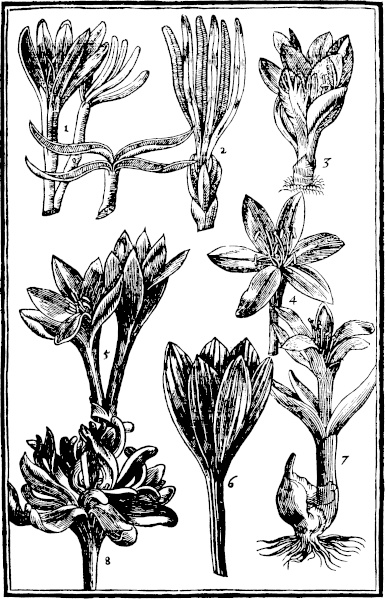
1Colchicum montanum Hispanicum. The little Spanish Medowe Saffron.
2Colchicum montanum minus versicolore flore. The small party coloured Medowe Saffron.
3Colchicum versicolor. The party coloured Medowe Saffron.
4Colchicum variegatum alterum. Another party coloured Medowe Saffron.
5Colchicum atropurpureum. The darke purple Medowe Saffron.
6Colchicum atropurpureum variegatum. The variable darke purple Medowe Saffron.
7Colchicum vernum. Medowe Saffron of the spring.
8Colchicum flore pleno. Double Medowe Saffron.
The Place.
All these Medowe Saffrons, or the most part of them, haue their places expressed in their titles; for some grow in the fields and medowes of the champion grounds, others on the mountaines and hilly grounds. The English kindes grow in the West parts, as about Bathe, Bristow, Warmister, and other places also. The double kindes are thought to come out of Germany.
The Time.
Their times likewise are declared in their seuerall descriptions: those that are earliest in Autumne, flower in August and September, the later in October, and the latest in the end of October, and in November. The other are said to bee of the Spring, in regard they come after the deepe of Winter (which is most vsually in December and Ianuary) is past.
The Names.
The generall name to all these plants is Colchicum, whereunto some haue added Ephemerum, because it killeth within one dayes space; and some Strangulatorium. Some haue called them also Bulbus Agrestis, and Filius ante Patrem, The Sonne before the Father, because (as they thinke) it giueth seede before the flower: but that is without due consideration; for the root of this (as of most other bulbous plants) after the stalke of leaues and seede are dry, and past, may be transplanted, and then it beginneth to spring and giue flowers before leaues, (and therein onely it is differing from other plants) but the leaues and seede follow successiuely after the flowers, before it may be remoued againe; so that here is not seede before flowers, but contrarily flowers vpon the first planting or springing, and seede after, as in all other plants, though in a diuers manner.
The Colchicum Hermodactilum may seeme very likely to bee the Colchicum Orientale of Matthiolus, or the Colchicum Alexandrinum of Lobelius: And some thinke it to be the true Hermodactilus, and so call it, but it is not so. We doe generally call them all in English Medowe Saffrons, or Colchicum, according to the Latine, giuing to euery one his other adiunct to know it by.
The Vertues.
None of these are vsed for any Physicall respect, being generally held to be deadly, or dangerous at the least. Only the true Hermodactile (if it be of this tribe, and not this which is here expressed) is of great vse, for paines in the ioynts, and of the hippes, as the Sciatica, and the like, to be taken inwardly. Costæus in his Booke of the nature of plants, saith, that the rootes of our common kindes are very bitter in the Spring of the yeare, and sweet in Autumne, which Camerarius contradicteth, saying, that he found them bitter in Autumne, which were (as he saith) giuen by some imposters to diuers, as an antidote against the Plague.
Chap. XVII. Crocus. Saffron.
There are diuers sorts of Saffrons, whereof many doe flower in the Spring time, and some in Autumne, among whom there is but one onely kinde, that is called tame or of the Garden, which yeeldeth those blades or chiues that are vsed in meates and medicines, and many wayes profitable for other respects, none of the rest, which are all wilde kindes, giuing any blade equall vnto those of the tame kinde, or for any other vse, then in regard of their beautifull flowers of seuerall varieties, and as they haue been carefully sought out, and preserued by diuers, to furnish a Garden of dainty curiosity. To entreate therefore of these, I must, to obserue an orderly declaration, diuide them into two primary families: the former shall be of those that yeeld their pleasant flowers in the Spring of the yeare, and the other that send out their colours in the Autumne, among whom that Rex pomarij (as I may so call it) the tame or manured kinde, properly called of the Garden, is to be comprehended, for that it giueth his pleasant flowers at that time among others. I shall againe distribute those of the Spring time into three chiefe colours, that is, into white, purple, and yellow, and vnder euery one of them, comprehend the seuerall varieties that doe belong vnto them; which course I will also hold with those of the Autumne, that thus being rightly ranked, they may the more orderly be described.
{Spring Saffron flowers}
1. Crocus Vernus albus purus minor. The smaller pure white Saffron flower of the Spring.
This small Saffron flower springeth vp in the beginning of the yeare, with three or foure small greene leaues, somewhat broader, but much shorter then the true Saffron leaues, with a white line downe the middle of euery leafe: betweene these leaues, out of a white skinne, riseth vp one or two small flowers, made of six leaues a peece, as all the rest in generall are, of a pure white colour, without any mixture in it, which abide not in flower aboue a weeke, or rather lesse, so sodainly is the pleasure of this, and the purple lost: it flowreth not for the most part, vntill a moneth after the yellow Crocus appeareth in flower, and the ordinary stript Crocus is past: the seede is small, round, and reddish, yet not so red as the seede of the yellow, contained in three square heads, yet seldome beareth, but encreaseth by the roote plentifully enough, which is small, round, and flat at the bottome, somewhat white on the outside, but whiter within, shooting out small sprouts on euery side of the roote, which is the best note to know this kinde and the lesser purple, which are both alike, from all other rootes of Saffron flowers.
2. Crocus albus maior multiflorus. The great snow white Crocus.
This greater Saffron flower riseth vp vsually with three or foure greene leaues, larger then the former, with a white line in euery one of them: the flowers are greater, and more in number, rising together, but flowring one after another, of a pure snow white colour, and abiding but little longer in flower then the former.
3. Crocus albus maior alter dictus Mæsiacus. The great white Saffron flower or Crocus of Mesia.
This great white Crocus of Mesia, riseth vp out of the ground, almost as early as the first sort of the yellow, with foure or fiue leaues, being very like vnto the leaues of the yellow Crocus, and as large, with white lines in them: the flowers also are as large as the flowers of the yellow, and many also rising one after another like vnto it, but not of so pure a white colour, as the former or last described, but rather tending to a Milky or Creame colour: the roote is not couered with any reddish, but rather pale skinnes or coates.
4. Crocus albus Mæsiacus fundo violaceo. The great white Crocus of Mesia with a blew bottome.
There is another of this kinde, like vnto the former in all things, sauing that the bottomes of the flowers of this kinde, with some part of the stalke next the flower, are of a pale shining purple colour, and rising vp a pretty way into the flower; whereas another also of this kind, hath a little shew or marke of blew, and not purple, at the bottome of the flower onely, which maketh a difference.
5. Crocus albus fundo purpureo. The white Crocus with a purple bottome.
This Saffron flower is of the same kinde with the first, both in roote, leafe, and flower, in none of them differing from it, but in that the bottome of this flower, with that part of the short foote-stalke next vnto it, is of violet or purple colour, and sometimes hauing here and there some purple small lines, or spots on the white leaues: it flowreth also with the first white, or somewhat later.
6. Crocus vernus albus striatus. The white stript Crocus.
This stript Saffron flower is likewise neare the same first kind, or first white Crocus, hauing the like leaues and flowers, somewhat larger, but as soone fading almost as it: but herein this flower differeth, that it hath pale blewish lines and spots in all the leaues thereof, and more principally in the three outer leaues: the root is also white on the outside, like the first white, but greater, with young ones growing round about it.
7. Crocus vernus albus polyanthos versicolor. The greater party coloured white Crocus.
The greater party coloured Saffron flower, hath his greene leaues like vnto the second great white Crocus before mentioned, hauing more flowers then any of the former, except the first great white, the leaues whereof haue greater stripes then the last recited Crocus, but of a purple Violet colour, making each leafe seeme oftentimes to haue as much purple as white in them: the roote hereof is somewhat like the second white, but of a little more duskie colour on the outside, and not budding out on the sides at all, or very little.
8. Crocus vernus albus versicolor. The lesser party coloured white Crocus.
The leaues and flowers of this other party coloured Crocus, are for bignesse in a manner equall with the last, but hath not so many flowers rising together from the roote: the flower is finely marked with blew strakes on the white flower, but nothing so much as in the former: the roote also is like the last.
9. Crocus Episcopalis. The Bishops Crocus.
This party coloured or Bishops Saffron flower, is very like both in leaues and rootes vnto the Neapolitane blew Crocus, but somewhat greater: the flowers doe abide not so long time blowne, and hath all the leaues either wholly white, with blew stripes on both sides of them, or wholly of a fine delayed blew Violet colour, and the three innermost more blew and finely striped, both on the inside and outside of them, and sometimes it hath been seen to haue three leaues white, and three leaues of a pale blew.
10. Crocus vernus striatus vulgaris. The ordinary stript Crocus.
There is another sort of stript Saffron flower, which is most common and plentifull in most Gardens, which I must needes bring vnder the ranke of these white kinds, although it differre very notably, both in roote, leafe, and flower, from all of them: the leaues of this rise vp sooner then the yellow or white Crocus, lying spread vpon the ground for the most part, but narrower then any of the former: among these leaues spring vp diuers flowers, almost as large as the former great white Crocus, of a very bleake or pale purple colour, tending to white on the inside, and in many almost white, with some small whitish chiues tipt with yellow in the middle: the three outer leaues are of a yellowish white colour on the backe side of them, stript euery one of them with three broad stripes, of a darke murrey or purple colour, and a little sprinkled with some small purple lines, on both sides of those stripes; but on the inside, of the same pale purple or white colour with the rest: the seede hereof is somewhat darker coloured then of the white, and is more liberall in bearing: the roote is differing from all the former, being rounder and bigger then any of them, except the kindes of Misia, yet somewhat flat withall, not hauing any shootes from the sides, but setting off into rootes plentifully, hauing a round circle compassing the bottome of the roote, which easily falleth away, when it is taken vp out of the ground, and couered with a browne coate, somewhat neare the colour of the yellow Crocus, but not altogether so bright: it flowreth vsually the first of all these sorts, or with the first of the early yellowes.
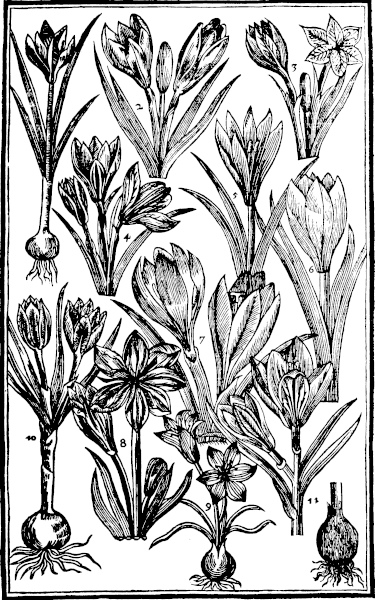
1Crocus vernus albus minor. The small white Saffron flower of the spring.
2Crocus vernus Mæsiacus albus. The great white Crocus of Misia.
3Crocus vernus albus striatus. The white stript Crocus.
4Crocus vernus albus polyanthos versicolor. The party coloured white Crocus.
5Crocus albus fundo purpureo. The white Crocus with a purple bottome.
6Crocus vernus Neapolitanus. The great blew Crocus of Naples.
7Crocus vernus purpureus maximus. The great purple Crocus.
8Crocus vernus purpureus striatus. The purple stript Crocus.
9Crocus vernus purpureus Capillarifolio. The purple Crocus with small leaues.
10Crocus vernus flavus striatus. The yellow stript Crocus.
11Crocus vernus luteus versicolor. The cloth of gold Crocus.
11. Crocus vernus striatus Turcitus. The Turkie stript Crocus.
There is another of this kinde, whose flower is a little larger, and of a deeper purple colour, both on the inside and outside; the greene leafe also is bigger, and of a more whitish colour.
12. Crocus vernus Capillarifolio albus. The white Crocus with small leaues.
This white Crocus is in all things like vnto the purple of the same kinde, but that the flower of this is wholly white: the full description therefore hereof, you shall haue in that purple with small leaues, of this kinde hereafter set downe, whereunto I referre you.
13. Crocus vernus purpureus minor. The smaller purple Crocus.
The smaller purple Saffron flower of the Spring, hath his greene leaues so like vnto the first white flowred Saffron, that they can hardly be distinguished, onely they seem to bee a little narrower: the flower is also much about the same bignesse, or a little bigger, and seldome beareth aboue one flower from a roote, euen as the first doth, of a deepe purple Violet colour, the bottome of the flower, with the vpper part of the stalke next thereunto, being of a deeper or blacker purple; in the middle of the flower are some pale chiues tipt with yellow pendents, and a longer pointell, diuided or forked at the toppe: the roote of this is in all things so like vnto the first white, that it is impossible for the most cunning and conuersant in them, to know the one from the other. This beareth seede very sparingly, as the white doth, and is reddish like vnto it, but recompenseth that defect with a plentifull encrease by the roote: it likewise flowereth at the very same time with the white, and endureth as small a time.
14. Crocus vernus purpureus maximus. The greatest purple Crocus.
This great purple Crocus is of the same kinde with the next described, as well in roote as leafe, but greater; for the greene leaues hereof are the greatest and broadest of all other Crocus, with a large white line in the middle of euery one: it springeth vp much later then the former, and doth not shew his flower vntill the other bee past a good while: the flowers also are the largest of all these Crocus of the Spring time, and equalling, if not surpassing that purple kinde that flowreth in Autumne, hereafter set forth, of a very faire and deepe Violet colour, almost as deepe as the former: the seed vessels are large also and white, wherein is contained pale reddish seede, like vnto the next blew kinde, but somewhat greater: the roote is (as I said before) like vnto the next, that is, flat and round, with a duskie coloured outside, whose head for springing in it is as hardly discerned.
Alter Apicibus albidis.
We haue one of this kinde, the toppes onely of whose purple flower are whitish, for the breadth of halfe the naile of a mans hand, which abideth constant euery yeare in that manner, and therefore is a difference fit to be remembred.
15. Crocus vernus Neapolitanus siue cæruleus maior. The greater blew Crocus of Naples.
This great blew Crocus riseth vp with diuers greene leaues, broader then any of the former (except the last) with a white line running downe the inside of euery leafe, as in the former, among which riseth vp, out of diuers great long white skinnes, diuers large flowers, but not fully so great as the former, consisting of six leaues, of a paler blew or Violet colour then in the former, hauing in the middle of the flowers a few pale threeds, tipt with yellow, and a longer pointell of a gold yellow colour, forked or diuided at the toppe, smelling sweeter then in the former, and abiding a great while longer, being in flower vsually euen with the stript yellow Crocus, or before the former purple, and yeelding more plenty of seede: the roote hereof is not very great, but a little darke on the outside, being round and flat withall, that one can hardly know which is the vpperside thereof.
Crocus Neapolitanus præcocior.
This kinde differeth very little from the former, either in roote, leafe, or flower, for the bignesse or colour, but that it seemeth to be a little bleaker or paler blew, because it flowreth a little earlier.
16. Crocus vernus purpureus striatus. The stript purple Crocus.
The leaues of this stript purple Saffron flower, are as large and broad as the last, or rather a little longer: the flowers also are as plentifull, and as large, of a fine delayed purple colour on the outside, with three broad strakes or lines downe the backe of the three outer leaues, and of a little deeper purple on the inside, as the other three leaues are also of a deeper purple colour, and are striped with the same deepe purple about the ground, or bottome of the leaues: this sometimes yeeldeth three square heads, containing in them brownish seede: the roote is like vnto the last, and flowreth much about the time of the former.
17. Crocus vernus purpureus versicolor. The siluer stript purple Crocus.
This stript Saffron flower, is in leaues and flowers somewhat like vnto the last stript purple, but a little smaller: the flowers are of a little deeper purple through the whole leaues, striped with white lines, both on the leaues, and towards the edges, which maketh a peculiar difference from all the rest: the roote of this is not so flat, though like it, and couered with a darke ash coloured skinne: it flowreth about the same time.
18. Crocus purpureus flammeus maior. The greater purple flame coloured Crocus.
The greene leaues of this Crocus or Saffron flower, are of a reasonable breadth and length, and of a pleasant fresh greenesse, with a faire broad white line downe the middle of them, but rising not out of the ground so early as the next described Crocus: the flowers are likewise of a meane bignesse, of a pale purple on the outside, somewhat whitish, especially the three outer leaues; but on the inside of a deeper purple, and striped with great stripes like flames, hauing some chiues in the middle, and a longer one also feathered a little at the toppe: the roote is white on the outside, somewhat flat and round, but not so flat as the Neapolitane Crocus before described.
19. Crocus purpureus flammeus minor. The lesser purple flame coloured Crocus.
This Crocus hath almost as broad and long greene leaues as the former, and of the same verdure, which rise vp earlier then it, and is in flower likewise somewhat before it, being smaller for size by a little, but of as deepe a purple on the outside, as on the inside, flamed with faire broad stripes from the middle of the leaues, or somewhat lower vnto the edges: each of these giue seed that is of a pale reddish colour: the root is very like vnto the former, but a little lesser.
20. Crocus vernus purpureus Capillarifolio. The purple Crocus with small leaues.
This small kinde of Saffron flower riseth out of the ground, with two or three long and small green leaues, very like vnto the leaues of the fine Fether-Grasse hereafter described, standing vpright at the first, but afterwards lying vpon the ground; among which come the flowers, sometimes three, but most vsually two vpon one stalke, if the roote be not young, which then will beare but one on a stalke, which is very short, so that the flowers scarce arise aboue the ground, yet laying themselues open in the day time, if it be faire, and the Sunne doe shine, otherwise they keepe close, and doe not open at all: and after one flower is past, which doth not last aboue three or foure dayes at the most, the others follow, which are of a bleake blewish purple in the middle of the flower, and of a deeper purple towards the ends or points or the leaues, but of a more sullen or darke purple on the outside of them, and yellowish at the bottome, with some yellow chiues in the middle: the seede is small and darker coloured then any of the former Crocus, contained also in smaller heads, standing one by another vpon the same short foote-stalke, which then riseth vp a little higher, shewing the maner of the standing of the flowers, which in their flowring time could not so easily bee discerned: the roote is very small and round, hauing one side at the bottome lower then the other, very like the roote of a Colchicum or Medowe Saffron, and somewhat neare resembling also the hoofe of an horse foote, couered with a very thicke skinne, of a darke or blackish browne colour: this flowreth the last of all the former sorts of Saffron flowers, euen when they are all past.
21. Crocus vernus purpureus striatus Capillarifolio. The stript purple Crocus with small leaues.
This small stript purple Saffron flower hath such like leaues, as the last described hath, betweene which riseth the flower vpon as short a foote-stalke, consisting of six leaues like the former, of a faire purple colour on the outside of the three outer leaues, with three lines or strakes downe euery leafe, of a deeper purple colour, and on the inside of a paler purple, as the other three leaues are also, with some chiues tipt with yellow pendents, and a forked pointell in the middle: the roote of this is somewhat bigger then the former, and rounder, but couered with as thicke and as browne a skinne: it flowreth about the same time with the former.
22. Crocus vernus luteus siue Mæsiacus. The yellow Crocus.
The yellow Crocus or Saffron flower, riseth vp with three or foure leaues out of the ground, being somewhat neare the breadth of the great purple kindes, with a white line in them, as in most of the rest: the flowers stand in the middle of these leaues, and are very large, of a gold yellow colour, with some chiues, and a forked point in the middle: the seede hereof is of a brighter colour then in any of the other: the roote is great and round, as great or greater then a Wall Nut sometimes, and couered with reddish skinnes or coates, yeelding more store of flowers then most of the former, and beginning to blowe with the first sorts, or presently after, but outlast many of them, and are of a pleasant good sent.
Flore aureo.
Of this kinde we haue some, whose flowers are of a deeper gold yellow colour then others, so that they appeare reddish withall.
Flore pallido.
And we haue also another sort, whose flowers are very pale, betweene a white and a yellow, not differing in any thing else.
Flore viridante luteo.
And another smaller, whose flower hath a shew of greennesse in the yellow, and more greene at the bottome.
23. Crocus vernus flavus striatus. The yellow stript Crocus.
This kinde of yellow stript Crocus or Saffron flower, riseth vp with more store of narrower and greener leaues then the former, and after the leaues are spread, there rise vp many yellow flowers from among them, which are not of so faire and bright a yellow colour, but more dead and sullen, hauing on the backside of each of the three outtermost leaues, three small stripes, of an ouer-worne or dull purple colour, with some chiues and a pointell in the middle: the roote of this kinde, is very like the roote of the former yellow, but somewhat smaller and shorter, and couered with the like reddish skinnes, but a little sadder: it flowreth not so early as the former yellow, but abideth almost as long as it.
24. Crocus vernus luteus versicolor primus. The best cloth of gold Crocus.
The fairest cloth of gold Crocus or Saffron flower, riseth vp very early, euen with the first, or the first of all other Crocus, with three or foure very narrow and short leaues, of a whiter colour then any of the former, which by and by after doe shew forth the flowers, rising from among them out of the same white skinne, which includeth the leaues, but are not so plentifull as the former yellow, being but two or three at the most, of a faire gold yellow colour, yet somewhat paler then the first, hauing on the backe of euery of the three outer leaues, three faire and great stripes, of a faire deepe purple colour, with some small lines at the sides or edges of those purple stripes; on the inside of these flowers, there is no signe or shew of any line or spot, but wholly of a faire gold yellow, with chiues and a fethertopt pointell in the middle: the seede hereof is like the former, but not so red: the roote of this kinde is easily knowne from the roote of any other Saffron flower, because the outer peelings or shels being hard, are as it were netted on the outside, hauing certaine ribbes, rising vp higher then the rest of the skinnes, diuided in the forme of a net-worke, of a darke browne colour, and is smaller and rounder then the former yellow, and not encreasing so plentifully by the roote.
25. Crocus vernus luteus versicolor alter. The second cloth of gold, or Duke Crocus.
There is no difference either in roote, leafe, or colour of flower, or time of flowring in this sort from the last before mentioned; for the flower of this is of the same bignesse and colour, the only note of difference is in the marking of the three outer leaues, which haue not three stripes like the former, but are wholly of the same deepe purple colour on the backe of them, sauing that the edges of them are yellow, which is the forme of a Duke Tulipa, and from thence it tooke the name of a Duke Crocus.
26. Crocus vernus versicolor pallideluteus. The pale cloth of gold Crocus.
We haue a third sort of this kinde of cloth of gold Crocus, which hath leaues and flowers like the former, but differeth in this, that the colour of the flower is of a paler yellow by much, but stript in the same manner as the first, but with a fainter purple colour: the roote also is netted like them, to shew that this is but a variation of the same kinde.
27. Crocus vernus versicolor albidoluteus. The cloth of siluer Crocus.
The chiefest note of difference in this Saffron flower is, that being as large a flower as any of the former of this kinde, it is of so pale a yellowish white, that it is more white then yellow, which some doe call a butter colour: the three outer leaues are striped on the backe of them, with a paler purple blew shining colour, the bottome of the flower, and the vpper part of the stalke, being of the same purple blew colour: the roote of this is also netted as the other, to shew it is a variety of the same kinde.
{Autumn Saffron flowers}
And thus much for those Saffron flowers that come in the Spring time; now to those that flower in Autumne onely: and first of the true Saffron.
1. Crocus verus sativus Autumnalis. The true Saffron.
The true Saffron that is vsed in meates and medicines, shooteth out his narrow long greene leaues first, and after a while the flowers in the middle of them appeare about the end of August, in September and October, according to the soile, and climate where they growe; these flowers are as large as any of the other former or late sorts, composed of six leaues a peece, of a murrey or reddish purple colour, hauing a shew of blew in them: in the middle of these flowers there are some small yellow chiues standing vpright, which are as vnprofitable, as the chiues in any other of the wilde Saffrons, before or hereafter specified; but besides these, each flower hath two, three, or foure greater and longer chiues, hanging downe vpon or betweene the leaues, which are of a fierie red colour, and are the true blades of Saffron, which are vsed physically or otherwise, and no other: All these blades being pickt from the seuerall flowers, are laid and pressed together into cakes, and afterwards dryed very warily on a Kill to preserue them; as they are to be seene in the shops where they are sold. I neuer heard that euer it gaue seede with any: the roote groweth often to be as great, or greater then a green Wall Nut, with the outer shell on it, couered with a grayish or ash-coloured skin, which breaketh into long haire threeds, otherwise then in any other roote of Crocus.
2. Crocus Byzantium argenteus. The siluer coloured Autumne Crocus.
This Saffron flower springeth vp in October, and seldome before, with three or foure short greene leaues at the first, but growing longer afterwards, and in the midst of them, presently after they haue appeared, one flower for the most part, and seldome two, consisting of six leaues, the three outermost whereof are somewhat larger then the other three within, and are of a pale bleake blew colour, almost white, which many call a siluer colour, the three innermost being of a purer white, with some yellow chiues in the middle, and a longer pointell ragged or fethered at the toppe: this very seldome beareth seede, but when the yeare falleth out to bee very milde; it is small, round, and of a darke colour: the roote is pretty bigge, and rounder then any other Crocus, without any flat bottome, and couered with a darke russet skinne.
3. Crocus Pyrenæus purpureus. The purple mountaine Crocus.
This purple Saffron flower of the Autumne, riseth vp but with one flower vsually, yet sometimes with two one after another, without any leaues at all, in September, or sometimes in August, standing vpon a longer foote-stalke then any kinde of Saffron flower, either of the Spring or Autumne, and is as large as the flower of the greatest purple Saffron flower of the Spring, of a very deepe Violet purple colour, which decayeth after it hath stood blowne three or foure dayes, and becommeth more pale, hauing in the middle some yellow chiues, and a long fether topt pointell, branched, and rising sometimes aboue the edges of the flowers: about a moneth after the flowers are past, and sometimes not vntill the first of the Spring, there riseth vp three or foure long and broad greene leaues, with a white line in euery one of them, like vnto the first purple Vernall kindes, which abide vntill the end of May or Iune: the roote is small and white on the outside, so like vnto the roote of the lesser Vernall purple or white Crocus, that it cannot be distinguished, vntill about the end of August, when it doth begin to shoot, and then by the early shooting vp a long white sprout for flower, it may be knowne. I neuer could obserue it to giue any seede, the Winter (as I thinke) comming on it so quickly after the flowring, being the cause to hinder it.
4. Crocus montanus Autumnalis. The Autumne mountaine Crocus.
The mountaine Saffron flower springeth vp later then any of the former, and doth not appeare vntill the middle or end of October, when all the flowers of the former are past, appearing first with three or foure short greene leaues, like vnto the Byzantine Crocus, and afterwards the flowers betweene them, which are of a pale or bleake blew tending to a purple, the foote-stalkes of them being so short, that they scarce appeare aboue ground at the first, but after two or three dayes they grow a little higher: the roote is very great and flat bottomed, couered with a grayish duskie coate or skinne, and encreaseth very little or seldome.
The Place.
The seuerall places of these Saffron flowers, are in part set downe in their titles; the others haue beene found out, some in one Countrey, and some in another, as the small purple and white, and stript white in Spaine: the yellow in Mesia about Belgrade, the great purple in Italy; and now by such friends helpes as haue sent them, they prosper as well in our Gardens, as in their naturall places. Yet I must giue you this to vnderstand, that some of these formerly expressed, haue been raised vp vnto vs by the sowing of their seede.
The Time.
Their seuerall times are likewise expressed in their descriptions; for some shew forth their pleasant flowers in the Spring, wherein for the three first moneths, our Gardens are furnished with the varietie of one sort or another: the rest in Autumne, that so they might procure the more delight, in yeelding their beauty both early and late, when scarce any other flowers are found to adorne them.
The Names.
I shall not neede to trouble you with an idle tale of the name of Crocus, which were to little purpose, nor to reiterate the former names imposed vpon them; let it suffice that the fittest names are giuen them, that may distinguish them one from another; onely this I must giue you to vnderstand, that the gold yellow Crocus or Saffron flower, is the true Crocus Mæsiacus, as I shewed before; and that neither the yellow stript, or cloth of gold (which wee so call after the Dutch name Gaud Laken) is the true Mæsiacus, as some suppose; and that the great white Saffron flower, by reason of his likenesse vnto the gold yellow, is called Crocus albus Mæsiaci facie, or facie lutei, that is, The white Saffron flower that is like the Mæsiacus or yellow.
The Vertues.
The true Saffron (for the others are of no vse) which wee call English Saffron, is of very great vse both for inward and outward diseases, and is very cordiall, vsed to expell any hurtfull or venomous vapours from the heart, both in the small Pockes, Measels, Plague, Iaundise, and many other diseases, as also to strengthen and comfort any cold or weake members.
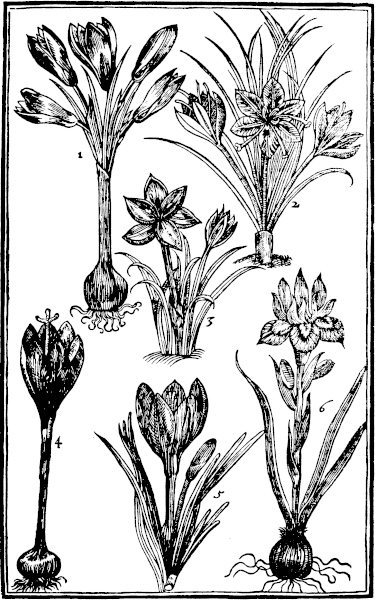
1Crocus vernus luteus vulgaris. The common yellow spring Crocus.
2Crocus verus sativus Autumnalis. The true Saffron.
3Crocus Byzantinus argenteus. The siluer coloured Autumne Crocus.
4Crocus Pyrenæus purpureus. The purple mountaine Crocus.
5Crocus montanus Autumnalis. The Autumne mountaine Crocus.
6Sisyrinchium maius. The greater Spanish Nut.
Chap. XVIII. Sisyrinchium. The Spanish Nut.
I can doe no otherwise then make a peculiar Chapter of this plant, because it is neither a Crocus, although in the roote it come somewhat neare vnto that kinde that is netted; but in no other part agreeing with any the delineaments of a Saffron flower, and therefore could not be thrust into the Chapter amongst them: neither can I place it in the forefront of the Chapter of the Iris bulbosa, or bulbous Flowerdeluces, because it doth not belong to that Family: and although the flower thereof doth most resemble a Flowerdeluce, yet in that no other parts thereof doe fitly agree thereunto, I haue rather chosen to seate it by it selfe betweene them both, as partaking of both natures, and so may serue in stead of a bridge, to passe from the one to the other, that is, from the Crocus or Saffron flower, to the Iris bulbosa or bulbous rooted Flowerdeluce, which shall follow in the next Chapter by themselues.
The Spanish Nut hath two long and narrow, soft and smooth greene leaues, lying for the most part vpon the ground, and sometimes standing vp, yet bending downewards; betweene these leaues riseth vp a small stalke, halfe a foote high, hauing diuers smooth soft greene leaues vpon it, as if they were skinnes, through which the stalke passeth; at the toppe whereof stand diuers flowers, rising one after another, and not all flowring at once: for seldome shall you haue aboue one flower blowne at a time, each whereof doth so quickly passe and fade away, that one may well say, that it is but one dayes flower, or rather the flower of a few houres: the flower it selfe hath nine leaues, like vnto a Flowerdeluce, whereof the three that fall downe, haue in each of them a yellow spot: the other three, which in the Flowerdeluces are hollow and ridged, couering the other three that fall downe, in this stand vpright, and are parted at the ends: the three that stand vp in the middle are small and short: the whole flower is smaller then any Flowerdeluce, but of sundry colours; for some are of an excellent skie colour blew, others of a Violet purple, others of a darker purple colour, and some white, and many others mixed, either pale blew and deepe purple, or white and blew mixed or striped together very variably, quickly fading as I said before: the seede is enclosed in small cods, so thinne and transparent that one may easily see, and tell the seeds as they lye, which are of a brownish red colour: the roote is small, blackish and round, wrapped in a thicke skinne or huske, made like vnto a net, or somewhat like vnto the roote of the cloth of gold Crocus: when the plant is in flower, it is found to haue two rootes one aboue another, whereof the vppermost is firme and sound, and the vndermost loose and spongie, in like manner as is found in the rootes of diuers Orchides or Satyrions, Bee-flowers and the like, and without any good taste, or sweetnesse at all, although Clusius saith otherwise.
Sisyrinchium Mauritanicum. The Barbary Nut.
There is another of this kinde, not differing from the former in any other notable part, but in the flower, which in this is of a delayed purplish red colour, hauing in each of the three lower leaues a white spot, in stead of the yellow in the former, but are as soone fading as they.
The Place.
The former doe grow very plentifully in many parts both of Spaine and Portugall, where Guillaume Boel, a Dutch man heretofore remembred often in this Booke, found them; of the sundry colours specified, whereas Clusius maketh mention but of one colour that he found.
The other was found in that part of Barbary, where Fez and Morocco do stand, and brought first into the Lowe-Countries: but they are both very tender, and will hardly abide the hard Winters of these colder regions.
The Time.
The first flowreth in May and Iune, the last not vntill August.
The Names.
The name Sisyrinchium is generally imposed vpon this plant, by all authors that haue written thereof, thinking it to bee the right Sisyrinchium of Theophrastus: but concerning the Spanish name Nozelha, which Clusius saith it is called by in Spaine, I haue beene credibly enformed by the aforenamed Boel, that this roote is not so called in those parts; but that the small or common stript Crocus is called Nozelha, which is sweete in taste, and desired very greedily by the Shepheards and Children, and that the roote of this Sisyrinchium or Spanish Nut, is without any taste, and is not eaten. And againe, that there is not two kindes, although it grow greater, and with more flowers, in those places that are neare the Sea, where both the washing of the Sea water, and the moisture and ayre of the Sea, causeth the ground to bee more fertile. This I thought good, from the true relation of a friend, to giue the world to vnderstand, that truth might expell errour.
The Vertues.
These haue not beene knowne to bee vsed to any Physicall purpose, but wholly neglected, vnlesse some may eate them, as Clusius reporteth.
Chap. XIX. Iris bulbosa. The bulbous Flowerdeluce.
The Flowerdeluces that haue bulbous rootes are of two sorts, the one greater then the other: the greater bearing larger and broader leaues and flowers, and the lesser narrower. But before I giue you the descriptions of the vsuall greater kindes, I must needes place one or two in the fore-front that haue no fellowes; the one is called of Clusius, his broad leafed Flowerdeluce, and the other a Persian, somewhat like vnto it, which although they differ notably from the rest, yet they haue the nearest resemblance vnto those greater kindes, that come next after them.
{Two that have no fellows}
Iris bulbosa prima latifolia Clusij. Clusius his first great bulbous Flowerdeluce.
This Flowerdeluce hath diuers long and broad leaues, not stiffe, like all the other, but soft and greenish on the vpperside, and whitish vnderneath; among which rise vp sometimes seuerall small, short, slender stalkes, and sometimes but one, not aboue halfe a foote high, bearing at the top one flower a peece, somewhat like vnto a Flowerdeluce, consisting of nine leaues, whereof those three that stand vpright, are shorter and more closed together, then in other sorts of Flowerdeluces; the other three that fall downe, turne vp their ends a little, and those three, that in other Flowerdeluces doe couer them at the bottome, stand like the vpright leaues of other Flowerdeluces, but are parted into two ends, like vnto two small eares: the whole flower is of a faire blew, or pale skie colour in most, with a long stripe in the middle of each of the three falling leaues, and in some white, but more seldome: the roote is reasonable great, round and white, vnder the blackish coates wherewith it is couered, hauing many long thicke white rootes in stead of fibres, which make them seeme to be Asphodill rootes. The flower is very sweete.
Iris bulbosa Persica. The Persian bulbous Flowerdeluce.
This Persian Flowerdeluce is somewhat like vnto the former, both in roote and in leafe, but that the leaues are shorter and narrower, and the flower being much about the same fashion, is of a pale blew russetish colour, each of the three lower falling leaues are almost wholly of a browne purple colour, with a yellow spot in the middle of them: this as it is very rare, so it seldome beareth flowers with vs.
The Place.
The first groweth in many places of Spaine and Portugall, from whence I and others haue often had it for our Gardens, but by reason of the tendernesse thereof, it doth hardly endure the sharpnesse of our cold Winters, vnlesse it be carefully preserued.
The other is said to come from Persia, and therefore it is so entituled, and is as tender to be kept as the other.
The Time.
The first flowreth most vsually not vntill May with vs, yet many times sooner: but in Ianuary and February, as Clusius saith, in the naturall places thereof.
The other is as early oftentimes when it doth flower with vs.
The Names.
Because Clusius by good iudgement referreth the first to the greater kindes of Flowerdeluces, and placeth it in the fore ranke, calling it Iris bulbosa latifolia prima, that is, The first broad leafed Flowerdeluce, and all others doe the like, I haue (as you see) in the like manner put it before all the other, and keepe the same name. The Spaniards, as he saith, called it Lirio espadanal, and they of Corduba, Lirios azules.
The other hath no other name then as it is in the title.
{Bulbous Flowerdeluce with broader leaves}
1. Iris bulbosa maior siue Anglica cærulea. The blew English bulbous Flowerdeluce.
This bulbous Flowerdeluce riseth vp early, euen in Ianuary oftentimes, with fiue or six long and (narrow, in comparison of any great breadth, but in regard of the other kinde) broad whitish green leaues, crested or straked on the backside, and halfe round, being hollow like a trough or gutter, white all along the inside of the leafe, and blunt at the end; among which riseth vp a stiffe round stalke, a cubit or two foot high, at the toppe whereof, out of a skinnie huske, commeth forth one or two flowers, consisting of nine leaues a peece, three whereof that are turned downewards, are larger and broader then the other, hauing in each of them a yellow spot, about the middle of the leafe, other three are small, hollow, ridged or arched, couering the lower part next the stalke of those falling leaues, turning vp their ends, which are diuided into two parts, other three stand vpright, and are very small at the bottome of them, and broader toward the toppe: the whole flower is of a faire blew colour; after the flowers are past, come vp three square heads, somewhat long, and lanke, or loose, containing in them round yellowish seede, which when it is ripe, will rattle by the shaking of the winde in the dry huskes: the roote of this kinde is greater and longer then any of the smaller kindes with narrow leaues, couered with diuers browne skinnes, which seeme to be fraught with long threeds like haires, especially at the small or vpper end of the roote, which thing you shall not finde in any of the smaller kindes.
2. Iris bulbosa maior purpurea & purpuro violacea. The paler or deeper purple great bulbous Flowerdeluce.
These purple Flowerdeluces differ not from the last described, either in roote or leafe: the chiefest difference consisteth in the flowers, which in these are somewhat larger then in the former, and in the one of a deepe blew or Violet purple colour, and in the other of a deepe purple colour, in all other things alike.
Flore cinereo.
There is also another, in all other things like vnto the former, but only in the flower, which is of a pale or bleake blew, which we call an ash-colour.
3. Iris bulbosa maior purpurea variegata siue striata. The great purple stript bulbous Flowerdeluce.
There is another of the purple kinde, whose flower is purple, but with some veines or stripes of a deeper Violet colour, diuersly running through the whole leaues of the flower.
Flore cinereo striata purpureo.
And another of that bleake blew or ash-colour, with lines and veines of purple in the leaues of the flowers, some more or lesse then other.
Flore purpureo orbe cinereo.
And againe another, whose flower is of a purple colour like vnto the second, but that round about that yellow spot, in the middle of each of the three falling leaues (as is vsuall in all the bulbous Flowerdeluces) there is a circle of a pale blew or ash-colour, the rest of the leafe remaining purple, as the other parts of the flower is.
4. Iris bulbosa maior flore rubente. The great peach coloured bulbous Flowerdeluce.
There is another of these greater kindes, more rare then any of the former, not differing in roote, leafe, or flower, from the former, but onely that the flower in this is of a pale reddish purple colour, comming somewhat neare vnto the colour of a peach blossome.
5. Iris bulbosa maior siue latifolia alba. The great white bulbous Flowerdeluce.
The great white bulbous Flowerdeluce, riseth not vp so early out of the ground as the blew or purple doth, but about a moneth or more after, whose leaues are somewhat larger, and broader then of the others: the stalke is thicker and shorter, bearing vsually two very large and great flowers, one flowring a little before the other, yet oftentimes both in flower together in the end, of a bleake blewish white colour, which wee call a siluer colour, while they are in the budde, and before they be blowne open, but then of a purer white, yet with an eye or shew of that siluer colour remaining in them, the three falling leaues being very large, and hauing that yellow spot in the middle of each of them: the seedes are likewise inclosed in heads, like vnto the blew or purple kindes, but larger, and are of a reddish yellow colour like them: the roote likewise is not differing, but greater.
6. Iris bulbosa maior alba variegata. The great white stript bulbous Flowerdeluce.
This white stript Flowerdeluce, is in roote, leafe, and flower, and in manner of growing, like vnto the former white Flowerdeluce; the onely difference is in the marking of the flower, being diuers from it: for this hath in the white flower great veines, stripes, or markes, of a Violet blew colour, dispersed through the leaues of the flower very variably, which addeth a superexcellent beauty to the flower.
7. Iris bulbosa maior siue latifolia versicolor. The great party coloured bulbous Flowerdeluce.
There is no difference in this from the former, but in the flower, which is of a whitish colour in the three falling leaues, hauing a circle of ash-colour about the yellow spot, the three rigged leaues being likewise whitish, but ridged and edged with that ash-colour, and the three vpright leaues of a pale blewish white colour, with some veines therein of a blewish purple.
Varietas.
There hath beene brought vnto vs diuers rootes of these kindes, with the dryed flowers remaining on them, wherein there hath beene seene more varieties, then I can well remember to expresse, which variety it is very probable, hath risen by the sowing of the seeds, as is truely obserued in the narrower leafed kinde of Flowerdeluce, in the Tulipa, and in some other plants.
Flore luteo.
Wee haue heard of one of this kinde of broad leafed Flowerdeluces, that should beare a yellow flower, in the like manner as is to be seene in the narrow leafed ones: but I haue not seene any such, and therefore I dare report no further of it, vntill time hath discouered the truth or falshood of the report.
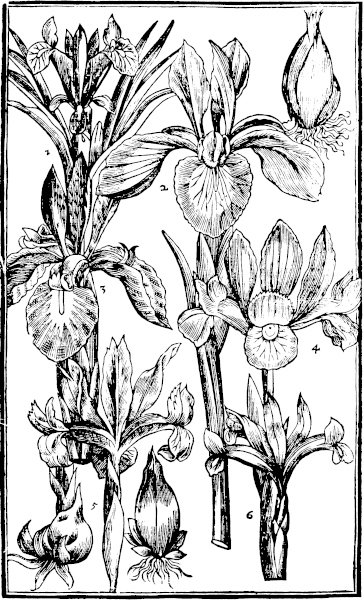
1Iris bulbosa latifolia prima Clusii. Clusius his first great bulbous Flowerdeluce.
2Iris bulbosa maior cærulea siue Anglica. The great blew of English bulbous Flowerdeluce.
3Iris bulbosa maior purpurea variegata. The great purple stript bulbous Flowerdeluce.
4Iris bulbosa angustifolia maior alba. The greater white narrow leafed bulbous Flowerdeluce.
5Iris bulbosa angustifolia versicolor. The party coloured narrow leafed bulbous Flowerdeluce.
6Iris bulbosa angustifolia Africana. The purple African bulbous narrow leafed Flowerdeluce.
The Place.
Lobelius is the first reporter, that the blew Flowerdeluce or first kinde of these broad leafed Flowerdeluces, groweth naturally in the West parts of England; but I am in some doubt of the truth of that report: for I rather thinke, that some in their trauels through Spaine, or other parts where it groweth, being delighted with the beauty of the flower, did gather the rootes, and bring them ouer with them, and dwelling in some of the West parts of England, planted them, and there encreasing so plentifully as they doe, they were imparted to many, thereby in time growing common in all Countrey folkes Gardens thereabouts. They grow also, and all the other, and many more varieties, about Tholouse, from whence Plantinianus Gassanus both sent and brought vs them, with many other bulbous rootes, and rare plants gathered thereabouts.
The Time.
These doe flower vsually in the end of May, or beginning of Iune, and their seede is ripe in the end of Iuly or August.
The Names.
Lobel calleth the first English blew Flowerdeluce, Hyacinthus Poetarum flore Iridis, & propter Hyacinthinum colorem, id est violaceum dictus: but I know not any great good ground for it, more then the very colour; for it is neither of the forme of a Lilly, neither hath it those mourning markes imprinted in it, which the Poet faineth to bee in his Hyacinth. It is most truely called an Iris, or Flowerdeluce (and there is great difference betweene a Lilly and a Flowerdeluce, for the formes of their flowers) because it answereth thereunto very exactly, for the flower, and is therefore called vsually by most, either Iris bulbosa Anglica, or Iris bulbosa maior siue latifolia, for a difference betweene it, and the lesser with narrow leaues: In English, eyther The great English bulbous Flowerdeluce, or the great broad leafed bulbous Flowerdeluce, which you will, adding the other name, according to the colour.
{Bulbous Flowerdeluce with narrow leaves}
And thus much for these broad leafed bulbous Flowerdeluces, so much as hath come to our knowledge. Now to the seuerall varieties of the narrow leafed bulbous Flowerdeluces, so much likewise as we haue been acquainted with.
Iris bulbosa minor siue angustifolia alba. The smaller white or narrow leafed bulbous Flowerdeluce.
This first Flowerdeluce, which beareth the smaller flower of the two white ones, that are here to bee described, springeth out of the ground alwaies before Winter, which after breaketh forth into foure or fiue small and narrow leaues, a foote long or more, of a whitish greene on the inside, which is hollow and chanalled, and of a blewish greene colour on the outside, and round withall: the stalke of this kinde is longer and slenderer then the former, with some shorter leaues vpon it, at the toppe whereof, out of short skinny leaues, stand one or two flowers, smaller, shorter, and rounder then the flowers of the former broad leafed Flowerdeluces, but made after the same proportion with nine leaues, three falling downewards, with a yellow spot in the middle, other three are made like a long arch, which couer the lower part next the stalke of those falling leaues, and turne vp at the ends of them, where they are diuided into two parts: the other three stand vpright, betweene each of the three falling leaues, being somewhat long and narrow: the flower is wholly, (sauing the yellow spot) of a pure white colour, yet in some hauing a shew of some blew throughout, and in others towards the bottome of the three vpright leaues: after the flowers are past, there rise vp so many long cods or seede vessels, as there were flowers, which are longer and smaller then in the former, and a little bending like a Corner, with three round squares, and round pointed also, which diuiding it selfe when the seede is ripe into three parts, doe shew six seuerall cells or places, wherein is contained such like round reddish yellow seedes, but smaller then the former: the roote is smaller and shorter then the former, and without any haires or threeds, couered with browne thin skinnes, and more plentifull in giuing encrease.
Iris bulbosa angustifolia alba flore maiore. The greater white narrow leafed bulbous Flowerdeluce.
I shall not neede to make a seuerall description to euery one of these Flowerdeluces that follow, for that were but to make often repetition of one thing, which being once done, as it is, may well serue to expresse all the rest, and but onely to adde the especiall differences, either in leafe or flower, for bignesse, colour, or forme, as is expedient to expresse and distinguish them seuerally. This greater white bulbous Flowerdeluce is like vnto the last described in all parts, sauing that it is a little larger and higher, both in leafe, stalke, and flower, and much whiter then any of these mixed sorts that follow, yet not so white as the former: the roote hereof is likewise a little bigger and rounder in the middle.
Albescens. Milke white.
There is another, whose falling leaues haue a little shew of yellownesse in them, and so are the middle ridges of the arched leaues, but the vpright leaues are more white, not differing in roote or leafe from the first white.
Argentea. Siluer colour.
And another, whose falls are of a yellowish white, like the last, the arched leaues are whiter, and the vpright leaues of a blewish white, which we call a siluer colour.
Albida. Whitish.
Another hath the fals yellowish, and sometimes with a little edge of white about them, and sometimes without; the vpright leaues are whitish, as the arched leaues are, yet the ridge yellower.
Albida labris luteis. White with yellow fals.
Another hath his fals yellow, and the vpright leaues white, all these flowers are about the same bignesse with the first.
Albida angustior. The narrow white.
But we haue another, whose flower is smaller, and almost as white as the second, the lower leaues are small, and doe as it were stand outright, not hauing almost any fal at all, so that the yellow spot seemeth to be the whole leafe, the arched leaues are not halfe so large as in the former, and the vpright leaues bowe themselues in the middle, so that the tops doe as it were meete together.
And another of the same, whose falling leaues are a little more eminent and yellow, with a yellower spot.
Aurea siue lutea Hispanica. The Spanish yellow.
We haue another kinde that is called the Spanish yellow, which riseth not vp so high, as ordinarily most of the rest doe, and is wholly of a gold yellow colour.
Pallide lutea. Straw colour.
There is another, that vsually riseth higher then the former yellow, and is wholly of a pale yellow, but deeper at the spot.
Albida lutea. Pale Straw colour.
There is also another like vnto the pale yellow, but that the falling leaues are whiter then all the rest of the flower.
Mauritanica flaua serotina minor. The small Barbary yellow.
There is a smaller or dwarfe kinde, brought from the backe parts of Barbary, neare the Sea, like vnto the yellow, but smaller and lower, and in stead of vpright leaues, hath small short leaues like haires: it flowreth very late, after all others haue almost giuen their seede.
Versicolor Hispanica cærulea labris albis. The party coloured Spanish.
We haue another sort is called the party coloured Spanish bulbous Flowerdeluce, whose falling leaues are white, the arched leaues of a whitish siluer colour, and the vpright leaues of a fine blewish purple.
Diuersitas. The diuersity or variation of this flower.
Yet sometimes this doth vary; for the falling leaues will haue either an edge of blew, circling the white leaues, the arched leaues being a little blewer, and the vpright leaues more purple.
Or the fals will be almost wholly blew, edged with a blewer colour, the arched leaues pale blew, and the vpright leaues of a purplish blew Violet colour.
Or the fals white, the arched leaues pale white, as the vpright leaues are.
Of not of so faire a blewish purple, as the first sort is.
Some of them also will haue larger flowers then others, and be more liberall in bearing flowers: for the first sort, which is the most ordinary, seldome beareth aboue one flower on a stalke, yet sometimes two. And of the others there are some that will beare vsually two and three flowers, yet some againe will beare but one. All these kindes smell sweeter then many of the other, although the most part are without sent.
Cærulea siue purpurea minor Lusitanica præcox. The small early purple Portugall.
There is another kinde, that is smaller in all the parts thereof then the former, the stalke is slender, and not so high, bearing at the toppe one or two small flowers, all wholly of a faire, blewish purple, with a yellow spot in euery one of the three falling leaues, this vsually flowreth early, euen with the first bulbous Flowerdeluces.
Purpurea maior. The greater purple.
We haue another purple, whose flower is larger, and stalke higher, and is of a very reddish purple colour, a little aboue the ground, at the foote or bottome of the leaues and stalke: this flowreth with the later sort of Flowerdeluces.
Purpurea serotina. The late purple.
There is another, whose flower is wholly purple, except the yellow spot, and flowreth later then any of the other purples.
Purpurea rubescens labris cæruleis. A reddish purple with blew fals.
There is yet another purple, whose vpright leaues are of a reddish purple, and the falling leaues of a blew colour.
Purpurea rubescens labris albido cæruleis. A reddish purple with whitish blew fals.
And another of a reddish purple, whose falling leaues are of a whitish blew colour, in nothing else differing from the last.
Purpurea labris luteis. Party coloured purple & yellow.
Another hath his falling leaues of a faire gold yellow, without any stripe, yet in some there are veines running through the yellow leaues, and some haue an edge of a sullen darke colour about them: the vpright leaues in euery of these, are a Violet purple.
Purpurea labris ex albido cærulea & luteo mixtis. Party coloured purple with stript yellow fals.
Another is altogether like this last, but that the falling leaues are of a pale blew and yellow, trauersing one the other, and the arched leaues of a pale purplish colour.
Subpurpurea labris luteis. Pale purple with yellow fals.
Another hath his vpright leaues of a paler purple, and the falling leaues yellow.
A paler purple.
And another little differing from it, but that the arched leaues are whitish.
Subcærulea labris luteis. Party coloured blew and yellow.
Another whose vpright leaues are of a pale blew, and the falling leaues yellow.
And another of the same sort, but of a little paler blew.
Crinis coloris elegantioris. A faire haire colour.
We haue another sort, whose vpright leaues are of a faire brownish yellow colour, which some call a Fuille mort, and others an haire colour; the falling leaues yellow.
Altera obsoletior. A dull haire colour.
And another of the same colour, but somewhat deader.
Iris bulbosa Africana serpentriæ caule. The purple or murrey bulbous Barbary Flowerdeluce.
This Flowerdeluce as it is more strange (that is, but lately knowne and possessed by a few) so it is both more desired, and of more beauty then others. It is in all respects, of roote, leafe, and flower, for the forme like vnto the middle sort of these Flowerdeluces, onely the lowest part of the leaues and stalke, for an inch or thereabouts, next vnto the ground, are of a reddish colour, spotted with many spots, and the flower, being of a meane size, is of a deepe purplish red or murrey colour the whole flower throughout, except the yellow spot in the middle of the three lower or falling leaues, as is in all others.
Purpurea cærulea obsoleta labris fuscis. The duskie party coloured purple.
And lastly, there is another sort, which is the greatest of all these narrow leafed Flowerdeluces, in all the parts of it; for the roote is greater then any of the other, being thicke and short: the leaues are broader and longer, but of the same colour: the stalke is stronger and higher then any of them, bearing two or three flowers, larger also then any of the rest, whose falling leaues are of a duskie yellow, and sometimes with veines and borders about the brimmes, of another dunne colour, yet hauing that yellow spot that is in all: the arched leaues are of a sullen pale purplish yellow, and the vpright leaues of a dull or duskie blewish purple colour: the heads or hornes for seede are likewise greater, and so is the seede also a little.
The Place.
These Flowerdeluces haue had their originall out of Spaine and Portugall, as it is thought, except those that haue risen by the sowing, and those which are named of Africa.
The Time.
These flower in Iune, and sometimes abide vnto Iuly, but vsually not so early as the former broad leafed kindes, and are soone spoiled with wet in their flowring.
The Names.
The seuerall names, both in Latine and English, are sufficient for them as they are set downe; for we know no better.
The Vertues.
There is not any thing extant or to be heard, that any of these kindes of Flowerdeluces hath been vsed to any Physicall purposes, and serue onely to decke vp the Gardens of the curious.
{Conclusion}
And thus much for these sorts of bulbous Flowerdeluces, and yet I doubt not, but that there are many differences, which haue risen by the sowing of the seede, as many may obserue from their owne labours, for that euery yeare doth shew forth some variety that is not seene before. And now I will conuert my discourse a while likewise, to passe through the seuerall rankes of the other kindes of tuberous rooted Flowerdeluces, called Flagges.
Chap. XX. Iris latifolia tuberosa. The Flagge or Flowerdeluce.
There are two principall kindes of tuberous or knobby rooted Flowerdeluces, that is, the tall and the dwarfe, or the greater and the lesser; the former called Iris maior or latifolia, and the other Iris minor, or rather Chamæiris; and each of these haue their lesser or narrow leafed kindes to bee comprehended vnder them: Of all which in their order. And first of that Flowerdeluce, which for his excellent beautie and raritie, deserueth the first place.
{Turkie Flowerdeluce}
Iris Chalcedonica siue Susiana maior. The great Turkie Flowerdeluce.
The great Turkie Flowerdeluce, hath diuers heads of long and broad fresh greene leaues, yet not so broad as many other of those that follow, one folded within another at the bottome, as all other of these Flowerdeluces are: from the middle of some one of those heads (for euery head of leaues beareth not a flower) riseth vp a round stiffe stalke, two foote high, at the toppe whereof standeth one flower (for I neuer obserued it to beare two) the largest almost, but rarest of all the rest, consisting of nine leaues, like the others that follow, but of the colour almost of a Snakes skinne, it is so diuersly spotted; for the three lower falling leaues are very large, of a deepe or darke purple colour, almost blacke, full of grayish spots, strakes, and lines through the whole leaues, with a blacke thrume or freeze in the middle of each of them: the three arched leaues that couer them, are of the same darke purple colour, yet a little paler at the sides, the three vpper leaues are very large also, and of the same colour with the lower leaues, but a little more liuely and fresh, being speckled and straked with whiter spots and lines; which leaues being laid in water, will colour the water into a Violet colour, but if a little Allome be put therein, and then wrung or pressed, and the iuice of these leaues dryed in the shadow, will giue a colour almost as deepe as Indico, and may serue for shawdowes in limming excellent well: the flower hath no sent that can be perceiued, but is onely commendable for the beauty and rarity thereof: it seldome beareth seedes in these cold Countries, but when it doth, it is contained in great heads, being brownish and round, but not so flat as in other sorts, the roots are more browne on the outside, and growing tuberous thicke, as all other that are kept in Gardens.
Iris Chalcedonica siue Susiana minor. The lesser Turkie Flowerdeluce.
There is another hereof little differing, but that the leafe is of a more yellowish greene colour, and the flower neither so large or faire, nor of so perspicuous markes and spots, nor the colour of that liuely (though darke) lustre.
The Place.
These haue been sent out of Turkie diuers times among other things, and it should seeme, that they haue had their originall from about Susis, a chiefe Citie of Persia.
The Time.
They flower in May most vsually, before any of the other kindes.
The Names.
They haue been sent vnto vs, and vnto diuers other in other parts, from Constantinople vnder the name of Alaia Susiana, and thereupon it hath been called, both of them and vs, either Iris Chalcedonica, or Susiana, and for distinction maior or minor: In English, The Turkie Flowerdeluce, or the Ginnie Hen Flowerdeluce, the greater or the lesser.
{Tuberous Flowerdeluces}
Iris alba Florentina. The white Flowerdeluce.
The great white Flowerdeluce, hath many heads of very broad and flat long leaues, enclosing or folding one within another at the bottome, and after a little diuided one from another toward the top, thin edged, like a sword on both sides, and thicker in the middle: from the middle of some of these heads of leaues, riseth vp a round stiffe stalk, two or three foot high, bearing at the top one, two, or three large flowers, out of seuerall huskes or skins, consisting of nine leaues, as all the other do, of a faire white colour, hauing in the middle of each of the three falling leaues, a small long yellow frize or thrume, as is most vsuall in all the sorts of the following Flowerdeluces, both of the greater and smaller kindes: after the flowers are past, come the seed, inclosed in thicke short pods, full fraught or stored with red roundish and flat seede, lying close one vpon another: the roote is tuberous or knobby, shooting out from euery side much like tuberous heads, lying for the most part vpon or aboue the ground, and fastened within the ground with long white strings or fibres, which hold them strongly, and encreaseth fast. There Flore pallido. is another like vnto this last in all things, sauing that the colour of the flower is of a more yellowish white, which we vsually call a Straw colour.
Iris alba maior versicolor. The white party coloured Flowerdeluce.
This variable Flowerdeluce is like vnto the former, but that the leaues are not so large and broad, the flower hereof is as large almost, and as white as the former, but it hath a faire list or line of a blewish purple downe the backe of euery one of the three vpright leaues, and likewise round about the edges, both of the vpper and lower leaues, and also a little more purplish vpon the ridge of the arched leaues, that couer the falling leaues: the roote hereof is not so great as of the former white, but a little slenderer and browner.
Iris Dalmatica maior. The great Dalmatian Flowerdeluce.
This greater Flowerdeluce of Dalmatia, hath his leaues as large and broad as any of the Flowerdeluces whatsoeuer, his stalke and flower doe equall his other proportion, onely the colour of the flower is differing, being of a faire watchet or bleake blew colour wholly, with the yellow frize or thrum downe the middle of the lower or falling leaues, as before is said to be common to all these sorts of Flowerdeluces; in all other parts it little differeth, sauing onely this is obserued to haue a small shew of a purplish red about the bottome of the greene leaues.
Iris purpurea siue vulgaris. The common purple Flowerdeluce.
This Flowerdeluce, which is most common in Gardens, differeth nothing at all from those that are formerly described, either in roote, leafe, or flower for the forme of them, but onely that the leaues of this are not so large as the last, and the flower it selfe is of a deep purple or Violet colour, and sometimes a little declining to rednesse, especially in some places.
Purpurea pallidior versicolor.
Sometimes this kinde of Flowerdeluce will haue flowers of a paler purple colour, comming neare vnto a blew, and sometimes it will haue veines or stripes of a deeper blew, or purple, or ash-colour, running through all the vpper and lower leaues.
Cærulea labris purpureis.
There is another like vnto this, but more purple in the fals, and more pale in the vpright leaues.
Iris Asiatica cærulea. The blew Flowerdeluce of Asia.
This Flowerdeluce of Asia, is in largenesse of leaues like vnto the Dalmatian, but beareth more store of flowers on seuerall branches, which are of a deeper blew colour, and the arched leaues whitish on the side, and purplish on the ridges, but in other things like vnto it.
Purpurea.
There is another neare vnto this, but that his leaues are a little narrower, and his flowers a little more purple, especially the vpper leaues.
Iris Damascena. The Flowerdeluce of Damasco.
This is likewise altogether like the Flowerdeluce of Asia, but that it hath some white veines in the vpright leaues.
Iris Lusitanica biflora. The Portugall Flowerdeluce.
This Portugall Flowerdeluce is very like the common purple Flowerdeluce, but that this is not so large in leaues, or flowers, and that it doth often flower twice in a yeare, that is, both in the Spring, and in the Autumne againe, and besides, the flowers haue a better or sweeter sent, but of the like purple or Violet colour as it is, and comming forth out of purplish skins or huskes.
Iris Camerarij siue purpurea versicolor maior. The greater variable coloured purple Flowerdeluce.
The greater of the variable purple Flowerdeluces, hath very broad leaues, like vnto the leaues of the common purple Flowerdeluce, and so is the flower also, but differing in colour, for the three lower leaues are of a deepe purple colour tending to rednesse, the three arched leaues are of the colour with the vpper leaues, which are of a pale or bleake colour tending to yellownesse, shadowed ouer with a smoakie purplish colour, except the ridges of the arched leaues, which are of a more liuely purple colour.
Iris purpurea versicolor minor. The lesser variable purple Flowerdeluce.
This Flowerdeluce differeth not in any thing from the last, but onely that it hath narrower greene leaues, and smaller and narrower flowers, else if they be both conferred together, the colours will not seeme to varie the one from the other any whit at all.
Altera minus fuliginea.
There is another somewhat neare vnto these two last kindes, whose huskes from whence the flowers doe shoote forth, haue purple veines in them, and so haue the falling purplish leaues, and the three vpright leaues are not so smoakie, yet of a dun purple colour.
Iris cærulea versicolor. The blew party coloured Flowerdeluce.
This party coloured Flowerdeluce hath his leaues of the same largenesse, with the lesser variable purple Flowerdeluce last described, and his flowers diuersly marked: for some haue the fals blew at the edges, and whitish at the bottome, the arched leaues of a yellowish white, and the vpright leaues of a whitish blew, with yellowish edges. Some againe are of a darker blew, with brownish spots in them. And some are so pale a blew, that we may well call it an ash-colour: And lastly, there is another of this sort, whose vpright leaues are of a faire pale blew, with yellowish edges, and the falling leaues parted into two colours, sometimes equally in the halfe, each side sutable to the other in colour: And sometimes hauing the one leafe in that manner: And sometimes but with a diuers coloured list in them; in the other parts both of flower and leafe, like vnto the other.
Iris lutea variegata. The yellow variable Flowerdeluce.
This yellow variable Flowerdeluce loseth his leaues in Winter, contrary to all the former Flowerdeluces, so that his roote remaineth vnder ground without any shew of leafe vpon it: but in the beginning of the Spring it shooteth out faire broad leaues, falling downwards at the points or ends, but shorter many times then any of the former, and so is the stalke likewise, not rising much aboue a foote high, whereon are set two or three large flowers, whose falling leaues are of a reddish purple colour, the three that stand vpright of a smoakie yellow, the arched leaues hauing their ridges of a bleake colour tending to purple, the sides being of the former smoakie yellow colour, with some purplish veines at the foote or bottome of all the leaues: the roote groweth somewhat more slender and long vnder ground, and of a darker colour then manie of the other.
Another sort hath the vpright leaues of a reasonable faire yellow, and stand more vpright, not bowing downe as most of the other, and the purple fals haue pale edges. Some Varietas. haue their greene leaues party coloured, white and greene, more or lesse, and so are the huskes of the flowers, the arched leaues yellow, as the vpright leaues are, with purplish veines at the bottome. And some haue both the arched and vpright leaues of so pale a yellow, that we may almost call it a straw colour, but yellower at the bottome, with purple veines, and the falling leaues purple, with two purple spots in them.
And these are the sorts of the greater tuberous or Flagge Flowerdeluces that haue come to our knowledge: the next hereunto are the lesser or narrow leafed kindes to be described; and first of the greatest of them.
1. Iris angustifolia Tripolitana aurea. The yellow Flowerdeluce of Tripoly.
This Flowerdeluce I place in the forefront of the narrow leafed Flowerdeluces, for the length of the leaues, compared with the breadth of them; it may fitly bee called a narrow leafed Flowerdeluce, although they be an inch broad, which is broader then any of them that follow, or some of those are set downe before, but as I said, the length make them seem narrow, and therefore let it take vp his roome in this place, with the description that followeth. It beareth leaues a yard long, or not much lesse, and an inch broad, as is said before, or more, of a sad greene colour, but not shining: the stalke riseth vp to be foure of fiue foote high, being strong and round, but not very great, bearing at the toppe two or three long and narrow gold yellow flowers, of the fashion of the bulbous Flowerdeluces, as the next to bee described is, without any mixture or variation therein: the heads for seede are three square, containing within them many flat cornered seedes: the roote is long and blackish, like vnto the rest that follow, but greater and fuller.
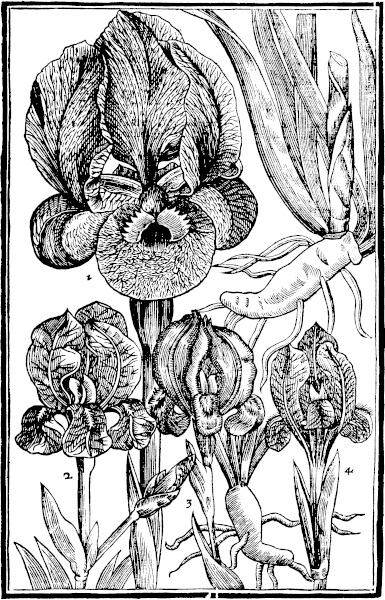
1Iris Chalcedonica siue Susiana maior. The great Turkie Flowerdeluce.
2Iris alba Florentina. The white Flowerdeluce.
3Iris latifolia variegata. The variable Flowerdeluce.
4Chamæiris latifolia maior. The greater dwarfe Flowerdeluce.
2. Iris angustifolia maior cærulea. The greater blew Flowerdeluce with narrow leaues.
This kinde of Flowerdeluce hath his leaues very long and narrow, of a whitish greene colour, but neither so long or broad as the last, yet broader, thicker and stiffer then any of the rest with narrow leaues that follow: the stalke riseth sometimes no higher then the leaues, and sometimes a little higher, bearing diuers flowers at the top, successiuely flowring one after another, and are like vnto the flowers of the bulbous Flowerdeluces, but of a light blew colour, and sometimes deeper: after the flowers are past, rise vp six cornered heads, which open into three parts, wherein is contained browne seede, almost round: the roote is small, blackish and hard, spreading into many long heads, and more closely growing or matting together.
3. Iris angustifolia purpurea marina. The purple narrow leafed Sea Flowerdeluce.
This Sea Flowerdeluce hath many narrow hard leaues as long as the former, and of a darke greene colour, which doe smell a little strong: the stalke beareth two or three flowers like the former, but somewhat lesse, and of a darke purple or Violet colour: in seede and roote it is like the former.
4. Iris angustifolia purpurea versicolor. The variable purple narrow leafed Flowerdeluce.
The leaues of this Flowerdeluce are very like the former Sea Flowerdeluce, and do a little stinke like them; the flowers are differing, in that the vpper leaues are wholly purple or violet, and the lower leaues haue white veines, and purple running one among another: the seede and rootes differ not from the former purple Sea kinde.
5. Iris angustifolia minor Pannonica siue versicolor Clusij. The small variable Hungarian Flowerdeluce of Clusius.
This Hungarian Flowerdeluce (first found out by Clusius, by him described, and of him tooke the name) riseth vp with diuers small tufts of leaues, very long, narrow, and greene, growing thicke together, especially if it abide any time in a place; among which riseth vp many long round stalkes, higher then the leaues, bearing two or three, or foure small flowers, one aboue another, like the former, but smaller and of greater beauty: for the lower leaues are variably striped with white and purple, without any thrume or fringe at all; the vpper leaues are of a blewish fine purple or Violet colour, & so are the arched leaues, yet hauing the edges a little paler: the heads for seede are smaller, and not so cornered as the other, containing seedes much like the former, but smaller: the roote is blacke and small, growing thicker and closer together then any other, and strongly fastened in the ground, with a number of hard stringie rootes: the flowers are of a reasonable good sent.
6. Iris angustifolia maior flore duplici. The greater double blew Flowerdeluce.
This Flowerdeluce, differeth not either in roote or leafe from the first great blew Flowerdeluce of Clusius, but onely in that the leaues grow thicker together, and that the flowers of this kinde are as it were double with many leaues confusedly set together, without any distinct parts of a Flowerdeluce, and of a faire blew colour with many white veines and lines running in the leaues; yet oftentimes the stalke of flowers hath but two or three small flowers distinctly set together, rising as it were out of one huske.
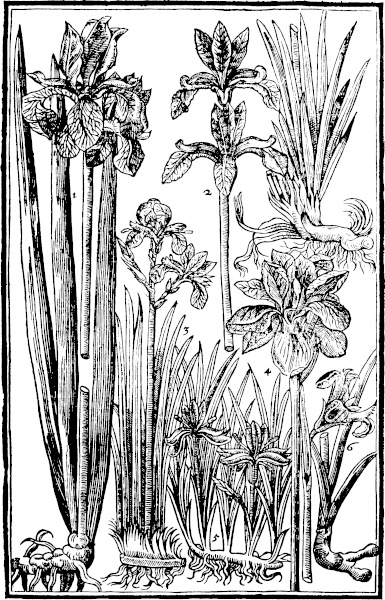
1Iris angustifolia Tripolitana. The yellow Flowerdeluce of Tripoli.
2Iris angustifolia maior cærulea. The greater blew Flowerdeluce with narrow leaues.
3Iris angustifolia minor Pannonica siue versicolor Clusii. The small variable Hungarian Flowerdeluce of Clusius.
4Iris angustifolia maior flore duplici. The greater double blew Flowerdeluce.
5Chamæiris angustifolia minor. The lesser Grasse Flowerdeluce.
6Iris tuberosa. The veluet Flowerdeluce.
7. Iris angustifolia minor alba Clusij. The small white Flowerdeluce of Hungary.
This likewise differeth little from the former Hungarian Flowerdeluce of Clusius, but that the leafe is of a little paler greene colour, and the flower is of a faire whitish colour, with some purple at the bottome of the leaues.
Next after these narrow leafed Flowerdeluces, are the greater and smaller sorts of dwarfe kindes to follow; and lastly, the narrow or grasse leafed dwarfe kindes, which will finish this Chapter of Flowerdeluces.
1. Chamæiris latifolia maior alba. The greater white dwarfe Flowerdeluce.
This dwarfe Flowerdeluce hath his leaues as broad as some of the lesser kindes last mentioned, but not shorter; the stalke is very short, not aboue halfe a foote high or thereabouts, bearing most commonly but one flower, seldome two, which are in some of a pure white, in others paler, or somewhat yellowish through the whole flower, except the yellow frize or thrume in the middle of euery one of the falling leaues: after the flowers are past, come forth great heads, containing within them round pale seed: the roote is small, according to the proportion of the plant aboue ground, but made after the fashion of the greater kindes, with tuberous peeces spreading from the sides, and strong fibres or strings, whereby they are fastened in the ground.
2. Chamæiris latifolia maior purpurea. The greater purple dwarfe Flowerdeluce.
There is no difference either in roote, leafe, or forme of flower in this from the former dwarfe kinde, but onely in the colour of the flower, which in some is of a very deepe or blacke Violet purple, both the toppes and the fals: in others the Violet purple is more liuely, and in some the vpper leaues are blew, and the lower leaues purple, yet all of them haue that yellow frize or thrume in the middle of the falling leaues, that the other kindes haue.
Altera.
There is another that beareth purple flowers, that might be reckoned, for the smalnesse and shortnesse of his stalke, to the next kinde, but that the flowers and leaues of this are as large as any of the former kindes of the smaller Flowerdeluces.
3. Chamæiris latifolia minor alba. The lesser white dwarfe Flowerdeluce.
There is also another sort of these Flowerdeluces, whose leaues and flowers are lesse, and wherein there is much variety. The leaues of this kinde, are all for the most part somewhat smaller, narrower, and shorter then the former: the stalke with the flower vpon it scarce riseth above the leaues, so that in most of them it may be rather called a foote-stalke, such as the Saffron flowers haue, and are therefore called of manie ἄκαυλοι, without stalkes; the flowers are like vnto the first described of the dwarfe kindes, and of a whitish colour, with a few purplish lines at the bottome of the vpper leaues, and a list of greene in the falling leaues.
Straminea.
Another hath the flowers of a pale yellow, called a Straw colour, with whitish stripes and veines in the fals, and purplish lines at the bottome of the vpper leaues.
4. Chamæiris latifolia minor purpurea. The lesser purple dwarfe Flowerdeluce.
The difference of this from the former, consisteth more in the colour then forme of the flower, which is of a deep Violet purple, sometimes paler, and sometimes so deep, that it almost seemeth blacke: And sometimes the fals purplish, and the vpper leaues blew. Some of these haue a sweete sent, and some none.
Cærulea.
There is another of a fine pale or delayed blew colour throughout the whole flower.
5. Chamæiris latifolia minor suauerubens. The lesser blush coloured dwarfe Flowerdeluce.
This Flowerdeluce hath the falling leaues of the flower of a reddish colour, and the thrumes blew: the vpper and arched leaues of a fine pale red or flesh colour, called a blush colour; in all other things it differeth not, and smelleth little or nothing at all.
6. Chamæiris latifolia minor lutea versicolor. The lesser yellow variable dwarfe Flowerdeluce.
The falling leaues of this Flowerdeluce are yellowish, with purple lines from the middle downewards, sometimes of a deeper, and sometimes of a paler colour, and white thrumes in the middle, the vpper leaues are likewise of a yellowish colour, with purple lines in them: And sometimes the yellow colour is paler, and the lines both in the vpper and lower leaues of a dull or dead purple colour.
7. Chamæiris latifolia minor cærulea versicolor. The lesser blew variable dwarfe Flowerdeluce.
The vpper leaues of this flower are of a blewish yellow colour, spotted with purple in the broad part, and at the bottome very narrow: the falling leaues are spread ouer with pale purplish lines, and a small shew of blew about the brimmes: the thrume is yellow at the bottome, and blewish aboue: the arched leaues are of a blewish white, being a little deeper on the ridge.
And sometimes the vpper leaues are of a paler blew rather whitish, with the yellow: both these haue no sent at all.
8. Chamæiris marina purpurea. The purple dwarfe Sea Flowerdeluce.
This small Flowerdeluce is like vnto the narrow leafed Sea Flowerdeluce before described, both in roote, leafe, and flower, hauing no other difference, but in the smalnesse and lownesse of the growing, being of the same purple colour with it.
9. Chamæiris angustifolia maior. The greater Grasse Flowerdeluce.
This Grasse Flowerdeluce hath many long and narrow darke greene leaues, not so stiffe as the former, but lither, and bending their ends downe againe, among which rise vp diuers stalkes, bearing at the toppe two or three sweete flowers, as small as any of them set downe before, of a reddish purple colour, with whitish yellow and purple strakes downe the middle of the falling leaues: the arched leaues are of a horse flesh colour all along the edges, and purple vpon the ridges and tips that turne vp againe: vnder these appeare three browne aglets, like vnto birds tongues: the three vpper leaues are small and narrow, of a perfect purple or Violet colour: the heads for seede haue sharper and harder cornered edges then the former: the seedes are somewhat grayish like the former, and so are the rootes, being small, blacke, and hard, growing thicke together, fastened in the ground with small blackish hard strings, which hardly shoote againe if the roote be remoued.
10. Chamæiris angustifolia minor. The lesser Grasse Flowerdeluce.
This Flowerdeluce is in leaues, flowers, and rootes so like the last described, that but onely it is smaller and lower, it is not to be distinguished from the other. And this may suffice for these sorts of Flowerdeluces, that furnish the Gardens of the curious louers of these varieties of nature, so farre forth as hath passed vnder our knowledge. There are some other that may be referred hereunto, but they belong to another history; and therefore I make no mention of them in this place.
The Place.
The places of most of these are set downe in their seuerall titles; for some are out of Turkie, others out of Hungaria, Dalmatia, Illyria, &c. as their names doe import. Those that grow by the Sea, are found in Spaine and France.
The Time.
Some of these do flower in Aprill, some in May, and some not vntill Iune.
The Names.
The names expressed are the fittest agreeing vnto them, and therefore it is needlesse againe to repeate them. Many of the rootes of the former or greater kindes, being dryed are sweete, yet some more then other, and some haue no sent at all: but aboue all the rest, that with the white flower, called of Florence, is accounted of all to be the sweetest root, fit to be vsed to make sweete powders, &c. calling it by the name of Orris rootes.
Iris tuberosa. The Veluet Flowerdeluce.
Vnto the Family of Flowerdeluces, I must needes ioyne this peculiar kinde, because of the neare resemblance of the flower, although it differ both in roote and leafe; lest therefore it should haue no place, let it take vp a roome here in the end of the Flowerdeluces, with this description following. It hath many small and foure square leaues, two foote long and aboue sometimes, of a grayish greene colour, stiffe at the first, but afterwards growing to their full length, they are weak and bend downe to the ground: out of the middle, as it were of one of these leaues, breaketh out the stalke, a foot high and better, with some leaues thereon, at the toppe whereof, out of a huske riseth one flower, (I neuer saw more on a stalke) consisting of nine leaues, whereof the three that fall downe are of a yellowish greene colour round about the edges, and in the middle of so deepe a purple, that it seemeth to be blacke, resembling blacke Veluet: the three arched leaues, that couer the lower leaues to the halfe, are of the same greenish colour that the edges and backside of the lower leaues are: the three vppermost leaues, if they may be called leaues, or rather short peeces like eares, are green also, but wherein a glimpse of purple may be seene in them: after the flower is past, there followeth a round knob or whitish seede vessell, hanging downe by a small foote-stalke, from betweene the huske, which is diuided as it were into two leaues, wherein is contained round white seede. The roote is bunched or knobbed out into long round rootes, like vnto fingers, two or three from one peece, one distant from another, and one longer then another, for the most part of a darkish gray colour, and reddish withall on the outside, and somewhat yellowish within.
The Place.
It hath beene sent out of Turkie oftentimes (as growing naturally thereabouts) and not knowne to grow naturally any where else.
The Time.
It flowreth in Aprill or May, sometimes earlier or later, as the Spring falleth out to be milde or sharpe.
The Names.
Matthiolus contendeth to make it the true Hermodadactylus, rather from the shew of the rootes, which (as is said) are like vnto fingers, then from any other good reason: for the rootes hereof eyther dry or greene, do nothing resemble the true Hermodactyli that are vsed in Physicke, as any that knoweth them may easily perceiue, either in forme or vertue. It is more truely referred to the Flowerdeluces, and because of the tuberous rootes, called Iris tuberosa, although all the Flowerdeluces in this Chapter haue tuberous rootes, yet this much differing from them all. In English it is vsually called, The Veluet Flowerdeluce, because the three falling leaues seeme to be like smooth blacke Veluet.
The Vertues.
Both the rootes and the flowers of the great Flowerdeluces, are of great vse for the purging and cleansing of many inward, as well as outward diseases, as all Authors in Physicke doe record. Some haue vsed also the greene rootes to cleanse the skinne, but they had neede to be carefull that vse them, lest they take more harme then good by the vse of them. The dryed rootes called Orris (as is said) is of much vse to make sweete powders, or other things to perfume apparrell or linnen. The iuice or decoction of the green roots doth procure both neezing to be snuft vp into the nostrils, and vomiting very strongly being taken inwardly.
Chap. XXI. Gladiolus. Corne Flagge.
Next vnto the Flagges or Flowerdeluces, come the Gladioli or Corne Flagges to bee entreated of, for some resemblance of the leaues with them. There are hereof diuers sorts, some bigger and some lesser, but the chiefest difference is in the colour of the flowers, and one in the order of the flowers. Of them all in their seuerall orders.
Gladiolus narbonensis. The French Corne Flagge.
The French Corne Flagge riseth vp with three or foure broad, long, and stiffe greene leaues, one as it were out of the side of another, being ioyned together at the bottome, somewhat like vnto the leaues of Flowerdeluces, but stiffer, more full of ribbes, and longer then many of them, and sharper pointed: the stalke riseth vp from among the leaues, bearing them on it as it riseth, hauing at the toppe diuers huskes, out of which come the flowers one aboue another, all of them turning and opening themselues one way, which are long and gaping, like vnto the flowers of Foxegloue, a little arched or bunching vp in the middle, of a faire reddish purple colour, with two white spots within the mouth thereof, one on each side, made like vnto a Lozenge that is square and long pointed: after the flowers are past, come vp round heads or seede vessels, wherein is contained reddish flat seede, like vnto the seede of the Fritillaria, but thicker and fuller: the roote is somewhat great, round, flat, and hard, with a shew as if it were netted, hauing another short spongie one vnder it, which when it hath done bearing, and the stalke dry, that the roote may be taken vp, sticketh close to the bottome, but may be easily taken away, hauing vsually a number of small rootes encreased about it, the least whereof will quickly grow, so that if it be suffered any long time in a Garden, it will rather choake and pester it, then be an ornament vnto it.