THE KITCHEN GARDEN. (continued 2)
Reading edition
Chap. XLII. Raphanus. Raddish.
There are two principall kindes of Garden Raddish, the one is blackish on the outside, and the other white; and of both these there is some diuision againe, as shall be shewed. Dittander and horse Raddish be reckoned kinds thereof.
The ordinary Raddish hath long leaues, vneuenly gashed on both sides, the stalke riseth vp to the height of three or foure foote, bearing many purplish flowers at the top, made of foure leaues a peece, which turne into thicke and short pods, wherein are contained round seede, greater then Turnep or Coleworte seede, and of a pale reddish colour: the roote is long, white, and of a reddish purple colour on the outside toward the toppe of it, and of a sharpe biting taste.
There is a small kind of Raddish that commeth earlier then the former, that we haue had out of the low Countries, not differing in any thing else.
The blacke Raddish I haue had brought me out of the lowe Countries, where they sell them in some places by the pound, and is accounted with them a rare winter sallet: the roote of the best kinde is blackish on the outside (and yet the seede gathered from such an one, hath after the sowing againe, giuen rootes, whereof some haue beene blacke, but the most part white on the outside) and white within, great and round at the head, almost like a Turnep, but ending shorter then a Raddish, and longer then a Turnep, almost peare-fashion, of a firmer and harder substance then the ordinary Raddish, but no lesse sharpe and biting, and somewhat strong withall; the leaues are somewhat smaller, and with deeper gashes, the flower and seede are like the former, but smaller.
Another sort of blacke Raddish is like in leafe and seede to the former, but the flower is of a lighter purple colour: the roote is longer and smaller, and changeth also to bee white as the former doth, so that I thinke they haue both risen from one kinde.
The Horse Raddish is a kinde of wilde Raddish, but brought into Gardens for the vse of it, and hath great large and long greene leaues, which are not so much diuided, but dented about the edges: the roote is long and great, much stronger in taste then the former, and abideth diuers yeares, spreading with branches vnder ground.
Dittander is likewise a wilde kinde hereof, hauing long pointed blewish greene leaues, and a roote that creepeth much vnder ground: I confesse this might haue bin placed among the herbes, because the leaues and not the rootes are vsed; but let it passe now with the kindes of Raddish.
The Vse of these Raddishes.
Raddishes doe serue vsually as a stimulum before meat, giuing an appetite thereunto; the poore eate them alone with bread and salt. Some that are early sowen, are eaten in Aprill, or sooner if the season permit; others come later; and some are sowen late to serue for the end of Summer: but (as of all things else) the earlier are the more accepted.
The blacke Raddishes are most vsed in the winter, (yet some in their naturall and not forc’d grounds, haue their rootes good most part of the Summer) and therefore must bee sowen after Midsomer; for if they should bee sowen earlier, they would presently runne vp to stalke and seed, and so lose the benefit of the roote. The Physicall propertie is, it is often vsed in medicines that helpe to breake the stone, and to auoyde grauell.
The Horse Raddish is vsed Physically, very much in Melancholicke, Spleneticke and Scorbuticke diseases. And some vse to make a kinde of Mustard with the rootes, and eate it with fish.
Dittander or Pepperworte is vsed of some cold churlish stomackes, as a sawce or sallet sometimes to their meate, but it is too hot, bitter and strong for weake and tender stomackes.
Our Gardiners about London vse great fences of reede tyed together, which seemeth to bee a mat set vpright, and is as good as a wall to defend the cold from those things that would be defended, and to bring them forwards the earlier.
Chap. XLIII. Cepæ. Onions.
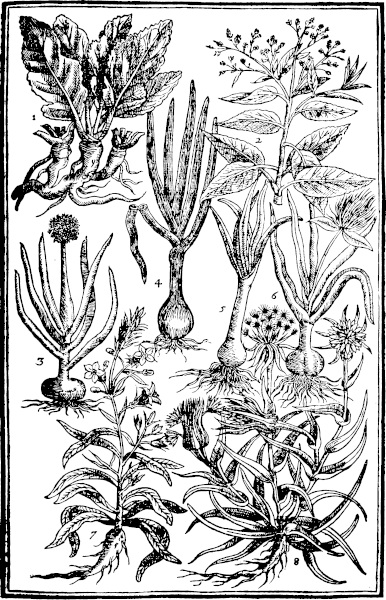
1Raphanus rusticanus. Horse Raddish.
2Lepidium siue Piperitis. Dittander.
3Cepæ rotunda. Round Onions.
4Cepæ longæ. Long Onions.
5Porrum. Leekes.
6Allium. Garlicke.
7Rapunculus. Rampions.
8Tragopogon. Goates beard.
Wee haue diuers sorts of Onions, both white and red, flat, round and long, as shall be presently shewed: But I will doe with these as I doe with the rest, only giue you one description for them all, and afterwards their seuerall names and varieties, as they are to be known by.
Our common Garden Onion hath diuers long greene hollow leaues, seeming halfe flat; among which riseth vp a great round hollow stalke, bigger in the middle then any where else, at the toppe whereof standeth a close round head, couered at the first with a thin skinne, which breaketh when the head is growne, and sheweth forth a great vmbell of white flowers, which turne into blacke seede: but then the head is so heauie that the stalke cannot sustaine it, but must be vpheld from falling to the ground, lest it rot and perish: the roote as all know is round, in some greater, in others lesser, or flat, in some red on the outside only, in others quite thorough out, in some white, and very sharpe and strong, in others milder, and more pleasant, and some so pleasant that they may be eaten as an Apple: All these kinds of Onions, contrary to the nature of all other bulbous rootes, haue no off-set, or other roote growing to it, but are euery one alone single by themselues; and therefore it seemeth, the Latines, as Columella recordeth, haue giuen it the name Vnio, and the French it should seeme following the Latine, and the English the French, do call it Oignon and Onion, as an vnite, or as if they were but one and one, and dye euery yeare after seed bearing.
The red flat kinde is most vsually with vs the strongest of them all, yet I haue had a great red Onion brought mee from beyond Sea, that was as great almost as two mens fistes, flat and red quite thoroughout, and very pleasant both to smell vnto, and to eate, but did quickly degenerate; so that we plainly see, that the soyle and climate doth giue great alteration to plants of all sorts.
The long kinde wee call St. Omers Onions, and corruptly among the vulgar, St. Thomas Onions.
The other red kinde we call Strasborough Onions, whose outside onely is red, and are very sharpe and fierce.
The white Onions both long and flat, are like vnto Chalke-stones lying vpon the ground, when they are ripe and fit to be gathered.
And lastly, there is the Spanish Onion, both long and flat, very sweete, and eaten by many like an apple, but as Iohn Tradescante saith, who hath beene in Spaine, that the Spaniards themselues doe not eate them so familiarly, as they doe those white Onions that come out of our owne Countrey, which they haue there more plentifully then their sweete Onions.
The Vse of Onions.
Onions are vsed many wayes, as sliced and put into pottage, or boyled and peeled and layde in dishes for sallets at supper, or sliced and put into water, for a sawce for mutton or oysters, or into meate roasted being stuffed with Parsly, and so many waies that I cannot recount them, euery one pleasing themselues, according to their order, manner or delight.
Onions boyled or rosted vnder the embers, and mixed with sugar and butter, are good for those that are troubled with coughes, shortnesse of breath, and wheesing. An Onion made hollow at the bottome, and some good Treakle put into it, with a little iuyce of Citrons (or Lemons in the stead thereof) being well baked together vnder the embers, after the hole is stopped againe, and then strained forth, and giuen to one that hath the plague, is very helpefull, so as hee be laid to sweate vpon it.
The iuice of Onions is much vsed to be applyed to any burnings with fire, or with Gun-pouder, or to any scaldings with water or oyle, and is most familiar for the Country, where vpon such sudden occasions they haue not a more fit or speedy remedie at hand: The strong smell of Onions, and so also of Garlicke and Leekes, is quite taken away from offending the head or eyes, by the eating of Parsley leaues after them.
Chap. XLIIII. Porrum. Leekes.
There be likewise sundry sorts of Leekes, both great and small. Leekes are very like vnto Onions, hauing long green hollow-like leaues, flattish on the one side, and with a ridge or crest on the backe side: if they bee suffered to grow vncut, then in the second or third yeare after the sowing, they will send forth a round and slender stalke, euen quite throughout, and not swollen or bigger in the middle like the Onion, bearing at the toppe a head of purplish flowers, and blacke seede after them, very like vnto Onion seede, that it is hard to distinguish them: the root is long and white, with a great bush of fibres hanging at it, which they call the beards.
The vnset Leeke hath longer and slenderer roots then the other, which being transplanted, groweth thicker and greater.
The French Leeke, which is called the Vine Leeke, is the best of all others.
Our common kinde is of two sorts, one greater then another.
Another sort encreaseth altogether by the roote, as Garlicke doth.
And then Ciues, which are the smallest, and encrease aboundantly only by the root.
Some doe account Scalions to be rather a kinde of Onions then Leekes, and call them Cepa Ascalonica, or Ascalonitides, which will quickly spend it selfe, if it be suffered to be vncut; but all Authors affirme, that there is no wilde kinde of Onion, vnlesse they would haue it to be Gethyum, whereof Theophrastus maketh mention, saying, that it hath a long necke (and so these Scalions haue) and was also of some called Gethyllides, which antiquity accounted to be dedicated to Latona, the mother of Apollo, because when she was bigge with childe of Apollo, she longed for these Leekes.
The Vse of Leekes.
The old World, as wee finde in Scripture, in the time of the children of Israels being in Egypt, and no doubt long before, fed much vpon Leekes, Onions, and Garlicke boyled with flesh; and the antiquity of the Gentiles relate the same manner of feeding on them, to be in all Countries the like, which howsoeuer our dainty age now refuseth wholly, in all sorts except the poorest; yet Muscouia and Russia vse them, and the Turkes to this day, (as Bellonius writeth) obserue to haue them among their dishes at their tables, yea although they be Bashas, Cades, or Vaiuodas, that is to say, Lords, Iudges, or Gouernours of countries and places. They are vsed with vs also sometimes in Lent to make pottage, and is a great and generall feeding in Wales with the vulgar Gentlemen.
Ciues are vsed as well to be shred among other herbes for the pot, as to be put into a Sallet among other herbs, to giue it a quicker relish.
Leekes are held to free the chest and lungs from much corruption and rotten flegme, that sticketh fast therein, and hard to be auoided, as also for them that through hoarsenesse haue lost their voice, if they be eyther taken rawe, or boyled with broth of barley, or some such other supping, fit and conducing thereunto. And baked vnder hot embers is a remedy against a surfeit of Mushromes.
The greene blades of Leekes being boyled and applyed warme to the Hemorrhoides or piles, when they are swolne and painfull, giue a great deale of ease.
Chap. XLV. Allium. Garlicke.
I haue spoken of diuers sorts of Garlicke called Moly, in the former booke: I shall neede in this place to shew onely those kindes, that this Garden nourseth vp, and leaue the rest to his fit time and place.
Garlicke hath many long greene leaues, like vnto Onions, but much larger, and not hollow at all as Onions are; the stalke riseth vp to be about three foote high, bearing such a head at the toppe thereof as Onions and Leekes doe, with purplish flowers, and blacke seede like Leekes: the roote is white within, couered ouer with many purplish skins, and is diuided into many parts or cloues, which serue both to set againe for increase, and also to vse as neede shall require, and is of a very strong smell and taste, as euery one knoweth, passing either Onions or Leekes, but exceeding wholsome withall for them that can take it.
Allium Vrsinum. Ramsons.
Ramsons are another kinde of Garlicke, and hath two or three faire broade leaues, of a fresh or light greene colour, pointed at the end: the stalke groweth about an hand length high, bearing many small and pure white starre-like flowers at the toppe, and afterwards small, blacke, and smooth round seede: the roote is also diuided into many parts, whereby it is much encreased, and is much milder then the former, both in smell and taste.
The Vse of Garlicke.
It being well boyled in salt broth, is often eaten of them that haue strong stomackes, but will not brooke in a weake and tender stomacke.
It is accounted, and so called in diuers Countries, The poore mans Treakle, that is, a remedy for all diseases. It is neuer eaten rawe of any man that I know, as other of the rootes aforesaid, but sodden alwaies and so taken.
Ramsons are oftentimes eaten with bread and butter, and otherwise also, as euery mans affection and course of life leadeth him to vse.
Chap. XLVI. Rapunculus siue Rapuntium. Rampions.
Garden Rampions are of two sorts, the one greater, the other lesser: the leaues of Rampions are in the one somewhat broad like a Beete, in the other somewhat long and narrow, and a little broader at the end, of a light greene colour, lying flat vpon the ground all the first winter, or yeare of the springing, and the next Spring shooteth forth stalkes two or three foote high, bearing at the toppe, in the bigger sort, a long slender spike of small horned or crooked flowers, which open their brimmes into foure leaues; in the lesser many small purplish bels, standing vpon seuerall small foote-stalkes, which turne into heads, bearing small blackish seede: the root is white, branched into two or three rootes, of the bignesse and length of a mans finger or thumbe.
The Vse of Rampions.
The rootes of both are vsed for Sallets, being boyled, and then eaten with oyle and vinegar, a little salt and pepper.
Chap. XLVII. Tragopogon. Goates beard.
Goates beard hath many long and narrow leaues, broader at the bottome, and sharper at the end, with a ridge downe the backe of the leafe, and of a pale greene colour; among which riseth vp a stalke of two or three foote high, smooth and hollow, bearing thereon many such like leaues, but smaller and shorter, and at the toppe thereof on euery branch a great double yellow flower, like almost vnto the flower of a Dandelion, which turneth into a head, stored with doune, and long whitish seede therein, hauing on the head of euery one some part of the doune, and is carried away with the winde if it bee neglected: the roote is long and round, somewhat like vnto a Parsnep, but farre smaller, blackish on the outside, and white within, yeelding a milkie iuyce being broken, as all the rest of the plant doth, and of a very good and pleasant taste. This kinde, as also another with narrower leaues, almost like grasse, growe wilde abroad in many places, but are brought into diuers Gardens. The other two kindes formerly described in the first part, the one with a purple flower, and the other with an ash-coloured, haue such rootes as these here described, and may serue also to the same purpose, being of equall goodnesse, if any will vse them in the same manner; that is, while they are young, and of the first yeares sowing, else they all growe hard, in running vp to seede.
The Vse of Goates beard.
If the rootes of any of these kindes being young, be boyled and dressed as a Parsnep, they make a pleasant dish of meate, farre passing the Parsnep in many mens iudgements, and that with yellow flowers to be the best.
They are of excellent vse being in this manner prepared, or after any other fit and conuenient way, to strengthen those that are macilent, or growing into any consumption.
Chap. XLVIII. Carum. Carawayes.
Carawayes hath many very fine cut and diuided leaues lying on the ground, being alwaies greene, somewhat resembling the leaues of Carrots, but thinner, and more finely cut, of a quicke, hot, and spicie taste: the stalke riseth not much higher then the Carrot stalke, bearing some leaues at the ioynts along the stalke to the toppe, where it brancheth into three or foure parts, bearing spoakie vmbels of white flowers, which turne into small blackish seede, smaller then Aniseede, and of a hotter and quicker taste: the roote is whitish, like vnto a Parsnep, but much smaller, more spreading vnder ground, and a little quicke in taste, as all the rest of the plant is, and abideth long after it hath giuen seede.
The Vse of Carawayes.
The rootes of Carawayes being boyled may be eaten as Carrots, and by reason of the spicie taste doth warme and comfort a cold weake stomacke, helping to dissolue winde (whereas Carrots engender it) and to prouoke vrine, and is a very welcome and delightfull dish to a great many, yet they are somewhat stronger in taste then Parsneps.
The seede is much vsed to bee put among baked fruit, or into bread, cakes, &c. to giue them a rellish, and to helpe to digest winde in them are subiect thereunto.
It is also made into Comfits, and put into Trageas, or as we call them in English, Dredges, that are taken for the cold and winde in the body, as also are serued to the table with fruit.
Chap. XLIX. Pappas siue Battatas. Potatoes.
Three sorts of Potatoes are well knowne vnto vs, but the fourth I rest doubtfull of, and dare not affirme it vpon such termes as are giuen vnto it, vntill I may be better informed by mine owne sight.
The Spanish kinde hath (in the Islands where they growe, either naturally, or planted for increase, profit, and vse of the Spaniards that nourse them) many firme and verie sweete rootes, like in shape and forme vnto Asphodill rootes, but much greater and longer, of a pale browne on the outside, and white within, set together at one head; from whence rise vp many long branches, which by reason of their weight and weaknesse, cannot stand of themselues, but traile on the ground a yard and a halfe in length at the least (I relate it, as it hath growne with vs, but in what other forme, for flower or fruit, we know not) whereon are set at seuerall distances, broad and in a manner three square leaues, somewhat like triangled Iuie leaues, of a darke greene colour, the two sides whereof are broad and round, and the middle pointed at the end, standing reasonable close together: thus much we haue seene growe with vs, and no more: the roote rather decaying then increasing in our country.
The Potatoes of Virginia, (Bauhinus vpon Matthiolus calleth it, Solanum tuberosum esculentum which some foolishly call the Apples of youth) is another kinde of plant, differing much from the former, sauing in the colour and taste of the roote, hauing many weake and somewhat flexible branches, leaning a little downwards, or easily borne downe with the winde or other thing, beset with many winged leaues, of a darke grayish greene colour, whereof diuers are smaller, and some greater then others: the flowers growe many together vpon a long stalke, comming forth from betweene the leaues and the great stalkes, euery one seuerally vpon a short foot-stalke, somewhat like the flower of Tabacco for the forme, being one whole leafe six cornered at the brimmes, but somewhat larger, and of a pale blewish purple colour, or pale doue colour, and some almost white, with some red threads in the middle, standing about a thicke gold yellow pointell, tipped with greene at the end: after the flowers are past, there come vp in their places small round fruit, as bigge as a Damson or Bulleis, greene at the first, and somewhat whitish afterwards, with many white seedes therein, like vnto Nightshade: the rootes are rounder and much smaller then the former, and some much greater then others, dispersed vnder ground by many small threads or strings from the rootes, of the same light browne colour on the outside, and white within, as they, and neare of the same taste, but not altogether so pleasant.
The Potatos of Canada, (which hath diuers names giuen it by diuers men, as Pelleterius of Middleborough in his Plantarum Synonimia, calleth it Heliotropium Indicum tuberosum, Fabius Columna in the second part of his Phytobasanos, Flos Solis Farnesianus, siue Aster Peruanus tuberosus: We in England, from some ignorant and idle head, haue called them Artichokes of Ierusalem, only because the roote, being boyled, is in taste like the bottome of an Artichoke head: but they may most fitly be called, Potatos of Canada, because their rootes are in forme, colour and taste, like vnto the Potatos of Virginia, but greater, and the French brought them first from Canada into these parts) riseth vp with diuers stiffe, round stalkes, eight or tenne foote high in our Country, where they haue scarce shewed their flowers, whereas the very head of flowers in other Countries, as Fabius Columna expresseth it, being of a Pyramis or Sugar loafe fashion, broade spreading below, and smaller pointed vpwards towards the toppe, is neere of the same length, whereon are set large and broade rough greene leaues, very like vnto the leaues of the flower of the Sunne, but smaller, yet growing in the very same manner, round about the stalkes: at the very later end of Summer, or the beginning of Autumne, if the roote bee well planted and defended, it will giue a shew of a few small yellow flowers at the top, like vnto the flowers of Aster or Starre-worte, and much smaller then any flower of the Sunne, which come to no perfection with vs: the roote, while the plant is growing aboue ground, encreaseth not to his full growth, but when the Summer is well spent, and the springing of the stalk is past, which is about the end of August, or in September, then the root is perceiued to be encreased in the earth, and will before Autumne be spent, that is, in October, swell like a mound or hillocke, round about the foote of the stalkes, and will not haue his rootes fit to be taken vp, vntill the stalkes be halfe withered at the soonest; but after they be withered, and so all the winter long vntill the Spring againe, they are good, and fit to bee taken vp and vsed, which are a number of tuberous round rootes, growing close together; so that it hath beene obserued, that from one roote, being set in the Spring, there hath been forty or more taken vp againe, and to haue ouer-filled a pecke measure, and are of a pleasant good taste as many haue tryed.
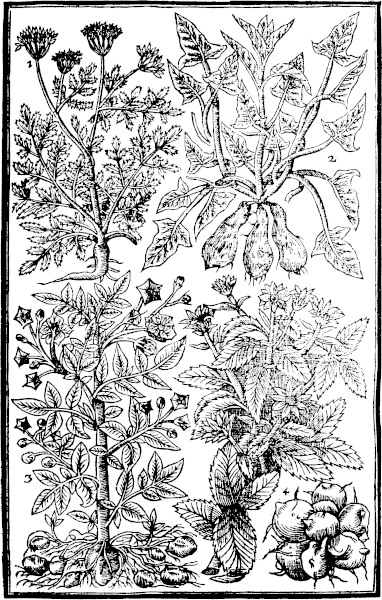
1Carum. Carawayes.
2Battatas Hispanorum. Spanish Potatoes.
3Papas seu Battatas Virginianorum. Virginia Potatoes.
4Battatas de Canada. Potatoes Of Canada, or Artichokes of Ierusalem.
The Vse of all these Potato’s.
The Spanish Potato’s are roasted vnder the embers, and being pared or peeled and sliced, are put into sacke with a little sugar, or without, and is delicate to be eaten.
They are vsed to be baked with Marrow, Sugar, Spice, and other things in Pyes, which are a daintie and costly dish for the table.
The Comfit-makers preserue them, and candy them as diuers other things, and so ordered, is very delicate, fit to accompany such other banquetting dishes.
The Virginia Potato’s being dressed after all these waies before specified, maketh almost as delicate meate as the former.
The Potato’s of Canada are by reason of their great increasing, growne to be so common here with vs at London, that euen the most vulgar begin to despise them, whereas when they were first receiued among vs, they were dainties for a Queene.
Being put into seething water they are soone boyled tender, which after they bee peeled, sliced and stewed with butter, and a little wine, was a dish for a Queene, beeing as pleasant as the bottome of an Artichoke: but the too frequent vse, especially being so plentifull and cheape, hath rather bred a loathing then a liking of them.
Chap. L. Cinara. Artichokes.
The fruits that grow vpon or neere the ground, are next to be entreated of, and first of Artichokes, whereof there be diuers kindes, some accounted tame and of the Garden, others wilde and of late planted in Gardens, Orchards or Fieldes, of purpose to be meate for men.
The Artichoke hath diuers great, large, and long hollowed leaues, much cut in or torne on both edges, without any great shew of prickles on them, of a kinde of whitish greene, like vnto an ash colour, whereof it tooke the Latin name Cinara: the stalke is strong, thicke and round, with some skins as it were downe all the length of them, bearing at the toppe one scaly head, made at the first like a Pine-apple, but after growing greater, the scales are more separate, yet in the best kindes lying close, and not flaring, as some other kindes doe, which are eyther of a reddish browne, whitish, or greenish colour, and in some broade at the ends, in others sharpe or prickly: after the head hath stoode a great while, if it bee suffered, and the Summer proue hot and kindly, in some there will breake forth at the toppe thereof, a tuft of blewish purple thrumes or threds, vnder which grow the seede, wrapped in a great deale of dounie substance: but that roote that yeeldeth flowers will hardly abide the next winter; but else being cut off when it is well growne, that dounie matter abideth close in the middle of the head, hauing the bottome thereof flat and round, which is that matter or substance that is vsed to be eaten: the roote spreadeth it selfe in the ground reasonable well, yeelding diuers heads of leaues or suckers, whereby it is increased.
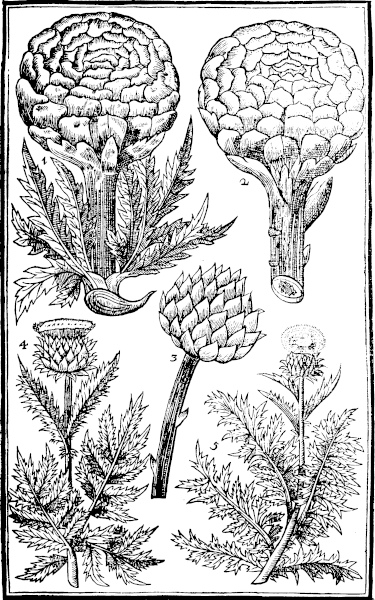
1Cinara satiua rubra. The red Artichoke.
2Cinara satiua alba. The white Artichoke.
3Cinara patula. The French Artichoke.
4Cinara siluestris. The Thistle Artichoke.
5Carduus esculentus. The Chardon.
The white Artichoke is in all things like the red, but that the head is of a whitish ashe colour, like the leaues, whereas the former is reddish.
We haue also another, whose head is greene, and very sharpe vpwards, and is common in many places.
Wee haue had also another kinde in former times that grew as high as any man, and branched into diuers stalkes, euery one bearing a head thereon, almost as bigge as the first.
There is another kinde, called the Muske Artichoke, which groweth like the French kinde, but is much better in spending, although it haue a lesser bottome.
The French Artichoke hath a white head, the scales whereof stand staring far asunder one from another at the ends, which are sharpe: this is well known by this qualitie, that while it is hot after it is boyled, it smelleth so strong, that one would verily thinke it had bin boyled in stinking water, which was brought ouer after a great froste that had well nigh consumed our best kindes, and are now almost cleane cast out again, none being willing to haue it take vp the roome of better.
There is a lowe kinde that groweth much about Paris, which the French esteeme more then any other, and is lower then the former French kinde, the head whereof as well as the leaues, is of a fresher greene colour, almost yellowish.
Then there is the Thistle Artichoke, which is almost a wilde kinde, and groweth smaller, with a more open and prickly head then any of the former.
And lastly, the Chardon as they call it, because it is almost of the forme and nature of a Thistle, or wilde Artichoke. This groweth high, and full of sharpe prickles, of a grayish colour. Iohn Tradescante assured mee, hee saw three acres of Land about Brussels planted with this kinde, which the owner whited like Endiue, and then sold them in the winter: Wee cannot yet finde the true manner of dressing them, that our Countrey may take delight therein.
All these kindes are encreased by slipping the young shootes from the root, which being replanted in February, March, or Aprill, haue the same yeare many times, but the next at the most, borne good heads.
Wee finde by dayly experience, that our English red Artichoke is in our Countrey the most delicate meate of any of the other, and therefore diuers thinking it to bee a seuerall kinde, haue sent them into Italie, France, and the Lowe Countries, where they haue not abode in their goodnesse aboue two yeare, but that they haue degenerated; so that it seemeth, that our soyle and climate hath the preheminence to nourish vp this plant to his highest excellencie.
The Vse of Artichokes.
The manner of preparing them for the Table is well knowne to the youngest Housewife I thinke, to bee boyled in faire water, and a little salt, vntill they bee tender, and afterwardes a little vinegar and pepper, put to the butter, poured vpon them for the sawce, and so are serued to the Table.
They vse likewise to take the boyled bottomes to make Pyes, which is a delicate kinde of baked meate.
The Chardon is eaten rawe of diuers, with vinegar and oyle, pepper and salt, all of them, or some, as euery one liketh for their delight.
Chap. LI. Fabæ & Phaseoli. Garden and French Beanes.
The Garden Beane is of two colours, red or blacke, and white, yet both rise from one; the small or fielde Beanes I make no mention of in this place; but the French or Kidney Beane is almost of infinite sorts and colours: we doe not for all that intend to trouble you in this place, with the knowledge or relation of any more then is fit for a Garden of that nature, that I haue propounded it in the beginning.
Our ordinary Beanes, seruing for foode for the poorer sort for the most part, are planted as well in fieldes as in gardens, because the quantity of them that are spent taketh vp many acres of land to be planted in, and rise vp with one, two or three stalks, according to the fertilitie of the soyle, being smooth and square, higher then any man oftentimes, whereon are set at certaine distances, from the very bottome almost to the toppe, two long smooth fleshy and thicke leaues almost round, one standing by another at the end of a small footestalke: betweene these leaues and the stalke, come forth diuers flowers, all of them looking one way for the most part, which are close a little turned vp at the brimmes, white and spotted with a blackish spot in the middle of them, and somewhat purplish at the foot or bottome, of the forme almost of Broome or Pease flowers, many of which that grow vpward toward the toppe, doe seldome beare fruit, and therefore are gathered to distill, and the toppes of the stalkes cut off, to cause the rest to thriue the better; after which grow vp long great smooth greene pods, greater then in any other kinde of Pulse, which grow blacke when they are ripe, and containe within them two, three or foure Beanes, which are somewhat flat and round, eyther white or reddish, which being full ripe grow blackish: the roote hath diuers fibres annexed vnto the maine roote, which dyeth euery yeare.
The French or Kidney Beane riseth vp at the first but with one stalke, which afterwards diuideth it selfe into many armes or branches, euery one of them being so weak, that without they be sustained with stickes or poles, whereon with their winding and claspers they take hold, they would lye fruitlesse vpon the ground: vpon these branches grow forth at seuerall places long footestalkes, with euery of them three broade, round and pointed greene leaues at the end of them, towards the tops whereof come forth diuers flowers, made like vnto Pease blossomes, of the same colour for the most part that the fruit will be of, that is to say, eyther white, or yellow, or red, or blackish, or of a deepe purple &c. but white is most vsuall for our Garden; after which come long and slender flat pods, some crooked, and some straight, with a string as it were running downe the backe thereof, wherein are contained flattish round fruit, made to the fashion of a kidney: the roote is long, and spreadeth with many fibres annexed vnto it, perishing euery yeare.
The Vse of these Beanes.
The Garden Beanes serue (as I said before) more for the vse of the poore then of the rich: I shall therefore only shew you the order the poore take with them, and leaue curiosity to them that will bestow time vpon them. They are only boyled in faire water and a little salt, and afterwards stewed with some butter, a little vinegar and pepper being put vnto them, and so eaten: or else eaten alone after they are boyled without any other sawce. The water of the blossomes distilled, is vsed to take away spots, and to cleer the skin. The water of the greene huskes or cods is good for the stone.
The Kidney Beanes boyled in water huske and all, onely the ends cut off, and the string taken away, and stewed with butter &c. are esteemed more sauory meate to many mens pallates, then the former, and are a dish more oftentimes at rich mens Tables then at the poore.
Chap. LII. Pisum. Pease.
There is a very great variety of manured Pease known to vs, and I think more in our Country then in others, whereof some prosper better in one ground and country, and some in others: I shall giue you the description of one alone for all the rest, and recite vnto you the names of the rest.
Garden Pease are for the most part the greatest and sweetest kinds, and are sustained with stakes or bushes. The Field Pease are not so vsed, but growe without any such adoe. They spring vp with long, weake, hollow, and brittle (while they are young and greene) whitish greene stalkes, branched into diuers parts, and at euery ioynt where it parteth one broad round leafe compassing the stalke about, so that it commeth as it were thorough it: the leaues are winged, made of diuers small leaues set to a middle ribbe, of a whitish greene colour, with claspers at the ends of the leaues, whereby it taketh hold of whatsoeuer standeth next vnto it: betweene the leaues and the stalkes come forth the flowers, standing two or three together, euery one by it selfe on his owne seuerall stalke, which are either wholly white, or purple, or mixed white and purple, or purple and blew: the fruit are long, and somewhat round cods, whereof some are greater, others lesser, some thicke and short, some plaine and smooth, others a little crooked at the ends; wherein also are contained diuers formes of fruit or pease; some being round, others cornered, some small, some great, some white, others gray, and some spotted: the roote is small, and quickly perisheth.
The kindes of Pease are these:
The Rounciuall.
The greene Hasting.
The Sugar Pease.
The spotted Pease.
The gray Pease.
The white Hasting.
The Pease without skins.
The Scottish or tufted Pease, which some call the Rose Pease, is a good white Pease fit to be eaten.
The early or French Pease, which some call Fulham Pease, because those grounds thereabouts doe bring them soonest forward for any quantity, although sometimes they miscarry by their haste and earlinesse.
Cicer Arietinum. Rams Ciches.
This is a kinde of Pulse, so much vsed in Spaine, that it is vsually one of their daintie dishes at all their feasts: They are of two sorts, white and red; the white is onely vsed for meate, the other for medicine. It beareth many vpright branches with winged leaues, many set together, being small, almost round, and dented about the edges: the flowers are either white or purple, according to the colour of the Pease which follow, and are somewhat round at the head, but cornered and pointed at the end, one or two at the most in a small roundish cod.
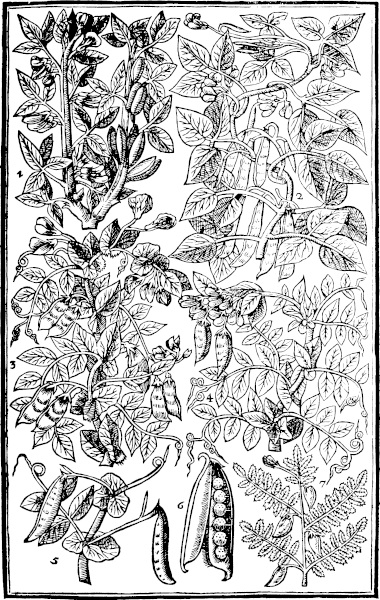
1Faba satiua. Garden Beanes.
2Phaseoli satiui. French Beanes.
3Pisum vulgare. Garden Pease.
4Pisum vmbellatum siue Roseum. Rose Pease or Scottish Pease.
5Pisum Saccharatum. Sugar Pease.
6Pisum maculatum. Spotted Pease.
7Cicer Arietinum. Rams Ciches or Cicers.
The Vse of Pease.
Pease of all or the most of these sorts, are either vsed when they are greene, and be a dish of meate for the table of the rich as well as the poore, yet euery one obseruing his time, and the kinde: the fairest, sweetest, youngest, and earliest for the better sort, the later and meaner kindes for the meaner, who doe not giue the deerest price: Or
Being dry, they serue to boyle into a kinde of broth or pottage, wherein many doe put Tyme, Mints, Sauory, or some other such hot herbes, to giue it the better rellish, and is much vsed in Towne and Countrey in the Lent time, especially of the poorer sort of people.
It is much vsed likewise at Sea for them that goe long voyages, and is for change, because it is fresh, a welcome diet to most persons therein.
The Rams Ciches the Spaniards call Grauancos, and Garauancillos, and eate them boyled and stewed as the most, dainty kinde of Pease that are, they are of a very good rellish, and doe nourish much; but yet are not without that windy quality that all sorts of Pulse are subiect vnto: they increase bodily lust much more then any other sorts, and as it is thought, doth helpe to encrease seede.
Chap. LIII. Cucumer. The Cowcumber.
Of Cowcumbers there are diuers sorts, differing chiefly in the forme and colour of the fruit, and not in the forme of the plant; therefore one description shall serue in stead of all the rest.
The Cowcumber bringeth forth many trailing rough greene branches lying on the ground, all along whereof growe seuerall leaues, which are rough, broad, vneuen at the edges, and pointed at the ends, with long crooked tendrils comming forth at the same ioynt with the leafe, but on the other side thereof: between the stalks & the leaues at the ioynts come forth the flowers seuerally, euery one standing on a short foot-stalke, opening it selfe into fiue leaues, of a yellowish colour, at the bottome whereof groweth the fruit, long and greene at the first, but when it is thorough ripe, a little yellowish, hauing many furrowes, and vneuen bunches all the length of it, wherein is a white firme substance next vnto the skin, and a cleare pulpe or watery substance, with white flat seede lying dispersed through it: the roote is long and white, with diuers fibres at it.
The kindes.
The first described is called, The long greene Cowcumber.
There is another is called, The short Cowcumber, being short, and of an equall bignesse in the body thereof, and of an vnequall bignesse at both ends.
The long Yellow, which is yellowish from the beginning, and more yellow when it is ripe, and hath beene measured to be thirteene inches long: but this is not that small long Cowcumber, called of the Latines, Cucumis anguinus.
Another kinde is early ripe, called The French kinde.
The Dantsicke kinde beareth but small fruit, growing on short branches or runners: the pickled Cowcumbers that are vsually sold are of this kind.
The Muscouie kinde is the smallest of all other, yet knowne, and beareth not aboue foure or fiue at the most on a roote, which are no bigger then small Lemons.
The Vse of Cowcumbers.
Some vse to cast a little salt on their sliced Cowcumbers, and let them stand halfe an houre or more in a dish, and then poure away the water that commeth from them by the salt, and after put vinegar, oyle, &c. thereon, as euery one liketh: this is done, to take away the ouermuch waterishnesse and coldnesse of the Cowcumbers.
In many countries they vse to eate Cowcumbers as wee doe Apples or Peares, paring and giuing slices of them, as we would to our friends of some dainty Apple or Peare.
The pickled Cowcumbers that come from beyond Sea, are much vsed with vs for sawce to meate all the Winter long. Some haue striuen to equall them, by pickling vp our Cowcumbers at the later end of the yeare, when they are cheapest, taking the little ones and scalding them thoroughly well, which after they put in brine, with some Dill or Fenell leaues and stalkes: but these are nothing comparable to the former, wee either missing of the right and orderly pickling of them, or the kinde it selfe differing much from ours (as I said of the Dantsicke kinde) for ours are neither so tender and firme, nor so sauoury as the other.
The rawe or greene Cowcumbers are fittest for the hotter time of the yeare, and for hot stomackes, and not to be vsed in colder weather or cold stomackes, by reason of the coldnesse, whereby many haue been ouertaken.
The seede is vsed physically in many medicines that serue to coole, and a little to make the passages of vrine slippery, and to giue ease to hot diseases.
Chap. LIIII. Melo. Milions or Muske Melons.
There bee diuers sorts of Melons found out at this day, differing much in the goodnesse of taste one from another. This Countrey hath not had vntill of late yeares the skill to nourse them vp kindly, but now there are many that are so well experienced therein, and haue their ground so well prepared, as that they will not misse any yeare, if it be not too extreme vnkindly, to haue many ripe ones in a reasonable time: yet some will be later then others alwayes.
The Melon is certainly a kinde of Cowcumber, it doth so neere resemble it, both in the manner of his growing, hauing rough trailing branches, rough vneuen leaues, and yellow flowers: after which come the fruit, which is rounder, thicker, bigger, more rugged, and spotted on the outside then the Cowcumber, of a russet colour, and greene vnderneath, which when it groweth full ripe, will change a little yellowish, being as deepe furrowed and ribbed as they, and besides hauing chaps or rifts in diuers places of the rinde: the inward hard substance is yellow, which onely is eaten: the seede which is bigger, and a little yellower then the Cowcumber, lying in the middle onely among the moister pulpe: the smell and changing of his colour, fore-shew their ripenesse to them that are experienced: the roote is long, with many fibres at it. The fruit requireth much watering in the hot time of the day, to cause them to ripen the sooner, as I haue obserued by diuers of the best skill therein.
The Vse of the kindes of Melons.
The best Melon seede doe come to vs out of Spaine, some haue come out of Turkie, but they haue been nothing so good and kindly.
Some are called Sugar Melons, others Peare Melons, and others Muske Melons.
They haue beene formerly only eaten by great personages, because the fruit was not only delicate but rare; and therefore diuers were brought from France, and since were noursed vp by the Kings or Noblemens Gardiners onely, to serue for their Masters delight: but now diuers others that haue skill and conueniencie of ground for them, doe plant them and make them more common.
They paire away the outer rinde, and cut out the inward pulpe where the seede lyeth, slice the yellow firme inward rinde or substance, & so eate it with salt and pepper (and good store of wine, or else it will hardly digest) for this is firmer, & hath not that moisture in it that the Cowcumbers haue. It is also more delicate, and of more worth, which recompenseth the paine.
The seed of these Melons are vsed as Cowcumbers physically, and together with them most vsually.
Chap. LV. Pepo. Pompions.
We haue but one kinde of Pompion (as I take it) in all our Gardens, notwithstanding the diuersities of bignesse and colour.
The Pompion or great Melon (or as some call it Milion) creepeth vpon the ground (if nothing bee by it whereon it may take hold and climbe) with very great, ribbed, rough, and prickly branches, whereon are set very large rough leaues, cut in on the edges with deepe gashes, and dented besides, with many claspers also, which winde about euery thing they meete withall: the flowers are great and large, hollow and yellow, diuided at the brims into fiue parts, at the bottome of which, as it is in the rest, groweth the fruit, which is very great, sometimes of the bignesse of a mans body, and oftentimes lesse, in some ribbed or bunched, in others plaine, and either long or round, either greene or yellow, or gray, as Nature listeth to shew her selfe; for it is but waste time, to recite all the formes and colours may be obserued in them: the inner rinde next vnto the outer is yellowish and firme: the seede is great, flat, and white, lying in the middle of the watery pulpe: the roote is of the bignesse of a mans thumbe or greater, dispersed vnder ground with many small fibres ioyned thereunto.
Gourds are kindes of Melons; but because wee haue no vse of them, wee leaue them vnto their fit place.
The Vse of Pompions.
They are boyled in faire water and salt, or in powdered beefe broth, or sometimes in milke, and so eaten, or else buttered; They vse likewise to take out the inner watery substance with the seedes, and fill vp the place with Pippins, and hauing laid on the couer which they cut off from the toppe, to take out the pulpe, they bake them together, and the poore of the Citie, as well as the Country people, doe eate thereof, as of a dainty dish.
The seede hereof, as well as of Cowcumbers and Melons, are cooling, and serue for emulsions in the like manner for Almond milkes, &c. for those are troubled with the stone.
Chap. LVI. Fragaria. Strawberries.
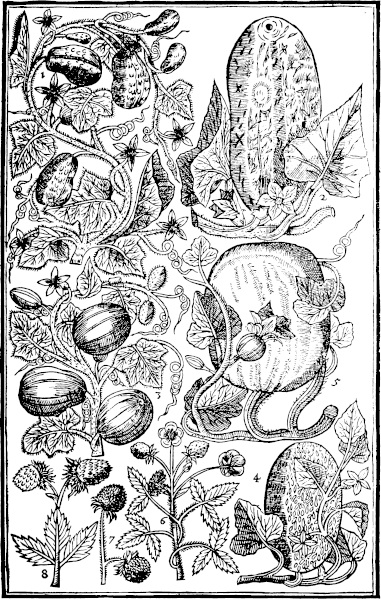
1Cucumis longus vulgaris. The ordinary Cowcumber.
2Cucumis Hispanicus. The long yellow Spanish Cowcumber.
3Melo vulgaris. The ordinary Melon.
4Melo maximus optimus. The greatest Muske Melon.
5Pepo. The Pompion.
6Fragari vulgaris. Common Strawberries.
7Fragari Bohemica maxima. The great Bohemia Strawberries.
8Fragari aculeata. The prickly Strawberry.
There be diuers sorts of Strawberries, whereof those that are noursed vp in Gardens or Orchards I intend to giue you the knowledge in this place, and leaue the other to a fitter; yet I must needs shew you of one of the wilde sorts, which for his strangenesse is worthy of this Garden: And I must also enforme you, that the wilde Strawberry that groweth in the Woods is our Garden Strawberry, but bettered by the soyle and transplanting.
The Strawberry hath his leaues closed together at the first springing vp, which afterwards spread themselues into three diuided parts or leaues, euery one standing vpon a small long foote-stalke, greene on the vpperside, grayish vnderneath, and snipped or dented about the edges; among which rise vp diuers small stalkes, bearing foure or fiue flowers at the tops, consisting of fiue white round pointed leaues, somewhat yellowish in the bottome, with some yellow threads therein; after which come the fruit, made of many small graines set together, like vnto a small Mulberry or Raspis, reddish when it is ripe, and of a pleasant winy taste, wherein is enclosed diuers small blackish seede; the roote is reddish and long, with diuers small threads at it, and sendeth forth from the head thereof long reddish strings running vpon the ground, which shoot forth leaues in many places, whereby it is much encreased.
The white Strawberry differeth not from the red, but in the colour of the fruite, which is whiter then the former when it is thorough ripe, enclining to rednesse.
The greene Strawberry likewise differeth not, but that the fruit is green on all sides when it is ripe, saue on that side the Sun lyeth vpon it, and there it is somewhat red.
The Virginia Strawberry carryeth the greatest leafe of any other, except the Bohemian, but scarce can one Strawberry be seene ripe among a number of plants; I thinke the reason thereof to be the want of skill, or industry to order it aright. For the Bohemia, and all other Strawberries will not beare kindly, if you suffer them to grow with many strings, and therefore they are still cut away.
There is another very like vnto this, that Iohn Tradescante brought with him from Brussels long agoe, and in seuen yeares could neuer see one berry ripe on all sides, but still the better part rotten, although it would euery yeare flower abundantly, and beare very large leaues.
The Bohemia Strawberry hath beene with vs but of late dayes, but is the goodliest and greatest, both for leafe next to the Virginian, and for beauty farre surpassing all; for some of the berries haue beene measured to bee neere fiue inches about. Master Quester the Postmaster first brought them ouer into our Country, as I vnderstand, but I know no man so industrious in the carefull planting and bringing them to perfection in that plentifull maner, as Master Vincent Sion who dwelt on the Banck side, neer the old Paris garden staires, who from seuen rootes, as hee affirmed to me, in one yeare and a halfe, planted halfe an acree of ground with the increase from them, besides those he gaue away to his friends, and with him I haue seene such, and of that bignesse before mentioned.
One Strawberry more I promised to shew you, which although it be a wilde kinde, and of no vse for meate, yet I would not let this discourse passe, without giuing you the knowledge of it. It is in leafe much like vnto the ordinary, but differeth in that the flower, if it haue any, is greene, or rather it beareth a small head of greene leaues, many set thicke together like vnto a double ruffe, in the midst whereof standeth the fruit, which when it is ripe, sheweth to be soft and somewhat reddish, like vnto a Strawberry, but with many small harmlesse prickles on them, which may be eaten and chewed in the mouth without any maner of offence, and is somewhat pleasant like a Strawberry: it is no great bearer, but those it doth beare, are set at the toppes of the stalks close together, pleasant to behold, and fit for a Gentlewoman to weare on her arme, &c. as a raritie instead of a flower.
The Vse of Strawberries.
The leaues of Strawberries are alwaies vsed among other herbes in cooling drinkes, as also in lotions, and gargles for the mouth and throate: the rootes are sometimes added to make it the more effectuall, and withall somwhat the more binding.
The berries themselues are often brought to the Table as a reare seruice, whereunto claret wine, creame or milke is added with sugar, as euery one liketh; as also at other times, both with the better and meaner sort, and are a good cooling and pleasant dish in the hot Summer season.
The water distilled of the berries, is good for the passions of the heart, caused by the perturbation of the spirits, being eyther drunke alone, or in wine; and maketh the heart merry.
Some doe hold that the water helpeth to clense the face from spots, and to adde some cleerenesse to the skinne.
Chap. LVII. Angelica. Garden Angelica.
Hauing thus furnished you out a Kitchen Garden with all sorts of herbes, roots & fruits fit for it, and for any mans priuate vse, as I did at the first appropriate it; let me a little transcend, and for the profit & vse of Country Gentlewomen and others, furnish them with some few other herbes, of the most especiall vse for those shall need them, to be planted at hand in their Gardens, to spend as occasion shall serue, and first of Angelica.
Angelica hath great and long winged leaues, made of many broade greene ones, diuided one from another vpon the stalk, which is three foot long or better somtimes, among which rise vp great thicke and hollow stalkes with some few ioynts, whereat doth alwayes stand two long leaues compassing the stalke at the bottome, in some places at the ioynts spring out other stalkes or branches, bearing such like leaues but smaller, and at the tops very large vmbels of white flowers, that turne into whitish seede somewhat thicke: the roote groweth great with many branches at it, but quickly perisheth after it hath borne seede: to preserue the roote therefore the better, they vse to cut it often in the yeare, thereby to hinder the running vp to seede: the whole plant, both leafe, roote and seede, is of an excellent comfortable sent, sauour and taste.
The Vse of Angelica.
The distilled water of Angelica, eyther simple or compound, is of especiall vse in deliquium animi, vel cordis tremores & passiones, that is, swounings, when the spirits are ouercome and faint, or tremblings and passions of the heart, to expell any windy or noysome vapours from it. The green stalkes or the young rootes being preserued or candied, are very effectuall to comfort and warme a colde and weake stomacke: and in the time of infection is of excellent good vse to preserue the spirits and heart from infection. The dryed roote made into pouder, and taken in wine or other drinke, will abate the rage of lust in young persons, as I haue it related vnto me vpon credit: A Syrupe made thereof in this manner, is very profitable to expectorate flegme out of the chest and lunges, and to procure a sweete breath. Into the greene stalke of Angelica as it standeth growing, make a great gashe or incision, wherein put a quantitie of fine white Sugar, letting it there abide for three dayes, and after take it forth by cutting a hole at the next ioynt vnder the cut, where the Syrupe resteth, or cut off the stalke, and turne it downe, that the Syrrupe may drayne forth; which keepe for a most delicate medicine.
Chap. LVIII. Dracunculus hortensis siue Serpentaria. Dragons.
Dragons riseth out of the ground with a bare or naked round whitish stalke, spotted very much with purplish spots and strakes, bearing at the toppe therof a few greene leaues very much diuided on all sides, standing vpon long foote-stalkes, in the middle whereof (if the roote be old enough) commeth forth a great long huske or hose, green on the outside, and of a darke purplish colour on the inside, with a slender long reddish pestell or clapper in the middle: the roote is great, round, flat and whitish on the outside, and whiter within, very like vnto the rootes of Arum, or Wakerobin, and tasting somewhat sharpe like it.
The Vse of Dragons.
The chiefe vse whereunto Dragons are applyed, is, that according to an old receiued custome and tradition (and not the iudgement of any learned Author) the distilled water is giuen with Mithridatum or Treakle to expell noysome and pestilentiall vapours from the heart.
Chap. LIX. Ruta. Garden Rue, or Herbe Grace.
Garden Rue or Herbe Grace groweth vp with hard whitish wooddy stalkes, whereon are set diuers branches of leaues, being diuided into many small ones, which are somewhat thicke and round pointed, of a blewish greene colour: the flowers stand at the tops of the stalkes consisting of foure small yellow leaues, with a greene button in the middle, and diuers small yellow threds about it, which growing ripe, containe within them small blacke seede: the roote is white and wooddy, spreading farre in the ground.
The Vse of Rue.
The many good properties whereunto Rue serueth, hath I thinke in former times caused the English name of Herbe Grace to be giuen vnto it. For without doubt it is a most wholesome herbe, although bitter and strong, and could our dainty stomackes brooke the vse thereof, it would worke admirable effects being carefully and skilfully applyed, as time and occasion did require: but not vndiscreetly or hand ouer head, as many vse to doe that haue no skill. Some doe rippe vp a beade rowle of the vertues of Rue, as Macer the Poet and others, in whom you shall finde them set downe, to bee good for the head, eyes, breast, liuer, heart, spleene, &c. In some places they vse to boyle the leaues of Rue, and keep them in pickle, to eate them as Sampire for the helpe of weake eyes. It is very auaileable in glisters or drinkes against the winde or the collicke, and to procure vrine that is stayed by the paines therof. The distilled water is often vsed for the same purposes aforesaid: but beware of the too frequent or ouermuch vse thereof, because it heateth exceedingly, and wasteth nature mightily.
Chap. LX. Carduus Benedictus. The Blessed Thistle.
Carduus benedictus or the blessed Thistle, hath many weake tender branches lying for the most part on the ground, whereon are set long and narrow leaues, much cut in or waued about the edges, hairy or rough in handling, yet without any hard or sharpe thornes or prickles at all, that the tenderest hand may touch them without harme: but those that grow toward the toppes of the stalkes are somewhat more prickly, and the heads which grow on the tops of the seuerall branches are somewhat sharpe, set with prickles like a Thistle: the flower is yellow, and the seede lying within the woolly or flocky doune like to all other thistles, are blackish, long and round, with a few haires on the head of them: the roote is white, and perisheth euery yeare after it hath giuen seede.
The Vse of the blessed Thistle.
The distilled water hereof is much vsed to be drunke against agues of all sortes, eyther pestilentiall or humorall, of long continuance or of lesse: but the deception of the herbe giuen in due time, hath the more forcible operation: it helpeth to expell wormes, because of the bitternesse, and is thereby also a friend to the stomack ouercharged with chollar, and to clense the liuer: it prouoketh sweate and vrine, is helpefull to them are troubled with the stone, and to ease paines in the sides.
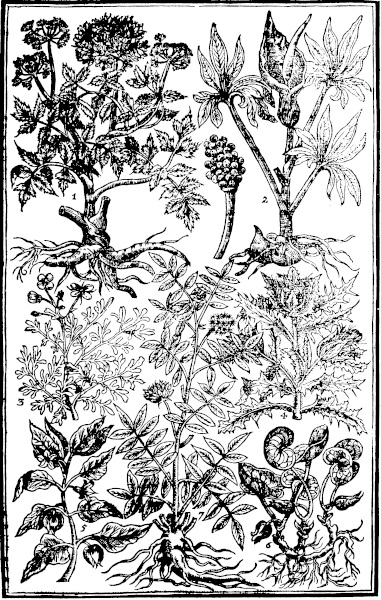
1Angellica. Angellica.
2Dracunculus hortensis. Dragons.
3Ruta hortensis. Garden Rue, or Herbegrace.
4Carduus benedictus. The blessed Thistle.
5Alkakengi siue Solanum Halicacabum & Vesicarium. Winter Cherries.
6Asarum. Asarabacca
7Liqueritia. Licoris.
Chap. LXI. Solarium vesicarium, siue Alkakengi. Winter Cherries.
The Winter Cherry hath a running or creeping roote in the ground, of the bignesse many times of ones little finger, shooting forth at seuerall ioynts in seuerall places, whereby it quickly spreadeth a great compasse of ground: the stalke riseth not aboue a yard high, whereon are set many broade and long greene leaues, somewhat like vnto the leaues of Nightshade, but larger: at the ioynts whereof come forth whitish flowers made of fiue leaues a peece, which after turne into green berries, inclosed with thin skins or bladders, which change to bee reddish when they grow ripe, the berry likewise being reddish, and as large as a Cherry, wherein are contained many flat and yellowish seed lying within the pulpe: which being gathered and strung vp, are kept all the yeare to be vsed vpon occasion.
The Vse of Winter Cherries.
The distilled water of the herbe and fruit together, is often taken of them that are troubled with the sharpnesse or difficultie of vrine, and with the stone in the kidneyes, or grauel in the bladder: but the berries themselues either greene or dryed boyled eyther in broth, in wine, or in water, is much more effectuall: It is likewise conducing to open obstructions of the liuer, &c. and thereby to helpe the yellow Iaundise.
Chap. LXII. Asarum. Asarabacca.
Asarabacca, from a small creeping roote set with many fibres, shooteth forth diuers heads, and from euery of them sundry leaues, euery one standing vpon a long greene stalke, which are round, thicke, and of a very sad or darke greene colour, and shining withall: from the rootes likewise spring vp short stalkes, not fully foure fingers high, at the toppe of euery one of which standeth the flower, in fashion very like the seede vessell of Henbane seede, of a greenish purple colour, which changeth not his forme, but groweth in time to containe therein small cornered seed: the greene leaues abide all the winter many times, but vsually sheddeth them in winter, and recouereth fresh in the spring.
The Vse of Asarabacca.
The leaues are much and often vsed to procure vomits, fiue or seuen of them bruised, and the iuice of them drunke in ale or wine. An extract made of the leaues with wine artificially performed, might bee kept all the yeare thorough, to bee vsed vpon any present occasion, the quantitie to bee proportioned according to the constitution of the patient. The roote worketh not so strongly by vomit, as the leaues, yet is often vsed for the same purpose, and besides is held auaileable to prouoke vrine, to open obstructions in the liuer and spleene, and is put among diuers other simples, both into Mithridatum and Andromachus Treakle, which is vsually called Venice Treakle. A dram of the dryed roots in pouder giuen in white wine a little before the fit of an ague, taketh away the shaking fit, & therby cause the hot fit to be the more remisse, and in twice taking expell it quite.
Chap. LXIII. Glycyrrhiza siue Liqueritia. Licorice.
Although there are two sorts of Licorice set downe by diuers Authors, yet because this Land familiarly is acquainted but with one sort, I shall not neede for this Garden, to make any further relation of that is vnknowne, but onely of that sort which is sufficiently frequent with vs. It riseth vp with diuers wooddy stalks, whereon are set at seuerall distances many winged leaues, that is to say, many narrow long greene leaues set together on both sides of the stalke, and an odde one at the end, very well resembling a young Ashe tree sprung vp from the seede: this by many yeares continuance in a place without remouing, and not else, will bring forth flowers many standing together spike-fashion one aboue another vpon the stalkes, of the forme of Pease blossomes, but of a very pale or bleake blew colour, which turne into long somewhat flat and smooth cods, wherein is contained small round harde seede: the roote runneth downe exceeding deep into the ground, with diuers other smaller roots and fibres growing with them, and shoote out suckers from the maine rootes all about, whereby it is much encreased, of a brownish colour on the outside, and yellow within, of a farre more weake sweete taste, yet far more pleasing to vs then that Licorice that is brought vs from beyond Sea; because that, being of a stronger sweet taste hath a bitternesse ioyned with it, which maketh it the lesse pleasing and acceptable to most.
The Vse of Licorice.
Our English Licorice is now adaies of more familiar vse (as I said before) then the outlandish, and is wholly spent and vsed to helpe to digest and expectorate flegme out of the chest and lunges, and doth allay the sharpenesse or saltnesse thereof. It is good also for those are troubled with shortnesse of breath, and for all sorts of coughes. The iuice of Licorice artificially made with Hyssope water, serueth very well for all the purposes aforesaid. It being dissolued with Gum Tragacanth in Rose water, is an excellent Lohoc or licking medicine to breake flegme, and to expectorate it, as also to avoyde thin frothy matter, or thin salt flegme, which often fretteth the lungs. It doth also lenisie exulcerated kidneyes, or the bladder, and helpeth to heale them. It is held also good for those that cannot make their water but by drops, or a small deale at a time.
The dryed root finely minced, is a speciall ingredient into all Trageas or Dredges, seruing for the purposes aforesaid, but the vse of them is almost wholly left now adaies with all sorts.
{Conclusion}
Thus haue I shewed you not only the herbes, rootes and fruites, noursed vp in this Garden, but such herbes as are of most necessary vses for the Country Gentlewomens houses: And now I will shew you the Orchard also.