THE KITCHEN GARDEN.
Reading edition
THE SECOND PART,
Containing as well all sorts of herbes, as rootes and fruits, that are vsually planted in Gardens, to serue for the vse of the Table whether of the poore or rich of our Countrey: but herein I intend not to bring any fruite bearing trees, shrubbes, or bushes; for I reserue them for my Orchard, wherin they shal be set forth. So that in these three parts, I suppose the exquisite ornament of any worthy house is consummate for the exteriour bounds, the benefit of their riches extending also to the furnishing of the most worthy inward parts thereof: but because many take pleasure in the sight and knowledge of other herbes that are Physicall, and much more in their properties and vertues, if vnto these three I should adde a Physicke Garden, or Garden of Simples, there would be a quadripartite complement, of whatsoeuer arte or nature, necessitie or delight could affect: which to effect (as many my friends haue, intreated it at my hands) will require more paines and time then all this worke together: yet to satisfie their desires and all others herein, that would bee enformed in the truth, and reformed of the many errours and slips set forth and published heretofore of plants by diuers, I shall (God assisting and granting life) labour to performe, that it may shew it selfe to the light in due conueniencie, if these bee well and gratefully accepted. And because I ended with some sweete herbes in the former part, I will in this part beginne with the rest, which I reserued for this place, as fitter for the pot and kitchen then for the hand or bosome, and so descend to other herbes that are for meat or sallets: and after them to those rootes that are to be eaten, as meate or as sallets: and lastly the fruits that grow neere, or vpon the ground, or not much aboue it; as the Artichoke, &c. in which I make a shorter description then I did in the former, rather endeauouring to shew what they are, and whereunto they are vsed, then the whole varietie or any exact declaration: which methode, although in some sort it may bee fitting for this purpose, yet it is not for an history or herball: I shall therefore require their good acceptance for whose sake I doe it, not doubting, but that I, or others, if they write againe of this subiect, may polish and amende what formerly hath beene eyther mis set, or not so thoroughly expressed, besides some additions of new conceits; seeing I treade out a new path, and therefore those that follow may the easilier see the Meanders, and so goe on in a direct line.
Chap. I. Maiorana latifolia, siue maior Anglica. Winter, or pot Marierome.
Winter Marierome is a small bushie herbe like vnto sweete Marierome, being parted or diuided into many branches, whereon doe grow broader and greener leaues, set by couples, with some small leaues likewise at the seuerall ioynts all along the branches: at the tops whereof grow a number of small purplish white flowers set together in a tuft, which turne into small and round seed, bigger then sweet Marierome seede: the whole plant is of a small and fine sent, but much inferiour to the other, and is nothing so bitter as the sweete Marierome, and thereby both the fitter and more willingly vsed for meates: the roote is white and threddy, and perisheth not as the former, but abideth many yeares.
The Vse of winter Marierome.
The vse of this Marierome is more frequent in our Land then in others, being put among other pot-herbes and farsing (or faseting herbes as they are called) and may to good profit bee applyed in inward as well as outward griefes for to comfort the parts, although weaker in effect then sweete Marieromes.
Chap. II
Thymum vulgatius siue durius. Ordinary Garden Tyme.
The ordinary Garden Tyme is a small low wooddy plant with brittle branches, and small hard greene leaues, as euery one knoweth, hauing small white purplish flowers, standing round about the tops of the stalkes: the seed is small and browne, darker then Marierome seed: the root is woody, and abideth well diuers Winters.
Thymum latifolium. Masticke Tyme.
This Tyme hath neyther so wooddy branches, nor so hard leaues, but groweth lower, more spreading, and with somewhat broader leaues; the flowers are of a purplish white colour, standing in roundles round about the stalkes, at the ioynts with leaues at them likewise. This Tyme endureth better and longer then the former, and by spreading it selfe more then the former, is the more apt to bee propagated by slipping, because it hath beene seldome seene to giue seede: It is not so quicke in sent or taste as the former, but is fitter to set any border or knot in a garden, and is for the most part wholly employed to such vses.
The Vse of Tyme.
To set downe all the particular vses whereunto Tyme is applyed, were to weary both the Writer and Reader; I will but only note out a few: for besides the physicall vses to many purposes, for the head, stomacke, splene, &c. there is no herbe almost of more vse, in the houses both of high and low, rich and poore, both, for inward and outward occasions; outwardly for bathings among other hot herbes, and among other sweete herbes for strewings: inwardly in most sorts of broths, with Rosmary, as also with other faseting (or rather farsing) herbes, and to make sawce for diuers sorts both fish and flesh, as to stuffe the belly of a Goose to bee rosted, and after put into the sawce, and the pouder with breade to strew on meate when it is rosted, and so likewise on rosted or fryed fish. It is held by diuers to bee a speedy remedy against the sting of a Bee, being bruised and layd thereon.
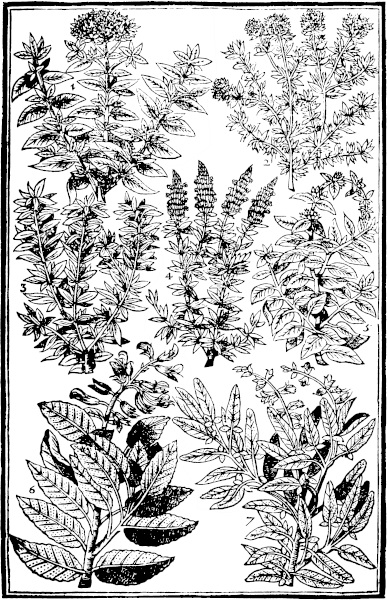
1Maiorana maior Anglica. Pot Marierome.
2Thymum vulgatius. Garden Tyme.
3Satureia. Sauorie.
4Hyssopus. Hyssope.
5Pulegium. Penniroyall.
6Saluia maior. Common Sage.
7Saluia minor primata. Sage of vertue.
Chap. III. Satureia siue Thymbra. Sauorie.
There are two sorts of Sauory, the one called Summer, and the other Winter Sauorie: The Summer Sauory is a small tender herbe, growing not aboue a foote and a halfe high, or thereabouts, rising vp with diuers brittle branches, slenderly or sparsedly set with small long leaues, soft in handling, at euery ioynt a couple, one against another, of a pleasant strong and quicke sent and taste: the flowers are small and purplish, growing at the toppes of the stalkes, with two small long leaues at the ioynts vnder them: the seede is small, and of a darke colour, bigger then Tyme seede by the halfe: the roote is wooddy, and hath many strings, perishing euery yeare wholly, and must bee new sowen againe, if any will haue it.
The Winter Sauorie is a small low bushie herbe, very like vnto Hyssope, but not aboue a foote high, with diuers small hard branches, and hard darke green leaues thereon, thicker set together then the former by much, and as thicke as common Hyssope, sometimes with foure leaues or more at a ioynt, of a reasonable strong sent, yet not so strong or quicke as the former: the flowers are of a pale purplish colour, set at seuerall distances at the toppes of the stalkes, with leaues at the ioynts also with them, like the former: the roote is woody, with diuers small strings thereat, and abideth all the winter with his greene leaues: it is more vsually encreased by slipping or diuiding the roote, and new setting it seuerally againe in the Spring, then by sowing the seed.
The Vse of Sauorie.
The Summer Sauorie is vsed in other Countryes much more then with vs in their ordinary diets, as condiment or sawce to their meates, sometimes of it selfe, and sometimes with other herbes, and sometimes strewed or layde vpon the dishes as we doe Parsley, as also with beanes and pease, rise and wheate; and sometimes the dryed herbe boyled among pease to make pottage.
The Winter Sauorie is one of the (farsing) faseting herbes as they call them, and so is the Summer Sauorie also sometimes. This is vsed also in the same manner that the Summer Sauorie is, set downe before, and to the same purposes: as also to put into puddings, sawsages, and such like kindes of meates. Some doe vse the pouder of the herbe dryed (as I sayd before of Tyme) to mixe with grated bread, to breade their meate, be it fish or flesh, to giue it the quicker rellish. They are both effectuall to expell winde.
Chap. IIII. Hyssopus. Hyssope.
Garden Hyssope is so well knowne to all that haue beene in a Garden, that I shall but actum agere, to bestow any time thereon, being a small bushie plant, not rising aboue two foote high, with many branches, woody below, and tender aboue, whereon are set at certaine distances, sundry small, long and narrow greene leaues: at the toppe of euery stalke stand blewish purple gaping flowers, one aboue another in a long spike or eare: after which followeth the seede, which is small and blackish: the rootes are composed of many threddy strings; the whole plant is of a strong sweet sent.
The Vse of Hyssope.
Hyssope is much vsed in Ptisans and other drinkes, to help to expectorate flegme. It is many Countrey peoples medicine for a cut or greene wound, being bruised with sugar and applyed. I finde it is also much commended against the falling sickenesse, especially being made into pils after the manner before rehearsed. It is accounted a speciall remedy against the sting or biting of an Adder, if the place be rubbed with Hyssope, bruised and mixed with honey, salt and cummin seede. A decoction thereof with oyle, and annointed, taketh away the itching and tingling of the head, and vermine also breeding therein. An oyle made of the herbe and flowers, being annointed, doth comfort benummed sinewes and ioynts.
Chap. V. Pulegium. Pennyroyall.
Pennyroyall also is an herbe so well knowne, that I shall not neede to spend much time in the description of it: hauing many weake round stalkes, diuided into sundry branches, rather leaning or lying vpon the ground then standing vpright, whereon are set at seuerall ioynts, small roundish darke greene leaues: the flowers are purplish that grow in gardens, yet some that grow wilde are white, or more white then purple, set in roundles about the tops of the branches; the stalkes shoote forth small fibres or rootes at the ioynts, as it lyeth vpon the ground, thereby fastening it selfe therein, and quickly increaseth, and ouer-runneth any ground, especially in the shade or any moist place, and is replanted by breaking the sprouted stalkes, and so quickely groweth.
Other sorts of Pennyroyall are fit for the Physicke Garden, or Garden of Simples.
The Vse of Pennyroyall.
It is very good and wholesome for the lunges, to expell cold thin flegme, and afterwards to warme and dry it vp: and is also of the like propertie as Mintes, to comfort the stomacke, and stay vomiting. It is also vsed in womens baths and washings: and in mens also to comfort the sinewes. It is yet to this day, as it hath beene in former times, vsed to bee put into puddings, and such like meates of all sorts, and therefore in diuers places they know it by no other name then Pudding-grasse.
The former age of our great Grandfathers, had all these hot herbes in much and familiar vse, both for their meates and medicines, and therewith preserued themselues in long life and much health: but this delicate age of ours, which is not pleased with any thing almost, be it meat or medicine, that is not pleasant to the palate, doth wholly refuse these almost, and therefore cannot be partaker of the benefit or them.
Chap. VI. Salvia. Sage.
There are two especiall kindes of Sage noursed vp in our Gardens, for our ordinary vse, whereof I intend to write in this place, leauing the rest to his fitter place. Our ordinary Sage is reckoned to bee of two sorts, white and red, both of them bearing many foure square wooddy stalkes, in some whiter, in others redder, as the leaues are also, standing by couples at the ioynts, being long, rough, and wrinkled, of a strong sweete sent: at the tops of the stalkes come forth the flowers, set at certaine spaces one aboue another, which are long and gaping, like vnto the flowers of Clary, or dead Nettles, but of a blewish purple colour; after which come small round seede in the huske that bore the flower: the roote is wooddy, with diuers strings at it: It is more vsually planted of the slips, pricked in the Spring time into the ground, then of the seed.
Saluia minor siue pinnata. Small Sage or Sage of vertue.
The lesser Sage is in all things like vnto the former white Sage, but that his branches are long and slender, and the leaues much smaller, hauing for the most part at the bottome of each side of the leafe a peece of a leafe, which maketh it shew like finns or eares: the flowers also are of a blewish purple colour, but lesser. Of this kinde there is one that beareth white flowers.
The Vse of Sage.
Sage is much vsed of many in the moneth of May fasting, with butter and Parsley, and is held of most much to conduce to the health of mans body.
It is also much vsed among other good herbes to bee tund vp with Ale, which thereupon is termed Sage Ale, whereof many barrels full are made, and drunke in the said moneth chiefly for the purpose afore recited: and also for teeming women, to helpe them the better forward in their childebearing, if there be feare of abortion or miscarrying.
It is also vsed to be boyled among other herbes, to make Gargles or waters to wash sore mouths and throates: As also among other herbes, that serue as bathings, to wash mens legs or bodies in the Summer time, to comfort nature, and warme and strengthen aged cold sinewes, and lengthen the strength of the younger.
The Kitchen vse is either to boyle it with a Calues head, and being minced, to be put with the braines, vinegar and pepper, to serue as an ordinary sawce thereunto: Or being beaten and iuyced (rather then minced as mannie doe) is put to a rosted Pigges braines, with Currans for sawce thereunto. It is in small quantity (in regard of the strong taste thereof) put among other fasting herbes, to serue as sawce for peeces of Veale, when they are farsed or stuffed therewith, and rosted, which they call Olliues.
For all the purposes aforesaid, the small Sage is accounted to be of the more force and vertue.
Chap. VII. Horminum sativum. Garden Clary.
There is but one sort of Garden Clary, though many wilde, which hath foure square stalks, with broad rough wrinkled whitish leaues, somewhat vneuenly cut in on the edges, and of a strong sweete sent, growing some next the ground, & some by couples vpon the stalkes: the flowers growe at certaine distances, with two small leaues at the ioynts vnder them, somewhat like vnto the flowers of Sage, but lesser, and of a very whitish or bleake blew colour: the seede is of a blackish browne colour, somewhat flat, and not so round as the wilde: the rootes spread not farre, and perish euery yeare that they beare flowers and seede. It is altogether to bee sowne of seed in the Spring time, yet sometimes it will rise of it owne sowing.
The Vse of Clary.
The most frequent and common vse of Clary, is for men or women that haue weake backes, to helpe to comfort and strengthen the raines, being made into Tansies and eaten, or otherwise. The seede is vsed of some to be put into the corner of the eye, if any mote or other thing haue happened into it: but assuredly although this may peraduenture doe some good, yet the seede of the wilde will doe much more. The leaues taken dry, and dipped into a batter made of the yolkes of egges, flower, and a little milke, and then fryed with butter vntill they be crispe, serue for a dish of meate accepted with manie, vnpleasant to none.
Chap. VIII. Nepeta. Nep.
Although those that are Herbarists do know three sorts of Nep, a greater & two lesser, yet because the lesser are not vsuall, but in the Gardens of those that delight in natures varieties, I do not here shew you them. That which is vsuall (and called of manie Cat Mint) beareth square stalkes, but not so great as Clarie, hauing two leaues at euery ioynt, somewhat like vnto Balme or Speare Mintes, but whiter, softer, and longer, and nicked about the edges, of a strong sent, but nothing so strong as Clary: the flowers growe at the toppes of the stalkes, as it were in long spikes or heads, somewhat close together, yet compassing the stalkes at certaine ioynts, of a whitish colour, for forme and bignesse like vnto Balme, or somewhat bigger: the rootes are composed of a number of strings, which dye not, but keepe greene leaues vpon them all the Winter, and shoote anew in the Spring. It is propagated both by the seede, and by slipping the rootes.
The Vse of Nep.
Nep is much vsed of women either in baths or drinkes to procure their feminine courses: as also with Clarie, being fryed into Tansies, to strengthen their backes. It is much commended of some, if the iuyce thereof be drunke with wine, to helpe those that are bruised by some fall, or other accident. A decoction of Nep is auaileable to cure the scabbe in the head, or other places of the body.
Chap. IX. Melissa. Baulme.
The Garden Baulme which is of common knowne vse, hath diuers square blackish greene stalkes, and round, hard, darke, greene pointed leaues, growing thereon by couples, a little notched about the edges, of a pleasant sweete sent, drawing nearest to the sent of a Lemon or Citron; and therefore of some called Citrago: the flowers growe about the toppes of the stalkes at certaine distances, being small and gaping, of a pale carnation colour, almost white: the rootes fasten themselues strongly in the ground, and endure many yeares, and is encreased by diuiding the rootes; for the leaues dye downe to the ground euery yeare, leauing no shew of leafe or stalke in the Winter.
The Vse of Baulme.
Baulme is often vsed among other hot and sweete herbes, to make baths and washings for mens bodies or legges, in the Summer time, to warme and comfort the veines and sinewes, to very good purpose and effect, and hath in former ages beene of much more vse then now adaies. It is also vsed by diuers to be stilled, being steeped in Ale, to make a Baulme water, after the manner they haue beene taught, which they keepe by them, to vse in the stead of Aqua vitæ, when they haue any occasion for their owne or their neighbours Families, in suddaine qualmes or passions of the heart: but if they had a little better direction (for this is somewhat too rude) it would doe them more good that take it: For the herbe without all question is an excellent helpe to comfort the heart, as the very smell may induce any so to beleeue. It is also good to heale greene wounds, being made into salues: and I verily thinke, that our forefathers hearing of the healing and comfortable properties of the true naturall Baulme, and finding this herbe to be so effectuall, gaue it the name of Baulme, in imitation of his properties and vertues. It is also an herbe wherein Bees doe much delight, as hath beene found by experience of those that haue kept great store; if the Hiues bee rubbed on the inside with some thereof, and as they thinke it draweth others by the smell thereof to resort thither. Plinie saith, it is a present remedy against the stinging of Bees.
Chap. X. Mentha. Mintes.
There are diuers sorts of Mints, both of the garden, and wilde, of the woods, mountaines, and standing pooles or waters: but I will onely in this place bring to your remembrance two or three sorts of the most vsuall that are kept in gardens, for the vses whereunto they are proper.
Red Mint or browne Mint hath square brownish stalkes, with somewhat long and round pointed leaues, nicked about the edges, of a darke greene colour, set by couples at euery ioynt, and of a reasonable good sent: the flowers of this kinde are reddish, standing about the toppes of the stalkes at distances: the rootes runne creeping in the ground, and as the rest, will hardly be cleared out of a garden, being once therein, in that the smallest peece thereof will growe and encrease apace.
Speare Mint hath a square greene stalke, with longer and greener leaues then the former, set by couples, of a better and more comfortable sent, and therefore of much more vse then any other: the flowers hereof growe in long eares or spikes, of a pale red or blush colour: the roots creepe in the ground like the other.
Party coloured or white Mint hath square greene stalkes and leaues, somewhat larger then Speare Mint, and more nicked in the edges, whereof many are parted, halfe white and halfe greene, and some more white then greene, or more green then white, as nature listeth: the flowers stand in long heads close set together, of a blush colour: the rootes creepe as the rest doe.
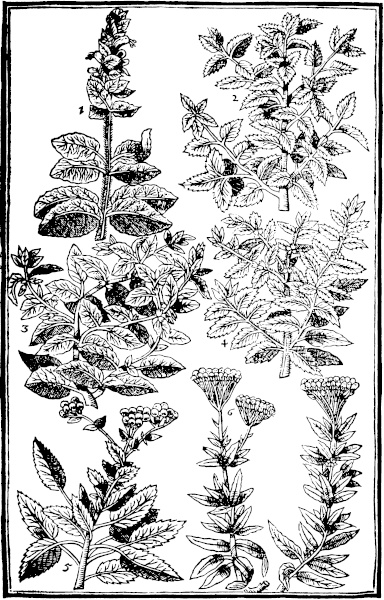
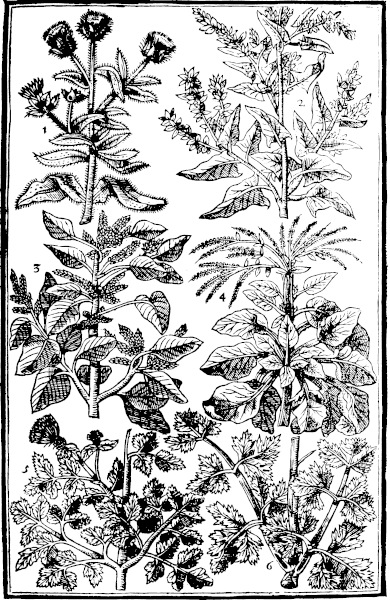
1Horminum sativum. Garden Clary.
2Nepeta. Nep.
3Melissa. Baulme.
4Mentha satiua. Garden Mintes.
5Balsamita mas, seu Costus hortorum. Costmary.
6Ageratum. Maudeline.
The Vse of Mintes.
Mintes are oftentimes vsed in baths, with Baulme and other herbes, as a helpe to comfort and strengthen the nerues and sinewes.
It is much vsed either outwardly applyed, or inwardly drunke, to strengthen and comfort weake stomackes, that are much giuen to casting: as also for feminine fluxes. It is boyled in milke for those whose stomackes are apt to cause it to curdle. And applyed with salt, is a good helpe for the biting of a mad dogge.
It is vsed to be boyled with Mackarell, and other fish.
Being dryed, is often and much vsed with Penniroyall, to bee put into puddings: as also among pease that are boyled for pottage.
Where Dockes are not ready at hand, they vse to bruise Mintes, and lay them vpon any place that is stung with Bees, Waspes, or such like, and that to good purpose.
Chap. XI. Balsamita mas & fæmina, seu Costus hortorum maior & minor. Costmary and Maudeline.
Costmary or Alecoast is a sweet herbe, bearing many broad and long pale green leaues, snipped about the edges, euery one vpon a long foote-stalke; among which rise vp many round greene stalkes, with such like leaues on them, but lesser vp to the toppe, where it spreadeth it selfe into three or foure branches, euery one bearing an vmbell or tuft of gold yellow flowers, somewhat like vnto Tansie flowers, but lesser, which turne into small heads, containing small flat long seede: the roote is somewhat hard and stringy, and being diuided, is replanted in the Spring of the yeare for increase.
Maudeline hath somewhat long and narrow leaues, snipt about the edges: the stalks are two foot high, bearing many yellow flowers on the tops of the branches, in an vmbell or tuft like vnto Tansie: the whole herbe is sweete, and somewhat bitter, and is replanted by slipping.
The Vse of Costmary and Maudeline.
Costmary is of especiall vse in the Spring of the yeare, among other such like herbes, to make Sage Ale, and thereupon I thinke it tooke the name of Alecoast.
It is also vsed to be put among other sweete herbes, to make sweete washing water, whereof there is great store spent.
The leaues haue an especiall vertue to comfort both the stomack and heart, and to warme and dry a moist braine. The seede is much vsed in the Country, to be giuen to children for the wormes, in the stead of wormseed, and so is the seede of Maudeline also.
Maudeline is much vsed with Costmary and other sweet herbes, to make sweete washing water: the flowers also are tyed vp with small bundels of Lauender toppes, these being put in the middle of them, to lye, vpon the toppes of beds, presses, &c. for the sweete sent and sauour it casteth. It is generally accounted of our Apothecaries to be the true Eupatorium of Auicen, and the true Ageratum of Dioscorides; but Dodonæus seemeth to contradict both.
Chap. XII. Tanacetum vulgare & crispum. Tansie.
Ovr Garden Tansie hath many hard greene leaues, or rather wings of leaues; for they are many small ones, set one against another all along a middle ribbe or stalke, and snipt about the edges: in some the leaues stand closer and thicker, and somewhat crumpled, which hath caused it to be called double or curld Tansie, in others thinner and more sparsedly: It riseth vp with many hard stalks, whereon growe at the tops vpon the seuerall small branches gold yellow flowers like buttons, which being gathered in their prime, will hold the colour fresh a long time: the seede is small, and as it were chaffie: the roote creepeth vnder ground, and shooteth vp againe in diuers places: the whole herbe, both leaues and flowers, are of a sharpe, strong, bitter smell and taste, but yet pleasant, and well to be endured.
The Vse of Tansie.
The leaues of Tansie are vsed while they are young, either shred small with other herbes, or else the iuyce of it and other herbes fit for the purpose, beaten with egges, and fryed into cakes (in Lent and the Spring of the yeare) which are vsually called Tansies, and are often eaten, being taken to be very good for the stomack, to helpe to digest from thence bad humours that cleaue thereunto: As also for weak raines and kidneyes, when the vrine passeth away by drops: This is thought to be of more vse for men then for women. The seed is much commended against all sorts of wormes in children.
Chap. XIII. Pimpinella siue Sanguisorba. Burnet.
Burnet hath many winged leaues lying vpon, the ground, made of many small, round, yet pointed greene leaues, finely nicked on the edges, one set against another all along a middle ribbe, and one at the end thereof; from among which rise vp diuers round, and sometimes crested browne stalkes, with some few such like leaues on them as growe belowe, but smaller: at the toppes of the stalkes growe small browne heads or knaps, which shoote forth small purplish flowers, turning into long and brownish, but a little cornered seede: the roote groweth downe deepe, being small and brownish: the whole plant is of a stipticke or binding taste or quality, but of a fine quicke sent, almost like Baulme.
The Vse of Burnet.
The greatest vse that Burnet is commonly put vnto, is to put a few leaues into a cup with Claret wine, which is presently to be drunke, and giueth a pleasant quicke taste thereunto, very delightfull to the palate, and is accounted a helpe to make the heart merrie. It is sometimes also while it is young, put among other Sallet herbes, to giue a finer rellish thereunto. It is also vsed in vulnerary drinkes, and to stay fluxes and bleedings, for which purposes it is much commended. It hath beene also much commended in contagious and pestilentiall agues.
Chap. XIIII. Hippolapathum sativum, siue Rhabarbarum Monachorum. Monkes Rubarbe or Patience.
Garden Patience is a kinde of Docke in all the parts thereof, but that it is larger and taller then many others, with large and long greene leaues, a great, strong, and high stalke, with reddish or purplish flowers, and three square seede, like as all other Dockes haue: the roote is great and yellow, not hauing any shew of flesh coloured veines therein, no more then the other kinde with great round thin leaues, commonly called Hippolapathum rotundifolium, Bastard Rubarbe, or Monkes Rubarbe, the properties of both which are of very weake effect: but I haue a kinde of round leafed Dock growing in my Garden, which was sent me from beyond Sea by a worthy Gentleman, Mʳ. Dʳ. Matth. Lister, one of the Kings Physitians, with this title, Rhaponticum verum, and first grew with me, before it was euer seen or known elsewhere in England, wᶜʰ by proof I haue found to be so like vnto the true Rubarbe, or the Rha of Pontus, both for forme and colour, that I dare say it is the very true Rubarbe, our climate only making it lesse strong in working, lesse heauy, and lesse bitter in taste: For this hath great and thicke rootes, as diuersly discoloured with flesh coloured veines as the true Rubarbe, as I haue to shew to any that are desirous to see and know it; and also other smaller sprayes or branches of rootes, spreading from the maine great roote, which smaller branches may well be compared to the Rhaponticum which the Merchants haue brought vs, which we haue seene to be longer and slenderer then Rubarbe, but of the very same colour: this beareth so goodly large leaues, that it is a great beauty in a garden to behold them: for I haue measured the stalke of the leafe at the bottome next the roote to bee of the bignesse of any mans thumbe; and from the roote to the leafe it selfe, to bee two foote in length, and sometimes more; and likewise the leafe it selfe, from the lower end where it is ioyned to the stalke, to the end or point thereof, to bee also two foote in length, and sometimes more; and also in the broadest part of the leafe, to be two foote or more ouer in breadth: it beareth whitish flowers, contrary to all other Dockes, and three square brownish seede as other Dockes doe, but bigger, and therefore assuredly it is a Docke, and the true Rubarbe of the Arabians, or at the least the true Rhaponticum of the Ancients. The figure of the whole plant I haue caused to be cut, with a dryed roote as it grew in my garden by it selfe, and haue inserted it here, both because Matthiolus giueth a false figure of the true Rubarbe, and that this hath not been expressed and set forth by any before.
The Vse of Patience, and of the Rubarbe.
The leaues of Patience are often, and of many vsed for a pot-herbe, and seldome to any other purpose: the roote is often vsed in Diet-beere, or ale, or in other drinkes made by decoction, to helpe to purge the liuer, and clense the blood. The other Rubarbe or Rhaponticum, whereof I make mention, and giue you here the figure, I haue tryed, and found by experience to purge gently, without that astriction that is in the true Rubarbe is brought vs from the East Indies, or China, and is also lesse bitter in taste; whereby I coniecture it may bee vsed in hot and feauerish bodies more effectually, because it doth not binde after the purging, as the East India Rubarbe doth: but this must bee giuen in double quantitie to the other, and then no doubt it will doe as well: The leaues haue a fine acide taste: A syrrupe therefore made with the iuice and sugar, cannot but be very effectuall in deiected appetites, and hot fits of agues; as also to helpe to open obstructions of the liuer, as diuers haue often tryed, and found auaileable by experience.
Chap. XV. Lapathum sanguineum. Blood-wort.
Among the sorts of pot-herbes Bloode-worte hath alwayes beene accounted a principall one, although I doe not see any great reason therein, especially seeing there is a greater efficacie of binding in this Docke, then in any of the other: but as common vse hath receiued it, so I here set it downe. Blood-worte is one of the sorts of Dockes, and hath long leaues like vnto the smaller yellow Dock, but striped with red veines, and ouer-shadowed with red vpon the greene leafe, that it seemeth almost wholly red sometimes: the stalke is reddish, bearing such like leaues, but smaller vp to the toppe, where it is diuided into diuers small branches, whereon grow purplish flowers, and three square darke red seede, like vnto others: the roots are not great, but somewhat long, and very red, abiding many yeares, yet sometimes spoiled with the extremitie of winter.
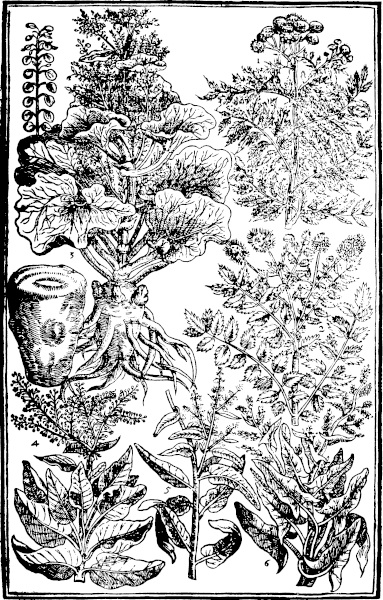
1Tanacetum. Tansie.
2Pimpinella. Burnet.
3Rhaponticum verum seu potius Rhabarbarum verum. True Raponticke or rather true Rubarbe.
4Lapathum sativum seu Patientiæ. Monkes Rubarbe or Patience.
5Lapathum sanguineum. Bloudwort.
6Acetosa. Sorrell.
The Vse of Blood-worte.
The whole and onely vse of the herbe almost, serueth for the pot, among other herbes, and, as I said before, is accounted a most especiall one for that purpose. The seede therof is much commended for any fluxe in man or woman, to be inwardly taken, and so no doubt is the roote, being of a stipticke qualitie.
Chap. XVI. Oxalis siue Acetosa. Sorrell.
Sorrell must needes bee reckoned with the Dockes, for that it is so like vnto them in all things, and is of many called the sower Docke. Of Sorrels there are many sorts, but I shall not trouble you with any other in this place, then the common Garden Sorrell, which is most knowne, and of greatest vse with vs; which hath tender greene long leaues full of iuice, broade, and bicorned as it were, next vnto the stalke, like as Arrach, Spinach, and our English Mercurie haue, of a sharpe sower taste: the stalkes are slender, bearing purplish long heads, wherein lye three square shining browne seede, like, but lesser then the other: the root is smaller then any of the other Dockes, but browne, and full of strings, and abideth without decaying, hauing greene leaues all the winter, except in the very extremitie thereof, which often taketh away all or most of his leaues.
The Vse of Sorrell.
Sorrell is much vsed in sawces, both for the whole, and the sicke, cooling the hot liuers, and stomackes of the sicke, and procuring vnto them an appetite vnto meate, when their spirits are almost spent with the violence of their furious or fierie fits; and is also of a pleasant relish for the whole, in quickning vp a dull stomacke that is ouer-loaden with euery daies plenty of dishes. It is diuers waies dressed by Cooks, to please their Masters stomacks.
Chap. XVII. Buglossum luteum, siue Lingua Bouis. Langdebeefe.
Vnto this place may well bee referred our ordinary Borage and Buglosse, set forth in the former Booke, in regard of the properties whereunto they are much employed, that is, to serue the pot among other herbes, as is sufficiently knowne vnto all. And yet I confesse, that this herbe (although it bee called Buglossum luteum, as if it were a kind of Buglosse) hath no correspondency with Buglosse or Borage in any part, sauing only a little in the leafe; & our Borage or Buglosse might more fitly, according to the Greeke name, bee called Oxe tongue or Langdebeefe; and this might in my iudgement more aptly be referred to the kinds of Hieratium Hawkeweed, whereunto it neerest approacheth: but as it is commonly receiued, so take it in this place, vntill it come to receiue the place is proper for it. It hath diuers broad and long darke green leaues, lying vpon the ground, very rough in handling, full of small haires or prickes, ready to enter into the hands of any that handle it; among which riseth vp a round greene hairy or prickly stalk, bearing at the toppe, among a few small green leaues, diuers small yellow flowers in rough heads, which turne into doune, containing within them browne yellowish small long seedes, somewhat like vnto the seede of Hawkeweede: the roote is wooddy, which perisheth quickly after it hath borne seed; but is tender while it is young.
1Lingua bouis siue Buglossum luteum. Langdebeefe.
2Atriplex siue Olus aureum. Arrach.
3Blitum. Blites.
4Beta. Beetes.
5Hipposelinum siue Olus atrum. Allisanders.
6Selinum dulce. Sweete Parsley.
The Vse of Langdebeefe.
The leaues are onely vsed in all places that I know, or euer could learne, for an herbe for the pot among others, and is thought to bee good to loosen the belly.
Chap. XVIII. Atriplex siue Olus Aureum. Arrach.
There be diuers kindes of Arrach, or Orach, as some doe call them; some of the Garden, whereof I meane to entreate in this place; others wilde of the Fieldes, &c. and others of the Sea, which are not to bee spoken of in this worke, but referred to a generall historie. The white garden Arrach, or Orach, hath diuers leaues, standing vpon their seuerall footestalkes, broade at the bottome, ending in two points like an arrow, with two feathers at the head, and small pointed at the end of the leafe, of a whitish yellow greene colour, and as it were strewed ouer with flower or meale, especially while they are young: the stalke like wise is mealy, bearing many branches with small yellow flowers on them, which turne into small leafie seeds: the roote groweth somewhat deepe in the ground, with many small threds fastened thereto: it quickly springeth vp of the seede, groweth great, and fadeth away as soon as it hath borne seede.
The purple Arrach is in all things like vnto the white, sauing onely in the colour of the leafe, stalke, seede, &c. which are all of a mealy dusty purplish colour.
The Vse of Arrach.
Arrach is cold and moist, and of a lubricke or slippery qualitie, whereby it quickely passeth through the stomacke and belly, and maketh it soluble, and is of many vsed for that purpose, being boyled and buttered, or put among other herbes into the pot to make pottage.
There are many dishes of meate made with them while they are young, for being almost without sauour of themselues, they are the more conuertible into what rellish any one will make them with Sugar, Spice &c.
Chap. XIX. Blitum. Blites.
There be diuers sorts of Blites, some whereof I haue entreated in the former part of this worke, vnder the titled Amaranthus, Flower gentle: others that are noursed vp in Gardens, I will set forth in this place, which are onely two, that haue come to my knowledge, that is, the white and the red, and are of a qualitie as neere vnto Arrach as vnto Beetes, participating of both, and therefore I haue placed them betwixt them. The white Blite hath leaues somewhat like vnto Beetes, but smaller, rounder, and of a whitish greene colour, euery one standing vpon a small long footestalke: the stalke riseth vp two or three foote high, with many such like leaues thereon: the flowers grow at the top in long round tufts or clusters, wherein are contained small round seede: the roote is very full of threds or strings.
The red Blite is in all things like the white, but that his leaues and tufted heades are exceeding red at the first, and after turne more purplish.
The Vse of Blites.
Blites are vsed as Arrach, eyther boyled of it selfe or stewed, which they call Loblolly, or among other herbes to bee put into the pot; and yet some doe vtterly refuse it, because in diuers it prouoketh castings. It is altogether insipide or without taste, but yet by reason of the moist slipperie qualitie it hath, it helpeth to loosen the belly. The vnsauorinesse whereof hath in many Countries growne into a prouerbe, or by-word, to call dull, slow, or lazie persons by that name: They are accounted more hurtfull to the stomacke, and so to the head and eyes, then other herbes, and therefore they are the lesse vsed.
Chap. XX. Beta. Beetes.
There are many diuersities of Beetes, some growing naturally in our own Country, others brought from beyond Sea; whereof some are white, some greene, some yellow, some red: the leaues of some are of vse only, and the root not vsed: others the roote is only vsed, and not the leaues: and some againe, both roote and leafe. The ancient Authors, as by their workes appeare, knew but two sorts, the white and the blacke Beete, whereof the white is sufficiently known, and was of them termed Sicula, of the later Physitians, Sicla, because it was thought first to be brought from Sicilie: the blacke abideth some controuersie; some thinking that our common greene Beete, because it is of a darke greene colour, was that they called the blacke Beete; others that our small red Beete, which is of a darke red colour, was their black Beete, which in my opinion is the more likely: But to come to the matter in hand, and giue you the descriptions of them which are in vse with vs, and leaue controuersies to such a worke as is fit for them, wherein all such matters may be discussed at large.
The common white Beete hath many great leaues next the ground (in some hot Countries growing to be three foote long, and very broade, in our Countrey they are very large, but nothing neere that proportion) of a whitish greene colour; the stalke is great, strong, and ribbed or crested, bearing great store of leaues vpon it vp to the very toppe almost: the flowers grow in very long tufts, small at the ends, and turning down their heads, which are small pale greenish yellow burres, giuing cornered prickly seede: the roote is great, long and hard, when it hath giuen seede, of no vse at all, but abideth a former winter with his leaues vpon it, as all other sorts following doe.
The common red Beet differeth not from the white Beete, but only that it is not so great, and both the leaues and rootes are somewhat red: the leaues bee in some more red then in others, which haue but red veines or strakes in them, in some also of a fresh red, in others very darke red: the roote hereof is red, spongy, and not vsed to bee eaten.
The common greene Beete is also like vnto the white Beete, but of a darke greene colour. This hath beene found neere the salt Marshes by Rochester, in the foote-way going from the Lady Levesons house thither, by a worthy, diligent and painefull obseruer and preseruer both of plants and all other natures varieties, often remembred before in this worke, called Iohn Tradescante, who there finding it, gaue me the knowledge thereof, and I haue vpon his report set it here down in this manner:
The Romane red Beete, called Beta raposa, is both for leafe and roote the most excellent Beete of all others: his rootes bee as great as the greatest Carrot, exceeding red both within and without, very sweete and good, fit to bee eaten: this Beete groweth higher then the last red Beete, whose rootes are not vsed to bee eaten: the leaues likewise are better of taste, and of as red a colour as the former red Beete: the roote is sometimes short like a Turnep, whereof it took the name of Rapa or raposa; and sometimes as I said before, like a Carrot and long: the seede is all one with the lesser red Beete.
The Italian Beete is of much respect, whose faire greene leaues are very large and great, with great white ribbes and veines therein: the stalke in the Summer time, when it is growen vp to any height, is six square in shew, and yellowish withall, as the heades with seede vpon them seeme likewise.
The great red Beete that Master Lete a Merchant of London gaue vnto Master Gerrard, as he setteth it downe in his Herball, seemeth to bee the red kinde of the last remembred Beete, whose great ribbes as he saith, are as great as the middle ribbe of the Cabbage leafe, and as good to bee eaten, whose stalke rose with him to the height of eight cubits, and bore plenty of seede.
The Vse of Beetes.
Beetes, both white, greene and red, are put into the pot among other herbes, to make pottage, as is commonly known vnto all, and are also boyled whole, both in France vsually with most of their boyled meates, and in our Countrey, with diuers that delight in eating of herbes.
The Italian Beete, and so likewise the last red Beete with great ribbes, are boyled, and the ribbes eaten in sallets with oyle, vinegar and pepper, and is accounted a rare kinde of sallet, and very delicate.
The roote of the common red Beete with some, but more especially the Romane red Beete, is of much vse among Cookes to trimme or set out their dishes of meate, being cut out into diuers formes and fashions, and is grown of late dayes into a great custome of seruice, both for fish and flesh.
The rootes of the Romane red Beete being boyled, are eaten of diuers while they are hot with a little oyle and vinegar, and is accounted a delicate sallet for the winter; and being cold they are so vsed and eaten likewise.
The leaues are much vsed to mollifie and open the belly, being vsed in the decoction of Glisters. The roote of the white kinde scraped, and made vp with a little honey and salt, rubbed on and layd on the belly, prouoketh to the stoole. The vse of eating Beetes is likewise held to bee helpefull to spleneticke persons.
Chap. XXI. Hipposelinum, siue Olus atrum. Alisanders.
Alisanders hath beene in former times thought to be the true Macedonian Parsley, and in that errour many doe yet continue: but this place giueth not leaue to discusse that doubt: but I must here only shew you, what it is, and to what vse it is put ordinarily for the Kitchen. The leaues of Alisanders are winged or cut into many parts, somewhat resembling Smallage, but greater, broader, and more cut in about the edges: the stalkes are round and great, two foote high or better, bearing diuers leaues on them, and at the toppe spokie roundles of white flowers on seuerall small branches, which turne into blacke seede, somewhat cornered or crested, of an aromaticall bitter taste; the roote is blacke without, and white within, and abideth well the first year of the sowing, perishing after it hath borne seed.
The Vse of Alisanders.
The tops of the rootes, with the lower part of the stalkes of Alisanders, are vsed in Lent especially, and Spring of the yeare, to make broth, which although it be a little bitter, yet it is both wholsome and pleasing to a great many, by reason of the aromaticall or spicie taste, warming and comforting the stomack, and helping it digest the many waterish and flegmaticke meates are in those times much eaten. The rootes also either rawe or boyled are often eaten with oyle and vinegar. The seede is more vsed physically then the roote, or any other part, and is effectuall to prouoke plenty of vrine in them that pisse by drops, or haue the Strangury: It helpeth womens courses, and warmeth their benummed bodies or members, that haue endured fierce cold daies and nights, being boyled and drunke.
Chap. XXII. Selinum dulce. Sweete Parsley or sweete Smallage.
This kinde of sweete Parsley or Smallage, which soeuer you please to call it, for it resembleth Smallage as well in the largenesse of the leaues, as in the taste, yet sweeter and pleasanter, is (as I take it) in this like vnto sweete Fennell (that hath his sweetnesse from his naturall soyle and clymate; for howsoeuer it bee reasonable sweete the first yeare it is sowne with vs, yet it quickly doth degenerate, and becommeth no better then our ordinarie Fennell afterwards). The first yeare it is sowne and planted with vs (and the first that euer I saw, was in a Venetian Ambassadours Garden in the Spittle yard, neare Bishops gate streete) is so sweete and pleasant, especially while it is young, as if Sugar had beene mingled with it: but after it is growne vp high and large, it hath a stronger taste of Smalladge, and so likewise much more the next yeare; that it groweth from the seed was gathered here: the leaues are many, spreading farre about the roote, broader and of a fresher greene colour then our ordinary Smalladge, and vpon longer stalkes: the seed is as plentifull as Parsley, being small and very like vnto it, but darker of colour.
The Vse of sweete Parsley.
The Venetians vse to prepare it for meate many waies, both the herbe and the roote eaten rawe, as many other herbes and rootes are, or boyled or fryed to be eaten with meate, or the dryed herbe poudered and strewed vpon meate; but most vsually either whited, and so eaten rawe with pepper and oyle, as a dainty Sallet of it selfe, or a little boyled or stewed: the taste of the herbe being a little warming, but the seede much more, helpeth cold windy stomackes to digest their meate, and to expell winde.
Chap. XXIII. Petrosolinum & Apium. Parsley and Smalledge.
We haue three sorts of Parsley in our Gardens, and but one of Smalladge: Our common Parsley, Curld Parsley, and Virginia Parsley; which last, although it be but of late knowne, yet it is now almost growne common, and of as good vse as the other with diuers. Our common Parsley is so well knowne, that it is almost needlesse to describe it, hauing diuers fresh greene leaues, three alwaies placed together on a stalke, and snipt about the edges, and three stalkes of leaues for the most part growing together: the stalkes growe three or foure foote high or better, bearing spikie heads of white flowers, which turne into small seede, somewhat sharpe and hot in taste: the roote is long and white.
Curld Parsley hath his leaues curled or crumpled on the edges, and therein is the onely difference from the former.
Virginia Parley is in his leafe altogether like vnto common Parsley for the forme, consisting of three leaues set together, but that the leaues are as large as Smallage leaues, but of a pale or whitish greene colour, and of the same taste of our common Parsley: the seede hereof is as the leaues, twice if not thrice as bigge as the ordinary Parsley, and perisheth when it hath giuen seede, abiding vsually the first yeare of the sowing.
Smallage is in forme somewhat like vnto Parsley, but greater and greener, and lesse pleasant, or rather more bitter in taste: the seede is smaller, and the root more stringy.
The Vse of Parsley.
Parsley is much vsed in all sorts of meates, both boyled, roasted, stewed, &c. and being greene it serueth to lay vpon sundry meates, as also to draw meate withall. It is also shred and stopped into poudered beefe, as also into legges of Mutton, with a little beefe suet among it, &c.
The rootes are often vsed to be put into broth, to helpe to open obstructions of the liuer, reines, and other parts, helping much to procure vrine.
The rootes likewise boyled or stewed with a legge of Mutton, stopped with Parsley as aforesaid, is very good meate, and of very good rellish, as I haue proued by the taste; but the rootes must bee young, and of the first yeares growth, and they will haue their operation to cause vrine.
The seed also is vsed for the same cause, when any are troubled with the stone, or grauell, to open the passages of vrine.
Although Smallage groweth in many places wilde in moist grounds, yet it is also much planted in Gardens, and although his euill taste and sauour doth cause it not to be accepted into meates as Parsley, yet it is not without many speciall good properties, both for outward and inward diseases, to helpe to open obstructions, and prouoke vrine. The iuyce cleanseth vlcers; and the leaues boyled with Hogs grease, healeth felons on the ioynts of the fingers.
Chap. XXIIII. Fœniculum. Fenell.
There are three sorts of Fenell, whereof two are sweete. The one of them is the ordinary sweete Fenell, whose seedes are larger and yellower then the common, and which (as I said before in the Chapter of sweete Parsley) doth soone degenerate in this our Country into the common. The other sweete Fenell is not much knowne, and called Cardus Fenell by those that sent it out of Italy, whose leaues are more thicke and bushie then any of the other. Our common Fenell, whereof there is greene and red, hath many faire and large spread leaues, finely cut and diuided into many small, long, greene, or reddish leaues, yet the thicker tufted the branches be, the shorter are the leaues: the stalkes are round, with diuers ioynts and leaues at them, growing fiue or six foot high, bearing at the top many spoakie rundels of yellow flowers; the Common, I meane, doth turne into a darke grayish flat seede, and the Sweete into larger and yellower: the roote is great, long, and white, and endureth diuers yeares.
The Vse of Fenell.
Fenell is of great vse to trimme vp, and strowe vpon fish, as also to boyle or put among fish of diuers sorts, Cowcumbers pickled, and other fruits, &c. The rootes are vsed with Parsley rootes, to be boyled in broths and drinkes to open obstructions. The seed is of much vse with other things to expell winde. The seede also is much vsed to be put into Pippin pies, and diuers other such baked fruits, as also into bread, to giue it the better rellish. The sweete Cardus Fenell being sent by Sir Henry Wotton to Iohn Tradescante, had likewise a large direction with it how to dresse it; for they vse to white it after it hath been transplanted for their vses, which by reason of the sweetnesse by nature, and the tendernesse by art, causeth it to be the more delightfull to the taste, especially with them that are accustomed to feede on greene herbes.
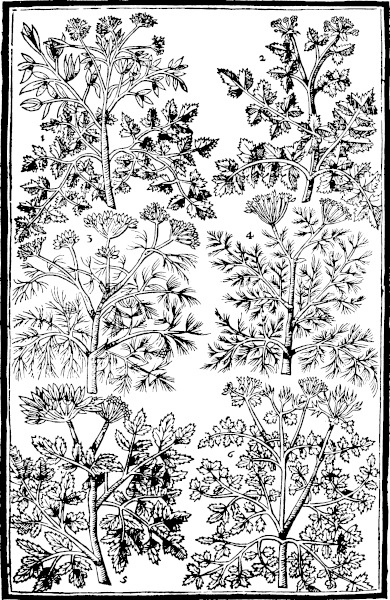
1Petrofolinum. Parsley.
2Apium. Smallage.
3Fœniculum. Fenell.
4Anethum. Dill.
5Myrrhis siue Cerefolium magnum. Sweete Cheruill.
6Cerefolium vulgare. Common Cheruill.
Chap. XXV. Anethum. Dill.
Dill doth much growe wilde, but because in many places it cannot be had, it is therefore sowne in Gardens for the vses whereunto it serueth. It is a smaller herbe then Fenell, but very like, hauing fine cut leaues, not so large, but shorter, smaller, and of a stronger and quicker taste: the stalke is smaller also, and with few ioynts and leaues on them, bearing spoakie tufts of yellow flowers, which turne into thinne, small, and flat seedes: the roote perisheth euery yeare, and riseth againe for the most part of it owne sowing.
The Vse of Dill.
The leaues of Dill are much vsed in some places with Fish, as they doe Fenell; but because it is so strong many doe refuse it.
It is also put among pickled Cowcumbers, wherewith it doth very well agree, giuing vnto the cold fruit a pretty spicie taste or rellish.
It being stronger then Fenell, is of the more force to expell winde in the body. Some vse to eate the seed to stay the Hickocke.
Chap. XXVI. Myrrhis siue Cerefolium maius & vulgare. Sweet Cheruill and ordinary Cheruill.
The great or sweete Cheruill (which of some is called Sweete Cicely) hath diuers great and faire spread winged leaues, consisting of many leaues set together, deeply cut in the edges, and euery one also dented about, very like, and resembling the leaues of Hemlockes, but of so pleasant a taste, that one would verily thinke, he chewed the leaues or seedes of Aniseedes in his mouth: The stalke is reasonable great, and somewhat cornered or crested about three or foure foote high, at the toppe whereof stand many white spoakie tufts of flowers, which change into browne long cornered great seede, two alwaies ioyned together: the roote is great, blackish on the outside, and white within, with diuers fibres annexed vnto it, and perisheth not, but abideth many yeares, and is of a sweete, pleasant, and spicie hot taste, delightfull vnto many.
The common Cheruill is a small herbe, with slender leaues, finely cut into long peeces, at the first of a pale yellowish greene colour, but when the stalke is growne vp to seede, both stalkes and leaues become of a darke red colour: the flowers are white, standing vpon scattered or thin spread tufts, which turne into small, long, round, and sharpe pointed seedes, of a brownish blacke colour: the roote is small, with diuers long slender white strings, and perisheth euery yeare.
The Uses of these Cheruils.
The common Cheruill is much vsed of the French and Dutch people, to bee boyled or stewed in a pipkin, eyther by it selfe, or with other herbes, whereof they make a Loblolly, and so eate it. It is vsed as a pot-herbe with vs.
Sweete Cheruill, gathered while it is young, and put among other herbes for a sallet, addeth a meruellous good rellish to all the rest. Some commend the greene seedes diced and put in a sallet of herbes, and eaten with vinegar and oyle, to comfort the cold stomacke of the aged. The roots are vsed by diuers, being boyled, and after eaten with oyle and vinegar, as an excellent sallet for the same purpose. The preserued or candid rootes are of singular good vse to warme and comfort a cold flegmaticke stomack, and is thought to be a good preseruatiue in the time of the plague.
Chap. XXVII. Malua Crispa. French Mallowes.
The curld or French Mallow groweth vp with an vpright greene round stalke, as high vsually as any man, whereon from all sides grow forth round whitish greene leaues, curld or crumpled about the edges, like a ruffe, else very like vnto an ordinary great Mallow leafe: the flowers grow both vpon the stalke, and on the other branches that spring from them, being small and white; after which come small cases with blacke seede like the other Mallowes: the roote perisheth when it hath borne seede, but abideth vsually the first yeare, and the second runneth vp to flower and seede.
The Vse of French Mallowes.
It is much vsed as a pot-herbe, especially when there is cause to moue the belly downward, which by his slippery qualitie it doth helpe forward. It hath beene in times past, and so is to this day in some places, vsed to be boyled or stewed, eyther by it selfe with butter, or with other herbes, and so eaten.
Chap. XXVIII. Imtubum. Succorie and Endiue.
I put both Succorie and Endiue into one chapter and description, because they are both of one kindred; and although they differ a little the one from the other, yet they agree both in this, that they are eaten eyther greene or whited, of many.
Endiue, the smooth as well as the curld, beareth a longer and a larger leafe then Succorie, and abideth but one yeare, quickely running vp to stalke and seede, and then perisheth: whereas Succorie abideth many years, and hath long and narrower leaues, somewhat more cut in, or torne on the edges: both of them haue blew flowers, and the seede of the smooth or ordinary Endiue is so like vnto the Succorie, that it is very hard to distinguish them asunder by sight; but the curld Endiue giueth blackish and flat seede, very like vnto blacke Lettice seede: the rootes of the Endiue perish, but the Succorie abideth.
The Vse of Succory and Endiue.
Although Succorie bee somewhat more bitter in taste then the Endiues, yet it is oftentimes, and of many eaten greene, but more vsually being buried a while in sand, that it may grow white, which causeth it to lose both some part of the bitternesse, as also to bee the more tender in the eating; and Horace sheweth it to be vsed in his time, in the 32. Ode of his first Book, where he saith,
Me pascunt Oliuæ, me Cithorea leuesqe Maluæ.
Endiue being whited in the same, or any other manner, is much vsed in winter, as a sallet herbe with great delight; but the curld Endiue is both farre the fairer, and the tenderer for that purpose.
Chap. XXIX. Spinachia, siue Olus Hispanicum. Spinach.
Spinach or Spinage is of three sorts (yet some doe reckon of foure, accounting that herbe that beareth no seede to be a sort of it selfe, when it is but an accident of nature, as it falleth out in Hempe, Mercury, and diuers other herbes) two that bear prickly seed, the one much greater then the other: the third that beareth a smooth seede, which is more daintie, and noursed vp but in few Gardens: The common Spinach which is the lesser of the two prickly sorts, hath long greene leaues, broad at the stalke, and rent, or torne as it were into foure corners, and sharpe pointed at the ends: it quickly runneth vp to stalke, if it be sowen in the Spring time; but else, if at the end of Summer, it will abide all the winter green, and then suddenly in the very beginning of the Spring, runne vp to stalke, bearing many leaues both below and at the toppe, where there doth appeare many smal greenish flowers in clusters, and after them prickly seede: The other greater sort that hath prickly seede, is in all things like the former but larger both in stalke, leafe and seede. The smooth Spinach hath broader, and a little rounder pointed leaues then the first, especially the lower leaues; for those that grow vpwards vpon the stalke, are more pointed, and as it were three square, of as darke a greene colour as the former: at the seuerall ioynts of the stalkes and branches, stand clustering many small greenish flowers, which turne into clusters of round whitish seede, without any prickles at all vpon them: the roote is long, white and small, like vnto the other, with many fibres at it: If it be often cut, it will grow the thicker, or else spindle vp very thinly, and with but few leaues vpon the stalke.
The Vse of Spinage.
Spinage is an herbe fit for sallets, and for diuers other purposes for the table only; for it is not knowne to bee vsed physically at all. Many English that haue learned it of the Dutch people, doe stew the herbe in a pot or pipkin, without any other moisture then it owne, and after the moisture is a little pressed from it, they put butter, and a little spice vnto it, and make therewith a dish that many delight to eate of. It is vsed likewise to be made into Tartes, and many other varieties of dishes, as Gentlewomen and their Cookes can better tell than my selfe; vnto whom I leaue the further ordering of these herbes, and all other fruits and rootes of this Garden: For I intend only to giue you the knowledge of them, with some briefe notes for their vse, and no more.
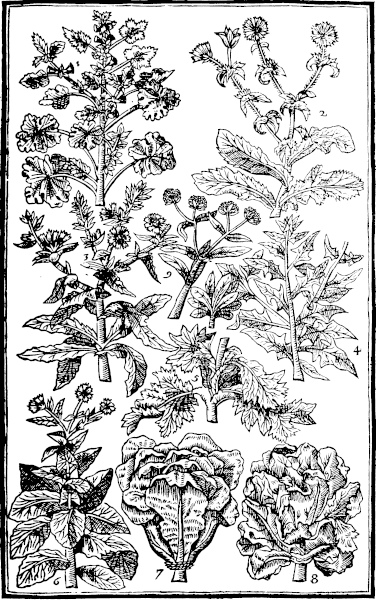
1Malua crispa. French Mallowes.
2Endiuia. Endiue.
3Cichorium. Succory.
4Spinachia. Spinach.
5Lactuca crispa. Curld Lettice.
6Lactuca patula. An open Lettice.
7Lactuca capitata vulgaris. Ordinary cabbage Lettice.
8Lactuca capitata Romana. The great Romane cabbage Lettice.
9Lactuca agueno. Corne Sallet or Lambes Lettice.
Chap. XXX. Lactuca. Lettice.
There are so many sorts, and so great diuersitie of Lettice, that I doubt I shall scarce be beleeued of a great many. For I doe in this Chapter reckon vp into you eleauen or twelue differing sorts; some of little vse, others of more, being more common and vulgar; and some that are of excellent vse and seruice, which are more rare, and require more knowledge and care for the ordering of them, as also for their time of spending, as some in the spring, some in summer, others in autumne, and some being whited for the winter. For all these sorts I shall not neede many descriptions, but only shew you which doe cabbage, and which are loose, which of them are great or small, white, greene or red, and which of them beare white seeds, and which of them blacke. And lastly I haue thought good to adde another Sallet herbe, which because it is called Lambes Lettice of many, or Corne Sallet of others, is put in only to fill vp a number in this Chapter, and that I must speake of it, and not that I thinke it to be any of the kindes of Lettice.
All sorts of Lettice, after a while that they haue closed themselues, if they bee of the Cabbage kindes, or otherwise being loose, and neuer closing, send forth from among the middle of their leaues a round stalke (in some greater, in others lesser, according to their kinde) full of leaues like vnto the lower, branching at the toppe into sundry parts, whereon grow diuers small star-like flowers, of a pale yellowish colour; after which come seede, eyther white or blackish, as the plant yeeldeth, whereat hangeth some small peece of a cottony doune, wherewith the whole head is stored, and is carried away with the winde, if it be not gathered in time: the roote is somewhat long and white, with some fibres at it, and perisheth quickely after the seede is ripe.
The Romane red Lettice is the best and greatest of all the rest. For Iohn Tradescante that first, as I thinke, brought it into England, and sowed it, did write vnto mee, that after one of them had been bound and whited, when the refuse was cut away, the rest weighed seuenteene ounces: this hath blacke seede.
The white Romane Lettice is like vnto it, hauing long leaues like a Teasell, it is in goodnesse next vnto the red, but must be whited, that it may eate kindly: the seede hereof is white.
The Virginia Lettice hath single and very broade reddish leaues, and is not of any great regard, and therefore is kept but of a few: it beareth blacke seede.
The common Lumbard Lettice that is loose, and another kinde thereof that doth somewhat cabbage, haue both white seedes.
The Venice Lettice is an excellent Cabbage Lettice, and is best to bee sowen after Midsummer for lateward Lettice; they be sometimes as great as the crowne of a mans hatt: the seede hereof is white, and groweth to be of a meane height.
Our common Cabbage Lettice is well known, and beareth blacke seede.
The curld Lettice which is open, and differeth but little from Endiue, beareth black seede.
Another sort of curld Lettice doth cabbage, and is called Flanders Cropers, or Cropers of Bruges; this groweth lowest, and hath the smallest head, but very hard and round, and white while it groweth: the seed is blacke.
A kinde of Romane Lettice is of a darke green colour, growing as low as the Venice Lettice, and is an excellent kinde, bearing blacke seede.
And lastly our winter Lettice is wonderfull hardy to endure our cold: It is but single, and must be sowen at Michaelmas, but will be very good, before any of the other good sorts sowen in the Spring, will be ready to be vsed, and beareth white seed.
To instruct a nouice (for I teach not a Gardiner of knowledge) how to gather his seede that it may be good, is in this manner: Let him marke out those plants that hee meaneth shall run vp for seede, which must be the most likely; & after they haue begun to shoote forth stalkes, strip away the lowest leaues, for two or three hands breadth aboue the ground, that thereby in taking away the lowest leaues, the stalke doe not rot, nor the seed be hindered in the ripening.
There are two manner of wayes to whiten Lettice to make them eate the more tender: the one is by raysing vp earth like moale hils, round about the plants while they are growing, which will make them grow white: the other is by tying vp all the loose leaues round together while it groweth, that so the close tying may make it grow white, and thereby be the more tender.
Lambes Lettice or Corne Sallet is a small plant while it is young, growing close vpon the ground, with many whitish greene, long and narrow, round pointed leaues, all the winter, and in the beginning of the spring (if it bee sowen in autumne, as it is vsuall to serue for an early sallet) riseth vp with small round stalkes, with two leaues at euery ioynt, branching forth at the toppe, and bearing tufts of small bleake blew flowers, which turne into small round whitish seede: the roote is small and long, with some small threds hanging thereat: the whole plant is of a waterish taste, almost insipide.
The Vse of Lettice.
All sorts of Lettice are spent in sallets, with oyle and vinegar, or as euery one please, for the most part, while they are fresh and greene, or whited, as is declared of some of the sorts before, to cause them to eate the more delicate and tender. They are also boyled, to serue for many sorts of dishes of meate, as the Cookes know best.
They all coole a hot and fainting stomacke.
The iuice of Lettice applyed with oyle of Roses to the foreheads of the sicke and weake wanting sleepe, procureth rest, and taketh away paines in the head: bound likewise to the cods, it helpeth those that are troubled with the Colts euill. If a little camphire be added, it restraineth immoderate lust: but it is hurtfull to such as are troubled with the shortnesse of breath.
Lambes Lettice is wholly spent for sallets, in the beginning of the yeare, as I said, before any almost of the other sorts of Lettice are to be had.
Chap. XXXI. Portulaca. Purslane.
Purslane hath many thicke round shining red stalkes, full of iuice, lying vpon the ground for the most part; whereon are set diuers long, thicke, pale green leaues, sometimes alone by themselues, and sometimes many small ones together with them; among which grow small yellow flowers, which stand in little greene huskes, containing blacke seede: the roote is small, and perisheth euery yeare, and must be new sowen in Aprill, in the alleyes of the Garden betweene the beds, as some haue heretofore vsed, where it may haue the more moisture, or, as I haue seene in some Gardens, vpon those beds of dung that Gardiners haue vsed to nourse vp their Cowcumbers, Melons, and Pompions, whereon after they haue been taken away, they haue sowen Purslane, where if it be much watered, the warmth of the dung, and the water giuen it, the Purslane hath grown great and large, and continued vntill winter.
The Vse of Purslane.
It is vsed as Lettice in sallets, to coole hot and faint stomackes in the hot time of the yeare, but afterwards if only for delight, it is not good to bee too prodigall in the vse thereof.
The seede of Purslane doth coole much any inflammation inward or outward, and doth a little binde withall.
Chap. XXXII. Dracoherba siue Tarchon & Dracunculus hortensis. Tarragon.
Tarragon hath long and narrow darke greene leaues, growing on slender and brittle round stalkes, two or three foote high, at the tops whereof grow forth long slender spikes of small yellowish flowers, which seldome giue any good seede, but a dustie or chaffie matter, which flieth away with the winde: the roote is white, and creepeth about vnder ground, whereby it much encreaseth: the whole herbe is of a hot and biting taste.
The Vse of Tarragon.
It is altogether vsed among other cold herbes, to temper their coldnesse, and they to temper its heate, so to giue the better rellish vnto the Sallet; but many doe not like the taste thereof, and so refuse it.
There are some Authors that haue held Tarragon not to be an herbe of it owne kinde, but that it was first produced, by putting the seede of Lin or Flaxe into the roote of an Onion, being opened and so set into the ground, which when it hath sprung, hath brought forth this herbe Tarragon, which absurd and idle opinion, Matthiolus by certaine experience saith, hath been found false.
Chap. XXXIII. Nasturtium hortense. Garden Cresses.
Garden Cresses growe vp to the height of two foote or thereabouts, hauing many small, whitish, broad, endented, torne leaues, set together vpon a middle ribbe next the ground, but those that growe higher vpon the stalkes are smaller and longer: the tops of the stalkes are stored with white flowers, which turne into flat pods or pouches, like vnto Shepheard purse, wherein is contained flat reddish seede: the roote perisheth euery yeare: the taste both of leaues and seedes are somewhat strong, hot, and bitter.
The Vse of Cresses.
The Dutchmen and others vse to eate Cresses familiarly with their butter and bread, as also stewed or boyled, either alone or with other herbes, whereof they make a Hotch potch, and so eate it. Wee doe eate it mixed among Lettice or Purslane, and sometimes with Tarragon or Rocket, with oyle and vinegar and a little salt, and in that manner it is very sauoury to some mens stomackes.
The vse of Cresses physically is, it helpeth to expectorate tough flegme, as also for the paines of the breast; and as it is thought taketh away spots, being laid to with vinegar. The seede is giuen of many to children for the wormes.
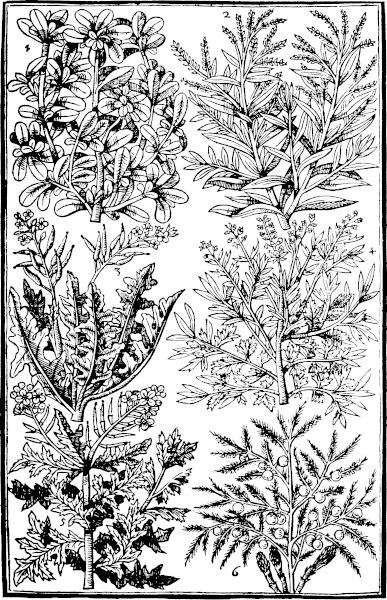
1Portulaca. Purslane.
2Dracho herba seu Tarchon. Tarragon.
3Eruca satiua. Garden Rocket.
4Nasturtium sativum. Garden Cresses.
5Sinapi. Mustard.
6Asparagus. Asparagus or Sperage.
Chap. XXXIIII. Eruca satiua. Garden Rocket.
Ovr Garden Rocket is but a wilde kinde brought into Gardens; for the true Romane Rocket hath larger leaues; this hath many long leaues, much torne or rent on the edges, smaller and narrower then the Romane kinde: the flowers hereof are of a pale yellowish colour, whereas the true is whitish, consisting of foure leaues: the seede of this is reddish, contained in smaller and longer pods then the true, which are shorter and thicker, and the seede of a whitish yellow colour: the rootes of both perish as soone as they haue giuen seede. Some haue taken one sort of the wilde kinde for Mustard, and haue vsed the seede for the same purpose.
The Vse of Rocket.
It is for the most part eaten with Lettice, Purslane, or such cold herbes, and not alone, because of its heate and strength; but that with the white seede is milder. The seede of Rocket is good to prouoke vrine, and to stirre vp bodily lust.
The seede bruised, and mixed with a little vinegar, and of the gall of an Oxe, cleanseth the face of freckles, spots, and blew markes, that come by beatings, fals, or otherwaies.
Matthiolus saith, that the leaues boyled, and giuen with some Sugar to little children, cureth them of the cough.
The seede is held to be helpfull to spleneticke persons; as also to kill the wormes of the belly.
Chap. XXXV. Sinapi sativum. Garden Mustard.
The Mustard that is most vsuall in this Country, howsoeuer diuers doe for their priuate vses sowe it in their Gardens or Orchards, in some conuenient corner, yet the same is found wilde also abroad in many places. It hath many rough long diuided leaues, of an ouerworne greene colour: the stalke is diuided at the toppe into diuers branches, whereon growe diuers pale yellow flowers, in a great length, which turne into small long pods, wherein is contained blackish seede, inclining to rednesse, of a fiery sharpe taste: the roote is tough and white, running deepe into the ground, with many small fibres at it.
The Vse of Mustard.
The seede hereof grownd between two stones, fitted for the purpose, and called a Querne, with some good vinegar added vnto it, to make it liquid and running, is that kinde of Mustard that is vsually made of all sorts, to serue as sawce both for fish and flesh.
The same liquid Mustard is of good vse, being fresh, for Epilepticke persons, to warme and quicken those dull spirits that are sopite and scarce appeare, if it be applyed both inwardly and outwardly.
It is with good successe also giuen to those that haue short breathes, and troubled with a cough in the lungs.
Chap. XXXVI. Asparagus. Sperage or Asparagus.
Asparagus riseth vp at the first with diuers whitish greene scaly heads, very brittle or easie to breake while they are young, which afterwards rise vp into very long and slender greene stalkes, of the bignesse of an ordinary riding wand at the bottome of most, or bigger or lesser, as the rootes are of growth, on which are set diuers branches of greene leaues, shorter and smaller then Fennell vp to the toppe, at the ioynts whereof come forth small mossie yellowish flowers, which turne into round berries, greene at the first, and of an excellent red colour when they are ripe, shewing as if they were beades of Corrall, wherein are contained exceeding hard and blacke seede: the rootes are dispersed from a spongious head into many long, thicke, and round strings, whereby it sucketh much nourishment out of the ground, and encreaseth plentifully thereby.
We haue another kinde hereof that is of much greater account, because the shootes are larger, whiter, and being dressed taste more sweete and pleasant, without any other difference.
The Vse of Asparagus.
The first shootes or heads of Asparagus are a Sallet of as much esteeme with all sorts of persons, as any other whatsoeuer, being boyled tender, and eaten with butter, vinegar, and pepper, or oyle and vinegar, or as euery ones manner doth please; and are almost wholly spent for the pleasure of the pallate. It is specially good to prouoke vrine, and for those that are troubled with the stone or grauell in the reines or kidneyes, because it doth a little open and cleanse those parts.
Chap. XXXVII. Brassica. Cabbages and Coleworts.
There is greater diuersity in the forme and colour of the leaues of this plant, then there is in any other that I know groweth vpon the ground. But this place requireth not the knowledge of all sorts which might be shewen, many of them being of no vse with vs for the table, but for delight, to behold the wonderfull variety of the workes of God herein. I will here therefore shew you onely those sorts that are ordinary in most Gardens, and some that are rare, receiued into some especiall Gardens: And first of Cabbages, and then of Coleworts.
Our ordinary Cabbage that closeth hard and round, hath at the first great large thicke leaues, of a grayish greene colour, with thicke great ribbes, and lye open most part of the Summer without closing, but toward the end of Summer, being growne to haue many leaues, it then beginneth to growe close and round in the middle, and as it closeth, the leaues growe white inward; yet there be some kindes that will neuer be so close as these, but will remaine halfe open, which wee doe not account to be so good as the other: in the middle of this head, the next yeare after the sowing, in other Countries especially, and sometimes in ours, if the Winter be milde, as may be seene in diuers Gardens (but to preuent the danger of our Winter frosts, our Gardiners now doe vse to take vp diuers Cabbages with their rootes, and tying a cloth or some such thing about the rootes, doe hang them vp in their houses, where they may be defended from cold, and then set them againe after the frosts are past) and then there shooteth out a great thicke stalke, diuided at the toppe into many branches, bearing thereon diuers small flowers, sometime white, but most commonly yellow, made of foure leaues, which turne into long, round, and pointed pods, containing therein small round seede, like vnto Turnep seede: the roote spreadeth not farre nor deepe, and dyeth vsually in any great froste; for a small frost maketh the Cabbage eate the tenderer.
The red Cabbage is like vnto the white, last spoken of, but differing in colour and greatnesse; for it is seldome found so great as the white, and the colour of the leaues is very variable, as being in some stript with red, in others more red, or very deepe red or purple.
The sugar loafe Cabbage, so called because it is smaller at the toppe then it is at the bottome, and is of two sorts, the one white, the other greene.
The Sauoy Cabbadge, one is of a deepe greene coloured leafe, and curld when it is to be gathered; the other is yellowish: neyther of both these doe close so well as the first, but yet are vsed of some, and accounted good.
The Cole flower is a kinde of Coleworte, whose leaues are large, and like the Cabbage leaues, but somewhat smaller, and endented about the edges, in the middle wherof, sometimes in the beginning of Autumne, and sometimes much sooner, there appeareth a hard head of whitish yellow tufts of flowers, closely thrust together, but neuer open, nor spreading much with vs, which then is fittest to be vsed, the green leaues being cut away close to the head: this hath a much pleasanter taste then eyther the Coleworte, or Cabbage of any kinde, and is therefore of the more regard and respect at good mens tables.
The ordinary Coleworte is sufficiently knowne not to close or cabbage, and giueth seede plentifully enough.
The other Colewortes that are noursed vp with those that delight in curiosities, besides the aforesaid ordinary greene, which is much vsed of Dutchmen, and other strangers, are these: The Curld Coleworte eyther wholly of a greene colour, or of diuers colours in one plant, as white, yellow, red, purple or crimson, so variably mixed, the leaues being curld on the edges, like a ruffe band, that it is very beautifull to behold.
There is also another curld Colewort of lesse beauty and respect, being but a little curld on the edges, whose leaues are white, edged with red, or green edged with white.
Two other there are, the one of a popingaye greene colour: the other of a fine deepe greene, like vnto the Sauoyes.
Then there is the Cole rape, which is also a kinde of Coleworte, that beareth a white heade, or headed stalke aboue the ground, as bigge as a reasonable Turnep, but longer, and from the toppe thereof springeth out diuers great leaues, like vnto Colewortes; among which rise diuers stalkes that beare yellow flowers, and seede in pods, almost as small as Mustard seede: the roote is somewhat long, and very bushie with threds.
The Vse of Cabbages and Colewortes.
They are most vsually boyled in poudered beefe broth vntil they be tender, and then eaten with much fat put among them.
The great ribs of the Popingay, and deepe greene Colewortes, beeing boyled and layde into dishes, are serued to the table with oyle and vinegar in the Lent time for very good sallets.
In the cold Countries of Russia and Muscouia, they pouder vp a number of Cabbages, which serue them, especially the poorer sort, for their most ordinary foode in winter; and although they stinke most grieuously, yet to them they are accounted good meate.
It is thought, that the vse of them doth hinder the milke in Nurses breasts, causing it to dry vp quickely: but many women that haue giuen sucke to my knowledge haue denyed that assertion, affirming that they haue often eaten them, and found no such effect. How it might proue in more delicate bodies then theirs that thus said, I cannot tell but Matthiolus auerreth it to encrease milke in Nurses breastes; so differing are the opinions of many. The seede grossely bruised and boyled a little in flesh broth, is a present remedie for the Collicke; the seede and the broth being taken together, easing them that are troubled therewith of all griping paines: as also for the stone in the kidneyes. A Lohoc or licking Electuary made of the pulpe of the boyled stalkes, and a little honey and Almond milke, is very profitable for shortnesse of breath, and those that are entering into a Consumption of the lunges. It hath beene formerly held to be helpefull in all diseases: for Crisippus, an ancient Physitian, wrote a whole Volume of the vertues, applying it to all the parts of the body: which thing neede not seeme wonderfull, in that it is recorded by writers, that the old Romanes hauing expelled Physitians out of their Common-wealth, did for many hundred of yeares maintaine their health by the vse of Cabbages, taking them for euery disease.
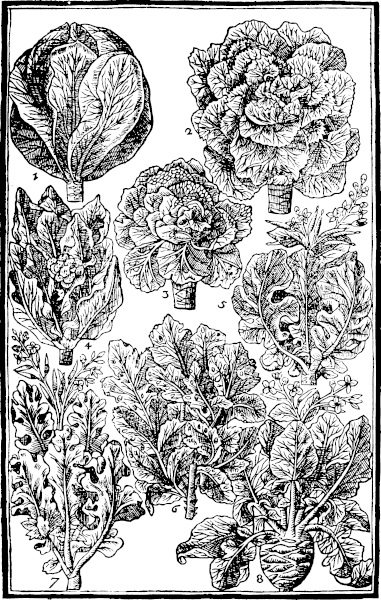
1Brassica capitata. Close Cabbage.
2Brassica patula. Open Cabbage.
3Brassica Sabaudica crispa. Curld Sauoye. Colewort.
4Caulis florida. Cole flower.
5Caulis crispa. Curld Colewort.
6Caulis crispa variata. Changeable Curld Colewort.
7Rapocaulis. Cole rape.
Chap. XXXVIII. Sisarum. Skirrets.
After all the herbes before rehearsed, fit for sallets, or otherwise to bee eaten, there must follow such rootes as are vsed to the same purpose: and first, Skirrets haue many leaues next the ground, composed of many small smooth green leaues, set each against other vpon a middle ribbe, and euery one snipt about the edges: the stalke riseth vp two or three foote high, set with the like leaues, hauing at the toppe spoakie tufts of white flowers, which turne into small seede, somewhat bigger and darker then Parsley seede: the rootes be many growing together at one head, beeing long, slender, & rugged or vneuen, of a whitish colour on the outside, and more white within, hauing in the middle of the roote a long small hard pith or string: these heads are vsually taken vp in February and March, or sooner if any so please, the greater number of them being broken off to bee vsed, the rest are planted againe after the heads are separated, and hereby they are encreased euery yeare by many; but it is now adayes more sowen of the seed, which come forwards well enough if the ground be fat and good.
The Vse of Skirrets.
The rootes being boyled, peeled and pithed, are stewed with butter, pepper and salt, and so eaten; or as others vse them, to roule them in flower, and fry them with butter, after they haue beene boyled, peeled and pithed: each way, or any way that men please to vse them, they may finde their taste to be very pleasant, far beyond any Parsnep, as all agree that taste them.
Some doe vse also to eate them as a sallet, colde with vinegar, oyle, &c. being first boyled and dressed as before said. They doe helpe to prouoke vrine, and as is thought, to procure bodily lust, in that they are a little windy.
Chap. XXXIX. Pastinaca satiua latifolia. Parsneps.
The common garden Parsnep hath diuers large winged leaues lying vpon the ground, that is, many leaues set one by another on both sides of a middle stalk, somewhat like as the Skirret hath, but much larger, and closer set: the stalke riseth vp great and tall, fiue or six foot high sometimes, with many such leaues thereon at seuerall ioynts; the top whereof is spread into diuers branches, whereon stand spoakie rundles of yellow flowers, which turne into brownish flat seede: the root is long, great and white, very pleasant to bee eaten, and the more pleasant if it grow in a fat sandy soyle.
There is another sort of garden Parsnep, called the Pine Parsnep, that is not common in euery Garden, and differeth from the former in three notable parts. The root is not so long, but thicker at the head and smaller below; the stalke is neither so bigge, nor so high; and the seede is smaller: yet as Iohn Tradescante saith (who hath giuen me the relation of this, and many other of these garden plants, to whom euery one is a debtor) the roote hereof is not altogether so pleasant as the other.
Moreouer the wilde kinde, which groweth in many places of England (and wherof in some places there might be gathered a quarter sacke full of the seede) if it be sowen in Gardens, and there well ordered, will proue as good as the former kinde of Garden Parsneps.
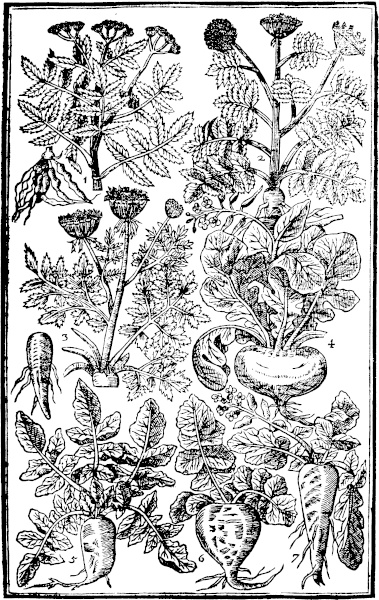
1Sisarum. Skirrets.
2Pastinaca latifolia. Parsneps.
3Pastinaca tenuifolia. Carrets.
4Rapum. Turneps.
5Napus sativus. Navewes.
6Raphanus niger. Blacke Raddish.
7Raphanus vulgaris. Common Raddish.
The Vse of Parsneps.
The Parsnep root is a great nourisher, and is much more vsed in the time of Lent, being boyled and stewed with butter, then in any other time of the yeare; yet it is very good all the winter long. The seede helpeth to dissolue winde, and to prouoke vrine.
Chap. XL. Pastina satiua tenuifolia. Carrots.
The Carrot hath many winged leaues, rising from the head of the roote, which are much cut and diuided into many other leaues, and they also cut and diuided into many parts, of a deepe greene colour, some whereof in Autumne will turne to be of a fine red or purple (the beautie whereof allureth many Gentlewomen oftentimes to gather the leaues, and sticke them in their hats or heads, or pin them on their armes in stead of feathers): the stalke riseth vp among the leaues, bearing many likewise vpon it, but nothing so high as the Parsnep, being about three foote high, bearing many spoakie tufts of white flowers, which turne into small rough seede, as if it were hairy, smelling reasonable well if it bee rubbed: the roote is round and long, thicke aboue and small below, eyther red or yellow, eyther shorter or longer, according to his kinde; for there is one kinde, whose roote is wholly red quite thoroughout; another whose roote is red without for a pretty way inward, but the middle is yellow.
Then there is the yellow, which is of two sorts, both long and short: One of the long yellow sorts, which is of a pale yellow, hath the greatest and longest roote, and likewise the greatest head of greene, and is for the most part the worst, being spongy, and not firme.
The other is of a deepe gold yellow colour, and is the best, hauing a smaller head, or tuft of greene leaues vpon it.
The shorte rootes are likewise distinguished, into pale and deepe yellow colours.
The Vse of Carrots.
All these sorts being boyled in the broth of beefe, eyther fresh or salt, but more vsually of salted beefe, are eaten with great pleasure, because of the sweetenesse of them: but they nourish lesse then Parsneps or Skirrets.
I haue not often knowne the seede of this Garden kinde to bee vsed in Physicke: but the wilde kinde is often and much vsed to expell winde, &c.
Chap. XLI. Rapum hortense. Turneps.
There are diuers sorts of Turneps, as white, yellow, and red: the white are the most common, and they are of two kinds, the one much sweeter then the other.
The yellow and the red are more rare, and noursed vp only by those that are curious: as also the Navewe, which is seene but with very few.
The ordinary Garden Turnep hath many large, and long rough greene leaues, with deepe and vneuen gashes on both sides of them: the stalke riseth vp among the leaues about two foote high, spread at the toppe into many branches, bearing thereon yellow flowers, which turne into long pods, with blackish round seede in them: the roote is round and white, some greater, some smaller; the best kinde is knowne to be flat, with a small pigges tale-like roote vnderneath it; the worser kinde which is more common in many places of this land, both North and West, is round, and not flat, with a greater pigges tayle-like roote vnderneath.
The yellow kinde doth often grow very great, it is hardly discerned from the ordinary kinde while it groweth, but by the greatnesse and spreading of the leaues beeing boyled, the roote changeth more yellow, somewhat neare the colour of a Carrot.
The red Turnep groweth vsually greater then any of the other, especially in a good ground, being of a faire red colour on the outside, but being pared, as white as any other on the inside. This, as Matthiolus saith, doth grow in the Countrey of Anania, where hee hath seene an infinite number of them that haue waighed fifty pound a peece, and in some places hee saith, a hundred pound a peece, both which we would thinke to be incredible, but that we see the kind is greatly giuen to grow, and in warme Countries they may so thriue, that the bulke or bignesse of the roote may so farre passe the growth of our Countrey, as that it may rise to that quantity aboue specified.
The Navew gentle is of two kindes, a smaller and a greater; the smaller is vsually called in France, Naveau de Cane, the roote is somewhat long with the roundnesse; this kinde is twice as bigge as a mans thumbe, and many of them lesse: The other is long and great, almost as big as the short Carrot, but for the most part of an vneuen length, and roundnesse vnto the very end, where it spreadeth into diuers small long fibres: neyther of them doth differ much from the Turnep, in leafe, flower or seed.
The Vse of Turneps.
Being boyled in salt broth, they all of them eate most kindly, and by reason of their sweetnesse are much esteemed, and often seene as a dish at good mens tables: but the greater quantitie of them are spent at poore mens feasts. They nourish much, and engender moist and loose flesh, and are very windy. The seede of the Navew gentle is (as I take it) called of Andromachus in the composition of his Treakle, Bunias dulcis: for Dioscorides and Plinie doe both say, that the seede of the tame Bunias or Napus is put into Antidotes, and not the seede of the wilde, which is more sharpe and bitter; neyther the seede of the Turnep, which is called in Greeke γογγύλη, in Latine Rapum, because the seede is not sweete.