THE GARDEN OF PLEASANT FLOWERS. (continued 10)
Reading edition
Chap. LXXIII. Scabiosa. Scabious.
The sorts of Scabious being many, yeeld not flowers of beauty or respect, fit to bee cherished in this our Garden of delight; and therefore I leaue them to the Fields and Woods, there to abide. I haue onely two or three strangers to bring to your acquaintance, which are worthy this place.
1. Scabiosa flore albo. White flowred Scabious.
This white Scabious hath many long leaues, very much iagged or gasht in on both sides, of a meane bignesse, being neither so large as many of the field, nor so small as any of the small kindes: the stalkes rise about a foote and a halfe high, or somewhat higher, at the tops whereof grow round heads, thicke set with flowers, like in all points vnto the field Scabious, but of a milke white colour.
2. Scabiosa rubra Austriaca. Red Scabious of Austria.
This red Scabious hath many leaues lying vpon the ground, very like vnto Deuils bit, but not so large, being shorter and snipt, not gashed about the edges, of a light greene colour; yet (there is another of a darker greene colour, whose flower is of a deeper red) the stalkes haue diuers such leaues on them, set by couples at the ioynts as grow belowe, and at the tops small heads of flowers, each consisting of fiue leaues, the biggest flowers standing round about in the outer compasse, as is vsuall almost in all the kinds of Scabious, of a fine light purple or red colour: after the flowers are past, come the seede, which is somewhat long and round, set with certaine haires at the head thereof, like vnto a Starre: the roote is composed of a number of slender strings, fastened at the head.
3. Scabiosa rubra Indica. Red flowred Indian Scabious.
This (reputed Indian) Scabious hath many large faire greene leaues lying on the ground, iagged or cut in on both sides to the middle ribbe, euery peece whereof is narrower then that at the end, which is the broadest: among these leaues rise vp sundry slender and weake stalkes, yet standing vpright for the most part, set with smaller and more iagged leaues at certaine distances, two or three at euery ioynt, branching forth at the toppe into other smaller branches, bearing euery one head of flowers, like in forme vnto other Scabiouses, but of an excellent deepe red crimson colour (and sometimes more pale or delayed) of no sent at all; after which doe come small roundish seede, like vnto the field Scabious: the roote is long and round, compassed with a great many small strings, and perisheth vsually as soone as it hath borne out his flowers and seede: otherwise if it doe not flower the first yeare of the sowing, if it be carefully defended from the extremity of Winter, it will flower the sooner the next yeare, as I my selfe haue often found by experience.
The Place.
The first is sometimes found wilde in our owne Countrey, but it is very geason, and hath been sent among other rare seedes from Italy.
The second was first found and written of by Clusius, in Pannonia and Austria, where it is very plentifull.
The third hath been sent both from Spaine & Italy, and is verily thought to grow naturally in both those parts.
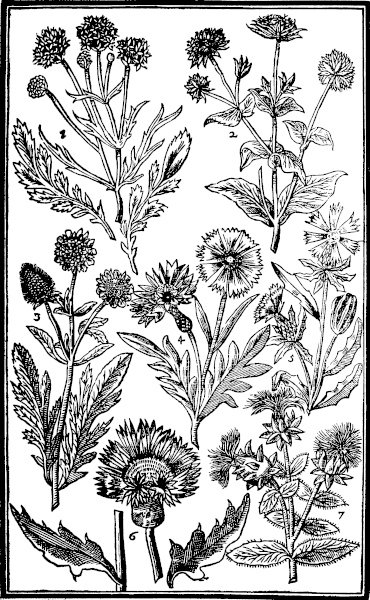
1Scabiosa flore albo. White flowred Scabious.
2Scabiosa rubra Austriaca. Red Scabious of Austria.
3Scabiosa rubra Indica. Red flowred Indian Scabious.
4Cyanus vulgaris minor. Corn-flower of diuers colours.
5Cyanus Bæticus. Spanish Corn-flower.
6Cyanus floridus Turcicus. The braue Sultans flower.
7Carthamus sativus. Spanish Saffron.
The Time.
The first and second flower earlier then the last, for that it flowreth not vntill September or October, (vnlesse it be not apt to beare the first yeare as I before said) so that many times (if none be more forward) it perisheth without bearing ripe seede, whereby we are oftentimes to seeke new seede from our friends in other parts.
The Names.
They haue all one generall name of Scabious, distinguished eyther by their flower, or place of growing, as in their titles: yet the last is called of diuers Scabiosa exotica, because they thinke the name Indica, is not truely imposed vpon it.
The Vertues.
Whether these kindes haue any of the vertues of the other wilde kinds, I know none haue made any experience, and therefore I can say no more of them.
Chap. LXXIIII. Cyanus. Corne flower, or blew Bottles.
Vnder the name of Cyanus are comprehended, not onely those plants which from the excellent blew colour of their flowers (furnishing or rather pestering the Corne fieldes) haue peculiarly obtained that name, and which doth much vary also, in the colour of the flowers, as shall be shewed; but some other plants also for their neere resemblance, but with seuerall distinctions. The Cyanus maior, Ptarmica Austriaca, Ptarmica Imperati, and many others which may be adioyned vnto them, do more fitly belong to the Garden of Simples, whereunto I leaue them, and will here only entreate of those that may most please the delight of our Gentle Florists, in that I labour and striue, to furnish this our garden, with the chiefest choyse of natures beauties and delights.
1. Cyanus vulgaris diuersorum colorum. Corne flower of diuers colours.
All these sorts of Corne flowers are for the most part alike, both in leaues and flowers one vnto another for the forme: the difference betweene them consisteth in the varying colour of the flowers: For the leaues are long, and of a whitish greene colour, deeply cut in on the edges in some places, somewhat like vnto the leaues of a Scabious: the stalkes are two foote high or better, beset with such like leaues but smaller, and little or nothing cut in on the edges: the toppes are branched, bearing many small greene scaly heads, out of which rise flowers, consisting of fiue or sixe, or more long and hollow leaues, small at the bottome, and opening wider and greater at the brims, notched or cut in on the edges, and standing round about many small threds in the middle: the colours of these flowers are diuers, and very variable; for some are wholly blew, or white, or blush, or of a sad, or light purple, or of a light or dead red, or of an ouerworne purple colour, or else mixed of these colours, as some, the edges white, and the rest blew or purple, or the edges blew or purple, and the rest of the flower white, or striped, spotted, or halfed, the one part of one colour, and the other of another, the threds likewise in the middle varying in many of them; for some will haue the middle thrume of a deeper purple then the outer leaues, and some haue white or blush leaues, the middle thrume being reddish, deeper or paler. After the flowers are past, there come small, hard, white and shining seede in those heads, wrapped or set among a deale of flockie matter, as is most vsuall, in all plants that beare scaly heads: the rootes are long and hard, perishing euery yeare when it hath giuen seede.
2. Cyanus floridus Turcicus. The Sultans flower.
As a kinde of these Corne flowers, I must needes adioyne another stranger, of much beautie, and but lately obtained from Constantinople, where, because (as it is said) the great Turke, as we call him, saw it abroade, liked it, and wore it himselfe; all his vassals haue had it in great regard, and hath been obtained from them, by some that haue sent it into these parts. The leaues whereof are greener, and not only gashed, but finely snipt on the edges: the stalkes are three foote high, garnished with the like leaues as are below, and branched as the former, bearing large scaly heads, and such like flowers but larger, hauing eight or nine of those hollow gaping leaues in euery flower, standing about the middle threds (if it be planted in good and fertile ground and be well watered, for it soone starueth and perisheth with drought) the circling leaues are of a fine delayed purple or blush colour, very beautifull to behold; the seede of this is smaller and blacker, and not enclosed in so much dounie substance, as the former (yet in our Countrey the seede is not so blacke, as it came vnto vs, but more gray) the roote perisheth likewise euery yeere.
3. Cyanus Bæticus supinus. The Spanish Corne-flower.
This Spanish kinde hath many square low bending or creeping stalkes, not standing so vpright as the former, but branching out more diuersly; so that one plant will take vp a great deale of ground: the leaues are broader then any of the rest, softer also, of a pale or whitish greene colour, and not much gashed on the edges: the flowers stand in bigger heads, with foure or fiue leaues vnder euery head, and are of a light pale purple or blush colour; after which come seede, but not so plentifully, yet wrapped in a great deale of flockie matter, more then any: the roote groweth downe deepe into the ground, but perisheth euery yeare as they doe.
The Place.
The first or former kindes, grow many times in the Corne fields of our own Countrey, as well as of others, especially that sort with a blew flower: but the other sorts or colours are not so frequent, but are nourished in gardens, where they will vary wonderfully.
The second as is before set downe, groweth in Turkie: and the last in Spaine, found out and first sent to vs by that industrious searcher of simples, Guillaume Boel before remembred.
The Time.
The first doe flower in the end of Iune, and in Iuly, and sometimes sooner. The other two later, and not vntill August most commonly, and the seede is soone ripe after.
The Names.
The first is generally called Cyanus, and some following the Ditch name, call it Flos frumenti. The olde Writers gaue it the name of Bapti sæcuba, which is almost worne out. We doe call them in English, Blew Bottles, and in some places, Corne flowers, after the Ditch names. The second hath beene sent by the name of Ambreboi, which whether it be a Turkie or Arabian name, I know not. I haue called it from the place, from whence we had it, Turcicus, and for his beauty, Floridus. The Turkes themselues as I vnderstand, doe call it The Sultans flower, and I haue done so likewise, that it may bee distinguished from all the other kindes, or else you may call it, The Turkey blush Corne flower, which you please. The last was sent by the name of Iacea Bætica, but I had rather to referre it to the Cyanus, or Corne flowers, because the flowers are like vnto the Corne flowers, and not vnto the Iaceas or Knapweedes.
The Vertues.
These had no vse in Physicke in Galen and Dioscorides time, in that (as it is thought) they haue made no mention of them: We in these dayes doe chiefly vse the first kindes (as also the greater sort) as a cooling Cordiall, and commended by some to be a remedy, not onely against the plague and pestilentiall diseases, but against the poison of Scorpions and Spiders.
Chap. LXXV. Iacea Marina Bætica. Spanish Sea Knapweede.
There are a great many sorts of Knapweedes, yet none of them all fit for this our Garden, but this only stranger, which I haue beene bold to thrust in here, for that it hath such like gaping or open flowers, as the former Corne flowers haue, but notably differing, and therefore deserueth a peculiar Chapter, as partaking both with Cyanus and Iacea. It hath many long and narrow leaues vneuenly dented or waued on both edges (and not notched, gashed or indented, as many other herbes are) being thicke, fleshie and brittle, a little hairy, and of an ouerworne darke greene colour, among which rise lowe weake stalkes, with such like leaues as grow at the bottome, but smaller, bearing but here and there a flower, of a bright reddish purple colour, like in forme vnto the Corne flowers, but much larger, with many threds or thrumes in the middle of the same colour, standing vp higher then any of the former: this flower riseth out of a large scaly head, all set ouer with small sharpe (but harmelesse) white prickles: the seedes are blackish, like vnto the Knapweedes, and larger then any of the former Corne flowers: the roote is great and thicke, growing deepe into the ground, fleshie and full of a slimie or clammy iuice, and easie to bee broken, blackish on the outside, and whitish within, enduring many yeares, like as the other Knapweedes, or Matfelons doe, growing in time to be very thicke and great.
The Place.
It groweth naturally by the Sea side in Spaine, from whence I receiued the seedes of Guillaume Boel, and did abide well in my garden a long time, but is now perished.
The Time.
It flowreth in the beginning of Iuly, or thereabouts, and continueth not long in flower: but the head abideth a great while, and is of some beauty after the flower is past; yet seldome giueth good seed with vs.
The Names.
It hath no other name then is set down in the title, being altogether a Nouelist, and not now to be seene with any sauing my selfe.
The Vertues.
We haue not yet known any use hereof in Physick.
Chap. LXXVI. Cnicus siue Carthamus sativus. Bastard or Spanish Saffron.
There are two or three sorts of Cnicus or bastard Saffrons which I passe ouer, as not fit for this Garden, and onely set downe this kinde, whose flowers are of a fairer and more liuely colour in our Country, then any hath come ouer from Spaine, where they manure it for the profit they make thereof, seruing for the dying of Silke especially, and transporting great quantities to diuers Countries. It hath large broad leaues, without any prickes at all vpon them in our Country, growing vpon the stalke, which is strong, hard, and round, with shorter leaues thereon vp to the toppe, where they are a little sharpe pointed, and prickly about the edges sometimes, which stalke riseth three or foure foote high, and brancheth it selfe toward the toppe, bearing at the end of euery branch one great open scaly head, out of which thrusteth out many gold yellow threads, of a most orient shining colour, which being gathered in a dry time, and kept dry, will abide in the same delicate colour that it bare when it was fresh, for a very long time after: when the flowers are past, the seede when it is come to maturity, which is very seldome with vs, is white and hard, somewhat long, round, and a little cornered: the roote is long, great, and wooddy, and perisheth quickly with the first frosts.
The Place.
It groweth in Spaine, and other hot Countries, but not wilde, for that it is accounted of the old Writers, Theophrastus and Dioscorides, to be a manured plant.
The Time.
It flowreth with vs not vntill August, or September sometimes, so that it hardly giueth ripe seede (as I said) neither is it of that force to purge, which groweth in these colder Countries, as that which commeth from Spaine, and other places.
The Names.
The name Cnicus is deriued from the Greekes, and Carthamus from the Arabians, yet still sativus is added vnto it, to shew it is no wilde, but a manured plant, and sowne euery where that wee know. Of some it is called Crocus hortensis, and Sarasenicus,from the Italians which so call it. We call it in English Bastard Saffron, Spanish Saffron, and Catalonia Saffron.
The Vertues.
The flowers are vsed in colouring meates, where it groweth beyond Sea, and also for the dying of Silkes: the kernels of the seede are onely vsed in Physicke with vs, and serueth well to purge flegmaticke humours.
Chap. LXXVII. Carduus. Thistles.
You may somewhat maruaile, to see mee curious to plant Thistles in my Garden, when as you might well say, they are rather plagues then pleasures, and more trouble to weede them out, then to cherish them vp, if I made therein no distinction or choise; but when you haue viewed them well which I bring in, I will then abide your censure, if they be not worthy of some place, although it be but a corner of the Garden, where something must needes be to fill vp roome. Some of them are smooth, and without prickes at all, some at the heads onely, and some all ouer; but yet not without some especiall note or marke worthy of respect: Out of this discourse I leaue the Artichoke, with all his kindes, and reserue them for our Kitchin Garden, because (as all know) they are for the pleasure of the taste, and not of the smell or sight.
1. Acanthus sativus. Garden Beares breech.
The leaues of this kinde of smooth thistle (as it is accounted) are almost as large as the leaues of the Artichoke, but not so sharp pointed, very deeply cut in and gashed on both edges, of a sad green & shining colour on the vpperside, and of a yellowish green vnderneath, with a great thicke rib in the middle, which spread themselues about the root, taking vp a great deale of ground. After this plant hath stood long in one place, and well defended from the iniury of the cold, it sendeth forth from among the leaues one or more great and strong stalkes, three or foure foote high, without any branch at all, bearing from the middle to the top many flowers one aboue another, spike-fashion round about the stalke, with smaller but not diuided greene leaues at euery flower, which is white, and fashioned somewhat like vnto a gaping mouth; after which come broad, flat, thicke, round, brownish yellow seede (as I haue well obserued by them haue beene sent me out of Spaine, and which haue sprung vp, and doe grow with me; for in our Countrey I could neuer obserue any seede to haue growne ripe) the rootes are composed of many great and thicke long strings, which spread farre in and vnder the ground, somewhat darkish on the outside, and whitish within, full of a clammy moisture (whereby it sheweth to haue much life) and doe endure our Winters, if they be not too much exposed to the sharpe violence thereof, which then it will not endure, as I haue often found by experience.
2. Acanthus siluestris. Wilde or prickly Beares breech.
This prickly Thistle hath diuers long greenish leaues lying on the ground, much narrower then the former, but cut in on both sides, thicke set with many white prickes and thornes on the edges: the stalke riseth not vp so high, bearing diuers such like thornie leaues on them, with such a like head of flowers on it as the former hath: but the seede hereof (as it hath come to vs from Italy and other places, for I neuer saw it beare seed here in this Country) is blacke and round, of the bignesse of a small pease: the roote abideth reasonable well, if it be defended somewhat from the extremity of our Winters, or else it will perish.
3. Eryngium Pannonicum siue Montanum. Hungary Sea Holly.
The lower leaues of this Thistle that lye on the ground, are somewhat large, round, and broad, hard in handling, and a little snipt about the edges, euery one standing vpon a long foote-stalke: but those that growe vpon the stalke, which is stiffe, two or three foote high, haue no foote-stalke, but encompasse it, two being set at euery ioynt, the toppe whereof is diuided into diuers branches, bearing small round rough heads, with smaller and more prickly leaues vnder them, and more cut in on the sides then those belowe: out of these heads rise many blew flowers, the foote-stalkes of the flowers, together with the toppes of the branches, are likewise blew and transparent, or shining.
Flore albo.
We haue another of this kinde, the whole toppes of the stalkes with the heads and branches, are more white then blew: the seede contained in these heads are white, flat, and as it were chaffie: the roote is great and whitish, spreading farre into many branches, and somewhat sweete in taste, like the ordinary Sea Holly rootes.
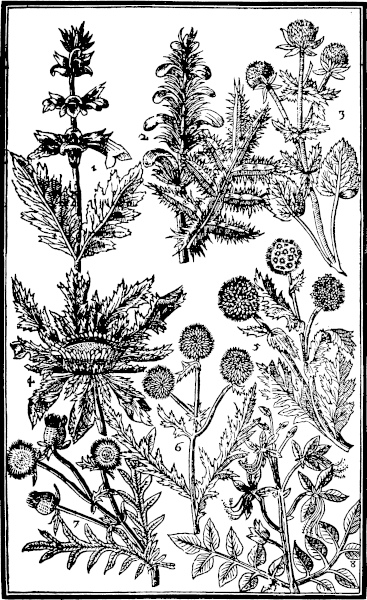
1Acanthus sativus. Garden Beares breech.
2Acanthus siluetris. Wilde Beares breech.
3Eryngium Pannonicum. Mountaine Sea Holly.
4Carlina humilis. The lowe Carline Thistle.
5Carduus sphærocephalus maior. The greater Globe-Thistle.
6Carduus sphærocephalus minor. The lesser Globe-Thistle.
7Carduus Eriocephalus. The Friers crowne.
8Fraxinella. Bastard Dittanie.
4. Carduus mollis. The gentle Thistle.
The leaues of this soft and gentle Thistle that are next vnto the ground, are greene on the vpperside, and hoary vnderneath, broad at the bottome, somewhat long pointed, and vneuenly notched about the edges, with some soft hairie prickles, not hurting the handler, euery one standing vpon a short foote-stalke; those that growe about the middle stalke are like the former, but smaller and narrower, and those next the toppe smallest, where it diuideth it selfe into small branches, bearing long and scaly heads, out of which breake many reddish purple threads: the seede is whitish and hard, almost as great as the seede of the greater Centory: the roote is blackish, spreading vnder the ground, with many small fibres fastened vnto it, and abideth a great while.
5. Carlina humilis. The lowe Carline Thistle.
This lowe Thistle hath many iagged leaues, of a whitish greene Colour, armed with small sharp white prickles round about the edges, lying round about the root vpon the ground, in the middle whereof riseth vp a large head, without any stalke vnder it, compassed about with many small and long prickly leaues, from among which the flower sheweth it selfe, composed of many thin, long, whitish, hard shining leaues, standing about the middle, which is flat and yellow, made of many thrums or threads like small flowers, wherein lye small long seede, of a whitish or siluer colour: the roote is somewhat aromaticall, blackish on the outside, small and long, growing downewards into the ground. There is another of this kinde that beareth a higher stalke, and a redder flower, but there is a manifest difference betweene them.
6. Carduus Sphærocephalus siue Globosus maior. The greater Globe Thistle.
The greatest of these beautifull Thistles, hath at the first many large and long leaues lying on the ground, very much cut in and diuided in many places, euen to the middle ribbe, set with small sharpe (but not very strong) thornes or prickles at euery corner of the edges, greene on the vpperside, and whitish vnderneath: from the middle of these leaues riseth vp a round stiffe stalke, three foote and a halfe high, or more, set without order with such like leaues, bearing at the toppe of euery branch a round hard great head, consisting of a number of sharpe bearded huskes, compact or set close together, of a blewish greene colour, out of euery one of which huskes start small whitish blew flowers, with white threads in the middle of them, and rising aboue them, so that the heads when they are in full flower, make a fine shew, much delighting the spectators: after the flowers are past, the seede encreaseth in euery one, or the most part of the bearded huskes, which doe still hold their round forme, yntill that being ripe it openeth it selfe, and the huskes easily fall away one from another, containing within them a long whitish kernell: the roote is great and long, blackish on the outside, and dyeth euery yeare when it hath borne seede.
7. Carduus Globosus minor. The lesser Globe Thistle.
The lesser kinde hath long narrow leaues, whiter then the former, but cut in and gashed on the edges very much with some small prickes on them; the stalke is not halfe so long, nor the heads halfe so great, but as round, and with as blew flowers as the greater: this seldome giueth ripe seede, but recompenseth that fault, in that the roote perisheth not as the former, but abideth many yeares.
8. Carduus Eriocephalus siue Tomentosus. The Friers Crowne.
This woolly Thistle hath many large and long leaues lying on the ground, cut in on both sides into many diuisions, which are likewise somewhat vnequally cut in or diuided againe, hauing sharpe white prickles at euery corner of the diuisions, of a dead or sad greene colour on the vpperside, and somewhat woolly withall, and grayish vnderneath: the stalke is strong and tall, foure or fiue foote high at the least, branching out into diuers parts, euery where beset with such like leaues as growe below; at the toppe of euery branch there breaketh out a great whitish round prickly head, flattish at the toppe, so thicke set with wooll, that the prickles seeme but small spots or haires, and doth so well resemble the bald crowne of a Frier, not onely before it be in flower, but especially after it hath done flowring, that thereupon it deseruedly receiued the name of the Friers Crowne Thistle: out of these heads riseth forth a purple thrumme, such as is to be seene in many other wilde Thistles, which when they are ripe, are full of a flockie or woolly substance, which breake at the toppe shedding it, and the seede which is blackish, flat, and smooth: the roote is great and thicke, enduring for some yeares, yet sometimes perishing, if it be too much exposed to the violence of the frosts in Winter.
The Place.
The first groweth naturally in Spaine, Italy, and France, and in many other hot Countries, and growe onely in Gardens in these colder climates, and there cherished for the beautifull aspect both of the greene plants, and of the stalkes when they are in flower. The Carline Thistle is found both in Germany and Italy in many places, and as it is reported, in some places of the West parts in England. The others are found some in France, some in Hungary, and on the Alpes, and the last in Spaine.
The Time.
They doe all flower in the Summer moneths, some a little earlier or later then others.
The Names.
The first is called Acanthus sativus (because the other that is prickly, is called siluestris or spinosus) and Branea vrsina; In English, Branck vrsine, and Beares breech. The third is called Eryngium montanum, Alpinum, and Pannonicum latifolium: In English, Mountaine or Hungary Sea Holly. The fourth is called Carduus mollis, The gentle Thistle, because it hath no harmfull prickles, although it seeme at the first shew to be a Thistle. The fifth is called of diuers Chamæleo albus, and Carlina, as if they were both but one plant; but Fabius Columna hath in my iudgement very learnedly descided that controuersie, making Carlina to be Ixine of Theophrastus, and Chamæleo another differing Thistle, which Gaza translateth Vernilago. We call it in English, The Carline Thistle. The other haue their names in their titles, as much as is conuenient for this discourse.
The Vertues.
The first hath alwaies been vsed Physically, as a mollifying herbe among others of the like slimie matter in Glisters, to open the body; yet Lobel seemeth to make no difference in the vse of them both (that is, the prickly as well as the smooth.) The Carline Thistle is thought to bee good against poysons and infection. The rest are not vsed by any that I know.
Chap. LXXVIII. Fraxinella. Bastard Dittany.
Hauing finished those pleasing Thistles, I come to other plants of more gentle handling, and first bring to your consideration this bastard Dittany, whereof there are found out two especiall kindes, the one with a reddish, the other with a whitish flower, and each of these hath his diuersity, as shall be presently declared.
1. Fraxinella flore rubente. Bastard Dittany with a reddish flower.
This goodly plant riseth vp with diuers round, hard brownish stalkes, neare two foote high, the lower parts whereof are furnished with many winged leaues, somewhat like vnto Liquerice, or a small young Ashe tree, consisting of seuen, nine, or eleuen leaues set together, which are somewhat large and long, hard and rough in handling, of a darkish greene colour, and of an vnpleasant strong resinous sent: the vpper parts of the stalkes are furnished with many flowers, growing spike fashion, at certaine distances one aboue another, consisting of fiue long leaues a peece, whereof foure that stand on the two sides, are somewhat bending vpwards, and the fift hanging downe, but turning vp the end of the leafe a little againe, of a faint or pale red colour, striped through euery leafe with a deeper red colour, and hauing in the middle a tassell of fiue or six long purplish threds, that bowe downe with the lower leafe, and turne vp also the ends againe, with a little freese or thrume at the ends of euery one: after the flowers are past, arise hard, stiffe, rough, clammy huskes, horned or pointed at the end, foure or fiue standing together, somewhat like the seede vessels of the Wolfes-banes, or Colombines, but greater, thicker and harder, wherein is contained round shining blacke seede, greater then any Colombine seede by much, and smaller then Peony seede: the roote is white, large, and spreading many wayes vnder ground, if it stand long: the whole plant, as well roots as leaues and flowers, are of a strong sent, not so pleasing for the smell, as the flowers are beautifull to the sight.
2. Fraxinella flore rubro. Bastard Dittaine with a red flower.
This differeth not from the former eyther in roote, leafe or flower for the forme but that the stalkes and leaues are of a darker greene colour, and that the flowers are of a deeper red colour, (and growing in a little longer spike), wherein the difference chiefly consisteth, which is sufficient to distinguish them.
3. Fraxinella flore albo. Bastard Dittanie with a white flower.
The white flowred Fraxinella hath his leaues and stalkes of a fresher greene colour then any of the former; and the flowers are of a pure white colour, in forme differing nothing at all from the other.
4. Fraxinella flore albo cæruleo. Bastard Dittanie with an ash coloured flower.
The colour of the flower of this Fraxinella onely putteth the difference betweene this, and the last recited with a white flower: for this beareth a very pale, or whitish blew flower, tending to an ash colour.
The Place.
All these kindes are found growing naturally, in many places both of Germany, and Italie: and that with the white flower, about Franckford, which being sent me, perished by the way by long and euill carriage.
The Time.
They flower in Iune and Iuly, and the seede is ripe in August.
The Names.
The name Fraxinella is most generally imposed on those plants, because of the resemblance of them vnto young Ashes, in their winged leaues. Yet some doe call them Dictamus albus, or Dictamnus albus, and Diptamus albus, as a difference from the Dictamnus Creticus, which is a farre differing plant. Some would haue it to be Tragium of Dioscorides, but beside other things wheaten this differeth from Tragium, this yeeldeth no milkie iuice, as Dioscorides saith Tragium doth: We in English doe eyther call it Fraxinella, or after the other corrupted name of Dictamus, Bastard Dittanie.
The Vertues.
It is held to be profitable against the stingings of Serpents, against contagious and pestilent diseases, to bring downe the feminine courses, for the paines of the belly and the stone, and in Epilepticall diseases, and other cold paines of the braines: the roote is the most effectual for all these, yet the seede is sometimes vsed.
Chap. LXXIX. Legumina. Pulse.
If I should describe vnto you all the kindes of Pulse, I should vnfold a little world of varieties therein, more knowne and found out in these dayes, then at any time before, but that must bee a part of a greater worke, which will abide a longer time before it see the light. I shall only select those that are fit for this garden, and set them downe for your consideration. All sorts of Pulse may be reduced vnder two generall heads, that is, of Beanes and Pease, of each whereof there is both tame and wilde: Of Beanes, besides the tame or vsuall garden Beane, and the French or Kidney Beane, (whereof I meane to entreate in my Kitchen garden, as pertinent thereto) there is the Lupine or flat Beane, whereof I meane to entreate here, and the blacke Beane and others which must bee reserued for the Physicke Garden. And of the kindes of Pease some are fit for this Garden; (whereunto I will adioyne two or three other plants as neerest of affinitie, the flowers of some, and the fruit of others being delightfull to many, and therefore fit for this garden) some for the Kitchen, the rest for the Physicke garden. And first of Lupines or flat Beanes, accepted as delightfull to many, and therefore fit for this garden.
{Lupines or flat Beans}
1. Lupinus sativus albus. The white garden Lupine.
The garden Lupine riseth vp with a great round stalke, hollow and somewhat woolly, with diuers branches, whereon grow vpon long footestalkes many broade leaues, diuided into seuen or nine parts, or smaller leaues, equally standing round about, as it were in a circle, of a whitish greene colour on the vpperside, and more woolly vnderneath: the flowers stand many together at seuerall ioynts, both of the greater stalke, and the branches, like vnto beanes, and of a white colour in some places, and in others of a very bleake blew tending to white: after the flowers are past, there come in their places, long, broade, and flat rough cods, wherein are contained round and flat seede, yellowish on the inside, and couered with a tough white skin, and very bitter in taste: the rootes are not very great, but full of small fibres, whereby it fasteneth it selfe strongly in the ground, yet perisheth euery yeare, as all the rest of these kindes doe.
2. Lupinus cæruleus maximus. The greater blew Lupine.
The Stemme or stalke of this Lupine is greater then the last before recited, as also the leaues more soft and woolly, and the flowers are of a most perfect blew colour, with some white spots in the middle: the long rough greenish cods are very great and large, wherein are contained hard, flat and round seede, not so white on the outside as the former, but somewhat yellower, greater also, and more rough or hard in handling.
3. Lupinus cæruleus minor. The lesser blew Lupine.
This kinde of wilde Lupine differeth not in the forme of leafe or flower from the former, but only that it is much smaller, the leaues are greener, and haue fewer diuisions in them: the flower is of as deepe a blew colour as the last; the cods likewise are small and long, containing small round seede, not so flat as the former, but more discoloured or spotted on the outside, then the greater kinde is.
Minimus.
There is a lesser kind then this, not differing in any thing from this, but that it is lesser.
4. Lupinus flore luteo. The yellow Lupine.
The yellow Lupine groweth not vsually so high, but with larger leaues then the small blew Lupine; the flowers grow in two or three rundles or tufts, round about the stalke and the branches at the ioynts, of a delicate fine yellow colour, like in fashion vnto the other kindes, being larger then the last, but nothing so large as the greater kindes, and of a fine small sent: the seede is round, and not very flat, but much about the forme and bignesse of the small blew, or somewhat bigger, of a whitish colour on the outside, spotted with many spots.
The Place.
The first groweth in many places of Greece, and the Easterne Countries beyond it, where it hath beene anciently cherished for their foode, being often watered to take away the bitternesse. It groweth also in these Western parts, but still where it is planted. The great blew Lupine is thought to come from beyond the parts of Persia, in Caramania. The lesser blew is found very plentifully wilde, in many places both of Spaine and Italy. The last hath beene brought vs likewise out of Spaine, whereas it is thought it groweth naturally. They all grow now in the gardens of those, that are curious louers of these delights.
The Time.
They flower in Summer, and their seede is ripe quickly after.
The Names.
They are generally called Lupini. Plautus in his time saith, they were vsed in Comedies in stead of money, when in any Scene thereof there was any shew of payment, and therefore he calleth them Aurum Comicum. And Horace hath this Verse,
Nec tamen ignorant, quid distent æra Lupinis,
to shew that counterfeit money (such as counters are with vs, or as these Lupines were vsed in those times) was easily knowne from true and currant coine. In English wee vsually call them after the Latine name, Lupines; and some after the Dutch name, Figge-beanes, because they are flat and round as a Figge that is pressed; and some Flat-beanes for the same reason. Some haue called the yellow Lupine, Spanish Violets: but other foolish names haue beene giuen it, as Virginia Roses, and the like, by knauish Gardiners and others, to deceiue men, and make them beleeue they were the finders out, or great preseruers of rarities, of no other purpose, but to cheate men of their money: as you would therefore auoyde knaues and deceiuers, beware of these manner of people, whereof the skirts of our towne are too pitifully pestered.
The Vertues.
The first or ordinary Lupine doth scoure and cleanse the skin from spots, morphew, blew markes, and other discolourings thereof, beeing vsed eyther in a decoction or pouther. Wee seldome vse it in inward medicines, not that it is dangerous, but of neglect, for formerly it hath beene much vsed for the wormes, &c.
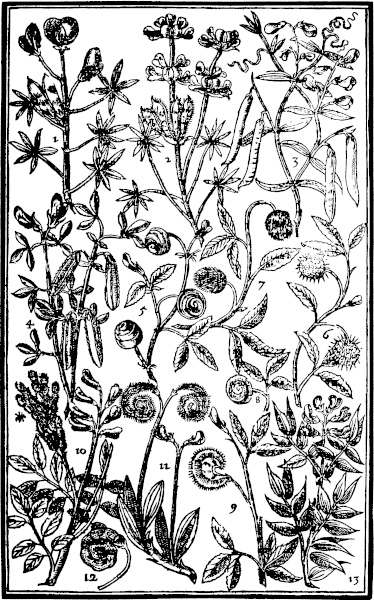
1Lupinus maior. The great Lupine.
2Lupinus luteus. The yellow Lupine.
3Lathyrus latifolius seu Pisum perenne. Pease euerlasting.
4Pisum quadratum. The crimson blossomd or square Pease.
5Medica cochleata vulgaris. Snailes or Barbary buttons.
6Medica spinosa. Prickly Snailes.
7Medica spinosa altera. Another sort of prickly Snailes.
8Medica folliculo lata. Broad buttons or Snailes.
9Medica lunata. Halfe Moons.
10Hedysarum clypeatum. The red Sattin flower or French Honeysuckle.
11Scorpioides minus. The lesser Caterpillar.
12Scorpioides maius. The greater Caterpillar.
13Orobus Venetus. Blew vpright Pease euerlasting.
{Peas}
1. Lathyrus latifolius, siue Pisum perenne. Pease euerlasting.
This kinde of wilde Pease that abideth long, and groweth euery yeare greater then other, springeth vp with many broade trayling branches, winged as it were on both the sides, diuersly diuided into other smaller branches, at the seuerall ioynts whereof stand two hard, not broad, but somewhat long greene leaues, and diuers twining claspers, in sundry places with the leaues, from betweene the branches and the leaues, at the ioynts towards the toppes, come forth diuers purplish pease like blossomes, standing on a long stemme or stalke, very beautifull to behold, and of a pretty sent or smell: after which come small, long, thin, flat, hard skind cods, containing small round blackish seede: the roote is great and thicke, growing downe deepe into the ground, of the thicknesse sometimes of a mans arme, blackish on the outside, and whitish within, with some branches and a few fibres annexed thereunto.
2. Orobus Venetus. Blew vpright euerlasting Pease.
This pretty kinde of Pease blossome beareth diuers slender, but vpright greene branches somewhat cornered, two foote high or thereabouts, hauing at seuerall distances on both sides of them certaine winged leaues, set together vpon long footestalkes one against another, consisting of six or eight leaues, somewhat broade and pointed, and without any odde one at the end: at the ioynts toward the toppes, between the leaues and the stalkes, come forth many flowers set together at the end of a pretty long footestalke, of the fashion of the former Pease blossome, but somewhat smaller, and of a purplish violet colour: after which come slender and long pointed pods rounder then they, wherein is contained small round grayish pease: the roote is blacke, hard or woody, abiding after seede bearing as the former doth, and shooting afresh euery yeare.
3. Lathyrus annuus filiquis orobi. Partie coloured Cichelings.
This small Pulse or wild Pease, hath two or three long slender winged branches, with smaller leaues thereon then the former, and without any claspers at all on them: the flowers stand single, euery one by it selfe, or two at the most together, the middle leaues whereof that close together are white, and the vpper leaues of a reddish purple colour: after which come long round flattish cods, bunched out in the seuerall places where the seedes lye, like vnto the cods of Orobus or the bitter Vetch, but greater: the roote is small and dyeth euery yeare.
4. Pisum quadratum. The crimson blossomd or square codded Pease.
This pretty kinde of Pulse might very well for the forme of the leaues, be referred to the kindes of Lotus or Trefoiles: but because I haue none of that kindred to entreate of in this Worke, I haue thought fittest to place it here before the Medica’s, because both pods and seedes are like also. It hath three or foure small weake stalkes, diuided into many branches, hauing two stalkes of leaues at euery ioynt, and three small soft leaues standing on a very small stalke, comming from the ioynts: the flowers stand for the most part two together, of a perfect red or crimson colour, like in forme almost vnto a Pease blossome; after which come long thicke and round cods, with two skinnes or filmes, running all along the cod at the backe or vpperside and two other such like filmes, all along the belly or vnder side, which make it seeme foure square, wherein there lye round discoloured Pease, somewhat smaller and harder then ordinary Pease: the roote is small and perisheth euery yeare.
5. Medica Cochleata vulgaris. Snailes or Barbary buttons.
The plant that beareth these pretty toyes for Gentlewomen, is somewhat like vnto a Three leafed grasse or Trefoile, hauing many long trayling branches lying vpon the ground, whereon at diuers places are three small greene leaues, set together at the end of a little footestalke, each of them a little snipt about the edges: at seuerall distances, from the middle of these branches to the ends of them, come forth the flowers, two for the most part standing together vpon a little footstalke, which are of a pale yellow colour, very small, and of the forme of a Pease blossome: after which come smooth heads, which are turned or writhen round, almost like a Snaile, hard and greene at the first, somewhat like a greene button (from the formes of both which came their names) but afterwards growing whiter, more soft and open, wherein lyeth yellowish round and flat seede, somewhat like vnto the Kidney beane: the roote is small and stringie, dying downe euery yeare, and must be new sowne in the spring, if you desire to haue it.
6. Medica spinosa maior. Prickly or thorny Snailes, or Buttons.
This kinde of Medica is in all things very like vnto the former, both in the long trayling branches, & three leaues alwaies growing together, but a little greater pale yellow flowers, and crooked or winding heads: but herein chiefly consisteth the difference, that this kinde hath his heads or buttons harder, a little greater, more closed together, and set with short and somewhat hard prickles, all the head ouer, which being pulled open, haue those prickles standing on each side of the filme or skinne, whereof the head consisteth, somewhat like vnto a fish bone, and in this kinde goeth all one way; in which are contained such like seedes for the forme, as are in the former, but great and blacke, and shining withall.
7. Medica spinosa altera. Small thorney Buttons, or Snailes.
This other kinde is also like vnto the last described in all other things, except in the heads or buttons, which are a little smaller, but set with longer and softer prickes vpon the filmes, and may easily bee discerned to goe both forwards and backewards, one enterlacing within another, wherein are contained such like flat and blacke shining seede, made after the fashion of a kidney, as are in the former, but somewhat smaller: the roote perisheth in like manner euery yeare.
8. Medica lata. Broade Buttons.
This kinde differeth not from the first in leafe or flower, the fruite onely hereof is broade and flat, and not so much twined as it.
9. Medica Lunata. Halfe Moones.
This is also a kinde of these Medicke fodders, hauing a trefoyle leafe and yellow flowers like the former sorts, but both somewhat larger, the chiefest difference consisteth in the head or fruite, which is broade and flat, and not twined like the rest, but abideth halfe closed, resembling a halfe Moone (and thereupon hath assumed both the Latine and English name) wherein is contained flat seede, kidney fashion like the former.
10. Hedysarum clypeatum. The red Sattin flower.
This red flowred Fitchling, hath many stalkes of winged faire greene leaues, that is, of many set on both sides a middle ribbe, whereof that at the end is the greatest of the rest: from the ioynts where the leaues stand, come forth pretty long small stalkes, bearing on them very many flowers, vp to the toppe one aboue another, of an excellent shining red or crimson colour, very like vnto Sattin of that colour, and sometimes of a white colour, (as Master William Coys, a Gentleman of good respect in Essex, a great and ancient louer and cherisher of these delights, and of all other rare plants, in his life time assured me; he had growing in his garden at Stubbers by North Okenden) which are somewhat large, and more closed together, almost flat and not open, as in most of the other sorts: after the flowers are past, there come rough, flat, round huskes, somewhat like vnto the old fashioned round bucklers without pikes, three or foure standing one vpon or aboue another, wherein are contained small brownish seede: the roote perisheth the same yeare it beareth seede, for oftentimes it flowreth not the first yeare it is sowne.
11. Scorpioides maius & minus. Great and small Caterpillers.
Vnder one description I comprehend both these sorts of Scorpions grasse, or Caterpillers, or Wormes, as they are called by many, whereof the greater hath been known but of late yeares; and ioyne them to these pulses, not hauing a fitter place where to insert them. It is but a small low plant, with branches lying vpon the ground, and somewhat long, broad, and hard leaues thereon, among which come forth small stalkes, bearing at the end for the most part, two small pale yellowish flowers, like vnto Tares or Vetches, but smaller, which turne into writhed or crooked tough cods; in the greater sort they are much thicker, rounder and whiter, and lesser wound or turned together then in the smaller, which are slenderer, more winding, yet not closing like vnto the Snailes, and blacker more like vnto a Caterpiller then the other, wherein are contained brownish yellow seede, much like vnto a Medica: the rootes of both are small and fibrous, perishing euery yeare.
The Place.
These are found seuerally in diuers and seuerall places, but wee sow and plant them vsually to furnish our Gardens.
The Time.
They doe all flower about the moneths of Iune and Iuly, and their seede is ripe soone after: but the second is earlier then the rest.
The Names.
The first is called Clymenum of Matthiolus, and Lathyris of Lobel and others: but Lathyris in Greeke is Cataputia in Latine, which is our Spurge, farre differing from this Pulse; and therefore Lathyrus is more proper to distinguish them asunder, that two plants so farre vnlike should not bee called by one name: this is also called Lathyrus latifolius, because there is another called angustifolius, that differeth from it also: It is most vsually called with vs, Pisum perenne, and in English Pease blossome, or Pease euerlasting. The second is called by Clusius, Orobus venetus, because it was sent him from Venice, with another of the same kinde that bore white flowers; yet differeth but little or nothing from that kinde he found in Hungary, that I thinke the seuerall places of their growing only cause them to bear seuerall names, and to be the same in deede. Although I yeeld vnto Clusius the Latine name which doth not sufficiently content mee; yet I haue thought good to giue it a differing English name, according as it is in the title. The third, because I first receiued it among other seeds from Spaine, I haue giuen it the name, as it is entituled. The fourth is called of some Sandalida Cretica, & Lotus filiquosus flore rubello, Lotus tetragonolobus, Pisum rubrum, & Pisum quadratum: We vsually call it in English, Crimson Pease, or square Pease. The Medica Cochleata is called of Dodonæus Trifolium Cochleatum, but not iudged to be the true Medica. Wee call it in English, Medick fodder, Snailes Clouer, or as it is in the title, and so the rest of the Medica’s accordingly. The Hedysarum clypeatum or Securidaca is called of Dodonæus Onobrichis altera, and we in English for the likenesse, The red Sattin flower, although some foolishly call it, the red or French Honysuckle. The last is called by Lobel, Scorpioides bupleurifolio, I haue called it minus, because the greatest sort which came to me out of Spaine was not knowne vnto him; in English they are generally called Caterpillers.
The Vertues.
The Medica’s are generally thought to feede cattell fat much more then the Medow Trefoile, or Clouer grasse, and therefore I haue known diuers Gentlemen that haue plowed vp some of their pasture grounds, and sowen them with the seedes of some Medica’s to make the experience. All the other sorts are pleasures to delight the curious, and not any way profitable in Physicke that I know.
Chap. LXXX. Pæonia. Peonie.
There are two principall kindes of Peonie, that is to say, the Male and the Female. Of the male kinde, I haue onely known one sort, but of the Female a great many; which are thus to be distinguished. The male his leafe is whole, without any particular diuision, notch or dent on the edge, & his rootes long & round, diuided into many branches, somewhat like to the rootes of Gentian or Elecampane, and not tuberous at all. The Female of all sorts hath the leaues diuided or cut in on the edges, more or lesse, and hath alwaies tuberous rootes, that is, like clogs or Asphodill rootes, with many great thick round peeces hanging, or growing at the end of smaller strings, and all ioyned to the toppe of the maine roote.
1. Pæonia mas. The Male Peonie.
The Male Peonie riseth vp with many brownish stalkes, whereon doe grow winged leaues, that is, many faire greene, and sometimes reddish leaues, one set against another vpon a stalke, without any particular diuision in the leafe at all: the flowers stand at the toppes of the stalkes, consisting of fiue or six broade leaues, of a faire purplish red colour, with many yellow threds in the middle, standing about the head, which after riseth to be the seede vessels, diuided into two, three or foure rough crooked pods like hornes, which when they are ful ripe, open and turn themselues down one edge to another backeward, shewing within them diuers round black shining seede, which are the true seede, being full and good, and hauing also many red or crimson graines, which are lancke and idle, intermixed among the blacke, as if they were good seede, whereby it maketh a very pretty shew: the roots are great, thick and long, spreading in the ground, and running downe reasonable deepe.
2. Pæonia fæmina vulgaris flore simplici. The ordinary single Female Peonie.
This ordinary Female Peonie hath many stalkes, with more store of leaues on them then the Male kinde hath, the leaues also are not so large, but diuided or nicked diuersly on the edges, some with great and deepe, and others with smaller cuts or diuisions, and of a darke or dead greene colour: the flowers are of a strong heady sent, most vsually smaller then the male, and of a more purple tending to a murrey colour, with yellow thrumes about the head in the middle, as the male kinde hath: the heads or hornes with seed are like also but smaller, the seede also is blacke, but lesse shining: the rootes consist, as I said, of many thicke and short tuberous clogs, fastened at the ends of long strings, and all from the head of the roote, which is thicke and short, and tuberous also, of the same or the like sent with the male.
3. Pæonia fæmina vulgaris flore pleno rubro. The double red Peonie.
This double Peonie as well as the former single, is so frequent in euerie Garden of note, through euery Countrey, that it is almost labour in vaine to describe it: but yet because I vse not to passe ouer any plant so slightly, I will set down the description briefly, in regard it is so common. It is very like unto the former single female Peony, both in stalkes and leaues, but that it groweth somewhat higher, and the leaues are of a fresher greene colour: the flowers at the tops of the stalkes are very large, thicke and double (no flower that I know so faire, great, and double; but not abiding blowne aboue eight or ten daies) of a more reddish purple colour then the former female kinde, and of a sweeter sent: after these flowers are past, sometimes come good seed, which being sowne, bring forth some single flowers, and some double: the rootes are tuberous, like vnto the former female.
4. Pæonia fæmina flore carneo simplici. The single blush Peony.
The single blush Peony hath his stalkes higher, and his leaues of a paler or whiter greene colour then the double blush, and more white vnderneath (so that it is very probable it is of another kinde, and not risen from the seede of the double blush, as some might thinke) with many veines, that are somewhat discoloured from the colour of the leafe running through them: the flowers are very large and single, consisting of fiue leaues for the most part, of a pale flesh or blush colour, with an eye of yellow dispersed or mixed therewith, hauing many whitish threads, tipt with yellow pendents standing about the middle head: the rootes are like the other female Peonies.
5. Pæonia fæmina flore pleno albicante. The double blush Peony.
The double blush Peony hath not his stalkes so high as the double red, but somewhat lower and stiffer, bearing such like winged leaues, cut in or diuided here and there in the edges, as all these female kindes are, but not so large as the last: the flowers are smaller, and lesse double by a good deale then the former double red, of a faint shining crimson colour at the first opening, but decaying or waxing paler euery day: so that after it hath stood long (for this flower sheddeth not his leaues in a great while) it will change somewhat whitish; and therefore diuers haue ignorantly called it, the double white Peony: the seedes, which sometimes it beareth, and rootes, are like vnto the former female kindes, but somewhat longer, and of a brighter colour on the outside.
6. Pæonia fæmina Byzantina. The single red Peony of Constantinople.
This red Peony of Constantinople is very like in all things vnto the double red Peonie, but that the flowers hereof are single, and as large as the last, and that is larger then either the single female, or the male kinde, consisting of eight leaues, of a deeper red colour then either the single or double Peonies, and not purplish at all, but rather of the colour of an ordinary red Tulipa, standing close and round together: the roots of this kinde haue longer clogs, and not so short as of the ordinary female kinde, and of a paler colour on the outside.
The Place.
All these Peonies haue beene sent or brought from diuers parts beyond the Seas; they are endenized in our Gardens, where wee cherish them for the beauty and delight of their goodly flowers, as well as for their Physicall vertues.
The Time.
They all flower in May, but some (as I said) abide a small time, and others many weekes.
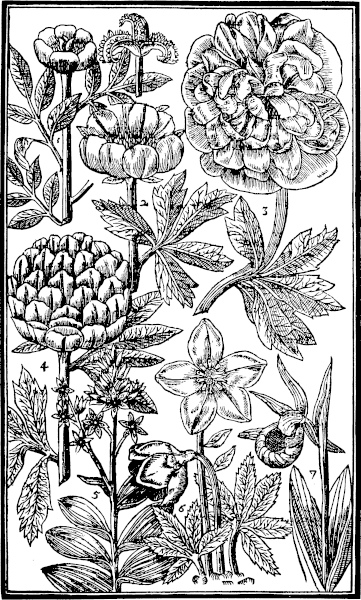
1Pæonia mas cum semine. The male Peony & the seed.
2Pæonia fæmina Byzantina. The female red Peony of Constantinople.
3Pæonia fæmina flore pleno vulgaris. The ordinary double Peony.
4Pæonia flore pleno albicante. The double white Peony.
5Helleborus vernus atrorubente flore. The early white Ellebor with a darke red flower.
6Helleborus niger verus. The Christmas flower.
7Calceolus Mariæ. Our Ladies Slipper.
The Names.
The name Pæonia is of all the later Writers generally giuen to these plants, although they haue had diuers other names giuen by the elder Writers, as Rosa fatuina, Idæus dactylus, Aglaophotis, and others, whereof to set downe the causes, reasons, and errours, were to spend more time then I intend for this worke. Wee call them in English, Peonie, and distinguish them according to their titles.
The Vertues.
The male Peony roote is farre aboue all the rest a most singular approued remedy for all Epilepticall diseases, in English, The falling sicknesse (and more especially the greene roote then the dry) if the disease be not too inueterate, to be boyled and drunke, as also to hang about the neckes of the younger sort that are troubled herewith, as I haue found it sufficiently experimented on many by diuers. The seede likewise is of especiall vse for women, for the rising of the mother. The seede of the female kinde, as well as the rootes, are most vsually sold, and may in want of the other be (and so are generally) vsed.
Chap. LXXXI. Helleborus niger. Beares foote.
There are three sorts of blacke Hellebor or Beares foote, one that is the true and right kinde, whose flowers haue the most beautifull aspect, and the time of his flowring most rare, that is, in the deepe of Winter about Christmas, when no other can bee seene vpon the ground: and two other that are wilde or bastard kindes, brought into many Gardens for their Physicall properties; but I will only ioyne one of them with the true kinde in this worke, and leaue the other for another.
1. Helleborus niger verus. The true blacke Hellebor, or Christmas flower.
The true blacke Hellebor (or Beare foote as some would call it, but that name doth more fitly agree with the other two bastard kindes) hath many faire greene leaues rising from the roote, each of them standing on a thicke round fleshly stiffe greene stalke, about an hand breadth high from the ground, diuided into seuen, eight, or nine parts or leaues, and each of them nicked or dented, from the middle of the leafe to the pointward on both sides, abiding all the Winter, at which time the flowers rise vp on such short thicke stalkes as the leaues stand on, euery one by it selfe, without any leafe thereon for the most part, or very seldome hauing one small short leafe not much vnder the flower, and very little higher then the leaues themselues, consisting of fiue broad white leaues, like vnto a great white single Rose (which sometimes change to be either lesse or more purple about the edges, as the weather or time of continuance doth effect) with many pale yellow thrummes in the middle, standing about a greene head, which after groweth to haue diuers cods set together, pointed at the ends like hornes, somewhat like the seede vessels of the Aconitum hyemale, but greater & thicker, wherein is contained long, round, and blackish seede, like the seede of the bastard kindes: the rootes are a number of brownish strings running downe deepe into the ground, and fastened to a thicke head, of the bignesse of a finger at the toppe manie times, and smaller still downewards.
2. Helleboraster minor. The lesser bastard blacke Hellebor, or Beare foote.
The smaller Beare foote is in most things like vnto the former true blacke Hellebor; for it beareth also many leaues vpon short stalkes, diuided into many leaues also, but each of them are long and narrow, of a blacker greene colour, snipt or dented on both edges, which feele somewhat hard or sharpe like prickes, and perish euery yeare, but rise againe the next Spring: the flowers hereof stand on higher stalkes, with some leaues on them also, although but very few, and are of a pale, greene colour, like in forme vnto the flowers of the former, but smaller, hauing also many greenish yellow threads or thrums in the middle, and such like heads or seede vessels, and blackish seed: the rootes are stringie and blackish like the former.
The Place.
The first groweth onely in the Gardens of those that are curious, and delight in all sorts of beautifull flowers in our Countrey, but wilde in many places of Germany, Italy, Greece, &c.
The other groweth wilde in many places of England, as well as the other greater sort, which is not here described; for besides diuers places within eight or ten miles from London, I haue seen it in the Woods of Northamptonshire, and in other places.
The Time.
The first of these plants doth flower in the end of December, and beginning of Ianuary most vsually, and the other a moneth or two after, and sometime more.
The Names.
The first is called Helleborus, or Elleborus niger verus, and is the same that both Theophrastus and Dioscorides haue written of, and which was called Melampodion, of Melampus the Goateheard, that purged and cured the mad or melancholicke daughters of Prætus with the rootes thereof. Dodonæus calleth it Veratrum nigrum primum, and the other secundum: Wee call it in English, The true blacke Hellebor, or the Christmas flower, because (as I said) it is most commonly in flower at or before Christmas. The second is a bastard or wilde kinde thereof, it so nearely resembleth the true, and is called of most of the later Writers, Pseudoelleborus niger minor, or Helleboraster minor, for a distinction betweene it and the greater, which is not here described: and is called in English, The smaller or lesser Beare foote, and most vsed in Physicke, because it is more plentifull, yet it is more churlish and strong in operation then the true or former kinde.
The Vertues.
The rootes of both these kindes are safe medecines, being rightly prepared, to be vsed for all Melancholicke diseases, whatsoeuer others may feare or write, and may be without danger applied, so as care and skill, and not temerary rashnesse doe order and dispose of them.
The powder of the dryed leaues, especially of the bastard kinde, is a sure remedy to kill the wormes in children, moderately taken.
Chap. LXXXII. Elleborus albus. White Ellebor or Neesewort.
There are two sorts of great white Ellebors or Neeseworts, whereas there was but one kinde knowne to the Ancients; the other being found out of later dayes: And although neither of both these haue any beauty in their flowers, yet because their leaues, being faire and large, haue a goodly prospect, I haue inserted them in this place, that this Garden should not be vnfurnished of them, and you not vnacquainted with them.
1. Elleborus albus vulgaris. White Ellebor or Neesing roote.
The first great white Ellebor riseth at the first out of the ground, with a whitish greene great round head, which growing vp, openeth it selfe into many goodly faire large greene leaues, plaited or ribbed with eminent ribbes all along the leaues, compassing one another at the bottome, in the middle whereof riseth vp a stalke three foot high or better, with diuers such like leaues thereon, but smaller to the middle thereof; from whence to the toppe it is diuided into many branches, hauing many small yellowish, or whitish greene starre-like flowers all along vpon them, which after turne into small, long, three square whitish seede, standing naked, without any huske to containe them, although some haue written otherwise: the roote is thicke and reasonable great at the head, hauing a number of great white strings running downe deepe into the ground, whereby it is strongly fastened.
2. Elleborus albus præcox siue atrorubente flore. The early white Ellebor with reddish flowers.
This other Ellebor is very like the former, but that it springeth vp a moneth at the least before it, and that the leaues are not fully so thicke or so much plaited, but as large or larger, and doe sooner perish and fall away from the plant: the stalke hereof is as high as the former, bearing such like starry flowers, but of a darke or blackish red colour: the seede is like the other: the roote hath no such head as the other (so farre as I haue obserued, both by mine own and others plants) but hath many long white strings fastened to the top, which is as it were a long bulbous scaly head, out of which spring the leaues.
The Place.
The first groweth in many places of Germany, as also in some parts of Russia, in that aboundance, by the relation of that worthy, curious, and diligent searcher and preseruer of all natures rarities and varieties, my very good friend, Iohn Tradescante, often heretofore remembred, that, as hee said, a good ship might be loaden with the rootes hereof, which hee saw in an Island there.
The other likewise groweth in the vpland wooddy grounds of Germanie, and other the parts thereabouts.
The Time.
The first springeth vp in the end or middle of March, and flowreth in Iune. The second springeth in February, but flowreth not vntill Iune.
The Names.
The first is called Elleborus albus, or Helleborus albus, the letter H, as all Schollers know, being but aspirationis nota: and Veratrum album flore viridante, of some Sanguis Herculis. The other is called Elleborus albus præcox, and flore atrorubente, or atropurpurante. We call the first in English, White Ellebor, Neesewort, or Neesing roote, because the powder of the roote is vsed to procure neesing; and I call it the greater, in regard of those in the next Chapter. The other hath his name according to the Latine title, most proper for it.
The Vertues.
The force of purging is farre greater in the roote of this Ellebor, then in the former; and therefore is not carelessly to bee vsed, without extreame danger; yet in contumatious and stubborne diseases it may bee vsed with good caution and aduice. There is a Syrupe or Oxymel made hereof in the Apothecaries shops, which as it is dangerous for gentle and tender bodies, so it may be very effectuall in stronger constitutions. Pausanias in Phocicis, recordeth a notable stratagem that Solon vsed in besieging the Citie of Cirrheus, viz. That hauing cut off the riuer Plistus from running into the Citie, he caused a great many of these rootes to be put into a quantity thereof, which after they had steeped long enough therein, and was sufficiently infected therewith, he let passe into the Citie againe: whereof when they had greedily drunke, they grew so weake and feeble by the superpurgation thereof, that they were forced to leaue their wals vnmand, and not guarded, whereby the Amphyctions their enemies became masters of their Citie. The like stratagems are set downe by diuers other Authors, performed by the helpe of other herbes.
Chap. LXXXIII. Elleborine. Small or wilde white Ellebor.
The likenesse of the leaues of these plants, rather then any other faculty with the former white Ellebor, hath caused them to be called Elleborine, as if they were smaller white Ellebors. And I for the same cause haue ioyned them next, whereof there are found many sorts: One which is the greater kinde, is of greatest beauty; the other which are lesser differ not much one from another, more then in the colour of the flowers, whereof I will onely take three, being of the most beautie, and leaue the rest to another worke.
1. Helleborine vel Elleborine maior, siue Calceolus Mariæ. Our Ladies Slipper.
This most beautifull plant of all these kindes, riseth vp with diuers stalkes, a foote and a halfe high at the most, bearing on each side of them broad greene leaues, somewhat like in forme vnto the leaues of the white Ellebor, but smaller and not so ribbed, compassing the stalke at the lower end; at the tops of the stalkes come forth one, or two, or three flowers at the most, one aboue another, vpon small short foote-stalkes, with a small leafe at the foote of euery stalke: each of these flowers are of a long ouall forme, that is, more long then round, and hollow withall, especially at the vpper part, the lower being round and swelling like a belly: at the hollow part there are two small peeces like eares or flippets, that at the first doe couer the hollow part, and after stand apart one from another, all which are of a fine pale yellow colour, in all that I haue seene (yet it is said there are some found, that are more browne or tending to purple) there are likewise foure long, narrow, darke coloured leaues at the setting on of the flower vnto the stalke, wherein as it were the flower at the first standeth: the whole flower is of a pretty small sent: the seede is very small, very like vnto the seede of the Orchides or Satyrions, and contained in such like long pods, but bigger: the roots are composed of a number of strings enterlacing themselues one within another, lying within the vpper crust of the earth, & not spreading deep, of a darke brownish colour.
2. Elleborine minor flore albo. The small or wilde white Ellebor with a white flower.
This smaller wilde white Ellebor riseth vp in the like manner vnto the former, and not much lower, bearing such like leaues, but smaller, and of a winter greene colour, almost of the colour and fashion of the leaues of Lilly Conually; the top of the stalke hath many more flowers, but lesser, growing together, spike-fashion, with small short leaues at the stalke of euery flower, which consisteth of fiue small white leaues, with a small close hood in the middle, without any sent at all; the seede and seede vessels are like vnto the former, but smaller: the rootes are many small strings, dispersing themselues in the ground.
3. Elleborine minor flore purpurante. The small or wilde white Ellebor with blush flowers.
The leaues of this kinde are like vnto the last described, but somewhat narrower: the stalkes and flowers are alike, but smaller also, and of a pale purplish or blush colour, which causeth the difference.
The Place.
The first groweth in very many places of Germany, and in other Countries also. It groweth likewise in Lancashire, neare vpon the border of Yorkeshire, in a wood or place called the Helkes, which is three miles from Ingleborough, the highest Hill in England, and not farre from Ingleton, as I am informed by a courteous Gentlewoman, a great louer of these delights, called Mistris Thomasin Tunstall, who dwelleth at Bull-banke, neare Hornby Castle in those parts, and who hath often sent mee vp the rootes to London, which haue borne faire flowers in my Garden. The Second groweth in many places of England, and with the same Gentlewoman also before remembred, who sent me one plant of this kinde with the other. The last I haue not yet knowne to growe in England; but no doubt many things doe lye hid, and not obserued, which in time may bee discouered, if our Country Gentlemen and women, and others, in their seuerall places where they dwell, would be more carefull and diligent, and be aduertised either by themselues, or by others capable and fit to be imployed, as occasion and time might serue, to finde out such plants as growe in any the circuits or limits of their habitations, or in their trauels, as their pleasures or affaires leade them. And because ignorance is the chiefe cause of neglect of many rare things, which happen to their view at sometimes, which are not to be seene againe peraduenture, or not in many yeares after, I would heartily aduise all men of meanes, to be stirred vp to bend their mindes, and spend a little more time and trauell in these delights of herbes and flowers, then they haue formerly done, which are not onely harmlesse, but pleasurable in their time, and profitable in their vse. And if any would be better enformed, and certified of such things they know not, I would be willing and ready to my best skill to aduertise them, that shall send any thing vp to me where I dwell in London. Thus farre I haue digressed from the matter in hand, and yet not without some good vse I hope, that others may make of it.
The Time.
The two first flower earlier then the last, and both the first about one time, that is, in the end of Aprill, or beginning of May. The last in the end of May, or in Iune.
The Names.
The first is called Elleborine recentiorum maior, and Calceolus Mariæ: Of some thought to be Cosmosandalos, because it is Sandali forma. In English we call it our Ladies Slipper, after the Dutch name. The other two lesser kinds haue their names in their titles: I haue thought it fit to adde the title of small white Ellebors vnto these, for the forme sake, as is before said.
The Vertues.
There is no vse of these in Physicke in our dayes that I know.
Chap. LXXXIIII. Lilium Conuallium. Lilly Conually.
The remembrance of the Conuall Lilly, spoken of in the precedent Chapter, hath caused me to insert these plants among the rest, although differing both in face and properties; but lest it should lose all place, let it keepe this. It is of two sorts, differing chiefly in the colour of the flowers, the one being white, and the other reddish, as shall be shewed in their descriptions following.
1. Lilium Conuallium flore albo. The white Lilly Conually.
The white Conuall or May Lilly, hath three or foure leaues rising together from the roote, one enclosed within another, each whereof when it is open is long and broad, of a grayish shining greene colour, somewhat resembling the leaues of the former wilde Neesewort, at the side whereof, and sometime from the middle of them, riseth vp a small short naked foote-stalke, an hand breadth high or somewhat more, bearing at the toppe one aboue another many small white flowers, like little hollow bottles with open mouths, nicked or cut into fiue or six notches, turning all downewards one way, or on one side of the stalke, of a very strong sweete sent, and comfortable for the memory and senses, which turne into small red berries, like vnto Asparagus, wherein is contained hard white seede: the rootes runne vnder ground, creeping euery way, consisting of many small white strings.
2. Lilium Conuallium flore rubente. May Lillies with red flowers.
This other May Lilly differeth neither in roote, leafe, nor forme of flower from that before, but onely in the colour of the flower, which is of a fine pale red colour, being in my iudgement not altogether so sweet as the former.
The Place.
The first groweth aboundantly in many places of England. The other is a stranger, and groweth only in the Gardens of those that are curious louers of rarities.
The Time.
They both flower in May, and the berries are ripe in August.
The Names.
The Latines haue no other name for this plant but Lilium Conuallium, although some would haue it to be Lilium vernum of Theophrastus, and others Oenanthe of the same Author. Gesner thinketh it to be Callionymus. Lonicerus to be Cacalia, and Fuchsius to be Ephemerum non lethale: but they are all for the most part mistaken. We call it in English Lilly Conually, May Lilly, and of some Liriconfancie.
The Vertues.
The flowers of the white kinde are often vsed with those things that help to strengthen the memory, and to procure ease to Apoplecticke persons. Camerarius setteth downe the manner of making an oyle of the flowers hereof, which he saith is very effectuall to ease the paines of the Goute, and such like diseases, to be vsed outwardly, which is thus: Hauing filled a glasse with the flowers, and being well stopped, set it for a moneths space in an Ants hill, and after being drayned cleare, set it by to vse.
Chap. LXXXV. Gentiana. Gentian or Fell-wort.
There are diuers sorts of Gentians or Fell-wortes, some greater, others lesser, and some very small; many of them haue very beautifull flowers, but because some are very suddenly past, before one would thinke they were blowne open, and others will abide no culture and manuring, I will onely set forth vnto you two of the greater sorts, and three of the lesser kindes, as fittest, and more familiarly furnishing our gardens, leauing the rest to their wilde habitations, and to bee comprehended in a generall Worke.
1. Gentiana maior flore flauo. The great Gentian.
The great Gentian riseth vp at the first, with a long, round and pointed head of leaues, closing one another, which after opening themselues, lye vpon the ground, and are faire, long and broad, somewhat plaited or ribbed like vnto the leaues of white Ellebor or Neeseworte, but not so fairely or eminently plaited, neyther so stiffe, but rather resembling the leaues of a great Plantane: from among which riseth vp a stiffe round stalke, three foote high or better, full of ioynts, hauing two such leaues, but narrower and smaller at euery ioynt, so compassing about the stalke at the lower end of them, that they will almost hold water that falleth into them: from the middle of the stalke to the toppe, it is garnished with many coronets or rundles of flowers, with two such greene leaues likewise at euery ioynt, and wherein the flowers doe stand, which are yellow, layd open like starres, and rising out of small greenish huskes, with some threds in the middle of them, but of no sent at all, yet stately to behold, both for the order, height and proportion of the plant: the seede is browne and flat, contained in round heads, somewhat like vnto the seede of the Fritillaria, or checkerd Daffodill, but browner: the rootes are great, thicke and long, yellow, and exceeding bitter.
2. Gentiana maior folio Asclepiadis. Swallow-wort Gentian.
This kinde of Gentian hath many stalkes rising from the roote, neere two foote high, whereon grow many faire pale greene leaues, set by couples, with three ribs in euery one of them, and doe somewhat resemble the leaues of Asclepias or Swallow-wort, that is, broade at the bottome, and sharpe at the point: the flowers grow at the seuerall ioynts of the stalkes, from the middle vpwards, two or three together, which are long and hollow, like vnto a bell flower, ending in fiue corners, or pointed leaues, and folded before they are open, as the flowers of the Bindeweedes are, of a faire blew colour, sometimes deeper, and sometimes paler: the heads or seede vessels haue two points or hornes at the toppes, and containe within them flat grayish seed, like vnto the former, but lesse: the rootes hereof are nothing so great as the former, but are yellow, small and long, of the bignesse of a mans thumbe.
3. Gentiana minor Cruciata. Crosse-wort Gentian.
This small Gentian hath many branches lying vpon the ground, scarce lifting themselues vpright, and full of ioynts, whereat grow vsually foure leaues, one opposite vnto another, in manner of a Crosse, from whence it tooke his name, in shape very like vnto Saponaria or Sopewort, but shorter, and of a darker greene colour: at the tops of the stalkes stand many flowers, thick thrusting together, and likewise at the next ioynt vnderneath, euery one of them standing in a darke blewish greene huske, and consisting of fiue small leaues, the points or ends whereof only appeare aboue the huskes wherein they stand, and are hardly to be seene, but that they are of a fine pale blew colour, and that many grow together: the seed is small and brown, hard, and somewhat like vnto the seed of the Marian Violets, or Couentry bels: the roots are small and whitish, dispersing themselues diuersly in the ground, of as bitter a taste almost as the rest
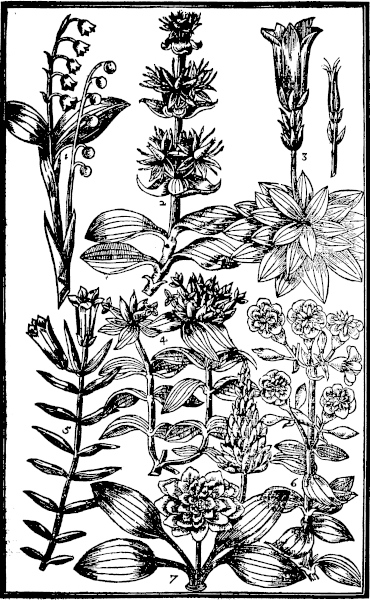
1Lilium Conuallium. Liricon fancy or Lilly Conually.
2Gentiana maior. The great Gentian.
3Gentianella verna. Small Gentian of the Spring.
4Gentiana Cruciata. Crossewort Gentian.
5Pneumonanthe seu Gentiana Autumnalis. Autumne Gentian.
6Saponaria flore duplici. Double flowred Sopewort.
7Plantago Rosea. Rose Plantane.
4. Gentianella Verna. Small Gentian of the Spring.
The small Gentian of the Spring hath diuers small hard greene leaues, lying vpon the ground, as it were in heads or tufts, somewhat broade below, and pointed at the end, with fiue ribs or veines therein, as conspicuous as in the former Gentians, among which riseth vp a small short stalke, with some smaller leaues thereon, at the toppe whereof standeth one faire, large, hollow flower, made bell fashion, with wide open brimmes, ending in fiue corners or diuisions, of the most excellent deepe blew colour that can be seene in any flower, with some white spots in the bottome on the inside: after the flower is past, there appeare long and round pods, wherein are contained small blackish seede: the rootes are small, long, pale yellow strings, which shoot forth here and there diuers heads of leaues, and thereby encrease reasonable well, if it finde a fit place, and ground to grow, or else will not be noursed vp, with all the care and diligence can be vsed: the whole plant is bitter, but not so strong as the former.
5. Gentiana Autumnalis siue Pneumonanthe. Calathian Violet or Autumne Gentian.
This Gentian that flowreth in Autumne, hath in some places higher stalkes then in others, with many leaues thereon, set by couples as in other Gentians, but long and narrow, yet shewing the three ribbes or veines that are in each of them: the toppes of the stalkes are furnished euery one with a flower or two, of an excellent blew purple colour, ending in fiue corners, and standing in long huskes: the rootes are somewhat great at the top, and spreading into many small yellow strings, bitter as the rest are.
6. Saponaria flore duplici. Double flowred Sopeworte.
Vnto these kindes of Gentians, I must needes adde these following plants, for that the former is of some neere resemblance in leafe with some of the former. And because the ordinary Sopeworte or Bruiseworte with single flowers is often planted in Gardens, and the flowers serue to decke both the garden and the house; I may vnder the one describe them both: for this with double flowers is farre more rare, and of greater beautie. It hath many long and slender round stalkes, scarce able to sustaine themselues, and stand vpright, being ful of ioynts and ribbed leaues at them, euery one somewhat like a small Gentian or Plantane leafe: at the toppes of the stalkes stand many flowers, consisting of two or three rowes of leaues, of a whitish or pale purple colour, and of a strong sweet sent, somewhat like the smell of Iasmin flowers, standing in long and thicke pale greene huskes, which fall away without giuing any seede, as most other double flowers doe that encrease by the roote, which spreadeth within the ground, and riseth vp in sundry distant places like the single.
7. Plantago Rosea. Rose Plantane.
This other plant is in all things like vnto the ordinary Plantane or Ribworte, that groweth wilde abroade in many places, whose leaues are very large: but instead of the long slender spike, or eare that the ordinary hath, this hath eyther a thicke long spike of small greene leaues vpon short stalkes, or else a number of such small greene leaues layd round-wise like vnto a Rose, and sometimes both these may be seene vpon one and the same roote, at one and the same time, which abide a great while fresh vpon the roote, and sometimes also giueth seede, especially from the more long and slender spikes.
The Place.
Some of these Gentians grow on the toppes of hils, and some on the sides and foote of them in Germany and other Countreyes: some of them also vpon barren heaths in those places, as also in our owne Countrey, especially the Autumne Gentian, and as it is reported, the Vernall likewise. The single or ordinary Sopeworte is found wilde in many places with vs, but the double came to vs from beyond the Sea, and is scarce known or heard of in England. The Rose Plantaine hath beene long in England, but whether naturall thereof or no, I am not assured.
The Time.
They flower for the most part in Iune and Iuly, but the small Gentian of the Spring flowreth somewhat earlier, and that of the Autumne in August and September.
The Names.
Gentiana is the generall name giuen to the Gentians. We call them in English Gentian, Fellworte, Bitterwort, and Baldmoney. Saponaria taketh his name from the scouring qualitie it hath: Wee call it in English Sopewort, and in some places Bruisewort. Some haue thought it to bee Struthium of Dioscorides, or at least haue vsed it for the same causes, but therein they are greatly deceiued, as Matthiolus hath very well obserued thereon, and so is Dodonæus, that thought it to be Alisma. The Rose Plantaine is so called of the double spikes it carrieth.
The Vertues.
The wonderfull wholsomnesse of Gentian cannot bee easily knowne to vs, by reason our daintie tastes refuse to take thereof, for the bitternesse sake: but otherwise it would vndoubtedly worke admirable cures, both for the liuer, stomacke and lunges. It is also a speciall counterpoison against any infection, as also against the violence of a mad dogges tooth: wilde Sopewort is vsed in many places, to scoure the countrey womens treen, and pewter vessels, and physically some make great boast to performe admirable cures in Hydropicall diseases, because it is diureticall, and in Lue Veneria, when other Mercuriall medicines haue failed. The Rose Plantaine no doubt hath the same qualities that the ordinary hath.
Chap. LXXXVI. Campanula. Bell-flowers.
Under the title of Bell-flowers are to bee comprehended in this Chapter, not only those that are ordinarily called Campanula, but Viola Mariana, and Trachelium also, whereof the one is called Couentry, the other Canterbury Bells.
1. Campanula Persicifolia alba, vel cærulea. Peach-leafed Bell-flowers white or blew.
The Peach-leafed Bell-flower hath many tufts, or branches of leaues lying vpon the ground, which are long and narrow, somewhat like vnto the leafe of an Almond or Peach tree, being finely nicked about the edges, and of a sad greene colour, from among which rise vp diuers stalkes, two foote high or more, set with leaues to the middle, and from thence vpwards, with many flowers standing on seuerall small foote-stalkes, one aboue another, with a small leafe at the foote of euery one; the flowers stand in small greene huskes, being small and round at the bottome, but wider open at the brimme, and ending in fiue corners, with a three forked clapper in the middle, set about with some small threds tipt with yellow, which flowers in some plants are pure white, and in others of a pale blew or watchet colour, hauing little or no sent at all: the seede is small, and contained in round flat heads, or seede vessels: the roote is very small, white and threddy, creeping vnder the vpper crust of the ground, so that oftentimes the heat and drought of the Summer will goe near to parch and wither it vtterly: it requireth therefore to be planted in some shadowie place.
2. Campanula maior, siue Pyramidalis. The great or steeple Bell-flower.
This great Bell-flower hath diuers stalkes, three foote high or better, whereon grow diuers smooth, darke, greene leaues, broade at the bottome, and small at the point, somewhat vneuenly notched about the edges, and standing vpon longer footestalkes below then those aboue: the flowers are blew, and in some white, not so great or large as the former, but neare of the same fashion, growing thicker and more plentifully together, with smaller leaues among them, burning thicke below, and rising smaller and thinner vp to the toppe, in fashion of a Pyramis or speere Steeple: the roote is thicke and whitish, yeelding more store of milke being broken (as the leaues and stalks also doe) then any other of the Bell-flowers, euery one whereof doe yeelde milke, some more and some lesse.
3. Viola Mariana flore albido vel purpureo. Couentry Bels white or purple.
The leaues of Couentry Bels are of a pale or fresh greene colour, long, and narrow next vnto the bottome, and broader from the middle to the end, and somewhat round pointed, a little hairy all ouer, and snipt about the edges: the stalkes rise vp the yeare after the sowing, being somewhat hairy also, and branching forth from the roote, into diuers parts, whereon stand diuers leaues, smaller then the former, and of a darker greene colour: at the end of euery branch stand the flowers, in greene huskes, from whence come large, round, hollow Bels, swelling out in the middle, and rising somewhat aboue it, like the necke of a pot, and then ending in fiue corners, which are either of a faire or faint white, or of a pale blew purplish colour, and sometimes of a deeper purple or violet: after the flowers are past, there rise vp great square, or cornered seede vessels, wherein is contained in diuers diuisions, small, hard, shining, browne, flat seeds: the roote is white, and being young as in the first yeares sowing, is tender, and often eaten as other Rampions are; but the next yeare, when it runneth vp to seede, it groweth hard, and perisheth: so that it is to be continued by euery other yeares sowing.
4. Trachelium maius flore albo vel purpureo. Great Canterbury Bels white or purple.
The greater Canterbury Bels, or Throateworte, hath many large rough leaues, somewhat like vnto Nettle leaues, being broad and round at the bottome, and pointed at the end, notched or dented on the edges, and euery one standing on a long footstalk: among these leaues rise vp diuers square rough stalkes, diuided at the toppe into diuers branches, whereon grow the like leaues as grow below, but lesser; toward the ends of the branches stand the flowers, mixed with some longer leaues, euery one in his seuerall huske, which are hollow, long and round, like a bell or cup, wide open at the mouth, and cut at the brimme into fiue corners, or diuisions, somewhat lesser then the Couentry Bels, in some of a pure white, and others of a faire deepe purple violet colour, and sometimes paler: after the flowers are past, come smaller and rounder heades then in the former, containing flat seede, but blacker, and not so redde as the last: the roote is hard and white, dispersing it selfe into many branches vnder ground, not perishing euery yeare as the former (although it loseth all the leaues in winter) but abiding many yeares, and encreasing into diuers heades or knobs, from whence spring new leaues and branches.
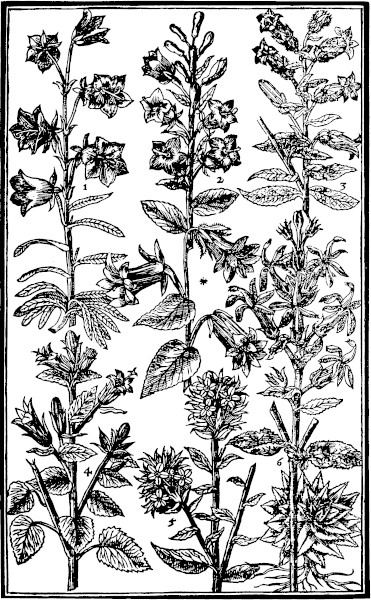
1Campanula persicifolia. Peach leafed Bell-flower.
2Trachelium maius simplex. Canterbury Bels.
*Trachelium flore duplici. Double Canterbury Bels.
3Viola Mariana. Couentry Bels.
4Trachelium Giganteum. Giants Throatewort.
5Trachelium minus. The lesser Throatewort.
6Trachelium Americanum siue Cardinalis planta. The rich crimson Cardinals flower.
5. Trachelium maius flore duplici albo & cæruleo. Canterbury Bels with double flowers both white and blew.
Of this kinde of Throateworte or Canterbury Bels, there is another sort, not differing in any thing from the former, but in the doublenesse of the flower: For there is of both the kindes, one that beareth double white flowers, and the other blew: Of each whereof I receiued plants from friends beyond the Sea, which grow well with me.
6. Trachelium Giganteum flore purpurante. Pale purple Giants Throateworte.
This Bell-flower, although it hath a Gigantine name, yet did I neuer perceiue it in my garden, to rise vp higher then the former, the epithite beeing in my perswasion, only giuen for difference sake: the leaues whereof are not so rough, but as large, and dented about the edges, somewhat larger pointed, and of a fresher greene colour: the stalkes beare such like leaues on them, but more thinly or dispersedly set, hauing a flower at the setting on of euery one of the leaues, from the middle vpwards, and are somewhat like the great Throateworte in forme, but of a pale or bleake reddish purple colour, turning the brims or corners a little backwards, with a forked clapper in the middle, sufficient eminent and yellow: the seede hereof is white, and plentifull in the heads, which will abide all the winter vpon the stalkes, vntill all the seede being shed, the heads remaining seeme like torne rags, or like thin peeces of skin, eaten with wormes: the roote is great, thicke and white, abiding long without perishing.
Flore albo.
There is another which differeth not any thing but in the flower, which is white.
7. Trachelium minus flore albo & purpureo. Small Throateworte or Canterbury Bells both white and purple.
The lesser Throateworte hath smaller leaues, nothing so broade or hard as the former great kinde, but long, and little or nothing dented about the edges: the stalkes are square and brownish, if it beare purple flowers, and greene if it beare white flowers, which in forme are alike, and grow in a bush or tuft, thicke set together, more then any of the former, and smaller also, being not much bigger then the flowers of the fielde, or garden Rampions: the roote is lasting, and shooteth afresh euery yeare.