THE GARDEN OF PLEASANT FLOWERS. (continued 8)
Reading edition
6. Lychnis Chalcedonica flore miniato pleno. Double Flower of Bristow, or Nonesuch.
This glorious flower being as rare as it is beautifull, is for rootes beeing stringie, for leaues and stalkes being hairy and high, and for the flowers growing in tufts, altogether like the first single kinde; but herein consisteth the chiefest difference, that this beareth a larger vmbell or tuft of flowers at the toppe of the stalke, euery flower consisting of three or foure rowes of leaues, of a deeper orenge colour then it, which addeth the more grace vnto it, but passeth away without bearing seede, as most other double flowers doe, yet recompenceth that defect with encrease from the roote.
7. Lychnis plumaria siluestris simplex & multiplex. The featherd wilde Campion single and double.
The leaues of this wilde Campion are somewhat like the ordinary white wilde Campion, but not so large, or rather resembling the leaues of sweete Williams, but that they grow not so close, nor so many together: the stalkes haue smaller leaues at the ioynts then those belowe, and branched at the toppe, with many pale, but bright red flowers, iagged or cut in on the edges, like the feathered Pinke, whereof some haue taken it to be a kinde, and some for a kinde of wilde William, but yet is but a wilde Campion, as may be obserued, both by his huske that beareth the flowers, and by the greyish roundish seede, being not of the Family of Pinkes and Gillowers, but (as I said) of the Campions: the roote is full of strings or fibres.
Flore pleno.
The double kinde is very like vnto the single kinde, but that it is lower and smaller, and the flowers very double.
8. Lychnis siluestris flore pleno rubro. Red Batchelours buttons.
The double wilde Campion (which of our Countrey Gentlewomen is called Batchelours buttons) is very like both in rootes, leaues, stalkes, and flowers vnto the ordinary wilde red Campion, but somewhat lesser, his flowers are not iagged, but smooth, and very thicke and double, so that most commonly it breaketh his short huske, wherein the flower standeth on the one side, seldome hauing a whole huske, and are of a reddish colour.
9. Lychnis siluestris flore albo pleno. White Batchelours buttons.
As the leaues of the former double Campion was like vnto the single kinde that had red flowers, so this hath his leaues like vnto the single white kinde, differing in no other thing from it, but in the doublenesse of the flowers, which by reason of the multiplicity of leaues in them thrusting forth together, breaketh his huskes wherein the flowers doe stand, as the other doth, and hath scarce one flower in many that is whole.
10. Ocymoides arborea semper virens. Strange Bassil Campion.
This Strange Campion (for thereunto it must bee referred) shooteth forth many round, whitish, wooddy, but brittle stalkes, whereon stand diuers long, and somewhat thicke leaues, set by couples, narrow at the bottome, and broader toward the point, of a very faire greene and shining colour, so that there is more beauty in the greene leaues, which doe so alwaies abide, then in the flowers, which are of a pale red or blush colour, consisting of fiue small long broad pointed leaues, notched in the middle, which doe not lye close, but loosly as it were hanging ouer the huskes: after the flowers are past, there come heads that containe blackish seede: the roote is small, hard, white, and threadie.
11. Muscipula Lobelij siue Ben rubrum Monspeliensium. Lobels Catch Flie.
I must needes insert this small plant, to finish this part of the Campions, whereunto it belongeth, being a pretty toye to furnish and decke out a Garden. It springeth vp (if it haue beene once sowne and suffered to shed) in the later end of the yeare most commonly, or else in the Spring with fiue or six small leaues, very like vnto the leaues of Pinkes, and of the same grayish colour, but a little broader and shorter, and when it beginneth to shoote vp for flower, it beareth smaller leaues on the clammy or viscous stalkes (fit to hold any small thing that lighteth on it); being broad at the bottome compassing them, and standing two at a ioynt one against another: the toppes of the stalkes are diuersly branched into seuerall parts, euery branch hauing diuers small red flowers, not notched, but smooth, standing out of small, long, round, stript huskes, which after the flowers are past, containe small grayish seede: the roote is small, and perisheth after it hath giuen seede; but riseth (as is before said) of its owne seede, if it be suffered to shed.
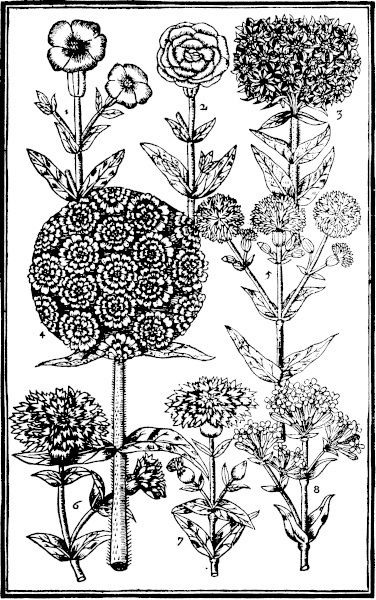
1Lychnis Coronaria simplex. Single Rose Campion.
2Lychnis Coronaria rubra multiplex. The double red Rose Campion.
3Lychnis Chalcedonica simplex. Single None such, or flower of Bristow.
4Lychnis Chalcedonica flore pleno. Double None such, or flower of Bristow.
5Lychnis plumaria multiplex. Pleasant in sight.
6Lychnis siluestris flore pleno rubro. Red Batchelours Buttons.
7Lychnis siluestris flore pleno albo. White Batchelours Buttons.
8Muscipula Lobelij. Lobels Catch Flie.
The Place.
The Rose Campions, Flowers of Bristow, or Nonesuch, the Bassil Campion, and the Catch Flie, haue been sent vs from beyond the Seas, and are onely noursed vp in Gardens with vs; the other Campions that are double, haue been naturally so found double wilde (for no art or industry of man, that euer I could be assured of to be true, be it by neuer so many repetitions of transplantations, and planeticall obseruations (as I haue said in the beginning of this worke) could bring any flower, single by nature, to become double, notwithstanding many affirmations to that purpose, but whatsoeuer hath been found wilde to be double, nature her selfe, and not art hath so produced it) and being brought into Gardens, are there encreased by slipping, and parting the roote, because they giue no seede.
The Time.
All of them doe flower in the Summer, yet none before May.
The Names.
The first kindes are called Lychnides satiuæ, and coronariæ, in English generally Rose Campions. The next is called Lychnis Chalcedonica, and Byzantina; in English, of some Nonesuch, and of others Flower of Bristow, and after the Latine, Flower of Constantinople, because it is thought the seede was first brought from thence; but from whence the double of this kinde came, we cannot tell. The names of the others of this kinde, both single and double, are set downe with their descriptions. The feathered Campions are called Armoraria pratensis, and Flos Cuculi, and of Clusius and others thought to be Odontitis Plinij. Some call them in English Crowflowers, and Cuckowe-Flowers; and some call the double hereof, The faire Maide of France. The Bassil Campions were sent ouer among many other seedes out of Italy, by the name of Ocimoides arborea semper virens. Arborea, because the stalke is more wooddy and durable then other Campions: And semper virens, because the leaues abide greene Winter and Summer. Clusius calleth it Lychnis semper virens, because it is certainly a Campion. The last is diuersly called of Authors; Lobel calleth it Muscipula: Others Armoraria altera: Dodonæus Armerius flos quartus. Clusius Lychnis siluestris altera, in his Spanish obseruations, and prima in his History of plants, and saith, the learned of Salmantica in Spaine called it, Ben rubrum, as Lobel saith, they of Mompelier doe also: and by that name I receiued it first out of Italy. It hath the name of Catch Flie, of Muscipula the Latine word, because the stalkes in the hot Summer dayes haue a certaine viscous or clammy humour vpon them, whereby it easily holdeth (as I said before) whatsoeuer small thing, as Flies, &c. lighteth vpon it.
The Vertues.
We know none in these dayes, that putteth any of these to any Physicall vse, although some haue in former times.
Chap. XXXIX. Keiri siue Leucoium luteum. Wall-flowers, or Wall Gilloflowers.
There are two sorts of Wall-flowers, the one single, the other double, and of each of them there is likewise some differences, as shall be shewed in their description.
1. Keiri siue Leucoium luteum simplex vulgare. Common single Wall-flowers.
The common single Wall-flower which groweth wilde abroad, and yet is brought into Gardens, hath sundry small, narrow, long, and darke greene leaues, set without order vpon small round whitish wooddy stalkes, which beare at the tops diuers single yellow flowers one aboue another, euery one hauing foure leaues a peece, and of a very sweete sent: after which come long pods, containing reddish seede: the roote is white, hard and thready.
2. Keiri siue Leucoium luteum simplex maius. The great single Wall-flower.
There is another sort of single Wall-flower, whose leaues as well as flowers are much larger then the former: the leaues being of a darker and shining greene colour, and the flowers of a very deepe gold yellow colour, and vsually broader then a twentie shilling peece of gold can couer: the spike or toppe of flowers also much longer, and abiding longer in flower, and much sweeter likewise in sent: the pods for seede are thicker and shorter, with a small point at the end: this is slower to encrease into branches, as also to be encreased by the branches, and more tender to be preserued; for the hard frosts doe cause it to perish, if it be not defended from them.
3. Keiri simplex flore albo. White Wall-flower.
This Wall-flower hath his leaues as greene as the great kinde, but nothing so large: the flowers stand at the toppe, but not in so long a spike, and consisteth of foure leaues, of a very white colour, not much larger then the common kinde, and of a faint or weaker sent: the pods are nothing so great as the former great one: this is more easie to be propagated and encreased also, but yet will require some care in defending it from the colds of the Winter.
4. Keiri siue Leucoium luteum vulgare flore pleno. Common double Wall-flowers.
This ordinary double Wall-flower is in leaues and stalke very like vnto the first single kinde, but that the leaues hereof are not of so deepe a greene colour: the flowers stand at the top of the stalkes one aboue another, as it were a long spike, which flower by degrees, the lowest first, and so vpwards, by which it is a long time in flowring, and is very double, of a gold yellow colour, and very sweete.
5. Keiri siue Leucoium luteum alterum flore pleno. Pale double Wall-flowers.
Wee haue another sort of this kinde of double Wall-flower, whose double flowers stand not spike-fashion as the former, but more open spread, and doe all of them blowe open at one time almost, and not by degrees as the other doth, and is of a paler yellow colour, not differing in any thing else, except that the greene leaues hereof are of a little paler greene then it.
6. Keiri siue Leucoium luteum maius flore pleno ferrugineo. Double red Wall-flowers.
We haue also another sort of double Wall-flower, whose leaues are as greene, and almost as large as the great single yellow kinde, or full as bigge as the leaues of the white Wall-flower: the flowers hereof are not much larger then the ordinary, but are of a darker yellow colour then the great single kinde, and of a more brownish or red colour on the vnderside of the leaues, and is as it were striped.
7. Keiri siue Leucoium maximum luteum flore pleno. The greatest double yellow Wall-flower.
This great double Wall-flower is as yet a stranger in England, and therefore what I here write is more vpon relation (which yet I beleeue to be most true) then vpon sight and speculation. The leaues of this Wall-flower are as greene and as large, if not larger then the great single kinde: the flowers also are of the same deepe gold yellow colour with it, but much larger then any of the former double kindes, and of as sweet a sent as any, which addeth delight vnto beauty.
The Place.
The first single kind is often found growing vpon old wals of Churches, and other houses in many places of England, and also among rubbish and stones. The single white and great yellow, as well as all the other double kindes, are noursed vp in Gardens onely with vs.
The Time.
All the single kindes doe flower many times in the end of Autumne, and if the Winter be milde all the Winter long, but especially in the moneths of February, March, and Aprill, and vntill the heate of the Spring doe spend them: but the other double kindes doe not continue flowring in that manner the yeare throughout, although very early sometimes, and very late also in some places.
The Names.
They are called by diuers names, as Viola lutea, Leucoium luteum, and Keiri, or Cheiri, by which name it is chiefly knowne in our Apothecaries shops, because there is an oyle made thereof called Cheirinum: In English they are vsually called in these parts, Wall-flowers: Others doe call them Bee-flowers; others Wall-Gilloflowers, Winter-Gilloflowers, and yellow Stocke-Gilloflowers; but we haue a kinde of Stocke-Gilloflower that more fitly deserueth that name, as shall be shewed in the Chapter following.
The Vertues.
The sweetnesse of the flowers causeth them to be generally vsed in Nosegayes, and to decke vp houses; but physically they are vsed in diuers manners: As a Conserue made of the flowers, is vsed for a remedy both for the Appoplexie and Palsie. The distilled water helpeth well in the like manner. The oyle made of the flowers is heating and resoluing, good to ease paines of strained and pained sinewes.
Chap. XL. Leucoium. Stocke-Gilloflower.
There are very many sorts of Stocke-Gilloflowers, both single and double, some of the fields and mountaines, others of the Sea marshes and medowes; and some noursed vp in Gardens, and there preserued by seede or slippe, as each kinde is aptest to bee ordered. But because some of these are fitter for a generall History then for this our Garden of Pleasure, both for that diuers haue no good sent, others little or no beauty, and to be entreated of onely for the variety, I shall spare so many of them as are not fit for this worke, and onely set downe the rest.
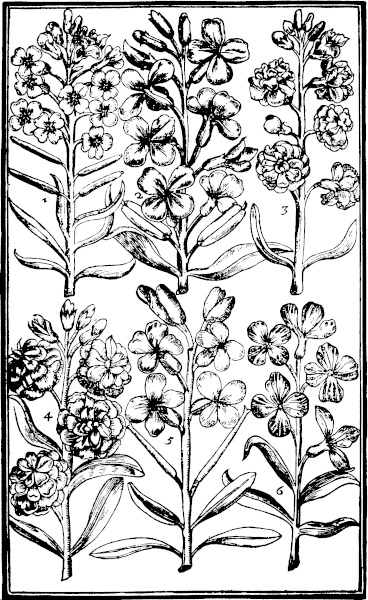
1Keiri siue Leucoium luteum vulgare. Common Wall-flowers.
2Keiri siue Leucoium luteum maius simplex. The great single Wall-flower.
3Keiri siue Leucoium luteum flore pleno vulgare. Ordinary double Wall-flowers.
4Keiri maius flore pleno ferrugineo. The great double red Wall-flower.
5Leucoium sativum simplex. Single Stocke Gilloflowers.
6Leucoium sativum simplex flore striato. Single stript Stocke-Gilloflowers.
1. Leucoium simplex sativum diversorum colorum. Garden Stocke-Gilloflowers single of diuers colours.
These single Stocke-Gilloflowers, although they differ in the colour of their flowers, yet are in leafe and manner of growing, one so like vnto another, that vntill they come to flower, the one cannot be well knowne that beareth red flowers, from another that beareth purple; and therefore one description of the plant shall serue, with a declaration of the sundry colours of the flowers. It riseth vp with round whitish woody stalkes, two, three, or foure foot high, whereon are set many long, and not very broad, soft, and whitish or grayish greene leaues, somewhat round pointed, and parted into diuers branches, at the toppes whereof grow many flowers, one aboue another, smelling very sweet, consisting of foure small, long, and round pointed leaues, standing in small long huskes, which turne into long and flat pods, sometimes halfe a foote long, wherein is contained flat, round, reddish seedes, with grayish ringes or circles about them, lying flat all along the middle rib of the pod on both sides: the roote is long, white, and woody, spreading diuers wayes. There is great variety in the colours of the flowers: for some are wholly of a pure white colour, others of a most excellent crimson red colour, others againe of a faire red colour, but not so bright or liuely as the other, some also of a purplish or violet colour, without any spot, marke, or line in them at all. There are againe of all these colours, mixed very variably, as white mixed with small or great spottes, strakes or lines of pure or bright red, or darke red, and white with purple spots and lines; and of eyther of them whose flowers are almost halfe white, and halfe red, or halfe white, and halfe purple. The red of both sorts, and the purple also, in the like manner spotted, striped, and marked with white, differing neyther in forme, nor substance, in any other point.
2. Leucoium satiuum albido luteum simplex. The single pale yellow Stocke-Gilloflower.
There is very little difference in this kind from the former, for the manner of growing, or forme of leaues or flower. Only this hath greener leaues, and pale yellow almost white flowers, in all other things alike: this is of no great regard, but only for rarity, and diuersity from the rest.
3. Leucoium Melancholicum. The Melancholick Gentleman.
This wilde kinde of stocke gilloflower hath larger, longer and greener leaues then any of the former kindes, vneuenly gashed or sinuated on both edges lying on the ground, and a little rough or hairy withall: from among which rise vp the stalkes, a yard high or more, and hairy likewise, bearing thereon here and there some such like leaues as are below, but smaller, and at the top a great number of flowers, as large or larger then any of the former single kindes, made of 4. large leaues a peece also, standing in such like long huskes, but of a darke or sullen yellowish colour: after which come long roundish pods, wherein lye somewhat long but rounder and greater seede then any stocke gilloflower, and nearer both in pod and seede vnto the Hesperis or Dames Violet: this perisheth not vsually after seede bearing, although sometimes it doth.
4. Leucoium marinum Syriacum. Leuant stocke gilloflowers.
This kind of stocke gilloflower riseth vp at the first with diuers long and somewhat broad leaues, a little vneuenly dented or waued on the edges, which so continue the first yeare after the sowing: the stalke riseth vp the next yeare to bee two foot high or more, bearing all those leaues on it that it first had, which then do grow lesse sinuated or waued then before: at the top whereof stand many flowers, made of foure leaues a peece, of a delayed purple colour, but of a small sent which turne into very long and narrow flat pods, wherein are contained flat seed like the ordinary stocke gilloflowers, but much larger and of a darke or blackish browne colour: the root is white, and groweth deepe, spreading in the ground, but growing woody when it is in seede, and perisheth afterwards.
5. Leucoij alterum genus, flore tam multiplici quam simplici ex feminio oriundum. Another sort of Stocke gilloflowers bearing as well double as single flowers from seede.
This kinde of Stocke gilloflower differeth neyther in forme of leaues, stalkes, nor flowers from the former, but that it oftentimes groweth much larger and taller; so that whosoeuer shall see both these growing together, shall scarce discerne the difference, onely it beareth flowers, eyther white, red or purple, wholly or entire, that is, of one colour, without mixture of other colour in them (for so much as euer I haue obserued, or could vnderstand by others) which are eyther single, like vnto the former, or very thicke and double, like vnto the next that followeth; but larger, and growing with more store of flowers on the long stalke. But this you must vnderstand withall, that those plants that beare double flowers, doe beare no seede at all, and is very seldome encreased by slipping or cutting, as the next kinde of double is: but the onely way to haue double flowers any yeare, (for this kinde dyeth euery winter, for the most part, after it hath borne flowers, and seldome is preserued) is to saue the seedes of those plants of this kinde that beare single flowers, for from that seede will rise, some that will beare single, and some double flowers, which cannot bee distinguished one from another, I meane which will be single and which double, vntill you see them in flower, or budde at the least. And this is the only way to preserue this kinde: but of the seed of the former kinde was neuer known any double flowers to arise, and therefore you must be carefull to marke this kinde from the former.
6. Leucoium flore pleno diuersorum colorum. Double Stocke Gillowflowers of diuers colours.
This other kinde of Stock gilloflower that beareth onely double flowers, groweth not so great, nor spreadeth his branches so farre, nor are his leaues so large, but is in all things smaller, and lower, and yet is woody, or shrubby, like the former, bearing his flowers in the like manner, many vpon a long stalke, one aboue another, and very double, but not so large as the former double, although it grow in fertile soyle, which are eyther white, or red, or purple wholly, without any mixture, or else mixed with spots and stripes, as the single flowers of the first kinde, but more variably, and not in all places alike, neuer bearing seede, but must be encreased, only by the cutting of the young sproutes or branches, taken in a fit season: this kinde perisheth not, as the former double kinde doth, so as it bee defended in the winter from the extreame frosts, but especially from the snow falling, or at the least remaining vpon it.
7. Leucoium satiuum luteum flore pleno. The double yellow Stocke Gilloflower.
This double yellow Stock gilloflower is a stranger in England, as far as I can learne, neyther haue I any further familiaritie with him, then by relation from Germany, where it is affirmed to grow only in some of their gardens, that are curious louers of these delights, bearing long leaues somewhat hoary or white, (and not greene like vnto the Wallflower, whereunto else it might be thought to be referred) like vnto the Stock gilloflowers, as the stalkes and branches also are, and bearing faire double flowers, of a faire, but pale yellow colour. The whole plant is tender, as the double Stock gilloflowers are, and must be carefully preserued in the winter from the coldes, or rather more then the last double, lest it perish.
The Place.
The single kindes, especially some of them, grow in Italie, and some in Greece, Candy, and the Isles adiacent, as may be gathered out of the verses in Plutarches Booke De Amore fraterno:
Inter Echinopodas velut asperam, & inter Ononim, Inter dum crescunt mollia Leucoia.
Which sheweth, that the soft or gentle stocke gilloflowers doe sometimes grow among rough or prickely Furse and Cammocke. The other sorts are only to be found in gardens.
The Time.
They flower in a manner all the yeare throughout in some places, especially some of the single kindes, if they stand warme, and defended from the windes and cold: the double kindes flower sometimes in Aprill, and more plentifully in May, and Iune; but the double of seed, flowreth vsually late, and keepeth flowring vnto the winter, that the frostes and colde mistes doe pull it downe.
The Names.
It is called Leucoium, & Viola alba: but the name Leucoium (which is in English the white Violet) is referred to diuers plants; we call it in English generally, Stocke gilloflower, (or as others doe, Stocke gillouer) to put a difference betweene them, and the Gilloflowers and Carnations, which are quite of another kindred, as shall be shewne in place conuenient.
The Vertues.
These haue no great vse in Physick that I know: only some haue vsed the leaues of the single white flowred kinde with salt, to be laid to the wrests of them that haue agues, but with what good successe I cannot say, if it happen well I thinke in one (as many such things else will) it will fayle in a number.
Chap. XLI.
1. Hesperis, siue Viola Matronalis. Dames Violets, or Queenes Gilloflowers.
The ordinary Dames Violets, or Queene Gilloflowers, hath his leaues broader, greener, and sharper pointed, then the Stock gilloflowers, and a little endented about the edges: the stalkes grow two foot high, bearing many greene leaues vpon them, smaller then those at the bottome, and branched at the toppe, bearing many flowers, in fashion much like the flowers of stocke gilloflowers, consisting of foure leaues in like manner, but not so large, of a faint purplish colour in some, and in others white, and of a pretty sweet sent, especially towards night, but in the day time little or none at all: after the flowers are past, there doe come small long and round pods, wherein is contained, in two rowes, small and long blacke seede: the roote is wholly composed of stringes or fibres, which abide many yeares, and springeth fresh stalks euery yeare, the leaues abiding all the Winter.
2. Hesperis Pannonica. Dames Violets of Hungary.
The leaues of this Violet are very like the former, but smoother and thicker, and not at all indented, or cut in on the edges: the flowers are like the former, but of a sullen pale colour, turning themselues, and seldome lying plaine open, hauing many purple veines, and streakes running through the leaues of the flowers, of little or no sent in the day time, but of a very sweete sent in the euening and morning; the seedes are alike also, but a little browner.
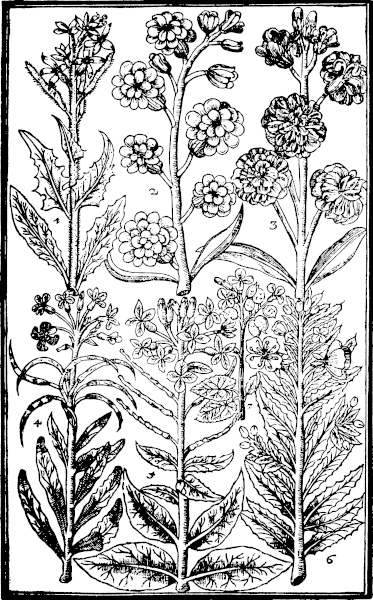
1Leucoium Melancholicum. Sullen Stocke-Gilloflowers.
2Leucoium sativum flore pleno. Double Stocke-Gilloflowers.
3Leucoium sativum flore pleno vario. Party coloured Stocke-Gilloflowers.
4Leucoium marinum Syriacum. Leuant Stocke-Gilloflowers.
5Hesperis vulgaris. Dames Violets or Winter Gilloflowers.
6Lysimachia lutea siliquosa Virginiana. The tree Primrose of Virginia.
7Viola lunaris siue Bolbonach. The white Sattin flower.
3. Lysimachia lutea siliquosa Virginiana. The tree Primrose of Virginia.
Vnto what tribe or kindred I might referre this plant, I haue stood long in suspence, in regard I make no mention of any other Lysimachia in this work: lest therefore it should lose all place, let me ranke it here next vnto the Dames Violets, although I confesse it hath little affinity with them. The first yeare of the sowing the seede it abideth without any stalke or flowers lying vpon the ground, with diuers long and narrow pale greene leaues, spread oftentimes round almost like a Rose, the largest leaues being outermost, and very small in the middle: about May the next yeare the stalke riseth, which will be in Summer of the height of a man, and of a strong bigge size almost to a mans thumbe, round from the bottome to the middle, where it groweth crested vp to the toppe, into as many parts as there are branches of flowers, euery one hauing a small leafe at the foote thereof: the flowers stand in order one aboue another, round about the tops of the stalks, euery one vpon a short foot-stalke, consisting of foure pale yellow leaues, smelling somewhat like vnto a Primrose, as the colour is also (which hath caused the name) and standing in a greene huske, which parteth it selfe at the toppe into foure parts or leaues, and turne themselues downewards, lying close to the stalke: the flower hath some chiues in the middle, which being past, there come in their places long and cornered pods, sharpe pointed at the vpper end, and round belowe, opening at the toppe when it is ripe into fiue parts, wherein is contained small brownish seed: the roote is somewhat great at the head, and wooddy, and branched forth diuersly, which perisheth after it hath borne seede.
The Place.
The two first grow for the most part on Hils and in Woods, but with vs in Gardens onely.
The last, as may be well vnderstood by the title, came out of Virginia.
The Time.
They flower in May, Iune, and Iuly.
The Names.
The name of Hesperis is imposed by most Herbarists vpon the two first plants, although it is not certainly knowne to be the same that Theophrastus doth make mention of, in his sixth Booke and twenty fiue Chapter de causis plantarum: but because this hath the like effects to smell best in the euening, it is (as I said) imposed vpon it. It is also called Viola Marina Matronalis, Hyemalis, Damascena and Muschatella: In English, Dames Violets, Queens Gilloflowers, and Winter Gilloflowers.
The last hath his Latine name in the title as is best agreeing with it, and for the English, although it be too foolish I confesse, yet it may passe for this time till a fitter be giuen, vnlesse you please to follow the Latine, and call it Virginia Loose-strife.
The Vertues.
I neuer knew any among vs to vse these kindes of Violets in Physicke, although by reason of the sharpe biting taste, Dodonæus accounteth the ordinary sort to be a kinde of Rocket, and saith it prouoketh sweating, and vrine: and others affirme it to cut, digest, and cleanse tough flegme. The Virginian hath not beene vsed by any that I know, either inwardly or outwardly.
Chap. XLII. Viola Lunaris siue Bolbonach. The Sattin flower.
Vnto the kindes of Stocke-Gilloflowers I thinke fittest to adioyne these kindes of Sattin-flowers, whereof there are two sorts, one frequent enough in all our Countrie, the other is not so common.
1. Viola Lunaris vulgaris. The common white Sattin flower.
The first of these Sattin flowers, which is the most common, hath his leaues broad belowe, and pointed at the end, snipt about the edges, and of a darke greene colour: the stalkes are round and hard, two foot high, or higher, diuided into many branches, set with the like leaues, but smaller: the tops of the branches are beset with many purplish flowers, like vnto Dames Violets, or Stocke Gilloflowers, but larger, being of little sent: after the flowers are past, there come in their places round flat thin cods, of a darke colour on the outside, but hauing a thinne middle skinne, that is white and cleare shining, like vnto very pure white Sattin it selfe, whereon lye flat and round brownish seede, somewhat thicke and great: the rootes perish when they haue giuen their seede, and are somewhat round, long, and thicke, resembling the rootes of Lilium non bulbosum, or Day Lilly, which are eaten (as diuers other rootes are) for Sallets, both in our owne Country, and in many places beside.
2. Viola Lunaris altera seu peregrina. Long liuing Sattin flower.
This second kinde hath broader and longer leaues then the former, the stalkes also are greener and higher, branching into flowers, of a paler purple colour, almost white, consisting of foure leaues in like manner, and smelling pretty sweete, bearing such like pods, but longer and slenderer then they: the rootes are composed of many long strings, which dye not as the former, but abide, and shoot out new stalkes euery yeare.
The Place.
The first is (as is said) frequent enough in Gardens, and is found wilde in some places of our owne Country, as Master Gerard reporteth, whereof I neuer could be certainly assured, but I haue had it often sent mee among other seedes from Italy, and other places. The other is not so common in Gardens, but found about Watford, as he saith also.
The Time.
They flower in Aprill or May, and sometimes more early.
The Names.
It hath diuers names, as well in English as in Latine; for it is called most vsually Bolbonach, and Viola Lunaris: Of some Viola latifolia, and of others Viola Peregrina, and Lunaria Græca, Lunaria maior, and Lunaria odorata, and is thought to be Thlaspi Crateuæ: In English, White Satten, or Satten flower: Of some it is called Honesty, and Penny-flower.
The Vertues.
Some doe vse to eate the young rootes hereof, before they runne vp to flower, as Rampions are eaten with Vinegar and Oyle; but wee know no Physicall vse they haue.
Chap. XLIII. Linum siluestre & Linaria. Wilde Flaxe and Tode Flaxe.
Although neither the manured Line or Flaxe is a plant fit for our Garden, nor many of the wilde sorts, yet there are some, whose pleasant and delightfull aspect doth entertaine the beholders eyes with good content, and those I will set downe here for varietie, and adioyne vnto them some of the Linarias, or Tode Flaxe, for the neare affinity with them.
1. Linum siluestre flore albo. Wilde Flaxe with a white flower.
This kinde of wilde Flaxe riseth vp with diuers slender branches, a foote high or better, full of leaues, standing without order, being broader and longer then the manured Flaxe: the tops of the branches haue diuers faire white flowers on them, composed of fiue large leaues a peece, with many purple lines or strikes in them: the seede vessell as well as the seede, is like vnto the heads and seede of the manured Flaxe: the rootes are white strings, and abide diuers yeares, springing fresh branches and leaues euery yeare, but not vntill the Spring of the yeare.
2. Linum siluestre luteum. Wilde Flaxe with a yellow flower.
This wilde Flaxe doth so well resemble a kinde of St. Iohns wort, that it will soone deceiue one that doth not aduisedly regard it: For it hath many reddish stalkes, and small leaues on them, broader then the former wilde Flaxe, but not so long, which are well stored with yellow flowers, as large as the former, made of fiue leaues a peece, which being past, there come small flattish heads, containing blackish seede, but not shining like the former: the rootes hereof dye not euery yeare, as many other of the wilde kindes doe, but abide and shoote out euery yeare.
3. Linaria purpurea. Purple Tode Flaxe.
This purple Tode Flaxe hath diuers thicke, small, long, and somewhat narrowish leaues, snipt about the edges, of a whitish greene colour, from among which rise vp diuers stalkes, replenished at the tops with many small flowers, standing together one aboue another spike-fashion, which are small and somewhat sweete, while they are fresh, fashioned somewhat like the common Tode flaxe that groweth wilde abroad almost euery where, but much smaller, with a gaping mouth, but without any crooked spurre behinde, like vnto them, sometimes of a sad purple neare vnto a Violet, and sometimes of a paler blew colour, hauing a yellow spot in the middle or gaping place: after the flowers are past, there come small, hard, round heads, wherein are contained small, flat, and grayish seede: the roote is small and perisheth for the most part euery yeare, and will spring againe of it owne sowing, if it be suffered to shed it selfe, yet some hard Winters haue killed the seede it should seeme, in that sometimes it faileth to spring againe, and therefore had neede to be sowne anew in the Spring.
4. Linaria purpurea odorata. Sweete purple Tode Flaxe.
The lower leaues of this purple Tode Flaxe are nothing like any of the rest, but are long and broad, endented about the edges, somewhat resembling the leaues of the greater wilde white Daisie: the stalke is set at the bottome with such like leaues, but a little more diuided and cut in, and still smaller and smaller vpward, so that the vppermost leaues are very like the common Tode Flaxe, the toppe whereof is branched, hauing diuers small flowers growing along vpon then, in fashion and colour almost like the last described Tode Flaxe, but not altogether so deepe a purple: the heads and seedes are very like the former, but that the seede of this is reddish; the flowers in their naturall hot Countries haue a fine sent, but in these colder, little or none at all: the rootes are small and threadie, and perish after they haue flowred and seeded.
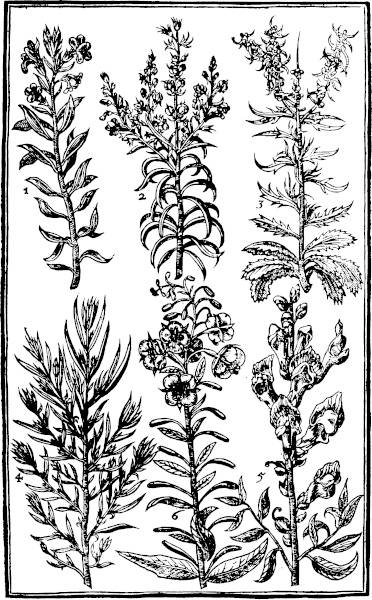
1Linum siluestre flore albo. Wilde Flaxe with a white flower.
2Linaria purpurea siue cærulea. Purple Tode Flaxe.
3Linaria purpurea odorata. Sweete purple Tode Flaxe.
4Scoparia siue Beluidere Italorum. Broome Tode Flaxe.
5Antirrhinum maius. The greater Snapdragon.
6Chamænerium flore delphinij. The willowe flower.
5. Linaria Valentina. Tode Flaxe of Valentia.
This Spanish Tode Flaxe hath three or foure thicker and bigger stalkes then the former, bearing small broad leaues, like vnto the small Centory, two or three together at a ioynt, round about the lower end of the stalkes, but without any order vpwards, at the toppes whereof stand many flowers, in fashion like vnto the common kinde, and almost as large, of a faire yellow colour, but the gaping mouth is downie, and the spurre behinde of a purplish colour.
6. Scoparia siue Beluidere Italorum. Broome Tode Flaxe.
Although this plant haue no beautifull flowers, yet because the greene plant full of leaues is so delightfull to behold, being in Italy and other places planted not onely in their Gardens, but set likewise in pots to furnish their Windowes, and euen with vs also hath growne to be so dainty a greene bush, that I haue thought it worthy to be among the delights of my Garden; the description whereof is as followeth: This pleasant Broome Flaxe riseth vp most vsually with one straight vpright square stalke, three foote and a halfe high or better in our Gardens, branching it selfe out diuers waies, bearing thereon many long narrow leaues, like the Garden Line or Flaxe, very thicke set together, like vnto a bush, or rather like vnto a faire greene Cypresse tree, growing broad belowe, and spire-fashion vpwards, of a very faire greene colour: at the seuerall ioynts of the branches, towards the tops, and among the leaues, there come forth small reddish flowers, not easily seene nor much regarded, being of no beauty, which turne into small round blackish gray seede: the rootes are a number of blackish strings set together, and the whole plant perisheth euery yeare at the first approach of any cold ayre, as if it neuer had beene so faire a greene bush.
The Place.
These kindes of wilde Flaxe doe growe naturally in diuers places, some in Germany, some in Spaine, and some in Italy. Those that delight in the beauty of natures variety, doe preserue them, to furnish vp the number of pleasant aspects.
The Time.
They all flower in the Summer moneths, and soone after perfect their seede.
The Names.
Their names are sufficiently expressed in their titles, yet I must giue you to vnderstand that the last is called of some Linaria magna, and of others Osyris.
The Vertues.
The wilde Flaxe hath no medecinable vertue appropriate vnto it that is knowne. The Tode Flaxe is accounted to be good, to cause one to make water.
Chap. XLIIII. Antirrhinum. Snapdragon.
There is some diuersity in the Snapdragons, some being of a larger, and others of a lesser stature and bignesse; and of the larger, some of one, and some of another colour, but because the small kindes are of no beautie, I shall at this time onely entreate of the greater sorts.
1. Antirrhinum album. White Snapdragon.
The leaues of these Snapdragons (for I doe vnder one description comprehend the rest) are broader, longer, and greener then the leaues of the Garden Flaxe, or of the wilde Flaxe set confusedly vpon the tender greene branches, which are spread on all sides, from the very bottome, bearing at the toppes many flowers, somewhat resembling the former Tode Flaxe, but much larger, and without any heele or spurre, of a faire white colour, with a yellow spot in the mouth or gaping place: after the flowers are past, there come vp in their places hard round seede vessels, fashioned somewhat like vnto a Calues head, the snout being cut off, wherein is contained small blacke seede: the rootes are many white strings, which perish in most places after they haue giuen seede, notwithstanding any care or paines taken with them to preserue them aliue, and yet they will abide in some places where they are defended in the Winter.
2. Antirrhinum purpureum siue roseum. Purple Snapdragon.
The purple Snapdragon is in stalkes, leaues, and flowers altogether like the former, and as large and great in euery part, or greater; the only difference is, that this beareth pale Stammell or Rose coloured flowers, with a yellow spot in the mouth, and sometimes of a paler colour, almost blush.
3. Antirrhinum variegatum. Variable Snapdragon.
This variable kinde is somewhat lesse, and tenderer then the last described, hauing also a reddish or blush coloured flower, lesser then the former, but much bigger then the middle kinde of Snapdragon (which is not set downe in this worke) the yellow spot in the mouth of it hath some white about it, and extending to both sides of the spot: the heads and seede are like the former: the rootes are smaller, but neuer will abide after they haue giuen flowers and seede.
4. Antirrhinum luteum. Yellow Snapdragon.
There is likewise another of these kindes, that beareth leaues as large as any of the former, & very faire yellow flowers, as large likewise as they, not differing in any thing else from the first; let not any therefore imagine this to be a Linaria or Tode Flaxe: for all parts are answerable vnto the Snapdragons.
The Place.
All these are nourished with vs in our Gardens, although in Spaine and Italy they are found growing wilde.
The Time.
They flower for the most part the second yeare after the sowing, from Aprill vntill Iuly, and the seede is quickly ripe after.
The Names.
The name Antirrhinum is vsually giuen to this plant, although it fully agreeth not eyther with the description of Dioscorides, or Theophrastus: It hath also diuers other names in Latine, as Orontium, Canis cerebrum Os Leonis, Leo herba, &c. In English Calues snout, from the forme of the seede vessels, and Snapdragon, or Lyons mouth, from the forme of the flowers.
The Vertues.
They are seldome or neuer vsed in Physicke by any in our dayes.
Chap. XLV. Chamænerium flore delphinij. The Willowe flower.
This plant riseth vp with many strong, woddy, round, brownish great stalkes, three or foure foote high, beset here and there without order, with one broad and long whitish greene leafe at a ioynt, somewhat like vnto a Lysimachia, or Willowe herbe, as also vnto a Peach leafe, but larger and longer: at the toppe of the branches stand many flowers one aboue another, of a pale reddish purple colour, consisting of fiue leaues, spread open with an heele or spurre behinde them, with many yellow threads in the middle, much larger then any flower of the Larkes spurres, and smelling somewhat sweete withall; it beareth a shew of long pods with seede, but I could neuer obserue the seede: the rootes are like the rootes of Lysimachia, or the ordinary yellow Loose-strife, or Willowe herbe, but greater: running and spreading vnder ground, and shooting vp in many places, whereby it filleth a ground that it likes quickly: the stalkes dye downe euery yeare, and spring againe in many places farre asunder.
The Place.
Wee haue not knowne where this Willowe flower groweth naturally, but we haue it standing in an out corner of our Gardens, to fill vp the number of delightfull flowers.
The Time.
It flowreth not vntill May, and abideth a long while flowring.
The Names.
It may seeme to diuers, that this is that plant that Dodonæus called Pseudolysimachium purpureum minus, and Lobel seemeth by the name of Delphinium buccinum to aime at this plant, but withall calleth it Chamænerium Gesneri, and giueth the same figure that Dodonæus hath for his Pseudolysimachium: But that is one kinde of plant (which hath smaller and shorter stalkes, and very narrow long leaues, whose flowers stand vpon long slender cods, full of downe, with reddish seede, like vnto the Lysimachia siliquosa siluestris, and rootes that abide many yeares, but creepe not) and this is another, much greater, whose true figure is not extant in any Author that I know. It is vsually called Chamænerium flore delphinij; but the name of Delphinium buccinum in my minde may not so conueniently be applyed vnto it. It is called in English, The Willowe flower, for the likenesse of the leaues, and the beauty and respect of the flowers.
The Vertues.
There is no vse hereof in Physicke that euer I could learne, but is onely cherished among other sorts of flowers, that serue to decke and set forth a Garden of varieties.
Chap. XLVI. Aquilegia. Colombines.
There are many sorts of Colombines, as well differing in forme as colour of the flowers, and of them both single and double carefully noursed vp in our Gardens, for the delight both of their forme and colours.
1. Aquilegia vulgaris flore simplici. Single Colombines.
Because the whole difference of these Colombines standeth in the varieties of the forme, and colour of the flowers, and little in the leaues, I shall not neede to make anie repetitions of the description of them, seeing one onely shall suffice for each peculiar kinde. The Colombine hath diuers large spread leaues, standing on long stalkes: euery one diuided in seuerall partitions, and roundly endented about the edges, in colour somewhat like the leaues of Celondine, that is, of a darke blewish greene colour: the stalkes rise vp sometimes two or three foote high, diuided vsually into many branches, bearing one long diuided leafe at the lower ioynt, aboue which the flowers growe, euery one standing on a long stalke, consisting of fiue hollow leaues, crooked or horned at the ends, turning backward, the open flower shewing almost like vnto a Cinquefoile, but more hollow: after the flowers are past, there arise small long cods, foure or fiue together, wherein are contained blacke shining seede: the rootes are thicke and round, for a little space within the ground, and then diuided into branches, ending in many small fibres, abiding many yeares, and shooting a fresh euery Spring from the round heads, that abide all the Winter. The variety of the colours of these flowers are very much, for some are wholly white, some of a blew or violet colour, others of a blush or flesh colour, or deepe or pale red, or of a dead purple, or dead murrey colour, as nature listeth to shew it selfe.
2. Aquilegia vulgaris flore pleno. Double Colombines.
The double Colombines differ not in leafe or manner of growing from the single, so that vntill they come to flower, they cannot bee discerned one from another; the onely difference is, it beareth very thicke and double flowers, that is, many horned or crooked hollow leaues set together, and are not so large as the leaues of the single flowers. The variety of colours in this double kinde is as plentifull, or rather more then in the single; for of these is party coloured, blew and white, and spotted very variably, which are not in the single kinde, and also a very deepe red, very thicke and double, but a smaller flower, and lesse plentifull in bearing then many of the other double sorts. These double kindes doe giue as good seede as the single kindes doe, which is not obserued in many other plants.
3. Aquilegia inuersis corniculis. Double inuerted Colombines.
These Colombines are not to be distinguished eyther in roote, leaues, or seed from the former, the flowers onely make the difference, which are as double as the former, but that the heeles or hornes of these are turned inward, and stand out in the middle of the flowers together: there is not that plentifull variety of colours in this kinde, as there is in the former: for I neuer saw aboue three of foure seuerall colours in this kinde, that is, white, purplish, reddish, and a dun or darke ouerworne purplish colour. These double flowers doe likewise turne into pods, bearing seede, continuing his kind, and not varying into the former.
4. Aquilegia Rosea. Rose Colombines.
The leaues and other parts of this kinde of Colombine, differ little or nothing from the former, the diuersitie consisteth likewise in the flowers, which although they stand in the same manner seuerally vpon their small stalkes, somewhat more sparingly then the former doe, yet they haue no heeles or hornes, eyther inward or outward, or very seldome, but stand sometimes but with eight or tenne smooth small plaine leaues, set in order one by one in a compasse, in a double rowe, and sometimes with foure or fiue rowes of them, euery one directly before the other, like vnto a small thick double Rose layd open, or a spread Marigold: yet sometimes it happeneth, that some of these flowers will haue two or three of the first rowes of leaues without any heele, and the rest that are inward with each of them a peece of a small horne at them, as the former haue: the colours of these flowers are almost as variable, and as variably mixed as the former double kindes. This likewise giueth seede, preseruing his owne kinde for the most part.
5. Aquilegia degener. Degenerate Colombines.
This kinde of Colombine might seeme to some, to bee but a casuall degeneration, and no true naturall kinde, happening by some cause of transplanting, or otherwise by the art of man: but I haue not so found it, in that it keepeth, and holdeth his own proper forme, which is like vnto the double Rose Colombine, but that the outermost row of leaues are larger then any of the rest inwardes, and is of a greenish, or else of a purplish greene colour, and is not altogether so apt to giue good seed like the former.
The Place.
The single kindes haue beene often found in some of the wooddy mountaines of Germany, as Clusius saith, but the double kindes are chiefly cherished in gardens.
The Time.
They flower not vntill May, and abide not for the most part when Iune is past, and in the meane time perfecteth their seede.
The Names.
Costæus doth call this plant Pothos of Theophrastus, which Gaza translateth Desiderium. Dalechampius vpon Athenæus, calleth it Diosanthos, or Iouis flos of Theophrastus, who in his sixth Booke and seuenth Chapter reckoneth them both, that is, Diosanthos and Pothos, to be Summer flowers, but seuerally. Dodonæus Leoherba, and Gesner Leontostomium. Fabius Columna in his Phytobasanos, vnto whom Clusius giueth the greatest approbation, referreth it to the Isopyrum of Dioscorides. All later Writers doe generally call it, eyther Aquileia, Aquilina, or Aquilegia; and we in English, generally (I thinke) through the whole Countrey, Colombines. Some doe call the Aquilegia rosea, Aquilegia stellata, The starre Colombine; because the leaues of the flowers doe stand so directly one by another, besides the doublenesse, that they somewhat represent eyther a Rose or a Starre, and thereupon they giue it the name eyther of a Starre or Rose.
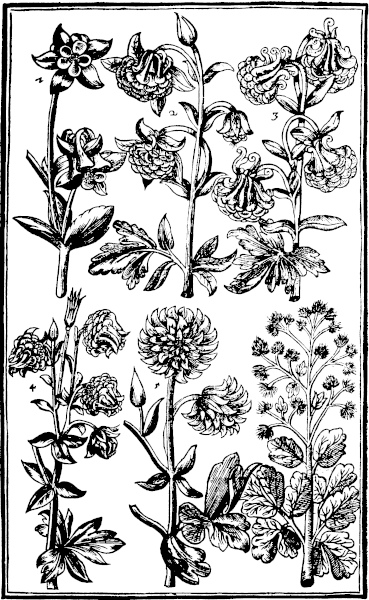
1Aquilegia simplex. The single Colombine.
2Aquilegia flore multiplici. The double Colombine.
3Aquilegia versicolor. The party coloured Colombine.
4Aquilegia inuersis corniculis. The double inuerted Colombine.
5Aquilegia Rosea siue Stellata. The Rose or the Starre Colombine.
6Thalictrum Hispanicum album. White Spanish tufts.
The Vertues.
Some in Spaine, as Camerarius saith, vse to eate a peece of the roote hereof fasting, many dayes together, to helpe them that are troubled with the stone in the kidneyes. Others vse the decoction, of both herbe and roote in wine, with a little Ambargrise, against those kinds of swounings, which the Greekes call ἀδυναμία. The seede is vsed for the iaundise, and other obstructions of the liuer. Clusius writeth from the experience of Franciscus Rapard, a chiefe Physician of Bruges in Flanders, that the seede beaten and drunke is effectuall to women in trauell of childe, to procure a speedy deliuerie, and aduiseth a second draught thereof should be taken if the first succeede not sufficiently.
Chap. XLVII. Thalictrum Hispanicum. Spanish Tufts, Or Tufted Columbines.
From among the diuersities of this plant, I haue selected out two sorts for this my garden, as hauing more beautie then all the rest; leauing the other to be entreated of, where all in generall may be included. I haue in this place inserted them, for the likenesse of the leaues only, being in no other part correspondent, and in a Chapter by themselues, as it is most fit.
Thalictrum Hispanicum album. White Spanish tufted Colombines.
These plants haue both one forme, in roote, leafe and flower, and therefore neede but one description. The leaues are both for colour and forme so like vnto Colombines leaues (although lesser and darker, yet more spread, and on larger stalkes) that they may easily deceiue one, that doth not marke them aduisedly; for the leaues are much more diuided, and in smaller parts, and not so round at the ends: the stalkes are round, strong, and three foote high at the least, branching out into two or three parts, with leaues at the seuerall ioynts of them, at the toppes whereof stand many flowers, which are nothing but a number of threads, made like vnto a small round tuft, breaking out of a white skinne, or leafe, which incloseth them, and being vnblowne, shew like vnto little buttons: the colour of these threds or tufts in this are whitish with yellow tips on them, and somewhat purplish at the bottome, hauing a strong but no good sent, and abiding in their beautie (especially if they grow in the shade, and not too hot in the sun) a great while, and then fall away, like short downe or threds: the seed vessels are three square, containing small, long, and round seede; the rootes are many long yellow fringes, which endure and encrease much.
Thalictrum Montanum purpureum. Purple tufted Colombines.
This purple tufted Colombine differeth onely from the former, in that it is not so high nor so large, and that the colour of the flower or tuft is of a blewish purple colour with yellow tips, and is much more rare then the other.
The Place.
These grow both in Spaine and Italie.
The Time.
They flower in the end of May, or in Iune, and sometimes later.
The Names.
Some doe call them Thaliotrum, and some Thalictrum. Others Ruta palustris, and Ruta pratensis, and some Rhabarbarum Monachorum, or Pseudo-rhabarbarum, by reason that the rootes being yellow, haue an opening qualitie, and drying as Rubarbe. In English what other fit Names to giue these then I haue expressed in the titles, I know not.
The Vertues.
They are a little hot and drying withall, good for old Vlcers, as Dioscorides saith, to bring them to cicatrising: in Italy they are vsed against the Plague, and in Saxonye against the Iaundise, as Camerarius saith.
Chap. XLVIII. Radix caua. Hollow roote.
The likenesse of the leaues likewise of this plant with Colombines, hath caused mee to insert it next the other, and although some of this kinde bee of small respect, being accounted but foolish, yet let it fill vp a waste corner, that so no place be vnfurnished.
1. Radix Caua maior flore albo. The white Hollow roote.
The leaues of this hollow roote breake not out of the ground, vntill the end of March, or seldome before, and are both for proportion and colour somewhat like vnto the leaues of Colombines, diuided into fiue parts, indented about the edges, standing on small long footestalkes of a whitish greene colour, among which rise vp the stalkes, without any leaues from the bottome to the middle, where the flowers shoote forth one aboue another, with euery one a small short leafe at the foote thereof, which are long and hollow, with a spurre behinde it, somewhat like vnto the flowers of Larckes spurres, but hauing their bellies somewhat bigger, and the mouth not so open, being all of a pure white colour: after the flowers are past, arise small long and round cods, wherein are contained round blackish seede: the roote is round and great, of a yellowish browne colour on the outside, and more yellow within, and hollow vnderneath, so that it seemeth but a shell: yet being broken, euery part will grow: it abideth greene aboue ground but a small time.
2. Radix Caua maior flore carneo. Blush colourd Hollow roote.
The blush Hollow roote is in all things like vnto the former, but onely that the flowers hereof are of a delayed red or purple colour, which we call blush: and sometimes of a very deepe red or purple colour; but very rare to meete with.
3. Radix Caua minor, seu Capnos fabacea radice. Small hollow roote.
This small kinde hath his leaues of a blewish greene colour, yet greener and smaller then the former, growing more thicke together: the flowers are like in proportion vnto the former in all respects, but lesser, hauing purplish backes, and white bellyes: standing closer and thicker together vpon the short stalkes: the roote is solid or firme, round and a little long withall, two being vsually ioyned together, yellowish both within and without: but I haue seene the dry roots that came from beyond Sea hither, that haue beene as small as hasell nuts, and somewhat flat with the roundnesse, differing from those that growe with vs, whether the nature thereof is to alter by manuring I know not.
The Place.
The greater kindes Clusius reporteth he found in many places of Hungarie, and the other parts neare thereunto: the lesser in the lower Germany, or Low Countries, as we call them.
The Time.
These are most truely to bee reckoned Vernall plants, for that they rise not out of the ground vntill the Spring bee come in, and are gone likewise before it be past, remaining vnder ground all the rest of the yeare, yet the lesser abideth longer aboue ground then the greater.
The Names.
Concerning the former of these, there is a controuersie among diuers, whether it should be Thesium of Theophrastus, or Eriphium of Galen, but here is no fit place to trauerse those opinions. Some would haue it to bee Corydalis, and some referre it to Plinie his Capnos Chelidonia, for the likenesse it hath both with Fumeterie and Celandine. It is generally called of all moderne Writers, Radix Caua, and we in English thereafter, Hollow roote. The lesser for the firmnesse of his round roote, is vsually called, Capnos fabacea radice, and the Dutch men thereafter, Boonkens Hollwortell: we of the likenesse with the former, doe call it the lesse Hollow roote.
The Vertues.
Some by the bitternesse doe coniecture (for little proofe hath beene had thereof, but in outward cases) that it clenseth, purgeth, and dryeth withall.
Chap. XLIX. Delphinium. Larkes heeles.
Of Larkes heeles there are two principall kindes, the wilde kinde, and the tame or garden; the wilde kinde is of two sorts, one which is with vs noursed vp chiefly in gardens, and is the greatest; the other which is smaller and lower, often found in our plowed landes, and elsewhere: of the former of these wilde sorts, there are double as well as single: and of the tame or more vpright, double also and single: and of each of diuers colours, as shall be set downe.
1. Delphinium maius siue vulgare. The ordinary Larkes heeles.
Varietas.
The common Larkes heele spreadeth with many branches much more ground then the other, rather leaning or bending downe to the ground, then standing vpright, whereon are set many small long greene leaues, finely cut, almost like Fennell leaues: the branches end in a long spike of hollow flowers, with a long spurre behinde them, very like vnto the flowers of the Hollow roote last described, and are of diuers seuerall colours, as of a blewish purple colour, or white, or ash colour or red, paler or deeper, as also party coloured of two colours in a flower; after the flowers are past, (which in this kinde abide longer then in the other) there come long round cods, containing very blacke seede: the root is hard after it groweth vp to seede, spreading both abroad and deepe, and perisheth euery yeare, vsually raising it selfe from it own sowing, as well as from the seede sowen in the spring time.
2. Delphinium vulgare flore pleno. Double common Larkes heeles.
Of this vulgar kinde there is some difference in the flower, although in nothing else: the flowers stand many vpon a stalke like the former, but euery one of them are as if three or foure small flowers were ioyned together, with euery one his spurre behinde, the greatest flower being outermost, and as it were containing the rest, which are of a pale red, or deepe blush colour: Another of this kinde will beare his flowers with three or foure rowes of leaues in the middle, making a double flower with one spurre behinde onely: and of this kinde there is both with purple, blew, blush, and white flowers, and party coloured also; these doe all beare seed like the single, wherby it is increased euery yeare.
3. Delphinium aruense. Wilde Larkes spurres.
This wilde Larkes spurre hath smaller and shorter leaues, smaller and lower branches, and more thinly or sparsedly growing vpon them, then any of the former: the flowers likewise are neyther so large as any of the former, nor so many growing together, the cods likewise haue smaller seede, and is harder to grow in gardens then any of the former, the most vsuall colour hereof is a pale reddish or blush colour, yet sometimes they are found both white and blew, and sometimes mixt of blew and blush, variably disposed, as nature can when she listeth; but are much more rare.
4. Delphinium elatius flore simplici diuersorum colorum. Single vpright bearing Larkes heeles of many colours.
The difference betweene this and the last is, that the leaues of this are not fully so greene, nor so large; the stalkes grow vpright, to the height of a man, and sometimes higher, hauing some branches thereon, but fewer then the former, and standing likewise vpright, and not leaning downe as the former: the toppes of the stalkes are better stored with flowers then the other, being sometimes two foote long and aboue, of the same fashion, but not altogether so large, but of more diuers and seueral colours, as white, pale, blush, redde deeper or paler, ashcoloured, purple or violet, and of an ouerworne blewish purple, or iron colour: for of all these we haue simple, without any mixture or spot: but we haue other sorts, among the simple colours, that rise from the same seede, and will haue flowers that wil be halfe white, and halfe blush or purple, or one leafe white, and another blush or purple, or else variably mixed and spotted: the seede and seede vessels are like the former but larger and harder.
5. Delphinium elatius flore pleno diuersorum colorum. Double vpright Larkes heeles of many colours.
These double Larkes heeles cannot bee knowne from the single of the same kinde, vntill they come towards flowring; for there appeare many flowers vpon the stalkes, in the same manner, and of as many colours almost as of the single, except the party coloured, which stand like little double Roses, layd or spread broade open, as the Rose Colombine without any heeles behinde them, very delightfull to behold, consisting of many small leaues growing together, and after they are fallen there come vp in their places three or foure small cods set together, wherein is contained here and there (for all are not full of seede, as the single kindes) blacke seede, like vnto all the rest, but smaller, which being sowen will bring plants that will beare both single and double flowers againe, and it often happeneth, that it variably altereth in colours from it owne sowing: for none of them hold constantly his owne colour, (so farre as euer I could obserue) but fall into others; as nature pleaseth.
6. Delphinium Hispanicum paruum. Spanish wilde Larkes spurres.
This small Larkes spurre of Spaine, hath diuers long and broad leaues next the ground, cut-in on both sides, somewhat like vnto the leafe of a Scabious, or rather that kinde of Stœbe, which Lobel calleth Crupina, for it doth somewhat neerly resemble the same, but that this is smooth on the edges, and not indented besides the cuts, as the Crupina is, being of a whitish greene colour, and somewhat smooth and soft in handling: among the leaues riseth vp a whitish greene stalke, hauing many smaller leaues vpon it that grow belowe, but not diuided, branching out into many small stalkes, bearing flowers like vnto the wilde Larkes heeles, but smaller, and of a bleake blewish colour, which being past, there come vp two or three small cods ioyned together, wherein is blacke seede, smaller and rounder then any of the former: the roote is small and thready, quickly perishing with the first cold that ouertaketh the plant.
The Place.
The greatest or first wilde kindes growe among corne in many countries beyond the Seas, and where corne hath beene sowne, and for his beauty brought and nourished in our Gardens: the lesser wilde kinde in some fields of our owne Country. The Spanish kinde likewise in the like places, which I had among many seedes that Guillaume Boel brought mee out of Spaine. The first double and single haue been common for many yeares in all countries of this Land, but the tall or vpright single kindes haue been entertained but of late yeares. The double kindes are more rare.
The Time.
These flower in the Summer onely, but the Spanish wilde kinde flowreth very late, so that oftentimes in our Country, the Winter taketh it before it can giue ripe seede: the double kindes, as well the vpright as the ordinary or wilde, are very choise and dainty many times, not yeelding good seede.
The Names.
They are called diuersly by diuers Writers, as Consolida regulis, Calcaris flos; Flos regius, Buccinum Romanorum, and of Matthiolus, Cuminum siluestre alterum Dioscoridis: but the most vsuall name with vs is Delphinium: but whether it be the true Delphinium of Dioscorides, or the Poets Hyacinth, or the flower of Aiax, another place is fitter to discusse then this. Wee call them in English Larkes heeles, Larkes spurres, Larkes toes, or clawes, and Monkes hoods. The last or Spanish kinde came to mee vnder the name of Delphinium latifolium trigonum, so stiled eyther from the diuision of the leaues, or from the pods, which come vsually three together. Bauhinus vpon Matthiolus calleth it, Consolida regalis peregrina paruo flore.
The Vertues.
There is no vse of any of these in Physicke in these dayes that I know, but are wholly spent for their flowers sake.
Chap. L. Balsamina fœmina. The Female Balsam Apple.
I haue set this plant in this place, for some likenesse of the flower, rather then for any other comparison, euen as I must also with the next that followeth. This plant riseth vp with a thicke round reddish stalke, with great and bunched ioynts, being tender and full of iuice, much like to the stalke of Purslane, but much greater, which brancheth it selfe forth from the very ground, into many stalkes, bearing thereon manie long greene leaues, snipt about the edges, very like vnto the Almond or Peach tree leaues; among which from the middle of the stalkes vpwards round about them, come forth vpon seuerall small short foot-stalkes many faire purplish flowers, of two or three colours in them, fashioned somewhat like the former Larkes heeles, or Monks hoods, but that they are larger open at the mouth, and the spurres behinde crooke or bend downewards: after the flowers are past, there come in their places round rough heads, pointed at the end, greene at the first, and a little yellower when they bee ripe, containing within them small round blackish seede, which will soone skippe out of the heads, if they be but a little hardly pressed betweene the fingers: the rootes spread themselues vnder ground very much from the toppe, with a number of small fibres, annexed thereunto: this is a very tender plant, dying euery yeare, and must bee sowne carefully in a pot of earth, and tended and watered in the heate of Summer, and all little enough to bring it to perfection.
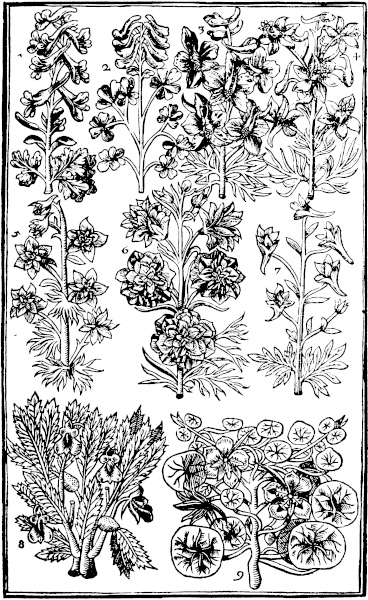
1Radix Caua maior flore albo. The white flowred Hollow roote.
2Capnos fabacea radice. The small Hollow roote.
3Delphinium flore simplici. Single Larkes spurs.
4Delphinium vulgare flore medio duplici. Larkes spurs double in the middle.
5Delphinium vulgare flore pleno. Common Larks spurs double.
6Delphinium elatius flore pleno. Double vpright Larkes spurs.
7Delphinium Hispanicum parvum. Small Spanish Larkes spurs.
8Balsamina fœmina. The Female Balsam apple.
9Nasturtium Indicum. Indian Cresses, or yellow Larkes spurs.
The Place.
Wee haue alwaies had the seede of this plant sent vs out of Italy, not knowing his originall place.
The Time.
It flowreth from the middle of Iuly, to the end of August: the seed doth seldome ripen with vs, especially if the Summer be backward, so that wee are oftentimes to seeke for new and good seede from our friends againe.
The Names.
Some vse to call it Charantia fœmina, Balsamina fœmina, Balsamella, and Anguillara, Herba Sanctæ Katharinæ. We haue no other English name to call it by, then the Female Balsame Apple, or Balsamina.
The Vertues.
Some by reason of the name, would attribute the property of Balme vnto this plant, but it is not sufficiently knowne to haue any such; yet I am well perswaded, there may bee some extraordinary quality in so beautifull a plant, which yet lyeth hid from vs.
Chap. LI. Nasturtium Indicum. Indian Cresses, or yellow Larkes heeles.
The likenesse (as I said before) of this flower likewise, hauing spurres or heeles maketh me ioyne it with the rest, which is of so great beauty and sweetnesse withall, that my Garden of delight cannot bee vnfurnished of it. This faire plant spreadeth it selfe into very many long trayling branches, enterlaced one within another very confusedly (yet doth it not winde it selfe with any claspers about either pole or any other thing, but if you will haue it abide close thereunto, you must tye it, or else it will lye vpon the ground) foure or fiue foot in length at the least, wherby it taketh vp a great deale of ground: the leaues are smooth, greene, and as round as the Penniwort that groweth on the ground, without any cut or incisure therein at all in any part, the stalkes whereof stand in the middle of each leafe and stand at euery ioynt of the stalke, where they are a little reddish, and knobbed or bunched out: the flowers are of an excellent gold yellow colour, and grow all along these stalkes, almost at euery ioynt with the leaues, vpon pretty long foote-stalkes, which are composed of fiue leaues, not hollow or gaping, but standing open each leafe apart by it selfe, two of them, that be larger and longer then the other, stand aboue and the other two that are lesser belowe, which are a little iagged or bearded on both sides, and the first lowest: in the middle of each of the three lower leaues (yet sometimes it is but in two of them) there is a little long spot or streake, of an excellent crimson colour, with a long heele or spurre behinde hanging downe: the whole flower hath a fine small sent, very pleasing, which being placed in the middle of some Carnations or Gilloflowers (for they are in flower at the same time) make a delicate Tussimussie, as they call it, or Nosegay, both for sight and sent: After the flower is past, come the seede, which are rough or vneuen, round, greenish yellow heads, sometimes but one, and sometimes two or three standing together vpon one stalke, bare or naked of themselues, without any huske, containing a white pulpy kernell; the rootes are small, and spreading vnder ground, which perish with the first frosts, and must be sowne a new euery yeare; yet there needeth no bed of horse-dung for the matter: the naturall ground will be sufficient, so as you defend it a little from those frosts, that may spoile it when it is newly sprung vp, or being yet tender.
The Place.
This goodly plant was first found in the West Indies, and from thence sent into Spaine vnto Monardus and others, from whence all other parts haue receiued it. It is now very familiar in most Gardens of any curiosity, where it yearly giueth ripe seed, except the yeare be very vnkindly.
The Time.
It flowreth sometimes in Iune, but vsually in Iuly (if it be well defended and in any good ground) and so continueth flowring, vntill the cold frosts and mistes in the middle or end of October, doe checke the luxurious nature thereof, and in the meane time the seede is ripe, which will quickly fall downe on the ground, where for the most part the best is gathered.
The Names.
Some doe reckon this plant among the Clematides or Convolvuli, the Clamberers or Bindweedes; but (as I said) it hath no claspers, neither doth it winde it selfe: but by reason of the number of his branches, that run one within another, it may seeme to climbe vp by a pole or sticke, which yet doth but onely close it, as hauing something whereon to leane or rest his branches. Monardus and others call it Flos sanguineus, of the red spots in the flowers, as also Mastuerzo de las Indias, which is Nasturtium Indicum, by which name it is now generally knowne and called, and wee thereafter in English, Indian Cresses, yet it may bee called from the forme of the flowers onely, Yellow Larkes heeles.
The Vertues.
The Spaniards and others vse the leaues hereof in stead of ordinary Cresses, because the taste is somewhat sharpe agreeing thereunto, but other Physicall properties I haue heard of none attributed to it.
Chap. LII. Viola. Violets.
The Garden Violets (for the Wilde I leaue to their owne place) are so well knowne vnto all, that either keepe a Garden, or hath but once come into it, that I shall (I thinke) but lose labour and time to describe that which is so common. Yet because it is not onely a choise flower of delight, notwithstanding the popularity, and that I let not passe anything without his particular description, I must also doe so by this. And hereunto I must adde that kinde of Violet, which, although it want that smell of the other, goeth beyond it in variety of dainty colours, called Viola tricolor & flammea, or Harts eases.
1. Viola simplex Martia. Single March Violets.
The single Garden Violet hath many round greene leaues, finely snipt or dented about the edges, standing vpon seuerall small stalkes, set at diuers places of the many creeping branches, which as they runne, doe here and there take roote in the ground, bearing thereon many flowers seuerally at the ioynts of the leaues, which consist of fiue small leaues, with a short round tayle or spurre behinde, of a perfect blew purple colour, and of a very sweete sent, it bringeth forth round seede vessels, standing likewise vpon their seuerall small stalkes, wherein is contained round white seede: but these heads rise not from where the flowers grew, as in all other plants that I know, but apart by themselues, and being sowne, will produce others like vnto it selfe, whereby there may be made a more speedy encrease to plant a Garden (as I haue done) or any other place, then by slipping, as is the vsuall manner: the rootes spread both deepe and wide, taking strong hold in the ground.
Flore albo.
Of this kinde there is another that beareth white flowers, not differing in smell or any thing else from the former.
Flore obsoleto.
And also another, that beareth flowers of a dead or sad reddish colour, in all other things alike, sauing that this hath not altogether so good a sent as the other.
2. Viola Martia flore multiplici. Double March Violets.
There is no difference betweene this Violet and the former, in any other thing then in the doublenesse of the flowers, which haue so many leaues set and thrust together, that they are like vnto hard buttons. There is of this double kinde both white and purple, as in the single; but the white sort is seldome so thicke and double as the purple: but of the red colour to be double I neuer heard.
3. Viola flammea siue tricolor. Harts eases or Pansies.
The Harts ease hath his leaues longer, and more endented or cut in on the edges then the Violet hath, and somewhat round withall: the stalkes are vpright, yet weake, and ready to fall downe, and lye vpon the ground, set here and there with the like leaues, from whence come forth the flowers, of little or no sent at all, made like vnto a Violet, yet more open, and with larger leaues; but so variably mixed with blew or purple, white and yellow, that it is hard to set downe all the varieties; For some flowers will be more white, and but some spots of purple or blew in the two vpper leaues, and the lower leaues with some stripes of yellow in the middle: others will haue more purple in them then any other colour, both in the vpper and lower leaues, the side leaues blew, and the middle yellow, and others white and blew with yellow stripes, as nature listeth to distribute their colours: the seede is small, whitish, and round, contained in small round heads: the roote perisheth euery yeare, and raiseth it selfe vp plentifully by it owne sowing, if it be suffered.
4. Viola tricolor flore duplici. Double Harts ease.
We haue in our Gardens another sort, that beareth flowers with more leaues then the former, making it seeme to be twice double, and that onely in Autumne; for the first flowers are single that come in Summer: This is of that sort that beareth purple flowers: And it is to be obserued, that the seed of this kinde will not all bring double flowers, but only some, if the ground be fit and liking, so that if you haue once had of this double kinde, you shall seldome misse to haue double flowers againe euery yeare of it owne growing or sowing.
5. Viola flammea lutea maxima. The great yellow Pansie.
There is one other kinde of Harts ease, that decketh vp our Gardens not to be forgotten, whose leaues and flowers are like the former, but more plentifull in stalkes and branches, and better abideth our Winters; the flowers are larger then any of the former, of a faire pale yellow colour, with some yellower stripes now and then about the middle; for it is sometimes without any stripes; and also of a little deeper yellow colour: this is to bee encreased by slips, which will soone comprehend in a moist or moistened ground, for that I neuer could obserue that it bore seede.
The Place.
These plants were first wilde, and by manuring brought to be both fairer in colour, and peraduenture of a better sent then when they grew wilde.
The Time.
The Violets flower in March, and sometimes earlier, and if the yeare be temperate and milde, in Autumne againe. The double Violets, as they are later before they flower then the single, so they hold their flowers longer. The Harts ease flowreth seldome vntill May; but then some will abide to flower vntill the end of Autumne almost, especially if the frosts be not early.
The Names.
The Violet is called Viola nigra, purpurea, and Martia: In English, Violets, March Violets, and purple Violets. The Harts ease is called Viola flammea, Viola tricolor, Viola multicolor, and of some, Iacea, Flos trinitatis, and Herba clauellata: In English, Harts ease, and Pansies, of the French name Pensees. Some giue it foolish names, as Loue in idlenesse, Call mee to you, and Three faces in a hood. The great yellow Harts ease is so called, because it is like in forme, and is the greatest of all other, although it haue not that diuersity of colours in it that the other haue.
The Vertues.
The properties of Violets are sufficiently knowne to all, to coole and moisten: I shall forbeare to recite the many vertues that may be set downe, and onely let you knowe, that they haue in them an opening or purging quality, being taken either fresh and greene, or dryed, and made into powder, especially the flowers; the dryed leaues will doe the like, but in greater quantity. Costæus in his booke of the nature of all plants saith, that the distilled water of Harts ease, is commended in the French disease, to be profitable, being taken for nine dayes or more, and sweating vpon it, which how true it is, I know not, and wish some better experience were made of it, before we put any great confidence in that assertion.
Chap. LIII. Epimedium. Barrenwort.
This pretty plant riseth vp out of the ground with vpright, hard, round, small stalkes, a foote and a halfe high, or not two foote high at the highest, diuided into three branches for the most part, each branch whereof is againe diuided for the most part into three other branches, and each of them beare three leaues (seldome either more or lesse) set together, yet each vpon his owne foote-stalke, each leafe being broad, round, and pointed at the end, somewhat hard or dry in feeling, hayrie, or as it were prickly about the edges, but very tenderly, without harme, of a light greene colour on the vpperside, and a little whiter vnderneath: from the middle of the stemme or stalke of leaues doth likewise come forth another long stalke, not much higher then those with the leaues on them, diuided into other branches, each whereof hath likewise three flowers, each vpon his owne footestalke, consisting of eight small leaues a peece, yet seeming to be but of foure leaues spread or layd open flat, for that the foure vppermost, which are the smaller and being yellow, doe lye so close on the foure vndermost, which are a little broader and red, that they shew as if they were yellow flowers with red edges, hauing yellow threds tipt with greene, standing in the middle of the flowers: the vnderside of the lower leaues are of a pale yellowish red, striped with white lines: after the flowers are past, there come small long pods, wherin are contained flat reddish seede: the rootes are small, reddish and hard, spreading, branching and enterlacing themselues very much, and is fit to be placed on some shady side of a garden: the whole plant is rather of a strong then any good sent, yet is cherished for the pleasant varietie of the flowers.
The Place.
Cæsalpinus saith it groweth on the mountaines of Liguria, that is nigh vnto Ligorne, in the Florentine Dominion. Camerarius saith, nigh vnto Vicenza in Italie. Bauhinus on the Euganian hils, nigh vnto Padoa, and in Romania in shadowie wet grounds.
The Time.
It flowreth from Iune vntill the end of Iuly, and to the middle of August, if it stand, as I said it is fittest, in a shadowie place.
The Names.
It is of most Writers accepted for the true Epimedium of Dioscorides, though he saith it is without flower or seede, being therein eyther mistaken, or mis-informed, as he was also in Dictamnus of Candy, and diuers other plants. From the triple triplicitie of the standing of the stalkes and leaues, and quadriplicitie of the flowers, it might receiue another name in English then is already imposed vpon it: but lest I might be thought to be singular or full of noueltie, let it passe with the name Barrenwort, as it is in the title.
The Vertues.
It is thought of diuers to agree in the propertie of causing barrennesse, as the ancients doe record of Epimedium.
Chap. LIIII. Papauer satiuum. Garden Poppies.
Of Poppies there are a great many sorts, both wilde and tame, but because our Garden doth entertaine none, but those of beautie and respect, I wil onely giue you here a few double ones, and leaue the rest to a general suruey.
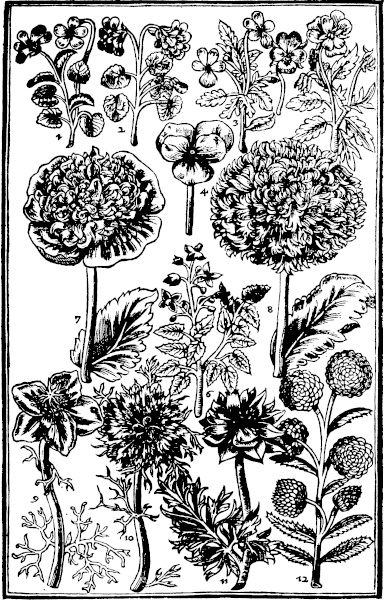
1Viola Martia simplex. Single March Violets.
2Viola Martia multiplex. Double March Violets.
3Viola flammea siue tricolor. Ordinary garden Pansies or Harts ease.
4Viola flammea lutea magna. Great yellow Pansies.
5Viola tricolor duplex. Double Pansies or Harts eases.
6Epimedium. Barrenwort.
7Papauer sativum flore pleno. Double garden Poppies.
8Papauer sativum flore pleno laciniata. Double feathered Poppies.
9Nigella Hispanica flore amplo. Spanish Nigella or Fenell flower.
10Nigella multiplex cærulea. Double blew Nigella or Fenell flower.
11Nigella duplex flore albo. Double white Nigella.
12Ptarmica flore pleno. Double wilde Pelletory.
1. Papauer multiplex album. Double white Poppies.
The double white Poppy hath diuers broade, and long whitish greene leaues, giuing milke (as all the rest of the plant aboue ground doth, wheresoeuer it is broken) very much rent or torne in on the sides, and notched or indented besides, compassing at the bottome of them a hard round brittle whitish greene stalke, branched towards the toppe, bearing one faire large great flower on the head of euery branch, which before it breaketh out, is contained within a thin skinne, and being blowne open is very thick of leaues, and double, somewhat iagged at the ends, and of a white colour, in the middle whereof standeth a round head or bowle, with a striped crowne on the heade of it, very like a starre, compassed about with some threds, wherein when it is ripe, is contained small, round, white seede, disposed into seuerall cels: the roote is hard wooddy, and long, perishing euery yeare, and must bee new sowne euery Spring, if they doe not spring of their own sowing, which if it doe, the flowers are seldome so faire and double as they that are sowne in the Spring: the whole plant is of a strong heady smell.
2. Papauer multiplex rubescens. Double red or blush Poppies.
This other kind of double Poppy differeth not in any other thing from the former, but only in the colour of the flowers, which are of a bright red, tending to a blush colour, parted, paned or striped in many places with white, and exceedingly more iagged then the former, almost like a feather at the ends, the bottomes of all the leaues being white: the seede hereof is white as the former, which is not so in any other Poppie, that beareth not a full white flower.
3. Papauer multiplex nigrum siue purpureum. Double purple or murry Poppies.
This kinde varyeth both in flowers and seede, although neyther in leaues or any other thing from the first: the flowers are thicke and double, and some what iagged at the ends, in some more, in some lesse, eyther red or blush, or purplish red, more or lesse, or of a sad murrey or tawney, with browne, or blacke, or tawny bottomes: the seede is eyther of a grayish blew colour, or in others more blackish.
4. Papauer Rhæas flore multiplici. The double red field Poppie.
This double Poppie is like the wilde or fielde Poppie, which is well knowne to all to haue longer, narrower, and more iagged greene leaues then the former, the stalkes more hairy, and the flower of a deepe yellowish red colour, knowne to all. Now this differeth in nothing from it, but in the doublenesse of the flower, which is very thicke and double, but not so large as the former. This riseth of seede in the like manner as they doe, and so to bee preserued.
The Place.
From what place they haue beene first gathered naturally I cannot assure you, but we haue had them often and long time in our gardens, being sent from Italie and other places. The double wilde kindes came from Constantinople, which whether it groweth neere vnto it or further off, we cannot tell as yet.
The Time.
They flower in the beginning or middle of Iune at the furthest, the seede is ripe within a small while after.
The Names.
The generall knowne name to all, is Papauer, Poppie: the seuerall distinctions are according to their colours. Yet our English Gentlewomen in some places, call it by a by-name, Ione siluer pinne: subauditur, Faire without and fowle within.
The Vertues.
It is not vnknowne, I suppose to any, that Poppie procureth sleepe, for which cause it is wholly and onely vsed as I thinke: but the water of the wilde Poppies, besides that it is of great vse in Pleurisies, and Rheumatick, or thinne Distillations, is found by daily experience, to bee a soueraigne remedy against surfeits; yet some doe attribute this propertie to the water of the wilde Poppies.
Chap. LV. Nigella. The Fenell flower, or Nigella.
Among the many sorts of Nigella, both wilde and tame, both single and double, I will onely set downe three sorts, to be noursed vp in this garden, referring the rest to a Physicke garden, or a generall Historie, which may comprehend all.
1. Nigella Hispanica flore simplici. The great Spanish Nigella.
Spanish Nigella riseth vp with diuers greene leaues, so finely cut, and into so many parts, that they are finer then Fenell, and diuided somewhat like the leaues of Larkes heeles, among which rise vp stalkes, with many such like leaues vpon them, branched into three or foure parts, at the toppe of each whereof standeth one faire large flower, like vnto other single Nigella’s, consisting of fiue or six leaues sometimes, of a bleake blew, or of a purplish blew colour, with a greene head in the middle, compassed about with seuen or eight small blewish greene flowers, or peeces of flowers rather, made like gaping hoodes, with euery of them a yellowish line thwart or crosse the middle of them, with some threds also standing by them: after the flower is past the head groweth greater, hauing sixe, seuen or eight hornes as it were at the toppe, greater and longer, and standing closer together then any other Nigella, spreading very like a starre, or the crowne of the Poppy head, but larger and longer, each whereof being folded together, openeth a little when the head is ripe, which is greater aboue, and smaller below, and not so round as the others are, containing within them small yellowish greene seede, or not so blacke as the other sorts: the rootes are small and yellow, perishing euery yeare as the others likewise doe.
2. Nigella Damascena flore multiplici. Double blew Nigella, or The Fenell flower.
The double Nigella is in leaues, stalkes and rootes, very like vnto the former Nigella, so that the one can very hardly bee discerned from the other before this rise vp to flower, except it be that the leaues hereof are not fully so large as they: the flower consisteth of three or foure rowes of leaues, layde one vpon another, of a pale blew colour, with a greene round head compassed with diuers short threads in the middle, and hauing fiue or sixe such small greene Fenell-like leaues vnder the flower, to beare it vp (as it were) below, which adde a greater grace to the flowers, which at the first sheweth sometimes white, but changeth quickely after: the horned heads hereof are like vnto the heads of the other wilde kinde, which are somewhat rounder and greater, hauing within: them blacke vneuen seedes, but without any sent.
3. Nigella Citrina flore albo multiplici. Double white Nigella.
This double white Nigella hath such like leaues as the last hath, but somewhat larger, of a yellower greene colour, and not so finely cut and iagged: the flowers are somewhat lesse, and lesser double then the former, and in colour white, hauing no greene leaues vnder the flower, as the former hath, the head whereof in the middle is very like the head of the last double kinde, but not great, wherein is contained black seede for the most part, and sweete like the Romane Nigella, which only is sweet besides this: yet sometimes it is not so blacke, but a little more white or yellowish: the roote is yellow, and perisheth as the others euery yeare.
The Place.
All these, and the rest be found wilde in diuers Countreyes, as France, Spaine, Italie, &c. but wee onely cherish them in our Gardens for our delight.
The Time.
They flower in the end of Iune, and in Iuly, or thereabouts.
The Names.
They are called Melanthium, Gith, and Nigella, and of some Flos Diuæ Catherinæ. We may either call them Nigella according to the Latine name, or the Fenell flower, as some doe, because the double blew Nigella hath small Fenell-like leaues bearing vp the flower, as I shewed before in the description.
The Vertues.
These Nigella’s are nothing so hot in qualitie as the single Romane kind is, as may well be knowne by the smell of the seede thereof, and therefore are not fit to be vsed in the steed of it, as many ignorant persons vse to doe: for the single Romane seede is vsed to helpe paines, and cold distillations in the head, and to dry vp the rheume. Pena saith, that the pressed oyle of the seede as well taken inwardly as vsed outwardly is an excellent remedy for the hardnesse and swelling of the spleene.
Chap. LVI. Ptarmica siluestris flore pleno. Double wilde Pelletory.
The double wilde Pelletorie hath straight and slender stalkes, beset with long and narrow leaues, snipt round about the edges, in all points like vnto the single wilde kinde, that groweth common with vs almost euery where: on the toppes of the stalkes stand foure or fiue, or more white flowers, one aboue another, with a greene leafe at the bottome of the footestalke of euery one of them, beeing small, thicke, and very double, with a little yellowishnesse in the middle of euery flower, like both for forme and colour vnto the flower of the double Featherfew, but smaller: the rootes are many long strings, running here and there in the ground: this hath no smell at all, but is delightsome only for the double white flowers.
The Place.
It is only cherished in some few Gardens, for it is very rare.
The Time.
It flowreth in the end of Iune or thereabouts.
The Names.
It is called of most Ptarmica, or Sternutamentoria, of his qualitie to prouoke neesing: and some Pyrethrum, of the hot biting taste. We vsually call it double wilde Pelletorie, and some Sneesewort, but Elleborus albus is vsually so called, and I would not two things should be called by one name, for the mistaking and mis-using of them.