THE GARDEN OF PLEASANT FLOWERS. (continued 12)
Reading edition
3Verbascum quartum Matthioli. French Sage.
4Æthiopis. Ethiopian Mullein.
5Valeriana rubro Dodonæi. Red Valerian.
6Valeriana Græca. Greek Valerian.
7Lamium Pannonicum. Hungary dead Nettle.
8Cardamine flore pleno. Double Cuckowe flower or Ladies smocks.
3. Valeriana Græca. Greeke Valerian.
The Greek Valerian hath many winged leaues lying vpon the ground, that is, many small leaues set on both sides of a middle ribbe, very like vnto the wilde Valerian, that groweth by the ditch sides, but much smaller and tenderer, among which rise vp one or two round brittle stalkes, two foote high or thereabouts, whereon are set at the ioynts, such like leaues as grow below, but smaller: the toppes of the stalkes are diuided into many small branches, thicke set together, full with flowers, consisting of fiue small round leaues a peece, layd open like vnto the Cinquefoile flower, with some white threds in the middle, tipt with yellow pendents: the colour of these flowers in some plants, is of a faire bleake blew colour, and in others pure white: And I doe heare of one beyond the Seas (if the report bee true, for I haue not seene such a one) which should beare red flowers: after the flowers are past, there come vp in their places small hard huskes or heads, containing small blackish seedes: the roote is composed of a number of small long blackish threds, fastened together at the head, without any sent at all of a Valerian, eyther in roote or leafe; and why it should bee called a Valerian I see no great reason, for it agreeth with none of them, in flower or seede, and but onely with the wilde Valerian in leafe, as I said before: but as it is, we so giue it you, and for the flowers sake is receiued into our gardens, to helpe to fill vp the number of natures rarities and varieties.
The Place.
All these Valerians are strangers, but endenizond for their beauties sake in our Gardens. The Mountaine Valerian I had of the liberalitie of my louing friend Iohn Tradescante, who in his trauaile, and search of natures varieties, met with it, and imparted thereof vnto me.
The Time.
They flower in the Summer moneths, and seed quickly after.
The Names.
The first is generally called of most, Valeriana rubra Dodonæi, who saith also that some would haue it to be Behen rubrum. Some call it Valerianthon, others make it a kinde of Ocimastrum, and some Saponaria altera, with other names, which are to no great purpose to set downe in this place, it beeing fitter for a generall worke to discusse of names, wherein both reading, knowledge and iudgement must bee shewen, to correct errours, and set downe the truth, that one may rest thereon. The others haue their names in their titles sufficient to distinguish them.
The Vertues.
The Mountaine Valerian is of all the rest here set downe of most vse in Physicke, the rest hauing little or none that I know, although it be much weaker then the great garden kinde, or the Indian Nardus, in whose steed anciently it was vsed, in oyles, oyntments, &c.
Chap. C. Cardamine. Cuckow flowers, or Ladies smockes.
Of the common sorts of Cuckow flowers that grow by ditch-sides, or in moist medowes, & wet grounds, it is not my purpose here to write, but of one or two other, the most specious or faire of all the tribe, that doe best befit this garden.
1. Cardamine flore pleno. Double Cuckow flowers.
The double Cardamine hath a few winged leaues, weake and tender, lying on the ground, very like vnto the single medow kinde; from among which riseth vp a round greene stalke, set here and there, with the like leaues that grow below, the top whereof hath a few branches, whereon stand diuers flowers, euery one vpon a small footestalk, consisting of many small whitish round leaues, a little dasht ouer with a shew of blush, set round together, which make a double flower: the roote creepeth vnder ground, sending forth small white fibres, and shooteth vp in diuers places.
2. Cardamine trifolia. Trefoile Ladies smockes.
This small plant hath diuers hard, darke round greene leaues, somewhat vneuen about the edges, alwayes three set together on a blackish small footstalke, among which rise vp small round blackish stalkes, halfe a foote high, with three small leaues at the ioynts, where they branch forth; at the toppes whereof stand many flowers, consisting of foure leaues a peece, of a whitish or blush colour very pale: after which come vp small, thicke and long pods, wherein is contained small round seede: the root is composed of many white threds, from the heads whereof runne out small strings, of a dark purple colour, whereby it encreaseth.
The Place.
The first with the double flower is found in diuers places of our owne Countrey, as neere Micham about eight miles from London; also in Lancashire, from whence I receiued a plant, which perished, but was found by the industrie of a worthy Gentlewoman, dwelling in those parts heretofore remembred, called Mistresse Thomasin Tunstall, a great louer of these delights. The other was sent me by my especiall good friend Iohn Tradescante, who brought it among other dainty plants from beyond the Seas, and imparted thereof a roote to me.
The Time.
The last most vsually flowreth before the former, yet not much differing, that is, in the end of Aprill or in May.
The Names.
The first is a double kinde of that plant, that growing wilde abroade, is vsually called Cardamine altera, and Sisymbrium alterum of Dioscorides, and of some Flos cuculi, but not fitly; for that name is more vsually giuen vnto the wilde featherd Campion, both single and double, as is before expressed: yet for want of a fitter name, wee may call it in English, eyther Cuckowe flower, or Ladyes smockes which you will. The second hath beene sent vnder the name of Sanicula trifolia, but the most frequent name now receiued, is Cardamine trifolia, and in English Trefoile Ladies smockes.
The Vertues.
The double Ladies smockes are of the same qualitie with the single, and is thought to be as effectuall as Watercresses. The propertie of the other I thinke is not much knowne, although some would make it a wound herbe.
Chap. CI. Thlaspi Creticum. Candy Tufts.
Of the many sorts of Thlaspi it is not the scope of this worke to relate, I will select but onely two or three, which for their beautie are fit to bee inserted into this garden.
Thlaspi Creticum vmbellatum flore albo & purpureo. Candy Tufts white and purple.
This small plant riseth seldome aboue a foote and a halfe high, hauing small, narrow, long and whitish greene leaues, notched or dented with three or foure notches on each side, from the middle to the point-wards; from among which rise vp the stalkes, branched from the bottome almost into diuers small branches, at the toppes whereof stand many small flowers, thick thrust together in an vmbell or tuft, making them seeme to be small, round, double flowers of many leaues, when as euery flower is single, and standeth a part by it selfe, of a faire white colour in some plants, without any spot, and in others with a purplish spot in the centre or middle, as if some of the middle leaues were purple; in others agane the whole flower is purplish all ouer, which make a pretty shew in a garden: the seede is contained in many small and flat seed vessels, which stand together in an vmbell, as the flowers did, in which are contained somewhat reddish seede, like vnto some other sorts of Thlaspi, called Treakle Mustards: the roote is small and hard, and perisheth euery yeare hauing giuen seede.
Thlaspi Marinum Bæticum.
We haue another sort, whose leaues before it sendeth forth any stalke, are a little toothed, or finely dented about the edges, and brancheth not so much out, but carryeth an vmbell of purplish flowers like vnto the former, and paler yellow seede.
The Place.
These doe grow in Spaine and Candie, not farre from the Sea side.
The Time.
These Thlaspi giue not their flowers vntill the end of Iune, or beginning of Iuly, and the seed is ripe soone after.
The Names.
The first is named by some, Draba, or Arabis, as Dodonæus, but Draba is another plant differing much from this. Wee call one sort, Thlaspi Creticum, and the other Thlaspi Bæticum marinum, because the one came from Spaine, and the other from Candy; we giue it in English, the name of Tufts, because it doth fit the forme of the flowers best, although ordinarily all the Thlaspi are Englished Wilde Mustardes.
The Vertues.
Candy, or Spanish Tufts, is not so sharpe biting in taste, as some other of the Thlaspies are, and therefore is not to be vsed in medicines, where Thlaspi should be in the stead thereof.
Chap. CII. Clematis. Clamberers, or Creepers.
Hauing shewed you all my store of herbes bearing fine flowers, let mee now bring to your consideration the rest of those plants, be they Shrubs or Trees, that are cherished in our garden, for the beauty of their flowers chiefly, or for some other beautifull respect: and first I will begin with such as creepe on the ground, without climing, and then such as clime vp by poles, or other things, that are set or grow neere them, fit to make Bowers, and Arbours, or else are like them in forme, in name, or some other such qualitie or propertie.
1. Clematis Daphnoides, siue Vinca peruinca simplex minor diuersorum colorum. Single Perwinkle of diuers colours.
The smaller Perwinkle which not onely groweth wilde in many places, but is most vsuall in our Gardens, hath diuers creeping branches, trayling or running vpon the ground, shooting out small fibres at the ioynts, as it creepeth, taking thereby hold in the ground, and rooteth in diuers places: at the ioynts of these branches stand two small darke greene shining leaues, somewhat like vnto small Baye leaues, but smaller, and at the ioynts likewise with the leaues, come forth the flowers, one at a ioynt, standing vpon a tender footestalke, being somewhat long and hollow, parted at the brims, sometimes into foure leaues, and sometimes into fiue, the most ordinary sort is of a pale or bleake blew colour, but some are pure white, and some of a darke reddish purple colour: the root is in the body of it, little bigger then a rush, bushing in the ground, and creeping with his branches farre about, taking roote in many places, whereby it quickely possesseth a great compasse; and is therefore most vsually planted vnder hedges, or where it may haue roome to runne.
2. Vinca peruinca flore duplici purpureo. Double purple Perwinkle.
The double Perwinkle is like vnto the former single kinde, in all things except in the flower, which is of that darke reddish purple colour that is in one of the single kindes; but this hath another row of leaues within the flower, so that the two rowes of leaues causeth it to be called double, but the leaues of these are lesser then the single. I haue heard of one with a double white flower, but I haue not yet seene it.
3. Clematis Daphnoides siue Peruinca maior. The greater Perwinkle.
This greater Perwinkle is somewhat like the former, but greater, yet his branches creepe not in that manner, but stand more vpright, or lesse creeping at the least: the leaues also hereof stand by couples at the ioynts, but they are broader and larger by the halfe: the flowers are larger, consisting of fiue leaues that are blew, a little deeper then the former blew: this plant is farre tenderer to keepe then the other, and therefore would stand warme, as well as in a moist shadowie place.
4. Clematis altera siue vrens flore albo. Burning Clamberer, or Virgins Bower.
This Causticke or burning Climer, hath very long and climing tender branches, yet somewhat woody below, which winde about those things that stand neere it, couered with a brownish greene barke, from the ioynts whereof shoote forth many winged leaues, consisting for the most part of fiue single leaues, that is two and two together, and one at the end, which are a little cut in or notched on the edges here and there, but euery part of them is lesser then the leaues of the next following Climer, without any clasping tendrels to winde about any thing at all: towards the vpper part of the branches, with the said leaues, come forth long stalks, whereon stand many white flowers clustering together, opening the brims into sixe or eight small leaues, spreading like a starre, very sweet of smell, or rather of a strong heady sent, which after turne into flattish and blackish seede, plumed at the head, which plume or feather flyeth away with the winde after it hath stood long, and leaueth the seede naked or bare: the roote is white and thicke, fleshie and tender, or easie to be broken, as my selfe can well testifie, in that desiring to take a sucker from the roote, I could not handle it so tenderly, but that it broke notwithstanding all my care. Master Gerard in his Herball maketh mention of one of this kinde with double white flowers, which hee saith he recouered from the seede was sent him from Argentine, that is Strasborough, whereof hee setteth forth the figure with double flowers: but I neuer saw any such with him, neither did I euer heare of any of this kinde with double flowers. Clusius indeed saith, that hee receiued from a friend some seede vnder the name of Clematis flore albo pleno: but he doubteth whether there bee any such: the plants that sprang with him from that seede, were like vnto the vpright kinde called Flammila Matthioli, or Iouis cresta, as he there saith: but assuredly I haue beene informed from some of my especiall friends beyond Sea, that they haue a double white Clematis, and haue promised to send it; but whether it will be of the climing or vpright sort, I cannot tell vntill I see it: but surely I doe much doubt whether the double will giue any good seede.
5. Clematis altera siue peregrina flore rubro. Red Ladies Bower.
This Climer hath many limber and weake climing branches like the former, couered with a browne thin outer barke, and greene vnderneath: the leaues stand at the ioynts, consisting but of three leaues or parts, whereof some are notched on one side, and some on both, without any clasping tendrels also, but winding with his branches about any thing standeth next vnto it: the flowers in like manner come from the same ioynts with the leaues, but not so many together as the former vpon long footstalkes, consisting of foure leaues a peece, standing like a crosse, of a darke red colour; the seed is flat and round, and pointed at the end, three or foure or more standing close together vpon one stalk, without any doune vpon them at all, as in the former: the roots are a bundell of brownish yellow strong strings, running down deep into the ground, from a bigge head aboue.
6. Clematis peregrina flore purpureo simplici. Single purple Ladies Bower.
This Ladies Bower differeth in nothing from the last described, but onely in the colour of the flower, which is of a sad blewish purple colour; so that the one is not possible to be known from the other, vntill they be in flower.
7. Clematis peregrina flore purpurea pleno. Double flowred purple Ladies Bower.
This double Clematis hath branches and leaues so neere resembling the single kinds, that there can be knowne no difference, vnlesse it be, that this groweth more goale and great, and yeeldeth both more store of branches from the ground, and more spreading aboue: the chiefest marke to distinguish it is the flower, which in this is very thicke and double, consisting of a number of smaller leaues, set close together in order in the middle, the foure outermost leaues that encompasse them, being much broader and larger then any of the inward, but all of a dull or sad blewish purple colour, the points or ends of the leaues seeming a little darker then the middle of them: this beareth no seede that euer I could see, heare of, or learne by any of credit, that haue noursed it a great while; and therefore the tales of false deceitfull gardiners, and others, that diliuer such for truth, to deceiue persons ignorant thereof, must not bee credulously entertained.
Clematis peregrina flore carneo pleno.
In the great booke of the Garden of the Bishop of Eystot (which place is neere vnto Noromberg) in Germany, I reade of a Clematis of this former kinde, whose figure is thereto also annexed, with double flowers of an incarnate, or pale purple tending to a blush colour, whereof I haue not heard from any other place.
8. Flammula Iouis erecta. Vpright Virgins Bower.
This kinde of Clematis hath diuers more vpright stalkes then any of the foure last described, sometimes foure or fiue foote high, or more: yet leaning or bending a little, so that it had some neede of sustaining, couered with a brownish barke; from whence come forth on all sides diuers winged leaues, consisting of fiue or seuen leaues, set on both sides of a middle ribbe, whereof one is at the end: the tops of the stalkes are diuided into many branches, bearing many white sweet smelling flowers on them, like in fashion vnto the white Virgins Bower; after which come such like feather topt seede, which remaine and shew themselues, being flat like the other, when the plumes are blowne abroad: the roote spreadeth in the ground from a thicke head, into many long strings, and fasteneth it selfe strongly in the earth; but all the stalkes dye downe euery yeare, and spring afresh in the beginning of the next.
9. Clematis cærulea Pannonica. The Hungarian Climer.
The stalks of this plant stand vpright, & are foure square, bearing at euery ioynt two leaues, which at the first are closed together, and after they are open, are somewhat like vnto the leaues of Asclepias, or Swallow-wort: from the tops of the stalks, and sometimes also from the sides by the leaues commeth forth one flower, bending the head downward, consisting of foure leaues, somewhat long & narrow, standing like a crosse, and turning vp their ends a little againe, of a faire blew or skie colour, with a thicke pale yellow short thrumme, made like a head in the middle: after the flower is past, the head turneth into such a like round feather topt ball, as is to be seene in the Trauellers ioy, or Viorna (as it is called) that groweth plentifully in Kent, and in other places by the way sides, and in the hedges, wherein is included such like flat seede. These stalkes (like as the last) dye downe to the ground euery yeare, and rise againe in the Spring following, shooting out new branches, and therby encreaseth in the root.
10. Maracoc siue Clematis Virginiana. The Virginia Climer.
Because this braue and too much desired plant doth in some things resemble the former Climers, so that vnto what other family or kindred I might better conioyne it I know not; let me I pray insert it in the end of their Chapter, with this description. It riseth out of the ground (very late in the yeare, about the beginning of May, if it be a plant hath risen from the seed of our owne sowing, and if it be an old one, such as hath been brought to vs from Virginia, not till the end thereof) with a round stalke, not aboue a yard and a halfe high (in any that I haue seene) but in hotter Countries, as some Authors haue set it downe, much higher, bearing one leafe at euery ioynt, which from the ground to the middle thereof hath no claspers, but from thence vpwards hath at the same ioynt with the leafe both a small twining clasper, like vnto a Vine, and a flower also: euery leafe is broad at the stalke thereof, and diuided about the middle on both sides, making it somewhat resemble a Figge leafe, ending in three points, whereof the middlemost is longest: the bud of the flower, before it doe open, is very like vnto the head or seede vessell of the ordinary single Nigella, hauing at the head or top fiue small crooked hornes, which when this bud openeth, are the ends or points of fiue leaues, that are white on the inside, and lay themselues flat, like vnto an Anemone, and are a little hollow like a scoope at the end, with fiue other smaller leaues, and whiter then they lying betweene them, which were hid in the bud before it opened, so that this flower being full blowne open, consisteth of ten white leaues, laide in order round one by another: from the bottome of these leaues on the inside, rise diuers twined threads, which spread and lay themselues all ouer these white leaues, reaching beyond the points of them a little, and are of a reddish peach colour: towards the bottomes likewise of these white leaues there are two red circles, about the breadth of an Oten strawe, one distant from another (and in some flowers there is but one circle seen) which adde a great grace vnto the flower; for the white leaues shew their colour through the peach coloured threads, and these red circles or rings vpon them being also perspicuous, make a tripartite shew of colours most delightfull: the middle part of this flower is hollow, and yellowish; in the bottome whereof riseth vp an vmbone, or round stile, somewhat bigge, of a whitish greene colour, spotted with reddish spots like the stalkes of Dragons, with fiue round threads or chiues, spotted in the like manner, and tipt at the ends with yellow pendents, standing about the middle part of the said vmbone, and from thence rising higher, endeth in three long crooked hornes most vsually (but sometimes in foure, as hath beene obserued in Rome by Dʳ. Aldine, that set forth some principall things of Cardinall Farnesius his Garden) spotted like the rest, hauing three round greene buttons at their ends: these flowers are of a comfortable sweete sent, very acceptable, which perish without yeelding fruit with vs, because it flowreth so late: but in the naturall place, and in hot Countries, it beareth a small round whitish fruit, with a crowne at the toppe thereof, wherein is contained (while it is fresh, and before it be ouer dried) a sweet liquor, but when it is dry, the seede within it, which is small, flat, somewhat rough and blacke, will make a ratling noise: the rootes are composed of a number of exceeding long and round yellowish browne strings, spreading farre abroad vnder the ground (I haue seene some rootes that haue beene brought ouer, that were as long as any rootes of Sarsaparilla, and a great deale bigger, which to be handsomely laid into the ground, were faine to be coyled like a cable) and shooting vp in seuerall places a good distance one from another, whereby it may be well encreased.
The Iesuites Figure of the Maracoc.
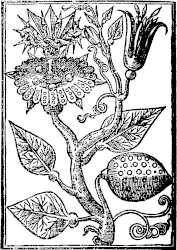
Granadillvs Frvtex Indicvs Christi Passionis Imago.
The Place.
The first blew Perwinkle groweth in many Woods and Orchards, by the hedge sides in England, and so doth the white here and there, but the other single and double purple are in our Gardens onely. The great Perwinkle groweth in Prouence of France, in Spaine, and Italy, and other hot Countries, where also growe all the twining Clamberers, as well single as double: but both the vpright ones doe growe in Hungary and there abouts. The surpassing delight of all flowers came from Virginia. Wee preserue them all in our Gardens.
The Time.
The Perwinkles doe flower in March and Aprill. The Climers not vntill the end of Iune, or in Iuly, and sometimes in August. The Virginian somewhat later in August; yet sometimes I haue knowne the flower to shew it selfe in Iuly.
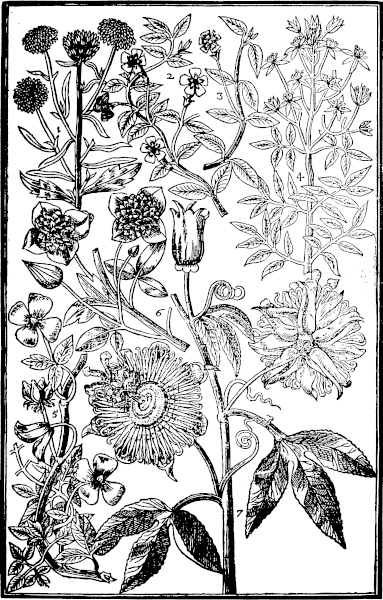
1Thlaspi Creticum. Candy tufts.
2Vinca peruinca flore simplici. Single Perwinkle.
3Vinca peruinca flore duplici. Double Perwinkle.
4Flammula Matthioli. Vpright Virgins Bower.
5Clematis peregrina flore simplici. The single Ladies Bower.
6Clematis peregrina flore pleno purpureo. Double flowred Ladies Bower.
7Maracoc siue Clematis Virginiana. The Virginian Climer.
The Names.
The first is out of question the first Clematis of Dioscorides, and called of many Clematis Daphnoides (but not that plant that is simply called Daphnoides, for that is Laureola) and is vsually called Vinca pervinca: but it is not Chamædaphne, for that is another plant, as shall be shewed in his place; some call it Centunculus: In English wee call it Perwinkle. The other is Clematis altera of Dioscorides, and is called also Clematis peregrina, whose distinctions are set downe in their titles: In English, Ladies Bower, or Virgins Bower, because they are fit to growe by Arbours, to couer them. The first vpright Clamberer is called, and that rightly of some, Clematis erecta, or surrecta. Of others, Flammula frutex, and Flammula Iouis, or surrecta: In English, Vpright Virgins Bower. The next is called by Clusius, Clematis Pannonica cæulea, who thought it to be Climeni species, by the relation of others, at the first, but after entituled it, Clematis: In English, the Hungarian Climer. The last may be called in Latine, Clematis Virginiana: In English, The Virgin or Virginian Climer; of the Virginians, Maracoc: of the Spaniards in the West Indies Granadillo, because the fruit (as is before said) is in some fashion like a small Pomegranate on the outside; yet the seede within is flattish, round, and blackish. Some superstitious Iesuite would faine make men beleeue, that in the flower of this plant are to be seene all the markes of our Sauiours Passion; and therefore call it Flos Passionis: and to that end haue caused figures to be drawne, and printed, with all the parts proportioned out, as thornes, nailes, speare, whippe, pillar, &c. in it, and all as true as the Sea burnes, which you may well perceiue by the true figure, taken to the life of the plant, compared with the figures set forth by the Iesuites, which I haue placed here likewise for euery one to see: but these bee their aduantagious lies (which with them are tolerable, or rather pious and meritorious) wherewith they vse to instruct their people; but I dare say, God neuer willed his Priests to instruct his people with lyes: for they come from the Diuell, the author of them. But you may say I am beside my Text, and I am in doubt you will thinke, I am in this besides my selfe, and so nothing to be beleeued herein that I say. For, for the most part, it is an inherent errour in all of that side, to beleeue nothing, be it neuer so true, that any of our side shall affirme, that contrarieth the assertions of any of their Fathers, as they call them: but I must referre them to God, and hee knoweth the truth, and will reforme or deforme them in his time. In regard whereof I could not but speake (the occasion being thus offered) against such an erroneous opinion (which euen Dʳ. Aldine at Rome, before remembred, disproued, and contraried both the said figures and name) and seek to disproue it, as doth (I say not almost, but I am affraid altogether) leade many to adore the very picture of such things, as are but the fictions of superstitious brains: for the flower it selfe is farre differing from their figure, as both Aldine in the aforesaid booke, and Robinus at Paris in his Theatrum Floræ, doe set forth; the flowers and leaues being drawne to the life, and there exhibited, which I hope may satisfie all men, that will not be perpetually obstinate and contentious.
The Vertues.
Costæus saith hee hath often seene, that the leaues of Perwinkle held in the mouth, hath stayed the bleeding at the nose. The French doe vse it to stay the menstruall fluxes. The other are causticke plants, that is, fiery hot, and blistering the skinne; and therefore (as Dioscorides saith) is profitable to take away the scurfe, leprye, or such like deformities of the skin. What property that of Virginia hath, is not knowne to any with vs I thinke, more then that the liquor in the greene fruit is pleasant in taste; but assuredly it cannot be without some speciall properties, if they were knowne.
Chap. CIII. Chamælæa. Dwarfe Spurge Oliue, or Dwarfe Baye.
I haue three sorts of Chamælæa to bring to your consideration, euery one differing notably from other; two of them of great beauty in their flowers, as well as in the whole plant: the third abiding with greene leaues, although it haue no beauty in the flower, yet worthy of the place it holds. And vnto these I must adioyne another plant, as comming nearest vnto them in the brauery of the flowers.
1. Chamælæa Germanica siue Mezereon floribus dilutioris coloris & saturatioris. Dwarfe Bay, or flowring Spurge Oliue.
We haue two sorts of this Spurge Oliue or Dwarfe Baye, differing onely in the colour of the flowers. They both rise vp with a thicke wooddy stemme, fiue or six foot high sometimes, or more, and of the thicknesse (if they be very old) of a mans wrest at the ground, spreading into many flexible long branches, couered with a tough grayish barke, beset with small long leaues, somewhat like vnto Priuet leaues, but smaller and paler, and in a manner round pointed: the flowers are small, consisting of foure leaues, many growing together sometimes, and breaking out of the branches by themselues: in the one sort of a pale red at the first blowing, and more white afterwards; the other of a deeper red in the blossome, and continuing of a deeper red colour all the time of the flowring, both of them very sweete in smell: after the flowers are past, come the berries, which are greene at the first, and very red afterwards, turning blackish red, if they stand too long vpon the branches: the rootes spread into many tough long branches, couered with a yellowish barke.
2. Chamælæa Alpina. Mountaine Spurge Oliue.
This Mountaine Laurell riseth vp with a small wooddy stemme, three or foure foot high, or more, branching forth towards the vpper parts into many slender and tough branches, couered with a rough hoary greene barke, beset at the ends thereof with flatter, fuller, and smaller round pointed leaues then the former, of a grayish greene colour on the vpperside, and hoary vnderneath, which abide on the branches in Winter, and fall not away as the former: the flowers are many set together at the ends of the branches, greater then the former, and consisting of foure leaues a peece, of a light blush colour, standing in small grayish huskes, of little or no sent at all: the fruit followeth, which are small long graines or berries, of an excellent red colour, which afterwards turne blacke: the roote is long, and spreadeth about vnder the vpper part of the earth.
3. Chamælæa tricoccos. Widowe Wayle.
This three berried Spurge Oliue hath no great stemme at all, but the whole plant spreadeth from the ground into many flexible tough greene branches, whereon are set diuers narrow, long, darke greene leaues all along the branches, which abide greene all the Winter: the flowers are very small, scarce to be seene, and come forth between the leaues and the stalke, of a pale yellow colour, made of three leaues; after which come small blackish berries, three vsually set together; the roote spreadeth it selfe in the ground not very farre, being hard and wooddy, and often dyeth, if it bee not well defended from the extremity of our sharpe Winters.
4. Cneorum Matthioli. Small Rocke Roses.
I was long in doubt in what place I should dispose of this plant, whether among the Campions, as Bauhinus, or among these, as Clusius doth; but lest my Garden should want it wholly, let it take vp roome for this time here. This gallant plant hath diuers long, weake, slender, but yet tough branches lying vpon the ground, diuided vsually into other smaller branches, whereon growe many, small, long, and somewhat thicke leaues, somewhat like vnto the leaues of the former Mezereon, set without any order to the very tops, from whence doe come forth a tuft of many small flowers together, made or consisting of foure leaues a peece, of a bright red or carnation colour, and very sweete withall, which turne into small round whitish berries, wherein is contained small round seede, couered with a grayish coate or skinne: the roote is long and yellowish, spreading diuers wayes vnder the ground, and abideth many yeares shooting forth new branches.
Flore albo.
It hath beene obserued in some of these plants, to bring forth white flowers, not differing in any thing else.
The Place.
The first sorts growe plentifully in many places of Germany. The second in the mountaines by Sauoye. The third in Prouence and Spaine. The last in diuers parts of Germany, Bohemia, and Austria, and about Franckford.
The Time.
The two first sorts are most vsually in flower about Christmas, or in Ianuary, if the weather be not violent, and sometimes not vntill February. The second flowreth not vntill Aprill. The third in May. The berries of them ripen some in Iune and Iuly; some in August and September, as their flowring is earlier or later. The last flowreth as well in the Spring as in Autumne, so apt and plentifull it is in bearing, and the seede at both times doth ripen soone after.
The Names.
The first is called of some Chamælæa, with this addition Germanica, that it may differ from the third, which is the true Chamælæa of Dioscorides, as all the best Authors doe agree, and is also called Piper montanum of the Italians. It is generally called Mezereon, and is indeede the true Mezereon of the Arabians, and so vsed in our Apothecaries shops, wheresoeuer the Arabians Mezereon is appointed, although the Arabians are so intricate and vncertaine in the descriptions of their plants, confounding Chamælæa and Thymælæa together. Matthiolus maketh it to be Daphnoides of Dioscorides; but in my opinion he is therein mistaken: for all our best moderne Writers doe account our Laureola, which hath blacke berries, to bee the true Daphnoides: the errour of his Countrey might peraduenture drawe him thereunto; but if hee had better considered the text of Dioscorides, that giueth black berries to Daphnoides, and red to Chamædaphne, he would not so haue written; and truly, I should thinke (as Lobel doth) with better reason, that this Chamælæa were Dioscorides Chamædaphne, then hee to say it were Daphnoides: for the description of Chamædaphne, may in all parts be very fitly applyed to this Chamælæa: and euen these words, Semen annexum folijs, wherein may be the greatest doubt in the description, may not vnfitly bee construed, that as is seene in the plant, the berries growe at the foote of the leaues, about the branches: the faculties indeede that Dioscorides giueth to Chamædaphne, are (if any repugnancie be) the greatest let or hinderance, that this Chamælæa should not be it: but I leaue the discussing of these and others of the like nature, to our learned Physitians; for I deale not so much with vertues as with descriptions. The second is called of Lobel Chamælæa Alpine incana, of Clusius Chamælæa secunda, and saith hee had it out of Italy. Wee may call it in English, Mountaine Spurge Oliue, as it is in the description, or Mountaine Laurell, which you will. The last hath the name of Cneorum, first giuen it by Matthiolus, which since is continued by all others. Bauhinus (as I said) referreth it to the Mountaine Campions, but Clusius (as I doe) to the kindes of Chamælæa or Thymælæa. For want of an English name I haue (as you see, and that is according to the name the Germane women, as Clusius saith, doe call it) entituled it the Small Rocke Rose; which may abide vntill a fitter may be conferred vpon it.
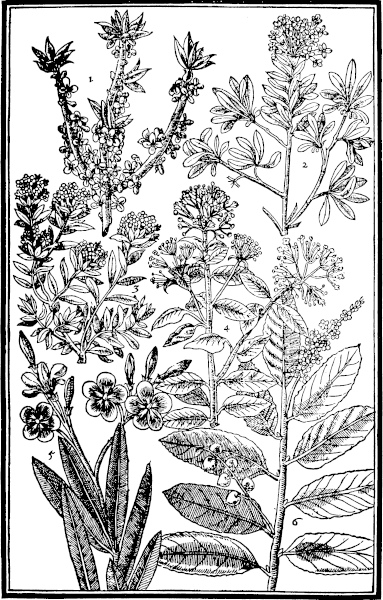
1Chamælæa Germanica seu Mezereon. Mezereon or Dwarfe Bay.
2Chamælæa Alpina. Mountain or Spurge Oliue.
3Cneorum Matthioli. Small Rocke Roses.
4Laurus Tinus siue siluestris. The wild Bay tree.
5Oleander siue Laurus Rosea. The Rose Bay tree.
6Laurocerasus. The Bay Cherrie tree.
The Vertues.
All these plants except the last, as well leaues as berries, are violent purgers, and therefore great caution is to bee had in the vse of them. The last hath not beene applyed for any disease that I know.
Chap. CIIIA. Laurus. The Bay Tree.
My meaning is not to make any description of our ordinary Bayes in this place (for as all may very well know, they may be for an Orchard or Courtyard, and not for this Garden) but of two or three other kindes, whose beautifull aspect haue caused them to be worthy of a place therein: the one is called Laurus Tinus, The wilde Baye: the other Laurus Rosea or Oleander, The Rose Bay: and a third is Laurocerasus, The Cherry Bay; which may haue not onely some respect for his long bush of sweet smelling flowers, but especially for the comely statelinesse of his gallant euer fresh greene leaues; and the rather, because with vs in most places, it doth but frutescere, vse to bee Shrub high, not arborescere, Tree high, which is the more fit for this Garden.
1. Laurus Tinus siue siluestris. The wilde Bay tree.
This wilde Baye groweth seldome to bee a tree of any height, but abideth for the most part low, shooting forth diuers slender branches, whereon at euery ioynt stand two leaues, long, smooth, and of a darke greene colour, somewhat like vnto the leaues of the Female Cornell tree, or between that and Baye leaues: at the toppes of the branches stand many small white sweete smelling flowers, thrusting together, as it were in an vmbell or tuft, consisting of fiue leaues a peece, the edges whereof haue a shew of a wash purple, or light blush in them, which for the most part fall away without bearing any perfect ripe fruit in our Countrey: Yet sometimes it hath small black berries, as if they were good, but are not. In his naturall place it beareth small, round, hard and pointed berries, of a shining blacke colour, for such haue come often to my hands (yet Clusius writeth they are blew); but I could neuer see any spring that I put into the ground. This that I here describe, seemeth to me to be neither of both those that Clusius saw growing in Spain and Portugall, but that other, that (as he saith) sprang in the low Countreyes of Italian seede.
2. Laurus Rosea siue Oleander. The Rose Bay.
Of the Rose Bay there are two sorts, one bearing crimson coloured flowers, which is more frequent, and the other white, which is more rare. They are so like in all other things, that they neede but one description for both. The stemme or trunke is many times with vs, as bigge at the bottome as a good mans thumbe, but growing vp smaller, it diuideth it selfe into branches, three for the most part comming from one ioynt or place, and those branches againe doe likewise diuide themselues into three other, and so by degrees from three to three, as long as it groweth: the lowest of these are bare of leaues, hauing shed or lost them by the cold of winters, keeping onely leaues on the vppermost branches, which are long, and somewhat narrow, like in forme vnto Peach leaues, but thicker, harder, and of a darke greene colour on the vpperside, and yellowish greene vnderneath: at the tops of the young branches come forth the flowers, which in the one sort before they are open, are of an excellent bright crimson colour, and being blowen, consist of foure long and narrow leaues, round pointed, somewhat twining themselues, of a paler red colour, almost tending to blush, and in the other are white, the greene leaues also being of a little fresher colour: after the flowers are past, in the hot countries, but neuer in ours, there come vp long bending or crooked flat pods, whose outward shell is hard, almost woody, and of a browne colour, wherein is contained small flat brownish seede, wrapped in a great deale of a brownish yellow doune, as fine almost as silke, somewhat like vnto the huskes of Asclepias, or Periploca, but larger, flatter and harder; as my selfe can testifie, who had some of the pods of this Rose bay, brought mee out of Spaine, by Master Doctor Iohn More, the seedes whereof I sowed, and had diuers plants that I raised vp vnto a reasonable height, but they require, as well old as young, to bee defended from the colde of our winters.
3. Laurocerasus. The Bay Cherry.
This beautifull bay in his naturall place of growing, groweth to bee a tree of a reasonable bignesse and height, and oftentimes with vs also if it bee pruined from the lower branches; but more vsually in these colder Countries, it groweth as a shrub or hedge bush, shooting forth many branches, whereof the greater and lower are couered with a darke grayish greene barke, but the young ones are very greene, whereon are set many goodly, faire, large, thicke and long leaues, a little dented about the edges, of a more excellent fresh shining greene colour, and farre larger then any Bay leafe, and compared by many to the leaues of the Pomeritron tree (which because wee haue none in our Countrey, cannot be so well known) both for colour and largenesse, which yeeld a most gracefull aspect: it beareth long stalkes of whitish flowers, at the ioynts of the leaues both along the branches and towards the ends of them also, like vnto the Birds Cherry or Padus Theophrasti, which the French men call Putier & Cerisier blanc, but larger and greater, consisting of fiue leaues with many threds in the middle: after which commeth the fruite or berries, as large or great as Flanders Cherries, many growing together one by another on a long stalke, as the flowers did, which are very blacke and shining on the outside, with a little point at the end, and reasonable sweete in taste, wherein is contained a hard round stone, very like vnto a Cherry stone, as I haue obserued as well by those I receiued out of Italie, as by them I had of Master Iames Cole a Merchant of London lately deceased, which grew at his house in Highgate, where there is a faire tree which hee defended from the bitternesse of the weather in winter by casting a blanket ouer the toppe thereof euery yeare, thereby the better to preserue it.
The Place.
The first is not certainly knowne from whence it came, and is communicated by the suckers it yeeldeth. The second groweth in Spaine, Italie, Grece, and many other places: that with white flowers is recorded by Bellonius, to grow in Candy. The last, as Matthiolus, and after him Clusius report, came first from Constantinople: I had a plant hereof by the friendly gift of Master Iames Cole, the Merchant before remembred, a great louer of all rarities, who had it growing with him at his countrey house in Highgate aforesaid, where it hath flowred diuers times, and borne ripe fruit also.
The Time.
The first flowreth many times in the end of the yeare before Christmas, and often also in Ianuary, but the most kindly time is in March and Aprill, when the flowers are sweetest. The second flowreth not vntill Iuly. The last in May, and the fruit is ripe in August and September.
The Names.
The first is called Laurus siluestris, and Laurus Tinus: in English Wilde Bay, or Sweete flowring Bay. The second is called Laurus Rosea, Oleander, Nerium, and Rhododendros: in English The Rose Bay, and Oleander. The last was sent by the name of Trebezon Curmasi, that is to say, Dactylus Trapezuntina, but not hauing any affinitie with any kinde of Bay. Bellonius as I thinke first named it Laurocerasus, and Cerasus Trapezuntina. Dalechampius thinketh it to bee Lotus Aphricana, but Clusius refuteth it. Those stones or kernels that were sent me out of Italie, came by the name of Laurus Regia, The Kings Bay. Wee may most properly call it according to the Latine name in the title, The Cherry bay, or Bay Cherry, because his leaues are like vnto Bay-leaues, and both flowers and fruit like vnto the Birdes Cherry or Cluster Cherry, for the manner of the growing; and therefore I might more fitly I confesse haue placed it in my Orchard among the sorts of Cherries: but the beautifulnesse of the plant caused mee rather to insert it here.
The Vertues.
The wilde Bay hath no propertie allotted vnto it in Physicke, but that it is not to be endured, the berries being chewed declare it to be so violent hot and choking. The Rose Bay is said by Dioscorides, to be death to all foure footed beasts, but contrariwise to man it is a remedie against the poison of Serpents, but especially if Rue bee added vnto it. The Cherry Bay is not knowne with vs to what physicke vse it may be applyed.
Chap. CIIII. Cerasus flore multiplici. The Rose or double blossomd Cherry. Malus flore multiplici. The double blossomd Apple tree. And Malus Persica flore multiplici. The double blossomd Peach tree.
The beautifull shew of these three sorts of flowers, hath made me to insert them into this garden, in that for their worthinesse I am vnwilling to bee without them, although the rest of their kindes I haue transferred into the Orchard, where among other fruit trees, they shall be remembred: for all these here set downe, seldome or neuer beare any fruite, and therefore more fit for a Garden of flowers, then an Orchard of fruite.
Cerasus flore pleno vel multiplici. The Rose Cherry, or Double blossomd Cherry.
The double blossomed Cherry tree is of two sorts for the flower, but not differing in any other part, from the ordinary English or Flanders Cherry tree, growing in very like manner: the difference consisteth in this, that the one of these two sorts hath white flowers lesse double, that is, of two rowes or more of leaues, and the other more double, or with more rowes of leaues, and besides I haue obserued in this greater double blossomd Cherry, that some yeares most of the flowers haue had another smaller and double flower, rising vp out of the middle of the other, like as is to bee seene in the double English Crow-foote, and double redde Ranunculus or Crowfoote, before described: this I say doth not happen euery yeare, but sometimes. Sometimes also these trees will giue a few berries, here and there scattered, and that with lesse double flowers more often, which are like vnto our English Cherries both for taste and bignesse. These be very fit to be set by Arbours.
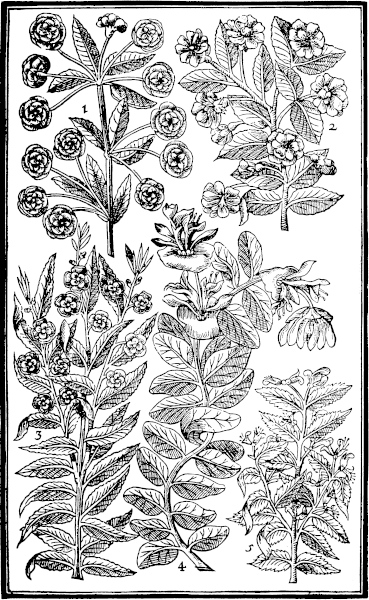
1Cerasus flore pleno. The double blossomd Cherry tree.
2Malus flore multiplici. The double blossomd Apple tree.
3Malus Persica flore pleno. The double blossomd Peach tree.
4Periclymenum perfoliatum. Double Honisuckle.
5Periclymenum rectum. Vpright Honisuckle.
Malus flore multiplici. The double blossomd Apple tree.
This double blossomd Apple tree is altogether like vnto our ordinary Pippin tree in body, branch and leafe, the only difference is in the flower, which is altogether whitish, sauing that the inner leaues towards the middle are more reddish, but as double and thicke as our double Damaske Roses, which fall away without bearing fruit.
Malus Persica flore multiplici. The double blossomd Peach tree.
This Peach tree for the manner of growing, is so like vnto an ordinary Peach tree, that vntill you see it in blossome you can perceiue no difference: the flower is of the same colour with the blossomes of the Peach, but consisting of three or foure, or more rowes of leaues, which fall often away likewise without bearing any fruite; but after it hath abiden some yeares in a place doth forme into fruite, especially being planted against a wall.
The Place.
Both the Cherry trees are frequent in many places of England, noursed for their pleasant flowers. The Apple is as yet a stranger. And the Peach, hath not been seen or knowne, long before the writing hereof.
The Time.
They all flower in April & May, which are the times of their other kinds.
The Names.
Their names are also sufficiently expressed to know them by.
The Vertues.
Cherries, Peaches and Apples, are recorded in our Orchard, and there you shall finde the properties of their fruit: for in that these beare none or very few, their blossomes are of most vse to grace and decke the persons of those that will weare or beare them.
Chap. CV. Periclymenum. Honysuckles.
The Honisuckle that groweth wilde in euery hedge, although it be very sweete, yet doe I not bring into my garden, but let it rest in his owne place, to serue their senses that trauell by it, or haue no garden. I haue three other that furnish my Garden, one that is called double, whose branches spreade far, and being very fit for an arbour will soone couer it: the other two stand vpright, and spreade not any way far, yet their flowers declaring them to be Honisuckles, but of lesse delight, I consort them with the other.
Periclymenum perfoliatum siue Italicum. The double Honisuckle.
The truncke or body of the double Honisuckle, is oftentimes of the bignesse of a good staffe, running out into many long spreading branches, couered with a whitish barke, which had neede of some thing to sustaine them, or else they will fall down to the ground (and therefore it is vsually planted at an arbour, that it may run thereon, or against a house wall, and fastened thereto in diuers places with nailes) from whence spring forth at seuerall distances, and at the ioynts, two leaues, being like in forme vnto the wilde Honisuckles, and round pointed for the most part; these branches diuiding themselues diuers wayes, haue at the toppes of them many flowers, set at certaine distances one aboue another, with two greene leaues at euery place, where the flowers doe stand, ioyned so close at the bottome, and so round and hollow in the middle, that it seemeth like a hollow cuppe or sawcer of flowers: the flowers stand round about the middle of these cuppes or sawcers, being long, hollow, and of a whitish yellow colour, with open mouthes dasht ouer with a light shew of purple, and some threds within them, very sweet in smell, like both in forme and colour vnto the common Honisuckles, but that these cuppes with the flowers in them are two or three standing one aboue another (which make a far better shew then the common, which come forth all at the heade of the branches, without any greene leaues or cuppes vnder them) and therefore these were called double Honisuckles.
Periclymenum rectum fructu rubro. Red Honisuckles.
This vpright Woodbinde hath a straight woody stemme, diuided into seuerall branches, about three or foure foote high, couered with a very thinne whitish barke, whereon stand two leaues together at the ioynts, being lesser then the former, smooth and plaine, and a little pointed: the flowers come forth vpon slender long footstalks at the ioynts where the leaues stand, alwayes two set together, and neuer more, but seldome one alone, which are much smaller then the former, but of the same fashion, with a little button at the foote of the flower; the buds of the flowers before they are open are very reddish, but being open are not so red, but tending to a kinde of yellowish blush colour: after which come in their places two small red berries, the one withered for the most part, or at least smaller then the other, but (as Clusius saith) in their naturall places they are both full and of one bignesse.
Periclymenum rectum fructu cæruleo. Blew berried Honisuckles.
This other vpright Woodbinde groweth vp as high as the former, or rather somewhat higher, couered with a blackish rugged barke, chapping in diuers places, the younger branches whereof are somewhat reddish, and couered with an hoary doune: the leaues stand two together at the ioints, somewhat larger then the former, and more whitish vnderneath: the flowers are likewise two standing together, at the end of a slender footestalke, of a pale yellowish colour when they are blowne, but more reddish in the bud: the berries stand two together as the former, of a darke blewish colour when they are fully ripe, and full of a red liquour or iuice, of a pleasant taste, which doth not only dye the hands of them that gather them, but serueth for a dying colour to the inhabitants where they grow plentifully, wherein are contained many flat seede: The roote is woody as the former is.
The Place.
The first groweth in Italie, Spaine, and Prouence of France, but not in the colder countreyes, vnlesse it be there planted, as is most frequent in our countrey. The others grow in Austria, and Stiria, as Clusius saith, and are entertained into their gardens onely that are curious.
The Time.
The first flowreth vsually in Aprill, the rest in May.
The Names.
The first is called Periclymenum, Caprifolium perfoliatum, and Italicum, as a difference from the common kinde: In English Double Woodbinde, or double Honisuckles. The others, as they are rare, and little knowne, so are their names also: yet according to their Latine, I haue giuen them English names.
The Vertues.
The double Honisuckle is as effectuall in all things, as the single wilde kinde, and besides, is an especiall good wound herbe for the head or other parts. I haue not knowne the vpright kindes vsed in Physicke.
Chap. CVI. Iasminum siue Gelseminum. Iasmine or Gesmine.
We haue but one sort of true Iasmine ordinarily in our Gardens throughout the whole Land; but there is another greater sort, which is farre more tender, brought out of Spaine, and will hardly endure any long time with vs, vnlesse it be very carefully preserued. Wee haue a third kinde called a yellow Iasmine, but differeth much from their tribe in many notable points: but because the flowers haue some likenesse with the flowers of the true Iasmine, it hath been vsually called a Iasmine; and therefore I am content for this Garden to conioyne them in one Chapter.
1. Iasminum album. The white Iasmine.
The white Iasmine hath many twiggy flexible greene branches, comming forth of the sundry bigger boughes or stems, that rise from the roote, which are couered with a grayish darke coloured barke, hauing a white pith within it like the Elder, but not so much: the winged leaues stand alwaies two together at the ioynts, being made of manie small and pointed leaues, set on each side of a middle ribbe, six most vsually on both sides, with one at the end, which is larger, more pointed then any of the rest, and of a darke greene colour: at the toppes of the young branches stand diuers flowers together, as it were in an vmbell or tuft, each whereof standeth on a long greene stalke, comming out of a small huske, being small, long, and hollow belowe, opening into fiue white small, pointed leaues, of a very strong sweete smell, which fall away without bearing any fruit at all, that euer I could learne in our Country; but in the hot Countries where it is naturall, it is said to beare flat fruit, like Lupines: the rootes spread farre and deepe, and are long and hard to growe, vntill they haue taken strong hold in the ground.
2. Iasminum Catalonicum. The Spanish Iasmine.
This Catalonia Iasmine groweth lower then the former, neuer rising halfe so high, and hath slender long greene branches, rising from the toppe of the wooddy stemme, with such like leaues set on them as the former, but somewhat shorter and larger: the flowers also are like vnto the former, and stand in the same manner at the end of the branches, but are much larger, being of a blush colour before they are blowne, and white with blush edges when they are open, exceeding sweete of smell, more strong then the former.
3. Iasminum luteum, siue Trifolium fruticans alijs Polemonium. The yellow Iasmine.
This that is called the yellow Iasmine, hath many long slender twiggy branches rising from the roote, greene at the first, and couered with a darke grayish barke afterwards, whereon are set at certaine distances, three small darke greene leaues together, the end leafe being alwaies the biggest: at the ioynts where the leaues come forth, stand long stalkes, bearing long hollow flowers, ending in fiue, and some in six leaues, very like vnto the flowers of the first Iasmine, but yellow, whereupon it is vsually called the Yellow Iasmine: after the flowers are past, there come in their places round blacke shining berries, of the bignesse of a great Pease, or bigger, full of a purplish iuyce, which will dye ones fingers that bruise them but a little: the roote is tough, and white, creeping farre about vnder the ground, shooting forth plentifully, whereby it greatly encreaseth.
The Place.
The first is verily thought to haue been first brought to Spaine out of Syria, or thereabouts, and from Spaine to vs, and is to be seene very often, and in many of our Country Gardens. The second hath his breeding in Spaine also, but whether it be his originall place we know not, and is scarce yet made well acquainted with our English ayre. The third groweth plentifully about Mompelier, and will well abide in our London Gardens, and any where else.
The Time.
The first flowreth not vntill the end of Iuly. The second somewhat earlier. The third in Iuly also.
The Names.
The first is generally called Iasminum album, and Gelseminum album: In English, The white Iasmine. The second hath his name in his title, as much as may be said of it. The third hath been taken of some to be a Cytisus, others iudge it to be Polemonium, but the truest name is Trifolium fruticans, although many call it Iasminum luteum: In English most vsually, The yellow Iasmine, for the reasons aforesaid; or else after the Latine name, Shrubbie Trefoile, or Make-bate.
The Vertues.
The white Iasmines haue beene in all times accepted into outward medicines, eyther for the pleasure of the sweete sent, or profit of the warming properties. And is in these dayes onely vsed as an ornament in Gardens, or for sent of the flowers in the house, &c. The yellow Iasmine, although some haue adiudged it to be the Polemonium of Dioscorides, yet it is not vsed to those purposes by any that I know.
Chap. CVII. Syringa. The Pipe tree.
Vnder the name of Syringa, is contained two speciall kinds of Shrubs or Trees, differing one from another; namely, the Lilac of Matthiolus, which is called Syringa cærulea, and is of two or three sorts: And the Syringa alba, which also is of two sorts, as shall bee declared.
1. Lilac siue Syringa cærulea. The blew Pipe tree.
The blew Pipe tree riseth sometimes to be a great tree, as high and bigge in the bodie as a reasonable Apple tree (as I haue in some places seene and obserued) but most vsually groweth lower, with many twigs or branches rising from the roote, hauing as much pith in the middle of them as the Elder hath, couered with a grayish greene barke, but darker in the elder branches, with ioynts set at a good distance one from another, and two leaues at euery ioynt, which are large, broad, and pointed at the ends, many of them turning or folding both the sides inward, and standing on long foote stalkes: at the toppes of the branches come forth many flowers, growing spike-fashion, that is, a long branch of flowers vpon a stalke, each of these flowers are small, long, and hollow belowe, ending aboue in a pale blewish flower, consisting of foure small leaues, of a pretty small sent: after the flowers are past, there come sometimes (but it is not often in our Country, vnlesse the tree haue stood long, and is grown great, the suckers being continually taken away, that it may growe the better) long and flat cods, consisting as it were of two sides, a thin skinne being in the midst, wherein are contained two long flattish red seede: the rootes are strong, and growe deepe in the ground.
2. Syringa flore lacteo siue argenteo. The siluer coloured Pipe tree.
This Pipe tree differeth not from the former blew Pipe tree, either in stemme or branches, either in leaues or flowers, or manner of growing, but onely in the colour of the flower, which in this is of a milke, or siluer colour, which is a kinde of white, wherein there is a thinne wash, or light shew of blew shed therein, comming somewhat neare vnto an ash-colour.
3. Lilac lacimatis folijs. The blew Pipe tree with cut leaues.
This Pipe tree should not differ from the first in any other thing then in the leaues, which are said to be cut in on the edges into seuerall parts, as the relation is giuen à viris fide dignis; for as yet I neuer saw any such; but I here am bold to set it downe, to induce and prouoke some louer of plants to obtaine it for his pleasure, and others also.
4. Syringa flore albo simplici. The single white Pipe tree.
The single white Pipe tree or bush, neuer commeth to that height of the former, but abideth alwaies like a hedge tree or bush, full of shootes or suckers from the roote, much more then the former: the young shootes hereof are reddish on the outside, and afterward reddish at the ioynts, and grayish all the rest ouer: the young as well as the old branches, haue some pith in the middle of them, like as the Elder hath: the leaues stand two at a ioynt, somewhat like the former, but more rugged or crumpled, as also a little pointed, and dented about the edges: the flowers growe at the toppes of the branches, diuers standing together, consisting of foure white leaues, like vnto small Muske Roses, and of the same creame colour, as I may call it, with many small yellowish threads in the middle, and are of a strong, full, or heady sent, not pleasing to a great many, by reason of the strange quicknesse of the sent: the fruit followeth, being flat at the head, with many leafie shels or scales compassing it, wherein is enclosed small long seede: the rootes runne not deepe, but spread vnder the ground, with many fibres annexed vnto them.
5. Syringa Arabica flore albo duplici. The double white Pipe tree.
This Pipe tree hath diuers long and slender branches, whereon growe large leaues, somewhat like vnto the leaues of the former single white kinde, but not so rough or hard, and not at all dented about the edges, two alwaies standing one against another at euery ioynt of the stalke, but set or disposed on contrary sides, and not all vpon one side; at the ends whereof come forth diuers flowers, euery one standing on his owne foote-stalke, the hose or huske being long and hollow, like vnto the white Iasmine, and the flowers therein consisting of a double rowe of white and round pointed leaues, fiue or six in a rowe, with some yellownesse in the middle, which is hollow, of a very strong and heady sweet sent, and abiding a long time flowring, especially in the hotter Countries, but is very tender, and not able to abide any the least cold weather with vs; for the cold windes will (as I vnderstand) greatly molest it: and therefore must as charily be kept as Orenge trees with vs, if wee will haue it to abide.
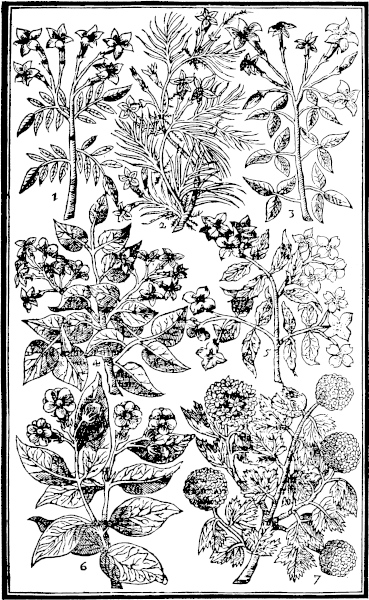
1Iasminum album vulgare. The ordinary white Iasmine.
2Iasminum Americanum siue Convolvulus Americanus. The Iasmine or Bindweed of America.
3Iasminum luteum vulgare. The yellow Iasmine.
4Lilac seu Syringa cærulea. The blew Pipe tree.
5Syringa alba vulgaris. The single white Syringa or Pipe tree.
6Syringa flore albo duplici. The double white Syringa.
7Sambucus rosea. The Elder or Gelder Rose.
The Place.
The first groweth in Arabia (as Matthiolus thinketh, that had it from Constantinople.) We haue it plentifully in our Gardens. The second and third are strangers with vs as yet. The fourth is as frequent as the first, or rather more, but his originall is not knowne. The last hath his originall from Arabia, as his name importeth.
The Time.
The first, second, and third flower in Aprill, the other two not vntill May.
The Names.
The first is called of Matthiolus Lilac, and by that name is most vsually called in all parts. It is also called Syringa cærulea, because it commeth nearest vnto those woods, which for their pithy substance, were made hollow into pipes. It is called of all in English, The blew Pipe tree. It seemeth likely, that Petrus Bellonius in his third Booke and fiftieth Chapter of his obseruations (making mention of a shrubbe that the Turkes haue, with Iuie leaues alwaies greene, bearing blew or violet coloured flowers on a long stalke, of the bignesse and fashion of a Foxe taile, and thereupon called in their language a Foxe taile) doth vnderstand this plant here expressed. The certainty whereof might easily be knowne, if any of our Merchants there residing, would but call for such a shrubbe, by the name of a Foxe taile in the Turkish tongue, and take care to send a young roote, in a small tubbe or basket with earth by Sea, vnto vs here at London, which would be performed with a very little paines and cost. The second and third, as kindes thereof, haue their names in their titles. The fourth is called by Clusius and others, Frutex Coronarius; some doe call it Lilac flore albo, but that name is not proper, in that it doth confound both kindes together. Lobel calleth it Syringa Italica. It is now generally called of all Syringa alba, that is in English, The white Pipe tree. Some would haue it to bee Ostrys of Theophrastus, but Clusius hath sufficiently cleared that doubt. Of others Ligustrum Orientale, which it cannot be neither; for the Cyprus of Plinie is Dioscorides his Ligustrum, which may be called Orientale, in that it is most proper to the Easterne Countries, and is very sweete, whose seede is like vnto Coriander seede. The last is called by diuers Syringa Arabica flore albo duplici, as most fitly agreeing thereunto. Of Basilius Beslerus that set forth the great booke of the Bishop of Eystot in Germany his Garden, Syringa Italica flore albo pleno, because, as it is likely, hee had it from Italy. It is very likely, that Prosper Alpinus in his booke of Egyptian plants, doth meane this plant, which hee there calleth Sambach, siue Iasminum Arabicum. Matthæus Caccini of Florence in his letter to Clusius entituleth it Syringa Arabica, siue Iasminum Arabicum, siue Iasminum ex Gine, whereby hee declareth that it may not vnfitly be referred to either of them both. We may call it in English as it is in the title, The double white Pipe tree.
The Vertues.
We haue no vse of these in Physicke that I know, although Prosper Alpinus saith, the double white Pipe tree is much vsed in Egypt to help women in their trauailes of childbirth.
Chap. CVIII. Sambucus Rosea. The Elder or Gelder Rose.
Although there be diuers kindes of Elders, yet there is but one kinde of Elder Rose, whereof I meane to intreate in this Chapter, being of neare affinity in some things vnto the former Pipe trees, and which for the beauty of it deserueth to be remembred among the delights of a Garden.
Sambucus Rosea. The Gelder Rose.
The Gelder Rose (as it is called) groweth to a reasonable height, standing like a tree, with a trunke as bigge as any mans arme, couered with a darke grayish barke, somewhat rugged and very knotty: the younger branches are smooth and white, with a pithy substance in the middle, as the Elders haue, to shew that it is a kind thereof, whereon are set broad leaues, diuided into three parts or diuisions, somewhat like vnto a Vine leafe, but smaller, and more rugged or crumpled, iagged or cut also about the edges: at the toppes of euery one of the young branches, most vsually commeth forth a great tuft, or ball as it were, of many white flowers, set so close together, that there can be no distinction of any seuerall flower seene, nor doth it seeme like the double flower of any other plant, that hath many rowes of leaues set together, but is a cluster of white leaued flowers set together vpon the stalke that vpholdeth them, of a small sent, which fall away without bearing any fruit in our Country, that euer I could obserue or learne: The roote spreadeth neither farre nor deepe, but shooteth many small rootes and fibres, whereby it is fastened in the ground, and draweth nourishment to it, and sometimes yeeldeth suckers from it.
The Place.
It should seeme, that the naturall place of this Elder is wet and moist grounds, because it is so like vnto the Marsh Elder, which is the single kind hereof. It is onely noursed vp in Gardens in all our Country.
The Time.
It flowreth in May, much about the time of the double Peony flower, both which being set together, make a pleasant variety, to decke vp the windowes of a house.
The Names.
It is generally called Sambucus Rosea: In English, The Elder Rose, and more commonly after the Dutch name, the Gelder Rose. Dalechampius seemeth to make it Thraupalus of Theophrastus, or rather the single Marsh Elder; for I thinke this double kinde was not knowne in Theophrastus his time.
The Vertues.
It is not applyed to any Physicall vse that I know.
Chap. CIX. Rosa. The Rose tree or bush.
The great varietie of Roses is much to be admired, beeing more then is to bee seene in any other shrubby plant that I know, both for colour, forme and smell. I haue to furnish this garden thirty sorts at the least, euery one notably differing from the other, and all fit to be here entertained: for there are some other, that being wilde and of no beautie or smell, we forbeare, and leaue to their wilde habitations. To distinguish them by their colours, as white, red, incarnate, and yellow, were a way that many might take, but I hold it not so conuenient for diuers respects: for so I should confound those of diuers sorts one among another, and I should not keepe that methode which to me seemeth most conuenient, which is, to place and ranke euery kinde, whether single or double, one next vnto the other, that so you may the better vnderstand their varieties and differences: I will therefore beginne with the most ancient, and knowne Roses to our Countrey, whether naturall or no I know not, but assumed by our precedent Kings of all others, to bee cognisances of their dignitie, the white Rose and the red, whom shall follow the damaske, of the finest sent, and most vse of all the other sorts, and the rest in their order.
1. Rosa Anglica alba. The English white Rose.
The white Rose is of two kindes, the one more thicke and double then the other: The one riseth vp in some shadowie places, vnto eight or ten foote high, with a stocke of a great bignesse for a Rose. The other growing seldome higher then a Damaske Rose. Some doe iudge both these to be but one kinde, the diuersitie happening by the ayre, or ground, or both. Both these Roses haue somewhat smaller and whiter greene leaues then in many other Roses, fiue most vsually set on a stalke, and more white vnderneath, as also a whiter greene barke, armed with sharpe thornes or prickles, whereby they are soone known from other Roses, although the one not so easily from the other: the flowers in the one are whitish, with an eye or shew of a blush, especially towards the ground or bottome of the flower, very thicke double, and close set together, and for the most part not opening it selfe so largely and fully as eyther the Red or Damaske Rose. The other more white, lesse thicke and double, and opening it selfe more, and some so little double as but of two or three rowes, that they might be held to be single, yet all of little or no smell at all. To describe you all the seuerall parts of the Rose, as the bud, the beards, the threds &c. were needlesse, they are so conuersant in euery ones hand, that I shall not neede but to touch the most speciall parts of the varieties of them, and leaue a more exact relation of all things incident vnto them, vnto a generall worke.
2. Rosa Incarnata. The Carnation Rose.
The Carnation Rose is in most things like vnto the lesser white rose, both for the growing of the stocke, and bignesse of the flower, but that it is more spreade abroade when it is blown then the white is, and is of a pale blush colour all the flower thoroughout, of as small a sent as the white one is almost.
Rosa Belgica siue Vitrea.
This kinde of Rose is not very great, but very thicke and double, and is very variable in the flowers, in that they will be so different one from another: some being paler then others, and some as it were blasted, which commeth not casually, but naturally to this rose: but the best flowers (whereof there will bee still some) will be of a bright pale murrey colour, neere vnto the Veluet rose, but nothing so darke a colour.
3. Rosa Anglica rubra. The English red Rose.
The red Rose (which I call English not only for the reason before expressed, but because (as I take it) this Rose is more frequent and vsed in England, then in other places) neuer groweth so high as the damaske Rose bush, but most vsually abideth low, and shooteth forth many branches from the roote (and is but seldome suffered to grow vp as the damaske Rose into standards) with a greene barke, thinner set with prickles, and larger and greener leaues on the vpperside then in the white, yet with an eye of white vpon them, fiue likewise most vsually set vpon a stalke, and grayish or whitish vnderneath. The Roses or Flowers doe very much vary, according to their site and abiding; for some are of an orient, red or deepe crimson colour, and very double (although neuer so double as the white) which when it is full blowne hath the largest leaues of any other Rose; some of them againe are paler, tending somewhat to a damaske; and some are of so pale a red, as that it is rather of the colour of the canker Rose, yet all for the most part with larger leaues then the damaske, and with many more yellow threds in the middle: the sent hereof is much better then in the white, but not comparable to the excellencie of the damaske Rose, yet this Rose being well dryed and well kept, will hold both colour and sent longer then the damaske, bee it neuer so well kept.
4. Rosa Damascena. The Damaske Rose.
The Damaske Rose bush is more vsually noursed vp to a competent height to stand alone, (which we call Standards) then any other Rose: the barke both of the stocke and branches, is not fully so greene as the red or white Rose: the leaues are greene with an eye of white vpon them, so like vnto the red Rose, that there is no great difference betweene them, but that the leaues of the red Rose seeme to bee of a darker greene. The flowers are of a fine deepe blush colour, as all know, with some pale yellow threds in the middle, and are not so thicke and double as the white, not being blowne, with so large and great leaues as the red, but of the most excellent sweet pleasant sent, far surpassing all other Roses or Flowers, being neyther heady nor too strong, nor stuffing or vnpleasant sweet, as many other flowers.
5. Rosa Prouincialis siue Hollandica Damascena. The great double Damaske Prouince or Holland Rose.
This Rose (that some call Centifolia Batauica incarnata) hath his barke of a reddish or browne colour, whereby it is soone discerned from other Roses. The leaues are likewise more reddish then in others, and somewhat larger, it vsually groweth very like the Damaske rose, and much to the same height: the flowers or roses are of the same deepe blush colour that the damaske roses are, or rather somewhat deeper, but much thicker, broader, and more double, or fuller of leaues by three parts almost, the outer leaues turning themselues backe, when the flower hath stood long blowne, the middle part it selfe (which in all other roses almost haue some yellow threds in them to be seene) being folded hard with small leaues, without any yellow almost at all to be seene, the sent whereof commeth neerest vnto the damaske rose, but yet is short of it by much, howsoeuer many doe thinke it as good as the damask, and to that end I haue known some Gentlewomen haue caused all their damaske stockes to bee grafted with prouince Roses, hoping to haue as good water, and more store of them then of damask Roses; but in my opinion it is not of halfe so good a sent as the water of damaske Roses: let euery one follow their own fancie.
6. Rosa Prouincialis rubra. The red Prouince Rose.
As the former was called incarnata, so this is called Batauica centifolia rubra, the difference being not very great: the stemme or stocke, and the branches also in this, seeming not to be so great but greener, the barke being not so red; the leaues of the same largenesse with the former damaske Prouince. The flowers are not altogether so large, thicke and double, and of a little deeper damaske or blush colour, turning to a red Rose, but not comming neere the full colour of the best red Rose, of a sent not so sweete as the damaske Prouince, but comming somewhat neere the sent of the ordinary red rose, yet exceeding it. This rose is not so plentifull in bearing as the damaske Prouince.
7. Rosa Prouincialis alba. The white Prouince Rose.
It is said of diuers, that there is a white Prouince Rose, whereof I am not oculatus testis, and therefore I dare not giue it you for a certaintie, and indeed I haue some doubt, that it is the greater and more double white rose, whereof I gaue you the knowledge in the beginning: when I am my selfe better satisfied, I shall bee ready to satisfie others.
8. Rosa versicolor. The party coloured Rose, of some Yorke and Lancaster.
This Rose in the forme and order of the growing, is neerest vnto the ordinary damaske rose, both for stemme, branch, leafe and flower: the difference consisting in this, that the flower (being of the same largenesse and doublenesse as the damask rose) hath the one halfe of it, sometimes of a pale whitish colour, and the other halfe, of a paler damaske colour then the ordinary; this happeneth so many times, and sometimes also the flower hath diuers stripes, and markes in it, as one leafe white, or striped with white, and the other halfe blush, or striped with blush, sometimes also all striped, or spotted ouer, and other times little or no stripes or markes at all, as nature listeth to play with varieties, in this as in other flowers: yet this I haue obserued, that the longer it abideth blowen open in the sun, the paler and the fewer stripes, markes or spots will be seene in it: the smell whereof is of a weake damaske rose sent.
9. Rosea Chrystallina. The Chrystall Rose.
This Rose is very like vnto the last described, both for stocke, branch and leafe: the flower hereof is not much different from it, being no great large or double Rose, but of a meane size, striped and marked with a deeper blush or red, vpon the pale coloured leafe, that it seemeth in the marking and beauty thereof, to bee of as much delight as the Chrystall Gilloflower: this, euen like the former, soone fadeth and passeth away, not yeelding any great store of flowers any yeare.
10. Rosa rubra humilis siue pumilio. The dwarfe red Rose, or Gilloflower Rose.
This Rose groweth alwayes low and small, otherwise in most respects like vnto the ordinary redde Rose, and with few or no thornes vpon it: the Flowers or Roses are double, thicke, small and close, not so much spread open as the ordinary red, but somewhat like vnto the first double white Rose before expressed; yet in some places I haue seene them more layde open then these, as they grew in my garden, being so euen at the toppes of the leaues, as if they had been clipt off with a paire of sheeres, and are not fully of so red a colour as the red Prouince Rose, and of as small or weak sent as the ordinary red Rose, or not so much.
11. Rosa Francafurtensis. The Franckford Rose.
The young shootes of this Rose are couered with a pale purplish barke, set with a number of small prickes like haires, and the elder haue but very few thornes: the flower or rose it selfe hath a very great bud or button vnder it, more then in any other rose, and is thicke and double as a red rose, but so strongly swelling in the bud, that many of them breake before they can be full blowen, and then they are of a pale red rose colour, that is, betweene a red and a damaske, with a very thicke broade and hard vmbone of short yellow threds or thrumes in the middle, the huske of the flower hauing long ends, which are called the beards of the rose, which in all other are iagged in some of them, in this hath no iagge at all; the smell is neerest vnto a red Rose.
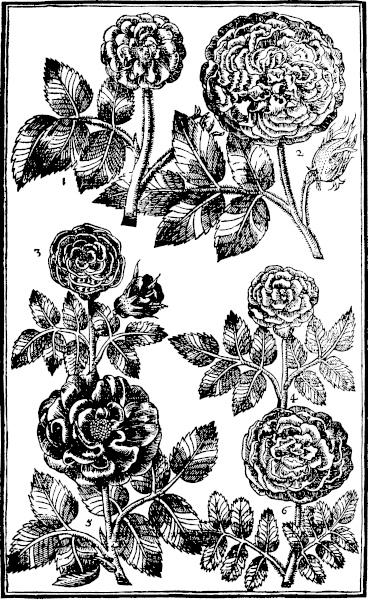
1Rosa Damascena. The Damaske Rose.
2Rosa Prouincialis siue Hollandica. The great Prouince Rose.
3Rosa Francafurtensis. The Franckford Rose.
4Rosa rubra humilis. The dwarfe red Rose.
5Rosa Hungarica. The Hungarian Rose.
6Rosa lutea multiplex. The great double yellow Rose.
12. Rosa Hungarica. The Hungarian Rose.
The Hungarian Rose hath greene shootes slenderly set with prickes, and seldome groweth higher then ordinarily the red Rose doth; the stemme or stocke being much about that bignesse: the flower or rose is as great, thicke and double, as the ordinary red Rose, and of the same fashion, of a paler red colour, and beeing neerely looked vpon is finely spotted with faint spots, as it were spreade ouer the red; the smell wherof is somewhat better then the smell of the ordinary red Rose of the best kinde.
13. Rosa Holoserica simplex & multiplex. The Veluet Rose single and double.
The old stemme or stock of the veluet Rose is couered with a dark coloured barke, and the young shootes of a sad greene with very few or no thornes at all vpon them: the leaues are of a sadder greene colour then in most sorts of Roses, and very often seuen on a stalke, many of the rest hauing but fiue: the Rose is eyther single or double: the single is a broade spread flower, consisting of fiue or sixe broade leaues with many yellow threds in the middle: the double hath two rowes of leaues, the one large, which are outermost, the other smaller within, of a very deepe red crimson colour like vnto crimson veluet, with many yellow threds also in the middle; and yet for all the double rowe of leaues, these Roses stand but like single flowers: but there is another double kinde that is more double then this last, consisting oftentimes of sixteene leaues or more in a flower, and most of them of an equall bignesse, of the colour of the first single rose of this kinde, or somewhat fresher; but all of them of a smaller sent then the ordinary red Rose.
14. Rosa siue spinis simplex & multiplex. The Rose without thornes single and double.
The Rose without thornes hath diuers greene smooth shootes, rising from the root, without any pricke or thorne at all vpon them, eyther young or old: the leaues are not fully so large as of the red rose: the flowers or roses are not much bigger then those of the double Cinamon Rose, thicke set together and short, of a pale red Rose colour, with diuers pale coloured veines through euery leafe of the flower, which hath caused some to call it The marbled Rose, and is of a small sent, not fully equall to the red Rose. The single of this kinde differeth not in any other thing from the former, then in the doublenesse or singlenesse of the flowers which in this are not halfe so double, nor yet fully single, and are of a paler red colour.
Rosa siue spina flore albo.
I haue heard likewise of a white Rose of this kinde, but I haue seene none such as yet, therefore I can say no more thereof.
15. Rosa Cinamomea simplex & multiplex. The Cinamon Rose single and double.
The single Cinamon Rose hath his shootes somewhat red, yet not so red as the double kinde, armed with great thornes, like almost vnto the Eglantine bush thereby showing, as well by the multiplicitie of his shootes as the quicknesse and height of his shooting, his wilde nature: On the stemme and branches stand winged leaues, sometimes seuen or more together, which are small and greene, yet like vnto other Roses. The Roses are single, of fiue leaues a peece, somewhat large, and of a pale red colour, like vnto the double kinde, which is in shootes redder, and in all other things like vnto the single, but bearing small, short, thicke and double Roses, somewhat like vnto the Rose without thornes, but a little lesser, of a paler red colour at the end of the leaues, and somewhat redder and brighter toward the middle of them, with many yellow short thrumes; the small sent of Cinamon that is found in the flowers hath caused it to beare the name.
16. Rosa lutea simplex. The single yellow Rose.
This single yellow Rose is planted rather for variety then any other good vse. It often groweth to a good height, his stemme being great and wooddy, with few or no prickes vpon the old wood, but with a number of small prickes like haires, thicke set, vpon the younger branches, of a darke colour somewhat reddish, the barke of the young shootes being of a sad greene reddish colour: the leaues of this Rose bush are smaller, rounder pointed, of a paler greene colour, yet finely snipt about the edges, and more in number, that is, seuen or nine on a stalke or ribbe, then in any other Garden kinde, except the double of the same kinde that followeth next: the flower is a small single Rose, consisting of fiue leaues, not so large as the single Spanish Muske Rose, but somewhat bigger then the Eglantine or sweete Briar Rose, of a fine pale yellow colour, without any great sent at all while it is fresh, but a little more, yet small and weake when it is dryed.
17. Rosa lutea multiplex siue flore pleno. The double yellow Rose.
The double yellow Rose is of great account, both for the rarity, and doublenesse of the flower, and had it sent to the rest, would of all other be of highest esteeme. The stemme or stocke, the young shoots or branches, the small hairy prickes, and the small winged leaues, are in all parts like vnto the former single kinde; the chiefest difference consisteth in the doublenesse of the flower or Rose, which is so thicke and double, that very often it breaketh out on one side or another, and but a few of them abiding whole and faire in our Countrey, the cause whereof wee doe imagine to bee the much moisture of our Countrey, and the time of flowring being subiect to much raine and showers; many therefore doe either plant it against a wall, or other wayes defend it by couering: againe, it is so plentifull in young shootes or branches, as also in flowers at the toppe or euery branch, which are small and weake for the most part, that they are not able to bring all the flowers to ripenesse; and therefore most of them fall or wither away without comming to perfection (the remedy that many doe vse for this inconuenience last recited is, that they nippe away most of the buds, leauing but some few vpon it, that so the vigour of the plant may be collected into a few flowers, whereby they may the better come to perfection, and yet euen thus it is hardly effected) which are of a yellowish greene colour in the bud, and before they be blowne open, but then are of a faire yellow colour, very full of leaues, with many short haires rather then leaues in the middle, and hauing short, round, greene, smooth buttons, almost flat vnder them: the flower being faire blowne open, doth scarce giue place for largenesse, thicknesse, and doublenesse, vnto the great Prouence or Holland Rose. This Rose bush or plant is very tender with vs here about London, and will require some more care and keeping then the single of this kinde, which is hardy enough; for I haue lost many my selfe, and I know but a few about this towne that can nourse it vp kindly, to beare or scarce to abide without perishing; but abideth well in euery free aire of all or the most parts of this Kingdome: but (as I heare) not so well in the North.
18. Rosa Moschata simplex & multiplex. The Muske Rose single and double.
The Muske Rose both single and double, rise vp oftentimes to a very great height, that it ouergroweth any arbour in a Garden, or being set by an house side, to bee ten or twelue foote high, or more, but more especially the single kinde, with many green farre spread branches, armed with a few sharpe great thornes, as the wilder sorts of Roses are, whereof these are accounted to be kindes, hauing small darke greene leaues on them, not much bigger then the leaues of Eglantine: the flowers come forth at the toppes of the branches, many together as it were in an vmbell or tuft which for the most part doe flower all at a time, or not long one after another, euery one standing on a pretty long stalke, and are of a pale whitish or creame colour, both the single and the double; the single being small flowers, consisting of fiue leaues, with many yellow threads in the middle: and the double bearing more double flowers, as if they were once or twice more double then the single, with yellow thrummes also in the middle, both of them of a very sweete and pleasing smell, resembling Muske: some there be that haue auouched, that the chiefest sent of these Roses consisteth not in the leaues, but in the threads of the flowers.
19. Rosa Moschata multiplex altera: alijs Damascena alba, vel verisimilior Cinamomea flore pleno albo. The double white Damaske Muske Rose.
This other kinde of Muske Rose (which with some is called the white Damaske Muske, but more truely the double white Cinamon Rose) hath his stemme and branches also shorter then the former, but as greene: the leaues are somewhat larger, and of a whiter greene colour; the flowers also are somewhat larger then the former double kinde, but standing in vmbels after the same manner, or somewhat thicker, and of the same whitish colour, or a little whiter, and somewhat, although but a little, neare the smell of the other, but nothing so strong. This flowreth at the time of other Roses, or somewhat later, yet much before the former two sorts of Muske Roses, which flower not vntill the end of Summer, and in Autumne; both which things, that is, the time of the flowring, and the sent being both different, shew plainly it cannot be of the tribe of the Muske Roses.
20. Rosa Hispanica Moschata simplex. The Spanish Muske Rose.
This Spanish Rose riseth to the height of the Eglantine, and sometimes higher, with diuers great greene branches, the leaues whereof are larger and greener then of the former kindes: the flowers are single Roses, consisting of fiue whiter leaues then in any of the former Muske Roses, and much larger, hauing sometimes an eye of a blush in the white, of a very sweete smell, comming nearest vnto the last recited Muske Rose, as also for the time of the flowring.
21. Rosa Pomifera maior. The great Apple Rose.
The stemme or stocke of this Rose is great, couered with a darke grayish barke, but the younger branches are somewhat reddish, armed here and there with great and sharpe thornes, but nothing so great or plentifull as in the Eglantine, although it be a wilde kinde: the leaues are of a whitish greene colour, almost like vnto the first white Rose, and fiue alwaies set together, but seldome seuen: the flowers are small and single, consisting of fiue leaues, without any sent, or very little, and little bigger then those of the Eglantine bush, and of the very same deepe blush colour, euery one standing vpon a rough or prickly button, bearded in the manner of other Roses, which when the flowers are fallen growe great, somewhat long and round, peare-fashion, bearing the beards on the tops of them; and being full ripe are very red, keeping the small prickles still on them, wherein are many white, hard, and roundish seedes, very like vnto the seede of the Heppes or Eglantine Berries, lying in a soft pulpe, like vnto the Hawthorne berries or Hawes: the whole beauty of this plant consisteth more in the gracefull aspect of the red apples or fruit hanging vpon the bushes, then in the flowers, or any other thing. It seemeth to be the same that Clusius calleth Rosa Pumila, but that with me it groweth much higher and greater then he saith his doth.