PARADISI IN SOLE
Reading edition
PARADISUS TERRESTRIS
BY JOHN PARKINSON
FAITHFULLY REPRINTED FROM THE EDITION OF 1629
METHUEN & CO.
LONDON
1904
THE ABERDEEN UNIVERSITY PRESS LIMITED
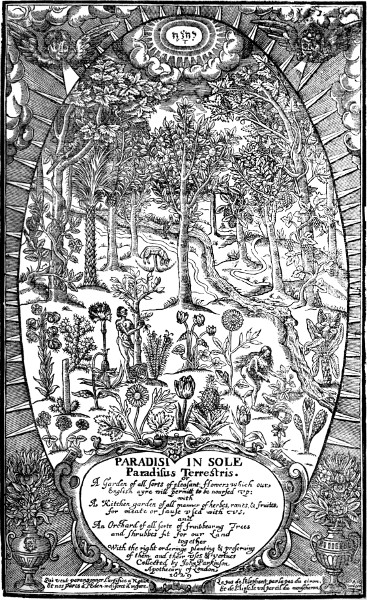
PARADISI IN SOLE Paradisus Terrestris. or A Garden of all sorts of pleasant flowers which our, English ayre will permitt to be noursed vp: with A Kitchen garden of all manner of herbes, rootes, & fruites, for meate or sause vsed with vs, and An Orchard of all sorte of fruitbearing Trees and shrubbes fit for our Land together With the right orderinge planting & preseruing of them and their vses & vertues Collected by John Parkinson Apothecary of London, 1629
Qui veut parangonner l’artifice a Nature Et nos parcs a l’Eden indiscret il mesure.
Le pas de l’Elephant par le pas du ciron, Et de l’Aigle le vol par cil du mouscheron.

TO THE QVEENES MOST EXCELLENT MAIESTIE.
Madame,

Knowing your Maiestie so much delighted with all the faire Flowers of a Garden, and furnished with them as farre beyond others, as you are eminent before them; this my Worke of a Garden, long before this intended to be published, and but now only finished, seemed as it were destined, to bee first offered into your Highnesse hands, as of right challenging the proprietie of Patronage from all others. Accept, I beseech your Maiestie, this speaking Garden, that may informe you in all the particulars of your store, as well as wants, when you cannot see any of them fresh vpon the ground: and it shall further encourage him to accomplish the remainder; who, in praying that your Highnesse may enioy the heauenly Paradise, after the many yeares fruition of this earthly, submitteth to be
Your Maiesties in all humble deuotion,
Iohn Parkinson.

TO THE COVRTEOVS READER.
Although the ancient Heathens did appropriate the first inuention of the knowledge of Herbes, and so consequently of physicke, some vnto Chiron the Centaure, and others vnto Apollo or Æsculapius his sonne; yet wee that are Christians haue out of a better Schoole learned, that God, the Creator of Heauen and Earth, at the beginning when he created Adam, inspired him with the knowledge of all naturall things (which successiuely descended to Noah afterwardes, and to his Posterity): for, as he was able to giue names to all the liuing Creatures, according to their seuerall natures; so no doubt but hee had also the knowledge, both what Herbes and Fruits were fit, eyther for Meate or Medicine, for Vse or for Delight. And that Adam might exercise this knowledge, God planted a Garden for him to liue in, (wherein euen in his innocency he was to labour and spend his time) which hee stored with the best and choysest Herbes and Fruits the earth could produce, that he might haue not onely for necessitie whereon to feede, but for pleasure also; the place or garden called Paradise importing as much, and more plainly the words set downe in Genesis the second, which are these; Out of the ground the Lord God made to grow euerie tree pleasant to the sight and good for meate; and in the 24. of Numbers, the Parable of Balaam, mentioning the Aloe trees that God planted; and in other places if there were neede to recite them. But my purpose is onely to shew you, that Paradise was a place (whether you will call it a Garden, or Orchard, or both, no doubt of some large extent) wherein Adam was first placed to abide; that God was the Planter thereof, hauing furnished it with trees and herbes, as well pleasant to the sight, as good for meate, and that hee being to dresse and keepe this place, must of necessity know all the things that grew therein, and to what vses they serued, or else his labour about them, and knowledge in them, had been in vaine. And although Adam lost the place for his transgression, yet he lost not the naturall knowledge, nor vse of them: but that, as God made the whole world, and all the Creatures therein for Man, so hee may vse all things as well of pleasure as of necessitie, to bee helpes vnto him to serue his God. Let men therefore, according to their first institution, so vse their seruice, that they also in them may remember their seruice to God, and not (like our Grand-mother Eve) set their affections so strongly, on the pleasure in them, as to deserue the losse of them in this Paradise, yea and of Heauen also. For truly from all sorts of Herbes and Flowers we may draw matter at all times not only to magnifie the Creator that hath giuen them such diuersities of forms, sents and colours, that the most cunning Worke-man cannot imitate, and such vertues and properties, that although wee know many, yet many more lye hidden and vnknowne, but many good instructions also to our selues: That as many herbes and flowers with their fragrant sweete smels doe comfort, and as it were reuiue the spirits, and perfume a whole house; euen so such men as liue vertuously, labouring to doe good, and profit the Church of God and the Common wealth by their paines or penne, doe as it were send forth a pleasing savour of sweet instructions, not only to that time wherein they liue, and are fresh, but being drye, withered and dead, cease not in all after ages to doe as much or more. Many herbes and flowers that haue small beautie or savour to commend them, haue much more good vse and vertue: so many men of excellent rare parts and good qualities doe lye hid unknown and not respected, vntill time and vse of them doe set forth their properties. Againe, many flowers haue a glorious shew of beauty and brauery, yet stinking in smell, or else of no other vse: so many doe make a glorious ostentation, and flourish in the world, when as if they stinke not horribly before God, and all good men, yet surely they haue no other vertue then their outside to commend them, or leaue behind them. Some also rise vp and appear like a Lilly among Thornes, or as a goodly Flower among many Weedes or Grasse, eyther by their honourable authoritie, or eminence of learning or riches, whereby they excell others, and thereby may doe good to many. The frailty also of Mans life is learned by the soone fading of them before their flowring, or in their pride, or soone after, being either cropt by the hand of the spectator, or by a sudden blast withered and parched, or by the reuolution of time decaying of it owne nature: as also that the fairest flowers or fruits first ripe, are soonest and first gathered. The mutabilitie also of states and persons, by this, that as where many goodly flowers & fruits did grow this years and age, in another they are quite pulled or digged vp, and eyther weedes and grasse grow in their place, or some building erected thereon, and their place is no more known. The Ciuill respects to be learned from them are many also: for the delight of the varieties both of formes, colours and properties of Herbes and Flowers, hath euer beene powerfull ouer dull, unnurtured, rusticke and sauage people, led only by Natures instinct; how much, more powerfull is it, or should be in the mindes of generous persons? for it may well bee said, he is not humane, that is not allured with this obiect. The study, knowledge, and trauel in them, as they haue been entertained of great Kings, Princes and Potentates, without disparagement to their Greatnesse, or hinderance to their more serious and weighty Affaires: so no doubt vnto all that are capable thereof, it is not onely pleasant, but profitable, by comforting the minde, spirits and senses with an harmelesse delight, and by enabling the iudgement to conferre and apply helpe to many dangerous diseases. It is also an Instructer in the verity of the genuine Plants of the Ancients, and a Correcter of the many errours whereunto the world by continuance hath bin diuerted, and almost therein fixed, by eradicating in time, and by degrees, the pertinacious wilfulnesse of many, who because they were brought vp in their errours, are most vnwilling to leaue them without consideration of the good or euill, the right or wrong, they draw on therewith. And for my selfe I may well say, that had not mine owne paines and studies by a naturall inclination beene more powerfull in mee then any others helpe (although some through an euill disposition and ignorance haue so far traduced me as to say this was rather another mans worke then mine owne, but I leaue them to their folly) I had neuer done so much as I here publish; nor been fit or prepared for a larger, as time may suddenly (by Gods permission) bring to light, if the maleuolent dispositions of degenerate spirits doe not hinder the accomplishment. But perswading my selfe there is no showre that produceth not some fruit, or no word but worketh some effect, eyther of good to perswade, or of reproofe to euince; I could not but declare my minde herein, let others iudge or say what they please. For I haue alwaies held it a thing vnfit, to conceale or bury that knowledge God hath giuen, and not to impart it, and further others therewith as much as is conuenient, yet without ostentation, which I haue euer hated. Now further to informe the courteous Reader, both of the occasion that led me on to this worke, and the other occurrences to it. First, hauing perused many Herbals in Latine, I obserued that most of them haue eyther neglected or not knowne the many diuersities of the flower Plants, and rare fruits are known to vs at this time, and (except Clusius) haue made mention but of a very few. In English likewise we haue some extant, as Turner and Dodonæus translated, who haue said little of Flowers, Gerard who is last, hath no doubt giuen vs the knowledge of as many as he attained vnto in his time, but since his daies we haue had many more varieties, then he or they euer heard of, as may be perceiued by the store I haue here produced. And none of them haue particularly seuered those that are beautifull flower plants, fit to store a garden of delight and pleasure, from the wilde and vnfit: but haue enterlaced many, one among another, whereby many that haue desired to haue faire flowers, haue not known eyther what to choose, or what to desire. Diuers Bookes of Flowers also haue been set forth, some in our owne Countrey, and more in others, all which are as it were but handfuls snatched from the plentifull Treasury of Nature, none of them being willing or able to open all sorts, and declare them fully; but the greatest hinderance of all mens delight was, that none of them had giuen any description of them, but the bare name only. To satisfie therefore their desires that are louers of such Delights, I took vpon me this labour and charge, and haue here selected and set forth a Garden of all the chiefest for choyce, and fairest for shew, from among all the seuerall Tribes and Kindreds of Natures beauty, and haue ranked them as neere as I could, or as the worke would permit, in affinity one vnto another. Secondly, and for their sakes that are studious in Authors, I haue set down the names haue bin formerly giuen vnto them, with some of their errours, not intending to cumber this worke with all that might bee said of them, because the deciding of the many controuersies, doubts, and questions that concerne them, pertaine more fitly to a generall History: yet I haue beene in some places more copious and ample then at the first I had intended, the occasion drawing on my desire to informe others with what I thought was fit to be known, reseruing what else might be said to another time & worke; wherein (God willing) I will inlarge my selfe, the subiect matter requiring it at my hands, in what my small ability can effect. Thirdly, I haue also to embellish this Worke set forth the figures of all such plants and flowers as are materiall and different one from another: but not as some others haue done, that is, a number of the figures of one sort of plant that haue nothing to distinguish them but the colour, for that I hold to be superfluous and waste. Fourthly, I haue also set down the Vertues and Properties of them in a briefe manner, rather desiring to giue you the knowledge of a few certaine and true, then to relate, as others haue done, a needless and false multiplicitie, that so there might as well profit as pleasure be taken from them, and that nothing might be wanting to accomplish it fully. And so much for this first part, my Garden of pleasant and delightfull Flowers. My next Garden consisteth of Herbes and Rootes, fit to be eaten of the rich and poor as nourishment and food, as sawce or condiment, as sallet or refreshing, for pleasure or profit; where I doe as well play the Gardiner, to shew you (in briefe, but not at large) the times and manner of sowing, setting, planting, replanting, and the like (although all these things, and many more then are true, are set down very largely in the seuerall bookes that others haue written of this subiect) as also to shew some of the Kitchen vses (because they are Kitchen herbes &c.) although I confesse but very sparingly, not intending a treatise of cookery, but briefly to giue a touch thereof; and also the Physicall properties, to shew some what that others haue not set forth; yet not to play the Empericke, and giue you receipts of medicines for all diseases, but only to shew in some sort the qualities of Herbes, to quicken the minds of the studious. And lastly an Orchard of all sorts of domesticke or forraine, rare and good fruits, fit for this our Land and Countrey, which is at this time better stored and furnished then euer in any age before. I haue herein endeauoured, as in the other Gardens, to set forth the varieties of euery sort in as briefe a manner as possibly could be, without superfluous repetitions of descriptions, and onely with especiall notes of difference in leaues, flowers and fruits. Some few properties also are set downe, rather the chiefest then the most, as the worke did require. And moreouer before euery of these parts I haue giuen Treatises of the ordering, preparing and keeping the seuerall Gardens and Orchard, with whatsoeuer I thought was conuenient to be known for euery of them.
Thus haue I shewed you both the occasion and scope of this Worke, and herein haue spent my time, paines and charge, which if well accepted, I shall thinke well employed, and may the sooner hasten the fourth Part, A Garden of Simples; which will be quiet no longer at home, then that it can bring his Master newes of faire weather for the iourney.
Thine in what he may,
Iohn Parkinson.
Ioanni Parkinsono Pharmacopæo Londinensi solertissimo Botanico consummatissimo T.D.M. S.P.D.

Poema panegyricum Opus tuum indefessi laboris, vtilitatis eximiæ postulat, & meriti iure à me extorqueret (mi Parkinsone) si fauentibus Musis, & secundo Apolline in bicipiti somniare Parnasso, & repentè Poetæ mihi prodire liceret. In fœtus tui bonis auibus in lucem editi, & prolixiorem nepotum seriem promittentis laudes, alii Deopleni Enthusiastæ carmine suos pangant elenchos; quos sub figmentis ampullata hyperbolicarum vocum mulcedine, vates serè auribus mentibusne insinuant. Veritas nuditatis amans, fuco natiuum candorem obumbranti non illustranti perpetuum indixit bellum: In simplicitate, quam assertionum neruosa breuitas exprimit, exultat. Audi quid de te sentiam, Tu mihi sis in posterum Crateuas Brittannus; inter omnes quotquot mihi hic innotuerunt, peritissimus, exercitatissimus, oculatissimus, & emunctissimæ naris Botanicus: Cuius opera in fortunata hac Insula rem herbariam tractari, emendari, augeri, & popularibus tuis vernaculo sermone ad amussim tradi, non decentiæ modo, sed etiam necessitatis est. Macte tua sedulitate (Vir optime) neque te laborum tam arduis lucubrationibus datorum hactenus pœniteat, vel deinceps impendendorum pigeat. Difficilia quæ pulchra. Leniet debitæ laudis dulcedo vigiliarum acerbitatem, & Olympicum stadium cito pede, à carceribus ad metas alacriter decurrentem nobile manet βραβεῖον. Sed memento Artem longam, Vitam esse breuem. Μηδὲν ἀναβαλλόμενος. Vide quid ad antiquum ilium, cuius si non animam, saltem genium induisti, Crateuam scribat Hippocrates, Τέχνης πάσης ἀλλότριον ἀναβολὴ ἰητρικῆς δὲ καὶ πάνυ, ἐν ᾗ ψυχῆς κίνδυνος ἡ ὑπέρθεσις. Nobilissimam Medicinæ partem Botanicam esse reputa. Floræ nunc litasti & Pomonæ, Apollini vt audio propediem Horto Medico facturus. Amabò integræ Vestæ sacra conficito, eiusque variegatum multis simplicium morbifugorum, myriadibus sinum absolutè pandito, quem sine velo nobis exhibeas. Nulla dies abeat sine linea. Sic tandem fructus gloriæ referes vberrimos, quos iustè sudoribus partos, vt in cruda & viridi senectute decerpas diu, iisque longum fruaris opto. Vale. Datum Londini Calendas Octobris anno salutis 1629.
Theodorus de Mayerne Eques aurat. in Aula Regum Magnæ Britanniæ Iacobi & Caroli P. & F. Archiatrorum Comes.

❧ Ad eximium arte & vsu Pharmacopœum & Botanographum I. Parkinsonum.

Herbarum vires, primus te (magne Britanne) Edocuit medicas, inclytus arte sophus. Atque cluens herbis alter, Chironis alumnus, Descripsit plantas, neu cadat vlla salus. Fortunate senex, sis tu nunc tertius Heros Hortos qui referas, deliciasque soli, Gu. Turnerus. M.D. Io. Gerardus Chirurgus. Et flores Veneris lætos, herbasque virentes, Arboreos fætus, pharmacum & arte potens. Posteritas iustos posthac tibi solvet honores, Laudabitque tuæ dexteritatis opus.
Ottuellus Meuerell. D.M. & Collegii Med. Lond. socius.
Amico suo Ioanni Parkinsono.

Extollunt alij quos (Parkinsone) labores Da mihi iam veniam comminuisse tuos. Extremos poteris credi migrasse per Indos: Cum liber haud aliud quam tuus hortus hic est: Ipse habitare Indos tecum facis, haud petis Indos I nunc, & tua me comminuisse refer. Est liber Effigies, tuus hic qui pingitur hortus, Digna manu facies hæc, facieque manus! Vidi ego splendentem varigatis vndique gemmis. Vna fuit Salomon, turba quid ergo fuit? Vt vario splendent Pallacia regia sumptu, Et Procerum turbis Atria tota nitent: Tunc cum festa dies veniam dedit esse superbis Quosque ficus texit, nunc tria rura tegunt: Plena tuo pariter spectatur Curia in Horto, Hic Princeps, Dux hic, Sponsaque pulchra Ducis. Quæque dies est festa dies, nec parcius vnquam Luxuriant, lauta hæc; Quotidiana tamen. Ecce velut Patriæ Paradisi haud immemor Exul, Hunc naturali pingit amore sibi. Pingit & ad vivum sub eodem nomine, & hic est Fronticuli sudor quem cerebrique dedit: Astat Adam medius Paradiso noster in isto Et species nomen cuique dat ipse suum. Hos cape pro meritis, qui florem nomine donas Æternum florens tu tibi Nomen habe.
Guilielmus Atkins.

Ad Amicum Ioannem Parkinsonum Pharmacopœum, & Archibotanicum Londinensem.

Africa quas profert Plantas, quas India mittit, Quas tua dat tellus, has tuus hortus habet: Atque harum Species, florendi tempora, vires, Et varias formas iste libellus habet: Nescio plus librum talem mirabor, an hortum Totus inest horto mundus; at iste libro. Parkinsone tuus liber, & labor, & tua sit laus, Herbas dum nobis das; datur herba tibi.
Guilielmus Brodus Pharmacopœus ac Philobotanicus Londinensis.
Ad Amicum Ioannem Parkinsonum Pharmacopœum & Botanicum insignem. Carmen.

Qvam magno pandis Floræ penetralia nixu Atque facis cœlo liberiore frui? Omnibus vt placeas, ô quam propensa voluntas, Solicitusque labor nocte dieque premit? Quam magno cultum studio conquirere in hortum Herbarum quicquid mundus in orbe tenet, Immensus sumptus, multosque extensus in annos Te labor afficiunt? & data nulla quies. Talia quærenti, surgit novus ardor habendi, Nec tibi tot soli munera magna petis; Descriptos vivâ profers sub imagine flores, Tum profers mensæ quicquid & hortus alit, Laudatos nobis fructus & promis honores, Profers, quas celebrant nullibi scripta virum, Herbarum species, quibus est quoque grata venustas: Sic nos multiplici munere, Amice, beas. Hoc cape pro meritis, florum dum gratia floret, Suntque herbis vires; en tibi Nomen erit. In serum semper tua gloria floreat ævum, Gloria quæ in longum non peritura diem.
Thomas Iohnson vtriusque Societatis consors.
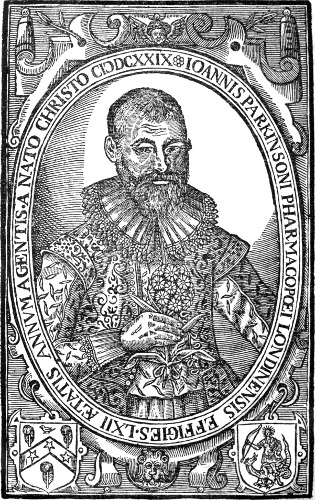
IOANNIS PARKINSONI PHARMACOPŒI LONDINENSIS EFFIGIES LXII ÆTATIS ANNVM AGENTIS A NATO CHRISTO CIↃDCXXIX.