THE GARDEN OF PLEASANT FLOWERS. (continued 7)
Reading edition
Alba purpureis oris & venis.
There is another of this kinde, whose flowers haue purple edges, and sometimes some veines of the same purple in the leaues of the flowers, not differing in any other thing from the former.
Alba oris rubris.
And another, whose edges of the flowers are of a bright red colour.
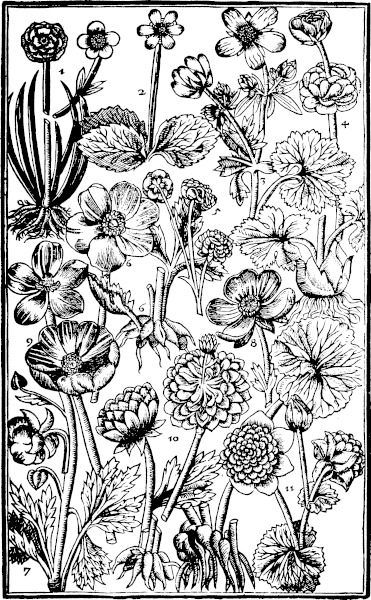
1Ranunculus gramineus flore simplici & duplici. The single and the double grasse Crowfoot.
2Ranunculus Lusitanicus Autumnalis. The Portugall Autumne Crowfoot.
3Ranunculus Creticus latifolius. The broad leafed Candy Crowfoot.
4Ranunculus Anglicus maximus multiplex. The double English Crowfoot.
5Ranunculus pratensis flore multiplici. The double yellow field Crowfoot.
6Ranunculus Creticus albus. The white Candy Crowfoot.
7Ranunculus Asiaticus flore albo vel pallido vario. The white or the straw coloured Crowfoot with red tops or edges.
8Ranunculus Tripolitanus flore rubro simplici. The single red Crowfoot of Tripoli.
9Ranunculus Asiaticus flore rubro amplo. The large single red Crowfoot of Asia.
10Ranunculus Asiaticus flore rubro pleno. The double red Crowfoot of Asia.
11Caltha palustris flore pleno. Double Marsh Marigold or Batchelours buttons.
15. Ranunculus Creticus flore argenteo. The Argentine, or cloth of siluer Crowfoot.
The greene leaues of this Crowfoote are as small and thinne, cut in or diuided on the edges, as the last two sorts; the stalke riseth vp somewhat higher, and diuided into some branches, bearing at the toppe of euery of them one flower, somewhat smaller then the former, composed of six, seuen, and sometimes of eight small round pointed leaues, of a whitish yellow blush colour on the inside wholly, except sometimes a little stript about the edges: but the outside of euery leafe is finely stript with crimson stripes, very thicke, somewhat like vnto a Gilloflower: in the middle riseth vp a small blacke head, compassed about with blackish blew threads or thrums, which head is as vnfruitfull for seede in our Countrey as the former. This flower hath no such greene leaues vnder it, or to enclose it before it be blowne open as the former: the rootes are in all things like the former.
16. Ranunculus Asiaticus siue Tripolitanus flore rubro. The single red Crowfoote of Asia or Tripoli.
The lower leaues of this red Crowfoote are alwayes whole without diuisions, being onely somewhat deeply indented about the edges, but the other that rise after them are more cut in, sometimes into three, and sometimes into fiue diuisions, and notched also about the edges: the stalke riseth higher then any of the former, and hath on it two or three smaller leaues, more cut in and diuided then those belowe: at the toppe whereof standeth one large flower, made of fiue leaues, euery one being narrower at the bottome then at the toppe, and not standing close and round one to another, but with a certaine distance betweene, of a duskie yellowish red colour on the outside, and of a deepe red on the inside, the middle being set with many thrums of a darke purple colour: the head for seede is long, and scaly or chaffie, and idle in like manner as the rest: the roote is made of many graines or small kernels set together, and closing at the head, but spreading it selfe, if it like the ground, vnder the vpper crust of the earth into many rootes, encreasing from long strings, that runne from the middle of the small head of graines, as well as at the head it selfe.
17. Ranunculus Asiaticus flore amplo rubro. The large single red Crowfoot of Asia.
There hath come to vs out of Turkie, together with the former, among many other rootes, vnder the same title, a differing sort of this Crowfoote, whose leaues weare broader, and much goaler; the flower also larger, and the leaues thereof broader, sometimes eight in a flower, standing round and close one to another, which maketh the fairer shew: in all other things it is like the former.
18. Ranunculus Asiaticus flore rubro vario simplici. The red stript single Crowfoote of Asia.
This party coloured Crowfoote differeth not eyther in roote or leafe from the former, the chiefest difference is in the flower, which being red, somewhat like the former, hath yet some yellow stripes or veines through euery leafe, sometimes but little, and sometimes so much, that it seemeth to bee party coloured red and yellow: this sort is very tender; for we haue twice had it, and yet perished with vs.
19. Ranunculus Asiaticus flore luteo vario simplici. The yellow stript single Crowfoote of Asia.
There is little difference in the roote of this Crowfoote from the last described, but the leaues are much different, being very much diuided, and the flower is large, of a fine pale greenish yellow colour, consisting of six and seuen, and sometimes of eight or nine round leaues; the toppes whereof haue reddish spots, and the edges sometimes also, with such purplish thrums in the middle that the other haue. None of these former Crowfeete with kernelly rootes, haue euer beene found to haue giuen so good seed in England, as that being sowne, any of them would spring vp; for hereof tryall hath been often made, but all they haue lost their labour, that haue bestowed their paines therein, as farre as I know.
20. Ranunculus Asiaticus flore rubro pleno. The double red Crowfoote of Asia.
The double red Crowfoote hath his rootes and leaues so like vnto the single red kinde, that none can perceiue any difference, or know the one from the other, vntill the budde of the flower doe appeare, which after it is any thing forward, may be perceiued to be greater and fuller then the budde of the single kinde. This kinde beareth most vsually but one faire large double flower on the toppe of the stalke, composed of many leaues, set close together in three or foure rowes, of an excellent crimson colour, declining to Scarlet, the outter leaues being larger then the inner; and instead of thrummes, hath many small leaues set together: it hath likewise six small narrow greene leaues on the backside of the flower, where the stalke is fastened to the flower.
Prolifero flore.
There is of this double kinde another sort, whose flower is of the same colour with the former, but out of the middle of the flower ariseth another double flower, but smaller.
The Place.
These plants grow naturally in diuers Countries; some in France, and Germany, and some in England, some in Spaine, Portugall, and Italy, and some haue been sent out of Turkie from Constantinople, and some from other parts, their titles for the most part descrying their Countries.
The Time.
Some of them flower early, as is set downe in their descriptions, or titles. The others in Aprill and May. The white Candy Crowfoote, and the other single and double sorts of Asia, about the same time, or somewhat later, and one in Autumne, as it is set downe.
The Names.
The names that are giuen seuerally to them may well serue this worke, that thereby they may bee distinguished one from another: For to set downe any further controuersie of names, how fitly or vnfitly they haue beene called, and how variably by diuers former Writers, is fitter for a generall History, vnto which I leaue what may be said, both concerning these and the rest: Onely this I would giue you to vnderstand, that the Turkie kindes haue been sent to vs vnder the names of Terobolos for the single, and Terobolos Catamer lale for the double, and yet oftentimes, those that haue been sent for double, haue proued single, so little fidelity is to bee found among them.
The Vertues.
All or most of these plants are very sharpe and exulcerating, yet the care and industry of diuers learned men haue found many good effects in many of them. For the rootes and leaues both of the wilde kindes, and of some of these of the Garden, stamped and applyed to the wrists, haue driuen away the fits in Feuers. The roote likewise of the double English kinde is applyed for pestilent sores, to helpe to breake them, by drawing the venome to the place. They helpe likewise to take away scarres and markes in diuers places of the body.
Chap. XXVIII. Caltha palustris flore pleno. Double Marsh Marigold.
As an appendix to the Crowfeete, I must needes adde this plant, yet seuerally by it selfe, because both it and his single kinde are by most adioyned thereunto, for the neare resemblance both in shape and sharpnesse of quality. The single kinde I leaue to the Ditch sides, and moist grounds about them, as the fittest places for it, and onely bring the double kinde into my Garden, as fittest for his goodly proportion and beauty to be entertained, and haue place therein.
The double Marsh Marigold hath many broad and round greene leaues, a little endented about the edges, like vnto the single kinde, but not altogether so large, especially in a Garden where it standeth not very moist: the stalkes are weake, round, hollow, and greene, diuided into three or foure branches at the toppe, with leaues at the seuerall ioynts, whereon stand very double flowers, of a gold yellow colour: the fiue outer leaues being larger then any of the rest that are encompassed by them, which fall away after they haue stood blowne a great while (for it endureth in flower a moneth or more, especially if it stand in a shadowie place) without bearing any seed: the rootes are composed of many thicke, long, and round whitish strings, which runne downe deep into the ground, and there are fastened very strongly.
The Place.
This plant groweth naturally in diuers Marshes, and moist grounds in Germany, yet in some more double then in others; it hath long agoe beene cherished in our Gardens.
The Time.
It flowreth in Aprill or May, as the yeare proueth earlier or later: all his leaues doe in a manner quite perish in Winter, and spring anew in the end of February, or thereabouts.
The Names.
There is great controuersie among the learned about the single kinde, but thereof I shall not neede to speake in this place; if God permit I may in a fitter. This is called generally in Latine, Caltha palustris multiplex, or flore pleno. And wee in English (after the Latine, which take Caltha to be that which wee vsually call Calendula, a Marigold) The double Marsh Marigold.
The Vertues.
The roote hereof is sharpe, comming neare vnto the quality of the Crowfeete, but for any speciall property, I haue not heard or found any.
Chap. XXIX. Hepatica nobilis siue trifolia. Noble Liuerwort.
Next vnto the Crowfeete are to follow the Hepaticas, because of the likenesse with them, seeming to be small Crowfeete in all their parts, but of another and more wholsome kinde. Their diuersity among themselues consisteth chiefly in the colour of the flowers, all of them being single, except one which is very thicke and double.
1. Hepatica flore cæruleo simplici maior. The great single blew Hepatica or noble Liuerwort.
The flowers of this Hepatica doe spring vp, blow open, and sometimes shed and fall away, before any leaues appeare or spread open. The rootes are composed of a bush of blackish things, from the seuerall heads or buttons whereof, after the flowers are risen and blowne, arise many fresh greene leaues, each seuerally standing vpon his foot-stalke, folded together, and somewhat browne and hairy at their first comming, which after are broad, and diuided at the edges into three parts: the flowers likewise stand euery one vpon his owne seuerall foote-stalke, of the same height with the leaues for the most part, which is about foure or fiue fingers breadth high, made of six leaues most vsually, but sometimes it will haue seuen or eight, of a faire blew colour, with many white chiues or threads in the middle, standing about a middle green head or vmbone, which after the flower is fallen groweth greater, and sheweth many small graines or seede set close together (with three small greene leaues compassing them vnderneath, as they did the flower at the bottome) very like the head of seed of manie Crowfeete.
2. Hepatica minor flore pallido cæruleo. The small blew Hepatica.
The leaues of this Hepatica are smaller by the halfe then the former, and grow more aboundantly, or bushing thicke together: the flowers (when it sheweth them, for I haue had the plant halfe a score yeares, and yet neuer saw it beare flower aboue once or twice) are of a pale or bleake blew colour, not so large as the flowers of the former.
3. Hepatica flore purpureo. Purple Hepatica or noble Liuerwort.
This Hepatica is in all things like vnto the first, but onely the flowers are of a deeper blew tending to a Violet purple: and therefore I shall not neede to reiterate the former description.
4. Hepatica flore albo minor. The lesser white Hepatica.
The flowers of this Hepatica are wholly white, of the bignesse of the red or purple, and the leaues somewhat smaller, and of a little whiter of paler greene colour, else in all other things agreeing with the former.
5. Hepatica alba magno flore. The great white Hepatica.
There is no other difference herein from the last, but that the flower being as white, is as large as the next.
6. Hepatica albida siue argentea. Ash-coloured of Argentine Hepatica.
Both the leaues and the flowers of this Hepatica are larger then any of the former, except the last: the flowers hereof at the first opening seeme to bee of a blush ash-colour, which doe so abide three or foure dayes, decaying still vntill it turne almost white, hauing yet still a shew of that blush ash-colour in them, till the very last.
7. Hepatica alba straminibus rubris. White Hepatica with red threads.
There is no difference between this Hepatica and the first white one, sauing that the threads in the middle of the flower, being white, as in the former, are tipt at the ends with a pale reddish colour, which adde a great beauty to the flowers.
8. Hepatica flore rubro. Red Hepatica or noble Liuerwort.
The leaues of this Hepatica are of a little browner red colour, both at their first comming vp, and afterwards, especially in the middle of the leafe more then any of the former: the flowers are in forme like vnto the rest, but of a bright blush, or pale red colour, very pleasant to behold, with white threads or chiues in the middle of them.
9. Hepatica flore purpureo multiplici siue pleno. The double purple Hepatica.
The double Hepatica is in all things like vnto the single purple kinde, sauing onely that the leaues are larger, and stand vpon longer foote-stalkes, and that the flowers are small buttons, but very thicke of leaues, and as double as a flower can be, like vnto the double white Crowfoote before described, but not so bigge, of a deepe blew or purple colour, without any threads or head in the middle, which fall away without giuing any seede.
10. Hepatica flore cæruleo pleno. The double blew Hepatica.
In the colour of this flower, consisteth the chiefest difference from the last, except one may say it is a little lesse in the bignesse of the flower, but not in doublenesse of leaues.
The Place.
All these plants with single flowers grow naturally in the Woods, and shadowie Mountaines of Germany in many places, and some of them in Italy also. The double kinde likewise hath been sent from Alphonsus Pantius out of Italy, as Clusius reporteth, and was also found in the Woods, neare the Castle of Starnbeg in Austria, the Lady Heusenstains possession, as the same Clusius reporteth also.
The Time.
These plants doe flower very early, and are of the first flowers that shew themselues presently after the deepe frosts in Ianuary, so that next vnto the Winter Wolfesbane, these making their pride appeare in Winter, are the more welcome early guests. The double kinde flowreth not altogether so early, but sheweth his flower, and abideth when the others are past.
The Names.
They haue obtained diuers names; some calling them Hepatica, Hepatica nobilis, Hepaticum trifolium, Trifolium nobile, Trifolium aureum, and some Trinitas, and Herba Trinitatis. In English you may call them either Hepatica, after the Latine name, as most doe, or Noble Liuerwort, which you please.
The Vertues.
These are thought to coole and strengthen the liuer, the name importing as much; but I neuer saw any great vse of them by any the Physitians of our London Colledge, or effect by them that haue vsed them in Physicke in our Country.
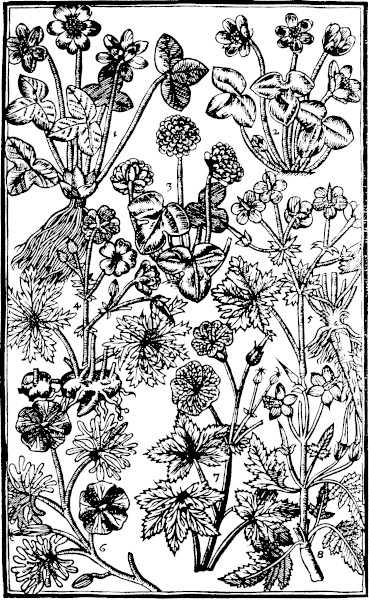
1Hepatica flore albo amplo simplici. The large white Hepatica.
2Hepatica flore rubro simplici. The red Hepatica.
3Hepatica flore purpureo pleno. The double purple Hepatica.
4Geranium tuberosum. Knobbed Cranes bill.
5Geranium Batrachoides flore albo vel cæruleo. The blew or white Crowfoote Cranes bill.
6Geranium Hematodes. The red Rose Cranes bill.
7Geranium Romanum striatum. The variable stript Cranes bill.
8Geranium Creticum. Candy Cranes bill.
Chap. XXX. Geranium. Storkes bill or Cranes bill.
As was said before concerning the Crowfeet, of their large extent and restraint, the like may be said of the Storkes bils or Cranes bils; for euen of these as of them, I must for this worke set forth the descriptions but of a few, and leaue the rest to a generall worke.
1. Geranium tuberosum vel bulbosum. Bulbous or knobbed Cranes bill.
The knobbed Cranes hath three or foure large leaues spread vpon the ground, of a grayish or rather dusty greene colour, euery one of them being as it were of a round forme, but diuided or cut into six or seuen long parts or diuisions, euen vnto the middle, which maketh it seeme to be so many leaues, each of the cuts or diuisions being deeply notched or indented on both sides; among which riseth vp a stalke a foote high or better, bearing thereon diuers pale but bright purple flowers, made of fiue leaues a peece, after which come small heads with long pointed beakes, resembling the long bill of a Storke or Crane, or such like bird, which after it is ripe, parteth at the bottome where it is biggest, into foure or fiue seedes, euery one whereof hath a peece of the beake head fastened vnto it, and falleth away if it bee not gathered: the roote is tuberous and round, like vnto the roote of the Cyclamen or ordinary Sowbread almost, but smaller, and of a darke russet colour on the outside, and white within, which doth encrease vnder ground, by certaine strings running from the mother root into small round bulbes, like vnto the rootes of the earth Chesnut, and will presently shoote leaues, and quickly grow to beare flowers, but will not abide to be kept long dry out of the ground, without danger to be vtterly spoiled.
2. Geranium Batrachoides flore cæruleo. The blew Crowfoote Cranes bill.
This Crowfoote Cranes bill hath many large leaues, cut into fiue or fix parts or diuisions, euen to the bottome, and iagged besides on the edges, set vpon very long slender foote-stalkes, very like the leaues of the wilde Crowfoot; from among which rise vp diuers stalkes with great ioynts, somewhat reddish, set with leaues like the former: the toppes of the stalkes are spread into many branches, whereon stand diuers flowers, made of fiue leaues a peece, as large as any of the wilde or field Crowfeete, round pointed, of a faire blew or watchet colour, which being past, there doe arise such heads or bils, as other of the Cranes bils haue: the roote is composed of many reddish strings, spreading in the ground, from a head made of diuers red heads, which lye oftentimes eminent aboue the ground.
3. Geranium Batrachoides flore albo. The white Crowfoote Cranes bill.
This Cranes bill is in leafe and flower altogether like the former, the onely difference betweene them consisteth in the colour of the flower, which in this is wholly white, and as large as the former: but the roote of this hath not such red heads as the other hath.
4. Geranium Batrachoides flore albo & cæruleo vario. The party coloured Crowfoote Cranes bill.
The flowers of this Cranes bill are variably striped and spotted, and sometimes diuided, the one halfe of euery leafe being white, and the other halfe blew, sometimes with lesser or greater spots of blew in the white leafe, very variably, and more in some years then in others, that it is very hard to expresse all the varieties that may be obserued in the flowers, that blow at one time. In all other parts of the plant, it is so like vnto the former, that vntill it be in flower, the one cannot be knowne from the other.
5. Geranium Batrachoides alterum flore purpureo. Purple Crowfoote Cranes bill.
This purple Cranes bill hath many leaues rising from the roote, set vpon long foot-stalkes, somewhat like vnto the other, yet not so broad, but more diuided or cut, that is, into seuen or more slits, euen to the middle, each whereof is likewise cut in on the edges more deeply then the former; the stalkes are somewhat knobbed at the ioynts, set with leaues like vnto the lower, and bearing a great tuft of buds at the toppes of the branches, which breake out into faire large flowers, made of fiue purple leaues, which doe somewhat resemble the flower of a Mallow, before it be too full blowne, each whereof hath a reddish pointell in the middle, and many small threads compassing it, this vmbell or tuft of buds doe flower by degrees, and not all at once, and euery flower abideth open little more then one day, and then sheddeth, so that euery day yeeldeth fresh flowers, which because they are so many, are a long while before they are all past or spent: after the flowers are past, there arise small beake heads or bils, like vnto the other Cranes bils, with small turning seede: the roote is composed of a great tuft of strings, fattened to a knobby head.
6. Geranium Romanum versicolor siue striatum. The variable stript Cranes bill.
This beautifull Cranes bill hath many broad yellowish greene leaues arising from the roote, diuided into fiue or six parts, but not vnto the middle as the first kindes are: each of these leaues hath a blackish spot at the bottome corners of the diuisions, the whole leafe as well in forme as colour and spots, is very like vnto the leafe of the Geranium fuscum, or spotted Cranes bill, next following to be described, but that the leaues of this are not so large as the other: from among these leaues spring vp sundry stalkes a foote high and better, ioynted and knobbed here and there, bearing at the tops two or three small white flowers, consisting of fiue leaues a peece, so thickly & variably striped with fine small reddish veines, that no green leafe that is of that bignesse can shew so many veines in it, nor so thick running as euery leafe of this flower doth: in the middle of the flower standeth a small pointell, which when the flower is part doth grow to be the seed vessell, whereon is set diuers small seeds, like vnto the small seedes of other Cranes bils: the root is made of many small yellow threads or strings.
7. Geranium fuscum siue maculatum. Swart tawny or spotted Cranes bill.
The leaues of this Cranes bill are in all points like the last described, as well in the forme and diuisions as colour of the leaues, being of a yellowish greene colour, but larger and stronger by much: the stalkes of this rise much higher, and are ioynted or knobbed with reddish knees or ioynts, on the tops whereof stand not many although large flowers, consisting of fiue leaues a peece, each whereof is round at the end, and a little snipt round about, and doe bend or turne themselues backe to stalkewards, making the middle to be highest or most eminent; the colour of the flower is of a darke or deepe blackish purple, the bottome of euery leafe being whiter than the rest; it hath also a middle pointell standing out, which afterwards bring forth seede like vnto others of his kinde: the roote consisteth of diuers great strings, ioyned to a knobby head.
8. Geranium Hematodes. The red Rose Cranes bill.
This Cranes bill hath diuers leaues spread vpon the ground, very much cut in or diuided into many parts, and each of them againe slit or cut into two or three peeces, standing vpon slender long foote-stalkes, of a faire greene colour all the Spring and Summer, but reddish in Autumne: among these leaues spring vp slender and weake stalkes, beset at euery ioynt (which is somewhat reddish) with two leaues for the most part, like vnto the lower: the flowers grow seuerally on the toppe of the stalkes, and not many together in bunches or branches, as in all other Cranes bils, euery flower being as large as a single Rose Campion flower, consisting of fiue large leaues, of a deeper red colour then in any other Cranes bill at the first opening, and will change more blewish afterwards: when the flower is past, there doth arise such like beakes as are in others of the same kinde, but small: the roote is hard, long, and thicke, with diuers branches spreading from it, of a reddish yellow colour on the outside, and whitish within, which abideth and perisheth not, but shooteth forth some new greene leaues, which abide all the Winter, although those that turne red doe fall away.
Geranium Creticum. Candy Cranes bill.
Candy Cranes bill beareth long and tender stalkes, whereon growe diuers broad and long leaues, cut in or iagged on the edges: the toppes of the stalkes are branched into many flowers, made of fiue leaues of a reasonable bignesse, and of a faire blew or watchet colour, with a purplish pointell in the middle, which being past, there follow beake heads like other Cranes bils, but greater, containing larger, greater, and sharper pointed seede, able to pierce the skinne, if one be not warie of it: the roote is white and long, with some fibres at it, and perisheth when it hath perfected his seede, and will spring of it owne sowing many times, if the Winter be not too sharpe, otherwise (being annuall) it must be sowne in the Spring of the yeare.
The Place.
Most of these Cranes bils are strangers vnto vs by nature, but endenizond in our English Gardens. It hath beene reported vnto mee by some of good credit, that the second or Crowfoot Cranes bill hath been found naturally growing in England, but yet I neuer saw it, although I haue seen many sorts of wilde kindes in many places. Matthiolus saith that the first groweth in Dalmatia and Illyria very plentifully. Camerarius, Clusius, and others, that most of the rest grow in Germany, Bohemia, Austria, &c. The last hath his place recorded in his title.
The Time.
All these Cranes bils doe for the most part flower in Aprill, and May, and vntill the middle of Iune. The variable or stript Cranes bill is vsually the latest of all the rest.
The Names.
The first is vsually called Geranium tuberosum, of some Geranium bulbosum, of the likenesse of the roote vnto a bulbe: It is without controuersie Geranium primum of Dioscorides. The second is called Geranium Gratia Dei, of others, Geranium cæruleum. The blew Cranes bill Lobel calleth it Batrachoides, because both leafe and flower are like vnto a Crowfoote; and the affinity with the Cranes bils in the seede causeth it rather to be referred to them then to the Crowfeete. The stript Cranes bill is called by some Geranium Romanum. The last sauing one is called Geranium Hæmatodes, or Sanguineum, of Lobel Geranium Gruinale Hæmatodes supinum radice repente. In English it may be called after the Greek and Latine, The bloudy Cranes bill, but I rather call it, The Rose Cranes bill, because the flowers are as large as single Roses, or as the Rose Campion. Some of them are called in many places of England Bassinets.
The Vertues.
All the kindes of Cranes bils are accounted great wound herbes, and effectuall to stay bleedings, yet some more than others. The Emperickes of Germanie, as Camerarius saith, extoll it wonderfully, for a singular remedie against the Stone, both in the reines and bladder.
Chap. XXXI. Sanicula guttata maior. Spotted Sanicle.
Hauing long debated with my selfe, where to place this & the other plants that follow in the two next Chapters, I haue thought it not amisse for this worke to set them downe here, both before the Beares eares, which are kindes of Sanicle, as the best Authors doe hold, and after the Cranes bils, both for some qualities somewhat resembling them, and for some affinity of the flowers with the former.
The spotted Sanicle hath many small round leaues, bluntly endented about the edges, somewhat like vnto the leaues of our white Saxifrage, of a full greene colour aboue, and whitish hairy, and somewhat reddish withall vnderneath: the stalkes are set here and there with the like leaues, rising a foote and a halfe high or more, very much diuided at the toppe into sundry small branches, bearing many very small white flowers, consisting of fiue small leaues, wherein are many small red spots to be seene, as small as pins points, of a pretty sweete sent, almost like Hawthorne flowers, in the middle whereof are many small threads compassing a head, which when it is ripe containeth small blacke seede: the roote is scaly, or couered with a chaffie matter, hauing many small white fibres vnderneath, whereby it is fastened in the ground.
Minor non guttata.
There is another of this kinde, like both in roote, leafe, and flower to the former, the onely difference is, that this is lesser then the former, and hath no spots in the flower, as the other hath.
Minus guttata.
We haue also another smaller kinde then the last, both in leafe and flower, the leaues whereof are smaller, but rounder, and more finely snipt or indented about the edges, like the teeth of a fine sawe: the stalke is little aboue a span high, hauing many small white flowers spotted as the first, but with fewer spots.
The Place.
These growe in the shadowie Woods of the Alpes, in diuers places, and with vs they more delight in the shade then the sunne.
The Time.
All these Sanicles doe flower in May, and continue flowring vntill Iune, and the seede soone ripeneth after: the rootes abide all the Winter, with some leaues on them, springing a fresh in the beginning of the yeare.
The Names.
The former two are called by Clusius Sanicula montana, and by others Sanicula guttata: by Lobel Geum Alpinum. The third or last hath been sent vs vnder the name of Sanicula montana altera minor.
The Vertues.
The name imposed on these plants doe certainly assure vs of their vertues, from the first founders, that they are great healers, and from their taste, that they are great binders.
Chap. XXXII. Cotyledon altera Matthioli. Spotted Nauelwort.
This spotted Nauelwort, as many doe call it, hath many thicke small leaues, not so broad as long, of a whitish greene colour, lying on the ground in circles, after the manner of the heads of Houseleeke, and dented about the edges; from the middle whereof sometimes (for it doth not flower euery yeare in many places) ariseth vp a stalke, scarce a foote high, beset with such like leaues as are belowe, but somewhat longer: from the middle of the stalke vp to the top it brancheth forth diuersly, with a leafe at euery ioynt, bearing three or foure flowers on euery branch, consisting of fiue white leaues, spotted with small red spots, like vnto the spotted Sanicle, but with fewer and greater spots, hauing a yellowish circle or eye in the bottome of euery flower, and many whitish threads with yellowish tips in it: the seede is small and blacke, contained in small round heads: the roote is small, long, and threadie, shooting out such heads of leaues, which abide all the Winter, those that beare flower perishing.
Cotyledon altera minor. Small dented Nauelwort.
There is another like vnto that before described in most things, the differences be these: It hath shorter leaues then the former, and dented about the edges in the like manner: the flowers hereof are white, but greater, made of six leaues, and most vsually without any spots at all in them, some are seene to haue spots also: the heads or seede vessels are more cornered then the former.
Cotyledon altera flore rubro stellato. Small red flowred Nauelwort.
This hath also many heads of leaues, but more open, which are longer, greener, and sharper pointed then eyther of the former, somewhat reddish also, and not dented about the edges, but yet a little rough in handling: the stalke ariseth from among the leaues, being somewhat reddish, and the leaues thereon are reddish pointed, diuided at the toppe into many branches, with diuers flowers thereon, made of twelue small long leaues, standing like a starre, of a reddish purple colour, with many threads therein, set about the middle head, which is diuided at the toppe into many small ends, like pods or hornes, containing therein very small seede: the roote is small like the former.
Sedum serratum flore rubente maculato. The Princes Feather.
This kinde of Sengreene is composed of heads of larger, broader, and thinner leaues then any of the former, of a sadder greene colour, somewhat vneuenly endented about the edges, and not so close set together, but spreading forth into seuerall heads like as the former sorts doe, although not so plentifully; from the middle of diuers of which heads rise vp brownish or reddish stalkes, set with smaller leaues thereon to the middle thereof, and then brancheth forth into seuerall sprigs, set with diuers small reddish flowers consisting of fiue leaues a peece, the innerside of which are of a pale red, somewhat whitish, spotted with many small bloud red spots, as small almost as pins points, with some small threads in the middle, standing about a small greene head, which turneth into the seede vessell, parted foure wayes at the head, wherein is contained small blackish seede: the rootes are small threads, which spread vnder the ground, and shoote vp seuerall heads round about it.
The Place.
All these growe in Germany, Hungarie, Austria, the Alpes, and other such like places, where they cleaue to the rocke it selfe, that hath but a crust of earth on it to nourish them. They will abide in Gardens reasonable well, if they be planted in shadowie places, and not in the sun.
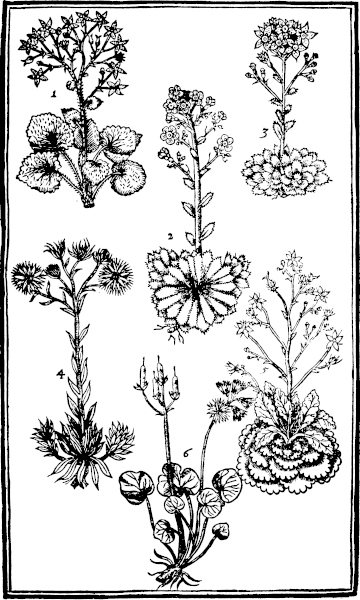
1Sanicula guttata. Spotted Sanicle.
2Cotyledon altera Matthioli. Spotted Nauelwort.
3Cotyledon altera minor. Small dented Nauelwort.
4Cotyledon altera flore rubro stellato. Small red flowred Nauelwort.
5Sedum serratum flore rubente maculato. The Princes Feather.
6Soldanella Alpina. Blew Moonwort.
The Time.
They flower for the most part in the end of May, and sometimes sooner or later, as the yeare falleth out.
The Names.
The first is called by Matthiolus, Cotyledon altera Dioscoridis, and Vmbilicus alter, but it is not the true Cotyledon altera of Dioscorides; for Sedum vulgare maius, Our common Houseleeke, by the consent of the best moderne Writers, is the true Cotyledon altera of Dioscorides, or Vmbilicus Veneris alter. I hold it rather to bee a kinde of small Houseleeke, as the other two likewise are. The second is called by some Aizoum or Sedum minus serratum. The third hath his name in his title. Wee doe call them Nauelworts in English rather then Houseleekes, Euphoniæ gratia. The last may be called dented Sengreene with reddish spotted flowers, but some of our English Gentlewomen haue called it, The Princes Feather, which although it be but a by-name, may well serve for this plant to distinguish it, and whereby to be knowne.
The Vertues.
They are all held to be cold and moist, like vnto other Houseleekes.
Chap. XXXIII. Soldanella Alpina. Mountaine Soldanella or blew Moonewort.
This beautifull plant hath many round and hard leaues, set vpon long foote-stalkes, a little vneuenly cut about the edges, greene on the vpperside, and of a grayish greene vnderneath, and sometime reddish like the leaues of Sowbread, which because they doe somewhat resemble the leaues of Soldanella marina, which is the Sea Bindweede, tooke the name thereof: the stalkes are slender, small, round, and reddish, about a span high, bearing foure or fiue flowers at the toppe, euery one hanging downe their heads, like vnto a Bell flower, consisting but of one leafe (as most of the Bindweeds doe) plated into fiue folds, each of them ending in a long point, which maketh the flower seem to haue fiue leaues, each whereof is deeply cut in on the edges, and hauing a round greene head in the middle, with a pricke or pointell at the end thereof: the flower is of a faire blew colour, sometimes deeper or paler, or white, as nature listeth without any smell at all: the middle head, after the flower is fallen, riseth to be a long round pod, bearing that pricke it had at the end thereof, wherein is contained small greenish seede: the roote hath many fibres shooting from a long round head or roote.
The Place.
This groweth on the Alpes, which are couered with snow the greatest part of the yeare, and will hardly abide transplanting.
The Time.
In the naturall places it flowreth not vntill the Summer moneths, Iune, Iuly, and August, after the snow is melted from the Hils, but being brought into Gardens, it flowreth in the beginning of Aprill or thereabouts.
The Names.
This plant, by reason of the likenesse of leaues with Soldanella, as was before said, is called by many Soldanella, but yet is no Bindweede; and therefore I rather call it in English a Mountaine Soldanella, then as Gerrard doth, Mountaine Bindweede. It is likewise called by some, Lunaria minor cærulea, The lesser blew Lunary or Moonwort, and so I would rather haue it called.
The Vertues.
They that imposed the name of Lunaria vpon this plant, seeme to referre it to the wound or consolidating herbes, but because I haue no further relation or experience, I can say no more thereof vntill tryall hath taught it. Some also from the name Soldanella, which is giuen it, because of the likenesse of the leaues, haue vsed it to help the Dropsie, for which the Sea plant is thought to be effectuall.
Chap. XXXIIII. Auricula Vrsi. Beares eares.
There are so many sundry and seuerall sorts of Beares eares, the variety consisting as well in the differing colours of the flowers, as the forme and colour of the leaues, that I shall not comprehend and set downe vnto you all the diuersities by many, that are risen vp to those that haue beene industrious in the sowing of the seedes of the seuerall sorts of them; yet if you accept of these that I doe here offer vnto you, I shall giue you the knowledge of others, as time, occasion, and the view of them shall enable me. And because they are without all question kinds of Cowslips, I haue set them downe before them in the first place, as being of more beautie and greater respect, or at the least of more rarity vnto vs. To dispose them therefore into order, I shall ranke them vnder three principall colours, that is to say, Red or Purple, White, and Yellow, and shew you the varieties of each of them (for so many as are come to my knowledge) apart by themselues, and not promiscuously as many others haue done.
{Beares eares}
1. Auricula Vrsi flore purpureo. Purple Beares eare, or The Murrey Cowslip.
This purple Beares eare or Cowslip hath many greene leaues, somewhat long and smooth, narrow from the bottome of the leafe to the middle, and broad from thence to the end, being round pointed, and somewhat snipt or endented about the edges; in the middle of these leaues, and sometimes at the sides also, doe spring round greene stalkes foure or fiue fingers high, bearing at the top many flowers, the buds whereof, before they are blowne, are of a very deepe purple colour, and being open, are of a bright, but deepe purple, vsually called a Murrey colour, consisting of fiue leaues a peece, cut in at the end as it were into two, with a whitish ring or circle at the bottome of each flower, standing in small greene cups, wherein after the flowers are fallen, are contained very small heads, not rising to the height of the cups, bearing a small pricke or pointell at the toppe of them, wherein is little blackish seede: the roote hath many whitish strings fastened to the maine long roote, which is very like vnto a Primrose or Cowslip roote, as it is in all other parts besides.
2. Auricula Vrsi purpurea absque orbe. The murrey Cowslip without eyes.
There is another of this kinde, whose leafe is somewhat lesse, as the flower is also, but of the same colour, and sometimes somewhat redder, tending to a Scarlet, without any circle at the bottome of the flower, in no other things differing from it.
3. Auricula Vrsi minor flore tannetto. Tawney Beares eares.
The leaues of this kinde haue a greater shew of mealinesse to be seene in them, and not much smaller then the former, yet snipt or endented about the ends like vnto them: the flowers are many, of the same fashion with the former, but smaller, each whereof is of as deepe a murrey or tawnie colour when it is blowne, as the buds of the former are before they are blowne, hauing a white circle at the bottome of the flower, and yellowish in the middle belowe the circle.
4. Auricula Vrsi flore rubro saturo orbe luteo. Deepe or bloud red Beares eares with eyes.
This kinde hath small and long greene leaues, nothing mealy, but snipt about the edges, from the middle of the leaues forwards to the ends: the flowers hereof are of a deepe red colour, tending to a bloud red, with a deepe yellow circle, or rather bottome in the middle.
Auricula Vrsi flore rubro saturo absque orbe.
There is another of this kinde, whose leaues are somewhat mealy, and smaller then any (that I haue seene) that haue mealy leaues: the flowers are of the same deepe red colour with the last described, yet hath no circle or bottome of any other colour at all.
5. Auricula Vrsi flore purpuro cæruleo. The Violet coloured Beares eare.
We haue another, whose leaues are somewhat mealy and large; the flowers whereof are of a paler purple then the first, somewhat tending to a blew.
6. Auricula Vrsi flore obsoleto magno. The Spaniards blush Beares eare.
This great Beares eare hath as large leaues as any other of this kindred whatsoeuer, and whitish or mealy withall, somewhat snipt about the edges, as many other of them are: the flowers stand at the toppe of a strong and tall stalke, larger then any of the other that I haue seene, being of a duskie blush colour, resembling the blush of a Spaniard, whose tawney skinne cannot declare so pure a blush as the English can; and therefore I haue called it the Spaniards blush.
7. Auricula Vrsi flore rubello. Scarlet or light red Beares eares.
The leaues of this kinde are very like the leaues of the first purple kinde, but that they are not so thicke; of a little paler greene colour, and little or nothing snipt about the edges: the flowers are of a bright, but pale reddish colour, not halfe so deepe as the two last with white circles in the bottomes of them, in other things this differeth not from others.
8. Auricula Vrsi roseo colore. The Rose coloured Beares eare.
We haue another, whose leafe is a little mealy, almost as large as any of the former, whose flowers are of a light red colour, very neare the colour of an ordinary Damaske Rose, with a white eye at the bottome.
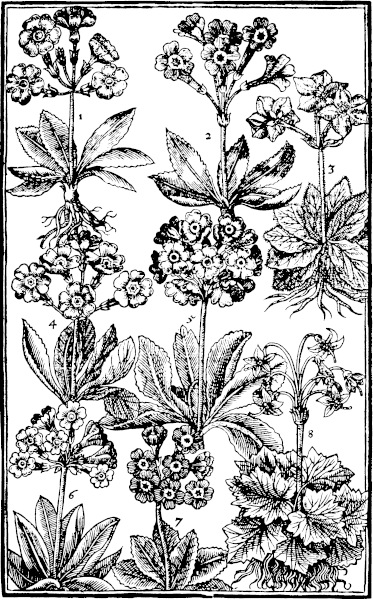
1Auricula Vrsi flore purpureo. Purple Cowslips or Beares eares.
2Auricula Vrsi flore tannetto. Tawney Beares eare.
3Auricula Vrsi flore & folio Boraginis. Blew Beares eares with Borage leaues.
4Auricula Vrsi flore carneo. Blush Beares eare.
5Auricula Vrsi maxima lutea flore eleganti. The greatest faire yellow Beares eares with eyes.
6Auricula Vrsi altera flore luteo. The yellow Beares eare.
7Auricula Vrsi crinis coloris siue flore fusco. The haire coloured Beares eare.
8Cortusa Matthioli. Beares eare Sanicle.
9. Auricula Vrsi flore cæruleo folio Boraginis. Blew Beares eares with Borage leaues.
This plant is referred to the kindred or family of the Beares eares, onely for the forme of the flower sake, which euen therein it doth not assimilate to the halfe; but because it hath passed others with that title, I am content to insert it here, to giue you the knowledge thereof, and rather to satisfie others then my selfe with the place thereof: the description whereof is as followeth: It hath diuers broad rough hairy leaues spread vpon the ground, somewhat like vnto the leaues of Borage for the roughnesse, but not for the largenesse; the leaues hereof being somewhat rent in some places at the edges: from among these leaues rise vp one, or two, or more brownish, round, and hairy stalkes, a span high or thereabouts, bearing at the toppes three or foure flowers a peece, consisting of fiue large pointed leaues, of a faire blew or light azur colour, with some small yellow threads in the middle, standing in small greene cups: the roote is long and brownish, hauing many small fibres annexed vnto it.
10. Auricula Vrsi maior flore albo. The great white Beares eare.
This white Beares eare hath many faire whitish greene leaues, somewhat paler then the leaues of any of the kindes of Beares eares, and a little snipt about the ends, as manie other are: among these leaues rise vp stalkes foure or fiue inches high, bearing at the toppe many flowers like vnto the small yellow Beares eare hereafter set downe, of a pale whitish colour, tending to yellow at the first opening of the flower, which after two or three dayes change into a faire white colour, and so continue all the while it flowreth: the roote is like the purple kinde, as all or most of the rest are, or very little differing.
11. Auricula Vrsi minor flore albo. The lesser white Beares eare.
The lesser Beares eare hath smaller leaues, of a little darker green colour: the stalke and flowers are likewise lesser then the former, and haue no shew of yellownesse at all, eyther in budde or flower, but is pure white, differing not in other things from the rest.
12. Auricula Vrsi maxima lutea flore eleganti. The greatest faire yellow Beares eare with eyes.
This yellow Beares eare hath many faire large thicke leaues, somewhat mealy or hoary vpon the greennesse, being larger then any other kinde, except the sixth, and the next yellow that followeth, smooth about the edges, and without any endenting at all: the stalke is great, round, and not higher then in other of the former, but bearing manie more flowers thereon then in any other kinde, to the number of thirty many times, standing so round and close together, that they seeme to be a Nosegay alone, of the same fashion with the former, but that the leaues are shorter and rounder, yet with a notch in the middle like the rest, of a faire yellow colour, neither very pale nor deepe, with a white eye or circle in the bottome, about the middle of euery flower, which giueth it the greater grace: the seede is of a blackish browne colour, like vnto others, but contained in greater round heads then any other, with a small pointell sticking in the middle: the roote is greater and thicker then any other, with long strings or fibres like vnto the other sorts, but greater.
13. Auricula Vrsi maior lutea folio incano. The greater yellow Beares eare.
This greater yellow Beares eare hath his leaues larger, and more mealy or hoarie then the last, or any other of these kindes: the flowers are not so many, but longer, and not so thicke thrusting together as the first, but of a deeper yellow colour, without any eye or circle in the middle.
14. Auricula Vrsi maior flore pallido. The great Straw coloured Beares eare.
This hath almost as mealy leaues as the last, but nothing so large; the flowers are of a faire strawe colour, with a white circle at the bottome of them, these three last haue no shew or shadow of any other colour in any part of the edge, as some others that follow haue.
15. Auricula Vrsi minor flore pallente. The lesser straw coloured Beares eare.
We haue another, whose leafe is lesse mealy, or rather pale green, and a little mealy withall; the flowers whereof are of a paler yellow colour then the last, and beareth almost as many vpon a stalke as the first great yellow.
16. Auricula Vrsi minor lutea. The lesser yellow Beares eares.
The leaues of this Beares eare are nothing so large as either of the three former yellow kindes, but rather of the bignesse of the first white kinde, but yet a little larger, thicker, and longer then it, hauing vnder the greennesse a small shew of mealinesse, and somewhat snipt about the edges: the flowers are of a pale yellow colour, with a little white bottome in them: the seed and rootes are like vnto the other kindes.
17. Auricula Vrsi flore flauo. The deepe yellow or Cowslip Beares eare.
This kinde hath somewhat larger leaues then the last, of a yellowish greene colour, without any mealinesse on them, or endenting about the edges, but smooth and whole: the flowers are not larger but longer, and not laide open so fully as the former, but of as deepe a yellow colour as any Cowslip almost, without any circle in the bottome: neither of these two last haue any shew of other colour then yellow in them, sauing the white in the eye.
18. Auricula Vrsi versicolor prima siue flore rubescente. The blush Beares eare.
The blush Beares eare hath his leaues as large, and as hoary or mealy as the third greater yellow, or straw coloured Beares eare; among which riseth vp a stalke about foure inches high, bearing from six to twelue, or more faire flowers, somewhat larger then the smaller yellow Beares eare before described, hauing the ground of the flower of a darke or dunne yellow colour, shadowed ouer a little with a shew of light purple, which therefore we call a blush colour, the edges of the flower being tipt with a little deeper shew of that purple colour, the bottome of the flower, abiding wholly yellow, without any circle, and is of very great beauty, which hath caused me to place it in the forefront of the variable coloured Beares eares. And although some might thinke it should be placed among the first ranke of Beares eares, because it is of a blush colour, yet seeing it is assuredly gained from some of the yellow kindes by sowing the seede, as many other sorts are, as may be seene plainly in the ground of the flower, which is yellow, and but shadowed ouer with purple, yet more then any of the rest that follow; I thinke I haue giuen it his right place: let others of skill & experience be iudges herein.
19. Auricula Vrsi crinis coloris. Haire coloured Beares eares.
The leaues of this kinde are more mealy like then the last blush kinde, but somewhat longer and larger, and snipt about the edges in the same manner, from the middle of the leafe forwards: the flower is vsually of a fine light browne yellow colour, which wee doe vsually call an Haire colour, and sometimes browner, the edges of the flower haue a shew or shadow of a light purple or blush about them, but more on the outside then on the inside.
20. Auricula Vrsi versicolor lutea. The yellow variable Beares eare.
This variable Beares eare hath his greene leaues somewhat like vnto the deepe yellow, or Cowslip Beares eare before described, but somewhat of a fresher greene, more shining and smaller, and snipt about the edges towards the ends, as many of those before are: the flowers are of a faire yellow colour, much laid open when it is full blowne, that it seemeth almost flat, dasht about the edges onely with purple, being more yellow in the bottome of the flower, then in any other part.
21. Auricula Vrsi versicolor lutescente viridi flore. The variable greene Beares eare.
This kinde of Beares eare hath greene leaues, very like vnto the last described, and snipt in the like manner about the edges, but in this it differeth, that his leaues do turne or fold themselues a little backwards: the flowers are of a yellowish greene colour, more closed then the former, hauing purplish edges, especially after they haue stood blowne some time, and haue little or none at the first opening: these haue no circles at all in them.
Many other varieties are to be found, with those that are curious conseruers of these delights of nature, either naturally growing on the mountaines in seuerall places, from whence they (being searched out by diuers) haue been taken and brought, or else raised from the seede of some of them, as it is more probable: for seuerall varieties haue beene obserued (and no doubt many of these before specified) to bee gotten by sowing of the seedes, euery yeare lightly shewing a diuersity, not obserued before, either in the leafe, diuers from that from whence it was taken, or in the flowers. I haue onely set downe those that haue come vnder mine owne view, and not any by relation, euen as I doe with all or most of the things contained in this worke.
The Place.
Many of these goodly plants growe naturally on mountaines, especially the Alpes, in diuers places; for some kindes that growe in some places, doe not in others, but farre distant one from the other. There hath likewise some beene found on the Pyrenæan mountaines, but that kinde with the blew flower and Borage leafe, hath beene gathered on the mountaines in Spaine, and on the Pyrenæans next vnto Spaine.
The Time.
They all flower in Aprill and May, and the seede is ripe in the end of Iune, or beginning of Iuly, and sometimes they will flower againe in the end of Summer, or in Autumne, if the yeare proue temperate, moist, and rainie.
The Names.
It is very probable, that none of these plants were euer knowne vnto the ancient Writers, because we cannot be assured, that they may be truely referred vnto any plant that they name, vnlesse we beleeue Fabius Columna, that it should be Alisma of Dioscorides, for thereunto hee doth referre it. Diuers of the later Writers haue giuen vnto them diuers names, euery one according to his owne conceit. For Gesner calleth it Lunaria arthritica, and Paralytica Alpina. Matthiolus accounteth it to bee of the kindred of the Sanicles, and saith, that in his time it was called by diuers Herbarists, Auricula Vrsi, which name hath since bin receiued as most vsuall. We in English call them Beares eares, according to the Latine, or as they are called by diuers women, French Cowslips; they may be called Mountaine Cowslips, if you will, for to distinguish betweene them and other Cowslips, whereof these are seuerall kindes.
Sanicula Alpina siue Cortusa Matthioli. Beares eare Sanicle.
I cannot chuse but insert this delicate plant in the end of the Beares eares, for that it is of so neare affinity, although it differ much in the forme of the leaues, the description whereof is in this manner: The leaues that spring vp first are much crumpled, and as it were folded together, which afterwards open themselues into faire, broad, and roundish leaues, somewhat rough or hairy, not onely cut into fine diuisions, but somewhat notched also about the edges, of a darke greene colour on the vpperside, and more whitish greene vnderneath; amongst these leaues riseth vp one or two naked round stalkes, fiue or six inches high, bearing at the toppes diuers small flowers, somewhat sweete, like vnto the first purple Beares eare, hanging downe their heads, consisting of fiue small pointed leaues a peece, of a darke reddish purple colour, with a white circle or bottome in the middle, and some small threads therein: after the flowers are past, there come small round heads, somewhat longer then any of the Beares eares, standing vpright vpon their small foot-stalkes, wherein is contained small round and blackish seede: the roote consisteth of a thicke tuft of small whitish threads, rather then rootes, much enterlaced one among another: the leaues of this plant dye downe euery yeare, and spring vp a new in the beginning of the yeare, whereas all the Beares eares doe hold their leaues greene all the Winter, especially the middlemost, which stand like a close head, the outermost for the most part perishing after seed time.
The Place.
This groweth in many shadowie Woods both of Italy and Germany; for both Clusius hath described it, finding it in the Woods of Austria and Stiria; and Matthiolus setteth it downe, hauing receiued it from Anthonius Cortusus, who was President of the Garden at Padua, and found it in the woody mountaines of Vicenza, neare vnto Villestagna; whereon (as Matthiolus saith) there is found both with white flowers as well as with blew, but such with white flowers or blew we neuer could see or heare further of.
The Time.
It flowreth much about the time of the Beares eares; or rather a little later, and the seede is ripe with them.
The Names.
Clusius calleth it Sanicula montana, and Sanicula Alpina, and referreth it to the Auricula Vrsi, or Beares eare, which it doth most nearly resemble: but Matthiolus referreth it to the Cariophyllata or Auens, making it to be of that tribe or family, and calleth it Cortusa of him that first sent it him. Wee may call it eyther Cortusa, as for the most part all Herbarists doe, or Beares eare Sanicle as Gerrard doth.
The Vertues.
All the sorts of Beares eares are Cephalicall, that is, conducing helpe for the paines in the head, and for the giddinesse thereof, which may happen, eyther by the sight of steepe places subiect to danger, or otherwise. They are accounted also to be helping for the Palsey, and shaking of the ioynts; and also as a Sanicle or wound-herbe. The leaues of the Cortusa taste a little hot, and if one of them bee laide whole, without bruising, on the cheeke of any tender skind woman, it will raise an orient red colour, as if some fucus had beene laide thereon, which will passe away without any manner of harme, or marke where it lay: This is Cortusus his obseruation Camerarius in his Hortus Medicus saith, that an oyle is made thereof, that is admirable for to cure wounds.
Chap. XXXV. Primula veris & Paralysis. Primroses and Cowslips.
We haue so great variety of Primroses and Cowslips of our owne Country breeding, that strangers being much delighted with them, haue beene often furnished into diuers Countries, to their good content: And that I may set them downe in some methodicall manner, as I haue done other things, I will first set downe all the sorts of those we call Primroses, both single and double, and afterwards the Cowslips with their diuersities, in as ample manner as my knowledge can direct me. And yet I know, that the name of Primula veris or Primrose, is indifferently conferred vpon those that I distinguish for Paralyses or Cowslips. I doe therefore for your better vnderstanding of my distinction betweene Primroses and Cowslips, call those onely Primroses that carry but one flower vpon a stalke, be they single or double, except that of Master Hesket, and that with double flowers many vpon a stalke, set out in Gerards Herball, which is his onely, not found (as I thinke) in rerum natura, I am sure, such a one I could neuer heare of: And those Cowslips, that beare many flowers vpon a stalke together constantly, be they single or double also. I might otherwise distinguish them also by the leafe; that all the Primroses beare their long and large broad yellowish greene leaues, without stalkes most vsually; and all the Cowslips haue small stalkes vnder the leaues, which are smaller, and of a darker greene, as vsually, but that this distinction is neither so certaine and generall, nor so well knowne.
1. Primula veris flore albo. The single white Primrose.
The Primrose that groweth vnder euery bush or hedge, in all or most of the Woods, Groues, and Orchards of this Kingdome, I may well leaue to his wilde habitation, being not so fit for a Garden, and so well knowne, that I meane not to giue you any further relation thereof: But we haue a kinde hereof which is somewhat smaller, and beareth milke white flowers, without any shew of yellownesse in them, and is more vsually brought into Gardens for the rarity, and differeth not from the wilde or ordinary kinde, either in roote or leafe, or any thing else, yet hauing those yellow spots, but smaller, and not so deepe, as are in the other wilde kinde.
2. Primula veris flore viridi simplici. The single greene Primrose.
The single greene Primrose hath his leaues very like vnto the greater double Primrose, but smaller, and of a sadder greene colour: the flowers stand seuerally vpon long foot-stalkes, as the first single kinde doth, but larger then they, and more laide open, of the same, or very neare the same yellowish greene colour that the huske is of, so that at the first opening, the huske and the flower seeme to make one double greene flower, which afterwards separating themselues, the single flower groweth aboue the huske, and spreadeth it selfe open much more then any other single Primrose doth, growing in the end to be of a paler greene colour.
3. Primula veris flore viridante & albo simplici. The single greene and white Primrose.
The leaues of this differ in a manner nothing from the former, neither doth the flower but only in this, that out of the large yellowish green huskes, which contain the flowers of the former, there commeth forth out of the middle of each of them either a small peece of a whitish flower, or else a larger, sometimes making vp a whole flower, like an ordinary Primrose.
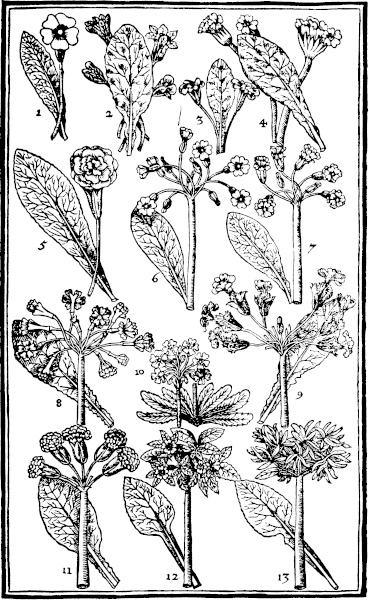
1Primula veris flore albo. The white Primrose.
2Primula veris flore viridi & albo simplici. The green and white Primrose.
3Primula veris flore viridi duplici. The double green Primrose.
4Primula veris Hesketi. Master Heskets double Primrose.
5Primula veris flore pleno vulgaris. The ordinary double Primrose.
6Paralysis veris flore viridante simplici. The single green Cowslip.
7Paralysis flore geminato odorato. Double Cowslips or hose in hose.
8Paralysis inodora flore geminato. Double Oxelips hose in hose.
9Paralysis hortensis flore & calice crispo. Curld Cowslips or Gaskins.
10Paralysis minor angustifolia flore rubro. Red Birds eyen.
11Paralysis hortensis flore pleno vulgaris. Double Paigles.
12Paralysis fatuo. The foolish Cowslip or Iacke an Apes on horse backe.
13Paralysis flore viridi roseo calamistrato. The double greene feathered Cowslip.
4. Primula veris flore viridi duplici. The double greene Primrose.
This double Primrose is in his leaues so like the former single greene kindes, that the one cannot be knowne from the other vntill it come to flower, and then it beareth vpon euery stalke a double green flower, of a little deeper green colour then the flower of the former single kinde consisting but of two rowes of short leaues most vsually, and both of an equall height aboue the huske, abiding a pretty time in flower, especially if it stand in any shadowed place, or where the Sun may come but a while vnto it.
5. Primula veris Hesketi flore multiplici separatim diviso. Master Heskets double Primrose.
Master Heskets double Primrose is very like vnto the small double Primrose, both in leafe, roote, and height of growing, the stalke not rising much higher then it, but bearing flowers in a farre different manner; for this beareth not only single flowers vpon seuerall stalkes, but sometimes two or three single flowers vpon one stalk, and also at the same time a bigger stalke, and somewhat higher, hauing one greene huske at the toppe thereof, sometimes broken on the one side, and sometimes whole, in the middle whereof standeth sometimes diuers single flowers, thrust together, euery flower to be seene in his proper forme, and sometimes there appeare with some whole flowers others that are but parts of flowers, as if the flowers were broken in peeces, and thrust into one huske, the leaues of the flowers (being of a white or pale Primrose Colour, but a little deeper) seldome rising aboue the height of the very huske it selfe; and sometimes, as I haue obserued in this plant, it will haue vpon the same stalke, that beareth such flowers as I haue here described vnto you, a small flower or two, making the stalke seeme branched into many flowers, whereby you may perceiue, that it will vary into many formes, not abiding constant in any yeare, as all the other sorts doe.
6. Primula hortensis flore pleno vulgaris. The ordinary double Primrose.
The leaues of this Primrose are very large, and like vnto the single kind, but somewhat larger, because it growth in gardens: the flowers doe stand euery one seuerally vpon slender long footestalkes, as the single kinde doth, in greenish huskes of a pale yellow colour, like vnto the field Primrose, but very thicke and double, and of the same sweete sent with them.
7. Primula veris flore duplici. The small double Primrose.
This Primrose is both in leafe, roote, and flower, altogether like vnto the last double Primrose, but that it is smaller in all things; for the flower riseth not aboue two or three fingers high, and but twice double, that is, with two rowes of leaues, yet of the very same Primrose colour that the former is of.
8. Paralysis vulgaris pratensis flore flauo simplici odorato. The Common field Cowslip.
The common fielde Cowslip I might well forbeare to set downe, being so plentifull in the fields: but because many take delight in it, and plant it in their gardens, I will giue you the description of it here. It hath diuers green leaues, very like vnto the wilde Primrose, but shorter, rounder, stiffer, rougher, more crumpled about the edges, and of a sadder greene colour, euery one standing vpon his stalke, which is an inch or two long: among the leaues rise vp diuers round stalkes, a foote or more high, bearing at the toppe many faire yellow single flowers, with spots of a deeper yellow, at the bottome of each leafe, smelling very sweete. The rootes are like to the other Primroses, hauing many fibres annexed to the great roote.
9. Paralysis altera odorata flore pallido polyanthos. The Primrose Cowslip.
The leaues of this Cowslip are larger then the ordinary fielde Cowslip, and of a darke yellowish greene colour; the flowers are many, standing together, vpon the toppes of the stalkes, to the number of thirty sometimes vpon one stalke, as I haue counted them in mine owne Garden, and sometimes more, euery one hauing a longer foote stalke then the former, and of as pale a yellowish colour almost as the fielde Primrose, with yellow spots at the bottome of the leaues, as the ordinary hath, and of as sweet a sent.
10. Paralysis flore viridante simplici. The single greene Cowslip.
There is little difference in leafe or roote of this from the first Cowslip, the chiefest varietie in this kinde is this, that the leaues are somewhat greener, and the flowers being in all respects like in forme vnto the first kinde, but somewhat larger, are of the same colour with the greene huskes, or rather a little yellower, and of a very small sent; in all other things I finde no diuersitie, but that it standeth much longer in flower before it fadeth, especially if it stand out of the Sunne.
11. Paralysis flore & calice crispo. Curl’d Cowslips or Gallegaskins.
There is another kinde, whose flowers are folded or crumpled at the edges, and the huskes of the flowers bigger than any of the former, more swelling out in the middle, as it were ribbes, and crumpled on the sides of the huskes, which doe somewhat resemble mens hose that they did weare, and tooke the name of Gallegaskins from thence.
12. Paralysis flore geminato odorato. Double Cowslips one within another, or Hose in Hose.
The only difference of this kinde from the ordinary field Cowslip is, that it beareth one single flower out of another, which is as a greene huske, of the like sent that the first hath, or somewhat weaker.
13. Paralysis flore flauo simplici inodoro absque calicibus. Single Oxe lippes.
This kinde of Cowslip hath leaues much like the ordinary kinde, but somewhat smaller: the flowers are yellow like the Cowslip, but smaller, standing many vpon a stalke, but bare or naked, that is, without any huske to containe them, hauing but little or no sent at all; not differing in any thing else from the ordinary Cowslip.
14. Paralysis flore geminato inodora. Double Oxelips Hose in Hose.
As the former double Cowslip had his flowers one within another, in the very like manner hath this kinde of Cowslip or Oxelippe, sauing that this hath no huske to containe them, no more then the former single Oxelippe hath, standing bare or naked, of the very same bignesse each of them, and of the same deepe yellow colour with it, hauing as small a sent as the former likewise.
Flore pallidiora.
Wee haue another of this kinde, whose leaues are somewhat larger, and so are the flowers also, but of a paler yellow colour.
15. Paralysis inodora calicibus dissectis. Oxelips with iagged huskes.
This kinde differeth not from the first Oxelip in the smalnesse of the greene leaues, but in the flower, which standing many together on a reasonable high stalke, and being very small and yellow, scarce opening themselues or layde abroade as it, hath a greene huske vnder each flower, but diuided into sixe seuerall small long peeces.
16. Paralysis flore fatuo. The Franticke, or Foolish Cowslip: Or Iacke an apes on horse backe.
Wee haue in our gardens another kinde, not much differing in leaues from the former Cowslip, and is called Fantasticke or Foolish, because it beareth at the toppe of the stalke a bush or tuft of small long greene leaues, with some yellow leaues, as it were peeces of flowers broken, and standing among the greene leaues. And sometimes some stalkes among those greene leaues at the toppe (which are a little larger then when it hath but broken peeces of flowers) doe carry whole flowers in huskes like the single kinde.
17. Paralysis minor flore rubro. Red Birds eyes.
This little Cowslippe (which will hardly endure in our gardens, for all the care and industrie we can vse to keepe it) hath all the Winter long, and vntill the Spring begin to come on, his leaues so closed together, that it seemeth a small white head of leaues, which afterwards opening it selfe, spreadeth round vpon the ground, and hath small long and narrow leaues, snipt about the edges, of a pale greene colour on the vpperside, & very white or mealy vnderneath, among these leaues rise vp one or two stalks, small & hoary, halfe a foot high, bearing at the top a bush or tuft of much smaller flowers, standing vpon short foot stalkes, somewhat like vnto Cowslips, but more like vnto the Beares eares, of a fine reddish purple colour, in some deeper, in others paler, with a yellowish circle in the bottomes of the flowers, like vnto many of the Beares eares, of a faint or small sent: the seede is smaller than in any of the former kindes, and so are the rootes likewise, being small, white and threddy.
18. Paralysis minor flore albo. White Birds eyes.
This kinde differeth very little or nothing from the former, sauing that it seemeth a little larger both in leafe and flower, and that the flowers hereof are wholly white, without any great appearance of any circle in the bottome of them, vnlesse it be well obserued, or at least being nothing so conspicuous, as in the former.
Flore geminato.
These two kindes haue sometimes, but very seldome, from among the middle of the flowers on the stalke, sent out another small stalke, bearing flowers thereon likewise.
19. Paralysis hortensis flore pleno. Double Paigles or Cowslips.
The double Paigle or Cowslip hath smaller and darker greene leaues then the single kinde hath, and longer stalkes also whereon the leaues doe stand: it beareth diuers flowers vpon a stalke, but not so many as the single kinde, euery one whereof is of a deeper and fairer yellow colour then any of the former, standing not much aboue the brimmes of the huskes that hold them, consisting of two or three rowes of leaues set round together, which maketh it shew very thicke and double, of a prettie small sent, but not heady.
20. Paralysis flore viridante pleno. Double greene Cowslips.
This double greene Cowslip is so like vnto the single greene kinde formerly expressed, that vntill they be neare flowring, they can hardly be distinguished; but when it is in flower, it hath large double flowers, of the same yellowish greene colour with the single, and more laid open then the former double Paigle.
21. Paralysis flore viridante siue calamistrato. The greene Rose Cowslip, or double greene feathered Cowslip.
There is small difference in the leaues of this double kinde from the last, but that they are not of so darke a greene: the chiefest difference consisteth in the flowers, which are many, standing together at the toppes of the stalkes, but farre differing from all other of these kindes: for euery flower standing vpon his owne stalke, is composed of many very small and narrow leaues, without any huske to containe them, but spreading open like a little Rose, of a pale yellowish greene colour, and without any sent at all, abiding in flower, especially if it stand in a shadowie place out of the sunne, aboue two moneths, almost in as perfect beauty, as in the first weeke.
The Place.
All those kindes as they haue been found wilde, growing in diuers places in England, so they haue been transplanted into Gardens, to be there nourished for the delight of their louers, where they all abide, and grow fairer then in their naturall places, except the small Birds eyes, which will (as I said) hardly abide any culture, but groweth plentifully in all the North Countries, in their squally or wet grounds.
The Time.
These doe all flower in the Spring of the yeare, some earlier and some later, and some in the midst of Winter, as they are defended from the colds and frosts, and the mildnesse of the time will permit; yet the Cowslips doe alwayes flower later then the Primroses, and both the single and double greene Cowslips latest, as I said in their descriptions, and abide much after all the rest.
The Names.
All these plants are called most vsually in Latine, Primulæ veris, Primulæ pratenses, and Primulæ siluarum, because they shew by their flowring the new Spring to bee comming on, they being as it were the first Embassadours thereof. They haue also diuers other names, as Herba Paralysis, Arthritica, Herba Sancti Petri, Claues Sancti Petri, Verbasculum odoratum, Lunaria arthritica, Phlomis, Alisma siluarum, and Alismatis alterum genus, as Fabius Columna calleth them. The Birds eyes are called of Lobel in Latine, Paralytica Alpina, Sanicula angustifolia, making a greater and a lesser. Others call them Sanicula angustifolia, but generally they are called Primula veris minor. I haue (as you see) placed them with the Cowslips, putting a difference betweene Primroses and Cowslips. And some haue distinguished them, by calling the Cowslips, Primula veris Elatior, that is, the Taller Primrose, and the other Humilis, Lowe or Dwarfe Primroses. In English they haue in like manner diuers names, according to seuerall Countries, as Primroses, Cowslips, Oxelips, Palsieworts, and Petty Mulleins. The first kindes, which are lower then the rest, are generally called by the name of Primroses (as I thinke) throughout England. The others are diuersly named; for in some Countries they call them Paigles or Palsieworts, or Petty Mulleins, which are called Cowslips in others. Those are vsually called Oxelips, whose flowers are naked, or bare without huskes to containe them, being not so sweete as the Cowslip, yet haue they some little sent, although the Latine name doth make them to haue none. The Franticke, Fantasticke, or Foolish Cowslip, in some places is called by Country people, Iacke an Apes on horse-backe, which is an vsuall name with them, giuen to many other plants, as Daisies, Marigolds, &c. if they be strange or fantasticall, differing in the forme from the ordinary kinde of the single ones. The smallest are vsually called through all the North Country, Birds eyen, because of the small yellow circle in the bottomes of the flowers, resembling the eye of a bird.
The Vertues.
Primroses and Cowslips are in a manner wholly vsed in Cephalicall diseases, either among other herbes or flowers, or of themselues alone, to ease paines in the head, and is accounted next vnto Betony, the best for that purpose. Experience likewise hath shewed that they are profitable both for the Palsie, and paines of the ioynts, euen as the Beares eares are, which hath caused the name of Arthritica, Paralysis, and Paralytica to bee giuen them. The iuice of the flowers is commended to cleanse the spots or marks of the face, whereof some Gentlewomen haue found good experience.
Chap. XXXVI. Pulmonaria. Lungwort, or Cowslips of Ierusalem.
Although these plants are generally more vsed as Pot-herbes for the Kitchen, then as flowers for delight, yet because they are both called Cowslips, and are of like forme, but of much lesse beauty, I haue ioyned them next vnto them, in a distinct Chapter by themselues, and so may passe at this time.
1. Pulmonaria maculosa. Common spotted Cowslips of Ierusalem.
The Cowslip of Ierusalem hath many rough, large, and round leaues, but pointed at the ends, standing vpon long foot-stalkes, spotted with many round white spots on the vppersides of the sad greene or browne leaues, and of a grayer greene vnderneath: among the leaues spring vp diuers browne stalkes, a foote high, bearing many flowers at the toppe, very neare resembling the flowers of Cowslips, being of a purple or reddish colour while they are buds, and of a darke blewish colour when they are blowne, standing in brownish greene huskes, and sometimes it hath beene found with white flowers: when the flowers are past, there come vp small round heads, containing blacke seed: the roote is composed of many long and thicke blacke strings.
2. Pulmonaria altera non maculosa. Vnspotted Cowslips of Ierusalem.
The leaues of this other kinde are not much vnlike the former, being rough as they are, but smaller, of a fairer greene colour aboue, and of a whiter greene vnderneath, without any spots at all vpon the leaues: the flowers also are like the former, and of the same colour, but a little more branched vpon the stalkes then the former: the rootes also are blacke like vnto them.
3. Pulmonaria angustifolia. Narrow leafed Cowslips of Ierusalem.
The leaues hereof are somewhat longer, but not so broad, and spotted with whitish spots also as the former: the stalke hereof is set with the like long hairy leaues, but smaller, being a foote high or better, bearing at the toppe many flowers, standing in huskes like the first, being somewhat reddish in the bud, and of a darke purplish blew colour when they are blowne open: the seede is like the former, all of them doe well resemble Buglosse and Comfrey in most parts, except the roote, which is not like them, but stringie, like vnto Cowslips, yet blacke.
The Place.
The Cowslips of Ierusalem grow naturally in the Woods of Germany, in diuers places, and the first kinde in England also, found out by Iohn Goodier, a great searcher and louer of plants, dwelling at Maple-durham in Hampshire.
The Time.
They flower for the most part very early, that is, in the beginning of Aprill.
The Names.
They are generally called in Latine, Pulmonaria, and maculosa, or non maculosa, is added for distinctions sake. Of some it is called Symphitum maculosum, that is, spotted Comfrey. In English it is diuersly called, as spotted Cowslips of Ierusalem, Sage of Ierusalem, Sage of Bethlehem, Lungwort, and spotted Comfrey, and it might bee as fitly called spotted Buglosse, whereunto it is as like as vnto Comfrey, as I said before.
The Vertues.
It is much commended of some, to bee singular good for vlcered lungs, that are full of rotten matter. As also for them that spit bloud, being boyled and drunke. It is of greatest vse for the pot, being generally held to be good, both for the lungs and the heart.
Chap. XXXVII. 1. Buglossum & Borrago. Buglosse and Borage.
Although Borage and Buglosse might as fitly haue been placed, I confesse, in the Kitchen Garden, in regard they are wholly in a manner spent for Physicall properties, or for the Pot, yet because anciently they haue been entertained into Gardens of pleasure, their flowers hauing been in some respect; in that they haue alwaies been enterposed among the flowers of womens needle-worke, I am more willing to giue them place here, then thrust them into obscurity, and take such of their tribe with them also as may fit for this place, either for beauty or rarity.
The Garden Buglosse and Borage are so well knowne vnto all, that I shall (I doubt) but spend time in waste to describe them; yet not vsing to passe ouer any thing I name and appropriate to this Garden so sleightly, they are thus to bee knowne: Buglosse hath many long, narrow, hairy, or rough sad greene leaues, among which rise vp two or three very high stalks, branched at the top, whereon stand many blew flowers, consisting of fiue small round pointed leaues, with a small pointell in the middle, which are very smooth, shining, and of a reddish purple while they are buds, and not blowne open, which being fallen, there groweth in the greene huske, wherein the flower stood, three or foure roundish blacke seedes, hauing that thread or pointell standing still in the middle of them: the roote is blacke without, and whitish within, long, thicke, and full of slimie iuice (as the leaues are also) and perisheth not euery yeare, as the roote of Borage doth.
2. Borrago. Borage.
Borage hath broader, shorter, greener, and rougher leaues then Buglosse, the stalkes hereof are not so high, but branched into many parts, whereon stand larger flowers, and more pointed at the end then Buglosse, and of a paler blew colour for the most part (yet sometimes the flowers are reddish, and sometimes pure white) each of the flowers consisting of fiue leaues, standing in a round hairy whitish huske, diuided into fiue parts, and haue a small vmbone of fiue blackish threads in the middle, standing out pointed at the end, and broad at the bottome: the seed is like the other: the root is thicker and shorter then the roote of Buglosse, somewhat blackish without also, and whitish within, and perisheth after seede time, but riseth of it owne seede fallen, and springeth in the beginning of the yeare.
3. Borrago semper virens. Euerliuing Borage.
Euerliuing Borage hath many broad greene leaues, and somewhat rough, more resembling Comfrey then Borage, yet not so large as either; the stalkes are not so high as Borage, and haue many small blew flowers on them, very like to the flowers of Buglosse for the forme, and Borage for the colour; the rootes are blacke, thicker then either of them, somewhat more spreading, and not perishing, hauing greene leaues all the Winter long, and thereupon tooke his name.
4. Anchusa. Sea Buglosse or Alkanet.
The Sea Buglosse or Alkanet hath many long, rough, narrow, and darke greene leaues, spread vpon the ground (yet some that growe by the Sea side are rather hoarie and whitish) among these leaues riseth vp a stalke, spread at the toppe into many branches, whereon stand the flowers in tufts, like vnto the Garden Buglosse, or rather Comfrey, but lesser; in some plants of a reddish blew colour, and in others more red or purplish, and in others of a yellowish colour: after which come the seedes, very like vnto Buglosse, but somewhat longer and paler: the roote of most of them being transplanted, are somewhat blackish on the outside, vntill the later end of Summer, and then become more red: for those that grow wilde, will be then so red, that they will giue a very deepe red colour to those that handle them, which being dryed keepe that red colour, which is vsed to many purposes; the roote within being white, and hauing no red colour at all.
5. Limonium Rauwolfij. Marsh Buglosse.
This Limonium (which I referre here to the kindes of Buglosse, presuming it is the fittest place where to insert it) hath many long narrow, and somewhat rough leaues lying vpon the ground, waued or cut in on both sides, like an Indenture, somewhat like the leaues of Ceterach or Miltwast, among which rise vp two or three stalkes, somewhat rough also, and with thin skinnes like wings, indented on both sides thereof also, like the leaues, hauing three small, long, rough, and three square leaues at euery ioynt, where it brancheth forth; at the toppe whereof stand many flowers vpon their foote stalkes, in such a manner, as is not seene in any other plant, that I know; for although that some of the small winged foot stalkes are shorter, and some longer, standing as it were flatwise, or all on one side, and not round like an vmbell, yet are they euen at the toppe, and not one higher than another; each of which small foote stalkes doe beare foure or fiue greenish heads or huskes, ioyned together, out of each of which doe arise other pale or bleake blew stiffe huskes, as if they were flowers, made as it were of parchment, which hold their colour after they are dry a long time; and out of these huskes likewise, doe come (at seuerall times one after another, and not all at one time or together) white flowers, consisting of fiue small round leaues, with some white threds in the middle: after these flowers are past, there come in their places small long seede, inclosed in many huskes, many of those heads being idle, not yeelding any goode seede, but chaffe, especially in out Countrey, for the want of sufficient heate of the Sunne, as I take it: the roote is small, long, and blackish on the outside, and perisheth at the first approach of Winter.
The Place.
Borage and Buglosse grow onely in Gardens with vs, and so doth the Semper virens, his originall being vnknowne vnto vs. Alkanet or Sea Buglosse groweth neare the Sea, in many places of France, and Spaine, and some of the kindes also in England. But the Limonium or Marshe Buglosse groweth in Cales, and Malacca in Spaine, and is found also in Syria, as Rauwolfius relateth: and in other places also no doubt; for it hath beene sent vs out of Italie, many yeares before eyther Guillaume Boel found it in Cales, or Clusius in Malacca.
The Time.
Borage and Buglosse doe flower in Iune, and Iuly, and sometimes sooner, and so doth the euer-liuing or neuer-dying Borage, but not as Gerrard saith, flowring Winter and Summer, whereupon it should take his name, but leaueth flowring in Autumne, and abideth greene with his leaues all the Winter, flowring the next Spring following. The other flower not vntill Iuly, and so continue, especially the Marshe Buglosse vntill September bee well spent, and then giueth seede, if early frosts ouertake it not; for it seldome commeth to be ripe.
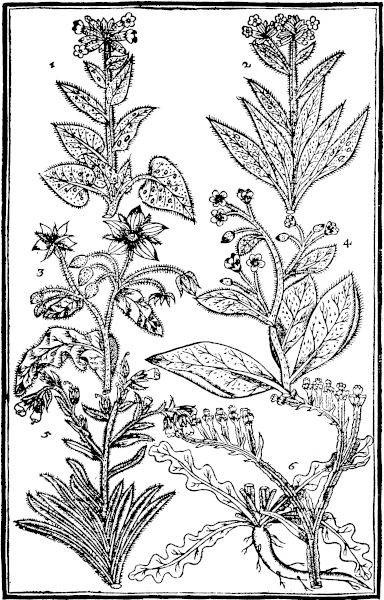
1Pulmonaria latifolia maculosa. Cowslips of Ierusalem.
2Pulmonaria angustifolia. Narrow leafed Cowslips of Ierusalem.
3Borrago. Borage.
4Borrago semper virens. Euerliuing Borage.
5Anchusa. Sea Buglosse or Alkanet.
6Limonium Rauwolfij. Marsh Buglosse.
The Names.
Our ordinary Borage by the consent of all the best moderne Writers, is the true Buglossum of Dioscorides, and that our Buglosse was vnknowne to the ancients. The Borago semper virens, Lobel calleth Buglossum semper virens, that is, Euer-liuing, or Greene Buglosse: but it more resembleth Borage then Buglosse; yet because Buglosse abideth greene, to auoyde that there should not be two Buglossa semper virentia, I had rather call it Borage then Buglosse. Anchusa hath diuers names, as Dioscorides setteth downe. And some doe call it Fucus herba, from the Greeke word, because the roote giuing so deepe a colour, was vsed to dye or paint the skinne. Others call it Buglossum Hispanicum, in English Alkanet, and of some Orchanet, after the French. Limonium was found by Leonhartus Rauwolfius, neere vnto Ioppa, which he setteth downe in the second Chapter of the third booke of his trauayles, and from him first knowne to these parts: I haue, as you see, referred it to the kindes of Buglosse, for that the flowers haue some resemblance vnto them, although I know that Limonium genuinum is referred to the Beetes. Let it therefore here finde a place of residence, vntill you or I can finde a fitter; and call it as you thinke best, eyther Limonium as Rauwolfius doth, or Marshe Buglosse as I doe, or if you can adde a more proper name, I shall not be offended.
The Vertues.
Borage and Buglosse are held to bee both temperate herbes, beeing vsed both in the pot and in drinkes that are cordiall, especially the flowers, which of Gentlewomen are candid for comfitts. The Alkanet is drying, and held to be good for wounds, and if a peece of the roote be put into a little oyle of Peter or Petroleum, it giueth as deepe a colour to the oyle, as the Hypericon doth or can to his oyle, and accounted to be singular good for a cut or greene wound.
The Limonium hath no vse that wee know, more then for a Garden; yet as Rauwolfius saith, the Syrians vse the leaues as sallats at the Table.
Chap. XXXVIII. Lychnis. Campions.
There bee diuers sorts of Campions, as well tame as wilde, and although some of them that I shall here entreate of, may peraduenture be found wilde in our owne Countrey, yet in regard of their beautifull flowers, they are to bee respected, and noursed vp with the rest, to furnish a garden of pleasure; as for the wilde kindes, I will leaue them for another discourse.
1. Lychnis Coronaria rubra simplex. The single red Rose Campion.
The single red Rose Campion hath diuers thicke, hoary, or woolly long greene leaues, abiding greene all the winter, and in the end of the spring or beginning of summer, shooteth forth two or three hard round woolly stalkes, with some ioynts thereon, and at euery ioynt two such like hoary greene leaues as those below, but smaller, diuersly branched at the toppe, hauing one flower vpon each seuerall long foot stalke, consisting of fiue leaues, somewhat broade and round pointed, of a perfect red crimson colour, standing out of a hard long round huske, ridged or crested in foure or fiue places; after the flowers are fallen there come vp round hard heads, wherein is contained small blackish seed: the roote is small, long and wooddy, with many fibres annexed vnto it, and shooteth forth anew oftentimes, yet perisheth often also.
2. Lychnis Coronaria alba simplex. The white Rose Campion.
The white Rose Campion is in all things like the red, but in the colour of the flower, which in this is of a pure white colour.
3. Lychnis Coronaria albescens siue incarnata maculata & non maculata. The blush Rose Campion spotted and not spotted.
Like vnto the former also are these other sorts, hauing no other difference to distinguish them, but the flowers, which are of a pale or bleake whitish blush colour, especially about the brims, as if a very little red were mixed with a great deale of white, the middle of the flower being more white; the one being spotted all ouer the flower, with small spots and streakes, the other not hauing any spot at all.
4. Lychnis Coronaria rubra multiplex. The double red Rose Campion.
The double red Rose Campion is in all respects like vnto the single red kinde, but that this beareth double flowers, consisting of two or three rowes of leaues at the most, which are not so large as the single, and the whole plant is more tender, that is, more apt to perish, then any of the single kindes.
5. Lychnis Chalcedonica flore simplici miniato. Single Nonesuch, or Flower of Bristow, or Constantinople.
This Campion of Constantinople hath many broad and long greene leaues, among which rise vp sundry stiffe round hairy ioynted stalks three foot high, with two leaues euery ioynt: the flowers stand at the toppes of them, very many together, in a large tuft or vmbell, consisting of fiue small long leaues, broade pointed, and notched-in in the middle, of a bright red orenge colour, which being past, there come in their places small hard whitish heads or seede vessels, containing blacke seede, like vnto the seede of sweet Williams, and hauing but a small sent; the roote is very stringie, fastening it selfe very strongly in the ground, whereby it is much encreased.
Flore albo. Et carneo. Versicolor.
Of the single kinde there is also two or three other sorts, differing chiefly in the colour of the flowers. The one is pure white. Another is of a blush colour wholly, without variation. And a third is very variable; for at the first it is of a pale red, and after a while groweth paler, vntill in the end it become almost fully white; and all these diuersities of the flowers are sometimes to bee seene on one stalke at one and the same time.