THE GARDEN OF PLEASANT FLOWERS. (continued 2)
Reading edition
16 A strawe coloured Holias, spotted and streamed with red, as is to bee seene in the white Holias.
17 A yellow Fooles coate, of some called a flame colour, wherein the yellow is more then the red, diuersly streamed.
Vnto these may be added the greene Tulipa which is also of diuers sorts. One hauing a great flower of a deepe green colour, seldome opening it selfe, but abiding alwaies as it were halfe shut vp and closed, the chiues being as it were feathered. Another of a paler or yellowish green, paned with yellow, and is called, The Parret, &c. with white edges. A third of a more yellowish green, with red or purplish edges. A fourth, hath the leaues of the flower equally almost parted, with greene and a light purple colour, which abiding a long time in flower, groweth in time to be fairer marked: for at the first it doth not shew it selfe so plainely diuided. Some call this a greene Swisser. A fifth hath the longest leaues standing like a starre, consisting of greene and purple.
Tulipa Serotina. The late flowring Tulipa.
The late flowring Tulipa hath had his description expressed in the precedent discourse, so that I shall not neede to make a repetition of what hath already beene set downe. The greatest matter of knowledge in this kinde is this, That it hath no such plentifull variety of colours or mixtures in his flowers, as are in the two former sorts, but is confined within these limits here expressed, as farre as hath come to our knowledge.
Tulipa Serotina.
Rosea intensior, aut remissior.
Rubra vulgaris, aut saturatior, & quasi nigricans, fundo luteo vel nigro orbe, aureo incluso, dicta Oculus Solis.
Lutea communis.
Lutea oris rubris.
Lutea guttis sanguineis, fundo nigro vel vario.
The late flowring Tulipa.
A Rose Colour deeper or paler.
An ordinary red, or else a deeper red like blacke bloud, with a blacke or yellow bottome, or blacke circled with yellow, called the Suns eye.
An ordinary yellow.
A yellow with red edges.
A yellow with red spots and veines, the bottome black or discoloured.
There yet remaine many obseruations, concerning these beautifull flowers, fit to be knowne, which could not, without too much prolixity, be comprehended within the body of the description of them; but are reserued to bee intreated of a part by themselues.
All sorts of Tulipas beare vsually but one stalke, and that without any branches: but sometimes nature is so plentifull in bearing, that it hath two or three stalkes, and sometimes two, or more branches out of one stalke (euery stalke or branch bearing one flower at the toppe) but this is but seldome seene; and when it doth happen once, it is hardly seene againe in the same roote, but is a great signe, that the roote that doth thus, being an old roote, will the same yeare part into diuers rootes, whereof euery one, being of a reasonable greatnesse, will beare both his stalke and flower the next yeare, agreeing with the mother plant in colour, as all the of-sets of Tulipas doe for the most part: for although the young of-sets of some doe vary from the maine roote, euen while it groweth with them, yet being separated, it will bee of the same colour with the mother plant.
There groweth oftentimes in the Medias, and sometimes also in the Præcoces, but more seldome, a small bulbe or roote, hard aboue the ground, at the bottome of the stalke, and betweene it and the lower leafe, which when the stalke is dry, and it ripe, being put into the ground, will bring forth in time a flower like vnto the mother plant, from whence it was taken.
The flowers also of Tulipas consist most commonly of sixe leaues, but sometimes they are seene to haue eight or tenne, or more leaues; but vsually, those rootes beare but their ordinary number of sixe leaues the next yeare: the head for seede then, is for the most part foure square, which at all other times is but three square, or when the flower wanteth a leafe or two, as sometimes also it doth, it then is flat, hauing but two sides.
The forme of the flower is also very variable; for the leaues of some Tulipas are all sharpe pointed, or all blunt and round pointed, and many haue the three outer leaues sharpe pointed, and the three inner round or pointed, and some contrariwise, the three outermost round pointed, and the three inner sharpe pointed. Againe, some haue all the leaues of the flowers long and narrow, and some haue them broader and shorter. Some Præcoces also haue their flowers very large and great, equall vnto eyther the Media, or Serotina, which most commonly are the largest, and others haue them as small as the Bolonia Tulipa.
The bottomes of the leaues of the flowers are also variably diuersified, and so are both the chiues or threeds that stand vp about the head, and the tips or pendents that are hanging loose on the toppes of them; and by the difference of the bottomes or chiues, many flowers are distinguished, which else are very like in colour, and alike also marked.
For the smell also there is some diuersity; for that the flowers of some are very sweete, of others nothing at all, and some betweene both, of a small sent, but not offensiue: and yet some I haue obserued haue had a strong ill sent; but how to shew you to distinguish them, more then by your owne sense, I cannot: for the seedes of sweete smelling Tulipas doe not follow their mother plant, no more then they doe in the colour.
And lastly, take this, which is not the least obseruation, worth the noting, that I haue obserued in many: When they haue beene of one entire colour for diuers yeares, yet in some yeare they haue altered very much, as if it had not beene the same, viz. from a purple or stamell, it hath beene variably either parted, or mixed, or striped with white, eyther in part, or through the whole flower, and so in a red or yellow flower, that it hath had eyther red or yellow edges, or yellow or red spots, lines, veines, or flames, running through the red or yellow colour, and sometimes it hath happened, that three leaues haue been equally parted in the middle with red yellow, the other three abiding of one colour, and in some the red had some yellow in it, and the yellow some red spots in it also; whereof I haue obserued, that all such flowers, not hauing their originall in that manner, (for some that haue such or the like markes from the beginning, that is, from the first and second yeares flowring, are constant, and doe not change) but as I said, were of one colour at the first, doe shew the weaknesse and decay of the roote, and that this extraordinary beauty in the flower, is but as the brightnesse of a light, vpon the very extinguishing thereof, and doth plainly declare, that it can doe his Master no more seruice, and therefore with this iollity doth bid him good night. I know there is a common opinion among many (and very confidently maintained) that a Tulipa with a white flower, hath changed to beare a red or yellow, and so of the red or yellow, and other colours, that they are likewise inconstant, as though no flowers were certaine: but I could neuer either see or heare for certaine any such alteration, nor any other variation, but what is formerly expressed. Let not therefore any iudicious be carried away with any such idle conceit, but rather suspect some deceit in their Gardeners or others, by taking vp one, and putting in another in the place, or else their owne mistaking.
Now for the sowing, planting, transplanting, choise, and ordering of Tulipas, which is not the least of regard, concerning this subiect in hand, but (as I think) would be willingly entertained; What I haue by my best endeauours learned, by mine owne paines in almost forty yeares trauell, or from others informations, I am willing here to set downe; not doubting, but that some may adde what hath not come to my knowledge.
First, in the sowing of seedes of Tulipas, I haue not obserued (whatsoeuer others haue written) nor could of certainty learne of others, that there doth arise from the seedes of Præcoces any Medias or Serotine Tulipas, (or but very seldome) nor am certainly assured of any: but that the seedes of all Præcoces (so they be not doubtfull, or of the last flowring sorts) will bring Præcoces: And I am out of doubt, that I neuer saw, nor could learne, that euer the seede of the Medias or Serotines haue giuen Præcoces; but Medias or Serotines, according to their naturall kinde. But if there should bee any degeneration, I rather incline to thinke, that it sooner commeth to passe (à meliore ad pelus, for facilis est descensus, that is) that Præcoces may giue Medias, then that Medias or Serotines should giue Præcoces.
For the choise of your seede to sowe. First, for the Præcoces, Clusius saith, that the Præcox Tulipa, that beareth a white flower, is the best to giue the greatest variety of colours. Some among vs haue reported, that they haue found great variety rise from the seede of the red Præcox, which I can more hardly beleeue: but Clusius his experience hath the greater probability, but especially if it haue some mixture of red or purple in it. The purple I haue found to be the best, next thereunto is the purple with white edges, and so likewise the red with yellow edges, each of them will bring most of their owne colours. Then the choise of the best Medias, is to take those colours that are light, rather white then yellow, and purple then red; yea white, not yellow, purple, not red: but these againe to be spotted is the best, and the more the better; but withall, or aboue all in these, respect the ground or bottome of the flower, (which in the Præcox Tulipa cannot, because you shall seldome see any other ground in them but yellow) for if the flower be white, or whitish, spotted, or edged, and straked, and the bottome blew or purple (such as is found in the Holias, and in the Cloth of siluer), this is beyond all other the most excellent, and out of question the choisest of an hundred, to haue the greatest and most pleasant variety and rarity. And so in degree, the meaner, in beauty you sowe, the lesser shall your pleasure in rarities be. Bestowe not your time in sowing red or yellow Tulipa seede, or the diuers mixtures of them; for they will (as I haue found by experience) seldome be worth your paines. The Serotina, or late flowring Tulipa, because it is seldome seene, with any especiall beautifull variety, you may easily your selues ghesse that it can bring forth (euen as I haue also learned) no raritie, and little or no diuersity at all.
The time and manner to sowe these seedes is next to be considered. You may not sowe them in the spring of the yeare, if you hope to haue any good of them; but in the Autumne, or presently after they be thorough ripe and dry: yet if you sowe them not vntill the end of October, they will come forward neuer the worse, but rather the better; for it is often seene, that ouer early sowing causeth them to spring out of the ground ouer early, so that if a sharp spring chance, to follow, it may go neere to spoile all, or the most of your seede. Wee vsually sowe the same yeares seede, yet if you chance to keepe of your owne, or haue from others such seed, as is two years old, they will thriue and doe well enough especially if they were ripe and well gathered: You must not sowe them too thicke, for so doing hath lost many a pecke of good seede, as I can tell; for if the seede lye one vpon another, that it hath not roome vpon the sprouting, to enter and take roote in the earth, it perisheth by and by. Some vse to tread downe the ground, where they meane to sowe their seede, and hauing sowne them thereon, doe couer them ouer the thicknesse of a mans thumbe with fine sifted earth, and they thinke they doe well, and haue good reason for it: for considering the nature of the young Tulipa rootes, is to runne downe deeper into the ground, euery yeare more then other, they thinke to hinder their quicke descent by the fastnesse of the ground, that so they may encrease the better. This way may please some, but I doe not vse it, nor can finde the reason sufficient; for they doe not consider, that the stiffenesse of the earth, doth cause the rootes of the young Tulipas to bee long before they grow great, in that a stiffe ground doth more hinder the well thriuing of the rootes, then a loose doth, and although the rootes doe runne downe deeper in a loose earth, yet they may easily by transplanting be holpen, and raised vp high enough. I haue also seene some Tulipas not once remoued from their sowing to their flowring; but if you will not lose them, you must take them vp while their leafe or stalk is fresh, and not withered: for if you doe not follow the stalke downe to the roote, be it neuer so deepe, you will leaue them behinde you. The ground also must be respected; for the finer, softer, and richer the mould is, wherein you sowe your seede, the greater shall be your encrease and varietie: Sift it therefore from all stones and rubbish, and let it be either fat naturall ground of it selfe, or being muckt, that it bee thoroughly rotten: but some I know, to mend their ground, doe make such a mixture of grounds, that they marre it in the making.
After the seede is thus sowne, the first yeares springing bringeth forth leaues, little bigger then the ordinary grasse leaues; the second yeare bigger, and so by degrees euery yeare bigger then other. The leaues of the Præcoces while they are young, may be discerned from the Medias by this note, which I haue obserued. The leaues of them doe wholly stand vp aboue the ground, shewing the small footstalkes, whereby euerie leafe doth stand, but the leaues of the Medias or Serotines doe neuer wholly appeare out of the ground, but the lower part which is broad, abideth vnder the vpper face of the earth. Those Tulipas now growing to bee three yeares old, (yet some at the second, if the ground and ayre be correspondent) are to bee taken vp out of the ground, wherein yee shall finde they haue runne deepe, and to be anew planted, after they haue been a little dryed and cleansed, eyther in the same, or another ground againe, placing them reasonable neare one vnto another, according to their greatnesse, which being planted and couered ouer with earth againe, of about an inch or two thicknesse, may be left vntaken vp againe for two yeare longer, if you will, or else remoued euery yeare after, as you please; and thus by transplanting them in their due season (which is still in the end of Iuly, or beginning of August, or thereabouts) you shall according to your seede and soyle, haue some come to bearing, in the fifth yeare after the flowring, (and some haue had them in the fourth, but that hath beene but few, and none of the best, or in a rich ground) some in the sixth and seuenth, and some peraduenture, not vntill the eighth or tenth yeare: but still remember, that as your rootes grow greater, that in re-planting you giue them the more roome to be distant one from another, or else the one will hinder, if not rot the other.
The seede of the Præcoces doe not thriue and come forward so fast as the Medias or Serotines, nor doe giue any of-sets in their running downe as the Medias doe, which vsually leaue a small roote at the head of the other that is runne downe euery yeare; and besides, are more tender, and require more care and attendance then the Medias, and therefore they are the more respected.
This is a generall and certaine rule in all Tulipas, that all the while they beare but one leafe, they will not beare flower, whether they bee seedlings, or the of-sets of elder rootes, or the rootes themselues, that haue heretofore borne flowers; but when they shew a second leafe, breaking out of the first, it is a certaine signe, that it will then beare a flower, vnlesse some casualty hinder it, as frost or raine, to nip or spoile the bud, or other vntimely accident befall it.
To set or plant your best and bearing Tulipas somewhat deeper then other rootes, I hold it the best way; for if the ground bee either cold, or lye too open to the cold Northerne ayre, they will be the better defended therein, and not suffer the frosts or cold to pierce them so soone: for the deepe frosts and snowes doe pinch the Præcoces chiefly, if they bee too neare the vppermost crust of the earth; and therefore many, with good successe, couer ouer their ground before Winter, with either fresh or old rotten dung, and that will maruellously preserue them. The like course you may hold with seedlings, to cause them to come on the forwarder, so it bee after the first yeares sowing, and not till then.
To remoue Tulipas after they haue shot forth their fibres or small strings, which grow vnder the great round rootes, (that is, from September vntill they bee in flower) is very dangerous; for by remouing them when they haue taken fast hold in the ground, you doe both hinder them in the bearing out their flower, and besides, put them in hazzard to perish, at least to bee put backe from bearing for a while after, as oftentimes I haue proued by experience: But when they are now risen to flower, and so for any time after, you may safely take them vp if you will, and remoue them without danger, if you haue any good regard vnto them, vnlesse it be a young bearing roote, which you shall in so doing much hinder, because it is yet tender, by reason it now beareth his first flower. But all Tulipa roots when their stalke and leaues are dry, may most safely then be taken vp out of the ground, and be so kept (so that they lye in a dry, and not in a moist place) for sixe moneths without any great harme: yea I haue knowne them that haue had them nine moneths out of the ground, and haue done reasonable well, but this you must vnderstand withall, that they haue not been young but elder rootes, and they haue been orderly taken vp and preserued. The dryer you keep a Tulipa roote the better, so as you let it not lye in the sunne or winde, which will pierce it and spoile it.
Thus Gentlewomen for your delights, (for these pleasures are the delights of leasure, which hath bred your loue & liking to them, and although you are herein predominant, yet cannot they be barred from your beloued, who I doubt not, wil share with you in the delight as much as is fit) haue I taken this paines, to set downe, and bring to your knowledge such rules of art, as my small skill hath enabled mee withall concerning this subiect, which of all other, seemed fittest in this manner to be enlarged, both for the varietie of matter, and excellency of beautie herein, and also that these rules set forth together in one place, might saue many repetitions in other places, so that for the planting and ordering of all other bulbous rootes, and the sowing the seedes of them, you may haue recourse vnto these rules, (tanquam ad normam & examen) which may serue in generall for all other, little diuersitie of particulars needing exception.
The Place.
The greater Tulipas haue first beene sent vs from Constantinople, and other parts of Turkie, where it is said they grow naturally wilde in the Fields, Woods, and Mountaines; as Thracia, Macedonia, Pontus about the Euxine Sea, Cappadocia, Bithynia, and about Tripolis and Aleppo in Syria also: the lesser haue come from other seuerall places, as their names doe decipher it out vnto vs; as Armenia, Persia, Candye, Portugall, Spaine, Italy, and France. They are all now made denizens in our Gardens, where they yeeld vs more delight, and more encrease for their proportion, by reason of the culture, then they did vnto their owne naturals.
The Time.
These doe flower some earlier, some later, for three whole moneths together at the least, therein adorning out a Garden most gloriously, in that being but one kinde of flower, it is so full of variety, as no other (except the Daffodils, which yet are not comparable, in that they yield not that alluring pleasant variety) doe the like besides. Some of the Præcoces haue beene in flower with vs, (for I speake not of their owne naturall places, where the Winters are milder, and the Spring, earlier then ours) in the moneth of Ianuary, when the Winter before hath beene milde, but many in February, and all the Præcoces, from the beginning to the end of March, if the yeare be kindly: at what time the Medias doe begin, and abide all Aprill, and part of May, when the Serotines flower and fade; but this, as I said, if the yeare be kindly, or else each kinde will be a moneth later. The seede is ripe in Iune and Iuly, according to their early or late flowring.
The Names.
There haue beene diuers opinions among our moderne Writers, by what name this plant was knowne to the ancient Authors. Some would haue it be Cosmosandatos, of the Ancient. Dodonæus referreth it to πυπῶν of Theophrastus, in his seuenth Booke and thirteenth Chapter: but thereof he is so briefe, that besides the bare name, wee cannot finde him to make any further relation of forme, or quality. And Bauhinus, vpon Matthiolus Commentaries of Dioscorides, and in his Pinax also, followeth his opinion. Camerarius in his Hortus Medicus is of opinion, it may be referred to the Helychrysum of Crateua. Gesner, as I thinke, first of all, and after him Lobel, Camerarius, Clusius and many others, referre it to the Satyrium of Dioscorides: and surely this opinion is the most probable for many reasons. First, for that this plant doth grow very frequent in many places of Greece, and the lesser Asia, which were no doubt sufficiently knowne both to Theophrastus, and Dioscorides, and was accounted among bulbous rootes, although by sundry names. And secondly, as Dioscorides setteth forth his Satyrium, so this most commonly beareth three leaues vpon a stalke (although sometimes with vs it hath foure or fiue) like vnto a Lilly, whereof some are often seen to be both red, in the first springing, and also vpon the decaying, especially in a dry time, and in a dry ground: the flower likewise of some is white, and like a Lilly; the roote is round, and as white within as the white of an egge, couered with a browne coate, hauing a sweetish, but not vnpleasant taste, as any man without danger many try. This description doth so liuely set forth this plant, that I thinke wee shall not neede to be any longer in doubt, where to finde Dioscorides his Satyrium Triphyllum, seeing wee haue such plenty growing with vs. And thirdly, there is no doubt, but that it hath the same qualities, as you shall hereafter heare further. And lastly, that plant likewise that beareth a red flower, may very well agree with his Erythronium; for the descriptions in Dioscorides are both alike, as are their qualities, the greatest doubt may be in the seede, which yet may agree vnto Lin or Flaxe as fitly, or rather more then many other plants doe, in many of his comparisons, which yet wee receiue for currant. For the seede of Tulipas are flat, hard, and shining as the seede of Linum or Flaxe, although of another colour, and bigger, as Dioscorides himselfe setteth it downe. But if there should be a mistaking in the writing of λὶνου for κρὶνου or λεῖριου in the Greeke Text, as the slippe is both easie and likely, it were then out of all question the same: for the seede is very like vnto the seede of Lillies, as any man may easily discerne that know them, or will compare them. It is generally called by all the late Writers, Tulipa, which is deriued from the name Tulpan, whereby the Turkes of Dalmatia doe entitle their head Tyres, or Caps; and this flower being blowne, laide open, and inuerted, doth very well resemble them. We haue receiued the early kinde from Constantinople, by the name of Cafa lale, and the other by the name of Cauala lale. Lobel and others doe call it Lilio-narcissus, because it doth resemble a Lilly in the leafe, flower, and seede, and a Daffodil in the roote. We call it in English the Turkes Cap, but most vsually Tulipa, as most other Christian Countries that delight therein doe. Daleschampius calleth it Oulada.
The Vertues.
Dioscorides writeth, that his first Satyrium is profitable for them that haue a convulsion in their necke, (which wee call a cricke in the necke) if it be drunke in harsh (which we call red) wine.
That the roots of Tulipas are nourishing, there is no doubt, the pleasant, or at least the no vnpleasant taste, may hereunto perswade; for diuers haue had them sent by their friends from beyond Sea, and mistaking them to bee Onions, haue vsed them as Onions in their pottage or broth, and neuer found any cause of mislike, or any sense of euill quality produced by them, but accounted them sweete Onions.
Further, I haue made tryall of them my selfe in this manner. I haue preserued the rootes of these Tulipas in Sugar, as I haue done the rootes of Eringus, Orchis, or any other such like, and haue found them to be almost as pleasant as the Eringus rootes, being firme and sound, fit to be presented to the curious; but for force of Venereous quality, I cannot say, either from my selfe, not hauing eaten many, or from any other, on whom I haue bestowed them: but surely, if there be any speciall propertie in the rootes of Orchis, or some other tending to that purpose, I thinke this may as well haue it as they. It should seeme, that Dioscorides doth attribute a great Venereous faculty to the seede, whereof I know not any hath made any especiall experiment with vs as yet.
Chap. IX. Narcissus. The Daffodill.
There hath beene great confusion among many of our moderne Writers of plants, in not distinguishing the manifold varieties of Daffodils; for euery one almost, without consideration of kinde or forme, or other speciall note, giueth names so diuersly one from another, that if any one shall receiue from seuerall places the Catalogues of their names (as I haue had many) as they set them down, and compare the one Catalogue with the other, he shall scarce haue three names in a dozen to agree together, one calling that by one name, which another calleth by another, that very few can tell what they meane. And this their confusion, in not distinguishing the name of Narcissus from Pseudonarcissus, is of all other in this kinde the greatest and grossest errour. To auoide therefore that gulfe, whereof I complaine that so manie haue bin endrenched; and to reduce the Daffodils into such a methodicall order, that euery one may know, to what Classis or forme any one doth appertaine, I will first diuide them into two principall or primary kindes: that is, into Narcissos, true Daffodils, and Pseudonarcissos, bastard Daffodils: which distinction I hold to be most necessarie to be set downe first of all, that euery one may be named without confusion vnder his owne primary kind, and then to let the other parts of the subdiuision follow, as is proper to them, and fittest to expresse them. Now to cause you to vnderstand the difference betweene a true Daffodill and a false, is this; it consisteth onely in the flower, (when as in all other parts they cannot bee distinguished) and chiefly in the middle cup or chalice; for that we doe in a manner onely account those to bee Pseudonarcissos, bastard Daffodils, whose middle cup is altogether as long, and sometime a little longer then the outter leaues that doe encompasse it, so that it seemeth rather like a trunke or long nose, then a cup or chalice, such as almost all the Narcissi, or true Daffodils haue; I say almost, because I know that some of them haue their middle cup so small, that we rather call it a crowne then a cup; and againe, some of them haue them so long, that they may seem to be of the number of the Pseudonyms, or bastard Daffodils: but yet may easily be knowne from them, in that, although the cup of some of the true Daffodils be great, yet it is wider open at the brim of edge, and not so long and narrow all alike as the bastard kindes are; and this is the chiefe and onely way to know how to seuer these kindes, which rule holdeth certaine in all, except that kinde which is called Narcissus Iuncifolius reflexo flore, whose cup is narrow, and as long as the leaues that turne vp againe.
Secondly, I will subdiuide each of these again apart by themselues, into foure sorts; and first the Narcissos, or true Daffodils into
Latifolios, broad leafed Daffodils.
Angustifolios, narrow leafed Daffodils.
Iuncifolios, Rushe Daffodils, and
Marinos, Sea Daffodils.
These sorts againe doe comprehend vnder them some other diuisions, whereby they may the better be distinguished, and yet still bee referred to one of those foure former sorts: as
Monanthos, that is, Daffodils that beare but one flower, or two at the most vpon a stalke, and
Polyanthos, those that beare many flowers together vpon a stalke: as also
Simplici flore, those that beare single flowers, and
Multiplici flore, or flore pleno, that is, haue double flowers.
Vernales, those that flower in the Spring, and among them some that are earlier; and therefore called
Præcoces, early flowring Daffodils, and
Autumnales, those that flower in Autumne onely.
And lastly, with the Pseudonarcissos, or bastard Daffodils, I will keepe the same order, to distinguish them likewise into their foure seuerall sorts; and as with the true Daffodils, so with these false, describe vnder euery sort: first, those that beare single flowers, whether one or many vpon a stalke; and then those that beare double flowers, one or many also. As for the distinctions of maior and minor, greater and lesser, and of maximus and minimus, greatest and least, they doe not onely belong to these Daffodils; and therefore must be vsed as occasion permitteth, but vnto all other sort of plants. To begin therefore, I thinke fittest with that stately Daffodill, which for his excellency carrieth the name of None such.
{True Daffodils: broad leaues, one or two single flowers vpon a stalke}
{Incomparable Daffodils}
1. Narcissus latifolius omnium maximus, amplo calice flauo, siue Nompareille. The great None such Daffodill, or Incomparable Daffodill.
This Narcissus Nompareille hath three or foure long and broad leaues, of a grayish greene colour, among which riseth vp a stalke two foote high at the least, at the toppe whereof, out of a thinne skinnie huske, as all Daffodils haue, commeth forth one large single flower, and no more vsually, consisting of sixe very pale yellow large leaues, almost round at the point, with a large cuppe in the middle, somewhat yellower then the leaues, the bottome whereof next vnto the stalke is narrow and round, rising wider to the mouth, which is very large and open, and vneuenly cut in or indented about the edges. The cup doth very well resemble the chalice, that in former dayes with vs, and beyond the Seas is still vsed to hold the Sacramentall Wine, that is with a narrower bottome, and a wide mouth. After the flower is past, sometimes there commeth (for it doth not often) a round greene head, and blacke round seede therein, like vnto other Daffodils, but greater. The roote is great, as other Daffodils that beare large flowers, and is couered ouer with a brownish coate or skinne. The flower hath little or no sent at all.
Flore geminato.
This doth sometimes bring forth a flower with ten or twelue leaues, and a cup much larger, as if it would be two, euen as the flower seemeth.
2. Narcissus omnium maximus flore & calice flauo. The great yellow Incomparable Daffodill.
This other kinde differeth neither in forme, nor bignesse of leafe or flower from the former, but in the colour of the circling leaues of the flower, which are of the same yellow colour with the cup.
Flore geminato.
This doth sometimes degenerate and grow luxurious also, bringing forth two flowers vpon a stalke, each distinct from other, and sometimes two flowers thrust together, as if they were but one, although it be but seldome; for it is not a peculiar kinde that is constant, yearly abiding in the same forme.
3. Narcissus maximus griseus calice flauo. The gray Peerlesse Daffodill.
This Peerlesse Daffodill well deserueth his place among these kindes, for that it doth much resemble them, and peraduenture is but a difference raised from the seede of the former, it is so like in leafe and flower, but that the leaues seeme to be somewhat greater, and the sixe outer leaues of the flower to be of a glistering whitish gray colour, and the cup yellow, as the former, but larger.
4. Narcissus latifolius flauo flore amplo calice, siue Mattenesse. The lesser yellow Nompareille, or the Lady Mattenesses Daffodill.
The leaues of this Daffodill, are somewhat like vnto the leaues of the first kind, but not altogether so long or broad: the stalke likewise riseth not vp fully so high, and beareth one flower like the former, but lesser, and both the cuppe and the leaues are of one colour, that is, of a pale yellow, yet more yellow then in the former: the cup of this also is lesser, and a little differing; for it is neither fully so small in the bottome, nor so large at the edges, nor so crumpled at the brimmes, so that all these differences doe plainly shew it to be another kinde, quite from the former.
The Place.
The places of none of these are certainly knowne to vs where they grow naturally, but we haue them onely in our Gardens, and haue beene sent, and procured from diuers places.
The Time.
They flower sometimes in the end of March, but chiefly in Aprill.
The Names.
The first and second haue been sent vs by the name of Narcisse Nompareille, as it is called in French; and in Latine, Narcissus omnium maximus amplo calice flauo, and Narcissus Incomparabilis, that is, the Incomparable Daffodill, or the greatest Daffodill of all other, with a large yellow cuppe: but assuredly, although this Daffodill doth exceed many other, both in length and bignesse, yet the great Spanish bastard Daffodill, which shall be spoken of hereafter, is in my perswasion oftentimes a farre higher and larger flower; and therefore this name was giuen but relatiuely, we may call it in English, The great None such Daffodill, or the Incomparable Daffodill, or the great Peerlesse Daffodill, or the Nompareille Daffodill, which you will: for they all doe answer either the French or the Latine name; and because this name Nompareille is growne currant by custome, I know not well how to alter it. The third kinde may passe with the title giuen it, without controule. The last is very well knowne beyond the Seas, especially in the Low Countries, and those parts, by the Lady Mattenesse Daffodill, because Clusius receiued it from her. We may call it in English, for the correspondency with the former, The lesser yellow Nompareille, or Peerlesse Daffodill, or the Lady Mattenesse Daffodill, which you will.
Narcissus Indicus flore rubro, dictus Iacobæus. The Indian Daffodill with a red flower.
This Indian Daffodill is so differing, both in forme, not hauing a cuppe, and in colour being red, from the whole Family of the Daffodils (except the next that followeth, and the Autumne Daffodils) that some might justly question the fitnesse of his place here. But because as all the plants, whether bulbous or other, that come from the Indies, either East or West (although they differ very notably, from those that grow in these parts of the world) must in a generall suruey and muster be ranked euery one, as neere as the surueiours wit will direct him, vnder some other growing with vs, that is of neerest likenesse; Euen so vntill some other can direct his place more fitly, I shall require you to accept of him in this, with this description that followeth, which I must tell you also, is more by relation then knowledge, or sight of the plant it selfe. This Daffodill hath diuers broad leaues, somewhat like vnto the common or ordinary white Daffodill, of a grayish greene colour; from the sides whereof, as also from the middle of them, rise vp sometimes two stalkes together, but most vsually one after another (for very often it flowreth twice in a Summer) and often also but one stalke alone, which is of a faint reddish colour, about a foote high or more, at the toppe whereof, out of a deepe red skinne or huske, commeth forth one flower bending downwards, consisting of sixe long leaues without any cup in the middle, of an excellent red colour, tending to a crimson; three of these leaues that turne vpwards, are somewhat larger then those three that hang downewards, hauing sixe threads or chiues in the middle, tipt with yellow pendents, and a three forked stile longer then the rest, and turning vp the end thereof againe: the roote is round and bigge, of a brownish colour on the outside, and white within. This is set forth by Aldinus, Cardinall Farnesius his Physitian, that at Rome it rose vp with stalks of flowers before any leaues appeared.
The Place, Time, and Names.
This naturally groweth in the West Indies, from whence it was brought into Spaine, where it bore both in Iune and Iuly, and by the Indians in their tongue named Azcal Xochitl, and hath beene sent from Spaine, vnto diuers louers of plants, into seuerall parts of Christendome, but haue not thriued long in these transalpine colde Countries, so far as I can heare.
Narcissus Trapezunticus flore luteo præcocissimus. The early Daffodill of Trebizond.
Because this Daffodill is so like in flower vnto the former, although differing in colour, I thought it the fittest place to ioyne it the next thereunto. This early Daffodill hath three or foure short very greene leaues, so like vnto the leaues of the Autumne Daffodill, that many may easily bee deceiued in mistaking one for another, the difference consisting chiefly in this, that the leaues of this are not so broad or so long, nor rise vp in Autumne: in the midst of these leaues riseth vp a short green stalke, an handfull high, or not much higher vsually, (I speake of it as it hath often flowred with mee, whether the cause be the coldnesse of the time wherein it flowreth, or the nature of the plant, or of our climate, I am in some doubt; but I doe well remember, that the stalkes of some plants, that haue flowred later with me then the first, haue by the greater strength, and comfort of the Sunne, risen a good deale higher then the first) bearing at the top, out of a whitish thinne skinne stripped with greene, one flower a little bending downewards, consisting of sixe leaues, laid open almost in the same manner with the former Indian Daffodill, whereof some doe a little turne vp their points againe, of a faire pale yellow colour, hauing sixe white chiues within it, tipt with yellow pendents, and a longer pointell: the roote is not very great, but blackish on the outside, so like vnto the Autumne Daffodill, but that it is yellow vnder the first or outermost coate, that one may easily mistake one for another.
The Place.
It was sent vs from Constantinople among other rootes, but as wee may ghesse by the name, it should come thither from Trapezunte or Trebizond.
The Time.
It flowreth sometimes in December, if the former part of the Winter haue been milde; but most vsually about the end of Ianuary, or else in Februarie the beginning or the end.
The Names.
Wee doe vsually call it from the Turkish name, Narcissus Trapezunticus, and some also call it Narcissus vernus præcox, as Clusius doth, in English, The early Daffodill of Trebizond.
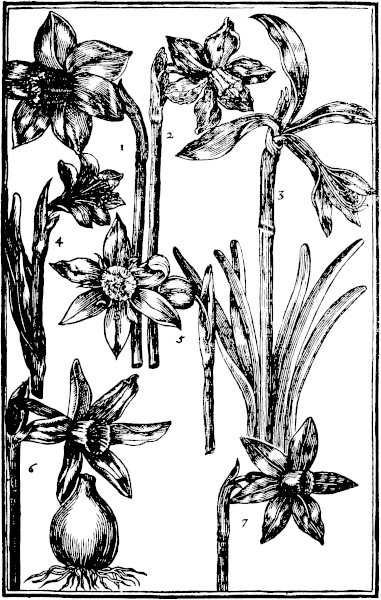
1Narcissus Nonpareille. The incomparable Daffodill.
2Narcissus Mattenesse. The lesser yellow Nompareille Daffodill.
3Narcissus Iacobæus flore rubro. The red Indian Daffodill.
4Narcissus Trapezunticus. The early Daffodill of Trabesond.
5Narcissus Montanus albus apophysibus præditus. The white winged Daffodill.
6Narcissus Montanus, siue Nompareille totus albus. The white Nompareille, or Peerlesse Daffodill.
7Narcissus albus oblongo calice. The white Daffodill with a long cup.
{Mountain Daffodils}
Narcissus Montanus albus apophysibus præditus. The white Mountaine Daffodill with eares, or The white winged Daffodill.
This Mountaine Daffodill riseth vp with three or four broad leaues, somewhat long, of a whitish greene colour, among which riseth vp a stalke a foote and a halfe high, whereon standeth one large flower, and sometimes two, consisting of sixe white leaues a peece, not very broad, and without any shew of yellownesse in them, three whereof haue vsually each of them on the back part, at the bottome vpon the one side of them, and not on both, a little small white peece of a leafe like an eare, the other three hauing none at all: the cup is almost as large, or not much lesse then the small Nompareille, small at the bottome, and very large, open at the brimme, of a faire yellow colour, and sometimes the edges or brimmes of the cup will haue a deeper yellow colour about it, like as if it were discoloured with Saffron: the flower is verie sweete, the roote is great and white, couered with a pale coate or skinne, not verie blacke, and is not very apt to encrease, seldome giuing of-sets; neither haue I euer gathered seede thereof, because it passeth away without bearing any with me.
Narcissus Montanus, siue Nompareille totus albus amplo calice. The white Nompareille Daffodill.
This white Nompareille Daffodill, is in roote and leafe very like vnto the former mountain or winged Daffodill, but that they are a little larger: the stalke from among the leaues riseth vp not much higher then it, bearing at the top one large flower, composed of sixe long white leaues, each whereof is as it were folded halfe way together, in the middle whereof standeth forth a large white cup, broader at the mouth or brims then at the bottome, very like vnto the lesser Nompareille Daffodill before remembred, which hath caused it to be so entituled: the sent whereof is no lesse sweete then the former.
The Place.
The naturall places of these Daffodils are not certainly knowne to vs; but by the names they carry, they should seeme to bee bred in the Mountaines.
The Time.
These flower not so early as many other kindes doe, but rather are to bee accounted among the late flowring Daffodils; for they shew not their flowers vntill the beginning of May, or the latter end of Aprill, with the soonest.
The Names.
The names set downe ouer the heads of either of them be such, whereby they are knowne to vs; yet some doe call the first Narcissus auriculatus, that is to say, The Daffodill with eares: and the other, Narcissus Nompareille totus albus, that is to say, The white Nompareille, or Peerlesse Daffodill.
{Daffodils with a long cup}
1. Narcissus albus oblongo calice luteo præcox minor. The small early white Daffodill with a long cup.
The leaues of this early Daffodill are broad, very greene, and not whitish as others, three or foure standing together, about a foote long or better, among which riseth vp a greene stalke, not full so high as the leaues, bearing one flower at the toppe thereof of a reasonable bignesse, but not so great as the later kindes that follow are, consisting of six whitish leaues, but not perfect white, hauing a show of a Creame colour appearing in them; in the middle is a long round yellow cup, about halfe an inch long or better. The smell of this flower is reasonable sweete, the roote is of a reasonable bignesse, yet lesser then the rootes of the later kindes.
2. Narcissus pallidus oblongo calice flauo præcox. The early Strawe coloured Daffodill with a long cup.
The leaues of this Daffodill are as greene as the former, but much narrower; and the leaues of the flower are more enclining to yellow, but yet very pale, as if it were a light strawe colour, and seeme to bee a little more narrow and pointed then the former: the cup of this, is as long and yellow as the precedent. The smell whereof is very like the former, yet neither of them being so sweete as those that follow.
3. Narcissus albus oblongo calice luteo serotinus maier. The great late flowring white Daffodill with a long cup.
This later flowring Daffodill hath his leaues somewhat narrow & long, of a grayish or whitish greene colour, among which the stalke riseth vp a foote and a halfe high, bearing one flower at the toppe, made of six white leaues, hauing the cup in the middle thereof as long as the former, and of a deepe yellow: the edges of this cuppe are sometimes plaine, and sometimes a little crumpled; they are often also circled at the brimmes with a Saffron colour, and often also without it, the smell whereof is very pleasant, and not heady: the roote hereof is reasonable bigge, and couered ouer rather with a pale then blackish skinne. This flower doth sometimes alter his forme into eight leaues, which being narrow and long, seeme like a white starre, compassing a yellow trunke.
4. Narcissus totus pallidus oblongo calice serotinus minor. The late pale coloured Daffodill with a long cup.
There is another of this kinde, whose flowers is wholly of a pale white, or yellowish colour, differing neither in leafe nor roote from the former.
5. Narcissus pallidus oblongo calice flauo serotinus. The Strawe coloured late flowring Daffodill with a long yellow cup.
The chiefe difference of this Daffodill from the former, consisteth in the colour of the cup, which is a more yellow colour, and a little larger then the former, and the brimmes or edges of the cup of a deeper yellow, or Saffron colour. The smell of this is no lesse sweete then in the former.
6. Narcissus albus oblongo calice flauo serotinus, duobus floribus in caule. The late white Daffodill with a long cup, and two flowers on a stalke.
This Daffodill is surely a kinde of it selfe, although it be so like the former, abiding constant in his forme and manner of flowring, vsually bearing without missing two flowers vpon a stalke, very like vnto the former great white kinde, that one cannot know any greater matter of difference betweene them, then that it beareth two flowers on a stalke: the cuppes whereof are seldome touched with any shew of Saffron colour on them at the brimmes or edges, as some of the former haue.
The Place.
All these Daffodils doe grow on the Pyrenæan mountaines, and haue been sought out, and brought into these parts, by those curious or couetous searchers of these delights, that haue made vs partakers of them.
The Time.
The former kindes flower earlier by a fortnight then the later, the one in the later end of March, and the other not vntill the middle of Aprill.
The Names.
Their names are giuen to euery one of them in their seuerall titles, as fitly as may best agree with their natures; and therefore I shall not neede to speake any further of them.
{White Daffodils}
Narcissus medioluteus vulgaris. The common white Daffodill called Primrose Peerlesse.
This Daffodill is so common in euery Country Garden almost through England, that I doubt I shall but spend my time in vaine, to describe that which is so well knowne, yet for their sakes that know it not, I will set downe the description of it in this manner. It hath long limber and broad leaues, of a grayish greene colour, among which riseth vp a stalke, bearing at the toppe out of a skinnie huske sometimes but one flower, but most commonly two flowers, and seldome three or more, but larger for the most part, then any that beare many flowers vpon a stalke, of a pale whitish Creame colour, tending somewhat neare vnto the colour of a pale Primrose (which hath caused our Countrey Gentlewomen, I thinke, to entitle it Primrose Peerlesse) with a small round flat Crowne, rather then a cup in the middle, of a pale yellow colour, with some pale chiues standing therein, being of a sweete, but stuffing sent: the roote is reasonable great, and encreasing more then a better plant.
Narcissus mediocroceus serotinus. The late flowring white Daffodill.
This Daffodill hath much smaller leaues, and shorter then the last, the stalke also riseth not so high by much, and beareth but one flower thereon, of a pure white colour, made of six small leaues, and somewhat narrow, standing seuerally one from another, and not so close together as the former, but appearing like a starre: the cup is small and round, of a pale yellow colour, but saffrony about the brims, hauing six small pale chiues in the middle, the smell whereof is much sweeter then in the former.
The Place.
The first is thought to grow naturally in England, but I could neuer heare of his naturall place. I am sure it is plentifull enough in all Country Gardens, so that wee scarce giue it place in our more curious parkes. The second liueth only with them that delight in varieties.
The Time.
The first Daffodill flowreth in the middle time, being neither of the earliest, nor of the latest; but about the middle, or end of April. The other flowreth with the latest in May.
The Names.
I shall not neede to trouble you with further repetitions of names, they hauing been set downe in their titles, which are proper to them.
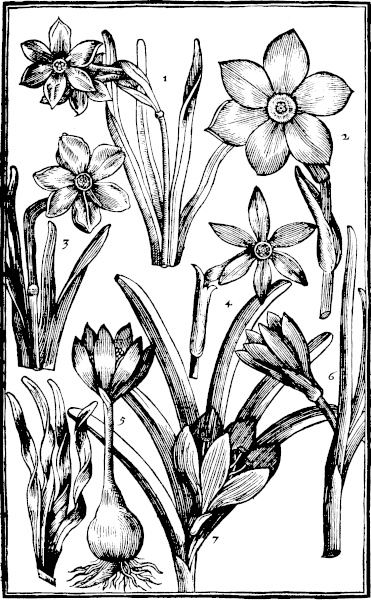
1Narcissus vulgaris medio luteus. The common White Daffodill, or Primrose Peerlesse.
2Narcissus medio purpureus maximus. The great white purple ringed Daffodill.
3Narcissus medio purpureus præcox. The early purple ringed Daffodill.
4Narcissus medio purpureus stellatus. The starry purple ringed Daffodill.
5Narcissus Persicus. The Persian Daffodill.
6Narcissus Autumnalis minor. The lesser Winter Daffodill.
7Narcissus Autumnalis maior. The greater Winter Daffodill.
{Purple Ringed Daffodils}
1. Narcissus medio purpureus præcox. The early purple ringed Daffodill.
This early Daffodill hath many long grayish greene leaues, somewhat narrower and stiffer than the former common white Daffodill, among which riseth vp a long naked hollow stalke (as all other Daffodils haue) bearing at the toppe one flower, and seldome two, made of sixe long white leaues, standing close together about the stalke; the cup is yellow, and so flat, that it might rather bee called a crowne: for it standeth very close to the middle, and very open at the brimmes, circled with a reddish or purple coloured ring, hauing certaine chiues in the middle of it also. The smell hereof is very sweete, exceeding many other.
2. Narcissus medio purpureus serotinus. The late purple ringed Daffodill.
The leaues of this Daffodill are alwayes broader then the former early one, and some are very neare twice as broad: the flower is very like the former, being large, and his leaues standing close one to the side of another; the ring likewise that compasseth the yellow coronet, is sometimes of a paler reddish purple, and sometimes as deep a red as the former: so that it differeth not in any other materiall point, then that it flowreth not vntill the other is past and gone. The sent of this is like the former, the roote hereof is greater, as well as the leafe and flower.
3. Narcissus medio purpureus maximus. The great white purple ringed Daffodill.
There is another kinde, whose flower (as well as leaues and rootes) is larger then any other of this kinde, which only maketh it a distinct sort from the other: it flowreth also with the later sort of these purple ringed Daffodils.
4. Narcissus medio purpureus stellaris. The starry purple ringed Daffodill.
This Daffodill hath his leaues a little narrower and greener then the former sorts, the flower also of this hath his sixe white leaues not so broad, but narrower, and seeming longer then they, not closing together, but standing apart one from another, making it seem like a white starre: it hath also a yellow coronet in the middle, circled about with purple, like the former. This doth smell nothing so sweete as the first but yet hath a good sent.
The Place.
The first, third, and fourth of these Daffodils, haue always beene sent vs from Constantinople among other bulbous rootes, so that wee know no further of their naturall places.
The second groweth in many places of Europe, both in Germany, France, and Italy, as Clusius hath noted.
The Time.
The first flowreth very early in March, euen with the first Daffodils. The second, third, and fourth, about a moneth after.
The Names.
The early and starre Daffodils, haue been sent vs by the Turkish name of Deuebohini, and Serincade. But their names, they haue receiued since, to bee endenizond with vs, are set downe in their seuerall titles.
{Persian and Autumne or Winter Daffodils}
Narcissus Persicus. The Persian Daffodill.
This Persian Daffodill differeth from all other kindes of Daffodils in his manner of growing, for it neuer hath leaues and flowers at one time together, wherein it is like vnto a Colchicum, yet in roote and leafe it is a Daffodill. The roote is a little blackish on the outside, somewhat like the roote of the Autumne Daffodill, from whence riseth vp a naked foote stalke, bearing one pale yellow flower, breaking through a thinne skinne, which first enclosed it, composed of six leaues, the three outermost being a little larger then the rest, in the middle of the flower there are six small chiues, and a longer pointell. The whole flower is of an vnpleasant sent. After the flower is past, come vp the leaues, sometimes before Winter, but most vsually after the deepe of Winter is past with vs, in the beginning of the yeare, which are broad, long, and of a pale greene colour, like the leaues of other Daffodils, but not greene as the Autumne Daffodill is, and besides they doe a little twine themselues, as some of the Pancratium, or bastard Sea Daffodils doe.
Narcissus Autumnalis maior. The greater Autumne or Winter Daffodill.
The greater Autumne Daffodill riseth vp with three or foure faire broad and short leaues at the first, but afterwards grow longer, of a very deepe or darke greene colour, in the middle of which riseth vp a short, stiffe, rounded footestalke, bearing one faire yellow flower on the head thereof (inclosed at the first in a thinne skinne, or huske) and consisteth of six leaues as the former, with certaine chiues in the middle, as all or most other Daffodils haue, which passeth away without shew of any seed, or head for seed, although vnder the head there is a little greene knot, which peraduenture would beare seede, if our sharpe Winters did not hinder it. The roote is great and round, couered ouer with a blackish skinne or coate.
Narcissus Autumnalis minor. The lesser Autumne or Winter Daffodill.
Clusius setteth downe, that the manner of the flowring of this lesser Daffodill, is more like vnto the Persian Daffodill, then vnto the former greater Autumne kind; but I doe fine that it doth in the same sort, as the greater kinde, rise vp with his leaues first, and the flowers a while after: the flower of this is lesser, and a little paler then the flower of the greater kinde, but consisting in like sort of six leaues, narrow and sharpe pointed; the greene leaues also are almost of as deepe a green colour, as the greater kinde, but smaller and narrower, and a little hollow in the middle. The roote is also alike, but lesser, and couered with a blackish skinne as the former. This hath sometimes borne blacke round seede in three square heads.
The Place.
The Persian Daffodill hath beene sent sometimes, but very seldome, among other roots from Constantinople, and it is probable by the name whereby it was sent, that it should naturally grow in Persia.
The other two haue likewise beene sent from Constantinople, and as it is thought, grow in Thracia, or thereabouts.
The Time.
They all doe flower much about one time, that is, about the end of September, and in October.
The Names.
The first hath been sent by the name of Serincade Persiana, and thereupon is called Narcissus Persicus, The Persian Daffodill.
The other two haue been thought by diuers to be Colchica, and so haue they called them, vpon no other ground, but that their flower is in forme and time somewhat like Colchicum, when as if they had marked them better, they might plainly discerne, that in all other things they did resemble Daffodils; but now the names of Colchicum luteum maius, & minus, is quite lost, time hauing worne them out, and they are called by most Herbarists now adayes, Narcissus Autumnalis maior & minor, The greater and the lesser Autumne Daffodill.
{True Daffodils: broad leaues, many single flowers vpon a stalke}
Thus farre haue I proceeded with those Daffodils, that hauing broad leaues, beare but one single flower, or two at the most vpon a stalke: And now to proceed with the rest, that haue broad leaues, and beare single flowers, but many vpon a stalke.
{Yellow Daffodils}
Narcissus Africanus aureus maior. The great yellow Daffodill of Africa.
This braue and stately Daffodill hath many very long and broad leaues, of a better green colour, then many others that are grayish, among which appeareth a stalke, not rising to the height of the leaues, bearing at the toppe out of a skinnie hose many faire, goodly, and large flowers, to the number of ten or twelue, if the roote bee well growne, and stand in a warme place, euery one being larger then any of the French, Spanish, or Turkie Daffodils, that beare many single flowers vpon a stalke, and commeth neere vnto the bignesse of the English Daffodill, called Primrose Peerlesse, before described, or that French kinde hereafter described, that beareth the largest flowers, many vpon a stalke (which some would make to bee a kinde of English Daffodill, but bearing more flowers) and of a faire shining yellow colour, hauing large, round, and open cups or boules, yellower then the outer leaues; and is of so exceeding sweete a sent, that it doth rather offend the senses by the aboundance thereof: the roote is great, and couered with a blackish browne coate or skinne.
Narcissus Africanus aureus minor. The lesser Barbary Daffodill.
This lesser kinde is very neere the same with the former, but that it lacketh somewhat of his statlinesse of height, largenesse of flower and cup (being a paler yellow) and beauty of colour, for it beareth neither of these equall vnto the former, but is in them all inferiour. And thus by this priuatiue, you may vnderstand his positive, and that shall be sufficient at this time.
Narcissus Byzantinus totus luteus. The yellow Turkie Daffodill.
Whereas the last described, came short of the beauty of the former, so this lacketh of that beauty is in the last; for this, although it haue very long leaues, and a high stalke, yet the flowers are neither so many, as not being aboue foure or fiue, nor so large, being not much greater then the ordinary French Daffodill hereafter described, nor the colour so faire, but much paler, and the cup also smaller; and herein consisteth the chiefest differences betweene this, and both the other, but that the sent of this is also weaker.
The Place.
The first and the second grow in Barbary, about Argiers, and Fez, as by the relation of them, that haue brought them into these parts, wee haue been enformed.
The last hath been often brought from Constantinople among other varieties of Daffodils, but from whence they receiued them, I could neuer learne.
The Time.
These Daffodils do flower very early, euen with the first sort of Daffodils, I meane after they haue been accustomed vnto our climate: for oftentimes vpon their first bringing ouer, they flower in Ianuary or February, especially if they be preserued from the frosts, and kept in any warme place; for they are very tender, and will soone perish, being left abroad.
The Names.
The first is called by diuers in French, Narcisse d’ Algiers and in many places of the Low Countries, Narcissen van Heck, or Narcissus Heckius; by diuers others Narcissus Africanus aureus maior, we may call it in English, The great African Daffodill, or the great Barbary Daffodill, or the great yellow Daffodill of Argiers, which you please.
The second hath no other variation of name, then a diminutiue of the former, as is set downe in the title.
The third is no doubt the same, that Clusius setteth downe in the twelfth Chapter of his second Booke of the History of more rare plants, and maketh the fourth sort, which came from Constantinople, and may also be the same, which he maketh his fifth, which (as he saith) he receiued from Doctour Simor Touar of Seuill in Spaine. Wee call it, from the place from whence we receiued it, Narcissus Byzantinus, with the addition of totus luteus, to put a difference from other sorts that come from thence also: in English, The yellow single Daffodill of Turkie.
{Lemon coloured Daffodils}
Narcissus Sulphureus maior. The greater Lemon coloured Daffodill.
The greater of these Daffodils, beareth three or foure greene and very long leaues, a foote and a halfe long at the least, among which riseth vp a round, yet crested stalke, not so high as the leaues, bearing fiue or sixe single flowers thereon, euery one of them being greater then the ordinary French or Italian Daffodils, with many flowers vpon a stalke; of a faint, but yet pleasant yellow colour at the first, which after they haue been in flower a fortnight or thereabouts, change into a deeper, or more sullen yellow colour: the cup in the middle is likewise larger, then in those formerly named, and of a deeper yellow colour then the outer leaues, hauing onely three chiues within it. The smell is very pleasant.
Narcissus Sulphureus minor. The lesser Lemon coloured Daffodill.
This lesser Daffodill hath broader and shorter leaues then the former, of the colour of other Daffodils, and not greene like the former: the stalke of this riseth vp higher then the leaues, bearing foure or fiue flowers vpon shorter footestalkes, and no bigger then the French Daffodill, of a pale yellow, which most doe call a Brimstone colour, the cup or rather crowne in the middle, is small, and broad open, of a little deeper yellow, hauing many chiues within it, and is as it were sprinkled ouer with a kinde of mealinesse. The smell of this is not full so pleasant as the former.
The Place.
Both these haue been gathered on the Pyrenæan Mountaines, and both likewise haue been sent out of Italy.
The Time.
They both flower in the middle time of the Daffodils flowring, that is, in Aprill.
The Name.
They haue their Latine names expressed in their titles and so are their English also, if you please so to let them passe; or else according to the Latine, you may call them, The greater and the lesser Brimstone coloured Daffodils; some haue called them Narcissus Italicus, but the Italians themselues haue sent them by the name of Narcisso Solfarigno.
{Milke White Daffodils}
Narcissus totus albus polyanthos. The milke white Daffodill many vpon a stalke.
The leaues of this Daffodill are of a meane size, both for length and breadth, yet somewhat greener then in the ordinary sorts, that haue some whitenesse in them: the flowers are many vpon the stalke, as small for the most part, as any of these kindes that beare many together, being wholly of a milke, or rather snow white colour, both the cuppe, which is small, and the outer leaues that compasse it; after which come small heads, wherein is contained round blacke seede, as all other Daffodils doe, although some greater, and others lesser, according to the proportion of the plants: the roote is couered ouer with a blackish skinne or coate; the smell is very sweete.
There are two other sorts more of this kinde, the differences whereof are, that the one hath his leaues somewhat broader, and the flowers greater then the former: And the other smaller leaues and flowers also, whose cups being small, are neuer seene fully open, but as it were halfe closed at the brimmes.
Narcissus latifolius totus albus, mediocri calice reflexus. The milke white Daffodill with the great cup.
There is yet another sort of these milke white Daffodils, whose leaues are as broad as any of the former, and whose cup in the middle of the flower, is somewhat larger then in any of the lesser sorts, and lesser then in the greater kinde: but the leaues of the flowers doe a little turne themselues vpwards, which maketh a chiefe difference.
The Place.
These Daffodils grow in Spaine, from whence I receiued many that flourished a while, but perished by some fierce cold Winters: they likewise grow in France, from whence many also haue been brought vnto vs. They haue likewise been sent from Constantinople to vs, among other kindes of Daffodils.
The Time.
They that come from Constantinople, for the most part doe flower earlier then the other, euen after they are accustomed to our ayre. Some of them flower notwithstanding in the end of March, the rest in Aprill.
The Names.
They are vsually called Narcissus totus albus polyanthos, adding thereunto the differences of maior, medius, and minor, that is, The milke white Daffodill, the greater, the middle, and the lesser; for so some doe distinguish them. The last, for distinction, hath his name in his title sufficient to expresse him.
{French, Italian and English Daffodils}
1. Narcissus Narbonensis, siue medio luteus præcox. The early French Daffodill.
The leaues of this Daffodill, spring vp out of the ground a moneth or two sometimes before the other of this kinde, that follow; being also shorter and narrower: the stalke likewise is not very high, bearing diuers flowers at the top, breaking through a thinne skinne, as is vsuall with all the Daffodils, euery one whereof is small, consisting of six white leaues, and small yellow cup in the middle, which is of a prettie small sent, nothing so strong as many others: the roote is great and round, and seldome parteth into of-sets, euen as all the other that follow, bearing many single flowers, doe.
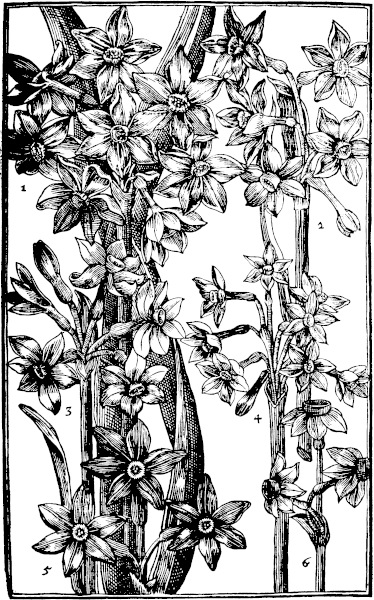
1Narcissus Africanus aureus maior. The great yellow Daffodill of Africa.
2Narcissus Africanus luteus minor. The lesser yellow Daffodill of Africa.
3Narcissus Narbonensis medio luteus. The French Daffodill.
4Narcissus Pisanus, vel totus albus. The Italian Daffodill, or the all white Daffodill.
5Narcissus Mussart. Mussart his Daffodill.
6Narcissus Anglicus polyanthos. The great English Daffodill.
2. Narcissus Narbonensis vulgaris. The ordinary French Daffodill.
This Daffodill hath long and broad greene leaues, a little hollowish in the middle, and edged on both sides; the stalke is a foote and a halfe high, bearing at the toppe diuers flowers, somewhat larger then the former, consisting of six white leaues, somewhat round; the cup is yellow in the middle, small and round, like vnto an Acorne cuppe, or a little fuller in the middle: this is the forme of that sort which was first brought vnto vs: But since there is found out some, whose cup is shorter, others flatter, some of a paler, others of a deeper yellow colour, and some that haue their cuppe longer then the rest. The rootes of them all are couered with a blackish skin or coate.
3. Narcissus Narbonensis maior amplo flore. The French Daffodill with great flowers.
The leaues of this Daffodill are somewhat like vnto the last, but not so broad, yet full as long, and spring sooner out of the ground, yet not so early as the first of these kindes: the stalke hereof is flatter, and riseth higher, bearing foure or fiue flowers, much larger then any of this kinde; for euery one of them doth equall the English Daffodill, before described, but whiter then it, and the yellow cup larger, and more open then in any of the rest. The roote of this is not so great, or round, as the former, but is more plentifull in of-sets, then any other of these French, or Italian kindes.
4. Narcissus Pisanus. The Italian Daffodill.
This Italian Daffodill hath his leaues as large, or larger then the second French Daffodill, and his stalke somewhat higher, bearing many white flowers, very like vnto the common French Daffodill, but somewhat larger also; and the yellow cup in the middle likewise is larger, and rounder, then is vsually seen in any of the French kinds, except the last with the greatest flowers.
5. Narcissus mediocroceus polyanthos. The French Daffodill with Saffron coloured cups.
This French Daffodill hath diuers leaues of a grayish greene colour, not so broad or long as the last recited Daffodill, but comming neerer vnto the second French kinde, the flowers likewise are white, and many vpon a stalke, like thereunto, but the yellow cup is somewhat large, and circled with a Saffron like brimme or edge, which maketh the chiefest difference.
6. Narcissus mediocroceus alter, dictus Mussart. Mussart his Daffodill.
The affinity between this & the last, (for it is not the same to be expressed vnder one title) hath made me ioyne it next vnto it, yet because it hath a notable difference, it deserueth a place by himselfe. The leaues are large and long, and the flowers, being white, are larger also then in any other, except the greatest, but the cup hereof is small and short, rather seeming a coronet then a cup, of a deepe Saffron colour all about the brimmes or edges.
7. Narcissus Anglicus polyanthos. The great English Daffodill.
This Daffodill hath his leaues not much broader or longer, then the French kinde with great flowers, before described, the stalke with flowers riseth not fully so high as it, bearing many flowers thereon, not altogether so white, yet whiter then the former English Daffodill, called Primrose Peerlesse, but nothing so large, and with short, broad, and almost round leaues, standing close one vnto another: the yellow cup in the middle is bowle fashion, being somewhat deeper then in any of the former kinds, but not much greater: the smell hereof is very sweete and pleasant.
8. Narcissus Narbonensis, siue medio luteus serotinus maior. The greater late flowring French Daffodill.
The roote as well as the leaues of this Daffodill, are greater, larger, broader, and longer then in any other of the former French, or Italian kindes; the stalke is as high as any of them, bearing at the toppe fiue or sixe white flowers, standing open spread like a starre, and not close together, euery one whereof is large, and round pointed, the cup is yellow, small and short, yet not lying flat to the flower, but a little standing out with some threads in the middle, as all the former Daffodils haue. This is not so sweete as the earlier kindes.
9. Narcissus medioluteus alter serotinus calice breui. The lesser late flowring French Daffodill.
This Daffodill is of the same kinde with the last described, the onley difference is, that it is lesser, and the yellow cuppe in the middle of the flower, is somewhat shorter then the former, although the former be shorter then many others, otherwise it differeth not, no not in time; for it flowreth late as the former doth.
The Place.
These Daffodils haue been brought vs from diuers places; The first and second grow naturally in many places of Spaine, that are open to the Sea: they grow likewise about Mompelier, and those parts in France. They haue been likewise sent among many other sorts of Daffodils from Constantinople, so that I may thinke, they grow in some places neere thereunto.
The fourth groweth plentifully in Italy, about Pisa in Tuscane, from whence we haue had plants to furnish our Gardens.
The seuenth is accounted beyond Sea to be naturall of our Country, but I know not any with vs that haue it, but they haue had it from them.
The rest haue been brought at diuers times, but wee know no further of their naturall places.
The Time.
The first flowreth earlier then any of the rest by a moneth, euen in the beginning of March, or earlier, if the weather be milde. The other in Aprill, some a little before or after another. The late kinds flower not vntill May.
The Names.
There can be no more said of the names of any of them, then hath beene set out in their titles; for they distinguish euery sort as fitly as we can: onely some doe call the first two sorts, by the name of Donax Narbonensis.
{True Daffodils: Broad leaves, double flowers}
After all these Daffodils, that hauing broad leaues beare single flowers, either one or many vpon a stalke, I shall now goe on to set forth those broad leafed Daffodils, that carry double flowers, either one or many vpon a stalke together, in the same order that we haue vsed before.
1. Narcissus albus multiplex. The double white Daffodill.
The leaues of this Daffodill are not very broad, but rather of a meane size, being of the same largenesse with the leaues of the purple ringed Daffodill, the stalke riseth vp to be a foote and a halfe high, bearing out of a thinne white skinne or hose, one flower and no more, consisting of many leaues, of a faire white colour, the flower is larger then any other double white Daffodill, hauing euery leafe, especially the outermost, as large almost as any leafe of the single Daffodill with the yellow cup, or purple ring. Sometimes it happeneth, that the flower is very little double, and almost single, but that is either in a bad ground, or for that it hath stood long in a place without remouing; for then it hath such a great encrease of rootes about it, that it draweth away into many parts, the nourishment that should be for a few: but if you doe transplant it, taking away the of-sets, and set his rootes single, it will then thriue, and beare his flower as goodly and double, as I haue before described it: and is very sweete.
2. Narcissus mediopurpureus multiplex. The double purple ringed Daffodill.
There is little difference in the leaues of this kinde, from the leaues of the single purple ringed Daffodill; for it is probable it is of the same kinde, but by natures gift (and not by any humane art) made more plentifull, which abideth constant, and hath not that dalliance, which oftentimes nature sheweth, to recreate the senses of men for the present, and appeareth not againe in the same forme: the chiefest difference is, that the flower (being but sometimes one on a stalke, and sometimes two) consisteth of six white outer leaues, as large as the leaues of the single kinde, hauing many small yellow peeces, edged with purple circles round about them, instead of a cup; and in the middle of these peeces, stand other six white leaues, lesser then the former, and a yellow cup edged with a purple circle likewise, parted into peeces, and they comprehend a few other white leaues, smaller than any of the other, hauing among them some broken peeces of the cup, with a few chiues also in the middle of the flower. The flower is very sweete.
There is of this kinde another, whose flower hath not so plaine a distinction, of a triple rowe of leaues in it: but the whole flower is confusedly set together, the outer leaues being not so large, and the inner leaues larger then the former; the broken yellow cuppe, which is tipt with purple, running diuersly among the leaues; so that it sheweth a fairer, and more double flower then the former, as it is indeed.
3. Narcissus medioluteus corona duplici. The Turkie Daffodill with a double crowne.
This Daffodill hath three or foure leaues, as large and long almost, as the great double Daffodill of Constantinople next following hath: the stalke likewise is very neere as great, but as high altogether, bearing at the toppe foure or fiue flowers, the leaues whereof are as large, as of the first or second kinde of French Daffodils, before described, but not altogether of so pure a white colour; and being six in number, stand like the former single French Daffodils, but that the yellow cup in the middle of this is thicke and double, or as it were crumpled together, not standing very high to be conspicuous, but abiding lowe and short, so that it is not presently marked, vnlesse one looke vpon it precisely; yet is exceeding sweete. The roote is like vnto the roote of the purple ringed Daffodill, or somewhat bigger.
4. Narcissus Chalcedonicus flore pleno albo polyanthos. The double white Daffodill of Constantinople.
This beautifull and goodly Daffodill (wherewith all Florists greatly desire to bee acquainted, as well for the beauty of his double flowers, as also for his superabounding sweete smell, one stalke with flowers being instead of a nosegay) hath many very broad, and very long leaues, somewhat greener then gray, among which riseth vp a strong round stalke, being sometimes almost flat, and ribbed, bearing foure or fiue, or more white flowers at the toppe, euery one being very great, large, and double, the leaues being confusedly set together, hauing little peeces of a yellow cup running among them, without any shew of that purple ring that is in the former, and fall away without bearing seed, euen as all, or most other double flowers doe: the smell is so exceeding sweet and strong, that it will soone offend the senses of any, that shall smell much vnto it: the roote is great and thicke, couered with a blackish coate.
5. Narcissus Chalcedonicus fimbriatus multiplex polyanthos. The great double purple ringed Daffodill of Constantinople.
This Daffodill differeth very little or nothing in leafe from the former, the onely difference is in the flowers, which although they bee double, and beare many vpon a stalke, like vnto them, yet this hath the peeces of the yellow cuppes tipt with purple, as if they were shred or scattered among the white leaues, whereas the other hath only the yellow, without any shew of purple tips vpon them: the smell of this is as strong as of the other.
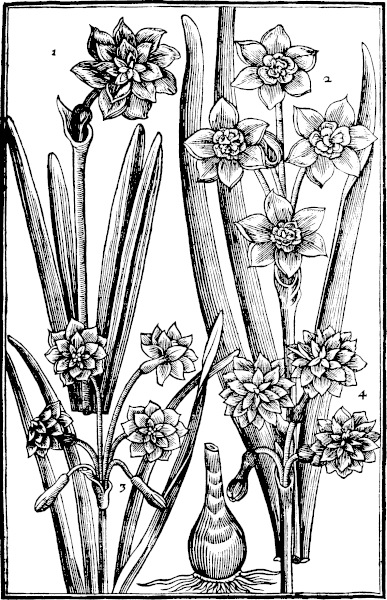
1Narcissus albus multiplex. The double white Daffodill.
2Narcissus medioluteus corona duplici. The Turkie Daffodill with a double crowne.
3Narcissus mediopurpureus multiplex. The double purple ringed Daffodill.
4Narcissus Chalcedonicus flore pleno albo polyanthos. The double white Daffodill of Constantinople.
6. Narcissus Cyprius flore pleno lutes polyanthos. The double yellow Daffodill of Cyprus.
The leaues of this Daffodill are almost as broad and long as the former, the stalke is a foot high and more, bearing foure or fiue flowers on the top, euery one very double, and of a fine pale yellow colour, of a strong heady sent. The root of this is also like the former.
The Place.
The first of these Daffodils, was full brought into England by Mʳ. Iohn de Franqueuille the elder, who gathered it in his owne Countrey of Cambray, where it groweth wild, from whose sonne, Mʳ. Iohn de Franqueuille, now liuing, we all haue had it. The rest haue come from Constantinople at seuerall times; and the last is thought to come from Cyprus. Wee haue it credibly affirmed also, that it groweth in Barbary about Fez and Argiers. Some of the double white kindes grow in Candy, and about Aleppo also.
The Time.
The Turkie kindes doe for the most part all flower early, in the end of March, or beginning of Aprill at the furthest, and the first double, about the middle or end of April.
The Names.
All these Daffodils, except the first, haue had diuers Turkish names set vpon the packets, wherein they haue been sent, but there is small regard of certainty to be expected from them; for that the name Serincade, without any more addition, which is a single Daffodill, hath beene imposed vpon that parcell of rootes, that have borne most of them double flowers of diuers sorts; and the name Serincade Catamer lale which signifieth a double flowered Daffodill, hath had many single white flowers, with yellow cups, and some whose flowers have been wholly white, cuppe and all, and some purple ringed, and double also among them. Their names, whereby they are knowne and called with vs, are, as fitly as may be, imposed in their titles: And this I hope shall suffice, to have spoken of these sorts of Daffodils.
{True Daffodils: Narrow leaved}
Hauing finished the discourse of the former sort of broad leafed Daffodils, it is fit to proceede to the next, which are Angustifolios Narcissos, those Daffodils that have narrow leaures, and first to set down those that beare single flowers, whether one or many flowers vpon a stalke, and then those that beare double flowers in the same manner.
Narcissus Virginens. The Virginia Daffodill.
This plant I thought fittest to place here in the beginning of this Classis, not finding where better to shroud it. It hath two or three long, and very narrow leaues, as greene as the leaues of the great Leucoium bulbosum, and shining withall, which grow sometimes reddish, especially at the edges: the stalke riseth vp a spanne high, bearing one flower and no more on the head thereof, standing vpright like a little Lilly or Tulipa, made of six leaues, wholly white, both within and without, except that at the bottome next to the stalke, and a little on the backside of the three outer leaues, it hath a small dash or shew of a reddish purple colour: it hath in the middle a few chiues, standing about a small head pointed; which head groweth to bee small and long, containing small blackish flat seede: the roote is small, long, and round, a little blackish on the outside, and white on the inside.
The Place.
This bulbous plant was brought vs from Virginia, where they grow aboundantly; but they hardly thriue and abide in our Gardens to beare flowers.
The Time.
It flowreth in May, and seldome before.
The Names.
The Indians in Virginia do call it Attamusco, some among vs do call it Lilionarcissus Virginianus, of the likenesse of the flower to a Lilly, and the leaues and roote to a Daffodill. Wee for breuity doe called it Narcissus Virgineus, that is, The Daffodill of Virginia, or else you may call it according to the former Latine name, The Lilly Daffodill of Virginia, which you will; for both names may serue well to expresse the plant.
Narcissus angustifolius albidus præcox oblongo calice. The early white narrow leafed Daffodill with a long cup.
This Daffodill hath three or foure narrow, long, and very green leaues, a foot long for the most part: the stalke riseth not vp so high as the leaves, whereon standeth one flower, not altogether so great as the late flowring Daffodill, with a long cuppe, described before among the broad leafed ones, which consisteth of six pale coloured leaves, not pure white, but hauing a wash of light yellow among the white: the cuppe in the middle is round and long, yet not so long as to bee accounted a bastard Daffodill, within which is a middle pointell, compassed with six chiues, hauing yellow mealy pendents.
The Place.
The Daffodill groweth with the other sorts of broad leafed ones, on the Pyrenæan Mountaines, from whence they have beene brought vnto vs, to furnish our Gardens.
The Time.
It flowreth early, a month before the other sorts of the same fashion, that is, in the beginning of March, if the time be milde, which the other before spoken of the doe not.
The Names.
It hath no other name that I know, then is expressed in the title.
{Small Daffodils}
2. Narcissus mediocroceus tenuifolius. The small Daffodill with a Saffron crown.
This small Daffodill hath foure or fiue narrow leaues, about a spanne long, among which riseth vp a stalke some nine inches high, bearing at the toppe one small white flower, made of six leaues, with a small yellow cup in the middle, shadowed ouer at the brimmes with a Saffron colour: the roote is small, rounded, and little long withall, couered with a blackish skinne or coate.
3. Narcissus minimus mediopurpureus. The least purple ringed Daffodill.
This little Daffodill hath small narrow leaues, shorter by much then any of the purple ringed Daffodils, before described: the stalke and flower keepe an equal proportion to the rest of the plant, being in forme and colour of the flower, like vnto the Starre Daffodill before recited, but vnlike in the greatnesse: this also is to bee obserued, that the purple colour that circleth the brimmes of the cuppe, is so small, that sometimes it is not well perceiued.
4. Narcissus minimus Iuncifolij flore. The least Daffodill of all.
This least Daffodill hath two or three whitish greene leaues, narrower then the two last recited Daffodils, and shorter by halfe, being but aboue two or three inches long, the stalke likewise is not aboue three or foure inches high, bearing one single flower at the toppe, somewhat bigger then the smalnesse of the plant should seeme to beare, very like vnto the least Rush Daffodill, and of the same bignesse, or rather somewhat bigger, being of a faint yellow colour, both leaues, and cup, or crowne, (if you please so to call it); for the middle part is spread very much, euen to the middle of the leaues almost, and lyeth flat open vpon the flower: the roote is small, euen the smallest of any Daffodill, and couered with a blackish skinne or coate.
The Place.
The first of these Daffodils haue beene brought vs from the Pyrenæan Mountaines, among a number of other rare plants, and the last by a French man, called Francis le Veau, the honestest roote-gatherer that euer came ouer to vs. The second was sent to Mʳ. Iohn de Franqueuille, before remembred, who imparted it to mee, as hee hath done many other good things; but his naturall place wee know not.
The Time.
They all flower about the latter end of Aprill.
The Names.
Being brought without names, wee haue giuen them their names according to their face and fashion, as they are set downe in their titles.
Narcissus Autumnalis minor albus. The little white Autumne Daffodill.
This little Autumne Daffodill riseth with his flowers first out of the ground, without any leaues at all. It springeth vp with one or two stalkes about a finger long, euery one bearing out of a small huske one small white flower, laid open abroad like vnto the Starre white Daffodill, before spoken of: in the middle of the flower is a small yellow cup of a meane size, and after the flower is past, there commeth in the same place a small head, containing small, round, blacke seede, like vnto the Autumne Hyacinth: the leaues come vp after the seede is ripe and gone, being small and narrow, not much bigger then the Autumne Hyacinth: the roote is small and blackish on the outside.
The Place.
This Daffodill groweth in Spaine, where Clusius saw it, and brought it into these parts.
The Time.
It flowreth in the beginning of Autumne, and his seede is ripe in the end of October in those hot Countries, but in ours it will scarce abide to shew a flower.
The Names.
The Spaniards, as Clusius reporteth, call it Tonada, and he vpon the sight thereof, Narcissus Autumnalis minor albus, and wee in English thereafter, The little white Autumne Daffodill.
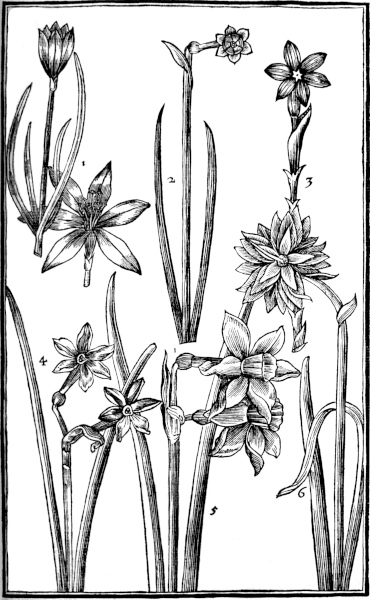
1Narcissus Virgineus. The Virginian Daffodill.
2Narcissus minimus Iuncifolij flore. The least Daffodill of all.
3Narcissus Autumnalis minor albus. The little white Autumne Daffodill.
4Narcissus albus Autumnalis medio obsoletus. The white Autumne Daffodill with a sullen crown.
5Narcissus Iuncifolius maximus amplo calice. The great Iunquilia with the largest flower or cup.
6Narcissus totus albus flore pleno Virginianus. The double white Daffodill of Virginia.
{The white Autumne Daffodill with a sullen crowne & The yellow Italian Daffodill of Caccini}
Narcissus albus Autumnalis medio obsoletus. The white Autumne Daffodill with a sullen crowne.
This Autumne Daffodill hath two or three leaues at the most, and very narrow, so that some doe reckon it among the Rush Daffodils, being somewhat broad at the bottome, and more pointed at the toppe, betweene these leaues commeth vp the stalke, bearing vsually two flowers and no more at the toppe, made of sixe white leaues a peece, pointed and not round: the cup is small and round like vnto the cup or crowne of the least Rush Daffodill, of a yellow colour at the bottome but toward the edge of a dunne or sullen colour.
Narcissus angustifolius luteus semper florens Caccini. The yellow Italian Daffodill of Caccini.
This Daffodill beareth a number of small, long, narrow, and very greene leaues, broader then the leaues of any Rush Daffodill, among which rise vp diuers stalkes, bearing at the head two or three flowers a peece, each of them being small and yellow, the cup or crowne is small also, of a deeper yellow then the flower. The Nobleman of Florence, who first sent this plant to Christian Porret at Leyden, after the death of Carolus Clusius, writeth that euery stalke doth beare with him more store of flowers, then are formerly set downe, and that it neuer ceaseth to beare flowers, but that after one or more stalkes haue been in flower together, and are past, there succeed other in their places.
The Place.
The first is naturall of Spain, the naturall place of the other is not known to vs.
The Time.
The times of the flowring, are set downe both in the title and in the descriptions; the one to be in Autumne, the other to be all the Summer long.
The Names.
The Latine names are imposed on them, as are fittest for them, and the last by that honourable man that sent it, which is most fit to continue, and not to bee changed. But wee, to let it bee knowne by an English name to English people, haue entituled it, The yellow Italian Daffodill of Caccini: if any man can giue it a more proper name, I shall bee therewith right well content.
Narcissus angustifolius, siue Iuncifolius maximus, amplo calice. The great Iunquilia with the large flower or cup.
Although this Daffodill importeth by his name, not to be of this family, but of the next, considering it is so like vnto them, but bigger; yet I haue thought good to place it in the end of these narrow leafed Daffodils, as being indifferent, whether it should bee referred to this or to that. For this carrieth diuers long green leaues, like vnto the other Rush Daffodils, but thicker and broader, so that it may without any great errour, bee reckoned among these narrow leafed Daffodils, bearing at the toppe two or three very faire large flowers, with a large and more open cuppe, then in any other of the Rush Daffodils, both of them of a faire yellow colour, yet the cuppe a little deeper then the flower, and a little crumpled about the edges, and both a pretty sharpe sent: the roote is greater and longer then the other Rush Daffodill, and couered likewise with a blackish coate.
The Place.
We haue this in Gardens onely, and haue not heard of his naturall place.
The Time.
It flowreth in Aprill.
The Names.
I leaue it indifferent, as I said, whether you will call it Narcissus angustifolius, or Iuncifolius magno calice, or maximus, because it is the greatest of all the rest of that kinde.
Narcissus totus albus flore pleno Virginianus. The double white Daffodill of Virginia.
The roote of this Daffodill, is very like vnto the former single Virginia Daffodill, set forth in the first place of this ranke of narrow leafed Daffodils, but that it is a little bigger and rounder, being a little long withall, and blackish also on the outside, as that is: from whence riseth vp two leaues, somewhat broader then the former: but of a like greennesse: the stalke riseth vp betweene these two leaues, about a span high, or not much higher, bearing one faire double snow white flower, very like in the fashion vnto the pale yellow double Daffodill, or bastard Daffodill of Robinus, hereafter described: For it is in the like manner laid open flat, and composed of six rowes of leaues, euery rowe lying in order iust opposite, or one before another, whereof those six leaues that make the first or outermost course, are the greatest, and all the rest lying, as I said, one vpon or before another, are euery rowe smaller then others from the middle of this flower, thrusteth forth a small long pointed forke or horne, white as the flower is.
The Place.
The place is named to be Virginia, but in what part it is not known to vs.