THE GARDEN OF PLEASANT FLOWERS.
Reading edition
Chap. I. Corona Imperialis. The Crowne Imperiall.
Because the Lilly is the more stately flower among manie: and amongst the wonderfull varietie of Lillies, knowne to vs in these daies, much more then in former times, whereof some are white, others blush, some purple, others red or yellow, some spotted, others without spots, some standing vpright, others hanging or turning downewards, The Crowne Imperiall for his stately beautifulness, deserueth the first place in this our Garden of delight, to be here entreated of before all other Lillies; but because it is so well knowne to most persons, being in a manner euery where common, I shall neede onely to giue you a relation of the chiefe parts thereof (as I intend in such other things) which are these: The roote is yellowish on the outside, composed of fewer, but much thicker scales, then any other Lilly but the Persian, and doth grow sometimes to be as great as a pretty bigge childes head, but somewhat flat withall, from the sides whereof, and not from the bottome, it shooteth forth thicke long fibres, which perish euery yeare, hauing a hole in the midst thereof, at the end of the yeare, when the old stalke is dry and withered, and out of the which a new stalke doth spring againe (from a bud or head to be seen within the hollownesse on the one side) the yeare following: the stalke then filling vp the hollownesse, riseth vp three or foure, foote high, being great, round, and of a purplish colour at the bottome, but greene aboue, beset from thence to the middle thereof with many long and broad greene leaues, very like to the leaues of our ordinary white Lilly, but somewhat shorter and narrower, confusedly without order, and from the middle is bare or naked without leaues, for a certaine space vpwards, and then beareth foure, sixe, or tenne flowers, more or lesse, according to the age of the plant, and the fertility of the soyle where it groweth: The buddes at the first appearing are whitish, standing vpright among a bush or tuft of greene leaues, smaller then those below, and standing aboue the flowers, after a while they turne themselues, and hang downewards euerie one vpon his owne footestalke, round about the great stemme or stalke, sometimes of an euen depth, and other while one lower or higher than another, which flowers are neare the forme of an ordinary Lilly, yet somewhat lesser and closer, consisting of sixe leaues of an Orange colour, striped with purplish lines and veines, which adde a great grace to the flowers: At the bottome of the flower next vnto the stalke, euery leafe thereof hath on the outside a certaine bunch or eminence, of a darke purplish colour, and on the inside there lyeth in those hollow bunched places, certaine cleare drops of water like vnto pearles, of a very sweete taste almost like sugar: in the midst of each flower is a long white stile or pointell, forked or diuided at the end, and sixe white chiues tipt with yellowish pendents, standing close about it: after the flowers are past, appeare sixe square seede vessels standing vpright, winged as it were or welted on the edges, yet seeming but three square, because each couple of those welted edges are ioyned closer together, wherein are contained broad, flat, and thinne seedes, of a pale brownish colour, like vnto other Lillies, but much greater and thicker also. The stalke of this plant doth oftentimes grow flat, two, three, or foure fingers broad, and then beareth many more flowers, but for the most part smaller then when it beareth round stalkes. And sometimes it happeneth the stalke to be diuided at the top, carrying two or three tufts of greene leaues, without any flowers on them. And sometimes likewise, to beare two or three rowes or crownes of flowers one aboue another vpon one stalke, which is seldome and scarce seene, and besides, is but meere accidentall: the whole plant and euery part thereof, as well rootes, as leaues and flowers, doe smell somewhat strong as it were the fauour of a Foxe, so that if any doe but come neare it, he cannot but smell it, which yet is not vnwholsome.
I haue not obserued any variety in the colour of this flower, more then that it will be fairer in a cleare open ayre, and paler, or as it were blasted in a muddy or smoakie ayre. And although some haue boasted of one with white flowers, yet I could neuer heare that any such hath endured in one vniforme colour.
The Place.
This plant was first brought from Constantinople into these Christian Countries, and by the relation of some that sent it, groweth naturally in Persia.
The Time.
It flowereth most commonly in the end of March, if the weather be milde, and springeth not out of the ground vntill the end of February, or beginning of March, so quicke it is in the springing: the heads with seed are ripe in the end of May.
The Names.
It is of some called Lilium Persicum, the Persian Lilly: but because wee haue another, which is more vsually called by that name, as shall be shewed in the next Chapter, I had rather with Alphonsus Pancius the Duke of Florence his Physitian, (who first sent the figure thereof vnto Mᶴʳ. Iohn de Brancion) call it Corona Imperialis, the Crowne Imperiall, then by any other name, as also for that this name is now more generally receiued. It hath been sent also by the name Tusai, and Tuschai, and Turfani, or Turfanda, being, as it is like, the Turkish names.
The Vertues.
For any Physicall Vertues that are in it, I know of none, nor haue heard that any hath been found out: notwithstanding the strong sent would perswade it might be applyed to good purpose.
Chap. II. Lilium Persicum. The Persian Lilly.
The roote of the Persian Lilly is very like vnto the root of the Crowne Imperiall, and losing his fibres in like maner euery yeare, hauing a hole therin likewise where the old stalke grew, but whiter, rounder, and a little longer, smaller, and not stinking at all like it, from whence springeth vp a round whitish greene stalke, not much lower than the Crowne Imperiall, but much smaller, beset from the bottome to the middle thereof, with many long and narrow leaues, of a whitish or blewish greene colour, almost like to the leafe of a Tulipa: from the middle vpwards, to the toppe of the stalke, stand many flowers one aboue another round about it, with leaues at the foote of euery one of them, each whereof is pendulous or hanging downe the head, like vnto the Crowne Imperiall, and not turning vp any of the flowers againe, but smaller than in any other kinde of Lilly, yea not so bigge as the flower of a Fritillaria, consisting of sixe leaues a peece, of a dead or ouerworne purplish colour, hauing in the midst a small long pointell, with certaine chiues tipt with yellow pendents: after the flowers are past (which abide open a long time, and for the most part flower by degrees, the lowest first, and so vpwards) if the weather be temperate, come sixe square heads or seede vessels, seeming to be but three square, by reason of the wings, very like to the heads of the Crowne Imperiall, but smaller and shorter, wherein are contained such like flat seed, but smaller also, and of a darker colour.
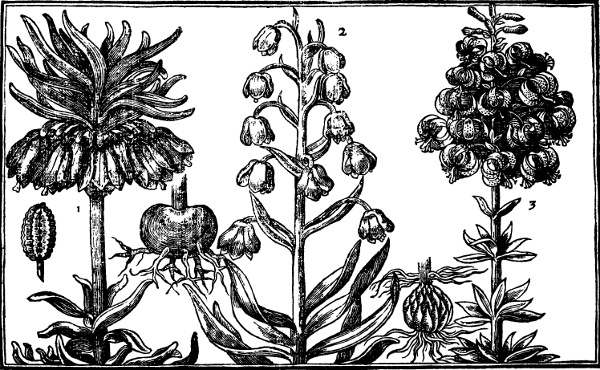
1Corona Imperialis. The Crown Imperiall.
2Lilium Persicum. The Persian Lilly.
3Martagon Imperiale. The Martagon Imperiall.
The Place.
This was, as it is thought, first brought from Persia vnto Constantinople, and from thence, sent vnto vs by the meanes of diuers Turkie Merchants, and in especiall, by the procurement of Mʳ. Nicholas Lete, a worthy Merchant, and a louer of all faire flowers.
The Time.
It springeth out of the ground very neare a moneth before the Crowne Imperiall, but doth not flower till it bee quite past (that is to say) not vntill the latter end of Aprill, or beginning of May: the seed (when it doth come to perfection, as it seldome doth) is not ripe vntill Iuly.
The Names.
It hath been sent by the name of Pennachio Persiano, and wee thereupon doe most vsually call it Lilium Persicum, The Persian Lilly. Clusius saith it hath been sent into the Low Countries vnder the name of Susam giul, and he thereupon thinking it came from Susis in Persia, called it Lilium Susianum, The Lilly of Susis.
The Vertues.
Wee haue not yet heard, that this hath beene applyed for any Physicall respect.
Chap. III. Martagon Imperiale, siue Lilium Montanum maius. The Martagon Imperiall.
Vnder this title of Lilium Montanum, or Lilium Siluestre, I do comprehend only those kindes of Lillies, which carry diuers circles of greene leaues set together at certaine distances, round about the stalke, and not sparsedly as the two former, and as other kindes that follow, doe. And although there bee many of this sort, yet because their chiefest difference is in the colour of the flower, wee will containe them all in one Chapter, and begin with the most stately of them all, because of the number of flowers it beareth vpon one stalke. The Imperiall Lilly hath a scaly roote, like vnto all the rest of the Lillies, but of a paler yellow colour, closely compact or set together, being short and small oftentimes, in comparison of the greatnesse of the stemme growing from it. The stalke is brownish and round at the bottome, and sometimes flat from the middle vpwards, three foote high or more, beset at certaine distances with rondles or circles of many broad leaues, larger and broader for the most part than any other of this kinde, and of a darke green colour: It hath two or three, and sometimes foure of these rondles or circles of leaues, and bare without any leafe betweene; but aboue toward the tops of the stalkes, it hath here and there some leaues vpon it, but smaller than any of the other leaues: at the toppe of the stalke come forth many flowers, sometime three or foure score, thicke thrust, or confusedly set together, and not thinne or sparsedly one aboue another, as in the lesser of this kinde of Mountaine Lilly. It hath been sometimes also obserued in this kinde, that it hath borne manie flowers at three seuerall spaces of the stalke, one aboue another, which hath made a goodly shew; each flower whereof is pendulous, hanging downe, and each leafe of the flower turning vp againe, being thicke or fleshy, of a fine delayed purple colour, spotted with many blackish or brownish spots, of a very pleasant sweet sent, which maketh it the more acceptable: in the middle of the flower hangeth downe a stile or pointell, knobbed or buttoned at the end with sixe yellow chiues, tipt with loose pendents of an Orient red or Vermillion colour, which will easily sticke like dust vpon any thing that toucheth them: the heads or seede vessels are small and round, with small edges about them, wherein is contained flat browne seede like other Lillies, but lesser. This root is very apt to encrease or set of, as we call it, wherby the plant seldome commeth to so great a head of flowers, but riseth vp with many stalkes, and then carry fewer flowers.
Martagon Imperiale flore non punctato.
Of this kinde there is sometimes one found, that beareth flowers without any spots: the leaues whereof and stalke likewise are paler, but not else differing.
Martagon flore albo. The White Martagon.
We haue also some other of this kind, the first wherof hath his stalke & leafe greener than the former, the stalke is a little higher, but not bearing so thicke a head of flowers, although much more plentifull than the lesser Mountaine Lilly, being altogether of a fine white colour, without any spots, or but very few, and that but sometimes also: the pendents in the middle of this flower are not red, as the former, but yellow; the roote of this, and of the other two that follow, are of a pale yellow colour, the cloues or scales of them being brittle, and not closely compact, yet so as if two, and sometimes three scales or cloues grew one vpon the head or vpperpart of another; which difference is a speciall note to know these three kindes, from any other kinde of Mountaine Lilly, as in all old rootes that I haue seene, I haue obserued, as also in them that are reasonably well growne, but in the young rootes it is not yet so manifest.
Martagon flore albo maculato. The White spotted Martagon.
The second is like vnto the first in all things, saue in this, that the flowers hereof are not altogether so white, and besides hath many reddish spots on the inside of the leaues of the flower, and the stalke also is not so greene but brownish.
Martagon flore carneo. The blush Martagon.
A third sort there is of this kinde, whole flowers are wholly of a delayed flesh colour, with many spots on the flowers, and this is the difference hereof from the former.
Lilium Montanum siue siluestre minus. The lesser Mountaine Lilly.
The lesser Mountaine Lilly is so like in root vnto the greater that is first described, that it is hard to distinguish them asunder; but when this is sprung vp out of the ground, which is a moneth after the first: it also carrieth his leaues in rondles about the stalke, although not altogether so great nor so many. The flowers are more thinly set on the stalkes one aboue another, with more distance betweene each flower than the former, and are of a little deeper flesh colour or purple, spotted in the same manner. The buds or heads of flowers, in some of these before they be blowne, are hoary white, or hairie, whereas in others, there is no hoarinesse at all, but the buddes are smooth and purplish: in other things this differeth not from the former.
Lilium Montanum non maculatum.
Of this sort also there is one that hath but few spots on the flowers, whose colour is somewhat paler than the other.
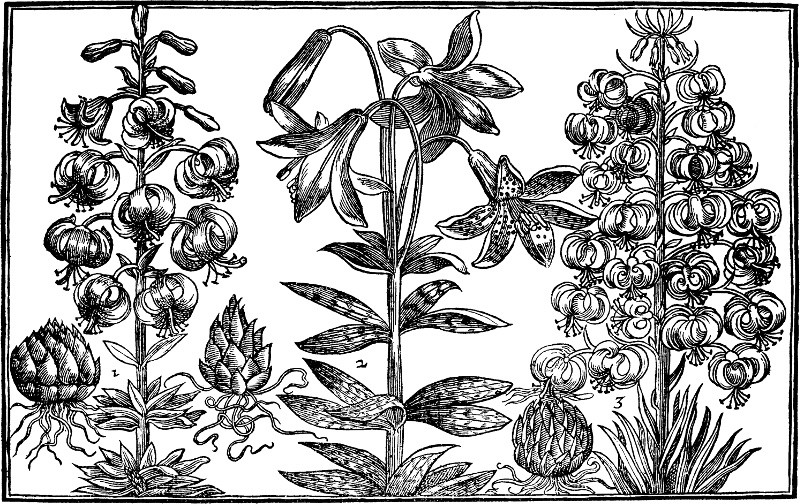
1Martagon flore albo. The white Martagon.
2Martagon siue Lilium Canadense maculatum. The spotted Martagon, or Lilly of Canada.
3Martagon Pomponeum. The Martagon Pompony, or early red Martagon.
Martagon Canadense maculatum. The spotted Martagon of Canada.
Although this strange Lilly hath not his flowers hanging downe, and turning vp again, as the former kinds set forth in this Chapter, yet because the green leaues stand at seuerall ioynts as they do, I must needs insert it here, not knowing where more fitly to place it. It hath a small scaly roote, with many small long fibres thereat, from whence riseth vp a reasonable great stalke, almost as high as any of the former, bearing at three or foure distances many long and narrow greene leaues, but not so many or so broad as the former, with diuers ribbes in them: from among the vppermost rundle of leaues breake forth foure or fiue flowers together, euery one standing on a long slender foote stalke, being almost as large as a red Lilly, but a little bending downewards, and of a faire yellow colour, spotted on the inside with diuers blackish purple spots or strakes, hauing a middle pointell, and sixe chiues, with pendents on them.
The Place.
All these Lillies haue been found in the diuers Countries of Germany, as Austria, Hungaria, Pannonia, Stiria, &c. and are all made Denisons in our London Gardens, where they flourish as in their owne naturall places. The last was brought into France from Canada by the French Colonie, and from thence vnto vs.
The Time.
They flower about the later end of Iune for the most part, yet the first springeth out of the ground a moneth at the least before the other, which are most vsually in flower before it, like vnto the Serotine Tulipas, all of them being early vp, and neuer the neere.
The Names.
The first is vsually called Martagon Imperiale, the Imperiall Martagon, and is Lilium Montanum maius, the greatest Mountaine Lilly; for so it deserueth the name, because of the number of flowers vpon a head or stalke. Some haue called it Lilium Sarasenicum, and some Hemerocallis, but neither of them doth so fitly agree vnto it.
The second is Lilium Montanum maius flore albo, and of some Martagon Imperiale flore albo, but most vsually Martagon flore albo, the white Martagon. The second sort of this second kinde, is called Martagon flore albo maculato, the spotted white Martagon. And the third, Martagon flore carneo, the blush Martagon.
The third kinde is called Lilium Montanum, the Mountaine Lilly, and some adde the title minus, the lesser, to know it more distinctly from the other. Some also Lilium Siluestre, as Clusius, and some others, and of Matthiolus Martagon. Of diuers women here in England, from the Dutch name, Lilly of Nazareth. The last hath his title Americanum & Canadense, and in English accordingly.
Chap. IV. 1. Martagon Pomponeum siue Lilium rubrum præcox, vel Lilium Macedonicum. The early red Martagon, or Martagon Pompony.
As in the former Chapter we described vnto you such Lillies, whose flowers being pendulous, turne their leaues backe againe, and haue their greene leaues, set by spaces about the stalke: so in this wee will set downe those sorts, which carry their greene leaues more sparsedly, and all along the stalke, their flowers hanging downe, and turning vp againe as the former, and begin with that which is of greatest beauty, or at least of most rarity.
1. Martagon Pomponeum angusti folium praecox.
1. This rare Martagon hath a scaly root closely compact, with broader and thinner scales than others, in time growing very great, and of a more deepe yellow colour then the former, from whence doth spring vp a round greene stalke in some plants, and flat in others, two or three foote high, bearing a number of small, long, and narrow greene leaues, very like vnto the leaues of Pinkes, but greener, set very thicke together, and without order about the stalke, vp almost vnto the toppe, and lesser by degrees vpwards, where stand many flowers, according to the age of the plant, and thriuing in the place where it groweth; in those that are young, but a few, and more sparsedly, and in others that are old many more, and thicker set: for I haue reckoned threescore flowers and more, growing thicke together on one plant with mee, and an hundred flowers on another: these flowers are of a pale or yellowish red colour, and not so deep red as the red Martagon of Constantinople, hereafter set down, nor fully so large: yet of the same fashion, that is, euery flower hanging downe, and turning vp his leaues againe. It is not so plentifull in bearing of seede as the other Lillies, but when it doth, it differeth not but in being lesse.
2. Martagon angusti folium magis serotinum.
There is another, whose greene leaues are not so thicke set on the stalke, but else differeth not but in flowring a fortnight later.
3. Martagon Pomponeum latifolium praecox.
There is another also of this kind, so like vnto the former in root, stalk, flower, & maner of growing, that the difference is hardly discerned; but consisteth chiefly in these two points: First, that the leaues of this are a little broader and shorter then the former; and secondly, that it beareth his flowers a fortnight earlier than the first. In the colour or forme of the flower, there can no difference bee discerned, nor (as I said) in any other thing. All these Lillies doe spring very late out of the ground, euen as the yellow Martagons doe, but are sooner in flower then any others.
4. Martagon flore phaeniceo.
A fourth kinde hereof hath of late been knowne to vs, whose leaues are broader and shorter than the last, and the flowers of a paler red, tending to yellow, of some called a golden red colour: but flowreth not so early as they.
2. Lilium rubrum Byzantinum, siue Martagon Constantinopolitanum. The red Martagon of Constantinople.
1. The red Martagon of Constantinople is become so common euery where, and so well knowne to all louers of these delights, that I shall seeme vnto them to lose time, to bestow many lines vpon it; yet because it is so faire a flower, and was at the first so highly esteemed, it deserueth his place and commendations, howsoeuer encreasing the plenty hath not made it dainty. It riseth out of the ground early in the spring, before many other Lillies, from a great thicke yellow scaly root, bearing a round brownish stalke, beset with many faire greene leaues confusedly thereon, but not so broad as the common white Lilly, vpon the toppe whereof stand one, two, or three, or more flowers, vpon long footestalkes, which hang downe their heads, and turne vp their leaues againe, of an excellent red crimson colour, and sometimes paler, hauing a long pointell in the middle, compassed with sixe whitish chiues, tipt with loose yellow pendents, of a reasonable good sent, but somewhat faint. It likewise beareth seede in heads, like vnto the other, but greater.
Martagon Constantinopolitanum maculatum. The red spotted Martagon of Constantinople.
We haue another of this kinde, that groweth somewhat greater and higher, with a larger flower, and of a deeper colour, spotted with diuers blacke spots, or strakes and lines, as is to be seene in the Mountaine Lillies, and in some other hereafter to be described; but is not so in the former of this kinde, which hath no shew of spots at all. The whole plant as it is rare, so it is of much more beauty than the former.
2. Martagon Pannonicum, siue Exoticum flore spadiceo. The bright red Martagon of Hungarie.
Although this Martagon or Lilly bee of another Countrey, yet by reason of the neerenesse both in leafe and flower vnto the former, may more fitly be placed next vnto them, then in any other place. It hath his roote very like the other, but the leaues are somewhat larger, and more sparsedly set vpon the stalke, else not much vnlike: the flowers bend downe, and turne vp their leaues againe, but somewhat larger, and of a bright red, tending to an Orenge colour, that is, somewhat yellowish, and not crimson, like the other.
3. Martagon Luteum punctatum. The Yellow spotted Martagon.
1. This Yellow Martagon hath a great scaly or cloued roote, and yellow, like vnto all these sorts of turning Lillies, from whence springeth vp a round greene strong stalke, three foote high at the least, confusedly set with narrow long greene leaues, white on the edges vp to the very toppe thereof almost, hauing diuers flowers on the head, turning vp againe as the former doe, of a faint yellowish, or greenish yellow colour, with many blacke spots or strakes about the middle of the leafe of euery flower, and a forked pointell, with sixe chiues about it, tipt with reddish pendents, of a heauie strong smell, not very pleasant to many. It beareth seede very plentifully, in great heads, like vnto the other former Lillies, but a little paler.
2. Martagon Luteum non maculatum. The Yellow Martagon without spots.
The other yellow Martagon differeth in no other thing from the former, but onely that it hath no spots at all vpon any of the leaues of the flowers; agreeing with the former, in colour, forme, height, and all things else.
3. Martagon Luteum serotinum. The late flowring Yellow Martagon.
There is yet another yellow Martagon, that hath no other difference then the time of his flowring, which is not vntill Iuly, vnlesse in this, that the flower is of a deeper yellow colour.
The Place.
The knowledge of the first kindes of these early Martagons hath come from Italy, from whence they haue bin sent into the Low-Countries, and to vs, and, as it seemeth by the name, whereby they haue bin sent by some into these parts, his originall should be from the mountaines in Macedonia.
The second sort is sufficiently knowne by his name, being first brought from Constantinople, his naturall place being not farre from thence, as it is likely. But the next sort of this second kinde, doth plainly tell vs his place of birth to be the mountaines of Pannonia or Hungarie.
The third kindes grow on the Pyrenæan mountains, where they haue been searched out, and found by diuers louers of plants, as also in the Kingdome of Naples.
The Time.
The first early Martagons flower in the end of May, or beginning of Iune, and that is a moneth at the least before those that come from Constantinople, which is the second kinde. The two first yellow Martagons flower somewhat more early, then the early red Martagons, and sometimes at the same time with them. But the third yellow Martagon, as is said, flowreth a moneth later or more, and is in flower when the red Martagon of Constantinople flowreth. And although the early red and yellow Martagons, spring later then the other Martagons or Lillies, yet they are in flower before them.
The Names.
The first early red Lillies or Martagons haue beene sent vnto vs by seuerall names, as Martagon Pomponeum, and thereafter are called Martagon of Pompony, and also Lilium or Martagon Macedonicum, the Lilly or Martagon of Macedonia. They are also called by Clusius Lilium rubrum præcox, the one angustiore folio, the other latiore folio. And the last of this kinde hath the title flore phæniceo added or giuen vnto it, that is, the Martagon or Lilly of Macedonia with gold red flowers.
The Martagons of Constantinople haue beene sent by the Turkish name Zufiniare, and is called Martagon, or Lilium Byzantinum by some, and Hemerocallis Chalcedonica by others; but by the name of the Martagon of Constantinople they are most commonly receiued with vs, with the distinction of maculatum to the one, to distinguish the sorts. The last kinde in this classis, hath his name in his title, as it hath been sent vnto vs.
The Yellow Martagons are distinguished in their seuerall titles, as much as is conuenient for them.
Chap. V. Lilium Aureum & Lilium Rubrum. The Gold and Red Lillies.
There are yet some other kindes of red Lillies to bee described, which differ from all the former, and remaine to be spoken of in this place. Some of them grow high, and some lowe, some haue small knots, which wee call bulbes, growing vpon the stalkes, at the ioynts of the leaues or flowers, and some haue none: all which shall be intreated of in their seuerall orders.
Lilium pumilum cruentum. The dwarfe red Lilly.
The dwarfe red Lilly hath a scaly roote, somewhat like vnto other Lillies, but white, and not yellow at all, and the cloues or scales thicker, shorter, and fewer in number, then in most of the former: the stalke hereof is not aboue a foote and a halfe high, round and greene, set confusedly with many faire and short greene leaues, on the toppe of which doe stand sometimes but a few flowers, and sometimes many, of a faire purplish red colour, and a little paler in the middle, euery flower standing vpright, and not hanging downe, as in the former, on the leaues whereof here and there are some blacke spots, lines or markes, and in the middle of the flower a long pointell, with some chiues about it, as is in the rest of these Lillies.
Lilium rubrum multiplici flore.
This kinde is sometimes found to yeeld double flowers, as if all the single flowers should grow into one, and so make it consist of many leaues, which notwithstanding his so continuing sundry yeares, vpon transplanting, will redire ad ingenium, that is, quickly come againe to his old byas or forme.
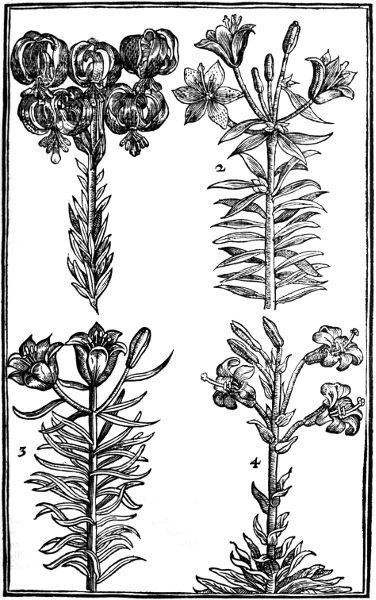
1Martagon rubrum siue luteum. The red or the yellow Martagon.
2Lilium Bulbiferum. The red bulbed Lilly.
3Lilium aureum. The gold red Lilly.
4Lilium album. The white Lilly.
Lilium Aureum. The Gold red Lilly.
The second red Lilly without bulbes groweth much higher then the first, and almost as high as any other Lilly: the roote hereof is white and scaly, the leaues are somewhat longer, and of a darke or sad greene colour; the flowers are many and large, standing vpright as all these sorts of red Lillies doe, of a paler red colour tending to an Orenge on the inside, with many blacke spots and lines on them, as in the former, and more yellow on the outside: the seede vessels are like vnto the roundish heads of other Lillies, and so are the seedes in them likewise.
1. Lilium minus bulbiferum. The dwarfe bulbed Lilly.
The first of the Lillies that carrieth bulbes on the stalke, hath a white scaly roote like the former; from whence riseth vp a small round stalke, not much higher then the first dwarfe Lilly, seeming to be edged, hauing many leaues thereon of a sad green colour set about it, close thrust together: the greene heads for flowers, will haue a kind of woollinesse on them, before the flowers begin to open, and betweene these heads of flowers, as also vnder them, and among the vppermost leaues, appeare small bulbes or heads, which being ripe if they be put into the ground, or if they fall of themselues, will shoote forth leaues, and beare flowers within two or three yeares like the mother plant, and so will the bulbes of the other hereafter described: the flowers of this Lilly are of a faire gold yellow colour, shadowed ouer with a shew of purple, but not so red as the first, or the next to bee described. This Lilly will shoote strings vnder ground, like as the last red Lilly will doe also, whereat will grow white bulbed roots, like the rootes of the mother plant, thereby quickly encreasing it selfe.
2. Lilium Cruentum bulbiferum. The Fierie red bulbed Lilly.
The second bulbed Lilly riseth vp with his stalke as high as any of these Lillies, carrying many long and narrow darke greene leaues about it, and at the toppe many faire red flowers, as large or larger then any of the former, and of a deeper red colour, with spots on them likewise, hauing greater bulbes growing about the toppe of the stalke and among the flowers, then any else.
Lilium Cruentum flore pleno. The Fierie red double Lilly.
The difference of this doth chiefly consist in the flower, which is composed of manie leaues, as if many flowers went to make one, spotted with black spots, and without any bulbes when it thus beareth, which is but accidentall, as the former double Lilly is said to be.
3. Lilium maius bulbiferum. The greater bulbed red Lilly.
The third red Lilly with bulbes, riseth vp almost as high as the last, and is the most common kinde we haue bearing bulbes. It hath many leaues about the stalke, but not of so sad a greene colour as the former: the flowers are of as pale a reddish yellow colour as any of the former, and comming neerest vnto the colour of the Gold red Lilly. This is more plentifull in bulbes, and in shooting strings, to encrease rootes vnder ground, then the others.
The Place.
These Lillies doe all grow in Gardens, but their naturall places of growing is the Mountaines and the Vallies neere them in Italy, as Matthiolus saith: and in many Countries of Germany, as Hungarie, Austria, Stiria, and Bohemia, as Clusius and other doe report.
The Time.
They flower for the most part in Iune, yet the first of these is the earliest of all the rest.
The Names.
All these Lillies are called Lilia Rubra, Red Lillies: Some call them Lilium Aureum, Lilium Purpureum, Lilium Puniceum, & Lilium Cruentum. Some also call them Martagon Chimistarum. Clusius calleth these bulbed Lillies Martagon Bulbiferum. It is thought to be Hyacinthus Poetarum, but I referre the discussing thereof to a fitter time. Wee haue, to distinguish them most fitly (as I take it) giuen their proper names in their seuerall titles.
Chap. VI. Lilium Album. The White Lilly.
Now remaineth onely the White Lilly, of all the whole family or stocke of the Lillies, to bee spoken of, which is of two sorts. The one is our common or vulgar White Lilly; and the other, that which was brought from Constantinople.
Lilium Album vulgare. The ordinary White Lilly.
The ordinary White Lilly scarce needeth any description, it is so well knowne, and so frequent in euery Garden; but to say somewhat thereof, as I vse to doe of euery thing, be it neuer so common and knowne; it hath a cloued or scaly roote, yellower and bigger then any of the red Lillies: the stalke is of a blackish greene colour, and riseth as high as most of the Lillies, hauing many faire, broad, and long greene leaues thereon, larger and longer beneath, and smaller vpon the stalke vpwards; the flowers are many or few, according to the age of the plant, fertility of the soile, and time of standing where it groweth: and stand vpon long greene footstalkes, of a faire white colour, with a long pointell in the middle, and white chiues tipt with yellow pendents about it; the smell is somewhat heady and strong.
Lilium Album Byzantinum. The White Lilly of Constantinople.
The other White Lilly, differeth but little from the former White Lilly, either in roote, leafe, or flower, but only that this vsually groweth with more number of flowers, then euer we saw in our ordinary White Lilly: for I haue seene the stalke of this Lilly turne flat, of the breadth of an hand, bearing neere two hundred flowers vpon a head, yet most commonly it beareth not aboue a dozen, or twenty flowers, but smaller then the ordinary, as the greene leaues are likewise.
The Place.
The first groweth onely in Gardens, and hath not beene declared where it is found wilde, by any that I can heare of. The other hath beene sent from Constantinople, among other rootes, and therefore is likely to grow in some parts neere thereunto.
The Time.
They flower in Iune or thereabouts, but shoote forth greene leaues in Autumne, which abide greene all the Winter, the stalke springing vp betweene the lower leaues in the Spring.
The Names.
It is called Lilium Album, the White Lilly, by most Writers; but by Poets Rosa Iunonis, Iuno’s Rose. The other hath his name in his title.
The Vertues.
This Lilly aboue all the rest, yea, and I thinke this onely, and none of the rest is vsed in medicines now adayes, although in former times Empericks vsed the red; and therefore I haue spoken nothing of them in the end of their Chapters, reseruing what is to be said in this. This hath a mollifying, digesting, and cleansing quality, helping to suppurate tumours, and to digest them, for which purpose the roote is much vsed. The water of the flowers distilled, is of excellent vertue for women in trauell of childe bearing, to procure an easie deliuery, as Matthiolus and Camerarius report. It is vsed also of diuers women outwardly, for their faces to cleanse the skin, and make it white and fresh. Diuers other properties there are in these Lillies, which my purpose is not to declare in this place. Nor is it the scope of this worke; this that hath been said is sufficient: for were it not, that I would giue you some taste of the qualities of plants (as I said in my Preface) as I goe along with them, a generall worke were fitter to declare them then this.
Chap. VII. Fritillaria. The checkerd Daffodill.
Although diuers learned men do by the name giuen vnto this delightfull plant, thinke it doth in some things partake with a Tulipa or Daffodill, and haue therefore placed it betweene them; yet I, finding it most like vnto a little Lilly, both in roote, stalke, leafe, flower, and seede, haue (as you see here) placed it next vnto the Lillies, and before them. Hereof there are many sorts found out of late, as white, red, blacke, and yellow, besides the purple, which was first knowne; and of each of them there are also diuers sorts: and first of that which is most frequent, and then of the rest, euery one in his place and order.
1. Fritillaria vulgaris. The common checkerd Daffodill.
The ordinary checkerd Daffodill (as it is vsually called, but might more properly be called the small checkerd Lilly) hath a small round white roote, and somewhat flat, made as it were of two cloues, and diuided in a maner into two parts, yet ioyning together at the bottome or seate of the roote, which holdeth them both together: from betweene this cleft or diuision, the budde for the stalke &c. appeareth, which in time riseth vp a foote, or a foote and a halfe high, being round and of a brownish greene colour, especially neere vnto the ground, whereon there standeth dispersedly foure or fiue narrow long and greene leaues, being a little hollow: at the toppe of the stalke, betweene the vpper leaues (which are smaller then the lowest) the flower sheweth it selfe, hanging or turning downe the head, but not turning vp againe any of his leaues, as some of the Lillies before described doe; (sometimes this stalke beareth two flowers, and very seldome three) consisting of sixe leaues, of a reddish purple colour, spotted diuersly with great spots, appearing like vnto square checkers, of a deeper colour; the inside of the flower is of a brighter colour then the outside, which hath some greennesse at the bottome of euery leafe: within the flower there appeare sixe chiues tipt with yellow pendents, and a three-forked stile or pointell compassing a greene head, which when the flower is past, riseth vpright againe, and becommeth the seede vessell, being somewhat long and round, yet hauing a small shew of edges, flat at the head, like the head of a Lilly, and without any crowne as the Tulipa hath, wherein is contained pale coloured flat seede, like vnto that of a Lilly, but smaller.
Fritillaria vulgaris pallidior, praecox, & serotina.
There is some variety to be seene in this flower; for in some the colour is paler, and in others againe of a very high or deepe colour: sometimes also they haue eight leaues, and sometimes ten or twelue, as if two flowers were made one, which some thereupon haue called a Double Fritillaria. Some of them likewise doe flower very early, euen with or before the early flowring Tulipas; and some againe flower not vntill a moneth or more after the former.
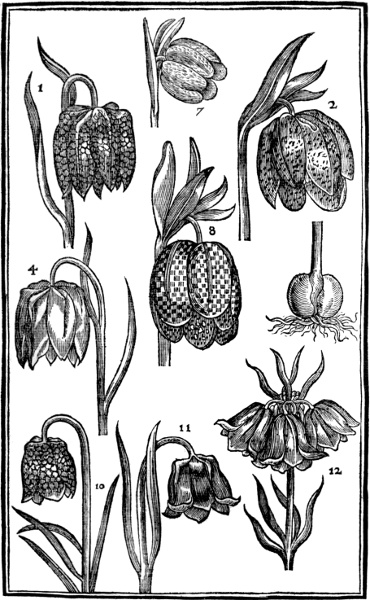
1Fritillaria vulgaris. The common Fritillaria.
2Fritillaria flore atrorubente. The dark red Fritillaria.
4Fritillaria alba. The white Fritillaria.
7Fritillaria lutea punctata. The yellow checkerd Fritillaria.
8Fritillaria lutea Italica. The great yellow Italian Fritillaria.
10Fritillaria lutea Lusitanica. The small yellow Fritillaria of Portugal.
11Fritillaria Pyrenæa. The blacke Fritillaria.
12Fritillaria umbellifera. The Spanish blacke Fritillaria.
2. Fritillaria flore atrorubente. The bloud red Fritillaria.
The roote of this Fritillaria is somewhat rounder and closer then the former, from whence the stalke riseth vp, being shorter and lower then in any other of these kindes, hauing one or two leaues thereon, and at the top thereof two or three more set closer together, which are broader, shorter, and whiter then any of them before, almost like vnto the leaues of the yellow Fritillaria, from among which toppe leaues commeth forth the flower, somewhat bending downe, or rather standing forth, being larger then any of the former, and almost equall in bignesse vnto the yellow Fritillaria, of a duskie gray colour all ouer on the outside, and of a very darke red colour on the inside, diuersly spotted or straked: this very hardly encreaseth by the roote, and as seldome giueth ripe seede, but flowreth with the other first sorts, and before the blacke, and abideth lesse time in flower then any.
3. Fritillaria maxima purpurea siue rubra. The great purple or red Fritillaria.
This great Fritillaria hath his roote equall to the bignesse of the rest of his parts, from whence riseth vp one, & oftentimes two stalks, hauing one, two or three flowers a peece on them, as nature and the seasons are fitting: euery one of these flowers are larger and greater then any of the former described, and pendulous as they are, of a sad red or purplish colour, with many thwart lines on them, and small long markes, which hardly seeme checkerwise, nor are so eminent or conspicuous as in the former: the stalke is strong and high, whereon are set diuers long whitish greene leaues, larger and broader then those of the former.
4. Fritillaria alba. The white Fritillaria.
The white Fritillaria is so like vnto the first, that I shall not neede to make another description of this: it shall (I hope) be sufficient to shew the chiefe differences, and so proceed to the rest. The stalke and leaues of this are wholly greene, whereby it may easily be knowne from the former, which, as is said, is brownish at the bottome. The flower is white, without almost any shew of spot or marke in it, yet in some the markes are somewhat more plainly to be seene, and in some againe there is a shew of a faint kinde of blush colour to be seene in the flower, especially in the inside, the bottomes of the leaues of euery flower sometimes are greenish, hauing also a small list of greene, comming downe towards the middle of each leafe: the head or seede vessell, as also the seede and the roote, are so like vnto the former, that the most cunning cannot distinguish them.
5. Fritillaria flore duplici albicante. The double blush Fritillaria.
This Fritillaria hath a round flattish white roote, very like vnto the last Fritillaria, bearing a stalke with long greene leaues thereon, little differing from it, or the first ordinary Fritillaria: the flower is said to be constant, composed of many leaues, being ten at the least, and most vsually twelue, of a pale whitish purple colour, spotted like vnto the paler ordinary Fritillaria that is early, so that one would verily thinke it were but an accidentall kinde thereof, whereas it is (as is said before) held to bee constant, continuing in this manner.
6. Fritillaria flore luteo puro. The pure yellow Fritillaria.
The pure yellow Fritillaria hath a more round, and not so flat a whitish roote as the former kindes, and of a meane bignesse; from the middle riseth vp a stalke a foote and a halfe high, and sometimes higher, whereon are set without order diuers long and somewhat broad leaues of a whitish greene colour, like vnto the leaues of the blacke Fritillaria, but not aboue halfe so broad: the flower is somewhat small and long, not much vnlike to the blacke for shape and fashion, but that the leaues are smaller and rounder pointed, of a faint yellowish colour, without any shew of spots or checkers at all, eyther within or without the flower, hauing some chiues and yellow pendents in the middle, as is to be seene in all of them: the seede is like the first kinde.
7. Fritillaria flore luteo vario siue punctato. The checkerd yellow Fritillaria.
This Fritillaria groweth not much lower then the former, and brownish at the rising vp, hauing his leaues whiter, broader, and shorter then it, and almost round pointed. The flower is greater, and larger spread then any other before, of a faire pale yellow colour, spotted in very good order, with fine small checkers, which adde a wonderfull pleasing beauty thereunto: it hath also some lists of greene running downe the backe of euery leafe. It seldome giueth seede; the roote also is like the other, but not so flat.
8. Fritillaria lutea maxima Italica. The great yellow Italian Fritillaria.
This kinde of Fritillaria riseth vp with a round and browne greene stalke, whereon are set diuers leaues somewhat broad and short, which compasse the stalke at the bottome of them, of a darke greene colour; at the toppe of the stalke, which bendeth a little downewards, doe most vsually stand three or foure leaues, betweene which commeth forth most vsually but one flower, which is longer then the last, hanging downe the head as all the others doe, consisting of sixe leaues, of a darke yellowish purple colour, spotted with some small red checkers. This kinde flowreth late, and not vntill all the rest are past.
9. Fritillaria Italorum polyanthos flore parno. The small Italian Fritillaria.
This small Italian Fritillaria carrieth more store of flowers on the stalke, but they are much smaller, and of a yellowish greene colour, spotted with long and small darke red checkers or markes: the stalke hath diuers small short greene leaues thereon, vnto the very toppe.
10. Fritillaria lutea Iuncifolia Lusitanica. The small yellow Fritillaria of Portugall.
The leaues of this Fritillaria are so small, narrow and long, that it hath caused them to take the name of rushes, as if you should call it, The rush leafed Fritillaria, which stand on a long weake round stalke, set without order the flower is small and yellow, but thicker checkerd with red spots then any of the other yellow Fritillaria’s; the stalk of the flower, at the head thereof, being also of a yellowish colour.
11. Fritillaria Pyrenæa siue Apenninea. The blacke Fritillaria.
The roote of this kinde doth often grow so great, that it seemeth like vnto the roote of a small Crowne Imperiall: the stalke is strong, round, and high, set without order, with broader and whiter greene leaues then any of the former, bearing one, two, or three flowers; sometimes at the toppe, being not so large as those of the ordinary purple Fritillaria, but smaller, longer, and rounder, sometimes a little turning vp the brims or edges of the leaues againe, and are of a yellowish shining greene colour on the inside, sometimes spotted with red spots almost through the whole inside of the flower, vnto the very edge, which abideth of a pale yellow colour, and sometimes there are very few spots to be seene, and those from the middle onely on the inside (for on the outside there neuer appeareth any spots at all in this kinde) and sometimes with no shew of spots at all, sometimes also of a more pale greene, and sometime of a more yellow colour: the outside of the flowers doe likewise vary, for in some the outside of the leaues are of a darke sullen yellow, &c. else more pale yellow, and in other of a darke purplish yellow colour, which in some is so deepe, and so much, that it rather seemeth blacke then purple or yellow, and this especially about the bottome of the flower, next vnto the stalke, but the edges are still of a yellowish greene: the head of seede, and the seede likewise is like vnto the former, but bigger in all respects.
12. Fritillaria Hispanica vmbellifera. The Spanish blacke Fritillaria.
This Fritillaria is no doubt of kindred to the last recited, it is so like, but greater in all parts thereof, as if growing in a more fruitfull soile, it were the stronger and lustier to beare more store of flowers: the flowers grow foure or fiue from the head together, hanging downe round about the stalke, like vnto a Crowne Imperiall, and are of a yellowish greene colour on the inside, spotted with a few red spots, the outside being blackish as the former.
The Place.
The first of these plants was first brought to our knowledge from France, where it groweth plentifully about Orleance; the other sorts grow in diuers other Countries, as some in Portugall, Spaine, Italy, &c. as their names doe import, and as in time they haue been obserued by those that were curious searchers of these rarities, haue been sent to vs.
The Time.
The early kindes doe flower in the beginning of Aprill or thereabouts, according to the mildenesse or sharpenesse of the precedent Winter. The other doe flower after the first are past, for a moneths space one after another, and the great yellow is very late, not flowring vntill about the middle or end of May.
The Names.
This hath receiued diuers names: some calling it Flos Meleagridis, the Ginny Hen Flower, of the variety of the colours in the flower, agreeing with the feathers of that Bird. Some call it Narcissus Caparonius, of the name of the first inuentor or finder thereof, called Noel Caperon, an Apothecary dwelling in Orleance, at the time he first found it, and was shortly after the finding thereof taken away in the Massacre in France. It is now generally called Fritillaria, of the word Fritillus, which diuers doe take for the Chesse borde or table whereon they play, whereunto, by reason of the resemblance of the great squares or spots so like it, they did presently referre it. It is called by Lobel Lilionarcissus purpureus variegatus, & sessulatus, making it a kinde of Tulipa; but as I said in the beginning of the Chapter, it doth most neerely resemble a small pendulous Lilly, and might therefore rightly hold the name of Lilium variegatum, or in English, the checkerd Lilly. But because the errour which first referred it to a Daffodill, is growne strong by custome of continuance, I leaue to euery one their owne will, to call it in English eyther Fritillaria, as it is called of most, or the checkerd Daffodill, or the Ginnie Hen flower, or, as I doe, the checkerd Lilly. I shall not neede in this place further to explaine the seuerall names of euery of them, hauing giuen you them in their titles.
The Vertues.
I haue not found or heard by any others of any property peculiar in this plant, to be applied either inwardly or outwardly for any disease: the chiefe or onely vse thereof is, to be an ornament for the Gardens of the curious louers of these delights, and to be worne of them abroad, which for the gallant beauty of many of them, deserueth their courteous entertainment, among many other the like pleasures.
Chap. VIII. Tulipa. The Turkes Cap.
Next vnto the Lillies, and before the Narcissi or Daffodils, the discourse of Tulipas deserueth his place, for that it partaketh of both their natures; agreeing with the Lillies in leaues, flowers, and seede, and somewhat with the Daffodils in rootes. There are not onely diuers kindes of Tulipas, but sundry diuersities of colours in them, found out in these later dayes by many the searchers of natures varieties, which haue not formerly been obserued: our age being more delighted in the search, curiosity, and rarities of these pleasant delights, then any age I thinke before. But indeede, this flower, aboue many other, deserueth his true commendations and acceptance with all louers of these beauties, both for the stately aspect, and for the admirable varietie of colours, that daily doe arise in them, farre beyond all other plants that grow, in so much, that I doubt, although I shall in this Chapter set downe the varieties of a great many, I shall leaue more vnspoken of, then I shall describe; for I may well say, there is in this one plant no end of diuersity to be expected, euery yeare yeelding a mixture and variety that hath not before been obserued, and all this arising from the sowing of the seede. The chiefe diuision of Tulipas, is into two sorts: Præcoces, early flowring Tulipas, and Serotinæ, late flowring Tulipas. For that sort which is called Mediæ or Dubiæ, that is, which flower in the middle time betweene them both, and may be thought to be a kinde or sort by it selfe, as well as any of the other two: yet because they doe neerer participate with the Serotinæ then with the Præcoces, not onely in the colour of the leafe, being of the same greennesse with the Serotinæ, and most vsually also, for that it beareth his stalke and flower, high and large like as the Serotinæ doe; but especially, for that the seede of a Media Tulipa did neuer bring forth a Præcox flower (although I know Clusius, an industrious, learned, and painfull searcher and publisher of these rarities, saith otherwise) so farre as euer I could, by mine owne care or knowledge, in sowing their seede apart, or the assurance of any others, the louers and sowers of Tulipa seede, obserue, learne, or know: and because also that the seede of the Serotinæ bringeth forth Medias, and the seede of Medias Serotinæ, they may well bee comprehended vnder the generall title of Serotinæ: But because they haue generally receiued the name Mediæ, or middle flowring Tulipas, to distinguish between them, and those that vsually doe flower after them; I am content to set them downe, and speake of them seuerally, as of three sorts. Vnto the place and ranke likewise of the Præcoces, or early flowring Tulipas, there are some other seuerall kinds of Tulipas to be added, which are notably differing, not onely from the former Præcox Tulipa, but euery one of them, one from another, in some speciall note or other: as the Tulipa Boloniensis flore rubro, the red Bolonia Tulipa. Tulipa Boloniensis flore luteo, the yellow Bolonia Tulipa. Tulipa Persica, Persian Tulipa. Tulipa Cretica, the Candie Tulipa, and others: all which shall bee described and entreated of, euery one apart by it selfe, in the end of the ranke of the Præcoces, because all of them flower much about their time. To begin then with the Præcox, or early flowring Tulipas, and after them with the Medias and Serotinas, I shall for the better method, diuide their flowers into foure primary or principall colours, that is to say, White, Purple, Red and Yellow, and vnder every one of these colours, set downe the seuerall varieties of mixtures we haue seene and obserued in them, that so they may be both the better described by me, and the better conceiued by others, and euery one placed in their proper ranke. Yet I shall in this, as I intend to doe in diuers other plants that are variable, giue but one description in generall of the plant, and then set downe the varietie of forme or colour afterwards briefly by themselues.
Tulipa præcox. The early flowring Tulipa.
The early Tulipa (and so all other Tulipas) springeth out of the ground with his leaues folded one within another, the first or lowest leafe riseth vp first, sharpe pointed, and folded round together, vntill it be an inch or two aboue the ground, which then openeth it selfe, shewing another leafe folded also in the bosome or belly of the first, which in time likewise opening it selfe, sheweth forth a third, and sometimes a fourth and a fifth: the lower leaues are larger then the vpper, and are faire, thicke, broad, long, and hollow like a gutter, and sometimes crumpled on the edges, which will hold water that falleth thereon a long time, of a pale or whitish greene colour, (and the Mediæ and Serotinæ more greene) couered ouer as it were with a mealinesse or hoarinesse, with an eye or shew of rednesse towards the bottome of the leaues, and the edges in this kinde being more notable white, which are two principall notes to know a Præcox Tulipa from a Media or Serotina: the stalke with the flower riseth vp in the middle, as it were through these leaues, which in time stand one aboue another, compassing it at certaine vnequall distances, and is often obserued to bend it selfe crookedly downe to the ground, as if it would thrust his head thereinto, but turning vp his head (which will be the flower) againe, afterwards standeth vpright, sometimes but three or foure fingers or inches high, but more often halfe a foote, and a foot high, but the Medias, and Serotinas much higher, carrying (for the most part) but one flower on the toppe thereof, like vnto a Lilly for the forme, consisting of sixe leaues, greene at the first, and afterwards changing into diuers and sundry seuerall colours and varieties, the bottomes likewise of the leaues of these sometimes, but most especially of the Mediæ, being as variable as the flower, which are in some yellow, or green, or blacke, in others white, blew, purple, or tawnie; and sometimes one colour circling another: some of them haue little or no sent at all, and some haue a better then others. After it hath been blowne open three or foure dayes or more, it will in the heate of the Sunne spread it selfe open, and lay it selfe almost flat to the stalke: in the middle of the flower standeth a greene long head (which will be the seed vessell) compassed about with sixe chiues, which doe much vary, in being sometimes of one, and sometimes of another colour, tipt with pendents diuersly varied likewise: the head in the middle of the flower groweth after the flower is fallen, to be long, round, and edged, as it were three square, the edges meeting at the toppe, where it is smallest, and making as it were a crowne (which is not seen in the head of any Lilly) and when it is ripe, diuideth it selfe on the inside into sixe rowes, of flat, thinne, brownish, gristly seede, very like vnto the seede of the Lillies, but brighter, stiffer, and more transparent: the roote being well growne is round, and somewhat great, small and pointed at the toppe, and broader, yet roundish at the bottome, with a certaine eminence or seate on the one side, as the roote of the Colchicum hath; but not so long, or great, it hath also an hollownesse on the one side (if it haue borne a flower) where the stalke grew, (for although in the time of the first springing vp, vntill it shew the budde for flower, the stalke with the leaues thereon rise vp out of the middle of the roote; yet when the stalke is risen vp, and sheweth the budde for flower, it commeth to one side, making an impression therein) couered ouer with a brownish thin coate or skin, like an Onion, hauing a little woollinesse at the bottome; but white within, and firme, yet composed of many coates, one folding within another, as the roote of the Daffodils be, of a reasonable good taste, neyther very sweete, nor yet vnpleasant. This description may well serue for the other Tulipas, being Medias or Serotinas, concerning their springing and bearing, which haue not any other great variety therein worth the note, which is not expressed here; the chiefe difference resting in the variety of the colours of the flower, and their seuerall mixtures and markes, as I said before: sauing onely, that the flowers of some are great and large, and of others smaller, and the leaues of some long and pointed, and of others broad and round, or bluntly pointed, as shall bee shewed in the end of the Chapter: I shall therefore onely expresse the colours, with the mixture or composure of them, and giue you withall the names of some of them, (for it is impossible I thinke to any man, to giue seuerall names to all varieties) as they are called by those that chiefly delight in them with vs.
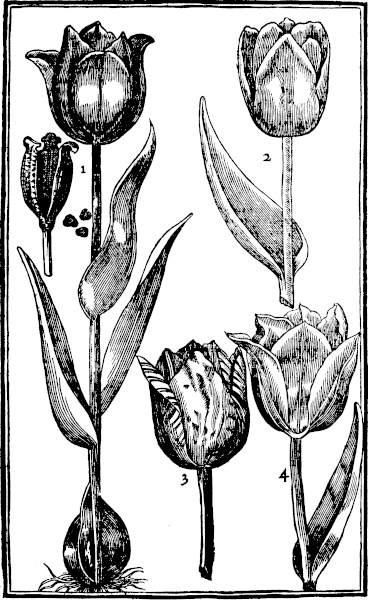
1Tulipa præcox alba siue rubra, &c. vnius coloris. The early white or red Tulipa, &c. being of one colour.
2Tulipa, præcox purpurea oris albis. The early purple Tulipa with white edges, or the Prince.
3Tulipa præcox variegata. The early stript Tulipa.
4Tulipa præcox rubra oris luteis. The early red Tulipa with yellow edges, or the Duke.
Tulipa præcox Alba.
1 Niuea tota interdum purpureis staminibus, vel saltem luteis, fundo puro haud luteo.
2 Alba siue niuea fundo luteo.
3 Albida.
4 Alba, venis cærulis in dorso.
5 Alba purpureis oris. ⎧Harum flores vel ⎨constantes, vel ⎩dispergentes.
6 Alba carneis oris.
7 Alba sanguineis oris.
8 Alba oris magnis carneis, & venis intro respicientibus.
9 Alba extra, carnei vero coloris intus, oras habens carneas saturatiores.
10 Albida, oris rubris, vel oris purpureis.
11 Alba, purpurascentibus maculis extra, intus vero carnei viuacissimi.
12 Alba, purpureis maculis aspersa extra, intus vero alba purpurantibus oris.
13 Dux Alba, i. e. coceineis & albis variata flaminis, à medio ad oras intercursantibus.
14 Princessa, i.e. argentei coloris maculis purpurascentibus.
15 Regina pulcherrima, albis & sanguineis aspersa radijs & punctis.
The early White Tulipa.
1 The flower whereof is either pure snow white, with purple sometimes, or at least with yellow chiues, without any yellow bottome.
2 Or pure white with a yellow bottome.
3 Or milk white that is not so pure white.
4 White with blew veines on the outside.
5 White with purple edges. ⎧Some of these ⎪abiding constant, ⎨& others ⎪spreading ⎩or running.
6 White with blush edges.
7 White With red edges.
8 White with great blush edges, and some strakes running from the edge inward.
9 White without, and somewhat blush within, with edges of a deeper blush.
10 Whitish, or pale white with red or purple edges.
11 Whitish without, with some purplish veins & spots, & of a liuely blush within.
12 White without, spotted with small purple spots, and white within with purple edges.
13 A white Duke, that is, parted with white & crimson flames, from the middle of each leafe to the edge.
14 The Princesse, that is, a siluer colour spotted with fine deepe blush spots.
15 The Queen, that is, a fine white sprinkled with bloud red spots, and greater strakes.
Tulipa præcox purpurea.
1 Purpurea satura rubescens, vel violacea.
2 Purpurea pallida, Columbina dicta.
3 Persici coloris saturi.
4 Persici coloris Pallidioris.
5 Paeoniæ floris coloris.
6 Rosea.
7 Chermesiua peramæna.
8 Chermesiua parum striata.
9 Princeps, i.e. purpurea saturatior vel dilutior, oris albis magnis vel paruis, fundo luteo, vel albo orbe, quæ multum variatur, & colore, & oris, ita vt purpurea elegans oris magnis albis; dicta est, Princeps excellens, &
10 Princeps Columbina, purpurea dilutior.
11 Purpurea Chermesina, rubicandioris coloris, albidis vel albis oris.
12 Purpurea, vel obsoleta albidis oris Princeps Brancion.
13 Purpurea diluta, oris dilutioris purpurei coloris.
14 Purpurea in exterioribus, carnei vero ad medium intus, oris albis, fundo luteo.
15 Purpurea albo plumata extra, oris albis, purpurascens intus, fundo luteo, vel orbe albo.
16 Alia, minus elegans plumata, minoribusq., oris albidis.
The early purple Tulipa.
1 A reddish purple, or more violet.
2 A pale purple, called a Doue colour.
3 A deep Peach colour.
4 A paler Peach colour.
5 A Peony flower colour.
6 A Rose colour.
7 A Crimson very bright.
8 A Crimson stript with a little white.
9 A Prince or Bracklar, that is, a deepe or pale purple, with white edges, greater or smaller, and a yellow bottome, or circled with white, which varieth much, both in the purple & edges, so that a faire deep purple, with great white edges, is called, The best or chiefe Prince, and
10 A paler purple with white edges, called a Doue coloured Prince.
11 A Crimson Prince or Bracklar.
12 A Brancion Prince, or purple Brancion.
13 A purple with more pale purple edges.
14 Purple without, and blush halfe way within, with white edges, and a yellow bottome.
15 Purple feathered with white on the out side, with white edges, and pale purple within, the ground being a little yellow, or circled with white.
16 Another very neere vnto it, but not so fairely feathered, being more obscure, and the edges not so great or whitish.
Tulipa præcox rubra.
1 Rubra vulgaris fundo luteo, aliquando nigro.
2 Rubra satura oris luteis paruis, dicta Roan.
3 Baro, i. e. rubra magis intensa, oris luteis paruis.
4 Dux maior & minor, i.e. rubra magis aut minus elegans satura, oris luteis maximis vel minoribus, & fundo luteo magno. Alia alijs est magis amœna, in alijs etiam fundo nigro vel obscuro viridi.
5 Ducissa, i. e. Duci similis, at plus lutei quàm rubri, oris magnis luteis, & rubore magis aut minus intus in gyrum acto, fundo item luteo magno.
6 Testamentum Brancion i.e., rubra sanguinea satura, aut minus rubra, oris pallidis, magnis vel paruis: alia alijs magis aut minus elegans diuersimodo.
7 Flambans, ex rubore & flauedine radiata, vel striata fundo luteo.
8 Mali Aurantij coloris, ex rubore, & flauedinè integre, non separatim mixta, oris luteis paruis, vel absq., oris.
9 Minij, siue Cinabaris coloris, i.e. ex purpurea, rubedine, & flauedine radiata, vnguibus luteis, & aliquando oris.
10 Rex Tuliparum, i.e. ex sanguineo & aureo radiatim mixta, à flammea diuersa, fundo luteo, orbe rubro.
11 Tunica Morionis, i.e. ex rubore & aureo separatim diuersa.
The early red Tulipa.
1 An ordinary red, with a yellow, & sometimes a blacke bottome.
2 A deep red, with a small edge of yellow, called a Roane.
3 A Baron, that is, a faire red with a small yellow edge.
4 A Duke, a greater and a lesser, that is, a more or less faire deep red, with greater or lesser yellow edges, and a great yellow bottome. Some of this sort are much more or lesse faire then others, some also haue a blacke or darke greene bottome.
5 A Dutchesse, that is like vnto the Duke, but more yellow then red, with greater yellow edges, and the red more or lesse circling the middle of the flower on the inside, with a large yellow bottome.
6 A Testament Brancion, or a Brancion Duke, that is, a faire deepe red, or lesse red, with a pale yellow or butter coloured edge, some larger others smaller: and some more pleasing then others, in a very variable manner.
7 A Flambant, differing from the Dutchesse; for this hath no such great yellow edge, but streaks of yellow through the leafe vnto the very edge.
8 An Orenge colour, that is, a reddish yellow, or a red and yellow equally mixed, with small yellow edges, and sometimes without.
9 A Vermillion, that is, a purplish red, streamed with yellow, the bottome yellow, and sometimes the edges.
10 The Kings flower, that is, a crimson or bloud red, streamed with a gold yellow, differing from the Flambant, the bottome yellow, circled with red.
11 A Fooles coate, parted with red and yellow guardes.
Tulipa præcox lutea.
1 Lutea siue flaua.
2 Pallida lutea siue straminea.
3 Aurea, oris rubicundis.
4 Straminea, oris rubris.
5 Aurea, rubore perfusa extra.
6 Aurea, vel magis pallida, rubore in gyrum acta simillima Ducissæ, nisi minus rubedinis habet.
7 Aurea, extremitatibus rubris, dici potest, Morionis Pilæus præcox.
The early yellow Tulipa.
1 A faire gold yellow without mixture.
2 A strawe colour.
3 A faire yellow with reddish edges.
4 A strawe colour, with red edges.
5 A faire yellow, reddish on the out side onely.
6 A gold or paler yellow, circled on the inside a little with red, very like the Dutchesse, but that it hath lesse red therein.
7 A gold yellow with red toppes, and may be called, The early Fooles Cap.
Tulipa de Caffa. The Tulipa of Caffa.
There is another sort or kinde of early Tulipa, differing from the former, whose pale greene leaues being as broad and large as they, and sometimes crumpled or waued at the edges, in some haue the edges onely of the said leaues for a good breadth, of a whitish or whitish yellow colour, and in others, the leaues are lifted or parted with whitish yellow and greene: the stalke riseth not vp so high as the former, and beareth a flower at the toppe like vnto the former, in some of a reddish yellow colour, with a russet coloured ground or bottome, and in others, of other seuerall colours: the seede and roote is so like vnto others of this kinde, that they cannot be distinguished.
There is (as I doe heare) of this kinde, both Præcoces and Serotinæ early flowring, and late flowring, whereof although wee haue not so exact knowledge, as of the rest, yet I thought good to speake so much, as I could hitherto vnderstand of them, and giue others leaue (if I doe not) hereafter to amplifie it.
Tulipa Boloniensis, siue Bombycina flore rubro major. The greater red Bolonia Tulipa.
There are likewise other kindes of early Tulipas to bee spoken of, and first of the red Bolonia Tulipa; the roote whereof is plainly discerned, to be differing from all others: for that it is longer, and not hauing so plaine an eminence at the bottome thereof, as the former and later Tulipas, but more especially because the toppe is plentifully stored with a yellowish silke-like woollinesse: the outside likewise or skinne is of a brighter or paler red, not so easie to be pilled away, and runneth vnder ground both downeright and sidewise (especially in the countrey ground and ayre, where it will encrease aboundantly, but not either in our London ayre, or forc’t grounds) somewhat like vnto the yellow Bolonia Tulipa next following. It shooteth out of the ground with broad and long leaues, like the former; but neither so broad, nor of so white or mealy a greene colour as the former, but more darke then the late flowring Tulipa, so that this may bee easily discerned by his leafe from any other Tulipa aboue the ground, by one that is skilfull. It beareth likewise three or foure leaues vpon the stalke, like the former, and a flower also at the toppe of the same fashion, but that the leaues hereof are alwayes long, and somewhat narrow, hauing a large blacke bottome, made like vnto a cheuerne, the point whereof riseth vp vnto the middle of the leafe, higher then any other Tulipa; the flower is of a pale red colour, nothing so liuely as in the early or late red Tulipas, yet sweeter for the most part then any of them, and neerest vnto the yellow Bolonia Tulipa, which is much about the same sent.
Tulipa pumilio rubra, siue Bergomensis rubra media & minor. The dwarfe red Bergomo Tulipa, a bigger and a lesser.
There are two other sorts hereof, and because they were found about Bergomo, do carry that name, the one bigger or lesser then another, yet neither so great as the former, hauing very little other difference to bee obserued in them, then that they are smaller in all parts of them.
Tulipa Boloniensis flore luteo. The yellow Bolonia Tulipa.
The roote of this Tulipa may likewise bee knowne from the former red (or any other Tulipa) in that it seldome commeth to bee so bigge, and is not so woolly at the toppe, and the skinne or outside is somewhat paler, harder, and sharper pointed: but the bottome is like the former red, and not so eminent as the early or late Tulipas. This beareth much longer and narrower leaues then any (except the Persian & dwarfe yellow Tulipas) and of a whitish greene colour: it beareth sometimes but one flower on a stalke, and sometimes two or three wholly yellow, but smaller, & more open then the other kinds, and (as I said) smelleth sweete, the head for seede is smaller then in others, and hath not that crowne at the head thereof yet the seed is like, but smaller.
Tulipa Narbonensis, siue Monspeliensis vel pumilio. The French or dwarfe yellow Tulipa.
This Tulipa is very like vnto the yellow Bolonia Tulipa, both in roote, leafe, and flower, as also in the colour thereof, being yellow: the onely difference is, that it is in all things lesser and lower, and is not so apt to beare, nor so plentifull to encrease by the roote.
Tulipa Italica maior & minor. The Italian Tulipa the greater and the lesser.
Both these kindes of Tulipas doe so neere resemble the last kinde, that I might almost say they were the same, but that some difference which I saw in them, maketh mee set them apart; and consisteth in these things, the stalkes of neither of both these rise so high, as of the first yellow Bolonia Tulipa: the leaues of both sorts are writhed in and out at the edges, or made like a waue of the sea, lying neerer the ground, and the flower being yellow within, is brownish or reddish on the backe, in the middle of the three outer leaues the edges appearing yellow. Both these kindes doe differ one from the other in nothing, but in that one is bigger, and the other smaller then the other which I saw with Iohn Tradescante, my very good friend often remembred.
Tulipa Lusitanica, siue pumilio versicolor. The dwarfe stript Tulipa.
This dwarfe Tulipa is also of the same kindred with the three last described; for there is no other difference in this from them, then that the flower hath some red veins running in the leaues thereof.
There are two other sorts of dwarfe Tulipas with white flowers, whereof Lobel hath made mention in the Appendix to his Aduersaria; the one whereof is the same that Clusius setteth forth, vnder the title of Pumilio altera: but because I haue not seen either of them both, I speake no further of them.
Tulipa pumilio alba. The white dwarfe Tulipa.
But that white flower that Iohn Tradescante shewed me, and as hee saith, was deliuered him for a white Pumilio, had a stalke longer then they set out theirs to haue, and the flower also larger, but yet had narrower leaues then other sorts of white Tulipas haue.
Tulipa Bicolor. The small party coloured Tulipa.
Vnto these kindes, I may well adde this kinde of Tulipa also, which was sent out of Italy, whose leaues are small, long, and narrow, and of a darke greene colour, somewhat like vnto the leaues of an Hyacinth: the flower is small also, consisting of sixe leaues, as all other Tulipas doe, three whereof are wholly of a red colour, and the other three wholly of a yellow.
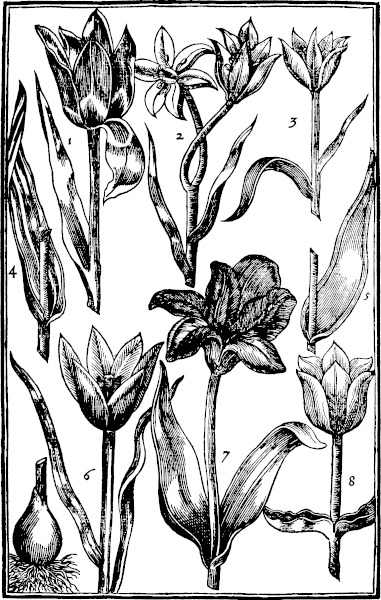
1Tulipa Bombycina flore rubro. The red Bolonia Tulipa.
2Tulipa Boloniensis flore luteo. The yellow Bolonia Tulipa.
3Tulipa pumilio rubra siue lutea. The red or yellow dwarfe Tulipa.
4Folium Tulipa de Cassa per totum striuatum. The leafe of the Tulipa of Cassa striped throughout the whole leafe.
5Folium Tulipa Cassa per oras striatum. The leafe of the Tulipa of Cassa striped at the edges onely.
6Tulipa Persica. The Persian Tulipa.
7Tulipa Cretica. The Tulipa of Candie.
8Tulipa Armeniaca. The Tulipa of Amenia.
Tulipa Persica. The Persian Tulipa.
This rare Tulipa, wherewith we haue beene but lately acquainted, doth most fitly deserue to be described in this place, because it doth so neerely participate with the Bolonia and Italian Tulipas, in roote, leafe, and flower: the roote hereof is small, couered with a thicke hard blackish shell or skinne, with a yellowish woollinesse both at the toppe, and vnder the shell. It riseth out of the ground at the first, with one very long and small round leafe, which when it is three or foure inches high, doth open it selfe, and shew forth another small leafe (as long almost as the former) breaking out of the one side thereat, and after it a third, and sometimes a fourth, and a fift; but each shorter then other, which afterwards be of the breadth of the dwarfe yellow Tulipa, or somewhat broader but much longer then any other, and abiding more hollow, and of the colour of the early Tulipas on the inside: the stalke riseth vp a foot and a halfe high sometimes, bearing one flower thereon, composed of sixe long and pointed leaues of the forme of other small Tulipas, and not shewing much bigger then the yellow Italian Tulipa, and, is wholly white, both inside and outside of all the leaues, except the three outtermost, which haue on the backe of them, from the middle toward the edges, a shew of a brownish blush or pale red colour, yet deeper in the midst, and the edges remaining wholly white: the bottomes of all these leaues are of a darke or dun tawnie colour, and the chiues and tippes of a darkish purple or tawnie also. This doth beare seed but seldome in our country, that euer I could vnderstand, but when it doth, it is small like vnto the Bolonia or dwarfe yellow Tulipas, being not so plentifull also in parting, or setting of by the roote as they, and neuer groweth nor abideth so great as it is brought vnto vs, and seldome likewise flowreth after the first yeare: for the rootes for the most part with euery one grow lesse and lesse, decaying euery yeare, and so perish for the most part by reason of the frosts and cold, and yet they haue been set deepe to defend them, although of their owne nature they will runne downe deep into the ground.
Tulipa Byzantina duobus floribus Clusij. The small Tulipa of Constantinople.
The small Tulipa of Constantinople, beareth for the most part but two leaues on the stalke, which are faire and broad, almost like vnto the Candy Tulipa, next hereunto to be described: the stalke it selfe riseth not aboue a foote high, bearing sometimes but one flower, but most commonly two thereon, one below another, and are no bigger then the flowers of the yellow Bolonia Tulipa, but differing in colour; for this is on the outside of a purplish colour, mixed with white and greene, and on the inside of a faire blush colour, the bottome and chiues being yellow, and the tippes or pendents blackish: the roote is very like the yellow Bolonia Tulipa.
Tulipa Cretica. The Tulipa of Candie.
This Tulipa is of later knowledge with vs then the Persian, but doth more hardly thriue, in regard of our cold climate; the description whereof, for so much as wee haue knowledge, by the sight of the roote and leafe, and relation from others of the flower, (for I haue not yet heard that it hath very often flowred in our Country) is as followeth. It beareth faire broad leaues, resembling the leaues of a Lilly, of a greenish colour, and not very whitish: the stalke beareth thereon one flower, larger and more open then many other, which is either wholly white, or of a deepe red colour, or else is variably mixed, white with a fine reddish purple, the bottomes being yellow, with purplish chiues tipt with blackish pendents: the roote is small, and somewhat like the dwarfe yellow Tulipa, but somewhat bigger.
Tulipa Armeniaca. The Tulipa of Armenia.
This small Tulipa is much differing from all the former (except the small or dwarfe white Tulipas remembred by Lobel and Clusius, as is before set downe) in that it beareth three or foure small, long, and somewhat narrow greene leaues, altogether at one ioynt or place; the stalke being not high, and naked or without leaues from them to the toppe, where it beareth one small flower like vnto an ordinary red Tulipa, but somewhat more yellow, tending to an Orenge colour with a blacke bottome: the roote is not much bigger then the ordinary yellow Bolonia Tulipa, before set downe.
And these are the sorts of this first Classis of early Tulipas.
Tulipa Media. The meaner or middle flowring Tulipa.
For any other, or further description of this kinde of Tulipa, it shall not neede, hauing giuen it sufficiently in the former early Tulipa, the maine difference consisting first in the time of flowring, which is about a moneth after the early Tulipas, yet some more some lesse; for euen in the Præcoces, or early ones, some flower a little earlier, and later then others, and then in the colours of the flowers; for wee haue obserued many colours, and mixtures, or varieties of colours in the Medias, which we could neuer see in the Præcoces, and so also some in the Præcoces, which are not in the Medias: yet there is farre greater varieties of mixture of colours in these Medias, then hath been obserued in all the Præcoces, (although Clusius saith otherwise) eyther by my selfe, or by any other that I haue conuersed with about this matter, and all this hath happened by the sowing of the seede, as I said before. I will therefore in this place not trouble you with any further circumstance, then to distinguish them, as I haue done in the former early Tulipas, into their foure primary colours, and vnder them, giue you their seuerall varieties and names, for so much as hath come to my knowledge, not doubting, but that many that haue trauelled in the sowing of the seed of Tulipas many yeares, may obserue each of them to haue some variety that others haue not: and therefore I thinke no one man can come to the knowledge of all particular distinctions.
Tulipa media alba.
1 Niuea, fundo albo vel luteo.
2 Argentea, quasi alba cineracea fundo lutescente, purpureis staminibus.
3 Margaritina alba, carneo dilutissima.
4 Alba, fundo cæruleo vel nigro.
5 Albida.
6 Alba, oris rubris. ⎧Hæc tria genera ⎪in aliquibus ⎨constanter ⎪tenent oras, in ⎩alijs dispergunt.
7 Alba, purpureis oris.
8 Alba, oris coccineis.
9 Albida primum, deinde albidior, oris purpureis, & venis intrò respicientibus, dicta nobis Hackquenay.
10 Alba, sanguineo colore variata, fundo vel albissimo, vel alio.
11 Alba, radiatim disposita flammis, & maculis coccineis.
12 Alba, purpurea rubedine plumata, diuersarum specierum, quæ cum superiore, vel albo, vel luteo, vel paruo cæruleo constant fundo, quæ constanter tenent punctatos colores, & non dispergunt, sed post trium aut quatuor dierum spatium pulchriores apparent.
13 Panni argentei coloris, i.e. alba, plumata, punctata, striata, vel diuersimodè variata, rubedine dilutiore, vel saturatiore purpurea, interius vel exterius, vel vtrinq., diuersarum specierum.
14 Tunica morionis alba varia, i.e. ex albo & purpureo striata diuersimodè, fundo albo vel alio.
15 Holias alba vel albida, absq., fundo, vel fundo purpureo cæruleo, vel cæruleo albo circundato, diuersè signata, vel variata intus ad medietatem foliorum, sursum in orbem vt plurimum, vel ad oras pertingens amplas & albas. Hæ species tantoperè multiplicantur, vt vix sint explicabiles.
Tanta est huius varietas, vel multitudine, vel striarum paucitate & distinctione, vel fundis variantibus, vt ad tædium esset perscribere.
The white meane flowring Tulipa.
1 A snow white, with a white or yellow bottome.
2 A siluer colour, that is, a very pale or whitish ashe colour, with a yellowish bottome and purple chiues.
3 A Pearle colour, that is, white, with a wash or shew of blush.
4 A white, with a blew or blacke bottome.
5 A Creame colour.
6 A white, with red edges. ⎧These three sorts ⎪doe hold their ⎨edges constant ⎪in some, but well ⎩spread in others.
7 A white, with purple edges.
8 A white, with crimson edges.
9 A pale or whitish yellow, which after a few dayes groweth more white, with purplish red edges, and some streakes running inward from the edge, which we call an Hackney.
10 A white mixed with a bloud red very variably, and with a pure white, or other coloured bottome.
11 A white, streamed with crimson flames, and spots through the whole flower.
12 A white, speckled with a reddish purple, more or lesse, of diuers sorts, with white, yellow, or blew bottomes, all which doe hold their markes constant, and doe not spread their colours, but shew fairer after they haue stood blown three or foure dayes.
13 A cloth of siluer of diuers sorts, that is, a white spotted, striped, or otherwise marked with red or purple, in some paler, in some deeper, either on the inside, or on the outside, or on both.
14 A white Fooles coate of diuers sorts, that is, purple or pale crimson, and white, as it were empaled together, eyther with a white ground or other, whereof there is great variety.
15 A white Holias, that is, a faire white, or paler white, eyther without a bottome, or with a blewish purple bottome, or blew and white circling the bottome,and from the middle vpwards, speckled and straked on the inside for the most part, with bloud red or purplish spots and lines vnto the very edges, which abide large and white. Of this kinde there are found very great varieties, not to be expressed.
Of this sort there is so much variety, some being larger or fairer marked then others, their bottomes also varying, that it is almost impossible to express them.
Tulipa media purpurea.
1 Purpurea satura.
2 Purpurea dilutior, diuersarum specierum, quarum Rosea vna, Carnea sit altera.
3 Persicicoloris, duarum aut trium specierum.
4 Chermesina, obscura aut pallida.
5 Stamela, intensior aut remissior.
6 Xerampelina.
7 Purpurea, striata.
8 Persici saturi, vel diluti coloris, vndulata, vel radiata.
9 Columbina, oris & radijs albis.
10 Purpurea rubra, oris, albis, similis Præcoci, dicta Princeps.
11 Chermesina, vel Heluola, lineis albis in medio, & versus oras, fundo cæruleo, vel albo, itemq., albo orbe.
12 Purpurea remissior, aut intensior, oris albis, paruis aut magnis, vt in Principe præcoci, fundo vel cæruleo, orbe albo, vel albo orbe cæruleo amplo.
13 Holias Heluola, sanguineis guttis intus à medio sursum in orbem, fundo cæruleo.
14 Tunica Morionis purpurea rubra satura, albido striata, quam in alba saturatior, fundo ex cæruleo & albo.
15 Purpurea rubra satura vel diluta, albo vel albedine, punctata vel striata diuersimodè, dicta Cariophyllata.
The meane flowring purple Tulipa.
1 A faire deep purple.
2 A paler purple, of many sorts, whereof a Rose colour is one, a Blush another.
3 A Peach colour of two or three sorts.
4 A Crimson, deepe, or pale.
5 A Stamell, darke or light.
6 A Murrey.
7 A purple, stript and spotted.
8 A Peach colour, higher or paler, waued or stript.
9 A Doue colour, edged and straked with white.
10 A faire red purple, with white edges, like vnto the early Tulipa, called a Prince.
11 A faire crimson, or Claret wine colour, with white lines both in the middle, and towards the edges, most haue a blew bottome, yet some are white, or circled with white.
12 A light or deepe purple, with white edges, greater or smaller, like the early Prince, the bottomes eyther blew circled with white, or white circled with a large blew.
13 A purple Holias, the colour of a pale Claret wine, marked and spotted with bloud red spots, round about the middle of each leafe vpward on the inside onely, the bottome being blew.
14 A Crimson Fooles Coate, a darke crimson, and pale white empaled together, differing from the white Fooles Coate, the bottome blew and white.
15 A deeper or paler reddish purple, spotted or striped with a paler or purer white, of diuers sorts, called the Gilloflower Tulipa.
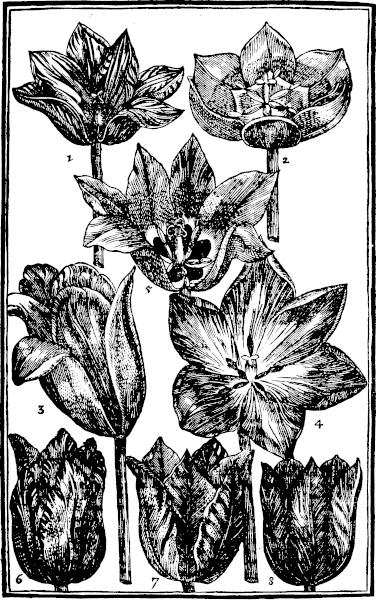
1Tulipa rubra & lutea varia. The Fooles Coate red and yellow.
2Tulipa Holeas alba absq. fundo. The white Holeas without a bottome.
3Tulipa argentea, vel punctata, &c. The cloth of siluer, or other spotted Tulipa.
4Tulipa alba flammis coccineis. The white Fooles Coate.
5Tulipa Holeas alba, &c. fundo purpureo, &c. A white Holeas, &c. with a purple bottome, &c.
6Tulipa rubra & lutea flammea, &c. A red and yellow flamed Tulipa, &c.
7Tulipa alba striata & punctata. A white striped and spotted Tulipa.
8Tulipa altera variata, &c. Another variable Tulipa.
Tulipa media rubra.
1 Rubra communis, fundo luteo, vel nigro.
2 Mali Aurantij coloris.
3 Cinabaris coloris.
4 Lateritij coloris.
5 Rubra, luteo aspersa.
6 Rubra, oris luteis.
7 Testamentum Brancion rubra satura, oris pallidis, diuersarum specierum, rubore variantium, & orarum amplitudine.
8 Cinabaris radiata, magis aut minus serotina.
9 Rubra purpurascens obsoleta exterioribus folijs, perfusa luteo intus, oris pallidis luteis.
10 Rubra purpurascens elegans extra & intus lutescens, oris pallidis luteis, fundo luteo vel viridi.
11 Rubra flambans coccinea, crebris maculis luteis absq. fundo.
12 Flambans elegantior rubra, i.e. radijs luteis intercursantibus ruborem.
13 Flambans remissior vtroq. colore.
14 Panni aurei coloris.
15 Tunica Morionis verior, seu Palto du Sot. optima, tænijs amplis amœnis & crebris, exrubro & flauo separatim diuisis & excurrentibus, flos constans.
16 Tunica Morionis altera, tænijs minoribus & minus frequentibus, magis aut minus alia alijs inconstans.
17 Tunica Morionis pallida, i. e. tænijs vel strijs frequentioribus in vtroq. colore pallidis, flos est constans & elegans.
18 Pileus Morionis, radijs luteis, in medio foliorum latis, per ruborem excurrentibus, fundo luteo, apicibus luteis, & tribus exterioribus folijs luteis oris rubris, vel absq. oris.
19 Le Suisse, tænijs radiata magnis ex rubore & pallore.
20 Altera dicta Goliah à floris magnitudine, tænijs radiata simillima le Suisse, nisi rubor & albedo sint elegantiores.
21 Holias rubra, i.e. sanguinea argenteis radijs, & guttis in orbem dispositis, præsertim interiùs, fundo viridi saturo.
22 Holias coccinea, rubra coccinea, albo radiata in orbem, circa medium foliorum interiùs, fundo albo.
23 Alia huic similis, fundo albo & cæruleo.
The meane flowring red Tulipa.
1 A faire red which is ordinary, with a yellow or blacke bottome.
2 A deepe Orenge colour.
3 A Vermillion.
4 A pale red, or Bricke colour.
5 A Gingeline colour.
6 A red with small yellow edges.
7 A Testament Brancion of diuers sorts, differing both in the deepnesse of the red, and largenesse of the pale coloured edges.
8 A Vermillion flamed, flowring later or earlier.
9 A dead purplish red without, and of a yellowish red within, with pale yellow edges.
10 A bright Crimson red on the outside, more yellowish on the inside, with pale yellow edges, and a bottome yellow or greene.
11 A red Flambant, spotted thicke with yellow spots without any bottome.
12 A more excellent red Flambant, with flames of yellow running through the red.
13 A pale coloured Flambant.
14 A cloth of gold colour.
15 A true Fooles Coate, the best is a faire red & a faire yellow, parted into guards euery one apart, varied through euery leafe to the very edge, yet in most abiding constant.
16 Another Fooles Coate, not so fairely marked, nor so much, some of these are more or lesse constant in their marks, & some more variable then others.
17 A pale Fooles Coate, that is, with pale red, and pale yellow guardes or stripes very faire and constant.
18 A Fooles Cappe, that is, with lists or stripes of yellow running through the middle of euery leafe of the red, broader at the bottome then aboue, the bottome being yellow, the three outer leaues being yellow with red edges, or without.
19 A Swisse, pained with a faire red and pale white or strawe colour.
20 A Goliah, so called of the bignesse of the flower, most like to the Swisse in the marks and guardes, but that the red and white is more liuely.
21 A red Holias. A bloud red stript with siluer white veines and spots, with a darke green bottome.
22 A Crimson red Holias, that is, a faire purplish red, spotted with white circlewise about the middle of the inner leaues, and a white bottome.
23 Another like thereunto, with a blew and white bottome.
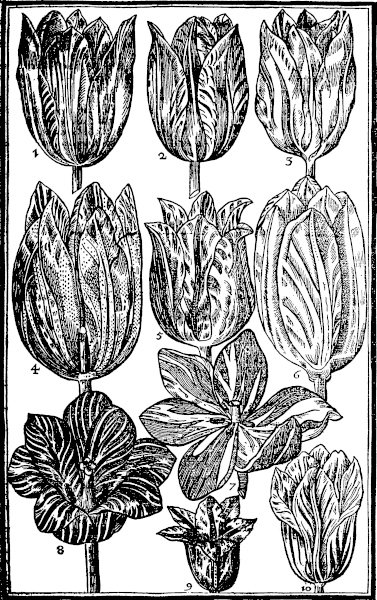
1Tulipa tricolor. A Tulipa of three colours.
2Tulipa Macedonica, siue de Caffa varia. The Tulipa of Caffa purple, with pale white stripes.
3Tulipa Heluola chermesina versicolor. A pure Claret wine colour variable.
4Tulipa Caryophyllata Wilmeri. Mr. Wilmers Gilloflower Tulipa.
5Tulipa Chermesina flammis albis. A Crimson with white flames.
6Tulipa Goliah. A kind of Zwisser called Goliah.
7Tulipa le Zwisse. A Tulipa called the Zwisser.
8Tulipa alba flammis coccineis. Another white Flambant or Fooles Coate.
9Tulipa Cinnabarina albo flammata. The Vermillion flamed.
10Tulipa plumata rubra & lutea. The feathered Tulipa red and yellow.
Tulipa media lutea.
1 Lutea, siue Aurea vulgaris.
2 Straminea.
3 Sulphurea.
4 Mali Aurantij pallidi coloris.
5 Lutea dilutè purpurea striata, aurei panni pallidi instar.
6 Pallidè lutea fuscedine adumbrata.
7 Flaua, oris rubris magnis, aut paruis.
8 Straminea oris rubris magnis intensis, vel paruis remissis.
9 Obscura & fuliginosa lutea, instar Folij decidui, ideoq. Folium mortuum appellatur.
10 Flaua, rubore perfusa, etiamque striata per totum, dorso coccineo, oris pallidis.
11 Pallidè lutea, perfusa & magis aut minus rubore striata, fundo vel luteo, vel viridi.
12 Testamentum Clusij, i.e. lutea pallida fuligine obfusca, exteriùs & interiùs ad oras vsq. pallidas, per totum vero floris medium, maculis interiùs aspersa instar omnium aliarum Holias, dorso obscuriore, fundo viridi.
13 Flambans lutea, diuersimodè intus magis aut minus striata, vel in alijs extra maculata rubore, fundo vt plurimum nigro, vel in alijs luteo.
14 Flambans pallidior & elegantior.
15 Holias lutea intensior vel remissior diuersimodè, in orbem radiata interius, rubris maculis ad supremas vsq. oras, aliquoties crebrè, aliàs parcè, fundo viridi, vel tanetto obscuro.
16 Holias straminea rubore striata & punctata, instar alba Holias.
17 Tunica Morionis lutea, alijs dicta Flammea, in qua color flavus magis & conspicuus rubore, diuersimodè radiata.
Huc reddenda esset viridarum Tuliparum classis, quæ diuersarum etiam constat specierum. Vna viridis intensior cuius flos semper ferè semiclausus manet staminibus simbriatis. Altera remissior, instar Psittacipennarum viridium, luteo variata oris albis. Tertia adhuc dilutiori viriditate oris purpureis. Quarta, cujus folia æqualiter purpura diluta, & viriditate diuisa sunt. Quinta, folijs longissimis stellæmodo expansis, ex rubore & viriditate coacta.
The meane flowring yellow Tulipa.
1 A faire gold yellow.
2 A Strawe colour.
3 A Brimstone colour pale yellowish greene.
4 A pale Orenge colour.
5 A pale cloth of gold colour.
6 A Custard colour a pale yellow shadowed ouer with a browne.
7 A gold yellow with red edges, greater or smaller.
8 A Strawe colour with red edges, deeper or paler, greater or smaller.
9 A sullen or smoakie yellow, like a dead leafe that is fallen, and therefore called, Fucille mort.
10 A yellow shadowed with red, and striped also through all the leaues, the backside of them being of a red crimson, and the edges pale.
11 A pale yellow, shadowed and striped with red, in some more in some lesse, the bottomes being either yellow or green.
12 A Testamentum Clusij, that is, a shadowed pale yellow, both within & without, spotted round about the middle on the inside, as all other Holias are, the backe of the leaues being more obscure or shadowed with pale yellow edges, and a greene bottome.
13 A yellow Flambant of diuers sorts, that is, the whole flower more or lesse streamed or spotted on the inside, and in some on the outside with red, the bottome in most being blacke, yet in some yellow.
14 A paler yellow Flambant more beautifull.
15 A yellow Holias, paler or deeper yellow very variable, spotted on the inside round about the middle, with red sometimes plentifully, or else sparingly with a green or dark tawny bottome.