THE GARDEN OF PLEASANT FLOWERS. (continued 13)
Reading edition
22. Rosa siluestris odora siue Eglenteria simplex. The single Eglantine or sweete Briar bush.
The sweete Briar or Eglantine Rose is so well knowne, being not onely planted in Gardens, for the sweetenesse of the leaues, but growing wilde in many woods and hedges, that I thinke it lost time to describe it; for that all know it hath exceeding long greene shootes, armed with the cruellest sharpe and strong thornes, and thicker set then is in any Rose either wilde or tame: the leaues are smaller then in most of those that are noursed vp in Gardens, seuen or nine most vsually set together on a ribbe or stalke, very greene and sweete in smell, aboue the leaues of any other kinde of Rose: the flowers are small single blush Roses, of little or no sent at all, which turne into reddish berries, stuffed within with a dounie or flock matter or substance, wherein doth lye white hard seede.
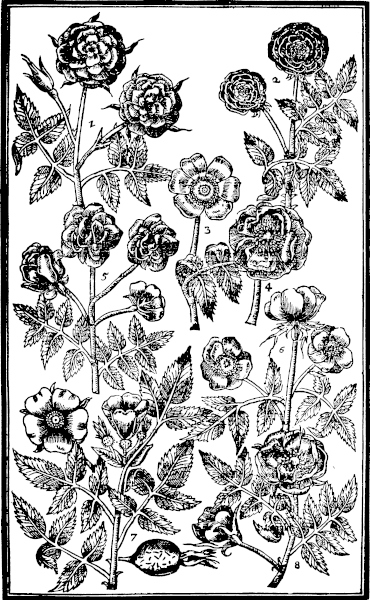
1Rosa siue spinis multiplex. The double Rose without thorns.
2Rosa Cinamomea flore plena. The double Cinamon Rose.
3Rosa Holoserica simplex. The single Veluet Rose.
4Rosa Holoserica duplex. The double Veluet Rose.
5Rosa Moschata multiplex. The double Muske Rose.
6Rosa Moschata Hispanica simplex. The single Spanish Muske Rose.
7Rosa Pomifera maior. The great Apple Rose.
8Rosa siluestris siue Eglanteria duplex. The double Eglantine Rose.
23. Rosa siluestris odora siue Eglenteria flore duplici. The double Eglantine.
The double Eglantine is in all the places that I haue seene it a grafted Rose, (but I doubt not, but that his originall was naturall, and that it may be made naturall againe, as diuers other Roses are.) It groweth and spreadeth very well, and with a great head of branches, whereon stand such like leaues as are in the single kinde, but a little larger, not smelling fully so sweete as it: the flowers are somewhat bigger then the single, but not much, hauing but one other rowe of leaues onely more then the former, which are smaller, and the outer leaues larger, but of the same pale reddish purple colour, and smelleth somewhat better then the single.
24. Rosa semper virens. The euer greene Rose bush.
This Rose or bush is very like vnto a wilde single Eglantine bush in many respects, hauing many very long greene branches, but more slender and weake, so that many times they bend downe againe, not able to sustaine themselues without some helpe, and armed with hooked thornes as other Roses be; the winged leaues consist of seuen for the most part, whereof those two that are lowest and opposite, are smallest, the next two bigger then they, the third couple bigger then any of the rest belowe, and the end leafe biggest of all: this proportion generally it holdeth in euery winged leafe through the whole plant, which at the first comming forth are somewhat reddish, with the young branch that shooteth out with them, but being full growne, are of a deepe greene colour, and somewhat shining, dented about the edges, and fall not away from the branches as other Roses doe, but abide thereon for the most part all the Winter: the flowers stand foure or fiue together at the tops of the branches, being single Roses, made of fiue leaues a peece, of a pure white colour, much larger then the ordinary Muske Rose, and of a fine sent, comming nearest thereunto, with many yellow chiues or threads in the middle.
The Place.
Some of these Roses had their originall, as is thought in England, as the first and second; for these dryed red Roses that come ouer to vs from beyond the Seas, are not of the kinde of our red Rose, as may well be perceiued by them that will compare our English dryed leaues with those. Some in Germany, Spaine, and Italy. Some againe in Turkie, as the double yellow Rose, which first was procured to be brought into England, by Master Nicholas Lete, a worthy Merchant of London, and a great louer of flowers, from Constantinople, which (as wee heare) was first brought thither from Syria; but perished quickly both with him, and with all other to whom hee imparted it: yet afterwards it was sent to Master Iohn de Franqueuille, a Merchant also of London, and a great louer of all rare plants, as well as flowers, from which is sprung the greatest store, that is now flourishing in this Kingdome.
The Time.
The Cinamon Rose is the earliest for the most part, which flowreth with vs about the middle of May, and sometimes in the beginning. The ordinary Muske Roses both single and double flower latest, as is said. All the other flower much about one time, in the beginning of Iune, or thereabouts, and continue flowring all that moneth, and the next throughout for the most part, and the red vntill August be halfe past.
The Names.
The seuerall names, whereby they are most commonly knowne vnto vs in this Countrey, are expressed in their titles; but they are much differing from what they are called in other Countries neare vnto vs, which to compare, conferre, and agree together, were a worke of more paines then vse: But to proportion them vnto the names set downe by Theophrastus, Pliny, and the rest of the ancient Authors, were a worke, wherein I might be sure not to escape without falling into errour, as I verily beleeue many others haue done, that haue vndertaken to doe it: I will therefore for this worke desire that you will rest contented, with so much as hath already been deliuered, and expect an exact definition and complete satisfaction by such a methodicall course as a generall History will require, to be performed by them that shall publish it.
The Vertues.
The Rose is of exceeding great vse with vs; for the Damaske Rose (besides the superexcellent sweete water it yeeldeth being distilled, or the perfume of the leaues being dryed, seruing to fill sweete bags) serueth to cause solublenesse of the body, made into a Syrupe, or preserued with Sugar moist or dry candid. The Damaske Prouince Rose, is not onely for sent nearest of all other Roses vnto the Damaske, but in the operation of solubility also. The red Rose hath many Physicall vses much more then any other, seruing for many sorts of compositions, both cordiall and cooling, both binding and loosing. The white Rose is much vsed for the cooling of heate in the eyes: diuers doe make an excellent yellow colour of the iuyce of white Roses, wherein some Allome is dissolued, to paint or colour flowers or pictures, or any other such things. There is little vse of any other sort of Roses; yet some affirme, that the Muske Roses are as strong in operation to open or loosen the belly as the Damaske Rose or Prouince.
Chap. CXI. Cistus. The Holly Rose or Sage Rose.
There are three principall kindes of Cistus, the male, the female, and the gumme or sweete smelling Cistus bearing Ladanum, called Ledon. Of each of these three there are also diuers sorts: Of them all to intreate in this Worke is not my minde, I will onely select out of the multitude some few that are fit for this our Garden, and leaue the rest to a greater.
1. Cistus mas. The male Holly Rose or Sage Rose.
The male Cistus that is most familiar vnto our Countrey, I meane that will best abide, is a small shrubby plant, growing seldome aboue three or foure foote high with vs, hauing many slender brittle wooddy branches, couered with a whitish barke, whereon are set many whitish greene leaues, long and somewhat narrow, crumpled or wrinckled as it were with veines, and somewhat hard in handling, especially the old ones; for the young ones are softer, somewhat like vnto Sage leaues for the forme and colour, but much smaller, two alwaies set together at a ioynt: the flowers stand at the toppe of the branches, three or foure together vpon seuerall slender footstalkes, consisting of fiue small round leaues a peece, somewhat like vnto a small single Rose, of a fine reddish purple colour, with many yellow threads in the middle, without any sent at all, and quickly fading or falling away, abiding seldome one whole day blowne at the most: after the flowers are past, there come vp round hard hairie heads in their places, containing small brownish seede: the roote is wooddy, and will abide some yeares with vs, if there be some care had to keepe it from the extreamity of our Winters frostes, which both this, and many of the other sorts and kinds, will not abide doe what we can.
2. Cistus fæmina. The female Holly Rose.
The female Holly Rose groweth lower, and smaller then the former male kinde, hauing blackish branches, lesse woody, but not lesse brittle then it: the leaues are somewhat rounder and greener, but a little hard or rough withall, growing in the same manner vpon the branches by couples: the flowers grow at the toppes of the branches, like vnto the former, consisting of fiue leaues, but somewhat lesser, and wholly white, with yellow threds in the middle, as quickly fading, and of as little sent as the former: the heads and seede are somewhat bigger then in the former.
3. Chamæcistus Frisicus. The dwarfe Holly Rose of Friseland.
This dwarfe Cistus is a small low plant, hauing diuers shootes from the rootes, full of leaues that are long and narrow, very like vnto the leaues of the French Spikenard or Spica Celtica; from among which leaues shoote forth short stalkes, not aboue a span high, with a few smaller leaues thereon; and at the toppes diuers small flowers one aboue another, consisting of six small round leaues, of a yellow colour, hauing two circles of reddish spots round about the bottome of the leaues, a little distant one from another, which adde much grace to the flower: after the flowers are past, there come in their places small round heads, being two forked at the end containing within them small brownish chaffie seede: the roote is small and slender, with many fibres thereat creeping vnder ground, and shooting forth in diuers places, whereby it much encreaseth: the whole plant, and euery part of it, smelleth strong without any pleasant sent.
4. Cistus annuus. The Holly Rose of a yeare.
This small Cistus that endureth but a year (and will require to be sowne euery year, if ye will haue it) riseth vp with straight, but slender hard stalkes, set here and there confusedly with long and narrow greenish leaues, very like vnto the leaues of the Gum Cistus or Ledon, being a little clammy withall: at the toppe of the stalkes, and at the ioynts with the leaues, stand two or three pale yellow flowers, consisting of fiue leaues a peece, with a reddish spot neere the bottome of euery leafe of the flower, as quickely fading as any of the former: after which follow small three square heades, containing small seede, like vnto the first female kinde, but somewhat paler or yellower: the root is small and woody, and perisheth as soone as it hath borne seede.
5. Cistus Ledon. The Gum Cistus, or Sweete Holly Rose.
This sweete Holly Rose or Gum Cistus, riseth higher, and spreadeth larger then the former male kind doth, with many blackish woody branches, whereon are set diuers long and narrow darke greene leaues, but whitish vnderneath, two alwayes standing together at a ioint, both stalks and leaues bedeawed as it were continually with a clammy sweete moisture (which in the hot Countries is both more plentifull, and more sweet then in ours) almost transparent, and which being gathered by the inhabitants, with certaine instruments for that purpose (which in some places are leather thongs, drawne ouer the bushes, and after scraped off from the thongs againe, and put together) is that kind of blacke sweet gum, which is called Ladanum in the Apothecaries shops; at the tops of the branches stand single white flowers, like vnto single Roses, being larger then in any of the former kindes, consisting of fiue leaues, whereof euery one hath at the bottome a dark purplish spot, broad below, and small pointed vpwards, with some yellow threds in the middle: after which are past, there arise cornered heads, containing such small brownish seede as is in the former male kinde: the roote is woody, and spreadeth vnder ground, abiding some yeares, if it be placed vnder a wall, where it may bee defended from the windes that often breake it, and from the extremitie of our winters, and especially the snow, if it lye vpon it, which quickly causeth it to perish.
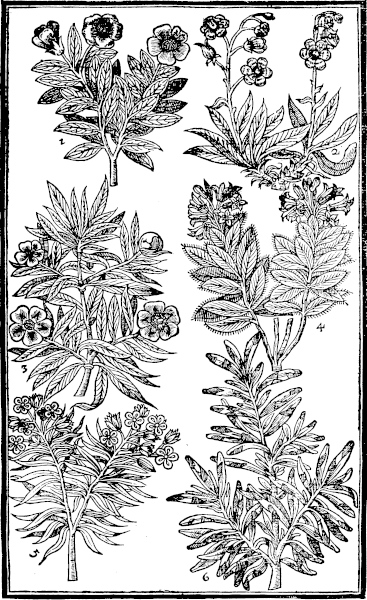
1Cistus mas. The male Holly Rose.
2Chamæcistus Frisicus. The dwarfe Holly Rose of Frisia.
3Cistus Ledon. The sweet Holly Rose or gumme Cistus.
4Ledum Alpinum. The mountaine Holly Rose.
5Ledum Silesiacum. The sweet Mary Rose of Silesia.
6Rosmarinum aureum. Gilded Rosemary.
6. Ledum Alpinum seu Rosa Alpina. The Mountaine sweet Holly Rose.
The fragrant smell with properties correspondent of two other plants, causeth me to insert them in this Chapter, and to bring them to your knowledge, as well worthy a fit place in our Garden. The first of them hath diuers slender woody branches, two foote high or thereabouts, couered with a grayish coloured barke, and many times leaning downe to the ground, whereby it taketh roote againe: vpon these branches grow many thicke, short, hard greene leaues, thicke set together, confusedly without order, sometimes whitish vnderneath, and sometimes yellowish: the toppes of the branches are loden with many flowers, which cause them to bend downwards, being long, hollow and reddish, opening into fiue corners, spotted on the outside with many white spots, and of a paler red colour on the inside, of a fine sweet sent: after the flowers are past, there follow small heads, containing small brownish seede: the root is long, hard and woody, abiding better if it comprehend in the ground, then some of the former, because his originall is out of a colder country.
7. Ledum Silesiacum. The sweete Mary Rose, or Rosemary of Silesia.
This other sweete plante riseth vp with woody ash-coloured branches two foote high or more, which shoote forth other branches, of a reddish or purplish colour, couered with a brownish yellow hoarinesse, on which are set many narrow long greene leaues, like vnto Rosemary leaues, but couered with the like hoarinesse as the stalks are (especially in the naturall places, but not so much being transplanted) and folding the sides of the leaues so close together, that they seeme nothing but ribbes, or stalkes, of an excellent sweet and pleasant sent; at the ends of the branches there grow certaine brownish scaly heads, made of many small leaues set thicke together, out of which breake forth many flowers, standing in a tuft together, yet seuerally euery one vpon his owne footstalke, consisting of fiue white leaues, with certaine white threds in the middle, smelling very sweete: after which rise small greene heads, spotted with brownish spots, wherein is contained very small, long, yellowish seede: the roote is hard and woodie.
The Place.
The first, second, fourth and fifth, grow in the hot Countries, as Italie, Spaine, &c. The third, and the two last in the colder Countries, as Friseland, Germanie, Bohemia.
The Time.
They do all flower in the Summer moneths of Iune, Iuly and August, and their seede is ripe quickly after.
The Names.
The first, second, fourth and fift, haue their names sufficiently expressed in their descriptions. The third was sent vnto Clusius, vnder the name of Hirculus Frisicus, because of the strong sent: but he referreth it to the kinds of Chamæcistus, that is, dwarfe or low Cistus, both for the low growth, and for the flowers and seede sake. The sixt is diuersly called; for Clusius calleth it Ledum Alpinum: others, Nerium Alpinum, making it to bee a Rose Bay. Gesner according to the Countrey peoples name, Rosa Alpina, and Rosa Montana. Lobel calleth it Balsamum Alpinum, of the fragrant smell it hath, and Chamærhododendros Chamælææfolio. And some haue called it Euonymus, without all manner of iudgement. In English wee may call it, The Mountaine Rose, vntill a fitter name be giuen it. The last is called of Matthiolus, Rosmarinum siluestre, but of Clusius Ledum, referring it to their kindred; and Silesiacum, because he found it in that Countrey; or for distinction sake, as he saith, it may bee called, Ledum folijs Rosmarini, or Ledum Bohemicum. Cordus, as it seemeth in his History of Plants, calleth it Chamæpeuce, as though he did account it a kinde of low Pine, or Pitch tree.
The Vertues.
The first, second, and fift, are very astringent, effectuall for all sorts of fluxes of humours. The sweet Gum called Ladanum, made artificially into oyle, is of singular vse for Alopecia, or falling of the haire. The seed of the fourth is much commended against the stone of the Kidneyes. The sweete Rosemary of Silesia is vsed of the inhabitants, where it naturally groweth, against the shrinking of sinewes, crampes, or other such like diseases, whereof their daily experience makes it familiar, being vsed in bathing or otherwise.
Chap. CXII. Rosmarinum. Rosemary.
There hath beene vsually knowne but one sort of Rosemary, which is frequent through all this Country: but there are some other sorts not so well known; the one is called Gilded Rosemary; the other broade leafed Rosemary; a third I will adioyne, as more rare then all the other, called Double flowred Rosmary, because few haue heard thereof, much lesse seene it, and my selfe am not well acquainted with it, but am bold to deliuer it vpon credit.
1. Libanotis Coronaria siue Rosmarinum vulgare. Our Common Rosmary.
This common Rosemary is so well knowne through all our Land, being in euery womans garden, that it were sufficient but to name it as an ornament among other sweete herbes and flowers in our Garden, seeing euery one can describe it: but that I may say something of it, It is well obserued, as well in this our Land (where it hath been planted in Noblemens, and great mens gardens against bricke wals, and there continued long) as beyond the Seas, in the naturall places where it groweth, that it riseth vp in time vnto a very great height, with a great and woody stemme (of that compasse, that (being clouen out into thin boards) it hath serued to make lutes, or such like instruments, and here with vs Carpenters rules, and to diuers other purposes) branching out into diuers and sundry armes that extend a great way, and from them againe into many other smaller branches, whereon are set at seueral distances, at the ioynts, many very narrow long leaues, greene aboue, and whitish vnderneath; among which come forth towards the toppes of the stalkes, diuers sweet gaping flowers, of a pale or bleake blewish colour, many set together, standing in whitish huskes; the seed is small and red, but thereof seldome doth any plants arise that will abide without extraordinary care; for although it will spring of the seede reasonable well, yet it is so small and tender the first yeare, that a sharpe winter killeth it quickly, vnlesse it be very well defended: the whole plant as well leaues as flowery smelleth exceeding sweete.
2. Rosmarinum striatum, siue aureum. Gilded Rosemary.
This Rosemary differeth not from the former, in forme or manner of growing, nor in the forme or colour of the flower, but only in the leaues, which are edged, or striped, or pointed with a faire gold yellow colour, which so continueth all the yeare throughout, yet fresher and fairer in Summer then in Winter; for then it will looke of a deader colour, yet so, that it may be discerned to be of two colours, green & yellow.
3. Rosmarinum latifolium. Broade leafed Rosemary.
This broad leafed Rosemary groweth in the same manner that the former doth, but that we haue not seene it in our Countrey since we had it to grow so great, or with such woody stemmes: the leaues stand together vpon the long branches after the same fashion, but larger, broader and greener then the other, and little or nothing whitish vnderneath: the flowers likewise are of the same forme and colour with the ordinary, but larger, and herein consisteth the difference.
4. Rosmarinum flore duplici. Double flowred Rosmary.
The double flowred Rosmary thus far differeth from the former, that it hath stronger stalkes, not so easie to breake, fairer, bigger and larger leaues, of a faire greene colour, and the flowers are double, as the Larkes heele or spurre: This I haue onely by relation, which I pray you accept, vntill I may by sight better enforme you.
The Place.
Our ordinary Rosmary groweth in Spaine, and Prouence of France, and in others of those hot Countryes, neere the Sea side. It will not abide (vnlesse kept in stoues) in many places of Germany, Denmarke, and those colder Countries. And in some extreame hard winters, it hath well neere perished here in England with vs, at the least in many places: but by slipping it is vsually, and yearly encreased, to replenish any garden.
The Time.
It flowreth oftentimes twice in the yeare; in the Spring first, from April vntill the end of May or Iune, and in August and September after, if the yeare before haue been temperate.
The Names.
Rosmary is called of the ancient Writers, Libanotis, but with this distinction, Stephanomatica, that is, Coronaria, because there were other plants called Libanotis, that were for other vses, as this for garlands, where flowers and sweete herbes were put together. The Latines call it Rosmarinum. Some would make it to be Cneorum nigrum of Theophrastus, as they would make Lauander to bee his Cneorum album, but Matthiolus hath sufficiently confuted that errour.
The Vertues.
Rosmary is almost of as great vse as Bayes, or any other herbe both for inward and outward remedies, and as well for ciuill as physicall purposes. Inwardly for the head and heart; outwardly for the sinewes and ioynts: for ciuill vses, as all doe know, at weddings, funerals, &c. to bestow among friends: and the physicall are so many, that you might bee as well tyred in the reading, as I in the writing, if I should set down all that might be said of it. I will therefore onely giue you a taste of some, desiring you will be content therewith. There is an excellent oyle drawne from the flowers alone by the heate of the Sunne, auaileable for many diseases both inward and outward, and accounted a soueraigne Balsame: it is also good to helpe dimnesse of sight, and to take away spots, markes and scarres from the skin; and is made in this manner. Take a quantitie of the flowers of Rosemary, according to your owne will eyther more or lesse, put them into a strong glasse close stopped, set them in hot horse dung to digest for fourteene dayes, which then being taken forth of the dung, and vnstopped, tye a fine linnen cloth ouer the mouth, and turne downe the mouth thereof into the mouth of another strong glasse, which being set in the hot Sun, an oyle will distill downe into the lower glasse; which preserue as precious for the vses before recited, and many more, as experience by practice may enforme diuers.
There is another oyle Chymically drawne, auaileable in the like manner for many the same inward and outward diseases, viz. for the heart, rheumaticke braines, and to strengthen the memory, outwardly to warme and comfort cold benummed sinewes, whereof many of good iudgement haue had much experience.
Chap. CXIII. Myrtus. The Mirtle tree or bush.
In the hot Countreyes, there haue been many sorts of Mirtles found out, naturally growing there, which will not fructifie in this of ours, nor yet abide without extraordinary care, and conueniencie withall, to preserue them from the sharpenesse of our winters. I shall only bring you to view three sorts in this my Garden, the one with a greater, the other two with lesser leaues, as the remainder of others which wee haue had, and which are preserued from time to time, not without much paine and trouble.
1. Myrtus latifolia. The greater leafed Mirtle.
The broader leafed Mirtle riseth vp to the height of foure or fiue foote at the most with vs, full of branches and leaues growing like a small bush, the stemme and elder branches whereof are couered with a dark coloured bark, but the young with a green, and some with a red, especially vpon the first shooting forth, whereon are set many fresh greene leaues, very sweet in smell, and very pleasant to behold, so neer resembling the leaues of the Pomegranate tree that groweth with vs, that they soone deceiue many that are not expert therein, being somewhat broade and long, and pointed at the ends, abiding alwaies green: at the ioynts of the branches where the leaues stand, come forth the flowers vpon small footestalkes, euery one by it selfe consisting of fiue small white leaues, with white threds in the middle, smelling also very sweet; after the flowers are past, there doe arise in the hot Countries, where they are naturall, round blacke berries, when they are ripe, wherein are contained many hard white crooked seedes, but neuer in this Countrey, as I said before: the roote disperseth it selfe into many branches, with many fibres annexed thereto.
2. Myrtus minor, seu minore folio. The smaller leafed Mirtle.
The smaller leafed Mirtle is a low shrub or bush, like vnto the former, but scarce rising so high, with branches spreading about the stemme, much thicker set with leaues then the former, smaller also, and pointed at the ends, of a little deeper greene colour, abiding greene also winter and summer, and very sweete likewise: the flowers are white like vnto the former, and as sweete, but shew not themselues so plentifull on the branches: the fruit is blacke in his naturall places, with seedes therein as the former.
3. Myrtus minor rotundiore folio. Boxe Mirtle.
Wee haue another sort of this small kinde of Mirtle, so like vnto the former both for smalnesse, deepe greene colour of the leaues, and thicke growing of the branches, that it will be thought of most, without good heede, and comparing the one with the other, to be the very same with the former: but if it bee well viewed, it will shew, by the roundnesse at the ends of the leaues very like vnto the small Boxe leaues, to be another differing kinde, although in nothing else. Wee nourse them with great care, for the beautifull aspect, sweete sent and raritie, as delights and ornaments for a garden of pleasure, wherein nothing should be wanting that art, care and cost might produce and preserue: as also to set among other euer greene plants to sort with them.
The Place.
These, and many other sorts of Mirtles grow in Spaine, Portugall, Italie, and other hot Countries in great aboundance, where they make their hedges of them: wee (as I said) keepe them in this Countrey, with very great care and diligence.
The Time.
The Mirtles doe flower very late with vs, not vntill August at the soonest, which is the cause of their not fructifying.
The Names.
They are called in Latine Myrtus, and in English Mirtle tree, without any other diuersitie of names, for the generall title. Yet the seuerall kindes haue had seuerall denominations, in Plinies time, and others, as Romana, Coniugala, Tarentina, Egyptia, alba, nigra, &c. which haue noted the differences, euen then well obserued.
The Vertues.
The Mirtle is of an astringent qualitie, and wholly vsed for such purposes.
Chap. CXIIII. Malus Punica siue Granata. The Pomegranet tree.
There are two kindes of Pomegranet trees, The one tame or manured, bearing fruit, which is distinguished of some into two sorts, of others into three, that is, into sower, and sweet, and into sower sweete. The other wilde, which beareth no fruite, because it beareth double flowers, like as the Cherry, Apple, and Peach tree with double blossomes, before described, and is also distinguished into two sorts, the one bearing larger, the other lesser flowers. Of the manured kinde wee haue onely one sort (so farre as we know, for it neuer beareth ripe fruit in this our Countrey) which for the beautifull aspect, both of the greene verdure of the leaues, and faire proportion and colour of the flowers, as also for the raritie, are noursed in some few of their gardens that delight in such rarities: for in regard of the tendernesse, there is neede of diligent care, that is, to plant it against a brick wall, and defend it conueniently from the sharpenesse of our winters, to giue his Master some pleasure in seeing it beare flowers: And of the double kinde we haue as yet obtained but one sort, although I shall giue you the knowledge and description of another.
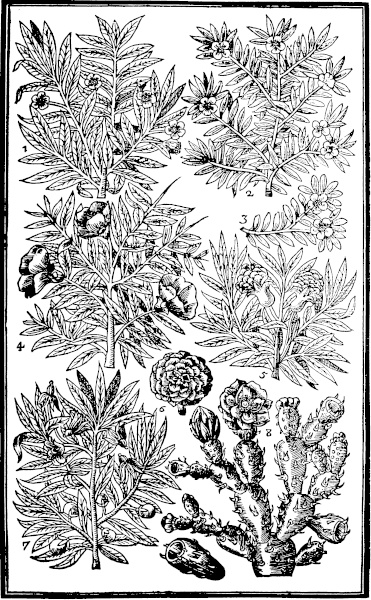
1Myrtus latifolia maior. The broad leaded Myrtle.
2Myrtus angustifolia minor. The small leafed Myrtle.
3Myrtus buxifolia minor. The Boxe leafed Myrtle.
4Malus Granatus simplici flore. The ordinary Pomegranet tree.
5Balaustium Romanum seu minus. The lesser double flowred Pomegranet tree.
6Balaustium maius siue Cyprium. The greater double flowred Pomegranet.
7Pseudocapsicum seu Amomum Plinij. The Winter Cherry tree.
8Ficus Indica cum suo fructu. The Indian Figgetree and his fruit.
1. Malus Punica satiua. The tame Pomegranet tree.
This Pomegranet tree groweth not very high in his naturall places, and with vs somtimes it shooteth forth from the roote many brownish twigges or branches, or if it bee pruned from them, and suffered to grow vp, it riseth to bee seuen or eight foote high, spreading into many small and slender branches, here and there set with thornes, and with many very faire greene shining leaues, like in forme and bignesse vnto the leaues of the larger Myrtle before described, euery one hauing a small reddish foote-stalke vpon these branches: among the leaues come forth here and there, long, hard, and hollow reddish cups, diuided at the brimmes, wherein doe stand large single flowers, euery one consisting of one whole leafe, smaller at the bottome then at the brimme, like bels, diuided as it were at the edges into fiue or six parts, of an orient red or crimson colour in the hotter Countries; but in this it is much more delayed, and tendeth neare vnto a blush, with diuers threads in the middle. The fruit is great and round, hauing as it were a crowne on the head of it, with a thicke tough hard skinne or rinde, of a brownish red colour on the outside, and yellow within, stuffed or packt full of small graines, euery one encompast with a thin skin, wherein is contained a clear red iuyce or liquor, either of a sweet (as said before) or sower taste, or betweene them both of a winie taste: the roote disperseth it selfe very much vnder ground.
2. Balaustium maius siue Malus Punica siluestris maior. The greater wilde or double blossomd Pomegranet tree.
The wilde Pomegranet is like vnto the tame in the number of purplish branches, hauing thornes, and shining faire greene leaues, somewhat larger then the former: from the branches likewise shoote forth flowers, farre more beautifull then those of the same or manured sort, because they are double, and as large as a double Prouince Rose, or rather more double, of an excellent bright crimson colour, tending to a silken carnation, standing in brownish cups or huskes, diuided at the brims vsually into foure or fiue seuerall points, like vnto the former, but that in this kinde there neuer followeth any fruit, no not in the Country, where it is naturally wilde.
3. Balaustium minus. The smaller wilde Pomegranet tree.
This smaller kinde differeth from the former in his leaues, being of a darker greene colour, but not in the height of the stemme, or purplishnesse of his branches, or thorns vpon them; for this doth shew it selfe more like vnto a wilde kind then it: the flowers hereof are much smaller, and not so thicke and double, of a deeper or sadder red Orenge tawny colour, set also in such like cups or huskes.
The Place.
The tame or manured kinde groweth plentifully in Spaine, Portugall, and Italy, and other in other warme and hot countries. Wee (as I said before) preserue it with great care. The wilde I thinke was neuer seene in England, before Iohn Tradescante my very louing good friend brought it from the parts beyond the Seas, and planted it in his Lords Garden at Canterbury.
The Time.
They flower very late with vs, that is, not vntill the middle or end of August, and the cold euenings or frosts comming so soone vpon it, doth not onely hinder it from bearing, but many times the sharpe winters so pinch it, that it withereth it downe to the ground, so that oftentimes it hardly springeth againe.
The Names.
The name Malus Punica for the tree, and Malum Punicum for the fruit, or Malus Granata, and Malum Granatum, is the common name giuen vnto this tree, which is called in English the Pomegarnet or Pomegranet tree. The flowers of the tame kinde are called Cytini, as Dioscorides saith, although Plinie seemeth either to make Cytinus to be the flower of the wilde kinde, or Balaustium to be the flower of both tame and wilde kinde: but properly, as I take it, Cytinus is the cup wherein the flower as well of the tame as wilde kinde doth stand; for vnto the similitude of them, both the flowers of Asarum, and the seede vessels of Hyosciamus are compared and resembled, and not vnto the whole flower: the barke or rinde of the fruit is called of diuers Sidion, and in the Apothecaries shops Psidium, and cortex Granatorum. The wilde kinde is called Malus Punica siluestris: In English, The wilde Pomegranet tree; the flower thereof is properly called Balaustium. The lesser kind is vsually called Balaustium Romanum, as the greater is called Creticum and Cyprium, because they growe in Candy and Cyprus.
The Vertues.
The vse of all these Pomegranets is very much in Physicke, to coole and binde all fluxibility both of body and humours: they are also of singular effect in all vlcers of the mouth, and other parts of the body, both of man and woman. There is no part of them but is applyed for some of these respects. The rinde also of the Pomegranet is vsed of diuers in stead of Gaules, to make the best sort of writing Inke, which is durable to the worlds end.
Chap. CXV. Amomum Plinij seu Pseudocapsicum. Tree Night shade or the Winter Cherry tree.
I haue adioyned this plant, for the pleasurable beauty of the greene leaues, and red berries. It groweth vp to be a yard or foure foote high at the most, hauing a small wooddy stemme or stocke, as bigge as ones finger or thumbe, couered with a whitish greene barke, set full of greene branches, and faire greene leaues, somewhat vneuen sometimes on the edges, narrower then any Night shade leaues, and very neare resembling the leaues of the Capsicum, or Ginny pepper, but smaller and narrower, falling away in the Winter, and shooting fresh in the Spring of the yeare: the flowers growe often two or three together, at the ioynts of the branches with the leaues, being white, opening starre-fashion, and sometimes turning themselues backe, with a yellow pointell in the middle, very like vnto the flowers of Night shade: after the flowers are past, come forth in their stead small greene buttons, which after turne to be pleasant round red berries, of the bignesse of small Cherries when they are ripe, which with vs vsually ripen not vntill the Winter, or about Christmas, wherein are contained many small whitish seede that are flat: all the whole plant, as well leaues and flowers as seede, are without either smell or taste: the roote hath many yellowish strings and fibres annexed vnto it.
The Place.
The originall place hereof is not well knowne, but is thought to bee the West Indies. It hath been planted of long time in most of these Countries, where it abideth reasonable well, so that some care bee had thereof in the extreamity of the Winter.
The Time.
It flowreth sometimes it Iune but vsually in Iuly and August, and the fruit is not ripe (as is said) vntill the Winter.
The Names.
This plant hath diuers names; for it is thought to be that kinde of Amomum that Plinie setteth downe. Dodonæus calleth it Pseudocapsicum, for some likenesse in the leafe and fruit vnto the small Capsicum or Ginnie Pepper, although much vnlike in the taste and property. Others doe call it Strichnodendron, that is, Solanum arborescens, and wee in English according thereunto, Tree Night shade. But some Latin asses corrupting the Latine word Amomum, doe call it the Mumme tree. Dalechampius calleth it Solanum Americum, seu Indicum, and saith the Spaniards call it in their tongue, Guindas de las Indias, that is, Cerasa Indiana, Indian Cherries, which if any would follow, I would not bee much against it: but many Gentlewomen, doe call them Winter Cherries, because the fruit is not throughly ripe vntill Winter.
The Vertues.
I finde no physicall property allotted vnto it, more then that by reason of the insipidity, it is held to be cooling.
Chap. CXVI. Ficus Indica minor. The smaller Indian Figge tree.
This Indian Figge tree, if you will call it a tree (because in our Country it is not so, although it groweth in the naturall hot Countries from a wooddy stemme or body into leaues) is a plant consisting only of leaues, one springing out of another, into many branches of leaues, and all of them growing out of one leafe, put into the ground halfe way, which taking roote, all the rest rise out thereof, those belowe for the most part being larger then those aboue; yet all of them somewhat long, flat, and round pointed, of the thicknesse of a finger vsually, and smallest at the lower end, where they are ioyned or spring out of the other leaues, hauing at their first breaking out a shew of small, red, or browne prickes, thicke set ouer all the vpper side of the leaues, but with vs falling away quickly, leauing onely the markes where they stood: but they haue besides this shew of great prickes, a few very fine, and small, hard, white, and sharpe, almost insensible prickes, being not so bigge as haires on the vnderside, which will often sticke in their fingers that handle them vnaduisedly, neither are they to be discerned vnlesse one look precisely for them: the leaues on the vnderside hauing none of those other great pricks or marks at all, being of a faire fresh pale green colour: out of the vppermost leaues breake forth certaine greene heads, very like vnto leaues (so that many are deceiued, thinking them to be leaues, vntill they marke them better, and be better experienced in them) but that they growe round and not flat, and are broad at the toppe; for that out of the tops of euery of them shooteth out a pale yellow flower, consisting of two rowes of leaues, each containing fiue leaues a peece, laid open with certaine yellow threads, tipt with red in the middle: this greene head, vntill the flower be past, is not of halfe that bignesse that it attaineth vnto after, yet seldome or neuer commeth vnto perfection with vs, being long and round, like vnto a Figge, small belowe, and greater aboue, bearing vpon the flat or broad head the marke of the flower; some holding still on them the dryed leaues, and others hauing lost them shew the hollownesse which they haue in the toppe or middle of the head, the sides round about being raised or standing vp higher: this head or figge in our Country abideth greene on the outside, and little or nothing reddish within (although it abide all the Winter, and the Summer following, as sometimes it doth) for want of that heate and comfort of the Sunne it hath in his naturall place, where it groweth reddish on the outside, and containing within it a bloudy red clammy iuyce, making the vrine of them that eate of them as red as bloud, which many seeing, were in doubt of themselues, lest their vrine were not very bloud; of what sweetnesse, like a figge, in the naturall places, I am not well assured, yet affirmed: but those that haue beene brought vnto me, whose colour on the outside was greenish, were of a reddish purple within, and contained within them round, small, hard seede, the taste was flat, waterish, or insipide: the roote is neither great, nor disperseth it selfe very deepe or farre, but shooteth many small rootes vnder the vpper crust of the earth.
There is a greater kinde hereof, whose leaues are twice or thrice as bigge, which hauing been often brought vs, will seldome abide more then one Summer with vs, our Winters alwaies rotting the leaues, that it could not be longer kept.
The Place.
This Indian Figge tree groweth dispersedly in many places of America, generally called the West Indies: The greater kinde in the more remote and hot Countries, as Mexico, Florida, &c. and in the Bermudas or Summer Islands, from whence wee haue often had it. The lesser in Virginia, and those other Countries that are nearer vnto vs, which better endureth with vs.
The Time.
It flowreth with vs sometimes in May, or Iune; but (as I said) the fruit neuer commeth to perfection in this Country.
The Names.
Diuers doe take it to bee Opuntia Plinij, whereof hee speaketh in the 21. Booke and 17. Chapter of his Naturall History: but he there saith, Opuntia is an herbe, sweete and pleasant to be eaten, and that it is a wonder that the roote should come from the leafe, and so to growe; which words although they descipher out the manner of the growing of this plant, yet because this is a kinde of tree, and not an herbe, nor to be eaten, it cannot bee the same: but especially because there is an herbe which groweth in the same manner, or very neare vnto it, one leafe standing on the toppe or side of another, being a Sea plant, fit to be eaten with vinegar and oyle (as many other herbes are that growe in the salt marshes, or neare the Sea, whereof Sea Purslane is one) which Clusius calleth Lychen Marinus, and (as Clusius saith) Cortusus very fitly called Opuntia marina, and out of doubt is the verie same Opuntia that Theophrastus maketh mention of, and Plinie out of him. Our English people in Virginia, and the Bermuda Island, where it groweth plentifully, because of the form of the fruit, which is somewhat like to a Peare, & not being so familiarly acquainted with the growing of Figs, sent it vnto vs by the name of the prickly Peare, from which name many haue supposed it to be a Peare indeede, but were therein deceiued.
The Vertues.
There is no other especiall property giuen hereunto, by any that haue written of the West Indies, then of the colouring of the vrine, as is before said.
Chap. CXVII. Yuca siue Iucca. The supposed Indian Iucca.
This rare Indian plant hath a great thicke tuberous roote (spreading in time into many tuberous heads) from the head whereof shooteth forth many long, hard, and guttured leaues, very sharpe pointed, compassing as it were one another at the bottome, of a grayish greene colour, which doe not fall away, but abide euer greene on the plant; from the middle whereof springeth forth (now and then, but not euery yeare) a strong round stalke, diuided into diuers branches, whereon stand diuers white, and somewhat large flowers, hanging downe their heads, consisting of six leaues, with diuers veines, of a weake reddish or blush colour, spread on the backe of the three outer leaues, especially from the middle of the leaues to the bottome, and not rising to the edge of the leafe of any flower, which fall away without bearing any seede in our Country, as farre as euer could be obserued either in the plant that Master Gerard kept a long time by him, or by Robinus at Paris his plant, which Master Gerard sent vnto him, or yet by that plant, that Vespasian Robin the sonne of old Robin sent vnto Master Iohn de Franqueuille, and now abideth and flourisheth in my Garden.
The Place.
It was first brought into England (as Master Gerard saith) from the West Indies, by a seruant of Master Thomas Edwards, an Apothecary of Exeter, and imparted to him, who kept it vnto his death: but perished with him that got it from his widow, intending to send it to his Country house.
The Time.
It flowreth not vntill Iuly, and the flowers fall away sodainely, after they haue beene blowne open a while.
The Names.
Master Gerard first as I thinke called it Iucca, supposing it to bee the true Yuca of Theuet, wherewith the Indians make bread, called Cassaua: but the true Iucca is described to haue a leafe diuided into seuen or nine parts, which this hath not: Yet not knowing by what better name to call it, let it hold still his first imposition, vntill a fitter may be giuen it.
The Vertues.
Wee haue not heard of any, that hath either read, heard, or experimented the faculties hereof, nor yet whether it hath good or euill taste; for being rare, and possessed but by a few, they that haue it are loth to cut any thereof, for feare of spoiling and losing the whole roote.
Some haue affirmed, that in some parts of Turkie, where as they say this plant groweth, they make a kinde of cloth from the threads are found running through the leaues; but I finde the threads are so strong and hard, that this cannot be that plant the relators meane is vsed in that manner.
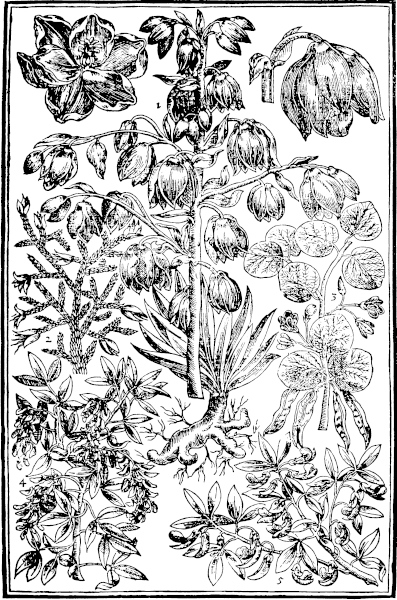
1Yuca siue Iucca. The Indian Iucca.
2Arbor vitæ. The tree of life.
3Arbor Iudæ. Iudas tree.
4Laburnum. Beane Trefoile.
5Cytisus. Tree Trefoile.
Chap. CXVIII. Arbor vitæ. The tree of life.
The tree of life riseth vp in some places where it hath stood long, to be a tree of a reasonable great bignesse and height, couered with a redder barke then any other tree in our Country that I know, the wood whereof is firme and hard, and spreadeth abroad many armes and branches, which againe send forth many smaller twigges, bending downewards; from which twiggy or slender branches, being flat themselues like the leaues, come forth on both sides many flat winged leaues, somewhat like vnto Sauine, being short and small, but not pricking, seeming as if they were brayded or folded like vnto a lace or point, of a darke yellowish greene colour, abiding greene on the branches Winter and Summer, of a strong resinous taste, not pleasing to most, but in some ready to procure casting, yet very cordiall and pectorall also to them that can endure it: at the toppes of the branches stand small yellowish dounie flowers, set in small scaly heads, wherein lye small, long, brownish seede, which ripen well in many places, and being sowne, doe spring and bring forth plants, which with some small care will abide the extreamest Winters we haue.
The Place.
The first or originall place where it naturally groweth, as farre as I can learne or vnderstand, is that part of America which the French doe inhabite, about the riuer of Canada, which is at the backe of Virginia Northward, and as it seemeth, first brought by them from thence into Europe, in the time of Francis the first French King, where it hath so plentifully encreased, and so largely beene distributed, that now few Gardens of respect, either in France, Germany, the Lowe Countries, or England, are without it.
The Time.
It flowreth in the end of May, and in Iune; the fruit is ripe in the end of August and September.
The Names.
All the Writers that haue written of it, since it was first knowne, haue made it to be Thuyæ genus, a kinde of Thuya, which Theophrastus compareth vnto a Cypresse tree, in his fifth Book and fifth Chapter: but Omne simile non est idem, and although it haue some likenesse, yet I verily beleeue it is proprium sui genus, a proper kinde of it owne, not to bee paralleld with any other. For wee finde but very few trees, herbes, or plants in America, like vnto those that growe in Europe, the hither part of Africa, or in the lesser Asia, as experience testifieth. Some would make it to be Cedrus Lycia, but so it cannot be. The French that first brought it, called it Arbor vitæ, with what reason or vpon what ground I know not; but euer since it hath continued vnder the title of the Tree of life.
The Vertues.
It hath beene found by often experience, that the leaues hereof chewed in the morning fasting, for some few dayes together, haue done much good to diuers, that haue beene troubled with shortnesse of breath, and to helpe to expectorate thinne purulentous matter stuffing the lungs. Other properties I haue not heard that it hath; but doubtlesse, the hot resinous smell and taste it hath, both while it is fresh, and after it hath beene long kept dry, doth euidently declare his tenuity of parts, a digesting and cleansing quality it is possessed with, which if any industrious would make tryall, hee should finde the effects.
Chap. CXIX. Arbor Iudæ. Iudas tree.
Iudas tree riseth vp in some places, where it standeth open from a wall, and alone free from other trees (as in a Garden at Batthersey, which sometimes agoe belonged to Master Morgan, Apothecary to the late Queene Elizabeth of famous memory) to be a very great and tall tree, exceeding any Apple tree in height, and equall in bignesse of body thereunto (as my selfe can testifie, being an eye witnesse thereof) when as it had many stalkes of flowers, being in the bud, breaking out of the body of the tree through the barke in diuers places, when as there was no bough or branch near them by a yard at the least, or yet any leafe vpon the tree, (which they gathered to put among other flowers, for Nosegayes) and in other places it groweth to bee but an hedge bush, or plant, with many suckers and shootes from belowe, couered with a darke reddish barke, the young branches being more red or purplish: the flowers on the branches come forth before any shew or budding of leaues, three or foure standing together vpon a small foote-stalke, which are in fashion like vnto Pease blossomes, but of an excellent deepe purplish crimson colour: after which come in their places so many long, flat, large, and thinne cods, of a brownish colour, wherein are contained small, blackish browne, flat, and hard seede: the roote is great, and runneth both deepe, and farre spreading in the earth: the leaues come forth by themselues, euery one standing on a long stalke, being hard & very round, like vnto the leafe of the largest Asarum, but not so thick, of a whitish green on the vpper side, and grayish vnderneath, which fall away euery yeare, and spring a fresh after the Spring is well come in, and the buds of flowers are sprung.
Flore albo.
There is another of this kinde, growing in some places very high, somewhat like the former, and in other places also full of twiggy branches, which are greener then the former, as the leaues are likewise: the flowers of this kinde are wholly white, and the cods nothing so red or browne, in all other things agreeing together.
The Place.
The former groweth plentifully in many places of Spaine, Italy, Prouence in France, and in many other places. The other hath beene sent vs out of Italy many times, and the seede hath sprung very well with vs, but it is somewhat tender to keepe in the Winter.
The Time.
The flowers (as I said) appeare before the leaues, and come forth in Aprill and May, and often sooner also, the leaues following shortly after; but neither of them beareth perfect seede in our Country, that euer I could learne, or know by mine owne or others experience.
The Names.
Some would referre this to Cercis, whereof Theophrastus maketh mention in his first Booke and eighteenth Chapter, among those trees that beare their fruit in cods, like as Pulse doe: and hee remembreth it againe in the fourteenth Chapter of his third Booke, and maketh it not vnlike the white Poplar tree, both in greatnesse and whitenesse of the branches, with the leafe of an Iuie, without corners on the one part, cornered on the other, and sharpe pointed, greene on both sides almost alike, hauing so slender long footestalkes that the leaues cannot stand forthright, but bend downwards, with a more rugged barke then the white Poplar tree. Clusius thinketh this large description is but an ample description of the third kinde of Poplar, called Lybica, the Aspen tree, which Gaza translateth Alpina: but who so will well consider it, shall finde it neyther answerable to any Poplar tree, in that it beareth not cods as Cercis doth; nor vnto this Arbor Iudæ, because it beareth not white branches. Clusius saith also, that the learned of Mompelier in his time, referred it to Colytea of Theophrastus in his third booke and seuenteenth chapter, where he doth liken it to the leaues of the broadest leafed Bay tree, but larger and rounder, green on the vpperside, and whitish vnderneath, and whereunto (as he saith) Theophrastus giueth cods in the fourteenth chapter of the same third booke: and by the contracting of their descriptions both together, saith, they agree vnto this Iudas tree. But I find some doubts and differences in these places: for the Colutæa that Theophrastus mentioneth in the said fourteenth chapter of his third booke, hath (as he saith there) a leafe like vnto the Willow, and therefore cannot bee the same Colutæa mentioned in the seuenteenth chapter of the same third book, which hath a broade Bay leafe: indeede hee giueth seede in cods: but that with broade Bay leaues is (as he saith) without eyther flower or fruite; and besides all this, he saith the rootes are very yellow, which is not to bee found in this Arbor Iudæ, or Iudas tree: let others now iudge if these things can bee well reconciled together. Some haue for the likenesse of the cods vnto Beane cods, called it Fabago. And Clusius called it Siliqua siluestris. It is generally in these dayes called Arbor Iudæ, and in English after the Latine name, vntill a fitter may be had, Iudas tree.
The Vertues.
There is nothing extant in any Author of any Physicall vse it hath, neyther hath any later experience found out any.
Chap. CXX. Laburnum. Beane Trefoile.
There be three sorts of these codded trees or plants, one neere resembling another, whereof Anagyris of Dioscorides is one. The other two are called Laburnum; the larger whereof Matthiolus calleth Anagyris altera, and so doe some others also: the third is of the same kinde with the second, but smaller. I shall not for this our Garden trouble you or my selfe with any more of them then one, which is the lesser of the two Laburnum, in that it is more frequent, and that it will far better abide then the Anagyris, which is so tender, that it will hardly endure the winters of our Countrey: and the greater Laburnum is not so easily to be had.
Laburnum. Beane Trefoile.
This codded tree riseth vp with vs like vnto a tall tree, with a reasonable great body, if it abide any long time in a place, couered with a smooth greene barke; the branches are very long, greene, pliant, and bending any way, whereon are set here and there diuers leaues, three alwaies standing together vpon a long stalk, being somewhat long, and not very narrow, pointed at the ends, greene on the vpperside, and of a siluer shining colour vnderneath, without any smell at all: at the ioynts of these branches, where the leaues stand, come forth many flowers, much like vnto broome flowers, but not so large or open, growing about a very long branch or stalke, sometimes a good span or more in length, and of a faire yellow colour, but not very deepe; after which come flat thin cods, not very long or broade, but as tough and hard as the cods of Broome; wherein are contained blackish seede, like, but much lesse then the seede of Anagyris vera (which are as big as a kidney beane, purplish and spotted): the roote thrusteth down deepe into the ground, spreading also farre, and is of a yellowish colour.
The Place.
This tree groweth naturally in many of the woods of Italie, and vpon the Alpes also, and is therefore still accounted to be that Laburnum that Plinie calleth Arbor Alpina. It groweth in many gardens with vs.
The Time.
It flowreth in May, the fruit or cods, and the seedes therein are ripe in the end of August, or in September.
The Names.
This tree (as I said before) is called of Matthiolus Anagyris altera, siue secunda, of Cordus, Gesner and others, especially of most now adayes, Laburnum. It is probable in my opinion, that this should bee that Colutæa of Theophrastus, mentioned in the fourteenth Chapter of his third book with the leafe of a Willow; for if you take any one leafe by it selfe, it may well resemble a Willow leafe both for forme and colour, and beareth small seed in cods like vnto pulse as that doth. Of some it hath beene taken for a kinde of Cytisus, but not truely. We call it in English, Beane Trefoile, in regard of his cods and seede therein, somewhat like vnto Kidney Beanes, and of the leaues, three alwayes standing together, vntill a more proper name may bee giuen it.
The Vertues.
There is no vse hereof in Physicke with vs, nor in the naturall place of the growing, saue only to prouoke a vomit, which it will doe very strongly.
Chap. CXXI. Cytisus. Tree Trefoile.
There are so many sorts of Cytisus or Tree trefoiles, that if I should relate them all, I should weary the Reader to ouerlooke them, whereof the most part pertaine rather to a generall worke then to this abstract. I shall not therefore trouble you with any superfluous, but only with two, which we haue noursed vp to furnish waste places in a garden.
Cytisus Maranthe. Horned Tree Trefoile.
This Tree Trefoile which is held of most Herbarists to bee the true Cytisus of Dioscorides, riseth vp to the height of a man at the most, with a body of the bignesse of a mans thumbe, couered with a whitish bark, breaking forth into many whitish branches spreading farre, beset in many places with small leaues, three alwayes set together vpon a small short footestalke, which are rounder, and whiter then the leaues of Beane Trefoile: at the ends of the branches for the most part, come forth the flowers three or foure together, of a fine gold colour, and of the fashion of Broome flowers, but not so large: after the flowers are past, there come in their places crooked flat thinne cods, of the fashion of a halfe moone, or crooked horne, whitish when they are ripe, wherein are contained blackish seede: the roote is hard and woody, spreading diuers wayes vnder the ground: the whole plant hath a pretty small hot sent.
Cytisus vulgatior. The common Tree Trefoile.
This Cytisus is the most common in this Land, of any the other sorts of tree trefoiles, hauing a blackish coloured barke, the stemme or body whereof is larger then the former, both for height and spreading, bearing also three leaues together, but smaller and greener then the former: the flowers are smaller, but of the same fashion and colour: the cods blackish and thin, and not very long, or great, but lesser then Broome cods, wherein there lyeth small blackish hard seede: the roote is diuersly dispersed in the ground.
The Place.
The first groweth in the kingdome of Naples, and no doubt in many other places of Italie, as Matthiolus saith. The other groweth in diuers places of France.
The Time.
They flower for the most part in May or Iune: the seede is ripe in August or September.
The Names.
The first (as I said) is thought of most to be the true Cytisus of Dioscorides, and as is thought, was in these later dayes first found by Bartholomæus Maranta of Naples, who sent it first to Matthiolus, and thereupon hath euer since beene called after his name, Cytisus Maranthæ. Some doe call it Cytisus Lunatus, because the cods are made somewhat like vnto an halfe Moone. We call it in English, Horned Tree Trefoile. The other is called Cytisus vulgaris or vulgatior; in English, The common Tree Trefoile, because we haue not any other so common.
The Vertues.
The chiefest vertues that are appropriate to these plants, are to procure milke in womens breasts, to fatten pullen, sheep &c. and to be good for bees.
Chap. CXXII. Colutæa. The Bastard Sena Tree.
Wee haue in our Gardens two or three sorts of the Bastard Sena tree; a greater as I may so call it, and two lesser: the one with round thin transparent skins like bladders, wherein are the seede: the other with long round cods, the one bunched out or swelling in diuers places, like vnto a Scorpions tale, wherein is the seede, and the other very like vnto it, but smaller.
1. Colutæa Vesicaria. The greater Bastard Sena with bladders.
This shrub or tree, or shrubby tree, which you please to call it, riseth vp to the height of a pretty tree, the stemme or stock being sometimes of the bignesse of a mans arme, couered with a blackish greene rugged barke, the wood whereof is harder then of an Elder, but with an hollownesse like a pith in the heart or middle of the branches, which are diuided many wayes, and whereon are set at seuerall distances, diuers winged leaues, composed of many small round pointed, or rather flat pointed leaues, one set against another, like vnto Licoris, or the Hatchet Fitch; among these leaues come forth the flowers, in fashion like vnto Broome flowers, and as large, of a very yellow colour: after which appeare cleare thinne swelling cods like vnto thinne transparent bladders, wherein are contained blacke seede, set vpon a middle ribbe or sinew in the middle of the bladder, which if it be a little crushed betweene the fingers, will giue a cracke, like as a bladder full of winde. The roote groweth branched and woody.
2. Colutæa Scorpioides maior. The greater Scorpion podded Bastard Sena.
This Bastard Sena groweth nothing so great or tall, but shooteth out diuersly, like vnto a shrub, with many shoots springing from the root: the branches are greener, but more rugged, hauing a white barke on the best part of the elder growne branches; for the young are greene, and haue such like winged leaues set on them as are to be seen in the former, but smaller, greener, and more pointed: the flowers are yellow, but much smaller, fashioned somewhat like vnto the former, with a reddish stripe downe the backe of the vppermost leafe: the long cods that follow are small, long and round, distinguished into many diuisions or dents, like vnto a Scorpions tayle, from whence hath risen the name: in these seuerall diuisions lye seuerall blacke seede, like vnto the seede of Fenigrecke: the roote is white and long, but not so woody as the former.
3. Colutæa Scorpioides minor. The lesser Scorpion Bastard Sena.
This lesser Bastard Sena is in all things like the former, but somewhat lower, and smaller both in leafe, flower, and cods of seede, which haue not such eminent bunches on the cods to be seene as the former.
The Place.
They grow as Matthiolus saith about Trent in Italie, and in other places: the former is frequent enough through all our Countrey, but the others are more rare.
The Time.
They flower about the middle or end of May, and their seede is ripe in August. The bladders of the first will abide a great while on the tree, if they be suffered, and vntill the winde cause them to rattle, and afterwards the skins opening, the seede will fall away.
The Names.
The name Colutæa is imposed on them, and by the iudgement of most writers, the first is taken to bee that Colutæa of Lipara that Theophrastus maketh mention of, in the seuenteenth chapter of his third booke. But I should rather thinke that the Scorpioides were the truer Colutæa of Theophrastus, because the long pods thereof are more properly to bee accounted filiquæ, then the former which are vesicæ tumentes, windy bladders, and not filiquæ: and no doubt but Theophrastus would haue giuen some peculiar note of difference if he had meant those bladders, and not these cods. Let others of iudgement be vmpeeres in this case; although I know the currant of writers since Matthiolus, doe all hold the former Colutæa vesicaria to be the true Colutæa Liparæ of Theophrastus. Wee call it in English, Bastard Sena, from Ruellius, who as I thinke first called it Sena, from the forme of the leaues. The second and third (as I said before) from the forme of the cods receiued their names, as it is in the titles and descriptions; yet they may as properly be called Siliquosæ, for that their fruite are long cods.
The Vertues.
Theophrastus saith it doth wonderfully helpe to fatten sheepe: But sure it is found by experience, that if it be giuen to man it causeth strong purgings both vpwards and downwards; and therefore let euery one beware that they vse not this in steede of good Sena, lest they feele to their cost the force thereof.
Chap. CXXIII. Spartum Hispanicum frutex. Spanish Broome.
Although Clusius and others haue found diuers sorts of this shrubby Spartum or Spanish Broome, yet because our Climate will nourse vp none of them, and euen this very hardly, I shall leaue all others, and describe vnto you this one only in this manner: Spanish Broome groweth to bee fiue or sixe foote high, with a woody stemme below, couered with a darke gray, or ash-coloured barke, and hauing aboue many pliant, long and slender greene twigs, whereon in the beginning of the yeare are set many small long greene leaues, which fall away quickly, not abiding long on; towards the tops of these branches grow the flowers, fashioned like vnto Broom flowers, but larger, as yellow as they, and smelling very well; after which come small long cods, crested at the backe, wherein is contained blackish flat seede, fashioned very like vnto the Kidney beanes: the roote is woody, dispersing it selfe diuers waies.
The Place.
This groweth naturally in many places of France, Spaine and Italie, wee haue it as an ornament in our Gardens, among other delightfull plants, to please the senses of sight and smelling.
The Time.
It flowreth in the end of May, or beginning of Iune, and beareth seede, which ripeneth not with vs vntill it be late.
The Names.
It is called Spartium Græcorum, and Spartum frutex, to distinguish it from the sedge or rush, that is so called also. Of some it is called Genista, and thought not to differ from the other Genista, but they are much deceiued; for euen in Spaine and Italie, the ordinary Genista or Broome groweth with it, which is not pliant, and fit to binde Vines, or such like things withall as this is.
The Vertues.
There is little vse hereof in Physicke, by reason of the dangerous qualitie of vomiting, which it doth procure to them that take it inwardly: but being applyed outwardly, it is found to helpe the Sciaticæ or paine of the hippes.
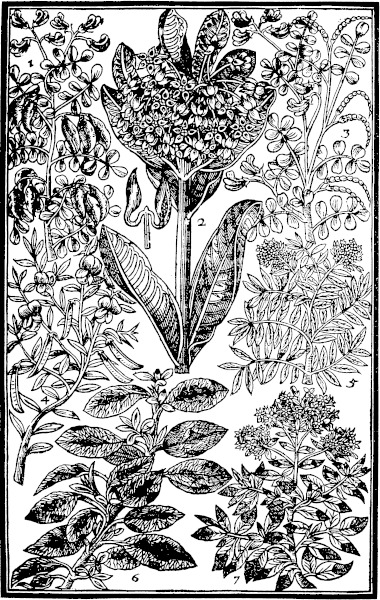
1Colutæa vulgaris. Ordinary bastard Sene.
2Periploca recta Virginiana. Virginian Silke.
3Colutæa Scorpioides. Scorpion bastard Sene.
4Spartum Hispanicum. Spanish Broome.
5Ligustrum. Priuet.
6Saluia variegata. Party coloured Sage.
7Maiorana aurea. Guilded Marierome.
Chap. CXXIIII. Periploca recta Virginiana. Virginian Silke.
Lest this stranger should find no hospitality with vs, being so beautifull a plant, or not finde place in this Garden, let him be here receiued, although with the last, rather then not at all. It riseth vp with one or more strong and round stalkes, three or foure foote high, whereon are set at the seuerall ioynts thereof two faire, long, and broad leaues, round pointed, with many veines therein, growing close to the stemme, without any foote-stalke: at the tops of the stalkes, and some times at the ioynts of the leaues, groweth forth a great bush of flowers out of a thinne skinne, to the number of twenty, and sometimes thirty or forty, euery one with a long foote-stalke, hanging downe their heads for the most part, especially those that are outermost, euery one standing within a small huske of greene leaues, turned to the stalkeward, like vnto the Lysimachia flower of Virginia before described, and each of them consisting of fiue small leaues a peece, of a pale-purplish colour on the vpperside, and of a pale yellowish purple vnderneath, both sides of each leafe being as it were folded together, making them seeme hollow and pointed, with a few short chiues in the middle: after which come long and crooked pointed cods standing vpright, wherein are contained flat brownish seede, dispersedly lying within a great deale of fine, soft, and whitish browne silke, very like vnto the cods, seede, and silke of Asclepias, or Swallow-wort, but that the cods are greater and more crooked, and harder also in the outer shell: the roote is long and white, of the bignesse of a mans thumbe, running vnder ground very far, and shooting vp in diuers places, the heads being set full of small white grumes or knots, yeelding forth many branches, if it stand any time in a place: the whole plant, as well leaues as stalkes, being broken, yeeld a pale milke.
The Place.
It came to me from Virginia, where it groweth aboundantly, being raised vp from the seede I receiued.
The Time.
It flowreth in Iuly, and the seede is ripe in August.
The Names.
It may seeme very probable to many, that this plant is the same that Prosper Alpinus in the twenty fift Chapter of his Booke of Egyptian plants, nameth Beidelsar; and Honorius Bellus in his third and fourth Epistles vnto Clusius (which are at the end of his History of plants) calleth Ossar frutex: And Clusius himselfe in the same Booke calleth Apocynum Syriacum, Palæstinum, and Ægyptiacum, because this agreeth with theirs in very many and notable parts; yet verily I thinke this plant is not the same, but rather another kinde of it selfe: First, because it is not frutex, a shrub or wooddy plant, nor keepeth his leaues all the yeare, but loseth both leaues and stalks, dying down to the ground euery yeare: Secondly, the milke is not causticke or violent, as Alpinus and Bellus say Ossar is: Thirdly, the cods are more crooked then those of Clusius, or of Alpinus, which Honorius Bellus acknowledgeth to be right, although greater then those he had out of Egypt: And lastly, the rootes of these doe runne, whereof none of them make any mention. Gerard in his herball giueth a rude figure of the plant, but a very true figure of the cods with seede, and saith the Virginians call it Wisanck, and referreth it to the Asclepias, for the likenesse of the cods stuffed with silken doune. But what reason Caspar Bauhinus in his Pinax Theatri Botanici had, to call it (for it is Clusius his Apocynum Syriacum) by the name of Lapathum Ægyptiacum lactescens siliqua Asclepiadis, I know none in the world: for but that he would shew an extreame singularity in giuing names to plants, contrary to all others (which is very frequent with him) how could he thinke, that this plant could haue any likenesse or correspondencie, with any of the kindes of Dockes, that euer he had seene, read, or heard of, in face, or shew of leaues, flowers, or seede; but especially in giuing milke. I haue you see (and that not without iust and euident cause) giuen it a differing Latine name from Gerard, because the Asclepias giueth no milke, but the Periploca or Apocymum doth; and therefore fitter to be referred to this then to that. And because it should not want an English name answerable to some peculiar property thereof, I haue from the silken doune called it Virginian Silke: but I know there is another plant growing in Virginia, called Silke Grasse, which is much differing from this.
The Vertues.
I know not of any in our Land hath made any tryall of the properties hereof. Captaine Iohn Smith in his booke of the discouery and description of Virginia, saith, that the Virginians vse the rootes hereof (if his be the same with this) being bruised and applyed to cure their hurts & diseases.
Chap. CXXV. Ligustrum. Primme or Priuet.
Because the vse of this plant is so much, and so frequent throughout all this Land, although for no other purpose but to make hedges or arbours in Gardens, &c. whereunto it is so apt, that no other can be like vnto it, to bee cut, lead, and drawne into what forme one will, either of beasts, birds, or men armed, or otherwise: I could not forget it, although it be so well knowne vnto all, to be an hedge bush growing from a wooddy white roote, spreading much within the ground, and bearing manie long, tough, and plyant sprigs and branches, whereon are set long, narrow, and pointed sad greene leaues by couples at euery ioynt: at the tops whereof breake forth great tufts of sweete smelling white flowers, which when they are fallen, turne into small blacke berries, hauing a purple iuyce within them, and small seede, flat on the one side, with an hole or dent therein: this is seene in those branches that are not cut, but suffered to beare out their flowers and fruit.
The Place.
This bush groweth as plentifully in the Woods of our owne Countrey, as in any other beyond the Seas.
The Time.
It flowreth sometimes in Iune,and in Iuly; the fruit is ripe in August and September.
The Names.
There is great controuersie among the moderne Writers concerning this plant, some taking it to be κύπρος of Dioscorides, other to be Phillyrea of Dioscorides, which followeth next after Cyprus. Plinie maketh mention of Cyprus in two places; in the one he saith Cyprus hath the leafe of Ziziphus, or the Iuiube tree: in the other he saith, that certain do affirme, that the Cyprus of the East Country, and the Ligustrum of Italy is one and the same plant: whereby you may plainly see, that our Priuet which is Ligustrum, cannot be that Cyprus of Plinie with Iuiube leaues: Besides, both Dioscorides & Plinie say, that Cyprus is a tree; but all know that Ligustrum, Priuet, is but an hedge bush: Againe, Dioscorides saith, that the leaues of Cyprus giue a red colour, but Priuet giueth none. Bellonius and Prosper Alpinus haue both recorded, that the true Cyprus of Dioscorides groweth plentifully in Egypt, Syria, and those Easterne Countries, and noursed vp also in Constantinople, and other parts of Greece, being a merchandise of much worth, in that they transport the leaues, and young branches dryed, which laid in water giue a yellow colour, wherewith the Turkish women colour the nailes of their hands, and some other parts of their bodies likewise, delighting much therein: and that it is not our Ligustrum, or Priuet, because Cyprus beareth round white seede, like Coriander seede, and the leaues abide greene alwaies vpon the tree, which groweth (if it bee not cut or pruined) to the height of the Pomegranet tree. I haue (I confesse) beyond the limits I set for this worke spoken concerning our Priuet, because I haue had the seede of the true Cyprus of Dioscorides sent mee, which was much differing from our Priuet, and although it sprang vp, yet would not abide any time, whereas if it had beene our Priuet, it would haue beene familiar enough to our Countrey.
The Vertues.
It is of small vse in physicke, yet some doe vse the leaues in Lotions, that serue to coole and dry fluxes or sores in diuers parts.
Chap. CXXVI. Saluia variegata. Party coloured Sage. And Maiorana versicolor siue aurea. Yellow or golden Marierome.
Vnto all these flowers of beauty and rarity, I must adioyne two other plants, whose beauty consisteth in their leaues, and not in their flowers: as also to separate them from the others of their tribe, to place them here in one Chapter, before the sweete herbes that shall follow, as is fittest to furnish this our Garden of pleasure. This kinde of Sage groweth with branches and leaues, very like the ordinary Sage, but somewhat smaller, the chiefest difference consisteth in the colour of the leaues, being diuersly marked and spotted with white and red among the greene: for vpon one branch you shall haue the leaues seuerally marked one from another, as the one halfe of the leafe white, and the other halfe greene, with red shadowed ouer them both, or more white then greene, with some red in it, either parted or shadowed, or dasht here and there, or more greene then white, and red therein eyther in the middle or end of the leafe, or more or lesse parted or striped with white and red in the greene, or else sometimes wholly greene the whole branch together, as nature listeth to play with such varieties: which manner of growing rising from one and the same plant, because it is the more variable, is the more delightfull and much respected.
There is another speckled Sage parted with white and greene, but it is nothing of that beauty to this, because this hath three colours euidently to bee discerned in euery leafe almost, the red adding a superaboundant grace to the rest.
Maiorana aurea siue versicolor. Yellow or golden Marierome.
This kinde of Marierome belongeth to that sort is called in Latine Maiorana latifolia, which Lobel setteth forth for Hyssopus Græcorum genuina: In English Winter Marierome, or pot Marierome: for it hath broader and greater leaues then the sweete Marierome, and a different vmbell or tuft of flowers. The difference of this from that set forth in the Kitchin Garden, consisteth chiefly in the leaues, which are in Summer wholly yellow in some, or but a little greene, or parted with yellow and greene more or lesse, as nature listeth to play: but in Winter they are of a darke or dead greene colour, yet recouering it selfe againe: the sent hereof is all one with the pot Marierome.
Wee haue another parted with white and greene, much after the manner with the former.
{The Place, Time, Names, and Vertues}
The Place, Time, Names, and Vertues of both these plants, shall be declared where the others of their kindes are specified hereafter, and in the Kitchen Garden; for they differ not in properties.
Chap. CXXVII. Lauendula. Lauender Spike.
After all these faire and sweete flowers before specified, I must needes adde a few sweete herbes, both to accomplish this Garden, and to please your senses, by placing them in your Nosegays, or else where, as you list. And although I bring them in the end or last place, yet are they not of the least account.
1. Lauendula maior. Garden Lauender.
Our ordinary Garden Lauender riseth vp with a hard wooddy stemme aboue the ground, parted into many small branches, whereon are set whitish, long, and narrow leaues, by couples one against another; from among which riseth vp naked square stalkes, with two leaues at a ioynt, and at the toppe diuers small huskes standing round about them, formed in long and round heads or spikes, with purple gaping flowers springing out of each of them: the roote is wooddy, and spreadeth in the ground: The whole plant is of a strong sweete sent, but the heads of flowers much more, and more piercing the senses, which are much vsed to bee put among linnen and apparrell.
Flore albo.
There is a kinde hereof that beareth white flowers, and somewhat broader leaues, but it is very rare, and seene but in few places with vs, because it is more tender, and will not so well endure our cold Winters.
2. Lauendula minor seu Spica. Small Lauender or Spike.
The Spike or small Lauender is very like vnto the former, but groweth not so high, neither is the head or spike so great and long, but shorter and smaller, and of a more purplish colour in the flower: the leaues also are a little harder, whiter, and shorter then the former; the sent also is somewhat sharper and stronger. This is not so frequent as the first, and is nourished but in some places that are warme, and where they delight in rare herbes and plants.
The Place.
Lauender groweth in Spaine aboundantly, in many places so wilde, and little regarded, that many haue gone, and abiden there to distill the oyle thereof whereof great quantity now commeth ouer from thence vnto vs: and also in Lanquedocke, and Prouence in France.
The Time.
It flowreth early in those hot Countries, but with vs not vntill Iune and Iuly.
The Names.
It is called of some Nardus Italica, and Lauendula, the greater is called Fæmina, and the lesser Mas. We doe call them generally Lauender, or Lauender Spike, and the lesser Spike, without any other addition.
The Vertues.
Lauender is little vsed in inward physicke, but outwardly; the oyle for cold and benummed parts, and is almost wholly spent with vs, for to perfume linnen, apparrell, gloues, leather, &c., and the dryed flowers to comfort and dry vp the moisture of a cold braine.
Chap. CXXVIII. Stœchas. Sticadoue, Cassidony, or French Lauender.
Cassidony that groweth in the Gardens of our Countrey, may peraduenture somewhat differ in colour, as well as in strength, from that which groweth in hotter Countries; but as it is with vs, it is more tender a great deale then Lauender, and groweth rather like an herbe then a bush or shrub, not aboue a foote and a halfe high, or thereabouts, hauing many narrow long greene leaues like Lauender, but softer and smaller, set at seuerall distances together about the stalkes, which spread abroad into branches: at the tops whereof stand long and round, and sometimes foure square heads, of a darke greenish purple colour, compact of many scales set together; from among which come forth the flowers, of a blewish purple colour, after which follow seede vessels, which are somewhat whitish when they are ripe, containing blackish browne seede within them: the roote is somewhat wooddy, and will hardly abide the iniuries of our cold Winters, except in some places onely, or before it haue flowred: The whole plant is somewhat sweete, but nothing so much as Lauender.
The Place.
Cassidony groweth in the Islands Stæchades, which are ouer against Marselles, and in Arabia also: we keep it with great care in our Gardens.
The Time.
It flowreth the next yeare after it is sowne, in the end of May, which is a moneth before any Lauender.
The Names.
It is called of some Lauendula siluestris, but most vsually Stæchas in English, of some Stichadoue, or French Lauender; and in many parts of England, Cassidony.
The Vertues.
It is of much more vse in physicke then Lauender, and is much vsed for old paines in the head. It is also held to be good for to open obstructions, to expell melancholy, to cleanse and strengthen the liuer, and other inward parts, and to be a Pectorall also.
Chap. CXXIX. Abrotanum fæmina siue Santolina. Lauender Cotton.
This Lauender Cotton hath many wooddy, but brittle branches, hoary or of a whitish colour, whereon are set many leaues, which are little, long, and foure square, dented or notched on all edges, and whitish also: at the tops of these branches stand naked stalkes, bearing on euery one of them a larger yellow head or flower, then eyther Tansie or Maudeline, whereunto they are somewhat like, wherein is contained small darke coloured seede: the roote is hard, and spreadeth abroad with many fibres: the whole plant is of a strong sweete sent, but not vnpleasant, and is in many places planted in Gardens, to border knots with, for which it will abide to be cut into what forme you thinke best; for it groweth thicke and bushy, very fit for such workes, besides the comely shew the plant it selfe thus wrought doth yeeld, being alwayes greene, and of a sweet sent; but because it quickly groweth great, and will soone runne out of forme, it must be euery second or third yeare taken vp, and new planted.
The Place.
It is onely planted in Gardens with vs, for the vses aforesaid especially.
The Time.
It flowreth in Iuly, and standeth long in the hot time of the yeare in his colour, and so will doe, if it be gathered before it haue stood ouer long.
The Names.
Diuers doe call it as Matthiolus doth, Abrotanum fæmina, and Santolina; and some call it Chamæcyparissus, because the leaues thereof, are somewhat like the leaues of the Cypresse tree: Wee call it in English generally Lauender Cotton.
The Vertues.
This is vsually put among other hot herbes, eyther into bathes, ointments, or other things, that are vsed for cold causes. The seede also is much vsed for the wormes.
Chap. CXXX. Ocimum. Bassill.
Bassill is of two sorts (besides other kindes) for this our Garden, the one whereof is greater, the other lesse in euery part thereof; as shall be shewed.
1. Ocimum Citratum. Common Bassill.
Our ordinary Garden Bassill hath one stalke rising from the root, diuersly branched out, whereon are set two leaues alwayes at a ioynt, which are broad, somewhat round, and pointed, of a pale greene colour, but fresh, a little snipt or dented about the edges, and of a strong or heady sent, somewhat like a Pomecitron, as many haue compared it, and thereof call it Citratum: the flowers are small and white, standing at the tops of the branches, with two smal leaues at euery ioynt vnder them, in some plants green, in others browne vnder them: after which commeth blacke seede: the roote perisheth at the first approach of winter weather, and is to be new sowen euery yeare.
2. Ocimum minimum siue Gariophyllatum. Bush Basill.
The bush Basill groweth not altogether so high, but is thicker spreade out into branches, whereon grow smaller leaues, and thicker set then the former, but of a more excellent and pleasant smell by much: the flowers are white like the former, and the seede blacke also like it, and perisheth as suddenly, or rather sooner then it, so that it requireth more paines to get it, and more care to nourse it, because we seldome or neuer haue any seede of it.
Ocimum Indicum. Indian Basill.
The Indian Basill hath a square reddish greene stalke, a foote high or better, from the ioynts whereof spreade out many branches, with broade flat leaues set thereon, two alwayes together at the ioynt, one against another, as other Basils haue, but somewhat deepely cut in on the edges, and oftentimes a little crumpled, standing vpon long reddish footestalkes, of a darke purple colour, spotted with deeper purple spots, in some greater, in others lesser: the flowers stand at the tops of the stalkes spike-fashion, which are of a white colour, with reddish stripes and veines running through them, set or placed in darke purple coloured huskes: the seede is greater and rounder then the former, and somewhat long withall: the roote perisheth in like manner as the other former doe. The whole plant smelleth strong, like vnto the other Basils.
The Place.
The two last sorts of Basils are greater strangers in our Country then the first which is frequent, and only sowen and planted in curious gardens. The last came first out of the West Indies.
The Time.
They all flower in August, or Iuly at the soonest, and that but by degrees, and not all at once.
The Names.
The first is vsually called Ocimum vulgare, or vulgatius, and Ocimum Citratum. In English, Common or Garden Basill. The other is called Ocimum minimum, or Gariophyllatum, Cloue Basill, or Bush Basill. The last eyther of his place, or forme of his leaues, being spotted and curled, or all, is called Ocimum Indicum maculatum, latifolium & crispum. In English according to the Latine, Indian Basill, broade leafed Basill, spotted or curled Basill, which you please.
The Vertues.
The ordinary Basill is in a manner wholly spent to make sweet, or washing waters, among other sweet herbes, yet sometimes it is put into nosegayes. The Physicall properties are, to procure a cheerefull and merry heart, whervnto the seede is chiefly vsed in pouder, &c. and is most vsed to that, and to no other purpose.
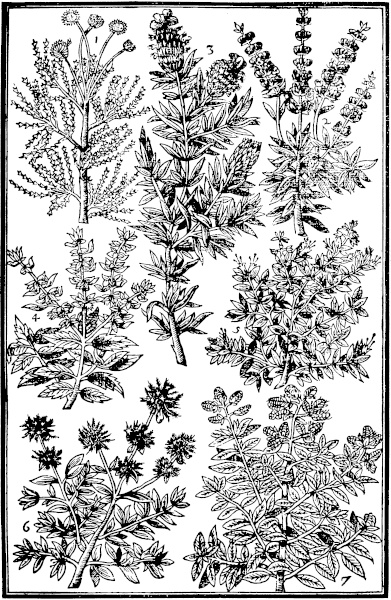
1Santolina. Lauender Cotton.
2Lauendula. Lauender Spike.
3Stœchas. Cassidony.
4Chamædrys. Germander.
5Ocimum minus. Fine Bassill.
6Marum. Herbe Masticke.
7Maiorana. Sweete Marierome.
Chap. CXXXI. Maiorana. Sweete Marierome.
Wee haue many sorts of Marierome; some that are sweete, and but Summer plants; others that are greater and not so sweet; and some also that are wilde. Of all these I will onely select some of the choisest that are fit for this place, and leaue the other for the next garden, and the garden of simples, or a generall worke: yet hereunto I will adioyne another sweete plant called Masticke, as participating neerer with them then with Time, whereunto many doe referre it.
1. Maiorana maior æstiua. Common sweet Marierome.
The sweet Marierome that is most frequently sowen in our Country, is a low herbe little aboue a foote high when it is at the highest, full of branches, and small whitish soft roundish leaues, smelling very sweet: at the toppes of the branches stand diuers small scaly heads, like vnto knots, (and therefore of some called knotted Marierome) of a whitish greene colour, out of which come here and there small white flowers, and afterwards small reddish seede: the roote is composed of many small threds or strings, which perish with the whole plant euery yeare.
2. Maiorana tenuifolia. Marierome gentle.
This Marierome hath likewise diuers small branches, growing low, and not higher then the former, but hauing finer and smaller leaues, hoary and soft, but much sweeter: the heads are like vnto the former, and so are the flowers and seede, and the whole plant abiding but a Summer in the like manner.
3. Marum. Herbe Masticke.
The neerer resemblance that this herbe hath with Marierome then with Tyme (as I said before) hath made me place it next vnto the small sweet Marierome. It riseth vp with a greater, and a more woody stalke then Marierome, two foote high or better in some places, where it liketh the ground and ayre, branching out on all sides towards the vpper part, leauing the stemme bare below, if it bee old, otherwise being young, thinly furnishing the branches from the bottome with small greene leaues, bigger then the leaues of any Tyme, and comming neere vnto the bignesse and forme of the last recited finer Marierome, but of a greener colour: at the toppes of the branches stand small white flowers on a head, which afterwards turne into a loose tuft of a long white hoary matter, like vnto soft doune, with some leaues vnderneath and about it, which abide not long on the stalkes, but are blowne away with the winde: the seede is so small if it haue any, that I haue not obserued it: the roote is threddy: the whole plant is of a sweete resinous sent, stronger then the Marierome, and abideth our winters, if it be carefully planted and regarded.
The Place.
The sweete Marieromes grow naturally in hot Countreyes: the first in Spaine &c. the second is thought to come out of Syria, or Persia first into Italie, where they much esteeme it, and plant it curiously and carefully in pots, and set them in their windowes, beeing much delighted therewith for the sweet sent it hath. The first is vsually sowen euery yeare in most gardens with vs: but the second is very rare and daintie, and must as daintely be preserued being more tender then the former. The herbe Masticke is thought to be first brought out of Candie, Clusius saith he found it in Spaine: It is planted by slippes, (and not sowen) in many gardens, and is much replanted for increase, but prospereth onely, or more frequently, in loamie or clay grounds then in any other soyle.
The Time.
The sweete Marieromes beare their knots or scaly heads in the end of Iuly, or in August. Herbe Masticke in Iune many times, or in the beginning of Iuly.
The Names.
The first of the two sweet Marieromes called Maiorana in Latine à maiore cura, is taken of most writers to be the Amaracus or Sampsuchum of Dioscorides, Theophrastus and Plinie, although Galen doth seem a little to dissent therefrom. The other sweet Marierome hath his name in his title as much as can be said of it. The next is thought by the best of the moderne Writers to be the true Marum that Galen preferreth for the excellent sweetnesse, before the former Marierome in making the Oleum, or vnguentum Amaricinum, and seemeth to incline to their opinion that thought Amaracus was deriued from Marum. It is the same also that Galen and others of the ancient Writers make mention of, to go into the composition of the Trochisci Hedychroi, as well as Amaracus among the ingredients of the Theriaca Andromachi. In English we call it Masticke simply, or Herbe Mastick, both to distinguish it from that Tyme that is called Masticke Tyme, and from the Masticke Tree, or Gum, so called. Some of later times, and Clusius with them, haue thought this to be Dioscorides his Tragoriganum, which doth somewhat resemble it: but there is another plant that Matthiolus setteth forth for Marum, that in Lobels opinion and mine is the truest Tragoriganum, and this the truest Marum.