THE GARDEN OF PLEASANT FLOWERS. (continued 14)
Reading edition
The Vertues.
The sweete Marieromes are not onely much vsed to please the outward senses in nosegayes, and in the windowes of houses, as also in sweete pouders, sweete bags, and sweete washing waters, but are also of much vse in Physicke, both to comfort the outward members, or parts of the body, and the inward also: to prouoke vrine being stopped, and to ease the paines thereof, and to cause the feminine courses. Herbe Masticke is of greater force to helpe the stopping of vrine, then the Marierome, and is put into Antidotes, as a remedie against the poyson of venemous Beasts.
Chap. CXXXI. Thymum. Tyme.
There are many kindes of Tyme, as they are vsually called, with vs, some are called of the garden, and others wilde, which yet for their sweetnesse are brought into gardens, as Muske Tyme, and Lemon Tyme; and some for their beauty, as embroidered or gold yellow Tyme, and white Tyme. But the true Tyme of the ancient Writers, called Capitatum, as a speciall note of distinction from all other kindes of Tyme, is very rare to be seene with vs here in England, by reason of the tendernesse, that it will not abide our Winters. And all the other sorts that with vs are called garden Tymes, are indeede but kindes of wilde Tyme, although in the defect or want of the true Tyme, they are vsed in the stead of it. With the Tymes I must doe as I did with the Marieromes in the Chapter before, that is, reserue the most common in vse, for the common vse of the Kitchen, and shew you only those here, that are not put to that vse: and first with the true Tyme, because it is knowne but to a few.
1. Thymum legitimum capitatum. The true Tyme.
The true Tyme is a very tender plant, hauing hard and hoary brittle branches, spreading from a small wooddy stemme, about a foote and a halfe high, whereon are set at seuerall ioynts, and by spaces, many small, long, whitish, or hoary greene leaues, of a quicke sent and taste: at the tops of the branches stand small long whitish greene heads, somewhat like vnto the heads of Stæchas, made as it were of many leaues or scales, out of which start forth small purplish flowers (and in some white, as Bellonius saith) after which commeth small seede, that soone falleth out, and if it be not carefully gathered, is soone lost, which made (I thinke) Theophrastus to write, that this Tyme was to be sowne of the flowers, as not hauing any other seede: the root is small and wooddy. This holdeth not his leaues in Winter, no not about Seuill in Spaine, where it groweth aboundantly, as Clusius recordeth, finding it there naked or spoiled of leaues. And will not abide our Winters, but perisheth wholly, roote and all.
2. Serpillum hortense siue maius. Garden wilde Tyme.
The wilde Tyme that is cherished in gardens groweth vpright, but yet is lowe, with diuers slender branches, and small round greene leaues, somewhat like vnto small fine Marierome, and smelling somewhat like vnto it: the flowers growe in roundels at the toppes of the branches, of a purplish colour: And in another of this kinde they are of a pure white colour.
There is another also like hereunto, that smelleth somewhat like vnto Muske; and therefore called Muske Tyme, whose greene leaues are not so small as the former, but larger and longer.
3. Serpillum Citratum. Lemon Tyme.
The wilde Tyme that smelleth like vnto a Pomecitron or Lemon, hath many weake branches trayling on the ground, like vnto the first described wilde Tyme, with small darke greene leaues, thinly or sparsedly set on them, and smelling like vnto a Lemon, with whitish flowers at the toppes in roundels or spikes.
4. Serpillum aureum siue versicolor. Guilded or embroidered Tyme.
This kinde of wilde Tyme hath small hard branches lying or leaning to the ground, with small party coloured leaues vpon them, diuided into stripes or edges, of a gold yellow colour, the rest of the leafe abiding greene, which for the variable mixture or placing of the yellow, hath caused it to be called embroidered or guilded Tyme.
The Place.
The first groweth as is said before, about Seuill in Spaine, in very great aboundance as Clusius saith; and as Bellonius saith, very plentifully on the mountaines through all Greece. The others growe some in this Country, and some in others: but wee preserue them with all the care wee can in our gardens, for the sweete and pleasant sents and varieties they yeeld.
The Time.
The first flowreth not vntill August; the rest in Iune and Iuly.
The Names.
Their names are seuerally set downe in their titles, as is sufficient to distinguish them; and therefore I shall not neede to trouble you any further with them.
The Vertues.
The true Tyme is a speciall helpe to melancholicke and spleneticke diseases, as also to flatulent humours, either in the vpper or lower parts of the body. The oyle that is Chimically drawne out of ordinary Tyme, is vsed (as the whole herbe is, in the stead of the true) in pils for the head and stomach. It is also much vsed for the toothach, as many other such like hot oyles are.
Chap. CXXXII. Hyssopus. Hyssope.
There are many varieties of Hyssope, beside the common or ordinary, which I reserue for the Kitchen garden, and intend onely in this place to giue you the knowledge of some more rare: viz. of such as are noursed vp by those that are curious, and fit for this garden: for there are some other, that must be remembred in the Physicke garden, or Garden of Simples, or else in a generall worke.
1. Hyssopus folijs niueis. White Hyssope.
This white Hyssope is of the same kinde and smell with the common Hyssope; but differeth, in that this many times hath diuers leaues, that are wholly of a white colour, with part of the stalke also: others are parted, the one halfe white, the other halfe greene, and some are wholly greene, or with some spots or stripes of white within the greene, which makes it delightfull to most Gentlewomen.
2. Hyssopus folijs cinereis. Russet Hyssope.
As the last hath party coloured leaues, white and greene, so this hath his leaues of an ash-colour, which of some is called russet; and hath no other difference either in forme or smell.
3. Hyssopus aureus. Yellow or golden Hyssope.
All the leaues of this Hyssope are wholly yellow, or but a little greene in them, and are of so pleasant a colour, especially in Summer, that they prouoke many Gentlewomen to weare them in their heads, and on their armes, with as much delight as many fine flowers can giue: but in Winter their beautifull colour is much decayed, being of a whitish greene, yet recouer themselues againe the next Summer.
4. Hyssopus surculis densis. Double Hyssope.
As this kinde of Hyssope groweth lower then the former or ordinary kinde, so it hath more branches, slenderer, and not so wooddy, leaning somewhat downe toward the ground, so wonderfully thicke set with leaues, that are like vnto the other, but of a darker greene colour, and somewhat thicker withall, that it is the onely fine sweete herbe, that I know fittest (if any be minded to plant herbes) to set or border a knot of herbes or flowers, because it will well abide, and not growe too wooddy or great, nor be thinne of leaues in one part, when it is thicke in another, so that it may be kept with cutting as smooth and plaine as a table. If it be suffered to growe vp of it selfe alone, it riseth with leaues as before is specified, and flowreth as the common doth, and of the same sent also, not differing in any thing, but in the thicknesse of the leaues on the stalkes and branches, and the aptnesse to be ordered as the keeper pleaseth.
Chamædrys. Germander.
Lest Germander should be vtterly forgotten, as not worthy of our Garden, seeing many (as I said in my treatise or introduction to this Garden) doe border knots therewith: let me at the least giue it a place, although the last, being more vsed as a strewing herbe for the house, then for any other vse. It is (I thinke) sufficiently knowne to haue many branches, with small and somewhat round endented leaues on them, and purplish gaping flowers: the rootes spreading far abroad, and rising vp againe in many places.
The Place.
These Hyssopes haue beene most of them noursed vp of long time in our English Gardens, but from whence their first originall should be, is not well knowne. The Germander also is onely in Gardens, and not wilde.
The Time.
They flower in Iune and Iuly.
The Names.
The seuerall names whereby they are knowne to vs, are set forth in their titles; and therefore I neede not here say more of them then onely this, that neyther they here set downe, nor the common or ordinary sort, nor any of the rest not here expressed, are any of them the true Hyssope of the ancient Greeke Writers, but supposititiæ, vsed in the stead thereof. The Germander, from the forme of the leaues like vnto small oaken leaues, had the name Chamædrys giuen it, which signifieth a dwarfe Oake.
The Vertues.
The common Hyssope is much vsed in all pectorall medicines, to cut fleagme, and to cause it easily to be auoided. It is vsed of many people in the Country, to be laid vnto cuts or fresh wounds, being bruised, and applyed eyther alone, or with a little Sugar. It is much vsed as a sweet herbe, to be in the windowes of an house. I finde it much commended against the Falling Sicknesse, especially being made into Pils after this manner: Of Hyssope, Horhound, and Castor, of each halfe a dramme, of Peony rootes (the male kinde is onely fit to be vsed for this purpose) two drams, of Assafætida one scruple: Let them be beaten, and made into pils with the iuyce of Hyssope; which being taken for seuen dayes together at night going to bed, is held to be effectual to giue much ease, if not thoroughly to cure those that are troubled with that disease. The vse of Germander ordinarily is as Tyme, Hyssope, and other such herbes, to border a knot, whereunto it is often appropriate, and the rather, that it might be cut to serue (as I said) for a strewing herbe for the house among others. For the physicall vse it serueth in diseases of the splene, and the stopping of vrine, and to procure womens courses.
{Conclusion}
Thus haue I led you through all my Garden of Pleasure, and shewed you all the varieties of nature noursed therein, pointing vnto them, and describing them one after another. And how lastly (according to the vse of our old ancient Fathers) I bring you to rest on the Grasse, which yet shall not be without some delight, and that not the least of all the rest.
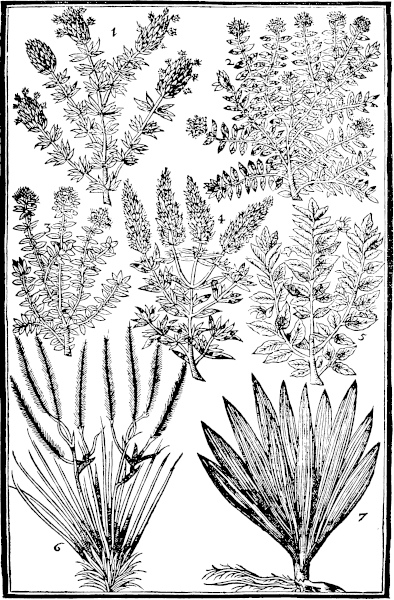
1Thymum legitimum. The true Tyme.
2Serpillum maius hortense. Garden wilde Tyme.
3Serpillum Citratum. Lemon Tyme.
4Hyssopus versicolor siue aureus. Golden Hyssope.
5Chamædrys. Germander.
6Spartum Austriacum siue Gramen plumarium minus. The lesser feather Grasse.
7Gramen striatum vel sulcatum. Painted Grasse or Ladies Laces.
Chap. CXXXIII. Gramina. Grasses.
There are among an infinite number (as I may so say) of Grasses, a few onely which I thinke fit to be planted in this Garden, both for the rarity of them, and also for your delight, and the excellent beauty that is in them aboue many other plants. One of them hath long agoe bin respected, and cherished in the country gardens of many Gentlewomen, and others. The others are knowne but vnto a few.
1. Gramen striatum. Painted Grasse or Ladies laces.
This kinde of Grasse hath many stiffe, hard, round stalkes, full of ioynts, whereon are set at euery ioynt one long leafe, somewhat broad at the bottome, where it compasseth the stalke, and smaller to the end, where it is sharpe pointed, hard or rough in handling, and striped all the length of the leafe with white streakes or lines, that they seeme party coloured laces of white and greene: the tops of the stalkes are furnished with long spikie tufts, like vnto the tufts of Couch Grasse: the rootes are small, white, and threddy, like the rootes of other Grasses.
2. Gramen Plumarium minus. The lesser Feather-Grasse.
This lesser Feather-Grasse hath many small, round, and very long leaues or blades, growing in tufts, much finer and smaller then any other Grasse that I know, being almost like vnto haires, and of a fresh greene colour in Summer, but changing into gray, like old hay in Winter, being indeede all dead, and neuer reuiuing; yet hardly to be plucked away vntill the Spring, and then other greene leaues or rushes rise vp by them, and in their stead, and are aboue a foote in length: from the middle of these tufts come forth rounder and bigger rushes, which are the stalkes, and which haue a chaffie round eare about the middle thereof, which when it is full growne, is somewhat higher then the toppes of the leaues or rushes, opening it selfe (being before close) at the top, and shewing forth three or foure long ayles or beards, one aboue another, which bend themselues a little downewards (if they stand ouer long before they are gathered, and will fall off, and be blowne away with the winde) being so finely feathered on both sides, all the length of the beard, and of a pale or grayish colour, that no feather in the taile of the Bird of Paradise can be finer, or to be compared with them, hauing sticking at the end of euery one of them, within the eare, a small, long, whitish, round, hard, and very sharpe pointed graine, like vnto an oaten graine, that part of the stalke of the feather that is next vnder it, and aboue the seede for some two or three inches, being stiffe and hard, and twining or curling it selfe, if it be suffered to stand too long, or to fall away, otherwise being straight as the feather it selfe: the roote is composed of many long, hard, small threddy strings, which runne deepe and far, and will not willingly be remoued, in that it gaineth strength euery yeare by standing.
3. Gramen Plumarium maius. The greater Feather-Grasse.
The greater Feather-Grasse is like vnto the lesser, but that both the leaues and the feathers, are greater, and nothing so fine, grosser also, and of lesse beauty and respect, though whiter then it; and therefore is not so much regarded: for I haue knowne, that many Gentlewomen haue vsed the former lesser kinde, being tyed in tufts, to set them in stead of feathers about their beds, where they haue lyen after childe-bearing, and at other times also, when as they haue been much admired of the Ladies and Gentles that haue come to visit them.
The Place.
The first of these Grasses, as Lobel saith, groweth naturally in the woods and hils of Sauoy. It hath long agoe beene receiued into our English gardens. The second, as Clusius saith, in Austria, from whence also (as I take it) the greater came, and are both in the gardens of those, that are curious obseruers of these delights.
The Time.
The first is in its pride for the leaues all the Spring and Summer, yeelding his bush in Iune. The other giue their feather-like sprigs in Iuly and August, and quickly (as I said) are shed, if they be not carefully gathered.
The Names.
The first is called by Lobel Gramen sulcatum, or striatum album; of others Gramen pictum. The French call it Aiguellettes d’armes, of the fashion that their Ensignes, Pennons, or Streamers vsed in wars were of, that is, like vnto a party coloured curtaine. In English vsually Ladies laces, and Painted Grasse. The first of the other two is called Gramen plumarium or plumosum, and minus is added for the distinction of it. Clusius calleth it Spartum Austriacum, of the likenesse and place where he found it. The last is, called Gramen plumarium, or plumosum maius, The greater Feather-Grasse.
The Vertues.
These kindes of Grasses are not in any time or place that I doe heare of applyed to any Physicall vse; and therefore of them I will say no more: but here I will end the prime part of this worke.