THE GARDEN OF PLEASANT FLOWERS. (continued 4)
Reading edition
Hyacinthus Stellatus Bæticus, siue Perüanus flore albo. The great white Spanish starry Iacinth.
This other Spanish Iacinth is in most parts like vnto the former, but that his leaues are not so large, nor so deep a greene: the stalks of flowers likewise hath not so thicke a head, or bush on it, but fewer and thinner set: the flowers themselues also are whitish, yet hauing a small dash of blush in them: the threeds are whitish, tipt with yellow pendents: the seede and rootes are like vnto the former, and herein consisteth the difference betweene this and the other sorts.
Hyacinthus Stellatus Bæticus, siue Perüanus flore carneo. The great blush coloured Spanish Starry Iacinth.
This likewise differeth little from the two former, but onely in the colour of the flowers; for this being found growing among both the other, hath his head of flowers as great and large as the first, but the buds of his flowers, before they are open, are of a deepe blush colour, which being open, are more delayed, and of a pleasant pale purple, or blush colour, standing vpon purplish stalkes: the heads in the middle are whitish, and so are the threeds compassing it, tipt with yellow.
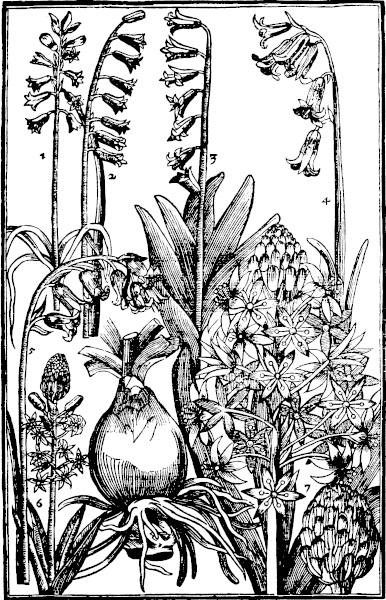
1Hyacinthus Orientalis facie. The little Summer Orientall Iacinth.
2Hyacinthus Mauritanicus. The Barbary Iacinth.
3Hyacinthus obsoletus Hispanicus. The Spanish duskie Iacinth.
4Hyacinthus Hispanicus flore campanula. The greater Spanish bel-flowred Iacinth.
5Hyacinthus Anglicus. The English Iacinth or Harebels.
6Hyacinthus Eriophorus. The Woolly Iacinth.
7Hyacinthus Stellaris Bæticus maior, siue Peruanus. The great Spanish Starry Iacinth, or of Peru.
The Place.
These doe naturally grow in Spaine, in the Medowes a little off from the Sea, as well in the Island Gades, vsually called Cales, as likewise in other parts along the Sea side, as one goeth from thence to Porto Santa Maria, which when they be in flower, growing so thicke together, seeme to couer the ground, like vnto a tapistry of diuers colours, as I haue beene credibly enformed by Guillaume Boel, a Freeze-lander borne, often before and hereafter remembred, who being in search of rare plants in Spaine, in the yeare of our Lord 1607, after that most violent frosty Winter, which perished both the rootes of this, and many other fine plants with vs, sent mee ouer some of these rootes for my Garden, and affirmed this for a truth, which is here formerly set downe, and that himselfe gathered those he sent mee, and many others in the places named, with his owne hands; but hee saith, that both that with the white, and with the blush flowers, are farre more rare then the other.
The Time.
They flower in May, the seede is ripe in Iuly.
The Names.
This hath beene formerly named Eriophorus Peruanus, and Hyacinthus Stellatus Peruanus, The Starry Iacinth of Peru, being thought to haue grown in Peru, a Prouince of the West Indies; but he that gaue that name first vnto it, eyther knew not his naturall place, or willingly imposed that name, to conceale it, or to make it the better esteemed. It is most generally receiued by the name Hyacinthus Peruanus, from the first imposer thereof, that is, the Iacinth of Peru: but I had rather giue the name agreeing most fitly vnto it, and call it as it is indeede Hyacinthus Stellatus Bæticus, The Spanish Starry Iacinth; and because it is the greatest that I know hath come from thence, I call it, The great Starry Iacinth of Spaine, or Spanish Iacinth.
{Starry Iacinth}
Hyacinthus Stellatus vulgaris, siue Bifolius Fuchsij. The common blew Starry Iacinth.
This Starry Iacinth (being longest knowne, and therefore most common) riseth out of the ground, vsually but with two browne leaues, yet sometimes with three, inclosing within them the stalke of flowers, the buds appearing of a darke whitish colour, as soone as the leaues open themselues, which leaues being growne, are long, and hollow, of a whitish greene on the vpper side, and browne on the vnder side, and halfe round, the browne stalke rising vp higher, beareth fiue or sixe small starre-like flowers thereon, consisting of six leaues, of a faire deepe blew, tending to a purple. The seede is yellowish, and round, contained in round pointed heads, which by reason of their heauinesse, and the weaknesse of the stalke, lye vpon the ground, and often perish with wet and frosts, &c. The roote is somewhat long, and couered with a yellowish coate.
Hyacinthus stellatus flore albo. The white Starry Iacinth.
The white Starry Iacinth hath his leaues like the former, but greene and fresh, not browne, and a little narrower also: the buddes for flowers at the first appeare a little blush, which when they are blowne, are white, but yet retaine in them a small shew of that blush colour.
Flore niueo.
We haue another, whose flowers are pure white, and smaller then the other, the leaues whereof are of a pale fresh greene, and somewhat narrower.
Hyacinthus Stellatus flore rubente. The blush coloured Starry Iacinth.
The difference in this from the former, is onely in the flowers, which are of a faire blush colour, much more eminent then in the others, in all things else alike.
Hyacinthus Stellatus Martius, siue præcox cæruleus. The early blew Starry Iacinth.
This Iacinth hath his leaues a little broader, of a fresher greene, and not browne at all, as the first blew Iacinth of Fuchsius last remembred: the buds of the flowers, while they are enclosed within the leaues, and after, when the stalke is growne vp, doe remaine more blew then the buds of the former: the flowers, when they are blowne open, are like the former, but somewhat larger, and of a more liuely blew colour: the roote also is a little whiter on the outside. This doth more seldome beare seede then the former.
Hyacinthus Stellatus præcox flore albo. The white early Starry Iacinth.
There is also one other of this kinde, that beareth pure white flowers, the green leafe thereof being a little narrower then the former, and no other difference.
Hyacinthus Stellatus præcox flore suaue rubente. The early blush coloured Starry Iacinth.
This blush coloured Iacinth is very rare, but very pleasant, his flowers being as large as the first of this last kinde, and somewhat larger then the blush of the other kinde: the leaues and rootes differ not from the last recited Iacinth.
The Place.
All these Iacinths haue beene found in the Woods and Mountaines of Germany, Bohemia, and Austria, as Fuchsius and Gesner doe report, and in Naples, as Imperatus and others doe testifie. Wee cherish them all with great care in our Gardens, but especially the white and the blush of both kindes, for that they are more tender, and often perish for want of due regard.
The Time.
The common kindes, which are first expressed, flower about the middle of February, if the weather bee milde, and the other kindes sometimes a fortnight after, that is, in March, but ordinarily much about the same time with the former.
The Names.
The first is called in Latine Hyacinthus Stellatus vulgaris, and Hyacinthus Stellatus bifolius, and Hyacinthus Stellaris Fuchsij and of some Hyacinthus Stellatus Germanicus; wee might very well call the other kinde, Hyacinthus Stellatus vulgaris alter, but diuers call it Præcox, and some Martius, as it is in the title. In English they may bee seuerally called: the first, The common; and the other, The early Starry Iacinth (notwithstanding the first flowreth before the other) for distinction sake.
The Hyacinthus, seemeth to be called Vacinium of Virgil in his Eclogues; for hee alwayes reckoneth it among the flowers that were vsed to decke Garlands, and neuer among fruits, as some would haue it. But in that hee calleth it Vacinium nigrum, in seuerall places, that doth very fitly answer the common receiued custome of those times, that called all deepe blew colours, such as are purples, and the like, blacke; for the Violet it selfe is likewise called blacke in the same place, where he calleth the Vacinium blacke; so that it seemeth thereby, that he reckoned them to be both of one colour, and we know the colour of the Violet is not blacke, as we doe distinguish of blacke in these dayes. But the colour of this Starry Iacinth, being both of so deepe a purple sometimes, so neare vnto a Violet colour, and also more frequent, then any other Iacinth with them, in those places where Virgil liued, perswadeth me to thinke, that Virgil vnderstood this Starry Iacinth by Vacinium: Let others iudge otherwise, if they can shew greater probabilitie.
{Starry Iacinths of Constantinople}
1. Hyacinthus Stellatus Byzantinus nigra radice. The Starry Iacinth of Turkie with the blacke roote.
This Starry Iacinth of Constantinople hath three or foure fresh greene, thinne, and long leaues, of the bignesse of the English Iacinth, but not so long, betweene which riseth vp a slender lowe stalke, bearing fiue or six small flowers, dispersedly set thereon, spreading open like a starre, of a pale or bleake blew colour: the leaues of the flowers are somewhat long, and stand as it were somewhat loosly, one off from another, and not so compactly together, as the flowers of other kindes: it seldome beareth ripe seede with vs, because the heads are so heauie, that lying vpon the ground, they rotte with the wet, or are bitten with the frosts, or both, so that they seldome come to good: the roote is small in some, and reasonable bigge in others, round, and long, white within, but couered with deepe reddish or purplish peelings, next vnto it, and darker and blacker purple on the outside, with some long and thicke white fibres, like fingers hanging at the bottome of them, as is to be seene in many other Iacinths: the roote it selfe for the most part doth runne downewards, somewhat deep into the ground.
2. Hyacinthus Stellatus Byzantinus maior. The greater Starry Iacinth of Constantinople.
This Iacinth may rightly be referred to the former Iacinth of Constantinople, and called the greater, it is so like thereunto, that any one that knoweth that, will soone say, that this is another of that sort, but greater as it is in all his parts, bearing larger leaues by much, and more store, lying vpon the ground round about the roote: it beareth many lowe stalkes of flowers, as bleake, and standing as loosly as the former: onely the roote of this, is not black on the outside, as the other, but three times bigger.
3. Hyacinthus Stellatus Byzantinus alter, siue flore boraginis. The other Starry Iacinth of Constantinople.
This other Iacinth hath for the most part onely foure leaues, broader and greener then the first, but not so large or long as the second: the stalke hath fiue or six flowers vpon it, bigger and rounder set, like other starry Iacinths, of a more perfect or deeper blew then either of the former, hauing a whitish greene head or vmbone in the middle, beset with six blew chiues or threeds, tipt with blacke, so closly compassing the vmbone, that the threeds seeme so many prickes stucke into a clubbe or head; some therefore haue likened it to the flower of Borage, and so haue called it: after the flowers are past, come vp round white heads, wherein is contained round and white seede: the roote is of a darke whitish colour on the outside, and sometimes a little reddish withall.
The Place.
The first and the last haue beene brought from Constantinople; the first among many other rootes, and the last by the Lord Zouch, as Lobel witnesseth. The second hath been sent vs out of the Lowe-Countries, but from whence they had it, we do not certainly know. They growe with vs in our Gardens sufficiently.
The Time.
These flower in Aprill, but the first is the earliest of the rest, and is in flower presently after the early Starry Iacinth, before described.
The Names.
The former haue their names in their titles, and are not knowne vnto vs by any other names that I know; but as I said before, the last is called by some, Hyacinthus Boraginis flore. The first was sent out of Turkie, by the name of Susamgiul, by which name likewise diuers other things haue beene sent, so barren and barbarous is the Turkish tongue.
{Summer Starry Iacinths}
Hyacinthus Stellatus Æstivus maior. The greater Summer Starry Iacinth.
This late Iacinth hath diuers narrow greene leaues, lying vpon the ground, somewhat like the leaues of the English Iacinth, but stiffer and stronger; among which riseth vp a round stiffe stalke, bearing many flowers at the toppe thereof, and at euery foote-stalke of the flowers a small short leafe, of a purplish colour: the flowers are starre-like, of a fine delayed purplish colour, tending to a pale blew or ash colour, striped on the backe of euery leafe, and hauing a pointed vmbone in the middle, with some whitish purple threeds about it, tipt with blew: the seede is blacke, round, and shining, like vnto the seede of the English Iacinth, but not so bigge: the roote is round and white, hauing some long thicke rootes vnder it, besides the fibres, as is vsuall in many other Iacinths.
Hyacinthus Stellatus Æstivus minor. The lesser Summer Starry Iacinth.
This lesser Iacinth hath diuers very long, narrow, and shining greene leaues, spread vpon the ground round about the roote, among which riseth vp a very short round stalke, not aboue two inches high, carrying six or seuen small flowers thereon, on each side of the stalke, like both in forme and colour vnto the greater before described, but lesser by farre: the seede is blacke, contained in three square heads: the roote is small and white, couered with a browne coate, and hauing some such thicke rootes among the fibres, as are among the other.
The Place.
Both these Iacinths grow naturally in Portugall, and from thence haue been brought, by such as seeke out for rare plants, to make a gaine and profit by them.
The Time.
They both flower in May, and not before: and their seed is ripe in Iuly.
The Names.
Some doe call these Hyacinthus Lusitanicus, The Portugall Iacinth. Clusius, who first set out the descriptions of them, called them as is expressed in their titles; and therefore we haue after the Latine name giuen their English, according as is set downe. Or if you please, you may call them, The greater and the lesser Portugall Iacinth.
Hyacinthus Stellaris flore cinereo. The ash coloured Starry Iacinth.
This ash coloured Iacinth, hath his leaues very like vnto the leaues of the English Iacinth, and spreading vpon the ground in the same manner, among which rise vp one or two stalkes, set at the toppe with a number of small starre-like flowers, bushing bigger below then aboue, of a very pale or white blew, tending to an ash colour, and very sweete in smell: the seede is blacke and round, like vnto the seede of the English Iacinth, and so is the roote, being great, round, and white; so like, I say, that it is hard to know the one from the other.
The Place.
The certaine originall place of growing thereof, is not knowne to vs.
The Time.
It flowreth in Aprill.
The Names.
Some doe call this Hyacinthus Someri, Somers Iacinth, because as Lobel saith, he brought it first into the Lowe-Countries, eyther from Constantinople, or out of Italy.
{Lilly leafed Starry Iacinths}
Hyacinthus Stellatus Lilifolio & radice cæruleo. The blew Lilly leafed Starre Iacinth.
This Iacinth hath six or seuen broad greene leaues, somewhat like vnto Lilly leaues, but shorter (whereof it tooke his name as well as from the roote) spread vpon the ground, and lying close and round: before the stalke riseth out from the middle of these leaues, there doth appeare a deepe hollow place, like a hole, to bee seene a good while, which at length is filled vp with the stalke, rising thence vnto a foote or more high, bearing many starre-like flowers at the toppe, of a perfect blew colour, neare vnto a Violet, and sometimes of paler or bleake blew colour, hauing as it were a small cuppe in the middle, diuided into six peeces, without any threeds therein: the seede is blacke and round, but not shining: the roote is somewhat long, bigge belowe, and small aboue, like vnto the small roote of a Lilly, and composed of yellow scales, as a Lilly, but the scales are greater, and fewer in number.
Hyacinthus Stellatus Lilifolius albus. The white Lilly leafed Starre Iacinth.
The likenesse of this Iacinth with the former, causeth me to be briefe, and not to repeate the same things againe, that haue already been expressed: You may therefore vnderstand, that except in the colour of the flower, which in this is white, there is no difference betweene them.
Flore carneo.
I heare of one that should beare blush coloured flowers, but I haue not yet seene any such.
The Place.
These Iacinths haue been gathered on the Pyrenæan Hils, in that part of France that is called Aquitaine, and in some other places.
The Time.
These flower in Aprill, and sometimes later.
The Names.
Because the roote is so like vnto a Lilly, as the leafe is also, it hath most properly beene called Hyacinthus Stellatus Lilifolio & radice, or for breuity Lilifolius, that is, The Starry Lilly leafed Iacinth. It is called Sarahug by the Inhabitants where it groweth, as Clusius maketh the report from Venerius, who further saith, that by experience they haue found the cattell to swell and dye, that haue eaten of the leaues thereof.
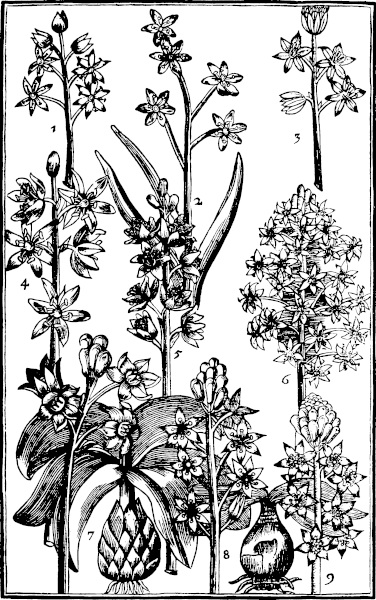
1Hyacinthus stellatus præcox cæruleus. The early blew starry Iacinth.
2Hyacinthus stellatus præcox albus. The early white starry Iacinth.
3Hyacinthus stellatus Byzantinus nigra radice. The Turkie starry Iacinth with a blacke roote.
4Hyacinthus Byzantinus alter siue flore Boraginis. The other starry Iacinth of Constantinople.
5Hyacinthus æstivus maior. The greater Summer starry Iacinth.
6Hyacinthus stellatus flore cinereo. The ash coloured starry Iacinth.
7Hyacinthus stellatus Lilifolius. The Lilly leafed starre Iacinth.
8Hyacinthus Autumnalis. The Autumne Iacinth.
9Scilla alba siue Hyacinthus marinus. The Sea Onion or Squill.
{Autumne Starry Iacinths}
Hyacinthus Autumnalis maior. The greater Autumne Iacinth.
The greater Autumne Iacinth hath fiue or six very long and narrow greene leaues, lying vpon the ground; the stalkes are set at the toppe with many starre-like flowers, of a pale blewish purple colour, with some pale coloured threeds, tipt with blew, standing about the head in the middle, which in time growing ripe, containeth therein small blacke seede, and roundish: the roote is great and white on the outside.
Hyacinthus Autumnalis minor. The lesser Autumne Iacinth.
This lesser Iacinth hath such like long and small leaues, but narrower then the former: the stalke is not full so high, but beareth as many flowers on it as the other, which are of a pale or bleake purple colour, very like vnto it also: the roote and seed are like the former, but smaller. These both for the most part, beare their flowers and seede before the greene leaues rise vp much aboue the ground.
Flore albo.
There is a kinde hereof found that beareth white flowers, not differing in any other thing from the smaller purple kinde last mentioned.
The Place.
The first and last are onely kept in Gardens, and not knowne to vs where their naturall place of growing wilde may be.
The second groweth wilde in many places of England. I gathered diuers rootes for my Garden, from the foote of a high banke by the Thames side, at the hither end of Chelsey, before you come at the Kings Barge-house.
The Time.
The greatest flowreth in the end of Iuly, and in August.
The other in August and September, you shall seldome see this plant with flowers and greene leaues at one time together.
The Names.
They haue their names giuen them, as they are expressed in their titles, by all former Writers, except Daleschampius, or hee that set forth that great worke printed at Lyons; for hee contendeth with many words, that these plants can bee no Iacinths, because their flowers appeare before their leaues in Autumne, contrary to the true Iacinth, as he saith: and therefore he would faine haue it referred to Theophrastus bulbus in libro primo cap. 12. and calleth it his Tiphyum mentioned in that place, as also Bulbus astivus Dalechampij. Howsoeuer these things may carry some probability in them, yet the likenesse both of rootes, and flowers especially, hath caused very learned Writers to entitle them as is set downe, and therefore I may not but let them passe in the like manner.
The Vertues.
Both the rootes and the leaues of the Iacinths are somewhat cold and drying, but the seede much more. It stayeth the loosnesse of the belly. It is likewise said to hinder young persons from growing ripe too soone, the roote being drunke in wine. It helpeth them also whose vrine is stopt, and is auaileable for the yellow Iaundise; but as you heare some are deadly to cattell, I therefore wish all to bee well aduised which of these they will vse in any inward physicke.
{The Sea Onions or Squills}
Scilla alba. The Sea Onion or Squill.
As I ended the discourse of both the true and the bastard Daffodils, with the Sea kindes of both sorts; so I thinke it not amisse, to finish this of the Iacinths with the description of a Sea Iacinth, which (as you see) I take to be the Scilla, or Sea Onion, all his parts so nearely resembling a Iacinth, that I know not where to ranke him better then in this place, or rather not any where but here. You shall haue the description thereof, and then let the iudicious passe their sentence, as they thinke meetest.
The Squill or Sea Onion (as many doe call it) hath diuers thicke leaues, broad, long, greene, and hollowish in the middle, and with an eminent or swelling ribbe all along the backe of the leafe, (I relate it as I haue seene it, hauing shot forth his leaues in the ship by the way, as the Mariners that brought diuers rootes from out of the Straights, did sell them to mee and others for our vse) lying vpon the ground, somewhat like vnto the leaues of a Lilly: these spring vp after the flowers are past, and the seed ripe, they abiding all the Winter, and the next Spring, vntill the heate of the Summer hath spent and consumed them, and then about the end of August, or beginning of September, the stalke with flowers ariseth out of the ground a foote and a halfe high, bearing many starre-like flowers on the toppe, in a long spike one aboue another, flowring by degrees, the lowest first, and so vpwards, whereby it is long in flowring, very like, as well in forme as bignesse, to the flowers of the great Starre of Bethlehem (these flowers I haue likewise seene shooting out of some of the rootes, that haue been brought in the like manner:) after the flowers are past, there come vp in their places thicke and three square heads, wherin is contained such like flat, black, and round seed, as the Spanish duskie Iacinth before described did beare, but greater: the root is great & white, couered with many peelings or couerings, as is plainly enough seen to any that know them, and that sometimes wee haue had rootes, that haue beene as bigge as a pretty childes head, and sometimes two growing together, each whereof was no lesse then is said of the other.
Scilla rubra siue Pancratium verum. The red Sea Onion.
The roote of this Squill, is greater oftentimes then of the former, the outer coates or peelings being reddish, bearing greater, longer, stiffer, and more hollow leaues, in a manner vpright: this bringeth such a like stalke and flowers, as the former doth, as Fabianus Ilges, Apothecary to the Duke of Briga, did signifie by the figure thereof drawne and sent to Clusius.
The Place.
They grow alwayes neare the Sea, and neuer farre off from it, but often on the very baich of the Sea, where it washeth ouer them all along the coasts of Spaine, Portugal, and Italy, and within the Straights in many places: it will not abide in any Garden farre from the Sea, no not in Italy, as it is related.
The Time.
The time wherein they flower, is expressed to be in August and September: this seede to be ripe in October and Nouember, and the greene leaues to spring vp in Nouember and December.
The Names.
These are certainly the true kindes of Scilla that should bee vsed in medicines, although (as Clusius reporteth) the Spaniards forbade him to taste of the red Squill, as of a most strong and present poison. Pliny hath made more sorts then can be found out yet to this day with vs: that Scilla that is called Epimenidia, because it might be eaten, is thought to be the great Ornithogalum, or Starre of Bethlehem. Pancratium is, I know, and as I said before, referred to that kinde of bastard Sea Daffodill, which is set forth before in the end of the history of the bastard Daffodils; and diuers also would make the Narcissus tertius Matthioli, which I call the true Sea Daffodill, to be a Pancratium; but seeing Dioscorides (and no other is against him) maketh Pancratium to be a kinde of Squill with reddish rootes, I dare not vphold their opinion against such manifest truth.
The Vertues.
The Squill or Sea Onion is wholly vsed physically with vs, because wee can receiue no pleasure from the sight of the flowers. Pliny writeth, that Pithagoras wrote a volume or booke of the properties thereof, for the singular effects it wrought; which booke is lost, yet the diuers vertues it hath is recorded by others, to be effectual for the spleene, lungs, stomach, liuer, head and heart; and for dropsies, old coughs, Iaundise, and the wormes; that it cleareth the sight, helpeth the tooth-ache, cleanseth the head of scurfe, and running sores; and is an especiall Antidote against poison: and therefore is vsed as a principall ingredient into the Theriaca Andromachi, which we vsually call Venice Treakle. The Apothecaries prepare hereof, both Wine, Vinegar, and Oxymel or Syrupe, which is singular to extenuate and expectorate tough flegme, which is the cause of much disquiet in the body, and an hinderer of concoction, or digestion in the stomach, besides diuers other wayes, wherein the scales of the rootes, being dryed, are vsed. And Galen hath sufficiently explained the qualities and properties thereof, in his eight Booke of Simples.
Chap. XII. Ornithogalum. Starre of Bethlehem.
After the Family of the Iacinths, must needes follow the kindes of Starre-flowers, or Starres of Bethlehem, as they are called, for that they doe so nearely resemble them, that diuers haue named some of them Iacinths, and referred them to that kindred: all of them, both in roote, leafe, and flower, come nearer vnto the Iacinths, then vnto any other plant. They shall therefore bee next described, euery one in their order, the greatest first, and the rest following.
Ornithogalum Arabicum. The great Starre-flower of Arabia.
This Arabian Starre-flower hath many broad, and long greene leaues, very like vnto the leaues of the Orientall Iacinth, but lying for the most part vpon the ground, among which riseth vp a round greene stalke, almost two foote high, bearing at the toppe diuers large flowers, standing vpon long foote-stalkes, and at the bottome of euery one of them a small short pointed greene leafe: these flowers are made of six pure white leaues a peece, laid open as large as an ordinary Daffodill, but of the forme of a Starre Iacinth, or Starre of Bethlehem, which close as they doe euery night, and open themselues in the day time, especially in the Sunne, the smell whereof is pretty sweete, but weake: in the middle of the flower is a blackish head, compassed with six white threeds, tipt with yellow pendents: the seede hath not beene obserued with vs: the roote is great and white, with a flat bottome, very impatient of our cold Winters, so that it seldome prospereth or abideth with vs; for although sometimes it doe abide a Winter in the ground, yet it often lyeth without springing blade, or any thing else a whole yeare, and then perisheth: or if it doe spring, yet many doe not beare, and most after their first bearing doe decay and perish. But if any be desirous, to know how to preserue the roote of this plant, or of many other bulbous rootes that are tender, such as the great double white Daffodill of Constantinople, and other fine Daffodils, that come from hot Countries; let them keepe this rule: Let either the roote be planted in a large pot, or tubbe of earth, and housed all the Winter, that so it may bee defended from the frosts; Or else (which is the easier way) keepe the roote out of the ground euery yeare, from September, after the leaues and stalkes are past, vntill February, in some dry, but not hot or windy place, and then plant it in the ground vnder a South wall, or such like defended place, which will spring, and no doubt prosper well there, in regard the greatest and deepest frosts are past after February, so that seldome any great frosts come after, to pierce so deepe as the roote is to be set, or thereby to doe any great harme to it in such a place.
The Place.
This hath been often sent out of Turkie, and likewise out of Italy; I had likewise two rootes sent mee out of Spaine by Guillaume Boel before remembred, which (as hee said) hee gathered there, but they prospered not with me, for want of the knowledge of the former rule. It may be likely that Arabia is the place, from whence they of Constantinople receiue it.
The Time.
It flowreth in May, if it be of the first yeares bringing; or in Iune, if it haue been ordered after the manner before set downe.
The Names.
It hath been sent out of Italy by the name of Lilium Alexandrinum, The Lilly of Alexandria, but it hath no affinity with any Lilly. Others call it Hyacinthus Arabicus; and the Italians, Iacintho del pater nostro; but it is no Iacinth neither, although the flowers be like some of them. Some also would referre it to a Narcissus or Daffodill, and it doth as little agree with it, as with a Lilly, although his flowers in largenesse and whitenesse resemble a Daffodill. Clusius hath most fitly referred it to the stocke or kindred of Ornithogala, or Starres of Bethlehem, as wee call them in English, and from the Turkish name, Zumbul Arabi, entituled it Ornithogalum Arabicum, although Zumbul, as I haue before declared, is with them, a Iacinth, wee may call it in English, The Arabian Starre-flower, or Starre of Bethlehem, or the great Starre-flower of Arabia.
{Starre-flowers}
1. Ornithogalum maximum album. The greatest white Starre-flower, or Starre of Bethlehem.
This great Starre-flower hath many faire, broad, long, and very fresh green leaues, rising vp very early, and are greater, longer, and greener then the leaues of any Orientall Iacinth, which doe abide greene, from the beginning or middle of Ianuary, or before sometimes, vntill the end of May, at which time they begin to fade, and the stalke with the head of flowers beginneth to rise, so that it will haue either few or no leaues at all, when the flowers are blowne: the stalke is strong, round, and firme, rising two foote high or more, bearing at the toppe a great bush of flowers, seeming at the first to be a great greene eare of corne, for it is made spike-fashion, which when the flowers are blowne, doth rise to be very high, slender or small at the head aboue, and broad spread and bushing below, so that it is long in flowring; for they flower below first, and so vpwards by degrees: these flowers are snow white, without any line on the backside, and is therein like vnto the former, as also in whitenesse, but nothing so large, with a white vmbone or head in the middle, beset with many white threeds, tipt with yellow: the seede is blacke and round, contained in three square heads: the roote is great, thicke, and short, and somewhat yellowish on the outside, with a flat bottome, both like the former, and next that followeth.
2. Ornithogalum maius spicatum album. The great white spiked Starre-flower.
This spiked Starre-flower in his growing, is somewhat like vnto the last described, but springeth not vp so early, nor hath his leaues so greene, or large, but hath broad, long, whitish greene hollow leaues, pointed at the end, among which riseth vp the stalke, which is strong and high, as the former, hauing a great bush of flowers at the toppe, standing spike-fashion, somewhat like the former, flowring in the same maner by degrees, first below, and so vpwards; but it is not so thicke set with flowers, nor so farre spread at the bottome as it, the flowers also are not so white, and each of the leaues of them haue a greene line downe the backe, leauing the edges on both sides white: after the flowers are past, the heads for seede grow three square, like the other, bearing such like blacke seede therein: the roote hereof is vsually bigger then the last, and whiter on the outside.
3. Ornithogalum Pannonicum. The Hungarian Starre-flower.
This Hungarian Starre-flower shooteth out diuers narrow, long, whitish greene leaues, spread vpon the ground before Winter, which are very like vnto the leaues of Gilloflowers, and so abide aboue the ground, hauing a stalke rising in the middle of them the next Spring, about halfe a foote high or thereabouts, bearing many white flowers at the toppe, with greene lines downe the backe of them, very like vnto the ordinary Starres of Bethlehem: the roote is greater, thicker, and longer then the ordinary Starres, and for the most part, two ioyned together, somewhat grayish on the outside.
4. Ornithogalum vulgare. The Starre of Bethlehem.
The ordinary Starre of Bethlehem is so common, and well knowne in all countries and places, that it is almost needlesse to describe it, hauing many greene leaues with white lines therein, and a few white flowers set about the toppe of the stalke, with greenish lines downe the backe: the roote is whitish, and encreaseth aboundantly.
5. Asphodelus bulbosus Galeni, siue Ornithogalum maius flore subuirescente. The bulbous Asphodill, or greene Starre-flower.
Diuers haue referred this plant vnto the Asphodils, because (as I thinke) the flowers hereof are straked on the backe, and the leaues long and narrow, like vnto the Asphodils; but the roote of this being bulbous, I rather (as some others doe) ioyne it with the Ornithogala, for they also haue strakes on the backe of the flowers. It hath many whitish greene leaues, long and narrow, spread vpon the ground, which spring vp in the beginning of the yeare, and abide vntill May, and then they withering, the stalke springeth vp almost as high as the first, hauing many pale yellowish greene flowers, but smaller, and growing more sparsedly about the stalke vpon short foot-stalkes, but in a reasonable long head spike-fashion: the seede is like vnto the second kinde, but smaller: the roote is somewhat yellowish, like the first great white kinde.
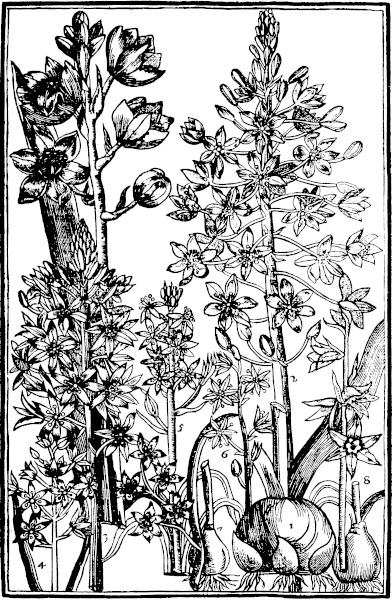
1Ornithogalum Arabicum. The great starre-flower of Arabia.
2Ornithogalum maximum album. The greatest white starre-flower.
3Ornithogalum maius spicatum album. The great white spiked starre-flower.
4Ornithogalum Pannonicum album. The Hungarian starre-flower.
5Asphodelus bulbosus Galeni, siue Ornithogalum maius subuirescente flore. The bulbed Asphodill, or greene starre-flower.
6Ornithogalum Hispanicum minus. The little starre-flower of Spaine.
7Ornithogalum luteum. The yellow starre-flower of Bethlehem.
8Ornithogalum Neapolitanum. The starre-flower of Naples.
The Place.
The first is onely nursed in Gardens, his originall being not well knowne, yet some attribute it vnto Pannonia or Hungary. The second hath been found neare vnto Barcinone, and Toledo in Spaine. The third was found in Hungary by Clusius. Our ordinary euery where in the fields of Italy and France, and (as it is said) in England also. And the last groweth likewise by the corne fields in the vpper Hungary.
The Time.
They flower in Aprill and May, and sometimes in Iune.
The Names.
The first is called by Clusius Ornithogalum maximum album, because it is greater then the next, which hee tooke formerly for the greatest: but it might more fitly, in my iudgement, bee called Asphodelus bulbosus albus (if there be any Asphodelus bulbosus at all) because this do so nearly resemble that, both in the early springing, and the decay of the greene leaues, when the stalkes of flowers doe rise vp. Diuers also doe call it Ornithogalum Pannonicum maximum album.
The second hath his name in his title, as most authors doe set it downe, yet in the great Herball referred to Dalechampius, it is called Ornithogalum magnum Myconi.
The third hath his name from the place of his birth, and the other from his popularity, yet Dodonæus calleth it Bulbus Leucanthemos.
The last is called by diuers Asphodelo-hyacinthinus, and Hyacintho-asphodelus Galeni. Dodonæus calleth it Asphodelus fæmina, and Asphodelus bulbosus. But Lobel, and Gerrard from him, and Dodonæus, doe make this to haue white flowers, whereas all that I haue seene, both in mine owne, and in others Gardens, bore greenish flowers, as Clusius setteth it truely downe. Lobel seemeth in the description of this, to confound the Ornithogalum of Mompelier with it, and calleth it Asphodelus hyacinthinus forte Galeni, and saith that some would call it Pancratium Monspeliense, and Asphodelus Galeni. But as I haue shewed, the Ornithogalum spicatum and this, doe plainly differ the one from the other, and are not both to be called by one name, nor to be reckoned one, but two distinct plants.
Ornithogalum Æthiopicum. The Starre-flower of Æthiopia.
The leaues of this plant are a foote long, and at the least an inch broad, which being broken, are no lesse woolly then the woolly Iacinth: the stalke is a cubit high, strong and greene; from the middle whereof vnto the toppe, stand large snow white flowers, vpon long, greene, thicke foot-stalkes, and yellowish at the bottome of the flower; in the middle whereof stand six white threeds, tipt with yellow chiues, compassing the head, which is three square, and long containing the seede: the roote is thicke and round, somewhat like the Asphodelus Galeni.
The Place.
This plant was gathered by some Hollanders, on the West side of the Cape of good Hope.
The Time.
It flowred about the end of August with those that had it.
The Names.
Because it came from that part of the continent beyond the line, which is reckoned a part of Æthiopia, it is thereupon so called as it is set downe.
Ornithogalum Neapolitanum. The Starre-flower of Naples.
This beautifull plant riseth out of the ground very early, with foure or fiue hollow pointed leaues, standing round together, of a whitish greene colour, with a white line downe the middle of euery leafe on the inside, somewhat narrow, but long, (Fabius Columna saith, three foot long in Italy, but it is not so with vs) in the middle of these leaues riseth vp the stalke, a foote and a halfe high, bearing diuers flowers at the toppe, euery one standing in a little cuppe or huske, which is diuided into three or foure parts, hanging downe very long about the heads for seede: after the flower is past, these flowers doe all hang downe their heads, and open one way, although their little foot-stalkes come forth on all sides of the greater stalke, being large, and composed of six long leaues, of a pure white on the inside, and of a blewish or whitish greene colour on the outside, leauing the edges of euery leafe white on both sides: in the middle of these flowers stand other small flowers, each of them also made of six small white leaues a peece, which meeting together, seeme to make the shew of a cuppe, within which are contained six white threeds, tipt with yellow, and a long white pointell in the middle of them, being without any sent at all: after the flowers are past, come vp great round heads, which are too heauie for the stalke to beare; and therefore lye downe vpon the leaues or ground, hauing certaine lines or stripes on the outside, wherein is contained round, blacke, rough seede: the roote is great and white, and somewhat flat at the bottome, as diuers of these kindes are, and doe multiply as plentifully into small bulbes as the common or any other.
The Place.
This Starre-flower groweth in the Medowes in diuers places of Naples, as Fabius Columna, and Ferrantes Imperatus doe testifie, from whence they haue been sent. And Matthiolus, who setteth out the figure thereof among his Daffodills, had (it should seeme) seene it grow with him.
The Time.
It flowreth in May, although it begin to spring out of the ground oftentimes in Nouember, but most vsually in Ianuary: the seede is ripe in Iuly.
The Names.
Matthiolus reckoneth this (as is said) among the Daffodils, for no other respect, as I conceiue, then that he accounted the middle flower to bee the cuppe or trunke of a Daffodill, which it doth somewhat resemble, and setteth it forth in the fourth place, whereupon many doe call it Narcissus quartus Matthioli, The fourth Daffodill of Matthiolus. Fabius Columna calleth it Hyacinthus aruorum Ornithogali flore. Clusius (to whom Imperatus sent it, in stead of the Arabian which hee desired) calleth it of the place from whence he receiued it, Ornithogalum Neapolitanum, and we thereafter call it in English, The Starre-flower of Naples.
Ornithogalum Hispanicum minus. The little Starre-flower of Spaine.
Clusius hath set forth this plant among his Ornithogala or Starre-flowers, and although it doth in my minde come nearer to a Hyacinthus, then to Ornithogalum, yet pardon it, and let it passe as he doth. From a little round whitish roote, springeth vp in the beginning of the yeare, fiue or six small long green leaues, without any white line in the middle of them, among which rise vp one or two small stalkes, an hand length high or better, bearing seuen or eight, or more flowers, growing as it were in a tuft or vmbell, with small long leaues at the foote of euery stalke, the lower flowers being equall in length with the vppermost, of a pale whitish blew or ash colour, with a strake or line downe the backe of euery leafe of them, with some white threeds standing about a blewish head in the middle: these flowers passe away quickly, and giue no seed, so that it is not knowne what seede it beareth.
The Place.
This groweth in Spaine, and from thence hath been brought to vs.
The Time.
It flowreth in May.
The Names.
It hath no other name then is set down in the title, being but lately found out.
{Two other Starre-flowers}
1. Ornithogalum album vnifolium. The white starre-flower with one blade.
This little starre-flower I bring into this place, as the fittest in my opinion where to place it, vntill my minde change to alter it. It hath a very small round white roote, from whence springeth vp one very long and round greene leafe, like vnto a rush, but that for about two or three inches aboue the ground, it is a little flat, and from thence springeth forth a small stalke not aboue three or foure inches high, bearing at the top thereof three or foure small white flowers, consisting of six leaues a peece, within which are six white chiues, tipt with yellow pendents, standing about a small three square head, that hath a white pointell sticking as it were in the middle thereof: the flower is pretty and sweete, but not heady.
Ornithogalum luteum. The yellow Starre of Bethlehem.
This yellow Starre-flower riseth vp at the first, with one long, round, greenish leafe, which openeth it selfe somewhat aboue the ground, and giueth out another small leafe, lesser and shorter then the first, and afterward the stalke riseth from thence also, being foure or fiue inches high, bearing at the toppe three or foure small green leaues, and among them foure or fiue small yellow starre-like flowers, with a greenish line or streake downe the backe of euery leafe, and some small reddish yellow threeds in the middle: it seldome giueth seede: the roote is round, whitish, and somewhat cleare, very apt to perish, if it bee any little while kept dry out of the ground, as I haue twice tryed to my losse.
The Place.
The first grew in Portugall, and Clusius first of all others desciphers it.
The other is found in many places both of Germany and Hungary, in the moister grounds.
The Time.
The first flowreth in May: the other in Aprill, and sometimes in March.
The Names.
Carolus Clusius calleth the first Bulbus vnifolius, or Bolbine, but referreth it not to the stocke or kindred of any plant; but (as you see) I haue ranked it with the small sorts of Ornithogalum, and giue it the name accordingly.
The other is referred for likenesse of forme, and not for colour, vnto the Ornithogala, or Starres of Bethlehem. It is called by Tragus and Fuchsius Bulbus siluestris, because of the obuiousnesse. Cordus taketh it to be Sisyrinchium. Lacuna calleth it Bulbus esculentus. Lobel and others in these dayes generally, Ornithogalum luteum, and wee thereafter in English, The yellow Starre-flower, or Starre of Bethlehem.
The Vertues.
The first kinde being but lately found out, is not knowne to be vsed. The rootes of the common or vulgar, are (as Matthiolus saith) much eaten by poore people in Italy, either rawe or roasted, being sweeter in taste then any Chestnut, and seruing as well for a necessary food as for delight. It is doubtfull whether any of the rest may be so vsed; for I know not any in our Land hath made any experience.
{Conclusion}
There are many other sorts of Starre-flowers, which are fitter for a generall then this History; and therefore I referre them thereunto.
Chap. XIII. Moly. Wilde Garlicke.
Vnto the former Starre-flowers, must needes bee ioyned another tribe or kindred, which carry their straked flowers Starre-fashion, not spikewise, but in a tuft or vmbell thicke thrust or set together. And although diuers of them smell not as the former, but most of their first Grandfathers house, yet all doe not so; for some of them are of an excellent sent. Of the whole Family, there are a great many which I must leaue, I will onely select out a few for this our Garden, whose flowers for their beauty of statelinesse, forme, or colour, are fit to bee entertained, and take place therein, euery one according to his worth, and are accepted of with the louers of these delights.
{The greatest Moly of Homer and the Indian Moly}
1. Moly Homericum, vel potius Theophrasti. The greatest Moly of Homer.
Homers Moly (for so it is most vsually called with vs) riseth vp most commonly with two, and sometimes with three great, thicke, long, and hollow guttered leaues, of a whitish greene colour, very neare the colour of the Tulipa leafe, hauing sometimes at the end of some of the leaues, and sometimes apart by it selfe, a whitish round small button, like vnto a small bulbe, the like whereof also, but greater, doth grow betweene the bottome of the leaues and the stalke neare the ground, which being planted when it is ripe, will grow into a roote of the same kinde: among these leaues riseth vp a round, strong, and tall stalke, a yard high or better, bare or naked vnto the toppe, where it beareth a great tuft or vmbell of pale purplish flowers, all of them almost standing vpon equall foot-stalkes, or not one much higher then another, consisting of fiue leaues a peece, striped downe the backe with a small pale line, hauing a round head or vmbone with some threeds about it in the midst: These flowers doe abide a great while blowne before they vade, which smell not very strong, like any Onion or Garlicke, but of a faint smell: and after they are past come the seede, which is blacke, wrapped in white close huskes: the roote groweth very great, sometimes bigger then any mans closed fist, smelling strong like Garlicke, whitish on the outside, and greene at the toppe, if it be but a while bare from the earth about it.
2. Moly Indicum siue Caucason. The Indian Moly.
The Indian Moly hath such like thicke large leaues, as the Homers Moly hath, but shorter and broader, in the middle whereof riseth vp a short weake stalke, almost flat, not hauing any flowers vpon it, but a head or cluster of greenish scaly bulbes, inclosed at the first in a large thinne skinne, which being open, euery bulbe sheweth it selfe, standing close one vnto another vpon his foot-stalke, of the bignesse of an Acorne, which being planted, will grow to bee a plant of his owne kinde: the roote is white and great, couered with a darke coate or skinne, which encreaseth but little vnder ground; but besides that head, it beareth small bulbes aboue the ground, at the bottome of the leaues next vnto the stalke, like vnto the former.
The Place.
Both these doe grow in diuers places of Spaine, Italy, and Greece; for the last hath been sent out of Turkie among other rootes. Ferrantes Imperatus a learned Apothecary of Naples, sent it to diuers of his friends in these parts, and hath described it in his naturall history among other plants, printed in the Italian tongue. It grew also with Iohn Tradescante at Canterbury, who sent me the head of bulbes to see, and afterwards a roote, to plant it in my Garden.
The Time.
The first flowreth in the end of May, and abideth vnto the midst of Iuly, and sometimes longer. The other beareth his head of bulbes in Iune and Iuly.
The Names.
We haue receiued them by their names expressed in their titles, yet the last hath also been sent by the name of Ornithogalum Italicum, but as all may easily see, it is not of that kindred.
{Molyes}
1. Moly montanum Pannonicum bulbiferum primum. The first bulbed Moly of Hungary.
This first Hungarian Moly hath three or foure broad and long greene leaues, folded together at the first, which after open themselues, and are carried vp with the stalke, standing thereon one aboue another, which is a foote high; at the toppe whereof doe grow a few sad reddish bulbes, and betweene them long footstalkes, bearing flowers of a pale purplish colour; after which followeth blacke seede, inclosed in roundish heads: the roote is not great, but white on the outside, very like vnto the roote of Serpents Moly, hereafter described, encreasing much vnder ground, & smelling strong.
2. Moly montanum Pannonicum bulbiferum secundum. The second bulbed Moly of Hungary.
The second Moly hath narrower greene leaues then the former: the stalke is about the same height, and beareth at the toppe a great cluster of small greene bulbes, which after turne of a darker colour; from among which come forth long foot-stalks, whereon stand purplish flowers: the roote is couered with a blackish purple coate or skinne.
3. Moly Serpentinum. Serpents Moly.
This Moly must also be ioyned vnto the bulbous Molyes, as of kindred with them, yet of greater beauty and delight, because the bulbes on the heads of the small stalkes are redder, and more pleasant to behold: the stalke is lower, and his grassie winding leaues, which turne themselues (whereof it tooke the name) are smaller, and of a whiter greene colour: it beareth among the bulbes purplish flowers also, but more beautifull, the sent whereof is nothing so strong: the roote is small, round, and whitish, encreasing into a number of small rootes, no bigger then pease round about the greater roote.
4. Moly caule & folijs triangularibus. The three cornered Moly.
This three square Moly hath foure or fiue long, and somewhat broad pale greene leaues, flat on the vpper side, and with a ridge downe the backe of the leafe, which maketh it seeme three square: the stalke which riseth vp a foote and a halfe high or better, is three square or three cornered also, bearing at the toppe out of a skinnie huske diuers white flowers, somewhat large and long, almost bell-fashion, with stripes of greene downe the middle of euery leafe, and a few chiues tipt with yellow in the middle about the head, wherein when it is ripe, is inclosed small blacke seede: the roote is white on the outside, and very like the yellow Moly; both roote, leafe, and flower hath a smacke, but not very strong of Garlicke.
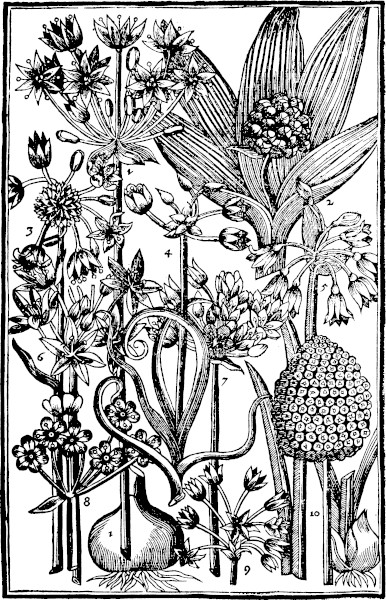
1Moly Homericum vel potius Theophrasti. The greatest Moly of Homer.
2Moly Indicum siue Caucason. The Indian Moly.
3Moly Pannonicum bulbiferum. The bulbed Moly of Hungary.
4Moly Serpentinum. Serpents Moly.
5Moly purpureum Neapolitanum. The purplish Moly of Naples.
6Moly caule & folijs triangularibus. The three cornered Moly.
7Moly latifolium flore luteo. The yellow Moly.
8Moly Dioscorideum Hispanicum. The Spanish Moly of Dioscorides.
9Moly Zibettinum vel Moschatinum. The sweete smelling Moly of Mompelier.
10Moly serotinum Coniferum. The late Pine apple Moly.
5. Moly Narcissinis folijs. Daffodill leafed Moly.
This Moly hath many long, narrow, and flat greene leaues, very like vnto the leaues of a Daffodill, from whence it tooke his name (or rather of the early greater Leucoium bulbosum, or bulbed Violet before described, ioyned next vnto the Daffodils, because it is so like them) among which riseth vp two or three stalkes sometimes, each of a foot and a halfe high, bearing at the toppe, inclosed in a skinny hose, as all the Molyes haue, a number of small purplish flowers, which doe not long abide, but quickly fade: the seede is blacke as others are; the roote is sometimes knobbed, and more often bulbed, hauing in the knobs some markes of the old stalkes to be seene in them, and smelleth somewhat like Garlicke, whereby it may be knowne.
6. Moly montanum latifolium luteo flore. The yellow Moly.
The yellow Moly hath but one long and broad leafe when it doth not beare flower, but when it will beare flower, it hath two long and broad leaues, yet one alwaies longer and broader then the other, which are both of the same colour, and neare the bignesse of a reasonable Tulipa leafe: betweene these leaues groweth a slender stalke, bearing at the toppe a tuft or vmbell of yellow flowers out of a skinnie hose, which parteth three wayes, made of six leaues a peece, laid open like a Starre, with a greenish backe or outside, and with some yellow threeds in the middle: the seede is blacke, like vnto others: the roote is whitish, two for the most part ioyned together, which encreaseth quickly, and smelleth very strong of Garlicke, as both flowers and leaues doe also.
7. Moly Pyrenæum purpureum. The purple mountaine Moly.
This purple Moly hath two or three leaues, somewhat like the former yellow Moly, but not so broad, nor so white: the stalke hath not so many flowers thereon, but more sparingly, and of an vnpleasant purple colour: the roote is whitish, smelling somewhat strongly of Garlicke, but quickly perisheth with the extremity of our cold Winters, which it will not abide vnlesse it be defended.
8. Moly montanum latifolium purpureum Hispanicum. The purple Spanish Moly.
This Moly hath two broad and very long greene leaues, like vnto the yellow Moly, in this, that they doe compasse one another at the bottome of them, between which riseth vp a strong round stalke, two foote high or more, bearing at the toppe, out of a thinne huske, a number of faire large flowers vpon long foot-stalkes, consisting of six leaues a peece, spread open like a Starre, of a fine delayed purple or blush colour, with diuers threeds of the same colour, tipt with yellow, standing about the middle head: betweene the stalke and the bottome of the leaues it hath some small bulbes growing, which being planted, will soone spring and encrease: the roote also being small and round, with many fibres thereat, hath many small bulbes shooting from them; but neither roote, leafe, nor flower, hath any ill sent of Garlicke at all.
9. Moly purpureum Neapolitanum. The purple Moly of Naples.
The Neapolitane Moly hath three of foure small long greene leaues set vpon the stalke after it is risen vp, which beareth a round head of very fine purple flowers, made of six leaues a peece, but so closing together at the edge, that they seeme like vnto small cuppes, neuer laying themselues open, as the other doe; this hath some sent of his originall, but the roote more then any part else, which is white and round, quickly encreasing as most of the Molyes doe.
10. Moly pyxidatum argenteum Hispanicum. The Spanish siluer cupped Moly.
This Spanish Moly hath two or three very long rush like leaues, which rise vp with the stalke, or rather vanish away when the stalke is risen vp to bee three foote high or more, bearing a great head of flowers, standing close at the first, but afterwards spreading much one from another, euery flower vpon a long foote-stalke, being of a white siluer colour, with stripes or lines on euery side, and fashioned small and hollow, like a cuppe or boxe: the seede I could neuer obserue, because it flowreth so late, that the Winter hindereth it from bearing seede with vs: the roote is small and round, white, and in a manner transparent, at least so shining, as if it were so, and encreaseth nothing so much, as many of the other sorts: this hath no ill sent at all, but rather a pretty smell, not to bee misliked.
11. Moly serotinum Coniferum. The late Pineapple Moly.
This late Moly that was sent me with the last described, and others also from Spain, riseth vp with one long greene leafe, hollow and round vnto the end, towards this end on the one side, breaketh out a head of flowers, enclosed in a thinne skinne, which after it hath so stood a good while, (the leafe in the meane time rising higher, and growing harder, becommeth the stalke) breaketh, and sheweth a great bush or head of buds for flowers, thicke thrust together, fashioned very like vnto the forme of a Pineapple (from whence I gaue it the name) of the bigness of a Walnut: after this head hath stood in this manner a moneth or thereabouts, the flowers shew themselues to bee of a fine delayed or whitish purple colour, with diuers stripes in euery of them, of the same cup-fashion with the former, but not opening so plainly, so that they cannot bee discerned to bee open, without good heede and obseruation. It flowreth so late in Autume, that the early frosts doe quickly spoile the beauty of it, and soone cause it to rotte: the roote is small and round, and shining like the last, very tender also, as not able to abide our sharpe Winters, which hath caused it vtterly to perish with me.
12. Moly Dioscorideum. Dioscorides his Moly.
The roote of this small Moly is transparent within, but couered with a thicke yellowish skinne, of the bignesse of an Hasell Nut, or somewhat bigger, which sendeth forth three or foure narrow grassie leaues, long and hollow, and a little bending downwards, of a whitish greene colour, among which riseth vp a slender weake stalke, a foot and a halfe high, bearing at the toppe, out of a thinne skinne, a tuft of milke white flowers, very like vnto those of Ramsons, which stand a pretty while in their beauty, and then passe away for the most part without giuing any seede: this hath little or no sent of Garlicke.
We haue anothor of this sort that is lesser, and the flowers rounder pointed.
13. Moly Dioscorideum Hispanicum. The Spanish Moly of Dioscorides.
This Moly came vnto me among other Molyes from Spaine, and is in all things like vnto the last described, but fairer, larger, and of much more beauty, as hauing his white flowers twice as great as the former; but (as it seemeth) very impatient of our Winters, which it could not at any hand endure, but quickly perished, as some others that came with it also.
14. Moly Moschatinum vel Zibettinum Monspeliense. The sweete smelling Moly of Mompelier.
This sweete Moly, which I haue kept for the last, to close vp your senses, is the smallest, and the finest of all the rest, hauing foure or fiue small greene leaues, almost as fine as haires, or like the leaues of the Feather-grasse: the stalke is about a foote high, bearing fiue or six or more small white flowers, laid open like Starres, made of six leaues a peece, of an excellent sweete sent, resembling Muske or Ciuet; for diuers haue diuersly censured of it. It flowreth late in the yeare, so that if the precedent Summer bee either ouer moist, or the Autumne ouer early cold, this will not haue that sweete sent, that it will haue in a hot drie time, and besides must be carefully respected: for it will hardly abide the extremity of our sharpe Winters.
The Place.
The places of these Molyes, are for the most part expressed in their titles, or in their descriptions.
The Time.
The time is set downe, for the most part to bee in Iune and Iuly, the rest later.
The Names.
To make further relation of names then are expressed in their titles, were needlesse; let these therefore suffice.
The Vertues.
All these sorts of Molyes are small kindes of wilde Garlicke, and are to be vsed for the same purposes that the great Garden Garlicke is, although much weaker in their effects. For any other especiall property is in any of these, more than to furnish a Garden of variety, I haue not heard at all.
{Conclusion}
And thus much may suffice of these kindes for our Garden, reseruing manie others that might be spoken of, to a generall worke, or to my Garden of Simples, which as God shall enable me, and time giue leaue, may shew it selfe to the world, to abide the iudicious and criticke censures of all.
Chap. XIIII. Asphodelus. The Asphodill.
There remaine some other flowers, like vnto the last described, to be specified, which although they haue no bulbous rootes, yet I thinke them fittest to bee here mentioned, that so I may ioyne those of neerest similitude together, vntill I haue finished the rest that are to follow.
{Asphodills}
1. Asphodelus maior albus ramosus. The great white branched Asphodill.
The great white Asphodill hath many long, and narrow, hollow three square leaues, sharpe pointed, lying vpon the ground round about the roote: the stalke is smooth, round, and naked without leaues, which riseth from the midst of them, diuided at the toppe into diuers branches, if the plant bee of any long continuance, or else but into two or three small branches, from the sides of the maine great one, whereon doe stand many large flowers Starre-fashion, made of six leaues a peece, whitish on the inside, and straked with a purplish line downe the backside of euery leafe, hauing in the middle of the flowers some small yellow threeds: the seede is blacke, and three square, greater then the seede of Bucke wheate, contained in roundish heads, which open into three parts: the roote is composed of many tuberous long clogges, thickest in the middle, and smaller at both ends, fastened together at the head, of a darke grayish colour on the outside, and yellow within.
2. Asphodelus albus non ramosus. The white vnbranched Asphodill.
The vnbranched Asphodill is like vnto the former, both in leaues and flowers, but that the flowers of this are whiter, and without any line or strake on the backe side, and the stalkes are without branches: the rootes likewise are smaller, and fewer, but made after the same fashion.
3. Asphodelus maior flore carneo. The blush coloured Asphodill.
This Asphodill is like to the last in forme of leaues and branches, and differeth in this, that his leaues are marked with some spots, and the flowers are of a blush or flesh colour, in all other things alike.
4. Asphodelus minimus albus. The least white Asphodill.
This least Asphodill hath foure or fiue very narrow long leaues, yet seeming three square like the greatest, bearing a small stalke, of about a foote high among them, without any branches, and at the toppe a few white flowers, straked both within and without, with a purplish line in the middle of euery leafe. The rootes are such like tuberous clogges as are in the former, but much lesser.
5. Asphodelus albus minor siue Fistulosus. The little hollow white Asphodill.
This little white Asphodill hath a number of leaues growing thicke together, thicker and greener then those of the small yellow Asphodill, or Kings Speare next following, among which riseth vp diuers round stalkes, bearing flowers from the middle to the toppe, Starre-fashion, with small greene leaues among them, which are white on the inside, and striped on the backe with purple lines like vnto the first described: the seede, and heads containing them, are three square, like the seede of the little yellow Asphodill: the rootes of this kinde are not glandulous, as the former, but stringie, long and white: the whole plant is very impatient of our cold Winters, and quickly perisheth, if it be not carefully preserued, both from the cold, and much wet in the Winter, by housing it; and then it will abide many yeares: for it is not an annuall plant, as many haue thought.
6. Asphodelus luteus minor, siue Hastula regia. The small yellow Asphodill, or Kings speare.
This small yellow Asphodill, which is vsually called the Kings speare, hath many long narrow edged leaues, which make them seeme three square, of a bluish or whitish greene colour: the stalke riseth vp three foote high oftentimes, beset with small long leaues vp vnto the very flowers, which grow thicke together spike-fashion one aboue another, for a great length, and wholly yellow, laid open like a Starre, somewhat greater then the last white Asphodill, and smaller then the first, which when they are past yeeld round heads, containing blacke cornered seede, almost three square: the rootes are many long yellow strings, which spreading in the ground, doe much encrease.
The Place.
All these Asphodils doe grow naturally in Spaine and France, and from thence were first brought vnto vs, to furnish our Gardens.
The Time.
All the glandulous rooted Asphodils doe flower some in May, and some in Iune; but the two last doe flower, the yellow or last, of them in Iuly, and the former white one in August and September, and vntill the cold and winter hinder it.
The Names.
Their seuerall names are giuen them in their titles, as much as is fit for this discourse. For to shew you that the Greekes doe call the stalke of the great Asphodill Ανθερίκη, and the Latines Albucum, or what else belongeth to them, is fitter for another worke, vnto which I leaue them.
{Bastard Asphodils}
The bastard Asphodils should follow next in place, if this worke were fit for them; but because I haue tyed my selfe to expresse onely those flowers and plants, that for their beauty, or sent, or both, doe furnish a Garden of Pleasure, and they haue none, I leaue them to a generall History of plants, or that Garden of Simples before spoken of, and will describe the Lilly Asphodils, and the Phalangia or Spider-worts, which are remaining of those, that ioyne in name or fashion, and are to be here inserted, before I passe to the rest of the bulbous rootes.
{Day Lillies}
1. Liliasphodelus phœniceus. The gold red Day Lilly.
Because the rootes of this and the next, doe so nearely agree with the two last recited Asphodils, I haue set them in this place, although some doe place them next after the Lillies, because their flowers doe come nearest in forme vnto Lillies; but whether you will call them Asphodils with Lilly flowers, as I thinke it fittest, or Lillies with Asphodill rootes, or Lillies without bulbous rootes, as others doe, I will not contend.
The red Day Lilly hath diuers broad and long fresh greene leaues, folded at the first as it were double, which after open, and remaine a little hollow in the middle; among which riseth vp a naked stalke three foot high, bearing at the toppe many flowers, one not much distant from another, and flowring one after another, not hauing lightly aboue one flower blown open in a day, & that but for a day, not lasting longer, but closing at night, and not opening againe; whereupon it had his English name, The Lilly for a day: these flowers are almost as large as the flowers of the white Lilly, and made after the same fashion, but of a faire gold red, or Orange tawny colour. I could neuer obserue any seede to follow these flowers; for they seeme the next day after they haue flowred, (except the time be faire and dry) to bee so rotten, as if they had lyen in wet to rotte them, whereby I thinke no seede can follow: the rootes are many thicke and long yellow knobbed strings, like vnto the small yellow Asphodill rootes, but somewhat greater, running vnder ground in like sort, and shooting young heads round about.
2. Liliasphodelus luteus. The yellow Day Lilly.
I shall not neede to make a repetition of the description of this Day Lilly, hauing giuen you one so amply before, because this doth agree thereunto so nearely, as that it might seeme the same; these differences onely it hath, the leaues are not fully so large, nor the flower so great or spread open, and the colour thereof is of a faire yellow wholly, and very sweet, which abideth blowne many daies before it fade, and hath giuen blacke round seede, growing in round heads, like the heads of the small yellow Asphodill, but not so great.
Clusius hath set downe, that it was reported, that there should be another Liliasphodill with a white flower, but we can heare of none such as yet; but I rather thinke, that they that gaue that report might be mistaken, in thinking the Sauoye Spider-wort to be a white Liliasphodill, which indeede is so like, that one not well experienced, or not well regarding it, may soone take one for another.
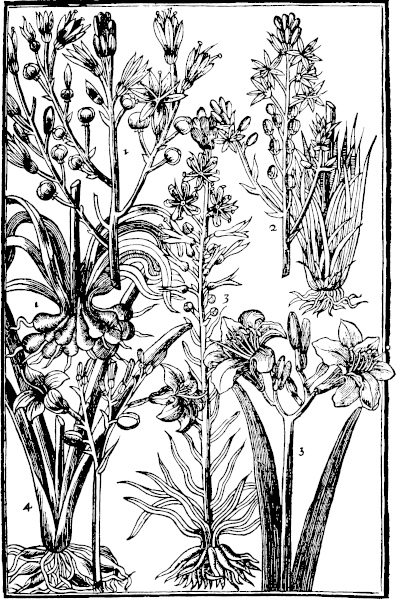
1Asphodelus maior albus ramosus. The great white branched Asphodill.
2Asphodelus minor albus seu fistulosus. The little hollow white Asphodill.
3Asphodelus minor luteus, siue Hastula regia. The small yellow Asphodill, or Kings speare.
4Liliasphodelus luteus. The yellow Day Lilly.
5Liliasphodelus phœniceus. The gold red Day Lilly.
The Place.
Their originall is many moist places in Germany.
The Time.
They flower in May and Iune.
The Names.
They are called by some Liliago, and Lilium non bulbosum, and Liliasphodelus. In English we call them both Day Lillies, but the name doth not so well agree with the last, as with the first, for the causes aboue specified.
The Vertues.
The rootes of Asphodill haue formerly beene had in great account, but now are vtterly neglected; yet by reason of their sharpnesse they open and cleanse, and therefore some haue of late vsed them for the yellow Iaundise. The Day Lillies haue no physicall vse that I know, or haue heard.
Chap. XV. Phalangium. Spider-wort.
These plants doe so nearely resemble those that are last set forth, that I thinke none that knowes them, will doubt, but that they must follow next vnto them, being so like vnto them, and therefore of the fairest of this kinde first.
{Spider-worts}
1. Phalangium Allobrogicum. The Sauoye Spider-wort.
The Sauoye Spider-wort springeth vp with foure or fiue greene leaues, long and narrow, yet broader at the bottome, narrower pointed at the end, and a little hollow in the middle; among which riseth vp a round stiffe stalke, a foote and a halfe high, bearing at the toppe one aboue another, seuen or eight, or more flowers, euery one as large almost as the yellow Day Lilly last described, but much greater then in any other of the Spider-worts, of a pure white colour, with some threeds in the middle, tipt with yellow, and a small forked pointell: after the flowers are past, the heads or seede vessels grow almost three square, yet somewhat round, wherein is contained blackish seede: the rootes are many white, round, thicke, brittle strings, ioyned together at the head, but are nothing so long, as the rootes of the other Phalangia or Spider-worts.
2. Phalangium maius Italicum album. The great Italian Spider-wort.
This great Spider-wort hath diuers long and narrow leaues spread vpon the ground, and not rising vp as the former, and not so broad also as the former, but somewhat larger then those that follow: the stalke is bigger, but seldome riseth vp so high as the next, whereof this is a larger kinde, hauing a long vnbranched stalke of white flowers, laid open like starres as it hath, but somewhat greater: the rootes are long and white, like the next, but somewhat larger.
3. Phalangium non ramosum vulgare. Vnbranched Spider-wort.
The leaues of this Spider-wort doe seeme to bee little bigger or longer then the leaues of grasse, but of a more grayish green colour, rising immediately from the head or tuft of rootes; among which rise vp one or two stalkes, sometimes two or three foote long, beset toward the toppe with many white Starre-like flowers, which after they are past turne into small round heads, containing blacke seede, like vnto the seed of the little yellow Asphodill, but lesser: the rootes are long white strings, running vnder ground.
4. Phalangium ramosum. Branched Spider-wort.
The branched Spider-wort hath his leaues somewhat broader then the former, and of a more yellowish greene colour: the stalke hereof is diuersly branched at the top, bearing many white flowers, like vnto the former, but smaller: the seedes and rootes are like the former in all things.
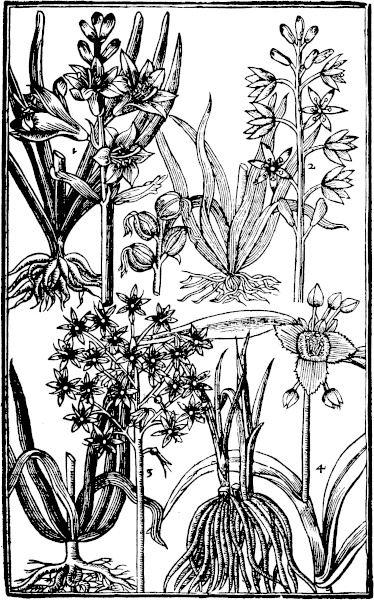
1Phalangium Allobrogicum. The Sauoye Spider-wort.
2Phalangium non ramosum. Vnbranched Spider-wort.
3Phalangium ramosum. Branched Spider-wort.
4Phalangium Ephemerum Virginianum. Iohn Tradescante’s Spider-wort.
The Place.
The first groweth on the Hils neare vnto Sauoye, from whence diuers, allured with the beauty of the flower, haue brought it into these parts.
The second came vp in my Garden, from the seede receiued out of Italy. The others grow in Spaine, France, &c.
The Time.
The vnbranched Spider-wort most commonly flowreth before all the other, and the branched a moneth after it: the other two about one time, that is, towards the end of May, and not much after the vnbranched kinde.
The Names.
The first (as I said before) hath beene taken to be a white Lilliasphodill, and called Liliasphodelus flore albo; but Clusius hath more properly entituled it a Phalangium, and from the place of his originall, gaue him his other denomination, and so is called of most, as is set downe in the title.
The other haue no other names then are expressed in their titles, but only that Cordus calleth them Liliago; and Dodonæus, lib. 4. hist. plant. would make the branched kinde to bee Moly alterum Plinij, but without any good ground.
The Vertues.
The names Phalangium and Phalangites were imposed on these plants, because they were found effectual, to cure the poyson of that kinde of Spider, called Phalangium, as also of Scorpions and other Serpents. Wee doe not know, that any Physitian hath vsed them to any such, or any other purpose in our dayes.
{The soon fading Spider-wort of Virginia}
5. Phalangium Ephemerum Virginianum Ioannis Tradescant. The soon fading Spider-wort of Virginia, or Tradescant his Spider-wort.
This Spider-wort is of late knowledge, and for it the Christian world is indebted vnto that painfull industrious searcher, and louer of all natures varieties, Iohn Tradescant (sometimes belonging to the right Honourable Lord Robert Earle of Salisbury, Lord Treasurer of England in his time, and then vnto the right Honourable the Lord Wotton at Canterbury in Kent, and lastly vnto the late Duke of Buckingham) who first receiued it of a friend, that brought it out of Virginia, thinking it to bee the Silke Grasse that groweth there, and hath imparted hereof, as of many other things, both to me and others; the description whereof is as followeth:
From a stringie roote, creeping farre vnder ground, and rising vp againe in many places, springeth vp diuers heads of long folded leaues, of a grayish ouer-worne greene colour, two or three for the most part together, and not aboue, compassing one another at the bottome, and abiding greene in many places all the Winter; other-where perishing, and rising anew in the Spring, which leaues rise vp with the great round stalke, being set thereon at the ioynts, vsually but one at a ioynt, broad at the bottome where they compasse the stalke, and smaller and smaller to the end: at the vpper ioynt, which is the toppe of the stalke, there stand two or three such like leaues, but smaller, from among which breaketh out a dozen, sixteene, or twenty, or more round green heads, hanging downe their heads by little foot-stalkes, which when the flower beginneth to blow open, groweth longer, and standeth vpright, hauing three small pale greene leaues for a huske, and three other leaues within them for the flower, which lay themselues open flat, of a deepe blew purple colour, hauing an vmbone or small head in the middle, closely set about with six reddish, hairy, or feathered threeds, tipt with yellow pendents: this flower openeth it selfe in the day, & shutteth vsually at night, and neuer openeth againe, but perisheth, and then hangeth downe his head againe; the greene huske of three leaues, closing it selfe againe into the forme of a head, but greater, as it was before, the middle vmbone growing to bee the seede vessell, wherein is contained small, blackish, long seede: Seldome shall any man see aboue one, or two at the most of these flowers blowne open at one time vpon the stalke, whereby it standeth in flowring a long time, before all the heads haue giuen out their flowers.
The Place.
This plant groweth in some parts of Virginia, and was deliuered to Iohn Tradescant.
The Time.
It flowreth from the end of May vntill Iuly, if it haue had greene leaues all the Winter, or otherwise, vntill the Winter checke his luxuriousnesse.
The Names.
Vnto this plant I confesse I first imposed the name, by considering duely all the parts thereof, which vntill some can finde a more proper, I desire may still continue, and to call it Ephemerum Virginianum Tradescanti, Iohn Tradescante’s Spider-wort of Virginia, or Phalangium Ephemerum Virginianum, The soone fading or Day Spider-wort of Virginia.
The Vertues.
There hath not beene any tryall made of the properties since wee had it, nor doe we know whether the Indians haue any vse thereof.
Chap. XVI. Colchicum. Medowe Saffron.
To returne to the rest of the bulbous and tuberous rooted plants, that remaine to bee entreated of, the Colchica or Medowe Saffrons are first to bee handled, whereof these later dayes haue found out more varieties, then formerly were knowne; some flowring in the Spring, but the most in Autumne, and some bearing double, but the greatest part single flowers: whereof euery one in their order, and first of our owne Country kindes.
1. Colchicum Anglicum album. The white English Medowe Saffron.
It is common to all the Medowe Saffrons, except that of the Spring, and one other, to beare their flowers alone in Autumne or later, without any green leaues with them, and afterwards in February, their greene leaues: So that I shall not neede to make manie descriptions, but to shew you the differences that consist in the leaues, and colours of the flowers; and briefly to passe (after I haue giuen you a full description of the first) from one vnto another, touching onely those things that are note worthy. The white English Medowe Saffron then doth beare in Autumne three or foure flowers at the most, standing seuerally vpon weake foote-stalkes, a fingers length or more aboue the ground, made of six white leaues, somewhat long and narrow, and not so large as most of the other kindes, with some threeds or chiues in the middle, like vnto the Saffron flowers of the Spring, wherein there is no colour of Saffron, or vertue to that effect: after the flowers are past and gone, the leaues doe not presently follow, but the roote remaineth in the ground without shew of leafe aboue ground, most part of the Winter, and then in February there spring vp three or foure large and long greene leaues, when they are fully growne vp, standing on the toppe of a round, weake, green, and short foote-stalke, somewhat like the leaues of white Lillies, but not so large, and in the middest of these leaues, after they haue been vp some time, appeare two or three loose skinny heads, standing in the middle of the leaues vpon short, thicke, greene stalkes, and being ripe, conteine in them round small brownish seede, that lye as it were loose therein, and when the head is dry, may bee heard to rattle being shaken: the roote is white within, but couered with a thicke blackish skinne or coate, hauing one side thereof at the bottome longer then the other, with an hollownesse also on the one side of that long eminence, where the flowers rise from the bottome, and shooting downe from thence a number of white fibres, whereby it is fastened in the ground: the greene leaues afterwards rising from the top or head of the roote.
2. Colchicum Anglicum purpureum. The purple English Medowe Saffron.
There is no difference at all in this Medowe Saffron from the former, but only in the colour of the flowers, which as they were wholly white in the former, so in this they are of a delayed purple colour, with a small shew of veines therein.
3. Colchicum Pannonicum album. The white Hungary Medowe Saffron.
The greatest difference in this Colchicum from the former English white one, is, that it is larger both in roote, leafe, and flower, and besides, hath more store of flowers together, and continuing longer in beauty, without fading so soone as the former, and are also somewhat of a fairer white colour.
4. Colchicum Pannonicum purpureum. The purple Hungary Medowe Saffron.
This purple Medowe Saffron is somewhat like vnto the white of this kinde, but that it beareth not so plentifully as the white, nor doth the roote grow so great; but the flowers are in a manner as large as they, and of the like pale delayed purple colour, or somewhat deeper, as is in the purple English, with some veines or markes vpon the flowers, making some shew of a checker on the out side, but not so conspicuous, as in the true checkerd kindes. Wee haue a kinde hereof is party coloured with white streakes and edges, which abide constant, and hath been raised from the seede of the former.
5. Colchicum Byzantinum. Medowe Saffron of Constantinople.
This Medowe Saffron of Constantinople hath his leaues so broad and large, that hardly could any that neuer saw it before, iudge it to be a Colchicum; for they are much larger then any Lilly leaues, and of a darke greene colour: the flowers are correspondent to the leaues, larger and more in number then in any of the former purple kindes, of the same colour with the last purple kinde, but of a little deeper purple on the inside, with diuers markes running through the flowers, like vnto it, or vnto checkers, but yet somewhat more apparently: the roote is in the middle greater and rounder then the others, with a longer eminence, whereby it may easily bee knowne from all other sorts.
6. Colchicum Lusitanicum Fritillaricum. The checkerd Medowe Saffron of Portugall.
The flowers of this Medowe Saffron are larger and longer then the flowers of either the English or Hungarian, and almost as large as the last before mentioned, and of the same colour, but a little deeper, the spots and markes whereof are somewhat more easie to be seene euen a farre off, like vnto the flower of a Fritillaria, from whence it tooke his significatiue name: the leaues of this Medowe Saffron doe rise vp sooner then in any other of the Autumne kindes, for they are alwayes vp before Winter, and are foure or fiue in number, short rather then long, broad belowe, and pointed at the end, canaled or hollow, and standing round aboue the ground, one encompassing another at the bottome, like the great Spanish Starre Iacinth, called the Iacinth of Peru, but shorter, and of a pale or grayish greene colour, differing from the colour of all the other Medowe Saffrons: the roote is like the roote of the English or Hungarian without any difference, but that it groweth somewhat greater. It is one of the first Medowe Saffrons that flower in the Autumne.
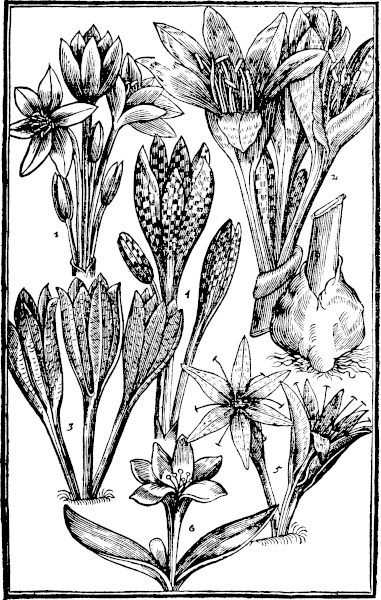
1Colchicum Pannonicum. The Hungarian Medow Saffron.
2Colchicum Byzantinum. Medowe Saffron of Constantinople.
3Colchicum Lusitanicum Fritillaricum. The checkerd Medowe Saffron of Portugall.
4Colchicum Neapolitanum Fritillaricum. The checkerd Medowe Saffron of Naples.
5Colchicum Fritillaricum Chiense. The Checkerd Medowe Saffron of Chio or Sio.
6Colchicum Hermodactylum. Physicall Medowe Saffron.
7. Colchicum Neapolitanum Fritillaricum. The checkerd Medowe Saffron of Naples.
This checkerd Medowe Saffron of Naples, is very like vnto the last recited checkerd Saffron of Portugall, but that the flower is somewhat larger, yet sometimes very little, or not at all: the greatest marke to distinguish them is, that the flowers of this are of a deeper colour, and so are the spots on the flowers likewise, which are so conspicuous, that they are discerned a great way off, more like vnto the flowers of a deepe Fritillaria, then the former, and make a goodlier and a more glorious shew: the leaues of this doe rise vp early after the flowers, and are somewhat longer, of a darker greene colour, yet bending to a grayish colour as the other, not lying so neatly or round, but stand vp one by another, being as it were folded together: neither of both these last named checkerd Medowe Saffrons haue giuen any seede in this Countrey, that euer I could learne or heare of, but are encreased by the roote, which in this is like the former, but a little bigger.
8. Colchicum Fritillaricum Chiense. The checkerd Medowe Saffron of Chio or Sio.
This most beautifull Saffron flower riseth vp with his flowers in the Autumne, as the others before specified doe, although not of so large a size, yet farre more pleasant and delightfull in the thicke, deepe blew, or purple coloured beautifull spots therein, which make it excell all others whatsoeuer: the leaues rise vp in the Spring, being smaller then the former, for the most part three in number, and of a paler or fresher greene colour, lying close vpon the ground, broad at the bottome, a little pointed at the end, and twining or folding themselues in and out at the edges, as if they were indented. I haue not seene any seede it hath borne: the roote is like vnto the others of this kinde, but small and long, and not so great: it flowreth later for the most part then any of the other, euen not vntill Nouember, and is very hard to be preserued with vs, in that for the most part the roote waxeth lesse and lesse euery yeare, our cold Country being so contrary vnto his naturall, that it will scarce shew his flower; yet when it flowreth any thing early, that it may haue any comfort of a warme Sunne, it is the glorie of all these kindes.
9. Colchicum versicolor. The party coloured Medowe Saffron.
The flowers of this Medowe Saffron most vsually doe not appeare, vntill most of the other Autumne sorts are past, except the last, which are very lowe, scarce rising with their stalkes three fingers breadth aboue the ground, but oftentimes halfe hid within the ground: the leaues whereof are smaller, shorter, and rounder, then in any of the other before specified, some being altogether white, and others wholly of a very pale purple, or flesh colour; and some againe parted, the one halfe of a leafe white, and the other halfe of the same purple, and sometimes striped purple and white, in diuers leaues of one and the same flower: and againe, some will be the most part of the leafe white, and the bottome purple, thus varying as nature list, that many times from one roote may bee seene to arise all these varieties before mentioned: these flowers doe stand long before they fade and passe away; for I haue obserued in my Garden some that haue kept their flower faire vntill the beginning of Ianuary, vntill the extremitie of the Winter frosts and snowes haue made them hide their heads: the leaues therefore accordingly doe rise vp after all other, and are of a brownish or darke greene colour at their first springing vp, which after grow to be of a deepe greene colour: the roote is like the former English or Hungarian kindes, but thicker and greater for the most part, and shorter also.
10. Colchicum variegatum alterum. Another party coloured Medowe Saffron.
There is another, whose party coloured flowers rise a little higher, diuersly striped and marked, with a deeper purple colour, and a pale or whitish blush throughout all the leaues of the flower.
11. Colchicum montanum Hispanicum minus. The little Spanish Medowe Saffron.
The flowers of this little Medowe Saffron are narrower and smaller then any of the former, and of a deeper reddish purple colour then either the English or Hungarian kindes: the greene leaues also are smaller then any other, lying on the ground, of a deepe or sad greene colour, rising vp within a while after the flowers are past, and doe abide greene all the Winter long: the roote is small and long, according to the rest of the plant, and like in forme to the others.
12. Colchicum montanum minus versicolore flore. The small party coloured Medowe Saffron.
This little kinde differeth not from the Spanish kinde last set forth, but in the varietie of the flower, which is as small as the former; the three inner leaues being almost all white, and the three outer leaues some of them pale or blush, and some party coloured, with a little greene on the backe of some of them.
13. Colchicum Hermodactilum. Physicall Medowe Saffron.
This Physicall Medowe Saffron springeth vp with his leaues in Autumne, before his flowers appeare beyond the nature of all the former kindes, yet the flower doth, after they are vp, shew it selfe in the middle of the greene leaues, consisting of six white leaues, with diuers chiues in the middle, and passeth away without giuing any seede that euer I could obserue: the greene leaues abide all the Winter and Spring following, decaying about May, and appeare not vntill September, when (as I said) the flowers shew themselues presently after the leaues are sprung vp.
14. Colchicum atropurpureum. The darke purple Medowe Saffron.
The greatest difference in this kinde consisteth in the flower, which at the first appearing is as pale a purple, as the flower of the former Hungarian kinde: but after it hath stood in flower two or three dayes, it beginneth to change, and will after a while become to bee of a very deepe reddish purple colour, as also the little foote-stalke whereon it doth stand: the flower is of the bignesse of the Hungarian purple, and so is the greene leafe: the seede and roote is like the English purple kinde.
15. Colchicum atropurpureum variegatum. The party coloured darke purple Medowe Saffron.
We haue of late gained another sort of this kinde, differing chiefly in the flower, which is diuersly striped thorough euery leafe of the flower, with a paler purple colour, whereby the flower is of great beauty: this might seeme to bee a degeneration from the former, yet it hath abiden constant with me diuers yeares, and giueth seede as plentifully as the former.
16. Colchicum flore pleno. Double flowred Medowe Saffron.
The double Medowe Saffron is in roote and leafe very like unto the English kinde: the flowers are of a fine pale or delayed purple colour, consisting of many leaues set thicke together, which are somewhat smaller, as in the English flower, being narrow and long, and as it were round at the points, which make a very double flower, hauing some chiues with their yellow tips, dispersed as it were among the leaues in the middle: it flowreth in September, a little after the first shew of the earlier Medowe Saffrons are past.
17. Colchicum variegatum pleno flore. The party coloured double Medowe Saffron.
We haue another of these double kinds (if it be not the very same with the former, varying in the flower as nature pleaseth oftentimes; for I haue this flower in my garden, as I here set it forth, euery yeare) whose flowers are diuersified in the partition of the colours, as is to be seene in the single party coloured Medowe Saffron before described, hauing some leaues white, and others pale purple, and some leaues halfe white and halfe purple, diuersly set or placed in the double flower, which doth consist of as many leaues as the former, yet sometime this party coloured flower doth not shew it selfe double like the former, but hath two flowers, one rising out of another, making each of them to be almost but single flowers, consisting of eight or ten leaues a peece: but this diuersity is not constant; for the same roote that this yeare appeareth in that manner, the next yeare will returne to his former kinde of double flowers againe.
18. Colchicum Vernum. Medowe Saffron of the Spring.
This Medowe Saffron riseth vp very early in the yeare, that is, in the end of Ianuarie sometimes, or beginning, or at the furthest the middle of February, presently after the deepe Frosts and Snowes are past, with his flowers inclosed within three greene leaues, which opening themselues as soone almost as they are out of the ground, shew their buds for flowers within them very white oftentimes, before they open farre, and sometimes also purplish at their first appearing, which neuer shew aboue two at the most vpon one roote, and neuer rise aboue the leaues, nor the leaues much higher then they, while they last: the flower consisteth of six leaues, long and narrow, euery leafe being diuided, both at the bottome and toppe, each from other, and ioyned together onely in the middle, hauing also six chiues, tipt with yellow in the middle, euery chiue being ioyned to a leafe, of a pale red or deepe blush colour, when it hath stood a while blowne, and is a smaller flower then any Medowe Saffron, except the small Spanish kindes onely, but continueth in his beauty a good while, if the extremity of sharpe Frosts and Windes doe not spoile it: the leaues wherein these flowers are enclosed, at their first comming vp, are of a brownish greene colour, which so abide for a while, especially on the outside, but on the inside they are hollow, and of a whitish or grayish greene colour, which after the flowers are past, grow to bee of the length of a mans longest finger, and narrow withall: there riseth vp likewise in the middle of them the head or seede vessell, which is smaller and shorter, and harder then any of the former, wherein is contained small round browne seede: the roote is small, somewhat like vnto the rootes of the former, but shorter, and not hauing so long an eminence on the one side of the bottome.