THE GARDEN OF PLEASANT FLOWERS. (continued 6)
Reading edition
Gladiolus Italicus binis florum ordinibus. The Italian Corne Flagge.
The Italian Corne Flagge is like vnto the French in roote, leafe, and flower, without any other difference, then that the roote is smaller and browner, the leafe and stalke of a darker colour, and the flowers (being of a little darker colour like the former, and somewhat smaller) stand out on both sides of the stalke.
Gladiolus Byzantinus. Corne Flagge of Constantinople.
This Corne Flagge that came first from Constantinople, is in all things like vnto the French Corne Flagge last described, but that it is larger, both in rootes, leaues, and flowers, and likewise that the Flowers of this, which stand not on both sides, are of a deeper red colour, and flower later, after all the rest are past: the roote hereof being netted as plainly as any of the former, is as plentifull also to giue encrease, but is more tender and lesse able to abide our sharpe cold Winters.
Gladiolus flore rubente. Blush Corne Flagge.
This blush kinde is like vnto the French Corne Flagge in all respects, sauing onely that the flowers are of a pale red colour, tending to whitenesse, which wee vsually call a blush colour.
Gladiolus flore albo. White Corne Flagge.
This white Corne Flagge also differeth not from the last, but onely that the rootes are whiter on the outside, the leaues are greener, without any brownesse or darknesse as in the former, and the flowers are snow white.
Gladiolus purpureus minor. The small purple Corne Flagge.
This also differeth not from any of the former, but onely in the smallnesse both of leafe, stalke, and flowers, which stand all on the one side, like vnto the French kinde, and of the same colour: the roote of this kinde is netted more then any other.
The Place.
They grow in France and Italy, the least in Spaine, and the Byzantine, as it is thought, about Constantinople, being (as is said) first sent from thence. Iohn Tradescante assured mee, that hee saw many acres of ground in Barbary spread ouer with them.
The Time.
They all flower in Iune and Iuly, and the Byzantine latest, as is said before.
The Names.
It hath diuers names; for the Latines call it Gladiolus, of the forme of a sword, which the leafe doth resemble. The Romanes Segetalis, because it groweth in the Corne fields. Some call it Victorialis rotunda, to put a difference between it, and the longa, which is a kinde of Garlicke. Plinie saith, that Gladiolus is Cypirus, but to decide that controuersie, and many others, belongeth to another discourse, this being intended only for pleasure. Gerrard mistaketh the French kinde for the Italian.
The Vertues.
The roote being bruised, and applyed with Frankinsense (and often of it selfe without it) in the manner of a pultis or plaister, is held of diuers to be singular good to draw out splinters, thornes, and broken bones out of the flesh. Some take it be effectuall to stirre vp Venerie, but I somewhat doubt thereof: For Galen in his eighth Booke of Simples, giueth vnto it a drawing, digesting and drawing faculty.
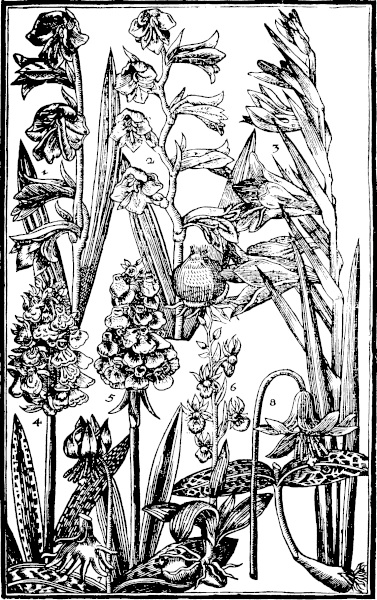
1Gladiolus Narbonensis. The French Corne Flagge.
2Gladiolus Italicus. The Italian Corne Flagge.
3Gladiolus Byzantinus. Corne Flagge of Constantinople.
4Palma Christi mas. The great male handed Satyrion.
5Orchis Hermaphroditica candida. The white Butterflie Orchis.
6Orchis Melitias siue apifera. The Bee flower or Bee Orchis.
7Dens Caninus flore purpurante. Dogges tooth Violet with a pale purplish flower.
8Dens Caninus flore albo. Dogges tooth Violet with a white flower.
Chap. XXII. Orchis siue Satyrium. Bee flowers.
Although it is not my purpose in this place, to giue a generall history of all the sorts of Orchides, Satyrions, and the rest of that kinde; yet because many of them are very pleasant to behold, and, if they be planted in a conuenient place, will abide some time in Gardens, so that there is much pleasure taken in them: I shall intrude some of them for curiosities sake, to make vp the prospect of natures beautifull variety, and only entreate of a few, leauing the rest to a more ample declaration.
1. Satyrium Basilicum siue Palma Christi mas. The greater male handed Satyrion.
This handed Satyrion hath for the most part but three faire large greene leaues, neare vnto the ground, spotted with small blackish markes: from among which riseth vp a stalke, with some smaller leaues thereon, bearing at the toppe a bush or spike of flowers, thicke set together, euery one whereof is made like a body, with the belly broader belowe then aboue, where it hath small peeces adioyned vnto it: the flower is of a faire purple colour, spotted with deeper purple spots, and hauing small peeces like hornes hanging at the backes of the flowers, and a small leafe at the bottome of the foote-stalke of euery flower: the rootes are not round, like the other Orchides, but somewhat long and flat, like a hand, with small diuisions belowe, hanging downe like the fingers of a hand, cut short off by the knockles, two alwayes growing together, with some small fibres or strings aboue the heads of these rootes, at the bottome of the stalke.
2. Satyrium Basilicum siue Palma Christi fæmina. The female handed Satyrion.
This female Satyrion hath longer and narrower leaues then the former, and spotted with more and greater spots, compassing the stalke at the bottome like the other: this beareth likewise a bush of flowers, like vnto the other, but that each of these haue heads like hoods, whereas the former haue none: in some they are white with purple spots, and in others of a reddish purple, with deepe or darke coloured spots: the roots are alike.
3. Orchis Hermaphroditica candida. The white Butterflie Orchis.
The rootes of this kinde take part with both the sorts of Orchis and Satyrium, being neither altogether round, nor fully handed, and thereupon it tooke the name, to signifie both kindes: the leaues are two in number, seldome more, being faire and broad, like vnto the leaues of Lillies, without any spot at all in them: at the toppe of the stalke stand many white flowers, not so thicke set as the first or second, euery one being fashioned like vnto a white Butterflie, with the wings spread abroad.
4. Orchis Melitias siue apifera. The Bee flower or Bee Orchis.
This is a small and lowe plant for the most part, with three or foure small narrow leaues at the bottome: the stalke is seldome above halfe a foote high, with foure or fiue flowers thereon one aboue another, hauing round bodies, and somewhat flat, of a kind of yellowish colour, with purple wings aboue them, so like vnto an honey Bee, that it might soone deceiue one that neuer had seene such a flower before: the roots are two together, round and white, hauing a certaine muccilaginesse or clamminesse within them, without any taste almost at all, as all or the most part of these kindes haue.
5. Orchis Sphegodes. Gnats Satyrion.
The leaues of this Orchis are somewhat larger then of the Bee flower, the stalke also somewhat higher: the flowers are fewer on the toppe, but somewhat larger then of the Bee flowers, made to the resemblance of a Gnat or great long Flie: the rootes are two round bulbes, as the other are.
6. Orchis Myodes. Flie Orchis.
The Flie Orchis is like vnto the last described, both in leafe and roote, the difference is in the flower, which is neither so long as the Gnat Satyrion, nor so great as the Bee Orchis, but the neather part of the Flie is blacke, with a list of ash-colour crossing the backe, with a shew of legges hanging at it: the naturall Flie seemeth so to bee in loue with it, that you shall seldome come in the heate of the day, but you shall finde one sitting close thereon.
The Place.
These grow in many places of England, some in the Woods, as the Butterflie, and the two former handed Satyrions: others on dry bankes and barren balkes in Kent, and many other places.
The Time.
They flower for the most part in the beginning or middle of May, or thereabouts.
The Names.
Their seuerall names are expressed in their titles, so much as may suffice for this discourse.
The Vertues.
All the kindes of Orchis are accounted to procure bodily lust, as well the flowers distilled, as the rootes prepared.
The rootes boyled in red Wine, and afterwards dryed, are held to bee a singular good remedie against the bloody Flixe.
Chap. XXIII. Dens Caninus. Dogs tooth Violet.
Vnto the kindes of Orchides, may fitly be ioyned another plant, which by many is reckoned to be a Satyrium, both from the forme of roote and leafe, and from the efficacy or vertue correspondent thereunto. And although it cannot be the Satyrium Erythronium of Dioscorides, as some would entitle it, for that as I haue shewed before, his Satyrium tryphillum is the Tulipa without all doubt; yet because it differeth very notably, and carrieth more beauty and respect in his flower then they, I shall entreate thereof in a Chapter by it selfe, and set it next vnto them.
Dens Caninus flore albo. Dogs tooth Violet with a white flower.
The white Dogs tooth hath for his roote a white bulbe, long and small, yet vsually greater then either of the other that follow, bigger belowe then aboue, with a small peece adioyning to the bottome of it, from whence rise vp in the beginning of the Spring, after the Winter frosts are past, two leaues for the most part (when it will flower, or else but one, and neuer three together that euer I saw) closed together when they first come vp out of the ground, which inclose the flower betweene them: the leaues when they are opened do lay themselues flat on the ground, or not much aboue it, one opposite vnto the other, with the stalke and the flower on it standing betweene them, which leaues are of a whitish greene colour, long and narrow, yet broader in the middle then at both ends, growing lesse by degrees each way, spotted and striped all ouer the leaues with white lines and spots: the stalke riseth vp halfe a foote high or more, bearing at the toppe one flower and no more, hanging downe the head, larger then any of the other of this kinde that follow, made or consisting of six white long and narrow leaues, turning themselues vp againe, after it hath felt the comfort of the Sunne, that they doe almost touch the stalke againe, very like vnto the flowers of Cyclamen or Sowebread: it hath in the middle of the flower six white chiues, tipt with darke purple pendents, and a white three forked stile in the middle of them: the flower hath no sent at all, but commendable onely for the beauty and forme thereof: after the flower is past, commeth in the place a round head seeming three square, containing therein small and yellowish seede.
Dens Caninus flore purpurascente. Dogs tooth with a pale purple flower.
This other Dogs tooth is like vnto the former, but lesser in all parts, the leafe whereof is not so long, but broad and short, spotted with darker lines and spots: the flower is like the other, but smaller, and of a delayed purple colour, very pale sometimes, and sometimes a little deeper, turning it selfe as the other, with a circle round about the vmbone or middle, the chiues hereof are not white, but declining to purple: the roote is white, and like vnto the former, but lesser, as is said before.
Dens Caninus flore rubro. Dogs tooth with a red flower.
This is in all things like vnto the last, both for forme and bignesse of flower and leafe: the chiefe difference consisteth in this, that the leaues hereof are of a yellowish mealy greene colour, spotted and streaked with redder spots and stripes, and the flower of a deeper reddish purple colour, and the chiues also more purplish then the last, in all other things it is alike.
The Place.
The sorts Dens Caninus doe growe in diuers places; some in Italy on the Euganean Hils, others on the Apenine, and some about Gratz, the chiefe Citie of Stiria, and also about Bayonne, and in other places.
The Time.
They flower in March most vsually, and many times in Aprill, according to the seasonablenesse of the yeare.
The Names.
Clusius did call it first Dentali, and Lobel, and from him some others Satyrium, and Erythronium, but I haue said enough hereof in the beginning of the Chapter. It is most commonly called Dens Caninus, and we in English, either Dogs tooth, or Dogs tooth Violet. Gesner called it Hermodactylus, and Matthiolus Pseudohermodactylus.
The Vertues.
The roote hereof is held to bee of more efficacy for venerous effects, then any of the Orchides and Satyrions.
They of Stiria vse the rootes for the falling sicknesse.
Wee haue had from Virginia a roote sent vnto vs, that wee might well iudge, by the forme and colour thereof being dry, to be either the roote of this, or of an Orchis, which the naturall people hold not onely to be singular to procure lust, but hold it as a secret, loth to reueale it.
Chap. XXIIII. Cyclamen. Sowebread.
The likenesse of the flowers, and the spotting of the leaues of the Dens Caninus, with these of the Cyclamen or Sowebread, maketh mee ioyne it next thereunto: as also that after the bulbous rooted plants I might begin with the tuberous that remaine, and make this plant the beginning of them. Of this kinde there are diuers sorts, differing both in forme of leaues and time of flowring: for some doe flower in the Spring of the yeare, others afterwards in the beginning of Summer: but the most number in the end of Summer, or beginning of Autumne or Haruest, whereof some haue round leaues, others cornered like vnto Iuie, longer or shorter, greater or smaller. Of them all in order, and first of those that come in the Spring.
1. Cyclamen Vernum flore purpureo. Purple flowred Sowebread of the Spring.
This Sowebread hath a smaller roote then most of the others, yet round and blackish on the outside, as all or most of the rest are (I speake of them that I haue seene; for Clusius and others doe report to haue had very great ones) from whence rise vp diuers round, yet pointed leaues, and somewhat cornered withall, greene aboue, and spotted with white spots circlewise about the leafe, and reddish vnderneath, which at their first comming vp are folded together; among which come the flowers, of a reddish purple colour and very sweete, euery one vpon a small, long, and slender reddish foote-stalke, which hanging downe their heads, turne vp their leaues againe: after the flowers are past, the head or seede vessel shrinketh downe, winding his footestalke, and coyling it selfe like a cable, which when it toucheth the ground, there abideth hid among the leaues, till it be growne great and ripe, wherein are contained a few small round seedes, which being presently sowne, will growe first into round rootes, and afterwards from them shoote forth leaues.
2. Cyclamen Vernum flore albo. White flowred Sowebread of the Spring.
The white flowring Sowebread hath his leaues like the former, but not fully so much cornered, bearing small snow white flowers, as sweete as the other: and herein consisteth the chiefest difference, in all other things it is alike.
3. Cyclamen Vernum Creticum flore albo. White Candy Sowebread of the Spring.
This Sowebread is somewhat like the former white kinde, but that the leaues grow much larger and longer, with more corners at the edges, and more eminent spots on them: the flowers also somewhat longer and larger, and herein consisteth the whole difference.
4. Cyclamen Æstivum. Summer Sowebread.
Summer Sowebread hath round leaues like vnto the Romane Sowebread, but somewhat cornered, yet with shorter corners then the Iuie leafed Sowebread, full of white spots on the vpperside of the leaues, and very purple vnderneath, sometimes they haue fewer spots, and little or no purple vnderneath: the flowers hereof are as small, as purple, and as sweete, as the purple Sowebread of the Spring time: the roote hereof is likewise small, blacke, and round.
5. Cyclamen Romanum rotundifolium. Romane Sowebread with round leaues.
The Romane Sowebread hath round leaues, somewhat like vnto the common Sowebread, but not fully so round pointed at the ends, a little cornered sometimes also, or as it were indented, with white spots round about the middle of the leaues, and very conspicuous, which make it seeme the more beautifull: the flowers appeare in Autumne, and are shorter, and of a deeper purplish red colour then the Iuie Sowebread, rising vp before the leaues for the most part, or at least with them, and little or nothing sweete: the roote is round and blacke, vsually not so flat as it, but growing sometimes to bee greater then any other kinde of Sowebread. There is sometimesVarietas. some variety to be seene, both in the leaues and flowers of this kinde; for that sometime the leaues haue more corners, and either more or lesse spotted with white; the flowers likewise of some are larger or lesser, longer or rounder, paler or deeper coloured one then another. This happeneth most likely from the sowing of the seede, causing the like variety as is seene in the Iuie leafed Sowebread. It doth also many times happen from the diuersity of soyles and countries where they grow: the seed of this, as of all the rest, is small and round, contained in such like heads as the former, standing almost like the head of a Snake that is twined or folded within the body thereof. This and the other Autumnall kindes, presently after their sowing in Autumne, shoote forth leaues, and so abide all the Winter, according to their kinde.
6. Cyclamen folio hederæ autumnale. Iuie leafed Sowebread.
The Iuie leafed Sowebread groweth in the same manner that the former doth, that is, bringeth forth flowers with the leaues sometimes, or most commonly before them, whose flowers are greater then the common round leafed Sowebread, somewhat longer then the former Romane or Italian Sowebreads, and of a paler purple colour, almost bluish, without that sweete sent as is in the first kinde of the Spring: the greene leaues hereof are more long then round, pointed at the ends, and hauing also one or two corners on each side, sometimes much spotted on the vpperside with white spots and marks, and sometimes but a little or not at all; and so likewise sometimes more or lesse purple vnderneath: all the leaues and flowers doe stand vsually euery one seuerally by themselues, vpon their owne slender foote-stalkes, as most of all the other kindes doe:Varietas. but sometimes it happeneth, that both leaues and flowers are found growing from one and the same stalke, which I rather take to be accidentall, then naturall so to continue: the seede hereof is like the former kindes, which being sowne produceth variety, both in the forme of the leaues, and colour and smell of the flowers: some being paler or deeper, and some more or lesse sweete then others: the leaues also, some more or lesse cornered then others: the root groweth to be great, being round and flat, and of a blackish browne colour on the outside.
7. Cyclamen autumnale hederæ folio flore albo. Iuie leafed Sowebread with white flowers.
There is one of this kinde, whose leaues are rounder, and not so much cornered as the former, flowring in Autumne as the last doth, and whose flowers are wholly white, not hauing any other notable difference therein.
8. Cyclamen autumnale angustifolium. Long leafed Sowebread.
This kinde of Sowebread may easily be knowne from all the other kindes, because his leafe is longer and narrower then others, fashioned at the bottome thereof with points, somewhat like vnto Arum or Wake Robin leaues: the flowers are like the former sorts for forme, but of a purple colour. There is also another of this kinde in all things like the former, but that the flowers are white.
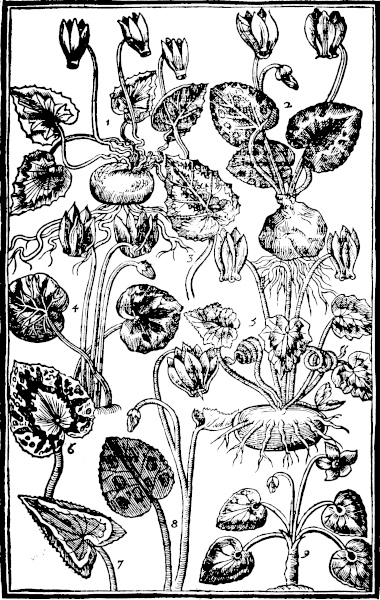
1Cyclamen Vernum flore purpureo. Purple flowred Sowebread of the Spring.
2Cyclamen astivum. Summer Sowebread.
3Folium Cyclaminis Cretici vernalis flore candido. A leafe of Candie Sowebread.
4Cyclamen Romanum Autumnale. Romane Sowebread of the Autumne.
5Cyclamen hederæfolio Autumnale. Iuie leafed Autumne Sowebread.
6Folium Cyclaminis Autumnalis flore albo. A leafe of the Autumne Sowebread with a white flower.
7Folium Cyclaminis angustifolij Autumnalis. A leafe of the long leafed Sowebread.
8Cyclamen Antiochenum Autumnale flore amplo purpureo duplici. The double flowred Sowebread of Antioch.
9Cyclamen vulgare folio rotundo. The common round leafed Sowebread.
9. Cyclamen Antiochenum Autumnale flore purpureo duplici. Double flowred Sowebread of Antioch.
This Sowebread of Antioch with double flowers, hath his leaues somewhat round, like vnto the leaues of the Summer Sowebread, but with lesse notches or corners, & full of white spots on them: it beareth flowers on stalks, like vnto others, & likewise some stalks that haue two or three flowers on them, which are very large, with ten or twelue leaues a peece, of a faire Peach colour, like vnto the flowers of purple Sowebread of the Spring, and deeper at the bottome.
There are of this kinde some, whose flowers appeare in the Spring, and are as large and double as the former, but of a pure white colour.
There are of these Sowebreads of Antioch, that haue but single flowers, some appearing in the Spring, and others in Autumne.
10. Cyclamen vulgare folio rotundo. The common Sowebread.
The common Sowebread (which is most vsed in the Apothecaries Shops) hath many leaues spread vpon the ground, rising from certaine small long heads, that are on the greater round rootes, as vsually most of the former sorts doe, being in the like manner folded together, and after spread themselues into round greene leaues, somewhat like vnto the leaues of Asarum, but not shining, without any white spots on the vpperside for the most part, or but very seldome, and reddish or purplish vnderneath, and very seldome greener: the flowers stand vpon small foot-stalkes, and shew themselues open for the most part, before any leaues doe appeare, being smaller and shorter then those with Iuie leaues, and of a pale purple colour, yet sometimes deeper, hanging downe their heads, and turning vp their leaues againe, as all others doe, but more sweete then many other of the Autumne flowers: after the flowers are past, come the heads turning or winding themselues downe in like manner as the other doe, hauing such like seede, but somewhat larger, and more vneuen, or not so round at the least: the roote is round, and not flat, of a browner colour, and not so blacke on the outside as many of the others.
The Place.
The Sowebreads of the Spring doe both grow on the Pyrenæan Mountaines in Italy, and in Candy, and about Mompelier in France; Antioch in Syria also hath yeelded some both of the Spring and Autumne. Those with round and Iuie leaues grow in diuers places both of France and Italy: and the common in Germany, and the Lowe-Countries. But that Autumne Sowebread with white flowers, is reported to grow in the Kingdome of Naples. I haue very curiously enquired of many, if euer they found them in any parts of England, neare or further off from the places where they dwell: but they haue all affirmed, that they neuer found, or euer heard of any that haue found of any of them. This onely they haue assured, that there groweth none in the places, where some haue reported them to grow.
The Time.
Those of the Spring doe flower about the end of Aprill, or beginning of May. The other of the Summer, about the end of Iune or in Iuly. The rest some in August, and September, others in October.
The Names.
The Common Sowebread is called by most Writers in Latine, Panis Porcinus, and by that name it is knowne in the Apothecaries shops, as also by the name Arthanita, according to which name, they haue an ointment so called, which is to be made with the iuice hereof. It is also called by diuers other names, not pertinent for this discourse. The most vsuall name, whereby it is knowne to most Herbarists, is Cyclamen (which is the Greeke word) or as some call it Cyclaminus adding thereunto their other seuerall titles. In English, Sowebread.
The Vertues.
The leaues and rootes are very effectuall for the spleene, as the Ointment before remembred plainly proueth, being vsed for the same purpose, and that to good effect. It is vsed also for women in long and hard trauels, where there is danger, to accelerate the birth, either the roote or the leafe being applyed. But for any amorous effects, I hold it meere fabulous.
Chap. XXV. Anemone. Windeflower and his kindes.
The next tuberous rooted plants that are to follow (of right in my opinion) are the Anemones or Windeflowers, and although some tuberous rooted plants, that is, the Asphodils, Spiderworts, and Flowerdeluces haue beene before inserted, it was, both because they were in name or forme of flowers sutable to them whom they were ioyned vnto, and also that they should not be seuered and entreated of in two seuerall places: the rest are now to follow, at the least so many of them as be beautifull flowers, fit to furnish a Florists Garden, for natures delightsome varieties and excellencies. To distinguish the Family of Anemones I may, that is, into the wilde kindes, and into the tame or mannured, as they are called, and both of them noursed vp in Gardens; and of them into those that haue broader leaues, and into those that haue thinner or more iagged leaues: and of each of them, into those that beare single flowers, and those that beare double flowers. But to describe the infinite (as I may so say) variety of the colours of the flowers, and to giue to each his true distinction and denomination, Hic labor, hoc opus est, it farre passeth my ability I confesse, and I thinke would grauell the best experienced this day in Europe (and the like I said concerning Tulipas, it being as contingent to this plant, as is before said of the Tulipa, to be without end in yeelding varieties:) for who can see all the varieties that haue sprung from the sowing of the seede in all places, seeing the variety of colours risen from thence, is according to the variety of ayres & grounds wherein they are sowne, skill also helping nature in ordering them aright. For the seede of one and the same plant sowne in diuers ayres and grounds, doe produce that variety of colours that is much differing one from another; who then can display all the mixtures of colours in them, to set them downe in so small a roome as this Book? Yet as I haue done (in the former part of this Treatise) my good will, to expresse as many of each kinde haue come to my knowledge, so if I endeauour the like in this, I hope the courteous wil accept it, and hold me excused for the rest: otherwise, if I were or could be absolute, I should take from my self and others the hope of future augmentation, or addition of any new, which neuer will be wanting. To begin therefore with the wilde kinds (as they are so accounted) I shall first entreate of the Pulsatillas or Pasque flowers, which are certainly kindes of wilde Anemones, both in leafe and flower, as may well be discerned by them that are iudicious (although some learned men haue not so thought, as appeareth by their writings) the rootes of them making one speciall note of difference, from the other sorts of wilde Anemones.
{Pasque flowers}
1. Pulsatilla Anglica purpurea. The purple Pasque flower.
The Pasque or Passe flower which is of our owne Country, hath many leaues lying on the ground, somewhat rough or hairie, hard in feeling, and finely cut into many small leaues, of a darke greene colour, almost like the leaues of Carrets, but finer and smaller, from among which rise vp naked stalkes, rough or hairie also, set about the middle thereof with some small diuided leaues compassing them, and rising aboue these leaues about a spanne, bearing euery one of them one pendulous flower, made of six leaues, of a fine Violet purple colour, but somewhat deepe withall, in the middle whereof stand many yellow threads, set about a middle purple pointell: after the flower is past, there commeth vp in the stead thereof a bushie head of long seedes, which are small and hoarie, hauing at the end of euery one a small haire, which is gray likewise: the roote is small and long, growing downewards into the ground, with a tuft of haire at the head thereof, and not lying or running vnder the vpper crust thereof, as the other wilde Anemones doe.
2. Pulsatilla Danica. The Passe flower of Denmarke.
There is another that was brought out of Denmarke, very like vnto the former, but that it is larger both in roote and leafe, and flower also, which is of a fairer purple colour, not so deepe, and besides, will better abide to bee mannured then our English kinde will, as my selfe haue often proued.
Viriusque flore albo & flore duplici.
Of both these sorts it is said, that some plants haue bin found, that haue borne white flowers. And likewise one that bore double flowers, that is, with two rowes of leaues.
3. Pulsatilla flore rubro. The red Passe flower.
Lobel, as I take it, did first set forth this kinde, being brought him from Syria, the leaues whereof are finer cut, the flower smaller, and with longer leaues, and of a red colour.
4. Pulsatilla flore luteo. The yellow Passe flower.
The yellow Passe flower hath his leaues cut and diuided, very like vnto the leaues of the first kinde, but somewhat more hairie, greene on the vpperside, and hairie vnderneath: the stalke is round and hoary, the middle whereof is beset with some small leaues, as in the other, from among which riseth vp the stalke of the flower, consisting of six leaues of a very faire yellow colour on the inside, and of a hoary pale yellow on the outside; after which followeth such an head of hairie thrummes as in the former: the roote is of the bignesse of a mans finger.
5. Pulsatilla flore albo. The white Passe flower.
The white Passe flower (which Clusius maketh a kinde of Anemone, and yet as hee saith himselfe, doth more nearely resemble the Pulsatilla) hath, from amongst a tuft or head of haires, which grow at the toppe of a long blacke roote, many leaues standing vpon long stalkes, which are diuided as it were into three wings or parts, and each part finely cut and diuided, like vnto the Passe flower of Denmarke, but somewhat harder in handling, greenish on the vpperside, and somewhat gray vnderneath, and very hairie all ouer: among these leaues rise vp the stalkes, beset at the middle of them with three leaues, as finely cut and diuided as those belowe, from aboue which standeth the flower, being smaller, and not so pendulous as the former, but in the like manner consisting of six leaues, of a snow white colour on the inside, and a little browner on the outside, with many yellow thrums in the middle: after the flower is past, riseth vp such a like hoary head, composed as it were of many haires, each whereof hath a small seede fastened vnto it, like as the former Passe flowers haue.
The Place.
The first is found in many places of England, vpon dry bankes that lye open to the Sunne.
The second was first brought, as I take it, by Doctor Lobel from Denmarke, & is one of the two kinds, that Clusius saith are common in Germanie, this bearing a paler purple flower, and more early then the other, which is the same with our English, whose flower is so darke, that it almost seemeth blacke.
The red kinde, as Lobel saith, came from Syria.
The yellow Passe flower, which Clusius maketh his third wilde Anemone, was found very plentifully growing at the foote of St. Bernards Hill, neare vnto the Cantons of the Switzers.
The white one groweth on the Alpes neare Austria, in France likewise and other places.
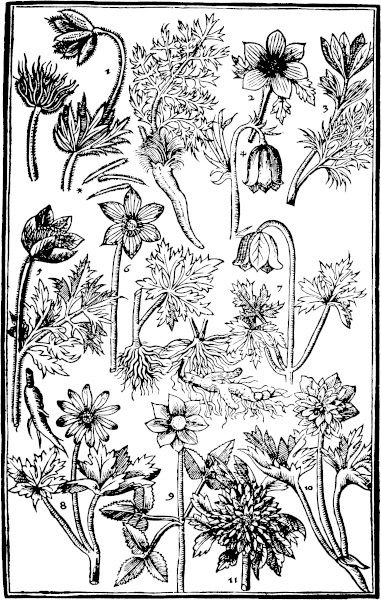
1Pulsatilla purpurea cum folio, semine, & radice. The purple Pasque flower with leafe, seed, and root.
2Pulsatilla luteo flore. The yellow Pasque flower.
3Pulsatilla rubra Syriaca Lobelij. Red Pasque flower of Lobel.
4Pulsatilla rubra Swertij. Swertz his red Pasque flower.
5Pulsatilla flore albo. White Pasque flower.
6Anemone siluestris albo Matthioli. The wilde white broad leafed Windflower.
7Anemone siluestris tenuifolia alba. The wilde single white Windflower.
8Anemone siluestris tenuifolia luteo. The yellow wilde thin leafed Windflower.
9Anemone siluestris trifolia Dodonæi. The three-leafed wilde Windflower.
10Anemone siluestris flore pleno albo. The double white wilde Windflower.
11Anemone siluestris flore pleno purpureo. The double purple wilde Windeflower.
*Semen seperatim divulsum. The seed separated.
†Radice cum folio inferiore. The roote with a lower leafe.
The Time.
All of them doe flower early in the yeare, that is, in the beginning of Aprill, about which time most commonly Easter doth fall.
The Names.
Their proper names are giuen to each in their seuerall titles, being all of them kindes of wilde Anemones, as I said in the beginning of the Chapter, and so for the most part all Authors doe acknowledge them. We call them in English, because they flower about Easter, Pasque flower, which is the French name for Easter, or Euphoniæ gratia, Pasque flower, which may passe currant, without any further descant on the name, or else Pulsatilla, if you will, being growne old by custome.
The Vertues.
The sharpe biting and exulcerating quality of this plant, causeth it to be of little vse, notwithstanding Ioachimus Camerarius saith in his Hortus Medicus, that in Borussia, which is a place in Italy, as I take it, the distilled water hereof is vsed with good successe, to be giuen to them that are troubled with a Tertian Ague; for he saith that it is medicamentum ὀκφρακτικὸν, that is, a medicine of force to helpe obstructions.
{Wilde Windflowers}
Anemone siluestris latifolia alba siue tertia Matthioli. The white wilde broad leafed Windflower.
This Windflower hath diuers broad greene leaues, cut into diuisions, and dented, about, very like vnto a broad leafed Crowfoote, among which riseth vp a stalke, hauing some such like cut leaues in the middle thereof, as growe below, but smaller; on the toppe whereof standeth one large white flower, consisting of fiue leaues for the most part, with some yellow threads in the middle, standing about such a greene head as is in the tame or garden Anemones, which growing greater after the flower is past, is composed of many small seedes, wrapped in white wooll, which as soone as they are ripe, raise themselues vp from the bottome of the head, and flye away with the winde, as the other tame or garden kindes doe: the roote is made of a number of long blacke strings, encreasing very much by running vnder ground, and shooting vp in diuers places.
Anemone siluestris tenuifolia lutea. The yellow wilde thin leafed Windflower.
The yellow wilde Anemone riseth vp with one or two small round naked stalkes, bearing about the middle of them, small, soft, and tender iagged leaues, deeply cut in and indented on the edges about, from aboue which, doth grow the stalke, bearing small yellow flowers, standing vpon weake foote-stalks, like vnto a small Crowfoot, with some threads in the middle: the roote is long and small, somewhat like vnto the roote of Pollipodie, creeping vnder the vpper crust of the earth: this kinde is lower, and springeth somewhat earlier then the other wilde kindes that follow.
Anemone siluestris tenuifolia alba simplex. The single white thin leafed wilde Windflower.
This white wilde Anemone riseth vp with diuers leaues vpon seuerall long stalkes; which are somewhat like vnto the former, but that they are somewhat harder, and not so long, nor the diuisions of the leaues so finely snipt about the edges, but a little broader, and deeper cut in on euery side: the flowers hereof are larger and broader then the former, white on the inside, and a little purplish on the outside, especially at the bottome of the flower next vnto the stalke: the roote of this is very like vnto the last.
Purpurea.
There is another of this kinde, whose flowers are purple, in all other things it is like vnto the white.
Coccinea siue suave rubens.
And likewise another, with a blush or carnation coloured flower.
Peregrina alba.
There is one that is onely nursed vp with vs in Gardens, that is somewhat like vnto these former wilde Anemones in roote and leafe, but that the flower of this, being pure white within, and a little purplish without, consisting of eight or nine small round pointed leaues, hath sometimes some leaues vnder the flower, party coloured white and greene: the flower hath likewise a greene head, like a Strawberry, compassed about with white threads, tipt with yellow pendents.
Peregrina viridis.
And another of the same kinde with the last, whose flower consisting of eight or nine leaues, is of a greenish colour, except the foure outermost leaues, which are a little purplish, and diuided at the points into three parts; the middle part is of a greenish white colour, with a greene head in the middle as the other.
Anemone siluestris trifolia Dodonæi. The three leafed wilde Windflower.
This wilde Anemone hath his rootes very like vnto the former kindes; the leaues are alwaies three set together at the toppe of slender stalkes, being small and indented about, very like vnto a three leafed Grasse, but smaller: the flower consisteth of eight small leaues, somewhat like vnto a Crowfoote, but of a whitish purple or blush colour, with some white threads, and a greene rough head in the middle.
Anemone siluestris flore pleno albo. The double white wilde Windflower.
This double kinde is very like vnto the single white kinde before described, both in his long running rootes, and thin leaues, but somewhat larger: the flowers hereof are very thicke and double, although they be small, and of a faint sweete sent, very white after it is full blowne for fiue or six dayes, but afterwards it becommeth a little purplish on the inside, but more on the outside: this neuer giueth seede (although it haue a small head in the middle) like as many other double flowers doe.
Anemone siluestris flore pleno purpureo. The double purple wilde Windflower.
This double purple kinde hath such like iagged leaues as the last described hath, but more hoarie vnderneath: the flower is of a fine light purple toward the points of the leaues, the bottomes being of a deeper purple, but as thicke, and full of leaues as the former, with a greene head in the middle, like vnto the former: this kinde hath small greene leaues on the stalkes vnder the flowers, cut and diuided like the lower leaues.
The Place.
The first broad leafed Anemone groweth in diuers places of Austria and Hungary. The yellow in diuers woods in Germany, but not in this Countrey that euer I could learne. The other single wilde kindes, some of them are very frequent throughout the most places of England, in Woods, Groues, and Orchards. The double kindes were found, as Clusius saith, in the Lowe-Countries, in a Wood neare Louaine.
The Time.
They flower from the end of March (that is the earliest) and the beginning of Aprill, vntill May, and the double kindes begin within a while after the single kinds are past.
The Names.
They are called Ranunculi siluarum, and Ranunculi nemorum, and as Clusius would haue them, Leimonia of Theophrastus; they are generally called of most Herbarists Anemones siluestres, Wilde Anemones or Windflowers. The Italians call them Gengeuo saluatico, that is, Wilde Ginger, because the rootes are, besides the forme, being somewhat like small Ginger, of a biting hot and sharpe taste.
{Garden Anemones or Windflowers}
Anemone Lusitanica siue hortensis latifolia flore simplici luteo. The single Garden yellow Windflower or Anemone.
This single yellow Anemone or Windflower hath diuers broad round leaues, somewhat diuided and endented withall on the edges, brownish at the first rising vp out of the ground, and almost folded together, and after of a sad greene on the vpperside, and reddish vnderneath; among which rise vp small slender stalkes, beset at the middle of them with two or three leaues, more cut and diuided then those belowe, with small yellow flowers at the toppe of them, consisting of ten or twelue leaues a peece, hauing a few yellow threads in the middle of them, standing about a small greene head, which in time growing ripe hath small flat seede, inclosed within a soft wooll or downe, which is easily blowne away with the winde: the roote groweth downeward into the ground, diuersly spread with branches here and there, of a brownish yellow on the outside, and whitish within, so brittle, that it can hardly bee touched without breaking.
Anemone latifolia flore luteo duplici. The double yellow Anemone or Windflower.
This double yellow Anemone hath such broad round leaues as the single kinde hath, but somewhat larger or ranker: the stalkes are beset with larger leaues, more deeply cut in on the edges: the flowers are of a more pale yellow, with some purplish veines on the outside, and a little round pointed; but they are all on the inside of a faire yellow colour, consisting of two rowes of leaues, whereof the innermost is the narrower, with a small greene head in the middle, compassed with yellow threads as in the former: the roote is like the roote of the single; neither of these haue any good sent, and this springeth vp and flowreth later then the single kinde.
Anemone latifolia purpurea stellata siue papaveracea. The purple Starre Anemone or Windflower.
The first leaues of this purple Anemone, which alwayes spring vp before Winter, (if the roote be not kept too long out of the ground,) are somewhat like the leaues of Sanicle or Selfe-heale, but the rest that follow are more deeply cut in and iagged; among which rise vp diuers round stalkes, beset with iagged leaues as all other Anemones are, aboue which leaues, the stalkes rising two or three inches high, beare one flower a peece, composed of twelue leaues or more, narrow and pointed, of a bleake purple or whitish ash-colour, somewhat shining on the outside, and of a fine purple colour tending to a murrey on the inside, with many blackish blew threads or thrummes in the middle of the flower, set about a head, whereon groweth the seede, which is small and blacke, inclosed in soft wooll or downe, which flieth away with the winde, carrying the seede with it, if it be not carefully gathered: the roote is blackish on the outside, and white within, tuberous or knobby, with many fibres growing at it.
Anemone purpurea Stellata altera. Another purple Starre Anemone.
There is so great diuersity in the colours of the flowers of these broad leafed kinds of Anemones or Windflowers, that they can very hardly be expressed, although in their leaues there is but little or no difference. I shall not neede therefore to make seuerall descriptions of euery one that shall be set downe; but it will be sufficient, I thinke, to giue you the distinctions of the flowers: for as I said, therein is the greatest and chiefest difference. This other Starre Anemone differeth not from the former in leafe or flower, but onely that this is of a more pale sullen colour on the outside, and of a paler purple colour on the inside.
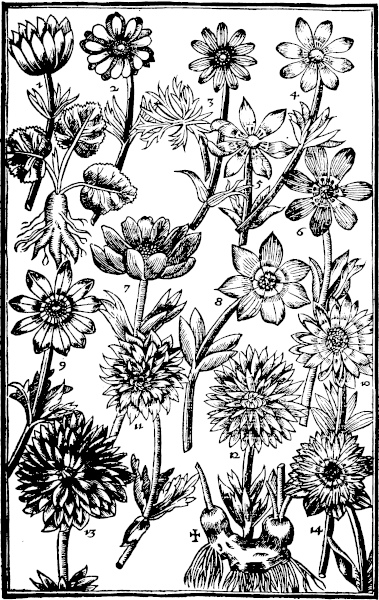
1Anemone latifolia flore luteo simplici. The single yellow Anemone.
2Anemone latifolia flore luteo duplici. The double yellow Anemone.
3Anemone latifolia flore purpureo Stellato. The purple Starre Anemone.
4Anemone latifolia purpurea dilutior. The pale purple Starre Anemone.
5Anemone latifolia flore miniato diluto. The pale red Anemone.
6Anemone latifolia coccinea Cardinalis dicta. The Cardinall Anemone.
7Anemone latifolia incarnata Hispanica. The Spanish incarnate Anemone.
8Anemone latifolia Pauo simplex dicta. The lesser Orenge tawney Anemone.
9Anemone latifolia flore carneo. The carnation Anemone.
10Anemone latifolia Arantiaca siue Pauo maior. The double Orenge tawney Anemone.
11Anemone Superitica siue Cyparissia. The double Anemone of Cyprus.
12Anemone latifolia flore pleno albicante. The double pale blush Anemone.
13Anemone Chalcedonica maxima. The great Spanish Marigold Anemone.
14Anemone Cacumeni siue Persica. The double Persian Anemone.
†Anemonis latifoliæ radice. The roote of a great Anemone.
Viola purpurea.
There is another, whose flower hath eight leaues, as many of them that follow haue (although diuers sorts haue but six leaues in a flower) and is of a Violet purple, and therefore is called, The Violet purple Anemone.
Varietas.
Of all these three sorts last described, there be other that differ only in hauing white bottomes, some smaller and some larger.
Purpurea striata.
There is also another of the same Violet purple colour with the former, but a little paler, tending more to rednesse, whose flowers haue many white lines and stripes through the leaues, and is called, The purple stript Anemone.
Carnea vivacissima simplex.
There is another, whose greene leaues are somewhat larger, and so is the flower likewise, consisting of eight leaues, and sometimes of more, of the colour of Carnation silke, sometimes pale and sometimes deeper, with a whitish circle about the bottome of the leaues, which circle in some is larger, and more to be seene then in others, when the flower layeth it selfe open with the heate of the Sunne, hauing blewish threads in the middle. This may be called, the Carnation Anemone.
Persiciviolacea.
We haue another, whose flower is betweene a Peach colour and a Violet, which is vsually called a Gredeline colour.
Cochenille.
And another of a fine reddish Violet or purple, which we call, The Cochenille Anemone.
Cardinalis.
And another of a rich crimson red colour, and may be called, The Cardinall Anemone.
Sanguinea.
Another of a deeper, but not so liuely a red, called, The bloud red Anemone.
Cramesina.
Another of an ordinary crimson colour, called, The crimson Anemone.
Coccinea.
Another of a Stamell colour, neare vnto a Scarlet.
Incarnata.
Another of a fine delayed red or flesh colour, and may bee called, The Incarnidine Anemone.
Incarnata Hispanica.
Another whose flower is of a liuely flesh colour, shadowed with yellow, and may be called, The Spanish Incarnate Anemone.
Rubescens.
Another of a faire whitish red, which we call, The Blush Anemone.
Moschutella.
Another whose flower consisteth of eight leaues, of a darke whitish colour, stript all ouer with veines of a fine blush colour, the bottomes being white, this may be called, The Nutmegge Anemone.
Enfumata.
Another whose flower is of a pale whitish colour, tending to a gray, such as the Monkes and Friers were wont to weare with vs, and is called, A Monkes gray.
Pauo maior simplici flore.
There is another, whose leafe is somewhat broader then many or most of the Anemones, comming neare vnto the leafe of the great double Orenge coloured Anemone; the flower whereof is single, consisting of eight large or broad leaues, very neare vnto the same Orenge colour, that is in the double flower hereafter described, but somewhat deeper. This is vsually called in Latine, Pauo maior simplici flore, and we in English, The great single Orenge tawnie Anemone.
Pauo minor.
There is likewise of this kinde another, whose flower is lesser, and called, The lesser Orenge tawnie Anemone.
Varietas magna ex seminio.
There is besides these expressed, so great a variety of mixt colours in the flowers of this kinde of Anemone with broad leaues, arising euery yeare from the sowing of the seede of some of the choisest and fittest for that purpose, that it is wonderfull to obserue, not onely the variety of single colours, but the mixture of two or three colours in one flower, besides the diuersity of the bottomes of the flowers, some hauing white or yellowish bottomes, and some none, and yet both of the same colour; and likewise in the thrums or threads in the middle: But the greatest wonder of beauty is in variety of double flowers, that arise from among the other single ones, some hauing two or three rowes of leaues in the flowers, and some so thicke of leaues as a double Marigold, or double Crowfoote, and of the same seuerall colours that are in the single flowers, that it is almost impossible to expresse them seuerally, and (as is said before) some falling out to bee double in one yeare, which will proue single or lesse double in another, yet very many abiding constant double as at the first; and therefore let this briefe recitall be sufficient in stead of a particular of all the colours.
Anemone Chalcedonica maxima versicolor. The great double Windflower of Constantinople.
This great Anemone of Constantinople hath broader and greener leaues then any of the former kindes, and not so much diuided or cut in at the edges, among which rise vp one or two stalkes, (seldome more from one roote) hauing some leaues about the middle of the stalke, as other Anemones haue, and bearing at the toppes of the stalkes one large flower a peece, very double, whose outermost leaues being broadest, are greenish at the first, but afterwards red, hauing sometimes some greene abiding still in the leaues, and the red striped through it: the other leaues which are within these are smaller, and of a perfect red colour; the innermost being smallest, are of the same red colour but turned somewhat inward, hauing no thrummes or threads in the middle, as the former haue, and bearing no seede: the roote is blackish on the outside, and white within, thicke and tuberous as the other kindes, but thicker set and close together, not shooting any long slender rootes as others doe. Some Gentlewomen call this Anemone, The Spanish Marigold.
Anemone Chalcedonica altera siue Pauo maior flore duplici. The great double Orenge tawney Anemone.
This other great Anemone of Constantinople hath his large leaues so like vnto the last, that one can hardly distinguish them asunder; the stalke hath also such like leaues set vpon it, bearing at the toppe a faire large flower, consisting of many leaues set in two or three rowes at the most, but not so thicke or double as the last, yet seeming to be but one thicke rowe of many small and long leaues, of an excellent red or crimson colour, wherein some yellow is mixed, which maketh that colour is called an Orenge tawney; the bottomes of the leaues are red, compassed with a whitish circle, the thrummie head in the middle being beset with many darke blackish threads: the roote is like the former.
Anemone Superitica siue Cyparissia. The double Anemone of Cyprus.
This Anemone (which the Dutchmen call Superitz, and as I haue beene enformed, came from the Isle of Cyprus) hath leaues very like the last double Anemone, but not altogether so large: the flower consisteth of smaller leaues, of colour very neare vnto the last double Orenge coloured Anemone, but more thicke of leaues, and as double as the first, although not so great a flower, without any head in the middle, or thrums about it as is in the last, and differeth not in the roote from either of them both.
Somewhat like vnto this kinde, or as it were betweene this and the first kinde of these great double Anemones, we haue diuers other sorts, bearing flowers very thicke and double; some of them being white, or whitish, or purple, deepe or paler, and some of a reddish colour tending to Scarlet or a Carnation colour, and some also of a blush or flesh colour, and diuers other colours, and all of them continue constant in their colours.
Anemone Cacumeni Maringi siue Persica. The double Persian Anemone.
This rare Anemone, which is said to come out of Persia to Constantinople, and from thence to vs, is in leafe and roote very like vnto the former double Anemones before described; onely the flower hereof is rather like vnto the second great double Orenge coloured Anemone, vsually called Pauo maior flore pleno, being composed of three rowes of leaues, the outermost rowe consisting of ten or twelue larger leaues, and those more inward lesser and more in number, but all of them variably mixed with white, red, and yellow, having the bottomes of the leaues white: but instead of a middle head with thrums about it, as the other hath, this hath a few narrow leaues, or a deepe yellow colour in the middle of the flower, standing vpright.
Hauing thus farre proceeded in the two parts of the kindes of Anemones or Windflowers, it remaineth to entreate of the rest, which is those Anemones which haue thin cut leaues, whereof some haue reckoned vp thirty sorts with single flowers, which I confesse I haue not seene; but so many as haue come to my knowledge, I shall here set downe.
Anemone tenuifolia siue Geranifolia cærulea. The Watchet Anemone or Storkes bill leafed Windflower.
This first Windflower with thin cut leaues, riseth not out of the ground vntil the great Winter frosts be past, that is, about the middle or end of February, and are somewhat brownish at their first appearing, but afterwards spread into wings of greene leaues, somewhat broader then the rest that follow, diuided into three parts, & each part into three leaues, euery one cut in about the edges, one standing against another vpon a long slender foote-stalke, and the end leafe by it selfe: among these riseth vp two or three greene stalkes, garnished with such like thin leaues as are at the bottome, from aboue which rise the flowers, but one vpon a stalke, consisting of fourteene or fifteene small pale blew or watchet leaues, lesser then any of the single kindes that follow, compassing many whitish threads, and a small greene head in the middle, somewhat like the head of the wilde Crowfoote, wherein is contained such like seede: the roote is blackish without, thrusting out into long tuberous peeces, somewhat like vnto some of the broad leafed Anemones.
Alba.
Of this kinde there is another, whose leaues are not browne at their first rising, but greene, and the flowers are white, in other things not differing.
Anemone tenuifolia purpurea vulgaris. The ordinary purple Anemone with thin leaues.
This purple Anemone which is most common, and therefore the lesse regarded, hath many winged leaues standing vpon seuerall stalkes, cut and diuided into diuers leaues, much like vnto the leaues of a Carrot; among which rise vp stalkes with some leaues thereon (as is vsuall to the whole Family of Anemones, both wilde and tame, as is before said;) at the toppes whereof stand the flowers, made of six leaues most vsually, but sometimes they will haue seuen or eight, being very large, and of a perfect purple Violet colour, very faire and liuely: the middle head hath many blackish thrums or threads about it, which I could neuer obserue in my Gardens to beare seed: the roote is smaller, and more spreading euery way into small long flat tuberous parts, then any other kindes of single or double Anemones.
Carneapallida.
There is another very like in leafe and roote vnto the former, but the flower is nothing so large, and is whitish, tending to a blush colour, and of a deeper blush colour toward the bottome of the flower, with blackish blew thrums in the middle, and giueth no seede that I could euer obserue.
Carnea viuida vnguibus albis.
There is likewise another like vnto the last in leafe and flower, but that the flower is larger then it, and is a of liuely blush colour, the leaues hauing white bottomes.
Alba venis purpureis.
And another, whose flower is white, with purple coloured veines and stripes through euery leafe, and is a lesser flower then the other.
Anemone tenuifolia coccinea simplex. The single Scarlet Anemone with thin leaues.
The leaues of this Scarlet Windflower are somewhat like vnto the former, but a little broader, and not so finely cut and diuided: the flower consisteth of six reasonable large leaues, of an excellent red colour, which we call a Scarlet; the bottomes of the leaues are large and white, and the thrums or threads in the middle of a blackish purple colour: the roote is tuberous, but consisting of thicker peeces, somewhat like vnto the rootes of the broad leafed Anemones, but somewhat browne and not so blacke, and most like vnto the roote of the double Scarlet Anemone.
Coccinea absq; vnguibus.
There is another of this kinde, whose flower is neare vnto the same colour, but this hath no white bottomes at all in his leaues.
Flore holosericeo.
We haue another which hath as large a flower as any single, and is of an Orient deepe red crimson Veluet colour.
Sanguinea.
There is another of a deeper red colour, and is called, The bloud red single Anemone.
Rubra fundo luteo.
And another, whose flower is red with the bottome yellow.
Coccinea dilutior.
Another of a perfect crimson colour, whereof some haue round pointed leaues, and others sharpe pointed, and some a little lighter or deeper then others.
Alba staminibus purpureis.
There is also one, whose flower is pure white with blewish purple thrums in the middle.
Carnea Hispanica.
And another, whose flower is very great, of a kinde of sullen blush colour, but yet pleasant, with blewish threads in the middle.
Alba carneis venis.
And another with blush veines in euery leafe of the white flower.
Alba purpureis vnguibus.
And another, the flower whereof is white, the bottomes of the leaues being purple.
Purpurascens.
Another whose flower consisteth of many small narrow leaues, of a pale purple or blush colour on the outside, and somewhat deeper within.
Facie florum pomi simplex.
There is another like in leafe and roote vnto the first Scarlet Anemone, but the flower hereof consisteth of seuen large leaues without any bottomes, of a white colour, hauing edges, and some large stripes also of a carnation or flesh colour to bee seene in them, marked somewhat like an Apple blossome, and thereupon it is called in Latine, Anemone tenuifolia simplex alba instar florum pomi, or facie florum pomi, that is to say in English, The single thin leafed Anemone with Apple blossome flowers.
Multiplex.
I haue heard that there is one of this kinde with double flowers.
1. Anemone tenuifolia flore coccineo pleno vulgaris. The common double red or Scarlet Anemone.
The leaues of this double Anemone are very like vnto the leaues of the single Scarlet Anemone, but not so thin cut and diuided as that with the purple flower: the flower hereof when it first openeth it selfe, consisteth of six and sometimes of seuen or eight broad leaues, of a deepe red, or excellent Scarlet colour, the middle head being thick closed, and of a greenish colour, which after the flower hath stood blowne some time, doth gather colour, and openeth it selfe into many small leaues, very thicke, of a more pale red colour, and more Stamell like then the outer leaues: the root of this is thicke and tuberous, very like vnto the root of the single Scarlet Anemone.
2. Anemone tenuifolia flore coccineo pleno variegata. The party coloured double Crimson Anemone.
We haue a kinde hereof, varying neither in roote, leafe, or forme of flower from the former, but in the colour, in that this will haue sometimes the outer broad leaues party coloured, with whitish or blush coloured great streakes in the red leaues both inside and outside; as also diuers of the middle or inner leaues striped in the same manner: the roote hereof giueth fairer flowers in some yeares then in others, and sometimes giue flowers all red againe.
3. Anemone tenuifolia flore coccineo saturo pleno. The double crimson Veluet Anemone.
Wee haue another also, whose flower is of a deepe Orenge tawny crimson colour, neare vnto the colour of the outer leaues, of the lesser French Marigold, and not differing from the former in any thing else.
4. Anemone tenuifolia flore pleno suauerubente. The greater double blush Anemone.
There is small difference to be discerned, either in the roote or leaues of this from the former double Scarlet Anemone, sauing that the leaues hereof are a little broader, and seeme to bee of a little fresher greene colour: the flower of this is as large almost, and as double as the former, and the inner leaues likewise almost as large as they, being of a whitish or flesh colour at the first opening of them, but afterwards become of a most liuely blush colour; the bottomes of the leaues abiding of a deeper blush, and with long standing, the tops of the leaues will turne almost wholly white againe.
5. Anemone tenuifolia flore albo pleno. The double white Anemone.
This double white Anemone differeth little from the former blush Anemone, but in that it is smaller in all the parts thereof, and also that the flower hereof being wholly of a pure white colour, without any shew of blush therein, hath the middle thrummes much smaller and shorter then it, and not rising vp so high, but seeme as if they were chipped off euen at the toppes.
6. Anemone tenuifolia flore pleno albicante. The lesser double blush Anemone.
This small double blush Anemone differeth very little from the double white last recited, but onely in the colour of the flower: for they are both much about the bignesse one of another, the middle thrums likewise being as small and short, and as euen aboue, onely the flower at the first opening is almost white, but afterwards the outer leaues haue a more shew of blush in them, and the middle part a little deeper then they.
7. Anemone tenuifolia flore pleno purpureo violaceo. The double purple Anemone.
This double purple Anemone is also of the same kindred with the first double red or Scarlet Anemone for the form or doublenesse of the flower, consisting but of six or seuen leaues at the most in this our Country, although in the hotter it hath ten or twelue, or more as large leaues for the outer border, and as large small leaues for the inner middle also, and almost as double, but of a deepe purple tending toward a Violet colour, the outer leaues being not so deepe as the inner: the roote and leafe commeth neare vnto the single purple Anemone before described, but that the roote spreadeth not so small and so much.
8. Anemone tenuifolia flore pleno purpureo cæruleo. The double blew Anemone.
This Anemone differeth not in any thing from the former double purple, but onely that the flower is paler, and more tending to a blew colour.
9. Anemone tenuifolia flore pleno roseo. The double Rose coloured Anemone.
The double Rose coloured Anemone differeth also in nothing from the former double purple, but onely in the flower, which is somewhat smaller, and not so thicke and double, and that it is of a reddish colour, neare vnto the colour of a pale red Rose, or of a deepe coloured Damaske.
10. Anemone tenuifolia flore pleno carneo viuacissimo. The double Carnation Anemone.
This Anemone, both in roote, leafe, and flower, commeth nearest vnto the former double white Anemone, for the largenesse and doublenesse of the flower, and in the smalnesse of the middle thrums, and euennesse at the toppes of them, being not so large and great a flower as the double purple, either in the inner or outer leaues, but yet is very faire, thicke and double, and of a most liuely Carnation silke colour, very deepe, both the outer leaues and middle thrums also so bright, that it doth as it were amaze, and yet delight the minde of the beholder, but by long standing in the Sun, waxe a little paler, and so passe away as all the most beautifull flowers doe.
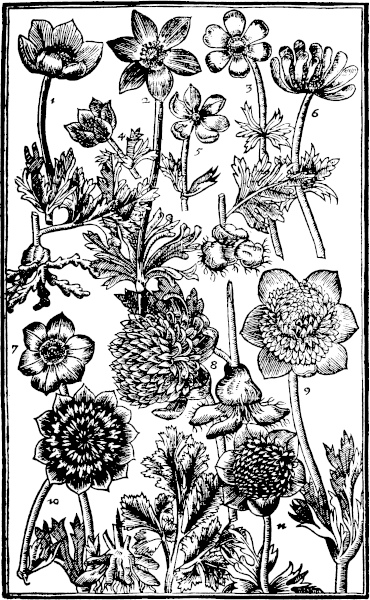
1Anemone tenuifolia simplex purpurea. The single purple Anemone with thin cut leaues.
2Anemone tenuifolia simplex alba pura. The single pure white Anemone.
3Anemone tenuifolia simplex chermesina. The single bright Crimson Anemone.
4Anemone tenuifolia simplex sanguinea. The single bloud red Anemone.
5Anemone tenuifolia simplex facie florum pomi. The single Apple bloome Anemone.
6Anemone tenuifolia simplex purpurascens. The single purplish blush Anemone.
7Anemone tenuifolia simplex alba vnguibus carneis. The single white Anemone with blush bottomes.
8Anemone tenuifolia flore pleno coccineo. The double red or ordinary Scarlet Anemone.
9Anemone tenuifolia flore pleno rubrofusca coma Amarantina. The double purple Veluet Anemone.
10Anemone tenuifolia flore pleno purpura violaceo. The double blewish purple Anemone.
11Anemone tenuifolia flore pleno incarnedini coloris sericei vivacissimi. The double Carnation Anemone, or of a liuely Carnation silke colour.
11. Anemone tenuifolia flore rubrofusco pleno coma Amarantina. The double purple Veluet Anemone.
This double Veluet Anemone is in all things like the last described Carnation Anemone, but somewhat larger, the difference consisteth in the colour of the flower, which in this is of a deep or sad crimson red colour for the outer leaues and of a deep purple Veluet colour in the middle thrums, resembling the colour of the lesser Amaranthus purpureus, or Purple flower gentle hereafter described, whereof it tooke the name, which middle thrums are as fine and small, and as euen at the toppes as the white or last Carnation Anemones.
12. Anemone tenuifolia flore pleno tricolor. The double purple Veluet Anemone of three colours.
This double Anemone also is very like the last described Anemone, but that in the middle of the purple thrums, there thrusteth forth a tuft of threads or leaues of a more light crimson colour.
And thus much for the kindes of Anemones or Windflowers, so farre forth as haue hitherto come to our knowledge; yet I doubt not, but that more varieties haue beene elsewhere collected, and will be also in our Countrey daily and yearly obserued by diuers, that raise them vp from sowing the seede, wherein lyeth a pretty art, not yet familiarly knowne to our Nation, although it be very frequent in the Lowe-Countries, where their industry hath bred and nourished vp such diuersities and varieties, that they haue valued some Anemones at such high rates, as most would wonder at, and none of our Nation would purchase, as I thinke. And I doubt not, if wee would be as curious as they, but that both our ayre and soyle would produce as great variety, as euer hath been seene in the Lowe-Countries; which to procure, if any of our Nation will take so much paines in sowing the seedes of Anemones, as diuers haue done of Tulipas: I will set them downe the best directions for that purpose that I haue learned, or could by much search and tryall attaine vnto; yet I must let them vnderstand thus much also, that there is not so great variety of double flowers raised from the seede of the thin leafed Anemones, as from the broad leafed ones.
First therefore (as I said before) concerning Tulipas, there is some speciall choice to be made of such flowers, whose seed is fittest to be taken. Of the Latifolias, the double Orenge tawney seede being sowne, yeeldeth pretty varieties, but the purples, and reds, or crimsons, either Latifolias or Tenuifolias, yeeld small variety, but such as draw nearest to their originall, although some be a little deeper or lighter then others. But the light colours be they which are the chiefe for choice, as white, ash-colour, blush or carnation, light orenge, simple or party coloured, single or double, if they beare seede, which must bee carefully gathered, and that not before it bee thorough ripe, which you shall know by the head; for when the seede with the wollinesse beginneth to rise a little of it selfe at the lower end, it must bee then quickly gathered, lest the winde carry it all away. After it is thus carefully gathered, it must be laid to dry for a weeke or more, which then being gently rubbed with a little dry sand or earth, will cause the seede to be somewhat better separated, although not thoroughly from the woollinesse or downe that compasseth it.
Within a moneth at the most after the seede is thus gathered and prepared, it must be sowne; for by that meanes you shall gaine a yeare in the growing, ouer that you should doe if you sowed it in the next Spring.
If there remaine any woollinesse in the seede, pull it in sunder as well as you can, and then sowe your seede reasonable thin, and not too thicke, vpon a plaine smooth bed of fine earth, or rather in pots or tubbes, and after the sowing, sift or gently straw ouer them some fine good fresh mould, about one fingers thicknesse at the most for the first time: And about a moneth after their first springing vp, sift or straw ouer them in like manner another fingers thicknesse of fine earth, and in the meane time if the weather proue dry, you must water them gently and often, but not to ouerglut them with moisture; and thus doing, you shall haue them spring vp before Winter, and grow pretty strong, able to abide the sharpe Winter in their nonage, in vsing some little care to couer them loosely with some fearne, or furse, or beane hame, or straw, or any such, which yet must not lye close vpon them, nor too farre from them neither.
The next Spring after the sowing, if you will, but it is better if you stay vntill August, you may then remoue them, and set them in order by rowes, with sufficient distance one from another, where they may abide, vntill you see what manner of flower each plant will beare, which you may dispose of according to your minde.
Many of them being thus ordered (if your mould be fine, loose, and fresh, not stonie, clayish, or from a middin) will beare flowers the second yeare after the sowing, and most or all of them the third yeare, if the place where you sowe them, be not annoyed with the smoake of Brewers, Dyers, or Maultkils, which if it be, then will they neuer thriue well.
Thus much haue I thought good to set downe, to incite some of our owne Nation to be industrious; and to helpe them forward, haue giuen such rules of directions, that I doubt not, but they will vpon the tryall and view of the variety, proceede as well in the sowing of Anemones as of Tulipas.
I cannot (Gentlewomen) withold one other secret from you, which is to informe you how you may so order Anemones, that after all others ordinarily are past, you may haue them in flower for two or three moneths longer then are to be seene with any other, that vseth not this course I direct you.
The ordinary time to plant Anemones, is most commonly in August, which will beare flower some peraduenture before Winter, but most vsually in February, March, and Aprill, few or none of them abiding vntill May; but it you will keepe some roots out of the ground vnplanted, vntill February, March, and Aprill, and plant some at one time, and some at another, you shall haue them beare flower according to their planting, those that shall be planted in February, will flower about the middle or end of May, and so the rest accordingly after that manner: And thus may you haue the pleasure of these plants out of their naturall seasons, which is not permitted to be enioyed in any other that I know, Nature being not so prone to bee furthered by art in other things as in this. Yet regard, that in keeping your Anemone rootes out of the ground for this purpose, you neither keep them too dry, nor yet too moist, for sprouting or rotting; and in planting them, that you set them not in too open a sunny place, but where they may be somewhat shadowed.
The Place.
I shall not need to spend much time in relating the seuerall places of these Anemones, but onely to declare that the most of them that haue not beene raised from seed, haue come from Constantinople to vs; yet the first broad leafed or yellow Anemone, was first found in Portugall, and from thence brought into these parts. And the first purple Starre Anemone in Germanie, yet was the same sent among others from Constantinople also. And the first thin cut leafed Anemone came first out of Italy, although many of that sort haue come likewise from Constantinople. And so haue the double red or Scarlet Anemones, and the great double blush, which I first had by the gift of Mʳ. Humfrey Packington of Worcestershire Esquire, at Haruington.
The Time.
The times of their flowring are sufficiently expressed in the descriptions, or in the rules for planting.
The Names.
The Turkish names whereby the great double broad leafed kindes haue beene sent vnto vs, were Giul Catamer, and Giul Catamer lale; And Binizade, Binizante, and Galipoli lale for the thinne cut leafed Anemones. All Authors haue called them Anemones, and are the true Herbæ venti. Wee call them in English eyther Anemones, after the Greeke name, or Windflowers, after the Latine.
The Vertues.
There is little vse of these in Physicke in our dayes, eyther for inward or outward diseases; onely the leaues are vsed in the Ointment called Marciatum, which is composed of many other hot herbes, and is vsed in cold griefes, to warme and comfort the parts. The roote, by reason of the sharpenesse, is apt to drawe downe rheume, if it be tasted or chewed in the mouth.
Chap. XXVI. Aconitum. Wolfebane.
There be diuers sorts of Wolfebanes which are not fit for this booke, but are reserued for a generall History or Garden of Simples, yet among them there are some, that notwithstanding their euill quality, may for the beauty of their flowers take vp a roome in this Garden, of whom I meane to entreate in this place: And first of the Winter Wolfesbane, which for the beauty, as well as the earlinesse of his flowers, being the first of all other, that shew themselues after Christmas, deserueth a prime place; and therefore for the likenesse of the rootes vnto the Anemones, I ioyne it next vnto them.
1. Aconitum Hyemale. The Winters Wolfesbane.
This little plant thrusteth vp diuers leaues out of the ground, in the deepe of Winter oftentimes, if there be any milde weather in Ianuary, but most commonly after the deepe frosts, bearing vp many times the snow vpon the heads of the leaues, which like vnto the Anemone, doe euery leafe rise from the roote vpon seuerall short foote-stalkes, not aboue foure fingers high, some hauing flowers in the middle of them, (which come vp first most vsually) and some none, which leaues stand as it were round, the stalke rising vp vnder the middle of the leafe, deeply cut in and gashed to the middle stalke almost, of a very faire deepe greene colour, in the middle whereof, close vnto the leafe, standeth a small yellow flower, made of six leaues, very like a Crowfoote, with yellow threads in the middle: after the flower is fallen, there rise vp diuers small hornes or cods set together, wherein are contained whitish yellow round seede. The roote is tuberous, so like both for shape and colour vnto the rootes of Anemones, that they will easily deceiue one not well experienced, but that it is browner and smooth without, and yellow within, if it be broken.
2. Aconitum flore albido, siue Aconitum luteum Ponticum. The whitish yellow Wolfesbane.
This Wolfesbane shooteth not out of the ground vntill the Spring be well begun, and then it sendeth forth great broad greene leaues, deeply cut in about the edges, not much vnlike the leaues of the great wilde Crowfoote, but much greater; from among which leaues riseth vp a strong stiffe stalke, three foote high, hauing here and there leaues set vpon it, like vnto the lowest, but smaller; the toppe of the stalke is diuided into three or foure branches, whereon are set diuers pale yellow flowers, which turne at the last to be almost white, in fashion like almost vnto the flowers of the Helmet flower, but much smaller, and not gaping so wide open: after the flowers are past come vp diuers short poddes, wherein is contained blacke seede: the roote is made of a number of darke browne strings, which spread and fasten themselues strongly in the ground.
3. Napellus verus flore cæruleo. Blew Helmet flower or Monkes hood.
The Helmet flower hath diuers leaues of a fresh greene colour on the vpperside, and grayish vnderneath, much spread abroad and cut into many slits and notches, more then any of the Wolfebanes; the stalke riseth vp two or three foot high, beset to the top with the like leaues, but smaller: the toppe is sometimes diuided into two or three branches, but more vsually without, whereon stand many large flowers one aboue another, in forme very like vnto a Hood or open Helmet, being composed of fiue leaues, the vppermost of which and the greatest, is hollow, like vnto an Helmet or Headpeece, two other small leaues are at the sides of the Helmet, closing it like cheekes, and come somewhat vnder, and two other which are the smallest hang down like labels, or as if a close Helmet were opened, and some peeces hung by, of a perfect or faire blew colour, (but grow darker, hauing stood long) which causeth it be so nourished vp in Gardens, that their flowers, as was vsuall in former times, and yet is in many Countrey places, may be laid among greene herbes in windowes and roomes for the Summer time: but although their beauty may be entertained for the vses aforesaid, yet beware they come not neare your tongue or lippes, lest they tell you to your cost, they are not so good as they seeme to be: in the middest of the flower, when it is open and gapeth wide, are seene certaine small threads like beards, standing about a middle head, which when the flower is past, groweth into three or foure, or more small blackish pods, containing in them blacke seede: the rootes are brownish on the outside, and white within, somewhat bigge and round aboue, and small downewards, somewhat like vnto a small short Carrot roote, sometimes two being ioyned at the head together. But the name Napellus anciently giuen vnto it, doth shew they referred the forme of the roote vnto a small Turnep.
Anthora. The wholsome Helmet flower, or counterpoison Monkes hood.
This wholsome plant I thought good to insert, not onely for the forme of the flower, but also for the excellent properties thereof, as you shall haue them related hereafter. The rootes hereof are small and tuberous, round and somewhat long, ending for the most part in a long fibre, and with some other small threads from the head downeward: from the head whereof riseth vp diuers greene leaues, euery one seuerally vpon a stalke, very much diuided, as finely almost as the leaues of Larkes heeles or spurres: among which riseth vp a hard round stalke, a foote high and better, with some such leaues thereon as grow belowe, at the toppe whereof stand many small yellowish flowers, formed very like vnto the former whitish Wolfesbane, bearing many blacke seedes in pods afterwards in the like manner.
Many more sorts of varieties of these kindes there are, but these onely, as the most specious, are noursed vp in Florists Gardens for pleasure; the other are kept by such as are Catholicke obseruers of all natures store.
The Place.
All these grow naturally on Mountaines, in many shadowie places of the Alpes, in Germany, and elsewhere.
The Time.
The first flowreth (as is said) in Ianuary, and February, and sometimes vntill March be well spent, and the seede soone ripe after.
The other three flower not vntill Iune and Iuly.
The Names.
The first is vsually called Aconitum hyemale Belgarum. Lobelius, calleth it Bulbosus vnifolius Batrachoides, Aconitum Elleboraceum, and Ranunculus Monophyllos, and some by other names. Most Herbarists call it Aconitum hyemale, and we in English thereafter, Winters Wolfesbane; and of some, Yellow Aconite.
The second is called by most Writers, Aconitum luteum Ponticum: Some also Lupicida, Luparia and Canicida, of the effect in killing Wolues and Dogs: And some, because the flower is more white then yellow, doe call it Aconitum flore albido, we call it in English, The whitish yellow Aconite, or Wolfesbane, but some after the Latine name, The yellow Wolfesbane.
The third is called generally Napellus, and Verus, because it is the true Napellus of the ancient Writers, which they so termed from the forme of a Turnep, called Napus in Latine.
The fourth is called Aconitum Salutiferum, Napellus Moysis, Antora and Anthora, quasi Antithora, that is, the remedy against the poisonfull herbe Thora, in English according to the title, eyther wholsome Helmet flower, or counterpoison Monkes hood.
The Vertues.
Although the first three sorts of plants be very poisonfull and deadly, yet there may bee very good vse made of them for sore eyes (being carefully applyed, yet not to all sorts of sore eyes neither without discretion) if the distilled water be dropped therein.
The rootes of the counterpoison Monkes hood are effectuall not onely against the poison of the poisonfull Helmet flower, and all others of that kinde, but also against the poison of all venemous beasts, the plague or pestilence, and other infectious diseases, which raise spots, pockes, or markes in the outward skinne, by expelling the poison from within, and defending the heart as a most soueraigne Cordiall. It it vsed also with good successe against the wormes of the belly, and against the paines of the Wind collick.
Chap. XXVII. Ranunculus. The Crowfoote.
Next vnto the Aconites, of right are to follow the Ranunculi or Crowfeete, for the nearenesse both of forme, of leaues, and nature of the plants, although lesse hurtfull, yet all of them for the most part being sharpe and exulcerating, and not without some danger, if any would be too bold with them. The whole Family of the Ranunculi is of a very large extent, and I am constrained within the limits of a Garden of Pleasure; I must therefore select out onely such as are fit for this purpose, and set them here downe for your knowledge, leauing the rest for that other generall worke, which time may perfect and bring to light, if the couetous mindes of some that should be most affected towards it, doe not hinder it: or if the helpe of generous spirits would forward it.
1. Ranunculus montanus albus humilior. The lowe white mountaine Crowfoot.
This lowe Crowfoote hath three or foure broad and thicke leaues, almost round, yet a little cut in and notched about the edges, of a fine greene and shining colour on the vpperside, and not so green vnderneath, among which riseth a small short stalke, bearing one snow white flower on the toppe, made of fiue round pointed leaues, with diuers yellow threads in the middle, standing about a greene head, which in time groweth to be full of seede, in forme like vnto a small greene Strawberry: the roote is composed of many white strings.
Duplici flore.
There is another of this lowe kinde, whose leaues are somewhat more deeply cut in on the edges, and the flower larger, and sometimes a little double, as it were with two rowes of leaues, in other things not differing from the former.
2. Ranunculus montanus albus maior vel elatior. The great single white mountaine Crowfoote.
The leaues of this Crowfoote are large and greene, cut into three, and sometimes into fiue speciall diuisions, and each of them besides cut or notched about the edges, somewhat resembling the leaues of the Globe Crowfoote, but larger: the stalke is two foote and a halfe high, hauing three small leaues set at the ioynt of the stalke, where it brancheth out into flowers, which stand foure or fiue together vpon long foote-stalkes, made of fiue white leaues a peece, very sweete, and somewhat larger then the next white Crowfoote, with some yellow threads in the middle compassing a greene head, which bringeth seede like vnto other wilde Crowfeete: the roote hath many long thicke whitish strings, comming from a thicke head.
3. Ranunculus montanus albus minor. The lesser single white Crowfoote.
This Crowefoote hath faire large spread leaues, cut into fiue diuisions, and somewhat notched about the edges, greene on the vpperside, and paler vnderneath, hauing many veines running through the leaues: the stalke of this riseth not so high as the former, although this be reasonable tall, as being neare two foote high, spread into many branches, bearing such like white flowers, as in the former, but smaller: the seede of this is like the former, and so are the rootes likewise.
4. Ranunculus albus flore pleno. The double white Crowfoote.
The double white Crowfoote is of the same kinde with the last single white Crowfoote, hauing such like leaues in all respects: the onely difference is in the flowers, which in this are very thicke and double. Some doe make mention of two sorts of double white Crowfeete, one somewhat lower then another, and the lower likewise bearing more store of flowers, and more double then the higher: but I confesse, I haue neuer seene but one sort of double, which is the same here expressed, not growing very high, and reasonably well stored with flowers.
5. Ranunculus præcox Rutæfolio siue Coriandrifolio. The early Coriander leafed Crowfoote.
This Crowfoote hath three or foure very greene leaues, cut and diuided into many small peeces, like vnto the wing of leaues of Rue, or rather like the lower leaues of the Coriander (for they well resemble either of them) euery of them standing vpon a long purplish stalke, at the toppe whereof groweth the flower alone, being composed or made of twelue small white leaues, broad pointed, and a little endented at the ends, somewhat purplish on the outside, and white on the inside, sustained by diuers small greene leaues, which are in stead of a cup or huske: in the middle of the flower are many small white threads, tipt with yellow pendents, standing about a small greene head, which after groweth to bee full of seedes like a Strawberry, which knobs giue small blackish seede: the roote is white and fibrous.
6. Ranunculus Thalictrifolio maior. The great colombine leafed Crowfoot.
The lower leaues of this Crowfoote haue long stalkes, and are very like vnto the smaller leaues of Colombines, or the great Spanish Thalictrum, which hath his leaues very like vnto a Colombine, foure or fiue rising from the roote: the stalke riseth about a foote and a halfe high, somewhat reddish, beset here and there with the like leaues, at the toppe whereof stand diuers small white flowers, made of fiue leaues a peece, with some pale white threads in the middle: the seede is round and reddish, contained in small huskes or hornes: the roote is made of a bush or tuft of white strings.
7. Ranunculus Thalictrifolio minor Asphodeli radice. The small white Colombine leafed Crowfoote.
This small Crowfoote hath three or foure winged leaues spread vpon the ground, standing vpon long stalkes, and consisting of many small leaues set together, spreading from the middle ribbe, euery leafe somewhat resembling both in shape and colour the smallest and youngest leaues of Colombines: the flowers are white, standing at the toppe of the stalkes, made of fiue round leaues: the root hath three or foure thick, short, and round yellowish clogs hanging at the head, like vnto the Asphodill roote. The great Herball of Lyons, that goeth vnder the name of Daleschampius, saith, that Dʳ. Myconus found it in Spaine, and sent it vnder the name of Oenanthe; and therefore Ioannes Molineus who is thought to haue composed that booke, set it among the vmbelliferous plants, because the Oenanthes beare vmbels of flowers and seede, and haue tuberous or cloggy rootes; but with what iudgement, let others say, when they haue compared the vmbels of flowers and seede of the Oenanthes, with the flowers and seede of this plant, and whether I haue not more properly placed it among the Ranunculi or Crowfeete, and giuen it a denomination agreeable to his forme.
8. Ranunculus Globosus. The Globe Crowfoot.
This Crowfoote (which in the Northerne countries of England where it groweth plentifully, is called Locker goulons) hath many faire, broad, darke greene leaues next the ground, cut into fiue, sixe, or seuen diuisions, and iagged besides at the edges; among which riseth vp a stalke, whereon are set such like leaues as are belowe, but smaller, diuided toward the toppe into some branches, on the which stand seuerall large yellow flowers, alwayes folded inward, or as a close flower neuer blowing open, as other flowers doe, consisting of eleuen leaues for the most part, set or placed in three rowes, with many yellow threads in the middle, standing about a greene rough head, which in time groweth to be small knops, wherein are contained blacke seede: the roote is composed of many blackish strings.
9. Ranunculus pratensis flore multiplici. The double yellow field Crowfoot.
There is little or no difference in the leaues of this double Crowfoot, from those of the single kindes that growe in euery medowe, being large and diuided into foure or fiue parts, and indented about the edges, but they are somewhat smaller, and of a fresher greene: the flowers stand on many branches, much diuided or separated, being not very great, but very thicke and double: the roote runneth and creepeth vnder ground like as the single doth.
10. Ranunculus Anglicus maximus multiplex. The Garden double yellow Crowfoot or Batchelours buttons.
This great double Crowfoote, which is common in euery Garden through England, hath many great blackish greene leaues, iagged and cut into three diuisions, each to the middle ribbe: the stalkes haue some smaller leaues on them, and those next vnder the branches long and narrow: the flowers are of a greenish yellow colour, very thicke and double of leaues, in the middle whereof riseth vp a small stalke, bearing another double flower, like to the other, but smaller: the roote is round, like vnto a small white Turnep, with diuers other fibres annexed vnto it.
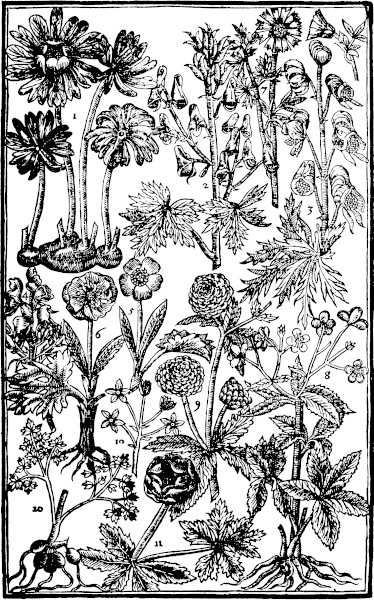
1Aconitum Hyemale. Winter Wolfesbane.
2Aconitum flore albido siue luteum Ponticum. The whitish yellow Wolfesbane.
3Napellus verus. Blew Helmets or Monkes hood.
4Anthora. The counterpoison Monkes hood.
5Ranunculus humilis albus simplex. The single white low Crowfoot.
6Ranunculus humilis albus duplici flore. The double lowe white Crowfoot.
7Ranunculus Coriandrifolio. The early Coriander leafed Crowfoot.
8Ranunculus montanus elatior albus. The great single white mountain Crowfoot.
9Ranunculus montanus albus flore pleno. The double white mountain Crowfoot.
10Ranunculus Thalictrifolio minor. The lesser Colombine leafed Crowfoot.
11Ranunculus globosus. The globe Crowfoot.
11. Ranunculus Gramineus. Grasse leafed Crowfoot
The leaues of this Crowfoote are long and narrow, somewhat like vnto Grasse, or rather like the leaues of single Gilloflowers or Pinckes, being small and sharpe pointed, a little hollow, and of a whitish greene colour; among these leaues rise vp diuers slender stalkes, bearing one small flower at the toppe of each, consisting of fiue yellow leaues, with some threads in the middle: the roote is composed of many thicke, long, round white strings.
There is another of this kinde that beareth flowers with two rowes of leaues, as if it were double, differing in nothing else.
12. Ranunculus Lusitanicus Autumnalis. The Portugall Autumne Crowfoot.
This Autumne Crowfoote hath diuers broad round leaues lying on the ground, set vpon short foote-stalkes, of a faire greene colour aboue, and grayish vnderneath, snipt all about the edges, hauing many veines in them, and sometimes swelling as with blisters or bladders on them; from among which rise vp two or three slender and hairy stalkes, bearing but one small yellow flower a peece, consisting of fiue and sometimes of six leaues, and sometimes of seuen or eight, hauing a few threads in the middle, set about a small greene head, like vnto many of the former Crowfeete, which bringeth small blacke seede: the roote is made of many thicke short white strings, which seeme to be grumous or kernelly rootes, but that they are somewhat smaller, and longer then any other of that kinde.
13. Ranunculus Creticus latifolius. The broad leafed Candy Crowfoot.
This Crowfoote of Candy, hath the greatest and broadest leaues of all the sorts of Crowfeete, being almost round, and without any great diuisions, but onely a few notches about the edges here and there, as large or larger sometimes then the palme of a mans hand; among which riseth vp the stalke, not very high when it doth first flower, but afterwards, as the other flowers doe open themselues, the stalke groweth to be a foote and a halfe high, or thereabouts, hauing some leaues on it, deeply cut in or diuided, and bearing many faire yellow flowers, consisting of fiue leaues a peece, being somewhat whitish in the middle, when the flower hath stood blowne a little time: the roote is composed of a number of small kernelly knobs, or long graines, set thicke together. This flowreth very early, being vsually in flower before the end of March, and oftentimes about the middle thereof.
14. Ranunculus Creticus albus. The white Candy Crowfoote.
The leaues of this Crowfoote are very like vnto the leaues of the red Crowfoote of Tripoli or Asia, hereafter set downe, being somewhat broad and indented about the edges, some of the leaues being also cut in or gashed, thereby making it as it were three diuisions, of a pale greene colour, with many white spots in them: the stalke riseth vp a foote high, with some leaues on it, more diuided then the lower, and diuided at the toppe into two and sometimes into three branches, each of them bearing a faire snow white flower, somewhat large, included at the first in a brownish huske or cup of leaues, which afterwards stand vnder the flowers, consisting of fiue white large round pointed leaues, in the middle whereof is set many blackish purple thrums, compassing a small long greene head, composed of many scales or chaffie whitish huskes, when they are ripe, which are the seede, but vnprofitable in all that euer I could obserue: the rootes are many small graines or kernels, set together as in the former, and much about the same colour, that is, of a darke or duskie grayish colour, but much smaller.