THE GARDEN OF PLEASANT FLOWERS. (continued 9)
Reading edition
The Vertues.
The properties hereof, no doubt, may well bee referred to the single kinde, beeing of the same qualitie, yet as I take it, a little more milde and temperate.
Chap. LVII. Parthenium flore pleno. Double Featherfew.
Featherfew that beareth double flowers is so like vnto the single kinde, that the one cannot be discerned from the other, vntill it come to flower, bearing broad, pale or fresh greene leaues, much cut in on the sides: the stalkes haue such like leaues on them as grow below, from the toppes whereof come forth many double white flowers, like vnto the flowers of the former wilde Pelletory, but larger, and like also vnto the flowers of the double Camomill: the sent whereof is as strong as of the single.
The Place.
We haue this kinde only in Gardens, and as it is thought by others, is peculiar only to our owne Countrey.
The Time.
It flowreth in the end of May, and in Iune and Iuly.
The Names.
It is called diuersly by diuers: Some thinke it to be Parthenium of Dioscorides, but not of Galen; for his Parthenium is a sweet herbe, and is thought to bee Amaracus, that is Marierome: others call it Matricaria; and some Amarella. Gaza translateth it Muraleum, Theoph. lib. 7. cap. 7. It is generally in these parts of our Country called Double Feaverfew, or Featherfew.
The Vertues.
It is answerable to all the properties of the single kinde which is vsed for womens diseases, to procure their monthly courses chiefly. It is held to bee a speciall remedy to helpe those that haue taken Opium too liberally. In Italy some vse to eate the single kinde among other greene herbes, as Camerarius saith, but especially fryed with egges, and so it wholly loseth his strong and bitter taste.
Chap. LVIII. Chamæmælum. Camomill.
Ovr ordinary Camomill is well knowne to all, to haue many smal trayling branches, set with very fine small leaues, bushing and spreading thicke ouer the ground, taking roote still as it spreadeth: the toppes of the branches haue white flowers, with yellow thrummes in the middle, very like vnto the Featherfew, before described, but somewhat greater, not so hard, but more soft and gentle in handling, and the whole herbe to be of a very sweet sent.
1. Chamæmælum nudum. Naked Camomill.
We haue another sort of Camomill in some Gardens, but very rare, like vnto the former, but that it is whiter, finer, and smaller, and raiseth it selfe vp a little higher, and beareth naked flowers; that is, without that border of white leaues that is in the former, and consisteth onely of a yellow round thrummie head, smelling almost as sweete as the former.
2. Chamæmælum flore pleno. Double flowred Camomill.
The double Camomill groweth with his leaues vpon the ground, as the other single kinde doth, but of a little fresher greene colour, and larger withall: the stalkes with the flowers on them, doe raise themselues vp a little higher then the ordinary, and bearing one or two flowers vpon a stalk, which are composed of many white leaues set together in diuers rowes, which make a fine double flower, with a little yellow spot in the middle for the most part of euery one, and are much larger then any single kinde, smelling better, and more pleasing then the ordinary: this doth creepe vpon the ground as the other, but is more tender to be kept in the Winter. Yet if you saue the flowers hereof (and so will the double Featherfew also) when they haue stood long, and ready to fade, and keepe them dry vntill the Spring, and then breaking them or pulling them to peeces, sowe them, there will spring vp from them Camomill, and also Featherfew, that will againe beare double flowers.
The Place.
Our ordinary Camomill groweth wilde in many places of our Country, and as well neare London as in other places. The others are onely found in our Gardens, where they are cherished. Bauhinus saith, that the double flowred Camomill is found wilde about Orleance in France.
The Time.
The double kinde is vsually in flower in Iune, before the ordinary kinde, and most commonly past before it flowreth, which is not vntill Iuly or August. The naked Camomill flowreth betweene them both, or later.
The Names.
Camomill is called Anthemis, Leucanthemis, and Leucanthemum, of the whitenesse of the flowers; and Chamæmælum of the corrupted Italian name Camomilla. Some call the naked Camomill, Chrysanthemum odoratum. The double Camomill is called by some Chamæmælum Romanum flore multiplici.
The Vertues.
Camomill is put to diuers and sundry vses, both for pleasure and profit, both for inward and outward diseases, both for the sicke and the sound, in bathings to comfort and strengthen the sound, and to ease paines in the diseased, as also in many other formes applyed outwardly. The flowers boyled in Posset drinke prouoke sweat, and helpe to expell colds, aches, and other griefes. A Syrupe made of the iuice of the double Camomill, with the flowers and white wine, as Bauhinus saith, is vsed by some against the Iaundise and Dropsie, caused by the euill disposition of the splene.
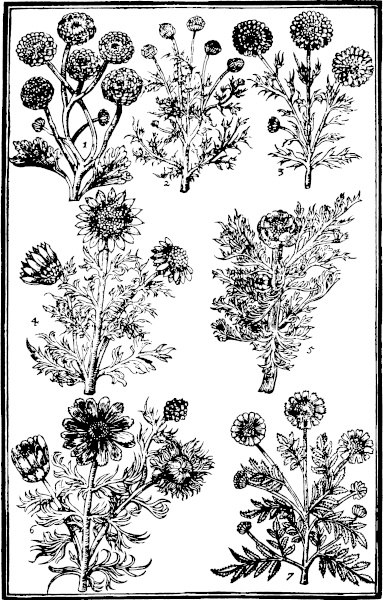
1Parthenium flore pleno. Double Featherfew.
2Chamæmælum nudum. Naked Camomill.
3Chamæmælum flore pleno. Double Camomill.
4Pyrethrum officinarum. Pelletory of Spaine.
5Flos Adonis flore rubro & flore lutea. Adonis flower both red & yellow.
6Helleborus niger ferulaceus siue Buphthalmum. The great Oxe eye or the great yellow Anemone.
7Buphthalmum vulgare. The common yellow Oxe eye.
Chap. LIX. Pyrethrum officinarum. Pelletory of Spaine.
I must needes adioyne vnto the Camomils this fine and tender plant, for some neare resemblance it hath with them in face, though not in quality. It is a small and lowe plant, bearing many fine greene leaues vpon his slender branches, which leane or lye down vpon the ground, diuided into many parts, yet somewhat larger and broader then Camomill, the stalkes whereof are bigger, and more iuicie then it: the flowers that stand at the toppes of the stalkes are single, but much larger then any Camomill flower, hauing a pale or border of many leaues, white on the vpperside, and reddish vnderneath, set about the yellow middle thrumme; but not standing so close together ioyning at the bottome, as the Camomill flowers doe, but more seuered one from another: it beareth small whitish seede, which is hardly found and discerned from the chaffe: the roote is long, and growing downe right, of the bignesse of a mans finger or thumbe in our Countrey, but not half so great where it groweth naturally, with some fibres and branches from the sides thereof, of a very hot, sharpe, and biting taste, drawing much water into the mouth, after it hath been chewed a while: the plant with vs is very tender, and will hardly or not at all endure the hardnesse and extremities of our Winters, vnlesse it be very carefully preserued.
The Place.
It groweth in Spaine wilde in many places, and in other hot Countries, where it may feele no frosts to cause it perish.
The Time.
It flowreth so late with vs, that it is not vntill August, that oftentimes we cannot gather ripe seedes from it, before it perish.
The Names.
The name Pyrethrum (taken from πὺρ, that is, ignis, fire) is giuen to this plant, because of the heate thereof, and that the roote is somewhat like in shew, but specially in property vnto the true Pyrethrum of Dioscorides, which is an vmbelliferous plant, whose rootes are greater, and more feruent a great deale, and haue a hayrie bush or toppe as Meum, and many other vmbelliferous plants haue. It is also called in Latin, Salinaris, of the effect in drawing much moisture into the mouth, to be spit out. We doe vsually call it Pelletory of Spaine.
The Vertues.
It is in a manner wholly spent to draw rheume from the teeth, by chewing it in the mouth, thereby to ease the tooth-ach, and likewise from the head, in the paines thereof.
Chap. LX. Flos Adonis flore rubro. Red Adonis flower.
Adonis flower may well be accounted a kinde of Camomill, although it hath some especiall differences, hauing many long branches of leaues lying vpon the ground, and some rising vp with the stalke, so finely cut and iagged, that they much resemble the leaues of Mayweed, or of the former Nigella: at the top of the stalkes, which rise a foote high or better, stand small red flowers, consisting of six or eight round leaues, hauing a greene head in the middle, set about with many blackish threads, without any smell at all: after the flowers are past, there grow vp heads with many roundish white seedes at the toppes of them, set close together, very like vnto the heads of seede of the great Oxe eye, set downe in the next Chapter, but smaller: the rootes are small and thready, perishing euery yeare, but rising of his owne seede againe, many times before Winter, which will abide vntill the next yeare.
Flore luteo.
Yellow Adonis flower is like vnto the red, but that the flower is somewhat larger, and of a faire yellow colour.
The Place.
The first groweth wilde in the corn fields in many places of our own country, as well as in others, and is brought into Gardens for the beauties sake of the flower. The yellow is a stranger, but noursed in our Gardens with other rarities.
The Time.
They flower in May or Iune, as the yeare falleth out to be early or late: the seed is soone ripe after, and will quickly fall away, if it be not gathered.
The Names.
Some haue taken the red kinde to be a kinde of Anemone; other to be Eranthemum of Dioscorides: the most vsuall name now with vs is Flos Adonis, and Flos Adonidis: In English, where it groweth wilde, they call it red Maythes, as they call the Mayweede, white Maythes; and some of our English Gentlewomen call it Rosarubie: we vsually call it Adonis flower.
The Vertues.
It hath been certainly tryed by experience, that the seed of red Adonis flower drunke in wine, is good to ease the paines of the Collicke and Stone.
Chap. LXI. Buphthalmum. Oxe eye.
Vnder the name Buphthalmum, or Oxe eye, are comprehended two or three seueral plants, each differing from other, both in face and property, yet because they all beare one generall name, I thinke fittest to comprise them all in one Chapter, and first of that which in leafe & seed commeth nearest to the Adonis flower.
1. Buphthalmum maius siue Helleborus niger ferulaceus. Great Oxe eye, or the yellow Anemone.
This great Oxe eye is a beautifull plant, hauing many branches of greene leaues leaning or lying vpon the ground for the most part, yet some standing vpright, which are as fine, but shorter then Fenell; some of them ending in a small tuft of green leaues, and some hauing at the toppes of them one large flower a peece, somewhat reddish or brownish on the outside, while they are in bud, and a while after, and being open, shew themselues to consist of twelue or fourteene long leaues, of a faire shining yellow colour, set in order round about a greene head, with yellow thrums in the middle, laying themselues open in the sunne, or a faire day, but else remaining close: after the flower is past, the head growing greater, sheweth it selfe compact of many round whitish seede, very like vnto the head of seede of the Adonis flower last described, but much greater: the rootes are many long blackish fibres or strings, set together at the head, very like vnto the rootes of the lesser blacke Hellebor or Bearefoote, but somewhat harder, stiffer, or more brittle, and seeming without moisture in them, which abide and encrease euery yeare.
2. Buphthalmum minus, seu Anthemis flore luteo. Small Oxe eye.
This plant might seeme to be referred to the Camomils, but that it is not sweete, or to the Corne-Marigolds, but that the stalkes and leaues are not edible: it is therefore put vnder the Oxe eyes, and so we will describe it; hauing many weake branches lying vpon the ground, beset with winged leaues, very finely cut and iagged, somewhat like vnto Mayweede, but a little larger; the flowers are like vnto the Corne Marigold, and larger then any Camomill, being wholly yellow, as well the pale or border of leaues, as the middle thrummes: the rootes are somewhat tough and long.
3. Buphthalmum vulgare. Common Oxe eye.
This Oxe eye riseth vp with hard round stalkes, a foote and a halfe high, hauing many winged leaues vpon them, made of diuers long and something broad leaues, snipt about the edges, set together somewhat like vnto Tansie, but smaller, and not so much winged: the flowers stand at the toppes of the stalkes, of a full yellow colour, both the outer leaues and the middle thrum, and not altogether so large as the last: the rootes of this kinde perish euery yeare, and require a new sowing againe.
The Place.
The first groweth in diuers places of Austria, Bohemia, and those parts, it hath beene likewise brought out of Spaine. The second in Prouence, a country in France. The last in diuers places, as well of Austria as Morauia, and about Mentz and Norimberg, as Clusius setteth downe. We haue them in our Gardens, but the first is of the greatest respect and beauty.
The Time.
The first flowreth betimes, oftentimes in March, or at the furthest in Aprill; the seede is ripe in May, and must be quickly gathered, lest it bee lost. The other two flower not vntill Iune.
The Names.
The first is called Buphthalmum of Dodonæus, Pseudohelleborus of Matthiolus, Helleborus niger ferulaceus Theophrasti by Lobel, of some others Elleborus niger verus, vsing it for the true blacke Ellebor, but it is much differing, as well in face as properties. Of others Sesamoides minus. Some haue thought it to be a yellow Anemone, that haue looked on it without further iudgement, and by that name is most vsually knowne to most of our English Gentlewomen that know it. But it may most fitly be called a Buphthalmum, as Dodonæus doth, and Hispanicum or Austriacum, for distinctions sake. We doe most vsually call it Helleborus niger ferulaceus, as Lobel doth: Bauhinus calleth it Helleborus niger tenuifolius Buphthalmi flore. The second is called Buphthalmum Narbonense: In English, The French, or lesser Oxe eye, as the first is called, The great Oxe eye. The last, The common Oxe eye.
The Vertues.
The first hath been vsed in diuers places for the true blacke Ellebor, but now is sufficiently knowne to haue been an errour; but what Physicall property hath, other then Matthiolus hath expressed, to be vsed as Setterwort for cattell, when they rowell them, to put or draw the rootes hereof through the hole they make in the dewe lappe, or other places, for their coughes or other diseases, I know not, or haue heard or read of any. The others likewise haue little or no vse in Physicke now a dayes that I know.
Chap. LXII. Chrysanthemum. Corne Marigold.
Although the sorts of Corne Marigolds, which are many, are fitter for another then this worke, and for a Catholicke Garden of Simples, then this of Pleasure and Delight for faire Flowers; yet giue me leaue to bring in a couple: the one for a corner or by-place, the other for your choisest, or vnder a defenced wall, in regard of his statelinesse.
1. Chrysanthemum Creticum. Corne Marigold of Candy.
This faire Corne Marigold hath for the most part one vpright stalke, two foote high, whereon are set many winged leaues, at euery ioynt one, diuided and cut into diuers parts, and they againe parted into seuerall peeces or leaues: the flowers growe at the toppes of the stalkes, rising out of a scaly head, composed of ten or twelue large leaues, of a faire, but pale yellow colour, and more pale almost white at the bottome of the leaues, round about the yellow thrumme in the middle, being both larger and sweeter then any of the other Corne Marigolds: the seede is whitish and chaffie: the roote perisheth euery yeare.
2. Chrysanthemum Perüuianum, siue Flos Solis. The golden flower of Peru, or the Flower of the Sunne.
This goodly and stately plant, wherewith euery one is now a dayes familiar, being of many sorts, both higher and lower (with one stalke, without branches, or with many branches, with a blacke, or with a white seede, yet differing not in forme of leaues or flowers one from another, but in the greatnesse or smalnesse) riseth vp at the first like vnto a Pompion with two leaues, and after two, or foure more leaues are come forth, it riseth vp into a great stalke, bearing the leaues on it at seuerall distances on all sides thereof, one aboue another vnto the very toppe, being sometimes, and in some places, seuen, eight, or ten foote high, which leaues standing out from the stemme or stalke vpon their seuerall great ribbed foote-stalkes, are very large, broad belowe, and pointed at the end, round, hard, rough, of a sad greene colour, and bending downewards: at the toppe of the stalke standeth one great, large, and broad flower, bowing downe the head vnto the Sunne, and breaking forth from a great head, made of scaly greene leaues, like vnto a great single Marigold, hauing a border of manie long yellow leaues, set about a great round yellow thrumme, as it were in the middle, which are very like vnto short heads of flowers, vnder euery one whereof there is a seede, larger then any seede of the Thistles, yet somewhat like, and lesser, and rounder then any Gourd seede, set in so close and curious a manner, that when the seede is taken out, the head with the hollow places or cels thereof seemeth very like vnto an hony combe; which seede is in some plants very blacke, in the hotter countries, or very white, and great, or large, but with vs is neither so large, blacke, or white; but sometimes blackish or grayish. Some sort riseth not vp halfe the height that others doe, and some againe beare but one stemme or stalke, with a flower at the toppe thereof; and others two or three, or more small branches, with euery one his flower at the end; and some so full of branches from the very ground almost, that I haue accounted threescore branches round about the middle stalke of one plant, the lowest neare two yards long, others aboue them a yard and a halfe, or a yard long, with euery one his flower thereon; but all smaller then those that beare but one or two flowers, and lesser also for the most part then the flower on the middle stalke it selfe. The whole plant, and euery part thereof aboue ground hath a strong resinous sent of Turpentine, and the heads and middle parts of the flowers doe oftentimes (and sometimes the ioynts of the stalke where the leaues stand) sweat out a most fine thin & cleare Rossin or Turpentine, but in small quantity, and as it were in drops, in the heate and dry time of the year, so like both in colour, smell, and taste vnto cleare Venice Turpentine, that it cannot be knowne from it: the roote is strongly fastened in the ground by some greater roots branching out, and a number of small strings, which growe not deepe, but keepe vnder the vpper crust of the earth, and desireth much moisture, yet dyeth euery yeare with the first frosts, and must be new sowne in the beginning of the Spring.
The Place.
Their places are set downe in their titles, the one to come out of Candy, the other out of Peru, a Prouince in the West Indies.
The Time.
The first flowreth in Iune, the other later, as not vntill August, and sometimes so late, that the early frosts taking it, neuer suffer it to come to ripeness.
The Names.
The first hath his name in his title. The second, besides the names set downe, is called of some Planta maxima, Flos maximus, Sol Indianus, but the most vsuall with vs is, Flos Solis: In English, The Sunne Flower, or Flower of the Sunne.
The Vertues.
There is no vse of either in Physicke with vs, but that sometimes the heads of the Sunne Flower are dressed, and eaten as Hartichokes are, and a accounted of some to be good meate, but they are too strong for my taste.
Chap. LXIII. Calendula. Marigolds.
Some haue reckoned vp many sorts of Marigolds, I had rather make but two, the single and the double; for doubtlesse, those that be most double, rise from the best seede, which are the middlemost of the great double, and some would be lesse double, whose seede is greater then the rest, according to the ground where it groweth; as also those that be of a paler colour, doe come of the seed of the yellower sort.
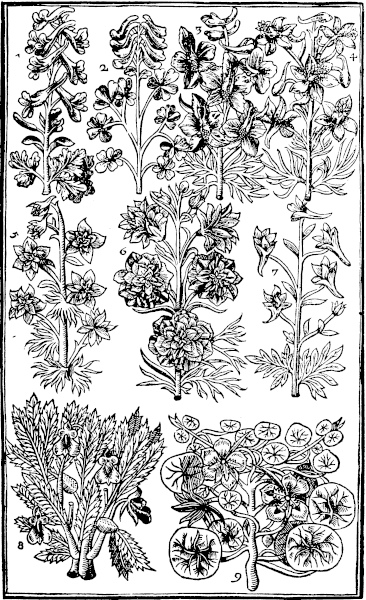
1Chrysanthemum Creticum. Corne Marigolds of Candy.
2Flos Solis. The Flower of the Sunne.
3Calendula. Marigolds.
4Aster Atticus siue Italorum. The Purple Marigold.
5Pilosella maior. Golden Mouse-eare.
6Scorsonera Hispanica. Spanish Vipers grasse.
7Tragopogon. Goates beard, or goe to bed at noone.
1. Calendula maxima. The great Garden Marigold.
Garden Marigold hath round greene stalkes, branching out from the ground into many parts, whereon are set long flat greene leaues, broader and rounder at the point then any where else, and smaller also at the setting to of the stalke, where it compasseth it about: the flowers are sometimes very thicke and double (breaking out of a scaly clammy greene head) composed of many rowes of leaues, set so close together one within another, that no middle thrume can bee seene, and sometimes lesse double, hauing a small browne spot of a thrume in the middle: and sometimes but of two or three rowes of leaues, with a large browne thrume in the middle; euery one whereof is somewhat broader at the point, and nicked into two or three corners, of an excellent faire deepe gold yellow colour in some, and paler in others, and of a pretty strong and resinous sweete sent: after the flowers are past, there succeede heads of crooked seede, turning inward, the outermost biggest, and the innermost least: the roote is white, and spreadeth in the ground, and in some places will abide after the seeding, but for the most part perisheth, and riseth againe of his owne seede. Sometimes this Marigold doth degenerate, and beareth many small flowers vpon short stalkes, compassing the middle flower: but this happeneth but seldome, and therefore accounted but lusus naturæ, a play of nature, which she worketh in diuers other plants besides.
2. Calendula simplex. The single Marigold.
There is no difference betweene this and the former, but that the flowers are single, consisting of one rowe of leaues, of the same colour; eyther paler or deeper yellow, standing about a great browne thrumme in the middle: the seed likewise is alike, but for the most part greater then in the double kindes.
The Place.
Our Gardens are the chiefe places for the double flowers to grow in; for we know not of any other naturall place: but the single kinde hath beene found wilde in Spaine, from whence I receiued seede, gathered by Guillaume Boel, in his time a very curious, and cunning searcher of simples.
The Time.
They flower all the Summer long, and sometimes euen in winter, if it be milde, and chiefly at the beginning of those monethes, as it is thought.
The Names.
They are called Caltha of diuers, and taken to be that Caltha, whereof both Virgil and Columella haue written. Others doe call them Calendula, of the Kalendes, that is the first day of the monthes, wherein they are thought chiefly to flower; and thereupon the Italians call them Fiori di ogni mese, that is, The Flowers of euery moneth: We cal them in English generally, eyther Golds, or Marigolds.
The Vertues.
The herbe and flowers are of great vse with vs among other pot-herbes, and the flowers eyther greene or dryed, are often vsed in possets, broths, and drinkes, as a comforter of the heart and spirits, and to expel any malignant or pestilential quality, gathered neere thereunto. The Syrupe and Conserue made of the fresh flowers are vsed for the same purposes to good effect.
Chap. LXIIII. Aster. Starre-wort.
Dioscorides and other of the ancient Writers, haue set forth but one kinde of Starre-wort, which they call Aster Atticus, of the place no doubt, where the greatest plentie was found, which was the Countrey of Athens: the later Writers haue found out many other plants which they referre to this kinde, calling them by the same name. It is not my purpose to entreate of them all, neyther doth this garden fitly agree with them; I shall therefore select out one or two from the rest, and giue the knowledge of them, leauing the rest to their proper place.
1. Aster Atticus flore luteo. Yellow Starre-wort.
This Starre-wort riseth vp with two or three rough hairy stalkes, a foote and a halfe high, with long, rough or hairie, brownish, darke greene leaues on them, diuided into two or three branches: at the toppe of euery one whereof standeth a flat scaly head, compared vnderneath with fiue or sixe long, browne, rough greene leaues, standing like a Starre, the flower it selfe standing in the middle thereof, made as a border of narrow, long, pale yellow leaues, set with a brownish yellow thrume: the roote dyeth euery yeare, hauing giuen his flower.
2. Aster Atticus Italorum flore purpureo. Purple Italian Starre-wort.
This Italian Starre-wort hath many wooddy, round brittle stalkes, rising from the roote, somewhat higher then the former, sometimes standing vpright, and otherwhiles leaning downewards, whereon are set many somewhat hard, and rough long leaues, round pointed, without order vp to the toppe, where it is diuided into seuerall branches, whereon stand the flowers, made like vnto a single Marigold, with a border of blewish purple leaues, set about a browne middle thrume, the heads sustaining the flowers are composed of diuers scaly greene leaues, as is to be seene in the Knapweedes or Matfelons, which after the flowers are past yeelde a certaine downe, wherein lye small blacke and flat seedes, somewhat like vnto Lettice seede, which are carried away with the winde: the roote is composed of many white strings, which perisheth not as the former, but abideth, and springeth afresh euery yeare.
The Place.
The first is found in Spaine, as Clusius, and in France, as Lobel say. The other hath beene found in many places in Germany, and Austria: in Italie also, and other places; we haue it plentifully in our Gardens.
The Time.
The first flowreth in Summer. And the other not vntill August or September.
The Names.
The first is called Aster Atticus flore luteo, Bubonium, & Inguinalis, and of many is taken to be the true Aster Atticus of Dioscorides: yet Matthiolus thinketh not so, for diuers good reasons, which hee setteth downe in the Chapter of Aster Atticus, as any man may vnderstand, if they will but reade the place, which is too long to bee inserted here. The other is thought by Matthiolus, to bee the truer Aster Atticus, (vnto whom I must also consent) and constantly also affirmed to be the Amellus Virgilij, as may be seene in the same place: but it is usually called at this day, Aster Italorum flore cæruleo or purpureo. Their English names are sufficiently expressed in their titles, yet some call the last, The purple Marigold, because it is so like vnto one in form.
The Vertues.
They are held, if they bee the right, to bee good for the biting of a mad dogge, the greene herbe being beaten with old hogs grease, and applyed; as also for swolne throats: It is likewise vsed for botches that happen in the groine, as the name doth import.
Chap. LXV. Pilosella maior. Golden Mouse-eare.
Some resemblance that the flowers of this plant hath with the former Golds, maketh me to insert it in this place, although I know it agreeth not in any other part, yet for the pleasant aspect thereof, it must bee in this my garden, whose description is as followeth: It hath many broade greene leaues spread vpon the ground, spotted with pale spots, yet more conspicuous at sometimes then at other; somewhat hairy both on the vpper and vnderside, in the middle of these leaues rise vp one, two or more blackish hairy stalkes, two foote high at the least, bare or naked vp to the top, where it beareth an vmbell, or short tuft of flowers, set close together vpon short stalkes, of the forme or fashion of the Haukeweedes, or common Mouse-eare, but somewhat smaller, of a deep gold yellow, or orenge tawney colour, with some yellow threds in the middle, of little or no sent at all: after the flowers are past, the heads carry small, short, blacke seede, with a light downie matter on them, ready to bee carried away with the winde, as many other plants are, when they be ripe: the rootes spread vnder ground, and shoote vp in diuers other places, whereby it much encreaseth, especially if it be set in any moist or shadowie place.
The Place.
It groweth in the shadowie woods of France, by Lions, and Mompelier, as Lobell testifieth: we keepe it in our gardens, and rather in a shadowie then sunnie place.
The Time.
It flowreth in Somer, and sometimes againe in September.
The Names.
It is called by Lobell, Pulmonaria Gallorum Hieratij facie: and the Herbarists of France take it to be the true Pulmonaria of Tragus. Others call it Hieratium flore aureo. Pelleterius Hieratium Indicum. Some Pilosella, or Auricula muris maior flore aureo. And some Chondrilla flore aureo. Dalechamptus would haue it to bee Corchorus, but farre vnfitly. The fittest English name we can giue it, is Golden Mouse-eare, which may endure vntill a fitter bee imposed on it: for the name of Grim the Collier, whereby it is called of many, is both idle and foolish.
The Vertues.
The French according to the name vse it for the defects of the lunges, but with what good successe I know not.
Chap. LXVI. Scorsonera. Vipers grasse.
Although there be foure or fiue sorts of Scorsonera, yet I shall here desire you to be content with the knowledge only of a couple.
1. Scorsonera Hispanica maior. The greater Spanish Vipers grasse.
This Spanish Vipers grasse hath diuers long, and somewhat broad leaues, hard and crumpled on the edges, and sometimes vneuenly cut in or indented also, of a blewish greene colour: among which riseth vp one stalke, and no more for the most part, two foote high or thereabouts, hauing here and there some narrower long leaues thereon then those below: the toppe of the stalke brancheth it selfe forth into other parts, euery one bearing a long scaly head, from out of the toppe whereof riseth a faire large double flower, of a pale yellow colour, much like vnto the flower of yellow Goates beard, but a little lesser, which being past, the seede succeedeth, being long, whitish and rough, inclosed with much downe, and among them many other long smooth seedes, which are limber and idle, and are carryed away at the will of the winde: the roote is long, thicke and round, brittle and blacke, with a certaine roughnesse on the outside: but very white within, yeelding a milkie liquor being broken, as euery other part of the plant doth besides, yet the roote more then any other part, and abideth many yeares without perishing.
2. Scorsonera Pannonica purpurea. Purple flowred Vipers grasse.
This purple flowred Vipers grasse hath long and narrow leaues, of the same blewish greene colour with the former: the stalke riseth vp a foote and a halfe high, with a few such like leaues, but shorter thereon, breaking at the toppe into two or three parts, bearing on each of them one flower, fashioned like the former, and standing in the like scaly knoppe or head, but of a blewish purple colour, not fully so large, of the sweetest sent of any of this kinde, comming neerest vnto the smell of a delicate perfume.
The Place.
The first is of Spaine. The other of Hungarie and Austrich: which now furnish our gardens.
The Time.
They flower in the beginning of May: the seede is soone ripe after, and then perishing downe to the roote for that yeare, springeth afresh before Winter againe.
The Names.
They are called after the Spanish name Scorsonera, which is in Latine Viperaria, of some Viperina, and Serpentina: Wee call them in English Vipers grasse, or Scorsonera.
The Vertues.
Manardus as I thinke first wrote hereof, and saith that it hath been found to cure them that are bitten of a Viper, or other such like venemous Creature. The rootes hereof being preserued with sugar, as I haue done often, doe eate almost as delicate as the Eringus roote, and no doubt is good to comfort and strengthen the heart, and vitall spirits. Some that haue vsed the preserued roote haue found it effectuall to expelling winde out of the stomacke, and to helpe swounings and faintnesse of the heart.
Chap. LXVII. Tragopogon. Goates beard.
I must in this place set downe but two sorts of Goates beards; the one blew or ash-colour, the other red or purple, and leaue the other kindes: some to bee spoken of in the Kitchin Garden, and others in a Physicall Garden.
1. Tragopogon flore cæruleo. Blew Goates beard.
All the Goates beards haue long, narrow, and somewhat hollow whitish greene leaues, with a white line downe the middle of euery one on the vpperside: the stalke riseth vp greater and stronger then the Vipers grasse, bearing at the toppe a great long head or huske, composed of nine or ten long narrow leaues, the sharpe points or ends whereof rise vp aboue the flower in the middle, which is thicke and double, somewhat broad and large spread, of a blewish ash-colour, with some whitish threads among them, shutting or closing it selfe within the greene huske euery day, that it abideth blowing, vntill about noone, and opening not it selfe againe vntill the next morning: the head or huske, after the flower is past, and the seede neare ripe, openeth it selfe; the long leaues thereof, which closed not before now, falling downe round about the stalke, and shewing the seede, standing at the first close together, and the doune at the toppe of them: but after they haue stood a while, it spreadeth it selfe round, and is ready to be carried away with the winde, if it be not gathered: the seede it selfe is long, round, and rough, like the seede of the Vipers grasse, but greater and blacker: the roote is long, and not very great, but perisheth as soone as it hath borne seede, and springeth of the fallen seede, that yeare remaining greene all Winter, and flowring the next yeare following: the whole yeeldeth milke as the former, but somewhat more bitter and binding.
2. Tragopogon purpureum. Purple Goates beard.
There is little difference in this kind from the former, but that it is a little larger, both in the leafe, and head that beareth the seed: the flowers also are a little larger, and spread more, of a darke reddish purple colour, with some yellow dust as it were cast vpon it, especially about the ends: the roote perisheth in the like manner as the other.
The Place.
Both these haue been sent vs from the parts beyond the Seas, I haue had them from Italy, where no doubt they grow naturally wilde, as the yellow doth with vs: they are kept in our Gardens for their pleasant flowers.
The Time.
They flower in May and Iune: the seede is ripe in Iuly.
The Names.
Their generall name is after the Greeke word Tragopogon, which is in Latine, Barbahirci: In English, Goates beard; the head of seede when it is readie to bee carried away with the winde, causing that name for the resemblance: and because the flower doth euery day close it selfe at noone (as I said before) and openeth not againe vntill the next Sunne, some haue fitly called it, Goe to bed at noone.
The Vertues.
The rootes of these kindes are a little more bitter and more binding also then the yellow kinde expressed in the Kitchin Garden; and therefore fitter for medicine then for meate, but yet is vsed as the yellow kinde is, which is more fit for meate then medicine. The distilled water is good to wash old sores and wounds.
Chap. LXVIII. Flos Africanus. The French Marigold.
Of the French or African Marigolds there are three kindes as principall, and of each of them both with single and double flowers: of these, some diuersity is obserued in the colour of the flowers, as well as in the forme or largenesse, so that as you may here see, I haue expressed eight differences, and Fabius Columna nine or ten, in regard hee maketh a diuersity of the paler and deeper yellow colour: and although the lesser kinde, because of its euill sent, is held dangerous, yet for the beauty of the flower it findeth roome in Gardens.
1. Flos Africanus maior siue maximus multiplex. The great double French Marigold.
This goodly double flower, which is the grace and glory of a Garden in the time of his beauty, riseth vp with a straight and hard round greene stalke, hauing some crests or edges all along the stalke, beset with long winged leaues, euery one whereof is like vnto the leafe of an Ash, being composed of many long and narrow leaues, snipt about the edges, standing by couples one against another, with an odde one at the end, of a darke or full greene colour: the stalke riseth to be three or foure foote high, and diuideth it selfe from the middle thereof into many branches, set with such like leaues to the toppes of them, euery one bearing one great double flower, of a gold yellow colour aboue, and paler vnderneath, yet some are of a pale yellow, and some betweene both, and all these rising from one and the same seede: the flower, before it be blowne open, hath all the leaues hollow; but when it is full blowne open, it spreadeth it selfe larger then any Prouince Rose, or equall vnto it at the least, if it be in good earth, and riseth out of a long greene huske, striped or furrowed, wherein after the flower is past, (which standeth in his full beauty a moneth, and oftentimes more, and being gathered, may be preserued in his full beauty for two moneths after, if it be set in water) standeth the seede, set thicke and close together vpright, which is blacke, somewhat flat and long: the roote is full of small strings, whereby it strongly comprehendeth in the ground: the flower of this, as well as the single, is of the very smell of new waxe, or of an honie combe, and not of that poisonfull sent of the smaller kindes.
2. Flos Africanus maior simplex. The great single French Marigold.
This single Marigold is in all things so like vnto the former, that it is hard to discerne it from the double, but by the flowers, onely the stalke will be browner then the double; and to my best obseruation, hath and doth euery yeare rise from the seede of the double flower: so that when they are in flower, you may see the difference (or not much before, when they are in bud) this single flower euer appearing with thrums in the middle, and the leaues, which are the border or pale standing about them, shewing hollow or fistulous, which after lay themselues flat and open (and the double flower appearing with all his leaues folded close together, without any thrum at all) and are of a deeper or paler colour, as in the double.
3. Flos Africanus fistuloso flore simplex & multiplex. Single and double French Marigolds with hollow leafed flowers.
As the former two greatest sorts haue risen from the seede of one and the same (I meane the pod of double flowers) so doe these also, not differing from it in anything, but that they are lower, and haue smaller greene leaues, and that the flower also being smaller, hath euery leafe abiding hollow, like vnto an hollow pipe, broad open at the mouth, and is of as deepe a yellow colour for the most part as the deepest of the former, yet sometimes pale also.
4. Flos Africanus minor multiplex. The lesser double French Marigold.
The lesser double French Marigold hath his leaues in all things like vnto the former, but somewhat lesser, which are set vpon round browne stalkes, not so stiffe or vpright, but bowing and bending diuers wayes, and sometimes leaning or lying vpon the ground: the stalkes are branched out diuersly, whereon are set very faire double flowers like the former, and in the like greene huskes, but smaller, and in some the outermost leaues will be larger then any of the rest, and of a deeper Orenge colour, almost crimson, the innermost being of a deepe gold yellow colour, tending to crimson; the whole flower is smaller, and of a stronger and more vnpleasant sauour, so that but for the beautifull colour, and doublenesse of the flower, pleasant to the eye, and not to any other sense, this kinde would finde roome in few Gardens: the rootes and seedes are like the former, but lesser.
5. Flos Africanus minor simplex. The small single French Marigold.
This single kinde doth follow after the last in all manner of proportion, both of stalkes, leaues, seedes, and rootes: the flowers onely of this are single, hauing fiue or six broad leaues, of a deepe yellow crimson colour, with deepe yellow thrummes in the middle, and of as strong a stinking sent, or more then the last.
The Place.
They growe naturally in Africa, and especially in the parts about Tunis, and where old Carthage stood, from whence long agoe they were brought into Europe, where they are onely kept in Gardens, being sowne for the most part euery yeare, vnlesse in some milde Winters. The last single and double kindes (as being more hardy) haue sometimes endured: but that kinde with hollow leafed flowers, as Fabius Columna setteth it downe, is accounted to come from Mexico in America.
The Time.
They flower not vntill the end of Summer, especially the greater kindes: but the lesser, if they abide all the Winter, doe flower more early.
The Names.
They haue been diuersly named by diuers men: Some calling them Caryophyllus Indicus, that is, Indian Gilloflowers, and Tanacetum Perüvianum, Tansie of Peru, as if it grew in Peru, a Prouince of America; and Flos Indicus, as a flower of the Indies; but it hath not been knowne to haue beene brought from thence. Others would haue it to be Othonna of Plinie, and others; some to be Lycopersicum of Galen. It is called, and that more truely, Flos Tunetensis, Flos Africanus, and Caltha Africana, that is, the flower of Tunis, the flower of Africa, the Marigold of Africa, and peraduenture Pedna Pænorum. We in English most vsually call them, French Marigolds, with their seuerall distinctions of greater or smaller, double or single. To that with hollow leafed flowers, Fabius Columna giueth the name of Fistiloso flore, and I so continue it.
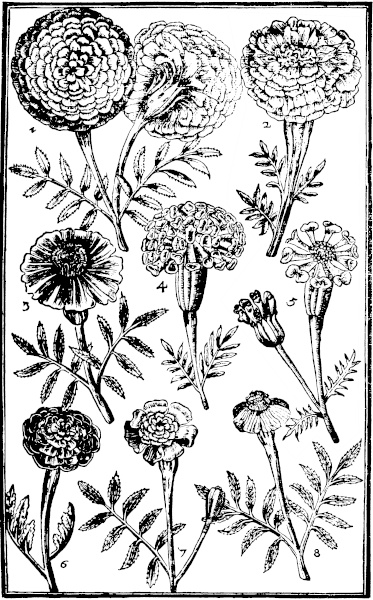
1Flos Africanus maximus multiplex. The greatest double French Marigold.
2Flos Africanus maior multiplex. The greater double French Marigold.
3Flos Africanus maximus simplex. The greatest single French Marigold.
4Flos Africanus multiplex fistulosus. The double hollow French Marigold.
5Flos Africanus simplex fistulosus. The single hollow French Marigold.
6Flos Africanus minor multiplex. The smaller double French Marigold.
7Flos Africanus minor multiplex alter. Another sort of the lesser double French Marigold.
8Flos Africanus minor simplex. The lesser single French Marigold.
The Vertues.
We know no vse they haue in Physicke, but are cherished in Gardens for their beautifull flowers sake.
Chap. LXIX. Caryophyllus hortensis. Carnations and Gilloflowers.
To auoide confusion, I must diuide Gilloflowers from Pinkes, and intreate of them in seuerall Chapters. Of those that are called Carnations or Gilloflowers, as of the greater kinde, in this Chapter; and of Pinkes, as well double as single, in the next. But the number of them is so great, that to giue seuerall descriptions to them all were endlesse, at the least needlesse: I will therefore set downe onely the descriptions of three (for vnto these three may be referred all the other sorts) for their fashion and manner of growing, and giue you the seuerall names (as they are vsually called with vs) of the rest, with their variety and mixture of colours in the flowers, wherein consisteth a chiefe difference. I account those that are called Carnations to be the greatest, both for leafe and flower, and Gilloflowers for the most part to bee lesser in both; and therefore will giue you each description apart, and the Orenge tawnie or yellow Gilloflower likewise by it selfe, as differing very notably from all the rest.
1. Caryophyllus maximus Harwicensis siue Anglicus. The great Harwich or old English Carnation.
I take this goodly great old English Carnation, as a president for the description of all the rest of the greatest sorts, which for his beauty and statelinesse, is worthy of a prime place, hauing beene alwayes very hardly preserued in the Winter; and therefore not so frequent as the other Carnations or Gilloflowers. It riseth vp with a great thicke round stalke, diuided into seuerall branches, somewhat thickly set with ioynts, and at euery ioynt two long greene rather then whitish leaues, somewhat broader then Gilloflower leaues, turning or winding two or three times round (in some other sorts of Carnations they are plaine, but bending the points downewards, and in some also of a darke reddish greene colour, and in others not so darke, but rather of a whitish greene colour:) the flowers stand at the toppes of the stalkes in long, great, and round greene huskes, which are diuided into fiue points, out of which rise many long and broad pointed leaues, deeply iagged at the ends, set in order round and comely, making a gallant great double flower, of a deepe Carnation colour, almost red, spotted with many blush spots and strakes, some greater and some lesser, of an excellent soft sweete sent, neither too quicke as many others of these kinds are, nor yet too dull, and with two whitish crooked threads like hornes in the middle: this kinde neuer beareth many flowers, but as it is slow in growing, so in bearing, not to be often handled, which sheweth a kinde of statelinesse, fit to preserue the opinion of magnificence: the roote is branched into diuers great, long, wooddy rootes, with many small fibres annexed vnto them.
2. Caryophyllus hortensis flore pleno rubro. The red or Cloue Gilloflower.
The red Cloue Gilloflower, which I take as a president for the second sort, which are Gilloflowers, grow like vnto the Carnations, but not so thicke set with ioynts and leaues: the stalkes are more, the leaues are narrower and whiter for the most part, and in some doe as well a little turne: the flowers are smaller, yet very thicke and double in most, and the greene huskes wherein they stand are smaller likewise then the former: the ends of the leaues in this flower, as in all the rest, are dented or iagged, yet in some more then in others; some also hauing two small white threads, crooked at the ends like hornes,in the middle of the flower, when as diuers other haue none. These kindes, and especially this that hath a deepe red crimson coloured flower, doe endure the cold of our winters, and with lesse care is preserued: these sorts as well as the former doe very seldome giue any seede, as far as I could euer obserue or learne.
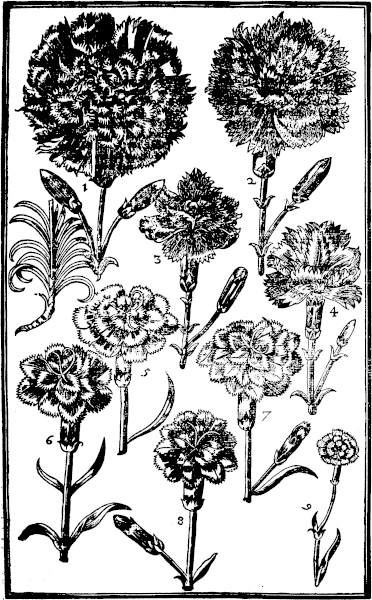
1Caryophyllus maximus rubro varius. The great old Carnation or gray Hulo.
2Caryophyllus maior rubro & albo varius. The white Carnation.
3Caryophyllus albo rubens. The Cambersine or the Poole flower.
4Caryophyllus Cantij striatus. The faire made of Kent.
5Caryophyllus Sabaudicus carneus. The blush Sauadge.
6Caryophyllus Xerampelinus. The Gredeline Carnation.
7Caryophyllus dictus Grimelo. The Grimelo or Prince.
8Caryophyllus albus maior. The great white Gilloflower.
9Elegans Heroina Bradshawij. Master Bradshawes dainty Lady.
3. Caryophyllus Silesiacus flore pleno miniato. The yellow or Orenge tawny Gilloflower.
This Gilloflower hath his stalkes next vnto the ground, thicker set, and with smaller or narrower leaues then the former for the most part: the flowers are like vnto the Cloue Gilloflowers, and about the same bignesse and doublenesse most vsually, yet in some much greater then in others; but of a pale yellowish Carnation colour, tending to an Orenge, with two small white threds, crooked at the ends in the middle, yet some haue none, of a weaker sent then the Cloue Gilloflower: this kinde is more apt to beare seede then any other, which is small, black, flat, and long, and being sowen, yeelde wonderfull varieties both of single and double flowers: some being of a lighter or deeper colour then the mother plants: some with stripes in most of the leaues: Others are striped or spotted, like a speckled Carnation or Gilloflower, in diuers sorts, both single and double: Some againe are wholly of the same colour, like the mother plant, and are eyther more or lesse double then it, or else are single with one row of leaues, like vnto a Pinck; and some of these likewise eyther wholly of a crimson red, deeper or lighter, or variably spotted, double or single as a Pinck, or blush eyther single or double, and but very seldome white: yet all of them in their greene leaues little or nothing varying or differing.
{Carnations and Gilloflowers}
Caryophylli maximi.
Carnations.
Caryophyllus maximus dictus Hulo rubro-varius.
The gray Hulo hath as large leaues as the former old Carnation, and as deepely iagged on the edges: it hath a great high stalke, whereon stand the flowers, of a deepe red colour, striped and speckled very close together with a darkish white colour.
Caryophyllus maximus dictus Hulo ruber non variatus.
The red Hulo is also a faire great flower, of a stamell colour, deeply iagged as the former, and groweth very comely without any spot at all in it, so that it seemeth to bee but a stamell Gilloflower, saue that it is much greater.
Caryophyllus maximus dictus Hulo cæruleo purpureus.
The blew Hulo is a goodly faire flower, being of a faire purplish murrey colour, curiously marbled with white, but so smally to be discerned, that it seemeth only purple, it hath so much the Mastrie in it; it resembleth the Brassill, but that it is much bigger.
Caryophyllus maximus dictus Grimelo siue Princeps.
The Grimelo or Prince is a faire flower also, as large as any Chrystall or larger, being of a faire crimson colour, equally for the most part striped with white, or rather more white then red, thorough euery leafe from the bottome, and standeth comely.
Caryophyllus maximus Incarnadinus albus.
The white Carnation or Delicate, is a goodly delightfull fair flower in his pride and perfection, that is, when it is both marbled and flaked, or striped and speckled with white vpon an incarnate crimson colour, beeing a very comely flower, but abideth not constant, changing oftentimes to haue no flakes or strakes of white, but marbled or speckled wholly.
Caryophyllus maximus Incarnadinus Gallicus.
The French Carnation is very like vnto the white Carnation, but that it hath more specks, and fewer stripes or flakes of white in the red, which hath the mastrie of the white.
Caryophyllus maximus Incarnadinus grandis.
The ground Carnation (if it be not the same with the graund or great old Carnation first set downe, as the alteration but of one letter giueth the coniecture) is a thicke flower, but spreadeth not his leaues abroade as others doe, hauing the middle standing higher then the outer leaues, and turning vp their brimmes or edges; it is a sad flower, with few stripes or spots in it: it is very subiect to breake the pod, that the flower seldome commeth faire and right; the greene leaues are as great as the Hulo or Lombard red.
Caryophyllus maximus Chrystallinus.
The Chrystall or Chrystalline (for they are both one, howsoeuer some would make them differ) is a very delicate flower when it is well marked, but it is inconstant in the markes, being sometimes more striped with white and crimson red, and sometimes lesse or little or nothing at all, and changing also sometimes to be wholly red, or wholly blush.
Caryophyllus maximus flore rubro.
The red Chrystall, which is the red hereof changed, is the most orient flower of all other red Gilloflowers, because it is both the greatest, as comming from the Chrystall, as also that the red hereof is a most excellent crimson.
Caryophyllus maximus dictus Fragrans.
The Fragrant is a faire flower, and thought to come from the Chrystall, being as large, but of a blush red colour, spotted with small speckes, no bigger then pinnes points, but not so thicke as in the Pageant.
Caryophyllus maximus Sabaudicus varius.
The stript Sauadge is for forme and bignesse equall with the Chrystall or White Carnation, but as inconstant as eyther of them, changing into red or blush, so that few branches with flowers containe their true mixtures, which are a whitish blush, fairely striped with a crimson red colour, thicke and short, with some spots also among.
Caryophyllus maximus Sabaudicus carneus.
The blush Sauadge is the same with the former, the same root of the stript Sauadge, as I said before, yeelding one side or part whose flowers will be eyther wholly blush, or hauing some small spots, or sometimes few or none in them.
Caryophyllus maximus Sabaudicus ruber.
The red Sauadge is as the blush, when the colour of the flower is wholly red without any stripes or spots in them, and so abideth long; yet it is sometimes seene, that the same side, or part, or roote being separate from the first or mother plant, will giue striped and well marked flowers againe.
Caryophyllus maximus Oxoniensis.
The Oxeford Carnation is very like vnto the French Carnation, both for forme, largenesse and colour; but that this is of a sadder red colour, so finely marbled with white thereon, that the red hauing the maistry, sheweth a very sad flower, not hauing any flakes or stripes at all in it.
Caryophyllus maximus Regius, siue Bristoliensis maior.
The Kings Carnation or ordinary Bristow, is a reasonable great flower, deepely iagged, of a sad red, very finally striped and speckled with white: some of the leaues of the flower on the one side will turne vp their brimmes or edges: the greene leafe is very large.
Caryophyllus maximus Granatensis.
The greatest Granado is a very faire large flower, bigger then the Chrystall, and almost as bigge as the blew Hulo; it is almost equally diuided and stript with purple and white, but the purple is sadder then in the ordinary Granado Gilloflower, else it might bee said it were the same, but greater. Diuers haue taken this flower to bee the Gran Pere, but you shall haue the difference shewed you in the next ensuing flower.
Caryophyllus maximus Gran Pere dictus.
The Gran Pere is a fair great flower, and comely for the forme, but of no great beautie for colour, because although it be stript red and white like the Queenes gilloflower, yet the red is so sad that it taketh away all the delight to the flower.
Caryophyllus maximus Cambersine dictus.
The Cambersine is a great flower and a faire, beeing a redde flower, well marked or striped with white, somewhat like vnto a Sauadge, say some, but that the red is not crimson as the Sauadge; others say the Daintie, but not so comely: the leaues of the flowers are many, and thrust together, without any due forme of spreading.
Caryophyllus maximus Longobardicus ruber.
The great Lombard red is a great sad red flower, so double and thick of leaues, that it most vsually breaketh the pod, and seldome showeth one flower among twenty perfect: the blades or greene leaues are as large as the Hulo.
Carophylli majores.
Gilloflowers.
Caryophyllus maior Westminsteriensis.
The lustie Gallant or Westminster (some make them to be one flower, and others to bee two, one bigger then the other) at the first blowing open of the flower sheweth to be of a reasonable size and comelinesse, but after it hath stood blowen some time it sheweth smaller and thinner: it is of a bright red colour, much striped and speckled with white.
Caryophyllus maior Bristoliensis purpureus.
The Bristow blew hath greene leaues, so large, that it would seeme to bring a greater flower then it doth, yet the flower is of a reasonable size, and very like vnto the ordinary Granado Gilloflower, striped and flaked in the same manner, but that the white of this is purer then that, and the purple is more light, and tending to a blew: this doth not abide constant, but changeth into purple or blush.
Caryophyllus maior Bristoliensis carneus.
The Bristow blush is very like the last both in leafe and flower, the colour only sheweth the difference, which seldome varyeth to be spotted, or change colour.
Caryophyllus maior Doroborniensis ruber.
The red Douer is a reasonable great Gilloflower and constant, being of a faire red thicke poudered with white spots, and seemeth somewhat like vnto the ground Carnation.
Caryophyllus maior Doroborniensis dilutus siue albus.
The light or white Douer is for forme and all other things more comely then the former, the colour of the flower is blush, thicke spotted with very small spots, that it seemeth all gray, and is very delightfull.
Caryophyllus maior Cantii.
The faire maide of Kent, or Ruffling Robin is a very beautiful flower, and as large as the white Carnation almost: the flower is white, thicke poudered with purple, wherein the white hath the mastrie by much, which maketh it the more pleasant.
Caryophyllus maior Regineus.
The Queenes Gilloflower is a reasonable faire Gilloflower although very common, striped red and white, some great and some small with long stripes.
Caryophyllus maior elegans.
The Daintie is a comely fine flower, although it be not great, and for the smallnesse and thinnesse of the flower being red so finely marked, striped and speckled, that for the liuelinesse of the colours it is much desired, beeing inferiour to very few Gilloflowers.
Caryophyllus maior Brasiliensis.
The Brassill Gilloflower is but of a meane size, being of a sad purple colour, thicke poudered and speckled with white, the purple herein hath the mastrie, which maketh it shew the sadder, it is vnconstant, varying much and often to bee all purple: the greene leaues lye matting on the ground.
Caryophyllus maior Granatensis.
The Granado Gilloflower is purple and white, flaked and striped very much: this is also much subiect to change purple. There is a greater and a lesser of this kinde, besides the greatest that is formerly described.
Caryophyllus Turcicus.
The Turkie Gilloflower is but a small flower, but of great delight, by reason of the well marking of the flower, being most vsually equally striped with red and white.
Caryophyllus Cambrensis Poole.
The Poole flower, growing naturally vpon the rockes neare Cogshot Castle in the Isle of Wight, is a small flower, but very pleasant to the eye, by reason of the comely proportion thereof; it is of a bright pale red, thicke speckled, and very small with white, that it seemeth to bee but one colour, the leaues of the flower are but smally iagged about: it is constant.
Caryophyllus Pegma dilutior.
The light or pale Pageant is a flower of a middle size, very pleasant to behold, and is both constant and comely, and but that it is so common, would be of much more respect then it is: the flower is of a pale bright purple, thicke poudered, and very euenly with white, which hath the mastery, and maketh it the more gracefull.
Caryophyllus Pegma saturatior.
The sad Pageant is the same with the former in forme and bignesse, the difference in colour is, that the purple hath the mastery, which maketh it so sad, that it doth resemble the Brassill for colour, but is not so bigge by halfe.
Caryophyllus Heroina dictus elegans Magistri Bradshawij.
Master Bradshawe his dainty Lady may be well reckoned among these sorts of Gilloflowers, and compare for neatenesse with most of them: the flower is very neate, though small, with a fine small iagge, and of a fine white colour on the vnderside of all the leaues, as also all the whole iagge for a pretty compasse, and the bottome or middle part of the flower on the vpperside also: but each leafe is of a fine bright pale red colour on the vpperside, from the edge to the middle, which mixture is of wonderfull great delight.
Caryophyllus albus optimus maior Londinensis & alius.
The best white Gilloflower groweth vpright, and very double, the blades growe vpright also, and crawle not on the ground.
The London white is greater and whiter then the other ordinary white, being wholly of one colour.
Caryophyllus maior rubens & minor.
The stamell Gilloflower is well knowne to all, not to differ from the ordinary red or cloue Gilloflower, but only in being of a brighter or light red colour: there is both a greater and a lesser of this kinde.
Caryophyllus purpureus maior & minor.
The purple Gilloflower a greater and a lesse: the stalke is so slender, and the leaues vpon them so many and thicke, that they lye and traile on the ground: the greatest is almost as bigge as a Chrystall, but not so double: the lesse hath a smaller flower.
Caryophyllus Persico violaceus.
The Gredeline Gilloflower is a very neate and handsome flower, of the bignesse of the Cloue red Gilloflower, of a fine pale reddish purple or peach colour, enclining to a blew or violet, which is that colour is vsually called a gredeline colour: it hath no affinity with eyther Purple, Granado, or Pageant.
Caryophyllus purpuro cæruleus.
The blew Gilloflower is neither very double nor great, yet round and handsome, with a deepe iagge at the edge, and is of an exeeding deepe purple colour, tending to a tawnie; this differeth from all other sorts, in that the leafe is as greene as grasse, and the stalkes many times red or purple: by the greene leaues it may be knowne in the Winter, as well as in the Summer.
Caryophyllus carneus.
The blush Gilloflower differeth not from the red or stamell, but only in the colour of the flower, which is blush.
Caryophyllus Silefiacus maximus Wittin.
Iohn Wittie his great tawny Gilloflower is for forme of growing, in leafe and flower altogether like vnto the ordinary tawny, the flower onely, because it is the fairest and greatest that any other hath noursed vp, maketh the difference, as also that it is of a faire deepe scarlet colour.
There are also diuers other Tawnies, either lighter or sadder, either lesse or more double, that they cannot be numbered, and all rising (as I said before) from sowing the seede of some of them: besides the diuersities of other colours both simple and mixed, euery yeare and place yeelding some variety was not seen with them before: I shall neede but onely to giue you the names of some of them we haue abiding with vs, I meane such as haue receiued names, and leaue the rest to euery ones particular denomination.
Of Blushes there are many sorts, as the deepe blush, the pale blush, the Infanta blush, a blush enclining to a red, a great blush, the fairest and most double of all the other blushes, and many others both single and double.
Of Reds likewise there are some varieties, but not so many as of the other colours; for they are most dead or deepe reds, and few of a bright red or stamell colour; and they are single like Pinkes, either striped or speckled, or more double striped and speckled variably, or else.
There are neither purple nor white that rise from this seede that I haue obserued, except one white in one place.
Caryophyllus Silesiacus striatus.
The striped Tawny are either greater or lesser, deeper or lighter flowers twenty sorts and aboue, and all striped with smaller or larger stripes, or equally diuided, of a deeper or lighter colour: and some also for the very shape or forme will bee more neate, close, and round; others more loose, vnequall, and sparsed.
Caryophyllus Silesiacus marmor-amulus.
The marbled Tawny hath not so many varieties as the striped, but is of as great beauty and delight as it, or more: the flowers are greater or smaller, deeper or lighter coloured one then another, and the veines or markes more conspicuous, or more frequent in some then in others: but the most beautifull that euer I did see was with Master Ralph Tuggie, which I must needes therefore call
Heroina Rodolphi florum Imperatoris.
Master Tuggies Princesse, which is the greatest and fairest of all these sorts of variable tawnies, or seed flowers, being as large fully as the Prince or Chrystall, or something greater, standing comely and round, not loose or shaken, or breaking the pod as some other sorts will; the marking of the flower is in this manner: It is of a stamell colour, striped and marbled with white stripes and veines quite through euery leafe, which are as deeply iagged as the Hulo: sometimes it hath more red then white, and sometimes more white then red, and sometimes so equally marked, that you cannot discerne which hath the mastery; yet which of these hath the predominance, still the flower is very beautifull, and exceeding delightsome.
Caryophyllus Silesiacus assulosus.
The Flaked Tawny is another diuersity of these variable or mixt coloured flowers, being of a pale reddish colour, flaked with white, not alwaies downeright, but often thwart the leaues, some more or lesse then others; the marking of them is much like vnto the Chrystall: these also as well as others will be greater or smaller, and of greater or lesse beauty then others.
Caryophyllus Silesiacus plumatus.
The Feathered Tawny is more rare to meete with then many of the other; for most vsually it is a faire large flower and double, equalling the Lumbard red in his perfection: the colour hereof is vsually a scarlet, little deeper or paler, most curiously feathered and streamed with white through the whole leafe.
Caryophyllus Silesiacus punctatus.
The Speckled Tawny is of diuers sorts, some bigger, some lesse, some more, and some lesse spotted then others: Vsually it is a deepe scarlet, speckled or spotted with white, hauing also some stripes among the leaues.
Caryophyllus roseus rotundus Magistri Tuggie.
Master Tuggie his Rose Gilloflower is of the kindred of these Tawnies, being raised from the seede of some of them, and onely possessed by him that is the most industrious preseruer of all natures beauties, being a different sort from all other, in that it hath round leaues, without any iagge at all on the edges, of a fine stamell full colour, without any spot or strake therein, very like vnto a small Rose, or rather much like vnto the red Rose Campion, both for forme, colour, and roundnesse, but larger for size.
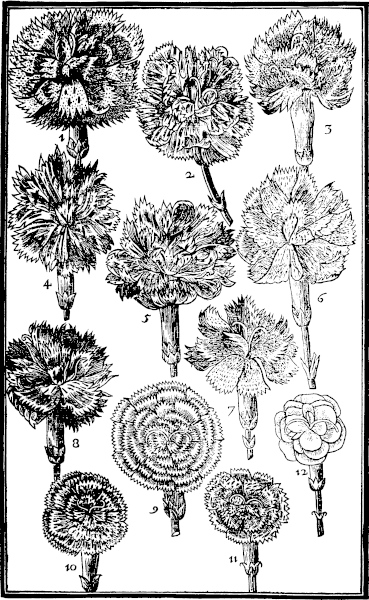
1Heroina Rodolphi florum Imperatoris Princessa dictus. Master Tuggie his Princesse.
2Caryophyllus Oxoniensis. The French or Oxford Carnation.
3Caryophyllus Westmonasteriensis. The Gallant or Westminster Gilloflower.
4Caryophyllus Bristoliensis. The Bristow.
5Caryophyllus Chrystallinus. The Chrystall or Chrystalline.
6Caryophyllus Sabaudicus striatus. The stript Sauadge.
7Caryophyllus Granatensis maximus. The Granpere or greatest Granado.
8Caryophyllus peræmanus. The Dainty.
9Caryophyllus Silesiacus maximus Ingonij Ioannis. Iohn Witty his great tawny Gilloflower.
10Caryophyllus Silesiacus striatus. The stript Tawny.
11Caryophyllus marmor-amulus. The marbled Tawny.
12Caryophyllus roseus rotundas magistri Tuggie. Master Tuggie his Rose Gilloflower.
The Place.
All these are nourished with vs in Gardens, none of their naturall places being knowne, except one before recited, and the yellow which is Silesia; many of them being hardly preserued and encreased.
The Time.
They flower not vntill the heate of the yeare, which is in Iuly (vnlesse it be an extraordinary occasion) and continue flowring, vntill the colds of the Autumne checke them, or vntill they haue wholly out spent themselues, and are vsually encreased by the slips.
The Names.
Most of our later Writers doe call them by one generall name, Caryophyllus sativus, and flos Caryophylleus, adding thereunto maximus, when wee meane Carnations, and maior when we would expresse Gilloflowers, which name is taken from Cloues, in that the sent of the ordinary red Gilloflower especially doth resemble them. Diuers other seuerall names haue beene formerly giuen them, as Vetonica, or Betonica altera, or Vetonica altilis, and coronaria. Herba Tunica, Viola Damascena, Ocellus Damascenus, and Barbaricus. Of some Cantabrica Plinij. Some thinke they were vnknowne to the Ancients, and some would haue them to be Iphium of Theophrastus, wherof he maketh mention in his sixth and seuenth Chapters of his sixth booke, among Garland and Summer flowers; others to be his Dios anthos, or Iouis flos, mentioned in the former, and in other places. We call them in English (as I said before) the greatest kindes, Carnations, and the others Gilloflowers (quasi Iuly flowers) as they are seuerally expressed.
The Vertues.
The red or Cloue Gilloflower is most vsed in Physicke in our Apothecaries shops, none of the other being accepted of or vsed (and yet I doubt not, but all of them might serue, and to good purpose, although not to giue so gallant a tincture to a Syrupe as the ordinary red will doe) and is accounted to be very Cordiall.
Chap. LXX. Caryophylli siluestres. Pinkes.
There remaine diuers sorts of wilde or small Gilloflowers (which wee vsually call Pinkes) to be entreated of, some bearing single, and some double flowers, some smooth, almost without any deepe dents on the edges, and some iagged, or as it were feathered. Some growing vpright like vnto Gilloflowers, others creeping or spreading vnder the toppe or crust of the ground, some of one colour, some of another, and many of diuers colours: As I haue formerly done with the Gilloflowers, so must I doe with these that are entertained in our Gardens, onely giue you the descriptions of some three or foure of them, according to their variety, and the names of the rest, with their distinctions.
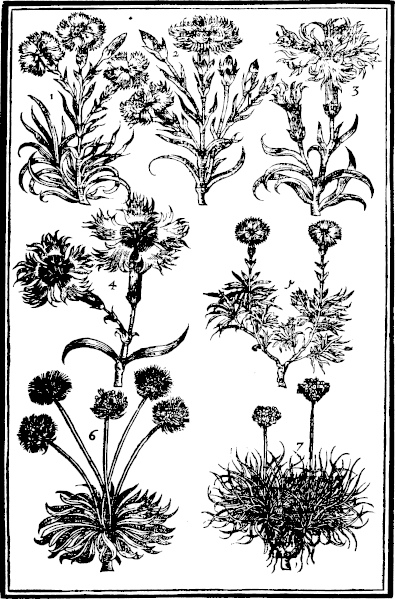
1Caryophyllus siluestris simplex. The vsuall single Pinke.
2Caryophyllus multiplex siluestris. Double Pinkes.
3Caryophyllus siluestris plumarius. Feathered or iagged Pinkes.
4Caryophyllus Stellatus. Starre Pinkes.
5Caryophyllus repens. Matted Pinkes.
6Caryophyllus mediterraneus. The great Thistle or Sea Gilloflower.
7Caryophyllus marinus. The ordinary Thistle or Sea Cushion.
1. Caryophyllus minor siluestris multiplex & simplex. Double and single Pinkes.
The single and double Pinkes are for forme and manner of growing, in all parts like vnto the Gilloflowers before described, sauing onely that their leaues are smaller and shorter, in some more or lesse then in others, and so are the flowers also: the single kindes consisting of fiue leaues vsually (seldome six) round pointed, and a little snipt for the most part about the edges, with some threads in the middle, either crooked or straight: the double kindes being lesser, and lesse double then the Gilloflowers, hauing their leaues a little snipt or endented about the edges, and of diuers seuerall colours, as shall hereafter be set downe, and of as fragrant a sent, especially some of them as they: the rootes are long and spreading, somewhat hard and wooddy.
2. Caryophyllus plumarius. Feathered or iagged Pinkes.
The iagged Pinkes haue such like stalkes and leaues as the former haue, but somewhat shorter and smaller, or grasse-like, and of a whitish or grayish greene colour likewise: the flowers stand in the like manner at the toppes of the stalkes, in long, round, slender, greene huskes, consisting of fiue leaues, very much cut in on the edges, and iagged almost like a feather, of a light red, or bright purple colour, with two white threads standing in the middle, crooked like a horne at the end, and are of a very good sent. Some of these haue not those two crooked threads or hornes in the middle, but haue in their stead many small threads, not crooked at all: the seedes of them all are like vnto the seedes of Gilloflowers, or the other Pinkes, that is, small, blacke, long, and flat: the rootes are small and wooddy likewise.
3. Caryophyllus plumarius albus orbe rubro siue Stellatus. Starre Pinkes.
Of this kinde there is another sort, bearing flowers almost as deeply cut or iagged as the former, of a faire white colour, hauing a ring or circle of red about the bottome or lower part of the leaues, and are as sweete as the former: this being sowne of seede doth not giue the starre of so bright a red colour, but becommeth more dunne.
4. Caryophyllus plumarius Austriacus siue Superba Austriaca. The feathered Pinke of Austria.
This kinde of Pinke hath his first or lower leaues, somewhat broader and greener then any of the former Pinkes, being both for breadth and greennesse more like vnto the Sweete Iohns, which shall bee described in the next Chapter: the leaues on the stalkes are smaller, standing by couples at euery ioynt, at the toppes whereof stand such like iagged flowers as the last described, and as large, but more deeply cut in or iagged round about, some of them of a purplish colour, but the most ordinary with vs are pure white, and of a most fragrant sent, comforting the spirits and senses a farre off: the seedes and rootes are like vnto the former. Some haue mistaken a kinde of wilde Campion, growing in our Woods, and by the paths sides in Hornsie Parke, and other places, to be this feathered Pinke: but the flowers declare the difference sufficiently.
5. Caryophyllus minor repens simplex & multiplex. Single and double matted Pinkes.
The matted Pinke is the smallest, both for leafe and flower of all other Pinkes that are nourished in Gardens, hauing many short and small grassie greene leaues vpon the stalkes, which as they grow and lye vpon the ground (and not standing so vpright as the former) doe take roote againe, whereby it quickly spreadeth, and couereth a great deale of ground in a little space: the flowers are small and round, a little snipt about the edges, whereof some are white, and some red, and some are white spotted with red, and some red spotted with white, all of them being single flowers. But there is another of this kinde, not differing in leafe, but in flower: for that the first flowers are but once double, or of two rowes of leaues, of a fine reddish colour, spotted with siluer spots: but those that follow, are so thicke and double, that they oftentimes doe breake the pod or huske; being not altogether of so deepe a red colour, but more pale.
6. Caryophyllus Mediterraneus siue Marinus maior. Great Sea Gilloflower or Great Thrift.
Vnto these kindes of Pinkes I must needs adde, not only our ordinary Thrift (which is more frequent in gardens, to empale or border a knot, because it abideth greene Winter and Summer, and that by cutting, it may grow thick, and be kept in what form one list, rather then for any beautie of the flowers) but another greater kinde, which is of as great beautie and delight almost as any of the former Pinkes, as well for that the leaues are like vnto Gilloflowers, being longer and larger then any Pinkes, and of a whitish greene colour like vnto them, not growing long or by couples vpon the stalkes as Pinkes and Gilloflowers doe, but tufting close vpon the ground, like vnto the common Thrift: as also that the stalkes, rising from among the leaues (being sometimes two foote high (as I haue obserued in my garden) are yet so slender and weake, that they are scarce able to beare the heads of flowers, naked or bare, both of leaues and ioynts, failing only in one place, where at the ioynt each stalke hath two small and very short leaues, not rising vpwards as in all other Gilloflowers, Pinkes, and other herbes, but growing downewards) and doe beare each of them a tuft or vmbell of small purplish, or blush coloured flowers, at the toppes of them standing somewhat like vnto sweete Williams, but more roundly together, each flower consisting of fiue small, round, stiffe or hardish leaues, as if they were made of paper, the bottome or middle being hollow, not blowing all at once as the ordinary Thrift, but for the most part one after another, not shewing vsually aboue foure or fiue flowers open at one time (so farre as I could obserue in the plants that I kept) so that it was long before the whole tuft of flowers were past; but yet the hoter and dryer the time was, the sooner it would be gone: the seede I haue not perfectly obserued, but as I remember, it was somewhat like vnto the seede of Scabious; I am sure nothing like vnto Gilloflowers or Pinkes: the roote is somewhat great, long and hard, and not so much spreading in the ground as Gilloflowers or Pinkes.
7. Caryophyllus Marinus. Thrift, or Sea Cushion.
Our common Thrift is well knowne vnto all, to haue many short and hard greene leaues, smaller then many of the grasses, growing thicke together, and spreading vpon the ground: the stalkes are naked of leaues a spanne high, bearing a small tuft of light purple, or blush coloured flowers, standing round and close thrusting together.
Double Pinkes.
The double white Pinke is onely with more leaues in it then the single which maketh the difference.
The double red Pinke is in the same manner double, differing from the single of the same colour.
The double purple Pinke differeth not from the single purple for colour, but only in the doublenesse of the flower.
The Granado Pinke differeth not from the Gilloflower of the same name, but in the smalnesse both of leaues and flower.
The double Matted Pinke is before described.
The double blush Pinke is almost as great as the ordinary blush Gilloflower, and some haue taken it for one, but the greene leaues are almost as small as Pinks, and therefore I referre it to them.
Single Pinkes.
The single white ordinary Pinke hath a single white flower of fiue leaues, finely iagged about the edges.
The single red pink is like the white, but that the leaues are not so much iagged, and the flower is of a pale purplish red colour,
The single purple Pinke is of a faire purple colour, like almost vnto the purple Gilloflower.
The great blush Pinke hath broader and larger leaues in the flower then any other Pinke, and of a faire blush colour.
The white Featherd Pinke hath the edges of the flower more finely and deeply cut in then the former.
The red or light purple featherd Pinke is like the former featherd Pinke, but only differeth in colour.
The Starre Pinke is a faire flower, finely iagged on the edges, with a faire red circle at the lower end of the leaues on the inside.
The white featherd Pinke of Austria is described before. The purple featherd Pinke of Austria is so likewise. The single matted Pinke is before described. The speckled Pinke is a small flower hauing small spots of red here and there dispersed ouer the white flower.
Those single flowers being like vnto Pinkes that rise from the sowing of the orenge tawney, I bring not into this classis, hauing already spoken of them in the precedent Chapter.
The Place.
These are all like as the former, nourished in Gardens with vs, although many of them are found wilde in many places of Austria, Hungarie, and Germany, on the mountaines, and in many other places, as Clusius recordeth. The ordinary Thrift groweth in the salt Marshes at Chattam by Rochester, and in many other places in England: but the great kinde was gathered in Spaine, by Guillaume Boel that painefull searcher of simples, and the seede thereof imparted to me, from whence I had diuers plants, but one yeare after another they all perished.
The Time.
Many of these Pinkes both single and double, doe flower before any Gilloflower, and so continue vntill August, and some, most of the Summer and Autumne.
The Names.
The seuerall titles that are giuen to these Pinkes, may suffice for their particular names: and for their generall they haue beene expressed in the former Chapter, beeing of the same kindred, but that they are smaller, and more frequently found wilde. The two sorts of Thrift are called Caryophyllus Marinus. The greater, Maior & Mediterraneus; In English, The greater or Leuant Thrift, or Sea Gilloflower. The lesser Minimus, and is accounted of some to be a grasse, and therefore called Gramen Marinum & Polyanthemum; In English, Thrift, Sea grasse, and our Ladies Cushion, or Sea Cushion.
The Vertues.
It is thought by diuers, that their vertues are answerable to the Gilloflowers, yet as they are of little vse with vs, so I thinke of as small effect.
Chap. LXXI. Armerius. Sweet Iohns, and sweet Williams.
These kindes of flowers as they come neerest vnto Pinkes and Gilloflowers, though manifestly differing, so it is fitted to place them next vnto them in a peculiar Chapter.
1. Armerius angustifolius rubens simplex. Single red sweete Iohns.
The sweete Iohn hath his leaues broader, shorter, and greener then any of the former Gilloflowers, but narrower then sweete Williams, set by couples, at the ioynts of the stalkes, which are shorter then most of the former, and not aboue a foote and a halfe high, at the tops whereof stand many small flowers, like vnto small Pinkes, but standing closer together, and in shorter huskes, made of fiue leaues, smaller then most of them, and more deeply iagged then the Williams, of a red colour in the middle, and white at the edges, but of a small or soft sent, and not all flowring at once, but by degrees: the seede is blacke, somewhat like vnto the seede of Pinkes, the roote is dispersed diuersly, with many small fibres annexed vnto it.
2. Armerius angustifolius albus simplex. Single white sweet Iohns.
This white Iohn differeth not in any thing from the former, but onely that the leafe doth neuer change brownish, and that the flower is of a faire white colour, without any mixture.
3. Armerius angustifolius duplex. Double sweet Iohns.
There is of both those former kindes, some whose flowers are once double, that is, consisting of two or three rowes of leaues, and the edges not so deeply iagged; not differing in any thing else.
4. Armerius latifolius simplex flore rubro. Single red sweet Williams.
The sweet Williams doe all of them spread into many very long traylng branches, with leaues lying on the ground, in the very like manner that the sweete Iohns doe: the chiefe differences betweene them are, that these haue broader, and darker greene leaues, somewhat brownish, especially towards the points, and that the flowers stand thicker and closer, and more in number together, in the head or tuft, hauing many small pointed leaues among them, but harmlesse, as all men know; the colour of the flower is of a deep red, without any mixture or spot at all.
5. Armerius latifolius flore rubro multiplici. Double red sweete Williams.
The double kinde differeth not from the single kinde of the same colour, but only in the doublenesse of the flowers, which are with two rowes of leaues in euery flower.
6. Armerius latifolius variegatus siue versicolor. Speckled sweete Williams, or London pride.
These spotted Williams are very like the first red Williams, in the forme or maner of growing, hauing leaues as broade, and browne sometimes as they, the flowers, stand as thicke or thicker, clustring together, but of very variable colours: for some flowers will be of a fine delayed red, with few markes or spots vpon them, and others will bee full speckled or sprinkled with white or siluer spots, circlewise about the middle of the flowers, and some will haue many specks or spots vpon them dispersed: all these flowers are not blowne at one time, but some are flowring, when others are decaying, so that abiding long in their pride, they become of the more respect: The seede is blacke, as all the rest, and not to be distinguished one from another: the roots are some long, and some small and threddy, running vnder the vpper crust of the earth.
7. Armerius latifolius flore rubro saturo holofericeo. Sweet Williams of a deepe red or murrey colour.
The leaues of this kinde seeme to be a little larger, and the ioints a little redder then the former, but in the flower consisteth the chiefest difference, which is of a deepe red, or murrey purple colour, like vnto veluet of that colour, without any spots, but smooth, and as it were soft in handling, hauing an eye or circle in the middle, at the bottome of the leaues.
8. Armerius latifolius simplex flore albo. Single white sweete Williams.
The white kinde differeth not in forme, but in colour from the former, the leaues are not browne at all, but of a fresh greene colour, and the flowers are wholly white, or else they are all one.
The Place.
These for the most part grow wilde in Italie, and other places: we haue them in our Gardens, where they are cherished for their beautifull varietie.
The Time.
They all generally doe flower before the Gilloflowers or Pinkes, or with the first of them: their seede is ripe in Iune and Iuly, and doe all well abide the extremitie of our coldest winters.
The Names.
They all generally are called Armerius, or Armeria, as some doe write, and distinguished as they are in their titles: Yet some haue called them Vetonica agrestis, and others Herba Tunica, Scarlatea, & Caryophyllus siluestris: Wee doe in English in most places, call the first or narrower leafed kindes, Sweet Iohns, and all the rest Sweete Williams; yet in some places they call the broader leafed kindes that are not spotted, Tolmeiners, and London tufts: but the speckled kinde is termed by our English Gentlewomen, for the most part, London pride.
The Vertues.
We haue not knowne any of these vsed in Physicke.
Chap. LXXII. Bellis. Daisie.
There be diuers sorts of Daisies, both great and small, both single and double, both wilde growing abroade in the fieldes, and elsewhere, and manured growing only in Gardens: of all which I intend not to entreate, but of those that are of most beautie and respect, and leaue the rest to their proper place.
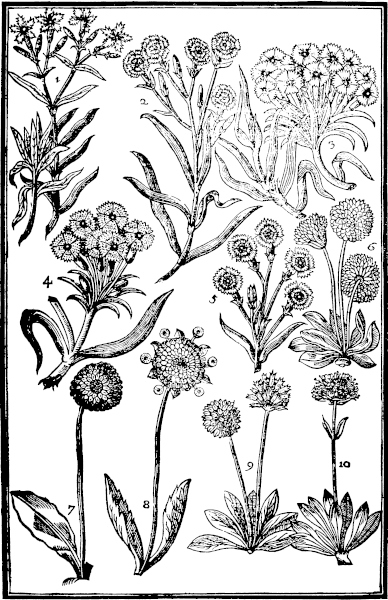
1Armerius angustifolius simplex. Single sweete Iohns.
2Armerius angustifolius multiplex. Double sweet Iohns.
3Armerius latifolius simplex. Single sweete Williams.
4Armerius latifolius versicolor. Spotted sweet Williams or pride of London.
5Armerius latifolius multiplex. Double sweet Williams.
6Bellis hortensis minor multiplex. Double Garden Daisies.
7Bellis minor hortensis flore vario. Double red Daisies stript.
8Bellis minor hortensis prolifera. Double fruitfull Daisies or Iacke an Apes on horsebacke.
9Bellis cærulea siue Globularia. Double blew Daisies or blew Globeflower.
10Bellis lutea montana siue Globularia lutea montana. Double yellow Daisies or yellow Globeflower.
1. Bellis maior flore albo pleno. The great double white Daisie.
The great Daisie with the double white flower, is in all things so like vnto the great single kinde, that groweth by the high wayes, and in diuers medowes and fields, that there is no difference but in the flower, which is double. It hath many long, and somewhat broad leaues lying vpon the ground, deepely cut in on both sides, somewhat like vnto an oaken leafe; but those that are on the stalkes are shorter, narrower, and not so deeply cut in, but onely notched on the edges: the flowers at the toppe are (as I said) white and double, consisting of diuers rowes of leaues, being greater in compasse then any of the double Daisies that follow, but nothing so double of leaues.
2. Bellis minor flore rubro simplici. Single red Daisies.
This single Daisie (like as all the rest of the small Daisies) hath many smooth, greene, round pointed leaues lying on the ground, a little snipt about the edges; from among which rise many slender round foote-stalkes, rather then stalkes or stems, about an hand breadth high at the most, and oftentimes not halfe so high, bearing one flower a peece, consisting of many small leaues, as a pale or border set about a middle thrumme: the leaues of this kinde are almost wholly red, whereas in the wilde they are white or whitish, enclining to red on the edges, the middle being yellow in both sorts: the rootes are many small white threads or strings.
3. Bellis minor hortensis flore pleno variorum colorum. Double Garden Daisies of diuers colours.
The leaues of all the double Daisies are in forme like vnto the single ones, but that they are smaller, and little or nothing snipt or notched about the edges: the small stalkes like wise are smaller and lower, but bearing as double flowers as any that growe on the ground, being composed of many small leaues, thicke thrust together, of diuers colours; for some are wholly of a pure white, others haue a little red, either dispersed vpon the white leaues, or on the edges, and sometimes on the backes of the leaues: some againe seeme to be of a whitish red, or more red then white, when as indeede they are white leaues dispersed among the red; others of a deepe or darke red colour, and some are speckled or striped with white and red through the whole flower: and some the leaues will bee red on the vpperside, and white vnderneath; and some also (but those are very rare) are of a greenish colour.
4. Bellis minor hortensis prolifera. Double double Daisies or childing Daisies.
There is no difference either in leafe or roote in this kinde from the former double Daisies: the chiefest variety consisteth in this, that it beareth many small double flowers, standing vpon very short stalkes round about the middle flower, which is vsually as great and double as any of the other double kindes, and is either wholly of a deepe red colour, or speckled white and red as in some of the former kindes, or else greenish, all the small flowers about it being of the same colour with the middlemost.
5. Bellis cærulea siue Globularia. Blew Daisies.
The likenesse and affinity that this plant hath with the former, both in the forme of leafe and flower, as also in the name, hath caused me to insert it, and another rare plant of the same kinde, in this place, although they be very rare to be met with in our English Gardens. This beareth many narrower, shorter, and blacker greene leaues then the former, lying round about vpon the ground; among which rise vp slender, but stiffe and hard stalks, halfe a foot high or more, set here and there with small leaues, and at the top a small round head, composed of many small blew leaues, somewhat like vnto the head of a Scabious: It hath bin found likewise with a white head of flowers: the roote is hard and stringie: the whole plant is of a bitter taste.
6. Globularia lutea montana. Yellow Daisies.
This mountaine yellow Daisie or Globe-flower hath many thicke, smooth, round pointed leaues, spread vpon the ground like the former; among which spring diuers small round rushie stalkes, a foote high, bearing about the middle of them two small leaues at the ioynts, and at the toppes round heads of flowers thrust thicke together, standing in purplish huskes, euery of which flowers do blow or spread into fiue leaues, starre-fashion, and of a faire yellow colour, smelling like vnto broome flowers, with many small threads in the middle compassing a flat pointell, horned or bended two wayes: after the flowers are past rise vp the seede vessels, which are round, swelling out in the middle, and diuided into foure parts at the toppes, containing within them round, flat, blacke seede, with a small cut or notch in them: the roote is a finger long, round and hard, with a thicke barke, and a woddy pith in the middle, of a sharpe drying taste and strong sent: the leaues are also sharpe, but bitter.
The Place.
The small Daisies are all planted, and found onely in Gardens, and will require to be replanted often, lest they degenerate into single flowers, & at least into lesse double. The blew Daisie is naturall of Mompelier in France, and on the mountaines in many places of Italy, as also the yellow kinde in the Kingdome of Naples.
The Time.
The Daisies flower betimes in the Spring, and last vntill May, but the last two flower not vntill August or September.
The Names.
They are vsually called in Latine Bellides, and in English Daisies. Some call them Herba Margarita, and Primula veris, as it is likely after the Italian names, of Marguerite, and Flor di prima vera gentile. The French call them Pasquettes, and Marguerites, and the Fruitfull sort, or those that beare small flowers about the middle one, Margueritons: our English women call them Iacke an Apes on horse-backe, as they doe Marigolds before recited, or childing Daisies: but the Physitians and Apothecaries doe in generall call them, especially the single or Field kindes, Consolida minor. The blew Daisie is called Bellis cærulea, and Globularia, of some Scabiosæ pumilum genus. The Italians call it Botanaria, because the heads are found like buttons. The yellow, Globularia montana, is onely described by Fabius Columna, in his last part of Phytobasanos, and by him referred vnto the former Globularia, although it differ in some notable points from it.
The Vertues.
The properties of Daisies are certainly to binde, and the roote especially being dryed, they are vsed in medicines to that purpose. They are also of speciall account among those herbes, that are vsed for wounds in the head.