THE GARDEN OF PLEASANT FLOWERS. (continued 3)
Reading edition
The Time.
It flowreth in the end of Aprill.
The Names.
It may be that this doth grow among the former single kinde, and called by the same name Attamusco, for that the plant is not much differing, yet hereof I am not certaine: But we, from the forme and countenance of the plant, do call it Narcissus Virginianus, The Virginian Daffodill, and because it beareth a double flower, it hath the title of double added vnto it.
{True Daffodils: Rush Daffodils}
The third order of Daffodils, I said in the beginning was of Iuncifolios, Rush Daffodils, which are now next to be entreated of, I shall herein keepe the same order I vsed in the former; but because I finde none of this order, that beare but one flower vpon a stalke, I must begin with those that beare many.
1. Narcissus Iuncifolius albus. The white Iunquilia.
This white Rush Daffodill hath small long leaues, a little broader, and of a whiter greene colour then the ordinary yellow Rush Daffodils: the stalke riseth vp halfe a foote high or more, bearing two or three small white flowers vpon a stalke, yet somewhat bigger then the common yellow Rush Daffodill, hauing a small round cuppe in the middle, white also as the leaues are. The seede is small, blacke, and round, as other seedes of Daffodils are: the roote is small and round, couered with a blackish coate.
Narcissus Iuncifolius albus magno calice. The white Iunquilia with a great cup.
There is of this kinde another sort, that hath the cup in the middle of the flower, a little larger then the other, but in all other things alike.
2. Narcissus Iuncifolius flore albo reflexo. The white turning Iunquilia, or Rush Daffodill.
This turning white Daffodill hath foure or fiue long greene leaues, yet shorter and broader then the ordinary yellow Iunquilia, and fully as greene also, from among which riseth vp a slender greene stalke, a foote high bearing out of a thinne skinnie huske, three or foure, or more snow white flowers, standing vpon long greene foot-stalkes, euery flower hanging downe his head, and turning vp his six narrow and long leaues, euen to the very foot-stalk againe: from the middle of the flower hangeth downe a long round cuppe, as white as the leaues, within which are contained three small white chiues, tipt with yellow, and a small long pointell, thrusting out beyond the brimmes of the cup: after the flowers are past, there come vp in their places small three square heads, wherein is contained very small, round, and blacke shining seede: the roote is small, round, and a little long withall, couered with a blackish browne coate or skin. The flower is quite without any good sent, or indeed rather none at all.
3. Narcissus Iuncifolius flore luteo reflexo. The yellow turning Iunquilia, or Rush Daffodill.
The leaues of the Rush Daffodill are greater and longer then the former, and of a paler greene colour: the stalke riseth somewhat higher, bearing two or three flowers thereon wholly of a gold yellow colour, both the cuppe and the leaues that turne vp againe.
4. Narcissus Iuncifolius calice albo reflexis folijs luteis. The yellow turning Iunquilia with a white cup.
This Daffodill hath his long rush-like leaues standing vpright as the former, betweene which riseth vp a greene stalke, about a foote high or more, bearing two or three flowers thereon, whose turning leaues are of a faire pale yellow, and the cuppe pale white, and not so pure a white as the former.
5. Narcissus Iuncifolius calice luteo reflexis folijs albidis. The white turning Iunquilia with a yellow cup.
As the last had the leaues of the flower that turne vp againe yellow, and the cuppe whitish, so this hath contrariwise the turning leaues of a whitish yellow, and the long cup yellower, else in his long green leaues, or any other thing, there is small difference.
6. Narcissus Iuncifolius luteus magno calice. The Iunquilia, or Rush Daffodill with a great cup.
This Rush Daffodill hath bigger leaues, and longer then the ordinary yellow Rush Daffodill, being a little flat on the one side, and round on the other, but of the same greennesse with all the rest: the stalke riseth vp two foote high, bearing two, and sometimes three flowers thereon, being of a faire yellow colour, with a large open cup in the middle, of a little deeper yellow colour, like vnto the great Iunquilia with the large flower, before set downe, whereof this is a kinde, no doubt; but that is larger and greater then this, both in leafe, flower, cup, &c. and this onely somewhat lesse in all parts then that.
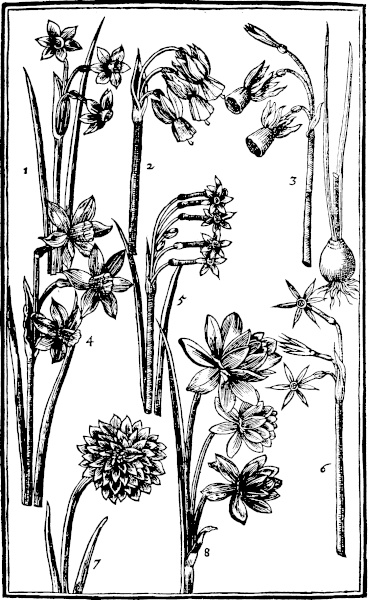
1Narcissus Iuncifolius albus. The white Iunquilia.
2Narcissus Iuncifolius flore albo reflexo. The white turning Iunquilia.
3Narcissus Iuncifolius calice luteo reflexis folijs albis. The yellow turning Iunquilia.
4Narcissus Iuncifolius luteus magno calice. The yellow Iunquilia with a great cuppe.
5Narcissus Iuncifolius luteus maior vulgaris. The ordinary yellow Iunquilia.
6Narcissus Iuncifolius Autumnalis flore viridi. The greene Autumne Iunquilia.
7Narcissus angustifolius aureus multiplex. The golden double narrow leafed Daffodill.
8Narcissus Iuncifolius flore pleno. The double Iunquilia.
7. Narcissus Iuncifolius luteus vulgaris maior. The ordinary Iunquilia, or Rush Daffodill.
This ordinary Rush Daffodill hath foure or fiue long greene round leaues, like vnto Rushes, whereof it tooke the name: among these leaues riseth vp the stalke, round and greene, a foote and a halfe high very often, bearing at the toppe three or foure flowers all yellow, but much smaller then the last, and so is the cup also: the seede is small and blacke, inclosed in small cornered heads; the roote is blackish on the outside. The smell of the flower is very sweete in all these sorts of Rush Daffodils.
8. Narcissus Iuncifolius luteus medius. The smaller Iunquilia, or Rush Daffodill.
The leaues of this Daffodill are like vnto the former, but smaller and rounder, the stalke riseth vp so high, nor are the flowers so great, but the leaues of the flower are a little rounder, and not so pointed as in the former, in all things else alike, sauing lesser.
9. Narcissus Iuncifolius luteus minor. The least Iunquilia, or Rush Daffodill.
This least Daffodill hath fiue or six small greene leaues, a little broader, and not so long as the last, among which riseth vp a stalke almost a foote high, bearing one or two small flowers at the toppe, of a paler yellow colour then the former, with a yellow open cuppe, or crowne rather in the middle, bigger then in either of the last two: the roote is very small and blacke, like vnto the last in roundnesse and colour.
10. Narcissus Iuncifolius luteus albicantibus lineis distinctus. The yellow Iunquilia, or Rush Daffodill with white lines.
This Rush Daffodill, hath round, greene, and long leaues, like vnto the ordinary Rush Daffodill, with a stalke bearing two or three yellow flowers, hauing leaues somewhat round at the point or end, with a line or strake of white in the middle of euerie one of them, the cup is short, and crowne fashion, a little crumpled about the brims: the seede, roote, or anything else differeth not.
11. Narcissus Iuncifolius Autumnalis flore viridi. The Autumne Rush Daffodill with a greene flower.
This strange Rush Daffodill (I call it strange, not onely because it differeth from all others of this kinde, but also because there are but few in these parts that haue had it, and fewer that doe still enioy it, in that it is perished withall that had it) hath but one onely leafe, very long, round, and greene, in all that euer I saw growing, which beareth no flower while that greene leafe is fresh, and to bee seene: but afterwards the stalke riseth vp, being like vnto the former greene leafe, round, naked, and greene vp to the toppe, where two or three flowers breake forth out of a small thin skinne, euery one consisting of six small and narrow greene leaues, very sharpe pointed at the end, and as it were ending in a small pricke or thorne: in the middle whereof is a small round cup, or rather crowne, of the same colour with the leaues and stalke, which flower smelleth very sweete, somewhat like vnto the rest of the Rush Daffodils: this sheweth not his flower vntill October, and the frosts quickly following after their flowring, cause them soone to perish.
12. Narcissus angustifolius aureus multiplex. The golden double narrow leafed Daffodill.
The leaues of this Daffodill are very narrow, and of a whitish greene colour, not aboue foure or fiue inches long, from among which riseth vp a stalke about a foote high, bearing at the top one flower, consisting of some outer leaues, which are of a yellow colour, and of many other leaues in the middle being smaller, and set thicke and round together of a more yellow gold colour, but with some whiter leaues among them, the middle part a little pointing forth; the flower standeth long before it doth perfect his colour, and abideth long in flower before the colour decay: the roote is in fashion almost like the ordinary Iunquilia, or Rush Daffodill. I acknowledge this Daffodill hath not his proper place; but because the figure is set in this table, let it thus passe at this time.
13. Narcissus Iuncifolius luteus flore pleno. The double Iunquilia, or Rush Daffodill.
The double Rush Daffodill hath his long greene leaues round, like the leaues of the common or ordinary Rush Daffodill, and of the same bignesse, among which riseth vp a long slender greene stalke, bearing two or three, seldome more small flowers, yellow and double, that is, with diuers rowes of leaues, hauing the yellow cup such as is in the single flower, broken into small threads or peeces, running among the leaues of the flower, which peeces in some flowers are not so easily seene, being smaller then in others, this beareth no button or head vnder the flower for seede, his roote is round and blackish, browne on the outside, so like vnto the common Rush Daffodill, that it is almost impossible to know the one from the other.
Alter minori flore.
There is another of this kinde, whose flowers are smaller, and not so double, one, two, or three at the most vpon a stalke, and of lesse beauty by much.
The Place.
All these Rush Daffodils, doe for the most part grow in Spaine and France, and on the Pyrenæan Mountaines, which are betweene Spaine and France, which Mountains are the Nourseries of many of the finest flowers, that doe adorne the Gardens of these louers of natures pride, and gathered in part by industrious, learned, generous men, inhabiting neare thereunto, and in part by such as make a gaine of their labours, bestowed vpon these things. Onely that with the greene flower was gathered in Barbary, and imparted vnto vs from France.
The Time.
They flower in the Spring, that is, in March and Aprill, except such whose time is set downe to be in Autumne.
The Names.
Their names are specified in their titles, and therefore I shall not need to set downe any further repetitions.
{True Daffodils: Sea Daffodils}
To conclude therefore this discourse of true Daffodils, there remaineth to speake of the Sea Daffodils, which (as I said in the beginning) is but one, that is frequent, and doth abide with vs. But there bee some others found about the Cape of good Hope, and in the West Indies, and brought vnto these parts rather for ostentation, then continuance, where they haue flowred onely once (if peraduenture so often) so that being such strangers, of so remote Countries, and of so diuers natures, I shall but shew you some of them, rather cursorily then curiously; and but onely for your satisfaction, giue you knowledge of two or three of them, that there haue beene seene such in flower, and that they are scarce to bee seene againe, except they bee fetcht a new euery yeare that they be seene.
{The great white Sea Daffodil}
Narcissus Marinus, siue tertius Matthioli. The great white Sea Daffodill, or Matthiolus his third Daffodill.
The roote of this Daffodill by long continuance, standing in one place without being remoued, groweth to be much greater and larger, than any other Daffodill whatsoeuer, and as bigge as any meane Squilla or Sea Onion roote, hauing many long, thicke, and white fibres, or long rootes, diuersly branched, and spread vnder the vpper part of the earth beside some others that grow downward, and perish not euery yeare, as the fibres of all, or most of the other Daffodils doe; and therefore this plant will not thriue, and beare flowers, if it be often transplanted, but rather desire to abide in one place without remouing, as I said, and that not to be ouershadowed, or couered with other herbes standing too neare it, which then will flourish, and beare aboundantly: from this roote, which is couered with many blackish coates, ariseth six or seuen, or more leaues, twice so broad almost, as any of the former Daffodils, but not so long by halfe as many of them, being but short, in comparison of the breadth, and of a white greene colour; from the middle of which leaues, as also from the sides sometimes, springeth vp one or two, or more stalkes, roundish and thicke, and sometimes a little flat and cornered, a foote high or somewhat more, bearing at the toppe, out of a skinnie huske, eight, ten, twelue, or more very large flowers, consisting of six white leaues a peece, spread or laid open, with a white short cuppe or crowne in the middle, lying flat vpon the leaues, cut or diuided into six corners (and not whole, as the cuppe or crowne of any other single Daffodill) from euery of which edges, or corners of this cup or crowne, standeth one white long thread, a little crooked or turning vp at the end, tipt with a yellow pendent, and some other white threads tipt with yellow pendents, standing also in the middle: after the flower is past, there come vp great three square heads, wherein the seede is contained, which is great, blacke, and round, like vnto the seede of other Daffodils, but greater: the flower hath a reasonable good sent, but not very strong.
The Place.
It was first found by the Sea side, in the Isle of Sardinia, and on the high Mountaines also of the same Isle, where it hath borne by report, thirty fiue flowers vpon a stalke: it groweth likewise about Illyricum, and in diuers other places.
The Time.
It springeth later out of the ground then any other Daffodill, that is to say, not vntill the later end of March, or beginning of Aprill, and flowreth in the end of May, or the beginning of Iune: the seede is ripe in the end of Iuly, or beginning of August.
The Names.
The first that hath made mention of this Daffodill, was Matthiolus, who placed it in the third place among his Daffodils, and is most vsually now adayes called Narcissus tertius Matthioli, Matthiolus his third Daffodill, the rather, because Clusius vpon a more mature deliberation, first referred it thereunto, but called it at the first, Lilionarcissus Hemerocallidis facie, and, as hee saith, Iacobus Plateau (who first sent him the figure hereof, with the description) called it Lilionarcissus Orientalis, but Clusius vpon certaine information, that it grew in the places aforesaid, misliked the name of Orientalis, and added Hemerocallis, which yet is not fit, for that his Hemerocallis Valentina, is a plaine Pancration or Sea bastard Daffodill, whose middle cup is longer then the cup of any true Daffodill, which (as I said in the beginning of this Chapter) is the chiefest note of difference, betweene a true and a bastard Daffodill. I receiued the seede of this Daffodill among many other seedes of rare plants, from the liberality of Mʳ. Doctor Flud, one of the Physitians of the Colledge in London, who gathered them in the Vniuersity Garden at Pisa in Italy, and brought them with him, returning home from his trauailes into those parts, by the name of Martagon rarissimum, (and hauing sowne them, expected fourteene yeares, before I saw them beare a flower, which the first yeare that it did flower, bore foure stalkes of flowers, with euery one of them eight or ten flowers on them) which of all other names, doth least answer the forme or qualities of this plant. It may most fitly be called Narcissus marinus maximus, in English, The great Sea Daffodill, both because it is a true Daffodill, and the greatest of all other, and also because it hath not been found, but in Islands, or else in other places neare the Sea. Lobelius entituleth it Pancratium Indicum alterum vernum, siue Narcissus Indicus alter facie Pancratij Monspeliaci, but all this is wide from the matter, as may easily be known, by that that hath been said before. It is generally (as I said before) called of all Narcissus tertius Matthioli, Matthiolus his third Daffodill, which may either so passe with vs, or as I called it, The great Sea Daffodill, which you will, & so Clusius doth lastly entitle it.
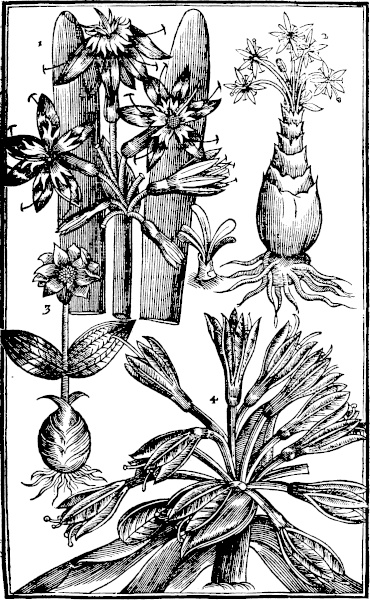
1Narcissus tertius Matthioli. The great white Sea Daffodill.
2Narcissus Indicus Autumnalis. The Indian Autumne Daffodill.
3Narcissus marinus Africanus. The Sea Daffodill of Africa.
4Narcissus marinus exoticus. The strange Sea Daffodill.
{Sea Daffodils and the Indian Autumne Daffodill}
1. Pancratium Indicum, aut Narcissus Indicus Autumnalis quorundam Lobelij. The Indian Autumne Daffodill of Lobel.
This plant hath in my opinion, a farre nearer resemblance vnto an Hyacinthus, then vnto any Daffodill: But because Lobel hath so set it forth, I will so publish it vnto you, leauing it to iudgement. The roote is, as he saith, a span long, and of the thicknesse of a mans arme, couered with many white shells, whereof the outermost are of a darke red or Chestnut colour: the flowers rise vp in September and October, being eight or ten in number, euery one by it selfe vpon a small footstalke, made of six leaues a peece, somewhat long, narrow, and pointed, like vnto the flowers of the English Colchicum, or Medowe Saffron, of a whitish yellow dunne colour, with six long threads in the middle: the greene leaues are long and broad, and broad pointed.
2. Narcissus Marinus Africanus, siue Exoticus Lobelij. The Sea Daffodill of Africa.
The roote of this strange plant (which of some likenesse is called a Daffodill) is very great, made as it were of many scaly cloues, from whence riseth vp a small short stalke, bearing hard aboue the ground two faire broad greene pointed leaues, more long then broad, so compassing the stalke at the bottome, that it seemeth to run through them: the stalke is spotted with diuers discoloured spots, and is bare or naked from these two leaues vnto the toppe, where it beareth one faire double flower, like vnto a double Anemone, of a delayed reddish colour, tending to a blush, with many threads set about the middle head.
3. Narcissus Marinus Exoticus. The strange Sea Daffodill.
The strange Sea Daffodill, hath fiue or six large and long leaues of a pale greene colour, from among which riseth vp a strong and bigge stalke, bearing at the toppe, out of a thinne hose or skinne, many very large flowers, made of six long and pointed leaues apeece, of a blewish purple colour, with a large round open cup in the middle, of a sadder colour then the leaues: the roote is very great, yet like vnto other great Daffodils, the outer skins whereof are of a darke browne colour.
The Place.
The Indian Daffodils grew in the vpper part of Hispaniola in the West Indies, and brought hither, where they all soone perished.
The other grew neare the Cape of good Hope, and was brought into the parts of Holland and thereabouts, from whence we had it, & perished also.
The last is vnknowne where it was gathered.
The Time.
The first flowred in Autumne, as it is said.
The other in the first Summer of their bringing.
And so did the last, but the same rootes will not flower with vs againe.
The Names.
So much hath been said of their names in their titles, as hath come to our knowledge; and therefore let that suffice.
{Bastard Daffodils}
Thus hauing gone through the whole Family of the true Daffodils, (for so much as hath come to our knowledge) and set them downe euery one by his name, and in this order; it is fit that we speake of their bastard brethern, and shew you them also, in the same order held with the former, as neare as the plenty of variety herein, which is not the like with the former, will giue leaue, that when you know them both by face and name, you may the better know to place or distinguish of others, that haue not passed vnder this rod.
{Bastard Daffodils: Broad leaves, Single flowers}
Pseudonarcissus aureus Hispanicus maximus. The great yellow Spanish bastard Daffodill.
The roote of this kinde of Daffodill is reasonable great, and blackish on the outside, desiring to be deepe in the ground; and therefore will runne downe, where it will then encrease into many of-sets, from whence rise vp many thicke, long, and stiffe leaues, of a grayish greene colour, among which riseth vp a round strong stalke, sometimes three foote high or better, bearing at the toppe one onely faire great yellow flower, standing forth right, and not pendulous, consisting of six short and somewhat broad leaues, with a very great, large, and long trunke, of an equall largenesse, but open at the mouth, and turning vp the brimmes a little, which are somewhat crumpled: after the flower is past, there commeth in the place a three square head, containing round, blacke seede, like vnto other Daffodils.
Pseudonarcissus Pyrenæus Hispanico & Anglico similis. The Mountaine bastard Daffodill of diuers kindes.
There is much variety in this kinde of bastard Daffodill: For one sort hath verie broad and whitish greene leaues, somewhat short in comparison of others, that are of that breadth: the flower is wholly yellow, but a little paler then the former Spanish kinde, hauing the leaues of his flower long, and somewhat narrow, standing like wings about the middle trunke, which is as long as the leaues, and smaller then in many other of this kinde, but a little yellower then the wings. Another sort hath narrower green leaues then this last, and longer, the flower is all yellow, but the trunke is larger, wider, and more open at the mouth then the former, and almost as large as the former Spanish, but not so high as the last. A third hath the wings of the flower of a Strawe colour, but the trunke is long and narrow, of a faire yellow. A fourth hath such like flowers, but that it is shorter, both the wings and the trunke: Some likewise haue the wings of the flower longer, then the long trunke, and some shorter. Some also are all yellow, and some haue their wings onely a little more pale or white, like the English kinde: Some againe haue their trunkes long and narrow, others haue them larger and wider open, and crumpled at the brimmes; so that it is needlesse, to spend a great deale of time and labour vpon such smally respected flowers, but that in the beholding of them, we may therein admire the worke of the Creatour, who can frame such diuersity in one thing: But this is beside the text, yet not impertinent.
Pseudonarcissus pallidus præcox. The early Strawe coloured bastard Daffodill.
The leaues of this Daffodill are of a meane size, betweene the broadest and the narrower kindes, of a grayish greene colour, and not very long: the stalke riseth vp a foot high or more, whereon standeth one large great flower, equalling the greatest Spanish bastard Daffodill, before described, in the largenesse of his trunke, and hauing the brimmes turned vp a little, which maketh it seeme the larger: the wings or outer leaues are in a manner as short, as they are in the greatest Spanish kinde, (and not long flagging down, like vnto the Mountain kinds) and stand straight outright: all the whole flower is of one euen colour, that is, of a fine pale yellow, somewhat like vnto the colour of a Lemon peele or rinde, but somewhat whiter, which vsually we call a Strawe colour; the greatnesse of the flower, the earlinesse of the flowring, and the difference of colour from all the rest of this kinde, hath made me entreate of it apart by it selfe, as being no lesse worthy.
Pseudonarcissus Hispanicus flore albo maior. The great white Spanish bastard Daffodill.
This bastard Daffodill hath diuers leaues rising vp together, long and broad, somewhat like vnto the first Spanish kinde, but a little broader, and of a whiter greene colour, yet not so white, as in the lesser Spanish white kindes, hereafter described: among these leaues riseth vp a round strong stalke, about two foote high, bearing one white flower at the toppe, bending downe the head, as all these white kindes doe, but is not of so pure a white, as the lesser kindes that follow, yet whiter then the greatest white Spanish kinde, next of all to be described: the whole flower, as well trunke as wings, is much larger then the lesser white kindes, and almost equalling the first Spanish yellow, but a little longer and narrower, a little crumpled and turning vp at the brimmes: the head and seede are like the first; the roote is greater and thicker then the first Spanish, and doth not encrease so much, nor is couered with a blacke, but rather with a whitish coate.
Pseudonarcissus Hispanicus maximus albidus. The greatest Spanish white bastard Daffodill.
This kinde of bastard Daffodill is very like the last mentioned Daffodill, both in leaues and flowers, but larger in both: the flower of this is not full so white, but hath some shew of palenesse therein, and more vpon the first opening of the flower then afterwards, and is as great altogether, as the great Spanish yellow, at the least with a longer, and somewhat narrower trunke: the seede is like vnto the former, and so is the roote also, but greater, being white on the outside, and not blacke.
Pseudonarcissus Hispanicus flore albo medius & minor. The two lesser white Spanish bastard Daffodils.
There are two other of these kindes of white Spanish Daffodils, one greater or lesser then the other, but neither of them so great as the former. The leaues of both are of a whitish greene colour, one a little broader then the other: the flowers of both are pure white, and bending downe the heads, that they almost touch the stalke againe, the greater flower hath the longer and narrower trunke; and the lesser flower, the shorter and wider open, yet both a little crumpled at the edges or brimmes: the rootes of both are like one vnto another, but differ in the greatnesse. From the seede of these haue sprung much variety, few or none keeping either colour or height with the mother plants.
Pseudonarcissus Anglicus vulgaris. Our common English wilde bastard Daffodill.
This bastard Daffodill is so common in all England, both in Copses, Woods, and Orchards, that I might well forbeare the description thereof, and especially, in that growing wilde, it is of little respect in our Garden: but yet, lest I bee challenged of ignorance in common plants, and in regard of some variety therein worth the marking. I will set downe his description and variety as briefly as I may: It hath three or foure grayish greene leaues, long and somewhat narrow, among which riseth vp the stalke, about a span high or little higher, bearing at the toppe, out of a skinnie huske, as all other Daffodils haue, one flower (although sometimes I haue seene two together) somewhat large, hauing the six leaues that stand like wings, of a pale yellow colour, and the long trunke in the middle of a faire yellow, with the edges or brimmes a little crumpled or vneuen: after the flower is past, it beareth a round head, seeming three square, containing round blacke seede; the roote is somewhat blackish on the outside.
But there is another of this kinde like vnto the former, whose further description you haue here before; the wings of which flower are much more white then the former, and in a manner of a milke white colour, the trunke remaining almost as yellow as the former, and not differing in any thing else.
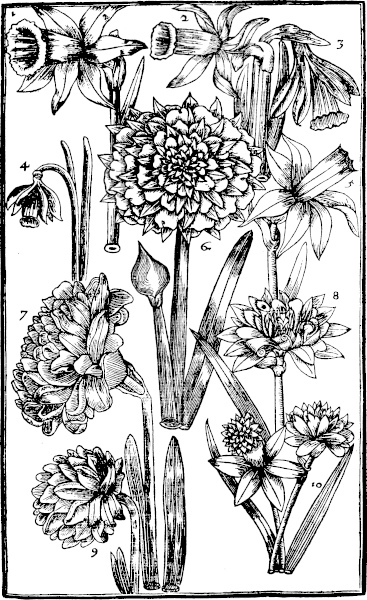
1Pseudonarcissus Hispanicus maximus aureus. The great yellow Spanish bastard Daffodill.
2Pseudonarcissus Pyrenæus variformis. The Mountaine bastard Daffodill of diuers kindes.
3Pseudonarcissus Hispanicus maior albus. The greater white Spanish bastard Daffodill.
4Pseudonarcissus Hispanicus minor albus. The lesser Spanish white bastard Daffodill.
5Pseudonarcissus tubo sexangulari. The six cornered bastard Daffodill.
6Pseudonarcissus maximus aureus, siue Roseus Tradescanti. Iohn Tradescants great Rose Daffodill.
7Pseudonarcissus aureus Anglicus maximus. Master Wilmers great double Daffodill.
8Pseudonarcissus Hispanicus aureus flore pleno. The double Spanish Daffodill, or Parkinsons double Daffodill.
9Pseudonarcissus Gallicus maior flore pleno. The greater double French Daffodill.
10Pseudonarcissus Anglicus flore pleno. The double English Daffodill, or Gerrards double Daffodill.
Pseudonarcissus tubo sexangulari. The six cornered bastard Daffodill.
This kinde of Daffodill hath two or three long, and somewhat broader leaues then the last, between which commeth forth a stalke, bearing one flower somewhat large hauing the six outer leaues of a pale yellow colour, and the long trunke plaited or cornered all along vnto the very edge into six parts, of a little deeper yellow then the wings.
The Place.
The first great Spanish kinde was brought out of Spaine. The rest from the Pyrenæan Mountaines, onely the last sauing one is plentifull in our owne Country, but the white sort of that kinde came with the rest from the same Mountaines.
The Time.
The pale or third kinde, and the English bee the most early, all the rest flower in Aprill, and the greatest yellow somewhat earlier, then the other greater or lesser white.
The Names.
Their seuerall names are expressed in their titles sufficient to distinguish them, and therefore there needeth no more to be said of them.
{Double flowered Bastard Daffodils}
1. Pseudonarcissus aureus maximus flore pleno, siue Roseus Tradescanti. The greatest double yellow bastard Daffodill, or Iohn Tradescant his great Rose Daffodill.
This Prince of Daffodils (belongeth primarily to Iohn Tradescant, as the first founder thereof, that we know, and may well bee entituled the Glory of Daffodils) hath a great round roote, like vnto other Daffodils, couered with a brownish outer skinne or peeling, from whence riseth vp foure or fiue somewhat large and broad leaues, of a grayish greene colour, yet not fully so long and large as the next following Daffodill: from the middle whereof riseth vp a stalke almost as high and great as it, bearing at the toppe (out of a skinnie huske) one faire large great flower (the budde, before it breake open, being shorter and thicker in the middle, and ending in a longer and sharper point then any of the other Daffodils) very much spread open, consisting of smaller and shorter leaues then the next, but more in number, and thicker and rounder set together, making it seeme as great and double as any Prouince Rose, and intermixt with diuers yellow and pale leaues, as it were on rowes one vnder another. It abideth long in flower, and spreadeth, by standing long, to be the broadest in compasse of any of the Daffodils, but falleth away at the last without giuing any seede, as all double Daffodils doe.
2. Pseudonarcissus aureus Anglicus maximus. Mʳ. Wilmers great double Daffodill.
The other great double Daffodill doth so neare resemble our ordinary English double kinde, that I doe not finde therein any greater difference, then the largenesse both of leaues and flowers, &c., and the statelinesse of growth. It beareth three or foure large, long, and broad leaues, somewhat longer and broader then the former, and of a whitish greene colour: the stalke riseth to bee two foote high, growing (in a fruitfull and fat soyle) strong, and somewhat round, bearing at the toppe, out of a thin skinne, one great and faire double flower, each leafe whereof is twice as large and broad as the former, diuersly intermixt with a rowe of paler, and a rowe of deeper yellow leaues, wholly dispersed throughout the flower, the pale colour as well as the deeper yellow, in this as in the other small English kinde, growing deeper by standing: sometimes the leaues hereof are scattered, and spread wholly, making it shew a faire, broad, open flower: and sometimes the outer leaues stand separate from the middle trunke, which is whole and vnbroken, and very thicke of leaues: and sometimes the middle trunke, will bee halfe broken, neither expressing a full open double flower, nor a close double trunke, as it is likewise seene in the small English kinde, as shall bee declared in his place: this beareth no seede; the roote hereof is thicke and great, and encreaseth as well as any other Daffodill.
3. Pseudonarcissus aureas Hispanicus flore pleno. The great double yellow Spanish bastard Daffodill, or Parkinsons Daffodill.
This double Spanish Daffodill hath diuers leaues rising from the roote, stiffer, narrower, and not of so whitish a greene colour as the former, but more sullen or grayish, plainely resembling the leaues of the single great kinde, from whence this hath risen: the stalke hereof likewise riseth almost as high as it, and neare the height of the last recited double, bearing one double flower at the toppe, alwayes spread open, and neuer forming a double trunke like the former, yet not so faire and large as it, the outermost leaues whereof being of a greenish colour at the first, and afterward more yellow, doe a little turne themselues backe againe to the stalke, the other leaues are some of a pale yellow, and others of a more gold yellow colour, those that stand in the middle are smaller, and some of them shew as if they were hollow trunked, so that they seeme to be greenish, whitish, yellow, and gold yellow, all mixed one among another: the root is great, round, and whitish on the inside, couered with darke coloured skinnes or peelings. I thinke none euer had this kinde before my selfe, nor did I my selfe euer see it before the yeare 1618, for it is of mine own raising and flowring first in my Garden.
4. Pseudonarcissus Gallicus maior flore pleno. The greater double French bastard Daffodill.
This greater double Daffodill, hath his whitish greene leaues longer and broader then the smaller French kinde, hereafter following, to bee described, and broader, longer, and more limber then the double English kinde: the stalke riseth vp not much higher, then the smaller French kinde, but a little bigger, bearing at the top one great double flower, which when it is fully and perfectly blowne open (which is but seldome; for that it is very tender, the leaues being much thinner, and thereby continually subiect, vpon any little distemperature of the time, to cleaue so fast one vnto another, that the flower cannot blow open faire) is a faire and goodly flower, larger by halfe then the smaller kinde, and fuller of leaues, of the same pale whitish yellow, or Lemon colour, with the lesser, or rather a little whiter, and not set in the same order of rowes as it is, but more confusedly together, and turning backe the ends of the outermost leaues to the stalke againe, and hauing the bottome of the flower on the backside somewhat greene, neither of which is found in the lesser kinde: the roote is very like vnto the lesser kinde, but a little bigger and longer.
5. Pseudonarcissus Anglicus flore pleno. The double English bastard Daffodill, or Gerrards double Daffodill.
The leaues of this double Daffodill are very like vnto the single kinde, being of a whitish greene colour, and somewhat broad, a little shorter and narrower, yet stiffer then the former French kinde: the stalke riseth vp about a foote high, bearing at the toppe one very double flower, the outermost leaues being of the same pale colour, that is to bee seene in the wings of the single kinde; those that stand next them are some as deepe a yellow as the trunke of the single, and others of the same pale colour, with some greene stripes on the backe of diuers of the leaues: thus is the whole flower variably intermixt with pale and deepe yellow, and some greene stripes among them, when it is fully open, and the leaues dispersed and broken. For sometimes the flower sheweth a close and round yellow trunke in the middle, separate from the pale outer wings, which trunke is very double, shewing some pale leaues within it, dispersed among the yellow: And sometimes the trunke is more open, or in part broken, shewing forth the same colours intermixt within it: the flower passeth away without giuing any seede, as all other bulbous rootes doe that beare double flowers: the roote is small, very like vnto the French double kindes, especially the lesser, that it is verie hard to know the one from the other.
The Place.
The first and greatest kinde, we had first from Iohn Tradescante (as I said before) whether raised from seed, or gained from beyond Sea, I know not.
The second we first had from Vincent Sion, borne in Flanders, dwelling on the Bank side, in his liues time, but now dead; an industrious and worthy louer of faire flowers, who cherished it in his Garden for many yeares, without bearing of any flowers vntill the yeare 1620, that hauing flowred with him, (and hee not knowing of whom hee receiued it, nor hauing euer seene the like flower before) he sheweth it to Mʳ. Iohn de Franqueuille, of whom he supposed he had receiued it, (for from beyond Sea he neuer receiued any) who finding it to bee a kinde neuer seene or knowne to vs before, caused him to respect it the more, as it is well worthy. And Mʳ. George Wilmer of Stratford Bowe Esquire, in his liues time hauing likewise receiued it of him (as my selfe did also) would needes appropriate it to himselfe, as if he were the first founder thereof, and call it by his owne name Wilmers double Daffodill, which since hath so continued.
The third is of mine owne fostering or raising, as I said before; for assuredly, it is risen from the seede of the great Spanish single kinde, which I sowed in mine owne Garden, and cherished it, vntill it gaue such a flower as is described.
The fourth is not certainly knowne where his originall should be: Some thinke it to be of France, and others of Germany.
The last is assuredly first naturall of our owne Countrey, for Mʳ. Gerrard first discouered it to the world, finding it in a poore womans Garden in the West parts of England, where it grew before the woman came to dwell there, and, as I haue heard since, is naturall of the Isle of Wight.
The Time.
They doe all flower much about one time, that is, from the middle or end of March, as the yeare is forward, vnto the middle of Aprill.
The Names.
Vpon the three first I haue imposed the names in Latine, as they are expressed in their titles: and for the English names, if you please, you may let them passe likewise as they are expressed there also, that thereby euery one may be truely distinguished, and not confounded. The fourth, besides the name in the title, is called of some Narcissus Germanicus, which whether it be of Germany, or no, I know not; but that the name should import so much. The last doth vsually carry Mʳ. Gerrards name, and called Gerrards double Daffodill.
{Bastard Daffodils: Narrow leaves}
1. Pseudonarcissus angustifolius flore flauescente tubo quasi abscisso. The narrow leafed bastard Daffodill with the clipt trunke.
This kinde of Daffodill hath long and narrow grayish greene leaues, bearing one single flower at the toppe of his stalke, like vnto the former single bastard kindes, before specified, hauing his outer leaues of a pale yellow colour, and his trunke of a deeper yellow: the chiefe differences in this from the former, is in the leaues, being narrow, and then in the trunke of the flower, which is not crumpled or turned vp, as most of the other are; and that the brimmes or edges of the flower is as if it had been clipt off, or cut euen.
2. Pseudonarcissus Hispanicus medius & minor luteus. The two lesser Spanish yellow bastard Daffodils.
These two lesser kindes of Spanish Daffodils, doe but differ in greatnesse the one from the other, and not in any thing else; so that in declaring the one, you may vnderstand the other to bee a little greater. The lesser hath three or foure narrow short whitish greene leaues, from among which commeth forth a short stalke, not aboue an hand breadth, or halfe a foote high, bearing one single flower, not fully standing outright, but a little bending downe, consisting of six small leaues, standing as wings about a small, but long trunke, a little crumpled at the brimmes: the whole flower, as well leaues as trunke, are of one deepe yellow colour, like vnto the great Spanish kinde: the roote is but small, and couered with a darkish coate. The other is in all parts greater, and (as I said) differeth not else.
3. Pseudonarcissus Hispanicus luteus minimus. The least Spanish yellow bastard Daffodill.
The leaues of this small kinde are smaller and shorter then the former, seldome exceeding the length of three inches, and very narrow withall, but of the same grayish greene colour with the former: euery flower standeth vpon a small and short footestalke, scarce rising aboue the ground; so that his nose, for the most part, doth lye or touch the ground, and is made after the same fashion, and of the same colour with the former, but much smaller, as his roote is so likewise.
4. Pseudonarcissus Gallicus minor flore pleno. The lesser French double bastard Daffodill.
The rootes of this lesser French kinde (if I may lawfully call it, or the greater kinde before specified, a bastard Daffodill; for I somewhat doubt thereof, in that the flower of either is not made after the fashion of any of the other bastard Daffodils, but doth more nearely resemble the forme of the double white Daffodill, expressed before among the true Daffodils) are like vnto the double English kinde, as also to the former double great French kinde, and the leaues are of the same whitish greene colour also, but narrower and not longer: the stalke riseth a little higher then the English, and not fully so high as the greater French, bearing one faire double flower thereon, of a pale yellow or Lemon colour, consisting of six rowes of leaues, euery rowe growing smaller then other vnto the middle, and so set and placed, that euery leafe of the flower doth stand directly almost in all, one vpon or before another vnto the middle, where the leaues are smallest, the outermost being the greatest, which maketh the flower seeme the more beautifull: this and the greater kinde hath no trunke, or shew of any other thing in the middle, as all or most of the other former double bastard Daffodils haue, but are flowers wholly composed of leaues, standing double euen to the middle.
The Place.
The first is vndoubtedly a naturall of the Pyrenæan Mountaines.
The Spanish kindes grew in Spaine, and
The French double kinde about Orleance in France, where it is said to grow plentifully.
The Time.
The first flowreth at the end of March.
The Spanish kindes are the most early, flowring betimes in March.
The French double doth flower presently after.
The Names.
More cannot bee said or added, concerning the names of any of these Daffodils, then hath been set downe in their titles: onely the French kinde is most vsually called Robinus his Daffodill.
{Bastard Rush Daffodils}
Pseudonarcissus Iuncifolius albus. The white bastard Rush Daffodill, or Iunquilia.
This bastard Rush Daffodill hath two or three long and very greene leaues, very like vnto the small yellow Rush Daffodill, formerly described, but not altogether so round, among which riseth vp a short stalke, seldome halfe a foote high, bearing at the toppe, out of a small skinnie huske, one small white flower, sometime declining to a pale colour, hauing six small and short leaues, standing about the middle of the trunke, which is long, and much wider open at the mouth, then at the bottome: the small outer leaues or wings are a little tending to greene, and the trunke (as I said) is either white, or whitish, hauing the brimmes a little vneuen: the seede is small, blacke, and round, like vnto other Rush Daffodils, but smaller.
Pseudonarcissus Iuncifolia, luteus maior. The greater yellow Iunquilia, or bastard Daffodill.
The leaues of this greater kinde are longer, greater, and a little broader then the former; the stalke also is higher, and the flower larger, more open at the mouth and crumpled, then the white, but wholly of a yellow colour: the seede and the roots are bigger, according to the proportion of the plant.
Pseudonarcissus Iuncifolius luteus minor. The lesser yellow bastard Iunquilia.
This is so like vnto the last in all things, that I shall not neede to trouble you with repetitions of the same things formerly spoken; the chiefest difference is the smallnesse of the plant in all parts.
Pseudonarcissus Iuncifolius luteus serotinus. The late yellow bastard Iunquilia.
There is likewise a third kinde, as great as the greater yellow, and in all his parts expressing and equalling it, but is accounted the fairer, and flowreth somewhat later.
The Place.
The Pyrenæan Hils haue afforded vs all these varieties, and wee preserue them carefully; for they are all tender.
The Time.
All these flower in Aprill, except the last, which is a moneth later.
The Names.
The French and Lowe-Countrey men call them Trompettes, that is, Trumpets, from the forme of the trunke; wee sometimes call them also by that name, but more vsually bastard Iunquilia’s.
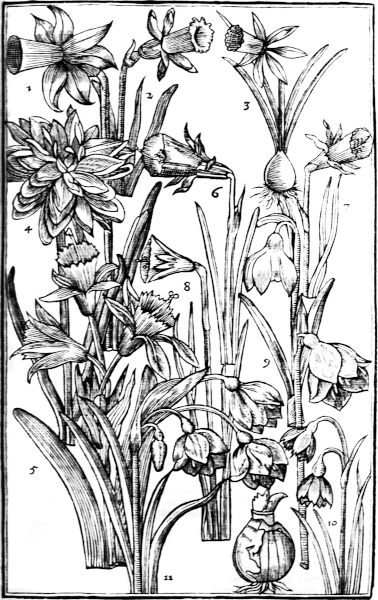
1Pseudonarcissus tubo quasi abscisso. The bastard Daffodill with the clipt trunke.
2Pseudonarcissus Hispanicus minor. The lesser Spanish bastard Daffodill.
3Pseudonarcissus Hispanicus minimus. The least Spanish bastard Daffodill.
4Pseudonarcissus Gallicus minor flore pleno. The lesser double French bastard Daffodil.
5Pancratium flore albo. The white Sea bastard Daffodil.
6Pseudonarcissus Iuncifolius luteus maior. The greater yellow bastard Iunquilia.
7Pseudonarcissus Iuncifolius luteus minor. The lesser yellow bastard Iunquilia.
8Pseudonarcissus Iuncifolius luteus serotinus. The late yellow bastard Iunquilia.
9Leucoium bulbosum præcox maius. The great early bulbous Violet.
†Leucoium bulbosum præcox minus. The lesser early bulbous Violet.
10Leucoium bulbosum autumnale. The small Autumne bulbous Violet.
11Leucoium bulbosum maius serotinum. The great late flowring bulbous Violet.
Pseudonarcissus marinus albus, Pancratium vulgo. The white Sea bastard Daffodill.
The Sea bastard Daffodill (to conclude this Chapter, and the discourse of Daffodils) hath diuers broad whitish greene leaues, but not very long, among which riseth vp a stiffe round stalke, at the top whereof breaketh out of a great round skinny huske, fiue or six flowers, euery one made somewhat of the fashion of the great bastard Rush Daffodill, but greater, and wholly white; the six leaues, being larger and longer then in the Rush kinde, and extending beyond the trunke, are tipt with greene at the point of each leafe, and downe the middle likewise on the backside. The trunke is longer, larger, and wider open at the mouth, cut in or indented at the brims or edges, and small at the bottome, with diuers white threeds in the middle, and is very sweet: vnder the flower is a round greene head, which groweth very great, hauing within it, when it is ripe, flat and blacke seede: the roote is great and white.
Flore luteo, & flore rubro.
It is reported, that there are found other sorts; some that beare yellow flowers, and others that beare red: but we haue seene none such, and therefore I can say no more of them.
The Place.
This kinde groweth neare the Sea side, both in Spaine, Italy, and France, within the Straights, and for the most part, vpon all the Leuant shoare and Islands also, but will seldome either flower, or abide with vs in these colder Countries, as I haue both seene by those that I receiued from a friend, and heard by others.
The Time.
It flowreth in the end of Summer, that is, in August and September.
The Name.
Diuers doe call it Pancratium, as the learned of Mompeher, and others, with the addition of flore Lilij, after they had left their old errour, in taking it to be Scylla, and vsing it for Scylla, in the Trochisces that go into Andromachus Treakle. The learned of Valentia in Spaine, as Clusius saith, doe call it Hemerocallis, thinking it to be a Lilly; and Clusius doth thereupon call it, Hemerocallis Valentina: but in my opinion, all these are deceiued in this plant; for it is neither a Lilly, to haue the name of Hemerocallis giuen vnto it, nor Scylla, nor Pancratium, as many doe yet call it: for certainly this is a kinde of Daffodill; the forme both of roote, leafe, and flower, doth assure me that haue seene it, and not Pancratium, which (as Dioscorides testifieth) is a kinde of Scylla, and in his time called Scylla, with a red roote, and a leafe like a Lilly, but longer, and was vsed both with the same preparation and quantity, and for the same diseases that Scylla was vsed, but that his force was weaker: all which doth plainly shew the errours that many learned men haue been conuersant in, and that all may see how necessary the knowledge of Herbarisme is to the practice of Physicke; And lest the roote of this Sea bastard Daffodill bee vsed in the stead of an wholesome remedy, which (as Clusius maketh mention) was deadly to him that did but cut his meate with that knife, which had immediately before cut this roote, and done in malice by him, that knew the force thereof, to kill his fellow, it working the more forceably by the euill attracting quality of the iron.
The Vertues of Daffodils in generall.
Howsoeuer Dioscorides and others, doe giue vnto some of them speciall properties, both for inward and outward diseases, yet know I not any in these dayes with vs, that apply any of them as a remedy for any griefe, whatsoeuer Gerrard or others haue written.
Chap. X. Leucoium bulbosum. The bulbous Violet.
Hauing thus set downe the whole family, both of the true and bastard Daffodils, I should next set in hand with the Hyacinths; but because Leucoium bulbosum, The bulbous Violet is a plant that doth challenge a place next vnto the Daffodils, as most nearly partaking with them, and a little with the Hyacinthes, I must of necessity interpose them, and shew their descriptions and differences, whereof some are early, of the first Spring, others later, and some of the Autumne.
{Early bulbous Violets}
Leucoium bulbosum præcox maius. The greater early bulbous Violet.
This bulbous Violet hath three or foure very greene, broad, flat, and short leaues, among which riseth vp a naked greene stalke, bearing out of a small skinny hose (as the former Daffodils doe) one white flower, hanging downe his head by a very small foot-stalke, made of six leaues, of an equall length, euery one whereof is tipt at the end with a small greenish yellow spot: after the flower is past, the head or seed-vessell groweth to be reasonable great, somewhat long and round, wherein is contained hard round seede, which being dry, is cleare, and of a whitish yellow colour: the roote is somewhat like a Daffodill roote, and couered with a blackish outside or skinne.
Leucoium bulbosum præcox minus. The lesser early bulbous Violet.
This lesser kinde riseth vp with two narrow grayish greene leaues, between which commeth forth the stalke, fiue or six inches high, bearing one small pendulous flower, consisting of three white leaues, which are small and pointed, standing on the outside, and hauing three other shorter leaues, which seeme like a cup in the middle, being each of them round at the ends, and cut in the middle, making the forme of an heart, with a greene tippe or spot at the broad end or edge: the seede is whitish, inclosed in long and round heads, like the former, but lesser: the roote is like a small Daffodill, with a blackish gray coate, and quickly diuideth into many of-sets.
Minus Byzantinum.
There is another of this kinde, that came among other bulbous rootes from Constantinople, and differeth in nothing from it, but that it is a little greater, both in root, leafe, and flower.
The Place.
The two first are found in many places of Germany, and Hungary. The third, as I said, was brought from Constantinople.
The Time.
The two lesser sorts doe most commonly flower in February, if the weather be any thing milde, or at the furthest in the beginning of March, but the first is seldome in flower, before the other be well neare past, or altogether.
The Names.
Lobel and Dodonæus call the lesser kinde Leucoium triphyllum, and Leuconarcissolirion triphyllum, of the three leaues in the flower. Some doe call it Viola bulbosa alba. The first or greater kinde is called by Lobel, Leuconarcissolirion paucioribus floribus; and by Dodonæus, Leucoium bulbosum hexaphyllum. We doe most vsually call them, Leucoium bulbosum præcox maius, & minus, The greater, or the lesser early bulbous Violet. In Dutch, Somer Sottekens, and not Druiskens, which are Grape-flowers, as some haue thought.
{Late bulbous Violets}
1. Leucoium bulbosum Vernum minimum. The small bulbous Violet of the Spring.
This small Leucoium sendeth forth his small and long greene leaues, like haires in Autumne, and before Winter, which abide greene vntill Aprill, and then wither away quite, and about May there ariseth vp a naked slender stalke, at the toppe whereof breake forth two small white flowers, made of six leaues a peece, hanging downe their heads, the three inner leaues being a little larger then the three outward, a little reddish neare the stalke, and very sweete: the root is small and round, and couered with a darke coate.
2. Leucoium bulbosum Autumnale. The small Autumne bulbous Violet.
As the former small Leucoium sprang vp with his leaues without flowers in Autumne, so this contrariwise, riseth vp with his slender brownish stalke of flowers in Autumne, before any greene leaues appeare, whereon stand two or three very small snow white pendulous flowers, consisting of six leaues a peece, and a little reddish at the bottome of the flower next vnto the stalke, so like vnto the former, that one would take them to be both one: after which, there grow small browne heads, containing small, blacke, round seed; after the flower is past, and the seede is ripening, and sometimes after the heads are ripe, the leaues begin to spring vp, which when they are full growne, are long, greene, and as small, or smaller then the leaues of the Autumne Hyacinth, which abide all the Winter, and Spring following, and wither away in the beginning of Summer: the roote is small, long, and white.
3. Leucoium maius bulbosum serotinum. The great late flowring bulbous Violet.
The late bulbous Violet hath three or foure broad flat greene leaues, very like vnto the first, but longer, among which riseth vp a flattish stalke, being thicker in the middle then at both edges, on the toppe whereof stand three or foure flowers, hanging downe their heads, consisting of six leaues a peece, all of an equall length and bignesse, wholly white, except that each leafe hath a greene tippe at the end of them: the seede hereof is blacke and round; the roote is reasonable great and white.
The Place.
The two former small ones were first found in Spaine, and Portugall, and sent to me by Guillaume Boel; but the first was so tender, that scarce one of a score sprang with me, or would abide. The greatest haue beene found wilde in Germany and Austria.
The Time.
The small ones haue their times expressed in their titles and descriptions, the last flowreth not vntill May.
The Names.
These names that are set downe in their titles, doe passe with all Herbarists in these daies.
The Vertues.
Wee haue not knowne these plants vsed Physically, either inwardly or outwardly, to any purposes in these dayes.
Chap. XI. Hyacinthus. The Hyacinth or Iacinth.
The Iacinths are next to be entreated of, whereof there are many more kindes found out in these later times, then formerly were knowne, which for order and method sake, I will digest vnder seuerall sorts, as neare as I can, that auoiding confusion, by enterlacing one among another, I may the better put euery sort vnder his owne kinde.
{Indian knobbed Iacinth}
Hyacinthus Indicus maior tuberosa radice. The greater Indian knobbed Iacinth.
I haue thought fittest to begin with this Iacinth, both because it is the greatest and highest, and also because the flowers hereof are in some likenesse neare vnto a Daffodill, although his roote be tuberous, and not bulbous as all the rest are. This Indian Iacinth hath a thicke knobbed roote (yet formed into seuerall heads, somewhat like vnto bulbous rootes) with many thicke fibres at the bottome of them; from the diuers heads of this roote arise diuers strong and very tall stalkes, beset with diuers faire, long, and broad leaues, ioyned at the bottome close vnto the stalke, where they are greatest, and grow smaller to the very end, and those that grow higher to the toppe, being smaller and smaller, which being broken, there appeare many threeds like wooll in them: the toppes of the stalkes are garnished with many faire large white flowers, each whereof is composed of six leaues, lying spread open, as the flowers of the white Daffodill, with some short threeds in the middle, and of a very sweete sent, or rather strong and headie.
Hyacinthus Indicus minor tuberosa radice. The smaller Indian knobbed Iacinth.
The roote of this Iacinth is knobbed, like the roote of Arum or Wake Robin, from whence doe spring many leaues, lying vpon the ground, and compassing one another at the bottome, being long and narrow, and hollow guttered to the end, which is small and pointed, no lesse woolly, or full of threeds then the former: from the middle of these leaues riseth vp the stalke, being very long and slender, three or foure foot long, so that without it be propped vp, it will bend downe, and lye vpon the ground, whereon are set at certaine distances many short leaues, being broad at the bottome, where they doe almost compasse the stalke, and are smaller toward the end where it is sharpe pointed: at the top of the stalke stand many flowers, with a small peece of a green leafe at the bottome of euery foot-stalke, which seeme to bee like so many white Orientall Iacinths, being composed of six leaues, which are much thicker then the former, with six chiues or threeds in the middle, tipt with pale yellow pendents.
The Place.
They both grow naturally in the West Indies, from whence being first brought into Spaine, haue from thence been dispersed vnto diuers louers of plants.
The Time.
They flower not in these cold Countries vntill the middle of August, or not at all, if they bee not carefully preserued from the iniury of our cold Winters; and then if the precedent Summer be hot, it may be flower a moneth sooner.
The Names.
Clusius calleth the lesser (for I thinke hee neuer saw the first) Hyacinthus Indicus tuberosa radice, that is in English, The Indian Iacinth with a tuberous roote: Some would call these Hyacinthus Eriophorus Indicus, that is, The Indian woolly Iacinth, because they haue much wooll in them when they are broken; yet some doe doubt that they are not two plants seuerall, as of greater and lesser, but that the greatnesse is caused by the fertility of the soyle wherein it grew.
{Muske Grape-flower}
1. Hyacinthus Botroides maior Moschatus, siue Muscari flore flauo. The great yellow Muske Grape-flower, or yellow Muscari.
This Muske Iacinth or Grape-flower, hath fiue or six leaues spread vpon the ground in two or three heads, which at the first budding or shooting forth out of the ground, are of a reddish purple colour, and after become long, thicke, hollow, or guttered on the vpper side, of a whitish greene colour, and round and darke coloured vnderneath: in the middle of these heads of leaues, rise vp one or two hollow weake brownish stalkes, sometimes lying on the ground with the weight of the flowers, (but especially of the seede) yet for the most part standing vpright, when they are laden towards the toppe, with many bottle-like flowers, which at their first appearing, and vntill the flowers begin to blow open, are of a browne red colour, and when they are blowne, of a faire yellow colour, flowring first below, and so vpwards by degrees, euery one of these flowers is made like vnto a little pitcher or bottle, being bigge in the belly, and small at the mouth, which is round, and a little turned vp, very sweete in smell, like vnto Muske, whereof it tooke the name Muscari; after the flowers are past, there come three square thicke heads, puffed vp as if it were bladders, made of a spongie substance, wherein are here and there placed blacke round seed: the roote is long, round, and very thicke, and white on the outside, with a little woollinesse on them, being broken, and full of a slimie iuice, whereunto are annexed thicke, fat, and long fibres, which perish not as most of the other Iacinths; and therefore desireth not to bee often remoued, as the other sorts may.
2. Hyacinthus Botroides maior Moschatus, seu Muscari flore cineritio. The Ashcoloured Muske Grape-flower, or Muscari.
This Muscari differeth not in rootes, or forme of leaues or flowers from the former, the chiefe differences are these: the leaues hereof do not appeare so red at the first budding out of the ground, nor are so darke when they are fully growne; the stalke also most vsually hath more store of flowers thereon, the colour whereof at the first budding is a little duskie, and when they are full blowne, are of a bleake, yet bright ash-colour, with a little shew of purple in them, and by long standing change a little more gray; being as sweete, or as some thinke, more sweete then the former: the roote (as I said) is like the former, yet yeeldeth more encrease, and will better endure our cold clymate, although it doth more seldome giue ripe seede.
3. Hyacinthus Botroides maior Moschatus, siue Muscari flore rubro. The red Muske Grape-flower.
This kinde (if there be any such, for I am in some doubt thereof) doth chiefly differ in the colour of the flower from the first, in that this should beare flowers when they are blowne, of a red colour tending to yellownesse.
4. Hyacinthus Botroides maior Moschatus, siue Muscari flore albo. The white Muske Grape-flower.
This also is said to haue (if there bee such an one) his leaues like vnto the second kinde, but of a little whiter greene, and the flowers pale, tending to a white: the roots of these two last are said vsually not to grow to be so great as of the former two.
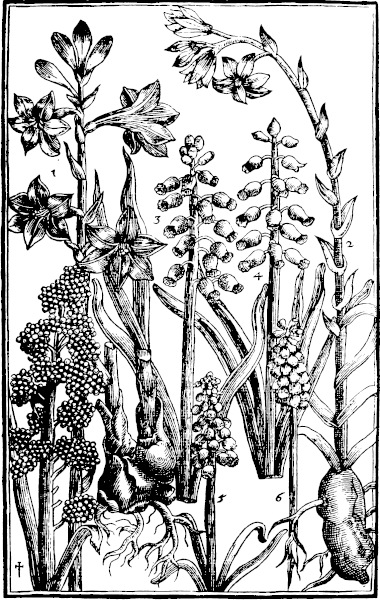
1Hyacinthus Indicus maior tuberosa radice. The greater Indian knobbed Iacinth.
2Hyacinthus Indicus minor tuberosa radice. The lesser Indian knobbed Iacinth.
3Muscari flore flauo. The yellow Muscari.
4Muscari flore cineritio. The ashcoloured Muscari.
5Hyacinthus Botroides cæruleus amænus. The skie coloured Grape-flower.
6Hyacinthus Botroides flore albo. The white Grape-flower.
†Hyacinthus Botroides ramosus. The branched Grape-flower.
The Place.
The rootes of the two first sorts, haue been often sent from Constantinople, among many other sorts of rootes, and it may be come thither from beyond the Bosphorus in Asia; we haue them in our Gardens.
The other two sorts are sprung (it is probable, if they be in rerum natura) from the seede of the two former; for we could neuer get such from Constantinople, as if the Turkes had neuer knowledge of any such.
The Time.
They flower in March or Aprill, as the yeare is temperate, but the first is soonest vp out of the ground.
The Names.
The two former haue beene sent from Turkie by the name of Muschoromi and Dipcadi. Matthiolus calleth it Bulbus vomitorius, saying that no root doth more prouoke vomit then it. Caspar Bauhinus doth most properly call it Hyacinthus Moschatus. It is most generally called Muscari, by all Herbarists and Florists, yet because it doth so neerely resemble the Grape-flower, I haue named it Hyacinthus Botroides maior Moschatus, to put a difference from the lesser Grape-flowers that follow; in English, The great Muske Grape-flower, or Muscari.
{Grape-flower}
Hyacinthus Botroides minor cæruleus obscurus. The darke blew Grape-flower.
This Grape-flower hath many small, fat, and weake leaues lying vpon the ground, which are somewhat brownish at their first comming vp, and of a sad greene afterwards, hollow on the vpperside, and round vnderneath, among which rise vp round, smooth, weake stalkes, bearing at the toppe many small heauie bottle-like flowers, in shape like the former Muscari, but very thicke thrust together, smaller, and of a very darke or blackish blew colour, of a very strong smell, like vnto Starch when it is new made, and hot: the root is round, and blackish without, being compassed with a number of small rootes, or of-sets round about it, so that it will quickly choke a ground, if it be suffered long in it. For which cause, most men doe cast it into some by-corner, if they meane to preserue it, or cast it out of the Garden quite.
Alter maior.
There is another of this kinde that is greater, both in leafe and flower, and differeth not in colour or any thing else.
Hyacinthus Botroides cæruleus amænus. The skie coloured Grape-flower.
This Iacinth springeth vp with fewer leaues then the first, and not reddish, but green at his first appearing; the leaues, when they are full growne, are long and hollow, like the former, but greener, shorter, and broader, standing vpright, and not lying along vpon the ground as they doe: the flowers grow at the toppe of the stalke, more sparsedly set thereon, and not so thicke together, but like a thinne bunch of grapes, and bottle-like as the former, of a perfect blew or skie colour, euery flower hauing some white spots about the brimmes of them: this hath a very sweete smell, nothing like the former: this roote is whiter, and doth not so much encrease as the former, yet plentifull enough.
Hyacinthus Botroides ramosus. The branched Grape-flower.
Of this kinde, there is another found to grow with many branches of flowers, breaking out from the sides of the greater stalkes or branches: the leaues as all the rest of the plant is greater then the former.
Hyacinthus Botroides flore albo. The white Grape-flower.
The white Grape-flower hath his green leaues a little whiter, then the blew or skie coloured Grape-flower, his flowers are very pure white, alike sparsedly set on the stalkes, but a little lower and smaller then it, in all other things there is no difference.
Hyacinthus Botroides flore albo rubente. The blush Grape-flower.
The roote of this Grape-flower groweth greater, then either the skie coloured, or white Grape-flower, and seldome hath any small rootes or of-sets, as the other haue: his leaues also are larger, and somewhat broader; the flowers are of a pale, or bleake blush colour out of a white, and are a little larger, and grow a little higher and fuller of flowers then the white.
The Place.
They naturally grow in many places both of Germany and Hungary; in Spaine likewise, and on Mount Baldus in Italy, and Narbone in France, about the borders of the fields: we haue them in our Gardens for delight.
The Time.
These flower from the beginning of March, or sooner sometimes, vntill the beginning of May.
The Names.
They are most commonly called Botroides, but more truely Botryodes, of Βότρυς the Greeke word, which signifieth a bunch or cluster of grapes: Lobelius calleth the white one, Dipcadi flore albo, transferring the name Dipcadi, whereby the Muscari is called to this Iacinth, as if they were both one. Their seuerall names, whereby they are knowne, and called, are set downe in their titles. The Dutchmen call them Driuekens, as I said before. Some English Gentlewomen call the white Grape-flower Pearles of Spaine.
{Faire haired Iacinth}
1. Hyacinthus Comosus albus. The white haired Iacinth.
This Iacinth doth more neerly resemble the Grape-flowers, then the faire haired Iacinths that follow, whereof it beareth the name, in that it hath no haire or threeds at the toppe of the stalke or sides, as they: and therefore I haue placed it next vnto them, and the other to follow it, as being of another kinde. The root hereof is blackish, a little long and round, from whence rise vp three or foure leaues, being smooth and whitish, long, narrow, and hollow, like a trough or gutter on the vpperside: among which the stalke riseth vp a foote high or more, bearing at the toppe diuers small flowers, somewhat like the former, but not so thicke set together, being a little longer, and larger, and wider at the mouth, and as it were diuided into six edges, of a darke whitish colour, with some blacker spots about the brimmes on the inside: the heads or seede-vessels are three square, and somewhat larger, then the heads of any of the former lesser Grape-flowers, wherein is contained round blacke seede.
2. Hyacinthus Comosus Byzantinus. The Turkie faire haired Iacinth.
This other Iacinth which came from Constantinople, is somewhat like the former, but that it is bigger, both in roote, and leafe, and flower, and bearing greater store of flowers on the head of the stalke: the lower flowers, although they haue short stalkes at their first flowring, yet afterwards the stalkes grow longer, and those that are lower, stand out further then those that are highest, whose foot-stalkes are short, and almost close to the stemme, and of a more perfect purple then any below, which are of a duskie greenish purple colour: the whole stalke of flowers seem like a Pyramis, broad belowe, and small aboue, or as other compare it, to a water sprinkle; yet neither of both these Iacinths haue any threeds at the tops of the stalkes, as the other following haue.
3. Hyacinthus Comosus maior purpureus. The great purple faire haired Iacinth.
This faire haired Iacinth hath his leaues softer, longer, broader, and lesse hollow then the former, lying for the most part vpon the ground: the stalke riseth vp in the midst of the leaues, being stronger, higher, and bearing a greater and longer head of flowers also then they: the flowers of this stand not vpon such long foote-stalkes, but are shorter below, and close almost to the stalke aboue, hauing many bright purplish blew threeds, growing highest aboue the flowers, as it were in a bush together, euery one of these threeds hauing a little head at the end of them, somewhat like vnto one of the flowers, but much smaller: the red of the flowers below this bush, are of a sadder or deader purple, and not so bright a colour, and the lowest worst of all, rather enclining to a greene, like vnto the last Turkie kinde: the whole stalke with the flowers vpon it, doth somewhat resemble a long Purse tassel, and thereupon diuers Gentlewomen haue so named it: the heads and seede are like vnto the former, but greater: the roote is great and white with some rednesse on the outside.
4. Hyacinthus Comosus ramosus purpureus. The faire haired branched Iacinth.
The leaues of this Iacinth are broader, shorter, and greener then of the last, not lying so weakly on the ground, but standing somewhat more vpright: the stalke riseth vp as high as the former, but branched out on euery side into many tufts of threeds, with knappes, as it were heads of flowers, at the ends of them, like vnto the head of threeds at the toppe of the former Iacinth, but of a little darker, and not so faire a blewish purple colour: this Iacinth doth somewhat resemble the next Curld haire Iacinth, but that the branches are not so fairely composed altogether of curled threeds, nor of so excellent a faire purple or Doue colour, but more duskie by much: the roote is greater and shorter then of the next, and encreaseth faster.
5. Hyacinthus Pennatus, siue Comosus ramosus elegantior. The faire Curld-haire Iacinth.
This admirable Iacinth riseth vp with three or foure leaues, somewhat like vnto the leaues of the Muske Grape-flower, but lesser; betweene which riseth vp the stalke about a foote high, or somewhat more, bearing at the toppe a bush or tuft of flowers, which at the first appearing, is like vnto a Cone or Pineapple, and afterwards opening it selfe, spreadeth into many branches, yet still retaining the forme of a Pyramis, being broad spread below, and narrow vp aboue: each of these branches is againe diuided into many tufts of threeds or strings, twisted or curled at the ends, and of an excellent purple or Doue colour, both stalkes and haires. This abideth a great while in his beauty, but afterwards all these flowers (if you will so call them) do fall away without any seede at all, spending it selfe as it should seeme in the aboundance of the flowers: the roote is not so great as the last, but white on the outside.
The Place.
The two first haue been sent diuers times from Constantinople, the third is found wilde in many places of Europe, and as well in Germany, as in Italy. The two last are onely with vs in Gardens, and their naturall places are not knowne vnto vs.
The Time.
The three former kindes doe flower in Aprill, the two last in May.
The Names.
The first and second haue no other names then are expressed in their titles. The third is called of some onely Hyacinthus maior and of others Hyacinthus comosus maior: We call it in English, The purple faire haired Iacinth, because of his tuft of purple threeds, like haires at the toppe, and (as I said) of diuers Gentlewomen, purple tassels. The fourth is called by some as it is in the title, Hyacinthus Comosus ramosus, and of others Hyacinthus Calamistratus. And the last or fifth is diuersly called by diuers, Fabius Columna in his Phytobasanos the second part, calleth it Hyacinthus Sannesius, because hee first saw it in that Cardinals Garden at Rome. Robin of Paris sent to vs the former of the two last, by the name of Hyacinthus Pennatus, and Hyacinthus Calamistratus, when as others sent the last by the name Pennatus, and the other by the name of Calamistratus; but I thinke the name Cincinnatus is more fit and proper for it, in that the curled threeds which seeme like haires, are better expressed by the word Cincinnus, then Calamistrum, this signifying but the bodkin or instrument wherewith they vse to frisle or curle the haire, and that the bush of haire it selfe being curled. Some also haue giuen to both these last the names of Hyacinthus Comosus Parnassi, the one fairer then the other. Of all these names you may vse which you please; but for the last kinde, the name Cincinnatus, as I said, is the more proper, but Pennatus is the more common, and Calamistratus for the former of the two last.
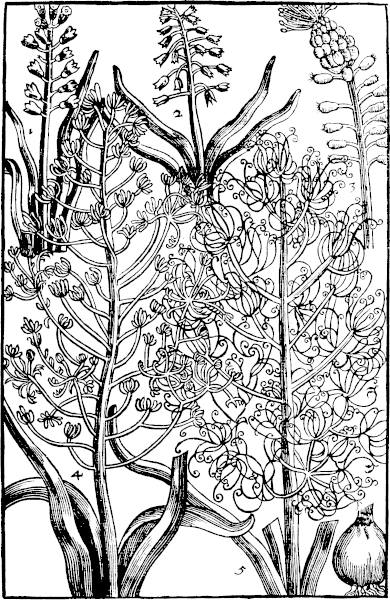
1Hyacinthus Comosus albus. The white haired Iacinth.
2Hyacinthus Comosus Byzantinus. The Turkie faire haired Iacinth.
3Hyacinthus Comosus maior purpureus. The purple faire haired Iacinth, or Purse tassels.
4Hyacinthus Comosus ramosus, siue Calamistratus. The faire haired branched Iacinth.
5Hyacinthus Pennatus, siue Comosus elegantior. The faire curld haire Iacinth.
{Orientall Iacinth}
1. Hyacinthus Orientalis Brumalis, siue præcox flore albo. The white Winter Orientall Iacinth.
This early Iacinth riseth vp with his greene leaues (which are in all respects like to the ordinary Orientall Iacinths, but somewhat narrower) before Winter, and sometimes it is in flower also before Winter, and is in forme and colour a plaine white Orientall Iacinth, but somewhat lesser, differing onely in no other thing, then the time of his flowring, which is alwayes certaine to be long before the other sorts.
2. Hyacinthus Orientalis Brumalis, siue præcox flore purpureo. The purple Winter Orientall Iacinth.
The difference of colour in this flower causeth it to bee distinguished, for else it is of the kindred of the Orientall Iacinths, and is, as the former, more early then the rest that follow: Vnderstand then, that this is the same with the former, but hauing fine blewish purple flowers.
3. Hyacinthus Orientalis maior præcox, dictus Zumbul Indi. The greatest Orientall Iacinth, or Zumbul Indi.
The roote of this Orientall Iacinth, is vsually greater then any other of his kinde, and most commonly white on the outside, from whence rise vp one or two great round stalkes, spotted from within the ground, with the lower part of the leaues also vpward to the middle of the stalkes, or rather higher, like vnto the stalkes of Dragons, but darker; being set among a number of broad, long, and somewhat hollow greene leaues, almost as large as the leaues of the white Lilly: at the toppe of the stalkes stand more store of flowers, then in any other of this kinde, euery flower being as great as the greatest sort of Orientall Iacinths, ending in six leaues, which turne at the points, of a faire blewish purple colour, and all standing many times on one side of the stalkes, and many times on both sides.
4. Hyacinthus Orientalis vulgaris diuersorum colorum. The ordinary Orientall Iacinth.
The common Orientall Iacinth (I call it common, because it is now so plentifull in all Gardens, that it is almost not esteemed) hath many greene leaues, long, somewhat broad and hollow, among which riseth vp a long greene round stalke, beset from the middle thereof almost, with diuers flowers, standing on both sides of the stalkes, one aboue another vnto the toppe, each whereof next vnto the foote-stalke is long, hollow, round, and close, ending in six small leaues laid open, and a little turning at the points, of a very sweete smell: the colours of these flowers are diuers, for some are pure white, without any shew of other colour in them: another is almost white, but hauing a shew of blewnesse, especially at the brims and bottomes of the flowers. Others againe are of a very faint blush, tending towards a white: Some are of as deepe a purple as a Violet; others of a purple tending to rednesse, and some of a paler purple. Some againe are of a faire blew, others more watchet, and some so pale a blew, as if it were more white then blew: after the flowers are past, there rise vp great three square heads, bearing round blacke seede, great and shining: the roote is great, and white on the outside, and oftentimes purplish also, flat at the bottome, and small at the head.
Flore purpureo violaceo lincis albicantis in dorso.
There is a kinde of these Iacinths, whose flowers are of a deepe purplish Violet colour, hauing whitish lines downe the backe of euery leafe of the flower, which turne themselues a little backwards at the points.
Floribus antrorsum respicientibus.
There is another, whose flowers stand all opening one way, and not on all sides, but are herein like the great Zumbul Indi, before set out.
Serotinus erectus floribus diuersorum colorum.
There is againe another kinde which flowreth later then all the rest, and the flowers are smaller, standing more vpright, which are either white or blew, or mixt with white and purple.
5. Hyacinthus Orientalis folioso caule. The bushy stalked Orientall Iacinth.
This strange Iacinth hath his rootes, leaues, and flowers, like vnto the former Orientall Iacinths: the onely difference in this is, that his stalke is not bare or naked, but hath very narrow long leaues, growing dispersedly, and without order, with the flowers thereon, which are blew, and hauing for the most part one leafe, and sometimes two at the foote, or setting on of euery flower, yet sometimes it happeneth, some flowers to be without any leafe at the bottome, as nature, that is very variable in this plant, listeth to play: the heads and seede are blacke and round, like the other also.
6. Hyacinthus Orientalis flore duplici. The bleake Orientall Iacinth once double.
This double Iacinth hath diuers long leaues, like vnto the other Orientall Iacinths, almost standing vpright, among which riseth vp a stalke, brownish at the first, but growing greene afterwards, bearing many flowers at the toppe, made like the flowers of the former Iacinths, and ending in six leaues, greene at the first, and of a blewish white when they are open, yet retaining some shew of greenesse in them, the brims of the leaues being white; from the middle of each flower standeth forth another small flower, consisting of three leaues, of the same colour with the other flower, but with a greene line on the backe of each of these inner leaues: in the middle of this little flower, there stand some threeds tipt with blacke: the smell of this flower is not so sweete as of the forme; the heads, seede, and rootes are like the former.
7. Hyacinthus Orientalis flore pleno cæruleo, vel purpuro violaceo. The faire double blew, or purple Orientall Iacinth.
The leaues of these Iacinths are smaller, then the leaues of most of the other former sorts; the stalkes are shorter, and smaller, bearing but three or foure flowers on the heads of them for the most part, which are not composed like the last, but are more faire, full, and double of leaues, where they shew out their full beauties, and of a faire blew colour in some, and purple in others, smelling pretty sweete; but these doe seldome beare out their flowers faire; and besides, haue diuers other flowers that will be either single, or very little double vpon the same stalke.
8. Hyacinthus Orientalis candidissimus flore pleno. The pure white double Orientall Iacinth.
This double white Iacinth hath his leaues like vnto the single white Orientall Iacinth; his stalke is likewise long, slender, and greene, bearing at the toppe two or three flowers at the most, very double and full of leaues, of a pure white colour, without any other mixture therein, hanging downe their heads a little, and are reasonable sweete. I haue this but by relation, not by sight, and therefore I can giue no further assurance as yet.
The Place.
All these Orientall Iacinths, except the last, haue beene brought out of Turkie, and from Constantinople: but where their true originall place is, is not as yet vnderstood.
The Time.
The two first (as is said) flower the earliest, sometimes before Christmas, but more vsually after, and abide a great while in flower, in great beauty, especially if the weather be milde, when as few or no other flowers at that time are able to match them. The other greatest kinde flowreth also earlier then the rest that follow, for the most part. The ordinary kindes flower some in March, and some in Aprill, and some sooner also; and so doe the double ones likewise. The bushy stalked Iacinth flowreth much about the same time.
The Names.
The former two sorts are called Hyacinthus Orientalis Brumalis, and Hyacinthus Orientalis præcox flore albo, or cæruleo. The third is called of many Zumbul Indicum, or Zumbul Indi, and corruptly Simboline; of others, and that more properly, Hyacinthus Orientalis maior præcox. The Turkes doe call all Iacinths Zumbul, and by adding the name of Indi, or Arabi, do shew from what place they are receiued. In English, The greatest Orientall Iacinth; yet some doe call it after the Turkish name Zumbul Indi, or Simboline, as is said before. The rest haue their names set downe in their titles, which are most fit for them.
Hyacinthus Hispanicus minor Orientalis facie. The little Summer Orientall Iacinth.
Flore cæruleo.
This little Iacinth hath foure or fiue long narrow greene leaues, lying vpon the ground, among which riseth vp a slender smooth stalke, about a spanne high or more, bearing at the toppe many slender bleake blew flowers, with some white stripes and edges to be seene in most of them, fashioned very like vnto the flowers of the Orientall Iacinth, but much smaller: the flower hath no sent at all; the seede is like the seede of the English Iacinth, or Hares-bels: the roote is small and white.
Flore albo.
There is another of this kinde, differing in nothing but in the colour of the flower, which is pure white.
Flore rubente.
There is also another, whose flowers are of a fine delayed red colour, with some deeper coloured veines, running along the three outer leaues of the flower, differing in no other thing from the former.
The Place.
These plants haue been gathered on the Pyrenæan Mountaines, which are next vnto Spaine, from whence, as is often said, many rare plants haue likewise been gathered.
The Time.
They flower very late, euen after all or most of the Iacinths, in May for the most part.
The Names.
They are called eyther Hyacinthus Hispanicus minor Orientalis facie, as it is in the title, or Hyacinthus Orientalis facie, that is to say, The lesser Spanish Iacinth, like vnto the Orientall: yet some haue called them, Hyacinthus Orientalis serotinus minor, The lesser late Orientall Iacinth, that thereby they may be knowne from the rest.
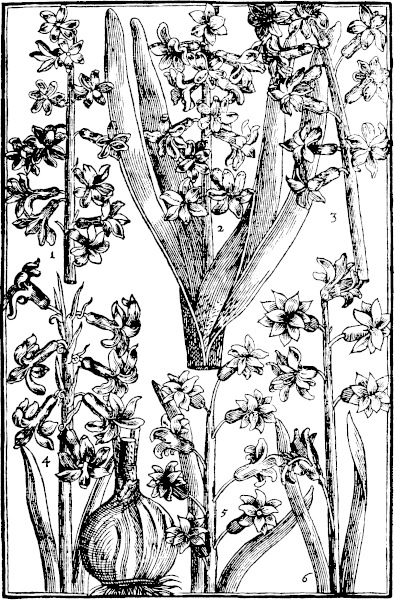
1Hyacinthus Orientalis brumalis. The Winter Orientall Iacinth.
2Zumbul Indi. The greatest Orientall Iacinth.
3Hyacinthus Orientalis vulgaris. The ordinary Orientall Iacinth.
4Hyacinthus Orientalis folioso caule. The bushy stalked Orientall Iacinth.
5Hyacinthus Orientalis flore duplici. The Orientall Hyacinth once double.
6Hyacinthus Orientalis flore pleno cæruleo. The faire double blew Orientall Iacinth.
Hyacinthus Hispanicus obsoletus. The Spanish dunne coloured Iacinth.
This Spanish Iacinth springeth very late out of the ground, bearing foure or fiue short, hollow, and soft whitish greene leaues, with a white line in the middle of euery one of them, among which rise vp one or more stalkes, bearing diuers flowers at the toppes of them, all looking one way, or standing on the one side, hanging downe their heads, consisting of six leaues, three whereof being the outermost, lay open their leaues, and turne back the ends a little again: the other three which are innermost, do as it were close together in the middle of the flower, without laying themselues open at all, being a little whitish at the edges: the whole flower is of a purplish yellow colour, with some white and green as it were mixed among it, of no sent at all: it beareth blacke and flat seede in three square, great, and bunched out heads: the roote is reasonable great, and white on the outside, with many strong white fibres at it, which perish not yearely, as the fibres of many other Iacinths doe, and as it springeth late, so it holdeth his greene leaues almost vntill Winter.
Mauritanicus.
There hath been another hereof brought from about Fez and Marocco in Barbary, which in all respects was greater, but else differed little.
Maximus Æthiopicus.
There was another also brought from the Cape of good Hope, whose leaues were stronger and greener then the former, the stalke also thicker, bearing diuers flowers, confusedly standing vpon longer foote-stalkes, yet made after the same fashion, but that the three inner leaues were whitish, and dented about the edges, otherwise the flowers were yellow and greenish on the inside.
The Place.
These plants grow in Spaine, Barbary, and Ethiopia, according as their names and descriptions doe declare.
The Time.
The first flowreth not vntill Iune; for, as I said, it is very late before it springeth vp out of the ground, and holdeth his leaues as is said, vntill September, in the meane time the seede thereof ripeneth.
The Names.
They haue their names according to the place of their growing; for one is called Hyacinthus Hispanicus obsoletioris coloris. The other is called also Hyacinthus Mauritanicus. And the last, Hyacinthus Æthiopicus obsoletus. In English, The Spanish, Barbary, or Ethiopian Iacinth, of a dunne or duskie colour.
{Bell-flowered Iacinth}
Hyacinthus Anglicus Belgicus, vel Hispanicus. English Hares-bels, or Spanish Iacinth.
Our English Iacinth or Hares-bels is so common euery where, that it scarce needeth any description. It beareth diuers long and narrow greene leaues, not standing vpright, nor yet fully lying vpon the ground, among which springeth vp the stalke, bearing at the toppe many long and hollow flowers, hanging downe their heads all forwards for the most part, parted at the brimmes into six parts, turning vp their points a little againe, of a sweetish, but heady sent, somewhat like vnto the Grape-flower: the heads for seede are long and square, wherein is much blacke seede; the colour of the flowers are in some of a deeper blew, tending to a purple; in others of a paler blew, or of a bleake blew, tending to an ash colour: Some are pure white, and some are party coloured, blew and white; and some are of a fine delayed purplish red or blush colour, which some call a peach colour. The rootes of all sorts agree, and are alike, being white and very slimie; some whereof will be great and round, others long and slender, and those that lye neare the toppe of the earth bare, will be greene.
Hyacinthus Hispanicus maior flore campanulæ instar. The greater Spanish bell-flowred Iacinth.
This Spanish bell-flowred Iacinth, is very like the former English or Spanish Iacinth, but greater in all parts, as well of leaues as flowers, many growing together at the toppe of the stalke, with many short greene leaues among them, hanging downe their heads, with larger, greater, and wider open mouths, like vnto bels, of a darke blew colour, and no good sent.
The Place.
The first groweth in many places of England, the Lowe-Countries, as we call them, and Spaine, but the last chiefly in Spaine.
The Time.
They flower in Aprill for the most part, and sometimes in May.
The Names.
Because the first is more frequent in England, then in Spaine or the Lowe-Countries, it is called with vs Hyacinthus Anglicus, The English Iacinth; but it is also called as well Belgicus, as Hispanicus: yet Dodonæus calleth it Hyacinthus non scriptus, because it was not written of by any Authour before himselfe. It is generally knowne in England by the name of Hare-bels. The other Spanish Iacinth beareth his name in his title.
Hyacinthus Eriophorus. The Woolly Iacinth.
This Woolly Iacinth hath many broad, long, and faire greene leaues, very like vnto some of the Iacinths, but stiffer, or standing more vpright, which being broken, doe yeeld many threeds, as if a little fine cotton wooll were drawne out: among these leaues riseth vp a long greene round stalke, a foote and a halfe high or more, whereon is set a great long bush of flowers, which blowing open by degrees, first below, and so vpwards, are very long in flowring: the toppe of the stalke, with the flowers, and their little footstalkes, are all blew, euery flower standing outright with his stalke, and spreading like a starre, diuided into six leaues, hauing many small blew threeds, standing about the middle head, which neuer gaue ripe seede, as farre as I can heare of: the root is white, somewhat like the root of a Muscari, but as full of wooll or threeds, or rather more, then the leaues, or any other part of it.
The Place.
This hath been sent diuers times out of Turkie into England, where it continued a long time as well in my Garden as in others, but some hard frosty Winters caused it to perish with me, and diuers others, yet I haue had it againe from a friend, and doth abide fresh and greene euery yeare in my Garden.
The Time.
This flowred in the Garden of Mʳ. Richard Barnesley at Lambeth, onely once in the moneth of May, in the yeare 1606, after hee had there preserued it a long time: but neither he, nor any else in England that I know, but those that saw it at that time, euer saw it beare flower, either before or since.
The Names.
It is called by diuers Bulbus Eriophorus, or Laniferus, that is, Woolly Bulbous; but because it is a Iacinth, both in roote, leafe, and flower, and not a Narcissus, or Daffodill, it is called Hyacinthus Eriophorus, or Laniferus, The Woolly Iacinth. It is very likely, that Theophrastus in his seuenth Book & thirteenth Chapter, did meane this plant, where hee declareth, that garments were made of the woolly substance of a bulbous roote, that was taken from between the core or heart of the roote (which, as he saith, was vsed to be eaten) and the outermost shels or peelings; yet Clusius seemeth to fasten this woolly bulbous of Theophrastus, vpon the next Iacinth of Spaine.
{Spanish starry Iacinth}
Hyacinthus Stellatus Bæticus maior, vulgò Perüanus. The great Spanish Starry Iacinth, or of Peru.
This Iacinth (the greatest of those, whose flowers are spread like a starre, except the two first Indians) hath fiue or six, or more, very broad, and long greene leaues, spread vpon the ground, round about the roote, which being broken are woolly, or full of threeds, like the former: in the middle of these leaues riseth vp a round short stalke, in comparison of the greatnesse of the plant (for the stalke of the Orientall Iacinth is sometimes twice so high, whose roote is not so great) bearing at the toppe a great head or bush of flowers, fashioned in the beginning, before they bee blowne or separated, very like to a Cone or Pineapple, and begin to flower belowe, and so vpwards by degrees, euery flower standing vpon a long blackish blew foote-stalke, which when they are blowne open, are of a perfect blew colour, tending to a Violet, and made of six small leaues, laid open like a starre; the threeds likewise are blewish, tipt with yellow pendents, standing about the middle head, which is of a deeper blew, not hauing any good sent to be perceiued in it, but commendable only for the beauty of the flowers: after the flowers are past, there come three square heads, containing round blacke seede: the roote is great, and somewhat yellowish on the outside, with a knobbe or bunch at the lower end of the roote, (which is called the seate of the roote) like vnto the Muscari, Scylla, and many other bulbous rootes, at which hang diuers white, thicke, and long fibres, whereby it is fastened in the ground, which perish not euery yeare, but abide continually, and therefore doth not desire much remouing.