THE GARDEN OF PLEASANT FLOWERS. (continued 11)
Reading edition
8. Trachelium Americanum flore ruberrimo, siue Planta Cardinalis. The rich crimson Cardinals flower.
This braue plant, from a white roote spreading diuers wayes vnder ground, sendeth forth many greene leaues, spread round about the head thereof, each whereof is somewhat broade and long, and pointed at the end, finely also snipt about the edges; from the middle whereof ariseth vp a round hollow stalke, two foote high at the least, beset with diuers such leaues as grow below, but longer below then aboue, and branching out at the toppe aboundantly, euery branch bearing diuers greene leaues on them, and one at the foote of euery of them also, the toppes whereof doe end in a great large tuft of flowers, with a small greene leafe at the foote of the stalke of euery flower, each footestalke being about an inch long, bearing a round greene huske, diuided into fiue long leaues or points turned downwards, and in the midst of euery of them a most rich crimson coloured flower, ending in fiue long narrow leaues, standing all of them foreright, but three of them falling downe, with a long vmbone set as it were at the backe of them, bigger below, and smaller aboue, and at the toppe a small head, being of a little paler colour then the flower, but of no sent or smell at all, commendable only for the great bush of so orient red crimson flowers: after the flowers are past, the seede commeth in small heads, closed within those greene husks that held the flowers, which is very like vnto the seede vessels of the Viola Mariana, or Couentry Bels, and is small and brownish.
The Place.
All these Bell-flowers do grow in our Gardens, where they are cherished for the beautie of their flowers. The Couentry Bels doe not grow wilde in any of the parts about Couentry, as I am credibly informed by a faithfull Apothecary dwelling there, called Master Brian Ball, but are noursed in Gardens with them, as they are in other places. The last groweth neere the riuer of Canada, where the French plantation in America is seated.
The Time.
They flower from May vntill the end of Iuly or August, and in the mean time the seed is ripe: But the Peache-leafed Bell-flowers, for the most part, flower earlier then the other.
The Names.
The first is generally called Campanula Perficifolia, in English Peach-leafed Bell-flower. The second is called Campanula maior, Campanula lactescens Pyramidalis, and Pyramidalis Lutetiana of Lobel, in English, Great or Steeple Bell-flower. The third is vsually called Viola Mariana, and of some Viola Marina. Lobel putteth a doubt whether it be not Medium of Dioscorides, as Matthiolus and others doe thinke; but in my opinion the thicknesse of the roote, as the text hath it, contradicteth all the rest. We call it generally in English Couentry Bels. Some call it Marian, and some Mercuries Violets. The fourth and fift are called Trachelium or Cervicaria, of some Vvularia, because many haue vsed it to good purpose, for the paines of the Vvula, or Throate: Yet there is another plant, called also by some Vvularia, which is Hippoglossum, Horse tongue, or Double tongue. The sixt hath his title to descipher it out sufficiently, as is declared. The seuenth is called Trachelium minus, and Ceruicaria minor, of some Saponaria altera; in English, Small Throateworte, or Small Canterbury Bels. The last hath his name in the title, as it is called in France, from whence I receiued plants for my Garden with the Latine name: but I haue giuen it in English.
The Vertues.
The Peach-Bels as well as the others may safely bee vsed in gargles and lotions for the mouth, throate, or other parts, as occasion serueth. The rootes of many of them, while they are young, are often eaten in sallets by diuers beyond the Seas.
Chap. LXXXVII. Campana Cærulea siue Convolvulus Cæruleus. Blew Bell flowers, or blew Bindeweede.
There are two other kindes of Bell-flowers, much differing from the Tribe or Familie of the former, because of their climbing or winding qualitie, which I must needes place next them, for the likenesse of the flowers, although otherwise they might haue beene placed with the other clamberers that follow. Of these there is a greater, and a lesser, and of each likewise some difference, as shall be declared.
1. Convolvulus cæruleus maior rotundifolius. The greater blew Bindweede, or Bell-flower with round leaues.
This goodly plant riseth vp with many long and winding branches, whereby it climbeth and windeth vpon any poles, herbes, or trees, that stand neare it within a great compasse, alwaies winding it selfe contrary to the course of the Sunne: on these branches doe growe many faire great round leaues, and pointed at the end, like vnto a Violet leafe in shape, but much greater, of a sad greene colour: at the ioynts of the branches, where the leaues are set, come forth flowers on pretty long stalkes, two or three together at a place, which are long, and pointed almost like a finger, while they are buds, and not blowne open, and of a pale whitish blew colour, but being blowne open, are great and large bels, with broad open mouths or brims ending in fine corners, and small at the bottome, standing in small greene huskes of fine leaues: these flowers are of a very deepe azure or blew colour, tending to a purple, very glorious to behold, opening for the most part in the euening, abiding so all the night and the next morning, vntill the Sunne begin to growe somewhat hot vpon them, and then doe close, neuer opening more: the plant carrieth so many flowers, if it stand in a warme place, that it will be replenished plentifully, vntill the cold ayres and euenings stay the luxury thereof: after the flowers are past, the stalkes whereon the flowers did stand, bend downwards, and beare within the huskes three or foure blacke seedes, of the bignesse of a Tare or thereabouts: the rootes are stringy, and perish euery yeare.
2. Convolvulus trifolius siue hederaceus purpureus. The greater purple Bindeweede, or Bell-flower with cornered leaues.
The growing and forme of this Bindeweede or Bell-flower, is all one with the former, the chiefest differences consisting in the forme of the leafe, which in this is three cornered, like vnto an Iuie leafe with corners; and in the flower, which is of a deeper blew, tending more to a deepe purple Violet, and somewhat more reddish in the fiue plaites of each flower, as also in the bottomes of the flowers.
3. Convolvulus tenuifolius Americanus. The red Bell-flower of America.
Although this rare plant (because wee seldome haue it, and can as hardly keepe it) be scarce knowne in these cold Countries, yet I could not but make mention of it, to incite those that haue conueniencie to keepe it, to be furnished of it. It springeth vp at the first from the seede with two leaues, with two long forked ends, which abide a long time before they perish, betweene which riseth vp the stalke or stemme, branching forth diuers waies, being of a brownish colour, which windeth it selfe as the former great Bell-flower doth, whereon are set at seuerall ioynts diuers winged leaues, that is to say, many small narrow and long leaues set on both sides of the middle ribbe, and one at the end: from these ioynts arise long stalkes, at the ends whereof stand two or three small, long, hollow flowers, fashioned very like vnto the flowers of a Bindeweede, or the flowers of Tabacco, and ending in the like manner in fiue points, but not so much laide open, being of a bright red colour, plaited as the Bindeweedes or Bell-flowers before they be open, with some few threads in the middle, which turne into long pointed cods, wherein is contained long and blacke seede, tasting hot like Pepper: the roote is small and stringy, perishing euery yeare, and with vs will seldome come to flower, because our cold nights and frosts come so soone, before it can haue comfort enough of the Sun to ripen it.
4. Convolvulus cæruleus minor Hispanicus. The Spanish small blew Bindeweede.
This small Bindeweede hath small long leaues, somewhat broader then the next that followeth, and not so broad as the common small Bindeweede (that groweth euery where wilde on the bankes of fields abroad) set vpon the small trayling branches, which growe aboue two or three foote high: from the middle of these branches, and so vnto the toppes of them, come forth the flowers at the ioynts with the leaues, folded together at the first into fiue plaites, which open into so many corners, of a most excellent faire skie coloured blew (so pleasant to behold, that often it amazeth the spectator) with white bottomes, and yellowish in the middle, which turne into small round white heads, wherein are contained small blackish cornered seede, somewhat like the former, but smaller: the roote is small and threddy, perishing as the former euery yeare: this neuer windeth it selfe about any thing, but leaneth by reason of the weaknesse of the branches, and dyeth euery yeare after seede time, and not to be sowne againe vntill the next Spring.
5. Convolvulus purpureus Spicæfolius. Lauander leafed Bindeweede.
This small purple Bindeweede, where it naturally groweth, is rather a plague then a pleasure, to whatsoeuer groweth with it in the fields; yet the beauty of the flower hath caused it to be receiued into Gardens, bearing longer and smaller leaues then the last, and such like small Bell-flowers, but of a sad purple colour: the roote is liuing, as the common kinds are, and springeth againe where it hath been once sowne, without feare of perishing.
The Place.
The first two greater kindes haue beene sent vs out of Italy, but whether they had them from the East Indies, or from some of the Easterne Countries on this side, wee know not: but they thriue reasonable well in our Country, if the yeare be any thing kindly. The next came out of America, as his name testifieth. The lesser blew kinde groweth naturally in many places both of Spaine and Portugall (from whence I first receiued seedes from Guillaume Boel, heretofore remembred.) The last groweth wilde in the fields, about Dunmowe in Essex, and in many other places of our owne Countrey likewise.
The Time.
The three first greater kindes flower not vntill the end of August, or thereabouts, and the seede ripeneth in September, if the colds and frosts come not on too speedily. The lesser kindes flower in Iune and Iuly.
The Names.
The first is called of some Campana Lazura, as the Italians doe call it, or Campana cærulea, of others Convolvulus cæruleus maior, siue Indicus, and Flos noctis. Of some Nil Auicennæ. The second, is called Convolvulus trifolius, or hederaceus, for the distinction of the leaues. In English wee call them eyther Great blew Bell flowers, or more vsually, Great blew Bindeweedes. That of America is diuersly called by diuers. It is called Quamoclit of the Indians, and by that name it was sent to Ioachinus Camerarius out of Italy, where it is so called still, as Fabius Columna setteth it downe, and as my selfe also can witnesse it, from thence being so sent vnto mee: but Andræas Cæsalpinus calleth it, Iasminum folio Millefolij, supposing it to be a Iasmine. Camerarius saith, it may not vnfitly be called Convolvulus tenuifolius, accounting it a kinde of Bindeweede. Columna entituleth it Convolvulus pennatus exoticus rarior, and saith it cannot bee referred to any other kinde of plant then to the Bindeweede. Hee that published the Curæ posteriores of Clusius, giueth it the name of Iasminum Americanum, which I would doe also, if I thought it might belong to that Family; but seeing the face and forme of the plant better agreeing with the Bindeweedes or Bell-flowers, I haue (as you see) inserted it among them, and giuen it that name may bee most fit for it, especially because it is but an annuall plant. The lesser kindes haue their names sufficiently expressed in their titles.
The Vertues.
We know of no vse these haue in Physicke with vs, although if the first be Nil of Auicen, both he and Serapio say it purgeth strongly.
Chap. LXXXVIII. Stramonium. Thorne-Apple.
Vnto the Bell-flowers, I must adioyne three other plants, in the three seuerall Chapters following, for some affinity of the flowers: and first of the Thorne-Apples, whereof there are two especiall kindes, that is, a greater and a lesser, and of each some diuersity, as shall be set downe.
1. Stramonium maius album. The great white flowred Thorne-Apple.
The greater Thorne-Apple hath a great, strong, round greene stalke, as high as any man, if it be planted in good ground, and of the bignesse of a mans wrest almost at the bottome, spreading out at the toppe into many branches, whereon stand many very large and broad darke greene leaues, cut in very deeply on the edges, and hauing manie points or corners therein: the flowers come forth at the ioynts, betweene two branches towards the toppe of them, being very large, long, and wide open, ending in fiue points or corners, longer and larger then any other Bell-flowers whatsoeuer: after the flowers are past, come the fruit, which are thorny long heads, more prickly and greene then the lesser kindes, which being ripe openeth it selfe into three or foure parts, hauing a number of flat blackish seede within them: the roote is aboundant in fibres, whereby it strongly taketh hold in the ground, but perisheth with the first frosts; yet the seede that is shed when the fruit is ripe, commeth vp the next yeare.
2. Stramonium maius purpureum. The great purple flowred Thorne-Apple.
This purple Thorne-Apple is in largenesse of leaues, thicknesse and height of stalke, greatnesse and forme of flowers and fruit, euery way equall and correspondent vnto the former, the chiefe differences be these: the stalke is of a darke purple colour; the leaues are of a darker greene, somewhat purplish, and the flowers are of light purple or pale Doue colour, enclining to white, and whiter at the bottome.
3. Stramonium minus seu Nux Metel flore albo. The smaller Thorne-Apple with a white flower.
The smaller Thorne-Apple riseth vp with one round stalke, of the bignesse of a mans finger, and neuer much aboue two foote high with vs, bearing a few large, broad, smooth leaues thereon, without any branches at all, which are vneuenly rent or torne about the edges, with many ribs, and smaller veines running through them, yet lesser by much then the greater kinde: at the ioynts where the leaues stand, come forth long and large white flowers, with broad or wide open brims, folded together before their opening, as the other former Bell-flowers or Bindeweedes, but hauing their fiue corners more pointed or horned then either they, or the former Thorne-Apples: after the flowers are past, succeed small fruit, rounder and harder, set with harder, but blunt prickes then the former, wherein is contained brownish yellow flat seede, sticking to the inward pulpe; the roote is not very great, but full of strings, and quickly perisheth with the first frosts.
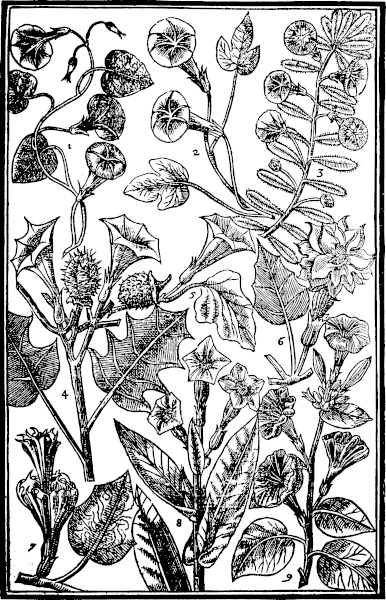
1Convolvulus maior cæruleus. The greater blew Bindweed or Bell flower.
2Convolvulus trifolius seu hederaceus. The great purple Bindeweed.
3Convolvulus minor cæruleus Hispanicus. The Spanish small blew Bindweed.
4Stramonium maius seu Pomum spinosum. The great Thorne-Apple.
5Datura seu Stramonium minus. The small Thorne-Apple.
6Stramonium flore duplici. The double flowred Thorne-Apple.
7Stramonium flore geminato. Double Thorne-Apple one out of another.
8Tabacco latifolium. Broad-leafed Tabacco.
9Mirabilia Peruana. The Meruaile of the world.
4. Stramonium minus flore geminato purpurante. The small double flowred purple Thorne-Apple.
In the flower of this plant, consisteth the chiefest difference from the former, which is as large as the last, pointed into more hornes or corners, and beareth two flowers, standing in one huske, one of them rising out from the middle of the other, like vnto those kindes of Cowslips and Oxelips, called double, or Hose in hose, before described, which are of a pale purplish colour on the outside, and almost white within: the fruit is round like the last, and beareth such like seede, so that vntill it bee in flower, their difference can hardly bee discerned: this is more tender then the last, although euen it is so tender, that it seldome beareth ripe seede with vs.
Flore duplici.
Sometimes (for I think it is not another kind) the flower will haue as it were double rowes of leaues, close set together, and not consisting of two, rising so distinctly one aboue another.
The Place.
All these kindes haue been brought or sent vs out of Turkie and Egypt; but Garcias, and Christopherus Acosta, with others, affirme that they grow in the East Indies. The lesser kindes are very rare with vs, because they seldome come to maturity; and therefore we are still to seeke of new seede to sowe. The greater kindes are plentifull enough in our Gardens, and will well abide, and giue ripe fruit.
The Time.
The smaller kindes flower later then the greater; and therefore their fruit are the sooner spoyled with the cold ayres, dewes, and frosts, that come at the latter end of the yeare: but the greater kinds neuer misse lightly to ripen.
The Names.
Both the greater and smaller kindes are generally called Stramonium, Stramonia, Pomum spinosum, and Datura. Bauhinus vpon Matthiolus his Comentaries on Dioscorides, calleth it Solanum fætidum spinosum. Some learned men haue referred it to Nux Metel, of the Arabian Authors. Wee call them generally, in English, Thorne-Apples, and distinguish them by their titles of greater and letter, single and double.
The Vertues.
The East Indian lasciuious women performe strange acts with the seed (of the smaller kinde, as I suppose, or it may be of either) giuing it their husbands to drinke. The whole plant, but especially the seed, is of a very cold and soporiferous quality, procuring sleep and distraction of senses. A few of the seeds steeped and giuen in drinke, will cause them that take it to seem starke drunke or dead drunke, which fit will within a few houres weare away, and they recouer their senses againe, as a drunken man raysed after sleep from his wine. It may therefore (in my opinion) be of safe and good vse to one, that is to haue a legge or an arme cut off, or to be cut for the stone, or some other such like cure to be performed, to take away the sense of paine for the time of doing it; otherwise I hold it not fit to be vsed without great caution. But the greene leaues of the greater kindes (as also the lesser, but that with vs they are not so plentifull) are by tryed experience, found to be excellent good for any scalded or burned part, as also to take away any hot inflammations, being made vp into a salue or ointment with suet, waxe, and rossin, &c. or with Axungia, that is, Hogs larde.
Chap. LXXXIX. Tabacco. Indian Henbane, or Tabacco.
There hath beene formerly but three kindes of Tabacco knowne vnto vs, two of them called Indian, and the third English Tabacco. In these later yeares, we haue had in our gardens about London (before the suppressing of the planting) three or foure other sorts at the least, and all of the Indian kinde, hauing some especiall difference, eyther in leafe, or flower, or both: And in regard the flowers of some of these carry a pretty shew, I shall only entreate of them, and not of the English kind.
Tabacco latifolium. Broade leafed Tabacco.
The great Indian Tabacco hath many very large, long, thicke, fat and faire greene leaues, standing foreright for the most part, and compassing the stalkes at the bottome of them, being somewhat pointed at the end: the stalke is greene and round, sixe or seuen foote high at sometimes, and in some places, in others not past three or foure foote high, diuided towards the toppe into many branches, with leaues at euery ioynt, and at the toppes of the branches many flowers, the bottomes hereof are long and hollow, and the toppes plaited or folded before they are open, but being open, are diuided sometimes into foure, or more vsually into fiue corners, somewhat like vnto other of the Bell-flowers, but lying a little flatter open, of a light carnation colour. The seede is very small and browne, contained in round heads, that are clammy while they are greene, and pointed at the end: the roote is great, whitish, and woody at the head, dispersing many long branches, and small fibres vnder the ground, whereby it is strongly fastened, but perisheth with our violent frosts in the winter, if it be left abroad in the garden, but if it be housed, or safely prouided for against the frostes, the rootes will liue, and spring afresh the next yeare.
There is of this kinde another sort, whose leaues are as large and long as the former, but thicker, and of a more dead greene colour, hanging downe to the ground-ward, and scarce any standing forth-right, as the former, vnlesse they bee very young: the flowers of this kinde are almost whole, without any great shew of corners at the brims or edges, in all other things there is no difference.
There is another, whose large and thicke flat leaues doe compasse the stalke at the bottome, and are as it were folded together one side vnto another: the flowers are of a deeper blush, or carnation colour, and with longer points and corners then in any of the former; and in these two things consisteth the difference from the others, and is called Verines Tabacco.
Another hath his leaues not so large and long as the first, and these haue short footestalkes, whereon they stand, and doe not compasse the stalke as the other doe: the flower hereof is like the first, but smaller, and of a little paler colour.
Tabacco angustifolium. Narrow leafed Tabacco.
This kinde of Tabacco hath somewhat lower, and smaller stalkes, then any of the former: the leaues hereof are smaller and narrower, and not altogether so thicke, but more pointed, and euery one standing vpon a footstalke, an inch and a halfe long at the least: the flowers hereof stand thicker together, vpon the small branches, somewhat larger, of a deeper blush colour, and more eminent corners then in any the former; the seed and roots are alike, and perish in like manner, vnlesse it be brought into a cellar, or other such couert, to defend it from the extremitie of the Winter.
The Place.
America or the West Indies is the place where all these kindes doe grow naturally, some in one place, and some in another, as in Peru, Trinidado, Hispaniola, and almost in euery Iland and Countrey of the continent thereof: with vs they are cherished in gardens, as well for the medicinable qualities, as for the beauty of the flowers.
The Time.
It flowreth in August, seldome before, and the seede is ripe quickly after. If it once sowe it selfe in a Garden, it will giue next year after young plants: but for the most part they will spring vp late, and therefore they that would haue them more early, haue sowen the seede vpon a bed of dung, and transplanted them afterwards.
The Names.
This plant hath gotten many names. The Indians call it in some places Petum, in others, Picielt, and Perebecenuc, as Ouiedus and others doe relate. The Spaniards in the Indies first called it Tabacco, of an Iland where plenty of it grew. It hath in Christendome receiued diuers other names, as Nicotiana, of one Nicot a French man, who seeing it in Portugall, sent it to the French Queene, from whom it receiued the name of Herba Regina. Lobel calleth it Sancta herba, & Sanasancta Indorum. Some haue adiudged it to be an Hioscyamus, and therefore call it Peruvianus. The most vsuall name wherby we call it in English, is Tabacco.
The Vertues.
The herbe is, out of question, an excellent helpe and remedy for diuers diseases, if it were rightly ordered and applyed, but the continuall abuse thereof in so many, doth almost abolish all good vse in any. Notwithstanding if men would apply their wits to the finding out of the vertues, I make no doubt but many strange cures would bee performed by it, both inward and outward. For outward application, a Salue made hereof (as is before recited of the Thorne apple leaues) cureth vlcers, and wounds of hard curation: And for inward helpes, a Syrupe made of the iuice and sugar, or honey, procureth a gentle vomit (but the dryed leafe infused in wine much more) and is effectuall in astmaticall diseases, if it bee carefully giuen. And likewise cleanseth cankers and fistulaes admirably, as hath beene found by late experience. The ashes of Tabacco is often vsed, and with good successe, for cuts in the hands, or other places, and for other small greene wounds.
Chap. XC. Mirabilia Peruviana. The Meruaile of Peru.
This plant yeeldeth in our Gardens fiue or sixe seuerall varieties of beautifull flowers, as pure white, pure yellow, pure red, white and red spotted, and red and yellow spotted. But besides these, I haue had some other sorts, among which was one, of a pale purple or peach colour: all which, comming vnto mee out of Spaine with many other, seedes in an vnkindly yeare (an early winter following a cold summer) perished with mee; yet I plainely might discerne by their leaues, and manner of growing, to be diuers from them that we now haue and keepe. I shall need therefore (because the chiefest difference consisteth almost in the flowers) to giue only one description of the plant, and therein shew the varieties as is before declared.
Admirabilis. The Meruaile of the World.
The stalke of this meruellous plant is great and thick, bigger then any mans thumbe, bunched out or swelling at euery ioynt, in some the stalkes will bee of a faire greene colour, and those will bring white, or white and red flowers: in others they will bee reddish; and more at the ioynts, and those giue red flowers; and in some of a darker greene colour, which giue yellow flowers; the stalkes and ioynts of those that will giue red and yellow flowers spotted, are somewhat brownish, but not so red as those that giue wholly red flowers: vpon these stalkes that spread into many branches, doe grow at the ioynts vpon seuerall footestalkes, faire greene leaues, broad at the stalke, and pointed at the end: at the ioynts likewise toward the vpper part of the branches, at the foote of the leaues, come forth seuerall flowers vpon short footestalkes, euery one being small, long and hollow from the bottome to the brimme, which is broade spread open, and round, and consist but of one leafe without diuision, like vnto a Bell flower, but not cornered at all: which flowers, as I said, are of diuers colours, and diuersly marked and spotted, some being wholly white, without any spot in them for the most part, through all the flowers of the plant; so likewise some being yellow, and some wholly red; some plants againe being mixed and spotted, so variably either white and red, or purple, (except here and there some may chance to be wholly white, or red or purple among the rest) or red and yellow through the whole plant, (except as before some may chance in this kinde to be eyther wholly red, or wholly yellow) that you shall hardly finde two or three flowers in a hundred, that will bee alike spotted and marked, without some diuersitie, and so likewise euery day, as long as they blow, which is vntill the winters, or rather autumnes cold blastes do stay their willing pronenesse to flower: And I haue often also obserued, that one side of a plant will giue fairer varieties then another, which is most commonly the Easterne, as the more temperate and shadowie side. All these flowers doe open for the most part, in the euening, or in the night time, and so stand blowne open, vntill the next mornings sun beginne to grow warme vpon them, which then close themselues together, all the brims of the flowers shrinking into the middle of the long necke, much like vnto the blew Bindeweede, which in a manner doth so close vp at the sunnes warme heate: or else if the day be temperate and milde, without much sunne shining vpon them, the flowers will not close vp for the most part of that day, or vntill toward night: after the flowers are past, come seuerall seedes, that is, but one at a place as the flowers stood before, of the bignesse (sometimes) of pease, but not so round, standing within the greene huskes, wherein the flowers stood before, being a little flat at the toppe, like a crowne or head, and round where it is fastened in the cup, of a blacke colour when it is ripe, but else greene all the while it groweth on the stalke, and being ripe is soone shaken downe with the wind, or any other light shaking: the roote is long and round, greater at the head, and smaller downwards to the end, like vnto a Reddish, spreading into two or three, or more branches, blackish on the outside and whitish within. These rootes I haue often preserued by art a winter, two or three (for they will perish if they be left out in the garden, vnlesse it be vnder a house side) because many times, the yeare not falling out kindely, the plants giue not ripe seede, and so we should be to seeke both of seede to sow, and of rootes to set, if this or the like art to keep them, were not vsed; which is in this manner: Within a while after the first frosts haue taken the plants, that the leaues wither and fall, digge vp the rootes whole, and lay them in a dry place for three or foure dayes, that the superfluous moysture on the outside, may be spent and dryed, which done, wrap them vp seuerally in two or three browne papers, and lay them by in a boxe, chest or tub, in some conuenient place of the house all the winter time, where no winde or moist ayre may come vnto them; and thus you shall haue these rootes to spring a fresh the next yeare, if you plant them in the beginning of March, as I haue sufficiently tryed. But some haue tryed to put them vp into a barrell or firkin of sand, or ashes, which is also good if the sand and ashes be thorough dry, but if it bee anything moist, or if they giue againe in the winter, as it is vsuall, they haue found the moisture of the rootes, or of the sand, or both, to putrefie the rootes, that they haue beene nothing worth, when they haue taken them forth. Take this note also for the sowing of your seede, that if you would haue variable flowers, and not all of one colour, you must choose out such flowers as be variable while they grow, that you may haue the seede of them: for if the flowers bee of one entire colour, you shall haue for the most part from those seedes, plants that will bring flowers all of that colour, whether it be white, red or yellow.
The Place.
These plants grow naturally in the West Indies, where there is a perpetuall summer, or at the least no cold frosty winters, from whence the seede hath been sent into these parts of Europe, and are dispersed into euery garden almost of note.
The Time.
These plants flower from the end of Iuly sometimes, or August, vntill the frosts, and cold ayres of the euenings in October, pull them down, and in the meane time the seed is ripe.
The Names.
Wee haue not receiued the seedes of this plant vnder any other name, then Mirabilia Peruvians, or Admirabilis planta. In English wee call them, The meruaile of Peru, or the meruaile of the world: yet some Authors haue called it Gelseminum, or Iasminum rubrum, & Indicum: and Bauhinus Solanum Mexicanum flore magno.
The Vertues.
We haue not knowne any vse hereof in Physicke.
Chap. XCI. Malua. Mallowes.
Of the kindred of Mallowes there are a great number, some of the gardens, others wilde, some with single flowers, others with double, some with whole leaues, others with cut or diuided: to entreate of them all is not my purpose, nor the scope of this worke, but onely of such whose flowers, hauing beautie and respect, are fit to furnish this garden, as ornaments thereunto. And first of those single kindes, whose flowers come neerest vnto the fashion of the former Bell-flowers, and after to the double ones, which for their brauery, are entertained euery where into euery Countrey womans garden.
1. Malua Hispanica flore carneo amplo. The Spanish blush Mallow.
The Spanish Mallow is in forme and manner of growing, very like vnto our common fielde Mallow, hauing vpright stalkes two or three foote high, spread into diuers branches, and from the bottome to the toppe, beset with round leaues, like vnto our Mallowes, but somewhat smaller, rounder, and lesse diuided, yet larger below then aboue: the flowers are plentifully growing vpon the small branches, folding or writhing their leaues one about another before they bee blowne, and being open consist of fiue leaues, with a long forked clapper therein, of the same colour with the flower: the chiefest difference from the common consisteth in this, that the leaues of these flowers are longer, and more wide open at the brimmes (almost like a Bell flower) and of a faire blush or light carnation colour, closing at night, and opening all the day: after the flowers are past, there come such like round heads, with small blacke seede, like vnto the common kinde, but somewhat smaller: the roote is small and long, and perisheth euery yeare.
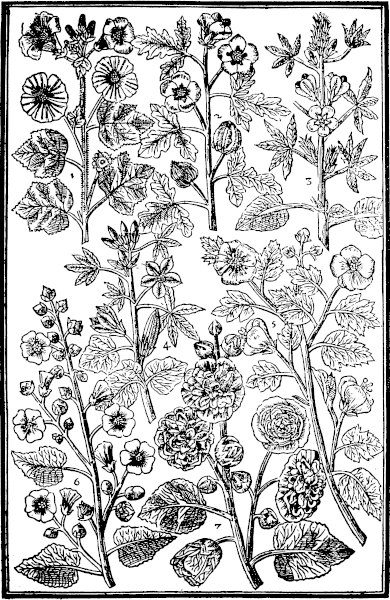
1Malua Hispanica flore carneo amplo. The Spanish Mallow.
2Alcea Veneta. The Venice Mallow.
3Alcea Americana. Thorney Mallow.
4Alcea Ægyptia. The Mallow of Egypt.
5Althea frutex. The shrubbe Mallow.
6Malua hortensis simplex. Single Hollihockes.
7Malua rosea multiplex. Double Hollihockes.
2. Alcea vulgaris flore carneo. Vervaine Mallow with blush flowers.
There is a Mallow that hath long stalkes, and flowers like vnto the common wilde Mallow, and of the same deepe colour with it, so that you can hardly know it from the ordinary kinde, which is found growing wilde together with it, but onely by the leafe, which is as round and as large as the former, but cut into many fine diuisions, euen to the stalke that vpholdeth it, that it seemeth to consist onely of ragges, or peeces of leaues: Of this kinde I take a plante for this garden, growing in all respects like vnto it, but differing onely in the colour of the flowers, which are of the same blush or light carnation colour, or not much differing from the former Spanish kinde, with some veines therein of a deeper colour: the root hereof liueth, as the root of the common wilde kinde doth.
3. Alcea peregrina siue vesicaria. Venice Mallow, or Good night at noone.
The Venice Mallow hath long and weake stalkes, most vsually lying or leaning vpon the ground, hauing here and there vpon them long leaues and somewhat broad, cut in or gashed very deepely on both edges, that it seemeth as if they were diuers leaues set together, euery one standing on a long footestalke: at the ioynts of these stalkes, where the leaues are set, come forth seuerall flowers, standing vpon long footstalkes, which are somewhat larger then any of the former flowers, consisting of fiue leaues, small at the bottome, and wide at the brimmes, of a whitish colour tending to a blush, and sometimes all white, with spots at the bottomes of the leaues on the inside, of a very deepe purple or murrey colour, which addeth a great grace to the flower, and hauing also a long pestle or clapper in the middle, as yellow as gold: these flowers are so quickly faded and gone, that you shall hardly see any of them blowne open, vnlesse it bee betimes in the morning before the Sunne doe grow warme vpon them, for as soone as it feeleth the Sunnes warme heate, it closeth vp and neuer openeth againe, so that you shall very seldome see a flower blowne open in the day time, after nine a clocke in the morning: after these flowers are past, there rise vp in their places thinne, round, shining or transparent bladders, pointed at the toppe, and ribbed down all along, wherein are contained small, round, blackish seede: the roote is long and small, and perisheth euery yeare.
4. Alcea fruticosa pentaphyllea. Cinquefoile Mallow.
The stalkes of this Mallow are very long, hard or wooddy, more then of any of the other Mallowes: at the lower part whereof, and vp to the middle, stand diuers leaues vpon long footestalkes, parted or diuided into fiue parts or leaues, and dented about the edges; but vpwards from the middle to the toppe, the leaues haue but three diuisions: among these leaues stand large wide open flowers, of the colour of the common Mallow: the seede is smaller then in any other Mallow, but the rootes are great and long, spreading in the ground like vnto the rootes of Marsh Mallowes, and springeth vp afresh euery yeare from the roote.
5. Sabdarifa seu Alcea Americana. Thorney Mallowe.
This Thorney Mallowe hath greene leaues next vnto the ground, that are almost round, but pointed at the end, and dented very much about the edges; the other leaues that growe vpon the stalke are diuided into three parts, like vnto a trefoile, and some of them into fiue diuisions, all of them dented about the edges: the stalke is reddish, with some harmelesse prickles in sundry places thereon, and riseth vp three or foure foote high in a good ground, a fit place, and a kindly yeare, bearing plenty of flowers vpon the stalkes, one at the foote of euery leafe, the toppe it selfe ending in a long spike, as it were of buddes and leaues together: the flowers are of a very pale yellow, tending to a white colour, spotted in the bottome of each of the fiue leaues, with a deepe purple spot, broad at the lower part, and ending in a point about the middle of the leafe, which are quickly fading, and not abiding aboue one day, with a long pestle in the middle diuided at the toppe: after the flower is past, commeth vp a short prickly podde, set within a small greene huske or cup that bore the flower, wherein is contained whitish, or rather brownish yellow seede, flat and somewhat round, like vnto the seedes of Hollyhocke: the roote is stringie, and quickly perisheth; for it will hardly endure in our cold Country to giue flowers, much lesse seede, vnlesse (as I said before) it happen in a kindly yeare, and be well planted and tended.
6. Bamia seu Alcea Ægyptia. The Mallow of Egypt.
This Mallow is also as tender to nourse vp as the last, hauing the lower leaues broad like a Marsh Mallow, and of a fresh greene colour; but those that growe vpon the stalke, and vp to the toppe, are diuided into fiue parts or points, but are not cut in to the middle ribbe, like the former Thorney Mallow, yet dented about the edges like vnto them: the flowers growe at the setting to of the leaues, like vnto a Mallow for forme, but of a whitish colour; after which come long fiue square pointed pods, with hard shels, wherein are contained round blackish gray seede, as bigge as a Vetch or bigger: the roote perisheth quickly with vs, euen with the first frosts.
7. Althæa frutex flore albo vel purpureo. Shrubbe Mallow with a white or purple flower.
There are diuers sorts of shrubbe Mallowes, whereof some that haue their stemmes or stalkes lesse wooddy, dye downe to the ground euery yeare, and others that abide alwayes, are more wooddy: Of the former sorts I intend not to speake, referring them to a fitter place; and of the other, I will onely giue you the knowledge of one or two in this place, although I doe acknowledge their fitted place had been to be among the shrubbes; but because they are Mallowes, I pray let them passe with the rest of their kindred, and their descriptions in this manner: These wooddy kindes of shrub Mallowes haue somewhat large, long, and diuided leaues, of a whitish greene colour, soft also, and as it were woolly in handling, set dispersedly on the whitish hard or wooddy stalkes: their flowers are large, like vnto a single Rose or Hollyhocke, in the one being white with purple spots in the bottome; in the other either of a deepe red colour, or else of a paler purple, with a deeper bottome, and with veines running in euery leafe: they are somewhat tender, and would not be suffered to be vncouered in the Winter time, or yet abroad in the Garden, but kept in a large pot or tubbe, in the house or in a warme cellar, if you would haue them to thriue.
8. Malua hortensis rosea simplex & multiplex diuersorum colorum. Hollihockes single and double of seuerall colours.
I shall not neede to make many descriptions of Hollihockes, in regard the greatest difference consisteth in the flowers, which are in some single, in some double, in some of one colour, and in others of other colours: for the lowest leaues of Hollihockes are all round, and somewhat large, with many corners, but not cut in or diuided, soft in handling; but those that growe vp higher are much more diuided into many corners: the stalkes sometimes growe like a tree, at the least higher then any man, with diuers such diuided leaues on them, and flowers from the middle to the toppe, where they stand as it were a long spike of leaues and buds for flowers together: the flowers are of diuers colours, both single and double, as pure white, and pale blush, almost like a white, and more blush, fresh and liuely, of a Rose colour, Scarlet, and a deeper red like a crimson, and of a darke red like blacke bloud; these are the most especiall colours both of single and double flowers that I haue seene: the single flowers consist of fiue broad and round leaues, standing round like vnto single Roses, with a middle long stile, and some chiues aboue them: the double flowers are like vnto double Roses, very thicke, so that no stile or vmbone is seene in the middle, and the outermost rowe of leaues in the flowers are largest, the innermost being smaller and thicke set together: after the flowers are past, there come vp as well in the double as single, flat round heads, like flat cakes, round about the bottomes whereof growe flat whitish seede: the roote is long and great at the head, white and tough, like the roote of the common Mallowes, but greater, and will reasonably well abide the Winter.
The Place.
The first groweth wilde in Spaine. The second in our owne Countrey. The third is thought to growe in Italy and Venice; but Lobel denieth it, saying, that it is there onely in Gardens, and is more plentifull in these parts then with them. The fourth Clusius saith he found in many places of Germany. The fifth is supposed to be first brought out of the West Indies, but an Arabicke name being giuen it, maketh me somewhat doubtfull how to beleeue it. The sixth groweth in Egypt, where it is of great vse, as Prosper Alpinus hath let downe in his Booke of Egyptian plants. The seuenth groweth in some parts both of Spaine and France. The last is not found but in Gardens euery where.
The Time.
The first, second, third, fourth, and last, doe flower from Iune vntill the end of Iuly and August. The rest flower very late, many times not vntill September or October.
The Names.
The first and second haue their names sufficiently expressed in their titles. The third is diuersly called, as Malua horaria, Alcea versicaria, Alcea Veneta, Alcea Peregrina, and of Matthiolus, Hypecoum. The most vsuall English name is Venice Mallow. The fourth is called Alcea fruticosa pentaphyllea, and Cannabinifolio, or Pentaphyllifolio: In English, Cinquefoile Mallow. The fifth hath been sent vnder the name of Sabdarifa, and Sabdariffa, and (as I said) is thought to be brought from America, and therefore it beareth the name of that Country. The sixth is called in Egypt, Bamia, or Bammia, and by that name sent with the addition del Cayro vnto it: In English, Egyptian Mallow, or Mallow of Egypt. The seuenth is called Althæa frutex, and of some Althæa arborea: In English, Shrubbe Mallow, because his stemme is wooddie, and abideth as shrubbes and trees doe. The eight and last is called Malua hortensis, Malua Rosea, and of some Rosa vltra marina: In English, of some Hockes, and vsually Hollihockes.
The Vertues.
All sorts of Mallowes, by reason of their viscous or slimie quality, doe helpe to make the body soluble, being vsed inwardly, and thereby helpe also to ease the paines of the stone and grauell, causing them to be the more easily voided: being outwardly applyed, they mollifie hard tumours, and helpe to ease paines in diuers parts of the body; yet those that are of most vse, are most common. The rest are but taken vpon credit.
Chap. XCII. Amaranthus. Flower-gentle.
We haue foure or fiue sorts of Flower-gentle to trimme vp this our Garden withall, which doe differ very notably one from another, as shall be declared in their seuerall descriptions; some of which are very tender, and must be carefully regarded, and all little enough to cause them beare seede with vs, or else wee shall bee to seeke euery yeare: others are hardy enough, and will hardly be lost out of the Garden.
1. Amaranthus purpureus minor. The small purple Flower-gentle.
This gallant purple Veluet flower, or Flower-gentle, hath a crested stalke two foote high or more, purplish at the bottome, but greene to the toppe, whereout groweth many small branches, the leaues on the stalkes and branches are somewhat broad at the bottome, and sharpe pointed, of a full greene colour, and often somewhat reddish withall, like in forme vnto the leaues of Blites (whereof this and the rest are accounted species, or sorts) or small Beetes: the flowers are long, spikie, soft, and gentle tufts of haires, many as it were growing together, broad at the bottome, and small vp at the toppe, pyramis or steeple-fashion, of so excellent a shining deepe purple colour, tending to a murrey, that in the most excellent coloured Veluet, cannot be seene a more orient colour, (and I thinke from this respect, the French call it Passe velours, that is to say, passing Veluet in colour) without any smell at all, which being bruised giueth the same excellent purple colour on paper, and being gathered in his full strength and beauty, will abide a great time (if it be kept out of the winde and sunne in a dry place) in the same grace and colour: among these tufts lye the seede scattered, which is small, very blacke, and shining: the rootes are a few threddy strings, which quickly perish, as the whole plant doth, at the first approach of Winter weather.
2. Amaranthus Coccineus. Scarlet Flower-gentle.
The leaues of this Flower-gentle are longer, and somewhat narrower then the former; the stalke groweth somewhat higher, bearing his long tufts at seuerall leaues, as also at the toppe of the stalkes, many being set together, but separate one from another, and each bowing or bending downe his head, like vnto a Feather, such as is worn in our Gallants and Gentlewomens heads, of an excellent bloudy Scarlet colour: the seede is blacke, like vnto the former: the roote perisheth quicklier, because it is more tender.
3. Amaranthus tricolor. Spotted or variable Flower-gentle.
The chiefest beauty of this plant consisteth in the leaues, and not in the flowers; for they are small tufts growing along the stalke, which is nothing so high as the former, especially with vs, and at the ioynts with the leaues: the leaues hereof are of the same fashion that the former are, and pointed also; but euery leafe is to be seene parted into greene, red, and yellow, very orient and fresh (especially if it come to his full perfection, which is in hot and dry weather) diuided not all alike, but in some leaues, where the red or yellow is, there will be greene, and so varying, that it is very pleasant to behold: the seede hereof is blacke and shining, not to bee knowne from the former.
4. Amaranthus Carnea spica. Carnation Flower-gentle.
There is another more rare then all the rest, whose leaues are somewhat longer, and narrower then the first, and like vnto the second kinde: the spikes are short, many set together, like branches full of heads or eares of corne, euery one whereof hath some long haires sticking out from them, of a deep blush, tending to a carnation colour.
5. Amaranthus purpureus maior paniculis sparsis. Great Floramour, or purple Flower-gentle.
The great Floramour hath one thicke, tall, crested, browne red stalke, fiue or six foote high, from whence spring many great broad leaues, like vnto the former for the forme, but much larger & redder for the most part, especially the lowest, which brancheth forth into diuers parts, & from between these leaues, & the stalks or branches, as also at the tops of them, stand long, spikie, round, & somewhat flat tufts, of a more reddish purple colour then the first, and diuided also into seuerall parts, wherin when they are full ripe, are to be seen an innumerable company of white seed, standing out among the short thrums, and do then easily fall away with a little touching; euery one of these white seed hath as it were an hole halfe bored through therin: the root is a great bush of strings, spreading in the ground, whereby it is strongly fastened, yet perisheth euery yeare, after it hath giuen his seede.
The Place.
All these plants growe in the Easterne Countries, as Persia, Syria, Arabia, &c. except the greatest, which hath been brought out of the West Indies, where it is much vsed, especially the seede: they are all, noursed vp with much care in our Gardens, and yet in a backward or cold yeare they will not thriue, for that they desire much heate: but the greatest doth alwayes giue ripe seede euery yeare.
The Time.
They beare their gallant tufts or spikes for the most part in August, and some not vntill September.
The Names.
The name Amaranthus is giuen to all these plants, taken from the Greeke word ἀμαραντίνος, non marcescens, or non senescens, that is, neuer waxing old, and is often also imposed on other plants, who haue the same property, that is, that their flowers being gathered in a fit season, will retaine their natiue colour a long time, as shall be shewed in the Chapter following. Diuers do thinke the first to be Phlox, or Flamma of Theophrastus. The third is called Gelosia, or Celosia of Tragus. Spigelius in his Isagoges saith, it is generally taken to be Sophonia, whereof Plinie maketh mention; and Lobel, to bee the Persians Theombroton of Plinie. The Italians, from whom I had it (by the meanes of Mʳ. Doctor Iohn More, as I haue had many other rare simples) call it, Blito di tre colori, A three coloured Blite. The fifth, which is the greatest, hath been sent from the West Indies by the name of Quinüa, as Clusius reporteth. The name Flower-gentle in English, and Floramour, which is the French, of Flos amoris, and Passe velours, as is before said, or Veluet flower, according to the Italian, Flor veluto, are equally giuen to all these plants, with their seuerall distinctions, as they are expressed in their titles.
The Vertues.
Diuers suppose the flowers of these plants doe helpe to stay the fluxe of bloud in man or woman, because that other things that are red or purple doe performe the same. But Galen disproueth that opinion very notably, in lib. 2. & 4. de simpl. medicament. facultatibus.
Chap. XCIII. Helichrysum, siue Amaranthus luteus. Golden Flower-gentle, Goldilockes, or Gold-flower.
The propinquity of property (as I before said) hath caused the affinity in name, and so in neighbourhood in these plants, wherein there are some diuersity; and although they differ from them before in many notable points, yet they all agree with themselues in the golden, or siluer heads or tufts they beare; and therefore I haue comprised them in one Chapter, and will begin with that which commeth nearest vnto the Helichrysum of Dioscorides, or Aurelia (as Gaza translateth it) of Theophrastus.
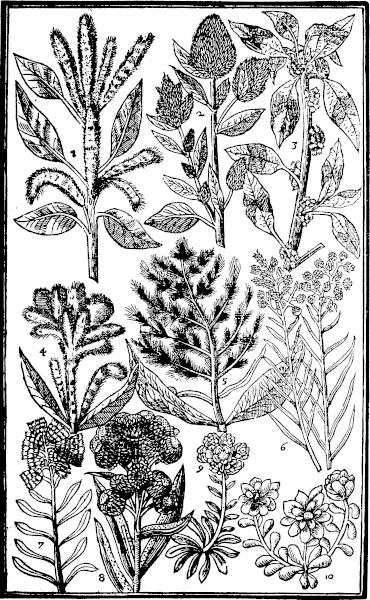
1Amaranthus purpureus maior. The great purple Flower gentle.
2Amaranthus purpureus minor. The lesser purple Flower gentle.
3Amaranthus tricolor. Variable Flower gentle.
4Amaranthus Coccineus. Scarlet Flower gentle.
5Amaranthus carnea spica. Carnation Flower gentle.
6Chrysocome. Golden Cassidonie.
7Heliochrysum Creticum. Candy Goldilockes.
8Gnaphalium Americanum. Liuelong or Life euerlasting.
9Gnaphalium montanum. Cats foote.
10Gnaphalium roseum. The Cotton Rose.
1. Helichrysum. The Golden flower of life.
This first Golden tuft riseth vp with many hard, round, white stalkes, a foote and a halfe high, whereon at certaine distances stand many fine cut leaues, or rather one leafe cut into many small fine parts, almost as small as Fenell, but grayish, like vnto the Cud-weedes or Cotton-weedes (whereof certainly these are speciall kindes) at the toppes of the stalkes stand many round flowers, of a pale gold colour, in an vmbell close together, yet euery flower vpon his owne stalke, and all of an euen height, which will keepe the colour, being gathered, and kept dry for a long time after, and are of a hot and quicke sent: the roote is small and wooddy, spreading vnder the vpper crust of the earth, and liueth long in his owne naturall place, but very hardly endureth the cold of our Winters, vnlesse they be milde, or it be well defended.
2. Helichrysum Creticum. Candy Goldilockes.
Candy Goldilockes hath two or three small slender white branches, set here and there very scatteringly, with small, long, and narrow hoary leaues, hauing yellow heads of flowers at the tops made into vmbels or tufts, not so round and euen as the former, but longwise one aboue another, the heads being made as it were of scales, loosly, and not so closely set together, as in the next following, which when they are full ripe, doe passe into doune, and are blowne away with the winde, hauing a small reddish seede at the end; but will abide a long time, as the other in his beauty, being gathered in time, as the rest will doe.
3. Helichrysum Orientale siue Amaranthus luteus. Golden Flower-gentle.
This most beautifull plant is very like vnto the former Candy Goldilockes last described, but growing vp higher, with many more branches, and more hoary, white, and woolly, hauing also long and narrow white leaues, but somewhat broader, and thicker set on the branches: the tufts of flowers or vmbels likewise doe consist of longer and larger heads, more scaly, and closer compact together, of an excellent pale gold yellow colour, and shining, with some yellow threads or thrummes in the middle: the roote dyeth not euery yeare, but liueth long, especially in the South and East Countries, where no colds or frosts are felt; but will require extraordinary care and keeping, and yet scarce sufficient to preserue it in these cold Countries.
4. Chrysocome siue Stæchas Citrina. Golden tufts or Golden Cassidony.
This Golden flower is somewhat like the former of these two last described, hauing hoary stalkes and leaues, standing confusedly on them, being long, and narrower then any of the former: the tops of the stalkes are diuided into many parts, each bearing a small long yellow head or flower at the toppe, with some yellow thrummes in them, which heads being many, are diffusedly set together, like a loose or sparsed vmbell, keeping their colour long before they wither, and when they are ripe, haue thinne small reddish seede, like Mariorome seede, but smaller; the roote is small and blacke: the whole plant, as well leaues and flowers, as rootes, are of a strong sharpe sent, yet pleasant.
5. Argyrocome siue Gnaphalium Americanum. Liue long or Life euerlasting.
This siluer tuft or Indian Cotton weede, hath many white heads of leafes at their first springing out of the ground, couered with a hoary woollinesse like cotton, which rising into hard, thicke round stalkes, containe still the same hoarinesse vpon them, as also vpon the long and narrow leaues which are set thereon, especially on the vnder side, for the vpper sides are of a darke shining greene colour: the stalkes are diuided at the toppe into many small branches, each whereof haue many scaly tufted heads set together, couered ouer with cotton before their opening, and then diffeuering one from another, abiding very white on the outside, when they are fully growne, but with a small yellow thrume in the midde of euery flower, which in time turne into yellow doune, apt to be blowne away with euery winde: the roots are long and black on the outside, creeping vnder ground very much.
6. Gnaphalium montanum flore albo & flore purpureo. White and purple Cats foote.
This small Cudweede or Cottonweede, hath many small white woolly leaues growing from the roote, which is composed of a few small blackish threds, and lying vpon the ground somewhat like vnto the leaues of a small Mouse eare, but smaller; from among which riseth vp a small stalke of halfe a foote high or thereabouts, beset here and there with some few leaues, at the top whereof commeth forth a tuft of small flowers, set close together, in some of a pure white, in others of a purple or reddish colour, in some of a pale red or blush, and in others of a white and purple mixt together, which for the beauty is much commended and desired, but will hardly abide to be kept in Gardens, so vnwilling they are to leaue their naturall abiding.
7. Gnaphalium Roseum. The Cotton Rose.
This little rose Cotton weede hath many such like woolly leaues, growing as the former from the roote vpon small short branches, not full an hand breadth high, in fashion somewhat like vnto Daysie leaues, but lesser, and round pointed: at the toppe of euery stalke or branch, standeth one flower, composed of two rowes of small white leaues, layd open like a Starre or a Rose, as it beareth the name, hauing a round head in the middle made of many yellow threds or thrumes, which falling away, there riseth vp a small round head, full of small seedes: the root is small, long and threddy.
The Place.
The foure first plants doe grow naturally in many of the hot Countries of Europe, as Spaine, Italie, and Prouince in France; as also in Candy, Barbary, and other places, and must be carefully kept with vs in the winter time. The Liue long was brought out of the West Indies, and groweth plentifully in our gardens. The two last doe grow as well in the colder Countries of Germany, as in France and other places.
The Time.
They all flower in the end of September, if they will shew out their beauty at all with vs, for sometimes it is so late, that they haue no faire colour at all, especially the foure first sorts.
The Names.
Variable and many are the names that seuerall Writers do call these foure first sorts of plants, as Helichrysum, Heliochrysum, or Elichrysum, Eliochrysum, Chrysocome, Coma aurea, Amaranthus luteus, Stoechas Citrina, and Aurelia, with others, needlesse here to be recited: it is sufficient for this worke, to giue you knowledge that their names are sufficient as they are expressed in their titles: The fift is called Gnaphalium by Carolus Clusius, from the likenesse of the vmbels or tufts of heads, though greater and white: for as I said before, the Cotton weedes are of kindred with the golden tufts: It hath been called by our English Gentlewomen, Liue long, and Life euerlasting, because of the durabilitie of the flowers in their beautie. The two last are called Gnaphalium, according to their titles; and in English they may passe vnder those names are set downe with them.
The Vertues.
The foure first are accounted to bee hot and dry, and the three last to bee cold and dry: yet all of them may to some good purpose bee applyed to rheumaticke heads. The former foure are likewise vsed to cause vrine, and in baths to comfort and heate cold parts. They are also layd in chests and wardrobes, to keepe garments from moths; and are worne in the heads and armes of Gentiles and others, for their beautifull aspect.
Chap. XCIIII. Canna Indica. The Indian flowring Reede.
There are two kindes or sorts of this beautifull plant, the one with a red flower, the other with a yellow, spotted with reddish spots, both which in some kindly yeares haue borne their braue flowers, but neuer any ripe seede, and doth not abide the extremities of our winters, eyther abroade or vnder couert, vnlesse it meete with a stoue or hot-house, such as are vsed in Germany, or such other like place: For neyther house nor cellar will preserue it, for want of heate.
Canna Indica flore rubro. Red flowred Indian Reede.
This beautifull plant riseth vp with faire greene, large, broade leaues, euery one rising out of the middle of the other, and are folded together, or writhed like vnto a paper Coffin (as they call it) such as Comfitmakers and Grocers vse, to put in their Comfits and Spices, and being spread open, another riseth from the bottome thereof, folded in the same manner, which are set at the ioynts of the stalke when it is risen vp, like vnto our water Reede, and growing (if it runne vp for flower) to be three or foure foote high, as I haue obserued in mine owne garden: the flowers grow at the toppe of the stalke one aboue another, which before their opening are long, small, round, and pointed at the end, very like vnto the claw of a Crauise or Sea-Crab, and of the same red or crimson colour, but being open, are very like vnto the flower of Gladiolus or Corne-flagge, but of a more orient colour then at the first, and standing in a rough huske, wherein afterwards standeth a three square head, containing therein round blacke seede, of the bignesse of a pease: the roote is white and tuberous, growing into many knobs, from whence arise such other leaues and stalkes, whereby it encreaseth very much, if it be rightly kept and defended.
Canna Indica flore flauo punctato. Yellow spotted Indian Reede.
This Reede groweth vp with leaues and flowers, in all points so like vnto the former, that it cannot bee knowne from it, vntill it come to flower, which is of a yellow colour, spotted with reddish spots, without any other difference.
The Place.
These plants grow naturally in the West Indies, from whence they were first sent into Spaine, and Portugall, where Clusius saith he saw them planted by the houses sides, flowring in winter, which might be in those warme Countreyes. We preserue them with great care in our gardens, for the beautifull aspect of their flowers.
The Time.
They flower not with vs vntill the end, or middle of August, at the soonest.
The Names.
They are called of some Canna Indica, and Arundo Indica, of others Cannacorus, and of some Flos Cancri, because the colour of the flowers, as well as the forme of the buds, are so like vnto a Sea-Crabs cle, or claw.
The Vertues.
There is not any vse of these in Physicke that I know.
Chap. XCV. Mandragoras. Mandrake.
The Mandrake is distinguished into two kindes, the male and the female; the male hath two sorts, the one differing from the other, as shall be shewed; but of the female I know but one: The male is frequent in many gardens, but the female, in that it is more tender and rare, is noursed vp but in a few.
Mandragoras mas. The male Mandrake.
The male Mandrake thrusteth vp many leaues together out of the ground, which being full growne, are faire, large and greene lying round about the roote, and are larger and longer then the greatest leaues of any Lettice, whereunto it is likened by Dioscorides and others: from the middle, among these leaues, rise vp many flowers, euery one vpon a long slender stalke, standing in a whitish greene huske, consisting of fiue pretty large round pointed leaues, of a greenish white colour, which turne into small round apples, greene at the first, and of a pale red colour when they are ripe, very smooth and shining on the outside, and of a heady or strong stuffing smell, wherein is contained round whitish flat seede: the roote is long and thicke, blackish on the outside, and white within, consisting many times but of one long roote, and sometimes diuided into two branches a little below the head, and sometimes into three or more, as nature listeth to bestow vpon it, as my selfe haue often seene, by the transplanting of many, as also by breaking and cutting off of many parts of the rootes, but neuer found harme by so doing, as many idle tales haue beene set downe in writing, and deliuered also by report, of much danger to happen to such, as should digge them vp or breake them; neyther haue I euer seene any forme of man like or woman-like parts, in the rootes of any: but as I said, it hath oftentimes two maine rootes running down right into the ground, and sometimes three, and sometimes but one, as it likewise often happeneth to Parsneps, Carrots, or the like. But many cunning counterfeit rootes haue bin shaped to such formes, and publickly exposed to the view of all that would see them, and haue been tolerated by the chiefe Magistrates of the Citie, notwithstanding that they haue beene informed that such practices were meere deceit, and vnsufferable; whether this happened through their ouer-credulitie of the thing, or of the persons, or through an opinion that the information of the truth rose vpon enuy, I know not, I leaue that to the searcher of all hearts: But this you may bee bold to rest vpon, and assure your selues, that such formes as haue bin publickly exposed to be seene, were neuer so formed by nature, but only by the art and cunning of knaues and deceiuers, and let this be your Galeatum against all such vaine, idle and ridiculous toyes of mens inuentions.
There is likewise another sort of these male Mandrakes, which I first saw at Canterbury; with my very louing and kinde friende Iohn Tradescante, in the garden of the Lord Wotton, whose gardiner he was at that time; the leaues whereof were of a more grayish greene colour, and somewhat folded together, when as the former kind that grew hard by it, was of the same forme that is before described, and ordinary in all others: but whether the apples were differing from the other, I know not, nor did they remember that euer it had borne any.
Mandragoras fæmina. The female Mandrake.
The female Mandrake doth likewise put vp many leaues together, from the head of the roote, but they are nothing so large, and are of a darker greene colour, narrower also and shining, more crumpled, and of a stronger sent: the flowers are many, rising vp in the middle of the leaues, vpon slender stalkes, as in the male kind, but of a blewish purple colour, which turne into small round fruite or apples, and not long like a peare (as Clusius reporteth that saw them naturally growing in Spaine) greene at the first, and of a pale yellowish colour, when they are full ripe; of a more pleasing, or if you will, of a lesse heady sent then the apples of the male, wherein is contained such like seede, but smaller and blacker: the rootes are like the former, blacke without and white within, and diuided in the same manner as the male is, sometimes with more, and sometimes with fewer parts or branches.
The Place.
They grow in many places of Italie, as Matthiolus reporteth, but especially on Mount Garganus in Apulia. Clusius saith hee found the female in many wet grounds of Spaine, as also in the borders of those medowes that lye neere vnto riuers and water courses. The male is cherished in many Gardens, for pleasure as well as for vse; but the female as is said, is both very rare, and farre more tender.
The Time.
The Male flowreth in March, and the fruit is ripe in Iuly. The Female, if it be well preserued, flowreth not vntill August, or September; so that without extraordinary care, we neuer see the fruite thereof in our gardens.
The Names.
Mandragoras mas is called albus, as the Fæmina is called niger, which titles of blacke and white, are referred vnto the colour of the leaues: the female is called also Thridacias, from the likenesse of Lettice, whereunto they say in forme it doth carry some similitude. Dioscorides saith, that in his time the male was called Morion, and both of them Antimelum, and Circæa. Wee call them in English, The male, and the female Mandrake.
The Vertues.
The leaues haue a cooling and drying qualitie, fit for the oyntment Populeon, wherein it is put. But the Apples haue a soporiferous propertie, as Leuinus Lemnius maketh mention in his Herball to the Bible, of an experiment of his owne. Besides, as Dioscorides first, and then Serapio, Auicen, Paulus Ægineta, and others also do declare, they conduce much to the cooling and cleansing of an hot matrix. And it is probable, that Rachel knowing that they might be profitable for her hot and dry body, was the more earnest with Leah for her Sonne Rubens Apples, as it is set downe Genesis 30. verse 14. The strong sent of these apples is remembred also, Cant. 7. 13. although some would diuert the signification of the Hebrew word, דודאים, vnto Violets, or some other sweet flowers, in the former place of Genesis, and the fruit of Musa, or Adams Apples in this place of the Canticles. Hamilcar the Carthaginian Captaine is said to haue infected the wine of the Lybians (his enemies against whom he fought) with the apples of Mandrake, whereby they being made exceeding drowsie, he obtained a famous victory ouer them.
Chap. XCVI. Pomum Amoris. Loue Apples.
Although the beautie of this plant consisteth not in the flower, but fruit, yet giue me leaue to insert it here, lest otherwise it haue no place: whereof there are two especiall sorts, which wee comprehend in one Chapter, and distinguish them by maius and minus, greater and smaller: yet of the greater kinde, we haue noursed vp in our Gardens two sorts, that differ only in the colour of the fruite, and in nothing else.
Pomum Amoris maius fructu rubro. Great Apple of Loue the ordinary red sort.
This greater kinde of Loue Apples, which hath beene most frequently cherished with vs, hath diuers long and trayling branches, leaning or spreading vpon the ground, not able to sustaine themselues, whereon doe grow many long winged leaues, that is, many leaues set on both sides, and all along a middle ribbe, some being greater, and others lesse, iagged also and dented about the edges, of a grayish ouer-worne greene colour, somewhat rough or hairy in handling; from among the leaues and the branches come forth long stalkes, with diuers flowers set thereon, vpon seuerall short footstalks, consisting of sixe, and sometimes of eight small long yellow leaues, with a middle pricke or vmbone, which after the flowers are fallen, riseth to be the fruite, which are of the bignesse of a small or meane Pippin, vneuenly bunched out in diuers places, and scarce any full round without bunches, of a faire pale reddish colour, or somewhat deeper, like vnto an Orenge, full of a slimie iuice and watery pulpe, wherein the seede lyeth, which is white, flat and somewhat rough: the roote shooteth with many small strings and bigger branches vnder ground, but perisheth at the first feeling of our winter weather. The fruite hereof by often sowing it in our Land, is become much smaller then I haue here described it: but was at the first, and so for two or three yeares after, as bigge as I haue related it.
Pomum Amoris maius fructu luteo. Yellow Amorous Apples.
Of the same kinde is this other sort of Amorous Apples, differing in nothing but the colour of the fruite, which is of a pale yellow colour, hauing bunches or lobes in the same manner, and seede also like the former.
Pomum Amoris minus, siue Mala Ethiopica parua. Small Loue Apples.
The small Apples of Loue in the very like manner, haue long weake trayling branches, beset with such like leaues as the greater kinde hath, but smaller in euery part: the flowers also stand many together on a long stalke, and yellow as the former, but much smaller: the fruite are small, round, yellowish red berries, not much bigger then great grapes, wherein are contained white flat seede, like the other, but smaller: the roote perisheth in like manner euery yeare, and therefore must bee new sowen euery spring, if you will haue the pleasure of their sight in the garden; yet some yeares I haue known them rise of their owne sowing in my garden.
The Place.
They growe naturally in the hot Countries of Barbary, and Ethiopia; yet some report them to be first brought from Peru, a Prouince of the West Indies. Wee onely haue them for curiosity in our Gardens, and for the amorous aspect or beauty of the fruit.
The Time.
They flower in Iuly and August, and their fruit is ripe in the middle or end of September for the most part.
The Names.
The first is named diuersly by diuers Authors; for Lobel, Camerarius, and others, call them Poma amoris. Dodonæus Aurea Mala. Gesnerus first, and Bauhinus after him, make it to be a kinde of Solanum Pomiferum. Anguillara taketh it to be Lycopersicum of Galen. Others thinke it to bee Glaucium of Dioscorides. The last is called Mala Æthiopica parua, and by that title was first sent vnto vs, as if the former were of the same kinde and country. We call them in English, Apples of Loue, Loue-Apples, Golden Apples, or Amorous Apples, and all as much to one purpose as another, more then for their beautifull aspect.
The Vertues.
In the hot Countries where they naturally growe, they are much eaten of the people, to coole and quench the heate and thirst of their hot stomaches. The Apples also boyled, or infused in oyle in the sunne, is thought to be good to cure the itch, assuredly it will allay the heate thereof.
Chap. XCVII. Digitalis. Foxegloue.
There are three principall sorts of Foxegloues, a greater, a middle or meane sort, and a lesser, and of them, three especiall colours, that is, purple, white, and yellow; the common purple kinde that groweth abroad in the fields, I leaue to his wilde habitation: and of the rest as followeth.
1. Digitalis maxima ferruginea. Dun coloured Foxegloues.
The leaues of this Foxegloue are long and large, of a grayish green colour, finely cut or dented about the edges, like the teeth of a fine sawe; among which commeth vp a strong tall stalke, which when it was full growne, and with ripe seede thereon, I haue measured to be seuen foot high at the least, whereon grow an innumerable company (as I may so say, in respect of the aboundance) of flowers, nothing so large as the common purple kinde, that groweth wilde euery where in our owne Countrey, and of a kinde of browne or yellowish dunne colour, with a long lippe at euery flower; after them come seede, like the common kinde, but in smaller heads: the rootes are stringie like the ordinary, but doe vsually perish, or seldome abide after it hath giuen seed.
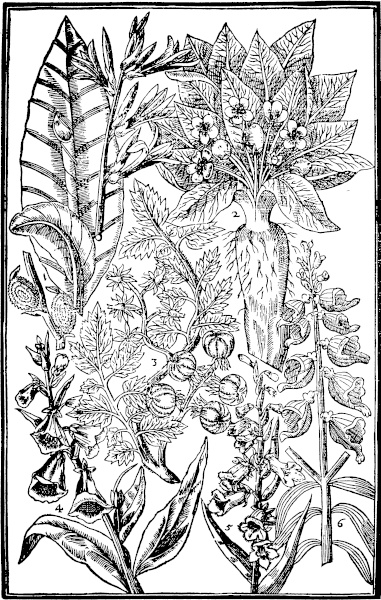
1Canna Indica. The Indian Reed.
2Mandragoras mas. The male Mandrake.
3Pomum amoris maius. Great Apples of loue.
4Digitalis maior flore luteo amplo. The great yellow Foxegloue.
5Digitalis media flore luteo rubente. Orenge tawny Foxegloues.
6Digitalis maxima ferruginea. Dun coloured Foxegloues.
2. Digitalis maior flore carneo. Blush coloured Foxegloues.
This kinde of Foxegloues hath reasonable large leaues, yet not altogether so large as the common field kinde: the flowers are also smaller then the common sort, but of a blush colour.
3. Digitalis media flore luteo rubente. Orenge tawnie Foxegloue.
As this Foxegloue is none of the greatest, so also is it none of the smallest; but a sort betweene both, hauing leaues in some proportion correspondent to the lesser yellow Foxegloue, but not so large as the lesser white: the flowers are long and narrow, almost as large as the last white, but nothing so large as the first white, of a faire yellowish browne colour, as if the yellow were ouershadowed with a reddish colour, and is that colour wee vsually call an Orenge tawnie colour: the seede is like the former: the rootes perish euery yeare that they beare seede, which is vsually the second yeare of the springing.
4. Digitalis maior alba. The greater white Foxegloue.
This white Foxegloue is in all things so like vnto the purple wilde kinde, that it can hardly be distinguished from it, vnlesse it be in the fresher greennesse and largenesse of the leaues: the flowers are as great in a manner as the purple, but wholly white, without any spot in them: the seed and other things agree in all points.
5. Digitalis alba altera seu minor. The lesser white Foxegloue.
We haue in our Gardens another sort of white Foxegloue, whose leaues are like vnto the last described, but not altogether so long or large, and of a darker greene colour: the stalke groweth not so high, as not full three foote: the flowers are pure white, fashioned like vnto the former, but not so great or large, in all other things alike: the rootes hereof did abide sometime in our Gardens, but since perished, and the seede also, since when we neuer could obtaine from any our friends of that kinde againe.
6. Digitalis maior lutea flore amplo. The great yellow Foxegloue.
The leaues of this greater yellow Foxegloue, are in forme somewhat like vnto the common purple kinde, but not altogether so large: the stalke groweth to bee three or foure foote high, whereon stand many long hollow pendulous flowers, in shape like the ordinary purple: but somewhat shorter, and more large and open at the brimmes, of a faire yellow colour, wherein are long threads, like as in the others: the roote hereof is greater at the head, and more wooddy then any of the rest, with many smaller fibres, spreading themselues in the ground, and abideth almost as well as our common purple kinde.
7. Digitalis minor lutea siue pallida. The small pale yellow Foxegloue.
This small pale yellow Foxegloue hath somewhat short, broad, smooth and darke greene leaues, snipt or dented about the edges very finely: the stalke is two foot high, beset with such like leaues, but lesser: the flowers are more in number then in any of the rest, except the first and greatest, and growe along the vpper part of the stalke, being long and hollow, like the other, but very small, and of a pale yellow colour almost white: the seede vessels are small like the former, wherein are contained seede like the rest, but smaller: the rootes are stringy, but durable, and seldome perish with any iniury of the extreamest frosts.
The Place.
The great white kinde hath been often, and in many places found wilde in our owne Country, among or hard by the common purple kinde. All the rest are strangers, but cherished in our Gardens.
The Time.
They flower in Iune and Iuly, and some in August, their seede becomming ripe quickly after.
The Names.
Onely the name Digitalis, is of all Writers giuen vnto these plants; for it is not knowne to bee remembred of any of the old Authors. Wee call them generally in English, Foxegloue; but some (as thinking it to bee too foolish a name) doe call them Finger-flowers, because they are like vnto the fingers of a gloue, the ends cut off.
The Vertues.
Foxegloues are not vsed in Physicke by any iudicious man that I know; yet some Italians of Bononia, as Camerarius saith, in his time vsed it as a wound herbe.
Chap. XCVIII. Verbascum. Mullein.
There be diuers kindes of Mullein, as white Mullein, blacke Mullein, wooddy Mullein, base Mullein, Moth Mullein, and Ethiopian Mullein, all which to distinguish or to describe, is neither my purpose, nor the intent of this worke, which is to store a Garden with flowers of delight, and sequester others not worthy of that honour. Those that are fit to bee brought to your consideration in this place, are first, the Blattarias, or Moth Mulleins, and then the wooddy Mullein, which otherwise is called French Sage, and lastly, the Ethiopian Mullein, whose beauty consisteth not in the flower, but in the whole plant; yet if it please you not, take it according to his Country for a Moore, an Infidell, a Slaue, and so vse it.
1. Blattaria lutea odorata. Sweete yellow Moth Mullein.
The yellow Moth Mullein whose flower is sweete, hath many hard grayish greene leaues lying on the ground, somewhat long and broad, and pointed at the end: the stalks are two or three foot high, with some leaues on them, & branching out from the middle vpwards into many long branches, stored with many small pale yellow flowers, of a pretty sweete sent, somewhat stronger then in the other sorts, which seldome giueth seede, but abideth in the roote, during many yeares, which few or none of the others doe.
2. Blattaria lutea maior siue Hispanica. The great yellow Moth Mullein.
This Spanish kinde hath larger and greener leaues then the former, and rounder and larger then the next that followeth: the stalke is higher than in any of the Moth Mulleins, being for the most part foure or fiue foote high, whereon toward the toppe growe many goodly yellow flowers, consisting of fiue leaues, as all the rest doe, not so thicke set as the former, but much larger, with some small purplish threads in the middle: the ends whereof are fashioned somewhat like as if a Flie were creeping vp the flower, which turne into round heads, sometimes two or three or more standing together, but vsually one, wherein lye small duskie seed: the roote is not great nor full of threads, and doth perish most vsually hauing giuen seede, except the Winter bee very milde.
3. Blattaria lutea altera vulgatior. The ordinary yellow Moth Mullein.
This yellow Moth Mullein (which is the most frequent in our Gardens) hath longer, and narrower leaues then any of the former, and roundly notched or dented on the edges, of a darke greene colour: the stalke is sometimes branched, but most vsually single, whereon stand many gold yellow flowers, not fully so large as the Spanish kinde, but with the like purple threads in the middle: the seede is small, and contained in the like round heads, but alwaies euery one single by it selfe: the roote perisheth euery yeare that it beareth seede.
4. Blattaria flore luteo purpurascente. Cloth of gold Moth Mullein.
The greatest point of difference betweene this and the last described, consisteth chiefly in the colour of the flower, which in this is of the colour of cloth of gold, that is, the ground yellow, and ouershadowed with a bright crimson colour, which is a fine colour of much delight: the threads in the middle are not so purple red as in the former, but much about the colour of the flower: this is not so willing to giue seede, and will as hardly abide in the roote, and hath out of question risen from the seede of the former.
5. Blattaria flore albo. White Moth Mullein.
The leaues of the white Moth Mullein are somewhat like vnto the yellow, yet not altogether so much roundly notched about the edges, but rather a little dented, with sharper notches: the stalke riseth as high as the yellow, and hath now and then some branches about it: the flowers hereof are pure white, as large and great as the ordinary yellow, or somewhat larger, with the like purple threads in the middle, as are in the yellow: the seed is like the other; the root perisheth in like manner, and will not endure.
6. Blattaria flore purpureo. Purple Moth Mullein.
The Purple Moth Mullein hath his leaues lying on the ground, broader and shorter then any of the other, of a more grayish greene colour, and without any denting for the most part about the edges, sharpe pointed also at the end of the leafe; among the leaues riseth vp the stalke, not so high as either the white or the yellow, and many times branched, bearing many flowers thereon, of the same fashion, and no whit smaller, of a faire deepe blewish colour tending to rednesse, the threads in the middle of the flowers being yellow: the seede vessels hereof are somewhat smaller then any of the former, except the first sweete yellow kinde: the roote hereof is long, thicke, and blackish on the outside, abiding very well from yeare to yeare, and riseth well also from the sowing of the seede.
7. Blattaria flore cæruleo. Blew Moth Mullein.
This blew Moth Mullein is in all respects like vnto the former purple kinde, sauing onely in the colour of the flower, which is of a blewish violet colour, and is not much inferiour either in greatnesse of the plant, or in the largenesse of the flower, vnto the former purple kinde, and endureth many yeares in the like manner. And these be all the sorts of this kinde of Moth Mullein, that I haue seene and noursed vp for this my Garden, without interposing any vnknowne, not seene, or vnworthy.
8. Verbascum siluestre siue quartum Matthioli. Wooddy Mullein or French Sage.
Wooddy Mullein or French Sage, hath diuers wooddy branches two or three foot high, very hoary or white, whereon at seuerall ioynts stand diuers thicke leaues, white also and hoary, long, somewhat broad, round pointed, and rough, somewhat resembling the leaues of Sage in the forme and roughnesse, but not in the sent, whereof our people gaue it the name of Sage, calling it French Sage (when as it is as great a stranger in France as in England, yet they doe with this as with many other things, calling them French, which come from beyond the Seas; as for example, all or most of our bulbous flowers, they call French flowers, &c.) at the toppes of the stalkes and branches, at certaine distances, are placed round about them many gaping flowers, like vnto the flowers of Sage, but yellow: after which now and then come seede, somewhat bigger then the Moth Mulleins, and lesse then the next Mullein of Ethiopia: the roote is wooddy at the toppe, with diuers blackish strings growing from it, and endureth as well aboue ground with his leaues, as vnder it with his rootes.
9. Æthiopis. Ethiopian Mullein.
This Mullein of Ethiopia hath many great, broad, and large leaues lying on the ground, rent or torne in diuers of them very much on the sides, of so hoary a white greene colour, that it farre passeth any of the white Mulleins, that growe wilde abroad in our owne Country; for they are of a yellowish white hoarinesse, nothing so pleasant to looke on as this: in the middle of these leaues riseth vp a square strong stalke, foure or fiue foote high, set full of such like leaues as growe belowe, but much lesser, and lesser still vp to the toppe, all hoary and woolly, as the rest, and diuided into manie branches, spreading farre, and taking vp a great compasse of ground, more then any one roote of Garden Clary, or other such like plant: at each of the stalkes and branches are set two small leaues, and with them, round about the stalkes, stand many small gaping flowers, of a pale bleake blew colour: the seede is almost as large as Garden Clary seede, and of the same forme and colour: the roote is wooddy, and perisheth as soone as it hath borne seede, which is vsually the second yeare after the sowing; for the first yeare it seldome runneth vp to flower.
10. Lamium Pannonicum siue Galeopsis Pannonica. Hungary dead Nettle or the Dragon flower.
Let mee thrust this plant into this place, rather then make a peculiar Chapter, because I haue no other of the same stocke or kindred to be ioyned with it, and is a pretty ornament in a Garden. The leaues whereof are very large, round, and great, rough or full of veines, which make it seeme crumpled, dented or deepely notched about the edges, and of a very darke greene colour, and some times brownish, or of a darke reddish colour withall, euery one standing on a long foote-stalke, very like in forme vnto the great white Arch-Angell leaues, but farre larger and blacker: the stalkes are great and foure square, hauing leaues and flowers standing round about them at the ioynts like coronets, which flowers are very great, long, and wide gaping open, of a darke red or purple colour, with some whitenesse or spots in the iawes, and some hairinesse also on the sides, which stand in full flower two or three moneths most vsually, and sometimes longer, after which come brownish seede: the roote is a great tuft or bush of long whitish strings, and encreaseth euery yeare, not fearing the greatest iniuries of our coldest and extreamest Winters.
The Place.
All these plants are strangers in our Countrey, and onely preserued in Gardens, to furnish them with variety; but (as I said) the cloth of gold Moth Mullein hath been raised from seed in our owne Country.
The Time.
The last flowreth first, before all the rest, beginning in Aprill. The Moth Mulleins in May and Iune. The French Sage in Iuly.
The Names.
All the sorts of Blattaria may bee comprehended vnder the kindes of Verbascum nigrum, as any one but meanely exercised in the knowledge of plants, may discerne. And although Plinie saith, that Moths doe most frequently haunt where Blattaria either groweth, or is laid, yet it is not obserued sufficiently in our Country so to doe, notwithstanding the name of Moth Mullein is generally giuen them. The last is generally called with vs Lamium Pannonicum, but certainely it is the Galeosis maxima Pannonica of Clusius.
The Vertues.
Other qualities I haue not found hath been alloted vnto the Blattaria or Moth Mullein, then those of Plinie, to engender Moths. Wee vse none of these plants in Physicke in these daies.
Chap. XCIX. Valeriana. Valerian.
The many sorts of Valerian (or Set-wall as many doe call them) are fitter for a generall worke, or a generall Physicall Garden of Simples, then this of delightfull flowers. I will therefore select out a few, worthy of the place, and offer them to your considerations.
1. Valeriana rubra Dodonæi. Red Valerian.
This Valerian hath diuers hard, but brittle whitish greene stalkes, rising from the roote, full of tuberous or swelling ioynts, whereat stand two leaues, on each side one, and now and then some small leaues from betweene them, which are somewhat long and narrow, broadest in the middle, and small at both ends, without either diuision or incisure on the edges, of a pale greene colour: the stalkes are branched at the top into diuers parts, at the ends whereof stand many flowers together, as it were in an vmbell or tuft, somewhat like vnto the flowers of our ordinary Valerian, but with longer neckes, and of a fine red colour, very pleasant to behold, but of no sent of any Valerian: after these flowers haue stood blowne a very great while, they sodainely fall away, and the seede is ripe very quickly after, which is whitish, standing vpon the branches naked, as the Valerians doe, and very like vnto them, with a little white doune at the end of euery one of them, whereby they are soone carried away with the winde: the roote is great, thicke, and white, continuing long, and shooting out new branches euery yeare, and smelling somewhat like a Valerian.
2. Nardus Montana tuberosa. Knobbed Mountaine Valerian.
This kinde of Valerian or Spiknard, if you will so call it, hath his first leaues lying on the ground, without any diuision in them at all, being smooth, and of a darke greene colour, which so abide all the winter; but those that spring vp after, and when it runneth vp to flower, are cut in on the edges, very like vnto the iagged leaues of the great garden Valerian, and so the elder they grow, the more cut and iagged they are: the stalke and flowers are very like the stalke with flowers of the garden Valerian, but of a darke or deepe red colour, and more store of them thrust together, by double the number almost: the seede is like the seede of the great Valerian: the root is tuberous, or knobbed in many parts, round about, aboue and below also, with some fibres shooting from them, whereby it is encreased, and smelleth very like the roote of the garden Setwall, or not altogether so strong.
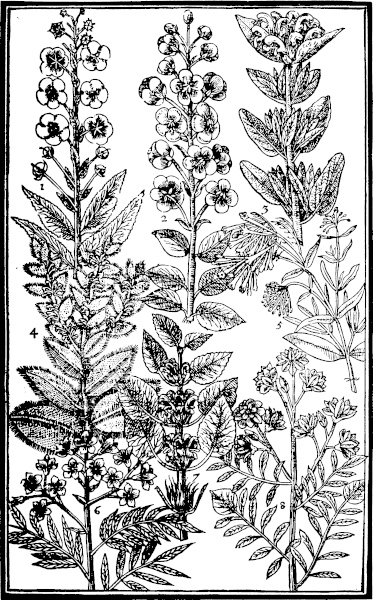
1Blattaria flore albo. Moth Mullein with a white flower.
2Blattaria flore purpureo. Moth Mullein with a purple flower.