FOR VOLUME XIV.
Reading edition
OUTING closes its thirteenth volume with this issue. The many readers that have come to us since we began the volume last October furnish an unmistakable evidence that OUTING has given great satisfaction to the lovers of sport. Slowly and steadily OUTING has improved. But the changes hitherto made have not been so marked as those about to be made.
The success of OUTING has been brought about by striving to present, in the most attractive dress, both artistic and literary, only such subjects as appeal, directly and closely, to the tastes and proclivities of the ever-increasing army of genuine lovers of sport and recreation.
In the fourteenth volume of OUTING, the best literature, descriptive of every phase of legitimate sport as participated in by ladies and gentlemen, will predominate.
In the hands of such mighty hunters as the late Gen. R. B. Marcy, Lieutenant Robertson, Mr. G. O. Shields and Capt. Jack Crawford, the crack of the rifle will be heard in the pages of OUTING. The almost inaccessible fastnesses of the gigantic mountain chains which traverse America and provide a very paradise for the lover of the biggest kind of game hunting will be penetrated, and the thrilling scenes and exciting adventures of following the elk, moose, bear, deer and other game will be presented to our readers.
The streams, rivers and lakes of this continent afford finer fishing than any other quarter of the globe. The salmon of the St. Lawrence and Saskatchewan, the lordly muskallonge of the Nor’west, the bass and trout of a thousand streams from Maine to California offer such sport as is not to be mentioned in the same breath with what one gets on the fly-whipped waters of Scotland, Ireland and Norway; and OUTING will present to its readers authentic records of the experiences of the best known adepts of this most fascinating sport.
Nothing is more remarkable in the general athletic revival of to-day than the great attention that is given to the physical recreation and development of the fair sex. This good work OUTING has always fostered, and to lead our gentle sisters into the joyous sports afield, we will offer them articles on camping, rowing and swimming, and also practical hints for horsemanship and fishing.
Recognizing that the dog is the sportsman’s best friend and most constant companion, OUTING is ready with a series of papers on the breeding, breaking and training of the different breeds of dogs used in the chase. Mr. Mercer will treat of Clumber Spaniels, Mr. Anthony of Pointers, and other writers will write of setters and hounds for deer-coursing, hunting, etc.
For the sportsman who, over lea and bracken and swamp and meadow and upland, follows the partridge, the quail and the woodcock, OUTING, in the coming volume, will have a rich treasure of useful as well as interesting reading. We have reminiscences of duck shooting in Canada, California, Oregon and other celebrated haunts, not forgetting, of course, the pleasures of Chesapeake Bay and the delights of the Carolinas and Florida.
In the field of general athletics, OUTING may justly claim to have done much; and the appreciation already manifested in our Club and College articles by all classes of readers has determined us to give this branch of our work its full share of prominence in the coming volume.
Summer field sports will, of course, find ample representation in OUTING. Mr. H. J. Slocum, Jr., Mr. Taylor, and other prominent players and writers on Lawn Tennis, will fully describe the interest taken in this widely popular game. Articles will appear on tennis on the Pacific slope, the South, and the more brilliant achievements at Newport, Staten Island, Orange, and other fashionable centres of the game. Cricket in England, Australia and America will be fully discussed, while Baseball, Lacrosse, and the popular pastime of Lawn Bowls, will be the themes of handsomely illustrated articles.
Rowing has at all times been a most popular exercise among college and club men, and OUTING will publish a very valuable series of papers on the EVOLUTION OF FORM IN COLLEGE AND AMATEUR ROWING. The recognized leading authorities on this subject have prepared these articles, and they will be one of the most attractive features of the coming numbers. While properly representing the brethren of the oar, OUTING has by no means forgotten the wielders of the paddle, and canoeists will find many a pleasant sketch of cruising and camping in the summer pages of OUTING.
In Yachting matters OUTING has always led the van, and we propose to present to our aquatic friends a fine galaxy of yachting literature during the coming season. The Larchmont Club will open the ball, and this article will be followed by others on the Seawanhaka, Eastern, and other prominent organizations. The illustrations for these articles will embrace reproductions from photographs of the leading flyers and “cracks” in each fleet, and the whole will be a most valuable collection of modern boats.
The marvelous results that can be obtained by the modern instantaneous camera, and the comparatively little trouble given by adding an outfit to one’s camp or field kit, makes photography a prominent feature in any expedition nowadays. In fact, photography may be aptly called a picture diary, which chronicles scenes and episodes more vividly and graphically than the most brilliant and epigrammatic collection of notes. OUTING will, therefore, furnish a series of short, pithy papers on photography, and Mr. Ellerslie Wallace, who writes the articles, is an instructor from whom all will be proud to learn.
Continent may differ from continent, nation from nation, in language, religion, and government, but sport is cosmopolitan, its literature is universal, its followers are brothers all the world over. Thus we find sportsmen in Europe are just as eager to read the doings by “flood and field” in America as Americans are interested in all that appertains to sport across the sea. OUTING, then, must of necessity be international, and with this idea in view the Editor and Manager of OUTING went to Europe recently to look over the field in England and on the continent, and returned bringing many MSS. and illustrations with him in his portmanteau, and his pockets lined with contracts for articles that will make the fourteenth volume an evidence of a good work done.
“Plantagenet,” whose name is familiar wherever English sport is known, will contribute regularly hereafter, and his introduction in this issue is sufficient to acquaint those who never read his writings with the great gain this connection brings to OUTING in the department of hunting and racing on British soil.
“Rockwood,” who has heretofore occasionally written for our pages, will hereafter address us at frequent intervals on sport with the Rod and Gun. “Redspinner,” than whom none writes better of the pleasures of Walton’s disciples, will contribute a series of papers. Mr. Dalziel, who has become one of the best living authorities on the Kennel, has taken in hand the kennel interests in Great Britain; and Mr. R. H. Moore, the clever English dog-artist, will furnish the illustrations, so that ere Vol. 14 closes the friends of the Kennel will have secured with its six numbers a pretty good history on matters canine in England and America. Lady Arnold has contributed a series of articles on Yachting, to be followed by valuable papers on this subject from other writers. A special correspondent has been sent by OUTING to the Mediterranean, and Yachting in Southern Europe will be the topic of a series of valuable papers to our yachtsmen.
Friends of the wheel have been specially cared for, and Mr. Joseph Pennell, who needs no introduction to cyclers, is now engaged on a series of articles and illustrations that will give OUTING a new look altogether. But, aside from these and other valuable papers, we have the pleasure of announcing the return of Mr. Howarth from the Azores, whither he was sent by OUTING, at great expense, with cycle, gun, and camera, to explore the islands of the sea; and the articles on Cycling in Mid-Atlantic, illustrated by Harry Fenn and Joseph Pennell, will prove one of the greatest attractions that any magazine ever offered to its readers. Lady Brierly will contribute papers on the horse; and last, but not least, the greatest of sporting writers, Capt. Hawley Smart, is now completing a sporting novel for OUTING that will run through at least six numbers, and be one of the best stories ever given to magazine pages.
OUTING has spared no pains to secure the best artists to illustrate its excellent literary material, and with such a staff at our command as Harry Fenn, Henry Sandham, A. C. Corbould, Joseph Pennell, M. J. Burns, R. H. Moore, J. W. Fosdick, Marie Guise, Eugene Bauer, and others of minor note, the readers may look forward to seeing each subject that is illustrated done ample justice to.
OUTING having thus an international field to work in, the American editors have called to their assistance a thoroughly competent English editor, whose authority and reputation on all sporting topics is admitted on both sides of the Atlantic. For this most important position we are happy in obtaining the services of no less a light than the world-renowned “Borderer,” who for the past decade has been one of the leading contributors to every publication of reputation in England, and whose knowledge and judgment in sporting matters is second to none. He needs no further introduction from us; let him speak for himself.
* * *
INTRODUCING OUR ENGLISH EDITOR.
I CANNOT outdo the Ethiopian in changing the color of my skin—even in putting on a new coat, the color must be the same. The question of its fitting is a serious one, and you know, readers, how uneasy and uncomfortable a thing it is to wear a new garment for the first time. You feel like a marked man. When a schoolboy you were pinched by all the other boys in commemoration of the event, and however proud you may have been of the fit, it took the edge considerably off your conceit to be asked, “Who’s your tailor?”
And now that my old garment—the delight of many a play hour, the warm friend of my youth, the custodian of my body in many a sport, the well-worn aid to health and strength—has been thrown aside and taken to the old-clothes shop to be refitted, I find myself very like the nervous schoolboy about to run the gauntlet of fresh critics, and perhaps ruthless ones; critics who know not the Borderer of old; who have not followed his rambling prose through many years, and caught the drift of his sporting thoughts; critics, too, whose tastes may not be so thoroughly in harmony with his as those of yore. And yet, perhaps the fear is greater than the reason for it, and on the score of plenary indulgence at starting, I shall try to make my new garment, the English editorship of OUTING, as appreciable as possible to my new acquaintances. Would that I could say with Oliver Goldsmith—
“He cast off his friends as a huntsman his pack, For he knew when he pleased he could whistle them back.”
OUTING is now our pet. Through it Borderer can speak to the world of sport.
What makes Jack a dull boy? The lack of OUTING.
“Funny name, that,” exclaimed a friend of mine the other day, “but, after all, very expressive.”
How we all look forward to our OUTING! Even those who have little chance of enjoying it. Do not they also count the days of its possible coming? Every one to his taste. We are off, like greyhounds from the slips, eager for sport, recreation or travel. Here still oftener, and for a modest sixpence, is OUTING, to make you learned in sport all the world over, and more worthy of your real happy outing when it comes. As money and modes of locomotion increase and multiply, so will OUTING flourish until it spreads its happy pages, like eagles’ wings, throughout the world. Neither sea nor land will stop the echo and re-echo of its outspoken thoughts, and proportionately great will be the responsibility of its utterances, as well as of those in whom it will confide as authors. To be a sportsman is one thing—to write of sport is another. “I must be cruel only to be kind,” says Shakespeare. So truth, honesty and uprightness shall be our leading characteristics. A true sportsman should be bold as a lion, steady as a rock, quick as an arrow, ’cute as a coon, cautious as a man, hard as nails, sober as a judge, with the temper of an angel, the eve of a lynx, the voice of a siren, and the nerve of a hero.
Taking these mighty attributes with us, my readers, let us launch our good ship on its transatlantic voyage. Let us fancy ourselves like bold Æneas of old, about to venture on new scenes, and interview the grandees of far-off countries, carrying with us the dauntless standard of sport. Ever foremost in the fray, ever aloft as the acme of delight, ever where virtue and destiny call—then Borderer’s reward will be signaled by the boundless success of his new venture—
OUTING.
BORDERER.
* * *
DOG CHAT.
NEGOTIATIONS are now in progress between the presidents of the National Dog Club of America and the American Kennel Club, with the object of bringing about some amicable arrangement between factions, and it is quite on the cards that ere this is read they will have amalgamated, the members of the N. D. C., in all probability joining as associate members of the A. K. C. The objectionable feature of the “associate” scheme, insufficient representation, has been eliminated. Every 100 members will be privileged to elect a representative who will be on the same footing as the delegates of the kennel clubs. This should prove an eminently satisfactory arrangement.
It has been made evident that public sentiment leans to the elder organization (another demonstration of the incomprehensibility of vox populi), and kennel matters, to all appearance, will be best advanced by every one’s falling into line, and thereby securing a voice in the government of dogdom. The A. K. C. makes fair promises, which, if fulfilled, should satisfy all. If they fail, why, the traces can be again kicked over.
This will be a busy season in dogdom, as an important show is scheduled-for each week from January to the end of April, and others, not as yet announced, will probably run well on into the month of May. Truly may it be said that dog shows are advancing in public favor when such can be the case.
The four important Field Trial meetings (those of the Indiana, Eastern, Southern and American F. T. clubs) are now things of the past, and taking them as a whole they have not received the liberal patronage of former years. As usual, the Memphis and Avent Kennel of Tennessee has swept everything before it, and equally, of course, the blood of old “Count Noble” is again to the front.
The Hempstead fox-terrier coursing has caused a considerable stir of late. While I am not in sympathy with the proceedings of the “Alphabetical” Society in this matter, I cannot make out just where the “sport” comes in in seeing a benumbed and scared “bunny” chased and killed by terriers. We are told that the “course” frequently takes less than thirty seconds’ time to decide, and that the rabbit never escapes. Now this, to my way of thinking, damns it as a field sport, the fascination in which is the element of uncertainty it contains; the knowledge that your skill and training, or your dog’s, is pitted against the natural cunning and quickness of the beast or bird pursued, and in the knowledge that the quarry has a chance for its life. Take away this and I am sure field sports will lose many of those who are at present devoted to them. Give the rabbits fair “law,” a chance for their lives, then it will be a legitimate sport.
An extraordinarily high-priced lot of greyhounds recently changed hands under the hammer in London. They were the property of Mr. Dent, who has given up coursing for the present. The puppy Fullerton was sold at 850 guineas to Colonel North, while Bit o’ Fashion was bought by the same purchaser for 200 guineas, also Miss Glendyne for 510 guineas. Huic Holloa fetched 350 guineas, and Jester 190 guineas. The prices paid throughout were high.
The English St. Bernard, Prince Battenberg, who once beat Plinlimmon, is for sale. His owner, Mr. King-Patten, announces that he has received an offer of 2,000 guineas for the dog, from an American. I fear some one has been “pulling his leg.”
DOGWHIP.
* * *
COLLEGE SPORTS.
EXCEPTIONALLY fine weather, October temperature, has made it possible for active college youths to practice various pastimes which are usually relegated to obscurity or the gymnasium during the cold winter months. Games of ball, lacrosse and tennis have been played in the open air, and in some places crews have been out in their frail shells. That boating will be very popular this spring seems assured if the interest shown by Yale, Harvard, Columbia, Cornell, and the University of Pennsylvania in the doings of their respective crews is any indication. With the return to college from the Christmas vacation the serious work of training conscientiously and intelligently began, and now the weeding-out process will soon begin. Harvard naturally expects great things from the tank. In January, the crew was able to do some rowing on the Charles, which, with work in the gymnasium and in the tank has given the crew a very good send-off. At no time previous has there been so wide-spread an interest in correct, scientific rowing as at present, and every effort is made by the captain to get the most out of his crew, not as one ordinarily would suppose, by getting his men to develop muscle and pull for all there was in them, but by studying the possibilities of each member and so combining them according to scientific principles as to yield the best results. This method is in vogue at Harvard and at Yale, where Bob Cook and prominent graduates, members of former crews, for months before the great race, consult and figure upon the material at hand, and endeavor to get it into shape.
The other sports, baseball and track athletics, are not being neglected by their admirers. The fleetfooted sprinters have been taking part in the several meetings of the Amateur Union and the National Association, and are consequently in comparatively good trim. With this attention to sport which the majority of college youths give, even in the many small institutions which can not boast of possessing well-equipped gymnasiums and track facilities, there is fast growing up a race which will be as superior to the men of to-day as the present generation of young men is superior to those of twenty years ago.
J. C. GERNDT.
WHAT YACHTING COSTS.
WHAT does yachting cost? That to be able to own and properly maintain a large yacht a man must have a good solid bank account to draw upon, is a truth; but that one in very moderate circumstances may enjoy all the pleasures of yachting is also true. Where there is one man who is able to own and run an Electra or a Volunteer, there are hundreds of Corinthian yachtsmen who have “fun alive” with boats of from fifteen to forty feet in length.
To state exactly, or even approximately, what yachting costs is well-nigh as difficult as to guess the correct number of hairs on a man’s head. But a very good general idea may be obtained by drawing deductions from well-known data.
If old Commodore John C. Stevens, the first flag-officer of the New York Yacht Club, were alive to-day, he would be surprised as well as delighted to observe the wonderful growth and improvement yachting has made since his time, nearly half a century ago, and no doubt he would hold up his hands in amazement at the increase in the luxuriousness of the appointments of a yacht during the same period.
The New York Yacht Club was organized in 1844, by Mr. Stevens and others, and was the outcome of the first organized effort ever made in this country to popularize yachting. The yachts of those days were few in number, and of small tonnage, The Maria, Commodore Stevens’ last yacht, though in her time a giant among her sister yachts, would be rated as only of average size compared with the larger pleasure craft of to-day. Her appointments, too, though far superior to those of her contemporaries, were very commonplace and inexpensive as compared with the palatial luxuriance of the interior fittings of any of the large yachts now afloat. To spend $20,000 at that time in building and equipping a yacht was considered extraordinary, if not a financial impossibility, for any man except Commodore Stevens, who, as the owner of nearly all of Hoboken and Weehawken, was estimated to be about the wealthiest man in America.
Since the organization of the New York Yacht Club, however, and especially since the success of the yacht America in England, each succeeding year has witnessed a multiplication of yachts, an increase in their size, and especially an augmentation of the luxuriance of their furnishings that have excited the wonder and admiration of the yachting world.
The yachts America, Julia, Una, and Widgeon, of the early period of American yachting history, were prodigies of their day and generation in respect to speed and size. All four were productions of that famous designer, George Steers, and were invincible against vessels built by other designers of the period. In this respect Edward Burgess, of Boston, concededly holds to-day the place occupied by George Steers thirty-five years ago; and the former designer’s Puritan, Mayflower, Sachem, and Volunteer have to-day a relative standing among yachts very much like that which George Steers’ productions enjoyed in their generation.
The total cost of all the yachts of forty years ago was less than that of Mr. William K. Vanderbilt’s yacht Alva alone. Two hundred thousand dollars would have been sufficient to buy the entire fleet. Year by year the amount of money expended for yachts has kept pace with the steady increase of the wealth of the country, till now it exceeds several millions of dollars annually. What the magnificent fleet of vessels which constitute the squadron of the New York Yacht Club to-day cost to build, rig, spar and furnish, represents an outlay of more than $3,500,000. The yachts at present enrolled in the New York Yacht Club number 184. Of these sixty-seven are schooners, sixty-five sloops, cutters and yawls, forty-six steamers and six launches. The tonnage of these 184 vessels aggregates 18,000 tons. The very best estimate obtainable from figures shows that it costs $200 per ton to build, rig, and fully furnish the average American yacht ready for cruising.
Instead of the one yacht club of 1844, there were on May 1, 1888, 101 incorporated yacht clubs in America. Of the yachting associations not yet advanced to the dignity of incorporated bodies, there are doubtless from two to three times as many more. These clubs are to be found in almost every harbor on the great lakes, and on every bay, lake, river and creek from one end of the land to the other. In fact, wherever there is a sufficient body of water to sail some kind of a boat upon, there will surely be found some sort of an association for the promotion of yachting. From very careful estimates made from records of yacht building, rigging and furnishing, which have been kept for years, the total tonnage of all sailing or steam vessels owned and run exclusively for purposes of pleasure in this country, on May 1, 1888, was 203,575, representing an aggregate money-value investment of $40,715,000. In view of these large figures, and they are increasing every year, the widespread and increasing interest taken in yachting events is hardly to be wondered at. The money estimate must be more than doubled, too, when “running expenses” are considered.
It is with a yacht very much as it is with a horse—it is not so much the buying as the keeping that makes the money go. The first cost of a yacht is, of course, very heavy, and it is estimated that this outlay, with the money spent in keeping the boats and running them, annually puts in circulation millions of dollars. The greatest item of expense in running a yacht is the pay of the crew. A vessel like the Volunteer, for example, gives employment for six months of the year to fifteen men. Mr. Vanderbilt’s steam-yacht Alva carries a crew of 100 men, and the smaller of the cabin-yachts, say of about twenty-five tons, require, to properly handle them, a sailing-master, cook, and three men before the mast. All told, the yachts of the New York Yacht Club furnish employment of this kind to more than 2,500 men, to whom the yacht owners pay not less than $125,000 per month for six months of each year, or $750,000 for the six months. As the average number of yachts belonging to each of the 101 yacht-clubs of the country is thirty-three, the result shows that there is, or was on May 1, 1888, a total of 3,333 yachts enrolled in the incorporated yacht clubs of the United States; and carrying out the extensions as based upon the estimate of the New York Yacht Club, the results show that these 3,333 yachts give employment to 45,289 men, to whom wages amounting to $2,264,450 are paid monthly, or the enormous sum of $13,586,700 for a season of six months. It may be not altogether proper to base the number and pay of crews for the yachts of the whole country upon figures of the New York Yacht Club, for the vessels of that club undoubtedly ton higher on the average than the vessels of the less prominent clubs; but it must be remembered that in getting at these figures only the incorporated associations have been considered, and the hundreds and even thousands of yachts belonging to minor associations, and the many yachts which fly the flag of no club at all, have not been taken into the calculation. From this point of view, the figures for crews and their salaries as given above furnish about as good an idea of the totals as it is possible to obtain.
Again, a yacht which is kept up in good shape has to have her rigging renewed constantly, and then there are the items of new sails, repainting and overhauling on the dry dock. These expenses cannot be estimated, and it is simply impossible to make a respectable guess, but it amounts to hundreds of thousands of dollars each year.
One of the largest, and in some respects the largest, item of expense in running a yacht is the steward’s department, but it is impossible even to approximately estimate what is annually spent in this very important department. One yacht owner may spend $15,000 a year entertaining a great number of guests at his table, while another man, with the same yacht may find one-third of that amount ample for the same purpose; but the sum of money put in circulation for ship stores and table furnishings may safely be put down as double the sum per month paid to the crew and officers in wages, or $1,500,000 for the yachting season of six months of the fleet of the New York Yacht Club alone. Thus the total amount of money put in circulation in one season by the yacht owners of this one club will not fall short of $3,500,000.
If the expenditure for maintaining the 184 yachts of the New York Yacht Club is $3,500,000 a year, it is not improbable that not less than $7,000,000 is spent on the 3,333 pleasure and racing craft of the 101 yacht clubs of the entire country for a like period of time.
There are other expenses which can be neither classified nor estimated, such as, for instance, the hiring of extra men for races; the payment of prize money to the crews of race-winners; repairs following collisions, running ashore, carrying away of sails and spars, and a thousand-and-one other things. Altogether, it is not overestimating the case to say that American yacht owners put $7,000,000 into the hands of workmen and tradesmen last year, and this amount bids fair to increase annually. That which is put into new boats is not included in this calculation at all, and easily amounted to $1,000,000 more.
The steamers and the large sloops built of recent years have tended to very greatly augment the expenditure of money on yachts. The steamers, especially, are a very expensive luxury. With them the coal bill is an additional and large item.
Some very wild estimates have been made as to what it costs to run one of the largest steam-yachts. It has been said that it costs Jay Gould $3,000 a day to run the Atalanta. This is absurd. Vice-Commodore E. A. Bateman, of the American Yacht Club, who owns the steam-yacht Meteor, once was heard to say that he ran her at an expense of $35 a day; and several years ago, when Mr. James Gordon Bennett owned the Dauntless, and was commodore of the New York Yacht Club, he is said to have remarked that it cost him $25,000 a year to entertain his guests alone. Probably the most expensively run yacht to-day is the Electra, the flagship of the New York Yacht Club. It is said that she costs Commodore Gerry $35,000 a year. But a yacht of fifty tons, if economy be practiced, and she be not raced, may be run at a very modest cost.
Many thousands of men enjoy all the sport to be had out of pleasure-sailing in a craft whose first cost, completely equipped, was but $1,000 or less. Such a yacht can be run at a very slight expense. Craft of this kind are called “single-handers,” from the fact that it requires but one man to handle them. Their number is large at present, and they are rapidly growing in popular favor. If the cost of such vessels, of yachts which are not enrolled in any club, and the boats of the numerous canoe-clubs, were added to the figures given as representing the amount invested in the pleasure vessels of the United States, the aggregate would be something enormous.
ROBERT DILLON.
HOW’S THIS FOR BASS?
THERE are odd places in and around the waters of New York where the enthusiastic fisherman can find plenty of sport at his favorite pastime. One day, toward the close of September, W. E. Sibley, of this city, an angler of some repute, and a companion, Mr. Del. Ruch, of Clifford’s, Staten Island, set out to troll for striped bass in the Great Kills. After they had trolled for some time, and had landed only a few one and two pounders, the sport grew tame, and Del. Ruch left Sibley’s boat and joined another fisherman to change his luck. Instead of Ruch finding luck it came to Sibley. In a few minutes after Ruch had left, Sibley’s troll was seized, and he found himself struggling with a bass of more than ordinary fight. A lively tussle took place. The fish had no idea of surrendering, and for half an hour the fish and the fisherman had a nip-and-tuck time of it. Finally the bass, wearied and worn out, yielded slowly, and when it was brought alongside of the boat it showed up magnificently. It was a monster. Though conquered, the fish was not captured. A difficulty arose regarding the ways and means about getting it into the boat. There was no gaff-hook handy. Mr. Sibley was perplexed. The thought of losing that bass, when it was so near and yet so far, nearly unnerved him. He was equal to the occasion, however. Holding the line stiff, Sibley ran his hand along the fish, slipped it in beneath the immense gill covering, and lugged the big fellow into the boat after a great effort. When measured and weighed, it lacked just half an inch of three feet, and tipped the scale at eighteen pounds. It is said to be the largest striped bass on record caught within twenty miles of New York.
OUR THEATRICAL PLAYGROUND.
“THE PLAYERS.”
PERHAPS the most notable event in the players’ world, with which the new year was ushered in, was the presentation by Edwin Booth to the organization of leading actors known as “The Players,” of a magnificent club-house in Grammercy Park. As the old year drew to a close there assembled a brilliant audience of players and guests, and at the stroke of twelve Mr. Booth handed over the deed to the property to Mr. Augustin Daly, of “The Players.” Mr. Booth closed his presentation speech in the following happy manner: “Though somewhat past the season, let us now fire the Yule-log, with the request that it be burnt as an offering of ‘love, peace and good-will to The Players.’ While it burns, let us drink from this loving cup, bequeathed by William Warren of loved and honored memory to our no less valued Jefferson, and by him presented to us; from this cup and this souvenir of long ago—my father’s flagon—let us now, beneath his portrait and on the anniversaries of this occupation, drink: To the Players’ Perpetual Prosperity.”
Mr. Daly responded appropriately in behalf of the club, and after a general grasping of hands, all adjourned to feast around the generous board. In every way this new home is most complete, and the decorations are handsome and solid. In the lounging room are two oil paintings by Joseph Jefferson. Beside them hangs Sir Joshua Reynolds’ celebrated portrait of David Garrick. There is also a Gainsborough, and a portrait of John Gilbert by J. Alden Weir. A goodly collection of dramatic literature fills the library on the second floor, Mr. Booth having presented 1,200 volumes, and Mr. Lawrence Barrett 2,000, besides a large number of rare works from Augustin Daly, T. B. Aldrich, Stanford White and others. An excellent maxim is found directly above the great seal of the order, which is inserted in the ornamental brickwork under the mantelpiece. It reads thus:
“Good friends, for friendship’s sake forbeare To utter what is gossip heare In social chatt, lest unawares Thy tongue offende thy fellow-plaiers.”
OLD ENGLISH COMEDY.
FOR his annual comedy revival Mr. Daly has chosen Capt. George Farquhar’s “The Inconstant; or, the Way to Win Him.” This play has not been seen in this city since 1873, and in Mr. Daly’s hands the somewhat doubtful morale of the play has been improved, and thus the revival was practically a first performance of the play. The change to suit modern ideas has been admirably effected, though possibly the fifth act might have been subjected to closer censorship. It is needless to say that Mr. Daly’s band of players acted their parts well. The public has come to accept that as almost a foregone conclusion. Miss Rehan as Oriana is the same person that has pleased us so long, but in the mad scene she strikes a key that is almost pathetic. The “Inconstant” may be looked upon as a success.
SHAKESPEARE AT PALMER’S.
PLAY-GOERS in New York have no reason to feel dissatisfied with the feast spread before them this season. Shakespeare has not been neglected for the newer generation of writers. Rarely has a play, however, been put on the stage in a more complete way, with greater magnificence and attention to details, than “Antony and Cleopatra.” Mr. Abbey has spared no expense, and surely it would be difficult to find an actress to look the part better than Mrs. James Brown Potter. Whatever may be her faults, she has succeeded in ridding herself of some of them, and in gesture, walk and pose this improvement is most marked. She still lacks facility in expressive speaking. Thus the presentation is of a spectacular sort, and on that fact will have to depend success or failure. The single scene which perhaps impresses the interested spectator most is revealed in the entrance of Cleopatra’s barge—“a bizarre painting of Egypt’s historical convoy, with its flowing sails of magenta, its glittering front and sides, its silver oars, its fawning slaves, and, over all, the tinkle of drowsy music.” The acting version of the play is by Mr. Kyrle Bellew, who himself assumes the character of Antony. He is not a roystering old ruffian; one does not behold scarred limbs and grizzled locks. The Antony of Kyrle Bellew is tender in speech, soft in action, and ever the lover. The play is scheduled for an extended run, and will doubtless receive a generous share of attention.
MACBETH.
AT the Fifth Avenue Theater Mrs. Langtry has been acting Lady Macbeth, and has won a good measure of success, which deserves recognition for the reason that her conception of the part differs from that acceptable to most Americans. Charlotte Cushman’s Lady Macbeth was a grim, imperious virago, and we have accepted that version as the true one. In Irving’s celebrated revival of the play, Ellen Terry presents a coaxing, loving, charming contradiction to the Cushman model. Mrs. Langtry has chosen a middle path. While not wholly able to cope successfully with the part, she gives a thoroughly interesting portrayal. In the sleep-walk scene she is bravely original. Utterly sacrificing her comeliness, she comes out from her bedroom like a veritable corpse from a tomb, a figure to shudder at in a theatre and to fly from if met near a churchyard. While her reading of this particular scene will call forth some condemnation perhaps, considerate judgment must also accord praise.
The Macbeth of Mr. Charles Coghlan was thoughtful, but hardly satisfactory. It lacks the fire and passion which make the character such a strong one in the hands of some actors. Mr. Joseph Wheelock, as Macduff, was as successful as that conscientious actor usually is in all he undertakes, and he called forth the enthusiasm of all by his painstaking work. On the whole the venture may be looked upon as a success.


“THE Harvard Index” for 1888–89 is a very complete directory of the students and the various literary and sporting organizations in college. A valuable feature is the list of best-on-record performances, both collegiate and other, for America and England.
ONE of the best and most artistic college annuals is the Princeton, 90, “Bric-à-Brac.” Some of the drawings are quite elaborate, and very much to the point. The records of the doings of the different associations, and the list of students, are as complete as it was possible to make them.
A SERIES of interesting books is issued by the well-known house of Lee & Shepard, under the general title of “Good Company.” The name is well bestowed, and the thoughtful reader will find, as he becomes acquainted with the various members of the company, that there is much which he can note with profit. Not only is the company good, but the dress is neat and inviting. The books before us are: “The Lover,” by Steele; “The Wishing-Cap Papers,” by Leigh Hunt; “Fireside Saints,” by Douglas Jerrold; “Dream Thorpe,” by Alexander Smith; “A Physician’s Problems,” by Charles Elam; “Broken Lights,” by Frances Power Cobbe, and “Religious Duties,” by the same author.
The same publishing house has issued a new edition of Rev. P. C. Headley’s biography of “Fighting Phil.” This book, intended for young readers, well describes the life of the dashing general, and at this time, when his personal memoirs are receiving such marked attention, the simpler story of Rev. Mr. Headley will be widely read by boys.
AN excellent library of sports and pastimes, the Badminton, is being issued by Longmans, Green & Co. Those who are seeking for knowledge on any of the subjects dealt with will find the results of many years’ experience written by men who are in every case adepts at the sport of which they write. There have already appeared, “Hunting,” “Fishing,” “Racing and Steeple-chasing,” “Cycling,” “Athletics and Football.” The latest additions to the library are “Boating” and “Cricket.” The former volume is by W. B. Woodgate, a veteran oarsman; the latter by A. G. Steel and the Hon. R. H. Lyttelton. The text is handsomely illustrated, and in every respect are the volumes to be recommended. Every sportsman should have a complete set of this series of books; they are an ornament to any library, and the information contained in them such as can not readily be obtained in other books on sports.
“CRUISINGS in the Cascades,” by the well-known author G. O. Shields, is in the press of Rand, McNally & Co., of Chicago. It is a record of an extended hunting tour, made by the author in the Cascade Mountains in Oregon, Washington Territory, and British Columbia. The work is handsomely illustrated from drawings and from instantaneous photographs taken by Mr. Shields.
AN entertaining work, not only for grown people, but also for boys, is John Augustus O’Shea’s “Military Mosaics.” The author has tried to be faithful to truth, and the language used is as close an approach to that which men would speak under the circumstances as can well be given in print. This effort on the part of the author is to be heartily commended, since boys are naturally anxious to know if things are what they seem. In the author’s words, “There is not an event set down which did not happen, or might not have happened, and to the soldier’s life, as to all others, there is a seamy side.” Thus we are told of hardships, fatiguing marches, exposure to all sorts of weather, and are impressed with the fact that the chief pleasures of warfare are those of memory. Messrs. W. H. Allen & Co., London, are the publishers.
The same firm has brought out “Orient and Occident,” a journey east from Lahore to Liverpool, by Major-General R. C. W. Reveley Mitford. It is a description of a home-coming by routes little traveled. China, Japan and the United States are successively visited, and as the author drifts from place to place he rather pleasantly gives us his impressions. The text is embellished with illustrations from sketches by the author.
A useful book for the yachtsmen who wish to spend some time cruising in the Mediterranean is “Shooting and Yachting in the Mediterranean,” by A. G. Bagot. Of course the yachtsman always provides himself with guns, and is ever ready to “pepper away.” However, it is rather the rule that he fails to bag his game. In “Shooting and Yachting” he will find much useful information on this point, as well as learn of localities to be visited, dangers to be avoided, etc. Not the least valuable part of Mr. Bagot’s work are the practical hints to yachtsmen, and the list of yacht-clubs with which the book closes. Allen & Co., London, are the publishers.
THE author of the “Book of the Black Bass” has issued through the press of Robert Clarke & Co., Cincinnati, a supplement, which he calls very happily “More About the Black Bass.” In it he presents the latest developments in the scientific and life history of this best of American game fishes, and describes the most recent improvements in tools, tackle and implements. The little work appears at a most opportune time.
IN his “Hunting Notes” “Borderer” gives a valuable resumé of the season’s work. While of no direct interest to the American reader, these notes present an admirable picture of the way hunting is done in Old England, and to those who follow the hounds in this country, and their number is increasing from year to year, a perusal of “Hunting Notes” will be profitable and entertaining. The publishers are A. H. Baily & Co., London.
I’M SINGLE NO LONGER, YOU KNOW.
’TWAS while kneeling at beauty’s fair shrine, In the years that I fain would regain, Spinster Fate drugged my vintage of wine, And entangled me fast in her skein. In the days ere my star’s sudden wane, I was thought a most handsome young beau, But I’m now called “decidedly plain,” For I’m single no longer, you know! Edith said that my eyes were divine As we strolled thro’ the green country lane— That the girls thought my figure was fine, I discovered from sweet Mary Jane; But alas for a once happy swain, With the virtues of one year ago! I am met with a haughty disdain, For I’m single no longer, you know! Tho’ these ballades and rondeaux of mine Had the verdict of “quite in the vein,” They say now I am shunned by the Nine, And my verses are ruthlessly slain. Tho’ by courtesy we are called twain, ’Tis my wife that comprises the Co., And of course I’ve no right to complain, For I’m single no longer, you know! In a word, to conclude the refrain, I have hung up my fiddle and bow, I have mortgaged my castles in Spain, For I’m single no longer, you know! Sanborn Gove Tenney.
FOR A PRESENT WHAT COULD BE BETTER THAN A SUBSCRIPTION?
Among the Artists represented are:
ELIHU VEDDER. J. ALDEN WEIR. J. W. TWACHTMAN. M. J. BURNS. WILLIAM HOLE. GEORGE HITCHCOCK. J. FRANCIS MURPHY. WILL H. LOW. W. H. GIBSON. J. D. WOODWARD. ROBERT BLUM. C. JAY TAYLOR. ALFRED KAPPES. ELBRIDGE KINGSLEY. BRUCE CRANE. WALTER L. PALMER.
SCRIBNER’S MAGAZINE.
Christmas Number Now Ready.
The completion of the second year of SCRIBNER’S MAGAZINE will be signalized by the publication of a remarkably beautiful and interesting Christmas Number. There will be about sixty illustrations, one-third of them full-pages of rich design.
ROBERT LOUIS STEVENSON will contribute a second instalment of his romantic novel, “The Master of Ballantrae,” strikingly illustrated by William Hole.
H. C. BUNNER’S “Squire Five Fathom” is a delicate and finely imagined story. C. Jay Taylor of Puck, will fully illustrate it.
REBECCA HARDING DAVIS will tell a story of life at a wayside station in the North Carolina mountains. Illustrations by Alfred Kappes.
W. M. TABER will contribute an unusually ingenious tale of a mystery entitled “Three Bad Men,” with illustrations by Francis Day and M. J. Burns.
JOHN J. à BECKETT will tell the story of a sentiment. Its title is “The Roses of the Señor,” and it will be illustrated by Robert Blum.
WILL H. LOW, the artist, will describe the origin and rapid growth in the United States of the art of making stained-glass windows; with beautiful reproductions of windows by La Farge, Armstrong, Tiffany and Lathrop.
WINTER IN THE ADIRONDACKS will be picturesquely described by Hamilton Wright Mabie, and elaborately illustrated by W. Hamilton Gibson, Bruce Crane, J. Francis Murphy, and J. D. Woodward.
LESTER WALLACK’S Reminiscences will be concluded; fully illustrated with portraits—one, taken last summer, representing Mr. Wallack at his country home, with his favorite dog at his feet.
GEORGE HITCHCOCK, the artist, will write of Botticelli. Illustrations from drawings by the author.
ILLUSTRATED POEMS will be a feature of the number, one of them, “THE LION OF THE NILE,” containing four pictures by ELIHU VEDDER.
MR. STEVENSON concludes for this year his series of monthly papers with “A Christmas Sermon.”
The publishers of SCRIBNER’S MAGAZINE aim to make it the most popular and enterprising of periodicals, while at all times preserving its high literary character. 25,000 new readers have been drawn to it during the past six months by the increased excellence of its contents (notably the Railway articles), and it closes its second year with a new impetus and an assured success. The illustrations will show some new effects, and nothing to make SCRIBNER’S MAGAZINE attractive and interesting will be neglected.
Price, 25 Cents a Number; $3.00 a Year.
CHARLES SCRIBNER’S SONS, 743–745 Broadway, N. Y.
FRAUDS IN POROUS PLASTERS.
Those who cannot originate, imitate, and all so-called Porous Plasters are only fraudulent imitations of ALLCOCK’S. If you want the genuine article, be certain not only to ask for
“ALLCOCK’S,”
but look well at the plaster and see that this
Trade Mark

is on every one. None are genuine without it.
ROYAL

BAKING POWDER
ABSOLUTELY PURE.
This powder never varies. A marvel of purity, strength and wholesomeness. More economical than the ordinary kinds, and cannot be sold in competition with the multitude of low test, short weight, alum or phosphate powders. Sold only in cans. ROYAL BAKING POWDER CO., 106 Wall St., N.Y.
GOLD MEDAL, PARIS, 1878. BAKER’S Breakfast Cocoa. Warranted absolutely pure Cocoa, from which the excess of Oil has been removed. It has more than three times the strength of Cocoa mixed with Starch Arrowroot or Sugar, and is therefore far more economical, costing less than one cent a cup. It is delicious, nourishing, strengthening, easily digested, and admirably adapted for invalids as well as for persons in health. Sold by Grocers everywhere.
W. BAKER & CO., Dorchester, Mass.
GOLD MEDAL, PARIS, 1878. BAKER’S Vanilla Chocolate Like all our chocolates, is prepared with the greatest care, and consists of a superior quality of cocoa and sugar, flavored with pure vanilla bean. Served as a drink, or eaten dry as confectionery, it is a delicious article, and is highly recommended by tourists. Sold by Grocers everywhere.
W. BAKER & CO., Dorchester, Mass.
UNITED STATES
GOVERNMENT
AND OTHER DESIRABLE
SECURITIES
FOR
INVESTORS
HARVEY FISK & SONS,
BANKERS,
28 Nassau Street, New York.
J. & W. TOLLEY’S “PARAGON” HAMMERLESS GUN.
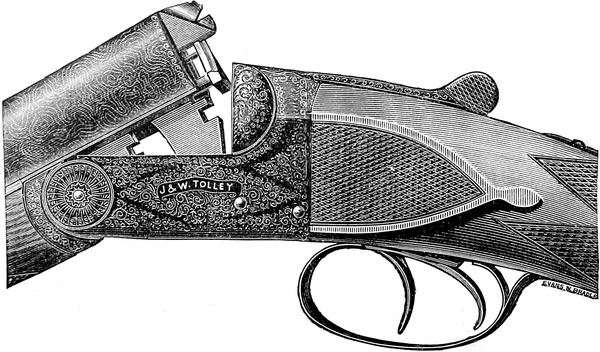
AFTER ELEVEN YEARS’ TRIAL in every sporting country, now stands unequalled for SAFETY, DURABILITY, EASE OF MANIPULATION and GENERAL EFFICIENCY.
Prices, $79, $100, $125, $150, $175.
The Highest Possible Excellence. The Most Elegant English Guns.
LONG RANGE WILDFOWL GUNS. Guaranteed performance of 10-bore at 100 yds.; 8-bore at 120 yds.; 4-bore at 150 yds. Shooting certificate accompanies each gun. Full particulars in detailed catalogue mailed free. AMERICANS wishing a perfect gun should call to be accurately measured, and we will build gun while they are in Europe. 1 CONDUIT STREET, REGENT STREET, LONDON.
LORENZ REICH, IMPORTER OF THE CHOICEST AND PUREST HUNGARIAN WINES, Commended by the most Eminent Medical Men of this Country.

THIS IS TO CERTIFY that I have examined Mr. Reich’s TOKAYER AUSBRUCH, TOKAYER MASLAS, and BUDAI IMP. I take great pleasure in commending these wines to the medical profession because of their purity.
R. OGDEN DOREMUS, M.D., LL.D., Prof. of Chemistry and Toxicology, Bellevue Hospital Med. Coll., and Prof. of Chemistry and Physics, Coll. City of N. Y.
Tokayer Ausbruch and Tokayer Maslas, Vintage of 1874.
Somlayai Imp. (White Wine), and Budai Imp. (Red Wine), Vintage of 1874.
SLIVOVITZ (Prune Brandy), 1868.
Sherries from the Vineyards of J. J. V. VEGAS, Frontera, Spain.
RAYAS, PALO CORTADO, AMONTILLADO PASADO, SANTO TOMAS.
ALSO, SOLE AGENT U. S. A. AND CANADA, FOR THE FOLLOWING BRANDS CHAMPAGNE:
MOIGNEAUX PERE ET FILS, DIZY, CUREE DE RESERVE, TRES SEC, PRES EPERNAY.
LORENZ REICH, The Cambridge, 334 Fifth Avenue, New York.
Branch Office, 70 State St., Chicago, Ill. Telephone Call, 318—39th St.
All orders promptly filled and shipped to any part of the United States. Beware of Impositions, as unscrupulous dealers are buying up my empty bottles.
The Kodak Camera
Anybody can use the KODAK without learning anything about photography, further than the mere operation of pointing the camera and PRESSING A BUTTON. No dark rooms or chemicals necessary. The camera is loaded for 100 pictures.
THE KODAK SYSTEM is a DIVISION OF LABOR whereby all the work of finishing the pictures is done at the factory, where the camera is sent by mail to be reloaded, and is available for those who have no time, inclination or facilities for learning photography.
Any Amateur can, of course, finish his own pictures if desirable.
If you want to know more about the Kodak, send for a copy of the Kodak Primer: a beautiful illustrated pamphlet containing Kodak photograph, free, by mail.
The Eastman Dry Plate and Film Co.,
PRICE, $25.00. ROCHESTER, N. Y.
For sale by all Photo. Stock Dealers.