Volume 13 / Part 2 — PART II.
Reading edition
TRUSTY to his promise, the porter calls us at early dawn. The train is rushing between massive walls of rock, rising to unseen heights and confining the railway to the bank of a swift green river. The official is already up, and standing upon the rearmost platform with closely buttoned coat, for the morning is chilly in the shadows of these Alps.
“This is The Gap,” he explains, “through which Bow River comes out. We follow it almost to its sources, before we come to Kicking-horse Pass, through the central range, or Main Divide. Better have the ladies called. We shall be at Banff in an hour, and they ought not to miss any of this.”
He touches an electric button, directs the responding porter to summon the Vassar family, and we return to the platform.
The Gap has now been traversed, and we can see the great mountains on each side of it. Then we turn northward and run along the river between gigantic upheavals. Their tops are half hidden in the lingering night-mists, but rifts now and then reveal bristling, snow-crested peaks, rosy with premonitions of sunrise, and tiers upon tiers of cliffs bounded by long lines of snow resting upon narrow ledges, and broken by gorges of unmeasured depth filled with blue shadows and swirling fog. It is a wonderful, inspiring, never-to-be-forgotten sight. Awakened and driven out by the skirmish line of the hosts of the morning, the clouds reluctantly forsake their rocky fastnesses, and more and more of the rugged grandeur and height of the bordering ranges, right and left, come out. Soon far-away peaks show daintily, “like kisses on the morning sky,” as one of the ladies expressed it, in imagery chaste, no doubt, but rather cold; and finally, as we sweep toward the face of the gigantic precipices of Cascade Mountain (which seem to rise courteously and advance to welcome us), even the valley shakes off its blanket of haze, and sunshine pours over the crystal heights to sparkle upon dewy leaves and glistening river.
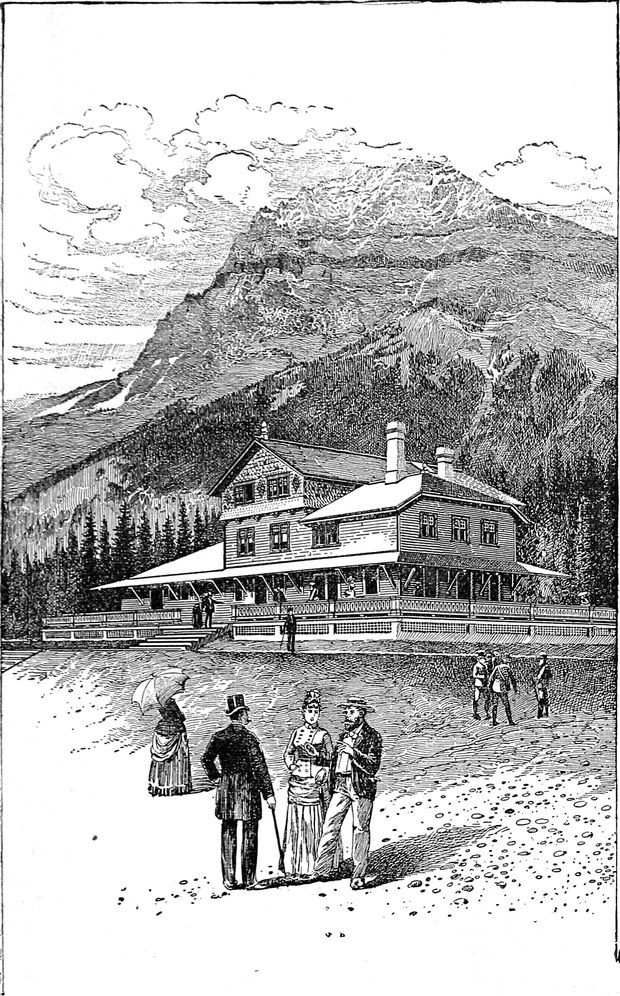
Under these brilliant auspices we step out of the car and into a carriage at Banff, and are whirled away to a great hotel, built upon the grandest site in Canada.
“This hotel is the Company’s property, and here you are to be my guests for the day,” was the command of our genial official, as he registered the names of the party. “It is too early for breakfast. Let us go to the upper balconies and have a look at the mountains. This is Canada’s National Park, you know, and she is proud of it.”
What a picture that north-western balcony opened to us! In the foreground green rolling woodland dotted with turfed openings and the red roofs of cottages or white dots of tents. Then the tortuous and shining course of the Bow River, sweeping gracefully to the right. On the left, steep and wooded slopes; ahead, high mountains—some with their splintered spires towering above rugged and darkly forested foothills, others more distant and breaking into jagged outlines, gashed by blue gulfs and piled with snow, others still farther away, filmy and white upon the western horizon, where the water-shed of the continent rises supreme and superb. Nearer is the cliff-fronted mass of Cascade Mountain, 5,000 feet high, its slender waterfall trembling like a loose ribbon down its broad breast—the badge of its identity. Past it, through a rocky gap, our eyes follow the lower Bow, sparkling with ripples, parted by islets, shadowed by leaning spruces and cottonwoods, to the green ridges where the railway runs, and on to where the white wall of the Fairholme range, a massive rank of heights, upholds wide spaces of stainless snow.
“Just behind that mighty wall, whose tallest peak—Mt. Peechee—is over 10,000 feet in altitude,” our friend tells us, “there is an immense cañon, occupied by a narrow and very deep lake. The Indians believe it to be haunted by malignant demons, and I don’t wonder at it. Cliffs thousands of feet in height rise straight from its margin, and its waters are shadowed by the Devil’s Head and other peaks, that can be seen for a hundred miles out on the plains. To cruise upon its surface in a canoe and catch the monstrous trout that lurk in its coves, while the echoes of your talk and paddling wander from scaur to scaur, and wild goats come to the edge of the crags to look down upon you, is an experience not to be duplicated easily anywhere else in the world.”
“What is this lake called?”
“Devil’s or Devil’s Head Lake. We will drive over there this afternoon, if you like. I think the views you get from that road are the best of the whole park scenery, unless, perhaps, you except the view of Mount Massive and the Main Divide from a boat on the Vermilion Lakes. Now let us go to the other end of the building.”
“Here,” he continued, when we were gathered upon the south-eastern balcony, “you are looking down the line of the Rockies, instead of up their length, as you were before. This is the valley of the Spray, which joins the Bow just below the hotel.”
We could not see the river, but we could hear its rushing, and readily believed our friend’s stories of the trout in its pools. On the left of the valley long slopes of whitish limestone rose bare and glistening with dew far above the forest, until they terminated in two sharply cut peaks, from which fell suddenly away, for many hundreds of feet, the precipices that we had half seen earlier that morning. This was Mount Rundle—an excellent type of the mountains of stratified limestone, shaped like wedges laid upon their sides, in parallel rows north and south, which constitute the eastern half of the Rocky Mountain system in this part of the world. The eastern aspect of all these ranges, therefore, is a rank of precipices—tier upon tier of nearly or quite level ledges of limestone, strongly indicated by banks of snow and lines of trees—broken into separate headlands, and bordered at their base by bush-covered slopes of débris. Here and there a great gap allows you to pass to the rear of these headlands, when you find them sloping back with much regularity into the forest-covered valley, beyond which another rank of cliff-faced promontories again confronts you, and so on until the central water-shed is reached.
“Why does that curious little cloud stay so persistently on the slope of that hill?” asked one of the ladies, pointing to the right.
“That is the steam from the hot springs,” was the reply, “and after breakfast we will walk up there.”
The hot mineral springs at Banff lie along the base of Sulphur Mountain, where they flow from exits round which great masses of tufa have been built up. The upper spring, some 700 feet above the river, commands a wonderful view of “peak o’ertopping peak,” with green vales and broken crags between. From this spring a large stream of sulphurous water, at a warmth of 120° F., is conducted down to the hotel, to supply the luxurious bath-houses. More plebeian arrangements exist at the spring itself for bathing and drinking the waters, which have proved wonderfully efficacious in curing a great variety of diseases, especially obstinate cases of rheumatism and dyspepsia. Two miles distant, up the Bow, are two other prominent springs—one an open basin, and the other a large pool, occupying a dome-shaped cavern built out of its own depositions when it was more copious, and this is now a most curious place. Originally, the only way of reaching the water was by squeezing one’s self through the chimney at the top of the dome and sliding down a slippery ladder, like entering a Tchuckchi house in Siberia. Now a tunnel has been bored through the side of the dome, level with the surface of the diminished water, and you go straight in from your dressing-room in the rustic cottage at the entrance. Another pretty cottage admits to the open pool. In both the pool and the cave the water is pleasantly warm, clear and almost tasteless, though highly impregnated with salts, giving it a close resemblance to the Arkansas Hot Springs. These improvements of the springs, and the good roads throughout the Park, are the work of the Government, which is making easily accessible all the most interesting localities and best points of view.
We could have spent a week in this most delightful spot—rambling, climbing, sketching, shooting (outside the Park limits), fishing and boating. The beautiful river and lakes, and the falls, have hardly been mentioned, even. But time presses, and next morning sees us reluctantly resuming our journey.
MOUNT STEPHEN FROM THE WEST.
From Banff we pushed straight westward through wooded defiles into the upper valley of the Bow, where the scenery is upon an even grander scale. On the left runs a line of magnificent promontories—prodigious piles of ledges studded with square bastions and peaked towers. On the right is a gray sloping wall, 5,000 feet high, of slaty strata tilted on edge, and notched into numberless sharp points and splinters, like the teeth of a badly hacked saw. Between the two, right in the foreground, stands Castle Mountain, isolated, lofty, brown and yellow, vividly contrasting with the remainder of the landscape, and terminating in a ruinous round tower from whose top pennants of mist are waving more than a mile above our heads. As we roll past its base it gradually changes from a lone castle tower to an escarpment of enormous cliffs. These can be climbed, and the expectation of what the outlook would be is more than realized.
But we must not forget in the grandeur of the Castle the splendid peaks fronting the valley on the left—Pilot, a leaning pyramid poised high upon a pedestal of square-cut ledges; next to it the more massive summit of Copper Mountain, to which you may almost ride on horseback along an old road cut to the copper mines near its apex; then the green gap of Vermilion Pass (into the Kootenay Valley), through whose opening we catch alluring glimpses of many a haughty spire and bristling ice-crown along the Continental Divide. To the north of this gap stretches Mount Temple’s rugged wall, and beyond it, supreme over all, Lefroy’s lonely peak—loftiest and most majestic of them all.
When Castle Mountain and the steel-pointed sierra behind it have swerved to the right, we see northward the great glacier that nourishes the childhood of the Bow with milky meltings, and in the midst of a galaxy of hoary peaks the noble form of Mount Hector—a monument to the first explorer of Kickinghorse Pass. Then, leaving the Bow, we climb the gorge of a little creek and enter the jaws of a narrow gap through the central range. Upon either hand rise rugged walls crowned with Alpine peaks, framing a chaos of snow-fields, glaciers, and sharp black summits westward—some close by, and showing the scars of ages of battle with eternal winter; others calm and blue in the far distance. Yet here in the pass it is warm and pleasant: trees flourish, flowers bloom, cataracts leap and flash in the sunlight. Backward we review in profile the line of mountains we have passed; beside us are the crumbling terraces and turrets of the Cathedral, thousands of feet straight upward; ahead, reflected in a lake whose waters flow east to the Atlantic and west to the Pacific, the stately head of Mount Stephen, brandishing cloud standards and carrying with royal dignity its ermine mantle of snow and gleaming coronet of ice.
THE SELKIRK PEAKS.
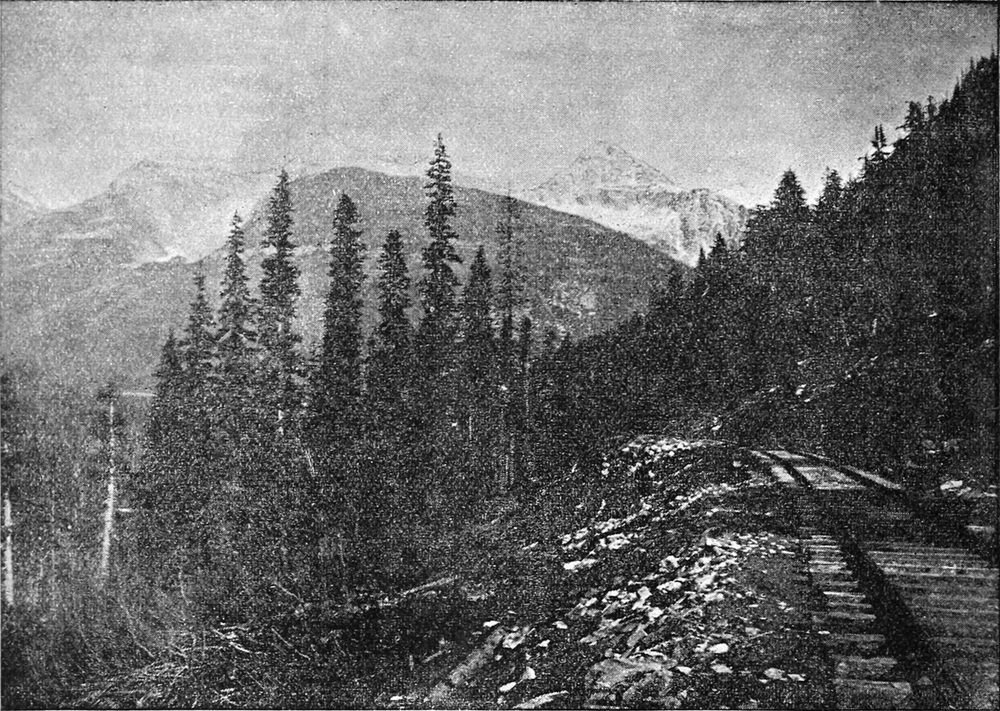
We have pierced the Rockies and are looking down the Pacific slope. Range after range of blue-and-white crests, rising from valleys of forest and prairie, burst upon our awed vision. The scene is past adequate description; we do not say much about it to one another, but only look; and when the descent has been accomplished, and some hours later we halt on the bank of the Columbia (only 100 miles from its source), we are almost stunned with the sublime panorama that has been unrolled so rapidly before our eyes, each scene more astonishing in its magnitude and beauty than the last.
Yet we have crossed only one of the three great subdivisions of the Canadian Rockies. Just ahead lie the Selkirks, and beyond that is the Gold Range. Then we shall cross a wide, hilly plateau region. Finally we must follow the Fraser River in its profound cutting through the Cascades range, before we see the coast of the Pacific. The whole distance from the eastern base of the Rockies to the coast—Banff to Vancouver—is done in thirty-six hours, and the night travel comes where there is little loss of fine scenery; but it is too much to take in at once. Our stop of only one day at Banff was not only a rest, but allowed us to become acquainted with the mountains and prepared us for what we should see ahead; and we mean to stop again at the summit of the Selkirks.
The ascent of the Selkirk range from the east is begun in a regular gateway, where the Beaver River pitches down some rocky stairs at the bottom of a chasm, and is continued along the forested side of its valley, gradually ascending until the track is a thousand feet above the stream. Here the splendor of the Selkirks is manifest in the west, where a rank of stately mountains, side by side and loaded with snow, are grandly outlined. Then we turn up a branch cañon and enter Roger’s Pass through the terrific cleft between Mount Carroll and The Hermit.
In another place[2] the present writer has described his first impressions of these singularly impressive heights—the climax of the transcontinental trip.
At the western extremity of Roger’s Pass lies the Great Glacier, where the Company has built a beautiful little hotel, within twenty minutes’ walk of the ice. It would have been nothing short of criminal to have gone past this point without stopping.
The path through the forest, the huge size of whose trees, and the redundancy of whose mossy undergrowth, bespeak our nearness to the warm coast, is along a brawling river gushing from underneath the glacier. Presently the vast slope of creeping ice is before us, completely filling the head of the gorge. All the glaciers we have hitherto seen were near the very crest of the range, but this one comes far down into the forest, so that flowers and shrubbery are sprouting all around its lower margin, whence a dozen rivulets gurgle out to feed the river. The rounded forefoot is broken, where blocks of loosened ice have been sloughed off, and seamed with numberless cracks, the commencement of further sloughings. These cracks and the freshly exposed faces are vividly blue, while liquid turquoise fills all the cavities and deepens to ultramarine in the shadows; but the general tone of the glacier, as it slopes steeply upward in billowy undulations toward the head of the ravine, is grayish white. Curving crevasses cross from flank to flank, and longitudinal rifts gash the surface as if cut with a sharp knife in an elastic substance. These crevasses may be as blue as the clearest sky, or sometimes green as young grass, according to the light; and between are often pure-white patches of fresh snow. Toward the top (where the breadth is nearly two miles) the slope is still steeper and the surface smoother; but along the very crest, jagged and hard against the sky, thousands of fractures appear, indicating how the mass of ice breaks, rather than bends, as it is pushed over the cliffs. These breaks then reunite, and the chaos becomes the smoothly congealed and undulating surface we see below.
A CAÑON ON THE ILLICILLIWAET.
“This glacier,” the official remarks, “is only one of several overflows from a mer de glace occupying a plateau on the summit, scores and perhaps hundreds of square miles in extent. It is continually crowded over the edge through breaks in the rim of cliffs, and thus room is made for the new deposits of snow annually heaped upon its frigid wastes.”
For several hours we scrambled about the edges of the ice. On its right is a huge moraine, which we climbed for a few hundred feet and thence ventured out upon the glacier itself, but could go only a few steps, for we had no spiked shoes, alpenstocks, ropes, or other appliances for safety. Greater in size than any of the Swiss glaciers, its exploration needs at least equal precautions. On one side a cave in the ice remains to mark the former exit of some now diverted stream; and when we entered it we found ourselves in an azure grotto, where the very air was saturated with blue and we expected to be turned into petrifactions of sapphire.
All the morning there rests upon the ice-slope the huge triangular shadow of Sir Donald—a superb pyramidal pile of cliffs, shooting its slender apex far above all its royal mates—Ross, Dawson, Carroll, The Hermit, and Cheops—and cleaving clouds that have swept unhindered over their heads. It is imperial in its grandeur and separation from the rest, and nowhere shows more magnificently than when we look back from a point far down the pass, and can see how royally this richly colored, elegantly poised spire soars exceedingly sharp and lofty above the group of lesser mountains—themselves monarchs of the range—grouped sublimely about it. These were the pictures we saw as, refreshed by a night’s slumber in the balsamic air of the spruce-clothed mountains, we renewed our journey next morning, and from the foot of Ross Peak gazed back with amazement at the tortuous descent our train had made around the loops and trestles that had “eased” us down from Roger’s Pass and Glacier Station to the bank of the Illicilliwaet.
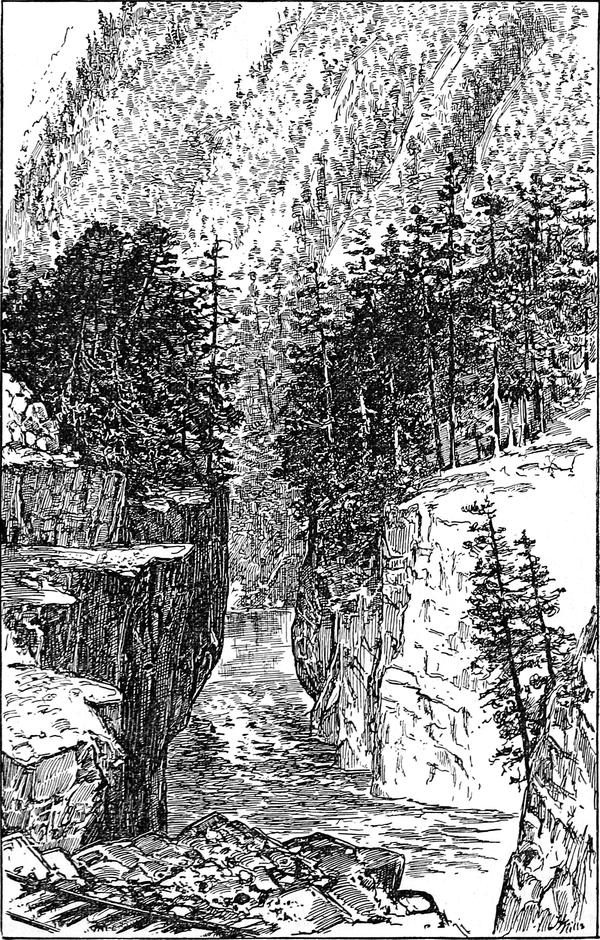
This river, fed by unmeasured stores of snow and ice kept in a circle of heaven-piercing peaks, rushes away down a series of densely wooded and rocky gorges. With much ingenuity the railway follows it to the Columbia, which has made a long detour around the northern end of the Selkirks since we last saw it. Here is Revelstoke, a railway headquarters, the limit of steamboat navigation, and the supplying centre of many mines. Behind it are lifted the western outliers of the Selkirks; before it, beyond the Columbia, is the Gold Range, some of whose glacier-studded peaks constitute a grand view.
The Gold Range is easily crossed. Eight miles beyond the Columbia bridge, we have risen into Eagle Pass, which is only 1,900 feet above the sea, and are gliding past lake after lake nestling between magnificent headlands. Trees 200 feet tall fill the pass and encircle the lakes in a close and continuous forest, and wherever a ledge or bit of easy slope allows soil to cling, the rocky crag-sides are clothed with luxuriant foliage. It is the White Mountains, or the Blue Ridge, doubled and trebled in scale. Each of these deep, still lakes is filled with fish, and along the Eagle River, which leads us westward out of the pass through a darkly shaded ravine, are many camps of sleepy Indians fishing for salmon.
As evening approaches we escape from the hills and run along a connected series of long, narrow and very deep bodies of water, penetrating between hills and ridges covered with unbroken forest. This polypus-like lake is called the Great Shushwap, and is as large as Cayuga, Seneca, and all the other lakes in Western New York would be were they connected by navigable straits. Fed by several strong rivers, it forms the reservoir which guarantees a steady supply to Thompson River, by whose side our train will run all night.
“These lakes are wonderful places for sport,” says the official. “Salmon and several other fish are numerous, and every kind of game abounds. It is an almost untouched field, too, although facilities for getting over an immense region of wild country, by steamboat, sloop or canoe, are exceedingly good.”
“What are we missing in the night?” asked Miss Vassar, as darkness blotted out the landscape and the cheery lamps were lighted for the last of so many jolly evenings together in this overland voyage.
“You don’t miss much until toward morning; and that you may get a fair idea of by moonlight if you sleep on the right-hand side of the car. We are getting entirely past and away from the mountains now, into a plateau country of grassy hills where farming (except by irrigation) has small success, but grazing is a great industry. At midnight we go through the important town of Kamloops, the headquarters of this grazing region, which extends for hundreds of miles southward, and is interspersed with many gold and silver mining localities. Then we pass Kamloops Lake and get into the cañons of the Lower Thompson River. There the scenery is very curious. This is a dry country—looks like California—and the rocks and earthen river-banks have been carved by wind and occasional deluges into the most fantastic and gayly colored of monumental forms, through which the waters of the racing Thompson mark a sinuous line as green as the purest emerald. It’s a very extraordinary, grotesque landscape, but having seen it once in daylight, I, for one, am satisfied to go through henceforth by night. After we leave the mouth of the Thompson at Lytton, however, and begin to descend Fraser River, the scenery becomes very grand and beautiful; so you must get up early once more.”
How shall I tell in a few words what those Fraser cañons are like? They are not like the thin, abysmal clefts of Colorado, nor the weird corridor through which the Missouri makes its way.
The Fraser is the main water-course of British Columbia, and comes from the far northern interior. It is a broad, heavy, rapid stream, flowing between steep banks sloping ruggedly back to the mountains, whose white and shapely peaks stand in splendid array before us at Lytton. The railway is at first on the eastern bank, and high above the turbulent yellow river, which is soon compressed into a narrow trough, where the hampered water rushes and roars with frightful velocity. Cliffs rise for hundreds of feet with out-jutting buttresses that almost bar the passage. Huge rocks, long ago precipitated into the water, have been worn “into forms like towers, castles, and rows of bridge-piers, with the swift current eddying around them.”
Near Cisco advantage is taken of a particularly narrow strait to cross the river upon a huge cantilever bridge, the farther end of which rests in a tunnel. The scenery here is savage, but the air is soft and the sky clearest blue. As we proceed, the cañon rapidly becomes narrower, deeper, and more terrific; the river, a series of whirlpools among knife-edged rocks. The railway pierces projecting headlands in short tunnels, springs across side-chasms, and is supported along sharp acclivities by abutments of natural rock or careful masonry. Finally the constantly heightening wall on the opposite side culminates in the crag of Jackass Mountain, which rises 2,000 feet in a well-nigh perpendicular mass—a second Cape Eternity. Nearly 1,000 feet above the boiling torrent, and often overhanging it, the wagon-road built years ago to connect the Fraser River gold mines with the coast creeps about its brow; and the little party of Indians trotting along this airy pathway look like pygmies or gnomes who have come out of some stony crevice to see us pass. Yet four-horse stages were driven here for many a year, and before the road was built men traveled afoot over the trail which preceded it, passing places like these on swinging pole-bridges, something like the foot-ropes under a ship’s yard-arm. Thrilling stories of that trail and road in the fierce old mining days of ’58 and ’64 are recorded in books and told by the “mossbacks” one meets up and down the coast. But since the building of the railway the wagon-road is little traveled, though the Cariboo district northward, and other districts south of the line, still yield gold and silver bountifully under systematic mining.
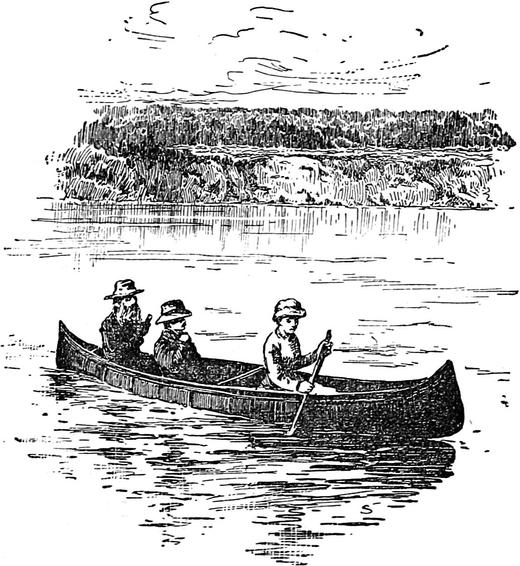
ON THE BROAD WATERS OF THE FRASER.
As we roll steadily onward through long shadows projected across the gulf by the rising sun the cañon alternately expands and contracts, but never loses its grandeur. The queer little figures of Chinese gold-washers dot the gravel-bars here and there (we can’t help wondering how they got down there!), and on almost every convenient rock near the river’s edge are perched Indians with large dip-nets, industriously scooping in an eddy after loitering salmon. Their rude bivouacs are scattered about the rocks; and their fish-drying frames, festooned with the red flakes of salmon-flesh, among which the curing smoke curls as lazily as Siwash smoke might be expected to do, add the last touch of artistic color to the picture.
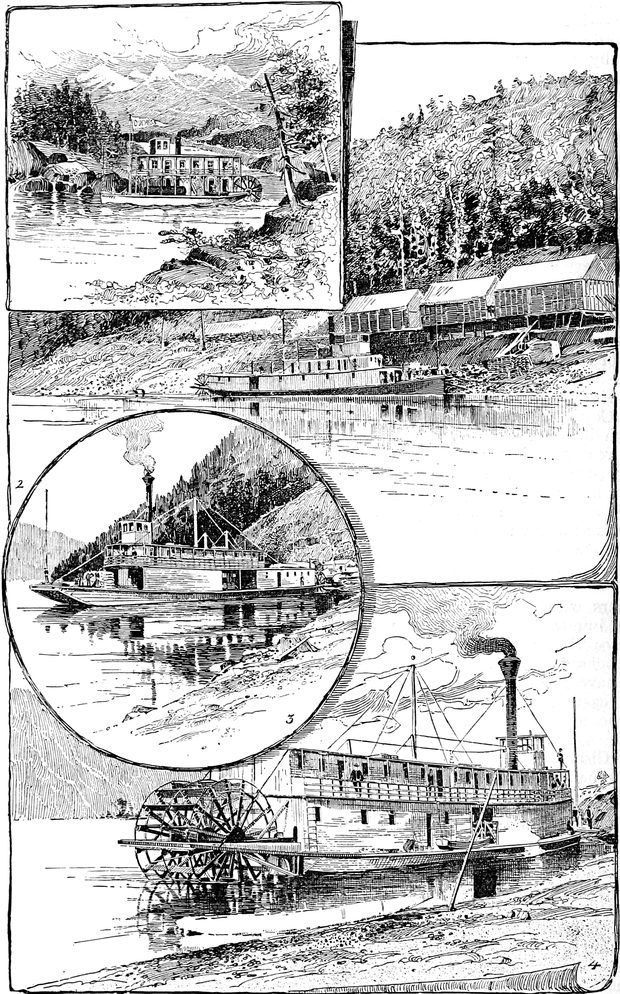
TYPES OF WESTERN STEAMBOATS.
⇒ LARGER IMAGE
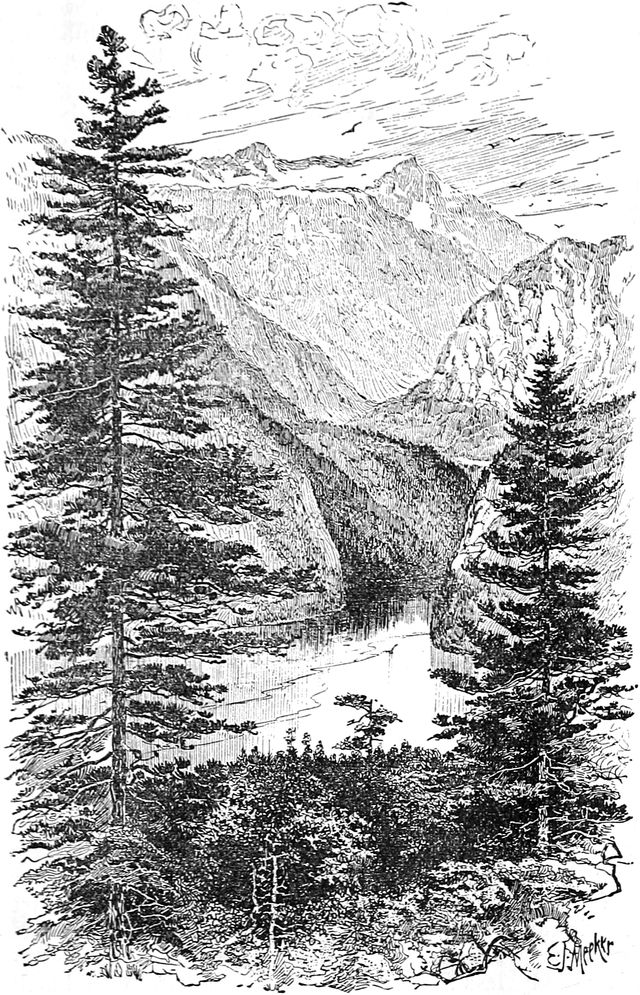
SCENERY OF THE FRASER CAÑON.
But a painter will be attracted constantly by the form and color of the bronze-brown chaotic rocks, the tawny, foam-laced river, the gaunt, desperately rooted trees, and the brilliant azure of the sky. And everywhere he will find handy a foreground-bit of “life”—gold-diggers, mule-trains, Chinese red-labeled cabins, Siwash “wickiups” and barbarically adorned graves, or some trim railway structure—to lighten the composition with a sympathetic human touch.
At North Bend we get breakfast in a charming hotel, and then go on again, past the important old town of Boston Bar (now abandoned to the Indians) and over the bridge above Skuzzy Falls, which come sliding down fern-strewn rocks in cataracts of lambent emerald. Gradually the cañon walls grow high again, and encroach more and more upon the channels. The railway passes from tunnel to bridge and bridge to tunnel in quick succession, always curving and costly. It is one long gallery of wonders. Ponderous masses of rock, fallen from the cliffs and long ago polished like black glass, obstruct the current, which roars through narrow flumes between them and hurls showers of spray far up their sides. This is the Black Cañon of old settlers; and an idea of its tortuous narrowness may be got from the fact that in freshets the choked-up water will rise a hundred feet above the ordinary level.
At the foot of this cañon is Yale, an old trading post and frontier town, ensconced in sombre mountains. As the head of navigation on the lower Fraser, it was once the leading town of the Province, and still has some 12,000 inhabitants. A few miles farther on is another similar village, Fort Hope, which is at the limit of steamboating, and is charmingly placed in front of a cluster of brilliant Cascade peaks. At times the figure of a colossal anchor is marked in snow-banks upon one of these summits; whence the name of the village—for is not the anchor the emblem of hope? In these mountains rich silver lodes await development.
Gradually the cañons and cliffs are left behind, and we gather speed on a level track through woods of prodigious growth. The river becomes a broad and placid stream, “backing up” here and there into lagoons, and making prairies utilized for herds of cattle. Beautiful mountains show themselves in every direction—last and finest of all, Mount Baker, fifty miles away.
At Agassiz many passengers leave the train to visit the Harrison Hot Springs, at the foot of Harrison Lake, five miles northward. This is one of the pleasantest watering-places on the coast, and a most interesting spot for sport and amusement. Harrison Lake and its outlet into the Fraser, with other lakes and portages, formed the foremost route to the northern interior twenty-five years ago. Its waters were then alive with steamboats, and the roads with wagons and pack-horses; but now the route is quite abandoned, and its wayside habitations have fallen into decay.
At noon we scent the saline odor of the ocean, and presently come with eager curiosity to the shore of Burrard Inlet. Half an hour later we are at Vancouver, and our transcontinental trip has reached its western terminus.
Two years ago a saw-mill represented civilization, and a dense forest covered the peninsula between Coal Harbor (a widening of Burrard Inlet) and English Bay (an offshoot of the Gulf of Georgia), where now a city of 5,000 people is established. The town is crescent-shaped, rising with gentle ascent to the ridge overlooking the open gulf, the heights of Vancouver Island and the Olympic and Cascade ranges in Washington Territory. Upon this high ground a group of residences has already arisen, whose windows command a wonderfully beautiful view of water and mountains.
The town has been built with great rapidity, but the wooden houses first thrown up are fast giving place to substantial buildings of brick and stone. All the improvements of modern civilization have been introduced; business and agriculture flourish; mining and the fisheries are engaging more and more capital, and the foundations of a great and beautiful seaport have been laid.
Thus the Canadian Pacific Railway is, in fact, a new way round the world!
A CRITICAL SITUATION.
BY S. SMITH.
AS I was walking through one of the principal London streets the other day, on my way to fulfil a business engagement, my attention was attracted by one of those huge posters which plentifully besprinkle the walls of the city. In resounding tones of red, blue and bright vermilion, it called the attention of the public to the fact that the stirring sensational melodrama, of deep domestic interest, entitled “For Life or Death; or, the Grave’s Witness,” was then being performed to overflowing audiences at the Royal Lorne Theatre. Just above the printed announcement was a picture representing one gentleman apparently in the act of boring a hole in the floor with another gentleman’s head, and which I took to bear reference to the printed notification below.
My momentary curiosity satisfied, I turned to proceed on my way, when my eyes encountered those of a man standing by my side—a man whom I had not noticed before, and who might have been the very ghost of a sandwich man instead of a sandwich man in the flesh, so suddenly and quickly had he come upon me. Yet, there he unmistakably was, his tattered old frock-coat, once the pink of fashion, frayed at the edges, worn to shreds at the seams, and bulging at the elbows; the trousers darned and patched in a dozen different places, but now gone far beyond the last stage of repair; the patent-leather boots broken and down at heel, and almost soleless; the battered white hat, with black band round it, and the brim all but gone; the bulbous red nose, the trembling mouth and the bleary eyes that told their own tale. I stood for a moment staring at this sudden appearance without any particular reason, and he, in his turn, staring at me. The pause, awkward enough in all conscience, was of that character in which one of the parties feels impelled to make an observation of some kind in order to get decently away. Before I could open my lips, however, my companion anticipated me.
“Striking sort of picture, that,” he said, in a dry, husky voice, and with an apologetic kind of sniff.
“If coloring has anything to do with it, I should certainly say it was striking enough,” I replied.
“Ah!” he returned, “you seemed interested in it; but I’ll warrant you’re not half so interested in it as I am. There’s not a soul in all this city that understands that picture as I do. The worst of it is, when I once start looking I’m unable to leave it for thinking of what this play once did for me. Then the police have to move me on, and that gets me into trouble. Even if I would forget the past, I may not, for—look here!”—he pointed to the two boards slung over his shoulders as he spoke, and showed me the inscription, “For Life or Death,” in lightning zigzag letters.
“Many people stop to look at the posters here and elsewhere, but there is not one of them to whom it means what it does to me. To you and them it is only a picture badly designed, clumsily cut, and worse colored. To me it is the story of my life’s ruin. Perhaps you’ll wonder what I’m driving at. If you care to listen for a few moments I can tell you.” He glanced at the open doorway of one of the old city churches near at hand. “Come in here,” he said; “it’s quiet and shady, and when there’s no one about they sometimes let me go in there for a rest. You may like to hear what I have to tell, and I shall be glad to get these infernal boards off my shoulders for a few moments.”
Thoroughly interested already in spite of myself—perhaps more by the man’s manner than anything else—I followed him. Entering the porch, he took the boards off his shoulders and placed them against the wall, and taking his seat on the bench just inside the doorway, drew a pocket handkerchief from his pocket and mopped his forehead with it.
“To begin with,” he said, after a moment’s silence, “let me tell you that my name is Edward Morton. Perhaps you will not believe me if I say that I was once upon a time—what of all things in the world do you think—a dramatic critic! Yes, it’s true. What is more, a dramatic criticism was the beginning and end of my downfall; and this is how it happened. It was about ten years ago, and soon after I started my journalistic career in the provinces, that I took a situation on one of our great daily papers—The Blunderer, to wit. This I had succeeded in obtaining through the influence of a friend at court, and, for a youngster just entering the profession, it was looked upon as an immense piece of good fortune. However that may be, up to town I came, and not being quite a fool, turned my chances to such good account that I was soon spoken of on all sides as ‘a promising young man.’ I might have gone on in this way, and ultimately attained to a bald head and a sub-editorship at fifty or so, but for doing two exceedingly foolish things. I made the acquaintance of Charlie Dashwood, and I fell desperately in love with a pretty actress, and one who was quite as clever and good as she was pretty—Lizzie Rayburn—you remember her? This Charlie Dashwood was a journalist like myself—a wild, harum-scarum fellow of the speculative sort—you’ve met his prototype, I daresay; always going off at a tangent, or breaking out in a fresh place when least expected; full of extravagant ideas about the undiscovered possibilities of the press; always vaporing about the reforms he intended to originate, if ever he should edit a paper of his own. I, at that time, admiring and looking up to Charlie, not only as the best of good fellows, which he really was, but as the very prince of journalists and an original genius, which, only too late, I have discovered he was not, firmly believed in and held to him in spite of the ridicule and chaff of older and wiser heads.
“At last, one day Charlie came to me at the office in a perfect frenzy of excitement with the news that he had just taken the management of a new weekly paper called The Bullseye, which would make its appearance the following week, and which had, as usual, been started to fill the not particularly noticed void. ‘We’re all full up with the exception of the dramatics, and Teddy my boy, you’re the very man! I know you have ideas of your own about the way that sort of thing should be done, and here’s the opportunity. Between us, we’ll make the paper the biggest “go” in London.’
“What Dashwood said was true. I had long possessed secret yearnings that way, which I had at times confided to Charlie. For a moment considerations of prudence came to my aid, and I ventured the mild suggestion of a doubt as to whether I was quite fitted for that line of work.
“‘Nonsense, my boy!’ said Charlie; ‘I know your proper capacity. You’re sure to make a hit.’ It was a curious fact that Charlie possessed the most remarkable intuitive faculty for discovering everybody’s proper capabilities except his own.
“‘Besides,’ he added, ‘think of Lizzie!’
“That settled it. Without further ado I closed with the offer, and a fortnight later saw me installed as dramatic critic of The Bullseye, with the title of that publication inscribed on my cards underneath that of The Blunderer. The plan of operation I proceeded to act upon was this: I had long had a wholesome contempt for that class of dramatic critics forever hanging round stage doors and hotel bars, and drinking with managers and actors, so I resolved to set an example in the opposite direction by keeping religiously aloof from all association with the profession—with one exception. This was Lizzie, who insisted on receiving her little paragraph of two or three lines regularly every week, and with whom I spent each Sunday afternoon and evening at her father’s place in Twickenham, whither he had retired to spend the rest of his days, free from the smoke of Aldgate and the cares of the grocery business. There had once been some talk of a Mr. Loydall, a huge, beetle-browed, hoarse-voiced tragedian, who played heavy lead to Lizzie’s juveniles at the Olympian, but he soon found out that he had no chance with me, and after one or two tussles retired from the battle, leaving me to walk over the course at my leisure.
“As you will guess, matters were pretty well settled between Lizzie and me, and we obtained old Rayburn’s consent to our marriage whenever the Blunderer’s management should recognize my merits sufficiently to advance my salary, and enable me to take Lizzie away from the stage. The Bullseye, contrary to everybody’s expectations—everybody, that is, outside the office—showed signs of becoming a pronounced success. My dramatic criticisms was soon one of the leading features of the journal. I had always had a notion that the withering, sarcastic style of writing was best suited to me, and this was the line I took, with such effect, that at times it became difficult to find out whether I had been praising or ‘slating’ a piece or an actor. Some people were unkind enough to say that they would prefer the latter process to the former. Needless to say that, as the power and influence of the paper increased, I soon became an object of hatred and dread to the whole profession. This only tickled my vanity the more, and I would strut along Fleet Street and the Strand of a morning meeting the scowls of passing ‘pros.’ with a stare of supercilious indifference.
“One night, entering my club at the usual hour, just before starting for the Lorne Theatre, where a new piece, entitled ‘For Life or Death,’ was to be produced that evening, I found a telegram lying for me in the rack. It was from Lizzie’s mother, telling me that Lizzie had been seized with a dangerous illness that very morning, and begging that I would proceed to the house at once. For a moment I was in a serious dilemma. At all hazards I must see Lizzie that night, yet it was imperative that I should attend the first night show at the Lorne, having for that special occasion undertaken The Blunderer’s notice in place of the regular man, who was absent through indisposition.
“Then an idea struck me as I caught sight of Scrubby, the dramatic critic of The Scorcher, at the other end of the room, already preparing to leave. Scrubby was a reliable man, I knew, and the best available for the purpose I had in my mind. Crossing over to where he was, I showed him the telegram, and explained my difficulty.
“‘Nothing easier, my boy,’ he exclaimed, clapping me on the back. ‘Trust to me. I’m going down to the show, and will leave you a program here, marked with my notes, on my way to the office. If you’re back here by half-past ten, you’ll find it waiting. Then you can scribble your notices for the two papers from my notes, and send them in in the usual way.’
“Warmly shaking him by the hand, I accepted his offer, and hastened away to Twickenham. When I reached the house I found my darling already delirious in the first stages of a high fever, and calling for me. I remained by her side, holding her hand in mine and soothing her as best I could until she had fallen off into a fitful doze. Then I stole quietly away, whispering to Mrs. Rayburn that I would return as soon as my business in town was concluded.
“When I got back to the club I found, as I expected, the program lying in the rack, inside an envelope addressed to me. Scrubby’s analysis of the production, play and acting, was distinctly unfavorable, his marginal notes having such a bitterly acrid flavor that I concluded it must all have been very bad indeed; and so I followed suit with good interest, cutting up everything and everybody concerned in the most unmerciful manner. The notices written, I put them into separate envelopes, the one addressed to The Blunderer, the other to The Bullseye, and sent them to the offices by the club messenger. This done, I went back to Twickenham.
“Returning to town the following morning, almost the first person I met was Charlie Dashwood. I made to speak to him, when, to my utter bewilderment, he stopped me short with a motion of his hand, looked me full in the face, and slowly drew a copy of that morning’s Bullseye from his pocket. Opening it, he pointed to my criticism of the production of ‘For Life or Death,’ at the Lorne Theatre, and held it up close to my eyes, then, deliberately turning his back upon me, passed on without uttering a syllable. I stared after him in a kind of daze as he rapidly disappeared. What on earth could he mean? What could he be driving at? In all my experience of him I had never known him to act so strangely. Could he be going off his head, or was I going off mine, or what?
“If I wanted an explanation I had not long to wait for one. As I entered the office, the hall-keeper handed me a letter, the superscription of which I recognized as that of the editor. I opened the letter with an unaccountable trembling at the fingertips. What I found inside was a check for three months’ salary, with a notification to the effect that in consequence of my great success in having that morning made The Blunderer the laughing stock of all London, the proprietors considered it due recognition of my talents that I should not enter the office again. For explanation I was referred to the enclosed cuttings from that day’s daily newspapers. I lifted one of the slips from out of the envelope, and what then met my eyes caused me to stagger back speechless and breathless against the wall, for there in that brief announcement of the postponement at the last moment of ‘For Life or Death,’ I saw the evidence of the horrible treachery of which I had been a victim. The evidence of my own ruin, utter and irremediable, stared me in the face. I had actually written a detailed report and criticism of an audience which had never assembled, of actors who had never appeared, of a piece which had never been produced!”
* * * * * *
“What need is there for me to tell you more, when you can guess the rest for yourself? You don’t want to hear that I and the papers with which I had been connected became the by-word and scoff of England, and that The Bullseye in particular never survived the shock. Nor do you need to be told that the few hundred enemies whom I had contrived to raise around me by my exceeding smartness turned the story in all ways so as to tell to my disadvantage, or that my journalistic career, which meant my livelihood, was practically at an end, if you can understand the charitable eyes with which an editor would be apt to look upon that kind of mistake. Whatever I tried, wherever I went, London or the provinces, it was always the same—the black shadow pursued me and closed every door in my face. Lizzie, of all the world, was the only one who clung to me in my trouble, and insisted on carrying out her promise and marrying me in the teeth of her parents, who threw her off when they found her bent on allying herself to a pauper. She struggled on by my side for two years, comforting and sustaining me in our bitterest adversity with her love and faith, until one day she died in my arms, and the light of my life went out. Then, having nothing else in the world to cling to, I clung to the drink the while it dragged me down, down, down to what I am.
“One thing more I have to mention,” said the sandwich man, as he rose from his seat and proceeded to hang the boards over his shoulders again; “it was one day some months after the events described that I met Scrubby. ‘I can’t for the life of me understand how you came to fall into that terrible blunder,’ he said, ‘especially after the note I left for you, telling how we had all gone down to the theatre on a wild-goose chase, only to find that the piece was postponed until the following week.’
“‘Note! Left for me by you!’ I ejaculated.
“‘Yes!—No! now I come to think of it, I didn’t leave the note. I wanted to go down to the Parthenon to see the new burlesque, but I gave it to a man who said he would be passing the club and would hand it in. Let me see. Ah! I have it now—you know him—Loydall, the Olympian heavy lead.’”
A VISIT TO DEATH LAKE, FLORIDA.
BY LIEUT. W. R. HAMILTON.
SOME years ago, I was stationed at Fort Barrancas, on the west coast of Florida, and at the mouth of Pensacola Bay. It was the custom of the military authorities every summer, as the sickly season approached, to order all the troops stationed in garrisons along the southern coast into camps among the pine-trees to escape the fatal yellow fever. The camps were selected with a view to health and isolation combined.
In the year of which I write, we were ordered up into the pine woods about thirty-six miles north-west of Pensacola. The camp was several miles from the only line of railroad then existing in that country, and fifteen miles from the nearest settlement, which happened to be a railroad and telegraph station also. The yellow fever had already broken out with terrible violence in New Orleans, and all the southern coast was alarmed. Of course, we were obliged to maintain the strictest quarantine to prevent any communication between our camp and the outside world. This was necessary, as the country soon became filled with refugees from the plague-stricken districts, yet it made our existence particularly doleful. We received fresh meat only once a week, and, as it was brought in an open cart thirty-six miles in the hot sun, the term fresh was about all there was of that significance about it. We lived on potted meats and canned vegetables and fruits almost entirely. Nothing was allowed inside the lines except the mails, and even they had to be disinfected outside before admission. News of the outside world was from a week to ten days old, and as the weather was extremely hot, it can be easily imagined that our existence was not particularly rose-colored.
Judge, then, of the delight and pleasure we all experienced when, one sultry evening, when the very air was quivering and dancing with heat, an old man came into camp with a large basket full of beautiful little fresh-water fish. How he passed the line of sentinels no one cared to inquire, the probability being that the guards, knowing what a boon he had in his basket, winked at his passing. He came direct to the line of officers’ tents, and in five minutes had sold all his fish at a good price. We asked him where the fish came from, and he answered “Death Lake.” I had heard of “Death Lake” a number of times, and the negroes in the neighborhood always spoke of it with bated breath and a mysterious air, so that my curiosity concerning it was much aroused. I therefore asked the old man to my tent, where I could talk to him about it. After he had seated himself and taken a drink of cool water, fresh from the spring, I asked him the name of the fish and when and where he caught them.
“They be brim, mister, and they wuz caught by me early this mawnin’ in the lake.”
“But where is the lake?” I inquired, “and why is it called Death Lake?”
“Wal,” he answered, “it lies about six miles from here, in the middle of a big swamp, and it is called Death Lake, I reckon, because no one can’t git there without losing his life.”
“Yet you have been there, and you are alive,” I replied.
“Yes, but I’ve most lost my life as much as a dozen times, and I’m only forty years old.”
He looked fully seventy, and he was much bowed and broken. His eyes were deep sunk, and had a watery opaqueness; his cheeks were sallow, and there were only a few straggling white hairs on his head. His answer surprised me, and I pressed him to tell me his story, which, after a while, he did, although he was much averse to it. After a time I prevailed upon the old man to take me to the lake next day. “But it is at your own risk, young man,” he said; “remember, if you dies, I told you all about it, and you can’t blame me.”
“Not if I die,” I replied; “but I am strong and healthy, and willing to take the risk.”
I easily obtained the necessary permission to leave the camp, as I was not going near the settlements, or where the fever existed, and I moreover promised to bring back a good string of fish for the commanding officer. The next morning I met the old man at daybreak, just outside the lines, and off we started together. He carried his large basket and a couple of fish-poles made of reeds he had cut in the swamps. I carried our lunch and a coffee-pot.
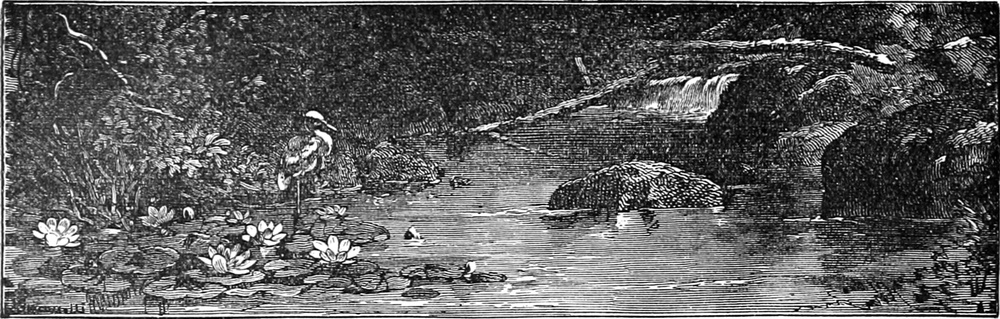
We tramped for about two hours through the woods, till we came to a small river called “Perdido,” from the Spanish word for “lost.” “Lost River” was a very good name for it, as it had its origin in Death Lake, and lost itself completely in the swamps after many turnings. Close to the bank, the old man had a flat-bottomed skiff moored, in which we paddled up the stream for a half-mile, when we reached the confines of the large swamp in which Death Lake is situated. The scenery here is of the typical Florida nature. On either side the stream was bounded by the swamp. Huge cypress trees lifted their weird limbs upward, and long streamers of trailing moss floated from them, and even at times formed a swinging arch across the entire width of the stream. The water was dark and sullen, and on the banks, wherever a little sunshine happened to strike, half a dozen alligators might be seen basking, which, on our approach, would flop into the water with a tremendous splash. After paddling up the sides of the swamp for a couple of miles we came to an archway, which appeared to have been cut by man through the foliage of trees and vines. It was not over four feet high and about eight wide, and from it the water flowed with a scarcely perceptible current.
“Now, Loot’nent,” said the old man, “we’ve got to go up this creek, and you’ll have to kneel down like this, for we have to stoop pretty low in places.”
Once inside the arch, it became very dark, for though the sun was shining brightly outside, it could not penetrate through the dense foliage of the vines. The little stream turned and twisted in the most tortuous channel I ever saw, and often it was with difficulty that we managed to turn the boat round the sharp and narrow corners. At length, after paddling in this fashion for over half a mile, we emerged into the famous Death Lake.
Right well had it been named, for the very feeling one had in breathing its atmosphere was of death. It seemed more like a river than a lake, for though by its various windings and twistings it was several miles long, it was never, in its broadest part, over sixty yards wide, and throughout most of its length not over twenty yards. The banks were lined by immense cypress trees that towered upward to a height of eighty feet or more. From their branches hung long festoons and trails of Florida moss, while the roots of the trees, half out of water, assumed such weird and fantastic shapes that they seemed like immense serpents that had become suddenly petrified in their writhings. So dense was the foliage that it formed an impenetrable wall to both sun and wind, and the sunlight never touched the water except between the hours of 12 and 2 P. M. Not a breath had stirred the waters for years, and they were covered to a depth of several inches with a green vegetable slime, so that the first appearance was that of a beautiful level floor, on which one might walk.
We reached the lake about ten minutes before the sun, and there was consequently a very strange light over the water. It had much the effect of a twilight above, through which the sun was breaking, while close to the water hung a mist, heavy, silent and motionless. But the tops of the trees the sun had touched with his master-strokes, and created tints more beautiful than could any painter’s brush. So still was the place that the silence was actually oppressive, and, though we were startled at the sound of our own voices, we would have been glad to have heard the noise of some animal life.
But all round us was death; no sign of life anywhere. No birds in the trees; no insects in the air. Even the reptiles and snakes avoided the fearful place. To breathe such air for an hour, except when the sun was directly over the water, would be death to any living creature. Even the water was lifeless, and the trees and all vegetation were dead, except the moss, which lived at the expense of all else. The old man had told me in his queer parlance that the lake had no bottom, for although he had dropped 900 feet of line, he had never touched. I had taken the precaution to bring with me two of my sea trolling-lines, and fastening them together, I had a line 250 feet long. With this I sounded in several places, but only proved the old man’s words, for I never touched bottom. I afterwards learned, as the explanation of this, that all Western Florida is of a limestone formation, and so I presume this lake is one of those wonders that have their sources far away down in the bowels of the earth.
As soon as the sun touched the water we let our fish-lines down to a depth of about thirty feet, and soon began to pull out very quickly the “brim”—a corruption of the name of bream. Although, when the hand was thrust through the slime, the water had a horribly slimy, warm feeling, the fish came up cold and firm, showing that below the water was clear and cold. The fish had the same dull, opaque eyes as fish of subterranean caves, proving that the vegetable mould on the water’s surface had for many years formed a bar to any light in the water.
In the two hours we managed to nearly fill our boat, for the fish bit as fast as we could throw the line overboard; so about two o’clock we stopped, and paddled out as quickly as possible to avoid those poisonous vapors that killed all animal life. Notwithstanding the sport, so weird and unearthly strange was the place that I was glad to leave it. I could well understand its name now, and as we passed through the tortuous archway, I thought of the many negroes in the old slavery days, that escaping to this swamp to find liberty found death instead.
After reaching the river, the old man suggested our stopping at a place on the banks, where the ground rose in a little knoll, and cooking some of our freshly caught fish. I agreed to the proposition, and as we reached the bank I jumped out and took three or four steps inland, when the old man sharply cried, “Look out, Loot’nent! See there!” at the same time pointing, as he stood up in the boat, to something directly in front of me. I looked and beheld, about a yard from me, a huge moccasin snake, the most deadly poisonous reptile of the South upreared to strike me. I involuntarily took a step backward, and as I did so I heard another hiss behind me, and then others on all sides. One quick, horrified glance showed me that I was surrounded by at least a dozen of these fearful reptiles, all coiled and ready to strike. For an instant I was paralyzed and unable to move, and it was, perhaps, well that it was so, as I should probably have stepped on one and been bitten.
“Move carefully and come away,” the old man cried. “If you don’t git close to them they can’t hurt you; they’re casting their skins.”
So it proved. It seems that this spot of ground, being drier than its surroundings and more exposed to the sun, had, by the natural instinct of the creatures, been selected as the place for the annual changing of their skins. While this process is going on they are almost incapable of motion. As a rule they will move off when disturbed, provided they are not attacked, but in this case they could not; but had I got within striking distance they would have bitten me. I picked my way out very daintily, and stepped into the boat, with no further desire to eat fish till I got back to camp. Indeed, I felt quite faint as I realized my narrow escape. We paddled down the river, soon reached our landing-place, and then made a bee-line for camp, which we reached just at dark. With such a string of fish, my return was heartily welcomed; but after hearing my adventures, no one else seemed anxious to make the visit to the lake.
I wanted to revisit the lake, till one morning, about two weeks after my visit, I was taken suddenly ill, and before the day was over I was unconscious with the terrible “swamp fever.” I had a long and hard fight for my life, and though I conquered in the end, I lost all desire to ever see the horrible place again.
AMERICAN COLLEGE ATHLETICS.
I. HARVARD UNIVERSITY.
By J. MOTT HALLOWELL.
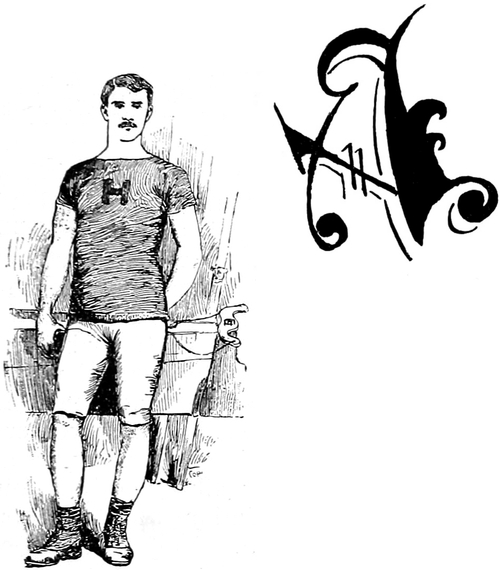
AT Harvard, and at nearly all other American colleges, athletics are managed on a plan entirely different from that adopted by most of the amateur athletic associations of this country. As a rule, an athletic association has control of all contests played upon its grounds, track and field athletics, boating, football, baseball, and all other games; but at Cambridge, the origin and growth of each branch of athletics has been so distinct in itself, and has had so little direct connection with the development of the others, that, as a result, each athletic sport is managed by a separate organization—the Harvard University Boat Club managing the boating interests, the Baseball Club taking care of the nine, while the Athletic Association has control only of the winter meetings in the gymnasium and the track and field meetings out of doors.
Of all the Harvard athletic clubs the Athletic Association deserves first mention as the club which each year opens the athletic season. If on the first Saturday in March, a little after one o’clock in the afternoon, a stranger should happen to pass by the Hemenway Gymnasium, his attention would be attracted by an incongruous, closely packed crowd, patiently waiting upon the porch and steps. There are small boys with pennies tightly clasped in closed fists, poking their elbows into the sides of the “sport,” who is jotting down his last entry in the book he has just made up on to-day’s games; a few of the ubiquitous unwashed muddying the nicely polished shoes of some dainty youths with big canes and high collars, and even a few poorly clad individuals of studious mien, with perhaps a book under one arm, who look as if they had crowded into the press in order to keep warm, in marked contrast to the contented looking men, wrapped in large ulsters and leisurely puffing cigars, who stand just at the edge. The crowd is jolly—swaying, jostling, and cracking its jokes, while it eagerly waits till the doors are opened to swarm into the gymnasium; for this afternoon is held the first winter meeting of the Athletic Association. Presently, by the time the first sparrers or wrestlers appear in the ring, every seat is filled, and even standing room whence can be had a view of the contestants.
This meeting is but one of seven that the Athletic Association holds every year; two field meetings, the class games and university games held every fall and every spring, and three winter meetings held in the gymnasium. In 1873 the Athletic Association had not been formed, and the only gymnasium for the use of the students was a wretched little structure now used as a storehouse; now the Association leads all the other colleges in its records, owns a hard cinder quarter-mile track, and has the use of one of the best gymnasia, if not the best, in America.
In July, 1874, at Saratoga, was held the first intercollegiate athletic meeting between American colleges. Due notice of this meeting had been sent round to the leading colleges, and the interest aroused by the proposed contest led to the first athletic meeting at Cambridge. A notice appeared in the Harvard Advocate that, if sufficient interest was felt by the students, some athletic sports would be held in the Jarvis Field on the afternoon of Wednesday, June 17th. The program was to consist of a mile running race, a mile walking race, a one hundred yards dash, a three hundred yards dash, a running high jump, running long jump, and a three-legged race; the entrance fee of 50 cents was to be used in purchasing cups for prizes, and the notice ended with an appeal to the students to give the games their generous support, so that the college might be enabled to select representative men to send to the intercollegiate games at Saratoga. No notice of the result of these games appeared in the college papers, but their success was sufficient to encourage four men to enter the Saratoga games, where they succeeded in winning last place in most of their events, none of their records being taken. The undergraduates seemed to have been stirred up by this signal defeat, and in the fall of 1874 the Harvard Athletic Association was formed for the purpose of encouraging track and field athletics—unknown factors in college games at that time—in order that the college might be fitly represented in intercollegiate contests.
It is strange in the present period of great athletic interest, crowded athletic meetings, and Faculty restrictions, to recall those days only fifteen years ago, when the undergraduate had to be encouraged to interest himself in athletic games. An editorial in the college paper in the winter of 1874–5, speaking of the formation of the Association, says: “While the bodies of the men now at the university do not receive a tithe of the attention they ought, it is cheering to note that more is being done towards inviting that attention than ever before. In no other exercise than baseball and rowing has there been any emulation, and never a general and systematic using of any set of muscles sustained throughout the year. The average student has been physically what he is now. At entering, President Eliot describes him as of ‘undeveloped muscle, a bad carriage and an impaired digestion, without skill in out-of-door games, and unable to ride, row, swim or shoot.’ During his four or six years, short of a little spasmodic work now and then, he does little towards becoming anything else, and with just that body and most of these defects he starts into his life’s work; and with growing labor and care, and little time to look after his body, and no one by to spur him to it, that is just about the sort of body he goes through life with, generally losing rather than gaining vigor and power. A new door has been opened for the men who really mean to be what they ought physically, and it is pleasant to see already signs of a brisk rivalry in this direction. The legs—long neglected members—are now to be put to their best, and at last we have the various foot contests so well known in the British universities. They began last fall, and the work done then was so little above mediocrity that there is strong ground to hope for new winners in May. All the running was slow, the jumping poor, and the walking nothing much.”
The Association when first formed was very primitive. Only about a couple of hundred men belonged to it; members were given tickets of admission to the games, which they could present to their friends, while the admission fee, entitling a person to a life-membership and free admission to all games ever held by the Association was only two dollars. Gradually, as the games grew in importance, and interest increased, the expenses of the Association became heavier; a track costing about $600 was laid out on Jarvis Field; the necessary expenses incurred in the winter meetings, held in the little gymnasium for the first time in 1876, added an annual increase of expenditure (the tickets of admission were then given away by members), until at last the expedient was adopted of laying an assessment of fifty cents on all members except Freshmen. The task of collecting this proved so great, that, of the collectors appointed, some resigned, while the others confessed their inability to proceed further.
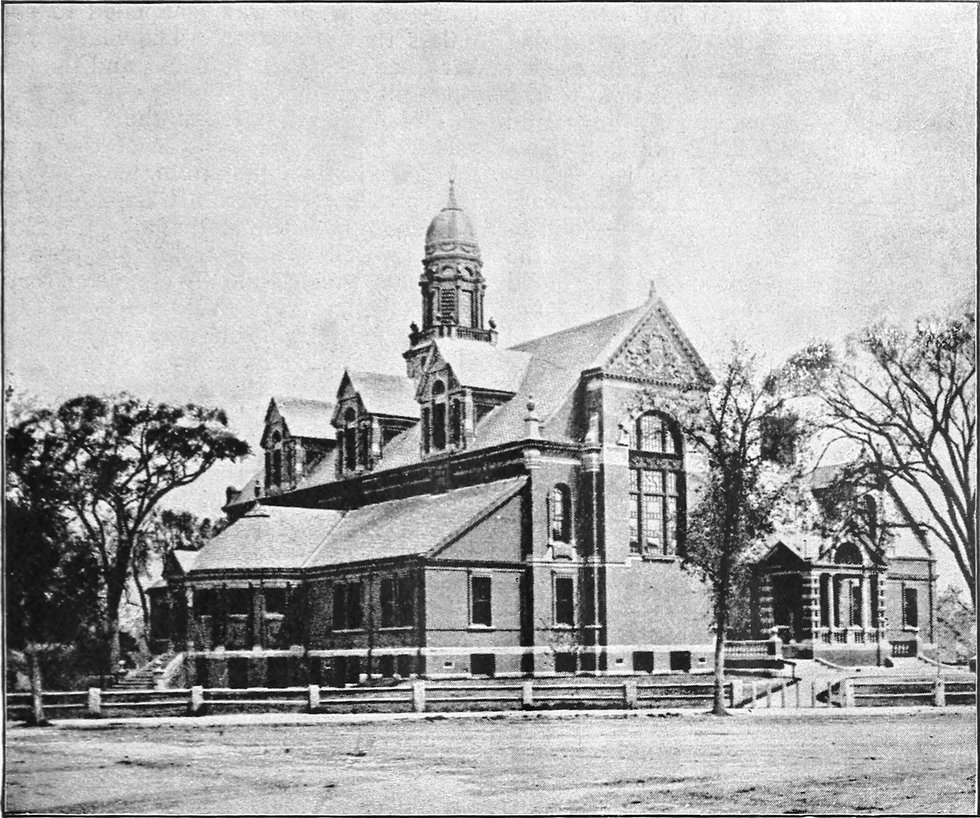
THE HEMENWAY GYMNASIUM.
In 1879 the Harvard Athletic Association, as well as the other athletic clubs, received a great stimulus in the erection of the Hemenway Gymnasium, the gift of Mr. Augustus Hemenway. Fifty years before, an attempt had been made to found a gymnasium out of doors in the Delta where Memorial Hall now stands, but the result had been unsuccessful. Again, in 1860, a small gymnasium was erected at the corner of Broadway and Cambridge Street, costing something less than $10,000; but this building had become entirely inadequate for the needs of the undergraduates, and in 1878 the ground was broken for the present erection. When finished, it cost, including all its apparatus, over $150,000, and is as complete as any gymnasium in the country. In the second story is a rowing-room for the crew, fitted up with hydraulic rowing-machines, while a gallery overlooking the main floor of the gymnasium makes an excellent running track. On the floor below is the gymnasium proper, fitted up with apparatus of every description, and at one side, under the rowing-room, are lockers and bath-rooms. In the basement is the “cage,” reserved for the winter practice of the nine and the lacrosse team; but room is left for nine bowling alleys, several hundred more lockers, a long open space for tug-of-war cleats, and a room for the use of fencers and sparrers.
In 1880 the management hit upon the happy expedient of setting apart one of the winter meetings in the gymnasium as a “Ladies’ Day,” on which only such events as the light gymnastics, bar performances, jumping, and light-weight sparring should be contested, the wrestling and the heavy-weight sparring being reserved for one of the other meetings. The next year another day was added as Ladies’ Day, so that only one of the meetings remained open to men alone. At first ladies were admitted free, the Association trusting to this additional attraction to fill their coffers from the pockets of the men; but after the success of Ladies’ Day was assured, the fair sex was put on an equal footing with their escorts, and have since been obliged to pay full price; indeed, they supply the principal source of revenue.
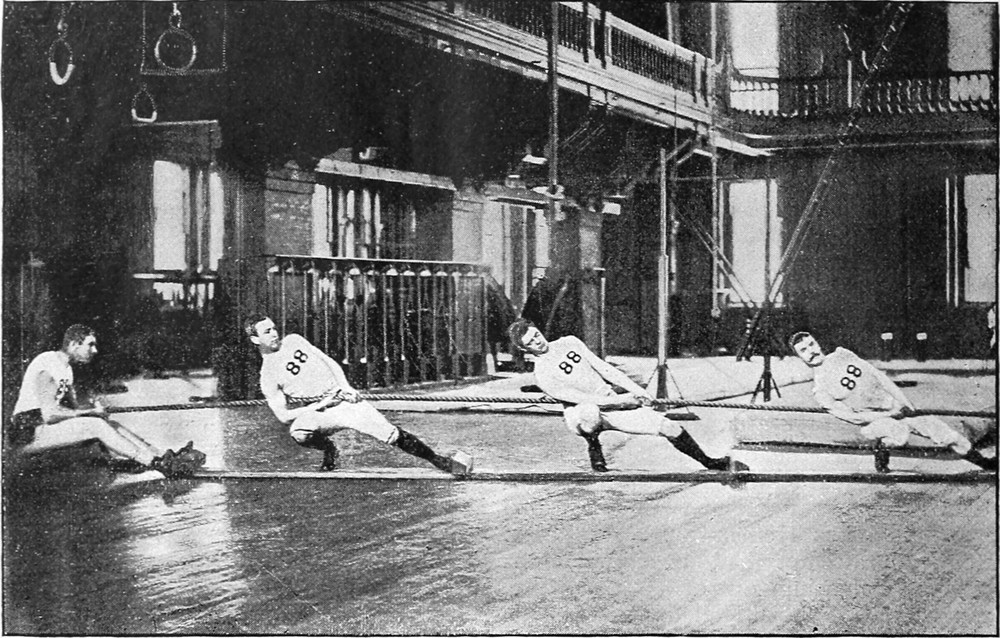
THE TUG-OF-WAR—“THE DROP.”
From the date of their first admission, however, they inaugurated a war against the sparring exhibitions which occur on one of their days. From that time to the present they have continually protested against it, and just as continually have they come in crowds to see it. There is in the first President’s report (Harvard Athletic Association), after the establishment of Ladies’ Day, a notice that “the ladies ought to understand that if blood be drawn in the sparring, the men will not leave the ring as they did last year;” and again in a report two years later: “We decided last year to have light and feather weight sparring on the first Ladies’ Day, and although there was at the time much talk against it among a certain number of men, we did not find the apparent interest of the ladies in any way less, or that their number decreased from the year before, although it had been extensively advertised for more than a month that there was to be sparring, and it is not to be supposed that many of the ladies were ignorant of the fact that they were to see it. Far would it be from me to force ladies to look at any event that was distasteful to them, but I fail to see why the large number who are entertained by sparring should be deprived of seeing it in our winter meetings because certain others object to it, more especially as the latter are in no way compelled to come unless they chose to.” The “large number” has continued to come, and the sparring still continues.
The financial status of the Association was assured by the success of the winter meetings in the gymnasium, until, in time, it was able to engage a track-master and trainer for the men, so that all competitors, poor as well as rich, trying for places in the team which annually competes for the intercollegiate cup, could have an equal chance of responsible training. It was also able to contribute $1,000 towards the construction of the hard cinder track round Holmes Field, finished in 1883, and now is able to pay all the expenses of the team which competes at the intercollegiate games. Besides the annual income received from the winter games, it receives a large sum annually from its membership roll. Though the fee is but small, only $3.00 for a life-membership entitling free admission to all games, a regulation forbidding any undergraduate to be present at the games unless he is a member, annually forces nearly the entire freshman class to join.
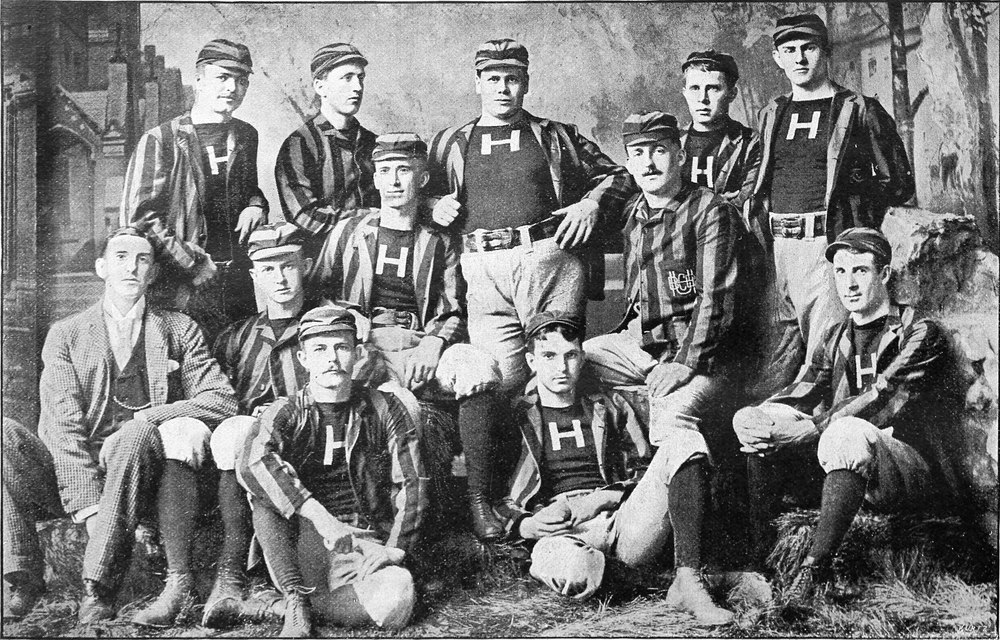
THE HARVARD BASEBALL TEAM.
⇒ LARGER IMAGE
There is not space in the limits of an article of this nature to mention more than a few of the men who have been connected with the rise and success of this Association. Some of them have already a world-wide athletic reputation, while many stand at the head of all college athletes. The fact that not until four years after Harvard’s entry into the Intercollegiate Athletic Association did she win the championship cup, but that then she won it for seven successive years, shows the need that existed originally in the college for such an association, besides demonstrating the success that has since attended it. Mr. E. J. Wendell, ’82, did more in his day than any one else, not only to increase its prosperity at home, but also to win laurels for it in its intercollegiate contests; and the names of Soren, Goodwin, Easton, Baker, Rogers and Wells show what strong representatives the Association has had. Out of the twenty-four first prizes that Harvard won the first four years she held the cup, W. Soren, ’83, won seven; he gained first prize in every jump in the intercollegiate program—running high, running broad, standing high and standing broad—besides the pole vault, and in the standing high jump holds the best amateur record in the world.
The following table shows the best records made under the Harvard Athletic Association in events contested at the intercollegiate games:
100 Yards Dash 10s. E. J. Wendell, ’82.
220 Yards Dash 22s. W. Baker, ’86.
440 Yards Dash 50¼s. W. Baker, ’86.
Half-mile Run 1m. 59 1-5s. G. P. Coggswell, ’88.
Mile Run 4m. 38 3-5s. G. B. Morison, ’83.
Hurdle Race, 120 yards 17 3-5s. S. R. Bell, ’91.
Hurdle Race, 220 yards 26 4-5s. G. S. Mandell, ’89.
Mile Walk 6m. 59½s. H. H. Bemis, ’87.
Bicycle Race (2 miles) 6m. 2½s. R. H. Davis, ’91.
Running High Jump 5 ft. 10¾ in. H. L. Clark, ’87.
Pole Vault 10 ft. 5-8 in. R. G. Leavitt, ’89.
Throwing Hammer (16 lbs.) 93 ft. 2 in. H. B. Gibson, ’88.
Putting the Shot (16 lbs.) 40 ft. 1½ in. D. B. Chamberlain, ’86.
Running Broad Jump 20 ft. 10 in. W. Soren, ’83.
The following records have been made in other events:
125 Yards Dash 12 3-5s. W. Baker, ’86.
180 Yards Dash 18s. W. Baker, ’86.
Two-Mile Walk 15m. 10½s. H. H. Bemis, ’87.
Three-Mile Walk 24m. 24 2-5s. H. H. Bemis, ’87.
Seven-Mile Walk 58m. 52s. H. H. Bemis, ’87.
Standing High Jump 5 ft. 1¼ in. W. Soren, ’83.
Two days after Baker had graduated he made a record of 8s. in the 80-yard dash, 10s. in the 100-yard dash, and 473⁄4s. in the 440-yard dash, all three of them counting as best amateur American records; but, unfortunately, since he had received his degree, the Harvard Athletic Association cannot claim these records. W. H. Goodwin, ’84, while he was in college, also made a record of 1m. 565⁄8s. in the half-mile run, but as he did not make it in college games, this record was also lost to the Harvard Athletic Association.
The tug-of-war is another event in which the Harvard Athletic Association can hold no record, but in which it has had no rival. The veteran anchor of the team, Easton, did more toward introducing science into this seemingly unskilful sport than any other collegian in the country. The amount of skill and team work cultivated in this contest at Cambridge is shown by the fact that at the last intercollegiate games, Harvard presented the class tug-of-war team of the senior class, because the men had had long experience in pulling together; and this class team defeated successively Princeton, Columbia, and Yale.
BASEBALL.
The game of baseball was first introduced into Cambridge in 1862. Until that year no ball club had existed in the college, and no record can be found of any games previously played. Baseball was brought to Cambridge from Phillips Exeter Academy, by the class which entered college from that school in 1862. “In December of that year,[3] George A. Flagg and Frank Wright, members of the then Freshmen class, and great enthusiasts over the game, established the ’66 Baseball Club. During the spring of 1863 the interest in the new game and class organization became very great, and the Cambridge city government granted a petition for leave to use that part of the Common near the Washington Elm for a practice-ground. Invitations to play were sent to many of the colleges, and among the first to the Yale class of ’66; but the latter replied that the game was not played by them, although they hoped soon to be able to meet a Harvard nine on the ball field.” A match was then arranged with the Sophomores of Brown University, and was played on June 23, 1863. This was the first intercollegiate baseball game ever played by Harvard, and resulted in the first of a long line of victories. Following is the official score of the game, a very different looking affair from our present complicated score card:
Harvard, ’66. Pos. Outs. Runs. Brown, ’65. Pos. Outs. Runs.
Banker, H. 3 3 Witter, P. 1 4
Wright, P. 1 5 Finney, H. 4 2
Flagg, S. 5 2 Brown, S. 2 1
Irons, A. 2 4 Rees, A. 4 1
Fisher, B. 2 4 Spink, B. 2 3
Greenleaf, C. 4 2 Deming, C. 4 1
Nelson, L. 4 2 Brayton, L. 2 3
Abercrombie, M. 2 3 Judson, M. 4 1
Tiffany, R. 4 2 Field, R. 4 1
27 27 27 17
Umpire:—Miller, Lowell Club. Scorers, Harvard—J. J. Mason; Brown—H. S. Hammond.
There were but few other college clubs at this time, and in order to keep alive the interest in the game it was necessary to play an annual championship series with the strongest local amateur nine that could be found. The Lowell Club, of Boston, was then the best amateur club in that part of the country, and the Harvards chose them for their regular opponents. The games played on the Boston Common for the championship and the possession of the silver ball offered as a trophy attracted immense crowds, sometimes as many as ten thousand people; and not only was college interest aroused, but also the worthy inhabitants of Boston and Cambridge became eager and enthusiastic partisans of their respective nines.
The first games with the Lowells were played by the class nine of ’66; but in 1864 the other classes, having taken up the game, united their forces and formed the University Baseball Club. The entire control of the University nine, from its organization until the fall of 1866, was left with the catcher, Flagg, and the pitcher, Wright—the former managing the players in the field. The old ground on Cambridge Common was abandoned, and the Delta, now covered in part by Memorial Hall, was turned into a ball-field. The games with the Lowells were continued as the principal event of the season until about 1870; for practice, the nine playing against the various college and professional nines, and occasionally getting a game with George Wright’s famous old team, the Red Stockings of Cincinnati.
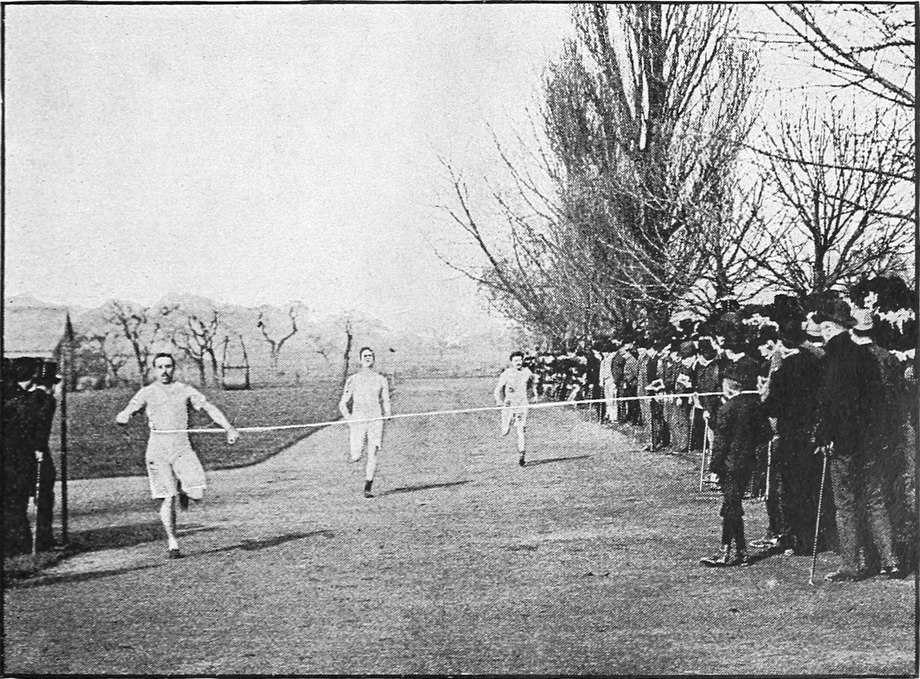
THE LAST LAP.
In the summer of 1870 the nine spent nearly the entire vacation in an extended tour through the West, playing all the principal amateur clubs and many of the professionals, and winning forty-four out of the fifty-four games they played. Their greatest victory was over the Niagaras, in which they made 62 runs to their opponents’ 4, and 49 base hits with a total of 68, for 8 hits by the Niagaras. The latter philosophically accepted their defeat, declaring that they could not expect to play ball successfully against a nine whose reputation was comparatively world-wide. The account in a contemporary paper, of the game against the old Cincinnati Red Stockings is interesting as showing what the general opinion at that time was of Harvard’s club. The Red Stockings was the old champion nine in which the veterans George Wright, Harry Wright, Leonard and McVey first made their reputations as ball players. “Never before in the history of the Union Grounds has so exciting a struggle taken place as that of yesterday between the Harvard University and the first nine of the Cincinnati Club. We heard many intimate that if the local favorites were beaten on their own grounds, something hitherto unheard of, they preferred that the deed of baseball glory should be accomplished by the gentlemen players from Cambridge, rather than by the more dreaded professionals from the East. The game was remarkably close, the Harvards outplaying their opponents at the bat and in the field; but at a critical moment in the last innings, professional training showed its superiority over amateur excitability, and the Red Stockings won by 20 to 17.” The game at the time was considered “one of the most remarkable on record—remarkable for the inferiority both at the bat and on the field, of a club of professionals who ought on their record to defeat their amateur opponents easily. Nothing but sheer luck saved the Red Stockings from a defeat which would have been honorable because administered them by the Harvards.”
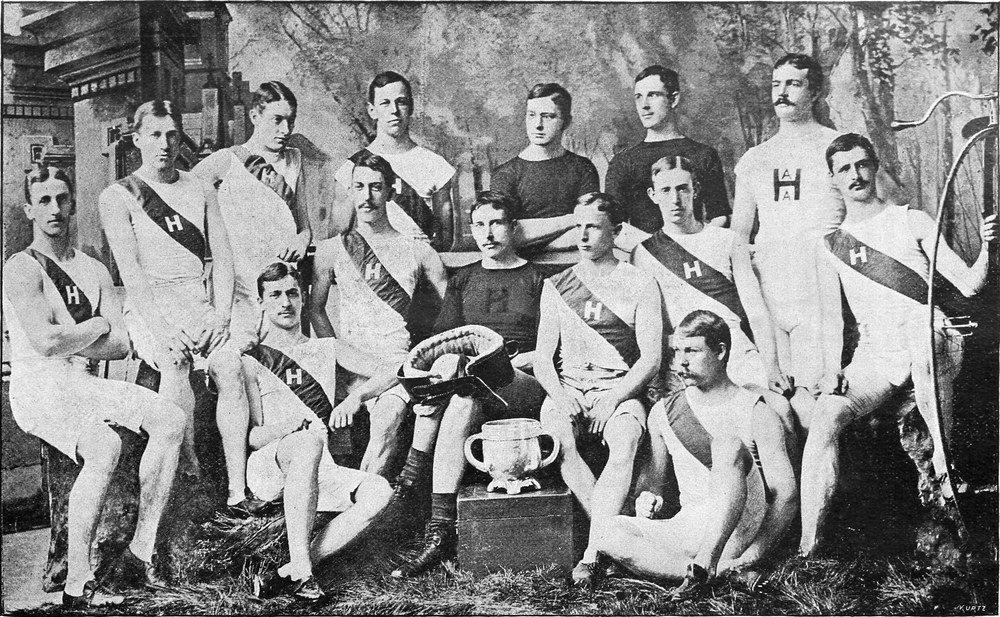
HARVARD INTERCOLLEGIATE ATHLETIC TEAM.
⇒ LARGER IMAGE
This was what might be called the uncollegiate period of Harvard baseball, for all of Harvard’s most important games were played with other than college teams; indeed, there were none of the latter who could compete with her. From 1867 until 1874 she did not lose a single game to any college, although annually playing their best nines. Of the many crack players during this period, A. McC. Bush, ’71, stands head and shoulder’s over all others. He played in one hundred and four games, was captain for one year, and his success in that office is shown by the fact that Harvard never lost a game to an amateur club during his captaincy.[4]
There is no time to trace further the development of baseball at Harvard, and, indeed, there would be little point in doing so; for the game there has simply kept pace with its progress throughout the rest of the country. I have purposely given this short sketch of the introduction of the game to show the early importance attached to it at Cambridge, the prominent part that the latter took in introducing the game among American colleges, and the general reputation that the nine had at that time. The significant remark in the Cincinnati papers about “the gentlemen players from Cambridge,” and many other comments of a similar kind, were made at a time when Harvard played many games against professionals—a privilege now forbidden.
Up to the present date, however, the game has retained its popularity, although no longer can the college boast of seven successive years without losing an intercollegiate game. After 1874 the team gradually began to find more formidable opponents among the other colleges, especially Princeton and Yale; but, nevertheless, Harvard won the college championship in 1876, 1877, 1878, and 1879. Tyng and Ernst, the famous battery of this period, still figure in the minds of the undergraduates as traditional heroes. Then an Intercollegiate Baseball Association was formed by a large number of the colleges; but not until 1885, under the captaincy of Winslow, ’85, and with the battery work of Nichols and Allen, did Harvard again win the college championship; but then she won every one of the ten championship games, and twenty-four out of the twenty-five played during the whole season. Then followed the withdrawal from the large college league, the formation of the smaller one with Yale and Princeton, and the discomfiture of the Harvard nine by the present Yale pitcher, Stagg. If any one wishes to understand the position that baseball occupies in the college, it is only necessary to go out on Holmes Field at the annual Harvard-Yale match the day after Class Day. Games are played then which throw the old Harvard-Lowell games on Boston Common completely in the shade. A large part of the unpleasantly critical element is excluded by enclosed grounds and an admission fee; but their places are taken by thousands and thousands of enthusiasts, less critical, but even more demonstrative.
To be continued.
A RIDE TO A RUSSIAN WEDDING.
BY C. M. LITWIN.
A FRIEND of mine sent me, not long ago, the recently published translation of Count Tolstoï’s “The Snow Storm.” I had not read it in the original, but the translation was a good one, and this little picture of a ride in a snow-storm, drawn by a master’s hand, vividly recalled to my mind many of my traveling experiences during ten years of active service in Russia.
One of them—I don’t know why—presented itself to my mind with more persistence than the others, and I have not been able to resist the temptation of putting it on paper. I hasten to say, for fear of giving a bad opinion of myself beforehand, it will not be an account of a ride in a snow-storm, nor a description of such a storm, although I have seen many and have often felt their embraces. Who, after having read the Count’s little gem, would dare attempt a description of a snow-storm? Would it not be the same as to attempt to paint a subject treated by Rembrandt, or to mold another “Statue of Liberty?”
My tale is simply about an exciting ride taken in the winter, but early in the season, with but little snow on the ground—for Russia—while I was in a very excited state of mind over an event that was of more importance to me then than the still pending Oriental question or any other question of either hemisphere, namely, the wedding and the wedding-ball of a girl with whom we had all been, or imagined ourselves to be, a little in love. But I see that mature age is not always a sufficient safeguard against excitement, and I confess that with this glance back at those happy days I begin to feel something of that youthful nervousness, always aspiring to something, always wishing for something, and to put a check on it I begin my tale.
My headquarters were in Ladoga, the county seat of the district of the same name, in the Province of St. Petersburg. The town is situated on the Lake of Ladoga, at the mouth of the river Wolchow, which is large, but very dangerous for navigation on account of its rapids. This stream forms a link in the water-system connecting the Caspian Sea with St. Petersburg and the Baltic.
The situation of Ladoga, its streets and buildings, have little of picturesqueness, except the old church built on a slight elevation just where the river enters the lake. On the high tower of this church, almost at its summit, and on the side facing the lake, there is a niche, protected from rain and wind by a pane of glass. Within this niche is placed a picture of the Holy Mother, lighted by several lamps burning day and night. These are kept there by the donations of the fishermen and sailors, who hold the holy picture in great veneration. They look for it from afar, not only with the eagerness of a Cunarder’s captain watching through his glass for Sandy Hook or the Fastnet lights, but also as worshipers, raising their eyes and hearts to the Holy Mother with her Infant, imploring help and protection in their lives of hardship and danger; for navigation on the lake is very dangerous from undercurrents, and I have often heard marine officers say that they would rather cross the ocean than make a trip on this lake.
The town of Ladoga contains only a few thousand inhabitants, but, since it is a county seat, all the government officers, military and civil, are obliged to live there with their families. If you add the staffs of the various regiments which are stationed there in turn, and several wealthy landowners of the nobility, you can imagine that life in Ladoga is gay.
In no other country than Russia are there so many private dancing parties, suppers—or rather midnight dinners—and all sorts of amusements, any one of which is, for the most part, a pretext for eating, drinking and gambling. Even among ladies, every game of cards is played for money, in a country where the paternal government says: “You cannot read; I will read for you. You cannot write; I will write for you. You cannot think; I will think for you.” Questions of public interest there are none. If there is a vacancy in an office, every one knows the Czar will make the appointment. If there is a famine, every one says the Czar will send bread; thousands will die meanwhile, but this is no matter. If there is a war, every one proclaims, “Our little father, the Czar, will beat them; our mother, Russia, is invincible; let him [the enemy] come, we will bury him under our caps.” One is only permitted to think how to win more at cards, how to eat more and not make himself ill, how to drink more and not be made drunk, although this last condition is not considered at all degrading. On the contrary, it awakens in every one charitable feelings, quite naturally, for every one expects to be drunk himself, if not to-day, then, surely, to-morrow. It is really edifying to see how a mantle of charity is thrown over one who is drunk, and how tenderly he is carried home to bed—more tenderly, indeed, than one who may have had the misfortune to slip and break his leg. But the young men do not think merely of cards, eating and drinking, although they do not lose much time before entering upon these delights, and almost all show, very early, a genius for them, probably by way of inheritance. The adherents and the advocates of the theory of inherited inebriety would find in Russia their task greatly simplified. In case of a hiatus in the genealogical record, or in case of the utter impossibility of tracing one, they would not be obliged to make a salto mortale to Noah. Stretching out their fingers triumphantly, they could at once point out son, father and grandfather drunk in company.
There is, however, a time when a young man, even in Russia, thinks more of dancing and flirtation than of anything else, and when he under no circumstances would omit a dancing party or a ball, to say nothing of a wedding-ball. A wedding and a wedding-ball were on the program for the next day. I was young, recently graduated, held quite an enviable office under government, and had been chosen by the bride to hold the crown—not of diamonds, but of tinsel—over her head at the wedding ceremony during her triple promenade round the pulpit, hand in hand with her fiancé, which, according to the Greek rite, is a symbol of the Gordian knot.
But something still better my stars had destined for me. It was that the dear girl, just lost to all others except her husband, had selected me from a score of aspirants to lead the mazurka with her at the end of the ball. No sympathetic soul will wonder that, under these circumstances, I thought myself of no less importance for the events of the coming day than Bismarck for the Vaterland, and that while hurrying on all the necessary preparations for my personal appearance, I was plotting to prolong the mazurka at least one hour beyond the usual time.
Perhaps some one will question how it was that the honor of dancing the principal dance with the bride was bestowed on me, and not reserved for the bridegroom. Well, there were two reasons of the best kind. The first—a secret I will not tell; but the other, known to all Ladoga, was as follows: The groom’s left leg was shorter than the right. This misfortune naturally prevented him from dancing that fiery dance. Besides this, he belonged to that body of dignitaries entrusted by the Father of all Russia with the power of deciding the fate of poor delinquents, no matter in what category. Russia has her points of etiquette. Was it possible for such a dignitary to hop for hours through a mazurka? Certainly not. Even if both his legs had been of the same length, he could not have done it, for his shoulders were already loaded with a terrible weight of responsibility. To please his own humane heart, and to please all the living steps above him, up to the highest, who—no matter what Roman numeral is appended to his name—is considered to be endowed with the most humane heart of all, our dignitary had often to decide a question, frequently put to Russian rulers: which penalty would be the most humane, several thousand strokes of the knout, under which the sufferer might possibly die; or twenty years in the mines, where he would probably die?
Now, since this subject is at present so eloquently presented before the world in a work—for which, oh, so many thousands of hearts are praying that it may bring the same blessed results as “Uncle Tom’s Cabin”—I will only say that my bridegroom, being in a constant dilemma himself on that point, carried his neck bent forward in addition to his mismatched legs.
The evening before the wedding and the ball my preparations were all accomplished to my satisfaction. My new uniform, new epaulets, new boots, fitting so tightly that I could scarcely walk in them, but made to my special order by the most reliable shoemaker in Ladoga, new white gloves—in one word, everything new—lay spread about in my room on tables and chairs. Imagine, then, my dismay, when, at five o’clock in the evening, I received a dispatch ordering me to go at once on a very important service to a place at a distance of ninety-six versts (about sixty miles) from Ladoga.
In spite of my own excited anticipation of to-morrow’s enjoyment, I must say that I was more tormented by the thought of the disappointment of the poor girl. What would she think? What would she feel? Would she not even consider my absence as a bad omen for all her future life? To be absent! No, even for the Czar’s sake I was incapable of such treachery. But what could I do? To report myself sick was impossible, for in that case I could not appear at the ball. Delay was out of the question. I was obliged to go. Fortunately I could calculate upon performing my duties there before noon of the next day, and it only remained to be sure if I could make the journey with the speed of the wind. But I would not allow any obstacles to give me uneasiness. I knew I could make the 192 versts easily in nineteen hours, and having twenty-seven hours before me, I calculated upon having plenty of time, both for the business and the journey.