Volume 13 / Part 2 — PART II. (continued 2)
Reading edition
So, without losing any time, I packed what was necessary for the trip, sent at once for the post-horses, and ran to communicate the bad news to my partner. As I anticipated, she was much startled, but by giving her the most solemn promises that I would return coûte que coûte in time for the ball, at eight o’clock the next evening, I succeeded in calming her.
As I have mentioned before, it was in the beginning of winter, so I traveled in a sleigh. I left Ladoga at half-past six in the evening, and arrived at my destination about three o’clock in the morning, without any accident. Ordering at the post station a samovar, I made tea for myself, drank several cups, gave orders that I should be aroused at six in the morning, and without undressing, wrapped myself in my fur cloak, and, pushing under my head my leather traveling pillow, fell asleep on the station sofa.
I was aroused punctually as I had ordered at six, and after the blessing of Russia—the samovar—had fulfilled its morning duty, I hastened to mine. As I said, I had fully decided to rid my hands of the unwelcome business in a very few hours, but I counted without my host. Some individuals who were called as witnesses, but had not in view a wedding hop, arrived late, and the village authorities, who could not guess the reason of my feverish zeal in the Czar’s service, moved and acted with the habitual slowness and apathy of the Russian peasant. In short, it was already one o’clock in the afternoon when the last document was duly signed, witnessed, and packed in my portfolio. I rushed into my furs and through the door, before which the trojka had been standing for more than an hour, the horses and the jamszczyk shivering with the cold, and the bells tinkling.
I threw myself into the low, spacious sleigh, well filled with straw, and shouted to the jamszczyk:
“Poszol!” (Go.)
A promise of one ruble if he would make the next station, a distance of sixteen versts, in one hour, did not fail to produce the desired effect. The horses, stimulated by the wild shouts of the jamszczyk, and by the whip, on the end of which stuck the promised ruble, ran, as the French say, ventre à terre, and the next village was reached at but seven minutes past two.
The day was clear, but a strong northwester, blowing fiercely, made the air bitterly cold. Snow having fallen some few days previously, the road was excellent, and my only fear was that I might fail to find horses at some station. In this case there would be no help. Every one, even the Governor-general himself, if he arrives unexpectedly, must wait till the return of the first span, and till the regulation two hours for feeding the exhausted beasts passes away. But, trusting to my good luck, and still more to the secret prayers of my partner in the mazurka, I drove such gloomy anticipations as far as possible from my mind.
The starosta met me at the door of the station, which was at the same time his house, invited me to enter and to warm myself with a cup of tea. I declined, and having no heart to ask the question dreaded by each traveler: “Are the horses at hand?” said that I was in a great hurry and wished to go at once. He said, “All right!” and I entered the room resolving to be polite and patient, knowing by experience that in many cases politeness and patience produce more effect than shouting and commands. Besides this, I was sure my former driver would not fail to tell his comrades that I was a “good fare.” Scarcely ten minutes had passed when the starosta came in, announcing: “The horses are ready.”
With a light heart I hurried out, but my satisfaction was a little checked by seeing that instead of three horses there were only two. I asked the starosta for the reason, and received the answer that all the jamsczyks were out, and that he would send his own boy, whom he could not risk with a trojka. At the same moment a little bit of a chap came out of the izba. He was not more than twelve years old, but looked bright and smart: he was dressed in the full costume of a genuine jamszczyk, and held in his hand his short whip, which he snapped with the air of a connoisseur. Approaching the horses deliberately, he walked round them, and imitating in every movement an old jamszczyk, he began to examine and to try by shaking the different parts of the harness, showing an especial fondness for the big bell hanging over the head of the horse in the shafts. He was evidently convincing himself that everything was in order for the event—so important for him—of driving a real officer with a star on his cap, instead of a simple peasant-delegate. Meanwhile the starosta helped me into the sleigh, seated me on my leather cushion, and piled heaps of straw round my legs and feet, pressing it so that it was impossible for me to move. As the cold was increasing, I abandoned myself to his tender care, which I could but consider as a mark of atonement for the missing third horse.
Everything being ready, I said “Go!” and the little boy, faithful to the end to the great rôle he was performing, took off his big cap, crossed himself hastily thrice—as every Russian does before any important, doubtful or dangerous occasion—seized the reins, threw himself coquettishly on the front edge of the sleigh, leaving his short legs hanging out, and in the manner of a well-bred jamszczyk, turned toward me his merry face, without disturbing his acrobatic posture, and asked, “Are you ready, sir?”
I gave a nod with my head just sticking out from the big collar of my fur coat, and the starosta said, “With God, Vaniusha [Johnny], and take care.” Vaniusha replied, “All right!” and addressing the horses, sang out with his silvery voice, “Eh, you, my little doves!” The doves started, the bells jingled, and off we went.
Now, I must confess that in my heart I was wickedly glad to have for a driver a child; “cet âge est sans pitié,” as the great fabulist has said, and I knew he would not spare the little doves, even without the one ruble pour boire.
The village being situated on a steep hill, the road from the station went rapidly down at a grade which could delight only a tobogganist. Besides this the road was not wide, and was bordered with izbas and fences on both sides. The passers-by greeted Vaniusha, and the village belles, attracted by the sounds of our chime, peeped out of the windows. That the little rogue, being well aware of the general admiration, felt himself in the seventh heaven, and was as proud as a peacock, he proved by an impatience which brought us both within a hair’s breadth of a bad end.
Not waiting to reach the plains, he began to tickle the tender parts of the side horse with his short whip. The tickled horse, knowing very well there are no flies in winter, instead of using his tail for self-protection, used his leg and kicked fiercely. Unfortunately, during this performance, the whiffle-tree became entangled in his legs. There is no difference between the animals of a civilized and an uncivilized country, and every one can easily guess what happened. The kicks were redoubled; and the shaft-horse, alarmed by his neighbor’s actions, kicked too, and both started on a wild race. The frightened Lilliputian dropped the lines and grasped the sleigh with both hands. I had no time to seize the reins before the sleigh tipped over. I was imprisoned in my seat by the straw tightly packed round my feet, so my body was forced to follow all the zigzags of the half-overturned sleigh, dragged furiously downward by the runaway “doves,” which seemed, indeed, to possess wings.
How long this lasted I cannot tell, for, thanks to the concussions that I received, and the dizzy speed in such an unaccustomed position, I lost all consciousness.
When I came to my senses I found myself stretched on the road. Hastening to get on my feet as quickly as I could, I began to examine myself, and was very glad to find everything all right.
I heard shouts of men running toward me, and perceived at some distance behind me the poor boy, now without his whip and without his big cap, standing in the middle of the road, bitterly crying and nursing one hand tenderly with the other. Far ahead spasmodic sounds of a bell resounded, and turning in that direction I saw my horses running round a mill which stood isolated beyond the village, just as if they had been performing a chariot-race at a circus.
I rushed to the boy and asked what was the matter. His pitiful sobs did not permit him to utter a single word, and I was afraid he had broken his arm.
Meanwhile the starosta and a crowd of moujiks reached us. Little Johnny was brought into the nearest izba and undressed. A careful examination by a znachar (village quack), fortunately present in the crowd, having been made, I was glad to learn from the mouth of the oracle that the bones were sound, though the wrist was sprained.
Several moujiks, who had run to catch the horses, brought them to the door, and my gun, portfolio, and other things scattered on the road were soon recovered.
This restored me to my full consciousness, and I exclaimed, “The mazurka!”
Without losing a moment, I thrust my hand into my pocket, gave to the still sobbing Vaniusha a “blue” (five paper rubles), and, addressing the starosta, said that I must go on at once.
The starosta, whose conscience now pricked him doubly for having economized on the third horse (for use of which he had already pocketed the post-fare), and for trusting a life precious to the Czar’s service to such childish hands, declared at once that he would drive himself. The station-house being now a half-mile away, not to lose time, he snatched, without much ceremony, from the nearest bystanders, things necessary to protect him from the cold, and we started.
Although this occurrence made me lose more than a half-hour, each minute of which was precious to me, I rendered thanks from my heart to Providence for my preservation from having my head split in two on a fence or on the corner of an izba.
The wind increased constantly, and snow began to fall and to melt on my nose, so I wrapped myself closely in my furs, and, feeling some fatigue from the excitement, sat perfectly quiet. Not so my driver. At first he was as still as a mouse, probably fearing or expecting some strongly flavored words from me, which he was sure he had deserved; but, seeing me so quiet, his own feelings began to wander in other directions. He grew angry. Had he not enough reason? His poor boy injured, and himself, instead of sitting in a warm izba and sipping tea, obliged to perform the duty of a jamszczyk. Who was guilty of all this? Certainly the doves, and to them he now turned all his attention. The whip, being now in the paternal hands, began to perform the paternal duty of bygone times. The doves could make no mistake this time about flies or mosquitoes, and had no time to kick. They ran at the top of their speed.
As it always was, and probably always will be—the one suffers, the other rejoices. So the doves suffered and I rejoiced as they devoured the space, and I flew with the speed of a state messenger bearing to the White Czar the news of a new victory of his army. In less time than any tip could have brought it about, we reached the next village, and, without any delay, I proceeded farther. The next stage was a long one, twenty-two versts, and the road led through the woods. Once in the woods, the wind could not be felt so severely. Darkness was coming on, and I felt sleepy. Moving hither and thither on my seat, and sliding down a little, I fell into quite a comfortable position and began to doze. My dreams, which constantly represented to my mind a brilliantly lighted hall, with its peculiarly scented atmosphere and incoherent rustle, all the beauties in their ball-dresses, and my still more beautiful partner of the mazurka, were interrupted by a sense of the cessation of motion, and by a voice saying, “Barin [sir], eh, Barin! do you see?”
“What is there?”
“Wolves!”
Indeed, straining my eyes to pierce the darkness, I perceived in the distance some points of light moving to and fro. I could hear indistinct howlings, too.
“The deuce!” thought I “what shall we do now?”
It seemed to me strange to meet, at this season, with a pack of wolves. The frosts had only begun, the snow was not deep, and generally these beasts venture out of their retreats only when driven by hunger. But I knew very well, too, that in such an encounter the most dangerous thing is to stop or to retreat. Even wolves respect courage. So, seizing my double-barreled gun, I said to the jamszczyk, “Go! go fast, but steadily, and do not stop under any circumstances.”
He started, but soon stopped again. Seeing that mildness would have no effect here, I applied to his head the strongest argument that I could, not neglecting, in spite of the darkness, to hit with my fist the lurking-place of his nerve of courage, indicated by Lavater. This plan worked, and, with the flash of an electric transmitter, he passed on the blow to the running nerves of the horses. They flew. The jamszczyk thrashed them without mercy, the bells jingled madly, and I, holding my gun in both hands, tried at the same time, by all possible means, not to tumble out of the sleigh. The points of light grew nearer, the howlings became more distinct, but it seemed to me as if it were dogs.
So it proved. Soon we came on a gypsy camp.
It was after seven in the evening when we reached the next station, and I had only one more before me. Being obliged to wait some time for fresh horses, and seeing that it would be impossible to arrive at the very beginning of the ball, I began to grow restless in spite of the conviction that the dear girl would never doubt my intentions, and would not pout her charming lips by way of punishing me for the moments of suspense.
At last the horses were announced, and I could proceed, but a new disappointment was in store for me. The horses, being still tired from a previous trip, showed themselves provokingly obedient to the regulation speed, and all my own and the jamszczyk’s efforts to urge them on proved useless. It was half-past nine when we reached the Wolchow. I think I have forgotten to say that my route being on the right side of the river, which was not yet frozen, I had to cross it. There was no bridge, and I think there never will be. Communication being made by a ferryboat, built and handled on the ante-diluvian principles, but quite safe in calm weather, I had now to cross the river on it once more. Generally it takes half an hour for the floating apparatus to make each trip, but I was prepared for this.
Imagine my surprise, then, when the ferryman—a weather-beaten ex-fisherman—who knew the lake and the river as well as his own five fingers, announced that the ferryboat was on the other side, and in such weather it could not cross the river.
Having made the last half of my way almost entirely through the woods, I was not aware of the increased fury of the elements. But now, jumping from the sleigh and approaching the river, I could convince myself of its condition.
Indeed it was an ugly sight. The wind blowing a gale, and coming from the lake, stopped the current of the river and raised its water. Not only white-caps, but whole mountains of waves were rolling in fiercely, throwing foam and spray high in the air. I saw there was no use even in promising a kingdom for a ferry. My feelings fell to a point below zero. So near to my goal, and at the same time so far from it! Nevertheless, I turned to the ferryman and asked him if there was no other way to cross the river. He said if I wished he would take me over in his little dory. I had noticed the little nutshell before, and always wondered how it could carry such a big sail without tipping over. But to think of it now! The bold proposal of the tar made me shudder. It was true that I might expect to be drowned that night, but though the Wolchow bubbled, sparkled and foamed, better than the driest product of the famous widow—it was not champagne.
Again I questioned the man whether there were no other means for crossing. He replied that, if I insisted upon it, I could have the large rowboat, adding that there were some men, who had already waited several hours in the ferry-house, to whom he had refused the boat, but that an officer must be accommodated, and that he was sure they would be glad to row me and themselves over.
I hastened to the shabby ferry-house, and found the company scattered about the floor asleep. Arousing them as quickly as I could, I explained to them the situation.
They were four in all—two peddlers and two peasants. Unanimously I was proclaimed captain, and we went to the boat at once.
I took the seat at the stern and seized the rudder. One of the peddlers took one oar, one of the peasants took the other. The second peddler, still half asleep, tumbled into the dancing boat, and we only waited for the remaining countryman.
What was my astonishment when I perceived him dragging something that did not wish to go? What was it? What new passenger? Before he reached the boat, however, I could guess by the squeals and peculiar noises which my ear caught amid the howling of the wind and the roaring of the river, that it was a pig.
Now, this was too much. My very epaulets revolted against such a thing. To go on a perilous expedition in company with a pig, and, if successful, to divide the honors with the pig!
I protested hotly. The owner of the pig implored, and the crew—true to tradition—revolted against the captain and voted for the pig.
What could I do? The chances were equal. Without me they could not have the boat; without them I could not manage it.
Fortunately at that critical moment—for to resist would be to lose the mazurka, and to yield to lose authority, and heaven knows of what those Tartars would not be capable in case of danger, once in the middle of the stream!—a brilliant idea struck me. I have acknowledged already my ignorance of nautical principles, but I had read in my boyhood, like every one else, some piratical novels, and the idea of ballast flashed through my mind.
The pig would be our ballast! And with this in view, I ordered the men to bind the pig’s legs and throw it into the bottom of the craft.
The ferryman having once more warned me to keep the boat constantly headed to the southwest, said to us, “Now, with God!” the two improvised oarsmen bent to the oars, and we started.
On the river it was pitch dark. I could barely see the forms of my companions. The boat danced wildly; nevertheless, I was in high spirits—I was advancing. The boat was large and in good condition, as the ferryman had assured me. All fears of capsizing disappeared from my mind, thanks to my bright idea of the ballast, which now lay gently grunting just in the centre of the boat. Besides, I had under my command two men in reserve to relieve the two oarsmen in case of their being exhausted, and we were provided with spare oars.
How long we pulled and struggled with the river I cannot say, for I began to lose all idea of time. Twice already the oarsmen had relieved each other, and in spite of this they began to show signs of exhaustion. It seemed to me we were not advancing at all. Suddenly the boat began to dance violently. From this I concluded that we must be in the middle of the river. To cheer up the crew, I communicated to them my nautical observations, but just at this moment a huge wave raised us high up, and another, as in a fury of jealousy, struck us vehemently. The boat made a terrible lurch. The frightened men raised cries of terror, and—worst of all—the pig began to squeal horribly, and, struggling with its bound legs, began to throw itself hither and thither. I was frightened. I thought the struggling animal would surely upset the boat; and in my turn I howled out, with a voice of which I am sure a captain possessed of the strongest lungs would not be ashamed, “Overboard with the pig!” But this command, instead of ameliorating the situation aggravated it in the most unexpected way. Its owner threw himself flat on the beast to protect it. The pig, taken by surprise, and misjudging the man’s intention, redoubled its tossings, and the man following each of them with his body, put the boat in real danger.
Already I was prepared to give a new command, “Overboard with the two pigs!” but hesitated for one moment.
At that time I had never killed anyone—though I must confess to having afterwards sacrificed the lives of a few stupid Circassians who dared to fight against the White Czar for their beautiful mountains and their liberty—and I was glad that I hesitated. The man proved stronger than the pig, overpowered it with his weight, and both man and pig lay still.
The boat recovering its buoyancy began again to follow the motions of the waves. At the same moment I perceived the lights of Ladoga, but to my horror those lights, instead of vanishing to the right, vanished rapidly towards the left. I jumped on my feet and shouted, “For your lives, men, pull stronger; we are drifting into the lake!”
A new struggle—a struggle for our lives—began. Each of us knew well that once in the lake in such weather and darkness, we were lost. The men threw their sheep-skins off. I did the same with my fur. We did not need them—we were bathed in perspiration.
How long it lasted again I cannot tell. It seemed an eternity, and in spite of our utmost efforts the lights vanished more and more to the left.
Suddenly I felt something strike my head. My cap was snatched off, and instinctively throwing my hand up to catch it, I struck a rope. I seized it frantically, and shouted, “A rope! catch hold!”
The pig’s master was now the first to follow my command, and at the same time I felt that the boat was striking something hard. This proved to be a huge barge. A merciful Providence had guided us just under the rope of her anchor. The rudder and the oars were abandoned; we all, except the pig, clung to the rope, and began to call for help.
A voice above our heads shouted, “Who the devil is there?” and the peddlers and the peasants, as with one voice, cried out, “It is a czinownik!” (a government officer). This magic word proved no less effective on sea than on land, and at once came the answer, “Hold on—wait!”
In a few minutes a light appeared on the deck, some one threw us a rope from the barge and we were dragged to the other side of the vessel.
I saw a man lying flat on his stomach and stretching down toward me both his hands; another man held his feet. I seized the welcome hands, or rather the welcome hands grasped mine vigorously, and I was hoisted on the deck.
My companions followed me in the same way. What became of the pig I don’t know.
My limbs trembled and almost refused to support me. From exhaustion and excitement I was shivering all over. But I had no time to lose. I must be on the shore as soon as possible, and my deliverers from an almost certain death led me, supported on both sides, to the place where an immense plank, some fifty feet long, connected the barge with the shore.
But if I could not walk very well on the deck, still less was it possible for me to risk myself on this narrow plank. So I was seated on it, and the boatswain of the barge pushed me over as carefully as if I were a bale of most precious merchandise.
Once on terra firma my legs recovered their elasticity as if by a charm, and thrusting into the hand of the boatswain the whole contents of my pocket-book, I ran to my lodgings.
With the help of my servant, who was fully initiated in all the mysteries of an officer’s ball attire, it did not take me long to get ready, but it was past two when I reached the house where all my thoughts were concentrated. It was supper-time, and the servant led me at once to the dining-room, brilliantly lighted and crowded to its utmost capacity.
But I had no time to waste in reflections, and had scarcely tossed off a few glasses of champagne in reply to toasts on my safe arrival when the signal for the mazurka was given.
All who had both legs right did not wait for the end of the supper, but seizing their partners rushed to the ballroom.
I need not say that I and my prize—I have the right to call her so, for I had fought gallantly for her, and won her, not for life, but for the mazurka—were at the head of all. We danced the mazurka, and danced till six in the morning.
THE ACE OF HEARTS.
I NEVER can see the ace of hearts (Like a single splash of bright, red blood), But a train of awful memory starts And o’er me whirls like a seething flood. I see the flash of a wicked knife That settles for all the hot dispute— A cruel end to a sweet young life, A boyish face lying white and mute. I can see it all—the lurid light From th’ open fire on the mountaineers— The far Sierras gleam cold and white, And through the forest the wan moon peers. My deal again—and again the ace That horrid train of memory starts: I can always see that dead boy’s face And his cold hands clutching the ace of hearts. Edith Sessions Tupper.
OUTDOOR LIFE OF THE PRESIDENTS.
By JOHN P. FOLEY.
No. II.
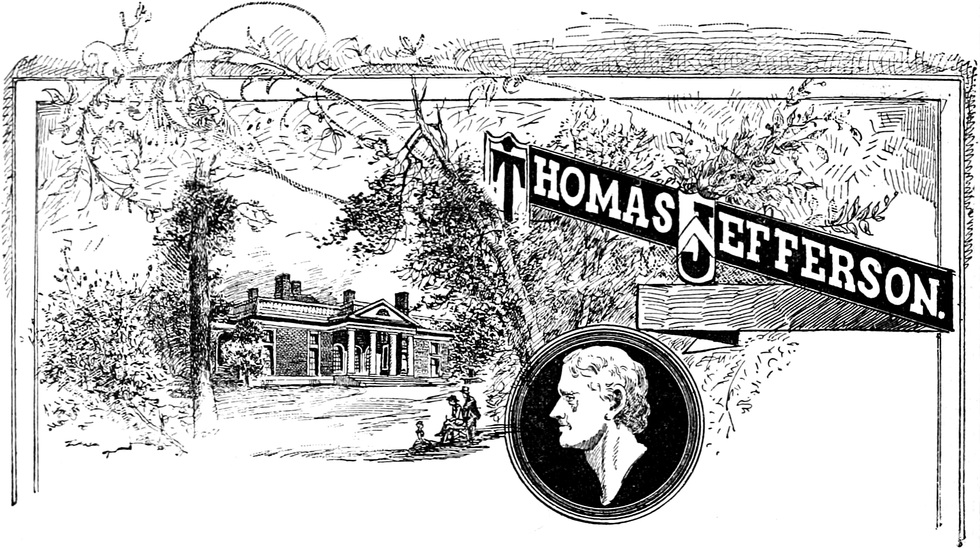
THOMAS JEFFERSON, the third President, was, like Washington, a member of the rich, slave-owning aristocracy of Virginia. His father was a large landed proprietor, and bequeathed to him a handsome estate in the county of Albemarle. It was called Shadwell, after a parish in London. To another son, younger, he left a property on the James River, named Snowden, which commemorated the reputed birthplace of the family in Wales. The Jefferson homestead was on the Shadwell lands. At a distance of about two miles from where it stood there arose a beautiful forest-clothed mountain, which commanded a wide view of the surrounding country. It was a favorite resort of young Jefferson. When a boy, he and a youthful companion used to climb its rocky sides, and in later years they repaired to it for the purposes of study and recreation. Under the shadow of a splendid oak they read their legal text-books, and, in the ardor of their friendship, resolved that whoever died first should be buried at its feet, and that, when the time came, the survivor should rest beside him. This young friend, Dabney Carr, who subsequently married a sister of Jefferson, died in early manhood, and the romantic compact of boyhood was faithfully carried out. Half a century later the remains of Jefferson were laid by his side.
The story is told that during one of their frequent rambles on the mountain, Jefferson unfolded to Carr his intention to build his future home amid the scenes where they had spent so many happy hours.
This tale is probably true, for soon after Jefferson became of age, the majority of his slaves were set to work clearing away the top of the mountain, now called, for the first time, Monticello, and preparing the site for the mansion which was destined to an eternity of fame, because of the splendid achievements of its illustrious owner.
Jefferson was only fourteen years old when his father died. He had been nine years at school at the time; knew the rudiments of Latin and Greek, and had some knowledge of French. In a letter written in his old age to a grandson, whose education he was superintending, Mr. Jefferson refers to this sad event in his life, and describes the perils that surrounded his youth as follows: “When I recollect that at fourteen years of age the whole care and education of myself was thrown on myself, entirely without a relative or friend qualified to advise or guide me, and recollect the various sorts of bad company with which I associated from time to time, I am astonished that I did not turn off with some of them and become as worthless to society as they were.... From the circumstances of my position I was often thrown into the society of horse-racers, card-players, fox-hunters, scientific and professional men, and of dignified men; and many a time have I asked myself in the enthusiastic moment of the death of a fox, the victory of a favorite horse, the issue of a question eloquently argued at the bar, or in the great council of the nation, ‘Well, which of these kinds of reputation should I prefer? That of a horse-jockey, a fox-hunter, an orator, or the honest advocate of my country’s rights?’” The temptations to which he refers beset him, in all probability, when he was at William and Mary College and immediately after, while he was reading law in Williamsburg, the then capital of Virginia. That town was the centre of the most refined society of the province; the seat of the legislature; the headquarters of the army; and it was only natural that the objectionable characters whom Jefferson condemns should have been attracted to it. A young man just graduated with the highest honors from the university, with a reputation for the possession of great intellectual gifts, the heir to a fine estate, of agreeable and cultivated manners, Jefferson was at once admitted into the very best society of Williamsburg. He lived in a style befitting his position. He had his horses and slaves, in fact all the luxuries which a rich young gentleman of the time could command. At this period he fortunately fell under the influence of three men who helped to mold his career and turn him toward those pursuits which were ultimately crowned with the highest honors an American can obtain. They were the first men in the social and political life of Williamsburg; the first men, in fact, in the whole province. One was George Wyeth, his legal preceptor, a gentleman of the highest order of ability; in after years a signer of the Declaration of Independence and Chancellor of Virginia. The second was Dr. Small, one of the professors in the college, “who made him his daily companion,” and the third Governor Fauquier, “the ablest man,” says Jefferson, “who ever filled that office.” At the table of the governor, Jefferson, not yet twenty years old, was a guest as often as twice a week. He was also a member of a little musical society which the representative of royalty in Virginia had organized. Fauquier was one of the most accomplished men of his time. He was of a distinguished English family, courtly in manner, a brilliant conversationalist, with a wide knowledge of the world. He loved high play, and, it is said, lost his fortune in one night to the celebrated Anson, who first circumnavigated the globe.
Jefferson’s father, as we have said, died when his son was only fourteen years of age; but, says Mr. Randall in his biography of the third President, he had already taught young Thomas “to ride his horse, fire his gun, boldly stem the Rivanna when the swollen river was ‘rolling red from brae to brae,’ and press his way with unflagging foot through the rocky summits of the contiguous hills in pursuit of deer and wild turkeys.” From youth to old age riding was the one amusement of which Jefferson never tired. At college he kept his horses, the very best that could be had. His stable was the one extravagance of which, while there, he appears to have been guilty. His expenditures in this respect were so heavy that he requested his guardian to charge them to his portion of the estate, so that his brother and sisters should not suffer; but the guardian declined, on the ground that if he had thus sown his wild oats the property would be able to stand it without very great loss. His taste for fine horses lasted all through life. He rode and drove magnificent animals, says Mr. Randall, and in his younger days was exceedingly “finical” in their treatment. When his saddle-horse was led out he examined him carefully. If there was a spot on his coat he rubbed it with a white pocket-handkerchief, and if it was soiled, the groom was reprimanded. He preferred the Virginian racehorse. He did not ride, and was scarcely willing to drive, any other. He usually kept half a dozen brood mares of high quality. Although not a turfman—he ran only one race in his life—he had all the fondness of the Virginian for the sport, and rarely missed seeing what promised to be a good contest. While he held the office of Secretary of State, and, later on, when chief magistrate, he was frequently seen on the race-courses near Philadelphia and the federal city. Jefferson was not satisfied with slow and spiritless animals. On the contrary, he always aimed to have fleet, powerful, mettlesome creatures, and when these qualities could be obtained he was willing to overlook a bad temper. Colonel Randolph, writing on this point, remarks: “A bold and fearless rider; you saw at once from his easy and confident seat that he was master of his horse.... The only impatience of temper he ever exhibited was with his horse, which he subdued to his will by a fearless application of the whip on the slightest manifestation of restiveness. He retained to the last his fondness for riding on horseback. He rode within three weeks of his death, when, from disease, debility and age, he mounted with difficulty.” A servant was rarely allowed to accompany him, for he loved solitude, and used to say that the presence of an attendant annoyed him. In his young days he never drew rein at broken ground, and when in haste he used to dash into the Rivanna, even when it was swollen into a large and rapid river by mountain torrents. His superb horsemanship served him well on a memorable occasion during the Revolutionary War, when a detachment of English troops visited Monticello in the hope of capturing him. He had timely notice of their approach, and, having sent his family away in carriages to one of his numerous farms, he ordered his horse to a certain point, and returned to the house to secrete his papers. While thus occupied a second alarm came, and he had barely time to mount and dash into the woods, where he was safe from pursuit. Jefferson was then governor of Virginia, and in after years his political opponents charged that he ignominiously ran away from the enemy.
Mr. Jefferson’s classical tastes were indicated in the names of his horses: “Caractacus” was one, “Arcturus” another, “Tarquin” a third, “Celer” a fourth. Then he had “Diomed” and “Cucullin,” “Jacobin” and “The General,” “Wildair” and “Eagle.” “Eagle” seems to have been his favorite steed. He was fleet and fiery, and, withal, of a gentle temper. This animal was ridden by Jefferson when he was so feeble that he had to be assisted to mount. “Eagle,” it would appear, loved his venerable master. The story is told that when a young kinsman of Jefferson’s mounted the old horse to ride with a cavalcade to meet Lafayette on his way to Monticello, in 1825, “Eagle” became so excited by the sound of the drums and bugles that the young gentleman was obliged to turn back and ride home. On one occasion, when Jefferson was old and suffering severely from an injured wrist, a messenger brought the intelligence to Monticello that a grandson of the ex-President was severely ill at Charlottesville. Night was coming on, and the sky was dark and threatening. Jefferson ordered that “Eagle” be led to the door. His family, alarmed for his safety, vainly entreated him not to attempt the journey. In the saddle, he gave “Eagle” a cut which set him off at full speed. Mr. Jefferson’s family anxiously listened, hoping that he would draw bridle at the “notch,” where the mountain began to descend abruptly. The echoes of “Eagle’s” hoofs over the rocks told them that the fearful speed was maintained. The returning messenger was soon passed, and Charlottesville was reached “in a time over such ground that would have reflected credit on the boldest rider in Virginia.” “Arcturus” had the honor of being one of the Presidential horses at Washington. His disposition was bad, and he was exceedingly unmanageable. The crags of Monticello did not suit him, and when he first arrived there he selected as a shying point a rock which jutted out into the narrow road on the edge of a ravine. The brute seemed to reason that his rider would not dare to punish him at such a point. Jefferson indulged him two or three times, and then determined to break him of the habit. The next time “Arcturus” shied he punished him so severely that the animal was glad to put his fore-feet on the rock and stand still. Mr. Jefferson kept a good stable while he was President, although his political enemies were unwilling to concede even that point in his favor. In one of the opposition prints of the day we are told that he carried his affectation of democratic simplicity so far that “he rode around the avenues of Washington an ugly, shambling hack of a horse which was hardly fit to draw a tumbril.” But this was a slander. There are conflicting stories in regard to Mr. Jefferson’s inauguration. On the one hand, we are assured that he rode to the Capitol alone, and, tying his horse to the palings surrounding the grounds, went to the Senate chamber and took the oath. Mr. Rayner, in his life of Jefferson, quotes the account of the event by an eye-witness as follows: “The sun shone bright on that morning. The Senate was convened. The members of the Republican party that remained at the seat of government, the judges of the Supreme Court, some citizens and gentry from the neighboring country, and about a dozen ladies, made up the assembly in the Senate chamber.... Mr. Jefferson had not yet arrived. He was seen walking from his lodgings, which were not far distant, attended by five or six gentlemen, who were his fellow-lodgers. Soon afterwards he entered, accompanied by a committee of the Senate.... He took the oath, which was administered by the Chief-Justice.... The new President walked home with two or three gentlemen who lodged in the same house.” It is a well-known matter of history that Jefferson abolished all the official and social pomp that was so marked a feature of the administrations of his predecessors. The levees were discontinued. He had only two days for the reception of company—the 1st of January and the 4th of July, when he dispensed a very liberal hospitality. The ladies of Washington bitterly opposed this severe simplicity, and determined to make Mr. Jefferson return to the old order of things. With that end in view, a number of them visited the White House on the usual reception day. Jefferson was out riding at the time, and on his return was informed of their presence. A storm of wrath gathered on his brow, but was soon dispelled. Booted, spurred, and covered with dust, he entered the room, and, riding-whip in hand, chatted in the most delightful manner. The ladies saw they were beaten, and never made a second attempt to get the levees back. Mr. Jefferson on one of his solitary rides, while he was President, met a feeble beggar sitting on the banks of a stream. The mendicant, not knowing whom he addressed, asked to be helped across. Mr. Jefferson directed him to mount behind, and carried him over. The pack was forgotten, and Jefferson recrossed the stream for it.
From his youth Jefferson had an intense fondness for agriculture. The care and management of his large estate devolved on him as soon as he became of age. He was studying law at Williamsburg, but his summers were spent at Shadwell. He kept a clock in his bedroom, and rose in the early dawn. During the day he usually took a gallop, and in the twilight walked to the top of Monticello. Nine o’clock in summer and ten in winter were his hours for retiring. At a very early period he introduced a minute and exact system into all his affairs. He kept a large number of note-books. In one, “the garden book,” he recorded facts and data about the vegetable world, more particularly information bearing on the subject of horticulture. He also kept “a farm book,” and books for “personal” and “general” expenses. Then there was a meteorological register. In his account-books we find such entries as these: “Paid 11d. to the barber; 4d. for whetting penknife; put 1s. in the church box.” On the memorable Fourth of July, 1776, when the Declaration of Independence was signed, he sets forth that he had “paid Sparhank for a thermometer £3 5s.,” and “27s. for 7 pairs of women’s gloves.” He gave “1s. 6d. in charity.” The weather record tells us that on the same day at six A. M. the mercury stood 68° above; at noon, 76°, and at nine P. M., 731⁄2°. Entries were made in this book regularly three times a day. Special expenditures were set down by themselves. All his outlay while President, for instance, is preserved in one manuscript volume, which was among the literary treasures of the late Samuel J. Tilden. A striking illustration of how Mr. Jefferson could charge his mind with the smallest as well as the largest matters of human concern is shown by the curious record which he kept of the condition of the vegetable market in Washington during the eight years of the Presidency. This table specifies thirty-seven different articles, and gives the date of the appearance of each of them on the table, or on the stands for sale. In his “garden book” he entered the time of the planting, sprouting, and ripening of his multitude of esculents. These entries were illustrated by diagrams, as neat as engravings, of the different plots or beds. The rows are numbered, and the seeds planted in them accurately given. Even small matters concerning the household received his attention, and we are told how much of this or that article will suffice for one person, or for a family; how much oil will be required for a given number of hours; the relative cost of oil and candles. His agricultural observations were ranged under seventeen general heads, comprising more than fifty subdivisions.
By birth and fortune Jefferson was an aristocrat, but his nature revolted against the idle and voluptuous habits of the planter class of that day. His ideas when he was about thirty years of age are well expressed by himself, as follows: “Those who labor in the earth are the chosen people of God, if ever he had a chosen people, whose breasts he has made his peculiar deposit for substantial and genuine virtue. It is the focus in which he keeps alive that sacred fire which otherwise might escape from the face of the earth. Corruption of morals in the aggregate mass of cultivators is a phenomenon of which no age nor nation has furnished an example. It is the mark set on those who, not looking up to heaven, to their own soil and industry, as does the husbandman, for their subsistence, depend for it on the casualties and caprice of customers. Dependence begets subservience and venality, suffocates the germ of virtue, and prepares fit tools for the designs of ambition. This, the natural progress and consequence of the arts, has sometimes, perhaps, been retarded by accidental circumstances; but, generally speaking, the proportion which the aggregate of the other classes of citizens bears in any State to that of its husbandmen, is the proportion of its unsound to its healthy parts, and is a good enough barometer whereby to measure its degree of corruption.”
Mr. Jefferson was married January 1, 1772, to Mrs. Martha Skelton, a rich young widow. The 1,900 acres inherited from his father he had increased to 5,000 acres, all paid for, and his slaves numbered nearly fifty. The farm yielded him about $2,000 a year, and his law practice $3,000, which was a large income at that time. Mrs. Jefferson inherited a fortune fully equal to that of her husband, so that when the Revolution came he was a rich man. Shadwell house had been burned down some years before, and the bride was taken to a wing of the new one at Monticello, which was ready for occupation. The wedding trip was inauspicious. The little phaeton in which the journey was made became imbedded in the snow and had to be abandoned. The young couple went the remainder of the distance on horseback, arrived at Monticello at midnight, and found all the servants asleep. A small bottle of wine, found behind some books in the library, constituted the bridal supper. Jefferson, as we have said, began the erection of Monticello when he reached his majority. The first work was to level the summit of the mountain, which rose nearly eight hundred feet above the surrounding country. This summit—an ellipsis of about ten acres—was made perfectly smooth. The view from it is of surpassing grandeur and beauty. At a distance of 100 miles, in some parts, the magnificent ranges of the Alleghanies shut out the horizon on the west, and trend away to the north and south. The Blue Ridge Mountains are visible for 150 miles, while in the foreground of the picture lies a lovely landscape of hill and valley, forest, stream and plain. The scene on the east, to quote the words of Mr. Wirt in his eulogy on Jefferson, “presents an extent of prospect bounded only by the spherical form of the earth, in which nature seems to sleep in eternal repose, as if to form one of the finest contrasts with the rude and rolling grandeur of the West.” “From this summit,” says Mr. Wirt, “the philosopher was wont to enjoy that spectacle, among the sublimest of nature’s operations—the looming of the distant mountains—and to watch the motions of the planets, and the greater revolutions of the celestial spheres. From this summit, too, the patriot could look down with uninterrupted vision upon the wide expanse of the world for which he considered himself born, and upward to the open-vaulted heavens which he seemed to approach, as if to keep him constantly in mind of his great responsibility. It is, indeed, a prospect in which you see and feel at once that nothing mean or little could live. It is a scene fit to nourish those great and high-souled principles which formed the elements of his character, and was a most noble and appropriate post for such a sentinel over the rights and liberties of man.”
The mansion was probably the finest country residence on the continent at the time. The main structure is one hundred feet in length and about sixty feet in depth. The basement story rises six feet above the ground. On it rests the principal story, twenty feet in height. Above this is an attic eight feet high, the whole crowned by a lofty dome twenty-eight feet in diameter. On the north and south fronts were piazzas, opening on a floored terrace which ran one hundred feet in a straight line, and then another hundred feet at right angles, terminated by pavilions two stories high. The offices and quarters of the servants were ranged under these terraces. The style of architecture is Doric with balustrades on top. The main entrance opens on a magnificent hall which is surrounded by a gallery connecting the upper rooms of the house. An American eagle in bas-relief, encircled by eighteen stars—the number of States when Jefferson was President—looks down from the ceiling, and holds in its claws a ponderous chandelier. This hall contained an immense number of statues and busts, so arranged as to exhibit the historical progress of sculpture from the rude attempts of the red Indian to Caracci’s finished statue of Jefferson himself. There was a vast collection of Indian paintings, ornaments, weapons, statues and idols, together with a profusion of natural curiosities and fossils of every description. The hall on one side opened on a spacious salon, through double doors of glass. The design was Egyptian. Imbedded in the walls were Louis XIV. mirrors, bought in France, while Mr. Jefferson was minister. It contained many fine paintings, historical and scriptural. There were portraits of Locke, Bacon, Newton, Jefferson’s “Trinity of great men;” of Columbus, Vespuceius, Cortez, Magellan and Raleigh; of Washington, Adams, Franklin, and other distinguished men of the Revolution. Adjoining it was another splendid apartment, called the “tea room,” fitted up in rich and becoming style. The southern wing was devoted to the library, cabinet, and chamber of Mr. Jefferson. The library was divided into three apartments, opening one into the other. In it, at one time, was the finest private collection of books on the continent, sold afterwards to Congress when the Capitol was burned in the second war with England. The cabinet led to a greenhouse filled with rare plants. In a room adjoining the study was a collection of mathematical, scientific, and optical instruments, said to be the best possessed by any private gentleman in the world. The erection and decoration of this elegant home, and the improvement of the grounds surrounding it, cost Mr. Jefferson more than $400,000. He was practically his own architect and superintendent. The rough work was performed by American mechanics, slave and free; but the decoration was wrought by foreign artisans, who were brought for the purpose from Italy, Switzerland, and other parts of Europe. Beneath the building are, or were, long subterranean passages, cased with stone, through which a person could walk upright. They were connected with the slave quarters and the stables, hundreds of feet distant. The master of Monticello used to pass through one of them from his bedchamber and mount his horse in the early morning before the household arose.
All the appointments at Monticello were on a scale corresponding with the style of the mansion. On the declivities of the mountain were houses and buildings sufficient to make a small village. They were the dwellings of his overseers and workmen; the quarters and workshops of his mechanics. It was a little community complete in itself. Mr. Jefferson’s millers ground in his own mill the corn and wheat raised on his farms; his horses were shod by his own blacksmiths; the timber of his woods was made into every article of use by his own carpenters, the wool clipped from his own sheep was spun and woven by his own people. He even made his own nails, and his mechanics were sufficiently skilful to build his carriages.
The lawn and grounds, which were laid out under his direction, were as beautiful as nature and art could make them. At the age of twenty-three, according to an entry in his garden book, he planted a great variety of fruit-trees, and about the same period he selected the now historic burying-place where the young friend of his youth, his own family, and himself are buried. The book is filled with memoranda like these: “What to do with the grounds: Thin out the trees; cut out stumps and undergrowth; remove old trees and other rubbish, except where they may look well; cover the whole with grass. Intersperse jessamine, honeysuckle, sweetbrier and hardy flowers which do not require attention. Keep in the park deer, rabbits, and every other wild animal except those of prey. Procure a buck elk, to be, as it were, monarch of the wood. Put inscriptions in various places on the bark of the trees, and make benches or seats of rock or turf.” There are directions for the shrubbery. “To be planted: Alder, bastard-indigo, flowering amorphia, barbery, cassioberry, carsine, chinquipin, Jersey tea, dwarf-cherry, lilac, wild-cherry, dogwood, redwood, horse-chestnut, magnolia, mulberry, locust, holly, juniper, laurel, yew.” “Hardy perennial flowers: snapdragon, larkspur, anemone, lily-of-the-valley, primrose, larkspur, sunflower, flower-de-luce, daisy, gilliflower, violet, flag, etc.” That Mr. Jefferson carried out his plans in regard to the deer is evident from the account which has been left us by the Marquis de Chastellux, who visited Monticello in 1782. The Marquis says: “Mr. Jefferson amuses himself by raising a score of these animals [deer] in his park. They have become very familiar, which happens to all the animals of America, for they are, in general, much easier to tame than those of Europe. He amuses himself by feeding them with Indian corn, of which they are very fond, and which they eat out of his hand. I followed him one evening into a deep valley where they are accustomed to assemble towards the close of the day, and saw them walk, run and bound.”
The lawn was filled with lofty willows, poplars, acacias, catalpas, and other native and foreign trees set out so as not to obstruct the view in any direction from the centre where the house stood. Many of them he had planted with his own hand, and all of them were placed where they grew under his immediate superintendence. No wonder he declined to leave this beautiful and ideal home and accept the commission to France when it was first offered to him. The death of Mrs. Jefferson, in 1782, was so severe an affliction, however, that he gladly went abroad as a means of escape from scenes which so forcibly reminded him of his loss. His important and often vexatious diplomatic duties did not prevent him from noting and sending home to his numerous correspondents every hint and suggestion likely to benefit the agricultural interests of the country. Almost every one of his many letters contains some reference to his favorite pursuit. He was a member of the Agricultural Society of Paris and of the Board of Agriculture of London. In 1785, he writes from Paris that he recently “went to see a plough which was worked by a windlass, without horses or oxen. It was a poor affair. With a very troublesome apparatus, applicable only to a dead level, four men could do the work of two horses.” To another correspondent he writes about a new invention—“the working of grist-mills by steam,” and adds, “I hear you are applying the same agent in America to navigate boats.” Then comes the prediction, “I have little doubt but that it will be applied generally to machines so as to supersede the use of water-ponds, and, of course, to lay open all the streams for navigation.” This improvement of the plough was one of Mr. Jefferson’s great problems, and it is said that he was the first to lay down a mathematical rule for shaping the mould-board. The first mention of it in his writings is found in the journal of his trip through Southern France, which was made partly for pleasure and partly to obtain information on agricultural and other subjects that would be of value to his countrymen at home. He received for the new mould-board a gold medal from the Société d’Agriculture de la Seine. With the same object in view, he also made a tour of Northern Italy. In a letter to the Marquis de La Fayette he writes: “In the great cities I go to see what travelers think alone worthy of being seen; but I make a job of it, and generally gulp it all down in a day. On the other hand, I am never satiated with rambling through the fields and farms, examining the culture and cultivators with a degree of curiosity which makes some take me to be a fool and others to be much wiser than I am. From the first olive fields of Pierrelatte to the orangeries of Hieres has been one continued rapture to me.” Mr. Jefferson was captivated by the olive. He wrote home that he considered it the most precious gift of heaven to man, and thought it was superior even to bread. He strongly urged its cultivation, and also that of the fig and the mulberry. The Southern States are indebted to him for upland rice. In 1790, he procured a cask of that variety from Denbigh, in Africa; shipped it to Charleston, where, by his direction, a part of it was sent to Georgia. He also shipped a large number of olive plants, which throve admirably in their new soil. “The greatest service,” says he, “which can be rendered any country is to add a useful plant to its culture, especially a bread grain. Next in value to bread is oil.” While in Italy, he procured the seeds of three different species of rice from Piedmont, Lombardy and the Levant, and sent them to South Carolina, together with the seeds of the San Foin and other grasses. He was not in favor of the cultivation of the vine in the United States—not, however, on account of his temperance principles, but because he thought men might be more profitably employed in other departments of industry. While there he bought Merino sheep for his farm at Monticello.
While he was sending these gifts to the country, greater and more valuable, perhaps, than all the parchment treaties that have come across the Atlantic since our diplomacy began, he was at the same time extremely zealous in making known every new discovery and invention within the whole circle of the arts and sciences. For the great staple productions of the country he eagerly sought new outlets and markets. He labored long and earnestly with the Count de Vergennes, the French Prime Minister, to break up the tobacco monopoly, so that the American product could be sold in France. He endeavored to convince the Italian merchants that they needed our whale-oil and lard, and thus laid the foundation of what afterwards became a profitable trade. In the literary and scientific circles of Paris he was a prominent figure, honored for his great attainments, the nobility of his character, and his services in the cause of human freedom. His fame had preceded him, and he was welcomed by the savants of France as a worthy successor to the immortal Franklin. He discussed natural history with M. de Buffon. “I have made a particular acquaintance here,” he writes to a friend, “with Monsieur de Buffon, and have a great desire to give him the best idea I can of our elk.” He requests his correspondent to send him the horns, skeleton and skin of one, if it is possible to procure them. In order to gratify Mr. Jefferson, a grand hunting party was organized in New Hampshire by his friends, and, after a day’s hard chase, a fine animal was captured. It was stuffed and shipped to Paris at an expense of over fifty pounds sterling. Daniel Webster used to tell the story that its arrival was celebrated by a grand supper, at which Buffon was, of course, a guest, and that, at the proper time, it was introduced as the scientific course of the feast. Mr. Jefferson also added to the King’s Cabinet of Natural History, in charge of Buffon, our American grouse and pheasant, which he asked Francis Hopkinson to buy for him in the markets of Philadelphia. But he began to weary of France. Writing to Baron Geismer in the fall of 1785, he says: “I am now of an age which does not easily accommodate itself to new manners and new modes of living, and I am savage enough to prefer the woods, the wilds and the independence of Monticello to all the brilliant pleasures of this gay capital.” He was not, however, released from his post until three years later. On his way home from Norfolk, where he landed upon his return, he received an invitation from Washington, then President-elect, to become Secretary of State. He reluctantly accepted, and entered on his new duties March, 1790, in New York, which was then the seat of government. Mr. Jefferson was duly beloved by his slaves, and his reception by them on his arrival at Monticello showed the reverence in which they held him. His daughter, Mrs. Randolph, writes: “The negroes discovered the approach of the carriage as soon as it reached Shadwell, and such a scene I never witnessed in my life. They collected in crowds around it, and almost drew it up the mountain by hand. The shouting, etc., had been sufficiently obstreperous before, but the moment it reached the top of the mountain, it reached the climax. When the door was opened, they lifted him in their arms and bore him to the house, crowding around and kissing his hands and feet—some blubbering and crying—others laughing. It seemed impossible to satisfy their anxiety to touch and kiss the very earth which bore him. They believed him to be one of the greatest, and they knew him to be one of the very best of men and kindest of masters.”
Mr. Jefferson did not lose his interest in agricultural pursuits while he was a member of the Washington administration. He made frequent trips to Monticello, and directed the operations of his farmers, laborers, and other workmen. In June, 1790, he writes from New York to one of his daughters: “We did not have peas or asparagus here until the 8th day of this month. On the same day I heard the first whip-poor-will whistle. Swallows and martins appeared here on the 21st of April. When did they appear with you, and when had you peas and strawberries and whip-poor-wills in Virginia? Take notice, hereafter, whether the whip-poor-wills always come with the strawberries and peas.” When Mr. Jefferson retired from the Washington Cabinet he immediately began to repair the damages his long absence had caused on his estate. He then owned 10,000 acres of land, of which 2,000 were under cultivation, but they had been sadly mismanaged by his overseers. All the cleared land was divided into nearly four equal parts, each containing about 280 acres. These were subdivided into fields of about forty acres in extent, separated from one another by rows of peach-trees, 1,151 of which were planted by him in one year alone. He had 154 slaves, 249 cattle, 390 hogs, 5 mules, and 34 horses, 9 of which were required for the use of his household. To quote his own words at this time, he gave himself up “to his family, his farms and his books.” His farming operations were conducted on the most approved scientific principles, and the first threshing-machine seen in Virginia was on his estate. But in a short time his election to the Vice-Presidency recalled him to the political arena, and “the rocks and wilds” of Monticello were once more abandoned. Four years, and he became President. The young capital, Washington, was then slowly assuming the form and appearance of a town, if not of a city. Jefferson, who, as Secretary of State at Philadelphia, had supervised the plan of its streets and the architecture of its public buildings, took a keen delight in the work of building and beautifying it. One of his biographers, writing shortly after his death in 1826, says: “Almost everything that is beautiful in the artificial scenery of Washington is due to the taste and industry of Mr. Jefferson. He planted its walks with trees and strewed its gardens with flowers. He was rarely seen returning from his daily excursions on horseback without bringing some branches of tree or shrub, or bunch of flowers, for the embellishment of the infant capital. He was familiar with every tree and plant, from the oak of the forest to the meanest flower of the valley. The willow-oak was among his favorite trees, and he was often seen standing on his horse gathering the acorns from this tree. He had it in view to raise a nursery of them, which, when large enough to give shade, should be made to adorn the walks of all the avenues in the city. In the meantime he planted them with the Lombardy poplar, being of the most sudden growth, contented that, though he could not enjoy their shade, his successors would. Those who have stood on the western portico of the Capitol and looked down the long avenue of a mile in length to the President’s house, have been struck with the beautiful colonnade of trees which adorns the whole distance on either side. They were all planted under the direction of Mr. Jefferson, who joined in the task with his own hands. He always lamented the spirit of extermination which had swept off the noblest forest trees that overspread Capitol Hill, extending down to the banks of the Tiber and the banks of the Potomac. He meant to have converted the grounds into extensive parks and gardens. ‘The loss is irreparable,’ said he to a European traveler, ‘nor can the evil be prevented. When I have seen such depredations I have wished for a moment to be a despot, that, in the possession of absolute power, I might enforce the preservation of these valuable groves. Washington might have boasted one of the noblest parks and most beautiful walks attached to any city in the world.’” The Washington of even 1830 has long since passed away. Where the long line of shade-trees from the Capitol to the President’s house stood, the parallel rails of the street-cars have long been laid, while the stream of classic name has been inclosed in brick and stone, and made to serve the ignoble purpose of a great drainage conduit. Jefferson’s dream of a beautiful capital has been realized, however; and could he return to it he would not find much to condemn in its avenues and parks except some of the statues that disfigure them.
Mr. Jefferson’s long political service came to an end in March, 1809, and with it his final retirement to Monticello. He was then sixty-six years of age. The journey to his home was one long triumphal procession, the inhabitants of every town and village through which he passed welcoming him with complimentary addresses and resolutions. He had been forty years in the service of the public. His intellectual powers were undecayed and his bodily health good. Seventeen years of life were yet before him. The restoration of his property was his first care. His lands were not in a compact body, and a great deal of riding to and fro was necessary. One of the principal farms was in Bedford County, more than a day’s journey from Monticello, and he usually spent six or seven weeks there every year. In private as well as in public life, Mr. Jefferson had made it a rule to be out of bed with the sun, and to transact a large amount of business before breakfast. To this rule he adhered even in his old age. In a letter to ex-President Adams, in 1820, he says: “I can walk but little, but I ride six or eight miles a day without fatigue; and, within a few days, I shall endeavor to visit my other home, after a twelvemonths’ absence from it. Our University, four miles distant, gives me frequent exercise, and the oftener as I direct its architecture.” The building and equipment of the University of Virginia was the crowning work of Mr. Jefferson’s life. He visited it nearly every day, and when compelled to remain at home, watched the workmen through a spyglass from his veranda. The usual routine of his life at this period is thus described by one of his biographers: “He rose with the sun. From that time to breakfast, and often until noon, he was in his cabinet, chiefly employed in epistolary correspondence. From breakfast, or noon at the latest, to dinner he was engaged in his workshops, his garden, or on horseback among his farms. From dinner to dark he gave to society and recreation with his neighbors and friends; and from candle-light to bed-time he devoted himself to reading and study.” A granddaughter has left us this picture of him in the last years of his life: “He loved farming and gardening, the fields, the orchards, and the asparagus beds. Of flowers he was very fond. I remember the planting of the first hyacinths and tulips. The precious roots were added to the earth under his own eye, with a crowd of happy young faces of his grandchildren clustered around to see the process and inquire anxiously the name of each separate deposit. In the morning, immediately after breakfast, he used to visit his flower-beds and gardens.” His retirement was invaded by a multitude of admirers and curiosity seekers, whose entertainment became so great a drain upon his resources that, coupled with other financial losses, he became deeply involved in pecuniary difficulties. His creditors grew clamorous, and he was compelled to ask the Legislature permission to dispose of his property by lottery. The scheme embraced three great prizes, namely, Monticello, valued at $71,000; the Shadwell Mills, adjoining it, $30,000, and the Albemarle estate at $11,500. Public attention having been thus called to his distress, meetings were held in nearly all the principal cities of the Union, and a large sum of money was subscribed for his benefit. But his life was now drawing to a close, and he experienced very little relief from these voluntary offerings. In the summer of 1826 he became very feeble, and he died on the 4th of July, at ten minutes to one o’clock, “the day on which he prayed that he might be permitted to depart.” Fifty years had passed away since the great Declaration had been given to the world, and the political independence of the Thirteen Colonies proclaimed. Away in distant Quincy, noble old John Adams died almost at the same hour, thanking God that “Thomas Jefferson still lives.”
MAN’S THREE FOLLIES.
A WOMAN said to sage Voltaire: “You men are really famous For just three follies: they’re your share; For more than three you blame us. “Man never waits for fruit to fall, But shakes the tree or beats it; While woman, in no haste at all, When fruit has ripened—eats it. “Men rush to war, defying fate, And fight as if for pleasure; When death would come, if men would wait, And take them at his leisure. “Man follows woman: foolish chase, For if he only knew her, And would but turn from her fair face, He need not thus pursue her. “If she once thought man meant retreat, All scruples she would swallow; Grass would not grow beneath her feet, So quickly would she follow. “We’re not afraid this truth to tell To men who oft deceive us We’ve learned their ways, and we know well That they will not believe us. “Man will not, cannot turn away From the fair face of woman; Her sceptre she will always sway— At least while man is human!” Egbert L. Bangs.
THE LADIES’ EASTERN TRICYCLE TOUR.
FROM THE MERRIMAC TO NAUMKEAG.
By DAISIE.
“OHNE HAST” was our motto as, in the month of October, we cycled from the banks of the Merrimac to old Naumkeag. We borrowed but one-half of Goethe’s motto, for we did not care to add the “Ohne Rast,” and live up to it. He gets much out of a cycle tour who wheels leisurely through the country, for he exerts himself far less than does the pedestrian or the equestrian; he sees no less of what is around and about him, and he travels farther in a given time. There are those who derive no pleasure from cycling unless they rush along, bent only on making quick time between points; but this idea has never animated the ladies who yearly wander awheel along the rocky coast of Northern Massachusetts.
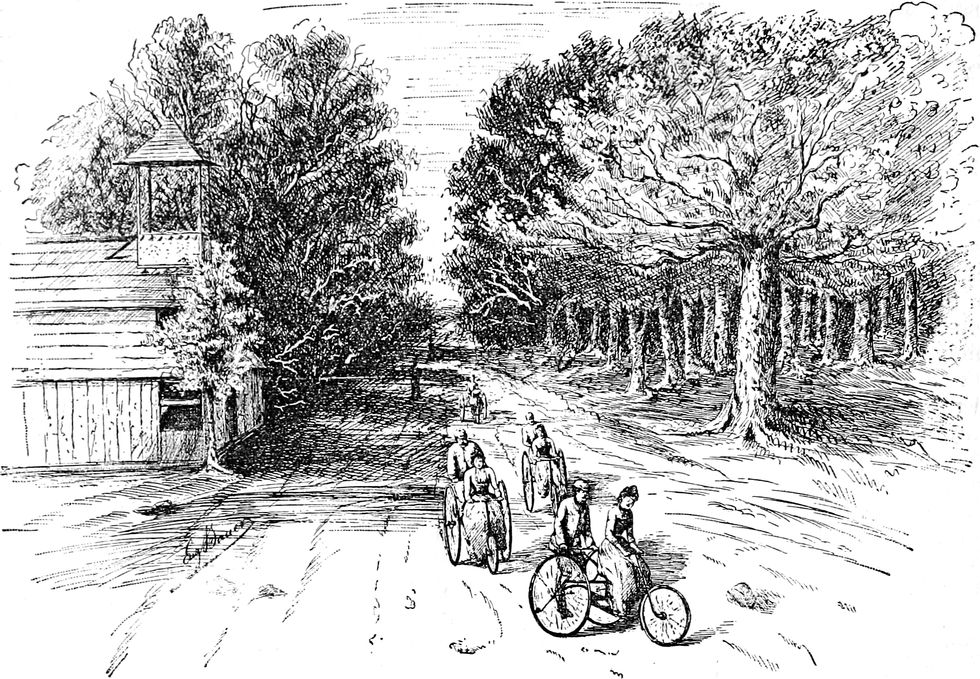
“The Ladies’ Annual Tricycle Tour to the North Shore of Massachusetts” is our rather cumbersome but all-inclusive title, and under it we have had four very delightful outings. This tour was evolved during the fall of 1885 from the mind of Miss Minna C. Smith, then on the editorial staff of OUTING, and the first tour was carried out under her direction, and became the subject of an article in this magazine at that time—(the Ladies’ Tour to Kettle Cove, vol. vii., p. 431). Minna’s first idea was a tour for ladies alone; but she very soon discovered that the ladies would not go without their husbands and sweethearts, and it occurred to her mind, also, that the masculines would be very handy in screwing up loose nuts, or repairing damages to the machines. And so it was a mixed company that first essayed to run awheel from Middlesex Fells to Kettle Cove. And it has come about that ladies with gentlemen have composed all the succeeding tours, three in number, though the ladies have always been in the majority, and the rule that no gentleman can participate unless he is escort to a lady has been rigidly adhered to. The gentlemen pay for the privilege of attending the tour by arranging all the details and liquidating the bills, and find their reward in the supreme satisfaction of which the ladies give evidence in look and manner. Before I tell you how we went and what we did, let me invite your attention to our itinerary.
Wednesday, October 3d.—By train from Boston to Newburyport—special car to carry our cycles. Night at the Wolfe Tavern.
Thursday, October 4th.—Ride from Newburyport to Gloucester, thirty miles. Through Newbury, Rowley, Ipswich, Essex Woods, Manchester-by-the-Sea, Magnolia, and Gloucester.
Friday, October 5th.—Around Cape Ann, through Rockport, Lanesville, Annisquam, Riverdale, West Gloucester, and Gloucester.
Saturday, October 6th.—A forenoon at Magnolia. In the afternoon, ride to Salem, through Manchester-by-the-Sea, Beverly Farms, Beverly, and Salem.
Sunday, October 7th.—A forenoon at Nahant, dinner at Lynn, and the homeward ride in the afternoon.
There were twenty-four of us in all. Eight wives assisted their husbands in pedaling eight tandems. Two pairs of girls propelled two tandems. The veteran and his wife rode a tandem bicycle. One young lady rode a single tricycle. One solitary gentleman rode a bicycle.
Our tandem bicycle was a seven-days’ wonder for the rustics on the route, and they viewed it with open-eyed astonishment. They never expected to see a lady on a bicycle, and they could hardly believe what their eyes told them.
There were some who protested against travel by rail on any part of a cycle tour, and spurned the idea of going to Newburyport in this way. They were allowed to exercise their own sweet wills, so four of the tourists wheeled forty miles to the rendezvous the day before the start. We were quartered at the Wolfe Tavern, in front of which hung a sign placed there in the last century, and bearing a portrait of General Wolfe. It was an ugly daub, but interesting and attractive, nevertheless. Hector thought it strange that a tavern should encourage the presence of a “wolf at the door,” and suggested that the landlord would have our assistance to drive him away when we came to pay our bills, or “pay the shot,” as he put it.
Newburyport is a quaint old place, and on every hand are to be seen suggestions of bygone days in the forms of a gambrel-roof house, a colonial door, or the more common outside steps which follow the front lines of the house and take one in at the front door by a turn. Here is the mansion house of Lord Timothy Dexter, who sent a cargo of warming-pans to the West Indies and made a large sum of money, not by selling them for bed-warming purposes, but for the use to which the natives quickly turned them of dipping up molasses from the vats. It is told, also, of this eccentric individual, that he had a mock funeral pass through the streets while he himself occupied the coffin, which was carried in a hearse. The picture of his great house, in front of which is a high fence with huge posts, each post a pedestal for a statue, has become familiar in cheap prints.
Hector and I were up early and strolling through the town. Our riding suits attracted no little attention, but one gets used to being stared at after cycling experiences of a few months. Gentlemen in knee-breeches are no uncommon sight in these days of tennis, baseball and cycling, but legs clad in knee-breeches appearing below an overcoat suggest an inharmonious grouping of garments, and I do not wonder that they provoke a smile. We made straight for the cemetery, of course, for in these quaint old places the cemetery is always interesting. We found it hard-by the jail, and I thought their juxtaposition not inappropriate. We read many epitaphs written a century ago, and could not but smile at the queer ideas expressed.
The natives turned out in force to see us start. They had possibly seen ladies ride tricycles before, but a large party like this, and one couple on a tandem bicycle, was a decided novelty. Good Mother Nature was kind to us on this the first day of our tour. She had been frowning for weeks before and sending down rain, rain, till we began to think we should have to tour in an ark instead of awheel. The gentlemen forgot what a glorious riding year lay behind them, and I heard many remarks more emphatic than polite. The frown on the face of the heavens changed to a smile the night before the eventful day, and we started our wheels toward Gloucester under pleasant skies. Molly was our pacemaker, while I staid behind to help along the laggards and to signal Molly in case of accident, and the Doctor’s wife looked after the drag which conveyed our luggage and a few spare machines. We had a whistle code which nobody took the trouble to learn, and our rules were very strict, though nobody seemed to pay much regard to them. Six miles an hour was the pace cut out by Molly, and this did not violate the motto, “Ohne Hast,” except in the minds of the horses on the drag. Do we mind the hills? Bless you, no! If the hill has a good hard surface we do not mind it nearly so much as we do a level, sandy stretch.
It were useless to attempt to tell the delight of a tricycle ride through a pleasant country, where Nature invites the eye to dwell upon her charms, where the roads are firm and smooth, when the whole body tingles with exhilaration born of quickened circulation and speedy movement through the air. To experience is to know. The half cannot be told.
We left the old town behind us and soon came to the river Parker (don’t call it Parker River in the presence of a Newburyporter). On the farther bank we were greeted by an old resident, who gave us apples to eat and entertained us with stories of the old house in which he lives, which, by the way, is the homestead of the Poor family, of which the noted Ben. Perley Poor and our friend are members. To-day we see Cape Ann under its rural aspect; tomorrow we shall see the bold shore and the open sea.
A boy shouts after the gentleman from New York: “Say, mister, your wheel’s goin’ round,” and the man from Manhattan nearly falls off his wheel from the effect of this very new joke.
At Bean’s Crossing we stopped for a drink of cold water at the well, and, if you will believe it, many of the ladies preferred to drink from the old oaken bucket, and spurned the drinking-cups gallantly offered by the gentlemen. The bucket was clean, however, without a suspicion of dirty moss on it. The ride through Essex woods was a poem in cycling. The summer residents have bought up large tracts of land in these woods and perpetuated this beautiful driveway. The road-bed is good, and one passes under arching trees for miles seeing nowhere any disturbance of nature due to the hand of man, save only the path he is traveling. Drink in this scene if you can, and garnish it with the glory of the autumnal foliage.
Just before we entered the woods we were met by the Poet and the Artist, who rode over from Gloucester to meet us and escort us on our way. They approached us down-hill, as we ascended. Just before we came up to them they performed a most artistic header in full sight of the party, which we all enjoyed, after we had discovered they had come out of it without injury. The poet dived through the air and alighted on the grass many feet in front of the machine, while the artist found himself under the machine, which illustrated the total depravity of inanimate things by jumping on him and pinning him to the sod. At Ipswich we drank again. Every pump is patronized by cycling tourists, and I dare not estimate the number of glasses of spring water that are consumed on a trip of this kind. Let me say that our tourists are teetotalers. I know this, because I heard one of the gentlemen say, after we had drunk from our fourth or fifth spring the first day, “I never saw such a lot of teetotal drinkers as cyclers are.”
Just out of Ipswich there was a breakdown. The Doctor’s axle yielded to his tremendously powerful pedaling, and a wrecked machine was cast upon the road. Here came in the usefulness of the drag with its cargo of spare machines. The wreck was taken on board and new machines were soon under the castaway crew.
Dinner was taken in picnic style, under the trees, in a nook of the Essex Woods, and ham sandwiches, chicken and eggs were washed down with water from a neighboring spring. At four P. M. we drew up in front of the Pavilion, at Gloucester. Then came the discussion over the distance. ’Tis with our cyclometers as with our watches, none go just alike, yet each believes his own. Some told us we had ridden thirty-two miles, others said thirty. My fatigue indicated a ride of a short distance, my hunger pointed to figures much larger than any cyclometer told.
That night there was music and dancing in the parlor. To see that merry company, who would think they had pedaled their “go-carts” over thirty miles of good, bad, and indifferent roads during the day? Molly favored the company with a number of recitations, the Doctor’s wife read an original poem which teemed with personalities, and Mrs. Manhattan played while we danced. We slept the sleep of the innocent that night, lulled to slumber by the breakers on the beach, just beneath our windows.
The second day is always the most important of the tour, for on it we circle Cape Ann. The road runs out of Gloucester at the north, belts the cape, and returns to Gloucester again from the west. Cape Ann projects into Massachusetts Bay, as though nature had given a great nose to the Old Commonwealth. The road follows the shore-line northward, then turns inland, and takes the visitor through a country of hills to the starting-point. I cannot believe that money or material wealth in any form could tempt a cycler to travel this road if it were not for the scenery. The length of the belt is only fifteen miles, but experienced riders suffer more fatigue in traveling these, than forty miles of ordinary roads would bring. A Boston newspaper pronounced it, a few years ago, an unfit road for ladies to ride over. And yet we have conquered it four times. Hill succeeds hill in constant succession, and sandy surfaces make the levels hard to ride upon. But we must pay for the good things of this life, and we cannot have Cape Ann scenery without compensation.
Twenty of us responded to the call of the pacemaker at nine o’clock Friday morning, and the drag was in position. Hector presented a pretty spectacle this morning behind the white wings of a dove which ornamented his tandem. The Doctor’s wife was suspected of this trick, perpetrated to show her appreciation of the way in which Hector sang his favorite song of “White Wings” for the entertainment of the company. If Hector’s beauty ranked with his inability to sing he would be another Adonis. The tourists were well avenged for the peace-destroying notes that had been forced upon them, for every shrill-voiced boy on the road that day—and we met several groups just let loose from school—saluted the decorated machine with the chorus of the well-worn song.
We went out of Gloucester with bright colors to the fore—on the cheeks of the ladies. Leaving Gloucester, we passed the old stone barn at Beaver Dam, then to Rockport, where we spent a pleasant half-hour at the quarries, looking down from the stone bridge that carries the roadway over the cut, into the great depths with the palisaded sides of still unquarried granite. Some of the great blocks but recently taken out were said to be twenty-five feet long and twenty tons in weight. We took the statement on faith, for we had neither measuring rod nor scales. A native took us to see a curio that is shown to visitors. A schooner ran into a sloop. The jibboom of the former went clear through the mast of the sloop and staid there. The mast with its unceremonious visitor lies upon the wharf to excite the wonder of those who behold it. “His Grace the Duke” cracked a very poor joke when he spoke of the masterly stroke of the schooner, and one man said that schooners had run into him without any such effect.
We were doing more walking than riding, for there are more hills than levels in that district, and many hills make pedestrianism a charm. Pigeon Cove came next in view. We saw several flights of ducks, but no pigeons hereabouts. Here, on the extreme easterly point of Cape Ann, we halted for lunch. An accommodating innkeeper, who had closed his hostelry, and who was the sole occupant except his family, kindly loaned us a table and the use of his range for the making of coffee. Molly made the coffee, and proved herself an artist in beverages.
After dinner we strolled and climbed upon the rocks which were piled up upon the point. Great slabs of granite that weighed ten, fifteen, and even twenty tons, were shown us, and we were asked to believe that they were thrown up by the sea, or moved rods away from their former positions by the gale of March, 1888. It was a great tax upon our credulity to view these massive stones and accept the tales that were told of the sport which the waves had made with them. The landlady showed an ugly and repulsive horned toad that had recently been sent her from California. It was still alive, and several of the ladies were courageous enough to take it in their hands, though the general verdict was, “Ugh!”
Leaving Pigeon Cove behind us, we rode on to Folly Cove. Here the scene is altogether different. The cove is surrounded by high land, from which we looked down upon white-capped waters and saw white-winged plyers of the deep in the middle ground and on the horizon, while just beneath us fishermen were tending their nets, and lobster-catchers in dories were hauling in their pots.
At Annisquam we visited the great boulder. Near the summit of a great hill lies this mass of rock, not less than fifty feet in height and width. Who put it there? Let the icebergs tell the story in scratches on its side. A few venturesome ones, who were shod with rubber, climbed to the top, and the photographer snapped his shutter and caught us as we stood about the rock. Off in the distance is Coffin’s Beach. Two schooners are on the sands, one at low-water mark, and the other far above the waters. They were thrown up there from the sea by the gale of last March, and they wait for the sands to engulf them. It will not pay to save them, so slowly but surely they are sinking into the sands, and before many months they will have gone down out of sight.
The Veteran brought pickled limes for our entertainment on the road. There should have been a few left when we got to the boulder, so one of the young ladies clambered into the drag to refresh herself, and soon had the box in her lap. There was a screech from the drag and a rush of the gentlemen toward it. When the maiden opened the box, she had found, not pickled limes, but the horned toad from California, who winked his ugly eyes at her as daylight was let in upon him. It appeared that the Doctor’s wife had begged him from the landlady at Pigeon Cove and without our knowledge had made him one of the party. He went with us to the end, and the ladies soon gained courage enough to feed him with flies.
We were back at Gloucester at half-past four. Then, after dinner, we had more fun in the parlor during the evening, more song and more story. Does anybody say we ought to have been tired after our long and difficult ride? Bless you, we never think of being tired on these tours.
Saturday morning brought clouded skies. Out upon you, Mother Nature, for marring our tour! It never yet rained on our touring days, then why spoil the record? Weatherwise natives told us that it would not rain long, and said that fair weather was ahead. Hector sententiously remarked: “He who rides a cycle needs no reins.” We started for Magnolia in a drizzle, and in a drizzle we did the place. Our wheels were housed at Willow Cottage, and the tourists strolled over to Rafe’s Chasm. It was a good day for surf studies, and the chasm is the ideal place for this. The waters rush up into the great cleft and come tumbling back white with anger, the waves beat upon the rocks, and the spray is sent high in air. We looked at the iron cross erected to the memory of Martha Marvin, who was washed into the sea from these rocks a few years ago; and lying right before us was Norman’s Woe, whereon the schooner Hesperus was wrecked.
Meantime the heavens put on a thicker coat of gray, foreboding trouble ahead for any who should dare venture unprotected beneath them. Two o’clock was our hour for starting, but at that time the rain was falling in torrents. No matter; let us drive on. It will not hurt us to get wet, for our work will keep us warm. Let me choose between a high wind and a rain-storm and I will take the rain in every case, and so think all cyclers. Keep the body warm by quick action on the wheel, change clothing at the end of the ride, and rub yourself well with a coarse towel, and there is no evil effect from a ducking of this kind.
We rode twelve miles to Salem. The roads were heavy, and we had to take the sidewalks wherever we could, without paying any regard to the law prohibiting sidewalk riding, for the blue-coated guardian of the peace could never be so cruel as to arrest ladies for riding on the sidewalk when the mud was six inches deep. It was: Go at your own pace now; no matter about precedence. The word was: Get to Salem as quick as you can! It was a race warm-bathward, as Miss Rives would say. The tandem bicycle reached the hotel first of all, but close behind were the Misses K—— on their tandem. Good English and Scotch blood flows in the veins of these two young ladies, and they have the brawn and sinew to put their machine over the road faster than many of the gentlemen care to ride. We must have presented a ludicrous sight as we passed through the villages drenched with rain and dropping water from every projection. “Why don’t you drop it and run?” called out a youngster after us as we hurried onward. When we came to the river, Hector suggested that we should ride through it, “for,” said he, “we can’t get any wetter than we are, and the experience will be novel.” Declining the suggestion, we took the bridge. Only the week before they had celebrated the centennial anniversary of the structure—old Beverly Bridge—and we wondered if ever a stranger company had crossed from shore to shore than this rain-drenched party of cyclists. The Doctor’s wife tired of riding in the rain before half the journey was completed, and she found a way to take solid comfort and keep dry. She got into the drag and left her husband to pedal a double-seated machine alone, but taking pity on him shortly, she threw him a rope and an umbrella. The rope he attached to the machine and the umbrella was raised for shelter. Thus was he towed along, to the delight of the small boys who witnessed the peculiar spectacle. Salem was kind to us. Warm fires were ready, and soon we were in dry clothing, with our wet garments hanging before the fires. Thus was marred the afternoon of our third day.