Volume 13 / Part 2 — PART II. (continued 3)
Reading edition
We held a council of war in the parlor, and decided that the tour should continue if the morning proved fair, otherwise it was to be considered at an end. Morning came, and the rain was still falling. We bade farewell to each other, and sought our homes as each deemed best. A few of the more reckless riders mounted their wheels for another ride in the rain, but this time home was their destination. Many went home by train, and a few remained at Salem to await fair weather.
Thus ended the fourth North Shore tour of the ladies. We had two glorious days and much pleasant experience. We had one half-day of rare enjoyment on the rocks at Magnolia, and the monotony of our delight was relieved by our cycle bath. They were red-letter days for us all. Ye who tour by rail, by boat, or by carriage, know not one half the delight one gets on the wheel. If you would be convinced of this, come with us next year when we embark on the fifth annual tour.
A LOVE LETTER.
HERE is her note. See how the courier pen, All dizzy with delight, went zigzag down The road that leads to Eros’ happy town! See, here a steady pace; and here again A sudden forward bound, as if, just then, Her heart beat faster for the precious noun That brought him near! and there, to match a frown, A wavy course, as if doubt blurred his ken. So, ever nearer to the self-same spot, Bearing the message of my sweetheart true, Her courier went rejoicing in his lot To have for heavens eyes of tender blue: Ah, Heart of mine! see, here’s a tiny blot— A cloud for him—a tender tear for you. Frank Dempster Sherman.
THE PAST CRICKET SEASON.
THE visit of the team of Irish amateur cricketers to the United States this past season resulted in affording further proof of the fact that Philadelphia is the home of cricket on this side of the Atlantic. While the Irish gentlemen had almost a walk-over in competing with the resident English cricketers of Canada, and were successful without difficulty against the selected teams of Boston and New York—though Boston gave them quite a close push—in Philadelphia alone were they opposed by elevens of native American cricketers only, whom they found their match. The success of the Philadelphia gentlemen in winning both of their games with the Irish visitors should encourage them to get up another team of American amateurs to cross the Atlantic again in 1889.
A NOTEWORTHY fact in local cricket this past season was that the old St. George cricket field was once more the scene of a match between elevens of the St. George and Manhattan clubs. The members of the St. George Cricket Club have of late years become so absorbed in lawn tennis that they have sadly neglected the old, manly English game of cricket, which was the basis of their organization over thirty odd years ago.
HENRY CHADWICK.
* * *
IN THE FOOTBALL FIELD.
FOR years before the adoption of the game of football in America our autumn season had no sport distinctively its own. Baseball dragged out a lingering existence as the hands grew numb in the frosty air. Boating shivered along into November in sweaters, but its life was frozen. Until the advent of football many of our best athletes, finding nothing to train for, strayed away from the strict regimen and early hours to the seductive tobacco and beer and all-night cards. Nor did they always return, for many refused to tear themselves away when the spring came, while still others, after the first few days of effort in the warm May weather, were so overcome with the longing for the flesh-pots that they would fall out of the ranks, never again to reappear. The athletes of to-day have an autumn sport the equal of any in enjoyment and the superior in helping symmetrical development. Nor is this the sole attraction. There is the generalship of a sport with room for all the planning of a real campaign. Its tactics are but half developed, and every year adds some new strategies.
The season of 1888 brought in a change of rules whereby there is a marked increase in the liberty allowed to comrades assisting a runner. Formerly the amount of aid they might render to one of their own men when he had the ball was so small that it was seldom attempted except in a crowd. The practice was to have all this done under the cover of the rushing and surging line of forwards, and at the time of the snap-back only. This led to many complications as the amount of interference grew gradually greater, owing to the leniency of umpires, until last season, when the play of all the teams in the field was characterized by the most marked and deliberate holding in the rush-line, oftentimes a runner was given an absolutely clean path through the forwards by having these opponents dragged out of the way by the men in front of him. Such was the state of affairs that the question of the day bade fair to become whether or not all the rushers could not be held so that the backs and halves would be the only ones left to tackle. This line of development was manifestly a bad one. Every move in that direction increased the personal contact of players who did not have the ball in their possession. It is and has been a noticeable fact in the history of the game in this country that whenever a rule has been passed which admitted of an increase in the liberty of laying hands upon a man who had not the ball, we have had a greater amount of “squabbling and slugging.” It seemed best, therefore to the Graduate Committee, who last year made the rules, to put forward changes which should effectually end this hand-slapping, pushing, and holding in the rush-line. In doing this, however, they wished to put no check upon what seemed by no means an objectionable feature, namely, assisting a runner by going alongside him and acting as an obstacle in the path of those advancing to tackle him.
The rules were altered accordingly, and the alteration has marked a decided advance in the sport. It has made the game more open by increasing the chances of a successful run. Nothing so delights the spectators as a long run. So keen is the excitement that it cannot be pent up, but must out, and while the partisans of the side against whom the run is being made stand holding their breath in fear lest the runner reach the goal, his sympathizers are crying out encouragement to him from all sides, and when at last he is brought to earth by some determined tackler, the sympathizing shouts are in their turn fairly drowned by the yell of exultation which goes up from the throats of the other party. While the kicking game is always a beautiful one to watch, it can never equal in excitement a game where long runs are made. The tedious game is the one which was played when the rules admitted of what was known as the “block game”—that is, where the ball was never advanced more than a yard without a “down,” and all the playing was in the centre. This style has fortunately been completely eliminated by the rules. The change of rules this year has again demonstrated the fact that the game is steadily advancing, and that every year brings it nearer and nearer that point of perfection so earnestly sought after by all its steadfast disciples, for no sport has more hearty, whole-souled followers, nor is there any so richly deserving them.
WALTER C. CAMP.
* * *
COLLEGE SPORTS.
THE limited time which students have had since their return from the summer vacation to indulge in their favorite pastimes, has not been productive of any achievements worthy of special mention. Many noted athletes were graduated in the class of ’88, and the Freshmen have hardly had the opportunity to show their mettle. To be sure, those semi-barbarous struggles known as rushes have taken place, and in many cases sophomoric dignity has had to suffer from freshman zeal, but such practices are frowned upon by college authorities and upper classmen. Very often serious injuries are inflicted, and what good is accomplished? None whatever. Want of organization always seriously interferes with the success of the new comers, and the frantic struggle, continued often for hours, to gain possession of and hold a two-foot cane can scarcely be called sport. Much better, because more satisfactory, are the class games of baseball and football. Here the freshmen are not so handicapped, because many of the men who go to college have received excellent preliminary training in the preparatory schools, and furthermore, these contests develop material for the college teams. Thus class feeling serves to call attention to and bring out men who can reflect honor to the college they represent in intercollegiate sports. A word with regard to these.
It is the opinion of many noted educators that such contests are detrimental to good scholarship. In the first place, the few who participate in them do not fairly represent the athletic development of their respective colleges. The majority of students, after a week or two of enthusiasm for sport immediately after college has begun, do not go near the gymnasium, and can hardly be said to take any interest in sport at all. Again, it is claimed that when the time for the holding of these contests approaches, studies are neglected, because interests centre in the success of the teams.
The readers of OUTING will be interested to learn the result of an investigation recently made at Cornell of the records of men who engaged in intercollegiate sports since the opening of the college. The result showed that the average scholarship of each man who rowed in the crews was 70 per cent., that of baseball players 73 per cent., and that of track athletes 76 per cent., a standard of 70 per cent. being necessary to graduate: 54 per cent. of all these men graduated, which is 7 per cent. above the University percentage of graduation. According to these figures, general scholarship does not suffer from intercollegiate contests, provided they are kept within reasonable limits. The standing in scholarship of noted athletes from Yale, Harvard and Princeton also shows that they are not strangers to hard study, while many of them are honor men and the winners of prizes in special departments of study.
J. C. GERNDT.
* * *
DOG CHAT.
THE present year will ever be memorable in the history of American “dogdom.” In it the battle between the American Kennel Club and its opponents has been inaugurated. The enforcement of “compulsory registration” in the American Kennel Club Stud Book, finally aroused the long suppressed popular indignation at the manifest incompetency of that body to administer its self-assumed control of kennel matters. The club’s action was, however, in a measure sustained by the brilliant success of the Westminster Kennel Club’s show, which was selected as the lists in which the initial contest of the rival factions was to be fought. So far, so good, for the A. K. C.
THE dog breeders and exhibitors of America, however, have long felt that a body composed of individuals was necessary for the proper guidance of the kennel affairs of the continent, and to guard their interests. The American Kennel Club is a club composed of clubs. The local clubs are almost entirely made up of “dog lovers,” so called—men who own perhaps but one dog, many of them none, and who are utterly ignorant of dog matters in general, with perhaps one or two “prominent” dog-men who hold the reins of power. It will be seen, therefore, that as these few individuals are able to use the club name and influence, should they wish it, in the furtherance of their private ends, a dangerous amount of power is placed in their hands. The large majority of our leading breeders were unattached, many of them living at long distances from the headquarters of local clubs. They were, therefore, without representation in the government of matters canine. To remedy this evil and for the protection of breeders—the A. K. C. having exhibited a criminal want of concern in their interests—the National Dog Club was formed.
THE President, Dr. J. Frank Perry, better known as “Ashmont,” was the prime mover. In May last, acting in accordance with the wishes of many prominent gentlemen, he wrote to about fifty of the best known and most successful breeders and exhibitors in America and in Canada, requesting them to become charter members of a club, the initial meeting of which was to be held during the Boston show in April. Upwards of forty at once assented.
AT first the intention was to limit the membership to fifty; but it was afterwards deemed advisable to make it unlimited. Upwards of one hundred and fifty members are now enrolled, and this number includes a majority of the most prominent and reputable owners of the continent.
FROM the outset the infant organization has had to contend against fierce opposition and prejudice, incited by the friends of the older club. But the promoters were not men to be easily turned aside from their purpose, and in consequence of their endeavors the most brilliant success has been achieved.
THE first show under the N. D. Club’s rules was that held by the International Fair Association, at Buffalo, and its enemies tried by every possible means to accomplish its ruin. Not only did they “boycott” the show, but they neglected no course by which they could injure it. Their defeat was a signal one.
THE Buffalo show was the best in the quality of dogs entered of any show ever held outside New York or Boston, and indeed was but little behind those giant rivals. The management, it is true, was execrable; but that cannot be cited against the N. D. C.
HONORS are easy, therefore, between the rival factions, although the fair-minded onlooker cannot but admit that the members of the N. D. C. have set an example by their temperate and gentlemanly behavior in the contest which their rivals by no means followed.
YET another National Kennel organization has been born within the year, namely, the Canadian Kennel Club. A meeting of Canadian dog-men was held for the purpose during the London, Ont., Show, and the club was organized with Lord Stanley (Governor-General), Hon. President; Mr. A. Gibson, London (of McEwen & Gibson, the leading collie breeders), president; U. S. Jackson, Toronto (of Bedlington terrier fame), first vice; Mr. M. Baumgarten, Montreal, second vice; Mr. Thos. Johnston, Winnipeg, third vice; Mr. F. C. Wheeler, London, secretary-treasurer; and Mr. C. M. Mills, Brantford (owner of the celebrated Brant Cocker Kennels); Mr. F. H. F. Mercer, Ottawa (invincible in clumber spaniels); Mr. W. B. Wells, Chatham; Mr. W. Hendrie, Hamilton; Mr. J. S. Campbell, Simcoe (widely known for his Gordon setters); Dr. Niven, London (of Gordon setter and spaniel renown); and Mr. F. Mills, Hamilton, executive committee. This array of names, embracing as it does nearly all the most prominent Canuck doggy men, may be taken as a guarantee of success, and I trust the new club will fulfil its fair promise.
DOGWHIP.
* * *
THE PAST BASEBALL SEASON.
THE success of the New York Club in winning the championship of the League for 1888 opens a new era in the contests for the pennant. From 1872 to 1876 the Boston Club held the professional championship. But in 1876, under the auspices of the newly organized National League, the Chicago Club went to the front, and since then that club has almost monopolized pennant honors in the League, Boston winning but three times since 1876, while Providence was successful twice. Now, however, the trophy has come East once more. The struggle was virtually confined to a quintet of the eight competing clubs, viz., the New York, Chicago, Detroit, Philadelphia and Boston clubs. Finally the contest for the pennant lay between but three of them, while Pittsburgh, Indianapolis and Washington were tail-enders throughout of the eight competitors.
“FOUR times winner” is the honor claimed by the St. Louis Club, the champion winners of 1888 in the American Association. This result was mainly due to the important fact that the St. Louis Club was the only one which presented for the pennant race a well-managed and ably-captained team, all the others being to a greater or less extent merely picked nines of star players. In no season has the fact that team work—alike at the bat and in the field—is the most important element of success in winning championship honors, been more strikingly illustrated than in the race for the American Association championship of 1888.
AMONG the many clubs organized for the promotion of healthy outdoor recreation, no feature has been more conducive to the best interests of gentlemanly sports in the metropolitan district than the friendly rivalry between the Staten Island Cricket and Baseball Association and the Staten Island Athletic Club. Both organizations have secured handsome grounds and club-houses. During the past season they have given their members attractive exhibitions of amateur play on their baseball, football, lacrosse and tennis fields. The former club, however, has had an advantage in its cricket team, a game the Athletic Club has not yet developed. The greatest attraction in their field games has been their baseball exhibitions, which have surpassed those of any other amateur organizations in the country except the representatives of Harvard, Yale and Princeton colleges.
THE national game has at last become fashionable as one of the sports at Newport. During the autumn a syndicate of admirers of the game among the Newport cottage residents was formed to purchase a plot of ground and lay out a baseball park to be ready for the season of 1889. A diamond field is to be made and a grand-stand erected. Match games will be played there by the rival college nines of Harvard, Yale and Princeton next summer.
THE Boston ball grounds were the most liberally patronized last season of those only boasting a National League club. The attendance at the Boston-Chicago games during the season alone reached a total of 59,020 people. This shows that it has paid to construct the handsome ball grounds.
HENRY CHADWICK.
* * *
SKATING.
THE season of winter sports has opened in a way that promises greater opportunities for indulgence in the fascinations of skating than have been afforded for the last few years. Whether this fair promise will be verified or not remains to be seen, but the enthusiastic skater must have been indulging in pleasurable anticipation of the joys of his favorite pastime.
Great, however, as is the individual enthusiasm in regard to this recreation, there seems to be a lack of concerted effort to give the sport the prominent place which it deserves. In England the prospects of good ice are anxiously watched every season, in order that contests, not only between the great skaters of England may be brought off, but also that international races between such champions as “Fish” Smart, and the pick of the Dutch and Scandinavian skaters, may take place. Considering the very limited chances afforded by English weather, the old country may well be proud of the feats performed by her sons. Why, then, may not America do far greater things? And not only in the professional, or semi-professional field, is there a chance for improvement, but there is a noticeable lack of energy in arranging races between amateurs. Surely skating can be made the vehicle for a winter athletic meeting, when running, jumping, etc., are put out of the question by the severity of the weather. We hope to see during this winter contests of this description taking place.
SPORTING TRAMP.
THE SCIENTIFIC VIEW OF THE CYCLE.
WHEELMEN will read with interest the following quotation from Sir Frederick Bramwell’s address to the British Association at Bath, England:
“Consider the bicycles and tricycles of to-day—machines which afford the means of healthful exercise to thousands, and which will, probably within a very short time, prove of the very greatest possible use for military purposes. The perfection to which these machines have been brought is almost entirely due to strict attention to detail; in the selection of the material of which the machines are made; in the application of pure science (in its strictest sense) to the form and to the proportioning of these parts, and also in the arrangement of these various parts in relation the one to the other. The result is that the greatest possible strength is afforded with only the least possible weight, and that friction in working has been reduced to a minimum. All of us who remember the hobby-horse of former years, and who contrast that machine with the bicycle and tricycle of the present day, realize how thoroughly satisfactory is the result of this attention to detail—this appreciation of the ‘next to nothing.’”
A YACHT-TRIP ROUND THE GLOBE.
WE are pleased to hear from Hong Kong that the American yacht Coronet—the winner of the yacht race across the Atlantic last spring—arrived safely at Yokohama, Japan, en route round the world. We next expect to hear from the Coronet at Singapore, then at Bombay, from which latter port the yacht will proceed to England, via the Suez Canal and the Mediterranean Sea.
FIGHT BETWEEN A VIPER AND A HEDGEHOG.
THE Copenhagen Jagttidente recently contained the following curious account of a fight between a viper and a hedgehog, as related by Dr. Bilandt, a Danish naturalist:
“One hot day, about noon, on the Billeslund estate, I espied a hedgehog in a meadow with its eyes fixed intently on some spot in a hedge close by, and, by following its gaze, I saw a viper lying on the bank curled up, sunning itself. I sat down on the grass to watch them. For quite an hour the two combatants remained immovable, the hedgehog keeping a steady eye upon his prey. Then suddenly the viper began to move exactly in the direction of his foe. The hedgehog let it nearly pass, when, swift as lightning, it darted forwards, and, having seized the viper by the tip of its tail with its teeth, rolled himself up. The viper writhed under the bite, and dashed its body repeatedly against the quills of the hedgehog till blood flowed, and in a short space of time it had practically committed suicide. The hedgehog then devoured its prey, from the tail upward, carrying away what he could not consume.”
GLASS-BALL SHOOTING EXTRAORDINARY.
AN incident in rifle-shooting this season was the feat accomplished by the well-known rifle-shot, Dr. F. W. Carver, who, in October, at the Pittsburgh Exposition Park, surpassed all previous efforts in rifle-shooting. Dr. Carver had made a bet of $100 with Adam Forepaugh, Jr., that he would break six glass balls thrown into the air simultaneously before they fell to the ground. The shooting was done with a Spencer repeating rifle in the presence of a few invited guests. Dr. Carver had not the slightest trouble in performing the feat, repeating it four times in succession. The doctor was not satisfied with this, but threw up seven balls at once, all of which he perforated before they fell to the ground. The cartridges used in these rifle-shooting exhibitions, however, are not simply made of powder and balls. They are prepared with shot in the place of bullets. Even with shot the feat is remarkable; with bullets it would be an impossibility.
THE NOVELTY IN WHEEL MACHINES.
WITH a flourish of trumpets, the advent of the road-sculler was heralded into public notice. How far the machine will attain the great popularity which its sponsors expect for it remains to be seen. No one will attempt to deny that it has real merits; whether, however, the machine has attained anything like its highest point of perfection seems uncertain. During the contest between all the noted scullers of the world at Madison Square Garden, there was undoubtedly far too high an average of breakages, which, indeed, seriously interfered with the interest of the show. But the average mortal is not such a creature of thews and sinews as the grand specimens of humanity who entered into that competition. Moreover, the ordinary use of the machine will not be for racing purposes, but simply as a means of pleasure and locomotion, and, therefore, the frailer parts of the mechanism will not be put to such undue strain. The question also arises whether the exercise is identical with sculling a boat, and the answer to this appears decidedly to be that it only comprises a portion of the muscular action necessary in sculling proper. At least two motions are absent, viz., the act of feathering, and dropping the hands at the end of the stroke. The action is a straight pull and a straight return. The natural inclination on the part of an expert oarsman to drop his hands was plainly observable, and possibly may have accounted for some of the accidents which happened to the steel ropes. The general conclusion will, however, be that the essential element which has gained rowing such a prominent place among athletic sports—the exercising of every muscle in the body, both arms and legs—is far from being lost, and this is a point which is lacking in both bicycle and tricycle.
OUR THEATRICAL PLAYGROUND.
THE FRENCH PLAYERS AT PALMER’S.
A FRENCH company headed by M. Coquelin of the Théâtre Française and Madame Jane Hading, of the Gymnase, Paris, made their American début at Palmer’s, October 8th. Palmer’s Theatre! How strange the name seems as it appears in print! It takes the place of “Wallack’s”—a name around which cluster the traditions of a playhouse that was the delight of New Yorkers for over a generation. Well! “the king is dead,” and close upon his burial came the comedians of France, to entertain an American public with French works in the home of English Comedy. M. Coquelin inaugurated the French season with Molière’s “Les Prècieuses Ridicules,” a couple of monologues, and a one-act piece, “La Joie Fait Peur,” made familiar to theatre-goers by Boucicault under the title of “Kerry.” New York gave the foreign players on the first night a welcome which assured them at once of the friendly spirit of an American audience. The visit of the Coquelin-Hading Company to this country, it is to be hoped, will be productive of good results. It was refreshing to be able to witness a dramatic representation by a good company, where scenery and costumes were secondary considerations. Coquelin in his acting demonstrates close study of his art in every detail. As a comedian, he is unapproachable. But when M. Coquelin attempts the heroes of romance he fails. The company engaged to support, though not particularly strong, have acquired much of the spirit of Coquelin’s acting. When one considers the elaborate productions of the American stage and compares them with the freedom from such show with which similar plays may be given, when acting is not subordinated to scenery and dry goods, the question naturally suggests itself, Is not much of this extravagant display in many of our theatres a mistake? The scene painter and costumer of to-day are of more account in a comic opera, for instance, than a prima donna. An opera may be produced with a prima donna devoid of singing voice, if she has shape, good looks, and sparse raiment to recommend her, but without elaborate scenery, and plenty of color and show, it would not run a fortnight. A similar state of affairs exists on the dramatic stage. It takes a small fortune to keep up the stage wardrobe of any actress who is called upon to play the heroine or a lady of fashion in modern plays. One of the brightest and most accomplished actresses of the American stage recently, after a great success in a part, on being complimented by a friend, accepted the compliment graciously enough, but felt considerably piqued because the critics did not notice the nice new frocks she had had made for the part, and which she expected to see praised quite as much as her acting. If the advent of M. Coquelin and Mme. Hading to this country will tend to correct some of these weaknesses, their coming among us will be of more benefit than was anticipated by their managers when the engagement was projected.
RE-OPENING OF DALY’S THEATRE.
Augustine Daly opened the doors of his theatre, Tuesday evening, October 9, with an adaptation from the French of the comedy “Les Surprises du Divorce.” Mr. Daly calls his work “The Lottery of Love.” It was enthusiastically received on the first night, and it grew in favor with subsequent repetition. During the season it is the intention of Mr. Daly to produce, in addition to the more pretentious part of his plans, a number of short one-act comedies. They will precede the important attraction of the night’s entertainment. These “curtain raisers,” as some writer has christened them, are oftentimes very enjoyable. One of the most pleasing recollections of the last theatrical season was the presentation of “Editha’s Burglar,” at the Lyceum.
“LORD CHUMLEY” SOTHERN.
Speaking of the Lyceum, calls to mind the success of young Sothern in “Lord Chumley.” Since the first night he appeared in the comedy, he has crowded the handsome little theatre with well pleased auditors. The success is due more to the acting and personality of Mr. Sothern as the young lord, who is not such a fool as he looks, than to the merits of the play or the acting of the company. Young Sothern’s “Lord Chumley” is as good in its way as was the elder Sothern’s “Lord Dundreary.” The play of “Lord Chumley” is a piece of literary patchwork, rather skillfully put together, and afterward run through the sieve of thorough rehearsals. Daniel Frohman may be congratulated on the success of his promising young star and the good fortune he has brought to the Lyceum.
THE PROSPERITY OF “A LEGAL WRECK.”
William Gillette’s victory with “A Legal Wreck,” in the very theatre—the Madison Square—in which his first play, “The Professor,” was brought before the footlights was complete. “A Legal Wreck” is not a great play, and Mr. Gillette did not aim to make it so. He did, however, attempt to make an interesting drama, and succeeded. Since its first night it has steadily improved. Judicious cutting down, and alterations in the stage business, have made it an effective acting play. When it is taken from the Madison Square Theatre and sent to other cities, it will meet with as much favor as here. When “A Legal Wreck” was first put on the stage it was not expected to be played more than a few weeks. It has exceeded expectations, and will run Mr. Gillette’s entire season out. A. M. Palmer’s follows with the regular Madison Square Company in a revival of “Partners,” after which he will produce “Captain Swift,” an English drama of the “Jim the Penman” order, which is highly spoken of by people who have seen it in London.
RICHARD NEVILLE.

A STORY of the rough life of the ranch in the Far West, clad, so to speak, in “purple and fine linen,” appears at first sight to be somewhat of an anomaly. In this case, however, the contents are worthy of the binding, and the story is not thrown into a shadowy background by its luxurious and sumptuous equipment. “Ranch Life and the Hunting-Trail,” by Theodore Roosevelt, has already made its bow to the public in a series of papers issued in the The Century magazine, and the verdict has been given in its favor. Now it is published in a veritable édition de luxe by The Century Company. The story loses nothing of its merits in the process, while Mr. Frederic Remington’s spirited and characteristic illustrations, so familiar to the readers of OUTING, are shown to the greatest possible advantage.
WITH the advance of popular education has arisen a demand for standard historical works, which, avoiding diffusiveness and elaboration of details, give the reader broad inductions and concise results. The student of the present day requires a book which may be regarded as absolutely authentic, and which will present to him, not elaborate historical dissertations on knotty historical periods, but able summaries and careful generalizations of the whole subject. Such a work is the “Cyclopædia of Universal History,” by John Clark Ridpath, LL.D. (The Jones Brothers Publishing Co., Cincinnati, and Phillips & Hunt, New York), and it is by far the most successful effort which has been hitherto made to supply this want of the modern student and the average American citizen. The handsome appearance of the three volumes, and the copious wealth of excellent illustrations, numbering twelve hundred, vastly enhance the effect and merits of the text.
THE South, at the present time, would appear to be the coming nursery of our light literature. The novels which have, of late, created the greatest stir—whether by their genuine merits or their sensationalism we do not propose to decide—have sprung from Southern brains. Yet another work—and this, we believe, is a maiden effort—by an author who hails from Tennessee, lies before us. But in “A Seaside Romance,” by William Perry Brown (New York: John B. Alden, 1888), there is nothing of the morbidly sensational. Though hardly to be classed as a notable novel, or likely to create a great stir, it is a pleasant, healthful story of Southern life. The characters are well drawn, though some are rather thinly delineated, and a certain lack of vigor is discernible in the action in places. It is, however, essentially a book to afford a reader a pleasant hour or two.
A SLIGHT infusion of medical science into a novel often proves both instructive and interesting. But experiments of this character require to be conducted with great care and judgment. Such can hardly be said to be the case in “From the Beaten Path,” by Edward R. Roe (Chicago: Laird Lee, 1888). Medical horrors are crowded into the volume, and the reader is confronted with cholera infantum (symptoms fully described), a most unpleasant affection of the eyes, and blindness resulting from rheumatism, within the first two chapters, while dislocations, sprains, fevers, consumption, and drunkenness—culminating in mania a potu—with a slight spice of body-snatching, are negligently scattered through the pages. Thrilling incidents are pitchforked into odd corners, and the thread of the story is quite disconnected. The motive of the book would appear to be the disparagement of allopathy, and commendation of faith-healing allied to magnetic influences. The extreme ease with which the cures are performed will, however, prove a somewhat hard pill for most people to swallow.
SPORTSMEN owe a debt of gratitude to any one who facilitates their quest of sport. This object should be vastly furthered by a little volume entitled “The Sportsman’s Guide,” compiled and edited by William C. Harris, editor of The American Angler (New York: The Anglers’ Publishing Company, Chas. T. Dillingham). The enormous number of hunting-grounds from which the sportsman has to choose are tabulated, and all necessary information regarding them given. The reports appear to be very accurate, the material being, for the most part, derived from personal letters from individuals acquainted with the localities. The condition of the shooting, whether good, bad, or indifferent, is plainly stated.
THE fascination of that charming amusement, amateur photography, year by year enlists a vast number of recruits for the already great army of amateur photographers. To such recruits, good textbooks are an indispensable feature, and for this purpose we can heartily recommend “The Photographic Instructor” (New York: Scovill Manufacturing Co., 1888). The volume consists of “the comprehensive series of practical lessons issued to the students of the Chautauqua School of Photography,” edited by W. I. Lincoln Adams, editor of The Photographic Times, with an appendix by Prof. Charles Ehrmann. It forms one of Scovill’s Complete Photographic Series.
A LITTLE handbook is issued by the Red Star Line of steamers entitled “Facts for Travelers.” In the mixture of useful and amusing matter contained in it, travelers are sure to find something worth noticing.
A SOUVENIR of the Montreal Amateur Athletic Association’s Fair has reached us, entitled “Athletic Leaves.” The editors are Samuel L. Baylis and William H. Whyte, and they have produced a very bright, readable little volume, with notably good illustrations.
RONDEAU.
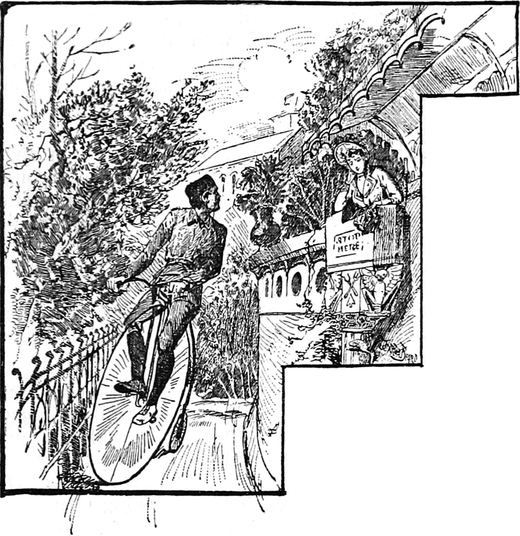
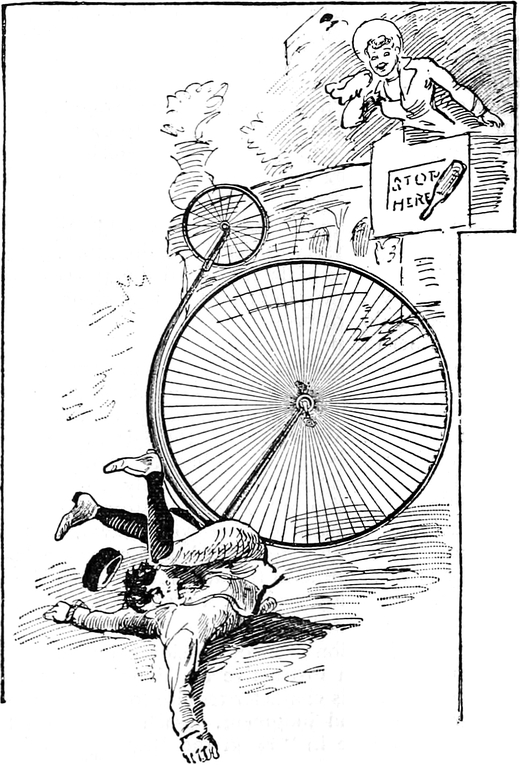
HER starry eyes, with lightning glance, Arrest me like a swift-thrown lance, As I ride down the narrow lane; And backward on my wheel I crane, Another glimpse to catch askance. My fickle steed begins to prance, And leads me such a lively dance, That danger signals glint in vain, Her starry eyes. O Fortune! if, by happy chance, You’d throw this fair one in a trance, Until I tumble on the plain— But no! she cries a laughing rain— A header dims my brief romance, Her starry eyes. And now whene’er I pass the seat Where first I met that maiden sweet, My aching heart is smote again; The blush of shame o’ermounts my brow, And bids me soft repeat the vow, Her starry eyes. Jay Gee.

FIRST BASEBALL PLAYER: Did you go to Shortstop’s wedding to-day?
SECOND BASEBALL PLAYER: Of course I did.
FIRST BASEBALL PLAYER: How did it come off?
SECOND BASEBALL PLAYER: Declared a tie.—Once a Week.
A CAPE COD fisherman calls his boat “The Kiss,” because it is nothing but a smack.—Puck.
MANY large wagers are chronicled from time to time, but Queen Elizabeth still remains the greatest Bet in history.—Exchange.
DEALER (to clerk): I’m going to make those boys’ diagonal suits fifteen dollars to-morrow.
CLERK: Fifteen dollars! Why, we’ve been selling them for ten dollars right along.
DEALER: I know it; but I’m going to give away a baseball bat with each one of them free of charge.—Detroit Free Press.
LADY (to negro cook): Can you poach eggs, Sambo?
SAMBO: ’Deed I kin, missy, when dey grows up.—Time.
CHOLLY: I say, Binx, did you ever witness a burial at sea?
BINX: No, never saw a burial, but we had a wake behind us all the way over last trip.—Harper’s Bazar.
“WHAT’S up, Billy?”
“Fut ball.”
“Well, ’fore I’d set up there in the cold watchin’ a lot of fellers kick a ball up—”
“Ain’t watchin’ em kick no ball up; watchin’ of ’em kick each other down!”—Harper’s Weekly.
A LOST curve in baseball—the Arc that Noah pitched.—Puck.
“WELL, Tompkins, how did you come out at the last race meeting?” asked a traveling man of a friend.
“As nearly as I can figure it, I came out about $1,500 ahead.”
“Fifteen hundred! That’s not bad. What horses did you back?”
“None. I had about $1,500 with me that I did not bet.”—Merchant Traveler.
“WHAT shall I play?” asked a meek-looking newly-appointed organist, of a parson of a rather festive turn of mind when off duty.
“That depends on the kind of a hand you have,” responded his reverence, in the most innocent manner.
THE man who is wild on the subject of yachting is an ultra-marine.—Puck.
SPIRITS probably walk about for exorcise.—Life.
THE yellow dog contemplates with satisfaction the advance in the price of tin cans. It’s an ill wind that blows nobody good.—Life.
DO you ever bet on the races, stranger?” he asked, as the boat approached Bay Ridge.
“I used to, but it cost me too much money.”
“You are a business man, I suppose?”
“Yes, sir; I sell ‘tips.’ I can give you a sure ten-to-one winner, to-day—only twenty-five cents.”—Time.
REFLECTIONS OF A CAT.
THE nicest bed is a pan of rising bread.
The old maid is the cat’s good Samaritan.
If it wasn’t for the rat I would be an outcast.
I think I have a pretty nose when it isn’t scratched.
The oven was about the hottest place I was ever in.
I am blamed for a great many things the girl breaks.
In all my experience I never yet saw a cat hit with a bootjack.
Every cat that gets on our back fence doesn’t come to see me.
When people go to sit down they never see I am asleep in the chair.
When I can’t get the ribbon off my neck I try to drag it in the dirt.
If I hadn’t talons the small boy would find no fun in pulling my tail.
The sailor is the only one who would sooner have a rat than a cat around.
The missis and I can never agree as to the place where I shall bring up my kittens.
Missis used to leave me only one kitten until after she had twins herself, and then she left me two.—Judge.
THIS department of OUTING is specially devoted to paragraphs of the doings of members of organized clubs engaged in the reputable sports of the period, and also to the recording of the occurrence of the most prominent events of the current season. On the ball-fields it will embrace Cricket, Baseball, Lacrosse and Football. On the bays and rivers, Yachting, Rowing and Canoeing. In the woods and streams, Hunting, Shooting and Fishing. On the lawns, Archery, Lawn Tennis and Croquet. Together with Ice-Boating, Skating, Tobogganing, Snowshoeing, Coasting, and winter sports generally.
Secretaries of clubs will oblige by sending in the names of their presidents and secretaries, with the address of the latter, together with the general result of their most noteworthy contests of the month, addressed, “Editor of OUTING,” 239 Fifth Avenue, New York.
TO CORRESPONDENTS.
All communications intended for the Editorial Department should be addressed to “The Editor,” and not to any person by name. Advertisements, orders, etc., should be kept distinct, and addressed to the manager. Letters and inquiries from anonymous correspondents will not receive attention. All communications to be written on one side of the paper only.
ATHLETICS.
THE Pavilion Pastime Club, of Brooklyn—a new organization—started in August last with a membership of twelve, has rapidly increased, and now numbers over seventy. Its grounds on Arlington Avenue, Jerome and Barbey streets, have been frequented daily by enthusiastic lovers of outdoor sports. The club has developed a number of excellent tennis players, among whom are the Misses Milan, the Misses Crawford, Miss Pattison, Miss Hart, Rev. R. H. Baker, Messrs. C. Palmer, J. H. Webster, and C. Wheeler. October 13, an evenly contested set was played on the grounds, Miss Alice Linton and Mr. J. A. Cruikshank defeating Miss Edith Linton and Dr. H. O. Rockefeller after a very interesting set, the score being 7-5.
A GENERAL meeting of the N. A. A. A. A. was held at the Grand Union Hotel, in this city, on the evening of October 6. The constitution and bylaws were revised. The alterations made were of a radical character, and a general movement of reform was inaugurated. The following clubs had delegates present: Missouri Amateur Athletic Club, Manhattan Athletic Club, Intercollegiate Athletic Association, Star Athletic Club, West Side Athletic Club, and Allerton Athletic Club. The matter of changing the rules governing weight competitions was referred to the executive committee, with power. The Intercollegiate Athletic Association will in future be entitled to one representative on the executive committee for every five colleges. This will increase the college representation to four. The Allerton Athletic Club, of New York City, was elected to membership, and other clubs will be proposed at the next meeting of the executive committee. The following meetings, under N. A. A. A. A. auspices, were announced: The Association championship was to take place positively, rain or shine, at the M. A. C. grounds, October 13. The Allerton Athletic Club games, open to all amateurs, was to take place at Madison Square Garden during November; the M. A. C. Winter games, open to all amateurs, same place, during December; the Star Athletic Club winter games, open to all amateurs, at same place, during January; the West Side Athletic Club games, open to all amateurs, at same place, during February. The International Athletic meeting, open to all amateurs, will take place on the Saturday before the Intercollegiate championship meeting at the M. A. C. grounds. In this meeting there will be fourteen scratch events, and the winner of each event will be entitled to go to Europe on the N. A. A. A. A. championship team, which team will compete at the English and Irish championships and at the international championship meeting at the Paris Exposition. The team will also take part in special meetings gotten up under the auspices of the National associations of the different countries. Among other large subscriptions, G. M. L. Sacks gives $500 towards the expenses of the team. The Columbia College Athletic Association will give its fall games under Intercollegiate Athletic Association rules. The entries of the N. A. A. A. A. athletes will be accepted in the open events. Other clubs and associations have expressed their intention of holding games under N. A. A. A. A. laws.
THE Perth Amboy, N. J., Athletic Association have elected the following officers for the ensuing year: William H. McCormick president; Mayor Thomas Armstrong, vice-president; Fred. F. Fox, secretary and treasurer.
AN exhibition was given by the athletic team of the Irish Gaelic Association at the Baseball grounds, Newark, N. J., October 20. Results were as follows:
100-yards run—J. Connelly, first, no time being taken; T. J. Maloney, second.
Hop, step and jump—Daniel Shanahan, first, 49 ft. 71⁄2 in.; P. Looney second.
Running long jump—D. Shanahan, first, 22 ft. 2 in.; J. Connelly, second, 21 ft.
Putting the 56-pound weight—J. S. Mitchell cleared 25 ft. 9 in. in the American style, and 32 ft. 5 in. according to Irish rules, J. C. Daly being second, with 24 ft. 2 in. and 30 ft. 7 in. respectively.
Quarter-mile run—N. J. Kearns first, in 54s.; F. Conklin, second, close up.
Throwing the 16-pound hammer from 9-ft. circle—J. S. Mitchell, first, 133 ft., the throw being made with a turn; J. C. Daly, second, 114 ft. 7 in.
Running high jump—O’Connor, first, 5 ft. 91⁄2 in.; Connery, second, 5 ft. 31⁄2 in.
The sports were brought to a close with the usual hurling match, which was watched with interest.
THE members of the Young Men’s Christian Association of Yonkers, N. Y., held their fall games October 20, the events resulting as follows:
100-yards run, for boys—N. A. Ball, first, in 121⁄2s.; G. W. Stephens second.
Running long jump—G. A. Gahagan, first, 22 ft. 91⁄2 in.; G. P. Holden second.
220-yards run, boys—N. A. Ball, won in 281⁄2s.
One mile run—Alexander Grieve, first, in 5m. 22s.; N. P. French second.
Running high jump—G. P. Holden won, 4 ft. 7 in.
100-yards run—M. Frazier, first; J. Atkinson second.
Half-mile run—F. A. Ware won, in 2m. 61⁄2s.
One mile walk—Frank Brown, first, in 7m. 521⁄2s.; C. L. Nicoll second.
Tug-of-war—Brooklyn Y. M. C. A. beat Yonkers Y. M. C. A. by a yard.
THE new athletic grounds, located at Morris Dock, on the Harlem River, were opened October 20, by the Berkeley Athletic Club. The opening event was a football match between teams representing the Berkeley Club and the St. John’s College of Sing Sing, which the latter won by a score of four touchdowns to nothing. The old Harvard champion sprinter, Wendell Baker, then attempted to surpass the record for running 280 yards, 29 4-5s., being assisted by his brother Fred, the latter receiving thirty yards start, and himself essaying to beat White’s 251-yard record of 311⁄4s. Owing to the heaviness of the track both failed, although Wendell lowered the record for the lesser distance to 26 3-5s. His time for 280 yards was 31 1-5s., while Fred’s time for 251 yards was 31 2-5s. Then A. F. Copeland, of the Manhattan Athletic Club, was successful in an attempt to break the hurdling records at 75, 100 and 120 yards, timers being stationed at the intermediate distances, and the new figures established being respectively 8 3-5s., 12 4-5s. and 14 3-5s., the hurdles being 2 ft. 6 in. in height. The event taken altogether was a great success.
THE fourth annual fall games of the Missouri Amateur Athletic Club took place at the Sportsman’s Park, St. Louis, October 14. The weather was not favorable, and the attendance was small. A large delegation from Chicago was present, and it must have been gratified at the way the Chicago athletes distinguished themselves in the contests in carrying off four firsts and five seconds. The games resulted as follows:
100-yards run, first heat—Emile Reder, M. A. A. C., 51⁄2 yards, won, 10 2-5s.; Walt Farrant, Chicago, 61⁄2 yards, second, by six inches. Second heat—Ed. Sampson, M. A. A. C., 9 yards, won, 10 4-5s.; Ed. Smith, Chicago, 41⁄2 yards and set back one, second, by two feet. Third heat—A. C. Wignall, Chicago, 41⁄2 yards, won, 10 3-5s.; A. J. Hellmich, M. A. A. C., 7 yards, second, by a yard. Fourth heat—D. L. Cabanne, Pastime A. C., 9 yards, won, 10 3-5s.; George Mark, M. A. A. C., 9 yards, second, by a foot. Fifth heat—John C. Meyers, M. A. A. C., 10 yards, won, 10 2-5s.; H. G. Perry, Chicago, 4 yards, second, by a yard. Final heat—Cabanne, won, 10 2-5s.; Wignall second, by a half-yard; Sampson third, Meyers fourth.
Weight contest for height—George Riddle easily won the 56-pound weight contest for height, tossing the missile over the bar at 10 ft. 5 in., with Dan Leahy second, three inches less. Riddle afterward threw 11 ft. 1 in. and is good for much higher. Three others competed.
Running high kick—A. C. Baum, of the Missouri A. A. C., easily won the running high kick with 8 ft. 11 in.; George Powell, same club, second, at 8 ft. 8 in. Baum then tried for a record, and did 9 ft. 51⁄2 in. C. C. Lee, of Yale College, holds the world’s record, 9 ft. 8 in. H. G. Perry, of Chicago, also competed.
440-yards run, handicap—First heat—W. S. Farrant, Chicago, 25 yards, won, 53 1-5s.; W. T. Nolan, M. A. A. C., 8 yards, second; R. J. Leacock, M. A. A. C., 20 yards, third. Second heat—J. C. Meyers, M. A. A. C., 30 yards, won, 52s.; James Price, Chicago, 30 yards, second; A. J. Hellmich, M. A. A. C., third. Final heat—Farrant won, 51 1-5s.; Leacock, second, by three yards; Price, third, by two yards. The start was too great for Farrant. Leacock’s effort was a good one, but he had hard work beating Price.
Mile walk, handicap—H. H. Hentrichs, M. A. A. C., 125 yards, won easily by twenty yards, 7m. 45s.; Ed. Gaines, M. A. A. C., scratch, second. Two others started, but both stopped.
Mile run, handicap—Arthur Hunn, M. A. A. C., 110 yards, won easily by ten yards, 4m. 43 2-5s.; R. K. McCullough, Chicago, 120 yards, a strong second; T. K. Henderson, Chicago, scratch, third, by twenty yards. The latter ran a game race.
Hurdle race, 220 yards, handicap—The first heat was a walk-over for George Mark, 15 yards, and A. J. Hellmich, 15 yards, in 30 3-5s. The second heat was won by Ed. Smith, Chicago, scratch, in 30 4-5s.; D. L. Cabanne, Pastime A. C., 15 yards, second; J. C. Meyers, 15 yards, third. Final heat—Mark won by two yards in 28 1-5s.; Smith second; Hellmich third, by ten yards.
George Powell took the high jump with an actual jump of 5 ft. 91⁄4 in., George Riddle, Chicago, six inches, second, 5 ft. 9 in.
Half-mile run, scratch—Ed. Baker, Chicago, won, 2m. 6 1-5s.; T. T. Lingo, St. Louis, second, by five yards.; W. T. Nolan, M. A. A. C., third, beaten off. R. J. Leacock, M. A. A. C., also started.
Hop, step and jump—Chas. Bayer, Jr., 4 feet, won, 43 ft. 111⁄2 in.; A. C. Wignall, Chicago, 4 feet, second, 43 ft. 9 in.
The members’ race was taken by A. H. Hitchings, in 37 2-5s.; B. A. McFadden second, by a yard.
John C. Meyers won the amusing obstacle race in easy style, with F. H. Armfield second, and Arthur Hunn third.
THE fall games of the Columbia Athletic Club, of Washington, D. C., were held on Analostan Island, in the Potomac River, October 6. The weather was disagreeable, and though the attendance of visitors was comparatively small, the games themselves were a success. The grounds and track were in fairly good condition, and the events resulted as follows:
100-yards run—Samuel King first, in 10 2-5s.; L. T. Reed, second by a yard.
Two-mile bicycle race, lap—W. E. Crist first, 26 points; Phil. Brown second.
120-yards hurdle race—Lee Harban first, in 18 3-5s.; McCawley second.
One mile walk—A. T. Stoutenburg first, in 9m. 15s.; O’Leary second.
Bicycle race, mile, novice—W. E. Bell, first, in 3m. 25 1-5s.; T. Hodgson second.
220-yards run—Sam. King, first, in 23s.; L. T. Reed, second.
One mile bicycle race—L. J. Barber, 75 yards start, first, in 2m. 47 4-5s.; W. E. Crist, scratch, second.
220-yard run—Sam King first, in 55 3-5s.
One mile run—J. M. Kenyon, first, Lee Harban second.
Throwing the hammer—T. C. Chalmers, first, 62 ft. 8 in.; Van Rensselaer, second, 60 ft. 2 in.
Standing high jump—Robert Elder, first, 4 ft. 4 in.
Running long jump—S. E. Lewis, first, 20 ft.
Putting the shot—L. T. Reed, first, 34 ft. 7 in.
Running high jump—W. E. Buell, first, 5 ft.
Standing long jump—Robert Elder, 9 ft. 10 in.
Pole vault—Telfair Hodgson, first, 7 ft. 8 in.
Tug-of-war—Fat men defeated lean men.
THE thirteenth annual meeting of the National Association of Amateur Athletes, for the Amateur Championship of America, was held October 13, on the Manhattan Athletic Club Grounds. The Irish athletes proved superior in three events—the 440-yards run, the running high jump, and throwing the fifty-six pound weight. In putting the shot, the method of J. S. Mitchell of the Irish team was objected to and he withdrew from the contest. He made one effort, however, that was allowed to count, and that gave him second place. In throwing the fifty-six pound weight he lowered the American record six and three-quarter inches. W. J. Barry, also of the Irish team, threw the sixteen-pound hammer 120 ft. 11 in., as an exhibition of his own method of throwing. Conneff, of the M. A. C., had an easy victory in the five-mile run, winning by over a quarter of a mile. Results were as follows:
100-yards run, first heat—Walk-over for F. Westing, M. A. C. Second heat—A. F. Copeland, M. A. C., first. Time, 10 2-5s. Third heat—V. E. Shifferstein, Olympic A. C., California, first. Time, 10 3-5s. Trial heat for second men—J. Mooney, Gaelic A. A., first. Final heat—F. Westing, first. Time, 10s. Dead heat between Copeland and Schifferstein. Copeland won the run off in 10 2-5s.
One mile walk—E. D. Lange, M. A. C., first. Time, 6m. 53 4-5s.; C. L. Nicoll, M. A. C., second.
One mile run—T. P. Conneff, M. A. C., first. Time, 4m. 32 3-5s.; W. McCarthy, Gaelic A. A., second.
220-yards run—F. Westing, first. Time, 22 2-5s.; H. M. Banks, M. A. C., second.
Two mile bicycle race—J. W. Powers, Jr., M. A. C., first. Time, 6m. 55s.; J. H. Hanson, M. A. C., second.
Three mile walk—E. D. Lange, first. Time, 22m. 49 3-5s.; C. L. Nicoll, second.
120-yards hurdle race, first heat—A. F. Copeland first. Time, 17 2-5s.; Herbert Mapes, Columbia College A. C., second. Second heat—Walk-over for H. S. Younghand, M. Vandervoort, M. A. C. Final heat—A. F. Copeland, first. Time, 16 2-5s.; Herbert Mapes, second.
Half-mile run—J. W. Moffatt, Montreal A. A. A., first. Time, 2m. 2 1-5s.; J. C. Devereaux, Columbia College A. C. second.
440-yards run—T. J. O’Mahony, Gaelic A. A., first. Time, 53s.; T. J. Norton, M. A. C., second.
220-yards hurdle race—A. F. Copeland, first. Time, 20 3-5s.; Herbert Mapes, second.
Five mile run—T. P. Conneff, first. Time, 25m. 35s. S. J. Freeth, Prospect Harriers, second.
Tug-of-war—D. S. Lord, J. Jenning, D. T. Brokaw and W. Revere, M. A. C., against G. M. Elliott, F. M. R. Meikleham, E. C. Robinson and Eugene Clapp, Columbia College. Manhattans won by two inches.
Tug-of-war—M. A. C. team against M. Mulhern, J. J. Van Houten, J. Moran and C. Miltman, West Side A. C. Manhattans won by 73⁄4 in.
Pole vault—G. P. Quinn, University of Pennsylvania, first, 10 ft. 1 in.; J. J. Van Houten, West Side A. C., second, 9 ft. 10 in.
Putting the shot—F. L. Lambrecht, M. A. C., first, 42 ft. 4 in.; J. S. Mitchell, Gaelic A. A., second, 41 ft. 9 in.
Running high jump—T. M. O’Connor, Gaelic A. A., first, 5 ft. 91⁄2 in.; M. W. Ford, Brooklyn, second, 5 ft. 81⁄2 in.
Throwing 16-lb. hammer—F. L. Lambrecht, first, 105 ft. 1 in.; J. S. Mitchell, second, 102 ft. 3 in.
Running broad jump—V. E. Schifferstein, first, 23 ft. 13⁄4 in.; A. F. Copeland, second, 22 ft. 1⁄2 in.
Throwing 56-lb. weight—J. S. Mitchell, first, 26 ft. 10 in.; J. C. Daly, Gaelic A. A., second, 26 ft. 8 in.
THE annual fall games of the Princeton College Athletic Association were held at the University grounds, October 20. The Princeton record in the half-mile run was broken by Roddy, ’91, who covered the distance in 2m. 5 1-5s. Dohm, ’90, ran one hundred yards in 10 sec. The other events and winners were as follows:
Throwing the hammer—Brownlee, ’89, 81 ft. 91⁄2 in.
Running high jump—Lemassena, ’90, 5 ft. 2 in.
Mile walk—Whitehead, ’91; time, 8m. 10 1-5s.
Putting the shot—Galt, ’91, 28 ft. 10 in.
Quarter-mile run—Somerby, ’92; time, 59s.
220-yards dash—Dohm, ’90; time, 23 1-5s.
Mile run—Phillips, ’90; time, 5m. 18s.
Two-mile bicycle race—Shick, ’92; time, 8m. 7 1-5s.
Running broad jump—Lemassena, ’90, 20 ft. 91⁄2 in.
THE fall meeting of the Ridgefield Athletic Association took place on the afternoon of October 8. The results were as follows:
100-yards dash—J. F. McDonald, three yards lead, first; J. H. Shepard, six yards, second. Time, 10 3-5s.
Running broad jump—Ben. J. Worman, one foot allowance, first, 19 ft. 7 in.; F. R. Wells, second, 18 ft. 11 in.
440-yards run—J. F. McDonald, 10 yards lead, first; William Grotenhuis, second. Time, 57 1-5s.
Hop, step and jump—Ben. J. Worman, allowance of three feet, first, 41 ft. 10 in.; F. R. Wells, second, 41 ft. 1⁄2 in.
100-yards dash, juniors, heats—J. H. Bailey first, E. L. Miller second. Time, 11s.
220-yards dash—Wm. Grotenhuis, six yards lead, first; R. S. Calkins, Jr., second. Time, 231⁄2s.
Running high jump—H. M. Wilcox, allowance of four inches, first, 4 ft. 11 in.; F. R. Wells, second, 4 ft. 91⁄2 in.
Putting 16-pound shot—F. R. Wells, first, 33 ft. 51⁄2 in.; M. Pennington, second, 29 ft. 4 in.
880 yards—W. Patterson first, F. R. Wells second. Time, 2m. 28 1-5s.
THE fall athletic sports of the University of Pennsylvania took place October 20, with the following results:
Open 100-yards dash—Won by Sweet, of Swarthmore, in 10 4-5s.
100-yards dash—Won by Landreth, ’91, in 10 4-5s.
Pole vault—Won by Quinn (law), with 9 ft. 51⁄2 in.
Throwing the hammer—Won by Bonsall (med.), with 96 ft.
Half-mile run—Won by Chamberlain, ’89, in 2m. 20 3-5s.
440-yards dash—Won by Kulp (med.), in 56s.
Mile walk—Won by Schofield (law), in 8m. 39 1-2s.
Running high jump—Won by Howard, ’91, with 5 ft. 7⁄8 in.
Running broad jump—Won by Landreth, ’91, with 19 ft. 5 in.
120-yards hurdle race—Won by Stroud, ’88, in 19s.
Mile bicycle race—Won by Cressman, ’90, in 3m. 25 1-5s.
Putting the shot—won by Bonsall (med.), with 33 ft. 6 in.
220-yards hurdle race—Won by Stroud, ’88, in 34 1-5s.
Mile run—Won by West, ’91, in 5m. 3s.
220-yards dash—Won by Landreth, in 25s.
THE fall meeting of the Yale University Athletic Association was held October 20. There were 137 entries. The grounds were in excellent condition. Results were as follows:
120-yards dash—Won by H. F. Walker, Yale, ’89, 61⁄2 yards start, in 12 1-5s.
Mile run—J. T. Lloyd, Yale, ’91, 50 yards handicap, won in 4m. 43 2-5s.
Mile walk—L. R. Parker, Yale, ’92, won in 8m. 19 1-5s.
600-yards run—Won by C. W. Porter, Amherst, ’90, 24 yards handicap, in 1m. 13s.
120-yards hurdle race—Won by H. L. Williams, Yale, ’91, 5 yards handicap, in 17 1-5s.
Two mile bicycle race—Won by F. A. Clark, Yale, ’91, Sheffield, handicap, 50 yards; time, 6m. 33 1-5s.
300-yards run—Won by H. F. Walker, Yale, ’89; time, 32 2-5s.
220-yards hurdle race—H. L. Williams, Yale, ’91, handicap 6 yards, won in 28 4-5s.
Three-quarter mile steeplechase—G. Y. Gilbert, N. Y. A. C., won in 4m. 38 4-5s.; C. A. Davenport, Harvard, ’90, and J. P. Lloyd, Yale, ’91, ran a dead heat for second place, which had to be run off, when the Harvard man won.
440-yards run—Won by E. B. Hinkley, Yale, ’89, in 52s.; F. W. Robinson, Yale, ’90, was a very close second.
Running high jump—A. Nickerson, N. Y. A. C., handicap 4 in., won in 5 ft. 111⁄2 in.
Throwing the hammer—H. A. Elcove, Yale, ’91, with a handicap of 3 ft., won with 81 feet, 1 in.
Running broad jump—E. P. Hinckley, Yale, ’89, handicap 3 ft. 6 in., jumped 22 ft. 8 in. and won.
Putting the shot—F. W. Robinson, Yale, ’90, handicap 4 ft., won with 35 ft. 8 in.
Pole vault—E. D. Ryder, Yale, ’91, with a handicap of 1 ft. 10 in., won with 10 ft. 2 in.; T. G. Shearman, Yale, ’89 was second.
DELEGATES from the Manhattan, Star, Titan, Crescent, Brighton and Allerton Athletic Clubs and the Missouri Athletic Association made up the meeting of the National Cross-Country Association in this city, October 23. The West Side Athletic Club was elected to membership. The officers elected for the ensuing year are: President, F. A. Ware, Crescent A. C.; vice-president, C. C. Hughes, Manhattan A. C.; secretary, C. J. Harvey, Star A. C.; treasurer, E. J. Ryan, Allerton A. C. Executive Committee—E. J. Ryan, Allerton, A. C.; D. J. Cox, Brighton, A. C.; C. S. Busse, Crescent A. C.; C. C. Hughes, Manhattan A. C.; J. A. Murphy, Missouri A. A. A.; C. J. Harvey, Star A. C.; J. L. McAuliffe, Titan A. C.; J. D. Douglass, West Side A. C.
THE first annual meeting of the National Amateur Athletic Union was held on the grounds of the Detroit Athletic Club, September 19. An attendance of five thousand witnessed the games, and the entire management was a success. The referee was John F. Huneker of the Athletic Club of the Schuylkill Navy. The judges were D. G. Trench, Chicago Athletic Club; W. G. Schuyler, New York Athletic Club; J. H. Booth and F. W. Janssen, Staten Island Athletic Club; P. E. Stanley and F. D. Standish, Detroit Athletic Club. As timekeepers, the following gentlemen officiated: Otto Ruhl and J. H. Abeel, Jr., New York Athletic Club; Fred. T. Moran, Detroit Athletic Club; W. H. Robertson, Pastime Club, and Hon. J. E. Reyburn, Cape May City Club. The measurers were J. E. Sullivan, Pastime Club; Howard Perry, Columbia Club; J. W, Carter, New York Club; Charles W. Lennon, Pullman Club, and W. H. Rogers, Schuylkill Navy. George Turner, of Philadelphia, was starter, and Sporting Editor, P. J. Donohue, of the New York World, was judge of walking. Harry McMillan, of the Schuylkill Navy, was chief-marshal of the day, and Fred. W. Burns, of the Brooklyn Athletic Club, official announcer. The following were the results in the various events:
100-yards run—F. Westing, Manhattan Athletic Club, first; C. H. Sherrill, Yale College, and Malcolm W. Ford, Staten Island Athletic Club, tied for second place, Ford getting the place on the toss. Time, first heat, 10 2-5s.; second heat, 10 3-5s.; third heat, 10 2-5s.; final heat, 10 2-5s.
120-yards hurdle—A. A. Jordan, New York Athletic Club, first; A. F. Copeland, Manhattan Athletic Club, second; E. M. Vandervoort, Manhattan Athletic Club, third. Time, 16 1-5s.; won in one heat.
One-mile walk—W. R. Burkhardt, Pastime Athletic Club, first; C. L. Nicoll, Manhattan Athletic Club, second. Time, 6m. 54 1-5s.
One-mile run—G. M. Gibbs, Toronto Athletic Club, first; T. P. Conneff, Manhattan Athletic Club, second; P. D. Skillman, New York Athletic Club. Time, 4m. 27 1-5s.
220-yards run—F. Westing, Manhattan Athletic Club, first; W. C. Dohm, New York Athletic Club, second; H. F. Walker, Detroit Athletic Club, third. Time, 22 1-5s.
220-yards hurdle race—Won in one heat—A. F. Copeland, Manhattan Athletic Club, first; A. A. Jordan, New York Athletic Club, second; G. Schwegler, Chicago Athletic Club, third. Time, 26 4-5s.
Three-mile walk—Won by E. D. Lange, of the Manhattan Athletic Club; Otto Hassell, Chicago Amateur Athletic Club, second.
Two-mile bicycle race—W. E. Crist, Columbia Athletic Club, first. Time, 6m. 49 1-5s.
440-yards run—W. C. Dohm, New York Athletic Club, first. Time, 51s.
880-yard run—G. Tracey, Wanderers’ Athletic Club, Chicago, first; C. M. Smith, New York Athletic Club, second; C. L. Estes, Manhattan Club, third. Time, 2m. 2 1-5s.
Five-mile run—T. P. Conneff, Manhattan Athletic Club, first; E. C. Carter, New York Athletic Club, second. Time, 26m. 46 3-5s.
Running high jump—J. D. Webster, Manhattan Athletic Club, first, 5 ft. 61⁄2, in.; W. M. Norris, Staten Island Athletic Club, second, 5 ft. 41⁄2 in.; R. K. Pritchard, Staten Island Athletic Club, third, 5 ft. 41⁄2 in.
Tug-of-war—Manhattan Athletic Club Team—D. S. Lord, anchor; W. Revere, D. T. Brokaw, and J. Senning, against the “Busy Bees” Athletic Association of Co. B, 22d Regiment, N. G. S. N. Y. Won by the “Busy Bees,” in the first and third pulls.
Putting 16-lb. shot—G. R. Gray, New York Athletic Club, first, 42 ft. 101⁄2 in.; F. L. Lambrecht, Manhattan Athletic Club, second, 40 ft. 6 in.; W. L. Coudon, New York Athletic Club, third, 40 ft. 41⁄2 in.
Running long jump—W. Halpin, Olympic Athletic Club, first, 23 ft.; A. F. Copeland, Manhattan Athletic Club, second, 22 ft. 115⁄8 in.; A. A. Jordan, New York Athletic Club, third, 22 ft. 97⁄8 in.
Throwing 16-lb. hammer—W. J. M. Barry, Queen’s College, Cork, first, 127 ft. 1 in.; C. A. J. Queckberner, Staten Island Athletic Club, second, 106 ft. 11 in.; F. L. Lambrecht, Manhattan Athletic Club, third, 97 ft. 4 in.
Pole vault—L. D. Godshall, Manhattan Athletic Club, first, 10 ft.; C. Whitehorn, Staten Island Athletic Club, second, 9 ft. 9 in.; A. A. Jordan, New York Athletic Club, third, 9 ft.
Throwing 56-lb. weight—W. L. Coudon, New York Athletic Club, 27 ft. 9 in., beating the world’s record by 1 ft. 11 in.
COLUMBIA COLLEGE students turned out in full force October 26, at the Manhattan Athletic Club grounds. The entries numbered over 225. Three Columbia records were broken and one intercollegiate record was equaled. H. Mapes, ’92 (mines), won the 220-yards hurdle in 26 4-5s., beating the Columbia record by two seconds and equaling the intercollegiate best time. He also beat the college record for the 120-yards hurdle in 17 1-5s. A. S. Vosburgh, ’90 (arts), beat the Columbia mile record by one second, making the distance in 4m. 53 2-5s. The winners and seconds are as follows:
100-yards dash—Final, Herbert Mapes, 3 yards, first; H. M. Banks, Jr., scratch, second. Time, 10 3-5s.
220-yards run—H. M. Banks, scratch, first; Herbert Shipman, 7 yards, second. Time, 23 2-5s.
440-yards run—J. C. Travis, 35 yards, first; Herbert Shipman, 18 yards, second. Time, 52s.
880-yards run—J. M. Hewlett, 40 yards, first; M. R. Strong, 10 yards, second. Time, 2m. 5s.
Mile run—A. S. Vosburgh, scratch, first; J. S. Langthorn, 25 yards, second. Time, 4m. 53 2-5s.
Mile walk—T. McIlvaine, scratch, first; H. G. Peck, second. Time, 8m. 8 4-5s.
Two-mile bicycle—W. H. Hall, 60 yards, first; G. A. Wardlaw, second. Time, 7m. 50 4-5s.
220-yards novice race—S. R. Bradley, first; J. R. Steers, second. Time, 25 4-5s.
880-yards novice race—F. E. Gunnison, first; J. A. Dempsey, second. Time, 2m. 27s.
120-yards hurdle—H. Mapes, ’92 (mines), first; T. H. Havemeyer, 12 yards, second. Time, 17 1-5s.
220-yard hurdle—H. Mapes, scratch, first; Victor Mapes, 15 yards, second. Time, 26 4-5s.
Putting 16-lb. shot—B. C. Hinman, actual distance 33 ft. 6 in., first; M. C. Bogert, actual distance 31 ft., second.
Running high jump—F. C. Hooper, actual height, 5 ft. 4 in., first; Alexander Stevens, 4 ft. 7 in., second.
Running broad jump—Victor Mapes, actual distance, 20 ft. 8 in., first; J. C. Devereaux, 19 ft. 8 in., second.
Throwing 16-lb. hammer—B. C. Hinman, actual throw, 79 ft., first; M. T. Bogert, 66 ft. 6 in., second.
Tug-of-war—’89 won from ’90 by 1 in.; ’92 won from ’91 by default; ’89 won from ’92 by default.
The winners in the open events were:
100-yards run, handicap—F. Westing, M. A. C. first; H. Shipman, 5 yards, second. Time, 10 2-3s.
Half-mile run—J. W. Moffatt, of Canada, scratch, first; D. I. Tompkins, Manhattan Athletic Club, 24 yards, second. Time, 2m. 2-5s.
C. H. Mapes was referee; G. L. M. Sachs, S. C. Herriman, and D. L. R. Dresser, judges; G. A. Avery, W. Hegeman, C. C. Hughes, timers, and H. Pike, starter.
BASEBALL.
THE following is the official record of the League Championship campaign, giving the victories and defeats of each club and the deciding percentage of victories, on the basis of which every club was placed in the race, from the pennant winner to the tail-ender:
CLUBS. New York. Chicago. Philadelphia. Boston. Detroit. Pittsburgh. Indianapolis. Washington. Games won. Per cent. of victories.
New York — 8 14 12 11 10 11 15 84 .641
Chicago 11 — 8 12 10 9 14 13 77 .570
Philadelphia 5 10 — 10 7 14 13 10 69 .531
Boston 8 7 9 — 10 10 11 15 70 .522
Detroit 7 10 11 8 — 10 11 11 68 .519
Pittsburgh 7 11 6 8 10 — 14 10 66 .493
Indianapolis 5 6 4 9 8 6 — 12 50 .370
Washington 4 6 9 5 7 9 8 — 48 .358
Games lost 47 58 61 64 63 68 85 86 532
Not only was the race close between New York and Chicago for first place up to October, but the struggle for the third position between Philadelphia, Boston, and Detroit, was interesting.
Here is a table giving the full statistics of the League campaign in all the most essential particulars.
New York. Chicago. Philadelphia. Boston. Detroit. Pittsburgh. Indianapolis. Washington.
Victories 84 77 69 70 68 66 50 48
Defeats 47 58 61 64 63 68 85 86
Games played 131 135 130 134 131 134 135 134
Per cent. of victories .641 .570 .531 .522 .519 .493 .370 .358
Drawn games 7 1 1 3 3 4 1 2
Series won 5 4 2 2 3 2 1 0
Series lost 1 1 1 2 1 2 6 5
Series tied 0 1 0 0 2 1 0 0
Series unfinished 1 1 4 3 1 3 3 3
Batting average .240 .247 .229 .240 .243 .223 .233 .207
Fielding average .918 .906 .919 .904 .916 .914 .904 .899
Victories at home 44 43 37 34 41 38 31 26
Victories abroad 40 34 32 36 27 28 19 22
Defeats at home 23 26 31 29 26 30 35 38
Defeats abroad 24 32 30 34 37 39 50 48
Extra innings games 6 2 9 2 4 4 1 1
Chicago victories 18 11 16 7 10 13 6 6
Chicago defeats 3 9 6 13 5 19 11 21
The appended table presents the statistics, in brief, of the thirteen pennant races of the League, from 1876 to 1888, inclusive.
YEAR. CHAMPION CLUB. VICTORIES. DEFEATS. Per cent. of victories. CLUB MANAGER.
1876 Chicago 52 14 .788 Spalding
1877 Boston 31 17 .648 Harry Wright
1878 Boston 41 19 .683 Harry Wright
1879 Providence 55 23 .705 George Wright
1880 Chicago 67 17 .798 Anson
1881 Chicago 56 28 .667 Anson
1882 Chicago 56 29 .655 Anson
1883 Boston 63 55 .534 Harry Wright
1884 Providence 84 28 .750 Frank Bancroft
1885 Chicago 87 25 .776 Anson
1886 Chicago 90 34 .725 Anson
1887 Detroit 79 45 .637 Watkins
1888 New York 84 47 .641 Mutrie
CANOE.
THE second series in the canoe sailing races for the international challenge cup took place October 13 from Bechtel’s Rock, Stapleton, Staten Island, over the usual course, which is two miles long. The boats sailed over the course four times, making the distance of the race eight miles. Col. C. L. Norton, of the New York Canoe Club, acted as referee.
There was but one race in the forenoon, which was won by the Eclipse of the Brooklyn Canoe Club, sailed by R. S. Blake, in 2h. 1m. 30s. The Charm, of the Royal Canoe Club, sailed by Walter Stewart, took the lead at first, but was overhauled and passed by the Yankee boat. The time of the Charm was 2h. 8m. 30s.
The afternoon race was won by the Eclipse, in 2h. 9m. 45s. The Charm was unable to round the offshore buoy according to the requirements, and the Brooklyn boat went over the course alone. The winning of the silver international cup by an American boat will necessitate the next international canoe race to be sailed also in American waters.
There were other races during the day for a prize flag. The first race of this contest had three entries, and the boats finished in the following order: Fly, time, 1h. 15m. 10s.; Essex, of the Essex Club, 2h. 7m.; and the Guinn, Brooklyn Club, 2h. 8m. The course was six miles.
The second race was decided in the following order: Fly, 1h. 34m. 45s.; Guinn, 1h. 36m. 30s.; Vagabond, 1h. 41m. 20s.; If, 1h. 45m. 45s.; New York, 1h. 48m.; Essex, 1h. 48m. 45s. Will of the Wisp and Nancy fell out of the race.
CRICKET.
CRICKET has closed for the year among the leading English teams. During the season the following scores were made in first-class matches: W. G. Grace, 215, 165, 153, and 148; W. W. Read, 338, 171, 109, and 103; W. Newham, 129 and 118; M. P. Bowden, 189, not out; J. Eccles, 184; Abel, 160; Painter, 150; P. J. T. Henery, 138, not out; Jesse Hide, 130; Hall, 129, not out; Briggs, 126, not out; S. W. Scott, 121, not out; Maurice Read, 109; K. J. Key, 108; Wainright, 105; Frank Sugg, 102, not out. The 153 and 148 of W. G. Grace were made in one match.
THE Irish Gentlemen cricketers, who have been visiting the principal cricket clubs in this country and Canada, sailed for home October 3, on the City of Rome. The Irishmen speak in warm terms of the way in which they were treated by their brother sportsmen here. They have reason to be proud of their performance. During six weeks they have played thirteen matches, of which they have won eleven and lost two. Both games were lost in Philadelphia, one by seven runs, the other by thirty-nine. In Canada the Home Rulers defeated Kingston’s and Ottawa’s best players by large scores, and in a match against all Canada they had eighty-six runs, and an innings to spare. In the United States they defeated all the best elevens, except those in Philadelphia. New York’s best team came within nine wickets of the Irishmen in a two-innings match. The highest score made by any member of the visiting team was 126, made by J. Dunn, in the New York match.
CURLING.
THE annual meeting of the Ontario Branch of the Royal Caledonia Curling Club was held in Montreal, October 16. The following is a list of the officers elected: His Excellency the Governor-General, Patron; Robert Ferguson, president; vice-presidents, John Harvey and Dr. Bouchier; chaplain, Rev. D. J. Macdonnell; secretary-treasurer, J. S. Russell; council of management, W. Badenach, Toronto Granite Club; W. Rennie, Toronto Caledonian Club; Dr. Beaton, Orillia Club; T. McGaw, Toronto Club; W. Leggatt, Hamilton Thistle Club, and Dr. Berth, Bowmanville Club.
CYCLING.
S. G. WHITTAKER continues to make new records abroad. September 22, at the Long Eaton Recreation Grounds, England, he made the attempt to beat the record for twenty-five miles, and succeeded in creating new figures for every mile from two to the finish. Time for the full distance, 1h. 11m. 52⁄3s.
G. R. WHITE, in England, at the annual North Road Cycling Club’s 100-mile road ride, September 22, over the usual course, on an “Ordinary,” rode the entire distance without dismounting, in 6h. 48m. 14s. The previous record was 7h. 6m. 18s., and was made by F. H. Williams.
THE Y. M. C. A., of Worcester, Mass., had games October 20, and in the one-mile bicycle race D. W. Rolston made the mile in 3m. 18 1-5s., James Wilson, Jr., coming in second, in 3m. 18 3-5s.
THE Pennsylvania five-mile handicap race was run October 20. The contest resulted as follows: J. H. Draper, half-lap handicap, first, in 22m. 25s.; D. A. Longaker, one lap, second; J. G. Fuller, scratch, third; C. L. Leisen, one lap, fourth; Al. Kohler, one lap, fifth; John A. Wells, one lap, sixth; L. J. McCloskey and W. W. Randall, each with two laps, finishing seventh and eighth. The track was soft and the wind strong.
A. C. AND W. D. BANKER, of Pittsburgh, Pa., rode a mile, tandem, Sunday, October 21, in 2m. 41 4-5s. The course was rough, and a strong wind prevailed against the riders.
THE Danvers, Mass., Cycle Club races were run October 20 on a heavy track. The results: Mile novice—J. Ogden, of Middletown, 3m. 4s. Half-mile, club challenge, two in three—M. W. Robson, of Salem. Mile tandem tricycle—R. H. Robson and mate, of Salem, 4m. 50s. Mile handicap—E. A. Bailey, of Somerville (scratch), 3m. 37s. Mile tricycle—R. H. Robson, of Salem, 5m. 15s. Two mile—E. A. Bailey, 8m. 15s. Mile county championship—H. Robson, of Salem, 4m. 14s. Referee, W. S. Atwell, of Boston.
THE five-mile Peninsula championship, decided at the Wilmington (Del.) Fair, was won by McDaniel; Pyle second; Jefferies third.
I. P. HAIL, of Albany, Oregon, recently made a four hundred mile trip through Southern Oregon to Coos Bay and return. He crossed the Coast Range Mountains twice, and traveled one hundred and fifty miles over a rough mountain trail, over which no bicycle had ever passed.
JOHN M. COOK has presented an eight-in-hand cycle to a college for the blind, at Upper Norwood, England. The eight-in-hand is arranged for the girls of the institution to ride. Two four-in-hands and a tandem will enable the boys to take exercise and recreation.
THE tournament of the Pittsburgh Cycling and Athletic Club was held at Pittsburgh, September 24, 25 and 26. It was a show in which professionals and amateurs took part. “The tournament,” says the Wheelmen’s Gazette, “was a success from a sporting standpoint,” whatever that may mean, “but there was little or no financial benefit.” The following is a summary of the races:
Monday, September 24.
One-half-mile bicycle scratch—W. W. Windle, first; time, 1m. 23s. One-mile novice—W. D. George, first; time, 3m. 20s. Five-mile professional championship—First heat of championship series—W. A. Rowe, first; time 15m. 22 1-5s. One-half-mile bicycle, 1:35 class—W. D. George, first; time, 1m. 35 1-5s. Two-mile professional lap race—H. G. Crocker, first, 31 points; time, 6m. 42s. Two-mile Pennsylvania Division State championship—A. C. Banker, first; time, 6m. 3 1-5s. One-mile bicycle, 3:30 class—W. D. George, first; time, 3m. 21 2-5s. One-mile professional handicap—W. F. Knapp, 30 yards, first; time, 2m. 52 3-5s. Two-mile bicycle scratch—W. W. Windle, first; time, 6m. 15s.
Tuesday, September 25.
One-mile bicycle lap race—W. W. Windle, first, 14 points; time, 2m. 55s. One-half-mile bicycle novice—W. D. George, first; time, 1m. 38s. Three-mile bicycle professional, second heat of world’s championship—W. A. Rowe, first; time, 8m. 57s. One-mile bicycle, 3:10 class—W. D. George, first; time, 3m. 19 1-5s. One-mile professional handicap—R. A. Neilson, 50 yards, first. One-mile bicycle scratch—W. W. Windle, first; time 3m. 2-5s. Two-mile bicycle professional—W. F. Knapp, first; time, 6m. 14s. Three-mile bicycle amateur handicap—W. W. Windle, scratch, first. Time, 8m. 59s.
Wednesday, September 26.
One-mile bicycle amateur handicap—W. W. Windle, scratch, first; time, 2m. 581⁄2s. One-mile professional bicycle scratch—R. A. Neilson, first; time, 3m. 12s. Two-mile bicycle amateur, 6:20 class—W. D. George, first; time, 7m. 2s. Two-mile bicycle amateur lap race—W. W. Windle, first; time, 6m. 20s. One-mile professional bicycle, final heat world’s championship—W. A. Rowe, first; time, 3m. One-mile bicycle amateur scratch—W. W. Windle, first; time, 2m. 55 3-5s. One-mile bicycle, 3:20 class—W. D. George, first; time, 3m. 23s. Two-mile bicycle handicap, professional—H. G. Crocker, 20 yards, first; time, 6m. 11s. Five-mile bicycle L. A.W. State championship—W. D. Banker, first; time, 16m. 28s.
THE Indianapolis Wheelmen held their first annual race meet at the Exposition Grounds, September 29. The track was bad, the weather was wretched, and time poor. The results were as follows: The one-mile novice race was won by W. C. Marmon, in 3m. 20 4-5s.; the five mile State championship by L. M. Hollingsworth, in 17m. 6 4-5s.; the one-half mile heat by A. B. Taylor, in 1m. 31s.; the one mile club championship by Tom Hay, in 3m. 59 4-5s.; the two-mile lap by L. M. Hollingsworth, in 7m. 7s.; the quarter-mile heat by A. B. Taylor, in 42s.; the one-mile, 3:30 class, by Chas. McKeen, in 3m. 42s.; the one-half mile heat by L. M. Barber, in 1m. 34s.; the one-mile rover safety by A. L. Tabor, in 3m. 56s.; the quarter-mile heat by A. B. Taylor, in 43 2-5s.; the one-mile open by A. J. Lee, in 3m. 511⁄4s.; the one-half mile, 1:30 class, by Josh Zimmerman, in 1m. 39 2-5s.; the two-mile handicap by L. M. Hollingsworth, in 6m. 42 3-5s.
THE bicycle races at Wilmington, Del., October 18 and 19, resulted as follows: Mile open—S. W. Merrihew, W. W. C., 4m. 73⁄4.; E. J. Halstead, Y. M. C. A., second. Mile, 3m. class—Merrihew, 4m. 541⁄2s.; Ludwig, Honeybrook, Pa., second. Three-mile lap race—W. I. Wilhelm, won, 19 points, 13m. 28s.; Merrihew, second, with 14 points. Half-mile open—Wilhelm, 1m. 451⁄2s.; Halstead, second. Two-mile 6.20 class—Merrihew won in 8m. 41⁄2s., but was protested as being out of his class. The race will go to McDaniels—Mile novice—C. R. Guiding, Reading, Pa., 4m. 263⁄4s.; J. D. Kurtz, Jr., second. Half-mile, state championship—B. F. McDaniels, Wilmington, 1m. 341⁄2s. Victor Pyle, 2d. Five mile state championship—McDaniels won, 19m. 51s.; Victor Pyle, 2d. Mile, 3:30 class—McDaniels won, 3m. 37s., J. D. Kurtz, 2d.
THE races at Quincy, Ill., October 11, resulted: Half-mile—Percy Stone, St. Louis, first; Lumsden, Chicago, second: Colie Bell, third; 1m. 483⁄4s. Quarter-mile, hands off—J. Harry Gordon, St. Louis, 1m. 38s.; Frank Peters, Newton, Kas., second. Mile, open—R. A. Neilson, Boston, won, 3m. 10s.; Munger, Chicago, second; Knapp, Denver, third; Crocker, Boston, fourth. The grand-stand fell in during the races, injuring many people.
OUR cycling friends will read the following with pleasure, as it shows that there is a probability of the improvement of the Madison Avenue pavement being accomplished shortly:
OFFICE OF THE BOARD OF ALDERMEN, NO. 8 CITY HALL, NEW YORK. October 24, 1888.

To the Editor of OUTING.
Dear Sir: I have the pleasure of informing you that at the Board meeting yesterday your resolution for a noiseless pavement on Madison Avenue, between 32d Street and 59th Street, was passed.
Yours very truly, GEO. H. FORSTER.
DEPARTMENT OF PUBLIC WORKS, COMMISSIONER’S OFFICE, NO. 31 CHAMBERS ST., NEW YORK. October 24, 1888.
To the Editor of OUTING.
Sir: In answer to your letter of the 6th inst., urging the desirability of continuing the asphalt pavement on Madison Avenue, from 32d Street to 59th Street, I beg to say that this work was included in the Department Estimate for “Repairing Streets and Avenues” for 1889, and that the work will be done by this Department next year if the Departmental Estimate is approved by the Board of Estimate and Apportionment.
Very respectfully, D. LOWBER SMITH, Deputy and Acting Commissioner of Public Works.
FOOTBALL.
AN Interscholastic Football Association has been formed in Boston, in which the following schools are represented: Roxbury Latin, Boston Latin, Chauncy Hall, Cambridge High and Latin combined, Mr. Hopkinson’s, Mr. Hale’s and Mr. Nichols’ and Mr. Stone’s combined, and Mr. Noble’s. The officers are as follows: President, R. B. Beals, Roxbury Latin School; vice-president, E. B. Randall, Mr. Noble’s school; secretary, F. W. Lord, Mr. Hale’s school; treasurer, F. Loring, Mr. Nichols’ school. The series of games consists of one game with each school, to be played on grounds mutually agreed on, for a cup to be called the Boston School Football Challenge Cup.
THE first game of football in the United States was played in New Haven, in 1840, between the classes of ’42 and ’43 of Yale College.
THE Intercollegiate Football Association held its annual meeting in New York, October 13. The colleges represented were: Yale—Camp, Corbin and King; Harvard—Brooks, Palmer and Sears; University of Pennsylvania—Hill and Hulme; Wesleyan—Coffin and Manchester; Princeton—Barr and Cowan. The interpretation of the rules as regards blocking was left as suggested by the Graduate Advisory Committee.
THE New England Intercollegiate Football Association held its annual meeting in Springfield, Mass., September 28. Trinity withdrew from the Association and Williams was admitted. The colleges represented this year are: Amherst, Dartmouth, Massachusetts Institute of Technology, Stevens’ Institute of Technology, and Williams.
THE Graduate Advisory Committee of the Intercollegiate Football Association met at the Fifth Avenue Hotel, October 6, to select umpires for the several association championship matches. The delegates present were: J. A. Hodge, of Princeton; Mr. Brooks, of Harvard; W. C. Camp, of Yale; J. C. Bell, of the University of Pennsylvania, and Mr. Beattys, of Wesleyan. It was decided to ask the following gentlemen to act: Yale vs. Harvard—R. Hodge, Princeton; Yale vs. Princeton—F. Fisk, Harvard, F. R. Remington, alternate; Yale vs. Pennsylvania—R. Hodge, Princeton; Yale vs. Wesleyan—F. Fisk, Harvard; Harvard vs. Princeton—E. Richards, Yale, A. Baker, alternate; Harvard vs. Pennsylvania—L. Price, Princeton, H. Beecher, Yale, alternate; Harvard vs. Wesleyan—J. A. Saxe; Princeton vs. Pennsylvania—H. Morris, Harvard College; Princeton vs. Wesleyan—W. A. Brooks, Harvard; Wesleyan vs. Pennsylvania—R. Hodge, Princeton, W. A. Brooks, alternate.
After the delegates had reached an agreement about the umpires they proceeded to give interpretations to Rules 10, 24 and 25, which read as follows:
Rule 10—Interference is using the hands or arms in any way to obstruct or hold a player who has not the ball, not the runner.
Rule 24 (a)—A player is put off side if, during a scrimmage, he gets in front of the ball, or if the ball has been last touched by his own side behind him. It is impossible for a player to be off side in his own goal. No player when off side shall touch the ball, or interrupt or obstruct opponent with his hands or arms until again on side.
Rule 25—No player shall lay his hands upon or interfere by use of hands or arms, with an opponent, unless he has the ball.
The Princeton delegate wished to have these rules so changed that a rusher should be allowed to block with his arms and also to use his open hands in pushing his opponent. The committee came to the conclusion that such a radical change should be left to the meeting of undergraduates and therefore decided merely to put the following interpretations on the rules:
(a.) The side which has the ball can only interfere (or block) with the body, and no use of the hands or arms will be permitted in any shape.
(b.) The side which has not the ball can use the hands and arms as heretofore, so long as they do not get “off side.”
The great idea in these rules is to do away with the disagreeable “slugging” feature that has characterized intercollegiate football matches for the past five or six years.
THE Harvard team defeated the Technology team at football, October 13, by a score of 18 to 0. There was a large crowd of spectators despite the drizzling rain. Some of Harvard’s best men were not on the team, but they won nevertheless.
THE opening game of the American Football Union took place on the grounds of the Staten Island Cricket Club, at Livingston, October 13. The teams of the Orange Athletic Club and the Staten Island Cricket Club took part in it. The game was a hot one, and ended by the Orange team winning. The score was 4 to 0. Mr. Larkin was referee.
THE Princeton team beat Stevens’ Institute at football, on the grounds at Princeton, N. J., October 13, by a score of 80 to 0. The Institute team lacked training, but some good individual work was displayed.
HARVARD’S Football team won the contest with the Worcester Technology Eleven on Jarvis Field, Cambridge, October 27. The score was 68 to 0.
KENNEL.
THE National Dog Club held a meeting in this city, October 15. Twenty new members were admitted. Among other business transacted, writes Secretary H. W. Huntingdon, it was decided—
“That the American Kennel Club be formally notified that the National Dog Club of America is ready and will be pleased to aid it in advancing the interests of the breeders and exhibitors of this country.
“That should the American Kennel Club desire to confer with the National Dog Club, the latter, on receiving such expression, will meet it in the person of Dr. J. Frank Perry, the chosen representative of the executive committee.
“That hereafter at all bench shows there shall be appointees of the executive committee of the National Dog Club to take charge of the dogs of those of the club’s members who are unable to attend, to see that such dogs are properly benched, fed, watered, groomed, brought before the judges, etc., and at the end of the show to superintend their reshipment. The expense of such service to be borne by the National Dog Club.”
THE New England Kennel Club will hold its next annual show in Boston, April 2, 3, 4 and 5, 1889.
THE chances of a bench show in Pittsburgh this winter are slight. The last venture in that direction was not a success.
THE Richmond Dog Show was a very creditable exhibition. The enterprise, however, was not successful financially.
THE Erminie Kennels, Mount Vernon, N. Y., have purchased from Mr. Jarvis, Scarborough, Eng., the well-known rough-coated St. Bernard, Lysander; also the imported smooth-coated St. Bernard dog, Barry out of Bella, own sister to the celebrated Guide.
A SPECIAL meeting of the American Pet Dog Club was held October 15. The following members were present: Mrs. Charles Wheatleigh, Mrs. M. E. Randolph, Mrs. John Draper, Mrs. Frank Leslie, Miss Marion Bannister, Dr. M. H. Cryer, Mr. W. J. Fryer, Jr., Mrs. Henry B. Cowles, Mrs. Landreau. By a resolution of the club, Mr. C. Ormsby was expelled from membership and the office of secretary which he held was declared vacant.
THE third annual meeting of the American Coursing Club was held at Great Bend, Ind., October 15, 16, 17, 18, 19 and 20. It proved a great success. The winner of the Great Bend Derby was Master Hare, a perfect specimen of his breed. Thorn, the winner of the Silver Cup, is a well-known greyhound in the neighborhood of Great Bend. The annual meeting of the club was held on the evening of October 19. President David Taylor of Emporia, Vice-President D. W. Heizer of Great Bend, Secretary F. K. Doan of St. Louis, Treasurer V. Prinkman of Great Bend, were re-elected for the ensuing year. Mr. D. V. Heizer, Mr. H. C. Lowe and Mr. W. W. Carney were elected as the executive committee.
AT the last meeting of the American Kennel Club, the following changes in the contemplated new Constitution and Rules were offered by Mr. Hitchcock:
Amendment to Article V., Section 1, of the Constitution, by adding “and no delegate shall represent more than one club.”
The following are the amendments to the Rules:
Now Rule III. by changing in Section No. 3, the words “Kennel Club Show” to “show recognized by the American Kennel Club.”
Proposed Rule XVI.: “unit of weight” should read “limit of weight.”
Add to proposed Rule XVII. to list of classes “Kennel Classes”; and add to Rule VIII.: “The Kennel Class shall be for kennels of dogs of the same breed to compete as a kennel. The number of dogs to comprise a kennel must be fixed by the Show Committee.”
Proposed Rule XVII., Section 6, by changing the word “four” on second line to “five.”
Proposed Rule XVII., by adding to Section 5, “and for dogs for which no challenge class has been provided.”
Last section of proposed Rule XVII. so as to read: “All dogs qualified to compete in a Champion Class previous to January 1, 1889, shall compete in the Challenge Class. The winnings referred to in these rules apply only to shows recognized by the American Kennel Club, a list of which, together with these Rules, must be published in the Premium List and Catalogue of each Show.”
HERMAN F. SCHELLHASS, Sec’y pro tem. A. K. C.
LACROSSE.
A LACROSSE match for the Eastern Championship and the Oelrichs’ Cup was played October 13, at Staten Island. The contestants were the teams of the Staten Island Athletic Club and the Brooklyn Lacrosse Club. The latter won after a desperate struggle by a score of 4 goals to 3. Canadian lacrosse men present stated that it was the finest exhibition of lacrosse they had ever witnessed.
A MATCH game between the teams of the Montreal Club from Canada and the Cambridges was held on the Union Grounds, Boston Mass., October 6. Heavy rains interfered somewhat with the games. The Montreal team won by a score of 6 to 0.
THE Victoria team defeated the Orients, both of Montreal, during the week ending October 6, by a score of 3 to 0.
THE Crescents also the same week, in the same city, beat the team of the St. Lawrence Club after the same fashion.
THE Hawthornes and the Jerseys, two other Canadian clubs, also during the same week had a match game, in which the Hawthornes were the victors by a score of 3 to 1.
THE Waltham and the Cambridge Lacrosse Teams met on the grounds of the Cambridge Club, October 13, to contest for the Boston Herald Cup and the New England Championship. The Waltham team won by a score of 2 to 0. The following was the organization of the contestants:
Flohr Goal Phalen
Young Point Clacy
Cook Cover Point Ritchie
Clements Defense field Watson

C. Brown Wyman
Menard Phillips
Smith Centre Gilmore
Stanley Attack field Crocker
Barton Rourke
A. Brown Clancy
Ballard First home Wells
Eyrick Second home Crocker
LAWN TENNIS.
MR. C. A. CHASE, the Champion of the Western States, goes into winter quarters with quite a brilliant record for the season. He began this year by winning the Western Championship, following this up by capturing the honors at the Wright & Ditson tournament. He also won again the following week at the invitation tourney at Nahant, and added to his victories the last of September the Middle States Championship at Rochester.