Volume 13 / Part 1 — OUTING.
Reading edition
VOL. XIII. DECEMBER, 1888. NO. 3.
SPORT—PAST, PRESENT AND FUTURE.
BY ALEXANDER HUNTER.
IT may be a pleasant task for the sporting antiquary or the historian of some future period to trace the rise and fall of shooting in the section where the Potomac bursts foaming through its narrow bed at the Great Falls to Point Lookout, where the wide, majestic river mixes its fresh waters with the brine of Chesapeake Bay. But retrospection only brings sadness and regret to the sportsman of to-day, who sees the finest shooting-ground for wild fowl on the American continent now denuded of its game, except in scantiest quantities.
Potomac in the Indian dialect signifies “The River of Swans.” A pleasure or health seeker as he passes down the bay en route to Old Point, or a tourist on a pilgrimage to Mount Vernon, admires from the steamer’s deck the fine scenery, the bold headlands, the sweeping curves of the shore, and the ever-shifting scenes of the beautiful river, but he will never catch a glimpse, in a lifetime’s travel, of the stately birds that were so plentiful that the river was named after them.
All the observant traveler now sees is the settling of, perhaps, a dozen broad-bills in the water, or the alighting of a solitary shuffler or mallard. He will learn with surprise that not many years back the steamer literally ploughed its way through vast flocks of ducks, who only took wing when the sharp prow was within a few yards of them, while every creek, stream and run that poured its waters into the river was alive with waterfowl of a dozen different species, scurrying to and fro, circling high into the air, or striking into their native element with an explosive splash. On a windy day the river was so black with them that the bosom of the deep seemed to have been changed into an undulating, many-hued meadow.
Across the river from Mount Vernon was one of the most famous ducking blinds on the Potomac. The steamboat passengers notice with curiosity what appears to be a small island directly in the centre of the river, which at this point is about two miles wide. It is a miniature Loch Leven Castle, and the ruins of a small stone edifice makes it a romantic picture in the varied panorama that unfolds as one passes down the “River of Swans.” Right across on the Maryland side is one of those old colonial brick houses that tell of days when his Majesty was “prayed for” by fox-hunting parsons, and where the King’s health was drunk before each toast by the cocked-hat gentry. The house, which stands on a high hill, and faces Mount Vernon across the river, is the manor-seat of the Chapmans, a family whose name is connected with every public enterprise or “high emprise” from the conversion of the colony of Maryland into a commonwealth.
General John Chapman was a great lover of both rod and gun, and some thirty years ago he conceived the idea of making comfort and sport go hand in hand. Having made his soundings, he kept his slaves steadily at work, during odd days and off hours, hauling rocks in flat-boats, and dumping them into the rolling river. He kept his own counsel, and his neighbors began to fear he was going crazy. At last his island was completed. Like the Old Point “Rip-Raps,” it arose sheer from the water, and was composed entirely of loose rock. Chapman Island, as it was called, had an area of about a quarter of an acre, and was shaped like a cigar—the smaller end gradually decreasing in height and breadth until the narrowing ledge disappeared in the water. At this point the decoys—rarely under a hundred, often double that number—were placed. At the large end of the island was the hunting-lodge, at a distance of about seventy-five yards. It was built low, but the walls were thick, and a coal stove kept it comfortable in the stormiest, coldest days. It is doubtful whether there ever was a blind in all America that surpassed in attractions this artificial island.
Ducks, as a general thing, when moving in great numbers, choose the middle of a river, and seeing a large flock (the decoys) floating near the point, they would invariably swirl aside and join them. At a time when the river was full of waterfowl, some idea may be had of the royal sport, without any terrible exposure and endurance; a warm fire, refreshments of all kinds within a minute’s walk, and the ducks raining down in a ceaseless stream from the sky—that was the very poetry of sporting.
In the fall and winter months General Chapman had his house filled with the men whose names are household words in America, and his oyster roasts, canvasback and terrapin stews were as widely known then as were the dinners of the great lobbyist and gourmand, Sam Ward, a quarter of a century afterwards.
From the traditions handed down, it is known that General Washington was an enthusiastic rider after hounds, and it was at one of the meets that he first met Mistress Betty Custis; but he never was a devotee of the gun. There are several letters written by him to his patron, Lord Fairfax, of Greenway Court, which are, or were a few years ago, in the possession of Mrs. Custis, of Williamsburg, Virginia. In them the young surveyor tells in glowing language of the fine runs he has had and the brushes he has taken.
Opportunity makes the right man; but for the Revolution, George Washington, of Mount Vernon, Virginia, would have been a hard-riding fox-hunter, a shrewd bargainer at a horse-trade, and a vestryman of the Pohick church.
Washington’s nearest neighbor was famous George Mason, whose statue adorns Capitol Square in Richmond, Va. He lived a few miles down the river at Gunston Hall, which, next to Greenway Court, was in its day the most celebrated hunting resort in Virginia, and was the scene of many a glorious meet long after girder, rafter and roof of Greenway Court had mouldered in the dust.
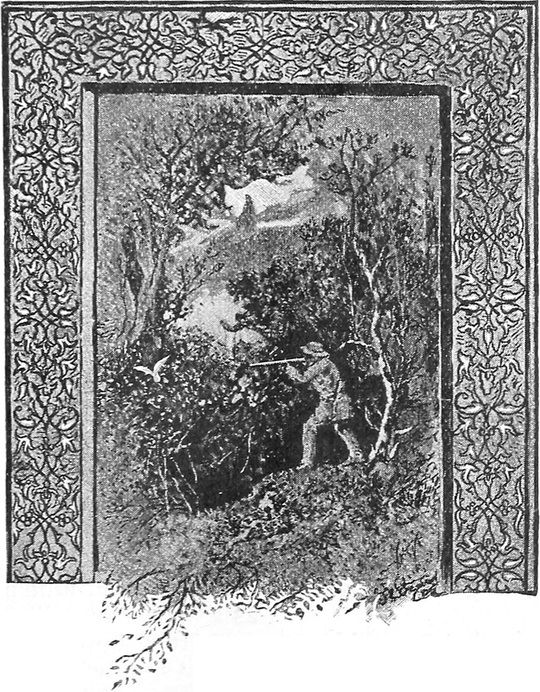
ON THE BANKS OF THE POTOMAC.
Gunston Hall of to-day is the same building as that of over a century ago. It was built for comfort and not for show, for the walls are very thick, making the rooms warm in winter and cool in summer. It was erected in 1739, and every brick was brought from England as ballast. The plantation originally comprised 5,000 acres, and was, without exception, the finest game preserve in the country. Colonel Mason was an ardent sportsman, and cherished and protected the game on his land. At his river front the wild celery grew in the greatest profusion. If those old walls of Gunston Hall could talk, what entrancing tales they could tell of men of iron mould and giant minds, and maidens “passing faire”! There is a porch around the ancient mansion, religiously preserved, though it is in the last stages of dilapidation, where on the south side of the hall Washington and Mason were wont to sit during the long summer evenings, their senses lulled by the fairy-like scene, their eyes ranging over the grand, circling sweep of the river, and their conversation freshened by many a decoction of pounded ice, fresh mint, and Jamaica brandy. By the way, there are comparatively few people who ever tasted a real Virginia mint julep. The decoction, hastily mixed and as hastily drunk, is called a julep. Bacchus, save the mark! It is as different from the royal mint julep as corn whisky from the imperial cognac. It does not take five minutes, an hour, or a day to properly brew this wonderful drink, but a year at the very least. Here is the way Colonel Bob Allen, of Curl’s Neck, on the James River, used to prepare the julep. In the early spring, gather the young and tender mint, have your demijohn three-quarters full of the best whisky, and into its mouth drop the mint, rolled into little balls, and well bruised—about a quarter of a peck, loosely heaped up, to each gallon of liquor. Next, enough loaf sugar is saturated in water to melt it, and sweeten the whisky ad lib. This fills the demijohn, which is then sealed tight, and kept for the future, being rarely opened for at least two years.
The preparation of the drink is simple, and yet artistic. First, a julep ought never to be mixed but in a silver flagon—there is such a thing as a “perfect accord.” The demijohn being opened, the fragrant liquor is poured into the mug, with a double handful of crushed ice—not pounded, but crushed until it is like hail or snow ice—(a stout towel and a few blows against a brick wall will accomplish this result); add a few sprigs of fresh mint, a few strawberries, a tablespoonful of Jamaica rum, and you will have an elixir worthy of Jove to drink and Ganymede to bear.
But the swans from whom the Potomac takes its name, what of them?
In my boyhood I have often heard the septuagenarians and octogenarians of the lowlands speak of the vast migratory flocks of swans and geese that would whiten the river for miles. So many were they that in the spring-time, when the imprisoned frost was released from the ground and the surface of the earth became soft, vast numbers would swoop upon the fields of winter-wheat, and ruin the crop in a single day. It was a common thing for the farmers to employ every supernumerary on the place to guard the young and tender wheat.
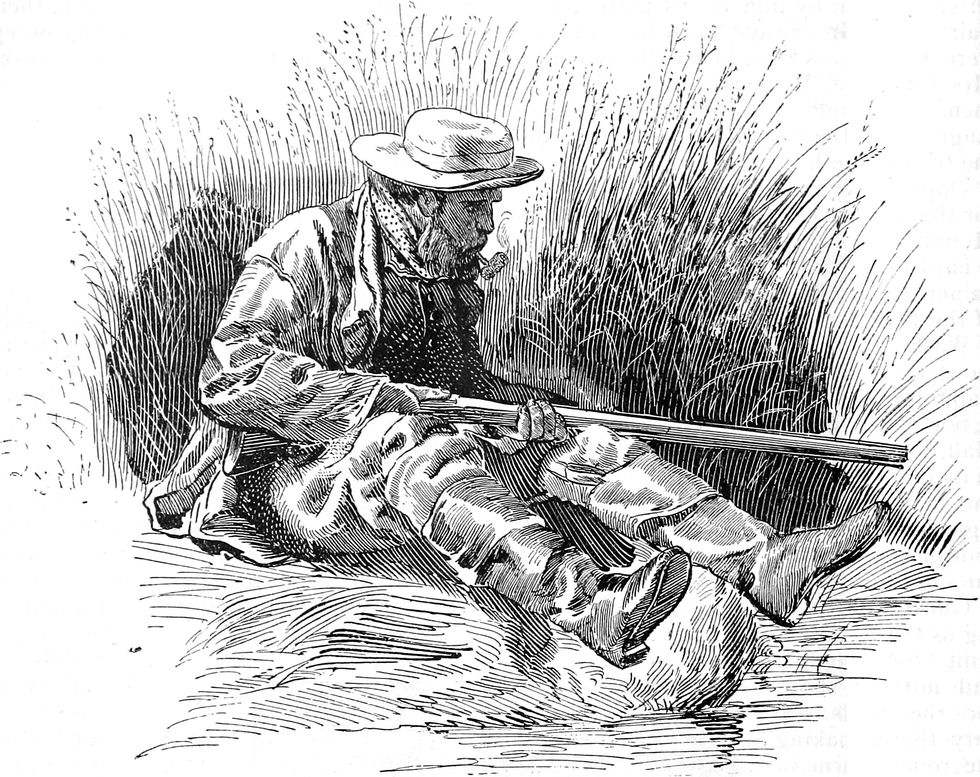
A POT-HUNTER WAITING FOR DUCKS.
But when the steamboat appeared on the scene, both swan and wild geese vanished, never to return.
Memory carries me back to my old ancestral home on the Virginia side of the Potomac, directly opposite the Washington Navy Yard.
In those days, a planter was an epicure by blood, a gourmand by breeding, and as long as his digestion remained unimpaired he could revel in the best of living on the choicest viands; and were he a devotee of the gun, he could amuse himself by killing a variety of game in such quantities that satiety would be apt to ensue.
Yes, the noble river furnished an unfailing supply of succulent food to the dwellers on its banks. The number of fish that swam in the clear waters of the Potomac would seem incredible in these times of purse-ponds and gill-nets. Our overseer used to devote one week in the spring to hauling a small seine, and would catch an abundance of fish to last the plantation the ensuing year, and there were enough herrings salted in barrels, and smoked shad in kits, to half fill our huge cellar that ran underground the whole length of the house. Fresh fish was on every table of the plantation nine months out of the year as a matter of course. The troll lines, set a short distance from the shore, yielded a steady supply of catfish, eels, perch, tobacco-boxes and fresh-water terrapin, or “tarrapin,” as they are called—a luxury only second to their cousin the “diamond-back.” As for the ducks and geese that made their home during winter on the flats between Washington and Alexandria, their number was simply astounding. I have hunted in the last decade from Havre de Grace to Tampa Bay, but never have seen such apparently limitless numbers of ducks as circled in the very sight of the Capitol’s dome some thirty years ago.
The channel was on the Maryland side. It varied from one hundred to one hundred and fifty yards across. For a mile and a half the water was rarely over two feet on the flats at low tide, and not over a fathom at the high-water mark. On these shallow bottoms there grew in the greatest luxuriance a peculiar quality of indigenous plant, called celery-grass, which wild fowl preferred to any other food. About the middle of November the birds began to congregate in such huge flocks that on a clear morning, when suddenly disturbed they took to wing, they made a noise like rolling thunder.
There were sportsmen, of course, at that time in the two cities of Washington and Alexandria, but they confined themselves to the laziest mode of shooting, and followed the creeks and streams that bordered or led into the river. Here the wild fowl afforded fine sport, with but little hardship.
As a general rule, the family on the plantation soon became tired of eating wild ducks; even the incomparable canvas-back palls at length upon the palate, as much as the partridges that are devoured on a wager, one each day for a month. The products of the poultry yard in the end were always preferred to the spoils of the river. Frequently, when company were coming to dinner, it was desirable to have a plentiful supply of game on the table; so my aunt, a famous housewife, would call up Sandy, who, being lame in one leg, was the general utility man of the plantation, one who could turn his hand to anything except regular labor, which he hated as a galley slave his oar, or as much as Rip Van Winkle did to earn an honest living. Sandy resembled Rip in more ways than one, though, fortunately for him, he had no sable Gretchen.
“Take Brother Bush’s gun, Sandy,” my aunt would say, “and go down and bring me some ducks.”
“How many does you want, Miss Jane?”
A mental calculation, and the number was given; then Sandy hobbled off with a matter-of-fact air, as if he were merely bound to the barnyard to slaughter half a dozen chickens. It was just as easy an undertaking, and one infinitely more to his taste. Calling one of the house-boys, he would go with him to the shore, a couple of hundred yards or so distant. Then the couple would walk in single file for some large tree bordering the river. The ducks feeding on the wild celery close to the shore would on their approach swim lazily from the banks out of gun-shot. Sandy would take his position behind the trunk of the tree and lie close. His companion would leisurely walk back to the house. The wild fowl, seeing the cause of their alarm disappear, would slowly circle back, and Sandy, waiting till they were well bunched, would let go both barrels; then, denuding himself of his breeches, he would wade in and bring out his game. The ducks never seemed to “catch on” to this dodge, and Sandy rarely failed to fill his orders, as the drummers say, “with promptness and dispatch.”
There was only one pot-hunter in the neighborhood of Washington thirty years ago—an old, grizzled, weather-beaten man, named Jerry, who anchored his little schooner in a snug cove on our shore every winter, and such was the unfailing supply of wild ducks that Jerry was rarely forced to up-anchor, set his sails and speed farther down the river. Old Jerry was assisted by his son, young Jerry, a chip of the old block. Every Saturday these two would put their game in canvas bags and carry them to their regular customers in Washington.
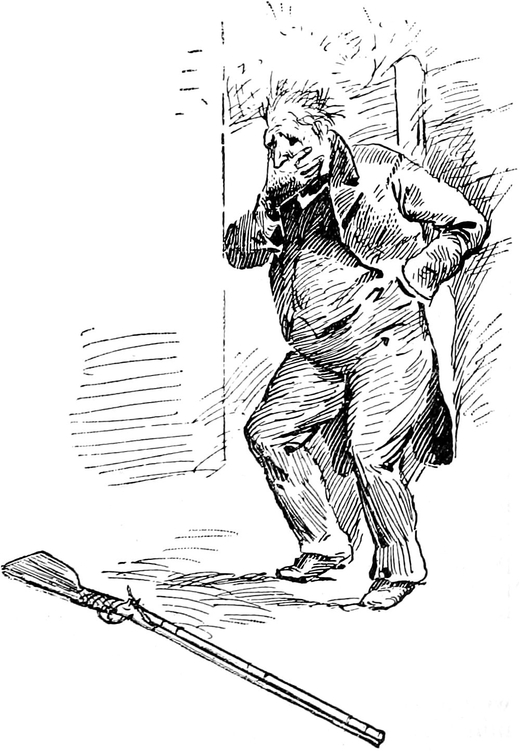
A KICKER.
I became a fast friend of these two pot-hunters, as much, indeed, as a boy of twelve years could with matured men. I suppose I imbibed from them that overmastering love of sport that has made me a wanderer for a score of years. I was of practical use to them; the sentiment and the benefits were all on my side, for I made the gardener give them regular rations of turnips and cabbages. In return, I was allowed the run of their cabin, a little cuddy at which the meanest, poorest slave on the plantation would have turned up his nose.
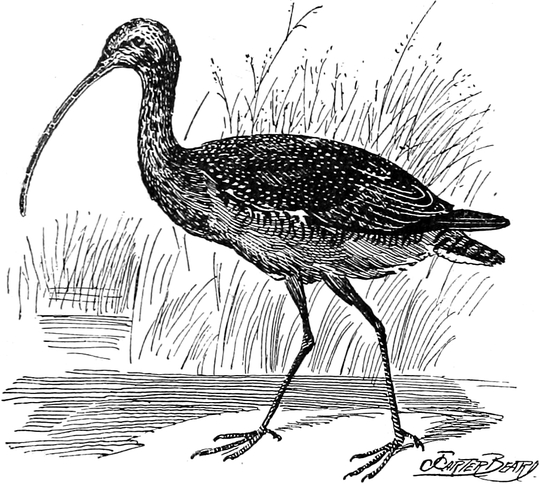
THE CURLEW.
Jerry was one of the few pot-hunters who possessed a swivel—a monster ducking gun, with a solid, uncouth stock, fastened to a barrel some ten or twelve feet long, with a bore as large as an old twelve-pounder Napoleon. This “thunderer” was loaded with twenty or twenty-five drachms of powder, and between thirty and forty ounces of shot.
Old Jerry would be in his skiff at the earliest dawn of day, and would cruise from Washington to Alexandria, closely followed by his son and heir, some hundred yards in the rear.
As soon as old Jerry saw a closely bunched flock of ducks, he would lie flat in the bottom of the skiff, and take his creeping paddles, which were about two feet long, two inches wide by a quarter of an inch thick, made of the best hickory, and painted a neutral color. With his arms hanging over the sides of his skiff, and a paddle in each hand, he could make his way evenly along, hardly raising a ripple. As he would approach closer the ducks would get more and more restless, swimming backward and forward, and gazing with alarm at what seemed a log with a queer, indescribable motion on each side. At last, when the woolen cap of a man could be seen, and underneath it the glittering eyes could be detected, then it was that the flock would rise from the water and take wing. That was the moment old Jerry was waiting for, with the stock resting against his shoulder, which was protected by a bag or pillow stuffed tight with feathers to break the recoil, and his eye ranging along the black barrel just as an artilleryman sights his piece before giving the word. A quick jerk of the trigger, the click of the flint striking the pan, the flash of the priming powder, then the deafening roar of the swivel, followed by a flash of flame, an encircling volume of smoke, the swirl of the water as the skiff was rocked by the kicking gun, and the deed was done. Old Jerry would rise up, grasp his double paddle, and make for the shore to reload, while the younger Jerry would come up in hot haste to pick up the dead, and dispatch with his double-barrel the crippled ducks.
Many a day have I played truant, and half the darkies on the plantation would be searching for me, while I, in the seventh heaven of delight, was with Jerry in his skiff following up the diving ducks whose wings were broken. I had a little single barrel that would make the water splash, and that was about all.
It was my one thought by day and dream by night to possess a gun big enough to kill the ducks at a fair distance—not a swivel by any manner of means—I had not the slightest desire to be behind that huge piece of ordnance when it went off. I wanted one that could strike a flock at eighty and a hundred yards. I never divulged my thoughts at home. I was that unfortunate “ne’er do weel,” known as the only son, and such an intimation would have raised hysterics at the female end of the house, and something worse at the male end of the mansion, for my paternal ancestor was a retired officer of the navy, and when he was excited his speech savored of the forecastle more than the cabin, and his actions became alarming.
A kind fate threw into my hands just such a weapon as my soul longed for, and I look back to it now with the same affection that a man of many affaires de cœur recalls the memory of his first love.
To make a long, rambling story short, my father bought, as a curiosity, a long Dutch ducking gun, that was intended to be fired from the shoulder by a man of stalwart build. Loading it carefully, the captain told the overseer, named Robinson, to fire it. This individual was a tall, ungainly lopsided man, who got sideways over the ground like a crab. He had a slatternly wife, with the most vivid, burning red hair I ever saw, and a large, callow brood of vividly headed children.
I suppose Robinson fired the gun, for it was brought back by his eldest hope, who said something about “Dad’s laid up; somethin’ or nuther kicked him;” but no attention was paid to what he said.
My father, accompanied by his youthful likeness, set out to try the gun himself. He made me fasten a piece of paper to the side of the ice-house, and then raised the long weapon slowly until he caught sight, and then pulled. I saw him spin around from the force of the blow, and utter the most blood-curdling curses against the gun, and next seizing the harmless piece and striking it against a tree, he broke the stock short off, then throwing the barrel down, he walked wrathfully away. I picked up the pieces tenderly, and carried them to Uncle Peter, the plantation carpenter, and told him I would give him a quart of that liquor he most loved in the world if he would patch it up. Uncle Peter agreed, if I would pledge myself to keep his share in the affair secret. Of course I promised.
What with braces, screws, clamps, rivets, the old piece was reconstructed, and I was as proud of it as a girl of her first long dress, or a spinster with a beau. It was about eight feet long, with a bore about the size of a Queen Anne musketoon. The barrel was slightly curved outside. The trigger was hard to pull, but the springs were good, and every time the flint fell a handful of sparks would be generated.
But, shades of Vulcan, how that ancient gun did kick! No vicious army mule, no bucking broncho, no Five Points billy-goat ever were productive of more sudden shocks. While the recoil was not so great as that of the famous gun that left the load stationary while it lodged the man who fired it in the fork of the tree two hundred yards in the rear, yet, like a champion pugilist, it sent every one to grass who tackled it. Uncle Peter was laid out. Sandy, steadying himself with his crutch planted firmly in the ground—a human tripod—was spun around and hurled to mother earth, as Hercules threw Antæus. Jack, the giant of the plantation, who led the cradlers in the harvest field, and pulled one end of the seine against six on the other side, tackled that weapon, and he, too, for the first time in his life, was vanquished. Though this piece could not quite rival the matchlock that belonged to Artemus Ward’s grandfather, which would not only knock the shootist over, but club him when he was down, still it put every man who fired it on the invalid list for the balance of the day.
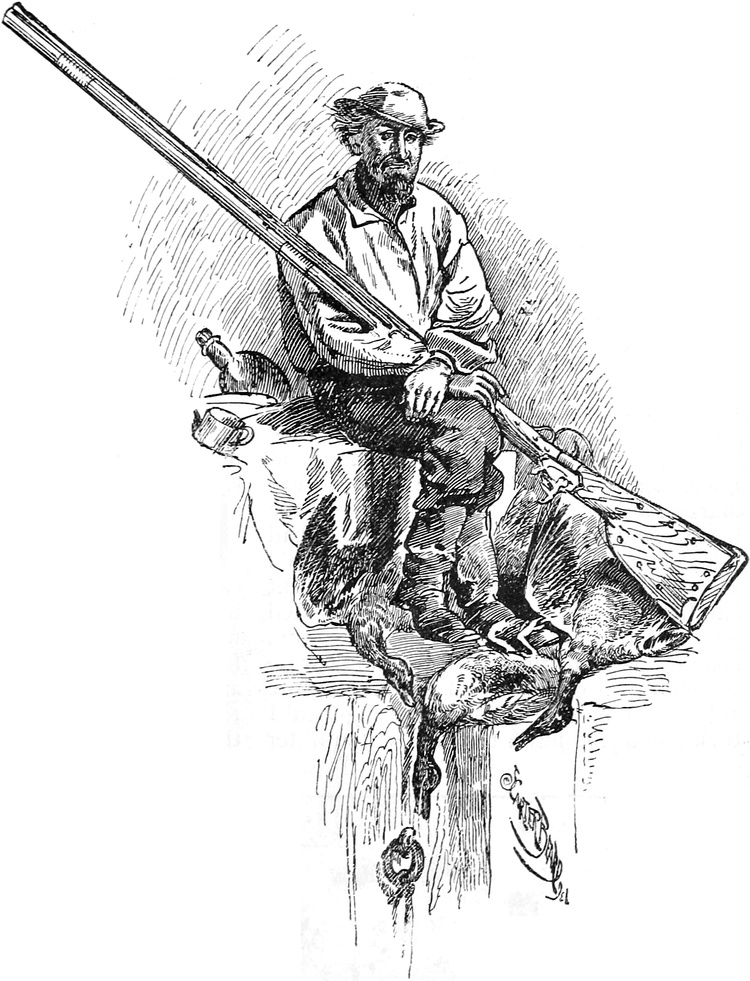
OLD JERRY AND THE DUCK GUN.
I would not have put that gun against my shoulder and pulled the trigger for a month’s holiday. Uncle Peter, however, did the trick, and fixed the gun so that it was as harmless as a copperhead with its fangs drawn. He got the blacksmith to rivet a couple of iron rings close to the muzzle and another on the breech just above the pan. Next, he put a massive staple in the prow of the skiff, and another and a smaller one on the front seat; a chain with a catch passed through staple and ring, and held everything tight. When the gun was fired the staples received the shock, and no kicking could loosen them.
Uncle Peter finished the job Saturday night, and Sunday morning a mysterious message came from the overseer’s son, Sam, that he was waiting to see me in the shuck-house. I no sooner laid my eyes on him than I knew his mind was full of something.
“Well, Sam, what is it?”
“Mister”—Sam called every white man and boy mister—“I done hearn pop say as you were a-goin’ to use that air big gun.”
“Yes, I am; but you keep your mouth shut about it. You hear, Sam?”
“I ain’t a-goin’ to tell, but you’d better leave her alone.”
“Why?”
“Cause it’ll kick yer liver lights out, that’s why.”
“How do you know?”
“Ef you cross yer heart, an’ say, ‘I hope I may die,’ I tell yer.”
This mystic process having been complied with, Sam commenced:
“One evenin’ I slipped home from the brickyard, an’ thar warn’t anybody at home ’cept the child’en. Pop was gone to market, an’ tuk mam wid him. I seed the big gun sittin’ in the corner, but pop had tole me that ef I ever tortched it he’d knock thunder outen me. So I dassent handle it. Jest then a big hawk lighted on the barn, an’ I jest grabbed the gun, meanin’ to shoot that bird, thrashin’ or no thrashin’. I crept behind the corn-house, an’ run the muzzle through the logs, an’ I tuck aim at the hawk that was watchin’ fer a chicken. I tried to draw back the hammer to a full cock, when the hammer slipped, and it went off. At first I thought that something had busted, then that Mose, the brindled bull, had butt me, or that Toby, the old blind mule, had kicked me, an’ I commenced a hollerin’, an’ jus’ then, by gum! pop an’ mam druv up, an’ mam thought as how I was killed, an’—” Here Sam stopped to take breath.
“Well, Sam, what did your father do? Did he scream, too?”
“Scream!” answered Sam; “pop ain’t that kind. No, he picked up the big gun with one hand, an’ tuk hole on me with the other, an’ dragged me home, me a-kickin’ an’ a-tryin’ to break away all the time, an’ then he got that cowhide that hangs over the chimbly, an’ almost tanned the hide offen me. But you jus’ see where that big gun kicked me,” and Sam opened his shirt and showed me his narrow pigeon-chest that was bruised black and blue.
“Now I mus’ be goin’, mister. You mine me, don’t you tortch that air big gun; as sure as yer do she’ll knock yer cold.”
Sam’s tale frightened me, and I pulled the trigger, with my heart in my mouth, the first time; but Uncle Peter had done his work well, and if it kicked I never felt it.
I remember through this long vista of years the ecstatic pleasure of creeping up to a huge flock early one morning, and the thumping of my heart that beat like a trip-hammer against the bottom of the skiff—for I was lying close, and using the creeping paddles. At last, at last! and as the flock cleared the water I let drive, and was rather astonished to find myself safe and afloat.
So in the Old Dominion the fox-hunter followed his hounds, and took timber as it came. The partridge-hunter discharged his right and left shots in the stubble. One fine morning in April, 1861, they awoke from their easy-going, rollicking existence, and dropping the shotgun and sporting rifle, grasped instead the sabre, the lanyard, the sword, or the musket.
To be continued.
PICKEREL SHOOTING ON THE MARSHES.
BY O. W. HARD.
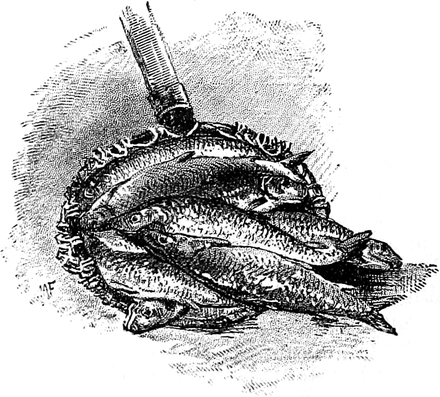
ONE winter, more than a score of years ago—a winter ever memorable for its extreme cold and great depth of snow—I changed my residence to near the head of Shelburne Pond, one of the most beautiful sheets of water in Northern Vermont. The pond is, for the most part, skirted by low marshes, fringed with alders, pussy and red willows, but here and there a bold promontory projects into the water.
All my life I had been a keen fisherman, and from my youth up I had, in one form or another, pursued the finny denizens of the waters. I had lured the slippery, wriggling eel and festive bullpout from many a deep hole in the Little Otter, snatched the shy minnow from some sheltered cove, and landed the shiner and horndace from some still pool, panting on the sandy shore. I had trolled for pickerel on the lake, and seen them taken by the score in a seine, had even caught one through the ice; but of the modern method of annihilation—shooting—I was ignorant. All through the winter I listened to the stories told by old fishermen of wonderful shots, and of the number, ranging from one to five, killed at a single shot. I dreamed of pickerel, and my mouth watered in expectancy as I fancied I detected a fish-like smell arising from the pan. Having provided myself with a fowling-piece and a goodly store of ammunition, I waited patiently for the first signs of milder weather to appear on the southern swale. The phœbe and redbreast, the first harbingers of spring, were beginning to trill their morning carols, but spring still lingered in the lap of winter. At length, under the genial action of the sun, now high in the heavens, the snow began to fade slowly and almost imperceptibly away, and patches of brown sward to appear on the hillsides.
One warm afternoon toward the middle of April, when not a cloud flecked the sky, nor a breeze rippled the miniature sea, I sallied forth to try my luck among the finny drove. I soon reached the edge of the north marsh, and saw that the water was literally alive with fish, darting hither and thither through the turbid flood, and leaving shining wakes in the water. But a sluggish brook, now swollen beyond its capacity with banks overflowed, presented an effectual barrier between me and the pickerel. Not to be baffled, however, by a little water, I commenced wading through bog and fen till I reached a fence, on which I crossed the brook, and went splashing and floundering through a swamp, and finally reached a very small spot of dry land.
Here I was among myriads of shovel-nosed fellows, facing me, perfectly motionless in the water, like a ship riding at anchor, or darting from under my very feet into the channel of the stream. Wading out into the shallow flood, I spied a big fish parting the water with his dorsal and caudal fins, and swimming slowly from me. I took aim and blazed away. To my utter astonishment, instead of one, five speckle-sided, white-bellied pickerel floated up. If I had been excited before, I was more so now—I had drawn blood.
Quickly ramming a charge into my gun, I was up and at them again, and soon had a string that did credit to a tyro, and would have done any old fisherman’s heart good to behold. I kept up a continual fusillade among them until the blackbirds, perched on the alders and among the branches of the gray ashes, began to ring their evening curfew. Then, slinging the slimy string over my shoulder, I wended my way homeward, with the pleasing thought in my mind that, if I was wet, the traditional fisherman’s luck was not wholly mine.
According to Lesueur, the common pike of our inland waters, the long or shovel-nosed pickerel (Esox reticulatus), attains a length of one to three feet; the body is green above and golden yellow on the sides, with dark, irregular, longitudinal lines, which unite in imperfect reticulations; flesh-colored on the throat, lower parts white; beneath the eye a black vertical band; caudal and dorsal fins greenish black, while the others are flesh-colored. It is a very rapid swimmer, voracious and strong; it remains apparently motionless in the water, awaiting an opportunity to dart upon its prey, consisting of anything it can swallow excepting the perch. While the body is suspended there is an incessant motion of the last few rays of the dorsal and anal fins, with a rotatory movement of the pectoral and, occasionally, of the ventral and caudal. Such an exact equilibrium do these forces maintain that the fish does not move in the water. This recalls what I said before about the fish lying at anchor. He is the shark of fresh waters, and sometimes attains a weight of thirty pounds, though the common size is two to five pounds.
For shooting in shallow water, small shot are, perhaps, as good as anything, but in deep water buckshot or ball are the best. Any one at all familiar with pickerel shooting has noticed that many fish captured in this way show no marks; they are simply stunned or killed by concussion. The pickerel spawns in the early spring, for that purpose ascending narrow brooks, creeks and ditches as soon as the ice is clear. The shooting season generally lasts from one to two weeks, or as long as the fish run. While the ice remains firm in the ponds there is always good sport, but when that disappears and the frogs, with throats cleared of frost, set up their nightly croaking, it is ended.
During the last two decades there has been such a renaissance of sport, so to speak, among the American people, both in forest and on stream, that what was once regarded merely as the pastime of the idle and wealthy is now recognized as suitable even for the pillars of the church and state. Every class seeks relaxation from business cares and worries in outings with rod and gun. Whatever may be the cause of this change, the fact remains that sporting has been reduced to almost an exact science. The effects of this are very palpable; for instance, pickerel shooting to-day is not what it was twenty, or even ten years ago. True, we have a law which forbids catching them through the ice, or shooting them, yet no attention is paid to it, except to impose an occasional fine on fishermen using nets in the lake. In direct violation of this law, great numbers are taken through the ice, and very many shot, and were they not wonderfully prolific, the species would soon become extinct. Whereas a few years since only a few sportsmen shot fish, now every one that can lay his hands on a gun or muster a spear makes a wholesale business of it during the season.
The best sport is obtained when, after a heavy fall, the snow melts with a rush, so as completely to cover the marshes. On a certain Good Friday I remember shooting fish at the base of a cobble, where a Canadian named Isaac was chopping wood. Now Isaac had a sense of humor, and thought to spoil our fun. He was half blind, but he told us if we shot a fish “we’d have to be darned slide about it.” We rolled them up right under his nose, however, and he was apparently none the wiser. I have enjoyed many a day’s outing with the pickerel, but none that would quite compare in zest and novelty with the day when I made my first shot.
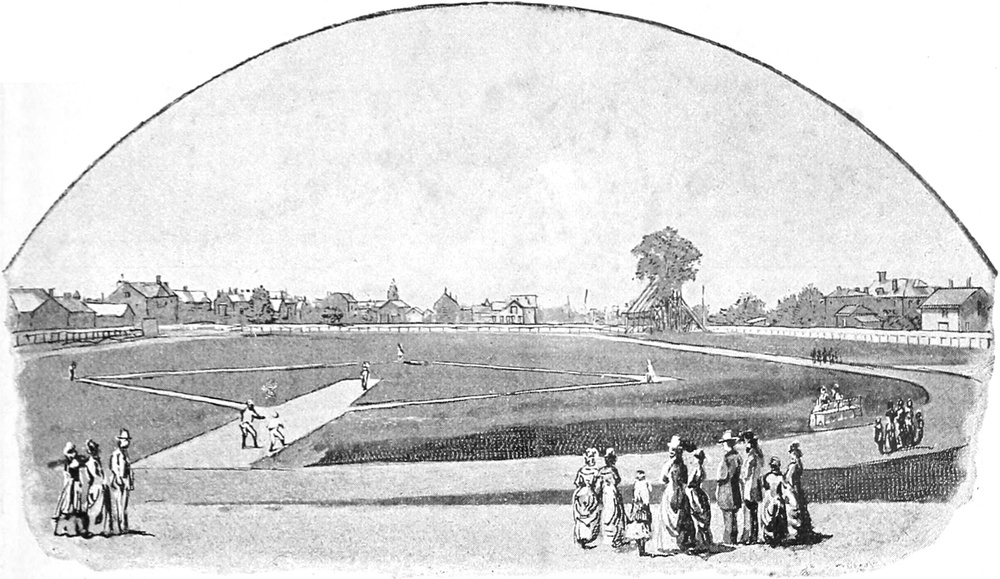
BALL GROUND, DETROIT ATHLETIC CLUB.
THE DETROIT ATHLETIC CLUB.
BY JOHN A. RUSSELL.
THE city of Detroit has had, within the past fifteen years, a variety of experiences with outdoor sports. It is nearly that length of time since the enthusiasm for boating was aroused, which spread over the adjacent territory and culminated in bringing out amateur boating crews of such national fame as the Hillsdales and the Sho-wae-cae-mettes. That enthusiasm was intense while it lasted. Every schoolboy, and many of larger growth for that matter, who could command the wherewith to buy or hire a boat, was out on the river, practising the characteristic strokes of Terwilliger or the Nadeaus.
Amateur boating clubs were organized in great profusion, and their boat-houses lined docks and slips in such numbers that the visitor to Detroit was amazed, and even the native could hardly account for the enthusiasm that could support them. Physicians who had patients of sedentary habits had a general prescription of “Take a little spin on the river in the evening,” which was administered quantum suff. Even the ladies were interested in the sport. It was no uncommon sight to see big barges industriously propelled by young girls and maidens grown, with here and there a more elderly person, who, with advancing years, had not forgotten the long sweep or the feathering motion of the oar.
The organization of a baseball club and its admission to the National League diverted some of the enthusiasm which had been given to boating, and the city became “ball-crazy” at once. The paroxysms became more marked every time the team won a substantial victory. Interest increased in the work of the professional club. Good hands began to look after its financial affairs, its positions were well supported, while the small boy and the devotee of physical culture took to ball-playing in summer, in preference to rowing, with a dash of gymnasium work in the winter in which boxing and sparring were the leading features. Getzein, Brouthers and the “good Deacon” White were put up as the idols to be worshipped in the places whence Durell, Dusseau, Van Valkenburgh and the other famous oarsmen of Monroe, Ecorse and Hillsdale had fallen. Even those who were not active, working devotees of the national game were found quite equal to taking their exercise by proxy on the cushioned seats of the grandstand, or in the more exposed positions of the “bleaching-boards.”
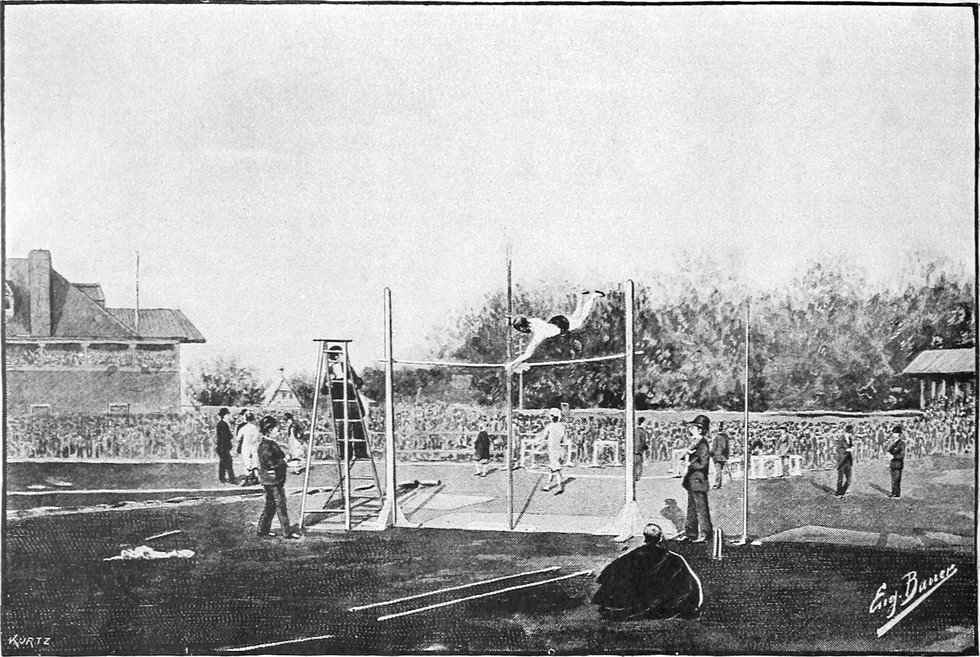
THE HIGH POLE VAULT.
Boating had its day. The fast oarsmen dropped back into semi-obscurity. The Montie Brothers, of Ecorse, who were in the famous Wah-wah-tah-see Club, returned to their avocations, as did Schweikart and Alder, of the Centennial Four of Detroit, while their associates, Parker and McMahon, developed into professional athletes and instructors. Only one of the old clubs—the Detroit—retains its organization and equipment in anything like the style in which they were maintained during the prevalence of the aquatic fever. Many of the oarsmen, having grown older, have taken to yachting as a pastime. For this there are unlimited facilities on the Detroit River and in the lakes above and below the city. There is not nearly as much exertion and training required for a yachting expedition as for a mile-and-a-half straightaway, and yet there is quite as much judgment called into play in handling sheets and tiller, with immeasurably more real sport.
Baseball, while it has palled somewhat, seems to have encouraged the taste for individual exertion. Up to a very recent period that taste was inclined to the pastime from which it came—baseball. No great interest was taken in general athletics by the majority until about a year ago. Prior to that time an organization for the promotion of general athletics had existed in the Detroit Amateur Athletic Association. Its membership, however, was small, and though its ambitions may have been great, its achievements were few, one alone excepted; that being its expansion into the present Detroit Athletic Club, and its fitting up of gymnasia and grounds. The Amateur Athletic Association was very like good King William IV. in that “nothing, perhaps, in life so became it like the leaving of it.” It merged itself into the movement for the new club, of which it was the precursor, and its members the founders and boomers until there was no further need of booming; for the present club is a pretty healthy infant. Its birth occurred at a time when its existence was most needed, and just after the period when boating had lost favor, and the ambitious athletes had learned that baseball had not all that could satisfy the utmost desires of the athletic spirit. It had a manifest advantage in being able to offer a greater diversity of sports than boating and baseball, which, after all, are two very limited sections of the general field of athletics.
The new association came into existence a year and a half ago. It is not in its organization like the Montreal Association, described by Mr. Whyte in OUTING for April, a federation of the athletic clubs of the city, but is a distinctive and independent club, with its own equipment and government. It was formed as a joint-stock corporation, with five hundred shares of the nominal value of $10.00. The demand for these became so great that a premium was soon obtainable for certificates of membership, their value going up until they are now held at $50.00 per share. The receipts from the sale of stock gave the young club a strong treasury from the start. The grounds of the old Athletic Association were secured on a long lease. They are on Woodward Avenue, in the heart of the finest residential portion of the city, and the plot is, perhaps, the largest piece of desirable property now unoccupied in the city; it contains something over 300,000 square feet, the land being, in round figures, 400 by 800 feet in dimensions. The six acres thus afforded have a value of nearly $200,000. They are readily accessible from both the business and residential quarters, and face two leading streets.
This property secured, steps were at once taken to erect a building suited to the needs of the club. There were some buildings on the tract barely fit for temporary quarters. In these the club housed itself until the present structure (see illustration, p. 212) was completed and opened last March. The house has a frontage of 107 feet and an extreme depth of 68 feet. It is of pressed brick with brownstone and terra-cotta ornaments, and possesses in its design much of the spirit of the newer styles of construction seen in English library and gymnasium buildings. Its space is well allotted. The entrance-hall is also a reception-room, with a cheery grate in pressed-brick designs. An ornamental staircase leads to the upper floor. The lower floor, besides containing the reception-room, has on it a ladies’ parlor and toilet-room, offices for the directors and stewards, a billiard-room, reading-room, the baths, and a locker-room. A wing on a lower level contains the bowling-alleys, while the upper floor is devoted to the gymnasium, the only reserved space being used for a small refreshment-room. Saved room under staircases is utilized for closets and chests, and there is not an inch of waste space in the house. The kitchen and accommodations for servants of the club are under the roof, in the attic story.
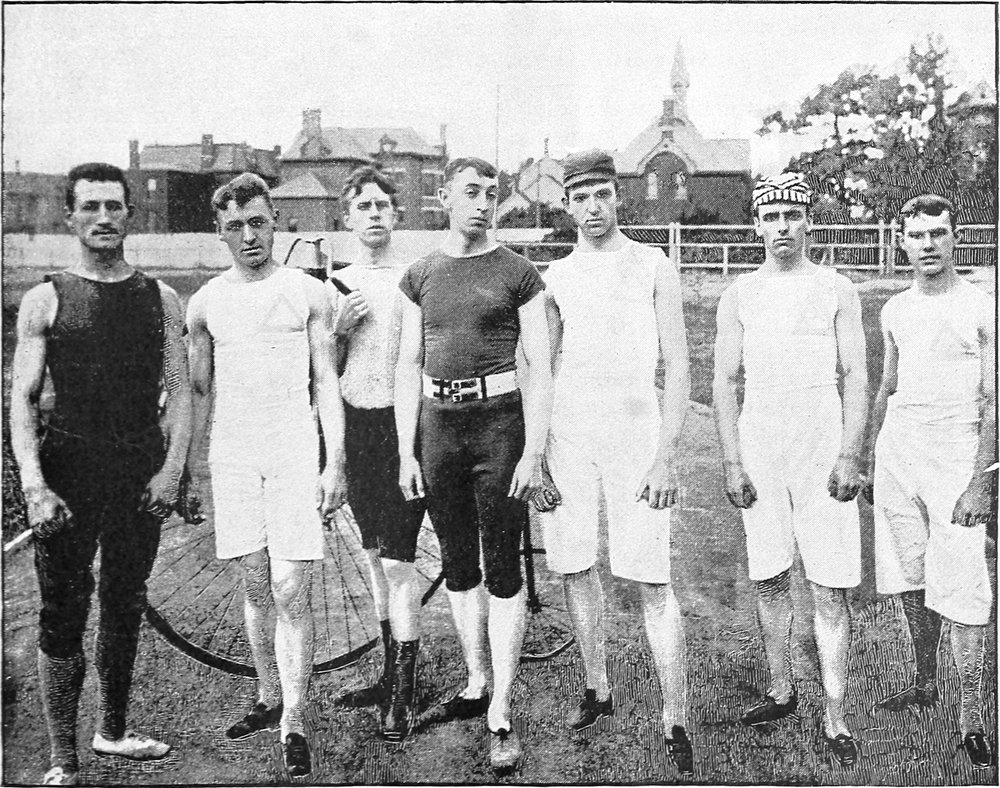
THE RUNNERS OF THE DETROIT ATHLETIC CLUB.
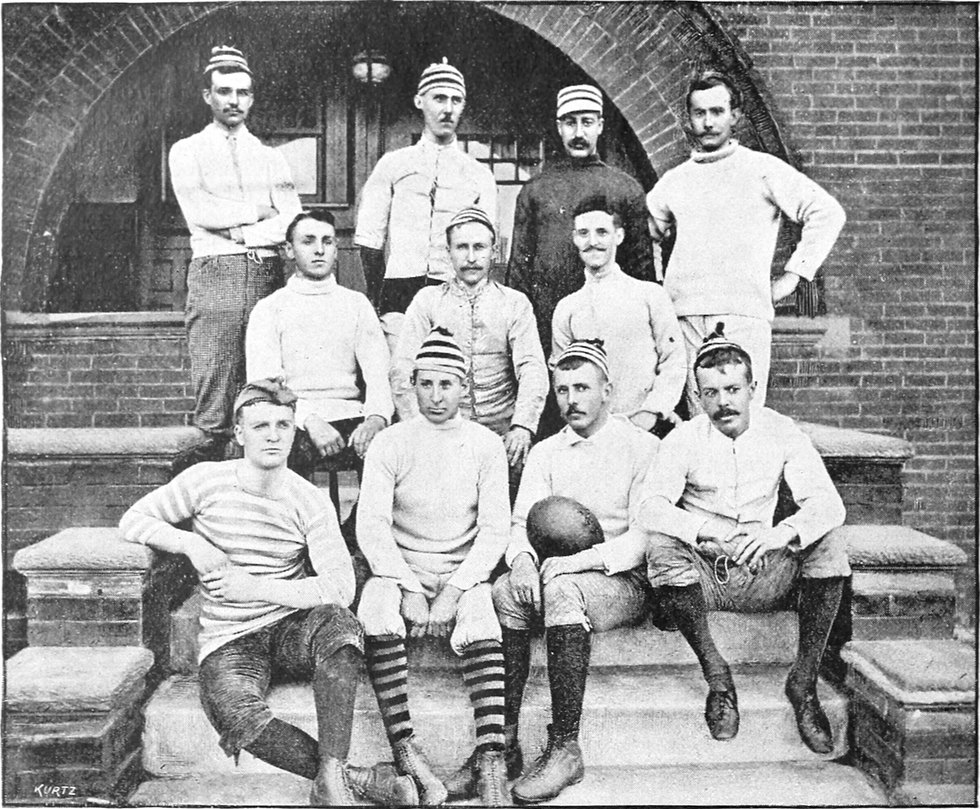
THE FOOTBALL ELEVEN, DETROIT ATHLETIC CLUB.
The various departments of the club-house are complete in their appointments. The reception-hall is a roomy apartment, finished in hard wood, which opens into the directors’ room and the reading-room on the one side, and a billiard-parlor and the bowling-alley on the other. The directors’ room is the headquarters of the caretakers and the office of the club. The reading-room is spacious, a big table and easy, antique oak chairs forming the furnishings, the walls being decorated with sketches of other club-houses and a series of photographic reproductions of the disc-throwers of the ancient Roman period. The mental pabulum furnished is of the class one would most naturally expect to find amid such associations—the leading journals and magazines devoted to athletics, the daily papers of the city, and the literary magazines. The billiard-parlor contains three Schulenberg tables, oak-finished, with furniture harmonizing with the club-house furnishings. It has already shown itself to be rather too small for the demands likely to be made upon it, but the house has been so designed that a wing may be extended without marring the harmony. Wrought-iron designs in gas-fixtures complete the furnishings of this part of the house.
Just beyond the reading-room, and disconnected from it, are the bath and locker rooms. A separate entrance to them is afforded from the grounds, while they are also connected by a private staircase with the gymnasium overhead. The lockers, in number about 300, are arranged in “L” fashion, the spaces between each set of six affording the privacy desirable for dressing-rooms.
The bath-room caused much marvel in these parts. It is 30 by 16 feet in size. The centre of marble-paved floor is occupied by the plunge-bath, 20 feet long and 12 feet wide. Its sides are lined with white enameled bricks, and a constant flow of water is secured from the city service-pipes. It varies in depth from three to five feet. At one end of the bath-room four marble-fitted shower-baths are located, and close by, an equal number of foot-baths.
Just beyond the bath and reading rooms, on the side of the house facing the grounds, and so depressed as to give a clay bottom for the structure, is the wing which contains the bowling-alleys. These are six in number, of the regulation length of 65 feet, and 42 inches wide. They are admirably equipped; the entire work, as well as that of the gymnasium above, having been executed by the Narragansett, R. I., Machine Company. A gallery for spectators is located behind the dead-line, above the level of the alleys.
The entire upper story, aside from that portion given to the lunch-room and staircase landings, is given up to the gymnasium. This, of course, is the feature of the clubhouse. It is a well-lighted, lofty hall, 76 by 32 feet, there being fifteen feet available in height from the hardwood floor to the open-timbered roof. The apparatus, being all new, is of the latest designs. The weight and pulley system of machines is used in every conceivable form for developing the muscles of the arms, chest, legs, neck, shoulders and the grip. Hand-over-hand climbing is afforded by ropeladders, poles, and hemp ropes suspended from the roof-timbers. Vaulting facilities appear in horses and frames, and a system of parallel and horizontal bars is provided with the necessary mattings to prevent injury. Besides these more elaborate pieces of machinery there are bells and Indian clubs innumerable for the classes in calisthenics, and gloves and foils for the devotees of the manly art and the gentleman’s sport. This practically completes the list of indoor sports.
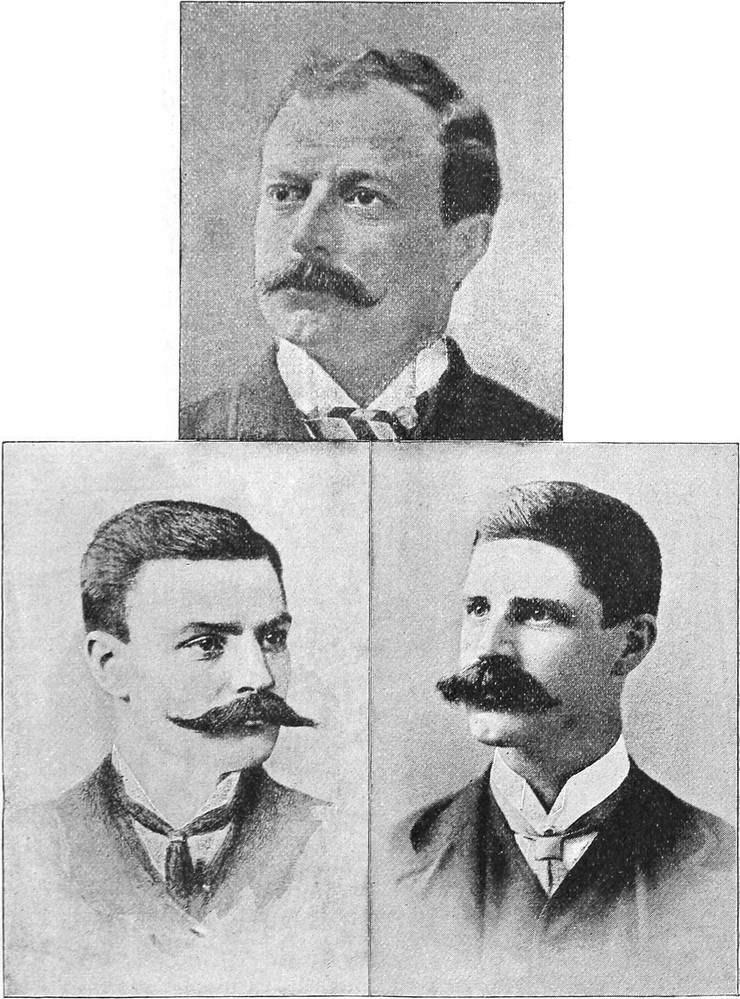
F. D. STANDISH. FRANK W. EDDY. JOHN H. CLEGG.
For outdoor exercise the club has admirable facilities. The big tract of ground which the club controls has very little, comparatively, of its area taken up by the club-house, and one standing on the big second-floor balcony which extends over the billiard-room on the lower floor, will notice that the turf that stretches in front of him for a furlong is cut up for a diversity of uses. The running track is the most noticeable feature. It is a quarter of a mile from start to finish, was laid out by the noted trainer of the Brooklyn Club, Jack McMaster, and was built from his designs. It is 16 feet in width at all points except on the finishing stretch and the 220-yards straightaway. This latter takes in the south side of the quarter-mile track as far as it goes and has a width of twenty feet. The track was laid last spring, is cinder-packed to the depth of a foot and has a clay foundation, all of which will combine to make it an ideal running-course in time. There was some disappointment with it at first, as it was feared it would be a trifle slow, but the rains and rolling have eliminated its spongy qualities and made it perfect, so that fast time can be expected upon it.
Within the circle formed by the track the two baseball diamonds are laid out. To the north of the track, and in shelter, are the tennis courts, four of them being “skin” courts, the rest, half a dozen, being the turf courts which are not so much in favor. The field is a fine one for cricket and football, both of which games are cultivated. Far down in the extreme corner there looms up during the summer a skeleton-like structure, which unjoints itself with the advent of winter, and forms a toboggan slide with an incline and a slide over an eighth of a mile long. Another corner is devoted in winter to a curling rink, where the royal Scotch game is played by its admirers with the greatest zest. The Detroit Curling Club has many members in the athletic club, and for their benefit a rink was set apart for the jolly Scotchmen and their besoms and curling-stones last winter. So pronounced was the success of the experiment that it will probably be repeated this coming winter.
The readers of OUTING will not be amazed, then, to know that with such facilities, the club’s membership kept growing as fast as applications could be investigated and applicants admitted. The personnel of the management was drawn from the young-man class of active workers. The president, Frank W. Eddy, had been the originator of the more modest Amateur Athletic Association, as he was of its successor, the present organization; and to him and half a dozen close associates the major part of the success of the club is attributable. Mr. Eddy was also one of the promoters of the movement for the Amateur Athletic Union of the United States, of which he is vice-president and one of the strongest backers. The first meeting of the union took place in the grounds of the Detroit Club in September. Mr. Eddy’s work was supplemented by that of a faithful set of directors, and between them they have managed to run the membership pretty close up to its permanent limit of five hundred.
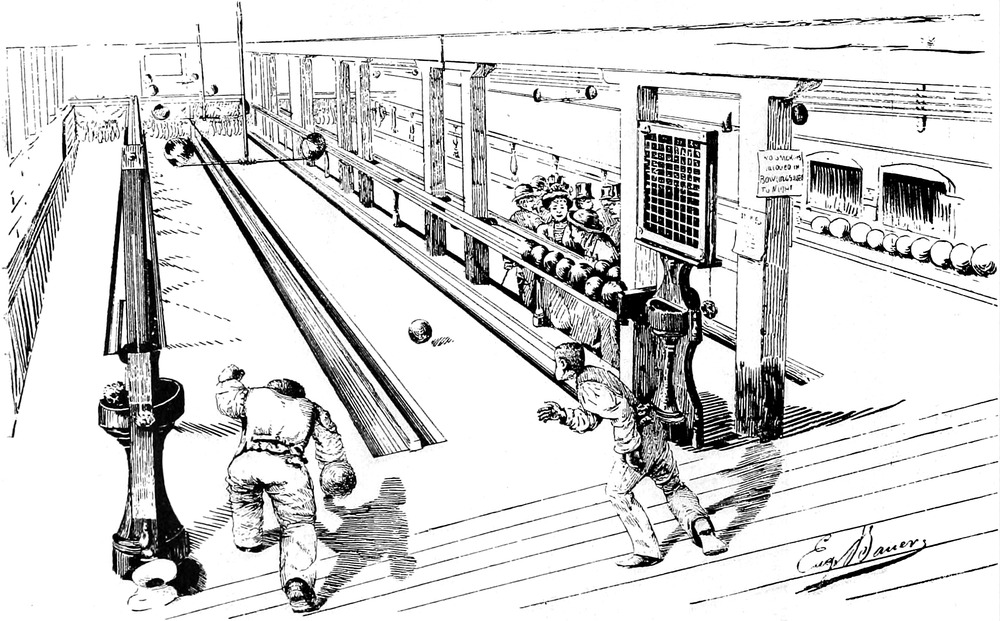
IN THE BOWLING ALLEYS.
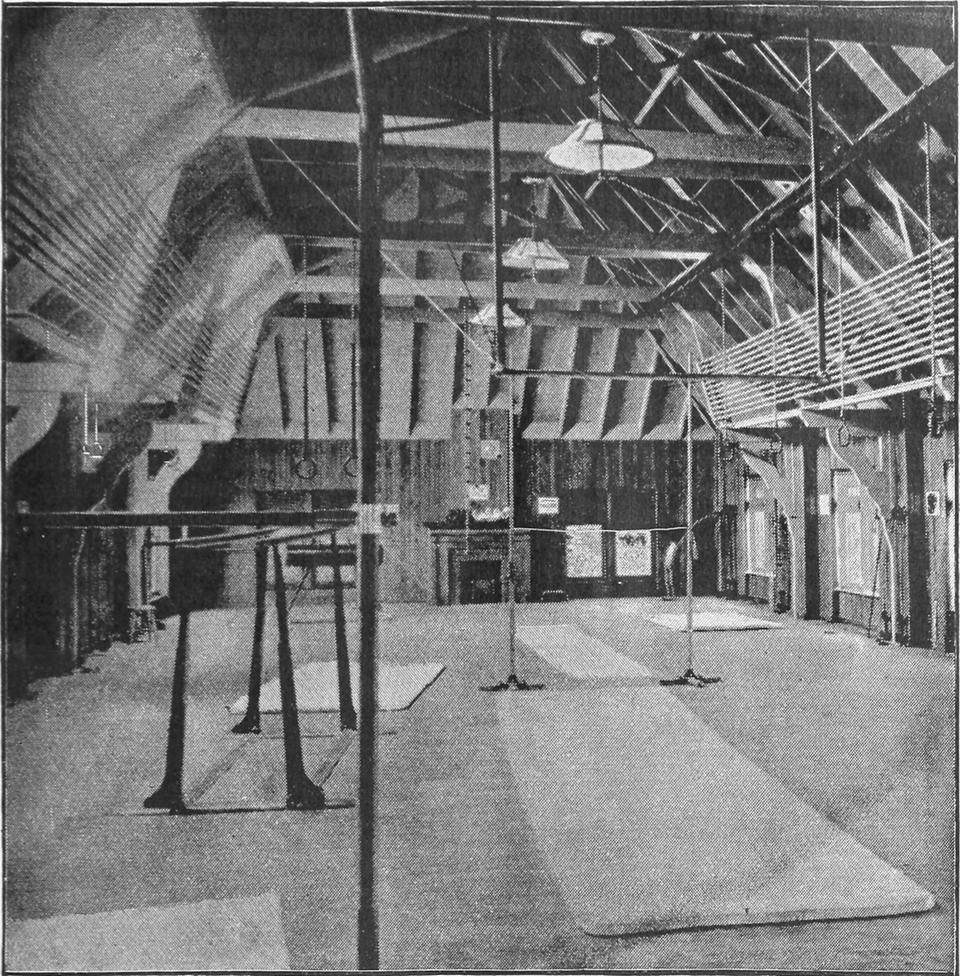
THE GYMNASIUM.
It must not, however, be for a moment believed that all these, or even a liberal percentage of them, are practised athletes. The membership of the club is mainly drawn from the class of young men between 18 and 25 years of age, in that period of life where sedentary careers are apt to tell hardest on constitutions however vigorous. There are many members, it is true, who had been accustomed to gymnasium work in the period of the boating excitement, but besides these, and the nucleus drawn from the old Amateur Athletic Association, it is fair to say that nine out of ten of the members were novices when they entered the club. There had been no such thing in Detroit as the cultivation of general athletic sports until this organization took hold, and whatever was cultivated was usually run to death. The private gymnasia were the first to break the ice; but even in these men undertook to rival Samson or Hercules in a week’s time, and, straining themselves, very often discouraged others as much as they caused injury to themselves. The private gymnasia were ephemeral affairs which were unsatisfactory, for the most part, and they never afforded the opportunity for long-continued training. Their prices, usually from ten to fifteen dollars for a two or three months’ term, were rather too much for young men of moderate means, and even where these drawbacks were eliminated there was no facility for outdoor work during the summer season under the direction of a proper tutor. The new club’s dues of twelve or fifteen dollars a year, at most, had an advantage from the standard of economy, and the price at which shares were sold early in its history made it possible for many to join it at a comparatively slight expenditure of money, taking into consideration the advantages gained. The novices took hold with a will, the advantage of a good instructor being very great, and under direction they have shown that there is much to be hoped for.
The instructor of the club is John Collins, a young man of twenty-five. He has also devoted some time to training in the gymnastic department of the Catholic Club and the local branch of the Young Men’s Christian Association. He has been five or six years in the business now, and is acknowledged to be the best all-round athlete in the city to-day. His special points of excellence are the grace and science of his boxing, and the expertness with which he handles the foils. He is self-trained, and during his career has boxed and sparred with most of the great men in the business, having stood up with Jack Burke, Pat Killen, Dennie Kelleher, “Reddy” Gallagher, Jack King, and others of equal fame. His earliest aspirations were in the direction of a private tutorship, and he was picked up first by the proprietors of some of the private gymnasia, where his methods and skill attracted so much attention as to secure him his present place. He is lightly built, quick and active, and has the necessary amount of patience with his pupils to qualify him for the difficulties of teaching. So far he has proved popular and profitable to the members of the club.
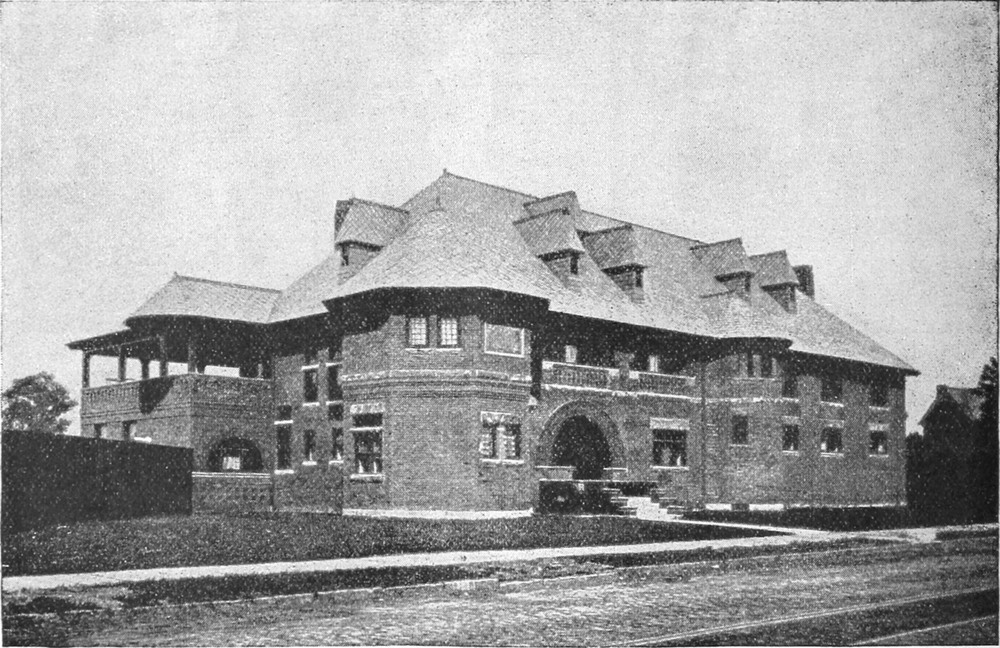
THE CLUB HOUSE.
It must not be supposed for a moment from the foregoing remarks about the novelty of athletic training in Detroit, that there are no members of the club who are above the level of mediocrity. That would be far from the truth. There are quite a number of athletes who were drawn almost directly from the teams of the colleges in which they were educated to the new movement at home, and these are among the very active workers. The captain of the club is Nathan C. Williams, Jr., who was a Yale graduate of ’84, and is now in business in Detroit. He has charge of the field sports of the club, is responsible for its property used in gymnastic work, and arranges, with the aid of his lieutenants, the various exhibitions and field days which are given from time to time. Mr. Williams was manager of the Yale baseball team in his college days, and had an enviable record at New Haven. He has two lieutenants, Sidney T. Miller, a young lawyer, a graduate of Trinity College, Hartford, and Benjamin S. Comfort, Principal of the Tappan School, who was also inducted into the spirit of athletic work in one of the Eastern colleges. The club’s secretary, George J. Bradbeer, is an excellent hammer-thrower, an allround athlete, and was a good ball-player in by-gone years. The club’s president, Mr. Eddy, is a sprinter and ball-player of local note, and rarely misses a daily jog in good time on the cinder track. The University of Michigan, which is located so near Detroit, has furnished quite a number of young athletes, among them Royal T. Farrand, who held the University light-weight championship in boxing; Fred T. Ducharme, who has won a score of running races in good, if not fast time, and who promises to develop into a great jumper; Geo. P. Codd, a Michigan sophomore, the crack pitcher of the University ball team, and a good single player in lawn tennis; and Albert E. Miller, a young lawyer, who is the best tennis player in the club—so much so, in fact, that he is generally required to give handicaps to contestants. Mr. Miller was first lieutenant and manager of the club’s events last year, and is this season catcher in the club’s regular baseball nine. So far none of the runners have made startling time, except in base-running, which is hardly a recognized feat. In this, however, W. H. Reidy has equaled the best time made by professionals, 14 4-5 seconds, and the feat has been time and again duplicated by members of the club in 15 seconds. Ben. S. Warren, a recent accession from Yale, has developed into a fast sprinter, having made the 100-yard dash in 10 2-5 seconds, the best record for the feat being 10 seconds even. In last year’s sports Warren won the quarter-mile dash in 60 1-5 seconds, and has since made it in 54 seconds. This year a fast runner has been developed in Ed. Sanderson, a young student, who with ten yards start made the quarter on a slow track in 57 seconds. W. A. Chope and M. W. Sales, all young athletes, are among the more promising of the fast ones.
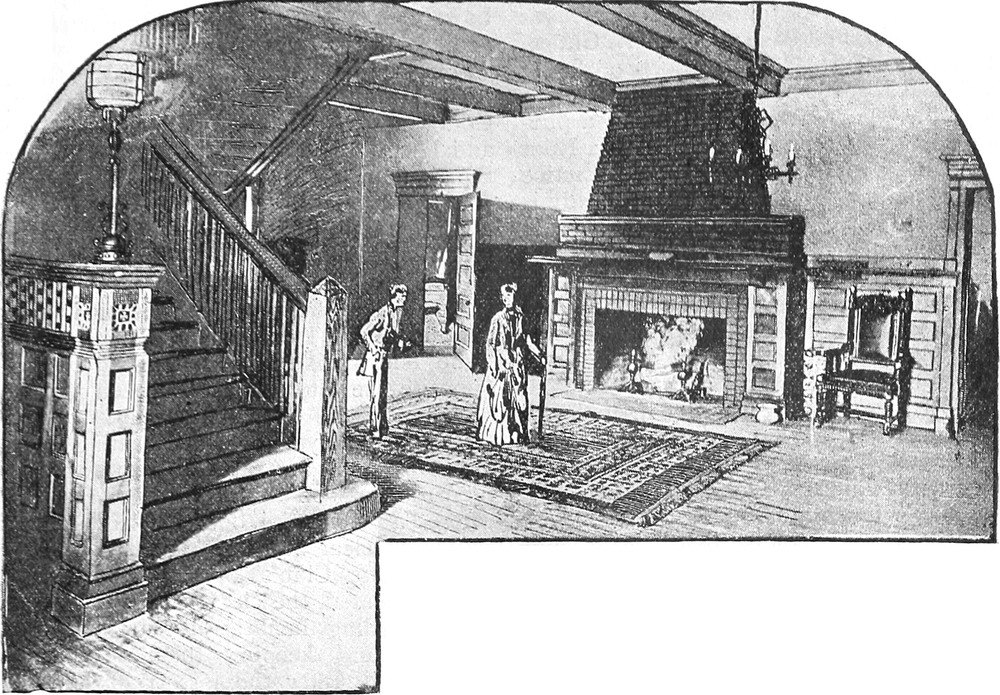
THE RECEPTION PARLOR.
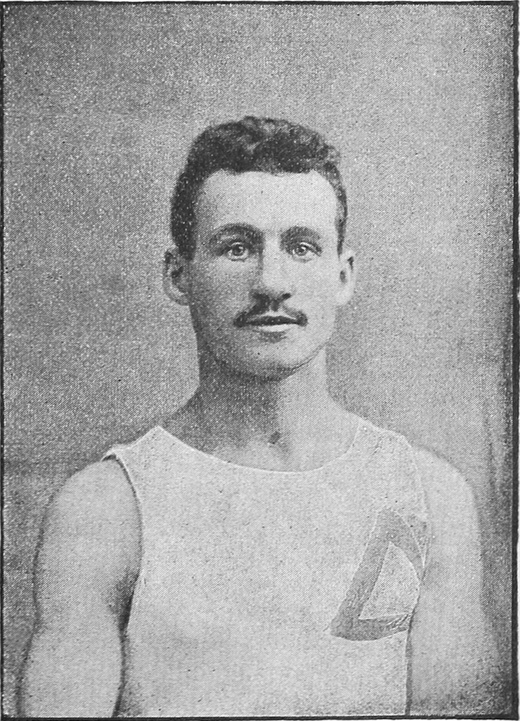
JOHN COLLINS, TRAINER, DETROIT CLUB.
The baseball team is a strong one. The regular nine is made up as follows: A. E. Miller, catcher; Charles T. Miller, pitcher; Ed. E. Swift, third base; W. H. Reidy, short stop; Wm. C. Johnson, second base; Wm. H. Reid, first base; Walter A. Chope, left field; Mart. J. Root, centre field; Charles K. Foster, right field. Of these Chope has the reputation of being a phenomenal left-fielder for an amateur; Root is a man who had a good deal of practice with his fellow students at Yale; Reidy is a good pitcher, and Reid is a player who made a name with the Class Club, one of the strongest local amateur teams. Besides these, there are substitutes innumerable; so many, in fact, that the team has rarely played together as named.
The team is managed by Principal Comfort. It has already won a majority of the games played against the State University team, and the strong local nines with which the city abounds. The ball club’s uniform is gray and blue, the Athletic Club’s colors being gray and black.
Football has a good number of devotees. Sidney T. Miller, Professor Comfort, Strathearn Hendrie, a Trinity College man, Albert E. Miller, Edward E. Swift and R. Humffreys-Roberts, the latter a well-known English player, are among the leaders of the sport, but they have been unlucky in their weather. The coming year will be utilized to the best advantage, however, when some interesting games are promised.
The tennis players include A. E. Miller, H. T. Cole, Jerome H. Remick, Geo. P. Codd, David S. Carter, Sidney T. Miller and H. E. Avery. Codd and A. E. Miller represented the club at the tournament of the North-western Lawn Tennis Association, at Chicago, in July, 1887, tying for second place in the doubles.
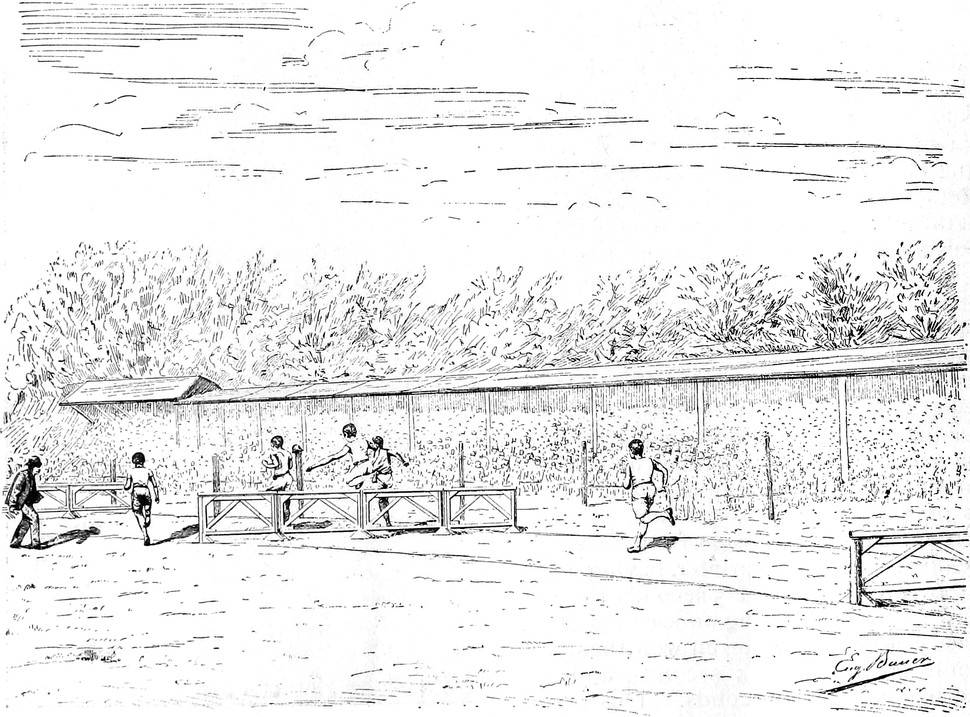
RACING OVER HURDLES.
The intention of the club management is to have a boating department in the near future. The City of Detroit owns Belle Isle, an island, 700 acres in extent, opposite the city, which has been turned into one of the finest public parks of the country. The yachting and boating clubs have taken or are preparing to take up their quarters on the shores of the island, where a congenial location and ready access to clear water are afforded. Here the Athletic Club’s boating department will be located, the city gymnasium of the club affording facilities for training the oarsmen and keeping them in shape. Those who know the history of boating in the West and are familiar with the names of the leaders, will recognize what the club has to hope for when it is stated that its membership includes John H. Clegg and Fred Standish, who have made the best records in pair-oared amateur races for years back. Both men are developments of the boating furore of a dozen years ago. Clegg took to the water for his health, and Standish for recreation, and they have been rowing together since 1881. In that year they won the senior pairs of the N. W. A. R. A., at Diamond Lake, and in 1882 took the senior pairs of the Mississippi Valley Amateur Rowing Association, at Creve Cœur Lake, near St. Louis. They were winners at Lachine, Quebec, in 1882. In 1883 and ’84 Clegg did not row, but in 1885 he returned to his old love, winning with Standish the pair-oared contests at New Orleans, at Moline, Ill., at St. Louis and at Detroit. At Hamilton, Ont., in August, 1885, they defeated Phillips and Hard, of the New York Athletic Club, in the Canadian annual regatta, winning in their class. Their record in 1885 was four straight victories and the lowering of the two-mile record. Clegg has decided views on the amateur question, and has contributed several articles to the press which meet the approval of the leading amateurs. He is opposed to semi-professionalism, paid crews, and those who row in the interest of backers, and believes all such should be excluded from competition against genuine amateurs. Mr. Clegg is a genuine American amateur, and with him and his co-worker, as leaders, there seems no reason why there should not be a healthy renaissance of boating among the members of the club.
It was this body of athletic enthusiasts who induced the Amateur Athletic Union of the United States to hold its first national meeting on the grounds of the Detroit Athletic Club. Those who are interested in amateur athletics already know of the success of that first meeting, held in the middle of September last. The entries included the leaders in the various departments of field and track work, and numbered 120, many competing in several events. There was excellent weather, a crowd of fully 5,000 people to enjoy the clever work, and much enthusiasm on the part of the participants and spectators. Some fast work was done in the running and jumping, although some people had fears that the track would prove rather slow. These fears were dispelled by the results, which were, in some cases, within one-fifth of a second of the best records. There was no record-breaking, however, save in one event—throwing the 56-lb. hammer. Till the meeting, Mr. C. A. J. Queckberner, of the Staten Island Athletic Club, had held the American championship on a best record of 26 ft. 43⁄4 in., while W. J. M. Barry, of Queen’s College, Cork, Ireland, had made 27 ft. The first essays of Queckberner fell below his own mark, and the work was tame until Mr. W. L. Coudon, of the New York Athletic Club, broke the world’s record by throwing the clumsy weight three-fourths of an inch beyond the distance made by Mr. Barry. When, in further competition with Queckberner, Coudon threw the weight 27 ft. 9 in., the excitement was intense, for even before the official announcement was made, it was apparent that he had beaten his previous throws by nearly a foot.
The running was of good character, with such contestants as Malcolm W. Ford, C. H. Sherrill, F. Westing, and a host of younger men from the New York Athletic clubs, and one each from Detroit and Philadelphia. Mr. C. H. Sherrill, of Yale College, suffered an unfortunate injury to his leg in the 220-yard dash, and Mr. T. P. Conneff, of the Manhattan Club, was badly worn out by the five-mile run, of which he was the winner; but beyond these there were no accidents to mar the occasion. The running times made very nearly approached records, but in no case excelled them.
The jumping did not come so close to records as the running. The hammer-throwing beat Queckberner’s record of 102 ft. 7 in., W. J. M. Barry, who has an American record of 129 ft. 11⁄2 in., throwing the 16-lb. hammer from a seven-foot circle, without follow, 127 ft. 1 in. Queckberner beat his present championship record by throwing 106 ft. 11 in. The vaulting was short. In the tug-of-war the “Busy Bees” Athletic Association of Company B, 22d Regiment, N. G. S. N. Y., competed with a four-men team of the Manhattan Athletic Club, best two in three pulls, time limit, and weight limited to 600 pounds. The “Busy Bees” won the first and third pulls, the Athletic Club taking the second.
About all the events there was a dash and interest and that reassuring appearance of “squareness” which makes the work of the Athletic Union so attractive. This promises to be one of the distinctive marks of amateurism as opposed to professionalism. The management was excellent. Every event went off on time and without a hitch. The timekeeping, the judging, and the announcement were done with a rapidity that pleased spectators and left a good impression both of the National Union and its local representative. One immediate result of the success of the meeting was a boom in the local club’s membership.
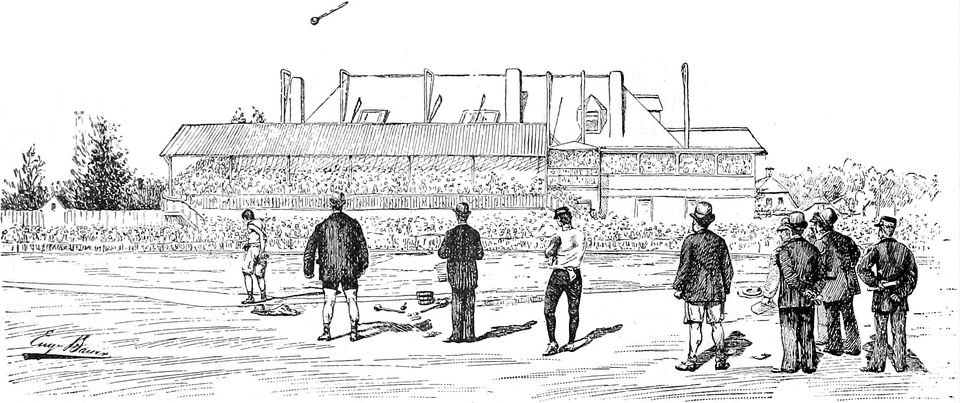
THROWING THE HAMMER.
There are many reasons why Detroit people are proud of their Amateur Athletic Club. The success of the idea which they aim to promote, the success of the national meeting, the character of the work done and the excellence of the facilities for doing it, the energy of the officers and the discipline of the members, and, above all, the vast physical benefit to result from the encouragement of the athletic idea, are among those reasons. Already the good work has begun to bear fruit in the establishment of other gymnasia. The Young Men’s Christian Association has equipped one, though not on quite so extensive a scale as the Athletic clubs. The Catholic Club has a class of about sixty, mostly its younger members, in training in a modest yet commodious “gym,” and the dealers tell the writer that the quantity of apparatus sold for private and home use during the past year is simply astonishing. These are direct results of the work of the Athletic Club, and there is hope for more.
GRAY EVENING.
THE evening’s gown of gray Sweeps over the sighing grain: She comes, with her tender smile, As the sunset’s glories wane; And the flowers nod to her, And the grasses kiss her feet, And she sings to the weary day A lullaby, low and sweet: Sing soft, sing low, O Evening gray! Hush thou to rest The weary day. The morning was very fair, And she laughed for very glee; And the blossoms, waking, breathed Of love and of hope to me. But love and hope have waned As the sunset colors wane— O Evening, come, for the day Is athrob with fevered pain! Sing soft, sing low, Sweet Evening gray! Lull thou to rest The heart-wrung day. Charles Prescott Shermon.
TO THE PACIFIC THROUGH CANADA.
BY ERNEST INGERSOLL.