Volume 13 / Part 2 — OUTING.
Reading edition
VOL. XIII. FEBRUARY, 1889. NO. 5.
BY WILL H. WHYTE.
HARK to the sleigh-bells—how they charm the ear With crystal music exquisitely clear! Watch the light sleighs, how merrily they go O’er firm new roads macadamized with snow! The skies are blue, the sunbeams, as they play, Eclipse the splendors of a summer day, And rubies, sapphires, emeralds, diamonds blaze, Beneath each horse’s footfall, with prismatic rays. G. Murray.
WHEN old Winter, the king of the Arctic Circle, issues from his polar domain for his annual visit to southern latitudes, accompanied by his stalwart henchman Jack Frost, he binds tight with icy chains the great rivers and lakes, and even the mighty St. Lawrence bows to and acknowledges his power. Then the country and roads lie deep beneath the snow-king’s mantle, and man, who cannot hibernate like the bears, adopts a mode of locomotion different from those he uses in the long days of summer. The noisy wheel he replaces with the silent runner.
In all northern countries, where the snow covers the ground to any depth, the inhabitants use some kind of sleigh or sled to enable them to travel during the winter. In the Arctic zone the Laplanders and Esquimaux traverse their ice-bound land in low but comfortable sledges drawn by reindeer or dogs. Around the shores of Hudson’s Bay, and in sections north of Lake Superior, where the iron horse has not yet made his appearance, the winter vehicle in use is the “traineau,” drawn by a team of dogs. In Manitoba and the Canadian Northwest, until its annexation and settlement some years ago by the Dominion, this was the sole means of communication in winter between many of the scattered settlements; and even now, in the far north, the mails are so conveyed. In these days of high pressure, time is an object, and few would care to spend fourteen days in a sleigh when fourteen hours by rail would bring one to his destination. There are, however, yet living, old travelers who could many a tale unfold of tragic adventure over frozen field and flood—some even thrilling enough to stir the blood of the reader of sensational novels.
In those early days, when for four months in the year the sleigh afforded the only means of transportation, it was not regarded as a sport or pastime. The highways followed the windings and indentations of the lakes and rivers, and were frequently blocked with heavy snowdrifts. The ice made a shorter and more level path, and was consequently preferred as soon as it was strong enough to bear the weight of a horse and sleigh, so affording, during the colder months, a pleasant road. But toward the spring of the year, when the returning power of the sun honey-combed the ice, it made a dangerous track, and many a sleigh with its living freight has disappeared beneath the treacherous ice. Even without such tragic incidents, excitement would often be afforded by the loss of horses and sleigh, and a weary, perilsome walk to the nearest village or settlement. In those days no one thought of leaving home without his rifle, for in wood and bush lurked the ravenous wolf, and, still more to be dreaded, the Indian of those days. Happily this has all passed away, and the present generation travels by steam in comfortable cars, and the traveler has no fear of being brained by a tomahawk or losing his scalp. His sleigh-riding is limited to perhaps the next town or village, and usually combines pleasure with business.
In Dakota, Minnesota, and other northwestern States, and in Manitoba, during the months of February and March, when that American product, the “blizzard,” is on the trail, sleighing at any distance from civilization is somewhat perilous. We have a vivid recollection of a sleigh drive in the province of Manitoba, when for twenty miles we never saw the horse that was drawing our sleigh. With fearful velocity the blizzard overtook us, and in an instant the air was filled with a whirlwind of snow. Covering our faces, we left our “shaginappi” pony to follow the trail as best he could, trusting that somehow the sagacious animal would find his way to some house or settlement. After many weary hours, when hope was almost expiring, benumbed and nearly exhausted, just as the shadows of night were closing in around us, our steed suddenly drew up in front of a house, and the most gladsome sight we ever beheld was the light in the window of that little shanty. A warm, comfortable room and something to eat soon thawed us out, and after seeing that our four-footed friend was well housed, we were soon sound asleep, fagged out with our tussle. Never since have we yearned for a similar experience.
In lumbering, that great industry of Maine, Michigan, Wisconsin, and Canada, the sleigh and sled plays a very important part. When frost makes the swamps firm and snow levels the ground, the lumber-camp is in all its activity. The vast forest trees are cut and then easily drawn on sleds to the nearest lake or river, whence in spring they are floated to market.
Ever since the days when the “lily flag” of the Bourbons floated over “La Nouvelle France,” ice-trotting has been a Canadian winter pastime on the great St. Lawrence River, either at Quebec, Three Rivers or Montreal. In fact, in any of the inland villages, wherever a stretch of ice can be found, may be seen the French Canadian, seated on a sleigh after the style of a skeleton-sulky, no matter how cold or stormy it may be. He is happy if he can show the good points of his trotter in a race with a neighbor before an admiring audience of countrymen, and when not racing he will spend hours speeding his horse over the glassy track. The Canadian horse is hardy for his size and weight, unsurpassed for pluck and endurance, and usually possesses good action and temper. Many are descendants of Norman stock. Ice-trotting has always been a favorite sport at Montreal, and many of the trotters of the present day are descended from horses that have been used in this sport. Among those that made a name for themselves on the ice forty years ago was the well-known St. Lawrence.
In Canada sleighing has attained the greatest pre-eminence as a pastime, and perhaps in the whole Dominion it is nowhere so popular as in the ancient province of Quebec. Here the climate is absolutely unsurpassed for the thorough enjoyment of outdoor sports. When winter once sets in a thaw rarely occurs, with the exception of one in January, which seldom lasts longer than two or three days. Jack Frost is the ruler of the weather. Consequently, though the air may be cold, it is clear and dry and enjoyable, the roads hard and smooth, the runners glide easily and quietly, while the bells jingle merrily. All who can afford it keep some kind of a sleigh and horse, while the livery-stables in the larger towns do a thriving and profitable business. The country and city roads present a gay appearance. Every variety of turn-out is there, from the home-made “cariole” and French-Canadian pony of the habitant, to the handsome sleigh and team of the millionaire. What a revelation would a procession of all the styles of sleigh that have been in vogue since the settlement of the province afford! Or even those of the present century. There would be the little market-box, or “Berlin;” the ancient but still fashionable “cariole,” on runners so low that a chance upset does not present much danger; the trotting-sulky; the light but dashing cutter, a style more in vogue over the border than in Quebec, and dozens of fashionable equipages mounted on single or double runners and furnished with a wealth of furs that would make a Russian prince envious.
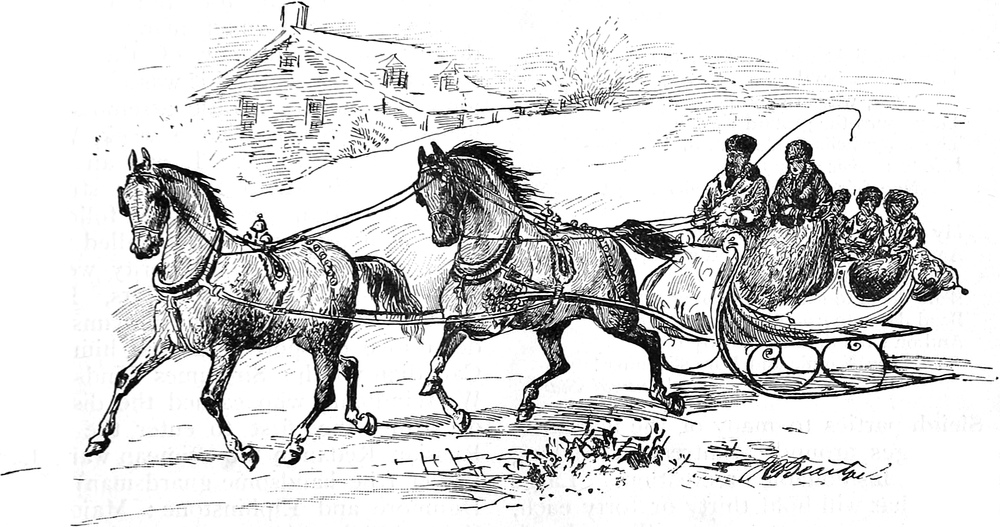
A MODERN TANDEM SLEIGH.
Montreal stands unsurpassed for winter vehicles. St. Petersburg, the Russian capital, can perhaps compete in furs, but the Canadian metropolis is unsurpassed in the beauty and variety of its sleighs. Nor can the pleasure of sleighing be enjoyed to greater perfection than in the “Royal City.” The clear, bracing atmosphere gives color to the faces of the fair occupants of the sleighs; the merry music of the bells, and the sound of the runners over the crisp and frozen snow, all lend a charm to the sport, and furnish a tonic finer and far more exhilarating than anything physicians can prescribe. Even the horses seem to trot with a full instinct of enjoyment.
What is more glorious or inspiring than a drive on a beautiful clear Canadian winter’s evening? The night is glorious; possibly there is not even a breath of wind to stir the mass of snow that covers the fields. The stars twinkle and sparkle in the blue sky; the moon transforms the snowy piles into heaps of sparkling diamonds and sketches in exquisite tracery the outlines of trees and leafless branches upon the virgin carpet beneath. The solemn stillness is only broken by the melodious chimes of the sleigh-bells and the patter of the horses’ hoofs upon the frozen crystals.
If on such a night, with some fair companion at your side, you are not moved to an appreciation of the beautiful in nature, then there is no romance in your composition. If at such a time you cannot throw off the petty cares and trials of the busy world, then, my friend, you are past cure. How the jingle of a sleigh-bell will recall memories of former drives! What visions will loom up of glorious nights, with a charming companion carefully wrapped up in warm and cozy robes! How easily did the sleigh slip along behind the pair of Canadian ponies, or how gayly that chestnut or bay would step out without requiring all the attention of the driver; for when eyes are sparkling in the moonlight, and cheeks glowing ruddy in the crisp and frosty air, it is remarkable what a tendency sleigh robes have to require one’s constant attention! Under such circumstances a horse that does not require all your care is a treasure, for you have plenty of occupation for your left arm keeping the sleigh robes in their proper place, you know. Ah! those glorious sleigh rides around Mount Royal. What can be compared to them, and what an auxiliary they have been to that little god Cupid, many and many a time!
Let poets idly dream and sing The beauty of the windy spring, And in green fields go Maying: Better by far is a winter night, When snow lies deep and hard and white, And the stars look down with twinkling light On Nan and me out sleighing. The moonlight makes a fairer day— The restless horses seem to say, “Oh, why are you delaying?” They spurn the ground with flying feet, The sleigh-bells tinkle clear and sweet— Life has never a joy to beat Nannie’s and mine out sleighing! My love then nestles near my arm, Among the furs so soft and warm, And I, my heart obeying, Bend down to see her beaming eyes, Bend down to catch her loving sighs, And oh! the time too swiftly flies, When Nannie and I are sleighing! Montreal Star.
Sleigh parties to many of the neighboring villages around Montreal have long been a fashionable recreation. Large sleighs, that will hold thirty or forty each, convey the party to some village hotel, and there, in the ballroom, which is invariably a part of the establishment, a merry and pleasant time is spent.
In the larger cities of Canada there have existed for many years driving clubs. These possess a greater or less degree of organization, and are in operation only during the winter months. Montreal, Quebec, Halifax and Kingston have all had their “tandem clubs.” Montreal and Quebec have probably older organizations than the others. Since they all were garrison towns, during the occupancy of the Imperial troops the officers of the various regiments were among the chief factors in keeping alive these clubs. Quebec’s Tandem Club is said to have been in existence at a time which the memory of the oldest inhabitant reacheth not. One of its oldest presidents is still living, and years ago drove four thoroughbreds of his own breeding. A number of Quebec’s well-known and wealthy merchants have been presidents of the club, and with Lord Alexander Russell and the Earl of Caledon have frequently driven four-in-hand around the streets of the ancient capital. The value, it is said, of some of their magnificent outfits—sleighs, horses and robes—often exceeded $5,000. In the days of the military, the club usually consisted of five or six four-in-hands and thirty to forty tandems, besides pairs and singles. This old club has never entirely lapsed, and consists at present of the officers of the battery of artillery which garrisons the Citadel, and the wealthier shipping and lumber merchants.
The Montreal Tandem Club, as a distinct organization for the pastime of sleighing, was formed many years ago, during the occupancy of the Imperial troops. In those days it was a most fashionable and aristocratic assemblage, and usually mustered twice a week, Wednesdays and Saturdays. It was an inspiriting sight to watch the long stream of handsome equipages as they followed in line. Among those who handled the ribbons with skill and dexterity were the old, gray-haired hero of Kars, Lieutenant-General Sir Fenwick Williams, whose deep love of sport endeared him to the Canadian youth; Sir James Lindsay; Sir W. Windham, who earned the distinction of being the first to enter the famous Russian Redan in the Crimean war; Lord Paulet (the handsome guardsman); Lords Dunmore and Elphinstone; Major Penn, Colonel Bell, and many others whose names we cannot at present recall. Two should, however, not be forgotten—two whose names have since become well known the world over—Colonel Wolseley, now General Lord Wolseley, and Lieutenant Butler of the 60th Rifles, now General Sir Redvers Butler. Pleasant days they were, and as the long line of four-in-hands, unicorns, tandems and pairs filed past, filled with the happy and smiling faces of the Canadian belles and gallant officers, many of the latter little thought that in after-years, far from Canadian snows, they would find soldiers’ graves, and “sleep the sleep that knows no waking” in lands where such a thing as a snowflake was never dreamed of.
After the withdrawal of the British troops, the Tandem Club for a few years had a feeble existence; but in January, 1882, principally through the exertions of some of the older members of the Montreal Hunt Club, it was reorganized. Mr. Joseph Hickson, the general manager of the Grand Trunk Railway was elected president, while in 1883 Mr. Andrew Allan, of the well-known Canadian Steamship Company, was the president—Mr. Joseph Hickson being again elected to the office in 1884. Every Saturday, at two o’clock, the club meets on Dominion Square, opposite the Windsor Hotel. A gay and pleasing sight it is to watch the smart “turn-outs” as they circle round the square before making a start for the selected destination. A favorite resort is Peloguin’s Hotel, at Sault-au-Recollect village, about seven miles from the city, on a northern branch of the Ottawa River. A six-mile trip eastward along the banks of the St. Lawrence, brings one to Longue Pointe, while westward a favorite road leads through the suburb of Côte St. Antoine, past the “Blue Bonnets,” to Lachine, about nine miles distant. Other favorite drives are to “The Kennels,” the headquarters of the Hunt Club, or round the winding, zigzag road to the park at the summit of picturesque Mt. Royal. The time spent at the rendezvous is usually about an hour, just enough for some light refreshments and perhaps a dance or two. Should the weather prove somewhat stormy and the sleighing heavy, a drive around town is the order of the day.
The Saturday meet always draws a crowd of citizens to watch and admire the handsome sleighs and horses. The cavalcade is steadily augmented by the new arrivals until the signal for starting is sounded from the coaching-horn of the leading four-in-hand. The four-in-hands always take the lead, followed by the unicorns, which rank next. Next come one or two randoms, and then follow a long line of tandems, then the pairs, the rear being brought up by another tandem, which acts as whipper-in.
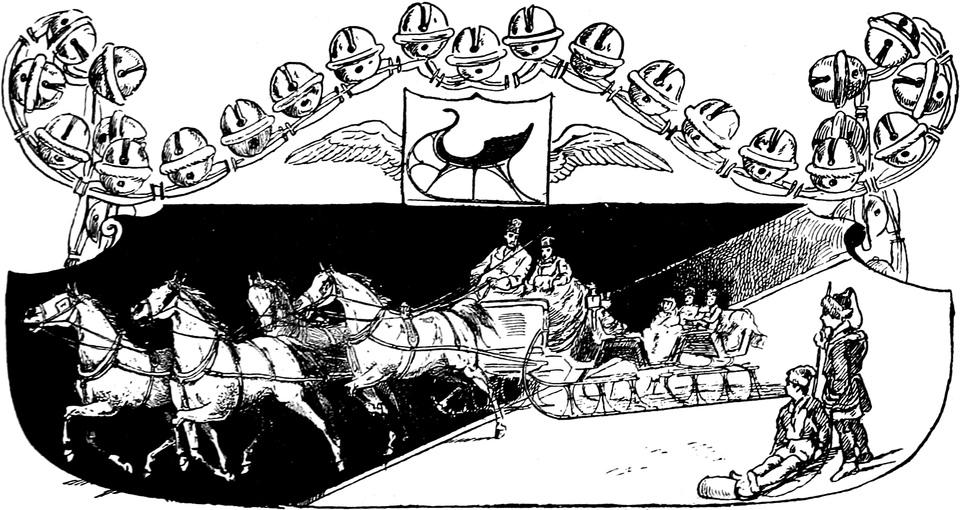
Since the introduction of the Montreal winter carnivals, the sleigh parade, or “Carnival Drive,” has been one of the week’s events each year, and is a sight worth seeing. These drives are a commingling of all sorts and conditions of men, wealth and affluence in the private equipages of the wealthy merchants and members of the Tandem Club, and rural comfort and simplicity in the humble but substantial outfit of the habitant. The athletic clubs turn out en masse in huge sleighs of various shapes and designs, holding fifty to sixty uniformed members, and drawn by eight, six, and four horses. There are double and single sleighs, carioles, box-sleighs, light cutters, family sleighs, habitant sleighs, skeletons, sulkies, “haysleds,” Russian sleighs, and nondescripts on runners impossible to classify, but all lending their aid to make up a spectacle.
Besides the fashionable Tandem Club, Montreal has other driving associations. The contractors, who in most large cities are well off, have a driving club, and visit the neighboring villages during each winter. The Hackmen’s Association have turned out sleighs by the hundred at the carnival drives, and their costly and handsome outfits have been the admiration of all, many of the master carters having sleighs that equal in style and finish those of the wealthy merchants.
ACROSS WYOMING ON HORSEBACK.
BY LEWIS P. ROBIE.
During a recent winter it became necessary for me to leave Cheyenne for Buffalo, Johnson County, in the northern part of the Territory. I could reach Buffalo either by rail to Rock Creek on the Union Pacific, thence by stage or team 250 miles, or by riding direct across country. The latter route would be the least expensive, but older and more experienced men advised me not to ride, particularly at that time of the year. Severe blizzards were common in April, much rain had fallen, and as I should have to cross many streams, which of course would be swollen by the rain, it would be a hazardous journey. Besides, the country to be traversed was entirely without towns or settlements, and the distances were long between ranches and places of shelter. I thought of the possibility of my horse falling lame, or of my losing him altogether, or of being taken sick myself or disabled in some way; and since I was only a “tenderfoot,” such a journey was, in my opinion, as well as that of others, quite an undertaking.
The first thing was to get a good horse, and I purchased a dark mouse-colored one, eight years old, tough, and full of life, at the same time kind and affectionate. I named him “Terry,” and he cost me $75.00, with saddle, halter and bridle complete. I purchased a pair of boots, leather chaperajos, broad-brimmed sombrero, blue flannel shirt, revolver and cartridges, and attached to my saddle an overcoat and “slicker,” a fur cap and mittens, and bought a good map of Wyoming and a pocket compass. Thus equipped, I bade farewell to my friends in Cheyenne, and on the morning of April 3 started on my eventful trip across the frontier.
The Magic City was soon far in the distance, as my horse covered the ground with a pacing gait, peculiar to him. About five miles out I climbed a high range, to take my last look at the city, and then descended to the rolling plains beyond. A strong head wind sprang up and retarded my progress considerably, so that it was not until after twelve o’clock that I struck a ranch nine miles away, where I put up for dinner. After enjoying a hearty meal, I re-saddled and continued my journey on the stage road for about four miles, when I turned to the left and followed a cattle trail to Pole Creek.
The morning had dawned pleasantly, but now the weather looked very dubious, and I could see a storm coming up toward the mountains, which were almost hidden from view. It was almost four P.M. before I reached Dyer’s sheep camp, on Pole Creek, about twenty miles from Cheyenne. The storm and wind seemed to grow worse, and it was dark, just as the rain came down in torrents, when I reached Lowe’s ranch, on Horse Creek; and well it was that I did, for as night came on I could hardly see two feet ahead of me. In crossing the creek Terry stumbled and fell on his knees, but I pulled through all right, though considerably wetted. Just as the cowboys were making the round-up I rode into camp and was cordially received. Supper over, pipes were lighted, and I played my flute for a while, but, being very tired after my hard ride in such inclement weather, I soon turned in on a rough bunk of blankets and fell asleep.
My route now lay east for a few miles along the creek, and I rode along lighthearted in the glorious morning. At Goodwin’s ranch I turned north, on the stage road, and by noon reached Bard’s, at Little Bear Springs. About six miles farther on I overtook a camp of freighters, and had a pleasant talk with a few old-timers, all of whom thought my trip would be rough, and told me that they would hesitate before taking such a journey themselves. The scenery had varied little. From day to day I crossed rolling plains, with thousands of cattle, sheep and horses quietly grazing, with numerous antelopes and prairie dogs in sight, and occasionally elk and black-tailed deer. Toward the west were the Laramie Range of the Rocky Mountains, with their snow-white peaks glistening in the sun.
Time flew by, and for ten miles I rode in silence until I came in view of a lone sheep-herder with his flock. Being interested in the details of a sheep-herder’s life, I went over to where he was seated on a ledge. He was dressed in rough, cowboy’s garb, his head bowed between his knees as if he were in deep thought, smoking a pipe. As his back was turned toward me he did not see me coming, and I rode up to him and said: “A pleasant afternoon, sir!” He started, but regained his composure in a second, and without taking his pipe from his mouth, grunted a simple “yes,” not even troubling to look up. “Your sheep are in good condition,” I continued. He raised his head suddenly, gave me a wild, murderous look, but answered not a word. Concluding he did not wish to be questioned, I proceeded on my journey. At Chugwater, on inquiring about this strange fellow, I heard that many years ago he lived in New England, was of good family, very well to do, and exceptionally well educated and intelligent. He fell in love with a girl, who jilted him, and he never could get over it, but left his home, came West and started to herd sheep, living alone and shunning all society.
Toward sundown I ran into a prairie-dog town, where hundreds of these little animals were running hither and thither, in and out of their holes, and filling the air with their clatter and squealing. It was now close to six o’clock, the sun was almost out of sight, and I was as nearly as I could judge seven miles from the Chug. Terry, however, was as impatient for his supper as I was, and at my “Get up, old boy!” he started into a gallop, which he steadily kept up till the bridge was reached. It was just seven o’clock as I rode up to the post-office at Chugwater—twenty-nine miles that day, and sixty of my trip ended.
This was one of the most important places on my route, containing a post-office, stage station, a ranch hotel, a general store, and the stock ranches of the Swan Land and Cattle Company, one of the largest organizations of its kind in the world, operating 250,000 head of cattle, and having three millions capital. It is also a lay-over for the stages of the Cheyenne, Fort Laramie and Black Hills Company. There was quite a gathering of ranchmen and others, on their way south to the annual meeting of the Stock Association at Cheyenne, a very important event to the cattle owners of Wyoming.
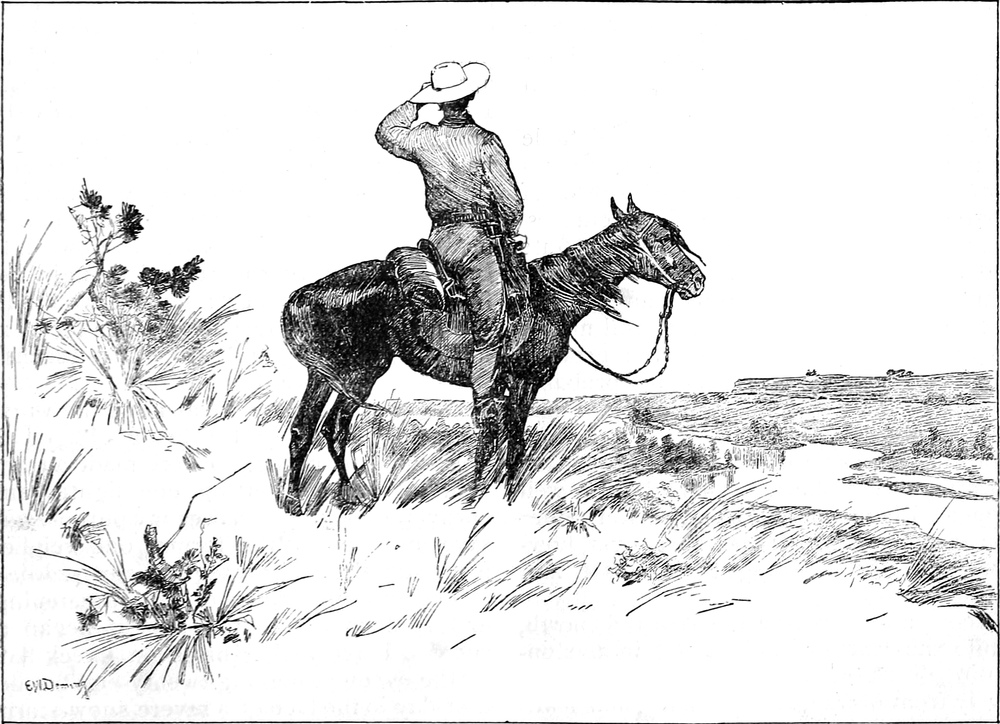
I TAKE MY LAST LOOK AT THE CITY.
In the morning I arose early, with the intention of reaching by noon a ranch called Hunton’s on the map. I found myself, however, so stiff in the limbs, not being thoroughly used to the new saddle and the action of the horse, that I concluded to allow Terry a run in the corral and rest till the afternoon before starting.
I passed the morning in looking into the workings of a model cattle ranch, preparatory to the spring round-up, and was particularly interested and amused in watching the men break some bronchos to the saddle. The life of one of these “broncho busters,” as they are called, requires much nerve and daring. Not unfrequently they are badly hurt by the kicking and struggles of these fiery beasts.
I had left the Chug scarcely more than three miles behind me, when, on turning a bend in the trail, I came suddenly on a band of a dozen or more antelopes, quietly grazing a short distance to my left. If I had had a rifle I might have distinguished myself, but I could only pop away at them with my six-shooter, much to the disgust of Terry, who kicked and bucked till I was nearly thrown. Between four and five o’clock, I reached Richard’s Creek, with four miles ahead of me to Hunton’s, where I intended to spend the night. As I approached the creek, I was overtaken by a brown, sunburnt individual, who, after we had exchanged “Hows,” invited me to spend the night at his camp half a mile down the creek. He was one of six who were on their way south to Colorado for the purpose of gathering up three hundred ponies for the round-ups in Northern Wyoming.
After enjoying a rough but palatable supper of frying-pan bread, bear meat and coffee, we lit our pipes, and with stories of frontier life, Indian raids and adventures, interspersed with music on the violin, flute and harmonica, the evening passed pleasantly. One has to put up with anything in this country, and when I had to roll myself up in blankets and sleep on the ground, it was not unexpected. I should probably have slept well if, toward morning, I had not been awakened by a rain and wind storm, which came up so suddenly that my coverings were blown away, and I was well drenched before I could find shelter under the camp wagon. It was soon over, however, and the morning broke clear and pleasant.
Soon after breakfast I started north, while the campers pulled out in the opposite direction for Colorado. Terry felt lively from his run on the plains, and I was at the ranch in less than an hour. There were now before me twenty miles to the Laramie River, and then sixty miles of very hard traveling over the foot-hills and mountains to Fort Fetterman on the North Platte, where the worst part of the trip would be over. All the afternoon, till the sun had nearly set, did I travel over the monotonous plains without seeing a sign of human life. About half-past five I heard a shot from my right, and, hastening over the hill, saw a hunter fire again at an antelope which was among a small “bunch” of cattle. Unless forced by want of water, or decoyed, these timorous creatures seldom allow hunters to approach so near; but this unfortunate in some way had got among the cattle, which were not afraid of the hunter, and so it quietly stood its ground till the first shot was fired, when it was too late to escape. The man proved to be the owner of a ranch on the river that I was bound for. I dismounted and helped him place the antelope, a fine young one, on his horse. Then, leading our horses, we started for the ranch, three miles away, anticipating with sharpened appetites the treat of fresh antelope for supper.
In the evening I was attracted by a camp-fire across the river, and thinking I might get more information as to trails, ranches, etc., I crossed the river on the logs. It proved to be a freighting outfit bound for Cheyenne direct from Buffalo. They spoke of my probably having a very hard pull to Fetterman, and thence I would be apt to get lost and turned about, unless I stuck to the stage road, and they advised me not to try to strike cow ranches, as I had planned. On recrossing the river I thought that I could get over as before, on the logs, but I missed my footing, made a misstep, and fell in. As I sank down into the cold water of the river, I thought before I could get out “my name would be Dennis;” but I grasped the logs for dear life, and, crawling and struggling, reached the shore wet as a drowned rat.
The next morning I was none the worse for my accident, or for being obliged to sleep in wet clothing. I here made a trade with my saddle, getting one lighter and cheaper, that would answer my purpose and save my horse, as the former one weighed forty pounds, being a regular cow saddle.
The morning dawned very threatening, and as I rode into the hills it began to snow. I reached Horseshoe Creek late in the evening, making twenty-eight miles that day in the face of a severe snow-storm. Early the next morning I started for Lebonte Creek, twenty-two miles away, thinking to reach there by noon, and Fetterman, twenty-two miles farther, that night. But, as I got farther into the foot-hills, I found it would be impossible through the snow, which in places was very deep, so that if I got through it in two days I would be lucky.
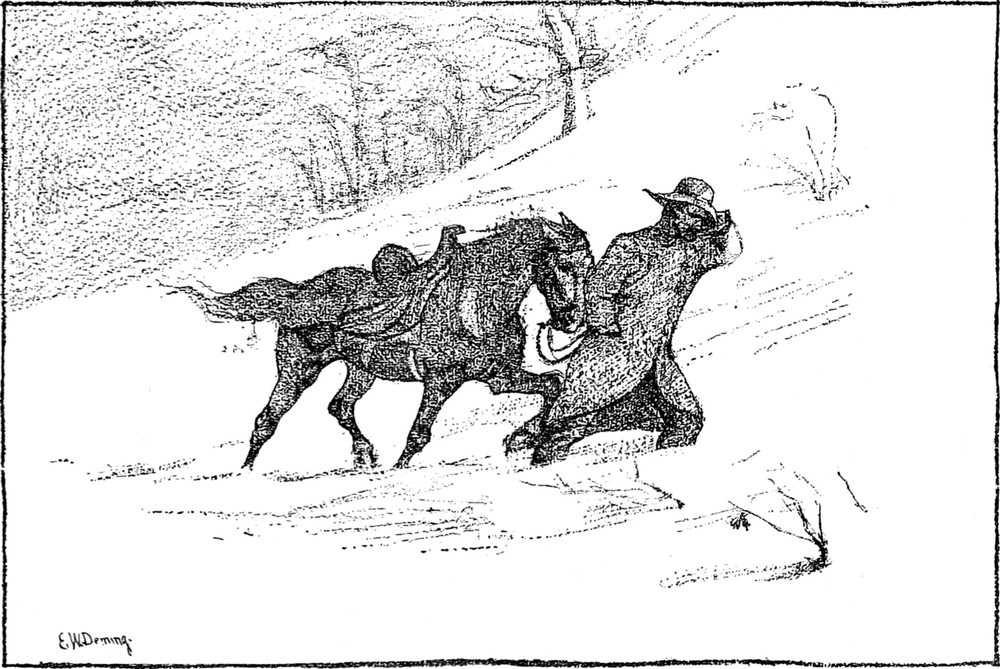
THROUGH DRIVING SLEET AND SNOW.
For some ten miles I rode, admiring the magnificent view of the Rocky Mountains, now plainly visible, with their snow-white peaks apparently touching the clouds, when, on dismounting to walk up a long and steep hill, I heard a clatter of hoofs behind, and on looking down the hillside, was astonished to see one of the gentler sex coming in my direction. All sorts of conjectures as to who she might be crossed my mind, and I thought of stories, read long since, of “Calamity Jane,” “Fearless Kate, the Female Highwayman,” etc., but I was again surprised, as she approached, to find one of apparent refinement and culture. I was thinking just how and what to say, when she bade me a pleasant “Good-morning, sir! Rather cool”—presumably referring to the weather, not to myself. I soon found use of my powers of speech, and we chatted away at a great rate. The young lady was returning from a visit to her nearest neighbors twenty miles down the creek, and lived at a ranch which I hoped to make by noon. The remaining twelve miles did not seem half so long as the first ten.
At Lebonte her father made it exceptionally pleasant. I concluded not to attempt to make the fort that day, but to accept their kind invitation to remain till morning. In the evening, seated before the open fire, we had a long and interesting conversation. This “Rose of the Mountain” lives twenty miles from the post-office and nearest neighbors, and she and her younger brother and sister have their ponies and nature in its grandeur for their society. I made a trade with one of her brothers, and for my watch obtained a fine Winchester rifle.
During the night a storm came up, and in the morning I was confronted by a regular Wyoming blizzard. I put on overcoat and slicker, crossed the creek, and pushed into the mountains. After less than five miles, I almost wished I had remained at the ranch till the storm was over. A very high wind, accompanied by a driving, drifting snow, retarded my progress, so I could hardly make three miles an hour. As I got into the mountains, the storm increased in violence, and it grew colder. I could hardly see the trail, and but for the government telegraph-poles connecting Fort Russell with the north, which I had used as a guide so far, I should surely have been lost. At Wagon Hound and Bed Tick Creek I was obliged to make a crossing, where, had the water been a foot deeper, I should never have been able to get over. As it was, poor Terry almost gave up, the water was so cold and deep, and at Bed Tick I had to go three miles east to find a place where I dared to enter the icy water. A great part of the way I had to walk, fighting against wind and snow, till late in the afternoon, when, utterly exhausted and chilled, I dragged weak and tired Terry into Fort Fetterman, twenty-two miles that day, and one hundred and seventy miles of my journey ended.
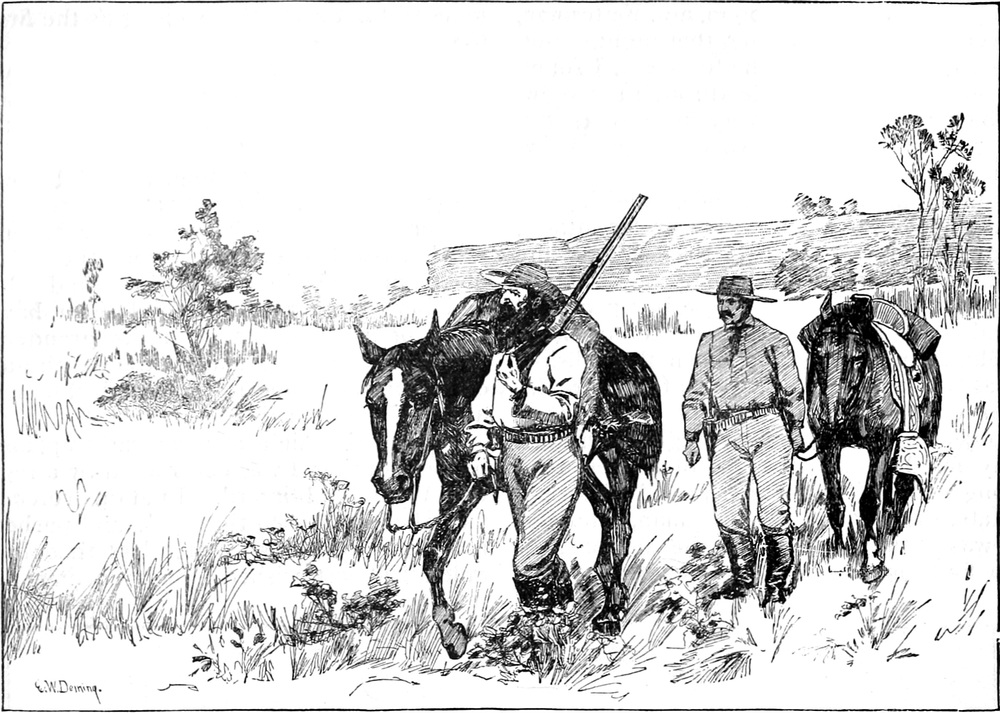
AND LEADING OUR HORSES WE STARTED FOR THE RANCH.
Fort Fetterman is situated on a high plateau, at the base of which the North Platte River winds its course for miles and miles, as far as the eye can reach, through the finest grazing country in the world, giving a view more extensive and grand than at any other point on my route. The storm cleared toward sundown, and during the night the characteristic Chinook wind of Wyoming came up—a dry wind, which blew away and absorbed nearly all the snow. When I awoke the next morning and looked out upon the vast expanse of plains and mountains, I was astonished to find hardly a trace of the storm, except in isolated places high up in the foot-hills.
Fort Fetterman used to be a Government fort, but has been abandoned for several years. It now contains two ranch hotels, several cow ranches, a post-office, Government telegraph office, half a dozen saloons and a general store, and is the largest place between Cheyenne and Buffalo. It has the reputation of being the hardest point in the Territories, being the rendezvous of all the cowboys in Central Wyoming. I kept very quiet, and with the exception of a few disagreeable solicitations to drink from some of them, I was not molested. I was a little concerned, but not at all shaken in my purpose, by authentic reports from the telegraph office, which connects with Fort McKinney, near Buffalo, of serious disturbances among the Crow Indians, who had left their reservation in Montana, and were only waiting for grass to make war on the settlers in Johnson County. I concluded, however, if they were to make a break, I would be as safe under the protection of the troops as I would be here, where a tenderfoot was never known heretofore to live more than ten days.
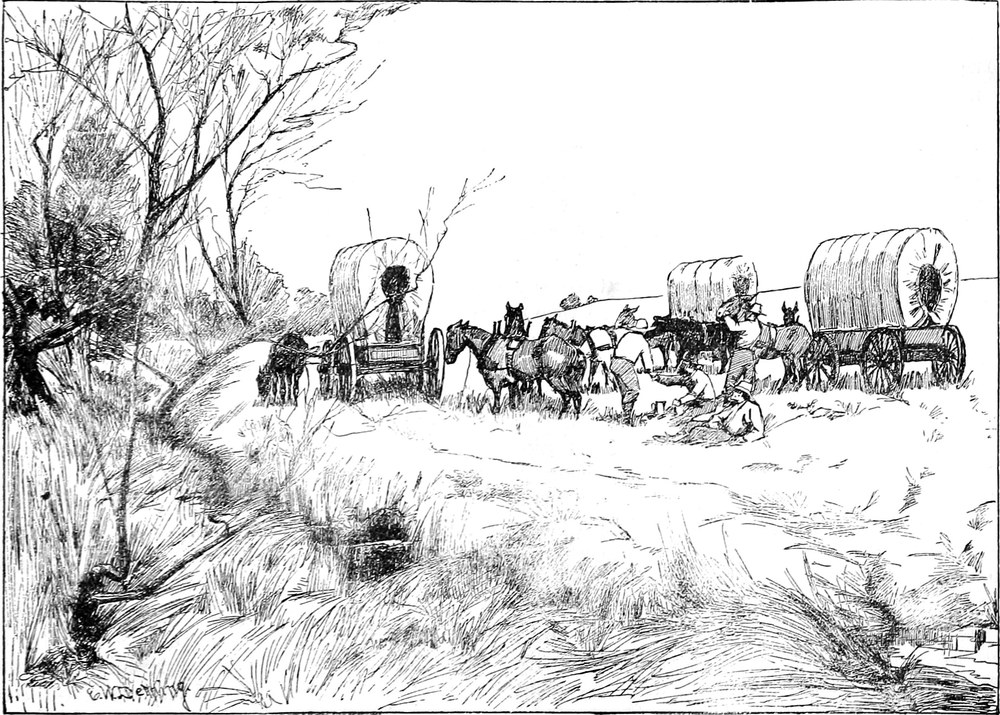
IN CAMP FOR THE NIGHT.
A true story is told of a young man who was stationed here as a telegraph operator. He belonged to the class designated dudes, whom the cowboys love less than any other breed of tenderfeet. He was much pleased with the country and life in the Far West, but he was not satisfied with simply seeing the boys ride on horseback into saloons and shoot the lights out, common everyday fights, and an occasional lynching bee. He sighed for Indians and gore. He wanted to “spread himself” fighting the wary redskin. Finally the cowboys thought they would see if there was as much stuff in him as he bragged, so half a dozen or more dressed themselves up as Indians, with paint, feathers and tomahawks, and hid in a secluded place not far from town. In the meantime our hero was informed that some Indians had been seen a few miles up the river, and he was invited, if he wanted some sport, to join in and add his great fighting ability to help the rest. So they all started, but had hardly got out a mile or so when the secreted pseudo-Indians commenced yelling and firing in the air. The would-be Indian fighter, thinking they were an advanced guard of a host of others, turned and fled with his hair on end, and did not stop till the telegraph office was reached. He immediately wired to the Governor at Cheyenne, “Dispatch troops at once; two thousand Indians are on us,” and then hurried out to warn all to arm themselves for their lives. The postmaster, whose office was in the same room as the telegraph, directly sent another message: “Don’t deliver telegram just sent,” and the return of the cowboys soon gave the trick away. They gave the St. Louis tenderfoot no peace whatever. The territorial papers got hold of the story, and one morning he packed his grip and silently boarded the south-bound stage for parts unknown.
Early on April 9 I crossed the North Platte River. At noon I reached Sage Creek, and after resting an hour or so, left the stage road and struck a trail to my right, leading, as I was told, to Andrew’s cow ranch, on South Fork Cheyenne River, fourteen miles distant. I could see by my map a ranch in that direction, so I felt perfectly safe in venturing away from the telegraph poles, which had been my faithful and silent guides hitherto.
I was now leaving the mountains and approaching the sage-brush plains, a most monotonous and dreary-looking country. For miles I plodded along, alternately riding and walking, without seeing any sign of human life, or anything to break the monotony of the sage-brush. About half-past six, as I approached the river, I ran into a barbed-wire fence, which, when followed up for a mile or so, led me to the door of the ranch, where I dismounted and camped for the night.
I left the ranch in fine spirits. I had gone perhaps four miles when two men overtook me, passed, then turned and came back, scrutinizing me and my outfit as they came. As they drew up, one said: “Where did you get that horse?” Was it a case of mind-reading, or a mere freak, that led me to match his impertinence by saying, “Stole him.” “Yes,” he replied, “we know you did,” drawing out at the same time a warrant for the arrest of a horse-thief. My bill of sale for the horse and other papers sufficed, however, to prove that I was not the thief, and Terry carried the proof of his identity in a brand under the saddle, though answering strangely well in other respects to the description of the missing horse. They apologized for their mistake, and bidding me good-day turned toward the hills in the hope of capturing the real thief. I felt much relieved as they disappeared, for a horse-thief once caught in Wyoming stands but little chance for his life.
After dinner at Warner’s, I turned to the left across the plains, towards the stage road again, not seeing any stop for me nearer than the Wyoming stage station at Antelope Springs. On the ranges adjacent to Bear Creek and Stinking Water I came across many carcasses and bones of dead Texan cattle, which had been unable to pull through the severe winter, and as I turned north on the stage road I saw a lone buffalo.
The sun had disappeared behind a lofty range of the Rockies as I pulled up at the ranch at Antelope Springs, with only ninety miles ahead of me to Buffalo. After supper the stock-tender suddenly asked for my rifle, and almost within a second fired down the creek, where we found that he had killed an enormous gray wolf. He then bought my rifle for $15.00. I was told here that sixteen miles to the northwest I could find a cow-camp, which would not make my journey more than five miles longer, and would save an expensive stop on the stage road. I could see no ranch designated on the map in that direction, but supposed that it was a new outfit. So, the next morning I turned to the left, and followed a very narrow and almost indistinct trail till late in the afternoon, making fully twenty-five miles, without seeing any sign whatever of a human habitation, when, upon looking ahead of me at the sun, now near the horizon, I found that I was traveling due west instead of going northwest, as I should have gone. The trail had been growing much more indistinct for the last hour, so much so that it was with great difficulty I could distinguish it at all. Near by was a high bluff, which I ascended, and from which I had an extended view in all directions—north, south, east and west, as far as my eyes could reach. Not a sign of human life met my gaze. A few cattle in the foot-hills, that was all.
Lost!
I thought it could not be more than twenty-five miles northeast to the stage road, but was afraid that poor Terry would not be able to make it with ten miles more to the ranch. Besides, as darkness came on, I might get lost and turned about worse than ever. The best and only course for me was to camp out all night and wait till morning.
Acting on this decision, I descended into a ravine, beside a small stream, which I found by looking at the map was probably a “dry” fork of the Powder River, so called because during the summer months the water dries up. Now, however, it was quite a creek, from whose cold, clear water both Terry and I gathered much refreshment. Dry cottonwood timber lay about in considerable quantity, and I soon had a fire. I had been advised, if night should overtake me, to picket my horse near what grass he could reach, with a chance of his being devoured by wild beasts, rather than to let him run on the plains with a greater chance of his getting away. The old frontier saying is, “It is better to count bones than tracks.” I had about thirty feet of rope, with which I securely fastened Terry to a scrub pine not far from the fire, where he could partially satisfy himself with the bunch and buffalo grass that abounds in the foot-hills. I piled on the wood for a big, rousing fire, for as the night came on it grew very cold, though fortunately it was clear.
The night continued to grow cold, and I found it impossible to get any sleep with my simple coverings of overcoat and slicker. Finally I built two fires, and lying between them at length managed to get warm, and was just falling into a gentle sleep when my ears were greeted with the unearthly yelp of the coyote, or timber-wolf, which soon grew louder and nearer, till apparently I was surrounded by hundreds of them. I started up in alarm, drawing my revolver, and assumed a position of defense, for I momentarily expected they would close in on me. But my being awake, and the light of the fire, kept them at a safe distance, though the yells and cries were kept up till late in the night. To add to my misfortune, poor Terry, frightened at the uproar, broke his fastenings and decamped. I was not supremely happy at the serenade, but when I saw my faithful horse disappear in the darkness, my heart sank within me. Even if I should live through the night, how could I get out and reach food and shelter without Terry? I hoped, however, that I might find him the next morning, as he had grown to be very affectionate of late, so much so that he would eat out of my hand and follow me at my bidding. Knowing that my only safety was in keeping a bright fire steadily burning, I piled on the wood, plenty of which was fortunately near at hand. Toward daybreak the wolves began to disperse, and I breathed a sigh of relief as I heard their distant yelps, thanking God that danger from that source was now over.
As soon as the daylight enabled me to distinguish objects, my thoughts were bent on finding Terry. I had hardly left the camp-fire when he made his appearance through the timber, running directly towards me, neighing, whinnying, and apparently much pleased to find me safe.
I saddled, and, breakfastless, struck out northeast by the compass, knowing that if I kept on in that direction I was bound to reach the road. I pushed ahead as fast as possible, but my progress was necessarily very slow, as my route lay through frozen mud, fallen timber and gulches. Suddenly the horse stopped at a sandy place. I urged him with whip and spur. He would not budge an inch. I jumped off and tried to lead him over, but he would only pull back. I remounted to see what he would do, and much to my surprise he went round and crossed where the water was nearly three feet deep. “There must be something the matter with the sand,” I said to myself. To satisfy my curiosity, I rode back on the opposite side, and as the gray tinge of the breaking day lighted up the surroundings, I was astonished to discover, a few feet ahead of me, the horns of a cow sticking out of the sand. It instantly flashed across me why the horse refused to cross.
Late in the afternoon I arrived at Seventeen-mile Ranch, horse and rider hungry, sleepy, and utterly exhausted. As soon as I lay down on a rude bunk I fell into a sleep from which I did not awake till early the next morning, with a little headache, but in other respects feeling first-rate. I found that the boys at Antelope Springs bulldozed me into leaving the road, as there was no cow-camp for a hundred miles in the direction I had taken.
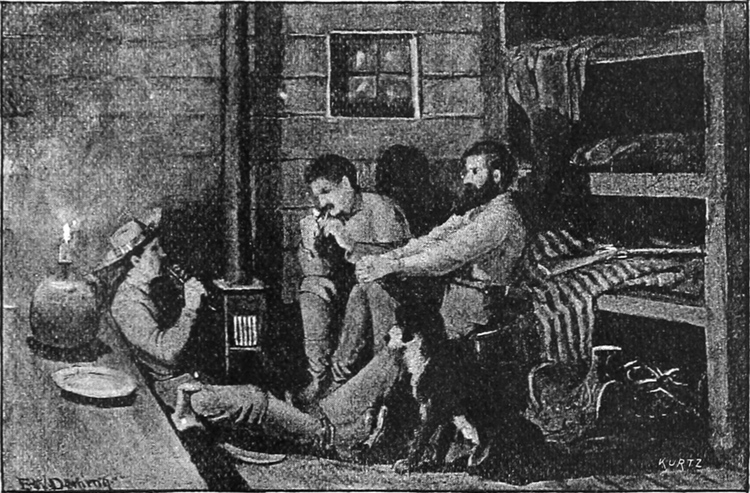
A MUSICAL EVENING.
I had now seventeen miles to Powder River, and fifty from there to Buffalo, with a stage station between at Crazy Woman Creek. I had proceeded about two miles when I was overtaken by two cowboys racing. Terry, plodding along at his usual gait, braced up as he heard them coming, and started into a dead run so suddenly that I was almost upset. He was bound not to be left behind, and surprised me by his spirit after such a hard trip. Away we went for a mile or so, neck and neck, till the cowboys turned to the left for their ranch down the river. The incident gave me encouragement to think that Terry was all right for getting there anyway.
About four o’clock I reached the post-office at Powder River, the scene of a noted Indian massacre a few years ago. Here I was overjoyed to find letters from Cheyenne and home, the first I had received since starting on my trip. The postmaster informed me that I could strike a camp eighteen miles northwest that would save me enough distance to make Buffalo at the end of the next day, but I had had experience enough in trying to strike cow-camps, and concluded to stick to the road, even if it did take me a day longer. So, very early the next morning I started on the road, in a drenching rain, for Crazy Woman, thirty-three miles.
This was the most disagreeable day I had had during the whole trip, and a very lonely ride. I saw nothing but a water-hole at Nine-mile Gulch. The ranch here consists of only a bar-room divided by a curtain from a room used for sleeping, cooking and eating, with the stables and corral beyond. I had just entered the bar-room when I was accosted by, “Here, stranger, come and have something. Turn out some more whiskey, Bill!” I felt now I had come to what I had expected all along the line, an invitation to drink, where to refuse would be to risk death; but I was going to fight it out as long as I could. I replied, “Boys, you must excuse me; I don’t drink.”
“What’s that? Don’t drink? You —— tenderfoot! I never had anybody refuse to drink with me yet, and, I tell yer, you do what I say—you drink!” drawing his revolver and pointing it at me.
“Well, I’ll take some light drink,” I said, knowing they had nothing but whiskey, “but I won’t drink that stuff.”
“What do you take us for? We don’t have any —— dude drinks here. You do as I tell yer—drink whiskey!”
I went over to the bar, took up the glass, and was about to drink, when a thought occurred to me. I turned to the owner of the place, who was turning out the drinks, and said:
“Now, sir, I come here a stranger. I propose to attend to my own business, and when I leave pay my bills and go on my way. The reason I don’t want to drink is that the liquor will make me crazy. If I take one glass I shall want five, and I shall not be responsible for what I do. I appeal to you to see I get fair play. I’ll take a cigar with the boys, but I would rather not drink.” To which the cowboy who had insisted on my drinking replied:
“That’s all right, stranger. If you don’t want to drink, you needn’t. Here, have a cigar. Give him a whole box, Bill; I’ll pay for it.”
I humored them for awhile, but preferring Terry’s dumb society to the noise and disturbance of the drunken cowboys, I soon joined him.
The storm cleared during the night and the morning broke very pleasant. The “cow-punchers” had pulled out late at night for their ranch, and congratulating myself that I was free from them, and had but twenty miles more, I ate a hearty breakfast, and started for my last ride. I was getting now into more of a farming country, where crops of oats and wheat are very successfully raised by irrigation. The Big Horn Mountains were plainly visible to the northwest, and together with the foot-hills, which were covered with a green carpet of spring grass, looked very fine. At ten o’clock I rode into Buffalo, heartily congratulating myself upon the happy termination of a long and perilous journey.
WINTER SHOOTING IN SOUTH CAROLINA.
BY C. W. BOYD.
NOTWITHSTANDING boasted advancement in civilization, the love of camp-life, with its unrestrained freedom and absence of care, is strong in many a bosom, though the demands of duty and calls of interest may lead one to suppress it. In my opinion, at any rate, there is nothing so thoroughly enjoyable as to throw off the trammels of conventionality and do as one pleases, without fear of restriction or comment.
When, therefore, towards the latter part of February, after a winter spent in town, without a chance to pull a trigger, my friend C—— proposed a “camp-hunt” up the country, I was not slow to join him. I was living at the time in the northwestern part of South Carolina, a famous country for quail, though persistent hunting and the clearing of heavy tracts of timber have made other game scarce. Having settled our destination—a spot locally known as “Indian Camp,” on Fair Forest River—and engaged the services of a teamster, with his two-horse wagon, we set to work to make up our outfit.
This, although it may seem a simple matter to the uninitiated, requires some experience, in order to know just what is necessary. I must own that, although not without some knowledge in the matter, I never went on a trip of the kind without forgetting something that I afterwards needed. In the first place, we took a tent, a cot apiece, blanket, a couple of camp-stools, water-bucket, cups, and cooking utensils. The staples of our commissariat (a very important department) were bacon, flour, lard, coffee, sugar, a few dozen lemons, and last, but not least, a little brown jug, which C—— insisted on taking, saying it would come in handy for carrying water when emptied of its original contents. These things, with sundries too numerous to mention, and our guns and cartridges, completed our outfit. We took two dogs, a pointer and a setter, each thoroughly trained.
As we had determined to go in style, the next point was to find a cook. We were soon overwhelmed with applications, and the only trouble was to make a good selection. We finally decided to take Barney, a somewhat dark mulatto of gigantic proportions, a genuine Southern negro, with thick lips, broad, good-humored face, and somewhat of a character in his way. His accomplishments were considerable. From heeling a gamecock to turning the jack in “old sledge” his skill was unrivaled among his colored brethren. Not an event of importance took place in local sporting circles of which Barney did not know, and of which he was not magna pars, as Virgil puts it. Add to this that he was a first-rate cook, and in social intercourse constantly inclined to risibility, with a never-failing flow of conversation, and no one, I think, can disapprove of our choice.
We arrived at Indian Camp late in the afternoon, and immediately set about making ourselves comfortable for the night, sending away our conveyance with instructions to return for us in a week. We pitched our tent at the foot of a steep, wooded bluff, a few feet from a spring, whose cold waters sprang from a cleft in the rock. We soon had a fire of dry branches crackling and blazing in front, with a goodly oak, felled for the purpose, to serve as a back-log. After a hearty supper and a glass of usquebaugh, we enjoyed a pipe and talked over our plans for the morrow, and then retired, to dream of slaughtered quail and turkey until daylight.
With the first dawn we were up, soused our hands and faces in a somewhat greasy tin-pan (it had been mixed up with the side of bacon coming up in the wagon), and were soon discussing breakfast. A heavy mist hung over us, shutting out from sight the tall cottonwoods on the banks of the river, and the outlines of the hills beyond. This, however, rapidly rolled away as the sun rose, leaving the landscape clear and the weather just cool enough to be bracing. We decided to employ our first day with quail, crossing the river, or, as it is more generally called, creek, being about twenty yards wide, and hunting the hillsides, where, as the weather had been very rainy lately, we knew we would find most of the coveys. As the bottoms were in a very miry condition, I put on a pair of rubber boots, but most sincerely did I afterwards repent it, as, when I was tramping over the stony hillsides, after the sun became warm, they were almost unendurable.
We “crossed the river on a hickory log,” as the song says, and forcing a way through a dense jungle of vines and canes at least twenty feet in height, were just emerging on the other side, when, whir! whir! whir! came the sharp and well-remembered whistle of retreating wings. We dashed out into the edge of a field of young wheat, just in time to see the last brown wing settling in the distance, and our dogs, which had preceded us, rising from a dead point. The covey had been lying so close to the edge of the canebrake that we walked right into them, not knowing that our dogs had pointed. There is no use crying over spilt milk, as the country people say, and so we started in pursuit.
We had not gone half across the field when we saw my setter, that in the meantime had half circled it, drop on the border of a patch of brown straw, on the other side. We hurried across, but, on approaching, were surprised to see the dog creep several yards forward, indicating, of course, that the birds were moving, and consequently that we had found a new covey, for after being once flushed and scattered the birds always lie close. We moved forward cautiously, and, in my own case at least, somewhat nervously, for it was my first shot of the season. Suddenly—it always comes suddenly—the shock of rushing wings, and bang, bang, bang!—bang! the three first reports almost simultaneous. On searching the ground we succeeded in finding only one bird, much to our chagrin, as we supposed we had made three shots without result. This, however, was not the case, as while hunting in the direction the flushed birds had taken, through a thicket of scrub-pine, we came out into a new clearing, where some boys were burning brush, and there found two more birds where they had dropped stone dead, several hundred yards from where they had been shot. While hunting here we had the same experience many times; in fact, I have never elsewhere seen quail that were so hard to kill. We tramped all day, finding birds in abundance, and towards evening had a fine bag, although the country was very unfavorable for shooting, being extremely hilly, with numerous thickets of scrub-pine, in which the birds would seek shelter after being flushed. These were so dense that it was hard to get a glimpse of the bird as he whistled away.
On my arrival in camp I found my feet badly blistered by the rubber boots, and determined to eschew them in future for any except wading purposes. However, after bathing my feet in cold water and whiskey I began to feel comfortable, and did ample justice to a supper of smothered quail, etc.
While we were cleaning our guns, an old negro named Ralph, with two half-grown boys, made his appearance, and we derived considerable amusement from their quaint notions and ready credulity. Even the old man had probably never been a dozen miles from his native cabin in his life. For a “dram” and some pieces of silver money they brought us eggs and very tolerable butter, promising a fresh supply on the morrow. In camp one is never troubled with sleeplessness, and we were soon snoozing away comfortably under our canvas roof, dogs and all, except when it became necessary to replenish the log-fire, which we had built in front of the tent-opening to keep off the dampness.
Next day, about four in the afternoon, being tired of tramping, I determined “to take a stand” in the heavy timber near the banks of the river, for any sort of game that might chance to appear. I took a seat at the butt of a huge fallen poplar, with a maple swamp on one hand, its swelling crimson buds already showing signs of spring, and a canebrake on the other. It was almost too early in the afternoon for anything in the game line to be stirring. But the forest was grand, solitary and primeval. To the mind, however, accustomed to commune with nature, there was nothing of loneliness, for innumerable voices of the wood cried out, and the spirit of life was busy in the wilderness, and its unrestrained freedom seemed to lift and stimulate the soul like old wine. Here was a splendid field for an ornithologist. Rare birds of many species flitted about from tree to tree, or rested in the cool shade. Conspicuous above all for brilliancy of plumage, and also the noise they make in the world, were the many species of woodpeckers, from the white-and-black Indian hen, as large as a spring chicken, to the minute sapsucker no larger than a man’s thumb. These kept up an incessant hammering and boring that resounded throughout the forest like the noise of a gigantic workshop. Here and there, on the highest branches of decayed trees, lazy turkey-buzzards sat, stretching at intervals their huge wings with a slumberous effort towards the afternoon sun, while high in the air a pair of “rabbit” hawks, disturbed from their perch, circled with shrill cries.
Presently I heard the sharp bark of a squirrel, and a little fellow, with his tail over his back, jumped over the ground for a neighboring tree. I let him alone, for I knew, if undisturbed, he would be presently followed by others; the old cautious fellows letting the young and more rash bloods go first from the holes, from which, if the coast seem clear, they follow. In a few minutes the woods appeared full of them, chattering away, and jumping from tree to tree, eating the young buds with such gusto that it seemed almost a sin to disturb them. A sportsman or a hungry man, however, is not apt to indulge in sentiment, and the hills were soon reverberating with the reports of my breech-loader. C—— soon came to the spot to find out what all the racket was about, and we managed to bag about twelve before the others, frightened by the noise, regained their dens. Then we gave the birds another turn, which lasted until we could not see to shoot, and returned to camp.
Near the tent stood a small haw-tree, on whose branches we strung up our game so as to be convenient for use. By the end of the week it was pretty well loaded. But it did not remain so for long. On Saturday night a party of friends from town came up to visit us, and game and other provisions disappeared with astonishing rapidity.
We made a merry party that night gathered around the camp-fire, and song, story and jest followed each other in rapid succession. With our supply of lemons a huge bowl of punch was brewed.
Old Ralph, scenting the good cheer from afar, came down from his cabin on the hill with several other darkies, and their hearts were all made glad with a “dram.” Tired and sleepy, about two o’clock I retired. The last thing I remember seeing as I dozed off was R—— (who I think staid up all night), seated on a camp-stool, explaining to the darkies how earthquakes were caused by a certain unmentionable gentleman who resides below, moving his furniture about with other scientific facts and theories of a like kind. In the meantime his audience sat on the ground, presenting a circle of black faces on which the firelight shone, revealing open mouths and eyes as large as saucers, all of which made a tout ensemble that was ludicrous in the extreme.
Next morning the weather was cloudy, and as it began to rain about eleven o’clock, we procured a wagon, packed up our equipment, and reluctantly abandoned our camp for the realms of civilization.
THREE DAYS’ GRACE.
THE tiny slipper she had dropped He lifted from the brookside dust, And placed it on the dainty foot That had so lightly held its trust. “Ah! Cinderella,”—but she waived His homage of the eye and knee; Half mockingly, half tenderly— “I am your debtor, sir,” said she. “Ay, and I wait the payment, love!” She flushed, then laughed back, as she sped From stepping-stone to stepping-stone: “Give me three days of grace,” she said. He cleared the streamlet at a bound, And whispered, gazing on her face, “The favor is not mine to grant, For all your days are Days of Grace!” Sarah J. Burke.
AMERICAN COLLEGE ATHLETICS.
II. YALE UNIVERSITY.
BY RICHARD M. HURD,
Author of “A History of Yale Athletics.”
YALE student life has changed much in all aspects since the beginning of the present century, but in no respect has the advance been more marked, or the evolution more complete, than in the department of athletics.
The picture of the Yale student of eighty years ago, to whom the words “physical culture” were unknown, and whose ideas of out-of-door exercise were limited to an impromptu running or jumping contest, a game of “one-old-cat,” or the kicking of a football, forms the strongest contrast to the present Yale undergraduate life, with its five branches of intercollegiate sports, its long and arduous months of preparation for a contest, its highly organized system of management, and its yearly expenditure of thousands of dollars. The difference between what athletics meant to the student of that period, and what they mean to-day, presents a more striking contrast, however, than the change in their mere outward form. They were then passing amusements, acting as a safety-valve for exuberant spirits; they are now serious and absorbing pursuits scientifically studied, to which are devoted the highest qualities of courage, skill and endurance in their accomplishment, the greatest resources of experience, foresight and generalship in their command, and the best organizing and business ability in their management to be obtained in the undergraduate body. In a word, the contrast lies between the student world of the old days, which directed its best efforts into channels mapped out and set before it by authority, and the body of modern students who find in all the duties connected with athletics, the opportunities to develop by actual experience, untrammeled by supervision, those qualities, of physique, of organization, or of command, to which their tastes most tend.
To forge, then, the connecting links between the Yale athletics of 1800 and those of to-day, and to show how the latter have gradually grown out of the former, will be the purpose of this article.
Regarding it as settled that the sports of our predecessors were confined to “one-old-cat,” or the kicking of a football, the first indication of any interest in athletics occurs in 1826, when the corporation appropriated $300 to erect gymnastic apparatus upon an uncovered piece of ground. About 1840 there sprang up an annual game of football between the sophomore and freshman classes, which has survived to the present day in the form of an annual “rush.” To call this class scrimmage football is a decided stretching of the term, as may be judged from the contemporary description of a game whose participants, attired in a unique grotesqueness of style, and with faces painted in all imaginable hues, formed wedges and phalanxes, and charged and scrambled with a most healthy rivalry, but in whom all knowledge of football was evidently lacking.
Turning to rowing, we find that to Yale belongs the honor of having the oldest rowing club in America, four boats having been purchased by the students in the spring of 1843, with the idea of rowing for exercise and recreation, an idea hitherto unthought of. The system of class boat-clubs prevailed at Yale until the first Yale-Harvard race in 1852 led to the formation of the “Yale Navy,” in which all the active boat-clubs were consolidated. This first intercollegiate rowing match originated as an advertising expedient in the mind of an enterprising railroad man, who desired to bring into notice the Boston, Concord and Montreal Railroad, then a new road.
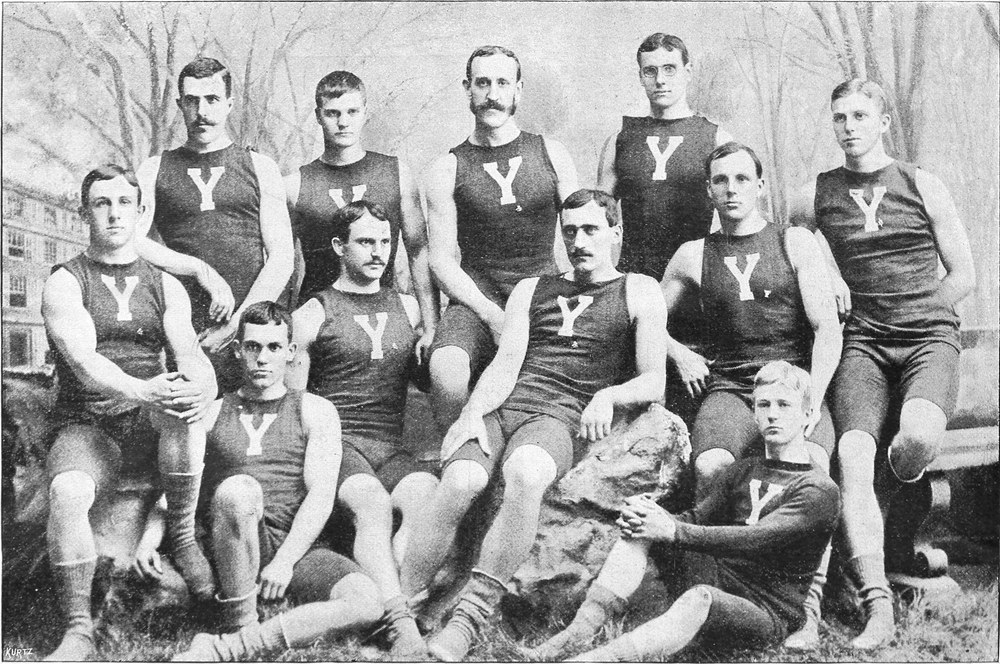
THE CREW—CHAMPIONS, 1888.
G. R. CARTER, ’88 S. C. O. GILL, ’89. R. M. WILCOX, ’88 S. N. JAMES, ’90 (SUBS.). W. H. CORBIN, ’89. G. S. BREWSTER, ’91. J. A. HARTWELL, ’89 S. S. M. CROSS, ’88 (STROKE). G. W. WOODRUFF, ’89 (SUBS.). F. A. STEVENSON, ’88 (CAPT.). R. THOMPSON, ’90 (COX.).
⇒ LARGER IMAGE
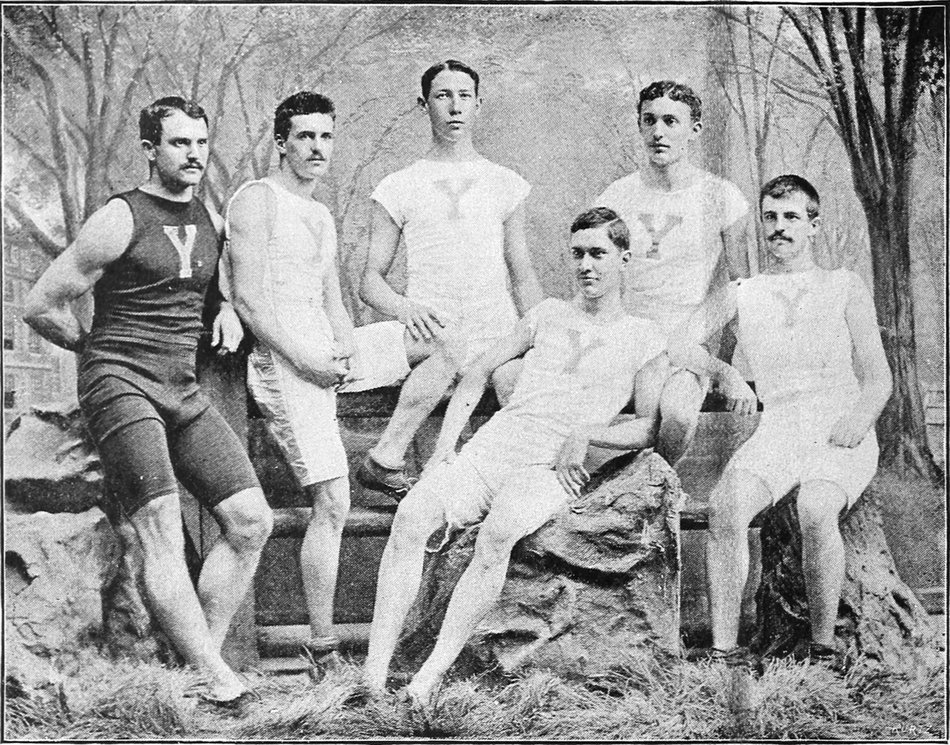
WINNERS IN INTERCOLLEGIATE ATHLETIC GAMES, 1888.
G. W. WOODRUFF, ’89. T. G. SHEARMAN, ’89. H. L. WILLIAMS, ’91. C. H. SHERRILL, ’89. W. G. LANE, ’88 (CAPT.). W. HARMAR, ’90.
Of preparation for this race there was almost none, as may be judged from the remark of a member of the Harvard crew, to the effect that “they had not rowed much for fear of blistering their hands.” Harvard won the race, largely owing to their superior boat, the Oneida, which being probably the best of her class, deserves a description. She was an eight-oared, “lap-streak” barge, thirty-seven feet long, three and a half feet beam, quite low in the water, and fitted with gratings at each end. Flat wooden thole-pins were used, a plain bar of hard wood served as stretcher, and a red baize cushion covered each seat. The oars were of white ash, and ranged in length from thirteen feet six inches in the waist to twelve feet at bow and stroke.
Occasional races were rowed between Yale and Harvard at Springfield and on Lake Quinsigamond up to 1864. These were three-mile, turnabout races, usually rowed in six-oared barges, although sometimes four-oared and eight-oared boats would contend with them, in which case an allowance of eleven seconds per extra oar would be made in favor of the smaller boats.
Baseball as an organized game was first played at Yale in 1859, but it was not until 1864 that the formation of the Y. U. B. B. C., and the three victories won by the first Yale nine caused it to become a recognized college institution. Yale’s first intercollegiate game occurred in this year, when she defeated the Agallian Club of Wesleyan University by a score of 39 to 13 runs. For the next few years the game continued to grow at Yale, some five or ten games a year being played, mostly with professional clubs. Yale met Princeton and Harvard for the first time on the diamond in 1868, defeating Princeton easily by 30 to 23.
The game at this time, it will be understood, was a “natural” sort of game, in which the individual capacities of the players counted for far more than either team-play or training or science. Harvard defeated Yale in their first game, and continued to do so until 1874, when the tide was turned in favor of Yale, largely by the able captaincy and fine individual playing of Mr. C. Hammond Avery, who broke the chain of eight Harvard successes by winning four straight victories over Harvard.
In 1872 a series of games, the best two in three, was substituted between Yale and Harvard, in place of the annual game, and in the following year the same arrangement was made between Yale and Princeton.
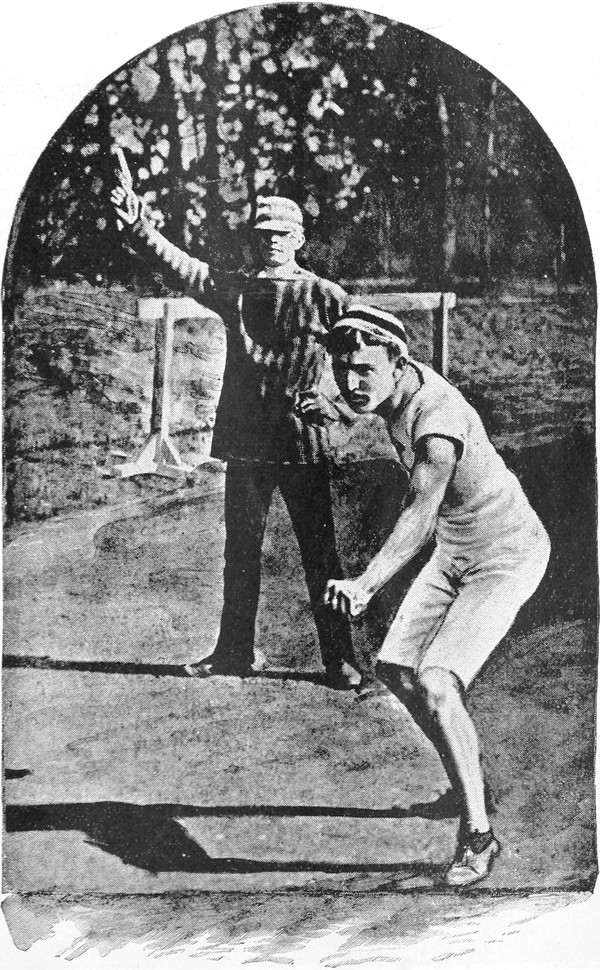
HUNDRED YARDS RUN—THE START.
It will be seen that the chief need of the Yale nines up to this time had been, not only a better knowledge of the game, but also greater coolness at critical points, which faithful practice could alone give them. The causes of Harvard’s uniform success were that baseball was started earlier and on a more scientific basis at Harvard than at Yale, and also because in and near Boston there were, in the early days of baseball, many nines, professional and amateur, whose influence in the way of example and practice tended always towards a high degree of skill.
Returning to football, we find that, owing to a lack of grounds, the students having been forbidden to play on the city green, the annual game was given up in 1858, and football was dead until 1870. In this year it was resurrected by the classes of ’72 and ’73, who were unusually enthusiastic over athletic sports, and becoming immediately a popular game, a match was arranged with Columbia in 1872. In this match twenty men played on each side, a game that consisted chiefly of kicking, bounding and batting the ball, one of the rules being, “No player shall pick up, throw or carry the ball.” Yale was outplayed and defeated by Princeton in the following year, the latter displaying much science. Two years later Yale attempted to play Harvard under what were called “modified Rugby rules,” and the other colleges under the old rules, with the disastrous result, which might have been expected, of being defeated by Columbia as well as by Harvard.
This brings us to the year 1876, which we will take as a starting-point for modern athletics, and retrace our steps to the Yale-Harvard races of ’64 and ’65. These were the races famous in Yale annals, won by Wilbur Bacon and his crew of giants. These men were picked out for strength, without regard to previous experience, and by dint of tremendous efforts, combined with the best discipline, they were transformed into very fast crews, despite their undoubtedly bad style. The training they underwent was, as one of their number said not long ago, “what no college crew could be asked to undergo at this time.” During the two months before the race, in which their training lasted in all its severity, they rose at six, walked and ran before breakfast from three to five miles, and rowed four miles at speed both morning and afternoon. Their diet was of the plainest, beef, mutton, toast, rice, and weak tea being the staples, with few vegetables. The time made by the ’65 crew, 17m. 471⁄2s., for a three-mile turnabout race, six-oared, broke all previous records, and was a noteworthy performance.
From 1872 to 1875 inclusive, the regattas were very large, as many as thirteen boats being entered in one race, and were characterized by much fouling of boats, and great dissatisfaction. Stories are told of crews fighting each other with their oar-blades when fouled, and whether this be true or not, it is certain that the overcrowding of the course and the impossibility of avoiding accidents had much to do with the withdrawal of the Yale and Harvard crews in 1876. The Yale crew of ’72, the worst that ever represented Yale, contained the Freshman who, as captain and stroke of the Yale crews for the four succeeding years, was destined ultimately to bring more improvement and prestige to Yale rowing than any other individual ever connected with it.
It was in the early spring of 1873 that “Bob” Cook took his trip to England to study rowing, in which, during some months spent among the university oars of Oxford and Cambridge and the watermen of the Thames, he largely acquired that complete mastery of rowing which has enabled him to raise Yale to the first rank as a boating college. Among the sacrifices that were made to enable Mr. Cook to go to England were his being dropped a class in his studies and the pawning of a gold watch by a Senior, now a Yale professor, in order to raise the necessary funds.
It was after the three Yale victories in the University, Freshman and single-scull race, in 1873, that by the energy of Mr. C. H. Ferry the sum of $16,500 was raised to build the fine boat-house that Yale now possesses.
The year 1876, bringing as it did the formation of the Intercollegiate Football Association, the introduction of eight-oared four-mile Yale-Harvard races, and the presentation of the Mott Haven Cup, may be taken as a starting-point for modern athletics. It is not so much that there was any distinct stride in advance in this year, but rather that with the better organization of athletic sports, better opportunities were given for their development.
FOOTBALL SINCE 1876.
In this year the American Rugby rules and the oval Rugby ball were adopted by the association composed of Harvard, Princeton, and Columbia. Yale declined to join this association, but defeated every member of it, thus being virtually champion for that year.
In the following year Yale desired to play with elevens, and the other colleges with fifteens. No game was played with Harvard, but for the sake of a game Yale consented to play Princeton with fifteens. The game, which was a draw, was probably the best exhibition of football thus far given in America. The only possible drawback was the fact that weight and roughness were to some extent substituted for skill in the Yale team.
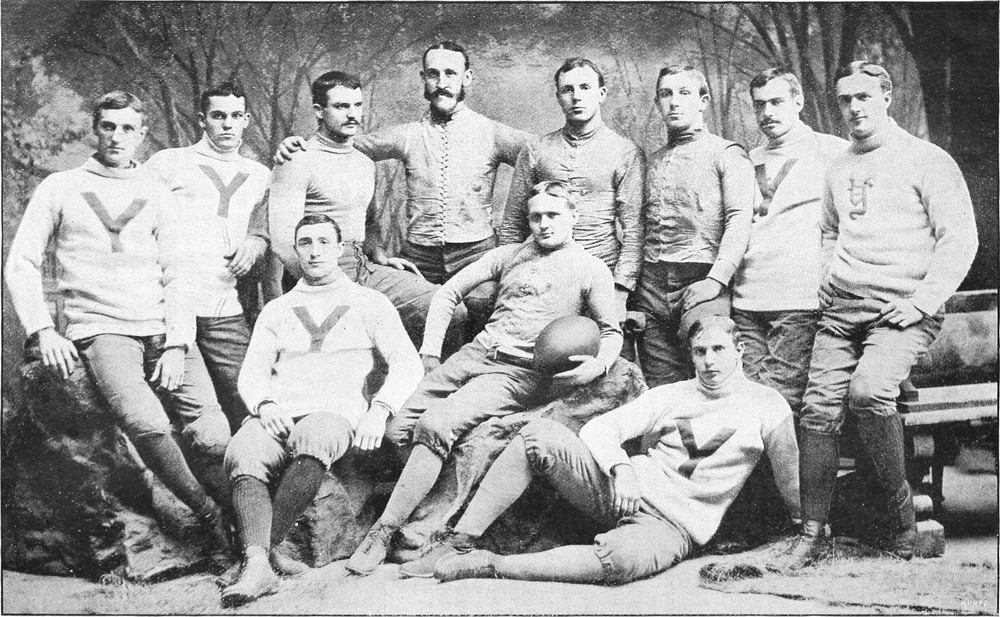
FOOTBALL TEAM—CHAMPIONS, 1887.
F. C. PRATT, ’88 S. S. M. CROSS, ’88. G. W. WOODRUFF, ’89. W. H. CORBIN, ’89. G. R. CARTER, ’88 S. C. O. GILL, ’89. F. W. WALLACE, ’89. W. T. BULL, ’88 S.
W. C. WURTENBERG, ’89 S. H. BEECHER, ’88 (CAPT.). W. P. GRAVES, ’91.
⇒ LARGER IMAGE
For the next two years football was played by fifteens, but since 1879 it has been played by elevens only. In the fall of 1878, the Yale Faculty permitted absence from recitation on account of football, to enable the team to play Harvard in Boston, which action put football on the same basis as baseball, and marked an epoch in its history. The victorious Yale team, having defeated Harvard by one goal to none, were met at the station at two A.M. by three hundred students, who were thus probably the first to inaugurate the present custom of a triumphant reception to the team winning an important victory.
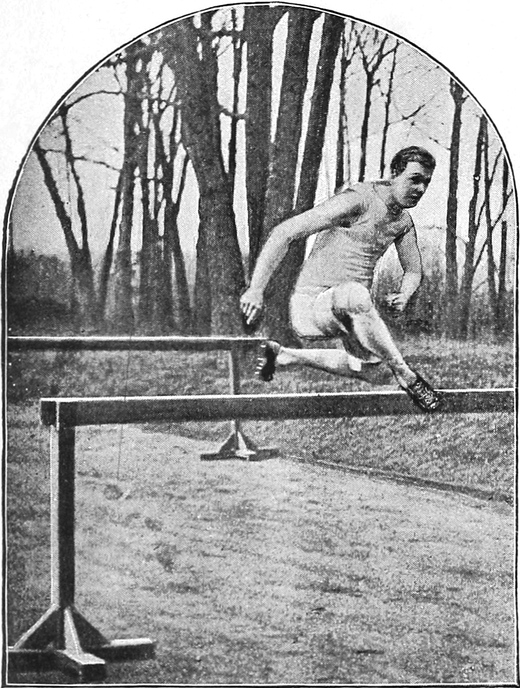
OVER THE HURDLES.
It was largely owing to the overconfidence of the Yale team engendered by this game, that they were defeated by Princeton a few days later. It was the more unfortunate that Princeton should have won this game in that it caused them to introduce the “block” game, which has done so much harm to football in America. The “block” game consists of a defensive style of play, whose sole object is to prevent the scoring of the opposing team, by which the college having won the year before may still retain the nominal glory of the championship. For the three ensuing years the Yale-Princeton games were draws. During these years the Yale-Harvard games were all well-fought contests, the Yale men winning by a more thorough understanding of the game, and by the aid of fine individual players.
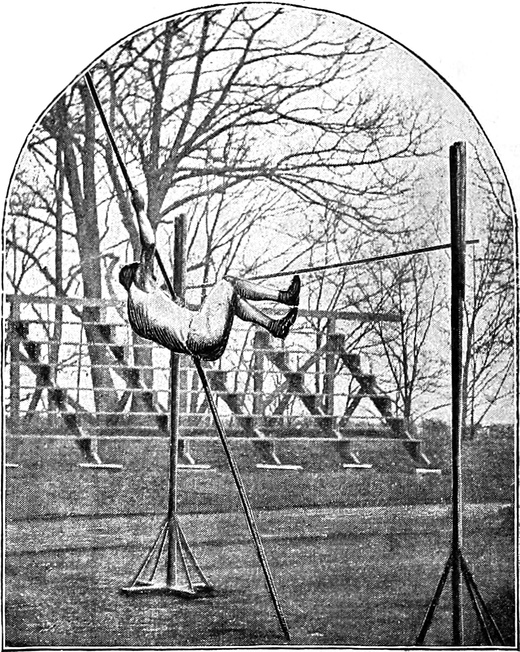
POLE VAULTING NO. 1.—THE RISE.
In 1881, a change in the rules was made with the idea of destroying the “block” game, by which safety touch-downs were made to count. This rule could be avoided, however, by making touch-in-goals, which were only technically different from safeties.
Yale began her football season in 1882 three weeks earlier than usual, and consequently played more practice games. In the Yale-Harvard game, Yale forced the play, making a touch-down a few moments after play began. The Harvard eleven, although they found themselves outmatched by the “finest rush-line ever put on an American field,” to their credit be it said, played the game for what it was worth and did not attempt any “blocking” tactics. The chief feature of the Yale-Princeton game was the long-distance kicking of Moffat for Princeton and of Richards for Yale, which was described as resembling a game of lawn-tennis. The most brilliant play of the game was the superb goal kicked from the sixty-five-yard line by Haxall of Princeton.
A new system of counting by points was introduced in 1883, by which a goal from touch-down was made to count six points, a goal from field five points, a touch-down two points, and a safety one. Up to this time goals from touch-downs and from field had been equivalent, and four touch-downs had equaled one goal.
The Yale team of ’83 had a giant rushline averaging 185 lbs., while the whole team averaged upwards of 173 lbs. In the Yale-Princeton game, which was distinguished by many brilliant plays, Yale made a touchdown and goal eight minutes after play began, after which no scoring was done by either side.
The Harvard Committee on Athletics having come to the conclusion that football was a brutal sport, before the Yale-Harvard game, only permitted it to be played on condition that the referee should be an alumnus, and that he should have full power to send any player off the field for unfair play, which was not in this sense to include offside play. These conditions were incorporated into the rules of the game at the annual convention, it being ruled that (1) a player can be offside but once during a game, and (2) the referee shall disqualify a man for three times intentionally delaying the game. In scoring, the system now in use was introduced, a touch-down being made to count four points instead of two, and a safety two instead of one.
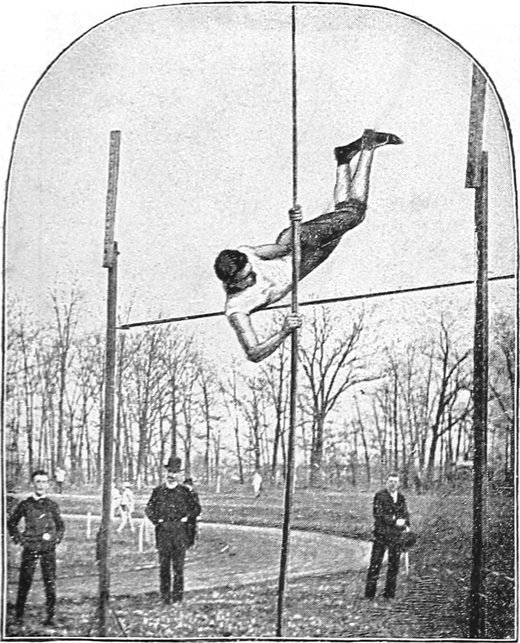
POLE VAULTING NO. 2.—CLEARING THE BAR.
The Yale eleven of 1884 defeated Harvard by 52 to 0, her eleven being by far the poorest she had ever turned out, ranking fifth among the college teams. In the Yale-Princeton game a goal from touch-down was made by Yale just three minutes after play was called. Princeton secured a touch-down, but no goal, and with the score 6 to 4 in favor of Yale, the game was called before time on account of darkness, thus making it technically “no game,” and depriving Yale of the formal championship.
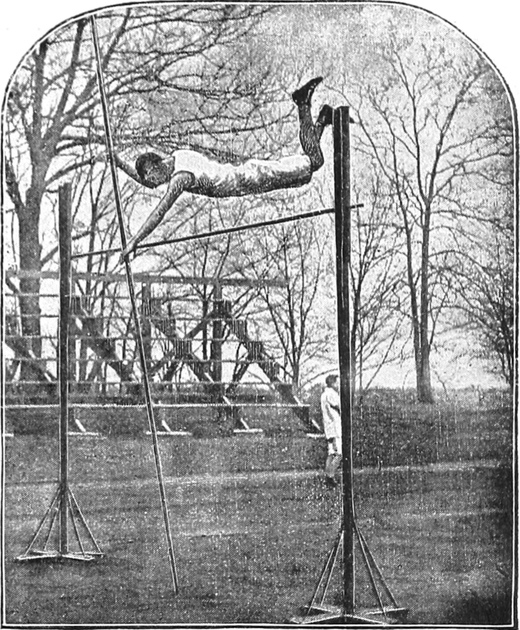
POLE VAULTING NO. 3.—DROPPING THE POLE.
For the season of 1885 the Football Association embraced but four members, Yale, Princeton, Wesleyan and Pennsylvania, Harvard being forbidden intercollegiate football by the action of their Faculty. At Yale one of the finest elevens ever turned out was formed from almost entirely new material, and, although defeated by Princeton by six points to five, this material has abundantly repaid the efforts made in its behalf by forming the backbone of Yale’s magnificent elevens of 1886 and 1887. In the first half of the Yale-Princeton game of 1885, Yale scored a goal from the field. In the second half, Lamar, of Princeton, made his famous run, seizing the ball on a long, low punt, and by clever dodging obtaining a clear field for a run, he made a touch-down between the goal-posts, thus winning the championship for Princeton. It was a marvelous feat, and one to be long remembered.
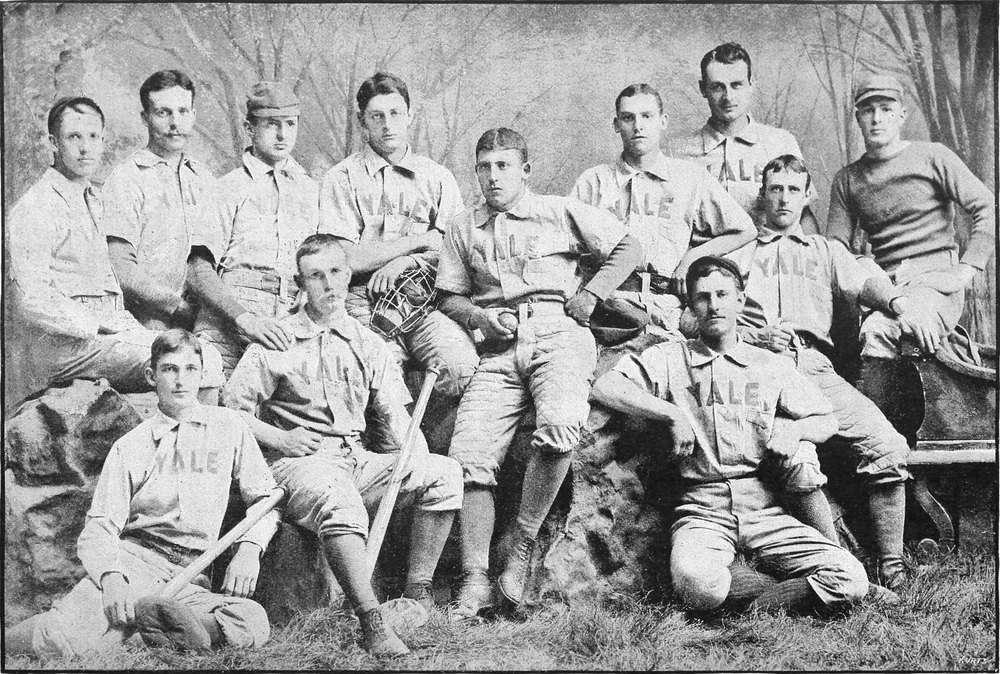
THE NINE—CHAMPIONS, 1888.
N. S. DALZELL, ’91 (SUBS.). J. O. HEYWORTH, ’88 (SUBS.). S. J. WALKER, ’88, l. f. J. C. DANN, ’88 S., c. S. Y. OSBORNE, ’88 S. (SUBS.) J. F. HUNT, L. S., c.f. C. B. McCONKEY, ’88, s. s.
H. McBRIDE, ’90 S., 1b. H. F. NOYES, ’89, 3b. A. A. STAGG, ’88, p. (CAPT.) A. G. McCLINTOCK, ’90, r. f. G. CALHOUN, ’91, 2b.
⇒ LARGER IMAGE
In the fall of 1886 Harvard was readmitted to the association, and proved that she had not been idle during her year of class football contests by displaying better football than she had ever shown before. In one of the most exhausting games ever played, Yale defeated her by 29 to 4. In this game Yale, according to her usual policy, forced the play from the beginning, obtaining two goals in the first twelve minutes’ play. The Yale-Princeton game of this year was something more than a disappointment to the thousands from New York, New Haven, and elsewhere, who gathered in Princeton only to be soaked by a fierce rain and to witness an unfinished game, in which good play, owing to the slippery ground, was impossible.
The resolutions adopted by the convention are worthy of record:
Resolved, 1, That this convention cannot, as a convention, award the championship for 1886.
Resolved, 2, That Yale, according to points scored, should have won the championship.
In the fall of 1887, the chief innovation was the appointment of an umpire, in addition to the referee, whose duty it was to prevent and punish violations of the rules of behavior. No delays of over one minute were allowed this year. Despite the heavy rain during the Yale-Princeton game, which rendered brilliant plays impossible, it was a very satisfactory game, being free from delays, slugging, foul-tackling, etc.
The Yale-Harvard game played at the Polo Grounds, New York, on Thanksgiving Day, in the presence of some twenty thousand people, was without doubt the finest game of football ever played in America, and one which, owing to its freedom from disagreeable incidents, did incalculable good in influencing popular opinion in favor of the game. In the first half Yale scored a goal from field and one from touch-down. The touch-down was made by the Yale centre, who, being unguarded by the Harvard centre, instead of snapping the ball back when the elevens lined up, kicked it a few inches forward, and, picking it up, made a long run. Time for the first half was called just as the Harvard back was making a run, and the Yale rushers not attempting to stop him, he secured a touch-down too late to be counted. In the second half Yale made a safety, and Harvard a goal from touch-down, making the score 11 to 8 in favor of Yale. One of the Yale half-backs, however, by a brilliant run of thirty-five yards, secured a touch-down, from which a goal was kicked, which rendered the final score 17 to 8.
The year 1887 was a most encouraging one to all lovers of football in the elimination of many disagreeable features and in the adequate enforcement of the rules by two officials. The last bugbear to football that seems to be gradually disappearing is the practice of “slugging,” or striking with the closed fist. What might be called a stricter attention to business necessitated by the more intricate system of team-play, aided by the appointment of a special umpire, has almost completely removed this stumbling-block. Two dangers remain that must be in some way overcome before the future of football is assured, and these are “holding in the line” and “interference.”
The different styles of play evolved at Harvard, Princeton and Yale in this year showed a more marked individuality than is usually the case. Harvard’s game was one of heavy rushing in its most aggressive form, with but little kicking. Princeton, on the other hand, adhered to their traditional game of agility, selecting their players for skill and sacrificing strength and weight, while Yale possessed an all-round team, capable of playing a rushing or a kicking game, and one which, being ably generaled, suited its style of play to that of its opponent.
There were but two games of interest in the fall of 1888, owing to the unfortunate action of the Harvard Faculty in not allowing the Yale-Harvard game to be played in New York. In the first of these Princeton defeated Harvard by 18 to 6, the victory being won by superior play, against a weak rush-line. The Yale-Princeton game was a magnificent and stubborn contest, being won by Yale by two goals from the field to nothing. Harvard having forfeited to Yale, the championship remained in New Haven for another year.
Football in American colleges, despite the severe crisis of 1884 and 1885, is at present in far better shape than it ever has been, and promises to become a great national game on this side of the water, as it has so long been on the other.
The record that Yale has made in football is too good to be omitted. She has won 93 out of 98 games played, having lost three games to Princeton, one to Harvard, and one to Columbia. Since 1878, Yale has lost but one game, and that by one point. In points Yale has won, since points began to be counted, 3,001 to her opponents’ 56; in goals, 530 to 19, and in touch-downs, 219 to 9.
ROWING SINCE 1876.
By a vote of the Y. U. B. C., Yale withdrew from the general rowing association and challenged Harvard to an eight-oared four-mile contest, a challenge which she promptly accepted. For this race all undergraduates of either college and all of the graduates of either who were studying for another degree were declared eligible. The ’76 race was an easy victory for Yale, being won by half a minute. Mr. Cook, the Yale stroke, set the stroke about thirty-three, and did not vary one point in the last two miles, while the Harvard stroke was very irregular, ranging from thirty-five to forty a minute. The boats used in this race were of cedar, and were the first eight-oared shells used in America. In the fall of this year a picked four from the Yale crew, stroked by Mr. Cook, won the international and intercollegiate regatta of the Centennial Exhibition at Philadelphia.
The withdrawal of Yale from the general regatta, followed next year by the withdrawal of Harvard, so effectually discouraged the smaller colleges that no rowing was done by any of them for a number of years.
The Yale-Harvard races, after being rowed at Springfield for two years, were moved in 1878 to New London, where they have since been rowed. The advantages offered by this place in the way of its easy access from the great cities, its clear and straight course, and the “moving grand stand” of platform cars running along the west bank of the river, are so strongly in its favor that it appears probable that the races have found their permanent home.
The races of ’77, ’78 and ’79 were won by Harvard with increasing ease, the first-named being won by seven seconds and the last by one minute and forty-three seconds. The spectators in this year were amazed, according to the papers, to see “how badly the Yale men rowed;” but with this disgraceful defeat came the spur to greater effort, and for the two ensuing years victory came to Yale.
In 1882 there occurred the famous “eel-grass” race, the most disappointing race ever rowed in America. The Yale captain, with the assistance of Mr. Davis, devised a new style of boat in which the oars were separated into pairs of starboard and port, by which device so much room was required that the boat measured sixty-eight feet, or nine feet longer than the average racing shell. The ultimate object was to attain a high stroke, scientific principles being sacrificed to a sort of “get there” way of rowing forty-two to forty-eight strokes a minute. The story of the race is soon told. Yale led at the mile-and-a-half by a length of clear water, and at the two miles, where Yale emerged from the eel-grass, Harvard led by six lengths. The Yale crew gave a splendid exhibition of “sand,” spurting right up to the finish line at a forty-five stroke, and finishing half a length behind Harvard. The fact that they rowed every individual half-mile excepting the fourth, when in the eel-grass, faster than Harvard, sufficiently proves their superiority.
Under the same captain, the Yale crew adhered to the same style of rowing in the following year, nor is it to be wondered at, considering the fast time they made both at New London and in New Haven harbor. The ’83 crew, however, lacked the snap and life and the severe training that alone can bring success to a crew rowing so incorrect a stroke as they used. Harvard’s victory by fifteen lengths killed the so-called “donkey-engine” stroke at Yale, which in itself was of more benefit to Yale rowing than many victories. Mr. R. J. Cook again came to the rescue of boating at Yale in 1884, and turned out the finest Yale crew that had yet sat on the water, and one that lowered the record to 20m. 31s.
In 1885 the Yale crew, as they rowed up to the starting flag, appeared very heavy and very ragged, owing to the difference in height. They were a powerful set of men, averaging 1751⁄2 pounds, wretchedly trained, four being over-trained and four undertrained, and rowing a combination Cook and “donkey-engine” stroke. Compromises in rowing are almost invariably fatal, and so it proved in this instance, the Yale crew finishing, very much distressed, some sixteen lengths behind Harvard. The Harvard crew used one of the best strokes they had ever rowed, it being characterized by a long, smooth pull, stronger in the middle of the stroke than at either catch or finish, and by a well-controlled slide at both ends of the stroke.
In the past three years, owing largely to the personal efforts of Mr. Cook, “the father of Yale boating,” in coaching a most faithful and painstaking set of men, victory has remained with the Yalensians, and Yale now leads Harvard in the number of eight-oared races won. The ’86 race was a comparatively easy one, Yale winning by eight lengths, while the ’87 race was a desperate struggle, won by but four lengths. The race of last spring will be long remembered by Yale men as the most crushing defeat ever administered to Harvard oarsmen. The strict adherence on the part of the Yale crew to the principles of rowing practised in the two preceding years, backed up by great enthusiasm and assiduous labor, turned out a crew that rowed the course in 20m. 10s., lowering the record easily without being pushed. At Harvard, the dissensions among the members of the rowing committee, their adoption of antiquated English ideas in regard to boats, oars, rigging, etc., and the curious notions of rowing held by Mr. Watson the chief coach, turned out a crew that lost a length in the first ten strokes, and crossed the finish line a quarter of a mile behind the Yale crew. “Too many cooks spoil the broth,” is an old but true adage. Yale is fortunate in possessing one Cook, who certainly makes most excellent broth. It seems probable that, in view of the practical working of their rowing committee, Harvard will either again seek the aid of professional oarsmen, or select one man, such as Mr. Frank Peabody, or Mr. J. J. Storrow, to have entire control of her boating interests. The diet of the ’88 crew may be given as fairly representative of the latest ideas in regard to this branch of the training. For breakfast and supper the crew ate oatmeal, beefsteak, mutton-chops, eggs, and stewed or baked potatoes; for dinner, roast beef, mutton, fricasseed chicken, water-cress, potatoes, rice, macaroni, tomatoes and puddings. Occasional ale was allowed, especially after the crew had rowed on time, or on particularly hot days. The work of the crew occupied about three hours a day, besides which as much work was done in pair-oars in the mornings during the spring, as recitations would permit.
The summary of Yale-Harvard races stands: Harvard 22, Yale 17; Harvard’s lead being obtained between 1852 and 1870, when rowing was in its infancy at Yale.
It is interesting to notice that neither age, weight nor height have any decided advantage among the Yale and Harvard crews, the oldest crews having won seven times in thirteen, the heaviest five times in thirteen, and the tallest four times in eleven.
It would thus appear that the qualities that bring success in rowing are not merely physical, to be computed mathematically, but that the moral qualities of pluck and endurance, added to skill and judgment, must be equally considered in selecting a typical rowing man.
The average rowing man, physically considered, of Yale and Harvard for the past twelve years has been a man 213⁄4 years old, 1671⁄2 lbs. in weight, and 5 ft. 101⁄2 in. in height. It is rather remarkable that the average Yale and the average Harvard rowing man does not vary more than a slight fraction in any of these three respects, despite the wide differences between individual Yale and Harvard crews.