Volume 13 / Part 2 — OUTING.
Reading edition
VOL. XIII. JANUARY, 1889. NO. 4.
AMONG THE TAURUS MOUNTAINS.
BY L. B. PLATT.
QUITTING the broad highways of travel, it is often refreshing to turn aside from beaten paths and strike off into new regions, where foot of tourist and pen of magazine writer have not awakened the sacred silences, startled the resident deities, and broadcast their treasures upon the world.
Through such a byway among the mountains of Taurus, in Asia Minor, from the sea-coast at Mersina, through half-ruined Tarsus, and across the wide Cilician Plain to the ancient cities of Marash and Aintab we made our journey.
There were three of us, Gould, a picturesque youth of seventeen mild summers, with carefully mapped side-whiskers of a style that had never before invaded that sequestered portion of the world, and afforded unceasing entertainment to the curious and admiring natives, Lee, a missionary at Marash, in the interior, and myself, the modest chronicler of our adventures. With three horses of the light-stepping Arabian blood, whose native turf is the sharp, loose stones of the mountains, another of less noble lineage to carry our pack, and an Armenian servant to run behind, we entered upon the Great Plain of Cilicia.
Immediately we were upon historic ground. Alexander had been here before us, wading breast-deep around that rugged promontory in the distance, beaten by the thundering Mediterranean surges, and sweeping the plain of his enemies with the velocity and destructiveness of a cyclone. He had met Darius the Persian here and annihilated his magnificent array in the world-famous battle of Issus, where “all day long the noise of battle rolled between the mountains and the (summer) sea.”
Cicero had been here as Roman Governor of the Province of Cilicia; had chased the bandit mountaineers into the fastnesses of the hills, defeating them there and flushing his maiden sword with victory, for which he ambitiously claimed, but never received, a Roman Triumph.
Antony and Cleopatra had been here, sailing the River Cydnus—the same Cydnus in whose cold waters Alexander bathed, overheated by the tropic sun, and almost lost his life. And poor Antony, also overheated, lost body and soul together by the no less tropic love glances of the Egyptian Queen. And who could wonder at it, if, as Shakespeare tells us—
“The barge she sat in, like a burnished throne, Burned on the water: the poop was beaten gold; Purple the sails, and so perfumed that The winds were lovesick with them; the oars were silver, Which to the tune of flutes kept stroke, and made The water which they beat to follow faster, As amorous of their strokes. For her own person, It beggar’d all description: she did lie In her pavilion—cloth-of-gold of tissue— O’er-picturing that Venus where we see The fancy outwork nature: on each side her Stood pretty dimpled boys, like smiling Cupids. * * * * * * At the helm A seeming mermaid steers.”
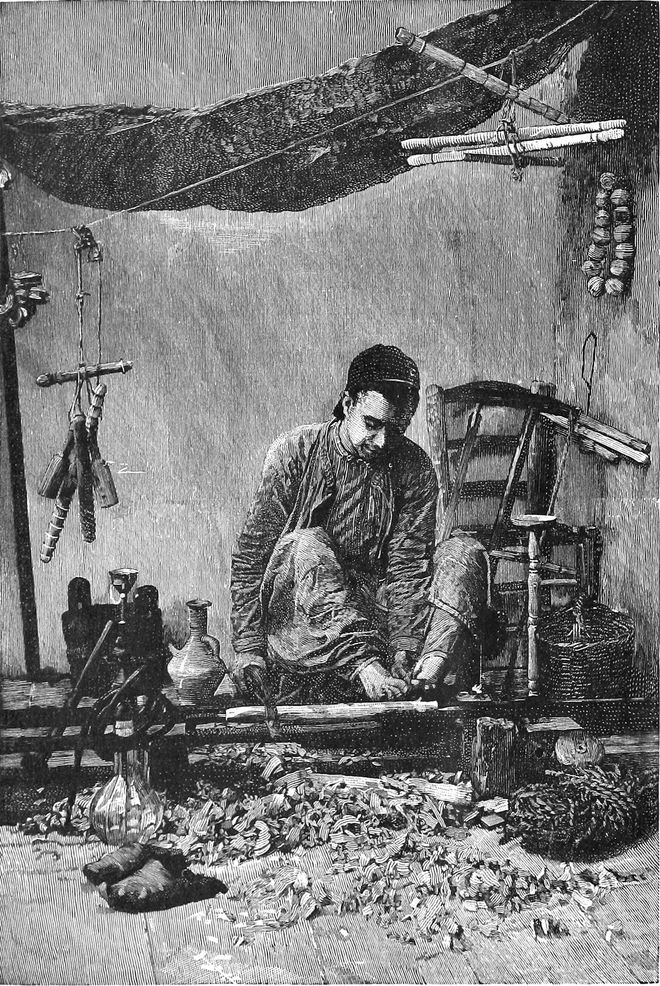
A CARPENTER OF THE TAURUS.
And here also, on the banks of this same river, swollen and rapid with the melting snows of Taurus, not far from the sea, is the forlorn-looking city where Saul of Tarsus was born to the trade of a tentmaker and the exalted career of the greatest of the Apostles. In Tarsus, once a free city under the Roman Empire, her coins proudly stamped “Metropolis,” at one time more illustrious with academies and schools of philosophy than Athens or Alexandria, the ancient Marseilles of the Mediterranean, real estate has taken a fearful tumble since Paul boasted that he was a citizen of “no mean city,” for he “was born in Tarsus.” Seven thousand squalid inhabitants still cling with amazing tenacity to life, and carry most of the real estate around with them as personal property. There is absolutely nothing of interest to be said of it, for it is not even a ruin. It is the degenerate scion of a noble ancestry, in “looped and windowed raggedness,” whose only claim to respectability is the “high connections” of past history; and of these the most is made, for among other pretensions not the least is the ancient one, that to this very port the prophet Jonah set sail when “he entered into a ship of Tarshish and paid the fare thereof.”
Riding leisurely through the suburbs, we are soon in the heart of the Great Plain. Two hundred and seventy miles from east to west, sixty-eight in greatest breadth from white-capped sea to snow-capped mountain, are the vast dimensions of this Cilician prairie. The soil is as fertile as nature ever made, the rich alluvium of three rivers constantly depositing itself in thick layers, century after century, and yet it is a comparative desert, often stricken to death with famine and calling upon the pitying world for help from starvation. And why is it? The only sufficient answer is—the Turkish Government!
Our first night we spent in the city of Adana, the present metropolis of the Plain, a city of 30,000 inhabitants, as geographers tell us, and, as they do not tell us, of as many mosquitoes to each inhabitant. We made a careful estimate of them that very night. In fact it was not without considerable anxiety that we waited to see how many, and in what condition the survivors would be who would respond to the breakfast call next morning. For myself, I had thought that that morning would never come; or, if it did, it would come too late for me to derive any benefit from it in this present life. I noticed that the roosters around town seemed to entertain the same opinion. They started in about midnight with considerable confidence, and once in a while would all take hold and lift together in one grand crow, and then settle back disappointed—there was a hitch somewhere, the sun would not up. In the meantime, a tender regard for the feelings of my readers would not allow me to attempt any description of our sufferings—only this, that after exhausting every stratagem I could think of to outwit the enemy—all to no purpose—I simply threw back the bedclothes in the madness of despair, and said,“Come on, then, if you want to!” And they came. They came in ranks and squadrons, wing touching wing, like Milton’s fallen angels when they went down with whir and rustle and clatter of stumpy wings into the pit. And as fast as they came I lifted my hand and slaughtered them—or rather, thought I did.
Then it occurred to me, in my half-asleep condition, that I would gather up those dead mosquitoes and pile them into a monument, so that if I should be devoured alive there would at least be something to mark the spot. But before I could find mosquitoes enough to lay the corner-stone, I fell asleep. I dreamed I was bodily lifted up on wings and borne through the air. I passed over island and ocean and continent and ocean again. And just as I came in sight of my home and saw my mother on the doorstep, there was an awful crash, and then a groan, and somebody said, “Great Caesar!” I awoke to see my friend Lee sitting upright in bed, listening with head bent forward, as if his life depended on his hearing something—his hands were uplifted and spread wide. Then there was the feeble first note of a song in the air, and the hands came together with fearful precision, and I thought, “Well, that mosquito has sung his doxology any way.” But there was no more sleep that night, and when the morning came we were a sorry company to think of starting on a long pilgrimage that day.
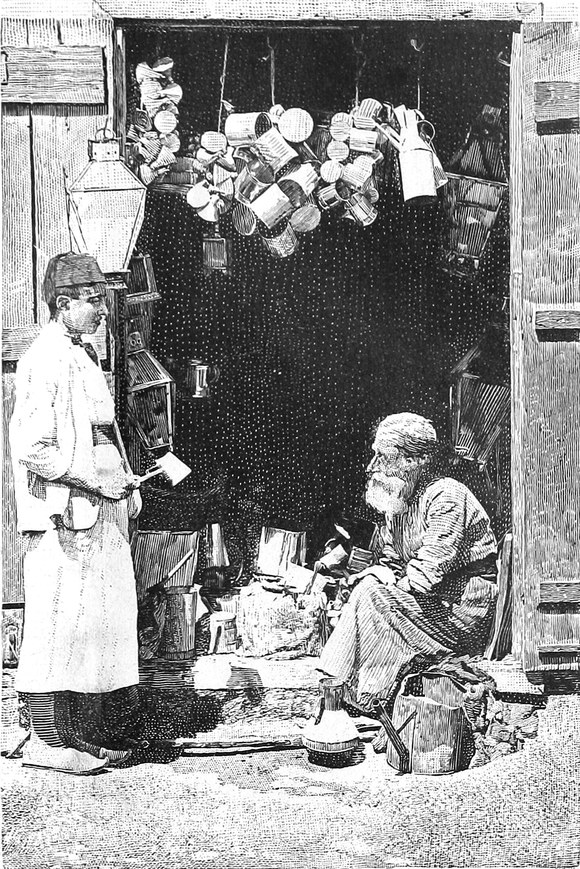
A TIN-SMITH’S SHOP.
All the forenoon we were making preparations for our journey. There were horses to obtain, and donkeys and saddles and provisions and servants, so that it was the middle of the afternoon before we were ready to start. We were going that day’s journey in company with a small caravan. Now, if a person has never seen a caravan get under way, he has something still in this world to live for. In the first place, when the horses and donkeys are brought together, as they were in this case, into the narrow courtyard of the house to be loaded, it seems to occur to all of them at once that the proper thing for them to do under such circumstances is—to kick. And they evidently think that what is worth doing at all, is worth doing well.
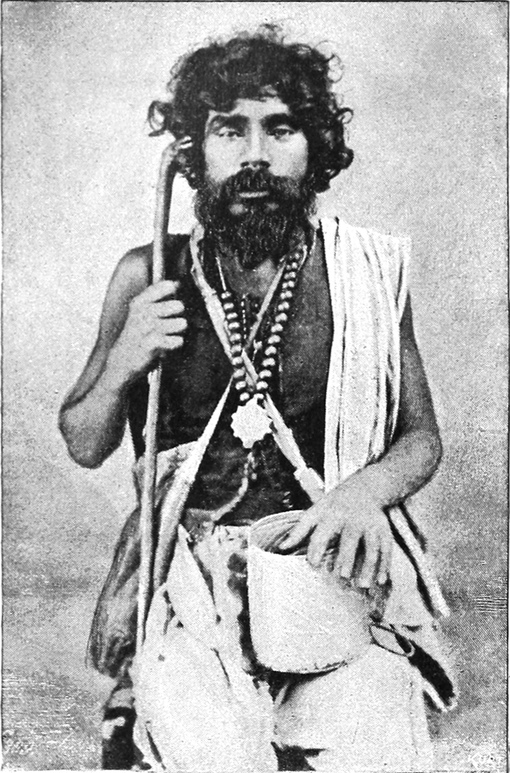
A MOUNTAIN MENDICANT.
I left my horse standing a moment to run up stairs, and when I returned, which was at the call of Mr. Lee to “come and hold your horse,” that animal of mine had made a circuit round that yard, like a comet round the sun—heels first, and left a clean swath behind him all the way. And when you add to all this confusion the crying of servants, the barking and yelping of dogs, the howling of babies, and above all, the screaming of camels and that excruciating bray of the jackass which makes you willing to stake all you possess that he can’t do that again and live through it; why, then you can gather some faint idea of what the starting of a caravan is on a small scale.
We mounted our horses and marched off in magnificent procession. They say that the grandest moment in the life of a boy—that moment when first he feels that there was no hap-hazard about his being born, but is conscious that he came into this world for a purpose, is when for the first time he gets on a pair of red-topped boots. They are the cradle and that is the birthday of all his after greatness. And I think that it is equally true that the very sublimest and topmost event in the life of any young man is when, with a belt full of pistols, a heart bursting with valor and a spur on his heel he puts his foot into the stirrup and swings himself across the back of a horse. I am ready to admit that it was so with me. I felt as though somebody ought to go ahead on the road and let people know that I was coming but that I wasn’t dangerous and probably wouldn’t hurt anybody. I remembered that it was the same country where the Apostle Paul had been taken for Mercury and Barnabas for Jupiter, and I thought that likely enough this people would take it into their heads that I was the War God, Mars, let loose upon them and careering through their country breathing fire from my nostrils and striking out hot lightnings from my horse’s hoofs.
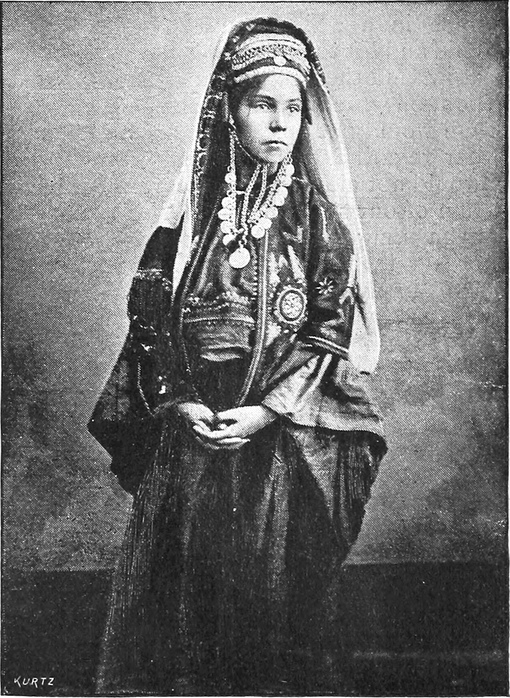
A COUNTRY BELLE.
I had two pistols; one of them had a barrel about the size of a quill tooth-pick. But I knew from what experience I had had with that weapon that all that was necessary would be to find the right man and somebody to hold him and it would then be only a question of time—I should certainly kill him. But my other pistol was altogether a different affair. It was as much too large as the other was too small. It was somewhere from one to three feet long and extended from my third rib down to my knee-pan, like a lightning rod down the side of a chimney, and kept me bolt upright and stiff in my saddle. It was so formidable that I would not have liked to fire it off without getting behind something. And I thought that if worse come to worst and we met a Circassian coming to rob us, I would just hand it over to him and let him discharge it, and watch and see what became of him.
But there was one member of our party whom I must not forget to mention, and that was the soldier or military police—the “zabtieh” as he is called. For the sake of convenience we will call him the “Government,” because he represents the Government. The advantage of having him with you is, not so much that he is a kind of traveling masked battery, concealed mostly by earthworks, nor that he always provides himself with a fast horse so that in case anything happens he can turn tail and make off so speedily that the next party going over the road will not be left without a guide and protector—not so much either that his gun is likely to be a flint-lock without any flint in it, as that when you have one of these ornamental gentlemen traveling in your company, and are attacked and plundered, the Turkish Government is bound to make good your losses in such a way that your great grandchildren, if they are healthy and long-lived, will have the benefit of them. It was this last consideration which determined us to take a zabtieh. One of the most interesting relics of antiquity, and almost the only voice out of the past, from this historic plain, is a simple monument of a single stone with the Latin inscription to the effect that a certain Roman captain—giving his name—“erects this pillar to the gods of his native land.” It was the Roman way of giving vent to homesickness, and this true patriot, stationed on these inhospitable shores so far from home, has left this pathetic monument of his longing to return. It is a beautiful tribute to that tender touch of nature which makes the whole world kin. A good, true heart he must have buckled under that Roman cuirass. Let us hope that he got his furlough with full pay.
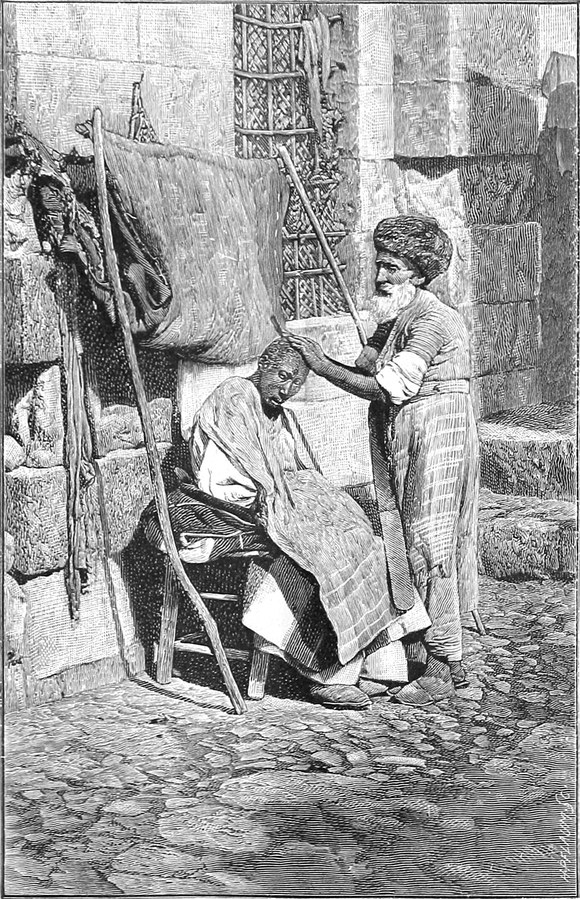
HADJAM—OR NATIVE BARBER.
The sun had dropped behind the mountain wall and the moon had taken his place with scarce diminished radiance when we approached the long-forgotten town of Mopsuestia. The atmosphere was so clear that we had seen the town for at least three hours, apparently only just ahead of us, but it never seemed to come any nearer. In fact, it seemed to be moving ahead on the road somewhat faster than our party. I tried to remember whether I had not somewhere read that at a certain season of the year corresponding with our first of May, the inhabitants of this country take up their houses on their backs and go off with them to a new place. But I could not make myself remember anything like that.
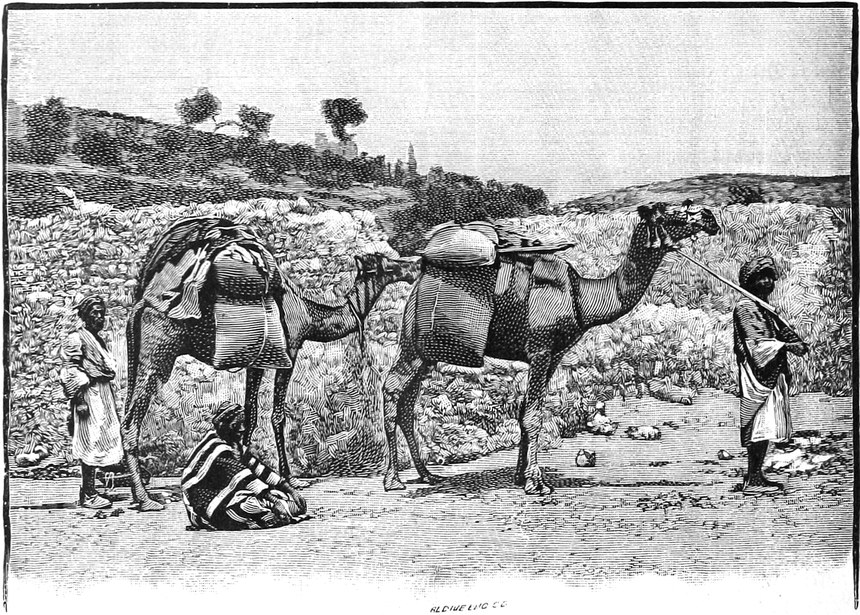
ON THE MARCH.
At last it became dark, and I was glad of it, because I thought that if those people were really going off with that city, they would probably want to set it down and rest when night came on, and then we should have a chance to overtake them.
And now the moonlight had effect upon us and we began to sing. First our Armenian servant, Crecor, started in. I thought I recognized the tune and was about to join in, when suddenly it changed to something else. At first I was sure it was “I need thee every hour”—next minute it was “Pull for the shore.” And I said: “All right, I would just as lief sing that.” But before I could pull my diapason and get my mouth open, it had changed again to “I want to be an angel.” “All right,” said I, “so do I.” But before I could join with him and be an angel, he had flown the track and was off again. When at last he wound up and put on the flourishes with a strain that limped on one leg like “Yankee Doodle,” and on the other like the “Old Hundredth,” and finally leaped up into the air and vanished in a heart-rending cry of anguish topped off by a howl that shook the stars, I did not try to follow him. I secretly suspected that, no matter how badly he wanted to be an angel, he never would be until he could make better music than that.
At last we came to the old river Pyramus. As we passed over the ancient stone bridge, fast falling into ruin, the musical click-clang of our horses’ hoofs on the archway was echoed back by the swift-running waters of the river beneath. Each wave of the stream seemed to be lifting itself to look at us and was struck down again by the arrowy glance of the moon, shivering and running away to tell the pebbles along the shore what a strange people with hats on, and even shirts and pants, they had seen.
But now, right ahead of us loomed up the walls of the hotel where we were to pass the night. It was by far the most high-toned hotel in the place—in fact it was the only one. It consisted of four stone walls about ten feet high without any roof. There was no bed-chamber, no bed, no carpet, no floor, no light, no fire, nothing to sit down on, nothing to eat and, so far as we could discover, no proprietor. But there was a door and it was locked for fear someone might imagine there was something inside, I suppose, and then go in and steal it; and by ill-luck someone had gone off with the key. Crecor went off to hunt it up and soon returned with the clerk of the hotel who ushered us in, horses and all, through the front door into the parlor. We had thought of telegraphing ahead to have the best chamber reserved for us, but were glad that we had saved ourselves that expense. For it happened that we were the first who registered that night, with the exception of a donkey and a man and his wife, and so we had the whole range of the hotel. We selected the corner where there seemed to be the fewest stones and least rubbish and cleared a place to put up our tent. And now for something to eat.
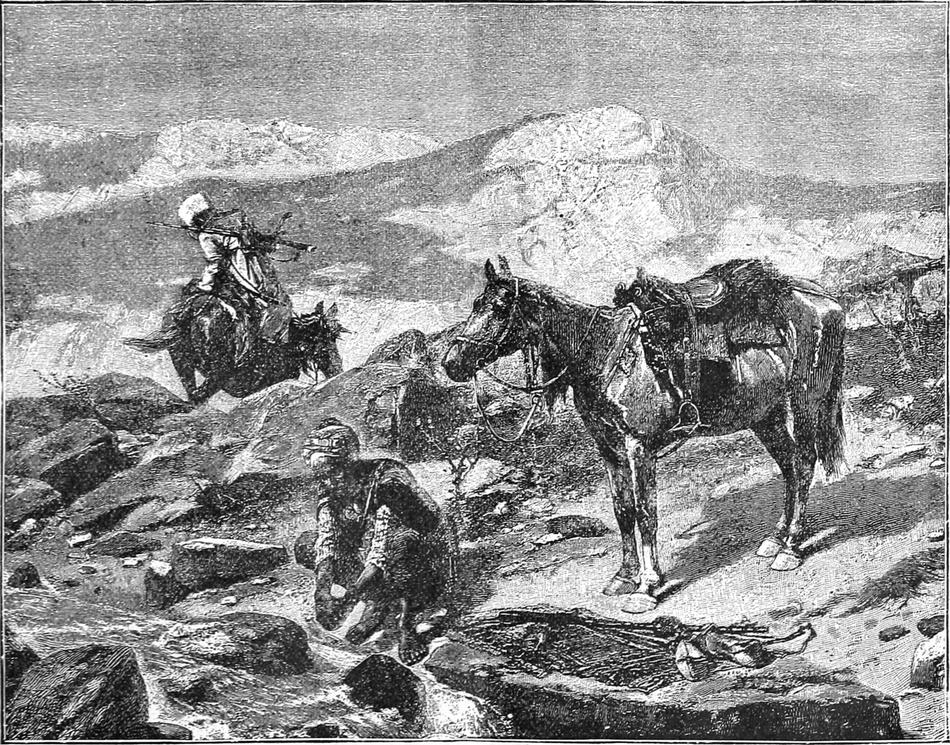
CIRCASSIAN MOUNTAINEERS.
Lee had brought along a chest full of bread, cake, canned goods, chicken, eggs, etc., so we were well provided with all but the appetite. We did not any of us want anything after that long, hot, dusty ride but just a watermelon apiece, and then to go to bed in the shortest and speediest manner. But to fall asleep was another matter. How it seemed to my traveling companions I don’t know, but there was such a horror of desolation about that place, such an awful, oppressive night-silence that made me think of all that I had ever read in the Bible about jackals howling in ruined places, hooting owls and creeping foxes and satyrs crying to their fellows, that I determined as soon as I struck the bed that if anybody got to sleep before I did he would have to be lively about it. I wasn’t going to be the last awake that night, anyway, and so I bent all my energies to the task. I had heard that if anyone would start slowly and count five hundred, it would surely put them to sleep. And so I began. I reached four hundred and fifty, and was just falling off into slumber when it occurred to me that I had only fifty more to count, and maybe I wouldn’t make it, and, of course, that excited me and woke me up. I thought that perhaps I had counted too fast, and concluded to give it another trial. began more slowly. I kept saying to myself, “Now, not too fast!” and of course. that kept me awake. I reached 499, and while I was waiting for something to happen before I said 500, the thought flashed through my head, “Well now, it seems to me it wasn’t 500 that puts folks to sleep after all, it was a thousand.” All right, I would try a thousand. I did. I went on to two thousand, three thousand, five thousand. I became wrought up. I said to myself, “I’ll do it if it takes forty thousand. I’ll lie on this bed all night, and all day to-morrow, if need be, and count a million.” And I believe I would have done it, if another plan had not happened to occur to me.
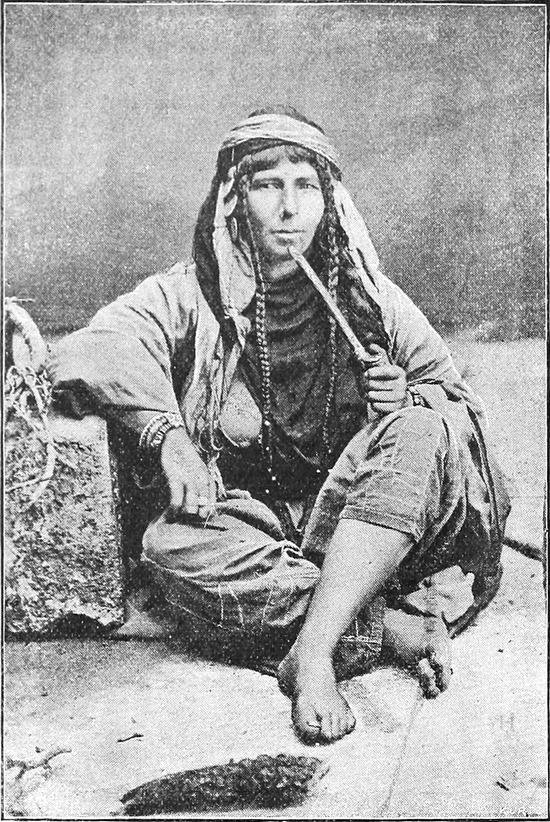
A NOMAD MOTHER.
I had read somewhere that if a person could only get their body into a certain position, no matter how wide awake they might be, sleep would immediately follow. I said to myself: “Now, how glad I am that I happened to think of that.” But, then, I couldn’t remember what that position was. Never mind, I would try them all, and see if I could strike it. I had rather a narrow field to operate in, for my iron bedstead wasn’t wide enough to turn over in without rolling out. And it wasn’t long enough, so that my feet could not go to bed at the same time I did. At last I think I must have hit it, for I fell asleep, and my last thought was, “I’m glad my mother does not know where I am to-night.”
Strange to say, it had not rained in that country for four solid months, but that night it rained as though it had been saved up for our special benefit. It waked us up at midnight. It drove in above and ran in below. It rolled down the folds of the tent like so many waterspouts. We all sat up in bed and looked at each other. We wanted to say something, all of us, but each seemed to be waiting for the other and wishing he would say it first, until, there being nothing else to do, Lee carefully gathered together the folds of the tent so that the water all ran down into his bed (which he didn’t discover until he laid down again). I put on my overcoat and again crawled into bed. The last I saw of Gould, he was lying flat on his back holding an umbrella with both hands, hoisted and spread over him, and trying to sleep.
Next morning we arose before daylight, called for our hotel bill, paid it (it was only fifteen cents for the whole company), mounted our horses and rode out of the front door with a long day’s journey of forty-five miles before us, a blazing sun above us, and the River Pyramus flowing by our side. The memory of that day is like one of those winterbird’s nests swinging on the tree, frozen stiff with rain and dreary enough, without a warm feather in it or a note of song. I have a confused recollection of a sun that was unmistakably hot, a white road that made it hotter, and a desert wind that was “Hottentotter.” I recollect, too, that I rode a horse that was never happy unless he was ahead, and I was never happy unless he was behind. I remember that I carried a sun umbrella, and every time a horse tried to go ahead of mine he would elevate his hind feet and lift me into the air, still holding on to my umbrella, until I had all the experience of going up in a balloon. But I do have a very distinct recollection of every time I came down again. It seemed to me that that saddle was all pommel, for though I went up and came down perhaps a hundred times, I never could land anywhere else.
We passed trains of camels, herds of donkeys, men and women on foot, and here and there a Mohammedan under the shade of a tree or wall going through with a gymnastic performance of standing on his head, which is the way he prefers to say his prayers. On every side was wilderness, parched and withered, without a spear of grass or a green leaf. But all things must have an end, and so must our journey. We made up our minds when we went to bed on the third night that next morning we would get up at three o’clock and push through, a journey of a day and a half, to Marash.
And what a morning that was!
We had pitched our tent in a valley, between the high perpendicular walls of two mountains. The moon rode full overhead and passed along just on the broken edge of one of them, now leaping a chasm, now dodging behind a crag, now looking down through a leafy gorge with a brilliancy of glory such as our moon never attains, except in the frostiest nights of winter, by the aid of a ground covered with snow. I was able to read a newspaper with ease. I tried it, holding it off at a natural distance. I could see distinctly every feature and line of a photograph of my mother which I took from my inside vest pocket and gazed at, as I thought possibly for the last time. I could even see to read my own writing as I penned what I thought might possibly be my last words. What made me think so was this: We were to start that morning through a mountain pass infested by robbers. Now, I hope my readers will meditate on this, and try to be as scared as I was. It was the same pass in which Mr. Montgomery, of Marash, with a friend, had been robbed but a short time previous. They had passed a group of Circassians, the highwaymen of that region, lying by the roadside, holding their horses and waiting for someone to come along. They had gone but a short distance when there was a clatter of hoofs around the bend of the mountain, a flashing of pistol barrels leveled straight at their heads, and a command to dismount and give over. And there was nothing else to do. The five Circassians stood over them with knives and made them empty their pockets and give up their weapons. Then they took their horses and left them to make the best of their way home on foot, some twenty or thirty miles across the mountain. And now we were entering that same pass. And it was night.
We had not gone far, groping our way up the narrow trail in single file over rough stones, not speaking above a whisper, and wishing that our horses’ hoofs were shod with velvet, when Lee turned about and said: “Have you got your shooting-irons ready? We must be pretty near the place now where Montgomery was robbed.”
Oh dear! I felt awful. I wanted to go back. It wasn’t what I came for, to be shot down on that cold mountain in the dark by a shirtless Circassian. The next moment we came where there was a big tree right ahead of us and oh, horrors! we could hear distinctly the voices of several men in conversation. At the same time I thought I heard something in the bushes beside me. Then I was sure of it. Then I saw it move. Then a man stepped out into the road close to me. I drew my pistol and held it where he could see the flash of the barrel in the moonlight.
He stood still and I passed him, turning round in my saddle to keep my eye on him.
We all had our pistols out and were ready with pale cheeks, and hearts that thumped like drumsticks.
But we passed by unmolested.
Lee said afterwards that if we had not been well armed and looked so formidable we should probably have been attacked and robbed. I was glad that I looked so.
The only other incident of any importance before we reached Marash was the downfall of the Turkish “Government.” He was riding ahead in grand style, full of the proud consciousness of having brought us safely through the mountains, pricking his horse with the sharp corner of the stirrup, which is used for a spur, and then playfully reining him up on his haunches, when suddenly, but with the utmost grace, horse and rider, with pistols and knives and gun, with brown rags and red rags fluttering in the wind, head down and feet uppermost, went tumbling over into the bushes. When he appeared again, unhurt but drooping at both ends like a dog when the boys have just got the pan securely fastened and are urging him to run, it was a sight that did us all good. We hadn’t laughed before in three days, and from that moment our feelings began steadily to improve. At last we came out into the open plain and ascending a rise of ground, saw in the far distance, hanging on the side of the mountain like an avalanche which has run half-way down and stopped in a gorge, the white houses of the city of Marash.
Three hours after we were riding through its streets, climbing up and up until we reached the high wall surrounding the buildings of the Mission. We rode in through the gate, and before we could dismount the missionaries were upon us. They welcomed us so heartily that we could not have been happier if we had returned home to America.
CALIFORNIAN LYRICS.
I. A MORNING TRYST.
The oleander bends its boughs above the running water, Sing, robins! call, orioles! coo, wild doves, coo! Ah! the iris skies above her have a less bewildering blue Than the eyes of the rancher’s daughter. The oleander shall hear vows above the running water; Sing, robins! call, orioles! coo, wild doves, coo! If she choose me for her lover, she shall find me fond and true, True and fond for the rancher’s daughter. The oleander swings its blooms above the running water; Sing, robins! call, orioles! coo, wild doves, coo! In the clover bees are humming: shall I dare be bold and sue For the lips of the rancher’s daughter? The oleander breathes perfumes above the running water; Sing, robins! call, orioles! coo, wild doves, coo! Shyly, shyly she is coming while the sun is in the dew On her path—ah! the rancher’s daughter.
II. SNOW-WIND.
Down from the stately Sierras, down through our valley of flowers Sweeps the snow-wind from far summits; the white rose trembles and cowers; The red rose flaming beside it, bends quivering and yields Its homage to the strong wind, rushing on to the green wheat fields.
III. A PINE-CONE FIRE.
Not two, not three, but twenty! Now half of twenty more— Huge cones that the kings of the forest, the kings of the forest bore. Now, snap and blaze and sparkle, oh, banners of fire that flow Towards fire of the stars! Glow royally, hearthstone, glow; Burn, cones, in fiery blossoms. Each crown-like flower disclose Your petals of coals that drop down in ashes of rose. Minna Caroline Smith.
AMERICAN COLLEGE ATHLETICS.
I.—HARVARD UNIVERSITY.
By J. MOTT HALLOWELL.
(Continued from page 241.)
ROWING.
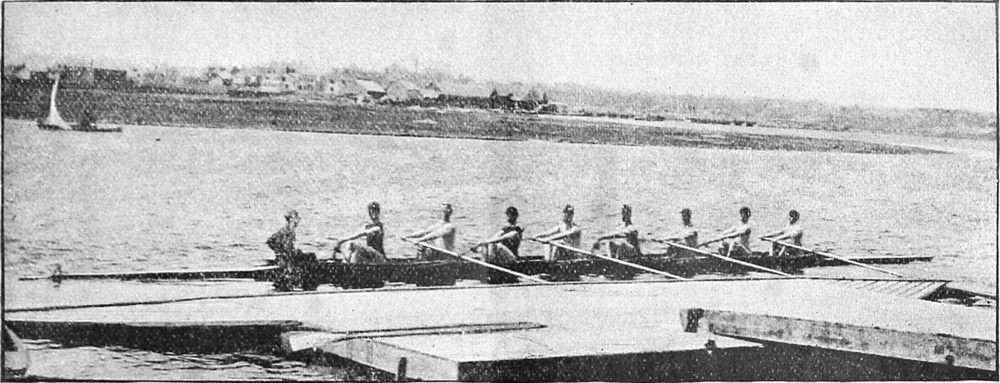
A HISTORY of the development of boating at Cambridge would in itself fill a large-sized volume, and would only be a repetition of what has been often written before. The boating interest of the college dates its rise from a time long antecedent to that of any other athletic contests, as we understand them now, and the first intercollegiate race, in 1852, was rowed more than ten years before Harvard began her intercollegiate baseball games. At first desultory races with Yale were rowed, in which Harvard was usually victorious; then the National Rowing Association of American Colleges was formed, and Harvard annually sent a crew to the Intercollegiate regatta. About this time also, 1869, a four-oared crew was sent to England, but was defeated by six seconds in a four-mile race with Oxford University. Endless disputes, before and after the races, and the occurrence of many fouls caused by the large number of entries, at last caused Harvard and Yale to withdraw in disgust from the National Rowing Association, and in 1878 were begun the annual boat races between the two colleges, rowed on the Thames at New London. These races are still continued and now form the only intercollegiate boat races in which the university crew rows. For seven years Columbia also rowed on the same course, but last year this race was abandoned. With Yale eleven races have been rowed over the Thames course, Yale winning six and Harvard five.
Of all athletic training at Cambridge, that for the university crew is the longest and most trying. Soon after college opens in the fall, the captain collects a crew of the most promising candidates who are not in training for football, and begins a little desultory practice on the river. About the first of December the work begins in earnest and from then until the Yale race the following June, the candidates for the crew pursue systematic training. During the winter, social pleasure is cut down, as the men have to be in bed at an early hour, with possibly the privilege of sitting up one night in the week. Daily practice is taken upon the rowing-machines in the gymnasium accompanied by light chest-weight work and a run out-of-doors. As soon as the ice is off the river, the crew begins work on the water and soon after goes to a training table for the rest of the year. Then not only are regular hours of retiring necessary, but the men must report at eight o’clock every morning for a short walk before breakfast. This sort of training accompanied by work on the river, gradually increased in severity, continues until the last of June, the day of the Yale race.
The Charles River flows within five minutes’ walk of the college yard, furnishing a fairly good piece of water for practice; and a little over a mile below the college, it opens into “the basin,” a broad sheet of water almost two miles in length. On this course are rowed the class races every May. The three principal rowing events of the year at Harvard are comprised in these class-races, the Freshman race with Columbia College and the contest with Yale University.
THE LACROSSE TEAM.
⇒ LARGER IMAGE
FOOTBALL.
In October, 1872, the first University Football Association was formed at Harvard. At this time football as a game was but little known in the United States; a few of the other colleges had formed a league, but the character of their game was absolutely different from that now played in America. It was modeled after the English “Association” game, and was played entirely with the feet; the ball could not be touched by the hands while the game was in progress, but instead was kicked or “dribbled” by the player in making his runs. At Harvard the game had a strong resemblance to our present method, and American football is a distinct outgrowth of a rough, rushing game as played for some fifty years on the college campus at Cambridge, a game at first modeled on no pattern, begun with no rules, but of an irregular, unrestrained growth, a sort of curious combination of “Association” football as played in England, and the college rush of those days in which an unlimited use of the hands and fists was allowed in order to gain possession of the coveted prize. About the year 1872, however, some Harvard men who had become acquainted with the English “Rugby” game, seeing the resemblance between it and the Harvard game, made a careful study of the former, and recognizing the need of regular rules, adopted a set of rules peculiarly like the Rugby, but adapted to the method of play then in vogue at Cambridge.
Thus was evolved a regular game limited by rules which were the result of a curious combination of three different factors: the game informally played by “sides” chosen from athletically inclined students, the rough fights of the Freshman and Sophomore classes in the annual rush, and lastly the influence of the adapted rules of the English Rugby game.
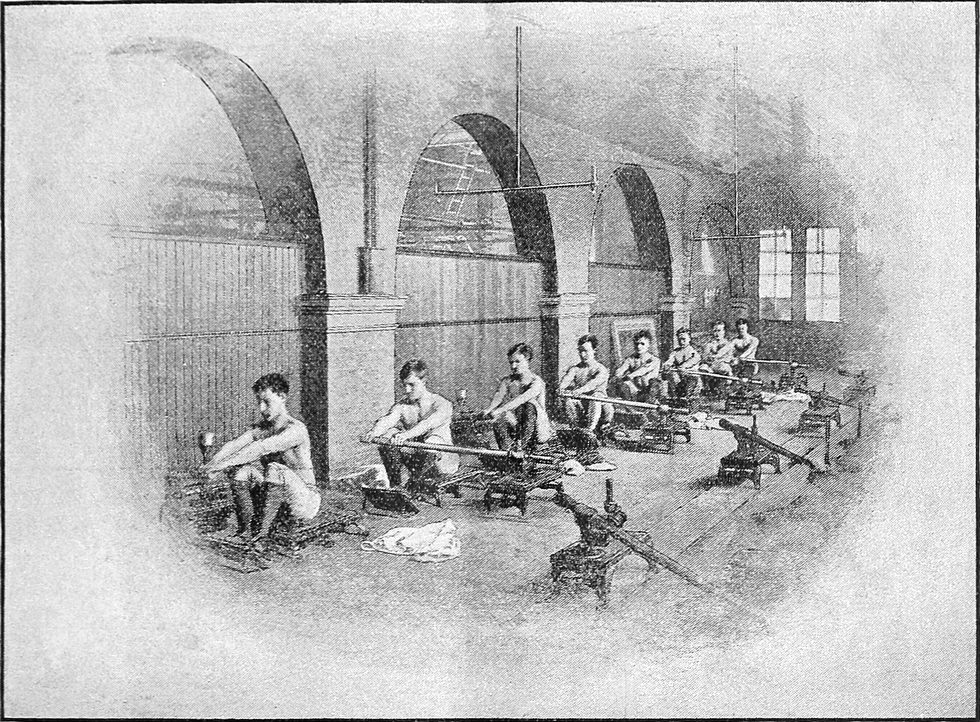
THE CREW AT THEIR WINTER WORK.
In the fall of 1874 Yale issued a call to Princeton, Harvard, Columbia and Rutgers to form an Intercollegiate Football Association, but Harvard could not join, because her game was so radically different from that played at the other colleges. The Yale Record remarked: “Harvard said that her game was so strictly scientific as to prevent her from ever contending with other colleges whose games were so entirely devoid of skill.” If Harvard had consented to join the League, American football to-day would be a very different game, but she could not have retained her own rules as they were fundamentally different from those in use at the other four colleges, and they, naturally wishing to retain their own rules, could have out-voted her. By her action in refusing to join the League, and her superiority—principally shown in games against Canadian teams—she forced first Yale and then the other colleges to adopt the Harvard game. In 1875 the first Yale-Harvard game was played under the Rugby Union Rules, practically the same as those used at Cambridge; and in 1876 the Intercollegiate Football Association was formed between Harvard, Yale, Columbia and Princeton. The game that Harvard introduced, Yale and Princeton have since developed.
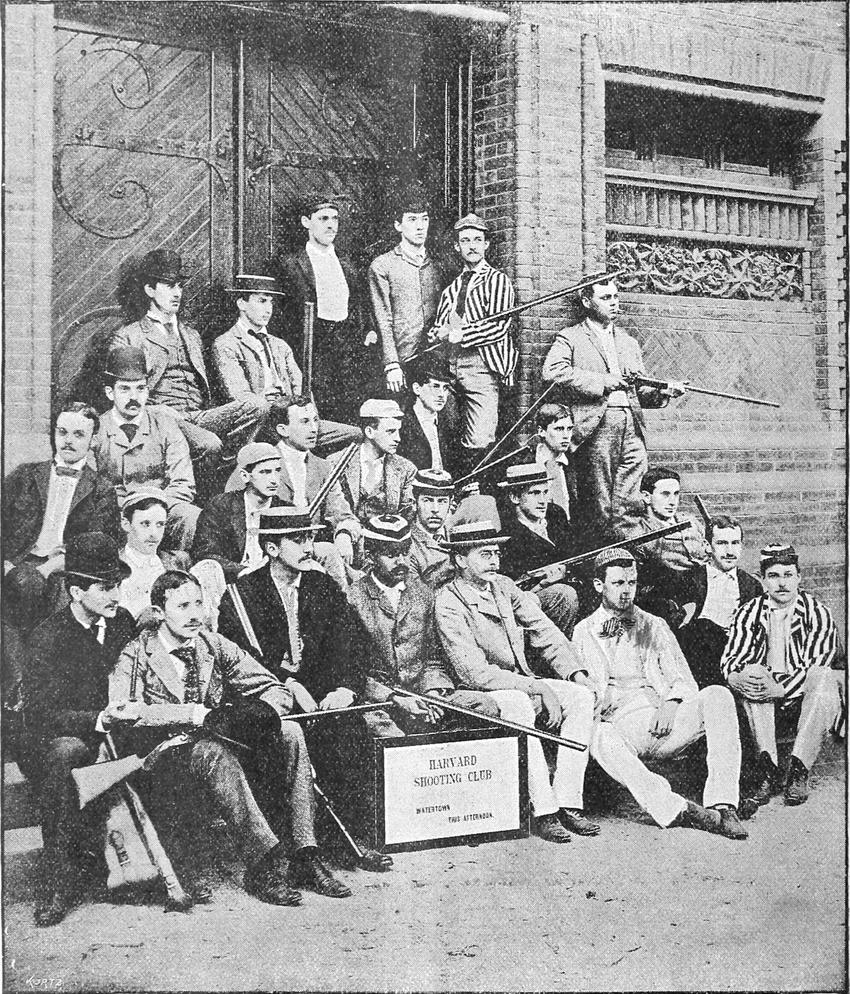
HARVARD SHOOTING CLUB.
In 1875 Harvard defeated Yale by four goals and four touch-downs to nothing. The next year she suffered defeat from Yale by one goal to three touch-downs, and since that time the Cambridge team has won not a single Yale game, and only a few from Princeton. The season of 1884 was especially disastrous. In vain the college paper, the Crimson, published semiweekly exhortations to the players to play better football, and to the undergraduates to take more interest in the team. The make-up of the eleven was excessively weak, and both the players and the rest of the undergraduates seemed indifferent concerning its success, so that at the close of the season it was disgracefully beaten by Yale and Princeton, and was defeated even by Wesleyan and the University of Pennsylvania. The undergraduates felt little regret when the Athletic Committee, who had for a long time been opposed to the game on account of its brutality as then played, announced that they considered it “brutal and demoralizing,” and that thereafter Harvard was forbidden to engage in any Intercollegiate football games. For a year the rule was enforced, but in 1886 it was reconsidered and Harvard again took her place in the football arena.
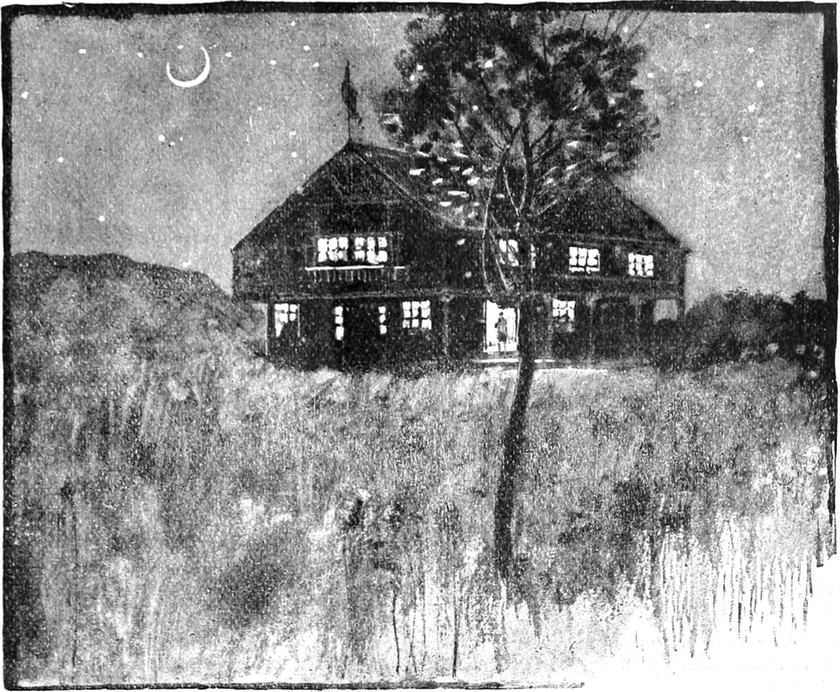
THE CREW’S NEW LONDON QUARTERS.
That year’s rest was fortunate, for it served as a breathing spell in which the college could pause and reflect for a brief space, so as to discern just what the fault was that had sent Harvard to the rear in football, while she still retained her prominent position in other games. When in 1886 she was allowed to resume her old position in the League, she began work with a grim determination to recover her lost prestige. With comparatively untried material to work upon, Brooks, ’87, the new captain, produced an eleven which was second only to Princeton and Yale. The record of Captain Holden’s eleven in 1887, the defeat of Princeton, the game lost to Yale at the New York Polo Grounds, and the dissatisfaction and dispute over the result, are still too fresh in the memory to need repetition.
The football played at Cambridge in the last two seasons shows that Harvard has regained her position as one of the leaders on the football field. For the seven or eight preceding years, Harvard football had been nothing more than a weak imitation of the game of Yale and Princeton. Upon the re-establishment of Harvard in the League, in the autumn of 1886, the game was first played with a slight attempt at originality. But the previous decline had been too great to admit of more than an attempt, and most of the time had to be spent in learning what the other colleges already knew. In 1887 for the first time in many years Harvard began the season on an equal footing with Yale and Princeton, with an equal knowledge of the science of the game and as clear a perception of what the requirements of the coming year would be. Instead of tamely imitating the game of the previous year as played by the two other colleges, she mapped out a plan of work of her own, and developed a scientific, heavy, rushing game, a system in striking contrast to the Yale and Princeton style, and entirely different from the heavy, bull-headed, rushing game as played by all the colleges six years ago. This style of play had its defects, but it possessed that which more than counterbalanced them all—it showed that at last Harvard football was logical and scientific, original in its conception and systematic in its play, and that the college again had taken her position as one of the leaders in the development of the American game of football.
LACROSSE.
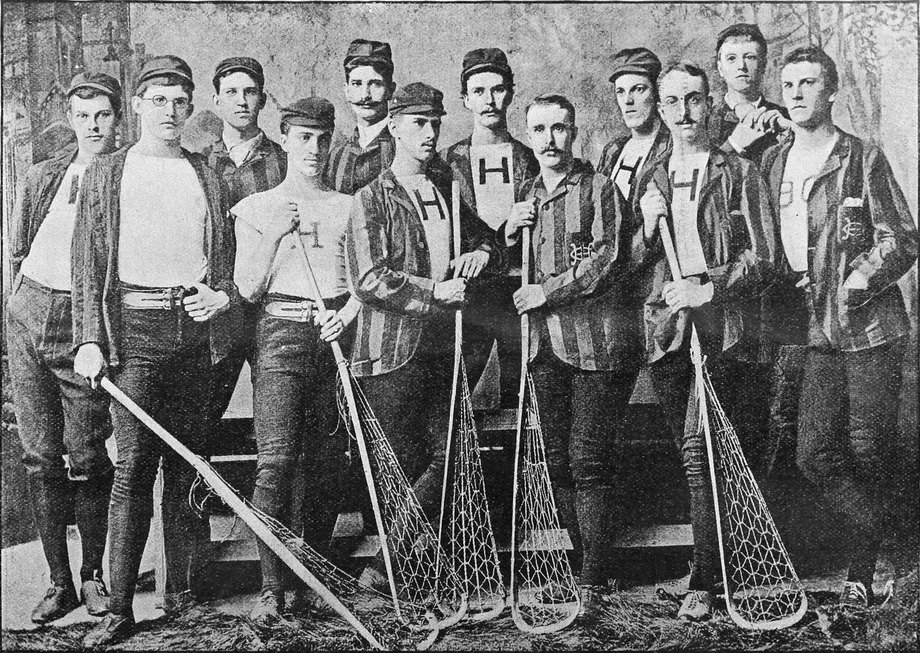
Although lacrosse is not a game very generally adopted in this country, it has been successfully played at Cambridge for nearly ten years. The Association is but a young brother of the other clubs, having been formed as late as 1879. It was quickly followed in 1881 by the formation of the Intercollegiate League, with Harvard as a leading member, and in 1881, 1882, 1883, 1885, 1886 and 1887 the lacrosse championship fell to Cambridge, and in two of these years the Oelrich’s Cup was also secured at the annual tournament in New York. When lacrosse was first played at Cambridge, fifteen dollars expended for advertising and policemen, and seven dollars received as gate receipts was not an unknown experience at a championship game. But successful teams, and the natural advantages of the game, have gradually extended its popularity, and now each year the rapidly increasing number of players attests the growing interest felt by the college.
There are also many other athletic clubs of more or less importance in the college, which, however, seldom take part in intercollegiate games—the polo, shooting, canoe and bicycle clubs, and the sparring association. In tennis, Harvard has furnished some of the leading players in the country—R. D. Sears, H. A. Taylor, J. S. Clark, P. S. Sears and Q. A. Shaw; and the extent to which the game is now played is shown by the fact that, in reply to the questions of the Faculty athletic committee, out of 1,031 men who replied, over 600 named tennis as one of their usual forms of outdoor exercise.
FACULTY REGULATION OF ATHLETICS.
In 1882 there entered into Harvard Athletics a new factor, in the shape of interference with, or rather attempted guidance of, athletics by the college authorities. With this purpose in view, a committee on athletics was appointed, consisting of Prof. C. E. Norton, Prof. J. W. White and Dr. Sargent; a committee which for a time was more discussed, more abused, and more misunderstood than any other unfortunates who ever had the complimentary misfortune of being appointed to guide college athletes into the path they ought to follow. The immediate cause of its appointment was to prevent several abuses which the Faculty believed they saw increasing coincidently with the growth of intercollegiate athletics.
The public sentiment of the undergraduates was favorably inclined toward the regulating action of the Faculty, and although some of the overzealous raised an outcry against any interference on the ground that such would injure their chances of success, the majority and the more cool-headed undergraduates agreed that some regulation of the growth of athletics was needed.
The members of the committee were all very strongly of the opinion that athletics were essential to the highest welfare of the students; but at the same time they thought they saw tendencies growing which, unless checked, would be likely to more than offset all the advantages which were to be gained. They felt that the drift of affairs during the past few years had been toward the effacement of that clearly defined line which separates amateur from professional athletics, and that for the preservation of intercollegiate athletics a strict observance of this line was necessary. The first step in interfering with the laissez faire system of athletics was to dismiss the men employed as trainers by the Athletic Association, and to forbid any “professional” trainer from appearing on the college grounds. Till that time each would-be athlete had chosen his own trainer, usually the professional selected by the H. A. A., but often some professional walker or sprinter who had no connection with the college. As a result petty disputes arose among the various trainers, and were continued on the track; and there was bitter rivalry in obtaining the best runners, in order to secure the advertisement of having trained a “record” man. Of course, imbued with this feeling, the trainers neglected the development of the weaker men who entered into track athletics for the sake of exercise, but with no hope of breaking a record. It was to remedy this evil that the committee on athletics forbade professional trainers to appear upon the college grounds. At the same time, realizing how necessary it was for the men in training to have some one to look after them, they sent a request to the corporation that some man might be appointed with a fixed salary, to have a place in the gymnasium and to act as a trainer for all the athletes. Their recommendation was accepted, and after a delay of about a year Mr. J. G. Lothrop was engaged to superintend the general exercise of all the track men, and also the special work of those training for the intercollegiate games, and he was installed in the gymnasium as “assistant in the department of physical science.” The satisfaction occasioned by this change has borne fruit in the large number who now work in the gymnasium classes during the winter, the many candidates for the intercollegiate team of track athletes, and the brilliant record of the team in annual intercollegiate games.
The second step taken by the committee, in 1882, was to prohibit the Harvard baseball nine from playing games against professionals. Previous to this, President Eliot had written to the Faculties of all the colleges with which the Harvard nine played matches, asking them whether they would forbid the nines of their respective colleges to play games with professional clubs in case Harvard took the initiative. Affirmative answers were received from all except Yale, and she alone rejected the proposition. Nevertheless, in October, 1882, the Harvard athletic committee forbade the nine to play further games against professionals; but the other colleges, instead of adopting the plan, as, naturally, it was supposed they would, neglected to support the position taken by Harvard, and up to the present time every college nine in the country except Harvard is allowed professional practice. At Cambridge the rule has been strictly enforced since it was adopted in 1882.
If the athletic committee won any favor with the undergraduates by their successful regulation of track and field athletics, it was all lost by this baseball regulation. The step was taken with the idea of drawing a strongly marked line between amateurs and professionals, thus effectually preventing the professional tendency from increasing in college athletics; and also to prevent the game from becoming a monopoly played by a few skilled players, instead of being participated in by the whole college. It was a measure passed with a good aim, but nevertheless one which has flown wide of its mark, for its only practical result has been to heavily handicap the Harvard nine.
When any game in any branch of athletics is successfully played by a university team, experience shows that greater interest is always aroused throughout the entire college in that particular sport; that more “scrub” teams are formed, and a larger number of undergraduates practise the game, than when they have only a weak, defeated university team as a model. A higher standard of ’varsity play may, perhaps, lessen the number of candidates for the team; but these candidates form only a very small proportion of the number who incidentally play the game, while the greater enthusiasm aroused largely increases the number of mediocre players. Thus this prohibition, besides weakening the nine, besides enforcing more work on the captain and the team, really defeats the very aim that the committee had in view, and lessens rather than increases the number of men who play the game for general recreation.
As regards the anti-professional reason, it is impossible to say what would be the status of the Harvard nine if this rule had not been passed. Judging from the other college nines who annually play professionals for practice, there would be but little difference from what now exists. The difference, so difficult to discover on the ball field, exists chiefly in the minds of men whose knowledge of baseball is derived principally from discussions in the college Faculty meetings. Although it is difficult to surmise how even there such a discriminating distinction can be drawn between local unrestrained, would-be-but-couldn’t-be professionals, and the disciplined league players; the former eager by any means fair or foul, to score a point against the “college boys,” the latter playing a practice game simply as a business matter. The Harvard Faculty, it is presumed, do not approve of professional sparring as an avocation for students, but they have not yet forbidden undergraduates to take lessons of competent teachers, even although the latter may have occasionally fought a prize-fight; and such lessons are deemed even less contaminating, from a professional point of view, than would be friendly and unpaid bouts with celebrated locals who hoped in the future to enter the ring.
The position of the committee towards college football has been unique. Football in this country is a game still in a state of development, and the Harvard athletic committee have taken an active part in developing it in the right direction. In November, 1883, the attention of the committee was first called to a serious consideration of football. The game as played that fall was one of the roughest ever played in the country; and of a kind of roughness where brutality and unfair play were put at a premium. On Thanksgiving Day, Harvard was scheduled to play the final championship game with Yale on the Polo Grounds, New York. Imagine the chagrin and astonishment of the undergraduates when, on November 22, a letter was received from the committee by R. M. Appleton, the captain of the eleven, stating that Harvard would not be allowed to play any more intercollegiate games, until substantial changes in the rules were made. Some of these rules appeared to the committee “to allow of no other inference than that the manly spirit of fair play is not expected to govern the conduct of all players, but on the contrary, that the spirit of sharpers and roughs has to be guarded against. The committee believes that the games hotly played under these rules have already begun to degenerate from a manly, if rough, sport, into brutal and dangerous contests. They regard this as a serious misfortune in the interest of the game, which, if played in a gentlemanly spirit, may be one of the most useful college sports as a means of physical development. They regret that they did not give earlier attention to the character of these rules, and thus earlier come to the conclusion which they have now reached, namely, that the Harvard eleven cannot be allowed to take part in any further intercollegiate match games until substantial changes in the rules have been made.” The objectionable rules were:
Rule 19. The referee shall disqualify any player whom he has warned twice for intentional off-side play, intentional tackling in touch or intentional violation of Rule 28.
Rule 28. No kicking, throttling, butting, tripping-up, tackling below the hips, or striking with closed fists shall be allowed.
Rule 38. No players shall intentionally lay hands upon or interfere with an opponent unless he has the ball.
In other words, a man could intentionally knock down another player with a straight blow from the shoulder; he could do it again if he wished, but not until he had done it the third time could he be disqualified. It was to this and its practice that the athletic committee objected. Most of the New York papers sneered at it as “Harvard delicacy;” while a scatter-brained undergraduate, in an open letter in the Crimson, abused the committee for obliging our eleven to break its agreement, for robbing the Yale team of some $1,500, its expected share in the gate-money, and ended by solemnly declaring, “We sincerely hope that the time will sometime come when our feelings of honor will have some weight with the Faculty in its decisions.”
That the athletic committee, however, were not irredeemably lost to all consideration of the honor of the students and were not quite as prudish or unreasonable as the New York press represented them, was soon shown by their allowing the game to be played when the respective captains of the Harvard and Yale teams informed them that the objectionable rules had been changed. The important changes were that the referee was allowed to disqualify a player without any previous warning, and that no more than two disqualified men on either side should have their places filled by substitutes; also that no player should lay hands on or interfere with an opponent unless he had the ball. The game was played, and, as was expected, Harvard was beaten. The football of the succeeding year was fully as bad as it had been in 1883, and consequently there was a large body among the students ready to support the athletic committee when, at the close of the season, they announced that they considered the game as then played to be brutal and demoralizing, and on this account should request the Faculty to prohibit Harvard from playing it against other colleges. A short delay was granted before presenting this report in order to give the students a chance for a hearing; but no satisfactory results came from the delay, and in January, 1885, Harvard was forbidden to engage in any more intercollegiate football contests.
So much has been said and written about this action of the athletic committee, so much abuse has been heaped by the newspapers on the “Harvard dudes,” and so much misrepresentation has been spread abroad concerning the so-called “Harvard daintiness,” that it is only fair, even at this late date, to consider, for a few moments, what it was that influenced the committee in their action, and whether this Harvard daintiness was the result of an unmanly avoidance of the roughness of the game, or whether it was actuated by a feeling that no sport encourages true manliness when it has such an alloy of brutality and unfair play as football had at that period.
The committee had attended the four principal championship games of the season, and at each of these games they had stationed themselves in different parts of the field, in order to notice what seemed to be the objectionable features of the play. Their report says: “In every one of these games there was brutal fighting with the fists when the men had to be separated by other players, or by the judges and referee, or by the bystanders and the police. In addition there were numerous instances where a single blow was struck, instances that occurred in every one of the games. A man was felled by a blow in the face in the Harvard-Princeton game, in the Harvard-Yale game and in the Yale-Princeton game. In the Wesleyan-Pennsylvania game a man was thrown unfairly, out of bounds, by an opposing player. Then, as he was rising, but before he was on his feet, his antagonist turned, struck him in the face and knocked him down, and returned in triumph with the ball. In all of the games the manifestations of gentlemanly spirit were lacking—the spirit that scorns to take an unfair advantage of an opponent. The teams played to win by fair means or by foul. If two teams are at all evenly matched, and one plays a gentlemanly and the other an unfair game, the self-respecting team will always be beaten.... In the four games which we attended there were but two cases where a player was punished for brutal or unfair play. In several cases the team was punished by having a ‘down’ given to the other side, but only twice was a man disqualified.”
In 1885 an important change was made in the personnel of the committee by increasing their number from three to five; of the five members two to be representative undergraduate athletes, one a recent graduate, one a physician, resident in Boston or in Cambridge, and the director of the gymnasium, who is also a member of the Faculty. The other colleges, urged on by a natural spirit of progress in the development of football, and spurred still further by the public attention which had been attracted to its abuses, had materially altered its character. The committee carefully watched it progress as shown in the championship contests between the other colleges, and after careful consideration, came to the conclusion that a decided change had taken place; that it had largely lost its brutality, and, although rough, its roughness was of a kind that often encouraged a manly spirit; that although still far from perfect, it was but in a transient stage of development, and that the new rules, with a few slight exceptions, had proved efficacious in regard to the evils they sought to remedy. They therefore recommended that the Faculty should allow Harvard to renew her intercollegiate games of football. The report was accepted and Harvard was reinstated in her position in the intercollegiate league.
Since the reinstatement of Harvard into the football league, no important action has been taken by the athletic committee. The committee have been much abused, and still more ridiculed, but a calm survey of the work they have done, however much one may differ with them on a few measures, must be convincing that they have been needed as a restraint upon the exceeding growth and concomitant abuses of athletics, and that their work has usually been successful.
The formation and growth of the different athletic organizations up to about 1882 formed by itself a distinct period in Harvard athletics; then began a new period, marked by their curtailment, or, more justly speaking, the curtailment of what seemed to be their abuses, by Faculty restrictions. Within the last few years has begun still a third period, marked by distinctly new athletic action; this is the curtailment by the students themselves of Harvard participation in intercollegiate athletics; a feeling that the intercollegiate athletic interests of the college have become too complicated and too cumbrous, and that action should be taken to restrain them.
When, in order to win an intercollegiate athletic meeting, it is necessary, as is the case, not only to send good athletes upon the field, but also to train good amateur detectives in order to ferret out unfair entries from other colleges, the time certainly has arrived when some sharp remedy should be applied. Often, it may be, these unfair entries are not sought by the college under whose colors they compete, they may be simply “mug hunters,” attracted by the rich prizes, and the wide reputation which attaches itself to an intercollegiate prize-winner; but, nevertheless, such entries are oftener and more easily made, and are more readily winked at when there are thirteen colleges and over two hundred entries, than when there are only two colleges and fifty entries. A clearly drawn distinction between college and non-college athletics is absolutely essential for the true welfare of college athletics, and this line it is hard to preserve in any large intercollegiate league.
Never yet has there been a large intercollegiate league in any important branch of athletics which has not been productive of bitter ill-feeling and charges of unfair play. The generous rivalry begun on the athletic field has far too often borne fruit at the conventions in underhand combinations worthy only of those political conventions of which they are cheap imitations, and too often victory on the athletic field must be preceded by a victory on paper, insignificant, perhaps, to the uninitiated, but which under its apparently harmless words conceals the future coup d’état by which victory is to be won. The defeated team, smarting at the recognition that it has been tricked, is obliged quietly to submit or be taunted with not having pluck enough to accept defeat; or else it may carry on a wordy war which no one outside the college understands, which brings no satisfaction, and which usually ends in nothing being accomplished. This is followed the next year very naturally by a sullen determination to return the compliment, not only on the field but also in the convention. These disputes, this ill-feeling, this idea that victory even meanly won, is well won, are real troubles which must be guarded against. They are practical signs of a partial disappearance of the line which ought to separate professional from college athletics, and the origin of them is largely due to the existence of intercollegiate leagues.
No quack medicine in the shape of edicts against what the world calls “professionals,” will stop this tendency. Such attempts remind one of the nobleman who, because his son was nightly attacked by the nightmare, hung all the old women, so-called witches, in his neighborhood, instead of regulating the boy’s evening diet. Nor can the trouble be prevented by abolishing all intercollegiate contests. Such a remedy would be like cutting off a man’s hand in order to extract a splinter. This plan was proposed last spring in an eccentric report presented by a majority of the committee on athletics appointed by the board of overseers, but, nipped in the bud by its own apparent weakness, it was suffered to pass quietly out of sight. The Faculty, however, aroused by the fresh importance attached to the subject, appointed a committee to investigate thoroughly the entire athletic question; statistics were collected having reference to the general standing in college of athletic men, and the effect of athletic sports upon the colleges as a whole; and the conclusion reached was that, although several abuses still exist, they are greatly overestimated; that the physical standard of undergraduates has been greatly raised since the general introduction of athletics; that as a usual thing the rank of athletic men is higher than the average, and the report ended by recommending the authorities at once to secure fresh land for new athletic ground, and to build an addition to the gymnasium. This report representing—as concerns athletics—the most conservative college in the country, practically puts an end to the opposition to athletics as a factor in college life, and recognizes the fact that college intercollegiate contests will and ought to retain a permanent and important position in the college world.
Now that the Harvard authorities have at last given official recognition of the importance and permanency of college athletics, it is all the more important that these evils arising from intercollegiate leagues should be driven out of existence. The quickest and only thorough way of effecting this is for Harvard to withdraw from all intercollegiate leagues, and to confine her annual championship contests to Yale alone. There are many other reasons besides those given in this article why Harvard’s position in intercollegiate leagues acts as a drag upon her true interests; increased expenses both in training and traveling attendant upon so many championship contests; the longer time necessarily spent in preparation for matches not important in themselves, but which lost by accident would impair the chances of winning the championship; the element of chance in determining the winner of the intercollegiate track athletic games, ever increasing with the admission of so many smaller colleges which have no hope of ever securing first place. The only solution of the present athletic problem for Harvard is a withdrawal from the intercollegiate leagues. As the case now stands, in most branches of athletics the contest eventually narrows itself down to one final effort between Yale and Harvard. There is everything to gain and nothing to lose by the change. The idea is rapidly gaining ground at Cambridge: a free discussion of it in the college papers has only added new converts. Dissolution from all athletic leagues, practice games against the best teams in the country, and championship games with Yale alone, would cure many of the evils which seem to have attached themselves to Harvard athletics.
NOTE.—The illustrations of the different groups of athletic, football, baseball, lacrosse, and other teams in this series of articles on college athletics, are from photographs by Pach Brothers, of 841 Broadway.
THE FAUN DANCE.
In gladsome grouping The fauns come trooping, With frolic steps and fleet. The short crisp grasses, As each one passes, Rebound beneath his feet. Now Pan goes trilling A measure thrilling With wild ecstatic mirth. The fauns leap after, With mad, sweet laughter, Their footsteps kiss the earth. The revel hushes The shy brown thrushes; They silent sit and peer. With lithe limbs shining, With arms entwining, The fauns leap there, leap here. The brown feet twinkle, While harebells tinkle In tune, with graceful nod. The sun-flecks racing, In antic chasing, Seem dancing on the sod. Light zephyrs swaying The boughs, are playing A soft Æolian air. The owlet, rousing From daytime drowsing, Looks down with sleepy stare. A cloud stoops o’er them; Behind, before them The pattering rain-drops fall. Then, helter-skelter, They fly for shelter Beneath the oak-tree tall. M. E. Gorham.
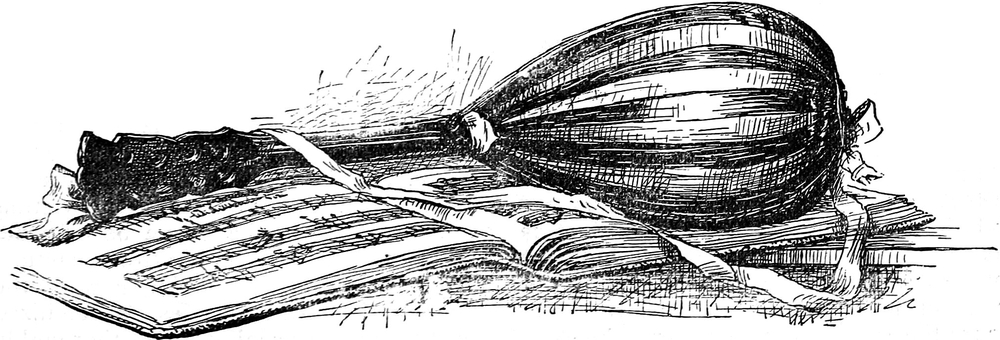
MASK AND FOIL FOR LADIES.
By CHARLES E. CLAY.
AMONG the infant nations of the world woman was expected to share the labors of the field with her lord. The exotic conditions of a pernicious civilization, as wealth accumulated and luxury grew, imposed trammels on woman and relegated her to the enervating confinement of the house in order that she might preserve a more delicate and pleasing form for the gratification of man returning after the day’s toil. Woman was, however, originally intended to be a much more competent companion and helpmate than the selfishness of man will concede.
So long as a community remained pastoral and nomadic, so surely did woman retain a physical development equal and perfect as that of her mate. Thus, we find that Atalanta was as fleet of foot as any of her male companions, and not until she allowed her cupidity to get the better of her judgment, while striving to secure the golden apples dropped by Hippomenes during the race, was she vanquished. That woman was once as skillful as man in the practice and art of venery, was symbolized by the fact that men did not deem it unworthy to worship a virgin huntress, and called upon Diana to lend them her knowledge and support in the chase. That war even claimed their services is evidenced by Herodotus and other ancient historians; and although the prowess of the doughty Amazons, who, in order that they might not be impeded in the use of the bow, mutilated their right breasts, may be in a great measure mythical, still such testimony goes to prove conclusively that woman, while perhaps not endowed with the same brute strength as man, can be his peer in most games, pastimes and recreations that call for dexterity and quickness of hand, foot and eye.
No one can gainsay the fact that the long-continued seclusion of our fair sisters from sports and exercises has undoubtedly much deteriorated the physical stamina of the female race, at least in civilized countries. They are not capable of undergoing the fatigue, exertion and exposure nature intended they should; they are the victims of many ailments that have become hereditary to their sex simply from inaction. They are not (I am talking now of the upper and leisure classes of civilized society more especially) in as thoroughly a healthy physical condition to sustain the burdens of maternity and its consequent strain upon the system as they ought to be, as it was intended by nature that they should be, and as they undoubtedly would be, if healthy exercise was more universally prevalent among the sex. If any reader doubts this statement he has only to analyze the statistics of any European nation that bear upon this subject to be convinced.
Happily, the baneful results of an indoor life of inaction have been realized before its effects have become ineradicable, and the growing superiority of the physical development of the Anglo-Saxon over her Latin sister is due chiefly to the revival of athletic outdoor exercise among the women of this family. English girls may surely claim the lead in the good work of athletic regeneration. They are closely followed by their fair sisters and rivals on this side of the Atlantic, and both are head and shoulders ahead of the daughters of France, Germany, and the other Continental nations. I will not waste words in contrasting the physical condition of the women of the West with the deplorable state of the sex in the East. It would be an insult to Christianity.
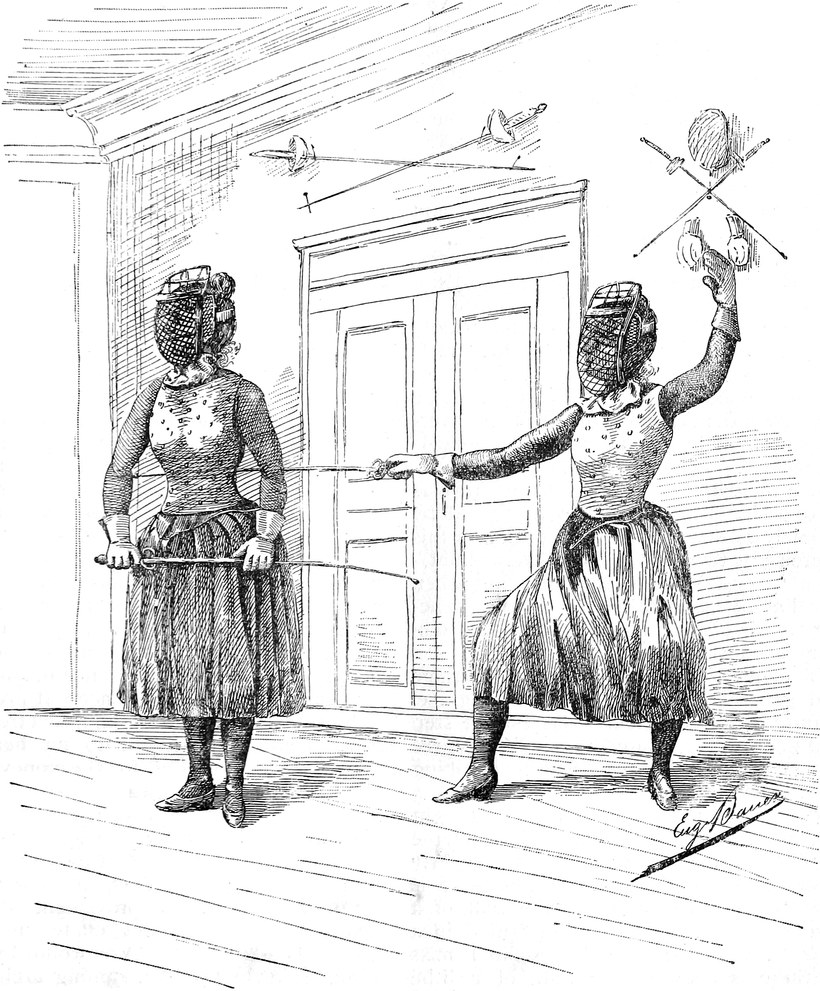
EN GARDE. FIRST POSITION. SECOND POSITION.
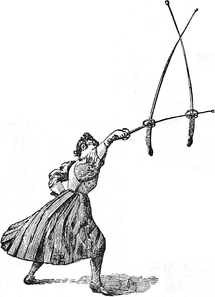
I need hardly enumerate the rich catalogue of sports, games and recreations that claim the attention of our enlightened sisters of to-day, but this much I will say, that there is not an exercise that will repay a girl so well, and at the same time rouse her enthusiasm and enjoyment so thoroughly as the practice of fencing—and in that term I include the handling of foil, broadsword and single-stick. In considering the art of fencing in the present article I shall not attempt to give any instruction in the rudiments or the more finished evolutions of the science, because, in the first place, to treat only the principal thrusts and parries would occupy more space than I have at my command, and in the second, fencing cannot be learned from the book. One lesson from a competent maitre d’armes will effect more than the perusal of a volume. I shall, however, endeavor to point out the beneficial results to be reaped from the exercise, to create a feeling, if possible, that fencing ought really to be an indispensable necessity of a young lady’s complete physical education, and to offer a few hints and suggestions as to the best means of learning and enjoying the art, as well as the proper dress and equipment to be employed.
Fencing, then, may be popularly defined as the art and science of attack and defense, the weapon used being the foil for pleasure, and the rapier in a duel of deadly intent. The attack consists of a number of thrusts, points and lunges, the latter being an extension of the thrust. The defense is the art of warding off an adversary’s thrusts by evolutions, termed guards or parries. It is also admissible to advance the whole body while dealing thrusts or to assist the execution of the guard by a timely retreat. The participation in this exercise by two persons is called a “bout,” or a “passage,” with the foils, and when one line of assailants faces another, fencing two and two, this general bout is distinguished as an assault of arms.
The exercise will give to the carriage and general poise of the body a grace, dignity and freedom, with majesty of step and mien to be attained in a like degree by no other means. Some finniking miss will, perhaps, venture that dancing and the idiotic steps of deportment taught by a mincing Frenchman is all the setting up that a young lady properly brought up should require; but there is just as much difference in the walk of a young lady who has been well drilled in a salle d’armes and a dancing-school miss as there is between the walk of a lithe young panther and a cat stepping over hot bricks. In fencing, every part of the body is brought into play. The strain on the wrist, and the rapid movements with the foil work every muscle in the shoulder and forearm. The quick advance and hasty retreat develop the lower limbs. The tension of the whole body brings into healthy action the internal organs. The chest expands, the lungs are quickened and produce a stronger circulation; the whole frame is invigorated, hardened, strengthened and braced up. Moreover, exercise with the foils does not abnormally develop one member, or one set of muscles to the detriment of others equally important. For, as Captain Nicholas, of the New York Fencers’ Club, very happily expressed it to me, “fencing rather places the muscles of the body in the very best position to perform their several functions to the best advantage.” That some pastimes, notably lawn tennis, will develop one member to an inordinate degree, if pursued to excess, is proved by the experience of many of the fashionable dressmakers, one of whom assured me not long ago, that since the general craze for tennis among her customers she has found it necessary to measure both arms and shoulders of her most ardent tennis-playing clientèle, as she finds as much as three to four inches difference in the deltoid and biceps measurements of the playing arm. And many of my lady friends have assured me that since taking up tennis they have found it impossible to put on the right hand the mate of the glove that snugly fits their left. In fencing this cannot occur, for the lessons are always given equally with left and right hand holding the foil.
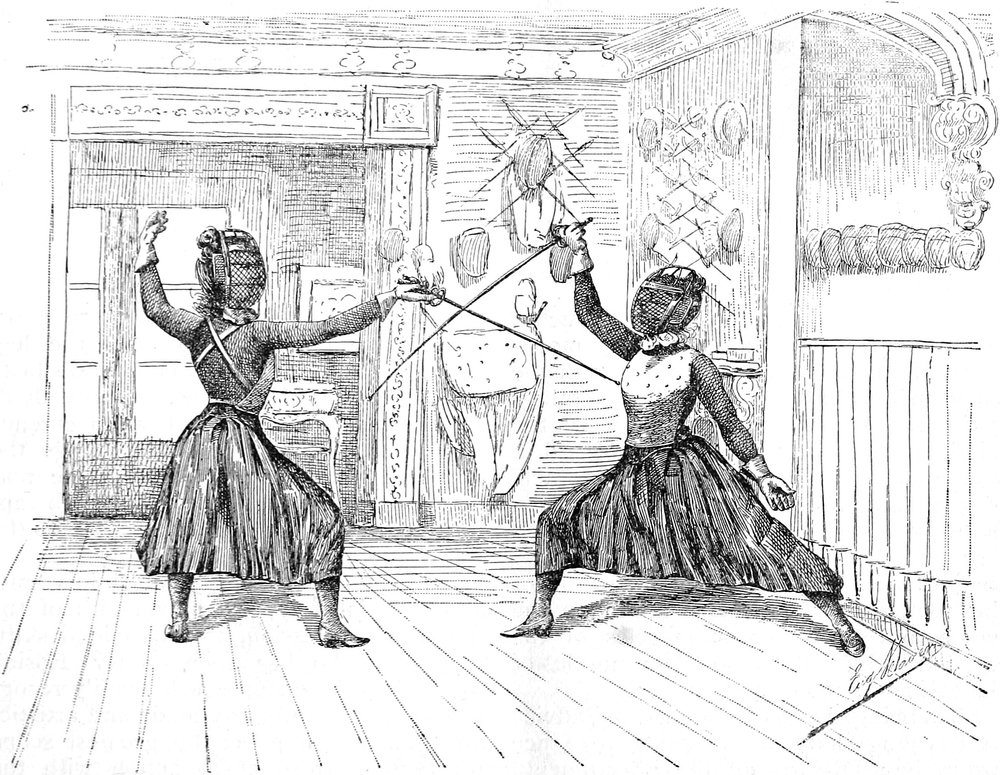
LOW QUARTE.
To prove that this healthy exercise is one of the very best means that can be employed to efface the serious effects to the lungs and heart involved by a narrow contracted chest and stooping shoulders, let me instance the experience of one of the young Viennese lady fencers at present with Professor Hartl’s accomplished troupe, as Fraulein A. related it to me herself. “Oh, no; it is not at all for the money that I continue to remain with Professor Hartl, neither did I join his excellent school in Vienna with the idea of ever going before a public audience, but I first took up fencing on my doctor’s orders, and the wonderful results in the improvement of my health from this training made me loth to quit the exercise.” “You would hardly think,” said the fraulein, smiling archly at me as I surveyed her plump and comely figure, “that barely twelve months ago I was so puny and sickly a creature that I could not rise from my chair nor walk across the room without assistance. I stooped like a broken-down old woman, my chest was so hollow and bent inwards that it was pain for me to draw a breath, and I was troubled all the time with a dry, hacking cough that was as distressing to my dear mother as it was painful to me. I had been for months in the doctor’s hands and nothing bettered by his treatment, though he was one of the leading physicians in Vienna. At last he told my mother that if I did not mend shortly she would be childless (for I am her only child), and as a last resource he would recommend my being sent to Professor Hartl’s fencing school. My mother was astounded, and demurred; but I, like some drowning wretch catching at a straw, was bent on going, and carried the day. I was conveyed to his salle d’armes in a carriage. The professor was very kind and prescribed a course of exercise as gentle and easily progressive as it was judicious. In three weeks I could walk, breathe and move my limbs as well as any of the other girls. Then my lessons with the foil commenced—very short and very feeble attempts they were at first, I can tell you, but I grew stronger and heartier every day. I became straight and strong, my chest became full, and my shoulders humped no longer. I had such an appetite, too, that my mother was appalled. Then the professor made arrangements to come to America. The doctor told me the sea voyage would be most beneficial. My mother reluctantly consented as I wanted much to see this great country. Ainsi me voici, monsieur!” Pretty conclusive evidence that, I take it, as regards the benefits of fencing to a weak constitution.
Let us now consider the subject of the most suitable costume to wear while taking a turn with the foils. In the first place let me say that, as a general thing, young ladies fashionably dressed in the prevailing styles are not properly attired even for a walk to do them any real good from an athletic point of view. The waist is too tightly laced. The bodice is worn too tight at shoulders and in the sleeves to give the freedom of play necessary for arms and shoulders, to walk beneficially. The dresses are “pulled back” to such a degree that they cramp the forward movement of hip and knee. The abominable shoes, with a tiny heel, with head no bigger than a dime, planted almost in the middle of the foot, tilt the body forward in such a manner that it becomes a miracle why ladies don’t pitch forward more often on their noses. Besides, this abnormal elevation of the heel throws the whole weight of the body on the ball and toe of the foot, causes a fearful strain on the instep and the extensor muscles of the leg, and throws all the posterior muscles of the calf and ankle out of use.
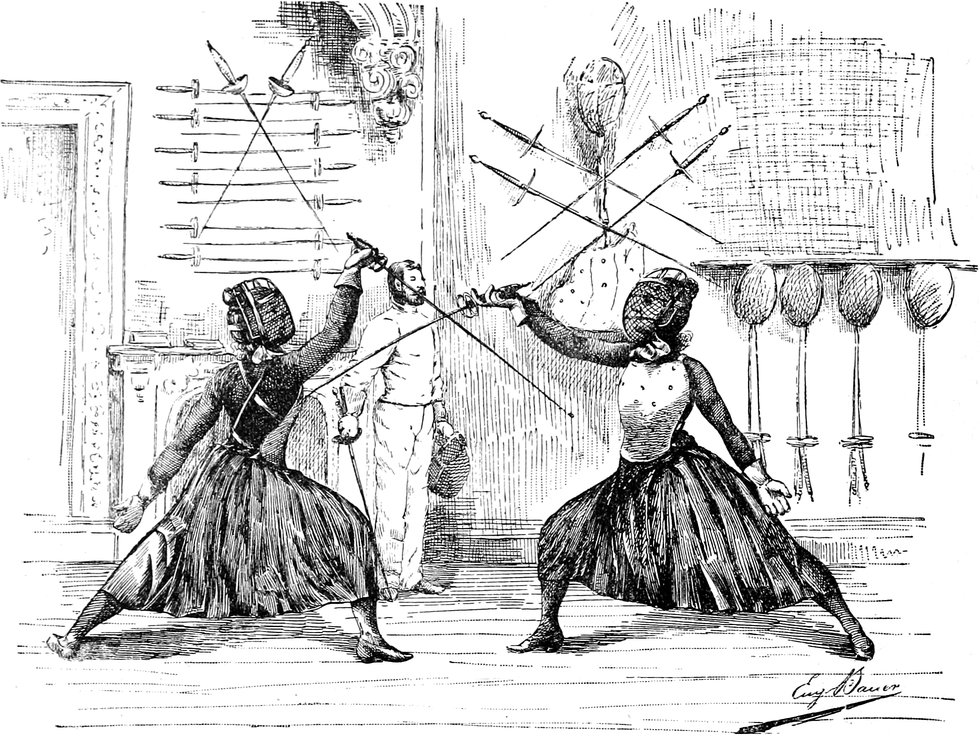
OCTAVE.
Such being the case of affairs, my advice to a young lady commencing to fence would be: Discard all the impedimenta and addenda, especially the latter, with which you so successfully break “the continuity of beauty’s lines and curves” on the street. Don a skirt of flannel, velvet or tweed that is moderately heavy, i. e., heavy enough to stay down without being weighted at the bottom with leads. The skirt should be amply kilted or plaited to a good broad, strong band, which when fastened round the waist should act the part of a man’s gymnasium belt. The plaits, of course, should be made so that they open easily at the bottom to allow the easy and rapid advance of the leg. The length may be left to the good taste and judgment of the wearer, only don’t have it made so long that when extended at your full length in the lunge the skirt will trail round the heel of the rear foot, for if this is the case you may be apt to step on the skirt as you recover to the “en garde” position.
Another style of dress much in vogue, and especially approved by ladies of the theatrical profession, is the divided skirt. Any one who has seen pretty Rosina Vokes in this costume will readily recognize that when properly made and artistically managed it gives the greatest scope for perfect freedom of action with the acme of grace in movement. But the plain kilted skirt is the simpler and more natural garment, and I recommend it to young ladies who practice fencing as an amusement and occasionally cross foils with their brothers or their male friends.
It is absolutely necessary that the upper portion of the figure should be well supported, and for this purpose a short underwaist reaching barely to the waistband of the skirt should be worn. This should be made of some twilled or ribbed material and laced snugly down the back, but should not contain whalebone or steel of any kind. I believe they are known as corset-waists. The ordinary steel corsets extend too low over the hips and are apt to be inconvenient when lunging. A good, elastic, silk jersey is the very best thing for a waist. But let it give ample room under the arms and across the chest. Many girls wear a simple blouse or sailor jacket, and they are very serviceable; but the jersey is preferable, inasmuch as it clings closely to the arm and the foil is not so likely to get caught in the sleeve as is apt to happen with a sailor-jacket sleeve. Let the throat be bare and wear no collar. Nothing, in fact, that will come above the neck of the plastron, or chest shield. Be shod with tennis shoes; they are better than high boots, because they allow more play to the ankle. If leather soles are worn it will be well to rub them liberally with some preparation that will prevent the foot slipping.
The accoutrements necessary are a plastron, or chest shield, mask, gauntlets, and a foil. The plastron is generally of finely dressed leather, quilted chamois leather, padded canvas or buckram. All these equally serve their purpose, which is to protect the chest when sharply struck with the button of the foil. They are made of various thicknesses and weights. Those thickly quilted and cotton stuffed, of course, insure perfect immunity from the blow, but they are ungainly, heavy-looking coverings, and for ordinary practice, I think a stout canvas or leather plastron will be found to be all that is required. They slip over the shoulders on which the straps rest, are cut out under the armpits, and are buckled at the back or side; if at the side, better on the left. They should fit closely round the neck and lie perfectly flat upon the chest.
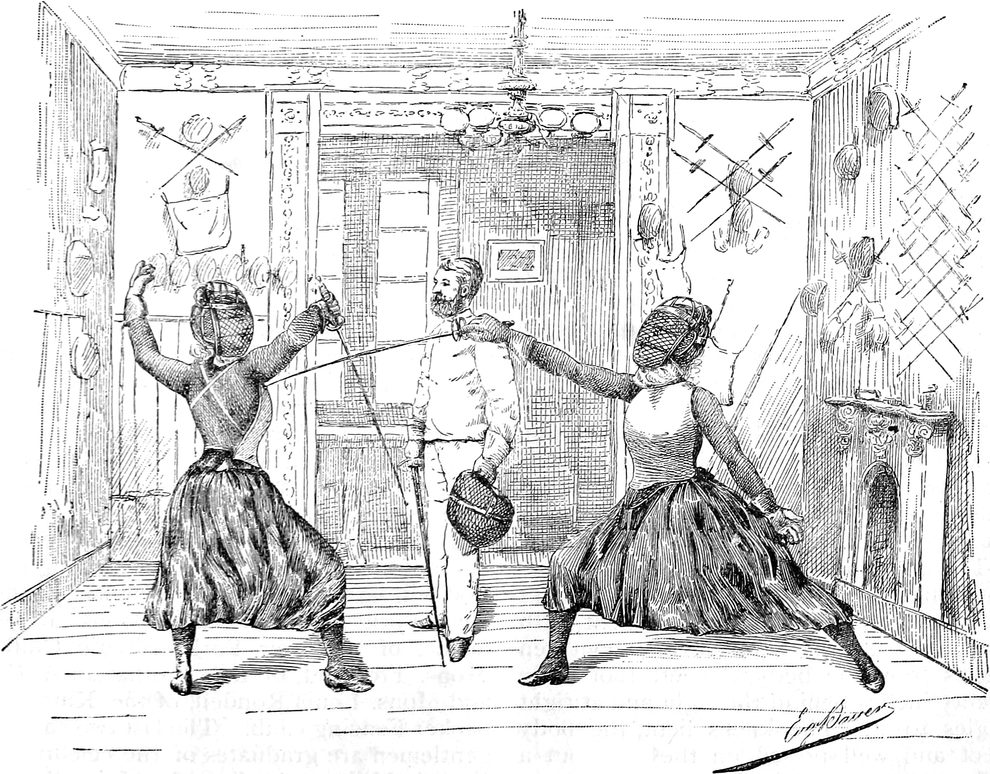
PRIME.
In choosing the gauntlets care should be taken to have the fingers, and especially the thumbs, thoroughly well padded. They should be perforated in the palm, and the wrist shield should be stiff and extend half-way up to the elbow. The mask must fit easily and comfortably well over the head and completely under the chin, protecting as much as possible the throat as well. The foil should be of best tempered steel and, for young girls particularly, as light as possible. The French make the best fencing paraphernalia, and if a young lady wants to get a thoroughly serviceable equipment, my advice would be to take counsel with some experienced male fencing friend on the selection, or perhaps better, to go to one of the leading maitres d’armes and trust him to get the complete outfit. One caution, and a most serious one I will emphasize, which every fencer, young or old, expert or tyro, should always bear in mind, and that is, never use a foil until you have thoroughly satisfied yourself that the button is firmly on the point, and that it is well covered. Negligence in this important particular may risk life. I vividly recall an instance that occurred in the class of Professor Angelo, of London, of which I was a member at the time. We were awaiting the advent of our teacher, being, as boys are very apt to be, a little before the appointed hour. Two of my classmates, donning masks and gauntlets but no plastrons, took their foils and were soon engaged in a furious bout, all the more earnest because of the keen rivalry that existed between them. Both were fairly expert fencers, and thrust and lunge and parry and feint succeeded with lightning rapidity. Suddenly young C—— received his adversary’s foil full on the chest, and with a sharp cry of anguish staggered backward, dropping his foil and falling heavily into a chair: a ghastly pallor overspread his face and a small red stream of blood trickled slowly from his parted lips. We hurried to him and hastily divested him of waistcoat and shirt, which we found stained with blood. We laid bare the chest and found a nasty livid-looking puncture just above the nipple of the left breast. The poor boy never spoke again, and before we could summon medical aid he expired. The cause of this tragedy was found to be that his opponent’s foil had lost its button; whether it was off before they engaged or was knocked off during the bout could not be ascertained, but the moral is easy to point. Never skylark with foils, broadswords or single-sticks, unless you are thoroughly dressed and prepared for the bout.
The proper method of holding the foil, as well as the correct position to assume, I quote from Mr. Van Schaick’s excellent article on fencing which appeared in OUTING for October, 1887:
The body must be placed so as to present a profile to the adversary. The right foot forward, the right arm half bent, with the elbow at the distance of about ten inches from the body, the left foot some twenty inches behind the right and at right angles to it. The knees bent, the body erect and well poised on the hips, but a trifle more on the left than on the right, so as not to interfere with the right leg when “lunging.” The general position must be such that the shoulders, the arms and the right leg will have the same direction towards the adversary; the purpose is to cover the vital parts and facilitate the lunge. The right arm, half bent, the wrist at the height of the breast, and the point of the foil at that of the eye. The left hand must be at the height of the head, the fingers well rounded, the thumb free. The head erect, looking in the direction of the right shoulder. The eyes fixed frankly on those of the adversary. The whole posture must be free and easy.
Advance takes place when the contestants are too far apart; retreat when too near. In order to advance, carry the right foot forward without in any way disturbing the position of the body or that of the sword, and bring immediately the left foot within its proper distance of the right (twenty inches). In order to retreat, carry the left foot backwards without in any way disturbing the position of the body or that of the sword, and bring immediately the right foot within its proper distance of the left.
The foil must be held so that the hand will take the direction of the forearm, and the point of the blade will be at the height of the eye. Hold the foil very firmly only when thrusting or parrying; if you grasp it tightly during a bout of any length, the muscles of your hand will become cramped and will prevent your handling the foil with the necessary delicacy.
The hand can assume three different positions when thrusting or parrying.
(1.) In quarte, where the palm is uppermost.
(2.) In tierce, where the knuckles are uppermost.
(3.) And in six, where the thumb is uppermost and the fingers are on the left; this last position is also called middling.
And to this article I refer all my young lady readers and fencers, but recommend you, as he himself would, to go to a master first and study his instructions as an aid to your maitre’s practical teaching.
There are a number of excellent teachers of fencing in New York. Among the best will be found Captain Nicholas, of the New York Fencers’ Club; Mons. Regis Senac, of the New York Athletic Club; Mons. Tronchet, of the Manhattan A. C., and Mons. Louis Rondell, of the Knickerbocker Fencing Club. The last two named gentlemen are graduates of the celebrated French Military Academy, at Joinville-les-Ponts, France, the highest authority on this subject in the world.
A last point I will make ere I close. Learn fencing, if for no other reason, at least as an additional means of protection and self-defense in case of a sudden emergency.
Although you, my fair sisters, may not be called upon to defend yourselves against the murderous attacks of drunken or lawless ruffians, yet instances are on record where women have been compelled literally to fight for the lives of themselves and their children. With the knowledge and practical experience gained in the salle d’armes, or the friendly bouts with foil and single-stick that helped to while away a winter afternoon, they have been able to hold their own, nay, even to come off victorious in a contest in which the stakes were life against life. I remember an instance of such a nature which, when told round the jovial mess-table, with clinking glasses and flashing lights and bursts of jocund laughter, hushed every tongue and caused the breath to come with panting gasps from breasts suffocating with feelings of hatred and vengeance.
A gay young subaltern returning to India after his first leave of absence, brought with him a tall, fair flower of English girlhood, gathered from a quiet vicarage away in Devonshire. Passing her life in the free enjoyment of the glorious English air, taking long rambles o’er fen and field and wold with her father, or joining in the more hardy sports by flood and field when her brothers were home for the holidays, she had built up a constitution that defied the weather and had acquired a freedom of action, a superb grace of deportment that would have been the envy of the sylvan Diana. She was a perfect horsewoman, a capital shot with gun and pistol, and could give points to most of her brothers at pool or billiards. Mrs. K—— had been well drilled in fencing and single-stick practice, and was passionately fond of the pastime; often after the early morning parade the young husband would invite some one or other of his brother officers to their cool bungalow veranda, where many a lusty bout was fought by the ardent young swordswoman, while the happy husband laughed merrily at the discomfiture of his warrior brothers.
But this pleasant scene was soon to change. Rumors of the deadly mutiny raging in Bengal were brought to the out-of-the-way cantonment. The swarthy Punjaubees, who a month or two before had paraded so quietly and calmly, and were so alert to obey orders, came now to drill or stables with dogged step and sullen brow.
It was an anxious time for every one. The officers were keenly alive to the volcano on which they trod, yet dared not show any semblance of fear or mistrust. All ammunition was carefully removed to the mess-house, and the sabres and lances of the men (for Lieutenant K——‘s was a cavalry regiment) were only issued for parade, when every officer carried loaded revolvers and a goodly stock of cartridges. At last, one morning, the regiment was paraded to attend the funeral of a young officer who had sickened and died. The men had already drilled that morning, and as they mustered for the funeral, ominous signs of disorder and disaffection were rife. With heavy and anxious hearts the little knot of officers gathered to perform the last sad rites to their dead comrade. But they were destined never to complete their mournful task. Just as the adjutant had formed the parade and the officers were awaiting the coming of the colonel, at a given signal, preconcerted doubtless, the entire regiment broke ranks and stampeded helter-skelter over the parade-ground.
The majority of the mutineers hurried to their huts, and gathering together all their chattels decamped as soon as possible to join the headquarters of insurgent sepoys. But a band of more desperate characters, longing to steep their hands in English blood, and eager to join their revolted brethren with the prestige born of some glaring deed of butchery, hastened to the colonel’s residence, where the only two ladies of the regiment were known to be. Most of the officers were at the bungalow of their deceased comrade, which was situated on the opposite side of the parade-ground. The adjutant and the officers on parade retreated, immediately on the outbreak, to the mess-house, which had been prepared for defense in anticipation of just such an occurrence. The colonel, coming from the orderly room, took in the status of affairs and hastened to join the mess-house defenders.
In the meanwhile the ladies had been watching the forming of the parade from the colonel’s private smoking den, where there was littered in truly masculine chaos the thousand and one articles with which a keen sportsman and soldier loves to surround himself—a well selected battery of rifles and shotguns, half a dozen pig spears, a varied and choice assortment of hunting-knives, powder-flasks, bullet moulds, rods and whips, and crops of all descriptions were everywhere. Hanging in a little more order and by themselves were the colonel’s military accoutrements, a couple of cavalry sabres, a pair of pistols, an old sabretache, and an extra set of bits and bridles. The ladies gazing out from this sportsman’s snuggery saw with a thrill of horror the stampede, witnessed the hurried retreat of the officers to the mess-bungalow, and before their dazed senses realized the awful catastrophe saw some half-dozen yelling sowars making for the house in which they were. The colonel’s wife, perceiving the peril with which they were threatened, uttered one piercing shriek and fell fainting on the floor. But young Mrs. K. was made of sterner stuff. She, too, saw the danger, but it stirred her to action: Self-reliant and heroic by nature, she rose grandly to the occasion. No help was to be expected from the servants. Peons, kitmutgar, syces and chokras all had fled. But not a moment was to be lost. As she dashed frantically to the entrance, and as she closed and bolted the teak doors, she heard menaces that chilled the very marrow in her bones. She flew to every window and barred the blinds—poor weak defenses at best!—yet the breaking of them would gain a moment’s respite for her to prepare for the attack. She then retreated to the room in which the colonel’s wife still lay as she had fallen. There was no time to care for her. Mrs. K. took down the heavy cavalry pistols and ascertained with delight that they were loaded. She next drew the heavy barrack-table in front of her fallen friend and facing the door. Placing the pistols at hand on the table, she took down from a peg on the wall the mask with head protector used for broadsword exercise, and as she adjusted the cumbrous thing over her bonny waves of golden hair, she thought sadly of the pleasant bouts she had had with the bluff old gentleman whose property it was, and how the gallant soldier would puff and blow in his attempts to make good his cranium against the blows which she rained with lightning rapidity on each exposed point.
Heavy blows on door and windows cut short her meditations, and selecting the lighter of the two sabres (made more to wear at dress parades or levées than actual warfare) the brave girl took up her position behind the table. The fiends did not keep her waiting long. The stout old veranda chairs, hurled with the force of battering rams by the strong arms of the now thoroughly infuriated natives, soon wrenched the door from its hinges, and with a thundering crash it fell inwards, creating havoc with the dainty little tables, with their delicate bric-a-brac. She heard the exulting shout of the troopers and the tramp of their heavy boots as they scoured the house in search of their intended victims. With dauntless mien and white lips the young wife grasped the pistol, and with one short muttered prayer for him she loved, awaited the supreme moment. A rush—a heavy thud as of bodies hurled against the door—a smashing of wood, and four burly sowars tumbled headlong into the room. As the first sepoy with a horrid oath picked himself hastily up, Mrs. K.’s pistol was discharged within a dozen feet of the would-be murderer’s breast, and with a choking sob the ruffian fell backwards. Instantly catching up the second weapon she fired at the advancing trio. Another howl of anguish told that the true ball found fatal lodgment. She seized her sabre as the table was overturned, and found herself hotly assailed by the two surviving troopers. Skillfully she parried the savage onslaught. With the rage of baffled demons they plied her with a perfect hailstorm of blows regardless of method or science. Some she eluded by her activity, some she caught on the frail blade she wielded, and she felt that some had wounded her on arm and side. She grew faint and dizzy—a black mist spread before her darkening eyes. She staggered—reeled—and fell upon the still unconscious form of Mrs. P. A hoarse shout from behind arrested the murderers. They turned one moment. It was their last. A couple of pistol-shots rang out, and the assassins fell dead on the bodies of their antagonist.