Volume 13 / Part 1 — PART I. (continued 3)
Reading edition
Sixth race—One mile, for safety wheels. Entries, as they finished in the race: Hathorn, Johnston, Renaud, Ulmer, Frederic. Time, 4m. 14 2-5s.
Seventh race—100 yards, last man wins. Entries; W. E. Hobson and R. P. Randall. Hobson won. Time, 2m. 18s.
Eighth race—One mile handicap. This race was won by H. Christy. Time, 3m. 40 4-5s. The distance traveled by the winner was 240 yards short of a mile.
Ninth race—21⁄2, miles, lap race, points to count. Entries: Guillotte, Christy, Hathorn, Graham and Randall. Guillotte won. Time, 9m. 55 1-5s.
Tenth race—One mile, consolation. Entries made on the track. Betts won. Time, 3m. 55s. Frederic second and Harris third.
THE Saint Cloud Club, of St. Cloud, Minn., was formed the last of July, and is known as the “St. Cloud Mystics.” Dr. S. Charest is president and captain, and James R. Jerrard the secretary and treasurer. The club has not yet joined the League, but intends to do so. The uniform is blue belts and caps, black coat, pants and stockings, and white shirts.
THE world’s record for one mile on safety tandems was made at Hartford, Conn., by Messrs. Crist and Davis, on a Swift tandem, and not on a Premier, as stated erroneously in a number of papers.
IN answer to an appeal made by OUTING on behalf of the wheelmen of New York, the following letter has been received, which will, we think, please our cycling friends:
OFFICE OF THE BOARD OF ALDERMEN, NO. 8 CITY HALL, NEW YORK, October 9, 1888.

To the Editor of OUTING.
Dear Sir: Your favor of 6th instant is at hand. I will endeavor to look into the matter of the pavement of Madison Avenue, from 32d Street to the Park, to-day.
Yours very truly, GEO. H. FORSTER.
OUR readers will notice that we make no record of the recent so-called championship of the world races between Ralph Temple and W. A. Rowe. In view of the disclosures effected by the Boston Herald and other papers, our reasons are obvious. The effect of such proceedings can only be a further stigma on professionalism.
FISHING.
THE officers of the Grand Central Fishing Club, of Cincinnati, O., for the year are: President, Herman H. Rotherl; secretary, Henry H. Muller; treasurer, Peter Bonte; commissary and quartermaster-general, Henry Stueve; adjutant and assistant to commissary and quartermaster-general, Adam Lotz; chaplain, Edward A. Shiele; assistant chaplain, Carl Lesber, and surgeon, Henry Morning.
FOOTBALL.
THE Boston Herald, in a dispatch from New Haven, gives the following changes in the football rules, adopted by the Intercollegiate Football Association:
1. To allow tackling above the knees.
2. To permit the snapper back to rush the ball.
3. To prohibit the rush line from using their hands or arms in blocking.
4. In putting the ball in play from touch, it “can be either bounded in or touched in with both hands at right angles to the touch line.”
(1.) In tackling, the line has always been drawn at the hips. In actual play, however, the tackler cared very little if his hands slipped below the hips so long as he checked his man, and the umpires, when called upon to declare it intentional, hesitated, and seldom disqualified. The new rule permits a dangerous tackle, and is not an improvement.
(2.) This was the disputed point in the Yale-Harvard game last year. The rule (29) was ambiguously worded, and Yale, by a little headwork, easily overcame it, and the referee could not very well decide against them. Last year the snapper-back could not rush the ball until it had touched a third man.
(3.) The new rule reads: “No player can lay his hands upon or interfere with, by use of hands or arms, an opponent, unless he has the ball.” And interference is defined “as using the hands or arms in any way to obstruct or hold a player who has not the ball.”
The intent of this rule is to make the rushers keep their arms down when lined up, or when covering one of their own men who is making a run. It looks easy enough on paper, but in actual practice it will probably be as easy to keep a rusher’s arms down as to keep a duck away from water.
To the casual spectator, and to those not experts in the technical points of the rules, the game will be as it has been—simon-pure football.
A MATCH was played at Montreal, September 22, between the Britannias and Victorias, which resulted in favor of the former team by 13 to 0. The following were the teams:
BRITANNIAS. VICTORIAS.
J. Ross Back Fred. Stewart
Crathern Three-quarter A. M. McEwen

Watson Back Ferndale
Ross Half Back R. Clarke
Kerby Forwards A. Fyfe


Thompson J. A. Gubian
Harvey C. McClatchie
Murphy T. A. Ouimet
McFarlane D. Hamilton
Kinghorn J. H. Gubian
H. Patterson Wings T. Scott


Warden E. May
Cameron J. McKay
Sinclair A. Cowan
September 22, a match between the Britannia third and Victoria second fifteens, resulted in a victory for the Britannias by 18 points to 0.
THE American Football Union arranged the following schedule for the autumn games: October 13—Orange vs. Staten Island, at Livingston; New York vs. Crescents, Brooklyn. October 20—Staten Island vs. Crescents, on Staten Island; New York vs. Orange, at New York. October 27—Staten Island vs. New York, in New York; Orange vs. Crescent, Brooklyn. November 3—Staten Island vs. Orange, on Staten Island; New York vs. Crescent, New York. November 10—Staten Island vs. Crescent, Brooklyn; New York vs. Orange, at New York. November 17—New York vs. Staten Island, on Staten Island, and Orange vs. New York, in New York. The Crescent Football Club won the championship of the union last year.
THE Amateur League Football Club has elected the following officers: President, H. B. Wheatcroft; treasurer, Dr. Mortimer; secretary, T. Savage.
W. J. FORD has been elected captain of the football team of the Crescent Athletic Club, of Brooklyn. He will organize two teams for the season.
THE Clinton Football Club was organized in Newark recently. The governing council consists of W. Elcox, C. Hopwood and C. Von Lengerke. Carl Suffern was elected captain.
AT the meeting of the executive committee of the Intercollegiate Football Association, the most radical changes, says The Dartmouth, in the rules were concessions to Harvard. A tackle may now be made anywhere above the knees. Interference was strictly defined and the rule re-enforced.
THE Canadian team now in England won a splendid victory, September 15, at Edinburgh, over the Hearts of Midlothian, one of the best football teams of Great Britain, by a score of three to none. The Canadians had by far the best of the play all through. The Canadian team is composed of Messrs. Garrett, Brubacher, Keller, Pirie, Kranz, Gordon, Webster, Thomas and Alexander Gibson.
THE Britannia and Victoria Rifle teams played a match in Montreal, September 15, which was won by the Britannias. Score, 7 to 4.
THE Ottawa College team has reorganized for the season. The team is heavier than those of previous years, and the outlook is promising.
KENNEL.
THE regular annual show of the Tri-State Fair Association, of Toledo, Ohio, was held in that city, September 27 to 31. Messrs. John Davidson and H. L. Goodman judged all classes. There were 166 entries.
THE long-looked-forward-to bench show at Buffalo was held September 11 to 14. The entries numbered five hundred and thirty-two, and the quality was good throughout. The judging, except in a few instances, gave satisfaction. The very liberal policy of the Buffalo club in regard to premiums offered has gained them a host of friends amongst the dog men. The money prizes alone footed up to some $4,000, and the list of specials was a long one. The weather was good, and the attendance was simply enormous. There were many of the arrangements that can be improved upon another year; in fact, the management was not of the best, owing, perhaps, to the reason that all the work appeared to be on the shoulders of two men, when there was enough to keep six going all the time. Next year, however, we shall look for an improvement. National Dog Club rules governed.
GOOD weather, good quality, cheerful and polite officers, and good judging, were the features of the show following Buffalo—Syracuse. A small entry and poor attendance were the drawbacks. Entries numbered three hundred and nineteen, but the absentees reduced this to less than three hundred. The management worked like heroes and kept things in good shape. The hall was light and well ventilated. American Kennel Club rules were in force.
THE London, Ontario, show, held the week following Syracuse, was the first of five to be held annually by the London Kennel Club. Everything ran smoothly. The entries made a very good showing with the quality fair. A new judge cropped out here, by the name of Bell, from Toronto. He judged spaniels and some of the smaller classes. When will men learn that because they have owned a dog or so for a year or two they are not competent judges? A man to be a judge at a bench show should be a breeder of experience and of long standing. Each year brings out its quota of new judges, who are heard of once and then sink away into oblivion.
LACROSSE.
THE Eastern and Western champions of Canada—the Brants of Paris, Ont., and the Shamrocks, of Montreal—met on the grounds of the latter club, at Montreal, September 22, and played before an audience of about 4,000 spectators. The result was three straight games for the Shamrocks. The teams were as follows:
SHAMROCKS. POSITIONS. BRANTS.
Reddy Goal Robinson
Barry Point Whitson
Creagan Cover Point Jennings
Fraser Defence field Whitelaw
Duggan Watson
Ahern Skea
Devine Centre Munn
Neville Home field Pickering
Reilly J. Adams
Ellard D. Adams
Keefe Outside home Walker
Brown Inside home Tate
Dumphy Captain Jas. Adams
Referee—W. L. Maltby.
Umpires—Messrs. McLeod and A. W. Stevenson.
Summary of Score—First game, Shamrocks, Ellard, 1⁄2m.; second game, Shamrocks, O’Reilly, 9m.; third game, Shamrocks, Devine, 20m.
THE tournament held at Washington Park, Brooklyn, in June, for the championship of the Eastern Association, was hardly as successful as it was hoped it would be. In part this was due to the day selected. But three clubs competed—the Staten Island Athletic Club, the Brooklyns, and the Maple Leafs, from Philadelphia. In winning first place and the championship, and defending it successfully in several games since, the team of the Staten Island Club—formerly the New York Lacrosse Club—has shown that a change of name did not affect its playing abilities.
A word regarding this change will not be out of place here. For many years the New York Lacrosse Club had been without a home. Notwithstanding this drawback, it struggled on. The record of its games will show that disappointments did not dishearten the members. This spring the opportunity of uniting with the Staten Island Athletic Club offered and was taken advantage of. As a part of the Athletic Club it now enjoys a home, has a suitable place for practice, and hopes in time to surpass its previous achievements.
A MATCH for the Eastern District Junior Championship was won by the Junior Shamrocks from the Crescents, at Montreal, September 22, by three straight games. The teams were as follows:
CRESCENTS. POSITIONS. JUN. SHAMROCKS.
Mazurette Goal McKenna
Blakely Point Brophy
Murphy Cover point Dwyer
Brown First defence Driscoll
Crosby Second defence Curran
Bark Third defence McVey
Clapperton Centre Moore
McCabe Third home McBrearty
McDonnell Second home Rowan
McAnulty First home Cafferty
McCafferty Outside Tansey
Herbert Inside Lavery
F. W. McAnulty Captain Maguire
Summary of Score—First game, Junior Shamrocks, Tansey, 2m.; second game, Junior Shamrocks, Brown, 15m.; third game, Junior Shamrocks, Cafferty, 1m.
Messrs. Hodgson and Shanks, umpires.
W. J. Cleghorn, referee.
LAWN TENNIS.
THE eighth annual tournament of the United States National Lawn Tennis Association for doubles was held on the grounds of the Staten Island Cricket and Baseball Club, Wednesday, September 12. The entries were not as large as in previous years, but the playing was excellent, namely, the match between H. W. Slocum, Jr., and Foxhall Keene against E. P. MacMullen and C. Hobart. All present were of one opinion that it was the best double tennis ever seen in this country. After reaching two sets all, Slocum and Keene seemed to weaken, while their opponents played with more confidence and heart. The struggle in the second round between 0. S. Campbell and V. G. Hall against H. A. Taylor and J. S. Clark was noticeable for many fine rallies and accurate placing. But the former team proved themselves too much for the veterans, and won the match three sets to one. In the finals great interest and excitement prevailed as Campbell and Hall were to face Hobart and MacMullen. The day set for the match was a perfect one, so that by three o’clock, when the referee called play, nearly two thousand people surrounded the court. From the very first it was apparent that Hall and Campbell had the match well in hand, while Hobart and MacMullen played as if slightly rattled. Three games all were called by the umpire on the first set. The playing so far had been very even. Each team now scored another game “four all.” Hall and Campbell, by fine serving and placing, won the next two games and set, 6-4. The second set also fell to them, 6-2, and the third in like manner, 6-4. The championship was over, and Hall and Campbell were victorious.
Number of points, 179. Campbell and Hall won 102; MacMullen and Hobart, 77. Points lost by ball knocked out, Campbell and Hall, 19; MacMullen and Hobart, 29. Points lost by putting into net, Campbell and Hall, 22; MacMullen and Hobart, 28. Balls placed or passing opponent, Campbell and Hall, 38; MacMullen and Hobart, 27. Following will be found the score in full: Preliminary round, A. Torrence and H. M. Torrence, Jr., beat M. S. Paton and C. E. Sands, 3-6, 1-6, 6-1, 7-5, 9-7; E. P. MacMullen and C. Hobart beat W. E. Glyn and M. F. Goodbody, 6-3, 7-5, 6-0; F. V. Beach and C. H. Ludington beat J. Dwight and I. Shaw, Jr., by default. First round, H. A. Taylor and J. S. Clark beat A. Torrence and H. M. Torrence, Jr., 6-3, 6-4, 6-3; V. G. Hall and 0. S. Campbell beat C. J. Post and W. A. Tomes, 6-2, 6-1, 6-1; B. F. Cummins and E. W. McClellan beat F. V. Beach and C. H. Ludington, 6-3, 4-6, 6-4, 7-9, 6-4; C. Hobart and E. P. MacMullen beat H. W. Slocum, Jr., and Foxhall Keene, 6-2, 3-6, 4-6, 7-5, 6-3. Second round, V. G. Hall and O. S. Campbell beat H. A. Taylor and J. S. Clark, 6-3, 3-6, 7-5, 6-3; C. Hobart and E. P. MacMullen beat B. F. Cummins and E. W. McClellan, 6-2, 5-7, 6-4, 6-3. Final and championship round, V. G. Hall and 0. S. Campbell beat C. Hobart and E. P. MacMullen, 6-4, 6-2, 6-4. Consolation prize, Beach and Ludington beat Post and Tomes, 7-5, 6-4, 8-10, 8-10, 8-6. Second prize, Hobart and MacMullen beat Post and Tomes, 6-3, 6-3, 6-4. Taylor and Clark defaulted.
A VERY pleasant and enjoyable tournament was given at Revere, Mass., September 3d, on the club grounds of the Revere Lawn Tennis Club. The audience was large and fashionable. The final game was won by Mr. Kimball, over his opponent, Mr. Tutien, by a score, 6-4, 6-2.
THE fall tournament of the Staten Island Athletic Club, August 30th, was regarded by all as the best entry list and best tennis yet seen on the grounds. Following will be found the score in full: Preliminary round—J. Brown beat N. Morris by default; J. W. Raymond beat W. Brown by default; J. E. Elliott beat W. A. French, 6-0, 6-0; D. Miller beat F. W. Smith, 6-2, 3-6, 10-8; Sam. Campbell, Jr., beat A. Williamson, 6-2, 2-6, 6-3. First round, A. H. Larkin beat S. Campbell, 0-6, 6-1, 8-6; E. P. Johnson beat W. E. Gaynor, 6-4, 6-3; W. Brown beat M. DeGarmendia by default; B. J. Carroll beat F. A. Kellogg, 6-3, 6-5; Raymond beat J. Johnson, 6-0, 6-4; Elliott beat Henshaw, 6-0, 6-0; Post beat Kelly, 6-0, 6-1; Miller beat Frothingham, 6-1, 6-4. Second round, Larkin beat Brown, 6-4, 6-0; Miller beat Johnson, 6-2, 2-6, 6-2; Elliott beat Carroll, 6-2, 5-6, 6-3; Raymond beat Post, 6-4, 3-6, 6-2. Third round, Elliott beat Larkin, 6-5, 6-5; Raymond beat Miller, 6-3, 6-5. Final round, Raymond beat Elliott, 6-2, 1-6, 6-1, 6-0. In the doubles, E. P. MacMullen and C. Hobart, of the N. Y. Tennis Club, were victorious, defeating Smith and Elliott in the final round, 6-1, 6-0, 7-5.
THE second annual invitation tournament of the New Hamburgh Lawn Tennis Club was held Tuesday, September 18th, and following days on the private grounds of Mrs. Swords and Mrs. Reese. The rain, which fell heavily during the entire week, greatly interfered with the playing. The final singles (out of twenty-four entries) was fought between Mr. O. S. Campbell and Mr. V. G. Hall. The former won after a long and hard struggle. Score: Campbell beat Hall, 4-6, 7-5, 7-5, 11-9. In the gentlemen’s doubles, Messrs. Campbell and Steele were victorious, defeating the Hall brothers in the finals, 1-6, 6-2, 6-4. Miss E. C. Roosevelt, of Poughkeepsie (well known on the tennis field), won the ladies’ singles over Miss Anna Sands. The ladies’ doubles were easily won by the Misses Roosevelt. The mixed doubles (which were handicap) were won by Miss Camilla Moss and Mr. C. E. Sands.
THE annual open Lawn Tennis tournament of the New York Tennis Club was held on their grounds at 147th Street, September 19th. The courts are considered by many to be the finest in the country. Mr. E. P. MacMullen won the gentlemen’s singles, and with Mr. C. Hobart as partner, the doubles also. Ladies’ singles and mixed doubles formed the other events. Mrs. Badgeley won the singles, and Mr. MacMullen and Miss V. Hobart the mixed doubles. The courts were in excellent condition. The playing was above that of last season, especially the final match between MacMullen and Hobart.
ONE of the largest tennis tournaments of the season was given September 26th, on the grounds of the Highlands Country Club, about five miles from Washington. The winner, Mr. Mansfield, now holds the championship of the Southern States. Remarkably good tennis, fine weather, and a large and fashionable attendance were the features of the week. Space forbids giving the score in full; suffice it to say that Fred. Mansfield, of the Longwood Club, Boston, carried off the honors in the gentlemen’s singles by defeating D. Miller in the final round, 6-1, 6-4, 6-2. In the gentlemen’s doubles, Mansfield was again successful, and with his partner, F. V. Hoppin, easily defeated, in the final round, Davidson and Metcalf, 6-2, 6-2, 3-6, 6-2.
THE Clifton Lawn Tennis Club held its annual tournament at Fort Wadsworth, Staten Island, September 27th. As the tournament was open to all Staten Island clubs, the Ladies’ Out-Door Sporting Club and the Staten Island Athletic Club were well represented. Miss Austin won in the final round of the ladies’ singles, defeating Miss Gertrude Williams, 6-3, 1-6, 6-4, 6-1. E. W. Gould carried off the honors among the gentlemen by defeating J. B. Johnson in the final, 6-2, 1-6, 6-1, 6-1. Very handsome prizes were given to the winners.
NOT long ago an association was formed comprising all the lawn tennis clubs on the Hudson River, from Yonkers to Albany. The name by which it was to be known was the Hudson River Lawn Tennis Association. The first tournament was held on the grounds of the “Far and Near,” at Hastings-on-the-Hudson, Sept. 25th, and proved, for a beginning, a great success. Mr. V. G. Hall, of the Edgwood Club, won the handsome silver pitcher, valued at $200, which will become his property by winning it twice. In the gentlemen’s doubles, V. G. Hall and his brother, E. L. Hall, were winners, defeating C. E. and R. C. Sands in the finals score, 6-4, 2-6, 3-6, 6-5, 6-3. Miss E. C. Roosevelt won the ladies’ singles, and with her sister Grace, the doubles also. The mixed doubles were won by Mr. C. E. Sands and Miss E. Roosevelt. In all probability, the next meeting, which is to take place some time in June, 1889, will be on the Newburgh courts.
QUOITS.
A MATCH was played at Montreal, September 22, for the championship of the Dominion, on the Montreal Quoiting Club’s grounds, and resulted in a victory for the home club over the Dominion Club by 65 points. The following are the teams, with the individual scores:
DOMINION CLUB. MONTREAL CLUB.
1. G. Fleet 23 A. McIntyre 31
2. J. Ganley 5 J. Graham 31
3. J. Briggs 10 J. J. Elliott 31
4. X. Desrochers 31 J. Williams 27
5. L. E. Farrar 26 G. Sibley 31
6. A. Tattersall 31 J. Leduc 12
7. M. Bannan 7 A. Lindsay 31
8. A. Weir 26 W. Renshaw 31
9. H. Oram 31 W. Ogilvie 20
10. R. Waugh 28 H. Trepannier 31
11. J. Cuthbert 31 A. Loiseau 15
12. W. J. Stewart 8 J. J. Adams 31
257 322
ROWING.
THE Atalanta Boat Club held its fortieth annual regatta on the Harlem, September 15. It was also Ladies’ Day. The club-house at One Hundred and Fifty-third Street was crowded with guests. No time was kept of the different contests, which were very exciting. The following is the result of the races, and the names of the men who took part in them:
Junior single shells—Entries: George B. Weed, William D. Bourne, William C. Dilger, Edward W. Tanner and Alexander Woods. William D. Bourne won.
Senior single gigs, for gold medal given by Captain Theodore Van Raden; distance, one mile—Entries: Max Lau, William Lau, George R. Storms and Benjamin A. Jackson. Max Lau won.
Four-oared shells—Entries: No. 1, W. E. Cody, bow; S. B. Marks, P. B. Reyhmer, J. A. Garland, stroke. No. 2, W. C. Doscher, bow; A. G. Roemer, C. A. Hawley, W. Content, stroke. No. 3, E. J. Stewart, bow; D. Van Holland, W. Dittmar, Jr., H. A. McLean, stroke. No. 2 won.
Eight-oared barge race—Entries were, No. 1, married, William C. Dilger, bow; G. M. Young, William Dittmar, D. Van Holland, E. J. Cullen, H. M. Williams, T. McAdam, W. Dittmar, Jr., stroke, and H. Hazard, coxswain. No. 2, single, C. F. Beyer, bow; E. McCormack, F. H. S. Cooley, F. A. Merrill, W. J. Davenport, A. J. Wallace, S. A. Saffard, E. Fuchs, stroke, and H. Moody, coxswain. The race was a close, pretty and interesting one, and resulted in a victory for the married men.
Eight-oared shells—Entries: No. 1, F. McElroy, bow; E. J. Allen, E. D. McMurray, D. Brown, H. D. Clapp, W. B. Merrall, L. F. Roediger, B. A. Jackson, stroke; E. P. K. Coffin, coxswain. No. 2, W. H. Chandler, bow; T. G. Smith, E. J. Ranhoffer, I. D. Fairchild, F. Pullman, W. J. Winter, J. A. Miller, O. Fuchs, stroke; J. E. Silliman, coxswain. No. 3, C. Renner, bow; W. J. Hutchinson, E. R. Bunce, W. F. Mohr, G. R. Pasco, G. Radley, W. D. Stewart, E. H. Patterson, stroke, and E. J. Byrne, coxswain. This race differed from the others in that it was over a straightaway mile course. No. 1 won.
THE fourth annual regatta of the Nautilus Boat Club took place September 15. The course was from the Sea Beach dock, at Bay Ridge, toward the Atlantic Yacht Club basin. Distance, with a turn, about three-fourths of a mile.
The junior single-gig race, class A, with five entries, was rowed in two trial heats. Johnson won first heat—time, 5m. 24s. Olsen, second heat, 5m. 29s. The final heat was won by Olsen; time, 5m. 6s.
The junior single-gig race, class B. Nine entries. First trial heat won by W. Reid; time, 5m. 21s. Second trial heat, S. H. Ayres; time, 5m. 27s. Third trial heat, S. Manley; time, 5m. 44s. The final heat was won by Ayres in 5m. 24s.; Manley second.
The junior double-scull gig was won by Oswald and Peterson; time, 5m.
The senior double-scull gig was won by F. Olsen and M. Donally; time, 4m. 45s. Their only competitors, the two Hillmans, were only a half length behind at the finish.
The single-gig match, between W. A. Merrick and T. F. Crean, was won by the latter. Time, 5m. 41s.
Two crews entered for the junior four-oared gig race. The crew composed by W. Charnley, T. F. Crean, A. T. Morro and A. Ribas, with W. Whitner as coxswain, won by a boat’s length, in 4m. 5s.
The eight-oared barge race was won by Captain Donnelly’s crew, made up as follows: Fred Olsen, bow; J. O’Conner, second; J. D. Phillips, third; A. N. Peterson, fourth; S. Manley, fifth; M. W. Mullany, sixth; R. Hillmon, seventh; M. Donaly, stroke, and C. W. Parmlee, coxswain, were the winning crew by two boat-lengths; time, 4m. 54s.
A POPULAR subscription has been started by the Cornell Era to raise money to put an eight-oar crew on the water next season. A Cornell crew in the seventies showed all the college crews the way to victory.
SHOOTING.
THE annual contest for State trophies of the Massachusetts Volunteer Militia took place at South Framingham, Sept. 25. The contests were open to teams of seven men each from each county, and the staff teams were five each. There were two prizes for staff officers, three for line officers, and three for enlisted men, besides the three team prizes. Two scores of seven shots each, contestants shooting in teams count that score and then shoot an additional one.
Staff Team Prize—Staff 2d Brigade, 1st, 136; Staff 5th Infantry, 2d, 136; Staff 1st Brigade, 3d, 135.
Staff Officers—Capt. J. B. Osborne, 1st Brigade, 60; Lieut. R. B. Edes, 5th Infantry, 60.
Line Officers—Lieut. E. B. C. Erickson, 5th Infantry, 61; Lieut. C. N. Edgell, 2d Infantry, 60; Capt. Williamson, 1st Infantry, 58.
Company Team Match—Compy. B, 2d Infantry, 200; Compy. C, 2d Cadets, 198; Compy. F, 2d Infantry, 194.
THE National Rifle Association of America held their annual meeting at Creedmoor in September. The attendance was smaller than last year—in fact, it seems to grow smaller every year. The shooting was, on the whole, good. Sergt. T. J. Dolan, 12th N. Y., made the fine score of 50 points at 200 and 500 yards, 5 shots at each range, making the possible 25 points at both, a feat that has never before been equaled on the range. Both his scores were made on the same day. Capt. Barnard Walther, of the renowned Zettler Club, of New York City, again carried off the first prize in the Tiffany Match, this being the second consecutive year he has won the cup. The Massachusetts State Team again won the Inter-state and Hilton trophies, being the third consecutive year that they have accomplished this. Major C. W. Hinman, of Boston, won the Governor’s Match at 50 yards. Sergt.-Major W. M. Merrill, of Boston, won the Wimbledon Cup at 1,000 yards. Sergt. Geo. Doyle, Corps of Engineers, U. S. A., won the President’s Match, which carries with it the title of Champion Military Rifle Shot of the U. S. A. for the coming year. Sergt. Fred. Wells, 22d N. Y., made the same number of points, but was outranked. Sergt. Wells won the first stage and prize of $20. The Zettler Rifle Club, of New York City, won the Short Range Team Match. The winners and matches were as follows:
Director’s Match (5 shots, 200 yards)—James Duane, 23.
Wimbledon Cup (30 shots, 1,000 yards)—Sergt. W. M. Merrill, 134; F. H. Holton, 125; W. F. Mayer, 117; I. F. McNevin, 116; C. H. Gaus, 103; T. J. Dolan, 79.
Judd Match (at 200 yards—two scores of five shots each to count for first five prizes. For remainder of prizes, one single score; each contestant to shoot six strings, three each day. Twenty-five prizes)—T. J. Dolan, 1st; T. G. Austen, 2d; D. H. Ogden, 3d; W. G. Hussey, 4th; W. C. Johnston, 5th. The first three prizes were won with the Remington 50 cal. rifle, which received two points allowance on ten shots.
The Long Range Military Match (10 shots at 800, 900 and 1,000 yards)—Jas. McNevins, 114; C. W. Hinman, 112; W. M. Merrill, 111; A. B. Van Heusen, 110.
President’s Match (first stage at 200 and 500 yards)—F. A. Wells, 1st, 67. The 22 men who won prizes in the first stage were eligible to shoot at 600 yards, 10 shots each, and the man making the highest total at 200, 500 and 600, won the prize of $25 and the title of Military Champion. Sergt. Doyle (total of both stages), 109; F. A. Wells, 109; T. J. Dolan, 107. T. J. Dolan was the winner last year.
Short Range Team Match (American standard target, 200 yards off-hand)—Zettler Rifle Club—B. Walther, 84; M. Dorrler, 83; L. Flack, 73; C. S. Zettler, 52—total, 292.
Second Regiment Team, Massachusetts Volunteer Militia—W. M. Farrow, 77; M. W. Bull, 70; S. S. Bumstead, 65; F. R. Bull, 59; allowance, 16—total, 287. This team used military rifles and received 4 points allowance per man.
Lynn Rifle Association, Lynn, Mass.—W. G. Hussey, 73; W. C. Johnston, 70; C. W. Hinman, 67; R. B. Eades, 55; allowance, 12—total, 277. All used military rifles except Hinman.
Nyack Rifle Club, Nyack, N. Y.—J. J. Sydecker, 64; G. McAucliffe, 59; D. Shakespear, 59; J. O. Davidson, 53—total, 245.
New York State National Guard Match—Regimental Team Match (at 200 and 500 yards)—23d Regiment Team, 1st, 521; 12th Regiment Team, 482; 7th, 495; 13th, 484; 22d, 451. 1st Brigade, National Guard Match—7th Regiment Team, 572; 12th, 485; 2d, 441. 2d Brigade—23d Regiment Team, 509; 13th, 457.
The Inter-State Match had only New York and Massachusetts State teams entered (12 men, 10 shots each, at 200 and 500 yards)—Massachusetts State Team, 1,047; New York State Team, 1,015.
Hilton Trophy—open to State teams and teams from the divisions of the regular army (7 shots each at 200, 500 and 600 yards, 12 men each team)—Massachusetts Team, 1,080; Division of the Atlantic Team, 1,057; New York Team, 1,057.
Governor’s Match (three scores to count at 500 yards each, shooter to shoot as many entries as he pleases)—Major C. W. Hinman, Boston, 1st; Capt. J. B. Osborn, Boston, 2d.
Tiffany Match (200 yards)—B. Walther, 1st; T. J. Dolan, 2d; W. M. Farrow, 3d.
Stewart Match (200 yards, standing, sitting or kneeling)—J. F. Klein, 1st; Geo. Doyle, 2d; W. M. Farrow, 3d; W. G. Hussey, 4th; C. L. Potter, 5th; J. S. Shepherd, 6th; C. H. Gaus, 7th; C. A. Jones, 8th; J. D. Foot, 9th.
All Comers and Marksman Badge (25 at 200 and 25 at 500)—T. J. Dolan, 1st.
Revolver Match—Ira A. Paine, 140; A. Brennor, 132; J. G. Newbury, 123; G. L. Garrigues, 122; W. E. Petty, 120; W. C. Johnston, Jr., 119; F. J. H. Merrill, 114; C. H. Gaus, 113; W. M. Merrill, 113; J. E. Winslow, 111. Among the noted visitors present during the week were Herr Josef Schuloff, the inventor of the magazine rifle and revolver, Col. Bodine, Col. Miller, Major Shorkley, and other well-known rifle-shots.
THE eighth annual tournament of the Western Rifle Association was held recently at Fort Snelling, Minn. It was successful as far as shooting is concerned. The following are the summaries:
THE CHICAGO MATCH (10 SHOTS).
200 YDS. 300 YDS. 600 YDS. TOTAL.
E. W. Bird 45 43 48 136
C. Mandlin 46 47 43 136
C. W. Skinner 48 42 43 133
DEER HUNTER MATCH (10 SHOTS, AMERICAN FIELD TARGET).
100 YDS. 200 YDS. TOTAL.
John Marshall 81 65 146
E. W. Bird 70 71 141
Pistol or Revolver Match (15 shots at 30 yards)—C. M. Skinner, 135; A. E. Chantler, 117; S. M. Tyrrell, 105.
Minneapolis Tribune Match (15 shots at 200, 500 and 600 yards)—C. W. Weeks, 275; John Marshall, 272.
Minneapolis Match (shot on new decimal target adopted by Minneapolis Rifle Club—15 shots at 500 and 600 yards)—E. W. Bird, gold badge, 225; A. F. Elliott, deer’s head, 224; John Marshall, silver card-tray, 216.
Police Revolver Match (50 yards, 20 shots each)—C. M. Skinner, 151; S. M. Tyrrell, 127; E. W. Bird, 126; A. S. Chantler, 118; C. W. Weeks, 117. This was shot on the American field target. C. Mandlin, of Minneapolis, won the Continuous Match at 200 yards off-hand.
MR. FRED E. BENNETT, of Boston, the champion revolver shot of America, has been doing some fine shooting at 50 yards, using a 22 calibre pistol. In 100 consecutive shots he made the following fine totals: 97, 95, 90, 85, 89, 91, 93, 89, 86, 91—total, 906, out of a possible 1,000. Mr. Bennett has issued a challenge to shoot a revolver match with Ira Paine for $1,000 a side, either in France, England, or America.
THE experts at the National Armory, at Springfield, Mass., are trying a new ammunition with a view to the adoption of a small calibre rifle. The experiments made so far demonstrate that the Swiss rifle, which is of a small calibre (about .30), has a very flat trajectory at 500 yards, and is accurate; while the Springfield, or U. S. Government rifle has a very high trajectory. Further experiments will be made before anything definite is done.
A NEW rifle club has been organized in Newark, N. J. Its officers are William Dennenger, president; F. Kraus, vice-president; William Doull, secretary; K. Kopf, treasurer; F. Siegman, sergeant-at-arms.
YACHTING.
A DOZEN pretty cat-rigged yachts, manned by jolly crews from Brooklyn, Canarsie and Ruffle Bar, sailed a very exciting race on Jamaica Bay, Saturday, September 23. It was the second of the series inaugurated by the Windward Club of Ruffle Bar, and the result has decided that Mr. Hatch’s pretty Julita, built three years ago by Dick Wallin, of South Brooklyn, is the fastest boat in the first class, for she has won both races, and so takes the prize of the Windward Cup, offered by the club.
THE Yorkville Yacht Club had its twice postponed fall races September 23. There was a lack of wind in the forenoon. In the afternoon the yachts started from Oak Point against a light wind and with a strong flood tide. Both wind and tide were with them on the return. Classes A, B and C sailed around the gangway buoy and return, a distance of twenty miles. The other classes rounded the Stepping Stones Lighthouse, making fifteen miles. In class A, for cabin sloops more than 30 feet, D. McGlynn’s Emma and Alice was the only entry. She made the distance in 5 hours 15 minutes 15 seconds. Maud M., manned by Sergeant McManus and a crew of 14 men from Fort Schuyler, had a walk over in the class for cabin boats under 30 feet. Her time was 5 hours 18 minutes 45 seconds. She broke her spinnaker on the return. J. Thomson’s Bessie R. was the only catboat between 17 and 22 feet, and she sailed the 15 miles in 5 hours 3 minutes 30 seconds. The Jessie was successful in her class, and the Happy Thought won handily in the race for smaller catboats. The Peerless, the Jennie V., and the Helen did not finish.
THE Fall Regatta of the New York Yacht Club took place September 20. The day was all that could be desired by the most ardent yachtsman.
At 11h. 32m. the Blue Peter was lowered on the Electra’s foremast and the signal gun started the racers. Fannie, under mainsail and jib, with the wind on the starboard quarter, rushed for the line, with the Dauntless a little to windward and the Katrina almost bow and bow. As they darted past the flagship the Dauntless hauled a little closer by the wind and shot ahead of the other two yachts, the Katrina passing within a few feet of the Electra’s lee side. The three went over almost in line and made one of the handsomest marine pictures ever seen in New York harbor. The Dauntless held the lead for a short distance, but the Katrina soon forged ahead. After these three the Alarm came slowly by as stiff as a house, but a little faster. Then followed the Shamrock, with her baby jibtopsail in stops, which were broken as she crossed the line, and the Adelaide, heeling well to leeward. The Grayling, with every sail set and as full as a balloon, rushed across in her dashing style. The Wizard followed after her with a handicap of 3 minutes, and then the Magic, also handicapped 12m. 57s.
The yachts had a beat to the lightship and were forced to make a long and short leg to weather the buoys, which had to be passed on the port hand. The Katrina and Shamrock seemed to point about the same and were both pinched very closely. The former was the first to go on port tack, at 12h. 35m., followed by the Shamrock one minute after. The Grayling held to the starboard tack longer than either of the sloops and gained very much in so doing, for she rounded the Sandy Hook Lightship almost the same moment as the Shamrock. Following are the times:
H. M. S.
Katrina 12 40 05
Shamrock 12 45 30
Grayling 12 45 35
In the run from the start to the lightship the Katrina gained 1m. 13s. on the Shamrock. That from the lightship to the stake boat was a reach by the wind on the port tack. When the yachts reached the Haviland the Katrina was still in the lead, though she had lost 45 seconds to the Shamrock, who had in turn gained 2 minutes on the Grayling. The Dauntless was leading the Fanny at this point, and the Adelaide the Wizard. At the stake-boat the following times were taken:
H. M. S.
Katrina 1 26 40
Shamrock 1 32 60
Grayling 1 34 55
The yachts passed the Haviland on the port hand, easing off sheets and running again for the lightship with the wind on the starboard quarter. They rounded the lightship a second time as follows:
H. M. S.
Katrina 2 10 05
Shamrock 2 15 08
Grayling 2 15 42
In this run the Katrina lost 22 seconds to the Shamrock, who gained 1 minute on the Grayling.
From Sandy Hook Lightship it was a run with the wind on the port beam to the finish. The sloops set their club topsails over working ones and made a fast run home. The Katrina held the lead to the end, but lost on time allowance. The wind was a steady wholesale breeze from the south-southwest, and remained so throughout the day.
The following is the elapsed and corrected time:
KEEL SCHOONERS.
Start. Finish. Elapsed Time. Corr’d. Time.
H. M. S. H. M. S. H. M. S. H. M. S.
Dauntless 11 34 14 3 22 24 3 48 10 3 48 10
Alarm 11 35 22 3 45 26 4 10 04 [*]
CLASS 3—SCHOONERS.
Grayling 11 40 55 3 10 35 3 29 40 3 29 40
Magic 11 42 00 3 42 03 4 02 03 3 59 22
CLASS 2—SLOOPS.
Shamrock 11 38 35 3 11 44 3 33 09 3 31 59
Katrina 11 34 23 3 08 13 3 33 50 3 33 50
Fanny 11 34 14 3 36 00 3 57 09 3 54 10
CLASS 4—SLOOPS.
Adelaide 11 40 06 3 55 38 4 15 32 [*]
Wizard 11 42 00 Did not finish.
Thus in the keel schooner class the Dauntless beats the Alarm. In class 3 the Grayling beats the Magic 29m. 42s. and makes the quickest time over the course. In the second class sloops the Shamrock beats the Katrina 1m. 51s., and the Adelaide has a walk over in class 4, the Wizard having carried away her topmast.
A NEW yacht club was recently organized in this city. It will be known as the Rockaway Yacht Club. The certificate of incorporation was signed Sept. 17.
CAN any of our readers inform us what has become of the following clubs, and what are their present addresses?
CYCLING—Weston Wheelmen, Weston, Ohio; Worcester Bicycle Club, Worcester, Mass.; Wayside Wheelmen, Brooklyn, L. I.
CANOE—Mystic Canoe Club, Winchester, Conn.; Stillwater Canoe Club, Stillwater, Ohio.
ROWING—New England Amateur Rowing Association, Boston, Mass.; Long Island Amateur Rowing Association, Brooklyn.
SHOOTING—Memphis Gun Club, Shell Lake, Ark.; Jacksonville Gun Club, Jacksonville, Ky.; Frelinghuysen Rifle Club, New York City; Krutland Ionia Hunting Club, Grand Rapids, Mich.
YACHTING—Bohemian Yacht Club, San Francisco, Cal.
ANSWERS TO CORRESPONDENTS.
[This department of OUTING is devoted to answers to correspondents seeking information on subjects appertaining to all sports.]
Yachtsman, Chesapeake Bay Y. C.—You cannot do better than have your boat furnished by Messrs. Warren, Ward & Co., 6 and 8 East 20th St., N. Y. City. Commodore Gerry had his steam yacht Electra fitted by this firm, and the results are admirable. The best refrigerator for a yacht is made by W. Law, 324 East 122d Street, City.
J. Dixon, New York City.—We are able to give you the information you require as to your proposed cycling trip from West Troy to Buffalo. (1) You would be allowed to ride on the tow-path of the canal. (2) The road is not good. (3) The distance is about 325 miles. (4) On the road you should average from forty to sixty miles, but on the tow-path you would not do more than about twenty-five miles a day. You would also have to dismount often on account of mule teams, etc. These animals have been known to jump into the canal at the sight of a bicycle, thereby causing trouble between canal boat men and cycler, much to the disadvantage of the latter. We should strongly advise you to take the main road, and follow the route in the New York Road Book. (5) As to your last question, we think that you had better use your own judgment.
Observer.—The best position in which to place a registering thermometer is over an open grass-plot. If this cannot be done, a wall may be used, care being taken that it is a garden-wall, and not the wall of a house; also that the screen in which the thermometer is placed hangs at some distance from the wall, so as to admit of the free passage of air behind it. In all cases the thermometer should be placed in a screen not less than four feet from the ground, and facing to the north (in the northern hemisphere) and sheltered from the sun at all hours, but exposed to a free circulation of the air.
Drag-Hunter, Boston, Mass.—The best drag for hounds is generally supposed to be a common red herring. Assafœtida is sometimes used, and also aniseed. Many people suppose, however, that the last is detrimental to hounds, but drag-hunting of any description will spoil a pack for fox, so that that question does not matter much.
T. G. F., Portland, Oregon.—Your description and sketch of the fish caught on a branch of the Columbia River, in Washington Territory, and which you supposed to be a “grayling,” was so imperfect that it was hard to give you an answer. We referred it to Dr. Tarleton H. Bean, of the Smithsonian Institution, one of the highest authorities on ichthyology in the country. It would have been a matter of great interest had the grayling been found in that region. It seems, however, that it is only another instance of the confusion which arises from local nomenclatures. Dr. Bean’s reply sets the matter at rest, and is so interesting that we publish it in full. He writes: “The sketch sent is intended to represent Williamson’s whitefish (Coregonus Williamsoni), which is called ‘grayling’ in some parts of the West. I do not know of the existence of a grayling west of Montana, until British America is reached. Williamson’s whitefish is common in the region west of the Rocky Mountains, particularly so in the Sierra Nevada, and is often styled ‘grayling.’”
B. J. W., Albany, N. Y.—Yes. An amateur athlete may compete with a professional, provided that it is a genuinely friendly contest, but not for money or prizes, or at a public meeting.
Scott, Montreal, Canada.—The best way to preserve gut leaders is to wrap them up in wash-leather, tightly bound with string. If they are in good condition, they will keep well like this for years.
J. S. M., East 56th Street, N. Y. City.—What you heard is quite true, although you appear to doubt it so much. The “King of Dudes,” Berry Wall, was at one time quite an athlete, and about seven or eight years ago was one of the fastest amateur walkers in the country. His record for a mile was 7m. 20s.
J. A. I., Phila.—E. Waters & Sons, of Troy, New York, are builders of paper boats. The name was incorrectly given in the September OUTING.
Duck Hunter, Charles City, Va.—You can obtain such rubber goods as you mention from the Hodgman Rubber Company, 459 and 461, Broadway, New York.
Jock, Dayton, Ohio.—The race called “The Oaks” is run on the Friday following Derby Day. It is for three-year-old fillies, and the distance is about a mile and a half, over the same course as the Derby. Both races were founded by the twelfth Earl of Derby—the first Oaks being run on May 14, 1779, and being named after his residence at Woodman Sterne, while the first Derby was run in the next year. The Derby course was at first a mile, but has since been altered.
Double Team, Albany, N. Y.—To the best of our knowledge there is no better treatment for thrush in horses than the old method of frequently dressing the affected feet with tar, spread on tow. This should be well thrust into the cleft of the frog. Carbolic acid is also used in the same way, while in severe cases, where lameness is occasioned, it becomes necessary to use poultices.
Pointer, Lynchburg, Va.—The question whether or not to remove a puppy’s dew-claws, is more a matter of fashion and opinion than anything else. As a matter of fact, the presence of dew-claws seems very seldom to lead to any inconvenience to a dog. There does not, however, seem to be any real objection to the removal of them, for the attachment is usually only ligamentous; or, if bone does exist, it is so slight that the operation of cutting them does not amount to anything.
Sportsman, Brooklyn.—President Cleveland’s bluefishing trip was not the first angling expedition he had made during his presidential career, for last year he went up to the Adirondacks for trout-fishing. It will be remembered that his predecessor, President Arthur, was also an enthusiastic angler.
Whip, Fifty-ninth Street, N. Y.—What you say is quite true as to the difficulty in procuring good, lasting gloves for rough work like driving. There is, however, a capital article for your purpose, or, indeed, for any purpose, manufactured by J. C. Hutchinson, Johnstown, N. Y. This maker’s gloves will, we think, give you satisfaction.
H. S. P., Newark, N. J.—If the horse has completely “broken down,” the fetlock joint will actually touch the ground. From your description this does not seem to be the case, and so the accident probably only amounts to a partial breakdown, due to the rupture of the flexor tendon and some of its ligamentous fibres. As to treatment, you had better consult a veterinary surgeon, but after the first severity of the inflammation has subsided, it is generally thought best to fire the leg.
Housewife, Baltimore, Md.—Truly your questions are hardly in OUTING’S line, but we can answer them. It is very hard to beat that most reliable article, the Royal Baking Powder; you will see from the company’s advertisement what testimonials it receives from sources absolutely trustworthy. As to your second question, we cannot do better than refer you to the Quarterly published by Messrs. Strawbridge & Clothier, Eighth and Market Streets, Philadelphia. In this useful publication you will find on page 148 just the information you want.
Racquet, Toronto.—You are quite right in supposing that tennis proper, or court tennis, has seen much palmier days. It is said that in the sixteenth and seventeenth centuries there were a couple of hundred courts in England, of which fourteen were in London, while Henry VIII. built one at Hampton Court Palace. No revival of this aristocratic game took place till this century. In 1838 one was built at Lord’s Cricket Ground, London. Now there are, we believe, three in London, one each at Oxford and Cambridge, while there are five other public or club courts in England, at Manchester, Brighton, Leamington, Crayley near Winchester, and Hampton Court. Besides these there are about as many private ones.
Capt. C., Minneapolis.—In England linseed oil is never used in hunting stables, except as a purgative, or, mixed with tobacco dust (about three-quarters of an ounce of the latter to three-quarters of a pint of the former) as a drench for worms. To hacks and harness horses linseed oil is sometimes given in small quantities to make their coats look better. The seed itself is given to hunters after a day’s work, either in the form of linseed tea (a substitute for oatmeal gruel), or when boiled to a jelly and mixed with a bran mash. About two pounds of linseed is the quantity for either preparation. Linseed jelly is often mixed with oats when it is desired to put flesh on horses in poor condition, or when getting them up for sale. It is a demulcent, and slightly laxative.
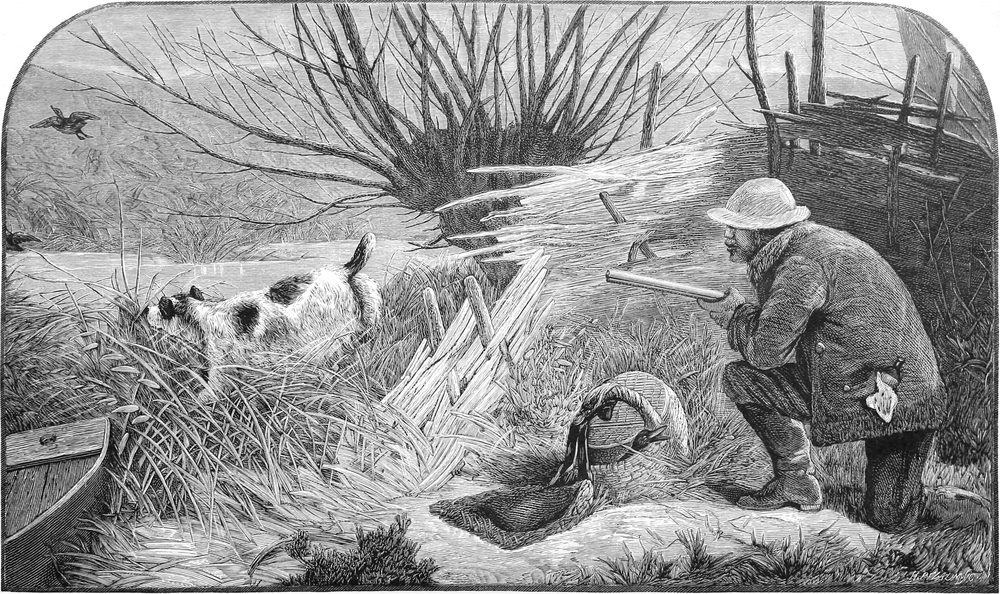
A PAIR OF POACHERS.
⇒ LARGER IMAGE