Volume 13 / Part 2 — OUTING. (continued 5)
Reading edition
THE Brooklyn Hill Tennis Club finished its handicap tournament on the grounds, Nostrand Avenue and Herkimer Street, Brooklyn, November 1. In the second round of the mixed doubles Miss Shreve and T. W. T. Maxwell defeated Miss and Mr. Hotchkiss by 6-5, 5-6, 6-1. The final round was won by Miss Brush and J. C. Tatum, who defeated Miss Shreve and her partner, 6-3, 6-4, 6-3.
First prize in the ladies’ singles was won by Miss Hanly. She beat Mrs. West in the final round after an exciting contest, 4-6, 6-5, 6-2, 6-3. The final round, gentlemen’s singles, was not finished. Mr. Raymond and Mr. W. Tomes played three sets, the score being in favor of the former, 6-1, 6-1, 5-7. The winner will be decided by lot.
ROD AND GUN.
THE Salt Lake (Utah) Sportsman’s Club was incorporated under Utah laws, August 25, 1888. President, M. B. Sowles; vice-president, Thos. J. Almy; secretary and treasurer, H. M. Miller; board of directors, M. B. Sowles, H. M. Miller, Thos. J. Almy, Charles Read, Wm. M. Bradley, I. M. Barratt and Phillip Klipple.
A GUN club has been organized at Lost Nation, Ia., under the name of the Lost Nation Gun Club. The officers are: President, L. Scott; vice-president, M. Stevenson; secretary and treasurer, F. M. Frazier; director, F. B. Nichols.
THE officers of the Commercial Rifle Club of New Orleans, La., are: President, Frank Dumas; vice-president, Wm. Monrose; treasurer, Charles Barnes; secretary, Geo. C. Hanser; superintendent, Wm. Marquetz.
OCTOBER 15, 1888, the Salt Lake (Utah) Gun Club was organized. President, Wm. M. Bradley; vice-president, Thos. J. Stevens; secretary and treasurer, W. J. De Bruhl; board of directors, W. M. Bradley, T. J. Stevens, W. J. De Bruhl, M. R. Evans, and W. F. Beer.
IN shooting for the Founder’s Cup at Harvard, November 1, Messrs. Post and Mackay tied for first place, with a score of 12 out of 15. In shooting off Post won.
THE Fly Casters’ Association, of Albany, held a tournament, October 27, which proved very successful. The judges were James H. Manning, Charles B. Andrews and W. W. Byington. There were eleven prizes, which were awarded as follows:
Association class—Thomas W. Olcott, first prize, a Spalding split bamboo rod; W. D. Frothingham, second, a Mills & Son standard split bamboo fly-rod; W. G. Paddock, third, an automatic reel; Howard Paddock, fourth, a Bray fly-book; Dayton Ball, fifth, fifty yards metallic centre-enameled line; B. F. Reese, sixth, two dozen trout flies; Stuart G. Spier, seventh, a trout basket. Amateur Second Class—Chas. A. Gove, first, an L. Levison fly-book; H. A. Goffe, second, a lancewood fly-rod; John M. Quinby, third, a gogebic reel; W. Story, fourth, pocket tackle-case.
THE ducking season began, in Pennsylvania, November 1. The lower Delaware and adjacent bays and inlets are said to be swarming with ducks. Extensive preparations have been made in Philadelphia by a club of well-known men, who call themselves “The Innocent Eight,” for an active ducking season. Among the Innocents are: Messrs. Michael B. Andrews, Clarence B. Kugler, Joseph Wright and Colonel William B. Mann. Members of the club have purchased a “rigging” at a cost of $2,000. It contains over a thousand decoys, many sink-boxes, both double and single, and all the improved paraphernalia used in ducking.
THE season for ducking opened, in Maryland, November 1. Back, Middle, Gunpowder and Bush rivers are all first-class waters for duck shooting. The best duck shooting in the country is to be found on the flats near the mouth of the Susquehanna River. On these flats grow the choicest celery, which, combined with the shallowness of the water, makes the spot most attractive to the fowl. The delicacy of the food imparts to the ducks a flavor that has given the Havre de Grace canvas-back a world-wide reputation. The State has passed stringent laws governing the flats, and collects quite a revenue from the boats engaged in shooting. A special police-force is maintained to enforce the laws.
ROWING.
HARVARD expects to have a rowing tank, similar to the Yale tank, shortly. The old gymnasium will probably be used for the purpose. An effort is also being made to raise funds for a new steam-launch. Harvard rowing men recognize that they must show by deeds that they deserve the support of the college.
All the crews have left the river and are at work in the gymnasium. The university crew is rowing on the machines and pulling chest-weights. The number of candidates is small, but it will be greatly increased after the vacation. With the exception of the freshmen, the class-crews are not in strict training. Eighty-nine played football during the fall for exercise; ’90 and ’91 are taking walks and pulling chest-weights. The freshmen are rowing in the ’varsity room on the machines. They are obliged to be through by five o’clock, and as they have nearly three crews at work, the lack of room is very apparent, and interferes greatly with their work. Their average weight is at present nearly 156 pounds.
THE Cornell oarsmen are very ambitious to send out next June an eight-oared crew, which, it is hoped, will beat Columbia, win the “Child’s Cup” for the third and last time, and, if possible, win against Yale. The whole amount needed for the purpose is estimated at $2000; $500 for a new shell, and $1500 for crew and trainer. The Cornell Era recently began raising a fund for this object, and over half the amount is already pledged, and the collections are coming in at the rate of $200 a week. The young women connected with the university have subscribed $100. There is no doubt but that the full amount will be raised. Courtney will train the crew.
BY reason of the expense, the class crews of Bowdoin have been given up.
THE famous old Atalanta Boat Club has now established winter quarters apart from the boat club, and have settled down in an elegant establishment on Fifth Avenue. The building is arranged and furnished so as to provide every facility for indoor amusement while the water is sealed in icy bonds. The billiard-rooms and bowling-alleys are located in the lower part of the house, and the other apartments are so arranged as to conduce to the comfort and enjoyment of the members.
“ROCK” KENT, one of the most promising scullers on the Harlem River, is, it is said, about to give up rowing altogether. He is one of the prominent members of the Metropolitan Rowing Club, and his withdrawal from that organization, if the report be true, will be a sad loss.
THE Union Boat Club, of Boston, which has a membership list of 200 names, has elected the following officers for 1889: President, Henry Parkman; vice-president, Edward B. Robins; captain, A. Van Courtlandt Van Rensselaer; lieutenant, Warren F. Kellogg; treasurer, Edward D. Blake; secretary, William R. Richards; directors, Arthur B. Ellis, Courtenay Guild, Thornton H. Simmons; election committee, William Appleton, J. F. Bush, Robert Bacon, William S. Eaton, Jr., William S. Hall, James M. Olmstead, Henry T. Spooner, Guy Wilkinson.
SKATING.
THE Lachine Skating Club held its second annual meeting recently and elected the following officers: Mr. T. A. Dawes, re-elected honorary president; C. Thos. Danford, president; Albert Dawes, vice-president, and Wm. A. Shackell re-elected secretary-treasurer. The following were selected for the committee: A. P. Bastable, H. K. Danford, J. MacGowan, A. Noad, E. W. H. Phillip and A. Perry. Several new members were elected.
THE annual meeting of the National Skating Association of England was held at the Bath Hotel, Cambridge, Oct. 27, Mr. Neville Goodman in the chair.
The committee, in their report, congratulated the members on the position of the association. Numerous attempts were made during the past season to bring off the championship race, but when all preparations had been made the changes in the weather upset the arrangements and the meetings had to be abandoned.... The committee were sanguine of being able to pay their way, but this could not be done without gate proceeds. It was pointed out that scarcely any sporting pastime was now participated in without a charge for admission being made, especially when valuable prizes were given. Owing to the paucity of members it was impossible to hold race-meetings without relying upon a “gate” to meet the heavy expenses. Under the present régime this rule would have to be adhered to, but should funds allow, free meetings would be held....
Mr. H. G. Few, R. S. O., Willingham, Cambs, was re-elected treasurer, and Messrs. J. D. Digby and J. Newton Digby were appointed joint honorable secretaries. Baron de Salis, of Holland, was elected an honorary life member.
The chairman, in accordance with notice, brought forward the question of the definition of an amateur; and proposed that in lieu of the present rule the following be adopted: “That an amateur is one who has never competed in a skating contest for a money prize.” This gave rise to discussion, the motion being opposed by the secretary, but it was carried.
SNOW-SHOEING.
THE following officers were elected by the Montreal Garrison Artillery Snow-Shoe Club: Hon. presidents, Lieut.-Col. Turnbull and Lieut.-Col. Oswald; Hon. vice-presidents, Major Cole and Capt. Levins; president, Capt. Lewis; vice-presidents, Lieuts. Crathern, Ogilvy and Foy; secretary-treasurer, Staff-Sergeant Cooper; assistant secretary-treasurer, Gunner Wilson. Committee: Lieut. McFarlane, Sergeant-Major Benton, Battery Sergeant-Major Murdock, Sergeant-Major Wilson, Sergeant McDonald, Sergeants Drysdale, Bonet, Pingel, Gunner Cokers, Trumpeter Shaw, Corporal Laurency. Delegates to Council Committee: Captain Lewis, Sergeant-Major Jones, Staff-Sergeant Cooper, Gunner Bremner.
SWIMMING.
J. NUTTALL, one of the foremost of swimmers in the English amateur ranks, has cast his lot with the professionals, and, in his first race for the 1,000-yard professional championship, which took place at Lambeth Baths, Westminster Bridge Road, London, October 19, he met J. J. Collier, ex-champion; J. Finney, previous holder of the championship, and George Kistler, all first-class swimmers. The men swam in a tank 40 yards long, and Nuttall took the lead directly after the dive, holding it to the finish. Nuttall beat all previous records from the outset, as the following times will show:
*2 lengths 0m. 54s.
*4 lengths 1 55½
*6 lengths 3 00½
*8 lengths 4 08½
*10 lengths 5 17
*12 lengths 6 28½
*14 lengths 7 38¼
*16 lengths 8 48½
*18 lengths 10 00
*20 lengths 11 11
*22 lengths 12 25½
*24 lengths 13 40
*25 (1,000 yards) 14 17¼
* Record beaten from the start.
The previous best on record was by Finney, 14m. 433⁄4s.
TOBOGGANING.
THE Essex County Toboggan Club recently elected the following Board of Governors for the season of 1888-’89: John Firth, F. W. Hall, E. P. Hamilton, Charles T. Minton, Clarence D. Newell, John H. Sprague, Louis E. Chandler, Dr. F. A. Levy, Dr. G. B. Dowling, R. G. Hopper, Frank Lyman, D. H. Carstairs, Charles Hendricks, N. B. Woodworth, and C. F. Whiting.
YACHTING.
THE schooner-yacht Brunhilde, Captain John J. Phelps, owner, started on her second voyage round the globe November 1. Captain Phelps is accompanied by his wife. The crew consists of ten men before the mast. The Brunhilde sailed direct for Bermuda. Captain Phelps has not yet determined how long he proposes to remain away.
FROM England comes the news that steps have been taken by yachtsmen there as well as on this side of the Atlantic to have a grand international race next May of sloop and cutter yachts in the forty, fifty, and sixty foot classes. It is understood that the Seawanhaka-Corinthian, Eastern and other clubs are arranging with the English clubs for the race, which is to be settled in American waters for prizes independent of the America’s cup.
AS we go to press it seems probable that James Coates, Jr., the Scotchman who owns the Thistle, will challenge for the America’s cup within thirty days.
THE report that another challenge for the America’s cup will shortly be issued from the other side of the Atlantic is again on the rounds. A correspondent of the London Times in Queenstown, Ireland, has heard that the Jamiesons, of Irish whiskey and Irex fame, have been quietly building a large steel sloop, with the end in view of challenging for the America’s cup. Richardson, the designer of the Irex, is said to be the designer of the new production. The author of the story has even learned the fact that the intended challenger is to be named the Shamrock. Mr. Jamieson has more than once been reported to have designs on the cup, and it is barely possible that a challenge may at some future day emanate from the Royal Irish Yacht Club, of which he is a member.
THE winter quarters of the Newark, N. J., Yacht Club are at 740 Broad Street, Newark. The new rooms are cosily fitted up, and members of the club and their friends love to linger in the parlors and spin yarns of the water and about the men who go down to the sea in yachts.
THE Harlem Yacht Club a short time ago moved into its new quarters, the old Randall mansion on East 121st Street. It was previously occupied by the Eastern Boulevard Club. The present officers of the club are: Commodore, James T. Lalor; vice-commodore, McEvoy; secretary, T. J. Dempsey; corresponding secretary, W. J. Parker; treasurer, H. M. Jones; measurer, T. P. Bates.
ANSWERS TO CORRESPONDENTS.
[This department of OUTING is devoted to answers to correspondents seeking information on subjects appertaining to all sports.]
Scot, Boston.—For the game of lawn bowls you must have turf in the finest possible condition. The dimensions of the ground should be about forty-two yards long, and, if possible, the same breadth. There should be ditches at both ends, about twelve inches wide and three inches deep, with a bank about eighteen inches above the level of the lawn, to stop the bowls. The reason why it is advisable to have the ground square, is that one can then change the direction of play and so save the grass.
Chas. T., Baltimore.—Your horse is probably suffering from irregular teeth. What you describe is called “quidding.” You should have a veterinary surgeon to see to his teeth, and if necessary rasp them down. If it does not come from the teeth, he is probably suffering from catarrh, with sore throat, and when he is swallowing water you will be able to notice a peculiar gulping effort. This, of course, would need treatment.
Breeder, Buffalo, N. Y.—The New Forest ponies are no good. They have much of the blood of Marsk, the sire of the famous English horse Eclipse, in their veins, but in spite of it they are about as ill-looking animals as one can imagine, with most hideous heads and necks. They are, however, hardy and useful. The best all-round specimens of the Shetland that we have ever seen, certainly in America, are the family of them exhibited by Mr. Pierre Lorillard at the New York Horse-Show. They are of exactly the right stamp for that class of pony, and the stallion, Montreal, was well described as having “the build of a cart-horse and the carriage of a thoroughbred.”
Matador.—The sword is passed between the skull and the first cervical vertebra, in a perpendicular direction only.
Fred, H. L., Brooklyn, N. Y.—The best method to render shoes impervious to snow is to apply castor-oil. It must be applied twice, after the boots have been warmed at the fire. Of course, the oil must be used again at intervals, when the leather shows signs of needing it. The best plan is to wash off all blacking first, and apply the oil to the sole as well as the other portions of the shoe.
R. S. B., Broadway.—The length of the Cambridgeshire course, at Newmarket, England, is 1 mile and 240 yards.
Gunner, Washington, D. C.—Strictly speaking, the correct plural is with the s; but that letter is very commonly omitted. Indeed, among sportsmen, it may be said that “snipe” is invariably used in the plural as well as the singular sense; but naturalists use the plural “snipes” as meaning the different species of snipe. With woodcocks it is more usual to add the s, but many sportsmen omit it.
Canine, Hartford, Conn.—(1) Your best plan is to wash the ears out and brush in some green iodide of mercury twice a week. (2) Puppies at the age of three months or so, often show crooked legs with enlarged joints, but these generally come right later.
Athlete, Cambridge.—You can obtain just the kind of jewelry you require from Shreve, Crump & Low Co., Washington Street, Boston. They also give special attention to designing and making prizes for clubs.
C. A. S., New Haven, Conn.—Excellent shooting can be obtained at Barnegat, Delaware and Chesapeake bays; for the last place Havre de Grace is the usual starting-point. At Crisfield, Md., near the swamps of the Pocomoke, geese and different kinds of ducks are abundant. The trip, however, if you procured boat, sink-box, etc., at the more popular places, would prove expensive. Good Ground, Long Island, on the Great South Bay, is highly recommended, and, being off the usual line of travel, should afford satisfactory shooting. We should hardly advise you to go farther north at this time of year; and on the Maine coast the birds are fishy to the taste. You could, however, get some sport with the seals—with a rifle, for they are too shy for a shotgun. At this time of year we would suggest Camden as a starting-point, where you can obtain outfit and guides at a reasonable figure, while in the back country you could get some woodcock and partridges. On the whole, our advice would be to try Long Island or Barnegat Bay.
John R. S., Indianapolis.—Although trotting as a sport has not assumed any large dimensions in England, some English stock is still imported to gain fresh blood. Mr. Fairfax, of Virginia, recently purchased the stallion Matchless for 1,000 guineas from Mr. Brough, of Londesborough Wold, Yorkshire. Trotting is, however, making some headway on the other side, and a gentleman is at present laying out a half-mile track at Aintree, near Liverpool, where it is proposed to hold a meeting this year.
H. B. P., Quebec.—(1) The Northwestern Amateur Rowing Association has its headquarters at Detroit, Michigan. It was organized in October, 1868, and is composed of some 47 clubs. (2) The laws in regard to “water” read as follows:
(a) A boat’s own water is its straight course, parallel with those of the other competing boats, from the station assigned to it at the start to the finish.
(b) Each boat shall keep its own water throughout the race, and any boat departing from its own water will do so at its peril.
(c) The umpire shall be sole judge of a boat’s own water and proper course during the race.
1158 Springfield, Mass.—(1) Road-books are issued by Connecticut and Massachusetts. For former, write to Weed Sewing Machine Company, Hartford, Conn.; for latter, to H. W. Hayes, 103 State Street, Boston, Mass. (2) The States that publish road-books can make their own regulations as regards selling them to persons not members of the League. All the information and statistics are furnished by members to the compilers free, and the idea of not selling the book to outsiders is to retain the benefits afforded by the organization for members only. It is thought by some that this will increase the membership. New York State sells the road-book to outsiders for $1.50, and to League members for $1.00.
Whist-Player, Yonkers.—The best thing we have seen in the line of card-tables, are those made by Keeler & Co., Washington Street, Boston. The folding pattern is especially commendable.
Paterfamilias, Springfield, Mass.—You will find that the repeating air-gun made by H. H. Kiffe, 318 Fulton Street, Brooklyn, is the very thing for your boy.
J. E. M., Lynchburg, Va.—Chapped heels arise from exposure to wet and cold, or from imperfect drying of the legs after washing. You will find white lead or zinc ointment beneficial.
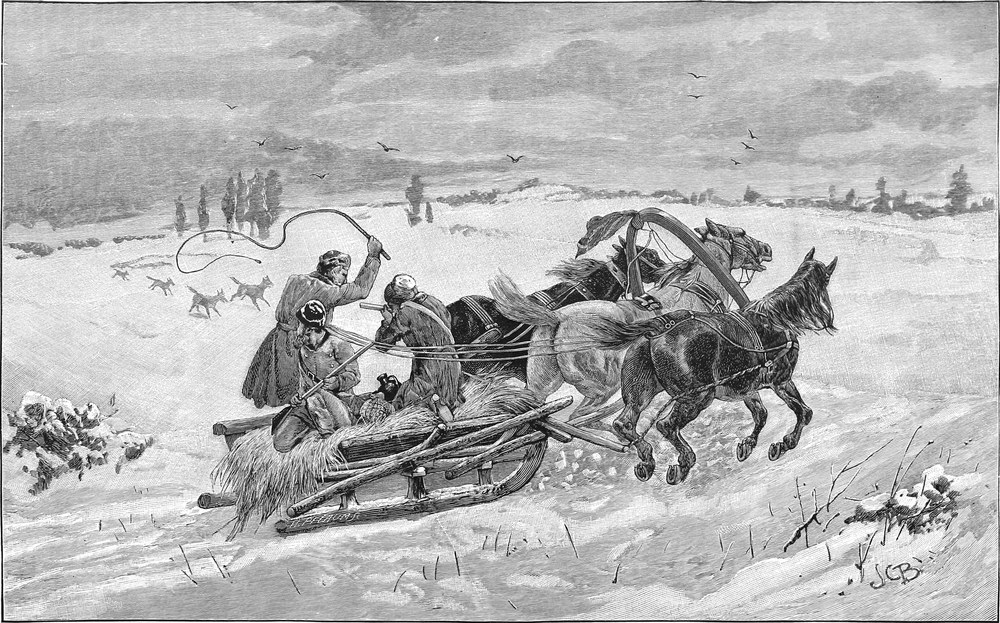
From a water-color painting by J. Carter Beard.
Engraved by H. Pflaum.
A MOONLIGHT ENCOUNTER WITH RUSSIAN WOLVES.
⇒ LARGER IMAGE