Volume 13 / Part 1 — PART I. (continued 2)
Reading edition

THE DISSENSIONS IN THE ATHLETIC WORLD.
IT is a matter for regret, that just at this season the National Amateur Athletic Association and the Amateur Athletic Union should be at daggers’ points with each other. It is to be deplored particularly now, when a visiting organization is here, three thousand miles from home, to engage in contests for championship honors. That the main object the two great organizations of amateur athletes have in view is praiseworthy is not for a moment put to question. It is to be presumed that both are influenced by a similar idea—the purification, or the attempted purification, of the athletic arena from the taint of semi-professionalism.
Young men who interest themselves in outdoor amusements belong to one of two classes—the amateur or the professional. Strange as it may seem, it is not so easy to draw the line between the two. The gentlemen, however, who are in a position to pilot the course of the great athletic bodies, and frame the rules for their government, certainly ought to be able to discriminate. A man who interests himself in athletic sports is either an amateur or a professional. He either goes in for pastime or sport; for the love of it, or for the gain it affords him; the badge or medal for the one—the purse for the other. The lines between these two are so strongly marked that a blind man can feel them. There is, however, a class of men who have crept into the amateur ranks which requires careful watching. We refer to those who are neither amateurs or professionals, but for want of a better designation may be classed as “professional amateurs.” These men will not enter the professional arena for purses, but they do not hesitate to become members of amateur clubs under questionable conditions. Men who devote nearly all their time to training on the cinder track, on the river, on the bicycle path, or in the baseball field, and who do not pay club dues, or who have their club dues paid for them, are tainted with the worse taint of professionalism. To pit one of these men against the amateur enthusiast, who goes in for outdoor sports for the pure love of them, is manifestly unfair. He has no chance to distinguish himself, if he feels so inclined, against such odds. It also discourages other younger amateurs from making a trial in the public contests. To protect the honest amateur athlete, the genuine lover of sport, against the tricksters who, under the guise of amateurs, do nothing else but hang about club-houses, and who are encouraged because they are “smart”—“smart” in more senses than one—is an accomplishment worthy of any great body. If this is the knotty problem which lies directly at the base of the difficulty between the two great central bodies of American amateur athletes, it ought not to be a difficult one to solve; but on the other hand, if it is a desire on the part of one to carry out a policy of rule or ruin, the sooner an understanding is arrived at the better. We have invited both the National Association and the Amateur Athletic Union to state their cases fairly in the pages of OUTING, and we await their action without further comment.
* * *
THE FOOTBALL SEASON.
THE season of football just inaugurated gives every evidence of being an active one. The interest in the game has increased to such an extent in the last few seasons that the sport has rapidly advanced to a leading position among the outdoor amusements of this country. The recent victories of the Canadian team in England and Scotland, too, have given an additional impetus to the game with the sturdy young men across the border. If the promise of the preliminary preparations produce good fruit the present season of football here and in Canada will be a most exciting one.
* * *
THE CLOSE OF THE YACHTING SEASON.
THE season of the year is now with us when the yachts comprising the American pleasure fleets go out of commission. With topmasts housed, sails unbent, and running gear coiled away below, they will lie up in winter berths until May, 1889.
Now, therefore, is the time to ask: “What has the season of 1888 done for yachting in America?” and OUTING answers, “Much.” True, we have had no international race, but what of that? When our friends in England are ready to challenge, we are ready to build, and meanwhile the interval has been profitably spent on both sides of the Atlantic. The Englishmen have been building boats to beat their previous productions. And so have Americans, with very satisfactory results. Our keel boats have done well, but the centreboards have done better. It has been a lively season, with more events and better racing and cruising than any previous. New boats have broken old records, and two important features have been developed, i. e., schooner racing, and “class racing.” At no time in the past ten years has there been such interest in the former class of sport, while the results of the latter were shown in the recent races off Larchmont. There half a dozen boats of almost equal dimensions—Pappoose, Baboon, Nymph, etc.—contested, and the results proved that it is not only more interesting to the spectator, but also very satisfactory to the yachtsmen whose boat has too often been hampered by being compelled to sail in annual races in a class with others nearly double her length. Class racing should be encouraged in New York waters, as it is in Boston and on the Lakes.
There has been much said this season about a summer club-house down the bay for the New York Yacht Club, but nothing definite has been done toward securing one as yet. It appears very necessary that the premier club of America should have an anchorage and house somewhere near the point from which their races are started. The club that has shown the most enterprise this year is the Larchmont. They have not only provided themselves with what may be justly termed the most perfectly appointed club-house in the country, but by inaugurating the class-racing spoken of, and encouraging the sailing of small boats by Corinthian crews, they have made themselves deservedly popular among all classes of yachtsmen. Boston, Marblehead, Hull, Beverley and Dorchester as usual wind up the season with the longest roll of events to their credit. It seems curious that our New York yachtsmen do not join and organize a Yacht Racing Association, by which the time allowances, and other racing details, might be governed. The Eastern Association, that meets in Boston, have all the principal clubs on their roll, and they have done much good work since they started.
J. C. SUMMERS.
* * *
THE EXPENSES OF THE KENNEL.
FEW but those who are intimately acquainted with the minutest details of keeping and training thoroughbred dogs can estimate the vast amount of time, labor and money expended nowadays on the canine race. This time, labor and money all go for the improvement and elevation of the dog, for scientific breeding, and preparation for shows and field trials.
With the daily increase of bench shows, we witness quickly growing extravagance in the prices paid for high-class dogs, and see money spent with a freer hand for dog furnishings and kennel accommodations. Dog furnishings alone, including such articles as collars of all grades, blankets, muzzles, leads, chains, snaps, swivels, couplings, etc., etc., and kennel fixtures, from dog-houses and porcelain-lined food-pans down to brushes, combs, dog-soap, and multitudinous patent medicines for every ailment, employ hundreds and hundreds of people of both sexes throughout the year, and these industries are undoubtedly on the increase.
As to prices paid for dog-flesh, we can cite a few, some of which have come under our personal notice. For instance, it is well known that the owner of the pointer dog Beaufort could have found a purchaser for him at any moment at a figure somewhat better than a thousand dollars; in fact, it is understood that that figure was about the price paid for him when little more than a pup. Another instance is the sale of the liver and white pointer Robert le Diable, at the New York show a year ago, for one thousand dollars. Again, we have the huge St. Bernard Rector, sold by Mr. E. R. Hearn to Fritz Emmet, bringing four thousand. Then, in the case of the English pointer Graphic, twenty-seven hundred was the cost of his transfer from one gentleman’s kennels to another’s, and the instance of the collie Bendigo, at the Westminster Kennel Club’s show last spring, bringing a thousand and a half in cash, showed how much his present owner wanted him. Now comes the latest thing in this line. That great and noble St. Bernard, loved throughout England, and for whom at his departure from his native place children wept and people of maturer years grew sad, has come to us—we refer to that grand dog Plinlimmon. Much ink was wasted and many offers made before his recent owner could be induced to part with him; at last the climax was reached, however, when a most luring and seductive bait of one thousand pounds was offered, which sealed the good dog’s fate. He is in this country now, having lately arrived on the Britannic. Mastiffs, too, have been bringing long prices, with spaniels (the black variety) and setters, some of these kennels being worth a small fortune in themselves. So, with new additions every month to the list of shows, dog interests increase and values enhance, until well-bred specimens may be seen at every hand where formerly mongrels predominated.
NOMAD.
* * *
FENCING.
WITH the return of cold weather, fencing comes once again to the fore. Indeed, fencing is growing more popular every year. We remember the time—and that not many years ago—when there was but a single professor of the art in New York, and a pretty poor one at that. Now, fencing academies are cropping up in all parts of the city. Fencing clubs are numerous and well attended. The two leading ones are the Knickerbocker and the Fencers’ Club. The two great athletic clubs of New York encourage fencing by devoting large and convenient rooms for salles d’armes, and giving valuable prizes to the winners of contests. The Manhattan has secured the services of Professor Louis Rondelle, the able and courteous master of the Knickerbocker. They promise magnificent fencing rooms in their new building, which will be the finest in America.
OUTING would like the secretaries of all the fencing clubs to report about the doings of their fellow-members. We will also furnish all desired information about fencing and fencers. An article on “Fencing for Ladies,” by Mr. Eugene Van Schaick, the author of “A Bout with the Foils,” and “A Bout with the Broadsword,” will be published in one of the early numbers of OUTING for 1889.
REVIVAL OF A FINE OLD ENGLISH GAME.
THE average young Canadian is more devoted to outdoor sports in all kinds of weather than his American neighbor. Even those among the Canucks whose hair is silver-sabled, as well as they whose locks are sable-silvered—to quote a phrase from that delightful old boy, the Autocrat, of Boston, as true a sportsman as ever breathed or wrote—are more devoted to almost all kinds of vigorous exercise, driving, perhaps, excepted, than those who live in the dominions of Uncle Sam. Not only do cricket, baseball, tennis and curling find thousands of enthusiastic players in Canada, but shinty, golf, and bowls have their adherents. The game last mentioned has of late taken an extraordinary hold in Ontario. Its great recommendation is that it is found to give just the degree of exercise in the open air to make it especially agreeable to those of middle age or to those
“Whose age is as a lusty youth, Frosty, but kindly.”
Lawn bowls resembles curling somewhat. In fact it consists in trying to do on level grass what it is the object of curlers to accomplish on smooth ice, i. e., to get one side’s bowls near a central object and to cut out those of the other side. Another point of resemblance is that the “in-turn” or “out-turn” of the curling-stone is initiated by the “fore-hand” or “back-hand” bias of the lignum-vitæ bowl. There is, however, no sweeping at bowls, so that the assistance, real or imaginary, toward the progress of a stone that a roaring and perspiring curler derives from his efforts with the broom, is denied to the bowler.
In former days the game was played, in Canada, at least, with balls much biased, so as to draw as much as six to ten feet in a run of sixty. The best players in Scotland, however, have discarded these extremely weighted bowls. The Pioneer rink of Toronto was the first to import bowls of the best Glasgow make, notwithstanding that a very fair article is made in Canada. Since Scotland has been mentioned, it may be as well to say just here that a correspondent, Mr. Samuel Gunn, of Glasgow, a fine bowler, and an undeniable Scotchman, inveighs, in a recent letter, against those who term bowls an English game, and declares that Scotland is its great exemplar to-day. This probably may be the case; but even Mr. Gunn will admit that the cyclopedias call it “a British game,” and they are not particular to say anything about North Britain either. He should also remember that in the fine picture illustrative of the game in the time of Elizabeth, it is Sir Francis Drake and a group of Englishmen whose game upon an English green was sought to be interrupted by a messenger bringing tidings that the Spanish Armada was in sight.
Be it Scotch or English, it is a good game.
IS HE A 9 4-5 MAN?
THE St. Louis Globe-Democrat writes in the following way of the performance of Schifferstein, the Californian sprinter:
“At the meeting of the Missouri Athletic Club, at St. Louis, September 9, the feature of the day was the performance of Schifferstein, the Californian, in the 100-yard race. He won away off in the world’s record time of 9 4-5s. The amateur record is 10s., and the Californian lowered this. The professional record of 9 4-5s. is held by H. M. Johnson, who was one of the timers. The performance will go on record, and Schifferstein will receive a handsome medal for lowering the record. There can be no doubt of the performance, as he beat Joe Murphy, who is a 101⁄4. man, three yards. In the second heat Schifferstein, O. J. Fath and Geo. M. Fuchs, of the M. A. A. C., and Eli Thornish, of Chicago, competed. Schifferstein raced away from his field in the first fifty yards, and won easily by four yards of Thornish, second. Time, 13 1-5s. The Californian has the easiest of styles. He much resembles Sherrill, the champion, in his style of movement, and does not seem to exert himself a bit when in motion. He will win the national championship. In the final heat a good start was effected, but Schifferstein opened up a big gap on his field in the first fifty yards as before. Murphy then held him even, but could not gain an inch, and the Californian won by three yards in the record time of 9 4-5s.”
A PLEA FOR THE WHEELMEN.
AS the days shorten, and the hours available for outdoor exercise grow fewer, more wheelmen are anxious to use the daylight they have at their own disposal for a reinvigorating run. No city is better provided with an exercise ground for cyclers than is New York with her beautiful park; but, nevertheless, there is a hitch. As things stand at present, one has, in order to reach the park, to take a car from the business parts of the city, and undergo all the tedium of the trip; then, hastily donning cycling clothes, take a hasty spin, a hurried bath, and resuming the garments of every-day life, run the risk of cold or pneumonia by taking a car down-town while still warm from the vigorous exercise.
The Board of Aldermen were apparently filled with good intentions, and went so far as to lay down in Madison Avenue, from Twenty-third to Thirty-second Street, a pavement which seems calculated to fill every wheelman’s heart with joy. This pavement is not the ordinary asphalt used for streets, but has an admixture of sand, which prevents extreme slipperiness. So far so good; but there remains the long stretch from Thirty-second to Fifty-ninth Street, over which no wheelman dare attempt to ride, and so many a man who pines for the refreshing run of an hour or so on his wheel is deterred by the thoughts of those trips on the cars and the other attendant discomforts. Surely the Board of Aldermen will take pity on such a good (and influential) class of citizens, and shortly remedy this real and considerable grievance.
A MASSACRE OF THE INNOCENTS.
AT the present time, when the inevitable effect of the actions of so-called “trout-hogs,” dynamitards, and pot-hunters is evoking so much attention, the report that on August 30 Lord Walsingham killed in one day to his own gun, 1,058 head of grouse, on his small moor at Blubberhouse, Yorkshire, has attracted no slight attention. The feat, if such it can be called, was undertaken with a view to eclipsing the former record made by Lord Walsingham in 1872 of 842 head, on which performance no great reliance has ever been placed. The new and gigantic record is, however, undoubtedly authentic. The bag was made between 5.15 A. M. and 7.30 P. M. and twenty “drives” were made, which occupied seven hours and a half. During the last half hour (i. e., from 7 to 7.30) fourteen birds were killed, during the walk home, and by deducting these it is found that 1,044 were killed in 449 minutes, or nearly 21⁄3 birds per minute. Once three birds were killed at one shot, and three times two birds at one shot. Lord Walsingham was the only person to fire, and used four guns, and employed two loaders. In this particular case, so far was the ground from being completely “shot out” that the reports say that two guns could readily get from 150 to 200 brace per day for two or three days during the next week over the same ground.
A BELLED BUCK.
THE New York Sun recently published a letter from Alex. Moss, of Madoc, Miss. Mr. Moss writes: “A day or two ago I killed a deer, a buck, the largest ever seen in this country; gross weight, 347 pounds. The horns three inches from the head were 13⁄4 in. in diameter. There were six points on one horn and seven on the other—thirteen points. Around the neck of the deer was a bell attached to a wire rope. On the inside of the bell was plainly engraved: ‘J. S. Dunn, Lansing, Mich. June (or Jan.), 1881.’ The wire rope had been spliced in sailor fashion, and was no doubt done before it was put on the deer, and allowances made for the neck growing. There was but a small portion of the material of which the rope was made left, save the wire. It was very tight around the deer’s neck, and the hair was white where the rope touched. The bell had no clapper, and was made of brass and copper.”
A DRINK FOR CYCLISTS.
A WRITER in the Bicycling World calls attention to a well-known injurious habit of wheelmen, as follows:
“The pernicious habit of imbibing large quantities of water at every stopping-place, so common among inexperienced wheelmen, not only aggravates the thirst, but, by promoting excessive perspiration, exhausts the rider. It is the perspiration that evaporates as fast as it appears, and not that which runs off the skin, that diminished the heat of the body. If the rider resists this desire to drink, the water for perspiration is taken from the fat—which is the dead weight—and he is benefited by the decrease in his avoirdupois.”
While the fault and result are very much as outlined above, the writer has failed to point out any remedy. A certain amount of liquid to assuage thirst must be taken by riders, and at the same time nourishment and mild stimulation are often essential. A harmless and satisfactory combination of all these may be secured by adding to a glass of milk a tablespoonful of Jamaica rum, and nothing but beneficial results will be secured, even if used in excess of moderation.
HINTS TO NEW YORK SPORTSMEN.
THE query has more than once been put to OUTING: “Where can one obtain good shooting within Too miles of New York?” In reply, we wish to give the following advice to men who, while keen on sport, have not the time to seek it far afield.
In the first place, good shooting, with a variety of game (one correspondent mentions rabbit, quail, grouse, partridge, etc.), cannot be obtained within too miles of the city.
The rabbit, or American hare (Lepus sylvaticus) can be found everywhere outside and sometimes inside city limits. He seems to be a “pariah and an outcast” among sportsmen, although rabbit shooting with a couple of good dogs on a brisk, frosty morning, is a sport by no means to be despised. Rabbits are protected by the game laws during the close season. Quail (Ortex Virginianus, or, according to many ornithologists, Perdix V.), are in many places still further protected by farmers upon whose lands they breed, most of the stubble fields being posted to keep off intruders. The right of shooting in such cases is reserved for themselves, or for city friends visiting them in the fall, although we have known of cases where the farms were posted so that the farmer’s boys might eke out a few pitiful pennies by snaring the birds for market. Good rabbit and fair quail shooting may be had early in the season on the line of the Southern Railroad of New Jersey, particularly in the neighborhood of Tom’s River. Also on Long Island, from South Oyster Bay eastward.
Ruffed grouse (Tetrao umbellus), improperly called “partridge” in the Eastern and some of the Middle States, and as improperly termed “pheasant” in the South, may still be found in fair numbers among the wooded slopes and swales of Sullivan County, N. Y., and Pike County, Penn. But the class of sportsmen whom we are specially addressing should try that migratory bird, the woodcock, finest of all our birds of the fall flight, the English snipe, most luscious of all for the table, and the shore birds, or Limicolæ, a large class comprehending the curlews, marlins, plovers, tattlers and sandpipers. It is unnecessary to say that, except with shore birds, good dogs are essential to success.
A WORD TO LAWN TENNIS PLAYERS.
LAWN TENNIS has, within late years, taken so prominent a place in the list of our outdoor amateur sports that it behooves those who feel an interest in its future progress to guard well against the introduction of the semi-professional element. This influence has done much to injure and retard the growth of many outdoor amusements. It threw back amateur rowing for years, and at one time brought the open regattas into such ill-favor that it was feared that rowing would fall back into the position it was in before the establishment of the National Association of Amateur Oarsmen. Even after the establishment of that organization, it required the closest attention on the part of the executive committee of the association, with so active a man as Henry W. Garfield to keep it clear from the snags that beset it. It would be well for the lovers of lawn tennis to take this matter seriously in hand and take a lesson from the course laid down by the amateur oarsmen to keep the pastime clear from professional amateur players of this delightful outdoor amusement.
CYCLES IN THE RUSSIAN ARMY.
MR. J. H. BLOCK, of Moscow, who has been instrumental in obtaining the introduction of cycles into the Russian army, thus explains how he was able to bring the measure about:
“I was very kindly received,” says Mr. Block, “by the Commander-in-Chief here, and he took the greatest interest in all I had to say about cycling. An official test has been made here between a cyclist and a grenadier on horseback. A despatch of great importance had to be taken to a small town thirty-five miles outside of Moscow, and an answer to be received from there. One of our best and most ardent bicyclists, Colonel Firsoff, who is fifty years of age, undertook to start off with the grenadier at the same time, and try to receive the answer, and come back in less time than the horseman would. This he achieved in the best possible manner. He came back four hours sooner than did the grenadier, and it created quite a sensation. Since that time we have had very long and continuous conversations about this matter, and after two months, the official introduction has taken place.”
THE HEROINE OF A YACHTING ACCIDENT.
A NARROW Escape from drowning, and, at the same time, an admirable instance of the value of coolness and presence of mind in the face of danger is thus recorded by the Hamilton, Canada, Spectator. It gives an account of the rescue of Mr. Bunbury, of Hamilton, and his daughter. After showing how a passing vessel noticed the capsized sloop, the Spectator goes on to say:
“Captain Irving was notified and got his glass set upon the object. He informed the passengers who had called his attention to it that it was a yacht on her side with two persons clinging to it. The steamer was headed for the yacht, and in a short time was alongside it. Then it was found that Miss Bunbury’s yacht had upset. The two passengers were picked up, and the young lady was rigged out in dry clothes and made comfortable. She did not appear to be the least bit concerned about the upset. ‘We were just three-quarters of an hour in the water,’ she said, looking at her watch, as she was lifted on deck.
“Mr. Bunbury had seen the squall coming, and was going to take in some of the canvas when the squall struck the boat. ‘Let go everything,’ he cried to his daughter, ‘and jump into the mainsail.’ The young lady obeyed with a promptness that perhaps saved her life. In a moment the boat was on her side, with the sail flat on the water, and the young lady on the sail. She picked herself up and stood on the centreboard, hanging on to the deck with both hands. The yacht was low in the water, and to raise it Mr. Bunbury dived into it and threw out the ballast. The young lady stood in the water up to her waist, while Mr. Bunbury was up to his neck, and when the boat lurched—a small sea having come up in the meantime—his head would go right under water.
“The young lady was made quite a heroine of by the passengers of the Macassa. She certainly deserves great credit for her pluck and presence of mind. Thomas Costen, one of the Macassa’s deck hands jumped into the water and assisted in getting the young lady and Mr. Bunbury on board. The yacht was afterward towed in by a steam launch.”
FISH LIVING IN HOT WATER.
THERE is a pond on the hay ranch at Golconda, which is fed by the waters from the hot springs. This pond has an area of two or three acres, and the temperature of the water is about 85°, and in some places, where the hot water bubbles up from the bottom, the temperature is almost up to a boiling point. Recently the discovery has been made that this warm lake is literally alive with carp, some of which are more than a foot long. All efforts to catch them with a hook and line have failed, as they will not touch the most tempting bait. A few of them have been shot, and, contrary to the general supposition, the flesh was hard and palatable. How the fish got into the lake is a mystery unsolved. Within too feet of it are springs which are boiling hot, and the ranchers in the vicinity use the water to scald hogs in the butchering season.
CARP FISHING.
THE New York Herald recently gave some advice to a correspondent who inquired as to the best method of getting some carp-fishing, which is so practical that it will bear repetition. It says: “At Little Falls, N. Y., you can obtain boats, although carp may be caught also from the shore. Carp may be taken in large numbers anywhere within ten miles above Little Falls. There is no law protecting carp, and they may be taken whenever and wherever anybody can find them. Use No. 3 or 4 hook, and fish on the bottom. Let the fish get a good hold before striking, as carp take the hook like suckers. They are often caught on worms used in fishing for other fish. If nothing but carp are wanted, a better bait is made of dough, mixed with cotton to keep it on the hook, or boiled peas.”
BOAT-RACING IN THE DARK.
A NUMBER of times during the past rowing season we noticed that unsatisfactory results were reached at the conclusion of a regatta, which anything like thoughtful management might have avoided. In two or three instances which might be called to mind, contestants were summoned to the starting-line at so late an hour that the shades of evening had fallen on the water. To start a boat race under such conditions is not only absurd and ridiculous, but fraught with danger to the men engaged in it, not to say anything of the numberless disputes likely to arise regarding the final result. In the first place, the referee cannot discharge the duties of his office properly if he is unable to see what is going on between the contestants, or how can a judge at the finish determine who crosses the line first when it is absolutely impossible to see distinctly three boats’ lengths ahead of him? In the Bowery Bay, a place that may become popular for racing with rowing men, and in the waters about the Staten Island Athletic Club’s boat-house, occurrences similar to those above referred to had practical illustrations within the past few weeks. In other sections of the country the practice of delay in starting boat races at an hour later than announced has become a positive nuisance. We propose to watch all sins of this kind in the future, and place the blame of such mismanagement where it belongs.
OUR THEATRICAL PLAYGROUND.
THE theatrical season in New York opened auspiciously about the first of September, and up to the present time shows no sign of in any way not keeping up to its early promise; and this despite the fact of an exciting presidential campaign, when mass meetings, torch-light processions and brass bands in the streets furnish all the elements of a free show outside the theatres. As a rule, a presidential year—at least the few weeks of the canvass preceding the election—seriously effects the attendance at all places of amusement. The past few weeks, however, seem to prove an exception. And no class of entertainment, so long as it is good, appears to be singled out for preference.
FAREWELL, WALLACK’S!
Colonel McCaull, with “Boccaccio,” easily led the comic opera patronage at Wallack’s. It was the best performance of the opera ever given in the city. Comedy and song are so happily blended in the work that it requires actors and singers to present it properly, and McCaull gave both. “Boccaccio,” by the McCaull Opera Company, will pass into the dramatic annals of this city as the last performance given in Wallack’s. October 6 Wallack’s ceased to exist, and a name which for more than a generation was a household word throughout the country passed away into a memory and becomes a tradition.
MEMORIES OF HOME.
As a contrast to the rollicking fun of comic opera let us see how the Academy of Music is doing with “The Old Homestead.” Here is a medley—it can hardly be called a play—which savors so strongly of country life that one almost feels the breath of the new-mown hay, or the genial warmth of a happy hearthstone while witnessing Den Thompson’s performance. It is a touch of nature, and thousands throng into the Academy to feel its influence.
A CHIP OF THE OLD BLOCK.
When young Sothern, at the Lyceum, came upon the stage as Lord Chumley, an indistinct something or other flashed through the minds of old theatre-goers. It was impossible at first to tell what produced that feeling, but as the play unraveled itself, and Mr. Sothern warmed to his work, it seemed as if the spirit of the elder Sothern animated the younger, and Lord Chumley was a blood relative of the lamented Lord Dundreary. As was the case with Dundreary so it was with Chumley—both sprung into popularity in a night. As in Laura Keene’s, crowds were drawn in days gone by to see the father, so now at the present day throngs fill the pretty Lyceum to look upon the son.
NOT OF THE FIRST WATER.
The handsome Broadway Theatre reopened with “The Queen’s Mate,” and the opera was followed by “The Kaffir Diamond.” Notwithstanding the admirable manner in which the drama was mounted and the magnificent performance of Mr. Aldrich as Shoulders, it failed to meet with public approval. The play is not a good one. It has some strong points and good situations, but it drags in places. It is claimed it will make a good road show. It may, but I doubt it. “Mr. Barnes of New York” succeeded “The Kaffir Diamond” on October 15.
CAB, SIR?
Edward Harrigan opened his theatre with another of those local admixtures which he calls “Waddy Googan.” Waddy is a hack driver, and Mr. Harrigan draws him to life, and places him in scenes and situations so faithfully true that the theatre is unable to accommodate his patrons. “Waddy Googan’s” run promises to be a long one.
A SUCCESSFUL WRECK.
William Gillette has made another success with “A Legal Wreck.” When he first produced it at the Madison Square he did not expect it would do more than fill out a part of his season there. Its success, however, was such that the piece will hold possession until the 10th of this month, when A. M. Palmer’s company returns to begin the regular winter season.
JULES VERNE’S STORY IN TIGHTS.
At Niblo’s Garden “Mathias Sandorf” came in with the season, and brought a flock of the prettiest ballet girls that ever adorned Niblo’s stage. “Mathias Sandorf” was said to be written by Jules Verne. M. Verne may have written it, but the people who filled the theatre at every performance lost all recollection of the story in the bright smiles and entrancing movements of the fairies of the ballet. Some managers have a weakness for the antique in the selection of their coryphées, but the rare experience of E. G. Gilmore and Bolossy Kiralfy teaches them that the young have much more attractiveness in the present day.
UP-HILL WORK.
J. M. Hill has produced a play called “Philip Herne” at the Fifth Avenue Theatre. It was written by Mrs. Mary Fiske, a very bright writer, and a lady well known in journalistic and theatrical circles. “Philip Herne” has not yet come up to its manager’s expectations. The play has all the advantages of a good cast. After a four weeks’ run at the Fifth Avenue it went up to the Standard for a five weeks’ stay. Mr. Hill is a very plucky manager, and is not afraid to meet defeat. Sometimes he even turns defeat into victory. Who can tell? “Philip Herne” may yet result in the victory Mr. Hill believes it capable of achieving.
THE FASCINATION OF IMPROBABILITIES.
J. Wesley Rosenquest, one of the most enterprising and intelligent of our younger managers, has now two theatres to guide instead of one—the Bijou Opera House and the Fourteenth Street Theatre. At the latter place of amusement, Cora Tanner has made the success of her career in “Fascination.” “Fascination” is a comedy, written by Robert Buchanan, and is about as improbable a story as one can listen to. But what of that? The people throng to see the play, or Cora Tanner, or both; and in this way stamp its improbabilities with the brand of success.
RICHARD NEVILLE.

FOR a writer of books on sporting subjects one qualification is absolutely indispensable if the result is to be a success, and this is that the author shall have his heart thoroughly in his work. In no other class of literature is the lack of such a qualification made so palpable to the reader. In “Wild Fowl Shooting” (Chicago: Rand, McNally & Co., 1888) Mr. William Bruce Leffingwell shows his love and knowledge of sport in a way which will give his work a high place in sporting literature. From the first to the last chapter the book is nothing if not practical, and the information is pleasantly interspersed with anecdotes and stories in such a way that the veteran will read with amusement and interest, and the tyro will gather instruction and pleasure at the same time. The scientific portions which are gleaned from the best sources are not unduly obtrusive, though of sufficient length to give any information required. The volume has the additional advantage of being illustrated.
IT is not often that the writer of a book of travel gives such thorough attention to his subject as did William Eleroy Curtis (New York: Harper & Brothers, 1888) in “The Capitals of Spanish America.” In his position as Commissioner from the United States to the Governments of Central and South America, the author had an opportunity which he improved fully and with profit. President Arthur’s unsigned letter, sent after his death, accepting the dedication and consenting to write the Introduction, is an interesting memento. The accounts given by the author of the cities and peoples he visited are full of life and interest, while more serious points are by no means neglected. But even the dry facts are so pleasantly discussed in chatty fashion and interlarded by anecdote and tale that no dry bones are left. The book is very profusely and, for the most part, handsomely illustrated.
REALISTIC fiction has in the last two years gained a strong foothold in this country. To-day twenty good writers might be named with whom this tendency has become a characteristic. There is undoubtedly an American school of fiction building up which will become distinctive of our day and country. But “Len Gansett,” by Opie P. Read (Boston: Ticknor & Co., 1888), is hardly calculated to reflect credit on this school. Realism is not all-sufficient, but must be ably seconded by literary merit to meet with general approbation. The plot of this work is so poor that one wonders at the finish why it should have ever been introduced. The characters are weak and quite devoid of originality, while the charms and picturesqueness which might have been introduced into such surroundings are conspicuous by their absence.
THERE are books that win favor by their very name. “Chris,” by W. E. Norris (London and New York: Macmillan & Co., 1888), is a volume that has more than a name to make a way for it. From the moment that one picks up this novel, one becomes intensely interested in the fortunes of the wayward heroine. The interest acquired in her various entanglements is almost personal, and when she is delivered from the clutches of the unscrupulous Val Richardson, one breathes a sigh of relief. Some of the prettiest touches are in connection with the faithful Peter, and when the faithful canine friend meets his untimely end, entire sympathy is felt with Chris in her wild and erratic flight. The characters are well drawn, though there is a tendency to overcoloring in some; but in spite of the interest of the book the plot can hardly be designated as original or deep.
UNIVERSAL as has been the baseball mania, it is an astonishing fact how little literature has sprung up in connection with the game. This is well shown in the introduction to “Hygiene for Baseball Players,” by A. H. P. Leuf, M.D. (Philadelphia: A. J. Reach & Co. 1888)—a work which, though unpretentious in appearance, is a most valuable and timely publication. It discusses at considerable length the “physiology and philosophy of curve-pitching,” and, as might be gathered from its name, “the diseases and treatment of ball players.” In addition, the relation of human anatomy to the methods of play, proper exercises for players, and numerous other bearings of the game are fully discussed. Illustrations amplify the merits of the text.
A MANUAL that will surely prove of real use to the yachtsman and canoeist is Captain Howard Patterson’s “Canal Guide” (New York Navigation School, New York). As the author truly remarks, it opens up a comparatively new field to yachtsmen, and offers a change to the annual cruise along the same coast line. The instructions given, and tables of depth of water, width of locks, etc., seem to be very complete and to furnish all necessary information.
CARP culture has of late come into much prominence among the pisciculturists of America. A valuable text-book on the subject reaches us, entitled, “Practical Carp Culture,” by L. P. Logan (Youngstown, O.: Evening Herald Print, 1888). Every feature of the industry is fully discussed, and both those who intend to engage in it, and those who take an interest in it as a measure of public utility, should study this little work. Rather more care in preparation might have been advantageously expended on the preparation of the volume, as in a preface of thirty-seven words there are two spelled wrongly.
FUN FROM THE WHEEL.
COLLEGE PROFESSOR: Mr. Wheeler, can you give me a definition of a philosopher?
MR. WHEELER (A racing man, with a grudge against the handicapper): A philosopher is a fellow who starts from scratch with a man ten seconds faster than he is, just to show the handicapper how little he knows about his business.
IT is said to be a poor rule that does not work both ways. Messrs. Salmon Bros., of Denver, are trying to introduce the Fly Cycle Co.’s wheels to American riders. A fly has long been the bait used to land salmon, but this is the first case on record where the salmon has reversed this order of things, and himself used the fly for bait. It would seem odd to ask the rider of one of these machines what machine he rode, and have him reply a “fly-wheel,” wouldn’t it?
“I UNDERSTAND Headerboy has grown wealthy of late,” remarked the old member of the Whangdoodle Wheelers to the club captain.
“Yes, he’s making about fifty dollars a week now.”
“Doing what? Why he can’t even ride a wheel without falling of.”
“That’s just it.”
“What do you mean?”
“Why, you see, he carries two or three accident insurance policies, rides a fifty-four-inch wheel when he measures for a fifty inch, so he has only to ride and take headers, to combine pleasure with profit.”
IT is said that Kluge, the well-known racing man of the Hudson County Wheelmen, owes his success upon the road and path to his profession as a paper-hanger. It teaches him to thoroughly “size up” the abilities of his opponents, and thus defeat them by taking advantage of their weaknesses.
RACING TERMS AND DEFINITIONS.
First—Adam. A Driving Race—Trotting.
Last—Cobblers. The Rail—A scolding wife.
Wins—Four aces. Left at the Post—The starter.
Loses—A bluff when called. A Foul—A duck-er chicken.
The Field—Potter’s. The judge’s Stand—On their feet.
Beaten—A drum. Dead Heat—110 degrees in the shade.
They’re off—Lunatics. A Tie—A four-in-hand.
A False Tart—A mud pie. A Handy-“capper”—A bunco steerer.
The Home Stretch—The one to get your hat on the morning after an evening with “the boys.”
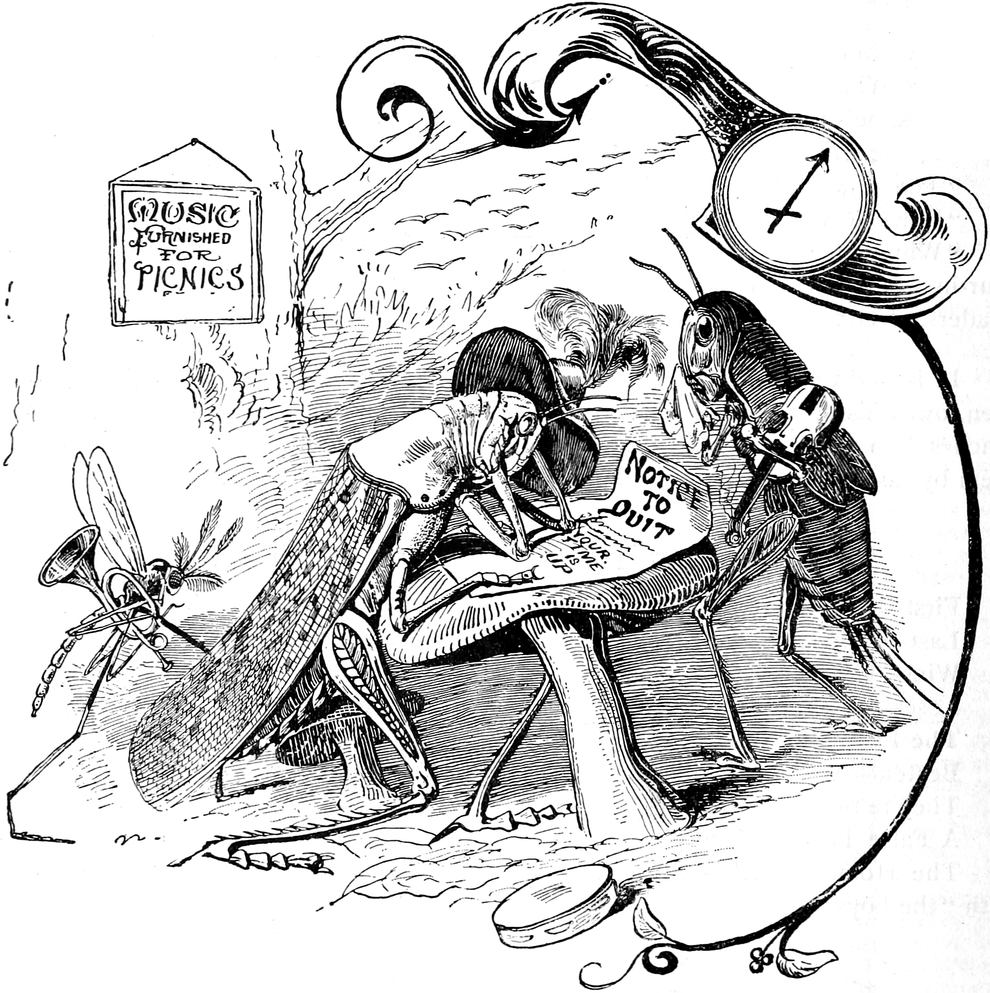
THE CLOSE OF THE SEASON.

THE boy who was “kept in” after school hours for bad orthography, and thus prevented from taking his place in the afternoon baseball match, explained to his captain that he was spell-bound.
EXCITED FARMER (to man with fishing tools): Look here, you can’t catch fish in this stream!
PISCATORIOUS: That’s all right. I won’t catch anything. I belong to the Washington Baseball Club.—Puck.
WOMAN (to tramp): If I give you a nice dinner will you help me put up some patent self-rolling window curtains?
TRAMP: No, ma’am. I’ll saw wood, carry in coal, or dig post holes, but I wouldn’t help a woman on window curtains if she gave me a Delmonico spread.—New York Sun.
Ocean gives up the following as fun when it states that a vessel resembles a prisoner when she is put in the dock, a witness when she is bound to a-pier, and a judge when she makes a trial trip. This little joke from the Ocean comes to us with the antique flavor of a chestnut.
LARRY: Your governor said last night, Jack, that he was not at all satisfied with the result of your last year at college.
“Well, by George! I got on the eleven, and pitched for the nine, and won first in the singles. What on earth does he want?” Such is Life.
“YOU should be a baseball player,” said the beetle to the spider.
“Why so?” inquired the latter.
“You’re so good at catching flies.”
“True, but I’d fall a victim to the fowls.”
And he went behind the bat.—Exchange.
HARVARD Lampoon informs its readers that “one of the girls, who pays part of her tuition by chasing the hens out of the Annex Garden, is thinking of entering the sprint races of Mott Haven next year, because she is such an adept in the ‘running shoes.’”
A BALLAD.
THE shades of night were falling fast, As from the tennis grounds there passed A youth who bore his head with pride, Because, there, walking by his side, Was Imogene. His step was light, his eye was bright, His heart was thumping at the sight That lit his soul with love’s bright beams, And fired his brain with glorious dreams Of Imogene. In cottage homes they saw the light Of household fires gleam warm and bright; But while the silvery moonlight shone, He much preferred it out alone With Imogene. “Beware the pass,” the old man said, “’Tis dark within the woods ahead.” He answered boldly, “Never fear, For dark is light when she is near— My Imogene!” “Oh, stay,” the maiden said; “inside, The parlor door is open wide.” He spoke no word; his eyes aglow Were to his comrade whispering low, “Dear Imogene.” He sat him down beside his love, And spooned until papa above Grew weary, and a step o’erhead Gave rise to sudden, anxious dread In Imogene. “Beware the baseball bat of pine— Beware my papa’s number nine!” This was the maiden’s last good-night; He answered as he shot from sight, “Dear Imogene!” —Life.
THIS department of OUTING is specially devoted to paragraphs of the doings of members of organized clubs engaged in the reputable sports of the period, and also to the recording of the occurrence of the most prominent events of the current season. On the ball-fields it will embrace Cricket, Baseball, Lacrosse and Football. On the bays and rivers, Yachting, Rowing and Canoeing. In the woods and streams, Hunting, Shooting and Fishing. On the lawns, Archery, Lawn Tennis and Croquet. Together with Ice-Boating, Skating, Tobogganing, Snowshoeing, Coasting, and winter sports generally.
Secretaries of clubs will oblige by sending in the names of their presidents and secretaries, with the address of the latter, together with the general result of their most noteworthy contests of the month, addressed, “Editor of OUTING,” 239 Fifth Avenue, New York.
TO CORRESPONDENTS.
All communications intended for the Editorial Department should be addressed to “The Editor,” and not to any person by name. Advertisements, orders, etc., should be kept distinct, and addressed to the manager. Letters and inquiries from anonymous correspondents will not receive attention. All communications to be written on one side of the paper only.
ATHLETICS.
THE fifth competition for the Linten and Scheiflin medal in the Brighton Athletic Club took place on the grounds at Pennsylvania Avenue, September 15. The results were as follows:
100-yard run—E. U. Torbett, 5 yds., 1st; W. J. Carr, 2 yds. Time, 111⁄2 sec.
High jump—D. J. Cox, 5 ft. 3 in., 1st; W. J. Carr, 2d.
Half-mile run—W. J. Carr, 25 yds., 1st; A. C. Macgregor, 12 yds., 2d. Time, 2 min. 25 sec.
Broad jump—W. R. Hooper, scratch, 1st, 19 ft. 43⁄4. in.; H. H. Petit, 2d, 15 in., 18 ft. 11 in.
Hop, step and jump—W. B. Dunlap, 8 in., 1st, 38 ft. 51⁄2 in.
One-mile run—G. U. Forbell, 110 yds., 1st; A. C. Macgregor, 25 yds., 2d. Time, 4 min. 25 sec.
IN the long-distance throwing match at Cincinnati, September 19, for the prize money of $100 offered by the Cincinnati Club and the Enquirer diamond locket, Harry Vaughn’s record was broken by Stovey of the Athletics. He threw the ball 369 feet and 2 inches. Tebeau tried to beat it, but only reached 353 feet. Ned Williamson may make a trip here to see if he can go ahead of the best record. Corkhill has not yet thrown.
OF the eleven records broken last May at Worcester, Mass., five are held by the students of Dartmouth.
THE formal opening of the New York Athletic Club’s grounds at Travers Island, took place September 22. The twentieth annual fall games of the club also took place. The day was all that could be desired.
Very little was done toward beating or even approaching previous records, the only exception being in putting the sixteen-pound shot, which Mr. George R. Gray managed to cast 44 ft. 5 in., some six inches beyond the existing limit, and Mr. W. L. Condon throwing a sixteen-pound hammer a distance of 117 ft. 91⁄2 in., topping the previous “high-water mark” by some nine feet or more.
The 100-yard run was won by A. F. Copeland, in 10 2-5 secs. Fred Westing second.
The one-mile race was won by G. G. Gilbert, in 5 min. 10 4-5 sec. Second, W. F. Thompson.
T. P. Conneff came in first in the 880-yard run, with C. M. Smith a close second. The 440-yard run was won by J. P. Thornton, in 53 1-5 sec., A. W. S. Cochrane bringing up close in the rear. Fred Westing succeeded in getting first place in the 220-yard run, in 23 4-5 sec., A. W. S. Cochrane again a close second.
A. F. Copeland distinguished himself by winning two hurdle races, the first, 120 yards, in 17 3-5 sec., and the second, 220 yards, in 27 3-5 sec., C. M. Smith being second in the first and C. T. Wiegand behind the winner in the second race.
Mr. Copeland jumped into further fame by covering 22 ft. 03⁄4 in. in the running broad jump. This was the fourth prize captured by Mr. Copeland.
T. P. Conneff again showed his heels to his competitors in a five-mile run, beating Mr. S. T. Freeth, who came in second, over one-fifth of a mile. The time was 27 min. 4 4-5 sec.
A number of the solid men of the New York and other clubs then struggled with a 56-pound weight, which Mr. Condon, who had broken the record with the 16-pound hammer, succeeded in throwing 26 ft. 63⁄4 in. A. J. Queckberner just missed this mark by three-quarters of an inch.
Not much was done in the way of pole vaulting. G. P. Quinn managed to clear 10 feet after repeated trials. The record for this event is 11 feet 5 inches. In the running high jump, M. W. Ford, S. I. A. C., cleared 5 feet 10 inches. C. T. Wiegand and R. K. Pritchard managed to lift themselves 5 feet 3 inches in the high jump.
In the aquatic sports the first event, the junior singles, had the following starters: D. G. Smyth, A. W. Lublin and M. J. Austin. Austin won by a length, Lublin spoiling his chances in the race by capsizing.
The second race was for eight-oar shells, handicap. The Rathborne crew allowed the Freeman crew twenty seconds start, the Rathborne eight soon overhauling the other crew and winning easily.
“Jack” Lambden, the pride of the New Rochelle Rowing Club, sized up C. P. Psotta, the amateur champion, and concluded he’d stay out of the senior single race. F. G. McDougall thought it worth the trial, but Psotta was too much for him, winning the race easily in 7 min. 10 sec.
The pair-oared gigs event had four entries, but only two starters appeared, the crews being: E. Wrinacht, bow; J. Cremins, stroke, and D. G. Smyth, coxswain. W. O. Inglis, bow; E. J. Giannini, stroke, and G. D. Phillips, coxswain. The Phillips crew won. Time, 7 min. 551⁄4 sec.
The double-sculls had four entries and three starters, as follows: J. H. Miller, bow; F. H. Romain, stroke. G. D. Phillips, bow; P. W. Rathbone, stroke. F. J. McDougall, bow; J. M. Austin, stroke. As the boats neared the half mile two fishing boats ran across the course, which threatened disaster to all three of the racing boats. A new start was made, when McDougall and Austin won the race by a length.
The four-oared shells had three entries, and was among the most interesting events of the day. The Devlin crew were looked upon as sure winners, but to the surprise of everybody the Cremins crew won by two lengths, after an exciting and closely contested race. The time was not taken.
Music was furnished by the Davids Island Military Band. The grounds were illuminated at night, many of the visitors staying until a late hour.
THE Manhattan Athletic Club completed its annual members’ games, postponed from September 8, at the grounds, Eighty-sixth Street and Eighth Avenue, September 15. A feature of the afternoon was the presentation of a handsome gold watch to Fred Westing, by G. L. M. Sachs, for having made ten seconds in a 100-yard run in England, and having been the first American to win an English championship prize at that distance. Westing had just concluded a trial to break the record at seventy-five yards, 73⁄4s., when he was given the timepiece. He failed to break the record in his trial, doing the distance against a strong breeze in a shade worse than 7 4-5s., which, under the circumstances, was highly creditable. Another feature of the day was the running of T. P. Conneff, who, without anyone to “run him out,” did 9m. 44 1-5s. for two miles, or about 61⁄4s. worse than the American record, and 2m. 6s. in a half-mile run. The results of the events were as follows:
100-yard run—Final heat, A. F. Copeland (11⁄2 yds.), 1st; C. Giet (81⁄2 yds.), 2d; time, 10 3-5s. Two trial heats were run last Saturday.
Two-mile run against the record of 9m. 383⁄8s., made by E. C. Carter, N. Y. A. C. The trial was made by T. P. Conneff, who had as pace-makers Messrs. Adams, Cooper, Devereaux, Wieners, Bogardus, Giet and Banks. He failed in his attempt, but broke records at 11⁄3 miles, 15⁄8 miles and 13⁄4 miles. His time for intermediate distances was, one-quarter, 1m. 7s.; one-half, 2m. 19 1-5s.; three-quarters, 3m. 32 4-5s.; mile, 4m. 48 1-5s.; one and one-third miles, 6m. 27s.; one and five-eighths miles, 7m. 55s.; one and three-quarters miles, 8m. 32 4-5s., and two miles, 9m. 44 1-5s. The best previous record at one and one-third miles was 6m. 38s., by E. C. Carter; at one and five-eighths miles, 8m. 39 2-5s., by W. G. George. There was no previous record in America for one and three-quarters miles, but in England W. G. George ran the distance in 8m. 8 1-5s.
Sixteen-pound hammer—F. V. Lambrecht (scratch) 1st, 107 ft. 10 in.; G. A. Whith, 2d.
120-yard hurdle race—A. F. Copeland (scratch), 1st; Z. A. Cooper (16 yds.), 2d; time, 16 2-5s.
Half-mile walk against Murray’s record of 3m. 2 2-5s.—E. D. Lange, 3m. 101⁄2s.
Running broad jump—Z. A. Cooper (4 ft.), 1st, at 18 ft. 61⁄4 in.; A. F. Copeland (scratch), 2d, at 21 ft. 6 in.
350-yard run—J. C. Devereaux (16 yds.), 1st; H. M. Banks (scratch), 2d; time, 39 4-5s.
Quarter-mile run—Z. A. Cooper (40 yds.), 1st; G. A. S. Wieners, Jr. (40 yds.), 2d; won easily in 53 3-5s.
Half-mile run—T. P. Conneff (scratch), 1st; F. A. Ware (36 yds.), 2d; won in a walk in 2m. 6s.
THE Staten Island Athletic Club is considering the advisability of sending a representative lacrosse team to Europe next spring.
AT the annual election of the Olympic Athletic Club, of San Francisco, Cal., September 3, the following officers were elected: President, Wm. Greer Harrison; vice-president, R. P. Hammond, Jr.; treasurer, H. B. Russ; secretary, W. E. Holloway; leader, Geo. Dall; directors, A. C. Forsyth, E. J. Molera, A. R. Smith, B. Baldwin, E. A. Rix, Alfred B. Field. Ground for the new club building will be broken very soon. Among the novelties of its construction will be a cinder track on the roof.
THE second annual field day of the Y. M. C. A. of Pittsburgh was held September 22, at the Exposition grounds, Allegheny. A good-sized audience was present, and considerable dissatisfaction was manifest over some of the decisions. Geo. E. Painter acted as referee; B. G. Follansbee and Alfred Reed were the judges. The results:
100 yards (novice)—1st prize, silver goblet; 2d, tennis racket. Won by Frank J. Kron in 11 sec., with E. E. Hughes 2d.
100 yards (junior)—1st prize, silver pitcher; 2d, tennis coat. Won by R. M. Trimble, Sanford B. Evans, 2d.
100 yards (handicap)—1st prize, gold medal; 2d, steel engraving. Won by F. J. Kron (7 yds.), Harry Tinker (5 yds.) 2d. Time, 101⁄4 sec.
Walking match, one mile—1st prize, silver goblet; 2d, an album. Won by C. V. McLean in 7m. 52s., R. L. McLean 2d.
Standing high jump—1st prize, silver-headed cane; 2d, library lamp. Won by Joe Boggs, who cleared 4 ft. 61⁄2 in.; Belitz was second with 4 ft. 2 in.
220 yards (handicap)—1st prize won by D. H. Barr, in 23s.; H. A. Davis 2d.
Putting the 16-pound shot—1st prize, pair gold sleeve buttons; 2d, traveling set. Won by S. E. Gordon, who threw 34 ft. 10 in.; J. H. Nicholson 2d.
440 yards (handicap)—1st prize, gold medal; 2d, pair Indian clubs. Won by H. A. Davis (20 yds.), in 55 sec.; W. H. Beazell (scratch) 2d.
Running high jump—1st prize, medal; 2d, tennis shoes. Won by Brown, who cleared 5 feet 41⁄2 in.; Pitcairn was 2d.
Throwing the baseball was won by E. F. Schaffer, who threw 99 yds. 1 ft.
888 yards (handicap)—1st prize, gold chain; 2d, running shoes. Won by W. H. Beazell (scratch), in 2m. 121⁄2s.; John McGren (40 yds.) 2d.
Pole vaulting, won by Professor Speer, with S. E. Gordon 2d.
In the hurdle race, H. C. Fry, Jr., beat N. S. Campbell and others.
The day’s sports ended with a three-legged race, which was won by D. A. Barr and W. J. Barr in 123⁄4s.
THE teams representing the Gaelic Athletic Association, which sailed from Queenstown, Ireland, September 16, arrived in this city on the 25th. The names of the Irish athletes are J. S. Mitchell, J. C. Daly, Pat Davin, P. O’Donnell, W. Real, D. Shanahan, J. McCarthy, M. Connery, J. Connery, W. McCarthy, T. J. O’Mahoney, W. Phibbs, T. M. O’Connor, J. Mooney, P. Looney, D. Powers and P. Keohan. The hurlers are G. Burgess, P. P. Sutton, J. Furlong, J. Hayes, Frank Coughlin, James Royce, P. J. Molohan, P. Fox, M. Curran, J. Dunne, J. Nolan, J. Cordial, P. Meleady, P. Davin, P. O’Donnell, T. O’Grady, I. O’Brien, J. Stapleton, T. Ryan, W. Prendergast, J. McCarthy, M. Connery, J. Connery, D. Godfrey, J. Mooney, P. Looney, D. Power, J. Coughlin, M. Hickey, and several others. It will be seen that several of the hurlers are also members of the team that will take part in the track and field events to be held during their stay here. President Maurice Davien, Treasurer R. J. Frewen, and Honorary Secretary W. Prendergast, of the Central Council of the G. A. A., accompany the team. John Cullinane, agent in advance, will have charge of the arrangements for the exhibitions proposed to be given by the Irish athletes in this country and Canada. The hurlers will appear in Irish costume—knee breeches, stockings, and shoes—and one team will wear bright green jerseys, marked with an Irish harp, while the other will wear orange and red jerseys. A game of football will be played. It is not a brutal exhibition, such as the Rugby rules bring out. In the Irish game the football cannot be lifted from the ground with the hands, and there is no throttling.
The Gaelic Association consists of 2,000 Irish athletic clubs, representing 20,000 members. The team consists of fifteen athletes who were winners in the contests in Ireland in August last. Thirty-five are hurlers. They are of all professions and business connections. Maurice Davin, the president, with one hand has thrown a 16-pound hammer 131 ft. 3 in. Pat Davin has a record for a standing high jump of 6 feet 23⁄4 inches, beating Page’s record. J. S. Mitchell has a record in throwing the 16-pound hammer of 136 ft. 11⁄2 in. Mitchell has run in 4m. 36s. on a bad track. Pat Keohen has a record of 13 ft. 3 in. in a standing jump, beating Ford’s record. There is no captain in the ordinary acceptation of the term.
THE exhibition games given by the members of the Gaelic Society athletes, at the Manhattan Athletic Society, on September 29, were mainly for the purpose of introducing the visiting Irish athletes. The first event was a 100-yard dash, four starters, won easily by J. J. Mooney in 10 2-5s., with J. McCarthy second. The second event was a three standing jump contest, three trials, won by P. Keohan, who made 34 ft. 4 in. His two competitors were J. Connery, 33 ft. 41⁄2 in., and J. McCarthy, 32 ft. 51⁄2, in. Keohan’s first jump was 34 ft. Keohan then tried one standing jump with weights, covering 11 ft. 7 in. An interesting event followed, a 120-yard hurdle race, with seven jumps. The competitors were T. J. O’Mahoney and D. Power. O’Mahoney led, but at the last hurdle was caught in splendid style by Power, who came in ahead in 19 4-5s., only two feet in advance of his opponent. T. J. O’Mahoney, who, in Ireland, is called the Rosscarberry Steam Engine, ran 440 yards in 56s., easily beating M. J. Curran. W. Phibbs and W. McCarthy ran a half-mile race, keeping neck and neck nearly all the way, Phibbs winning by a few inches in 2m. 231⁄2s. The high jump was won by T. M. O’Connor, who cleared 5 ft. 81⁄2 in. Throwing the 16-pound hammer excited great interest. The contest lay between J. S. Mitchell, a man of classic proportions and immense strength, and Dr. J. C. Daly, a big man, of great girth, weighing 300 pounds. After two trials each the 16-pound hammer handle broke and an 18-pound one was procured. Mitchell won with 118 ft. 11 in., Daly making 106 ft. 1 in. The record in this country for the 16-pound hammer is 129 ft. Mitchell has now established a record for the 18-pound. The broad jump was won by D. Shanahan, who covered 20 ft. 71⁄2 in., J. Mooney coming second, with 19 ft. 91⁄2 in. The two giants, Mitchell and Daly, next entered on the trial of slinging the 56-pound weight. Each man threw by slinging the weight around the head in the first trial and in the second standing. Mitchell’s record is 35 ft. by “following” his throw. He won the straight throw from the shoulder, covering 30 ft. 101⁄2 in. Dr. Daly threw 30 ft. 5 in. P. Rooney won the running hop, step and jump with 44 ft. 7 in. The last event previous to the hurling match, which was greatly enjoyed, was throwing the 14-pound hammer. Mitchell’s record is 158 ft. He threw it 157 ft., and Dr. Daly, 155 ft. 101⁄2 in.
THE fifth annual championship meeting of the Amateur Athletic Association of Canada was held on the grounds of the Montreal Athletic Association, September 29, before 3,000 people. The games were not well managed, and frequent delays brought on nightfall before the programme was finished. The following is a summary of the games:
100-yard run—F. A. Westing, M. A. C., New York, first; time, 10 1-5s. V. E. Schefferstein, O. A. C., San Francisco, second; A. F. Copeland, M. A. C., New York, third.
Putting 16-pound shot—G. R. Gray, N. Y. A. C., first, 42 ft.; C. A. J. Queckberner, S. I. A. C., New York, second, 39 ft. 41⁄2 in.; F. L. Lambrecht, M. A. C., New York, third, 38 ft. 6 in.
Half-mile run—J. W. Moffat, M. A. A. A., Montreal, first; time, 2m. 3 4-5s. G. Tracey, Halifax, N. S., second; C. M. Smith, N. Y. A. C., third.
Three-mile walk—C. L. Nicholl, M. A. C., New York, first, 22m. 44s.; E. D. Lange, M. A. C., New York, second; H. Wyatt, Brickfield Harriers, England, third.
Pole vault—H. H. Baxter, N. Y. A. C., first, 10 ft. 3 in.; L. D. Godshall, M. A. C., New York, second, 10 ft.; G. P. Quinn, M. A. C., New York, third, 9 ft. 6 in.
Two-mile run—T. P. Conneff, M. A. C., first; time, 10m. 10s. P. D. Skillman, N. Y. A. C., second; G. I. Gilbert, N. Y. A. C., third.
220-yard run—A. F. Copeland, M. A. C., New York, first; time, 231⁄2s. A. W. S. Cochrane, N. Y. A. C., second; W. C. White, M. A. C., third.
Throwing 56-pound weight—C. A. J. Queckburner, S. I. A. C., New York, first, 25 ft. 3 in.; G. R. Gray, N. Y. A. C., second, 22 ft.; F. L. Lambrecht, M. A. C., New York, third, 21 ft. 9 in.
Running high jump—M. W. Ford, S. I. A. C., New York, first, 5 ft. 5 in.; C. T. Wiegand, N. Y. A. C., and V. E. Schifferstein, O. A. C., San Francisco, tied for second place at 5 ft. 3 in.
One-mile run—T. P. Conneff, M. A. C., New York, first; time, 4m. 32 3-5s. G. M. Gibbs, Toronto A. C., second; P. D. Skillman, N. Y. A. C., third.
Running broad jump—A. A. Jordan, N. Y. A. C., first, 20 ft. 5 in.; William Halpin, O. A. C., New York, second, 19 ft. 111⁄2 in.; A. F. Copeland, M. A. C., New York, third, 19 ft. 10 in.
440-yard run—W. C. Dohm, N. Y. A. C., first, 511⁄2s.; G. J. Bradish, N. Y. A. C., second; J. P. Thornton, N. Y. A. C., third.
Throwing the 16-pound hammer—C. A. J. Queckburner, S. I. A. C., New York, first, 98 ft. 111⁄2 in.; L. L. Lambrecht, M. A. C., 93 ft. 8 in.; G. R. Gray, N. Y. A. C., third, 74 ft.
120-yard hurdle race—A. F. Copeland, M. A. C., New York, first, 16 2-5s.; A. A. Jordan, N. Y. A. C., second; H. S. Young, M. A. C., New York, third.
BASEBALL.
IN the metropolitan amateur arena, the Staten Island Athletic Club’s nine bore off the championship of the Amateur League; the Staten Island Cricket Club’s nine being second; the Brooklyn Athletic Club’s team third, and that of the Orange Athletic Club fourth.
THE struggle for the championship of the American Association arena was virtually settled by the first of October in favor of the St. Louis club, leaving the Brooklyn and Athletic clubs to contest for second position, as Cincinnati’s place as fourth was settled before the end of September. When our table was made up, on September 7th, the record stood as follows:
CLUBS. St. Louis. Athletic. Brooklyn. Cincinnati. Baltimore. Cleveland. Louisville. Kansas City. Games won. Per cent of victories.
St. Louis — 10 10 9 14 16 15 14 88 .693
Athletic 7 — 8 10 13 10 15 14 77 .611
Brooklyn 10 10 — 11 9 13 13 11 80 .606
Cincinnati 7 10 6 — 14 10 16 13 76 .589
Baltimore 6 5 8 6 — 8 11 11 55 .423
Cleveland 4 6 4 7 8 — 9 10 48 .393
Louisville 2 5 7 3 9 8 — 10 44 .341
Kansas City 3 3 9 4 8 9 6 — 42 .336
Games Lost 39 49 52 53 75 74 85 83 510
It will be seen that the St. Louis club had a winning lead over a month before the close of the season, while it was a close contest for second place between the Brooklyn and Athletic clubs to the last. The contest in the American arena was settled simply by superior club management.
THE interest in the League pennant race for 1888 culminated during the first week in October. That week’s play virtually gave the championship to the New York team. The contest for third place, however, remained unsettled up to the last week of the season, it being a triangular fight between the Philadelphia, Detroit, and Boston teams. In the contest between the four Eastern teams and their Western adversaries, New York led Philadelphia by a percentage of .603 to .594, Boston being away behind. In the fight between the four Western and the four Eastern clubs, Chicago led Detroit by a percentage of .592 to .522, Pittsburg being a poor third. Last year, with Detroit as the pennant winner, Philadelphia came in second, and Chicago third, while New York had to be content with fifth place. This year New York stands first, and Chicago second, while the other three—at the time our record was made up—were fighting for third place; Philadelphia and Detroit being tied for third place with a percentage of .524 each, while Boston stood fifth with a percentage .523. It will be seen that the contest was close and exciting up to the very last week of the season as far as the struggle for third position was concerned. Here is the record in full up to October 8th:
CLUBS. New York. Chicago. Detroit. Philadelphia. Boston. Pittsburgh. Washington. Indianapolis. Games won. Per cent of victories.
New York — 8 11 14 12 9 15 13 82 .651
Chicago 11 — 10 8 12 9 11 14 75 .573
Detroit 7 10 — 10 8 10 10 11 66 .524
Philadelphia 5 8 6 — 10 14 10 13 66 .524
Boston 8 7 10 9 — 7 15 11 67 .523
Pittsburgh 5 11 10 6 8 — 10 14 64 .500
Washington 4 6 5 9 5 0 — 8 46 .357
Indianapolis 4 6 3 4 6 6 12 — 46 .354
Games Lost 44 56 60 60 61 64 83 84 512
IN the minor Leagues the success of the Syracuse club in winning the International Association’s championship was the event of the month of September, and the same month saw the Newark club win the championship of the Central League.
BOWLING.
AT the annual meeting of the Pui Knight Bowling Club, the following officers were elected:—Fred Manners, president; W. A. Tompkins, vice-president; Lyall Hutchings, treasurer; Austin Baldwin, secretary; John Coutrell, captain.
CANOEING.
THE annual regatta of the Philadelphia Canoe Club took place on the Delaware River on the afternoon of September 21, and consisted of sailing, paddling, tandem paddling, and upset races. The entries in the sailing race included the Alys, W. S. Grant, Jr.; Water Witch, J. S. Warr, Jr.; Antic, Francis Thibault; Lassie, Harry La Motte; Lelange, Dr. T. S. Westcott; Avocett, A. S. Fenimore; Florence, J. A. Inglis; Nenemoosha, S. H. Kirkpatrick. The start was made at 2.30 o’clock from the club-house at the foot of Second Street, Camden, and the course was around the south end of Petty’s Island, returning around the north end to the club-house, a distance of six miles, the second-class boats having a time allowance of eight minutes. The Water Witch was the first to cross the line in 1h. 2m. 48s.; the Antic second, the Nenemoosha third. The Alys met with an accident, and did not finish. In the paddling race, distance over 11⁄2 miles, the Imp won in 11m. 22s., Avocett second, Impetuous third, Chromo fourth. Grant and Warr, in the Water Witch, won the tandem race, with Kirkpatrick and Inglis in the Nenemoosha, second, and Westcott and Wray in the Lelange, third. The course for the upset race was around a stake-boat and back to the slip, a distance of 300 yards. The entries were: Messrs. Grant, Fenimore, Kirkpatrick and Warr. The former was an easy winner. The judges were: W. J. Haines, Francis Thibault and J. A. Inglis. The presentation of the prizes took place at the Colonnade Hotel, at the club meeting on Monday, September 30.
THE Fall Regatta of the Yonkers Canoe Club took place September 22. The attendance was large, and the balcony of the club-house presented a very gay appearance. At 2.30 P. M. promptly, the start for the first race was made, and a dozen canoes of rigs of various kinds—leg-o’-muttons, mohican, gunter and lateen—undertook the hard task of crossing the line against the ebb tide and north wind. The Stranger, Mr. Everett Master, and the Caona, Mr. Grant Edgar, took the lead, and the former won the prize of a silk banner. Unfortunately, the lack of wind prevented the sailing of any more races. Four canoes competed in the single paddling race, and H. La Motte, of Philadelphia, won the prize of a pair of paddles. In the tandem paddling race there were five entries, and after an exciting race, unfortunately marred by some fouls, Messrs. Master and Reeves, in the Stranger, won by half a length. J. W. Simpson won the paddling upset race, and also finished first in the hurry-scurry, but with the spirit of a true sportsman, conceded the prize to Mr. Palmer, of the Ianthe Club, who rounded the buoy far ahead. Owing to wrong instructions as to the course, he went much out of his way, but finished a good second. Both gentlemen were, however, given prizes. The final event, a water tournament, was won by Messrs. Master and T. Simpson. The day was wound up by a pleasant entertainment at the club-house in the evening.
CURLING.
THE Grand National Curling Club of America met in its twenty-second annual Convention at Adelphi Hall, Seventh avenue and Fifty-second street, New York, September 19. In the absence of President Gen. John McArthur, of Chicago, the vice-president, George Grieve, of New York, occupied the chair. David Foulis, of New York, secretary, reported that the association now numbers thirty-nine clubs, eleven of which are in New York city. Six new clubs were received, as follows: Lodi, of Wisconsin; Heather, of Philadelphia; John o’Groat, Excelsior, and Temple of Honor and Temperance, of New York, and Long Island City, of Long Island City. These officers were chosen: President, George Grieve, New York; vice-presidents, Major John Peattie, Utica; John McCulloch, St. Paul, Minn.; chaplain, William Ormiston, D.D., New York; Secretary and Treasurer, David Foulis, New York. The next convention will be held in Albany.
The delegates to the convention were afterwards entertained at a banquet at the Adelphi Hall on the evening of the same day.
CYCLING.
A SERIES of races between wheelmen took place on the closing day of the State Fair at Philadelphia, September 13. The crowd of spectators was large, weather fine, track fairly good. Summary:
One mile, Pennsylvania Club championship—E. I. Halstead, first, in 3m. 37 2-5s.; C. L. Leisen, second, in 3m. 40s.
Three miles, L. A. W. State championship—E. I. Halstead, Pennsylvania Bicycle Club, first, in 10m. 8 2-5s.; F. M. Dampmann, Honeybrook, second, in 10m. 9s.
One mile, South End Wheelmen—J. J. Bradley, first, in 3m. 30s.; E. J. Kolb, second, in 3m. 31 1-5s.
Quarter mile—E. I. Halstead, Pennsylvania B. C., first, in 40s.; S. W. Merrihew, P. B. C., second, in 41 1-5s.; M. J. Bailey, Century Wheelmen, third.
One mile, open, 3.20 class—S. W. Merrihew, Pennsylvania B. C., first, in 3m. 9 3-5s.; William Taxis, second, in 3m. 9 4-5s.; W. I. Grubb, Pottstown, third.
One mile, novice—H. D. Ludwig, first, in 3m. 21s.; Clarence Elliott, Wilmington, Del., second, in 3m. 22 3-5s.
Half-mile—E. I. Halstead, New York Athletic Club, first, in 1m. 26 2-5s.; M. J. Bailey, Century Wheelmen, second, in 1m. 26 4-5s.
One mile, championship Century Wheelmen—M. J. Bailey, first, in 3m. 45 2-5s.; R. L. Shaffer, second, in 3m. 45 3-5s.
Two miles, lap—E. I. Halstead, New York A. C., first, in 6m. 35 1-5s., scoring 23 points; F. M. Dampmann, Honeybrook, second, 18; S. W. Merrihew, Pennsylvania B. C., third, 11.
One mile, match, tandem tricycle—Louis A. Hill and John G. Fuller defeated John A. Wells and Samuel Crawford in 3m. 47 2-5s.
One mile, 3.00 class—W. I. Grubb, Pottstown, first, in 3m. 10s.; S. W. Merrihew, Pennsylvania B. C., second, in 3m. 10 3-5s.; J. J. Bradley, South End Wheelmen, third, in 3m. 11s.
One mile, match—H. I. Halstead and John G. Fuller, on a tandem bicycle, defeated John A. Wells and Louis A. Hill on a tandem tricycle.
One mile, championship of Philadelphia—H. I. Halstead, Pennsylvania B. C., first, in 3m. 25 2-5s.; L. J. Kolb, South End Wheelmen, second, in 3m. 26s.; M. J. Bailey, Century Wheelmen, third.
ROBERT RUCK, of the Rambler’s Bicycle Club, of Cleveland, O., attempted to excel the State road record for twenty-four hours, 190 miles, credited to E. J. Douhet, of the same club. He started at midnight, September 15, riding from Monumental Square to Painesville and return, 60 miles; to Elyria, 26 miles; to Dover, 12 miles; back to Ridgefield, 8 miles; to Cleveland, 22 miles; back to Dover and return to Cleveland, 28 miles. The last trip to Dover was made in rain, and over bad roads, which decided Ruck to abandon his task, with a record of 156 miles to his credit. He will try again.
THE New Jersey Division, L. A. W., held their annual meet and races at Roseville, N. J., September 21 and 22. All the clubs in the State were represented. Over five hundred wheelmen were present. The management was in the hands of the Orange Wanderers. The events resulted as follows:
One mile, bicycle, championship of the State—Sidney B. Bowman, Jersey City, first, in 3m. 30 2-5s.; E. P. Baggott, Jersey City, second, in 3m. 31s.; C. E. Kluge, Jersey City, the favorite, third, he being out of condition.
One mile, handicap, championship of Passaic County Wheelmen and C. A.—W. E. Shuit (scratch), first, in 3m. 49s.; Charles Finch, 90 yds. start, second, in 4m. 3s.; B. F. Spencer, 50 yds., third.
One mile, safety tandem bicycle, handicap—L. H. Johnson, Orange, and W. H. Caldwell, Elizabeth, riding an Invincible Premier roadster, 50 yds. start, first, in 4m. 1 1-5s.; Louis A. Hill and E. I. Halstead, Philadelphia, on an Ivel racing machine, (scratch), second.
One mile, bicycle, championship of Elizabeth Wheelmen—W. H. Caldwell, first, in 3m. 36s.; L. E. Bonnett, second, in 3m. 39 2-5s.; A. T. Downer, third.
One mile, bicycle, handicap, Orange Wanderers—Amzi T. Todd, 125 yds. start, first, in 3m. 47 4-5s.; Fred Brodesser, 175 yds., second, in 3m. 48 4-5s.; Charles A. Lindsley, 150 yds., third.
Two miles, bicycle, State championship—E. P. Baggott, Jersey City, first, in 7m. 39 2-5s.; F. N. Burgess, Rutherford, second, in 7m. 40s. None of the other starters finished the distance.
One mile, bicycle, championship of Hudson County Wheelmen—S. S. Bowman, 35 yds. start, first, in 3m. 30 3-5s.; Fred J. Guhleman, 75 yds., second, in 3m. 32 2-5s.; J. E. Day, third.
One-third of a mile race—E. I. Halstead, Philadelphia, first, in 59 4-5s.; W. H. Caldwell, Elizabeth, second, in 1m. 2s.; W. F. Pendleton, third.
One mile, championship of Plainfield B. C.—M. S. Ackerman, first, in 3m. 58 4-5s.; Van Buren, second, in 4m. 1 2-5s.
One mile, consolation—A. Zimmerman, first, in 3m. 56 1-5s.; F. N. Burgess, second, in 4m. 11⁄2s.; A. C. Jenkins, third.
One mile, tandem tricycle—Sidney B. Bowman and W. H. Caldwell, first, in 5m. 13 1-5s.; C. E. Kluge and L. H. Johnson, second, in 5m. 54 1-5s.
Hill climbing, Eagle Rock Hill, one mile—Fred Coningsby, Brooklyn Bicycle Club, first, in 7m. 43s.; C. L. Leisen, Pennsylvania Bicycle Club, Philadelphia, second, in 8m. 17s.; Edgar Decker, Orange Wanderers, third, in 9m. 15s. The winner rode a Victor Safety.
THE meeting held at the Park, Poughkeepsie, N. Y., September 21 and 22, proved a success. There was a large crowd of people present each day. The following is the summary:
One mile, novice, amateur—H. D. Betts, Poughkeepsie, first, in 3m. 16s.; E. T. Van Benschoten, Poughkeepsie, second, by four lengths; Jesse Colwell, Rochdale, third.
One mile, amateur—John Van Benschoten, Poughkeepsie, 50 yds., first, in 2m. 571⁄4s.; Theodore W. Roberts, Poughkeepsie, scratch, second, by ten lengths; W. H. Boshart, Poughkeepsie, 130 yds., third.
One mile, professional—Robert A. Neilson, Boston, Mass., 50 yds. start, first, in 2m. 46s.; W. F. Knapp, Denver, Col., 30 yds., second, by a scant length; W. A. Rowe, Lynn, Mass., scratch, third; H. G. Crocker, Boston, 20 yds., fourth.
Five miles, amateur, open—William I. Wilhelm, Reading, Pa., first, in 16m 293⁄4s.; Ludwig Forster, Hartford, Conn., second, by fifteen lengths; W. E. Crist, Washington, D. C., third; Theodore W. Roberts, Poughkeepsie, fourth.
Three miles, professional—William F. Knapp, Denver, Col., 70 yds. stare, first, in 9m. 20s.; William A. Rowe, Lynn, Mass., scratch, second; H. G. Crocker, Boston, 50 yds., third; Robert A. Neilson, Boston, 110 yds., fourth.
One mile, amateur, open—William I. Wilhelm, Reading, Pa., first, in 3m. 5s.; W. E. Crist, Washington, second; Ludwig Forster, Hartford, Conn., third.
One mile, tandem, professional—Robert A. Neilson and H. G. Crocker, Boston, scratch, first, in 3m. 151⁄4s.; W. J. Morgan, New York, and T. W. Eck, Minneapolis, 150 yds. start, second, by ten lengths.
Two miles, amateur, 6.20 class—Ludwig Forster, Hartford, Conn., first, in 7m. 23⁄4s.; John Van Benschoten, Poughkeepsie, second, three lengths away; H. Von der Linden, Poughkeepsie, third, close up.
One mile, professional, open—William A. Rowe, Lynn, Mass., first, in 2m. 41 3-5s.; H. G. Crocker, Boston, second, close behind; W. F. Knapp, Denver, third, half a length away.
One mile, amateur, championship of Dutchess County—John Van Benschoten, Poughkeepsie, first, in 3m.; Theodore W. Roberts, Poughkeepsie, second, by half a length; H. Von der Linden, Poughkeepsie, third. The winner bestrode a heavy roadster, which makes his performance the more creditable. He is a very promising rider, and with careful training should not fail to make his mark.
Two miles, teams—William I. Wilhelm, Reading, first, in 2m. 511⁄2s.; John Van Benschoten, Poughkeepsie, second; Theodore W. Roberts, Poughkeepsie, third.
Two miles, professional—William F. Knapp, Denver, Col., first, in 6m. 13⁄4s.; W. A. Rowe, Lynn, scratch, second; H. G. Crocker, Boston, third; R. A. Neilson, Boston, fourth; W. J. Morgan, N. Y. City, fifth.
One mile, amateur, 3.20 class—E. T. Van Benschoten, Poughkeepsie, first, in 3m. 15s.; Ludwig Forster, Hartford, Conn., second; Carl Kroeber, Yonkers, N. Y., third.
Half-mile, professional—H. G. Crocker, Boston, first, in 1m. 193⁄4s.; W. F. Knapp, Denver, second, Robert A. Neilson, Boston, third.
One mile, amateur, 3.00 class—John Van Benschoten, Poughkeepsie, first, in 3m. 171⁄4s.; H. Von der Linden, Poughkeepsie, second.
Five miles, amateur, 16.00 class—W. E. Crist, Washington, D. C., first, in 18m. 283⁄4s.; Ludwig Forster, Hartford, Conn., second.
Three miles, professional—W. F. Knapp, Denver, first, in 9m. 311⁄2s.; W. J. Morgan, New York, second.
Three miles, professional—William A. Rowe, Lynn, Mass., first, in 9m. 311⁄2s.; W. F. Knapp, Denver, Col., second; William J. Morgan, New York, third.
Two miles, amateur, open—W. E. Crist, Washington, D. C., first, in 6m. 1⁄2s.; William I. Wilhelm, Reading, Pa., second.
One mile, consolation, amateur—E. Winans, Poughkeepsie, first, in 3m. 261⁄4s.; Carl Kroeber, Yonkers, second.
THE grand meeting at Charter Oak Park, Hartford, Conn., September 13, 14, under the auspices of the Hartford Wheel Club, was a great success. The track was in good order. The strength of the wind prevented any record-breaking on the first day. On the second day W. E. Crist, of Washington, and R. H. Davis, of Harvard, made a mile on a tandem safety in 2m. 441⁄2s. Ludwig Forster, of the Hartford Wheel Club, won six of twenty races among the amateurs.
One mile, novices—E. A. Tucker, Meriden, first, in 3m. 21⁄2s.; G. A. Pickett, New Haven, second, by eight yards; D. C. Shea, Hartford, third.
One mile, professional championship of America—William A. Rowe, Lynn, Mass., first, in 2m. 503⁄4s.; Ralph Temple, Chicago, Ill., second by less than six inches.
One mile, amateur, open—Will Windle, Millbury, Mass., first, in 2m. 56s.; J. F. Midgley, Worcester, second by three yards.
Two miles, amateur, 6.10 class—Ludwig Forster, Hartford, first, in 6m. 111⁄4s.; George Smart Hartford, second, by eight feet; S. J. Steele, Bristol, Conn., third.
One mile, amateur, Rover type, R. D. safety—W. E. Crist, Washington, D. C., first, in 2m. 553⁄4s.; Robert Davis, Rome, Italy, second by two yards; William Harding, Hartford, third.
One mile, Columbia Cycle Club handicap—F. B. Covell, 90 yds. start, first in 3m. 6s.
Five miles, lap, professional—W. A. Rowe won the first lap, H. G. Crocker the second and third laps, and W. F. Knapp the two following and first money; Crocker second, Rowe and Ralph Temple dividing third money.
Two miles, amateur handicap—Ludwig Forster, Hartford, 130 yds. start, first, in 6m. 50s.; P. S. Brown, Washington, D. C., second; Harry Kingston, Baltimore, third.
Three miles, amateur, State championship—Ludwig Forster, Hartford, first, in 9m. 34s.; William Harding, Hartford, second, close up; H. C. Backus, New Haven, third.
One mile, tricycle, amateur—W. E. Crist, Washington, D. C., first, in 3m. 91⁄2s.; Robert Davis, Rome, Italy, a Harvard student, second by three yards.
One mile, 3.00 class, amateur—Ludwig Forster, Hartford, first, in 2m. 521⁄2s.; H. C. Backus, New Haven, second; G. I. Whitehead, Hartford, third.
One mile, professional handicap—W. F. Knapp, Denver, Col., 30 yds. start, first, in 3m. 341⁄4s.; Jules Dubois, Paris, 90 yds., second; W. J. Morgan, New York, 120 yds., third.
One mile, amateur, Rover type, R. D. safety, handicap—Robert H. Davis, Rome, Italy (scratch), first, in 2m. 46s.; William Harding, Hartford, 50 yds. start, second, by six feet; P. S. Brown, Washington, 100 yds., third.
One mile, Hartford Wheel Club, handicap—Ludwig Forster (scratch), first, in 2m. 50s.; F. L. Damery, 120 yds. start, second, by a wheel; D. C. Shea, 150 yds., third.
One mile, amateur handicap—S. J. Steel, Bristol, 100 yds. start, first, in 2m. 451⁄4s.; W. I. Wilhelm, Reading, Pa., 40 yds, second; P. S. Brown, Washington, 75 yds., third.
Three miles, professional, lap—W. F. Knapp, Denver, Col., first, in 10m. 30s.; W. A. Rowe, Lynn, Mass., second; Ralph Temple, Chicago, and H. G. Crocker, Boston, dividing third money.
One mile, amateur State championship—Ludwig Forster, Hartford, first, in 3m. 321⁄4s.; H. C. Backus, New Haven, second, by two yards.
Five miles, amateur lap—P. S. Brown, Washington, first, in 15m. 271⁄2s.; W. E. Crist, Washington, second; W. J. Wilhelm, Reading, Pa., third.
One mile, professional, consolation—R. A. Neilson, Boston (scratch), first, in 3m. 83⁄4s.; J. R. West, England, a one-legged rider, 150 yds. start, second.
One mile, amateur, consolation—G. I. Whitehead, Hartford, first, in 3m. 191⁄2s.; James Wilson, Jr., Worcester, second; George C. Dresser, Hartford, third, the three being nearly in line.
Field officers: Referee, Howard P. Merrill; judges, C. S. Howard, W. G. Kendall and George H. Burt; timers, F. G. Whitmore, C. T. Stuart and J. H. Parker; starter, H. H. Chapman; clerk, Henry Goodman.
THE Essex Club, of Newark, which has been in existence since May, 1879, and is known as “Old Essex,” resumed its runs, which were discontinued during July and August, in the last days of September. The organization is one of the pioneers of cycling, and is the third oldest club in the National League of American Wheelmen. Stone House Plains, South Orange and Irvington, Avondale, Roselle, Rahway, and Montclair were visited during October. The programme for this month, so far as arranged, is a run to Montrose, and on the 6th a run to Caldwell and Parsippany, to Morris Plains Asylum, thence to Morristown, and return, via Madison, home.
MR. FRANK I. STOTT, secretary of the New York Bicycle Club, has issued a call for the formation of a wheelman’s bowling league, for inter-club contests during the ensuing winter. The idea is an excellent one, and replies from the Long Island Wheelmen, Harlem Wheelmen, King’s County Wheelmen, Atlantas of Newark, and Hudson County Wheelmen of Jersey City, have already been received, favoring the affair, and promising their support and play, so that a close and spirited contest for supremacy may be looked for, and the success of the affair is assured. By this means not only is a more perfect acquaintance between neighboring clubs arrived at, but the winter, the dull season in wheeling, is pleasantly employed.
THE New York Bicycle Club took possession of their newly-erected west end club-house on September 1st. The building is beyond question the most costly ever constructed for a cycling club-house, representing as it does an expenditure of nearly $45,000 exclusive of furniture and interior decorations. The club and their new home are both a credit to the sport, and speak volumes for the permanency of wheeling interest.
THE feeling of dissatisfaction against the League of American Wheelmen that has for some time existed in Brooklyn, has taken form in the organization of “The Cyclists’ Union of Long Island.” The Union proposes to devote itself to the protection and development of Long Island cycling, and will be purely local in its scope and action. The charter members are: Messrs. J. B. Huggins, G. W. Mabie, C. A. Bradford, C. Newberg, M. L. Bridgeman, M. Furst, H. Greenman, H. E. Raymond, W. J. Clark, and L. G. Wilder. The C. U. L. I. declares itself as not being in any way antagonistic to the L. A. W.
THE mileage of the New York Bicycle Club for the eight months ending September 1st was 35,269, of which 36 men rode 8,093 in August. George M. Nesbit leads with a total of 5,039 for the year, 1,219 of which was made in August. His longest day’s ride was 162 miles, and his average per riding day in the 1,219 miles was 44 3-5 miles. W. E. Findley follows with a total to date of 2,794, 590 being credited to him for August. His longest ride in one day was 134 miles, and his record of 132 days’ riding without a break is record. J. M. Andreni rode 406 miles in August on a tricycle, bringing his record for the year up to 1,285. Irving M. Shaw shows 145 miles done in one day, with a total for the year of 1,763. The figures in the above are beyond question, as they are those on which the club’s prizes for mileage of 1888 will be awarded. Nesbit’s total and Findley’s 132 days of consecutive riding are notable performances. All of the gentlemen named are in active business, and have accomplished these performances for purely recreative purposes, after business hours.
THE most important event in the cycling world in the West was the inter-State tournament which has closed its three days’ session in Kansas City, September 9th. The track was rough, and fast time was not made nor expected.
The first race, the one-mile Kansas State championship, was won by A. Joseph Henley, of Wichita; Harry Gordon, of St. Louis, took the first prize in the one-mile hurdle; in the three-mile handicap, Percy Stone, of St. Louis, took first prize, and Nelson T. Haynes of Kansas City, second; in the one-mile club championship, open only to Kansas City United Wheelman, Mr. Haynes took the handsome cup presented by the Pope Manufacturing Company. One of the fastest races was the two-mile lap race, which was won by Percy Stone, of St. Louis; Harry Gordon, second. The one-mile handicap was won by Percy Stone; Frank Mehlig, of St. Louis, second. An important race was the three-mile Kansas State championship, which was won by A. Joseph Henley. The half-mile race, with hands off, was won by Harry Gordon; John A. De Tar, of Kansas City, second; the one-mile Missouri State championship was won by John Hogden, of St. Louis; the three-mile Missouri State championship was won by Percy Stone, as was also the two-mile team race, which secured for him a handsome silver cup. The tournament closed with a banquet at the Midland, which was a grand affair, and healed many wounds that had been received during the three days’ contest.
THE cycling clubs of New Orleans enrolled in the Louisiana division of the L. A. W., gathered in Audubon Trotting Park, September 27, for the fourth annual race meeting. Two thousand ladies graced the grand stand. The officers of the course were Harry H. Hodgson, chief consul, referee. Judges: F. C. Fenner, J. M. Gore, R. W. Abbott, C. H. Fenner, B. F. Albertson. Timers: P. M. Hill, J. C. O’Reardon, W. L. Hughes. Starter: Edward A. Shields. Clerk: C. M. Fairchild.
The following is a summary of the results:
First race—Novice, one mile. Entries: H. Christy, W. W. Ulmer, R. P. Patson, R. P. Randal, George Johnson, Jr., and Charles H. Fourton. Christy, after a struggle, won. Time, 3.49.
Second race—One mile, championship of the South. Entries: R. P. Randall, C. B. Guillotte and C. T. Mitchell. Guillotte won, hands down. Time, 3.38 3-5.
Third race—One mile, Louisiana Cycling Club championship. Entries: R. G. Betts, W. H. Renaud, Jr., L. J. Frederic, Jr., W. M. Hathorn, H. Christy, E. M. Graham, W. W. Ulmer, A. B. Harris, R. P. Randall, W. E. Hobson, W. H. Crouch and M. S. Graham. Hathorn was so well out of harm’s way near the close that he won rather easily in 3m. 38 2-5s., Graham second, Frederic third, Betts fourth and Randall last, of course. Time, 3m. 38 2-5s.
Fourth race—Half-mile, for boys under sixteen. Entries: Robert Jobin, Eddie Dupre, Albert Abbott, J. Born, Guy Menton, Aiken Polkingham, J. Swartz, Theo. Bernhard, Thayer Randall, Eddie Dare and J. D. Houston, Jr. Eddie Dupre won as he pleased in 2m. 19 1-5s. Albert Abbott second, J. Born third, Robert Jobin fourth.
Fifth race—One mile, State championship. Entries: Chas. B. Guillotte, Chas. H. Fourton, C. T. Mitchell and Randall. Guillotte, in this race, as he did in all he rode, killed his opponents by fast riding for the first half-mile, then going it easy and winning as he pleased. Time, 3m. 34 2-5s.