Volume 13 / Part 2 — OUTING. (continued 3)
Reading edition
All the time the talk has been of fish and fishing-rods, of big fish that were caught and the far bigger fish that escaped. The angling romancer has a special license as regards story-telling. Rarely, indeed, does he fail to take full advantage of his privilege. But in the journey up the talk has been all of the past; now it is all of the future; the hope is of the morrow.
Stewart, the landlord of “The Royal,” is too busy looking to the comfort of his guests to answer all the questions so eagerly put by the new-comers; but the boatmen of the lake stand near, ready to shake hands with old patrons and to tell them that in the late floods “the fish have jist been literally croodin’ into the loch, till there’s scarcely room for them unless they lie heids and thraws [head and foot] like bairns in a bed.” The Scottish boatman does not promise so much as his Irish brother, who said that the snipe in the bog were “jist jostlin’ wan another, sir,” but he does not find it advantageous to damp your spirits with prospects of indifferent sport. A shilling or so will make them happy enough in the back bar of the hotel. There, in Gaelic, they will hook and kill salmon which they gaffed long ago for old sportsmen long since dead, for the ranks of the opening-day fishers of Loch Tay have of late been very much thinned of veterans.
Before breakfast the early-rising angler will have time to explore Killin, which is beautifully situated within the peninsula formed by the confluence of the rivers Dochart and Lochy. The great Dr. McCulloch, most charming of all writers on Scottish landscape, says: “Killin is the most extraordinary collection of extraordinary scenery in all Scotland; unlike everything else in the country and perhaps on earth, and a perfect picture gallery in itself, since you cannot move three yards without meeting a new landscape. A busy artist might here draw a month and not exhaust it. Fir-trees, rocks, torrents, mills, bridges, houses—these produce the great bulk of the middle landscape, under endless combinations; while the distances more constantly are found in the surrounding hills, in their varied woods, in the bright expanse of the lake and the minute ornaments of the distant valley, in the rocks and bold summit of Craig-Cailliach, and in the lofty vision of Ben Lawers, which towers like a huge giant in the clouds—monarch of the scene.” This picture we can endorse, having seen Killin in all seasons of the year, when the Dochart in spate was foaming and churning among the rocks and the tree-roots of the numerous wooded islands; where the bluebell and fox-glove bloomed bonnily on the banks of the Lochy in early summer, and again where the red glow on the upper mountain betokened that the grouse-hiding heather was in full bell. But the angler loves it best when Ben Lawers has on his nightcap of snow. No matter though a snow-shower sweeps like spin-drift before a squall and makes him shiver as he watches the rods at the stern, if he have the shelter of the bays and the “saumont” is in a taking mood.
But the “halesome parritch” is reeking on the breakfast table, and every angler, be he Scotchman or not, will be wise if he puts the contents of a “coggie” and some rich milk from a Highland cow within him. They will keep heart in him and cold without all day, besides “man,” as his boatman will tell him, “they mak’ gran’ bottoming for the whisky ane maun keep drinking.” Breakfast over, the boats are soon manned where they lie at the lochy a few minutes’ walk from the hotel door. This leads to a description of the system of fishing which is pursued on the lake.
Except the reserved water of the Marquis of Breadalbane, the proprietor, who keeps a favorite portion for himself and his guests, the rights belong to the hotel proprietors, whose houses are situated on the lake. Kenmore Hotel has four boats and about eight miles of water at the east end of the loch, and across its whole breadth. Killin Hotel has six boats, and its beat extends to about eight miles, also across the whole breadth. Bridge of Lochay Inn, with three boats, has the same water as the Killin Hotel. Ardenaig Inn has two boats, and Lawers Inn, at the foot of Ben Lawers, two boats. The regulations at these hotels are the same, each boat being allowed to carry only two rods at £5 per week, or 25 shillings a day; if two anglers are in one boat, at 30 shillings a day, all fish caught to be the property of the angler. Two boatmen are necessary, and these are paid 3s. 8d. per day, the angler allowing them luncheon only when he feels so disposed. This, no doubt, looks very costly, but when the sport obtained is considered, in reality it seems very cheap. Take the following score made by Mr. I. Watson Lyall, made through the favor of Lord Breadalbane a few years ago:
Feb. 5.—Opening day, after two o’clock P. M., 8 salmon, 28, 23, 23, 21, 20, 19, 18 and 16 lbs. 168
Feb. 6.—6 salmon, 32, 20, 20, 18, 19, 17 lbs. 126
Feb. 7.—4 salmon, 20, 19, 23 and 18 lbs. 80
Feb. 8.—Weather too stormy for fishing. —
Feb. 9.—6 salmon, 32, 17, 22, 19, 21, 17 lbs. 128
Feb. 10.—Stopped at two o’clock, 2 salmon, 30 and 19 lbs. 49
Total for five days’ fishing, 26 salmon, weight lbs. 551
Not bad fishing that, and far from costly when salmon is selling in London at two shillings per pound.
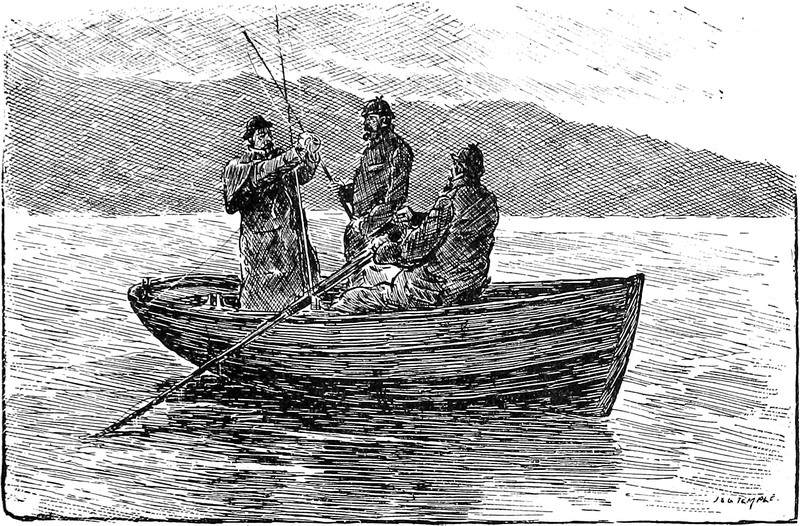
“HE LOOPED THE LINE ONTO THE OTHER ROD.”
The fish, which rarely weigh under twenty pounds, fight strongly, and carry out as much as eighty yards of line at a single rush, so that they always give magnificent sport before being landed. For some reason or other which cannot be explained, they will not rise to the fly. Phantom minnows of the ordinary form are used, with small screw-propellers at the nose to make them spin, and the better they spin the more likely is the angler to be successful. On arrival at the fishing-ground, the rods, which as a rule are fourteen feet long, are fixed in little forked rests and so made to point sternward at an angle over the gunwale. Forty yards of line are let out to trail (some allow as many as sixty yards), and a small stone is placed upon a part of the line under each of the rods. When these stones are jerked off, the watchful angler knows that he is fast in a fish. There are, of course, certain favorite bits of water, and these the boatmen take the rods over with great care.
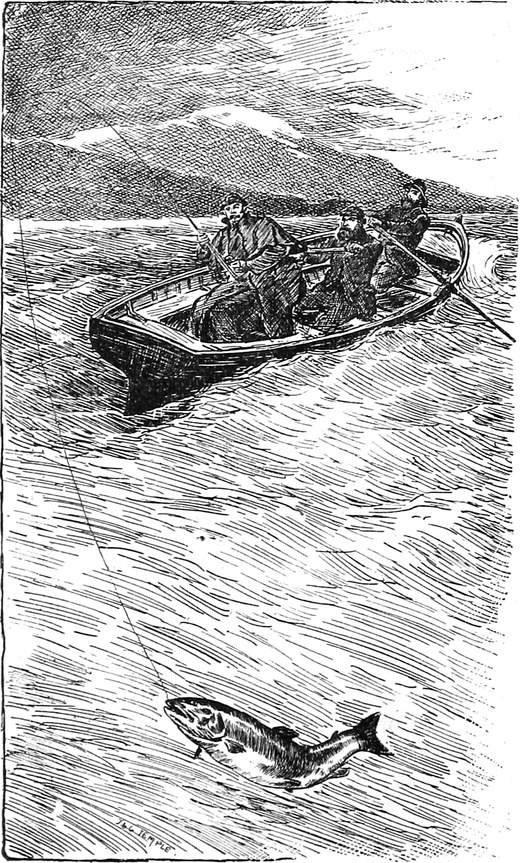
“WAS OBLIGED TO SIT DOWN WITH SUCH A STORM ON.”
The Loch Tay tackle has for some reason or other remained very heavy, and so boats cannot be taken close inshore for fear of the lines fouling the rocks or the weeds, which grow in many places in rich profusion at the bottom. And yet in these waters, near the shore, the most of the salmon are to be found lying in wait for food. Last year the heaviest salmon of the year—a magnificent forty-pounder—was caught with the lightest tackle and lightest rod ever used, and so there is very likely to be a considerable reform in Loch Tay trolling rods within the next few years. The capture of this fish is worth relating.
Mr. Geen, of Richmond, Surrey, a famous angler of southern waters, had determined to use the very finest tackle, notwithstanding remonstrances from fellow-anglers and boatmen. He made up his mind that with lighter tackle he could “troll” his phantom a few feet nearer the surface than with heavy tackle, an undoubted advantage in the bays, and that with a line less likely to be seen a fish was far more likely to take the bait. A light rod, he moreover thought, would kill a fish once caught, quicker than one which had neither spring nor balance, so he used what might be classed as an ordinary fly trouting rod of cane, with greenheart top. All the epithets of derision to be found in the Gaelic dialect were hurled at this determined innovation. Mark the sequel, and with it the adventure, one of the greatest feats of perseverance with a salmon under difficulties ever known in any angling water.
One of those sudden squalls which come down on Loch Tay and raise lumpy water in the centre came up. To seek shelter from it, he directed his two Highland boatmen to keep as near the shore as possible, so as to come circling round on the landward side of the fleet. This was close to a bold bluff known as Fat Man’s Rock. It was well on to five o’clock in the afternoon, and he had not struck a fish. Suddenly the stone sprang off the line under his inner rod as the boat swept round, and the reel began to run with a desperate speed and noise.
“We have got hold of the county,” said his boatmen—this being an ironical way of saying that he had hooked the land.
“No, we’ve not; it’s a fish,” said Mr. Geen, seizing the rod.
A fish, and a good one it was, too, for away it went seaward for 100 yards with a rush which staggered the boat, and then, salmon-like, jumped into the air. It was not long, however, before it returned to the place it was hooked, and here it began to be most troublesome among the rocks. These troubles, however, were small compared with what were to follow. As they reached deeper water again, his holder began to handle with much success, apparently, for he got him almost within reach of the gaff. Almost, but unfortunately not quite. James reached out, but miscalculated his distance, caught the line, and Mr. Geen felt something slip. His heart fell. Was he free? No! for immediately the music of the reel was heard again, and he was off, this time right to the bottom, sunk like a newly harpooned whale. There he assumed the customary sulky disposition. In vain they tried to drop stones on him. He was fully sixty yards down, and the stones no doubt never dropped near him. The weight of the rod was tried on him, with the result that six feet broke off at the top.
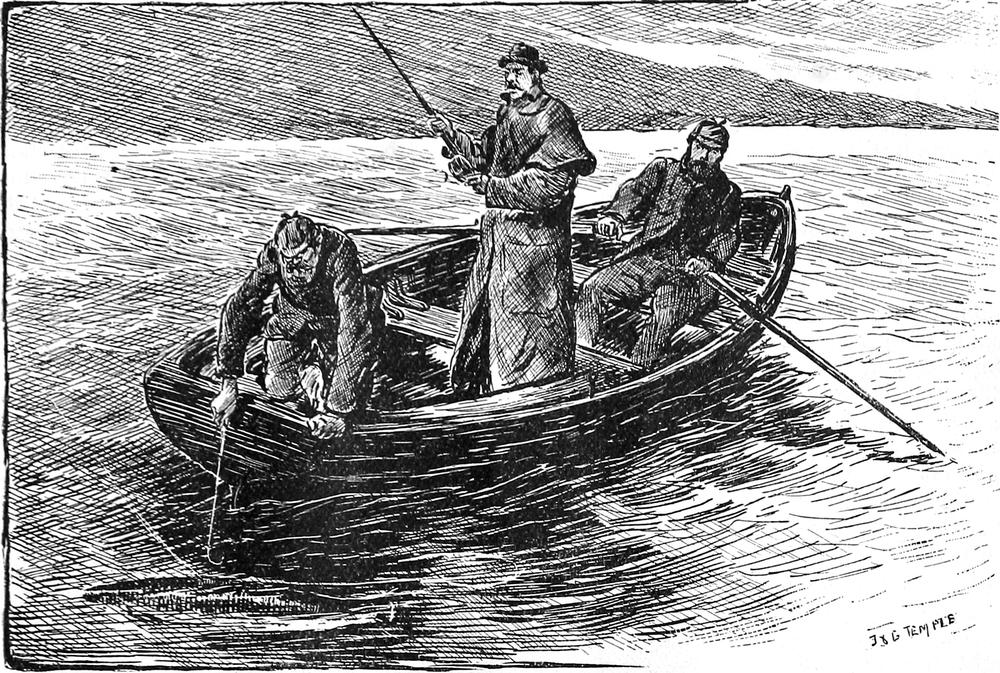
“HE WAS CAUGHT IN THE BACK FIN.”
Darkness was now gathering, and the boats were crowding down homeward to Killin and the Lochy Hotel. There was little sympathy on the part of boatmen and sportsmen for the gentleman with the light tackle and the cane rod. Some said he had hold of “the county,” others that his fish was a small one, too much for his rod, and some betted him two to one that he would not get it. One gentleman hailed him and said: “I will stand by you all night, and watch the result.” This gentleman, though he had not touched a fish for three days, was rewarded in the next five minutes by a salmon on his own line—the recompense of true sympathy with a fellow sportsman.
But what was to be done, and how was the rod to be mended? “Row quietly out, James, so that I may cut all my trolling line” (the line which is used outside the boat), “and I will put him on the other rod.” This was slowly done, till the line was fastened quietly on the second rod; though for precaution it was still, for the time, kept fast on the broken rod. The broken rod was then slipped by cutting off the connection, and once more Mr. Geen was prepared to fight in earnest, but this time against almost pitch darkness.
“We maun raise him, sir; he’s a deed fish,” said James; “he’s like a stane at the bottom.”
Inch by inch for sixty yards of line did James draw him up. At last he said: “I have come to the first swivel.” Still no fish showed the white of its belly. Up and up an inch or two more, and then—
“She’s gone, James!” said the holder of the rod, breathless with excitement, as the boatman made a lightning movement.
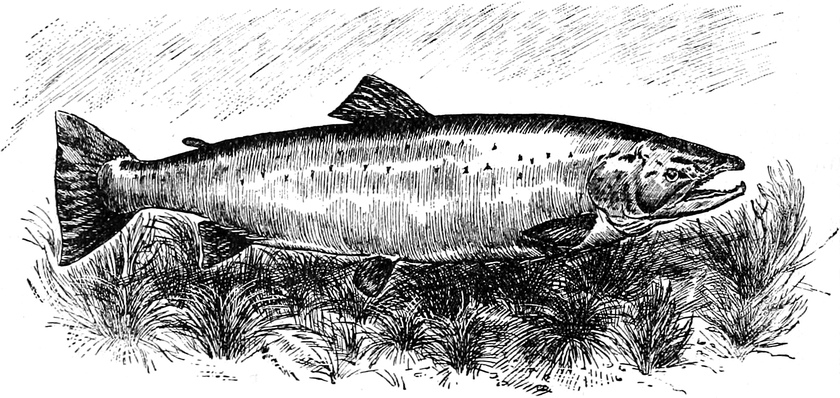
“Yes, sir. Give him the gaff!” and the next instant the magnificent fish was in the boat. Yes, there he was, hooked by the back fin. No wonder, indeed, that he was hard to lift. The reason that he had been hooked foul was because he had somehow got a turn or two of the line round his body, and while the hook had been jerked out of his mouth at the first time of gaffing, it slipped round and fouled him.
It was eight o’clock when the boat got back to Killin, and the whole village, man, woman and child, turned out to learn of this wonderful exploit, which will long be talked of on Loch Tay side.
Because Mr. Geen fought and killed this salmon successfully, it would be absurd to argue that all men who fish under the shadow of Ben Lawers should follow his example and fish with tackle of the finest quality, and rods as springy as a tandem whip. It will be argued by many that the difficulties in landing the fish were partly his own creation, i. e., the use of a rod which was not equal to the heaviest Loch Tay fish. We have had the pleasure of handling the rod, which is one of Canter’s best make. We have no hesitation in saying that though a lady might handle it without fatigue, it would prove far more fatiguing to a fish than the stiff rods at present in use on the lake. A salmon would come quicker within reach of the gaff when such a rod were wielded by good hands—and a man with bad hands will never make a good steersman or a clever man on horseback.
An invention made by Mr. Geen we liked much. It is a telescopic extra length of rod which drops off when the butt is seized and a fish is about to be played. This arrangement permits the point of the rod, in trolling, to be lowered, so that the angle between the phantom and the point is made more oblique, and the more oblique the angle is made the higher in the water will remain the lure. This is a matter of the utmost importance with revolving baits, as the screw will not work at times unless kept going almost parallel to the waterline, and the illusion remains incomplete. If any one is exercised in his mind about this, let him take a phantom and attach head and tail to something which will whirl round at the rate of six or eight revolutions per second, and he will understand the necessity. Hooks and all disappear, and you see but a small fish, and so does the salmon. Stop the revolutions and you see a fish with hooks, barbs, and everything else. I believe the double-screw propeller, which I saw some years ago, though not successful when applied to ships, would do well for phantoms, as giving one extra spin. However, it might raise the Gaelic bile to say too much, and when that is raised there are more than broken rods flying about.
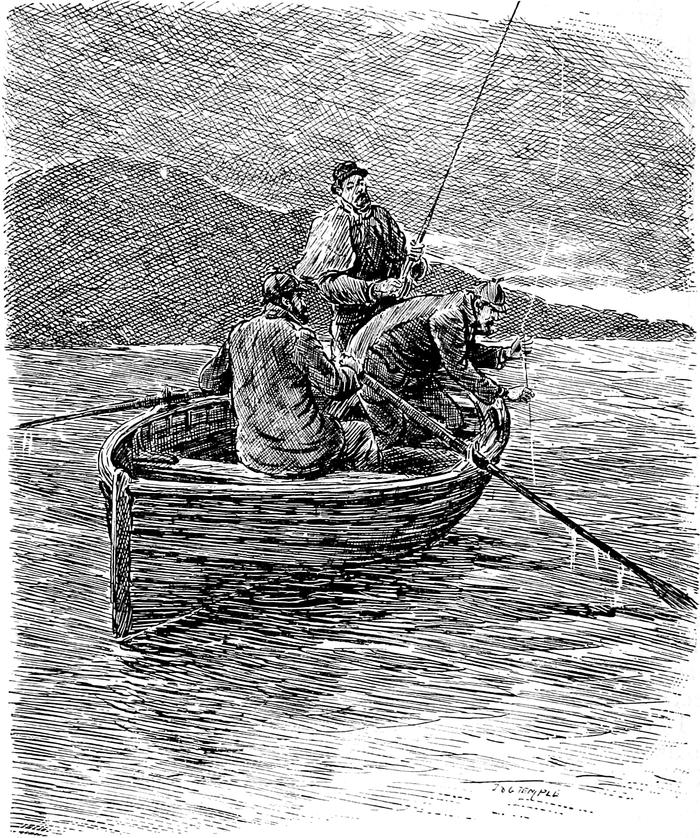
“THEY HEAVED HIM UP INCH BY INCH.”
When the fishing on Loch Tay palls on the angler, he may have some capital off-days in the neighborhood, a drive up Glenlocky being a favorite. The hotel is noted for its good horses. Then one can have a sail up the lake in these little fresh-water models of Atlantic greyhounds, The Lady of the Lake, and Alma Carlotta, to Kenmore. These pretty little steamers were designed by Mr. G. L. Watson, whose name is so well known in the yachting world. At Kenmore the beautiful grounds of Taymouth Castle may be visited, and they are well worthy of it, as there is nothing to beat them in either the Highlands or Lowlands of Scotland. Three miles beyond Kenmore is Abergeldy, where are the celebrated Banks of Abergeldy, whose praises the poet Burns has celebrated in undying song. The ascent of Ben Lawers may be made from Ben Lawers Inn, and a grand view of the Taymouth district be obtained, as it is the fourth highest mountain in Scotland.
As a rule, many of the off-days are spent nearer home, and a much frequented spot is the old ruins of Finlarig Abbey, close to Killin, and situated on the banks of the lake. One of the smoking-room stories tells how on one occasion, before an off-day party had been arranged by Stewart the landlord, a Macgregor had been bouncing about his famous ancestor, Rob Roy, in a manner which would have astonished the famous cateran himself. These, if not taken with a pinch of snuff, would denote that the Macgregor was always jumping rivers at the widest points, and playing at hop, step and jump from Ben Lomond to the Cobbler, and from the Cobbler over to Ben Lawers. Common report makes Rob out to have been a very clever gentleman cattle-lifter, but when a Macgregor gets hold of a few southern anglers over a tumbler of toddy in the smoking-room of a Scotch hotel, he is allowed to make him execute performances worthy of Jupiter. And “ye must na’ doot the word o’ a Macgregor, for ye ken it has aye been true, no like the word o’ the Cammells, which has never been kept.”
To get a joke out of a real genuine Macgregor was quietly suggested, and next day it was fully carried out. In the large hotel drag the Macgregor of the party was allowed to continue his marvelous sketches of the old chief’s exploits.
“But,” said a Saxon of the party, “how does it happen that all the places of interest connected with the Macgregor family are associated with escape? In Loch Lomond you are pointed out his Cave of Refuge; on the burn at Inversnead, the place he jumped when pursued, and the same in the Lyon—all, too, when fleeing from a Campbell.”
“A Cammell, did you say? A Macgregor flee from a Cammell? Never! It takes ten Cammells to make a Macgregor turn his back. Say a hundred Cammells and you will be right. Rob Roy flee frae a Cammell? That’s impossible! No; when his foot was on his native heath, and his good broadsword in his hand, all the dead Cammells that are in the ill place itself would never have made him run. Sir, you do not know the speerit o’ the Macgregors!”
“But they were a lawless, useless lot,” was the interruption of another knight of the rod, “and the country around here never did any good till they got rid of them in the old-fashioned Scotch way.”
“What do you call the old-fashioned Scotch way?”
“Oh, the gallows; dancing Gillie Callum and the Highland fling from an ash bush, with three feet of daylight below them.”
“And who dare do that with a Macgregor?” was the response, in tones of thunder.
Fortunately the skirr of the brake on the wheels of the trap, as Stewart took a pull at his horses, stopped the conversation. It heralded, also, our arrival at the old castle gates. The castle of Finlarig was in stormy times the residence of the Breadalbane Campbells, and the “auld laird” who occupied it made short work of such as were not Campbells who were found straying in the neighborhood. As the party walked in quietly, Stewart whispered to Mrs. Campbell, the guide, “When ye come to the hangman’s-tree ye maun say ‘saxty Macgregors’, instead of sax.”
“Guid save us, Mr. Stewart! Saxty Macgregors!” was the astonished reply, “that would be the hale clan o’ them!”
“Never mind; say saxty,” was the whispered answer.
The old ruins having been well explored—the Macgregor fuming all the time because “Sassenach fushing-men” would persist in making comparisons in its favor with the dirty old fox-kennel-like caves in which Rob Roy used to live—the party was then shown the old gallows-tree.
“Thet’s the plece,” said Mrs. Campbell, “where the auld laird hanged saxty Macgregors one morning before his breakfast.”
“Gregarach, woman! ye dinna say sae. It could na be saxty Macgregors,” was the indignant response of Rob Roy’s descendant.
“Saxty Macgregors, I say—saxty Highland vagabonds, if ye like; a half-dizzen [dozen] at a time. And a bonnie braw mornin’s work, nae doubt, it would be for the country side!”
“Saxty Macgregors allow themselves to be hanged! Hoots, woman, ye be bletherin’; they could nae have been true Macgregors!”
“True Macgregors? Weel, I’ll no say that; the Lord never made sich a thing as a true Macgregor.”
“And never anything but false Cammells. Saxty Macgregors!” and the champion of the old clan fairly wept for his unfortunate countrymen. Had the Maccalumore himself looked in and a claymore been handy, there would have been more tragic narrative. Humbled before the Sassenachs, he remained silent till the graves of Black Duncan and the old Campbell chief were pointed out, and then he had his revenge.
Jumping into the vault, he shouted to the attendant piper to play up “Macgregor’s March.” He then danced on the stones above the grave till the sparks were flying from the hobnails of his heavy boots. Ever and anon, as he wheeled and jumped, he uttered the words, “Saxty Macgregors!—hang saxty Macgregors! the scoundrels! Blaw up, piper, a guid auld Macgregor reel tune, Rothermurchis Rout, or anything with the music o’ the deevil in it. I could dance over a Cammell’s bones for a fortnicht!”
Mrs. Campbell possibly did not relish the performance as much as the “Sassenach fushing-men,” but very wisely did not interfere. Had there been a hatchet on the spot, the gallows-tree would soon have been removed and flung into the vault or hollow. Fortunately there was nothing better handy than the old headsman’s axe of the Stuart period (James Rex) given in the picture.
The Macgregor told no stories in the smoking-room that night about the feats of his ancestors, but if any “Bleck McFlea” roused him in the night-time, he was heard murmuring “Saxty Macgregors!” and then letting forth his opinions of the whole Clan Campbell in certain Gaelic words which are forbidden to be used by the Free Kirk in preaching Gaelic sermons. The little story of the gallows-tree at Finlarig Castle, where he was fair effronted afore the “fusher’s folk,” still haunts him, and he shows this by sudden fits of temper, which seemed to worry him when on the streets. But the smoking-room at Killin reeks with fishing stories and anecdotes of the kind, and more than one number of OUTING would be required to give them as they are given, over a tumbler of good Scotch whisky toddy, after a long day in the boats when salmon fishing on Loch Tay.
“HE WAS SENT HOME TO BE STUFFED.”
SONNET.
THE moon shone full upon the tide, On whose dark, heaving bosom wide The white light broke, till far and near, With dancing jewels, silver-clear, The sullen waves were glorified. We spoke no word—all beauties vied To charm our souls; and, satisfied, We felt no care, no doubt, no fear— For there we vowed, in accents dear, To walk life’s pathway side by side. Howell Stroud England.
WINTER SHOOTING IN FLORIDA.
BY F. CAMPBELL MOLLER.
WITH the middle of December the upland shooting in the Eastern States comes virtually to an end. To be sure, a couple of weeks remain before the curtain of legal protection descends over the game still to be found in the dead fields and snow-whitened coppices on the first day of the new year, but the remnants of the quail bevies are wild, and, in much shot-over districts, begin to approach in their watchful behavior and antics the typical wariness of the hawk. As for the ruffed-grouse, one needs to be a thorough workman, both in shooting and stalking, to render even a tolerable account of these birds. The last woodcock was seen nearly a month ago, this mid December day, as one fired and missed him among the black alders, and he is up and away on the next stage of his journey to the swamp-lands of the Carolinas or the Mississippi.
The sportsman resident of the country may at this season of the year have an occasional sun-gilded winter’s day with the setters, when the breeze comes warm from the south. But more often will he be listening to the tinkling, musical notes of his beagles as the brown hare leads them a circling chase through the brier-fields, or the deeper notes of the fox-hounds will strike upon his ear as they echo among the gray cliffs of the brown-treed mountain-side.
Yes, it may not seem to be quite the correct thing to my English readers, but we shoot foxes from a “runaway” in the rough, wooded, hilly country of the Eastern States, where it would be impossible to ride to hounds, and gladly do we accept this chance to rid our farmers of this destroyer of game and poultry.
After the 1st of January, comes the exodus of fashion, sport and ill-health from the rigors and blizzards of a Northern winter, and many are the queries from brethren of the gun, visiting for the first time the land of Spanish-moss and palm-trees, to those who have shot quail among the wild violets and sweet jessamine in the Carolinas during early springtime, or “plugged” alligators in some muddy “backout” of the Upper St. John.
No matter whether he knows how to use a gun or not, nearly every man off for an outing in the South thinks it necessary to take with him some such weapon for the destruction of animal life. This fact, in brief, is sufficient reason for the scarcity of game along the shore and in the waters of the traveled portion of the St. John’s River. Continual bombarding has driven the denizens of flood and field to remoter districts, and if one wishes really good sport, he must literally hunt for it.
The majority of men going South solely for sport take the Charleston, Savannah or Fernandina steamers, continuing by rail, if necessary, to their destination, which is certainly the most economical procedure, especially if one’s dogs be taken. This should always be done, if possible, as a dog fit for a sportsman to shoot over can rarely be hired or even bought in Florida until the end of the season.
If quail-shooting be the expressed desideratum, one had better confine one’s self to the Carolinas or to Georgia, both for quantity and proper ground to shoot over. But if he desires a variety, such as snipe, deer, ’gator and quail shooting, all on diverse grounds, lying, however, in the sweep of a short radius from the spot he makes his headquarters, Florida must needs be his objective.
If one is not going below the Carolinas, a rifle will be an unnecessary encumbrance. Bird-shooting alone will be obtainable unless you visit the wild mountainous country far from the paths of the Northern tourist. Here the shotgun and buckshot are the chief agents used in killing deer, and, in this sport as practiced in that section of the wildwoods, one must nearly always be able to ride well; and unless one is shooting on some friend’s invitation, he must also pay well for the auxiliaries necessary to secure a shot at the denizens of the woods.
The same directions will apply to “jumping” deer with dogs from among the stunted scrub covers of the Florida brakes. One generally shoots from horseback at the small deer of this region, because the saddle affords a much better opportunity of seeing over the clumps of dwarf oaks or palmettos than would be obtained on foot.
For alligator shooting a heavy bored rifle—especially an express—will be indispensable. A forty-four calibre repeater will, however, be found to answer very well for all-round work on the river. And here, let me at once dissipate any tyro’s fallacious belief regarding the invulnerability of the American saurian, save in the eye. I have known them—aye, big ones at that—to be killed with buckshot from a close-carrying shotgun, at a distance of thirty-five yards by planting a few pellets behind the fore-shoulder, and in the thinner skin of the lateral abdominal walls. Frequently a second or even a third shot at close range will be necessary to finish them as they lie floundering in the shoal and blood-stained shore-waters by the side of a half-submerged old tree-trunk. But more of ’gator shooting anon.
Tweed clothes of light color and loosely woven texture should be worn for Florida sporting, as it is warm shooting there even in midwinter. When shooting or outing generally, it is much better to increase the thickness and warmth of the underclothing as the coolness of weather renders such advisable, than to encumber one’s movements by heavy coats and trousers. A pair of thick, oil-tanned grained-leather knee-boots with legs made as narrow as permissible, to be worn with thick-ribbed, long hose, will be found the best shoeing to be used in the Florida bottoms. The long boots, coming over the buttonings of the snug-fitting knee-breeches of whipcord—not knickerbockers, mind you—where they fasten just above the swell of the calf, will be found the most comfortable and consistent rig, whether splashing through the sloppy prairies, along the river after snipe, or tramping the waste fields in the clearings between the pine woods. Should you wear ankle-boots and the baggy knickerbockers, always don a pair of thick leathern leggings as an indispensable precaution against the musical and larksome rattler.
Along the St. John’s, from Magnolia to Enterprise, increasing proportionately as one nears the latter place, fair sport may be had with all the before-mentioned varieties of game by driving or boating far enough into the recesses of the back country, away from the spots easily reached by the average hotel lounger. But for really good shooting one must get over into the Indian River region, or, better still, the Hummocks on the Gulf coast, and especially about Homassassa, if he wants good accommodation and an abundance of deer, quail, and snipe as well as bass fishing. Below Lake Georges and extending toward the Everglades is an immense breadth of country, comparatively unknown, rich in sport and adventure to the exploring tourist who is willing to endure much rough travel by canoe and portage, and to pitch his tent o’ nights in the great dense swamp-lands.
In Florida, quail are mostly shot in the open of the stubble fields or clearings, or in the slight cover underlying the tall, shadowy pine-lands, for the simple reason that the “thickets” in the far South are almost impassable. I remember once following a bevy of quail, flushed from an old maize field, into a bordering covert of prickly plum, cactus and palmetto, with the same indifference with which I generally plunge into the many-stemmed alder-brake or waist-high cat-briers at home. I shall never do it again. Let the bevy go! Start up a fresh one, and trust to your skill in “driving” them into lyings more favorable for your purposes, if not for theirs.
For shooting in the country back from one’s hotel a wagon and pair will be needed, and, unless you are well acquainted with the region, a driver and guide combined, be he “Cracker,” “Nigger” or Indian. As most of these gentry do a little pot-shooting themselves, in season and out, they will generally insure you good sport, particularly if the man is made to understand that an extra “tip” may be forthcoming, when you return in the evening, proportionate with the amount of game found.
A deal of shooting is done driving through the rough country, among the pine woods, leaving at times the sandy road for miles together, provided the undergrowth be not too dense. And with the dogs quartering on each side of the wagon, one has but to get out and shoot when a point is obtained.
I find No. 10 shot, backed by a heavy charge of powder, the best size for shooting Southern quail, which, by the way, are a trifle smaller than the Northern bird, although identical in all other respects. No. 10 shot is also the proper size for snipe. Some capital bags of these migratory birds may be obtained even on the meadows—or prairies as they are called in Florida—suburban to Jacksonville.
But quail and snipe shooting in the South, with trifling differences as to covert, haunt and lyings, inseparable from the richness of the tropical setting and coloring, will be found so analogous to the same sport in the North that further comment is unnecessary. However, it will prove a new and delightful experience to the Northern sportsman to flush birds, as is frequently done, in the scent-laden atmosphere amid the glorious coppery splashes of color of an orange grove, and see through the tree-stems the blue St. John’s flashing its sapphire width in the warmth of golden sunlight, and the solitary giant palm rising here and there along the far, sandy shore.
A day with the alligators is not bad sport when properly undertaken and provided for; and the hide, teeth and feet will put you in possession of much valuable material to be made into bags, leggings, slippers, shoes, whistles, and gun-racks. But since the utility of the ’gator’s hide has been discovered, they, too, are fast disappearing from the places wherein they formerly abounded.
This sort of sport does not demand an early morning start. The best time to approach within easy range of the alligators is while they are taking their siesta at midday or early afternoon, sunning themselves on the bog burrocks, which, in lieu of a beach, mark the line of demarcation between the waters of the bayou and the swampy forest bottoms.
Your skiff and man—who, by the way, should be a good paddler and familiar with the haunts of the quarry you intend pursuing—having been engaged over-night, you may breakfast as late and as leisurely as you will, provided you have not too far to row to your proposed ground before high noon. So, enjoy your repast of fresh fish and game of the region, after having previously coolingly and deliciously prepared your palate with a goblet full of pure orange juice from fruit plucked that morning. Your sable attendant is waiting outside in the warm, genial sunshine, in which all of his color love to work for periods almost indefinite, and relieves your waiter first of all, because to him the most important, of the luncheon hamper, grinning the while, and giving a soft “chaw! chaw!” as he hefts its portentous weight and eyes the claret and beer bottles protruding from one of the partly raised lids. This all being to his entire satisfaction, he will pick up your macintosh coat and shotgun and precede the way to his boat. You take a gun as well as a rifle, as doubtless you will get some shots at ducks and shore-birds as you row to the creek and back, especially the latter, because the evening flight will then be on.
Your man may have pulled you for nearly an hour, and as you near a bay which marks the outlet of a creek leading to the lagoon where you intend paddling for ’gators, an object well out from shore attracts attention. It looks like a water-logged dead branch floating under water, save for three knotty protuberances rising above the placid surface. It is the snout, orbital bone and topmost spinal joint of a ’gator, at least eight feet in length, judging the distances between the slightly exposed portions of his scaly frame. No use firing at him; even if one did hit the small mark he gives at 200 yards, he would only be lost, for a dead or wounded alligator will always sink to the bottom, and there, where that old chap is floating in silent content, the water is much too deep to use the long boat-hook or the grapnel to fetch his body to the surface.
Entering the bayou, the darky exchanges the oars for a thing he calls a paddle. Not as delicately shaped is it as are those you have used about Bar Harbor or on the Adirondack lakes, but it will answer the purpose admirably. You seat yourself in the bow of the boat with your repeater across your knees. There is a fascination in this coasting along the weird, shadowy banks of the tropical creek, with its wealth of beautifully and vividly colored birds. Rounding into the entrance of the lagoon one sees a flock of white heron with wings glistening and flashing in the sunlight as they fly over yonder moss-hung headland; and the brilliant flamingo dyes with a gliding streak of salmon-pink his reflected flight in the shaded, still waters underlying the wild tangle of the wooded shore along which your boat is silently creeping. The skiff rounds the headland.
“Look yaar, sah! Dere he be—ole ’gator on a lorg.”
“Where? where?” is hastily whispered, as you anxiously scan the shore-line for a hundred yards ahead. Nothing, however, meets the inexperienced eye but a wild reach of water-grass, rushes, bog-burrocks and partly submerged fallen tree-trunks.
“Dar, sah! under dat big cypress, ’bout ten rod ahead, and lying on de lorg on de show. Shoot, or he’ll be orf next minit,” hurriedly whispers your “gillie.”
“Ah! there he is.” One holds just back of the fore-shoulder. Bang! “He’s hit!” Then his tail wildly beats the air, and he rolls into the water, which just covers but does not conceal his frantic contortions, only to expose himself to a second shot as he flounders up on some sunken logs. The man has grasped the oars after the first shot, and is rowing rapidly to the spot where the mud and spray are being whirled vigorously about.
“Give him a shot in the neck.” Missed! but no matter.
Now we’re within twenty yards of him. “Stop, Joe; don’t row up any farther. Keep well out of the reach of his tail.” Now, pump another ball at his head or neck to break his cervical vertebræ. “Good!” He rolls off the log, but “rolled off dead, shoo,” says woolly-head, showing his ivories, and getting the long-pointed hook ready for use when the blood-stained waters shall have cleared away.
While the darky busies himself with removing the alligator’s skin, you start off for a shot at a flock of teal which has come dangerously near, and perhaps you also secure some plover. There is every reason to be satisfied as you turn your boat down stream for home. The waters are aglow in the evening sun; not a breath of air is stirring; everywhere calm and quiet. You puff away at your pipe, and as you gaze at the ’gator skin in the bottom of your skiff, you find a use for every tooth and every inch of hide, and you picture to yourself the pleasure you are going to give to numerous friends. It is well to dispose of your cargo in this way before you make your landing, for there at the wharf you will find assembled the usual contingent of pretty girls waiting for the evening steamer and the return of the different boating and shooting parties. Hard-hearted will you have to be to withstand the pleadings for mementos, etc., and there is every probability that when you reach your hotel all that you have left will be the memory of a pleasant afternoon with a ’gator.
THE CRUISE OF THE FROLIC.
BY S. G. W. BENJAMIN.
THERE is no cruising-ground on the coast of the United States equal to that around Massachusetts Bay, and north as far as Portsmouth. The ports are frequent and generally easy of access, and the variety of scenery, the picturesque nature of the coast, the sea flavor about the character of the people, and the quaintness of the towns of that region invest it with singular raciness and an endless variety of charm. Our yachtsmen are fast finding this out, although I think one can better enjoy and appreciate these attractions when cruising in a small five-tonner than in a large yacht, or in the company of a fleet, for there are many curious nooks which only such a wee ship, off on a roving commission by itself, would think of visiting. And it is this very dodging among these odd corners of our coast that adds especial zest to the enjoyments of your cruising yachtsman.
So much by way of preface to the statement that a lot of jolly sons of Gotham made up their minds, on a certain summer in the eighties, to fly the hurry of Wall Street and the temptations of a sinful metropolis for the pure breezes of ocean, following in the wake of the sea serpent and of the Pilgrim discoverers.
No seaport in America offers so many small craft handy for inexpensive cruising as Boston. And hither Benton, our Corinthian skipper, and the writer of this log hied in search of a suitable sloop or schooner obtainable at a reasonable sum. The keel sloop Frolic was finally selected, and put into proper condition by the addition of fresh paint, new cushions and curtains, a yawl, and the like. Charts and compass, lead and fishing-lines, a new cable, and a stock of provisions, including a supply of fluids, were also put on board; the rigging was set up anew, and last, but not least, the crew was engaged. It consisted of one pock-marked, grizzly-bearded mariner, whose appearance was not altogether in his favor. But he came well recommended; had been mate of a brig, it was stated, and had also sailed in many yachts. He declared himself able and willing to pilot us into every port as far as Eastport, to do “light cooking,” to serve as steward, and bear a hand in working the sloop; he was, in fact, a paragon of nautical excellences. My experience has led me to doubt those who lay claim to such versatility and virtue, whether on land or sea, whether in matters horsey or matters marine. But Mr. Brown was the best who offered, and was therefore regularly enrolled on the ship’s list of the Frolic.
Scarcely was everything in readiness when Will Hallett and Frank Weller arrived from New York, and made signals from the wharf that they desired to be taken on board with their traps. For them the proposed cruise was one of unusual interest, as they were novices in cruising, although not altogether ignorant on the score of boat sailing. They anticipated no end of fun, far more, doubtless, than is generally found in these summer wanderings along the coast, which are sources rather of quiet, healthy relaxation than of stirring adventure, and we older hands thought it unwise to quench their young ardor.
There was little wind, but the weather was fine, and it was hoped that with the sunset a breeze might come up that would float us down to Marblehead before midnight. While Brown was loosening the sails a propitiatory libation was offered to Neptune or his representative in those waters. All hands then fell to and set the mainsail and gaff-topsail, and got up the anchor. It was two hours yet until the turn of the tide, and with this to aid the sloop we might easily drop down past the islands, and the moon would light the night watches. But as evening drew on the light westerly air entirely died away, followed shortly after by signs of a fog from the bay.
Under the circumstances the sloop was headed toward Long Wharf, and anchored, amid a cluster of yachts and coasters, south of the main channel. About midnight, the night being very still and ghostly, and a heavy, dripping fog lying on the water, through which the moon and the nearer anchor-lights were barely visible, Benton was aroused by a steady thump, thump, thump. He recognized the sound at once. A large schooner, swinging with the tide, was bearing down on the sloop, threatening to carry away her main-boom. For Benton and Brown to rush from the cuddy in vestibus naturalibus, bestride the damp boom and jump into the boat and pull the stern of the sloop out of the way, was but the work of an instant. But, as everything was dripping with fog, the Spartan simplicity of the costume produced a chill which it was thought best to modify without delay by a searching prescription of rye.
The following day opened windless and foggy. In the middle of the forenoon the fog lifted and showed a sullen, ominous offing. By noon a breeze set in from the northeast.
“Let’s get up the mainsail,” said Benton.
“You ain’t agoin’ to sea to-day, be you?” asked Brown.
“Why not?”
“Don’t you see the wind’s dead ahead? We’ll have a dead beat of it down to Marblehead, and if it comes on to blow I guess we’ll get caught out and have to run for a lee, and the fog on the coast just as thick as mud.”
“Oh, I guess not. At any rate, there’s a breeze, and we’ll try it! We’ve got a chart and compass, and if it don’t blow harder than this we’re sure to fetch up inside of Marblehead Light before dark.”
Reaching down to Apple Island, through the main channel, the Frolic fetched a tack up to Shirley Gut, a tortuous channel between Deer Island and Point Shirley, which is impassable except for small vessels. The tide was running out, while the long swell was rolling in. The two meeting on the bar made a mass of boiling foam that looked a great deal more savage than it was in reality, if met with a steady eye and a firm hand at the helm. The tacks here were short, and the Frolic, carrying a stiff weather helm, and buoyant as a duck, rapidly and gracefully shivered her sails. and fell off on the other tack every time, flinging the spray aft in sheets. But we were soon clear of this and riding on a green swell enveloped by a mizzling fog. Now and again a coaster suddenly loomed out of the mist and hailed the yacht to learn the bearings of the land. The bold red cliffs of Nahant and Egg Rock were successively passed. Ram Island, off Swampscott, and Roaring Bull, off Marblehead Neck, were gradually seen, or rather the cold white foam that beat against their faint coast line; then the cruel ledge called Tom Moore’s Reef, which the sloop passed with a rush, glad to be clear of such a dread foe under the lee beam. Soon after, Marblehead lighthouse was hailed with satisfaction, for the rising sea and strong gusts coming with growing frequency, made it desirable to reach a safe anchorage before nightfall, now rapidly approaching with the settled foreboding gloom of a gathering storm. Moll Pitcher, the presiding witch of those shores, was evidently brewing foul weather.
Rounding the Light, and easing off the mainsheet, the Frolic flew down the little port and took a snug berth near the quarters of the Eastern Yacht Club. That night it blew great guns, and rained in torrents; but with both anchors down and plenty of scope, in one of the snuggest harbors in the world, we realized that there is nothing more cozy under such circumstances than the cuddy of a trim yacht, with a warm supper and a jolly game of whist.
The Frolic was not much to boast of in the way of size or splendor, but she was comfortable, and that is the chief thing. She was thirty-two feet long over all, and twelve feet beam, and, of course, a keel boat. A centerboard box so reduces the space in the cabin of a small cruising yacht that it should be avoided. A small stove was placed in the forepeak, leaving a narrow transom for the sleeping quarters of the crew. The skipper and friends entirely occupied the main cabin, as it was called with a certain grim humor, where we had just five feet of head-room.
The day broke pleasantly, contrary to expectation, the blow being merely a summer storm. It was Sunday morning, and all hands except Brown went ashore to buy beans and bread for breakfast. That meal over, we turned out for a quiet smoke, when Brown followed instead of remaining below to wash the dishes, a homely but necessary duty which falls on the crew in small yachts. If there be no crew, strictly speaking, the passengers are naturally expected to contribute their labors toward the domestic duties of running a sloop down the coast. It was evident from the look and manner of the aforesaid Brown that trouble was brewing in the forecastle.
“It looks like good weather for running down to Gloucester, Mr. Brown,” said Skipper Benton; “how soon do you think you’ll be cleared up below?”
“I guess you’ll have to go without me,” replied Brown, gruffly.
“How so? What’s up now?”
“Wall, you see, this ’ere job ain’t what I calkilated on. ’Tain’t for me, who’ve been mate of a brig, to be washing of dishes and cooking of food. ’Twan’t so understood when I agreed to go in this ’ere sloop. I’m willin’ for to steer my trick and bear a hand in making sail and the like o’ that; but I understood I was to be skipper aboard, and not steward. I ain’t goin’ on no such job as you are givin’ me; you’ll have to find somebody else in my place.”
“But you understood perfectly well what we expected you to do, and I can bring witnesses to prove it. What you are after is perfectly plain; you want to get an increase in the wages I agreed to give you.”
“Well, and what if I do? You don’t expect me to keep on with you at a dollar and a half a day, and work in this blamed fashion?”
“I certainly did, and I could hold you to your bargain. But we’d rather have you go at once, without another word. We’ll put you ashore, and the sooner you clear out the better. We want no lily-fingered hands on this sloop.”
Brown growled and grumbled, evidently disappointed at the result of the mutiny, but Benton was firm.
The boat was hauled alongside, and the mutinous crew was rowed to the nearest wharf. Lest he should poison the loafers on the wharf against us, one of the party kept within earshot of him, while another went in search of a man to take his place, which was by no means an easy thing to accomplish under the circumstances. Happily Benton had acquaintances among the sea-folk of Marblehead, and by their aid was soon able to engage Uncle Joe, who came on board the Frolic immediately after bidding his wife good-bye. His only fault was his age. He was really too old for service, having passed a good part of a long and well-spent life on the Banks. In other respects he was an admirable specimen of a Marblehead sailor; a clear, honest blue eye gleamed under a broad brow, frosted with white, and a thick snowy beard fringed the lower part of his bluff yet kindly features. He had seen seventy winters, yet stood erect and firm as when he first walked a schooner’s deck; his conversation was a racy combination of simplicity and shrewdness. Uncle Joe’s outfit for the trip was comprehended within a cotton handkerchief. He was a steady smoker of the pipe, but had sworn off from anything stronger than tea and coffee.
Ten minutes after he came aboard, the Frolic was under weigh and bowling across Salem Bay with a stiff westerly breeze abeam. There is not a finer yachting port in America than Salem Bay, with its cluster of islets protecting it from easterly gales, and the group of little harbors—Marblehead, Salem, Beverly, Manchester, and the Misery diverging like the fingers on a hand. For sea picnics in which ladies and children can join, there is no water safer, and at the same time more attractive on our coast.
The Frolic stowed her jib at Misery Island, and came to anchor in its little port, where a boat may make a landing on its miniature beach in all weathers. A quiet night was passed there, and in the morning, while some of our party were bathing, Benton strolled over to the east side of the Misery and painted the beautifully colored rocks of House Island, close at hand. We hasten to add that he did not actually paint the rocks themselves, but made a sketch of them on canvas. This explanation is given because many on that coast would not so understand the phrase. A friend of mine went down to Salem from Boston to take studies of old schooners. Seeing a rusty, picturesque craft lying at Derby Wharf, he said to the old skipper:
“How long are you going to be here, for I should like to paint your schooner?”
“You needn’t bother yourself about a paintin’ of her. I guess I can do all the paintin’ she needs,” replied that ancient worthy, squirting out the tobacco juice, and not condescending to look up from the sail he was mending.
There was to be a yacht race that day at Marblehead, and toward noon the Frolic stood out toward Halfway Rock to see the racers on the home-stretch. The wind was sou’west, a green hump of a sea was heaving up foam to the southward, and the sky looked very hazy to windward. In other words, it was blowing a smoky sou’wester.
Glancing often and anxiously toward that quarter, Benton said:
“I don’t altogether like the look of things to windward; it’s going to blow, and I’m thinking we had better be making tracks for port.”
“I don’t think it’ll amount to anything; it’ll go down with the sun; don’t you think so, Uncle Joe?” asked Frank.
Thus appealed to, the old salt, puffing vigorously on his pipe, closely scanned the offing, and said, “I don’t know about that; it looks kinder measly to windward; one can’t tell much about these sou’westers; they don’t never tell what they’re goin’ to do; but I guess ’twon’t be no harm done if we stand in and smoothen the water a mite afore it comes on to blow. I’m thinkin’, too, we’d better haul the topsail while we can.”
“Aye, aye, take her in, Uncle Joe,” replied Benton, as a smart puff laid the Frolic down to her trunk. Scarcely was the topsail stowed than it became necessary to take a reef in the mainsail as a precautionary measure. The sloop was headed for the Marblehead shore in order to have a lee if the breeze should develop into a heavy squall, as now looked more than probable. The racing yachts were now sweeping by, burying their lee rails and reefing down for the coming blow.
All went well, however, until we came abreast of Marblehead harbor. One glance at that port was enough. The water, an inky black, was furrowed and lashed to foam by a furious squall that was advancing with frightful rapidity. I have never seen the surface of the sea look more wicked.
“Now, boys, be lively! Let go all!” cried Benton, grasping the tiller with both hands and bracing his feet for a good hold.
Frank sprang to the jib downhaul, while the others let go the mainsail halliards, just as the squall struck the yacht. The jib went down on the run, but the throat halliards jammed, and the pressure on the canvas was such that the sloop failed to fall off with the helm hard up. She lay over on her side, half buried in the water, and in the most imminent peril. Springing up the mast and hanging to the hoops, Frank started the gaff. As soon as this was done she began to pay off before the wind. But for the mainsail being reefed the Frolic would have gone down; as it was, her standing room and cuddy were half full of water when she righted.
Brought down to balance-reefed mainsail, the Frolic was steered handsomely under the lee of Peach’s Point and came to anchor in Doliber’s Cove. During this exciting episode a small schooner, caught as we had been, capsized and went down in shoal water, and the crew clung to the mastheads until picked up, while in every direction vessels were seen carrying away spars and sails, and running for a lee.
The squall proved short as it was violent. In two hours everything was balmy and serene, and we decided to steal across the bar by moonlight, leaving it to circumstances to guide us. The idle wind of evening wafted us to the entrance of Manchester port, and under the jib we let the sloop drift until she brought up in the mud and eel-grass, for it was ebb tide. We lay half dozing and dreaming on deck until the turning tide lifted the yacht, and a light air from the southward coyly filled the jib. Thus we glided until fairly among the wharves of a wee little haven inclosed by hills, houses and thickets. The mud-hook was dropped, and with every prospect of a good night’s rest after the vicissitudes of an exciting day, we all turned in, but, as it proved, alas, not to sleep.
The quiet of the cuddy was suddenly broken by a strong English monosyllabic exclamation. Then Frank was heard to give his cheek a smart slap; expressions more or less desperate were now heard from every quarter of the cuddy with alarming frequency and distinctness. It was too true—the ubiquitous, merciless and innumerable musquito had invaded the Frolic. He came attended by ten billions of miniature demons thirsting for blood and buzzing a song of triumph, like the distant tuning up of an orchestra of bagpipes in an approaching thunder-storm: these atmospheric sharks drove us pell-mell on deck, but there they seemed not less numerous and infuriating. At length, as a relief, the dingey was drawn alongside, and leaving Uncle Joe to look out for the yacht, the rest of us slowly paddled about the little port. There was no fault to find with the night. It was absolutely serene. The sky’s fathomless purple was without a cloud, spanned by the Galaxy’s illimitable train of mystic splendor reaching up from the south. The moon was at the full, and its argent light turned the little fishing haven into a cave in the land of dreams; by that magical glow old farmhouses and barns were transformed into fairy pavilions, and the fireflies darting hither and thither appeared like the flicker of torches lighting phantom halls. A weather-worn schooner leaning against a barnacled wharf might have passed for Cleopatra’s barge, as she lifted her moon-silvered masts against the stars, her maintruck jeweled by a planet. The stillness was almost awful. “Dear God, the very houses seemed asleep!” At intervals only a melancholy whippoorwill in a distant thicket dared to utter its complaint on this perfect summer night.
Toward dawn the tide began to slacken, and with a line attached to the end of the bowsprit we towed the Frolic to the mouth of Manchester port. Finding no mosquitoes there, and no likelihood of a breeze to disturb us for some hours, we again dropped anchor and enjoyed a delicious slumber until the noisy cocks on the neighboring shores insisted that we awake and see the dawn.
What can equal the solemn splendor of a summer dawn in such a spot! A gradual glow deepened in the cloudless east, and the morning star shimmered on the brow of the coming day, casting a quivering trail of silver on the pale, glassy surface of the ocean. The shores of islet and mainland were thinly veiled by a gray gauze of mist, and the songs of awakening birds came from far and near. The metallic beat of oars on the tholes, heard faintly in the distance, announced that the early fisherman was going forth to catch the early fish. Benton, who had been quietly feasting his artistic eye with this enchanting scene for some time, when the vane of the Manchester-by-the-Sea church caught the first flash from the sun bursting above the sea, put his head down the companion-way and shouted:
“Come, boys, come! Turn out! Sun’s up, and we’ve no time to lose if we are going to get to the Shoals to-day!”
“Oh, pshaw! why not let a fellow sleep awhile?” yawned Hallett; but the discipline of the ship, or rather the delicious fragrance of the morning air, could not be resisted, and ere long the seductive aroma of coffee was noticed stealing from the cuddy. Breakfast dispatched, all sail was made, and before long the Frolic was abreast of Kettle Cove and the pretty settlement of Magnolia. After passing the Cove the breeze freshened, and when off Gloucester harbor the kites were taken in, as the puffs off the land were fresh and frequent. Standing across Milk Island Channel, then impassable owing to the tide, we sailed around Thatcher’s Island, whose trim granite lighthouses, 130 feet high, towered grandly above us. The wind here was very fresh, and the Frolic fairly scooted. To make it easier going we took the dingey on board, laying it across the cabin trunk. The day was fine, and many sails were seen, including those of a number of yachts. Having safely passed Hallibut Point, as the day was warm notwithstanding the breeze, it was deemed prudent to go below and partake of what Dick Swiveller called a “modest quencher.”
Uncle Joe being weary, and Frank being willing to show his seamanship, he was left for a few moments in charge of the tiller, the sloop being under mainsail and jib, and the wind on the port quarter. He knew how to steer reasonably well, and we never knew exactly how it happened that at the precise moment that Benton declared the lemonade to be exactly right the Frolic gybed her main-boom and went over almost on her beam ends. We were all thrown together in a heap; and as for the lemonade—well, the less said about it the better, for it mingled with the flood of water that deluged the cuddy. Puffing and blowing we scrambled on deck, where, happily, nothing had been carried away, but we had a close squeak of it.
After this drenching we found the sloop was just abreast of the entrance to Essex. As we were off on a cruise to nowhither except the land of fun, it suddenly occurred to us that none of us had ever been to Essex. Why not put in there and take a look at things? Out came the chart, which showed a clear but narrow channel hedged by shifting shoals, and with sandbars on each side. The weather being fine, we were soon inside the snow-white sand-hills of the bar, and came to an anchor, as the channel thence to Essex is tortuous, beset with rocks and impassable, except with a favoring tide.
The sunset came on serenely, the golden glow tingeing the white sand-dunes where lay an old wreck. The plaintive wail of the sandpipers hopping on the sand gave an indescribable effect to the quietude of the scene. How pleasant was our long chat that evening with our pipes! Sometimes one spun a yarn of the sea, and then followed an interlude of silence, or a bit of humor that elicited a genial laugh. The stars were thick that night and the dews heavy when we turned in to enjoy a night of calm repose, after voting that there is no out-of-door sport that offers more charms than cruising in a yacht.
The Frolic was left in charge of Uncle Joe the next day. There was a dead calm and promise of a continuance of the same for a day or two, so we started for Essex in the dingey. It was a pull of five or six miles along a winding channel, but we proceeded in a leisurely manner, stopping at various attractive spots on the way. One of these was Cross’ Island, in mid-channel, a hilly islet containing a clump of trees to relieve its bareness. A few shanties were scattered along its slopes, of which the oldest were thrown up years ago for the gentlemen who were in the habit of spending a week or two in October shooting in the neighborhood for water-fowl. One of these shanties was on a rock at the water’s edge, having bunks built into the sides as in a ship. On our return from Essex, two of our party passed the night there, and the sound of the tide rushing under the shanty as one lay in his bunk conveyed the impression of being at sea.
We found Essex a quiet, old-fashioned village of two or three thousand people, offering no special attractions beyond the stock of provisions we obtained there. It was formerly one of the chief ship-building ports of New England; but now one sees only here and there a fishing schooner or coaster on the stocks. The most striking characteristic of the population of that worthy burg is, that the people belong mostly to three families: the Burnhams, Storys and Choates. If one should throw a stone in the streets of Essex, the chances are three to one that it would hit some one bearing one of those names. It is evident that, as in Plymouth, the people are still largely of the old New England stock, a hard-headed, sturdy, close-mouthed, shrewd, sensible, conservative race, not easily swayed, not given to sentiment, but liable to occasional impulses of popular feeling that surprise one who would not look for it in that quarter. During the period of the witchcraft delusions, the people of Essex yielded to the notion that the devil was marching on their place with a legion of evil spirits.
Leaving Frank and Will at Cross’ Island, Benton and the writer returned to the Frolic towards evening. Uncle Joe was seen quietly smoking his pipe on deck, and was rejoiced to see us back. The position of the sloop was exposed, and he was old, and did not care to be in charge alone all night. The boys promised to be back in good season the following morning, hoping to come off in a passing dory. But either they failed to get such conveyance as early as expected, or they found life on the island too agreeable, for they did not put in an appearance until afternoon. The breeze was then too light to reach any place before night, and we were forced to lie at Essex until another day.
The sky looked hazy at sunset, the sun was yellow, and the surf had a deep hollow roar on the bar, all signs indicating a gathering storm of some duration. We therefore moved the Frolic a little north of the berth where she was lying, and kept a watch on deck all night, lest it should come on to blow before dawn. I do not know of a more wild and desolate scene on our coast than where the Frolic was anchored, especially at low tide; on all sides white sands and dunes, or gray sands reaching miles and miles, and the air filled with the spray from the ever-rolling surf, beating on the bar from age to age.
It was scarcely dawn when the writer, the watch on deck having fallen asleep, was awaked by a cold sensation on his side exactly like a snake creeping up his leg. That it must be a slimy reptile was the first thought that flashed across my mind, the more naturally, perhaps, because I once had a centipede leisurely creep on the bare skin from the ankle to the knee. But as soon as I was wide awake, I realized that the Frolic was lying aground on her bilge, and that the bilge-water was pouring into the lee bunks. Either she had not been pumped dry the night before, or her garboard had opened with the strain of lying high and dry. That we should be left by the tide in such a position was due to the extreme low ebb, and the fact that the boat had swung out of the channel. In any case there was nothing to be done but await the course of events.
The sun arose out of a cloud-bank, and the weather looked threatening, but while we were waiting, two of the party walked off across the sands to obtain fresh milk from the house where Rufus Choate was born, which was in plain sight of the bar. While they were gone we put our oil-stove into the dory alongside, and put the kettle on. The crabs were running out to sea by the myriad, and when the water was boiling we picked them out of the water and tossed them into the kettle. It is needless to say that that portion of our breakfast that morning was fresh and appetizing.
By the time the breakfast was eaten it became evident that the sooner we found another port the better, as the wind was piping up out of the northeast and the sea was rising so fast it would drive us ashore when the Frolic floated. But as the tide rose we saw to our surprise that the Frolic did not rise with it, but had settled and lay on the sand like lead, while the water flooded her lee decks. There was not a moment to be lost. Unshipping the block from the jaws of the gaff we attached it to one end of a hawser, at the other end of which was an anchor. This we carried out into deep water in the dingey; then, bowsing on the throat halliards, we brought the Frolic upon an even keel, when she floated. In ten minutes we were under mainsail and jib and beating out to sea. The Frolic staggered under that canvas, but was forced to carry it in order to meet the heavy sea and tide and hold her own in the quick, short tacks in a narrow channel, hedged by sand-shoals white with breakers.
Fairly past that danger, we had to face the question as to the course to be followed. To beat up to the Isles of Shoals or Portsmouth against a freshening northeaster on a lee shore, seemed foolhardy unless for a good reason. We had to choose between running for Cape Ann and a lee, or heading for Newburyport, by way of Plum Island Channel, Ipswich Bay, its entrance being on our lee beam. This being a terra or aqua incognita to us all, offered the zest of novelty. We decided in its favor nem. con. The helm was put up and the sheets eased away, and the Frolic galloped over the high seas like a racehorse. The channel here follows the southern shore of the bay past the light-house. That was the only course for us to take, but under the exhilaration of the sea wind we recklessly headed directly over the bar, a piece of folly to which I now look back with amazement, as it was absolutely unnecessary. The Frolic steered rather wildly with a quartering sea, and the swell rose steep, hollow and furious as we approached the bar, which had been bare and above water two hours before. Happily for us, the Frolic whooped over the bar on the top of a great roller, and a moment after we were gliding in smooth water. Had the sloop gone in on the fall of the sea she would have left her bones there, and perhaps her crew as well.
It was a short run from the turning-point to Grape Island, a section of the long, low breakwater called Plum Island which has been thrown up in the course of ages to protect the pastoral shores between Essex and Newburyport, and offer a hunting-ground for sportsmen. Plover, sand-pipers, rail and duck abound there, and the hummocky character of the surface of the island, tufted with sedge and salt grass, and intersected with creeks, offers fine opportunities for stalking the game. Many a rare spirit has found solace on those lonely island moors in the fall of the year in times past, and the region is haunted by legends of wrecks and sporting characters, who have made it a “happy hunting-ground.” One story may not be generally known concerning a certain well-known worthy of thirty years ago, remembered for handling the long-bow as well as the rifle.
“Sand-peeps?” said he to one, who was asking about game on Plum Island—“sand-peeps? why, bless you, there’s millions of them! I crossed over to the island one afternoon in October, and left the dory in a creek. Then I just clamb a little hill and up flew an all-fired big flock of sand-peeps. I up and let fly both barrels at them, but I aimed a leetle too low and they all flew away; but just to show you how thick they are, I picked up a bushel-basket full of legs! A fact!”
There was a cheap hostel, a sort of fifth-rate saloon “for transients,” on Grape Island. The piazza overlooking the sea had a certain attraction, and we decided to try our luck there for a chowder. A clam-chowder was what we got, served without any assumptions of cleanliness. We were waited on by a tall, slender woman, dark complexioned and wearing large yellow earrings. She had been handsome once, but now wore that spiritless, faded look one sees so often in our seaport towns down east, as if hardship, disappointment and a diet of saleratus biscuit had filled life with a general disgust. She was evidently of the mixed race one sees in that region, formed by Pilgrim stock intermarrying with the Portuguese who settled at Marblehead and Cape Ann. The chowder was poor and the beer very small beer indeed, but I look back with intense pleasure to the hours idly passed that summer afternoon on the porch of the inn, quietly smoking and gazing over the green slopes of Ipswich dotted with peaceful farms, the winding steel-gray waters of the channel, the russet moors of the island, and the vast expanse of ocean deeply blue and flashing with white crests.
The storm we had expected seemed deferred to another day, for the sun set clear and took away the wind with it. In the twilight a little whiffling air came up from the sea, and we concluded to run up to Ipswich. But the wind died away, and at ten o’clock we were merely drifting with the tide, under the jib. The sky was clear, but the moon was still not risen, and it was exceedingly dark. It was a weird night, whose silence was only broken by the sudden, startling scream of a seabird, the distant boom of the surf and the swash of the tide on the shallows and against the bow of the yacht. We became aware, at last, that the hills were closing in around us, and the anchor was dropped within a few yards of the shore.
We were awakened by the low of cattle, apparently not a dozen yards from the sloop, and the rumble of a wagon over a bridge. But on putting our heads above the companionway we could see nothing, the fog was so dense, excepting here and there the faint ghostlike form of a tree. There was nothing until the dripping mist thinned out for a moment and enabled us to discover that we had run up the Parker River, and were anchored within a stone’s-throw of Oldtown Bridge, a venerable stone structure erected in 1718. If we had continued 100 yards farther than we did in the dark, the Frolic would have carried away her mast against the bridge.
The tide left us this time flat on the ooze of the river bed; there was nothing to be done but go on a foraging expedition after milk, eggs, fresh bread and meat, all of which provisions were now scant in our lockers. The village seemed to number about a dozen houses and as many barns, and the people appeared to have been born and brought up in a fog, to judge from the obfuscation of their faculties. They acted as if they had been asleep since the days when pirates made descents on the coasts, robbed henroosts, cast sheep’s-eyes at the women folks and hid treasure in caves. The good people glared at us as if they had never seen respectable men in sea-boots, blue-flannel shirts and sea-caps. The young girls peeked at us through cracks behind the doors, giggling in a most entertaining manner. We little thought when we set sail that we were destined to give as much pleasure to these simple-minded rustics of Newbury Oldtown as an Italian with a barrel-organ and monkey, nor that we should be the cause of such breaking of the tenth commandment on their part. The barnyards were well stocked with cows, and healthy brahmas were cackling before every door; but at every house we were told in the most emphatic manner that milk and eggs were not to be found in Oldtown at that particular time. One man plucked up courage to answer a few of our questions, but like the rest, his cows were short of milk and his fowls did not lay enough eggs to pay for their keeping. To take these people at their word, Oldtown was the most godforsaken spot on the globe. One dried-up specimen of womanhood was hanging out her clothes on the line when we appeared at her gate: hearing the latch click, she looked around sharply and received a shock that must have shortened her days. Exclaiming, “Sakes alive!” she dropped the garment from her hand, rushed into the house and slammed and bolted the door in our faces. It was useless to apply for provisions there.
Finally, at the very last house in the village we found a family who actually asked us to walk in, offered us seats and a drink of milk, and supplied us with fresh eggs, milk and buns for a reasonable price. Their hospitality was thoroughly appreciated and is not forgotten.
When the fog rose the wind rose also, a regular stiffener out of the northeast. The little Frolic beat up the exceedingly narrow and winding channel under a press of sail, working beautifully in the short tacks with her lee rail buried half the time. When we reached Newburyport the drawbridge flew up, and dashing through we anchored in the Merrimac, near the railroad-bridge, at three P. M., just as it began to screech out of the northeast; and howl it did for two days, while the rain fell in torrents. The Frolic hung on, with both anchors down, and a long scope of cable. But when the wind backed into the nor’west the second night for an hour or two, and blew down the swollen river, which ran like a mill-race, it looked as if the yacht would drag her anchors and be blown on Plum Island or out to sea. Luckily everything held, and the wind was soon back in the old quarter. We had a fine period of leisure during the gale for sleeping, reading up all the old novels on board, and living like fighting-cocks on shore, where we found a fine old negro, whose thrifty wife has no superior on that coast for roasting chickens and cooking coffee.
It came out fine after the gale, the wind soft and bland and the sea as enchanting as if it had not been doing its level best to shift the sands of Newburyport bar and strew the coast with wrecks. We hung out all the muslin and stood over to the Isles of Shoals. After dining at the Appledore, we started for Portsmouth. The glow of a superb sunset suffused land and sea and sky as we slid past the Whaleback Light and anchored in the Piscataqua, off Newcastle.
The following morning, when the flood-tide set in, we ran up past Pull-and-be-dam Point, and the other intricacies which render the approach to Portsmouth a matter of care and patience, and anchored in a creek opposite the Navy Yard. Here we were detained for nearly four days by a dense fog, sometimes accompanied by rain, which made it inexpedient to run along the coast. While lying at Portsmouth we repeatedly availed ourselves of the hospitalities of the Rockingham House, a small but admirable hotel. Finally the fog cleared away, and, in company with several other yachts detained like the Frolic, we were able to put to sea. Our long detention at the last two ports made it necessary to head for home. We passed the first night of our return voyage at Pigeon Cove. The entrance is only wide enough to admit the passage of one ship. The following day we towed the Frolic out in a calm, and took a breeze off Straitmouth Channel. The tide being well up, we concluded to try this hazardous passage, which is only reasonably safe at high tide with a leading wind. We were bowling along quietly and comfortably, when in a most unexpected manner the Frolic landed on the top of a rock scarce four feet below the surface. She was caught only by the stern-post and the bow lay loose. The rock was evidently steep and pointed, for the yacht rocked dangerously from side to side and threatened to capsize. We all ran forward to the bow, and our weight depressed the bow and caused the stern to float. Our escape was such a relief that we felt it essential to offer a libation to Bacchus.
Once through the channel, we took a staving nor’west breeze, which swept us down to Point Shirley by four o’clock. By careful manœuvring we succeeded in bringing the Frolic safely back to her berth opposite Long Wharf in time to go on shore and take a bath, followed by a jolly dinner at one of the excellent restaurants with which Boston is better supplied now than it was only a few years ago.
Thus ended a cruise which was attended by no remarkable adventures nor extended over much time, but was none the less attended by much pleasure as well as decided advantages to the health of all concerned. We earnestly recommend a similar experience to the reader, simply adding that cruising on that coast requires experience in things nautical, and is sufficiently hazardous not to be trifled with by those who are ignorant of seamanship and boat-sailing. Before closing, the writer would suggest that for cruising and dodging from port to port, I find the schooner rig preferable to that of the sloop, and should not again select a sloop for such a purpose. Small schooners of the size of the Frolic are much more common in New England than New York. But such are the advantages of this rig that it is singular it is not more the fashion for cruising in an inexpensive manner.