Volume 13 / Part 2 — OUTING. (continued 2)
Reading edition
It is a popular though erroneous idea among the uninitiated that snowshoeing in the night is done by torchlight. Torches are never used. This notion probably owes its birth to the fact that at the various carnivals snowshoers have used torches, purely, however, for effect, and rather against their will.
A new member of the club or a distinguished visitor is generally welcomed by his future comrades or his hosts by “bouncing” him. The victim is seized by as many as can lay hold of him and is unceremoniously flung skyward, or, more correctly, ceiling-ward, and on his descent from on high he is caught again and the ceremony repeated two or three times. He is not allowed to fall, however. He suffers only in his wind and perhaps his nerves.
In snowshoeing the fatigue and consequent stiffness are great at first, but with practice this soon wears off, and the motions become easy and rapid. Of course, it is hardly possible to travel on snowshoes as rapidly as afoot on dry ground, yet, nevertheless, the speed obtained is not inconsiderable, as the records of snowshoe racing will show. For the various distances these are as follows:
Min. Sec.
100 yards, 12
220 “ 26
440 “ 1 08
½ mile, 2 33
1 “ 5 42½
2 “ 11 52¾
3 “ 20 18½
5 “ 33 43
Mount Royal Steeplechase, distance about 2 miles, 500 yards, 17m. 20s.
The last record, as well as others, is held by Mr. James G. Ross, perhaps the fastest all-round amateur who ever buckled on the “raquette.”
It is not an uncommon thing, however, for clubs to traverse thirty, and even eighty, miles across country in a tramp. A tramp from Montreal to St. John’s is a regular annual event with the Tuque Bleues.
I will conclude by quoting the words of a well-known litterateur, who had been induced by the genial president of a certain club to come out for a tramp with his club:
“Thus briefly was I brought to know that our winter sports are a means of health and good spirits to all who take part in them. They quicken the circulation, clear the brain and lighten the heart. No such good is got out of the formal drill of a gymnasium as there is out of a snowshoe tramp or a toboggan slide, under the broad sky with pleasant companionship. Men with kinky spines, sluggish livers and narrow chests—get blanket suits, moccasins and snowshoes, and use them soon and often. They will dispel your pains and aches and gloomy views of life.”
HOW TO CYCLE IN EUROPE.
BY JOSEPH PENNELL.
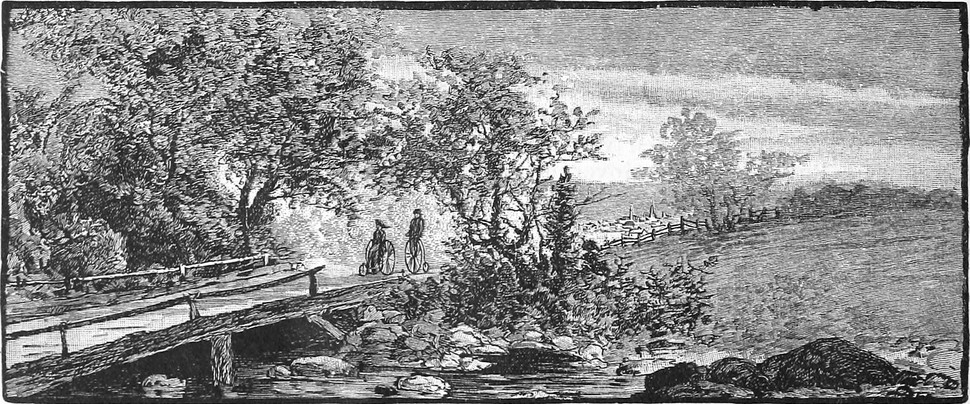
A DESIRE for independent traveling is growing daily. The reasons for this are various. It may be the person who wishes to indulge the desire is eccentric and eager to make a show of himself. It may be economy which prompts him to leave a railway carriage and foot it. It may be because he imagines it to be “English, you know,” though let me assure him that this is one of the many myths about the English. Englishmen as a rule are not great cycling tourists. More Americans, comparatively, have toured in England and on the Continent than Englishmen themselves, and the number is increasing daily. Or it may be that the tourist wishes to see the country in the only way it can be properly seen; and this is probably why in the winter and the spring so many Americans write to me, as the representative in England of the League of American Wheelmen, and ask for information about roads and routes.
I presume this last to be the real reason for the growth of independent traveling, and I leave out of consideration all walking tours, because, after having walked in one year 500 miles and cycled nearly as many thousand, I feel justified in saying that walking is not for a moment to be compared with cycling. I may some day compare these two modes of traveling, but just now this is not my purpose. What I say about cycling applies equally well to riding and driving, though of course you cannot ride or drive continuously the same number of miles you can cycle. I can very well remember the state of dense ignorance concerning the means of independent traveling in Europe, in which I was six years ago, as well as the almost utter impossibility of obtaining any definite information. Six years, every one of which has seen at least one tour, have, however, given me some little experience.
If you are a rider of an American cycle, of course it will be necessary to bring your machine with you. Ask the steamship authorities whether to crate it or not. If it is a bicycle, and you carry it without crating, they may charge nothing. There is no duty on entering England; but if you ride an English machine, I should advise you to sell your present mount and make arrangements, either with the dealer you know in America or the firm itself in England, giving them three or four months to get your machine ready and to have it awaiting you at their agents in Liverpool, Southampton or Glasgow, or wherever you may land. Tell the makers what sort of a tour you propose taking, and you will probably find that they will understand your needs better than you. If, however, you are confident you know exactly what you want, you may be able to make suggestions.
Before leaving America—though I suppose what I say applies equally well to Australians—join the Cyclists’ Touring Club. From their offices you will receive a vast amount of useful information concerning your tour. You can also obtain route-books, maps, guides, etc. Americans should apply to F. W. Weston, Savin Hill, Boston, Mass.; Canadians to H. S. Tibbs, 26 Union Avenue, Montreal; Australians and Indians to S. A. Stead, 19 Tabley Road, Holloway, London, N. The subscription is the equivalent of two shillings and sixpence, and the entrance fee is another shilling. Any amateur cycler can become a member without trouble. Another thing to be provided is a Baedeker guidebook for the country over which you wish to tour. In it you will find the rates of the various hotels, and of course you will go to those which suit your pocket, remembering that now you are an independent traveler, and that if you do not like the outside of an hotel, there is no reason why you should go in. The C. T. C. hotels in England are mainly respectable, and with the hand-book you know where you are going. But the C. T. C. rates, except in the large towns, are frequently an advance upon the ordinary rates. You will find it almost impossible to obtain breakfast before eight o’clock in the morning, in many places before nine, without considerable trouble. A breakfast will cost from one to three shillings, according to the hotel: On leaving the hotel it is necessary to fee the boots and the waiter, but sixpence goes quite as far as half a crown.
In riding, keep to the left, Englishmen differing in this, as in so many other respects, from all creation. Do not ride on the side paths or you will be promptly arrested. It is useless to expect any cycler you meet to be more civil to you than the driver of any other conveyance. Cycling clubs in England are not what they are in America or on the Continent. Therefore you need not look for any of those attentions bestowed upon the touring cycler at home, though you may encounter some very delightful fellows. Of course, it is a very good thing to have letters of introduction.
At noon, in any save the large towns and on market days, you will not be able to get a hot dinner without waiting a long time. But you will probably find excellent cold roast beef, or you can eat a succession of lunches of bread and cheese and drink a modicum of bitter ale, called beer. My practice is never to eat much in the middle of the day when touring. The succession of small lunches and short rests is better than a single long one. Coffee taverns—that is, temperance houses—may be found everywhere, but they range from very good to very bad, and you had better investigate them before deciding to stay overnight. It is unnecessary and quite useless to bargain for anything in England. Your lunch will cost from sixpence to two shillings, and you should give the waiter a penny for every shilling. You will have to order your dinner in the evening in the majority of places, and in the small towns it is wiser to have what is called a “meat tea,” that is, a chop or a steak, one or two vegetables, jam and tea; or else a cold supper, that is, cold meat or fowl, salad, a tart and cheese.
If you arrive wet, you will find it possible to have your clothes dried, and very well too, as innkeepers in England rather expect to have to perform this duty. In fact you may receive many little attentions which are very pleasing, and there is a cozy, homelike feeling about an English inn which one finds nowhere else. It is not necessary to inflict the fact that you are an American upon everybody you meet; they have seen Americans before, and they probably knew it before you opened your mouth. I have seen it stated and hinted that one can obtain a room in an English inn or hotel for sixpence or ninepence a night. This is, of course, absurd. You can, if you go to a house with the sign “Accommodation for Travelers; beds, sixpence a night.” In the same way, in America, you can go to a station-house for nothing, or to a tramps’ lodging-house for almost as little. It is necessary to count upon spending about eight shillings or two dollars a day for touring in England; but it is possible to do it for half that amount, though not comfortably or decently. Even this is a moderate figure, and is less than the C. T. C. rate.
In London I can recommend the Charing Cross Hotel, and, I believe, Burr’s private hotel in Queen Square. There are thousands of hotels in London, but both of these are central, and can be reached on the wheel. London streets, however, require very careful riding, owing to the rapid driving, and, to the American, the fact that everybody seems to be on the wrong side of the road.
I have presumed that you are a practical cycler, and therefore that you will carry whatever you are in the habit of taking with you at home, or will send your baggage from one place to another as you do there. In England it is wiser to use the Parcel’s Post, as the express is very unreliable. Personally, I either ride a safety or a tandem tricycle, and, whether alone or with my wife, always carry every thing we want on the machine. We are consequently perfectly independent, and have been out for six weeks at a time.
On leaving England for the Continent, unless money is absolutely no object, you must go to France by Dieppe, Havre or St. Malo. By Calais or Boulogne the charges are extortionate, and you will have to pay in the custom-houses. The greater part of Belgium is paved with Belgian blocks, over which you cannot ride. To Holland you can go by way of Amsterdam, and I believe the riding is fairly good over the brick roads, but I have never been there. The principal attractions in Norway seem to be the cheapness and the scenery, and for both you have to walk about as much as you ride, which is not my idea of cycling. Anyhow, it cannot be compared to Switzerland, and the reason it is so much talked about in English cycling papers is because it is a fine pot-hunting ground for racing men.
Of Spain I am entirely ignorant, and the accounts of this country all contradict each other with the most wonderful unanimity. No reliable data of the roads have yet been obtained. I hope to go over them myself before long. But in the first place, to visit any foreign country you must understand something of the language, the more the better.
The following, which is a portion of an article I contributed to the Pall Mall Gazette a short time since, contains all that need be said on touring in France: “You must provide yourself with good road maps, showing the main road, the routes nationales and the routes départementales. There are, of course, byroads all over France—that is, routes communales and routes vicinales—but it is never safe, save in the south, to make short cuts or detours or to trust to these byroads in any way. They are frequently as bad as the others are good. Stick to the high-road. Work out on your map the route you wish to follow. You can buy excellent road maps of Hachette or of Phillips. The maps sold by the Cyclists’ Touring Club are not up to date, and you are compelled to purchase four sheets when you may only need one. Recently I was detained in Avignon for having these maps in my possession, being told by the préfet of the department of Vaucluse that it was illegal to carry them, as in France they are made and sold for the private use of the War Department. How true this is I do not know. I have usually carried them, and never before had any trouble. However, they are becoming rather out of date, and Hachette is bringing out new series all the time.
“Supposing you land at Dieppe, your machine will be taken to the custom-house, whither you should accompany it. If you can succeed in satisfying the officials that you intend to leave the country with your machine within three months, they will not charge you duty, and will not, unless you ask for it, give you a receipt. If you do get a receipt—this is, of course, the lawful method—you will be obliged to deposit 50f., only two-thirds of which will probably be returned to you when you leave the country. But the French Government has usually been very accommodating in this matter, though at Calais the duty or the deposit is nearly always demanded. If you wish to go by train from Dieppe, have your cycle registered, for which you pay a penny if it is under 56 lbs. Two people can take a tandem for the same money, if it is under 112 lbs. But do not stand on your dignity, and write to the papers, and make a frightful row, because the Swiss, German, and Italian railways compel you to pay a big price whenever you carry a cycle on their lines. Their rules are not those of France. In frontier stations you need never be surprised at any regulations.
“But let us suppose that you intend to ride away from the station at Dieppe. You are hungry, having been landed there at five o’clock in the morning. Have your coffee in any café on the Place, or in the very expensive one in the station. And this is the point where, if you want to live inexpensively, you must remember the customs of the country. In the station you never see a Frenchman, and on one occasion I paid two francs and twenty-five centimes for the privilege of having a pot of coffee and rolls and butter there. The next time, I went to a café in the street leading from the pier to the Place. It was full of townspeople, was more gorgeous, the coffee was equally good, and I paid seventy-five centimes. Why I should pay a franc and a half for having my coffee on the pier, I am unable to see. Cafés are always good, and charge just about half the price of an hotel or a station restaurant, and the French traveler, as a rule, does not take his coffee in the hotel unless he is in a great hurry. He goes to the café across the street, reads his morning paper, and pays half the price. The landlord does not object; it is the custom of the country. For lunch, if I know the town where I am going, I stop, not at the swellest restaurant on the boulevard, nor at the dirty estaminet of the workman—I object to one as much as to the other—but at a decent, clean, middle-class restaurant, where it is the exception if I do not fare very well at the cost of about a franc and a half. And how do I find it? Either by using my own eyes, or by asking the first decent-looking man who comes along. If it is between half-past ten and one in the day he will probably be on his way to or from his own breakfast, and will be only too glad to show you the place. If you do not like the place, there is no reason why you should go in. If it is good, and the people are jolly and talkative, as they usually will be, ask them for a good hotel, of the sort they, as Frenchmen, would go to, in the town where you purpose to spend the night. They will tell you readily. It may be the first, or more likely the last, on Baedeker’s list; it may not be there at all. If it is a very swell place, don’t be afraid to go in if Frenchmen have recommended it; if it is very disreputable on the outside, and the proprietor in cook’s cap and apron rushes out to meet you, do not turn away, for he will probably greet you as warmly and give you as good a dinner as you have ever had in your life. You will find at the table a lot of jolly commercial travelers, who will take pleasure in giving you a list of hotels from one end of your route to the other. And what will it cost you? The dinner will vary from two and a half to three and a half francs, and your room from one and a half to two and a half, and there will be no extras. Totting this up, we have eight francs fifty for the day. Say you give the waiter half a franc. That makes nine.
“But the next night, being a touring cycler, you have not reached the town where you intended to stay, owing to something of interest on the road, or you have passed beyond it. You will stop in a decent, clean auberge by the roadside—and you will find many—or in the best inn in the village, where your bill will be about four francs for lodging, dinner and coffee. And so, in the course of two or three weeks, instead of exceeding an average of seven francs a day, you will fall below it. This is the way Frenchmen do. This is the way men like Louis Stevenson have done. And this is the plan I like to follow; not to go to an hotel where one has to pay for the dirty swallow-tail and bad English of the waiter, the sham plate and the stupid table d’hôte; nor, on the other hand, to stint one’s self and to glory in saving a sou here and doing a man out of a franc there; but to quietly adapt yourself as much as you possibly can to the habits and customs of the people, of the middle and characteristic class, whose country you are visiting. If you do not like to do this and cannot afford the swell hotels, you had better stay at home.”
Very much the same conditions exist in Italy and Switzerland. In Italy, however, you must bargain for everything; you must even know how much your candle is going to cost you before you go to bed, and how much you are to pay for the waiter and chambermaid. In Germany one lives more in English style. The laws of the road are the same in all these countries as in America.
Many of the hills on the Continent, owing to their S-shaped curves, are very dangerous. In England one finds warnings everywhere for cyclers. You can ride or be pulled or pushed up behind a diligence over every pass in Switzerland that is used by vehicles. On the Continent you will find yourself everywhere legally treated as the driver of a carriage. Carry a passport, and do not regard all foreigners as fools and thereby make a fool out of yourself. Do not regard yourself as the first man who ever visited the place, and do not try to paint the town red. I admit these foreigners do not understand our little ways.
As to touring singly or with a party, that is your own affair, not mine; only I can warn you it is rather lonely work to cross a great country by yourself. If there is anything I have not made clear, write to me to the care of OUTING. I shall be only too glad to answer your questions.
AMATEUR PHOTOGRAPHY.
BY ELLERSLIE WALLACE.
WHEN we come to criticise photographs as pictures, we find that one great defect is to be found in their small size. It is true that the perfection of detail and fine finish compound for this in a measure, but it has often been said that one good print of 11 × 14 inches, or larger, is worth dozens of the little scraps made on 5 × 4 and 4 × 3 inch plates. It has lately become too much the fashion to advise the use of small sizes, and to depend upon some enlarging process when a print of good size is wanted. The idea of making small negatives and enlarging them afterwards seems fair enough, and it is, indeed, successfully done in many cases; but if such a size as 10 × 12 were settled upon, we should advise that the negatives be made direct, and the prints not enlarged from, say, 5 × 7 or 5 × 4 inch negatives. All experienced operators agree that the making of negatives for enlargement requires great skill and care. Remembering how greatly the cost of making photographs has been reduced, and what excellent outfits can now be had for a moderate sum, we feel justified in advising those who aim at good artistic results to begin boldly with plates of a fair size—certainly not less than 81⁄2 × 61⁄2, or, better, 10 × 8 inches.
Now, since the first thing to be considered in the selection of a photographic outfit is the size of picture desired, and the next the character of work to be done, let us here say that the difficulties of obtaining clean, good results increase with the increase of size to a certain extent, and the expense of making the picture increases very materially. Nevertheless, in spite of the various processes for making large prints from small negatives—enlarging processes, as they are technically termed—we repeat that we should not advise the purchase of very small cameras, unless mere amusement is the only thing to be considered. Plenty of fun can undoubtedly be had out of the little “detective” cameras now so commonly used, but more satisfaction will be felt in a nice collection of views or portraits on plates measuring, say, five inches by eight or ten inches by eight, the camera for which would be too large to be conveniently concealed as the smaller sizes are:
Since the introduction of the gelatine dry plate, and the consequent simplifying of the chemical part of the work, large-sized photographs may be made with far greater ease than formerly, and to those of our readers who have devoted any attention to art matters we will suggest one of the larger-sized cameras for plates, say fourteen inches by eleven, as offering more scope for the artistic treatment of fine subjects, particularly landscapes.
The size of plate and camera being settled upon, the next thing is to get a suitable lens, and this is often no easy matter. In most of the detective cameras the lens is supplied as a part of the outfit, but one intending to provide himself with a regular photographic apparatus ought to have some knowledge of lenses before purchasing. Without going into too great detail in the matter, we may say that some general distinctions between the different varieties of lenses should be borne in mind, as follows: (1) Lenses including an ordinary angle or amount of subject, say forty to fifty-five degrees on the base-line of the picture, and of tolerably long focus; and (2) wide-angle lenses including eighty degrees, or even more, and of very short focus. It would be natural for the purchaser to imagine that that lens which included most subject would be best, but as a general rule the contrary is true, namely, that the longer-focus lenses are the more practically useful and give the more pleasing pictures. There is another distinguishing characteristic between lenses that are “single” or “doublet.” The former are cheaper, but quite good enough for average landscape work, while the latter are indispensably necessary for architectural subjects and the accurate copying of anything like maps, plans, engravings, etc. To those who are disposed to be very economical, we may say that the front lens of an opera-glass will make excellent photographs. It should be unscrewed from the barrel, and set in a short tube with its flat side facing the view; or, in other words, it should have its position just reversed from what it was in the opera-glass. A stop of suitable size is then set in front of it at a distance equaling one-fifth of its burning focus.
It should be remembered that the perspective of the photograph is made by the lens, and cannot be altered by the operator, except in so far as he provides himself with a number of lenses of different focus and angle, so as to be able to treat different subjects with lenses suitable to their peculiarities, using each lens pro re rata, as the doctors would say.
It may not be generally known that experienced outdoor operators are pretty well agreed upon certain proportions between the focus of the lens and the size of plate, as affording the most pleasing pictures, and being most useful in the long run. We should thus choose an 11-inch focus lens for the 81⁄2 × 61⁄2 plate, a 9-inch for the 8 × 5, etc., or, in other words, one whose equivalent focus was about equal to the diagonal of the plate.[5] But let us take this occasion to say that we cannot too strongly insist upon the desirability of the photographer’s having more than one lens irrespective of the size or style of his pictures. We ourselves have worked with lenses of 11-inch, 7-inch, and 51⁄2-inch focus on the 81⁄2 × 61⁄2 plate, and succeeded in a great variety of subjects. The 11-inch was probably used five or six times where the 7-inch was once, while the 51⁄2-inch was only resorted to on rare occasions where the peculiarities of the subject required a very wide angle.
We enter into this matter at some length because the artistic qualities in landscape photographs will be found to depend in great measure upon the ability of the operator to include just the desired amount of subject on his plate from any given point of view; for the latter cannot always be changed so as to favor the lens. Then, also, it must not be forgotten that every change in the position of the camera will change something in the view; the whole character of the picture may be altered by shifting the apparatus a little in one direction or the other. A speaking proof of this is seen when examining the results obtained by the members of photographic clubs and societies after having been out for a field-day; here we often see two photographs of the same subject, where the men have stood side by side, one being complete as a picture, while the other fails in its effect simply because the lens has been a few inches or a few feet farther to the right or left, and has omitted or included some object which has been the making or marring of the picture.
Another prominent defect in photographs, taken as a whole, is that they are usually made in fixed sizes in spite of varieties or peculiarities of subject. How unpleasant it is in the case of a fine panoramic view, where the interest lies in the extended horizontal sweep rather than in the sky or foreground, to see things forced into a nearly square plate, say 10 × 8 inches, which gives entirely too much space above and below, with insufficient length! On the other hand, how empty the ends of a long, narrow 8 × 5-inch plate appear if some isolated and rather square object, such as a villa or group of trees, occupies the centre! Many a picturesque subject, dealing in high and narrow lines, will be utterly ruined if crowded on a square-shaped plate—street views in cities, for example, made near to churches with high steeples. Here we must either have a long, narrow plate, or use a lens of short enough focus to reduce the whole scale of the picture so that it can be afterwards trimmed to suit the subject. Here we see an additional reason why the plate should be of a good generous size to start with, and the outfit of lenses complete. If we had only a small plate on which to make the view, the trimming might make the finished print too small to be worth anything.
Let us now consider the shape of the picture, or plate, together with the proportions existing between its boundaries or sides, premising that while here and there a print may be trimmed square, circular or oval, to suit some particular subject, the oblong shape will be by far the most generally useful.
If we compare two plates, one measuring 81⁄2 × 61⁄2 inches and the other 8 × 5, we find that the diagonal line connecting two opposite corners is 11⁄4 inches longer in the former than in the latter. We also find that the former has a clear space 11⁄2 inches wider than the other, extending over the whole of the long dimensions of the plate, together with another space half an inch wide at the narrow end. To put it in other words, the 81⁄2 × 61⁄2 plate differs from the 8 × 5 both in shape and in size, but offers considerably more surface with but a slightly longer diagonal. This latter has an important relationship to the covering or defining powers of the lens, for, supposing we wanted a lens to just cover the plate, we should have to select one the diameter of whose field or circle of light was equal to the diagonal of the plate—not to its base line, for in that case the plate would not be covered. Again, if we desired a lens to give perfect sharpness up to the corners of a given size of plate, we should reckon by the diagonal, and not by the base line.
A little study of perspective is most highly to be recommended to those who desire their pictures to be truthful and pleasing. Now, by this we do not at all mean that our readers should wade through ponderous volumes filled with mathematical problems and long equations, but that they should, for instance, set themselves to consider such facts as the following: If an empty box be set on the end of a long table with its hollow facing the student, it will be observed that the bottom and the sides are in a certain proportion to each other, and that the lines of junction between them appear to recede at a certain angle. If the box now be moved up to within twelve inches of the face, these lines of junction will be seen to stand at much more obtuse angles, besides which the sides will appear broader in proportion to their height than when the box was at a distance. Let him now consider that the principles here involved would hold true in the photographing of street views, and many other subjects where both near and distant objects were included. For if a wide-angle lens be employed, all the receding lines in the picture, such as cornices of buildings, railroads, curbstones, etc., etc., will stand at much more obtuse angles than when a narrow-angle lens is used; the terms “wide-angle” or “short-focus,” on the one hand, and “narrow-angle” or “long-focus,” on the other, being indiscriminately used by the photographer.
This great obtuseness of angle in the perspective of pictures made with wide-angle lenses, is sometimes the cause of most unsightly and ridiculous pictorial failures. It will be seen at once that the objection to using very wide-angle lenses is that, owing to this great obtuseness of angle of the perspective lines, distant objects will appear unnaturally dwarfed in size, while those near at hand will come out immensely larger than they ought to. A few trials on street views with a lens including, say, eighty degrees of angle, with prominent objects close in the foreground, will soon prove the truth of what we have been saying, and sometimes well-known localities will be so changed in the photograph that no one would recognize them. We are thus met by the paradox that the perspective of the photograph, while mathematically correct, is false to the eye.
These ideas of perspective will be found very useful in photographing architectural subjects, wide-angle lenses often being indispensable here. Caution must be observed in using them on these subjects, however, for if the buildings stand in confined positions, where there is no room to move the camera backward, the picture will have an unnatural effect, and might be compared to the eye of an observer trying to see something that was too close for convenience.
In portraiture, the perspective will suffer very much if the distance between the sitter and the lens be too small, and the lens of too wide an angle. In this case, the cheeks will look too narrow in proportion to the length of the face, while the hands and feet will be absurdly larger than they ought to be if at all obtruded. The head, and indeed the whole figure, will look more rotund and more life-like if a fair distance—say twice the sitter’s height—is kept between the lens and the sitter. If this should give too small a picture, a lens of longer focus will have to be used. Objects look broader when taken near at hand with wide-angle lenses. Interior views of buildings, halls, etc., where there is plenty of room to keep the camera well back, will not be found difficult, but the interiors of small private houses and rooms will often be very unsatisfactory subjects because there is not room for the camera to be set well back and give a life-like, natural effect.
Photographs of long, narrow objects will be great failures in the pictorial point of view if the camera be brought too close, and so that the nearer portions are unduly magnified while the more distant become dwarfed in size. Here we see one of the principal reasons why the photographer should have lenses of different focus, so that if he is compelled to take an unfavorable point of view he may not be confined to one focus and angle.
To be continued.
EVOLUTION OF FORM IN COLLEGE ROWING.
BY E. M. GARNETT.
I.—THE HARVARD STROKE.
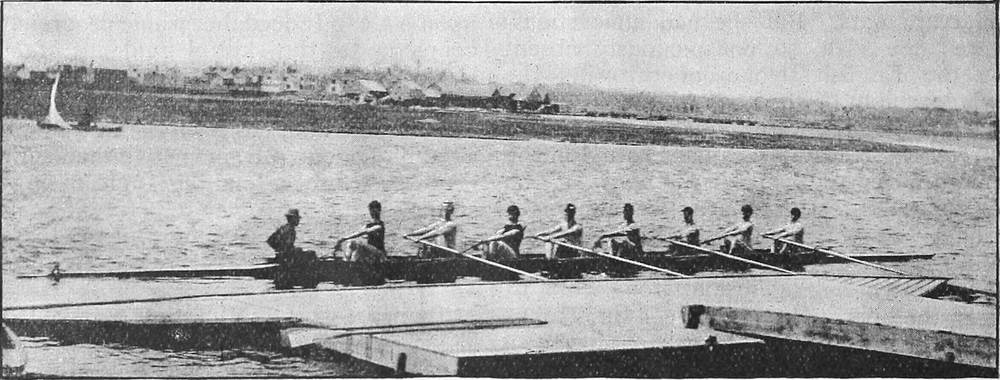
SCIENTIFIC rowing may be properly called a modern luxury. It may be said, with a moderate degree of certainty, that neither the Greeks, the Romans, nor yet the early English, were in the habit of pulling themselves about in ten-inch shells provided with anti-crab swivel rowlocks and ball-bearing slides. Had any one of them been caught in such an act he would have been condemned, in all probability, to drink the hemlock, or worshipped as a wizard. Of course, from time immemorial there have been certain vague principles regulating the application of the weight of the body to the oar. But up to the time when that eccentric genius lubricated the seat of his boat and the seat of his trousers with some fatty substance, and slid his greasy way to victory, rowing was much more a matter of brute strength than of exquisite skill. And with the evolution of the sliding seat from the crude but effective idea, possibilities were offered for great improvements in the art of pulling an oar. During the last twenty years new inventions and radical changes in the rigging of boats have necessitated a departure, not only from former methods of rowing, but also from its recognized tenets. The principles are not immutable—as some would have us believe. For example, it is a physical impossibility, with some styles of rigging, to apply much power at the end of the stroke. Still, different systems have their ardent supporters, and the superiority of one over another is apparently a mooted question.
According to some aquatic enthusiasts, it is the best plan to let the men get into a boat and pull: time and a little intelligence will remedy their faults. Others urge that it is only necessary to master “the few essential principles,” and, as Mr. Julian Hawthorne says, “the refinements will take care of themselves.” Still others, who treat with withering scorn the opponents of “form,” lay great stress upon the absolute importance of sedulous attention to the minutest details.
In support of this first view, numerous instances have been cited of rough, awkward professional crews “yanking” and “yawing” their way in ahead of the best trained and disciplined amateur oarsmen, and, as one writer upon rowing aptly says, “casting despite upon the traditions of the art.” Indeed, until recent years it has been the current belief that a good amateur crew was no match for a set of skilled professionals. And the apparent truth of this opinion was never better illustrated than by an impromptu race rowed on the Charles River in ’78 or ’79—I forget the exact date—between the famous Bancroft crew and eight of the best oarsmen that could be gathered together from the purlieus of Boston. It is true the professional crew was made up of such celebrities as Ross, Plaisted, Gorkin, Faulkner, etc., but before that morning they had never sat together in a boat. Their boat, by the way, differed utterly in rigging from those they had been accustomed to, and, in fact, was the worst and most dilapidated the Harvard Boat-house could afford. After a preliminary “paddle” down to the starting-point—the Brookline Bridge—the race was rowed over the regular two-mile course. Well, it is related—and I have it from one of the victors—that by the time the celebrated Harvard crew reached the Union Boat-house their untutored rivals had carried their boat into the house and were nonchalantly wiping her off.
Now, why did this crew, composed as it was of the heaviest and strongest men that had ever sat in a Harvard boat, who moreover, by their irreproachable “form,” had crowned themselves with glory at New London, allow themselves to be so lamentably defeated by a set of men who labored under almost every possible disadvantage? Evidently there was some potent influence at work. Although the hardy and callus-fisted members of the professional crew gained a precarious livelihood in arts which did not sap their physical vigor, yet the superior endurance of the crew as a whole can hardly be urged as an excuse for such an overwhelming defeat in a two-mile race. We are left the bitter alternative, then, of shocking the æsthetic sensibilities of our amateurs by the inevitable conclusion that the professionals possessed superior skill.
Now, intelligent amateur, before turning away in disgust, reflect a moment. What is skill? What is form? Are they synonymous?
Skill is that which in almost every sport—in sparring, in fencing, in wrestling, in baseball, in tennis, etc., etc., other things being equal—enables one to win. Like elegance in writing, it is “the exquisite adaptation of means to ends.” In rowing it is that management of the body and oar—other things being equal, of course—which is conducive to the greatest speed of the boat.
“Form” in rowing is not so easily defined—for what would satisfy the most rigid exactitude in one system would be found defective in another. In general terms, however, it may be called, in crew rowing, “the graceful and nice management of the body and oar which contributes most to the appearance of similarity and uniformity throughout the crew.”
Now, it is true the professionals did not row with backs as straight, nor with a swing as even as the canons of good “form” call for, but they possessed the all-important secret of economizing all their strength and time. They not only knew how and when to apply their weight to the oar, but were fully alive to the necessity of holding the oar in the water no longer than it could do good, and in the air as short a time as possible. These and other less perceptible virtues, which such a constellation of aquatic lights will always possess, are generally obscured by the rugged and uncouth appearance of their body work.
But this body work, as far as the effect is concerned, though by no means all that can be desired, is not so very bad after all, for the swing of one man across the boat is counteracted by the swing of another. This fact, coupled with the firm, strong, simultaneous finish of the stroke, will effectually prevent the rolling of the boat.
On the other hand, the Harvard crew, whose “form” would have sent an æsthete into rhapsodies of praise, were skillful enough in their own peculiar way, but their rowing itself was unskillful because radically wrong in principle. But didn’t it enable them to win at New London? Yes, to be sure; but always against the same system or an inferior one.
The defeat of a well-trained amateur crew by a set of professionals does not, then, necessarily bring the traditions of the art of rowing into disrepute. “Form” without skill must always succumb to skill without “form.” The combination of the two should be the goal of the aquatic ambition. And the one need not be detrimental to the other. It is all very well to scoff at “form” and rest placidly content to let the refinements take care of themselves. They won’t, and the result will be a lot of irremediable faults.
In sparring, or, still better, in fencing, what is called direction, i. e., the precision of one’s aim, will be greatly affected by the slightest deviation of the hand from its proper position. The man who adheres to this principle through all the complications of attack and defense will be indeed a formidable antagonist. A master must pay the strictest attention to the details of his art. Then why not in rowing, where the object is to get in ahead of your adversary, and where the lightest touch of the flat of the blade to the water will add its mite to diminish the speed of the boat? Besides, the acquirement of the details will always add zest to one’s pleasure in the sport. Few sensations, indeed, are more pleasing than that of shooting through the water in a frail shell with a clean, strong sweep of the oars, especially when that sensation is flavored by a consciousness of a complete mastery over the situation.
To become an adept in the art of rowing does not demand the patience of a Palissy, nor yet the sagacity of a Socrates. True, a certain class of men of rare physical and intellectual torpidity will never master the correct methods, but to a man moderately well endowed as to mind and body, they are quite accessible.
Perhaps those practical gentlemen who scout the idea of “form,” and seem to believe that by some secret process sufficient excellence will be attained if the men get into a boat and pull, are like some of George Eliot’s good people of Raveloe, who supposed “there was nothing behind a barn door because they couldn’t see through it.”
Now, the essential thing is to first get hold of the correct principles of rowing, and then apply the refinements to them. The result will be a winning crew every time. And this happy combination and its inevitable consequences were brought about for the first time in the history of college boat-racing at Harvard in ’85. That is to say, the principles involved in the stroke of that year are the best that have yet been discovered. They, the principles, mind you, are identical with those believed in by Hanlan, the father of them—Teemer, Gaudaur, O’Connor, and all the crack scullers of the present day. And these principles, the fruits of years of experience and unremitting toil in the acquirement of a method that would enable men to win races and their daily bread, it is natural to suppose, should be pretty nearly correct.
It is a great mistake to believe these men so deficient intellectually that they are forced to rely principally upon brute strength to put their boats through the water at the highest possible rate of speed. Rowing is not such a subtle and complex thing as all that. Is it not, to say the least, a bit of conceit on the part of amateurs to presume that with all their transcendent intellect they can, by a few years of intermittent devotion to a sport, acquire a more rational knowledge of it than men like Hanlan, who give their lives to it?
It is the same with professionals in any sport—in sparring, in fencing, in baseball, etc.—what amateurs can compete successfully with them?
But let us see what prodigy was warmed into being by the genial light of correct principle.
Until 1885, college boating-men had failed—inexplicable it almost seems—to keep pace with the modern improvements in rigging and consequent advance in the science of rowing, which professionals had been for some years familiar with. They were under the able tuition of Mr. Faulkner, the veteran but progressive coach and bow-oar of both the champion “four” of America and of the champion “pair-oar” of the world, and adopted “in toto” the rigging and system which had won him such marked distinction. The result surpassed their most sanguine expectations.
After the new stroke had been pretty well mastered, a series of impromptu races with the best crew of professionals that could be scraped from the Charles was gotten up. This crew was composed of Hosmer, Faulkner, Gorkin, Casey, and others, including the burly Jake Kilrain, an oarsman as well as pugilist, and now at the summit of his fame. As they were given the best shell in the boat-house, and one week in which to rig it and “get together,” they were really superior to the crew which so mercilessly defeated the Harvards in ’78. Well, the Harvard crew not only forced them to take their back-wash for two miles, but in a number of half-mile spurts cleared them each and every time a full boat-length in the first quarter mile. Pretty conclusive evidence, is it not, taken in connection with the unusually light weight of the ’85 crew, and the comparatively short time they had rowed together under the new regime, that the new system was superior to the old?
It proves abundantly, also, that “form” and skill will triumph, even in a spurt, over skill alone. Some one—that is, some one who did not see these races—will say, perhaps, “Oh, the professionals allowed themselves to be beaten!” For the benefit of the more skeptical, I will say, that on one occasion, when the struggle of the professionals was more than usually hopeless, I had the distinguished honor of occupying a vicarious position in the bow of their boat. The genial Jake Kilrain, who, by the way, oftentimes, in a spirit of jocose repartee, has beaten me cruelly about the head, was, besides myself, the only amateur (oarsman) in the boat. Spurred on by our frantic stroke’s disgusted and unorthoepical plaint, “Aw, yoose amatoors don’t back me up!” we leaped madly against the stretcher at the rate—it seemed to me—of about fifty-five strokes to the minute. No! there was no lack of sincerity in that boat.
Moreover, the pride of a professional is wounded to the quick when an amateur happens to subvert the natural order of things by defeating him. Indeed this particular set, in an ebullition of amazement, admitted that the “amatoors” could show their rudder to the best professional crew that ever sat in a boat. But so long as the professionals, no matter what principles of rowing they may build their faith upon, persist in sacrificing “form” to skill, so long must they suffer defeat at the hands of a crew who preserve both these elements.
As the two leading universities, Harvard and Yale, have experimented in the last five years with every recognizable system of rowing, from the slow, stately and intensely amateurish English stroke to a hideous exaggeration of the professional style, the history of college boat-racing during this period will afford the best means of illustrating and demonstrating the superiority of one method over another. Let us gird on our polemical armor, then, and enter the lists.
There is probably no athletic event in America which excites such universal interest and enthusiasm, among amateurs at least, as the annual boat-race between Harvard and Yale, on the Thames.
Weeks before the “eventful day,” windy interviews with the Nestors of the rowing world appear in the daily papers, rooms are engaged at the hotels in and about New London, the enviable owners of yachts prepare for the sail, and every one is speculating upon the chances of his favorite college adding to its list of victories. “Straight tips” and wiseacres are equally plentiful, and equally inefficient in increasing one’s store of knowledge.
At the race the river is dotted with gayly bedecked steamboats, yachts, and small craft of every description, the banks are lined with people, and the observation train, which from a distance looks like a huge colored snake, is a blue and crimson mass of bunting-waving, horn-tooting, yelling, frenzied collegians. It is not an exaggeration to say that fully fifteen thousand people annually witness the race.
Is it not strange that among all this crowd of intensely interested, over-excited spectators it would be extremely difficult to find a single person sufficiently informed to give one an adequate explanation of the causes leading to the defeat of one crew by another? For, especially when there is a great discrepancy in the times made by the two crews, there is always a reason beyond the overstrained condition of No.——, the slowness of the boat, or the eel-grass course, why one crew should cross the finish line a quarter of a mile in the lead.
But no! the spectators, though their native fancy for mystification is tickled by the triumph of skill and “form,” are quite impermeable to their constituent elements. They seem to follow the principle laid down in Hudibras, that
“Still the less they understand, The more they admire the sleight of hand,”
for they certainly seem more delirious than their more experienced fellow-men.
It is not remarkable that men who acquired their knowledge of rowing when the art was in its infancy, and quite innocent of the time and labor saving contrivances now in vogue, should allow their ideas to grow rusty or fail to keep abreast of the times. It is rather extraordinary, though, that many college boating-men of to-day, who have had ample opportunity to study the principles involved in the various strokes, should be unable to elucidate the reasons for their particular styles of rowing. And this sad fact has been the indirect cause of some of the most disheartening defeats at New London.
There has always been at college a sort of Bœotian haziness of ideas regarding the merits of this or that way of pulling an oar. And while the last few years—thanks to Mr. Storrow—have seen a certain development in the inquisitive instincts of college boating-men, indecision and uncertainty as to the virtues of the different systems of rowing seem still to prevail at Harvard.
The mooted question of superiority is confined practically to the English style of rowing; that introduced in ’85 by Mr. Storrow, and the so-called Bob Cook stroke.
In the following brief sketch of what the last five years of college boating can show, let it be borne in mind by those who see their long-cherished convictions ruthlessly attacked, that all excuses for the defeat of one crew by another must be considered as necessary adjuncts to the attempted demonstration.
In 1883, Yale, under the tutelage of that aquatic Archimedes, Mike Davis, made a radical departure from the stroke which had been brought over from England some years previously by Mr. Cook, and introduced, with slight modifications, at both Yale and Harvard.
Although this stroke, which had failed to bring victory to Yale in ’82, was almost the same in principle as that which defeated her, and, therefore, could not be held responsible for the defeat, yet she saw fit to discard it for the unique ideas of Mr. Davis.
The boat was made unusually long, to provide for a novel method of seating the men in pairs, all of Mr. Davis’s latest inventions were introduced, and phenomenal results were expected. Whatever good there may have been in these inventions, the fact remains that in the race Yale rowed a short, rapid, jerky stroke, while Harvard adhered to the long, slow, English style, and won with comparative ease.
The experiment having failed, the next year Yale returned to her former method of rowing. But, aided by her experience of the past, as well as by a few valuable hints, it is said, from one of the famous Ward crew, she had the rare good sense to improve upon her previous conception of the English or Bob Cook stroke—for the sake of convenience, I shall call it English at present. As to the exact share Mr. Ward had in the amendment I do not speak with authority, but regarding the character of the difference between the strokes rowed that year by Yale and Harvard I speak whereof I know.
After the first two miles it was patent that Yale had the race well in hand. Her oars were in the water longer and in the air a shorter time than Harvard’s. Every man in her boat threw his weight more directly against the stretcher, and instead of holding his slide on the recover until his arms were straightened and the body was swung forward from the waist, he diminished materially the time the oar would otherwise have been in the air by starting his seat and shoulders immediately after extending his arms. He used his legs more, and “hung” less at both ends of the stroke. The slow, stately sweep of the Harvard crew succeeded in bringing them in about fifteen lengths behind their happy rivals.
It is true, the speed of the Harvard boat was affected by a number of important changes which she was compelled to make, prior to the race, in the composition and seating of the crew. But despite this fact, which could not alone account for such an overwhelming defeat—especially as the substitutes were good oars—she had the strongest and heaviest crew that ever represented a college.
In 1885, as we have seen, there was a revolution in rowing at Harvard. It was not until the early part of winter that Mr. Storrow, in the face of a certain amount of passive opposition, took the rather daring step, by engaging Mr. Faulkner as coach, of throwing overboard all those principles which, it is supposed, had won Harvard many a splendid victory. An entirely new system of rowing was inaugurated, and there was much grumbling and dubious head-shaking at the issue. Yale, on the contrary, was highly elated at Harvard’s adoption of the “professional” stroke. Her crew, be it said, was deemed so strong as to earn the appellation of the “Yale giants,” while Harvard’s was not only unusually light, but, with two exceptions, was composed of men who had never before sat in a ’Varsity boat. Save with the brave but meagre minority who believed in the new régime, up to a week before the race Yale’s success was a foregone conclusion. Well, the race, as one disappointed wearer of the blue expressed it, was a “procession.” Yale, vulgarly speaking, carried the bucket. Harvard jumped into the lead the moment her oars struck the water, and though averaging about thirty-four strokes to the minute after the first spurt, to her opponent’s thirty-seven, increased her lead at every stroke. On the last mile there were twenty-five boat lengths between the two crews. Harvard’s rowing was remarked upon, though little understood, by all who saw the race. So little effort was apparent in her style, that the uninitiated were at a loss to account for the speed of her boat. While it was manifest that the “Yale giants” were not as well trained as the Harvard men, it was palpable to the merest tyro that the immense distance between the two crews was due to causes other than the physical condition of the rowers. Although, be it remembered, Yale had improved somewhat upon the English stroke, yet the laborious wastefulness of her style was in sharp contrast to the ease and dash of the Harvard stroke.
The moment Harvard’s blades gripped the water every man in the boat, with a spring from the stretcher and simultaneous heave of the shoulders, threw his whole weight into the oar, and kept it there until the stroke was finished. The blades were covered throughout the stroke, and remained in the air as short a time as was consistent with the avoidance of “rushing” the slides. There was hardly the slightest perceptible “hang” of shoulders or hands at either end of the stroke. Although the body work was not all that could be desired, the “watermanship” or action of the blades was as smooth as the stroke of a piston-rod.
On the other hand, after making all due allowance for the air of general wretchedness which always surrounds a defeated crew, and for the halo of perfection about the victors, Yale’s rowing was really bad. Before the last mile was reached the desperate tugging of her men, the not infrequent splashing of her oars, and other symptoms of fatigue, showed plainly that the pace was too hot for her labored style of rowing. But her reputation for pluck and doggedness was never better sustained. In spite of the conscious hopelessness of the struggle, her efforts throughout the race were titanic.
After the race the usual exculpatory rumors developed the intelligence that the stroke of the Yale crew had been lifted from a sick-bed, and supported, tottering and nerveless, to his seat in the boat. Either this was a laudable attempt to apotheosize Mr. Flanders, or else his powers of recuperation must have been miraculous, for no man ever pulled a pluckier and more apparently powerful oar.
The next year, 1886, Harvard went down to New London with her crew of ’85, with a single exception, presumably strengthened by an additional year’s experience. Yale, on the other hand, had a comparatively new set of men. The race was the closest for several years, but ended in the defeat of Harvard by about five lengths. This may seem incomprehensible at first sight, but Harvard labored under a combination of untoward circumstances, which alone were enough to account for a defeat of five lengths. She was compelled by an accident which happened to her shell prior to the Columbia race, to row in an old class tub, which possessed the additional defect of shorter slides and outriggers than her style of rowing called for. The shorter stroke, which this change necessitated, was visible to all who saw the race. Add to this the fact that, through Yale’s aversion to rough water, the race was postponed and rowed up the river in the evening; that Yale, who had the east side, where the swift current which with the incoming tide flows up the course for a mile and a half, was permitted to jump ahead at the start; that Harvard had the dead water on the west side; that in spite of her rough water and ill-rigged tub, after Yale had left her lively current, Harvard gained four or five lengths upon her, and we have sufficient reasons to account for a defeat of five lengths. Nor is this all. The hopes of the advocates of the English or Bob Cook stroke, so-called, must fall to the ground like wilted rose-leaves when it is considered that Yale rowed as nearly the same stroke as Harvard as close attention and the exercise of some intelligence during a limited time could make it. If the diligent reader of newspaper interviews doubts this truth he should have been at the Thames during the race weeks of ’85 and ’86.
In noticeable contrast to her “watermanship” of previous years, and in a laudable attempt to improve upon it, Yale exaggerated the rather flat feather of the Harvard oars. But she had almost mastered the idea, so conspicuously absent in the English stroke, of throwing the whole weight of the body, the moment the oar gripped the water, directly against the stretcher. Had the race been rowed in the rough water and wind of the morning, the exaggerated feather, the noticeably longer “hang” at both ends of the Yale stroke, and the weaker “finish”—which last fault must always fail, against a strong wind, to keep the boat jumping between the strokes—would have conspired to defeat her.
In 1887, Harvard, after winning an exciting victory from the fastest crew Columbia ever sent out, and lowering the intercollegiate record, was again defeated by Yale, this time by about seven lengths. Her twice happy rivals deserved all the approbation showered upon them by their overjoyed supporters, for their rowing was magnificent. They had almost the same crew as in the previous year, and had still further modified their style in conformity with the stroke rowed by Harvard in ’85. Indeed, to connoisseurs the only perceptible differences between these two strokes were the longer “hang” of the Yale oars before entering the water, the slightly stronger “catch,” the slower start of the shoulders on the “recover,” and the weaker finish. As the wind blew down the course, these defects did not tell against her. As for her time, it would have delighted the rhythmic sensibilities of a Wagnerian.
Harvard, on the contrary, through her inability throughout the year to secure the regular services of a coach, and on account of her comparatively raw crew, did not adhere as closely in practice as in theory to the standards of ’85. After the first two miles, the punishing work her rather young crew[6] had undergone three days previously in the Columbia race began to tell upon her. They began to “clip” still more off their already short stroke, and their rowing became slightly ragged.
These reasons will answer the question, “Why was Harvard defeated by seven lengths?” and, taken in connection with the fact that Yale rowed in a boat as similarly rigged as Harvard’s as a foot-rule and the faculty of imitation could make it, will deal a death-blow at any marked individuality which the Yale or Bob Cook system of rowing may now be said to possess. Waters, of Troy, is the boat builder to both colleges. The innuendo, I hope, is quite fathomable.
It is not my intention to cast any slur upon Yale. Indeed, her whole progressive course under the skillful guidance of Mr. Cook, who knows a good thing when he sees it, but is not the aquatic god some would make him, has been marked by rare good judgment. I am merely marshaling my evidence for a final onslaught upon the system of rowing in vogue before ’85.
In 1888, a committee of four graduates, only one of whom had rowed in recent years, was appointed to take charge of boating matters. Naturally enough they strove to inculcate in the crew those principles with which they were most familiar, viz., those which pertained to the English or Bancroft system of rowing. Despite the fact that the method introduced by Storrow had brought about the overwhelming defeat of the Yale giants in ’85, despite the manifest adoption by Yale of the essential features of this method, and her consequent successes, and despite the marked improvement in the speed of the boat since ’85, the crew of ’88, we are told, endeavored to “unlearn the radically wrong principles” of the three previous years. The endeavor was pre-eminently successful, and what was the result? A crushing defeat, such as had never been seen upon the Thames. At one time in the race there was almost half a mile between the two crews. Yale, naturally enough, retained the principles, the efficacy of which she had tested, and gave even a better exhibition of rowing than the Harvard crew of ’85.
My standpoint is well illustrated by a letter to the New York Spirit of the Times of September 29th, upon “Why Yale beats Harvard.” The letter is written by a man “who has done for Harvard good work with the oar.” Among other good things he says (the italics are my own): “The Yale and Columbia crews of 1886 beat Harvard after close races because they adopted to a considerable extent the same system and ideas that Storrow had taught Harvard the year before. Yale beat Harvard again last year because she still believed in and practiced the same system, while Harvard seemed to have endeavored to forget as much of it as possible. The contrast between the styles of rowing of the Harvard and Yale crews in the race was most striking. The Yale crew carefully covered their oars at the beginning of the stroke, and kept them covered to the end, maintaining a firm pressure throughout, the appearance of their oars in the water reminding the observer of the Harvard crew of ’85, but otherwise their work was far superior to the Storrow crew. The Harvard crew seemed to have forgotten the accepted principles that govern the management of the oar in the water; their blades made a complete circle, and but a small arc of its circumference entered the water, the oar being fully covered but an instant of time. In their body work they followed the principles taught by Bancroft, but did not attain the smoothness which Bancroft himself, and his more skillful pupils acquired. In this respect they tried to follow the English system, and seemed to have adopted the English style of rigging, for their slides were noticeably shorter than those of the Yale crew. The whole course of the committee clearly showed their incompetency to direct the crew.” And again: “It is reported that before coming to New London they rowed a series of races with a scratch crew, composed of substitutes and old rowing-men about Boston, and were beaten again and again, although the men in the scratch crew had never before sat together in a boat.”
Rather a striking coincidence with the feat of the ’78 crew who rowed the same stroke, is it not?
So much for what the history of college boating during the past five years can show. The supporters of the English system of rowing are welcome to any solace they may derive from a perusal of it.
It seems incredible that any doubt as to the superiority of one system of rowing over the other should still linger in the minds of Harvard men.
But the result of last year’s race leaves them, no doubt, “more troubled than the Egyptians in a fog.”
To be continued.
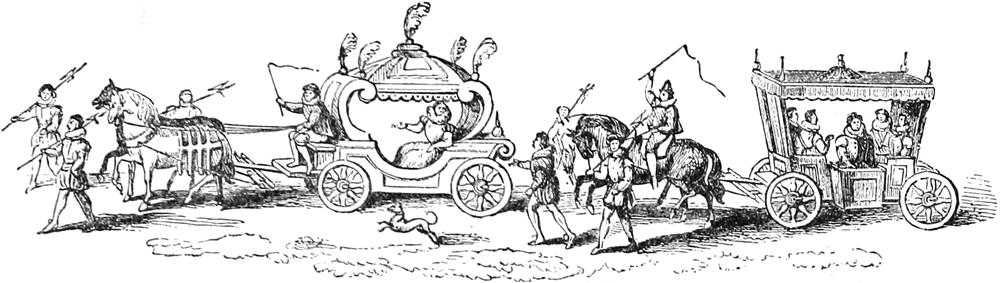
STATE-COACH OF QUEEN ELIZABETH OF ENGLAND.
COACHING AND COACHING CLUBS.
BY CHARLES S. PELHAM-CLINTON.
IN “Tom Brown’s Schooldays,” that ever-popular book, there is a sketch of coaching which stands unequaled for concise and graphic description, and which will bear repetition. Tom was starting for Rugby by the coach, and his father is seeing him off. They hear the ring and rattle of the four fast trotters and the town-made drag, as it dashes up to the “Peacock.”
“‘Anything for us, Bob?’ says the burly guard, dropping down from behind and slapping himself across the chest.
“‘Young gen’l’m’n, Rugby; three parcels, Leicester; hamper o’ game, Rugby,’ answers the hostler.
“‘Tell young gent to look alive,’ says the guard, opening the hind-boot and shooting in the parcels, after examining them by the lamps. ‘Here, shove the portmanteau up atop—I’ll fasten him presently. Now then, sir, jump up behind.’
“‘Good-bye, father—my love at home.’ A last shake of the hand. Up goes Tom, the guard catching his hat-box and holding on with one hand, while with the other he claps the horn to his mouth. Toot, toot, toot! The hostlers let go their heads, the four bays plunge at the collar, and away goes the ‘Tally-ho’ into the darkness, forty-five seconds from the time they pulled up.”
Considerable more romance about this than a departure from the Grand Central or Jersey City depots. There was much fun on the road in those days, and the jehu generally had a stock of old jokes that he let off at the box-seat passenger day after day. For instance, a crusty and stingy old curmudgeon who had neglected to “dampen the whistle” of the driver in the proper fashion, and who grumbled at the wet weather, would be greeted with, “Why don’t you invest a penny in a Yarmouth bloater? and you’ll be dry all day, I’ll warrant.” Things are more staid now, and the Irish coachman who demanded “Shall I pay the ‘pike’ or drive at it?” is happily gathered to his fathers, and life and limb are in the hands of a less humorous but more sober set of drivers.
From one source I learn coaches were first introduced into England in 1580 by Fitzallan, Earl of Arundel, before which time the customary mode of travel was on horseback. The Queen used to ride on a pillion behind her chamberlain. Another history says that in 1564, Booner, a Dutchman, became Queen Elizabeth’s coachman, proving that she must have had a coach. In 1619, however, things had so improved that Buckingham drove a coach and six.
A very authentic history says that the first coach in England was built in 1555, for the Earl of Rutland, by Walter Rippon. This maker must have been the Brewster of his day, as he made a coach for Queen Mary, and in 1564 built a state-coach for Queen Elizabeth, presumably the one that the above Booner drove. Hackney-coaches came into vogue in 1605, and in 1640 the stage-coach was first adopted. It was built to carry six or eight persons, and was hung upon leather straps.
In 1662 six stage-coaches were running, and in 1673 stage communication was started between Exeter and Chester and London. No less an authority than Sir Walter Scott says that in 1755 the speed of a stage was frequently but four miles an hour. A year previous to this, however, steel springs had been invented, and in 1784 it is authentically stated that the average speed was eight miles an hour. Prior to this rapid increase of speed, the Lord Mayor of London’s state-coach was built in 1757, and weighed the trifle of three tons, sixteen hundred-weight. In 1762 a royal state-coach was built for George III. which weighed four tons, and which is still used on full state occasions, being drawn by eight cream-colored horses.
Through the efforts of Mr. John Palmer, M.P. for Bath, in 1784 the mails were entrusted to the care of the coaches, the first mail-coach leaving London on the 8th of August of that year. Until 1834 the mail-coaches were not allowed to carry more than three outside passengers, while the ordinary stages carried four inside and fourteen outside.
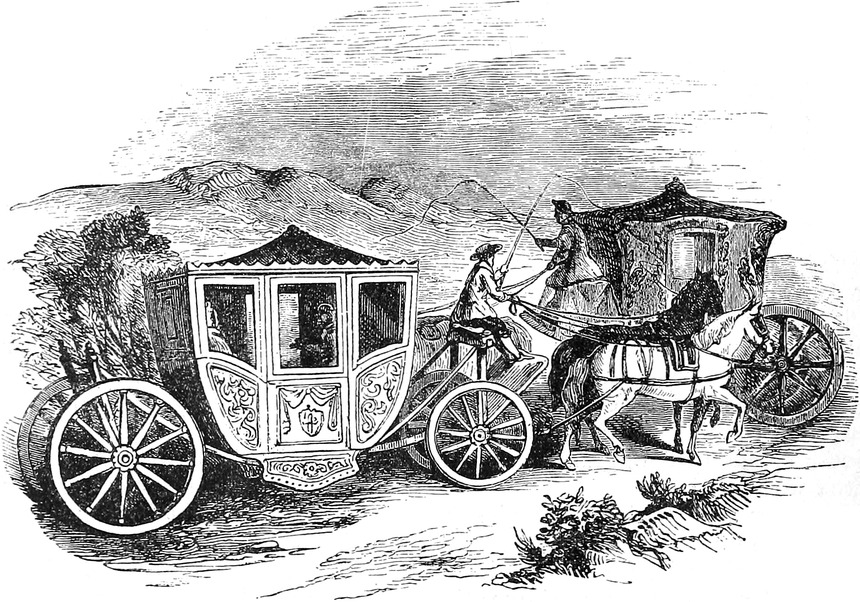
STATE-COACH OF KING CHARLES II. OF ENGLAND.
It was at this period that gentlemen began to “tool” not only their own but public coaches, and the amusement, which in many cases combines business with pleasure, has been continued ever since. Smedley, the novelist, creates a character in “Frank Fairleigh,” under the name of the Hon. George Lawless, who shows how thirty to fifty years ago this fashion had come into vogue.
The spirit of the times was such that in 1807 the first club was established, under the name of the Bensington (Oxonicé Benson) Driving Club, the number of members being limited to twenty-five. There were four meets in a year—two at the White Hart, Bensington, near Oxford, and two at the Black Dog, Bedfont, near Hounslow. There was no annual subscription; but each member paid £10 on his election. After the first sixteen years of the club’s life, the meetings were entirely confined to Bedfont, as being more easy of access. Here it was that the wine of the club was kept, and hence it was that, after dining, the members “dashed home in a style of speed and splendor equal to the spirit and judgment displayed by the noble, honorable, and respective drivers.” Among these were the “Squire of Squerries,” the father of fox-hunting; Sir Henry Peyton, who, like his descendant Sir Thomas, drove grays, and introduced the second ferrule on the whip; the Marquis of Worcester, Sir Bellingham Graham, Mr. Charles Jones, and Mr. John Walker, who drove the Bognor coach.
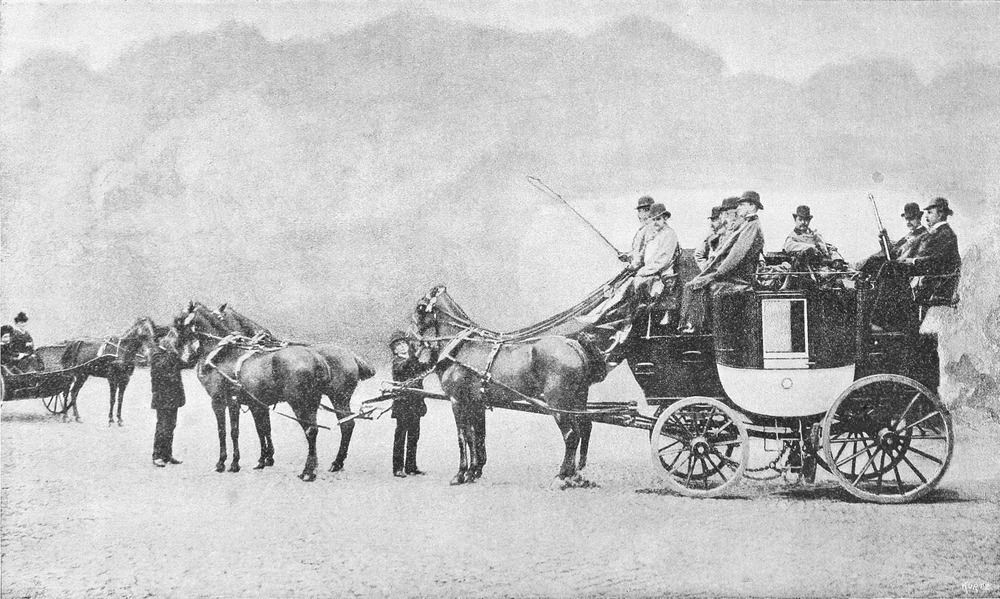
COLONEL DELANCY KANE’S FOUR-IN-HAND.
⇒ LARGER IMAGE
This was very quickly followed by the Four-Horse Club, founded in 1808 by Mr. Charles Buxton, which existed only about twenty years. The members included Mr. Warde, Sir John Peyton, Lord Anson, the Marquis of Worcester, Sir Bellingham Graham, Lord Sefton, and a host of others. This body used to meet twice a month in Cavendish Square, and its meetings, wrote “Nimrod,” were “perhaps objectionable as making unnecessary parade.” What would he have said of the Magazine meets? The Four-Horse Club was also known as the Barouche Club, and, according to “Nimrod,” as the Whip Club; but Lord William Lennox would seem to imply that the Whip Club was a distinct society, inasmuch as it used to meet in Park Lane and drive to Harrow-on-the-Hill, instead of meeting in Cavendish Square and driving to Salt Hill, as was the custom of the Four-Horse members. In “Hit and Miss” Charles Mathews caricatured the many-pocketed drab coat, with its buttons the size of a crown piece; the blue waistcoat, with its inch-wide yellow stripes; the plush breeches, and the three-and-a-half-inch hat, that formed the club uniform; and the celebrated comedian offended many of the foremost coaching men by the travesty. Joey Grimaldi also made capital out of this somewhat startling dress. A drab coat was formed out of a blanket, a purloined cabbage was used as a bouquet, plates formed the buttons of the coat; the opportune appearance of a cradle and four cheeses enabled a coach to be built, while a toy-shop furnished four blotting-paper horses.
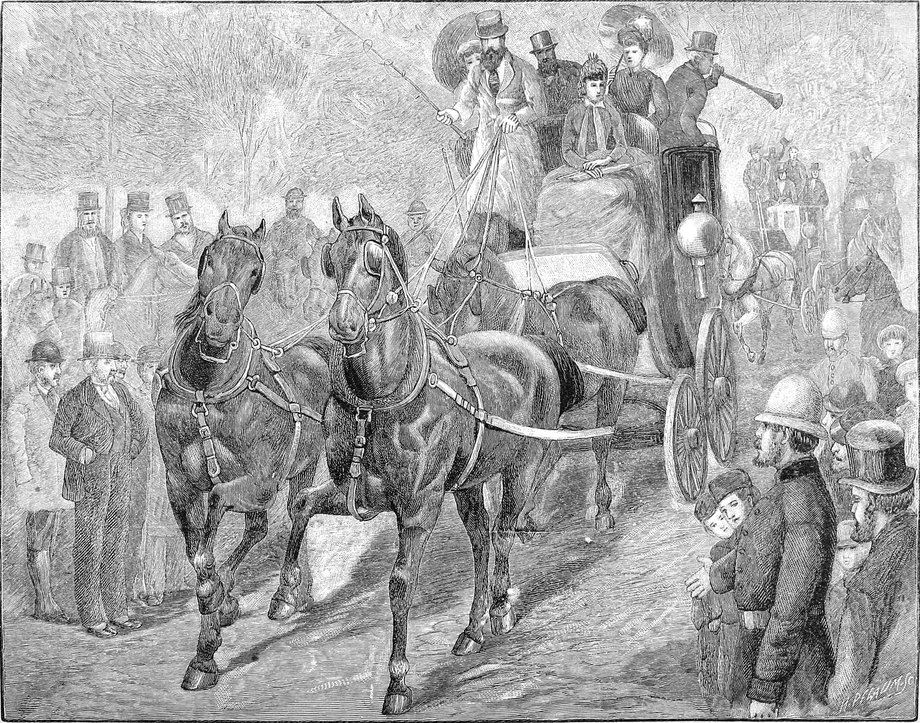
THE FOUR-IN-HANDS IN CENTRAL PARK.
⇒ LARGER IMAGE
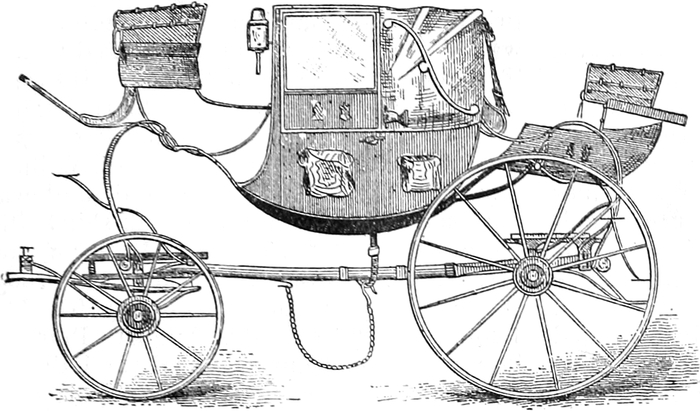
FAMILY TRAVELING COACH, 17TH CENTURY.
About 1820 the Four-Horse Club came to an end, but was resuscitated about two years later, only to be dissolved again.
The Bensington Driving Club kept on, and was joined, in 1838, by the Richmond Driving Club, under the presidency of Lord Chesterfield. The meets of this club took place at Chesterfield House, and the destination of the club was Richmond. The R. D. C., however, only had a short life, and the parent society, the B. D. C., was alone in its glory till 1852, when it came to an end.
Then came an interregnum of about four years, until it occurred to the late Mr. William Morritt, of roans and yellow coach celebrity, to establish the Four-in-Hand Driving Club—this is its real name—of which the Duke of Beaufort and the late Sir Watkin Wynn were original members. In 1870 the Coaching Club was started, and this completes the list of clubs—past and present—formed in England for the encouragement of the difficult art of driving four-in-hand. On the books of these societies are to be found the names of all the best coachmen of the time; and it may be doubted whether the institutions of the present day may not fairly anticipate a longer life than was vouchsafed to their predecessors.
For some time it was a legitimate boast that no other country could show a sight equal to the English coaching meets; but the monopoly in that, as in other lines connected with sport and pastime, is at an end.
Sundry attempts, but wholly unsuccessful ones, have been made to organize meets of other vehicles than coaches. Once there was a meet of tandems in Hyde Park, but it was a sorry exhibition. Then a sleighing meet was tried; but the only result of the venture was to show that England is not quite the place for an experiment of that kind. Later came the meet of trotters, a yet more ludicrous affair, so it is only necessary for some one to organize a meet of “pickaxe” teams, to have introduced to the British public every variety of driving not in common use.
So much for coaching in England. In America its history does not run back quite so far; but, in 1697, John Clapp, a New York Bowery innkeeper, is recorded as having a hackney-coach built for him, and must be booked as the first of the “cabbies” whose extortion give New York such a name among travelers.
We hear of the first private carriage in 1745. In 1750, the Rev. Mr. Burnaby, writing of New York, mentions Italian chaises as the proper means of conveyance in his time, excepting in Virginia, where coaches were used and required six horses to drag them. They require that number now in most parts of that State, particularly in the winter and spring.
Boston is said to have had a stage in 1661, and in the middle of the eighteenth century a stage-line was established between that city and New York. Stages were, however, very little in use until 1786, at which time there were only three carriage builders in New York. The “boom” must have commenced about then, as I learn from an article on coaching, written by Miss Jennie J. Young some fifteen years ago, that during the next three years the number had trebled, and that there were five livery yards as well.
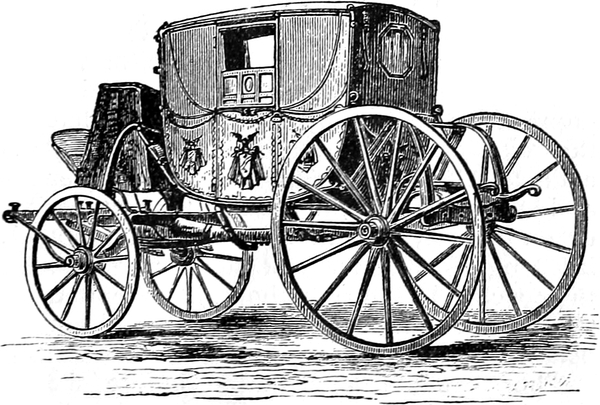
TRAVELING COACH, 18TH CENTURY.
During the next two decades the number had grown to twenty-nine, which would have been further increased had it not been for the enormous cost of production, a complaint that prevails a hundred years later. Most people, therefore, imported their coaches. Among these was Washington. Mr. J. T. Watson describes his coach as follows: “It was cream-colored, globular in its shape and capacious within, ornamented in the French style with cupids supporting festoons and wreaths of flowers emblematically arranged along the panel-work, the figures and flowers beautifully covered with fine glass, very white and dazzling to the eye of youth and simplicity in such matters. It was drawn sometimes by four, but in common by two, very elegant Virginia bays, with long switch tails and splendid harness, and driven by a German, tall and muscular, possessing an aquiline nose.” A handsome vehicle in its time, no doubt, but one that would appear as an advance guard of Barnum’s in these days of workmanlike simplicity.
A less gorgeous vehicle, but equally curious, was lately, Miss Young says, in the possession of Brewster, of Broome Street. “It was built in 1801 by Leslie, of London, and was brought to this country on the occasion of a matrimonial alliance between the families of Van Rensselaer and of Vischer. The body is painted yellow, and on the panels are the arms of both families. The lining is green. The wheels are high, and the body, instead of being let down between them, is kept as far from the ground as possible. The driver’s seat is also pushed up to the highest possible altitude.”
At the commencement of this century three stages were enough for the requirements of the travelers from and to this city. One of these ran from the corner of Wall and New streets to Greenwich, and the other ran from the Bull’s Head to Harlem and Manhattanville respectively. Twenty-five years made a vast difference in the travel by road, and the country roads being improved a large number of coaches left this city daily, among them being daily mails to Albany, Philadelphia, Westchester and Danbury; and there was a day mail between this city and Boston. This did not last long, as the advent of steam-cars sent the coaches to the rightabout, or relegated them to the interior where steam had not penetrated.
Then came a long period before the time-honored sport was renewed.
It is said that in 1860 there was only one private four-in-hand in the Union, which was of English build, and belonged to Mr. T. Bigelow Lawrence, of Boston. It eventually passed, on his death, into the hands of Brewster & Co. While in their hands it attracted the attention of Col. William Jay and Mr. Thomas Newbold, and was purchased by them, the copartnership being increased by Mr. Frederick Bronson and Mr. Kane. Three years later, in 1863, Wood Brothers built a coach for Mr. Leonard Jerome; Mr. August Belmont imported one from England, and during the next decade coaches were imported by Mr. Bronson, Col. Delancy Kane, and Mr. James Gordon Bennett, whose importation was afterward purchased by Mr. William P. Douglas.
Curiously enough, the organization of the Coaching Club was started abroad, several gentlemen, among whom were Col. Delancy Kane and Col. W. Jay, being the prime movers in this idea. In 1875 the organization was effected. The first parade was held in 1876, and six coaches made their appearance. Many of the names that were included on the roll in the first year are still represented on the box-seat; Mr. Frederick Bronson and Col. William Jay were, however, the only two who put in an appearance at the meet last May. The others are James Gordon Bennett, William P. Douglas, Leonard Jerome, Delancy Kane, Nicholson Kane, Thomas Newbold, and Mr. Thorndike Rice. This list was speedily augmented, and included August Belmont, senior and junior, Hugo S. Fritsch, George R. Fearing, Theodore A. Havemeyer, G. G. Haven, Frederick Neilson, Fairman Rogers, Francis R. Rives, G. P. Wetmore, Pierre Lorillard, Augustine Whiting, and Augustus Schermerhorn—all names that are interesting to students of the history of the sports of the past twenty-five years.
The membership was originally twenty-five, but so popular has the club become that it has been deemed advisable to increase the number, and the limit now stands at forty-five, with only one vacancy, and plenty of applicants. The uniform consists of a dark green cut-away coat with brass buttons, and a yellow striped waistcoat, the buttons bearing the initials C. C., and having the bars as a design. The club only comes before the public twice a year, one of these occasions being the annual meet in the Park, and another being the annual drive to some spot within about fifty miles of New York. At these times the club is greeted by a large portion of the New York public, and when the weather favors the annual meet it takes all the energies of the “sparrow police” to keep the road clear for the coaches.
Very few of the members have ever driven public coaches, so the rule that obliges members of the English coaching clubs to have previously driven a public coach, would be prohibitory here. Col. Delancy Kane is about the only member that has done so in England, and he was, with Colonel Jay, Theodore Roosevelt and Frederick Bronson, the prime mover in the “Tantivy” which ran for several seasons from the Hotel Brunswick to the Country Club at Pelham. Last year Mr. Hugo Fritsch and Mr. Frederick Bronson ran this venture, but I fancy that the returns were by no means commensurate with the expenses, and that they lost money. It seems a pity that no one is public-spirited enough to follow in their footsteps, as after all the expense is not so very vast, and it would give the prestige that many strive for in other ways. Colonel William Jay was the first president of the club, and he still retains that position, leading the van in the parades, and sits at the head of the table at the dinner which follows.
The parades have been attended with very few accidents, and indeed the whole history of amateur coaching in America is singularly devoid of exciting incidents. The Central Park gates are wider than those of Hyde Park, and the example of a noble lord who not very long since took a wheel off and quietly “dumped” his load on the sidewalk, has not as yet been emulated. I have heard of a case in which a four-in-hand and a street-car tried conclusions to the detriment of the former, and one or two of the starts at Jerome have been fraught with considerable peril to those who were on the coach. Fortune favors the brave, however, and Jerome luckily has not such a tremendous hill on the way home as has Goodwood, the historic racecourse situated above the beautiful park of the Duke of Richmond and Gordon. To this course some thirty private four-in-hands make the trip from the different country houses and towns in the neighborhood.
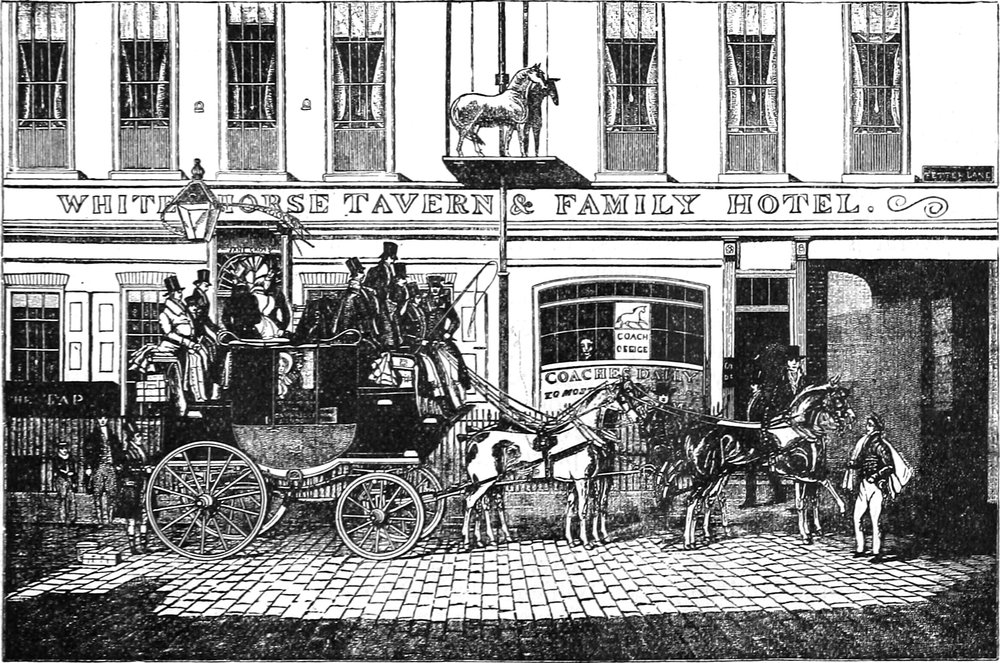
“THE CAMBRIDGE TELEGRAPH,” WHITE HORSE TAVERN, FETTER LANE, LONDON.
About ten years back, Lord Charles Beresford, of “Condor” fame, was driving his coach home from these races; on the seat beside him was Lady Folkestone, and another lady was among those behind. When a couple of hundred yards through the park had been compassed, a sudden block occurred on the road, and Lord Charles, to save running into some of the carriages in front, swung off the road onto the grass. The jerk broke the chain of the “skid,” and the coach ran away with the horses. The hill at this point is very steep, and the pace was simply terrific. The coach swayed from side to side, but did not turn over; the horses were going at a mad gallop, and a stumble meant instant death to all. Down the hill they plunged, Lady Folkestone never moving or saying a word, and the rest of the party, with teeth set, grimly facing the end that seemed inevitable. The bottom of the hill came at last, and over the rolling sward tore the horses. Finally, about a mile and a half from the bottom, they came to a stand, not a strap broken, and no damage of any kind done. Lord Charles could not release his hands from the reins, and they had to be forced from him. Since then he can never depend on them, as any strain seems to paralyze him, and at one or two meets of the Coaching Club he has been obliged to relinquish the “ribbons” in consequence of the horses’ pulling. This all reads like a traveler’s yarn to those who do not know the steepness of the hill; but Lord Charles told it to me himself, and added that the only thing lost was the whip. This could hardly occur at Jerome, as there are no precipices to encounter.
The annual drive of the Coaching Club is quite a feature, and some very charming trips have been made. Last year the chosen spot was “Idle Hour,” the beautiful country seat of Mr. William K. Vanderbilt, at Oakdale, L. I. The start was made on June 2, at 9.30 A. M., from the Brunswick Hotel, Col. Jay “handling the ribbons.” Idle Hour was reached by six P. M. Changes were made at Flushing, Lakeville, Garden City, Belmore, Amityville, Bayshore, and Islip; the different gentlemen horsing the coach and driving the several stages being Messrs. F. A. Havemeyer, F. Bronson, A. Belmont, Jr., Delancy Kane, and Prescott Lawrence. The return journey was made on Monday, the changes being made at the same places, and at six o’clock, dusty and thirsty, the members of the C. C. drew up at the door of the Brunswick. It was the eleventh annual drive of the club, the other places visited having been the country seats of A. J. Cassatt and of Fairman Rogers, at Philadelphia; Mr. Frederick Bronson, at Greenwich Hill, Conn.; Mr. Francis Rives, at Cornwall-on-the-Hudson; Col. William Jay, at Bedford, N. J.; Theodore Havemeyer, at Mawah, N. J.; Pierre Lorillard, at Rancocas, N. J.; Mr. Theodore Roosevelt, at Hyde Park, and Mr. Schermerhorn, at Lenox, Mass. The trip made in 1878 to Philadelphia was a long one, the entire ninety miles being accomplished in about seven hours and a half. The route was divided into nine stopping-places, these being Newark, Rahway, Signboard, Six Mile Run, Princeton, Trenton, Hulmeville and Holmesburg—the drivers being Col. Delancy Kane, F. R. Rives, P. Belmont, Jr., T. A. Havemeyer, G. P. Wetmore, Hugo O. Fritsch, F. Bronson, G. R. Fearing, and Fairman Rogers.
The meets which take place on the last Saturday in May have for the two past years been subject to atmospheric depression, which has had a deteriorating effect on the attendance and on the spirits of those present; but, rain or no rain, the meet takes place. Only seven coaches were in line last year, which shows that, however much the “art” may be appreciated in New York, the increase in the number of coaches during the past decade has hardly kept up with the corresponding increase in the membership of the club.
Colonel Jay drove a pair of useful golden chestnut wheelers and gray and roan leaders to his red and yellow coach. His leaders were not quite as showy as the gray and chestnut leaders that he had last year. Dr. Seward Webb’s coach was black and yellow, his horses being four well-matched chestnuts. Mr. Prescott Lawrence’s coach has a primrose body with yellow carriage, and his cross-team of chestnut and brown wheelers, with roan and gray leaders, were as good as any on the ground. Mr. Fairman Rogers drove bays and grays, and Mr. Hugo Fritsch’s coach was drawn by brown and bay wheelers and bay and roan leaders. Mr. E. N. Padelford deserted the traditions of the club and brought a “stag party” in his white and blue coach horsed by four bays. Mr. Frederick Bronson had a useful pair of brown wheelers with chestnut and brown leaders. Weather has a great deal to do with these parades, and there seemed a lack of enthusiasm on the part of the spectators, and a lack of the pleasurable animation on the part of those on the coaches, which is necessary to make a meet of the Coaching Club a perfect success.
Let us hope, in the interest of this grand sport, that the sun may shine very brightly on the last Saturday of next May, that the number of coaches be quadrupled, and that all the beauty of New York occupy the seats on the tops of the different drags.
SALMON FISHING ON LOCH TAY.
BY “ROCKWOOD.”
PARTRIDGES and pheasants have just come under the protection of the Close Time Act, and the gun has been laid in its old place on the rack, there to remain till the 12th of August, when the grouse-shooting opens; the greyhound courser is thinking of the near approach of Waterloo, when, on the plains of Altcar, at Liverpool, the Blue Riband of the Leash will be fought for amongst the cracks of the “longtails;” the fox-hunters of the shires are hard at it and keen as ever, though their horses are leg-weary and suffering from overreaching and attendant sprains of the sinews, when we fly north from London by the London and Northwestern Railway en route to Loch Tay for the early spring salmon fishing.
Every Scottish lake has had its poet. Scott and Christopher North have in prose celebrated the praises of Loch Lomond. The Gaelic bards, like Robb Donn Mackay, have sung of Loch Maree, the silent and majestic, beloved of all the lakes by Her Majesty the Queen; but Loch Tay is the loch of the angler and the sportsman. It is, par excellence, the lake home of the Scottish salmon, that fish which, viking-like, cruises annually along the west side of the German Ocean, and with health and vigor charges mill-lades, linns, weirs, and a hundred other obstacles, with all the fury of a Highlandman on a battle-field, and not a little of the Celt’s cunning in dodging round the ends of stake-nets on his return to his native waters.
The Purdies and the Kers of the Border may swear by the superior charms of killing “a guid Tweed fush.” On the Solway Dee they will contest for the merits of their own waters, and where the Dee of Aberdeenshire sweeps through the woods of Invercauld and down under the shadow of the windows of Balmoral, the Farquharsons and the Gordons, adepts at throwing a long fly, will hold in contempt the anglers of less favored streams. Each riverman has his opinion, yet all are agreed that Loch Tay is the premier fishing loch.
“FROM KENMORE TO KILLIN.”
This magnificent sheet of water drains, by means of the rivers Dochart and Lochy, the large range of hills which guard central Scotland from the storms which sweep across the Atlantic past the North of Ireland, and to whose accompaniment of heavy seas Mull, Skye, and other of the Hebridean islands form a huge breakwater. Loch Awe takes the drainage of the west water-shed, the river Awe carrying it through the Pass of Brander to the Atlantic. Loch Tay gathers all on the east and north and carries it by means of the silver Tay right across Scotland to the German Ocean, through varied and unsurpassed scenes of beauty. Onward the river flows, under the walls of stately mansions, once the homes of fierce chieftains, now the residences of enthusiastic sportsmen. Among these the most noted is Murthly Castle, where Sir John Millais every year makes known to the salmon the lightness of the hand required to successfully apply a brush to canvas.
THE BOATS STARTING—KILLIN.
But the train whirls northward, through counties renowned in hunting song, past old coaching “half-way” houses, famous in the history of the English mail coach. Here the travelers of sixty years ago used to hold merry jinks, whilst the coachman fretted and the guard shouted and four good steeds pawed the sward, anxious to start on the next stage. On between blazing furnaces, the coal ground of the iron horse, past reeking coal pits. Descending those dark shafts and traveling along every corner of the mine, you will find British sportsmen, each as ready and as enthusiastic in backing a horse or a greyhound as his master, the wealthy mine owner and member of the Jockey Club. Over the Cumberland hills, where wrestling is still the favorite pastime, as in days of yore, to merry Carlisle, that old English border-town which was the scene of many a fierce battle between Scotch and English. Skirting Gretna Green, where runaway couples were hitched tight by the old blacksmith in the days when marriages were made more binding than now, Bectloch summit is crossed, and soon the train crosses the Clyde valley. At Stirling Junction carriages have to be changed, and while the setting sun is gilding the western sky, we dip from Killin old station, beyond Callande, down into the lovely valley of the Dochart, to Killin, the capital of Breadalbane and the head fishing quarters of Loch Tay; and this, too, only twelve hours after leaving Euston Station, London.