Volume 13 / Part 2 — OUTING. (continued 2)
Reading edition
The principles of good rowing laid down by Mr. Cook in the last two years, and re-enforced by his constant attention, have resulted in a settled style of rowing at Yale, which bids fair to be modified only as the needs of individual crews may require. There are a few oarsmen who still favor somewhat the rapid stroke of the ’82 Yale crew, basing their arguments upon the fast times made by that crew both at New London and on New Haven harbor. The answer to be made to the advocates of their style of rowing is that they were a set of giants, capable of rowing forty-five strokes to the minute for four miles, a feat impossible to modern oarsmen. It is conceivable that the rapid stroke, so much trusted in by professionals, might with men of immense strength, who were incapable of attaining to the finish and detail of a crew of the present day, turn out a faster eight than the “Bob Cook” stroke with the same men, still it is much to be doubted. While with the present tendency towards selecting light and muscular, rather than beefy men, there can be no question but that the fastest rowing of which they are capable will be done by the “Bob Cook” stroke, which with its long swing and slow slide takes advantage of every pound of impetus, and with its slow catch gives the oarsman between every stroke a chance to recover his breath and nerve himself for the next pull. And this present method of selecting material is more than justified by the magnificent rowing of the ’88 Yale crew, which in the opinion of Mr. Frank Peabody, the Harvard coach, could defeat any crew, amateur or professional, English or American, that should be pitted against it. In other words, the ’88 Yale crew made the finest exhibition of rowing ever seen in America, and may be safely said to have been the fastest crew that ever sat in a boat.
BASEBALL SINCE 1876.
After the Yale successes in baseball in ’74 and ’75, the Yale nines played much closer games with Harvard, although for the four succeeding years the series of games was invariably won by Harvard.
One of the Yale-Harvard games in 1877 was remarkable in that the Harvard nine went to the bat only twenty-seven times, each player going out in the order of striking. Not a single hit was made off Carter, the Yale pitcher. In 1878 Yale defeated Harvard on her own grounds for the first time, which inspired so much over-confidence in the Yale team that they were defeated in three straight games by Harvard. This is but one of many instances of the truth that college nines do best when least is expected of them, and that it is confidence unfortified by hard work which most surely issues in defeat.
The Intercollegiate Baseball Association was formed in December, 1879, with Yale, Harvard, Princeton, Amherst, Dartmouth and Brown as members. Yale shortly withdrew from the association because it voted to allow the playing of college men who had played on professional teams. Series of games were arranged, however, with Harvard, Princeton and Amherst, in which Yale won seven out of eight games, virtually winning the championship. In her games with professionals Yale was singularly successful, winning eleven out of thirteen played.
From 1880 to 1888 inclusive Yale has won the championship, with but one exception, when in 1885 Harvard won it by ten straight victories. In 1884 Yale and Harvard were tied for first place, and the deciding game, played in Brooklyn, was won by Yale.
The year 1885 was the most disastrous in athletics ever experienced at Yale. The Yale nine, although possessing individual players of merit, had no reliable pitcher, and lacked team play and discipline. Yale’s first defeat in 1886 was in an exhibition game with Columbia, whose brilliant team of this year defeated Harvard also. This team was in reality a graduates’ nine composed mostly of Law School men, and included graduates of Yale, Princeton, etc. The tie game for the championship was played off in Hartford, between Harvard and Yale, on the day after Yale’s victory on the water. The Yale nine, who had been practising on the Hartford grounds while the Harvard nine watched the race, played with great determination, and won by a score of 7 to 1. The now famous battery of Stagg and Dann first came to the front in this year.
After this season’s play, Harvard, Princeton and Yale withdrew from the Intercollegiate Association and formed a triangular league. Into this “College League” Columbia was admitted, but after a few games she withdrew owing to various difficulties. The first Yale-Harvard game in 1887, played in New Haven, resulted in a crushing defeat for Harvard by a score of 14 to 2. The game was quite close until the eighth inning, in which the Yale nine completely knocked Boyden out of the box, making eight hits with a total of twelve, and allowing every member of the nine to make a circuit of the bases.
The baseball season of 1888 opened with a severe check to Yale’s hopes in her defeat by Princeton in the first game played. The loss of this game made it appear that Princeton, after having for several years assisted Yale to the championship by winning a game or two from Harvard, would now render a like service to Harvard. The first Yale-Harvard game, however, was reassuring, Yale winning by 7 to 1. The next game, played in Cambridge, being won by Harvard, 7 to 3, put an entirely different aspect upon affairs, necessitating, as it did, in order for Yale to win the championship, her winning the three remaining games of the series. This difficult feat was brilliantly accomplished by the aid of much “sand” in the Yale team. The most notable feature was the game played in Cambridge, won by Yale, 8 to 0, in which Stagg held the Harvard batters down to two hits. As was the case in 1886 and 1887, Yale’s chief strength this year lay in her battery, Stagg and Dann.
Yale’s baseball record is, on the whole, most creditable, she having won 130 out of 177 college games played. With Harvard, Yale has won 32 games and lost 30, while with Princeton Yale has won 33 and lost 11. To other colleges than these two, Yale has lost but six games, two to Amherst, two to Brown, one to Columbia and one to Dartmouth. In all her games, with professionals as well as amateurs, Yale has made about 550 more runs than her opponents.
An innovation was made last fall in the matter of getting together a university nine for practice games in the fall. During the winter the nine practised batting daily in the baseball cage, and got in good physical condition by gymnasium work and out-of-door running. A simple machine, enabling the nine to practise sliding in the cage, was devised last spring, and its results are evident in the number of stolen bases accredited to the Yale nine in its past season’s play.
The number of annual championships in Rowing, Football, and Baseball since the establishment of intercollegiate associations in these branches, won respectively by Yale, Harvard and Princeton is a source of pride to Yale men, the numbers being: Yale 21, Harvard 7, and Princeton 2.
TRACK ATHLETICS.
Track Athletics at Yale started in 1872, about the time that the first intercollegiate athletic meetings were being held in Saratoga. Yale sent two representatives, born athletes devoid of instruction, to the intercollegiate meetings of ’74 and ’75, who won a first prize apiece each year. Fall games were started at Yale in 1875, and were an unqualified success, the most interesting event being the running high jump of Gale, ’78 S., who cleared 5 ft. 3 in., pronounced to be “the finest amateur jumping ever done in America.”
It is a curious commentary on the taste of this period that the hurdle and the one hundred yard races were regarded as tame, while a three or a seven mile walk was considered most interesting and exciting. The presentation of the Challenge Cup, valued at $500, now commonly known as the Mott Haven Cup, served as a great stimulus to track athletics in all the other prominent athletic colleges except Yale, whose apathy and indifference to this branch was so great that from 1877 till 1880 she sent no representatives to the meetings. In 1880 Mr. T. Dewitt Cuyler, of Yale, established a record of 4m. 37 3-5s. in the mile run, a record which was not broken for seven years. From 1880 on, Harvard continued to win the cup with an unvarying regularity, with Columbia a good second and Yale a poor third.
In 1882 one of Yale’s best runners appeared, Mr. H. S. Brooks, who won the intercollegiate 100 yards and 220 yards for two years, doing the 100 in 10 1-5s., and the 220 in 22 5-8s.
The famous 220 yards run between Brooks and W. Baker of Harvard, occurred in 1884, and was a magnificent exhibition of running, Baker winning in 22 2-5s.
In 1886 the contest for the cup between Yale and Harvard was most closely fought, resting as it did upon the decision in the 100 yards, which was, at any rate, a very difficult decision to make. It is hardly worth while to recount that Sherrill of Yale was cheered and congratulated as winner, or that the decision rested with one judge, a Harvard graduate, who alone, out of the three judges, witnessed the finish, for Yale lost the cup. The policy of Yale men after defeat has always been to make no excuses for failure, but to turn with greater determination to the work of retrieving the past by victory in the future.
Yale has had a large number of fine individual track athletes in the past two years, among them being Sherrill, ’89, amateur champion in 1887 for 100 yards, and easy winner this year in the intercollegiate 100 yards and 220 yards; Coxe, ’87, with his records of 101 ft. 1 in. in the hammer throw, and of 40 ft. 91⁄2 in. in putting the shot; Ludington, ’87, who has hurdled in 163⁄4s.; Harmar, ’90, who has run a mile in 4m. 32 2-5s., and Shearman, ’89, who jumps 21 ft. 71⁄2 in. in the broad jump, 5 ft. 81⁄2 in. in the high jump, and pole vaults 10 ft. 3 5-8 in.
To the fact that Yale had so many crack performers in 1887 was due her winning of the cup, aided by the fact that Harvard found very strong competition from the other colleges in her events. Yale lost the cup this year for the opposite reasons, having no luck in winning events, and having but three crack performers left. As to men of medium ability, Yale never possesses them, her success depending solely upon her first-class men. It is a notable commentary on the system of track athletics at Yale, that her three best performers this year won five first prizes, and that these were the only ones taken by Yale.
Until Yale follows in Harvard’s footsteps in training carefully and skilfully a large number of men for her athletic team she can never hope to compete on an equality with Harvard. And this will not be possible at Yale until greater interest is taken in this branch of athletics, and until the cup is valued as highly as a football championship or a Yale-Harvard race.
LAWN TENNIS.
The game of lawn tennis, first played in this country in 1875, was long a popular game among college students before it became an object of intercollegiate strife. In 1883, at the proposal of Trinity College, an association was formed embracing Amherst, Brown, Harvard, Trinity and Yale. This association has grown in numbers since that time, until it has now eleven members, the added ones being Columbia, Lehigh, Princeton, University of Pennsylvania, Wesleyan and Williams. The tournaments for the first two years were held in Hartford, and for the last three years in New Haven. In the first year of the association two tournaments were held, both won by Harvard, but since then one annual championship has been held every fall.
The difference in the expenses of the tournaments of 1883 and 1888, will indicate somewhat the increased importance of this annual event, the total expenditure in the first year being $8, while for prizes alone there was spent last year $285. The number of college men who are reckoned among the best players of this country, is worthy of note, including as it does such names as Mr. R. D. Sears, Mr. H. W. Slocum, Mr. J. Clark, Mr. G. M. Brinley, Mr. H. A. Taylor, and others.
Mr. R. D. Sears, the well-known ex-champion of the United States, only played once, in 1884, in the intercollegiate tournament, and was then beaten, principally owing to the poor grounds, by Mr. W. P. Knapp, of Yale, who of all individual players has the best record in the college tournaments, having won two first prizes in singles and three in doubles. In the five annual championship tournaments, Yale has won five first places and three seconds, Harvard five firsts and one second, Trinity one first and four seconds, Columbia one first and three seconds, and Amherst one second.
There are now in Yale five athletic organizations for the five branches of athletics, each of which is a member of an intercollegiate association for that branch. Each organization has its own president, vice-president, treasurer and secretary, elected annually, of whom the president is usually an academic senior, the vice-president a scientific senior, and the treasurer and secretary either underclassmen or, in the case of the boat club, a professor of the college. The annual expenses of the various organizations are about as follows: Football, $3,000; baseball, $4,000; crew, $5,000 to $7,000; track athletics, $2,000 to $2,500; tennis, $250. Of these the football, baseball and tennis associations are self-supporting, the Track Athletic Association is very nearly so, and only the expense of supporting the crew falls upon the students. In this the undergraduates are assisted by graduate subscriptions, by glee-club concerts, and by concessions from the railroads that run into New London, and from the town itself. The Football Association, especially in lucky years, nets the largest sum from its games, although there is usually also a substantial baseball surplus remaining.
A scheme of uniting all the organizations, with a common treasury, has often been proposed; but it would seem to be inadvisable owing to the probable increased expenditure, where each organization would not let the others surpass it in expensive uniforms or luxurious living.
To sum up what Yale has done for athletics would be entirely beyond the scope of this article, and equally impossible would it be to calculate what athletics have done for Yale. Suffice it to say, that Yale has always been on the side of manly, fair and honest sport, and that in the persons of such men as Mr. Robert Cook, Mr. Walter Camp, and others, as well as in the devoted labors of many hundred athletes, with the head as well as with the hand, she has always striven to advance the science and elevate the tone of every athletic sport. While, as to what athletics have done for Yale, leaving out of consideration the lower purposes served of bringing glory and prominence to Yale among American colleges, and the undoubted attraction of larger numbers of students, athletics have turned out from Yale many hundreds not to say thousands of men, manly and democratic in ideas, possessed of constitutions able to endure almost any amount of work, and competent to struggle and hold their own in whatever circumstances they may in afterlife find themselves placed.
The saying of Mr. Robert Cook applies to other sports as well as boating: “A successful oarsman is always a successful man.” The qualities absolutely necessary in athletics, of self-mastery, of patience, of perseverance, of pluck, of endurance, and of obedience, form the best endowment to a young man about to enter life.
NOTE.—The illustrations of the different groups of athletic, football, baseball, lacrosse, and other teams in this series of articles on college athletics, are from photographs by Pach Brothers, of 841 Broadway.
A RUSSIAN WOLF HUNT.
BY TOM BOLTON.
DURING the winter of ’82 business complications made it necessary for me to take a journey into a wild and remote part of Russia. The house with which I was connected had had some very unsatisfactory dealings with one of its branches, and things had come to such a pass that a visit from a member of the main establishment had become imperative.
It was late in January when I had to make my start, and the weather had been unusually cold. I could travel 750 miles out of my journey of 1,000 by rail; but the balance of the trip would have to be made by sledges, not a very rapid or convenient mode of transportation, though it has the advantage of enabling the traveler to regulate his time as he feels disposed. Being extremely fond of field sports, and knowing that the section of country I was going to visit would, in all probability, contain plenty of game, I carried my Colt’s breech-loading shotgun and a fine Winchester repeating rifle, with a good store of ammunition for both.
Well, I arrived at the end of my railroad journey without any accident or incident other than the regular daily skirmishes for meals and hot tea at the not overclean stations. We were fortunate in having a clear line, no snow having fallen for over a week—rather a remarkable circumstance in Russia—so we were not compelled to dig out any snowbanks, though this form of amusement is by no means unusual. The morning after my arrival at Udalla I sent to make arrangements for a sledge at the posting-station. This was soon done, and in an hour I was clear of the town and fairly started on the second half of my long journey.
In Russia the sledges are generally roofed over—especially those used for traveling—somewhat after the fashion of our buggies, and are very low, so that, provided there are plenty of rugs and furs, one can make a trip comfortably enough, and even sleep at his pleasure. The picture in the mind of travel of this description is of three horses abreast, gayly dashing along in fine style; but in my case the actual facts were very different. Before we had gone two versts from Udalla, the road became very bad, for the snow was deep on each side of the track, and though the track itself was broken, the snow was in great lumps. Over these the sledge thumped and banged, while the horses stumbled and floundered along as best they could. The driver, meanwhile, consoled himself by alternately cursing the horses, the road, and his bad luck at having to come out, with an occasional vogtd at me for a crazy Englishman who wanted to kill something so badly that he had to go hunting in the dead of winter; my language and impedimenta giving rise to various unfounded rumors, while every one speaking English is put down as an Englishman by the peasantry in this part of Russia.
We reached the post-station, at the end of our first day’s travel, long after nightfall. After a hot supper, I continued my journey all night, taking a number of naps, but no regular sleep, because, as soon as I began to doze, I would imagine my ribs to be a corduroy road, and my vertebræ a troop of army mules crossing it and kicking off flies. However, I managed to get along tolerably well, all things considered, and had the satisfaction of knowing that my unfortunate driver was having considerably the worse time of the two.
During the fourth day’s journey, while we were passing through a very extensive forest, several wolves came out into the road and followed us a mile or more, but at quite a respectful distance. Their number was too small to cause me any uneasiness, though my driver did not at all like their presence, and the horses betrayed their alarm by their evident desire to hurry along. One large black fellow tried to get up some excitement, and howled most dismally, so I made my driver stop, while I got out my heavy Smith & Wesson revolver. Taking a rest over my left elbow, I let fly at his shoulder as he stood sideways to me, and had the satisfaction of seeing him stumble forwards, and take to the timber again with his friends at his heels. My driver told me that a sledge had been attacked by wolves on this very road a couple of winters before, and both horses and passengers eaten up, but that the wolves had been rather scarce since.
I had heard much about wolf-hunting as practised by the Russians of the Steppes, viz., driving a sledge through the woods and over the plains with a piece of meat dragging behind to attract the wolves, thus giving the hunters in the sledge an opportunity to kill them. I had promised myself to try this plan and have some sport in spite of the fact that my driver told some blood-curdling tales of the fierceness of the wolves when banded together and made desperate by hunger.
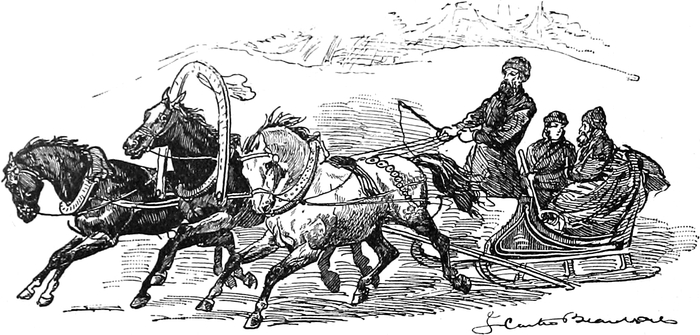
WE ENTERED AN OPEN SLEDGE WITH THREE HORSES HARNESSED ABREAST.
It was nearly night on the fifth day, before I arrived at my destination, and, as may be imagined, I enjoyed a good night’s sleep, as well as a much better supper than I had been having.
The following morning I had to attend to the business that had brought me so far. I soon discovered that only prompt action would save us heavy losses, so I at once discharged the local manager, as well as two collectors, whose honesty I had cause to suspect. This threw much work on my hands, so I had very little time at my own disposal. However, I managed to make the acquaintance of a Captain Komanoff, who owned a small estate in the neighborhood, and who was devoted to sport in all its branches. When I mentioned my desire for a wolf hunt to him, he laughed and said he had been on several, and had generally had good sport. He added that he would arrange to go with me whenever I should be ready.
In the course of ten days I had the rather complicated affairs pretty well in hand, and as there had been a damp fall of snow, followed by a frost, I concluded I could spare time for my hunt. Accordingly, I notified Komanoff, and one clear, calm night we entered an open sledge, that is, one without any top, and with three good horses harnessed abreast, set out.
I carried my shotgun, with a bounteous supply of cartridges loaded with small buckshot, thinking it a better weapon than a rifle to use at night, while Komanoff had an army carbine, carrying a large-sized ball, with which, he told me, he had killed many a bear and wolf. Each of us was also armed with a revolver and heavy hunting-knife. The driver whom we had engaged for the night had a couple of pistols and a knife in his belt, and as he was a plucky fellow and had hunted (or been hunted by) wolves before, we were pretty well prepared for anything. Ivan (the driver) took care that we also had a small basket of lunch and a bottle of brandy, so we were quite in the humor to make a night of it.
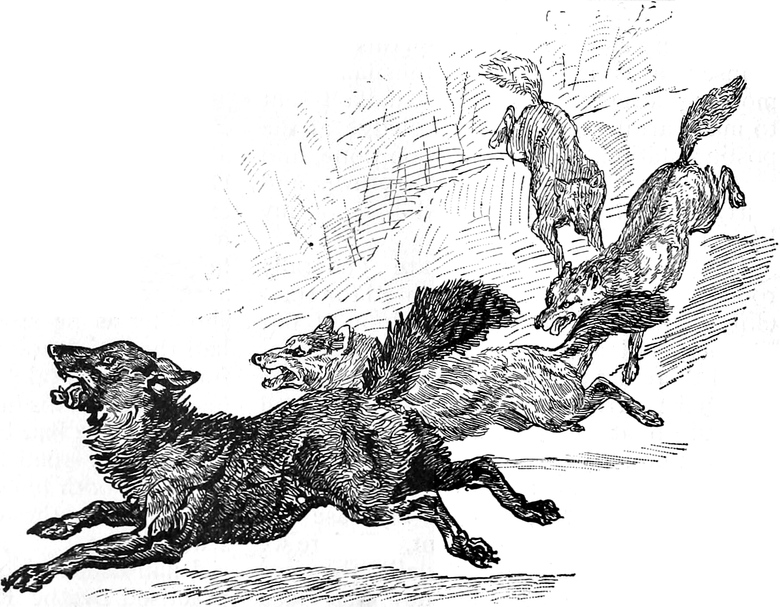
RUSSIAN WOLVES.
The snow was well crusted over, and easily bore our horses, thus making a hard, level surface to travel over, also reducing the chances of a capsize, which, if one were pursued, might give the sport a very different ending from that intended. When well out from the village and near the edge of the timber, the bait (in this case a quarter of a calf, well rubbed with asafœtida and bound with straw) was thrown over and allowed to drag at the end of a stout cord about forty feet behind us.
It was certainly a grand night, the moon being at the full, and the reflection on the snow made objects almost as clearly discernable as in the daytime. Far up on the northern horizon the Aurora Borealis alternately flashed and paled, now throwing up bars and rays of violet and gold, and again diffusing itself over the heavens in a soft but ever-changeful glow.
We had been riding slowly along for a couple of hours, when Komanoff remarked:
“I am afraid we shall have our trip for nothing; the wolves don’t seem to be about to-night, and yet this wood is a famous place to look for them.”
“Don’t be uneasy, Captain,” said Ivan; “I am going to make a circle and cross our track again, and I think you will have some shooting yet.”
The words were hardly spoken before we heard, far off to our right, the long-drawn, sepulchral howl of a wolf. He had evidently struck our trail, and the veal smelled good, so he was yelling for his friends. The team was at once stopped, while we listened and heard several more howls in response. The horses heard them too, and at once showed their fear by an attempt to get away, but Ivan had them well under control, and only permitted them to walk, not wishing to blow them before the beasts began to gather.
“I see a wolf,” said Komanoff; “look away back there on our track, right under the moon. Ah! and there are several more; I think they will come along now.”
Looking back, I saw several black objects coming out of the timber, which we knew to be wolves, and the way they increased in size showed they were following us at full speed. Every now and then several more would dart out of the woods and join our pursuers; but not a sound was heard, for wolves, unlike dogs, run mute. We now prepared to receive them, and we removed our heavy outer coats so as to allow us a better chance to shoot. The horses were allowed to trot, though it was all Ivan could do to hold them, as they were pulling the sledge by their bits, whilst they showed by their rolling eyes and quick backward glances, their extreme terror.
Our friends in the rear now numbered fully twenty, and to my surprise they came rushing boldly on, as though we were no more to be feared than some timid deer which they had cornered.
When they had come within thirty yards I gave the foremost my right barrel and instantly followed it with my left among the pack. I saw the leader’s tail go up as he plunged forward on his head, and Komanoff exclaimed that two more had dropped to my second shot. I fully expected that the rest would scatter in all directions, but they did nothing of the kind; they simply fell upon their defunct companions and tore them to pieces almost before they had done kicking, and then immediately resumed their pursuit of us.
When Komanoff saw this he looked rather grave, and told Ivan it would be well to head for home. “For,” said he, “when they eat each other in that manner, it’s a sign that they are starving, and should a large pack gather, we would have a poor chance of escape.”
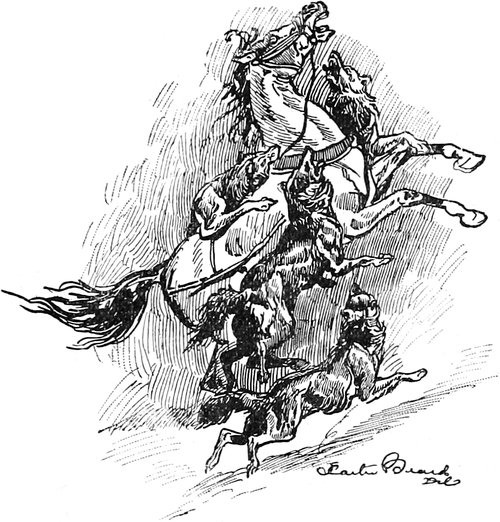
THEY FLUNG THEMSELVES ON THE OUTSIDE HORSE.
Accordingly, Ivan let his team go along at an easy gallop. The wolves were again coming along in hot pursuit, and were almost in range, when Ivan uttered a shout, and the horses made a sudden swerve, so that the sledge was nearly upset. Komanoff and I were thrown in a heap in the bottom, his gun being discharged by his fall, fortunately without doing any damage. Quickly recovering ourselves, we saw that a fresh and large pack of wolves had come out of the woods, and had nearly run into us, causing the team to bolt at full speed. I fired right and left into the thick of them (they were only a few yards away), while Komanoff began to empty his revolver.
This fusillade checked them for a few moments, till our original pack had come up and joined them. Then, having devoured the slain, they came for us again with redoubled vigor, their appetites having evidently been sharpened by the taste of blood. As they closed upon us we fired as rapidly as we could load, but without alarming them at all, only a few stopping to bury the dead (in their stomachs), while the main body tried to come up with our horses and sledge.
Komanoff now cut our bait loose, for we had had all the fun we wanted. As the wave of wolves, as one might say, rolled up over it, we fired into the thick of it, and, as they were in a dense mass, must have done considerable execution. But they were only delayed a moment, and on they came again, their long, tireless gallop soon bringing them up with us.
It was indeed a fearful sight, and enough to shake the stoutest nerves. There was that vast pursuing horde, crazy with hunger and wild with lust of blood, dashing after us relentless as death. Their long black bodies swept over the snow, the hindmost constantly leaping over the foremost in their eagerness to press on, their eyes a-shine, with great flecks of foam on breasts and sides, while the glimpses we caught of their long white teeth showed us just what our fate would be should there be an accident to team or vehicle. Komanoff turned to me and said: “If they ever pass us and leap on the horses we are dead men. Keep cool and shoot only those that try to pass on your side and I will do the same on mine.”
So we dashed on for a mile or so, keeping up a rapid fire, and shooting a number of our dusky friends. They were thoroughly in earnest, and made repeated attempts to get at our horses, but so far we had been able to foil them, when suddenly a big gray fellow dashed past on Komanoff’s side (who missed him), and flung himself on the outside horse. Ivan shot at him as he did so, but the horse swerved and stumbled, breaking both traces before he could recover himself. The wolf fell as the ball struck him, but our team was now almost unmanageable, and we were liable to be upset at any moment. Fortunately Ivan kept his head, and succeeded in turning his horses towards a deserted charcoal-burner’s hut, which he knew, and applied his whip lustily, so we dashed forward with renewed speed.
“I know where he is going,” said Komanoff, “but our chance is poor unless the door be open; but it’s our only hope now, therefore be ready to jump the instant I do. Take you the arms, while I help Ivan with the horses.”
A short distance farther and we sighted the cabin. The door was ajar, and as we pulled up I tumbled out the guns, robes and lunch-basket, and with a revolver in each hand faced our pursuers.
Our sudden stop and the rapid crack of my pistols seemed to confuse the pack, and checked them long enough to enable my companions to cut the horses loose. They instantly dashed off through the forest, a portion of our hungry assailants after them in hot pursuit, whilst we ran into the house and barred the door in the faces of those that remained. In a few seconds there was a perfect cloud of wolves round us, some of them frantically digging at the walls, and others trying the door with their teeth. Fortunately it was a stout one, or this story would never have been written.
After resting a little, we found a chink or two in the walls through which we could shoot, and again opened fire. After we had knocked over some twenty-five or thirty of them, the survivors drew off, though they still continued to prowl round and fight over the bones of the dead, for all we shot were instantly devoured by their companions. Meanwhile we had contrived to start a fire, and having eaten our lunch we lit our pipes and waited for day to break, thinking then our savage foes would raise the siege. In this hope we were not disappointed, for as the morning light became clear the wolves sneaked off one by one, casting, however, many wistful glances in our direction. We gave them a few parting shots by way of farewell, and as soon as the sun was fairly up we came out of our house of refuge and started on our five-mile tramp for home.
We had not proceeded far, however, before we met a well-armed company of men coming to look for us, as one of the horses had reached home, and they judged from his condition, as well as the cut harness, that we were in a scrape of some kind. We arrived home safely, and after a good sleep were none the worse for our adventure. The other two horses, however, never turned up, but their bones were found in the forest the following spring not far from the hut, just where the poor animals had been pulled down.
This experience cured me of all desire for wolf hunting, and though I spent several months at the post, and had plenty of sport, I never cared to see a wolf again.
HERNE THE HUNTER.
BY WILLIAM PERRY BROWN.
HERNE THE HUNTER was tall, brown and grizzled. The extreme roundness of his shoulders indicated strength rather than infirmity, while the severing of his great neck at a blow would have made a feudal executioner famous in his craft. An imaginative man might have divined something comely beneath the complex conjunction of lines and ridges that made up his features, but it would have been more by suggestion, however, than by any actual resemblance to beauty traceable thereon. The imprint of strength, severity and endurance was intensified by an open contempt of appearance; only to a subtle second-sight was revealed aught nobler, sweeter and sadder, like faint stars twinkling behind filmy clouds.
Some town-bred Nimrod, with a misty Shakespearean memory, had added to his former patronymic of “Old Herne” that of Windsor’s ghostly visitor. The mountaineers saw the fitness of the title, and “Herne the Hunter” became widely current.
His place of abode was as ambiguous as his history, being somewhere beyond the “Dismal,” amid the upper caves and gorges of the Nantahalah. The Dismal was a weird, wild region of brake and laurel, walled in by lonely mountains, with a gruesome outlet between two great cliffs, that nearly met in mid-air hundreds of feet over a sepulchral cañon, boulder-strewn, and thrashed by a sullen torrent, that led from a dolorous labyrinth, gloomy at midday, and at night resonant with fierce voices and sad sighings.
Far down in Whippoorwill Cove, the mountaineers told savage tales of adventure about the outskirts of the Dismal, yet, beyond trapping round the edges or driving for deer, it was to a great extent a terra incognita to all, unless Herne the Hunter was excepted.
“The devil air in the man, ’nd hopes him out’n places no hones’ soul keers to pester hisse’f long of.”
This was common opinion, though a few averred that “Old Herne ’nd the devil wern’t so master thick atter all.” Said one: “Why, the dinged old fool totes his Bible eroun’ ez riglar ez he do his huntin’-shirt. Onct when the parson wuz holdin’ the big August meetin’ down ter Ebeneezer Meetin’-house, he stepped in. The meetin’ was a gittin’ ez cold ez hen’s feet, ’nd everybody a lookin’ at Herne the Hunter, when down he draps onto his knees, ’nd holdin’ on by his rifle he ’gun ter pray like a house afire. Wal, he prayed ’nd he prayed, ’twel the people, arter thur skeer wuz over, ’gun ter pray ’nd shout too, ’nd fust they all knowed, the front bench wuz plum full of mou’ners. Wal, they hed a hog-killin’ time fur a while, ’nd all sot on by Herne the Hunter, but when they quieted down ’nd begun ter luk fer him—by jing!—he wern’t thar. Nobody hed seed him get erway, ’nd that set ’em ter thinkin’, ’nd the yupshot wuz they hed the bes’ meetin’ old Ebeneezer hed seed in many a year.”
Once a belated hunter discovered, when the fog came down, that he was lost amid the upper gorges of the Nantahalahs. While searching for some cranny wherein to pass the night, he heard a voice seemingly in mid-air before him, far out over an abyss of seething vapor which he feared concealed a portion of the dreaded Dismal. Memories of Herne the Hunter crowded upon him, and he strove to retrace his steps, but fell into a trail that led him to a cave which seemed to bar his further way. The voice came nearer; his blood chilled as he distinguished imprecations, prayers and entreaties chaotically mingled, and all the while approaching him. He fled into the cave, and peering thence, beheld a shadowy form loom through the mist, gesticulating as it came.
A whiff blew aside shreds of the fog, and he saw Herne the Hunter on the verge of a dizzy cliff, shaking his long rifle, his hair disheveled, his eyes dry and fiery, and his huge frame convulsed by the emotions that dominated him. The very fury and pathos of his passion were terrifying, and the watcher shrank back as old Herne, suddenly dropping his rifle, clutched at the empty air, then paused dejectedly.
“Always thus!” he said, in a tone of deep melancholy. “Divine in form—transfigured—beautiful—oh, so beautiful!—yet ever with the same accursed face. I have prayed over these visitations. I have sought in God’s word that confirmation of my hope which should yet save me from despair; but, when rising from my supplications, the blest vision confronts me—the curse is ever there—thwarting its loveliness—reminding me of what was, but will never be again.”
He drew a tattered Bible from his bosom and searched it intently. He was a sight at once forbidding and piteous, as he stood with wind-fluttered garments, his foot upon the edge of a frightful precipice, his head bent over the book as though devouring with his eyes some sacred antidote against the potency of his sorrow. Then he looked up, and the Bible fell from his hands. His eyes became fixed; he again clutched at the air, then fell back with a despairing gesture, averting his face the while.
“Out of my sight!” he cried. “Your eyes are lightning, and your smile is death. I will have no more of you—no more! And yet—O God! O God!—what dare I—what can I do without you?”
He staggered back and made directly for the cavern. The watcher shrank back, while Herne the Hunter brushed blindly by, leaving Bible and rifle on the rock without. Then the wanderer, slipping out, fled down the narrow trail as though there were less peril from the dizzy cliffs around than in the society of the strange man whose fancies peopled these solitudes with such soul-harrowing phantoms.
Thus for years Herne the Hunter had been a mystery, a fear, and a fascination to the mountaineers; recoiling from men, abhorring women, rebuffing curiosity, yet at times strangely tender, sad, and ever morbidly religious. He clung to his Bible as his last earthly refuge from his darker self, and to the aspirations it engendered as a bane to the fatalistic stirrings within him.
He was a mighty hunter and lived upon the proceeds of his skill. Once or twice a year he would appear at some mountain store, fling down a package of skins, and demand its worth in powder and lead. The jean-clad loungers would regard him askance, few venturing to idly speak with him, and none repeating the experiment. His mien daunted the boldest. If women were there he would stand aloof until they left; on meeting them in the road he would sternly avert his eyes as though from a distasteful presence. One day the wife of a storekeeper, waiting on him in her husband’s absence, ventured to say, while wrapping up his purchases:
“I’ve all’ays wonnered, Mr. Herne, what makes ye wanter git outen the wimmen folks’ way? Mos’ men likes ter have ’em eroun’.”
Herne the Hunter frowned heavily, but made no reply.
“I’m shore, if ye had a good wife long with ye way up thar whur ye live, she’d make ye a leetle more like a man ’nd less like a—a—” she hesitated over a term which might censure yet not give offense.
“Like a beast you would say.” He exclaimed then with vehemence: “Were the necks of all women in one, and had I my hands on it, I’d strangle them all, though hell were their portion thereafter.”
He made a gesture as of throttling a giant, snatched his bundle from the woman’s hand and took himself off up the road with long strides.
* * * * *
That night was a stormy one. Herne the Hunter was covering the last ten miles between him and the Dismal in a pelting rain. The incident at the store, trivial as it was, had set his blood aflame. He prayed and fought against himself, oblivious of the elements and the darkness, sheltering his powder beneath his shirt of skins where his Bible lay secure. In his ears was the roar of wind and the groans of the tortured forest. Dark ravines yawned beside him, out of which the wolf howled and the mountain owl laughed; and once came a scream like a child, yet stronger and more prolonged. He knew the panther’s voice, yet he heeded nothing.
At last another cry, unmistakably human, rose nearer by. Then he paused, like a hound over a fresher scent, until it was repeated. He made his way around a shoulder of the mountain, and aided by the gray light of a cloud-hidden moon, approached the figures of a woman, a boy and a horse, all three dripping and motionless.
“Thank God! we will not die here, after all,” exclaimed the female, as Herne the Hunter grimly regarded them. “Oh, sir, we have missed the way. This boy was guiding me to the survey camp of Captain Renfro, my husband, on the upper Swananoa. He has sprained his foot, and we have been lost for hours. Can you take us to a place of shelter? I will pay you well—”
“I hear a voice from the pit,” said Herne, fiercely. “It is the way with your sex. You think, though you sink the world, that with money you can scale Heaven. Stay here—rot—starve—perish—what care I!”
After this amazing outburst he turned away, but her terror of the night overbore her fear of this strange repulse, and she grasped his arm. He shook himself free, though the thrill accompanying her clasp staggered him. For years no woman’s hand had touched him; but at this rebuff she sank down, crying brokenly:
“What shall I do? I should not have started. They warned me below, but I thought the boy knew the way. Oh, sir! if you have a heart, do not leave us here.”
“A heart!” he cried. “What’s that? A piece of flesh that breeds endless woes in bosoms such as yours. All men’s should be of stone—as mine is now!” He paused, then said abruptly; “Up with you and follow me. I neither pity nor sympathize; but for the sake of her who bore me, I will give you such shelter as I have.”
He picked up the boy, who, knowing him, had sat stupefied with fear, and bade the woman follow him.
“But the horse?” she said, hesitating.
“Leave it,” he replied. “The brute is the best among you, but whither we go no horse may follow.”
He turned, taking up the boy in his arms, and she dumbly followed him, trembling, faint, yet nerved by her fears to unusual exertion. So rapid was his gait, encumbered though he was, that she kept him in view with difficulty. Through the gloom she could divine the perils that environed their ever upward way. The grinding of stricken trees, the brawl of swollen waters harrowed her nerves not less than the partial gleams of unmeasured heights and depths revealed by the lightning. A sense of helplessness exaggerated these terrors among the unknown possibilities surrounding her.
It seemed as though they would never stop again. Her limbs trembled, her heart thumped suffocatingly, yet their guide gave no heed, but pressed on as though no shivering woman pantingly dogged his steps. They traveled thus for several miles. She felt herself giving way totally when, on looking up once more, she saw that the hunter had vanished.
“Where am I?” she cried, and a voice, issuing seemingly out of the mountain-side, bade her come on. Her hands struck a wall of rock; on her right a precipice yawned; so, groping toward the left, she felt as she advanced that she was leaving the outer air; the wind and rain no longer beat upon her, yet the darkness was intense.
She heard the voice of the boy calling upon her to keep near. Into the bowels of the mountains she felt her way until a gleam of light shone ahead. She hastened forward round a shoulder of rock into a roomy aperture branching from the main cavern. The boy lay upon a pallet of skins, while Herne the Hunter fixed the flaring pine-knot he had lighted into a crevice of the rock. Then he started a fire, drew out of another crevice some cold cooked meat and filled a gourd with water from a spring that trickled out at one end of the cave.
“Eat,” he said, waving his hand. “Eat—that ye may not die. The more unfit to live, the less prepared for death. Eat!”
With that he turned away and busied himself in bathing and bandaging the boy’s foot, which, though not severely sprained, was for the time quite painful. Mrs. Renfro now threw back the hood of her waterproof and laid the cloak aside. Even old Herne—women hater that he was—could not have found fault with the matronly beauty of her face, unless with its expression of self-satisfied worldliness, as of one who judged others and herself solely by conventional standards, shaped largely by flattery and conceit.
She was hungry—her fears were somewhat allayed, and though rather disgusted at such coarse diet, ate and drank with some relish. Meanwhile, Herne the Hunter turned from the boy for something, and beheld her face for the first time. A water-gourd fell from his hands, his eyes dilated, and he crouched as he gazed like a panther before its unsuspecting prey. Every fibre of his frame quivered, and drops of cold sweat stood out upon his forehead. The boy saw with renewed fear this new phase of old Herne’s dreaded idiosyncrasies. Mrs. Renfro at length raised her eyes and beheld him thus. Instantly he placed his hands before his face, and abruptly left the cavern. Alarmed at his appearance, she ran toward the boy, exclaiming:
“What can be the matter with him? Do you know him?”
“I knows more of him ’n I wants ter,” replied the lad. “Oh, marm, that’s old Herne, ’nd we uns air the fust ones ez hev be’n in hyar whar he stays. I ganny! I thort shore he’d hev yeaten ye up.”
“Well, but who is he?”
“Well, they do say ez the devil yowns him, not but what he air powerful ’ligyus. No one knows much ’bouten him, ’cep’n’ he’s all’ays a projeckin’ eround the Dismal whar no one yelse wants ter be.”
“Has he been here long?”
“Yurs ’nd yurs, they say.” Tommy shook his head as though unable to measure the years during which Herne the Hunter had been acquiring his present unsavory reputation, but solved the riddle by exclaiming: “I reckon he hev all’ays be’n that-a-way.”
An hour or more passed. Tommy fell asleep, while the lady sat musing by his side. She did not feel like sleeping, though much fatigued. Finally she heard a deep sigh behind her, and turning saw the object of her fears regarding her sombrely. The sight of her face appeared to shock him, for he turned half away as he said:
“You have eaten the food that is the curse of life, in that it sustains it. Yet such we are. Sleep, therefore, for you have weary miles to go, ere you can reach the Swananoa.”
There was an indescribable sadness in his tone that touched her, and she regarded him curiously.
“Who are you,” she asked, “and why do you choose to live in such a place as this?”
“Ask naught of me,” he said, with an energy he seemed unable to repress. “Ask rather of yourself who am I and how came I—thus.”
He struck himself upon the breast, and without awaiting an answer again abruptly left the cave. She sat there wondering, trying to weave into definite shape certain vague impressions suggested by his presence, until weariness overcame her and she slept.
Hours after, Herne the Hunter reentered the cave, bearing a torch. His garments were wet, the rain-drops clung to his hair, and his face was more haggard than ever. He advanced towards the slumbering woman softly, and stood over her, gazing mournfully upon her, while large tears rolled down his cheeks. Then his expression changed to one that was stern and vindictive. His hand nervously toyed with the knife in his belt. Milder thoughts again seemed to sway him, and his features worked twitchingly.
“I cannot, I cannot,” he whispered to himself. “The tears I thought forever banished from these eyes return at this sight. There has never been another who could so move me. Though thou hast been my curse, and art yet my hell—I cannot do it. Come! protector of my soul; stand thou between me and all murderous thoughts!”
He drew his Bible from his bosom, kissed it convulsively, then held it as though to guard her from himself, and drawing backward slowly, he again fled into the storm and darkness without.
* * * * *
The gray light of morning rose over the Dismal, though within the cave the gloom still reigned supreme, when Herne the Hunter again stood at the entrance holding a flaring light. Then he said aloud:
“Wake, you that sleep under the shadow of death! Wake, eat, and—pass on!”
Mrs. Renfro aroused herself. The boy, however, slept on. Herne fixed his torch in the wall, and replenished the fire. Then he withdrew, apparently to give the lady privacy in making her toilet.
She was stiff in limb and depressed in mind. After washing at the spring, she wandered listlessly about the cave, surveying old Herne’s scanty store of comforts. Suddenly she paused before a faded picture, framed in long, withered moss, that clung to an abutment of the rock. It was that of a girl, fair, slender and ethereal. There was a wealth of hair, large eyes, and features so faultless that the witching sense of self-satisfaction permeating them, added to rather than marred their loveliness.
The lady—glancing indifferently—suddenly felt a thrill and a pain. A deadly sense of recognition nearly overcame her, as this memento—confronting her like a resurrected chapter of the past—made clear the hitherto inexplicable behavior of their host. She recovered, and looked upon it tenderly, then shook her head gently and sighed.
“You cannot recognize it!” said a deep voice behind her. “You dare not! For the sake of your conscience—your hope in heaven—your fear of hell—you dare not recognize and look upon me!”
She did not look round, though she knew that Herne the Hunter stood frowning behind, but trembled in silence as he went on with increasing energy:
“What does that face remind you of? See you aught beneath that beauty but treachery without pity, duplicity without shame? Lo! the pity and the shame you should have felt have recoiled upon me—me, who alone have suffered.” He broke off abruptly, as though choked by emotion. She dared not face him; she felt incapable of a reply. After a pause, he resumed, passionately: “Oh! Alice, Alice! The dead rest, yet the living dead can only endure. Amid these crags, and throughout the solitude of years, I have fought and refought the same old battle; but with each victory it returns upon me, strengthened by defeat, while with me all grows weaker but the remorselessness of memory and the capacity for pain.”
She still stood, with bowed head, shivering as though his words were blows.
“Have you nothing to say?” he asked. “Does that picture of your own youth recall no vanished tenderness for one who—self-outcast of men—fell to that pass through you?”
“I have a husband,” she murmured, almost in a whisper.
“Aye, and because of that husband I have no wife—no wife—no wife!” His wailing repetition seemed absolutely heartbroken; but sternly he continued: “You have told me where he is. I say to you—hide him—hide him from me! Even this”—he struck his bosom with his Bible feverishly—“may not save him. I have prayed and wrought, but it is as nothing—nothing—when I think—when I remember. Therefore, hide him from me—lest I slay him—”
“You would not—you dare not harm him!” She faced him now, a splendid picture of an aroused wife and mother. “He is not to blame—he knew you not—he has been good to me—and—and—I love him.”
He shrank from the last words as though from a blow, and stood cowering. Then he hissed out:
“Let me not find him. Hide him—hide him!”
Tommy here awoke with a yawn, and announced that his foot was about well. Herne, closing his lips, busied himself about preparing breakfast, which cheerless meal was eaten in silence. When they finally emerged from the cave the sun was peeping into the Dismal below them; bright gleams chased the dark shadows down the cliffs, and the morning mists were melting. The storm was over; there was a twitter of birds, the tinkle of an overflowing burn, and a squirrel’s bark emphasizing the freshness of the morn. The pure air entered the lips like wine, and Mrs. Renfro felt her depression roll off as they retraced the devious trail of the night before.
They found the lady’s horse standing dejectedly near where he had been left. The fog, in vast rolls, was climbing out of the Dismal, disclosing dark masses of forest below. The flavor of pine and balsam slept beneath the trees, every grass blade was diamond-strewn, and every sound vivified by the sense of mighty walls and unsounded depths.
After Mrs. Renfro had mounted, Herne the Hunter swept an arm around. The scene was savage and sombre, despite the sunlight. The intensity of the solitude about them dragged upon the mind like a weight.
“Behold,” he said sadly, “this is my world. I can tolerate no other.”
She inwardly shuddered; then a wave of old associations swept over her mind. Beneath the austerity of the man, beyond his selfish nurture of affliction, she—for the moment—remembered him as he once was, homely, kindly, enthusiastic and true. Had she indeed changed him to this? Or was it not rather the imperativeness of a passion, unable to endure or forget her preference of another? Whatever the cause, her heart now ached for him, though she feared him.
“Come with us,” she said. “You were not made to live thus.”
“I cannot—I dare not. It will take months to undo the misery of this meeting.”
“My husband—”
“Do not name him!” he cried fiercely; then abruptly lowering his tone, he said, with infinite sadness: “Ask me no more. Yonder, by that white cliff, lies the Swananoa trail you missed yesterday. The kindest thing you can do is to forget that you have seen me. Farewell!”
He turned away and swung himself down the mountain-side into the Dismal. She saw the rolling mists close over him, and remained motionless in a reverie so deep that the boy spoke twice to her before she turned her horse’s head and followed him.
* * * * *
Above the surveyor’s camp lay the Swananoa Gap, a gloomy, precipitous gorge through which the river lashed itself into milder reaches below. Mrs. Renfro found her husband absent. With a single assistant he had started for the upper defiles, intending to be gone several days. They told her that he would endeavor to secure the services of Herne the Hunter as a guide, as one knowing more of that wilderness than any one else.
Here was fresh food for wifely alarm. Herne had never met her husband, yet the latter’s name would make known his relationship to herself. She shuddered over the possibilities that might result from their sojourn together—far from aid—in those wild mountains, and made herself wretched for a week in consequence.
Meanwhile the transient fine weather passed; the rains once more descended, and the peaks of Nantahalah were invisible for days amid a whirl of vapor. The boom of the river, the grinding of forest limbs, the shriek of the wind, made life unusually dreary at the camp. She lay awake one night when the elements were apparently doing their worst. Her husband was still absent—perhaps alone with a possible maniac, raving over the memory of fancied wrongs.
Finally another sound mingled with and at last overmastered all others—something between a crash and a roar, interblended with sullen jars and grindings. Near and nearer it came. She sprang to the tent-floor and found her feet in the water. The darkness was intense. What could be the matter? Fear overcame her resolution and she shrieked aloud.
A man bearing a lantern burst into the tent with a hoarse cry. Its gleams showed her Herne the Hunter, drenched, draggled, a ghastly cut across his face, with the blood streaming down, his long hair flying, and in his eyes a fierce flame.
“I feared I would not find you,” he shouted, for the roar without was now appalling. “It is a cloud-burst above. In five minutes this hollow will be fathoms deep. The tents lower down are already gone. Come!”
He had seized and was bearing her out.
“Save—alarm the others!” she cried.
“You first—Alice.”
In that dread moment she detected the hopelessness with which he called her thus, as though such recognition was wrung from his lips by the pain he hugged, even while it rended him.
“My husband?” she gasped, growing faint over the thought of his possible peril—or death.
“Safe,” he hissed through his clenched teeth, for his exertions were tremendous. With a fierce flap the tent was swept away as they left it. About his knees the waters swirled, while limbs and other floating débris swept furiously by.
What seemed to her minutes—though really seconds—passed amid a terrific jumble of sounds, while the rain fell in sheets. It seemed as though the invisible mountains were dissolving. They were, however, slowly rising above the floods. She heard Herne’s hard breathing, and felt his wild heart-throbs as he held her close. Something heavy struck them, or rather him, for he shielded her. One of his arms fell limp, and he groaned heavily. Then she swooned away, with a fleeting sensation of being grasped by some one else.
Later, when she revived, there was a great hush in the air. Below, the river gently brawled; there was a misty darkness around, and the gleam of a lantern held before a dear and familiar form.
“Husband—is it you?” she murmured.
“Yes, yes,” said Captain Renfro, “I thought I had lost you. You owe your life to Herne the Hunter. In fact, but for him I would have been overwhelmed myself.”
“Where is he?” she asked feebly.
“The men are searching for him. Just as one of them got hold of you, he fell back—something must have struck him, and the flood swept him off. I tell you, Alice, that man—crazy or not—is a hero. We were on our way down and had camped above the Gap, when the cloud-burst came. We knew you all would be overwhelmed before we could get round here by the trail; so what does Herne do but send us on horseback by land, while he scoots down that cañon in a canoe—little better than an eggshell. Risked his life in that awful place to get here in time. I insisted on going with him at first.”
“Just like you, George,” said the wife fondly, though in her mind’s eye came a vision of Herne the Hunter battling with that Niagara to save and unite the two, through whom his own life had been made a burden. She sighed and clasped her husband’s hand, while he resumed:
“I was a fool, I expect, for the canoe would have swamped under both of us. He knew this, and ordered me off with a look I did not like; there was madness in it. Well, we hurried round by the trail with one lantern; Herne took the other. When we got here, you were apparently dead, Herne and two of the men swept off—the camp gone from below, and so on.”
A cry was now heard. Several men hastened down, and soon lights were seen returning. Four of them bore Herne the Hunter. One arm and a leg were broken, and his skull crushed in; yet the wonderful vitality of the man had kept him alive and sensible.
“We found him clinging to a sapling,” said one. “But he’s about gone—poor fellow!”
Poor fellow, indeed! Mrs. Renfro felt the lumps rise in her throat as she gazed upon that wreck, and thought. Presently Herne opened his eyes—already filling with the death-mist—and his gaze fell upon her face.
“Alice,” he whispered, “my troubles—are over. This”—he tugged at something in his bosom with his uninjured arm, when some one drew forth his Bible, drenched and torn—“ this saved me. I could have killed him—” he glanced at Renfro, who amid his pity now wondered. “I could—but—I saved you. And—now—Jesus—have mercy—”
These were his last words, for in another minute Herne the Hunter was a thing of the past, and a weeping woman bent over him. After that there was silence for a while. Then the wife said to her husband, while the others removed the dead man:
“It was his misfortune, not my fault, that he loved me. Has he not made amends?”
And the husband, with his hands clasped in hers, could find no other heart than to say:
“Aye—most nobly!”
AN OUTING.
DOWN country lanes, O’er treeless plains, And seas of prairie grasses, I wheel along, With cheers and song To every breeze that passes. I leave the town, Walls bare and brown, The bustling, sordid masses— The business boom Of counting-room, The dandies, dudes, and asses. Awheel, awheel, The miles I reel, Afar from heated highways, And odors greet Of verdure sweet, Along the country by-ways. By fields of grain, O’er daisy plain, Adown the pretty valley; By drowsy kine, By cot and vine, So joyfully I sally. O, healthful steed! My only creed, Beyond dissent or doubting, Is Nature’s way, In holiday Upon a summer outing. Jay Gee.
MEMORIES OF YACHT CRUISES.
BY THE LATE CAPTAIN R. F. COFFIN.
No. IV.
DESPITE the charms of the cruise on an individual yacht, much is to be said in favor of the cruise in squadron. The cruise in the solitary craft may be very pleasant at first, but it is apt to become monotonous after a few days, unless the party on board has been most happily selected. While en route from port to port every craft bound in the same direction is at once made a contestant in an improvised race, and unless she, too, is a yacht, she is too easily disposed of. As has been often proven, the slowest of the yachts is more than a match for the fastest coasting vessel. Probably the fastest vessels encountered will be the fishing schooners, and some of these nowadays sport nearly as much fancy canvas as the yachts do. They are finely modeled craft, and generally sail, as the yacht does, in good ballast trim. As a matter of course, they are admirably handled, and occasionally the tedium of the individual cruise is enlivened by a more or less spirited trial of speed with a well-appointed fishing schooner. Always, however, so far as my experience goes, these trials end in favor of the pleasure craft, none of which can properly be considered slow, except by comparison with some other yacht. Nothing proves more conclusively that yachting means racing than the fact that the chief interest and pleasure of the individual cruise arise from these chance contests with vessels encountered en route.
Now, in the squadron cruise all this is furnished to hand, and as part of the regular order of things. Each passage between ports is a race, and each yacht selects her class competitors, and cares for the movement of no others in the fleet. Very much more now than formerly, care is taken to have these races fair, and a matter of official record. In some instances the New York Yacht Club has hired a tug to accompany the yachts for the whole cruise, and from her the time is taken accurately at the start and finish of each day’s sail. Commodore Gerry (as noted in the September OUTING) has the regatta committee on the Electra, and makes a specialty of having a correct record of the daily runs kept, making manifold copies of the result, and sending a copy to each yacht almost as soon as her anchor is down. This increases the interest in the cruise immensely. The New York, however, is the only club, except, of course, the American, which has a steam yacht for its flagship, and certainly there are few commodores who would take the trouble that Mr. Gerry does. I have no hesitation in saying that he is, in this respect, the best commodore that the old club has ever had.
In the Eastern, the Atlantic, the Seawanhaka, and other clubs which cruise in squadron, this matter of accuracy in timing is receiving more and more attention each year. In the printed orders of the commodore it is expressly provided that the first yacht to arrive at a designated point shall note her own time, and then the times of all that follow, and shall report the same to the commodore. The start is not entirely fair, as it is made by general signal, and some yachts must of necessity, where the squadron is large, be in a better position than others. It is, however, the much-vaunted “one-gun start,” so strenuously advocated—for no reason that I can think of except that it is the style common in Great Britain. The British clubs, however, rarely start a large fleet, and where there are but five or six yachts, comparatively little trouble need be feared from permitting them all to crowd upon the line at once; while if there were thirty, forty, or more, vessels, confusion, and perhaps collision, would certainly result. After all, what can be fairer than the present American method of timing each yacht to a second at start and finish?
It is the continuous series of races, then, which gives the squadron cruise a charm lacking in all other forms of yachting; but it also has other attractions. The interchange of visits between the guests on the different yachts, the jolly dinners, the pleasant shore parties—all these make the cruise exceedingly pleasant, and no club whose fleet is at all respectable should fail to encourage it. None, of course, can present such a fleet of fine vessels as the New York, Atlantic and Eastern clubs; but much enjoyment may be had, even if the fleet is not so imposing. The Knickerbocker Club can in numbers equal any, and its short cruises—generally in the early part of July—have been very enjoyable. The cruise of the Seawanhaka Corinthian Club this year was a great success, although its fleet was not large. The Larchmont Yacht Club has never yet found itself in a position to essay the cruise, but as in all other respects it has placed itself in the front rank, it may well be expected to in the future.
The difficulty where the yacht is small is to accommodate the guests. Roughing it is all very well in theory, but in practice it is unsatisfactory. Men on a pleasure trip do not care to rough it. There is also a difficulty in the small craft to find stowage for water and ice, two prime necessities; but if the runs are made short, so that the supply may be replenished daily, the small craft can manage very well, and I think in the future the annual cruise will become as much a regular feature of the yacht club programme as is the annual regatta.
If I am not mistaken, the Seawanhaka Corinthian Yacht Club had its first cruise in July, 1879, and it was a Corinthian one, only a few professionals being allowed on the yachts. Well, it’s all right for the guests on board a yacht to take a pull at sheets or halliards once in a while, but as for doing all the deck duty, turning out and washing down the decks, cleaning the bright work, and making and taking in sail continuously all day long, it is quite absurd. But this has to be done, if the wind be paltry and baffling. But as for calling it amusement, I think that when turning a grindstone becomes a pleasurable occupation, then strict Corinthian yachting will be a pastime, and not until then.
The Corinthian Club, on this its first cruise, assembled at Glen Cove, and sailed thence to Black Rock, with a fleet composed of one schooner and four sloops; among them the Schemer, then owned by Mr. C. S. Lee, who was lost last March in the yawl Cythera. He was a very intelligent gentleman, and one of the most skillful of the yachting men of the time.
Mr. Lee was one of the earliest converts to the cutter theory, and in 1881 he had the cutter Oriva built from a design by John Harvey, who at that time was in business in London. Her advent not only introduced a new style in design, but also in workmanship, she being by all odds the best constructed yacht ever built in this country. She was not as narrow as the ordinary British cutter of her length at that time, and would have been still better had she been given another foot of beam. At that time, however, there was a mistaken notion on the part of those most violently affected by the “cutter craze,” as it was called, that the British yachts sailed fast because they were narrow. People wholly ignored the fact that each builder made his yacht as broad as possible under the rule, and as soon as it was relaxed the Thistle was produced, by far the most speedy cutter yet turned out from a British yard. I think that, should a 90-foot boat be designed as a challenger for the America’s Cup, the Thistle’s proportion of beam to length will probably be exceeded in her, and that her success will be greater than that of the Scotch challenger.
At the time of this first cruise of the Seawanhaka Club, Mr. Samuel J. Colgate, of the schooner Idler, was the commodore, but the fleet on this cruise was under the command of its vice-commodore, Oliver E. Cromwell, and the schooner Eddie was the flagship.
From Black Rock the fleet sailed to New London. At that port it was joined by the Muriel, another of the Harvey cutters built in this country, and which antedated the Oriva by some three years. The first spar plan of this cutter was entirely too small, and her performance for her two first seasons only confirmed the centreboard men in their opinions as to the superiority of the broad and shallow model.
The Seawanhaka fleet went on to Newport, and later to New Bedford, where the cruise practically ended, the flagship having carried away her foremast on the passage from Newport.
The cruise of the Seawanhaka Club in 1880 was under the command of Commodore W. A. W. Stewart, who recently owned the yawl Cythera, which he had purchased in England, and who was lost in her. His loss, like that of Mr. Lee, who accompanied him as his friend and guest, was most serious to the yachting interests of this city, and one from which the Corinthian Club, of which these two gentlemen were the chief supports, will hardly recover.
The fleet of the club on this cruise was larger than in the previous year. It had as schooners the Wanderer, Mr. James Stillman, and the Clytie, Mr. Anson Phelps Stokes; and there were nine sloops, the Regina carrying the pennant of the commodore. The fleet assembled at Glen Cove, July 13, and sailed thence to Morris Cove, at the entrance to the harbor of New Haven, a most inconvenient stopping-place. It is four miles from the city, has an inconvenient landing-place, and except in the daytime there is no regular communication with the city. No supplies of any kind can be obtained there. Still it is handy for a fleet of small yachts bound from Glen Cove, being about half way to New London.
At this latter port, whither the fleet next proceeded, it remained for a day, and had a sweepstake race between three of its sloops, for the delectation of the lady guests at the Pequot House, with whom, of course, the Corinthian “tars” were great favorites. This harbor will always be a favorite stopping-place for yachts. From the first of June until the first of October there is hardly a day that one or more of the pleasure fleet may not be seen at anchor off the Pequot House, or off the Edgecombe House, on the opposite side of the harbor. There is good water clear up to the city, for the largest yachts; supplies of all kinds are as abundant and cheap as in this city. There are facilities for hauling out, and several well-appointed shipyards where any kind of work on hull, rigging, spars or sails can be well done, at a fair price. In the afternoon the wind as a general thing is fair for a run up to the city, and in the early morning there is usually, during the summer months, a light air from the northward to bring the yachts back to the anchorage at the mouth of the harbor.
The fleet this year, as in that previous, went on to New Bedford, where some racing had been arranged. Stormy weather prevented this, and a return to Newport was made, where the cruise ended.
The Atlantic Yacht Club, this year, had a fine muster of yachts, excelling, I think, that of any previous cruise. It left Whitestone July 31, under command of Commodore L. A. Fish, the present owner of the Grayling, with seven schooners and seventeen sloops. Its flagship was the schooner Agnes, the same which capsized at her anchor, with sails furled, while lying off Staten Island, in a hard squall last June. Her mishap has always been a mystery to me, for although an extremely shallow vessel, she had great initial stability. The squall must have been extremely heavy.
The fleet pursued its usual route from Whitestone to Black Rock, where it remained over Sunday, and started the next day for New London. Here, on Monday evening, a ball in its honor was given at the Edgecombe House, and then, varying the ordinary route, it went to Block Island. Two or three attempts have been made by different yacht clubs to utilize Block Island as a stopping-place, but never with any satisfactory result. The anchorage is bad, and the harbor is but an apology for such. However, the Atlantic club desired to skip Newport if it were possible. The passage to New Bedford from Block Island was rather rough, and a stormy time there spoiled the hospitable intentions of the New Bedford Yacht Club in its behalf. There is no port at which the cruising yachtsman tarries, where he receives a warmer welcome than at the city of New Bedford. It is a hard place to emigrate from. As a harbor, however, it has its disadvantages; the entrance is narrow, and, with the wind blowing in, large and sluggishly-working yachts have to tow out.
The Atlantic club went on to Cottage City and had a great time there. Mr. Joseph Spinney entertained the members and guests at his cottage, and there were fireworks on the yachts, etc. Next day the fleet sailed for Newport. This plan of taking Newport in on the return to the westward is an excellent one, and the beat back from Cottage City is a better test of the qualities of the yachts than all the previous runs have been. From Newport the club ran over to Greenport, where it disbanded. It was by far the most successful cruise which the club has ever had, and I doubt whether it has ever been improved upon; much of this, of course, being due to its excellent commodore. Whatever Mr. Fish undertakes he accomplishes, as a rule, successfully.
The fleets of the New York and Eastern yacht clubs were joined in the cruise of 1880, the Eastern club coming west as far as New London, where it had to wait one day longer than had been expected on account of the tardy movement of the New York fleet. They had been delayed by calm weather on the passage from Glen Cove. Together, the two fleets went over to Shelter Island, making a magnificent display in front of the Manhansett House. From there, the combined squadrons sailed to Newport and thence to New Bedford, where there was a set race in which seven schooners and eleven sloops were started. The schooner Halcyon, then owned by General Paine, made the best time over the course, but the Peerless captured the prize from her on allowance of time. The Halcyon was originally a New York yacht and only of fair average speed; but after General Paine had purchased her, that skillful yachtsman experimented with her to such good purpose that he made her the fastest light-weather schooner in the fleets. For years, when the New York yachts raced in Eastern waters, she regularly captured the prizes.
The Peerless, which won on this occasion on allowance of time, was originally rigged as a sloop, having been built by the Poillons, in Brooklyn, for Mr. J. Rogers Maxwell, the present owner of the sloop Shamrock. She did not please the leading experts of the time, one of whom christened her “the Bull Pup.” Mr. Maxwell, however, was not discouraged, and he finally made of her a fairly fast sloop. He then lengthened her and altered her rig to that of a schooner, and as such made her the fastest second-class schooner in America. At the time of this race she belonged to the New Bedford Yacht Club, having been sold to Vice-Commodore Hathaway of that club. The two squadrons proceeded together to Vineyard Haven, where, after the usual interchange of courtesies, the Eastern club parted company, going on to Boston, while the New York club returned to Newport, where it disbanded, having been kept together for ten days.
This was the year that the steel cutter Vanduara came out in English waters, and created such a furore. The New York yachtsmen on their return from this cruise were greeted by rumors from across the Atlantic that another bid was about to be made for the America’s Cup. This rumor did not trouble them much, but in the light of subsequent events, it is tolerably certain that if the Vanduara had come in 1881, as threatened, she would have carried the cup back to England in her locker. Fortunately, or otherwise—for I do not know that it would be a misfortune if the cup was fairly captured by a foreign club—the Vanduara did not come, but the Atalanta did, and was disposed of with all ease.
The schooner Agnes was the flagship of the Atlantic club during the cruise of 1881, once more carrying the pennant of Commodore Fish. In number, the fleet was not as large as in the previous year, but there were five schooners and twelve sloops in the squadron when it left Black Rock, a very respectable fleet. The same old route was pursued—New London, Shelter Island, Newport and New Bedford; but here the monotony of the cruise was varied by a race, the entries comprising four New Bedford and three Atlantic club schooners and six Atlantic and seven New Bedford sloops. The New Bedford schooner Peerless and the Atlantic sloop Fanita and New Bedford sloops Hesper and Nixie were the winners in the several classes, so the honors were decidedly with the New Bedford club, as it captured three out of the four prizes.
The cruise of the New York Yacht Club for the year 1881 promised at its beginning to be the most brilliant in its history. It assembled at New London under the command of Commodore Waller, with the Dauntless as the flagship. By way of opening the cruise in an interesting manner, Mr. Charles Minton, who was then the secretary, offered a $250 cup for a schooner prize on the run to Newport the following day, to be taken by the first yacht in, without allowance of time. It was shrewdly suspected that the secretary believed that without allowance of time there was no yacht in the fleet which could beat the Dauntless, on board which he was sailing, and that he intended the cup as a prize for the commodore. Had the start been made as arranged, all would have been well; but at the hour named a fog hung over the harbor and Sound like a pall, and there was scarcely any wind, so the race for the Secretary’s Cup was declared off.
In the afternoon, however, the fog lifted, a good breeze sprang up, and the fleet started. When the schooner Tidal Wave passed Point Judith, there was not a schooner in the fleet which was not hull down astern of her. It had been resolved to sail for the Secretary’s Cup the next day from Brenton’s Reef Lightship to Clark’s Point, off New Bedford; but in view of the performance of the Tidal Wave in this run from New London, she seemed a certain winner, and such a state of affairs was particularly distasteful to Fleet-Captain Robert Center and the others on board the flagship.
What was to be done to avert the threatened calamity? I know not who was responsible for the action, and should not state it if I did, for it was peculiarly disgraceful. A half hour before the start, Fleet-Captain Center rowed through the fleet and gave notice that no yacht could sail for the Secretary’s Cup unless the owner was on board. By a curious coincidence, as the elder Mr. Weller might have said, the only yacht which did not have her owner on board was the Tidal Wave, the yacht which had run all the other schooners out of sight on the previous day.
No meeting of the club had taken place in the meanwhile, and where any one obtained authority for such an unheard-of rule it is impossible to say. Captain Center, however, frankly admitted at New Bedford the next day, that the action was taken solely with a view to barring out the Tidal Wave. He, however, based his action on a personal feeling against Captain “Joe” Elsworth, who, because he had sailed the Countess of Dufferin in her second race for the America’s Cup, had excited Captain Center’s ire. He had determined—so he said—that Captain “Joe” should never again sail for a cup in the New York Yacht Club. Since that time, as we all know, the club and the public have been glad to avail themselves of Captain Elsworth’s skill, and he has been an important factor in the preservation of the great yachting trophy. After all, this disgraceful business was not at all necessary; for although the Tidal Wave started with the fleet, and although Captain Elsworth did his best to get to Clark’s Point ahead of the lot, the little New Bedford schooner Peerless, the once despised “Bull Pup” of the New York experts, captured the Secretary’s Cup.
Of course, after this plain expression of feeling on the part of the officers of the club, Captain Elsworth could not consent to remain with the squadron, and immediately left it. The result was the loss of the only light-weather schooner that had any chance against the Halcyon, and in the races which were sailed while the fleet was at New Bedford for the cups presented by Mr. E. A. Buck of the Spirit of the Times, the Halcyon, as usual, captured the schooner prize.
This was rather a disastrous cruise, although it had promised so fairly. Commodore Waller had gone to the expense of having a large barge towed to New Bedford, and on board her a ball was given, the music being furnished from New York. But there were several days of foggy weather which interfered materially with the programme. Finally a start was made, from Vineyard Haven for Boston, but, threatening weather being encountered, the fleets returned to Vineyard Haven, and the Eastern club concluded to part company and go to Newport. So it was arranged that next day, if the weather was favorable, the New York club should go on to Boston. During the day, however, there were many defections, and next morning but a small fleet remained. The commodore also was taken seriously ill, and the fleet was disbanded. No cruise ever cost flag-officers so much money, and none was ever less satisfactory.
The Seawanhaka Corinthian Yacht Club postponed its cruise this year until August, hoping to have the British cutter Madge accompany it, but the canny Scotchman who had charge of her did not care to have her speed measured with other yachts until her regular races came on. The club made its muster at Whitestone on this occasion, and went from there to Morris Cove. Commodore Stewart had his pennant on the schooner Sea Drift, and his fleet was very small, there being, besides this schooner, only seven sloops. Among these was the cutter Oriva, on her first cruise. The cruise was very tame, and only extended as far as Newport. It was the summer of President Garfield’s death, and he was just hovering between life and death when the club started, a circumstance which prevented some of the yacht owners from joining.
Although the Seawanhaka club did not obtain much credit from its annual cruise in 1881, it covered itself with glory by its matches with the cutter Madge. There can be no doubt but that the two sloops selected as the champions of the club in the Madge contests were as good as any of their sizes in the club. It is equally certain that they were brought to the line in a miserably slipshod condition. The fact was, that at that time the yachting men of this country had the most thorough contempt for the British cutter. Captain Ira Smith, who sailed the Schemer in her race with the Madge, when his attention was called to the miserably setting topsail on his yacht—an old one borrowed for the occasion—shrugged his shoulders and said, “Oh! it’s good enough; anything will do to beat that thing,” pointing to the cutter, which was lying a short distance away attired in one of Lapthorn’s most perfect suits; and the captain’s remark exactly expressed the general feeling at that time.
Mr. Henry Steers, Captain “Joe” Elsworth, and many members of the clubs had been to England and had seen these yachts sail, and knew that they were speedy; but their utterances were received with incredulity. “They sail well enough when compared with each other,” it was said, “but put them alongside of our centreboard yachts and they will be beaten easily.” The average Bay Shore boatman hitched up his trousers and said oracularly: “It stands to reason them things away down on their sides can’t sail; a boat has got to have bottom fur to sail on.”
Had the Madge been the Vanduara, the America’s Cup would have gone back to Great Britain, beyond a peradventure. That was one chance of which John Bull failed to avail himself; he has another this season—will he avail himself of it? Quien sabe?
ON BLADES OF STEEL.
BY D. BOULTON HERRALD.
TO the enthusiastic skater even the pleasures afforded by the enclosed rink are manifold, but who will compare them to those offered by the far-stretching reach of the frozen river or lake?
However tastefully decorated the rink may be, it cannot bear comparison with the arena supplied by Nature. Instead of flags and streamers we have the green pines on the distant hill-tops, while closer at hand the trees, clothed with leaves of autumn tints, are painted by Nature’s brush. The carpet of brown, withered ferns and grass is dotted here and there with drifted heaps of early snow. In place of long lines of promenading, gossiping humanity, our boundaries are the barren shores, their sameness relieved here by an upturned boat and there a stranded log. Replacing the glare of the electric light, we have the sun’s genial rays, or the softer and more beauteous moon. Gone is the damp vapor that will ever arise from even the best-appointed rink, and we can revel in the crisp and bracing air of autumn. Surely, then, is outdoor skating entitled to the palm. In the rink the never-ceasing round from left to right, and, at the sound of the bell, from right to left, grows wearily monotonous, even though the most charming of partners may glide by one’s side. Round and round the skaters promenade in endless procession. You dare not go too fast nor yet too slow, for the one will surely bring you into collision with some one who blocks the way; the other will still more certainly run some one into you.
But in the glorious open all is changed. Your skates locked on, away you glide, fast or slow, turning and twisting without let or hindrance, as fancy prompts your path. Do not go near that hole! Beware of yonder stick! Though half hidden in the ice, it yet projects enough to catch the point of your skate and give you an ugly “cropper.” Crack! You are on thin ice. Keep nearer to the shore. Who is this coming up behind so fast? He evidently wishes to have a “brush,” and you are not unwilling.
So on you fly, past the creek, with timorous children and girls covering its surface. They prefer to skate over the shallows to trusting themselves upon the deeper river. Here’s the deserted pottery, bleak and dismal, with sashes that hold naught but the ragged edges of the panes that once kept out the weather—victims of the small boy and his “sling.” And here the Fair Grounds, the long rows of whitewashed stabling, grand-stand and buildings glaring in the bright sunshine. The oblong race track recalls memories of the close finish between “Little Vic” and “Chestnut Jim.” How your heart stopped still until “Vic” showed her nose under the wire, a short head to the good, for she carried your “pile” on her handsome shoulders! On and on, until the bridge stops your progress. The ice beneath it is not of sufficient strength to bear your weight.
Then, after walking across the road and climbing the fences, you come to the narrows, where the ice is ever frail. Keep well in, under the trees, skate swiftly, and do not tumble, or you will surely get a ducking. Halloa! the man ahead seems to be in difficulties. He has fallen into a water-hole! Now, put on a burst and try to avoid meeting with a like mishap. You near the victim as he stands over the waist in water. His coat collar seems to offer a good hold—and the idea is no sooner thought of than acted on. As you pass, you grasp him, and with the impetus of your speed drag him from his involuntary bath to a spot where the ice is firm.
“PUT YOUR SKATES ON, MISS?”
He betrays ingratitude, however, of the basest description, for he consigns you to a hotter place than—skating, because, forsooth, you gathered some of his back hair in your fist. Well, such is life! “Men were ungrateful ever.”
Now you near the worst place yet encountered, open water, with ice here and there between the boulders on the shore. In and out you thread your way, dulling the skate blades sadly on the stones; but soon the obstruction is passed, and the “going” is again good. There, to the right, is the tamarac swamp, where you have bowled over many a “bunny” and many a grouse. There the wooded point where you had such a pleasant picnic and met jolly Miss Jones. But duck your head, for here is the railroad bridge, and in case of contact with those jutting iron bolts your cranium would be apt to come out second best.
Why, here we are at the locks already! A short four miles it has seemed, covered in little more than twenty minutes. Now off with the “acmes,” for why should one blunt them, or stumble over the portage like a drunken man, when he can so easily unlock the skates and saunter over comfortably?
Another mile and a half is passed, and a second set of lock-gates is reached, which must be crossed ere we can come to the lake-like expanse on their farther side, made by the widening of the river. Halloa! there is a sail, and a large one at that. What can it be? Oh, the ice-boat, of course. How stupid of me not to think of it before.
When we cross over the rise the boat comes into full view, dashing along at high speed as it tacks from shore to shore. It is the only craft of the kind in Central Canada, and is consequently regarded as a wonderful machine. To me, however, it looks a crude affair indeed, after the far-famed fleets that grace the frozen waters of the Hudson.
Mile after mile we skim along, now jumping a crack, now avoiding a miniature drift of snow. The sun is in my eyes, and I cannot keep a good lookout. Suddenly I am startled by a warning shout, which brings me to a standstill to discover that there is open water but a few feet ahead.