Volume 13 — OUTING. (continued 2)
Reading edition
The third day we reached the upper end of Ste. Anne’s, near the old French fort. At that time the village was even a quieter spot than now, where never a speculator had looked with greed upon the soil; its greatest stir made by the visits and voices of the boisterous voyageurs; its rapids sacred to the memory of the poet Moore, and the soft refrain of his “Canadian Boat Song.” Moreover, its surroundings made it a perfect paradise for wild duck.
We were marching along, when some one’s sharp eyes espied a solitary black duck feeding close to the shore, about thirty yards away. Suddenly it rose with a frightened flutter. With considerable difficulty I had managed to cock my gun. I raised it to my shoulder, with a strong fear that it would go off, and an inward prayer that it wouldn’t, took accurate aim by pointing in the direction of the bird, and shutting my eyes—with the Latin inscription brought at that moment vividly before me, as if the letters had elongated from the butt to the barrel—I thought of my past sins and pulled the trigger.
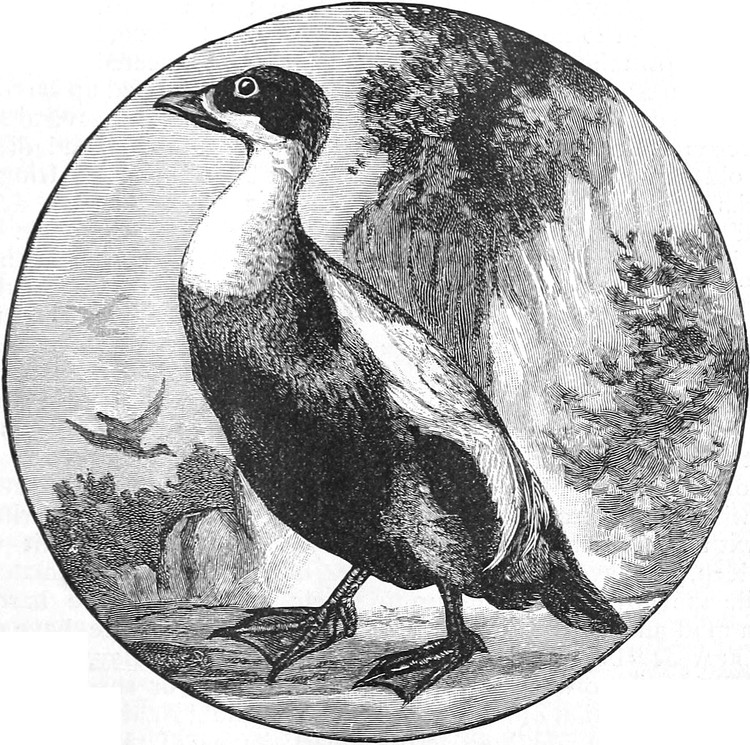
EIDER DUCK (SOMATERIA MOLLISSIMA).
Once I participated in a railroad accident when a locomotive almost telescoped our car; but it was an insignificant impression to the condensed crash and astonishing concussion that followed the snapping of the cap. As if weary of well-doing, the old gun went off with a vengeance, blowing the stock off the barrel with a retrograde movement that met my shoulder on the way with a deliberate intention to dislocate, sent the hammer into the air, singed the hair from around my eyes closer and more speedily than I have ever been professionally shaved on my chin, and gave the trusting hand that was supporting the barrel a shake of extreme familiarity—a left-handed compliment—that was reflected up my arm and down the spinal column until it bred my deepest and most heartfelt contempt. Like Richard, when about to fight for his kingdom, I was depressed, and
“Had not that alacrity of spirit And cheer of mind that I was wont to have.”
After having carried that gun round the island for three days, sparing no pains to keep it dry, to oil its rusty barrel and wash its musty stock, I felt it had been an ungrateful companion, undeserving of the personality with which we had almost invested it, and, to use a modern metaphor, that it “had gone back on me.” It evoked on my part an et tu, Brute! sort of feeling. As I looked at it in silent woe, lock, stock and barrel lying in bits, I felt sore enough at its conduct to have given it a retributive kick, and sent it into the river, but the kicking capacity of my legs had been too materially weakened by the last kick of the gun.
Gun gone to glory, vision of some one’s big brother with possible heavy fist and inevitable “good, round, mouth-filling oath,” hand, head, and, indeed, all my anatomy aching, there was a consolation that poured metaphorical oil on my wounds and alleviated the pangs of pain—I had shot the duck!
You won’t find wild duck at Ste. Anne’s to-day, except some stray ones of over-curious trait, who refuse to be advised by their experienced friends. You’ll be lucky if you hit upon a spot within thirty miles of Montreal where you do not find “pothunters” by the dozen—that New World species of the genus homo who should have lived in Arcadia, where they would certainly have utilized their propensity to good purpose by driving away the birds which haunted Lake Stymphalus, without the brazen clappers of Vulcan or the arrows of Hercules.
For short holidays, one of the most popular localities, and therefore one which has been well spoiled, was in the vicinity of Carillon Bay. You may enjoy a varied autumn vacation by taking the steamer Prince of Wales at Lachine, landing at Carillon, and staging about twenty minutes to the beautifully situated village of St. Andrews. There beg, buy or borrow a dug-out canoe, small enough to be concealed in cover, and paddle down the charming North River, with its picturesque rocks and pretty shadows, until you cast anchor at the portage of the Presqu’ Isle. Here you will find remnants of old camp-fires, plenty of free fuel, hay-stacks in the vicinity to make your bed, and elderberries ripe in September, luscious in October, waiting in thick and tempting clusters to be eaten on the spot, or taken home and made into wine. Pitch your tent at this point, and portage your canoe through the narrow strip of loose soil and water to some convenient slip in what is called “The Bay.” You fasten a stout stick through a rope or chain on the nose of the boat, and two getting abreast of it where the portage is heavy, or at each end with outstretched arms where the water is deep, you have quite an enjoyable tug, while the novelty of being up to your knees in mud and water, without getting wet if you wear “beef” moccasins, or a delicious indifference to wet feet if you do not, gives you a sensation of “roughing it,” that not even the pain you’ll get across your shoulders can make you impugn.
The Bay, which is two miles across, is picturesque, and, were it not getting too well known, a glorious place for duck. From it you see St. Placide, about seven miles away, its church spires gleaming in the sunshine; and nearer, Presqu’ Isle Point, Borwash Point, Point de Roche, Coon’s Point, Jones’ Island, and Green Island—between which and the end of the Presqu’ Isle you can see any vessels that pass up and down the Ottawa River. Mount Rigaud—mysterious hill, with its “Lake of Stones”—rises to the west, while the few farms and houses of the Bay settlement lie on the uplands to the north. Over the islands the smoke of steamers miles away may be seen, and the plash of the paddle-wheels heard like the distant “rat-tat” of kettledrums.
The most unique echo I know in Canada follows your shot in this Bay, and is one of the “lions”—a roaring lion at that—of the place. It travels in tremulous waves of sound across the water, lurks for a moment in the bush of the Presqu’ Isle, then shoots out abruptly on the other side and flies over the Ottawa to strike Mount Rigaud, where it reverberates from hill and dale, now to the right, now to the left, in a mysterious prolonged monotone, as if at hide-and-seek in the “Lake of Stones.” Then it returns with a scared suddenness, only to fly back in broken flutterings of sound, from crag to crag, from haunt to haunt, again to be repeated, like frightened deer, chased and cooped up on every side, with no escape, till, after several such re-echoes, it calms to a lullaby, and dies away on the distant hills. A marsh fringes the Presqu’ Isle, and on its borders are many good feeding spots for the duck. The grass of the marsh is mowed with scythes and heaped in large stacks, which you can mount to spy for duck that may be feeding among the lily stalks—though, if your experience is limited, or your vision none of the best, you will often be puzzled to know whether the moving objects are lily stalks or duck.
For many years, a few Canadians of French descent, the inheritors of the old voyageur-sportsman spirit of the ancien régime, who dread legitimate labor with all their hearts, but love harder work that smacks of adventure, have camped in the vicinity of the Bay, trapping musk-rats, catching fish or shooting duck and snipe. The veritable chief of the clan bears the martial name of “Victor,” and is a character in his way. I first saw him with his breeches rolled above his knees, loading his gun in the marsh. Nature evidently made him in haste, for there is an unfinished look about his face, and enough indentations around his head to give a phrenologist the blues. His nose is mostly nostril, and fiery enough to make the nose of Bardolph look pale, while his eyes are black as a sloe and piercing as a falcon’s. Though he can neither read nor rhyme, he has a taste in common with Byron—he hates pork and loves gin. When he swears—and then he best pronounces English—spiders feign death, and his dog turns his tail between his legs and moans. He is said, like sheep, to undress only once a year. When he changes his clothes the very pores of his skin open themselves in mute astonishment. If you can hire him by the day as your “Man Friday,” it will add very much to your sport, for he is a walking map of the haunts of duck, and has a perfect genius for waking them up. He will steal with his canoe through the marsh wherever they can go, quietly as a snake in the grass, until he is within gunshot of his game. To crown all, he is the presiding genius of bouillon; and I canonize him for this, if for nothing more.
Have you ever tasted bouillon made in camp? It is not “fricasseed nightmare,” mon ami. It is more savory than tongue of lark or peacocks’ brains, or other rarest dish that epicures of ancient Rome ever compounded. Yes, it even throws the wild boar of Apicius or the roast pig of Charles Lamb into the shades of unpalatableness. You take water, fish, musk-rat or squirrel (in lieu of beef), potatoes, onions, butter, pepper and salt, and boil them all together in a pot, in the open air, over a glowing wood fire. Pour off the soup, and you have the nectar of the gods; the balance is a dish I would not be ashamed to set before a hungry king. I would not give one sip of bouillon made by Victor for a bottle of the wine in which Cleopatra dissolved her precious pearl.
But where are the wild duck?—for this seems all digression. Ah! there they come, with the flutter of wings which starts something of the same sort in your heart, their long necks stretched out, following their leader in Indian file, or wedged together like the Macedonian phalanx, or spreading out when they come nearer in échelon or like skirmishers, as if knowing the risk of receiving your shot in close column. You lie low, concealed by the long stalks of the marsh grass—the point of your canoe hidden by the house of a musk-rat. What a quiet few moments as they come within range! You can almost hear your heart beat. Gun at full cock, nerves steady as a rock, ducks coming straight to their fate—look out! Forty yards off, up goes gun to shoulder in a twinkling, eye following the game, a gentle pressure of the trigger—deftly, as if all your care and coolness had been concentrated for that instant in your right forefinger—down drop the legs of a duck, denoting mortal wound, off goes your dog at a plunge, back in boisterous haste and trembling, with a frothy mouthful which he drops at your feet with an almost human sense of importance, and an expressive wag of his tail that quivers delicious delight from every hair! If a “fellow feeling” does not make you “wondrous kind” to that dog—if you do not realize the touch of nature that Darwin declares makes you kin—if, after his companionship, you are not sparing in your chastisement, generous with your pats, and loath to treat him like a dog, you must be a brute, beneath the stature of a trained retriever, and unworthy to have the meanest and most mongrel cur whine at your grave.
Education has ennobled your dog. His senses have gained a keenness you may envy, while more eloquence and gratitude is gestured from his tail than can be uttered by many a human tongue and eye. I will not question the propriety of Solomon’s instructions in training a child, but I protest against its applicability to a dog. A dog that has been bullied into obedience possesses the same sort of training as a boy who has been whipped into morality. They both become white-livered; the dog carries his tail between his legs, and so would the boy if he had one. You may have seen a hot-tempered drover beat an obstinate cow in unsuccessful attempts to make it move, while another simply twisted its tail, and at once stimulated its muscles of locomotion. If you have to chastise a dumb brute at all, you may as well do it mercifully, and on the Italian system of penmanship—the heavy strokes upward and the light ones down; specially so with a dog you wish to be your companion in hunting duck or partridge.
If you have done much duck-hunting you will have discovered that within rifle-range of civilization the instinct of duck is surpassingly keener than outside the pale. In spite of the “blue unclouded weather,” soft calm on the water, and stillness in the air, you cannot catch them asleep any more than a weasel. If you would get within range of them at their feeding-ground you must slip slyly and softly. They sniff gunpowder in the air, and know it from the smell of burning bush. Victor vows they know an empty cartridge-case or gun-wad a mile away. You cannot make them believe your canoe is a musk-rat house, however you try. You cannot put an empty calabash on your head as they do in China, and wade among them, so as to pull them under the water and secure them by a strap. You may fool a Chinese or a Hindoo duck in that way, but not a Canadian. They will play in the water twenty yards away when you have not a gun; but they know the difference between the barrels of one peeping from a marsh and the grass stalks or lilies, better than many people know the difference between a duck and a crow.
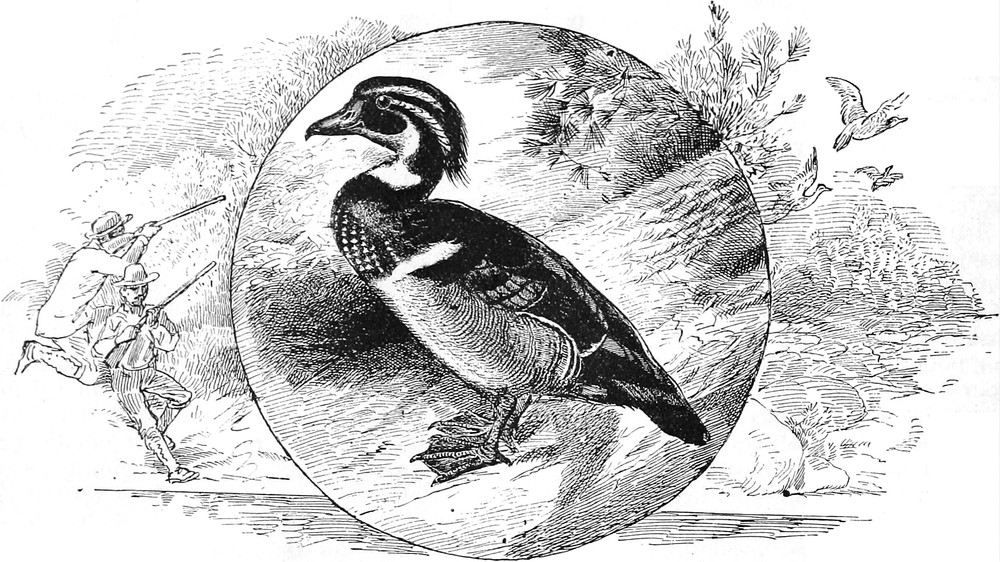
WOOD DUCK (AIX SPONSA).
There is at least one virtue displayed by enthusiastic hunters of duck—it is that of patience. You may not get a shot for days, or even catch a glimpse of a bird, except your tame decoys, and be tempted to waste a cartridge for change on a stump or a branch; but it is not all monotony, sitting quietly in your camp or in your canoe, or paddling through the marsh, and, Micawber-like, waiting for “something to turn up.” There is a physical and intellectual enjoyment, if you have the capacity to take it in—a pleasant antithesis to the excitement of a shot. If you’re in camp it is expended in a hundred ways. If you do nothing more than lie on your back, with your arms under your head for a pillow, and look up through spreading branches of trees, gorgeous with autumnal tints, into “the witchery of the soft blue sky”—if you only let your mind lie fallow, and your hard-worked body feel the luxury of a genuine rest, it is not time misspent. Toward the close of day the duck exercise their wings and take their supper, and you may then get some good shots. If you are in your canoe waiting for their appearance, I commend to you the magnificent sunset for which the Bay is famed.
Flocks of blackbirds whiz and whir over your head in wild abandon, as if conscious they were not in danger; the melancholy “too, too, too, to-o-t” of the owl is heard in the woods, as if it were mourning for Minerva; kingfishers flutter in one narrow compass of mid-air over their prey, as if trembling with apprehensive joy, and shoot down suddenly like meteors to seize the unsuspecting minnow below; the “schayich” of the “ritualistic” snipe is heard as it rises from the bog in graceful evolutions and gyrations a danseuse might envy; the incense of autumn is borne to your nostrils; a conversazione of swallows is going on throughout the bush near by, while a perfect tempest of twitter rages on a tree-top. Is it love, jealousy or scandal, is it an Œcumenical Council to proclaim the infallibility of the kingfisher or the peacock, or are they only scolding their young ones to bed?
To complete the delight of your senses, you will be sure to add to your knowledge of entomology the penetrating fact that, though the black flies have absconded, the marsh in autumn is “the last ditch” of the mosquito. Here it conjugates the verb “to bite,” in all its moods and tenses, until the frost-king subdues its ardor, or the dragonfly saves the frost the trouble. It does not interest you to know that its wings vibrate three thousand times a minute, and that with these and the rapid vibrations of the muscles of its chest it produces its soothing sound. Its sting is certainly very complex and attractive under the microscope—not so under your skin. You may be ever so gallant, and yet be unable to pardon the fact that only the female mosquitoes bite. You may be reduced to believe with Gay’s fable of the man and the flea, “that men were made for fleas (or mosquitoes) to eat.” The mosquito is far too insinuating in its manner. It depresses one’s mind, but it elevates one’s body. When you’re sitting in your canoe on the qui vive for a shot, its familiar evening hymn is heard in a halo of buzzing around your head. Sting first, like a sapper with his heel on his spade in the trenches in the face of the enemy, it digs into you with a perseverance worthy of a nobler aim. A summer’s sucking has not satiated the thirst of the seniors, while the junior cannibals are eager to try their stings; but the weather has curbed their power if not their desire, and you may slap them into eternity with comparative ease. If there is no food for powder in the air, You can live in hope and wish there was, or you can meditate on your sins, or, what is more popular and pleasant, the sins of your friends and enemies; but it somewhat disturbs the equanimity of your thought and humiliates your dignity to find a corduroy road of mosquito bites on the back of your neck, and suddenly to realize that the last of the Mohicans is determined to “play tag” with the tip of your nose, or to say its vespers vigorously in the hollow warmth of your ear.
If you’ve never shot wild duck, at least you’ve eaten them. Charles Lamb may extol roast pig, but, as Victor says, “Pigs can’t lay eggs, nor can dey fly.” I doubt if the genial essayist ever ate wild roast duck, done to a turn, with sage dressing, plump bellies and legs trussed, hung for a day or two before being dressed, well basted while cooking, and sent to table hot, with apple sauce. Plutarch says that Cato kept his household in health, when the plague was rife, by dieting them on roast duck. Can anything be finer than the mellow sniff that steals up the nostrils from a tender roasted one, that you’ve shot yourself?
The end of the hunting season is the ducks’ Thanksgiving Day. What tales they must hiss and stories they must quack of shots escaped; and of nervous marksmen down whose very gun-barrels they stared and quacked out defiance. How the veterans of the season must brag, and the Gascons of two put on airs, and be envied as the heroes of many battles! How they must raise their wings and show their scars, and be looked up to as ducks of valor and experience!
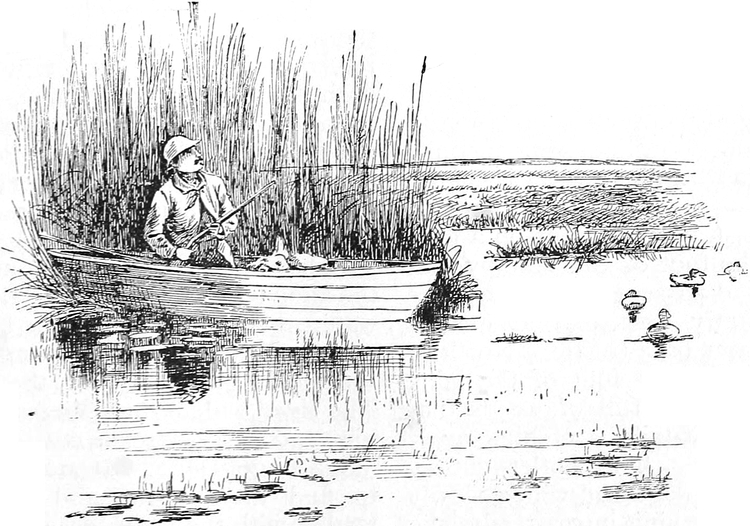
PADDLES AND PALETTES.
BY EDWARD L. CHICHESTER.
Concluded from page 510.
A FEW miles below Seneca Falls the river forks. One branch, flowing in a northeasterly direction, is used as the canal; the other, probably at one time the only course of the river, turns southeast toward Cayuga Lake. A loose pile of rocks, forming an irregular wall, keeps the water from entirely forsaking the commercial channel, but enough gushes over and through the barrier to form a very respectable stream that eddies off between its own banks with a kind of jolly flow of freedom, like a boy escaped from school.
On reaching this fork, we lifted the canoes over the obstruction and joined our fortunes with the runaway, much preferring its adventurous course to the one laid down by the State.
Large trees hung over the water, and an occasional rock or snag, crowned with a matted mass of eel-grass that floated back on the surface like a mermaid’s hair, lifted its head in front of our bows and seemed to rush toward us. The stream, though far from being rapid, was at first swift enough to give us plenty of occupation to avoid obstructions, but, like some people, gained both breadth and repose as it neared its end.
The village of Cayuga is built on a gentle slope near the foot of the lake by that name. A railroad passes through the place and turns abruptly west, carried over a mile or so of water on a trestle. North of the trestle extends the foot of the lake, very shallow here, and full of weeds that end in a bank of cat-tails, stretching away toward Montezuma. The outlet cuts a broad swath in the flags and winds slowly northward, now widening into a reedy lake and again narrowing, till the current becomes perceptible enough to bend the rushes at its sides.
As we glided quietly along our course through the outlet, an occasional duck darted among the rushes, or a big blue heron lifted himself from the water and flew slowly overhead, preserving his air of dignity in spite of the long, bare legs sticking out behind. Bass and sunfish, lying close to the surface, shot away from our bows, streaking the water with little wakes. As the day advanced, we looked anxiously about for a place to camp, and at last came to an island that lifted itself like a whale’s back from the surrounding swamp.
To be sure, it was rather bare—a stony ridge, growing mullen stalks and teasels, and inhabited by some retired army mules, whose gaunt forms stood black against the sky; but it was a relief to see something higher than the flags, and we gladly landed at the first opening and pulled the boats well up on the shore.
We had a visit here from a genuine son of the soil, if such a country could be said to possess a soil. He sauntered down to the camp before we were well settled for the night, and frankly gave us his opinion of the boats and our other belongings.
He was a queer youngster, not more than fourteen years old, with innocent blue eyes and the modest air of a little child when he asked questions, but changing instantly to the most reckless braggadocio when he referred to his own experiences. He was born, he said, at Montezuma, pointing to a distant spire, and hoped some day to jump from the Brooklyn Bridge. It has been a query in our minds ever since, whether the mere fact of being born on a flat would gender such ambitions.
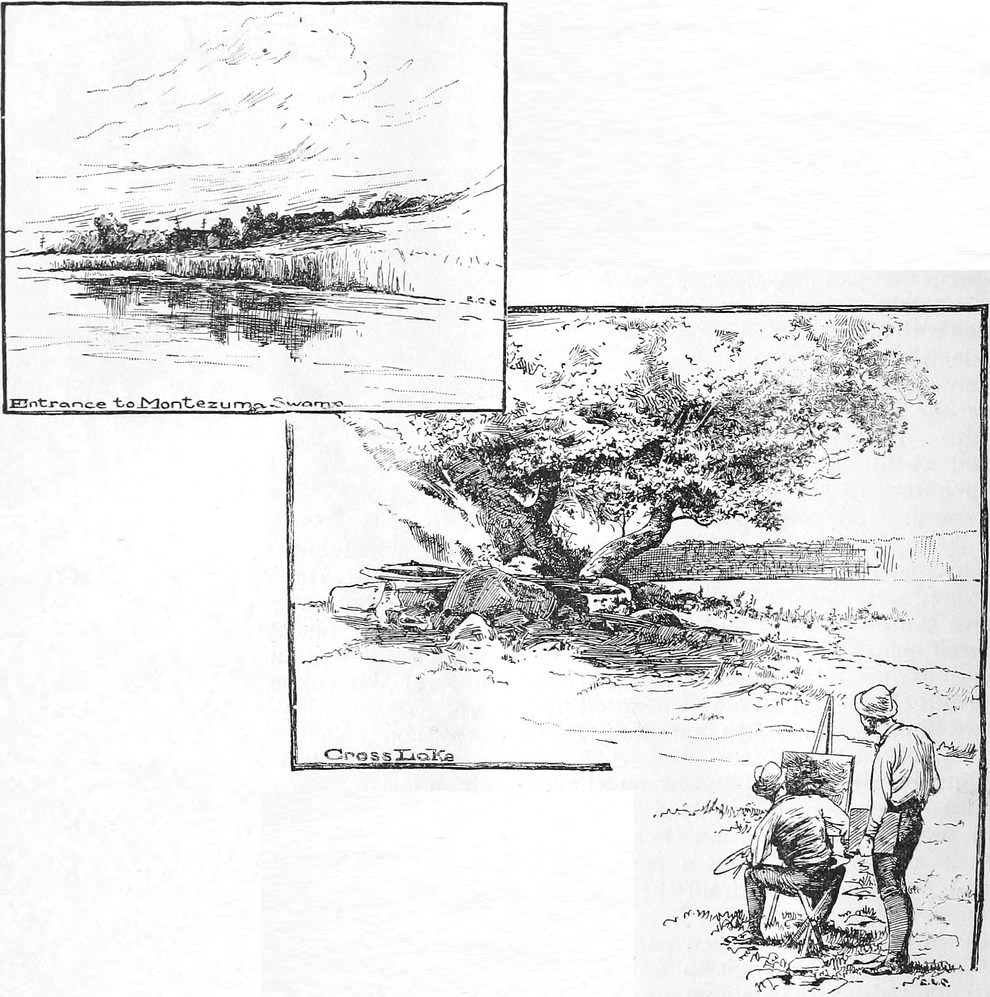
Below this island the stream flows under the aqueduct of the Erie Canal, and putting waterproof blankets over our heads we shot under a dripping arch, coming out dry, but with decks glistening with the shower-bath. The river widens here, becomes very shallow, and at last spreads out in all directions like a huge Delta. It was often difficult to find the current, and the air seemed loaded with the heaviness of the swamp.
Acres of water-lilies spread before us, small flowers of a waxy whiteness gleamed among patches of sagittaria, and the interminable walls of reeds were weighted down with a plant resembling the hop-vine, and bearing clusters of pink blossoms, that added their perfume to the heaviness of the air.
Slowly we worked our way through this strange region, the paddles after every stroke coming up laden with dripping plants, while we were kept anxiously alert lest we should lose our way in the labyrinth. We occasionally stood up in the boats in vain efforts to see where we were. At one spot the Sybaris moored herself in a lush mass of lily-pads and grasses, from which the soft mud oozed as her keel pressed it down, while Simpson, who had been exerting himself manfully, ceased his efforts in disgust. I took advantage of his experience to avoid the slough, and as I paddled past, heard him remark, as if to himself: “Query, is this land or water?”
But, like Bunyan’s pilgrims on the enchanted ground, we “made a good shift and wagged along,” and before night struck a State ditch—not a canal, but a broad channel dug to drain the region—a channel with a current that bore us along with scarcely an effort on our part.
We were glad enough to escape, even through a ditch. This was our last day spent in a swamp, for the country soon became more broken, the water clearer, and the air lost its malarial heaviness and blew fresh over green hills. Even the mosquito stayed behind.
One evening Simpson was sitting by the fire, having arrived at a good camping-place and put the Sybaris in order for the night before I had come up. He was frying potatoes, holding the spider in one hand and running his eye over a letter that had reached him through the Weedsport post-office. He had laid a stone on the letter to prevent its being blown away, and occasionally his eye would wander from the closely-written page to the graceful lines of the canoe, whose jauntily striped tent was flapping back and forth in the breeze.
In addition to these occupations he was singing something about his “Bonny over the Ocean,” and his voice, which is not unmusical, came floating up to where I had moored the Rena, and was trying to catch a sunset effect. The musical cadence fell in with the place and hour, and I found myself humming the air while I worked; but suddenly it stopped, and I paused a moment in my drawing, thinking I heard thunder.
Certainly there was a roar, though there was no sign of a storm overhead. I put my sketch under the deck, pushed off the boat, and paddled down toward the camp.
On rounding a point I caught sight of Simpson, running toward the water with the Sybaris clasped in his arms. She would weigh fully ninety pounds with her tent and bedding, and I was astonished to see him lug her along in that reckless manner; but in a moment a bull tore through a hedge and bore down upon him. The canoeist had a good start, and in another moment had run into the river, plunged head-first into the boat, leaving his heels sticking out from under a torn tent-flap as he floated away, while the bull stopped short on the shore, pawing and bellowing.
When my friend’s head emerged from the cockpit the boat was some rods away, and the bull had turned his attention to the potatoes. It was only by means of a red Jersey flaunted on the end of a paddle that the animal’s attention was diverted from the camp long enough to rescue the duffle. I diverted him, as Simpson flatly refused to again assume that rôle.
Nothing was injured but the letter, which had been trampled in the mud.
I naturally felt elated at escaping with so little loss, but Simpson was grumpy all the rest of the evening.
From Weedsport to Cross Lake the Seneca River winds through a rich, rolling country, and we were delighted with views of farm-yards with weather-beaten barns and stacks of grain. Fine cattle stood in shallow places in the stream, chewing their cuds and lazily switching of the flies, and herds of colts tossed their heads and galloped away as we came suddenly upon them. A settlement of old houses clustered about the end of a bridge bore the name of Mosquito Point. Though the place provided us with excellent bread and butter, we did not want to remain there, notwithstanding the inhabitants stoutly asserted that the village bore a misnomer. “It’s nawthin’ to Montezumy,” remarked one gray-bearded citizen, whom we took for the oldest inhabitant, and we believed him. They told us a legend here of the Great Swamp.
The story ran, that a single pair of mosquitoes had their abode there, and these specimens were so large they would devour an Indian without taking the trouble to peel off the canoe, much as a pig would eat a beech-nut. In time, the tribes grew restive under this annoyance, and organized a grand hunt, which resulted in the destruction of their enemies; but while rejoicing over the victory, myriads of a smaller breed rose from the carcasses, and have infested the country ever since.
One of the pleasantest spots along the whole course of the Seneca River is Cross Lake, a beautiful sheet of water crossed by the stream. Here we remained some time. The camp was made on a gravelly beach not far from the village of Jordan. The scenery had that peculiar quality found in an uneven, partially cleared country.
It composed well.
Some buttonwood grew near us on a side hill. A strip of swampy shore stretched away to the south, and above us some bars, opening through a rickety fence overhung with bushes, led into a pasture beyond.
“ASTRIDE THE DECK.”
The owner was going to fix the fence, but had not “got round to it.” We were glad he had not. Early in the mornings we were awakened by the shrill cries of the tip-ups that fed in the marshy spots with the woodcocks and schytepokes, the last-mentioned a brown-backed, wading bird, resembling at a distance a crook-necked squash on stilts. Simpson was fond of shooting at this fowl with his revolver, for, though holding the views promulgated by the Audubon Society, he said he had not signed the pledge to abstain from wearing the feathers of non-edible birds—“besides,” he argued, ignoring this point to make another, “we could eat a schytepoke.” We did not try it, however, mainly because he never hit one.
On the last night of our stay here we neglected to button down the tents and were well-nigh drowned out by a storm; but the rain ceased with the first streak of dawn, and the grand panorama that was disclosed as we stepped out into the fresh wind was worth hours of discomfort to witness. The clouds, though still black and threatening, were whirling off in ragged masses, and the lake stretched a steely gray plain, seamed with the dark lines of its waves, and reflecting the first dull glow of the morning.
The freshness of the air and the sense of conflict felt in a storm made one want to shout, while the wild grandeur awed one to silence. It did not clear until late that afternoon, and the wind that blew all day in wet gusts carried us swiftly down the river.
We found the current more rapid as we advanced, and the stream wound between rocky and, at times, precipitous banks.
At one point a blasted oak stood white against the forest behind, and then flashes of sunlight lit up stretches of stony pasture or revealed the wet roof of a barn hidden among the trees. As we bowled along under full sail, I let out the trolling-line and captured some fine black bass and a pike before we reached Baldwinsville, eight miles away.
Onondaga Lake empties into the Seneca River through a narrow outlet, scarcely a mile long, and when we reached the mouth of this stream we turned and paddled against the current. As we entered the lake the city of Syracuse loomed in sight, looking a smoky purple in the distance.
On the left rose the high chimneys of the salt-works of Liverpool, making the village look like a huge burying-ground dotted with the monuments of a former industry. We secured supplies at this place, and wandered through some of the buildings, now falling to decay.
In some places nature had tried to soften the outlines of ruin with grass and creeping vines; but tall brick chimneys do not readily lend themselves to decoration, and there is something in rusting machinery that reminds one of unburied bones, a kind of skeleton in chains doomed to be a blot on the landscape so long as the gallows stands.
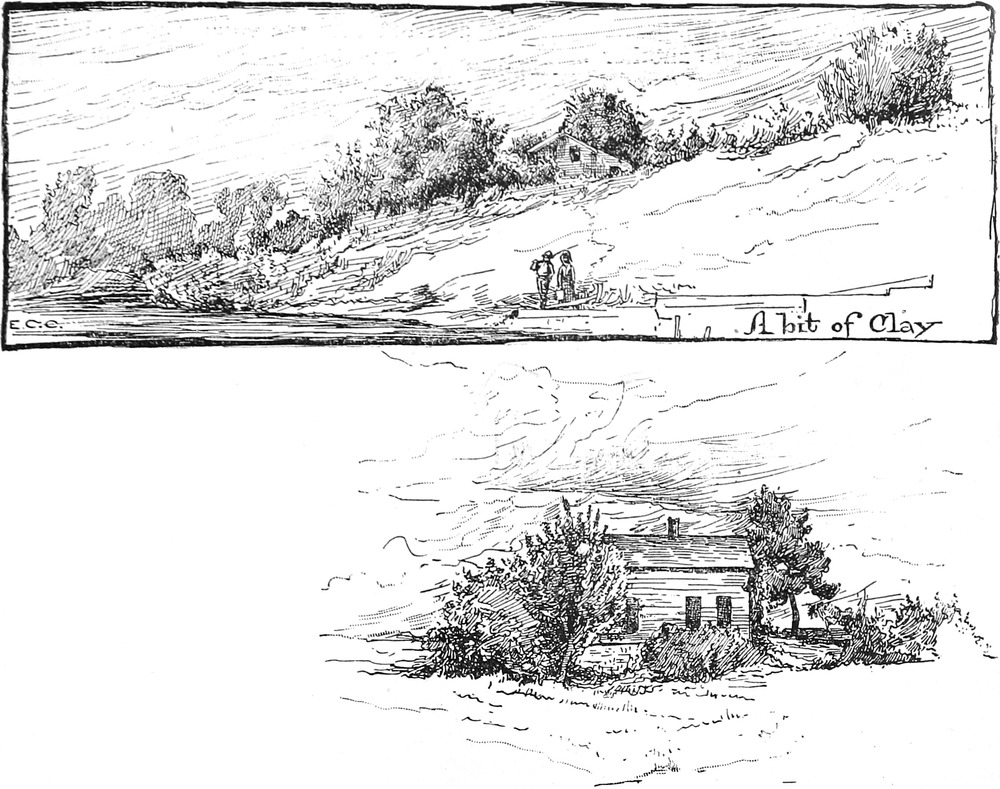
Half a day’s paddle from the lake brought us to the village of Clay, or New Bridge, as it is commonly called. This place was old and ruinous, but presented a most picturesque aspect as we came suddenly upon it, perched on the hillsides on either side of the river.
The unpainted houses, stained a dingy gray by the weather, were embowered in thick masses of apple and plum trees, and down by the water stood a forsaken warehouse with a sunken canal-boat before its doors. We spent a Sunday within a mile of the town, and rainy weather kept us some days longer in the vicinity, so that we had a fine opportunity to study the old place. “God forsaken,” the farmers called it. It was a sort of supply depot for passing canalers and certainly not a flourishing port, but perhaps possessed an artistic interest in proportion to its ruin.
“If you want any good eatin’ apples, you’ll find ’em under them trees, an’ there’s green-corn in the garden beyond; help yourselves.” This hospitable remark was made by a farmer who came to see our sketches, and it was accompanied with a handful of ripe tomatoes and cucumbers.
“LANDED FOR SUPPLIES.”
This sort of open-handedness had become a feature of the cruise, and on our last day on the river we gave a lock-tender a goodly supply of superfluous vegetables. In fact, our living expenses were made so small by the bounty of the people on whose land we camped, that we felt like distinguished foreigners who had been given, not the liberty of the town, but of the whole country.
A few miles below Clay the Seneca unites with the Oneida River, the two forming the Oswego at Three River Point, and by following this broad stream we reached the milling town of Phoenix. We were delayed here by a short portage, but again in the canoes the stream carried us on, now heaving under the boats as its deep volume eddied over hidden rocks, or spreading out into placid stretches that seemed to have no perceptible current.
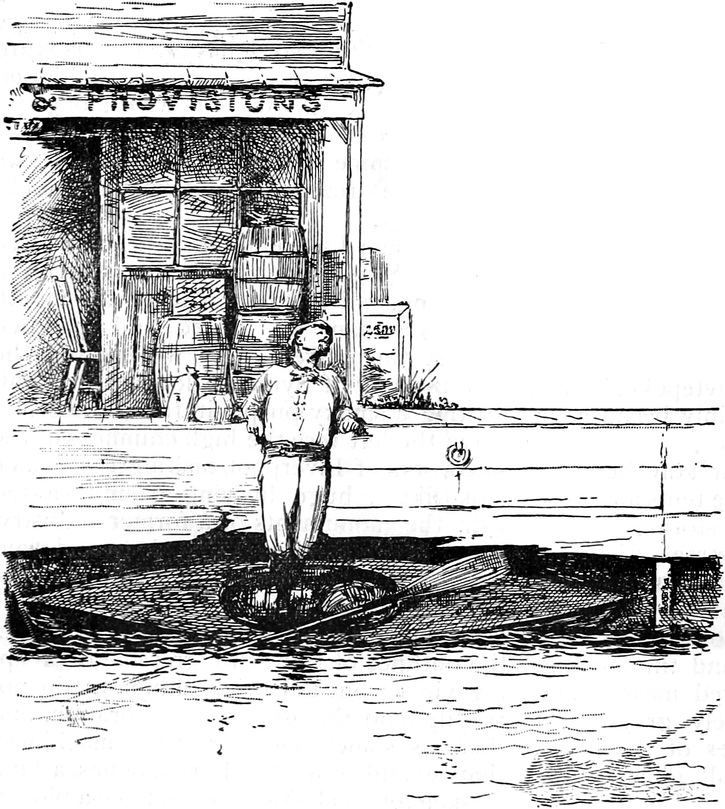
At one point we were whirled through an eel-weir rift and well spattered with spray; and again, while passing under a bridge, a sunken pier caught one of the canoes as a submerged monster might snatch a fly, but fortunately with no damage to the boat. A muskrat, drawing a long line across the stream, ended it suddenly with the quotation mark of his tail as our bows came almost on him. Then the river grew broad and still, and paddling on we entered the canal at Fulton. I had an embarrassing adventure here. I had landed for supplies, and was again getting into the boat that lay some four feet below, when the uneasy craft slipped under the docking, carrying my feet with her, leaving me hanging by the elbows and shouting for Simpson, who was some distance away.
The muddy water of the canal never seemed less inviting than during those anxious moments, as I hung with my arms gradually slipping, certain, if the Sybaris did not come quickly, of going in head foremost. But fortunately she came quickly and I was rescued dry.
Below Fulton lies the historical spot known as Battle Island, the theatre of some exciting events of the war of 1812. Near this island the river is obstructed by a dam, and here we lowered the boats over with ropes.
The Sybaris went first, and, once over, shot off through a stretch of rapid water.
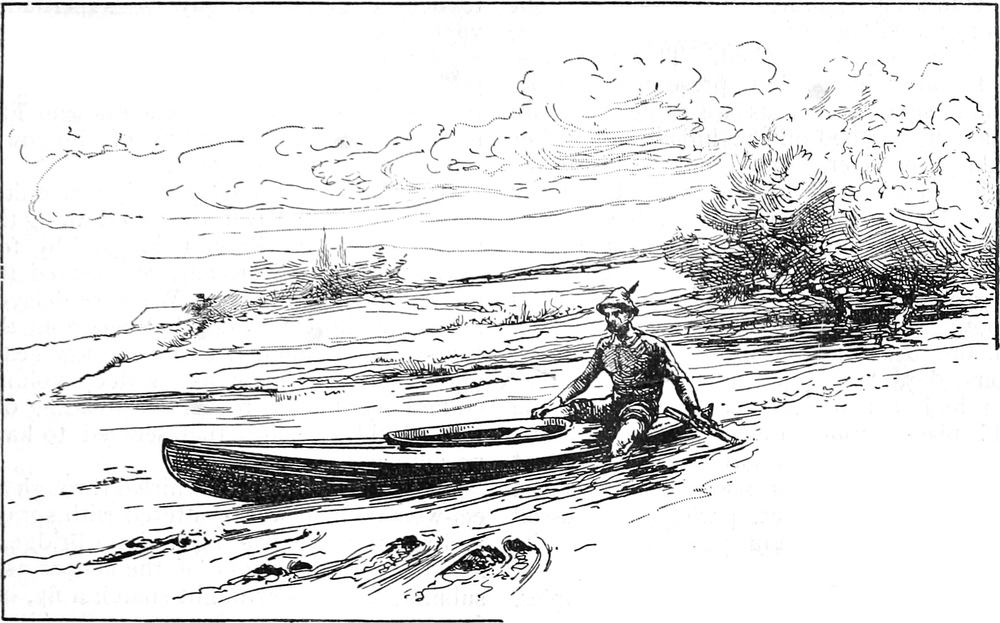
Simpson, in his efforts to guide her, broke his paddle, and was obliged to jump overboard in order to keep her off the rocks. He came back dripping to help me with the Rena, and told me exactly how to steer when I was cast adrift; but in rapids a little experience is certainly worth more than a good many directions; and once started I found it useless to try to recall a word he had said. The sensation of being carried through a rift is certainly peculiar. With the attention so closely exerted to avoid danger, the boatman has no opportunity to watch the shores, and, as the Irishman expressed it, “see himself go by.” On the contrary, he must fix his gaze forward, and soon has the feeling of standing quite still, while the rocks bob up in front of him and rush at his boat. As I whirled along, a formidable line of boulders rose at my left and swung steadily around to embrace me. Work as I would, they came nearer and nearer, then there was an ominous grating, a rattle of iron (I carried the pots and kettles), and the Rena stuck fast, with the water surging and boiling round her. I expected she would roll over, but she lay wedged just where she struck, and observing there was no change, I pulled off my shoes, and, taking hold of the combing, raised myself out, and sat down astride the deck just back of the cockpit.

“NOT EXACTLY A PADDLE.”
I had not calculated the effect of this change of position on the boat, for her stern dropped instantly, and rearing like an impatient sea-horse she dashed forward, while I clung on as well as I could, feeling like an amateur Neptune, or “a water imp,” as Simpson said. But I was really a little nervous at the time and much relieved to reach still water in safety.
Lower down we landed, and my friend mended his paddle, and then stretched himself out in the sun and read “Lorna Doone” till his clothes were dry. Then we went on—gliding under overhanging trees, passing bare sand-banks crowned with sumac, and catching glimpses of little gullies full of poplars, and fence corners yellow with golden-rod. Some houses and barns strung along the hill-top marked the outskirts of Bundy’s Corners, and later we heard the roar of a fall, down at Minetto.
When we reached this village we found another high dam with a wooden apron below.
We inquired particularly about the channel: Was it deep under the dam? Did boats ever go over?—Questions the people who came down to see the canoes answered readily. It was deep on the other side, and flat-bottom boats had gone over. “Then we can go,” said Simpson, and pushed off with his paddle.
I followed, and we skirted the upper edge of the dam, cautiously working across the river. The water overflowed the obstruction in one thin sheet, and fell spattering among piles of ugly-looking stones, until we reached the extreme east end; here a breach had been made and a heavy stream poured itself through, tumbling into a great white, seething pool some ten feet below. We landed and surveyed the place thoroughly, then removed the sketches, together with a pail of milk and some eggs from the Sybaris, when Simpson entered the boat, worked a few rods back, and rested on his paddle.
Slowly the little craft moved forward, then her speed increased as she felt the resistless drawing of the current, and in a moment her delicate bow was trembling on the brink. She seemed to hesitate an instant—then plunged!
As her keel struck the apron she turned on one side, and the same instant the rudder bearings caught some obstruction and whirled her bottom up. A dark hull and a weather-stained felt hat bobbed about, making two blots in the white foam that swirled and tossed under the fall; then the hat moved toward the boat, and in less than a minute Simpson’s broad shoulders emerged, hauling the Sybaris toward the bank. Two fishermen, catching caddice-worms for bait a short distance below, hastened to the rescue, and came up in time to help in bailing out; and before I was ready to follow with the Rena the canoe was again afloat, uninjured, but with a slightly damaged cargo. I considered the situation very carefully, and in view of the fact that it was late in the afternoon and the only spare dry suit of clothes between us was stowed in my boat, decided, for Simpson’s sake (who, I remembered, had a slight cold), to go round through the canal.
I did so, and the fishermen carried my craft down to the river.
This caution on my part proved quite unnecessary, so far as Simpson was concerned. I left him an hour later, clad in my best suit and with sails unfurled to dry; but the wind gradually drew the boat off, and when he discovered her she was well out in the river. Of course, in the absence of the other canoe, there was nothing to do but run for it, and when I returned it was to find him steaming by the fire. We stayed in this, our last camp, for some time. It was only four miles from Oswego, and we lingered, reluctant to leave the river we had followed so long. In the cool evenings we would sit by the fire and watch its flickering blaze reflected in the water, or strolling along the shore would startle the fish that had come up into the shallows.
The season was approaching Indian summer, and all nature seemed hushed and expectant. Some mornings the sun rose in a burst of splendor, converting the whole earth, wet with dew, into a vast sparkling mirror. Again a bank of fog made it seem as if our point were the end of the earth, projecting into space, till the light in the east glowed through and showed us the forms of trees and houses looming up like phantoms across the river. A kindly old man living near often came to see us, and seating himself on a camp-stool would give long accounts of the country in the early days. But one morning we pushed off and took our last voyage on the Oswego, drifting down through its broad mouth into Lake Ontario, where, putting the canoes on board a steamer, we sailed for Charlotte.
The passengers were most of them from the Thousand Islands, one of those well-mixed companies. There was the jaunty girl who read a novel all the way, and actually looked stylish in a hat as forlorn as Simpson’s. And the aggressive old gentleman with convictions, who hammered his theories of government into the self-satisfied senator from Maryland—the latter a large English-looking man, with sandy hair, a tweed suit and green necktie, who listened with an air of amused patience.
The lake was very quiet, and the steamer left a long, shining wake in the greenish-gray expanse, while the smoke rolled back till it settled into a haze on the darkening horizon.
Gradually the colors faded from the sky. The groups on deck drew their wraps about them and moved closer together. It grew quite dark, then a bell clanged—we moved slower.
Lights flashed, people started to their feet. We had reached Charlotte, and our cruise was over.
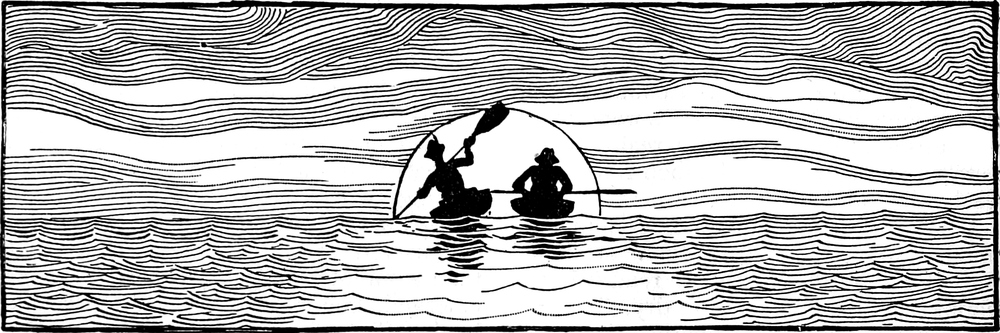
“EELIN’ OFF GOOSE P’INT.”
BY SCOTT CAMPBELL.
A LARGE dory, old and weather-beaten—as weather-beaten as the sunburned faces of the three fishermen who sat motionless upon the thwarts—it was a mud-stained, patched old hulk, battered by hard knocks, scraped by harder rocks, beaten by harsh waves. Three men sat silent, thoughtful, absorbed, with grim countenances portraying sombre reflections; a little child—a boy of scarcely ten years—seated alone in the bow, his small brown hand clutching the rail on either side; a child with a round, rosy face, and great dilating blue eyes, opened wide, and a timid, awe-impressed look—all floating upon a wide creek of placid water, unruffled by a breath. All slowly, silently drifted on the ebbing tide, out toward the broader waters of the distant bay, down toward a long, low, narrow point of mainland—Goose Point—which stretched out into the sea like a huge index finger directing attention to the thin silver crescent of the new moon, hovering for one last moment on the western horizon.
The tide had well-nigh ebbed; the dusk of the early evening was fast fading into darkness; the cooling dampness of the summer atmosphere had begun to gather in the form of dew.
Almost motionless the cumbrous boat floated upon the surface of the sluggish and devious waters; from the unplied oars, extended to either side, silver drops now and then fell to disappear into the darker depths below. A solemn silence reigned—a silence unbroken save by the faint, dull, far-away note of the frogs from the distant meadows, or the cry of some night-bird wafted over the marsh-land.
The moon slowly sank from the view of the silent sitters; the narrow line of quivering, silvery light disappeared from the surface of the waters; one by one the stars came out in the cloudless heavens. The child in the bow of the boat, awed by his sombre surroundings, awed by the death-like silence, awed by the faces before him, gazed mutely aloft at the star-lit dome above him.
At length the impressive silence was broken.
The child started quickly, and his eyes were turned from the heavens to gaze at the grizzled, wrinkled neck and broad back of the speaker.
“So thet wear the vardict, wear it, Nathan?” The tone was solemn—as solemn as the expression upon the aged face of him who asked the question; and the hands which held the oars were raised till the broad, dripping blades again parted the dark waters.
The man addressed selected a long, wriggling worm from a rusty tin pail between his feet, and calmly wound it with a piece of strong thread upon the “eel-bob” in his hand.
“Aye, thet wear the vardict, Abram; he air to be detained pendin’ the investigation.”
“Pendin’ the investigation,” slowly repeated the other, dubiously. “An’ what might be the ackerite meanin’ o’ thet, Nathan?”
“Well, ez nigh ez I can come to’t, he air to be jailed till the woman be found, or suthin’ definite larned consarnin’ her.”
“And thet wear the decision at the perliminary examination, wear it?” asked the third man, speaking now for the first time.
“Aye, it wear, Seth.”
There was another spell of silence. Abram Skellet, who held the oars, pulled one sturdy stroke, which sent the heavy boat away from the dark, thatch-grown mud-bank it was approaching, out into the deeper water of the creek; and again they floated silently on toward the low point of land, which, in the increasing darkness, now appeared only as a dim irregularity in the line of demarcation between the sea and sky.
After a few moments—
“What wear the evidence, Nathan, agin’ the man?” asked Seth Skellet, dangling an “eel-bob,” composed of a round ball of mingled thread and worms, over the side.
“It wear bad—’tarnel bad; though the man mout not be guilty for all o’ thet, ez he wear not seen to do the woman any harm; an’ the evidence air all what they call suckumstantial. Thus it wear, in a nutshell: night afore last he wear seen to meet her on the old bridge ez crosses the herrin’-brook, beyond the parsture to the suth’ard o’ Parson Greenleaf’s ten-acre lot. She wear obsarved to be waitin’ there for a long time afore he come—John Jenkins’s son seen her; an’ bein’ supplied with more natural curosity than air gen’rally ’lowed to a male, an’ wonderin’ what she wear doin’ out there all alone, he kind o’ hung round to see. She mout hev been there a half-hour, when Paul Gramley come hurryin’ across the fields an’ jined her. They hed some sharp words—leastwise so young Jenkins says; an’ arter awhile they walked off together. Thet air nuthin’ in itself; any two air prone to hev hard words at some time or ’nuther; but, ez ye all know, the next mornin’ the parson’s darter, Hetty Greenleaf, wear missin’, an’ a sarch high an’ low didn’t reveal her. Then young Jenkins come to the front with his story; an’ on the strength o’ thet Paul Gramley wear arrested an’ examined, bein’ ez it wear that he wear the last pusson ez is known to hev seen her.”
“It hev a dark look, Nathan,” remarked Seth, as the narrator paused long enough to dip into the rusty tin pail for another worm.
“Aye, it hev so. But Paul Gramley declares thet he left her not a hun’ed feet from her own door, an’ jest ez the village clock wear strikin’ nine. An’ he swears thet the last he see of her she wear movin’ slowly toward the house; but the parson, on the other hand, claims thet she wear not in the house arter seven o’clock—an’ the parson’s word air ez reliable ez the gospel. An’ thet air the evidence agin Paul Gramley; an’ he air detained pendin’ the investigation.”
“Ez I obsarved afore, it hev a dark look,” muttered Seth, shaking the water from his “bob,” and turning in his seat to gaze earnestly in the direction of the Point, toward which they were drifting.
“Nathan, what air your opinion?” asked Abram Skellet, leaning upon the oars. “You air putty well acquainted with young Gramley.”
“Aye, Abe, so I be; for he hev boarded at my wife’s house ever since he come to this ’ere town, twelve months agone. He air a hot-headed young buck, an’ one ez is prone to gay company, an’ the like o’ thet; but, harkee to me—he hev a heart in his bosom ez big ez the heart of an ox, an’ ez soft ez a woman’s; an’ he loved Hetty Greenleaf; every throb o’ thet great heart o’ his beat for her; an’ the man ez says he harmed a hair o’ her head, lies, boys! I tell ye, he lies! for I know ’twan’t in him!”
And the wrinkled old man, loud in his vehemence, brought his brawny fist down upon the thwart beside him with a blow that made the old boat quiver from stem to stern.
And the eyes of the child opened wider.
“What do Paul Gramley say hisself?” asked Seth, with a nod of approval.
“Nary a word, save to say that he air innocent o’ meanin’ her harm. I know how he loved her, lads, for I hev obsarved him, when he thought he wear alone by hisself; all the love in his heart wear given to her. He air a stranger among us, an’ little enough we know about him or his; but when a man hev lived under my roof for a year, I calkerlate thet I larn suthin’ about him; an’ I tell ye, boys, thet Paul Gramley air a better man to-day than them ez hints at him ez Hetty Greenleaf’s murderer—if so be she air dead, which no one knows. He wear a young man yesterday, full o’ life an’ hope; to-day he air old an’ broken—more so than years o’ wind and weather would a done; for his heart air turned to ice—an’ I know it.”
“Wear he home night afore last?”
“He wear—about midnight; an’ he says he wear walkin’ alone by the sea-shore, arter he left her. I believe him!”
The old man made the assertion as if he wished to hear no opposition; and for a few moments they floated on through the silent night. All three men were gloomy and thoughtful, for Paul Gramley was a favorite with all who claimed his acquaintance.
“Pull on your right oar, Abe.” The command came in a low tone from Seth Skellet’s lips. “We air too nigh the flats for the best o’ the eels. Steady—that’ll do. Youngster, drop over the anchor.”
The child in the bow moved again, and taking a large stone from the bottom of the boat, dropped it over the side. It fell with a splash into the black waters; the cumbrous craft rocked to and fro, swayed here and there, then swung in toward Goose Point, and finally came to rest.
“Youngster, light the torch.”
The child searched in his pocket till he found matches, and taking a pitch-pine brand from beside him, applied the fire. The wood spluttered and crackled and burst into a flame.
“Here, change seats with me.”
Mutely the child did as he was bidden, and took his place upon the seat which the oarsman had occupied.
“Now, hold the light out over the water—and hold it still.”
Without a word the child obeyed; and fixing himself as comfortable as was possible, gazed from one to the other of those about him, then down upon the water, where the three balls of mingled, tangled thread and worms bobbed up and down upon its surface in the light of that flaming torch.
A weird scene to those wondering blue eyes.
The glories of the soft summer night were lost upon him; the enchanting stillness of the breathless heavens had no charm; the tranquil sea, dark mirror of a myriad of burning stars, claimed not his attention. His one hand held the blazing brand out above the black waters; upon his other rested a chubby chin, close to the boat-rail; and his eyes were fixed upon the circle of bright light cast by the flaming torch—a circle fading away in the near distance, till its circumference was lost in dim and dark shadows.
The faces of the three men were grim visages, now clearly defined, white and ghastly, now faint and spectre-like, as the smoking flame rose and fell.
For a long time there was silence. Despite the gloom that was on them, the three men were pursuing an habitual occupation—“Eelin’ off Goose P’int.”
About the bobs, which rose and fell on the water, dark, writhing objects came and went, now plainly seen, now lost again; and ever and anon a white hand would jerk a bob from the surface, and take therefrom one, and sometimes two, of the slimy, wriggling forms and cast them into a basket.
Then a faint ejaculation would escape the lips of the child; he would look up for a moment at the struggling, squirming creatures; then turn his intent gaze back again on the waters.
“What air your opinion ez to where she mout be, Nathan?” asked one of the fishermen, who could keep neither mind nor tongue from the subject.
“Wal, thet air hard to tell. She mout hev left town, but, in thet case, some one or nuther would likely hev seen her; she mout hev met with a mishap ez yit undiscovered. There air many things ez could hev happened.”
“She mout be in trouble,” ventured Seth, timorously; “though thet air not likely, bein’ ez how she air a parson’s darter,” he added, half apologetically.
Nathan bowed gravely, to Seth’s surprise; and, after a moment, said slowly:
“Parson’s darters air human, the same ez the rest o’ we worms o’ the airth. Seth, ye hev hit the nail o’ my own idee on the head. They hev passions, godly or ungodly, an’ air ez prone to yield ez the weakest among us. She wear in love with Paul Gramley, and he wear in love with her; there air no doubt o’ thet. Whate’er may be the outcome o’ thet love, or the obstacles agin it, I know not. But this ’ere I believe, she hev left the town alive, or else she air in it—wal, if she air in it, God knows how she be!”
And the child heard, but he did not understand.
“Ye do not think he harmed her?”
“I hev said my say on thet p’int,” replied Nathan, gravely. “Men air not prone to harm those ez they love with all their soul. It air my opinion she will be found afore many days—God knows where, or how.”
The eyes of the child were fixed upon the grim waters. Without comprehending the meaning of what he heard, he was impressed by their solemn tones and miens, and a tremor ran through his slender frame, and a chill, like the chill that curdles young blood at ghost-legends told in the twilight.
And he thought he observed a strange change in the waters, whereon he was gazing; he imagined he saw in the depths a white, ghastly face—the face of a woman, with wide-staring eyes, and parted lips where the teeth could be seen, and long, dishevelled hair, in which the green sea-grasses were intertwined. He thought that the deathly face, with its awful, fixed smile, was rising toward his own so close to the water—rising, as if to press those cold, chilled lips to his—rising, nearer and nearer, till the staring eyes were close to the surface, where the hair and grasses now floated.
His hand clutched harder than ever the flaming torch; he was frozen by fear; he was chilled into silence; he saw, as one sees in a dream, vaguely and doubting, for in all of his experience he never had seen such an apparition as that which now appeared in the waters.
A wild, hoarse, terrified cry broke the tranquil stillness of the night, and resounded far over the sea; the old boat quivered and trembled as the man in the bow suddenly sprang to his feet.
“’Fore God! what is that?”
“What?—Ha! Reach me the hook—there! by ye feet, Seth! Air ye turned into stone, man? It air the hand o’ God, raisin’ the dead out o’ the depths, and sendin’ a light through the darkness!”
But Nathan himself was obliged to get the boat-hook, for Seth Skellet was palsied.
And the child’s blue eyes, not wondering, but terrified now, saw the three men lift the cold, dead form into the boat and lay her dripping before him; and the torch fell from his grasp and its flame expired, as her life’s flame had, in the black, choking waters.
Through the darkness they rowed to the shore—an hour of darkness, when it seemed that even the stars were dimmed and withheld their accustomed light—an hour of darkness, while the child stared, fascinated, at the void eyes, which were staring at him, and his innermost soul shrieked in fear for it to move and ease the horrible spell that held him.
“Youngster, run to the village store an’ tell ’em we hev found it.” They were hoarse words from Seth Skellet’s lips, spoken as she was borne, by strong, tender hands, away from the rippling waters that sang upon the beach, and laid upon the grass-land which her feet had often trod.
And the child obeyed; turned and fled, across fields and meadows—fled from that awful presence, which, to him, was and was not—fled, and paused not till he stood in the village store, where some half-dozen loungers were sitting.
And one man there was who saw in the terrified face the shadow of death; and he cried:
“My life! my Hetty!”
“Dead! drowned!” gasped the child. And he saw the man—tall and grand, with curling hair and warm, dark eyes—spring to his feet, with a cry of anguish; saw him grasp the clothing above his heart, then reel, totter, and fall—fall, as if shot, face downward upon the floor.
A few days after, the boy heard the bells tolling; saw a sorrowing throng pass through the village street; followed, and saw two forms laid near together in a quiet corner of the country churchyard. He heard the weeping people speak of love, of retribution, of mercy; heard them speak of a wife, his wife—who had been thought dead, but lately discovered—discovered, when his love was another’s; heard them speak of a heart, his heart, broken by anguish; heard them speak of a child, his child and hers—a child, who had died when she died.
And the boy heard, but he did not understand.
Do not ask me where Goose Point is, nor in what year these foregoing episodes occurred, for I would prefer not to tell you; but, hearing with the ears of a child, seeing with the eyes of a child, I relate their sadness in the language of a man; for their impressive stamp, undimmed by time, is still vivid upon the tablets of my memory.
THE TRAINING OF A UNIVERSITY CREW.
BY FREDERIC A. STEVENSON,
Captain of the Yale Crew, ’88.
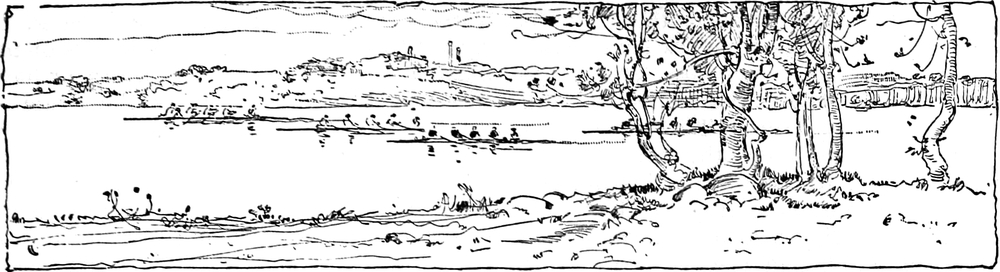
VERY few among the many thousands who witness the annual boat race between the universities of Yale and Harvard on the Thames at New London, appreciate what the preparation for that event means. Of course, nearly every one has heard that the crews have been in training, and from the newspaper articles that come thick and fast about the time of the race, has formed certain vague and often erroneous ideas as to how that training is effected.
The winning crew is most elaborately praised: their stroke was perfect, their backs rose and fell in unison, they worked like a piece of well-oiled machinery. On the other hand, the losing crew is characterized in terms no less strong: their work was ragged, such a man in the boat gave out, the men were not properly trained. Thus, by reading the usual newspaper reports of a race is the general idea of a boat race and the work required for it formed. How well the average correspondent can be relied on for authentic and accurate information was well illustrated this year at New London. The day before the Yale-Harvard race, one paper published an article praising the Harvard stroke, speaking of “the perfect stroke of the Harvard eight.” The result of the race entirely changed the tone of the next article. The same paper then described the same stroke of the same crew, thus: “The rowing was of the most ragged kind, and their style abominable.” This was scarcely true and was most certainly very unjust. It would surely have been impossible for a crew to go backwards to that extent in a single day. The fact is that both articles were greatly exaggerated, the first as badly in one direction as the second was in the other.
Let us see if we cannot come right down to hard facts concerning training and ascertain what it really means in the case of a university crew.
One race is but just over when the work for the next begins. The summer’s work, however, is mainly confined to the captain, for he must during that time make a careful study of the manner of coaching, of the theory of the stroke, and of the styles of rigging a shell, in preparation for the year’s work. Then, too, the truly enthusiastic oarsman endeavors as much as possible to improve during the summer, mainly in getting thoroughly acquainted with the feeling and motion of the water.
But now autumn is with us again, the university is open, and once more another college athletic year is begun. The first event in the rowing department is the fall regatta. In this only the class crews take part, and the training is short and not so severe as in the spring. But these fall regattas, unimportant as they may seem to an outsider, are really a great factor in the university crew work, and should never be neglected.
The class crews are the main feeders of the university crew, and it is all-important that they should get as much practice as possible, so that they be taught the regular university crew stroke. The members of the past year’s crew act as coaches. This is doubly advantageous, for it both instills the right principles into the crew, and teaches the coach not only to think about the stroke and to see faults, but also to learn how they may be corrected, which is of immense advantage to him when his own work begins.
After the class races the men start work for the university crew. The captain selects from the class crews the men whom he considers fitted to train. To this number are added some who, though they may never have rowed, yet seem to have in them suitable material, and the old crew men who are not playing football. The work is light, consisting of a daily short row, and lasts only so long as the water is open.
After the Christmas recess, the real work begins. All through the fall the “weeding-out” process has been in operation. Now the ranks are once more filled, mainly with those who have been playing football during the fall, so that the number of candidates who begin the real training will be between twenty-five and thirty. Now is the time, therefore, to ask the questions of what does the training actually consist? what are the requirements for a crew man? and how are the standards of excellence to be applied?
We will consider first the training itself. The work will take from two to three hours a day. During the winter, the men assemble at the gymnasium at some fixed hour; their clothes are quickly changed, knickerbockers, running shoes and “sweaters” being substituted, and the work of the afternoon begins. After a few moments’ work in the gymnasium, a short run is taken, outside if the weather permits; if not, inside on the canvas-covered track. A distance of five or six miles is covered at a pace varying from a fast walk to a sharp trot, according to the fancy of the captain. On the return to the gymnasium, after cooling off somewhat after the run, the men in a body go through a series of exercises designed to limber up the rowing muscles. Then the men are taken in squads of eight and set to work on the rowing-machines, or, what is far better, in a tank. A well-built tank is as much superior to the ordinary rowing-machine as the modern racing shell is to the old-style racing boat.
A few words will describe a tank. The only one that I know of is at Yale, and is used by the university crew in their winter work. A wall a little over three feet in height encloses a space about fifty feet in length to thirty feet in width in the basement of the gymnasium. The bottom and sides are cemented and it contains water to the depth of about two feet. A barge, securely fastened at both ends, lies in the water. This is of full size and regularly rigged to suit the men. The blades of the oar have to be either of less width or have a hole cut in the centre of the blade to diminish the great pressure. The tank is arranged so as to accelerate the current of water as much as possible as it is driven by the oars. This current is guided by means of the curved corners of the tank and by partitions running parallel to the barge over which the shank of the oar passes. By the stroke, the water is driven toward the stern outside the partition, i. e., in the channel farthest from the boat, and flows back toward the bow on the inside. These side partitions come just above the surface of the water, while a partition about two-thirds as high as those at the sides runs beneath the boat and practically divides the tank in half, giving two distinct and separate circular currents. The theory is that the oarsman’s strength is expended in driving the water round where ordinarily it is used in sending the boat ahead.
The crew is now seated in the boat, oars in hand, ready for the real work of the afternoon. The captain or the “coach” stands on the edge of the tank. At the command “Get ready!” off come the “sweaters,” and the men come up into position ready for the catch. The coach runs his eye quickly along the boat, straightens up the men, and satisfies himself that everything is right. The rowing is now begun and lasts from a half to three-quarters of an hour. The coach goes completely round the boat on the edge of the tank, correcting faults, explaining points, often stopping the crew, and making individual men practice certain difficult points. At the close of this work the men take a shower-bath, and after being rubbed down are ready, with hearty appetites, for the supper at the training table.
Such is the general afternoon’s gymnasium work during the winter. When spring comes, the tank gives way to the harbor and the gymnasium to the boat-house. Then the entire time is spent on the water, and the men are carefully watched by the coach from a steam launch.
The question of the selection of the men is the most difficult point that the captain and coach have to decide. Of course, certain physical traits are essential for a crew man, and he must have perfectly sound heart and lungs. This must be decided by a doctor’s examination. He must be tough, strong and enduring, and this is shown by the work he can stand.
But more is required for the modern university crew man. The day of “beef” and mere strength is past; for rowing has kept up with the times and it is now the era of skill in rowing. Brain-work is just as necessary in crew-rowing as muscular exertion. Neither is of use without the other, the two carefully combined give the winning crew. So nowadays the crew candidate has to undergo a mental as well as a physical examination. In passing judgment on these qualifications the greatest care must be used. Only those men can be selected in whom not only the captain and the coach, but every man in the boat has full confidence. This man may not always be the most skillful individual oarsman, but the fact that the ideal is a crew, and that eight must be chosen who will work as one man, must constantly be kept in mind. How can a crew row a hard race when there is a feeling that there is one man in the boat whose “sand” will give out when the final test comes? Every good crew man must be an enthusiast, a hard and faithful worker, a conscientious trainer, and a man who feels at all times that the honor and glory of his university are entrusted to his care.
Too much stress cannot be laid on the subject of harmony in a crew. All must work with the same will, with the same ideal in view. Often a man must take the coach’s word for what seems to him in his inexperience like a fatal blunder. Where there is mutual confidence between crew and coach, a strict adherence to what is believed to be the right principles, and honest, faithful work, defeat will come but seldom, disgraceful defeat never.
Such are the men who make up the university crews of to-day. How these men are regarded in college may be judged by a remark made this year by the Dean of Yale. He said, “The rowing men are the best class of men in college, the men with whom the faculty have the least trouble.”
In conclusion, I would like to say a word in reply to the oft-repeated question, whether it is beneficial to take part in college athletics. If I may be permitted to express an opinion after four years of rowing, I will most certainly answer, yes, for that branch of college athletics builds a man up physically as every one admits. It does not prevent a man from standing well in his studies. The men who are most relied on in a crew are, as a rule, those who make a good showing in the recitation room. The training a man undergoes as a member of the university crew sends him out into the world not only with a sound, healthy body, but also with the habits of regularity, promptness, obedience, self-control and self-restraint thoroughly ground into him; in short, with all the personal characteristics that combine to make a successful man fully developed. I have never found a crew man who regrets the time and labor he gave to it. Every one loves it with an affection that only a crew man can understand, and looks back upon it as one of the most pleasant as well as most profitable parts of his college course.

HOW TO TAKE A TRAMP TRIP.
BY LEE MERIWETHER.
Author of “A Tramp Trip; or, Europe on Fifty Cents a Day.”
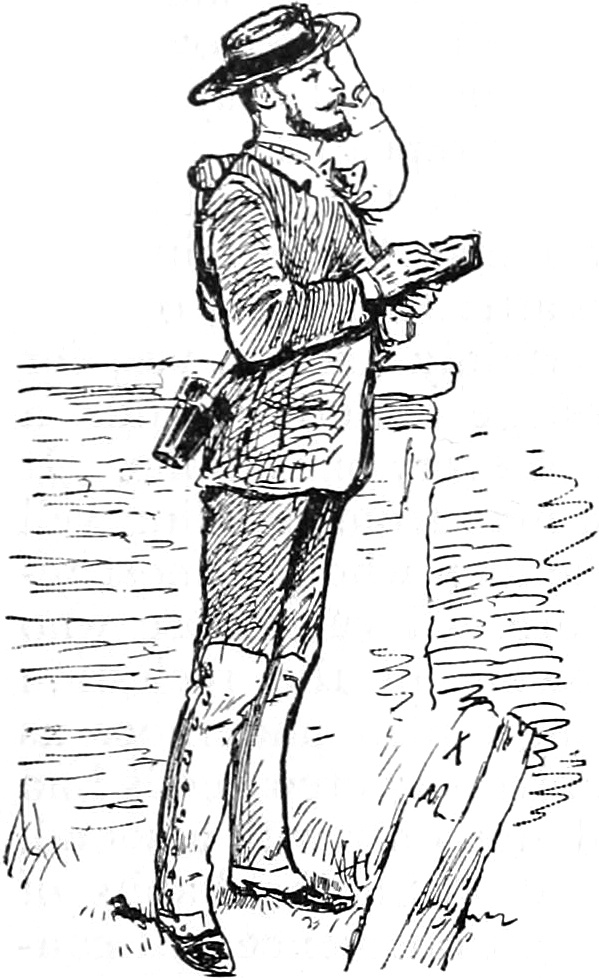
WHEN I wrote my book I did not imagine any one would care to take a Tramp Trip except on paper, hence the brevity of the chapter on “Hints to Tramp Tourists.” The publication of each new edition, however, brings forth letters from young men in all parts of the country requesting further hints and suggestions as to the manner in which one should set about taking a pedestrian tour, not on paper, but in propria persona among the people of Europe, as I did. These letters of inquiry have become altogether too numerous to permit individual replies. I shall, therefore, try to answer them here, and give, as briefly as I can, an outline of the way to plan and carry out a pedestrian trip through Europe.
The first thing, of course, is to decide on the countries to be visited. “If I cannot see all Europe, which portion shall I see?” Undoubtedly, Italy, by reason of its history, ruins, art, scenery, and picturesque people, stands first of all. My own preference would then take me to Switzerland, next to Germany, then to France, Austria, Hungary, and so on, to the far East. England I place last on the list, because, in comparison with the other countries mentioned, it is almost like America. When I landed at Folkestone after a year on the Continent and in Asia Minor, the English faces, English language, English cities, all seemed American—they were so much more American than any of the things I had been accustomed to. To the student always, and to the traveler, if fresh from America, England is novel and interesting. But it is not half so novel or interesting to the mere sightseer as Continental Europe, hence it stands last on the list.
Assuming that the candidate for pedestrianism agrees with me as to beginning his tour in Italy, the first step should be to familiarize himself with Roman and Italian history. He who has read Tacitus and Gibbon will look with far greater profit and pleasure on the palace of Nero, the Caprian villas of Tiberius, the rugged walls of Stamboul, than will a stranger to those authors. As to language, the better the tourist’s command of Italian, the greater his profit and pleasure; but he need not be discouraged if without such command, for Italian is not difficult. A few months’, or even a few weeks’, study of the grammar, capped by a three-weeks’ voyage to Naples or Palermo in an Italian steamer, surrounded by Italians, will enable the traveler to “get along” fairly the first day he lands; and as he proceeds on his tour, being careful to avoid American consulates and tourists’ hotels where English is spoken, he will find his command of the language equal to all ordinary occasions. The dialects in the Neapolitan states, in Tuscany, Venice, etc., differ one from the other, but not so much so as to embarrass the traveler who has followed the course indicated above. He will, unless deficient in acquiring languages, find after the course I have mentioned that he knows enough to make himself fairly understood in Naples, Rome, Florence, Venice, or any other Italian city.
Many people have an idea that French is the most essential language for the traveler in Europe. It is for all except the tramp traveler. In Spain, Italy, Germany, Russia, Turkey—in short, in any part of Europe, French is spoken in your five-dollar-a-day hotels, but in workingmen’s inns it is of little use outside France and French Switzerland. The most important languages for the tramp traveler are Italian and German. German, of course, is all that is needed in Germany, Austria and German Switzerland; in addition it will often be found serviceable in Belgium, Western Russia, Sweden, and in the southeastern European States, as Hungary, Servia, Bulgaria and Roumania. Italian is of use, not only in Italy, but all along the Mediterranean, from Gibraltar to the Bosporus, and even in the Black Sea ports of Russia, where Italian commerce has made the people familiar with Italian sailors for centuries past. My guide and interpreter in Constantinople was a young scamp of a Turk, who had picked up a colloquial knowledge of the language from Italian sailors.
It is far more difficult to acquire German, and unless the tramp has some previous acquaintance with that language, I fear he will fare badly in the Fatherland. I was fortunate in having some knowledge of German, acquired by long residence with a German family in America. But for this I do not think my tramp through Germany and Austria would have been half so enjoyable and profitable as it was.
As to outfit, little can be said more than is already said in the final chapter of my book. A knapsack can be bought for two dollars; into this pack a change of underclothing, a woolen shirt, a note-book, and a few etceteras, and you are ready for the trip. It is not advisable to carry fire-arms. The most serviceable weapon is a heavy club or walking-stick. The possession of a revolver may incur untold trouble in an Italian dogana, and is really of no use, since no one is in the least likely to attack so shabby a person as the tramp tourist becomes after a voyage in the steerage across the Atlantic.
The tramp tourist, not having and not requiring much money, need not be bothered with letters of credit or bills of exchange. Bank of England notes can be bought in New York for from $4.84 to $4.90 the pound, according to the rate of exchange. Buy about a hundred Italian lire ($20.00) for immediate use, and put the rest of your funds in English bank notes, which, for safe keeping, should be buttoned or sewed in some well-secured inner pocket. These notes can readily be exchanged anywhere in Europe for the money of the country in which you happen to be, and as several hundred dollars value can be carried without even making a lump in the pocket, they form a convenient and reasonably safe way of carrying one’s funds.
Having arrived at Naples, Palermo, or some other Italian city, the reader of my “Tramp Trip” will, nine chances to one, say something not suited to polite society, and not flattering to my veracity. For, notwithstanding my repeated expositions of Italian trickery, the tramp fresh from America will overlook some loophole, and the first days of his arrival, before he is taught by his own experience as well as by mine, will in all probability be charged, or rather overcharged, as much as though he were going first-class, with glasses slung over his shoulder and a red guidebook in his hand. I recall one of my first experiences in Naples. At a restaurant, before taking a seat, a certain sum was stipulated upon for a dinner. When it came to settling, the Italian charged just double the amount agreed on—perche? “Because,” and the rogue shrugged his shoulders as he said it—“because, signore, you took two pieces of meat instead of one.”
Of course it was a mere cheat, but what can you do? At first you pay, as I did; later, when you see such things are going to occur, not once but twenty or a hundred times a day, you lay down the right sum and walk off.
The tomb of Virgil is a few yards without one of the gates of Naples. Within the walls cab drivers are limited in their charges by a tariff—without, they charge what they like, or what they can get. I knew this, and so when I started for the poet’s grave, I bade the Jehu stop just inside the gate, where I meant to get out and walk the few yards to the tomb. But when we reached the gate Jehu drove on through, despite my remonstrance, saying he wished to let his horse stand outside in the shade of the wall. On this slight ground he built an outrageous charge, four times as much as the tariff rate to the gate. When he had driven me back to the city and I offered him the correct fare, he fumed like a Turk, swore he would have me arrested, that he had taken me into the country, into the campagna, and that he didn’t mean to let himself be cheated by a base foreigner. And all the while he danced and jumped about me, shaking his fist like a madman. When my curiosity was satisfied, I threw the right fare, one lira, on the ground, and walked off. Instantly there was a transformation that would have done credit to a veteran comedian. The cabman, seeing I did not mean to be cheated, ceased his fierce antics, stooped and picked up the silver, and waved me an “addio” with a smile as pleasant and as fresh as a May morn.
In Vienna I stepped into a money-changer’s to buy Turkish money. “Wait a few minutes,” said the manager, “I must send to the Börse to see what the exchange is to-day.” I took a seat. In ten minutes the money-changer came to me with the Turkish gold, and I rose to go. But in passing out the door a man stopped me and demanded a gulden. “For what?” “I went to the Börse to find out the exchange.” His going to the Börse was none of my affair; I refused to pay him forty cents for running the money-changer’s errand. Then followed a curious scene. The man threatened to invoke the power of the entire Empire unless he received his gulden. I told him to invoke. An excited crowd began to gather and block the narrow street.
“Young man, you are wrong,” shouted one in the crowd. “He went to the Börse; you must pay him.”
“The law is on his side; you will have to go to jail,” shouted another. Whereupon I sprang on a box that stood in front of the money-changer’s window, and harangued the crowd in the best German I could command. I told them I was traveling to see strange sights; that nothing would interest me more than an experience in a Vienna jail. “That,” I said, “will be something to tell my countrymen and make them stare. Come, I am ready; take me to jail.”
The man who wanted a gulden looked puzzled, but finally made up his mind to brave it out. Summoning a gendarme, he made his complaint, and I was placed under arrest. Away we went, followed by a hooting, jeering crowd, some of whom tried to shake my determination by shouting out the horrors of an Austrian dungeon. But the gulden not being forthcoming, there was no change in the line of march, and at length we brought up at the police station. Here the accuser spoke to me in a low tone, and said if I would pay half a gulden he would withdraw his charge. No. Well, ten kreutzers, five—anything, and finally nothing! For, unwilling or unable to deposit the necessary security for the costs of the case should he fail to prove his charge, he at length strode away sullen and furious because he had failed either to frighten or to cheat me.
I mention these incidents that the reader may understand what fifty-cents-a-day traveling means. The majority of tourists would have paid that gulden, and other similar guldens, and thus run their expenses up to five or ten dollars a day. Perhaps they would rather it should be twenty dollars than go through such scenes. It all depends upon one’s “point of view,” as Henry James says. For my part, I refused to pay that cheating messenger not so much to save my gulden, as for the sake of the scene. That surly, disappointed churl, the mob, the scene at the station before the stern gendarmes afforded me more enjoyment than I could have bought with twenty guldens. I would advise none to take a tramp trip who cannot, if necessary, enter such scrimmages with a feeling of positive delight. If you have not that disposition—if you cannot enjoy this close contact with and study of the lower classes—stay at home, else will your trip be one not of delight, but of petty humiliations and counting pennies.
One of the most frequent questions put to me by my inquisitive correspondents is: “How is it possible to find cheap lodging-places the first night in strange cities? and if you don’t find them, if you must go, even temporarily, to a first-class hotel, how is the per diem to be kept within fifty cents?”
The reason this question is so often asked is because the writers have never been to Europe, and have never traveled as tramps. They are thinking of their occasional trips to New York or Philadelphia, when, with a heavy valise in their hands, they are compelled to go straightway to an hotel. Different is it with the tramp tourist abroad. He has nothing but a cane in his hand; his knapsack now fits like another garment, and is unnoted. So accoutred, he arrives in town, walks about, sees the sights, and when he sees also the legend “casa locanda” over a door, he stops to investigate. If prices do not suit, off he goes again, looking until he finds one that does suit. When that is done he will do well, in stipulating a price, to say over and over again, “Tutti compresso”—everything included—else will he be obliged to pay not, indeed, more than the five soldi agreed on for the room, but twenty, thirty, one knows not how many soldi more for the candle, or the furniture, or the soap, or the water and towels, or something that was not agreed on. In Verona, home of Juliet, I had a pitched battle (of words) with a landlord who wanted to charge two lire (forty cents) extra for the candle, when I had bargained for the room “tutti compresso” for una mezza lira (ten cents). But for that magic phrase he might possibly have succeeded in his demands—possibly only, for I had then been in Italy some months, and was not so easily “squeezed” as the day when first I stepped on her historic soil at Genoa.
A question sometimes asked is, whether one could work one’s way should funds give out. I think not. In the first place, labor is so poorly paid; in the second place, a foreigner could scarcely get work at any price. I met a Philadelphia cigarmaker in Italy. He had tried in vain to secure work at his trade—in vain, because he was not a member of the necessary guilds, or unions. At home he could travel to his heart’s content, finding work in New York as well as in San Francisco, in St. Paul as well as in New Orleans. But in Europe he could not get a chance to make even the forty cents a day that European cigarmakers are able on the average to earn. It is the same with other trades. I advise the pedestrian, therefore, not to depend in the least degree on making ends meet by work anywhere in Europe.
In Eastern Europe pedestrianism is not advisable; the roads are poor, the villages often few and far between. West of Vienna there are few districts where the traveler will fail to find excellent roads and villages every few miles. Indeed, except in places like the Black Forest in Germany, the Higher Alps in Switzerland, the Pontine Marshes in Italy, you no sooner leave one village behind you than another appears in sight before you, so there need be no anxiety about being overtaken at night “in the woods.”
Baedeker’s Guide-Books are, in my opinion, the best. Besides much historical information, they contain minute maps and directions as to finding one’s way about a country. So minute and accurate were the directions in the Handbook for Switzerland, I was able to find my way over the most solitary mountain paths without other aid. Meier’s Guide-Books are cheaper than Baedeker’s, and almost if not quite as good, but they are printed only in German. Baedeker should be bought in New York, and carefully studied on the voyage across the Atlantic. It will prepare the traveler for many necessary details which would otherwise be learned only by troublesome experience. Be sure to cover the Baedeker with a quiet-colored cloth or paper, else will its flaming red binding betray that you are a tourist, and involve you in all of a tourist’s troubles.
These few hints will, I hope, suffice to start the traveler on his way; and in concluding I can make him no better wish than that he may derive as much enjoyment from his journey as I did from my “Tramp Trip.”
COURSING IN IRELAND.
BY ROBERT F. WALSH.
IN the autumn of last year, I was enjoying a holiday at Rostrevor, in County Down, Ireland. One bright morning a friend woke me early and proposed a visit to the Mourne Park Coursing Meeting.
Two hours later we were “on the ground” in Lord Kilmorey’s beautiful park on the Mourne Mountains. On the road from Rostrevor we had met numberless sporting people, and men, women and children of all sorts and conditions on their way to see the fun. I must say the variety of class that comprised that living stream was almost outrivaled by the variety of modes of conveyances. Everything, from the common “butt” or cart, drawn by an old horse whose visit to the tannery was almost due, to the coach-and-four of the Earl, was brought into requisition to carry these lovers of sport. There were lords and beggarmen, betting men and priests, ladies and work-girls, old and young, athletes and cripples. It was a curious crowd, but most good-humored. All seemed determined to enjoy their drive through the beautiful scenery of Mourne and to forget care while the deity of the leash catered for their wants and amusement. On the ground were collected several thousand pleasure seekers and sporting men, and about two hundred and fifty beautiful greyhounds, well cared for and covered with heavy “clothing.” Some of these dogs, I was told, were worth from $5,000 to $10,000 each, and many of them had been brought from England and Scotland.
On a gentle slope of the mountain there is a large meadow walled in on two sides. One end is fenced, but the bottom is open and partly secured so as to allow the hares to get away from the dogs if they are lucky enough to reach this “escape.” At the other end of this large field (nearly half a mile away) there is a V-shaped fence with several sliding shutters at the bottom. About twenty yards from the point of this V (in the field) is a screen made of branches, behind which the “slipper” stands with the brace of dogs ready to be slipped from the leash when a hare is driven through one of the shutters I have described.
Some days before the meeting, several hundred hares are driven from the mountains into the shrubbery or “enclosure” directly behind the V-shaped fence. This enclosure is about forty acres in extent, and when the sport begins, the hares are collected near the shutters.
When the dogs are handed over to the slipper and all is ready, the “slip-steward” signals to the beaters and opens one shutter, which is immediately closed again when a hare appears. Then begins the fun. The hare is allowed nearly one hundred yards start before the dogs are slipped. When the slipper is certain that both dogs have sighted their fleet-footed prey, he pulls the string and off they go. Picture two beautiful dogs, with straining necks, careering headlong after a little hare which knows they are seeking her death. On they go at almost lightning pace, and as they near the hare, one shoots ahead and makes a drive at the “quarry”; but “puss” is too cunning and suddenly turns from her pursuers. Then the dogs get closer and closer. Sometimes one leads, sometimes the other; but puss doubles as often as they get close to her “scut,” and so the hunt continues until the death or escape of the hare.
The onlookers are breathlessly intent as they watch and count the “points” scored by each dog in the course. Then, finally, madame escapes or one dog “drives” right into her and kills; or, perhaps, in her endeavor to turn from the leader, she is caught and killed by the dog behind.
At the Mourne Park Coursing Meeting, I learned that it was not always the dog which killed that won the course. It was explained to me in this way: The “run up” to the hare, that is, the first dog that “turns” or causes her to swerve to one side or other, counts one or two points according to whether the hare is turned on the inside or outside of the line of the course. Every turn after this counts one point.
A “go-by,” that is, where the second dog passes the first by one clear length after the first turn, counts two, and the death counts one point off the other dog’s turn, or two off the turn of the dog that kills. In this way, a clever dog may often beat a much faster one, as was the case when Snowflight won the Waterloo Cup—“the blue ribbon of the leash.” The “Cups,” “Plates,” or “Purses” are all run off in ties. The names of all the dogs entered for each stake are placed in a hat the evening before the meeting, and are drawn out one by one. The first and second drawn run the first course, and so on until the entire number are drawn. Then, as is the case in most games or sports where matches are contested for in ties, the winner of the first course runs against the winner of the second, the winner of the third against that of the fourth, etc., until only two dogs remain. And then is run the final tie, on the result of which, in an important meeting, many thousands of pounds are bet.