Volume 13 — OUTING. (continued 3)
Reading edition
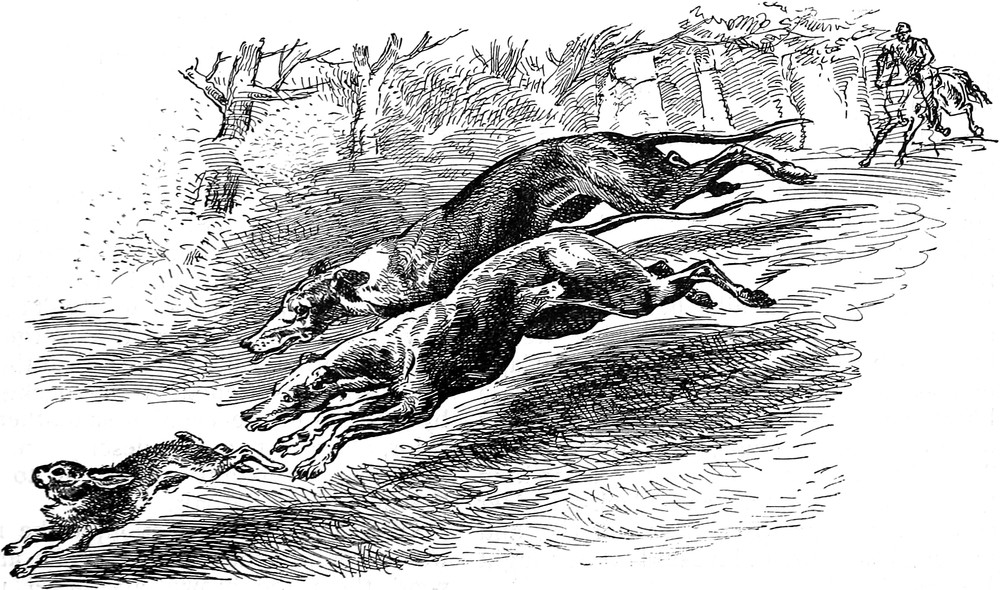
The sport seemed to me to be much more exciting than horse-racing. I noticed also that the betting fraternity have much more scope for their “trade” at a coursing meeting than on a race-course. Along the fence were hundreds of “book-makers” placing their bets and incessantly yelling their changes in “the price” of each dog as the vagaries of the hare made it more difficult to decide which would win.
But the principal betting takes place on the evening before the meeting, when the “draw” has been arranged. The chairman (usually a nobleman and president of the club) calls out the names of each dog. Then vive voce bets are offered and taken, and repeated by the chairman, first at “long odds” on the chance of an individual dog winning the stake, and afterwards on the individual courses. The “long odds” betting ranges from even money on a favorite to five hundred to one against an outsider or unknown contestant. The betting on the individual courses is, naturally, much closer. At meetings like Waterloo, Gosforth Park Gold Cup Meeting, or at Epsom, where the prize for the winner has often been $50,000—upwards of $1,000,000 change hands on the different results. Report says that ten times that amount has been invested about the Waterloo Cup, months before the meeting takes place.
In my description of the sport I have almost forgotten to tell the impression it produced on me. It is truthfully this: I was fascinated by its excitement and uncertainty, and so thoroughly pleased was I with my first day’s coursing that I traveled many a mile to be present at other meetings before I left the Green Isle.
YSLETA
BY E. HOUGH.
I.
’PACHE and I were tired. There was not any question about that. Fifty miles since morning, without getting out of the saddle, either one of us—though ’Pache always tried to get out of the saddle every morning, and sometimes nearly did.
’Pache was my horse. At least he was before Bill Stitt’s gang stole him. Now, why did they ever steal ’Pache, I wonder? The ugliest horse on earth without doubt, the dirtiest clay-bank that ever was, and the most simple, ingenuous, unexpected, naïve bucker! But ’Pache had the black streak down his back which plainsmen prize; and for a long goer he was hard to beat. Farewell, ’Pache! God bless you, you miserable india-rubber demon, wherever you may be now!
’Pache and I were tired. No question of it. And hungry? ’Pache took a piece out of my leggings once in a while, to testify to that. And thirsty? Yes, pretty thirsty; but we knew it was forty miles between water-holes, so we loped on, heads down, joints loose; loppity-lop, loppity-lop, loppity, loppity, lop, lop, lop.
’Pache struck a trot at the foot of the long climb up the Sierra Capitan divide. In and out among the cañons, winding around where it was easy to get lost—for by only one combination of these cañons was it possible for a horseman to cross this divide—and going up all the time. ’Pache coughed; it sounded dull. I tried to whistle; it sounded as small as a cambric needle.
The black piñon hills hustled and huddled and crowded up together, frightened by the threatening fingers of the Capitans—a lonesome range, the Capitans—a lonesome, waterless range. Spirits and demons in these hills, said the natives. The biggest cinnamon bears on earth in them, said the hunters, and black-tail deer so old they wore spectacles; and elk, and maybe plesiosauri and mastodons, for aught I know.
Tradition said there was a lake of water up on top of the highest peak. Tradition said you could find pieces of smoky topaz up there as big as your fist. Tradition said there was a cave over in the middle of the range, painted blue inside, and walled up in front, and with the whole interior covered with strange characters. Tradition said that one Señor José Trujillo had found, not far from this cave, a large piece of stone covered with sign-writing no one could read—a second Rosetta stone. Tradition said that Señor Trujillo dwelt in a little placita hidden somewhere back in the Capitans.
’Pache and I topped the divide. Did anybody say we were tired? Did any one believe that for a minute? That was a mistake. Why, when you throw off this chrysalis of pain and grief, when you drop your poor, sad mockery of a body, and pull up over the Range, you’re not going to be tired, are you? Are they tired on Pisgah? Are wings going to be tired like legs and arms and brains? No. Because—well, ’Pache knew that much.
A soft breeze from the south reached us upon the crest, and at its touch there hummed through ’Pache’s head the words of Goethe’s song in “Wilhelm Meister,”
“Ein sanfter Wind vom blauen Himmel weht;”
and the refrain,
“Kennst du das Land?”
And, verily, the Italy for which Mignon sighed might have been this that lay before us, stretching on and on in long lifts and falls of hills and valleys; in architecture of the ribs of eternity; in color the sum of Nature’s grand and simple touch. You can’t mix that! You can’t paint in royal purple, argent and aurum run together in one liquid, unburning fire! Take it up on a knife-blade, and perhaps it wouldn’t drop off. It wouldn’t run. But spread on by the brush of the Eternal hand, mellowed in the middle distance, softened in the background by the rays of the evening sun—there was color, above art, above description, above talk, above thought almost, fit to make ’Pache and me despair.
Off in the other direction, to the northwest, stretched the black foothills, and beyond them the brown and level plains, waterless, endless. That way—home lay that way, once. But if ’Pache and I should gallop night and day, we wouldn’t be as far as we see, and we wouldn’t have reached the nearest water-hole.
Tired? Why, we were on the crest of the divide, on the uplift of the earth, above the earth and its ailments. I could feel ’Pache’s wings under the saddle-flaps!
And ’Pache lifted up his head, whereon the mane was lightly blowing, and pitched his ears forward and neighed loud and cheerily. And some Valkyr steed behind a flat rock heard him and laughed at him, and so did another, and so did many others; and spirits came out and jeered at ’Pache, and small demons afar off mocked at him, and trumpet-calls for the assembly of the spirits of the mountains echoed and called back to us, fainter and fainter, passing on to the regions of the inner range.
They might have had the Holy Grail in there in those wild heights, those spirits of the Capitans. I do not know. There might be better than ’Pache and I to send for it!
Down the long reaches on the other side we rattled, in and out, loppity, loppity, loppity; down into cañons which grew darker as the sun went down. ’Pache didn’t mind it now. He knew where he was, and into his wise, yellow head came visions of a pint of hard, blue Mexican corn, and a whole rio full of water. Happy ’Pache!
But what made the creature stick his ears forward so, and throw his head up, and look around at me out of the corner of his eye? Anything to make a fellow hitch his belt around a little? Ah! There it was. Piñon smoke! The faint, pungent odor came up the cañon quite unmistakably now, and ’Pache and I knew that someone had gone into camp down on the rio, more than a mile below. We had expected to camp there that night ourselves, though it wasn’t plain what we’d have to eat, outside that one pint of Mexican corn, unless Providence should favor a pin-hook, or send a cotton-tail our way. So ’Pache and I scrambled up out of the cañon, at a shallow place, and reconnoitered a bit.
Greasers—a man and a boy—a bull-team—empty—going home from the Fort.
’Pache turned up his nose in disgust. How he did hate Greasers!
We scrambled back into the cañon, and came down the trail on a run, in great style, to show the Greaser outfit that, though we had traveled far, there was still some life in us. ’Pache stopped short at the edge of the wagon, and fell to stealing corn, while his rider threw the bridle down and advanced to the campers, saying, “Como l’va?”
“Como la va, Señor?” said the elder Mexican; and soon he added, seeing that I did not ride on, “Que queres?”
“Quero comar,” said I, briefly and to the point—which is to say, “I want to eat.”
“O, si, muy bien!” said he, smiling gravely, and with a real dignity handing me the camp frying-pan, and then poking the embers up around the coffee-pot. They had just finished their supper.
What there was in that frying-pan I never knew. I only know there was less when I got through than when I began. I dared look at it only once, and then saw a greenish-looking semi-liquid which would have done to tell fortunes over. I suspect chili verde and sheep; maybe cotton-tail, perhaps flour—possibly onions.
After supper I led ’Pache down to drink. He would have died of thirst before he would have left off stealing corn. It was a matter of principle with him!
It was a beautiful place, this wild little mountain spot, and the big clumsy carro and the broad-horned oxen hardly detracted from the picturesque, neither did the half-wild teamsters who lay stretched out on the ground. The stream, troutful and delicious, poured melodiously by, just big enough to hold one-pounders. The cañon walls swept widely out into a perfect amphitheatre, back of which rose the solemn Capitans, now of a wondrous, mournful purple in the dying sunlight. The evening chill was coming on. The big stars were showing. The rio babbled vaguely, whispering of cold, black mountain depths beyond; grieving, maybe, that no man had ever been found good enough to attain the Holy Grail.
Alone, ’Pache and I would not have been lonesome. We would have lain down there with our one blanket and slept the sleep of the ingenuously wicked, as calmly as two babes. But now the two-legged gregariousness came out. The Greasers were yoking up their cattle. They were going to pull out. It would be lonesome. We would go too.
No, it didn’t matter where. The trip to the Fort might wait. Mañana. Poco tiempo. After a while. What was the difference?
I approached the elder Greaser, as with much liquid, beautiful Southern profanity he labored with his lead yoke. I did not offer him money in return for his supper, for I knew he would not take it under the circumstances. There are a few gentlemen in the mountains, though they are mostly getting killed off.
“Yo vamos,” said my Mexican, smiling and showing a good set of teeth.
“Quantos milas a placita?” (How many miles to the village?) I asked, boldly, guessing that he couldn’t be far from home, since he was starting out with a full team at that time of day.
“Sies,” said he, soberly and politely, as one who says, “Good-evening.” Indeed, he soon added, “Adios!”
But I made mille gracias for my supper, and begged a thousand pardons, too. And could I not accompany him to the placita? Consider, it was late, it was far to the Fort; I had no serape. Moreover, I was most anxious to learn of one Señor José Trujillo, who had found a stone.
The Greaser brightened up, smiled, and said that though there was not Señor Trujillo, there were plenty of stones in the placita, which, por Dios! I might buy. Stones through which one could barely see; as well as some of blue. Oh, Si. I might vamos tambien.
These half-savage hill people are not fond of having Americans come to their villages; but they cannot resist the fascination of exchanging smoky topaz and turquoise for silver pesos. I said nothing further, but set out with my new companions, not caring much how far we went, or where. One leaves his senses at the edge of the Capitans.
We pulled down along the rio a half mile or so, half in half out of the water, slipping on the stones, swishing in the stream which whispered up to ’Pache and me not to go on, and clanking over stones which sent up dull, grating objurgations at us through the water. Then we left the stream and entered a black-mouthed cañon which tunneled sharp north, right into the Capitans.
The wonderful Southern moon swam stately up the blue sky and silvered the hills above us, and once in a while shed its light into the cañon. The bull-team plodded and coughed. The big carro creaked and groaned. The Greaser swore musically.
The moon climbed higher; lit up the cañon, glorified the peaks beyond, softened and melted the rocks along the trail into white, trembling heaps of silver. I dismounted from ’Pache, and tied him at the end of the carro. As a matter of courtesy, I hung my belt and .45 over the pommel of the saddle; but, as a matter of fact, I kept a tidy .41 in its usual dwelling-place. In case of any foolishness, I thought the .41 would do. It is always well to be polite; but it is always well also to have a reserve fund when you are dealing with human nature, Greaser or white, in mountains or city.
“O toros, sons of infants of sin, name of the devil and twelve saints, bowels of St. Iago, can ye not vamos, then? It is late. Vamos, refuse of the earth, vamos!”
I inferred that my host was a domestic sort of Greaser. I heard him say that their being so late would cause the madre to be in wonder. And the boy replied, “Si; y Ysleta.” (“Yes, and Ysleta also.”)
Ysleta? What a pretty name! Then I laughed and winked at ’Pache. Ysleta would be thirty years old, and would weigh 230 pounds. Bah! You couldn’t fool ’Pache and me!
We groaned into the placita somewhere before midnight. ’Pache sat up all night and stole corn, but I rolled in under the wagon, dead tired, and was asleep in a minute.
II.
I AWOKE in Palestine.
There was the broken, bare-hilled country I had seen in the pictures pored over when I was a child. There were the short, black, scrubby trees, just as I had pictured them on the Mount of Olives. There were the low, flat-roofed, earth-covered houses. There were the flocks, attended by the shepherds. There was Esau, shaggy, swart and fierce. And there—why, buenas dias, Rebecca! But who would have expected to see you at the well so early in the day, Rebecca?
Olla on her head, the Mexican girl walked down to the well. Walked, did I say? We have but the one word for it. It means, also, the stumpy stumble of our deformed American women. Let us say that this girl did not walk, but swam upright over the ground, as angels do in a fairy spectacular, with a wire at the waist, scorning the ground.
At the well the girl rested the big jar on the curb, and stood looking toward the east, falling into poses of pure grace and beauty as naturally as a shifting scene of statuary—the poses of a noble, grand and normal physical life, ripe and untrammeled for centuries. That they were not poses for effect, or at least for the spectator under the wagon, was very plain, for when I crawled out and appeared, the girl screamed, left her water-jar, and ran into the house near by. “So, this is Palestine,” thought I. “I wonder where is Jacob?”
The inhabitants of the little placita, fifty or sixty in number, perhaps, turned out en masse to see the Americano. Doubtless there were those among them who had never before seen a white man. I do not think curiosity was altogether mingled with approbation, though no positive distrust was shown beyond a black look or two.
It was not altogether a comfortable situation. I could assign, even to my own mind, only the flimsiest reasons for my intrusion; and it did seem almost as much an intrusion as if I had forced my way into a home uninvited. I sighed at my own foolishness, made my morning salutations, bought three pieces of turquoise, and then coming swiftly to the point, said I was hungry. ’Pache didn’t say anything. He wasn’t hungry. He bit an occasional piece out of an unwary dog, but he just did that for fun. He wasn’t hungry.
With that grave courtesy which is coin sterling the world round, the centuries through, these simple people asked me into a house, invited me to sit upon a sheepskin mat, and brought me what they had.
After breakfast I found that the little crowd had dispersed, though where they went was not apparent. Many of the men, Italian fashion, followed the business of wood-cutting in the hills, and quite a little troop of pannier-laden burros could be seen moving down the trail bound for the Fort with their big burdens of piñon wood.
I wandered about the little place, which soon sank into apathy again, and approached several houses under pretense of wishing to buy some smoky topaz. As I stopped at the door of one I heard an exclamation—
“Ysleta! el Americano.”
I waited at the door till I was invited by a stout and wrinkled dame to enter. I did so, and found two other women within; one a young woman of no especial noteworthiness; the third—Ysleta—the most beautiful woman I ever saw or expect to see. She was the girl at the well; the Ysleta spoken of by my companions of the night before.
Where this girl got her wonderful dowry I do not know. Beauty is not common among the lower caste Mexicans, though good eyes, hair and teeth are the rule. Yet here was a beauty faultless at every point, a royal beauty which would have become a queen, and with it the queenly grace and superiority which beauty arrogates as of right unto itself, no matter who may be its possessor, or in what land it may be found. And well it may. There is nothing really nobler than a grand human form, just as God thought it. Conscious of the sins of our ancestors still alive in our own misfit forms, we are ashamed and humbled before the fruit of unhurt nature, and we reverence it, appeal to it, almost dread it.
But if Ysleta knew, consciously or unconsciously, that she was beautiful, she was as yet unspoiled by flattery, and, moreover, there appeared in her air a certain humility, a gentle dependence. Advanced thinkers among women will labor a long time before men cease to love this in a woman—no matter what they may theoretically conclude. Taken as she was, this half-wild creature would cause in New York or Washington society a stir which no “professional beauty” has ever yet approached.
Seated on the floor, clad in the lightest attire, Ysleta was a model such as painters do not often find. It seems to me almost sacrilege for a man ever to attempt a description of a beautiful woman. It isn’t quite right. There is something wrong about it. Especially is it wrong where justice is impossible; and that is the case here. I know that the girl’s hair was very long and silky, quite free from the usual Mexican coarseness, and her eyes were very clear and soft. Her half sitting, half reclining position showed every supple line of a perfect figure: such a figure as in three generations would make reform schools needless, churches only half so needful, and doctors a forgotten thing.
Ysleta sat on the floor. In her arms she held a young child. As the stranger entered, she, with some slight confusion, started and turned half about, looking up with wondrous, wondering eyes. But in a short time she was again absorbed in the infant, which she now rolled and caressed as if it were a kitten, and now regarded thoughtfully, with a wondering, puzzled look, half awed, and with so great a mother-love shining in her eyes as made one almost hold his breath. Ysleta left me to the others. What time had she for aught else in life, when here, in her arms, was this strange and most wonderful gift—moving, living, crying, laughing?
Ysleta held up the child before her face. In her gaze was all the melancholy of youth, all the infinite sadness and mystery of love, and all the immeasurable tenderness of the maternal feeling. The poor girl’s face was so tender, so innocent, so dependent! I think the Recording Angel has more than one tear for Ysleta’s fault. With face illuminated she gazed at the child. Her eyes softened, swam, fairly melted—nay, they did melt.
“Muchachito!” she murmured; “muchachito mio! Ah, carissimo mio! Americano mio!”
“My American!” Then Ysleta broke into a storm of sobs, and rocked her boy in her arms, with a big cry for something which she didn’t have.
Perhaps the sight of a white face, even though that of a stranger, touched some tender spot. As quickly as I could, and with a feeling that Providence hadn’t got all the kinks out of the world yet, I went away.
This is Ysleta’s story, as her father, the carretero, told me.
“It was one day at the fiesta in the large town. Ysleta had not been from the placita before that day.
“Ysleta had not made any sin, but she felt sad, as if she had made a sin. Therefore she went to the padre. The padre was busy with others, richer, and Ysleta must wait. Ysleta had not made any sin, but she was sad. She stood at the door of the church. All was new to her. She was afraid.
“There came to Ysleta, so she has said, an Americano. He was not as the men of this country. His skin was white, his hair yellow, his eyes blue. Ysleta thought he was more than a man. Perhaps he was less than a man. She loved him, doubtless. Such things are. Why? Quien sabe?”
“Was Ysleta married to el Americano? Señor, I am a man of travel and of knowledge. I have been twenty leguas from this spot. Therefore, it is plain that I know easily what marriage is. But Ysleta—Ysleta is a hill girl. It is not alike. I asked of Ysleta if she was married, and she said, ‘Si,’ for that she loved, and would love no other. Is that marriage? Who knows? I believe Ysleta thinks so.
“There is no mother here who loves a child as Ysleta loves hers. It is not good, so much to love. But Ysleta loves no man. ‘I am esposa,’ says Ysleta.
“El Americano? It is not known. He disappeared. He never came back. Ysleta has of him a picture, not painted as the saints in the church are painted. And she has a paper; but what the paper may say we do not know here. He is gone. And Ysleta grieves. And because Ysleta grieves and will not love any young man, the young men will kill you to-night, since you, too, are Americano.”
“Thanks!” said I, as this last information was calmly conveyed. “Thanks, awfully; but, excuse me, I believe I will vamos. Sorry to inconvenience your young gentlemen, but really—!” And I exchanged a glance of intelligence with ’Pache, who nodded and winked in reply.
I gave my watch-chain to Ysleta and the little fellow; and which admired it more I could not say. I further divided my few pesos among the simple folks, and rode away with such store of smoky topaz that I wouldn’t have liked a hard run down the cañon with it behind the cantle.
I rode away, thinking of the most beautiful woman I ever saw; perhaps the saddest, also. Poor girl! Born to a wealth the wealthiest woman on earth would envy, she was a beggar in happiness. A child of nature, a creature of the outer air, an Undine-woman of the hills, she suffered and lost her simple joy forever, when, at the touch of what we call a higher civilization, she felt the breath of what we call a higher love, and groaned at the birth in her heart of what we call a soul. As in some quiet court, sheltered from every wind, and turned always to the rays of the stimulating sun, some rare fruit, waxy-cheeked and tender, ripens and swells into full perfection, knowing no reason for its access save the unquestioned push of nature’s hand—as this fruit shrinks and shivers at the breath of a fence-breaking northern wind, so Ysleta, thoughtless as a fruit, as ripe, as sweet, as soulless, shrank and shivered at the marauding breath of feelings new to her—the breath of the mystery and the sorrow of a lasting love. I wondered about this. I wondered about it one day as I rode up where, morning, noon and night, spring, summer and autumn, the broad, white, snowy arms of the undying Holy Cross lie stretched out on the Sangre de Christo range. I wondered if those arms didn’t stretch over the poor hill-girl as much as over the Americano who, with tinkling spur, and light song on his lips, rode out through the hills, up through the cañons, up to the gate of the little valley—Launcelot bringing the curse to the Lady of Shalott!
“’Pache,” said I, “I’m disgusted. What does all this civilized life amount to? It only brings curses with it. Let us go into the hills. Let us run wild, and never be heard of again. Let us forget a world whose business it is to forget us as fast as it can. Come. There are two of us. We’re not afraid. What do you say? Shall we go back?”
But ’Pache shook his head.
I yielded with a sigh; and so I went on out through the Capitans, overruled by ’Pache. I don’t believe ’Pache liked the Mexican corn.
Out from the Capitans, which still rose grim, mysterious, silent, unexplored—out from the spirits which guard the Holy Grail. ’Pache and I couldn’t find it. I think—I feel sure—that no man will ever find it. But I believe that if Ysleta came and sought it, the demons and spirits of the Capitans would cease mocking, and stand hand on mouth. I believe the wide gates would open; that the white-garmented angels of the inner shrine would draw back to let Ysleta by, and that the Grail would glow red and pure and warm to let itself be taken in her hand.
’Pache and I went down the cañon; heads down; loppity-lop, loppity-lop. ’Pache, you clay-colored, india-rubber angel, God bless you, wherever you are!
A RAINY DAY.
THE clouds have darkened down again, And all the world is sad with rain, As if the dead of many years Were all awake and shedding tears. Before the window-pane I stand And gaze upon the reeking land, Till I am cold and damply blue, Dejected quite, and shivering too. Roll up, thou blesséd luxury, Thou ample arm-chair made for me! Roll up before the open fire, Whose merry flames leap high and higher. I’d rather watch these devils play, Than see the angels weep all day! Bring me my pipe, whose ample bowl Is filled with that which cheers the soul; Soft comfort’s very essence lies In the weed which only fools despise! Bring, too, a glass with taper waist, Broad, shallow, and demurely chaste; Meet vessel for the quickening wine That knoweth not chill sorrow’s brine! The clinging smoke curls lovingly About, as if caressing me; And with a most entrancing pop, The wine flows forth with gems atop, Which, sparkling, burst in tiny spray As if small sprites were there at play. The dreary drip I cannot see— I sip my “Clicquot” cozily, And need no further joy than this, Together with my meerchaum’s kiss. The weather’s just as bright for me, As if the sun were high and free! So what care I for all the rain? I’m happy till it shines again!
H. J. Livermore.

OUTING begins another volume under the most favorable auspices. The twelfth volume inaugurated many changes. Baseball was made a feature, the Records were restored, the art work was greatly improved, the variety of each number became the object of special study, and so the volume grew in improvements with each successive issue from April to September. The present number speaks for itself. OUTING does not make fair promises simply to break them. Its present management believes in the performance rather than in the pledge. When the changes were inaugurated last spring, no startling announcement heralded a new era. The improvements were not even pointed out from month to month. The remarkable superiority of OUTING’S constituency over that of general sporting papers is an acknowledged fact. Our readers exact a high standard of excellence, and OUTING proposes to reach that standard.
The rapidly growing interest in sport and athletics broadens the field for OUTING considerably. Clubs are organizing daily, and it is difficult indeed to serve all sections of this vast and growing country as well as all the rest of the English-speaking world without neglecting here and there, at times, this or that particular sporting body or game—but in the end OUTING will cover the field, and no organization entitled to representation in this magazine shall long have reason to complain of neglect at the hands of a management determined ere another volume is begun to have all fair-minded people acknowledge as the WORLD’S best illustrated magazine of recreation, our own beloved OUTING.
* * *
OUTING is delighted to find its esteemed contemporary, the Canadian Sportsman, so thoroughly appreciative of the excellence of the August number as to reprint entire the article “A Rare Fish” under the original title, “The Famous Winninishe.” Unfortunately, the Canadian Sportsman forgot to tell its readers that the article originally appeared in the pages of OUTING.
* * *
THE RICHMOND BICYCLE TOURNAMENT.
THE bicycle tournament to be given at Richmond, Va., under the auspices of the Old Dominion Wheelmen, October 23d and 24th, promises to be an interesting affair. The races will be on a new half-mile track, now being laid by the Mechanical and Industrial Exposition of Old Virginia. The program of races, eighteen in number, is varied and includes nearly all classes of bicycle riding. The prizes are sufficiently tempting to attract all lovers of the wheel, professionals as well as amateurs. Entries must be made to Alexander H. Meyers, 601 East Broad Street, Richmond, Va., on or before October 20th.
* * *
BOWLING.
The bowling season began last month. Although it has hardly yet got into full swing, the indications are that bowling is increasing in popularity. The outdoor season of all kinds of sports just now drawing to a close has been remarkably successful. It is a healthy sign that gentlemen, and, for that matter, gentle women are becoming more and more impressed with the necessity of taking exercise. No better stimulant can be indulged in than a half-hour’s exercise in a good ball alley and a tussle at bowling.
* * *
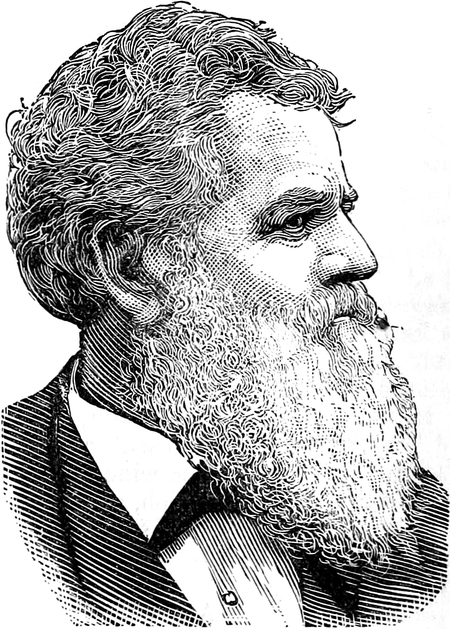
SETH GREEN.
SETH GREEN, whose name will be associated with pisciculture as long as the artificial reproduction of fishes is known, died at his home in Rochester, August 20, in the seventy-second year of his age.
To those who knew personally, as the writer did, the strong, rugged, gray-headed and grizly-bearded man, whose appearance seemed to indicate a longer life of usefulness, the announcement came like a shock. But it had been known to others for some months that the grand old “Father of Fishes,” as he was sometimes called, was lying hopelessly ill, and that his precious charges at Caledonia Springs—the little fishes—would know him no more. Mr. Green had from his early youth the tastes of the sportsman, and, with the proper education, would have made a great naturalist. He had great powers of observation; even in ascertaining such minutiæ as whether fishes can hear.
In 1864 Mr. Green bought a piece of property at Caledonia Springs, near Rochester, and his success in raising trout there was so great as to lead many others to embark in the business in different parts of the State. Dr. Theodatus Garlick had preceded him in the successful raising of trout, but not to a sufficient extent to detract from Mr. Green’s fame as a great trout breeder.
As a pisciculturist, however, Mr. Green will be best remembered for his discovery that the eggs of certain sea fishes, particularly the shad, require a continuous motion of the water to prevent the eggs from adhering to each other. The floating shad-box which bears his name, was the result of this discovery. Although it was superseded by the invention of Mr. Fred Mather, and later by the hatching jar of Colonel McDonald, Fish Commissioner of the United States, the credit of the discovery belongs to Mr. Green. Mr. Green was at one time Fish Commissioner of the State, with the Hon. Horatio Seymour and the Hon. R. B. Roosevelt. Of late years, however, he had been Superintendent of the State Fish Hatchery at Caledonia Springs.
He was a voluminous writer on the subject of fishes. He edited the Angler’s column of the American Angler, and wrote, in conjunction with Mr. Roosevelt, a charming little book called “Fish Hatching and Fish Catching.”
F. ENDICOTT.
* * *
YACHT RACING RESULTS.
WHETHER yachting is an expensive pastime or not, it certainly is popular and growing in favor every year. The waning season of 1888 shows a marked increase in the American pleasure fleet over that of 1887, with a proportionate number of new yacht owners—not all owners of new yachts, however, for there are plenty of old ones fast enough and shapely enough to satisfy the average business man, who does not care to order a new boat. So versatile are our yacht designers and builders of the present day, that one can have his order filled at short notice for a sloop or schooner, while just as fine a cutter of the most pronounced type may be had without crossing the Atlantic.
Although the first half of the season gave us but little racing worth chronicling, the latter half, beginning with the New York Yacht Club’s cruise, gave promise of some lively work, and, what is better, some surprising results.
It is an acknowledged fact among yachtsmen who witnessed the races for the Martha’s Vineyard cups, and the two following, where the schooners Sea Fox, Sachem and Grayling did such remarkably close sailing, that it was the finest schooner racing for the distance ever seen in these waters. Moreover, the victory of the old cutter Bedouin over the new sloop Katrina has brought the “keel or centreboard, cutter or sloop” question to the front again, with odds a good deal in favor of the cutter.
The events of the cruise have shown us that there is quite as much genuine sport in schooner racing as there is in big sloop contests, for two new schooners, the Alert and Sea Fox—the first a heavy keel cruising boat, the second a light centreboard craft, built for racing purposes—have, by their recent performances, shown themselves to be very dangerous antagonists to their class rivals. The Marguerite, Elma, Enone, Tampa, and other new schooners of this year, have not been entered with the crack yachts of their class, so no fair estimate can be formed of their stability or speed, but among the new sloops and cutters the results have been very satisfactory. The Puritan and Mayflower have fought it out nobly to windward and leeward, the Genesta’s rival proving more than a match for the Mayflower under some conditions. In the smaller classes, the old sloop Bertie easily disposed of her class-mates, and, the Pappoose, that famous little cutter from Boston, outsailed everything in her class in all conditions of weather.
The season thus far has given the sloop men and the cutter men plenty of food for thought, and the results bring them back to the question, “Will the English challenge for the cup next year; and if so, with what yacht?”
It is safe to say that an International contest for the Cup in 1889 is a certainty, and that a compromise cutter of Watson design, and one that will sail in our 60-foot class, will be the challenger. Mr. Ralli’s Yarana, for instance, the handsome cutter that ever since her début last spring has been winning races from the Patronilla and the famous Irex, might, if she were sent over, prove a good match for our Shamrock, Titania, or Katrina. Of course we believe that when Burgess or Carey Smith or Ellsworth are called upon to design a sloop to beat the world, each of them will produce something very fast, but it is nevertheless a fact that Watson’s latest production has all the beauty of the Thistle, with none of her faults, and plenty of speed both to windward and before it. So if the public have been disappointed because they saw no international race this season, they may be sure of one next that will amply repay them for waiting.
With commendable enterprise, the New York Yacht Club has decided to have a fall race every season. The first one will be sailed late in this month, when strong breezes and fine racing may be looked for; at any rate, it will bring together most of the new and old fliers, and probably give us better results than the spring regattas have.
J. C. SUMMERS.
* * *
CANOEING.
THE NINTH ANNUAL A. C. A. MEET AT LAKE GEORGE.
CANOE building is becoming quite as much a science as yacht building. The boat that won nearly all the sailing races and made the highest record ever attained at an A. C. A. meet was built by the same man who turned out Dr. Rice’s paddling canoe, which won the paddling championship—Ruggles, of Rochester. M. V. Brokaw, of Brooklyn, who sailed the Eclipse, did excellent work, but no better than Paul Butler, who sailed canoe Fly beautifully. Never before has so fine a lot of canoes been at the meet and sailed in the races. A large proportion of the canoes that entered the races were well built, perfectly finished, smooth, clear and clean, and very lightly, yet strongly, rigged. The influence of Mr. Barney’s success in canoe Pecowsic in 1886 and 1887 was very clearly seen in the rigs at the meet this year. It will be remembered that the Pecowsic had five sails, all of different sizes, laced to the masts, incapable of being reefed, only two of which were used at one time, or in one race. The power of the wind at the start governed the selection of the two most fitting for the particular day. Once started in the race, no changes could be made. Many canoes this year carried the standing rig, notably Eclipse. The standing rig is a bad thing, more especially if the sail cannot be folded up easily and stowed, as was the case with many. Butler and the Lowell men had by far the best sails in camp—reefing sails, well cut, neatly bent, all of one piece of cloth, with no bites in them, so the muslin spread a perfectly smooth surface to the wind when flattened down by the sheets for work, on trim and scientifically shaped spars.
One lesson Mr. Barney taught the canoeist which has come home very forcibly to the many, and will not soon be forgotten—the very great advantage of lightness in masts, spars and rigs generally, as well as in the canoes themselves, especially lightness aloft. A very general movement in this direction has set in, and many very clever devices were noticeable at the meet to gain this point without loss of strength.
The perfect sailing canoe and rig have not yet been made. The improvements and progress each year only serve to put the goal still higher and keep showing larger possibilities all the time. Methods of building have been wonderfully improved, and the metal fittings that are now used are marvels of mechanical skill. The secret of it all is the very great rivalry in canoe sailing, and the many minds continually working out improvements to attain greater speed.
The racing this year in some ways, was a marked advance over that of last year—the boats of the fleet sailed better. No one has yet equaled R. W. Gibson’s sailing at any A. C. A. meet—that was true science. Butler did the best sailing this year, and showed a knowledge of the finer points in making and rounding buoys without loss of time, headway or a foot. Brokaw sailed wonderfully well and showed pluck in the heavy weather. Where there was luck he had it—as in the cup race, when Butler led, and the wind fell to a breeze best suited for the sails Brokaw had; and again, in the Barney cup race, when he caught up to and passed the Jabber in If by a lucky fluke, If lying becalmed all the time, or nearly so. Brokaw is one of the very few strong men and good paddlers who does any sailing. This fact gave him a chance to accomplish what has never been done before—win the highest possible number of points on the record. He first won the unlimited sailing race (3 miles) in a fleet of thirty-three canoes, twenty-one of which completed the course. He scored ten points for this. Next he won his class paddling race (Class IV.), beating four others. His luck helped him here also. His boat in beam was 293⁄4 inches, the very lowest limit in the class; but, more than this, both Dr. Rice and Johnson (the best paddlers in the A. C. A.) raced in Class III., so he did not have to meet them. In the combined race (11⁄2 miles paddle, 11⁄2 miles sail) there were six men against him, and he won by strong paddling, quick work in hoisting and stowing sail, and fast sailing with no luck or flukes. Three races, ten points each, thirty points. The second man on the record was E. Knappe (Springfield, Mass.), three races, 16.95 points. The third, fourth and fifth men, all prize winners, got, respectively, 15.50 (Leys, Toronto), 14.60 (Patton, Yonkers), and 13.70 (Quick, Yonkers) for two races each.
The Lowell men won the club race, securing the club championship flag, and they well deserved it. Seldom has a meet witnessed such excellent boats, plucky sailing, and genuine club fellowship as existed among its members. Butler won the club race in Fly, and took the individual prize. He won the same race last year, when no prize was given to the winner, and when his men did not give him the support they did this year, for the club flag then went to Brooklyn.
A tournament was added to the program at the meet and greatly interested the spectators, canoeists and visitors to the camp; also a tug-of-war—four men in two canoes, paddling in opposite directions, with the boats securely tied together, end to end, with a stout rope.
Walter Stewart, who came from England to race for the Trophy, and take part generally in the meet, did not win a race. He is the holder of the Royal Canoe Club championship challenge cup, won on Hendon Lake, both in 1887 and 1888. His canoe Charm beat Baden-Powell and other English canoeists in each race. In 1886, when Stewart was out here before, it will be remembered Powell came with him, and defeated him in the sailing races. Stewart entered three record races, won 13.35 points, and thus got sixth place, missing the fifth record place (and prize) only by 35-100 of a point. Before returning to England he will sail again for the New York Canoe Club challenge cup on New York Bay, now held by C. Bowyer Vaux.
No review of the canoe meet would be complete without a mention of the paddling done by Dr. Rice, who won the championship flag. He proved conclusively that fast paddling can be done gracefully, and without any body or back movement. His arms alone do the work, while he sits firmly on the seat with his back well braced. Johnson paddled the class races, sitting high up in his boat, as usual, and with his old-time reach forward at every stroke. Rice, however, beat him. In the mile championship race, Johnson paddled standing up, a feat never before seen at an A. C. A. meet, though it is not unknown in Canadian races when the double paddle is used. As the race was down the wind this may have been a slight advantage. Rice and Knappe won the tandem race in fine style against three other crews. They paddle in the same manner, keep perfect time, and work like machines, so regular is their stroke.
One feature of the camp must not be overlooked. The men seemed to think much more of dress than is usual at the meets, no doubt on account of the many ladies who camped on what in former years was known as Squaw Point. The nearness of hotels made it very easy for lady visitors to appear in camp daily, and during the racing days they were everywhere.
As a Canadian commodore was elected for 1889, the next meet will be held on the St. Lawrence, or somewhere in Canada once again.
C. BOWYER VAUX.
* * *
THE POLITICS OF CYCLING.
OUTING’S mission is to entertain and instruct, to elevate and encourage legitimate outdoor sport and recreation, to the end that the manhood and womanhood of its clientèle may benefit thereby in mind and body.
Occupying this high place, and having selected this noble part as our particular field of enterprise in the world, we have always deemed it best to take little active, and positively no partisan, interest in the politics of the League of American Wheelmen. We are content to leave the exclusively cycling press in undisputed possession of that field which treats of League offices and the doings of League officials.
Sometimes, when scanning the brilliant editorials of our weekly cycling contemporaries, we have grown envious and have been sorely tempted to take a hand and out with our opinions. The legislative wisdom that bristles on our pen point, however, has been restrained by the knowledge that we appear before the wheel-world but once a month, when the question under discussion has often been disposed of by the weeklies before we go to press.
We, along with all who have the best interests of cycling at heart, have been greatly interested in the arguments, pro and con, concerning the new League constitution. As we are minded to jot down these few remarks, there lies before us copies of the Wheel and Cycle Trade Review and copies of the Bicycling World and League Bulletin. Apropos of the subject under discussion there is, to say the least, a “friendly difference of opinion” between them.
“Rings,” “wire-pullings,” “gangs,” etc., are openly talked of, and dark hints lurk between lines and words. Some of the remarks and insinuations indulged in are refreshingly frank, and yet the impression is left, that the pens of the writers have been held under restraint, so as not to reveal the depth of their inmost thoughts. It is, or appears to us to be, almost a case of “you have” and “we swear to you, by all that’s holy, we have not—so there!” not to say “you’re another!”
It is in such moments as these that OUTING takes unto itself much solid comfort in the reflection that, as a non-combatant and a mutual friend and well-wisher, it can take the non-partisan stump and out with a word or two of timely wisdom to the rank and file of the League, whilst the rival champions are fighting it out.
Whether ringsters, wire-pullers and gangs have really taken possession of the politics of the L. A. W. is a matter that every member of the organization should judge for himself from the evidence advanced. The League is not made up of children, nor of dotards, but, for the most part, of intelligent young men capable of knowing their own minds and forming their own opinions.
THOMAS STEVENS.
* * *
BASEBALL.
THE League pennant race during August was made intensely interesting to the New York patrons of the game by the continued success of the New York team, and the fact that they finally gained the lead during that month. The falling off in the Detroit team was also a noteworthy feature of the month’s campaign, while Chicago, too, lost their previous winning pace. The surprise of the month was the brilliant rally made by the Boston team after their demoralizing experience of July. Chicago went to the front in May, after Boston’s April spurt, Boston being second and New York third. By July Detroit had pushed Boston to third place, while Chicago still kept in the van, New York having dropped to fourth position. Before the end of July, however, New York had not only taken Detroit’s place as third in the race, but by the end of the month they had reached the front and had pushed Chicago back to second place. The last week in August saw New York at the head of the list with a percentage of .663 to Chicago’s .579 and Detroit’s .527, Boston being fourth with .516, and Philadelphia fifth with .500, the other three being entirely out of the race. The last week in August, however, saw Boston rally for a higher position in brilliant style, three straight victories over New York at the Polo Grounds being one of the noteworthy events of the month, no other club having been able to win three straight games from the New York team during the season before this. This left September’s campaign the most interesting of the season, as on the games of that month would depend the virtual settlement of the championship question, though the season would not end until the middle of October. The fact that New York would finish its season at home, from September 28th to October 16th, greatly favored the anticipations of the club, and the close of August left them confident of ultimate success in winning the pennant.
A feature of the early Fall campaign in the League arena was the contrast between the Boston club’s record of victory and defeats in July, and their August record. During July the Boston team lost seventeen games out of twenty-two, while in August—up to the 30th—they had won fifteen out of twenty. New York’s records in June and that in July were almost as striking in their contrast. In June that club’s team only won thirteen games out of twenty-three, while in July they won eighteen out of twenty-three. On the other hand, the falling off in the play of the Chicago team in July as compared with their June record was equally surprising; as in June they won fourteen games out of twenty-two, while in July they lost fourteen out of twenty-three. But the worst series of defeats of the season was that sustained by the Detroit team in August, when they lost sixteen games out of twenty-two, after winning fourteen out of twenty-four in July. These changes are all in accordance with the uncertain character of the national game, which gives it much of its attraction to our chance-loving sporting public.
In the American arena the contest for the pennant still being confined to the four leading teams of the St. Louis, Cincinnati, Athletic and Brooklyn clubs, lost much of its interest to the metropolitan patrons of the game, owing to the unexpected collapse of the Brooklyn team, which, from its occupancy of first position on July 15th with a percentage of .676, with St. Louis second with .639, and Cincinnati with .600, fell within one month to fourth place. By the last week in August they had only a percentage of .585, while the Athletic team had worked itself up ahead of Cincinnati into second place with a percentage of .625, Cincinnati being third with .608, and St. Louis first with .701, with a fair promise of ultimate success in winning the pennant. The New York League team, when they themselves took up their leading position, had hoped to see the Brooklyn team keep pace with them so that the two might eventually compete for the world’s championship honors, as they well knew that in such a series of contests the Brooklyns would draw thousands of spectators where the St. Louis would only attract hundreds. It is almost a certainty that St. Louis will win, while the struggle for second place will be between Brooklyn, the Athletics and Cincinnati, the other four being completely out of the race. Bad management lost Brooklyn the chance of winning the pennant, as they unquestionably had the material at command to have kept the lead.
HENRY CHADWICK.
THE OPEN GAME SEASON IN CANADA.
THE season for shooting woodcock in Canada commenced August 15th, and birds may now be shot till the 1st of January. Grouse, pheasants, partridges, snipe, rail, golden plover, ducks of all kinds, and all other kinds of water-fowl, excepting geese and swan, may also be lawfully killed from the first of September until the first of the year. The open season for geese and swans runs from September 1st to May 1st. The quail season does not begin until October 15th, and quail must not be killed after December 15th. The deer season begins October 15th and ends November 20th. Moose, elk, reindeer or caribou are protected entirely until the year 1895.
PONY RACING.
A SPORT which has attained great dimensions in England of late years, and has to some extent been popularized in America, is pony and galloway racing. It is, in fact, this sport which has revived the word “galloway,” which was falling quite out of use, and never seen except occasionally in an auctioneer’s catalogue. The word is defined by “Stonehenge” as applying to “full-blooded ponies which are bred in the south of Scotland and which show more Eastern blood than the Highlanders.” He goes on to say that they “seldom exceed fourteen hands, and are described as possessing all the attributes of a clever hack.” That the sport has a real use no one can doubt, for the breeding of ponies had become an industry sorely in want of an impetus, which it now has in the extra inducements offered to breeders by the high prices obtainable for really speedy animals. In proportion to size, a pony is a better animal than a horse, and can do far more work “for his inches.” The improvement of speed and better development of the various breeds is therefore a highly desirable object. The sport is a great favorite among military men in India, and, according to all, it is a truly wonderful sight to see what welter weights a small pony will carry without apparent distress. In America the recruits for the sports of the East, whether racing or polo, are largely obtained from the West. From the improved stock which is now brought in large quantities to New York and other eastern towns every year, judicious selection can obtain really first-class material. Though the ponies are usually “in the rough” when they arrive, careful handling and good stable management will soon reduce them to such shape that, were it not for the tell-tale brand on the quarters, no one would recognize them as specimens of that much-maligned class, “cow-ponies.”
FROM KANSAS ON A WHEEL.
MR. ELMER E. JUNKEN, of Abilene, Kansas, has made a long ride on a 52-inch “Expert” Columbia. He left his home May 16th, and arrived in this city August 18th. He traveled the whole distance on his wheel, and with the exception of being sunbrowned and travel-stained, appeared nothing the worse for the wear and tear of his journey. The route lay through Kansas City, St. Louis, Ill., along the National Road to Terre Haute, Indianapolis, Richmond, Ind., Springfield, Dayton, Columbus, Cleveland, O., along the Ridge Road to Buffalo, through Rochester, Syracuse, Utica, the Mohawk Valley to Albany, thence through Pittsfield, Northampton, Ware, Worcester to Boston and to New York. The journey was made for pleasure and sight-seeing, and for this enjoyment Mr. Junken covered over two thousand miles. The roads he describes as variable, and he gives credit to Ohio and Indiana for having the best. His outfit consisted of a change of underwear, a serviceable cyclist’s suit, and a rubber coat. Mr. Junken will make the return journey home partly on his wheel, with an occasional lift on the cars.
MANHATTAN’S VICTORIOUS ATHLETES.
THE Manhattan Club team returned from England, August 12th, after an absence of ten weeks, during which time its members won a half dozen championships in the national games at Crewe and the international games in Dublin. The team, when it went away from here, consisted of G. A. Avery, T. P. Conneff, H. M. Banks, Jr., and Frederick Westing, who were joined on the other side by Thomas Ray and C. V. S. Clark, English resident members of the club. From Queenstown Conneff went to Belfast, and won the four-mile Irish championship run. From that time the team’s career was a series of victories. The men went into training at the grounds of the London Athletic Club, and soon had themselves in excellent trim. Besides winning his four-mile race, Conneff won the English one-mile and the international one-mile championship races. He also beat Carter in a five-mile match race. Thomas Ray won the pole-vaulting championship, and Westing carried off the honors in the 100-yard race at Crewe, besides winning at the international races in Dublin at the same distance. Westing’s time in the latter race was ten seconds. Clark, another member of the team, completed the list by winning the seven-mile walk at Crewe. Gold medals were awarded in each event. Westing has challenged Great Britain for the 100-yard championship of the world, the race to take place on the Manhattan Athletic Club’s grounds. Messrs. Ritchie and Woods have accepted the challenge. A similar challenge by Conneff for the mile championship has been accepted by Messrs. Hickman and Leaver. When these championship events come off they will excite great interest.
THE TRIP OF THE CHICAGO BALL-PLAYERS.
THE Australian tour of the Chicago Baseball Team, which is now in everyone’s mouth, is a novel scheme, the credit of which is due to Mr. Leigh S. Lynch, the well-known theatrical manager. During his travels in Australia Mr. Lynch perceived how great was the love of outdoor sports displayed by the Anglo-Saxons of that rising young continent. He also noted the complete ignorance of baseball which prevailed. The outcome of his observations was the undertaking of the Australian tour by Mr. A. G. Spalding. Mr. Lynch was dispatched to make arrangements, and on his return in the spring the work of organizing two teams was undertaken. Not content with instructing the people of Australia in the art of baseball, Mr. Spalding has determined to take with him men capable of playing cricket and football also. The work of selection has resulted in the choice of the following teams: A. C. Anson, (captain), E. Williamson, F. Pfeffer, T. Burns, J. Ryan, F. Flint, M. Sullivan, R. Pettit, M. Baldwin and T. Daly, and this team is to be known as “The Chicagoes.” The second bears the name of “The Picked Club,” and comprises: John M. Ward (captain), M. Kelly, Boston; F. Carroll, Pittsburgh; M. Tiernan, New York; Wood, Philadelphia; E. Hanlon, Detroit; Fogarty, Philadelphia; Comiskey, St. Louis; while it is hoped that the services of Caruthers, of Brooklyn, and McPhee, of Cincinnati, will also be secured. John A. Rogers, of the Peninsular Cricket Club of Detroit, has been made captain of the cricket team. All players are bound by strict contracts as if they were playing in a league or association club.
After a series of farewell games in America, beginning in October at Chicago and continuing in Milwaukee, Des Moines, St. Paul, Minneapolis, Omaha, Denver, Salt Lake City, Stockton, Los Angeles and San Francisco, they will embark on November 17 at the last-named place. S. S. Alameda has been chartered, the owners agreeing to do the trip in twenty-five days. The foreign campaign will begin at Honolulu, where two games will be played, one with a local club, the other between the two teams. It is hoped that King Kalakaua will honor the field with his august presence. The first antipodean city visited is Auckland, then Sidney, and hence the route lies to Melbourne, Adelaide, Brisbane and other cities. Altogether it appears likely that the tour will prove a phenomenal success.
POLO.
THE season of outdoor sports is once more on the wane, and soon the morning papers will no longer teem with reports of sports of every kind, from the baseball which interests all, down to the small and ragged urchin who can scarcely toddle, to aristocratic polo, with its select clique of followers. Each has its own field to fill, but to each is vouchsafed the mission of strengthening and filling with robust health the systems of its votaries.
Polo is, and except under very exceptional circumstances always must be, the game of the rich. Unless it be in a community where each man has for part of his stock-in-trade horses and ponies, none but the wealthy can afford to keep the necessary ponies, and none but they care to run the risk of damage to their stock involved in this sport. In its original home, India, its nimble exponents certainly often manage with but one pony each, but the result of this appears in the way in which English officers, inferior in skill, by the superiority of their horseflesh, succeed in beating the native players.
In its limited circle Polo has, however, taken firm root, as the papers testify, and though the crack players are not elevated to the questionably pleasant position of popular heroes, to be lauded to the skies one day, and the next hissed and hooted, they are to a few select admirers little short of demi-gods. In spite of the ardor, however, with which this game is now pursued in America, competent judges dare to hint that it has not yet reached the English standard. Again, it is sure that in England there are few who can emulate the dexterity of the natives of India. In the American game, a certain lack of vigor in the strokes is especially noticeable, and but few seem to have mastered the difficulties of the sweeping overhand stroke.
With such a basis as the game has attained, it is only a matter of time and practice for a high pitch of excellence to be reached. Let us hope that in the course of but few years the exponents of this fine and manly sport may become masters of all the skill they can desire.
RETURNING THE BALL IN LAWN-TENNIS.
A CORRESPONDENCE which has been going on in the columns of the English sporting paper, Land and Water, has elicited the following remarks from the editor, which seem to contain such an important point that they are well worth reproduction:
“The majority of gentlemen make their best drives by taking the ball when near the ground. This is undoubtedly the best way to ensure accuracy and certainty, combined with severity; but it has the disadvantage of giving the opponent plenty of time to get into position and recover his composure. Besides accuracy and severity, rapidity of return is a very important factor against the best players, who all of them possess great aptitude in covering the court. The deadliness of the volley, of course, lies in the fact that the ball is returned so soon after it has passed the net, calling for redoubled exertion on the part of the muscular and mental faculties employed. What applies to the volley also applies to the ground-stroke, and players who recognize this in practice endeavor to return the ball with as little delay as possible, when circumstances are favorable, as is generally the case with high-bounding second services, when the ball is taken at elbow-height, and even higher. With beginners and indifferent players no practice is more to be condemned than that of running in to meet the ball, and in doing this lies the secret of the failure of so many. But if one watches the play of those at the very top of the tree he will find that they never lose an opportunity of getting at the ball as soon as they can safely do so. Mr. H. F. Lawford is especially good at this tactic, and he has explained in print that he considers the time gained to be more than a recompense for the risk run of losing some of his accuracy. Mr. E. Renshaw takes the ball, under the circumstances, overhanded; but both Miss L. Dod and Mrs. Hillyard (to mention only the case in point) manage to get over it, returning it at great speed. To take the ball in this way with proper effect is difficult of accomplishment, which is the reason why we mention the circumstance.”
THE AMERICA’S CUP ONCE MORE.
THE prospects are that next season will see another comer from across the ocean in American waters to offer battle for the America’s Cup. The new visitor will probably be Mr. Paul A. Ralli’s new cutter Yarana, a vessel designed by G. L. Watson, the designer of the famous Thistle and the almost equally well-known Irex. The Thistle we know from her performances in American waters last season; the Irex we only know from her honorable record in British contests. The Yarana is a cutter 66.08 feet long on the load water line, and has a 14.08 feet beam. Her draft is not given. This craft has been in all the principal British regattas since her début, May 22d, in the Thames Yacht Club event, and her performances have all come up to her designer’s expectations. In fifteen matches with the Irex—and the Irex is one of the crack yachts of old England—the Yarana won nine and the Irex four. Two of the races must not be taken into account, as the Irex ran aground. Last year the Thistle had nine to her account against the Irex, but when it is remembered that the small boat is not put on an equal footing with the large sloop by any rule of time allowance now in use, the record of the Yarana may be fairly said to prove that Mr. Watson has improved on his previous creations. If the Yarana comes here she will be welcome as a visitor, and equally welcome as a challenger for a trophy which has a reputation the world over. The advent of a smaller boat competing for this much-valued prize will prove beneficial. It will create more interest among yachtsmen generally, as it will give a chance for the smaller boats to enter the lists. The owners of the Shamrock, Titania and Katrina have great faith in their craft. Possibly they might have a chance next season to measure speed with the new Britisher. Let us hope so; and may the best boat win, be she American or English!
AMATEUR OARSMEN AND THE NATIONAL ASSOCIATION.
HENRY W. GARFIELD, President of the National Association of Amateur Oarsmen, in the annual communication to the organization, thus discourses on rowing matters in general and what constitutes an amateur:
The conditions which brought the National Association into being may be well known to some, but are hardly appreciated by those boating men whose interests in aquatic sports commenced at a later date. In 1872 there was in the United States no generally accepted definition of an amateur oarsman, and the constant formation of new clubs, and consequent increase in racing, made the adoption of some uniform definition eminently desirable. A convention of boating men was accordingly called to meet in New York city, and then and there was the National Association of Amateur Oarsmen organized. In the following year its first regatta was held in Philadelphia. The merits of the new definition were early seen, and the value of its Laws of Boat-Racing soon recognized, until both have since been generally adopted and followed by every amateur rowing association and club.
When, however, the Association attempted to enforce its rules and to discipline offenders, it was for several years sturdily opposed by powerful clubs from one or two localities. The attempt was made to prejudice the minds of some by alleging that your Executive Committee had in several instances misused its great powers for the punishment of those who were personally inimical to some of its members, or seemed dangerous antagonists of their clubs. But the gentlemen to whom you delegated authority had full confidence that their laborious and, at first, thankless efforts, would in due season be appreciated, and so they patiently bided their time. We feel that whatever errors of judgment your successive Executive Boards may have committed, the work the Association has accomplished through them is generally recognized. We believe the Association to be worthy the hearty loyalty and undivided support of every section. Under its fostering care and encouragement other associations have sprung up and grown to vigorous strength, both in the East and the West. In their prosperity we cannot but rejoice, and we have always found in them important and influential allies, ever willing to assist in any movement tending to advance our mutual interests, the promotion of rowing among amateurs. It still continues important that some central authority should adjudicate disputed cases, conduct annual meetings for the decision of championships, revise laws when desirable, and endeavor not only to retain the results of a persistent and long continued warfare for the purification of aquatics, but to still further advance the lines, so that in every State may be seen an increase in the number of active boating men, assured that they will be asked to compete only with their equals.
As a further step in this reform we have taken pleasure in following your mandate of a year since, and have submitted to the clubs for action here tonight an amendment to Article III. of the Constitution, reading as follows:
We further define an amateur to be one who rows for pleasure or recreation only, and during his leisure hours, and who does not abandon or neglect his usual business or occupation for the purpose of training.
Of course, it is not by this intended to forbid legitimate training during vacation periods, or to exclude those who, more fortunate than their fellows, have a competency and can devote time to training which, in the case of others, would be irregular. It is intended to reach men who (to the detriment of legitimate amateur sport and the discouragement of those rising oarsmen who, following business pursuits, have limited opportunity to practice) spend a whole summer on the water and are undesirable participants at nearly every race meeting. Their number is not so large, but the injury they are able to accomplish is unquestionable. The interpretation of the law must be left to the discretion of prudent men, and if your present Board does not merit your confidence in this particular, we would gladly give place to worthier men who do.
THE BUFFALO DOG SHOW.
ONE of the attractive features of the Buffalo Exhibition was the Dog Show. Much interest, from the time it was first announced, was felt in its success. The National Dog Club, at the meeting of its executive committee, voted to give fifteen bronze medals as special prizes for the best American bred dog or bitch of the following breeds: Mastiffs, St. Bernards, deerhounds, English setters, Irish setters, Gordon setters, pointers, toy dogs, sporting spaniels, pugs, collies, fox-terriers, greyhounds, bull-dogs and terriers (except fox-terriers).
HOW CROWS EAT FISH.
THE Allgemeine Sport Zeitung published a letter from a correspondent recently which gave a curious account of the manner in which crows eat fish. He stated that during a visit to the country for sporting purposes he found the estate largely under water from long-continued rains. At the edge of the retreating waters were large flocks of crows engaged in eating the half-stranded fish fry. They evidently did not confine their attentions entirely to the small fry, for he found the skeleton of a trout which must have weighed a pound at least, picked quite clean.
WE are pleased to call the attention of our readers for once to a book which will actually fill a gap in the literature of athletic sports. It is the second volume of the OUTING Library of Sports, “Janssen’s American Amateur Athletic and Aquatic History. 1829–1888.” (New York: OUTING CO., 239 Fifth Avenue.) As Mr. Janssen says in the preface, on undertaking the work of compilation, he planned a small pamphlet. The result has, however, spread it to a portly volume required by the real extent and scope of the subject, and we have before us a book that will have a larger circulation and prove of greater value than any other contribution to athleticism. In the opening of the book are given the champion and best amateur records of America and England, and these are supplemented on the last page by the records of 1888, bringing the book down to the moment of going to press. In all other respects the same thoroughness characterizes the work, and every one who inspects the book will agree with the author in saying that “if any organization, record or champion has been omitted, it has simply been from either lack of reliable information, or for want of interest on the part of those communicated with.” The volume is such that no athlete will be without it. It is indispensable as a book of reference, but it is also a book worthy of diligent study.
A BOOK which should be on the shelves of every sportsman, is “Names and Portraits of Birds which Interest Gunners,” by Gurdon Trumbull. (New York: Harper & Brothers. 1888.) The best explanation of the purport of the book is found in the continuation of the title, “with descriptions in language understanded of the people.” The author’s method is to give the scientific name of a bird, and describe its appearance, measurements, habitat, etc., with illustrations of male and female, and then to give the ordinary name applied, locally or otherwise. The sole disappointment in connection with the volume is to find that the birds mentioned are only those of the eastern half of the United States.
WE note with pleasure that Messrs. Macmillan & Co. have published a cheap edition of that most excellent novel, “Mr. Isaacs,” by F. Marion Crawford. It is a great blessing to the public to be able to obtain such literature at a moderate rate, instead of having to weary brain and eye with badly-printed “penny awfuls.”
ANOTHER book which has become accessible to the traveler by land or water, is Andrew Carnegie’s “An American Four-in-Hand in Britain.” (New York: Charles Scribner’s Sons.) In connection with recent events, it is just now of special interest.
MARVELOUS as every one knows the improvements to be that have been effected in the illustrative art of late years, nobody will see the photogravure series issued by Messrs. Nims & Knight, of Troy, N. Y., without genuine delight. In them one would say that the limit has been reached, for anything more delicately beautiful in this line of illustration is inconceivable. Four of the series are from photographs by S. R. Stoddard, and each one of them is as near perfection as possible.
“Lake George Illustrated” is described on the title-page as a book of pictures. This is, we think, too much modesty, for such are the powers of the reproductive process used that this and each volume possesses the charms of a perfect sketch-book. Not only are the views of the lovely scenery exquisite, but the decorative efforts to complete the pages are most beautiful in result. A second of the series is “The Adirondack Lakes,” and this is in no whit inferior. Except one saw the exquisite delineation of details due to photography, he would imagine that the lovely effects produced were in sepia by a master hand. With eager avidity, every lover of the beautiful in nature will turn to the rest of the series. The next is “The Adirondack Mountains,” and again wonder arises at the effects produced. Especially beautiful are the effects of water, which show a delicacy and truth to nature most fascinating. In the fourth of the series to which Mr. Stoddard’s name is attached, “The Hudson River,” we have a succession of lovely views of the grand river from its source to its mouth.
IN “Bits of Nature,” Messrs. Nims & Knight have published ten gems of the photogravure process. Of these the pick seems to us to be the view in Prospect Park, Brooklyn, in which the light and shadow effects and the water are very charming, while in the illustration entitled “Road to Grand Hotel,” the effect of the rugged bark on the tree in the foreground is beautifully reproduced. In the smaller series, “Corners in the Catskills,” we have some lovely pieces of Nature.
IN the “Log of the Ariel,” illustrated by L. S. Ipsen, the same publishers have reproduced in most artistic form the log of a trip on a steam yacht on the Gulf of Maine. The illustrations are clever, and the whole is produced with exquisite taste.
MESSRS. NIMS & KNIGHT have also published a volume of poems, “The Two Voices: Poems of the Mountains and the Sea,” selected by John Chadwick, which is a fitting handbook to go with the above volumes. It contains choice morsels of poetry culled from the best sources.
WORTHY of mention among its host of contemporaries, is the midsummer number of The Richfield News. While professedly “devoted to the interests of American summer resorts,” it possesses a genuine interest for a wide circle of readers with its chatty, pleasant style. The general appearance of the paper and its illustrations is most wonderfully effective. We are looking forward with pleasure to the early reappearance of its twin sister, The St. Augustine News.
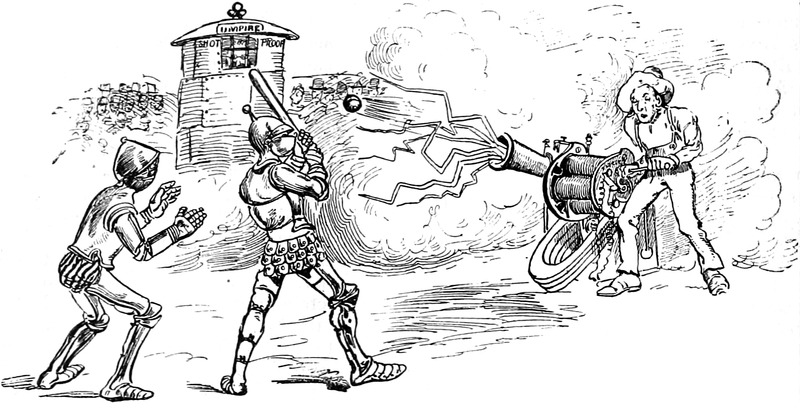
HOW BASEBALL WILL PROBABLY BE PLAYED 100 YEARS HENCE.
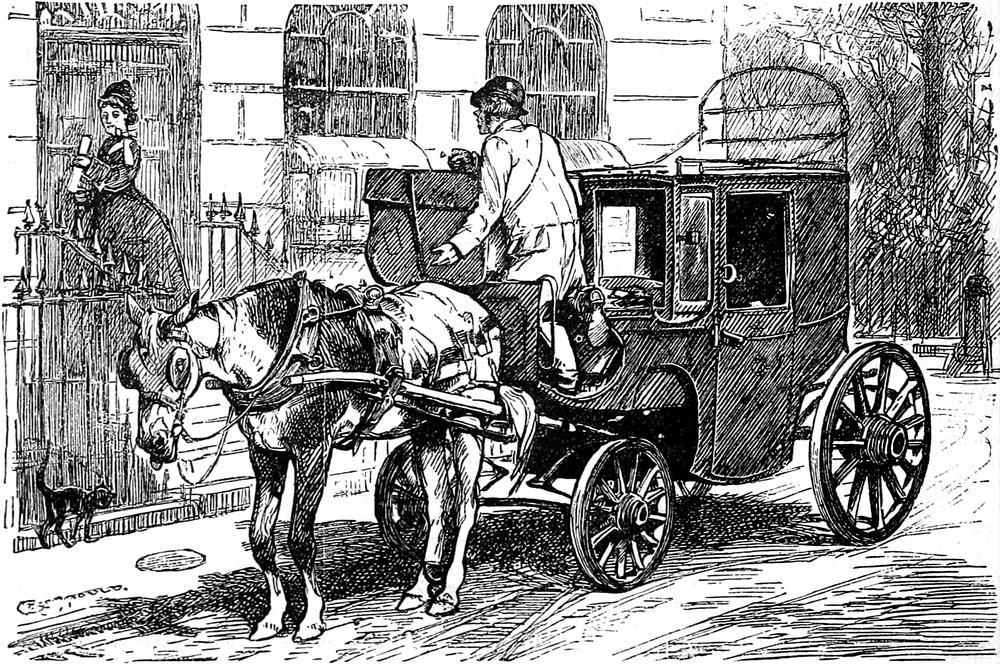
CABBY (who has been paid his bare fare before hiring): Bring yer box in? What, I leave my young ’oss a-standin’ ’ere of hisself!—(with determination)—No, I can’t leave my cab! Spozin’ he runs away, ’oos to pay for the damage, I should like to know?
THIS department of OUTING is specially devoted to paragraphs of the doings of members of organized clubs engaged in the reputable sports of the period, and also to the recording of the occurrence of the most prominent events of the current season. On the ball-fields it will embrace Cricket, Baseball, Lacrosse and Football. On the bays and rivers, Yachting, Rowing and Canoeing. In the woods and streams, Hunting, Shooting and Fishing. On the lawns, Archery, Lawn Tennis and Croquet. Together with Ice-Boating, Skating, Tobogganing, Snowshoeing, Coasting, and winter sports generally.
Secretaries of clubs will oblige by sending in the names of their presidents and secretaries, with the address of the latter, together with the general result of their most noteworthy contests of the month, addressed, “Editor of OUTING,” 239 Fifth Avenue, New York.
TO CORRESPONDENTS.
All communications intended for the Editorial Department should be addressed to “The Editor,” and not to any person by name. Advertisements, orders, etc., should be kept distinct, and addressed to the manager. Letters and inquiries from anonymous correspondents will not receive attention. All communications to be written on one side of the paper only.
AMATEUR PHOTOGRAPHY.
THE Hartford Camera Club had an agreeable outing in August over the Meriden, Waterbury and Connecticut River Road. The club frequently makes trips of this character. Among those who participated in the excursion were: James B. Cone, president; Mr. and Mrs. E. M. White, Mr. and Mrs. W. J. Hickmott, Mr. and Mrs. J. C. Kinney, Mr. and Mrs. F. O. Tucker, Mr. and Mrs. A. F. Woods, Mr. and Mrs. F. A. Thompson, Henry Fuller, Lawrence Cody, W. G. Abbott, A. L. Butler, J. C. Hill, H. O. Warner, C. F. Butler, T. S. Weaver, Miss Helen Cody, Miss Abbott, Miss Sarah Green, Miss Mary Green, Miss Harbison, Miss Weaver, Mrs. W. P. Marsh and Misses Mills, all belonging in Hartford.
The Meriden party who accompanied them were: Mr. and Mrs. Geo. Rockwell, T. S. Rust, C. S. Perkins, G. L. Ellsbree, A. Chamberlain, Rev. A. H. Hall, A. S. Thomas, J. M. Harmon, G. A. Fay, E. Miller, Jr., Dr. Mansfield, Supt. Crawford. A pleasant stay at Highland Lake was made, and several pretty views were taken of the scenery in the neighborhood.
THE fifth annual convention of the Photographers’ Association of Canada was held in the rooms of the Ontario Society of Artists, at Toronto, Canada, July 31 to August 2. Among the exhibits the following were noteworthy: C. A. Tenjoy, of Collingwood, fine large pictures and cabinets; S. J. Dixon, of Toronto, large prints of unusual merit; S. D. Edgeworth, of St. Louis, a fine collection from various sources; W. F. Johnson, of Pictou, a large exhibit of excellent work; R. D. Bayley, Battle Creek, Mich., fine cabinets; Guerin, of St. Louis, some splendid work in cabinets. H. Barraud, of London, Eng., had a fine exhibit, also his relative and namesake, of Barrie, Ontario. E. Poole, of St. Catherine’s, had one of the largest exhibits and of the first order. Brockenshire, of Wingham, also exhibited some very fine bromides and enameled pictures. T. J. Bryce, of Toronto, exhibited a number of large, fine Rembrandt effects and some excellent cabinets. E. D. Clarke, of Guelph, showed colored bromides that called forth much admiration. Poole and Robson, of Port Perry, also had a good exhibit. William Davison, of Brampton, exhibited a number of pictures. W. Mecklechwaite, of Toronto, also had a very good exhibit. Zybach, of Niagara Falls, Ontario, had a magnificent exhibit of large photographs of the Falls, both in winter and summer.
ATHLETICS.
THE Board of Managers of the Amateur Athletic Union held a meeting at the new club-house of the New York Athletic Club, on Travers’ Island, August 25. A resolution intended to put a stop to any conflicting claims to athletic jurisdiction in the United States, and to prevent any minor organizations from holding championship field meetings, was passed. The resolution unanimously adopted by the board is as follows:
Resolved, That any amateur athlete competing in any open amateur games in the United States not governed by rules approved by the Amateur Athletic Union shall be debarred from competing in any games held under the rules of the Amateur Athletic Union. This resolution shall take effect immediately.
This wholesale legislation was deemed necessary on the part of the board, and it is thought it will be productive of perplexing results. The Manhattan Athletic Club of this city, it is said, will virtually be the only sufferer by the new arrangement, as it is the only club hereabouts giving games under rules other than those approved by the union. It will be compelled either to recognize and adopt the rules of the union, or to create a new field of athletics, as far as its track members are concerned. Of these the Manhattan Club has about fifty, and as it is supposed they will not submit to being debarred from the privileges of competing in games given by the various clubs in and around New York, the club, it is asserted, will have to adopt the union’s rules. The Manhattan Club, it is claimed, is leaning too far toward professional methods.
The Board of Managers also considered the case of the Staten Island and the New Jersey athletic clubs, each of which advertised a carnival of athletic sports for Labor Day, Sep. 3. The Staten Island Club was shown to have the right to the day by reason of priority of announcement, and the New Jersey Club was censured for choosing a date that directly conflicted with that of a sister club in the union.
The Investigating Committee reported on the cases of J. Cunningham and P. Cahill. Cunningham was disqualified by a unanimous vote, and Cahill’s case referred back to the Committee, with instructions to investigate his fight with Robinson. The board decided to investigate the amateur status of E. Hickey and J. J. Sampson, both of whom are under suspicion.
The delegates at the meeting were: President, Harry McMillan, of Philadelphia; secretary, Otto Ruhl, of New York; treasurer, Howard Perry, of Washington; Jas. E. Sullivan, of New York; F. W. Janssen, of Staten Island; Edward Milligan, of Philadelphia; W. O. Eschwege, of Brooklyn. John F. Huneker, of Philadelphia, represented the Detroit Athletic Club, and Daniel G. French that of Chicago.
WILLIAM J. M. BARRY, of the Queen’s College Athletic Club, Cork, Ireland, holds the world’s championship in throwing the 16-lb. hammer. August 11 he succeeded in putting the hammer, on his fifth throw, the unprecedented distance of 129 ft. 31⁄4 in. G. M. L. Sachs, C. C. Hughes, and L. E. Myers were the judges of the performance.
THE Orange Athletic Club will hold an athletic meeting October 6, and one and two mile bicycle races will be prominent features. The meeting is open to all amateurs, and some of the best athletes in the country are expected to compete.
THE Philadelphia Clan-na-Gael Association held its annual games at the Rising Sun Park, Philadelphia, August 13. It is estimated 30,000 people witnessed the games. The events resulted as follows:
Putting the 16-pound stone—George Ross, 44 ft.; J. A. MacDougall, 43 ft. 1⁄2 in.; P. J. Griffin, 41 ft. 91⁄2 in.
Standing long jump—John F. Hartnett, 13 ft. 6 in.; P. J. Griffin, 12 ft. 91⁄2 in.; Con. J. Sullivan, 12 ft. 6 in.
150-yard dash—First, S. J. Farrell, 16s.; second, M. C. Murphy; third, Thos. Aitken.
Throwing 16-pound hammer—J. A. MacDougall, 100 ft. 2 in.; Philip Cummings, 99 ft. 41⁄2 in.; George Ross, 89 ft. 7 in.
Running long jump—Con. J. Sullivan, 20 ft. 9 in.; David Ader, 20 ft. 81⁄2 in.; Wm. Henderson, 20 ft. 4 in.
Members’ 150-yard dash—First, John Flynn, 171⁄2s.; second, Philip Cummings; third, Patrick Lyons.
Throwing 56-pound weight, between legs—Philip Cummings, 26 ft. 10 in.; John A. MacDougall, 25 ft. 2 in.; P. J. Griffin, 25 ft. 1 in.
Half-mile race—First, S. J. Farrell, 2m. 10s.; second, E. Case; third, T. C. Riordan.
Running hop, step and jump—Con. J. Sullivan, 46 ft.; William Henderson, 45 ft. 8 in.; Thomas Aitken, 45 ft.
150-yard sack race—First, John Cahill; second, William Irvine; third, Thomas Aitken.
Putting 63-pound weight—George Ross, 22 ft.; Patrick Lyons, 21 ft. 1⁄2 in.; Philip Cummings, 21 ft.
Standing high jump—P. J. Griffin, 5 ft. 6 in.; John Hartnett, 5 ft. 53⁄4. in.; Archie Scott, 5 ft. 5 in.
Three standing jumps—P. J. Griffin 39 ft. 6 in.; John F. Hartnett, 38 ft. 91⁄2 in.; Archie Scott 36 ft. 9 in.
150-yard dash, boys—First, Thomas Pierce; second, Thomas Harrington; third, William Washington.
Half-mile dash, members—First, John Lyons, 3m. 28s.; second, P. Lyons; third, Lawrence O’Dea.
Running high jump—Thomas Aitken, 5 ft. 10 in.; second, 5 ft. 9 in., tie between Archie Scott and William Henderson.
Throwing 56-pound weight, for height—Philip Cummings, 13 ft. 9 in.; J. A. MacDougall, 13 ft. 83⁄4 in.; third, George Ross, 13 ft. 6 in.
Running high jump, amateurs—First, J. E. Terry, Schuylkill Navy Athletic Club; second, William Haar, Turner’s Club, Philadelphia.
One-mile race, amateurs—First, W. H. Morris, colored, Young Men’s Christian Association, 5m. 20s.; second, Thomas Crawford, Caledonian Club.
Putting 16-pound shot, amateurs—James Kane, Jr., Schuylkill Navy Athletic Club, 35 ft. 1 in.; J. K. Shell, same club, 34 ft. 83⁄4 in.
Standing hop, step and jump—John F. Hartnett, 35 ft. 7 in.; Archie Scott, 35 ft. 3 in.; P. J. Griffin, 34 ft. 11⁄2 in.
One-mile race—First, E. Case, 4m. 48s.; second, James Grant; third, T. C. Riordan.
Pole vault—Archie Scott, 10 ft. 1 in.; Thomas Aitken, 10 ft.; William Henderson, 9 ft. 11 in.
Hitch and kick—George Slater, 9 ft.; Archie Scott, 8 ft. 11 in.; Daniel Aider, 8 ft. 10 in.
Three standing jumps, members—Lawrence O’Day, 35 ft. 111⁄2 in.; P. Lyons, 34 ft. 5 in.; Philip Cummings, 34 ft. 2 in.
150-yard hurdle race—First, M. C. Murphy; second, P. J. Griffin; third, Archie Scott.
Throwing 56-pound weight between legs, members—Philip Cummings, 25 ft. 9 in.; John O’Day, 23 ft. 8 in.; P. Lyons, 22 ft. 4 in.
Five-mile race—First, James Grant, 28m.; second, Edward Case; third, T. C. Riordan.
The final heat of the tug-of-war was won by the Napper Tandy Club—John McLean, F. Corrigan, William Reed, Joseph Hughes, Hugh Scullen, Harry Kearney, F. Mullen, E. E. Hackett, John Dillon and Frank Coxe. The prize was $500 and an emblem.
THE Pavilion Pastime Club—another notable addition to Brooklyn’s large list of outdoor societies—was organized last month with the following officers: Dr. H. O. Rockefeller, President; Messrs. J. A. Cruikshank, vice-president; A. H. Weston, secretary, and Charles E. Bevington, treasurer. A Governing Committee was formed by the election of Messrs. Webster, Pattison and Hollister, Mrs. Weston, Mrs. Bevington, and Misses Nellie Molloy and Phœbe Crawford.
Suitable grounds have been obtained on Arlington Avenue and Jerome Street, directly opposite the headquarters, and the work of leveling, grading, rolling and enclosing is now in progress at a cost of several hundred dollars.
Lawn tennis, archery, croquet and other games and sports are to be indulged in during the summer, while later on lacrosse, football, and later still tobogganing will be introduced. The club-house is now crowded with working paraphernalia, and it is the intention of those in charge to increase the initiation fee to $10.
THE American Legion of Honor held its decennial celebration, August 29, at the city Colosseum in Jones’ Wood, New York City. About 10,000 people were present during the day. The athletic games, which were the chief attractions of the day’s festivities and for which handsome prizes were provided, resulted as follows:
100-yard run—T. J. Lee, first; E. C. Bauman, second. Time, 10 4-5s.
Half-mile run—A. Bair, first; W. F. Beck, second. Time, 2m. 20s.
One-mile “Go-as-you-please”—F. Howell, first; T. Curran, second. Time, 9m.
100-yard three-legged race—J. J. O’Brien, champion light weight wrestler of America, first; T. Gillan, second. Time not taken.
Half-mile run, for members’ sons under sixteen years of age—W. E. Garrity, first; P. Fanning, second. Time, 2m. 30s.
One-mile walk—S. F. Moen, first; J. J. Barker, second. Time, 8m.
High jump—D. J. Cox, 5 ft. 5 in., and B. Kline, 5 ft. 3 in.
Broad jump—T. J. Lee 17 ft. 4 in.; W. R. Hooper, 17 ft.
Tug-of-war, four each side—Won by the Turn Verein Society’s team.
Five-mile “Go-as-you-please,” for professionals only—I. E. Regan, first; P. J. McCarthy, second. Time, 27m. 30s.
The judges were Thomas Namack and Gus Guerrero. P. J. Donough was referee.
THE programme of events proposed for international competition by the team of the Gaelic Athletic Association, who are to visit this country shortly, is as follows: 100, 220, 440 and 880 yards and one mile races, 120 yards hurdle race, running long jump, running high jump, running hop, step and jump, standing hop, step and jump (or three leaps instead), with weights; standing long jump, with weights; throwing 14-pound weight, under Gaelic A. A. rules; putting 16-pound shot, 7 ft. run, no follow; pushing 56-pound weight from shoulder, G. A. A. rules; throwing 16-pound hammer, G. A. A. championship rule, unlimited run and follow, and American style.
THE Orange Athletic Club has finally determined upon October 6 for the date of its fall games.
THE Executive Committee of the National Association Amateur Athletes of America decided to postpone the Championship Meeting announced for September 15th to October 6th.
It will be held on that date, at the Manhattan Athletic Club Grounds, Eighth Avenue and 86th Street, New York City.
This postponement will enable the athletic team from England and Ireland, which is expected to arrive in New York about October 1st, to participate, and will make the meeting an international one.
THE Staten Island Athletic Club had a great celebration Labor Day. The attendance exceeded expectations. The first event was the final tennis contest in singles and doubles. Mr. J. W. Raymond, of the Twenty-third Regiment Tennis Club, won the singles, by defeating J. C. Elliot. In the doubles, E. P. McMullen and C. Hobart beat Elliot and Smith.
One hundred and twenty yards run—The starters were M. W. Ford, S. I. A. C.; R. T. Hussey, S. I. A. C.; M. Bishop, S. I. A. C.; S. Toch, S. I. A. C.; George Popham, S. I. A. C,; S. E. Corbett, S. I. A. C.; H. W. Partridge, S. I. A. C., and F. A. Errington, S. I. A. C. The final heat was won by Ford in 12 4-5s.
Half-mile run—Won by W. T. Thompson, in 2m. 5s.; Stewart Barr, second.
Running high jump—R. K. Pritchard and M. W. Ford, each cleared the bar at 5 ft. 101⁄4 in. in the running high jump. Pritchard won by a toss.
Weight throwing—C. A. J. Queckberner won, covering a distance of 26 ft. 43⁄4 in., beating his best previous record 11⁄2 inches.
Two-mile bicycle race—Won by A. B. Rich, in 6m. 58 1-3s.
Running broad jump—Won by A. A. Jordan, 21 ft. 11 in. Mr. Ford, 21 ft. 7 in.
Two hundred and ten yards run—Won by W. C. Dohme, 21 3-5s.
One-mile steeple-chase—Won by W. T. Thompson, in 4m. 50 3-5s.
Lacrosse game—This match between the Staten Island team and the Druids, of Baltimore, was won by the Staten Islanders. Result, 7 goals to 2.
Eight-oared shell race—Six boats competed in this race. The course was one mile straightaway, and resulted in a dead heat between the Passaic and the Schuylkill Navy Crews. Time, 5m. 281⁄2s.
THE first fall field-meeting of the New Jersey Athletic Club was held on September 3 at Bergen Point. It was successful and the attendance was large. The events were as follows;
One hundred yards run (handicap)—Forty starters and seven trial heats, winner in each heat and winner in second men’s second trial running the final. Won by Charles Hagemeyer, P. A. C.; in 101⁄2s.; H. Luersen second.
One-mile bicycle race (novice)—Won by F. N. Burgess, of Rutherford, in 3m. 9 4-5s.; M. S. Ackerman, of Plainfield B. C., second.
One-mile walk—Won by W. R. Burkhard, P. A. C., in 6m. 28 4-5s.; W. F. Pohlman second.
Three hundred yards run (handicap)—Three trial heats, first and second in each in final heat. Won by C. Devereux, M. A. C., in 33s. A. W. S. Cochran, N. Y. A. C., second.