Volume 13 / Part 1 — PART I.
Reading edition
ONE hundred years ago, “through Canada to the Pacific” was first achieved by Sir Alexander Mackenzie. Making his way in a birch canoe from Montreal up the Ottawa and connecting rivers to Lake Huron, he came to the Sault Sainte Marie. Then followed hundreds of miles of paddling along the homeless shores of Lake Superior until civilization was seen again at Fort William on the northern shore. Yet that was only the real starting-point. Here Mackenzie began one of the most adventurous and productive explorations of that era, when the world was busy with exploration. Through rivers, ponds, and portages to Lake Winnipeg, across it and up the Saskatchewan, he pursued a well-defined route of the Hudson Bay Company’s voyageurs. But finally he reached even the fur-trader’s frontier, and pushed forward into a region never then penetrated by a white man. He came to the Peace River and began its ascent. It led him into, and guided him through, the mountains. At its sources he found water flowing westward, and through weeks of hardy adventure traced this river or that until he scented the salt breezes, and looked abroad upon the Pacific—the first man to cross Canada!
That is only a century ago; yet when you place Mackenzie’s canoe beside our transcontinental railway train, the contrast is as wide as between the first and last page of history; but put the courage of the old fur-trader beside the pluck which built this railway, and the extremes meet again.
The transcontinental trip by the Canadian Pacific Railway, then, is the subject of this article. We shall not precisely follow Mackenzie’s devious route, but shall touch it here and there, and see all the way the same kind of things that he saw.
Let us, first of all, have a clear understanding of what this journey is to be.
The Canadian Pacific is the largest railway system on the continent, yet there is none so little known to the general public in the United States, and none so widely misapprehended. It lies wholly in Canada. From Quebec it follows the St. Lawrence to Montreal, and then the Ottawa to the capital of the Dominion. From Ottawa it directs an almost straight course to the northernmost angle of Lake Superior, and skirting its shore for a hundred miles, strikes west to Winnipeg. Thence it crosses 900 miles of prairie, enters the Rocky Mountains 150 miles north of the United States boundary, and forcing its way through 250 miles of magnificent highlands, descends to the Pacific coast near the mouth of the Fraser River.
This main line is 3,070 miles in length, and reaches from ocean to ocean. Its through trains do not change their sleeping-cars all the way. An English family bound for China need make only two changes of conveyance between Liverpool and Hong-Kong—one at Montreal from the steamer to the cars, and another in re-embarking at Vancouver, the Pacific terminus. This is a notable advantage over the pieced-up route through Europe or the United States.
Yet this main line is only the stem of the great system. One side-line goes to Boston. Two others communicate with railways in New York State, at Brockville and Prescott, on the St. Lawrence. Short branches reach a dozen towns in Quebec. Westward, Montreal and Ottawa are connected with Toronto, whence branches ramify through all Ontario. Lake Huron is reached at Owen Sound, whence a line of ocean-like steamships on the Great Lakes is sustained. From Sudbury, a station 443 miles west of Montreal, a branch runs along the northern shore of Lake Huron to Sault Sainte Marie, where it is joined by a bridge over those historic rapids with two new American lines—one to Minneapolis, and another to Duluth. In Manitoba, branches penetrate all the corners of that rich wheat-growing province. Thus, the total length of its railways approaches 5,000 miles, and a year hence will be increased by a direct line to St. John, N. B., and Cape Breton, to connect with especially swift steamers, forming a new Atlantic ferry and carrying England’s Oriental mails. Yet, as has been said, few Americans know or realize these important facts in Canadian progress.
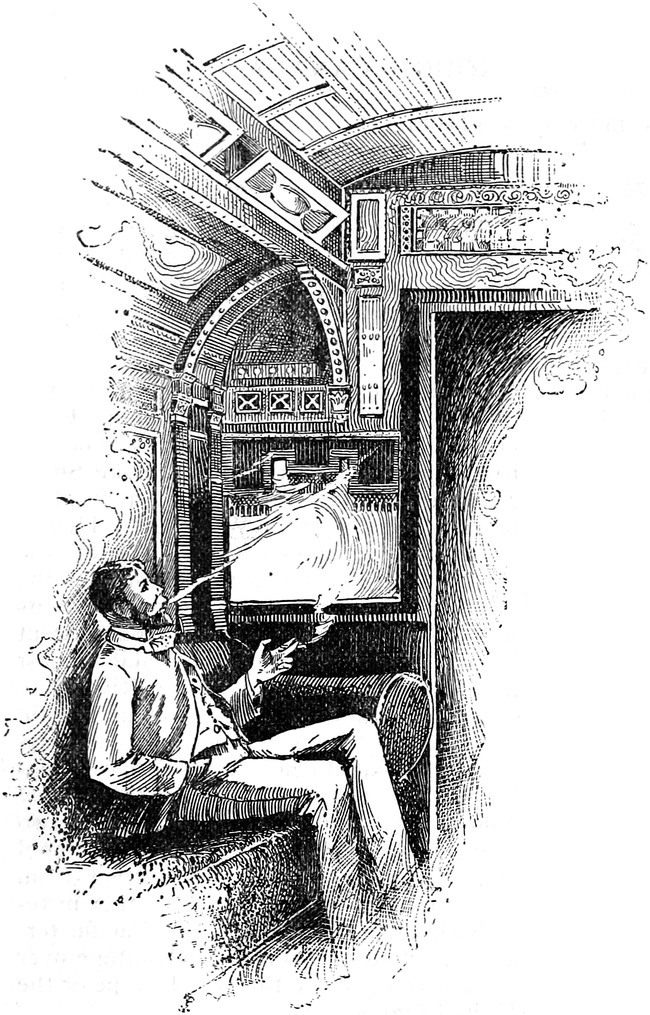
“SMOKING IN A SNUG CORNER.”
The new station in Montreal, whence we take our departure for the transcontinental journey one summer evening, is a magnificent piece of architecture. It stands just at the corner of Dominion Square, where the first strains of the band concert are calling together the loitering, pleasure-making crowds which twice a week throng its gravel walks or lounge upon the turf of its green parterres.
Out from the station stretches a series of broad stone arches, carrying the tracks upon an elevated way that reminds one of London, to the outskirts of the city, and into the quaint French villages named by pious founders after some Ste. Rose, Ste. Therése, or St. Phillipe, or other revered personages of the olden times.
We go to sleep, and do not know when Ottawa, Canada’s pleasant capital and lumber market, is passed at midnight. We are oblivious to this and all the world besides until a cheery call of “Breakfast-time, sir!” rouses our energies, and we peep out of our window to find ourselves rushing through a dense green forest, still glistening with the night’s dew. Then the breadth of Lake Nipissing opens like a plain of azure amid the green woods, and we halt at North Bay, where a road from Niagara Falls and Toronto terminates and makes a junction with ours. We step out and take a run up and down the long platform. The sunlight seems unusually bright and clear, the breeze from the lake is “nipping and eager”—everything and everybody has an air of alertness and glee which is inspiriting. We have slept well—we are wide awake; this balsamic odor of the woods is appetizing—we are hungry. The dining-car is therefore doubly inviting. Its furnishing is in elegant taste; its linen white as the breaking of the lake-waves; its silver glitters in the sunlight; on every table is a bouquet of wild flowers, masking a basket of fruit. There are tables for two and tables for four. One of the latter holds a family party—father, mother and two young ladies, Vassar girls, perhaps. We seat ourselves opposite, and as the train moves smoothly on, eat and talk with a gusto forgotten since last summer’s outing.
Our vis-à-vis at table proves to be an official of the company, who knows the whole line, as he says, “like the book.” He is going clear through to attend to matters on the western coast. This is great luck, for he seems quite as willing to answer our eager questions as we are to ask them. He is intensely interested in this great achievement, as is everybody connected with it, and wants us to become equally enthusiastic.
“This ought to be a good region for fishing,” we suggest, looking out upon the beautiful lake whose rocky shores we are skirting.
“Excellent,” the official agrees, as he quarters his orange. “Lake Nipissing abounds in big fish, and so does French River, its outlet into Lake Huron. I have had capital sport at the end of the steamboat pier at North Bay, ‘whipping’ with a rod and spoon for pike, bass, pickerel, whitefish, etc. Sometimes muskallonge weighing forty or fifty pounds are caught by trolling from a boat.”
“How about trout?”
“Well, if you’re bent upon trout, and don’t want to go up to the Jackfish or Nepigon River (which we shall cross to-morrow morning), your best plan is to go to Trout Lake and down to the Mattawan. Trout Lake lies four or five miles inland, behind those hills, where the scenery is exceedingly beautiful and the fishing practically untouched. In the lake itself are huge bass, pickerel and muskallonge. I know of one caught there by a lady, which weighed thirty-five pounds. Down to the lake, through tortuous, shady ravines, come cataract-rivers filled with untroubled trout. You can get a boat at a settler’s, or take your own and camp where you please, and fish in a new place every day all summer. Then from Trout Lake you can run a canoe down through a chain of lakes into the Mattawan River. Each of these lakes and streams has plenty of fish of several kinds, and charming camping places. The Mattawan carries you into the Ottawa, which you can descend in a boat—fishing all the way—to the St. Lawrence.”
“That’s an alluring story,” we say.
“It’s literally true; and in the fall and winter, sport with the gun is equally good. Moose, caribou, and deer are plentiful, and the town of Mattawan forms an excellent outfitting place for a shooting trip. Indian and white guides can be got who know the country, and the many lumberers’ roads and camps facilitate the sport. New Brunswick used to be the best place for that sport, but now this part of Canada is far more accessible and convenient.”
At noon we come to Sudbury, where extensive mines of copper and gold are worked, and a brisk village is growing up, with some farming and a great deal of lumbering in the neighborhood. Here branches off the new “Soo” route to St. Paul.
All the afternoon we run through forested hills, the line bending hither and yon to avoid rocky ridges and crystalline lakes, cutting athwart promontories, and bridging ravines. Here and there are extensive tracts of arable land, but little agricultural settlement can be expected in these forests as long as the rich prairies westward, all ready for the plow, are only half-tenanted. Yet the cabins of settlers, who are part farmers, part lumbermen, part trappers, and part “Injun,” are scattered all along the line; and every hundred miles or so we encounter a railway “divisional” station, where there are engine-houses, repairing shops, and the homes of the men employed on that section of the line.
In the evening, groups gathered in our brilliantly-lighted palaces—for every one had become acquainted, like a cozy ship’s company at sea—and whiled away the time with books, story-telling and whist. The Vassar girls, the Official and the Editorial We had a grand game, closing with a tie at eleven o’clock. Just then we were at Missanabie, where you might launch a canoe—“that frail vehicle of an amphibious navigation,” as Sir George Simpson styled it—and run down to the fur-famed—
“Beware of puns!” cried Miss Dimity Vassar.
—Michipicoten, in Lake Superior; or, with a few portages, glide northward to Hudson’s Bay.
Bidden to be awake early, at six next morning we were astir, and, lo! there was Lake Superior. All day we ran along its shores, here taking advantage of a natural terrace or ledge, there rolling with thunderous roar along some gallery blasted out of the face of the gigantic cliffs whose granite bases were beaten by the waves; next darting through a tunnel or safely overriding a long and lofty bridge, beneath which poured some wine-colored torrent. This is daring and costly engineering.
Always high above the water, which sometimes dashes at the very foot of the trackway, and sometimes is separated from us by barriers of vine-clad rock, the eye overlooks a wide and radiant scene. A line of distant and hilly islands cuts off this interior part (Nepigon Bay) from the open lake; and as we swerve hither and yon in our rapid advance, these islands group themselves into ever changing combinations, opening and closing lanes of blue water, displaying and hiding the silvery horizon, letting passing vessels appear and disappear, and taking some new charm of color with each new position.
Nor was this all. Cliffs and shore are grandly picturesque in form, brilliant in color, and constantly varied. After we had reached Jackfish River—a famous fishing-place—and the gaudy overhanging cliffs had been left behind, the lake began to be hidden by a line of trap-buttes, masked in dense foliage; and these beautiful table-lands lasted all the way to the crossing of the Nepigon, where again we were face to face with Nepigon Bay. You may say later that the scenery of the Rocky Mountains is better than this morning ride along Lake Superior; but you will not forget, nor be willing to omit it, all the same.
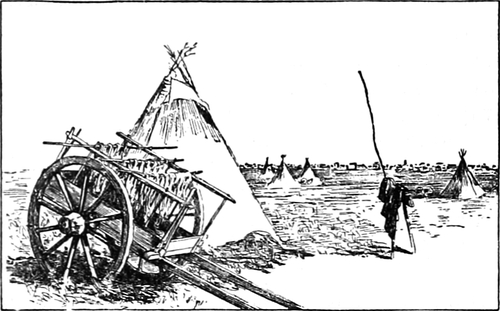
INDIAN TEPEES.
Nepigon River, up which we have a long view, is the prince of trout-rivers, and at the railway station canoes, camping supplies and Indian crews are always obtainable. Think of brook-trout weighing five or six pounds, to be caught, and bass and whitefish and what not in plenty besides!
That afternoon we passed Port Arthur, a town of 3,500 population, on Thunder Bay, and the port for the fine Canadian Pacific steamers, which present an alternative summer route between the East and West by way of the lakes, Owen Sound and Toronto. Five miles farther on we came to old Fort William, now a growing village and grain port. Here, on the fertile flats of the Kaministiquia, more than two hundred years ago, was planted an Indian trading-post, which a century later became the headquarters of the great Northwest Fur Company, and then an important post of the Hudson’s Bay Company, to which, after years of warfare, the Northwest corporation finally capitulated. Some of the storied old buildings, to which a whole magazine article might easily be devoted, still stand, but they are overshadowed by the railway shops and warehouses, the huge elevators and coal-bins, which here, as at Port Arthur, testify to an enormous shipping traffic.
For four hundred miles west of Fort William, where we bid good-bye to Lake Superior, the road passes through a wild, rough region of rocks and forest, reticulated with lakes and rivers. It is the most unattractive piece of country on the whole line, but it abounds in minerals, and supplies the treeless region beyond with lumber. Near its eastern border, at Rabbit Mountain, exceedingly rich silver mines are worked. The Lake of the Woods, in the centre of this tract, is a very beautiful spot, and one whose water-power supplies many large mills.
Morning found us among open groves and thickets—the fringed-out western edge of that almost continental forest which sweeps behind us to the Atlantic, and northward until it half envelops Hudson’s Bay. Finally even this disappeared in an expanse of verdant turf—the prairie of Manitoba,—its perfectly level horizon broken only by the tall buildings and steeples of the city of Winnipeg.
Winnipeg stands at the point where Red River receives its largest western tributary, the Assiniboine. It has been the site of an Indian trading post, and the centre of the “Red River settlements” for almost a century; but until ten years ago it was nothing more. Then it sprung at one bound, amid an ecstasy of speculation, into a city. It had a hard time after this injudicious exuberance began to subside; but it survived, and now Winnipeg is as well founded, and growing as healthfully, as is Denver or Omaha. The town has ridiculously wide streets, which it cost a fortune to pave with cedar blocks, and which make the really tall and fine business buildings look dwarfed. There are several expensive churches, hundreds of elegant residences, and some stately public buildings. The width of the streets; the great number of vacant lots, due to the large expectations of the “boom” period, which spread the town beyond all reason; and the use of cream-colored brick and light paint in the buildings, give to Winnipeg a singularly pale and scattered appearance, likely to diminish in the eyes of a casual visitor the city’s real wealth and importance.
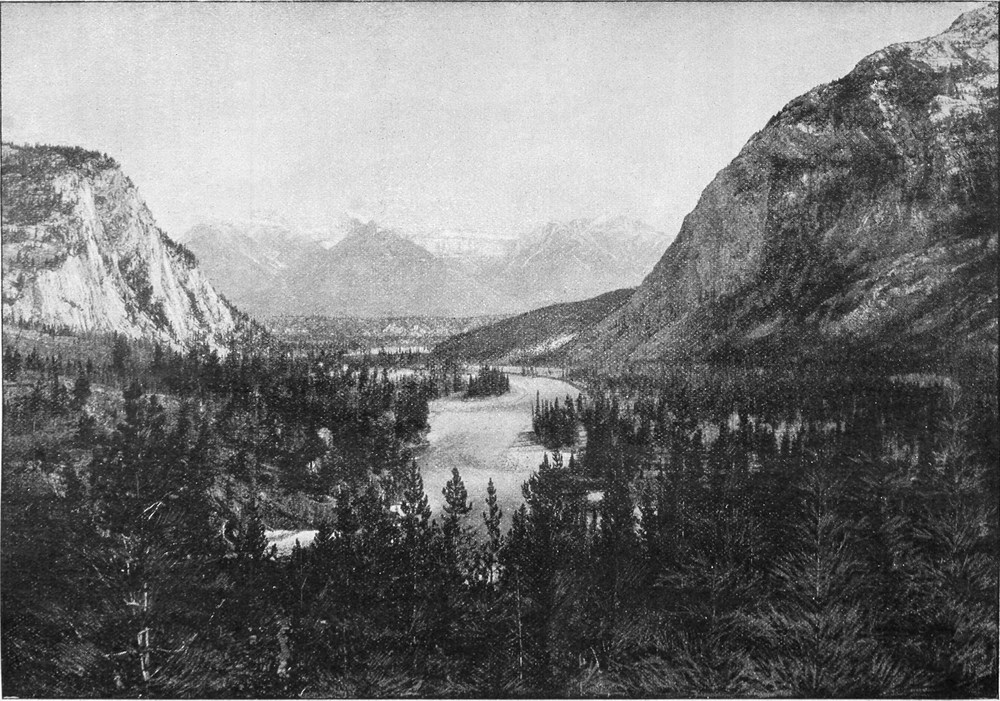
THE VIEW FROM THE HOT SPRINGS, BANFF, LOOKING DOWN THE BOW.
⇒ LARGER IMAGE
“While you would find here in Winnipeg,” says our cicerone, as we sat smoking in a snug corner, “if you studied the matter a little, the key to much that you will see beyond, you must look beyond for the key to much you will see in Winnipeg. Situated just where the forests end and the vast prairies begin, with thousands of miles of river navigation to the north, south and west, and with railways radiating in every direction into the wheat lands of all Manitoba, like spokes in a wheel, Winnipeg has become, what it must always be, the commercial focus of the Canadian Northwest. Looking at these long lines of warehouses filled with goods, and these twenty miles or more of railway side-tracks all crowded with cars, you begin to realize the vastness of the country we are about to enter. From here the wants of the people in the west are supplied, and this way come the products of their fields, while from the far north are brought furs in great variety and number.”
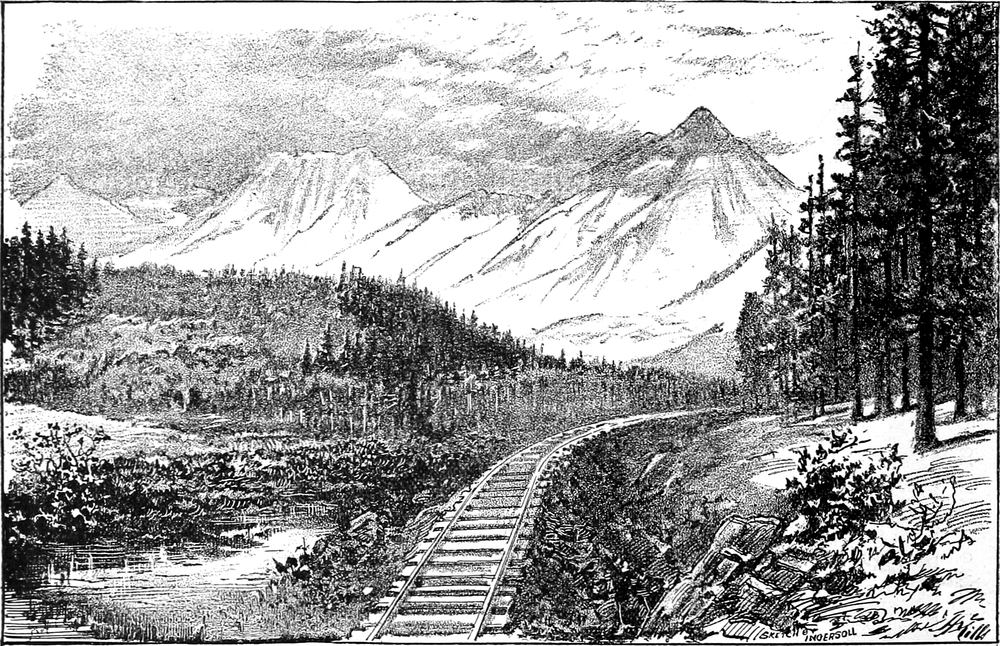
NEARING THE ROCKY MOUNTAINS.
The surrounding prairie is absolutely flat, and was the bed of a prehistoric lake—the last remnant of the waters that once covered the whole interior; and as we race across it we can picture how the wavelets rose and fell before the ancient wind by noticing the olive-and-gray ripples that flow over the long grass under this noonday breeze. Here and there cattle are standing up to their bellies in the lush meadow. Far off to the southward a dark line indicates the fringe of trees along the Assiniboine. Nothing else breaks the verdant flats that sweep around us save the track and the telegraph poles, straight as a ray of light behind and ahead to their vanishing points on each horizon. After a while habitations and farms grow more numerous, for we have imperceptibly risen to a region lighter in soil and formerly held at a cheaper price than the speculative tracts near the city, whose owners have seen settlers go steadily past them.
The centre of this is the far-scattered town of Portage la Prairie, an old landing-place of the voyageurs, who here loaded their boat-cargoes into carts and carried them across to Lake Manitoba, there to be re-embarked for the long canoe voyage inland. Here are now great wheat elevators and mills, and hence a railway has pushed 250 miles northwestward, to continue nobody knows how much farther. Brandon, seventy-five miles beyond, is a wide-awake, handsomely built young city on the Assiniboine, sustained by an immense agricultural environment. In regard to this let me quote somewhat from a standard work on the prairies: “Leaving Brandon, we have fairly reached the first of the great prairie steppes, that rise one after the other at long intervals to the Rocky Mountains; and now we are on the real prairie, not the monotonous, uninteresting plain your imagination has pictured, but a great billowy ocean of grass and flowers, now swelling into low hills, again dropping into broad basins with gleaming ponds, and broken here and there by valleys and by irregular lines of trees marking the watercourses. The horizon only limits the view; and, as far as the eye can reach, the prairie is dotted with newly made farms, with great black squares where the sod has just been turned by the plow, and with herds of cattle. The short, sweet grass, studded with brilliant flowers, covers the land as with a carpet, ever changing in color as the flowers of the different seasons and places give to it their predominating hue.... Here is produced, in the greatest perfection, the most famous of all varieties of wheat—that known as the ‘hard Fyfe wheat of Manitoba’—and oats as well, and rye, barley and flax, and gigantic potatoes, and almost everything that can be grown in a temperate climate.... Three hundred miles from Winnipeg we pass through the famous Bell Farm, embracing one hundred square miles of land. This is a veritable manufactory of wheat, where the work is done with almost military organization—plowing by brigades and reaping by divisions. Think of a farm where the furrows are ordinarily four miles long, and of a country where such a thing is possible! There are neat stone cottages and ample barns for miles around, and the collection of buildings about the headquarters near the railway station makes a respectable village, there being among them a church, an hotel, a flour mill, and, of course, a grain elevator, for in this country these elevators appear wherever there is wheat to be handled or stored.”
The fertile, pleasantly habitable region of the Canadian West is a triangular region with a base 800 miles in width east and west, and a northern limit marked by the forests beyond the Saskatchewan. Between these forests and the Rocky Mountains the arable country extends almost to the borders of Alaska, and through it are scattered trading stations and small settlements among a peaceful and semi-industrious Indian population. The climate is dry, yet the rainfall (except in the southwestern part) is quite sufficient for agriculture. The winters are rigorous, but not so long as those of Quebec, and the snowfall is light. Wheat, oats, barley and vegetables grow to perfection even farther north than the Peace River valley, in latitude 56° to 57°—the parallel which in the east passes just north of Labrador. Settlement on these fine prairies (which are often bushy, and show no sage-brush and little alkali) is only a decade old, yet last year there was produced a surplus for export of twelve million bushels of wheat alone.
Not far beyond the Regina wheat plain, which is about 1,800 feet above the sea, the altitude is abruptly increased by a rise to the top of the Coteau de Missouri, where the average of elevation is 3,000 feet. Here the climate is drier, and grazing becomes the principal industry, especially toward the foothills, where enormous herds of horses, cattle and sheep are pastured. Of this great and growing business Calgary is headquarters.
Only ten years ago this was the home of millions of buffalo, whose trails and wallows mark the surface in every direction; but not a bison is now to be seen within a long distance northward. The prairies from Regina westward are dotted with lakes, generally of fresh water, are well grassed, and broken by wooded eminences. The elk and mule-deer are still common, and in the autumn immense herds of antelope, migrating southward, are still to be seen from the car windows. Around the lakes crowd countless wild fowl at all seasons, while flocks of prairie chickens whirl away on each side at our approach. In the seasons of migration geese and ducks are here in myriads.
We cross the South Saskatchewan near some extensive coal mines, and toward evening of Friday (we left Montreal on Monday night and Winnipeg on Thursday morning) we catch our first brief glimpse of the Rockies—a serrated white line notching the sunset horizon. To-morrow morning we shall awake within their glorious gates.
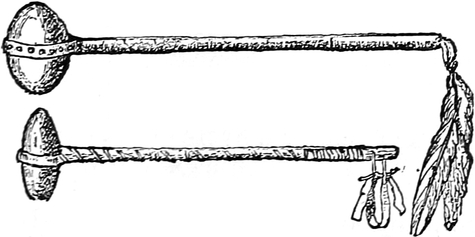
STONE POGAMOGGANS OF THE CANADIAN SIOUX.
THE NEW YORK YACHT CLUB CRUISE OF ’88.
THE annual cruise of the New York Yacht Club grows in importance with increasing years. From the organization of the club, far back in the forties, its history has been a progressive one. Its vessels have won a reputation for their fleetness the world over; members have attracted the attention of all aquatic sportsmen who love
“A wet sheet and a flowing sea, And a wind that follows fast;”
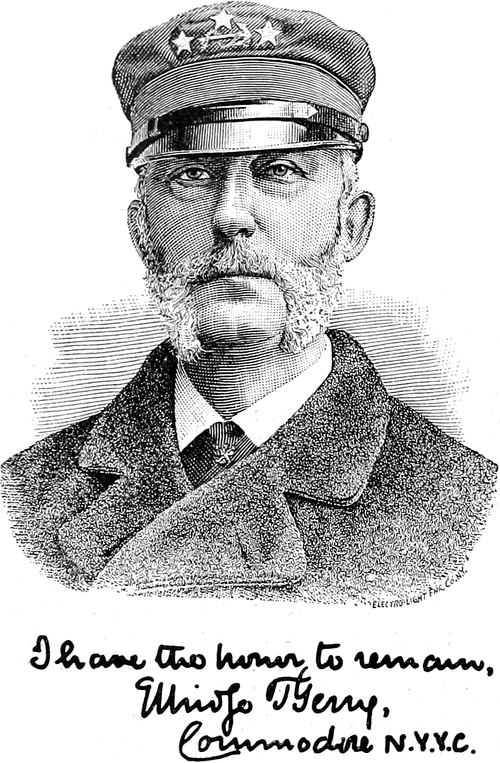
and the club pennant of the red cross, with the single star sparkling like a gem in its deep azure field, is known in every harbor of the maritime world. Well may the members of this famous old club look back upon its record with pride, and well may Elbridge T. Gerry, the present commodore, rejoice in his proud position as commander of as magnificent a fleet of pleasure boats as ever sailed the waters blue of old ocean.
Great strides have been made, since the establishment of the club in 1844, not only in the sport of yachting, but in all things else besides. It probably never dawned upon the vision of Commodore Stevens, in those early days, when from his quaint little castle on the point of rocks overhanging the Elysian Fields, in Hoboken, looking out on the waters of the Hudson, as they rolled on to the Narrows and out into old ocean, that the club would make so proud a mark in the history of a pastime which the lovers of daring deeds so fondly cultivate. A great city has grown up since then all around him; buildings now occupy the space where, in those early American yachting days, leafy groves afforded shade to yachtsmen, and long lines of wharfs take the place of the gentle grassy slopes, kissed by the waters of the Hudson. All is changed since then. Even the old club has undergone a transformation. The fact, however, remains that the keystone of its success, the brightest gem in its diadem of honorable record, is that which was won in ’51, when Commodore Stevens’s America sailed away from the whole fleet of English yachts and carried off the Queen’s Cup.
This aquatic feat did much to permanently establish yachting in this country. It was a surprise to the well trained, brave and skillful sailors of the tight little island that Yankee sailors, after an ocean voyage, should beat them in their own waters. But they took the America’s victory in good part, and though it was a difficult pill to swallow, they got it down with a smile, for your true Englishman is always manly.
“Yankee Doodle had a craft, A rather tidy clipper, And he challenged, while they laughed, The Britishers to whip her; Their whole yacht squadron she outsped, And that on their own water; Of all the lot she went ahead, And they came nowhere arter.”
From those early days in the fifties, until the war broke out the New York Yacht Club grew strong in membership and vessels. Its cruises and its regattas became popular, the latter especially, for they served to afford a pleasant day’s amusement to people who enjoyed a holiday on the water. Many of our best known men and grand old merchant princes were devoted yachtsmen. What cruise was complete without rare old Moses Grinnell on board some one of the flyers of days gone by? When the war broke out, did not many of these same yachtsmen lend a hand in the struggle for the Union? If we mistake not, James Gordon Bennett put his vessel, the Rebecca, into commission, and did service himself on board, off the Southern coast. Hundreds of other instances might be cited to prove the patriotism, daring and pluck of “the men who went down to the sea in ships,” even though these ships were pleasure craft, and the men who sailed them simply on pleasure bent.
When “the cruel war” was over there came renewed interest in yachting. Then the challenges from the other side were received. English yachtsmen looked with longing eyes across the ocean and declared their readiness to do battle for the possession of the America’s cup. With the true spirit of sportsmen American yachtsmen met their Island brethren with equal ardor to defend the possession of the prize—the greatest yachting trophy of the world.
The races in which the Cambria, Livonia, Genesta, Galatea, Thistle, Columbia, Sappho, Puritan, Mayflower, Volunteer, etc., took part, are too well known to the readers of OUTING to require more than a mere passing notice. These contests form proud chapters in the history of the club of which Elbridge T. Gerry is commodore.
No less important pages in its history are the great ocean races, in which the Vesta, Fleetwing, Dauntless competed, the Dauntless and Cambria’s ocean race, and again, the race in midwinter between the Coronet and Dauntless, when the Atlantic was in its most angry moods. The famous schooner Sappho, owned by William P. Douglass, ex-vice-commodore of the club, was another fair skimmer of the briny deep that carried the burgee of the club with honor in any and every contest in which she was entered in home or foreign waters. And so the list might be strung out in a magnificent array of the names of those white-winged beauties of the sea that muster in the roll of Commodore Gerry’s fleet.
For the nonce, let us turn from the past and look upon the present. Let us survey the fleet of this season as they came together in the harbor of New London, on the morning of August 9. Never did the famous old rendezvous present so brilliant an aquatic spectacle. The event was ushered in with a clear, bright blue sky. As the day grew older the scene grew in activity. Fifty-three sailing yachts and twenty odd steamers responded to the sunrise gun, and sent aloft the club signal to kiss the breeze that stole out from the southwest almost as gently as summer zephyr laden with the odor of the sea. It was not the piping breeze loved so well by your true yachtsman, when close-reefed sails and housed topmasts are the order of the day. At 10.47 the preparatory gun was given from the flag-ship Electra; ten minutes later the signal gun to start. And what a busy scene presented itself! With anchors weighed and all sails set, the magnificent fleet began to move out of the harbor into the waters of the ocean, with the Puritan, true to her record, showing the way over the line, closely followed by the Grayling, Troubadour and Sea Fox. It was in this way the annual cruise began.
As the squadron passed the flagship Electra, a beautiful picture was presented to the eye. The wind being light, the yachts had all available sails spread, and the view at the start was of an almost solid mass of canvas.
Before going further it will be well to give an explanation regarding the races that took place from New London to Newport, from Newport to Vineyard Haven, from Vineyard Haven to New Bedford and thence to Newport.
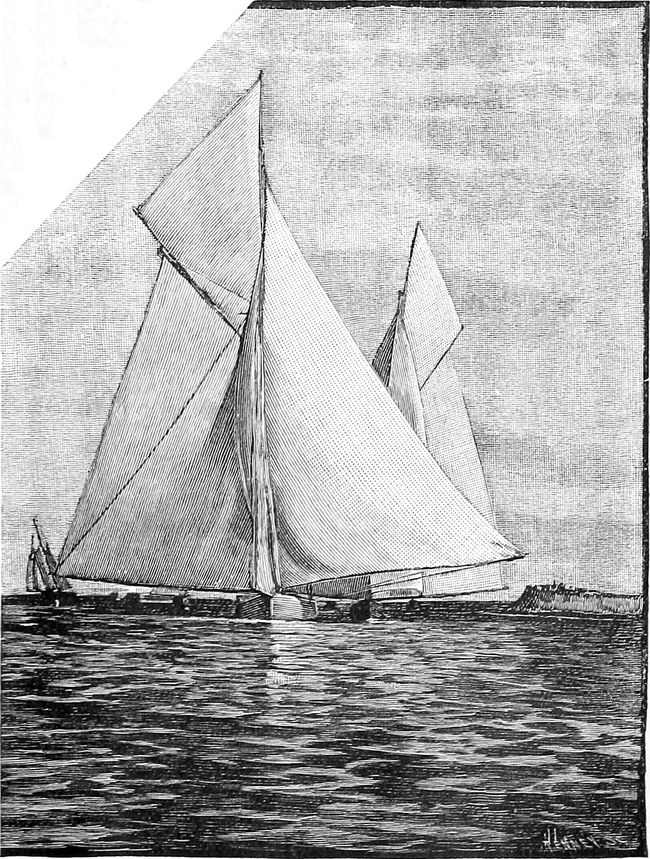
DEAD BEFORE THE WIND.
A feature of past cruises has always been this racing from port to port. Until this year, however, the arrangements in connection with it have been eminently unsatisfactory, both as regards methods of starting and the way in which a large yacht arriving first at the common destination would be disqualified on time allowance and the victory awarded to a smaller vessel. The methods of former years having then proved inefficacious in deciding the actual merits of the competing boats, Commodore Gerry, Vice-Commodore C. H. Colt and Rear-Commodore E. D. Morgan resolved this year to present prizes to that yacht in each of the eleven classes which made the best record in the runs from port to port. These prizes consist of handsome lamps of solid silver resting on ebony stands. On one side is an inscription of the names of the donors, while on the other the New York Yacht Club flag is represented. All the eleven prizes are exactly alike. A novelty of the trophy is the fact that the lamp may be lifted from its receptacle, when the stand forms a handsome cup with two handles. These prizes did much to stimulate the energies of the captains, and some fine races resulted.
Twenty minutes instead of the usual ten were allowed as starting time in these contests. Soon after the fleet had started the wind gradually died away, and for half an hour the water was scarcely ruffled, but the Commodore’s proverbial good luck did not desert him long. Soon sufficient breeze returned to carry the yachts bowling merrily into Newport harbor. The following table tells the story of the day’s run:
FIRST CLASS SCHOONERS—THIRTY-FIVE MILES.
Start. Finish. Elapsed Time. Corr’d. Time.
NAME. H. M. S. H. M. S. H. M. S. H. M. S.
Ambassadress 11 06 00 5 33 35 6 27 35 6 27 35
Dauntless 11 09 33 4 42 37 5 33 04 5 33 04
Norseman 11 05 25 4 52 05 5 46 40 5 45 31
Palmer 11 12 54 4 32 05 5 19 11 5 15 34
Wanderer 11 09 45 5 10 55 6 01 10 — — —
Alarm 11 06 00 4 48 30 5 42 30 — — —
SECOND CLASS SCHOONERS.
Intrepid 11 09 45 4 46 27 5 36 42 5 36 42
Gitana 10 56 00 4 43 40 5 47 40 5 46 26
Montauk 11 09 45 4 29 05 5 19 20 5 16 40
Columbia 11 13 30 4 52 58 5 39 28 — — —
THIRD CLASS SCHOONERS.
Sea Fox 11 01 12 4 10 52 5 09 40 5 09 40
Sachem 11 09 45 4 19 20 5 09 35 5 07 49
Troubadour 11 00 40 4 24 19 5 23 39 5 21 18
Varuna 11 03 04 5 11 30 6 08 26 6 05 52
Miranda 11 07 58 4 26 14 5 18 12 5 15 26
Grayling 11 00 40 4 24 25 5 23 45 5 18 50
Atalanta 10 56 30 4 44 33 5 48 03 — — —
Elma 11 12 30 3 40 33 5 28 03 — — —
FOURTH CLASS SCHOONERS.
Marguerite 11 02 07 5 51 45 6 49 38 6 49 38
Iroquois 11 05 03 4 21 48 5 16 45 5 15 36
Magic 11 08 35 4 44 29 5 35 54 5 33 44
Halcyon 10 56 00 4 38 18 5 42 18 5 40 42
Princess 11 16 10 5 29 23 6 13 13 — — —
FIFTH CLASS SCHOONERS.
Harbinger 11 11 32 5 03 14 6 51 42 — — —
Triton 11 09 40 5 28 27 6 18 47 — — —
Lotus 11 17 00 5 05 14 6 48 14 — — —
Azalea 11 14 38 5 37 52 6 23 14 — — —
Lydia 11 12 08 5 28 27 6 16 19 — — —
Whim 11 06 00 5 32 40 6 26 40 — — —
Clio 11 17 00 5 50 37 6 33 37 — — —
FIRST CLASS SLOOPS.
Volunteer 11 08 54 4 21 32 5 12 38 5 12 38
Mayflower 11 50 20 4 16 03 5 10 43 5 09 56
Puritan 11 02 07 4 08 39 5 06 32 5 03 14
THIRD CLASS SLOOPS.
Katrina 11 12 30 4 26 42 5 14 12 5 14 12
Bedouin 11 05 03 5 35 55 6 30 52 6 29 23
Fanny 11 05 15 4 20 12 5 14 57 5 11 28
Pocahontas 11 01 30 4 47 04 5 45 34 5 34 34
Nonpareille 11 09 45 5 36 43 6 40 58 — — —
Huron 11 11 00 4 52 18 5 41 08 5 34 04
FOURTH CLASS SLOOPS.
Hildegarde 11 03 53 4 27 02 5 23 09 5 23 09
Dare 11 10 27 5 52 02 6 04 55 6 00 00
Medusa 11 10 50 5 21 24 6 10 34 6 02 22
Whileaway 11 06 00 4 35 17 5 29 17 5 22 52
Thistle 11 09 45 5 12 45 6 03 00 — — —
FIFTH CLASS SLOOPS.
Athlon 11 14 08 4 50 25 5 36 17 5 36 17
Cinderella 11 09 40 5 54 04 5 44 20 5 43 36
Gaviota 11 15 31 4 54 06 5 38 35 5 37 28
Bertie 11 08 22 4 47 11 5 45 49 5 40 55
Concord 11 11 00 5 51 17 6 40 17 6 34 17
SIXTH CLASS SLOOPS.
Regina 11 05 30 5 07 00 6 01 30 — — —
Nymph 11 08 56 5 27 47 6 18 51 — — —
Crocodile — — — 5 13 25 — — — — — —
Iseult — — — 5 01 40 — — — — — —
WINNERS—First class schooner—Palmer; second class schooner—Montauk; third class schooner—Sachem; fourth class schooner—Iroquois; fifth class schooner—Lydia. First class sloop—Puritan; third class sloop—Fanny; fourth class sloop—Whileaway; fifth class sloop—Athlon; sixth class sloop—Regina.
In the evening red lights were burned on the yachts, lighting up the harbor and producing a fine effect.
The next day, Friday, August 10, the race for the Goelet cups took place over the Sow and Pigs course, off Newport Harbor. At 10.20 the preparatory gun was fired, there being at the time a light northerly wind. Ten minutes later the starting signal was given, and the Volunteer crossed the line in the lead, with the Mayflower second. Then came the Miranda leading the schooners, followed by the Sea Fox and Sachem. At West Island Light the Volunteer had established a lead of half a mile with the Mayflower still second, followed by the Palmer, Sea Fox, Puritan, Sachem and Katrina in the order named.
At the Sow and Pigs lightship the order was somewhat changed among the leaders. The Sachem had taken the lead and the Mayflower had tailed off. The order and time as the yachts rounded the lightship were as follows:
Sachem, 3.27.33; Volunteer, 3.37.32; Sea Fox, 3.43.15; Puritan, 3.45.58; Miranda, 3.48.26; Grayling, 3.49.07; Katrina, 3.49.51; Iroquois, 3.50.30; Palmer, 3.51.27; Troubadour, 3.53.22; Mayflower, 3.53.32; Dauntless, 3.55.46; Montauk, 3.56.36; Magic, 3.59.00; Ramona, 3.59.30.
The Katrina had the race in hand at this point, and she increased her lead to the Hen and Chickens. During this run of four miles, the Katrina gained three minutes on the Volunteer and Puritan, proving herself to be a remarkably fast boat. Just as the boats reached the Hen and Chickens buoy the wind dropped again, shifting round to the southwest. The time at this mark, so far as taken, was as follows:
Sachem, 4.40.03; Volunteer, 4.44.49; Sea Fox, 4.48.36; Puritan, 4.51.00; Grayling, 4.52.01; Katrina, 4.52.38; Miranda, 4.58.21; Mayflower, 4.58.53; Iroquois, 4.59.33.
The Katrina was 5m. 44s. ahead of the Volunteer by corrected time at this mark. The Sachem and Volunteer having rounded the mark some four minutes ahead of the next boat, the Sea Fox, had an immense advantage by the shift of the wind, which came just after they turned the buoy.
It was now a beat to windward to Brenton’s Reef and the finish line. The wind freshened and hauled more to the westward and became a good steady breeze. The Sea Fox in this beat pointed very high—her pointing was something remarkable. The time at the finish was as follows:
Start. Finish. Elapsed Time. Corr’d. Time.
NAME. H. M. S. H. M. S. H. M. S. H. M. S.
Volunteer 10 30 57 6 52 32 8 21 35 8 21 25
Sachem 10 32 09 7 12 57 8 40 48 8 27 48
Grayling 10 33 40 7 19 34 8 45 54 8 29 22
Katrina 10 33 17 7 19 49 8 46 32 8 35 10
Puritan 10 32 47 7 15 35 8 42 48 8 39 07
Sea Fox 10 31 58 7 23 34 8 51 26 8 40 23
Mayflower 10 31 51 7 33 05 9 01 14 9 00 21
Miranda, 10.31.53; Palmer, 10.32.25; Montauk, 10.32.40; Troubadour, 10.32.52; Intrepid, 10.33.32; Magic, 10.33.49; Dauntless, 10.34.25; Elma, 10.36.00; Iroquois, 10.36.38, and Ramona, 10.40.00; not timed.
In the schooner class, the Sachem won the cup, beating the Grayling 1m. 36s. on corrected time. In the sloop class, the Volunteer won, beating the Katrina 13m. 44s.; Puritan, 17m. 31s.; Mayflower 38m. 46s., corrected time. Katrina beat both Puritan and Mayflower.
On Saturday, August 11, a start was made for Vineyard Haven, Martha’s Vineyard. Once more every yacht was accurately timed from Newport, this being the second of the runs from port to port for the class prizes.
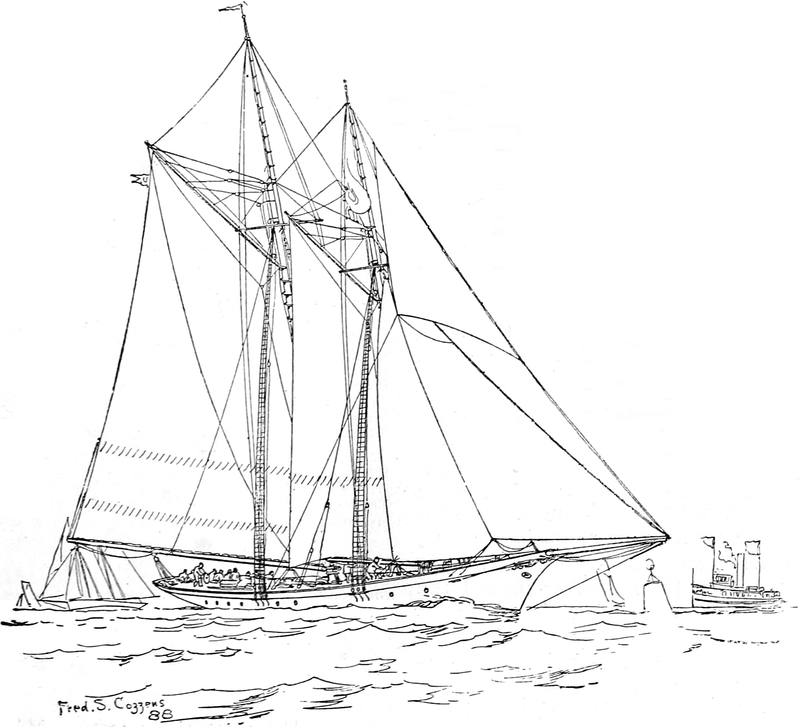
SEA FOX—OWNER, A. CASS CANFIELD, ESQ.
Again did the Puritan take the lead at the line, closely followed by the Lydia, Clio, Montauk and Volunteer. Everything went smoothly till the Mayflower and Grayling came along, and then occurred the only accident or collision of the cruise of ’88. Immediately after crossing the line the Mayflower was directly behind the Grayling and was sailing a trifle faster. Almost before any one realized that an accident was about to happen, the Mayflower’s bowsprit caught the end of the Grayling’s mainboom. This of itself was nothing serious. The sloop Regina was, however, right ahead of the Grayling, and by the Mayflower pressing upon the Grayling’s boom, the latter’s stern was pushed to windward, her bow swung off, and in a moment her big bowsprit struck the Regina’s mainsail just abaft the mast. The little sloop keeled over to starboard, when her topmast snapped, and the rigging came rattling down on her deck. Three of the guests on board the Regina became excited, and jumped overboard, and then immediately started to swim for the boat which they had just left. Lines were thrown from the Grayling and caught by the swimmers, but the big schooner did not lose her headway, and the men grasping the rope were towed through the water.
The Electra, Grayling, and Mayflower soon had boats out, the Electra’s gig being first. By the time the excitement had subsided all the yachts had crossed the line, and the faster boats were rapidly moving to the front. Soon the Volunteer passed the Puritan and took the lead, which she kept until almost to the line, only to be defeated by the Puritan, after having victory apparently within her grasp. The way in which Commodore Forbes regained the lead was a clever piece of work. The Volunteer was leading and was encountering a strong head tide; but the Puritan and others were rapidly overtaking her, not being bothered with the tide, while they had the full advantage of the wind. The Puritan was soon equal with the leader, and though not gaining, was gradually working toward the shore away from the current. Meanwhile the Volunteer had dropped anchor, not being able to make any headway. As soon as the Puritan came near the shore and out of the strong current, she slowly moved toward the line, and crossed it a victor. The results of the day’s run were:
FIRST CLASS SCHOONERS.
Start. Finish. Actual Time.
NAME. H. M. S. H. M. S. H. M. S.
Norseman 10 46 06 7 58 00 9 12 54
Palmer 10 47 07 7 59 45 9 12 38
Alarm 10 47 35 8 13 50 9 26 15
Dauntless 10 49 25 8 16 20 9 26 55
Wanderer 10 51 00 8 41 00 9 50 00
Ambassadress 10 51 35 — — — — — —
Ramona 11 00 00 7 51 15 9 51 15
SECOND CLASS SCHOONERS.
Montauk 10 41 58 7 55 30 9 13 40
Gitana 10 44 00 — — — — — —
Columbia 10 46 17 8 02 58 9 16 41
Intrepid 10 47 35 — — — — — —
THIRD CLASS SCHOONERS.
Troubadour 10 43 30 8 34 30 9 51 00
Sea Fox 10 43 47 7 21 17 8 37 30
Sachem 10 44 43 7 23 45 8 39 02
Miranda 10 45 15 7 31 23 8 46 08
Grayling 10 48 08 7 21 17 8 33 09
Varuna 10 51 00 — — — — — —
Elma 10 58 55 7 53 40 8 54 45
FOURTH CLASS SCHOONERS.
Iroquois 10 43 16 7 30 43 8 47 27
Halcyon 10 45 00 8 06 25 9 21 25
Marguerite 10 47 35 8 37 00 9 49 25
Magic 10 49 10 7 53 00 9 03 50
Clytie 10 51 00 — — — — — —
FIFTH CLASS SCHOONERS.
Lydia 10 41 15 8 36 15 9 55 00
Clio 10 41 41 8 35 00 9 53 19
Harbinger 10 45 48 8 11 11 9 25 23
Lotus 10 57 00 — — — — — —
Whim 11 00 00 — — — — — —
FIRST CLASS SLOOPS.
Puritan 10 40 53 7 14 25 8 33 32
Volunteer 10 41 58 7 22 45 8 40 47
Mayflower 10 48 08 7 49 22 9 01 14
THIRD CLASS SLOOPS.
Pocahontas 10 42 40 8 12 35 9 29 55
Katrina 10 42 40 7 52 23 9 09 43
Huron 10 44 28 — — — — — —
Bedouin 10 48 08 7 26 52 8 38 44
Fanny 10 50 37 — — — — — —
Vision 10 54 22 8 34 30 9 40 08
Nonpareille 10 54 49 8 44 25 9 48 36
FOURTH CLASS SLOOPS.
Whileaway 10 45 48 — — — — — —
Hildegarde 10 47 55 — — — — — —
Thistle 10 48 08 8 26 00 9 37 52
Medusa 10 49 35 8 40 00 9 30 25
FIFTH CLASS SLOOPS.
Athlon 10 44 32 8 05 06 9 20 34
Bertie 10 45 48 — — — — — —
Cinderella 10 47 35 — — — — — —
SIXTH CLASS SLOOPS.
Crocodile 10 44 28 — — — — — —
Regina 10 46 40 — — — — — —
Nymph 10 52 20 8 08 58 9 16 38
WINNERS—Schooners—First class, Alarm; second, Montauk; third, Grayling; fourth, Iroquois; fifth, Harbinger; Sloops—First class, Puritan; third, Bedouin; fourth, Medusa; fifth, Athlon; sixth, Nymph.
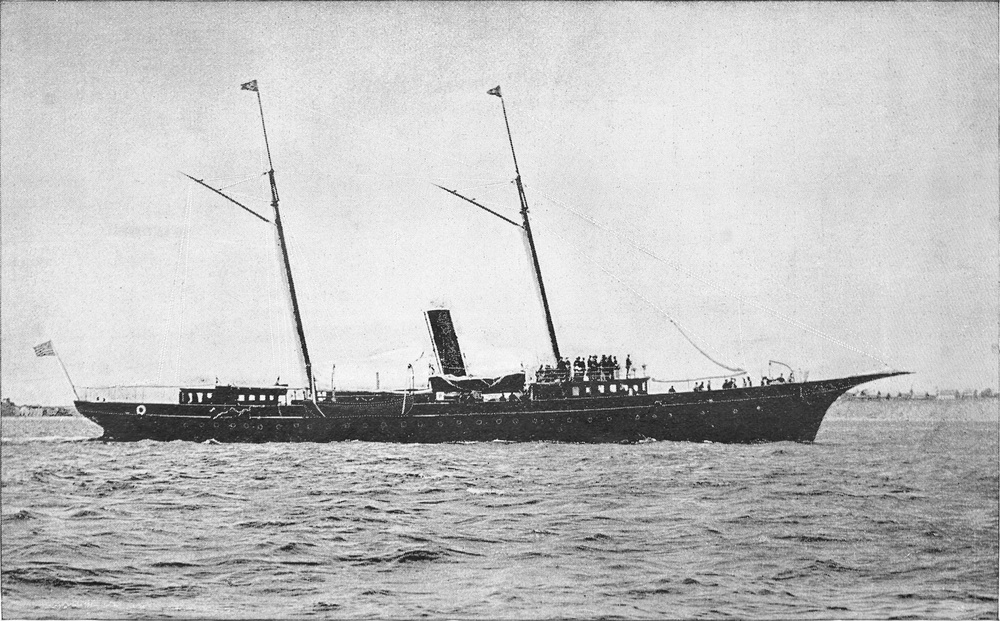
ELECTRA, THE FLAGSHIP—OWNED BY COMMODORE E. T. GERRY.
⇒ LARGER IMAGE
During Sunday the fleet lay at anchor in Vineyard Haven. At a meeting of the captains, held on board the flagship Electra, it was decided to abandon the cruise to Marblehead for this year and to accept the offer made by the Newport citizens, of cups, to be sailed for over the Sow and Pigs course before the cruise terminated. It was also decided to go to New Bedford on the day after the race for the Martha’s Vineyard Cup, and then from New Bedford to go to Newport and sail the race for the cup offered.
Monday, August 13, was the day set for the race for the Martha’s Vineyard Cup, but after the flagship Electra had taken her position ready for the start the Regatta Committee decided to postpone the race. On Monday, therefore, the yachts lay anchored in Vineyard Haven, while their owners enjoyed themselves at Cottage City.
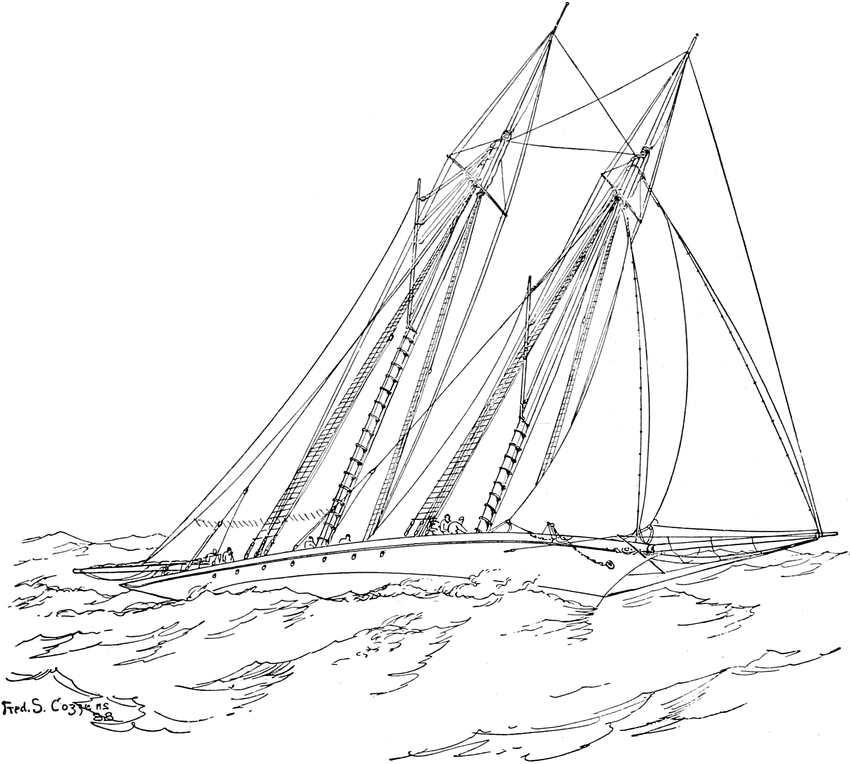
IROQUOIS—OWNER, T. JEFFERSON COOLIDGE, ESQ.
On Tuesday, the day was clear and bright, with a wind strong and fresh from the southwest. It was an ideal yachting day. The result was the finest race of the cruise.
The prizes were a series of valuable cups offered by the citizens of Martha’s Vineyard, as follows: $250 for keel schooners, $250 for second-class centre-board schooners, $200 for third-class centre-board schooners, $250 for first-class sloops, $200 for second-class sloops, $150 for third-class sloops, $100 for fourth-class sloops and $100 for fifth-class sloops.
The course gave a beat to windward of eighteen nautical miles to and round a stakeboat off Gay Head and return to starting line off Cottage City.
The starting signal was given at 10.10, and the Puritan was again first over the line. The Alert was next, closely pursued by the Sea Fox and Grayling. General Paine was aboard the Alert, and it was generally believed that his presence did not keep her back at all.
The wind increased shortly after the start, and soon a heavy sea came rolling in from the eastward, striking the big sloops first. The Puritan was still leading, but the Mayflower seemed to make better weather of the seas, and soon passed to leeward of the Puritan.
About the same time the Grayling ran through the Sachem’s lee, and the Sea Fox was holding a splendid wind and going fast through the water. She was to the windward of both the Sachem and the Grayling. Soon after the start the schooner Palmer carried away her fore gaff, but she held on under whole mainsail, fore topsail and jib. The Grayling and Sachem had it hot for a while on the starboard tack; the Sachem got a little the best of the bout. The Alert now hoisted a small maintopmast staysail and came along at a slashing pace, apparently outsailing all the schooners. The first mark of the course to be turned was the bell buoy off Nobska Point, which was turned by the leaders as follows: Puritan, 11.17.30; Mayflower, 11.18.45; Sachem, 11.21.10; Sea Fox, 11.22.05; Alert, 11.25.00; Grayling, 11.29.00.
On the way from Nobska Point to Gay Head the wind rather moderated, topmasts were sent up, and reefs shaken out on most of the boats. The time taken at Gay Head stakeboat was as follows: Puritan, 12.42.50; Mayflower, 12.47.00; Sachem, 12.50.30; Alert, 12.52.22; Sea Fox, 12.53.26; Grayling, 12.58.32; Miranda, 1.01.45; Montauk, 1.14.00; Iroquois, 1.06.30; Katrina, 1.09.55.
It was a free wind from Gay Head to the finish off the Sea View House at Cottage City. All the yachts sent their kites up soon after turning, and all made splendid time. The Alert was at a great disadvantage here in not having any spinnaker or balloon topsails on board, so that the Miranda was able to overhaul her. The race between the Sea Fox and Sachem was most exciting and very close; the Katrina also pulled up on the Bedouin, but not enough to save her loss outside. The Grayling did not do as well as usual in this home run; she was outsailed by both the Sachem and Sea Fox. The finish line was crossed in the following order: Puritan, Sachem, Mayflower, Sea Fox, Alert, Grayling, Miranda, Montauk, Iroquois, Bedouin, Katrina, Intrepid, Troubadour, Hildegarde, Halcyon, Bertie, Athlon, Vixen, and Usher.
The following tables show the result:
FIRST CLASS SCHOONERS.
Start. Finish. Elapsed Time. Corr’d. Time.
NAME. H. M. S. H. M. S. H. M. S. H. M. S.
Alert 10 10 44 2 21 32 4 10 48 — — —
Intrepid 10 11 43 2 44 14 4 32 31 4 30 10
Miranda 10 11 45 2 27 55 4 16 10 4 05 14
Palmer 10 17 58 Did not finish.
Ramona 10 10 24 — — — — — — — — —
SECOND CLASS SCHOONERS.
Sea Fox 10 11 23 2 20 08 4 09 45 4 08 23
Grayling 10 11 25 2 26 23 4 15 03 4 10 34
Sachem 10 11 48 2 17 08 4 06 20 4 04 33
Montauk 10 13 23 2 29 46 4 16 23 4 16 23
Troubadour 10 15 00 2 47 20 4 32 20 4 28 47
THIRD CLASS SCHOONERS.
Iroquois 10 12 10 2 34 12 4 22 02 4 22 02
Halcyon 10 14 59 3 10 38 4 55 39 4 54 54
FIRST CLASS SLOOPS.
Puritan 10 10 16 2 12 58 4 02 42 4 00 07
Mayflower 10 13 14 2 17 44 4 04 30 4 04 30
SECOND CLASS SLOOPS.
Bedouin 10 11 25 2 37 39 4 26 14 4 24 43
Katrina 10 14 26 2 42 37 4 28 11 4 28 11
THIRD CLASS SLOOPS.
Hildegarde 10 14 11 3 09 43 4 55 32 4 55 32
FOURTH CLASS SLOOPS.
Bertie 10 13 41 3 26 42 5 13 01 5 07 59
Athlon 10 20 00 3 59 45 5 39 45 5 39 45
FIFTH CLASS SLOOPS.
Vixen 10 16 30 4 01 30 5 45 00 — — —
Hesper 10 16 48 4 03 47 5 46 59 — — —
Thistle 10 16 54 — — — — — — — — —
Winners and prizes: Alert, $250; Sachem, $250; Iroquois, $200; Puritan, $250; Bedouin, $250; Hildegarde, $150; Bertie, $100, and Hesper, $100.
On Wednesday morning the fleet started for New Bedford. The wind was a regular sou’wester, and fast time was made.
The preparatory signal was given at 9.50, and ten minutes later the starting gun was fired. The race abounded in exciting manœuvres, and much good seamanship was displayed. It was a grand sight to watch the Sea Fox, Grayling and Sachem contesting for first place, and so close together were they at the finish that all three crossed the line within one minute.
The following table shows the actual results of the race:
FIRST CLASS SCHOONERS.
Start. Finish. Elapsed Time. Corr’d. Time.
NAME. H. M. S. H. M. S. H. M. S. H. M. S.
Ramona 10 04 30 3 40 45 5 36 15 5 36 15
Palmer 10 20 00 3 54 04 5 34 04 5 31 59
Intrepid 10 02 56 3 42 42 5 39 46 5 37 21
THIRD CLASS SCHOONERS.
Grayling 10 00 56 3 03 07 5 02 11 4 58 38
Sea Fox 10 01 21 3 02 18 5 00 57 5 00 57
Sachem 10 02 15 3 03 09 5 00 54 4 59 27
FOURTH CLASS SCHOONERS.
Iroquois 10 01 21 3 26 15 5 25 54 5 23 54
Halcyon 10 02 09 Did not sail the course.
FIFTH CLASS SCHOONERS.
Lydia 10 02 59 5 09 23 7 08 24 — — —
Clio 10 01 21 4 07 14 6 05 53 — — —
Harbinger 10 00 38 Did not sail the course.
FIRST CLASS SLOOPS.
Puritan 10 00 35 3 03 40 5 02 05 4 59 26
Mayflower 10 02 19 Did not sail the course.
THIRD CLASS SLOOPS.
Pocahontas 10 02 52 3 56 20 5 53 28 Not meas.
Katrina 10 07 00 3 14 37 5 07 37 5 07 37
Bedouin 10 05 24 3 13 13 5 07 49 5 06 13
Fanny 10 11 27 Did not sail the course.
FOURTH CLASS SLOOPS.
Hildegarde 10 10 12 4 06 30 5 56 18 5 56 18
FIFTH CLASS SLOOPS.
Athlon 10 04 00 4 48 52 6 44 52 6 44 52
Bertie 10 01 16 4 35 10 6 33 54 6 28 43
Cinderella 10 01 31 4 39 56 6 38 25 6 37 39
Concord 10 04 12 Did not sail the course.
SIXTH CLASS SLOOPS.
Nymph 10 03 53 Did not sail the course.
Pappoose 10 04 30 5 07 31 7 03 01 — — —
WINNERS—First class schooners, Palmer; third class schooners, Grayling; fourth class schooners, Iroquois; fifth class schooners, Clio; first class sloops, Puritan; third class sloops, Bedouin; fourth class sloops, Hildegarde; fifth class sloops, Bertie; sixth class sloops, Pappoose.
In the evening a meeting of the captains was held on board the Electra, after which a reception was given to the captains and their guests by Commodore Gerry. On Thursday the fleet remained in New Bedford harbor, and on signal all hands “dressed ship,” and the quaint old harbor, with its whaling vessels along the docks, presented a very pretty sight. During the afternoon cutter, gig and dingey races were rowed. In the evening the visiting yachtsmen and their friends were received by the local club.
When the preparatory signal was given on Friday morning for the final run of the cruise, the wind blowing fresh from the southwest, caused most of the yachts to house topmasts and tie two reefs in their mainsails. The Grayling crossed the line first, followed closely by the Puritan and Lydia. The great surprise of the day was the way in which the Mayflower “walked away” from the Puritan and all the others.
After the finish the yachts continued into Newport harbor. The results of the day’s run were:
FIRST CLASS SCHOONERS.
Start. Finish. Elapsed Time. Corr’d. Time.
NAME. H. M. S. H. M. S. H. M. S. H. M. S.
Palmer 10 23 52 3 14 18 4 50 26 4 47 37
Intrepid 10 22 13 3 20 24 4 58 11 4 53 37
Dauntless 10 22 13 3 42 25 5 20 12 5 20 12
Ramona 10 31 29 4 35 22 6 03 53 6 03 04
THIRD CLASS SCHOONERS.
Sachem 10 23 00 3 06 08 4 43 08 4 43 18
Miranda 10 33 17 3 26 20 4 53 03 4 51 11
Grayling 10 21 07 Did not finish.
FOURTH CLASS SCHOONERS.
Iroquois 10 24 20 3 34 35 5 10 15 5 10 15
FIFTH CLASS SCHOONERS.
Clio 10 22 20 — — — — — — — — —
Lydia 10 21 15 — — — — — — — — —
FIRST CLASS SLOOPS.
Mayflower 10 23 17 2 30 04 4 06 47 4 06 47
Puritan 10 21 12 3 03 48 4 42 36 4 40 40
THIRD CLASS SLOOPS.
Bedouin 10 25 45 3 12 26 4 46 41 4 45 32
Katrina 10 23 55 3 10 55 4 47 00 4 47 00
FOURTH CLASS SLOOPS.
Hildegarde 10 21 45 3 59 54 5 34 09 5 38 09
FIFTH CLASS SLOOPS.
Bertie 10 22 29 4 07 19 5 44 50 5 41 03
Cinderella 10 24 30 4 27 44 6 03 14 6 02 40
Athlon 10 22 29 — — — — — — — — —
Active 10 32 55 — — — — — — — — —
SIXTH CLASS SLOOPS.
Papoose 10 25 29 4 41 22 6 15 53 — — —
Nymph 10 27 05 — — — — — — — — —
Kelpie 10 35 00 — — — — — — — — —
WINNERS—First class schooners, Palmer; third class schooners, Sachem; fourth class schooners, Iroquois; first class sloops, Mayflower; third class sloops, Bedouin; fourth class sloops, Hildegarde; fifth class sloops, Bertie; sixth class sloops, Pappoose.
On Saturday and Sunday the yachts remained in the harbor, and their owners spent the time in Newport.
On Monday, August 20, the 50-mile race for the cups offered by the citizens of Newport was sailed, but the wind being very light the event caused much disappointment. The run was to be before the wind, and so the big sloops lowered their spinnaker booms as they came toward the line. The Puritan crossed first, and next came the Fanny, noted for her light-weather qualities, then the Dauntless, followed by the Alarm, Hildegarde and Volunteer in the order given.
The Volunteer gradually gained on the leader, passed her adversaries one by one, and shortly before rounding the stakeboat was first. The wind was light, and variable all day, and died out at most inopportune times. The Volunteer alone crossed the finish within the time limit.
At colors on Tuesday the fleet was formally disbanded, and so ended the very successful cruise of 1888.
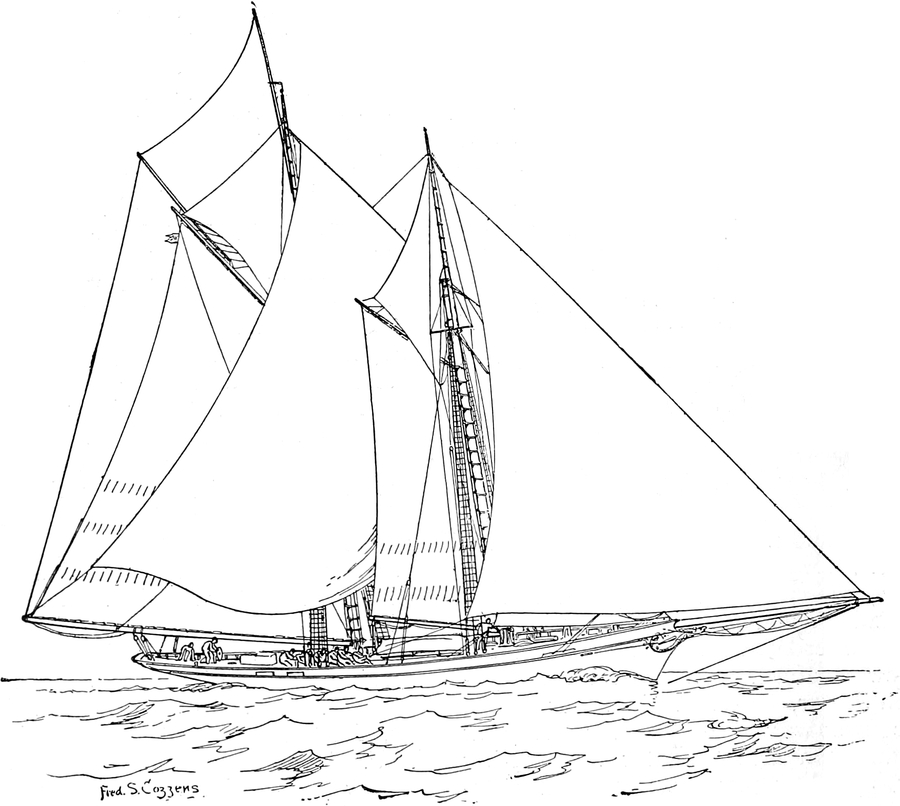
SACHEM—OWNERS, MESSRS. C. D. OWEN AND JESSE METCALF, PROVIDENCE, R. I.
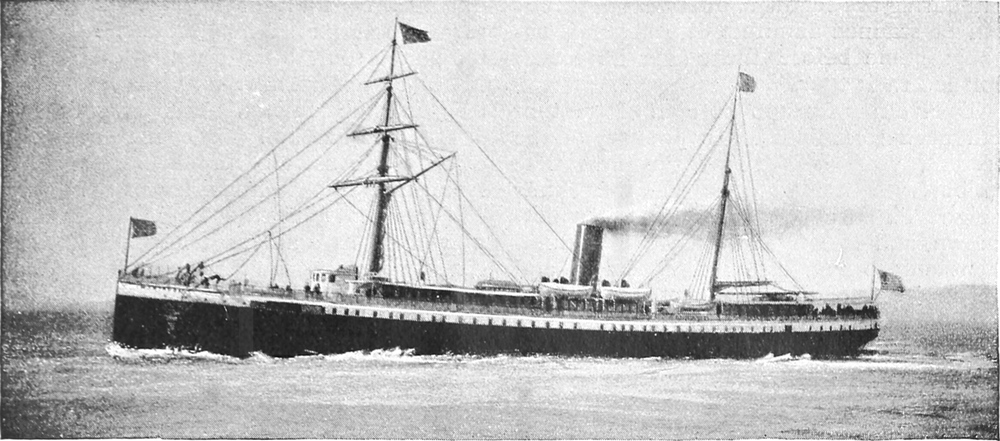
BASEBALL IN AUSTRALIA.
BY HARRY PALMER.
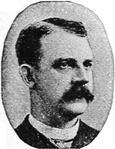
NOTE.—OUTING gladly places at the head of this article the portrait of Mr. A. G. Spalding, the projector and promoter of the American Baseball Tour to Australia.—EDITOR.
“HO, for Australia!”
What a world of pleasant memories the thought must awaken in the heart of every one who has plowed the depths of the broad Pacific; past the land of the Kanakas and the dominion of King Kalakaua; on through the Samoan group, to the shores of New Zealand; finally, under the light of the Southern Cross, to drop anchor in the harbor of Sydney, the most wonderful natural harbor in the world.
Just at present Australia and the Australians are objects of special interest to a large majority of Americans. Next to home, young America loves nothing so well as the national game of baseball. Popular enthusiasm aroused by the game is a matter for wonder to all people not Americans. This arises from the fact that in no other country is baseball so thoroughly practised or understood. The probable reason why England, Canada, Australia, and other countries, with their innate love for sports and athletics, have not become enamored of the game, is that our best exponents find America too attractive and profitable a field, from a professional standpoint, to find time or opportunity for introducing the pastime into other lands. Other considerations operate against the scheme of a mission of instruction. The expense of taking two selected teams abroad, the possibility of meeting unfavorable weather, accidents to players, and numberless other obstacles, would occur to the mind of any ambitious baseball manager who might contemplate such a scheme.
An invasion of foreign territory was, however, made in 1875. The Boston and Athletic teams, embracing many of the leading players of that period, went to show the Englishmen the game of baseball as played in America, and to play cricket with them.
In connection with that tour of ’75 Mr. A. G. Spalding, then the hard-working young pitcher of the Boston Club, was a prominent figure. Now, the same man, having become the head of the great mercantile house that bears his name, is, with the same spirit, about to introduce the game into a land ten thousand miles away. Bold as is the enterprise, the man who has undertaken it has not only the nerve and courage to carry it out, but also the ability to make the venture successful in every sense of the word. That the Australians will be afforded the opportunity to see the attractive features of the game demonstrated to the best possible advantage, is assured by the make-up of the visiting teams. If the Australian people admire a game in which skill, training, endurance and daring are requisite qualifications, they will be staunch admirers of America’s national game before the teams have half finished their tour.
Twelve months ago no plan of the tour had been formulated. In January of the present year it was for the first time seriously contemplated. At that time Leigh S. Lynch, a gentleman widely known, and of long experience in amusement enterprises, met Mr. Spalding, and the subject of an Australian baseball tour, once broached, was seriously and fully discussed. The greatest obstacle that had heretofore existed, viz., the want of a capable and experienced associate in the venture, was, to Mr. Spalding’s mind, overcome by the advent of Mr. Lynch. Almost immediately the two began to make arrangements for the tour, on which they had with little hesitation decided. Captain Anson was interested in the project, and together with Messrs. Lynch and Spalding, entertained the view that there was but one policy to adopt if success was to be attained. It must be an undertaking on a large scale. Money would have to be expended without stint, and all chances taken of the venture proving financially successful. In spite of their broad-minded view of the case, and though the limit of expense for the trip was placed at the liberal figure of $30,000, the venture has grown with each month since its inception until it has attracted the attention and awakened the interest of every lover of sport in England, America and Australia by its magnitude.
In February Mr. Lynch started for Australia, and on his arrival promptly secured the sole right to use the cricket grounds at Sydney and Melbourne for baseball games during the winter of 1888–9. Before returning to America he announced the contemplated tour to the press of these cities. Much to his gratification, the news awakened marked interest.
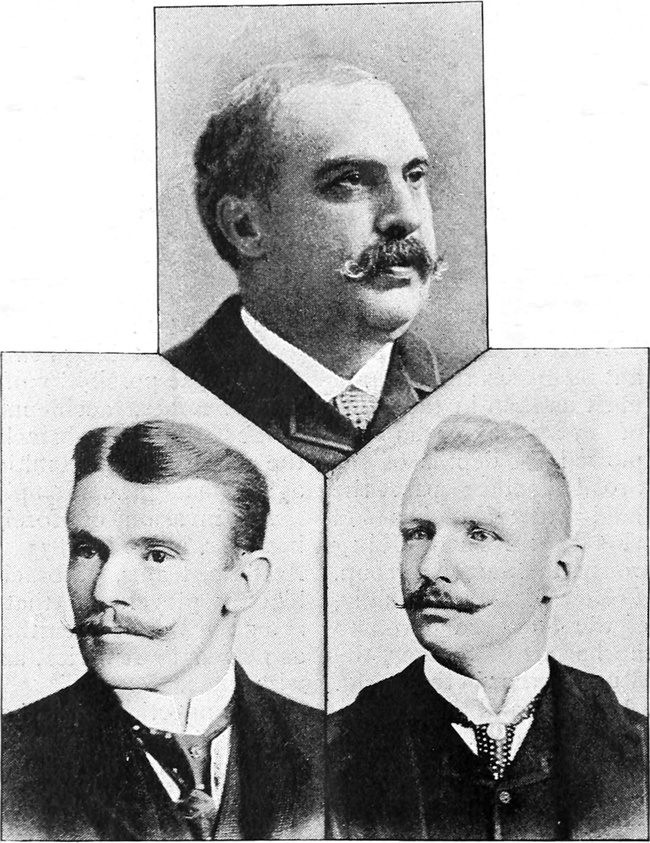
JOHN M. WARD. LEIGH S. LYNCH. A. C. ANSON.
Hitherto baseball has never been introduced in Australia in such a form as Americans know. Some few of the American residents in the larger cities have played it in amateur fashion, but never have two professional teams, such as these comprising the National League, crossed bats upon Australian soil. It is, therefore, evident that the tour will be watched with interest in America, while the reputation of the Australians as lovers of all kinds of sport, together with the attractive character of baseball, seem to promise the awakening of no small degree of enthusiasm among them.
In America baseball has surpassed in public favor horse-racing, aquatic and field sports of every character. Its growth has been one of nearly twenty years, and with each succeeding year it has commanded an increase in public patronage, until it has beyond all question become the national game of Americans.
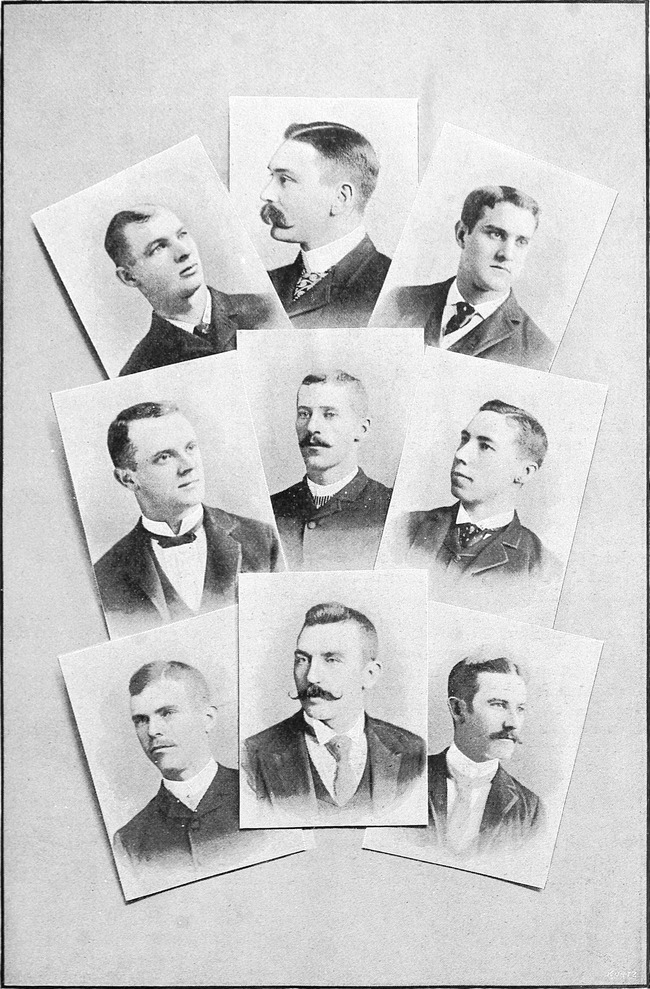
THE CHICAGO TEAM.
MARTIN SULLIVAN. F. N. PFEFFER. JOHN K. TENER. MARK BALDWIN. ROB’T PETTITT. THOS. P. DALY. JAMES RYAN. E. N. WILLIAMSON. THOS. BURNS. A. C. ANSON, CAPTAIN (SEE PAGE 158).
⇒ LARGER IMAGE
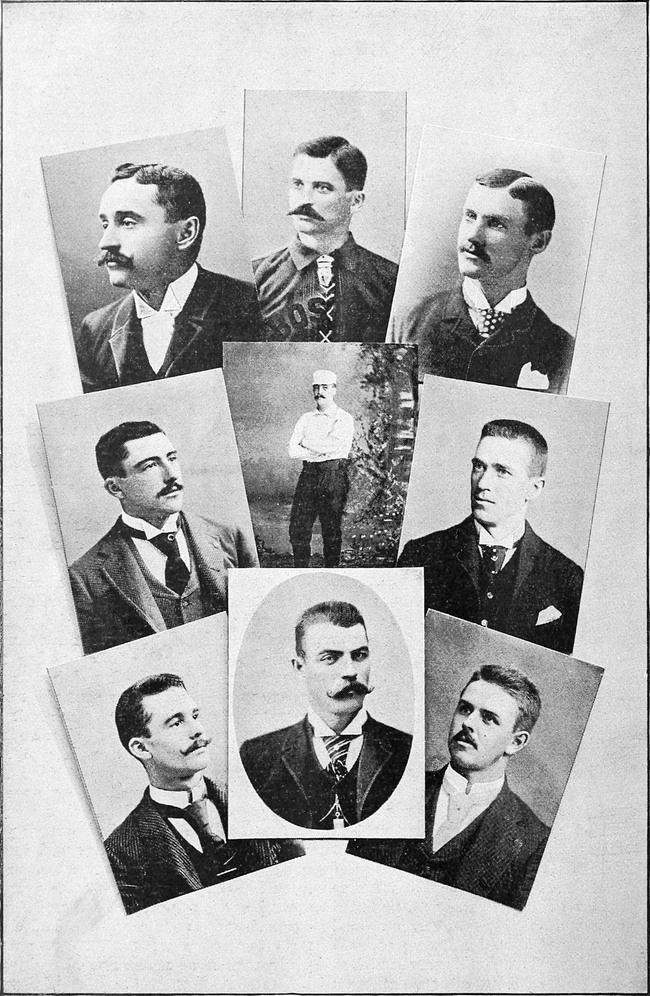
THE CHICAGO TEAM.
THE ALL-AMERICAN TEAM.
EDWARD HANLON, DETROIT. M. J. KELLY, BOSTON. JOHN HEALY, INDIANAPOLIS. JAMES G. FOGARTY, PHILADELPHIA. H. H. SIMPSON, NEWARK. M. J. TIERNAN, NEW YORK. J. A. DONNELLY, WASHINGTON. GEORGE A. WOOD, PHILADELPHIA. F. H. CARROLL, PITTSBURG. JOHN M. WARD, NEW YORK, CAPTAIN (SEE PAGE 158).
⇒ LARGER IMAGE
In America there are two prosperous leagues, or associations, of professional baseball clubs, known as the National League and the American Association. These organizations are each composed of eight clubs, each club being located in one of eight cities, which comprise the circuit of each organization. Each organization has its constitution and by-laws governing the affairs of each and every club in membership, and each organization has its prearranged schedule of games, which are played during each season. According to the schedule of 1888, each team was scheduled to play 140 games during the season—seventy at home with visiting teams, and an equal number abroad, or ten games on the grounds of each competing club—the seasons at home and abroad being so arranged as to give lovers of the game two or three weeks of continuous ball playing, and then a like period of rest. It is needless to say the return of the home team is made the occasion of a great outpouring of people and a hearty reception in each city of the circuit, while its fortunes in other cities are eagerly followed by its friends at home. The daily press of the country devotes columns of space in each issue to the victories and defeats on the “diamond,” and in nearly all of the larger League and Association cities the evening papers issue an extra edition containing the accounts of the afternoon’s games. These find a large and ready sale, not only in the cities where they are published, but each outgoing train bears its package of “extras,” which are waited for by crowds of expectant and impatient watchers at every station.
No attempt has been made in these lines to color the picture. Public enthusiasm in America over the national game is something more than the cleverest pen could depict. From day to day the relative standing of the teams in the championship races is stated in tabulated form at the head of the baseball column of every reputable American daily, and the slightest change in the positions of the teams in the race is sufficient cause for exultation in the home of the fortunate team, and for a corresponding degree of depression in the home of the team that has been supplanted in its position. The position of a team in the race is determined by the percentage of the games it has won, the percentage being determined by dividing the number of games won by those played. Thus a team may have won 51 games and lost 47, consequently it has played 98. Now, divide 51 by 98, adding to the dividend three ciphers, and for a quotient you have .520, which would be the percentage of games won to the number of games played by that team.
The theory of the game of baseball is in itself simple. It is that two contesting teams must endeavor to send the greatest number of men around the circuit of the bases under prescribed rules within a limited number of innings. That is the cardinal point in the theory of the game.
Now, as to the rules and requirements to which players must adhere in attempting to make the circuit of the bases, and the means by which they can be prevented.
Each team must invariably consist of nine men, and the game must be played upon a regularly marked or laid-out field, as illustrated upon page 165.
The field, it will be seen, consists of a continuous runway, these runways being clay-covered paths, laid out in the shape of a huge diamond. At each corner of the diamond is a basebag of canvas filled with sand or other material, and strapped securely to the ground.
Now, to the average American youth, the duties of the players in two contesting ball teams, and their positions upon the field, are known in a general way. There are many spectators, even in America, however, who, if asked to explain the simplest points in a game, would find themselves lamentably ignorant upon the subject. Baseball correspondents, writers, professional players and rule makers, probably because long experience has made them thoroughly familiar with the rules and terms of the national game, have fallen into the use of technicalities, that in many instances cause the game to seem intricate to the uninitiated. In truth, however, the game’s greatest charm is its simplicity, combined with the manifold opportunities it offers for brilliant and daring work by the players. A simple description of the cardinal points in the game, therefore, divested of all technical terms that cannot be plainly defined, will, perhaps, aid many a reader in America, as well as in other countries, to understand baseball, where the simple reading of the professional playing rules, framed by the rules committee, would mystify rather than inform a reader not already familiar with the game.
Let it be understood, therefore, that the basebags are known as first, second, third base and home plate, first base being the first bag to the right of the batsman as the latter faces the pitcher. The distance between bases is ninety feet. The players are known as pitcher, catcher, first baseman, second baseman, short-stop, third baseman, right fielder, centre fielder, and left fielder. The pitcher (or bowler) stands in the centre of the diamond, within prescribed lines four feet wide by five feet four inches long, known as the pitcher’s box. The forward line of the pitcher’s box is fifty feet from the home plate, which the pitcher faces when ready to deliver the ball, and beside which the batsman stands as he faces the pitcher. Behind the home plate stands the catcher, it being his duty to receive the ball from and return it to the pitcher, should it not be batted by the batsman. Just behind the catcher stands the umpire, who is expected to judge every ball pitched and every play made during the game, his decision being final in every instance. At first base stands the first baseman, and at second base stands the second baseman. The short-stop is stationed midway between the second and third basemen, in or near the runway, and the third baseman at third base. These four men constitute the “infield” of the team. Facing the diamond, and stationed from 100 to 125 yards from the infield, are the right, centre, and left fielders. These men constitute the “outfield” of the team.
The choice of going to bat or to the field for the opening innings of the game is optional with the captain of the home team—that is, the team upon whose grounds the game is being played. Should he decide to send his men to the field, he stations them as above indicated, while the nine players of the opposing team take their seats upon the visiting players’ bench. These players go to bat in the order in which their names appear upon the score card. When the fielding team has taken its position, the first batsman of the opposing team steps to the plate, and others follow him in regular turn, until three batsmen have been retired by the efforts of the opposing fielders. Then the positions of the teams are reversed, the side which was at bat going to the field, and the side which was doing fielding duty coming in to take their turn at bat in regular order. When three of the second team’s batsmen have been retired, or put out by the efforts of the opposing fielders, the innings is ended, each team having sent three or more men to bat, and each having had three men retired. Nine such innings, requiring from one hour and a half to one hour and fifty minutes of play, constitute a game, and the team which has scored the most runs wins the game. Should rain, or any other cause, stop the game before five full innings have been played, however, the game must be contested over again before it can count in a championship record.
When the batsman steps to the plate he is expected to hit the ball so that it will pass the intercepting fielders, and go to such distance in the outfield as will enable him to reach first base before the ball can be returned to the fielder stationed there. If he can reach second or third base, or make the entire circuit of the bases before the ball has been intercepted by any one of the infielders, or before it has been captured by an outfielder and returned to the infield, so much the better, for the base-runner’s object is to ultimately make the circuit and touch the home plate, by which he scores a run for his side. To put a batsman out, a fielder must catch the batted ball before it has reached the ground, or must recover it in time to throw it to the base for which the base-runner is making, before the base-runner reaches it.
The pitcher is required by the rules to pitch the ball over the plate and between the knee and shoulder of the batsman. Each time he tries and fails to do so the umpire calls “ball,” and upon five such balls being pitched, the batsman is entitled to take first base. When three fair balls have been put over the plate, however, and the batsman has failed to hit them, the batsman is out, whether he has struck at the ball or not. For each fair ball the umpire calls “strike.”
From the home plate along the runways to and past first and third bases, are drawn two chalk lines. These are known as foul lines, and any ball batted outside these lines is called a foul ball, and does not count against either the pitcher or batsman unless it should be caught by a fielder before touching the ground, in which case the batsman is out. Very frequently a swiftly pitched ball is struck at by the batsman, who fails to correctly judge it, and the ball being just grazed by the bat, shoots into the catcher’s hand. This is called a “foul tip,” and puts the batsman out.
When the innings begins, and there are no base-runners on bases, the catcher usually stands well back from the plate and takes the ball on the bound, so as to save his hands as much as possible. When three balls or two strikes have been called by the umpire, however, or when a batsman has succeeded in reaching first base on a hit, or by other means, the catcher puts on his protecting mask and pad and stands close up behind the batsman, taking the balls as they come over the plate. This is done that he may more quickly take advantage of any opportunity that may offer to put the batsman out, or retire the base-runner, who may already have reached first base.
There are many terms applied to the different plays in a game of baseball, which, as a rule, are but imperfectly understood. The writer has known a spectator who, though familiar with the make-up of every ball team in the League and Association, was so ignorant of baseball parlance as to call a “foul tip” a “fly,” an “out” from second to first baseman a “sacrifice,” and a “wild pitch” a “wild throw.” An understanding of all the terms used in connection with the game is, of course, not requisite to a reasonably clear conception of the points therein, yet ability to designate a play and a player’s position correctly, is positively necessary in scoring.
A careful perusal of the following terms and their meaning will greatly help the uninitiated to follow the playing and grasp its significance:
A Batsman is the player who stands at the plate for the purpose of hitting the ball. A Base-runner is what the batsman becomes after he has batted the ball. A Fielder is any one of the nine players opposing the side at bat. A Coacher is one of the players belonging to the side at bat, who takes up his position near first or third base, and advises, or coaches, the base-runner. The Battery—A term usually applied to the catcher and pitcher. The Back-stop—A term sometimes applied to the catcher. The Infield—A term applied to the first, second, third baseman and short-stop. The Outfield—A term applied to the right, centre, and left fielders. A Strike—A strike is called when the ball has passed over the home plate, between the knee and shoulder of the batsman, whether he has struck at it or not; three strikes send the batsman to his seat. A Ball—“Ball” is called by the umpire when the ball delivered by the pitcher has passed above the shoulder or below the knee of the batsman, or has gone wide of the plate; five balls so delivered entitle the batsman to take his base. A Foul Hit—Any hit which sends the ball outside of the foul lines. A Fair Hit—Any hit which sends the ball across the diamond so that it will land inside the foul lines. A Fly-ball—A ball hit into the air and caught by a fielder before it touches the ground; such a catch retires the batsman. A Liner—A ball batted straight across the diamond toward any infielder. A Grounder—A batted ball which strikes the ground inside the diamond. A Wild Pitch—An unsteady delivery of the ball by the pitcher which passes the catcher, and permits a base-runner to advance a base. A Passed Ball—A ball which bounds from the catcher’s hands on coming from the pitcher, and permits a base-runner to advance a base; each base-runner may start for the base ahead of him on a passed ball or wild pitch, and hold it, provided he reaches it before the catcher recovers the ball, and sends it to the fielder at the bag for which the base-runner is making. A Muff—The failure of a fielder to hold a fly or thrown ball after it has fairly struck his hands. A Fumble—The failure of a fielder to quickly handle and throw a batted ball to the base for which the base-runner is making. A Steal—Frequently a base-runner will start for the base ahead of him immediately upon the pitcher’s delivering the ball, and depending upon his sprinting ability for success; if he succeeds he may be said to have stolen a base; if he fails, through the catcher’s receiving the ball and throwing it to the fielder at the base for which the base-runner is making, the latter may be said to have been put out on an attempted steal. An Error—When a fielder fumbles or muffs a ball, or fails to stop a batted ball which it may be fairly presumed he could have stopped, or when he in any way fails to make the play he might and should have made, he has been guilty of an error, and is charged with the same in the score. A Wild Throw is a ball thrown over the head or out of reach of the fielder to whom it is directed, thus permitting a base-runner to gain a base. A Base Hit—A base hit is a ball so batted toward fair ground that the opposing fielders cannot reach it before it strikes the ground, or so that they cannot recover it in time to throw it to the base before the base-runner reaches there; a base hit may be for one, two, three, or four bases, according to the distance to which the ball is batted. A Single is a base hit upon which the batsman reaches first base, usually referred to as a safe hit. A Double is a hit upon which the batsman reaches second base. A Triple is a hit upon which the batsman reaches third base. A Home Run is a hit upon which the base-runner makes the entire circuit of the bases. A Double Play is a play by the fielders which retires two men simultaneously. A Triple is a play that retires three men simultaneously; for instance, a double play may be made thus: with a base-runner on first base, the batsman sends a grounder to the second baseman; immediately the ball is hit, the base-runner on first starts for second and is touched out by the second baseman as he passes him, and then the second baseman quickly throws to first base, the first baseman receiving the ball before the base-runner gets there, thus two men are retired; should the first baseman, after putting his man out at first, then throw to the home plate in time to shut off a base-runner running in from third base, it would be a triple play. A Slide—When a base-runner sees that there is a chance of the fielders getting the ball to the base for which he is making before he gets there himself, he will plunge head first, or feet first, for the bag, sliding over the ground upon his stomach or back, a distance of ten feet or more to the base; this is called base-sliding, and is a reckless and daring feature of the game that invariably arouses much enthusiasm in America. A Balk is any motion made by the pitcher as though he intended to deliver the ball, but made for the purpose of deceiving the base-runner; a balk advances a base-runner a base. A Blocked Ball is a ball batted or thrown into the crowd; in case of a “block” the base-runner may continue on around the bases without being put out until the ball has been returned to the pitcher’s box. Hit by Pitched Ball—When a batsman is hit by a pitched ball he is entitled to his base then and there. A Sacrifice Hit—A fly-ball (usually to the outfield) so batted as to retire the batsman but assist a base-runner on first, second, or third base to reach the base ahead of him.
To return, however, to the Australian expedition. The tour is now begun, and the party of ball players is this month en route to the Pacific coast by slow stages, in order that the teams may play exhibition games in the more populous cities between Chicago and San Francisco. There are among them twenty-two ball players—including Captains Ward and Anson—half a dozen representatives of the leading newspapers of the country, OUTING’S special correspondent, and quite a number of tourists who have taken advantage of the opportunity and the reduced rates to make the trip. In addition to these there are: President Spalding and family, Mrs. John M. Ward, née Helen Douvray, the well-known actress, and Mrs. Anson. The journey is performed in two special cars, with hotel and sleeping accommodations, these cars going through to San Francisco. As to the program of the party from the time of leaving Salt Lake City, it was admirably outlined to the writer by Leigh Lynch before his departure for Australia in September to prepare the way for the teams at points between Chicago and San Francisco, at Honolulu, Auckland, Sydney, Melbourne, and other points in New Zealand and Australia which the teams will visit. Mr. Lynch’s present trip is the fourth he has made, and his knowledge upon every point of interest connected with the present tour is complete.
This was his plan of campaign: “Our design is that the teams shall separate at Salt Lake City, the All-American team, under Ward’s management, proceeding direct to San Francisco, where a series of games will be played with the San Francisco ball clubs. The Chicago team, under Anson’s management, will, on the other hand, go up through Oregon and Washington Territories to Portland, Seattle, Spokane Falls, and other points, afterwards going south from Portland, where it will join the All-American team. Two exhibition games will be played by the combined teams in San Francisco before sailing. The sailing hour is fixed for two P. M., November 17; but I shall endeavor to arrange with the steamship company to defer it till eight o’clock, so that we may play our farewell game the day we leave. Many of the players have already visited San Francisco, consequently they will not care to do much sight-seeing.
“After leaving San Francisco, the trip will, however, be replete with interest for the party. From the time the Alameda passes through the Golden Gate, we shall have a continuous voyage of seven days before we strike land. These seven days will constitute a sort of preparatory period for what is to follow, and every member of the party will want to get his sea-legs as soon as possible. Our steamer, the Alameda, is the best equipped boat in the line, of 3,200 tons measurement, and provided with electric lights, baths, and every convenience of a modern house. The table is excellent, and the officers considerate and kind in every way.
“A voyage across the Pacific is rarely attended by such rough weather as one encounters upon the Atlantic, and as a rule the great ocean is true to its name. On board ship every possible method is adopted to pass the time. There is music and dancing on the deck, and the ordinary ship’s games, while nothing is more delightful than to lie back in a blanket-covered steamer-chair and gaze at the seemingly boundless ocean stretching away on every side. The fragrant breezes of the South Pacific fan the brow, and the light from a gorgeous moon and a million stars flood the deck and sails of the ship which is steadily plowing along through the billows of the mightiest stretch of water upon the globe. Nowhere can one so truly realize the grandeur and the immensity of nature as on the Pacific Ocean.
“At Honolulu the tourists will see with surprise the high state of civilization and cultivation encountered on every hand. Honolulu is upon the island of Oahu, and has a population of about 25,000 people, including whites, natives, and Chinese. The harbor is natural, and the city very handsomely constructed. The public parks are among the most beautiful in the world. The trees and shrubberies at night blaze with incandescent electric lights, and colored fountains play, while the walks are ornamented at every turn with artistic statuary. The royal band, which gives concerts nightly at the Royal Hawaiian Hotel, is without doubt one of the best I ever heard, and I have heard the bands of every civilized nation. The drives surrounding the city are naturally beautiful and are admirably cared for. The Kanakas are a remarkable and interesting race. Their skin is dark, not unlike that of the American Indian, the features small and regular, and the hair straight and luxuriant. They are excellent swimmers, and invariably surround every steamer that touches at Honolulu, eager to exhibit their skill for the most trivial recompense.
“We stop at Honolulu between twelve and fifteen hours, and play two games of ball—one between the Chicagos and All-Americans, and the other between the Chicagos and the local Honolulu team, which, by the way, is very good. I shall endeavor to arrange so that King Kalakaua may witness both games, and think I shall be able to do so, for he is very fond of athletics.
“Seven days after leaving Honolulu we stop at Tutuila, in the Samoan group. It is distant about 2,000 miles from the Hawaiian capital, and nearly as far south of the Equator as Honolulu is north. Twelve hundred miles from Honolulu our ship crosses the Equator, and Neptune is invariably received with due honors upon every boat that passes the line.
“Six days after leaving Tutuila, where our ship stops only two or three hours, we reach Auckland, the capital of New Zealand. There we stop about ten hours and propose to give the inhabitants a game of ball. Auckland is a pretty provincial town, of about 40,000 people, built in the English style. The cricket grounds are among the finest I ever saw.
“From Auckland we go to Sydney, and there our Australian tour proper commences. So much has been said of the cities of Sydney and Melbourne that the less I say now, perhaps, the better.
“When we leave America we shall leave not far from midwinter. When we arrive in Australia we shall arrive in midsummer, for our December is their July. So it will be necessary to the comfort of every member of our party to dress for the trip just as though they were providing for an approaching summer at home. A steamer coat may be a good thing to carry with one, as the nights are at times chilly.
“As to the program of the ball teams in Australia, that I cannot give you definitely now. Suffice it to say, however, that our teams will stand ready to meet Australian cricket elevens or football teams at any city they visit, and that as a result of their visit baseball will be better known, and probably better liked, by the Australian people when we bid farewell to Sydney. There will be ball games in Sydney, Melbourne, Adelaide, Bathurst, Ballarat, and every other point that we can visit to advantage. As to the recreative features of the trip, I feel sure they will be taken care of. Australians are a generous and hospitable people, and the visiting teams will doubtless become well acquainted in every city they visit. Of course we shall have a kangaroo round-up, while there will be many interesting and novel sights to entertain our party from the time we arrive on the continent until we leave it.”
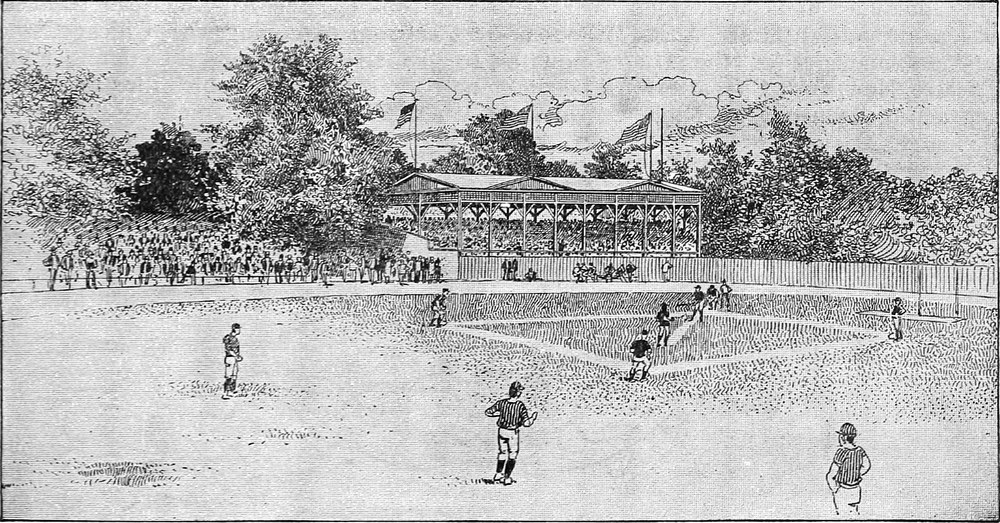
A BASEBALL TEAM IN POSITION ON THE FIELD.
To Mr. A. G. Spalding, the principal baseball legislator in America, and the head of the Chicago Club, is due the credit of the enterprise. His pluck, money and position made the project feasible.
To Leigh Lynch, the business manager, is due the credit of having perfected all details, a duty for which his long experience as an amusement enterprise manager fully qualifies him. For nine years he was associated with Mr. A. M. Palmer as business manager of the Union Square Theatre, New York City, afterward becoming acting manager of Niblo’s. During the winter of 1887 he assumed management for Mrs. Langtry. He has traveled all over the globe; is familiar with the peoples of all countries; is well informed upon any topic, and is possessed of influential friends in every civilized nation. Both in capability and experience Mr. Lynch is a valuable ally to Mr. Spalding.
As to the players, they will form representative teams in every sense of the word. The Chicagos, under the captaincy of Anson, embracing the flower of the regular team’s talent, will go as a well trained, thoroughly drilled body of ball players, capable of putting up as strong, finished, and brilliant a game of ball for the edification of the Australian people as Americans have ever had the privilege of witnessing. Anson, Pfeffer, Williamson and Burns will certainly be as representative an infield as Pettitt, Ryan and Sullivan are an outfield. Baldwin and Tenner, with Tom Daly and Frank Flint to hold down their delivery, can without doubt ably illustrate the points in battery work. All are gentlemanly, experienced, and capable men, and can as a body, and individually, scarcely fail to prove a credit to the game and to America upon the coming trip.
The All-American team, traveling under the captaincy of John M. Ward, the popular and intelligent ex-captain of the New Yorks, is composed of men picked from the ranks of the representative ball teams of America. They have been chosen not only for their proficiency as ball players, but because of their clean professional records. Kelly, Wood, Fogarty, Hanlon, Carroll, Tiernan, and the balance of the players who compose the All-American team, are all capable of coping with Chicago, so as to give all who witness the coming games abroad some admirable illustrations of America’s National Game.
CHICAGO. ALL-AMERICAN.
Light gray shirts and knee breeches, with black stockings, caps and belts; black letters across the breast, CHICAGO. White flannel shirts, knee breeches, with blue stockings; blue letters across the breast denoting the home club of the individual, thus, NEW YORK, etc.; caps of blue and white flannel; belts of white duck, covered with American flag of silk draped round waist and knotted on left hip.

LOVE AT FISHING.
PUT one arm here, and with the other fling The silken string, Steel hook, and gadfly bait into the cool, Transparent pool, And drive love’s prattle tiptoe ’cross the lip, Or let it turn to language-gaze, and sip Its honey from a stillness. Watch the dip And glimmer of the cork, and how they slip— The scarlet fish—below the water, like The thoughts that strike Athwart the mind. How else could lovers wish Than thus to fish? Though I have cut no strand of yellow hair To spin my silken cord from what you wear, In long warm tresses over face, to stare Through quaintly; nor a golden hook to snare The water’s fruit! or more than this cool nook, With that one look Between the willow branches at the sky From where we lie, Edged round with ribbon grasses tangled in The lover’s knots, as if they meant to win Love hither by a meaning that is kin; For nature holds love’s thought and origin! That bird dropped down upon the pool’s near hem Like a red gem, Shook off the hand; and left a vision glint, That faint song-print— Just gone.... Mark how the fishes flit and chase, Lit to a passion, ’cross the water’s face— So like the minutes moving in the space Of this one day. What are the words they trace Therein?... That bird flew to its nest just now Upon the bough. The stooping sun trails long red fingers through The grass. The dew Slips off the willow leaves. It cannot be The day is over, and the fish still free— Except the fish of happiness that we Have caught; with love’s gold ring for you and me! Edward A. Valentine.


FRANKLIN SATTERTHWAITE, a genial sportsman, a good fellow, and a journalist whose pen ofttimes described the sports and pastimes he loved so well, died September 16, at his home in Newark. Mr. Satterthwaite was among the best known writers on field sports in this country. He was the son of John B. Satterthwaite, who married Miss Duane, a daughter of the celebrated W. J. Duane, Secretary of the Treasury during Andrew Jackson’s presidency. Franklin Satterthwaite was brought up in Philadelphia. The name of Franklin descended to him from his great grandfather, Benjamin Franklin. He had a wide circle of friends. His place will be missed among the men who love outdoor sports, for Franklin Satterthwaite was not only an enthusiast in their pursuit, but his ready pen never flowed so freely as when recounting some exciting or interesting adventure of flood or field. May his name continue as green in the memory of those who knew and loved him as the sod which covers his grave!