Volume 13 — OUTING.
Reading edition
VOL. XIII. OCTOBER, 1888. NO. 1.
THE BOAT CLUBS OF CHICAGO.
BY MRS. EDITH SESSIONS TUPPER.
CHICAGO is singularly devoid of the presence of that species of animal popularly known as “the dude.” In going about its bustling streets, one remarks that the thin-legged, hollow-chested youth who is chiefly noticeable for the height of his collar, and from the fact that the head he carries on his stick is larger than the one he carries on his shoulders, is seldom met.
In place, then, of a throng of these sickly creatures dawdling up and down and ogling the women, one sees a hurrying crowd of broad-shouldered, athletic young men with sturdy limbs, sparkling eyes and florid complexions. They walk, they do not saunter. As they shoulder their way through the busy throng, one cannot fail to note their muscular figures and supple movements. No doubt much of this is due to their daily associations and the constant Western push for place, but to the realm of sport must belong much of the credit, and to constant exercise with the oar this supreme vitality is greatly attributable.
For many years rowing has been popular in Chicago, and the city boasted several independent clubs, but there was no concerted plan of action until September, 1886, when the “Chicago Navy” was organized, which comprises all the various clubs of the city and suburban towns. Previous to this, the active boating had been done by the Farragut, Delaware, Pullman, Tippy-canoe, and Evanston clubs.
The membership of the “Chicago Navy” is composed of the Iroquois, Ogden, Catlin, Union, Hyde Park, Quintard, and Douglas clubs, in addition to those above mentioned—twelve in all.
The effect of this organization was at once felt, especially among the weaker clubs, whose enthusiasm was aroused to such an extent that they soon caused some of the older ones to look to their laurels. While the clubs are constantly working to strengthen their respective organizations, and while there is much friendly rivalry between them, the ambition of all is to make Chicago the headquarters of all the rowing associations of the West. All signs point to the speedy consummation of this desire. From her commercial importance and central position, from the fact that all roads lead to Chicago, she is destined to become the centre of the aquatic sports of the West. Chicago men have been made president and commodore of the Mississippi Valley Rowing Association, which embraces all rowing clubs from Galveston to St. Paul, and from Omaha to Detroit. This organization has a contract with the Pullman Club to hold its annual regattas on Lake Calumet for the next three years.
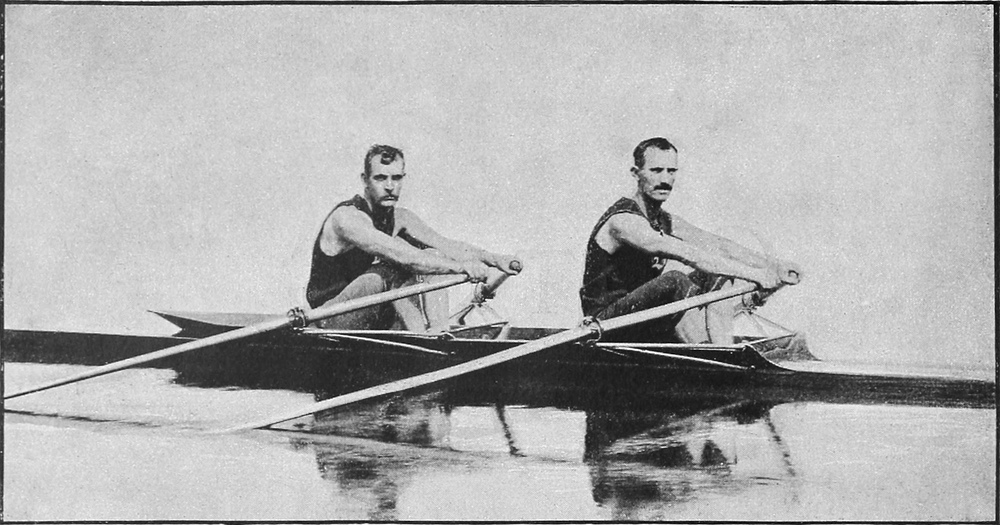
J. F. KORF AND W. WEINAND OF THE DELAWARE CLUB.
The annual regattas of the “Chicago Navy” are also held on Lake Calumet, at that remarkable town of Pullman owned by the great sleeping-car knight. The lake is about four miles long, and the course is three-quarters of a mile from start to turning-stake. The first annual regatta was held July 4, 1887.
FARRAGUT CLUB.
Both from the fact that it is the oldest settler, and from its record, the Farragut Club must take supremacy. It was organized March 10, 1872, and incorporated July 1, 1875. The fleet at that time consisted of one barge, the Farragut, and the timber-house of the Illinois Central Railroad Company was its boat-house.
In the spring of 1873 a boat-house, which cost $350, was built at the foot of Twenty-first Street. This was destroyed by a storm in 1874. Another was erected in its place, which was, later, moved to Riverdale, on Calumet River, to be used for training purposes, and a new boat-house costing over a thousand dollars was erected on the old site. In November, 1877, this house, as well as that of the Chicago Barge Club, in its immediate neighborhood, was completely destroyed by storm, and only three boats were saved. The next year a two-story brick boat-house was built at the foot of Twenty-fifth Street, costing $4,000. The first floor was used for storing boats and the second was devoted to social purposes. For six years it was a pleasant home for the club. But it would seem that Fate had an especial grudge against the Farragut, for, it becoming necessary to move the boat-house nearer the lake to make way for the encroachments of a railroad, in the month of March, 1883, a furious storm arose and destroyed it, with twenty expensive boats.
A temporary house was at once erected and new boats were purchased, and the ambition of the club was fired rather than daunted by its repeated disasters. It was fast outgrowing the former narrow limits of the organization, and at this juncture its president, Lyman B. Glover, to whom the club is more indebted than to any other one man, proposed that they should build an elegant club-house on some eminence overlooking Lake Michigan, and simply provide a storage for boats near the water.
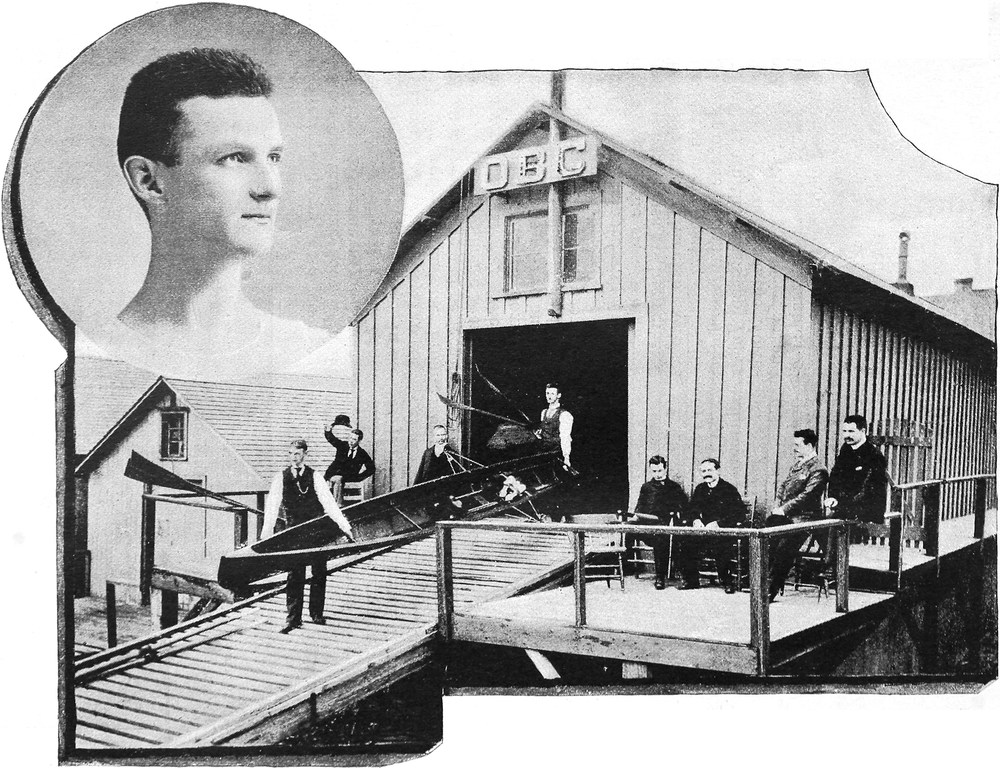
OGDEN BOAT CLUB.
⇒ LARGER IMAGE
This rather startling proposition speedily gained favor, and the result is shown in the superb club-house which stands on a lofty elevation on Lake Park Avenue, overlooking the vast expanse of the blue lake which stretches before it. It is a model of correct and elegant architecture. From its balconies and observatory one commands a view of the entire city as well as the lake. Indoors it is most conveniently arranged for the comfort and pleasure of its habitués, the hall and staircase being especially beautiful. It is finished throughout in hard wood, and its fireplaces are handsomely tiled, with the initials of the club inserted. There are two spacious parlors, directors’ room, card-room and billiard-room on the first floor. On the second is a large gymnasium and dancing-hall, which is also equipped with a good-sized stage for dramatic purposes. In the basement there is a bowling alley, two pool tables, and various other attractions. From top to bottom it is complete and perfect in every respect. The club-house seems to have been a veritable mascotte. The limit of membership has been raised from time to time, until now it rests at two hundred and fifty. Socially the club is an important factor, being made up of prominent business and professional men.
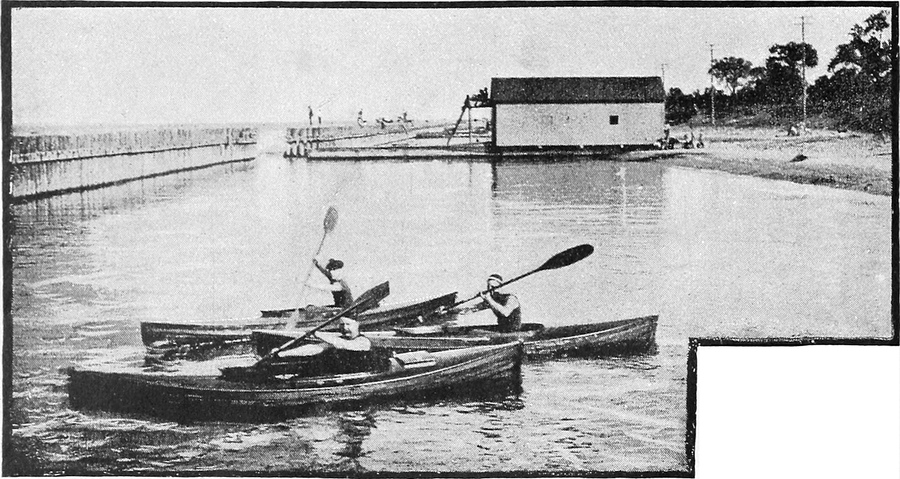
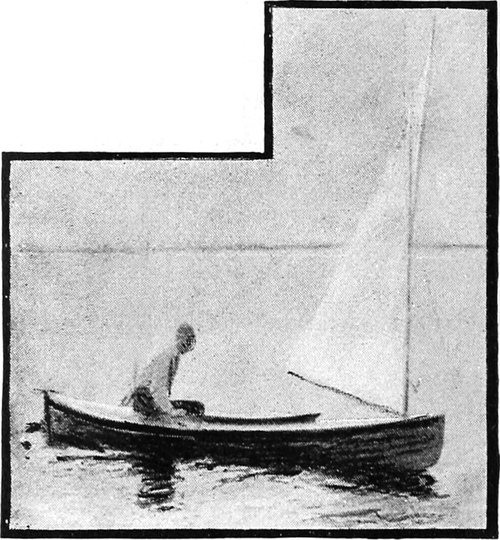
STARTING FOR A PADDLE.
The club is well equipped with a fleet of thirty fine boats, for the storage of which a commodious boat-house has been erected near the club-house. This club exercises active interest in many boating circles, being a member of the National Association of Amateur Oarsmen, the Mississippi Valley Amateur Rowing Association, the Northwestern Amateur Rowing Association, and the Chicago Navy. It has a remarkable record, for a Western club that has no smooth water for practice, of seventy victories, trophies of which adorn the walls of the club-house. In 1879 and ’80 their four-oared crew—Downs, Adams, Young and Muchmore—won several brilliant races. Their time was not beaten for some years. In 1882, at St. Louis, McClellan, Van Schaak, Metcalf and Berau won the four-oared race against the celebrated Minnesota crew of St. Paul. In 1885 a great four-oared crew, Billings, Plummer, Avery and Fowler, won eight straight races. In 1886, at the regatta of the M. V. R. A. at Moline, Illinois, the pair-oared crew, Adams and Jennison, defeated Clegg and Standish, of Detroit, who were the former national champions.
But the bright particular star of the club is the recent champion amateur sculler, J. F. Corbet. He was formerly a member of the Pullman Club, and won his first race under their auspices. But he has for some time been a member of the Farragut crew, and the club is justly proud of his great record.
In 1886, at the Northwestern Rowing Association regatta, at Grand Rapids, he won the senior single; time, 13m. 453⁄4s., two miles with turn. At the National Association regatta, at Albany, N. Y., in the same year, he won the trial heat; time, 8m. 461⁄2s., one and a half miles straightaway. In the final, he beat all but Mr. Monahan, of Albany, but was shut out at the finish by rowboats closing in upon him.
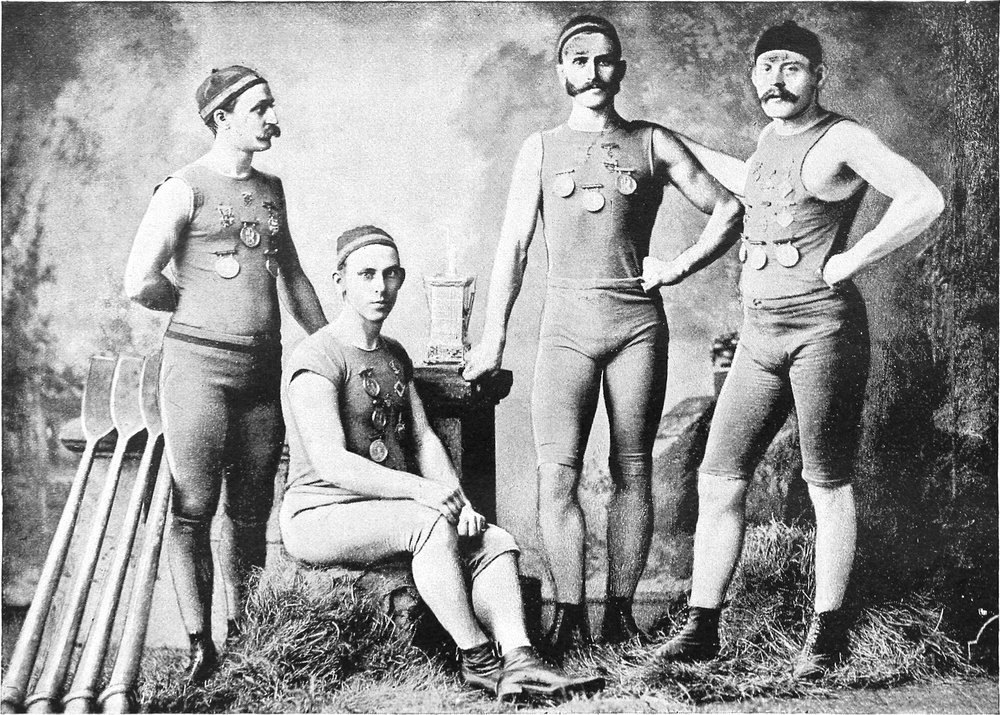
H. C. AVERY. H. P. BILLINGS. C. A. PLUMMER. M. F. FOWLER.
THE BIG FOUR OF THE FARRAGUT CLUB.
⇒ LARGER IMAGE
In 1887 he won the senior single in the Chicago Navy, M. V. R. A. and N. W. R. A. regattas, and at the National regatta, on Chautauqua Lake, won not only the senior single on one day, but on the following the final heat and the Amateur Championship of America, beating all the scullers of the United States and Canada. To complete this record of two years, which has never been surpassed by any amateur sculler, he won the senior single at Lake Minnetonka regatta; time 10m. 40s., one and a half miles with turn.
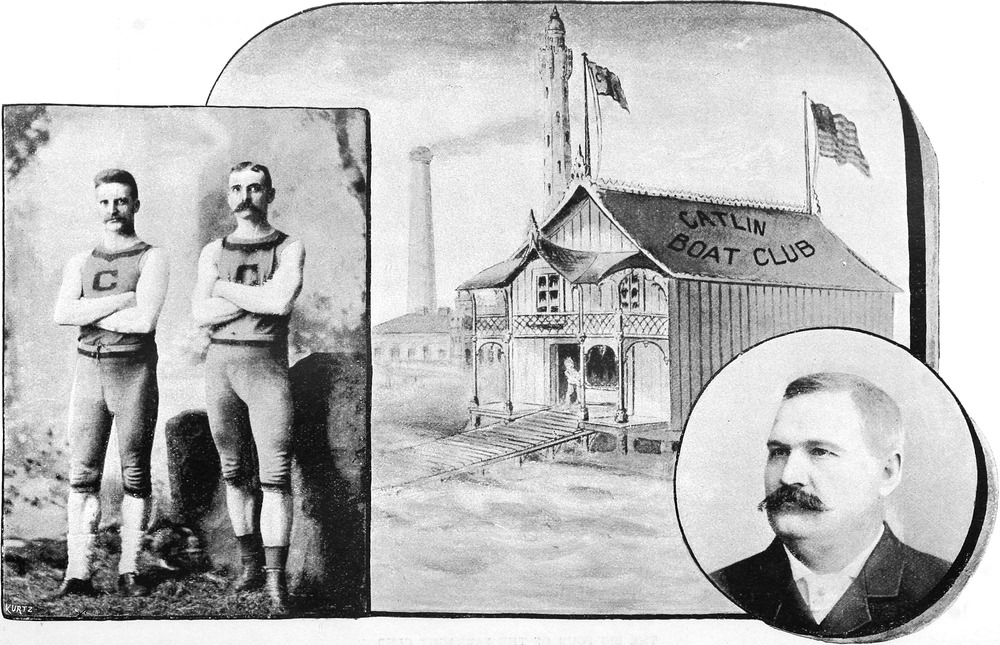
CATLIN BOAT CLUB.
⇒ LARGER IMAGE
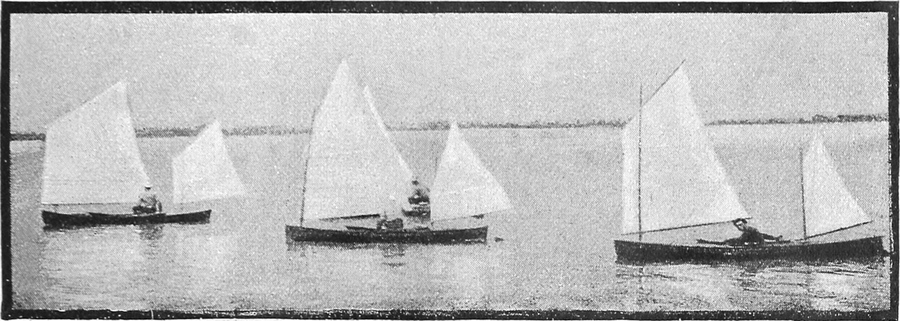
SOME OF THE TIPPY-CANOE CLUB FLEET.
Among other prominent men in boating circles who have been members of the Farragut Club, may be mentioned W. B. Curtis, of the Spirit of the Times; John Ostrom, the famous Cornell stroke and captain; and Frank E. Yates, who was twice the national champion.
Lyman B. Glover, who was for seven years president, and George R. Blodgett, secretary, were presented with honorary memberships in the National Amateur Rowing Association of France.
CATLIN CLUB.
This club, so-called from its president, Charles Catlin, who is also commodore of the M. V. R. A., though practically a new club, has done good work and made a record for itself at its first trial. It was founded in 1882, with a boat-house at Cedar Lake, Indiana; but last year a commodious boat-house, with a capacity for storing twenty boats, was built in Chicago, at a cost of $500. It is the intention of the club to fit up the second story as a gymnasium and club-room. Reeding and Goff form their crack team. They won the junior double in the Chicago Navy regatta last year at Pullman, and later the junior double in the M. V. R. A. regatta. It is an ambitious, energetic club, and intends to do great things in future. Mr. Catlin is their main stay, and though not an oarsman himself, is exceedingly popular with his followers.
OGDEN CLUB.
What is known as the “gilt-edged” club of Chicago, being very exclusive in its tendencies, is the Ogden Club, so named from the first Mayor of Chicago. Its boat-house was originally near the foot of Chicago Avenue. But Lake Michigan, with a reprehensible disregard for the feelings of so aristocratic a club, proceeded to wash it down as fast as it was erected. It was finally removed to the foot of Superior Street, where it now stands in safety. It is the largest club on the North Side, and, as one of its prominent members expresses it, “looks more to the social than physical status of its members.” Heretofore it has devoted its attention to barge parties, pleasure rowing and sailing, but proposes to give more time to racing in the future. A costly “Goldie” rowing-machine was purchased this winter, and several new boats and shells have been ordered. The president, Mr. James W. Scott, who is proprietor of the Chicago Herald, has offered five gold medals to be competed for at the club regatta next fall.
Among its honorary members is Professor David Swing, the famous preacher. A prominent active member is W. M. Le Moyne, who was captain of the Harvard University crew in 1876–77. The club owns a number of fine boats, including two four-oared gigs, four sailing canoes, six shell-bottom working boats, five pleasure boats, a single-scull shell, and a barge that will carry fifteen people.
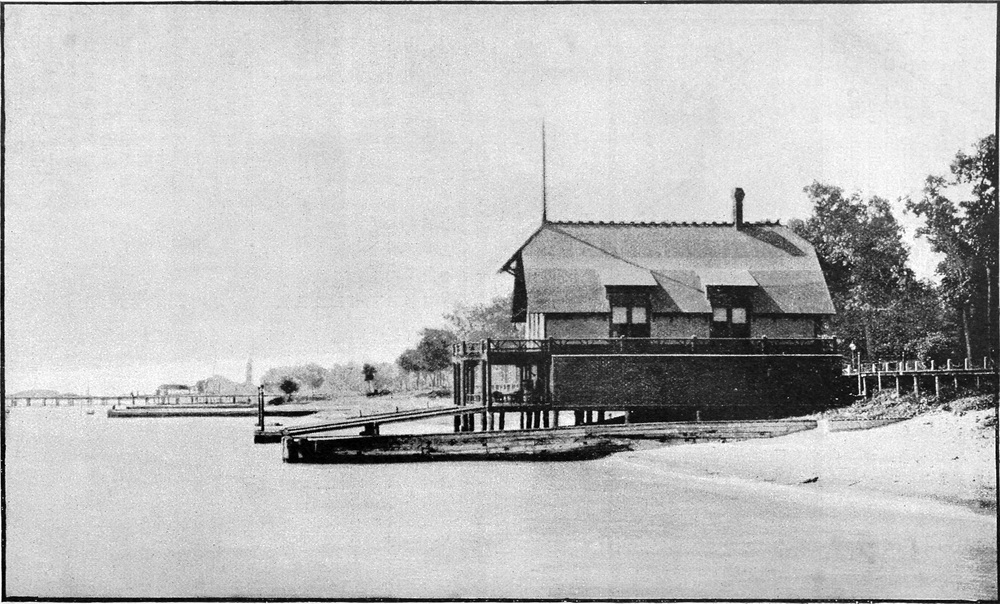
CLUB-HOUSE AT EVANSTON.
⇒ LARGER IMAGE
E. D. Neff, captain of the club, who is also secretary of the Chicago Navy, won the single sculling race in the Navy regatta last year, defeating a competitor who was considered invincible. He has competed in the single sculling races this year, in the regattas of the Chicago Navy, Mississippi Valley, and Northwestern Associations.
There is a project afloat to issue bonds and erect a club-house which shall cost thirty thousand dollars, and contain theatre, gymnasium and billiard rooms, but no action will be taken until the course of the Lake Shore Drive has been settled.
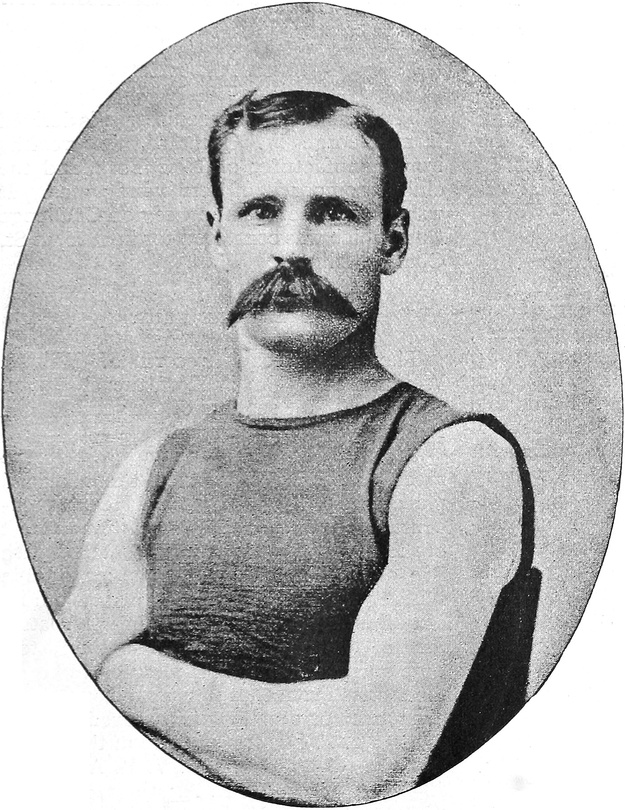
J. F. CORBET, FARRAGUT BOAT CLUB.
TIPPY-CANOE CLUB.
This club is, as its appropriate name indicates, a canoeing organization. It has a fleet of sixteen canoes, which for beauty of model and excellence of finish compare favorably with those of any club in the country. The captain of the club, Mr. D. H. Crane, who unites a wide experience in boating matters with unusual skill as a draughtsman, is the designer of these canoes.
At the first annual regatta of the Chicago Canoe Club, in 1884, J. B. Keogh, in the Phantom, of Class A, won the sailing race, and again in 1885. In this same year A. W. Kitchin won the “paddling” races for Classes 2 and 3, in the Gypsy, and in the “upset” race won again in The Bells. The tandem race was won by J. B. Keogh and H. B. Cook.
In 1885, the Chicago Canoe Club became defunct, its members joining the Tippy-canoe, which is now the representative canoe club of the State of Illinois.
No club regattas were given last year, but the members carried off all the prizes in paddling at the Navy regatta at Pullman. Later in the season, several of the members attended the Western Canoe Association meet at Ballast Island, and carried off many laurels.
Kitchin won the paddling race again in the Tippy. B. W. Wood’s Vivum won the free-for-all “no ballast” sailing race. R. P. McCune’s Idler won the “hurry-scurry” race, as well as the free-for-all sailing race around Ballast Island for the Nixon special prize; while in the “Tournament,” the contest that always proves so edifying to spectators, G. C. Messer and his partner succeeded in capsizing all who entered the lists against them.
IROQUOIS CLUB.
Organized in 1882 and incorporated in March, 1888, this club did not escape the misfortune of many of its fellows, for in 1884 their boat-house was blown down and washed away, and many boats and shells destroyed.
Nothing daunted, they erected a new home at the foot of Chicago Avenue on the lake front.
They own a fleet of twelve boats, one, a four-oared shell, being the finest in the West. Their uniform is very handsome, and they have patriotically selected red, white and blue for their colors.
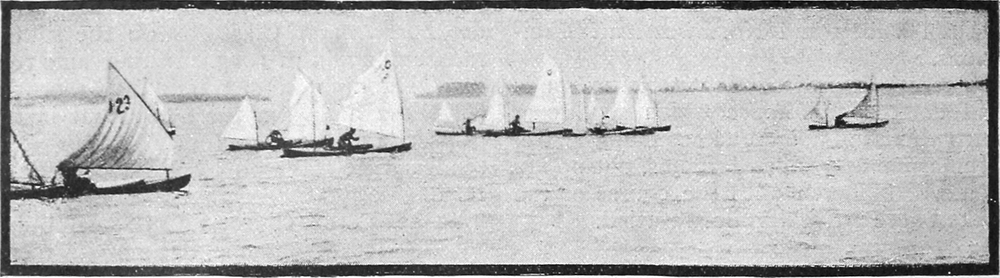
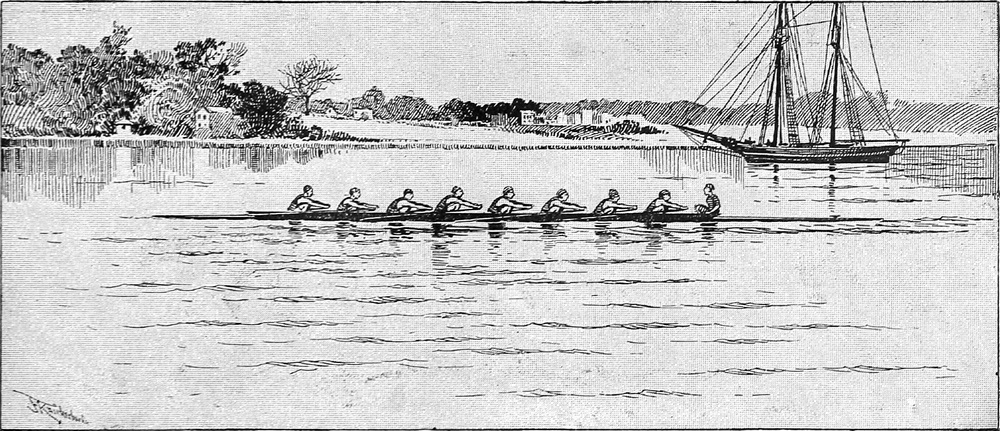
A RACE OF THE TIPPY-CANOE CLUB.
One of their single shells won two victories at Pullman last season. They are workers, and propose to make themselves felt in the future.
EVANSTON CLUB.
The preliminary organization of the Evanston Club was effected in September, 1880, and incorporated in February, 1881.
Their equipment is good. They own forty boats, including single shells, double sculling boats, four-oared shells and several canoes. Canoeing is quite as popular with them as rowing. This club holds every year a series of local regattas which attract considerable attention, the contestants all being members of this club. The membership numbers one hundred and sixty-one. They possess a neat and commodious club-house, which is beautifully situated.
The club seems to be of a genial, social nature, and does not greatly thirst for glory.
HYDE PARK CLUB.
This club devotes its energies chiefly to sailing, and has a fleet of thirty sail-boats, two steam launches and one cat-boat.
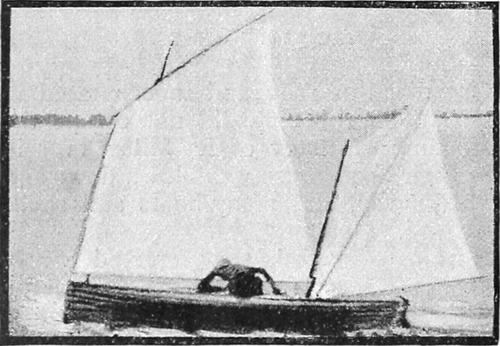
UNDER WEIGH.
QUINTARD CLUB.
The name of this organization is derived from George W. Quintard, the wealthy iron manufacturer of New York, and the club is composed of very young men. It was the winner of the Cregier Challenge Cup, which was contested for in 1886, at St. Charles, Illinois.
DELAWARE CLUB.
The phenomenal record of William Weinand and John F. Korf, the champion amateur double scullers of the country, has rendered this club famous.
In 1883 this noted team entered the races of the M. V. R. A. and took second place among four starters. Heartily encouraged, they worked actively for the rest of the season, and in ’84 were entered, with five other starters, in the junior double sculling race. They won this race and also the senior double, winning the latter race of two miles and turn in the fastest time on record of twelve minutes and forty seconds. From that time they have never been beaten, and have won over twenty-five races. The most notable of these are: 1884–85–86–87, of the M. V. R. A.; 1885–86–87, of the N. W. R. A.; the race for the medal at the New Orleans Exposition; the race for the National Championship at Albany, N. Y., in 1886, and that on Lake Chautauqua in ’87.
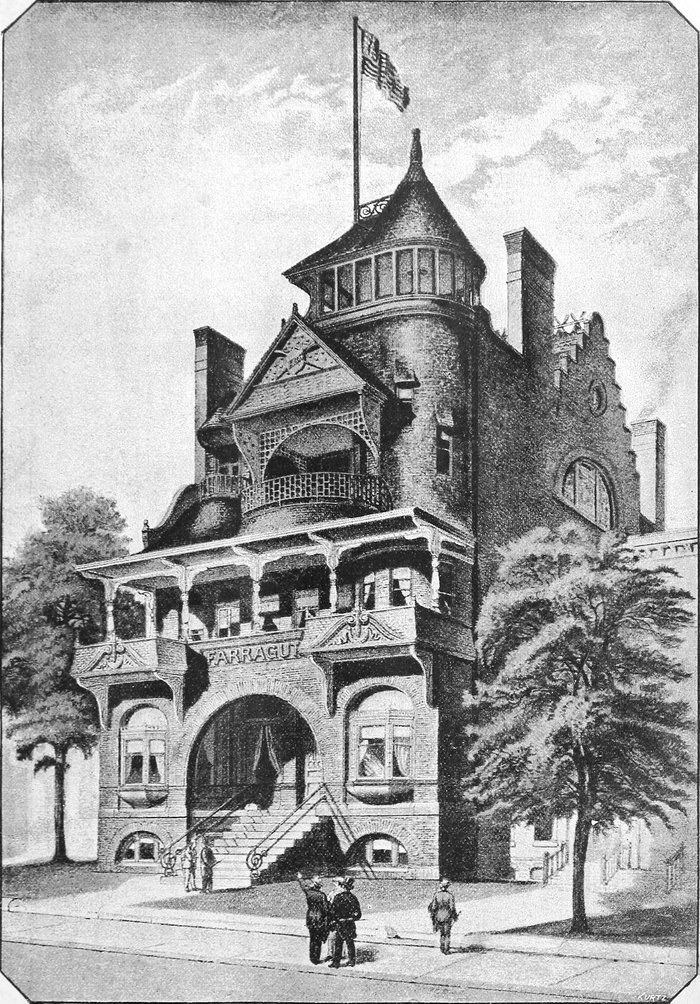
THE FARRAGUT CLUB-HOUSE.
⇒ LARGER IMAGE
By a decision of the referee, they were disqualified after winning the latter race by forty seconds, and being dissatisfied with this result, they are anxious to meet any amateur double sculling team in the United States or Canada. Indeed, they challenged the famous Metropolitan double to a race on Lake Calumet, offering to put up an appropriate prize, and pay all the expenses of their competitors, but the offer was declined. Few teams, it is apparent, care to meet these all-conquering oarsmen. They will no longer be allowed to row in the races of the M. V. R. A. and the N. W. R. A., as they, of course, prevent competition.
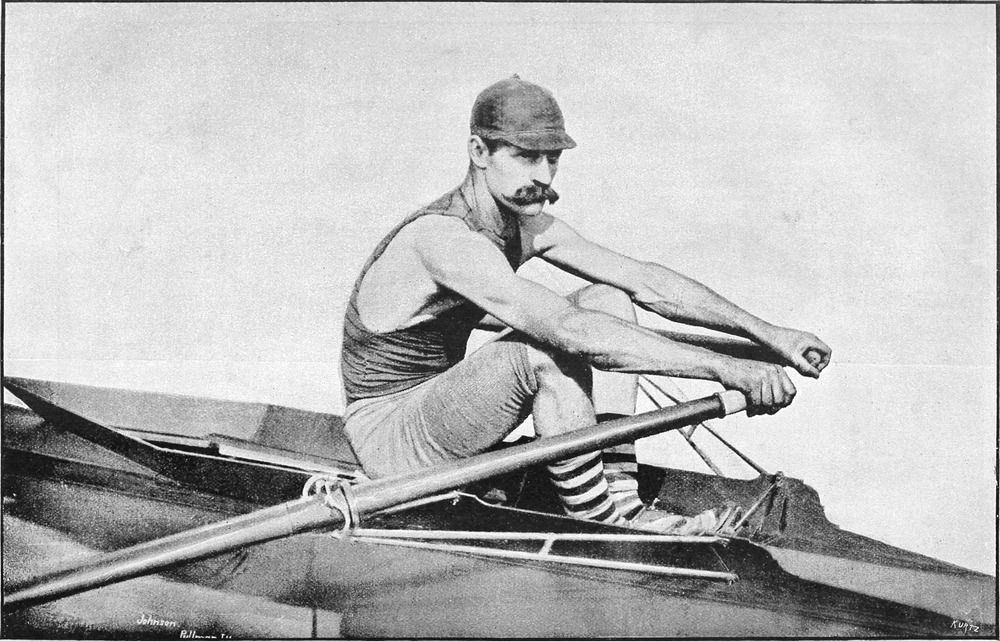
J. F. CORBET.
⇒ LARGER IMAGE
In future they will turn their attention to bringing a four-oared crew to the front that shall win fresh laurels for the Delaware.
There are only sixteen members, but they intend to become known by works rather than numbers.
“We have no wall-flowers,” said handsome, athletic John Korf, “but men that are willing to try to win races.”
The club has a fleet of thirteen boats, and a good-sized boat-house, the second story of which is used for a gymnasium, and is well stocked with apparatus for the development of the muscles.
PULLMAN CLUB.
The history of the Pullman Club is so interwoven with that of the Athletic Club of the place, that it requires almost a separate paper.
There is a beautiful island of about three acres in extent lying in Lake Calumet. This has been most handsomely laid out for athletic sports by command of Mr. Pullman. Here is located a substantial club-house, and here are erected two grand-stands with a seating capacity of four thousand.
Under these grand-stands are accommodations for thirty rowing clubs, at the least calculation, and from them one obtains a fine view of the regattas.
The Pullman Rowing Association was formed in 1881, and the next year the international regatta took place there.
Many professional oarsmen from Canada, England and this country were present, and the universal verdict was one of favor for Pullman’s rowing course.
Through the efforts of Mr. Lyman Glover, President of the Mississippi Valley Rowing Association, that organization holds its annual regattas on this lake, and efforts are being made to induce the Northwestern and International Associations to do likewise. Lake Calumet seems well adapted to aquatic sports, being a mile and a half in width by four miles in length, and can always be depended on for smooth water in the evening. The property of the club consists of one six-oared racing barge, two four-oared racing shells, two single shells, two gigs, and eight pleasure-boats. The club entered crews in the National regatta at Detroit in ’83, and got second place among seven starters. It has defeated the Farragut and Delaware clubs in match races. It won the barge race and four-oared shell race at the Chicago Navy regatta of last summer, and the four-oared junior race at the M. V. R. A. regatta a few days later.
Thus it will be seen that Chicago can point with pride to the achievements of her oarsmen, and, with admirable audacity, she prophesies greater victories in the future.
I wish to acknowledge my indebtedness to Mr. Lyman B. Glover, of the Farragut Club, and Mr. Thomas P. Hallinan, of the Catlin Club, for their invaluable aid in procuring data for this sketch.
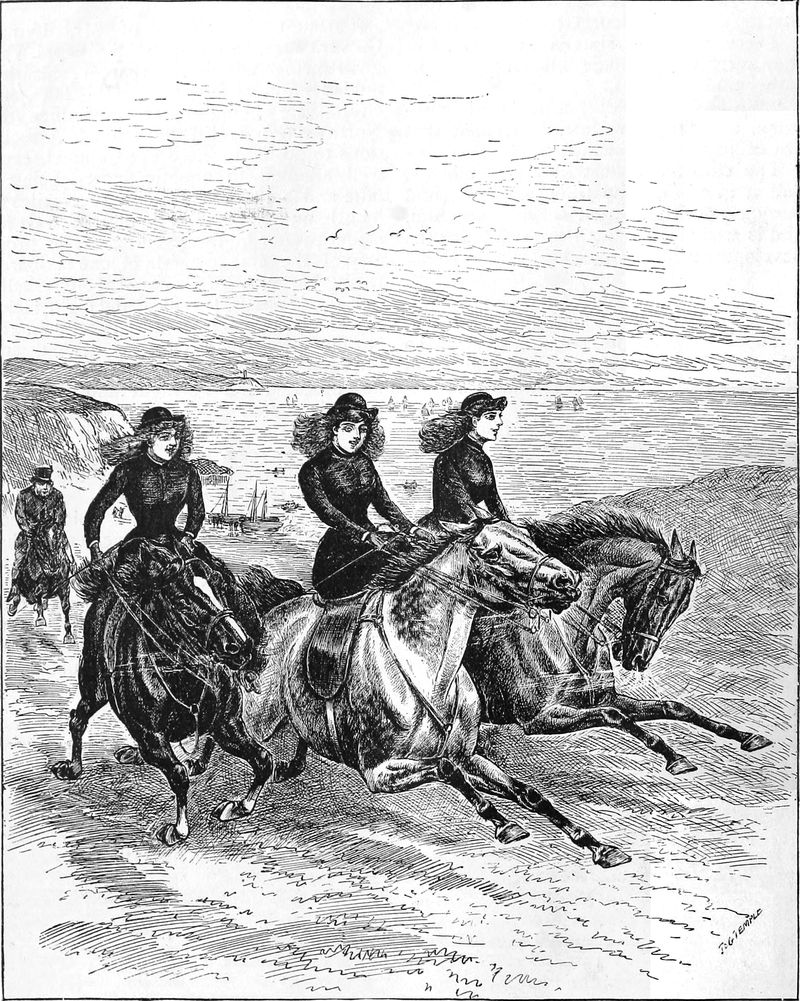
A SCAMPER ON THE BREEZY DOWNS OF SUSSEX.
⇒ LARGER IMAGE
A TALK ABOUT THE PIGSKIN.
BY A SPORTING TRAMP.
“This gallant Had witchcraft in’t—he grew unto his seat; And to such wondrous doing brought his horse, As he had been incorpsed, and demi-natured With the brave beast.”—Hamlet.
TO deliberately sit down and write on the subject of riding is a task which is attended with no slight difficulty. Such themes are invariably hard to handle, but riding has special difficulties. Much that is apropos and correct has been written on this most engaging subject from the day of Xenophon onward, but it is nevertheless an impossibility—nay, more, it is an absurdity, to suppose that rules can be shaped by which all can regulate their particular styles of riding. It is as futile to try to frame a code for the direction of both the fashionable crowd of a metropolis and the ranchmen of the West as to compare the Indian squaw, crouched on the pony that drags the “tepee” poles, with the blithe damsels enjoying a scamper on the breezy downs of Sussex.
Not only do different surroundings and objects alter the style, but Mother Nature has endowed her sons with limbs of varying shapes. It is no more possible for the short, stout man of vast avoirdupois to emulate the methods of a McLaughlin, a Fred Archer or a Tom Cannon, than it is for the same person to look elegant on a ball-room floor. “Circumstances alter cases,” and every man must adapt himself to the saddle as best he can.
Again, what may be a very taking display of horsemanship in Rotten Row, or Central Park, would look sadly out of place in rounding up a “bunch” of cattle on a Wyoming ranch. An equestrian might look very nice at a meet of fox-hounds, about whom we entertain grave doubts whether after forty minutes’ run across a stiff country he would be still well to the fore. The method that in one place is a near approach to perfection is worse than ridiculous in the other In this connection arises the fact that, though there are many brilliant exceptions, the great jockeys of the English flat are, generally speaking, by no means so much at home when following hounds as when braving the dangers of Tattenham Corner. Of course, however, it is by no means impossible, and it is often the case, that a man can adapt his style to his immediate circumstances, but it is rare to find a man who excels in all styles.
Some few years ago a “Britisher,” who though young had already made a name for himself in the noted hunting counties of Ireland and Leicestershire, migrated to the far West to try his luck in the ranching business. His scorn was great when he saw the unwieldy saddles that cowboys used, and he promptly determined to keep an English hunting saddle for his own use. His lesson was soon learnt, and after a few “almighty croppers,” he adapted himself to circumstances and the saddle of the country. Ere long his fame as a rider spread among the very “broncho busters” who had laughed at him on his first arrival. The finishing touch to his lasting renown was reached when he managed to sit a certain animal yclept the “Camel,” which had disposed of all previous aspirants to the honor of mounting him.
Such cases are rare, and though some few Englishmen have acquired a great reputation as riders in the West, the majority find that the style to which they have been brought up stands in their way when it comes to riding cow-ponies. Mayhap Buffalo Bill’s visit to Earl’s Court, London, may prove to have inculcated the necessary lesson.
One thing is very apparent to English visitors to New York, and it is that the English seat is now the thing. By the English seat we mean what is called, “across the herring pond,” the park seat, though we see occasionally symptoms of the adoption of the hunting seat. But before going farther, it would be well to say a few words as to the differences between the two. The park seat is the dandified style mostly taught in riding-schools. It is, however, an indispensable qualification of any man who wishes to “show” his horse. The general appearance is rather similar to that one may notice among the horsemen of the Southern States. Though a difference exists, it is hard to define, but may be summed up thus: while every Southerner seems part and parcel of the animal he bestrides, whence comes the common dictum that all Southerners are born cavalrymen, the possessor of a park seat, however perfect, lacks the appearance of being perfectly at home on his horse. The reason is obvious, viz., that the park seat is artificial, and the rider’s attention is chiefly given to producing good action on his hack’s part. He carries his hands high, often very high, and as he rides he “lifts” his horse, and is answered by correspondingly high action. The bit is often severe to further this. The rider’s feet are carried rather wide, and all the while the calf of the leg is never quite at rest, for while the grip of the knee is neglected, the calf is kept continuously but gently in motion. The spur never touches the flank, but the horse feels the necessary reminder at his ribs, and frets and moves with vigorous action as his rider wishes. In such a seat the foot is thrust but a short way through the stirrup, and rests on the iron at or about the ball of the great toe. The rider has, of course, to sit well down in his saddle, and stick to his horse mostly by balance, as the seat-preserving grip of the knee is so slightly maintained.
Youatt, in his book “The Horse,” gives the following instructions regarding the riding of hackneys: “He does wrong who constantly pulls might and main: he will soon spoil the animal’s mouth. He does worse who carelessly throws the reins on the neck of the horse. Always feel the mouth lightly, with a simultaneous pressure of both legs. By these means, the rider will insure a regularity of pace, and command the safety and speed of his horse. If he depends entirely upon the feeling of the hand, the mouth may become too sensitive, and refuse to have the proper bearing upon the bit.... Again, if the horseman neglects the elasticity and fine feeling of the hand, and makes too much use of his legs alone, a callous mouth and boring upon the bit will most likely result from the practice.... By this constant gentle feeling he will likewise be induced to carry his head well, than which few things are more conducive to the easy, beautiful, and safe going of the horse.”
To turn to the other style of English riding, it must be said that here there are many variations in style. The older school adopts a very short “leather” and feet thrust well home into a heavy stirrup, with a tendency to disregard the smaller niceties of the art. Look at an old gentleman nearly approaching the span of life allotted by the Psalmist, as he makes his way to covert. If he allows his horse to go out of a walk at all, the pace does not exceed a slow “jog” or trot, in fact, what is called the “huntsman’s jog.” He goes along, bump, bump, bumping, or, perhaps, for some hundred yards effecting a kind of shuffling rise from his saddle, while his knees seem to have no grip whatever on his horse’s sides and sway to and fro with every motion. Probably any stranger to the country could make many greater errors than to follow this old gentleman when hounds are running a rattling pace with a breast-high scent, for as necessity calls, a change takes place in his riding. See him as he lifts his flagging hunter at that stone-wall, his grip on the saddle is wonderful and he seems glued to it! This style is still common in England, and every man who has hunted there will see in his mind the picture of some white-haired old gentleman to whom this description might apply. Such men were the older generation who were content to rise before daylight, to ride long miles to the covert side without taking their horses out of a walk or a slow jog, so that they might arrive fresh and fit for the day’s sport. One may see them still, jogging behind the huntsman and his hounds, leaving the more rapid conveyances of train or tandem to sportsmen of the modern stamp.
One reaches the meet, and though the time appointed is eleven o’clock sharp, the master is not here yet. He belongs to the younger school of sportsmen with whom punctuality is not one of the cardinal virtues. But after twenty minutes, which are profitably employed in exchanging greetings and inquiries after absent friends, he is seen in the distance.
Down the bridle-path he comes as fast as his smart little covert-hack can lay legs to the ground. He is a perfect picture of the more modern school of cross country riding. A dim suspicion crosses the mind that he may at some period have held a commission in a crack cavalry regiment. Decidedly there is a soupçon of the military seat about him. Stirrups long, feet thrust in to an extent half way between the old hunting and the park style, hands kept low, sitting well down in the saddle, very probably with only a snaffle, or, at any rate, but a merciful double bridle, he looks as graceful a knight as ever championed dame of old in the jousting field.
In no costume is there such a happy blending of the dandified and workmanlike as in a well-appointed hunting man. Nowhere is the scorn showered on the luckless dude who has missed the workmanlike part of his equipment so great as in the hunting-field. The top-boots glittering in the gleam of sunshine in spite of their perfection of fit are stout enough to keep the wearer’s feet dry, should he do such an unlikely thing as take a walk in them on a rainy day. The spotless leathers are warm and comfortable—the smart “pink” is a roomy and serviceable garment. The resplendent silk hat will perhaps save the wearer a broken neck or fractured skull ere the day’s work is done. That milk-white scarf so neatly and dexterously tied that it also takes the place of collar, protects the throat and chest and relieves its wearer from the galling confinement of a collar. And the horse’s saddle and bridle, how simple and yet how handsome! not a buckle too much, but yet a man could rely on such work if he rode for his life.
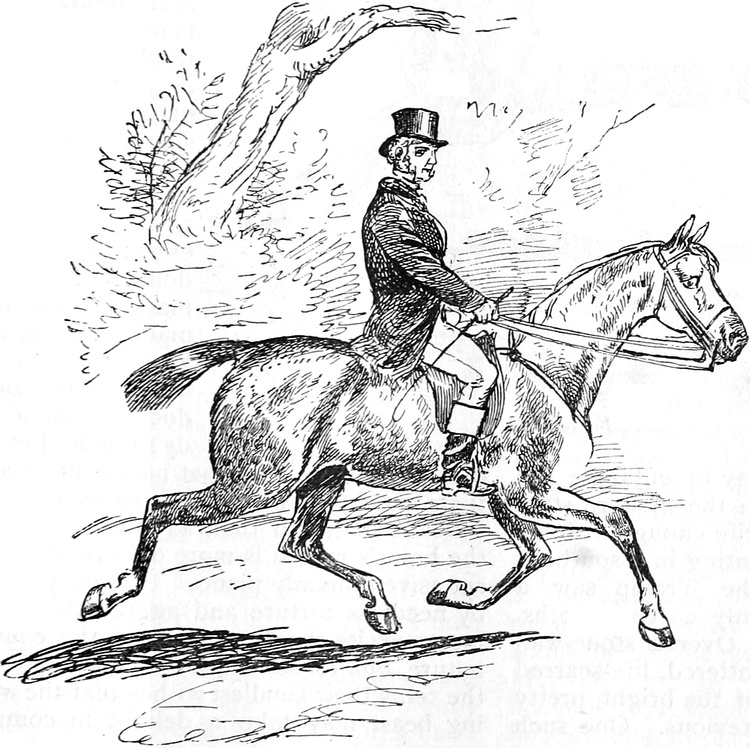
ONE OF THE OLDER SCHOOL OF SPORTSMEN.
The fashion for the last few years in England has been all for plain-flap saddles, i. e., with no knee-rolls at all. No doubt they look neater, and give no artificial support, making the rider rely entirely on his own powers, but there are disadvantages. Should a horse take it into his head to buck, or “pig-jump,” the merest pretence of a knee-roll will save a good rider, who without it may cut a somersault, from being taken unawares. Again, the absence of them no doubt affects the riding somewhat, giving an increased looseness of seat. Hence it seems a pity that the arbitrary Goddess of Fashion should lay down a hard and fast law, instead of allowing her votaries to follow their own inclinations.
Another fashion which has a bad side to it, is the recent introduction of very long-necked hunting spurs. They look very tidy and trim, with the long, straight piece of highly-polished metal finishing off the heel of the smart boot. Few men, however, find themselves capable of wearing such a spur with rowels left in. The danger of cutting the horse, most probably in the shoulder, is too great; hence has arisen the foolish custom of making spurs without rowels, or with plain round rowels, merely for appearances’ sake. In truth the short spurs, with curved necks, of our fathers may not have been so effective in appearance, but when punishment was to be given to a refractory horse, they had the pull. With the introduction of the English method of riding has come the adoption of the English riding-breeches for men, and the short, safe, plain skirt for ladies. In regard to the latter the Tramp has but little experience, and feels but slightly qualified to speak, though in the English sporting papers he has read vast columns of correspondence on the question from the pens of such authorities as Mrs. O’Donoghue Power. But to any practical horseman it must be a patent fact that the modern style is in every respect superior to the old-fashioned. To see a lady following hounds in one of the once fashionable flowing habits was a sight to make any one capable of reflection shudder. Without entire knowledge of all the intricacies of elastic loops, shot-weighted skirts, etc., one could not but feel how impossible it was that in an accident those flowing lengths should fall clear of a pommel, or fail in some way to entangle the fair wearer. Even with the modern style of skirt, accidents are rife enough. Some few years ago, while hunting in a southern county of England, the Tramp saw a young lady, married only a few months, dragged by her habit. Over a stone-wall flew the horse, and a battered, life-scarred visage took the place of the bright, pretty face of five minutes previous. One such sight is enough for a lifetime.
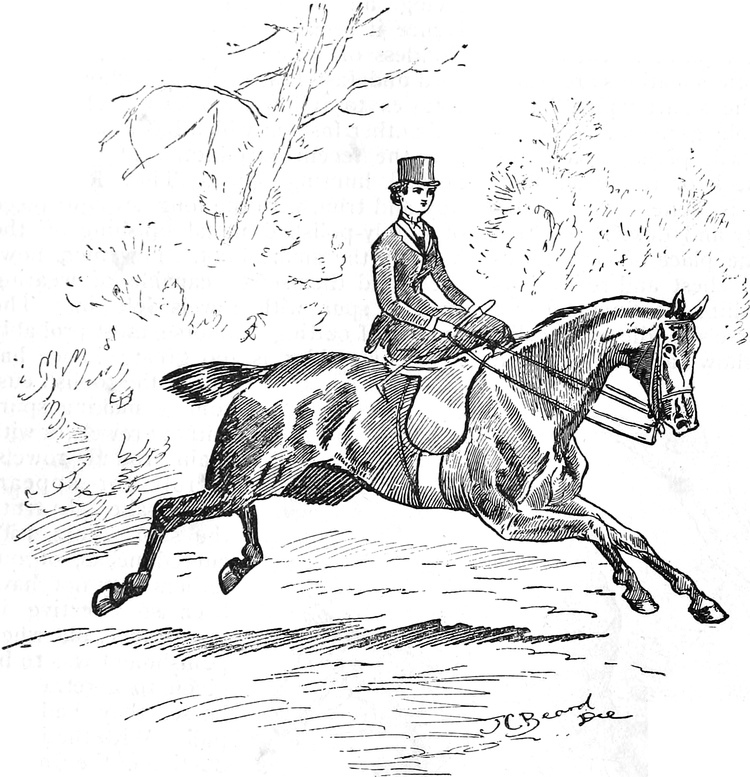
A MODERN DIANA.
After all, nowadays a lady has but little more encumbrance than a man, and who shall say modesty is in any respect violated, clamorous as was the outcry at the first adoption of the short skirt? To watch a beautiful woman on a fine thoroughbred, clad in a neatly-cut habit with its plain severe folds, and the suspicion of a dainty patent-leather jack-boot apparent, is to see God’s noblest work to every advantage. Even the increased masculinity that fashion has dictated of late years, is becoming, under the circumstances, and the shining silk hat, dainty tie and collar, and trim edges of fancy work simulating the male waistcoat, all add to the tout ensemble.
The trouble with ladies in the saddle is often said—alas! with considerable truth—to be that they are unmerciful: that to them a horse is as an engine, bound to go at any pace desired until it is stopped. One cannot but feel admiration when one sees a lady calmly and dexterously manage a fretting, restless horse in a crowded ride. Too often it is that sharp, cruel little spur beneath the habit that is the cause. On the other hand, it is an undoubted fact that many a horse unmanageable to the heavier hands of a man, will become docile under a lady’s touch. Let ladies, then, remember that nature has made them capable of more sensitive handling of the horse’s mouth than any man, and that the horse’s mouth is more delicate and responsive than any piano. The glory is not by needless torture and aggravating teasing to excite the baser side of the equine nature, but to so convey to the horse by the reins their smallest wishes that the willing beast may take a delight in compliance.
Men can by no means lay the sole claim in these times to workmanlike simplicity. The ladies have adopted this as their motto. The days are gone for trailing skirts, plumed hats, lace collars and such stagey effects, and the modern Diana relies not on her winning feminine graces, but her ability to rival man in his own field.
Well does she press her claim. To see the score or so of young ladies that follow an English pack must prove an eye-opener to those of an older generation when riding to hounds was thought unladylike, and a gentle palfrey of easy paces considered the right mount for the sweeter half of humanity. Now, whether it be in Central Park or Rotten Row, the hunting field or the road, the lady assumes the place that is her right, if her ability equal her ambition. All lackadaisical ideas are thrown overboard, and the best one is she who rides best.
Nor do the ladies lack leaders in such a movement. With the Empress of Austria showing the way across country, and the Princess of Wales gracing Hyde Park with her presence, who shall say that bright examples are lacking? Many more might be quoted; the Empress Victoria of Germany was accounted a good rider in her day, and, in fact, Queen Victoria and all her family have been fairly expert in the saddle.
Concerning the male riding costume the Tramp has formed decided opinions, for he has tried all shapes and kinds. His conclusion has been that nothing equals breeches, carefully made by a good tailor. The feeling of snugness about the knee is pleasant, and enables the rider to get a good grip, and feel his horse; with the ordinary garments of the male biped there is a great tendency to wrinkles and such discomforts. For hunting, the lower parts of the limbs are best equipped in top or butcher boots, while for ordinary hacking a neat pair of lace shoes, with gaiters cut loose in the lower part, are the best outfit. But above all eschew hooks for the laces; nothing is more prone to cause serious mishaps in accidents than these consolations for the lazy. They are simply a patent invention to ensure that a foot stuck in a stirrup may never come out of it till the owner has been dragged or kicked to death. As to the upper part of the body, every man should follow his own inclinations.
In England, however, custom has made certain rules which are not to be lightly transgressed. No man should don a black tail-coat with a low hat, nor a shooting-jacket with a tall hat, nor a tall hat and black coat with gaiters. In the hunting field, no man should wear white riding-breeches and top-boots with anything but either a pink or black tail-coat and a tall hat or hunting-cap. By the by, the hunting-cap has almost become obsolete for any but the hunt servants, e. g., huntsman, two-whips, and second-horsemen—and sometimes the master, except in a few woodland counties, e. g., the Braes of Derwent, in Northumberland. Again, no one should wear anything but white breeches and top-boots (i. e., boots with tops of leather of a different color, white, mahogany, pink, etc., as fashion dictates) with a black or scarlet coat and a tall hat; while top-boots should not be worn with breeches of any color but white, though, of course, plain boots (called in England butcher-boots) may be. Such rules are, of course, entirely lacking in any real reason, but the observance of them is almost universal, and the effect produced is good.
Fashion, as is her usual habit, varies every few years in most points. The color of tops may alter, the length of spurs may vary, the correct coat may be cut with a full skirt or a swallow-tail, but these rules are as unchanging as the laws of the Medes and Persians.
But leaving the mandates of the goddess who shares with Fortune the reputation of fickleness, let us return to riding proper. It is a common thing to hear riders, and good riders too, declare that riding cannot be taught, meaning thereby that if nature did not intend a man to be a finished equestrian, no practice or tuition can make him such. This is no doubt to some extent true, but surely even a bad rider can by determination so improve himself as to become moderately good.
Again, ideas differ much as to the advisability of teaching children to ride while quite young. The general opinion seems to be that the younger they begin the better, for that, unless they happen to meet with a serious and nerve-shaking accident, they will become accomplished and bold riders. This opinion is, however, by no means universal, and is not shared especially in some of the English colonies, where a boy who rides boldly when young is regarded as likely to “lose his nerve” about the time he reaches maturity. Whyte-Melville gave his observation in one of his books that among the boldest riders to hounds that he had ever seen were men who had never followed hounds until after twenty years of age.
Much depends on the way in which a youngster is taught. It is very possible to make a child imbibe a hatred of the saddle which will last him into later life. The idea, then, to be kept in mind is that lessons should be made a pleasure, and not a torture. Begin with easily-learnt instruction and short lessons, and the child will enjoy it. But begin with lessons lasting till the poor little legs are aching, and the head is muddled with complicated commands, and the youngster will regard his teacher as his torturer. As the aptitude and capacity grows, the lessons can be made harder and longer, till almost before the teacher or the pupil can recognize the fact, a fair, if not a good, rider has been turned out.
As to the methods of teaching riding, this must be left for riding-masters to discuss, but some few points should, I think, be insisted on. Chief among these is that the horses or ponies on which the pupil is mounted should be changed often. This enables him both to learn how to handle horses with differing qualities of mouth, and how to sit the variations of gait. The most successful results seem to ensue where the first lessons are given on a plain saddle-cloth, or “numnah;” and another important elementary lesson is to make the pupil keep his toes turned up so as to harden the muscles of the inner side of the thigh, and thus acquire a strength of grip. Snaffles should invariably be used, to foster that great essential of a good rider—lightness of hand. The pupil must be taught to ride by balance, that indispensable quality without which all the grip in the world is useless. But above all the master must see that the pupil has confidence in him, or his best efforts will be in vain.
Grip without balance is of no use. One often hears people say that they ride by balance, or that they ride by grip. In reality the one is a necessary concomitant and supporter of the other.
Some few years ago a man with whom the Tramp was acquainted, when slightly in his cups, undertook to go home by a short cut across country. His attempted negotiation of a fence ended in a somewhat ignominious “voluntary.” As he sat on the ground, he plaintively remarked: “Old B—— says that I ride blamed well ’cos I ride by balance. Old B—— ’s a blanked old fool. What the thunder’s the good of balance?” And he had to a certain extent hit the point. No man in creation can ride all the time by grip—the constant strain on the muscles soon brings cramp.
There is in one of England’s fairest counties a certain sporting young squire whose grip on his horse is so terrific that to prevent galling the animal’s sides, a space in the padding of the flaps of his saddle is left where his knees come, with thick padding round the edges. But even this man could not ride always by grip.
This is demonstrated by the schooling which a recruit undergoes on entering an English cavalry regiment. He has to ride on a “numnah” at first, after such preliminary lessons as to how to lead a horse, etc. Next he is placed on a “stripped” saddle, without stirrups—meanwhile riding with only a “biddoon”—and is put to jumping obstacles some two feet high, with his reins tied and his arms folded behind his back. If such discipline as this is not calculated to inculcate the doctrine of both balance and grip one can scarcely say what is. This course is found so severe that many a man who enlists with the idea that he is a crack rider begins to doubt it before he is through the school.
As, however, was said at the beginning of this paper, it is impossible to lay down arbitrary rules for all cases. Any one who has tried it can vouch for the extraordinary difference between riding in an English hunting-saddle and, say, a McClellan army saddle. A follower of the old-fashioned hunting seat would be much put about to follow hounds in one of the peaked wooden saddles, excellent in their own line as they may be. In all truth the saddle has more to do with the formation of a seat than is usually supposed. An uncomfortable saddle makes the unfortunate rider twist and writhe in vain endeavor to find an easy spot. A jogging horse that won’t walk, and an uneasy saddle which seems to be galling one in a dozen places at once, is enough to make a man eschew equestrianism for the rest of his life. It is a man’s fault if he cannot find a saddle to suit him, and in selecting one it should be remembered that as a rule the more comfortable the saddle the better the seat. It is great folly to try to save a few pounds extra weight at the expense of comfort. A large roomy saddle is certainly more comfortable to a rider, and generally easier for the horse, which, unless the work to be done is exceptionally long and wearisome, will never notice the slight increase in weight.
In the same way everything should be as large and roomy as possible without being clumsy. The stirrups should be large and heavy enough to slip easily from the feet in case of accident; the reins broad enough to hold firmly, and the bit or bits solid enough to give the horse something to play with.
One thing should always be borne in mind, which, alas! people are too apt to forget. A horse is not a machine. He is a sensible, affectionate, willing animal, in ninety-nine cases out of a hundred wishing to do his best for one. He is, therefore, entitled to as much kindness and sympathy as possible, and no one will be worse for remembering the old, well-worn saying, put in the horse’s mouth: “Up hill worry me not, down hill hurry me not, on level ground spare me not.”
THE SOFT LIGHT BEAMED.
THE soft light beamed, with glow benign, O’er purpling hill-tops fringed with pine, As seated snugly, side by side, We drifted with the glist’ning tide, Adown the classic Brandywine. We heard the lowing of the kine— We saw the trees their boughs entwine, And o’er the meadows newly mown The soft light beamed. I held her dimpled hand in mine, And from each dainty, curving line I read her fate—till, bolder grown, I dared to join it with my own; While from those eyes, so deep, divine, The soft light beamed.
Howell Stroud England.
MEMORIES OF YACHT CRUISES.
BY THE LATE CAPTAIN R. F. COFFIN.
Continued from page 517.
NOTE.—OUTING for November will contain a richly illustrated article on “The Cruise of 1888,” in consequence of which the next article by the late Captain Coffin will appear in OUTING for December.
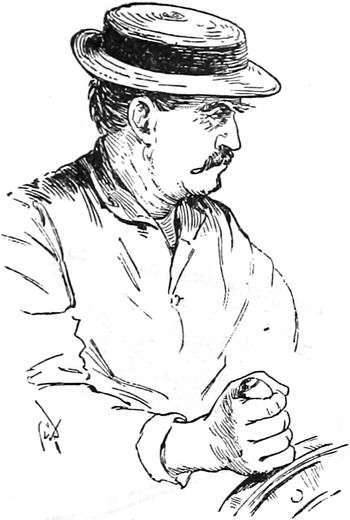
IN 1878 the cruises of the New York and Atlantic Yacht Clubs occurred at the same time, and while at Greenport the Atlantic Club had a regatta with the New York Club as spectators. The two clubs, however, did not fraternize to any greater extent then than they do now. Both have always inclined to conservatism, the Atlantic particularly so, and among the list of eighteen starters in this regatta, there is not a single New York Club yacht, and, in fact, the New York squadron was got under weigh for New London before the Atlantic race had ended, the two fleets meeting in Gardner’s Bay. Very many owners in the New York Club have found it to their interest to join the Atlantic, but comparatively few of the distinctively Atlantic Yacht Club members have joined the New York. Still, as the years have gone by, the relations between the New York and Atlantic clubs have become more and more friendly, and if there is any club in this neighborhood that the old and aristocratic club could be induced to fraternize with, it would probably be the Atlantic.
On this particular occasion, however, the courses of the fleets on leaving Greenport diverged, the Atlantics going to Newport, the New Yorks to New London. Practically, the Atlantic Club disbanded at Greenport, only six of the yachts going on to Newport. Commodore Kane was a great favorite at the Pequot House, and the proprietor and guests went to the extreme of courtesy to do honor to the club while it tarried there. This cruise, like that of the previous year, was a great success.
To those who know the gentlemen—the announcement of the correspondents with the fleet on this cruise, that divine service was held on board the Estelle—Mr. John Oakey officiating as chaplain, and Alexander Taylor, Jr., and John R. Dickerson leading the choir—is an assurance that the service was interesting and impressive.
At this time the sloop Thistle, the same yacht now owned by Mr. William Zeigler, belonged to Mr. E. C. Palmer, president of the Louisiana State Savings Bank and a member of the Boston Yacht Club. She was considered to be the fastest sloop in Boston. She has been much altered since then and doubtless much improved, but she would stand no chance at all to-day with the crack sloops of the “Hub,” which is a convincing proof, if any were needed, that Boston yachtsmen have been moving in the past ten years.
The Active, the Regina and the Vixen, at that time the three fastest sloops of the New York Yacht Club, were selected to polish off the Thistle when she was encountered in the harbor of New Bedford. I was fortunate enough to receive an invitation to sail on the Thistle during that race. The Thistle was beaten, but she was miserably equipped, not half manned, and sailed in the most lubberly manner. In elapsed time she was only about a minute behind the Vixen and Active, but was beaten about thirteen minutes on corrected time by the Vixen. Had she, however, been as well equipped and handled as the New York yachts she would have beaten them, I think, and that was the general opinion. After all, what are any of these yachts compared with the yachts of to-day? I think that to yachts of this class we have added at least a knot an hour in speed, and to the larger craft, such as Gracie, Fanny, Shamrock and Titania, fully two knots are added, and these are, withal, safer yachts than their predecessors.
The New York Yacht Club managed to get back from Vineyard Haven to Newport, and then it disbanded. As usual, a race had been arranged, but there were not sufficient entries and the thing was given up.
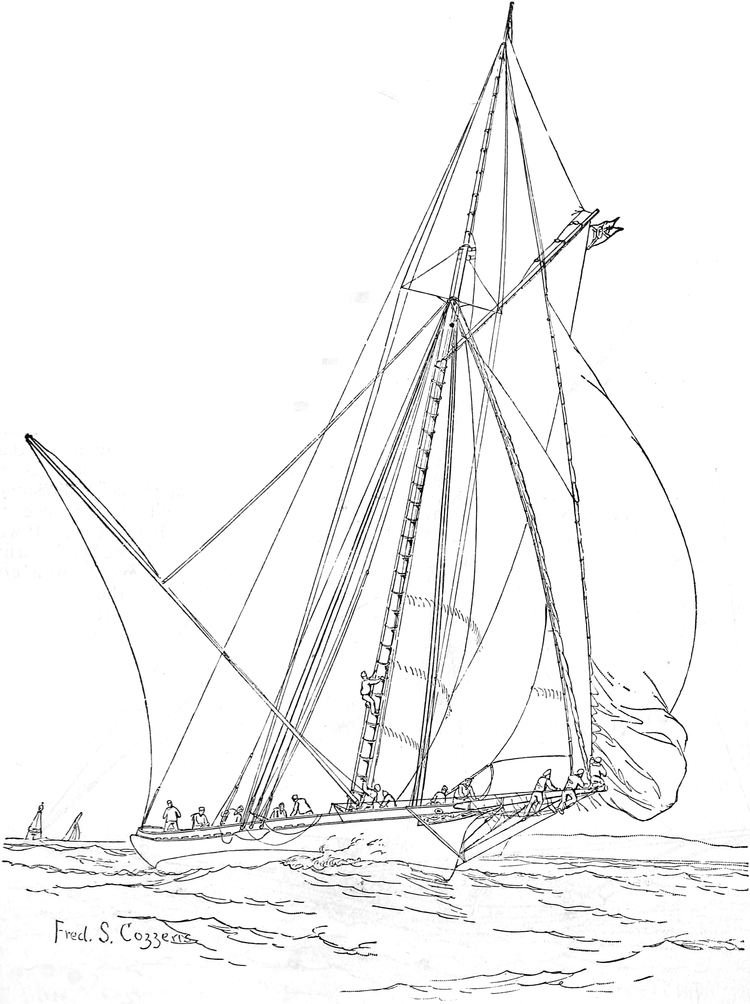
SLOOP FANNY, NOW THE PROPERTY OF JOS. P. EARLE, ESQ.
The Atlantic Yacht Club, I think, made its first visit to Black Rock in 1879. After a rendezvous at Whitestone as usual on a Saturday afternoon, the fleet sailed thence to Glen Cove. Next day, for a wonder, not one of the twelve chaplains of the club was available, and the usual divine service had to be omitted. What then were the yachtsmen to do? Glen Cove was dreary enough, and there was a fine breeze blowing from the southwest. At that time Mr. Fish was the commodore, and after consultation with the owners he found that a majority of them were in favor of disregarding the traditions of the club as to Sunday sailing, and at noon he hoisted the signal for the fleet to get under way. Whether or not this was its first visit to Black Rock, I know not, but matters were found so pleasant there that I believe it has been the rendezvous of this club ever since. The George Hotel there is a splendid hostelry, in the season always full of guests; the harbor, though small, is good, and the anchorage close to the shore and handy for the embarkation of ladies. So since this year the club leaves Whitestone on the afternoon of some Saturday and sails to Black Rock, where on Sunday there is divine service on board of one of the schooners, which is attended by a great majority of the hotel guests. This service on board a flush-decked yacht enclosed with awnings is peculiarly impressive. The Rev. Dr. Thomas has usually been the officiating clergyman, but the club has many other chaplains that can be called upon in an emergency. Its list of chaplains comprise the following well-known divines: Revs. A. A. Willets, of Philadelphia, whose club connection dates back to 1866; J. T. Duryea, D.D., of Boston (1868); H. M. Gallaher, of Brooklyn (1868); C. H. Hall, D.D., Brooklyn (1869); G. F. Pentacost, Brooklyn (1870); W. H. Thomas, Cambridge, Mass., and E. Murphy, Brooklyn (1871); E. Van Slyke, Syracuse, N. Y. (1873); H. M. Scudder, D.D., Brooklyn (1874); G. H. Hepworth, New York (1875). For eleven years after this the club did not add to the list, but in 1886 it elected R. Heber Newton, D.D., of New York, and its latest addition to its chaplains was Joshua Reynolds, Jr., of Brooklyn, elected May, 1888.
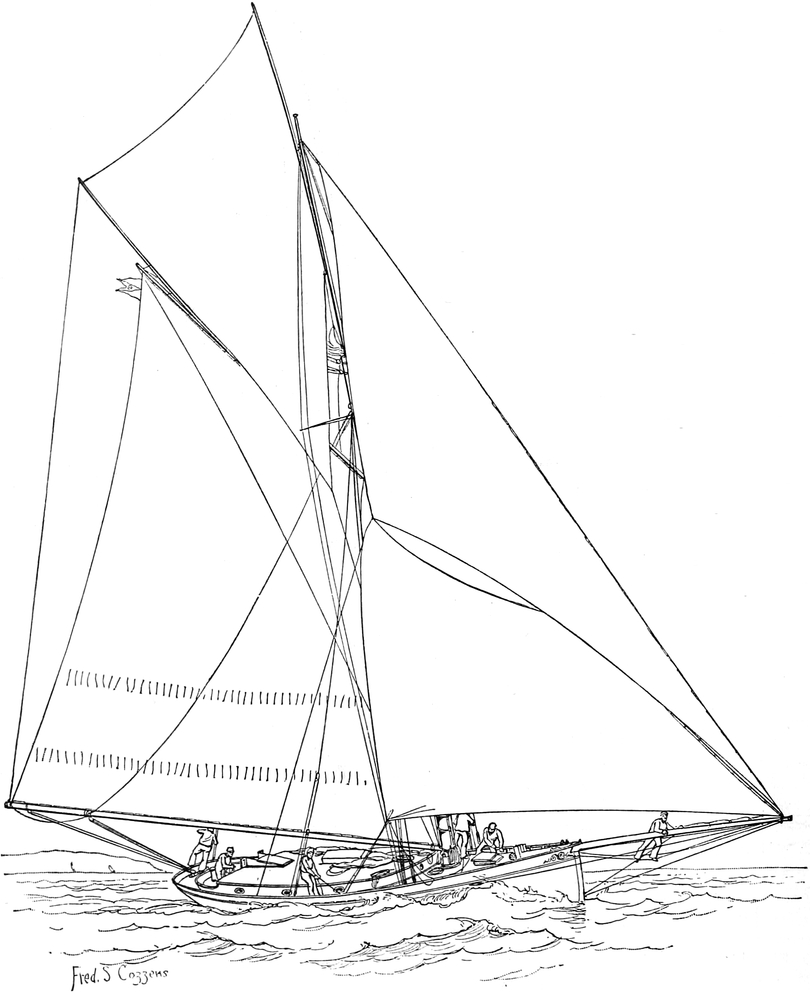
SLOOP VIXEN, NOW THE PROPERTY OF W. C. LOVING, OF BOSTON.
The Atlantic Club has never desired to leave Black Rock sufficiently to induce it to break through its rule with respect to sailing on the Sabbath. After the lunch which follows the sermon, the guests find an afternoon at the hotel on shore pleasant. For those who so desire, there are very pleasant drives, and in the evening there is music at the hotel and companionship sufficiently pleasant to detain the boats at the landing to a late hour.
Black Rock is easily accessible from the city, and guests who cannot join on Saturday may come up by the late train on Sunday.
In those days, nine years ago, neither the Larchmont, New Rochelle, nor the American yacht clubs had established their headquarters on the Sound, and possibly the rendezvous of the future when a club is about to start on a cruise will be at one of these congenial anchorages. The American Club, as being farthest east and as affording the best anchorage, will doubtless be the favorite, but the Atlantic Club has strong affiliations with the New Rochelle members and may make that its first rendezvous in place of Whitestone, and start thence to Black Rock. It will hardly, in any event, neglect the George Hotel, with which so many pleasant memories are associated.
As to this particular cruise in 1879, there is not much to tell, as it was very tame and monotonous. The yachts on their passages from port to port had exceedingly light airs. They visited New London, Greenport, Newport, New Bedford, and Martha’s Vineyard, the old, old route, and there the fleet disbanded. Why on earth cruises are not continued, returning from this point direct to the place of departure, or making stoppages on the way, I have never been able to discover. Bound East there is generally no weather at all, or if there is, it is accompanied by “dirty” weather. A beat back to Black Rock would show what the yachts really could do.
This was the year that Commodore Thomas had command of the New York Yacht Club fleet, and the big Rambler was his flagship. A fleet of over twenty yachts left Glen Cove, and went to New London and thence to the Manhansett House, Shelter Island, where a grand reception awaited the yachtsmen. There was an illumination and fireworks in the evening, and this was followed by a ball which continued until after daybreak.
It is not possible, as far as I know, to vary the route, and yet I think some change might be made. This year, as usual, the yachts went from Shelter Island to Newport and thence to New Bedford. Here the New Bedford people arranged a regatta that was a great success; six schooners and six sloops starting and filling four classes. The Vision and Niantic (now the Hildegard), at that time, were the crack sloops of the New York Yacht Club, and their close match in this race will be remembered by all who were present. The Niantic was sailed by her owner, the late Mr. R. M. Huntley, and was admirably handled.
There is no port which the yacht fleet visits where the welcome is so cordial as in the old whaling city of New Bedford. On this occasion, the mayor and the prominent officials visited the flagship, and extended a welcome to all the yachtsmen. In the evening, a number of citizens passed through the fleet with a band and tendered a serenade. There were also fireworks and all sorts of jollifications, and all hands left with regret the next morning.
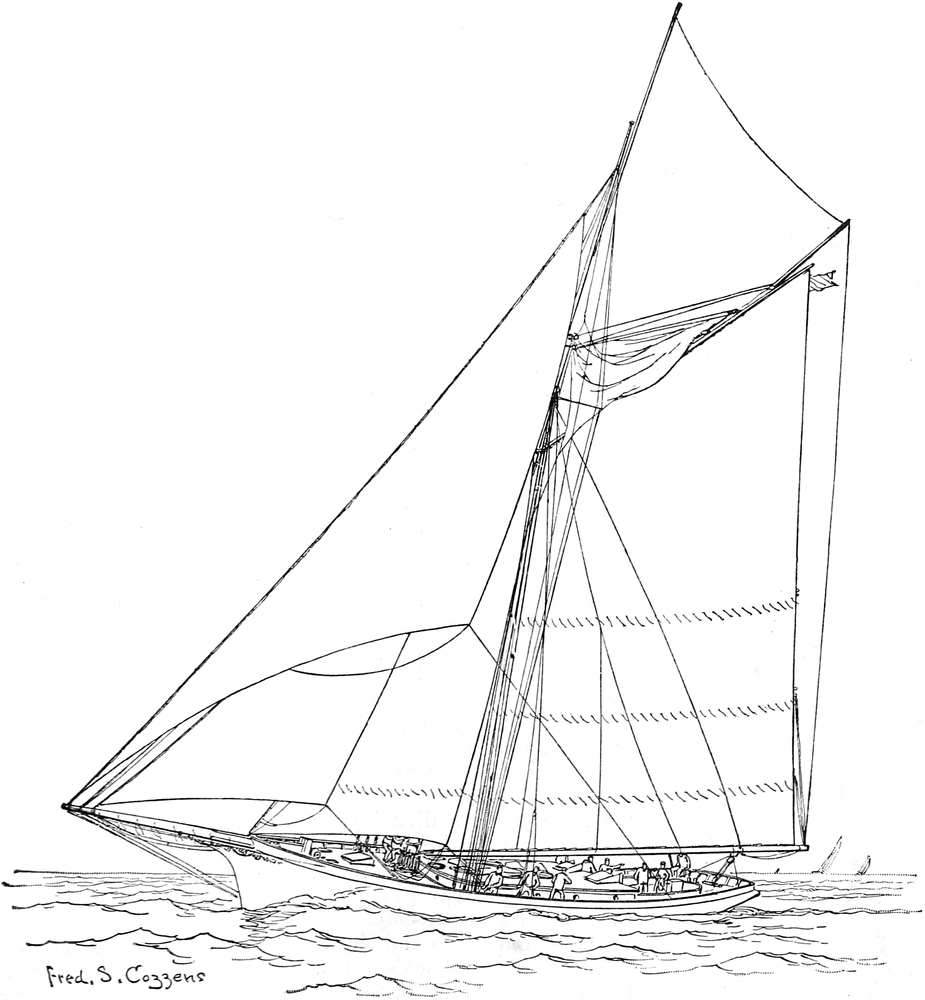
SLOOP GRACIE, NOW THE PROPERTY OF MESSRS. FISKE BROS.
The reach down the Vineyard Sound, while the fleet was en route for Oak Bluffs, was one not easily forgotten. There was a cracking breeze from the southwest and the schooner Dreadnought was the first vessel through Quick’s Hole, followed by the Wanderer, after which came the Rambler. All three had all balloons pulling, and the Rambler easily established her claim to be the fastest sailing vessel in the world with a free wind. She went through the Wanderer’s lee as if that vessel had been anchored, and was coming up with the Dreadnought—which was doing full thirteen knots—hand over hand, but, when just at her taffrail, the head of the Rambler’s mainmast went just above the rigging. Her racing career was over for the rest of the cruise. She ran into Vineyard Haven to clear away the wreck preparatory to returning to the city, and the Dauntless became the flagship, with Vice-Commodore John Waller in command. The next day the fleet returned to Newport and disbanded.
A YACHTING SONG.
KEEN is the clear, free air, Sharp with a salty tang, Far o’er the waters blown— Blown on the winds that fly. Up with the topsail, there! Gray have the shore-lines grown, Dim where the mountains sprang Bold, as we turned toward Skye. Never a flaw in the breeze, A fair and favoring gale, Never a guy-rope wrong, Never a sheet awry! Over the summer seas, Gay as a lover’s song, Merrily on we sail Up to the Straits of Skye. Let them prate of their joy, Footing firm on the earth; Oh, they may prate who will, Ours is the joy, say I! Bliss of the buoyant boy, Tremble and throb and thrill— Sound of the wild sea’s mirth, Loud on the Strand of Skye!
Clinton Scollard.
CANADIAN FISHING SKETCHES.
BY HIRAM B. STEPHENS.
II. SPEARING FISH AT THE LACHINE RAPIDS.
THE Lachine Rapids are well known to many American tourists, as they are included in a circuit of tourist travel adopted by large numbers, viz.: from Niagara Falls through Lake Ontario, the Thousand Islands, the Rapids of the St. Lawrence, down to the ancient city of Quebec, and on to the mysterious Saguenay. The average tourist’s knowledge of the Lachine Rapids is confined to the personal experience of running them in the steamboat. But few realize that this is historic ground, trod by “the pioneers of France in the New World;” that Champlain endeavored to ascend these rapids in a small boat two centuries and a half ago, and that La Salle built a fort or house here which is still standing, though fast falling into decay. Here have been Champlain, Maisonneuve, Frontenac, Joliette, and La Salle himself, all of whom have left their indelible records, not alone in Canadian history, but in that of America.
The Lachine Rapids rush madly past, whitening with foam in their ceaseless career. The old name of the rapids was the “Sault St. Louis.” The Catholic mission here has been famous; it was situated on the south shore, and has changed its home several times, till now it is located in the Indian village of Caughnawaga. In this village lived La Salle some twenty years previous to the “massacre at Lachine,” perpetrated by the Iroquois on the night of the 4th August, 1689, when, in not more than an hour, over two hundred persons were butchered. In Caughnawaga lived Charlevoix, the author of the celebrated “Histoire de la Nouvelle France,” and his desk is still to be seen there in the Presbytère. Not many months ago, the writer was called upon by two dusky Indians, and asked by them to translate a certain parchment. It was dated early in the seventeenth century, written in old Norman French, and signed “LOUIS ROY.” It was the deed of the seigneurie to the mission, which these Indians had carefully preserved, without any safe deposit company, through all their wars and massacres, their fires and revolts. But I am not to write historical notes and must cease, much as the subject interests.
Above the villages of Lachine (so named by La Salle, who thought of going to China from this point) and Caughnawaga, the St. Lawrence is wide and forms what is known as Lake St. Louis. This lake narrows very much at the two villages. A few miles below, the river, taking a turn, rushes over a bed of rocks and boulders, forming the Lachine Rapids, and then widens out into Laprairie Bay below, and passes on more peacefully to the good city of Montreal.
The south shore from the Lachine Rapids down past and below Laprairie Bay, is an excellent fishing-ground, and deserves a few notes which it has never yet, to the writer’s knowledge, received in any important publication.
The fish which can be secured here are sturgeon, bass, dory, carp, and mullet of different kinds, and the eel. There are also bream, shad, and a fish known as the loche, and at times whitefish and small perch. The Indians of Caughnawaga devote much of their time to fishing. These Indians, by the way, have intermarried with the surrounding French Canadians to such an extent that the blood is far from pure, if there be even one pure-blooded Indian remaining, except an old squaw 107 years old, who still smokes her pipe and is somewhat active. But theirs is a commercial pursuit and not for any love of sport. They use nets principally, and in the spring spear the carp and eels in large numbers. Apart from their fishing pursuits, their chief means of livelihood lies in running timber rafts down the rapids. The majority of them speak French, and some of them English. Their squaws are engaged in the making of Indian “curiosities” for sale to tourists.
A visit to the village is interesting in more ways than one. The locality is not an inviting one, as it is rocky and somewhat barren, and if the original intention in placing the Indians here was to instruct them in agricultural pursuits, no more unsuitable locality could have been found. They could drill, and that is all, for there is nothing but solid rock. The houses are all of stone, as might be supposed, with quaint little windows. In some of them the old irons still remain, placed there in colonial days. There is one long street, the houses being built on each side at varying distances. The church is a plain building, very simply appointed, free from the gorgeous elaborateness of more modern Roman Catholic churches, and contains some curious old pictures, more curious than valuable. Last summer, while the floor of the church was being altered, a quantity of bones were discovered; but the Indian workmen were not disturbed, continuing their work, and probably relaying the floor without paying any further attention.
The pappooses are worth seeing. They are so old-fashioned and wise-looking that one is tempted to think they are born with all the knowledge and wisdom they ever possess, and merely require time for the purpose of acquiring a larger growth. They never cry, and would probably starve to death without a single whimper. With their dark complexions, jet black eyes and severe expressions, they very much resemble scheming imps of darkness.
The rapids are delightful as an experience of steamboat travel, and a more exciting episode is a descent of them on a raft of timber, and a still more exciting and certainly foolhardy event is to run them in a canoe, as has been done on several occasions. It is, however, regarded in much the same light as an attempt to swim through the Niagara rapids. It is exciting enough, and yet not too dangerous to persons of cool temperament to take what is known as a “dug-out” and a French-Canadian pêcheur and have a day’s bass-fishing in the rapids. The “dugout,” somewhat out of date now, is merely a log hollowed out to form a canoe, and it is fully as treacherous as a bark canoe. No paddle is used; a pole is the arm of progression, and it is really wonderful with what skill one of these French-Canadian fishermen will take you from eddy to eddy, in and out between the rocks and across mad currents. The crude boat seems to be part of himself. Other boats are used ordinarily of a safer description, made more like a punt, from which one can throw a fly with some security and with little fear of taking a “header” and being swept toward the ocean. The bass fishing is excellent, and splendid sport can be had during the proper season. Dory (pickerel) can be caught here with the minnow, and though they are not game-fish, they are excellent eating.
But the sport at the foot of the Lachine Rapids is spearing fish, i. e., sturgeon, carp and eels.
In June the large red-finned carp, known locally as the “carpes des rois,” weighing from three to fifteen pounds each, ascend the river; the eels are present in large numbers, and the sturgeon come in-shore to feed.
A flat-bottomed boat is secured and an arrangement for the light put in place. This usually consists of an open basket made of a few strips of hoop-iron. In this pine and cedar knots are burned, emitting a pleasant odor and a somewhat fitful glare over the water. Another means of lighting is to split cedar rails in long, thin strips six or eight feet in length, and make them into bundles, a boy in the boat holding them at the required position over the water. The boat is allowed to float broadside on down the river over the best places, the torch of pine burning with its crackling noise. The spear usually consists of either five or seven barbs and those used by the French-Canadian fishermen are frequently made by themselves out of hammered iron, and are clumsy instruments, which when they strike a fish sometimes almost cut it in two.
The best plan is to have one made out of No. 4 wire, or buy one of the light steel spears; and with a light ash handle about one inch in diameter and ten feet in length, an exciting time can be had, especially if one has never been out before. One misjudges the distance so as the boat floats on, and is fortunate if no upset occurs. A waving weed is mistaken for a huge eel, and a frantic dart ends only in disappointment, or an eel is thought to be a useless weed, and annoyances ensue at the mistake. But the art or knack is soon learnt, and then the enjoyment is keen. Round about, on the same purpose bent, are other boats, each with their blaze of light, like some huge red Cyclops.
The night is dark and one floats on, darting at each successive finny denizen, missing some and lifting many a fine fellow with the cruel barb into the boat sans cérémonie. A huge eel, four feet in length, is speared and with some difficulty hauled into the boat, and his wriggling form gives one the shudders.
Then a large sturgeon that appears to weigh thirty pounds is seen lazily moving his tail and merely maintaining himself against the current. C’est un gros—“He’s a big fellow,” and every one is stilled into expectancy. The spear is held in the water till the time for striking is come—down goes the spear, and as you press on it you feel the points are crushing through bone and flesh and are firmly fixed. There is a cruel joy or satisfaction as you thus fix the spear in him; he turns, and you hold on like grim death; the boat swings end on in the struggle; you have to go with the current and the fish, resisting as firmly as you can. And so the struggle continues; your boatman has been gradually poling nearer and nearer to the shore. The water is only two feet deep here, and shouting to you to look out, the boatman is in the water and has the sturgeon by the gills, and with a few steps is on terra firma. You follow, regardless of wet feet, and find you have speared the largest one of the season, so far. Your spear has to be cut out, so firmly are the points imbedded, and the sturgeon’s sufferings are over. He is weighed, and tips the scales at 651⁄2 pounds.
This is picturesque work—the swarthy, indistinct forms in a circle of flickering light, looking for all the world, with their spears, like attendants of some fresh-water Neptune. The boats float slowly down stream, the shores are invisible in the gloom, and all is still. A splash, and another fish is secured, and so the night draws on. There is an end to all things, and the evening’s spearing is over.
One drives back to the village hotel in the quaint town of Laprairie, or else “bunks” with a friendly French-Canadian, paying him trente sous for the accommodation. In many cases no charge will be made, but some gratuity ought to be given, and for this nothing is better than tobacco.
The fish congregate on these shallows as the water is not deep, and therefore is of a higher temperature, which in the spring months attracts them.
An al fresco lunch on one of these islands at the foot of the Lachine Rapids is a delightful experience on a bright blue sunny day, so happily frequent in the valley of the St. Lawrence. The rushing of the waters and the rustling of the leaves in the trembling silver maples is a sweet chorus of music, ever changing and ever harmonious; the coup d’œil up the rapids is unequaled in interesting beauty, and there is a sense of communing with Nature entirely different in spirit and feeling to that in the solitudes and hearts of the great forests.
One reads everywhere the records of past winters and of winters to come in the ruggedness of the entire landscape, in the hardy look of the timber, in the robustness more than tenderness of the herbage and signs of latent strength conserved to contend with the mighty snows. The present is the more enjoyable by very reason of this knowledge; and the lunch is a royal repast, made so by the royal appetite which the ozone of the woods and waters always produces. We enjoy our lunch of fish chowder, baked beans, strong tea, and such extras as may be in supply, and look upon these magnificent rapids, the “last escapade” of the St. Lawrence in its eternal march to the sea.
I have written of the spring months and their wealth of fishing. But there are the duck, the outardes and the snipe to be shot in the fall, when Nature is donning her winter suit and the days are getting shorter and more sombre, when there is a change that renders one thoughtful and pensive, except in the excitement of the chase.
One ponders over this mighty St. Lawrence, one of the grandest highways of the globe. “Its history, its antecedents are unparalleled. The great lakes are its camping-grounds; here its hosts repose under the sun and stars in areas like that of states and kingdoms, and it is its waters that shake the earth at Niagara. It is a chain of Homeric sublimities from beginning to end. The great cataract is a fit sequel to the great lakes; the spirit that is born in vast and tempestuous Superior takes its full glut of power in that fearful chasm.”
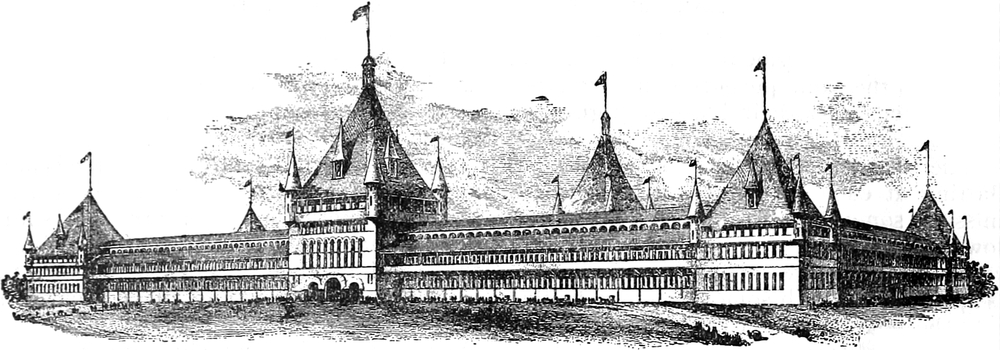
MAIN BUILDING OF THE BUFFALO INTERNATIONAL FAIR ASSOCIATION.
ONE MAN’S WORK FOR CYCLING.
BY HOWARD P. MERRILL.
NO man has ever given such an impetus to any recreative sport as Henry E. Ducker has given to cycling. Almost wholly by individual efforts, he has brought cycling to the foremost position it now holds in America. In his own town he has raised an obscure club to a position of such prominence as to be almost without a rival in the whole country. It was Ducker who inaugurated the tournaments which have without doubt done most toward giving bicycling its present pre-eminence. And it is this same Henry E. Ducker who is now quickening the whole cycling world by his latest and most daring project of an Annual World’s Cycling Tournament, under the auspices of the Buffalo International Fair Association, the first meet of which gathered in the “Queen City” on the shores of Lake Erie, ten thousand wheelmen, besides making the event one of the most notable in the history of cycling. But, though his name be familiar to the whole world of sport, there is no widespread knowledge of the individual man.
It is, therefore, the purpose of OUTING in this article to present to cyclists and all lovers of sport a short but compendious sketch of this giant among wheelmen.
Henry E. Ducker was born in London, England, forty years ago, and came to New York with his parents in 1853. In 1863 the family removed to Springfield, Mass., where he lived until June, 1887. Early in life Mr. Ducker learned the printer’s and bookbinder’s trade. While still a youth he became foreman of the large establishment variously known as the Clark W. Bryan Company and the Springfield Printing Company, and for five or six years he was the superintendent of this establishment. In June, 1887, he went to Buffalo to accept the superintendency of the printing department of Gies & Co. Within the past few months he has devoted himself entirely to cycling, and now expects to make it the work of his life.
Mr. Ducker, from his boyhood, has been an ardent admirer of all athletic sports—boating, shooting, fishing, skating and baseball, but he has a special passion for cycling.
Mr. Ducker’s cycling career dates from May, 1880, when he purchased his first bicycle—a “Harvard”—and in that year he rode 800 miles. In 1881 he rode 1,183 miles; in 1882, 1,218 miles; in 1883, 1,030 miles; in 1884, 1,087 miles. Since 1884 he has preserved no records. He kept his “Harvard” until 1883, when he changed to a “Sanspareil.” During 1885 he again changed his machine, this time to a “Victor.” Later, he adopted an “Expert Columbia” for his mount, which he rides to-day, and he has in addition a Columbia tandem. Gifted with an enthusiasm as exhaustless as his energy he quickens all with the same love for cycling that possesses him. Thus every member of his own household has been made an enthusiastic cycler.
Mr. Ducker’s prominence as a cycler dates from the organization of the Springfield club, which he, together with several other gentlemen, called into life.
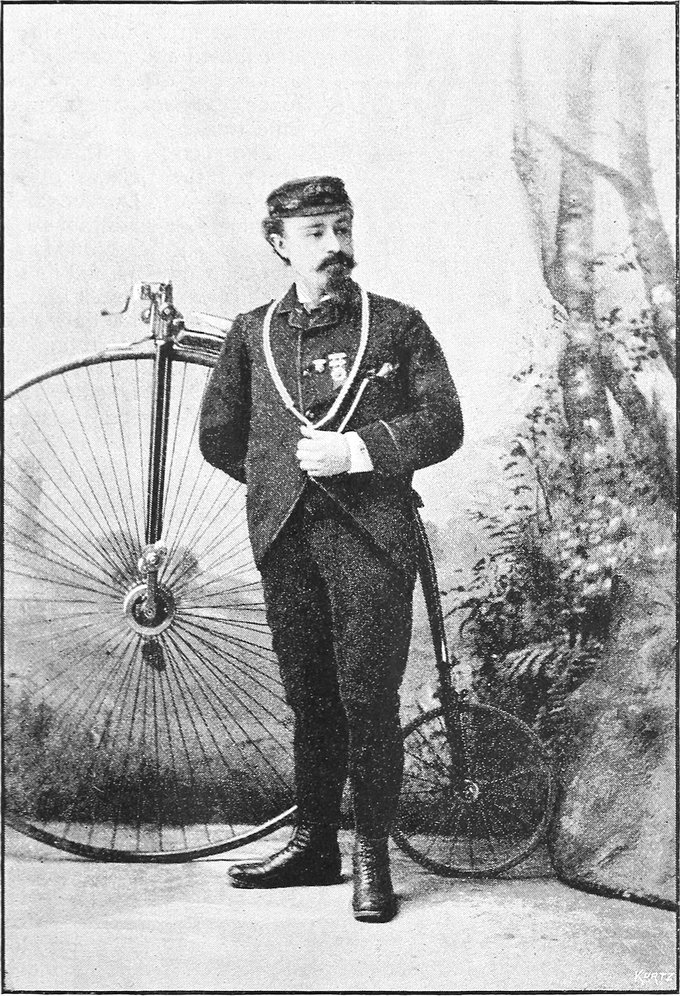
HENRY E. DUCKER.
Every cycler in the world has heard of this Massachusetts cycle club,[1] and its fame is due solely to the enterprise and push of its founder. The first meetings of the club were held at his house and were well attended. Never in the club’s history has the percentage of attendance at club meetings been larger than during its first year. As chairman of the entertainment committee, Mr. Ducker, in the fall of 1881, arranged with a committee from the local post of the G. A. R. to give bicycle races in connection with the Grand Army field-day. He supplemented these with a very successful evening exhibition of fancy and trick riding at the local skating rink, and it was the prosperous issue of this enterprise that started the bicycle “boom.”
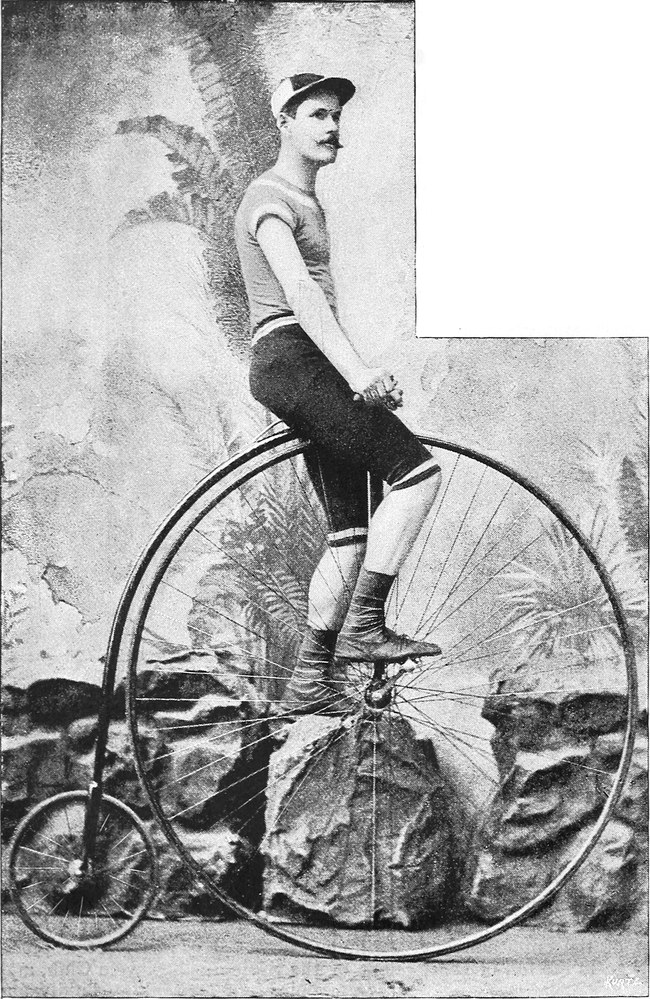
W. M. WOODSIDE.
The following year Mr. Ducker was inspired with the idea of giving a tournament, or race meeting, similar to the trotting fixtures. He was elected president of the Springfield Bicycle Club, and after mapping out a program, boldly announced that a one day’s tournament would be given, at which $1,200 in prizes would be distributed. The tournament was advertised far and wide, and wheelmen came from all over the United States to attend this innovation in racing events. The tournament was a grand success, and the Springfield club cleared over $800. Record-breaking, which has always been the characteristic of the Springfield or Ducker tournaments, dates from this event. Frank Moore, of England, who was under the care of JOHN S. PRINCE, astonished everybody by putting the mile at 2m. 571⁄4s., and made what was then considered wonderfully fast time for five miles. He gave all the starters (among them GEORGE M. HENDEE, in his first year of racing) a start of thirty seconds, and broke the record of 16m. 103⁄4s., making a new record of 15m. 473⁄4s. Moore was the lion of the town, and perhaps the proudest moment of Mr. Ducker’s life was when he distributed the prizes at the rink, and announced that two records had been made. The racing was done on the mile track.
The success of this first tournament aroused the citizens of Springfield as much as Mr. Ducker, and the bicycle club had large additions to its membership. Moore’s records had whetted Mr. Ducker’s appetite, and he started to have a special racing track built.
When the three days’ camp and tournament of 1883 were announced, everybody was on the qui vive. This was the year in which “Doodle” Robinson posed as England’s fastest amateur rider. He was, however, pitted against Geo. M. Hendee and ignominiously defeated. Mr. Ducker had now raised the Springfield people to such a pitch of enthusiasm that, on the second day of the tournament, all the banks and principal manufactories, many of the stores, and even the public schools, were closed. Nearly every one of Springfield’s 33,000 inhabitants caught the infection. The days of 1883 and 1884 seem almost like a dream. It appears incredible that one man should have so completely dominated a whole city. In those days Ducker was a king in all but the name; he had but to express a wish and it was instantly executed.
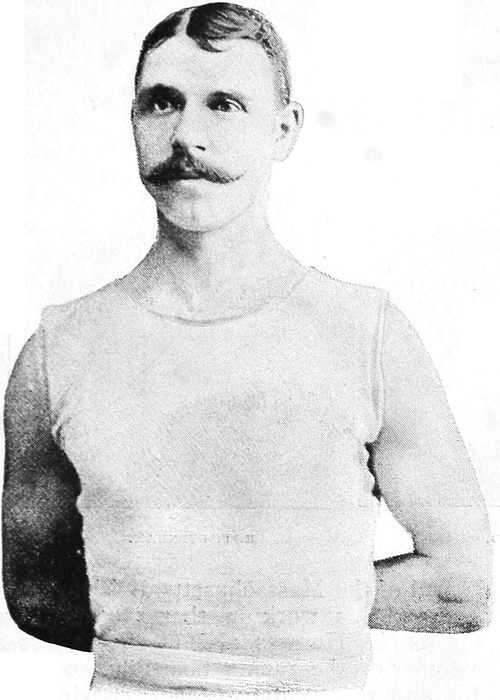
J. S. PRINCE.
The tournaments of 1884 and 1885 only showed slight diminution in popularity. But in 1886, owing to the non-appearance of the Englishmen, who had been announced, the tournament was not so well patronized.
Mr. Ducker has been the uncompromising advocate of the rights of the racing bicyclers. Single-handed, he gamely fought the League on the makers’ amateur issue. He even carried the war to England and nearly won the N. C. U. over to his standard. He has always believed that the racing men have rights, and, therefore, has done everything to promote their interests. The racing men, however, are not the only ones who have been befriended by him. He is generosity personified, and though he has been in many disputes, his bark is worse than his bite.
The money expended in tournaments and cycle exhibitions during Mr. Ducker’s administration in Springfield amounted to upward of $60,000. These large expenditures have given rise to the silly charge that Mr. Ducker went into cycle racing for the money to be made out of it. How far from the fact this imputation lies may be judged by this. The Springfield Bicycle Club, on one occasion, after a very profitable meet, presented Mr. Ducker with five hundred dollars in recognition of the time and labor expended by him in behalf of cycling. On his removal to Buffalo he was presented with a dinner set of 150 pieces, and these are the only two instances in which he “made” anything. His work was for the club, and not for himself. If there was any profit, so far as he was concerned, it went into the club’s treasury.
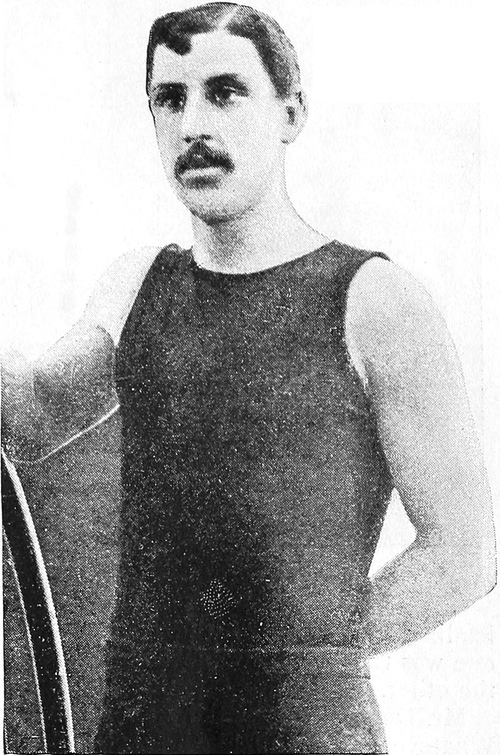
W. A. ROWE.
Mr. Ducker attributes his success in promoting tournaments to the cordial and unqualified support of the Springfield Bicycle Club. Whatever he suggested was cheerfully carried out, and whatever work he laid out was taken up with a will and faithfully performed. An indefatigable worker himself, he influenced others to perform herculean tasks. Without the Springfield Bicycle Club Mr. Ducker’s fame would probably not be as widespread as it is, and without Ducker the Springfield Bicycle Club would not to-day rank as the leading cycle club of the country. The one was the indispensable complement of the other.
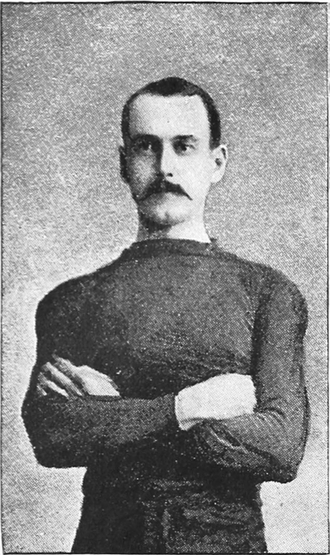
R. JAMES.
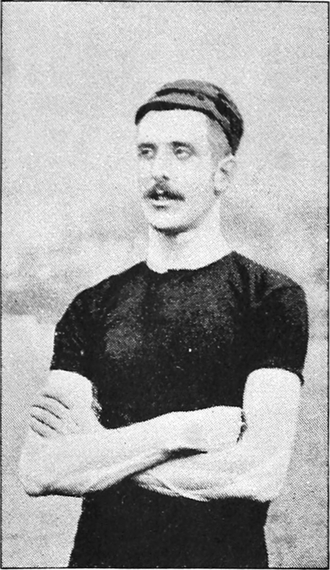
F. WOOD.
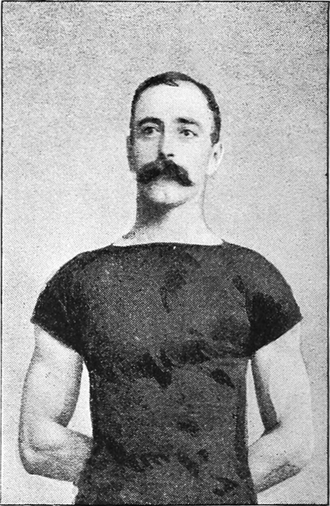
E. P. BURNHAM.
Mr. Ducker is essentially an originator. Whatever tends to make a successful race meeting when traced back, nine times out of ten, will be found to have its impetus from him. The arranging of programs, track building, timing, scoring, novelty races, all bear his stamp. Everybody concedes that the Springfield tournaments were models; everything was managed with clockwork precision, and rarely was there a hitch in the program. So great was their reputation that Mr. Ducker has often been called upon to furnish details and even personal assistance for other meetings, and he has received letters asking advice from Switzerland, Germany, and even Australia. His motto has always been: “The best is none too good,” and as a result of strict adherence to that rule, the Springfield track holds to-day a large proportion of the existing records.
His ideas on track building were the result of personal observation and study. Good side-paths in the country were the means of awakening and guiding his attention. It occurred to him that if a path could be built of nearly the same materials, the problem of good tracks would be solved. That he successfully followed up this idea as well as the accuracy of his reasoning, the Springfield track, and, more recently, the Buffalo track indisputably prove.
In 1885 and 1886, Mr. Ducker was chief consul of the Massachusetts division, L. A. W., and his work in that office speaks for itself. He was also for two years a member of the racing board of the L. A. W., and representative for Massachusetts. He was for five years president of the Springfield Bicycle Club, of which he is a life member; he is a member of the Massachusetts Bicycle Club of Boston, the Ixion Club of New York City, the Ramblers of Buffalo and the N. C. U. of England. In connection with the Springfield tournaments, Mr. Ducker founded the Springfield Wheelmen’s Gazette. It was intended at first only as a tournament “boomer,” but it made such a hit, that he yielded to the public demand for its permanent publication. Upon his removal to Buffalo, the Gazette was sold to Darrow Brothers, of Indianapolis. While in Mr. Ducker’s control it was a crisp, sparkling sheet, and commendable from a literary standpoint. He was also the publisher and editor, in connection with Henry Goodman, of “The Wheelmen’s Reference Book.”
Mr. Ducker’s cycling correspondence is simply enormous. His private office is the headquarters for cycling information of every kind, and in Springfield it was constantly besieged by newspaper men.
Until within a few months, Mr. Ducker has worked regularly at his business, consequently his cycling work has been done after business hours. He is of medium height and inclined to stoutness. He is of light complexion, with sandy, curly hair and heavy imperial and mustache. Nature has not endowed Mr. Ducker with a very good voice, having oversupplied him with tones of the upper, entirely to the neglect of those of the lower register. But his voice is no handicap to his ability to talk. He is an enthusiastic conversationalist, and can convert the most skeptical to his optimistic way of thinking.
For the past few months, Mr. Ducker has given his entire attention to the World’s Tournament at Buffalo, which is his latest project. The management of the Buffalo International Fair Association, recognizing Mr. Ducker’s abilities, secured his services by most liberal offers of support. And Mr. Ducker’s first official act was to appoint his friend G. M. Hendee as starter.
A full report of events as they shall become a matter of record in connection with the Buffalo meet, will appear in later issues of OUTING.
It now remains for us to recall a few of the names of the noted cyclers who, under the management of Mr. Ducker, visited Springfield during his prominent connection with the cycling history of that most noted of American cycling clubs.
In the year 1886, W. A. Rowe defeated George M. Hendee and Fred Wood, of England, for the world’s championship. Rowe is, of course, very well known to the cycling world by his wonderful record, holding as he does all from a 1⁄4 mile to 22 miles. These have been, however, made at record trials, i. e., against time and not in races. Recently Rowe visited England, but he has twice been unsuccessful in holding the title of the world’s champion as against Richard Howell.
M. V. J. Webber, or “Alphabet” Webber, was one of the fast English amateurs who raced at Springfield in ’85. He made 21 miles within the hour during a race. It was a 10-mile race, but he was anxious to keep on, and was allowed to do so with the result above mentioned. He has been off the path since his return to England.
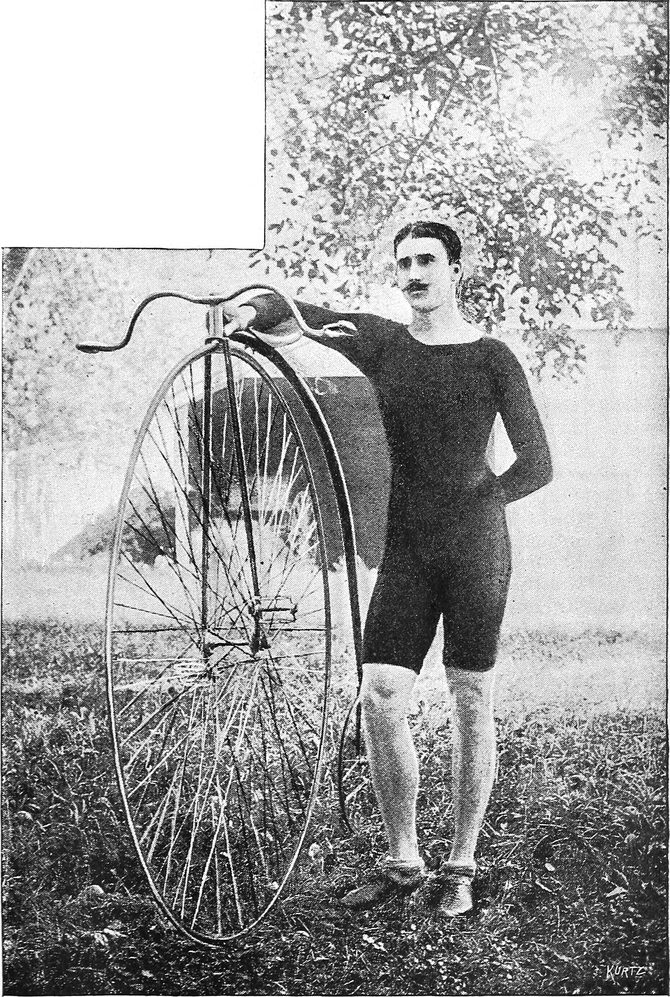
G. M. HENDEE.
George Weber was America’s champion Star rider, but he died in ’85. He was a plucky rider, and though he did not secure many first places in track riding, he was unconquerable in road racing and hill climbing. He won the great 100-mile road race in the spring of ’85.
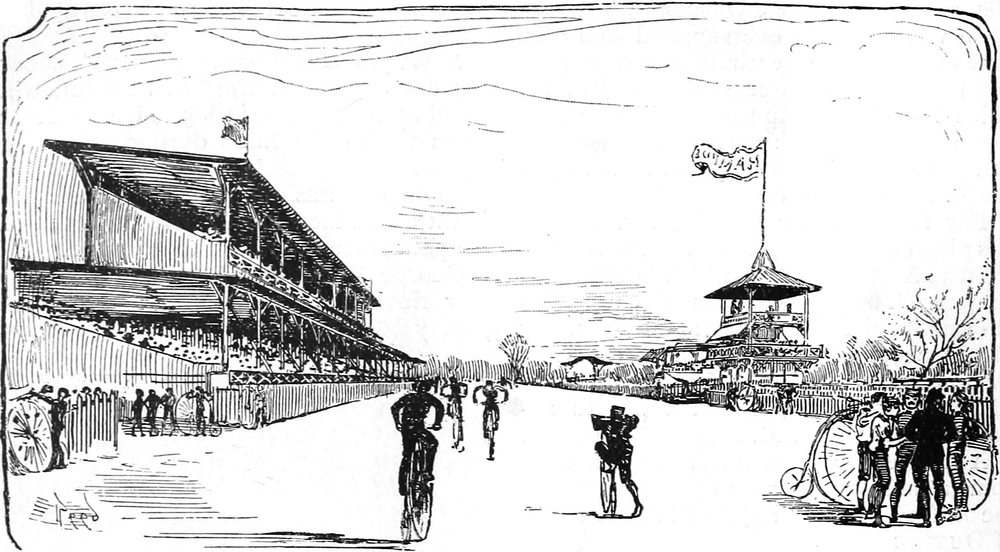
HAMPDEN PARK, IN SPRINGFIELD, MASS.
Richard Howell, of England, professional, is undoubtedly the world’s champion. Indeed, he has for a long time been called “King of the Wheel.” His recent defeats of Rowe have put his right to the title beyond dispute. He has rarely been beaten and is a marvelous rider, having a spurt that cannot be approached. He was the first to do a mile in 2m. 31 1-5s. It was a trial against time and was made just after the ’85 tournament at Springfield.
Percy Furnivall, while on the path, was England’s fastest amateur rider, holding the amateur championship of England for two years. He raced at the ’85 Springfield tournament and won every event in which he started. He was to have raced against Hendee, at that time America’s champion amateur, but Hendee was “spilled” and prevented from racing.
R. A. Cripps was another English amateur who raced at Springfield in ’85. He was first-class as a tricycle rider.
Another English professional of note who has appeared on the Springfield track is Fred Wood. He was formerly Howell’s great rival. In ’86, Wood was the only scratch man in a mile handicap at Hartford, and won, his time being 2m. 33s., the fastest mile ever made in a race in America. The race was run on a trotting track, and if it had been the Springfield track the time would have been nearer 2m. 31s. Wood made 2m. 35s. at Springfield the following week.
E. P. Burnham is what is known as a “luck” rider, for in several races he has been first through accidents to others. He is, however, a good rider, and very hard to beat on a tricycle. He has been off the track for two years. H. G. Crocker is a protégé of Burnham, and is one of America’s best riders.
William M. Woodside is known as the Irish champion, and is a member of W. J. Morgan’s American Racing Team. Woodside has sometimes been styled the champion of America, but has never really held the title. He is best known by his having done so much “donkey work” in races, i. e., he has set the pace for others and thus sacrificed his own chances for a position. He is a professional rider.
John Shillington Prince is also a professional. He was the first to put the mile record down to 2m. 39s., which performance was shortly afterwards equaled by Sanders Sellers, the fast English amateur, who defeated Hendee in 1884. Prince has also posed as America’s champion rider. He formerly gained much prominence when he was racing against John Keen, England’s old war-horse.
Of course, numerous other prominent riders have taken part in the Springfield tournaments. Lewis B. Hamilton was a very popular amateur, and was known as the Yale College rider. Robert James, professional, and Reuben Chambers, amateur, are Englishmen who have appeared several times. In ’85, R. H. English performed as an amateur, but is now a professional, while at the same time W. A. and G. H. Illston, both amateurs, were in America for the Springfield tournament. Space fails us to mention all the prominent riders whose names have been on the programs of the Springfield tournaments, but the few we have mentioned will convince the unprejudiced reader of the omnipotence in the bicycling world of Henry E. Ducker.
WILD DUCK SHOOTING.
BY W. G. BEERS.
AMONG the memorable events of my youth I can scarcely recall any rival to the days spent on foot and in canoe hunting wild duck. It was the master passion of the boyhood of many I know, becoming in later years a passion to master. It was the acme of enjoyment in the days when one was light-hearted and débonnaire, and went whistling through birthdays with that enviable serenity so few of us manage to retain.
Wild duck! With the last fall of leaves and the first fall of snow, their quack was music to the ear. Steeped to the lips in classics, one wondered if there were no duck on the coast of Campania, that Tiberius tired of the pleasures around him and sighed in vain for more; or if there were none in Assyria, that Sardanapalus sought to have new amusements invented; or if there were no real ones where Loelius and Scipio made them on water with flat stones.
The first wild duck one kills, like first love, or one’s first proof-sheet, causes a sensation that is never duplicated. The history of its mysterious and ecstatic thrill through the veins, its wild rush through the soul, never knows a repetition. The duck may be in the “sere and yellow,” stricken in years, scraggy on the crown, weak in the wings, tough to your teeth as parchment—aye, indeed, with one foot in the grave and the other shot off, and have long ago ceased to scud between earth and sky for mere fun—just as the first love may have been nearly old enough to have been your mother, and with no more love in her eyes than an oyster; or as the first proof-sheet may have been an immature production to which you are now thankful you did not append your name. But in the heyday of life a vivid imagination throws a halo around our achievements, and though other duck, like other love, may turn out more “tender and true,” yet there lingers about the memory of the first experience an inexpressible charm which no gross soul can know.
I do not think I shall ever forget the first wild duck I shot. It was impressed upon me in a manner too striking. During the school holidays a few of us undertook to dispose of our superfluous energy by a pedestrian pilgrimage around the Island of Montreal, and as a dose for the game we might encounter, we managed, by coaxing a big brother, to muster a single-barreled gun and liberal supply of ammunition. There was a strong suspicion of rust down the barrel, and a disabled look about the hammer, but the owner declared it was good enough for boys, with that sublime faith manifested by watermen who let boats to inexperienced lads, that Providence takes special care of people who cannot take care of themselves. A well-worn inscription on the butt was ominously deciphered as “Memento mori.” I’ve seen more defective guns since—but they had burst.
MALLARD DUCK (ANAS BOSCHAS).
We started from the Place d’Armes, and when we reached “the Cross,” at Hochelega, held a council of war about loading the gun, as a scared squirrel had just darted under a fence and roused our thirst for blood. Opinions conflicted as to whether the powder or shot should be put in first, as one dogmatic adventurer, whose experience in squibs and fire-crackers entitled him to respect, declared with the positiveness of error that the shot should have the preference. Better reasoning, however, prevailed, and to make assurance doubly sure, down went a double charge of powder. “It’s not near full yet,” sneered young Dogmatism. I hoped not; but to make assurance trebly sure, up came the flask again and down went more powder. I remember one of the group, whose characteristic caution provoked us throughout the trip, suggested mounting the gun in an embrasure in the fence, laying a train of powder to the nipple, and testing its safety at discreet distance; but there was a display of fear in the proposal that we, as of Saxon blood, could never countenance, and so we strangled it at birth. It is a memorable fact, that may go some way to sustain the belief that I have mentioned above, that, as if prompted by instinct, the gun refused to go off on several occasions, in spite of repeated cleanings of the nipple, coaxing with grains of powder and fresh caps. We were unable to “distill the soul of goodness” in this apparently evil and obdurate circumstance; so the charge was withdrawn, the barrel cleaned, and to make assurance quadruply sure, the powder was poured down with even more liberality than before.