Volume 13 / Part 2 — OUTING. (continued 2)
Reading edition
The rescue is easily explained. When the officers perceived the attack was meant for the colonel’s house, and that the mess-house was comparatively safe, the colonel, adjutant, and a couple of others rushed after the attacking mutineers, and arrived in time to turn the tables on the dastardly cowards. The whole affray, assault, defense, and vengeance, was enacted in less moments than it takes to read the account. Mrs. K. recovered after long months of illness, and is now living among the scenes of her childhood.
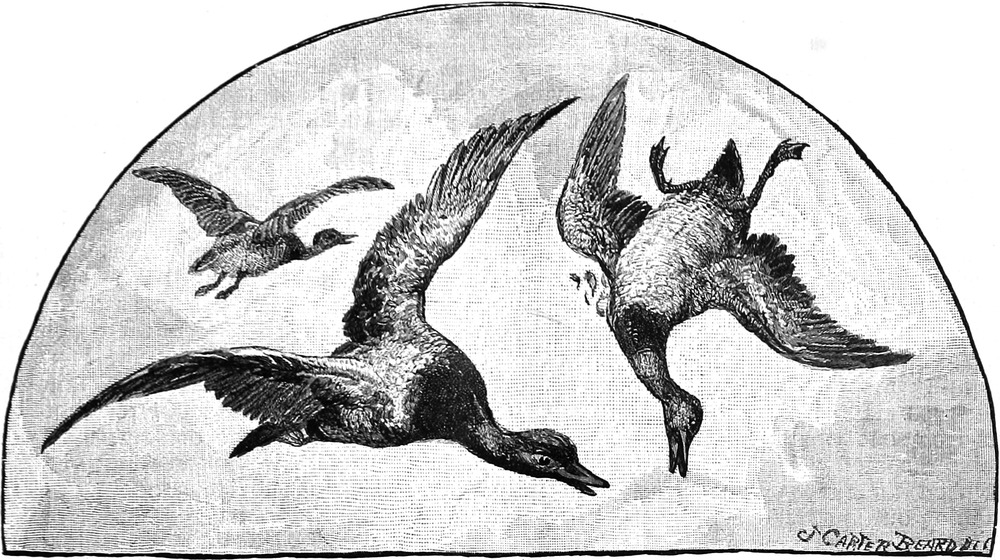
SPORT—PAST, PRESENT AND FUTURE.
BY ALEXANDER HUNTER.
PART II.
FOR four years the game in Virginia, all undisturbed, increased and multiplied at an astonishing rate. There was no shot to be had in the Confederacy, and the only way an ardent sportsman, when home on furlough, could take a shy at the game, was to hammer out from a leaden bullet long, square blocks, and then cutting off the ends with a knife, to use a brick to roll these bits on the floor until each pellet became round enough for use. It would take a man a day, and exhaust all his patience, to make one pound of shot; and he would naturally be very chary about using his ammunition, and rarely pull a trigger except when certain of his game. In most sections of Virginia to fire a gun was a dangerous pastime, for what with raids, irruptions, incursions and forays, the people were in a state of siege, and the report of a firearm was as likely as not to be followed by a bullet from some traveling soldier, prowling bushwhacker, or passing cavalryman, thrown just for good luck in the direction of the sound. Then, if it should happen that a raid was in progress, the shot would attract the videttes and scouts, and the luckless gunner would find himself in hostile hands; and if too old or too young for military service, he might consider himself lucky if he were allowed to depart minus his fowling-piece and dog.
In the mountains of Virginia the wild turkeys were more numerous than they ever were before, the various bivouacs furnishing them in winter with an ample supply of food, while, best of all, they were allowed to feed unmolested. The water-fowl on the Potomac kept up their ratio of increase, for except the officers of the gunboats patrolling up and down the river, none dared to fire a gun. There were hunters of men in those times scattered along the banks, as well as floating on the bosom of the blue water. The explosion of a sportsman’s gun, and its smoke, might serve as an admirable target for the boatswain of an iron-clad with a crew nearly dead with listlessness and ennui, and glad to get an excuse to blaze away at anything.
In the fall of 1865, those Virginians who loved sporting, and had the good luck to return to the homes of their youth with their arms and legs intact, had a rare and royal time among the fur and feather, and a moderate shot would return in the evening and show such a bag as the result of the day’s sport as would last the family for a week. A couple of sportsmen living about ten miles from Culpeper Court House, Virginia, killed, in one day, eighty-four rabbits and fourteen wild turkeys. If a gunner can start even half a dozen cotton-tails now in a long day’s tramp he considers himself fortunate, and he won’t see a wild turkey in a season’s shooting. I well remember a hunt that I had in the autumn of 1865, just after the war ended. It was a perfect day in November, with the morning mists still hanging around the tree-tops. I had borrowed a double-barrel from one friend, and a good, staunch pointer named “Josh” from another. I climbed the fence of an orchard, and put the dog out in a huge field near Warrenton Junction, where portions of both armies had often encamped. Josh had not gone seventy-five yards before he came to a dead stand, and with beating heart I advanced and hied him on. As the birds rose I let fly both barrels, and—did not touch a feather! Loading up, I again sent Josh careering over the stubble. In ten minutes he had pointed a covey, and I again emptied the gun with the same result as before. If ever a dog’s face expressed contempt Josh’s was surely the one. His dewlaps curled up, and he absolutely showed his teeth, whether in anger or derision I never found out. The third time I approached a covey that Josh had cornered in a big patch of briers, and two more loads were sent harmless as Macbeth’s sword “cutting the intrenchant air.” This was enough for that disgusted dog. He sneaked off, and I never laid my eyes upon him again.
It was no great matter, the birds were so plentiful that I had merely to walk up and down the field, and I banged away most lustily. All in vain! I could not touch one. I fired with both eyes open, then with one shut, and still no partridge lingered on that account. I became superstitious and fired with both eyes shut. I doubled the charges, until I swept that meadow with leaden pellets, as a field is cleared by grape-shot. But there were no dead. At last, in my despair, I would shoot even if the bird was half a mile off. I went home that evening, after shooting away about ten pounds of shot, with one solitary partridge in my game-bag, and this bird, when I flushed him suddenly, was so scared that he flew from the edge of the field across a fence and against the trunk of a black-jack tree with such force as to knock himself silly, and before he could hustle himself away I had jumped the fence and wrung his neck.
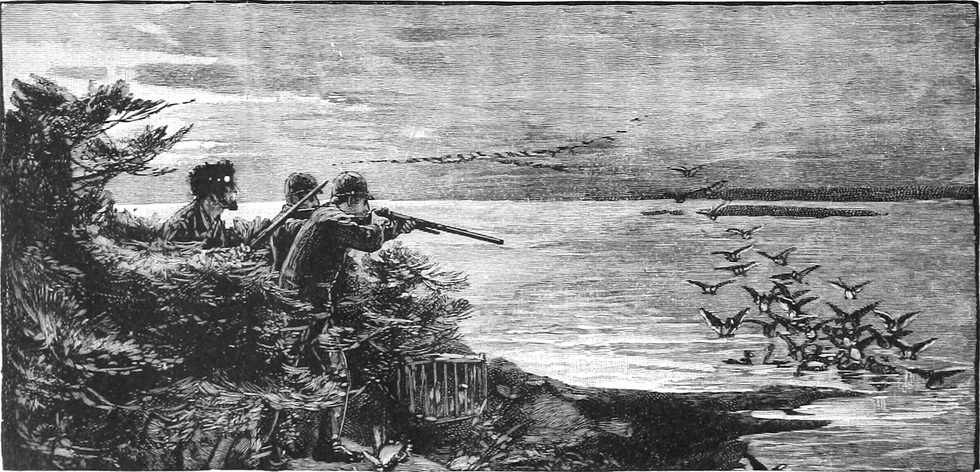
SHOOTING OVER DECOYS.
There was apparently enough fur and feather in Virginia just after the war to supply the whole of America with small game, but in one decade the state of the case was completely altered. First came the invention of the breech-loader, which enables one to shoot all day without intermission. The game stood but little chance against these machines of perpetual destruction. But worse even than the breech-loader was the old army musket, loaded with a handful of shot, with a lately enfranchised freedman behind the big end of it. The darkey is a nocturnal prowler, as much so as a ’coon or ’possum, and his prowls through meadow, woods and fallow cause him frequently to stumble on the wary turkey that forgets his cunning as he struts around preparatory to flying to his roost, generally a dead limb on a lofty tree. He bags many a molly cotton-tail loping down the road to get his evening drink at the branch. But it is when “our friend and brother” catches sight, in the shades of the evening, of a flock of partridges settling in some field for their night’s rest, that he becomes dangerous. It is then that the old army musket is converted into a terror, and when its muzzle bears upon the whole covey squatted in a space that can be covered by a bandana handkerchief, and its contents are turned loose, every bird will be either killed or crippled.
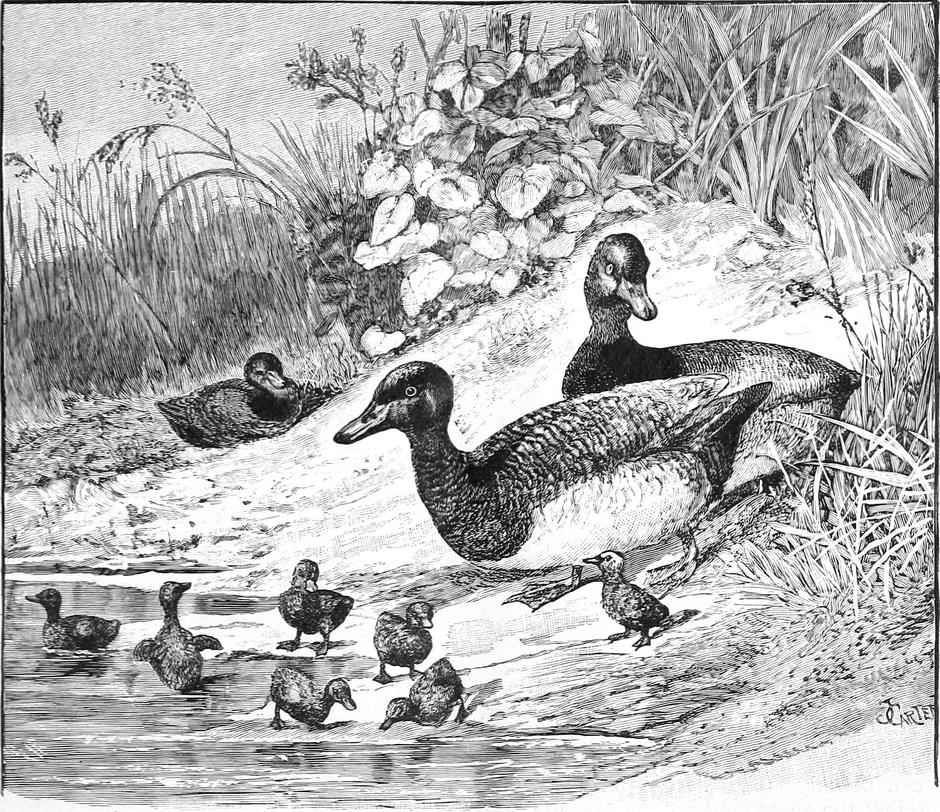
RED-HEAD DUCKS AT HOME.
The freedman’s musket, battered and patched though it be, must look down upon the handsome, resplendent breechloader as a great orator does upon the garrulous, loquacious youth who talks upon every subject at any time, and at any length, while he only opens his mouth to make knock-down arguments, or to utter words of great import that thrill and convince. When the reverberating roar of that old A. M. was heard, it was safe to bet that something that did not come from the barnyard would fill the shooter’s iron pot that night.
A weather-beaten old darkey said to me once: “It dun cos’ me nearly five cents to load that air musket, countin’ powder, caps, shot and everythin’, an’ I ain’t gwine to let er off ’less I knows I’se sartin to make by de shot.”
The baybird-shooting in the summer, and the duck-shooting outside the Virginia capes, was at its zenith some fifteen years ago. Then, too, the canvas-back, that king of water-fowl, before whose name the gourmand bows in homage, still lingered in the tributaries of the Chesapeake Bay, but now it is nearly extinct. A sportsman may gun for a whole winter in the bay and not kill half a dozen “canvas-backs,” but, if a good shot over the decoys, he can count on the kind known as the “red-head”—and if he knew how to pull out a few feathers, as does the professional pot-hunter, he could easily follow that gentleman’s example and sell them at fancy figures for “canvas-backs,” which in another decade will be as utterly annihilated as the dodo. Still, great is the culinary chef’s art, and if he can, by the magic power of his sauces, herbs and seasonings, pass calf’s head off for green turtle, and the skillpot for diamond-back terrapin stew, then nobody is hurt. His patrons enjoy it just the same, and to the average man the red-head duck tastes as well with his champagne as its incomparable relative.
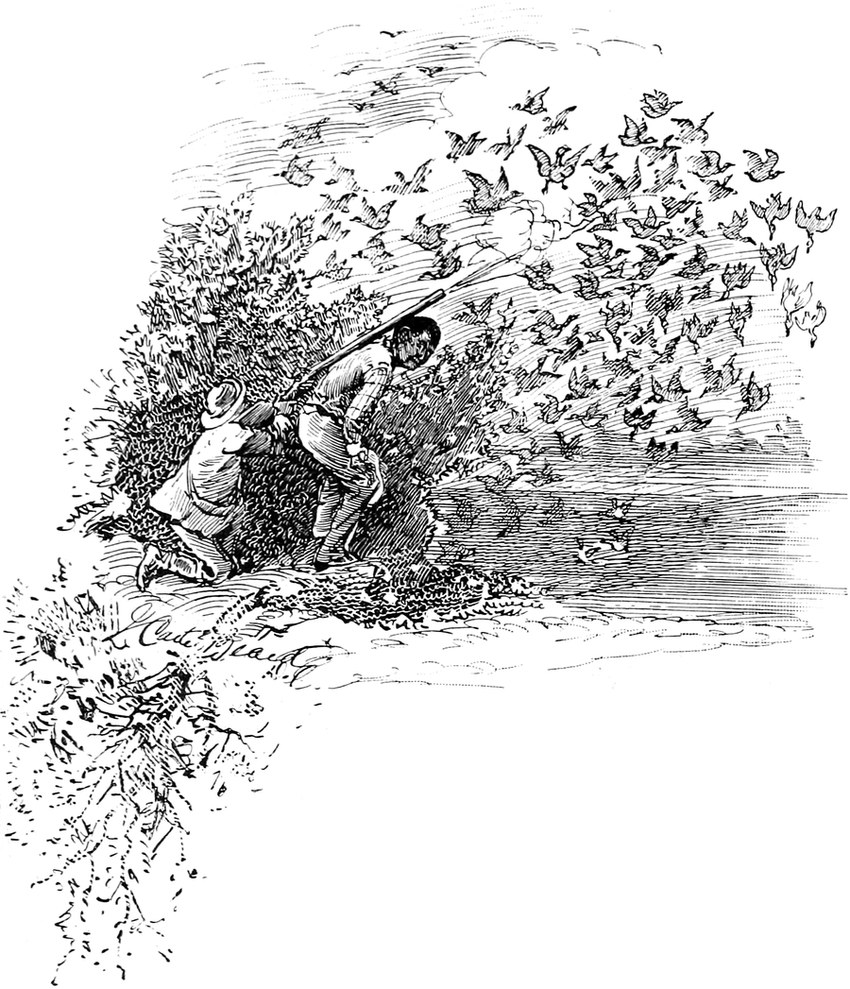
POTOMAC SHOOTING—OLD STYLE.
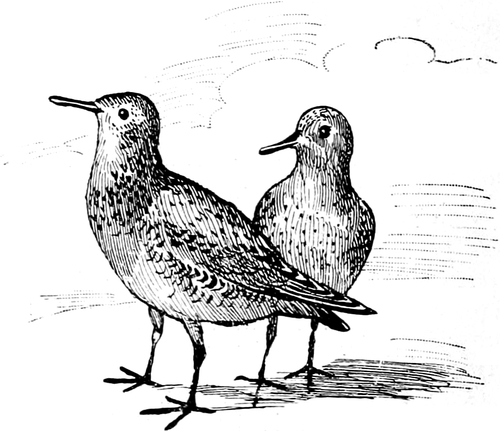
ROBIN-SNIPE.
Fifteen years ago—even ten years—many an amateur would pack his trunk with ammunition, and taking steamer for Old Point Comfort, disembark there, and after a few hours’ wait at the Hygeia Hotel, proceed on his way to the eastern shore of Virginia by crossing the Chesapeake Bay. Or he would go outside the capes, and stop at Cape Charles, or Cobb’s Island. Once at his objective point, he could be certain in the right season of having his fill of shooting every day at the baybirds. They were so plentiful that all along the Virginia Broadwater every oyster-bar or mud-flat would be covered with them, and all the shooter would have to do would be to make a blind out of sea-grass, place his decoys around him, and then try his hand on singles, doubles and flocks, striking them on the turn, while a hundred pair of yellow-legs, or willet, would not be considered anything out of the way. As it is now—well, the finest shot in the country could not kill that many snipe in a week, simply because they are not there to kill. The vast flocks of robin-snipe that tarried in their migrations along the shores of the Chesapeake and the Broadwater of the Atlantic coast have entirely disappeared. The curlew still haunt their favorite places, but have become so wary that neither blind nor decoys can lure them, except, indeed, at the earliest dawn of day, before their eyes are wide open. Half a dozen curlew, between sunrise and sunset, in the blinds, is something for a sportsman to be proud of, for no crow is keener-eyed, more suspicious, and keeps a sharper lookout than these birds. Fifteen years ago I have often killed from thirty to fifty from sun to sun, at Smith Island or Cape Charles, but now one has to load his shell with No. 3 shot to bring down the high-circling, distrustful curlew.
The willet is still fairly plentiful. They lay their eggs and rear their young in the neighboring sea-meadows, and though preyed upon by crabs, snakes and raccoons from the time the egg is laid until the bird is able to fly, they still hold their own. They are such sociable birds that whenever a flock of snipe is fired into, one of the dead is almost certain to be a willet.
The ox-eye, another variety of the snipe family, is found in abundance on the shores and sea-meadows, and they owe their preservation, like the sandpipers, to their insignificant size. There are no birds in existence that keep so close together when on the wing as these ox-eyes. A large flock resembles a solid mass, and dire is the destruction that a double-barrel makes as it pours forth its contents of No. 8 shot at point-blank distance and strikes them on the turn. I asked old Nathan Cobb, of Cobb’s Island, which is outside the Virginia capes—a pot-hunter of half a century’s experience, who has grown independent from the proceeds of his gun—what was the greatest number of snipe he had ever killed by one discharge of his double-barrel.
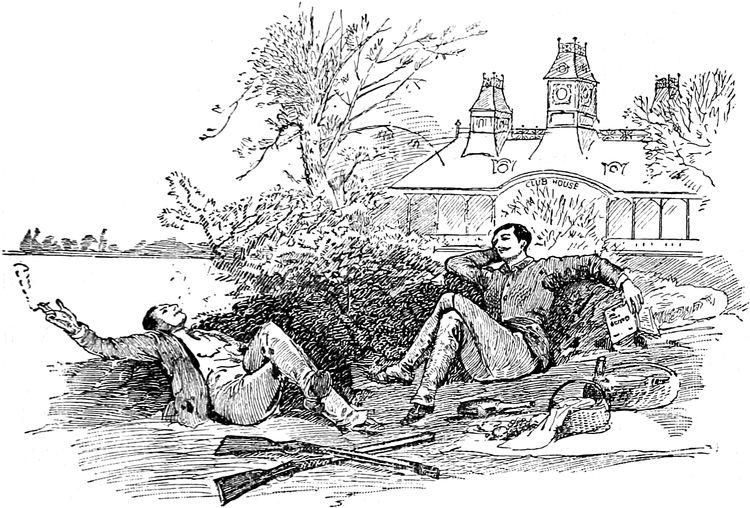
POTOMAC SHOOTING—NEW STYLE.
“Wal,” said Nathan, with his Eastern Shore drawl, “I was out gunning one spring, about thirty years ago, and had a No. 8 muzzle-loader that would hold comfortably six ounces of shot. I ran in on a solid acre of robin-snipe on the beach, and fired one load raking them as they fed, giving them the other barrel as they rose. I picked up three hundred and two.”
I next asked him the greatest number of brant he had ever killed in one day over the decoys, with single shots.
“I bagged,” he answered, “about ten years ago, one hundred and seventy brant, and nearly every one of them was a single shot.”
I can easily believe this, for I have shot in blinds with many sportsmen, at redhead, shufflers, black duck and brant, and I never yet saw amateur, professional, or pot-hunter, whose aim was so unerring and deadly at the flying ducks as Nathan Cobb’s. I do not believe this score has ever been beaten in this country.
At the present day this same story of the disappearance of the waterfowl on the Virginia coast and along the Capes becomes dreary from repetition. It does not pay the sportsman to go to Cobb’s Island now. I spent three seasons there in the winter, during the “Eighties,” and found that the brant were so wild that they would not stool. Then I went to Cape Charles, just outside the Capes, and, though it is a most inaccessible place, the brant would not come near the decoys.
Two winters ago, I tried Currituck Sound, and found palatial club-houses open all about that noble sheet of water. Some of these houses are so splendid in appointment that when you glance around the elegantly furnished rooms, with their damask curtains, Brussels carpets and open grates where the anthracite is piled high, it is impossible to imagine that just outside roll the dark waters of the Sound, while miles upon miles of barren sea-meadows, marshes and swamp separate the house from civilization. All of these club-houses are owned by Northern men—rich in world’s gear, of course—men who count their incomes by thousands, where ordinary bread-winners of the professions count their earnings by tens. Think of having in the magazine of a club-house thirty thousand dollars in guns! Gordon Cumming, starting for a ten years’ game hunt in the jungles of Africa, or Stanley, setting out to fight his way through the “Dark Continent,” with countless hordes of savage “Wawangi” disputing his passage, never had that amount invested in weapons—and all to kill the wary geese and swift-flying ducks.
Even with such perfection of outfit—with guns of every imaginable make from the 12 to the 4 bore, and trained gunners to oversee every arrangement, the clubmen were talking gloomily about the sport fast deteriorating. Pot-hunters, “duck pirates,” countrymen, freedmen—all who lived or robbed along the shores of the Sound had their shy at the ducks, day in and night out, and such a fusillade was never heard since Burnside stormed and carried Roanoke Island, some miles below, in the glinting spring days of 1862. I found good enough sport on the private point of a friend who lived on a large farm by the shores of the Sound. Still the birds were thinning rapidly.
Last winter’s experience with Currituck made me determine never to go to that spot again for sport. I do not think I overstate matters when I say that wildfowl-shooting on the finest grounds in the world is doomed. Gone are the vast flocks, decimated are the swans and geese that were so plentiful in certain localities even three short years ago, and indigo blue are the rich sportsmen who quaff their champagne in silence and puff moodily at their twenty-five cent cigars as they think of the meagre bags they have made, and how matters, now so bad, are always getting worse, thereby proving the old saw which saith “Nothing can be so bad that it cannot be made worse.” The club men should, however, be glad that the snipe will always be with them.
For keen trading, guileless equivocation and general deviltry commend me to the “cracker” of the North Carolina Coast. He could discount the Jersey Yankee upstairs and down-stairs. The typical specimen is slab-sided and always thin; I never met a fat one yet. Their complexion shows that they have wrestled for years with “chills,” and their cheeks are as yellow as a newly-pulled gourd; they drawl in their speech, look at you with half-shut eyes, are afraid of neither man nor devil, have no hero-worship in their composition, and are as familiar with the captain of a yacht as with the roustabout. They are as keen as a brier, despite their listless, indifferent air, and to them more than any other cause is due the extermination of the wild fowl in Currituck Sound. They cleaned out the wild geese by setting steel traps on the bars. What they did not catch they frightened away.
Mr. William Palmer, the superintendent of the Palmer Island Club, states, moreover, that the number of sportsmen who come to Currituck to shoot has increased twenty-five per cent., while the natives have crowded the Sound with their blinds, and every male “cracker” who can hold a gun straight is on the watch.
It is true that there are stringent State Laws against the illegal killing of wild fowl, and also a close season. If these rules were enforced there would be first-class shooting in Currituck Sound for years to come, but the laws seem to be completely ignored; there is not even a pretense of observing them. The law makes a strong provision against a gun being fired at a duck after sunset, but there are numbers of murderous, greedy natives who have their skiffs hid in the woods and swamps in which are the huge ducking guns already referred to. Every hour during the night can be heard the sullen boom of these swivels floating across the waters, and the true sportsman, as he listens to the echoing roar, can only grind his teeth with rage, for he knows what a slaughter is going on, and how the survivors will take wing and abandon the Sound for good and all.
But the worst remains to be told. As if steel traps and big guns were not enough to destroy the wild fowl, the ingenious natives make fires on the banks of the creeks that run through the marshes, and, as the ducks float in ricks up to the illuminated waters, the ambushed assassin gets in his deadly work. Unless the sportsmen who own the club-houses on the Sound, by concerted action and vast outlay, can prosecute the offenders, then “Othello’s occupation’s gone.”
My own idea is that these clubs are too exclusive. They should make it a point to cultivate the entente cordiale with the sportsmen of the State of North Carolina, and thus, by gaining their co-operation, they could induce the State authorities to take stringent action against the law-breakers. Unless this is done the sporting code will remain a dead letter as far as Currituck is concerned. The people shrug their shoulders when the subject is mentioned and say, “Those fancy Northern sportsmen don’t want a North Carolinian to kill a North Carolina duck in North Carolina waters,” and so on, and so on. Had I the arranging and the forming of a game protective association of the club men in Currituck, I would extend a pressing and standing invitation to every member of the Legislature and every officer of the State Government to make the club-houses their own, and the Governor and his staff should be kidnapped every winter, and be made to enjoy the gilt-edge sport of the “Yankee” clubs.
Seeing in a State paper that the Light-house Board intended to abandon the Pamlico (N. C.) Light-house, I applied to the Treasury Department to turn it over to me for a “shooting box.” This was done, and I hope to have some good sporting in the future.
Southward the sportsmen must make their way, and find more inaccessible spots than Currituck to establish club-houses. This being the case, the topography and charts of the regions lying south of Currituck become interesting to the handlers of the gun. Four miles across the mainland is that grand sheet of water, the Albemarle Sound, some fifteen miles wide. Though this sound cannot compare with Currituck for the number and variety of its waterfowl in past years, at the present time it is filled with the birds that have been driven by night-shooting away from Currituck to find safer quarters there. Undoubtedly there will, in the next few years, be erected many club-houses in Albemarle Sound. Some twelve miles as the crow flies across the peninsula, another sheet of water is encountered. This is the Crotan Sound, apparently of about the area of Currituck. There is an abundance of waterfowl here, and but few, if any, club-houses, which will, however, soon follow.
Ten miles southward, across a swampy, barren pine country, there appears the largest and grandest sound of all, the Pamlico. I have no data to furnish the exact size, but the steamer travels over 100 miles before it arrives at Pamlico Point light, at the spot where the Pamlico River enters the Sound. Here is the home and haunt of the swan, and, as they have been but comparatively little hunted, they furnish fine sport to those who have their own yachts and plenty of time. There are no spots at Currituck that can afford more exciting sport or show a greater abundance of all kinds of waterfowl than Pamlico Point, Porpoise Point, about five miles distant, or Brant Island, some twelve miles away. The inaccessibility of the place prevents the shore pot-hunters from disturbing the game, and the “duck murderer,” with his night-shooting, has not yet put in an appearance.
The water of Pamlico Sound is neutral to the taste; sometimes fresh, again decidedly saline, but, for most of the time, it is simply brackish. This condition arises from the fact that the Neuse and Pamlico Rivers pour fresh waters into its area, while New Hatteras and Oregon inlets and Core Sound admit the salt waters of the ocean. This mixture of fresh, brackish and salt waters in a common receptacle naturally attracts every variety of waterfowl. The red-head and shuffler haunt the mingling of the fresh-water rivers with the Sound waters, while the black duck, mallard, and that king of aquatic birds, the gamest of all—the brant, stay in the vicinity of Oregon Inlet. In my opinion, within a few years Pamlico Sound is destined to be the greatest sporting-ground in the country, and the costly and expensive club-houses at Currituck will be discounted by the new ones at Pamlico Sound.
How long it will be before the breech-loader in the hands of the natives and the swivel gun, killing in the night, will drive the wild fowl out of that extensive region is a question that none can answer. Many sportsmen who have been forced southward and still southward during the past years in quest of game hope that Pamlico Sound will furnish winter sport to last them at least the balance of their days.
MR. PERKER’S BEAR; OR, MR. BEAR’S PERKER?
BY PRESIDENT BATES.
SINCE his marriage with Effie Cameron, Mr. Perker has greatly improved in many respects. In his attire, his wheel, and his general style, Mr. Perker still retains his proud pre-eminence as the pink of fashion of the club. Taken all in all, he is the nattiest wheelman that ever sat on a saddle. But now it is a chastened and refined glory. The little “loudness,” indicative of an ambition soaring after effects not quite attainable, which formerly marred Mr. Perker’s brilliancy at times, has given place to a subdued chasteness, suggesting that he could be still more elegant if a rival should appear. Plainly he exhibits evidences of being toned by feminine taste.
Mr. Perker still clings fondly to his bicycle gun, but nowadays he keeps it in the barn. Mrs. Effie will not permit it to be brought into the house. I mention this for the tranquilization of visiting wheelmen, so that they need not hesitate to accept an invitation to one of the elegant lunches with which Mrs. Effie is wont to regale the club and its guests on occasions. And pilgrim wheelmen, who have read OUTING in former years, do not need to be assured that Mrs. Effie Perker is an altogether charming hostess, and one of the prettiest and most warm-hearted Scotchwomen that ever made a home happy.
Former readers of OUTING also know that Mr. Perker’s remarkable dog, Smart, gave promise in his puppyhood of becoming one of the most intelligent animals in the country. In fact, he achieved wide notoriety in his early career. He is now famous for sagacity and accumulated wisdom. As a bicycle hunting dog he is not only peerless, but the founder of a new race—bicycle hunting dogs—a species of dog not hitherto known; and several clubs have obtained specimens of his progeny.
When Mr. Perker was required by the firm to whose interests he devotes his talents to visit a settlement upon the northern coast of Lake Michigan, upon business that would occupy him for two or three weeks, he determined to take with him his dog, his bicycle gun and his wheel. Mrs. Perker protested mildly; but yielded sweetly upon hearing Mr. Perker’s solemn promise not to hunt wildcats. For a woman whose girlhood was spent in the frontier wilds of Canada, Mrs. Perker entertains a singular apprehension of wildcats—all on Mr. Perker’s account. Of course, he is a hero in her wifely estimation; but she does not consider him a wildcat hero. And she has very little faith in Mr. Perker’s bicycle gun, or in the tried courage and sagacity of Mr. Perker’s dog Smart, as against wildcats. She mingled with the packing of Mr. Perker’s clean linen a loving remonstrance against hunting wildcats; and she mixed with Mr. Perker’s toothbrush and razor a tender warning against being led by “that fool, Smart,” into danger. Mr. Perker solemnly promised, with his parting kiss, to take good care of himself. And he meant it.
When Mr. Perker left the city, in Southern Michigan, the spring was well advanced. The roads had dried and were ridable, while the trees were beginning to show yellow-green buds. When, however, he arrived in the Northern woods, the snow still lingered in patches in the dim shades of the pine and hemlock forests, and ice clung to the shores of the lake. The rivers and brooks had cleared themselves, but were still in spring flood. The sharp frosts at night were followed by warm, sunny days, and occasionally by a day that remained cold enough not to melt the surface frost. There was no chance to ride except along the lake shore, where the sloping sands had frozen smoothly and were firm when their surface was unmelted. At various distances from the shore, generally ten to thirty rods, ice-banks, in some places twenty feet high, had formed in the shoal water, from great fields of drifting ice being driven upon the coast by the winter gales, and breaking and piling up their shore edges. Between the ice-banks and the shore sands the ice was reasonably flat, with a top surface of roughly frozen snow. Wherever a swollen river discharged into the lake, its freshet had cut an open channel through the flat ice and through the ice-banks, though the ice-banks still furnished bridges by which to cross the channels of the smaller streams.
At that season of the year there was little hunting, for most game was protected by the game-laws. To be sure the open spaces of water were visited by flocks of wild fowl flying northward, and there were rabbits in the woods, and of them Mr. Perker bagged a few. But, as of old, his hunter’s soul longed for larger game, and only his solemn promise to Effie prevented his joining the settlers in their wildcat hunting. There were wolves in the woods—large gray wolves. But it requires good hunting to get sight of one of these wary prowlers; and Mr. Perker had not the time to take long tramps into the swamps where they kept their lairs. The bears had also come out from their winter sleep, and almost every day Mr. Perker heard of their slaughter. But bears require skilled hunting, unless one happens upon a specimen by accident. If there was any one thing more than another that Mr. Perker longed for it was a bear. He ached for the glory of killing a bear. A bearskin, captured by his own hand, would elevate him several degrees in the estimation of the club and would greatly enhance the reputation of his bicycle gun. But the days of his sojourn in the wilderness were waning fast, and an encounter with a real live bear still remained the thing “he long had sought and mourned because he found it not,” as the hymn-book feelingly remarks. What made his disappointment more bitter was the fact that everybody in the settlement freely conceded that Smart undoubtedly possessed all the faculties and qualities of a good bear dog, except that of finding a bear. Smart, with his master, had made the acquaintance of every dead bear brought into the settlement, but the live bears perversely avoided his distinguished society.
Bears have provokingly peculiar ways. When you arm yourself with rifle, axe, knife and dog, and go hunting expressly for bear society, every bear in the woods hangs out a sign, “not at home,” and declines to be interviewed. When you particularly prefer not to be disturbed in your solitude, as your gun is at home, and you forgot to bring either axe or knife, and your dog is a mile off, rushing around after fugacious rabbits, then is the time that the largest and savagest, and most impudent of all bears is most apt to thrust himself upon your attention, with alarming indications of begging for a chew.
Mr. Perker had reached the last day of his stay in the settlement. It was a fine but cold Sunday. There was a moderate northwest wind swaying the dull evergreen tree-tops and ruffling the gray-blue waters of the lake, but in the woods and along the shore, sheltered by the bordering pines and hemlocks, the air was still and just cool enough not to melt the surface of the frozen sand. Five miles up the shore lived a man with whom Mr. Perker had done business for the firm. Mr. Perker desired to call upon him once more, not really on business, but to show him attention and leave a good impression. This man had a thirteen-year-old boy who, during a visit to a city the previous summer, had seen cowboys perform in a circus, and this had fired his youthful spirit with ambition to lasso something. Mr. Perker thought to win the heart—and custom—of the father by making the boy a present of a lasso. To this end he bought a suitable rope, thirty-six feet long. On one end he had a sailor make a Turk’s-head knot, to prevent its slipping through the grasp. On the other end was the lasso loop. But, lest the ambitious youth should accidentally strangle his younger brother, or his father’s favorite calf or pig, the sailor put a knot in the rope so that the loop could close sufficiently to hold but not to choke. The rope was stretched and limbered with oil and wax, making it a very good lasso for a boy, and strong enough to hold a mule.
Mr. Perker would not go a-hunting on Sunday—he never did. There was, however, no service till evening, so he determined to ride along the beach on his wheel, make the visit, return in time for the service, and start for home on Monday morning. He coiled the lasso and tied it with a thread, so that he could easily carry it on the head of his wheel, and though he did not take his bicycle gun, Smart, of course, accompanied him. The beach sand proved hard and moderately smooth, so that the riding was fair. He was in good spirits, having succeeded well in his business, and at peace with the world, and had no thought of seeing game of any kind.
He had gone nearly half-way, and was riding quietly and comfortably along, minding his own business, when he was startled by seeing a large bear come out of the woods, ahead of him, and walk down to the shore, where it turned and went leisurely forward, evidently not having seen him.
Smart, as was his habit, was—very sagaciously—somewhere else when he was wanted to put himself in danger. If Smart had reasoned that he did not know that his master would meet a bear but, in case his master should meet a bear, it would be a great deal safer for him to be absent, he could not have acted with shrewder wisdom. At that moment he was a quarter of a mile behind in the woods, enjoying himself greatly, trying to ram himself down a woodchuck’s hole, at the bottom of which, his wise nose informed him, a woodchuck either was or recently had been. He was sternly resolved to have that woodchuck out, if it took all day. So now and then he would pull out his head to bark, by way of signaling his master for help, and then ram it down the hole again, so that the woodchuck couldn’t get out without running down his yawning throat.
In the absence of Smart, Mr. Perker conceived a brilliant scheme for the capture of the bear. He would lasso the beast, and then call Smart, whom he supposed to be somewhere close at hand. So breaking the thread that kept the coils of the rope together, he opened the loop, slipped the knotted end under his right thigh, and drew it around the saddle behind him, holding the knot in his left hand, and then pedaled rapidly toward the unconscious and innocent forest monarch, the rubber-tired wheel making no noise. As he was an excellent rider, he could have done this without using either hand; but he kept his left hand, with the knotted end of the lasso in it, upon the handle-bar.
He was almost upon the bear, stealing silently upon his prey, when the bear caught a glimpse of him over his shoulder. Instantly the bear wheeled about, reared upon his hind legs, exhibited a frightfully open countenance and spread claws, at least three inches long, in a way that betokened a warm welcome. At the same time every hair on the animal’s body seemed to bristle with fury, and it snarled in a blood-curdling baritone voice, which would have made a fortune for an opera star villain.
Mr. Perker was not entirely prepared for this reception. It had not occurred to him that his advances toward a familiar acquaintance would be met in that way. He hastily concluded not to intrude. But not having his right hand upon the handle-bar, in a position to put down the break, it was a great deal easier to wish to stop than to accomplish it. Therefore, he simply stood on the pedals, and they pitched him headlong over the handles, right at the bear, like heaving a bag of bran off a wagon.
It was now the bear’s turn to be astonished. He had not calculated upon any such method of assault. He was prepared for a fair fight; but he wasn’t used to having men thrown at him, all doubled up in a wad. “Take any shape but that, and my firm nerves shall never tremble.” But that shape!—well, he was the scaredest bear probably ever seen upon the coast of Lake Michigan. He was so scared that he didn’t have presence of mind enough to run into the woods; but, with a loud snort of panic, he scattered the frozen sand straight down the beach.
In falling Mr. Perker somehow gave the lasso loop such a flirt that it went over the head of the bear and drew about his neck, when he started to run. Mr. Perker did not intend to do it, and the bear ought not to have laid it up against Mr. Perker. It was purely an accident—a liberty with a stranger that Mr. Perker would not have taken under such circumstances, if he could have helped it. In fact he couldn’t have lassoed a bear by the neck if the bear hadn’t been surprised by his header, for a bear on guard is as practiced a boxer as can be found, and one can no more get a noose about his neck than one can over a man’s neck with his hands and arms free to fend it off. As it was, however, the bear was caught; and, as he ran, the knot of the rope caught under the bicycle saddle, and that machine was dragged, rattling, bounding, banging and glittering after the flying brute, adding to his panic, like a tin-pan tied to a dog’s tail.
Mr. Perker scrambled to his feet quicker than he ever did before in his life. His first instinctive impulse was to ascertain if he was still alive, with none of his members missing. Having discovered that he was all there, his next impulse was to run after his beloved wheel, which he did, shouting like a lunatic for “Smart! Smart!” This did not tend to lessen the fright, nor diminish the speed of the bear—quite the contrary.
About twenty rods ahead a small brook had cut a channel through the flat ice with its spring flood, but the ice-banks were still intact a dozen rods from the shore, compelling the outflowing flood to find a channel beneath them. When Mr. Perker first formed the scheme to lasso the bear he had counted upon this open water to stop the animal in case he ran that way. Now he expected the bear to either turn into the woods or else go around the open mouth of the brook on the ice-bank. But, as may be guessed, Mr. Perker was not familiar with bears. This bear, frightened half out of his wits by the bicycle clattering at his heels at the end of the rope, didn’t turn at the brook. On the contrary he plunged into it and swam across, no doubt with the notion that his mysterious pursuer could be stopped by the icy water. Clambering out on the ice on the opposite side, as soon as he got the length of the rope from the brink the bicycle caught under the ice and anchored him. This the more easily because the ice upon which he stood was glassy smooth from the recent overflow, and gave his claws no hold, let him strain, and yank, and dig in his toes and swear as savagely as he might.
Seeing this Mr. Perker hurried faster and shouted louder, doing his best to get around the end of the open channel by way of the ice-bank. He was afraid that the rope would break or be gnawed off and let his beloved wheel sink where the water was probably twenty feet deep. Coming around the head of the channel, he ran along the edge of the ice to get between the bear and the water, and haul up the bicycle. If he could recover his wheel he would be willing to let the bear go. Meanwhile he kept shouting for Smart. On his approach the bear redoubled his efforts to break away, but in vain. Mr. Perker reached the spot and managed to loosen his wheel from its hold under the ice by pulling on its handle-bar. It naturally came up out of the water with a jerk that upset Mr. Perker with great violence, jamming one of his feet between the spokes as he fell.
The bear now set off again, plunging and snarling, this time toward the woods, only a hundred feet away, dragging Mr. Perker by the foot, flat on his back. In hopes of stopping the procession, Mr. Perker flopped over upon his breast, and tried to dig his hands into the ice. No go. He only skinned his hands. As he struck the rougher ice it felt hot from friction, and he turned over again on his back. But it was equally hot that way. When he struck the sand, it seemed red-hot. It was like being drawn over a rasp. Luckily the sand was only a few feet wide, the woods coming down at this point almost to the shore. Here the bear turned slightly, and in a moment Mr. Perker’s free leg went on one side of a small tree, while his caught leg went on the other side. The tree did not break nor his leg pull out by the roots, though Mr. Perker thought for a moment that it would, and the procession was anchored again. By way of backing the anchor Mr. Perker threw his arms about the tree and hugged it with all his might, while he yelled for Smart.
The frightened bear, after a few frantic tugs, became convinced that he could not get away. Then he turned upon the prostrate and yelling Perker with dire intent; but the instant the strain slackened on the rope, Mr. Perker was able to kick, and a single kick freed his caught foot. Before he could rise, however, the bear would have been upon him but for an interruption. That interruption was from Smart who came tearing around the ice-bank and charged bravely to the rescue of his imperiled master.
Finding that the woodchuck—if there was any woodchuck in the hole—evidently intended to stay there, Smart paused in the work of excavation, and sat down to reflect and catch his breath. The instant he was thus quiet he heard the far-off voice of his master calling him in a manner that indicated urgency. Smart ran after his master at full speed, and coming to the spot where Mr. Perker first encountered the bear, stopped as if he had run against something. His nose whispered “bear!” to his brain. The hair on his back bristled. Then he heard Perker shout, and set off on his track again. Coming around the open channel by way of the ice-bank he caught sight of the bear, and charged fiercely upon the unknown enemy, intending to incontinently scatter his vitals all over that part of the coast.
Attacked by the dog, the bear halted in his rush at Mr. Perker, sat up on his haunches, and bestowed a buffet upon poor Smart that rolled him over and over, a dozen feet away. Smart, though a remarkably intelligent dog, did not know much about bears; but that single cuff taught him much. He caught the general idea immediately, and rushed behind Mr. Perker for protection, while the bear rushed after him. Mr. Perker shinned up that small tree very much faster than a boy after a bird’s nest. By the time he was up his own length, spreading his legs as wide as he could, to get them higher, Smart, with admirable strategy, perceiving that the shelter of Mr. Perker’s legs was withdrawn, ran around the tree, looking for a good place to climb it also. The bear ran around after Smart. This wound the rope around the tree; and, when Smart ran off at a tangent, the bear rushing after him was brought up with such a violent jerk of the noose upon his neck that he turned end for end and hit Smart with his hind legs, like the snap of a whip, while every bone in his back cracked. The shock almost jerked Mr. Perker out of the tree, but he hung on grimly, and crawled up a few feet farther. By the time he was eight feet from the ground, however, the tree, which was only as large as a man’s leg at the bottom, began to bend over with his weight, and he could go no higher.
The dog being out of his reach, the bear now ran back at Mr. Perker, and rearing up against the tree, tried to reach him. Mr. Perker again spread his legs wide apart, and drew himself up as far as he could. The bear cautiously raised himself a little higher and managed to give one of Mr. Perker’s swaying legs a scratch that drew from him a yell of pain and fear. Then Smart rushed in and hung upon the bear’s flank, and the bear and Smart dropped upon Mr. Perker’s wheel. The bear got one foot through the spokes, and he and Smart went wildly cavorting about with the wheel, till Mr. Perker’s anguish of mind and failure of muscle let him drop with a yell upon them, knocking the bear down. He did not, however, hold the bear down. On the contrary, he executed a prompt strategic movement, and did not stop rolling over until he brought up twenty feet away. Smart followed him, with that devotion for which he is noted, and the bear followed Smart, until snubbed again by the rope.
At this moment, when Mr. Perker most needed repose, his nerves were startled by the crack of a rifle. The ball sang over his head and pierced that of the bear, who immediately turned slowly around twice, and then sank down in a heap, quivering and kicking, whereupon Smart, with renewed courage, ran in and tugged terribly at one of his ears. As soon as Mr. Perker could comprehend what had happened, he was grateful. He thought the voice of the man who ran forward and asked: “Are you hurt?” was the most welcome sound he had ever heard. He replied that he was “only just a little out of breath.” This reply, wasn’t strictly accurate. A sorrier looking object than Mr. Perker has rarely been seen on Sunday.
The man kicked Smart off the bear’s ear, and then said, looking curiously at the disconsolate Mr. Perker:
“Why! Mr. Perker! how are you?”
Perker limply took his hand, looked at him, and answered:
“Hello! Smith!”
Then he shook Smith’s hand heartily, for Smith was the identical man he was going to see. With Smith was the boy to whom Mr. Perker was taking the lasso. The boy had stood gazing in open-mouthed wonder at the lassoed bear, at Perker, and at Smart, with which sagacious beast he had already struck up a treaty of amity and mutual admiration.
Smith noticed the rope and drew it from the neck of the dead bear.
“Was a tame critter, eh?” he asked.
Perker answered with unnecessary heat: “Tame! not by a blamed sight!”
“You wasn’t trying to lead a wild bear into town with a rope, was you?” asked Smith, grinning.
“That’s what I started to do,” said Perker, seeing that honest confession was best, “but he came near leading me into his camp.”
Then Perker told the whole story, and Smith sat down and laughed till exhausted. Finally he slapped Perker on the shoulder and said, with vast soberness:
“Well, Perker, you’re the pluckiest chap I ever met! You couldn’t have hired any man about here to undertake that job for ten dollars an hour!”
And he laughed again and fell to skinning the bear, chuckling. Then the boy wanted to know what he was going to do with the rope. This reminded Perker and he gave it to him. Never was a boy so thoroughly delighted. He had a lasso that had actually lassoed and held a wild bear, and a big one at that!
Perker found his idolized wheel in a sad state. Its rim was badly buckled, and half a dozen spokes were bent, but after some straightening and tightening, with Smith’s aid, except for a wet saddle, rapidly drying, the wheel was as good as ever.
Mr. Smith proposed to cure the skin and send it to Mr. Perker, taking his city address for that purpose. This pleased Perker immensely; and they parted with mutual satisfaction.
When Mr. Perker reached the city, he limped home, and Mrs. Effie, while she tended his hurts, remarked: “Theophilus, you’re too big a fool to be trusted to go alone into the woods! And the sooner you get rid of that fool of a dog the longer you’ll be likely to dodge the Foolkiller!”
Mr. Perker did not report this observation to the Club, but Mrs. Perker’s kitchen-girl reported it to Mrs. Littleweed’s cook, and a course of pumping, by the Club wits, extracted the other facts from Mr. Perker.
This is the reason the members, when Mr. Perker proudly exhibits the bear-skin, sometimes speak of “Mr. Perker’s bear,” and sometimes of “Mr. Bear’s Perker.”
FAST ICE-YACHTS.
HOW THEY ARE BUILT, RIGGED AND HANDLED.
BY CHARLES LEDYARD NORTON.
ON a rocky promontory of the Hudson River, a few miles above Poughkeepsie, there stands, half hidden by the foliage in the summer, a long, low, neatly painted structure instantly suggestive to the nautically inclined of boats and their belongings.
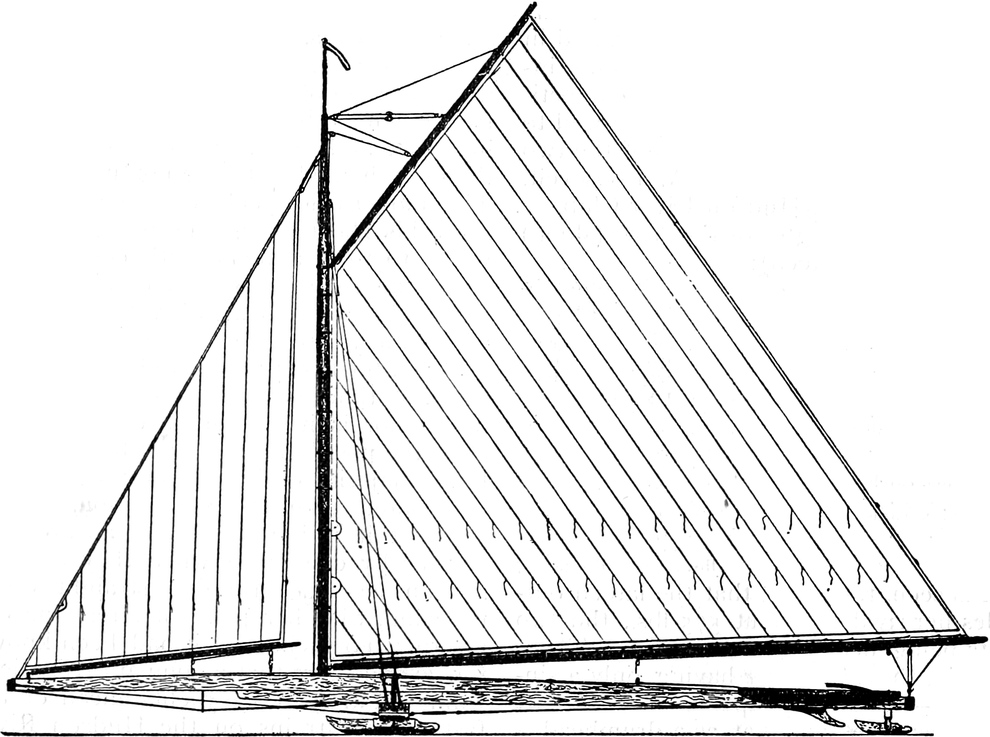
But there is an unaccountable lack of the familiar characteristics of such localities. Even in midsummer there are few, if any, boats anchored in the cove, or hauled up on the shelving rock that serves in lieu of a beach. Through the open doors of the boat-house one may, perhaps, see certain varnishing and rigging operations under way. There are bundles of sails, coils of rope, rows of blocks, and long, curiously curved spars resting upon racks—long enough they are to serve as topgallant-yards for an old-fashioned man-of-war, but no ordinary sailorman would see any use for them with their nautically impossible curves and angles, and their unfamiliar and unshipshape attachments of galvanized iron.
This boat-house, however, is the headquarters of a yacht club that stands easily at the head of its class in all the world; but its fleet of racers is dismantled and laid aside in summers when other yachts are in the height of their glory. This fleet goes into commission only when the floating fields of new ice are fast welded together, and the river surface is solid from the Highlands to the Mohawk.
The Hudson River is by no means the only club, though it may not unfairly be designated as the leading one. At the neighboring towns of Poughkeepsie, New Hamburg and Newburg, and up stream at Hudson, Athens, Saugerties, Albany, and elsewhere, are other associations, with fleets of yachts always eager to try conclusions with their down-stream rivals. Poughkeepsie, and its immediate vicinity, however, has always been, and is likely to remain, the headquarters for ice-yachting.
This is due to several favorable conditions, natural as well as artificial. The river narrows and becomes tortuous at the Highlands—about forty miles from the sea—and this natural obstacle largely determines the permanency of ice in the river above. In a large stream the ice rarely forms across from shore to shore in a single night. It freezes in bands and patches, which become detached from the shore and float up and down with the tide until they become jammed and frozen together. North of the Highlands, too, the average winter temperature is considerably lower than it is to the southward, and sharp frosts come earlier and stay later. The beautiful and picturesque banks, moreover, have since early colonial times proved attractive to lovers of the country, and the riverside is for many miles almost continuously occupied by residents who have abundant means and leisure for such recreations as suit them best. Again, the great harvest field of the Hudson River ice-crop finds here its southernmost limit. At this point in the stream the admixture of sea-water renders the ice more or less unmarketable, and the ice-yachtsmen are therefore not so likely to be interfered with by the armies of men who are set to work by the great companies as soon as the ice is thick enough to pay for cutting and storage.
It is proverbial that no sooner is a good surface formed for ice-yachting than it is hopelessly buried under a shroud of snow; but here again nature comes to the rescue, for the latitude is far enough south to render alternations of frost and thaw probable all through the winter. Accordingly the white surface soon becomes streaked with gray, and ere long the yachtsman looks out of a morning and sees his highway once more practicable for steel runners.
This year engineering science has arrayed itself on the side of the yachtsman, and has built two huge piers in the river at Poughkeepsie. Primarily these are intended for the new cantilever railroad bridge, but incidentally they are welcomed by the winter-sailing clubs, because they will undoubtedly keep the ice in the river longer than it has heretofore been in the habit of staying. This is highly important in their eyes, for not infrequently there are cold “spells” in March which render the ice available for good sport, provided it could be held in position long enough to be temporarily re-frozen and prevented from floating away down stream on the ebb tide.
Despite all these favorable conditions, however, the goddess who presides over the destinies of ice-yachting is but a coy and fickle divinity. Sometimes she vouchsafes to her devotees not more than a day or two of sailing in an entire winter. Often she limits her favors to ten or fifteen days, and only at rare intervals does she smile upon them for thirty days, all told. The ice-yachtsman may, therefore, plume himself upon being the most select and exclusive of all sportsmen. He cannot, if he would, spend very much time en voyage, so he makes up for it as well as he may by contriving and perfecting all the details of his craft during her hours of enforced idleness. The result is that he has evolved a fabric that is a marvel of construction, adapted for lightness and strength in a wonderful degree.
Many of our readers have never seen an ice-yacht, but probably most of them have seen and made a common diamond-shaped kite—the simplest and easiest form of kite known to ingenious boyhood. This frame is in its general principles of construction identical with that of the modern ice-yacht, as shown in the working plans published herewith. The cross-piece corresponds with the runner-plank, the upright represents the center-timber, and the cord that passes around the whole is identical with the side-stays. (See Fig. 1.)
It is only necessary to set up a mast at or near the intersection, rig sails upon it, attach some kind of runners to the ends of the runner-plank and to the long or aftermost end of the center-timber, and you will have a very passable model, constructionally speaking, of the modern ice-yacht. Magnify it a hundred-fold, substitute wire-rope with turn-buckles for the side-stays, fit the timber ends with cast-metal caps, bolt everything together with cunningly contrived fittings, mount her upon a set of hardened iron runners, equip her with a “tailor-made” suit of sails, launch her on reasonably smooth ice, and, given a twenty-mile breeze, she will carry you forty miles, or maybe sixty miles, an hour, if you know how to make her do her best.
It may be remarked in passing that very pretty sport may be had with model ice-yachts, constructed somewhat after the manner indicated. Pieces of tin or sheet-iron will do for runners and steering-gear at a pinch, and if the sails are moderate in area and the center-timber tolerably long, so that ballast can be suitably adjusted, she will go like a witch and skim over a mere veneering of ice to the admiration of all beholders. There are always several days at the beginning of winter before the ice is available for skating, when model ice-yachts might be made to do duty instead of the sticks and stones with which impatient boyhood usually disports itself, thereby ruining the ice for the legitimate pastimes of colder weather.
In the regions where the ice rarely becomes thick enough for satisfactory skating, these little ice-yachts may easily afford a deal of not altogether unprofitable amusement. Model yachts have not as yet gained much of a foothold in the nonfreezing United States, but in England, where there are prosperous clubs almost everywhere, even in Hyde Park, in the heart of London, the conditions are very favorable. Sails and rigging are all ready and need only to be mounted upon a suitable frame with runners, steering gear and adjustable ballast. The average Englishman may probably regard this suggestion as unwarrantable, because ice-yachting is wholly beyond his range of experience, but if once he tries it he will find that it opens up possibilities of seamanship not dreamed of heretofore, and he will cover the frozen Serpentine with miniature fleets that will rival in beauty and vastly excel in speed those that dance over its ripples during the summer months.
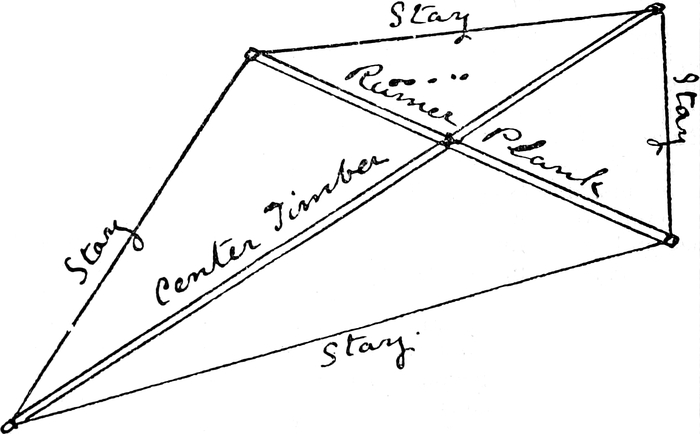
FIG. 1.—A KITE-FRAME FOR AN ICE-YACHT.
In its main features the Hudson River ice-yacht now closely approaches perfection. Improvements will, of course, be made from time to time in the minor details of rig, and occasionally some phenomenally fast boat will be built, the secret of her speed remaining perhaps, in some degree, unexplained.
A few years ago the lateen rig was simultaneously adopted by the Hudson River and Shrewsbury (N. J.) clubs, and for a time it bade fair to supersede the jib and mainsail boats that had long held the championship pennant. Several very large lateen-rigged yachts were constructed, notably the Scud of the Shrewsbury, and the Avalanche of the Hudson River Club. Experience has shown, however, that craft of that size and rig are phenomenally fast only when the wind rises to No. 70 of Beaufort’s scale, that is to say, something nearly approaching a full-grown hurricane. With such a wind the big lateens are undoubtedly very fast, but the rarity of such conditions leaves them in the lurch on ordinary racing days, and it is by no means certain that even in a hurricane they are sure to win when pitted against a jib and mainsail. At all events, some of the large lateens have been altered to the sloop rig, and their owners are not disposed to try back.
On small or moderate sized yachts, however, the lateen is an admirable rig, and in average racing weather such boats not infrequently distance their larger competitors. In this connection it may be well to compare the respective weights of the two rigs as taken by Mr. John A. Roosevelt, Commodore of the Hudson River Club.
Comparative weights of the Icicle (sloop) and Avalanche (lateen):
Icicle. Avalanche.
Center-timber and box, lbs. 776½ lbs. 768½
Runner-plank and strap, 565 520
Mast, 250 361
Runners, 150 186½
Boom and two blocks, 146½ 451½
Rigging, 125 —
Blocks, — 93
Rudder-post and tiller, 91 81½
Gaff, 47½ —
Yard, — 198
Jib-boom and two blocks, 47 —
Blocks, — 18½
Blocks and halyards, 62 50
Sails, 172 206
lbs. 2,432½ lbs. 3,007¾
It is seen, therefore, that the lateen outscales her rival by about 575 lbs., the two boats being nearly the same size. Theoretically, the Avalanche having only a single sail—and that capable of being set almost as tight and flat as a drumhead—should out-point and out-foot anything of her size, but practically the extra weight hinders more than the better fitting canvas helps her.
The “cat-rig,” too, has been tried, but without the good results anticipated, and a sharpie rig has, it is said, done fairly well with a small boat on the Shrewsbury.
It may be confidently stated that the sloop rig is the safest to count upon for allround work, particularly in the largest-sized boats. In boats of the second and third class the lateen may be used with a chance, not altogether assured, of superlatively good results.
It is not likely that ice-yachts will ever be built larger than the present, the Avalanche, Icicle, Northern Light, Scud, and their class, i. e., about fifty feet long, and spreading something like 600 square feet of canvas. To sustain such a boat requires comparatively heavy ice; to drive her at a high rate of speed calls for a living gale of wind, and to tow her home when becalmed, or collect her scattered fragments should she chance to be shipwrecked, is a work demanding a large store of patience and endurance. In average blustering wintry weather, with a wind not to exceed, say, twenty-five miles an hour, boats of the second class stand a very fair chance of beating those of a larger spread and heavier weight.
The art of sailing an ice-yacht is sui generis. It is, indeed, of comparatively modern origin. A generation ago sheets were started on an ice-yacht when running free, much as they are in an ordinary sailing-boat, and the singular properties of the close-hauled sail were not understood. The modern ice-yachtsman never slacks away his sheet except, perhaps, when he wants to turn a stake with certainty, or when the ice softens. Given a hard surface and a stiff breeze, he will outrun the wind in any direction.
One who hears this paradox stated for the first time may be pardoned for incredulity, nor is it easy in all cases to make clear the possibility of such a feat. A very large majority of intelligent people when confronted with the proposition, simply say that it is impossible and absurd, and are hardly convinced when they actually see an ice-yacht running straight down the wind, with her pennant streaming out astern. To yachtsmen. it had been known for several years that a comparatively light wind would send ice-yachts ahead of the fast express trains on the Hudson River Railroad. After a time the mathematical experts heard of it, and they said it could not be so; they took their little slates and proved their position to the satisfaction of all properly constituted scientific minds. But this did not prevent the yachtsmen from sailing faster and faster, and presently other mathematicians rose up and demonstrated the contrary of the proposition, thereby showing, for the ten-thousandth time, that all save the truth can be proven by figures.
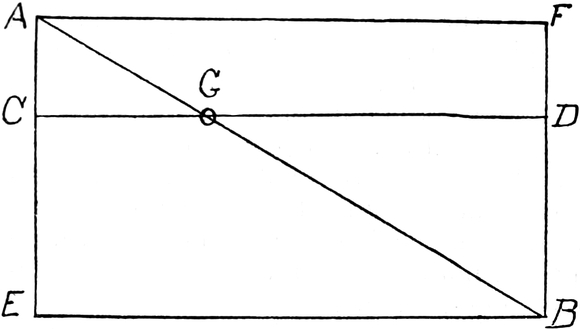
FIG. 2.—THE SAILING PARADOX.
The fundamental principle of sailing an ice-yacht faster than the wind may be readily demonstrated by means of a very simple mechanical device.
Let A, E, B, F be an open frame, A-B a wire stretched diagonally from corner to corner, and G a ring running upon the wire. C-D, another wire, reaches from end to end of the frame, passing also through the ring G at the intersection of the wires. This second wire (C-D) is movable back and forth between A-F and E-B, and parallel to them. It is evident that when C-D is moved the ring G will slide along both wires, and that while C-D is passing from A-F to E-B, G will slide from A to B—twice as far, that is, as the distance traversed by C-D, the moving agent.
SAIL PLAN OF A MODERN ICE-YACHT.
Now, suppose G to be an ice-yacht; let the movement of C-D across the frame represent the direction and velocity of the wind and the diagonal A-B the distance to be traversed. The ice-yacht G moves twice as far, that is to say, twice as fast as does C-D (the wind) that drives it. Such is, perhaps, as plain a statement of the conditions as can be devised. In practice the elements become more complicated. Let Fig. 3 represent a section of frozen river, with the wind blowing across it in the direction indicated by the arrows. Applying the principle shown in Fig. 2, an ice-yacht may run from A to B while the wind is moving across the river from A-F to E-B. It is not the purpose of this paper to go into the logistics of sailing in general, but any one who can sail a boat will see at a glance, that with the wind as shown in Fig. 3, an ordinary boat would sail nearly or quite as fast from C to D, or from E to F, as she would from A to B. The same rules apply, of course, to an ice-yacht, but with this important difference, while an ordinary sailing-boat meets with increasing resistance from the water the faster she goes through it, an ice-yacht meets less and less frictional resistance from the ice the faster she goes over it. Again, if she is pointing more or less toward the wind (as on a line from E to F), she increases the apparent force of the wind by her own motion. The only considerable resistance is that offered by spars, rigging, etc., in passing through the air, and this is trifling when compared with her large sail area, and the propulsive energy of even a moderate breeze.
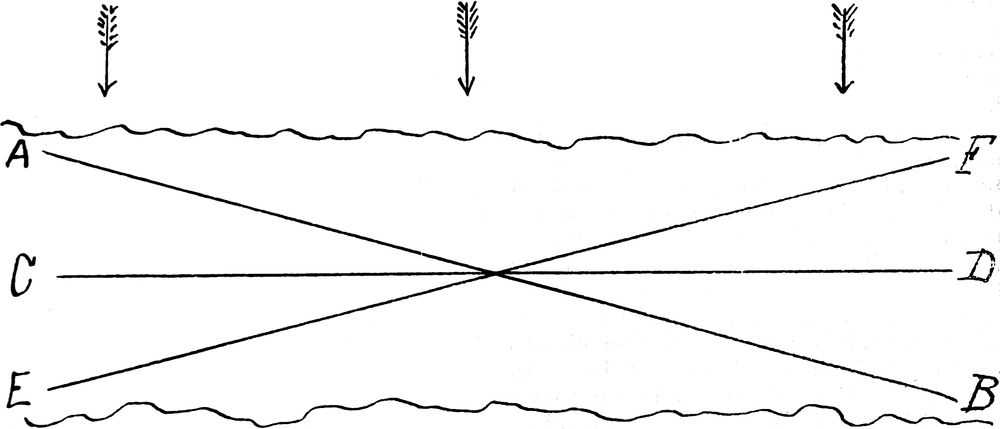
FIG. 3.—THE SAILING PARADOX IN PRACTICE.
In sailing an ice-yacht there is none of the vexatious handling of ropes unavoidable in an ordinary sailing-boat. The sheets usually take care of themselves in going about, and the steersman has only to move his tiller a little to starboard or port to secure instant obedience and an eagle-like swoop of the yacht in the desired direction. In high winds, however, the yacht is apt to lift her weather runner clear of the ice, upon which she at once becomes unmanageable and must be brought down to her bearings as soon as possible. If properly balanced she should shortly do this of her own accord, but during the few seconds when she has the bit between her teeth she may do untold mischief.
The astonishing rapidity with which an ice-yacht under control may be handled was well instanced last winter in an encounter between the Polaris and Arrow, as indicated in the diagram, Fig. 4. The Polaris was running dead before the wind, heading to pass a space of open water where ice-cutters were at work, when her steersman became aware of the Arrow approaching on his starboard hand at a fearful rate of speed, but with her weather runner in the air, and evidently with the bit between her teeth. A collision was imminent, for the Polaris could not bear away in either direction; on one side was open water and on the other was the Arrow, too near to be passed astern. Under the circumstances it was instinct rather than a process of reasoning that led Commodore Roosevelt to jam his helm hard a-starboard and send the Polaris spinning on her center, making a complete revolution almost within her own length (see Fig. 4). She did it, and was on her former course again almost before any one knew what had happened, her jib-boom barely clearing the after leach of the Arrow’s mainsail as she passed astern of her. Such a gyration as this is justifiable only in extreme cases, for of course everything is subjected to a sudden and tremendous strain, and if nothing gives way it speaks well for the perfection of equipment.
Sometimes an ice-yacht will perform this maneuver on her own responsibility and without an instant’s warning, and this is especially true of the smaller class of lateen-rigged boats. With them, however, damage is less likely to result, as the strains are proportionately less severe.
Sailing on the wind is a comparatively simple matter, though, of course, where a number of boats are breaking tacks, as in a thrash to windward on a regatta day, a quick eye and a steady hand are indispensable if collisions are to be avoided and the most made of every turn.
Running down the wind, however, calls for the more skillful seamanship, and involves a closer calculation of chances. Not many years ago, when a fleet of ice-yachts sailed down the wind, it was a straight run with lifted sheets, but after a while some bright fellow discovered that by putting his boat on the wind at her very best point for speed, she would in a few seconds attain a maximum velocity. Then, bearing away, she would run sometimes for several minutes through the wind, her pennant flying out astern, and she sliding past her free-sailing competitors at an astonishing rate.
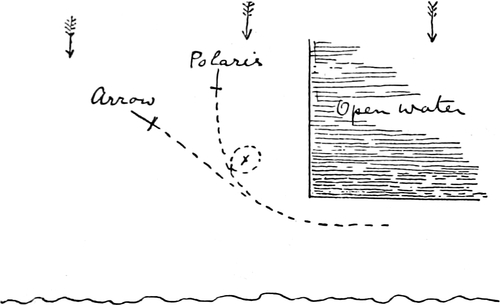
FIG. 4.—A CLOSE CALL.
Fig. 5 roughly shows the comparative courses of two ice-yachts, A running dead to leeward and B tacking after the method described. The proportions between the tacks across the wind and the runs through it cannot be preserved on so small a map; but it is evident that B traverses a far longer course. That she invariably beats A, other things being equal, is the unanimous testimony of all practical ice sailors. In other words, if a balloon could be persuaded to drift down the wind at a convenient height above the ice, B could let it have a fair start, and could, if properly handled, sail completely around it in a run of two or three miles.
This “proper handling,” however, is not so simple as it seems. It involves an intimate knowledge of and sympathy with one’s boat. Her best point of sailing varies with every variation in the force of the wind, and her skipper should know by instinct exactly when she is doing her very best under existing conditions. She must not be forced so that she will lift her weather runner clear of the ice, for the moment that runner lifts the grip of the lee runner weakens, and the yacht is in danger of making leeway. She must not be turned too sharply, for the rudder checks her headway, and so does the lateral resistance that she encounters while changing directions. A knowledge of the course is of vital importance. Instead of the currents and tide-rips of summer, the winter yachtsman must be familiar with the “windrows,” air-holes, cracks, ice-imbedded drift-wood, and the like, that beset his course. After every storm these are liable to change and new obstructions from similar causes likely to appear. Hence every tack must be calculated to a nicety, so that the next change of direction can be made to the best advantage.
When running for the stake it is important to gauge headway so that the turn can be made without being carried too far beyond the mark; and here again a personal knowledge of the boat and her whims is indispensable for nice seamanship. In the excitement of the moment one may readily lose control, and it is said to be a good plan to slack away the peak halyards a trifle just before rounding. This enables the rudder to act with certainty, and as soon as the turn has been made the halyards can be again hauled taut. This operation necessitates the best modern appliances in the way of hoisting-tackle, for the halyards all lead aft to the “box,” and one man should be able to slack away or haul taut with one hand. Then, of course, there are all the devices known to sailing experts intensified a hundred-fold by the altered conditions.
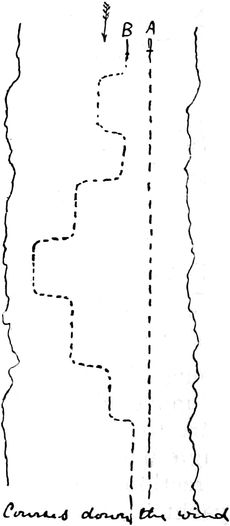
FIG. 5.
An absolutely even start can always be had since the contestants can be held at anchor till the signal is given, though, of course, the windward position gives an advantage. Once under way seamanship and knowledge of the course begin to tell, and bold maneuvering may quite as often win a race as in the slower evolutions of regular sailing craft. The swiftness with which any plan can be executed renders the game extremely exciting. One sees an opponent making a short and seemingly unnecessary tack. The natural results must be comprehended instantly or, peradventure, one may find one’s self presently forced to yield the right of way when every second is of the last importance. It is jockeying, perhaps, but when one knows that by crowding a dangerous rival a trifle he will be forced to tack a mile farther on by an insurmountable windrow, one were more than mortal to resist the temptation. It calls for quick thinking and equally quick action to sail an ice-yacht successfully and well in a modern regatta; but the excitement is of the wildest description, and all the accessories are fascinating in the extreme to one who has robust health and does not care a rap for exposure in a northern midwinter.
Our frontispiece is from an instantaneous photograph which caught the Northern Light (holder at the time of the Challenge Pennant) just as she was rounding the home stake, off Poughkeepsie, on Valentine’s Day, 1887. She was probably moving at the rate of twenty miles an hour when the picture was taken. The sleet thrown up by her lee runner can be seen flying off astern. Her weather runner was, in fact, just clear of the ice at the moment, though so slightly as to be imperceptible in the picture. This is probably the best photograph of a moving ice-yacht that has ever been taken.
Every year sees improvements in fittings and rig. The “Haggarty hoist” is now used on the mainsails of the best boats instead of the ordinary mast-hoops. This hoist consists of a series of metal clamps attached to the luff of the sail and engaging a wooden cleat shaped like a T-rail and fastened vertically to the after-side of the mast.
To secure a better “set” the luff of the sail is no longer doubled over on itself, but instead, a canvas binding is sewed on. This gives three thicknesses of canvas instead of five thicknesses, as was often the case under the old system, and, consequently, the sail stretches along the mast, where the greatest hoisting strain falls, and where any inequality is most readily taken up without causing wrinkles elsewhere. The elliptical box, with its comfortable cushions and its central hand-rail for the passengers to grasp in case of need, is suggestive of luxury but in itself it is largely delusive, for no position is less endurable than a half-reclining one with the head raised, as was formerly unavoidable. To render the sitting position possible the iron tiller is now given an upward curve, so that the steersman can sit with his legs across the center-timber, the tiller swinging freely above his knees. This posture, however, necessitates some sort of a backboard, and the best appears to be an upholstered iron frame, as shown in Fig. 6.
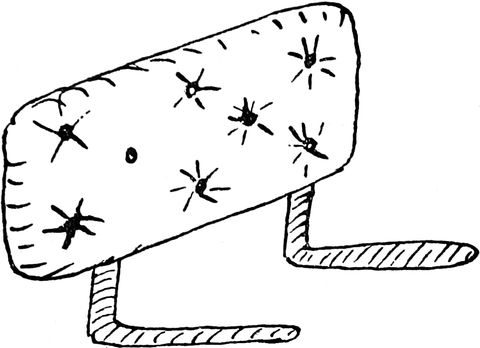
FIG 6.—A BACK-REST.
The flat extensions, A A, pass under the cushion, and a firm back and brace is thus supplied. Another device is to make the central portion of the side of the box higher than the rest, with a narrow cushion to fit, effecting the same end. This matter of cushions is not mere luxury. The rapid passage of the runners over any save the very smoothest of ice produces a jarring motion that speedily becomes unendurable wherever the person rests against a hard or angular surface. In previous articles it has been suggested that stout chair-seats, with arms and back, might be adjusted to the center-timber in connection with a foot steering-gear, similar to those used in canoes. Such seats could be fastened anywhere on the center-timber by means of thumb-screws, thus moving the weight forward or aft according to the special conditions of wind or weather.
The season for ice-yachting in the latitude of New York rarely begins before January and often holds off until February. The daily morning papers always mention the condition of the ice on the preceding day, and by taking an early morning train one may easily reach the sailing-ground by noon or shortly after. The weather, in New York is no criterion of that north of the Highlands. It is often raining on the coast when the sky is clear and the weather fine in the interior. When, therefore, good ice is announced by the papers, the correct thing to do is to take the next train to Poughkeepsie, irrespective of weather. You may be disappointed, for wind and temperature are proverbially fickle; but if you have reasonably good luck you may see the finest ice-yachts in the world, and learn by personal observation how they are managed.
THE LAKE CHAMPLAIN YACHT CLUB.
FREDERIC G. MATHER.
THIS is a great day for Lake Champlain,” said a rustic who had been discussing with his fellow the difference between a cat-boat and a sloop. “I may not know the difference, but there’s plenty about here who do—and I say, ‘Hurrah for old Champlain! anyhow.’”
The rustic, like many others who are right, spoke better than he knew. It was a mild morning in September last. Rain had fallen all through the neighborhood, and more was to come according to that never failing test—the low-hung clouds which still covered the eastern slopes of the Adirondacks and refused to lift even when an occasional ray of sunshine gave them every chance. From the opposite shore of New York the early morning hours were watched with intense interest. The alternate layers of mist and mountain showed also stretches of lake, and the larger objects in Burlington appeared through the rifts—the whole making nature’s mise en scène for what was to come.
And, indeed, it was a great day. The Lake Champlain Yacht Club was organized May 16, 1887, with a constitution, by-laws and sailing regulations patterned closely after those of the New York Yacht Club. Its rules for sailing were no stricter than its rules for uniforms. In a word, at the time of the regatta everything that experience and enterprise could suggest had been in preparation for sixteen months under the guidance of such gentlemen as W. Boerum Wetmore, commodore; W. A. Crombie, vice-commodore; J. Gregory Smith, president; W. S. Webb, first vice-president; Henry Ballard, second vice-president; Joseph Auld, secretary, and Horatio Hickok, treasurer. An executive committee of thirty included not only the above but also such names as H. J. Brookes, H. Le Grand Cannon, H. H. Noble, Jacob G. Sanders, J. A. Averill, A. C. Tuttle, W. H. H. Murray and Alvaro Adsit—all of them well-known sailors upon fresh water; while the total membership of two hundred took in navigators as far to the southward as Albany and New York. In fact, it will be noticed that many of the names are those of New Yorkers who spend the summer months along the shores of Champlain, and one enthusiastic member, Robert W. Rogers, comes all the way from New Orleans. Among the members who have not, according to popular belief, made any aquatic record is G. F. Edmunds, the U. S. Senator from the State of Vermont.
Thus all that hard work, good discipline and natty uniforms could do had been done. The day was a great one because it would bring what had been attempted to a practical test. The lake is about one hundred miles long with a breadth varying from half a mile at the southern end to twenty miles (including islands) at the northern end, so that the greatest stretch of clear water from east to west is ten miles, and the longest unobstructed sweep lengthwise is forty miles. There is no perceptible current, although the drainage is northward into the valley of the St. Lawrence. The prevailing winds are from the south, with occasional winds from the north and, near the shores, frequent puffs that come down through the notches in the Green Mountains on one side and the Adirondack Mountains on the other. Given, then, such a lake not so steady for sailing purposes as Long Island Sound, the chain of the Great Lakes, or even the inland lakes of Chautauqua, Seneca and Cayuga with their low-crowned banks, and yet less treacherous than smaller mountain lakes, like George and Memphremagog—to find the craft that will sail it best with speed and safety. This was the problem that had been discussed and solved and solved over again for months, and which had now come to the point where all theories must show their value or cease to be entertained.
Yachting on Lake Champlain was a plant of slow growth. It was hardly an exotic, because some kind of craft had been known there for 250 years. The xebecs of the early French gave way to the sloops and schooners of the English; and the latter, in the decline of commerce, have been followed by the “long-lakers,” and the Canadian square-sail galleys of to-day. Sail boats of uncertain age, and still more uncertain origin, have flitted about the lake for generations; but nothing was ever evolved from them that met the requirements of the modern yacht. It was reserved for the Rev. W. H. H. Murray to bring thither some of the ideas that he had gathered among the oystermen along the coast of Connecticut and to adapt them to a fresh-water lake. Everyone credits Mr. Murray, better known as “Adirondack,” with calling attention to the broad expanse of lake opposite Burlington that had not been used as it might be by sails and hulls of modern cut; and everybody agrees that the present yacht club is the outcome of his earlier efforts, although, in many respects, it has outgrown what he developed and contended for at the first. So Mr. Murray shall have the credit in these pages.
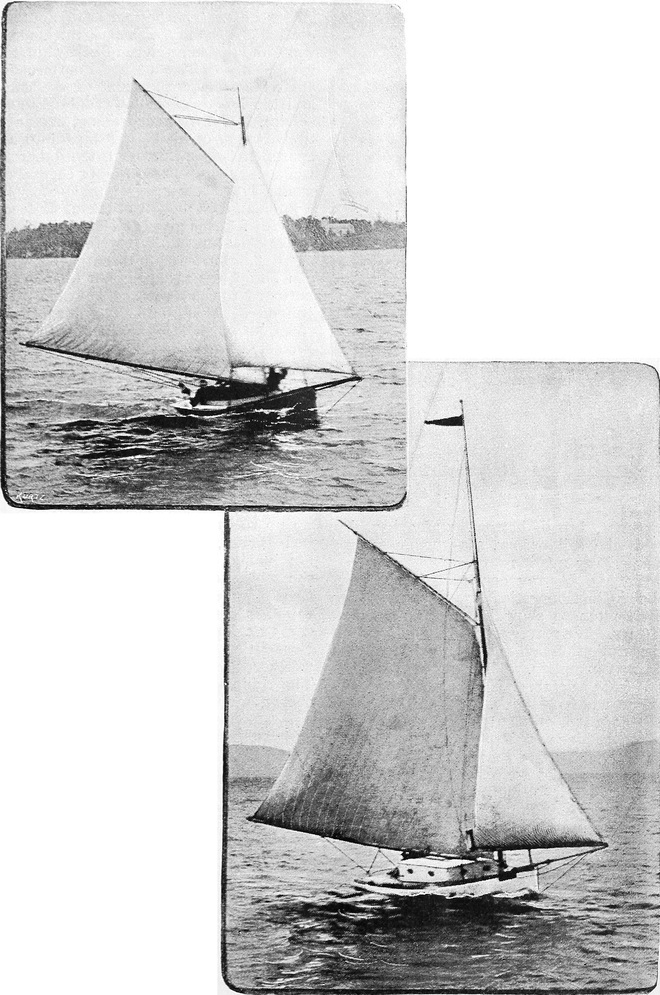
THE “GYPSIE,” PHELPS & SON, BURLINGTON, VT.
THE “VIRGINIA”—PETER THUST, ST. JOHNS, CANADA.
⇒ LARGER IMAGE
It had occurred to Mr. Murray that the type of oyster-boat known on Long Island Sound as the “sharpie,” would fill all the conditions on Champlain noted above. The sharpie was the successor of the old V-shaped punts, or “flat-iron” scows, that brought the earlier oysters to market. When the demand for more bivalves led to the transplanting of Southern oysters to Long Island Sound, the larger boat, the sharpie, was produced, as the one which would combine cheapness, light draught, broad bottom, ready handling with the sail or oar, sea-worthiness, and fair sailing qualities.
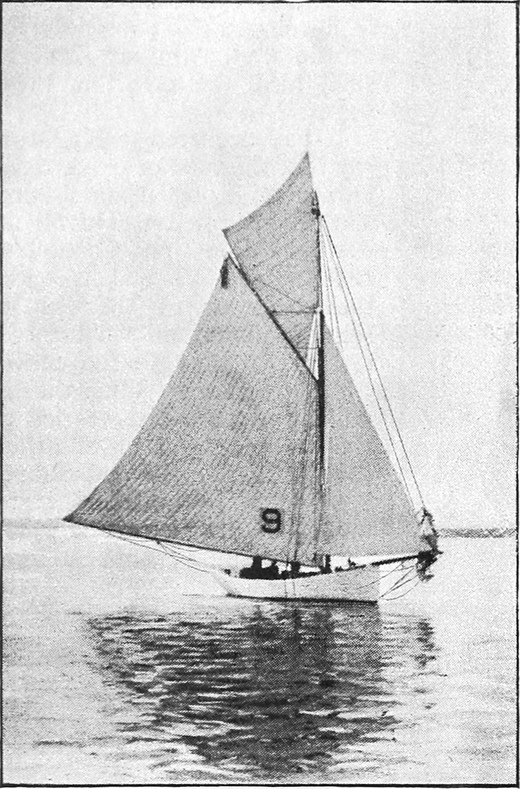
THE “FLYAWAY”—DR. W. S. WEBB.
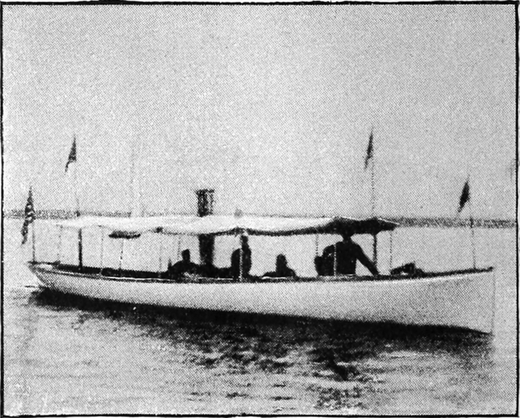
COMMODORE’S LAUNCH “DOLPHIN.”
So Mr. Murray constructed the White Wings in Connecticut, and brought it to Burlington to show his faith in his new theory. We may quote liberally from his description of a sharpie adapted for use on Lake Champlain. The length over-all is 50 feet; depth, 4 feet amidships; extreme width of deck, 12 feet; length of center-board, 16 feet; width, 5 feet; distance between masts, 30 feet; sail-area, 200 to 300 yards; length of foremast, 50 feet; length of mainmast, 47 feet. The sails are laced to small booms, or the sprit can be used. The sails can be of strictly “leg-o’-mutton” shape or “clubbed” in form, which is desirable when a large spread of canvas is demanded, because it allows a large sail area, and, at the same time, keeps the major section of the sail low down, where the wind-pressure should be located. These boats are decked and staved in hard woods—oak, cherry, birch or Southern pine. White pine is of course allowed, but it is soft and liable to be marred by indentations. The sides are of white pine plank, 2 inches in thickness, 8 inches wide, and from 16 to 20 feet in length. Such plank-work is easily shaped, and makes a strong boat. The bottom is of Southern pine, finest quality, 2 inches thick and 6 wide, and the stern-piece of best white oak, with plenty of size to it. Fourteen feet abaft the stem is the front of the cabin, and the length of cabin is adapted to suit service. If for home sailing, it can be twelve feet, divided amidships into two apartments—one for men, the other for women. The front section of each apartment, say 4 × 5, is fitted with a lavatory like a Pullman car; height of cabin, six feet in the clear. This gives an elevation of sides above deck-line of, say, two feet, three sides to be built in two or three panels which can be opened inward in fair weather, and buttoned to cabin roof. The cabin is thus converted, at will, into a charming sitting-room, in which ladies and children can be protected from the sun, and yet enjoy the sight of water and mountains beyond. If the boat is intended for cruising, the cabin can be made longer, say twenty-two feet. This would still leave a large cockpit, and accommodate a party of a dozen with berths and tables for sleeping and eating, whether the weather was fair or foul. The table-leaf can be hinged to the center-board case, so as to hang vertically to it and take up no room when not in use. Berths, on bed frames, made of wicker, 6 × 2 feet, are hinged to the cabin sides, and like the table, hang pendant when not in use. Cook’s galley, immediately ahead of the cabin, is entered by a hatch of large size, say 3 × 4 feet, built to be slid forward in close-fitting grooves, so that in rough weather it would be practically water-tight. The cabin should be of quartered oak or cherry, or any desirable wood. Fifty chairs can be placed in the cabins and cockpit.
Such were the boats of which Mr. Murray wrote: “They are well adapted to meet the wants of amateurs, and will do much to make yachting a popular recreation to a degree never hitherto realized.” The appearance of the White Wings led to the building of other sharpies, and an organization under the name of the Sharpie Yacht Club of Burlington became the nucleus of the present yacht club.
Since Burlington boasts no canoe or rowing clubs, it was Mr. Murray’s idea to combine all the boating interests as a part of a general scheme which should take charge of all kinds of sports and pastimes natural to such a magnificent body of inland water, and yet the boating section of the club was to be devoted to sharpies—the model to which Mr. Murray still pins his faith. As the club grew it showed decided tendencies toward a regular yacht club. This carried with it the erection of a $5,000 club-house on one of the best wharves in the harbor at a point about which all the boating tendencies of the lake might rally, the expenses of membership being only $10 yearly with no financial responsibility beyond this figure.
As an illustration of the very effective and concise way of doing things, it will be of interest to repeat a statement that was posted upon the bulletin board: “The regatta committee will announce before each race in which direction the course shall be sailed, which will depend upon the wind. If the course is first to the north from the club-house, all yachts will pass to the right of all rounding marks, leaving them on their port sides. In case an overlap exists between two yachts when both of them, without tacking, are about to pass a mark on the required side, then the outside yacht must give the inside yacht room to pass clear of the mark. A yacht shall not, however, be justified in attempting to establish an overlap and thus force a passage between another yacht and the mark after the latter yacht has altered her helm for the purpose of rounding. When a yacht is in danger of running aground, or of touching a pier, rock or other obstruction, and cannot go clear by altering her course without fouling another yacht, then this latter shall on being hailed by the former, at once give room, and in case one yacht is forced to tack or to bear away in order to give room, the other shall also tack or bear away, as the case may be, at as near the same time as is possible without danger of fouling.”
The regatta should have taken place on the first Tuesday in August, and that will be the date hereafter; but last year it was postponed till September 21, in the hope that certain new boats might be finished and enter the races. The Nautilus, the most eagerly expected of all, failed to appear. We will make note of her later on.
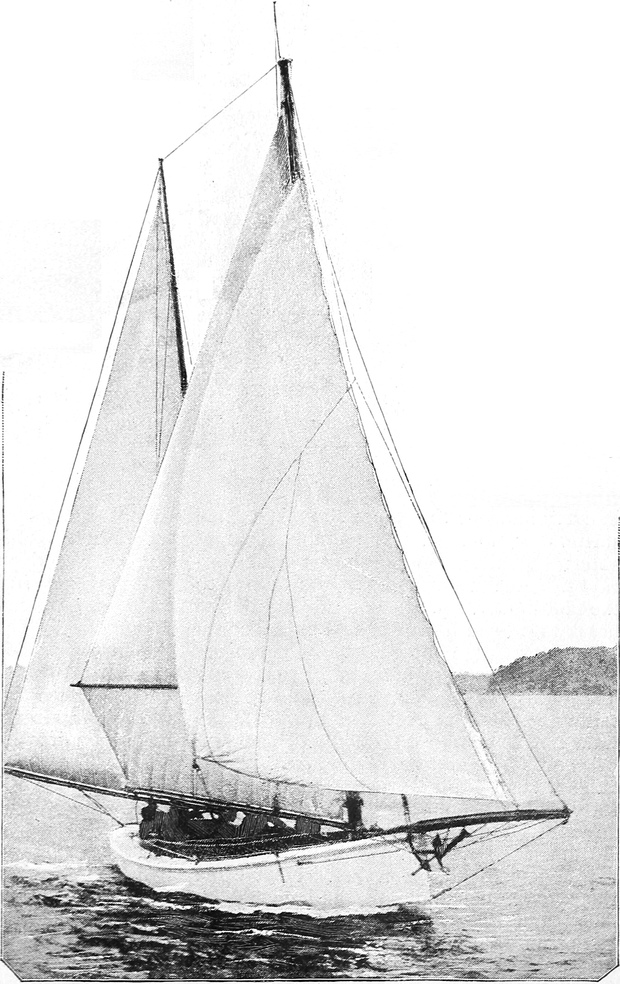
SHARPIE YACHT “BURLINGTON”—JOSEPH AULD AND OTHERS, BURLINGTON, VT.
It was required in every instance that there should be three starters or no race. The club course of about 85⁄16 miles commenced on a line inside the breakwater and at right angles to the club-house, round the south end of the breakwater, south of Rock Dunder, south of Juniper Ledge buoy, west end of Juniper Island, north end of breakwater to starting line. This was the course for the first class sailing yachts (33 feet and upward), the time not to exceed 23⁄4 hours. The first prize was $60, and the second $20.
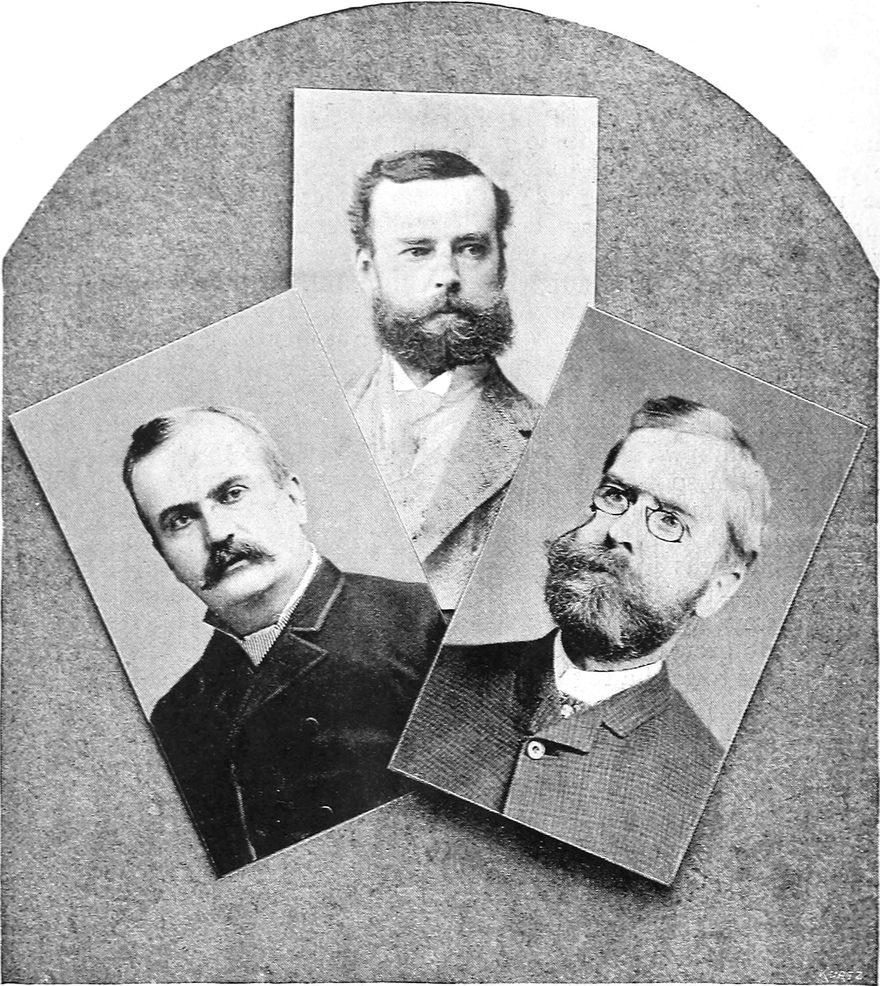
W. S. WEBB, FIRST VICE-PRESIDENT. W. A. CROMBIE, VICE-COMMODORE. JOSEPH AULD, SECRETARY.
There had been a brush, a few days before, for the championship pennant. The Flyaway, a sloop built by Lawler, of Boston, for Dr. W. S. Webb. had covered the course in 1h. 30m. 42s. Next came the Ripple, a sloop built and owned by Adsit and Bigelow, in 1h. 32m. 50s.; and last came the sharpie, White Wings, built under Murray’s eye, and owned by C. B. Gray, her time being 1h. 48m. 30s. The same boats started in the first class race, except that the sharpie, Burlington, owned by Joseph Auld and others, having less freeboard and an improved stern, took the place of the White Wings. Time allowance was waived by the Ripple and the Burlington. The Ripple came over the line first and held the lead till, on rounding Juniper Island, she was passed by the Flyaway. Then came a very close contest, the Ripple afterward claiming she would have won if she had had the time allowance. The elapsed time was: Flyaway, 1h. 45m. 3s.; Ripple, 1h. 46m. 33s. The Burlington was becalmed and withdrew.
By this time a drizzling rain had set in; but the yachtsmen and their friends had had enough taste of the sport to want more. The second class race was for sailing yachts measuring between 20 and 33 feet. The prizes were $45 and $15. The course was the club course, omitting the turning of Juniper Ledge buoy—distance, 71⁄3 miles, to be covered in 23⁄4 hours. There were five starters, and the prospects were for the best race of the day. But the rain beat down the wind; the race became a drifting match, and was postponed till the next day. The starters were: the White Wings, sharpie; the Agnes T., a sloop owned by T. A. Taft; the Princess, a sloop owned by R. W. Rogers; the Puritan, a sloop owned by W. C. Witherbee, and the Eagle, a schooner-rigged keel-boat owned by W. S. Hopkins. The same yachts were allowed to sail in the postponed race on the following day, but only the Agnes T. appeared. She sailed over the course in 1h. 14m. 25s. Two entries of the day before were barred out because they did not start at that time.
There was still more rain and still less wind when the third class yachts (under 20 feet) were called. The course was 513⁄16 miles, starting around the north end of the breakwater, thence about Rock Dunder, and homeward around the south end of the breakwater. Two hours was the time limit; and the prizes were $30 and $10. The only starter was the sloop Goat, owned by W. C. Witherbee—and so the race was declared off.
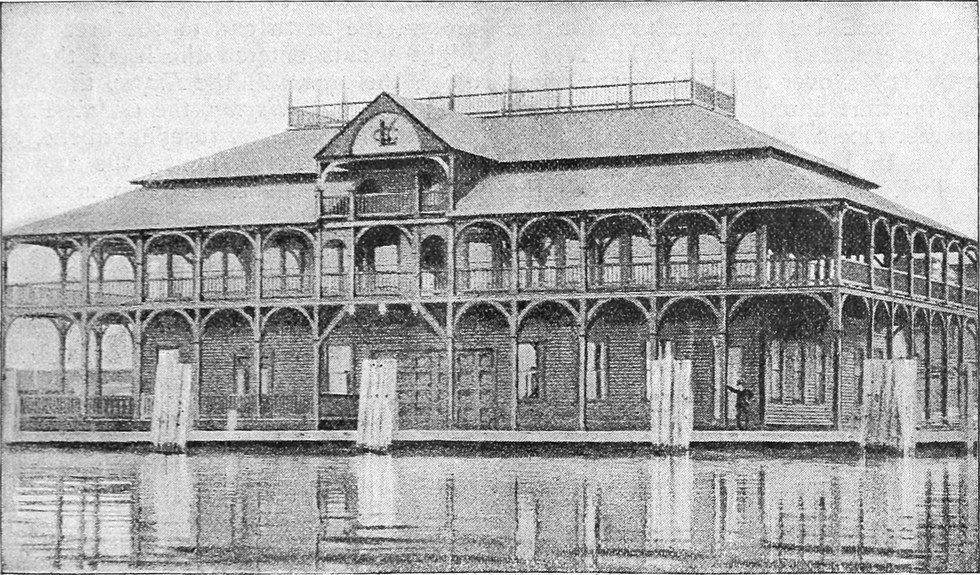
THE BURLINGTON Y. C. HOUSE.
But no amount of rain or lack of wind could keep back the steam and naphtha launches of under 50 feet from racing for the $100 cup offered by Commodore Wetmore. The course was around the north end of the breakwater, north of Appletree buoy, south of Proctor’s shoal buoy and around the south end of the breakwater, a distance of 7 1-5 miles. The time limit was 11⁄2 hours. Four of the starters finished the race; the fifth, the Idlewild, owned by Averill & Kellogg, having passed the first buoy only. The starters, together with their owners and elapsed time, were these: the Nymph, Dr. W. S. Webb, 41m. 55s.; the Cecil, Myers & Clough, 49m. 33s.; the Adonis, J. B. Tressidder, 52m. 141⁄2s.; the Comus, R. W. Rogers, 58m. 17s. It was evident from the start that the Nymph would win—but there was a very exciting contest for second place, the Cecil finally leading the Adonis. In figuring the result the Isherwood rule was used, because the lengths of all the boats were less than 50 feet. If they had been more than 50 feet, the Emory rules of the American yacht club would have held. The Isherwood rules provide that the speed in knots per hour is divided by the cube root of the length on the waterline of the yachts respectively, and the quotients represent, relatively, the merits of the different yachts. Based on this rule, the ratios were: Nymph, 1.13; Cecil, 0.97; Adonis, 0.91.
The Nymph is 46 feet long, 8 feet beam, and 3 feet draught. She divides with the Dolphin, owned by Commodore Wetmore, the honor of being the fastest steam launch on the lake. The Dolphin is 42 feet long, with the same beam and draught as the Nymph. On October 15 there was a test of speed between the two for the champion pennant of the lake. The Nymph won by 111⁄2s. over a 7-mile course, there being no time allowance. On November 1 another race over a course of 61⁄2 miles was won by the Dolphin by 321⁄2s. We may look for good time from both the Dolphin and the Nymph in the steam race of 1889.
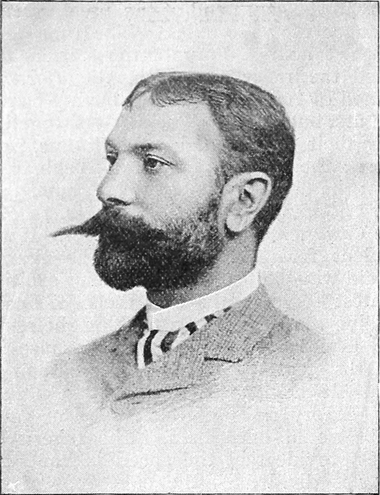
COMMODORE B. WETMORE.
The greatest race of all came off upon Saturday, September 22, the second and final day of the regatta. This was for the $500 cup made by Tiffany, and presented by the ladies of Burlington. It is an elaborately-made punch-bowl, with a fine engraving, on the outside, of the harbor of Burlington. According to the rules of the club, “the Ladies’ Cup” shall be a perpetual challenge, and shall be sailed for each year by the yachts belonging to the members of the club at their annual regatta. The course shall be about ten miles, and the sailing allowances, etc., shall be governed by such rules of the club, as from time to time may obtain. The course, etc., may be changed from time to time by the regatta committee as the exigencies of the club may require. They, or their successors in office, are made custodians of the cup for the club, and shall award the same each year to the successful yacht; which yacht shall have its name and the date of the regatta engraved on the cup by the committee, and shall hold it until the next annual regatta, giving bonds to the committee in the sum of $600 for the safe keeping of the same. Any damage or loss to the cup while in the possession of a yacht shall be appraised and deducted by the committee from the bond on the return of the cup, which shall be one week before the next annual meeting. Owners of yachts failing to return the cup at the time specified, shall sacrifice their bonds and cease to be members of the club. A yacht holding the cup and not competing for its possession, is considered as having competed and lost. In all races, at least three yachts must start or no race, unless a race has been postponed; but should the yacht which is in possession of the cup be a competitor, she may sail the course, without this limit as to the number starting.