Volume 13 / Part 2 — OUTING.
Reading edition
VOL. XIII. MARCH, 1889. NO. 6.
FOX-HUNTING.
A DAY IN THE SHIRES.
BY HENRY H. S. PEARSE (“PLANTAGENET”).
THERE is a touch of original barbarism in all field sports—at least that is what our critics say, and I am prepared to put aside all cause for controversy by admitting without hesitation that there is much truth in the charge. Nay, more, I am even disposed to know the very quality that squeamish sentimentalists condemn, and to regard the spirit of sport in its most ferocious outbursts as the very antithesis of cold-blooded, wanton cruelty.
If proof were required that the most typical hunting-men are not insensible to animal suffering, one need only point to their tender care for horses and hounds, with which they have bonds of sympathy utterly inexplicable to people who are not sportsmen. A keen, bold rider may gallop his horse to a standstill in the rapture of hot pursuit, or put him at an almost impossible leap, staking life and limb and neck of man and beast against the chance of holding a place in the first flight, but when that effort is over his hand will rival a woman’s in the tenderness of its caresses for the noble brute that has answered so generously to touch of whip or spur. This combination of fierce daring and feminine weakness has never been more elegantly expressed than in Whyte Melville’s stirring song, “The Place where the Old Horse Died.” The man who will jest at his own scars, and make light of a broken rib or a dislocated shoulder, can be moved to infinite pity for an injured hunter. But even if the capacity to greatly dare and stoically endure were only to be attained by the sacrifice of sympathy with animal suffering, it would, I fancy, be worth cultivating by any race in danger of overcivilization. Such qualities may be characteristic of original barbarism, but no nation has yet been able to find satisfactory substitutes for them. As tending to their development, there is no pursuit within reach of ordinary citizens in an old and populous country that can for a moment compare with the moving accidents of fox-hunting. Very few sportsmen, however, stand in need of this excuse for the passion that possesses them.
A defense of the chase on high moral grounds would sound to them very like cant, and a fox-hunter worthy of the name may well dispense with the services of an apologist. If there be any foreigner who believes that the sturdy manhood of Great Britain is in danger of being played out, let him make a tour of the rural districts of the island from November to March. Taking a map of ordinary scale, one cannot put his finger on any spot outside the densely peopled cities, between Land’s End and John O’Groats, and say, “Here is a place where the music of hounds is never heard!” Every county has its two or three, and some a dozen, packs of fox-hounds, hunting here up to the outskirts of busy towns surrounded by networks of railways, and there amid the stillness and silence of mighty mountain ranges far from “the madding crowd.” On rugged heights where no horse could find secure foothold, their loved bell-like chorus may be heard cleaving the thin air and echoing from rock to rock, with the accompaniment of shrill cheers from sturdy hillmen who follow on foot from morn to even-tide without sign of fatigue. These, however, are rather the by-ways of sport, and to make acquaintance with fox-hunting in its more conventional phases one must needs follow great Nimrod’s footsteps to the classic fields where Hugo Meynell, John Ward, Osbaldiston, Assheton Smith, Anstruther Thomson, and many other masters of woodcraft graduated. Not there will one find the science of hunting practiced in its highest development; but there, alone of all countries in the world, may one see the art of riding to hounds illustrated in every variety of style.
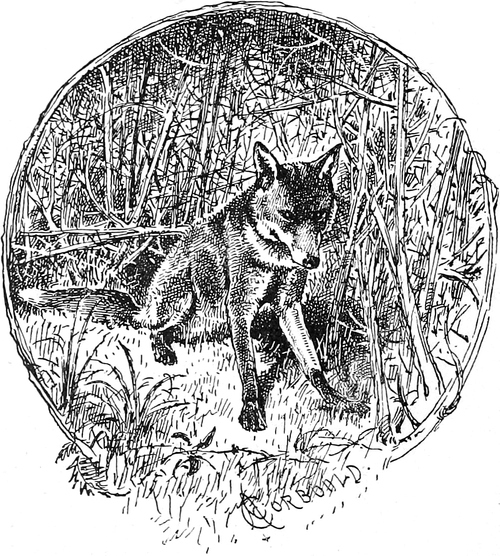
A FOXY VARMINT.
To describe hound work, pure and simple, with the incidents of a long hunting run, I should have to take as my theme a fixture in some remote provincial hunt, where plough and pasture alternate with deep woodlands. A day with wild Jack Parker, of the Sinnington, and his trencher-fed pack, among Yorkshire dales; or with Mr. Lawrence’s half-bred Welch hounds in the coverts of Monmouthshire, or with any of the Devonshire fox-hounds, where open moors and densely wooded coombes are the haunts of foxes, wild as their native hills, would best illustrate the science of woodcraft, and all the minutiæ about which Beckford, Delmé, Radcliffe, and the author of “Notitia Venatica” discoursed so learnedly.
We might then begin with the earth-stopper, on his lonely midnight rounds in storms of snow or rain. Following the track of his ambling pony, and guided by the pale gleam of his lantern through the mists, we might watch him as he bent to work under the dripping twigs of bramble and hazel, or rolled a great stone into the mouth of some cavernous hole among a “clitter of rocks,” as they say in the west country. We might learn from him much concerning the dissipated habits of the red race—male members of which follow very much the customs of men about town, devoting their nights to feasting or flirtation and their days to rest and sleep. In regard to the latter, no bachelor of the Albany could be more fastidious in the choice of quarters. Should a belated worker find the door of his regular abode closed against him, he always knows where to seek cozy shelter in the warmest corner of a gorse covert, or the dry top-growth of a grassy hedgerow. In the spring-time, when his “fancy lightly turns to thoughts of love,” he is apt to wander far from his familiar haunts and make his bed wherever the first flush of dawn lights on him. All these are habits of which the earth-stopper, in his nocturnal watches, takes careful note, and he knows the exact hour of every season when improvised doors should be stopped at night to keep the gay old dog out, or put to after daybreak to shut the vixen securely in.
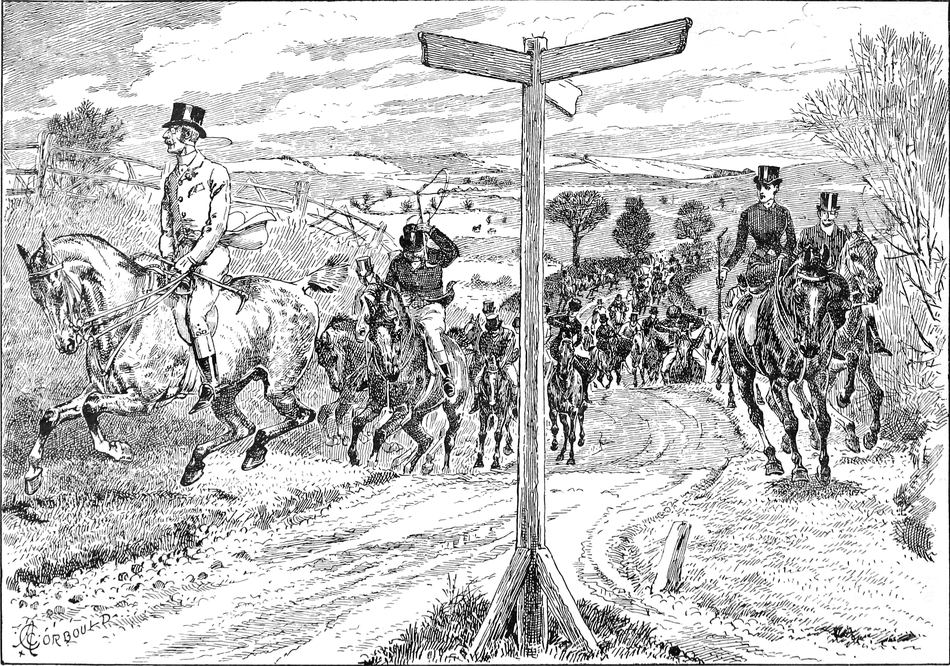
THE ROAD-RIDING DIVISION.
⇒ LARGER IMAGE
About such details as earth-stoppers and their duties, however, the merry sportsmen who throng the midland shires concern themselves only when a brilliant burst is brought to a premature end by the cunning fox slipping into a drain that has been overlooked. Hunting the dray of a wild rover from his midnight foraging grounds to some distant lair is also a tedious detail of woodcraft in which the Meltonian would disdain to take part, even if he could tear himself from his bed at the chill hour when our grandfathers’ sport began. There are not many countries nowadays so scantily stocked that this preliminary to a find need be resorted to, but in some very provincial corners of the land, and notably among Welsh mountains and Cumberland fells, the custom is still pursued. Fashionable midland fields would dwindle to very small proportions indeed if half a dozen coverts were drawn blank, and the ardor of thirsting youths would ooze away if they had to watch hounds patiently puzzling out a cold scent for an hour or two before the fun, fast and furious, began. Yet their languid regard for creature comforts is only a harmless affectation after all. The first note of horn or hound sends the hot blood tingling through their veins, and when once they have thrown off the cloak of conventional unconcern, it must be a formidable obstacle that can balk them, and a long run that takes the keen edge off their rivalry.
If we elect to throw in our lot with glorious Tom Firr and the Quorn; to meet Will Goodall with his Pytchley bitches at Weedon or Crick; Frank Gillard and his bright Belvoir tans at Piper Hole, where the “partickler purty landscape” of Belvoir Vale unfolds a pleasant prospect before us; or Gillson and the Cottesmore at Langham’s far-famed Ranksborough gorse, there will be nearly the same brilliant galaxy of sporting celebrities, only with a different setting. Let us make for ourselves, then, an imaginary fixture at some centre that is surrounded by the most characteristic features of all these favored countries, and watch the gay cavalcades from different points converge at the trysting-place.
A few farmers, well mounted, neatly attired in black coats and workmanlike cords, and bearing about them no visible signs of depression, are first to appear at the meet. Then follow rough-riders of the Dick Christian order, on raw young ones, qualifying for hunters’ certificates, or queer-tempered animals that need some schooling yet, though the season is far spent, and many a hard run ought to have taken the devil out of them. The Leicestershire rough-rider is sui generis, and his exact counterpart is not to be found in any other hunting country that I know of. Long training has made him amenable to every form of discipline exacted by the M. F. H., and he is never out of his proper place, no matter what other people may be doing. He betakes himself now to a quiet out-of-the-way corner where hounds are not likely to come within reach of his restive horse’s heels, and whenever the rush for a start may begin, he will display marvelous tact in getting clear of the ruck to cut out a line for himself. His nether limbs have been battered out of all shapeliness by frequent fractures, so that he seems to have no grip of the saddle, and his hands look too rigid to yield the fraction of an inch in play; but somehow he has the knack of sitting like a jackanapes, never off, and he can squeeze the veriest jade over a stiff line of country.
There is a blaze of scarlet along the lane yonder, and flashes of white between the thorn fences as the hounds are brought up, followed by groups of gorgeously arrayed gallants. The huntsman and his whips are turned out in the perfection of neatness, their breeches spotless, and every item of equipment scrupulously bright. The twenty couples of hounds have the glossy bloom of faultless condition, as if this were only the beginning instead of the fag end of a hard season. And now the throng grows denser every minute. The master threads his way through a maze of vehicles and a mass of horsemen, exchanging courteous greetings with friends or strangers alike. Four-in-hands, tandems, and smart buggies come in quick succession to choke the crowded highway. Covert-hacks are dexterously exchanged for hunters. Fair damsels throw aside wraps and newmarkets to appear in all the bewitching simplicity of dainty habits, or the more pronounced combinations of masculine cut, with open coats, snowy vests, folded cravats, masher collars, and all the latest triumphs of sartorial ingenuity. There is mounting in hot haste, for the word has been given to draw a favorite gorse brake not two miles away, and that is a sure find. The February sun-shine is screened by soft clouds, “the wind in the east most forbiddingly keen,” and all the conditions favorable to a brilliant run, if only a stout traveler can be induced to lead pursuers across the fair pastures that stretch far away to a hazy line of coverts yonder. The keen-faced huntsman, lithe, wiry and active as a boy yet, gets his hounds through the thicket of restless heels with quiet coolness which no confusion can ruffle. Then begins an eager rush for short cuts to the covert-side, only restrained by the master’s imperative “Hold hard, gentlemen! Let hounds go first, if you please.” A Yorkshire dealer, who has been extolling the young horse he bestrides as a wonderful fencer who does not “jump from here to there, but from here to yonder,” begins looking already by way of putting these exceptional leaping powers to the proof, but he will have quite enough of that in the legitimate course of things before the day is over.
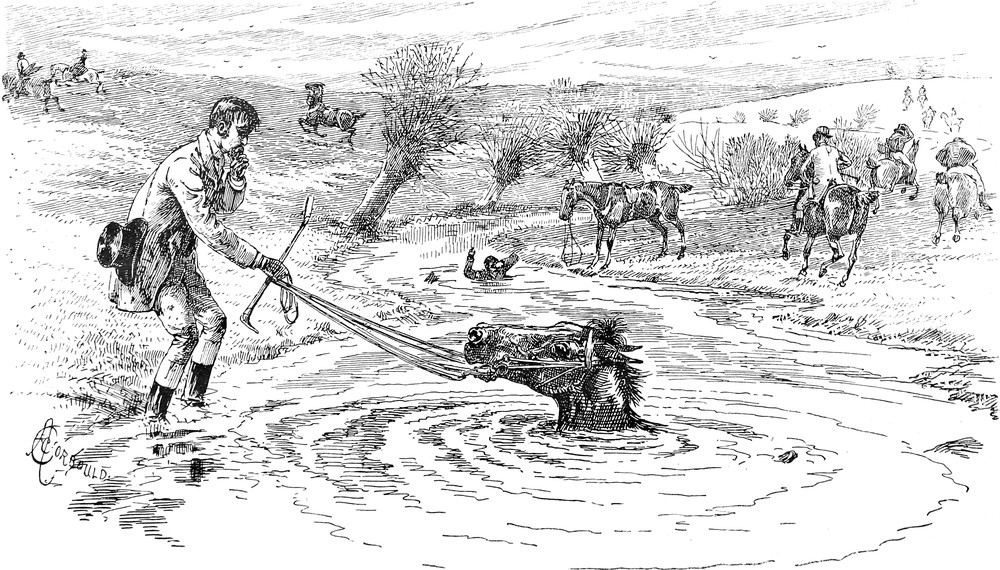
“IT IS THE HORSE IN AND THE MAN ON THE RIGHT SIDE.”
⇒ LARGER IMAGE
At length the foremost squadrons are marshaled quietly, in compact order, beside a five-acre brake—all keeping a little down wind so that the fox may be forced to break covert towards that inviting stretch of verdant pastures with its heavy thorn fences, tall bullfinches, stiff oxen and gleaming brook, brimful from recent rains. If kindly fortune should take us that way, how soon the field will be squandered, the faint-hearted follower stopped, and the reckless brought to grief! There is little danger that hounds will chop their fox before he can get well away. He must be a sound sleeper indeed if the tramp of five hundred horses and the voices of his foes have not roused him to alert action before our huntsman’s “Loo in yoi, wind him, bo-oys!” gives peremptory notice to quit.
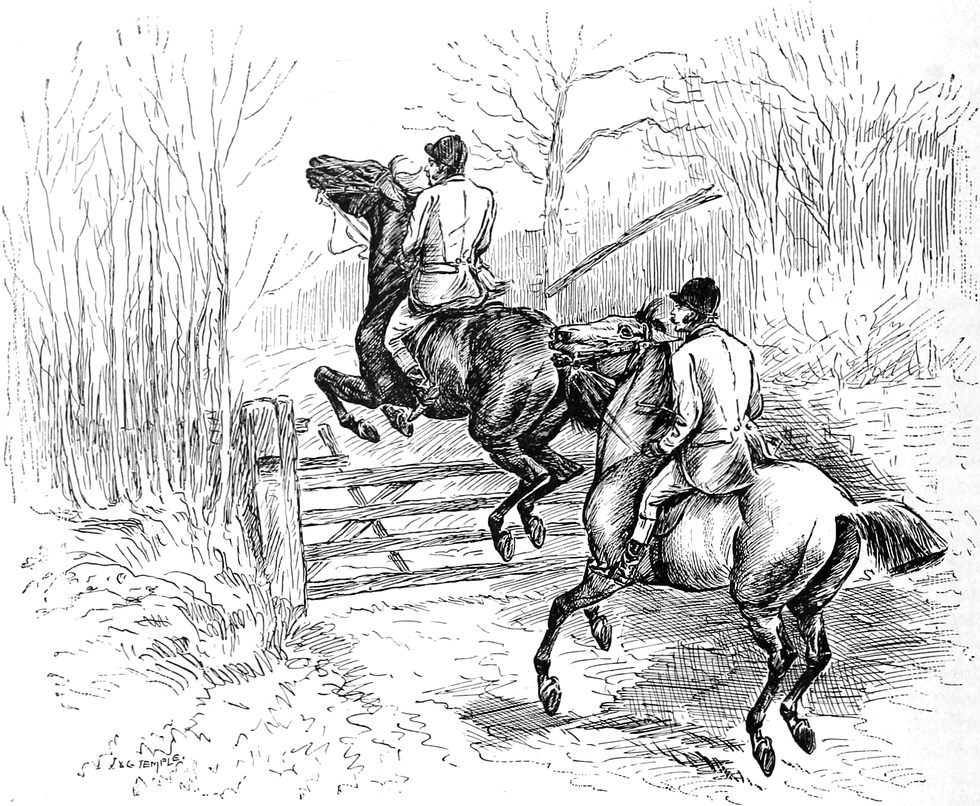
“AND TOPS THE NEXT GATE.”
There is no sign of movement, however, except where the hounds are working through tangled growth of sedge and brier with ceaseless waving of their “rush-grown tails,” as Somerville phrases it, and for a while no whimper is heard. Impetuous spirits are beginning to be a little dashed by the dread that this brake may for once be blank; then a light challenge is heard from a bitch that never lies, and the huntsman answers with a cheer. To that sound every hound flies eagerly, and the chorus of their music clangs like a carillon. Another brief pause, while hearts beat high, hats are thrust tightly down, horses are pressed up to their bits, and the squadrons stand in severed ranks like cavalry waiting for the bugle to sound a charge.
Now there rises at the far corner, clear and shrill, a “Gone away!” that electrifies everybody. Hounds are out in a twinkling as their huntsman dashes forward with a spirit-stirring “Hoic, holloa,” and a few short, sharp blasts of his horn. Then the headlong rush of a hundred horsemen sweeps like a thundering mountain torrent down the slope. In that glowing stream a few dark habits flutter, and all the first flight men and women charge a blackthorn fence abreast. By this time the pack is half a field ahead, rising with ferocious dash, and skimming like a flock of wild doves over the grass. Three or four men are down in the ditch, more than one loose horse is sailing along in gay career, rejoicing to be free, and the boldest riders have to harden their hearts as they face a ragged bullfinch with a broad grip towards them, and a stiff ox-rail a yard or two on the far side. Some take a strong feel of their bridles and pull back into a hand gallop, hoping by a double effort to negotiate the obstacle cleverly; others send their horses out at steeplechase pace, riding for an almost certain fall, but trusting that by sheer impetus they may be able to clear the timber or smash it. There is a sharp crunching of thorn twigs, a repeated rapping of hoofs on the timber, a loud crash as one gallant horse breasts the rail, shivers it into atoms, staggers, and recovering himself, goes on again in hot pursuit; the dull thuds of some heavy falls, and then all who are left of the line that swept so proudly down hill at the outset speed on, a shattered section of their former strength, but with two dainty habits still proudly holding their places in the first flight.
The road-riding division has been swiftly scattered in all directions. One column is galloping hard towards some well-known coverts five miles off. Regardless of the fact that our fox would have to travel dead up wind every yard of the way to reach there, these skirters place confidence in their pilot, who boldly asserts his knowledge of the hunted one’s point, because he has taken “that very line twice before.” It is strange how some men, who might go straight enough across country if left to their own devices, will often follow the lead of a rank impostor of this order simply because he can ride like a demon after dinner “across the walnuts and the wine,” and is always taken at his own valuation until found out. Nobody ever saw him perform the daring feats he has been credited with, but many have followed him mile after mile on the “’ard ’igh road,” and kept the secret carefully to themselves, lest in exposing him they should have to confess how they also rode the run. Not that one exposure would abash him much, for he has always a variety of excuses ready to explain why he failed to get through the crowd at the start, or took a wrong turn at a critical point, and so had to make up his lost ground by a short cut. Resplendent in garb of closest conformity with conventional ideas—a single-breasted coat, long in the waist and with square-cut, ample skirts, beneath which are just visible the faultless folds of breeches that fit like skin about his knees; boots without a wrinkle or a blemish in the brilliancy of their enamel; delicately tinted tops that are not the fraction of an inch too long or too short for Fashion’s fastidious eye; a cravat which quaint old Jack Parker would say “must have been starched and ironed on him,” and a gardenia in his button-hole—this youth is, from the crown of his polished silk hat to the buckle of his silver spurs, the perfection of scrupulous neatness, and the ideal presentment of a Meltonian sportsman; but his riding to hounds is a melancholy delusion. Conspicuous by the obtrusive correctness of his “get up,” he is the centre of much misplaced admiration among the fair at every meet; and, equally conspicuous now as he heads the torrent that rolls down a lane, he is the subject of misplaced confidence also.
Once thrown into the wake of such a pilot and fairly committed to a road, while Leicestershire hounds are flying like swallows over the grass four fields away—
“Not a nose to the ground, not a stern in the air,”
even you, bold rider, know how next to impossible is the chance of getting to them again. Like a stout swimmer caught in a rapid, from which all struggles to escape are vain, you can only float on with the foaming current, deafened by its din, paralyzed by its force, and hurl anathemas at the unconscious head of that weak being whose example led you to plunge into mid-stream. If he had shown the white feather palpably you would never have followed him; but it is the boastful funker’s characteristic that he never gives you cause to suspect the fear that is in him. He looked up to the last stride like going at that bullfinch, but just then the hounds seemed to swing round a little. He saw this, and in a second was shaping his swift course for the nearest gate; you hesitated, thinking he must surely know the country best, and, having hesitated, were lost.
Let me not be misunderstood. I condemn no man merely because he shirks a big jump, for not all of us have the nerve or the confidence, the horsemanship or the quick, resolute judgment to hold our own with hounds when they are racing hard over a strongly-fenced country. Such gifts in combination are not vouchsafed to one in every hundred, even among those who hunt with the Quorn, and he who frankly admits that nothing would tempt him to put his horse at any obstacle more formidable than a sheep hurdle may be a sportsman to the backbone, worthy of our highest respect; but Leicestershire is not quite the country for him. Only a man’s assumption of courage and attempts to cloak his cowardice make him and the action ridiculous. Nor would I for a moment hint, as John Warde once did, the fastidiousness which marks Meltonians in matters of hunting costume is a sign of effeminate weakness. A perfectly dressed man is never out of place except in the ruck; and to do the most foppish youths justice, it must be said that funking is not their characteristic fault. Digby Collins, one of the quietest, boldest, and best riders to hounds in his day that any “provincial” country, or the shires for that matter, could boast, summed up the exquisite’s character in brief when he said: “Your true hunting dandy would as soon think of omitting those minutiæ and obvious sacrifices to the Graces as he would of turning aside from a nasty place for fear of soiling them; and if he can carry his splendors well to the front for forty minutes from Ranksboro’ Gorse or the Coplow, nor fear to smirch them in the muddy waters of the Whissendine, who shall blame him?”
There are half a dozen of this type holding their own now in the first flight, from whose doings our thoughts have been for a few brief moments turned aside. Dandies they are in every detail, scrupulous even as to the correct length and width of the bow above their boots, and fond of personal adornment as the bewitching maiden whose white-vested habit has flashed past them once or twice, and whose presence has nerved them to all that man dare do. The wiry huntsman, full of dash and fire for all his fifty years, rides straight as he rode it from Waterloo Gorse nearly a quarter of a century ago; and the master, hoping to shake off the incubus of exuberant youth, puts his horse at the stiffest timber, where nothing but fine nerve in a crisis can save him from a crushing fall. But neither these nor the hounds, turn which way they will, can get half a field away from those half-dozen dandies who charge an oxen as their soldier forefathers did a line of infantry, and count fifteen rapturous minutes with the Quorn as worth a cycle of slow hunting in Clayshire.
As the line of chase bends down wind a little, and the bitches can no longer drive at topmost speed, they are in danger of being overridden. One youth, more reckless than the rest, lands over a double almost on top of the pack. The master’s reprimand is muttered in D minor, but he looks unutterable language, against which the thickest hide should not be armor-proof. The offending youth, however, speeds on with unruffled composure, his imperturbability reminding one of another thrusting pursuer in a distant hunt whose propensity for pressing hounds off a line the M. F. H. ironically rebuked by requesting him to take particular care not to jump on one of them, as it was a special favorite. Not a jot abashed, the youth replied: “I have a shocking bad memory for hounds, and I am afraid he will have to take his chance with the others.”
If our fox had held on up-wind he could not have stood before hounds another mile at the pace they drove over those first ten meadows. But now the line bends with a sharper curve from the easterly breeze, and the speed slackens somewhat, but only just enough to let the second flight up as we find our faces set straight at the brook that never fails to thin a Leicestershire field. We can already see the willow trees that mark its course. One ragged thorn fence and two furlongs of furrowed water-meadow lie between us and the yawning channel. That fence does not look forbidding; but ride at it carefully, for old gaps unmended mean that there is some other obstacle beyond. It may be broad, it may be deep, and the branches droop as if over a ditch, but you cannot afford to chance anything now. A crumpler here would take half the remaining breath out of steeds already sorely pressed, and you will want it all for a bigger effort presently. That warning came not a minute too soon. The old horse pricks his ears, but his rush had best be restrained. Sloping ground on the far side tells of a deep drop, and the horse that goes fast at that will want ready hands controlled by iron nerves to save him as he lands. There goes one! With just a turn too much speed put on at sight of a broad ditch and rotten banks, he spanned the chasm, but that drop was more than wearied forelegs could stand as they struck the steep slope. A falter, a peck, a heavy thud, and the rider executes a somersault two yards clear of the prostrate steed. Now watch how a workman deals with the obstacle. He seems to go at it just as fast, but by a firm, light feel of the mouth he has collected his horse for a supreme effort. The impetus is just enough and no more; the distance has been measured to a nicety; the hunter, well bred and high mettled, leaps “from the hand” without a pause, lands lightly as a bird, and like a bird skims on again.
There has been no check yet, but just a brief pause where the fox changed his course, and hounds are driving on as if he were now only a field ahead of them. The scent is breast-high and they have no need to stoop to it. Nor do they throw their tongues freely; the pace is too good for that. Like cavalry charging with a broad front, they carry what sportsmen call a good head. At every twist and turn there is keen rivalry for the lead, as first one and then another flashes out in front and swings to the scent like a yacht keeling over on a new tack or a swallow turning in mid-air. There is just a shrill whimper then, and the whole pack wheels to it as if at word of command. Fifteen minutes, full of more incidents than can be crowded into the hours of an ordinary day, have passed since our fox was halloa’d away. The hundreds from among whose thundering heels the tail hounds had to make hazardous way as we sped over the first broad meadow, have dwindled down to a twentieth of their number, and now we are heading straight for the sluggish brook, which is so full now that we cannot see where its slimy banks have been worn hollow by the slow curves and eddies of its summer current or the first rushes of winter floods.
The riding and spurring o’er Canobie Lea was as nothing to the rush with which men wheel right and left, galloping hard to find a gate and avoid the water. It is
“No shallow dry ditch, with a hurdle to screen it, That cocktail imposture a steeple-chase brook; But the flood-fretted banks tell as plain, if we mean it, The less we shall like it the longer we look.”
How that “dream of the Old Meltonian” rings in our ears as we clench our teeth hard, sit down in our saddles and ride for the brook! There are not twenty followers left with the pack now, and not more than half of them look as if they mean going.
The quiet, determined horseman who negotiated that last awkward drop so cleverly (typical of the best man of any country, whether in Leicestershire or the most remote provinces), is taking a line of his own, but without any sign of shirking or hesitation. At one point a light thorn-fence half screens the brook, and he goes for it at that point, well knowing that the roots of bushes will give him firm ground to take off from; and as to the sort of place on which he may land, he is content to take his chance. Catching firm hold of his horse’s head, but so lightly that there is no perceptible increase of pressure on bit or bridle, he sends an electric thrill of sympathy, along the reins. A strong squeeze of the knees, just one touch of the spur, and they go at it best speed. Like a bullet the good steed flies through the screen of slender twigs, hangs a brief beat of time above the glittering water, and with just a scramble where the hollow bank gives way, is on terra firma once more. It was a yawner indeed—broad as a Lincolnshire dyke, deep enough to engulf horse and rider, and gloomy as the Styx. One fair pursuer goes at it where the huntsman leads, and, thanks to her pilot’s quick eye for selecting a sound place, gets over cleverly. The other races hard at a bend where ceaseless eddies have worn a wider channel. The little teeth are clenched tightly, and every nerve in her slender frame is tingling with excitement. The gallant thoroughbred shares this feeling, and, big as the effort is, he will not be balked. With nostrils dilated and quivering, eyes straining forward, and every muscle at tension, he bounds boldly forward, and rather by impetus of speed than any palpable exertion of his own, flies across the broad chasm. It is a hair’s breadth too much at this point even for his superb leaping powers to compass; the hind feet drop in, but fortunately find hold on a lower submerged shelf. The rider’s lithe, light figure is instinctively thrown forward, the plucky steed has his head, and by a second effort such as the underbred cocktail seldom makes, he carries his rider safely ashore, shakes his dripping quarters, and a minute later is speeding on beside the pack again.
On either hand the splash and gurgle of waters tell that somebody has gone down. In the one case it is the horse in, the man on the right side, with reins in hand and rueful contemplation on his face; in the other it is a man in mid-stream, spluttering and gesticulating for the help of a friendly hunting crop, while his recreant steed, with sweating flanks and straining eyes, looks over the brink at him.
A minute later hoofs are clattering hard against the unyielding oak of stiff post and rails, whereat one horse, that has been done to a turn in his efforts to catch the first flight, rises impotently out of sticky ground. His knees hit the top bar, which scarcely bends before the weight, and turning heels over head, he falls heavily on his rider. Fortunately the ground is soft and there are no ribs broken, but all the fiery spirit has been pumped out of both horse and rider by this disaster. Now we cross one of the modern curses to fox-hunting in the midlands—a newly cut railway—go slowly over the next field, jump the bank and binders up-hill into a roadway, and then come to our first real check at the end of twenty fast minutes.
Up to this point there has been more riding than hunting; but what Meltonian has eyes for hounds, or cares about them, while they lead the field at highest speed if only they furnish musical accompaniment enough for him to ride by? Those twenty minutes, full of dash and keen rivalry, are to him worth all the slow hunting runs ever chronicled, and the delight of watching hounds puzzle out a cold scent or drive a fox through dense woodlands where no man can ride to them, and when only by their sonorous music one can know which way the tide of chase is rolling, is to him a sensation unknown. At this first check, which means that either the fox will beat his pursuers or that they will have to hunt him patiently to death, the man who comes out simply to ride would fain go home again, were it not that a fresh fox may be found presently, and another fast scurry give him the opportunities of steeplechasing distinction for which his soul craves.
There is a popular superstition that the typical Leicestershire huntsman is very much of the same mind on these points—that, having got off the line of one fox, he will neither give hounds time to make their own cast nor complete the work with painstaking science himself, but will simply fling forward in a half-circle, like an over-eager hound. That, if he fails to hit off a scent in this dashing fashion, he will gallop straight to the nearest brake and find a fresh fox, thereby getting credit for a wonderfully clever cast from those who have been too far behind to see what happened, or too inexperienced to know. These things, or something like them, happen, it is true, when hounds come to their first check before there has been time to shake off the crowd. A huntsman who could not practice little deceptions of this kind at times without making either his pack or himself hopelessly wild, would be as useless in the shires as a hound that had not the courage to thread its way among hundreds of heels, and slip through the torrent of mad pursuers when the “gone away” has been sounded. I have seen such methods resorted to with brilliant success by Will Goodall of the Pytchley, by Neill of the Cottesmore, and Tom Firr of the Quorn, when the throng pressed so persistently that hounds had no chance to hunt. But the perfection of breeding and training is attested by the fact that, though frequently lifted thus, all three packs will stoop readily to a scent when they have room, make their own casts with dash, not waiting with heads up for their huntsman to help them whenever they come to a difficulty, and hunt a cold line as cleverly as any “provincial” pack.
There is not much time to “leave ’em alone,” or practice slow tactics now, for the thunder of road-riders rolls down the wind, and in a few minutes more the presence of hundreds may spoil all that would have been possible with a field of only fifty followers. Still the huntsman will not hurry. The hounds probably know more than he does, and he knows enough to be sure that a mistake made at the first check can rarely be retrieved. There is a little feathering and waving of sterns on the line our fox has come; then a few couples try forward without success, and then, as if actuated by one impulse, they all swing round in a wide self-cast. In this there is no flashy wildness, but perfect steadiness and close work, yet nothing to suggest the style of harriers.
See one hound as he circles round, stops suddenly, stoops to the furrow, feathers along it for a few yards, and then throws his tongue lightly. “Hoic to Festive! hoic together! Hurrah for the blood of Belvoir Fallible!” shouts the huntsman, all animation in a second at the sound. Every hound flies to where Festive spoke, but they do not stop to “quest” the scent and make sure of it for themselves, as harriers would. Each, jealous of honors and striving for the lead, flies eagerly forward to feel for the line a few yards in advance of his rivals. So, one after the other, they take up the cry until all burst out in a clamorous chorus, and speed over the open once more.
Luckily, we are set going just in time, and straight for a line of frowning bullfinches, where network of thorns to be bored through, and ox-rails and ditches to be got over somehow, would stall off the faint-hearted. A minute later the road-riding division in all their might would have been upon us, but now they are left behind again. There is a gorse covert ahead, where fresh foxes are sure to be on foot, and if only we change to any of these, our hunted one may save his brush after all. But Will, the whipper-in, slips round as fast as he can to the fox side as hounds dash into the cover.
A red-roan steers away when he gets there, but it is not the right animal, and Will stops the leading hounds when they come to him. Then all is silence. But what is that old bitch doing in the dry ditch beside the boundary fence? Our huntsman has one eye on her, the other on the uplands a field or two off. Yes, that’s it. Something brown is stealing along a furrow. The fox has never gone into this gorse, but skirted it, his cunning telling him that he might thus delay pursuers and throw them off on a false scent. Two or three light touches of the horn bring hounds to him. In a cluster they follow him as he crashes through a bullfinch and tops the next gate. He takes them along as if they were running in view, but at one wave of his hand when he comes where the fox was last viewed, they spread out like a fan, own to the scent with notes of joy, and take us on again mile after mile, their pace quickening as the power of horses to rise at a leap begins to flag.
A welcome breathing space comes when hounds enter a chain of woods in which our fox is certain to pause for a while. But here the huntsman gives his quarry little time to rest. His voice rings out in answer to every whimper from a hound he can trust, and so they keep driving straight through for the far end. Evidently our fox is a stout-hearted traveler, who does not mean to dwell and be caught like a rat in a trap. He will run until he can run no longer, and then die like a gentleman. Shall we be there to see, or is the end yet afar off?
The bold first flightman, whose example disproves the fallacy that a hard rider neither cares nor knows anything about hound work, shall be our guide still. Watch him as he moves quietly through the rides of this wood—his eye quick to take in all that each hound is doing, his ear sensitive to every sound, while he may seem to be noting nothing. He knows instinctively, though he may never have seen the pack before, when a hound is lying with the reckless clamor of youth, or with the half-closed mouth and faint whimper of long-continued weakness for riot, or when another is telling the truth with hot outspoken tongue. Directly that last welcome sound reaches him, followed by Will’s view-halloa, he is out of the wood like an arrow from the bow, and with the pack as it comes together in the open.
Two fields have been crossed, and we begin to realize that the fox’s point must be a well-known stronghold of the neighboring hunt where tree-tops can be seen in the hazy distance; but his gallant effort to reach it is in vain. We see by the way hounds begin to twist and turn that the hunted one’s sinewy limbs are beginning to fail him, though his courage holds out to the last. There is no need to nurse your horse any longer, for the chase is near its end, and you may push over wet meadow or deep plough without fear. You cannot override hounds now or turn them from the line, for see, their hackles are up; that low, fierce growl means that they have caught a view of the sinking fox, and the shrill scream that makes every fibre tingle with excitement is a death-knell.
A minute later the clear “Whaw! whoop!” rings out over the tattered remnants for which hounds are struggling and wrangling. The superb young horsewoman, whose daring deeds have put many a bold Meltonian to shame, is handed a trophy which Diana might proudly hang at her saddle-bow, for it is the brush of as good a fox as ever led his pursuers a fast forty minutes over Leicestershire pastures.
It may justly be objected that a run like this is not typical of the terrific rush as of a whirlwind, the brilliant burst for fifteen minutes with hounds racing every yard of the way from find to finish, and the reckless rivalry that goes to make up all that is most characteristic of a run in the shires. But my answer is, that these fast scurries are not fox-hunting, and I have chosen rather to describe the incidents of a run that may be seen once in a season, but not oftener, in the much vaunted shires; or with the “blue and buff” followers of the Badminton or the tawny coats of Atherstone; with the Warwickshire, the Fitzwilliam, the Cheshire, the Vale of White Horse, or any of the leading provincial hunts.
Of the minutæ of wilder sport in countries where hounds must do all the work and mere riding is at a discount, I shall have to write in another article. The happy hunting-grounds of old England are being rapidly hemmed in by railways and curtailed by the abnormal growth of manufacturing centres, but fox-hunting flourishes still, and there are many counties wherein the cheery notes of horn and hound may be heard from October to May.
SPANIEL TRAINING.
BY D. BOULTON HERRALD.
MANY a dog is ruined for the field by injudicious training. With all the good intentions in the world he trains his puppy to retrieve, using a stick or a stone, and encourages him to chase the sparrows in the street, because, forsooth, he thinks that checking him would have the effect of blunting his hunting enthusiasm when on game. The result is a dog that reduces the birds to a pulp while retrieving them, and who rushes about the covert at railroad speed, hundreds of yards ahead of the gun, flushing the birds far out of range, and chasing everything he sees, until, exhausted, he is forced to return to his master and rest.
The following lines are penned especially for the benefit of the sportsman (and his name is legion) who pursues this mode of training (?) in the hope that his next spaniel, taught under the rules laid down in this article, will be at least an improvement on the one he at present owns.
Before commencing work, remember that you must always be firm but kind, and that above all things you must not lose your temper with your pupil. Never give in to the dog; always make him do what he is told. Be sure that he knows what he is being punished for when it becomes necessary to do so, and don’t delay the punishment long enough for him to forget for what he is being corrected. Do not stint your praise when he does well.
The first lesson to be taught is retrieving. The nearer the puppy is to two months old the better, in my opinion, for our purpose. Some writers recommend waiting until he has lost his milk teeth and the new ones are well grown in, as they say that a dog taught to retrieve before getting rid of these first teeth is apt to be hard-mouthed in retrieving birds, etc.; but the experience of the writer has been that if properly taught, however young, the puppy will not develop that evil habit. If a youngster of any “go,” he can be taught more easily at that age, though a dull one cannot be taken in hand so early.
Roll an old and soft woolen sock into a ball, then sit down and call your pupil to you. Push the ball in his face to attract his attention to it, making him try to take hold. Then, throwing it six inches away, say, “Go fetch it, Jack” (as we will call him), motioning him towards it with the right hand at the same time. If he refuses to pick up the ball, go to him, and, placing it in his mouth, force him to go with you to the place you threw from, making him hold it until you have said, “dead bird!” or “dead!” Should he refuse to give up the ball, force his jaws open with the thumb and second finger of the left hand inserted at the base of the jaws, removing it with the right, saving the while, “Dead! dead!” Never pull anything away, as he will pull too, and a nice state your partridge or duck would be in were such a proceeding permitted. He must be taught to drop whatever he is carrying when commanded to do so by voice or sign. For a sign, hold up the right hand, with the forefinger erect and the rest folded. Never let him worry nor mouth anything.
Should he pick up the ball, and run away, refusing to bring it to you, take him behind the shoulders and drag him to the place where you were sitting when it was thrown. Make him hold the ball until you get there, and then proceed as hereinbefore directed. He will soon learn this lesson. Throw the ball farther and farther as he progresses, and continue until he is perfected in it.
When he has learned to retrieve the thrown ball he can be advanced a stage. Show him the bail, not letting him take it, and, saying “Dead!” place it on the ground and walk away, telling him to follow. After going a few steps, turn, and, waving the hand in the direction in which he is to go, say, “Go, seek dead!” Should he fail to understand your meaning, go back, show him the ball, and, after again taking him away some little distance, order him to get it and then deliver to you.
When three or four months old, if he is perfect in his other lessons, take, say, a game bird’s wing, or in default of that, a fowl’s, show it him, and, putting him out of the room (I am supposing that you teach him in the house), shut the door. Then hide it where it can easily be found, and let him in, saying, “Go, seek dead!” motioning the direction in which he is to quest. Continue this for some time until he does it perfectly, hiding the wing in out-of-the-way places about the house as he progresses.
Never let his search be a fruitless one. If he cannot find for himself, show him the hiding-place, and make him fetch the wing to the place from which you sent him.
To teach the puppy to retrieve from water after he has learnt to do so on land, take him, when the water is warm, to a shelving beach. First throw his ball to the water’s edge (for this work fold some cork shavings in it), then into the water far enough to force him to wet his feet, and so on, farther and farther, until at last he is obliged to swim. This should be gone about gradually, and with extreme care, so as to give him confidence in his powers. Above all things do not throw him into water over his depth, as it will only tend to make him dislike it, and may ruin him for water retrieving altogether. It is well to make your pupil retrieve sometimes in the dark, as if only worked by daylight he is apt to depend too much on eyesight, which practice must not, of course, be tolerated for a moment.
The next lesson to be taught is “coming to heel.” When you are out walking, and he is running ahead, call sharply, “Heel, Jack—heel!” forcing him behind you at the same time. Should he try to break away, tap him smartly with your whip or walking-stick, saying, “Heel! heel!” Continue this until he will come in at once when called, and thrash him if he breaks away without the order to “hie on” or “go on.” To teach this, wave the hand forward while verbally giving the order, and run a few steps onward. This lesson will be easily inculcated, and it will be to him the most welcome order he has to obey.
Few spaniels in this country are trained to drop to shot or command; but presuming my reader to be desirous of giving his pupil a finished education, I will describe an easy mode of teaching it. Order him sharply to “drop!” when standing beside you, at the same time forcing him to the ground by placing the knee on his shoulders, and keep him there for a few moments, saying “Drop! drop!” Then removing your hand or foot from off him, say “Up!” making him rise. When ordering him to drop, hold your right (or left) arm erect above the shoulder, so that in time he will associate the uplifted arm with the verbal command. In due course he will drop at the signal alone. Do not allow him to get up until ordered to do so, whether you walk away and leave him or not.
Next take some firearm, a muzzle-loading horse-pistol for choice, and, commanding him to drop by voice and sign, fire it. In time he will associate the report with the other orders to drop, and so “drop to shot.”
Never weary your pupil; stop the lesson before he tires of it. Always have him alone with you when at work, as his attention must not be distracted from the matter in hand. Never deceive him. It is well to reward him now and again for good behavior with some dainty of which he is fond. Use the whip as little as possible; but when you do whip, whip soundly.
And now for the field. On arriving at the covert in which you purpose beginning operations, order him in; instinct then teaches him to quest for a scent. At first allow him to range at will to put a keen edge on his appetite for the work, and do not check him when so hunting. If he goes too far away, hide carefully and make him find you without assistance from you. He will think he is lost, and be wary of going too far in future.
When he begins to enjoy his work thoroughly you can begin to curb his ranging propensities. If he runs too far, call “Close, Jack—close!” and should he persist in doing so, thrash him, repeating the while, “Close! close!” He should not be allowed to range farther than twenty or twenty-five yards from the gun.
Should he give chase to a flushed bird, shout “Ware chase, Jack!” and if he persists, call him in and thrash him, repeating the order whilst doing so. If he springs a hare and attempts to chase her, shout “Ware fur, Jack!” and calling him to where you stand, scold and thrash him. He must be broken of noticing “fur” at all hazards.
When you shoot the first bird over him order him to “go seek dead!” motioning the direction in which it fell. If he cannot find it, go and find it for him, then pointing to it, say “Dead!” and calling him to follow, go back to where you stood at firing, and order him to get it. If he refuses to pick the bird up, put it in his mouth and force him to carry it to where you stood. Order him to put it down, and praise and make much of him, and ten to one next time he will retrieve. Use every endeavor to kill the first bird you fire at to his flush.
After this, “practice makes perfect,” and the reader will in time own a dog of whose accomplishments afield he may be proud.
LAWN TENNIS IN THE SOUTH.
BY H. W. SLOCUM, JR.
The remarkable interest displayed in lawn tennis throughout the North, and the increasing popularity of the game, as shown each year by the multitude of new players and new clubs, have been fully equaled in the South during the past two seasons. The Southern interest is an awakening one. The athletes of that section have become aware, only during the last few years, that lawn tennis is a game which fully develops every muscle, and at the same time possesses the elements of excitement and competition which render any athletic game more attractive.
The Southern Lawn Tennis Association, which was organized in the fall of 1887, made it a part of its constitution that “no club which is situated north of Wilmington, Delaware, should be admitted to membership in the Association.” So we may well take a line drawn east and west through Wilmington as the northern boundary of the Southern tennis field; and what a vast field it is! Winter visitors to the South find the game in full swing in every town from Wilmington, Delaware, to St. Augustine, Florida. Tournaments are held in the largest cities of the extreme South in the middle of winter, and the turf is as green and the temperature even more delightful for lawn tennis than the Northern players enjoy at Newport where the tournament for the National championship is held in midsummer.
The enthusiasm of the extreme South has reached its highest point in St. Augustine, Florida, where a valuable challenge cup has been offered, to be played for in February or March of each year. The cup was last year contested for by only a few Northerners, who happened to be sojourning in Florida, and was won by Mr. H. G. Trevor, of New York City. It has lately been reported, however, that a special Pullman car, finely equipped, will convey to the scene of conflict Northern contestants in the next tournament, to be held in the month of March, 1889. The St. Augustine Lawn Tennis Club has recently become a member of the United States National Lawn Tennis Association, and the coming tournament will be held under its auspices.
To reach the centre of Southern interest and enthusiasm, however, we must travel far north of St. Augustine and visit three large cities, viz., Washington, the national capital, Baltimore and Wilmington. In Washington, particularly, the game has taken a long stride forward; and what place could be better adapted for such a sport? Its climate is such that the “tennis fiend” may enjoy his favorite game all the year round. Turf courts can be used as late as December and as early as April, and during the intervening months practice on asphalt is sufficient to keep the eye and the hand well “in.” Some years ago a few members of the Metropolitan Club built an asphalt court on I Street, and since that time there have been few winters when the court has not been in constant use. On many occasions the snow has been shoveled away to afford an afternoon’s amusement. The members of the different foreign legations have been accustomed to use this court, and during the past few years Lord Sackville-West, the unfortunate victim of American politics, was an almost constant attendant, usually as a spectator. On this court Mr. W. V. R. Berry and Mr. H. W. Slocum, Jr., played almost daily during the winter of ’84 and ’85, and Mr. Berry showed the value of his winter practice by capturing most of the rich prizes offered at Northern tournaments during the following summer, his rank among expert players being second only to the champion, Mr. R. D. Sears. Mr. Berry is almost a giant in stature, and few of his opponents in tournaments of that summer will be apt to forget his strong and accurate “smashing,” which was the feature and chief strength of his game.
Prior to the summer of 1887, tournaments for the championship of the South had been held on the grounds of the Delaware Field Club, at Wilmington, that club being a member of the United States National Lawn Tennis Association, and the tournaments being held under its auspices.
During the latter part of that summer, a few active spirits in Washington, the most prominent of whom was Dr. F. P. MacLean, conceived the idea of organizing an association, to be composed exclusively of clubs situated in the South, and of holding an annual tournament for the championship of the South, under the auspices of that association. Up to this period no tournaments had been held in the District of Columbia, except a few local contests, which had aroused little or no enthusiasm. There were probably not more than ten clubs in the city, and most of these were composed of but few members. To Dr. MacLean, more than any one else, was due the interest which was now newly excited. His enthusiasm was contagious, and active preparations were begun for the first tournament of an association which was not yet in existence. It was decided to hold the tournament in October, and circulars were sent to all of the prominent clubs of the South, inviting their members to contest in the coming tournament and share in the organization of the Association.
The responses were numerous and favorable, and on the 30th of October a meeting was held at Wormley’s Hotel, in Washington, at which delegates from the Baltimore Cricket Club of Baltimore, Md., the Delaware Field Club of Wilmington, and other smaller clubs scattered through Virginia and Maryland, met representatives of the prominent clubs of the District of Columbia. A permanent organization was effected, to be known as the Southern Lawn Tennis Association. Dr. F. P. MacLean was elected president, Mr. Leigh Bonsal, of the Baltimore Cricket Club, vice-president, and Mr. C. L. McCawley, of the Columbia Athletic Club, of Washington, secretary and treasurer. It was resolved that no club situated north of Wilmington, Del., should be admitted to membership in the Association.
The first tournament of the Association was successful, far beyond the anticipation of its promoters. It was held on October 30, and the following days, at the United States Marine Barracks. The championship of the South, in singles, was won by Leigh Bonsal, of the Baltimore Cricket Club, and the same player, with L. V. LeMoyne as partner, secured the honor of the doubles championship for his club. Washington was obliged to rest content with second honors, R. B. Goodfellow securing second place in the singles, and C. L. McCawley and R. S. Chilton the same in the doubles. The tournament was ably managed by a committee composed of Dr. MacLean, W. V. R. Berry, and C. L. McCawley. The prizes were donated to the Association by two prominent firms of New York City, A. G. Spalding & Bros. giving a challenge cup for the singles, to be won two years before it became the property of the holder, and Peck & Snyder presenting two silver cups to the winners of the doubles championship.
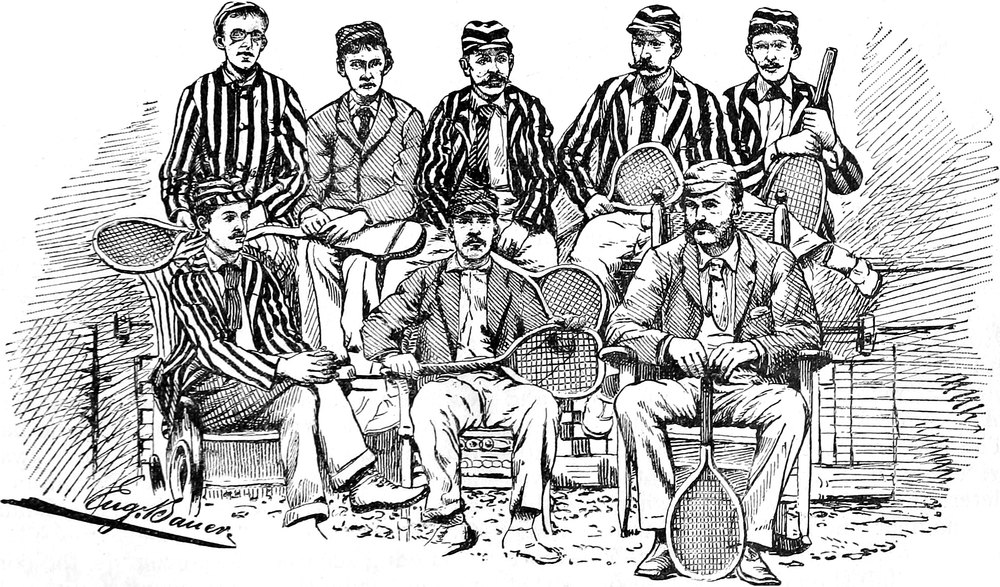
GROUP OF CONTESTANTS—TOURNAMENT OF THE COUNTRY CLUB OF MARYLAND.
A. W. TOMES. A. H. S. POST. TOM PETTITT. F. MANSFIELD. F. V. L. HOPPIN. R. V. BEACH. YATES PENNINGTON. A. L. RIVES.
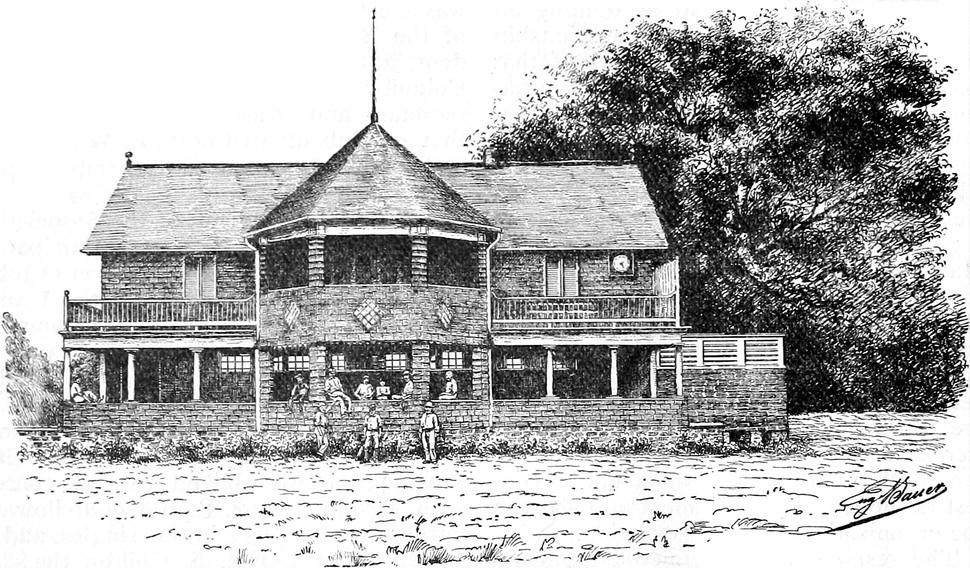
CLUB HOUSE, BALTIMORE CRICKET CLUB.
The success of this initial tournament of the Association greatly encouraged its officers. Many of the contestants had been hitherto unheard of, and some of them coming from clubs located in small towns and villages of Virginia and Maryland, had shown skill of no mean order. Particularly surprising was the play of Mr. Abel John Layard, a young Englishman, and a member of the Winchester Club, of Winchester, Va., who, during the progress of the tournament, played a very interesting exhibition match with Mr. W. V. R. Berry, and showed remarkable skill. His play demonstrated anew that the skill of the average Englishman in lawn tennis is superior to that of the average player in this country. It is equally true, however, that we are approaching nearer and nearer to the English standard of excellence, and that in a few years our experts will be able to meet the best players of England on even terms.
This tournament virtually ended the lawn tennis season of 1887 in the South. Its effect was noticeable, however, in the largely increased number of clubs and players in Washington and its vicinity. The officers of the Southern Association were not idle during the winter. It was determined that the next championship tournament should be held in the spring, and that the grounds of the Baltimore Cricket Club should be used, in order that the city of Baltimore might share in the newly awakened interest in lawn tennis. Early in the month of May, however, the most active players of Washington arranged a tournament for the championship of the District of Columbia, believing that such a competition would develop players who might represent Washington with honor in the championship tournament at Baltimore.
It is unquestionably true that tournament practice, as a promoter of skill, is far better than any other. The player competing in a tournament is continually alert and strives hard to win every point, while one who has no such incentive is apt to become indolent and indifferent as to success, in which condition he is little apt to improve. Two days in a tournament is worth more than a week of ordinary practice to one who desires to improve in skill.
The committee in charge concluded to hold the tournament on the courts of Kendall Green, the ably conducted Government college for deaf mutes, at the head of which is the well-known Dr. Gallaudet. Two tennis organizations ordinarily use these courts; the one composed mainly of the college professors, and the other almost entirely of the students, some of whom have become quite proficient, and are always among the most interested spectators of any important match played at Kendall Green.
Having secured these grounds, the committee made the tournament additionally attractive by adding two events for ladies, both a singles and a doubles competition. There are no ladies in the District whose skill rivals that of the seemingly invincible Miss Robinson of Staten Island; she appears to be in a class by herself among the lady players of this country, and the only ambition of a majority of her opponents is to do as well as possible against her; but there are many of considerable skill, and the entries in these two events were sufficient to make them very interesting. The championship of the District of Columbia, in ladies’ singles, was won by Miss Bayard, a daughter of the Secretary of State, who had often demonstrated the strength of her game while a member of the Delaware Field Club of Wilmington. The contest in ladies’ doubles was won by Miss Bayard and Miss Safford. The championship in men’s singles was rather unexpectedly taken by Mr. John Pope, who had shown a considerable knowledge of the science of the game when representing Cornell University in the Intercollegiate tournament of the previous year. Mr. Pope’s most troublesome competitors were Mr. R. B. Goodfellow and Mr. C. L. McCawley, both of whom showed marked improvement in their play. Mr. McCawley, with Mr. Stevens as a partner, succeeded in winning the final round of the doubles from Messrs. Woodward and Davidson, and thus carried off that championship.
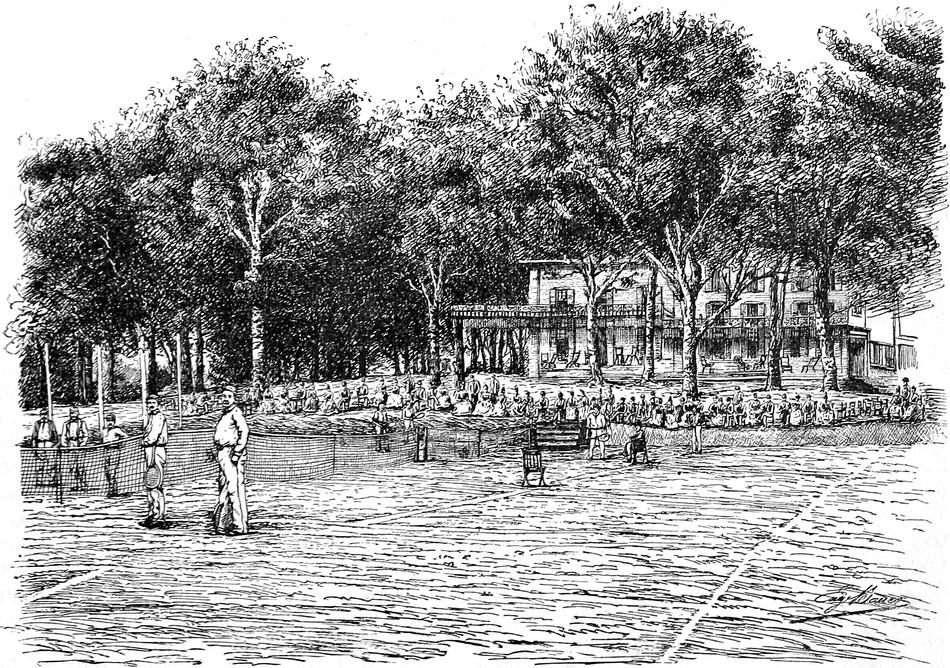
CLUB HOUSE AND TENNIS COURTS—COUNTRY CLUB OF MARYLAND.
The success of this tournament and the good play shown did not, however, appear to materially affect the result of the next championship meeting of the Southern Association, held on the grounds of the Baltimore Cricket Club, on June 13 and following days. Washington was represented by some of its strongest players, who made a creditable showing. Messrs. Bonsal and LeMoyne, however, who, as a result of continued practice together, showed admirable team work, succeeded in winning the double event for the second time, and thus became the owners of the two cups presented by Peck & Snyder. A new champion made his appearance in the singles. Mr. A. H. S. Post gave by far the best exhibition of skill that had up to that time been seen in the South, and won the championship without much trouble. Mr. Post is only seventeen years of age, and as his play is not free from some of those faults and weaknesses common to young players, it was greatly to his credit that he succeeded in wresting victory from opponents of so much greater experience. His strokes are at times positively brilliant, and, though he often shows inexcusable carelessness and an apparent lack of steadiness, it was demonstrated that his game possesses real strength by the closeness of the match which he played with a strong opponent, Mr. Q. A. Shaw, in the open tournament held at Narragansett Pier last summer. Mr. Post is undoubtedly one of the most promising of the young players, and the development of his skill will be watched with interest.
Though the two tournaments held at Washington in the fall of ’87 and the spring of ’88 did not produce a player capable of winning the championship, yet their beneficial influence was shown in the improved play of the greatly increased number who followed lawn tennis as a pastime. There were about ten clubs in existence two years ago. There are now seventy, and the total number of players, as estimated by the “Capitol” newspaper, is two thousand. If a devotee of lawn tennis, who is anxious to improve but does not himself wish to compete in a tournament, will observe carefully the methods of different contestants who are struggling to win the prizes, he is certain to obtain some hints which will be useful to him and strengthen his game. Thus did these tournaments result in a substantial improvement in play throughout Washington. Among the most expert, and among those whose improvement has been most rapid, may be mentioned Messrs. Oscar Woodward, C. L. McCawley, John Pope, R. B. Goodfellow, John Davidson, W. P. Metcalf, and Dr. J. L. Wortman. No list could be complete without adding the name of Mr. W. V. R. Berry, who established his reputation as an expert some years ago, and who now appears to have joined the ranks of retired veterans.
Some few years ago a club, social in its nature, was organized by several gentlemen of Washington, prominent among whom was Mr. John F. Waggeman. A clubhouse and grounds were secured on the Bladensburg road, at a point located in the State of Maryland, but only a short distance from the boundary line of the District of Columbia, and not more than three or four miles from the centre of the city of Washington. The club is known as the Country Club of the State of Maryland, or the Highland Country Club, and it was designed to occupy the same relation to the city of Washington as the country clubs of Boston and New York hold to those cities. One of the earliest sporting features added to the club was a tennis court, and it at once occurred to the ever active mind of Dr. F. P. McLean, who was a member and interested in the club, that this would be a grand place in which to hold a large lawn tennis tournament. Tournaments for the championship of the South had been held under the auspices of the Southern Lawn Tennis Association; but it had been required, as a condition of playing, that a contestant should be a member of a club belonging to the Association, and, consequently, only a resident of the South was able to compete.
Dr. McLean knew that the Middle States Championship had been won by Mr. R. D. Sears, a resident of New England, and that the New England championship is at the present time held by a New Yorker. He felt that a tournament for the championship of the South, open to all comers, whether from the North or the South, would excite general interest, and would, moreover, give the residents of Washington an opportunity to witness the skillful playing of the Northern experts, who, it was hoped, would be induced to compete.
As a first step, the Country Club of the State of Maryland applied for membership in the United States National Lawn Tennis Association, with the idea of holding the proposed tournament under the auspices of that Association. The application was granted and authority given to the club to hold the tournament for the championship of the Southern States. This action, of course, placed the National Association in an attitude of apparent rivalry to the Southern Association. The latter had already held a tournament at Baltimore, as has been related, and, naturally, would not recognize any champion for the year except the winner of that tournament. The rivalry was more apparent than real, however, as Dr. McLean, the president of the Southern Association, was one of the originators, and, in fact, the most active in the management of the Country Club tournament. The apparent conflict and championship complication will not be experienced in the future, as it is probable that the United States National Lawn Tennis Association, whose membership is now limited to single clubs, will at the next annual meeting engraft into its constitution a clause under which other associations may be admitted to membership in the older organization, thus making it a central and undisputed authority in lawn tennis throughout the United States. Under such a clause the Southern Association can become a member, and only one annual tournament for the championship of the South will hereafter be held.
Dr. McLean spent a great part of last summer in visiting Northern tournaments and extending to Northern experts an invitation to compete in the Country Club tournament. To each one was offered the hospitality of the club during the tournament, and Dr. McLean finally succeeded in securing the entries of several players prominent in the North. In the meantime active preparations were being made at the Highland Country Club. A more interesting place for such an event could not be selected. The club is located, as before noted, on the old Bladensburg road, about three or four miles from Washington, and one or two from the village of Bladensburg. The club-house is in the centre of a large area of level ground, every foot of which is rich in historical association. On this very ground occurred, in the year 1814, one of the most important conflicts of the war of that period, the battle of Bladensburg, and on one side of the lot, close to the main road and distant only three or four hundred yards from the club-house, is a plot of ground particularly interesting as being the scene of the many duels which have made the name of Bladensburg famous.
The club had at this time but one lawn tennis court, and as soon as the tournament became an assured fact, it was at once decided to lay out four more. A description of the means by which these courts were finally constructed will not be uninteresting to one who proposes to build a court of clay or dirt, the materials used in this case. September had already arrived, and as it was proposed to hold the tournament during the latter part of that month, there was but little time for the construction of courts; but a plot of ground was easily leveled, a foundation of some solid material laid, and a mixture of dirt and clay filled in. At this point it seemed as if fate were against the club, for rain began to fall before the mixture had commenced to solidify, and rain continued to fall for one whole week, until the space occupied by that dirt and clay assumed the aspect of a quagmire. The rain ceased only a week before the time set for the tournament, and it was at first feared that it could not be held; but the ingenious idea of some brilliant mind saved the day. An old negro farmer, with a small army of mules at his command, lived near by, and both he and his mules were at once sent for. The old fellow brought his fourteen mules to the club, and they were turned loose upon the quagmire of clay and dirt. They tramped and stamped over it from daylight until eleven o’clock at night, and at the end of the third day of tramping, the Highland Country Club had as solid a piece of ground as could be desired. A few irregularities on the surface were easily smoothed away, and four courts were laid out, good enough to be used by the most exacting of lawn tennis experts.
The tournament was held on Tuesday, September 25 and the following days, and could hardly have been a greater success. Mr. F. Mansfield, of the Longwood Cricket Club, Boston, Messrs. F. V. L. Hoppin and H. A. Ditson, of the same club; Messrs. Ludington and Beach, of Yale University; Mr. Dean Miller, of New York; Mr. F. W. Kellogg, of New Haven; Mr. A. W. Tomes, of Brooklyn, and Mr. J. W. Smith were among the entries from the North, and all of these gentlemen enjoyed the hospitality of the club. The most expert of their Southern opponents were Mr. A. H. S. Post, the champion of the Southern Association, representing Baltimore, and Messrs. Davidson, Woodward, McCawley, Rives, Goodfellow, Metcalf and Wortman, all from the District of Columbia. There were in all thirty-six contestants, making it by far the largest tournament ever held in the South, as well as the greatest in interesting features. Dr. McLean had secured the presence of Thomas Pettitt, the professional champion of the world in court tennis, and also remarkably expert in lawn tennis. Pettitt played two exhibition games during the week, one with Mr. A. H. S. Post, in which he successfully conceded odds of fifteen, and the other with Mr. Mansfield, to whom he was unable to give the same odds, and was defeated. Pettitt’s game is a model of good form, and delighted the spectators.
The play in the tournament proper demonstrated that Southern form is not yet up to Northern, for, as the contest approached the final round, it was found that the four men left to battle for the prize were all representatives of the North. They were Messrs. Mansfield, Miller, Hoppin, and Smith. The final round was contested by Messrs. Mansfield and Miller, and was won easily by the former, who thus became the second champion of the South for the year 1888. In this connection a word or two in praise of young Mr. Post is not out of place. Having already won the Southern championship at Baltimore, he might well have refused to risk the loss of that honor by competing in the Country Club tournament. Mr. Post showed true spirit in preferring to play, and although beaten in one of the early rounds by Mr. Hoppin, undoubtedly stands at the head of Southern players.
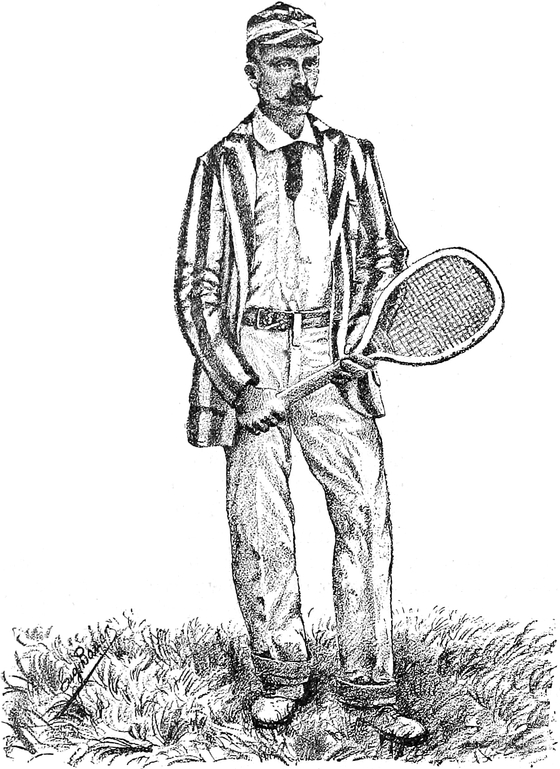
F. MANSFIELD, CHAMPION, HIGHLAND COUNTRY CLUB TOURNAMENT.
The success of Mr. Mansfield was particularly gratifying to those who have been familiar with his undoubted skill in practice, and disappointed that he could not exhibit the same skill in tournament play. His experience demonstrates plainly that “confidence” is a most important factor in the success of a lawn tennis player. Mr. Mansfield’s trouble has been a lack of that factor. He has one day played a practice game of unusual strength and the next been beaten in a tournament by some player much his inferior in skill, and only by reason of lack of confidence in his own ability. Sincere modesty, such as Mr. Mansfield’s, will make a man extremely popular among lawn tennis players, but it may be regarded as a settled fact, that when two men, at all equal in skill, meet in a lawn tennis contest, the one who has the most thorough confidence in his own ability to win will surely be the victor.
The double event was won by Messrs. Mansfield and Hoppin, but in the final round Messrs. Davidson and Metcalf, the crack Washington team, gave a good exhibition of double playing and won one set from the victors. This brought to a close a most successful tournament, and the Northern players returned to their homes with a very high opinion of Southern hospitality. A feature of the visit, which will be remembered with much pleasure by all, was their call on the President of the United States. One morning about thirty of the players boarded a hay-cart, the property of that “same old negro” and drawn by two of his mules, were taken to Washington, shown all points of interest, and, finally, invaded the White House, where they were presented to President Cleveland.
As we leave Washington, with its multitude of small clubs, and arrive at Baltimore, after an hour’s travel by rail, a widely different condition of affairs is presented; for in this city the lawn tennis interest is almost entirely centred in two clubs, the Baltimore Cricket Club and the Towson Club of Towson, a suburb of Baltimore. Of these two, the Cricket Club is by far the more prominent. It is an old organization, having been founded in 1874, but it was not until 1878 that the club, then quite small in membership, leased grounds at Mount Washington, also a suburb of Baltimore and situated about six miles from the city, on the Northern Central Railroad. The railroad runs numerous trains to Mount Washington, and the drive to the club, through Druid Hill Park, is a most pleasant one.
As its name signifies, the Baltimore Cricket Club was originally organized for cricket purposes. But after lawn tennis was introduced as a club sport in the year 1879, that game rapidly became so popular with the members that the interest in cricket has decreased, a fate somewhat similar to that which has befallen this scientific game in our own St. George’s Cricket Club of New York. The rapid rise of lawn tennis in popular interest could not be more plainly demonstrated than by the experience of the Baltimore Cricket Club. Its tennis courts were originally laid out on a part of the cricket field, but the game became so widely played that it was found necessary, in 1884, to grade an additional plot of ground, to be used for tennis alone, upon which there are now ten excellent turf courts. This number was thought to be ample, but the past season has shown the necessity for still larger accommodation, and preparations are now being made for the construction of four dirt and four additional turf courts. A number of improvements were made during the past summer, the most important of which was the erection of a large and picturesque club-house, for the use of both tennis and cricket members. Ladies do not contribute to the finances or take any part in the management of the club, but become members by courtesy. A small house has been erected for their use, and some of their number, notably Miss Bonsal and Miss Latrobe, have shown much skill in lawn tennis tournaments of the North.
Tournaments open only to members of the club are usually held in the spring and fall. In these contests Mr. Leigh Bonsal has uniformly proved himself to be the club champion, until the past summer, when Mr. A. H. S. Post, the holder of the championship of the Southern Lawn Tennis Association, captured that honor. The last club tournament, a handicap, was held in October, 1888, and Mr. Post conclusively proved his superiority by winning it, though conceding considerable odds to all contestants. Mr. W. J. Bell and Mr. A. D. Atkinson, both very young players, won the doubles. Among other experts of the club are S. Taggart Steele, H. M. Brown, R. B. McLane, Jr., L. V. Lemoyne, Yates Pennington, and Frank Bonsal. With a total membership of over two hundred, and a lively interest in sports of every nature, the Baltimore Cricket Club is perhaps the most prominent athletic club of the South. Next in importance in Baltimore is the Towson Club of Towson, which does not boast of so many players, but embraces in its membership a number of those who also belong to the cricket club. It has seven good turf courts, and is particularly popular among ladies of the city.
At Wilmington, Delaware, is located one of the most flourishing clubs of the Southern section. The Delaware Field Club was organized in 1882, grounds were secured and buildings erected in 1883, and the club was incorporated in 1885. Since that time it has made its mark in the athletic world in more ways than one. Lawn tennis has always been the favorite sport of the members, and it now seems to be definitely settled that the lawn tennis world is indebted to the Delaware Field Club for the introduction of “progressive tennis,” a novelty founded on that once popular craze, “progressive euchre.”
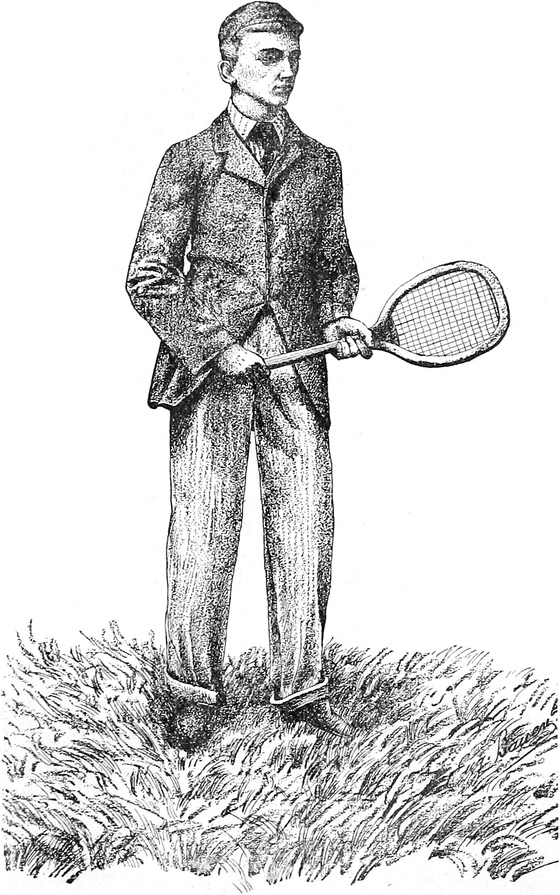
A. H. S. POST, CHAMPION, SOUTHERN LAWN TENNIS ASSOCIATION.
The club was one of the earliest to join the United States National Lawn Tennis Association, and in 1886 a tournament for the championship of the South, held on its grounds under the auspices of that association, was won by Mr. C. B. Davis, of Lehigh University. Mr. Davis was thus the first champion of the South, both in singles and doubles, for he also captured the latter event with Mr. R. H. E. Porter, of Lehigh, as a partner. An open tournament, held in 1887, was likewise won by Mr. Davis, but on this occasion his partner in the doubles was Mr. A. G. Thomson, of Philadelphia. The grounds of the club will accommodate at least twenty-five courts, and as many as eighteen are in almost constant use. Out of a total membership of two hundred, about eighty are active lawn tennis players, and in this number are included several ladies, the most expert of whom is Miss Florence Bayard, a daughter of Mr. Cleveland’s Secretary of State. Of the club tournaments, which have been held since 1883, Mr. W. S. Hilles has succeeded in winning three, including that of 1888, while Mr. J. E. Smith was known as club champion in 1887, and Mr. J. L. Tatnall in 1884. Other leading players of the club are Mr. W. C. Jackson, the present champion of Cornell University, Mr. H. B. Bringhurst, Jr., and Mr. A. H. Smith. It is now believed that the next annual tournament of the Southern Lawn Tennis Association will be played on these courts, and everything points to the continued prosperity of the club.
Looking back over these brief sketches of lawn tennis in Washington, Baltimore, and Wilmington, we find that tournaments for the championship of the South have been held since 1886. The following table gives, in a condensed form, the facts relating to those contests.
TOURNAMENTS FOR CHAMPIONSHIP OF THE SOUTH.
YEAR. HELD AT SINGLES CHAMP’S DOUBLES CHAMPIONS
1886. Del. Field Club. C. B. Davis. Davis & Porter.
1887. U. S. Mar. Barracks, Wash., D. C. Leigh Bonsal. Bonsal & Lemoyne.
1888. Balt. Cricket Club. A. H. S. Post. Bonsal & Lemoyne.
1888. Highland C. C., Wash., D. C. F. Mansfield Mansfield & Hoppin.
The coming season promises to be a most interesting one to the lovers of lawn tennis throughout the United States, for it is hoped and expected that England will send some of her most expert and representative players to contest for our national championship at Newport. Let the South, also, send in its entries. Certain it is, that if the same interest and general improvement as has been shown during the past two seasons mark the future development of the game in that section, it will soon be able to send representatives who will win laurels among the most skilful.
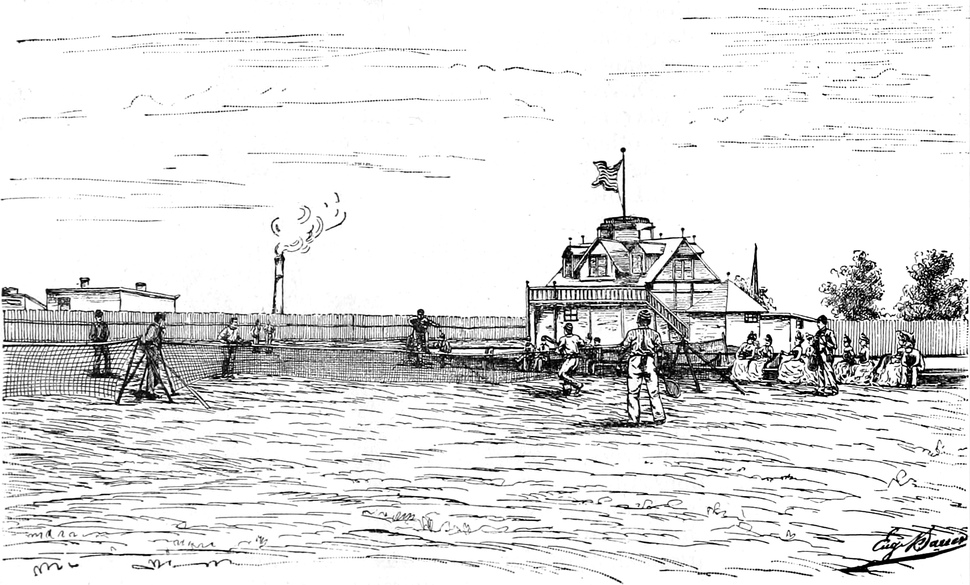
CLUB HOUSE AND GROUNDS, WILMINGTON FIELD CLUB.
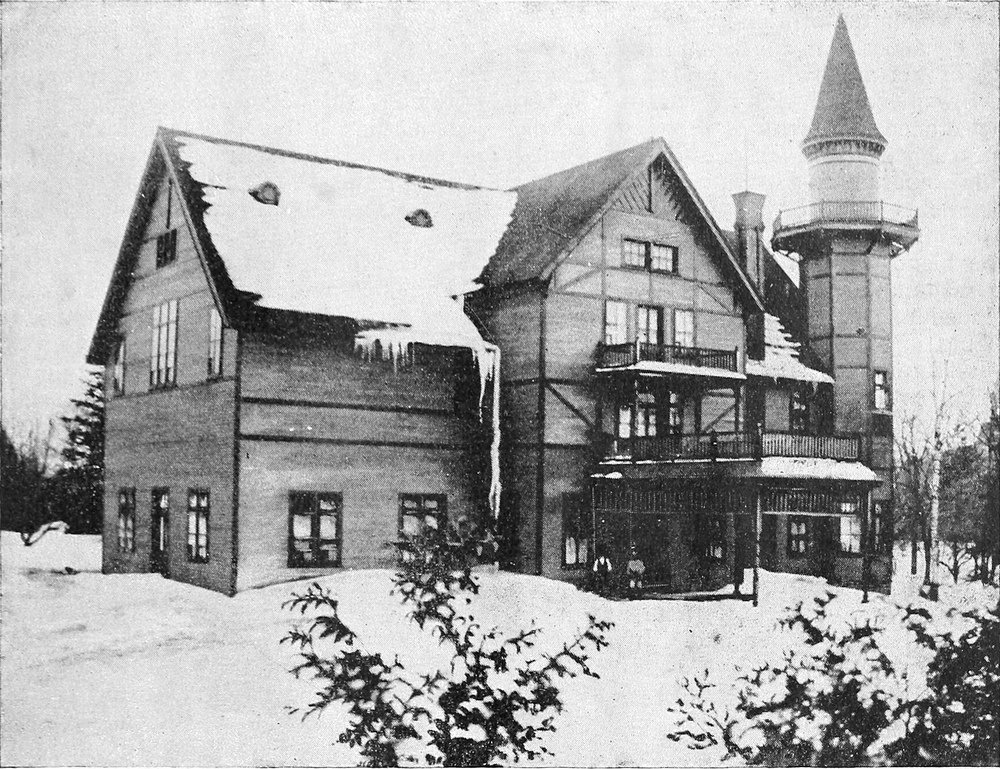
THE CLUB HOUSE.
SNOWSHOEING IN CANUCKIA.
BY JAMES C. ALLAN.
SNOWSHOEING is surely one of the most fascinating of sports. To the uninitiated it might appear strange that there should be any pleasure in ambling along over the snow in a manner somewhat resembling the ungraceful waddle of that unornamental bird, the domestic duck, and with feet hampered by the weight and the inconvenient form of a pair of ungainly snowshoes, so-called.
To a certain extent our captious critic would be right; the source of enjoyment is to be found in the accessories of the sport, and in the knowledge that under him are many feet of yielding snow, in which he would be helplessly floundering but for the aid of his trusty raquettes.
Then there is the peculiar indefinable charm of the winter scenery, the beautiful effects of the sunset on the dazzling expanse of snow, scenic effects perhaps even more entrancing when the pale moonlight casts ghostly shadows here and there, and brings into brilliant prominence some snow-crowned elevation in the landscape. I cannot do better than quote the glowing description which a noted American writer gives of the appearance of the country over which he tramped on one of his first excursions on “the merry snowshoe”:
“The mountain rose up behind us, covered with snow. Away toward the declining sun the landscape spread as far as the eye could reach, with low white hills away off on the horizon. Between the hills and the foreground flowed the river under its cover of ice. The red, wintry sun now low in the heavens, touched the prominent points of the rolling, snow-covered country with crimson, while the far-off clouds that stood motionless in the sky were of all the hues of the rainbow, and these varied tints were in turn faintly reflected on the broad expanse of spotless snow.”
The snow, let it be borne in mind, is not of the nature or consistency of that which falls in softer climes; it is so fine, so dry and loose as much to resemble flour, only infinitely whiter, and of dazzling purity.
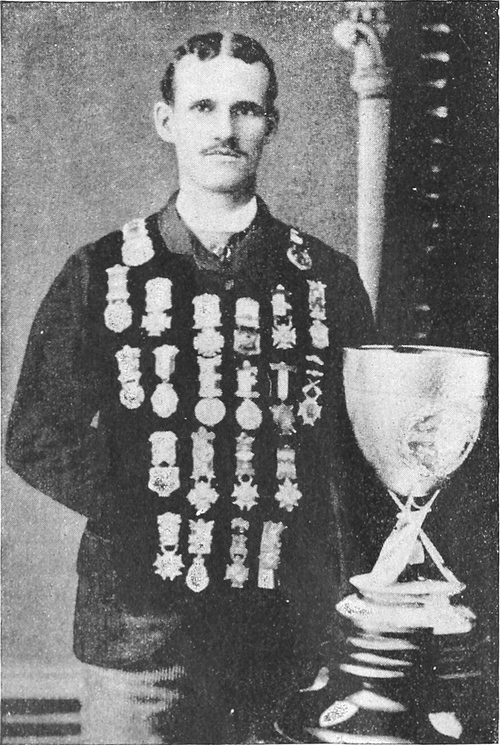
MR. J. G. ROSS, CHAMPION SNOWSHOE RUNNER, CANADA.
As many of my readers very probably have never seen a snowshoe, a short description of its form and construction may not be amiss. It consists, broadly speaking, of a framework composed of a long, narrow piece of hickory wood, over which is stretched a network of thongs, or cords, made sometimes of strips of deerskin dried and prepared in a peculiar manner, and sometimes made of the intestines of animals. This network is called the “gut.” The hickory rod of which the frame is to be made, after having been steamed and steeped in boiling water, and so rendered pliable, is placed edgewise and then bent round somewhat in the shape of a tennis-bat, with an oval-shaped front, and the two ends joined together at one extremity and tapering off to a point corresponding to the handle of the tennis-bat. The total length of the shoe is about three feet, the extreme width from thirteen to sixteen inches. Across the oval and fitted into the inside of the framework by mortises, are two bars or battens of wood, each of them five or six inches clear of either end. In front of that cross-bar nearest the fore part of the shoe is an open space, and over the bar a deerskin thong is fastened, forming an aperture for the reception of the great toe. The thong is then crossed over the top of the foot, passed around the ankle once or twice and then tied. This leaves the heel free to move in any direction; the toe works in and out of the opening in the shoe, and in lifting the shoe in making a step forward its weight rests on the toe. When placing the foot down again the toe touches the snow first. Occasionally the framework is adorned with tufts of many-colored wool.
The size and shape of the snowshoe varies according to the requirements or the taste of its owner. Some are nearly round and present a squat appearance; others again are long and narrow, and resemble somewhat in shape the Norwegian ski.
For a tramp over untrodden or “virgin” snow, of course a large shoe of considerable area is desirable; for racing purposes over a beaten track, a smaller shoe is used. The regulation width of a pair of racing shoes is not less than ten inches of gut; the weight, including strings, must not be less than one and a half pounds.
The Indians and the half-breeds seem to enjoy a monopoly of the manufacture of snowshoes, and of toboggans as well.
The snowshoe enabled them, in former days, to traverse with ease, when in pursuit of game or on the warpath, leagues of wilderness otherwise impassable in the winter season; the toboggan they used as a sledge on which to drag their provisions or to convey to camp their slaughtered game.
It is true that there is in use in Norway an implement somewhat similar to the American snowshoe, called a “ski,” and composed of a couple of long, narrow slabs of wood, one for each foot, painted and turned upward at both ends. The ski, however, is principally used for sliding down declivities and jumping crevasses; it is ungainly and awkward to use on level ground. The aid of a staff, or alpenstock, is necessary in skiing, and a description of it hardly comes within our province.
“Raquettes” was the name originally given by the hardy Canadian coureurs du bois and the voyageurs of the Hudson Bay Company to the snowshoe, and we can easily imagine of what inestimable value it must have been to these adventurous individuals in their trips of almost incredible length, difficulty and peril. To the present day hardly a farmhouse in all broad Canada is without its pair of snowshoes, and they are generally of the sturdy, old-fashioned kind, long and broad and substantial.
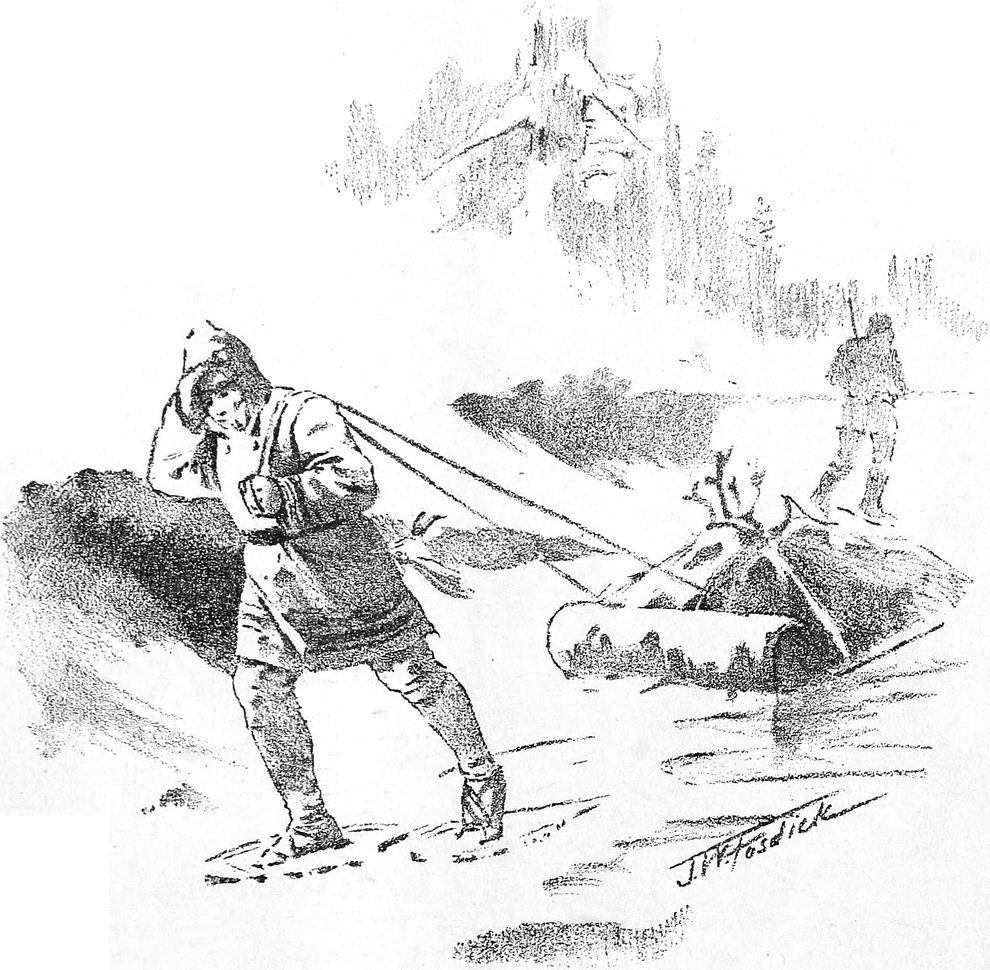
HOMEWARD BOUND.
In hunting the moose and the caribou, in the wilder parts of the Dominion, the snowshoe plays an important part. The crust on top of the snow is insufficient to sustain the weight of these heavy animals; they break through it at every stride, its sharp edges lacerate their legs, and the hunter can follow their course guided by the blood-marks on the snow. Sustained by his trusty shoes, he soon overtakes the laboring game, and a well-directed shot puts it out of misery.
But it is in its aspect as a sport, as a means of healthful recreation, that we have principally to consider snowshoeing. Of late years many clubs have been formed all over Canada, and in those parts of the neighboring Republic favored with the slightest suspicion of the “beautiful,” and of all these the premier, in point of seniority, is the Montreal Club, founded in 1840, and composed originally of twelve members.
As Canada is the home of snowshoeing, so is Montreal, par excellence, the leading city of Canada in this branch of athletics, both on account of the severity and the long duration of its winters, the natural advantages possessed by the city as regards its situation, and the widespread devotion among its young men to sports in general.
And of all the hardy winter sports snowshoeing is easily the first. Tobogganing and skating rise in public estimation and decline, but snowshoeing, like Tennyson’s “Brook,” “goes on forever,” and is continually gaining ground, as any one who has been so fortunate as to witness one of those unique winter carnivals in Montreal, and to gaze upon the hosts of picturesquely clad athletic young “knights of the shoe” in their attack upon the marvelously beautiful ice castle may well believe.
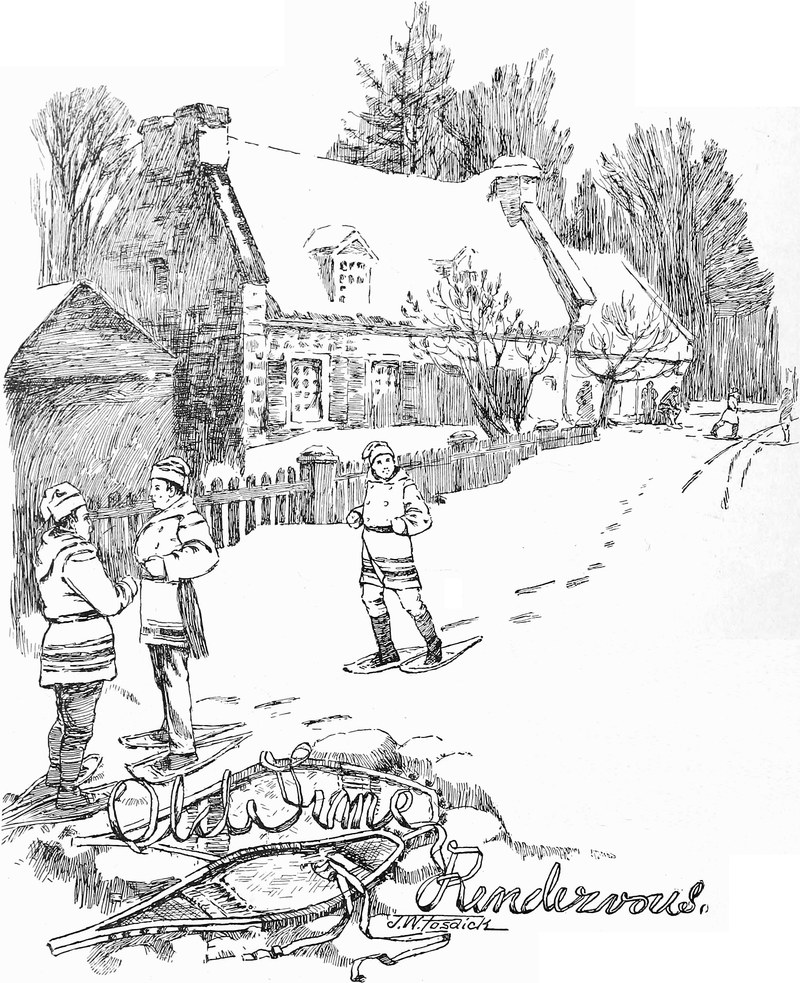
In place of the one solitary club of twelve members in existence in 1840, Montreal may now boast of dozens. The old Tuque Bleue Club, alias the Montreal, has now a membership of 2,000. The St. George has, perhaps, half that number; other principal organizations are the Emerald, Argyle, Le Trappeur, Le Canadien, St. Charles, Maple Leaf, Wolseley, Vandalia, Royal Scots, etc., while other Canadian cities are not far behind.
Toronto, Ottawa, Quebec, St. Hyacinthe, Winnipeg, Brandor, Souris and Portage la Prairie have all sent their representatives to the Montreal Ice Carnivals, and now St. Paul and Minneapolis, those twin cities of the American Northwest, have caught the fever and are enthusiastic in their emulation of their Canadian brethren.
A snowshoe club is organized in much the same manner as other athletic associations. It has its president, vice-president, secretary, treasurer, and last, but by no means least, its entertainment committee, whose pleasing duty it is to provide amusement for their fellow-members at the club rendezvous when half the tramp is over and the “boys” are resting previous to their return home.
The costume of the snowshoer is at once comfortable, singularly well adapted to its purpose, and picturesque in the extreme. The head is protected by a gaudy knitted woolen cap, with brilliant tassel, and is called a tuque, in the Norman French of the Canadian habitant, who used it first of all. Then there is a coat with capote, and knickerbockers made usually of white blankets with many-hued border. Of late years, however, colored blankets have come into favor and bid fair to rival the white in popularity. Around the waist the coat is drawn together by a sash; colored stockings and deerskin moccasins, and, of course, snowshoes, complete the costume. Each club is distinguished by some peculiarity in the uniform of its members; for example, the Montreal club affects a blue tuque, red sash and red stockings; the Knights of St. George, or the “Saints,” as they somewhat arrogantly style themselves, a purple tuque with white stripes, purple sash, and stockings of Tyrian hue also. So with the other clubs.
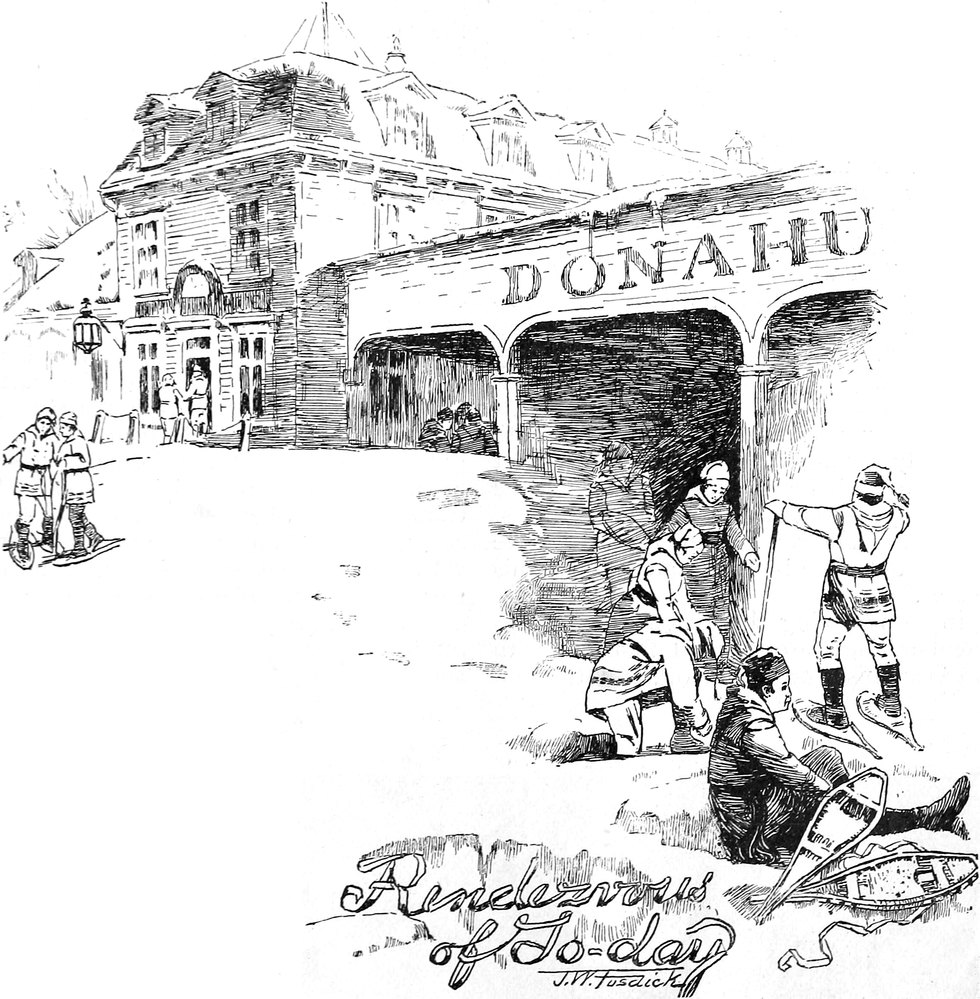
An entire outfit, including complete costume and snowshoes, may be procured for less than twenty-five dollars, and the suit under ordinary circumstances will outlast several winters. Some of the boys who have plenty of cash, or better opportunities of obtaining the articles than the rest, invest in buckskin hunting shirts and fringed leggings. They are made by Indians and half-breeds in Manitoba and the Northwest, and are, of course, more expensive than the blanket suits.
In Montreal it is usual for each club to tramp out on one evening in each week, and to take a more extended tour across country on Saturday afternoons.
On the evening appointed for the tramp the boys meet at their club-rooms; shoes are strapped on, the president leads the way, the members follow in Indian file, and the whipper-in brings up the rear to give the novice or the lazy a lift, and off they go. Let us suppose we are taking the route usual for evening tramps, partially around and up over a spur of Mount Royal, thence across country for about a mile and a half to our rendezvous. The pace increases, and, excepting an occasional nip at one’s ears, Jack Frost is forgotten as we warm to our work. “Number off,” cries the president. “No. 1, No. 2,” and so on, until the whipper-in responds, “No. 60; all up.”
What a pretty picture the long line of ghost-like shadows makes, as it silently winds in and out in the light of the moon! Now they disappear from view for a moment or so as they plunge through brushwood; they race down gullies, clamber over fences and mount hills, until at last the goal of their desire is reached at mine host Lumpkin’s, or at the Athletic Club-house, where, after enjoying the programme provided by the committee, and perhaps refreshing the inner man, we take up our homeward march, and, our starting-point attained, separate for another week, or until the following Saturday afternoon.