Volume 13 — OUTING.
Reading edition
VOL. XIII. NOVEMBER, 1888. NO. 2.
OUTDOOR LIFE OF THE PRESIDENTS.
BY JOHN P. FOLEY.
I. GEORGE WASHINGTON.
THE great cities have not yet given the country a President. From Washington to Cleveland the chief magistrates have all come from great Southern plantations, lonely Western farms, rural towns or villages, scattered up and down the Republic. The early Virginia Presidents were, as a rule, more fortunate in the circumstances of their birth than any of their successors. Washington’s infant eyes opened amid scenes of rare natural beauty. The home of his parents was on the banks of the Potomac, one hundred miles below Mount Vernon. It was a large, comfortable cottage, filled with all the luxuries which a wealthy planter of that period could command. From its lawn could be seen a wide expanse of the majestic river, ten miles broad at that point, and on the opposite shore the forest-crowned hills and plains of Maryland. Thomas Jefferson was born on the handsome estate of his father, in Albemarle County, part of which he afterward inherited. Madison’s father, too, was a large landed proprietor, the owner of slaves, and the possessor of a fortune sufficient to gratify his ambition. James Monroe was equally fortunate. His father lived in a fair Virginia home, surrounded by all the semi-feudal splendor of that distant slave era. To complete the group of the Revolutionary Presidents the name of John Adams must be added. In his youth his prospects in life were as cold and hard as his native New England hills. His father was poor, and had to strain every pecuniary nerve to send him to Harvard College. When he left that institution he was compelled to earn his living as a teacher. The story of the deeds of these five men in the cabinet, the field, and the halls of legislature has been written by many pens and told in many tongues. Their fame is one of the precious inheritances of the Republic whose foundations they so materially helped to lay, and to whose magnificent structure of popular government they contributed perhaps more than any other five leaders and statesmen of the Revolution. But it is with their private home life, and that of their successors, we are now concerned.
Washington is the most stately figure in our history. It requires an effort of the imagination to think of him except, as it were, in full-dress. He is ever the commander-in-chief, mounted on a spirited war-horse; serene in the hour of victory; undaunted in adversity; full of hope and confidence when all others are in gloom and despair. Again, we love to picture him as the majestic President, ceremonious as the most imperial of monarchs, provoking the harsh criticism of enemies by what they termed his mimicry of foreign potentates—of the English court and king whose political fetters he had shattered. And, still again, he towers up in our imagination as the American Cincinnatus, laying down the sword and the sceptre, retiring from the pomp and power to which he had been so long accustomed, to his picturesque home in the Virginia woods, leaving behind him an example of lofty patriotism without a parallel in all human annals. But there was another Washington whom we seldom see except in stray glimpses, when the curtain rises before the scene is fully set, or when the side wings hitch and halt in their grooves. His biographers tell us that his military propensities were early developed; that when a boy he was in the habit of forming his school companions into military companies, who paraded, marched, and fought mimic battles, and that he showed his genius for command by being always the leader of one of the rival parties. He was fond of athletic amusements; of running, jumping, tossing heavy bars, and other feats of agility and strength. “Indeed,” says Mr. Sparks, “it is well known that these practices were continued by him after he had arrived at the age of mature life.”
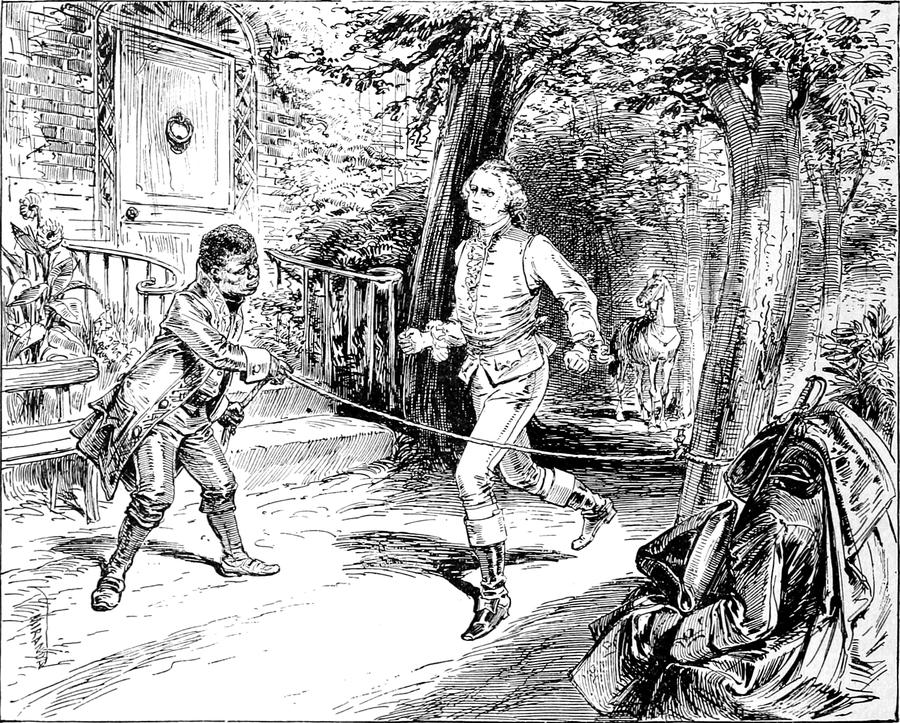
WASHINGTON SKIPPING THE ROPE FOR EXERCISE.
This story is told of him while he was commander-in-chief of the Continental armies: Colonel Timothy Pickering, to whom Washington was very much attached, had a negro body-servant named “Primus.” Washington visited Pickering’s quarters one day, and found him absent.
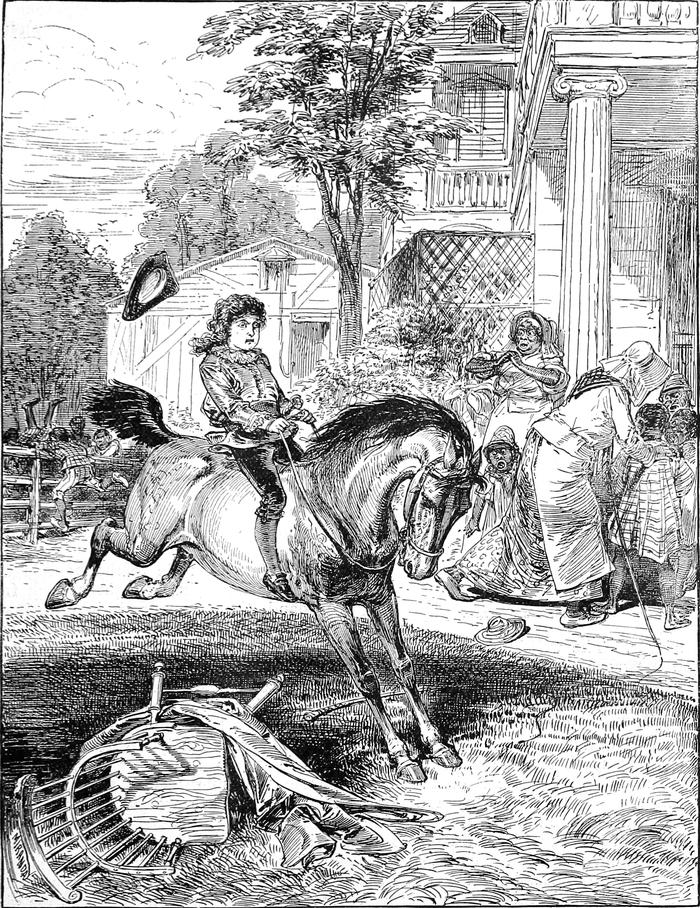
WASHINGTON GIVES THE COLT HIS FIRST LESSON.
“It does not matter,” said General Washington to Primus, “I am greatly in need of exercise, and you must help me to get some before your master returns.”
Under Washington’s directions the negro tied a rope to a neighboring tree, about breast high, and Primus was ordered to stand at some distance and hold it horizontally extended. Washington ran forward and backward for some time, jumping over the rope as he came and went, until he expressed himself satisfied with the exercise. It is said that he frequently visited Primus and amused himself in this primitive fashion.
He learned fencing when he was quite young; his teacher being an old soldier who had seen service with his brother in the Indies. His stone-throwing feats across the Rappahannock, over the Palisades, and to the top of the Natural Bridge in Virginia, are mentioned by nearly all his biographers. Charles W. Peale, the artist, tells us that when he was at Mount Vernon in 1772, painting Washington’s picture, he saw him toss a bar very much farther than the most athletic and expert of a number of young men who were, on one occasion, testing their strength in that way. He was then forty years old, and proudly remarked, “You perceive, young gentlemen, that my arm yet retains some portion of the vigor of my early days.” He was a good wrestler, and many stories of his prowess in this respect are told.
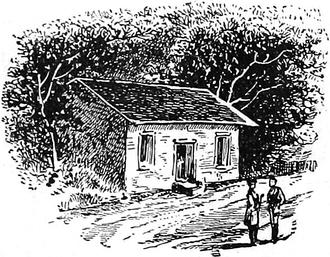
LORD FAIRFAX’S COTTAGE.
General Washington was a splendid horseman. There was no animal he could not master, and he never lost his seat in the saddle. The well-known hatchet dialogue between his father and himself is suspected to have no better foundation than the imagination of the Rev. Mr. Weems. The following incident in his young life, and the subsequent interview between his mother and himself, rest on more substantial historical data: Lady Washington owned a fine span of gray horses, in which she took very great pride. One of them had never been broken to the saddle. It entered into the heads of some young friends of Washington to give the colt his first lesson in this particular branch of his education. The animal resisted their efforts, and would not allow any one of them to mount him. George, although one of the youngest of the party, managed to pacify the terrified creature and to bestride him. Then came a battle royal between horse and boy. All the animal’s efforts to free himself from his rider were vain, and he started to run. Washington gave him free rein. The horse never stopped till he fell prostrate beneath his young master. George, as may be imagined, was very much alarmed at what had occurred, but he immediately told his mother. “I forgive you,” she replied, “because you have had the courage to tell me the truth at once.”
Washington loved a good horse, and long before the war of the Revolution his blooded stock was not inferior to any in the country. Fox-hunting was one of his favorite amusements, and at the “meet” few of his planter friends and neighbors were better mounted than he was. All his hunting paraphernalia was imported from England. His costume was made by the best tailors in London. It consisted of a blue cloth coat, scarlet waistcoat, buckskin breeches, with velvet cap, and admirably became his splendid form and figure. He usually rode a large, fiery animal of great endurance, called “Blueskin.” The names of some of his other horses were “Chinkling,” “Valiant,” “Ajax,” and “Magnolia.” “Will Lee,” his huntsman, was famous through the province as a daring rider. “Mounted on Chinkling,” we are told, “this fearless horseman would rush through brake and tangled wood in a style at which modern huntsmen would stand aghast.” Washington’s kennel was an excellent one. When a mere boy he rode to the hounds with Lord Fairfax, who brought a pack from England, the only one, it is said, in the country at the time. Washington, therefore, knew what a good pack should be, and “it was his pride,” says Lossing, “to have it so critically drafted as to speed and bottom that, in running, if one leading dog should lose the scent another was at hand immediately to receive it, and thus, when in full cry, to use a racing phrase ‘you might cover the pack with a blanket.’” Here are the names of some of the dogs: “Vulcan,” “Ringwood,” “Singer,” “Truelove,” “Music,” “Sweetlips,” “Forester” and “Rockwood.” Lafayette sent Washington some hounds after the close of the war, but he had then given up hunting. Previous to that he hunted in the season two or three times a week. He is candid enough to admit, in his correspondence and diary, that the foxes nearly always escaped, but he philosophically consoled himself with the reflection that the main end in view—excitement and recreation—had been achieved.
During the Presidency he sometimes drove six horses to his carriage in New York and Philadelphia. His servants wore livery, for which Tom Paine bitterly attacked him, and he was often accompanied by outriders. George W. Parke Custis, his adopted son, in his “Recollections and Private Memoirs of Washington,” gives an interesting account of the management of the stables when the seat of government was at Philadelphia. “The President’s stables,” he says, “were under the direction of ‘German Tom,’ and the grooming of the white chargers will rather surprise the moderns. The night before the horses were expected to be ridden they were covered entirely over with a paste, of which whiting was the principal component part; then the animals were swathed in bed-cloths and left to sleep upon clean straw. In the morning the composition had become hard, and was well rubbed in, and curried and brushed, which process gave to the coats a beautiful glossy and satin-like appearance. The hoofs were then blackened and polished, the mouths washed, the teeth picked and cleaned, and the leopard-skin housings being properly adjusted, the white chargers were led forth for service.” When Washington rode out he was always accompanied by his servant “Bishop.” This was his favorite exercise in New York and Philadelphia while he was President. He sometimes walked, however, and around the Battery, then a fashionable promenade in New York, and now given over almost entirely to immigrants from all quarters of the world, was the direction he most frequently took in this city. He frequently drove and rode what was then called the “fourteen miles around.” This route was up the old King’s Bridge road to McGowan’s Pass, at 108th Street, thence across on a line with the Harlem River to Bloomingdale, and down on the west side of the island to the city.
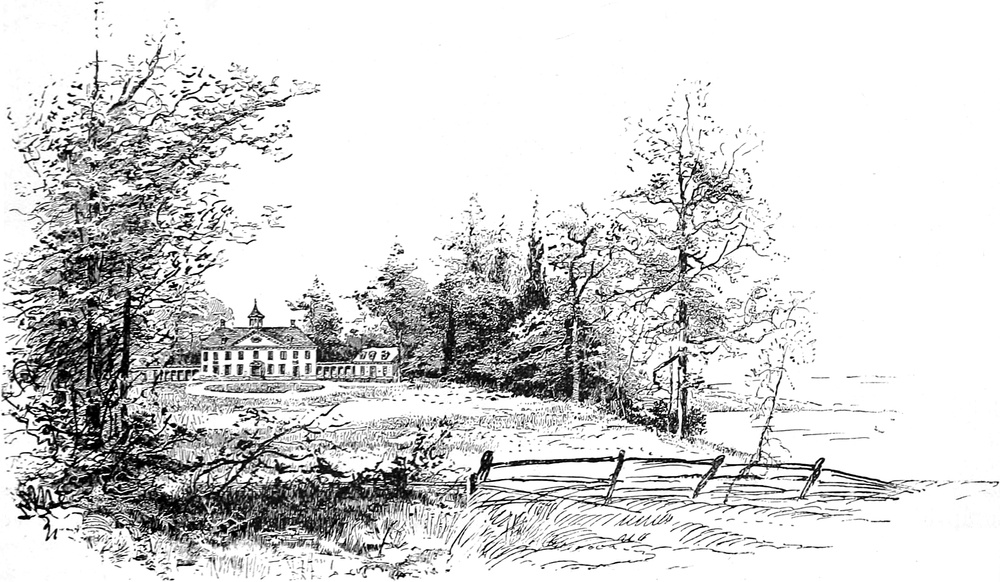
MOUNT VERNON.
Fowling was another favorite amusement of the first President. His own estates and the country around them abounded in game of all kinds. A century and a half ago, and, we suppose, long before that time, the waters of the Chesapeake were the resort, as they are now, of the incomparable canvas-back and other wild-duck. Tradition has it that Washington was a good shot. He knew the favorite feeding-places of the finest flocks, and he could steal a march on them as secretly as, in after years, it was his wont to surprise the fortified camp lines of the British redcoats. Although Washington loved to follow his own game-birds and bring them down when he could, he rigorously prohibited other people from breaking in on his preserves. His principal biographer has preserved a story from oblivion which illustrates his sentiments in this respect together with his personal courage and resolution. A lawless person was in the habit of crossing the Potomac opposite Mount Vernon in a canoe, and, concealing himself in the woods, filling his game-bag at Washington’s expense. Repeated warnings to desist were sent him, but, poacher-like, he was a believer in the doctrine that game is common property and belongs to him who can capture it. Washington was determined to stop the raids upon his birds, and the poacher’s end at last came. Hearing a shot one day, and suspecting who had fired it, Washington mounted his horse and rode in the direction of the sound. The poacher discovered his approach, and had time to enter his canoe and push a few yards from the banks before the master of Mount Vernon appeared in view. When Washington, with anger in his eye, became visible, the poacher raised his gun, cocked it, and took deliberate aim. Washington did not betray the slightest sign of alarm or timidity. He strode into the water, seized the canoe and pulled it ashore. Disarming his antagonist, Washington gave him so severe a chastisement that he never again ran the risk of meeting a similar reception. Washington in the latter part of his life was something of a fisherman. There is an entry in one of his diaries, while the Federal Convention was in session in Philadelphia, telling of a fishing party near Valley Forge. While President, he also drew in a codfish with his own hand on the fishing banks off Portsmouth, New Hampshire.
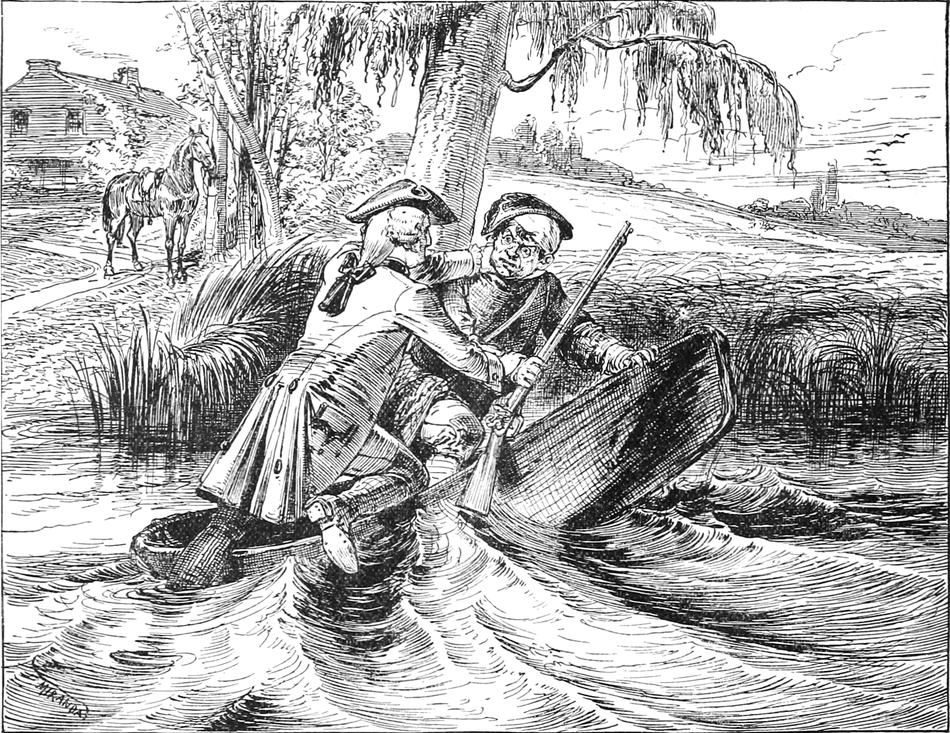
WASHINGTON CHASTISING THE POACHER.
No one of the presidents lived so much in the open air as Washington. With the exception of the eight years in the Presidency, he was almost constantly in the field, the woods, the wilderness, or the farm. His first occupation was that of a surveyor, upon which he entered when he was sixteen years of age. During his last summer at school he amused himself by surveying the grounds around the school-house. The adjoining plantations then became the field of his experiments, and their angles and boundaries were all marked down by him with the most minute detail. At this time he thought of going to sea. His brother Lawrence obtained a midshipman’s warrant for him, but his mother objected, and an admiral, perhaps, was lost to the navy of the English king whose most famous general he was destined to defeat. He then received a commission to survey the western lands of Lord Fairfax. This led him across the first range of the Alleghany Mountains into the wilderness. He was accompanied on this expedition by George, the eldest son of William Fairfax. They endured much hardship and privation, but the trip, in all probability, was the means of laying the basis of the splendid physical health which Washington enjoyed all through life. The country was almost uninhabited. The dwellings, mere huts at the best, were few and far apart. Storms very often swept away their tents, and frequently they were compelled to sleep with no roof except the skies. Three years, the severe winter months excepted, were spent in this work, which, like everything Washington undertook, was well executed. His success led to promotion. He received an appointment as official surveyor, which enabled him to make his entries in the county offices. The lands surveyed lay on the south bank of the Potomac, seventy miles above the present Harper’s Ferry. Washington did not foresee that in a short time he would have an opportunity to turn to very great advantage in the public service the knowledge he was then acquiring of this comparatively unknown region. But, nevertheless, the French-Indian war, in which he bore so conspicuous a part, was not far distant. In 1751, the western boundaries of the colony of Virginia were so harassed by the Indians that measures had to be adopted for their protection. The country was divided into districts, to one of which Washington was appointed inspector with the rank of major. He was now a soldier. In 1755, when he was only twenty-three years of age, the command of the Virginia troops was given to him. He resigned his commission in 1758 and the following year he was married.
Washington was barely twenty-seven years old when this interesting event took place, and when he may be said to have settled down to lead the life of a country gentleman. He was in every sense of the term what is called a favorite of fortune. Rich, honored, loved, married to a beautiful woman of distinguished family and large wealth, the possessor of a splendid estate, which he had just inherited, of handsome person and superb health, with more fame than falls to the share of most young men at his period of life, a keen relish for the good things of the world with the means to obtain and the capacity to enjoy them—the prospect before him was, indeed, an alluring one. Mount Vernon was one of the loveliest homes in the country and the landscape around it unrivaled on the continent. Through its hospitable gates came the governors and leading men of old colonial Virginia as the friends and guests of its master. Gay hunting parties, with hounds and horns to rouse the fox in his hill-side cover, gathered on its spacious lawns. Stately dames talked over the latest society gossip from the colonial capitals and across the seas on its broad verandas and under its overarching trees. To speak of more material things, there was a small army of slaves to employ, to clothe, to feed, to watch and to attend, for Washington was one of the most humane of masters. Thousands of broad acres awaited cultivation and improvement, while flocks and herds innumerable claimed protection from winter storm and summer heat. Into this manifold life, with all its cares and responsibilities, Washington entered with the keenest zest. His ambition in a public way seemed to have been satisfied with the fame he had won in the French war. But, whatever may have been his thoughts or aspirations, he set himself to the task of cultivating and adorning his property. Mount Vernon consisted of five farms, each one of which had its own appropriate set of laborers under the direction of an overseer. Washington visited them all daily and gave instructions for the day following. He was one of the most methodical of men, rising at a regular hour in the morning, and retiring at a fixed time at night. He loved his stock, and paid particular attention to their comfort. Prize cattle shows and exhibitions had not then come into fashion. If they had existed at the time it is very certain that the name of the young soldier-planter would have headed the lists of exhibitors, and that he would have filled Mount Vernon with cups and premiums testifying to his pre-eminence as a breeder. He had an attachment even for the lower animals, and never destroyed life when there was no necessity for it. A gentleman, who at one time lived in his family as secretary, tells us that, as he was walking one day with Washington in his grounds, a snake of a harmless species started up in front of them. The secretary lifted his heel to crush the reptile, when Washington caught his arm and exclaimed, “Stay, sir! Is there not room enough in this world for you and that harmless little reptile? Remember that life is all—everything to the creature—and cannot be unnecessarily taken without indirectly impugning its Creator, who bestowed it to be enjoyed with its appropriate pleasures through its own natural term of existence.”
He was the model farmer of his time. Though not a student in the ordinary acceptation of the term, he read a good deal on agricultural and kindred subjects, investigated the nature and character of his soils, and grew his crops on a scientific basis. Fond of flowers and trees, he was never weary of ornamenting his estate with the choicest specimens, native and foreign, that he could find. Life for him had flowed along in this tranquil way during a period of fifteen years when the first mutterings of the Revolutionary storm were borne to Mount Vernon. He was as eager to do battle for the rights of his country as any gentleman within the boundaries of the thirteen colonies. The war came, and he was chosen commander-in-chief. Before he departed for the scene of operations in New England, he gave his superintendent minute instructions in regard to the management of his property while he was absent. During the progress of the long struggle, he corresponded with him as frequently as possible, and an immense number of letters, written from the camp and his ever-shifting headquarters, many of them before and immediately after important engagements, attest the deep interest he took in the smallest matter connected with his beloved home. The manager is told what crops to sow in different fields; the precise spots on which young trees of different families should be planted, and what old and decaying ones should be cut down. We can see in these curious and interesting letters how deeply he was attached to every animate, and indeed inanimate, object on his estate, and how he yearned to be restored to them. Only once in the long eight years did he visit Mount Vernon. He was then on his way to lay siege to Cornwallis at Yorktown, and finally receive the sword of the best English general in America. To describe his outdoor life while in the army would be to re-tell the story of the Revolution.
At last the end came, and the foremost commander of his age, the liberator of his country, was again a private citizen and a country gentleman. Mount Vernon had suffered severely from his long absence, for his instructions had been imperfectly carried out. The soil was in many places exhausted by successive crops of tobacco, while the necessity for extensive repairs confronted him on every hand. He was fifty-one years of age. The work of restoring his estate to its former splendid condition was at once begun. He plunged into agriculture with all the ardor of his youthful days. In a letter to Lafayette, he describes his feelings at this time. “At length,” he writes, “I am become a private citizen on the banks of the Potomac, and, under the shade of my own fig-tree, free from the excitement of the camp and the busy scenes of public life, I am solacing myself with those tranquil enjoyments of which the soldier, who is ever in pursuit of fame, the statesman whose watchful days and sleepless nights are spent in devising schemes to promote the welfare of his own, perhaps the ruin of other countries (as if this globe were insufficient for us all), and the courtier, who is always watching the countenance of his prince in hopes of catching a gracious smile, can have very little conception.” Troops of friends and admirers visited him in his retirement and were entertained in a most hospitable manner.
In the autumn he began on a systematic plan to renovate his worn-out fields; each parcel of land was numbered, and the precise crops to be planted in it were set down several years in advance. This method proved so successful that he adhered to it during the remainder of his life. He next turned his attention to his grounds. Early in the spring he began with the lawn. To it he transferred the choicest trees in his forests, setting them out with evergreens and flowering shrubs intermingled in such a manner as to produce the most pleasing effect. The removal and replanting of each one received his personal attention, and from day to day he watched them with the greatest solicitude, keeping in his diary the record of their life or death. Next came the replenishing of his orchards and gardens. Fruit-trees of rare and valuable varieties were procured at whatever cost. Flowering shrubs were planted in abundance—in fact, nothing that could add to the beauty and decoration of Mount Vernon was left undone. The pruning-knife now took the place of the sword, and he never tired of wandering among his plants, cutting away useless branches and shoots which marred their beauty or hurt their growth. There was no law on the statute book against foreign contract labor, and he imported skilful gardeners to enable him to carry out his plans of improvement. His habits were most regular. He was out of bed with the sun, and the hours until breakfast were passed in his study, writing letters or reading. Breakfast over, his horse was ready at the door to take him on the round of his farms. If his guests wished to accompany him, or to make excursions into the surrounding country, horses for them also were led out. Returning from his fields, he again shut himself up in his study, where he remained until three o’clock, when dinner was announced. The remainder of the day and evening was given to his guests until ten o’clock, when he retired.
The repose of this fascinating life was not destined to be of long duration. With the close of the war the young confederacy found itself confronted with new difficulties and dangers. To meet them, and bring order out of the political chaos, there assembled that body of patriotic and illustrious men who, as the result of their deliberations, gave the world the constitution of the United States. Washington presided over their deliberations, and, in due time, his election to the Presidency followed. It was hard to be compelled again to leave Mount Vernon and to abandon all his cherished plans for its improvement. This entry is found in his diary in the summer of 1789: “At ten o’clock I bade adieu to Mount Vernon, to private life and to domestic felicity, and with a mind oppressed with more anxious and painful emotions than I have words to express, set out for New York, having in company Mr. Thomson and Colonel Humphrey; with the best dispositions to render service to my country in obedience to its call, but with less hope of answering its expectations.” He was loath to leave home for many private reasons, chief among which was his desire to pursue the system he had matured for the improvement of his estate. Since the war he had procured from England the best works on agriculture, and was impatient to put his ideas and theories into practical operation. Now all had to be given up, at least for four years, when, he hoped, the term of his second servitude in public life would come to an end. But what was to be done in the meantime? The seat of government was hundreds of miles away, and roads next to impassable except at certain seasons of the year, made communications tedious and difficult. He did the best thing possible, namely, to appoint a manager and leave with him instructions in writing for his guidance.
These instructions throw a strong light on the character of Washington, a light for which we might search in vain among the many volumes of his State papers, public addresses and private correspondence. His dearest interests were involved in the management of his property, and he naturally wrote with a freedom, directness and emphasis concerning it which he scarcely could have employed on any other occasion. In these simple memoranda, made when he was on the eve of assuming the highest honor his country could confer—an honor all the greater because of the transcendent ability and character it was supposed the position demanded—we can see, that while the world was ringing with the fame of his achievements, his innermost thoughts were occupied with those beloved fields on which he had lavished so much care. He intended that everything should run along in his absence precisely as if he were present. There is a military ring in the following sentences which reveals the old commander-in-chief: “One thing I cannot forbear to put in strong terms. It is that whenever I order a thing to be done it must be done; or a reason given at the time, or as soon as the impracticability can be discovered why it cannot be done, which will produce a countermand or a change. But it is not for the person receiving the order to suspend or dispense with its execution; and, after it has been supposed to have gone into effect, to be told that nothing has been done in it; that it will be done or that it could not be done—either of these is unpleasant and disagreeable to me, having been all my life accustomed to regularity and punctuality. Nothing but system and method are required to accomplish any reasonable requests.” Due notice that he will expect every man to do his duty at Mount Vernon while he is in New York is given as follows: “To request that my people must be at work as soon as it is light; work until it is dark, and be diligent while they are at it, can hardly be necessary, because the propriety of it must strike every manager who attends to my interests, or regards his own character, and he, on reflecting, must be convinced that lost labor is never to be regained.” His plan, or system, was very comprehensive. It contained instructions what to plant and where to plant it, not only for the year but for many years in advance. Every one of the five overseers was required to make a minute weekly report concerning the operations on the farm he had in charge. This was given to the manager and by him sent to the President. The work performed by the laborers and their condition, whether ill or well, were to be noted. The slightest incident or accident connected with everything on the estate—the stock, the crops, the trees, the fences, the farming implements—was to be made known to him. And, no matter how public business pressed, time and opportunity were found or made, during all the eight years of the Presidency, to consider and attend to the affairs of Mount Vernon. Each weekly report was closely examined and answered, sometimes at great length.
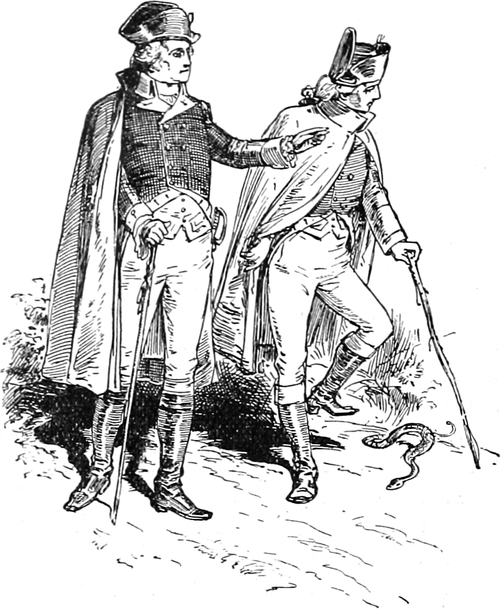
“STAY SIR! DO NOT KILL THAT REPTILE.”
This extract from one of his communications shows how closely he watched his slaves and how well he was acquainted with them personally: “What sort of sickness is Dick’s that he should have been confined with it for weeks? And what kind of sickness is Betty Davis’s that it should have a similar effect upon her? If pretended ailments without apparent causes or visible effects will screen her from work, I shall get no service out of her, for a more lazy, deceitful and impudent huzzy is not to be found in the United States than she is.” In another letter, he refers to a young negro whom he wished to have trained as a house-servant. “Put him in the house,” he says, “give him good clothes, so as to make him self-respecting, and a stout horn comb. Make him comb his hair, or wool, so that it will grow long.”
What a many-sided character Washington possessed! No President ever held the helm of state more firmly than he did during those eight years while the young Republic was beginning its career as a nation. The ablest men in our history as a people were then in public life, but he was the master of them all. He was supreme in a cabinet containing two men of such vast acquirements as Hamilton and Jefferson, and he ruled them as completely as he governed “Dick” and “impudent Betty Davis” down at Mount Vernon.
The summer months were usually spent on his estate, though not invariably. During the Presidency, he traveled a good deal in different parts of the country—Long Island, the Eastern States, and down South and out West. No man of his time probably knew the geography and topography of the country better than he did. As we have pointed out, the French-Indian war led him across the Alleghanies, and he twice again visited that region, less known then almost than the middle of Africa is to-day. He explored the middle of New York with De Witt Clinton, penetrated to the very centre of the Dismal Swamp, and took the field once more when the Whisky Insurrection broke out.
After the expiration of his second term, he again returned to the banks of the Potomac and resumed the occupations he laid down eight years before. Writing to a friend soon after his arrival, he tells him that he “began his daily course with the rising of the sun and first made preparations for the business of the day. By the time I have accomplished these matters breakfast is ready. This being over, I mount my horse and ride around my farms, which employs me till it is time to dress for dinner, at which I rarely miss to see some strange faces, come, as they say, out of respect for me.” The farm was over eight thousand acres in extent, and these rides averaged twelve or fifteen miles in length. This description of Washington at the time was given by young Custis to a gentleman who had inquired for him: “You will meet with an old gentleman riding alone, in plain drab clothes, a broad-brimmed white hat, a hickory switch in his hand and carrying an umbrella with a long staff which is attached to his saddle-bow. That person, sir, is General Washington.” Another call to duty came in the threatened war with France. Washington was made lieutenant-general, but the storm soon blew over.
He was now sixty-eight years old, and the end of all was coming. He rode out as usual one morning in December, caught cold, and died in a few days. The trees he planted in his youth bend above his grave on the banks of the Potomac.
THE PROGRESS OF ATHLETISM.
BY C. TURNER.
ATHLETISM is one of the distinctive forces of the nineteenth century, and of all the forces, acting upon the social, moral and physical life of the century, it is probably destined to be the most permanent in its effects. No impulse has had a swifter or a wider scope. While other forces of aggregation have welded together peoples having a common ethnological origin into a nation, such as Italy, and consolidated independent states into a system, such as Germany, it has been the function of athletics to unite in a common interest the whole (Anglo-Saxon) world. America and Australasia have felt its influence, and passed under its discipline, in no less degree than the scattered colonies and dependencies of “Greater Britain.” Remarkable as it may at first sound, it is true, that no fact to-day “flashed round the girdle of the globe” would excite so widespread a curiosity, or so much personal interest, as that an amateur athlete had succeeded in covering one hundred yards of space in one second less than the recorded time of the great classic contests of the century.
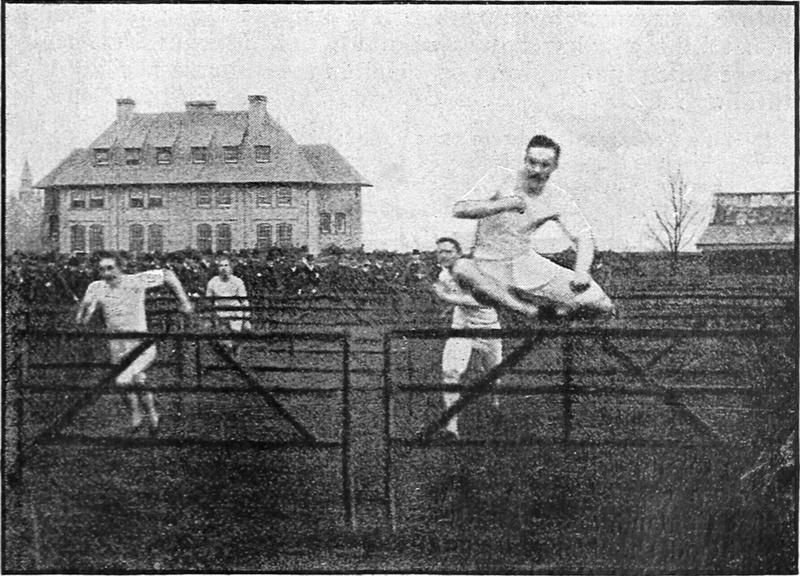
THE HURDLE RACE AT CAMBRIDGE UNIVERSITY.
In the United Kingdom, Ministries may come and Ministries may go, Governments may wax and wane; such news will interest few but the inhabitants of Great Britain. In America contests of deep interest may rage round a Presidential Election and rend public opinion, but the very knowledge of the contest will be confined largely to the American continent. The fiercest controversies in science and religion may rise and subside, the whole current of ecclesiastical thought may change, whilst the “Tracts for the Times” will remain a mere phrase to the millions who are keenly alive to the more cosmopolitan questions involved in athletism. On the remote sheep-farms of Australia, in the cattle ranches of Texas, on the pampas of South America, amongst the snows of the Himalayas, round the kraal fires of Southern Africa and in the busy marts of China and Japan, there will be auditors who will gather with keener interest to hear of the battles of pluck and endurance by the Isis and the Cam than would be displayed about any contest for dominion among the powers of the world. In the island home of its birth, and the land of its most earnest adoption, no system of news, in its ingathering and dispersion, is so regular, systematic and universal, or so anxiously scanned as the sports of the Queen’s Club Grounds, or the progress of the baseball nines of New York, Boston or Chicago. It puts into operation a system as perfect and as rapid as if the fate of nations hung in the balance.
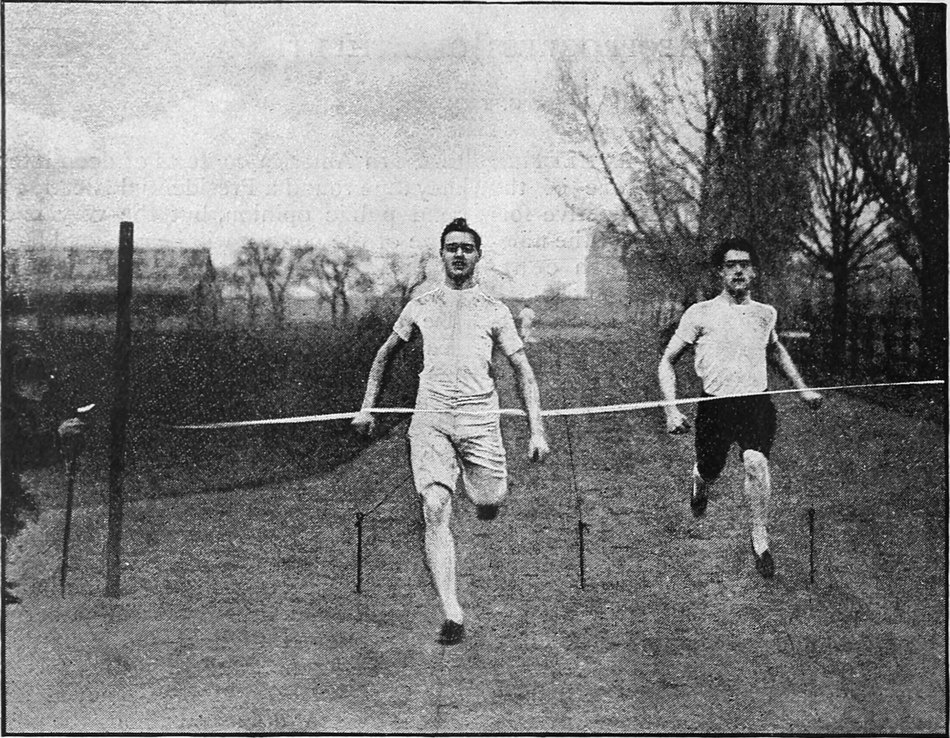
WINNING THE HUNDRED YARDS.
Whence is all this? Partly, it may be, that the subject dealt with and the competitors involved touch the most abiding and deep-seated instincts of our common nature, carrying us back, by their very mention, to those halcyon days when we too marked the scudding form or joined in the thrilling race.
“Be it a weakness, it deserves some praise; We love the play-place of our early days, The scene is touching, and the heart is stone That feels not at that sight, and feels at none,”
sang one of our early English poets, and again:
“The pleasing spectacle at once excites Such recollections of our own delights, That, viewing it, we seem almost t’ obtain Our innocent, sweet simple years again.”
But how came the natural aptitude and expertness of the Saxon in outdoor sports to be so totally obliterated, as undoubtedly it was, up to within the past forty years? That England, above all, with her old Viking blood, should have lain torpid and effeminate; that that “hard gray weather,” which, as Kingsley says, “makes hard Englishmen,” should have become barren in results, is one of the most puzzling facts of a now happily remote past. It was not ever thus; the early poets teem with allusions to training and skill in manly sports and outdoor pastimes, but the records of the eighteenth century as surely point to their almost universal eclipse. Read Cowper’s “Timepiece,” written in 1783, and more especially his “Tirocinium; or, a Review of the Schools,” written in the following year. What a picture do they present! The tavern and the play-house, cards and the race-course, license and riot, fill the terrible picture of the youth of the period, the product of the school and college. Study languished, emulation slept, and virtue fled, is his uncontested verdict.
“See womanhood despised and manhood shamed, With infamy too nauseous to be named; Fops at all corners, ladylike in mien, Civeted fellows, smelt ere they are seen. Else coarse and rude in manners, and their tongue On fire with curses and with nonsense hung, Now flush’d with drunkenness, now with excess pale, Their breath a sample of last night’s regale, Designed by nature wise, but self-made fools; All these, and more like these, were bred at schools.”
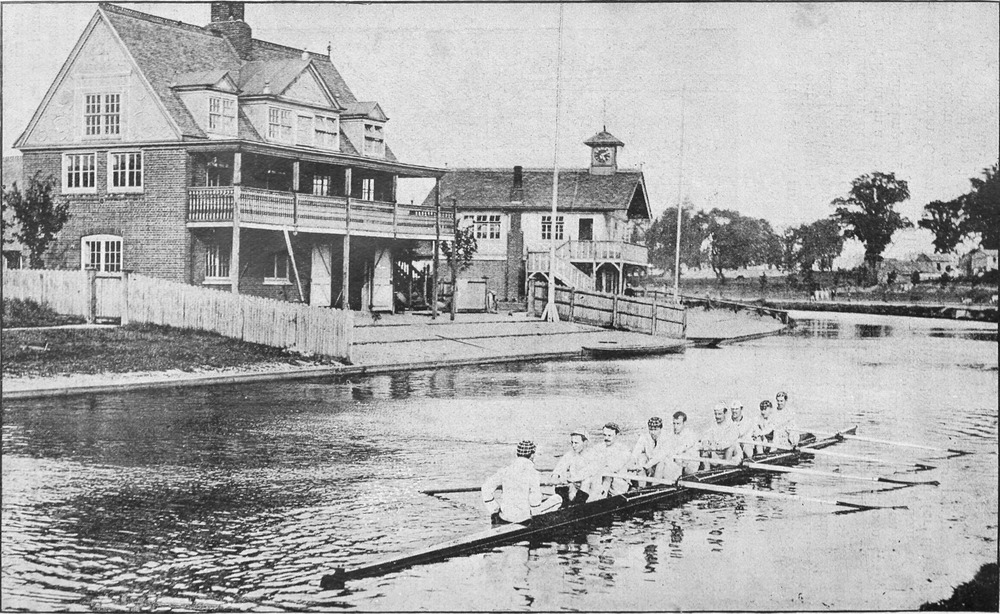
THE TRINITY HALL CREW, CAMBRIDGE UNIVERSITY
⇒ LARGER IMAGE
It certainly is a picture which, thank God! could not be painted now. Nor could it be written of the well-to-do youth of the nation, as was written by South and quoted by Dr. Johnson in his Dictionary in illustration of the word “athletick”—“strong of body, vigorous, robust,” that “seldom shall we see in rich families that athletick soundness and vigor of constitution which is seen in cottages where nature is cook and necessity caterer.” The youth of “rich families” have now, happily become the very pink of the “strong of body, vigorous, robust,” and a practical refutation of such an opinion, in every English-speaking land.
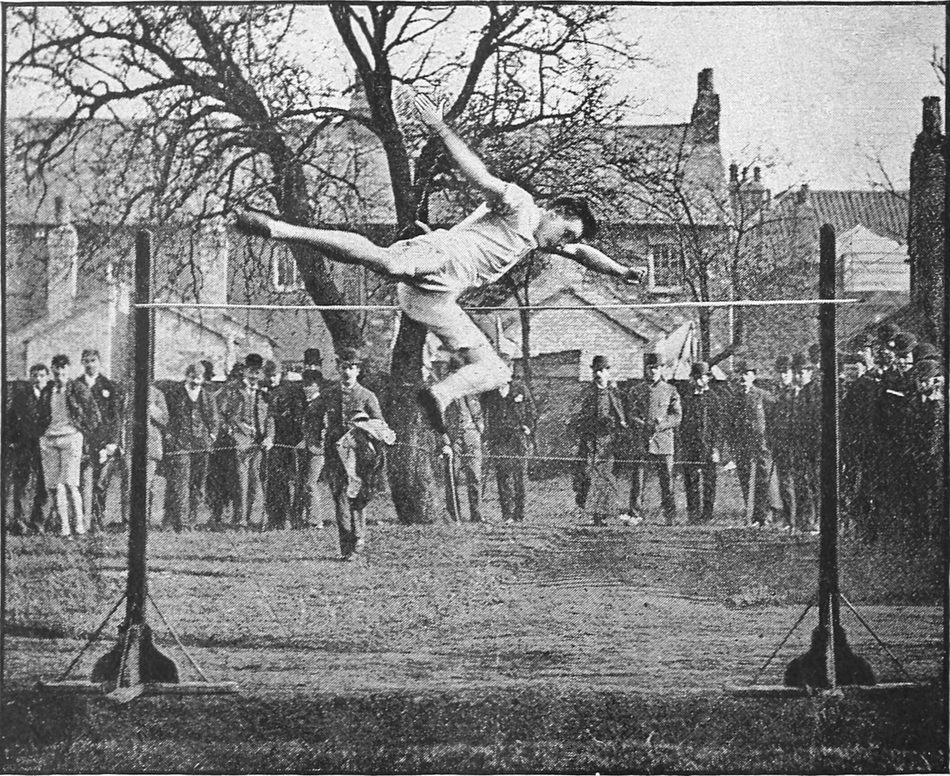
WINNING THE HIGH JUMP.
It was fitting, though singular, that the revival of outdoor sports, which received its first check from the narrow fanaticism and repressive bitterness of the puritanical period, that saw Beelzebub in the quarter-staff and Satan in a foot-race, should have received its first impulse into new life largely from the disciples of “Muscular Christianity,” of whom Canon Kingsley may perhaps be taken as the type. Yet so it was; they fanned into life the embers in which still burnt the hidden fire, and rekindled the dormant passion for rural sports into more than its old vigor with a new purity and with a force which, ere half a century had passed, was to restore athletism to its legitimate sphere throughout the Anglo-Saxon world.
Many other things combined to help the movement. Not the least of these was the dawning belief that Juvenal’s oft quoted “mens sana in corpore sano,” contained a fallacy, and that the healthy body must precede and render possible the healthy mind. This doctrine, in “the forties,” was feebly struggling for recognition, but is now recognized as lying at the very root of social and moral regeneration. England’s danger in the period of the Crimean war, tended to turn the minds of men to the seriousness of our national position, and to the advantages of systematic training to resist hardship. The volunteer movement, with its platoon exercises and its outdoor drills, often on the old “Butts Green,” which the wisdom of our forefathers had provided for their day and generation, drew further marked attention to physical training. All this tended to create in the rising generation an inclination to return to our older, more natural, and more healthful custom of outdoor life.
Whatever were the causes, and whether this enumeration of them be either accurate or complete, certain it is that in the early “fifties” athletism took a new and marked departure. As was natural, that departure received its concrete form in the two ancient English universities “where students most do congregate.” In athletics it can with truth be said, “the boy is father of the man.”
For all the higher interests of athletism this was fortunate. In those two centres the young plant was at least in a soil with materials for its growth, and in an atmosphere where its grosser forms could scarce take root, and where that parasite, the professional blackleg, could certainly not develop. Thus it has transpired that those concomitant evils which at one time threatened even the existence of cricket have been kept from the field of amateur athletics. The watchful eye, the timely warning, the friendly aid of authority, which, without crushing, silently regulated the mode and conduct of these sports, has enabled them to spread a beneficent and not a corrupting influence. That there were evils, inherent, latent, and which might have become powerful, all will admit; that they were surely and deeply rooted and ineradicable was the fear of many; that they showed a tendency at first to develop is a matter of record, but that they no longer affect athletism, where it is conducted by gentlemen for gentlemen, is equally certain and satisfactory.
That the development of athletism, regulated and purified as it soon became, was a distinct advance on the antecedent pastimes is perfectly clear. Athletics soon obtained a recognition and a warm welcome from the public. Let those who are old enough cast back their minds thirty years and recall the scenes of brutality which filled the columns of public newspapers, the very existence of which is now almost forgotten. Turn even to the Times, and it will be found that in that exclusive journal and great reflex of the age, “prize fighting” holds quite a significant space. But the work unostentatiously begun in the universities, and spreading to the schools, was preparing a public which would become interested in the more scientific development of the human frame for higher and nobler purposes.
To Oxford belongs the honor of initiation in the Athletic Club of Exeter College founded in 1850. Five years later the sister university followed Oxford’s example; but, as is her habit, though slower to the influence of innovation than Oxford, when once she has accepted an idea, she makes more rapid progress. St. John’s College led the van; Emmanuel, and one by one the rest, followed. So rapid, indeed, was the development, that within two years the whole of the seventeen colleges and halls were ready for a “federation,” and in 1857 the first intercollegiate sports were held. Three years after, Oxford, too, was ready for its extended sphere, its “United States” constitution.
Naturally, the existence of these two friendly yet rival corporations led to a trial of strength between them. Cambridge challenged Oxford to a friendly tournament, and in 1864 the first of those since famous meetings of the students of the two universities was held. Nothing can be more significant of the then position of athletism than the manner of its announcement. In an obscure corner of the Times, crushed almost out by the more engrossing incidents of the German-Danish war and of the American Rebellion, still may be seen the two small lines announcing: “Athletic Games.—The athletic games between Oxford and Cambridge will take place on the 5th March at 12 o’clock.” But small as was the space, it was a clear indication that athletism had become a subject of national and not entirely of local interest. From this event may be measured all the subsequent career. “The events took place in Christ Church new cricket ground, in the presence of a vast number of persons, including many of the college authorities, and some hundreds of ladies, who took a very keen interest in the proceedings,” says the Times. But even more interesting is the fact that at the baptism of these inter-university sports there should have been the sponsorship of official recognition. Of the two judges, one was the Rev. A. H. Faber, of New College, Oxford; the other was the Rev. H. Mortimer Luckock, of Trinity College, Cambridge (now Canon of Ely Cathedral), whilst the office of referee was filled by the Rev. Leslie Stephen. As Oxford “had gathered there her beauty and her chivalry” as spectators, so amongst the competitors were no mean representatives of the universities at their best. Oxford had her Gooch and Darbyshire, and Cambridge that very paragon of all graceful power, C. B. Lawes (who has since enriched sculpture by so much that is admirable in art). What son of Cambridge who saw Lawes is ever likely to forget him? He was a sight for the gods!—a very athletic “Admirable Crichton.”
Emulation and imitation, that sincerest form of flattery, quickly produced followers; the flame which the universities had lit, raised to a beacon’s height by the Times’ reports, spread like a wildfire. Trinity College, Dublin, Eton College and Wellington, before the year was out, appeared in the lists, and were quickly followed by those nurseries of the universities, Harrow and Winchester, Rossall and Cheltenham, Westminster and Charterhouse, whilst Sandhurst and Chatham added to the list the military students, and the “United” Hospitals the students in medicine. Nor was the agitation confined to one side of the Atlantic, for within an extremely short period, the foundation of that now world-renowned association, the New York Athletic Club, was laid.
Is it to be wondered at that this sudden, simultaneous, and widespread movement should have raised grave apprehensions, and anxious, if not bitter, critics? The first warning voice was raised against the alleged existence of gambling and against the debasing influence of money as prizes. It is singular to remember, under present circumstances, the fact, which has almost passed from memory, that at the first inter-university sports the prizes were given in money. Nor was the friendly yet apprehensive critic alone in the field. Mr. Wilkie Collins, the novelist, with less knowledge and more animus, mixed gall and wormwood with his criticism and produced in his “Man and Wife” a caricatured monster so overdrawn as to be, fortunately, ineffective. Even so good an authority as Mr. Leslie Stephen was apparently ranged against the child of his adoption (for he was the first referee); but, as a matter of fact, he was merely tempted to use the athlete as a “bogey” to frighten “the characteristic doctrine out of the university Tory;” but having to invoke a “bogey” for his purpose he was compelled, by the exigencies of the case, to draw the university athlete in language more forcible than elegant. This having served its purpose, may now well be charitably consigned to oblivion. The Hon. Edward Lyttleton, following suit to Mr. Stephen, urged the aid of “variety in education” as a corrective to the engrossing attractions of the sports. The fears which haunted Mr. Lyttleton, and still find expression, were born of a too contracted view of the facts. To him, the enervating effect was its growing popularity. He saw the increasing multitudes flocking once a year to see the public exhibitions, in which but few students competed, and he forgot the thousands who plodded, day after day, month after month, through the weary details of practice, for the development of their frames, or in private contests.
Nor were the tutor, the schoolmaster and the novelist alone in their onslaughts; a far more dangerous attack came from certain medical men, of whom Dr. Richardson may be taken as the type. To them the athlete was a man doomed to a premature decay, a broken and exhausted wreck. Budding athletism had the good fortune to secure, in Dr. E. Morgan, of Manchester, a champion whose exhaustive labors and conclusive deductions from authentic facts, made short work of the adverse theory, and established, beyond future cavil or dispute, that the death rate amongst those who had passed the most trying ordeals was 30 per cent. lower than the national average.
The combination of assaults on lines like these, and the anxieties generated in maternal minds, led the university authorities to discourage the spirit of rivalry which, it was feared, the inter-university contests might develop to excess. Cambridge was staggered, in 1867, by an official prohibition against the Oxford and Cambridge sports taking place within the precincts of the university. No other step could so certainly have produced the very results which it was aimed to prevent. Driven from Cambridge, where the contests might long have continued comparatively subordinate, under the immediate guardianship of the official eye, they were forced into the extended, and by no means preferable, area of the London world, of which they have since formed an important annual fixture.
Athletism rose triumphant over these as over the many other difficulties and dangers which surrounded its early path. The varying “uses” of distant and conflicting schools were reconciled, the barnacles of corruption cleared off, and the authority firmly established of that great central governing body the Amateur Athletic Association.
Cambridge, which by its early example did so much to popularize athletics, has had a long succession of faithful, loyal and patriotic sons to carry her colors through many a hard-won fight and many a stubborn fray. Who that has seen her career through the past quarter of a century cannot recall, with all the glow of rekindled satisfaction, her champions, from the day, in 1865, when R. E. Webster (now the learned attorney-general) twice lowered Oxford’s colors by defeating the Earl of Jersey for the mile in 4m. 441⁄4s. (on a slow, wet ground) and for the two miles in 10m. 381⁄2s. down to W. C. Kendall’s exciting “odd event” jump this spring? Between these dates what memories crowd the scene! Pitman and Ridley, Churchill and R. H. Macaulay (now head-master of Rugby), who covered the quarter of a mile in 1881 in 50 1-5s.; I. L. Stirling, “three stride Stirling,” of 1870, over his 120 yards and 10 flights; A. B. Loder, who, in 1876, plucked the honors from Upcher, the very classic of the hurdlers, in 16s.; S. Palmer, lithe as a leopard, who, in 1883, carried the “light blue” through in the same time; phenomenal E. J. Davies, short and spare of build, who, with his second thrust in midair, covered 22 ft. 10 in. in the broad jump; F. B. Roberts, who, in 1886, covered 21 ft. 9 in., and W. C. Kendall’s winning jump of 1888; W. W. Hough, lean and light of foot, who put the three miles behind him in 15m. 1 1-5s.; the mighty hammer throws of G. H. Hales, in 1876, 138 ft. 3 in. and E. O’F. Kelly putting the weight—these and hundreds more flit across the mind.
And who that has seen thirty generations—for each year brings its new generation—of under-graduates “strip” can have failed to recognize a distinct, general improvement in the average physique, in build, in carriage, and even in the quality and condition of the flesh. It is undoubted and palpable even to the casual eye, and it has, singularly enough, within the past few months, received confirmation from an authority anything but casual. Dr. Sargent, of Harvard, in his “Physical Proportions of the Typical Man,” has proved with mathematical accuracy and from reliable and exhaustive measurements, that “man cultivated both in mind and body along the lines of least resistance shows that the tendency of the race is to attain the perfect type, the order of growth is regular towards it.” Nor is it necessary at this day to elaborate the point that this physical advance is not only no injury to, not only compatible with, but a promoter of moral and spiritual benefits, as well as a direct aid to withstanding the wear and tear of modern business. The Universities’ missions to South Africa and China, abroad, Toynbee Hall, the White Cross Society, and other like efforts at home, are a standing testimony on the one hand, while on the other the presence “thick as autumn leaves in Vallombrosa” of old-time champions in the high offices of state and in every walk of science, art, enterprise and commercial life, is a ready and complete answer.
An author, whose modesty conceals his name, but whose good sense justifies the quotation, has well summed up the situation. “Athletism may not have crowned all its votaries with the laurels of social heroism, but it has disseminated a thoroughly healthy and energizing taste among our young men. It has taken them away from the smoking and the billiard rooms at unreasonable hours and stamped out that physical and moral malady, which was once powerfully described by the author of ‘David Copperfield’ as the ‘dry-rot in men.’”
In her physical training of the youth of the nation, those “trustees for posterity,” may its motto long express the universal verdict “Floreat Cantabrigia.”
COMPARATIVE TABLE OF AMATEURS’ RECORDS.
Oxford and Cambridge Inter- university, 1864. Oxford and Cambridge Inter- university, 1888. London Athletic Club, 1886. New York Athletic Champions’ Times. Harvard Champions’ Times. Canbridge Champions’ Times.
100 Yards Flat 10½s. 10 4-5s. 10s. 10s. 10s. 10s.
120 Yards, and 10 flights of hurdles 17½s. 17 1-5s. 16s. 16 1-5s. — 16s.
Quarter Mile Flat 53s. 51 2-5s. 49 4-5s. 47¾s. — 50 1-5s.
Half Mile 1m. 59s. 2m. 1m. 46 2-5s.
One Mile 4m. 56s. 4m. 29 2-5s. 4m. 25 2-5. 4m. 30s. 4m. 36 4-5s. 4m. 25 3-5s.
Two Miles 9m. 38s. 10m. 7s.
Three Miles 15m 28 1-5s. 14m. 50 3-5s. 15m 1 1-5s.
High Jump 5 ft. 5 in. 5 ft. 10¼ in. 5 ft. 11 in. 5 ft. 10½ in.
Broad Jump 18 ft. 0 in. 20 ft. 10¾ in. 21 ft. 7½ in. 22 ft. 10¾ in.
Putting the Weight 37 ft. 44 ft. 9½ in. 39 ft. 1 in.
Throwing the Hammer 93 ft. 10 in. 119 ft. 0 in. 138 ft. 3 in.
SHRILL cocks salute the tardy dawn That glimmers o’er the landscape blurred; Somewhere upon the barren lawn Is piping one lorn little bird— A robin red-breast, loath to leave, Although he only stays to grieve. The thresher’s flail rings clear and loud All day long from the open barn; The pigeons on the rafters crowd, Torn is the spider’s silvery yarn. The frosts have left their ghostly prints Upon the meadow’s russet tints. Beneath the sunset’s lurid light, The pinewood holds its plumes of black— The pilot moon brings in the night, His white boat in a windy track— One tall, far spire across the land, In warning lifts a fiery hand. November, born to poverty, The winds are mournful with her prayer; A vagrant, pleading charity, And yet her hands are always bare; And still within her clouded eyes Are lurking dismal prophecies. Too late for Autumn’s golden wealth, The harvest-dance, the merry stir; Too soon for Winter’s lusty health, And yet our fond hearts welcome her; For ’tis her cold breath that first lights The happy household fire o’ nights. Susan Hartley Swett.
A DAMP JOURNEY ON A DOWN GRADE.
BY RALPH K. WING.
TIME was when a trip into the woods meant “roughing it.” Nowadays it may mean anything. An arm-chair in the stern of a skiff, propelled by a backwoods laborer, who lugs your boat from one lake to another over the highways of such travel—this is the ordinary type of the modern Adirondack voyage. The tourist languidly views the scenery through his eye-glass, and returns to his city friends to rapturously descant upon the perils and hardships undergone, and the bravery required for a sojourn in this “uncombed” region.
We had never taken an outing in such a manner. It was our intention to “do” the North Woods on business principles, take a tent, shun hotels, keep away from the usual paths of travel, carry our own canoe, do our own paddling, and, in fact, get the real benefit of genuine wild life in wild places.
Our canoe was at Blue Mountain Lake; and thither Will Maynard, my chum, and I made the thirty-mile stage ride from North Creek, the terminus of the railway. We reached the lake in the afternoon; and desiring to avoid the necessity of stopping over night at any of the hotels, we immediately looked around for a wagon to start us on our way. Our objective point was Rock Lake, about seven miles from Blue Mountain Lake, and a mile off the regular road. This pond gives rise to the Rock River, which flows into the Indian River, which again makes a junction with the upper Hudson far back in the remote wilderness. These water-courses we desired to follow, and continuing on the Hudson River to a few miles below the village of North Creek, portage over into Schroon River, from which Lake George, our ultimate destination, could easily be reached.
Good luck brought us an empty returning wagon, and it was soon engaged. About sunset we were landed at an inn at a point a mile and a half from Rock Lake. We discussed the feasibility of packing our boat and luggage this distance over a trail not too good and entirely unknown to us, before darkness settled down. Meanwhile we ate our supper, and then cut the Gordian knot by hiring two backwoodsmen to help us.
As, lagging somewhat behind our guides, we emerged from the end of the path we met them returning noiselessly, motioning to enjoin silence.
“What is it?” we whispered.
“Hist! Keep quiet. There’s a bear about the camp. Perhaps we can get a shot.”
We tiptoed after them. They had their rifles and I my revolver. The fading light glimmered faintly across the lake and over the open, swampy margin. We peered eagerly through the gloaming; but, strain eye and ear as we might, we scanned the landscape in vain. Bruin wisely concluded not to do battle at such great odds against him. A few shots, that provoked hollow, lonesome echoes from the wilderness, we fired in the direction in which the bear had last been heard.
We turned to look at our surroundings. On the verge of the woods, a few hundred yards from where the path terminated at the lake, was a very small log cabin, with one window, breast high, and a low door. This was to be our quarters for the night. Our friends, quickly starting a brisk fire at the front, sat down for a few minutes’ chat before they began their dark, and, to less practiced persons, uncertain journey home. We took occasion to glean all the information we could regarding our proposed route. Great were our astonishment and dismay at their replies.
“Well,” remarked one, “when I hear’n that you fellows were going down the Rock and Cedar rivers, I just said right out loud to myself, ‘They can’t do it.’ Do you know how far you will get to-morrow if you begin work early in the morning and work all day just as hard as you can? You won’t go no farther than six miles below—to where the Cedar River comes in. There ain’t enough water, and it’s rough and rocky all the way. When you get down to Cedar River there be some still water; but it is all filled up with logs. There isn’t no paths, and the woods be too thick for you to carry your things around any of the bad places. You will have to drag your boat over the rocks a smart bit of the way, and you stand a mighty good chance of getting it smashed.”
“Would you advise us to take our outfit back to the road and wait for some team to take us to North River?” we inquired. “The water is deep enough there, is it not?”
“I wouldn’t say what I think you ought to do ’cept as you ask it. We ain’t trying to frighten ye; but I don’t think any of the boys livin’ up this way, unless they had a blamed good reason, would think to try what you said you wanted to do. It’s too late to get back through the woods to-night. I would stay right here on this pile of balsam boughs in your shanty till morning, then carry your things back to the road, and wait until an empty wagon comes your way. But we’ve got to get home, so good-night!”
Maynard and I built up the fire with green wood to make smoke and drive off the insect pests, universal in these dense woods; and each crawling into his sleeping bag, made by sewing several blankets together, slept until long after sunrise.
I stepped over to a little brook that dashed by our camp to take my morning’s wash. A large flat stone was lying in the middle of the stream. On this I stood, and while making a liberal lather, discovered on another rock only three feet away a big green bullfrog, staring at me with a fixed, immovable, owl-like gaze. After several efforts, which did not seem to alarm him in the least, I finally succeeded in landing some soapsuds in his eyes. This made him relax sufficiently to wink violently two or three times, but not enough to change his posture or the glassy gleam of his optics. With no better effect I again anointed him, but the third time I gave him such a nasty dose that he deliberately waddled down to the water, put his head under, and removed the objectionable foreign substance. Then he ambled back to his old roost, composedly resuming his position in a way which seemed to say, “Keep it up if you want to; it don’t hurt me any.” I laughed till I was tired, and left this genuine humorist of nature in undisturbed possession.
After breakfast we very leisurely carried our canoe and equipment back to the road. We reposed under the trees, waiting for “something to turn up,” but as hour after hour slipped by, we found it very monotonous. We had almost reconciled ourselves to staying where we were for the night, when with joy we saw a wagon coming our way.
The driver, who intended to make an all-night journey to the railroad terminus, was an employé of one of the Blue Mountain Lake hotels. He was a native of the district, well versed in all the stories and traditions of the wilderness, and was evidently glad of an audience. He told of the last of the Indians in that region; of the deer and bear that had been shot at different points as we passed; the uselessness of attempting to farm on the rocky precipitous slopes; and, now that the section was open to competition with the products of more fertile localities, the dependence of the inhabitants on the summer tourists. Despite the talk, the banter, and the songs, our not over-soft seats on the bow of the canoe and the sides of the springless wagon became no easier. As the result of our two days’ severe work and the lateness of the hour, we would find ourselves dropping off into a short doze, to awake just in the nick of time to avoid falling out of the wagon by a desperate grab at the first available support. The small hours of the morning overtook us: still the wheels rolled on in their dusty course, still the horses trotted down a decline to toil panting up the crest of the next hill; still the dim shadows ahead would, as we approached, disclose the faintly outlined forms of rocks, stumps and trees; still the mountains bathed their feet in the fogs of the valley and in their sable garments draped the scene in mourning. Soon black, threatening clouds shut out the small remnant of light that the giant mountains failed to obscure. Presently we heard a deep muttering, as if these Titans roared in anger to each other, then the illuminating flashes, as if they exchanged shots with one another, proclaimed more certainly than a weather bulletin that it would become moist in our vicinity. Rubber coats afforded us as good protection as could be expected in the postures we were obliged to assume.
But soon the stars reasserted their sway; then the first glimmer of the river, as after its long détour through the virgin forest, it once more approached the highway, could be caught through the trees from the hill we were descending. Then a house or two appeared, and we rattled up in front of the inn at North River, a hamlet about six miles above North Creek, the terminus of the railroad.
Very thankful we were to see a light burning. Our elation was but short-lived, for we were told that every room in the house was occupied. We were, however, more prepared for emergencies than the ordinary traveler, and carrying our blankets into the barn, we were easily convinced, and not for the first time, that a haymow has its advantages as a sleeping-place.
Before launching next morning we repaired to the only store in the place to make a few purchases. In this remote country store, surrounded by a well-nigh uninhabited and inaccessible region, we did not expect to find anything to remind us of the teeming marts of trade from which we had recently come. Judge then our surprise when upon entering the place we found the proprietor cornered by the everlasting, ubiquitous drummer. This particular specimen was not carrying a general line, but was a specialist, traveling for a soap powder. I expressed my astonishment, and was informed by the storekeeper that there had been already ten salesmen in there that day. Probably these fellows had an idea that in a place so remote from the ordinary routes of travel, if the storekeeper wanted anything in their line, he would take a large amount. Be that as it may, it furnished a striking illustration of American business enterprise.
In the store was a child, not over three years of age, complacently smoking a full-sized cigar. This was the proprietor’s son, and it seemed to give the father much pleasure to exhibit the little wretch’s accomplishment. “He uses tobacco just like a man,” he beamingly remarked. “He takes to it naturally. He chewed a piece of my fine-cut before he was out of the cradle, and he is now never without a cigar, pipe, or quid. He can take his little toddy, too, without winking, just like his old man,” and the unnatural parent fairly gloated over the precocious depravity of his offspring. It must be said, though, in favor of this “infant prodigy,” that he seemed to survive the treatment with remarkable success. A sturdier young sinner, with rosier cheeks, would be hard to find.
Directly across the road, opposite the hotel and the few houses comprising the hamlet, flowed the river, which at this point was much contracted, booming and roaring for half a mile in a not insignificant rapid. As soon as it became noised about that we intended to embark at the head of this, the place was on the tiptoe of expectation. The inhabitants were accustomed to nothing but rowboats, and could not appreciate the advantages possessed by a canoe in lightness and in the ability of the occupant to see his course as he proceeds, so many skeptics were found. As we loitered about, making purchases and getting things in shape, the number of doubters increased, some of them being unkind enough to hint at a lack of “sand” on the part of “them city dudes.” This was our first rapid of the season, and it must be confessed that as we shoved off we did not feel exactly stiff in the knees.
We made directly for the centre with our quickest, most powerful strokes, and sooner almost than thought itself the banks were whizzing past us, and we were plunging in the midst of the foam and the billows, dodging the rocks as they sought our frail craft, and zigzagging from one side of the stream to the other in quest of a channel. We had hardly time to get frightened, hold our breath hard, and receive a few dashes of spray before we found ourselves in comparatively smooth water at the foot of the run.
The distance to North Creek, six miles, was, in the high state of the river, very easily and most enjoyably made. The sun was shining, the water clear, the current swift but free enough from dangerous stretches to allow us to give our full attention to the charms of the landscape, rendered doubly attractive by the rain of the previous night. The road ran close to the river. The driver of a conspicuous red wagon, drawn by a team of spirited horses, going in our direction, became filled with a desire to show us the greater expedition of his method of travel. With this end in view he lashed his horses up hill and down, speeding them to the best of his ability. Not being in the racing mood, we enjoyed at our leisure his manifest desire to leave us in the lurch, finding that, aided by the swift water, we were able to keep the lead by the exercise of only ordinary effort.
In less than an hour we had traveled the six miles to North Creek. While there it rained heavily, to the relief of my chum, who utilized the time by flirting with the pretty post-mistress. Female charms must always be recognized as dangerous, especially when placed in the vantage-ground of a post-office. Owing to the indiscretion of Uncle Sam in placing this maiden in a position to practise her seductive wiles on my susceptible friend, our departure was delayed till late in the afternoon, so bringing upon us a catastrophe before the day was done.
Although it was five o’clock before we started, we judged from the quick and easy run that we had already made, that the ten miles to Riverside, the point at which we intended to leave the Hudson, could readily be made before darkness overtook us. The road had now turned off from the river, and for the nonce we plunged once more into the primitive wilderness.
Forests overhung the water on both banks, and no landing for our boat, much less a camping-place, could be found. This deprivation of a last resort, obliging us in any case to continue, we soon found to be a most serious matter. Rapids began to be frequent, presenting many undesirable features. Angular boulders of immense size threatened to monopolize the current at these points, while we were forcibly reminded of that great feature of the Hudson, the lumber traffic, by enormous piles of logs. These had drifted on the rocks in the freshets, and had been left high and dry far above us, blockading the channel and shutting off the view of what lay before us. Our hands were in now, and recking little of what was concealed, we plunged boldly in, paddling fast even in the swiftest water, and trusting to experience and intuition to get us through.
The mountain air grew cool in the lengthening shadows; but coats, vests and hats were thrown aside. Amidst the boom and surge of the rushing water, one interval of white, foam-crested waves succeeding another in almost unbroken succession, we shouted to each other in the din and plied our paddles from side to side, now backing with heavy stroke or desperately shoving ahead on the opposite quarter. Our blood was on fire with excitement and the spirit of battle pervaded every nerve.
The rocks thickened, the current quickened. White water appeared at the beginning of a bend, and we made right for it with the confidence born of recklessness. As we slid on to the dancing billows, we were coolly discussing the relative merits and demerits of decked and open canoes for running rapids, when on turning the point such a sight was presented as made even our madcap hearts pause in their tattoo against our ribs. For half a mile extended a toboggan slide of water, with all element of smoothness omitted. Rocks were piled in confused, broken heaps as in the crater of a volcano; and between, round and over them rushed and plunged, like an aqueous cannon-ball, the deep contracted, resistless tide. No escape: the alternatives were to get through on our muscle or die game. We became self-possessed from desperation. Onward and downward, like a descent into a maelstrom, we dived and tossed. To attempt to shape our course to suit ourselves was almost useless: the depth and volume of the narrowed flood was too great. Suddenly the broad stream became a funnel, and tumbling down a miniature cascade of some three feet, swept over a partially submerged flat rock a few yards below the middle of the plunge. Toward this we were irresistibly drawn. The bow of the canoe was higher than the stern when we dived down the incline, so the prow glided over the obstruction, the bottom gave a sharp rasp, and the stern was lifted high upon the rock. At once we shoved our paddles against the unyielding surface to push off ere our predicament was made worse. The boat would not budge; the water was driven hard against it, threatening by its force alone to tear the wood apart; the craft, balanced nicely on the end of its heel, tipped violently with the slightest movement, several times admitting water.
We calmly discussed the situation. There seemed to be little hope for us. Maynard was in the stern, I in the bow. In a hoarse, deliberate voice, he said, “If we capsize here we are both lost. I am going to attempt to get out on the rock and pull her loose. If I succeed you will go down alone, stern first, but you may get through all right. It is our only hope.”
Carefully rising, gathering his strength, he made a leap. He landed on the rock. Pressing his foot against a projection, by a succession of powerful efforts he got the boat loose, and before it had time to take the momentum of the water and be swept from his hands, he made a desperate grab at the gunwales as far forward as he could reach, drawing himself off of the stone and out of the water, and resumed his paddle before the canoe had a chance to drift broadside.
The sweat of exertion and terror stood out on our brows—but the worst was over; a few more vigorous strokes and we floated where we might again feel moderately secure.
The sun was just sinking. We thought anxiously of camp, and to our great relief, a house appeared. It must be near Riverside, so we landed. The dwelling was close to the bank, and a few cultivated fields lay around it, another habitation appearing in the distance. With these exceptions all was wild. However, a glorious blaze on the beach soon dried our wet garments. The moon was full, and as no signs of human proximity were visible, by its light we proceeded to investigate the house. A tumble-down fence and a rankly overgrown garden betokened a neglect which was soon explained by a deserted home. We shoved our dark lantern through all the windows, and being satisfied that the house was vacant, and we would not be disturbed, we produced our bedding and wrapping ourselves up on the porch were soon lost in our dreams. So ended an eventful day, the scenes of which in our slumber were re-enacted with terrifying variations. The house, fences, trees, moon, and the solid earth seemed to have an insecure, tumbling, rolling tendency; and as the roar of an actual rapid below where we landed filled the air and was echoed to our sleeping ears, one of us, as a corner of a blanket covered his mouth, would fancy that he was taking his last plunge into the cold, hurrying waters, and wake with a suffocating gasp.
The dawn found us stirring. It ushered in a day so full of queer circumstances as to seem like a chapter from “Alice in Wonderland.” After a breakfast of dried beef, bread, hot chocolate and oatmeal, which we thoroughly appreciated, our first solicitude was to find a wagon to convey our canoe to Loon Lake, via which and its outlet we intended to reach the Schroon River. This was an occasion of the mountain coming to Mahomet; for we had hardly finished our breakfast when three men bent on a swim, and attracted by the revolver practice in which we had been indulging, made their appearance. Living at a distance from any improved road, they had no wagon suitable for our purpose, but a neighbor who was to be found nearly a mile across country, might be able to satisfy our wants. Maynard made the quest; and after an hour or so of weary waiting, beguiled by the conversation of the granger delegation, I spied a box lumber wagon coming slowly and carefully through the fields. The duffle and the light little boat were soon aboard and snugly lashed down.
Now began a journey of seven miles by land, requiring as much care, but lacking the excitement of the previous day’s river trip. We took turns walking, the man on foot keeping behind to see that the craft did not lurch over to one side so that the delicate cedar would be chafed against an uneven board or protruding nail. Listening to our driver, alternately trudging and riding, picking berries, telling stories, singing and declaiming, we made our portage. Along the borders of Loon Lake we passed for about half a mile to a spot where our guide informed us we could obtain a meal. Carrying our outfit down to a beautiful sandy beach, and leaving all ready for a launch, we stormed the house. Though it was in the afternoon, the prospect of earning a little money was sufficient inducement to these frugal folks to quickly produce a dinner in which that inevitable last resort of a remote farmhouse—fried pork—largely figured.
We swept rapidly through the lake, a small body of water. Paddling down the narrow outlet, we soon reached the dam, which marked its terminus. A boom of logs on the near side of the structure, and the lack of an available place to land after the obstruction was passed, said plainly to boatmen, “No thoroughfare.” We dragged the canoe through a clump of willows uncomfortably close to a pig-sty, and much to our chagrin, frightened away two pretty girls who stood farther down on the path. We were soon at the dam, only to find by glancing below that the water supplied to the mills on the brook down which we had expected to float had been almost entirely shut off. We were in a quandary how to proceed. Inquiring, we learned that a mile below the stream received a tributary, and that beyond the junction we would probably find water enough to float. We tried the Adirondack plan; and one of us shouldering the boat and the other carrying as much as he could of what remained, we let down bars and climbed fences, cutting across fields in approved style, to strike the road at the most direct point. Perspiring, but persevering, we pushed on. The sky now began to darken. A thunder-storm was evidently rapidly approaching.
A desire for sleeping under a wooden roof took possession of us. Carefully concealing the canoe in the bushes by the brookside, we made for a farmhouse near by. We had taken a solemn oath not to sleep in beds. To get the concession of spending the night in the barn, we used diplomacy. After telling who we were, what we were doing, where we were going, and producing our canvas “Saratoga” in proof of our statements, we would say, “If you will allow us to sleep in your barn we will not smoke nor light any matches,” that being the regulation bugbear of the average farmer. Generally, as in this case, the granger had become intensely interested in our adventurous journey by field and flood, and would warmly press upon us the hospitalities of his home. This invitation we invariably declined.
“At peep of dawn we brushed, with hasty steps, the dews away,” and trudging across the meadow, found the small stream now deep enough for our purposes. We moved slowly through beautiful, fresh meadow land along the winding stream, the water clear as the air above it, and varying from five to fifteen feet in width, and of a depth just sufficient for our purpose. The bottom was covered with sawdust from the mill, over the yielding beds of which, as occasion required, we could easily pole our craft. The banks were now open and lined with rushes, ferns and sweet-smelling grasses, and again rose crested with thickly crowded trees, overhanging and enclosing the thread of silver. The brook was in charming harmony with our diminutive bark, affording us uninterrupted enjoyment.
Continuing several miles in this manner, making, it is true, slow but delightful progress, we arrived about dinner-time at Chestertown, a village which, though ten miles from any railroad, is surrounded by beautiful drives, and is on the turnpike to famous Schroon Lake, and other of the less wild and most fashionable resorts of the Adirondacks. It is itself possessed of several fine hotels, containing not a few rich city people, who are content to spend their summers in simply breathing the pure air of this region, and occasionally making a carriage excursion to some of the fine fishing ponds in the neighborhood.
We saved the time necessary for preparing food by making a savage inroad on a civilized hotel dinner, much to the terror of the other guests and the holy horror of the landlord. I believe we paid before sitting down, otherwise, judging from the merits of the case, we should have left with purses as light as our meal had been heavy.
The stream now led through the village, and we were viewed by the inhabitants with as much curiosity as if we hailed from the spirit world. After flattening out for several low bridges, and posing as the “only greatest show on earth,” we found ourselves once more free from the confines and criticism of people and society.
Then we immediately found ourselves surrounded by thick woods. Occasional open vistas showed gently rising hills clothed in harmonious proportions with timber and pasture, and disclosed a fine perspective of lofty mountains in the background, marking the untraveled wilderness. The forest continued for a number of miles—in fact, until we emerged into the Schroon River. Occasionally a duck would fly up just out of reach of the eager revolver, or an animal of some kind would manifest itself by scurrying off through the thick undergrowth before we had a chance to get a glimpse of its form.
Suddenly we came to an obstruction which occupied a large part of the small stream, and though in an alluvial bottom appeared to be a large rock. As we came up with it, to our unbounded surprise this boulder became endowed with motion, and resolved itself into a turtle of huge dimensions. In spite of a shot fired excitedly with rather uncertain aim, it managed to disappear in the water. Although the stream was so shallow, a thorough probing of the bottom failed to reveal the hardshell’s retreat.
Higher ground on the immediate banks of our brook, and a rift which obliged us to wade and float the canoe, warned us that we were nearing the Schroon River. This was entered so very abruptly that we at first supposed it to be a sudden lake-like expansion of the diminutive creek which we had been following.
The Schroon is known among the lumbermen as “Still River,” to distinguish it from the Hudson. At first it seemed to justify this local designation. It flowed sluggishly, the banks were of a rich, loamy soil, and immense forest trees grew close to the water’s edge, or had been undermined by the erosion of the light earth by the slow-moving current.
Soon we were undeceived. An ominous thunder broke upon our ears, at first nothing but a murmur, then for a while it was lost altogether, only to grow louder as we turned a favoring bend, until finally the heavy, sustained roar warned us that we were getting dangerously near to a genuine cataract. We landed, forced ourselves through the impeding fringe of thick, young growth, and carefully making our way out in the stream on a succession of half-submerged rocks, found the fall to be about eight feet high. The descent was at somewhat of an angle, and at one place, a few feet wide, there seemed to be enough water to float a steamboat. But so great was the force, and so problematical our ability to shape our course over this particular spot, and the memory of our recent narrow escape so fresh in our minds, that after due consideration we wisely made a portage.
The sun was now throwing his copper-colored lance of light upon the tops of the highest hills. Another mile was made, a large lumber mill was discerned, and pulling out on to a closely cropped meadow at the foot of a loudly-talking rapid, we prepared to spend the night. The air was mild. We determined to dispense with a tent, and pulling our blankets closely round us, lulled by the silvery gurgle of the rushing water close by our heads, we slept as birds must sleep after a day’s free flight into the untrammeled recesses of the air.
A quarter of a mile carry, a brief sojourn at a store which we found locked, and the proprietor at work in an adjoining field, and once more we started on to turn the leaves of the book of fate. The river now showed constant current, and the landscape much diversity and beauty. Again the low, portentous monotone of a waterfall caught the ear. This one, like that of the day previous, was just possible, but not very inviting. It consisted of three low falls, not far apart, and, though the volume of the water was ample, the sinuosities of the channel, and particularly the sight on the rocks at the foot of the third, of a skiff crushed to the fineness of kindling wood, sufficed, not, perhaps, to dampen our ardor, but to prevent it from getting dampened.
After hauling our things around, we had barely paddled away from the all-pervading din, when, as that sound grew less, the noise of another rush of water took its place. This, as we advanced, possessed the air, and disclosed its source in an apparently unbroken line of white water.
We were by this time rather ashamed of having backed out so frequently. A man whom we saw just at that moment was interrogated with regard to what lay below.
“I calkerlate you fellows can’t run it,” he drawled, “leastwise in that bit of a thing. The big lumber skiffs do sometimes go to pieces down thar. No, they ain’t no falls,” he added in a reply to our inquiry, “but you be like to find two miles of as stiff rapids as you ever see.”
Rather than undertake such a long, laborious carry, we determined to take our chances. The morning was now well advanced, and the sun so warm that we could dry our things that might get wet. Elevating all our belongings above the bottom of the canoe, so as to get them out of the way of the waves we anticipated would wash in, and lashing everything firmly into position, we headed with misgiving hearts directly for the most available opening.
What a glorious run that was! A storm at sea, with massive walls of mountainous waves making clean breaches over flooded decks, a cavalry charge, the rattle of musketry, the groans of the wounded and the dying, the shouts of the attacked and of the assailants, the impetuous momentum of the gigantic missile of flesh and blood—all these might seem tame to those who have been through them, as they lose themselves in the ecstasy of the wild rush over foam-crested billows and the plunge down the rock-studded declivity with a speed too great to realize. The waves bounded in fine style. Half way down we encountered an eddy, and taking advantage of it, ran the boat up to the rocky shore, and clinging desperately, made a hasty inspection of our condition.
We were kneeling in water. Where was the sponge? It was not to be found. It must have been left at the head of the rapid. While Maynard held the boat I made my way at my best speed to where we recollected having landed. Although walking my fastest, it took me twenty minutes to go and return. The passage by water had occupied hardly two. We accounted ourselves most fortunate in getting as far as we had. I wielded the stern paddle, and it was agreed that, upon my saying left or right, as the case might be, Maynard was to paddle on the side indicated. Shoving off, we were at once in the fray again. The earth and everything solid seemed to reel and revolve. The waves of rapids are not uniform undulations—they roll and curve in all directions. As we were thrown high into the air, twisted sideways or backwards, jerked hither and thither, shot forward into a yawning depression, nothing seemed stationary—we had apparently nothing by which to be guided.
Instead of our going toward the rocks they appeared to be moving, like spent cannon-balls, right up stream. We dodged these to the best of our ability. The fun waxed fast and furious. The immediate surroundings, the channel just ahead, and the course far below, had all to be considered at once. The combination had to be worked like a mathematical puzzle, but it must needs be solved instantly. The mental and physical acrobatics proved nearly too much for me. I could not speak my own name. I wanted Maynard to make certain moves, but was utterly unable to utter the words—I could not tell left from right.
My companion remembered our understanding. Until told, he did not intend to make a stroke. We whizzed straight for a rock. I could not avoid it unassisted; and Maynard, not knowing my intentions, did not try to keep off. Luckily, it was of a gentle slope, and not much above the surface, so the canoe, instead of hitting it a fair blow, was simply lifted clean out of the river by the tremendous force of the current and launched in the water on the lower side of the obstruction. A few more spasmodic strokes, a little more spasmodic steering, and we found ourselves out of the vortex. The river that erstwhile shook its rumpled mane in anger, looked with eyes of gentle peace again. We swept through a narrow channel past a beautiful island, and, turning a bend at its foot, found ourselves in a gentle current, and in the bright sunshine of a pastoral scene, the angry roar of furious waters replaced by the sweet melody of birds.
“You fellows did pretty well to come out of that all right,” said a man who had come up behind us. “It’s no fool trick to get through there. Last summer there was a young millionaire blood that came up from Warrensburg, just for the fun of running these rapids. He had a fine cedar boat that cost him considerably over $100, and he was skillful enough to go to everlasting smash just a half mile above here.”
After a hearty dinner we spent the afternoon in getting through some minor rapids, eventually, just at dusk, pulling out to portage round a bit of water that was absolutely impassable. Our route lay over a hill, on the crest of which we paused to drink in the inspiriting scene made by the river as it leaped, bounded and reverberated through the perpendicular cañon at our feet. A house, a green meadow with a barn in the centre, made the end of the carry a most inviting spot for camping.
The next day was one of hard work. We had reached the quiet part of Schroon River. The shores were now entirely alluvial. The valley broadened and the stream wound in and out in snake-like curves. Trees, swamps and sand-bars constituted the scenery. The banks were uniformly low, and any mile, like one of a block of city houses, was a counterpart of every other.
We had been afloat that morning at seven o’clock. By unremitting labor, at eleven A. M. we had covered the distance of twenty-two miles to the village of Warrensburg. This beautiful place lies scattered in wide, shaded avenues, fine houses and attractive gardens close along the river, as if fearful lest the stream in its winding course might escape from those who prize it so highly.
Our trip was now practically ended. Lake George lay but six miles to the eastward. At the lower part of the village, a few miles before the Schroon joins the Hudson, is a rapid with an ugly reputation. We were anxious to stir our blood once more by a farewell wrestle with the river demon that had been so long slumbering. Engaging a conveyance to meet and carry us from the foot of the rapids to Lake George, I put the canoe upon my back, and marching ceremoniously through the business thoroughfare, a crowd followed us to the huge wood-pulp paper mill, at which point began our half-mile run. Well-nigh unanimous was the testimony regarding our inability to do what we had announced. An ominous shaking of all heads proclaimed that it was generally expected that we stood a better chance of getting to the bottom of the river than the bottom of the rapid, and made us feel half fool and half hero, filling us with a strong desire to act the part of neither by taking the land route out of the difficulty. However, having committed ourselves, we threw the town and people over our shoulders by slipping out into the stream. It was like a salmon ladder—all zigzag. We had a very good aquatic representation of broncho riding: