Division II. Dicotyledons. (continued 8)
Reading edition
Vauquelinia is confined to the New World and is distributed from New Mexico, Arizona and Lower California to southern Mexico. Three species are distinguished; of these one inhabits the mountain ranges of southern Arizona and New Mexico.
The generic name is in honor of the French chemist Louis Nicholas Vauquelin (1763—1829).
1. Vauquelinia californica Sarg.
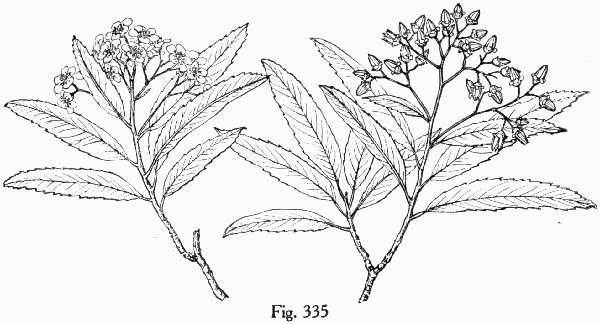
Leaves narrowly lanceolate, acuminate or rarely rounded at apex, abruptly cuneate or slightly rounded at base, and remotely serrate with minute glandular teeth, when they unfold puberulous above and densely tomentose below, and at maturity coriaceous, bright yellow-green and glabrous on the upper and tomentose on the lower surface, 1½′—3′ long, ¼′—½′ wide, with a thick conspicuous midrib grooved on the upper side, and numerous thin primary veins connected by reticulate veinlets; deciduous in spring or early summer; petioles thick, ⅓′—½′ in length. Flowers appearing in June, ¼′ in diameter, in hoary-tomentose panicles 2′—3′ across; petals oblong; inner surface of the disk pilose. Fruit fully grown by [378] the end of August, ¼′ long, persistent on the branches after opening until the spring of the following year; conspicuous from the contrast of the bright red faded petals and the white silky pubescence of the calyx and carpels; seed 1/12′ long, and one third as long as its wing.
A tree, 18°—20° high, with a slender often hollow trunk 5′—6′ in diameter, rigid upright contorted branches, and slender branchlets at first bright reddish brown and more or less thickly covered with hoary tomentum, becoming light brown or gray in their second year and marked by large elevated leaf-scars; or more often a low shrub. Winter-buds: axillary minute, acuminate, reddish brown, pubescent. Bark about 1/16′ thick, dark red-brown, and broken on the surface into small square persistent plate-like scales. Wood very heavy, hard, close-grained, dark rich brown streaked with red, with 14 or 15 layers of annual growth.
Distribution. Bottoms and rocky sides of gulches, or on grassy slopes; mountain ranges of extreme southwestern New Mexico (Guadalupe Cañon, teste E. A. Means), southern Arizona, Sonora, and Lower California; arborescent and of its largest size in Arizona on the Santa Catalina Mountains at altitudes of about 5000° above the sea.
2. LYONOTHAMNUS A. Gray.
A tree or shrub, with scaly bark exfoliating in long strips, stout terrete pubescent ultimately glabrous branchlets, and scaly, acuminate buds. Leaves opposite, long-petiolate, lanceolate, acuminate, rounded or cuneate at base, entire, finely crenulate-serrate or serrulate lobulate below the middle, or sometimes irregularly pinnately parted into 3—8 linear-lanceolate remote lobulate segments, coriaceous, transversely many-veined, dark green above, paler and more or less pubescent below, persistent; stipules lanceolate, acute, minute, caducous. Flowers on slender pedicels, in broad compound terminal pubescent cymose corymbs, with minute acute persistent bracts and bractlets; calyx-tube hemispheric, with 1—3 bractlets, tomentose on the outer surface, the lobes nearly triangular, slightly keeled, apiculate, persistent; disk 10-lobed, with a slightly thickened margin; petals 5, orbicular, sessile, white; stamens 15, inserted in pairs opposite the petals and singly opposite the sepals; filaments subulate, incurved, as long as the petals; anthers oblong, 2-celled, the cells opening longitudinally; carpels 2, inserted in the bottom of the calyx-tube, forming a superior glandular, hairy ovary; styles 2, spreading; stigmas capitate, truncate; ovules 4 in each cell, suspended; micropyle superior; raphe ventral. Fruit of 2 woody ovoid glandular-setulose carpels, dehiscent on the ventral and partly dehiscent on the dorsal suture. Seeds ovate-oblong, pointed at the ends; seed-coat light brown, thin and membranaceous; hilum orbicular, apical; raphe broad and wing-like; cotyledons oblong, acuminate, twice as long as the straight radicle directed toward the hilum.
Lyonothamnus is represented by a single species found only on the islands off the coast of southern California.
Lyonothamnus, in honor of its discoverer, William S. Lyon.
1. Lyonothamnus floribundus A. Gray. Ironwood.
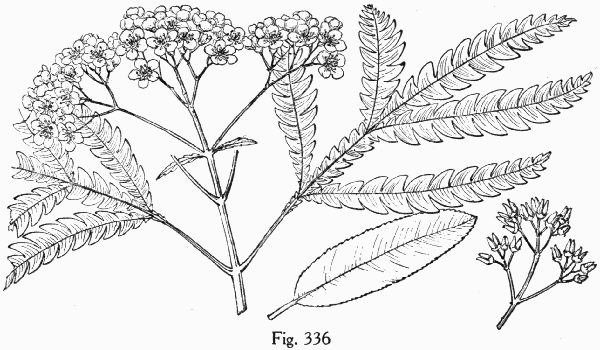
Leaves 4′—8′ long, ½′ wide when entire, or 4′ wide when pinnately divided, when they unfold covered below with hoary deciduous tomentum, at maturity dark green and lustrous above and yellow-green, glabrous or pubescent below, with an orange-colored midrib. Flowers in June and July, ⅛′—¼′ in diameter, in clusters varying from 4′—8′ across. Fruit ripens in August and September, 3/16′ long.
A bushy tree, rarely 30°—40° high, with a single straight trunk 8′—10′ in diameter, and slender branchlets at first pale orange color and coated with deciduous pubescence, becoming at the end of their first season bright red and lustrous; usually shrubby, with several tall stems, or in exposed situations a low bush. Bark ⅓′ thick, dark red-brown, and composed of numerous thin papery layers, forming after exfoliating long loose strips persistent on the stem. Wood heavy, hard, close-grained, bright clear red faintly tinged with orange.
[379]
Distribution. Steep slopes of cañons in dry rocky soil; on the islands of Santa Catalina, Santa Cruz, San Clemente, Santa Rosa, California; most abundant and of its largest size on the northern shores of Santa Cruz; on Santa Catalina much smaller and rarely arborescent.
Now occasionally cultivated in California.
3. MALUS Hall. Apple.
Trees, with scaly bark, slender terete branchlets, small obtuse buds covered by imbricated scales, those of the inner ranks accrescent and marking the base of the branchlet with conspicuous ring-like scars, and fibrous roots. Leaves conduplicate in the bud in the American species, simple, often incisely lobed, especially those near the end of vigorous branchlets, petiolate, deciduous, the petioles in falling leaving narrow horizontal scars marked by the ends of three equidistant fibro-vascular bundles; stipules free from the petioles, filiform, early deciduous. Flowers in short terminal racemes, with filiform deciduous bracts and bractlets, on short lateral spur-like often spinescent branchlets; calyx-tube obconic, 5-lobed, the lobes imbricated in the bud, acuminate, becoming reflexed, persistent and erect on the fruit or deciduous; petals rounded at apex, contracted below into a stalk-like base, white, pink or rose color; stamens usually 20 in 3 series, those of the outer series opposite the petals; carpels 3—5, usually 5, alternate with the petals, united into an inferior ovary; styles united at base; ovules 2 in each cell, ascending; raphe dorsal; micropyle inferior. Fruit a pome with homogeneous flesh, and papery carpels joined at apex, free in the middle; seeds 2, or by abortion 1 in each cell, ovoid, acute, erect, without albumen; seed-coat cartilaginous, chestnut-brown and lustrous; embryo erect; cotyledons plano-convex, fleshy; radicle short, inferior. Malus is confined to North America where nine species have been recognized, to western and southeastern Europe, and to central, southern, and eastern Asia. Of exotic species, Malus pumila Mill. of southeastern Europe and central Asia, the Apple-tree of orchards, has become widely naturalized in northeastern North America. Several of the species of eastern Asia and their hybrids are cultivated for their handsome flowers, or for their fruits, the Siberian Crabs of pomologists.
Malus is the classical name of the Apple-tree.
CONSPECTUS OF THE NORTH AMERICAN SPECIES.
Calyx persistent on the green or rarely yellow fruit covered with a waxy exudation; leaves of vigorous shoots laterally lobed; anthers dark (Chloromeles).
Leaves glabrous at maturity.
[380]
Leaves on flowering branchlets, acute or acuminate, serrate.
Leaves at the end of vigorous shoots distinctly lobed, those of flowering branchlets incisely serrate or lobed.
Leaves subcordate, with the lowest pair of veins springing directly from the base, light green on the lower surface.
1. M. glabrata (A).
Leaves truncate or rounded at base, the lowest pair of veins at some distance from the base.
Leaves glaucescent beneath, thickish at maturity.
2. M. glaucescens (A, C).
Leaves light green on the lower surface, thin.
3. M. coronaria (A, C).
Leaves at the end of vigorous shoots only slightly lobed, those of flowering branchlets serrate.
Leaves oval-elliptic, acute; fruit much depressed, distinctly broader than high.
4. M. platycarpa (A, C).
Leaves lanceolate, acuminate, thin; fruit subglobose.
5. M. lancifolia.
Leaves on flowering branchlets usually rounded at apex, those at the end of vigorous shoots only slightly lobed; fruit subglobose.
6. M. angustifolia (A, C).
Leaves tomentose or villose at maturity, at least those of vigorous shoots, strongly veined.
Calyx glabrous on the outer surface; leaves of flowering branchlets without lobes, glabrous or nearly so.
7. M. bracteata (A, C).
Calyx tomentose or pubescent on the outer surface; leaves usually incisely lobed, pubescent or tomentose beneath, rarely glabrous.
8. M. ioensis (A, C).
Calyx deciduous from the yellow or reddish fruit without a waxy exudation; leaves of vigorous shoots often 3-lobed at apex; anthers yellow (Sorbomalus).
9. M. fusca (B, G).
1. Malus glabrata Rehd. Crab Apple.
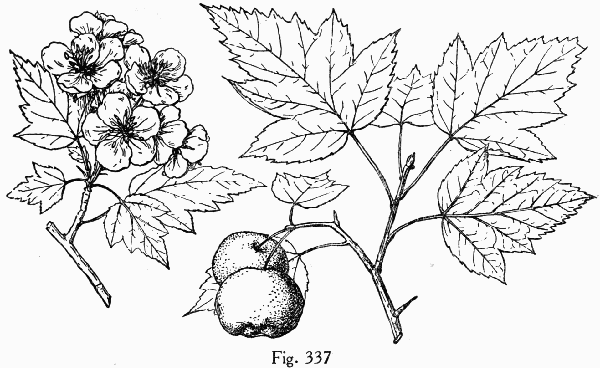
Leaves triangular-ovate or ovate, acute or acuminate at apex, cordate or rarely truncate at base, lobed with 2 or 3 pairs of short-acute or short-acuminate coarsely serrate lobes, when they unfold bronze color and sparingly covered with caducous hairs, glabrous when fully expanded, and at maturity dark yellow-green and lustrous above, pale below, 2½′—3′ long and 2′—2½′ wide, with 5—7 pairs of prominent primary veins, the lowest pair from the base of the leaf; petioles slender, glabrous, ⅘′—1¼′ in length; leaves at the end of vigorous shoots more deeply lobed and often 4′ long and 3½′ wide. Flowers about 1¼′ in diameter, [381] on slender glabrous purple pedicels ⅗′—1¼′ long, in 4—7-flowered clusters; calyx-tube purple and glabrous, the lobes glabrous on the outer surface, slightly longer than the tube; petals suborbicular or broadly ovate, abruptly contracted below, about ⅗′ wide, often erose-denticulate; stamens about one third shorter than the petals; styles 5, slightly longer than the stamens, villose below the middle. Fruit on slender pedicels about ⅘′ in length, depressed globose, slightly angled, distinctly ribbed at the deeply impressed apex, about 1¼′ high and 1½′ in diameter, with a deep basal cavity; seed obovoid-oblong, about ⅓′ long.
A tree, 18°—25° high, with a short trunk rarely 1° in diameter, spreading branches often armed with stout straight spines up to 1½′ in length, and glabrous purple branchlets, becoming purple-brown and slightly lustrous at the end of their first season, dull red-brown in their second year, and ultimately grayish brown. Winter-buds ovoid or oblong-ovoid, acute, glabrous, dark purple-brown up to ¼′ in length.
Distribution. A common Crab Apple in the valleys of western North Carolina at altitudes of 2000°—3500°; near Biltmore, Buncombe County, Dillsboro, Jackson County, and Highlands, Macon County.
2. Malus glaucescens Rehd. Crab Apple.
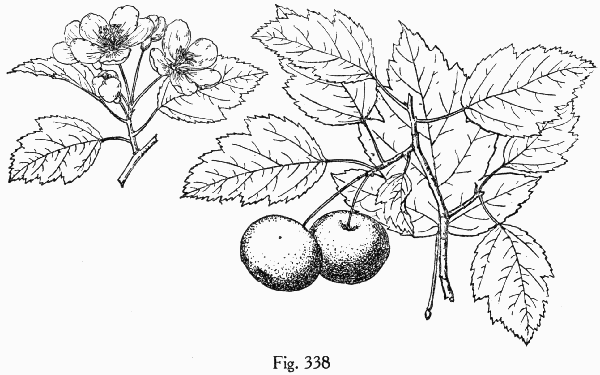
Leaves triangular-ovate or ovate, acute, short-acuminate or rounded at apex, truncate or rounded at base, those of flowering branchlets more or less lobed and coarsely serrate with abruptly acuminate teeth, their lobes triangular, broad-ovate and abruptly acuminate, those of the lowest pair usually the longest, bronze color and covered with thin floccose tomentum when they unfold, soon glabrous, dull yellowish green above, glaucescent below, 1½′—3½′ long and 1¼′—3′ wide, with 4—7 pairs of prominent primary veins; turning yellow or dark purple and falling early in the autumn; petioles slender, slightly villose at first, soon glabrous, 1½′—3′ in length; stipules filiform, purple, glabrous or slightly villose, about ⅓′ long; leaves at the end of vigorous shoots broad-ovate, acuminate, rounded or slightly cordate at base, often deeply lobed, 3′—3½′ long, 3′ wide, with petioles 1½′—2′ in length. Flowers 1⅓′—1½′ in diameter, on slender glabrous pedicels, ⅘′—1¼′ in length, in usually 5—7-flowered clusters, calyx-tube coated with floccose caducous pubescence or glabrous, slightly shorter than the long-acuminate lobes densely tomentose on the inner surface; petals oval, abruptly contracted below into a long claw, white or rose color, ½′—⅗′ wide; stamens about one third shorter than the petals; styles 5, about as long as the stamens, densely villose below and united at base for about one fourth of their length. Fruit [382] depressed globose, pale yellow when ripe, 1′—1¼′ high, 1¼′—1¾′ in diameter, with a shallow only slightly corrugated cavity at apex and a shallow concave depression at base.
An arborescent shrub or small tree, rarely more than 15° high, often spreading into thickets, with a trunk 4′ or 5′ in diameter, spreading spinescent branches forming an open irregular head, and slender branchlets slightly pubescent at first, soon glabrous, bright red-brown in their first and second years, becoming dark gray-brown and marked by yellow lenticels. Bark dark gray, divided by shallow longitudinal fissures and finally separating into small thin scales.
Distribution. Glades and open woods in rich soil; western New York (Ontario, Munroe, Cattaraugus and Erie Counties) to southern Ontario, western Pennsylvania (near Carnot, Allegheny County); and southeastern and northern Ohio; Tiptop, Tazewell County, Virginia; near Spruce Pine, Mitchell County, North Carolina; slopes of Lookout Mountain, above Valleyhead, DeKalb County, Alabama; apparently most generally distributed and most abundant in Ohio.
3. Malus coronaria L. Crab Apple. Garland Tree.
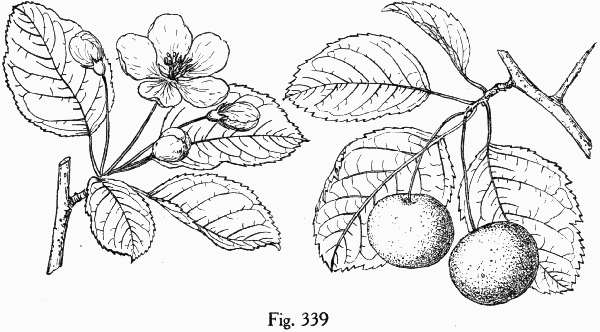
Leaves ovate to oval, rounded, acute or acuminate and often abruptly short-pointed at apex, rounded or cuneate at base, and coarsely serrate usually only above the middle, tinged with red and villose-pubescent when they unfold, soon glabrous, and at maturity yellow-green above, paler below, 2′—3′ long and 1½′ wide, with a prominent midrib and thin inconspicuous primary veins; turning yellow in the autumn before falling; petioles slender, at first puberulous, becoming glabrous, ½′—1′ in length; leaves at the end of vigorous shoots broad-ovate, usually lobed with short acute lobes, more coarsely serrate, thicker, often 3′—4′ long and 2′—3′ wide, with a prominent midrib and primary veins, and stout petioles often tinged with red and 1½′—2′ in length. Flowers 1¼′—1½′ in diameter, on glabrous pedicels ½′—1′ long, in 3—6-flowered clusters; calyx-tube glabrous, or rarely more or less densely villose-pubescent (var. dasycalyx Rehd.), the lobes long-acuminate, longer than the tube, sparingly pubescent on the outer surface, hoary-tomentose on the inner surface; petals oblong-obovate, gradually or abruptly narrowed into a long claw, about ½′ wide; stamens shorter than the petals; styles 5, clothed for half their length with long white hairs and united at the base. Fruit on slender pedicels 1½′—2′ in length, green when fully grown, yellow-green at maturity, ¾′—1′ high and 1′—1¼′ wide.
A tree, often forming dense thickets, 25°—30° high, with a trunk 12′—14′ in diameter, dividing 8°—10° above the ground into several stout spreading branches forming a wide open head, and branchlets hoary-tomentose when they first appear, glabrous or slightly pubescent, bright red-brown and marked by occasional small pale lenticels in their first winter, and [383] developing in their second year stout, spur-like, somewhat spinescent lateral branchlets. Winter-buds obtuse, with bright red scales scarious and ciliate on the dark margins. Bark ⅓′ thick, longitudinally fissured, the outer layer separating into long narrow persistent red-brown scales. Wood heavy, close-grained, not strong, light red, with yellow sapwood of 18—20 layers of annual growth; used for levers, the handles of tools, and many small domestic articles.
Distribution. Western New York to southern Ontario and westward through Ohio, southern Michigan, Indiana, Illinois, and southern Wisconsin to Missouri (Jackson and Butler Counties), and southward through Pennsylvania to northern Delaware, and along the Appalachian Mountains to North Carolina, sometimes up to altitudes of 3300°; the var. dasycalyx common and widely distributed in Ohio (Lorain, Clark, Franklin, Hardin and Lucas Counties, R. E. Horsey), and in Wells and Porter Counties, Indiana (C. C. Deam).
Sometimes planted in the gardens of the northern and eastern states; passing into
Malus coronaria var. elongata Rehd.
Malus elongata Ashe.
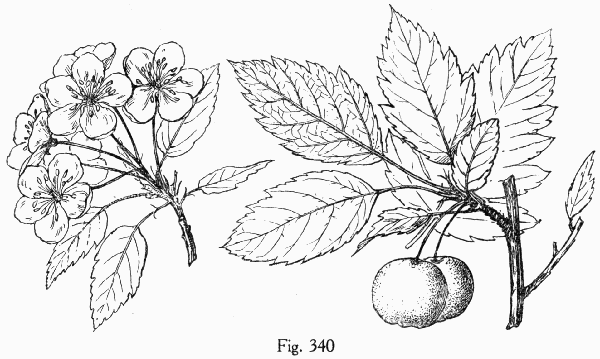
Leaves oblong-ovate, gradually narrowed and acuminate at apex, rounded or broad-cuneate at base, incisely serrate or slightly lobed, floccose-tomentose when they unfold, soon glabrous, dark yellow-green above, lighter below, 2′—3½′ long, 1′—1¼′ wide; at the end of vigorous shoots ovate, rounded or broad and cuneate at base, acuminate, lobed with short acuminate lobes, 3½′—4′ long, 2′—2½′ wide, with a prominent midrib and primary veins, and slightly pubescent orange-colored petioles 1′—1½′ in length. Flowers and Fruit as in the species.
A shrub or small tree, sometimes forming dense almost impenetrable thickets.
Distribution. Western New York (Ontario, Cattaraugus and Erie Counties); Virginia (on Peak Mountain, Pulaski County); West Virginia (near Elkins, Randolph County, and White Sulphur Springs, Greenbrier County), and westward to southern Ohio (Oberlin, Lorain County); North Carolina (near Highlands, Macon County); and northeastern Georgia (Rabun County).
4. Malus platycarpa Rehd. Crab Apple.
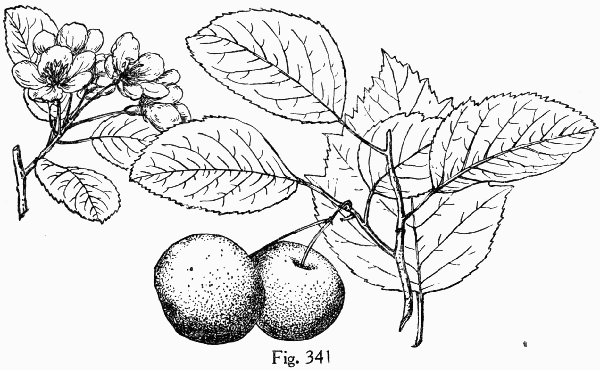
Leaves ovate to elliptic, abruptly contracted at the rounded apex into a short point, rounded at base, and sharply usually doubly serrate, when they unfold covered with long [384] white hairs caducous except from the midrib and at maturity glabrous; dark yellow-green, lustrous, and slightly rugulose on the upper surface, lighter on the lower surface, 2½′—3¼′ long and 1½′—2½′ wide, with 5—7 pairs of prominent primary veins; petioles slender, villose, often becoming nearly glabrous, 1′—1½′ in length; on vigorous shoots often broad-ovate and lobed with short triangular lobes sometimes 4′ long and nearly as wide. Flowers about 1½′ in diameter, on glabrous pedicels 1½′—2½′ long, in 3—6-flowered clusters; calyx-tube glabrous or rarely pubescent (var. Hoopesii Rehd.), the lobes lanceolate, acuminate, longer than the tube, glabrous on the outer surface, densely tomentose on the inner surface; petals orbicular-obovate, usually irregularly incisely dentate and abruptly contracted at base into a short claw, slightly villose on the inner surface near the base, ½′ to nearly 1′ wide; stamens slightly shorter than the petals; styles 5, somewhat shorter than the stamens, villose below the middle and united below for one third their length. Fruit on slender pedicels, 1¼′—1½′ in length, depressed globose with a deep cavity at base and apex, 1½′—1¾′ high and 2′—2½′ wide; seeds oblong-obovoid, about ⅓′ long.
A tree, 18°—20° high, with a trunk 4′ or 5′ in diameter, spreading unarmed branches, and branchlets clothed when they first appear with thin villose tomentum, becoming by the end of their first year glabrous, brown or purple-brown and lustrous, dull brown in their second season, and ultimately grayish brown. Winter-buds ovoid, acute, glabrous except on the villose margins of the purplish brown scales, about ¼′ long.
Distribution. Near Franklin, Macon County, North Carolina; Mercer Springs, Mercer County, West Virginia; near Olympia, Bath County, Kentucky; Youngstown, Mahoning County, Ohio (R. E. Horsey).
5. Malus lancifolia Rehd. Crab Apple.
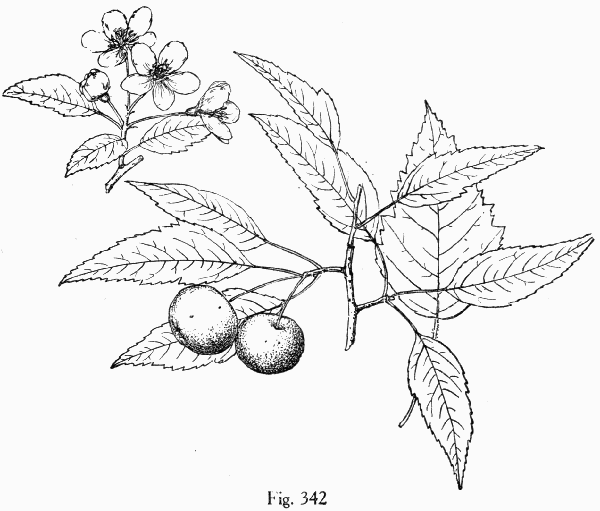
Leaves ovate-lanceolate to oblong-lanceolate, acute or short-acuminate at apex, rounded or broad-cuneate at base, finely or coarsely doubly serrate with short or occasionally with larger teeth pointing forward, covered with thin floccose tomentum when they unfold, soon glabrous, bright yellow-green, 1½′—3′ long, ½′—1′ wide, with 8—10 pairs of veins; petioles slender, slightly villose at first, soon glabrous, ½′—1′ in length; leaves on vigorous shoots ovate or oblong-ovate, slightly lobed, more densely pubescent below, 2½′—3¾′ long, 2′—2½′ wide, with a thin midrib and 4—7 pairs of veins slightly villose through the season, and stouter petioles. Flowers 1¼′—1½′ in diameter, in 3—6-flowered clusters, on slender glabrous pedicels about 1¼′ in length; calyx glabrous, the lobes longer than the tube, oblong-lanceolate, glabrous on the outer surface, coated with villose tomentum on the inner surface; [385] petals contracted into a long narrow claw, glabrous, white or rose color, ½′ wide; stamens shorter than the petals; styles 5, densely villose below the middle. Fruit on slender drooping pedicels about 1′ long, subglobose, 1′—1¼′ wide.
A tree, 20°—25° high, with a trunk 12′—15′ in diameter, spreading spinescent branches forming an open pyramidal head, and slender branchlets slightly pubescent or nearly glabrous when they first appear, becoming reddish brown at the end of their first season and ultimately gray-brown. Bark of the trunk brownish gray, divided by shallow longitudinal fissures and separating into thin plates.
Distribution. Northeastern Pennsylvania (Scranton, Lackawanna County) to the western and southwestern parts of the state, and southward to Randolph and Greenbrier Counties, West Virginia, Pulaski County (on Peak Mountain), Virginia, and to the mountains of North Carolina up to altitudes of 3200°, and westward to northeastern Kentucky, through southern Ohio, eastern Indiana (Delaware County) and southern Illinois (Richland, Jackson, Gallatin and Pope Counties); Missouri (Jackson and Wayne Counties).
6. Malus angustifolia Michx. Crab Apple.
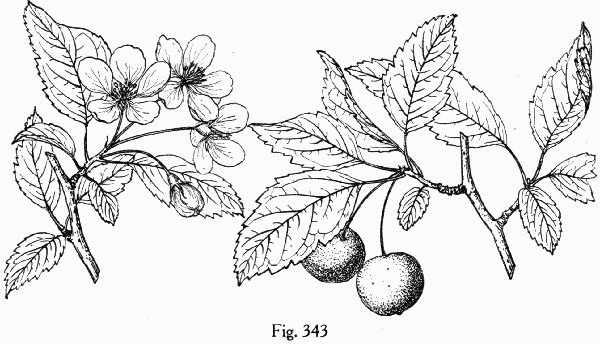
Leaves elliptic to oblong-obovate, rounded or acute and apiculate at apex, gradually narrowed and cuneate at base, and crenately serrate, hoary-tomentose below and sparingly villose above when they unfold, soon glabrous, or occasionally pubescent on the midrib below, and at maturity subcoriaceous dull green on the upper and light green on the lower surface, 1′—2′ long, ½′—¾′ wide; turning brown in drying; petioles slender, at first villose, soon glabrous, ½′—¾′ in length; stipules linear, rose-colored, ⅓′ long; leaves at the end of vigorous shoots ovate, oblong-ovate or elliptic, usually lobed with numerous short acute lobes, or coarsely serrate, usually rounded at apex, broad-cuneate at base, at maturity glabrous, or slightly floccose-pubescent below, especially on the midrib and veins, 2′—3′ long, 1½′—2′ wide, with stout often rose-colored glabrous or pubescent petioles. Flowers about 1′ in diameter, very fragrant, on slender glabrous or rarely puberulous pedicels, ¾′—1′ long, in mostly [386] 3—5-flowered clusters; calyx-tube short and broad, glabrous, the lobes about as long as the tube, glabrous on the outer surface, thickly covered with hoary tomentum on the inner surface; petals oblong-obovate, gradually narrowed below into a long claw, rose-colored, about ¼′ wide; stamens shorter than the petals; styles 5, united at base, villose below the middle. Fruit depressed-globose, pale yellow-green, ¾′—1′ in diameter.
A tree, rarely 30° high, with a short trunk 8′—10′ in diameter, rigid spreading or rarely slender and pendulous (var. pendula Rehd.) branches forming a broad open head, and young branchlets clothed at first with pale caducous pubescence, soon glabrous, in their first winter brown slightly tinged with red, and in their second year light brown and marked by occasional orange-colored lenticels. Winter-buds 1/16′ long, chestnut-brown, slightly pubescent. Bark ⅜′—¼′ thick, dark reddish brown, and divided by deep longitudinal fissures into narrow ridges broken on the surface into small persistent plate-like scales. Wood heavy, hard, close-grained, light brown tinged with red, with thick yellow sapwood; occasionally employed for levers, the handles of tools and other small objects. The fruit is used for preserves.
Distribution. Southeastern Virginia in the neighborhood of the coast, southward to western Florida, and through southern Alabama and Mississippi to western Louisiana (near Winnfield, Winn County); in the Carolinas and Georgia, ranging inland to the Appalachian foothills and in Mississippi to the neighborhood of Iuka, Tishomingo County in the northeastern corner of the state; in southern Illinois (Pope and Johnson Counties, E. J. Palmer).
7. Malus bracteata Rehd.
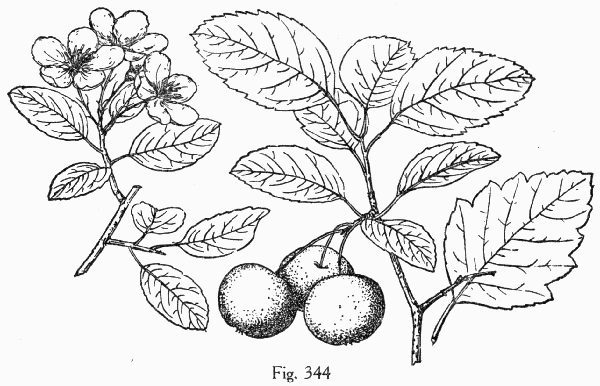
Leaves elliptic-ovate to oblong-ovate, acute, on flowering branchlets sometimes obtusish at apex, cuneate or rounded at base, serrate or incisely serrate, sometimes slightly lobed near the base, covered below with floccose tomentum when they unfold, soon glabrous, and at maturity thin, bright yellow-green and lustrous above, light green below, 1½′—3′ long, 1′—1¼′ wide; petioles glabrous, reddish like the under side of the midrib, ⅔′—1′ in length; leaves at the end of vigorous shoots ovate, acute, cuneate at base, usually lobed with 4 or 5 pairs of short acute or rounded lobes, more thickly tomentose when they unfold, at maturity thicker, glabrous above, more or less pubescent below, often 3′—3½′ long and 2′—2½′ wide, with a stout midrib and petiole. Flowers 1′—1¼′ in diameter, on slender glabrous or nearly glabrous pedicels, in 3—5-flowered clusters, with subulate bractlets ⅕′—⅛′ long, often persistent until after the flowers open; calyx-tube glabrous, the lobes slightly longer than the tube, villose on the inner surface; petals oval, narrowed into a slender claw, deep [387] pink, 5/12′—½′ wide; stamens about one third shorter than the petals; styles slightly shorter than the stamens, united at base and villose below for a third of their length. Fruit depressed-globose, with a shallow basal cavity and a shallow slightly corrugated cavity at apex, slightly viscid, ⅘′—1′ high and 1′—1¼′ wide.
A tree, 15°—30° high, with a trunk up to 6′ or 7′ in diameter, thick branches forming a broad often symmetrical head, and stout branchlets red and glabrous when they first appear, becoming reddish brown and lustrous at the end of their first season, and dull red-brown and armed with occasional stout spines or unarmed the following year, the vigorous shoots more or less pubescent early in the season, becoming glabrous, or often densely pubescent until autumn. Winter-buds red-brown, glabrous, or slightly pubescent. Bark dark brown and broken into thin closely appressed scales.
Distribution. Missouri (Allenton, St. Louis County, and Campbell, Dunklin County); northern Kentucky (Fordsville, Ohio County); Tennessee, without locality; North Carolina (Biltmore, Buncombe County, near Highlands, Macon County, up to altitudes of 3500°, and Abbottsburg, Bladen County); Georgia (Dillard, Rabun County, near Augusta, Richmond County); Florida (River Junction, Gadsden County).
8. Malus ioensis Britt. Crab Apple.
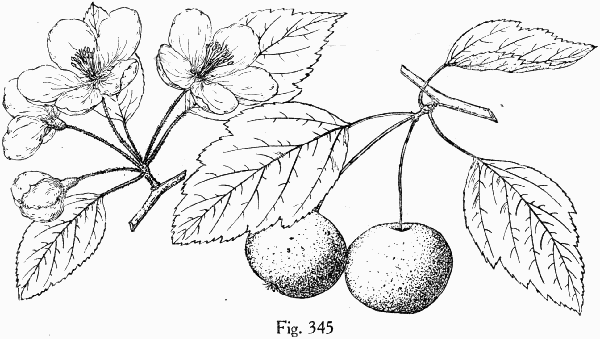
Leaves elliptic to ovate or oblong-obovate, acute, acuminate or rounded at apex, cuneate or rounded at the narrow base, crenately serrate, and often slightly lobed with acute or rounded lobes, hoary-tomentose below and floccose-pubescent above when they unfold, and at maturity thick and firm, dark green, lustrous and glabrous above, pale yellow-green and tomentose or nearly glabrous below, 2½′—4′ long, 1′—1½′ wide, with a slender midrib and primary veins; turning yellow in the autumn before falling; petioles slender, hoary-tomentose in early spring, becoming pubescent or nearly glabrous, ¾′—1′ in length; leaves at the end of vigorous shoots broad-ovate to oblong-ovate, acute, rounded at the broad or narrow base, often deeply lobed, covered below through the season with floccose easily detached tomentum, often 4′ or 5′ long and 3′ or 4′ wide, with a thick midrib and primary veins, and stout hoary-tomentose petioles ¾′—1′ in length. Flowers 1½′—2′ in diameter, on villose pubescent pedicels 1′—1½′ long, in 3—6-flowered clusters; calyx covered with hoary tomentum, the lobes narrow, rather longer than the tube; petals obovate, gradually narrowed below into a long slender claw, rose color or white, about ½′ wide; stamens shorter than the petals; styles 5, united at base, covered below for a third of their length with long white hairs. [388] Fruit on stout tomentose or villose stems 1′—1½′ long, depressed globose, with shallow basal and apical depressions, green or greenish yellow, ¾′—1′ high, and 1′—1¼′ wide.
A tree, 20°—30° high, with a trunk 12′—18′ in diameter, stout spreading branches forming a wide open head, and branchlets hoary-tomentose when they first appear, glabrous or slightly pubescent, bright red-brown and marked by occasional small pale lenticels in their first winter, the lateral branchlets usually spinescent. Winter-buds minute, obtuse, pubescent above the middle. Bark ⅓′ thick, covered with long narrow persistent red-brown scales.
Distribution. Southeastern Minnesota to Iowa, eastern Nebraska, and Missouri, and through southern Wisconsin and Illinois to Huntington County, Indiana. Passing into var. Palmeri Rehd., differing from the type in its smaller oblong more thinly pubescent leaves usually rounded at apex, those of the flowering branchlets crenately serrate and not lobed; a small tree rarely more than 15° high, with a slender stem, spiny zigzag branches and stout branchlets densely tomentose when they first appear, becoming glabrous or nearly glabrous and reddish or gray-brown at the end of their first season; the common form in Missouri, Arkansas and eastern Oklahoma. On the Edwards Plateau, in western Texas (Blanco, Kendall, and Kerr Counties) M. ioensis is represented by the var. texana Rehd., differing in its smaller and broader leaves only slightly or not at all lobed and densely villose through the season; usually an intricately branched shrub forming large dense thickets. A shrub from Campbell, Dunklin County, southeastern Missouri, with small leaves and flowers, a glabrescent calyx, and long slender flexible branches armed with numerous long straight spines is distinguished as var. spinosa Rehd. A variety with elliptic-ovate to oblong-ovate leaves rounded or broadly cuneate at base, nearly entire or crenately serrate, pubescent below at least on the veins, with densely villose petioles is distinguished as var. creniserrata Rehd.; a small tree with slender spineless branchlets villose while young; near Pineville, Rapides Parish, and Crowly, Arcadia Parish, western Louisiana. A variety with less deeply lobed glabrescent oblong-lanceolate leaves is distinguished as var. Bushii Rehd.; Williamsville, Wayne County, and Monteer, Shannon County, southern Missouri.
Malus ioensis var. plena Rehd., the Bechtel Crab, a form with large rose-colored double flowers is a favorite garden plant.
× Malus Soulardii Britt. with ovate, elliptic or obovate usually obtuse leaves, rugose and tomentose on the lower surface, and depressed-globose fruit 2′—2½′ in diameter, is believed to be a hybrid of Malus ioensis and Malus pumila.
[389]
9. Malus fusca Schn. Crab Apple.
Malus rivularis Roem.
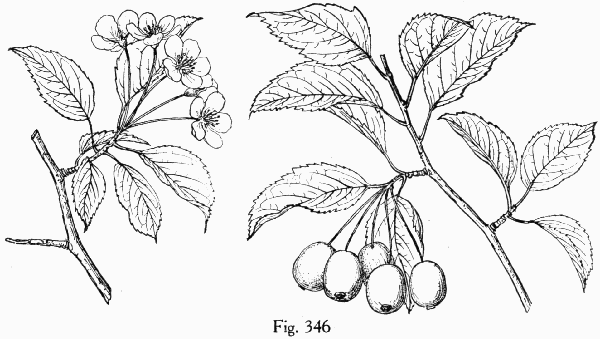
Leaves ovate to elliptic or lanceolate, acute or acuminate, cuneate or rounded at base, sharply serrate with appressed glandular teeth, and often slightly 3-lobed, when they unfold pubescent on the lower and puberulous on the upper surface, at maturity thick and firm, dark green and glabrous above, pale and pubescent or glabrous below, 1′—4′ long, ½′—1½′ wide, with a prominent midrib and primary veins and conspicuous reticulate veinlets; before falling in the autumn turning bright orange and scarlet; petioles stout, rigid, pubescent, 1′—1½′ in length; stipules narrowly lanceolate, acute, ½′—¾′ long; leaves at the end of vigorous shoots ovate to obovate, acuminate, often 3-lobed above the middle, rounded or cuneate at base, 2½′—3½′ long and wide, with petioles often 2′ in length. Flowers ¾′ in diameter on slender pubescent or glabrous pedicels, ½′—¾′ long, in short many-flowered clusters; calyx-tube deciduous from the mature fruit, glabrous, puberulous or tomentose, the lobes rather longer than the tube, minutely apiculate, glabrous or tomentose, hoary-tomentose on the inner surface; petals orbicular to obovate, erose or undulate on the margins, abruptly contracted into a short claw, ¼′ wide, white or rose color; styles 2—4, glabrous. Fruit obovoid-oblong, ½′—¾′ long, yellow-green, light yellow flushed with red or sometimes nearly red; flesh thin and dry.
A tree, 30°—40° high, with a trunk 12′—18′ in diameter, and slender branchlets coated at first with long pale hairs soon deciduous or persistent until the autumn, becoming bright red and lustrous, and later dark brown, and marked by minute remote pale lenticels; often a shrub with numerous slender stems. Winter-buds 1/16′ long, chestnut-brown, the inner scales at maturity lanceolate, usually bright red, and nearly ½′ in length. Bark ¼′ thick, and covered by large thin loose light red-brown plate-like scales. Wood heavy, hard, close-grained, light brown tinged with red, with lighter colored sapwood of 20—30 layers of annual growth; used for mallets, mauls, the handles of tools, and the bearings of machinery. The fruit has a pleasant subacid flavor.
Distribution. Deep rich soil in the neighborhood of streams, often forming almost impenetrable thickets of considerable extent; Aleutian Islands southward along the coast and islands of Alaska and British Columbia to Sonoma and Plumas Counties, California; of its largest size in the valleys of western Washington and Oregon.
Occasionally cultivated as an ornamental plant in the eastern states, and in western Europe.
× Malus Dawsoniana Rehd., a hybrid of Malus fusca and a form of M. pumila, has been raised at the Arnold Arboretum from seeds collected in Oregon.
[390]
4. SORBUS L. Mountain Ash.
Trees or shrubs, with smooth aromatic bark, stout terete branchlets, large buds covered by imbricated scales, the inner accrescent and marking the base of the branchlet by conspicuous ring-like scars, and fibrous roots. Leaves alternate, pinnate in the American species, the pinnæ conduplicate in the bud, serrate, deciduous; stipules free from the petioles, foliaceous. Flowers in broad terminal leafy cymes; calyx-tube urn-shaped, 5-lobed, the lobes imbricated in the bud, persistent; petals rounded, abruptly narrowed below, white; stamens usually 20 in 3 series, those of the outer series opposite the petals; carpels 2—5, usually 3; styles usually 3, distinct; ovules 2 in each cell, ascending; raphe dorsal; micropyle inferior. Fruit a small subglobose red or orange-red pome with acid flesh, and papery carpels free at the apex. Seeds 2, or by abortion 1, in each cell, ovoid, acute, erect; seed-coat cartilaginous, chestnut-brown and lustrous; embryo erect; cotyledons plano-convex, flat; radicle short, inferior.
Sorbus is widely distributed through the northern and elevated regions of the northern hemisphere with three or four species in North America of which one is arborescent, and with many species in eastern Asia and in Europe. Of the exotic species, Sorbus Aucuparia L., the common European Mountain Ash, or Rowan-tree, with several of its varieties and hybrids, is often cultivated as an ornamental tree in Canada and the northern states and has become sparingly naturalized northward.
Sorbus is the classical name of the Pear or of the Service-tree.
1. Sorbus americana Marsh.
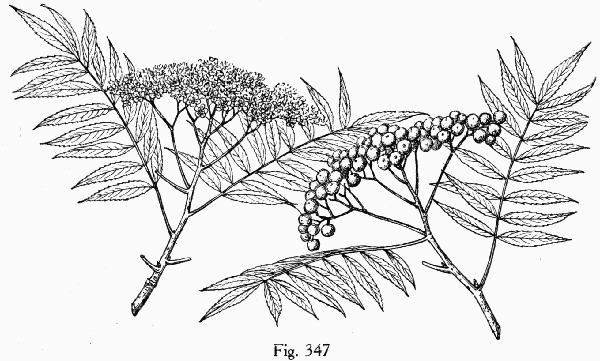
Leaves 6′—8′ long, with 13—17 lanceolate acute taper-pointed leaflets unequally cuneate or rounded and entire at base, sharply serrate above with acute often glandular teeth, sessile or short-stalked, or the terminal leaflet on a stalk sometimes ½′ long, when they unfold slightly pubescent below, at maturity membranaceous, glabrous, dark yellow-green, on the upper surface, and paler or glaucescent and rarely pubescent on the lower surface, 2′—4½′ long, ¼′—1′ wide, with a prominent midrib and thin veins; turning bright clear yellow before falling in the autumn; petioles grooved, dark green or red, 2′—3′ in length, the rachis often furnished with tufts of dark hairs at the base of the petiolules; stipules broad, nearly triangular, variously toothed, caducous. Flowers appearing after the leaves are fully grown, ⅛′ in diameter, on short stout pedicels, in flat cymes 3′—4′ across, with acute minute caducous bracts and bractlets; calyx broadly obconic and puberulous, with short, [391] nearly triangular lobes tipped with minute glands and about half as long as the nearly orbicular creamy white petals. Fruit ¼′ in diameter, subglobose or slightly pyriform, bright orange-red, with thin flesh; seeds pale chestnut color, rounded at apex, acute at base, about ⅛′ long.
A tree, 20°—30° high, with a trunk rarely more than a foot in diameter, spreading slender branches forming a narrow round-topped head, and stout branchlets pubescent at first, soon glabrous, becoming in their first winter brown tinged with red, and marked by the large leaf-scars and by oblong pale remote lenticels, and darker in their second year, the thin papery outer layer of bark then easily separable from the bright green fragrant inner layers; more often a tall or sometimes a low shrub, with numerous stems. Winter-buds acute, ¼′—¾′ long, with dark vinous red acuminate scales rounded on the back, more or less pilose, covered with a gummy exudation, the inner scales hoary-tomentose in the bud. Bark ⅛′ thick, with a smooth light gray surface irregularly broken by small appressed plate-like scales. Wood close-grained, light, soft and weak, pale brown, with lighter colored sapwood of 15—20 layers of annual growth. The astringent fruit is employed domestically in infusions and decoctions, and in homœopathic remedies.
Distribution. Borders of swamps and rocky hillsides; Newfoundland to Manitoba and southward through the maritime provinces of Canada, Quebec and Ontario, the elevated portions of the northeastern United States and the region of the Great Lakes to Minnesota, and on the Appalachian Mountains from western Pennsylvania and West Virginia to North Carolina and Tennessee; in North Carolina ascending to altitudes of nearly 6000°; probably of its largest size on the northern shores of Lakes Huron and Superior; in the United States, except in New England, more often a shrub than a tree; on the Appalachian Mountains usually low, with narrower leaflets and smaller fruit than northward.
Often cultivated in Canada and the northeastern States for the beauty of its fruit and the brilliancy of its autumn foliage. Of its forms the most distinct is
Sorbus americana var. decora Sarg.
Pyrus sambucifolia A. Gray, not Cham. and Schlecht. Pyrus americana var. decora Sarg. Sorbus decora Schn. Sorbus scopulina Britt., in part, not Greene. Pyrus sitchensis Rob. and Fern., not Piper.
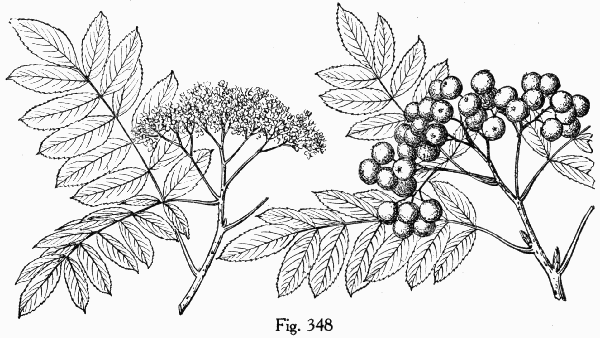
Leaves 4′—6′ long, with 7—13 oblong-oval to ovate-lanceolate leaflets blunt and rounded, abruptly short-pointed or acuminate at apex, pubescent below as they unfold, at maturity [392] glabrous, dark bluish green on the upper surface and pale on the lower surface; petioles stout, usually red 1½′—2′ in length. Flowers ¼′ in diameter, in rather narrower clusters, appearing eight to ten days later than those of the type. Fruit subglobose, bright orange-red, often ½′ in diameter.
A tree, occasionally 30° high, with a trunk sometimes a foot in diameter, and spreading branches forming a round-topped handsome head.
Distribution. Coast of Labrador to the northern shores of Lake Superior and Minnesota, southward to the mountains of northern New Hampshire, Vermont, and New York. Distinct in its extreme forms but connected with Sorbus americana by intermediate forms.
This variety of Sorbus americana, perhaps the most beautiful of the genus when the large and brilliant fruits cover the branches in autumn and early winter, occasionally finds a place in the gardens of eastern Canada and the northern states.
5. HETEROMELES Roem.
A tree, with smooth pale aromatic bark, stout terete branchlets pubescent or puberulous while young, acute winter-buds covered by loosely imbricated red scales, and fibrous roots. Leaves oblong-lanceolate, acute at the ends, sharply and remotely serrate with rigid glandular teeth, or rarely almost entire, dark green and lustrous above, paler below, feather-veined, with a broad midrib and conspicuous reticulate veinlets; petiolate with stout petioles often furnished near the apex with 1 or 2 slender glandular teeth; stipules free from the petioles, subulate, rigid, minute, early deciduous. Flowers on short stout pedicels, in ample tomentose terminal corymbose leafy panicles, their bracts and bractlets acute, minute, usually tipped with a small gland, caducous; calyx-tube turbinate, tomentose below, glabrate above, the lobes short, nearly triangular, spreading, persistent; disk cup-shaped, obscurely sulcate; petals flabellate, erose-denticulate or emarginate at apex, contracted below into a short broad claw, thick, glabrous, pure white; stamens 10, inserted in 1 row with the petals in pairs opposite the calyx-lobes; filaments subulate, incurved, anthers oblong-ovoid, emarginate; carpels 2, adnate to the calyx-tube, and slightly united into a subglobose tomentose nearly superior ovary; styles distinct, slightly spreading, enlarged at apex into a broad truncate stigma; ovules 2 in each cell, ascending; raphe dorsal; micropyle inferior. Fruit obovoid, fleshy, the thickened calyx-tube connate to the middle only with the membranaceous carpels coated above with long white hairs filling the cavity closed by the infolding of the thickened persistent calyx-lobes, their tips erect and crowning the fruit. Seed usually solitary in each cell, ovoid, obtuse, slightly ridged on the back; seed-coat membranaceous, slightly punctate, light brown; hilum orbicular, conspicuous; embryo filling the cavity of the seed; cotyledons plano-convex; radicle short, inferior.
The genus is represented by a single species of western North America.
The generic name, from ἔτερος and μῆλον, is in reference to its difference from related genera.
1. Heteromeles arbutifolia Roem. Tollon. Toyon.
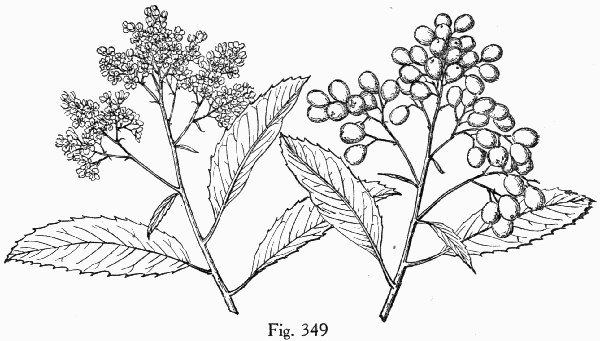
Leaves appearing with the flowers in early summer, 3′—4′ long, 1′—1½′ wide, usually persistent during at least two winters; petioles ½′—⅔′ in length. Flowers opening from June to August in clusters 4′—6′ across and often more or less hidden by young lateral branchlets rising above them. Fruit ripening in November and December, mealy, astringent and acid, scarlet or rarely yellow, ⅓′ long, remaining on the branches until late in the winter.
A tree, sometimes 30° high, with a straight trunk 12′—18′ in diameter, dividing a few feet above the ground into many erect branches forming a handsome narrow round-topped head, and slender branchlets covered at first with pale pubescence, in their first winter dark red and slightly puberulous, ultimately becoming darker and glabrous. Winter-buds ¼′ long. Bark ½′—⅔′ thick, light gray, with a generally smooth surface roughened by obscure [393] reticulate ridges. Wood very heavy, hard, close-grained, dark red-brown, with thin lighter colored sapwood of 7 or 8 layers of annual growth. The fruit-covered branches are gathered in large quantities and used in California in Christmas decorations.
Distribution. Usually in the neighborhood of streams or on dry hills and especially on their northern slopes, and often on steep sea-cliffs; California: coast region from Mendocino County to Lower California; most common and of its largest size on the islands off the California coast; on the foothills of the Sierra Nevada and on the San Bernardino Mountains up to altitudes of 2000° above the sea and usually shrubby; very abundant and forming groves of considerable extent on the island of Santa Catalina.
Occasionally cultivated as an ornamental plant in California, and rarely in the countries of southern Europe.
6. AMELANCHIER Med.
Trees or shrubs, with scaly bark, slender terete branchlets, acute or acuminate buds, with imbricated scales, those of the inner rows accrescent and bright-colored, and fibrous roots. Leaves alternate, conduplicate in the bud, simple, entire or serrate, penniveined, petiolate, deciduous; stipules free from the petioles, linear, elongated, rose color, caducous. Flowers in erect or terminal racemes, on slender bibracteolate pedicels developed from the axils of lanceolate acuminate pink deciduous bracts; calyx-tube campanulate or urceolate, the lobes acute or acuminate, recurved, persistent on the fruit; disk green, entire or crenulate, nectariferous; petals white, obovate-oblong, spatulate or ligulate, rounded, acute or truncate at apex, gradually contracted below into a short slender claw; stamens usually 20, inserted in 3 rows, those of the outer row opposite the petals; filaments subulate, persistent on the fruit, anthers oblong; ovary inferior or superior, more or less adnate to the calyx-tube, the summit glabrous or tomentose, 5-celled, each cell incompletely divided by a false partition; styles 2—5, connate below, spreading and dilated above into a broad truncate stigma; ovules 2 in each cell, erect; micropyle inferior. Fruit subglobose or pyriform, dark blue or bluish black, often covered with a glaucous bloom, open at the summit, the cavity surrounded by the lobes of the calyx and the remnants of the filaments; flesh sweet, dry or juicy; carpels membranaceous, free or connate, glabrous, or villose at apex. Seeds 10 or often 5 by the abortion of 1 of the ovules in each cell, ovoid-ellipsoid; seed-coat coriaceous, dark chestnut-brown, mucilaginous; embryo filling the cavity of the seed; cotyledons plano-convex; radicle inferior.
Amelanchier is widely distributed with many species through the temperate, northern [394] and mountainous regions of eastern and western North America; it occurs with one species in southern Europe, northern Africa and southwestern Asia, and with another in central and western China and Japan. Only three species, all North American, attain the habit and size of trees. The fruit of nearly all the species is more or less succulent, and several are cultivated in gardens for the beauty of their early and conspicuous flowers, and occasionally for their fruit. The name is of doubtful origin.
CONSPECTUS OF THE NORTH AMERICAN ARBORESCENT SPECIES.
Leaves finely serrate, acute or acuminate at apex; flowers on elongated pedicels in nodding racemes; summit of the ovary glabrous; winter-buds lanceolate, long-acuminate.
Leaves densely white tomentose while young; flowers appearing before or as the leaves unfold in silky tomentose racemes; calyx-lobes ovate, acuminate or nearly triangular and acute; fruit dry and tasteless.
1. A. canadensis (A).
Leaves slightly pubescent as they unfold, soon glabrous, dark red-brown while young; flowers appearing after the leaves are nearly half grown in glabrous racemes; calyx-lobes lanceolate or subulate, long-acuminate; fruit sweet and succulent.
2. A. laevis (A).
Leaves coarsely serrate usually only above the middle, rounded at apex, oblong-ovate or oval; flowers on shorter pedicels in short erect or spreading racemes; summit of the ovary covered with hoary tomentum; winter-buds ovoid or ellipsoid, acute or short-acuminate.
3. A. florida (F, C, G).
1. Amelanchier canadensis Med. Service Berry. Shad Bush.
Amelanchier canadensis var. tomentula Sarg.
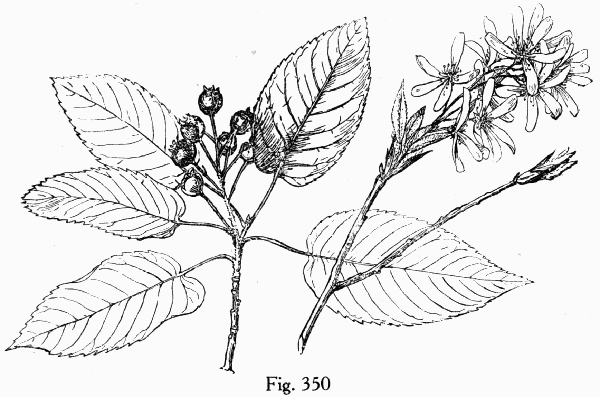
Leaves ovate-oval, oblong-obovate or rarely lanceolate or oblanceolate, acuminate and often abruptly short-pointed at apex, rounded, slightly cordate or occasionally cuneate at base, and finely serrate with acuminate teeth pointing forward; thickly coated when they unfold with silvery white tomentum, more or less densely pale pubescent below until midsummer, later becoming glabrous or nearly glabrous, yellowish green on the upper surface, paler on the lower surface, usually 2′—4′ long and 1′—2′ wide, southward sometimes up to 6′ in length, with a slender midrib, and thin primary veins; petioles slender, hoary-tomentose at first, usually becoming glabrous by midsummer, 1½′—2′ in [395] length. Flowers ¼′—⅓′ long, appearing in early spring before or as the leaves unfold, on pedicels ¼′—½′ in length, in short nodding silky tomentose racemes, their bracts and bractlets linear-lanceolate, villose, bright red; calyx-tube campanulate, glabrous or densely hoary-tomentose, the lobes ovate, acuminate or nearly triangular and acute, glabrous or hoary-tomentose on the outer surface, tomentose on the inner surface, reflexed after the petals fall; petals oblong-obovate, rounded or nearly truncate at apex, about ⅙′ wide; summit of ovary glabrous. Fruit ripening in June and July, maroon-purple, dry and tasteless, about ¼′ in diameter.
A tree, occasionally 50°—70° high, with a trunk 12′—18′ in diameter, small erect and spreading branches forming a narrow round-topped head, and slender branchlets thickly covered when they first appear with long white hairs, soon glabrous, bright red-brown during their first year, becoming darker in their second season, and marked by numerous pale lenticels; usually smaller, and in the south Atlantic and Gulf states sometimes a shrub only a few feet tall. Winter-buds green tinged with brown, ½′—⅔′ long, about 1/12′ thick. Bark ¼′—½′ thick, dark ashy gray, divided by shallow fissures into longitudinal ridges covered by small persistent scales.
Distribution. At the north usually on dry exposed hills, on the borders of woods and in fence rows, southward often on the banks of streams and the borders of swamps; valley of the Penobscot River (Winn and Milford, Penobscot County) and Washington County (Pembroke, M. L. Fernald), Maine; Quebec (near Longueuil, Bro. M. Victorin); valley of the Connecticut River (central Vermont, southern New Hampshire, Massachusetts and Connecticut), and westward through western Massachusetts, New York, southern Ontario, southern Ohio, southern Michigan, and Indiana and Illinois; in central Iowa and southeastern Nebraska (Nemaha County, J. M. Bates), and southward to western Florida, southern Alabama, south central Mississippi, Louisiana westward to St. Landry Parish (near Opelousas, R. S. Cocks), northwestern Arkansas and northeastern Oklahoma; rare and of small size in the south Atlantic coast-region; ascending the southern Appalachian Mountains to altitudes of about 2200°, not common; abundant and probably of its largest size in western New York and southern Michigan.
Occasionally cultivated, and the first of all the cultivated species to flower in the spring.
2. Amelanchier laevis Wieg. Service Berry.
Amelanchier canadensis of many authors, in part, not L.
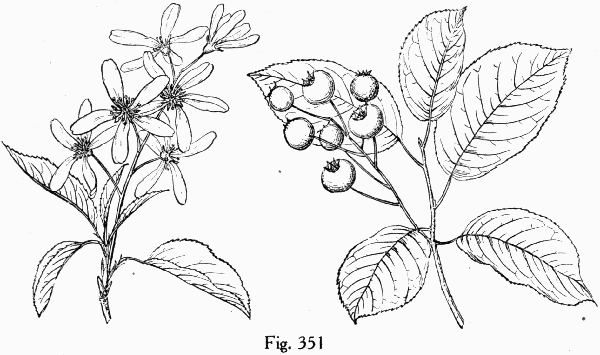
Leaves ovate to elliptic or rarely lanceolate, acute or acuminate and often abruptly short-pointed at apex, rounded and occasionally slightly cordate or rarely cuneate at base, and sharply and coarsely serrate with subulate callous-tipped teeth, covered when they unfold with long matted pale hairs more abundant on the lower surface than on the upper surface, soon glabrous, dark red-brown until nearly half grown, and at maturity dark green and slightly glaucous above, paler below, usually 2′—2½′ long and 1′—1½′ wide, rarely 3′—3½′ long and not more than 1′ wide, with a thin midrib and primary veins, rarely deep green and lustrous above (f. nitida Wieg.); petioles slender, slightly villose at first, soon glabrous, ½′—1′ in length. Flowers ½′—¾′ long, appearing when the leaves are nearly half grown on pedicels ½′—1′ in length, in open few-flowered nodding racemes, becoming much lengthened before the fruit ripens, their bracts and bractlets linear-lanceolate, slightly villose, tinged with rose color; calyx-tube campanulate, glabrous, the lobes lanceolate or subulate, long-acuminate, glabrous on the outer surface, tomentose on the inner surface, usually reflexed before the petals fall; petals oblong-obovate, rounded at apex, about ⅙′ wide; summit of the ovary glabrous. Fruit ripening in June and July, obovoid to subglobose, usually rather broader than long, about ⅓′ in diameter, purple or nearly black, glaucous, sweet and succulent, on pedicels often 1½′—2′ in length.
A tree, sometimes 30°—40° high, often with a tall trunk 12′—18′ in diameter, small spreading branches forming a narrow round-topped head, and slender glabrous branchlets reddish brown when they first appear, rather darker during their first winter and dull grayish [396] brown in their second season, and marked by small dark lenticels; at the north often a shrub sometimes only a few feet high. Winter-buds ½′ long, about 1/12′ thick, green tinged with red, the inner scales lanceolate, bright red above the middle, ciliate with silky white hairs, and sometimes 1′ long when fully grown. Bark ¼′—½′ thick, dark reddish brown, divided by shallow fissures into narrow longitudinal ridges and covered by small persistent scales. Wood heavy, exceedingly hard, strong, close-grained, dark brown sometimes tinged with red, with thick lighter-colored sapwood of 40—50 layers of annual growth; occasionally used for the handles of tools and other small implements.
Distribution. Cool ravines and hillsides; Newfoundland, through the maritime provinces of Canada, Quebec and Ontario to northern Wisconsin, and southward through New England, New York and Pennsylvania, and along the Appalachian Mountains to northern Georgia; on the North Carolina Mountains ascending to altitudes of 5500°; common and generally distributed at the north and in New England, New York and through the Appalachian forests; the forma nitida only in Newfoundland.
Occasionally cultivated and very beautiful in spring with its abundant pure white flowers and conspicuous red-brown leaves.
3. Amelanchier florida Lindl. Service Berry.
Amelanchier alnifolia Sarg., probably not Nutt. Amelanchier Cusickii Fern.
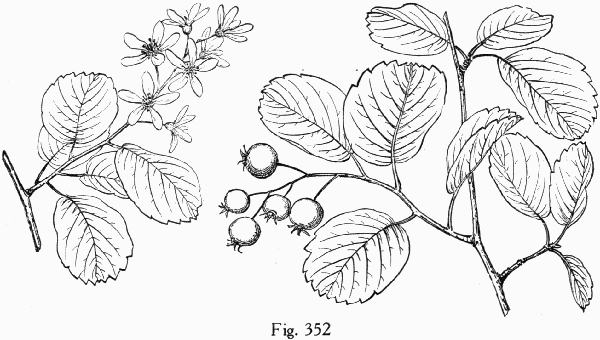
Leaves oblong-ovate to oval or ovate, or at the end of vigorous shoots broad-ovate or occasionally broad-obovate, rounded or rarely acute at apex, rounded or slightly cordate at base, and coarsely serrate only above the middle with straight teeth; when they unfold often tinged with red and sometimes floccose-pubescent below, usually soon glabrous, at maturity thin, dark green on the upper surface, pale and rarely pubescent on the lower surface, 1½′—2½′ long, and 1′—1½′ wide, with a thin midrib and about ten pairs of primary veins; petioles slender, at first glabrous or puberulous becoming glabrous, ½′—1′ in length. Flowers ½′—¾′ long, appearing when the leaves are about half grown on pedicels ⅙′—¼′ in length, in short crowded erect glabrous or pubescent racemes, their bracts and bractlets scarious, slightly villose; calyx-tube campanulate, glabrous or tomentose, the lobes ovate, long-acuminate, glabrous or tomentose on the outer surface, tomentose or rarely nearly glabrous on the inner surface, soon reflexed; petals oblong-obovate gradually narrowed or broad at the rounded apex, ⅙′—¼′ wide; summit of the ovary densely tomentose. Fruit [397] usually ripening in July, on pedicels ½′—¾′ long, in short nearly erect or spreading racemes, short-oblong or ovoid, dark blue, more or less covered with a glaucous bloom, ¼′ to nearly ½′ in diameter, sweet and succulent.
A tree, occasionally 30°—40° high, with a tall trunk 12′—14′ in diameter, small erect and spreading branches forming an oblong open head, and slender branchlets glabrous, pubescent or puberulous when they first appear, bright red-brown and usually glabrous during their first season, rather darker in their second year, and ultimately dark gray-brown; more often a large or small shrub. Winter-buds ovoid to ellipsoidal, acute or acuminate, dark chestnut-brown, glabrous or puberulous, ⅙′—¼′ long, scales of the inner ranks ovate, acute, brightly colored, coated with pale silky hairs, ½′—¾′ long. Bark about ⅛′ thick, smooth or slightly fissured, and light brown slightly tinged with red. Wood heavy, hard, close-grained, light brown. The nutritious fruit was an important article of food with the Indians of northwestern America, who formerly gathered and dried it in large quantities.
Distribution. Valley of the Yukon River (near Dawson) and Wrangell, Alaska, and southward to the coast region of British Columbia, and southward in Washington and Oregon possibly to northern California, ranging east in the United States to western Idaho, and probably to the northern Rocky Mountain region; its range, like that of the other species of western North America, still very imperfectly known.
7. CRATÆGUS. Hawthorn.
Trees or shrubs, with usually dark scaly bark, rigid terete more or less zigzag branchlets marked by oblong mostly pale lenticels, and by small horizontal slightly elevated leaf-scars, light green when they first appear, becoming red or orange-brown and lustrous or gray, rarely unarmed or armed with stout or slender short or elongated axillary simple or branched spines generally similar in color to that of the branches or trunk on which they grow, often bearing while young linear elongated caducous bracts, and usually producing at their base one or rarely two buds often developing the following year into a branch, a leaf, or a cluster of flowers, or sometimes lengthening into a leafy branch. Winter-buds small, globose or subglobose, covered by numerous imbricated scales, the outer rounded and obtuse at apex, bright chestnut-brown and lustrous, the inner accrescent, green or rose color, often glandular, soon deciduous. Leaves conduplicate in the bud, simple, generally serrate, sometimes 3-nerved, often more or less lobed, especially on vigorous leading branchlets, membranaceous to coriaceous, petiolate, deciduous; stipules often glandular-serrate, linear, acuminate, frequently bright-colored, deciduous, or on vigorous branchlets [398] often foliaceous, coarsely serrate, usually lunate and stalked and mostly persistent until autumn. Flowers pedicellate, in few or many-flowered simple or compound cymose corymbs terminal on short lateral leafy branchlets, with linear usually bright-colored often glandular caducous bracts and bractlets leaving prominent gland-like scars, the lower branches of compound corymbs usually from the axils of upper leaves; branches of the inflorescence mostly 3-flowered, the central flower opening before the others; calyx-tube usually obconic, 5-lobed, the lobes acute or acuminate and usually gland-tipped, rarely foliaceous, glandular-serrate or entire, green or reddish toward the apex, reflexed after the flowers open, persistent and often enlarged on the fruit, or deciduous; disk thin or fleshy, entire, lobed or slightly sulcate, concave or somewhat convex; petals imbricated in the bud, orbicular, entire or somewhat erose or rarely toothed at apex, white or rarely rose color, spreading, soon deciduous; stamens often variable in number in the same species by imperfect development, but normally 5 in 1 row and alternate with the petals, or 10 in 5 pairs in 1 row alternate with the petals, or 15 in 2 rows, those of the outer row in 5 pairs opposite the sepals and alternate with and rather longer than those of the inner row, or 20 in 3 rows, those of the inner row shorter and alternate with those of the 2d row, or 25 in 4 rows, those of the 4th row alternate with those of the 3d row; filaments broad at base, subulate, incurved, often persistent on the fruit; anthers pale yellow to nearly white, or pink to light or dark rose color or purple; ovary composed of 1—5 carpels inserted in the bottom of the calyx-tube and united with it; styles free, with dilated truncate stigmas, persistent on the mature carpels; ovules ascending; raphe dorsal; micropyle inferior. Fruit subglobose, ovoid or short-oblong, scarlet, orange-colored, red, yellow, blue, or black, generally open and concave at apex; flesh usually dry and mealy; nutlets 1—5; united below, more or less free and slightly spreading above the middle, thick-walled, rounded, acute, or acuminate at apex, full and rounded or narrowed at base, rounded or conspicuously ridged and grooved on the back, flattened, or nearly round when only 1, their ventral faces plane or plano-convex, in some species penetrated by longitudinal cavities or hollows, and marked by a more or less conspicuous hypostyle sometimes extending to below the middle or nearly to the base of the nutlet. Seed solitary by abortion, erect, compressed, acute, with a membranaceous light chestnut-brown coat; embryo filling the cavity of the seed; cotyledons plano-convex, radicle short, inferior.
Cratægus is most abundant in eastern North America, where it is distributed from Newfoundland to the mountains of northern Mexico, and is represented by a large number of arborescent and shrubby species. A few species occur in the Rocky Mountains and Pacific-coast regions, and in China, Japan, Siberia, central and southwestern Asia, and in Europe. The genus is still very imperfectly known in North America, and in the absence of sufficient information concerning them several arborescent species are necessarily excluded from the following enumeration. The beautiful and abundant flowers and showy fruits make many of the species desirable ornaments of parks and gardens, and several are cultivated. Of exotic species, the Old World Cratægus Oxyacantha L., and C. monogyna Jacq., early introduced into the United States as hedge plants, have now become naturalized in many places in the northeastern and middle states. Cratægus produces heavy hard tough close-grained red-brown heartwood and thick lighter colored usually pale sapwood; useful for the handles of tools, mallets, and other small articles.
The number of the stamens, although it differs on the same species within certain usually constant limits, and the color of the anthers, which appears to be specifically constant with one exception, afford the most satisfactory characters for distinguishing the species in the different groups.
Cratægus, from κράτος, is in reference to the strength of the wood of these trees.
[399]
CONSPECTUS OF THE NATURAL GROUPS OF THE NORTH AMERICAN ARBORESCENT SPECIES.
1. Nutlets without ventral cavities.
*Veins of the leaves extending to the points of the lobes only.
†Petioles short, usually slightly wing-margined above the middle, glandless or with occasional minute glands; leaves cuneate at base.
Corymbs compound, generally many-flowered; flowers appearing after the unfolding of the leaves; flesh of the fruit usually green or greenish yellow, dry and mealy.
Leaves coriaceous or subcoriaceous, rarely thin, dark green and shining above, usually serrate only above the middle, their veins thin except on vigorous shoots; fruit mostly subglobose to short-oblong; nutlets 1—5, thick, usually obtuse and rounded at the ends, prominently ridged on the back.
I. Crus-galli (page 400).
Leaves membranaceous or subcoriaceous, mostly acute, their veins prominent; fruit short-oblong to subglobose, often conspicuously punctate, ⅓′—1′ long; nutlets 2—5, prominently ridged on the back.
II. Punctatæ (page 422).
Corymbs simple, few-flowered; flowers appearing with or before the unfolding of the leaves; fruit scarlet, lustrous; flesh yellow, juicy, subacid; nutlets rounded and slightly grooved on the back.
III. Æstivales (page 434).
†Petioles elongated, slender, eglandular or occasionally glandular; corymbs many-flowered (few-flowered in one species each of Dilatatæ and Intricatæ).
++Leaves acute or acuminate at the ends, broad at base on one species; fruit not more than ⅝′ in diameter; flesh usually thin and dry.
IV. Virides (page 437).
++Leaves usually broad at base.
Fruit subglobose to short-oblong, often broader than high, red or green, often slightly 5-angled, pruinose; mature calyx raised on a short tube; flesh of the fruit dry and mealy; nutlets 5, grooved on the back.
V. Pruinosæ (page 449).
Fruit subglobose to short-oblong, ovoid or obovoid, generally longer than broad, rarely slightly pruinose, mature calyx sessile; flesh of the fruit dry and mealy; stamens 10, anthers rose color; leaves hairy above early in the season.
VI. Silvicolæ (page 453).
Fruit short-oblong to obovoid, red or scarlet; flesh of the fruit usually soft and juicy; anthers rose color or pink; leaves thin, at maturity glabrous below.
VII. Tenuifoliæ (page 456).
Fruit subglobose, oblong or obovoid, crimson, scarlet, or rarely yellow; flesh thick, occasionally succulent, and edible; nutlets usually 5, thin, pointed at the ends, mostly obscurely grooved or ridged on the back; corymbs tomentose or pubescent; leaves membranaceous to subcoriaceous, broad, rounded or cuneate at base, at maturity usually pubescent or tomentose below.
VIII. Molles (page 463).
Fruit short-oblong to obovoid, scarlet; flesh usually soft and juicy; nutlets 3—5, grooved and usually ridged on the back; corymbs glabrous or tomentose; leaves thin or rarely subcoriaceous, oblong-ovate or oval, more or less acutely lobed; anthers rose or purple; rarely white in shrubby species.
IX. Coccineæ (page 488).
Fruit subglobose to short-oblong, crimson, or red tinged with green, its calyx enlarged and prominent; nutlets 5; stamens 20; anthers rose color; leaves thin, at the end of vigorous shoots as broad or broader than long.
X. Dilatatæ (page 500).
++Leaves cuneate at base.
Corymbs many-flowered; leaves subcoriaceous; fruit subglobose, rarely short-oblong; nutlets 2 or 3, obtuse at the ends, conspicuously ridged on the back; corymbs glabrous or tomentose; leaves dark green and lustrous above.
XI. Rotundifoliæ (page 504).
[400]
Corymbs few-flowered (many-flowered in one species of Bracteatæ).
Fruit subglobose to short-oblong, greenish or yellowish; nutlets 3—5, usually rounded at the ends, conspicuously ridged on the back; leaves subcoriaceous, yellow-green.
XII. Intricatæ (page 508).
Fruit subglobose, red or orange-red; nutlets 3—5, slightly grooved on the back; stamens 20; anthers rose color; leaves thin, incisely lobed.
XIII. Pulcherrimæ (page 511).
Fruit subglobose to short-oblong, ½′—⅝′ long; nutlets 3—5, narrowed at the ends, prominently ridged on the back; corymbs villose; bracts large and conspicuous; calyx-lobes foliaceous; stamens 20; anthers yellow; leaves dark green, lustrous and scabrate above, their petioles sparingly glandular through their whole length.
XIV. Bracteatæ (page 513).
†Petioles long or short, leaves and corymbs glandular; corymbs usually simple, few-flowered; fruit subglobose to short-oblong or obovoid, green, orange, or red, flesh usually hard and dry; branchlets conspicuously zigzag.
XV. Flavæ (page 515).
**Veins of the leaves extending to the points of the lobes and to the sinuses; corymbs many-flowered; stamens usually 20.
Fruit depressed-globose to short-oblong, not more than ¼′ long, scarlet; nutlets 2—5, prominently ridged and often grooved on the back; anthers rose color or yellow.
XVI. Microcarpæ (page 530).
Fruit subglobose, ⅓′—½′ in diameter, blue or blue-black; nutlets 3—5, obtuse at the ends, slightly ridged on the back; anthers yellow; leaves cuneate at base, dark green and lustrous.
XVII. Brachyacanthæ (page 533).
2. Nutlets longitudinal cavities on their ventral faces; flowers in many flowered compound corymbs.
Fruit obovoid to subglobose or short-oblong, lustrous, orange or scarlet; nutlets 2 or 3, obtuse at the ends, prominently ridged on the back; leaves thin to subcoriaceous, mostly pubescent below.
XVIII. Macracanthæ (page 535).
Fruit short-oblong to subglobose, black; rarely chestnut color; nutlets 5, obtuse at the ends, obscurely ridged on the back; stamens 10—20; anthers pale rose color.
XIX. Douglasianæ (page 545).
Fruit subglobose, short-oblong to ovoid, scarlet; nutlets 3—5, acute at the ends, ridged on the back, ventral cavities obscure; leaves scabrate above.
XX. Anomalæ (page 547).
I. CRUS-GALLI.
CONSPECTUS OF THE ARBORESCENT SPECIES.
Corymbs, leaves, and young branchlets slightly hairy while young, soon becoming glabrous (glabrous while young in 1, 4, 6, 9, and 13).
Stamens 10.
Anthers rose color or purple.
Leaves glabrous, obovate-cuneiform, coriaceous, their veins within the parenchyma; fruit short-oblong to subglobose, dull red often covered with a glaucous bloom.
1. C. Crus-galli (A).
Leaves oblong to ovate, usually acute, coriaceous; fruit short-oblong to subglobose, dark crimson, lustrous, the flesh red and juicy.
2. C. Canbyi (A).
Leaves obovate, usually short-pointed at the broad apex, subcoriaceous; fruit short-oblong to obovoid, bright scarlet.
3. C. peoriensis (A).
Leaves oblong-obovate to oval, or broadly ovate, their petioles glandular with minute stipitate glands; fruit short-oblong to subglobose, orange-red, villose until nearly fully grown.
4. C. fecunda (A).
Anthers yellow.
Leaves subcoriaceous.
Leaves oval to elliptic, acute or acuminate; fruit short-oblong, green tinged with red.
5. C. regalis (C).
[401]
Leaves glabrous, obovate, acute, acuminate, or rounded at apex; fruit short-oblong, dull dark crimson.
6. C. arduennæ (A).
Leaves obovate to oblong-cuneiform, rounded or acute at apex; fruit subglobose to obovoid, dull red, or green flushed with red.
7. C. algens (A, C).
Leaves broadly oval to oblong, rounded or acute or short-pointed at apex; fruit subglobose, dull green tinged with red or cherry-red.
8. C. Palmeri (C).
Leaves thin.
Leaves ovate to obovate, acute, dull green above; fruit subglobose, flattened at the ends, dark dull crimson.
9. C. erecta (A).
Leaves oval to oblong-obovate, acute or acuminate, lustrous above; fruit short-oblong, rounded at the ends, bright scarlet.
10. C. acutifolia (A).
Stamens 20.
Anthers rose color.
Leaves broad-obovate, coarsely serrate; corymbs many-flowered; anthers large, bright rose color; fruit green tinged with dull red.
11. C. Bushii (C).
Leaves narrow-obovate, finely serrate; corymbs few-flowered; anthers small pale rose color; fruit crimson, lustrous.
12. C. Cocksii (C).
Anthers yellow.
Leaves oblong-obovate to oblanceolate; calyx-lobes slender, elongated.
13. C. arborea (C).
Leaves oblong-obovate; calyx-lobes short and broad.
14. C. uniqua (C).
Corymbs, leaves, and branchlets more or less villose or pubescent through the season.
Stamens 10.
Anthers rose color or pink.
Leaves finely crenately serrate, scabrate above; anthers rose color.
15. C. Engelmannii (A).
Leaves coarsely serrate with straight teeth, glabrous above; anthers pink.
16. C. montivaga (C).
Anthers yellow (doubtful in 17 and 18).
Leaves oval, oblong-obovate or elliptic, acute, thin to subcoriaceous; fruit globose to subglobose, orange-red.
17. C. denaria (C).
Leaves obovate to obovate-cuneiform, rounded or acute at apex, thin; fruit short-oblong, dark red, more or less pruinose.
18. C. signata (C).
Stamens 20.
Anthers rose color.
Leaves oblong-obovate, acute, scabrate; fruit short-oblong, dull green tinged with red, slightly pruinose.
19. C. edita (C).
Leaves oblong to obovate-cuneiform, rounded and obtuse or occasionally acute at apex, glabrous or scabrate above; fruit globose to subglobose or short-oblong, dark red.
20. C. tersa (C).
Anthers yellow.
Leaves oblong-obovate, rounded or gradually narrowed at apex, subcoriaceous, pale below; fruit subglobose, orange color with a red cheek.
21. C. berberifolia (C).
Leaves oblong or obovate-cuneiform, rounded and obtuse or rarely acute at apex, coriaceous, glabrate or slightly scabrate above; fruit subglobose, orange or yellow with a red cheek.
22. C. edura (C).
Leaves oblong to obovate-cuneiform, rounded or acute at apex, subcoriaceous, glabrous or glabrate above, pale below; fruit ellipsoid to short-oblong, yellow.
23. C. crocina (C).
Leaves oblong to obovate-cuneiform, rounded or obtuse or rarely truncate at apex, coriaceous, scabrate above; fruit globose to subglobose, bright red or scarlet.
24. C. fera (C).
Leaves obovate, acute, thin to subcoriaceous; fruit subglobose to short-oblong, somewhat flattened at apex, bright orange-red.
25. C. Mohrii (C).
[402]
1. Cratægus Crus-galli L. Cock-spur Thorn.
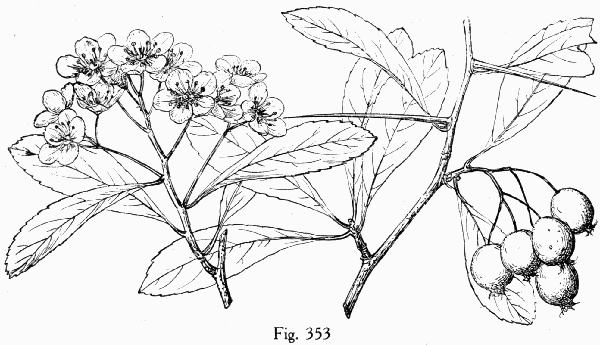
Leaves glabrous, obovate, acute or rounded at apex, cuneate and gradually narrowed to the slender entire base, and sharply serrate above with minute appressed usually gland-tipped teeth, when they unfold tinged with red, membranaceous and nearly fully grown when the flowers open about the 1st of June, and at maturity thick and coriaceous, dark green and lustrous above, pale below, reticulate-venulose, 1′—4′ long, and ¼′—1′ wide, with a slender midrib, and primary veins within the parenchyma; turning bright orange and scarlet in the autumn before falling; petioles stout, ½′—¾′ in length; leaves at the end of vigorous shoots acute or acuminate, coarsely serrate, often 5′—6′ long. Flowers ⅔′ in diameter, on slender pedicels, in many-flowered glabrous corymbs; calyx-tube narrowly obconic, glabrous, the lobes linear-lanceolate, entire or minutely glandular-serrate; stamens 10; anthers rose color; styles usually 2, surrounded at base by tufts of pale hairs. Fruit ripening late in October and persistent on the branches until spring, short-oblong to subglobose, ½′ long, dull red often covered with a glaucous bloom; calyx little enlarged; nutlets usually 2, full and rounded at the ends, with a high rounded grooved ridge, ¼′ long.
A tree, sometimes 25° high, with a trunk a foot in diameter, covered with dark brown, scaly bark, stout rigid spreading branches forming a broad round-topped head, and glabrous, light brown or gray branchlets armed with stout straight or slightly curved sharp-pointed chestnut-brown or ashy gray spines 3′—4′ long and becoming on the trunk and large branches 6′—8′ in length and furnished with slender lateral spines.
Distribution. Usually on the slopes of low hills in rich soil; valley of the St. Lawrence River near Montreal, southward to Delaware and along the Appalachian foothills to North Carolina, and westward through western New York and Pennsylvania to southern Michigan.
A form, var. pyracanthifolia Ait., with narrower elliptic to obovate leaves acute or rounded at apex, and slightly pubescent while young on the upper side of the midrib, and with rather smaller flowers and smaller bright red fruit, is not rare in eastern Pennsylvania and northern Delaware; a form, var. salicifolia Ait., cultivated in European gardens, but not known in a wild state, with thinner narrower and more elongated lanceolate or oblanceolate leaves, should also probably be referred to this species. A form, var. oblongata Sarg., with rather brighter colored oblong fruit often 1′ long, and nutlets acute at the ends, is not rare near Wilmington, Delaware, and at Durham, Bucks County, Pennsylvania. A form, var. capillata Sarg., with thinner leaves, slightly villose corymbs, and 1 or rarely 2 nutlets, occurs near Wilmington, Delaware.
[403]
Often cultivated as an ornamental plant and for hedges in the eastern United States, and very frequently in the countries of eastern and northern Europe.
2. Cratægus Canbyi Sarg.
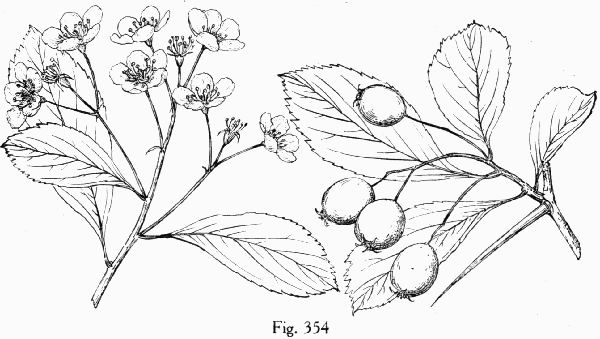
Leaves oblong-ovate to ovate, obovate or oval, acute, acuminate or rarely rounded at apex, gradually narrowed, cuneate and entire at base, and coarsely often doubly serrate above the middle, more than half grown when the flowers open about the 1st of May and then glabrous or very rarely with a few scattered hairs on the upper side of the midrib and on the corymbs, and at maturity coriaceous, glabrous, dark green and very lustrous above, pale and dull below, 2′—2½′ long, and 1′—1½′ wide, with a thick pale midrib, and 4 or 5 pairs of remote primary veins conspicuous on the lower surface; petioles glandular with scattered dark red persistent glands, red below the middle, ½′—¾′ in length; leaves at the end of vigorous shoots often deeply and irregularly divided into broad acute lobes, and frequently 3′—4′ long and 2′ wide. Flowers ⅝′ in diameter, on long slender pedicels, in broad loose many-flowered long-branched corymbs; calyx-tube narrowly obconic, the lobes entire or serrate with minute scattered glandular teeth; stamens usually 10, occasionally 12 or 13; anthers, small, rose color; styles 3—5. Fruit ripening in October but persistent until after the beginning of winter, on elongated slender stems, in loose many-fruited drooping clusters, short-oblong to subglobose, rounded at the ends, with a distinct depression at the insertion of the stalk, lustrous, dark crimson, marked by occasional large pale dots, ½′—⅝′ long; calyx-lobes reflexed, closely appressed, often deciduous before the fruit ripens; flesh thick, bright red, very juicy; nutlets 3—5, with a broad rounded ridge, bright chestnut-brown, about ¼′ long.
A bushy tree, sometimes 20° high, with a trunk 12′—18′ in diameter, large ascending wide-spreading branches forming a broad open irregular head occasionally 30°—35° in diameter, and glabrous chestnut-brown branchlets armed with thick usually straight chestnut-brown spines ¾′—1½′ long.
Distribution. Hedges and thickets near Wilmington, Newcastle County, Delaware; shores of Chesapeake Bay (near Perryville, Cecil County), Maryland, and in eastern Pennsylvania.
3. Cratægus peoriensis Sarg.
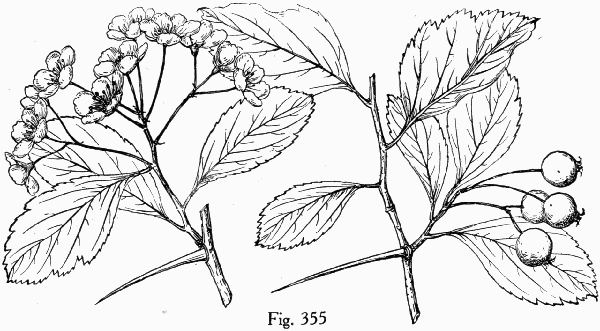
Leaves obovate, short-pointed or occasionally rounded at the broad apex, gradually narrowed, cuneate and entire below, sharply and often doubly serrate usually only above the middle, and sometimes irregularly lobed with short broad terminal lobes, when they unfold [404] villose above, especially toward the base of the midrib, and bright bronze color, becoming at maturity thick and firm, glabrous, dark green and very lustrous above, pale below, 1½′—2′ long, and ¾′ wide, with 4 or 5 pairs of thin primary veins conspicuous on the under side and extending obliquely from the slender midrib to the end of the lobes; petioles usually about ¼′ in length, slightly glandular above the middle, and covered when they first appear with short pale deciduous hairs; leaves at the end of vigorous shoots deeply divided into broad acute lateral lobes, 2′—3′ long, and 1½′ wide. Flowers opening in May and June, cup-shaped, about ½′ in diameter, on slender elongated pedicels, in broad loose glabrous corymbs; calyx-tube narrowly obconic, the lobes narrow acuminate, entire or irregularly glandular-serrate, pubescent below the middle on the inner surface; stamens 10; anthers small, rose color; styles 2 or 3, surrounded at base by a narrow ring of pale tomentum. Fruit ripening early in October, on slender elongated pedicels, in drooping many-fruited clusters, short-oblong or obovoid, rounded at the ends, slightly depressed at the insertion of the stalk, bright scarlet, marked by many small dark dots, ½′—¾′ long; calyx-lobes enlarged, erect, incurved and persistent; flesh thick, nearly white, firm and dry; nutlets 2 or 3, about ¼′ long.
A tree, 20°—25° high, with a trunk occasionally 1° in diameter, stout spreading branches forming a broad flat-topped symmetrical head, and slender orange-brown branchlets armed with straight or slightly curved thin dull chestnut-brown spines 2′—2½′ long.
Distribution. Open woods, the moist borders of streams and depressions in the prairie, and on hillsides in clay soil, Short and Peoria Counties, Illinois.
4. Cratægus fecunda Sarg.
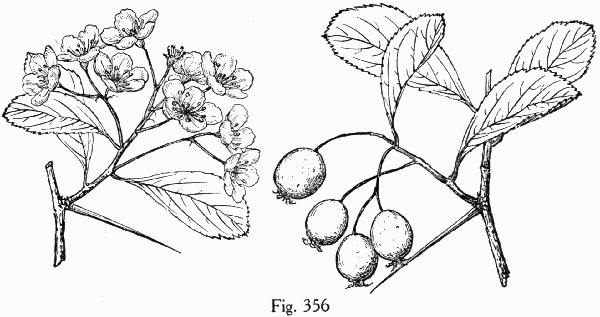
Leaves oblong-obovate to oval, or broad-ovate, acute or rarely rounded and short-pointed at apex, gradually or abruptly narrowed at base, and coarsely and usually doubly serrate except toward the base, when they unfold dark green, lustrous and roughened above by short pale appressed caducous hairs and pale yellow-green and villose on the midrib and primary veins below, about half grown when the flowers open early in May and at maturity thin and firm in texture, dark green and lustrous on the upper surface, pale yellow-green on the lower surface, 2′—2½′ long, and 1½′—2′ wide, with a stout midrib and remote primary veins after midsummer often bright red below; turning late in the autumn to brilliant shades of orange or scarlet or deep rich bronze color; petioles often glandular, at first coated with pale hairs, soon glabrous, dull red at maturity, ½′—¾′ in length; leaves at the end of vigorous shoots often slightly lobed with short broad acute lobes, convex by the hanging down of the margins, 3′—4′ long, and 2′—3′ wide. Flowers ¾′ in diameter, on slender pedicels, in wide many-flowered slightly villose corymbs, with large glandular bracts and bractlets; calyx-tube [405] narrowly obconic, more or less villose, the lobes elongated, acute, coarsely serrate with stipitate dark red glands, villose on the inner surface; stamens usually 10, occasionally 12—15; anthers small, dark rose color; styles 2 or 3. Fruit on slender pedicels often ½′ long, in broad many-fruited drooping clusters, short-oblong to subglobose, full and rounded at the ends, covered until nearly fully grown with long soft pale hairs, and at maturity orange-red marked by many small dark dots, ⅞′—1′ long; calyx-lobes linear-lanceolate, erect and incurved, coarsely glandular-serrate above the middle, dark red on the upper side toward the base; flesh very thick, firm and hard, pale green; nutlets 2 or 3, ⅓′ long.
A tree, 20°—25° high, with a trunk 10′—12′ in diameter, covered with dark brown scaly bark, stout wide-spreading branches forming a broad symmetrical round-topped rather open head, and stout branchlets covered at first with soft matted pale hairs, soon glabrous, light orange-green, becoming ashy gray in their second season, and armed with numerous very slender straight or slightly curved chestnut-brown shining spines 2′—2½′ long.
Distribution. Rich woodlands near Allenton, St. Louis County, Missouri, and on the bottom-lands of the Mississippi River, St. Claire County, Illinois.
5. Cratægus regalis Beadl.
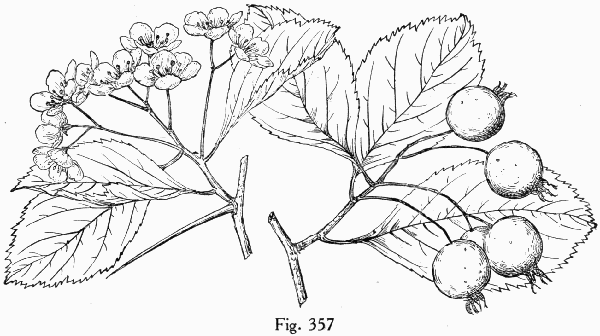
Leaves oval to elliptic, acute or acuminate at apex, gradually narrowed and concave-cuneate at the entire base, and coarsely, often doubly serrate above with acute straight or [406] incurved teeth, when they unfold tinged with red and sparingly villose above and on the midrib below, soon glabrous, nearly fully grown when the flowers open at the end of April, becoming at maturity thick and firm or subcoriaceous, bright green and lustrous on the upper surface, pale on the lower surface, 1½′—2½′ long, and 1′—1¼′ wide, with a stout yellow midrib and primary veins; turning in the autumn yellow, orange, and brown; petioles stout, reddish brown toward the base, about 1′ in length; leaves at the end of vigorous shoots broadly oval, coarsely serrate, mostly slightly incisely lobed, 3′—4′ long, and 1½′—2′ wide, with a thicker midrib and veins. Flowers ½′ in diameter, on long slender pedicels, in broad many-flowered corymbs; calyx-tube narrowly obconic, the lobes linear-lanceolate, entire or remotely serrate; stamens 10; anthers yellow; styles 2 or 3. Fruit ripening in September or October, on slender stems, in few-fruited drooping clusters, short-oblong, ⅜′—½′ long, green tinged with red; calyx-lobes slightly enlarged, reflexed and often deciduous from the ripe fruit; flesh yellow, dry and mealy; nutlets 2 or 3, about ¼′ long.
A tree, often 20° high, with a tall trunk 8′—12′ in diameter, stout ascending or spreading branches forming a broad symmetrical head, and stout glabrous orange-brown branchlets armed with stout or slender nearly straight spines 1½′—2′ long.
Distribution. Low woods, northwestern Georgia and northern Alabama; common in the flat woods near Rome, Floyd County, Georgia.
6. Cratægus arduennæ Sarg.
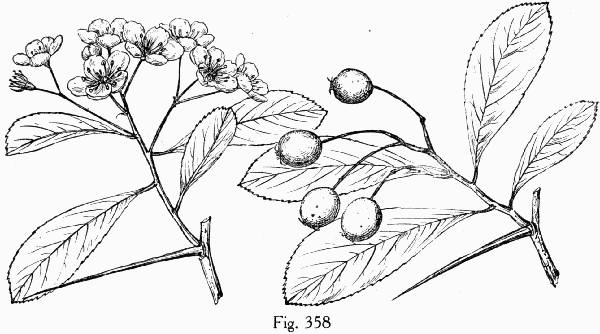
Leaves obovate, acute, acuminate or rounded at apex, gradually narrowed from near the middle to the entire cuneate base, and finely crenulate-serrate above with glandular teeth, glabrous and deeply tinged with red as they unfold, nearly fully grown when the flowers open at the end of May or early in June, and at maturity subcoriaceous, dark green and very lustrous above, pale below, 1½′—2½′ long, and ½′—1′ wide, with a slender yellow midrib, and obscure primary veins mostly within the parenchyma; petioles stout, occasionally sparingly glandular, ¼′—⅝′ in length; leaves at the end of vigorous shoots mostly elliptic, short-pointed, coarsely serrate, usually laterally lobed, and often 2½′—3′ long, and 1½′—2′ wide, with a stout midrib and prominent slender primary veins. Flowers ½′—⅝′ in diameter, on long slender pedicels, in broad many-flowered glabrous corymbs; calyx-tube narrowly obconic, the lobes abruptly narrowed from the base, linear, acuminate, tipped with small dark red glands, entire or slightly and irregularly serrate; stamens 5—12; usually 10; anthers small, pale yellow; styles 1 or 2. Fruit on slender pedicels, in drooping many-fruited clusters, short-oblong, dull dark crimson, marked by large pale dots, about ½′ long, and ⅜′—½′ in diameter; calyx only slightly enlarged, the lobes reflexed and appressed; flesh thin and [407] yellow; nutlet 1, gradually narrowed from the middle to the obtuse ends, grooved and irregularly ridged on the dorsal face, or 2 and then broad, rounded at the ends, with a high wide rounded ridge, about 5/16′ long.
A tree, sometimes 20° high, with a trunk 8′—12′ in diameter, covered with smooth light gray bark, spreading branches forming a round-topped head, and slender slightly zigzag branchlets light orange-green when they first appear, becoming dark purple and lustrous and ultimately grayish brown, and armed with many slender straight or slightly curved dark purple-brown shining spines 1′—2′ long.
Distribution. Central and northern Missouri, northern Illinois, northeastern Indiana (Allen County), southeastern Michigan, southern Ontario, through Ohio to western New York (South Buffalo, Erie County), and in eastern Pennsylvania (Berks County).
7. Cratægus algens Beadl.
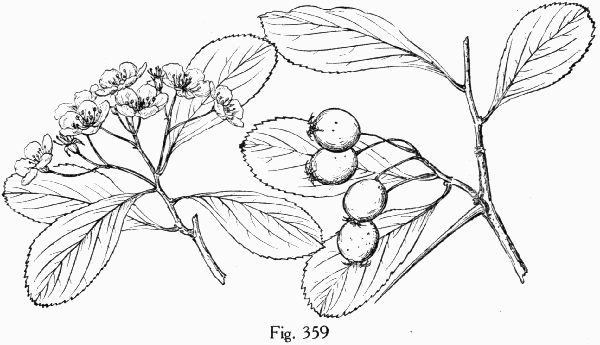
Leaves obovate to oblong or elliptic, rounded or acute at apex, gradually narrowed and concave-cuneate at the entire base, sharply serrate above, villose on the upper side of the midrib and nearly full grown when the flowers open at the end of May, and at maturity glabrous, subcoriaceous, dark green and lustrous above, pale below, 1½′—2′ long, and ¾′—1¼′ wide, with a thin midrib and slender primary veins; turning in the autumn to shades of orange, yellow, and brown; petioles slender, rarely glandular with minute glands, about ¼′ in length; leaves at the end of vigorous shoots oblong-obovate, rounded or abruptly short-pointed at apex, coarsely serrate, and often 3′ long and 1½′ wide. Flowers ½′ in diameter, on slender elongated pedicels, in broad many-flowered glabrous corymbs; calyx-tube narrowly obconic, glabrous, the lobes slender, acuminate, entire or remotely serrate; stamens 10; anthers yellow; styles 1-3. Fruit ripening in September and October, on slender pedicels, in few-fruited hanging clusters, subglobose to obovoid, ⅜′—½′ in diameter, dull red, or green flushed with red, ⅜′—½′ long; calyx somewhat enlarged, with reflexed persistent lobes; nutlets usually 1 or 2, prominently ridged on the back, ¼′—⅜′ long.
A tree, 15°—18° high, with a short trunk occasionally 7′—8′ in diameter, stout ascending wide-spreading branches forming a wide round-topped head, and stout glabrous bright chestnut-brown branchlets becoming gray in their second year, and armed with stout nearly straight spines 1′—2′ long.
Distribution. Borders of woods and fields; western North Carolina to northern Georgia and central Alabama (near Selma, Dallas County, common), and to eastern Tennessee; one of the commonest species in the neighborhood of Asheville, Buncombe County, North Carolina.
[408]
8. Cratægus Palmeri Sarg.
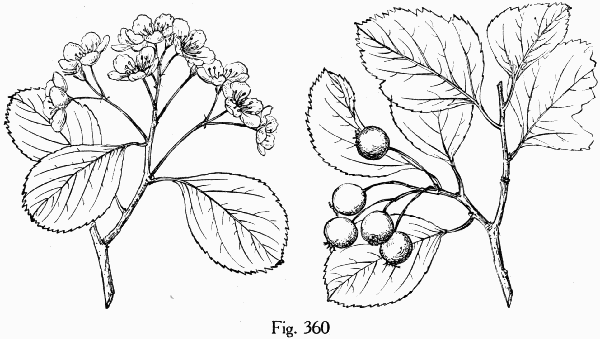
Leaves broadly oval to oblong, rounded, acute or short-pointed at apex, gradually narrowed and cuneate at the entire base, and coarsely serrate above with straight gland-tipped teeth, nearly fully grown when the flowers open during the first week in May, and then very thin, dark green and lustrous above, pale bluish green below, and at maturity coriaceous, dark green and lustrous on the upper surface, paler on the lower surface, 1½′—2′ long, and 1¼′—1¾′ wide, with a slender yellow midrib and 4 or 5 pairs of very thin primary veins; petioles stout, rose-colored in the autumn, about ⅜′ in length; leaves at the end of vigorous shoots oblong-ovate to elliptic, usually acute, coarsely serrate, occasionally laterally lobed, glandular at base, 2½′—3′ long, and 1½′—2′ wide. Flowers about ½′ in diameter, on slender pedicels, in many-flowered corymbs; calyx-tube narrowly obconic, the lobes slender, acuminate, tipped with small dark glands, entire or slightly serrate; stamens 10; anthers pale yellow; styles 3, surrounded at base by a thin ring of pale tomentum. Fruit ripening in October, on slender elongated pedicels, in few-fruited drooping clusters, subglobose, dull green tinged with red or cherry-red, marked by large pale dots, about ⅓′ in diameter; calyx sessile, with erect and incurved lobes mostly persistent on the ripe fruit; nutlets 3, thin, acute at the ends, slightly and irregularly ridged on the back with a low grooved ridge, ¼′—5/16′ long.
A tree, sometimes 25° high, with a trunk often a foot in diameter, covered with smooth pale bark, stout wide-spreading branches forming a broad round-topped symmetrical head, and slender nearly straight glabrous, bright chestnut-brown branchlets armed with thin straight dark red-brown shining spines ¾′—3′ long.
Distribution. Southwestern Missouri, usually in low rich soil; common near Carthage and Webb City, Jasper County, and near Noel, McDonald County.
9. Cratægus erecta Sarg.
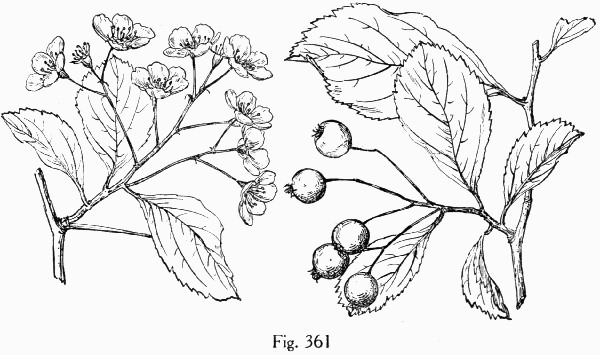
Leaves oval to obovate, acute and short-pointed at apex, cuneate and entire at base, and finely glandular-serrate, when they unfold often villose with a few short caducous pale hairs on the upper side of the midrib, nearly fully grown when the flowers open early in May, and at maturity thin and firm in texture, dark dull green on the upper surface, pale on the lower surface, 1½′—2′ long, and 1′—1¼′ wide, with a slender midrib, and thin prominent primary veins; in the autumn turning dull orange color; petioles slender, glandular with minute dark glands, usually dark red after midsummer, ¼′—½′ in length; leaves at the end of vigorous shoots often nearly orbicular, coarsely serrate with broad nearly straight glandular teeth, and sometimes 3′ long and 2½′ wide. Flowers ½′—⅝′ in diameter, on slender [409] pedicels, in broad loose many-flowered glabrous corymbs; calyx-tube narrowly obconic, the lobes narrow, elongated, acuminate, entire or occasionally obscurely and irregularly serrate; stamens usually 10, occasionally 11—13; anthers small, pale yellow; styles 3 or 4, surrounded at base by a narrow ring of short pale hairs. Fruit on elongated pedicels, in few-fruited drooping clusters, subglobose and usually a little longer than broad, flattened at the ends, dark dull crimson marked by occasional dark-colored dots, ¼′—⅓′ long; calyx-tube short, the lobes closely appressed, gradually narrowed from a broad base and usually persistent on the ripe fruit; nutlets 3 or 4, with a broad high grooved ridge, 3/16′ long.
A tree, 25°—40° high, with a trunk 1°—3° in diameter, thick ascending branches forming a wide open rather symmetrical head, and bright chestnut-brown or orange-brown ultimately dark brown spreading branchlets armed with thin straight chestnut-brown spines 1′—2′ long.
Distribution. Rich bottom-lands of the Mississippi River, St. Claire County, Illinois (east St. Louis, near Fish Lake, and Kahokia); banks of Desperes River, south St. Louis, St. Louis County, and Osage, Cole County, Missouri.
10. Cratægus acutifolia Sarg.
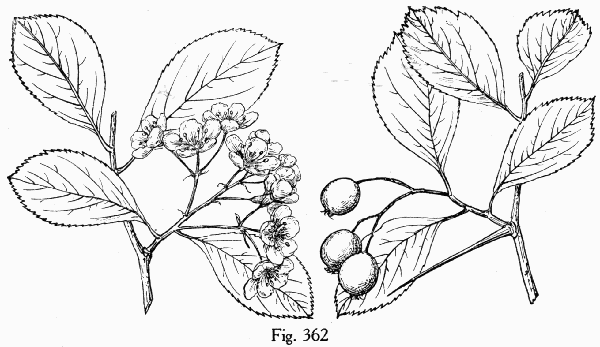
Leaves oval to oblong-obovate, acute or acuminate or rarely rounded at apex, cuneate at the usually entire base, finely crenulate-serrate often only above the middle with glandular teeth, nearly fully grown when the flowers open about the 10th of May, and then membranaceous, and lustrous above, with occasional short scattered pale caducous hairs on the upper side of the midrib, and at maturity thin and firm, dark green and lustrous above, pale yellow-green below, about 1½′ long, and 1′ wide, with a slender light yellow midrib and about 4 or 5 pairs of thin primary veins; petioles glandular when they first appear with minute dark glands, ¼′—½′ in length; leaves at the end of vigorous shoots frequently divided at apex into 2 or 3 pairs of short acute lobes, and often 3′ long and 2′ wide. Flowers ½′ in diameter, on slender pedicels, in many-flowered compact corymbs; calyx-tube narrowly obconic, the lobes lanceolate, acuminate, entire or obscurely and irregularly glandular-serrate; stamens 10; anthers small, pale yellow; styles 2 or 3. Fruit ripening and falling at the end of September, on slender pedicels ½′—¾′ long, in few-fruited drooping clusters, short-oblong, full and rounded at the ends, bright scarlet, marked by occasional dark dots, ½′ long; calyx-tube prominent, with closely appressed lobes often deciduous before the fruit ripens; nutlets 2 or 3, with a broad rounded ridge, about 3/16′ long.
[410]
A tree, often 30° high, with a trunk 18′ in diameter, stout wide-spreading branches forming a symmetrical round-topped rather open head, and stout bright chestnut-brown branchlets dark gray-brown in their second year, and occasionally armed with scattered thin straight chestnut-brown spines 1′—2′ long.
Distribution. Open woods; banks of the Desperes River near Carondelet, St. Louis County, Missouri; in St. Claire County, Illinois (north of stock yards, East St. Louis, and near Kahokia).
11. Cratægus Bushii Sarg.
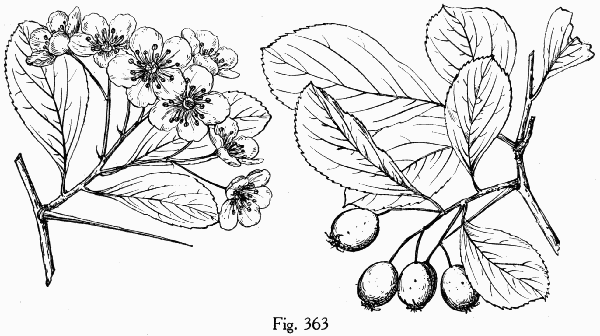
Leaves obovate, broad and rounded or acute at apex, or elliptic and acute, gradually narrowed from near the middle to the cuneate entire base, and coarsely serrate above, when they unfold dark green on the upper surface, pale on the lower surface, and villose with short white hairs on both sides of the midrib and veins, nearly fully grown when the flowers open at the end of April, and at maturity coriaceous, lustrous, glabrous, 1¼′—1½′ long, and ½′—1′ wide, with a stout yellow midrib and few slender prominent primary veins; petioles [411] villose early in the season, becoming glabrous, usually about ½′ in length; leaves at the end of vigorous shoots usually elliptic, acute, coarsely serrate, frequently 3′ long and 1½′ wide, with stouter and more broadly winged petioles. Flowers ¾′—1′ in diameter, on slender pedicels, in broad many-flowered glabrous corymbs; calyx-tube broadly obconic, glabrous, the lobes elongated, linear-lanceolate, entire or occasionally slightly dentate; stamens 20; anthers large, bright rose color; styles two or three, surrounded at base by conspicuous tufts of white hairs. Fruit ripening late in October or in November, on slender pedicels about ½′ long, in few-fruited drooping clusters, short-oblong, green tinged with dull red, ⅓′ long, with only slightly enlarged erect and incurved calyx-lobes mostly deciduous before the fruit ripens; flesh thin, green, dry and hard; nutlets 2 or 3, with a high rounded ridge, ¼′ long.
A tree, 15°—20° high, with a trunk 8′—10′ in diameter, covered with dark scaly bark, small spreading branches forming a broad open irregular head, and nearly straight dull chestnut-brown branchlets gray-brown in their second year, and unarmed or sparingly armed with stout straight chestnut-brown spines 1½′—1¾′ long.
Distribution. Rich upland woods near Fulton, Hemstead County, southern Arkansas; Chopin, Natchitoches Parish, near Winn, Winnfield Parish, and Lake Charles, Calcasieu Parish, Louisiana; in the neighborhood of Marshall, Harris County, Texas.
12. Cratægus Cocksii Sarg.
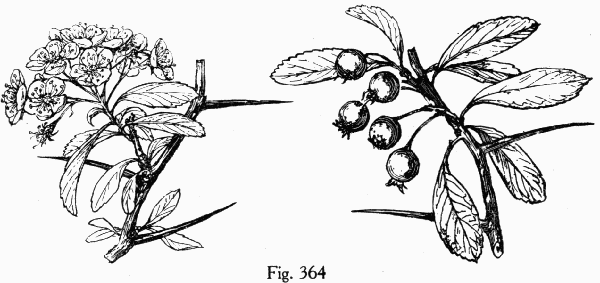
Leaves oblong-obovate, acute or rounded at apex, gradually narrowed and cuneate at base, finely serrate above the middle with straight acuminate teeth, glabrous, dark green and lustrous above, dull and paler below, 1′—1¼′ long, and ¼′—½′ wide, with a slender midrib, and primary veins mostly within the parenchyma; petioles slender, about ⅙′ in length; leaves at the end of vigorous shoots broad-obovate, rounded or abruptly short-pointed at apex, thicker, more coarsely serrate, often 1½′ long and 1′ wide. Flowers ½′—¾′ in diameter, on slender pedicels, in compact few-flowered glabrous corymbs; calyx-tube broadly obconic, glabrous, the lobes oblong-ovate, gradually narrowed and acuminate, entire, sparingly villose on the inner surface; stamens 20, small, pale rose color; styles 2 or 3, surrounded at base by clusters of white hairs. Fruit ripening in October, on slender pedicels about ⅓′ in length, in few-fruited clusters, short-oblong to slightly obovoid, crimson, lustrous, ⅓′—½′ long, with spreading calyx-lobes mostly deciduous from the ripe fruit; nutlets 2 or 3, obovoid, acute at apex, rounded at base, prominently ridged on the back, ⅓′ long.
A slender tree, 20°—25° high, with a tall trunk 4′—6′ in diameter, with dark red-brown bark covered with small closely appressed scales, smooth slender drooping branches forming a broad open head, and slender bright red-brown pendulous branchlets becoming gray in their second year, and armed with straight slender dark chestnut-brown lustrous spines 1¼′—1¾′ in length.
[412]
Distribution. Low rich woods at the marble quarry near Winnfield, Winn Parish, Louisiana.
Distinct in the Crus-galli Group in its head of slender pendulous branches.
13. Cratægus arborea Beadl.
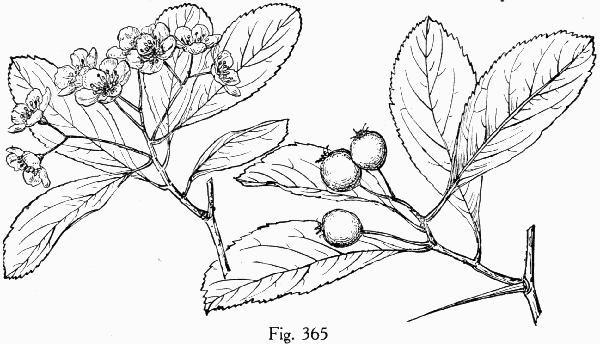
Leaves obovate to oblanceolate, narrowed, acute or rounded at apex, gradually narrowed and concave-cuneate at the long tapering entire base, and finely serrate above the middle with minute straight teeth, nearly fully grown when the flowers open the middle of April and then glabrous, and at maturity subcoriaceous, bright green and lustrous above, pale below, 1¾′—2′ long, and about ¾′ wide; turning in the autumn orange, yellow, and brown; petioles ⅓′—⅔′ in length; leaves at the end of vigorous shoots coarsely serrate, occasionally slightly lobed, and often 3′ long and 1½′ wide. Flowers ½′ in diameter, on slender pedicels, in broad many-flowered glabrous corymbs; calyx narrowly obconic, glabrous, the lobes slender, elongated, acuminate, slightly serrate; stamens 20; anthers pale yellow; styles usually 2. Fruit ripening in September and October, globose to subglobose, ¼′—⅓′ in diameter, red, the calyx enlarged, with elongated coarsely glandular-serrate reflexed lobes; nutlets usually 2, about ¼′ long.
A tree, sometimes 30° high, with a trunk 12′—18′ in diameter, spreading or ascending branches forming a broad handsome head, and branchlets orange-green in their first season, becoming reddish in their first winter, and usually unarmed.
Distribution. In open woods usually in clay soil near Montgomery, Montgomery County, Alabama.
14. Cratægus uniqua Sarg.
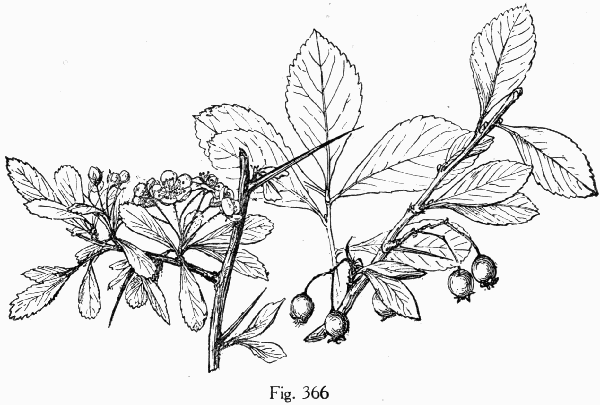
Leaves oblong-obovate, acute or occasionally rounded at apex, gradually narrowed to the long cuneate base, and finely serrate above the middle with straight or incurved glandular teeth, more than half grown and sparingly villose on the upper side of the midrib when the flowers open the middle of April, and at maturity glabrous, dark green and lustrous above, paler below, 1′—1½′ long, and ½′—¾′ wide, with a thin midrib, and slender primary veins mostly within the parenchyma; petioles slender, glabrous, ⅓′—½′ in length; leaves at the end of vigorous shoots broad-obovate, rounded or acute at apex, coarsely serrate, 2′—2½′ long, and 1′—1¼′ wide. Flowers ⅖′—½′ in diameter, on slender pedicels, in mostly 5—8-flowered glabrous corymbs; calyx-tube narrowly obconic, the lobes short and broad, acuminate, entire or slightly dentate near the middle, sparingly villose on the inner surface; stamens 20; anthers small, nearly white; styles 2 or 3. Fruit on slender drooping pedicels, short-oblong, rounded at the ends, dull red, about ½′ long and ⅓′ thick; calyx prominent, with [413] reflexed closely appressed persistent lobes; flesh thin, dry and hard; nutlets 2 or 3, broad and rounded at base, narrowed at apex, about ¼′ long.
A tree, 18°—20° high, with a slender stem covered with close dark slightly ridged bark, small wide-spreading branches forming a flat-topped head, and slender slightly zigzag orange or red-brown branchlets unarmed, or armed with few or many straight or slightly curved dark chestnut-brown shining spines ½′—1′ in length.
Distribution. Woods in low sandy soil; eastern Texas (near Marshall, Harrison County, and Livingston, Polk County).
15. Cratægus Engelmannii Sarg.
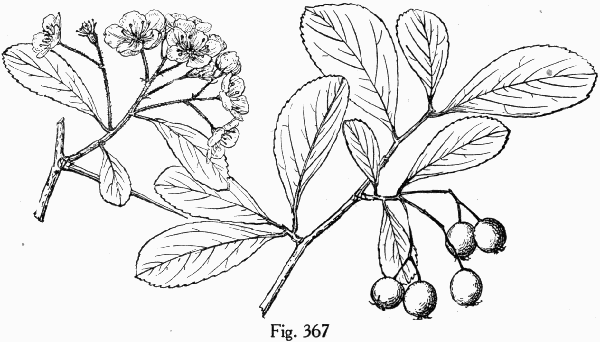
Leaves oblong-obovate or rarely elliptic, rounded or often short-pointed and acute at apex, gradually narrowed or entire below, finely crenulate-serrate usually only above the middle and generally only at the apex, nearly fully grown and roughened on the upper surface by short rigid pale hairs when the flowers open about the middle of May, and at maturity [414] coriaceous, dark green, lustrous and scabrate above, pale below, and pilose on both surfaces of the slender midrib and obscure primary veins and veinlets, 1′—1½′ long, and ½′—1′ wide; petioles glandular, villose when they first appear, soon glabrous, usually about ¼′ in length. Flowers ¾′ in diameter, on slender pedicels, in broad loose 8—11-flowered villose corymbs; calyx-tube narrowly obconic, villose or nearly glabrous, the lobes narrow, acuminate, entire, glabrous on the outer surface, usually puberulous on the inner surface; stamens 10; anthers small, rose color; styles 2 or 3. Fruit ripening early in November, on slender pedicels, in drooping many-fruited glabrous clusters, globose or short-oblong, bright orange-red, with a yellow cheek, about ⅓′ in diameter; calyx prominent, with large spreading lobes usually deciduous before the fruit ripens; nutlets 2 or 3, thick, with a broad rounded ridge, ¼′ long.
A tree, 15°—20° high, with a trunk 5′—6′ in diameter, wide-spreading usually horizontal branches forming a low flat-topped or rounded head, and branchlets covered with long pale hairs when they first appear, soon glabrous and bright red-brown, becoming gray or gray tinged with red during their second year, and armed with numerous stout straight or slightly curved spines 1½′—2½′ long.
Distribution. Dry limestone slopes and ridges; common near Allenton and Pacific, St. Louis and Franklin counties, Missouri; near Eureka Springs, Carroll County, Arkansas.
16. Cratægus montivaga Sarg.
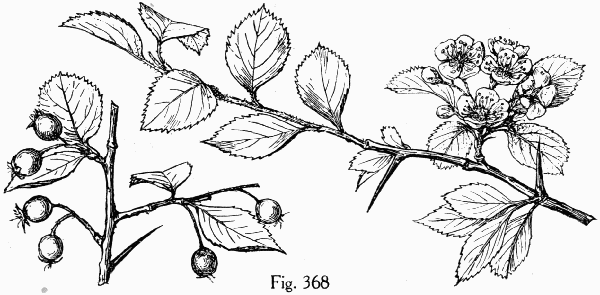
Leaves obovate to oval, rhombic or suborbicular, rounded, acute or acuminate or abruptly short-pointed at apex, concave-cuneate at base, and sharply coarsely serrate usually to below the middle with straight acuminate glandular teeth, covered above with short white hairs and glabrous below when they unfold, and at maturity dark green, lustrous and scabrate above, pale yellow-green below, 1′—1¼′ long, and ¾′—1′ wide, with a slender midrib and prominent primary veins; petioles slender, villose early in the season, becoming glabrous, about ¼′ in length. Flowers opening late in April, about ½′ in diameter, on villose pedicels ¼′—½′ long, in compact mostly 7—10-flowered villose corymbs, their bracts and bractlets linear-obovate, conspicuously glandular-serrate; calyx-tube broadly obconic, glabrous or with occasional hairs near the base, the lobes gradually narrowed from a wide base, glandular-serrate, sometimes laciniate near the acuminate apex, glabrous on the outer surface, villose on the inner surface; stamens 10—15, usually 10; anthers pink; styles 2 or 3. Fruit ripening late in September or in October, on erect nearly glabrous or villose pedicels, short-oblong to ellipsoid, orange-red, about ⅓′ long; the calyx enlarged and conspicuous; flesh thin, yellow-green; nutlets 2 or 3, rounded at apex, with a low broad rounded ridge, about ¼′ long.
A bushy tree, rarely more than 12°—15° high, with a short trunk 10′—12′ in diameter, erect [415] and spreading branches, and slender nearly straight branchlets orange-brown and covered with long scattered pale hairs when they first appear, dull red-brown and glabrous at the end of their first season, becoming gray the following year. Bark of the branches smooth and dark brown, becoming slightly scaly on the trunk.
Distribution. Rocky banks of streams; western Texas (Comal, Kendall, Bandera, Edwards, Brown and Calhoun Counties, and on the Davis Mountains, Jeff Davis County); common on the banks of the Guadalupe and other streams on the Edwards Plateau.
Interesting as the extreme southwestern representative of the Crus-galli Group, and its only species in western Texas.
17. Cratægus denaria Beadl.
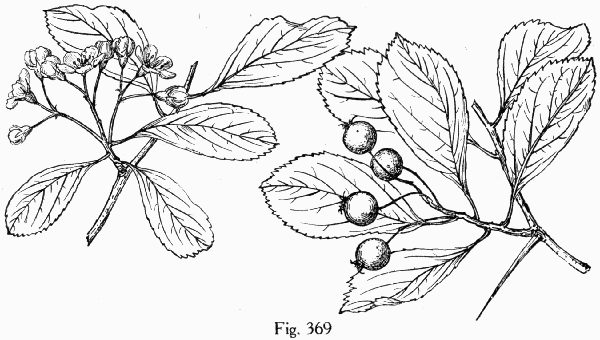
Leaves oval, oblong-obovate or elliptic, acute or acuminate at apex, gradually narrowed from near the middle and cuneate and entire below, and coarsely often doubly serrate above with straight teeth, when they unfold tinged with red and slightly pilose above and glabrous below, nearly fully grown when the flowers open toward the end of May, and at maturity firm to subcoriaceous, bright green and lustrous on the upper surface, pale on the lower surface, 2½′—3′ long, and ¾′—1¼′ wide, with a slender midrib and few remote thin primary veins; turning in the autumn orange, yellow, or brown; petioles stout, conspicuously glandular, and about ¼′ in length; leaves at the end of vigorous shoots broadly oval to ovate or obovate, occasionally incisely lobed, 2½′—3′ long, and 1½′—2′ wide. Flowers ½′—⅔′ in diameter, on long slender pedicels, in broad lax many-flowered sparingly villose corymbs; calyx narrowly obconic, glabrous, the lobes slender, elongated, acuminate and glandular at apex, mostly entire or slightly serrate below; stamens usually 10; styles 3—5. Fruit on long slender pedicels, in drooping few-fruited clusters, globose to subglobose, ¼′—5/16′ in diameter, orange-red, the calyx somewhat enlarged, with spreading or closely appressed lobes; nutlets 3—5, slightly ridged on the back, about 3/16′ long.