Division II. Dicotyledons. (continued 11)
Reading edition
Distribution. Central and western New York to western Pennsylvania (Allegheny and Crawford counties), and to southern Ontario to the neighborhood of Toronto and London; common; passing into var. gloriosa Sarg. differing in its rather larger flowers with pink anthers, larger and more lustrous fruit often mammillate at base and ripening a few days earlier and in its convex leaves. A tree, 20°—25° high, with a trunk often 1° in diameter, and a symmetrical round-topped head; Rochester, Munroe County, New York; not common.
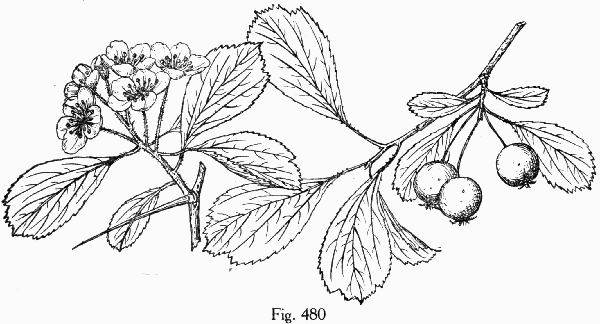
100. Cratægus Holmesiana Ashe.
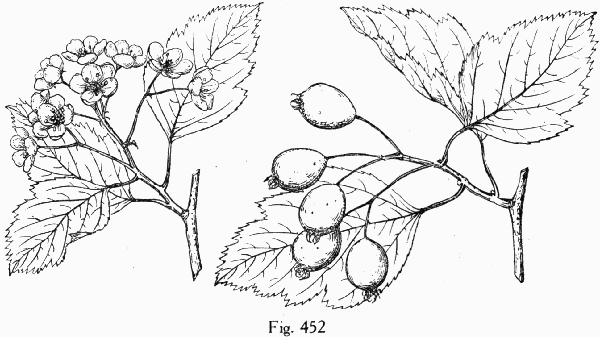
Leaves oval or ovate, acute or acuminate at apex, rounded or broad-cuneate at base, coarsely doubly serrate above the middle with straight teeth tipped at first with prominent dark red caducous glands, and usually divided into 3 or 4 pairs of short acute or acuminate lateral lobes, when they unfold dark red, roughened by rigid pale hairs on the upper surface, and glabrous or sometimes villose on the lower surface, scabrate above, pale yellow-green and nearly half grown when the flowers open early in May, and at maturity thick and firm, almost smooth, conspicuously yellow-green, usually about 2′ long and 1¾′ wide, with a prominent midrib often bright red on the lower side toward the base, and 4—6 pairs of slender primary veins arching to the point of the lobes; petioles slender, nearly terete, glandular, glabrous or sometimes puberulous while young, 1′—1½′ in length; leaves at the end of vigorous shoots often broad-ovate to oval, rounded, truncate or slightly cordate at base, more coarsely serrate and more deeply lobed, and frequently 4′ long and 3′ wide. Flowers cup-shaped, ½′—¾′ in diameter, on long slender glabrous pedicels, in loose glabrous or rarely puberulous many-flowered corymbs, with oblanceolate or linear acute glandular caducous bracts and bractlets; calyx-tube narrowly obconic, glabrous, more or less deeply tinged with red, the lobes long, acuminate, glandular-serrate, or often nearly [496] entire; glabrous on the outer surface, villose-pubescent on the inner surface; stamens usually 5, sometimes 6—8; anthers large, dark reddish purple; styles usually 3, surrounded at base by a narrow ring of pale tomentum. Fruit ripening and falling early in September, on long slender pedicels, in many-fruited drooping clusters, obovoid to ellipsoidal, crimson, lustrous, marked by occasional small dark dots, about ½′ long, and ⅓′ in diameter; calyx enlarged, conspicuous, with erect and incurved glandular-serrate lobes, bright red toward the base on the upper side; flesh thin, yellow, dry and mealy, with a disagreeable flavor; nutlets usually 3, light chestnut-brown, prominently grooved and ridged on the back with a broad rounded ridge, about ¼′ long.
A tree, often 30° high, with a tall straight trunk 10′—15′ in diameter, covered with pale gray-brown or nearly white scaly bark, stout ascending branches forming an open irregular rather compact head, and stout glabrous branchlets dark green more or less tinged with red when they first appear, becoming bright chestnut-brown or orange-brown and lustrous, and ultimately ashy gray, and armed with occasional thick mostly straight bright chestnut-brown shining spines 1½′—2′ long.
Distribution. Rich moist hillsides and the borders of streams and swamps, neighborhood of Montreal and southern Ontario to the coast of southern Maine, central and western Massachusetts, Rhode Island, western New York, and eastern Pennsylvania; most abundant and of its largest size on the hills of Worcester County, Massachusetts. In Sellersville, Bucks County, Pennsylvania, in a form of this species (var. villipes Ashe) the young branchlets, petioles, and corymbs are often puberulous and the under surface of the leaves more or less hairy, especially on the midrib and veins. Passing into var. tardipes Sarg. differing from the type in its darker green leaves somewhat rougher on the upper surface, flowers often ⅘′ in diameter on villose pedicels, and in the shorter slightly hairy pedicels of the fruit ripening early in October.
A tree, in size, habit and bark similar to the species; southern Ontario (neighborhood of Toronto, common, near London, bank of the St. Claire River below Sarnia and Walpole Island, Lamberton County); Province of Quebec (Montreal, Caughnawaga, Isle Perrot, St. Ann’s and Hemmingford); central and western New York.
101. Cratægus acclivis Sarg.
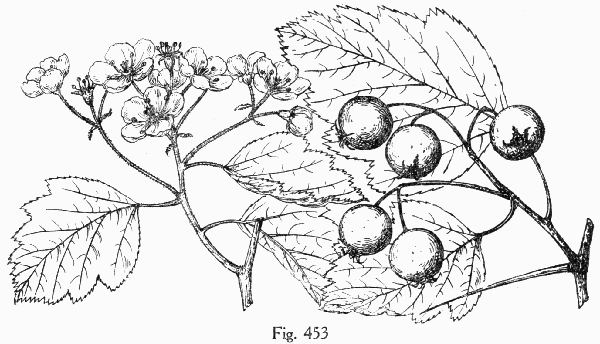
Leaves oblong-ovate, acuminate, broad-cuneate or rounded at the entire base, coarsely doubly serrate above with straight gland-tipped teeth, and deeply divided into numerous wide-spreading acuminate lateral lobes, when they unfold tinged with red, densely villose on the upper surface, pubescent on the midrib and veins below, about half grown when the flowers open during the last week of May and then light yellow-green, slightly roughened above by short white hairs and pubescent on the midrib and veins below, and at maturity membranaceous, dark yellow-green and nearly smooth above, pale yellow-green and glabrous below, 2½′—3′ long, and 2′—2½′ wide, with a stout yellow midrib, and 5 or 6 pairs of primary veins extending obliquely to the point of the lobes; petioles slender, slightly wing-margined at apex, glandular with numerous small dark glands, densely villose early in the season, becoming puberulous or glabrous in the autumn, 1½′—2′ in length; leaves at the end of vigorous shoots broad-ovate, acuminate, cordate at the wide base, deeply divided into wide acute lateral lobes, and often 4′—5′ long and wide, with foliaceous, lunate, coarsely glandular-serrate stipules, 1½′ wide, and persistent throughout the season. Flowers ¾′ in diameter, on slender densely villose pedicels, in broad lax many-flowered long-branched hairy corymbs, their bracts lanceolate, glandular, large and conspicuous, persistent until after the flowers open; calyx-tube narrowly obconic, covered with a thick coat of long matted hairs, the lobes long slender, acuminate, serrate with occasional large gland-tipped teeth, glabrous on the outer surface, slightly villose on the inner surface; stamens usually 5; anthers pink; styles mostly 5. Fruit ripening the middle of September and soon falling, on long slender slightly hairy pedicels, in many-fruited drooping clusters, short-oblong, broad and rounded at the ends, yellowish red, glaucous, marked by occasional pale dots, about ¾′ long and ⅝′ wide; calyx sessile, with usually erect enlarged coarsely serrate [497] lobes villose on the upper side and often deciduous from the ripe fruit; flesh thick, yellow, rather juicy; nutlets usually 5, narrow and acute at the ends, ridged with a high broad ridge, or rounded and slightly grooved on the back, about ⅝′ long.
A tree, 25°—30° high, with a short trunk occasionally 4′—5′ in diameter, covered with smooth light gray bark, numerous erect branches forming an oblong open very irregular head, and stout slightly zigzag branchlets coated when they first appear with long matted pale hairs, light red-brown and lustrous, marked by small pale lenticels, and pubescent at the end of their first season, becoming dull red or orange-brown the following year, and armed with stout straight or curved bright red-brown shining spines 1¼′—2′ long.
Distribution. New York: near Albany, Albany County, steep banks of the gorge of the Genesee River, Rochester, Munroe County, banks of the Niagara River, Niagara Falls, Niagara County, and near Buffalo, Erie County; common.
102. Cratægus delecta Sarg.
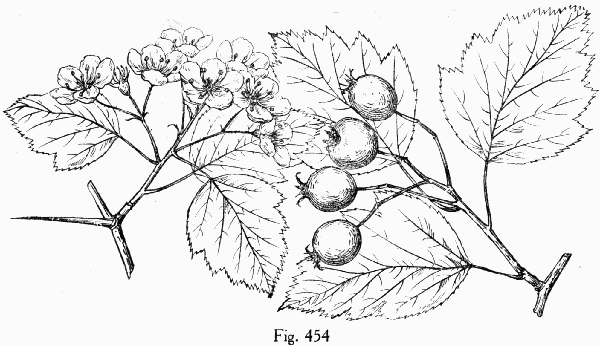
Leaves broad-ovate, acute or acuminate at apex, rounded or broad-cuneate at the entire base, sharply often doubly serrate above with straight glandular teeth, and divided usually only above the middle into numerous short acuminate lateral lobes, when they unfold tinged with red and covered with glistening white hairs more abundant below than above, nearly half grown when the flowers open during the first half of May and then roughened on the upper surface by short white hairs and glabrous or sparingly villose on the midrib and veins below with scattered hairs sometimes persistent through the season, and at maturity membranaceous, light yellow-green, lustrous and glabrous above, paler below, 1½′—2′ long and wide, with a stout yellow midrib, and 6 or 7 pairs of slender primary veins arching obliquely to the point of the lobes; turning purplish in the autumn before falling; petioles slender, covered early in the season with matted pale hairs, becoming glabrous, slightly glandular, often tinged with red below the middle, ¾′—1′ in length; leaves at the end of vigorous shoots sometimes long-pointed at apex and slightly cordate at base, more deeply lobed and more coarsely serrate, and often 3′—4′ long and wide. Flowers ¾′—1′ in diameter, on long slender slightly hairy pedicels, in broad villose 10—15-flowered sparingly villose corymbs, with glandular caducous bracts and bractlets; calyx-tube broadly obconic, villose or nearly glabrous, the lobes acuminate, coarsely glandular-serrate, glabrous on the outer surface, villose on the inner surface; stamens 5—10, usually 5; anthers dark rose color; styles 3—5, usually 5. Fruit ripening from the first to the middle of September and soon falling, on stout glabrous pedicels, in drooping few-fruited clusters, subglobose to slightly [498] obovoid, bright red or scarlet, becoming purple when fully ripe, ½′—¾′ long, and ⅔′—¾′ in diameter; calyx prominent, with erect and incurved coarsely serrate lobes; flesh thick, yellow, juicy, mildly acid and edible; nutlets 3—5, usually 5, narrowed and acute at the ends, rounded and very irregularly ridged on the back, ¼′—5/16′ long.
A tree, sometimes 30° high, with a trunk rarely 1° in diameter and 6°—9° long, covered with light gray slightly fissured smooth bark, spreading or ascending branches forming an oblong open head, and slender branchlets at first slightly villose, becoming glabrous, dull red, and ultimately gray or olive-gray, and armed with stout nearly straight spines much thickened below the middle, dark chestnut-brown and lustrous, becoming dull brown or gray, and usually 1′—2′ long.
Distribution. Pastures, open woods or their borders; northeastern Illinois (Lockport, Will County, Wauconda, Fort Sheridan, Deerfield, Lake Forest, Highland Park, Lake County).
103. Cratægus Eamesii Sarg.
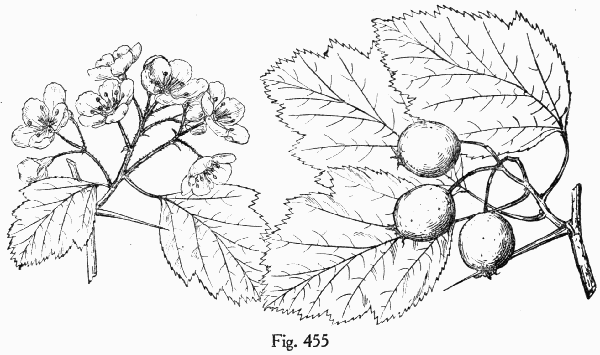
Leaves oblong-ovate, acute or acuminate, concave-cuneate or rounded at the entire or glandular base, sharply often doubly serrate above with straight glandular teeth, and divided into numerous short acute lateral lobes, about half grown when the flowers open the middle of May, and then membranaceous, light yellow-green and roughened above by short rigid white hairs and pale and glabrous below with the exception of a few hairs on the midrib, and slender primary veins arching to the point of the lobes, and at maturity subcoriaceous, glabrous, dark rather dull green and smooth above, pale yellow-green below, 3′—3½′ long, and 2′—2½′ wide; petioles slender, wing-margined above, villose at first, becoming glabrous, 1′—1½′ in length; leaves at the end of vigorous shoots usually rounded or truncate at the broad base, more deeply lobed, often 3½′—4′ long and 3½′ wide. Flowers about ¾′ in diameter, on slender slightly hairy pedicels, in crowded compact 5—25, usually 15—18-flowered sparingly villose corymbs, with linear-obovate coarsely glandular reddish bracts and bractlets, mostly deciduous before the flowers open; calyx narrowly obconic, glabrous, the lobes long, slender, glandular with large bright red stipitate glands, glabrous on the outer, slightly villose on the inner surface; stamens 5—10, usually 5—8; anthers deep rose-purple; styles 4 or 5, surrounded at base by a narrow ring of pale pubescence. Fruit ripening early in September and soon falling, on stout glabrous pedicels, in large many-fruited drooping clusters, short-oblong to slightly ovoid, rounded at the ends, bright cherry-red, lustrous, pruinose, marked by few large dark dots, ⅝′—¾′ long, and about ½′ in diameter; [499] calyx only slightly enlarged, the lobes erect and incurved, coarsely serrate, dark red on the upper side below the middle, their tips deciduous from the ripe fruit; flesh thick, pale yellow, juicy; nutlets 4 or 5, narrow at the ends, irregularly ridged often with a high broad ridge, and sometimes grooved on the back, about ¼′ long.
A tree, occasionally 20° high, with a trunk a foot in diameter, ascending branches forming a narrow open head, and stout glabrous branchlets bright reddish brown and rather lustrous during their first season, becoming light gray slightly tinged with red in their second year, and armed with stout straight or slightly curved spines 1′—1½′ long; or occasionally shrubby, with a short trunk divided near the ground into several spreading stems.
Distribution. Rich moist ground, Stratford, Fairfield County (E. H. Eames), and Ansonia, New Haven County, Connecticut (E. B. Harger).
104. Cratægus sertata Sarg.
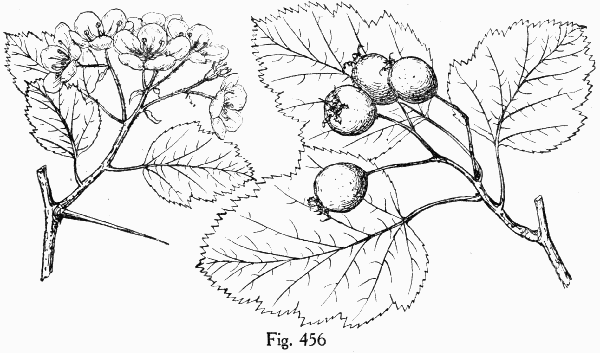
Leaves oblong-ovate, acuminate, rounded, truncate, subcordate or rarely cuneate at the broad base, finely and often doubly serrate with straight gland-tipped teeth, and deeply divided into 5 or 6 pairs of wide acuminate lobes, when they unfold coated above with short pale hairs and villose below on the midrib and veins, about half grown and villose when the flowers open during the first half of May, and at maturity membranaceous, dark yellow-green and scabrate on the upper surface, pale yellow-green and glabrous on the lower surface, 2½′—3′ long, and 1½′—2′ wide, with a thin yellow midrib, and slender primary veins arching obliquely to the point of the lobes; petioles slender, slightly grooved, villose early in the season, ultimately glabrous, sparingly glandular, 1½′—3′ in length; leaves at the end of vigorous shoots broad-ovate, rounded or slightly cordate at base, often 3′ long and 2½′ wide. Flowers ¾′—1′ in diameter, on slender pedicels, in broad 10—15-flowered densely villose corymbs, with linear to linear-obovate glandular large and conspicuous caducous bracts and bractlets; calyx-tube broadly obconic, glabrous above, villose below, the lobes abruptly narrowed from the base, broad, acuminate, tipped with small red glands, coarsely glandular-serrate, glabrate on the outer surface, pubescent on the inner surface; stamens 5—10, usually 5; anthers pale rose color; styles 3—5, surrounded at base by tufts of pale hairs. Fruit ripening about the middle of September and soon falling, on slender villose or pubescent pedicels, in drooping many-fruited clusters, subglobose to slightly obovoid, rounded at the ends, bright red and lustrous, becoming darker or crimson when fully ripe, marked by occasional large pale dots, about ½′ long and wide; calyx prominent, with enlarged mostly erect incurved serrate lobes; flesh thin, yellow, aromatic, pleasantly [500] acid; nutlets 3—5, usually 4, thin, narrow and acute at the ends, slightly ridged on the back with a wide or narrow ridge, ⅜′ long.
A tree, 10°—20° high, with a trunk 6′—8′ in diameter and often 4°—5° long, covered with close dark gray bark separating into long narrow thin plate-like scales, stout spreading branches forming a handsome open head, and slender nearly straight branchlets thickly coated when they first appear with matted pale hairs, light brown and lustrous at the end of their first season, and dark gray-brown the following year, and unarmed or armed with stout nearly straight or curved spines 1′—2½′ long.
Distribution. Open woods and pastures in rich moist soil; northeastern Illinois (Mokena, Will County, Glenellyn, Dupage County, Barrington, Glendon Park, Cook County, Highland Park, Lake Zurich, Lake County); Fox Point, Milwaukee County, Wisconsin.
X. DILATATÆ.
CONSPECTUS OF THE ARBORESCENT SPECIES.
Flowers in broad 6—12-flowered corymbs.
Leaves broad-ovate; fruit bright scarlet.
105. C. dilatata (A).
Leaves nearly orbicular to oval; fruit dull red blotched with green, or orange-red.
106. C. suborbiculata (A).
Leaves ovate to slightly obovate; fruit crimson, pruinose.
107. C. hudsonica (A).
Flowers in very compact 5—7-flowered corymbs; leaves broad-ovate; fruit usually broader than high, much flattened at the ends, dark crimson, very lustrous.
108. C. coccinioides (A).
105. Cratægus dilatata Sarg.
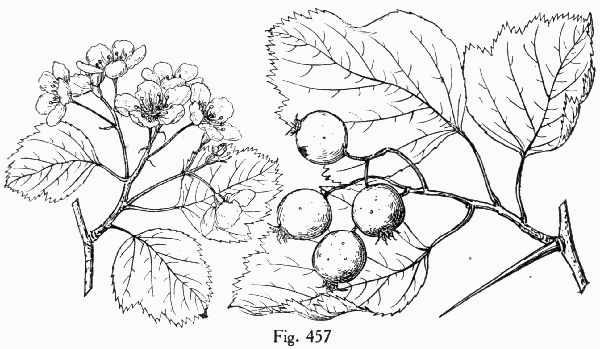
Leaves broad-ovate, acute, truncate, cordate or slightly rounded at the broad base, coarsely and generally doubly and irregularly serrate above with straight teeth tipped with large dark glands, unequally lobed usually with 2 or 3 pairs of acute or acuminate lateral lobes, about one third grown when the flowers open at the end of May, and then light yellow-green, conspicuously plicate, roughened on the upper surface with short stiff white hairs and glabrous on the lower surface, and at maturity smooth and glabrous, dark green above, pale below, 2′—2½′ long, and almost as wide as long, with a slender midrib and 4 or 5 pairs of thin primary veins; petioles slender, somewhat glandular, at first villose, soon glabrous, often dark red toward the base after midsummer, 1′—2′ in length; leaves at [501] the end of vigorous shoots often 4′—5′ long, and frequently rather broader than long. Flowers 1′—1⅛′ in diameter, on slender elongated hairy pedicels, in broad, loose, usually 8—12-flowered slightly villose corymbs, with lanceolate bracts and bractlets glandular like the inner bud-scales with dark red glands; calyx-tube broadly obconic, covered toward the base with matted pale hairs, nearly glabrous above, the lobes broad, acuminate, coarsely glandular with large scattered red glands, glabrous on the outer surface and generally slightly villose on the inner surface; stamens 20; anthers large, rose color; styles usually 5, surrounded at base by small tufts of white hairs. Fruit ripening and falling early in September, on slender pedicels, in many-fruited drooping clusters, subglobose, bright scarlet, marked by numerous small dark dots, about ¾′ in diameter; the calyx much enlarged, with spreading coarsely serrate lobes bright red on the upper side toward the base; flesh thin, sweet and yellow; nutlets 5, thin, rounded and prominently ridged on the back, about ¼′ long.
A tree, occasionally 20° high, with a tall straight trunk, covered with light gray-brown scaly bark, branches spreading into a wide round-topped symmetrical head, and short glabrous slightly zigzag branchlets armed with few stout straight light brown shining spines 1′—2′ long.
Distribution. Eastern Massachusetts, coast of Rhode Island, western Vermont, in the neighborhood of Albany, New York, and near Montreal, Province of Quebec.
106. Cratægus suborbiculata Sarg.
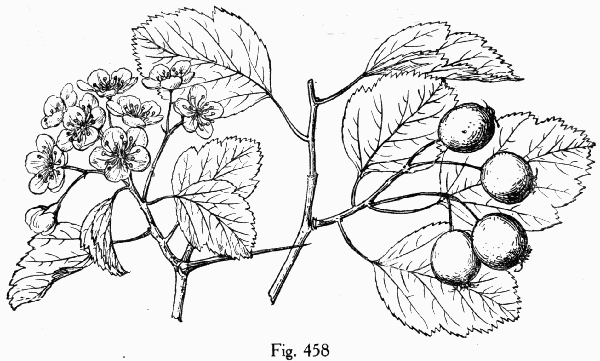
Leaves nearly orbicular to oval or rarely to oblong, short-pointed at apex, broad and rounded or broad-cuneate at the entire base, sharply doubly serrate above with slender straight or incurved glandular teeth, and often divided above the middle into 3 or 4 pairs of short acute lobes, when they unfold pale yellow-green and somewhat villose on the upper surface toward the base and below in the axils of the principal veins, about a third grown when the flowers open during the first week of June, and at maturity thin and firm in texture, dull dark green above, paler below, usually about 1½′ long and broad, with a slender midrib and 4 or 5 pairs of thin primary veins; petioles slender, slightly glandular, more or less winged above, ⅝′—1′ in length; leaves at the end of vigorous shoots nearly orbicular to oval, more coarsely serrate and more deeply lobed, and frequently 3′ long and wide, their petioles often broadly winged and conspicuously glandular. Flowers ¾′ in diameter, on short stout pedicels, in compact 6—12-flowered glabrous corymbs; calyx broadly obconic, the lobes gradually narrowed from a broad base, long, acuminate, entire or occasionally [502] obscurely denticulate; stamens 20; anthers small, rose color; styles 5, surrounded at base by a broad ring of hoary tomentum. Fruit falling in October without becoming mellow, on short rigid pedicels, in few-fruited erect clusters, subglobose, often rather longer than broad, about ⅝′ in diameter, dull red more or less blotched with green, or often wholly green on one face, or scarlet in one form; calyx enlarged, prominent, with a broad deep cavity and nearly entire wide-spreading lobes; flesh yellow, thin, dry and hard; nutlets 5, broad and thick, narrow and rounded at the ends, obscurely and unequally grooved on the back, about ¼′ long.
A tree, rarely more than 15°—20° high, with a well-developed trunk 5′—6′ in diameter, stout spreading branches forming a broad low flat-topped head, and stout branchlets orange-brown in their first season, becoming dark gray-brown the following year, and armed with thick straight or slightly curved bright chestnut-brown shining spines 1′—2′ in length.
Distribution. Low limestone ridges opposite Lachine near the south bank of the St. Lawrence River, and on the Island of Montreal, Province of Quebec; near Cornwall, Ontario.
107. Cratægus hudsonica Sarg.
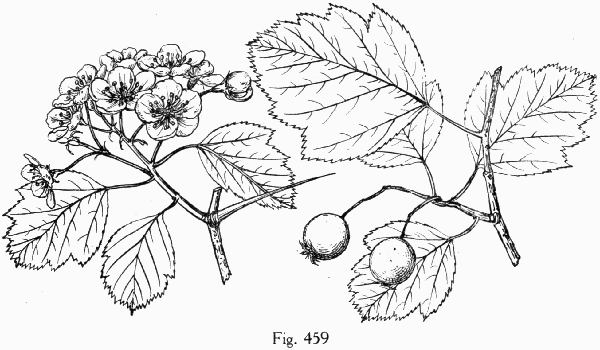
Leaves ovate or slightly obovate, acute, gradually and abruptly narrowed and mostly concave-cuneate at the entire base, sharply and often doubly serrate above with straight or incurved glandular teeth, and frequently slightly divided above the middle into short acute lobes, nearly fully grown when the flowers open at the end of May, and then thin, light yellow-green, smooth and glabrous above with the exception of a few short white scattered hairs on the midrib, and pale and glabrous below, and at maturity thin and firm in texture, glabrous, 2′—2½′ long, and 1½′—1¾′ wide, with a slender yellow midrib, and 5 or 6 pairs of thin primary veins extending obliquely to the point of the lobes; petioles slender, wing-margined above, glandular, at first slightly hairy, becoming glabrous and rose color toward the base, ¾′—1′ in length; leaves at the end of vigorous shoots broad-ovate to suborbicular, full and rounded or broad-cuneate at the wide base, deeply divided into broad lateral lobes, and 2′—3′ long and wide. Flowers about ¾′ in diameter, on long slender pedicels, in broad usually 10—12-flowered glabrous corymbs; calyx-tube narrowly obconic, glabrous, the lobes gradually narrowed from a broad base, acuminate, glandular-serrate often only below the middle, glabrous on the outer surface, slightly hairy on the inner surface; stamens 20; anthers rose color; styles 3—5. Fruit ripening early in September, in [503] few-fruited drooping clusters, subglobose, crimson, pruinose, marked by numerous pale dots, about ⅝′ in diameter; calyx enlarged, with a deep broad cavity, and closely appressed serrate lobes villose on the upper side; flesh thick, yellow, dry and mealy; nutlets 3—5, rounded at base and narrowed and rounded at apex, rounded and sometimes ridged on the back with a high rounded ridge, about 5/16′ long.
A tree, sometimes 20° high, with a tall trunk 8′—10′ in diameter, covered with pale scaly bark, heavy ascending and spreading branches forming a broad open head, and stout ascending glabrous branchlets dark orange color when they first appear and light orange-brown and lustrous during their first winter, and armed with numerous slender straight or slightly curved bright red-brown shining spines 1½′—2′ long; sometimes a broad bush, with numerous stout spreading stems.
Distribution. Rolling hills in the valley of the Hudson River, near Albany, Albany County, New York.
108. Cratægus coccinioides Ashe.
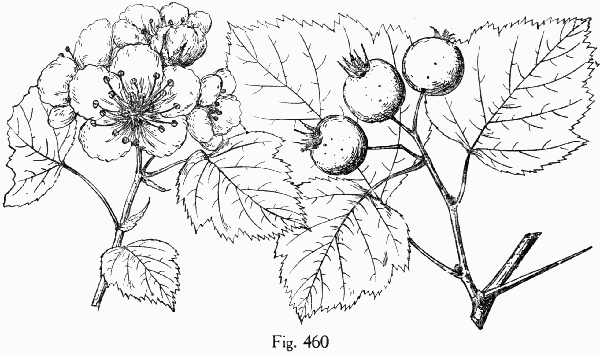
Leaves broad-ovate, acute, full and rounded or truncate at base, sharply and often doubly serrate with straight glandular teeth, and divided above the middle into short acute lobes, as they unfold conspicuously plicate, very lustrous, yellow-green, and villose on the lower side of the midrib with a few short pale hairs usually persistent during the season, about half grown when the flowers open early in May, and at maturity thin and firm in texture, rather rigid, dull dark green and smooth on the upper surface, pale on the lower surface, 2½′—3′ long, and 2′—2½′ wide, with a thin pale yellow midrib deeply impressed above and often bright red toward the base after midsummer, and slender primary veins arching to the point of the lobes; turning late in October gradually bright orange and scarlet; petioles glandular on the upper side with minute-stalked dark red glands, at first villose, soon glabrous, often bright red or pink toward the base, ¾′—1′ in length; leaves at the end of vigorous shoots more or less cordate at base and usually 3½′—4′ long and wide. Flowers ¾′ in diameter, in very compact 5—7-flowered glabrous or slightly villose corymbs, with coarsely serrate oblong-obovate acute bracts and bractlets, conspicuously glandular with large bright red glands; calyx-tube broadly obconic, glabrous, the lobes gradually narrowed from a broad base, acute and coarsely glandular-serrate; stamens 20; anthers large, deep rose color; styles 5, surrounded at base by a ring of pale tomentum. Fruit ripening early in October and falling gradually during a month or six weeks, on stout pedicels, in few-fruited compact erect clusters, subglobose, much flattened at the ends, often obscurely [504] angled, dark crimson, very lustrous, marked by numerous large pale dots, ¾′ long, and ⅞′ wide; calyx much enlarged and conspicuous, with spreading or erect lobes bright red on the upper side near the base; flesh thick, firm, subacid, more or less deeply tinged with red; nutlets 5, comparatively small, light-colored, narrow at the ends, acute at apex, rounded at base, rounded and slightly ridged on the back, about ⅓′ long.
A tree, sometimes 20° high, with a stem 8′—10′ in diameter, covered with dark brown scaly bark, stout spreading light gray branches forming a broad handsome head, and stout nearly straight glabrous bright chestnut-brown very lustrous branchlets armed with thick dark reddish purple shining spines 1½′—2′ long.
Distribution. Dry woods in the neighborhood of St. Louis, Missouri; in eastern Kansas.
XI. ROTUNDIFOLIÆ.
Coccineæ Sarg.
CONSPECTUS OF THE ARBORESCENT SPECIES.
Stamens 10; leaves coriaceous.
Leaves elliptic or obovate; fruit subglobose, dark crimson; anthers pale yellow.
109. C. rotundifolia (A).
Leaves elliptic or ovate; fruit short-oblong to oblong-obovoid, bright carmine-red; anthers rose color.
110. C. Jonesæ (A).
Stamens 20; leaves subcoriaceous, rhombic to oblong-obovate; fruit short-oblong to subglobose, dark dull red or rusty orange-red; anthers pale yellow.
111. C. Margaretta (A, C).
109. Cratægus rotundifolia Moen.
Cratægus coccinea var. rotundifolia Sarg.
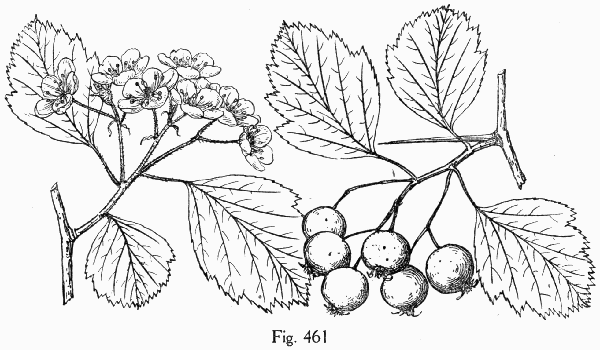
Leaves elliptic or obovate, acute or acuminate, gradually narrowed from above the middle to the cuneate entire base, finely and often doubly serrate above with incurved or straight teeth tipped with minute dark glands, and divided above the middle into several short acute lateral lobes, about half grown when the flowers open at the end of May, and then thin, light yellow-green and glabrous, and at maturity coriaceous, dark green, smooth and lustrous on the upper surface, paler on the lower surface, 1½′—2′ long, and 1′—1½′ wide, [505] with a thin midrib, and 4 or 5 pairs of primary veins extending to the point of the lobes; petioles slender, glandular, slightly winged at apex, glabrous, often dark red toward the base, ¾′—1′ in length; leaves at the end of vigorous shoots oblong-ovate, oval or often nearly orbicular, more deeply lobed, and frequently 2½′—3′ long and wide. Flowers ½′—¾′ in diameter, on slender pedicels, in broad loose many-flowered glabrous corymbs; calyx-tube broadly obconic, glabrous, the lobes gradually narrowed from a broad base, acute, coarsely glandular-serrate, glabrous, often bright red toward the apex; stamens 10; anthers small, pale yellow; styles 3 or 4. Fruit ripening and falling late in October, on short stout pedicels, in drooping many-fruited glabrous clusters, subglobose but occasionally rather longer than broad, dark crimson, marked by scattered dark dots, about ½′ in diameter; calyx enlarged, conspicuous, the lobes bright red on the upper side toward the base, wide-spreading or erect; flesh thin, yellow, dry and sweet; nutlets 3 or 4, rounded at the ends, about ¼′ long.
A bushy tree, occasionally 20° high, with a short trunk 8′—10′ in diameter, covered with dark red-brown scaly bark, stout ascending branches forming a broad round-topped symmetrical head, and slender glabrous branchlets light green when they first appear, bright red-brown and lustrous during their first year, and ultimately ashy gray, and armed with many stout straight or slightly curved chestnut-brown shining spines 1′—1½′ long.
Distribution. Nova Scotia, southern Quebec and Ontario to Manitoba and Saskatchewan (Saskatoon), and southward through New England, eastern and northern New York, the southern peninsula of Michigan and northern Indiana; in Pennsylvania (Lackawanna, Bucks, Northampton and Blair Counties); common in the New England coast region; a form (var. pubera Sarg.) with young leaves covered above with soft pale hairs and pubescent on the under side of the midrib and veins and villose petioles, flowers with a pubescent calyx-tube, in villose corymbs, becoming pilose when the fruit ripens, and young branchlets covered with long matted pale hairs, ranges from Newfoundland to the shores of Lake St. John, Province of Quebec, northern Ontario, Winnipeg and Manitoba, and southward through the maritime provinces of Canada, New England to southern Connecticut, northern and western New York (near Buffalo, Essex County), the northern peninsula of Michigan, northeastern Wisconsin; in central Minnesota (St. Cloud, Stearns County); common northward.
110. Cratægus Jonesæ Sarg.
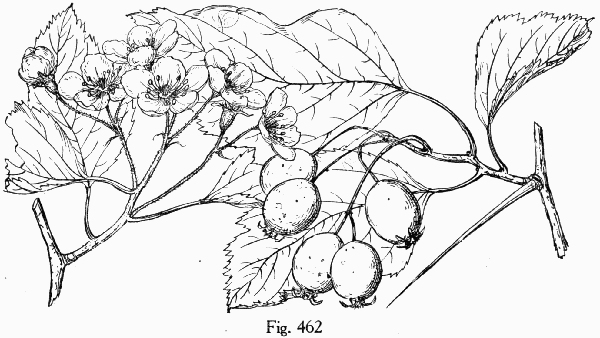
Leaves elliptic to ovate, acute, gradually narrowed or broad-cuneate at the entire base, coarsely doubly serrate above with spreading or incurved teeth tipped with deciduous [506] dark red glands, and usually divided above the middle into 2 or 3 pairs of short acute or acuminate lobes, more than half grown when the flowers open during the first week of June, and then membranaceous and coated with soft pale hairs most abundant on the under side of the midrib and principal veins, and at maturity thick and coriaceous, dark green and lustrous on the upper surface, pale and puberulous on the lower surface, 3′—4′ long and 2′—3′ wide, with a stout midrib, 4—6 pairs of primary veins and conspicuous secondary veinlets; petioles stout, more or less winged toward the apex, villose, ultimately glabrous, tinged with red below the middle, 1½′—2′ in length, after midsummer often twisted at base, bringing the lower surface of the leaf to the light; leaves at the end of vigorous shoots usually more coarsely serrate and much more deeply lobed, with broadly winged petioles, and falcate coarsely glandular-serrate stipules sometimes 1′ in length. Flowers 1′ in diameter, on long slender pedicels, in broad loose lax many-flowered tomentose corymbs; calyx-tube narrowly obconic, tomentose, the lobes abruptly narrowed from a broad base, long, acute, entire, villose; stamens 10; anthers large, rose color; styles 2, or generally 3, surrounded at base by a narrow ring of pale tomentum. Fruit ripening usually early in October, on slender elongated pedicels, in broad many-fruited drooping glabrous or puberulous clusters, short-oblong to oblong-obovoid, rounded at the ends, bright carmine-red, marked by occasional large dots, ¾′—1′ long, and ¾′ in diameter; calyx conspicuous, with enlarged and elongated closely appressed lobes; flesh thick, yellow, sweet and mealy; nutlets 3 or rarely 2, thick, narrowed and acute at base, full and broad at apex, rounded and ridged on the back with a high broad ridge, about 7/16′ long.
A tree, sometimes 20° high, with a tall trunk often a foot in diameter, covered with dark brown scaly bark, ascending or spreading branches forming a broad open irregular head, and stout branchlets tomentose early in the season, becoming orange-brown, glabrous and very lustrous during their first summer, and light gray the following year, and armed with stout straight or curved chestnut-brown shining spines 2′—3′ long and usually pointed toward the base of the branch.
Distribution. Rocky shores of sounds and bays; coast of Maine, Islesboro and Belfast Bay to the island of Mount Desert (Waldo and Hancock Counties); in hedges, near Fredericton, York County, New Brunswick; Rivière du Loup, Kamouraska County, Province of Quebec (Brother Victorin).
111. Cratægus Margaretta Ashe.
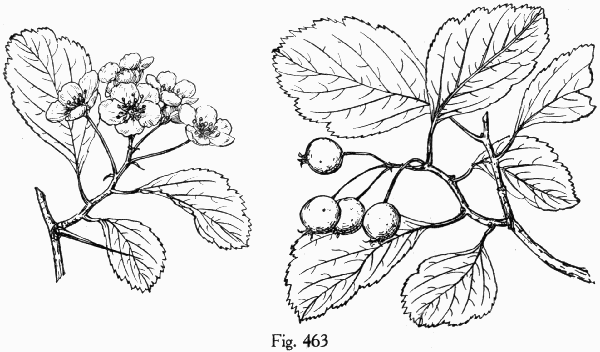
Leaves broad-rhombic, oblong-obovate or rarely ovate, acute or rounded at apex, gradually narrowed and usually entire below, coarsely often doubly crenately-serrate [507] above with usually glandless teeth, and divided above the middle or frequently only at apex into short broad rounded or acute lobes when the flowers open in May, thin and roughened above by short pale hairs and glabrous below, and at maturity firm and rather leathery in texture, or subcoriaceous, glabrous, smooth, dark green and somewhat lustrous on the upper surface, pale on the lower surface, 1′—1¼′ long, and 1′ wide, with a yellow midrib, and 3—5 pairs of primary veins extending obliquely to the point of the lobes; petioles slender, often slightly winged toward the apex, glandular at first with minute dark red caducous glands, ½′—1′ in length; leaves at the end of vigorous shoots broad-ovate or semiorbicular, usually more deeply and more generally lobed, often 3′ long and 2′—3′ wide. Flowers about ¾′ in diameter, on long slender pedicels, in 3—12-flowered thin-branched slightly villose corymbs; calyx-tube narrowly obconic, slightly villose toward the base, or glabrous, the lobes gradually narrowed from below, acuminate or short-pointed at apex, finely and irregularly glandular-serrate, glabrous or villose on the inner surface; stamens usually 20; anthers small, light yellow; styles 2 or 3, surrounded at the base by a narrow ring of pale tomentum, and villose below the middle with occasional long spreading hairs. Fruit ripening and falling at the end of September, in few-fruited drooping clusters, short-oblong, rounded at the ends, or subglobose and flattened at the ends, dull dark red or rusty orange-red or rarely yellow, marked by occasional dark dots, and about ½′ long; calyx only slightly enlarged, the lobes spreading or erect and frequently deciduous before the fruit ripens; flesh thin, yellow, dry and mealy; nutlets 2 or 3, broad and rounded at base, acute at apex, conspicuously grooved and ridged on the back with a broad rounded ridge, about ¼′ long.
A tree, occasionally 25° high, with a straight trunk 4′—6′ in diameter, covered with thin dark gray-brown bark, small rather erect branches forming a narrow open head, and slender branchlets, orange-green, glabrous or sometimes pubescent when they first appear, becoming bright chestnut-brown and lustrous, and ashy gray or gray tinged with red during their second year, and armed with thin straight or slightly curved bright chestnut-brown spines ¾′—1½′ long.
Distribution. Central Iowa (Steamboat Rock, Harden County, Cedar Rapids, Linn County), southward to Missouri (Hannibal, Marion County, Webster, St. Louis County to the neighborhood of Springfield, Greene County), and eastward to northeastern Illinois (Downers Grove, Dupage County); through north central Indiana to southern Michigan (Kalamazoo and Ingham Counties); through central and southern Ohio to the southeastern part of the state (Washington County); southeastern Ontario (London and Oakwood); in central Tennessee (West Nashville, Davidson County).
[508]
XII. INTRICATÆ.
CONSPECTUS OF THE ARBORESCENT SPECIES.
Stamens 10; leaves broad-ovate to oval.
Fruit depressed-globose, yellow-green flushed with russet-red; anthers pale yellow; calyx-lobes eglandular.
112. C. Boyntonii (A, C).
Fruit subglobose, red or russet-red; anthers pale rose color; calyx-lobes glandular with stalked glands.
113. C. Buckleyi (A).
Stamens 20.
Leaves oval to ovate or oblong-obovate; fruit short-oblong, dull red, often with a bright russet face; stamens usually 5—15; anthers small, pale yellow.
114. C. venusta (C).
Leaves oblong-ovate to elliptic or ovate; fruit subglobose to short-oblong, yellow or orange-yellow, more or less flushed with red; anthers large, purple.
115. C. Sargentii (C).
112. Cratægus Boyntonii Beadl.
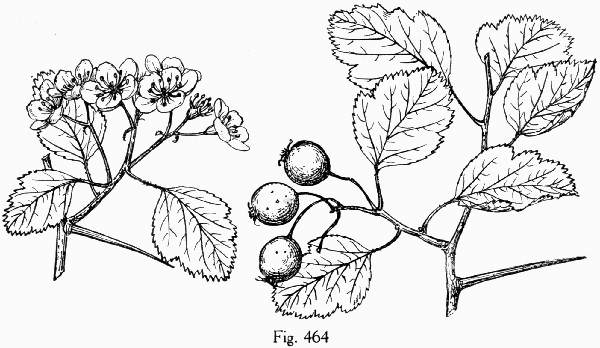
Leaves broad-ovate to oval, acute, rounded or cuneate at the entire glandular base, sharply and often doubly serrate above with glandular teeth, and frequently divided into 2 or 3 pairs of short broad acute lateral lobes, when they unfold deep bronze-red, slightly glandular and viscid, nearly fully grown when the flowers open early in May, and then membranaceous and glabrous or occasionally slightly pilose, and at maturity subcoriaceous, glabrous, yellow-green on the upper surface, pale on the lower surface, 1′—2½′ long, and 1′—2′ wide, with a thin pale yellow midrib and 4—7 pairs of slender veins; petioles stout, glandular often to the base with bright red glands, slightly winged above, usually about ½′ in length; leaves at the end of vigorous shoots often as broad as long, truncate or cordate at base, and more coarsely dentate and more deeply lobed. Flowers about ¾′ in diameter, on short slender pedicels, in compact 4—10-flowered compound corymbs; calyx-tube broadly obconic, the lobes abruptly narrowed from a broad base, acute or rounded at apex, entire or obscurely and irregularly glandular-serrate above the middle; stamens 10; anthers large, pale yellow; styles 3—5, surrounded at base by a broad thick ring of hoary tomentum. Fruit ripening and falling early in October, on short stout pedicels, in few-fruited erect clusters, depressed-globose, more or less angled, yellow-green flushed with russet-red, marked with small dark dots, usually about ½′ in diameter; calyx prominent, the large spreading lobes [509] often deciduous before the fruit ripens; nutlets 3—5, acute or acuminate at apex, rounded at the narrow base, about ¼′ long.
A tree, occasionally 20° high, with a tall straight trunk 6′—8′ in diameter, sometimes armed with long gray compound spines, stout ascending branches forming a narrow open irregular or occasionally a round-topped head, and glabrous branchlets furnished with many thin nearly straight light chestnut-brown spines 1½′—2′ long; or more often a shrub, with numerous stems.
Distribution. Banks of streams, the borders of fields and upland woods in the southern Appalachian foothill region from southern Virginia to northern Georgia; in northern Alabama, southeastern Kentucky, and eastern Tennessee; sometimes ascending to altitudes of 3000° above the sea.
113. Cratægus Buckleyi Beadl.
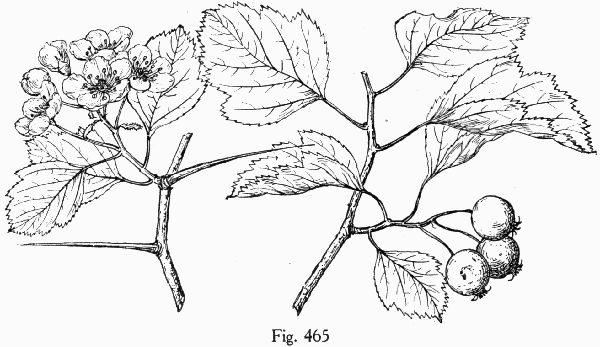
Leaves broad-ovate or oval, acute, rounded or subcordate or narrowed and concave-cuneate at the entire base, coarsely often doubly serrate above with straight glandular teeth, and more or less incisely lobed with acuminate lateral lobes, more than half grown when the flowers open about the middle of May and then pale green and glabrous with the exception of a few caducous hairs on the upper side of the base of the midrib, and at maturity dark green above, paler below, 1½′—2′ long, and 1½′—2′ wide; petioles stout, conspicuously glandular above the base, wing-margined at the apex, glabrous, ½′—¾′ in length. Flowers about ¾′ in diameter, on slender glabrous pedicels, in compact 3—7-flowered simple corymbs, with conspicuously glandular bracts and bractlets; calyx-tube broadly obconic, glabrous, the lobes broad, acuminate, laciniately cut toward the apex, and glandular with stipitate glands; stamens 10; anthers pale rose color; styles 3—5, surrounded at base by tufts of pale hairs. Fruit ripening late in September or in October, subglobose, usually angled, red or russet-red, about ½′ in diameter; calyx little enlarged, with spreading or reflexed lobes; flesh thin, dry and mealy; nutlets 3—5, broad and rounded at base, rounded at the slightly narrowed apex, prominently ridged on the back, with a broad grooved ridge, about 5/16′ long.
A tree, often 25° high, with a trunk 4′—7′ in diameter and sometimes 10°—12° long, covered with gray or often dark brown scaly bark, stout spreading or ascending branches, and thick glabrous red-brown branchlets armed with thin straight shining spines ½′ long, becoming much longer and branched on the trunk and large branches.
Distribution. Southwestern Virginia, through western North Carolina to eastern Tennessee; usually at altitudes between 2000° and 3000°; common on wooded slopes with Oaks, Hickories, and Pines.
[510]
114. Cratægus venusta Beadl.
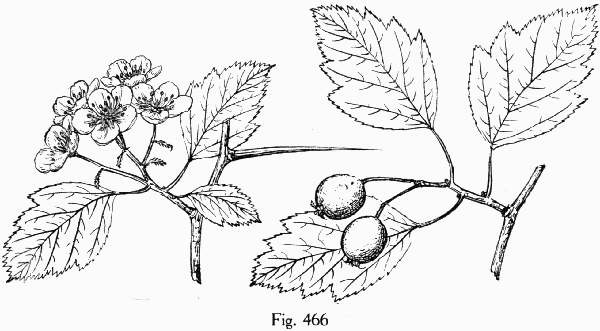
Leaves oval to ovate or occasionally to oblong-ovate, acute, gradually or abruptly narrowed and cuneate or rounded at the entire base, finely serrate above with usually incurved glandular teeth, and frequently slightly and irregularly divided above the middle into 1—3 pairs of short broad acute lobes, when they unfold dark bronze color, with a few scattered pale caducous hairs on the upper surface, about half grown when the flowers open from the 20th to the end of April, and then yellow-green, smooth and glabrous, and at maturity dark dull green above, pale below, 2½′ long, and 1½′ wide, with a stout midrib and 4—7 pairs of thin primary veins; late in the autumn turning, especially those on leading shoots deep orange or scarlet; petioles stout, glandular, more or less winged above, ½′—¾′ in length; leaves at the end of vigorous shoots generally broad-ovate, rounded at base, deeply lobed with broad lobes, and often 3½′ long and 3′ wide. Flowers 1′ in diameter, on short pedicels, in 4—9-flowered compact corymbs, their bracts and bractlets like the inner bud-scales coarsely glandular-serrate and bright red before falling; calyx-tube broadly obconic, the lobes gradually narrowed from a broad base, acute, coarsely glandular-serrate often only below the middle; stamens 15—20, usually 15—17; anthers small, pale yellow; styles 3—5, surrounded at the base by a ring of pale hairs. Fruit ripening and falling from the 1st to the middle of October, on stout pedicels often 1′ long, in few-fruited clusters, short-oblong, rounded at the ends, dull red, often with a bright russet face, and marked by occasional large dark dots; calyx prominent, with a long tube, and spreading lobes often deciduous before the fruit ripens; flesh thick, yellow, dry and mealy; nutlets 3—5, narrow and acute at base, broad, about ¼′ long.
A bushy tree, often 25° high, with a short trunk a foot in diameter, furnished like the large branches with innumerable stout much-branched spines frequently 6′ long, and slender nearly straight glabrous dark chestnut-brown branchlets, armed with many stout straight or slightly curved dark chestnut-brown shining spines frequently pointing toward the base of the branch, and 1½′—2½′ long.
Distribution. Open Oak and Hickory-woods on the dry slopes of Red Mountain in the southern part of the city of Birmingham, Jefferson County, Alabama.
115. Cratægus Sargentii Beadl.
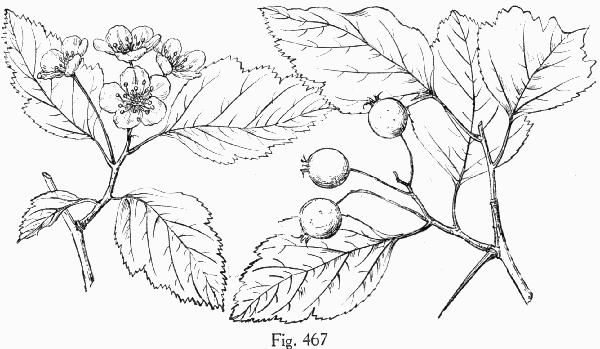
Leaves oblong-ovate to elliptic or rarely to ovate, acute or acuminate at apex, gradually or abruptly cuneate or rounded at the nearly entire base, irregularly doubly serrate above with straight or incurved glandular teeth, and usually irregularly divided into 3 or 4 pairs [511] of short broad acute or acuminate lobes, nearly fully grown when the flowers open late in April, and then subcoriaceous, pale yellow-green, and villose on the midrib with scattered pale caducous hairs, and at maturity lustrous, dark yellow-green above, pale below, 2′—3′ long, and 1½′—2′ wide, with a thin midrib, 5—7 pairs of thin light yellow veins and conspicuous reticulate veinlets; turning in the autumn bright yellow and red; petioles slender, glandular, more or less broadly winged toward the apex, ½′—¾′ in length; leaves at the end of vigorous shoots oblong-ovate, concave-cuneate at base, often 3′ long and 2′ wide, their petioles broadly wing-margined to below the middle. Flowers nearly 1′ in diameter, on long thin slightly villose pedicels, in 2—5 usually 3-flowered simple corymbs, with coarsely glandular-serrate bracts and bractlets; calyx-tube narrowly obconic, glabrous or slightly villose, the lobes foliaceous, acute, coarsely glandular-serrate above the middle; stamens 20; anthers large, dark rose color; styles 3—5, usually 4, surrounded at base by a narrow ring of pale hairs. Fruit ripening and falling about the middle of September, often only a single fruit maturing from a flower-cluster, subglobose to short-oblong, rounded at the ends, yellow or orange-yellow, generally more or less flushed with red, marked by occasional large dark dots, ⅓′—½′ long; calyx prominent, with an elongated tube and closely appressed lobes; flesh yellow, thin and hard; nutlets 3—5, usually 4, about ¼′ long.
An intricately branched tree, rarely more than 20° high, with a tall trunk 6′—7′ in diameter, stout ascending branches forming a narrow or sometimes a round flat-topped head, and glabrous branchlets armed with thin straight or slightly curved dark chestnut-brown shining spines, ¾′—1½′ long; often a large shrub, with few or many stems.
Distribution. Rocky woods and bluffs in the foothill region of northwestern Georgia (cliffs of the Coosa River near Rome, Floyd County), southeastern Tennessee (near Chattanooga, Hamilton County, and Tracy City, Grundy County), and northeastern Alabama; very abundant in Alabama at Valley Head, De Kalb County, and on the low ridges extending southward to the neighborhood of Birmingham, Jefferson County.
XIII. PULCHERRIMÆ.
CONSPECTUS OF THE ARBORESCENT SPECIES.
Leaves oval to ovate or nearly orbicular, their lobes acute or rounded; fruit bright red.
116. C. opima (C).
Leaves ovate to oval or obovate, their lobes acute; fruit orange-red.
117. C. robur (C).
[512]
116. Cratægus opima Beadl.
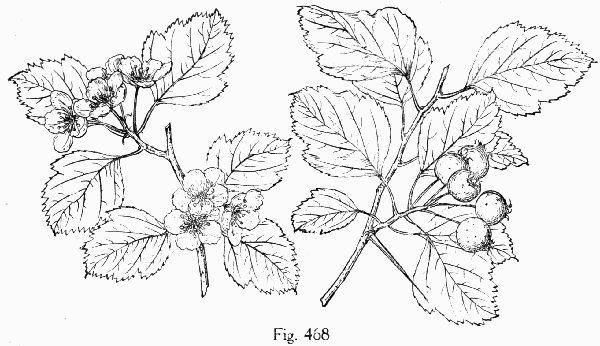
Leaves oval to ovate or nearly orbicular, acute, gradually or abruptly narrowed and cuneate at the entire base, finely serrate above with incurved teeth, and usually divided above the middle into short acute, acuminate or rounded lobes, half grown when the flowers open the middle of April, and then glabrous with the exception of a few short caducous hairs on the midrib and veins, and at maturity light green on the upper surface, pale on the lower surface, 1½′ long, and 1¼′ wide, with a slender midrib, and 5 or 6 pairs of arcuate primary veins spreading to the point of the lobes; petioles narrowly winged at the apex, usually about ¾′ in length; leaves at the end of vigorous shoots sometimes rounded or nearly truncate at base and 1½′—2½′ long and broad. Flowers about ⅔′ in diameter, on short slender pedicels, in compact few-flowered glabrous corymbs; calyx-tube broadly obconic, glabrous, the lobes gradually narrowed from a broad base, acute, entire or sparingly glandular-serrate, tipped with dark red glands, glabrous on the outer surface, puberulous on the inner surface; stamens 20; anthers dark rose color; styles 3—5, surrounded at base by a narrow ring of snowy white tomentum. Fruit ripening about the 1st of October and then remaining on the branches for several weeks, on short stout pedicels, in compact few-fruited erect or drooping clusters, subglobose, often rather longer than broad, bright red, about ¼′ in diameter; calyx prominent, with a well-developed tube, and much enlarged closely appressed lobes often deciduous with the tube before the fruit becomes entirely ripe; flesh thin, yellow, dry and mealy; nutlets 3—5, thin, ⅛′ long.
A tree, 20°—25° high, with a tall, slender often spiny trunk covered with ashy gray bark nearly black at the base of old trees, spreading and ascending branches forming a rounded or oval usually open head, and thin nearly straight bright red-brown glabrous branchlets becoming gray tinged with red or brown in their second season, and armed with thin nearly straight bright chestnut-brown lustrous spines, 1′—1½′ long.
Distribution. Open woods in clay soil in the neighborhood of Greenville, Butler County, Alabama; common near Tallahassee, Leon County, Florida.
117. Cratægus robur Beadl.
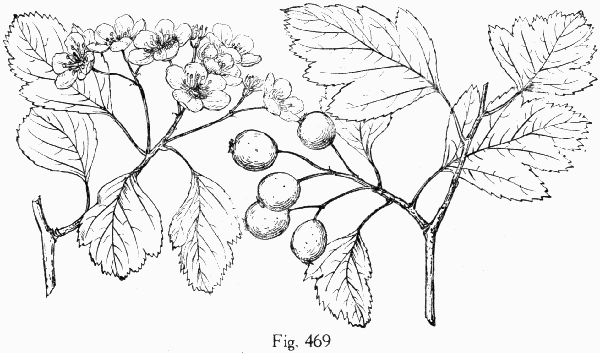
Leaves ovate, oval or obovate, acute or acuminate, entire or sparingly glandular below, finely serrate above with incurved glandular teeth, and incisely lobed above the middle with numerous short acute lobes, nearly fully grown when the flowers open at the end of March, and then membranaceous and dark yellow-green and lustrous, and at maturity [513] yellow-green, 1½′—2′ long, and 1′—1½′ wide, with a slender yellow midrib, and thin primary veins extending very obliquely to the point of the lobes; turning in the autumn orange, yellow, or brown; petioles slender, slightly wing-margined toward the apex, sparingly glandular, ½′—1′ in length; leaves at the end of vigorous shoots broadly ovate, cuneate or nearly truncate at the wide base, deeply divided into broad lateral lobes, often 2′—3′ long and broad, with a stout broadly winged petiole frequently 1′ long. Flowers 1⅛′—1¼′ in diameter, on long slender pedicels, in 5—10-flowered glabrous corymbs, with large conspicuously glandular bracts and bractlets; calyx-tube narrowly obconic, glabrous, the lobes gradually narrowed from a broad base, glabrous, entire or sparingly serrate; stamens 20; anthers pale rose color; styles 3—5, surrounded at base by a narrow ring of pale hairs. Fruit ripening in September and October, on elongated, slender pedicels, in few-fruited drooping clusters, subglobose, orange-red, about ½′ in diameter; calyx-lobes deciduous before the maturity of the fruit leaving a narrow ring round the shallow cavity; flesh thin and firm; nutlets 3—5, broad, rounded at the ends, barely grooved on the rounded back, 3/16′ long and nearly as broad.
A tree, 20°—25° high, with a trunk 4′—6′ in diameter, covered with gray or brown scaly bark, spreading or ascending branches, and slender red-brown branchlets unarmed or armed with stout spines ¾′—1′ long; more often a large much-branched shrub, with one or more stems.
Distribution. Woods and borders of fields, northwestern Florida; common in the neighborhood of Tallahassee, Leon County.
XIV. BRACTEATÆ.
CONSPECTUS OF THE ARBORESCENT SPECIES.
Leaves oval to broad-obovate, subcoriaceous; corymbs many-flowered; stamens 10—20, usually 20; fruit bright red or orange-red.
118. C. Harbisonii (C).
Leaves broad-ovate or rarely obovate, thin; corymbs 3—10-flowered; stamens 20; fruit bright red.
119. C. Ashei (C).
118. Cratægus Harbisonii Beadl.
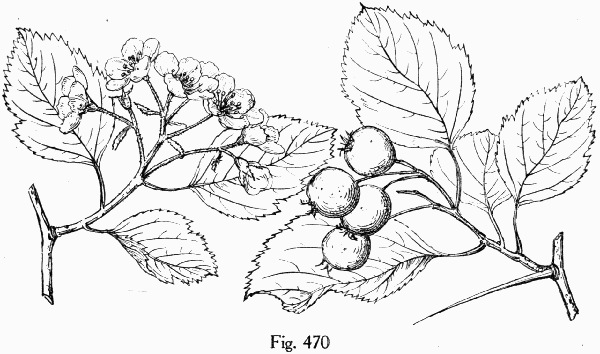
Leaves oval to broad-obovate, acute at apex, cuneate or rounded at the entire base, and coarsely serrate above with straight glandular teeth, when they unfold roughened above by stout, rigid pale hairs, and soft and pubescent below, nearly fully grown early in [514] May when the flowers open, and then thin, dark yellow-green above and pale below, and at maturity subcoriaceous; pale on the lower surface, 2′—2½′ long, and 1′—1½′ wide, with a stout midrib and primary veins deeply impressed on the upper side of the leaf, and conspicuous reticulate veinlets; petioles stout, villose, more or less winged above, ¼′—½′ in length; leaves at the end of vigorous shoots broad-ovate, cuneate and decurrent on their stouter petiole, 3′—4′ long, and 2½′—3′ wide, with lunate coarsely glandular-dentate stipules frequently ½′ long. Flowers ¾′ in diameter, in broad loose usually 10—12-flowered corymbs, with broad acute conspicuous glandular-serrate bracts and bractlets; calyx-tube broadly obconic, densely villose at the base and glabrous or pubescent above, the lobes elongated, gradually narrowed from a broad base, acute, bright green, more or less hairy, coarsely glandular-serrate, with large stipitate dark red glands; stamens 10—20, usually 20; anthers large, light yellow; styles 3—5. Fruit ripening and falling early in October, subglobose, often rather longer than broad, bright red or orange-red, marked by numerous large dark dots; calyx enlarged, with spreading glandular lobes often deciduous before the fruit ripens; flesh yellow, thick, dry and mealy; nutlets 3—5, narrowed at the ends, ¼′ long.
A tree, sometimes 25° high, with a trunk 10′—12′ in diameter, covered with light gray or gray-brown bark, and often armed with straight or much-branched spines, wide-spreading light gray or reddish branches forming a rather open symmetrical head, and slender branchlets coated when they first appear with long spreading white hairs, pubescent or glabrous and light red-brown or orange-brown during their first season, becoming dark or light gray the following year, and furnished with numerous usually stout straight dark reddish brown shining spines 1½′—2′ long.
Distribution. Dry limestone hills and ridges; West Nashville, Davidson County, Tennessee; common.
119. Cratægus Ashei Beadl.
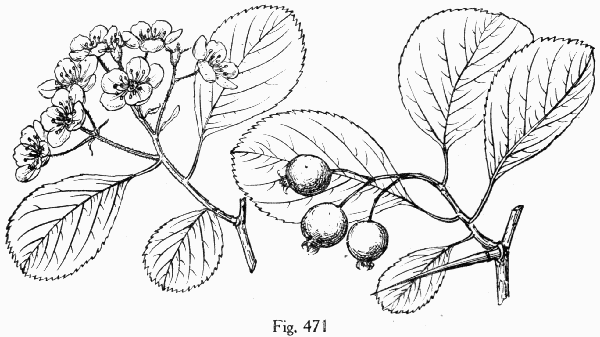
Leaves broad-ovate or occasionally obovate, acute and generally short-pointed at apex, gradually or abruptly narrowed and cuneate and usually entire at base, coarsely and occasionally doubly serrate above with straight or incurved teeth tipped with small dark glands, when they unfold roughened on the upper surface with short pale hairs and pubescent below, nearly fully grown and membranaceous when the flowers open early in May, and at maturity thin but firm in texture, pale and puberulous on the lower surface on the slender midrib and primary veins, about 2′ long and 1½′ wide; petioles stout, broadly winged above, glandular, pubescent early in the season but ultimately nearly glabrous, about ½′ in length; [515] leaves at the end of vigorous shoots usually broadly oval or nearly orbicular, rounded or short-pointed at apex, 2½′—3′ long, and 2′—2½′ wide. Flowers ¾′ in diameter, on slender hairy pedicels, in 3—10-flowered simple or compound corymbs, with broad conspicuous glandular bracts and bractlets; calyx-tube broadly obconic, thickly coated with long matted reflexed white hairs, the lobes broad, acute, nearly glabrous on the outer surface, villose on the inner surface, glandular with small stout stipitate glands; stamens 20; anthers small, yellow; styles 3—5, surrounded at base by a narrow ring of pale hairs. Fruit ripening and falling late in September or early in October, on stout villose or glabrous pedicels, in few-fruited clusters, subglobose or rather longer than broad, bright red, marked by large scattered dots, more or less villose toward the ends, about 1′ in diameter; calyx conspicuous, with elongated coarsely glandular-serrate, erect incurved or reflexed lobes; flesh thick and yellow; nutlets 3—5, thin, acute at the ends, ⅓′ long.
A tree, rarely more than 20° high, with a slender trunk covered with smooth light gray or red-brown bark becoming fissured and scaly on old individuals, stout ascending branches forming a pyramidal or oval head, and slender branchlets coated when they first appear with long pale matted reflexed hairs, soon becoming nearly glabrous, lustrous, orange-brown or reddish brown, and light gray or gray tinged with red during their second season, and armed with straight or slightly curved thin dark red-brown shining spines 1′—1½′ long.
Distribution. Abandoned fields, and woods, growing usually on clay soils; near Montgomery, Montgomery County, and Gallion, Hale County, Alabama.
XV. FLAVÆ.
CONSPECTUS OF THE ARBORESCENT SPECIES.
Stamens 20.
Anthers pink or purple.
Corymbs usually 3—6-flowered.
Leaves elliptic to broad-ovate, yellow-green; fruit dark orange-brown.
120. C. flava (C).
Leaves ovate to obovate or orbicular, bright yellow-green; fruit obovoid, dark orange color with a red cheek.
121. C. visenda (C).
Leaves obovate or ovate, dark green; fruit subglobose to short-oblong, red or orange-red.
122. C. ignava (C).
[516]
Corymbs 1—5-flowered.
Leaves broad-obovate to nearly orbicular, bright green; fruit globose or depressed-globose, bright red.
123. C. consanguinea.
Leaves obovate, bright green; fruit ellipsoidal to short-oblong, orange-red; anthers pink.
124. C. tristis.
Anthers yellow (doubtful in 128, 133).
Leaves yellow-green.
Leaves 3-nerved.
Leaves obovate-cuneate, often 3-lobed at apex; fruit obovoid to subglobose, bright orange-red and lustrous; corymbs tomentose.
125. C. floridana.
Leaves obovate; fruit subglobose to short-oblong, dull brownish yellow; corymbs glabrous.
126. C. lacrimata.
Leaves with numerous primary veins.
Leaves thin.
Leaves scabrate above at maturity, obovate, rounded or abruptly short-pointed at apex; fruit subglobose to short-oblong, bright orange-red.
127. C. Ravenelii (C).
Leaves smooth above at maturity.
Leaves obovate to obovate-cuneiform; fruit subglobose, bright red.
128. C. senta (A).
Leaves obovate to oval or orbicular; fruit subglobose to ellipsoidal, orange-red or red and orange.
129. C. annosa (C).
Leaves subcoriaceous.
Flowers in 3—5-flowered corymbs.
Leaves obovate; fruit globose or depressed-globose, orange-yellow with a red cheek.
130. C. panda (C).
Leaves obovate to oblong-ovate, minutely serrate; fruit globose, red or yellow.
131. C. integra (C).
Flowers in 1 or 2-flowered corymbs; leaves spathulate; fruit obovoid, red.
132. C. recurva (C).
Leaves conspicuously blue-green, broad-ovate to orbicular; fruit subglobose to short-oblong, light red, puberulous at the ends.
133. C. dispar (C).
Stamens 10; anthers yellow; leaves broad-obovate to oval or rhombic, dark yellow-green; fruit subglobose, dull orange-red, often slightly villose at the ends.
134. C. aprica (C).
120. Cratægus flava Ait.
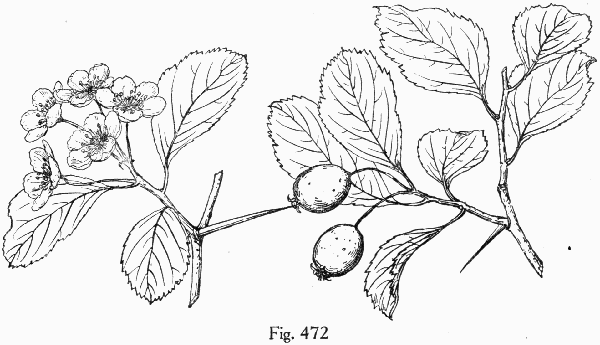
Leaves elliptic to broad-obovate, acute or rarely rounded at apex, gradually narrowed and cuneate at the glandular base, and coarsely doubly serrate above with broad straight or incurved teeth tipped with large dark red stipitate glands, when they unfold bronze color, villose above with short pale caducous hairs most abundant near the base of the midrib and pubescent below on the midrib and veins, about half grown when the flowers open from the 10th to the 20th of April, and at maturity membranaceous, yellow-green, usually about 2′ long and 1½′ wide, with a slender yellow midrib and 3 or 4 pairs of primary veins usually puberulous on the under side and only slightly impressed above; petioles slender, glandular, winged nearly to the base, generally more or less villose, after midsummer often light red on the lower side, and about ½′ in length; leaves at the end of vigorous shoots frequently 3′ long and 2′ wide, and sometimes broad-ovate, 3-lobed or divided into 2 or 3 pairs of lateral lobes, their petioles 1′—1½′ long, broadly winged and conspicuously glandular, and foliaceous lunate or elliptic coarsely glandular-serrate stipules. Flowers about ¾′ in diameter, on short slender pedicels, in few-flowered simple or compound slightly villose compact corymbs, with lanceolate acute coarsely glandular-serrate bracts and bractlets; calyx-tube broadly obconic, glabrous, the lobes wide, acute, usually laciniately divided, very glandular; stamens 20; anthers large, dark rose color. Fruit ripening early in October and soon falling, in few-fruited drooping clusters, short-oblong, full and rounded at the ends, [517] dark orange-brown, ½′—⅝′ long, and ⅓′—½′ in diameter; calyx prominent, with a long narrow tube, and enlarged closely appressed lobes often deciduous before the fruit ripens; flesh thick, orange color, dry and mealy; nutlets 5, gradually narrowed and rounded at the ends, ridged and deeply grooved on the back with a high narrow ridge, about ½′ long.
A tree, 15°—20° high, with a tall trunk 8′—10′ in diameter, covered with thin dark brown bark tinged with red and divided into narrow rounded ridges, stout ascending branches forming an open and somewhat irregular head sometimes 20° across, and slender slightly zigzag glabrous branchlets dark green deeply tinged with red when they first appear, becoming dull red-brown or orange-brown during their first season, darker the following year, and ultimately dark gray-brown, and armed with thin nearly straight bright chestnut-brown spines ¾′—1¼′ long.
Distribution. Dry sandy soil on the sand hills of Summerville, near Augusta, Richmond County, Georgia, and at River Junction, Gadsden County, Florida.
121. Cratægus visenda Beadl.
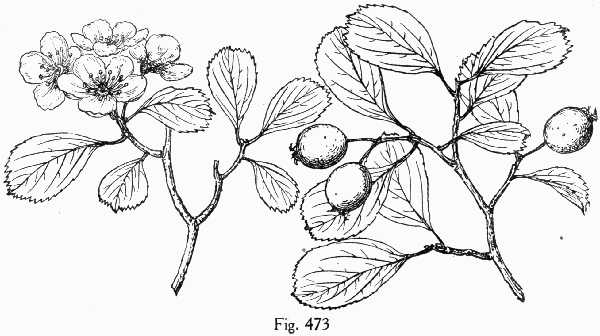
Leaves ovate, obovate, or orbicular, short-pointed and acute or occasionally broad and rounded at apex, concave-cuneate and gradually narrowed at the mostly entire base, finely [518] serrate above with rounded teeth, glandular with bright red glands, and divided above the middle into short acute lobes, nearly fully grown when the flowers open at the end of March, and then glabrous with the exception of a few short pale hairs on the two surfaces near the base of the midrib, and at maturity thin and firm in texture, bright yellow-green and lustrous above, pale below, glabrous, 1′—1½′ long, and ¾′—1′ wide, with a slender midrib, and thin primary veins extending very obliquely to the point of the lobes; turning yellow, orange, or brown in the autumn; petioles slender, broadly wing-margined above the middle, conspicuously glandular, sparingly villose early in the season, becoming nearly glabrous, ½′—¾′ in length. Flowers about ¾′ in diameter, on short villose pedicels, in simple 3—6-flowered corymbs; calyx-tube broadly obconic, hairy near the base with scattered pale hairs, glabrous above, the lobes broad, acuminate, glandular-serrate, glabrous on the outer, pilose on the inner surface; stamens 20; anthers pale purple; styles 3—5, surrounded at base by small tufts of white hairs. Fruit ripening and falling late in August and early in September, on stout pedicels, usually in 1 or 2-fruited clusters, obovoid, dark orange-colored, with a red cheek, ½′—⅝′ long, nearly ½′ in diameter; calyx enlarged, the lobes coarsely glandular-serrate, puberulous on the upper surface, closely appressed; flesh soft and yellow; nutlets 3—5, obtuse and rounded at the ends, rounded and slightly ridged on the back, about ⅜′ long.
A tree, sometimes 30° high, with a trunk 10′—12′ in diameter, covered with dark gray or brownish bark, crooked horizontal or ascending branches forming a broad irregular head, and stout often contorted branchlets villose when they first appear, soon glabrous, dull reddish brown to ashy gray, and armed with slender straight spines ½′—⅝′ long.
Distribution. Sandy soil near Bristol, Liberty County, Florida.
122. Cratægus ignava Beadl.
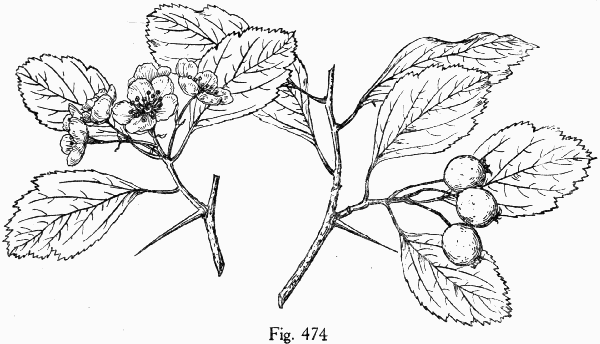
Leaves obovate to ovate, acute, gradually narrowed from near the middle to the concave-cuneate glandular base, sharply often doubly serrate above with glandular teeth, and usually divided toward the apex into short acute lobes, nearly fully grown when the flowers open at the end of April, and then membranaceous, glabrous with the exception of a few hairs on the midrib above and on the midrib and slender veins below, and at maturity subcoriaceous, bright green and lustrous on the upper surface, pale and still hairy on the lower surface, 1½′—2′ long, and 1′—1½′ wide; turning in the autumn yellow and brown sometimes flushed with red; petioles slender, wing-margined at the apex, glandular, ¼′—½′ in length. Flowers about ¾′ in diameter, on slender glabrous pedicels, in 3—6-flowered simple corymbs, with lanceolate conspicuously glandular reddish bracts and bractlets; calyx-tube broadly [519] obconic, glabrous, the lobes abruptly narrowed from the base, wide, glabrous, glandular with dark red stipitate glands, and often coarsely serrate above the middle; stamens 20; anthers large, dark rose color; styles 3—5, surrounded at base by a ring of pale hairs. Fruit ripening and falling at the end of September and early in October, on slender erect pedicels, in few-fruited clusters, subglobose to short-oblong, orange-red, marked by numerous pale dots, about ⅜′ long; calyx enlarged and prominent, with spreading lobes often deciduous from the ripe fruit; flesh thick and soft; nutlets 3—5, rounded at the ends, prominently but irregularly ridged and grooved on the back, ¼′ long.
A tree, sometimes 10°—12° high, with a slender trunk covered with ashy gray fissured scaly bark often tinged with brown and frequently nearly black near the ground, stout ascending branches, and slender zigzag glabrous branchlets bright red-brown during their first season, becoming dark gray-brown, and armed with many very slender red-brown lustrous ultimately ashy gray spines 1′—1½′ long.
Distribution. Northeastern Alabama; common on Lookout Mountain above Valley Head and at Collinsville, DeKalb County, and at Gadsden, Etowah County.
123. Cratægus consanguinea Beadl.
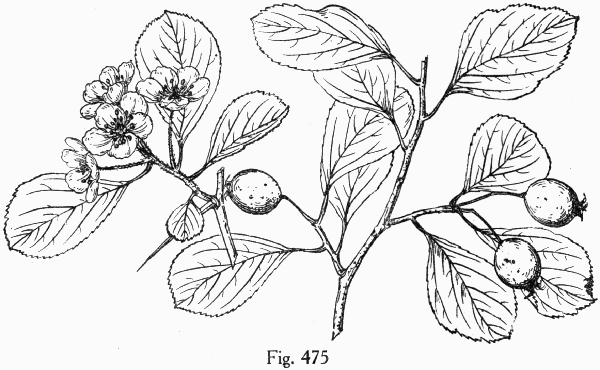
Leaves broad-obovate to nearly orbicular, occasionally oval or rhombic, acute and generally short-pointed at apex, gradually narrowed and concave-cuneate or sometimes rounded at the entire base, finely and often doubly serrate with glandular teeth, and frequently irregularly divided above the middle into short acute lobes, nearly fully grown when the flowers open at the end of March or early in April, and then very thin, blue-green, slightly villose, especially on the midrib and veins, and at maturity thin, bright green, glabrous with the exception of a few hairs on the under side of the slender midrib, and thin primary veins extending very obliquely toward the end of the leaf, about 1′ long, and ¾′—⅞′ wide; petioles slender, glandular, wing-margined above, villose early in the season, becoming glabrous, ⅓′—¾′ in length; leaves at the end of vigorous shoots often 1½′—2′ long and wide. Flowers ¾′ in diameter, on long slender hairy pedicels, in simple 1—5-flowered corymbs, with oblanceolate acuminate bright red caducous bracts and bractlets; calyx-tube broadly obconic, sparingly hairy with long pale caducous hairs, the lobes gradually narrowed from a broad base, acute, glandular with minute bright red glands, glabrous; stamens 20; anthers small, deep rose color; styles 3—5, surrounded at base by a narrow ring of short pale hairs. Fruit ripening and falling about the middle of September, on slender glabrous pedicels, often only a single fruit in a cluster developing, globose to depressed-globose, bright red, marked by small dark dots, nearly ½′ in diameter; calyx prominent, with enlarged [520] appressed lobes; flesh thin, yellow, dry and mealy; nutlets 3—5, thick, narrowed and rounded at base, broad and rounded at apex, ridged on the back with a broad low rounded ridge, about 5/16′ long.
A tree, often 20° high, with a tall trunk 6′—8′ in diameter, covered with nearly black deeply furrowed bark broken into short thick closely appressed scales, wide-spreading often pendulous branches forming a broad symmetrical handsome head, and slender slightly zigzag branchlets covered when they first appear with pale caducous hairs, soon becoming bright red-brown and lustrous, and dull reddish brown in their second season, and armed with short nearly straight gray or chestnut-brown spines ⅓′—¾′ long.
Distribution. Dry upland Oak-woods in western Florida from the neighborhood of Tallahassee, Leon County to the Apalachicola River; common in the neighborhood of River Junction, Gadsden County, and at Aspalaga, Liberty County.
124. Cratægus tristis Beadl.
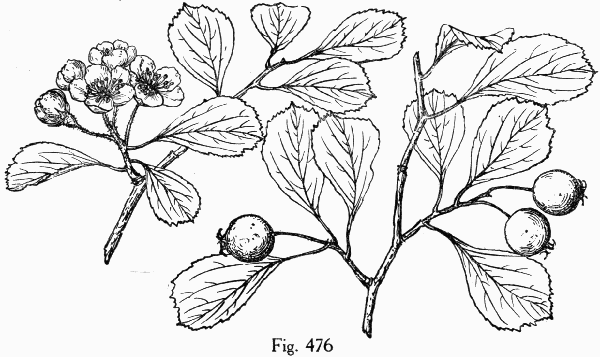
Leaves obovate, acute, acuminate, or rounded and often more or less undulate-lobed at the broad apex, gradually narrowed from above the middle and concave-cuneate at the glandular base, and serrate above with blunt glandular teeth, about half grown when the flowers open at the end of April, and then slightly pilose on the upper and villose on the lower surface on the thin midrib and in the axils of the slender veins extending obliquely to the point of the lobes, and at maturity thin and firm in texture, bright green and glabrous, 1¼′—1½′ long, and about ¾′ wide; turning in the autumn yellow, brown, and orange; petioles slender, wing-margined above, conspicuously glandular, slightly puberulous, ½′—¾′ in length; leaves at the end of vigorous shoots oblong-obovate, often deeply and irregularly divided into broad acute lateral lobes, and frequently 1½′—2′ long and nearly as broad. Flowers ⅝′—¾′ in diameter, on slender villose pedicels, in simple 3—5-flowered corymbs, with rose-colored and conspicuously glandular bracts and bractlets; calyx-tube broadly obconic, hairy toward the base with long scattered pale hairs, the lobes gradually narrowed from a broad base, acuminate, glandular with large dark red glands, and entire or coarsely serrate above the middle; stamens 20; anthers pink; styles 3—5. Fruit ripening and falling late in August or early in September, ellipsoidal or short-oblong, orange-red, about ½′ long, with soft flesh; calyx little enlarged, with recurved persistent lobes; nutlets 3—5, broad and rounded at base, gradually narrowed and acute at apex, rounded and ridged on the back with a broad low slightly grooved ridge, about 5/16′ long.
A tree, sometimes 25° high, with a trunk 8′—10′ in diameter, covered with dark sometimes nearly black deeply furrowed bark, stout pendulous branches forming a broad [521] shapely handsome head, and slender branchlets hoary-tomentose when they first appear, bright red-brown and puberulous at the end of their first season, becoming dark gray-brown, and armed with few slender straight spines 1¼′—1½′ long; or often a large shrub.
Distribution. Slopes of low hills, northwestern Georgia; common in the neighborhood of Rome, Floyd County.
125. Cratægus floridana Sarg.
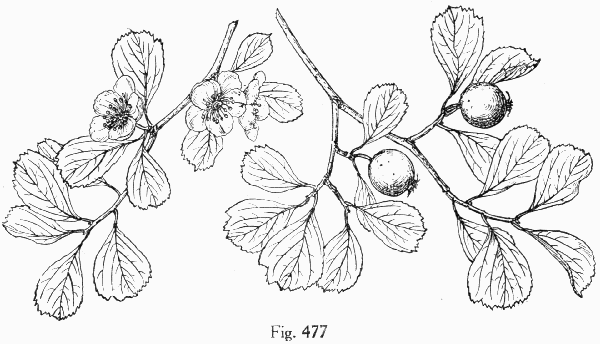
Leaves obovate-cuneate, frequently 3-lobed at apex with short rounded lobes, gradually narrowed and cuneate at the entire base, finely serrate above with straight or incurved teeth tipped with conspicuous ultimately dark persistent glands, 3-nerved with slender nerves, numerous thin secondary veins and reticulate veinlets, slightly villose above as they unfold, nearly fully grown when the flowers open about the middle of March, and then light yellow-green and glabrous with the exception of a few persistent hairs on the upper side of the nerves and in their axils, and at maturity thick and firm, dark green and lustrous on the upper surface, pale on the lower surface, 1′—1½′ long, and about ½′ wide; petioles slender, glandular, more or less winged toward the apex, tomentose, becoming pubescent or glabrous, usually about ½′ in length; leaves at the end of vigorous shoots frequently 2′ long, and sometimes divided by deep rounded sinuses into numerous narrow lateral lobes, their stipules lunate, foliaceous, pointed, coarsely glandular-serrate. Flowers about ⅝′ in diameter, on slender tomentose pedicels, in few usually 1—3-flowered simple compact corymbs; calyx-tube broadly obconic, coated with long matted white hairs, the lobes narrow, acuminate, glandular with bright red stipitate glands, villose toward the base on the outer surface and on the inner surface; stamens 20; anthers small, pale yellow; styles 4 or 5, surrounded at the base by a broad ring of long shining white hairs. Fruit ripening from the middle to the end of August, on short stout pubescent pedicels, solitary or in 2 or 3-fruited drooping clusters, obovoid to short-oblong, usually about ¾′ long, bright orange-red, lustrous, marked by numerous pale dots; calyx prominent, with an elongated tube puberulous on the outer surface, and reflexed glandular-serrate lobes; flesh thin, yellow, dry and mealy; nutlets 4 or 5, acute at base, broad and rounded at apex, rounded and occasionally slightly ridged on the back, about ⅓′ long.
A tree, rarely more than 15° high, with a long straight trunk 6′—8′ in diameter, covered with thick nearly black deeply furrowed bark broken into short thick plate-like scales, small drooping branches forming a handsome symmetrical head, and slender conspicuously zigzag pendulous branchlets coated when they first appear with long pale matted hairs, [522] becoming during their first season dark red-brown and more or less villose, and dark brown the following year, and armed with thin straight spines ¾′—1′ long, or unarmed.
Distribution. Dry sandy soil of the Pine-barrens of northeastern Florida; abundant in the neighborhood of Jacksonville, Duval County.
126. Cratægus lacrimata Small.
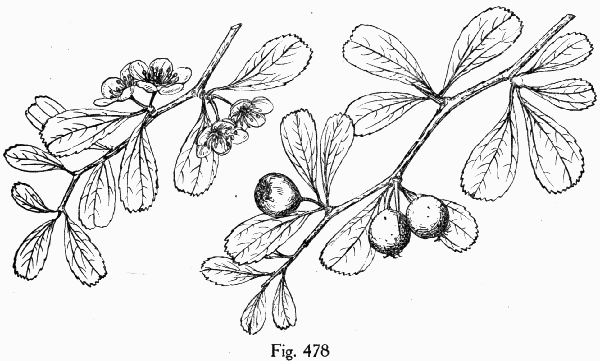
Leaves obovate, rounded or acute and glandular-serrate at apex usually with incurved teeth, entire and glandular below, gradually narrowed from above the middle to the base, and 3-nerved with slender yellow nerves, numerous thin secondary veins and reticulate veinlets, when the flowers open early in April nearly fully grown, light yellow, glabrous, with the exception of small tufts of pale caducous hairs in the axils of the nerves below, and at maturity subcoriaceous, lustrous, ¼′—¾′ long, and about ⅓′ wide; petioles slender, wing-margined toward the apex, dark orange-brown, at first puberulous, soon becoming glabrous, ¼′—½′ in length. Flowers about ⅔′ in diameter, on short stout glabrous pedicels, in 3—5-flowered simple corymbs, with long linear entire caducous bracts and bractlets turning red in fading; calyx-tube broadly obconic, glabrous, the lobes gradually narrowed from a broad base, acuminate, entire, tipped with large dark glands; stamens 20; anthers large, light yellow; styles usually 3, surrounded at base by a narrow ring of pale hairs. Fruit ripening toward the end of August, on slender pedicels, in 1 or 2-fruited clusters, subglobose to short-oblong, rounded at the ends, dull brownish yellow marked by occasional dark dots, about ⅓′ in diameter; calyx prominent, with an elongated tube, and spreading lobes usually deciduous before the fruit ripens; flesh thin, yellow, dry and mealy; nutlets 3, broad, rounded at the broad ends, rounded and sometimes obscurely grooved on the back, about ⅜′ long.
A tree, occasionally 20° but usually not more than 10° high, with a tall trunk 4′—6′ in diameter, covered with thick deeply furrowed black bark broken on the surface into thick plate-like closely appressed scales, long slender drooping branches forming a handsome symmetrical round-topped head; and thin glabrous very zigzag branchlets light orange-brown when they first appear, soon becoming reddish brown and lustrous, and dark gray-brown in their second year, and armed with many small nearly straight dark chestnut-brown spines ½′—¾′ long.
Distribution. Western Florida, Walton and Santa Rosa Counties (Pensacola to De Funiak Springs); sometimes in moist sand; more often in dry barrens; common and often a conspicuous feature of the vegetation.
[523]
127. Cratægus Ravenelii Sarg.
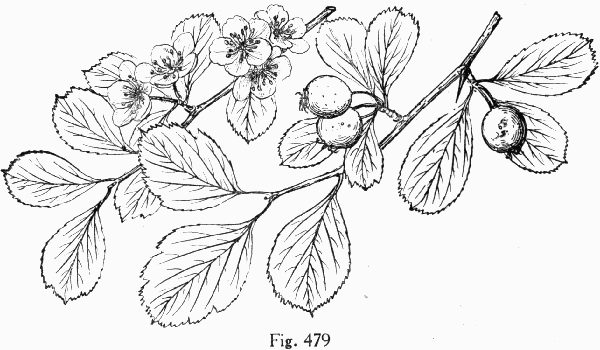
Leaves obovate, rounded and abruptly short-pointed or acute at the broad sometimes slightly lobed apex, gradually narrowed from above the middle to the elongated cuneate base, more or less undulate on the margins, and coarsely and usually doubly glandular-serrate above with large bright red ultimately dark persistent glands, nearly fully grown when the flowers open the middle of April, and then coated with long pale caducous hairs, and at maturity thin and firm in texture, yellow-green, scabrous on the upper surface, pale, and pubescent on the lower surface on the slender veins, 1′—1½′ long, and about ¾′ wide; petioles slender, glandular, winged above, tomentose when they first appear, becoming pubescent, ¼′—½′ in length; leaves at the end of vigorous shoots often 2′ long and 1½′ wide, and frequently divided above the middle into 2 or 3 pairs of broad lateral lobes. Flowers about ¾′ in diameter, on slender tomentose pedicels, in simple corymbs; calyx-tube narrowly obconic, thickly coated with long white hairs, the lobes lanceolate, villose on the outer, glabrous on the inner surface, glandular with small red glands; stamens 20; anthers small, pale yellow; styles 5, surrounded at base by a broad ring of pale tomentum. Fruit ripening early in October, on short thick pedicels, in few-fruited drooping or spreading clusters, globose to short-oblong, bright orange-red, marked by occasional dark dots, puberulous at the ends, ⅓′—½′ in diameter; calyx prominent, with enlarged spreading and appressed lobes; flesh thick, yellow, subacid; nutlets 5, narrowed and acute at the ends, ridged on the back with a high narrow ridge, ½′ long.
A tree, 25°—30° high, with a trunk often 14′ or 15′ in diameter, covered with thick dark brown bark deeply divided into narrow interrupted ridges broken on the surface into short thick plate-like scales, heavy ascending or spreading branches forming an open irregular head, and stout zigzag branchlets thickly coated at first with hoary tomentum, dark purple or red-brown and pubescent during their first summer, becoming dark red-brown and glabrous the following season, and armed with thick straight dull gray-brown spines usually about 1½′ long.
Distribution. Sand hills near Aiken, Aiken County, South Carolina, and in Summerville near Augusta, Richmond County, Georgia.
128. Cratægus senta Beadl.
Leaves obovate or obovate-cuneiform, acute or sometimes rounded and frequently slightly divided into several short acute lobes at the broad apex, gradually narrowed from the middle to the entire base, and serrate or doubly serrate above with incurved conspicuously [524] glandular teeth, when they unfold often dark red, covered above with long pale caducous hairs and villose below on the midrib and veins, nearly fully grown when the flowers open from the 1st to the 10th of May and then bright yellow-green and almost glabrous with the exception of the persistent tufts of pale hairs in the axils of the veins, and at maturity thin and firm, dark green and lustrous above, paler below, usually about 1½′ long and 1′ wide, with an orange-colored midrib, generally 3 pairs of slender primary veins extending obliquely to the point of the lobes, and dark conspicuous reticulate veinlets; turning red, yellow, or brown in the autumn; petioles slender, glandular, wing-margined above, at first tomentose, becoming pubescent or nearly glabrous, about ¾′ in length; leaves at the end of vigorous shoots broad-ovate, often nearly orbicular, more deeply lobed with broad rounded or acute lobes, 2′—2½′ in diameter, their stipules lunate, coarsely glandular-dentate, sometimes ½′ long. Flowers ¾′ in diameter, on long slender pedicels coated with matted pale hairs, in lax compound 3—6-flowered villose corymbs, with lanceolate straight or falcate glandular bracts and bractlets; calyx-tube broadly obconic, villose particularly toward the base, the lobes narrow, elongated, acuminate, nearly glabrous, coarsely and irregularly glandular-serrate; stamens 20; styles 3—5, surrounded at base by a broad ring of hoary tomentum. Fruit ripening and falling at the end of September or early in October, on slender slightly hairy elongated pedicels, in few-fruited drooping clusters, globose, bright red, ⅓′—½′ in diameter; calyx enlarged, with closely appressed lobes; flesh yellow, dry and mealy; nutlets 3—5, broad and rounded at apex, narrowed and acute at base, slightly grooved on the back, about ½′ long.
Distribution. Abandoned fields and open Pine-woods near Asheville, Buncombe County, North Carolina, at altitudes of about 2200°.
129. Cratægus annosa Beadl.
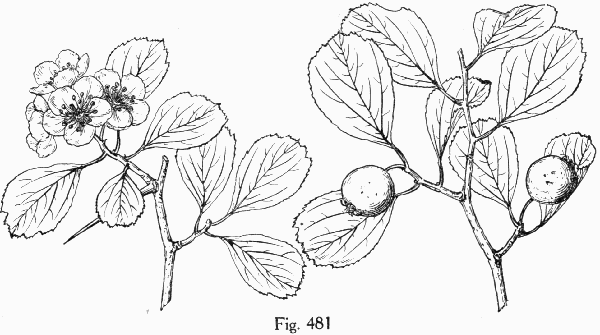
Leaves obovate, oval, or oblanceolate, cuneate and glandular at base, sharply and often doubly glandular-serrate above, and usually slightly lobed toward the short-pointed acute apex, more than half grown when the flowers open early in April and then pale yellow-green and scurfy above, with a few short pale hairs above and below near the base of the midrib, and at maturity thin, glabrous, bright green, 1′—1½′ long, and ¾′—1′ wide, with a prominent pale yellow midrib, and remote slender veins extending very obliquely to the point of the lobes; turning in the autumn yellow, orange, or brown; petioles slender, narrowly winged above, conspicuously glandular with large dark glands, ½′—¾′ in length; leaves at the end of vigorous shoots broad-ovate to obovate or suborbicular, coarsely serrate, conspicuously reticulate-venulose, sometimes 2′ long and wide, with broadly winged petioles and foliaceous [525] coarsely dentate persistent stipules often ¾′ long. Flowers ¾′ in diameter, on stout villose pedicels, in simple 3—5-flowered villose corymbs; calyx-tube narrowly obconic, sparingly villose toward the base, the lobes acute, glandular-serrate, glabrous on the outer surface, puberulous on the inner surface; stamens 20; anthers almost white; styles 3—5, surrounded at base by a broad ring of snow-white tomentum. Fruit ripening and falling late in August or early in September, subglobose or ellipsoidal, orange-red or red and orange, about ½′ long; calyx little enlarged, the lobes puberulous on the upper side and reflexed; flesh thick and soft; nutlets 3—5, broad and rounded at base, narrowed and rounded at apex, rounded and ridged on the back with a broad low rounded ridge, about 5/16′ long.
A tree, 20°—25° high, with a trunk sometimes a foot in diameter, covered with dark rough often black bark, stout spreading or ascending branches, and thick dull red-brown ultimately dark gray or nearly black branchlets armed with straight rather stout spines 1′—1½′ long.
Distribution. Eastern central Alabama; common near Phœnix, Lee County, and Girard, Russell County.
130. Cratægus panda Beadl.
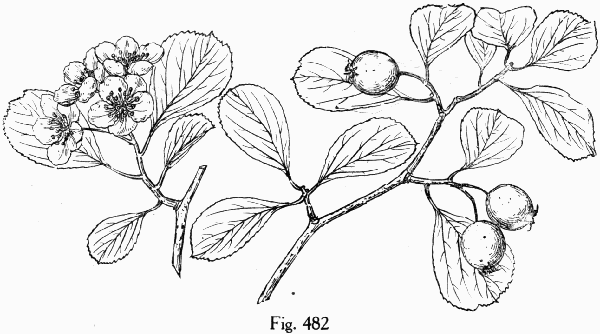
Leaves obovate, rounded and short-pointed or abruptly narrowed and acute at the broad occasionally slightly lobed apex, concave-cuneate and glandular at the entire base, and finely serrate above with minute incurved glandular teeth, when they unfold tinged with red and sparingly villose, nearly fully grown when the flowers open the 1st of April and then roughened above by short pale rigid hairs and villose above and below on the midrib and on the veins below, and at maturity glabrous, or puberulous on the under surface of the slender midrib, subcoriaceous, light green and lustrous, glandular, 1′—1¼′ long, and ¾′—1′ wide, with slender primary veins extending very obliquely toward the end of the leaf; turning yellow-brown or orange color in the autumn before falling; petioles slender, slightly wing-margined at apex, villose early in the season, becoming glabrous, glandular, about ⅜′ in length; leaves at the end of vigorous shoots broad-ovate, rounded, apiculate and lobed at apex, puberulous and villose on the midrib and veins on the lower surface, often 1¾′ long and 2′ wide. Flowers ⅝′—¾′ in diameter, on slender hairy pedicels, in compact 3—5-flowered simple corymbs; calyx-tube narrowly obconic, covered with matted white hairs, the lobes gradually narrowed from a broad base, acuminate, glandular-serrate, more or less villose; stamens 20; anthers nearly white; styles 3—5, surrounded at base by a narrow ring of pale hairs. Fruit ripening and falling at the end of August or early in September, on stout pedicels, in erect few-fruited clusters, globose or depressed-globose, orange-yellow, with a red [526] cheek, ⅜′—¾′ in diameter; calyx slightly enlarged, with closely appressed often deciduous lobes; flesh thick, succulent, orange-yellow; nutlets 3—5, narrowed and acute at the ends, grooved on the rounded back with a broad shallow groove, about ¼′ long.
A tree, 20°—25° high, with a trunk sometimes a foot in diameter, covered with dark rough bark, crooked recurved branches forming an open irregular head, and stout branchlets covered at first with matted pale hairs, reddish brown and puberulous during their first season, becoming gray, and unarmed or occasionally armed with stout spines ½′—1′ long.
Distribution. Dry sandy soil near Tallahassee, Leon County, Florida.
131. Cratægus integra Beadl.
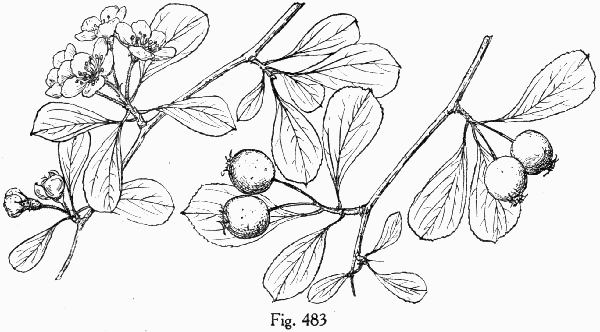
Leaves obovate to oblong-obovate, narrowed from near the middle to the acute apex, concave-cuneate and gradually narrowed to the slender base, and finely serrate, nearly half grown when the flowers open about the 20th of March, and then glandular on the margins, slightly hairy on the midrib and on the under side of the veins, and at maturity subcoriaceous, bright green, lustrous, and glabrous above, paler below, 1′—1¼′ long, and about ¾′ wide, [527] with a thin yellow midrib puberulous below, slender primary veins extending very obliquely to the end of the leaf, with 1 or 2 pairs near the middle of the blade more prominent than those below and above them; turning in the autumn yellow, orange and brown; petioles slender, narrowly wing-margined above, glandular, at first hoary-tomentose, becoming pubescent or puberulous, ½′—¾′ in length; leaves at the end of vigorous shoots broadly obovate, short-pointed at apex, slightly undulate-lobed above the middle, sometimes 1½′ long and broad. Flowers ⅝′—¾′ in diameter, on slender elongated hoary-tomentose pedicels, in 3—5-flowered simple corymbs; calyx-tube narrowly obconic, thickly covered with matted white hairs, the lobes gradually narrowed from a broad base, acuminate, glandular, pilose on the outer, sparingly pilose on the inner surface; stamens 20; anthers pale yellow; styles 3—5, surrounded at base by a thick ring of white hairs. Fruit ripening and falling in August, on slender erect pubescent pedicels, globose, red, about ½′ in diameter; calyx deciduous; flesh thin, orange-yellow, and succulent; nutlets 3—5, narrowed and acute at the base, rounded at the apex, flat and grooved on the back with a narrow shallow groove, about 5/16′ long.
A tree, 12°—15° high, with a trunk sometimes 8′ in diameter, covered with thick nearly black checkered bark, drooping branches forming a handsome symmetrical head, and slender very zigzag branchlets clothed when they first appear with hoary tomentum, rather bright reddish brown and roughened by minute tubercles at the end of their first season, becoming gray or grayish brown, and unarmed or armed with occasional short slender spines.
Distribution. Sandy woods and abandoned fields; central Florida; common near Eustis, Lake County, and Orlando, Orange County.
132. Cratægus recurva Beadl.
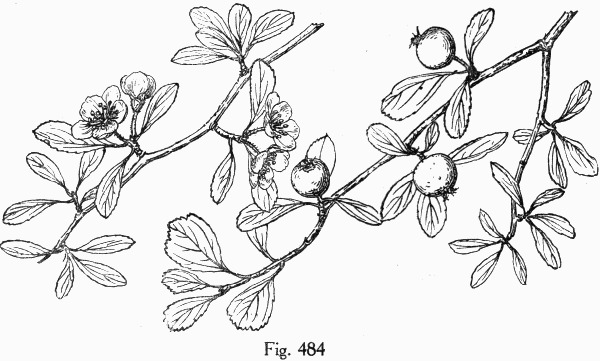
Leaves spatulate, rounded or acute or sometimes obovate and obtusely 3-lobed at apex, and finely glandular-serrate with bright red glands, nearly half grown when the flowers open about the 20th of March and then almost glabrous above, slightly hairy near the base below, and at maturity subcoriaceous, glabrous, about 1′ long and ¼′—½′ wide, with a slender yellow midrib and one pair of veins often more prominent than the others and nearly parallel with the margins of the blade; turning in the autumn yellow, orange, and brown; petioles slender, conspicuously glandular, villose when they first appear, becoming glabrous, ¼′—½′ in length; leaves at the end of vigorous shoots broad-obovate, deeply divided into narrow lateral ascending rounded lobes, concave-cuneate at base, with a stouter midrib, and veins arching to the point of the lobes, and often 1′ long and ¾′ wide. Flowers [528] ½′—⅝′ in diameter, on stout pedicels thickly covered with matted pale hairs, solitary or in 2-flowered simple corymbs; calyx-tube broadly obconic, pilose below, nearly glabrous above, the lobes slender, acuminate, glandular-serrate, slightly hairy on the outer surface, glabrous on the inner surface; stamens 20; anthers pale yellow; styles 3—5. Fruit ripening in August, erect on short stout pedicels, obovoid, red, ½′ long; calyx little enlarged, often deciduous; flesh thick and soft; nutlets 3—5, broad and rounded at the ends, rounded and obscurely grooved on the back, about ¼′ long.
A tree, 15°—18° high, with a short trunk 5′—6′ in diameter, covered with gray or brownish rough bark, slender pendulous branches forming a broad symmetrical head, and slender very zigzag branchlets, villose early in the season, becoming bright chestnut-brown and very lustrous and ultimately dark reddish brown, and armed with numerous slender straight spines usually about ½′ long.
Distribution. Dry sandy soil, Ocala, Marion County, Florida.
133. Cratægus dispar Beadl.
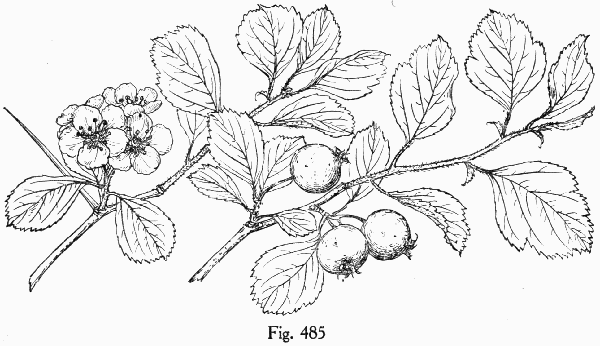
Leaves broad-ovate or orbicular, 3-nerved, acute or rounded at apex, generally narrowed and cuneate or concave-cuneate at the glandular entire base, serrate or doubly serrate above with straight or incurved glandular teeth, and mostly divided above the middle into short acute lobes, when they unfold coated with long matted white hairs most abundant on the lower surface, more than half grown when the flowers open about the middle of April and then blue-green and villose above and tomentose below, and at maturity thin and firm in texture, blue-green and glabrous on the upper surface, pale and slightly pubescent on the lower surface, usually about 1′ long and ¾′—1′ wide; turning red, yellow, or brown in the autumn; petioles slender, tomentose, becoming pubescent or villose, glandular, slightly wing-margined above, usually about ⅓′ in length; leaves at the end of vigorous shoots broad-ovate or suborbicular, rounded at the broad base, coarsely serrate, and often deeply divided above the middle into 3 wide acute lobes broader than long. Flowers about ⅝′ in diameter, on slender hoary-tomentose pedicels, in simple 3—7-flowered corymbs, with narrow-obovate acute glandular bracts and bractlets; calyx-tube narrowly obconic, coated with hoary tomentum, the lobes narrow, acute, glandular-serrate with minute bright red glands, tomentose on the outer surface below the middle, glabrous above, tomentose on the inner surface; stamens 20; styles 3—5, surrounded at base by a ring of pale tomentum. Fruit ripening late in August or early in September, on slender pubescent pedicels, in few-fruited clusters, subglobose to short-oblong, light red, puberulous toward the ends, about ⅓′ in diameter; calyx prominent, with reflexed closely appressed lobes tomentose at base; [529] flesh thin, yellow, subacid; nutlets 3—5, rounded at the ends, ridged on the back with a broad low ridge, dark brown, ¼′ long.
A tree, 20°—25° high, with a short trunk a foot in diameter, heavy ascending branches forming a broad irregular head, and stout zigzag branchlets at first hoary-tomentose, dark red-brown and pubescent during their first summer, becoming darker colored and glabrous the following season, and armed with thick or thin nearly straight dark red-brown ultimately gray spines 1½′—2′ long.
Distribution. Dry sand hills near Aiken, Aiken County, and Trenton, Edgefield County, South Carolina; more abundant at Summerville, west of Augusta, Richmond County, Georgia.
134. Cratægus aprica Beadl.
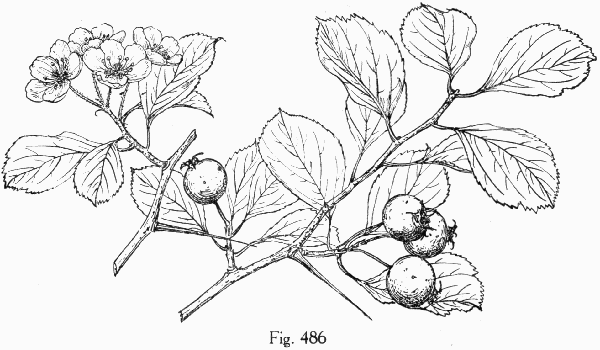
Leaves broad-obovate, oval, or rhombic, acute and short-pointed or rounded and often somewhat lobed at apex, gradually or abruptly narrowed and cuneate at the entire base, and serrate usually only above the middle with small incurved teeth terminating in conspicuous rose-colored ultimately dark red persistent glands, when they unfold deep orange color, roughened above by short pale appressed hairs and sparingly villose below, especially on the slender midrib and remote primary veins, nearly fully grown when the flowers open about the 10th of May, and at maturity thick and firm, glabrous, smooth, and dark yellow-green on the upper surface, pale on the lower surface, 1′—1¼′ long, and 1′ wide; petioles stout, conspicuously glandular, more or less winged toward the apex, villose early in the season, becoming nearly glabrous, usually bright red on the lower side toward the base after midsummer, about ½′ in length; leaves at the end of vigorous shoots often nearly orbicular, frequently more deeply lobed, and 1½′—2′ long and wide, with a stout broadly winged petiole, and foliaceous lunate stipules. Flowers ¾′ in diameter, on slender villose pedicels, in small 3—6-flowered compact simple corymbs; calyx-tube broadly obconic, villose at base, glabrous above, the lobes gradually narrowed from a broad base, acuminate, glabrous, coarsely glandular-serrate; stamens 10; anthers small, bright yellow; styles 3—5, surrounded at base by a narrow ring of pale hairs. Fruit ripening late in the autumn, on stout glabrous or slightly villose pedicels, in erect or drooping usually 2 or 3-fruited clusters, subglobose, rarely rather longer than broad, about ½′ in diameter, dull orange-red, often slightly villose at the ends, marked by numerous small dark dots; calyx much enlarged, with wide-spreading coarsely glandular acuminate lobes bright red at base on the upper side; flesh thin, light yellow, sweet and rather juicy; nutlets 3—5, broad and rounded at the ends, rounded and ridged on the back with a broad low ridge, about ¼′ long.
[530]
A tree, occasionally 20° high, with a stem 6′—8′ in diameter, covered with deeply furrowed dark gray bark broken irregularly into small persistent plate-like scales, and becoming on old stems often nearly black, spreading often elongated contorted branches forming a broad open head, and slender zigzag branchlets dark green tinged with red and villose when they first appear, soon becoming nearly glabrous, light orange-brown at midsummer, dark reddish brown or purple before winter, and ultimately ashy gray, and armed with thin nearly straight chestnut-brown spines 1′—1½′ long; or frequently a much-branched shrub, with several stout spreading stems.
Distribution. Dry woods in the foothill region of the southern Appalachian Mountains; southwestern Virginia through western North Carolina to eastern Tennessee and northern Georgia; in northern Alabama; usually at altitudes between 1500° and 3500°; common.
XVI. MICROCARPÆ.
CONSPECTUS OF THE ARBORESCENT SPECIES.
Fruit short-oblong; leaves orbicular to broad-ovate, pinnately 5—7-cleft.
135. C. apiifolia (C).
Fruit subglobose.
Leaves broad-ovate to triangular, long-stalked; calyx deciduous from the fruit.
136. C. Phænopyrum (A, C).
Leaves spatulate to oblanceolate, short-stalked; calyx generally persistent on the fruit.
137. C. spathulata (C).
135. Cratægus apiifolia Michx. Parsley Haw.
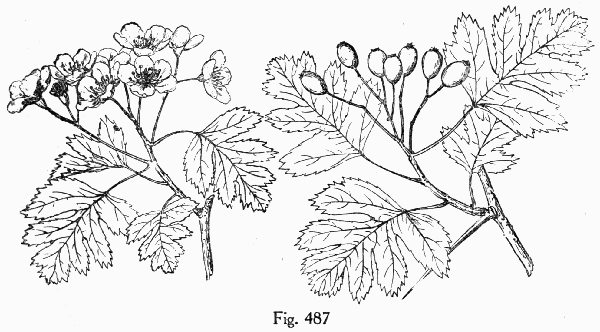
Leaves broad-ovate to orbicular, acute at apex, truncate, slightly cordate or cuneate at the broad base, and pinnately 5—7-cleft with shallow acute or deep wide sinuses, and incisely lobed with broad or acute segments serrate toward the apex with spreading glandular teeth, when they unfold pilose above with long pale hairs, and mostly glabrous below, fully grown when the flowers open late in March or early in April, and at maturity thin, bright green and rather lustrous above, paler and glabrous or pilose below on the prominent midrib and primary veins, or on occasional plants pubescent on both surfaces, ⅔′—1½′ wide; petioles slender, pubescent, becoming glabrous, 1′—1½′ in length; leaves at the end of vigorous shoots often divided nearly to the midrib, with foliaceous lunate coarsely glandular-serrate short-stalked stipules sometimes ½′ long. Flowers ½′ in diameter, on long slender [531] hairy pedicels, in crowded densely villose usually 10—12-flowered corymbs; calyx-tube narrowly obconic, glabrous or covered with long matted pale hairs, the lobes lanceolate, acute, glabrous, usually glandular-serrate, often tinged with red toward the apex; stamens 20; anthers bright rose color; styles 1—3. Fruit ripening in October and persistent on the branches until the beginning of winter, short-oblong, bright scarlet, ⅓′ long; calyx prominent, the lobes elongated, reflexed, often deciduous from the ripe fruit; flesh thin; nutlets 1—3, rounded at the ends, about ⅓′ long.
A tree, occasionally 20° high, with a trunk rarely 6′—8′ in diameter, branches spreading nearly at right angles and forming a wide irregular open head, and slender more or less zigzag often contorted branchlets covered when they first appear with long pale hairs, light red or pale orange-brown and usually puberulous in their first winter, ultimately light brown or ashy gray, and armed with stout straight chestnut-brown spines 1′—1½′ long.
Distribution. Borders of streams and swamps or in hummocks in Pine-barrens in the coast and Piedmont regions of the south Atlantic States from southeastern Virginia to Georgia; in western Florida south to Lafayette County (near Old Town), north-central and southern Alabama, Louisiana and the coast region of Texas to the valley of the lower Colorado River (low woods, Peyton’s Creek, Matagorda County), and through Arkansas to eastern Oklahoma (Page, Le Flore County) and to southeastern Missouri; most abundant and of its largest size in southern Arkansas and western Louisiana.
136. Cratægus Phænopyrum Med. Washington Thorn.
Cratægus cordata Ait.
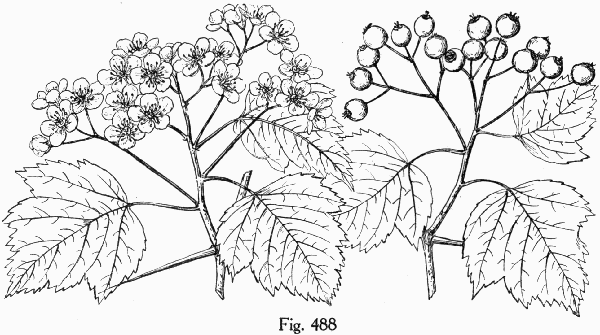
Leaves broad-ovate to triangular, acute or acuminate, truncate, broad-cuneate, rounded or cordate at the entire base, coarsely serrate above with acute spreading often gland-tipped teeth, and more or less incisely lobed or often 3-lobed, tinged with red when they unfold and sparingly pilose above with long pale caducous hairs, fully grown when the flowers open at the end of May, and at maturity thin and firm, dark green and lustrous above, pale and rarely pubescent on the lower surface, especially on the conspicuous orange-colored midrib and primary veins, 1½′—2′ long, and 1′—1½′ wide; turning late in the autumn bright scarlet and orange; petioles slender, terete, glabrous, ¾′—1½′ in length. Flowers on slender pedicels, in rather compact many-flowered glabrous corymbs; calyx-tube broadly obconic, glabrous, the lobes short, nearly triangular, entire, abruptly contracted at apex into a minute point, glabrous on the outer, pubescent on the inner surface, ciliate on the margins; stamens 20; anthers rose color; styles 2—5, surrounded at base by [532] conspicuous tufts of pale hairs. Fruit ripening in September and October and persistent on the branches until the spring of the following year, depressed-globose, scarlet, lustrous, ¼′ in diameter; calyx deciduous from the ripe fruit, leaving a wide circular scar surrounding the persistent erect tips of the carpels; nutlets 3—5, narrowed and acute at base, broad and rounded at apex, about ⅛′ long.
A tree, 20°—30° high, with a straight trunk sometimes a foot in diameter, generally dividing 4°—5° above the ground into slender usually upright branches forming an oblong or occasionally round-topped head, slender zigzag glabrous bright chestnut-brown lustrous branchlets, becoming dark gray or reddish brown, and armed with slender sharp spines 1½′—2′ long; often much smaller, and sometimes a broad spreading bush.
Distribution. Banks of streams in rich soil; western North Carolina at altitudes of about 2000°, to middle Tennessee and southern Kentucky; in southern Missouri (St. Francois, Wayne, Shannon, Carter and Ripley Counties), and in Richland County, Illinois; now often naturalized in the middle and Ohio valley states; nowhere common. Often cultivated in the eastern states and in western Europe; hardy as far north as eastern Massachusetts.
137. Cratægus spathulata Michx.
Cratægus spathulata var. flavanthera Sarg.
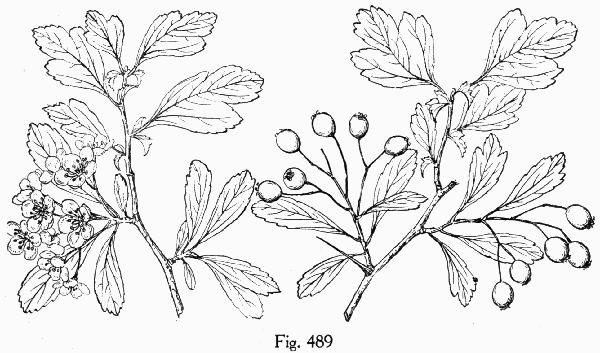
Leaves spatulate to oblanceolate, rounded or acuminate and sometimes 3-lobed at apex, gradually narrowed from above the middle to the slender concave-cuneate entire base, and crenately serrate above, nearly fully grown when the flowers open from March to May and then sparingly villose above with long white caducous hairs, and at maturity subcoriaceous, glabrous, dark green and lustrous above, paler below, reticulate-venulose, with an obscure yellow midrib and primary veins, 1′—2′ long, and 1′—1½′ wide, clustered at the end of short lateral branchlets; petioles slender, wing-margined to the base, ⅛′—¼′ in length; leaves at the end of vigorous shoots often deeply 3-lobed above the middle with rounded coarsely crenately serrate lobes, and narrowed below into a long winged petiole, 1′—2′ long, and 1′—1½′ wide, with a broad thick midrib often pilose on the lower surface, their stipules foliaceous, lunate, sharply serrate, stalked, often ½′ broad. Flowers ½′ in diameter, on long slender pedicels, in glabrous many-flowered narrow corymbs; calyx-tube broadly obconic, glabrous, the lobes short, nearly triangular, almost entire, minutely glandular-apiculate; stamens 20; anthers pale yellow; styles 2—5. Fruit ripening in October, subglobose, [533] bright scarlet, lustrous, about ⅛′ in diameter; calyx only slightly enlarged, with reflexed lobes; flesh thin, dry and mealy; nutlets 3—5, broad and rounded at apex, narrowed at base, 1/16′—⅛′ long.
A tree, 18°—25° high, with a straight trunk occasionally 8′—10′ in diameter, slender upright and spreading branches forming a broad open head, and thin zigzag glabrous light reddish brown branchlets, unarmed, or armed with straight stout light brown spines 1′—1½′ long; more often a shrub, with numerous spreading stems.
Distribution. Rich soil usually near the banks of streams or swamps, or low depressions in Pine-forests; North Carolina (near Albemarle, Stanly County) to central South Carolina, central, northwestern (Rome, Floyd County), and southwestern Georgia to northern Florida (Ocala, Marion County, to River Junction, Gadsden County); northern Alabama southward to Dallas County; eastern and western Mississippi (near Natchez, Adams County); eastern and northwestern Louisiana (Richland, Rapides, Caddo and Natchitoches Parishes); eastern Texas to the valley of the Guadalupe River (near Seguin, Guadalupe County), southeastern Oklahoma (Bennington, Bryan County), and through southern and western Arkansas to southwestern Missouri (Tanney and Jasper Counties); probably most abundant in central Georgia.
XVII. BRACHYACANTHÆ.
CONSPECTUS OF THE ARBORESCENT SPECIES.
Leaves oblong-lanceolate to ovate or rhombic; broad-ovate to nearly triangular on vigorous shoots; fruit subglobose to obovoid, bright blue covered with a glaucous bloom.
138. C. brachyacantha (C).
Leaves narrow-rhombic to oval; lanceolate, acuminate on vigorous shoots; fruit globose, blue-black, very lustrous.
139. C. saligna (F).
138. Cratægus brachyacantha Sarg. & Engelm. Pomette Bleue.
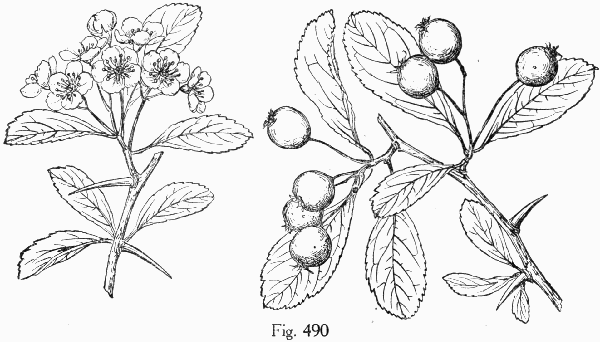
Leaves oblong-lanceolate to ovate or rhombic, acute or rounded at apex, gradually narrowed to the concave-cuneate entire base, and crenulate-serrate above with minute incurved glandular teeth, slightly puberulous when they unfold on the upper surface and glabrous on the lower surface, nearly fully grown when the flowers open at the end of April and early in May, and at maturity subcoriaceous, glabrous, dark green and lustrous, 1′—2′ long, and ½′ to nearly 1′ wide, with a thin inconspicuous midrib and veins; petioles slender, narrowly [534] wing-margined above, ½′—¾′ in length; leaves at the end of vigorous shoots sometimes broad-ovate or almost triangular, cuneate, truncate or cordate at the broad base, more or less deeply lobed, frequently 2½′ long and 2′ wide, with foliaceous broadly ovate to triangular acute stalked stipules sometimes 1′ long. Flowers ⅓′ in diameter, on slender pedicels, in crowded glabrous many-flowered corymbs; calyx-tube narrowly obconic, glabrous, the lobes short, nearly triangular, gradually narrowed to the gland-tipped apex, entire; petals turning bright orange color in fading; stamens 15—20; anthers yellow; styles 3—5. Fruit ripening and falling the middle of August, on erect pedicels, in few-fruited clusters, subglobose or obovoid, bright blue, covered with a glaucous bloom, ⅓′—½′ in diameter; calyx slightly enlarged, with spreading lobes; flesh thin; nutlets 3—5, narrowed and acute at base, full and rounded at apex, rounded and slightly grooved on the back, about ¼′ long.
A tree, 40°—50° high, with a trunk 18′—20′ in diameter, covered with thick dark brown deeply furrowed scaly bark, and divided usually 5°—10° from the ground into stout spreading light gray branches forming a broad compact round-topped head, and branchlets light green and slightly pubescent early in the season, soon becoming glabrous and pale red-brown, and ultimately ashy gray, and armed with numerous short stout generally curved or sometimes straight slender spines ⅓′—⅔′ long, and also often terminal on the lateral branchlets of vigorous shoots.
Distribution. Borders of streams in rich moist soil; southwestern Arkansas (Ashtown, Little River County, and Texarkana, Miller County) to the valley of the Trinity River (Livingston, Polk County), eastern Texas, and to western Louisiana (Caddo, Webster, Ouachita, Natchitoches, St. Landry and Jefferson Davis Parishes); in eastern Louisiana (Glen Gordon, Covington, St. Tammany Parish; common); a few miles west of Opelousas, Louisiana, surrounding with dense groves low wet prairies and a conspicuous and beautiful feature of arborescent vegetation.