Division II. Dicotyledons. (continued 10)
Reading edition
An oval-headed tree, 20°—30° high, with a short trunk sometimes 8′—10′ in diameter, covered with dark gray scaly bark, and stout zigzag often contorted branchlets dark orange-green and marked by large pale lenticels when they first appear, becoming light chestnut-brown and lustrous in their first season and dull red-brown the following year, and armed with few stout slightly curved chestnut-brown shining spines 1′—1½′ long, persistent and becoming branched on old stems.
Distribution. Rich hillsides, Kittanning, Armstrong County, and on the flood plain of the Allegheny River at Whiskey Hollow across the river from Kittanning, and Linesville, Crawford County, Pennsylvania.
VII. TENUIFOLIÆ.
CONSPECTUS OF THE ARBORESCENT SPECIES.
Stamens 5—10.
Corymbs villose.
Leaves oblong-ovate; stamens usually 5; anthers pink; fruit obovoid to short-oblong.
61. C. apiomorpha (A).
Leaves oblong-obovate; stamens 10; anthers reddish purple; fruit obovoid to subglobose.
62. C. paucispina (A).
Corymbs glabrous; leaves oval or ovate; stamens usually 5; anthers dark reddish purple; fruit short-oblong.
63. C. pentandra (A).
Stamens usually 20.
Corymbs villose.
Leaves broad-ovate to obovate or rarely oval; fruit short-oblong to obovoid.
64. C. lucorum (A).
Leaves rhombic to broad-ovate or rarely obovate; fruit ellipsoidal.
65. C. lacera (C).
[457]
Corymbs glabrous.
Leaves ovate; anthers pale rose color; fruit subglobose to broad-obovoid, dark red.
66. C. depilis (A).
Leaves ovate; stamens 15—20; anthers dark rose color; fruit subglobose.
67. C. basilica (A).
61. Cratægus apiomorpha Sarg.
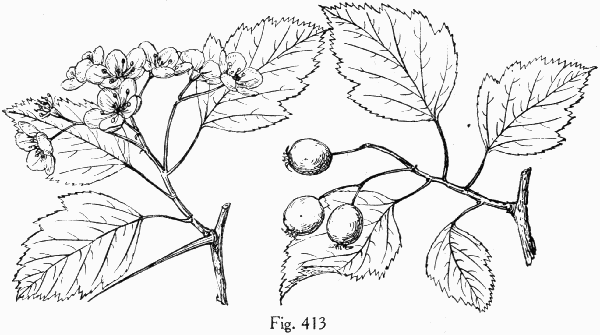
Leaves oblong-ovate, acuminate, rounded or rarely cuneate at the entire often unsymmetrical base, finely doubly serrate above with slender glandular teeth, and slightly divided above the middle into 4 or 5 pairs of triangular acute lobes, about half grown when the flowers open early in May and then membranaceous, light yellow-green and tinged with red or bronze color, and covered above with short white hairs and pale and glabrous below, and at maturity thick and firm in texture, dark blue-green and smooth and lustrous or sometimes dull and scabrate on the upper surface, pale blue-green on the lower surface, 1½′—2¼′ long, and 1⅛′—1½′ wide, with a stout midrib, and primary veins arching obliquely to the point of the lobes; petioles slender, slightly winged at the apex, often sparingly glandular, ⅜′—1′ in length; leaves at the end of vigorous shoots often 3′ long. Flowers ½′—¾′ in diameter, on short villose or glabrous pedicels, in compact many-flowered usually hairy corymbs, their bracts and bractlets linear to oblong-obovate, glandular-serrate with stipitate dark red or purple glands, turning red before falling, mostly persistent until after the flowers open; calyx-tube narrowly obconic, glabrous, the lobes abruptly narrowed at base, slender, acuminate, entire or sparingly glandular; stamens 5—10, usually 5; anthers pink; styles 3—5, surrounded at base by tufts of pale hairs. Fruit ripening early in September and soon falling, on slender pedicels, in few-fruited drooping clusters, obovoid or rarely short-oblong, bright reddish purple, marked by small scattered pale dots, ⅜′—⅝′ long, and ¼′—⅓′ in diameter; calyx much enlarged, with spreading lobes, their tips mostly deciduous from the ripe fruit; flesh thin, yellow, juicy, pleasantly acid; nutlets 3—5, thin, rounded and ridged on the back with a low ridge, about ¼′ long.
A tree, sometimes 25° high, with a trunk 6′ in diameter and 3°—6° long, covered with dark gray bark separating into thin plates, in falling disclosing the yellow inner bark, numerous ascending branches forming an oblong or pyramidal crown, and slender branchlets dark dull red-brown during their first season, becoming dark gray-brown the following year, and unarmed, or armed with slender nearly straight dull red-brown ultimately ashy gray spines 1′—1½′ long; or often shrubby, with numerous stems spreading into small clumps.
[458]
Distribution. Dry open places, borders of woods, and the margins of the high banks of streams; common and generally distributed in northeastern Illinois.
62. Cratægus paucispina Sarg.
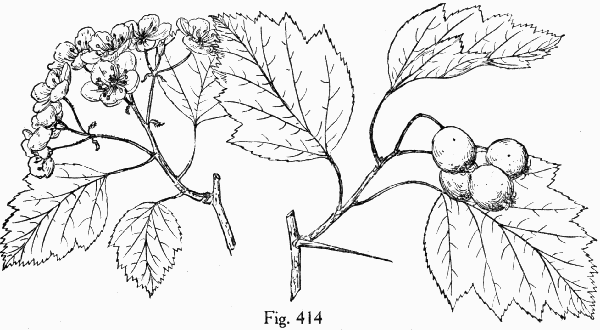
Leaves oblong-obovate, acuminate, rounded, concave-cuneate to truncate or subcordate at the entire base, sharply doubly serrate above with straight glandular teeth, and deeply divided into 4 or 5 pairs of acute lateral lobes spreading or pointing toward the apex of the leaf, about half grown when the flowers open early in May and then light yellow-green and slightly roughened above by short white hairs and paler and glabrous below, and at maturity membranaceous, dark blue-green and scabrate on the upper surface, pale blue-green on the lower surface, 2½′—3′ long, and 1½′—2½′ wide, with a slender yellow midrib, and thin primary veins extending obliquely to the point of the lobes; petioles slender, usually without glands, tinged with purple in the autumn, ¾′—1½′ in length. Flowers ⅝′—¾′ in diameter, on slender hairy pedicels, in broad 12—20-flowered slightly villose corymbs, their bracts and bractlets linear to oblong-obovate, glandular, red, mostly persistent until after the flowers open; calyx-tube narrowly obconic, glabrous, the lobes narrow, acuminate, glandular-serrate with small dark red stipitate glands, glabrous on the outer, pubescent on the inner surface; stamens 10; anthers bright reddish purple; styles 4 or 5, surrounded at base by tufts of pale hairs. Fruit ripening during the first half of September and soon falling, on slender glabrous pedicels, in drooping clusters, obovoid to subglobose, crimson or purplish, marked by numerous small pale dots, slightly pruinose, ½′—⅝′ long, and about ½′ in diameter; calyx small, with reflexed and appressed or erect and incurved serrate lobes dark red on the upper side below the middle, often deciduous from the ripe fruit; flesh thin, yellow, juicy, acid and edible; nutlets 4 or 5, thin, narrowed and acute at the ends, rounded and slightly grooved or obscurely ridged on the back, about ¼′ long.
A tree, sometimes 25° high, with a trunk 4′—6′ in diameter and often 6° long, covered with dark gray or nearly black bark separating into thin plate-like scales, numerous branches forming a round-topped head, and slender glabrous branchlets dark yellow-green when they first appear, becoming dark reddish brown at the end of their first season, olive-green in their second year, and ultimately dark gray-brown, and armed with small straight light red-brown shining spines ½′—¾′ long.
Distribution. Woods and river banks in dry clay soil; northeastern Illinois; common.
63. Cratægus pentandra Sarg.
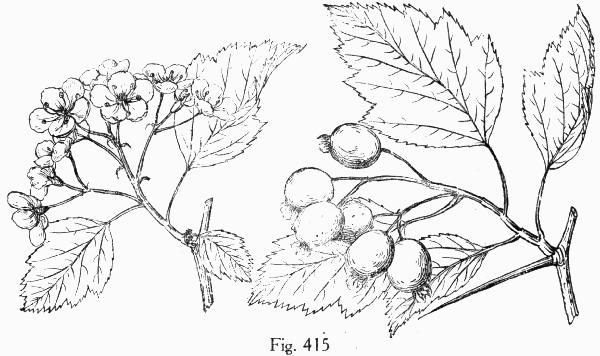
Leaves oval or ovate, acuminate, broadly cuneate or rarely rounded at the entire base, divided above the middle into numerous short acute or acuminate lobes, and coarsely and [459] often doubly serrate with straight or incurved teeth tipped with small dark glands, nearly fully grown and very thin when the flowers open at the end of May, and at maturity membranaceous, dark green and roughened above by short rigid pale hairs, pale and glabrous below, 2′—2½′ long, and 1½′—2′ wide, with a slender yellow midrib, and thin primary veins extending to the point of the lobes; petioles slender, often winged toward the apex, glandular with minute dark glands, usually about 1′ in length; leaves at the end of vigorous shoots more deeply lobed, and often 4′ long and 3′ wide. Flowers ⅝′—¾′ in diameter, on long slender pedicels, in compact few-flowered glabrous corymbs; calyx-tube narrowly obconic, glabrous, dark red, the lobes linear-lanceolate, entire or finely glandular-serrate; stamens usually 5, occasionally 6—10; anthers large, dark red-purple; styles 3, surrounded at base by a thin ring of hoary tomentum. Fruit ripening about the middle of September and soon falling, on stout pedicels, in drooping narrow clusters, short-oblong, full and rounded at the ends, dark crimson, lustrous, marked by minute pale dots, usually about ⅝′ long and ½′ in diameter; calyx enlarged and persistent, the lobes elongated, strongly incurved, often deciduous before the fruit ripens; flesh thick, dry and mealy; nutlets 3, narrowed and acute at the ends, prominently ridged on the back with a high broad ridge, ⅓′ long.
A tree, rarely more than 15° high, with a straight trunk 5′—6′ in diameter, covered with thin bark separating into papery lustrous pale scales, stout branches forming a broad open irregular head, and slender glabrous branchlets bright chestnut-brown during their first season, becoming ashy gray the following year, and armed with many thick straight or curved bright chestnut-brown or red-brown spines 1′—1½′ long.
Distribution. Low hills and limestone ridges; western and southern Vermont; southern Connecticut (rocky shore of Alewive Creek, Waterford, New London County), and eastern and central New York (Whitesboro, Oneida County).
64. Cratægus lucorum Sarg.
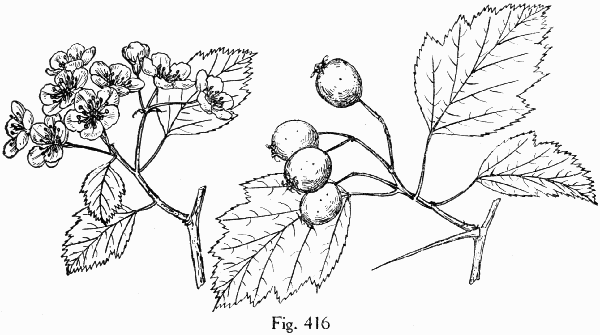
Leaves broad-ovate to obovate or rarely oval, broad-cuneate or rounded at the entire base, coarsely serrate above with straight teeth tipped with large persistent bright red glands, and deeply divided above the middle into 3 or 4 pairs of wide acute or acuminate lobes, rather more than a third grown when the flowers open early in May and then light yellow-bronze color, covered on the upper surface with short soft pale hairs and glabrous on the lower surface, and at maturity membranaceous, smooth, dark dull green and glabrous above, pale yellow-green below, about 2′ long and 1¼′ wide, with a slender yellow midrib, and 3 or 4 pairs of thin primary veins extending obliquely to the point of the lobes; [460] petioles slender, glandular, often somewhat winged toward the apex, 1′—1½′ in length; leaves at the end of vigorous shoots usually ovate and rounded at the broad base, more deeply lobed, and sometimes 3′ long and broad. Flowers ¾′ in diameter, on thin pedicels, in narrow compact few-flowered small villose corymbs; calyx broadly obconic, glabrous, the lobes narrow, acuminate, coarsely glandular-serrate, villose on the inner surface; stamens 20; anthers small, dark purple; styles 4 or 5. Fruit ripening about the middle of September and soon falling, on short stout pedicels, in erect few-fruited slightly villose clusters, obovoid until nearly fully grown and then short-oblong or somewhat obovoid, full and rounded at the ends, crimson, lustrous, marked by small pale dots, ½′—⅝′ long; calyx enlarged, the lobes elongated, coarsely glandular-serrate, villose above, closely appressed, often deciduous before the fruit ripens; flesh thick, yellow, dry and mealy; nutlets 4 or 5, thin, rounded, and sometimes obscurely ridged on the back, about ¼′ long.
A tree, 20°—25° high, with a tall straight trunk 6′—8′ in diameter, covered with close dark red-brown bark, slender ascending branches forming a narrow open head, and thin branchlets dark green and somewhat villose when they first appear, becoming dull orange-brown in their first summer and ultimately dark gray-brown, and armed with straight or slightly curved bright red-brown lustrous spines 1′—1½′ long.
Distribution. Rich moist soil along the margins of Oak-groves on the banks of sloughs; Barrington, Cook County, Illinois; near Ithaca, Thompkins County, New York.
65. Cratægus lacera Sarg.
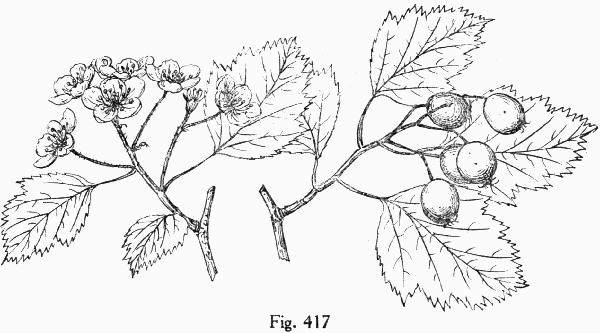
Leaves rhombic to broad-ovate or rarely obovate, acute at apex, broadly cuneate and entire at base, coarsely often doubly serrate above with straight glandular teeth, and divided above the middle into numerous acute lobes, when they unfold coated below with thick hoary tomentum and villose above, nearly fully grown when the flowers open about the 20th of April and then glabrous on the lower surface and covered on the upper surface with short scattered pale hairs, and at maturity glabrous, light yellow-green, paler below than above, thin, about 1½′ long and 1¼′ wide, with a slender yellow midrib and few remote primary veins; petioles slender, villose, becoming glabrous or puberulous, slightly winged at the apex, often red toward the base, ¼′—⅓′ in length; leaves at the end of vigorous shoots broad-ovate, often deeply 3-lobed, coarsely serrate, 3′—4′ long and broad. Flowers ¾′ in diameter, on slender villose pedicels, in sparingly villose few-flowered corymbs; calyx-tube narrowly obconic, glabrous, the lobes linear-lanceolate, elongated, coarsely glandular-serrate, glabrous on the outer surface, villose on the inner surface; stamens 20; anthers small, rose color; styles 4 or 5. Fruit ripening toward the end of October, on short stout glabrous [461] pedicels, in erect few-fruited clusters, ellipsoidal, rounded at the ends, bright cherry-red, lustrous, marked by occasional large dark dots, about ½′ long; calyx only slightly enlarged, with small nearly triangular villose spreading lobes mostly deciduous before the fruit ripens; flesh thick, orange color; nutlets 3—5, thin, narrowed at the ends, only slightly ridged on the rounded back, 5/16′ long.
A slender tree, 25°—30° high, with a tall trunk 4′—5′ in diameter, covered with pale scaly bark, small short branches forming a narrow head, and slender branchlets dark olive-green and villose when they first appear, becoming light red-brown and glabrous during their first summer, and ultimately dull light gray, and armed with thin straight bright chestnut-brown lustrous spines ¾′—1¾′ long.
Distribution. Low rich forest-glades near Fulton, Hempstead County, Arkansas.
66. Cratægus depilis Sarg.
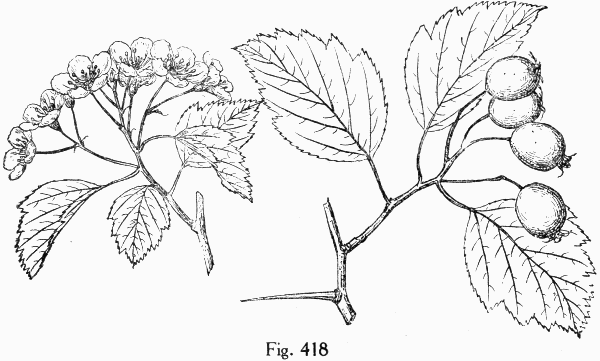
Leaves ovate, acute or acuminate, rounded or broad-cuneate and often unsymmetrical at the entire base, sharply doubly serrate above with straight glandular teeth, and often divided into 4 or 5 pairs of short acute lobes, when they unfold deeply tinged with red and covered above with fine short caducous hairs, nearly half grown when the flowers open [462] during the second week of May, and at maturity membranaceous, glabrous, smooth, yellowish to bluish green on the upper surface, pale on the lower surface, 1½′—2′ long, and 1′—1¼′ wide, with a slender midrib and 5 or 6 pairs of thin primary veins; turning yellowish and brown or russet color in the autumn; petioles slender, glabrous, sparingly glandular with minute glands, ¾′—1′ in length; leaves at the end of vigorous shoots often 2½′ long and 1½′ wide. Flowers ¾′ in diameter, on slender pedicels, in broad glabrous 8—12-flowered corymbs, with linear or oblong glandular bracts and bractlets; calyx narrowly obconic, glabrous, the lobes lanceolate, glandular-serrate, deeply tinged with purple; stamens 20; anthers pale rose color; styles 4 or 5. Fruit ripening early in September and soon falling, on slender pedicels, in drooping few-fruited clusters, subglobose to broad-obovoid, dark red to reddish purple, lustrous, ½′—¾′ long, and ⅜′—⅝′ in diameter; calyx only slightly enlarged, the lobes reflexed, glandular-serrate, and red on the upper side toward the base; flesh thick, yellow, sweet, juicy and slightly acid; nutlets 4 or 5, full and rounded at apex, narrowed and acute at base, and prominently but irregularly ridged on the back with a high sometimes grooved ridge, ¼′—5/16′ long.
A tree, 20°—25° high, with a trunk 4′—8′ in diameter and 6°—9° long, covered with dark gray or gray-brown flaky bark, spreading branches forming an oblong or rounded open head, and slender glabrous branchlets bright red-brown and very lustrous during their first summer, becoming light gray-brown the following year, and armed with stout or slender nearly straight spines ¾′—1½′ long.
Distribution. Rich clay or gravelly soil in pastures and on the borders of woods; northeastern Illinois (Lake, Cook and Mill Counties).
67. Cratægus basilica Beadl.
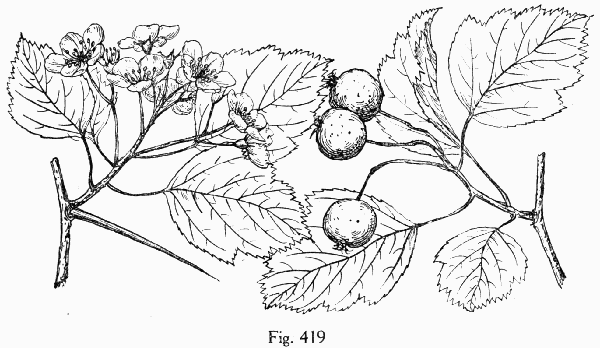
Leaves ovate, acute or acuminate, broad-cuneate or rounded at the entire or crenate base, sharply and often doubly serrate above with straight slender glandular teeth, and divided into numerous short acute lateral lobes, more than half grown when the flowers open early in May and then roughened above by short pale hairs and glabrous below, and at maturity thin but firm in texture, bright green and scabrate above, paler below, 2½′—3′ long, and 1½′—2′ wide, with a slender yellow midrib, and thin veins arching to the point of the lobes; turning yellow and brown in the autumn; petioles slender, slightly winged at apex, 1′—1½′ in length. Flowers ½′—⅝′ in diameter, on elongated slender pedicels, in 5—15-flowered glabrous compact corymbs; calyx-tube broadly obconic, glabrous, the lobes slender, acuminate, glabrous, entire or occasionally serrate; stamens 15—20; anthers dark rose color; [463] styles 3—5. Fruit ripening and falling early in September, on slender pedicels, in few-fruited drooping clusters, subglobose, scarlet, covered with a glaucous bloom, ½′—⅝′ in diameter; flesh soft, sweet, and edible; nutlets 3—5, narrowed and acute at the ends, prominently ridged on the back with a high broadly grooved ridge, ¼′—5/16′ long.
A tree, sometimes 20° high, with a trunk 7′—8′ in diameter, covered with dark gray or brown scaly bark, ascending or slightly spreading branches forming a narrow irregular head, and stout glabrous branchlets dark chestnut-brown in their first season becoming dark gray, and armed with numerous slender bright chestnut-brown lustrous ultimately gray spines 2′—2½′ long.
Distribution. Open woods and the borders of fields and roads, western North Carolina, usually at altitudes of 2000°—3000° above the sea.
VIII. MOLLES.
CONSPECTUS OF THE ARBORESCENT SPECIES.
Stamens 20.
Anthers pale yellow or white (rose color in 71).
Leaves broad and rounded, truncate or cordate at base; fruit subglobose to short-oblong or obovoid, red, crimson or scarlet.
Mature leaves glabrous on the upper surface.
Leaves thin.
Fruit subglobose to short-oblong, scarlet, ripening in August and September.
68. C. mollis (A).
Fruit obovoid to short-oblong, dark red, ripening in October.
69. C. sera (A).
Leaves subcoriaceous; fruit short-oblong to obovoid, crimson, ripening in October and November.
70. C. arkansana (C).
Mature leaves scabrate on the upper surface; fruit depressed-globose, red, ripening in August and September.
71. C. gravida (A).
Leaves broad-cuneate or rounded at base, acute or acuminate, scabrate on the upper surface at maturity.
Fruit red.
Leaves villose below at maturity on midrib and veins, those at the end of vigorous shoots cuneate at base; flowers in usually 7—12-flowered corymbs; fruit short-oblong, orange-red.
72. C. invisa (C).
Leaves hoary-tomentose below at maturity, those at the end of vigorous shoots rounded, cordate or abruptly cuneate at the broad base; flowers in 15—20-flowered corymbs; fruit ellipsoidal, ovoid, short-oblong or subglobose, crimson.
73. C. limaria (C).
Fruit bright canary yellow, subglobose; leaves villose below at maturity elliptic to ovate, oval or slightly obovate.
74. C. viburnifolia (C).
Leaves narrowed at base.
Mature leaves glabrous on the upper surface; fruit short-oblong to subglobose.
Leaves oblong-obovate or oval.
75. C. Berlandieri (C).
Leaves elliptic to ovate or slightly obovate.
76. C. meridionalis (C).
Mature leaves scabrate on the upper surface; fruit subglobose to short-oblong, red.
Leaves ovate to oval; flowers in 3—10-flowered corymbs; calyx-lobes glabrous.
77. C. Treleasei (C).
Leaves ovate; flowers in many-flowered corymbs; calyx-lobes villose.
78. C. canadensis.
Anthers rose color.
Leaves broad at base.
Mature leaves smooth on the upper surface.
Leaves thick, ovate, acute at apex; fruit short-oblong to obovoid, bright cherry red.
79. C. corusca (A).
[464]
Leaves thin, broad-ovate to suborbicular, rounded at apex; fruit subglobose to ovoid, bright yellow.
80. C. Kelloggii (A).
Mature leaves scabrate on the upper surface, oblong-obovate; fruit short-oblong, crimson.
81. C. induta (C).
Leaves narrowed at base; fruit red.
Leaves yellow-green.
Mature leaves glabrous on the upper surface; fruit short-oblong to obovoid.
82. C. texana (C).
Mature leaves scabrate on the upper surface.
Fruit subglobose to short-oblong.
83. C. quercina (C).
Fruit obovoid.
84. C. pyriformis (C).
Leaves blue-green, subcoriaceous, ovate to suborbicular, scabrate on the upper surface; fruit subglobose to short-oblong, red.
85. C. lanuginosa (C).
Stamens 10.
Anthers yellow.
Leaves broad at base.
Leaves smooth on the upper surface.
Leaves ovate or rarely oval, dark yellow-green above; fruit subglobose, crimson, ripening late in August.
86. C. arnoldiana (A).
Leaves ovate, blue-green above; fruit obovoid to short-oblong, scarlet, ripening in September.
87. C. champlainensis (A).
Leaves scabrate on the upper surface, ovate, acute, rounded or abruptly cuneate at base; anthers nearly white; fruit short-oblong, bright orange-red.
88. C. pennsylvanica (A).
Leaves cuneate at base, scabrate on the upper surface, ovate, acute; fruit obovoid, orange-red.
89. C. submollis (A).
Anthers rose color.
Leaves broad at the rounded, abruptly cuneate or cordate base.
Leaves scabrate on the upper surface.
Leaves oval, rounded or cuneate at base; flowers in wide many-flowered corymbs; fruit short-oblong, crimson.
90. C. Ellwangeriana (A).
Leaves oblong-ovate; flowers in compact few-flowered corymbs; fruit obovoid to short-oblong, scarlet.
91. C. Robesoniana (A).
Leaves smooth on the upper surface at maturity, ovate, usually broad-cuneate at base; fruit obovoid to short-oblong, crimson.
92. C. anomala (A).
Leaves cuneate at base, smooth on the upper surface at maturity; fruit subglobose, orange-red.
93. C. noelensis (C).
68. Cratægus mollis Scheele. Red Haw.
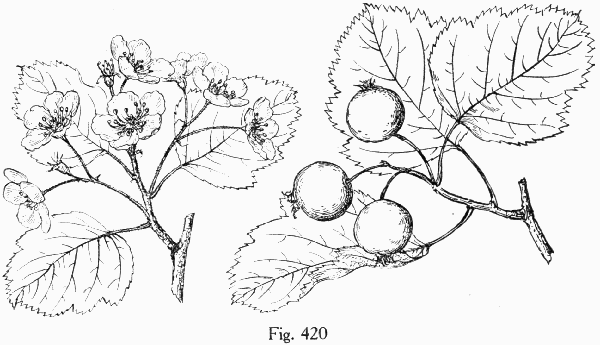
Leaves broad-ovate, acute, usually cordate or rounded at the wide base, coarsely and generally doubly serrate with straight glandular teeth, and more or less deeply divided into 4 or 5 pairs of acute or rounded lateral lobes, covered above with short pale hairs and hoary-tomentose below when they unfold, about half grown when the flowers open early in May and then membranaceous, light yellow-green and hairy above and pubescent or tomentose below, and at maturity firm in texture, dark yellow-green and slightly rugose on the upper surface and paler and pubescent or puberulous on the lower surface along the stout midrib, and 4 or 5 pairs of primary veins extending to the point of the lobes, 3′—4′ long and broad; petioles stout, terete, at first tomentose, ultimately pubescent or nearly glabrous, often slightly glandular with small dark caducous glands, 1′—1¼′ in length; leaves at the end of vigorous shoots more deeply lobed, with a deeper basal sinus, and frequently 5′—6′ long and broad. Flowers 1′ in diameter, on stout densely villose pedicels, in broad many-flowered tomentose corymbs, with conspicuous bracts and bractlets; calyx-tube narrowly obconic, hoary-tomentose, the lobes narrow, acuminate, coarsely glandular-serrate with bright red glands, villose on the outer, tomentose on the inner surface; stamens [465] 20; anthers large, light yellow; styles 4 or 5, surrounded at base by a broad ring of hoary tomentum. Fruit ripening late in August and early in September, on stout pedicels, in drooping few-fruited villose clusters, short-oblong to subglobose, rounded at the ends, more or less pubescent, scarlet marked by occasional large dark dots; ¾′—1′ in diameter; calyx prominent, hairy, with large erect and incurved lobes usually deciduous before the fruit ripens; flesh thick, yellow, subacid, dry and mealy; nutlets 4 or 5, thin, rounded and obscurely ridged on the back, light brown, ¼′ long.
A tree, sometimes 40° high, with a tall trunk often 18′ in diameter, heavy wide-spreading smooth ashy gray branches forming a broad round-topped and often symmetrical head, and stout branchlets covered at first with a thick coat of long white matted hairs, villose during their first season, becoming glabrous in their second year, and armed with occasional straight thick bright chestnut-brown shining spines 1′—2′ long.
Distribution. Low rich soil usually on the bottom-lands of streams; northern Ohio and southwestern Ontario (Point Edward) to northern Missouri, eastern South Dakota, eastern Nebraska, and eastern Kansas; common; near Nashville, Davidson County, Tennessee.
69. Cratægus sera Sarg.
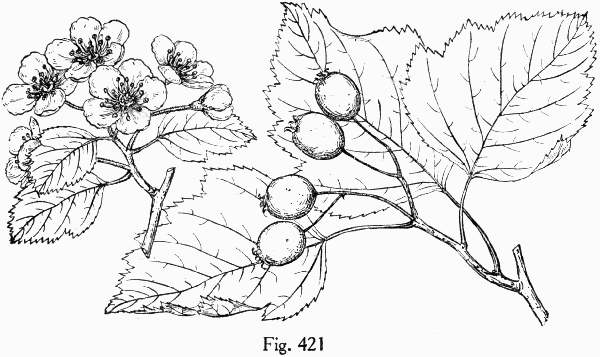
Leaves oblong-ovate, acute or acuminate, rounded, truncate or slightly cordate at the broad base, irregularly divided into 4 or 5 pairs of short acute lateral lobes, and sharply and sometimes doubly serrate nearly to the base with straight glandular teeth, unfolding about the 1st of May with the opening of the flowers and then covered above with short soft white hairs and tomentose below, and at maturity membranaceous, dark yellow-green and glabrous on the upper surface, pubescent on the lower surface, 2′—4′ long, and 2½′—3′ wide, with a slender midrib, and thin remote primary veins extending to the point of the lobes; petioles slender, tomentose, becoming pubescent, 1′—1½′ in length; leaves at the end of vigorous shoots more deeply lobed, and often 4′—5′ long and 3′—4′ wide. Flowers ¾′ in diameter, on stout densely villose pedicels, in compact many-flowered tomentose corymbs; calyx-tube broadly obconic, coated with broad matted pale hairs, the lobes broad, acute or acuminate, glandular-serrate with large dark glands, tomentose on the outer surface and villose on the inner surface; stamens 20; anthers pale yellow; styles 4 or 5, usually 5. Fruit ripening about the 1st of October, on stout puberulous or villose pedicels, in drooping or erect few-fruited clusters, obovoid or short-oblong, dull dark red, marked by small pale dots, usually slightly villose or pubescent at the ends, ⅔′ long, and ½′ in diameter; calyx enlarged, with erect, coarsely glandular-serrate, incurved lobes often deciduous before the ripening of the fruit; flesh thick, dry and mealy; nutlets usually 5, thin, light brown, irregularly grooved on the back with a broad shallow groove, ¼′ long.
[466]
A tree, 30°—40° high, with a tall straight trunk 12′—18′ in diameter, thick branches forming a broad round-topped symmetrical head, and branchlets hoary-tomentose at first, becoming light red-brown and puberulous and ultimately pale orange-brown, and armed with occasional straight or slightly curved chestnut-brown lustrous spines 1¼′—1½′ in length.
Distribution. Walpole Island, Lamberton County, southwestern Ontario; Belle Isle in the Detroit River, near Port Huron, St. Clair County, and in the neighborhood of Grand Rapids, Kent County, Michigan; northeastern Illinois (Cook, Will, Lake and Dupage Counties), and in the neighborhood of Milwaukee, Milwaukee County, Wisconsin.
70. Cratægus arkansana Sarg.
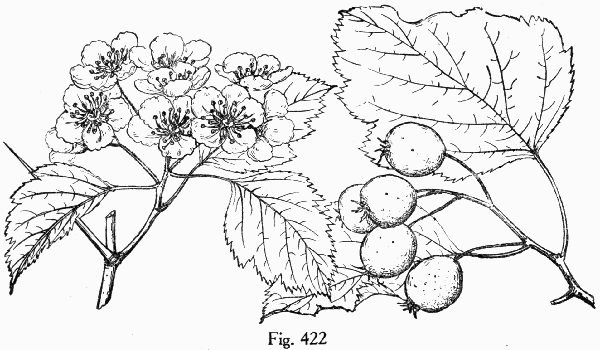
Leaves oblong-ovate or oval, acute, rounded, broadly cuneate or truncate at base, usually divided above the middle into 3 or 4 pairs of short broad acute lobes, and serrate sometimes to the base with short straight glandular teeth, when the flowers open about the middle of May nearly one third grown and coated with soft white hairs, and at maturity thick and leathery, dull dark green and glabrous on the upper surface, pale yellow-green on the lower surface, 2′—3′ long, and 1¾′—2′ wide, with a stout light yellow midrib and primary [467] veins slightly villose below, conspicuous secondary veins and reticulate veinlets; late in October and in November turning bright clear yellow; petioles stout, deeply grooved, more or less winged toward the apex, glandular with minute usually deciduous dark glands, at first tomentose, ultimately glabrous or puberulous, turning dark red after midsummer, 1′—1½′ in length; leaves at the end of vigorous shoots broad-ovate, rounded or truncate at base, often 4′ long and 3′ wide. Flowers nearly 1′ in diameter, on short stout pedicels, in broad rather compact many-flowered villose corymbs; calyx-tube narrowly obconic, coated with long matted pale hairs, the lobes short, acute, coarsely glandular-serrate, glabrous or slightly villose; stamens 20; anthers large, pale yellow; styles 5. Fruit ripening at the end of October and falling gradually at the end of several weeks, on stout villose pedicels, in few-fruited drooping clusters, short-oblong or rarely obovoid, rounded and slightly tomentose at the ends, bright crimson, very lustrous, marked by few large dark dots, ¾′—1′ long, about ¾′ in diameter; calyx little enlarged, with small linear-lanceolate coarsely glandular-serrate erect and persistent lobes; flesh thick, yellow, subacid; nutlets 5, small in comparison to the size of the fruit, thin, rounded or slightly and irregularly ridged on the back, ⅓′ long.
A tree, 20° high, with a tall straight stem, thick slightly ascending wide-spreading branches forming a broad open irregular head, and stout branchlets dark green and covered early in the season with long pale hairs, becoming orange-brown, glabrous, and very lustrous in their first winter, and unarmed or armed with occasional straight light chestnut-brown shining spines, ⅓′—½′ in length.
Distribution. Bottom-lands of the White River near Newport, Jackson County, Arkansas; hardy as far north as eastern Massachusetts, and unsurpassed late in the autumn in the beauty of its large brilliant abundant fruits long persistent on the branches.
71. Cratægus gravida Beadl.
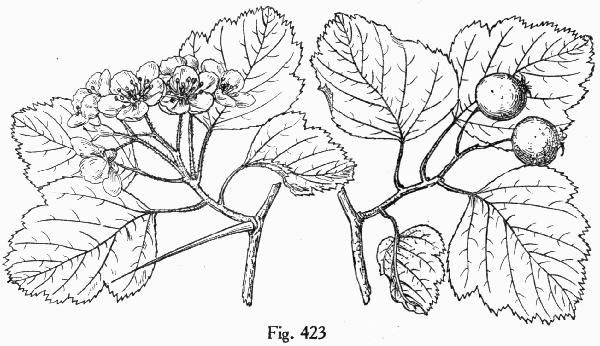
Leaves broad-ovate, acute, rounded or truncate at base, coarsely and often doubly serrate with incurved glandular teeth, and slightly incisely lobed, roughened above by short pale hairs and hoary-tomentose below when they unfold, nearly half grown when the flowers open about the 1st of May, and at maturity thin, firm, dark green, lustrous and scabrate above, paler and pubescent or puberulous below, particularly on the slender midrib and veins, 1¾′—2½′ long, and 1½′ wide; turning in the autumn yellow, orange and brown; petioles slender, tomentose early in the season, becoming pubescent or nearly glabrous, about ½′—1′ in length; leaves at the end of vigorous shoots oblong-ovate to nearly orbicular, round or cuneate at the broad base, more coarsely serrate, more deeply lobed, [468] and often 2½′—3′ long and wide, their petioles ¾′—1′ long. Flowers about ⅝′ in diameter, on short hoary-tomentose pedicels, in narrow crowded many-flowered hoary-tomentose corymbs; calyx-tube broadly obconic, covered with matted pale hairs, the lobes gradually narrowed, acuminate, glandular-serrate, villose; stamens 20; anthers dark rose; styles 5. Fruit ripening in August and September, on elongated tomentose pedicels, in few-fruited drooping clusters, depressed-globose, red; calyx enlarged, the lobes conspicuously serrate, puberulous on the upper surface, reflexed and closely appressed, sometimes deciduous from the ripe fruit; flesh thin, yellow, dry and mealy; nutlets 5, thin, narrow and rounded at base, acute at apex, rounded and obscurely grooved on the back, about 5/16′ long.
A tree, sometimes 20° high, with a trunk 8′—10′ in diameter, heavy wide-spreading branches forming a broad round-topped head, and stout branchlets covered at first with a thick coat of matted pale hairs, orange-red and puberulous at the end of their first season, glabrous and reddish brown the following year, and armed with slender nearly straight spines about 1½′ long.
Distribution. Limestone hills in the neighborhood of Nashville, Davidson County, Tennessee.
72. Cratægus invisa Sarg.
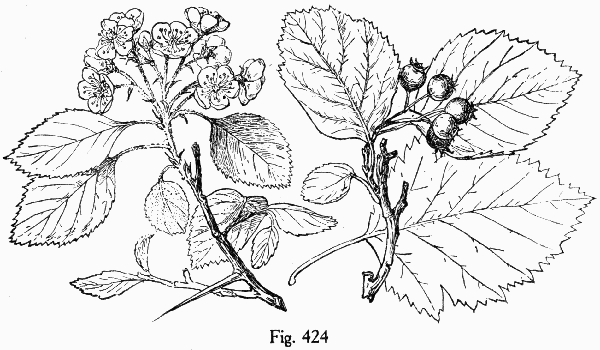
Leaves ovate to oval, acute or acuminate at apex, cuneate or rounded at base, coarsely often doubly serrate with broad straight glandular teeth, and slightly divided usually only above the middle into 3 or 4 pairs of small acuminate lobes, densely tomentose below and villose above when they unfold, about one third grown when the flowers open at the end of March and then thin, dark yellow-green and roughened on the upper surface by short hairs and coated below with long matted white hairs, and at maturity thin, yellow-green, scabrate and lustrous above, hairy below especially on the midrib and veins, 2½′—3′ long, and 2′—2½′ wide; petioles slender, slightly wing-margined at apex, covered with pale hairs early in the season, becoming nearly glabrous, and 1½′—2′ in length; leaves at the end of vigorous shoots broad-ovate, acuminate, abruptly cuneate at the wide base, more coarsely serrate, deeply divided into acute lateral lobes, and often 3½′—4′ long and 3′—3½′ wide; petioles slender, villose, 1½′—2′ in length. Flowers opening at the end of March, about ¾′ in diameter, on slender pedicels thickly coated like the wide calyx-tube with long matted white hairs, in broad mostly 7—12-flowered corymbs; calyx-lobes gradually narrowed from the base, short, broad, acuminate, laciniately glandular-serrate, thickly covered with long white hairs on the outer surface, villose above the middle on the inner surface; stamens 20; anthers white; styles 3—5, surrounded at base by a ring of long white hairs. Fruit ripening [469] at the end of October, on long slender slightly hairy pedicels, in erect or spreading few-fruited clusters, short-oblong, full and rounded and slightly hairy at the ends, orange-red, marked by large pale dots, and about ½′ in diameter; calyx little enlarged, with spreading lobes dark red on the upper side below the middle and villose toward the apex; flesh thin, yellow, dry and mealy; nutlets 3—5, rounded at the ends, broader at apex than at base, rounded and only slightly grooved on the back, ⅕′ long.
A tree, sometimes 30° high, with a tall trunk covered with dark brown bark broken into small closely appressed plate-like scales, large spreading branches forming a wide irregular head, and stout slightly zigzag branchlets clothed when they first appear with hoary tomentum, dull gray-brown, marked by small pale lenticels and slightly pubescent at the end of their first season and dark gray the following year, and unarmed or armed with occasional slender straight chestnut-brown spines 1′—1¼′ long.
Distribution. In dense woods on the rich bottom-lands of Red River near Fulton, Hempstead County, and near Texarkana, Miller County, Arkansas.
73. Cratægus limaria Sarg.
Cratægus Mackensenii Sarg.
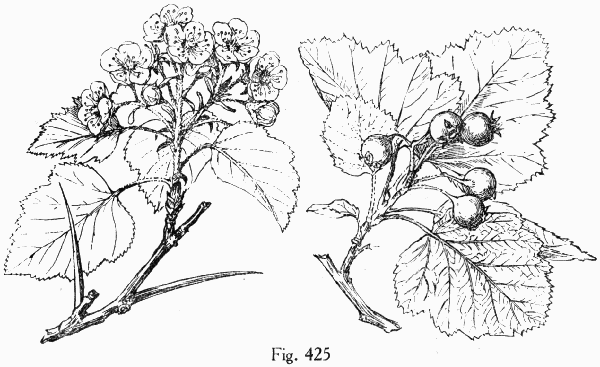
Leaves ovate, acute, concave-cuneate or rounded at base, coarsely often doubly serrate with broad straight glandular teeth, and slightly divided into 3 or 4 pairs of small acute lateral lobes, not more than a quarter grown when the flowers open early in April and then thin, yellow-green and covered above with short white hairs and thickly coated below with hoary tomentum, and at maturity light green and scabrate on the upper surface, pale and tomentose on the lower surface, 2½′—3′ long, and 1½′—2′ wide, with a stout midrib and thin primary veins; petioles slender, slightly wing-margined at apex, covered when they first appear with long matted white hairs, villose through the season, and 1′—1½′ in length; leaves at the end of vigorous shoots broad-ovate, rounded or cordate at the wide base, more deeply lobed, and often 4′ long and broad. Flowers opening early in April, ⅘′—1′ in diameter, on long slender pedicels coated with matted white hairs, in compact 15—20-flowered villose corymbs; calyx-tube broadly obconic, thickly covered with white hairs, the lobes gradually narrowed from the base, wide, acuminate, laciniately glandular-serrate, villose; stamens 20; anthers white; styles 3—5, surrounded at base by a narrow ring of pale tomentum. Fruit ripening in October, on long stout erect or spreading hairy pedicels, in few-fruited clusters, ellipsoidal to ovoid or short-oblong, rounded at apex, truncate at base, [470] crimson, lustrous, marked by large pale dots, villose especially at the ends, ½′—⅗′ in diameter; calyx prominent, with a long villose tube, and erect villose persistent lobes dark red on the upper side below the middle, their tips slightly spreading or incurved; flesh thick, yellow, dry and mealy; nutlets 3—5, narrowed and rounded at apex, rounded at the broad base, slightly grooved on the back, ⅕′—¼′ long.
A tree, often 30° high, with a tall trunk 8′—12′ in diameter, covered with dark scaly bark, stout ascending branches forming a narrow irregular head, and slender zigzag branchlets thickly coated when they first appear with long-white hairs, light orange-brown, lustrous, pubescent and marked by pale lenticels at the end of their first season, dull gray-brown and glabrous the following year, and armed with slender straight or slightly curved purple ultimately ashy gray spines 2′—2½′ long.
Distribution. In dense woods on the rich bottom-lands of the Red River near Fulton, Hempstead County, Arkansas; river banks; western Texas (Guadalupe River, near Victoria, Victoria County; Cibolo River, Sutherland Springs, Wilson County; San Antonio River, Bexar County; C. Mackensenii Sarg.).
74. Cratægus viburnifolia Sarg.
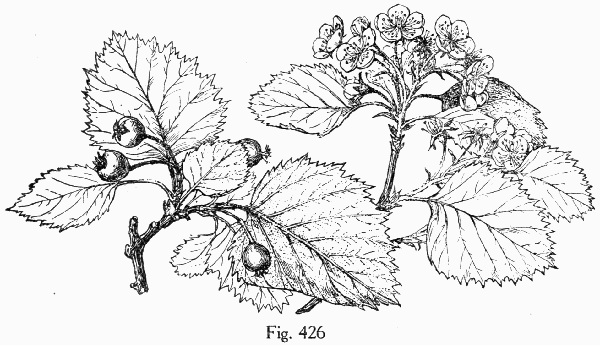
Leaves elliptic to ovate, oval or slightly obovate, acute or rounded at apex, concave-cuneate at the entire base, coarsely often doubly serrate above with straight glandular teeth, and slightly and irregularly divided above the middle into 2 or 3 pairs of small acute lobes, half grown when the flowers open about the 20th of March and then thin, yellow-green and roughened above by short white hairs and hoary-tomentose below, and at maturity thick, deep green, very lustrous and scabrate on the upper surface, coated on the lower surface with pale hairs, 2½′—3½′ long, and 2′—2½′ wide, with a prominent midrib and primary veins; petioles slightly wing-margined at apex, densely hoary-tomentose early in the season, becoming glabrous, ⅖′—1½′ in length. Flowers about ¾′ in diameter, on long slender tomentose pedicels, in wide lax mostly 5—12-flowered corymbs, with large lanceolate to spatulate foliaceous bracts and bractlets slightly serrate above the middle, and generally persistent until after the petals fall; calyx-tube narrowly obconic, thickly coated with matted white hairs, the lobes gradually narrowed from the base, long, slender, acuminate, laciniately glandular-serrate, slightly villose on the outer surface, densely villose on the inner surface; stamens 20; anthers white; styles 4 or 5. Fruit ripening early in October, on long slender drooping slightly hairy pedicels, in few-fruited clusters, subglobose, bright canary yellow, about 1′ in diameter; calyx little enlarged, with spreading lobes; flesh thick, light yellow, soft and succulent; nutlets 4 or 5, gradually narrowed and rounded at the ends, irregularly ridged on the back with a broad grooved ridge, ⅓′ long.
[471]
A tree, 30°—35° high, with a tall trunk sometimes a foot in diameter, covered with gray scaly bark, large ascending and spreading branches forming an open irregular head, and stout nearly straight unarmed branchlets thickly coated with hoary tomentum when they first appear, becoming purple, lustrous and nearly glabrous at the end of their first season and dark brown or gray-brown the following year.
Distribution. Borders of woods in low ground, valley of the Brazos River near Columbia, Brazoria County, and in low woods on the Colorado River, at Wharton, Wharton County, Texas.
75. Cratægus Berlandieri Sarg.
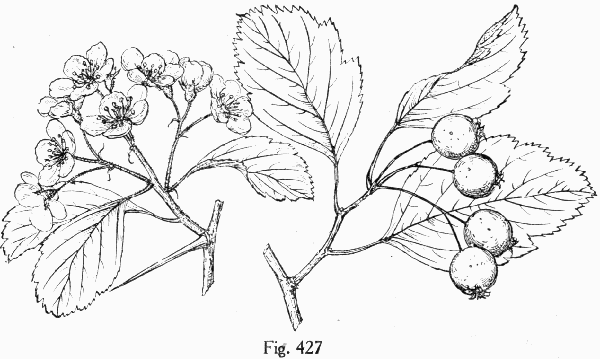
Leaves oblong-obovate or oval, acute or acuminate, gradually narrowed, cuneate and entire below the middle, coarsely and often doubly serrate with broad straight or incurved glandular teeth, and unequally divided above into numerous acute or acuminate lobes, when the flowers open from the middle to the end of March coated on the upper surface with short pale caducous hairs and on the lower surface with thick hoary tomentum, and at maturity thin and firm in texture, glabrous, dark green, and lustrous above, pale and pubescent below, and usually about 3′ long and 2′ wide, with a slender midrib, remote primary veins extending to the point of the lobes, conspicuous secondary veins, and reticulate veinlets; petioles more or less winged toward the apex, tomentose early in the season, becoming pubescent, ½′—¾′ in length; leaves at the end of vigorous shoots often 5′ long and 3′ wide, with rounded, acute lobes. Flowers ¾′ in diameter, on long stout hoary-tomentose pedicels, in broad loose many-flowered tomentose corymbs, with oblong-obovate to lanceolate finely glandular-serrate villose conspicuous bracts and bractlets; calyx-tube broadly obconic, covered with thick pale tomentum, the lobes broad, acute, very coarsely glandular-serrate, tomentose on the outer surface and villose on the inner surface; stamens 20, anthers yellow; styles 5, surrounded at base by tufts of white hairs. Fruit ripening after the middle of October, on slender elongated pedicels, in loose dropping clusters, short-oblong to subglobose, scarlet, about ½′ long; calyx much enlarged, with coarsely serrate erect and persistent villose lobes; flesh thin, yellow, dry and mealy; nutlets 5, rounded and occasionally obscurely grooved on the back, about ¼′ long.
A tree, 15°—20° high, with a tall straight trunk 8′—10′ in diameter, covered with thin dark brown furrowed bark, spreading branches forming a broad open head, and branchlets hoary-tomentose at first, soon puberulous, dull reddish brown or yellow-brown by midsummer, becoming ashy gray late in the autumn, and armed with few straight gray spines about 1′ in length.
[472]
Distribution. Low rich woods on the bottom-lands of the Brazos River at Columbia and Brazoria, Brazoria County, Texas.
76. Cratægus meridionalis Sarg.
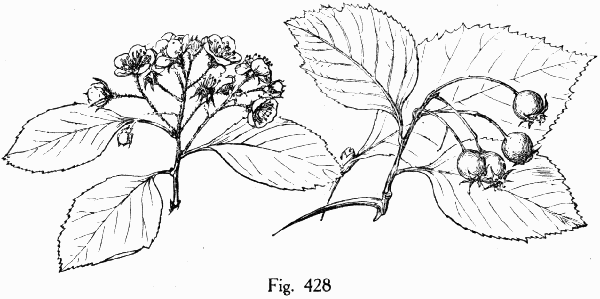
Leaves elliptic to ovate or slightly obovate, acuminate, cuneate at the entire base, and coarsely often doubly serrate above with broad straight glandular teeth, coated below with hoary tomentum and covered above with short white hairs when they unfold, more than half grown when the flowers open from the first to the middle of April, and at maturity thin, yellow-green and scabrate on the upper surface, paler and villose-pubescent on the lower surface, especially on the slender midrib and primary veins, 2′—3½′ long, and 1′—2′ wide; petioles slender, slightly wing-margined at apex, densely villose-pubescent with white hairs early in the season, becoming glabrous or nearly glabrous, ½′—¾′ in length; leaves at the end of vigorous shoots broad-ovate to broad-elliptic, more coarsely serrate, occasionally slightly divided into short broad lateral lobes, often 4′ long and 2½′ wide, with a stout midrib and petioles broadly wing-margined at apex, and about ½′ in length. Flowers ¾′ in diameter, on stout pedicels thickly covered like the narrow obconic calyx-tube with matted silvery white hairs, in broad compact many-flowered villose corymbs, with conspicuous glandular-serrate villose bracts and bractlets mostly persistent until after the flowers open; calyx-lobes narrow, acuminate, laciniately glandular-serrate, slightly villose-pubescent when the buds open; stamens 20; anthers white; styles 3—5, surrounded at base by a broad ring of white tomentum. Fruit ripening from the middle to the end of September, on elongated slender puberulous pedicels, in few-fruited drooping red-stemmed clusters, short-oblong to subglobose, rounded at the ends, scarlet, ½′ to ⅔′ in diameter, the calyx persistent, much enlarged, with erect or spreading conspicuous lobes; nutlets 3—5, rounded at base, acute at apex, ridged on the back with a high rounded ridge, about ⅓′ long.
A tree, often 25° high, with a trunk 8′ in diameter, covered with dark bark slightly divided by shallow fissures into broad thin plates, spreading ashy gray branches forming a round-topped head, and slender zigzag branchlets, covered when they first appear with long white hairs, soon glabrous, orange-brown or reddish brown during their first season and dull gray the following year, and armed with numerous straight slender purple spines 1′—2′ in length.
Distribution. Limestone soil, in upland woods and glades; common in the limestone belt of central Alabama, from the neighborhood of Gallion, Hale County to western Mississippi (Starkville, Oktibbeha County, and Brookville, Noxubee County).
77. Cratægus Treleasei Sarg.
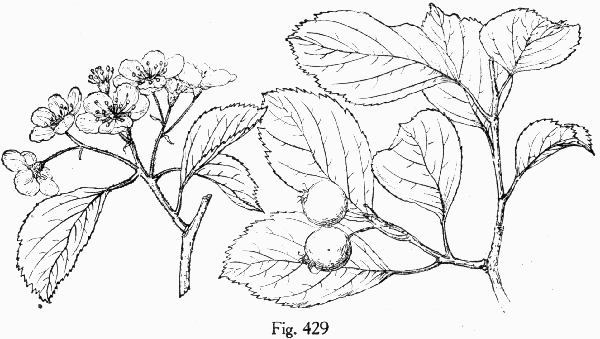
Leaves ovate to elliptic, acute, concave-cuneate or rounded at the narrow base, sharply doubly serrate above with straight glandular teeth, and slightly divided into 3 or 4 pairs of [473] narrow acuminate lateral lobes, unfolding with the opening of the flowers at the end of April or early in May and then light yellow-green tinged with bronze color, lustrous and covered above with short shining caducous white hairs and hoary-tomentose below, and at maturity thin, light yellow-green and scabrate on the upper surface, paler and pubescent on the lower surface, especially on the slender midrib, and 4 or 5 pairs of thin primary veins extending obliquely to the point of the lobes, 1¾′—2¼′ long, and 1½′—2′ wide; petioles slender, more or less wing-margined at apex, villose early in the season, pubescent in the autumn, ½′—¾′ in length; leaves at the end of vigorous shoots broad-ovate, acute, cuneate at the wide base, often 2½′—3′ long and 2′—2½′ wide; petioles stout, wing-margined at apex ¾′—1′ long. Flowers 1′ in diameter, on short stout pedicels covered with matted pale hairs, in 3—10-flowered compact compound or rarely simple villose corymbs; calyx-tube broadly obconic, covered with matted pale hairs, the lobes glabrous, narrowed from the base, with wide rounded sinuses between them, slender, acuminate, tipped with a small red gland, and glandular-serrate with stipitate red glands; stamens 20; anthers pale yellow; styles 4 or 5, usually 5. Fruit ripening at the end of September, on stout erect villose pedicels, in few-fruited clusters, subglobose, often broader than high, crimson, lustrous, marked by numerous large pale dots, pubescent at the ends, and ½′—¾′ in diameter; calyx prominent, with a short villose tube, and reflexed appressed villose lobes often deciduous from the ripe fruit; flesh thick, light yellow, dry and mealy; nutlets 4 or 5, thin, full and rounded at apex, narrowed and acute at base, grooved with a broad shallow groove and sometimes irregularly ridged on the back, about 5/16′ long.
A tree, 20°—25° high, with a tall trunk sometimes 6′ in diameter, slender branches forming a narrow open head, and thin nearly straight branchlets thickly covered at first with long lustrous white hairs, dull light reddish brown and puberulous at the end of their first season, becoming dark gray-brown, and armed with stout straight or slightly curved dark purple shining spines usually about 1¼′ long, or unarmed.
Distribution. Banks of small streams in moist soil from Doe Run to Bismarck, St. François County, Missouri.
78. Cratægus canadensis Sarg.
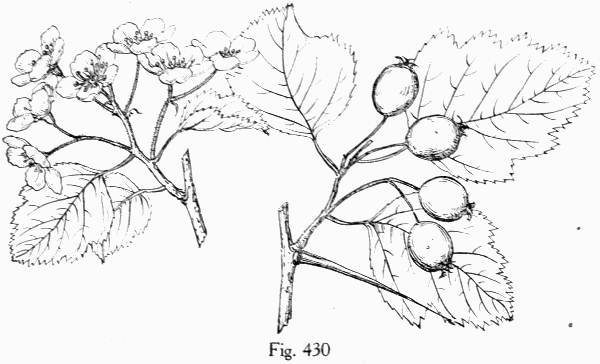
Leaves ovate, short-pointed, slightly lobed usually only above the middle with short broad acute lobes, and coarsely and frequently doubly serrate to the broad-cuneate base with spreading glandular teeth, coated above in early spring with soft white hairs, and below with dense hoary tomentum, about a third grown when the flowers open at the end of May, and at maturity thin and firm in texture, blue-green and scabrate on the [474] upper surface, pale and pubescent on the lower surface on the midrib and primary veins, 2′—2½′ long, and 1½′ to nearly 3′ wide; petioles slender, glandular, often more or less winged above, at first tomentose, becoming nearly glabrous, ¾′—1′ in length; leaves at the end of vigorous shoots broad-ovate, truncate or slightly cordate at the broad base, more deeply lobed, often 2½′—3′ long and wide, the petioles wing-margined at apex often glandular, and 1′—1½′ in length. Flowers about ¾′ in diameter, in broad loose tomentose corymbs; calyx-tube broadly obconic, villose with long matted hairs, the lobes lanceolate, villose, and glandular with large red stipitate glands; stamens 20; anthers small, nearly white; styles 5, surrounded at base by a thin ring of pale tomentum. Fruit ripening early in October and falling gradually until after midwinter, on stout pedicels, in erect slightly villose few-fruited clusters, short-oblong to subglobose, crimson, lustrous, marked by large scattered pale dots, slightly hairy toward the ends, ½′—⅝′ long, ⅓′—½′ in diameter; calyx prominent, the lobes gradually narrowed from a broad base, elongated, glandular, villose, spreading or reflexed, often deciduous before the fruit ripens; flesh thin, pale yellow, dry and mealy; nutlets 5, thin, rounded and irregularly ridged on the back, ¼′ long.
A tree, 18°—30° high, with a trunk 6′—8′ in diameter, stout spreading branches forming a broad round-topped symmetrical head, and stout zigzag branchlets dark green and covered with matted pale hairs when they first appear, soon becoming light orange-brown and very lustrous, and armed with numerous stout straight or slightly curved dark chestnut-brown shining spines 2′—2½′ long.
Distribution. Limestone ridges near the St. Lawrence River at Châteaugay, Caughnawaga, and La Tortue in the Province of Quebec.
79. Cratægus corusca Sarg.
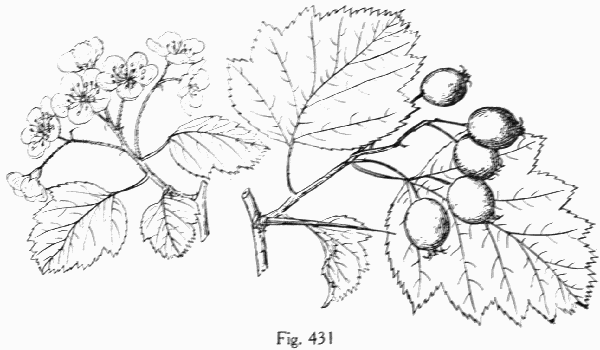
Leaves ovate, acute, truncate, rounded or slightly cordate at the broad base, regularly divided into 4 or 5 pairs of short acute lateral lobes, and doubly serrate with straight glandular teeth, when they unfold covered above with short soft pale hairs and glabrous below, about a third grown when the flowers open the middle of May, and at maturity thin but firm and rigid in texture, glabrous, dark yellow-green, bright and lustrous above, pale yellow-green below, 2′—2½′ long and wide, with a slender pale midrib and primary veins; petioles slender, villose early in the season, soon becoming glabrous and dark red below the middle, 1½′—2½′ in length; leaves at the end of vigorous shoots frequently divided into narrow acute lateral lobes, and often 3½′—4′ long and wide. Flowers ¾′ in diameter, on stout villose pedicels, in compact narrow many-flowered corymbs covered with matted pale hairs; calyx-tube narrowly obconic, glabrous, or villose toward the base, the [475] lobes narrowed from a broad base, acute, coarsely glandular-serrate, villose on the inner surface; stamens 20; anthers small, pale pink; styles 4 or 5. Fruit beginning to ripen and fall about the middle of September and continuing to fall until the end of October, on stout pedicels, in glabrous few-fruited clusters, short-oblong to obovoid, bright cherry-red, lustrous, marked by dark scattered pale dots, ⅝′—¾′ long, and ½′—⅝′ in diameter; calyx little enlarged, the lobes slightly glandular-serrate, usually deciduous before the fruit ripens; flesh thick, yellow, dry and mealy; nutlets 4 or 5, dark-colored, rounded on the back, ¼′ long.
A tree, 18°—20° high, with a tall trunk 8′—10′ in diameter, wide-spreading branches forming a handsome symmetrical head, and stout branchlets dark green and coated with matted pale hairs when they first appear, soon becoming light red-brown, light orange-brown and lustrous in their second year, and armed with thick nearly straight bright chestnut-brown spines often 3′ in length.
Distribution. Sandy shores of Lake Zurich, Lake County, Illinois.
80. Cratægus Kelloggii Sarg.
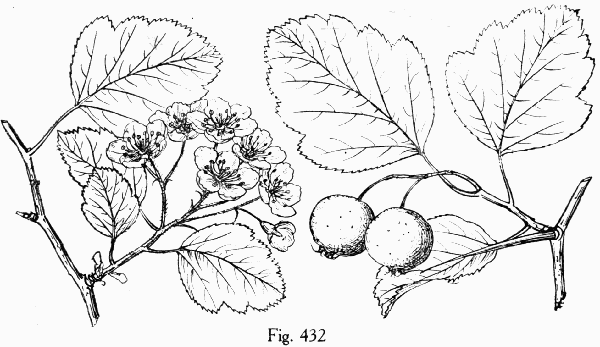
Leaves broad-ovate to suborbicular, rounded and often short-pointed at apex, rounded, broadly cuneate or truncate at the entire base, coarsely serrate above with straight gland-tipped teeth, and divided usually only above the middle into several short broad acute or acuminate lobes, about half grown when the flowers open during the last week of April and then thin, yellow-green, covered above with short pale hairs and pubescent below on the midrib and veins, and at maturity thin but firm in texture, dark yellow-green, glabrous and smooth on the upper surface, pale and glabrous on the lower surface with the exception of a few hairs near the base of the thin yellow midrib and of the 4 or 5 pairs of slender prominent primary veins arching to the point of the lobes, 2′—2½′ long, 1¾′—2½′ wide, and often broader than long; petioles slender, slightly winged at apex, villose while young with long matted white hairs, becoming glabrous, ¾′—1′ in length. Flowers ⅝′ in diameter, on slender hairy pedicels, in compact 5—10-flowered villose corymbs, with oblong-obovate to linear acuminate glandular bracts and bractlets mostly persistent until the flowers open; calyx-tube broadly obconic, slightly hairy at base, glabrous above, the lobes slender, acuminate, glandular with minute dark red stipitate glands, or entire, glabrous on the outer surface, sparingly villose on the inner surface; stamens 20; anthers pale rose color; styles 5. Fruit ripening at the end of September and soon falling, on long slender glabrous pedicels, in few-fruited drooping clusters, subglobose to short-ovoid, bright yellow, marked by many small [476] pale dots, ¾′—1′ in diameter; calyx small, with spreading reflexed lobes slightly villose toward the apex and often deciduous from the ripe fruit; flesh thin, yellow, dry and mealy; nutlets 5, rounded and very slightly grooved on the back, about ⅜′ long.
A tree, 20°—25° high, with a tall trunk 4′—5′ in diameter, covered with nearly black deeply furrowed bark, erect branches, and nearly straight branchlets dark green tinged with red and slightly villose when they first appear, bright red-brown and lustrous at the end of their first season, becoming dark dull reddish brown the following year, and unarmed, or armed with slender nearly straight bright chestnut-brown shining spines usually about 1′ long.
Distribution. Banks of the Desperes River, South St. Louis, St. Louis County, Missouri; not common.
81. Cratægus induta Sarg. Turkey Apple.
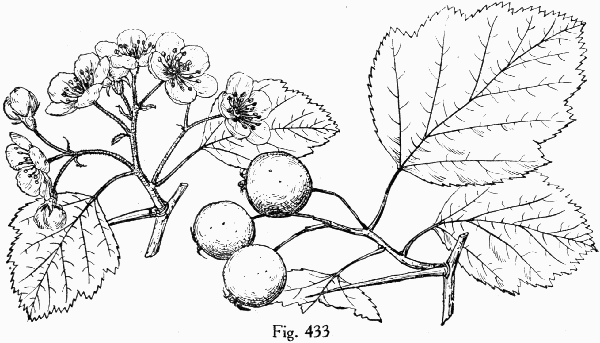
Leaves oblong-obovate, acute, cuneate, rounded or rarely truncate at the broad entire base, coarsely doubly serrate above with glandular teeth, and slightly and irregularly divided into broad acute lateral lobes, about a third grown when the flowers open from [477] the middle to the end of April and then thin, light yellow-green and roughened above by short lustrous white hairs and hoary-tomentose below, and at maturity thin, dark yellow-green and scabrate on the upper surface, pale and tomentose or pubescent on the lower surface, particularly on the stout midrib and 4 or 5 pairs of prominent primary veins, 3′—4′ long, and 2½′—3′ wide; petioles slender, more or less wing-margined at the apex, glandular, hoary-tomentose early in the season, becoming sparingly villose in the autumn, 1¼′—1½′ in length. Flowers ¾′ in diameter, on slender tomentose pedicels, in broad many-flowered hoary-tomentose corymbs; calyx-tube narrowly obconic, thickly coated with long densely matted white hairs, the lobes small, acuminate, glandular-serrate, villose; stamens 20; anthers small, rose color; styles 5, surrounded at base by a broad ring of snow-white hairs. Fruit ripening the middle of October, on stout villose pedicels, in few-fruited clusters, short-oblong, rounded and villose at the ends, crimson or reddish yellow, lustrous, marked by small pale dots, ¾′—2′ in diameter; calyx prominent, with a short tomentose tube and much enlarged coarsely glandular-serrate hairy erect incurved lobes often deciduous from the ripe fruit; flesh thick, orange-colored, with an astringent subacid flavor; nutlets 5, thin, rounded and slightly grooved on the back, 5/16′—⅜′ long.
A tree, sometimes 25° high, with a trunk often a foot in diameter, covered with thick dark brown furrowed bark, large spreading and ascending branches forming an open irregular head, and stout branchlets covered at first with long matted white hairs, light orange-brown, lustrous and puberulous at the end of their first season, becoming ashy gray or light grayish brown the following year, and armed with many stout nearly straight dark purple shining spines usually about 2½′ long.
Distribution. Dry upland woods, near Fulton, Hempstead County, Arkansas; common.
82. Cratægus texana Buckl.
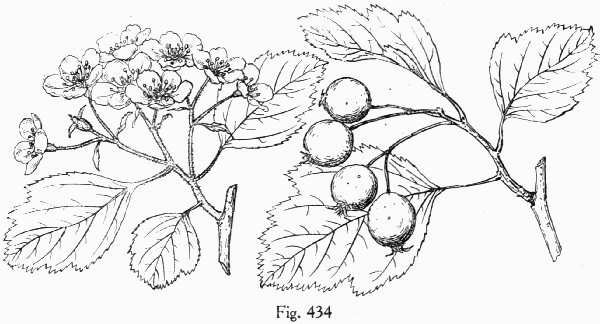
Leaves broad-ovate, acute or rarely rounded at apex, broadly concave-cuneate at base, coarsely doubly glandular-serrate above, and usually divided above the middle into 4 or 5 pairs of broad acute lobes, covered above when they unfold with short soft pale hairs and below with a thick coat of hoary tomentum, more than half grown when the flowers open late in March, and at maturity thick and firm, dark green and lustrous above, pale and pubescent or tomentose below, particularly on the stout midrib, primary veins, prominent secondary veins and reticulate veinlets, 3′—4′ long, 2½′—3′ wide; petioles stout, deeply grooved, more or less winged above, at first tomentose, becoming nearly glabrous, ½′—¾′ in length; leaves at the end of vigorous shoots sometimes truncate or slightly cordate at the broad base, more deeply lobed, and frequently 3′ long and wide. Flowers ¾′ in diameter, on [478] elongated slender densely villose pedicels, in broad open many-flowered tomentose corymbs, with oblong or oblong-obovate acute conspicuous villose bracts and bractlets often 1½′ in length; calyx-tube broadly obconic, coated with pale tomentum, the lobes foliaceous, gradually narrowed from a broad base, acuminate, coarsely glandular-serrate, and villose with long matted pale hairs; stamens 20; anthers large, dark red; styles 5, surrounded at base by a narrow ring of pale tomentum. Fruit ripening toward the end of October, in drooping many-fruited tomentose ultimately glabrous clusters, obovoid and tomentose until nearly grown, becoming when fully ripe short-oblong or slightly obovoid, rounded at the ends, bright scarlet, marked by occasional large pale dots, puberulous at apex, ¾′—1′ long; calyx enlarged, with glandular-serrate usually erect lobes, dark red at base on the upper side, often deciduous before the ripening of the fruit; flesh thick, yellow, sweet, and edible; nutlets 5, slightly grooved on the back, ¼′—⅓′ long.
A tree, often 30° high, with a tall trunk sometimes a foot in diameter, thick branches ascending while the tree is young, forming an open irregular crown, and spreading in old age into a broad symmetrical round-topped head, and branchlets dark bronze-green and covered with long matted white hairs when they first appear, becoming dull reddish brown and ultimately pale ashy gray, and armed with occasional thin nearly straight bright chestnut-brown lustrous spines usually about 2′ long, or often unarmed.
Distribution. Rich bottom-lands, Texas coast region; valley of the lower Brazos River to those of the Navidad (Canardo, Jackson County), Guadalupe (Victoria, Victoria County), and Cibolo (Sutherland Springs, Wilson County).
83. Cratægus quercina Ashe.
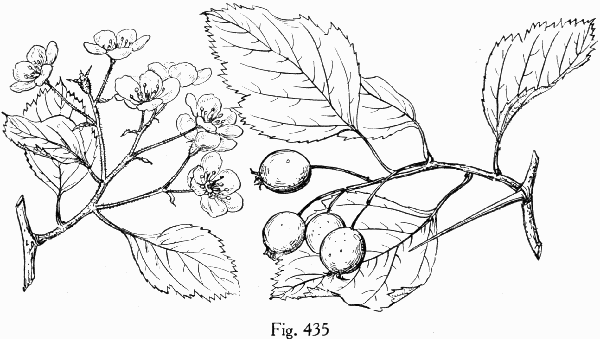
Leaves elliptic to obovate, usually acute or occasionally rounded at apex, obtusely or acutely cuneate at the entire base, irregularly doubly serrate above with slender glandular teeth, and often divided above the midrib into narrow acuminate lobes, when they unfold conspicuously plicate, often dark red and coated above with long soft pale hairs and covered below with a thick coat of silvery white shining tomentum, about a third grown when the flowers open from the middle to the end of March, and at maturity thin but firm in texture, dark green, lustrous and scabrate above, pale and pubescent or tomentose below, and 2′—2½′ long and wide, with a slender midrib, 4 or 5 pairs of thin primary veins, and conspicuous reticulate veinlets; petioles stout, tomentose, about ½′ in length; leaves at the end of vigorous shoots broad-ovate, rounded or obtusely cuneate at the wide base, usually deeply divided into numerous acuminate lateral lobes, often 3′ long and 2½′ wide. Flowers ¾′ in diameter, on long slender tomentose pedicels, in broad many-flowered lax hoary-tomentose [479] corymbs, with oblong-obovate glandular-serrate villose bracts and bractlets; calyx-tube narrowly obconic, hoary-tomentose, the lobes short, acute, coarsely glandular-serrate, tomentose; stamens 20; anthers small, dark red; styles 5, surrounded at base by tufts of long snow-white hairs. Fruit ripening after the middle of October, on slender nearly glabrous pedicels, in few-fruited tomentose spreading clusters, subglobose but often rather longer than broad, rounded at the ends, tomentose until nearly fully grown, glabrous at maturity, dark red, marked by numerous large pale dots, about ½′ in diameter; calyx prominent, with short spreading often deciduous lobes; flesh thin, light yellow, hard and dry, generally shrivelling before the fruit falls; nutlets 5, rounded and ridged on the back, about ¼′ long.
A tree, remarkable for the lustre of its white tomentum, occasionally 25° high, with a tall trunk 6′—8′ in diameter, covered with light gray scaly bark, becoming near the base of old trees deeply furrowed and nearly black, ascending branches forming a broad symmetrical head, and branchlets coated when they first appear with hoary tomentum, becoming light red-brown and more or less villose during their first season, glabrous and rather darker in their second year, and armed with numerous straight or slightly curved chestnut-brown shining spines usually 1′—1¼′ long.
Distribution. Sandy bottom-lands in open Live Oak-forests on the Brazos River, near Columbia, Brazoria County, Texas.
84. Cratægus pyriformis Britt.
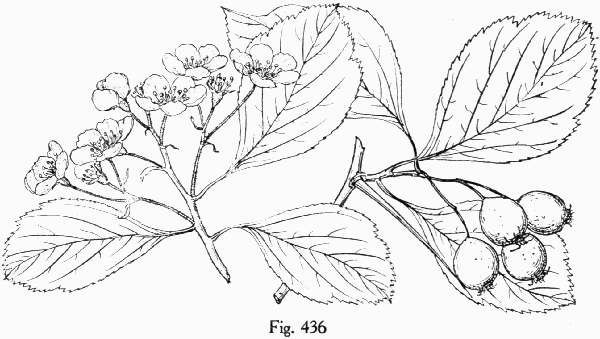
Leaves oval to broad-ovate, acute and often short-pointed at apex, gradually narrowed and concave-cuneate at the entire base, sharply and sometimes doubly serrate above with straight glandular teeth, and often slightly and irregularly lobed above the middle, fully grown when the flowers open about the 10th of May and then thin, light yellow-green, roughened above by short rigid pale hairs and pubescent below, particularly on the slender midrib and 5 or 6 pairs of remote primary veins, and at maturity thin and firm, lustrous and scabrate on the upper surface, pale and pubescent on the lower surface, and generally about 3′ long and 2′ wide; petioles slender, winged at apex, tomentose, ultimately pubescent, 1′—1¼′ in length; leaves at the end of vigorous shoots usually ovate, coarsely serrate, more deeply lobed, and frequently 4′—5′ long and 3′—4′ wide. Flowers 1′ in diameter, on long slender tomentose pedicels, in broad many-flowered lax corymbs; calyx-tube narrowly obconic, villose, the lobes narrow, acuminate, glandular-serrate, and covered more or less thickly with pale hairs; stamens 20; anthers pale rose color; styles 4 or 5, usually 5, surrounded at base by a broad ring of pale tomentum. Fruit ripening in October, on [480] long slender pubescent pedicels, in drooping few-fruited clusters, obovoid, rounded at the ends, bright cherry-red, lustrous, marked by occasional large pale dots, about ⅝′ long and ½′ in diameter; calyx prominent, with linear glandular-serrate closely appressed lobes often deciduous before the fruit ripens; flesh thin, light yellow, juicy; nutlets 4 or usually 5, rounded, and deeply grooved on the back, dark brown, ⅝′ long.
A tree, 25°—30° high, with a trunk a foot in diameter, spreading branches forming a broad symmetrical head, and slender branchlets light green and villose when they first appear with long matted pale hairs, dull red-brown and pubescent in their first season, becoming glabrous the following year, and armed with occasional thin nearly straight bright chestnut-brown shining spines usually about 1½′ long.
Distribution. Rich bottom-lands of the streams of Shannon County, southern Missouri.
85. Cratægus lanuginosa Sarg.
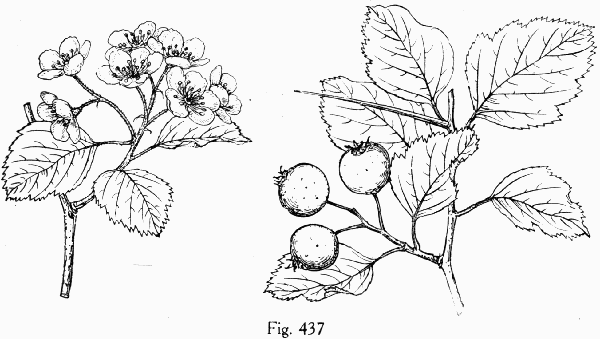
Leaves ovate to suborbicular, acute or rounded and short-pointed at apex, broadly cuneate or rounded at the entire base, coarsely and sharply doubly serrate above with glandular teeth, and often irregularly divided above the middle into short broad acute lateral lobes, less than half grown when the flowers open during the last week of April and then dark green and villose above and covered below with a thick coat of hoary tomentum, and at maturity subcoriaceous, dark blue-green, lustrous and scabrate on the upper surface, yellow-green and tomentose on the lower surface, 1½′—2′ long, and 1′—1½′ wide, with a thick midrib, and 3—5 pairs of stout primary veins extending obliquely to the point of the lobes; petioles stout, tomentose, ½′—¾′ in length; leaves at the end of vigorous shoots often broad-ovate, very coarsely glandular-serrate, rounded or truncate at base, and frequently 3′ long and wide. Flowers ¾′ in diameter, on short stout pedicels covered with long matted pale hairs, in compact many-flowered hoary-tomentose corymbs, with large glandular-serrate conspicuous bracts and bractlets persistent until the flowers open; calyx-tube broadly obconic, hairy, the lobes short, broad, acute, glandular with minute stipitate glands, densely villose on the outer surface and slightly villose on the inner surface; stamens 20; anthers rose color; styles 5, surrounded at base by large tufts of snow-white hairs. Fruit ripening at the end of October, on short tomentose erect pedicels, in few-fruited clusters, subglobose to short-oblong, rounded and slightly hairy at the ends, ½′ in diameter; calyx enlarged, with villose coarsely serrate usually erect spreading or incurved persistent lobes bright red on the upper side near the base; flesh thin, orange color, dry and mealy; nutlets 5, thin, rounded and very irregularly ridged on the back, about ¼′ long.
A tree, sometimes 25° high, with a stout trunk covered with pale bark, spreading and [481] erect branches, and stout zigzag branchlets light green and villose early in the season, dull red-brown and sparingly villose or pubescent at the end of their first year, becoming dark or light gray-brown, and armed with many long straight purple shining ultimately ashy gray spines 1¼′—3½′ in length.
Distribution. Southwestern Missouri; common near Webb City, Jasper County; well distinguished by the distinctly blue color of the small leaves, the dark crimson hard fruits and by the remarkable development of the spines unusual in the species of this group.
86. Cratægus arnoldiana Sarg.
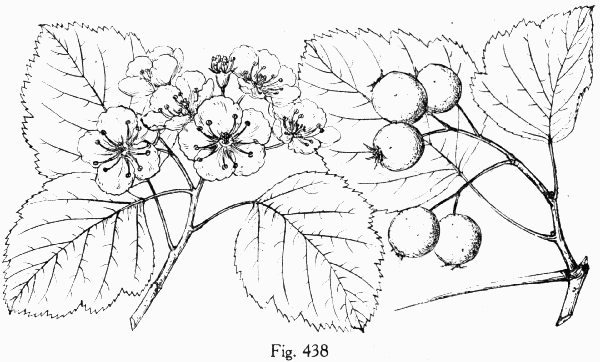
Leaves broad-ovate or rarely oval, acute, regularly divided above the middle into numerous short acute lobes, and coarsely doubly serrate with straight glandular teeth except at the rounded truncate or occasionally cuneate base, coated with dense matted pale hairs when they unfold, about half grown when the flowers open at the end of May or early in June and then roughened above by stout stiff hairs and soft-pubescent below, and at maturity thin, smooth, very dark green and lustrous above, paler below, and slightly villose on the under side of the slender midrib, and of the thin prominent primary veins extending to the point of the lobes, 2′—3′ long and wide; petioles slender, densely villose early in the season, becoming puberulous, ¾′—1½′ in length; leaves at the end of vigorous shoots acute or acuminate, round or obtusely cuneate at base, more deeply lobed, often 3′—4′ long and 3′ wide. Flowers about ¾′ in diameter, on slender pedicels, in broad many-flowered tomentose corymbs; calyx-tube broadly obconic, densely tomentose, the lobes narrow, elongated, acuminate, glandular-serrate, villose on both surfaces; stamens 10; anthers, large, pale yellow; styles 3—5, usually 3 or 4, surrounded at base by a broad ring of thick hoary tomentum. Fruit ripening about the middle of August and mostly falling before the first of September, on stout pedicels, in erect spreading or rarely drooping few-fruited villose clusters, subglobose but rather longer than broad, bright crimson marked by many large pale dots, villose, particularly toward the ends, with long scattered white hairs, ¾′ long; calyx little enlarged, with elongated coarsely glandular-serrate spreading lobes often deciduous before the fruit ripens; flesh thick, bright yellow, subacid; nutlets 3 or 4, light-colored, prominently ridged on the back with a high rounded ridge, about ¼′ long.
A tree, 15°—20° high, with a short trunk 10′—12′ in diameter, stout ascending branches forming a broad open irregular head, and slender conspicuously zigzag branchlets clothed early in the season with long matted pale hairs, becoming dark orange-brown and very lustrous before midsummer, glabrous or puberulous during their first winter, bright orange-brown [482] or gray-brown during their second year, and armed with many stout straight or slightly curved bright chestnut-brown shining spines 2½′—3′ long.
Distribution. Thickets on a dry bank in the Arnold Arboretum, valley of the Mystic River at West Medford, Middlesex County, Massachusetts, and near Lyme, New London County, Connecticut.
Often cultivated in the parks and gardens in the neighborhood of Boston; very conspicuous and easily recognized in winter by its ascending remarkably zigzag branchlets.
87. Cratægus champlainensis Sarg.
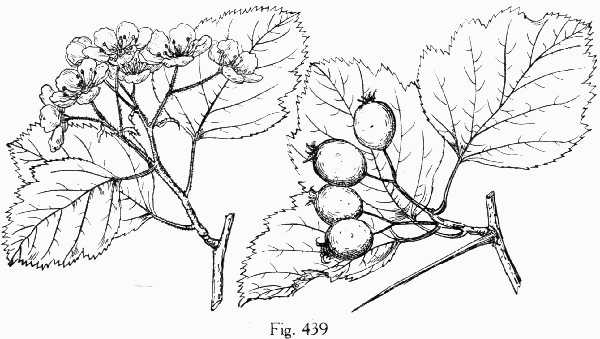
Leaves ovate, acute, rounded, truncate, slightly cordate or broad-cuneate at base, usually divided into 2 or 3 pairs of short narrow acute lobes, and coarsely often doubly serrate with glandular teeth, roughened above by short pale hairs and villose below when they unfold, nearly fully grown when the flowers open early in June, and at maturity thick and firm in texture, conspicuously blue-green and glabrous above, light yellow-green and somewhat pubescent below on the slender midrib and remote primary veins, 2′—2½′ long, and 1′—1½′ wide; petioles slender, more or less tomentose early in the season, usually becoming glabrous and light red below the middle before autumn, and ¾′—1′ in length; leaves at the end of vigorous shoots broad-ovate, rounded or slightly cordate at base, more deeply lobed, and often 3′—4′ long and wide. Flowers ¾′ in diameter, on short slender densely villose pedicels, in compact few-flowered densely villose corymbs; calyx-tube narrowly obconic, coated with thick hoary tomentum, the lobes lanceolate, finely glandular-serrate, tomentose on the outer surface usually only below the middle, villose on the inner surface; stamens 10; anthers small, light yellow; styles 5, surrounded at base by tufts of pale hairs. Fruit ripening early in September and usually remaining on the branches during the remainder of the year, on short slightly pubescent pedicels, in compact erect villose clusters, obovoid to short-oblong, bright scarlet, marked by scattered pale dots, more or less villose or pubescent toward the ends; calyx prominent, persistent, with a long tube, the lobes gradually narrowed from a broad base, acuminate, finely glandular-serrate, villose, dark red on the upper side below the middle, spreading or erect; flesh thick, yellow, dry and mealy; nutlets 5, ridged on the back with a broad ridge, 5/16′ long.
A tree, 15°—20° high, with a tall trunk 8′—10′ in diameter, covered with deeply fissured bark separating into thin loose plate-like scales, stout wide-spreading branches forming a broad round-topped often symmetrical head, and slender somewhat zigzag branchlets coated early in the season with hoary tomentum, soon becoming glabrous and light chestnut-brown [483] and lustrous, and armed with straight or slightly curved chestnut-brown spines 1½′—2′ long.
Distribution. Limestone ridges; valley of the St. Lawrence River near Montreal, Province of Quebec, southward through the Champlain valley to eastern New York and westward through New York, and southern Ontario to the neighborhood of Toronto.
88. Cratægus pennsylvanica Ashe.
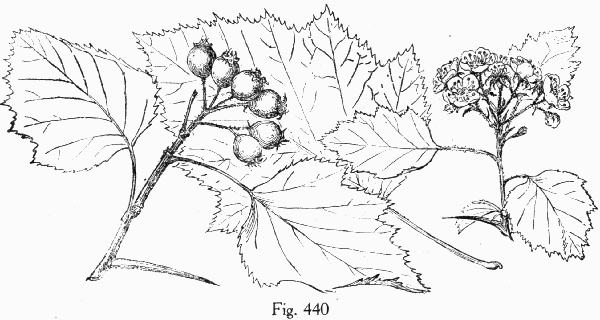
Leaves ovate, acuminate, rounded or abruptly cuneate at base, coarsely often doubly serrate with straight glandular teeth, and slightly divided into 3 or 4 pairs of short broad acuminate lobes, slightly tinged with red when they unfold, more than half grown when the flowers open the middle of May and then thin, dark yellow-green and roughened above by short white hairs and villose on the prominent midrib and primary veins below, and at maturity thin, dark yellow-green and scabrate on the upper surface, paler, scabrate and still somewhat villose on the midrib and veins below, 2½′—3½′ long, and 2′—2¾′ wide; petioles slender, slightly wing-margined at apex, villose through the season, occasionally glandular, 1¼′—1½′ in length; leaves at the end of vigorous shoots rounded or truncate at base, coarsely serrate, more deeply lobed, and often 4′—4½′ long and broad, with a stout midrib, prominent primary veins, a conspicuously glandular petiole, and large foliaceous lunate coarsely glandular-serrate persistent stipules. Flowers ¾′—1′ in diameter, on slender densely villose pedicels in broad lax hairy mostly 8—15-flowered corymbs; calyx-tube narrowly obconic, covered with long white hairs, the lobes long, slender, acuminate, laciniately glandular-serrate, glabrous on the outer surface, villose on the inner surface; stamens 8—12; anthers faintly tinged with pink; styles 3—5. Fruit ripening and falling early in October, on short stout drooping slightly hairy pedicels, in 4—12-fruited clusters, short-obovoid, full and rounded at apex, bright orange-red marked by small pale dots, puberulous at the ends, ¾′—1′ in diameter; calyx little enlarged, with small spreading lobes dark red on the upper side, their tips often deciduous from the ripe fruit; flesh thick, orange-yellow, somewhat acidulous, edible, sometimes made into jelly; nutlets 3—5, rounded at apex, acute at base, rounded and slightly grooved or ridged on the back, about ⅓′ long.
A tree, sometimes 30° high, with a tall trunk often 18′ in diameter, covered with dark gray scaly bark, large spreading branches forming a wide symmetrical round-topped head, and stout slightly zigzag branchlets dark orange-green and more or less tinged with red when they first appear, becoming dark chestnut-brown, marked by large dark lenticels and more or less pubescent in their first season, dark red-brown the following year, and armed with stout straight or slightly curved chestnut-brown spines 1′—1½′ long.
Distribution. Meadows in low moist soil near Pittsburgh, Allegheny County, Pennsylvania.
[484]
89. Cratægus submollis Sarg.
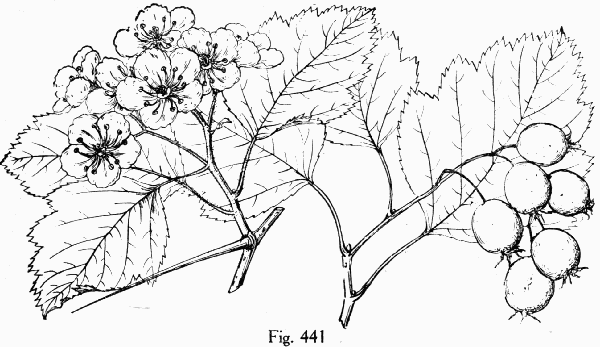
Leaves ovate, acute, gradually narrowed and cuneate at the nearly entire base, coarsely doubly serrate above with straight glandular teeth, and divided into 3 or 4 pairs of short acute lobes, half grown at the end of May or early in June when the flowers open and then roughened above by short stiff pale hairs and soft-pubescent below, particularly on the midrib and veins, and at maturity thin, dark yellow-green and scabrate above, pale below, 3′—3½′ long, and 2′—2½′ wide, with a thick yellow midrib and remote primary veins puberulous on the lower side; petioles stout, nearly terete, more or less winged at apex, tomentose early in the season, becoming puberulous, often bright red toward the base, 1′—2′ in length; leaves at the end of vigorous shoots broad-ovate, cuneate, rounded, truncate, or occasionally slightly cordate at base, often 4′ long and 3′—3½′ wide. Flowers 1′ in diameter, on long slender villose pedicels, in broad many-flowered tomentose corymbs; calyx-tube narrowly obconic, covered with a thick coat of long matted white hairs, the lobes gradually narrowed from a broad base, acute, glandular with large red stipitate glands, glabrous or villose on the outer surface; stamens 10; anthers small, pale yellow; styles 3—5, surrounded at base by a narrow ring of long white hairs. Fruit ripening and falling during the first half of September, on elongated slender slightly villose pedicels, in broad gracefully drooping many-fruited clusters, obovoid, bright orange-red, lustrous, marked by large scattered pale dots, puberulous toward the base, about ¾′ long; calyx much enlarged, with erect coarsely glandular-serrate persistent lobes; flesh yellow, thin, subacid, dry and mealy; nutlets usually 5, rounded and slightly ridged on the back, about ⅓′ in length.
A tree, 20°—25° high, with a tall trunk occasionally a foot in diameter, ascending or spreading ashy gray branches forming a broad handsome head, and branchlets dark green and coated with hoary tomentum when they first appear, light or dark orange-brown and slightly tomentose at midsummer, becoming glabrous, lustrous, and light red-brown or dark orange-brown, and armed with numerous thin straight or somewhat curved bright chestnut-brown shining spines 2½′—3′ in length.
Distribution. Rich damp hillsides and the borders of woods and roads; valley of the St. Lawrence River from the Isle of Orleans westward; Hull County, Province of Quebec; near Ottawa, Ontario; valley of the Penobscot River and Gerrish Island, Maine to the coast of eastern Massachusetts.
90. Cratægus Ellwangeriana Sarg.
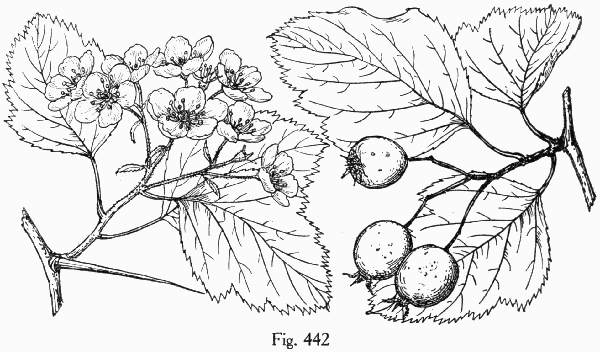
Leaves oval, acute, rounded or broad-cuneate at the entire base, irregularly divided usually only above the middle into numerous short acute lobes, and coarsely and often [485] doubly serrate above with straight or incurved glandular teeth, about half grown when the flowers open the middle of May, and then roughened above by short pale hairs and villose below on the slender midrib and primary veins, and at maturity thin, light green and scabrate on the upper surface, pale and nearly glabrous on the lower surface, 2½′—3½′ long, and 2′—3′ wide; petioles slender, villose early in the season, finally glabrous, 1½′—2′ in length; stipules oblong-obovate, acute, villose, coarsely glandular-serrate, ½′ long, those of the upper leaves mostly persistent until after the ripening of the fruit. Flowers 1′ in diameter, on short stout hairy pedicels, in many-flowered densely villose corymbs; calyx-tube broadly obconic, villose, the lobes long, lanceolate, glandular with small pale stalked glands, villose on both surfaces; stamens 10, sometimes 8; anthers small, rose color; styles 3—5. Fruit ripening and falling at the end of September, on slender glabrous pedicels, in drooping villose many-fruited crowded clusters, short-oblong, full and rounded at the ends, bright crimson, lustrous, covered at the ends with scattered pale hairs, 1′ long, and ½′—¾′ in diameter; calyx little enlarged, the lobes elongated, glandular-serrate above the middle, villose on the inner surface, spreading, or erect and incurved; flesh thin, yellow, juicy and acid; nutlets 3—5, thick, pale brown, deeply and often doubly and irregularly grooved on the back, ¼′—⅓′ long.
A tree, sometimes 20° high, with a tall trunk often a foot in diameter, covered with pale gray scaly bark, stout ascending branches forming a broad symmetrical head, and slender zigzag branchlets dark green and clothed at first with long matted pale hairs, becoming in their first summer light chestnut-brown and slightly villose, dark chestnut-brown and very lustrous in their second year, and armed with stout straight or somewhat curved dark chestnut-brown shining spines 1½′—2′ long.
Distribution. Western New York (common) to western Pennsylvania, and through southern Ontario to southern Michigan.
91. Cratægus Robesoniana Sarg.
Cratægus spissiflora Sarg.
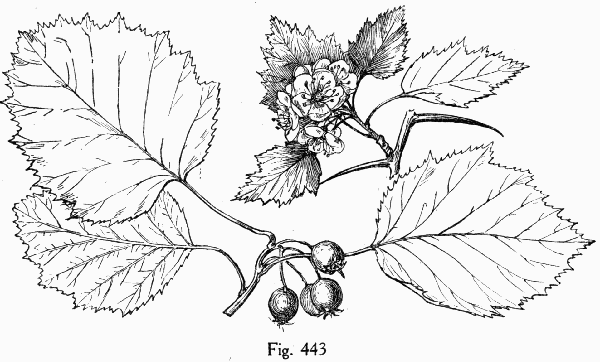
Leaves oblong-ovate, acute or acuminate at apex, rounded broadly cuneate or rarely cordate at the entire base, sharply doubly serrate above with slender straight gland-tipped teeth, and deeply divided into numerous broad acute or acuminate lateral lobes, villose above and densely tomentose below when they unfold, about half grown when the flowers open at the end of May and then roughened above by short rigid white hairs and pubescent [486] below on the midrib and veins, and at maturity dark yellow-green and scabrate on the upper surface, glabrous on the lower surface, 3′—3½′ long, and 2½′—3′ wide, with a slender midrib, and 4 or 5 pairs of prominent veins extending obliquely to the point of the lobes; petioles slender, more or less wing-margined at apex, slightly grooved, sparingly glandular, villose early in the season, becoming glabrous and rose color in the autumn, 1¼′—1½′ in length; leaves at the end of vigorous shoots cordate or rarely cuneate at base, deeply lobed, often 4′ long and 3½′ wide, with a stout conspicuous glandular petiole. Flowers ⅔′ in diameter, on short slender villose pedicels, in small very compact few, usually 4—6-flowered, thin-branched villose corymbs, with oblong-obovate acuminate glandular bracts and bractlets mostly deciduous before the flowers open; calyx-tube narrowly obconic, coated with long matted white hairs, the lobes slender, acuminate, finely glandular-serrate, glabrous on the outer surface, villose on the inner surface; stamens 10; anthers dark rose color; styles 4 or 5, surrounded at base by a narrow ring of pale tomentum. Fruit ripening at the end of September or early in October, on short reddish pubescent pedicels, in compact drooping clusters, oblong-obovoid to short-oblong, scarlet, lustrous, marked by small pale dots, about ¾′ long, and ½′ in diameter; calyx little enlarged, with spreading sharply serrate lobes often deciduous from the ripe fruit; flesh thick, yellow, dry and mealy; nutlets 4 or 5, thin, acute at the ends, rounded or only slightly grooved on the back, about ⅝′ in length.
A tree, 20°—25° high, with a trunk often 1° in diameter, covered with smooth pale gray bark, and stout spreading branches forming a round-topped head, and stout slightly zigzag dark red-brown branchlets sparingly villose early in the season, soon glabrous, bright red-brown, very lustrous and marked by small pale lenticels at the end of their first season, becoming dark gray or gray-brown the following year, and armed with few stout spreading bright chestnut-brown shining ultimately gray spines 1′—1½′ long.
Distribution. Western Massachusetts through central and western New York to the neighborhood of Toronto, southern Ontario.
92. Cratægus anomala Sarg.
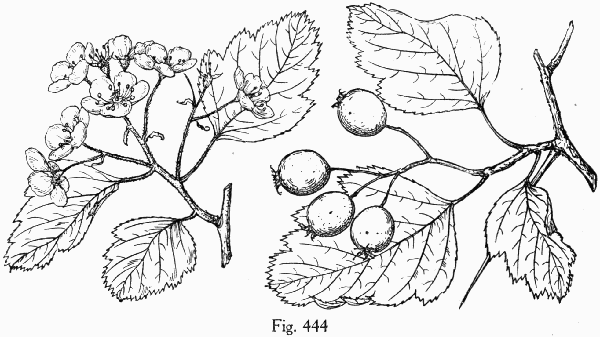
Leaves ovate, acute, divided above the middle into 5 or 6 pairs of short acute or acuminate lobes, and coarsely doubly serrate with spreading glandular teeth except toward the broad-cuneate or occasionally rounded base, when they unfold conspicuously plicate, covered above with short appressed pale hairs, and villose below, especially on the slender midrib, and thin remote primary veins arching to the point of the lobes, about a third grown when the flowers open at the end of May, and at maturity membranaceous, light [487] yellow-green, smooth and glabrous above, paler and villose below, 2½′—3′ long, and 2′—3′ wide; petioles stout, glandular on the upper side with scattered dark glands, ¾′—1′ in length; leaves at the end of vigorous shoots, rounded or truncate at base, and often 4′—4½′ long and 2½′—3′ wide. Flowers saucer-shaped, ½′ in diameter when fully expanded, on elongated slender hairy pedicels, in broad loose many-flowered villose corymbs; calyx-tube narrowly obconic, coated with long matted pale hairs, the lobes long, acuminate, coarsely glandular-serrate, pubescent on the outer surface and tomentose on the inner surface; stamens usually 10, occasionally 7 or 8; anthers large, bright red; styles 4 or 5, surrounded at base by a narrow ring of pale tomentum. Fruit ripening in October, on long slender slightly pubescent pedicels, in loose many-fruited sparingly villose clusters, obovoid to oblong, gradually narrowed to the rounded base, crimson, lustrous, marked by large pale dots, slightly villose, particularly toward the full and rounded apex, ¾′—⅞′ long, ½′—⅝′ in diameter; calyx large and prominent, with elongated acuminate lobes abruptly narrowed from a broad base, dark red on the upper side, tomentose on the lower, finely glandular-serrate, spreading or closely appressed, often deciduous before the ripening of the fruit; flesh thin, light yellow, somewhat juicy; nutlets 4 or 5, thin, prominently and irregularly ridged on the back, ¼′—5/16′ long.
A bushy tree, sometimes 20° high, with a short trunk 6′ in diameter, covered with pale gray-brown scaly bark, stout ascending branches, and slender somewhat zigzag branchlets at first dark green and villose with long matted white hairs, puberulous and light orange-brown during their first season, becoming glabrous and orange-brown or bright red, and armed with numerous stout straight or slightly curved bright chestnut-brown spines 1¼′—2′ long.
Distribution. Low limestone ridges near the banks of the St. Lawrence River in the Caughnawaga Indian Reservation opposite Lachine in the Province of Quebec; western Vermont (Clarendon, Rutland County); Crown Point, Essex County, and Fort Ann, Washington County, New York.
93. Cratægus noelensis Sarg.
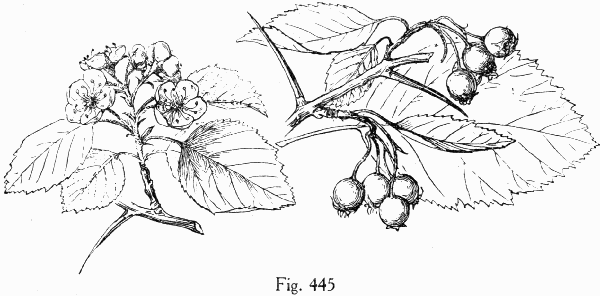
Leaves ovate to oval, acute, acuminate or rarely rounded at apex, acutely or broadly cuneate at base, and coarsely doubly serrate with straight teeth, covered above with short white hairs and densely villose-pubescent below when they unfold, more than half grown when the flowers open at the end of April, and at maturity dark yellow-green, smooth and glabrous on the upper surface, villose-pubescent on the lower surface, 2′—3′ long, and 1¼′—2½′ wide, with a prominent midrib and thin conspicuous primary veins; petioles slender, slightly wing-margined at apex, hoary-tomentose early in the season, becoming glabrous, [488] 1′—1¼′ in length; leaves at the end of vigorous shoots ovate, acuminate, rounded or cuneate at the broad base, more coarsely serrate, usually laterally lobed with short broad acuminate lobes, 3′—4′ long, and 2½′—3′ wide. Flowers ¾′ to nearly 1′ in diameter, on short pedicels densely covered like the narrow obconic calyx-tube and the compact 5—10-flowered corymb with long matted white hairs; calyx-lobes slender, long-acuminate, minutely glandular-serrate, slightly villose; stamens 5—10, usually 10; anthers rose color; styles 3—5, surrounded at base by a broad ring of pale tomentum. Fruit ripening in September, on slender drooping pubescent pedicels, subglobose, orange-red, ½′—⅔′ in diameter, the calyx prominent with a short tube and spreading closely appressed lobes; flesh thin, soft and yellow; nutlets 3—5, rounded at base, narrowed and rounded at apex, slightly grooved on the back, about ¼′ long.
A tree, 15°—18° high, with a trunk sometimes 1° in diameter, spreading branches forming a broad flat or round-topped head, and stout zigzag branchlets coated when they first appear with matted white hairs, reddish brown, pubescent or puberulous during their first season and gray the following year, and armed with few or many slender straight purple lustrous spines 1′—2½′ in length, sometimes persistent and compound on old trunks.
Distribution. Rich alluvial soil; in the neighborhood of Noel, McDonald County, Missouri; common.
IX. COCCINEÆ.
Flabellatæ Sarg.
CONSPECTUS OF THE ARBORESCENT SPECIES.
Stamens 20; leaves yellow-green and scabrate above.
Leaves ovate; anthers deep rose-purple; fruit obovoid to short-oblong, bright red, often slightly pruinose.
94. C. neo-londinensis (A).
Leaves oblong-ovate; anthers pink; fruit obovoid, crimson, lustrous.
95. C. Hillii (A).
Stamens 10—20, usually 10; anthers pinkish purple, leaves broad-ovate, dull dark green and scabrate above; fruit short-oblong to slightly obovoid, dull red or crimson.
96. C. assurgens (A).
Stamens usually 10.
Fruit on short stout pedicels; leaves yellow-green and glabrous above.
Leaves oval, drooping, conspicuously concave; anthers purple; fruit short-oblong, dark dull red, villose at the ends.
97. C. Pringlei (A).
Leaves oval to oblong-ovate; anthers dark reddish purple; fruit short-oblong, crimson, lustrous.
98. C. lobulata (A).
[489]
Fruit on long slender pedicels; leaves broad-ovate to obovate or rhombic, dark rich green and scabrate above; anthers rose color; fruit short-oblong, bright scarlet, lustrous.
99. C. pedicellata (A).
Stamens usually 5—7, rarely 10.
Fruit obovoid to ellipsoidal; leaves oval or ovate, conspicuously yellow-green; anthers dark reddish purple; fruit crimson, lustrous.
100. C. Holmesiana (A).
Fruit short-oblong; leaves oblong-ovate, deep yellow-green, nearly smooth above; anthers pink; fruit yellowish red, glaucous.
101. C. acclivis (A).
Fruit subglobose to obovoid.
Leaves glabrous above; anthers dark rose color.
Leaves broad-ovate, thin, light yellow-green and lustrous above; fruit bright red or scarlet.
102. C. delecta (A).
Leaves oblong-ovate, subcoriaceous, dark dull green; fruit bright cherry-red, pruinose.
103. C. Eamesii (A).
Leaves scabrate above, oblong-ovate, thin, dark yellow-green; anthers pale rose color; fruit crimson.
104. C. sertata (A).
94. Cratægus neo-londinensis Sarg.
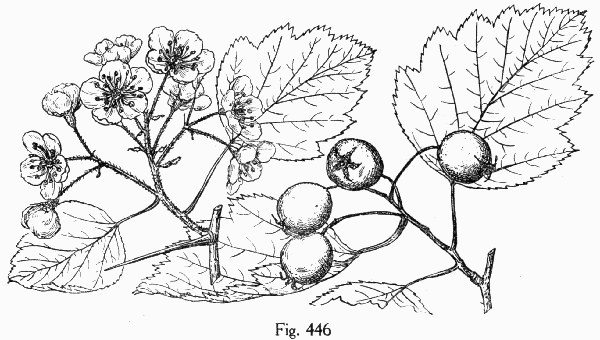
Leaves ovate, acute or acuminate, rounded, truncate or broadly concave-cuneate at the wide entire or glandular base, sharply often doubly serrate above with straight glandular teeth, and divided into numerous short narrow acuminate lateral lobes, about half grown when the flowers open the middle of May and then very thin, light yellow-green and roughened above by short white rigid hairs and paler and sparingly hairy below, and at maturity membranaceous, dull yellow-green and scabrate on the upper surface, pale green and glabrous below, or occasionally slightly hairy on the under side of the stout yellow midrib, and of the thin remote primary veins arching to the point of the lobes, 3′—4′ long, and 2½′—3½′ wide; petioles slender, nearly terete, glandular, at first slightly hairy, becoming glabrous and purplish toward the base, 1′—2′ in length; leaves at the end of vigorous shoots only slightly larger. Flowers 1′—1⅛′ in diameter, on slender sparingly villose pedicels, in lax slightly drooping usually 5—12-flowered villose or nearly glabrous corymbs, with linear often slightly falcate glandular bracts and bractlets, persistent until after the flowers open; calyx-tube narrowly obconic, covered with short matted pale hairs, the lobes gradually narrowed from a broad base, acuminate, coarsely glandular-serrate below the middle, glabrous on the outer, villose on the inner surface; stamens 17—21, usually 20; anthers deep rose-purple; styles 4 or 5, usually 5, surrounded at base by a narrow ring of pale tomentum. [490] Fruit ripening and beginning to fall early in September, on stout villose or glabrous pedicels, in large drooping few-fruited clusters, obovoid or short-oblong, bright red, often slightly pruinose, marked by numerous minute pale dots, ⅝′—¾′ long, ½′—⅝′ in diameter; calyx enlarged, prominent, with spreading or erect and incurved coarsely serrate persistent lobes, their upper surface bright red below the middle and covered above with soft white hairs; flesh thick, orange-yellow, soft, juicy and acidulous; nutlets 4 or 5, thin, narrowed at the ends, acute at base, rounded at apex, rounded and sometimes broadly grooved on the back, about 5/16′ long.
A tree, often 20° high, with a tall trunk 8′—10′ in diameter, covered with light grayish brown slightly fissured bark, large spreading and drooping branches forming an open head often 20° across, and slender branchlets olive-green and slightly hairy when they first appear, dull red-brown and marked by many large pale lenticels during their first season, becoming light gray and rather lustrous, and armed with stout straight dark purple shining ultimately gray spines often 2′ long.
Distribution. Borders of woods near the shores of Fisher’s Island Sound, Mumford’s Point, Groton, and near Lyme, New London County, Connecticut.
95. Cratægus Hillii Sarg.
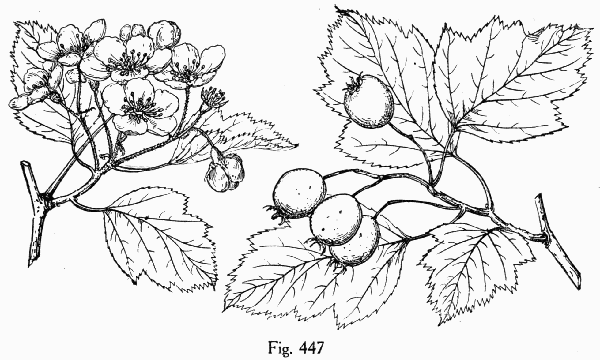
Leaves oblong-ovate, acuminate, rounded or rarely cuneate at the broad entire base, coarsely doubly serrate above with straight glandular teeth, and divided into numerous short acuminate lateral lobes, when they unfold coated above with short lustrous white hairs and densely tomentose below, particularly on the midrib and veins, about one fourth grown when the flowers open the middle of May and then roughened above by short hairs and villose below, and at maturity thin, light yellow-green and scabrate on the upper surface, pale yellow-green on the lower surface, 2½′—3′ long, and 2′—2½′ wide, with a slender midrib often slightly hairy near the base, and 4 or 5 pairs of thin primary veins extending obliquely to the point of the lobes; petioles slender, densely villose early in the season, slightly hairy in the autumn, and ⅝′—1½′ in length; leaves at the end of vigorous shoots often truncate or slightly cordate at base, deeply lobed with broad triangular lobes, and 3½′—4′ long and wide, with a stout rose-colored glandular petiole, and hairy lunate glandular-serrate stipules. Flowers about ¾′ in diameter, on slender densely villose pedicels, in broad many-flowered hairy compound corymbs, their large linear to oblong bracts and bractlets occasionally persistent until midsummer; calyx-tube narrowly obconic, thickly covered with long spreading white hairs, the lobes abruptly narrowed at base, broad, [491] acuminate, coarsely glandular-serrate, glabrous on the outer surface, villose on the inner surface; stamens 20; anthers pink; styles 4 or 5, surrounded at base by a narrow ring of pale tomentum. Fruit ripening from the middle to the end of September, on slender puberulous pedicels, in drooping few-fruited clusters, obovoid, broad and rounded at apex, gradually narrowed to the rounded base, crimson, lustrous, marked by small pale dots, ½′—⅝′ long, ⅜′—½′ in diameter; calyx only slightly enlarged, with closely appressed coarsely serrate lobes often deciduous from the ripe fruit; flesh yellow, thin, acidulous, juicy; nutlets 4 or 5, thin, gradually narrowed and acute at the ends, irregularly ridged and sometimes grooved on the back, about ⅜′ long.
A tree, 25°—30° high, with a trunk sometimes a foot in diameter and 6° or 7° long, covered with close light gray bark tinged with red and divided by shallow fissures into small plates, stout ascending branches forming an open irregular often round-topped head, and slender nearly straight branchlets densely villose when they first appear, dark orange color tinged with red and sparingly villose when the flowers open, becoming bright red-brown and lustrous at the end of their first season and dark dull reddish brown the following year, and sparingly armed with slender nearly straight red-brown shining spines 1½′—2′ long.
Distribution. Open woods near the borders of streams in moist rich soil; northeastern Illinois (Thatcher’s Park, Glendon Park, and River Forest, Cook County); not common.
96. Cratægus assurgens Sarg.
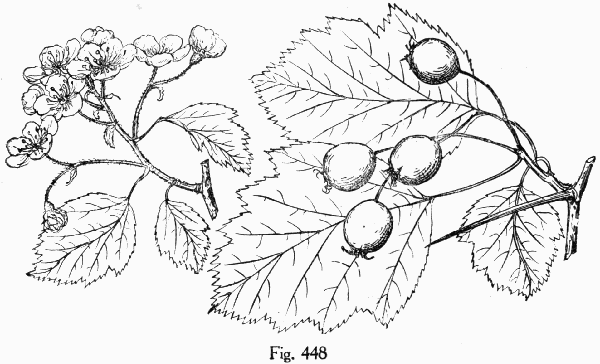
Leaves broad-ovate, acuminate, rounded or rarely cuneate at the wide entire base, sharply doubly serrate above with straight gland-tipped teeth, and slightly divided, into 3 or 4 pairs of small acuminate lobes, about one third grown when the flowers open the middle of May and then roughened above by short white hairs and glabrous or sparingly villose below, with persistent hairs on the slender yellow midrib, and on the veins arching obliquely to the point of the lobes, and at maturity membranaceous, dull dark green and scabrate on the upper surface, light yellow-green on the lower surface, 2¾′—3½′ long, and 2¼′—2¾′ wide; petioles slender, villose early in the season, becoming pubescent, 1′—1½′ in length; leaves at the end of vigorous shoots often deeply lobed, coarsely serrate, sometimes 4′ long and wide, with long stout glandular petioles and foliaceous lunate acuminate coarsely glandular-serrate persistent stipules. Flowers ¾′—⅝′ in diameter, on short villose pedicels, in compact 8—15-flowered hairy corymbs, with oblong, acuminate, glandular bracts and bractlets, deciduous with the opening of the flowers; calyx-tube narrowly obconic, sparingly villose, the lobes long, narrow, acuminate, tipped with minute red [492] glands, finely glandular-serrate, glabrous on the outer, pubescent on the inner surface; stamens 10—20, usually 10; anthers pinkish purple; styles 4 or 5, surrounded at base by tufts of pale hairs. Fruit ripening from the 15th to the 20th of September, and usually falling about the 1st of October, on short glabrous pedicels, in drooping few-fruited clusters, short-oblong to slightly obovoid, dull red to crimson, ½′—⅝′ long, about ½′ wide; calyx sessile, with spreading closely appressed serrate usually persistent lobes; flesh thin, pale yellow or nearly white, acidulous; nutlets 4 or 5, broad, narrow and acute at the ends, prominently ridged on the back with a high narrow ridge, or often grooved, about ¼′ long.
A tree, sometimes 25° high, with a trunk 2′—6′ in diameter and often 6°—9° long, covered with close dark gray bark, ascending branches forming an oblong, open head, and slender branchlets light orange-yellow and covered when they first appear with long scattered caducous white hairs, becoming bright red-brown and lustrous, and dark gray-brown the following year, and armed with many stout usually slightly curved bright red-brown shining spines, 1′—1½′ long.
Distribution. River banks and low woods in rich soil; northeastern Illinois (Leyden township, La Grange, Thatcher’s Park, Cook County, Highland Park, Deerfield, Wauconda, Lake County); Fox Point, Milwaukee County, Wisconsin.
97. Cratægus Pringlei Sarg.
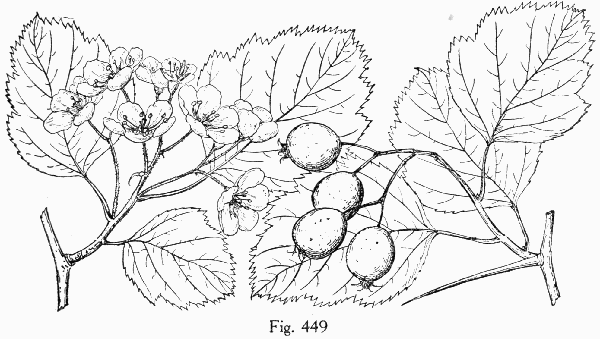
Leaves oval, acute, rounded or often abruptly narrowed and cuneate at base, occasionally irregularly lobed above the middle with short broad acute lobes, and coarsely and often doubly serrate with glandular teeth, as they unfold villose on both surfaces, and often more or less tinged with red, when the flowers open, usually in the last week of May, roughened above by short closely appressed pale hairs and glabrous below with the exception of a few hairs on the slender midrib and remote primary veins, and at maturity thin, glabrous, and bright yellow-green on the upper surface, pale below, 2′—2½′ long, and 1¾′—2¼′ wide, usually conspicuously concave by the gradual turning down of the blades from the midrib to the margins, drooping on long thin slender glandular petioles at first villose, ultimately glabrous, 1′—1¾′ in length; leaves at the end of vigorous shoots sometimes truncate or slightly cordate at the base, and frequently 3′ long and wide. Flowers about ¾′ in diameter, on stout hairy pedicels, in many-flowered compound villose corymbs; calyx-tube narrowly obconic, villose, particularly toward the base, the lobes narrow, acuminate, coarsely glandular-serrate, villose on both surfaces or only on the inner surface; stamens 10, occasionally 5—10; anthers small, purple; styles 3—5, surrounded at the base by conspicuous [493] tufts of pale tomentum. Fruit ripening and falling late in September or early in October, on stout pedicels, in erect villose mostly few-fruited clusters, short-oblong, dark dull red, marked by few dark dots, villose at the ends with long scattered pale hairs, ¾′ long and ⅝′ in diameter; calyx little enlarged, the lobes gradually narrowed from a broad base, acuminate, glandular-serrate, often erect; flesh thick, yellow, dry and acid, with a disagreeable flavor; nutlets 3—5, rounded and slightly ridged on the back, ⅓′ long.
A tree, occasionally 25° high, with a tall trunk 10′—12′ in diameter, covered with thin bark separating into large flakes broken into small loose dark red-brown scales, stout branches forming a wide symmetrical head, and slightly zigzag branchlets at first dark green and villose, soon becoming glabrous, chestnut-brown and lustrous, bright orange-brown during their second year, and armed with thick straight or somewhat curved chestnut-brown spines often 1½′ long.
Distribution. Southern New Hampshire, through southern Vermont to western Massachusetts and eastern New York; through central and western New York and southern Ontario to northeastern Ohio (Plymouth, Ashtabula County), the southern peninsula of Michigan and northeastern Illinois.
98. Cratægus lobulata Sarg. Red Haw.
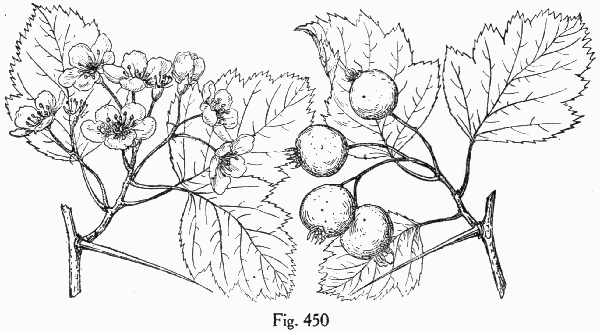
Leaves oval to oblong-ovate, acute at apex, broad-cuneate or rounded at the entire base, sharply and often doubly serrate above with straight glandular teeth, and deeply divided into numerous narrow acute or acuminate lobes spreading or pointing to the apex or to the base of the leaf, when they first appear and until after the opening of the flowers during the last week in May covered above with short soft pale hairs and slightly pubescent below on the slender midrib, and thin primary veins arching to the point of the lobes, and at maturity thin, dark yellow-green and glabrous on the upper surface, paler on the lower surface, with occasional short white hairs toward the base of the midrib, 2½′—3½′ long and 2′—2½′ wide; petioles slender, nearly terete, at first tomentose, particularly at the base, becoming pubescent or nearly glabrous and bright red, 1′—1½′ in length; leaves at the end of vigorous shoots broad-ovate, rounded or truncate at the broad base, divided into numerous acuminate lateral lobes, often 3½′—4′ long and 3′—3½′ wide. Flowers ¾′ in diameter, on elongated slender pedicels, in rather compact many-flowered tomentose corymbs, with linear-lanceolate glandular-serrate bright red bracts and bractlets; calyx-tube broadly obconic, glabrous, or villose toward the base, dark red, the lobes gradually narrowed from a broad base, glabrous, coarsely glandular-serrate with large dark red stipitate glands; stamens usually 10, occasionally 5—10; anthers small, dark reddish purple; styles [494] 3—5, sometimes surrounded at the base by a ring of pale tomentum. Fruit ripening and falling early in October, on short stout pedicels, in erect compact tomentulose clusters, short-oblong, somewhat flattened at the rounded ends, bright crimson, very lustrous, marked by occasional small white dots, about ¾′ long and ⅝′ in diameter; calyx little enlarged, the lobes small, lanceolate, coarsely glandular-serrate, tomentose on the upper surface, erect and incurved, persistent; flesh thick, yellow, sweet and juicy; nutlets 3—5, thin, dark colored, ridged and often grooved on the back, ¼′ long.
A tree, occasionally 35° high, with a straight trunk often a foot in diameter, covered with dark red-brown fissured bark broken into small thick plate-like scales, stout generally ascending branches forming an open usually narrow irregular head, and slender branchlets, dark green and covered with matted pale hairs when they first appear, becoming bright chestnut-brown and very lustrous during their first season, and light orange-brown the following year, and armed with many stout nearly straight chestnut-brown spines rarely more than 1′ in length.
Distribution. Burlington, Chittenden County, Vermont, and southward through the Champlain valley to Crown Point, Essex County and to the neighborhood of Albany, New York; western Massachusetts to southern Connecticut (Stratford, Fairfield County); common.
99. Cratægus pedicellata Sarg.
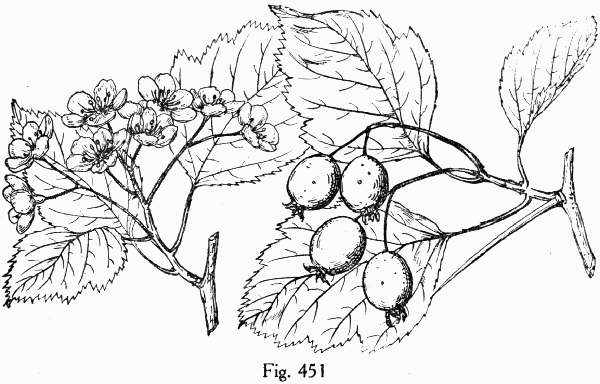
Leaves broad-ovate or occasionally obovate or rhombic, acute or acuminate, broad-cuneate or rounded at the entire base, coarsely often doubly serrate above with spreading glandular teeth, and divided above the middle into 4 or 5 pairs of short acute or acuminate lobes, nearly two thirds grown when the flowers open during the last week in May, and then roughened above by short rigid pale hairs and glabrous below, and at maturity membranaceous, dark rich green and scabrate on the upper surface, pale on the lower surface, 3′—4′ long, and 2′—3′ wide, with a slender midrib, and thin remote primary veins arching to the point of the lobes; petioles slender, nearly terete, glandular with minute scattered dark glands, at first villose, becoming glabrous, 1½′—2½′ in length; leaves at the end of vigorous shoots sometimes truncate or slightly cordate at base, more deeply lobed, often 3′—4′ long and 3′ wide. Flowers ½′ in diameter, on long thin pedicels, in loose lax many-flowered slightly villose corymbs; calyx-tube narrowly obconic, glabrous, the lobes broad, acute, very coarsely glandular-serrate; stamens usually 10; anthers rose color; styles 5, surrounded at base by a conspicuous ring of pale tomentum. Fruit ripening and falling during September, on long slender pedicels, in few-fruited drooping glabrous clusters, [495] obovoid until nearly fully grown, becoming short-oblong when fully ripe, rounded at the ends, bright scarlet, lustrous, marked by numerous small dark dots, ¾′ long, and ½′—⅝′ in diameter; calyx large and conspicuous, the lobes much enlarged, coarsely serrate, and usually erect and incurved; flesh pale, thin, dry and mealy; nutlets 5, narrowed and acute at the ends, rounded and deeply grooved on the back, about ⅓′ long.
A tree, 18°—20° high, with a tall trunk sometimes a foot in diameter, covered with close red-brown scaly bark, long comparatively slender spreading or ascending branches forming a handsome symmetrical head, and thin branchlets dark chestnut-brown and slightly villose at first, becoming very lustrous and ashy gray in their second year, and armed with straight or slightly curved shining chestnut-brown spines 1½′—2′ long.