Division II. Dicotyledons. (continued 16)
Reading edition
A family of two genera, one widely distributed, the other, Dipteronia, distinguished by the broad wings encircling the mature carpels, and represented by a single Chinese species.
1. ACER L. Maple.
Characters of the family.
Acer with sixty or seventy species is widely distributed over the northern hemisphere, with a single species extending south of the equator to the mountains of Java. Acer produces light close-grained moderately hard wood valued for the interior finish of houses and in turnery. The bark is astringent, and the limpid sweet sap of some of the American species is manufactured into sugar.
Acer is the classical name of the Maple-tree.
CONSPECTUS OF THE NORTH AMERICAN ARBORESCENT SPECIES.
Leaves simple, usually palmately lobed (sometimes 3-foliolate in 1, 3-lobed at apex in 4).
Flowers appearing with or after the leaves.
Flowers with petals; sepals distinct.
Inflorescence corymbose.
Flowers in terminal drooping corymbs.
Leaves 3-lobed or parted.
1. A. glabrum (B, F, G).
Leaves palmately 3—5-lobed.
2. A. circinatum (B, G).
Inflorescence racemose.
Flowers in dense erect racemes.
3. A. spicatum (A).
Flowers in drooping racemes.
Ovary and young fruit glabrous; leaves 3-lobed at apex.
4. A. pennsylvanicum (A).
Ovary and young fruit hairy; leaves deeply 5-lobed.
5. A. macrophyllum (G).
[682]
Flowers without petals; sepals united; inflorescence corymbose; pedicels long, pendulous, mostly hairy.
Leaves pale or glaucescent, or green and glabrous beneath.
Leaves green or pale beneath, glabrous or in one form villose-pubescent on the under side of the veins and on the petioles.
6. A. saccharum (A, C).
Leaves pale and pubescent, rarely glabrous beneath, their lobes usually short and obtuse or acuminate.
Lobes of the leaves only slightly lobed or entire; bark of young trees smooth and pale.
7. A. floridanum (C).
Lobes of the leaves distinctly lobulate; bark of young trees dark brown and scaly.
8. A. grandidentatum (F, H).
Leaves green and pubescent, rarely glabrous beneath.
Leaves hirsute-pubescent beneath and on the petioles, the lobes entire or lobulate, the basal sinus often closed by the lower lobes; bark dark and furrowed.
9. A. nigrum (A).
Leaves pilose-pubescent, rarely glabrous beneath, the lobes slightly lobulate, the basal sinus open; petioles glabrous; bark pale and smooth.
10. A. leucoderme (C).
Flowers appearing before the leaves in dense lateral clusters from separate buds; leaves 5-lobed (3-lobed in varieties of 12); fruit ripening in May or June.
Flowers sessile or short-stalked, without petals; ovary and young fruit tomentose.
11. A. saccharinum
Flowers on long pedicels, with petals; ovary and young fruit glabrous.
12. A. rubrum
Leaves 3—7-foliolate; flowers diœcious, without petals.
13. A. Negundo (A, B, C, F, G, H).
1. Acer glabrum Torr. Dwarf Maple.
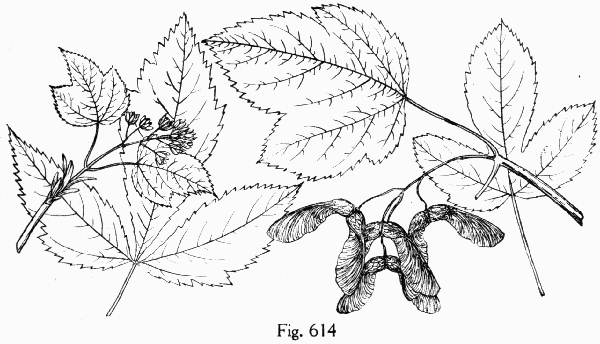
Leaves glabrous, thin, rounded in outline, cordate-truncate or cuneate at base, 3—5-lobed, the middle lobe usually narrowed and entire below the middle, or often 3-parted or 3-foliolate (f. trisecta Sarg.), with acute or obtuse doubly serrate lobes, 3′—5′ in diameter, dark green and lustrous on the upper, paler on the lower surface, with conspicuous veinlets; petioles stout, grooved, 1′—6′ in length, and often bright red. Flowers about ⅛′ long on short slender pedicels, in loose few-flowered glabrous racemose corymbs on slender drooping peduncles from the end of 2-leaved branchlets, the staminate and pistillate usually produced separately on different plants; sepals oblong, obtuse, petaloid, as long as the [683] greenish yellow petals; stamens 7 or 8, with glabrous unequal filaments shorter than the petals, much shorter or rudimentary in the pistillate flower; ovary glabrous, with short obtuse lobes, rudimentary or 0 in the staminate flower; style divided to the base into 2 spreading stigmatic lobes as long as the petals. Fruit glabrous, with broad nearly erect or slightly spreading wings ¾′—⅞′ long, often rose-colored during the summer; seeds ovoid, bright chestnut-brown, about ¼′ long.
A small tree, occasionally 20°—30° high, with a short trunk 6′—12′ in diameter, small upright branches, and slender glabrous branchlets often slightly many-angled, pale greenish brown when they first appear, becoming bright red-brown during their first winter; often a shrub. Winter-buds acute, ⅛′ long, with bright red or occasionally yellow scales, those of the inner ranks pale brown tinged with pink, tomentose on the inner surface, becoming 1½′ long and narrow-spatulate. Bark of the trunk thin, smooth, and dark reddish brown. Wood heavy, hard, close-grained, light brown or often nearly white, with thick lighter colored sapwood.
Distribution. Borders of mountain streams usually at elevations of 5000°—6000°; Rocky Mountains from Montana to Wyoming, the Black Hills of South Dakota, Sioux County, Nebraska, Colorado, Utah, Nevada, northern Arizona, and to the Sacramento Mountains, New Mexico; in California from the Siskiyou Mountains along the Sierra Nevada to the East Fork of the Kaweah River, Kern County, at altitudes of 5000°—6000° at the north and of 8000°—9000° at the south. Passing into
Acer glabrum var. Douglasii Dippel.
Acer Douglasii Hook.
Leaves ovate or oblong-ovate, slightly cordate by a wide shallow sinus, truncate or rarely rounded at base, 3-lobed with acuminate lobes often slightly divided into acuminate lobules, the terminal leaflet usually ovate from a broad base, or occasionally gradually narrowed below and rhombic in outline and sharply serrate to the base or nearly to the base of the lobe with long-acuminate teeth pointing forward, dark green above, paler and often glaucescent below, 3½′—4′ long and 3′—4′ wide, with 3 prominent nerves extending to the points of the lobes, and slender veins; petioles glabrous, 1′—3½′ in length. Flowers as in the species. Fruit with erect or nearly erect wings, ¾′—1′ long and ⅓′—½′ wide.
[684]
A tree, occasionally 40° high, with a short trunk 12′—18′ in diameter, small upright branches and slender bright red-brown branchlets.
Distribution. Coast of southern Alaska (head of Lynn Canal), southward near the coast to Vancouver Island and western Washington, and eastward on the high mountains of Washington to the Blue Mountains of eastern Oregon, western Idaho and northern Montana; on Loomis Creek, Natrona County, Wyoming.
2. Acer circinatum Pursh. Vine Maple.
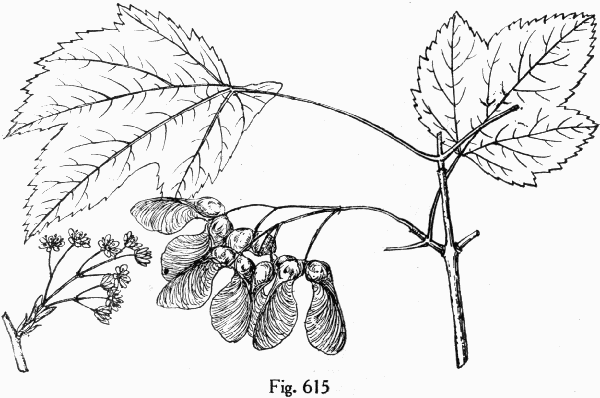
Leaves almost circular in outline, cordate at base by a broad shallow sinus, or sometimes almost truncate, palmately 7—9-lobed occasionally nearly to the middle, with acute lobes sharply and irregularly doubly serrate, and conspicuously palmately nerved, with prominent veinlets, when they unfold tinged with rose color, and puberulous, especially on the lower surface and on the petioles, and at maturity glabrous with the exception of tufts of pale hairs in the axils of the large veins, thin and membranaceous, dark green above, pale below, and 2′—7′ in diameter; in the autumn turning orange and scarlet; petioles stout, grooved, 1′—2′ in length, clasping the stem by their large base. Flowers appearing when the leaves are about half grown, in loose 10—20-flowered umbel-like corymbs pendent on long stems from the end of slender 2-leaved branchlets, the staminate and pistillate flowers produced together; sepals oblong to obovate, acute, villose, purple or red, much longer than the greenish white broad, cordate petals folded together at apex; stamens 6-8, with slender filaments villose at base, exserted in the staminate flower, much shorter than the petals in the pistillate flower; ovary glabrous, with spreading lobes, in the staminate flower reduced to a small point surrounded by a tuft of pale hairs; style divided nearly to the base into long exserted stigmas. Fruit with thin wings, 1½′ long, spreading almost at right angles, red or rose color like the nutlets in early summer, ripening late in the autumn; seeds smooth, pale chestnut-brown, ⅛′¼′ long.
A tree, rarely 30°—40° high, often vine-like or prostrate, with a trunk 10′—12′ in diameter, and glabrous pale green or reddish brown branchlets frequently covered during their first winter with a glaucous bloom, and occasionally marked by small lenticels; often a low wide-spreading shrub. Winter-buds ⅛′ long, rather obtuse, with thin bright red outer scales rounded on the back, and obovate-spatulate inner scales rounded at apex, contracted into a long narrow claw, bright rose-colored and more or less pubescent, especially on the outer surface, and when fully grown often 2′ long and ¼′ broad. Bark of the trunk thin, smooth, bright red-brown, marked by numerous shallow fissures. Wood heavy, hard, close-grained, not strong, light brown, sometimes nearly white, with thick lighter colored sapwood; used [685] for fuel, the handles of axes and other tools, and by the Indians of the northwest coast for the bows of their fishing-nets.
Distribution. Banks of streams; coast of British Columbia through western Washington and Oregon to Mendocino County, and the cañon of the upper Sacramento River, California; one of the most abundant of the deciduous-leaved trees of western Washington and Oregon up to altitudes of 4000° above the sea, and of its largest size on the rich alluvial soil of bottom-lands, its vine-like stems in such situations springing 4 or 5 together from the ground, spreading in wide curves and sending out long slender branches rooting when they touch the ground and forming impenetrable thickets of contorted and interlaced trunks, often many acres in extent; in California smaller and less abundant, growing along streams in the coniferous forest or rarely on dry ridges up to an altitude of 4000° in the northeastern part of the state.
Occasionally cultivated as an ornamental plant in Europe, and in the eastern states, and hardy as far north as eastern Massachusetts.
3. Acer spicatum Lam. Mountain Maple.
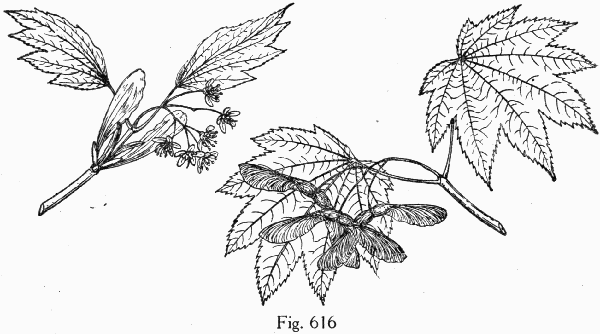
Leaves subcordate or sometimes truncate at base, conspicuously 3-nerved, 3 or slightly 5-lobed, with gradually narrowed pointed lobes, and sharply and coarsely glandular-serrate, when they unfold puberulous on the upper surface and densely tomentose on the lower surface, and at maturity thin, 4′—5′ long and broad; turning in the autumn to various shades of orange and scarlet; petioles slender, enlarged at base, 2′—3′ in length, often becoming scarlet in summer. Flowers opening in June after the leaves are fully grown, ¼′ diameter, on slender pedicels ½′—¾′ long, the pistillate toward the base and the staminate at the apex of a narrow many-flowered long-stemmed upright slightly compound pubescent raceme; calyx-lobes narrow-obovate, yellow, pubescent on the outer surface, much shorter than the linear-spatulate pointed yellow petals; stamens 7 or 8, inserted immediately under the ovary, with slender glabrous filaments as long as the petals in the sterile flower, about as long as the sepals in the pistillate flower, and glandular anthers; ovary hoary-tomentose, reduced to a minute point surrounded by a tuft of pale hairs in the staminate flower; style columnar, almost as long as the petals, with short stigmatic lobes. Fruit fully grown and bright red or yellow in July, turning brown late in the autumn, almost glabrous, with more or less divergent wings about ½′ long; seeds smooth, dark red-brown, ⅛′ long.
A bushy tree, occasionally 25°—30° high, with a short trunk 6′—8′ in diameter, small upright branches, and slender branchlets light gray and pubescent when they first appear, [686] becoming glabrous during the summer, bright red during their first winter, gray or pale brown the following season, and blotched or streaked with green toward the base; more often a tall or low shrub. Winter-buds acute; the terminal ⅛′ long, with bright red outer scales more or less coated with hoary tomentum, those of the inner ranks becoming at maturity 1′ or more in length and then lanceolate, pale and papery; axillary buds much smaller and glabrous or puberulous. Bark of the trunk very thin, reddish brown, smooth or slightly furrowed. Wood light, soft, close-grained, light brown tinged with red, with thick lighter colored sapwood.
Distribution. Moist rocky hillsides usually in the shade of other trees, and really arborescent only on the western slopes of the high mountains of Tennessee and North Carolina; Newfoundland and Labrador to Hudson Bay, Manitoba, and Saskatchewan, and southward through the northern states, and westward to Minnesota and northeastern Iowa, and along the Appalachian Mountains to northern Georgia.
Occasionally cultivated as an ornament of parks and gardens in the northern states.
4. Acer pennsylvanicum L. Striped Maple. Moose Wood.
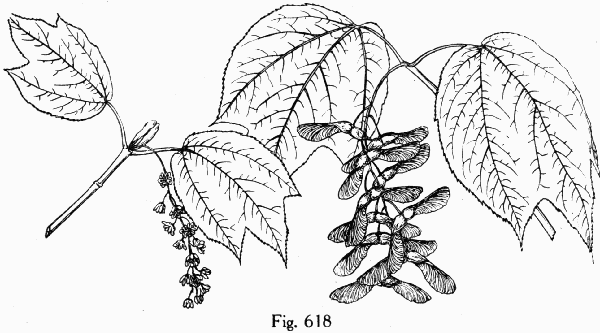
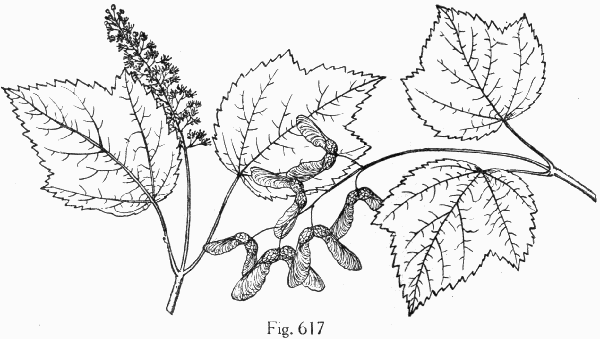
Leaves rounded or cordate at base, palmately 3-nerved, 3-lobed at apex, with short lobes contracted into a tapering serrate point, and finely and sharply doubly serrate, when they unfold thin, pale rose color and coated with ferrugineous pubescence, especially on the lower surface and on the petioles, and at maturity glabrous with the exception of tufts of ferrugineous hairs in the axils of the principal nerves on the two surfaces, thin, pale green above, rather paler below, 5′—6′ long and 4′—5′ wide; turning in the autumn clear light yellow; petioles stout, grooved, 1½′—2′ in length, with an enlarged base nearly encircling the branch. Flowers bright canary-yellow, opening toward the end of May or early in June when the leaves are nearly fully grown, on slender pedicels ¼′—½′ long, in slender drooping long-stemmed racemes 4′—6′ in length, the staminate and pistillate usually in different racemes on the same plant; sepals linear-lanceolate to obovate, ¼′ long and a little shorter and narrower than the obovate petals; stamens 7—8, shorter than the petals in the staminate flower, rudimentary in the pistillate flower; ovary purplish brown, glabrous, in the staminate flower reduced to a minute point; styles united nearly to the top, with spreading recurved stigmas. Fruit in long drooping racemes, glabrous, with thin spreading wings ¾′ long, and marked on one side of each nutlet by a small cavity; seeds ¼′ long, dark red-brown, and slightly rugose.
A tree, 30°—40° high, with a short trunk 8′—10′ in diameter, small upright branches, and slender smooth branchlets pale greenish yellow at first, bright reddish brown during their [687] first winter, and at the end of two or three years striped like the trunk with broad pale lines; or often much smaller and shrubby in habit. Winter-buds: the terminal conspicuously stipitate, sometimes almost ½′ long, much longer than the axillary buds, covered by two thick bright red spatulate boat-shaped scales prominently keeled on the back, the inner scales green and foliaceous, becoming 1½′—2′ long, ½′ wide, pubescent, and bright yellow or rose color. Bark of the trunk ⅛′—¼′ thick, reddish brown, marked longitudinally by broad pale stripes, and roughened by many oblong horizontal excrescences. Wood light, soft, close-grained, light brown, with thick lighter colored sapwood of 30-40 layers of annual growth.
Distribution. Usually in the shade of other trees, often forming in northern New England a large part of their shrubby undergrowth; shores of Ha-Ha Bay, Quebec, westward along the shores of Lake Ontario and the islands of Lake Huron to northern Wisconsin, and southward through the Atlantic states and along the Appalachian Mountains to northern Georgia; ascending to altitudes of 5000°; common in the north Atlantic states, especially in the interior and elevated regions; of its largest size on the slopes of the Big Smoky Mountains, Tennessee, and of the Blue Ridge in North and South Carolina.
Sometimes cultivated as an ornamental tree in the northern states, and occasionally in Europe.
5. Acer macrophyllum Pursh. Broad-leaved Maple.
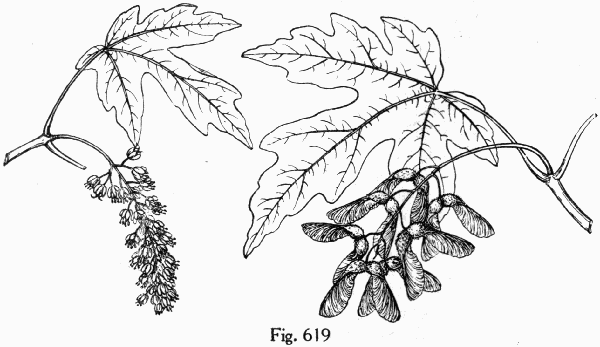
Leaves more or less cordate at the broad base, deeply 5-lobed by narrow sinuses acute in the bottom, the lobes acute or acuminate, the terminal lobe often 3-lobed, the others usually furnished with small lateral lobules, the lower lobes much smaller than the others, prominently 3—5-nerved, puberulous when they unfold, especially on the upper surface along the principal veins, and at maturity subcoriaceous, dark green and lustrous on the upper surface, pale on the lower surface, 8′—12′ in diameter; turning in the autumn bright orange color before falling; petioles stout, 10′—12′ in length, with enlarged bases united and encircling the stem and often furnished on the inside with small tufts of white hairs. Flowers bright yellow, fragrant, ¼′ long, on slender pubescent often branched pedicels ½′—¾′ in length, the staminate and pistillate together in graceful pendulous slightly puberulous racemes 4′—6′ long, appearing in April and May after the leaves are fully grown; sepals petaloid, obovate, obtuse and a little longer and broader than the spatulate petals; stamens 9—10, with long slender filaments hairy at base, exserted in the staminate flower and included in the pistillate flower, and orange-colored anthers; ovary hoary-tomentose, reduced in the staminate flower to a minute point; styles united at base only; stigmas long and exserted. Fruit [688] fully grown by the 1st of July and ripening late in the autumn; nutlets covered with long pale hairs, their wings 1½′ long, ½′ wide, slightly divergent and glabrous with the exception of a few hairs on the thickened edge; seeds dark-colored, rugose and pitted, ¼′ long.
A tree, 80°—100° high, with a tall straight trunk 2°—3° in diameter, stout often pendulous branches forming a compact handsome head, and stout branchlets smooth and pale green at first, becoming bright green or dark red in their first winter, covered more or less thickly with small longitudinal white lenticels, and in their second summer gray or grayish brown. Winter-buds obtuse; terminal ¼′ long, with short broad slightly spreading dark red ciliate outer scales rounded on the back, those of the inner ranks green and foliaceous, and at maturity 1½′ long, colored and puberulous; axillary buds minute. Bark of the trunk ½′—¾′ thick, brown faintly tinged with red or bright reddish brown, deeply furrowed and broken on the surface into small square plate-like scales. Wood light, soft, not strong, close-grained, rich brown tinged with red, with thick lighter colored often nearly white sapwood of 60—80 layers of annual growth; more valuable than the wood produced by other deciduous-leaved trees of western North America, and in Washington and Oregon used in the interior finish of buildings, for furniture, and for axe and broom-handles.
Distribution. Banks of streams or on rich bottom-lands or the rocky slopes of mountain valleys; coast of Alaska south of latitude 55° north, southward along the islands and coast of British Columbia, through Washington and Oregon west of the Cascade Mountains, and southward along the coast ranges and the western slopes of the Sierra Nevada to the San Bernardino Mountains, and to Hot Spring Valley, San Diego County, California; on the Sierra Nevada usually between altitudes of 2000° and 5000° and on the southern mountains rarely above 3000°; most abundant and of its largest size in the humid climate and rich soil of the bottom-lands of southwestern Oregon, forming extensive forests; in California usually much smaller, especially on the coast ranges.
Generally planted in the Pacific States for shade and as a street tree, and occasionally in the Eastern States as far north as Long Island, New York, and in western Europe; not hardy in Massachusetts.
6. Acer saccharum Marsh. Sugar Maple. Rock Maple.
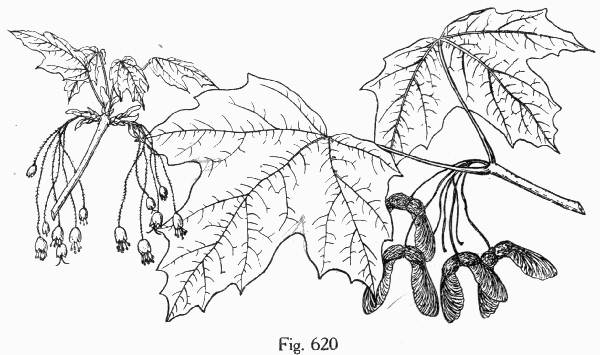
Leaves rarely in whorls of 3, heart-shaped by a broad sinus, truncate or sometimes cuneate at base, 3—5-lobed, the lobes usually acute sparingly sinuate-toothed usually 3-lobulate at apex, with 3—5 conspicuous nerves, and reticulate veinlets, when they unfold coated below with pale pubescence, glabrous or more or less pubescent on the nerves below (var. Schneckii Rehd.) and at maturity, 4′—5′ in diameter, often rather coriaceous, dark green and opaque on the upper surface, green or pale (var. glabrum Sarg.) on the lower surface; turning in the autumn brilliant shades of deep red, scarlet and orange or clear yellow; petioles slender, glabrous, 1½—3′ in length. Flowers appearing with the leaves on slender more or less hairy pedicels ¾′—3′ long, in nearly sessile umbel-like corymbs from terminal leaf-buds and lateral leafless buds, the staminate and pistillate in the same or in separate clusters on the same or on different trees; calyx broad-campanulate, 5-lobed by the partial union of the obtuse sepals, greenish yellow, hairy on the outer surface; corolla 0; stamens 7—8, with slender glabrous filaments twice as long as the calyx in the staminate flower and much shorter in the pistillate flower; ovary obtusely lobed, pale green, covered with long scattered hairs, in the staminate flower reduced to a minute point; styles united at base only, with 2 long exserted stigmatic lobes. Fruit ripening in the autumn, glabrous, with broad thin and usually divergent wings ½′—1′ long; seeds smooth, bright red-brown, ¼′ long.
A tree, 100°—120° high, with a trunk often 3°—4° in diameter, rising sometimes in the forest to the height of 60°—70° without branches, or in open situations developing 8°—10° from the ground stout upright branches forming while the tree is young a narrow egg-shaped head, ultimately spreading into a broad round-topped dome often 70°—80° across, and slender glabrous branchlets green at first, becoming reddish brown by the end of their first season, lustrous, marked by numerous large pale oblong lenticels, and in their second winter pale brown tinged with red. Winter-buds acute, ¼′ long, with purple slightly puberulous [689] outer scales, and inner scales becoming 1½′ long, narrow-obovate, short-pointed at apex, thin, pubescent, and bright canary yellow. Bark of young stems and of large branches pale, smooth or slightly fissured, becoming on large trunks ½′—¾′ thick and broken into deep longitudinal furrows, the light gray-brown surface separating into small plate-like scales. Wood heavy, hard, strong, close-grained, tough, light brown tinged with red, with thin sapwood of 30-40 layers of annual growth; largely used for the interior finish of buildings, especially for floors, in the manufacture of furniture, in turnery, shipbuilding, for shoe-lasts and pegs, and largely as fuel. Accidental forms with the grain curled and contorted, known as curly maple and bird’s-eye maple, are common and are highly prized in cabinet-making. The ashes of the wood are rich in alkali and yield large quantities of potash. Maple sugar is principally made from the sap of this tree.
Distribution. Newfoundland and Nova Scotia, westward to the Lake of the Woods, Ontario, and southward through eastern Canada and the northern states, and along the Appalachian Mountains to northern Georgia; in central Alabama and Mississippi, and westward in the United States to Minnesota, northeastern South Dakota (coulées of Little Minnesota River, Roberts County), central and northwestern Iowa, eastern Kansas, central Oklahoma, and eastern Louisiana; most abundant northward; ascending in North Carolina the Alleghany Mountains to altitudes of 3000°; the var. glabrum rare and local in the north from Prince Edwards Island and Lake St. John, Quebec, to Iowa and southward to Pennsylvania, Ohio and central Tennessee; more abundant southward; apparently the only form but not common in South Carolina, Alabama, Mississippi, Louisiana and southern Arkansas; the var. Schneckii with leaves glaucous or glaucescent below and more or less densely pubescent with spreading hairs, on the under side of the midrib and veins and on the petioles, southern Indiana and Illinois to western Kentucky and western and middle Tennessee, northwestern Georgia (near Rome, Floyd County), and to eastern Missouri southward to Williamsville, Wayne County.
Commonly planted as a shade and ornamental tree in the northern states.
More distinct are the following varieties:
Acer saccharum var. Rugelii Rehd.
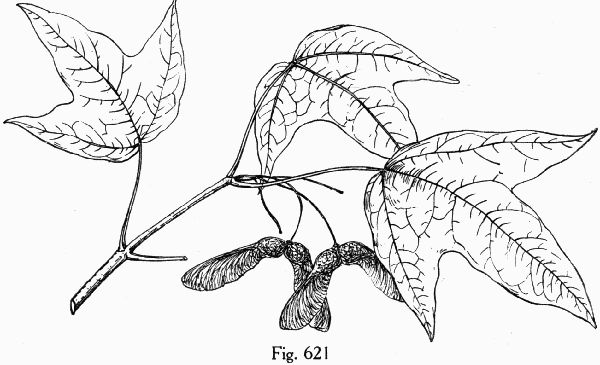
Leaves thick, 3′—5′ long and 4′—6′ wide, pale and glabrous below, 3-lobed by broad rounded sinuses, rounded or slightly cordate at base, the lobes long-acuminate, usually entire, the middle lobe occasionally slightly undulate, the lateral lobes spreading, sometimes furnished near the base with a short acute lobule.
[690]
Distribution. Southeastern Ohio to western Pennsylvania (Kittaning, Armstrong County) and eastern and middle Tennessee, and to southern Ontario, the southern peninsula of Michigan, eastern and central Indiana, southern Illinois, eastern Missouri and northwestern Arkansas (Eureka Springs, Carroll County); rare and local in its extreme form; its 3-lobed leaves sometimes appearing on upper branches of trees bearing on lower branches leaves of the typical Sugar Maple.
Acer saccharum var. sinuosum Sarg.
Acer sinuosum Rehd.
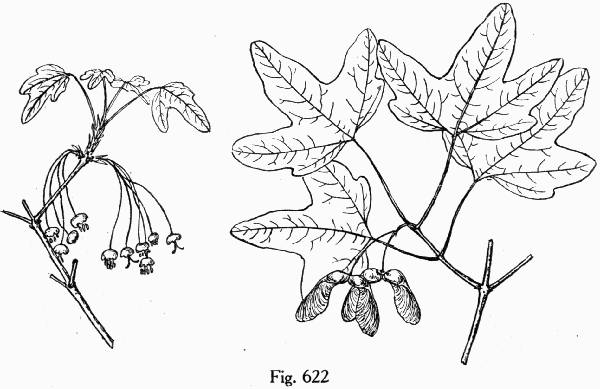
Leaves suborbicular, broader than long, 3—5-lobed with short triangular-ovate to triangular-oblong obtuse lobes, entire or on vigorous shoots occasionally dentate, usually broad-cordate at base, often with the nerves of the two lateral lobes projecting into the [691] broad sinus and forming its base, when they unfold glabrous and purplish above, loosely hairy below, soon glabrous, and at maturity dark yellow-green and lustrous on the upper surface, pale, reticulate-venulose and glabrous except in the axils of the principal veins on the lower surface, 3—5-nerved, usually not more than 1½′ long, occasionally up to 2¾′ long and 3′ wide; petioles slender, glabrous, ½′—1½′ in length. Flowers appearing with the leaves, on slender glabrous pedicels, ½′—1¼ long, in 3—8-flowered nearly sessile corymbs; calyx broad-campanulate or cupulate, with short semiorbicular lobes ciliate on the margins; petals 0; stamens usually 6, with slender filaments longer than the calyx of the staminate flower; style divided to below the middle, with two spreading stigmas. Fruit glabrous, with long and broad almost horizontally spreading nutlets, convex, smooth, pale yellow-brown, the wing curved upward.
A tree, rarely more than 20° high with a short trunk 8′—10′ in diameter, small branches forming an open irregular head, and slender glabrous branchlets light green above when they first appear, becoming pale red-brown and marked by pale lenticels during their first season and ultimately dull gray-brown. Bark of the trunk smooth, pale gray. Winter-buds small, obtuse, covered with dark brown scales, those of the inner ranks accrescent, linear-oblong, scarlet or pink, up to 1⅛′ in length when fully grown.
Distribution. Edwards Plateau of western Texas, banks and bluffs of Cibolo Creek, near Boerne, Kendall County, on the rocky banks of upper Saco Creek, Bandera County, and at the base of a high limestone bluff near Utopia, Uvalde County; rare and local.
7. Acer floridanum Pax. Sugar Maple.
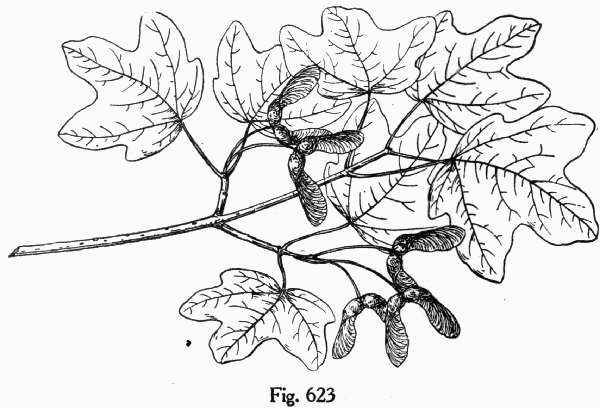
Leaves rounded, truncate or slightly cordate at the broad base, 3—5-lobed, with short obtuse or acute entire or lobulate lobes, when they unfold sparingly hairy on the upper surface and hoary-tomentose on the lower surface, and at maturity thin, dark green and lustrous above, pale or glaucescent and pubescent below, 1½′—3′ in diameter, and prominently 3—5-nerved, with stout spreading lateral veins and conspicuous reticulate veinlets; turning yellow and scarlet in the autumn before falling; petioles slender, glabrous, or pubescent generally becoming glabrous, 1½′—3′ in length, with an enlarged base nearly encircling the branchlet. Flowers appearing with the leaves on slender elongated sparingly hairy ultimately glabrous or villose-tomentose (var. villipes Rehd.) pedicels, in many-flowered drooping nearly sessile corymbs; calyx campanulate, yellow, about ⅛′ long, persistent under the fruit, the short lobes ciliate on the margins with long pale hairs; corolla 0. Fruit green, [692] sparingly villose until fully grown, usually becoming glabrous, with spreading occasionally erect wings ⅜′—¾′ long; seeds smooth, bright red-brown, about ¼′ long.
A tree, occasionally 50°—60° high, with a trunk rarely 3° in diameter, small erect and spreading branches, and slender glabrous or more or less densely villose-tomentose (var. villipes Rehdr.) branchlets, light green when they first appear, becoming rather light red-brown during their first season, and covered with minute pale lenticels; usually smaller. Winter-buds obtuse, about ⅛′ long, with dark chestnut-brown obtuse scales and bright rose-colored linear-spatulate inner scales often 1′ long when fully grown. Bark of the trunk thin, smooth, pale, becoming near the base of old trees thick, dark, and deeply furrowed.
Distribution. River banks and low wet woods, southeastern Virginia (near McKinney, Dinwiddie County, W. W. Ashe), valley of the Roanoke River near Weldon, Halifax County, North Carolina, and southward to southern Georgia and western Florida to Lafayette County; near Selma, Dallas County, Alabama; West Feliciana Parish and through western Louisiana to eastern Texas (Harrison and St. Augustine Counties), and southern Arkansas (Fulton, Hempstead County); the var. fillipes near Raleigh, Walker County, North Carolina, Calhoun Falls, Abbeville County, South Carolina, Shell Bluff on the Savannah River, Burke County, Cuthbert, Randolph County, and Columbus, Muscogee County, Georgia; River Junction, Gadsden County, Florida, and on the San Luis Mountains, southern New Mexico (A. brachypterum Woot. & Stanl.).
Sometimes planted as a shade-tree; the prevailing tree in the streets and squares of Raleigh, North Carolina.
8. Acer grandidentatum Nutt. Sugar Maple.
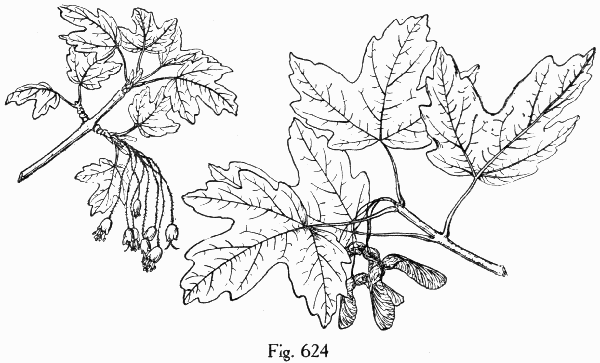
Leaves cordate or truncate at base, 3-lobed by broad shallow sinuses, the lobes acute or obtuse, entire or slightly lobulate, sparingly hairy on the upper surface and thickly coated with dense pale tomentum on the lower surface when they unfold, and at maturity thick and firm, dark green and lustrous above, pale and pubescent below, especially on the stout nerves and veins, or rarely glabrous, 2′—5′ in diameter; turning in the autumn before falling yellow and scarlet; petioles stout, 1′—2′ in length, glabrous, often red after midsummer, encircling the branchlet with their large base villose on the inner surface. Flowers appearing with the leaves on long slender drooping villose pedicels, in short-stalked corymbs; calyx campanulate, yellow, sparingly hairy with long pale hairs, about ¼′ long, with broad rounded lobes, often persistent under the fruit; corolla 0; stamens 7 or 8, much longer than the calyx, in the pistillate flower shorter than the calyx; ovary usually glabrous, with long spreading [693] stigmatic lobes, rudimentary in the staminate flower. Fruit often rose-colored at midsummer, green at maturity, glabrous or rarely sparingly hairy, with spreading or erect wings ½′—1′ long; seeds smooth, light red-brown, about ¼′ long.
A tree, occasionally 30°—40° high, with a trunk 8′—10′ in diameter, stout usually erect branches, and slender glabrous bright red branchlets marked by numerous small pale lenticels and nearly encircled by the narrow leaf-scars, with conspicuous bands of long pale hairs in their axils. Winter-buds acute or acuminate, about 1/16′ long, bright red-brown, with puberulous-ciliate outer scales and obovate apiculate inner scales sometimes ½′ long when fully grown. Bark of the trunk thin, dark brown, separating on the surface into plate-like scales. Wood heavy, hard, close-grained, bright brown or nearly white, with thick sapwood.
Distribution. Banks of mountain streams usually at altitudes of 5000°—6000° above the sea; on the Salt River Mountains, western Wyoming; valley of the Columbia River in northern Montana, southeastern Idaho (Pocatello, Oneida County), Wasatch Mountains, Utah, mountains of Arizona and of southern New Mexico; on the Guadalupe Mountains, western Texas, and on the Wichita Mountains, southwestern Oklahoma (G. W. Stevens); in Coahuila; rare and local.
Occasionally cultivated; hardy in the Arnold Arboretum.
9. Acer nigrum Michx. Black Maple.
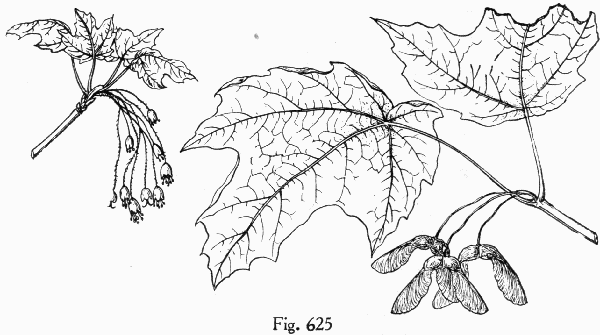
Leaves generally 3 or occasionally 5-lobed, with abruptly short-pointed acute or acuminate lobes, undulate and narrowed from broad shallow sinuses and rarely furnished with short lateral spreading lobules, cordate at base with a broad sinus usually more or less closed by the approximation or imbrication of the basal lobes, occasionally 3-lobed with a broad long-acuminate nearly entire terminal lobe, and rounded or slightly cordate at base (var. Palmeri Sarg.), covered below when they unfold with hoary tomentum and above with caducous pale hairs, and at maturity thick and firm in texture, dull green on the upper surface, yellow-green and soft-pubescent, especially along the yellow veins on the lower surface, and 5′—6′ long and wide, with drooping sides; turning bright clear yellow in the autumn; petioles stout, tomentose or pubescent, sometimes becoming glabrous at maturity, usually pendent, 3′—5′ in length, much enlarged at base, frequently nearly inclosing the buds, in falling leaving narrow scars almost encircling the branchlet and furnished in their axils with tufts of long pale hairs; stipules triangular and dentate or foliaceous, sessile or stipitate, oblong, acute, tomentose or pubescent, sometimes slightly lobed, frequently 1½′ long. Flowers yellow, about ¼′ long, on slender hairy pedicels 2½′—3′ long, in many-flowered [694] nearly sessile umbel-like corymbs, the staminate and pistillate in separate or in the same cluster on the same or on different trees; calyx broad-campanulate, 5-lobed by the partial union of the sepals, pilose on the outer surface near the base; corolla 0; stamens 7 or 8, with slender glabrous filaments, in the staminate flower nearly twice as long as the calyx and in the pistillate flower shorter than the calyx; ovary obtusely lobed, pale green, covered with long scattered hairs, minute in the sterile flower. Fruit glabrous, with convergent or wide-spreading wings ½′—1′ long; seeds smooth, bright red-brown, ¼′ long.
A tree, sometimes 80° high, with a trunk frequently 3° in diameter, stout spreading or often erect branches, and stout branchlets marked by oblong pale lenticels, orange-green and pilose with scattered pale caducous hairs when they appear, orange or orange-brown and lustrous during their first year, becoming dull pale gray-brown the following season. Winter-buds sessile, ovoid, acute, ⅛′ long, with dark red-brown acute scales hoary-pubescent on the outer surface and often slightly ciliate on the margins, and yellow puberulous inner scales, ½′—1′ long at maturity. Bark of young stems and of the branches thin, smooth, pale gray, becoming on old trunks thick, deeply furrowed, and sometimes almost black.
Distribution. Valley of the St. Lawrence River in the neighborhood of Montreal, Quebec, southward to the valley of Cold River, New Hampshire, through western Vermont and Massachusetts and northwestern Connecticut (near Salisbury, Litchfield County), and westward through northern and western New York, southern Ontario, Ohio, the southern peninsula of Michigan, Indiana, Illinois, and Iowa to southeastern Minnesota, northeastern South Dakota, western and southern Missouri, eastern Kansas, and southward through western Pennsylvania, West Virginia and eastern Kentucky; comparatively rare near Montreal and in New England, more abundant farther west; almost entirely replacing Acer saccharum in Iowa, and the only Sugar Maple of South Dakota; easily distinguished in summer by its heavy drooping leaves, and at all seasons of the year by the orange color of the branchlets; the var. Palmeri in a single grove at Tunnel Hill, Johnson County, Illinois; southern Indiana (Shelby, Putnam and Lawrence Counties), and in Clark, Jackson and Dunklin Counties, Missouri; rare and local.
Occasionally planted in the region where it grows naturally as a shade-tree.
10. Acer leucoderme Small. Sugar Maple.
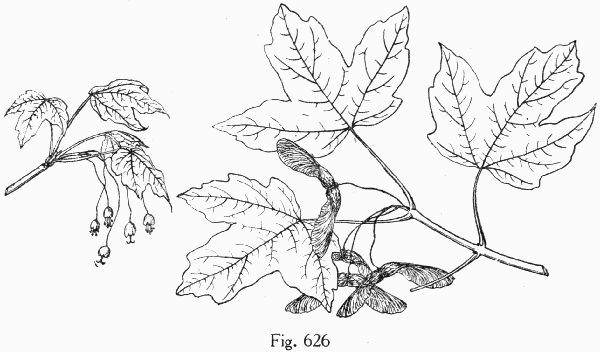
Leaves usually truncate or slightly cordate at base, more or less deeply divided into 3—5 acute caudate-acuminate lobes coarsely and sinuately dentate or undulate, when they unfold coated below with long matted pale caducous hairs, and at maturity thin, dark yellow-green above, bright yellow-green and pilose-pubescent below, 2′—3½′ in diameter; often turning in the autumn bright scarlet on the upper surface before falling; petioles slender, glabrous, 1′—1½′ in length. Flowers yellow, about ⅛′ long, on slender, glabrous pedicels, in nearly sessile clusters; calyx campanulate, glabrous or slightly villose, with rounded ciliate lobes; corolla 0; stamens 7 or 8; filaments villose, longer than the calyx, much shorter than the calyx in the pistillate flower; ovary villose; style elongated, with short spreading lobes. Fruit villose, with long scattered pale hairs until nearly grown, becoming glabrous at maturity, the wings wide-spreading or divergent, ½′—¾′ long; seeds smooth, light red-brown, about ¼′ long.
A tree, usually 20°—25° high, with a trunk a foot in diameter, occasionally 40° high, with a trunk 18′—20′ in diameter, short slender branches forming a rather compact round-topped head, and slender glabrous branchlets dark green when they first appear, becoming bright red-brown and lustrous during their first summer, and marked by numerous small oblong pale lenticels, gradually growing darker in their second year and finally light gray-green. Winter-buds ovoid, acute, dark brown, glabrous, rather more than 1/16′ long, the inner scales becoming bright crimson and very conspicuous when the tree is in flower. Bark of young stems and large branches close, light gray or grayish brown, becoming near the base of old trees dark brown or often nearly black and broken by deep furrows into narrow ridges covered by closely appressed scales.
[695]
Distribution. Banks of streams, rocky gorges, and woods in moist soil; valley of the Yadkin River, Stanley County, North Carolina; southeastern Tennessee (Polk County); valley of the Savannah River (Abbeville County, South Carolina, and Richmond County, Georgia) to central and northwestern Georgia (near Rome, Floyd County, and Walker County) and to the valley of the Chattahoochee River to Muscogee County; northern and central Alabama; western Louisiana (Natchitoches and Sabine Parishes); southern Arkansas (Baker Springs, Howard County); rare and local; most abundant in northwestern and central Georgia and northern Alabama.
Occasionally planted as a street tree in the towns of northern Georgia and Alabama; hardy as far north as eastern Massachusetts.
11. Acer saccharinum L. Silver Maple. Soft Maple.
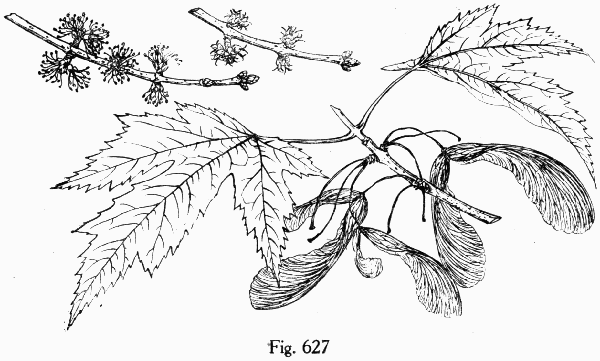
Leaves truncate or somewhat cordate at base, deeply 5-lobed by narrow sinuses, with acute irregularly and remotely dentate lobes, the middle lobe often 3-lobed, 6′—7′ long and nearly as broad, thin, bright pale green above, silvery white and at first slightly hairy below, especially in the axils of the primary veins; turning pale yellow in the autumn before falling; petioles slender, drooping, bright red, 4′—5′ in length. Flowers greenish yellow, opening during the first warm days of the late winter or early spring long before the appearance of the leaves, on short pedicels, in sessile axillary fascicles on shoots of the previous year, or on short spur-like branchlets developed the year before from wood of the preceding season, the staminate and pistillate in separate clusters, on the same or on different trees, and produced from clustered obtuse buds covered with thick ovate pubescent red and green scales ciliate on the margins with a thick fringe of long rufous hairs; calyx slightly 5-lobed, more or less pubescent on the outer surface, long and narrow in the staminate and short and broad in the pistillate flower; corolla 0; stamens 3—7, with slender filaments, three times as long as the calyx of the staminate flower and about as long as the calyx of the pistillate flower; ovary covered, like the young fruit, with a thick coat of pubescence, rudimentary in the sterile flower; styles united at base only, with long exserted stigmatic lobes. Fruit ripening in April and May when the leaves are nearly grown, on slender drooping pedicels, 1½′—2′ long, glabrous, 1½′ to nearly 3′ long, with thin almost straight conspicuously falcate divergent wings sometimes ¾′ broad, prominently reticulate-veined and pale chestnut-brown or rarely bright red; seeds ½′ long, with a pale reddish brown wrinkled coat, germinating as soon as they fall to the ground, and producing plants with several pairs of leaves before the end of the summer.
[696]
A tree, 90°—120° high, with a trunk 3°—4° in diameter, generally dividing 10°—15° from the ground into 3 or 4 stout upright secondary stems destitute of branches for a considerable length, brittle pendulous branchlets light green and covered with lenticels when they first appear, soon becoming darker, bright chestnut-brown, smooth and lustrous in the autumn and winter of their first year, and in their second season pale rose color or gray faintly tinged with red. Winter-buds ⅛′ long, with thick ovate bright red outer scales rounded on the back, minutely apiculate, and ciliate on the margins, and acute inner scales pubescent on the inner surface, becoming pale green or yellow and about 1′ long. Bark of young stems and large branches smooth and gray faintly tinged with red, becoming on old trunks ½′—¾′ thick, reddish brown and more or less furrowed, the surface separating into large thin scales. Wood hard, strong, close-grained, easily worked, rather brittle, pale brown, with thick sapwood of 40—50 layers of annual growth; now sometimes used for flooring and in the manufacture of furniture. Sugar is occasionally made from the sap.
Distribution. Sandy banks of streams, rarely in deep often submerged swamps; valley of the St. John’s River (near Fredericton), New Brunswick, to that of the St. Lawrence in Quebec, and southward through western Vermont and central Massachusetts to western Florida, Alabama, and south central Mississippi, and westward through Ontario, New York, Ohio, the southern peninsula of Michigan and southern Indiana to Minnesota, southeastern South Dakota, and eastern Nebraska, and through Kentucky, Tennessee, Missouri, eastern Kansas, northwestern Arkansas, and eastern Oklahoma; in western Louisiana (swamp near Alexandria, Rapides Parish); rare in the immediate neighborhood of the Atlantic coast and on the high Appalachian Mountains; probably of its largest size in the valley of the lower Ohio River.
Often cultivated with several forms differing in habit and in the lobing of the leaves; fast-growing, and largely planted in the eastern states as a park and street tree.
12. Acer rubrum L. Red Maple. Scarlet Maple.
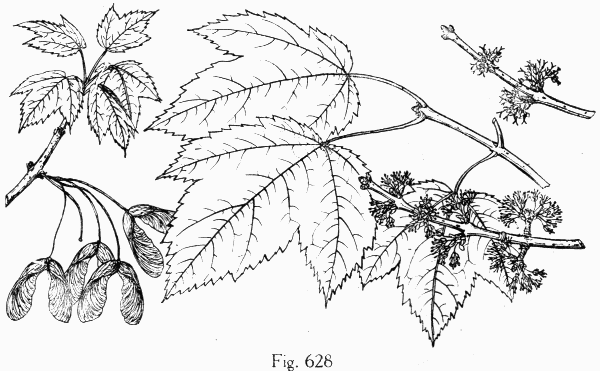
Leaves truncate, more or less cordate by a broad shallow sinus, rounded or cuneate at base, 3—5-lobed by acute sinuses, with irregularly doubly serrate or toothed lobes, the middle lobe often longer than the others, when they unfold pubescent especially beneath, and at maturity light green and glabrous on the upper surface and white or glaucescent and more or less pubescent or densely tomentose (var. tomentosum Kirch. [var. rubrocarpum Detmars]) on the lower surface, particularly along the principal veins, chartaceous or sometimes almost coriaceous, 1½′—6′ long and rather longer than broad; turning in the early [697] autumn to brilliant shades of scarlet and orange, or clear bright yellow; petioles slender, glabrous or puberulous, red or green, 2′—4′ in length. Flowers opening in March and April before the appearance of the leaves, bright scarlet, dull yellowish red or sometimes yellow (var. pallidiflorum Pax.), on long slender pedicels, in few-flowered fascicles on branches of the previous year, from clustered obtuse buds, the staminate and pistillate flowers in separate clusters on the same or on different trees; sepals oblong, obtuse, as long as and broader than the oblong or linear petals; stamens 5—8, scarlet or yellow, with slender filaments exserted in the staminate and included in the pistillate flower; ovary glabrous on a narrow slightly lobed glandular disk; styles slightly united above the base, with long exserted stigmatic lobes. Fruit ripening in the spring or early summer on drooping stems 3′—4′ long, scarlet, dark red or brown or yellow, with thin erect wings, convergent at first, divergent at maturity, ½′—1′ long and ¼′—½′ wide; seeds dark red, with a rugose coat, ¼′ long, germinating as soon as it falls to the ground.
A tree, 80°—120° high, with a tall trunk 3°—4½° in diameter, upright branches usually forming a rather narrow head, and branchlets green or dark red when they first appear, becoming dark or bright red and lustrous at the end of their first summer and marked by numerous longitudinal white lenticels, and gray faintly tinged with red in their second year. Winter-buds obtuse, ⅛′ long, with thick dark red outer scales, rounded on the back and ciliate on the margins, and inner scales becoming ¾′—1′ long, narrow-oblong, rounded at apex and bright scarlet. Bark of young stems and of the branches smooth and light gray, becoming on old trunks ¼′—½′ thick, dark gray, and divided by longitudinal ridges separating on the surface into large plate-like scales. Wood very heavy, close-grained, not strong, light brown often slightly tinged with red, with thick rather lighter colored sapwood; used in large quantities in the manufacture of chairs and other furniture, in turnery, for wooden ware and gun-stocks.
Distribution. Borders of streams, wet swamps, upland forests and rarely on dry rocky hillsides and sand dunes; Newfoundland, southward to southern Florida (banks of the Miami River, Dade County, on the east coast and to Cypress swamps east of Everglade, Lee County, on the west coast) and westward through Quebec to latitude 49° north, and Ontario to the sandy shores of the Upper Peninsula of Michigan (Brevort, Mackinac County, on Lake Michigan and White Fish Point, Chippewa County, on Lake Superior), western Wisconsin, northwestern Minnesota (Buckeye County), southeastern Iowa (Johnson County), central Oklahoma, and the valley of the Trinity River, Texas; on the mountains of North Carolina to altitudes of 4500°; one of the commonest and most [698] generally distributed trees of eastern North America, ranging between more degrees of latitude than any other American tree; most abundant southward especially in the valley of the Mississippi River, and of its largest size in the river swamps of the lower Ohio and its tributaries; in the north often covering with small trees low wet swamps; on the sand dunes and ridges of northern Michigan reduced to a low shrub. On var. tomentosum leaves usually 5-lobed, cordate or rarely rounded at base, with glabrous or pubescent petioles and branchlets; widely distributed but rare; near Cranberry Island, Buckeye Lake, Licking County, Ohio; Biltmore, Buncombe County, North Carolina; neighborhood of Augusta, Richmond County, Georgia; top of Flagstaff Mountain, Barclay, Talladega County, Alabama; Panther Burn, Sharkey County, Mississippi; near Little Rock, Pulaski County, Arkansas; near Page, Leflore County, Oklahoma, and Larissa, Cherokee County, Texas; connected by trees of this variety with pubescent branchlets and winter-buds, and broad-ovate 3—5-lobed slightly cordate leaves and pubescent petioles with
Acer rubrum var. Drummondii Sarg.
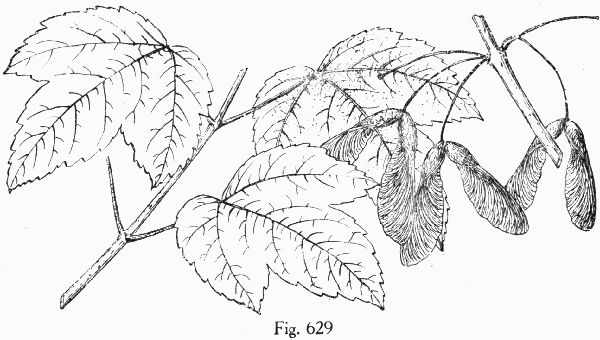
Leaves often broader than long, usually 5-lobed, cordate or truncate at base, 3′—6′ long and wide, with a stout midrib and veins, until nearly fully grown covered above with scattered hairs and clothed below with thick snow-white tomentum, and more or less pubescent during the season; petioles stout, hoary-tomentose, 1¼′—4′ in length, becoming nearly glabrous in the autumn. Flowers bright scarlet. Fruit ripening with or before the unfolding of the leaves late in March or in April, bright scarlet, with convergent wings 1¼′—2½′ long and ½′—¾′ wide.
A tree, usually not more than 30°—35° high, with small erect branches forming a narrow head and slender branchlets coated when they first appear with matted pale hairs, becoming glabrous and dark reddish brown in their second season.
Distribution. Deep swamps, eastern Louisiana to the valley of the Neches River (Beaumont, Jefferson County, and Concord, Hardin County), eastern Texas and northward through southern and eastern Arkansas to western Mississippi, western Tennessee and Kentucky, southeastern Missouri (Butler, Stoddard, Dunklin and Mississippi Counties), southern Illinois (Gallatin, Pulaski and Richland Counties), and southwestern Indiana (swamp eighteen miles west of Decker, Knox County, C. C. Deam). A form growing at Hattiesburg, Forrest County, Mississippi, at Glen Gordon, Covington, St. Tammany Parish, and Chopin, Natchitoches Parish, Louisiana, near Beaumont, Jefferson County, Texas, and at Poplar Bluff, Butler County, Missouri, with 3-lobed leaves rounded at base (f. rotundatum Sarg.) shows in the shape of the leaves a transition from the var. Drummondii to
[699]
Acer rubrum var. tridens Wood. Red Maple.
Acer carolinianum Britt., not Walt.
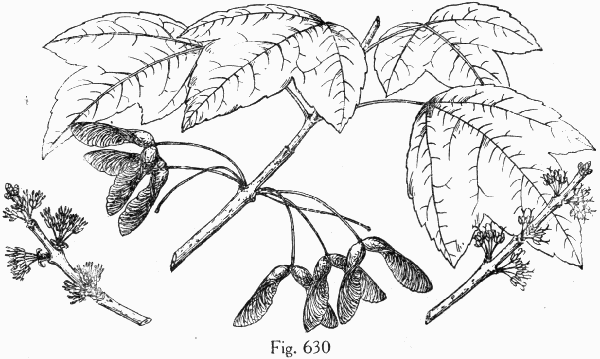
Leaves obovate, usually narrowed from above the middle to the rounded or rarely cuneate base, 3-lobed at apex, with acute or acuminate erect or slightly spreading lobes, simple or furnished with short lateral secondary lobes, remotely serrate except toward the base, with incurved glandular teeth, and often ovate by the suppression of the lateral lobes and acute or acuminate, thick and firm in texture, glaucous and usually pubescent or rarely tomentose or tomentulose below, 2′—3′ long and 1½′—2½′ wide; petioles slender, glabrous or pubescent. Flowers sometimes tawny yellow. Fruit usually much smaller and rarely also yellow.
Distribution. Usually with the species; Massachusetts and central New York, southward usually in the coast region and the middle districts to western Florida, along the Gulf coast to the valley of the Trinity River, Texas, and through western Louisiana, and Arkansas to northeastern Mississippi, southern Missouri, western Tennessee and Kentucky and southern Illinois; in North Carolina occasionally ascending on the Appalachian Mountains to altitudes of 3000°; often the prevailing Red Maple in southern Missouri and northwestern Louisiana; in the swamps of western Florida and southwestern Georgia the form with leaves densely tomentose below and pubescent petioles prevails.
13. Acer Negundo L. Box Elder. Ash-leaved Maple.
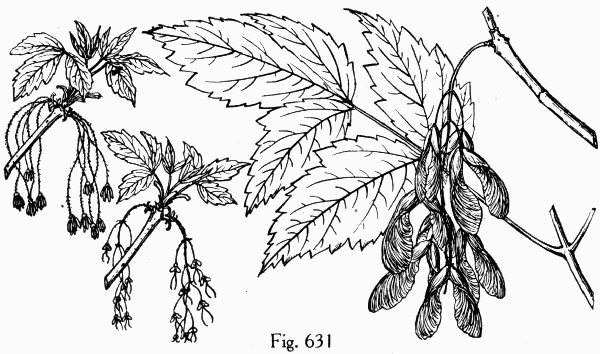
Leaves usually 3, rarely 5—7-foliolate, with a slender glabrous petiole 2′—3′ in length, the enlarged base often furnished with a minute rim of deciduous white hairs, and in falling leaving a large conspicuous scar surrounding the stem; leaflets ovate to elliptic or obovate, acuminate, and often long-pointed at apex, rounded or cuneate and often unsymmetrical at base, coarsely and irregularly serrate usually only above the middle or nearly entire, and occasionally slightly and irregularly lobulate; when they unfold more or less hoary-tomentose below and slightly pubescent above, and at maturity thin, light green, paler on the lower than on the upper surface, glabrous above, villose-pubescent along the under side of the midrib and veins, often furnished with conspicuous tufts of axillary hairs, otherwise glabrous or slightly pubescent below, 2½′—4′ long, and 1½′—2½′ wide, on slender glabrous petiolules, that of the terminal leaflet ¾′—1′ long and much longer than those of the smaller lateral leaflets. Flowers on slender glabrous or rarely hairy pedicels, minute, apetalous, yellow-green, the staminate and pistillate on separate trees, expanding just before or with the leaves from buds developed in the axils of the last leaves of the previous year, the staminate fascicled, the pistillate in narrow drooping racemes, sometimes furnished near the [700] base with one or two smaller 3-lobed or rarely elliptic leaves; calyx 5-lobed, hairy, campanulate in the staminate flower, much smaller in the pistillate flower and divided to the base into 5 narrow sepals; corolla 0; stamens 4—6, with slender exserted hairy filaments and long linear anthers narrowed and apiculate at apex, 0 in the pistillate flower; ovary on a narrow rudimentary disk, pubescent, only partly inclosed by the calyx; style separating from the base into 2 long stigmatic lobes. Fruit attaining nearly its full size in summer, pendent on glabrous stems 1′—2′ long, in graceful racemes 6′—8′ in length, ripening in the autumn, deciduous from the stems persistent on the branches until the following spring, 1½′—2′ long, with narrow acute pubescent nutlets diverging at an acute angle and constricted below into a stipe-like base, and thin reticulate straight or falcate wings undulate toward the apex; seeds narrowed at the ends, smooth, bright red-brown, ½′ long.
A tree 50°—70° high, with a trunk 2°—4° in diameter, dividing near the ground into a number of stout wide-spreading or erect branches, and slender pale green lustrous glabrous branchlets. Winter-buds terminal acute, ⅛′ long, rather longer than the obtuse lateral buds, the scales tomentose, those of the inner pairs accrescent, becoming 1′ long at maturity, deciduous, leaving conspicuous scars visible at the base of the branchlet for two or three years. Bark of the trunk ¼′—½′ thick, pale gray or light brown and deeply divided into broad rounded ridges separating on the surface into short thick scales. Wood light, soft, close-grained, not strong, creamy white, with thick hardly distinguishable sapwood; occasionally manufactured into cheap furniture, and sometimes used for the interior finish of houses, for wooden ware, cooperage, and paper pulp. Small quantities of maple sugar are occasionally made from this tree.
Distribution. Banks of streams and lakes, and the borders of swamps; western Vermont, western Massachusetts and Connecticut, central New York and southwestern Ontario, and southward to west-central Florida (Hernando County) and westward to Minnesota, Iowa, Nebraska, Missouri, eastern Kansas, Arkansas, eastern Oklahoma, western Louisiana, and eastern and southern Texas to the valley of the lower Rio Blanco.
Often planted in the United States, especially in the western states and in eastern Canada, and in western and northern Europe, especially the varieties with variegated leaves.
Passing into the following varieties:
Var. violaceum Kirch., with slender pale or bluish violet glabrous branchlets covered with a glaucous bloom and rather larger winter-buds. Leaves 3—11, usually 3—7-foliolulate, the leaflets slightly thicker, lanceolate to oblong-ovate or obovate, often entire or irregularly dentate, occasionally lobed, the terminal leaflet sometimes 3-lobed, usually pubescent and furnished with tufts of axillary hairs on the lower surface. Fruit glabrous, [701] usually constricted at the base. Western Massachusetts through Ohio to northern Wisconsin, Minnesota, Iowa and South Dakota, and to northern and southwestern Missouri; in Nez Perces County, Idaho.
Var. texanum Pax., with branchlets covered with pale tomentum. Leaves 3-foliate, the leaflets ovate, or the terminal obovate, acuminate, short-pointed at apex, rounded or cuneate at base, coarsely serrate above the middle or entire, only slightly and irregularly lobed, early in the season villose along the midrib and veins above and thickly coated below with matted pale hairs, and at maturity nearly glabrous on the upper surface and covered below with loose pubescence, 3′—4′ long and 2′—3′ wide. Fruit puberulous, constricted into a short stipe-like base. Western and southwestern Missouri, southeastern Kansas, Arkansas, Oklahoma and eastern Texas to the valley of the San Antonio River. Passing into forma latifolia Sarg. differing only in its glabrous branchlets, and distributed from eastern Texas through Louisiana to western Mississippi, western North Carolina, Virginia and southern Ohio.
Var. interior Sarg., with branchlets covered with close pale pubescence, or rarely nearly glabrous. Leaves trifoliate, with puberulous petioles, rachis and petiolules, the long-stalked leaflets ovate to lanceolate, or the terminal sometimes obovate, acuminate and long-pointed at apex, cuneate, rounded or cordate at base, coarsely serrate, sometimes distinctly 3-lobed at base, glabrous or villose on the midrib below, or in Arizona sometimes sparingly pubescent on the lower surface, 3′—4′ long and 1½′—4′ wide. Fruit glabrous, not at all, slightly or at the north conspicuously constricted at the base. Southern Manitoba, Saskatchewan and Alberta to Wyoming, and through the mountain regions of Colorado and Utah to New Mexico and Arizona.
Var. arizonicum Sarg., with glabrous branchlets thickly covered with a glaucous bloom. Leaves thin, 3-foliolulate; petioles slender, glabrous, 1¾′—3′ long, often turning bright red late in summer; leaflets oblong-ovate to rhombic, acuminate and long-pointed at apex, rounded or cuneate at base, coarsely serrate, often slightly lobed near the middle, glabrous with the exception of conspicuous tufts of axillary hairs, 2½′—4′ long, 1½′—2′ wide; petiolules slender, glabrous, usually bright red, that of the terminal leaflet ¾′—1′ long, the others not more than ⅛′ in length. Fruit in glabrous racemes 3′ or 4′ long, the body glabrous, spreading, not constricted at base. A tree, 20°—25° high. Bark fissured. Mountain cañons, central and southern Arizona up to 8000° altitude, and in Socorro County, New Mexico. More distinct is
Acer Negundo var. californicum Sarg.
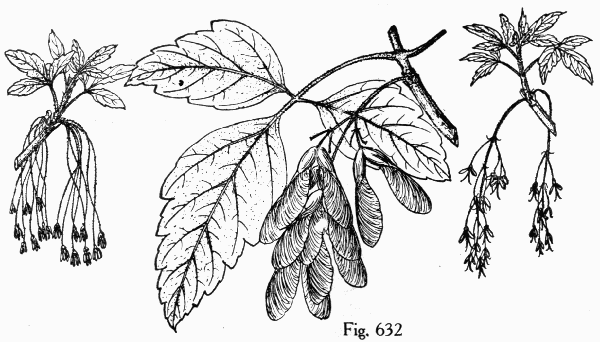
Leaves trifoliate with tomentose or nearly glabrous rachis and petiolules; leaflets oblong-ovate to rhombic, acuminate and long-pointed at apex, cuneate or unsymmetrically [702] rounded at base, coarsely serrate above the middle, or nearly entire, when they unfold hoary-tomentose below and densely pubescent above, occasionally deeply lobed, glabrous on the upper surface except along the midrib and veins, thickly coated on the lower surface with matted pale hairs and furnished with large axillary tufts. Fruit on pubescent pedicels, puberulous or nearly glabrous, not constricted or rarely slightly constricted at base.
A tree, 20°—50° high, with dark bark, hoary-tomentose branchlets and winter-buds.
Distribution. California, valley of the lower Sacramento River and the interior valleys of the coast ranges from the Bay of San Francisco to Santa Barbara County and in elevated cañons on the western slopes of the San Bernardino Mountains; widely distributed but nowhere abundant.
Occasionally planted in California.
XXXVI. HIPPOCASTANACEÆ.
Trees or rarely shrubs, with stout terete branchlets conspicuously marked by triangular leaf-scars, fetid bark, thick fleshy roots, and large scaly winter-buds, the inner scales accrescent with the young shoots and often brightly colored. Leaves opposite, digitately compound, without stipules, deciduous; leaflets 3—9, lanceolate or ovate, serrate, pinnately veined. Flowers polygamo-monœcious, showy, white, red, or pale yellow, on stout jointed pedicels from the axils of minute caducous bracts, racemose or nearly unilateral on the branches of large terminal thyrsi or panicles, appearing later than the leaves, only those near the base of the branches of the inflorescence perfect and fertile; calyx 5 or rarely 2-lobed, the lobes imbricated in the bud, unequal, campanulate or tubular, the lobes imbricated in the bud, mostly oblique or posteriorly gibbous at base; disk hypogynous, annular, depressed, lobed, more or less gibbous posteriorly; petals 4 or 5, imbricated in the bud, alternate with the lobes of the calyx, deciduous, the anterior petal often abortive, unguiculate, the margins of the claw commonly involute; stamens 6—8, rarely 5, generally 7, inserted on the disk, free, unequal; filaments filiform; anthers ellipsoid, glandular-apiculate, attached on the back below the middle, introrse, 2-celled, the contiguous cells opening longitudinally; ovary sessile, oblong or lanceolate, 3-celled, echinate or glabrous, rudimentary in the staminate flower; style slender, elongated, generally more or less curved; stigma terminal, entire, mostly acute; ovules 2 in each cell, borne on the middle of its inner angle, amphitropous, the upper ascending, the micropyle inferior, the lower pendulous, the micropyle superior. Fruit an echinate or smooth coriaceous capsule, 3-celled and loculicidally 3-valved, the cells 1-seeded by abortion, often by suppression 1 or 2-celled, and then 1 or 2-seeded, the remnants of the abortive cells and seeds commonly visible at its maturity. Seeds without albumen, round when one is developed, or, when more than one, flattened by mutual pressure; seed-coat coriaceous, dark chestnut-brown or pale orange-brown, smooth and lustrous, with a broad opaque light-colored hilum; embryo filling the cavity of the seed; cotyledons very thick and fleshy, often conferruminate, unequal, incurved on the short conic radicle, remaining under ground in germination; plumule conspicuously 2-leaved.
The Horsechestnut family is composed of the widely distributed genus Aesculus and of Billia Peyr., a genus of two species of Mexican and Central American trees, differing from Aesculus in its 3-foliolate leaves.
1. AESCULUS L.
Characters of the family; leaves 5—9-foliolate.
Aesculus with fifteen or sixteen species, is represented in the floras of the three continents of the northern hemisphere and is most abundant in the southeastern United States. It produces soft straight-grained light-colored wood and bitter and astringent bark. The seeds contain a bitter principle, aesculin. Aesculus Hippocastanum L., of the mountains [703] of Greece, the common Horsechestnut of gardens, is largely planted as an ornamental tree in all countries with temperate climates, and now occasionally grows spontaneously in the eastern states.
The generic name is the classical name of an Oak-tree.
CONSPECTUS OF THE ARBORESCENT SPECIES OF NORTH AMERICA.
Winter-buds without a resinous covering. Pavia.
Calyx campanulate (occasionally tubular in 3); margins of the petals ciliate, eglandular; flowers usually yellow. Octandræ.
Fruit covered with prickles; flowers yellow; petals nearly equal in length, shorter than the stamens.
1. A. glabra (A, C).
Fruit without prickles; flowers yellow or red; petals unequal in length, longer than the stamens.
Pedicels and calyx glandular-villose.
2. A. octandra (A, C).
Pedicels and calyx without glandular hairs.
3. A. georgiana (C).
Calyx tubular; margins of the unequal petals without hairs, glandular; fruit without prickles. Eupaviæ.
Lower surface of the leaves glabrous or slightly pubescent along the midrib; flowers red; seeds dark chestnut-brown.
4. A. Pavia (C).
Lower surface of the leaves tomentose or pubescent; flowers red and yellow, red, or in one form yellow; seed light yellow-brown.
5. A. discolor (C).
Winter-buds resinous; petals nearly equal in length, shorter than the stamens; fruit without prickles. Calothyrsus.
6. A. californica (G).
1. Aesculus glabra Willd. Ohio Buckeye. Fetid Buckeye.
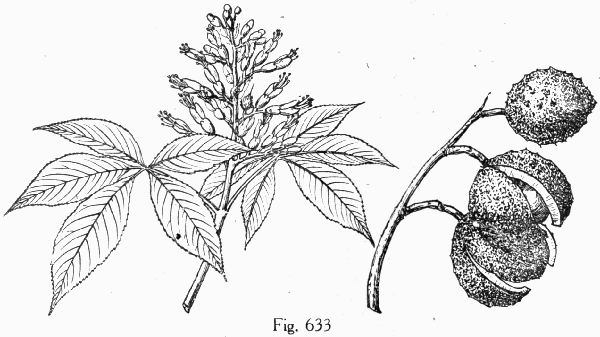
Leaves with a slender petiole 4′—6′ long and enlarged at the end, a rachis often furnished on the upper side with clusters of dark brown chaff-like scales surrounding the base of the petiolules, and 5 rarely 7 (var. Buckleyi Sarg.) oval-oblong or obovate acuminate leaflets gradually narrowed to the elongated entire base, finely and unequally serrate above, at first sessile, becoming slightly petiolulate at maturity, covered on the lower surface like the petioles when they first appear with floccose deciduous hairs most abundant on the midrib and veins, and at maturity glabrous with the exception of a few hairs along the under side of the conspicuous yellow midrib and in the axils of the principal veins, or rarely covered below with close dense pubescence persistent during the season (var. pallida, Kirch.); yellow-green, paler on the lower than on the upper surface, 4′—6′ long and 1½′—2½′ wide; turning [704] yellow in the autumn before falling. Flowers pale yellow-green, mostly unilateral, ½′—1½′ long or more than twice as long as the pedicels, appearing in April and May in clusters 5′—6′ long and 2′—3′ wide, and more or less densely covered with pubescence, with short usually 4—6-flowered branches; calyx campanulate; petals nearly equal, puberulous, the thin limb about twice as long as the claw, in the lateral pair broad-ovate or oblong, and in the superior pair oblong-spatulate, much narrower, sometimes marked with red stripes; stamens usually 7, with long exserted curved pubescent filaments and orange-colored slightly hairy anthers; ovary pubescent, covered with long slender deciduous prickles thickened and tubercle-like at base. Fruit on a stout stem ½′—1′ long, ovoid or irregularly obovoid, pale brown, 1′—2′ long, with thin or sometimes thick valves, roughened by the enlarged persistent bases of the prickles of the ovary; seeds 1′—1½′ broad.
A tree, occasionally 70° high, with a trunk rarely 2° in diameter, small spreading branches, and branchlets orange-brown and covered at first with short fine pubescence, soon glabrous, reddish brown, and marked by scattered orange-colored lenticels; usually much smaller, and rarely more than 30° high. Winter-buds ⅔′ long, acuminate, with thin nearly triangular pale brown scales, the outer bright red on the inner surface toward the base, those of the inner pair strap-shaped, prominently keeled on the back, minutely apiculate and slightly ciliate along the margins, and at maturity 1½′—2′ long and bright yellow. Bark of young stems and of the branches dark brown and scaly, becoming on old trees ¾′ thick, ashy gray, densely furrowed, and broken into thick plates roughened on the surface by numerous small scales. Wood light, soft, close-grained, not strong, often blemished by dark lines of decay, nearly white, with thin dark-colored sapwood of 10—12 layers of annual growth; used in the manufacture of artificial limbs, wooden ware, wooden hats, and paper pulp; occasionally sawed into lumber. An extract of the bark has been used as an irritant of the cerebro-spinal system.
Distribution. River-bottoms and the banks of streams in rich moist soil; western slopes of the Alleghany Mountains, western and southwestern Pennsylvania to northern Alabama, and westward to central and southern Iowa, southeastern Nebraska, northern and central Missouri and northeastern Kansas; nowhere abundant; most common and of its largest size in the valley of the Tennessee River in Tennessee and northern Alabama.
A shrubby form (var. micrantha Sarg.) with flowers not more than ½′ long near Fulton, Hempstead County, Arkansas. In southern Missouri, Arkansas and probably Oklahoma Aesculus glabra is replaced by the var. leucodermis Sarg. with glabrous leaves pale green or glaucescent below. A tree occasionally 60° high, well distinguished from the type by the smooth pale nearly white bark of the trunk and large branches, becoming on old trunks light brown and separating into oblong flakes, and by its later flowers; the var. pallida in Iowa, Missouri and Arkansas; the var. Buckleyi in Jackson County, Missouri, eastern Kansas, Ohio and Mississippi.
The Ohio Buckeye is occasionally cultivated as an ornamental plant in the eastern United States and Europe; hardy as far north as eastern Massachusetts.
× Aesculus Bushii Schn., probably a hybrid of Aesculus discolor var. mollis Sarg. and Aesculus glabra var. leucodermis Sarg., has been found in the neighborhood of Fulton, Hempstead County, Arkansas; and what is evidently a hybrid of Aesculus discolor var. mollis and the typical form of Aesculus glabra occurs near Starkville, Oktibbeha County, Mississippi.
× Aesculus mississippiensis Sarg., a probable hybrid between Aesculus glabra and Aesculus Pavia with characters intermediate between those of its supposed parents, occurs near Brookville, Noxubee County, Mississippi. The mingling of a species of the Octandræ and of the Eupaviæ in these hybrids of Aesculus is shown by the presence of both hairs and glands on the margins of the petals.
2. Aesculus octandra Marsh. Sweet Buckeye.
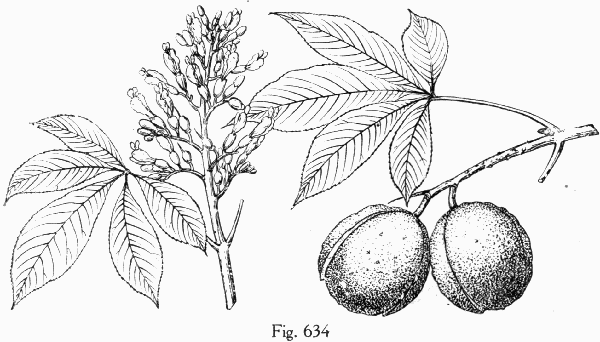
Leaves with slender or slightly pubescent petioles 4′—6′ long, and 5—7 elliptic or obovate-oblong leaflets, acuminate and usually abruptly long-pointed at apex, gradually narrowed and cuneate at base, sharply and equally serrate, glabrous above except on the midrib and [705] veins sometimes clothed with reddish brown pubescence, when they unfold more or less canescent-pubescent on the lower surface, becoming glabrous at maturity, with the exception of a few pale or rufous hairs along the stout midrib and in the axils of the principal veins, dark yellow-green, duller on the lower than on the upper surface, 4′—6′ long, and 1½′—2½′ wide; petiolules 1/12′—½′ in length; turning yellow in the autumn before falling. Flowers opening in early spring when the leaves are about half grown, 1′—1½′ long, pale or dark yellow, rarely red, pink or cream-colored (var. virginica Sarg.), on short glandular-villose pedicels mostly unilateral on the branches of the pubescent clusters 5′—7′ in length; calyx campanulate, glandular-villose; petals connivent, very unequal, puberulent, the claws villose within, limb of the superior pair spatulate, minute, the long claws exceeding the lobes of the calyx, those of the lateral pair obovate or nearly round and subcordate at base; stamens usually 7, rather shorter than the petals, with straight or inclining subulate villose filaments; ovary pubescent. Fruit 2′—3′ long, generally 2-seeded, with thin smooth or slightly pitted pale brown valves; seeds 1½′ to nearly 2′ wide.
A tree, sometimes 90° high, with a tall straight trunk 2½°—3° in diameter, small rather pendulous branches, and glabrous or nearly glabrous branchlets orange-brown when they first appear, becoming in their second year pale brown and marked by numerous irregularly developed lenticels. Winter-buds ⅔′ long, rather obtuse, with broad-ovate pale brown outer scales rounded on the back, minutely apiculate, ciliate, and slightly covered with a glaucous bloom, the inner scales becoming sometimes 2′ long, bright yellow or occasionally scarlet. Bark of the trunk about ¾′ thick, dark brown, divided by shallow fissures and separating on the surface into small thin scales. Wood light, soft, close-grained, difficult to split, creamy white, with thick hardly distinguishable sapwood; used in the manufacture of artificial limbs, for wooden ware, wooden hats, paper pulp, and occasionally sawed into lumber.
Distribution. Rich river-bottoms and mountain slopes; southwestern Pennsylvania (Alleghany, Greene and Fayette Counties), southward along the mountains to east Tennessee, and northwestern Georgia, and westward to north central Ohio (near Plymouth, Richard County), southeastern and southern Indiana (near Aurora, Dearborn County, and on the banks of Dry River near Leavenworth, Crawford County, C. C. Deam) and to southern Illinois (near Golconda, Pope County, shrub 6′—12′ high, E. J. Palmer); the var. virginica at White Sulphur Springs, West Virginia.
Occasionally cultivated in the parks of the eastern United States and Europe.
× Aesculus hybrida DC., with red and yellow flowers, believed to be a hybrid of Aesculus octandra and Aesculus Pavia, appeared in the Botanic Garden at Montpelier in France [706] early in the nineteenth century, and in many varieties is cultivated in Europe and occasionally in the eastern United States.
3. Aesculus georgiana Sarg.
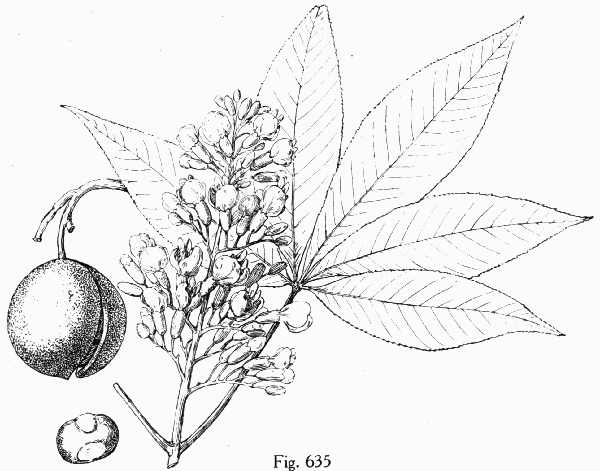
Leaves with slender glabrous petioles 4½′—6′ in length, and 5 leaflets oblong-obovate, abruptly acuminate and long-pointed at apex, gradually narrowed and acuminate at base, finely often doubly serrate with rounded teeth pointing forward, sparingly covered early in the season, especially on the upper side of the midrib and veins, with short caducous hairs, yellow-green above, green, glabrous and lustrous or pubescent (var. pubescens Sarg.) below, 4½′—6′ long, 1½′—2½′ wide, with a stout orange-colored midrib and 20—30 pairs of slender primary veins; petiolules stout, puberulous early in the season, ¼′—½′ in length. Flowers opening in April and May 1′—1⅛′ long, on slender puberulous pedicels, in broad pubescent panicles, 4′—6′ in length; calyx campanulate or tubular, puberulous, about 5/12′ in diameter, red on the upper side, pale yellow on the lower side or entirely red or yellow, 5-lobed, the lobes oblong-ovate, narrowed and rounded at apex, finely serrate on the margins; petals connivent, obovate, rounded at apex, gradually narrowed below, those of the superior and lateral pairs very unequal in size, puberulous and glandular on the outer surface, pubescent on the inner surface, ciliate on the margins, bright yellow or red, their claws furnished on the margins with long white hairs, those of the superior pair as long as the lateral petals; stamens 7, shorter than the petals; filaments villose, especially below the middle; ovary covered with matted pale hairs; styles exserted, villose. Fruit on stout pendulous pedicels, globose, usually 1-seeded, 1′—1¼′ in diameter, with thin light brown slightly pitted valves; seed globose, dark chestnut-brown.
A tree, 25°—30° high, with a trunk 6′—10′ in diameter, slender erect and spreading branches and stout glabrous branchlets, orange-green and marked by pale lenticels when they first appear, becoming light reddish brown in their first winter; more often a large or small round-topped shrub 3°—5° tall and broad. Bark of the trunk thin, dark brown, the surface separating into small thin scales. Winter-buds about ⅓′ long, with light reddish [707] brown scales, narrowed, rounded and short-pointed at apex. The common Buckeye of the Piedmont region of North and South Carolina and northern Georgia.
Distribution. Central North Carolina (Durham and Orange Counties), southward to eastern (Richmond County) and central Georgia; northern Alabama (Madison, Etowah and Tuscaloosa Counties), and near Pensacola, Escambia County, Florida. The var. pubescens occasionally arborescent in habit, common in the woods west of Augusta, Richmond County, and in De Kalb, Rabun and Floyd Counties, Georgia, ranging northward to Orange County, North Carolina, and ascending on the Blue Ridge to altitudes of 3000°; in northern Alabama.
× Aesculus Harbisonii Sarg., a probable hybrid between A. discolor var. mollis and A. georgiana, has appeared in the Arnold Arboretum among plants of A. georgiana raised from seeds collected near Stone Mountain, De Kalb County, Georgia.
A distinct form of Aesculus georgiana is
Aesculus georgiana var. lanceolata Sarg.
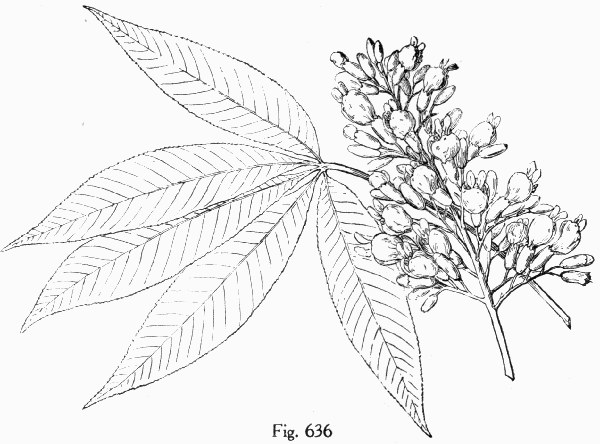
Leaves with glabrous petioles 3½′—5½′ in length, and 5 lanceolate or slightly oblanceolate leaflets long-acuminate at apex, cuneate at base, and finely glandular-serrate, when the flowers open early in May thin yellow-green above, pale below, glabrous with the exception of occasional hairs on the under side of the slender midrib and of minute axillary tufts, 6′—8′ long and 1¼′—1½′ wide; petiolules 1/12′—⅙′ in length. Flowers on stout puberulous pedicels, bright red, in narrow crowded clusters, 8′—10′ long; calyx narrow-campanulate, otherwise as in the type. Fruit not seen.
A tree 25°—30° high, with a short trunk 6′—10′ in diameter, small erect and spreading branches forming a narrow head, and slender glabrous branchlets orange-brown when they first appear, becoming dark gray-brown and marked by pale lenticels in their second year.
Distribution. Georgia, rich woods near Clayton, Rabun County.
4. Aesculus Pavia L. Red-flowered Buckeye.
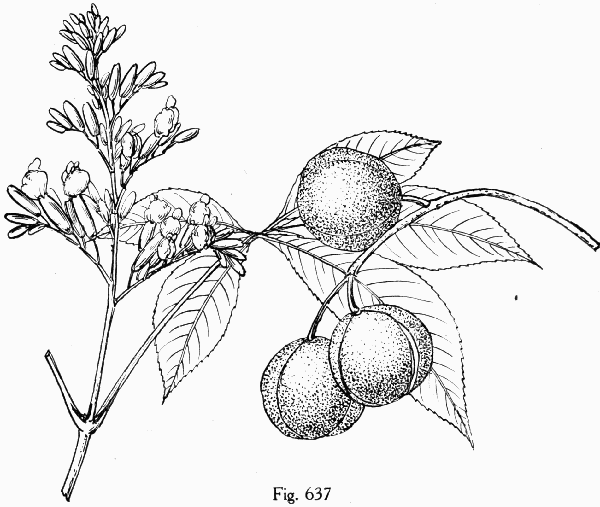
Leaves with slender petioles glabrous or puberulous early in the season and 4′—7′ long, and 5 short-petiolulate, oblong-obovate, acuminate leaflets, gradually narrowed at base, [708] coarsely often doubly serrate above with incurved teeth, slightly pubescent early in the season along the upper side of the midrib and veins, and glabrous or slightly pubescent below, and at maturity thin, lustrous and glabrous, dark green on the upper surface, pale yellow-green on the lower surface, often furnished with conspicuous tufts of axillary hairs, 3½′—6′ long and 1¼′—1¾′ wide, with a thin midrib and from 18—30 pairs of slender primary veins. Flowers in narrow pubescent panicles, 4½′—8′ in length, on slender pubescent pedicels; calyx tubular, dark red, puberulous on both surfaces, minutely lobed, the lobes rounded, much shorter than the light red petals; petals connivent, unequal, oblong-obovate, rounded at apex, glandular on the outer surface and on the margins, gradually narrowed below into a long slender villose claw; claw of the lateral petals about as long or shorter than the calyx, those of the superior pair much longer than the calyx, their blades not more than one-third as large as the blades of the lateral pair; stamens exserted; filaments villose like the ovary. Fruit obovoid or subglobose, light brown, smooth, generally pitted, usually 1 or 2-seeded, pendulous on slender stems; seeds usually about 1′ in diameter, dark chestnut-brown and lustrous with a small hilum.
Occasionally a tree, rarely 40° high, with a tall trunk 8′—10′ in diameter covered with smooth dark bark, large erect branches forming an open head, and stout light orange-brown branchlets marked in their second year by conspicuous emarginate scars of fallen leaves showing the ends of 3 fibro-vascular bundles; usually a shrub, often flowering when not more than 3′ high.
Distribution. Southeastern Virginia, southward to western Florida to the valley of the Suwanee River (near Old Town, Lafayette County), and westward to eastern Louisiana, usually in the neighborhood of the coast; in Alabama ranging inland to Jefferson and Dallas Counties and in Louisiana to West Feliciana Parish; in southern Kentucky (near Bowling Green, Warren County).
[709]
5. Aesculus discolor Pursh. Buckeye.
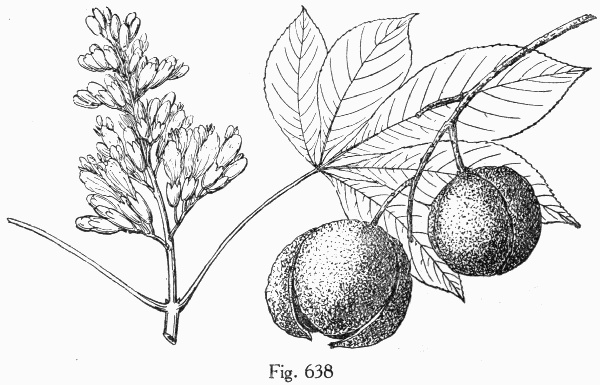
Leaves with slender grooved villose or pubescent usually ultimately glabrous petioles 4′ or 5′ long, and 5 oblong-obovate or elliptic leaflets, acuminate and usually long-pointed at apex, gradually narrowed and acuminate at the entire base, finely or coarsely and sometimes doubly crenulate-serrate above, dark green, lustrous and glabrous except along the slender yellow midrib and veins on the upper surface, lighter colored and tomentulose or tomentose on the lower surface, 4′—5′ long, 1½′—2′ wide, nearly sessile or raised on slender petiolules up to ½′ in length. Flowers opening from the first to the middle of April, usually ¾′—1′ long, on slender pubescent pedicels much thickened on the fruit, sometimes ¼′ long, and mostly aggregated toward the end of the short branches of the narrow pubescent inflorescence 6′—8′ in length; calyx red, rose color or yellow more or less deeply tinged with red, tubular, short and broad or elongated, puberulous on the outer surface, tomentose on the inner surface, with rounded lobes; petals yellow, shorter than the stamens, connivent, unequal, oblong-obovate, rounded at apex, puberulous on the outer surface and glandular on the margins with minute dark glands, those of the superior pair about half as wide as those of the lateral pair, with claws much longer than the calyx; filaments and ovary villose. Fruit ripening and falling in October, usually only a few fruits maturing in a cluster, generally obovoid or occasionally subglobose, mostly 2-seeded, 1½′—2½′ long, with very thin, light brown slightly pitted valves; seeds light yellow-brown, sometimes 1½′ in diameter, with a comparatively small hilum and a thin shell.
Rarely arborescent and occasionally 25° high, with a straight trunk 6′ or 7′ in diameter, stout branches forming a narrow symmetric head, and slender branchlets marked by numerous small pale lenticels, green and puberulous at first, becoming gray slightly tinged with red during their first winter and only slightly darker in their second year; usually a small or large shrub. Winter-buds broad-ovoid, obtusely pointed, about ¼′ long, with rounded apiculate light red-brown scales. Bark thin, smooth, and pale.
Distribution. Rich woods; Shell Bluff on the Savannah River, Burke County, Georgia; near Birmingham, Jefferson County, and Selma, Dallas County, Alabama; near Campbell, Dunklin County, Missouri; Comal Springs, New Braunfels County, and Sutherland Springs, Wilson County, Texas; rare and local, and found as a tree only near Birmingham, Alabama; more abundant is the var. mollis Sarg. (Aesculus austrina Small) with bright red flowers; a tree up to 25° or 30° high, or more often a large or small shrub; valley of the lower Cape Fear River (near Wilmington, New Hanover County), North Carolina, southward [710] near the coast to the neighborhood of Charleston, South Carolina, through Georgia to the neighborhood of Rome, Floyd County, and southward to western Florida; in Alabama widely distributed from Jefferson County southward; widely distributed in Mississippi except in the neighborhood of the Gulf coast, to West Feliciana Parish, eastern Louisiana; more common and generally distributed in western Louisiana, and through eastern Texas to the valley of the San Antonio River (neighborhood of San Antonio, Bexar County) and to that of the upper Guadalupe River (near Boerne, Kendall County), ranging northward through Arkansas to southern Missouri and western Tennessee.
On the Edwards Plateau of western Texas Aesculus discolor is represented by the var. flavescens Sarg., with yellow flowers, appearing a few days earlier than those of the var. mollis; a shrub 9′—12′ high, or often much smaller; interesting as the only form of Eupaviæ with yellow flowers; San Marcos, Hays County, common on the slopes above Comal Springs, near New Braunfels, Comal County, near Boerne, Kendall County (with the var. mollis), Kerrville, Kerr County, and Cancan, Uvalde County.
6. Aesculus californica Nutt. Buckeye.
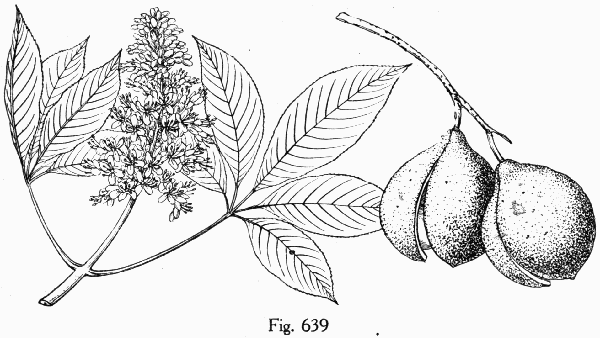
Leaves with slender grooved petioles 3′—4′ long, and 4—7 usually 5 oblong-lanceolate acuminate leaflets narrowed and acuminate or rounded at base, sharply serrate, 4′—6′ long, 1½′—2′ wide, dark green above, paler below, slightly pubescent when they first appear, becoming glabrous or nearly so, on petiolules ½′—1′ long; falling early, often by midsummer. Flowers white or pale rose color, 1′—1¼′ long, appearing from May to July when the leaves are fully grown, on short pedicels mostly unilateral on the long branches of the densely flowered long-stemmed pubescent cluster 3′—9′ in length; calyx 2-lobed, slightly toothed, much shorter than the narrow oblong petals; stamens 5—7, with long erect exserted slender filaments and bright orange-colored anthers; ovary densely pubescent. Fruit obovoid, often somewhat gibbous on the outer side, with thin smooth pale brown valves, usually 1-seeded, 2′—3′ long, on a slender stalk ¼′—½′ in length; seeds pale orange-brown, 1½′—2′ broad.
A tree, rarely 20°—30° high, with a short trunk occasionally 4°—5° in diameter, often much enlarged at base, stout wide-spreading branches, forming a round-topped head, and branchlets glabrous and pale reddish brown when they first appear, becoming darker in their second season; more often a shrub, with spreading stems 10°—15° high forming broad dense thickets. Winter-buds acute, covered with narrow dark brown scales rounded on the back and thickly coated with resin. Bark of the trunk about ¼′ thick, smooth, and light gray or nearly white. Wood soft, light, very close-grained, white or faintly tinged with yellow, with thin hardly distinguishable sapwood of 10—12 layers of annual growth.
[711]
Distribution. California, borders of streams, valley of the south fork of the Salmon River, Siskiyou County, south along the coast ranges to San Luis Obispo County and on the western slope of the Sierra Nevada, usually at altitudes between 2000° and 2500°, occasionally to 5000°, to the northern slopes of Tejon Pass, Kern County, and to Antelope Valley, Los Angeles County.
Occasionally cultivated as an ornamental plant in the Pacific states, and in western and southern Europe.
XXXVII. SAPINDACEÆ.
Trees or shrubs, with alternate pinnate petiolate persistent or deciduous leaves, without stipules. Flowers regular or irregular, polygamo-diœcious, polygamo-monœcious or polygamous; calyx of 4 or 5 sepals or lobes imbricated in the bud; petals 4 or 5 imbricated in the bud; disk annular, fleshy, 5-lobed, or unilateral and oblique; stamens usually 7—10, inserted on the disk; filaments free; anthers introrse, 2-celled, the cells opening longitudinally; ovary 2—4 or 3-celled; styles terminal; stigmas capitate or lobed; ovule solitary or 2 in each cell, anatropous or amphitropous. Fruit a drupe or capsule. Seed usually solitary, without albumen; seed-coat bony, coriaceous or crustaceous.
Of the one hundred and twenty-six genera of this family, which is chiefly confined to the tropics and is more abundant in the Old than in the New World, four have arborescent representatives in the United States.
CONSPECTUS OF THE ARBORESCENT GENERA OF THE UNITED STATES.
Fruit baccate.
Fruit dark orange-color or yellow, with thin semitranslucent coriaceous flesh; ovules 1 in each cell of the ovary; leaflets subcoriaceous to coriaceous.
1. Sapindus.
Fruit purple, with thick juicy flesh; ovules 2 in each cell of the ovary; leaflets thin, persistent.
2. Exothea.
Fruit a drupe; leaves 3-foliolate, persistent.
3. Hypelate.
Fruit a 3-valved capsule; leaves 4 or 5, rarely 3-foliolate, deciduous.
4. Ungnadia.
1. SAPINDUS L. Soapberry.
Trees or shrubs, with terete branches, without a terminal bud, marked by large obcordate leaf-scars showing the ends of 3 equidistant fibro-vascular bundles, small globose axillary buds often superposed in pairs, the upper bud the larger, and thick fleshy roots. Leaves equally or rarely unequally pinnate. Flowers regular, minute, polygamo-diœcious, on short pedicels from the axils of minute deciduous bracts, in ample axillary or terminal panicles; sepals 4 or 5, unequal, slightly united at base; petals 4 or 5, equal, alternate with the sepals, inserted under the thick edge of the annular fleshy entire crenately lobed disk, unguiculate, naked or furnished at the summit of the claw on the inside with a 2-cleft scale, deciduous; stamens usually 8 or 10, inserted on the disk immediately under the ovary, equal; filaments subulate or filiform, often pilose, exserted in the staminate, much shorter in the pistillate flower; anthers oblong, attached near the base; pistils 2 or 3, united; ovary sessile, entire or 2—4-lobed, 2—4-celled, narrowed into a short columnar style, rudimentary in the staminate flower; stigma 2—4-lobed, the lobes spreading; ovule solitary in each cell, ascending from below the inner angle of the cell; raphe ventral; micropyle inferior. Fruit baccate, coriaceous, 1—3-seeded, usually formed of 1 globose coriaceous carpel, with the rudiments of the others remaining at its base, or of 2 or sometimes 3 carpels more or less connate by their base and then 2—3-lobed. Seed solitary in each carpel, obovoid or globose; seed-coat bony, smooth, black or dark brown; tegmen membranaceous or fleshy; hilum oblong, surrounded by an ariloid tuft of long pale silky hairs; embryo incurved or straight; cotyledons thick and fleshy, incumbent; radicle very short, inferior, near the hilum.
[712]
Sapindus is widely distributed through the tropics, especially in Asia, occasionally extending into colder regions. About forty species have been distinguished; of these three are found within the territory of the United States.
Sapindus contains a detersive principle which causes the pulp of the fruit to lather in water, and makes it valuable as a substitute for soap. The bark, which is bitter and astringent, has been used as a tonic. The seeds of several of the species are strung for chaplets and bracelets and are used as buttons.
The generic name, from sapo and Indus, refers to the detersive properties and use of the first species known to Europeans, a native of the West Indies.
CONSPECTUS OF THE SPECIES OF THE UNITED STATES.
Leaves persistent.
Rachis of the leaf interrupted-winged, with usually broad wings; leaflets 4—9, oblong-lanceolate and acute to elliptic-ovate or oblong, tomentulose below; petals without scales; fruit globose, orange-brown.
1. S. saponaria (D).
Rachis of the leaf without wings narrow-margined or marginless; leaflets 7—13, oblong-lanceolate, acuminate, often somewhat falcate, glabrous below; petals with scales; fruit somewhat oblong, dorsally keeled, yellow.
2. S. marginatus (C).
Leaves deciduous, their rachis without marginal borders; leaflets 8—18, lanceolate, mostly falcate, soft-pubescent or ultimately glabrous below; petals with scales; fruit globose, not keeled, turning black in drying.
3. S. Drummondii (C, E).
1. Sapindus saponaria L.
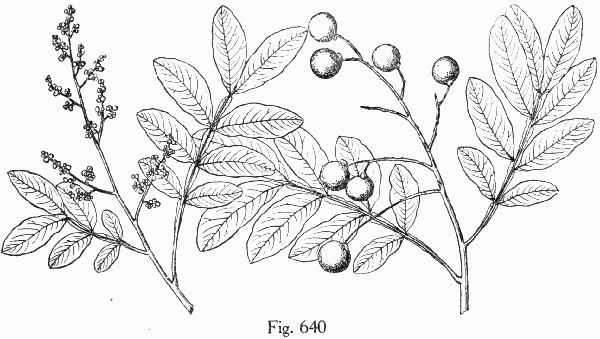
Leaves 6′—7′ long, with a broad winged rachis, the wings narrow and often nearly obsolete below the lowest pair of leaflets, and sometimes nearly ½′ wide below the upper pair, and usually 7—9 elliptic to oblong-lanceolate leaflets, rounded or slightly emarginate at apex, gradually narrowed at base and very short-petiolulate, soft-pubescent on the lower surface when they unfold, and at maturity rather coriaceous, yellow-green, paler and tomentulose below, prominently reticulate-venulose, 3′—4′ long and 1½′ wide, with a yellow midrib and primary veins, those of the lowest pair smaller than the others; rarely reduced to a single leaflet. Flowers appearing in Florida in November, usually produced 3 together on short pedicels, in terminal panicles 7′—10′ in length, with an angulate peduncle and branches; calyx-lobes acute, concave, ciliate on the margins, the 2 outer rather smaller than those of the inner rank, much shorter than the white, ovate, short-clawed petals, without scales, rounded at apex and covered, especially toward the base, [713] with long scattered hairs; ovary slightly 3-lobed; stamens included or slightly exserted, with hairy filaments broadened at base. Fruit ripening in spring or in early summer, globose, ⅔′—¾′ in diameter, with thin orange-brown semitranslucent flesh; seeds obovoid, black, 1′ in diameter.
A tree, sometimes 25°—30° high, with a trunk rarely exceeding 10′—12′ in diameter, erect branches and slender branchlets at first slightly many-angled and puberulous, soon glabrous, orange-green and marked by white lenticels, becoming in their second season terete, pale brown faintly tinged with red. Bark of the trunk ¼′—½′ thick, light gray and roughened by oblong lighter colored excrescences, the outer layer exfoliating in large flakes exposing the nearly black inner bark. Wood heavy, rather hard, close-grained, light brown tinged with yellow, with thick yellow sapwood.
Distribution. Florida, shores of Cape Sable, shores and islands of Caximbas Bay, Key Largo, Elliott’s Key, and the shores of Bay Biscayne, Dade County; in Florida most common in the region of Cape Sable, and of its largest size on some of the Ten Thousand Islands, Lee County; generally distributed through the West Indies to Venezuela and Ecuador.
2. Sapindus marginatus Willd.
Sapindus manatensis Radlk.
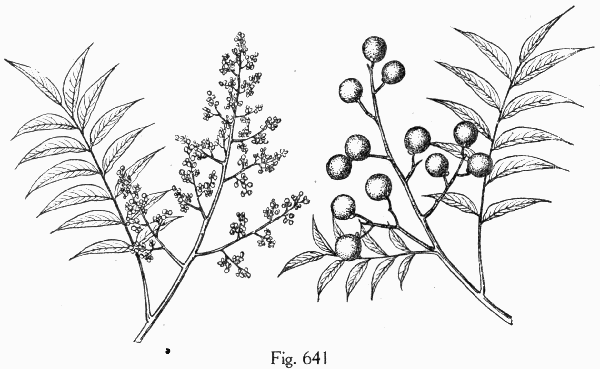
Leaves 6′—7′ long, with a slender wingless or narrow-margined or marginless rachis, and 7—13 lance-oblong acuminate more or less falcate leaflets, glabrous, dark green, and lustrous on the upper surface, paler and glabrous or puberulous on the lower surface along the slender midrib, sessile or very short-petiolulate, 2′—5′ long, ¾′—1¼′ wide, the lower usually alternate, the upper opposite. Flowers appearing in early spring, more or less tinged with red and nearly ⅛′ in diameter, on short stout tomentose pedicels, in panicles 4′—5′ long and usually about 3′ wide, with a villose stem and branches; sepals acute, concave, ciliate on the margins, much shorter than the ovate-oblong, short-clawed, ciliate petals furnished on the inner surface near the base with a 2-lobed villose scale; filaments villose; ovary 3-lobed. Fruit conspicuously keeled on the back, short-oblong to slightly obovoid, about ¾′ long, with thin light yellow translucent flesh; seeds obovoid, dark brown.
A tree, rarely more than 25°—30° high, with a trunk sometimes 1° in diameter, and stout pale brown or ultimately ashy gray branchlets.
Distribution. Hurricane Island at the mouth of Medway River, Liberty County, [714] Georgia (Miss J. King); hummocks, peninsular of Florida to Alachua and Manatee Counties; not common; in Cuba.
3. Sapindus Drummondii Hook. & Arn. Wild China-tree.
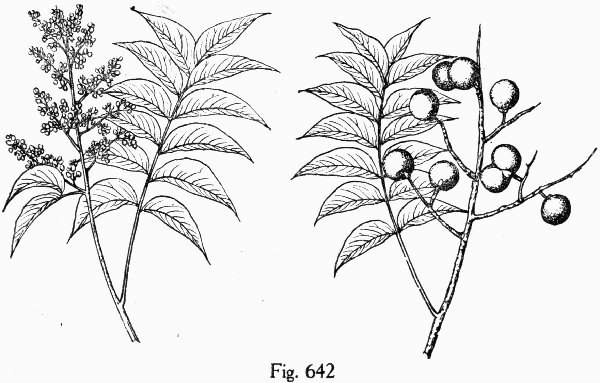
Leaves appearing in March and April, with a slender grooved puberulous rachis, without wings, and 4—9 pairs of alternate obliquely lanceolate acuminate leaflets, glabrous on the upper surface and covered with short pale pubescence on the lower surface, coriaceous, prominently reticulate-venulose, pale yellow-green, 2′—3′ long, ½′—⅔′ wide, short-petiolulate; deciduous in the autumn or early winter. Flowers appearing in May and June in clusters 6′—9′ long and 5′—6′ wide, with a pubescent many-angled stem and branches; sepals acute and concave, ciliate on the margins, much shorter than the obovate white petals rounded at apex, contracted into a long claw hairy on the inner surface and furnished at base with a deeply cleft scale hairy on the margins; filaments hairy, with long soft hairs. Fruit ripening in September and October, persistent on the branches until the following spring, glabrous, not keeled, yellow, ½′ in diameter, turning black in drying; seeds obovoid, dark brown.
A tree, 40°—50° high, with a trunk sometimes 1½°—2° in diameter, usually erect branches, and branchlets at first slightly many-angled, pale yellow-green, pubescent, becoming in their second year terete, pale gray, slightly puberulous, and marked by numerous small lenticels. Bark of the trunk ⅓′—½′ thick, separating by deep fissures into long narrow plates broken on the surface into small red-brown scales. Wood heavy, strong, close-grained, light brown tinged with yellow, with lighter colored sapwood of about 30 layers of annual growth; splitting easily into thin strips and largely used in the manufacture of baskets used in harvesting cotton, and for the frames of pack-saddles.
Distribution. Moist clay soil or dry limestone uplands; southwestern Missouri to northeastern and southern Kansas, eastern Louisiana (Tangipahoa Parish R. S. Cocks), and to extreme western and southwestern Oklahoma, through eastern Texas to the Rio Grande, over the Edwards Plateau, and in the mountain valleys of western Texas and of southern New Mexico and Arizona; in northern Mexico.
2. EXOTHEA Macf.
A tree, with thin scaly bark, and terete branchlets covered with lenticels. Leaves petiolate, abruptly pinnate or 3 or rarely 1-foliolate, glabrous, without stipules, persistent; leaflets oblong or oblong-ovate, acute, rounded or emarginate at apex, with entire undulate [715] margins, obscurely veined, thin, dark green and lustrous on the upper surface and slightly paler on the lower surface. Flowers regular, polygamo-diœcious, on short pedicels from the axils of minute deciduous bracts covered with thick pale tomentum, in ample terminal or axillary wide-branched panicles clothed with orange-colored pubescence; sepals 5, ovate, rounded at apex, ciliate on the margins, puberulous, persistent; petals 5, white, ovate, rounded at apex, short-unguiculate, alternate with and rather longer and narrower than the sepals; disk annular, fleshy, irregularly 5-lobed, puberulous; stamens 7 or 8, inserted on the disk, as long as the petals in the staminate flower, much shorter in the pistillate flower; filaments filiform, glabrous, anthers oblong, with a broad connective, rudimentary in the staminate flower; ovary sessile on the disk, conic, pubescent, 2-celled, contracted into a short thick style, rudimentary in the staminate flower, stigma large, declinate, obtuse; ovules 2 in each cell, suspended from the summit of the inner angle, collateral, anatropous, raphe ventral; micropyle superior. Fruit a nearly spherical 1-seeded berry containing the rudiment of the second cell and tipped with the short remnant of the style, surrounded at base by the persistent reflexed sepals; flesh becoming thick, dark purple, and juicy at maturity. Seed short-oblong to subglobose, solitary, suspended; seed-coat thin, coriaceous, orange-brown and lustrous; embryo subglobose, filling the cavity of the seed; cotyledons fleshy, plano-convex, puberulous; radicle superior, very short, uncinate, turned toward the small hilum and inclosed in a lateral cavity of the seed-coat.
The genus is represented by a single West Indian species.
The generic name is from ἐξωθέω, in allusion to its removal from a related genus.
1. Exothea paniculata Radlk. Ironwood. Ink Wood.
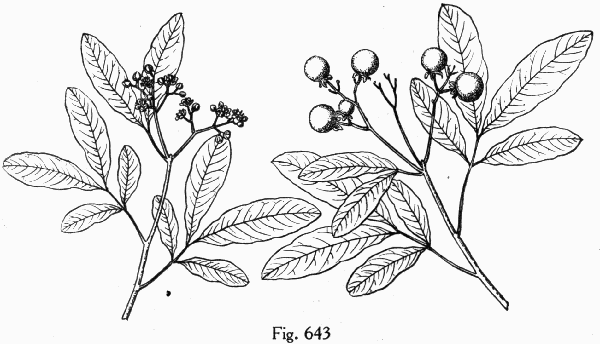
Leaves appearing in April, on stout grooved petioles ½′—1′ in length; leaflets 4′—5′ long and 1½′—2′ wide. Flowers opening in Florida in April, ¼′ across when expanded, the staminate and pistillate on separate plants. Fruit fully grown by the end of June and then ½′—⅝′ long, and dull orange color, remaining on the branches during the summer, ripening in the autumn; seeds ¼′—⅜′ in diameter.
A tree, sometimes 40°—50° high, with a trunk 12′—15′ in diameter, slender upright branchlets orange-brown when they first appear, becoming reddish brown in their second year and thickly covered by small white lenticels. Bark of the trunk ⅛′—¼′ thick, the bright red surface separating into large scales. Wood very hard and heavy, strong, close-grained, bright red-brown, with lighter colored sapwood of 10—12 layers of annual growth; valued for piles and also used in Florida in boat-building, for the handles of tools, and many small articles.
Distribution. Florida, Mosquito Inlet on the east coast to the shores of Bay Biscayne [716] and on the Everglade Keys, Dade County, and on the southern keys; on the Bahamas, on many of the Antilles, and in Guatemala; on the Florida Keys generally distributed, but not common.
3. HYPELATE P. Br.
A glabrous tree or shrub, with smooth bark and slender terete branchlets. Leaves long-petioled, the petioles sometimes narrow-winged, 3-foliolate, the terminal leaflet rather larger than the others, persistent; leaflets sessile, obovate, rounded or rarely acute or emarginate at apex, entire, with thickened revolute margins and a prominent midrib, coriaceous, feather-veined, the veins arcuate and connected near the margins, dark green and lustrous on the upper surface, bright green on the lower surface. Flowers regular, polygamo-monœcious, minute, on slender pedicels from the axils of minute deciduous bracts, in few-flowered long-stemmed wide-branched terminal or axillary panicles; calyx 5-lobed, the lobes ovate, rounded at apex, slightly puberulous on the outer surface, ciliate on the margins, deciduous by a circumscissile line, petals 5, rather longer than the calyx-lobes, rounded, spreading, ciliate on the margins, white; stamens 7 or 8, inserted on the lobes of the annular fleshy disk; filaments filiform, as long as the petals in the staminate flower, much shorter in the pistillate flower; anthers oblong, attached on the back near the bottom, the cells spreading from above downward; ovary sessile on the disk, slightly 3-lobed, 3-celled, contracted into a short stout style, rudimentary in the staminate flower; stigma large, declinate, obscurely 3-lobed; ovules 2 in each cell, borne on the middle of its inner angle, superposed, amphitropous, the upper ascending, with the micropyle inferior, the lower pendulous, with the micropyle superior. Fruit an ovoid black drupe crowned with the remnants of the persistent style and supported on the persistent base of the disk; flesh thin and fleshy; walls of the stone thick and crustaceous. Seed solitary by the abortion of the upper ovule, suspended, obovoid; seed-coat thin, slightly wrinkled; embryo conduplicate, filling the cavity of the seed; cotyledons thin, foliaceous, irregularly folded, incumbent on the long radicle.
The genus with a single species is distributed from southern Florida to the Bahamas, Cuba, Porto Rico, St. Martin, Anguilla and Jamaica.
Hypelate is the ancient name of the Butcher’s Broom.
1. Hypelate trifoliata Sw. White Ironwood.
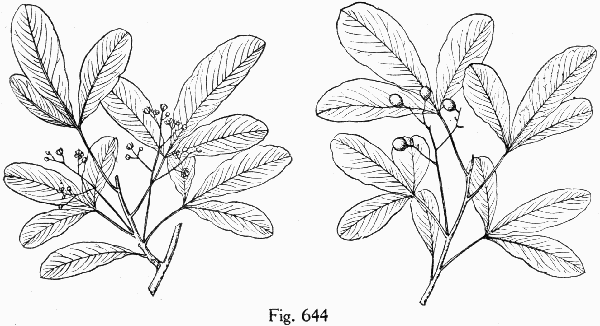
Leaves unfolding in June and persistent until their second season or longer; petioles stout, 1½′—2′ in length, with narrow green wings; leaflets 1½′—2′ long and ¾′—1¼′ wide. Flowers appearing in Florida in June, rather less than ⅛′ in diameter, in few-flowered panicles 3′—4′ long, on a slender peduncle, the staminate and pistillate in separate panicles [717] on the same tree. Fruit ripening in September, ⅜′ long, with a sweet rather agreeable flavor.
A tree, sometimes 35°—40° high, with a trunk occasionally 18′—20′ in diameter, and branchlets pale green when they first appear, becoming gray during their first season and bright red-brown the following year; generally much smaller. Bark of the trunk rarely ⅛′ thick, marked by shallow depressions and numerous minute lenticels. Wood very heavy, hard, close-grained, rich dark brown, with thin darker colored sapwood of 4 or 5 layers of annual growth; very durable in contact with the soil and valued in Florida for posts; also used in shipbuilding and for the handles of tools.
Distribution. Southern Florida, Upper Metacombe, Umbrella and Windley’s Keys; rare.
4. UNGNADIA Endl.
A tree or shrub, with thin pale gray fissured bark, slender terete slightly zigzag branchlets, without a terminal bud, marked by large conspicuous obcordate leaf-scars, small obtuse nearly globose winter-buds covered with numerous chestnut-brown imbricated scales, and thick fleshy roots. Leaves long-petioled, 5 or 7 or rarely 3-foliolate, deciduous; leaflets ovate-lanceolate, acuminate, rounded or cuneate, and often oblique at base, irregularly crenulate-serrate, coated when they first appear on the lower surface like the petiole with dense pale tomentum, and pilose above, glabrous at maturity with the exception of a few hairs on the lower surface along the principal veins, pinnately veined, reticulate-venulose, the terminal leaflet long-petiolulate, the others short-petiolulate to subsessile. Flowers irregular, polygamous, in small pubescent fascicles or corymbs appearing just before or with the leaves from the axils of those of the previous year, usually from separate buds, or occasionally from the base of leafy branches; calyx 5-lobed, hypogynous, the lobes oblong-lanceolate, somewhat united irregularly at base only, deciduous; petals 4 by the suppression of the anterior one, or 5 and then alternate with the lobes of the calyx, hypogynous on the margin of a thickened truncate torus, unguiculate, bright rose color, deciduous, the claw as long as the lobes of the calyx, nearly erect, clothed with tomentum, especially on the inner surface, conspicuously appendaged at the summit with a fimbricated crest of short fleshy tufted hairs, the blade obovate, spreading, often erose-crenulate; disk unilateral, oblique, tongue-shaped, surrounding and connate with the base of the stipe of the ovary; stamens 7—10, usually 8 or 9, inserted on the oblique edge of the disk, much exserted and unequal, the anterior ones shorter than the others, equal or almost so and shorter than the petals in the pistillate flower; filaments filiform; anthers oblong, attached near the base; ovary ovoid, 3-celled, pilose, raised on a long stipe, rudimentary in the staminate flower; style subulate, filiform, elongated, slightly curved upward; stigma minute, terminal; ovules 2, borne on the inner angle of the cell near its middle, ascending, the micropyle inferior. Fruit a coriaceous 3-celled loculicidally 3-valved broad-ovoid capsule, conspicuously stipitate, crowned with the remnants of the style, rugosely roughened and dark reddish brown, loculicidally 3-valved, the valves somewhat cordate, bearing the dissepiment on the middle. Seed generally solitary by abortion, almost globose; seed-coat coriaceous, very smooth and shining, dark chestnut-brown or almost black; hilum broad; tegmen thin; embryo filling the cavity of the seed; cotyledons thick and fleshy, nearly hemispheric, conferruminate, incumbent on the short conic descending radicle turned toward the hilum, remaining below ground in germination.
Ungnadia with a single species is confined to Texas, New Mexico, and northern Mexico.
The name is in honor of Baron Ferdinand von Ungnad, Ambassador of the Emperor Rudolph II. at the Ottoman Porte who sent seeds of the Horsechestnut-tree from Constantinople to Vienna in the middle of the sixteenth century.