Division II. Dicotyledons. (continued 2)
Reading edition
Leaves oblong-obovate to elliptic, acute or abruptly acuminate with a short or long-pointed apex, gradually narrowed and cuneate at the often unsymmetrical base, entire or remotely and irregularly crenately serrate, thin and firm, dark yellow-green and lustrous above, pale or glaucous and glabrous or pilose below, 1¼′—4′ long, ½′—1½′ wide, with a broad yellow pubescent midrib and slender veins forked and arcuate within the slightly thickened and revolute margins and connected by conspicuous reticulate veinlets; petioles slender, puberulous, ¼′—½′ in length; stipules foliaceous, semilunar, glandular-serrate, ⅛′—¼′ long, caducous. Flowers: aments appearing before the leaves, oblong-cylindric, erect, nearly sessile on short tomentose scale-bearing branchlets, the staminate about 1′ long and rather more than ½′ thick, the pistillate 1½′ long, about 5/12′ thick; scales oblong, narrowed at the ends, dark-colored, covered with long white hairs, persistent under the fruit; stamens 2, with free [161] glabrous filaments; ovary cylindric, short-stalked, with a distinct style and broad emarginate stigmas; pedicels less than half the length of the scale, villose. Fruit oblong-ovoid, acuminate, light reddish brown, pale pubescent, about ⅓′ long.
A tree, occasionally 30° high, with a short trunk rarely exceeding 1° in diameter, slender pendulous branches forming a rather compact round-topped shapely head, and stout branchlets marked by scattered yellow lenticels, coated when they first appear with pale early deciduous pubescence, becoming bright yellow or dark orange color, and in their second year dark red-brown and much roughened by the conspicuous leaf-scars; or more often a shrub. Winter-buds ovoid, acute, nearly terete or slightly flattened, with narrow lateral wing-like margins, light or dark orange color, glabrous or pilose at the base, about ¼′ long. Bark thin, dark brown slightly tinged with red, and divided into broad flat ridges. Wood light, soft, close-grained, light brown tinged with red, with thick nearly white sapwood.
Distribution. Cook’s Inlet, coast of Alaska, and valley of the Yukon River near Dawson southward through western British Columbia to northern California, ranging eastward through Washington and northwestern Oregon to northern Idaho and Montana.
From central California to San Bernardino County represented by the variety crassijulis Andr. (S. brachystachys Benth.) with shorter and broader obovate leaves rounded at apex, pubescent and tomentose branchlets and larger pubescent winter-buds. A tree sometimes 70° high with a trunk often 2½° in diameter.
On the high Sierra Nevada eastward to the eastern ranges of the Rocky Mountains of Colorado and to northern New Mexico, northern Wyoming and the Black Hills of South Dakota represented by the var. flavescens Schn. A shrub or rarely a small tree with obovate rounded yellowish leaves and branchlets.
23. Salix Hookeriana Barr.
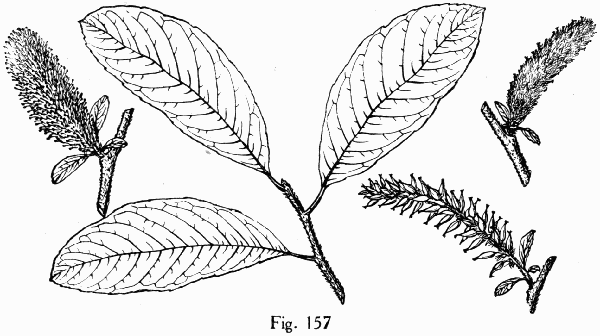
Leaves oblong to oblong-obovate, acute or abruptly acuminate, or rarely rounded and frequently apiculate at apex, gradually narrowed and cuneate or rounded at base, coarsely crenately serrate, especially those on vigorous shoots, or entire, when they unfold villose with pale hairs, or tomentose above and clothed below with silvery white tomentum, at maturity thin and firm, bright yellow-green and lustrous, nearly glabrous or tomentose on the upper surface, pale and glaucous and tomentose or pubescent on the lower surface, especially along the midrib and slender arcuate primary veins and conspicuous reticulate veinlets, 2′—6′ long, 1′—1½′ wide; petioles stout, tomentose, ¼′—⅓′ long. Flowers: aments [162] oblong-cylindric, erect, rather lax, often more or less curved, about 1½′ long, on short tomentose scale-bearing branchlets, the staminate ⅔′ thick and rather thicker than the pistillate; scales oblong-obovate, yellow, coated with long pale hairs, the staminate rounded above and rather shorter than the more acute scales of the pistillate ament persistent under the fruit; stamens 2, with free elongated glabrous filaments; ovary conic, glabrous, stalked, with a slender stalk about one third as long as the scale, gradually narrowed above, with a slender elongated bright red style and broad spreading entire stigmas. Fruit oblong-cylindric, narrowed above, about ¼′ long.
A tree, occasionally 30° high, with a trunk about 1° in diameter, and stout branchlets marked by large scattered orange-colored lenticels, covered during their first season with hoary tomentum and rather bright or dark red-brown and pubescent in their second summer; more often shrubby, with numerous stems 4′—8′ thick and 15°—20° high; frequently a low bush, with straggling almost prostrate stems. Winter-buds ovoid, acute, nearly terete, dark red, coated with pale pubescence, about ¼′ long. Bark nearly ⅛′ thick, light red-brown, slightly fissured and divided into closely appressed plate-like scales. Wood light, soft, close-grained, light brown tinged with red, with thin nearly white sapwood.
Distribution. Borders of salt marshes and ponds and sandy coast dunes; Vancouver Island southward along the shores of Puget Sound and the Pacific Ocean to southern Oregon.
24. Salix sitchensis Sanson.
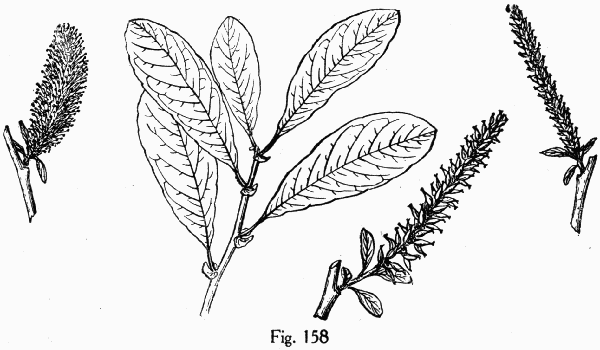
Leaves oblong-obovate to oblanceolate, entire or minutely glandular dentate, acute or acuminate, or rounded and short-pointed, or rounded at apex, gradually narrowed and cuneate at base, when they unfold pubescent or tomentose on the upper surface, and coated on the lower with lustrous white silky pubescence or tomentum persistent during the season or sometimes deciduous from the leaves of vigorous young shoots, at maturity thin and firm, dark green, lustrous and glabrous above, with the exception of the pubescent midrib, 2′—5′ long, ¾′—1½′ wide, with conspicuous slender veins arcuate and united within the margins and prominent reticulate veinlets; petioles stout, pubescent, rarely ½′ long; stipules rarely produced, foliaceous, semilunar, acute or rounded at apex, glandular-dentate, coated below with hoary tomentum, often ½′ long, caducous. Flowers: aments cylindric, densely flowered, erect on short tomentose leafy branchlets, the staminate 1½′—2′ long and ½′ thick, the pistillate 2½′—3′ long, and ¼′ thick; scales yellow or tawny, the staminate oblong-obovate, rounded at the apex, covered with long white hairs, much longer than the more acute pubescent scales of the pistillate ament; stamen 1, with an elongated [163] glabrous filament, or very rarely 2, with filaments united below the middle or nearly to the apex; ovary short-stalked, ovoid, conic, acute, pubescent and gradually narrowed into the elongated style, with entire or slightly emarginate short stigmas. Fruit ovoid, narrowed above, light red-brown, pubescent about ¼′ long.
A much-branched tree, occasionally 25°—30° high, with a short contorted often inclining trunk sometimes 1° in diameter, and slender brittle branchlets coated at first with hoary tomentum, pubescent and tomentose and dark red-brown or orange color during their first winter, becoming darker, pubescent or glabrous, and sometimes covered with a glaucous bloom in their second season; more often shrubby and 6°—15° tall. Winter-buds acute, nearly terete, light red-brown, pubescent or puberulous, about ¼′ long. Bark about ⅛′ thick and broken into irregular closely appressed dark brown scales tinged with red. Wood light, soft, close-grained, pale red, with thick nearly white sapwood.
Distribution. Banks of streams and in low moist ground; Cook Inlet and Kadiak Island, Alaska, southward in the neighborhood of the coast to Santa Barbara, California; on the Marble Creek of the Kaweah River at 6900° altitude (f. Ralphiana Jeps.)
VI. MYRICACEÆ.
Aromatic resinous trees and shrubs, with watery juice, terete branches, and small scaly buds. Leaves alternate, revolute in the bud, serrate, resinous-punctate, persistent in our species, in falling leaving elevated semiorbicular leaf-scars showing the ends of three nearly equidistant fibro-vascular bundles. Flowers unisexual, diœcious or monœcious, usually subtended by minute bractlets, in the axils of the deciduous scales of unisexual or androgynous simple oblong aments from buds in the axils of the leaves of the year, opening in early spring, the staminate below the pistillate in androgynous aments; staminate, perianth 0; stamens 4 or many, inserted on the thickened base of the scales of the ament; filaments slender, united at the base into a short stipe; anthers ovoid, erect, 2-celled, introrse, opening longitudinally; ovary rudimentary or 0; pistillate flowers single or in pairs; ovary sessile, 1-celled; styles short, divided into 2 elongated filiform stigmas stigmatic on the inner face; ovule solitary, erect from the base of the cell, orthotropous, the micropyle superior. Fruit a globose or ovoid dry drupe usually covered with waxy exudations; nut hard, thick-walled. Seed erect, with a thin coat, without albumen; embryo straight; cotyledons plano-convex, fleshy; radicle short, superior, turned away from the minute basal hilum.
The family consists of the genus Myrica L., of about thirty or forty species of small [164] trees and shrubs, widely distributed through the temperate and warmer parts of both hemispheres. Of the seven North American species three are trees. Wax is obtained from the exudations of the fruit of several species. The bark is astringent, and sometimes used in medicine, in tanning, and as an aniline dye. Myrica rubra Sieb and Zacc., of southern Japan and China, is cultivated for its succulent aromatic red fruit.
The generic name is probably from the ancient name of some shrub, possibly the Tamarisk.
CONSPECTUS OF THE NORTH AMERICAN SPECIES.
Flowers diœcious.
Leaves oblanceolate, usually acute or rarely rounded at apex, mostly coarsely serrate above the middle, yellow-green, coated below with conspicuous orange-colored glands.
1. M. cerifera (A, C).
Leaves usually broadly oblong-obovate, rounded or rarely acute at apex, entire, dark green and lustrous.
2. M. inodora (C).
Flowers monœcious; leaves oblanceolate or oblong-lanceolate, sharply serrate, dark green and lustrous.
3. M. californica (G).
1. Myrica cerifera L. Wax Myrtle.
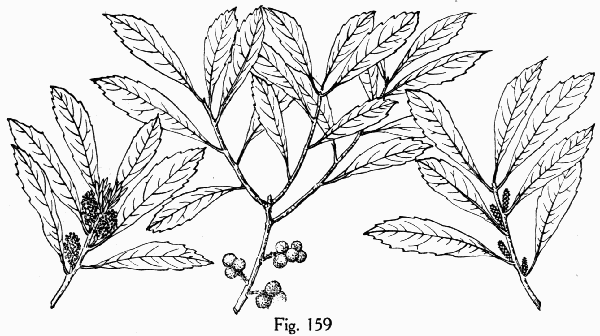
Leaves oblanceolate or rarely oblong-lanceolate, acute or rarely gradually narrowed and rounded at apex, cuneate at base, decurrent on short stout petioles, coarsely serrate above the middle or entire, yellow-green, covered above by minute dark glands and below by bright orange-colored glands, 1½′—4′ long and ¼′—½′ wide, with a slender pale midrib often puberulous below, and few obscure arcuate veins, fragrant with a balsamic resinous odor; gradually deciduous at the end of their first year. Flowers in small oblong aments, with ovate acute ciliate scales, those of the staminate plant ½′—¾′ long, about twice as long as those of the pistillate plant; stamens few, with oblong slightly obcordate anthers at first tinged with red, becoming yellow; ovary gradually narrowed into 2 slender spreading stigmas longer than its scale. Fruit in short spikes, ripening in September and October and persistent on the branches during the winter, irregularly deciduous in the spring and early summer, globose, about ⅛′ in diameter, slightly papillose, light green, coated with thick pale blue wax; seed pale, minute.
A tree, occasionally 40° high, with a tall trunk 8′—10′ in diameter, slender upright or slightly spreading branches forming a narrow round-topped head, and slender branchlets [165] marked by small pale lenticels, coated at first with loose rufous tomentum and caducous orange-colored glands, bright red-brown or dark brown tinged with gray, usually lustrous and nearly glabrous during their first winter, finally becoming dark brown; generally smaller, frequently shrubby. Winter-buds oblong, acute, 1/16′—⅛′ long, with numerous ovate acute imbricated scales, the inner scales becoming nearly ½′ long, and often persistent until the young branch has completed its growth. Bark of the trunk ¼′ thick, compact, smooth, light gray. Wood light, soft and brittle, dark brown, with thin lighter-colored sapwood.
Distribution. In the neighborhood of the coast; Cape May, New Jersey, southern Delaware and Maryland to the keys of southern Florida, and through the Gulf states to the shores of Aranzas Pass, San Patricio County, Texas, ranging inland to the neighborhood of Natchez, Jackson County, Mississippi, the valley of the Red River (Natchitoches, Louisiana and Fulton, Arkansas), and to Cherokee County, Texas, and northward to the valley of the Washita River, Arkansas; on the Bermuda and Bahama Islands and on several of the Antilles; most abundant and of its largest size on the south Atlantic and Gulf coasts in sandy swamps and pond holes; the most common woody plant and forming great thickets on the Everglades east of Lake Okeechobee, Florida; in the sandy soil of Pine-barrens and on dry arid hills of the interior, often only a few inches in height, var. pumila Michx.
2. Myrica inodora W. Bartr. Wax Myrtle.
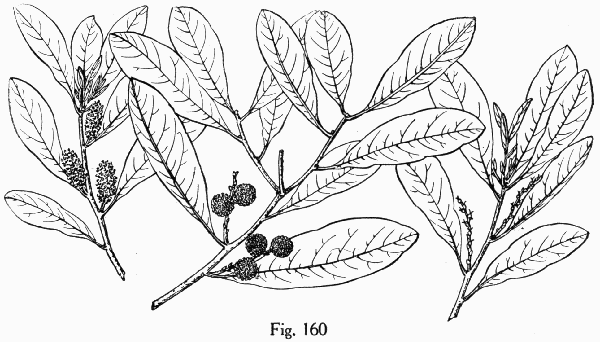
Leaves broadly oblong-obovate or rarely ovate, rounded or sometimes pointed and occasionally apiculate at apex, narrowed at base, decurrent on short stout petioles, entire or rarely obscurely toothed toward the apex, thick and coriaceous, glandular-punctate, dark green and very lustrous above, bright green below, 2′—4′ long, ¾′—1½′ wide, with a broad conspicuously glandular midrib slightly pubescent on the lower side, and few remote slender obscure primary veins forked and arcuate near the much-thickened and revolute margins; gradually deciduous from May until midsummer. Flowers in aments ¾′—1′ long, with ovate acute glandular scales; stamens numerous, with oblong slightly emarginate yellow anthers; pistillate flowers usually in pairs, with an ovate glabrous ovary and slender bright red styles. Fruit produced sparingly in elongated spikes, oblong, ⅓′—½′ long, papillose, black, and covered with a thin coat of white wax; seed oblong-oval, acute at apex, rounded at base, ⅛′ long, bright orange-brown, with a pale yellow hilum.
Usually a shrub, with numerous slender stems, occasionally arborescent and 18°—20° high, with a straight trunk 6°—8° tall and 2′—3′ in diameter, and stout branchlets roughened [166] by small scattered lenticels, coated at first with dense pale tomentum, soon becoming bright red-brown, scurfy, and glabrous or pubescent. Winter-buds ovoid, acute, nearly ⅛′ long, with numerous loosely imbricated lanceolate acute red-brown scurfy-pubescent scales. Bark thin, smooth, nearly white.
Distribution. Deep swamps, Round Lake, Jackson County, and Appalachicola, and Saint Andrews Bay, Florida; near Mobile and Stockton, Alabama; near Poplarville, Pearl County, Mississippi, and Bogalusa, Washington Parish, Louisiana.
3. Myrica californica Cham. Wax Myrtle.
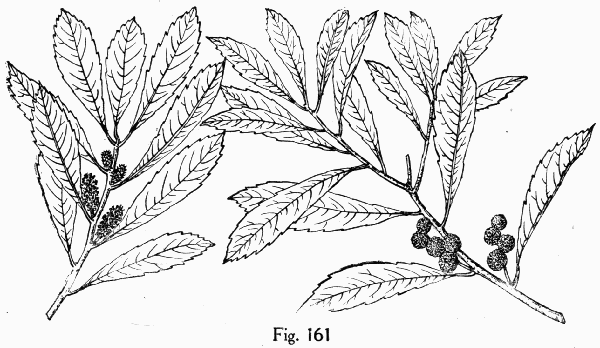
Leaves oblanceolate to oblong-lanceolate, acute at apex, remotely serrate except at the gradually narrowed base with small incurved teeth, decurrent on a short stout petiole, thin and firm, dark green and lustrous above, yellow-green, glabrous or puberulous and marked by minute black glandular dots below, 2′—4′ long, ½′—¾′ wide, with a narrow yellow midrib and numerous obscure primary veins arcuate near the thickened and revolute margins, slightly fragrant, gradually deciduous after the end of their first year. Flowers subtended by conspicuous bractlets, those of the two sexes on the same plant; staminate in oblong simple aments often 1′ long, pistillate in shorter aments in the axils of upper leaves, androgynous aments occurring between the two with staminate flowers at their base and pistillate flowers above, or with staminate flowers also mixed with the pistillate at their apex; scales of the aments ovate, acute, coated with pale tomentum; stamens numerous, with oblong slightly emarginate dark red-purple anthers soon becoming yellow; ovary ovoid, with bright red exserted styles. Fruit in short crowded spikes ripening in the early autumn and usually falling during the winter, globose, papillose, dark purple, covered with a thin coat of grayish white wax; seed pale reddish brown, minute.
A tree, occasionally 40° high, with a trunk 14′—15′ in diameter, short slender branches forming a narrow compact round-topped head, and stout branchlets coated at first with loose tomentum, dark green or light or dark red-brown, glabrous or pubescent during their first season, becoming in their second year much roughened by the elevated leaf-scars, darker and ultimately ashy gray; usually smaller at the north and toward the northern and southern limits of its range reduced to a low shrub often only 3°—4° tall. Winter-buds ovoid, acute, about ⅓′ thick, with loosely imbricated ovate acute dark red-brown tomentose scales nearly ½′ long when fully grown and long-persistent on the branch. Bark smooth, compact, 1/16′—⅛′ thick, dark gray or light brown on the surface and dark red-brown internally. Wood heavy, very hard and strong, brittle, close-grained, light rose color, with thick lighter colored sapwood.
[167]
Distribution. Ocean sand-dunes and moist hillsides in the vicinity of the coast from the shores of Puget Sound to the neighborhood of Santa Monica, Los Angeles County, California; of its largest size on the shores of the Bay of San Francisco.
Occasionally used in California as a garden plant.
VII. LEITNERIACEÆ.
A tree or shrub, with pale slightly fissured bark, scaly buds, stout terete pithy branchlets marked by pale conspicuous nearly circular lenticels and by elevated crescent-shaped angled or obscurely 3-lobed leaf-scars, very light soft wood, and thick fleshy stoloniferous yellow roots. Leaves involute in the bud, lanceolate to elliptic-lanceolate, acuminate or acute and short-pointed at apex, gradually narrowed at base, entire, with slightly revolute undulate margins, penniveined with remote primary veins arcuate and united near the margins, and conspicuous reticulate veinlets, petiolate, at first coated on the lower surface and on the petioles with thick pale tomentum and puberulous on the upper surface, thick and firm at maturity, bright green and lustrous above, pale and villose-pubescent below, deciduous. Flowers in unisexual aments, with ovate acute concave tomentose scales, the male and female on different plants, opening in early spring from buds formed the previous autumn and covered with acute chestnut-brown hairy scales; the staminate clustered near the end of the branches, their scales bearing on the thickened stipe a ring of 3—12 stamens, with slender incurved filaments and oblong light yellow introrse 2-celled anthers opening longitudinally; perianth 0; pistillate aments scattered, shorter and more slender than the staminate, their scales bearing in their axils a short-stalked pistil surrounded by a rudimentary perianth of small gland-fringed scales, the 2 larger lateral, the others next the axis of the inflorescence; ovary superior, pubescent, 1-celled, with an elongated flattened style inserted obliquely, curving inward above the middle in anthesis, grooved and stigmatic on the inner face; ovule solitary, attached laterally, ascending, semianatropous; micropyle directed upward. Fruit an oblong compressed dry drupe thick and rounded on the ventral, narrowed on the dorsal edge, rounded at base, thin and pointed at apex, chestnut-brown, rugose, with a thick dry exocarp closely investing the thin-walled light brown crustaceous rugose nutlet. Seed flattened, rounded at the ends, light brown, marked on the thick edge with the oblong nearly black hilum; embryo erect, surrounded by thin fleshy albumen; cotyledons oblong, flattened; radicle superior, conical, short, and fleshy.
The family consists of a single genus, Leitneria Chapm., with one species of the southern United States, named for a German naturalist killed in Florida during the Seminole War.
1. Leitneria floridana Chapm. Cork Wood.
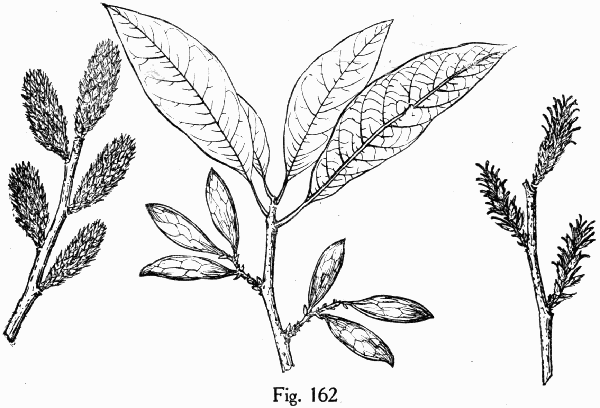
Leaves 4′—6′ long, 1½′—2½′ wide, with petioles 1′—2′ in length. Flowers opening at the end of February or early in March; staminate aments 1′—1¼′ long, ¼′ thick, and twice as long as the pistillate. Fruit solitary or in clusters of 2—4, ripening when the leaves are about half grown, ¾′ long, ¼′ wide.
A shrub or small tree, occasionally 20° high, with a slender straight trunk 4′—5′ in diameter above the swollen gradually tapering base, spreading branches forming a loose open head, and branchlets at first light reddish brown and thickly coated with gradually deciduous hairs, becoming in their first winter glabrous or puberulous, especially toward the ends, and dark red-brown. Winter-buds: terminal broad, conic, ⅛′ long, covered by 10 or 12 oblong nearly triangular closely imbricated scales coated with pale tomentum and long-persistent at the base of the branch; lateral scattered, ovoid, flattened. Bark about 1/16′ thick, dark gray faintly tinged with brown, divided by shallow fissures into narrow rounded ridges. Wood soft, exceedingly light, close-grained, the layers of annual growth hardly distinguishable, pale yellow, without trace of heartwood; occasionally used for the floats of fishing-nets.
Distribution. Borders of swamps of the lower Altamaha River, Georgia (C. L. Boynton); [168] muddy saline shores on the coast of the Gulf of Mexico near Apalachicola, Florida; swampy prairies, Velasco (E. J. Palmer), and swamps of the Brazos River near Columbia, Brazoria County, Texas; Varner, Lincoln County (B. F. Bush), and Moark, Clay County (E. J. Palmer) Arkansas; and in Butler and Dunklin Counties, southeastern Missouri, here sometimes occupying muddy sloughs of considerable extent to the exclusion of other woody plants.
VIII. JUGLANDACEÆ.
Aromatic trees, with watery juice, terete branchlets, scaly buds, the lateral buds often superposed, 2—4 together, and alternate unequally pinnate deciduous leaves with elongated grooved petioles and without stipules, the leaflets increasing in size from the lowest upward, penniveined, sessile, short-stalked or the terminal usually long-stalked. Flowers monœcious, opening after the unfolding of the leaves, the staminate in lateral aments and composed of a 3—6-lobed calyx in the axil of and adnate to an ovate acute bract, and numerous stamens inserted on the inner and lower face of the calyx in 2 or several rows, with short distinct filaments and oblong anthers opening longitudinally; the pistillate in a spike terminal on a branch of the year and composed of a 1—3-celled ovary subtended by an involucre free toward the apex and formed by the union of an anterior bract and 2 lateral bractlets, a 1 or 4-lobed calyx inserted on the ovary, a short style with 2 plumose stigmas stigmatic on the inner face, and a solitary erect orthotropous ovule. Fruit drupaceous, the exocarp (husk) indehiscent or 4-valved, inclosing a thick- or thin-shelled nut divided by partitions extending inward from the shell, and like the shell more or less penetrated by internal longitudinal cavities often filled with dry powder. Seed solitary, 2-lobed from the apex nearly to the middle, light brown, its coat thin, of 2 layers, without albumen; cotyledons fleshy and oily, sinuose or corrugated, 2-lobed; radicle short, superior, filling the apex of the nut. Of the six genera of the Walnut family two occur in North America.
CONSPECTUS OF THE NORTH AMERICAN GENERA.
Aments of staminate flowers simple; husk of the fruit indehiscent; nut sculptured; pith in plates.
1. Juglans.
Aments of staminate flowers branched; husk of the fruit 4-valved; nut not sculptured; pith solid.
2. Carya.
[169]
1. JUGLANS L. Walnut.
Trees, with furrowed scaly bark, durable dark-colored wood, stout branchlets, laminate pith, terminal buds with 2 pairs of opposite more or less open scales often obscurely pinnate at apex, those of the inner pair more or less leaf-like, and obtuse slightly flattened axillary buds formed before midsummer and covered with 4 ovate rounded scales, closed or open during winter. Leaves with numerous leaflets, and terete petioles leaving in falling large conspicuous elevated obcordate 3-lobed leaf-scars displaying 3 equidistant U-shaped clusters of dark fibro-vascular bundle-scars; leaflets conduplicate in the bud, ovate, acute or acuminate, mostly unequal at base, with veins arcuate and united near the margins. Aments of the staminate flowers many-flowered, elongated, solitary or in pairs from lower axillary buds of upper nodes, appearing from between persistent bud-scales in the autumn and remaining during the winter as short cones covered by the closely imbricated bracts of the flowers; calyx 3—6-lobed, its bract free only at the apex; stamens 8—40, in 2 or several ranks, their anthers surmounted by a conspicuous dilated truncate or lobed connective; pistillate flowers in few-flowered spikes, their involucre villose, free only at the apex and variously cut into a laciniate border (corolla?) shorter than the erect calyx-lobes; ovary rarely of 3 carpels; stigmas club-shaped, elongated, fimbriately plumose. Fruit ovoid, globose or pyriform, round or obscurely 4-angled, with a fleshy indehiscent glabrate or hirsute husk; nut ovoid or globose, more or less flattened, hard, thick-walled, longitudinally and irregularly rugose, the valves alternate with the cotyledons, and more or less ribbed along the dorsal sutures and in some species also on the marginal sutures. Seed more or less compressed, gradually narrowed or broad and deeply lobed at base, with conspicuous dark veins radiating from the apex and from the minute basal hilum.
Juglans is confined to temperate North America, the West Indies, South America from Venezuela to Peru, western and northern China, Korea, Manchuria, Japan, and Formosa. Eleven species are known. Of exotic species Juglans regia L., an inhabitant probably originally of China, is cultivated in the middle Atlantic and southern states and largely in California for its edible nuts, which are an important article of commerce. The wood of several species is valued for the interior finish of houses and for furniture.
Juglans, from Jupiter and glands, is the classical name of the Walnut-tree.
CONSPECTUS OF THE NORTH AMERICAN SPECIES.
Fruit racemose; nut 4-ribbed at the sutures with smaller intermediate ribs, 2-celled at the base; heartwood light brown; leaflets 11—17, oblong-lanceolate.
1. J. cinerea (A, C).
Fruit usually solitary or in pairs; nut without sutural ribs, 4-celled at the base; heartwood dark brown.
Nuts prominently and irregularly ridged with often interrupted ridges; leaflets 15—23, ovate-lanceolate.
2. J. nigra (A, C).
Nuts more or less deeply longitudinally grooved.
Nuts up to 1½′ in diameter; leaflets 9—13, rarely 19, oblong-lanceolate to ovate, acuminate, coarsely serrate.
3. J. major (F, H).
Nuts not more than ¾′ in diameter.
Leaflets 17—23, narrow-lanceolate, long-pointed.
4. J. rupestris (C).
Leaflets 11—15 or rarely 19, oblong-lanceolate, acute or acuminate, the lower often rounded at the apex.
5. J. californica (G).
Nuts obscurely or not at all grooved, up to 2′ in diameter; leaflets 15—19, ovate-lanceolate to lanceolate, long-pointed.
6. J. Hindsii (G).
1. Juglans cinerea L. Butternut.
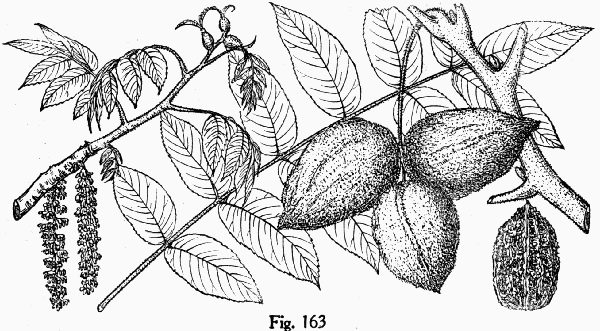
Leaves 15′—30′ long, with stout pubescent petioles, and 11—17 oblong-lanceolate acute or acuminate leaflets 2′—3′ long, 1½′—2′ wide, finely serrate except at the unequal rounded [170] base, glandular and sticky as they unfold, at maturity thin, yellow-green and rugose above, pale and soft-pubescent below; turning yellow or brown and falling early in the autumn. Flowers: staminate in thick aments 3′—5′ long; calyx usually 6-lobed, light yellow-green, puberulous on the outer surface, ¼′ long, its bract rusty-pubescent, acute at apex; stamens 8—12, with nearly sessile dark brown anthers and slightly lobed connectives; pistillate in 6—8-flowered spikes, constricted above the middle, about ⅓′ long, its bract and bractlets coated with sticky white or pink glandular hairs and rather shorter than the linear-lanceolate calyx-lobes; stigmas bright red, ½′ long. Fruit in 3—5 fruited drooping clusters, obscurely 2 or rarely 4-ridged, ovoid-oblong, coated with rusty clammy matted hairs, 1½′—2½′ long with a thick husk; nut ovoid, abruptly contracted and acuminate at apex, with 4 prominent and 4 narrow less conspicuous ribs, light brown, deeply sculptured between the ribs into thin broad irregular longitudinal plates, 2-celled at the base and 1-celled above the middle; seed sweet, very oily, soon becoming rancid.
A tree, occasionally 100° high, with a tall straight trunk 2°—3° in diameter, and sometimes free of branches for half its height; more frequently divided 20° or 30° above the ground into many stout limbs spreading horizontally and forming a broad low symmetrical round-topped head, and dark orange-brown or bright green rather lustrous branchlets coated at first with rufous pubescence, covered more or less thickly with pale lenticels, gradually becoming puberulous, brown tinged with red or orange in their second year and marked by light gray leaf-scars with large black fibro-vascular bundle-scars and elevated bands of pale tomentum separating them from the lowest axillary bud. Winter-buds: terminal ½′—⅔′ long, ¼′ wide, flattened and obliquely truncate at apex, their outer scales coated with short pale pubescence; axillary buds ovoid, flattened, rounded at apex, ⅛′ long, covered with rusty brown or pale pubescence. Bark of young stems and of the branches smooth and light gray, becoming on old trees ¾′—1′ thick, light brown, deeply divided into broad ridges separating on the surface into small appressed plate-like scales. Wood light, soft, not strong, coarse-grained, light brown, turning darker with exposure, with thin light-colored sapwood composed of 5 or 6 layers of annual growth; largely employed in the interior finish of houses, and for furniture. The inner bark possesses mild cathartic properties. Sugar is made from the sap, and the green husks of the fruit are used to dye cloth yellow or orange color.
Distribution. Rich moist soil near the banks of streams and on low rocky hills, southern New Brunswick to the valley of the St. Lawrence River in Ontario, the northern peninsular of Michigan, southern Minnesota, eastern South Dakota, eastern Iowa, southeastern Nebraska, and southward to central Kansas, northern Arkansas, Delaware, eastern [171] Virginia, and on the Appalachian Mountains and their foothills to northern Georgia; in northern Alabama, southern Illinois and western Tennessee; most abundant northward.
Occasionally cultivated.
× Juglans quadrangulata A. Rehd., a natural hybrid of J. cinerea and the so-called English Walnut (J. regia) is not uncommon in eastern Massachusetts, and a hybrid of J. cinerea with the Japanese J. Sieboldiana Maxm. has appeared in the United States.
2. Juglans nigra L. Black Walnut.
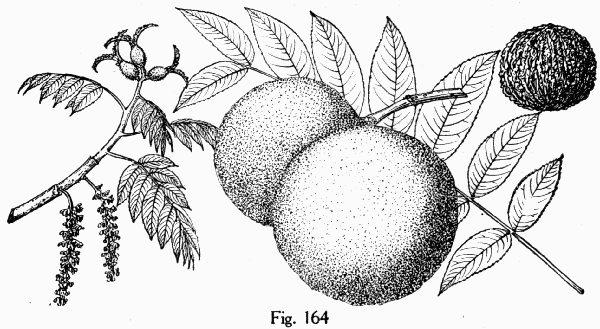
Leaves 1°—2° long, with pubescent petioles, and 15—23 ovate-lanceolate leaflets 3′—3½′ long, 1′—1¼′ wide, long-pointed, sharply serrate except at the more or less rounded often unequal base, thin, bright yellow-green, lustrous and glabrous above, soft-pubescent below, especially along the slender midrib and primary veins; turning bright clear yellow in the autumn before falling. Flowers: staminate in stout puberulous aments 3′—5′ long, calyx rotund, 6-lobed, with nearly orbicular lobes concave and pubescent on the outer surface, its bract ¼′ long, nearly triangular, coated with rusty brown or pale tomentum; stamens 20—30, arranged in many series, with nearly sessile purple and truncate connectives; pistillate in 2—5 flowered spikes, ovoid, gradually narrowed at the apex, ¼′ long, their bract and bractlets coated below with pale glandular hairs and green and puberulous above, sometimes irregularly cut into a laciniate border, or reduced to an obscure ring just below the apex of the ovary; calyx-lobes ovate, acute, light green, puberulous on the outer, glabrous or pilose on the inner surface; stigmas yellow-green tinged on the margins with red, ½′—¾′ long. Fruit solitary or in pairs, globose, oblong and pointed at apex, or slightly pyriform, light yellow-green, roughened by clusters of short pale articulate hairs, 1½′—2′ in diameter, with a thick husk; nut oval or oblong, slightly flattened, 1⅛′—1½′ in diameter, dark brown tinged with red, deeply divided on the outer surface into thin or thick often interrupted irregular ridges, 4-celled at base and slightly 2-celled at the apex; seed sweet, soon becoming rancid.
A tree, frequently 100° and occasionally 150° high, with a straight trunk often clear of branches for 50°—60° and 4°—6° in diameter, thick limbs spreading gradually and forming a comparatively narrow shapely round-topped head of mostly upright rigid branches, and stout branchlets covered at first with pale or rusty matted hairs, dull orange-brown and pilose or puberulous during their first winter, marked by raised conspicuous orange-colored lenticels and elevated pale leaf-scars, gradually growing darker and ultimately light brown. Winter-buds: terminal ovoid, slightly flattened, obliquely rounded at apex, coated with pale silky tomentum, ⅓′ long, with usually 4 obscurely pinnate scales; axillary [172] ⅛′ long, tomentose, their outer scales opening at the apex during the winter. Bark of young stems and branches light brown and covered with thin scales, becoming on old trees 2′—3′ thick, dark brown slightly tinged with red, and deeply divided into broad rounded ridges broken on the surface into thick appressed scales. Wood heavy, hard, strong, rather coarse-grained, very durable, rich dark brown, with thin lighter colored sapwood of 10—20 layers of annual growth; largely used in cabinet-making, the interior finish of houses, gun-stocks, air-planes, and in boat and shipbuilding.
Distribution. Rich bottom-lands and fertile hillsides, western Massachusetts to southern Ontario, southern Michigan, southeastern Minnesota, central and northern Nebraska, central Kansas, eastern Oklahoma, and southward to western Florida, central Alabama and Mississippi, and the valley of the San Antonio River, Texas; most abundant in the region west of the Alleghany Mountains, and of its largest size on the western slopes of the high mountains of North Carolina and Tennessee, and on the fertile river bottom-lands of southern Illinois and Indiana, southwestern Arkansas, and Oklahoma; largely destroyed for its valuable timber, and now rare.
Occasionally cultivated as an ornamental tree in the eastern United States, and in western and central Europe. × Juglans intermedia Carr., a natural hybrid, of J. nigra with the so-called English Walnut (J. regia) has appeared in the United States and Europe, and on the banks of the James River in Virginia has grown to a larger size than any other recorded Walnut-tree. In California a hybrid, known as “Royal,” between J. nigra and J. Hindsii has been artificially produced.
3. Juglans major Hell. Nogal.
Juglans rupestris var. major Torr. Juglans rupestris Sarg., in part, not Engelm.
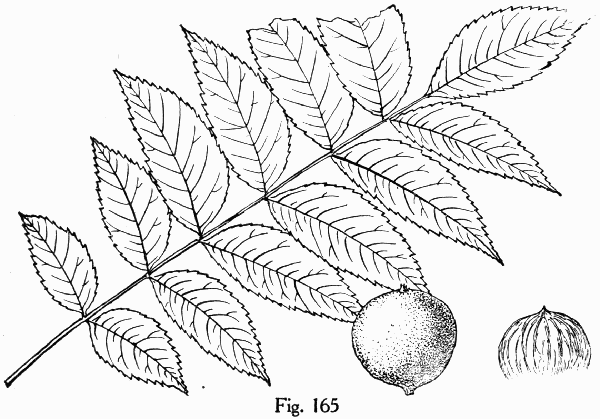
Leaves 8′—12′ long, with slender pubescent petioles and rachis, and 9—13 rarely 19 oblong-lanceolate to ovate acuminate often slightly falcate coarsely serrate leaflets cuneate or rounded at base, coated when they first appear with scurfy pubescence, soon becoming glabrous, or at maturity slightly pubescent on the midrib below, 3′—4′, or those of the lower pairs 1½′—2′ long, and 1′—1½′ wide, thin, yellow-green, with a thin conspicuous yellow midrib and primary veins. Flowers: staminate in slender puberulous or pubescent aments 8′—10′ [173] long; calyx nearly orbicular, long-stalked, pale yellow-green, 5 or 6-lobed, the lobes ovate, acute, hoary pubescent on the outer surface, their bract acute, coated with thick pale tomentum; stamens 30—40, with nearly sessile yellow anthers, and slightly divided connectives; pistillate not seen. Fruit subglobose to slightly ovoid or oblong, abruptly contracted at apex into a short point (J. elæopyren Dode), densely tomentose when half grown, 1′—1½′ in diameter, with a thin husk covered with close rufous pubescence; nut dark brown or black, slightly compressed, usually rather broader than high, or ovoid, rounded or bluntly acute at apex, rounded and sometimes depressed at base, longitudinally grooved with broad deep grooves, thick shelled; seed small and sweet.
A tree sometimes 50° high, with a straight trunk occasionally 3°—4° in diameter, or divided at the ground into several large stems, stout branches forming a narrow head, and slender branchlets thickly coated when they first appear with rufous pubescence, becoming red-brown, pubescent or puberulous and marked by many small pale lenticels at the end of their first season and ashy gray the following year.
Distribution. Banks of streams in the cañons of central and southern New Mexico and Arizona, and on Oak Creek near Flagstaff, Arizona on the Colorado plateau (P. Lowell).
4. Juglans rupestris Engelm. Walnut.
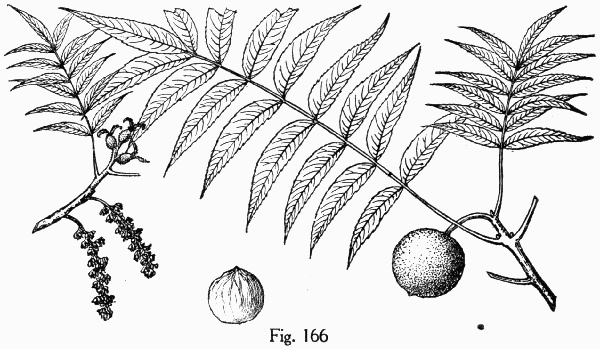
Leaves 9′—12′ long, with slender pubescent or puberulous petioles and rachis, and 13—23 narrow lanceolate long-pointed usually falcate finely serrate leaflets entire or nearly entire on their incurved margins, cuneate or rounded at base, thin, light green, glabrous or pubescent on the midrib below, 2′—3′ long and ⅓′—⅔′ wide. Flowers: staminate in slender aments, 3′—4′ long, pubescent when they first appear, becoming glabrous; calyx short-stalked, nearly orbicular, light yellow-green, puberulous on the outer surface, 3—5-lobed with rounded lobes, their bracts ovate-lanceolate, coated with hoary tomentum; stamens about 20, with nearly sessile yellow anthers and slightly lobed connectives; pistillate flowers oblong, narrowed at the ends, thickly coated with rufous pubescence; bract and bractlets irregularly divided into a laciniate border rather shorter than the ovate acute calyx-lobes; stigmas green tinged with red, ⅓′ long. Fruit globose or subglobose, tipped with the persistent remnants of the calyx, pubescent or puberulous with rusty hairs, ½′—¾′ in diameter, with a thin husk; nut subglobose to slightly ovoid, sometimes obscurely 4-ridged from the apex nearly to the middle (J. subrupestris Dode), deeply grooved with longitudinal simple or forked grooves, 4-celled at base, 2-celled at apex, thick shelled; seed small and sweet.
A shrubby round-headed tree occasionally 20°—30° high, with a short generally leaning [174] trunk 18′—30′ in diameter, usually branching from near the ground, and slender branchlets coated with pale scurfy pubescence often persistent for two or three years, orange-red and marked by pale lenticels in their first winter and ultimately ashy gray; often a shrub with clustered stems only a few feet high. Winter-buds: terminal, ¼′—½′ long, compressed, narrowed and often oblique at apex, covered with pale tomentum; axillary ⅛′ long, compressed, coated with pale pubescence. Wood heavy, hard, not strong, rich dark brown with thick white sapwood. The beauty of the veneers obtained from the stumps of the large trees is fast causing their destruction.
Distribution. Limestone banks of the streams of southern, central and western Texas from the Rio Grande to the mountains in the western part of the state; western Oklahoma (Kiowa, Greer, Beckham, Rogel, Mills and Ellis Counties); southeastern New Mexico.
Occasionally cultivated in the eastern United States and in Europe, and hardy as far north as eastern Massachusetts; interesting as producing the smallest nuts of any of the known Walnut-trees.
5. Juglans californica S. Wats.
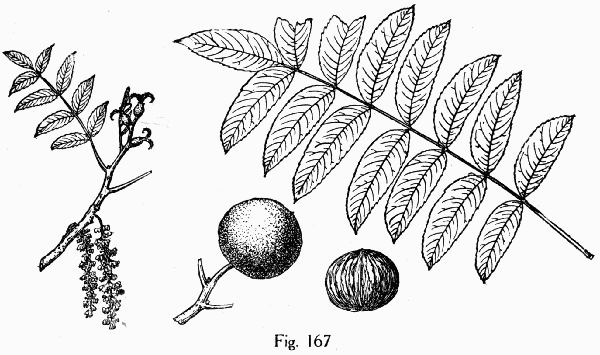
Leaves 6′—9′ long, with glandular pubescent petioles and rachis, and 11—15, rarely 19, oblong-lanceolate acute or acuminate glabrous finely serrate leaflets cuneate or rounded at base, 1′—2½′ long and ⅓′—¾′ wide, the lower often rounded at apex. Flowers: staminate in slender glabrous or puberulous aments 2′—3′ long; calyx puberulous on the outer surface with acute or rarely rounded lobes, its bract, puberulous; stamens 30—40, with yellow anthers and short connectives bifid at apex; the pistillate subglobose, puberulous; stigmas yellow, ½′ long. Fruit globose, ⅓′—¾′ in diameter, with a thin dark-colored puberulous husk; nut nearly globose, deeply grooved with longitudinal grooves, thick shelled, 4-celled at base, imperfectly 2-celled at apex; seed small and sweet.
A shrubby round-headed tree or shrub generally 12°—20°, rarely 40°—50° high, usually branching from the ground or with a short trunk 1° or rarely 2°—3° in diameter, and slender branchlets coated with scurfy rufous pubescence when they first appear, glabrous, reddish brown and marked by pale lenticels at the end of their first season and gray the following year. Winter-buds coated with rufous tomentum.
Distribution. Banks of streams and bottom-lands in the southern California coast region from Santa Barbara and the Ojai valley to San Fernando and the Sierra Santa Monica, and along the foothills of the Sierra Madre to the San Bernardino Mountains and southward to the Sierra Santa Anna.
[175]
A curious seminal variety (var. quercina Babcock) with compound leaves composed of 3 oval leaflets, the terminal long-stalked and 2 or 3 times larger than the lateral leaflets, is occasionally cultivated in California.
6. Juglans Hindsii Rehd.
Juglans californica S. Wats., in part. Juglans californica var. Hindsii Jep.
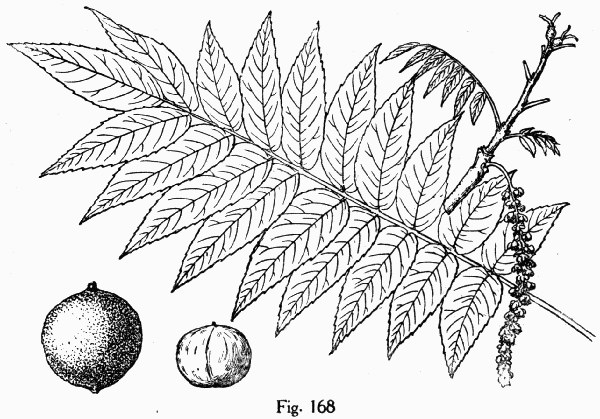
Leaves 9′—12′ long, with slender villose pubescent petioles and rachis, and 15—19, usually 19, ovate-lanceolate to lanceolate long-pointed often slightly falcate leaflets, serrate with remote teeth except toward the usually rounded cuneate or rarely cordate base, thin, puberulous above while young, becoming bright green, lustrous and glabrous on the upper surface, below furnished with conspicuous tufts of pale hairs, and villose-pubescent along the midrib and primary veins, 2½′—4′ long and ¾′—1′ wide. Flowers: staminate in slender glabrous or sparingly villose aments 3′—5′ long; calyx elongated, coated like its bract with scurfy pubescence, divided into 5 or 6 acute lobes; stamens 30—40, with short connectives bifid at apex; ovary of the pistillate flower oblong-ovoid, thickly covered with villose pubescence, ⅛′ long, the border of the thin bract and bractlets much shorter than the calyx-lobes; stigma yellow. Fruit globose, 1¼′—2′ in diameter, with a thin dark-colored husk covered with short soft pubescence; nut nearly globose, somewhat flattened at the ends, faintly grooved with remote longitudinal depressions, thick shelled; seed small and sweet.
A tree usually 30°—40°, occasionally 75° high, with a tall trunk 1°—2° in diameter, stout pendulous branches forming a narrow round-topped head, and comparatively slender branchlets thickly coated when they first appear with villose pubescence, reddish brown and puberulous, and marked by pale lenticels and small elevated obscurely 3-lobed leaf scars during their first winter, becoming darker and nearly glabrous in their second year. Winter-buds coated with hoary tomentum; terminal acute, compressed, more or less enlarged at apex, ¼′—⅓′ long; axillary usually solitary, nearly globose, about 1/16′ in diameter. Bark gray-brown, smoothish, longitudinally fissured into narrow plates. Wood heavy, hard, rather coarse-grained, dark brown often mottled, with thick pale sapwood of from 8 to 10 layers of annual growth.
[176]
Distribution. Coast region of central California; banks of the lower Sacramento River; along streams near the western base of Mt. Diablo, and on eastern slope of the Napa Range near Atlas Peak east of Napa Valley; near Loyalton in the Sierra Valley.
Often cultivated in California as a shade tree and as stock on which to graft varieties of Juglans regia L., and rarely in the eastern states and in Europe. In California, a hybrid known as “Paradox” between J. Hindsii and J. regia has been artificially produced.
2. CARYA NUTT. Hickory.
Hicoria Rafn.
Trees, with smooth gray bark becoming on old trunks rough or scaly, strong hard tough brown heartwood, pale sapwood and tough terete flexible branchlets, solid pith, buds covered with few valvate or with numerous imbricated scales, the axillary buds much smaller than the terminal. Leaves often glandular-dotted, their petioles sometimes persistent on the branches during the winter, and in falling leaving large elevated oblong or semiorbicular more or less 3-lobed emarginate leaf-scars displaying small marginal clusters and central radiating lines of dark fibro-vascular bundle-scars; leaflets involute in the bud, ovate or obovate, usually acuminate, thick and firm, serrate, mostly unequal at base, with veins forked and running to the margins; turning clear bright yellow in the autumn. Aments of the staminate flowers ternate, slender, solitary or fascicled in the axils of leaves of the previous or rarely of the current year, or at the base of branches of the year from the inner scales of the terminal bud, the lateral branches in the axils of lanceolate acute persistent bracts; calyx usually 2 rarely 3-lobed, its bract free nearly to the base and usually much longer than the ovate rounded or acuminate calyx-lobes; stamens 3—10, in 2 or 3 series, their anthers ovate-oblong, emarginate or divided at apex, yellow or red, pilose or hirsute, as long or longer than their slender connectives; pistillate flowers sessile, in 2—10-flowered spikes, with a perianth-like involucre, slightly 4-ridged, unequally 4-lobed at apex, villose and covered on the outer surface with yellow scales more or less persistent on the fruit, the bract much longer than the bractlets and the single calyx-lobe; stigmas short, papillose-stigmatic. Fruit ovoid, globose or pyriform, with a thin or thick husk becoming hard and woody at maturity, 4-valved, the sutures alternate with those of the nut, sometimes more or less broadly winged, splitting to the base or to the middle; nut oblong, obovoid or subglobose, acute, acuminate, or rounded at apex, tipped by the hardened remnants of the style, narrowed and usually rounded at base, cylindric, or compressed contrary to the valves, the shell thin and brittle or thick, hard, and bony, smooth or variously rugose or ridged on the outer surface, 4-celled at base, 2-celled at apex. Seed compressed, variously grooved on the back of the flat or concave lobes, sweet or bitter.
Carya is confined to the temperate region of eastern North America from the valley of the St. Lawrence River to the highlands of Mexico, and to southern China where one species occurs. Of the seventeen species, fifteen inhabit the territory of the United States.
The generic name is from Καρύα, an ancient name of the Walnut.
CONSPECTUS OF THE SPECIES OF THE UNITED STATES.
Bud-scales valvate, the inner strap-shaped and only occasionally slightly accrescent; fruit more or less broadly winged at the sutures; the thin partitions of the nut containing cavities filled with dark astringent powder (absent in 3 and 5).
Shell of the nut thin and brittle; leaflets more or less falcate.
Aments of staminate flowers nearly sessile, usually on branches of the previous year; lobes of the seed entire or slightly notched at apex.
Leaflets 9—17; nut ovoid-oblong, cylindric; seed sweet.
1. C. pecan (A, C).
Leaflets 7—13; nut oblong, compressed; seed bitter.
2. C. texana (C).
Aments of staminate flowers pedunculate, on branches of the year or of the previous year; lobes of the bitter seed deeply 2-lobed.
[177]
Leaflets 7—9; nut cylindric or slightly compressed.
3. C. cordiformis (A, C).
Leaflets 7—13; nut compressed, usually conspicuously wrinkled.
4. C. aquatica (C).
Shell of the ellipsoidal cylindric nut thick and hard; lobes of the sweet seed deeply 2-lobed; leaflets 7—9, occasionally 5, rarely slightly falcate; aments of staminate flowers long-pedunculate at the base of branches of the year.
5. C. myristicæformis (C).
Bud-scales imbricated, the inner becoming much enlarged and often highly colored; aments of staminate flowers on peduncles from the base of branches of the year, rarely from the axils of leaves; fruit usually without wings; partitions of the nut thick without cavities filled with astringent powder; seed sweet, its lobes deeply 2-lobed.
Branchlets usually stout (slender in 7); involucre ¼′—½′ in thickness, opening freely to the base.
Bark on old trunks separating into long, broad, loosely attached plates; nuts pale.
Branchlets light red-brown; shell of the nut thin.
Leaflets 5 or rarely 7, obovate to ovate, acute or acuminate; nut much compressed, often long-pointed at apex; branchlets glabrous or pubescent.
6. C. ovata (A, C).
Leaflets 5, lanceolate, acuminate; nut little compressed, acute at apex; branchlets slender, glabrous.
7. C. carolinæ-septentrionalis (C).
Branchlets pale orange color, pubescent; leaflets usually 7—9; shell of the nut thick.
8. C. laciniosa (A, C).
Bark not scaly, on old trunks dark, deeply ridged; leaflets 7—9, often subcoriaceous, pubescent below; nut reddish brown, often long-pointed, thick shelled; branchlets pubescent.
9. C. alba (A, C).
Branchlets slender; leaves 5—7-foliolate; involucre of the fruit tardily dehiscent to the middle, indehiscent or opening freely to the base; shell of the nut thick, bark close, (sometimes scaly in 13).
Branchlets and leaves not covered when they first appear with rusty brown pubescence.
Involucre of the fruit 3—5.5 mm. in thickness, opening freely to the base, leaves usually 7-foliolate; winter-buds pubescent.
Leaflets hoary tomentose below in early spring, slightly pubescent at maturity; petioles and rachis glabrous; fruit broad-obovoid; branchlets glabrous.
10. C. leiodermis (C).
Leaflets covered in early spring with silvery scales, pale and pubescent below during the season; petioles and rachis more or less thickly covered with fascicled hairs; fruit ellipsoidal to obovoid or globose; branchlets glabrous or slightly pubescent.
11. C. pallida (A, C).
Involucre of the fruit 1—3 mm. in thickness; winter-buds glabrous or puberulous.
Leaves 5, rarely 7-foliolate, glabrous or rarely slightly pubescent; fruit obovoid, often narrowed below into a stipitate base, the involucre indehiscent or tardily dehiscent.
12. C. glabra (A, C).
Leaves generally 7-foliolate, glabrous or rarely pubescent; fruit ellipsoidal, subglobose or obovoid, the involucre opening freely to the base; bark often more or less scaly.
13. C. ovalis (A, C).
Branchlets and leaves densely covered when they first appear with rusty brown pubescence; leaflets usually 5—7; winter-buds rusty pubescent.
Fruit obovoid; the involucre 2—3 mm. in thickness; peduncles of the aments of staminate flowers often from the axils of leaves; branchlets soon becoming glabrous.
14. C. floridana (C).
Fruit subglobose to broadly obovoid, ellipsoidal or pyriform, the involucre on the different varieties 2—13 mm. in thickness; branchlets pubescent through their first season.
15. C. Buckleyi (A, C).
1. Carya pecan Asch. & Gr. Pecan.
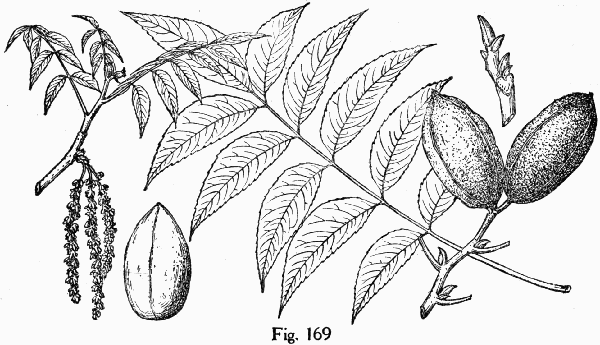
Leaves 12′—20′ long, with slender glabrous or pubescent petioles, and 9—17 lanceolate to oblong-lanceolate more or less falcate long-pointed coarsely often doubly serrate leaflets [178] rounded or cuneate at the unequal base; sessile, except the terminal leaflet, or short-stalked, dark yellow-green and glabrous or pilose above, and pale and glabrous or pubescent below, 4′—8′ long, 1′—3′ wide, with a narrow yellow midrib and conspicuous veins. Flowers: staminate in slender puberulous clustered aments 3′—5′ long, from buds formed in the axils of leaves of the previous year or occasionally on shoots of the year, sessile or short-stalked, light yellow-green and hirsute on the outer surface, with broadly ovate acute lobes rather shorter than the oblong or obovate bract; stamens 5′ or 6′; anthers yellow, slightly villose; pistillate in few or many flowered spikes, oblong, narrowed at the ends, slightly 4-angled and coated with yellow scurfy pubescence. Fruit in clusters of 3—11, pointed at apex, rounded at the narrowed base, 4-winged and angled, 1′—2½′ long, ½′—1′ broad, dark brown and more or less thickly covered with yellow scales, with a thin, brittle husk splitting at maturity nearly to the base and often persistent on the branch during the winter after the discharge of the nut; nut ovoid to ellipsoidal, nearly cylindric or slightly 4-angled toward the pointed apex, rounded and usually apiculate at base, bright reddish brown, with irregular black markings with a thin shell and papery partitions; seed sweet, red-brown, its nearly flat lobes grooved from near the base to the apex by 2 deep longitudinal grooves.
A tree, 100°—180° high, with a tall massive trunk occasionally 6° or 7° in diameter above its enlarged and buttressed base, stout slightly spreading branches forming in the forest a narrow symmetrical and inversely pyramidal head, or with abundant room a broad round-topped crown, and branchlets at first slightly tinged with red and coated with loose pale tomentum, becoming glabrous or puberulous in their first winter, and marked by numerous oblong orange-colored lenticels and by large oblong concave leaf-scars with a broad thin membranaceous border surrounding the lower axillary bud. Winter-buds acute, compressed, covered with clusters of bright yellow articulate hairs and pale tomentum; terminal ½′ long; axillary ovoid, often stalked, especially the large upper bud. Bark 1′—1½′ thick, light brown tinged with red, and deeply and irregularly divided into narrow forked ridges broken on the surface into thick appressed scales. Wood heavy, hard, not strong, brittle, coarse-grained, light brown tinged with red, with thin light brown sapwood; less valuable than that of most Hickories, and used chiefly for fuel, and occasionally in the manufacture of wagons and agricultural implements. The nuts, which vary in size and shape and in the thickness of their shells and in the quality of the kernels, are an important article of commerce.
Distribution. Low rich ground in the neighborhood of streams; in the valley of the Mississippi River, Iowa (Clinton and Muscatine Counties), southern Illinois, southwestern [179] Indiana (Sullivan and Spencer Counties), western Kentucky and Tennessee, western Mississippi and Louisiana, extreme western and southwestern Missouri (Jackson County southward, common only on the Marias de Cygne River), eastern Kansas to Kickapoo Island in the Missouri River near Fort Leavenworth, Oklahoma to the valley of the Salt Fork of the Arkansas River (near Alva, Woods County) and to creek valleys near Cache, Comanche County (G. W. Stevens), through Arkansas; and in Texas to the valley of the Devil’s River and to that of Warder’s Creek, Hardiman County; reappearing on the mountains of Mexico; most abundant and of its largest size in southern Arkansas and eastern Texas.
Largely cultivated in the Southern States, in many selected varieties, for its valuable nuts.
2. Carya texana Schn. Bitter Pecan.
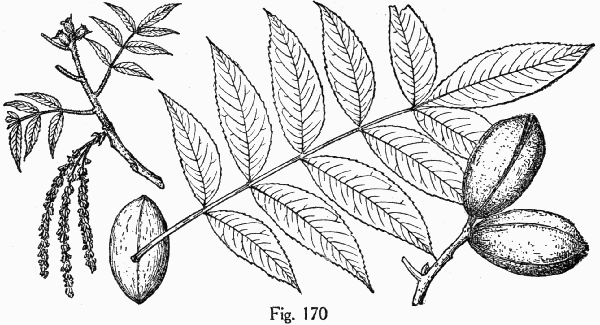
Leaves 10′—12′ long, with slender petioles, and 7—13 lanceolate acuminate finely serrate leaflets, hoary-tomentose when they unfold, and more or less villose in the autumn, thin and firm, dark yellow-green and nearly glabrous above, pale yellow-green and puberulous below, 3′—5′ long, about 1½′ wide, the terminal leaflet gradually narrowed to the acute base and short-stalked, the lateral often falcate, unsymmetrical at the base, subsessile or short-stalked. Flowers: staminate in villose aments 2′—3′ long, light yellow-green and villose on the outer surface, with oblong-ovate rounded lobes; pistillate in few fruited spikes, oblong, slightly 4-angled, villose. Fruit oblong or oblong-obovoid, apiculate at apex, slightly 4-winged at base, dark brown, more or less covered with yellow scales, 1½′—2′ long, with a thin husk; nut oblong-ovoid or oblong-obovoid, compressed, acute at the ends, short-pointed at apex, apiculate at base, obscurely 4-angled, bright red-brown, rough and pitted, with a thin brittle shell, thin papery walls, and a low basal ventral partition; seed very bitter, bright red-brown, flattened, its lobes rounded and slightly divided at apex, longitudinally grooved and deeply penetrated on the outer face by the prominent reticulated folds of the inner surface of the shell of the nut.
A tree, sometimes 100° high on the bottoms of the Brazos River, with a tall straight trunk 3° in diameter, and ascending branches, or on the borders of prairies in low wet woods usually 15°—25° tall, with a short trunk 8′—10′ in diameter, small spreading branches forming a narrow round-topped head, and slender branchlets coated at first with thick hoary tomentum sometimes persistent until the autumn, bright red-brown and marked by occasional large pale lenticels during their first winter and by the large concave obcordate leaf-scars nearly surrounding the lowest axillary bud, becoming darker in their second season and dark or light gray-brown in their third year. Winter-buds covered with light [180] yellow articulate hairs; the terminal oblong, acute, or acuminate, somewhat compressed, about ¼′ long, and rather longer than the upper lateral bud. Bark ½′—¾′ thick, light reddish brown, and roughened by closely appressed variously shaped plate-like scales. Wood close-grained, tough and strong, light red-brown, with pale brown sapwood.
Distribution. Bottom-lands and low wet woods; valley of the lower Brazos River, Texas; near Lake Charles, Calcasieu Parish, and Laurel Hill, West Feliciana Parish, Louisiana; near Natchez, Adams County, Mississippi; valley of the Arkansas River (Arkansas Post, Arkansas County, and Van Buren, Crawford County), Arkansas.
3. Carya cordiformis K. Koch. Pignut. Bitternut.
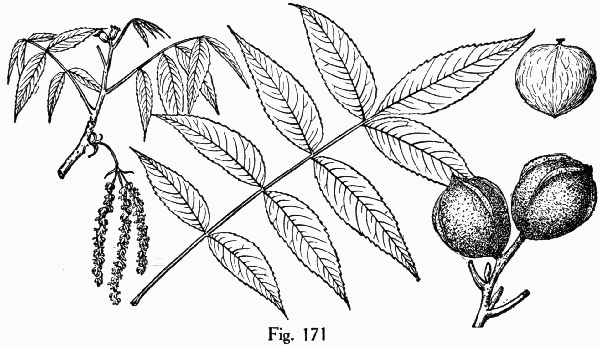
Leaves 6′—10′ long, with slender pubescent or hirsute petioles, and 7—9 lanceolate to ovate-lanceolate or obovate long-pointed sessile leaflets coarsely serrate except at the equally or unequally cuneate or subcordate base, thin and firm, dark yellow-green and glabrous above, lighter and pubescent below, especially along the midrib, 4′—6′ long, ¾′—1¼′ wide, or occasionally 2′—4′ wide (var. latifolia Sarg.). Flowers: staminate in slightly pubescent aments, 3′—4′ long, coated with rufous hairs like its ovate acute bract; stamens 4, with yellow anthers deeply emarginate and villose at apex; pistillate in 1 or 2-flowered spikes, slightly 4-angled, covered with yellow scurfy tomentum. Fruit cylindric or slightly compressed, ¾′—1½′ long, obovoid to subglobose, or oblong and acute at apex (var. elongata Ashe), 4-winged from the apex to about the middle, with a thin puberulous husk, more or less thickly coated with small yellow scales; nut ovoid or oblong, often broader than long, compressed and marked at base with dark lines along the sutures and alternate with them, depressed or obcordate, and abruptly contracted into a long or short point at apex, gray tinged with red or light reddish brown, with a thin brittle shell; seed bright reddish brown, very bitter, much compressed, deeply rugose, with irregular cross-folds.
A tree, often 100° high, with a tall straight trunk 2°—3° in diameter, stout spreading branches forming a broad handsome head, and slender branchlets marked by oblong pale lenticels, bright green and covered more or less thickly with rusty hairs when they first appear, reddish brown and glabrous or puberulous during their first summer, reddish brown and lustrous during the winter and ultimately light gray, with small elevated obscurely 3-lobed obcordate leaf-scars. Winter-buds compressed, scurfy pubescent, bright yellow; terminal ⅓′—¾′ long, oblique at apex, with 2 pairs of scales; lateral 2-angled, often stalked, ⅛′—¼′ long, with ovate pointed slightly accrescent scales keeled on the back. Bark ⅓′—¾′ thick, light brown tinged with red, and broken into thin plate-like scales separating [181] on the surface into small thin flakes. Wood heavy, very hard, strong, tough, close-grained, dark brown, with thick light brown or often nearly white sapwood; largely used for hoops and ox-yokes, and for fuel.
Distribution. Low wet woods near the borders of streams and swamps or on high rolling uplands often remote from streams, southern Maine to Quebec and Ontario, the northern shores of the Lower Peninsula of Michigan, northern Minnesota, southeastern Nebraska, eastern Kansas, eastern Oklahoma, and southward to northwestern Florida, Dallas County, Alabama, and eastern Texas; generally distributed, but not very abundant in all the central states east and west of the Appalachian Mountains; ranging farther north than the other species, and growing to its largest size on the bottom-lands of the lower Ohio basin; the common Hickory of Iowa, Nebraska, and Kansas.
A natural hybrid, × C. Brownii Sarg. of C. cordiformis with C. pecan, with characters intermediate between those of its supposed parents, occurs on bottom-land of the Arkansas River near Van Buren, Crawford County, Arkansas. Probably of the same parentage is the so-called Galloway Nut found in Hamilton County, Ohio. Another hybrid, × C. Brownii var. varians Sarg., probably of the same parentage also, occurs near Van Buren. × C. Laneyi Sarg., a natural hybrid evidently of C. cordiformis with C. ovata, has been found in Rochester, New York, and trees considered varieties of the same hybrid, var. chateaugayensis Sarg., occur near the mouth of the Chateaugay River, Province of Quebec, and at Summertown, Ontario.
4. Carya aquatica Nutt. Water Hickory.
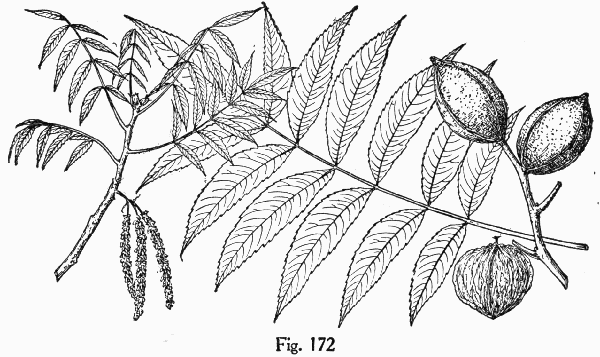
Leaves 9′—15′ long, with slender dark red puberulous or tomentose petioles, and 7—13 ovate-lanceolate long-pointed falcate leaflets symmetrical and rounded or cuneate and unsymmetrical and oblique at base, finely or coarsely serrate, sessile or stalked, 3′—5′ long, ½′—1½′ wide, covered with yellow glandular dots, thin, dark green above, brown and lustrous or tomentose on the lower surface, especially on the slender midrib and primary veins, the terminal leaflet more or less decurrent by its wedge-shaped base on a slender stalk or rarely nearly sessile. Flowers: staminate in solitary or fascicled hirsute aments 2½′—3′ long, covered like their bract with yellow glandular pubescence; stamens 6, with yellow puberulous anthers; pistillate in several flowered spikes, oblong, slightly flattened, 4-angled, glandular-pubescent. Fruit often in 3 or 4-fruited clusters, much compressed, usually broadest above the middle, rounded at the slightly narrowed base, rounded or abruptly narrowed at apex, conspicuously 4-winged, dark brown or nearly black, covered [182] more or less thickly with bright yellow-scales, 1½′ long, 1′—1¼′ wide, with a thin brittle husk splitting tardily and usually only to the middle; nut flattened, slightly obovoid, nearly as broad as long, rounded and abruptly short-pointed at apex, rounded at the narrow base, 4-angled and ridged, dark reddish brown, and longitudinally and very irregularly wrinkled, with a thin shell; seed oblong, compressed, dark brown, irregularly and usually longitudinally furrowed, very bitter.
A tree, occasionally 80°—100° high, with a trunk rarely exceeding 2° in diameter, slender upright branches forming a narrow head, and slender dark reddish brown or ashy gray lustrous branchlets marked by numerous pale lenticels, at first slightly glandular and coated with loose pale tomentum, glabrous or puberulous during the summer, and marked during the winter by small nearly oval or obscurely 3-lobed slightly elevated leaf-scars, growing dark red-brown and ultimately gray. Winter-buds slightly flattened, acute, dark reddish brown, covered with caducous yellow scales; terminal ⅛′—¼′ long, often villose; axillary much smaller, frequently nearly sessile, often solitary. Bark ½′—⅔′ thick, separating freely into long loose plate-like light brown scales tinged with red. Wood heavy, strong, close-grained, rather brittle, dark brown, with thick light-colored or often nearly white sapwood; occasionally used for fencing and fuel.
Distribution. River swamps often inundated during a considerable part of the year from southeastern Virginia southward through the coast regions to the shores of Indian River and the valley of the Suwanee River, Florida, through the maritime portions of the Gulf states to the valley of the Brazos River, Texas, and northward through western Louisiana to southeastern Missouri, and to northeastern Louisiana, western Mississippi, and the valley of the lower Wabash River, Illinois; passing into the var. australis Sarg. with narrower leaflets, smaller ellipsoidal fruit, pale red-brown nuts without longitudinal wrinkles, and with close not scaly bark of the trunk. A large tree in dry sandy soil; high banks of the St. John’s River, near San Mateo, Putnam County, near Jupiter, Palm Beach County, banks of the Caloosahatchie River at Alma, Lee County, and Old Town, Lafayette County, Florida; near Marshall, Harrison County, Texas.
5. Carya myristicæformis Nutt. Nutmeg Hickory.
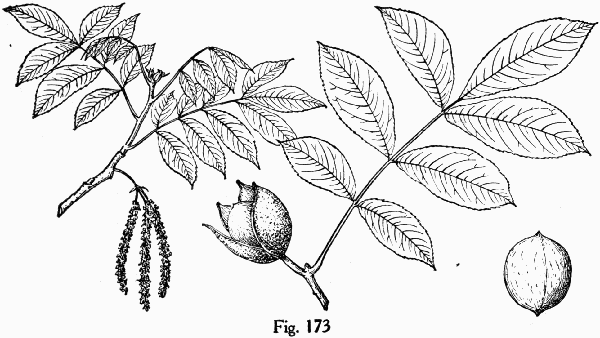
Leaves 7′—14′ long, with slender terete scurfy-pubescent petioles, and 7—9, occasionally 5, ovate-lanceolate to broadly obovate acute leaflets usually equally or sometimes unequally cuneate or rounded at the narrow base, coarsely serrate, short-stalked or nearly sessile, thin and firm, dark green above, more or less pubescent or nearly glabrous and silvery white and very lustrous below, 4′—5′ long, 1′—1½′ wide, with a pale scurfy pubescent [183] midrib; changing late in the season to bright golden-bronze color and then very conspicuous. Flowers: staminate in aments 3′—4′ long and coated like the ovate-oblong acute bract and calyx of the flower with dark brown scurfy pubescence; stamens 6, with yellow anthers; pistillate oblong, narrowed at the ends, slightly 4-angled, covered with thick brown scurfy pubescence. Fruit usually solitary, ellipsoidal or slightly obovoid, 4-ridged to the base, with broad thick ridges, 1½′ long, coated with yellow-brown scurfy pubescence, the husk not more than 1/32′ thick, splitting nearly to the base; nut ellipsoidal or sometimes slightly obovoid, 1′ long, ¾′ broad, rounded and apiculate at the ends, smooth, dark reddish brown, and marked by longitudinal broken bands of small gray spots covering the entire surface at the ends with a thick hard and bony shell, a thick partition, and a low thin dorsal division; seed sweet, small, dark brown; the lobes deeply 2-lobed at apex.
A tree, 80°—100° high, with a tall straight trunk often 2° in diameter, stout slightly spreading branches forming a comparatively narrow rather open head, and slender branchlets coated with lustrous golden or brown scales often persistent until the second year, light brown or ashy gray during their first winter, ultimately dark reddish brown, and marked by small scattered pale lenticels and small oval emarginate elevated leaf-scars. Winter-buds covered with thick brown scurvy pubescence; terminal ⅛′—¼′ long, ovoid, rather obtuse; axillary much smaller, acute, slightly flattened, sessile or short-stalked, often solitary. Bark ½′—¾′ thick, dark brown tinged with red, and broken irregularly into small thin appressed scales. Wood hard, very strong, tough, close-grained, light brown, with thick lighter colored sapwood of 80—90 layers of annual growth.
Distribution. Banks of rivers and swamps in rich moist soil or rarely on higher ground; eastern South Carolina, central Alabama, eastern, and northwestern (bluffs of the Yazoo River at Yazoo City) Mississippi, southern Arkansas, western Louisiana, southeastern Oklahoma to Clear Boggy Creek, western Choctaw County, and in Beaumont County, Texas; on the mountains of northeastern Mexico; rare and local; abundant only in southern Arkansas.
6. Carya ovata K. Koch. Shellbark Hickory. Shagbark Hickory.
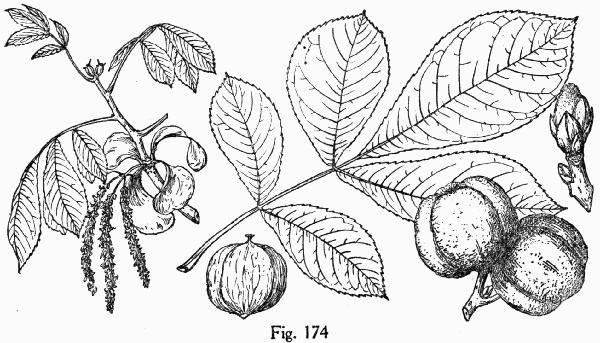
Leaves 8′—14′ long, with stout glabrous or pubescent petioles, and 5 or rarely 7 ovate to ovate-lanceolate or obovate leaflets, acuminate or rarely rounded at apex, more or less thickly ciliate on the margins, finely serrate except toward the usually cuneate base, dark yellow-green and glabrous above, paler, glabrous and lustrous or puberulous below, the terminal leaflet decurrent on a slender stalk, 5′—7′ long, 2′—3′ wide, rather larger than the sessile or short-stalked upper leaflets, and two or three times as large as those of the lowest [184] pair. Flowers: staminate opening after the leaves have grown nearly to their full size, in slender light green glandular-hirsute aments 4′—5′ long, glandular-hirsute, their elongated ovate-lanceolate acute bract two or three times as long as the ovate concave rounded or acute calyx-lobes; stamens 4, with yellow or red anthers hirsute above the middle; pistillate in 2—5-flowered spikes, ⅓′ long, clothed with rusty tomentum. Fruit solitary or in pairs, subglobose, rather longer than broad or slightly obovoid, depressed at apex, dark reddish brown or nearly black at maturity, roughened by small pale lenticels, glabrous or pilose, 1′—2½′ long, the husk, ⅛′—½′ thick, splitting freely to the base; nut oblong, nearly twice as long as broad, or obovoid and broader than long, compressed, prominently or obscurely 4-ridged and angled, acute and gradually or abruptly narrowed or rounded or nearly truncate at apex, gradually narrowed and rounded at base, pale or nearly white, with a usually thin shell; seed light brown, lustrous, sweet, with an aromatic flavor.
A tree, 70°—90° and occasionally 120° high, with a tall straight trunk 3°—4° in diameter, in the forest often free of branches for 50°—60° above the ground and then divided into a few small limbs forming a narrow head, or with more space sometimes dividing near the ground or at half the height of the tree into stout slightly spreading limbs, forming a narrow inversely conic round-topped head of more or less pendulous branches, and stout branchlets marked with oblong pale lenticels, covered at first with caducous brown scurf and coated with pale glandular pubescence, soon bright reddish brown, and lustrous, glabrous or pubescent, growing dark gray in their second year and ultimately light gray, and marked by pale and slightly elevated ovate semiorbicular or obscurely 3-lobed leaf-scars. Winter-buds: terminal broadly ovoid, rather obtuse, ½′—¾′ long, ⅓′—½′ broad, the 3 or 4 outer scales nearly triangular, acute, dark brown, pubescent and hirsute on the outer surface, the exterior scales often abruptly narrowed into long rigid points and deciduous before the unfolding of the leaves, the inner scales lustrous, covered with resinous glands, yellow-green often tinged with red, oblong-obovate, pointed, becoming 2½′—3′ long and ½′ broad, usually persistent until after the fall of the staminate aments; axillary buds coated at first with thick white tomentum, becoming ⅓′—½′ long when fully grown. Bark light gray, ¾′—1′ thick, separating in thick plates often a foot or more long and 6′—8′ wide, and more or less closely attached to the trunk by the middle, giving it the shaggy appearance to which this tree owes its common name. Wood heavy, very hard and strong, tough, close-grained, flexible, light brown, with thin nearly white sapwood; largely used in the manufacture of agricultural implements, carriages, wagons, and for axe-handles, baskets, and fuel. The nut is the common Hickory nut of commerce.
Distribution. Low hills and the neighborhood of streams and swamps in rich deep moderately moist soil; southern Maine to the valley of the St. Lawrence River near Montreal, along the northern shores of Lakes Erie and Ontario to central Michigan, central Wisconsin, southeastern Minnesota, eastern Iowa and southeastern Nebraska, and southward to western Florida, northern Alabama and Mississippi, and to eastern Kansas, eastern Oklahoma, and eastern Texas; ranging further north than other Hickories with the exception of C. cordiformis; and in the Carolinas ascending to 3000° above the sea in valleys on the western slope of the Blue Ridge. Variable in the size and shape of the nut and in the character and amount of pubescence on the leaves and branchlets. These varieties are distinguished: var. Nuttallii Sarg., with nuts rounded, obcordate or rarely pointed at apex, rounded or abruptly pointed at base, much compressed, and only about ⅗′ long and ⅖′—½′ broad; not rare and widely distributed northward. Var. complanata Sarg., with oblong-obovoid fruit and broadly obovoid much compressed slightly angled nuts cuneate at base and rounded, truncate or slightly obcordate at apex; a single tree on the Drushel Farm near Mt. Hope, Holmes County, Ohio. Var. ellipsoidalis Sarg., with ellipsoidal much compressed nuts abruptly long-pointed at apex, and slender reddish branchlets; near Hannibal, Marion County, and Oakwood, Rolles County, northeastern Missouri, and Indian River, Lewis County, and near Rochester, Munroe County, New York. Var. pubescens Sarg., differing in the dense pubescence of pale fascicled hairs on the young branchlets, and on the petioles, rachis and under surface of the leaflets; bottoms of the [185] Savannah River, Calhoun Falls, Abbeville County, South Carolina, bottom of Little River, Walker County, Georgia, Chattanooga Creek, Hamilton County, Tennessee, Valley Head, DeKalb County, Alabama, and Columbus, Lowndes County, Starkville, Oktibbeha County, and Brookville, Noxubee County, Mississippi. More distinct is
Carya ovata var. fraxinifolia Sarg.
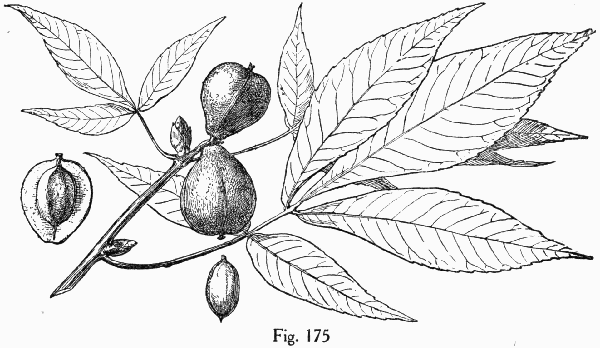
Leaves 7′—9′ long, with slender glabrous or puberulous petioles and 5 lanceolate to slightly oblanceolate acuminate finely serrate leaflets glabrous except on the under side of the midrib, the terminal leaflet 4′—7′ long and 1′—1½′ wide, the lateral sessile, unsymmetrical at base, those of the upper pair often larger than the terminal leaflet, those of the lower pair 2′—2½′ long and 1′—1¼′ wide. Flowers as in the species. Fruit obovoid, usually rounded at apex, compressed, about 1¼′ long, the husk splitting freely to the base, ⅙′—⅕′ in thickness; nut much compressed, rounded at the ends, prominently angled.
A large tree with bark separating in long loose plates, and slender reddish glabrous or puberulous branchlets.
Distribution. Near Rochester, Munroe County, New York; common; near Kingston, Ontario, and westward through Ohio and Indiana; at Keosauqua, Van Buren County, Iowa, and near Myers, Osage County, Oklahoma.
7. Carya carolinæ-septentrionalis Schn. Shagbark Hickory.
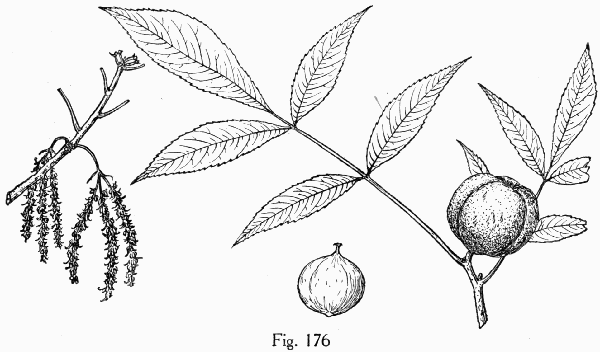
Leaves 4′—8′ long, with slender glabrous petioles, and usually 5 but occasionally 3 lanceolate long-pointed leaflets gradually narrowed at the acuminate symmetrical or unsymmetrical base, coarsely serrate, ciliate with long white hairs as the leaves unfold, thin, dark green above, pale yellow-green and lustrous below, the upper leaflets 3′—4′ long, 1′—1½′ wide, and about twice as large as those of the lower pair, turning dull brown or yellow-brown some time before falling. Flowers: staminate in slightly villose aments, glandular-hirsute on the outer surface, with linear elongated acuminate villose bracts; stamens 4; anthers puberulous; pistillate usually in 2-flowered spikes, oblong and covered with clustered golden hairs, their bract linear and ciliate on the margins. Fruit broader than high, or short-oblong, slightly depressed at apex, ¾′—1½′ wide, dark red-brown, roughened by small pale lenticels, the husk ⅛′—⅜′ thick, splitting freely almost to the base; nut ovoid, compressed, prominently 4-angled, acute at ends, nearly white or pale brown, with a thin shell; seed light brown, sweet.
A tree, on moist bottom-lands sometimes 80° tall, with a trunk 2°—3° in diameter, and [186] short small branches forming a narrow oblong head, or on dry hillsides usually not more than 20°—30° tall, with a trunk generally not exceeding a foot in diameter, and slender red-brown branchlets marked by numerous small pale lenticels and by the small low truncate or slightly obcordate leaf-scars, becoming ultimately dull gray-brown. Winter-buds: terminal ovoid, gradually narrowed to the obtuse apex, about ¼′ long, with glabrous bright red-brown and lustrous acute and apiculate strongly keeled spreading outer scales, the inner scales becoming when fully grown bright yellow, long-pointed, and sometimes 2′ long; axillary buds oblong, obtuse, not more than 1/16′ long. Bark light gray, ¼′—¾′ thick, separating freely into thick plates often a foot or more long, 3′ or 4′ wide, and long-persistent, giving to the trunk the shaggy appearance of the northern Shagbark Hickory. Wood hard, strong, very tough, light reddish brown, with thin nearly white sapwood.
Distribution. Dry limestone hills, river-bottoms and low flat often inundated woods, frequently in clay soil; central North Carolina to northern Georgia, and through western North Carolina to eastern Tennessee, eastern Mississippi, and in Cullman and Dallas Counties, Alabama.
8. Carya laciniosa Schn. Big Shellbark. King Nut.
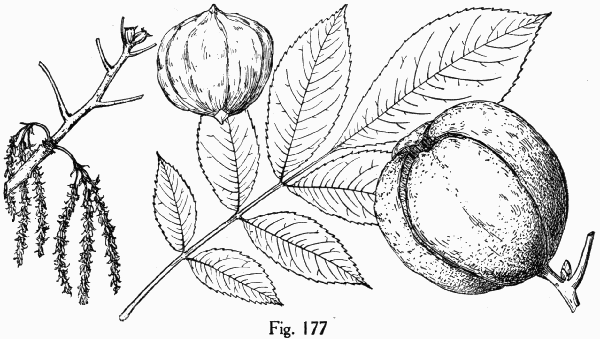
Leaves 15′—22′ long, with stout glabrous or pubescent petioles often persistent on the branches during the winter, and 5—9, usually 7, ovate to oblong-lanceolate or broadly obovate leaflets, the upper 5′—9′ long and 3′—5′ wide and generally two or three times as large as those of the lowest pair, usually equilateral and acuminate at apex, equally or unequally cuneate or rounded at the often oblique base, finely serrate, sessile or short-stalked, dark green and lustrous above, pale yellow-green or bronzy brown and covered with soft pubescence below. Flowers: staminate in aments 5′—8′ long, glabrous or covered with rufous scurfy tomentum, with linear-lanceolate acute bracts two or three times as long as the broad rounded calyx-lobes; anthers hirsute, yellow, more or less deeply emarginate; pistillate in 2—5-flowered spikes, oblong-ovoid, about twice as long as broad, slightly angled, clothed with pale tomentum, their linear bracts acute much longer than the nearly triangular bractlets and calyx-lobe. Fruit solitary or in pairs, ellipsoidal, ovoid or subglobose, depressed at apex, roughened with minute orange-colored lenticels, downy or glabrous, light orange-colored or dark chestnut-brown at maturity, 1¾′—2½′ long and 1¼′—2′ broad, with a hard woody husk pale and marked on the inside with dark delicate veins, and ¼′—⅓′ thick; nut ellipsoidal or slightly obovoid, longer than broad or sometimes broader than long, flattened and rounded at the ends, or gradually narrowed and rounded at base [187] and occasionally acuminate at apex, more or less compressed, prominently 4-ridged and angled or often 6-ridged, furnished at base with a stout long point, light yellow to reddish brown, 1¼′—2½′ long and 1½′—1¾′ wide, with a hard bony shell sometimes ¼′ thick; seed light chestnut-brown, very sweet.
A tree, occasionally 120° high, with a straight slender trunk often free of branches for more than half its height and rarely exceeding 3° in diameter, comparatively small spreading branches forming a narrow oblong head, and stout dark or light orange-colored branchlets at first pilose or covered with pale or rufous pubescence or tomentum, roughened by scattered elevated long pale lenticels, orange-brown and glabrous or puberulous during their first winter, and marked by oblong 3-lobed emarginate leaf-scars. Winter-buds: terminal ovoid, rather obtuse, sometimes 1′ long and ⅔′ wide, and three or four times as large as the axillary buds, usually covered by 11 or 12 scales, the outer dark brown, puberulous, generally keeled, with a long point at apex, the inner scales obovate, pointed or rounded at apex, light green tinged with red, or bright red or yellow, covered with silky pubescence on the outer face, slightly resinous, becoming 2′—3′ long and 1′ wide. Bark 1′—2′ thick, light gray, separating into broad thick plates frequently 3°—4° long, sometimes remaining for many years hanging on the trunk. Wood heavy, very hard, strong and tough, close-grained, very flexible, dark brown, with comparatively thin nearly white sapwood. The large nuts are often sold in the markets of western cities and commercially are not often distinguished from those of the Shellbark Hickory.
Distribution. Rich bottom-lands usually inundated during several weeks of every year; central and western New York and southeastern Ontario, and westward through southern Ohio, southern Michigan, Indiana and Illinois to southeastern Iowa and southeastern Nebraska, through Missouri and Arkansas to southeastern Kansas and northeastern Oklahoma, and southward through eastern Pennsylvania to western West Virginia; in southeastern Tennessee; banks of the Alabama River, Dallas County, Alabama, and in West Feliciana Parish, Louisiana.
× Carya Nussbaumerii Sarg. with leaves like those of C. laciniosa, slender branchlets, and large fruit of the shape of that of the Pecan but without sutural wings and white or nearly white nuts, believed to be a hybrid of these species, has been found near Fayetteville, St. Clair County, Illinois, at Mt. Vernon, Posey County, Indiana, near Burlington, Des Moines County, Iowa, and from the neighborhood of Rockville, Bates County, Missouri.
Trees intermediate in character between C. laciniosa and C. ovata growing on the bottoms of the Genessee River at Golah, Munroe County, New York, and believed to be hybrids of these species, are × C. Dunbarii Sarg.
[188]
9. Carya alba K. Koch. Hickory.
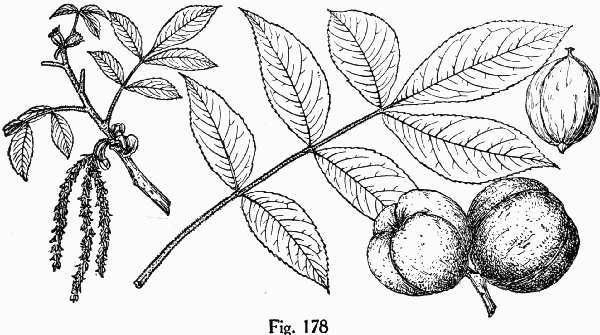
Leaves glandular, resinous, fragrant, 8′—12′ long, with petioles covered like the rachis and the under surface of the leaflets with fascicled hairs, and 5 or 7 oblong-lanceolate to obovate-lanceolate leaflets gradually or abruptly acuminate, mostly equilateral, equally or unequally rounded or cuneate at base, minutely or coarsely serrate, sessile or short-stalked, dark yellow-green and rather lustrous above, lustrous, paler or light orange-colored or brown on the lower surface, the upper leaflets 5′—8′ long and 3′—5′ wide, and two or three times as large as those of the lowest pair. Flowers: staminate in aments 4′—5′ long, with slender light green stems coated with fascicled hairs, pale yellow-green, scurfy-pubescent, with elongated ovate-lanceolate bracts ending in tufts of long pale hairs, and three or four times as long as the calyx-lobes; stamens 4, with oblong bright red hirsute anthers; pistillate in crowded 2—5-flowered spikes, slightly contracted above the middle, coated with pale tomentum, the bract ovate, acute, sometimes ¼′ long, about twice as long as the broadly ovate nearly triangular bractlets and calyx-lobes; stigmas dark red. Fruit ellipsoidal or obovoid, gradually narrowed at the ends, acute at apex, abruptly contracted toward the base, rarely obovoid with a stipe-like base (var. ficoides Sarg.), or ovoid with a long acuminate apex (var. ovoidea Sarg.), pilose or nearly glabrous, dark red-brown, 1½′—2′ long, with a husk about ⅛′ thick splitting to the middle or nearly to the base; nut nearly globose, ellipsoidal, obovoid-oblong or ovoid, narrowed at ends, rounded at base, acute, and sometimes attenuated and long-pointed at apex, much or only slightly compressed, obscurely or prominently 4-ridged, light reddish brown, becoming darker and sometimes red with age, with a very thick hard shell and partitions; in drying often cracking transversely; seed small, sweet, dark brown, and lustrous.
A tree, rarely 100° high, usually much smaller, with a tall trunk occasionally 3° in diameter, comparatively small spreading branches forming a narrow or often a broad round-topped head of upright rigid or of gracefully pendulous branches, and stout branchlets clothed at first with pale fascicled hairs, rather bright brown, nearly glabrous or more or less pubescent, and marked by conspicuous pale lenticels during their first season, becoming light or dark gray, with pale emarginate leaf-scars almost equally lobed, or elongated with the lowest lobe two or three times as long as the others. Winter-buds: terminal broadly ovoid, acute or obtuse, ½′—¾′ long, two or three times as large as the axillary buds, the three or four outer bud-scales ovate, acute, often keeled and apiculate, thick and firm, dark reddish brown and pilose, usually deciduous late in the autumn, the inner scales [189] ovate, rounded or acute and short-pointed at apex, light green covered with soft silky pubescence on the outer, and often bright red and pilose on the inner surface, becoming 1′—1½′ long and ½′ broad. Bark ½′—¾′ thick, close, slightly ridged by shallow irregular interrupted fissures and covered by dark gray closely appressed scales. Wood very heavy, hard, tough, strong, close-grained, flexible, rich dark brown, with thick nearly white sapwood; used for the same purposes as that of the Shellbark Hickory.
Distribution. Eastern Massachusetts southward to Lake County, Florida, and eastern Texas, and through Ohio, southwestern Ontario, southern Michigan, Illinois and Indiana to southeastern Iowa, and through Missouri to eastern Oklahoma; comparatively rare at the north, growing on dry slopes and ridges and less commonly on alluvial bottom-lands; absent from eastern Canada, northern and western New England, and New York except in the neighborhood of the coast; the most abundant and generally distributed Hickory-tree of the southern states, growing to its largest size in the basin of the lower Ohio River and in Missouri and Arkansas; commonly in southern Arkansas and eastern Texas, and occasionally in other southern states represented by var. subcoriacea Sarg., differing in its larger, thicker, more pubescent leaflets, more prominently angled fruit with a thicker husk, larger nuts, and in its longer winter-buds often ⅘′ long and ¾′ in diameter.
× Carya Schneckii Sarg., believed to be a hybrid of C. alba and C. pecan, has been found at Lawrenceville, Lawrence County, Illinois, and near Muscatine, Muscatine County, Iowa.
10. Carya leiodermis Sarg.
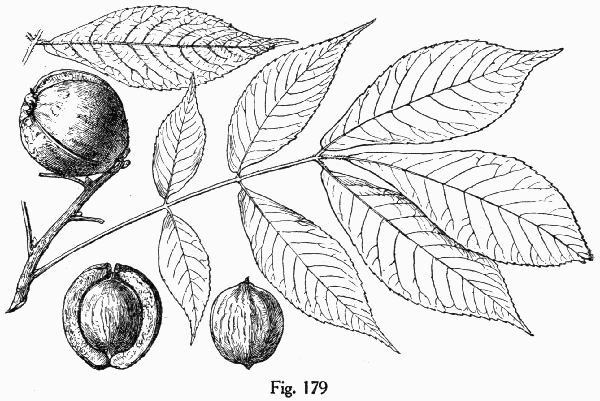
Leaves 12′—14′ long, with slender petioles and rachis slightly or densely pubescent with fascicled hairs, becoming glabrous or nearly glabrous, and 7 or rarely 5 thin finely serrate leaflets, long-pointed at apex, and gradually narrowed, cuneate and unsymmetrical at base, at first hoary tomentose below and pubescent above, becoming dark green and lustrous on the upper surface and pale and slightly pubescent on the lower surface, especially on the stout midrib, the terminal oblong-obovate with a stalk ⅕′—⅗′ in length, or nearly sessile, of the same shape and often smaller than the nearly sessile upper leaflets, 4′—5′ long and 2′—2½′ wide, and much larger than the lanceolate lower leaflets. Flowers: staminate opening after the leaves have grown nearly to their full size, in slender puberulous aments [190] 4′—4½′ long; bract of the flower ovate, lanceolate, ciliate on the margins with long white hairs mixed with stipitate glands, a third longer than the ciliate calyx-lobes; stamens 4, anthers red, covered with long rigid white hairs; pistillate in short spikes, their involucre and bracts densely clothed with white hairs. Fruit broadly obovoid, smooth, glabrous or puberulous, covered with scattered white scales, 1½′—1¾′ long, about 1¼′ in diameter, the husk ⅕′ to nearly ¼′ thick, opening freely to the base usually only by two sutures; nut ellipsoidal or slightly obovoid, little compressed, rounded at the ends, tinged with red, with a shell ⅙′—⅕′ thick; seed small and sweet.
A tree 60°—75° tall with a trunk occasionally 3° in diameter, stout often pendulous branches forming a narrow round-topped head, and slender reddish brown lustrous branchlets puberulous or pubescent when they first appear, becoming glabrous or nearly glabrous by the end of their first season. Winter-buds: terminal acute, about ½′ long, the outer scales pubescent, the inner covered with appressed pale hairs and ciliate on the margins; axillary buds ovoid and rounded at apex or subglobose. Bark close, pale, only slightly ridged.
Distribution. Low wet woods; Louisiana to southern Arkansas, and in northwestern Mississippi (bluffs, Yazoo County); most abundant in western Louisiana from the neighborhood of the coast to the valley of Red River, and in Tangipahoa Parish east of the Mississippi River.
Passing into var. callicoma Sarg., differing in the thinner husk of the fruit and in the bright red color of the unfolding leaves.
Distribution. Low wet woods; valley of the Calcasieu River (near Lake Charles), western Louisiana to that of the Neches River (near Beaumont), Texas; in western and southern Mississippi (Warren, Adams, Hinds, Lafayette, Copiah, Lowndes and Oktibbeha Counties).
11. Carya pallida Ashe.
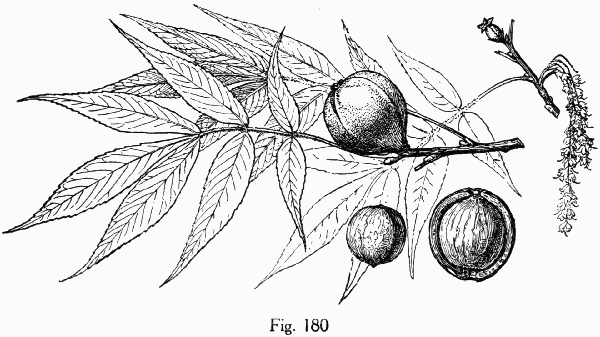
Leaves 7′—15′ long, with slender petioles and rachis covered, like the under side of the midrib, with prominent persistent clusters of fascicled hairs mixed with silvery scales, and usually 7, rarely 9, lanceolate or oblanceolate leaflets, the terminal rarely obovate, finely serrate, resinous, fragrant, acuminate and long-pointed at apex, cuneate or rounded and often unsymmetrical at base, covered in spring with small silvery peltate scales, and at maturity light green and lustrous above, pale and pubescent or puberulous below, the terminal short-stalked or nearly sessile, 4′—6′ long and 1′—2′ wide, and as large or slightly larger than the upper lateral leaflets, those of the lower pairs usually not more than 2′ long and [191] ½′ wide. Flowers: staminate in aments covered with fascicled hairs and silvery scales, 2½′—5′ long, puberulous and glandular on the outer surface, with linear acuminate bracts; stamens 4, anthers hirsute; pistillate usually solitary, oblong, covered with yellow scales, their bract ovate-lanceolate, ciliate on the margin. Fruit pubescent and covered with yellow scales, ellipsoidal to obovoid, broad-obovoid, subglobose to depressed-globose, and from ½′—1½′ in length, with a husk from ⅛′—⅙′ in thickness, splitting tardily to the base by 2 or 3 of the sutures, or occasionally remaining unopened until midwinter; nut white, rounded at the ends, or obcordate or obtusely pointed at apex, compressed, more or less prominently ridged nearly to the base, with a shell ⅛′—1/12′ thick; seed small and sweet.
A tree occasionally 90°—110° high, with a tall trunk 2½°—3° in diameter, usually not more than 30°—40° tall, with a trunk 12′—18′ in diameter, stout branches, the upper erect, the lower often pendulous, and slender red-brown glabrous or pubescent branchlets. Winter-buds acute or obtuse, reddish brown, puberulous and covered with silvery scales, the terminal ¼′ long with 6—9 scales and rather larger than the lateral buds usually covered with fewer scales. Bark of large trees grown in good soil pale and slightly ridged, that of trees on dry ridges, rough, deeply furrowed, dark gray and southward often nearly black. Wood brown with nearly white sapwood; probably little used except as fuel.
Distribution. Sandy soil in the neighborhood of Cape May, New Jersey, in southern Delaware, and in the southern part of the Maryland peninsula; common in rich soil in Gloucester and James City Counties, Virginia, growing here to its largest size, and southward from southeast Virginia through the Piedmont region of North and South Carolina, ascending to altitudes of 2200° in the mountain valleys of these states; common in northern and central Georgia and southeastern Tennessee, occasionally reaching the Georgia coast and the southwestern part of that state; in western Florida, through northern and central Alabama to Dallas County, and through southern Mississippi to northeastern Louisiana (near Kentwood, Tangipahoa Parish); in Mississippi extending northward to the valley of the Yazoo River in Yazoo County; in northern Tennessee (Lexington, Henderson County); in Alabama the common Hickory on the dry gravelly and poor soils of the upland table-lands and ridges of the central part of the state.
12. Carya glabra Sweet. Pignut.
Carya porcina Nutt.
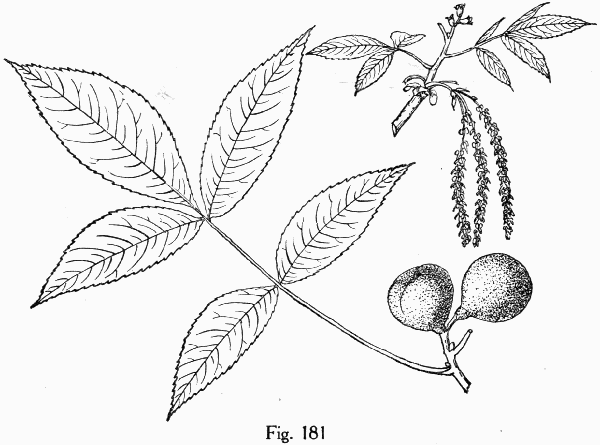
Leaves 8′—12′ long, with slender glabrous petioles and rachis, and 5 or rarely 7 lanceolate or oblanceolate finely serrate leaflets acuminate at the ends, yellow-green and glabrous above, glabrous, or pubescent on the midrib below, the terminal leaflet sometimes obovate, 4′—4½′ long and 5′ or 6′ wide, and raised on a glabrous or sparingly pubescent stalk, ¼′—½′ in length, the lateral leaflets sessile, those of the upper pair about the size of the terminal leaflet, and two or three times larger than those of the lower pair. Flowers: staminate in short-stalked pubescent aments 2′—2½′ long, yellow-green, the bract villose, much longer than the calyx-lobes; stamens 4, anthers yellow, villose toward the apex; pistillate in few-flowered spikes, oblong, coated with hoary tomentum like the lanceolate acuminate bract. Fruit obovoid, compressed, rounded at apex, gradually narrowed below and often abruptly contracted into a stipe-like base, about 1′ long and ¾′ wide, with a husk from 1/12′—⅛′ in thickness, opening late by one or two sutures or often remaining closed; nut obovoid, compressed, without ridges, rounded or slightly obcordate at apex, gradually narrowed and rounded below, with a hard thick shell; seed small and sweet.
A tree 60°—90° high, with a trunk 2°—2½° in diameter, with small spreading often drooping branches forming a tall narrow head, and slender glabrous reddish branchlets marked by pale lenticels. Winter-buds ovoid, acute, light brown, glabrous, ⅓′—½′ long and ⅕′—¼′ in diameter, the inner scales covered with close pubescence. Bark close, ridged, light gray. Wood heavy, hard, strong and tough, flexible, light or dark brown, with thick lighter-colored sapwood; used for the handles of tools and in the manufacture of wagons and agricultural implements, and largely for fuel.
[192]
Distribution. Hillsides and dry ridges; southwestern Vermont to western New York, southeastern Ontario, southern Indiana and southwestern Illinois, and southward to Delaware, the District of Columbia and eastern Virginia, and along the Appalachian Mountains to North Carolina; in northern, central and eastern Georgia, northern Alabama and eastern Mississippi.
The name “Pignut” usually applied to this tree and to the forms of C. ovalis Sarg., especially in the north, properly belongs to C. cordiformis Schn.
Passing into
Carya glabra var. megacarpa Sarg.
Carya megacarpa Sarg.
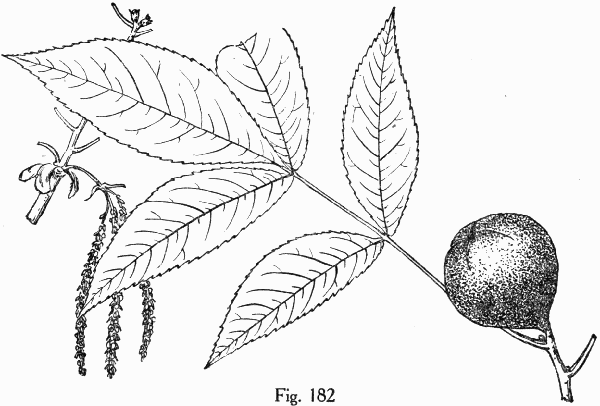
Leaves 12′—14′ long, with slender glabrous petioles and 5—7 lanceolate to oblanceolate leaflets long-pointed and acuminate at apex, gradually narrowed and unsymmetrical at base, finely serrate, glabrous or very rarely pubescent, often furnished below with small clusters of axillary hairs, the three upper 8′—10′ long and 1½′—2½′ wide and about twice as large as those of the lowest pair. Flowers: staminate in slightly villose aments 2½′—3′ in length, villose, their bract long-pointed, acuminate, villose, twice longer than the calyx-lobes, stamens 4—6, anthers yellow, villose above the middle; pistillate in short-stalked spikes, their involucre only slightly angled, covered with pale yellow hairs, the bract acuminate, twice longer than the bractlets and calyx-lobes. Fruit oblong-obovoid with a stipe-like base to short-obovate and rounded or abruptly cuneate at base, rarely depressed at apex, slightly flattened, often covered with bright yellow scales, 1′—2′ long, 1′—1½′ in diameter, with a husk ⅛′—⅕′ in thickness, opening tardily to the middle usually by one or by two sutures, or often remaining closed; nut broadest toward the rounded apex or oblong and occasionally acute at apex, gradually narrowed and acute at base, often compressed, slightly or rarely prominently angled (f. angulata Sarg.), with a shell ⅛′—⅙′ in thickness; seed small and sweet.
A tree 50°—70° high, with a trunk up to 2° in diameter, stout spreading and drooping branches, and stout or rarely slender glabrous branchlets, reddish brown at the end of their [193] first season, becoming dark gray-brown. Winter-buds ovoid, acute, glabrous, up to ½′ in length, the inner scales puberulous. Bark close, only slightly ridged, light or dark gray.
Distribution. Rochester, Munroe County, New York, through southern Ohio and Indiana to southern Illinois (Tunnel Hill, Johnson County); coast of New Jersey; District of Columbia and southward to the shores of Indian River and the valley of the Callusahatchie River, Florida, and through southern Alabama to western Louisiana; one of the commonest Hickories in the coast region of the south Atlantic and east Gulf states, occasionally ranging inland to central and northern Georgia and western Mississippi.
13. Carya ovalis Sarg.
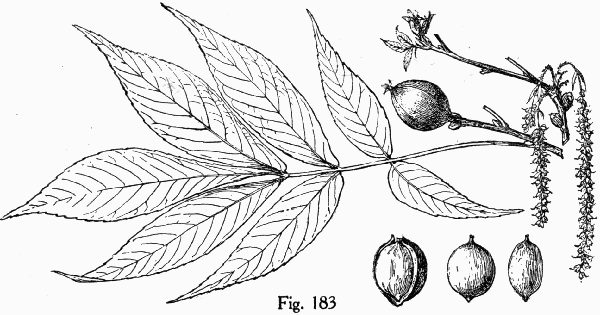
Leaves 6′—10′ long, with slender petioles often scurfy-pubescent early in the season, soon glabrous, and 7 or rarely 5 lanceolate to oblanceolate, or occasionally obovate finely serrate leaflets, long-pointed and acuminate or rarely rounded at apex, cuneate and unsymmetrical at base, early in the season often scurfy-pubescent and furnished below with small axillary tufts of pale hairs, soon glabrous, the upper 6′ or 7′ long and 1½′—2′ wide, and raised on a stalk ¼′—½′ in length, the lateral sessile, those of the upper pairs as large or slightly smaller than the terminal leaflet. Flowers: staminate in puberulous aments 6′—7′ long, pubescent, their bracts twice longer than the ovate acute calyx-lobes; stamens 4, anthers yellow, thickly covered with pale hairs; pistillate in 1 or 2-flowered spikes, obovoid, more or less thickly covered with yellow scales. Fruit ellipsoidal, acute or rounded at apex, rounded at base, puberulous, 1′—1¼′ long, about ¾′ in diameter, with a husk 1/12′—1/10′ in thickness, splitting freely to the base; nut pale, oblong, slightly flattened, rounded at base, acute or acuminate and 4-angled at apex, the ridges extending for one-third or rarely for one-half of its length, with a shell rarely more than ⅕′ in thickness; seed small and sweet.
A tree sometimes 100° high, with a tall trunk occasionally 3° in diameter, small spreading branches forming a narrow often pyramidal head, and slender lustrous red-brown branchlets marked by pale lenticels, often slightly pubescent when they first appear, soon glabrous. Winter-buds ovoid, obtuse, acute or acuminate; the terminal often ½′ long and twice as large as the lateral, the outer scales red-brown, lustrous and glabrous, the inner covered with close pale tomentum. Bark slightly ridged, pale gray, usually separating freely into small plate-like scales, or occasionally close. Wood heavy, hard and tough, flexible, light or dark brown, with thick lighter-colored sapwood; used for the handles of tools, in the manufacture of wagons and agricultural implements, and largely for fuel.
[194]
Distribution. Hillsides and rich woods; western New York, eastern Pennsylvania and the District of Columbia to southern Illinois and central Iowa (Ames, Story County), and southward to the mountains of North Carolina and Tennessee, and to central Georgia and Alabama; usually rare and local; most abundant and generally distributed in Indiana. With its varieties usually but incorrectly called “Pignut.”
The following varieties differing in the shape of their fruit are distinguished:
Carya ovalis var. obcordata Sarg.
Carya microcarpa Darling. in part. Hicoria microcarpa Britt. in part.
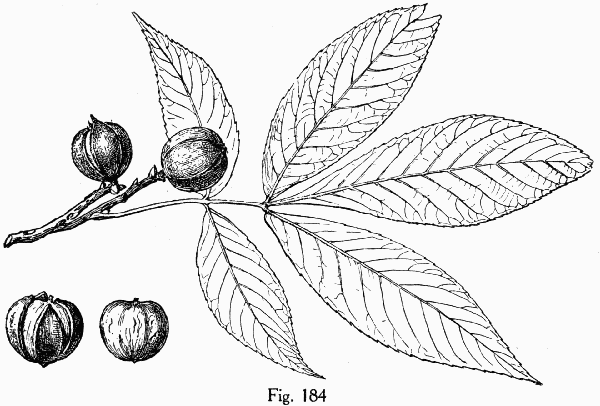
Fruit subglobose to short-oblong or slightly obovoid, 1′—1¼′ in diameter, with a husk 1/12′—⅛′ in thickness, splitting freely to the base or nearly to the base by often narrow-winged sutures; nut much compressed, slightly angled and often broadest above the middle, rounded and usually more or less obcordate at apex, narrowed and rounded at base.
[195]
Distribution. Southern New England to southern Wisconsin, southwestern Missouri, western North Carolina, central and eastern Georgia, eastern Mississippi and central Alabama; the common and most widely distributed northern variety of Carya ovalis; common in the mountain districts of central Alabama; varying to the f. vestita Sarg. with stouter branchlets covered during their first year with rusty tomentum and more or less pubescent in their second and third seasons, leaflets slightly pubescent below, and with more compressed nuts and puberulous winter-buds. A single tree near Davis Pond, Knox County, Indiana.
Carya ovalis var. odorata Sarg.
Carya microcarpa Darling. in part. Hicoria microcarpa Britt. in part. Hicoria glabra var. odorata Sarg. in part.
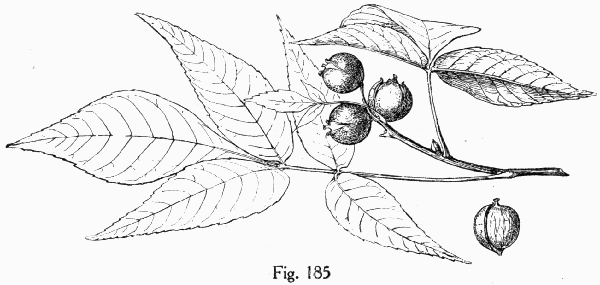
Fruit subglobose or slightly longer than broad, much flattened, ½′—⅗′ in diameter, with a husk not more than 1/24′ in thickness, splitting freely to the base by sutures sometimes furnished with narrow wings; nut compressed, rounded at apex, rounded or acute at base, slightly or not at all ridged, pale or nearly white, with a shell 1/12′ or less in thickness.
Distribution. Southern New England, eastern Pennsylvania and the District of Columbia to western New York, and southeastern Ontario, and through Ohio and Indiana to southern Illinois; near Atlanta, Georgia, and Starkville, Oktibbaha County, Mississippi; less variable in the size and shape of the fruit than the other varieties of C. ovalis.
Carya ovalis var. obovalis Sarg.
Hicoria glabra Sarg. in part.
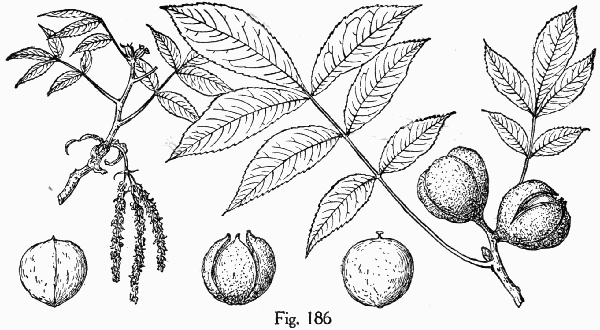
Fruit more or less obovoid, about 1′ long and ⅘′ in diameter, with a husk 1/12′—⅛′ thick, splitting freely to the base.
Distribution. Southern New England to Missouri and northern Arkansas; on the mountains of North Carolina, on the coast of Georgia and in north central Alabama. The common “Pignut” in the middle western states, varying to f. acuta Sarg. with nuts pointed at the ends and closer bark; only near Rochester, Munroe County, New York.
Other forms of C. ovalis are var. hirsuta Sarg. (Hicoria glabra hirsuta Ashe) with obovoid compressed fruit narrowed into a stipitate base, with a husk 1/12′—⅛′ in thickness, scaly bark, pubescent winter-buds, leaves with pubescent petioles and leaflets pubescent on the lower surface; a common tree on the mountains of North Carolina up to altitudes of 2000° above the sea; and var. borealis Sarg. (Hicoria borealis Ashe) with pubescent branchlets [196] and winter-buds, leaves pubescent early in the season, ellipsoidal or ovoid flattened fruit with a husk ⅛′—⅕′ in thickness, an ovoid nut ridged to the base, and scaly bark; only in southeastern Michigan.
14. Carya floridana Sarg.
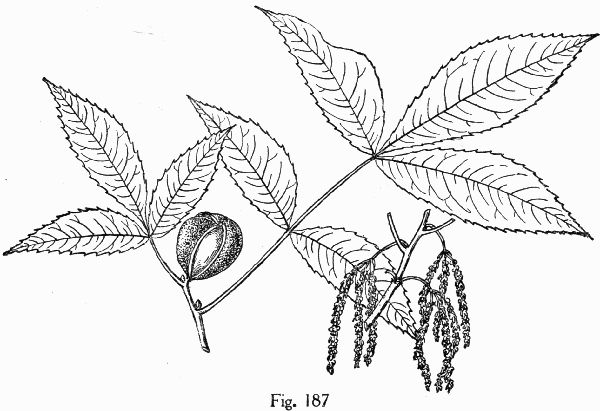
Leaves 6′—8′ long, with slender petioles rusty pubescent when they first appear, soon glabrous, with 5 or rarely 7 lanceolate to oblanceolate leaflets long-pointed and acuminate at apex, unsymmetrical and rounded or cuneate at base, serrate with remote cartilaginous teeth, sessile or the terminal leaflet short-stalked, covered when they unfold with rufous pubescence, soon glabrous, at maturity thin, conspicuously reticulate-venulose, yellow-green above, often brownish below, the upper three 3½′—4′ long, 1′—2′ wide, and about twice larger than those of the lowest pair. Flowers: staminate in long-stalked scurfy pubescent aments 1′—1½′ in length, produced at the base of branchlets of the year from the axils of [197] bud-scales, and often of leaves, scurfy pubescent, their bract ovate, acuminate, a third longer than the calyx-lobes; stamens 4 or 5, anthers yellow, slightly villose near the apex; pistillate in 1 or 2-flowered spikes, obovoid, thickly covered, like their bracts, with yellow scales. Fruit obovoid, gradually narrowed, rounded and sometimes slightly depressed at apex, narrowed below into a short stipe-like base, occasionally slightly winged at the sutures, often roughened by prominent reticulate ridges, puberulous and covered with small yellow scales, ⅘′—1½′ long, ¾′—1′ in diameter with a husk 1/12′—⅛′ thick, splitting freely to the base by 2 or 3 sutures; nut pale or reddish, subglobose, not more than ⅗′ in diameter, or ovoid or rarely oblong, acute at base, narrowed and rounded at apex, slightly compressed, with a shell 1/12′—⅛′ in thickness.
A tree 50°—70° high with a trunk up to 20′ in diameter, slender spreading branches forming a broad head, and slender branchlets at first coated with rufous pubescence, soon puberulous or glabrous, bright red-brown and marked by pale lenticels during their first winter; or in dry sand often a shrub producing abundant fruit on stems 3° or 4° high. Winter-buds ovoid, acute or obtuse, the outer scales covered with thick rusty pubescence and more or less thickly with yellow or rarely silvery scales, the inner coated with pale pubescence; the terminal ⅕′—⅓′ in length and twice as large as the axillary buds. Bark slightly ridged, close dark gray-brown. Wood dark brown, with pale sapwood; probably used only for fuel.
Distribution. Dry sandy ridges and low hills, Florida; east coast, Volusia County to Jupiter Island, Palm Beach County; in the interior of the peninsula as a shrub, from Orange to De Soto Counties, and on the shores of Pensacola Bay.
15. Carya Buckleyi Durand.
Carya texana Buckl., not Le Conte.
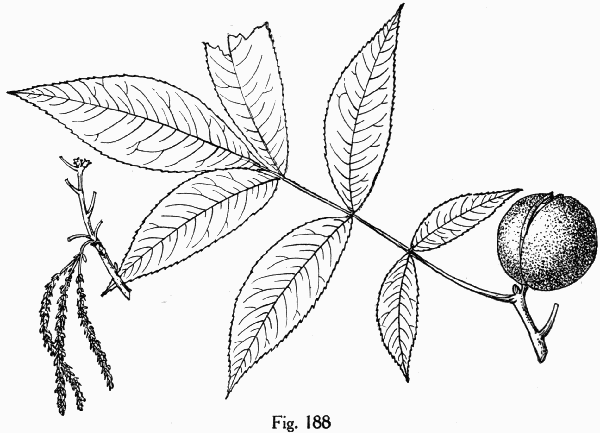
Leaves 8′—12′ long, with slender petioles rusty pubescent and sparingly villose early in the season, and 5—7, usually 7, lanceolate to oblanceolate acuminate bluntly serrate sessile leaflets, the terminal occasionally broadly obovate and abruptly pointed, and sometimes raised on a winged stalk ¼—½′ in length, when they unfold thickly covered with rusty pubescence mixed with small white scales and villose on the lower side of the midrib and veins, [198] and at maturity dark green, lustrous, glabrous or puberulous along the midrib above, paler, glabrous or sparingly villose and furnished with small tufts of axillary hairs below, the upper three leaflets 4′—6′ long and 2′—2¼′ wide, and twice the size of those of the lowest pair. Flowers: staminate in rusty pubescent aments 2′—3′ long, their bract slender, long acuminate, 3 or 4 times longer than the acuminate calyx-lobes; stamens 4 or 5, anthers yellow, slightly villose toward the apex; pistillate in 1 or 2-flowered short-stalked spikes, slightly angled, thickly coated with rufous hairs like the bract and bractlets. Fruit subglobose, puberulous, 1¼′—1¾′ in diameter, with a husk 1/12′—⅛′ thick, splitting freely to the base by slightly winged sutures; nut slightly compressed, rounded at base, abruptly narrowed and acute at apex, 4-angled above the middle or nearly to the base, dark reddish brown, conspicuously reticulate-venulose with pale veins, with a shell about ⅛′ thick; in drying often cracking longitudinally between the angles; seed small and sweet.