Division II. Dicotyledons. (continued 17)
Reading edition
1. Ungnadia speciosa Endl. Spanish Buckeye.
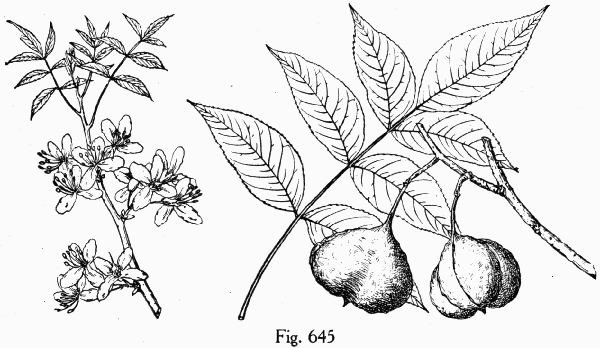
Leaves appearing from March to April with or just after the flowers, 6′—12′ long, with a petiole 2′—6′ in length, rather coriaceous leaflets, dark green and lustrous on the upper surface [718] and pale and rugose on the lower surface, 3′—5′ long and 1½′—2′ wide, the terminal leaflet on a petiolule ¼′—1′ in length. Flowers 1′ across when expanded, in crowded clusters 1½′—2′ long. Fruit 2′ broad, opening in October, the empty pods often remaining on the branches until the appearance of the flowers the following year; seeds ½′—⅝′ in diameter.
A tree, occasionally 25°—30° high, with a trunk 6′—8′ in diameter, dividing at some distance from the ground into a number of small upright branches, and branchlets light orange-brown and covered during their first season with short fine pubescence, and pale brown tinged with red, glabrous and marked by scattered lenticels in their second year; more often a shrub, with numerous stems. Winter-buds about ⅛′ in diameter. Bark of the trunk rarely more than ¼′ thick, light gray and broken by numerous shallow reticulated fissures. Wood heavy, close-grained, rather soft and brittle, red tinged with brown, with lighter colored sapwood. The sweet seeds possess powerful emetic properties and are reputed to be poisonous.
Distribution. Borders of streams, river-bottoms and limestone hills, and westward on the sides of mountain cañons; valley of the Trinity River, Dallas County and of the lower Brazos River, Texas, to the mountains of southeastern New Mexico, and southward into Mexico; most common and of its largest size forty to fifty miles from the Texas coast west of the Colorado River.
Occasionally cultivated as an ornamental plant in the southern United States.
XXXVIII. RHAMNACEÆ.
Trees or shrubs, with scaly or naked buds, watery bitter astringent juice, simple leaves, and minute deciduous stipules (persistent in Krugiodendron). Flowers small, mostly greenish, perfect (polygamo-diœcious in one species of Rhamnus); calyx 4—5-lobed, the lobes valvate in the bud; petals 4—5, inserted on the calyx near the margin of the conspicuous disk lining the short calyx-tube, and infolding the stamens, or 0; stamens as many as and alternate with the calyx-lobes, free, inserted at or below the margins of the disk; filaments slender, subulate; anthers introrse, versatile, 2-celled, the cells opening longitudinally; pistils of 2—3 united carpels; ovary 2—3-, or rarely 1-celled by abortion, partly immersed in the disk; style terminal; stigma 2—4-lobed; ovules 1 in each cell, erect, anatropous; raphe ventral; micropyle inferior. Fruit drupaceous, supported on the tube of the calyx and bearing the remnants of the style. Seed usually with scanty oily albumen; embryo with broad cotyledons; radicle inferior, next the hilum.
[719]
CONSPECTUS OF THE ARBORESCENT GENERA OF THE UNITED STATES.
Fruit more or less fleshy.
Fruit with a single stone; petals 0.
Sepals without crests.
Leaves alternate; branches spinescent.
1. Condalia.
Leaves nearly opposite; branches not spinescent.
2. Reynosia.
Sepals crested; leaves mostly opposite.
3. Krugiodendron.
Fruit with 2 or 3 nutlets; petals 4 or 5, or 0; leaves alternate.
4. Rhamnus.
Fruit crustaceous, 3-lobed, separating into 3 longitudinally 2-valved nutlets.
Sepals inflexed; petals narrowed into a long slender claw.
5. Ceanothus.
Sepals spreading; petals sessile.
6. Colubrina.
1. CONDALIA Cav.
Trees or shrubs, with rigid spinescent branches and minute scaly buds. Leaves alternate, subsessile, obovate or oblong, entire, feather-veined. Flowers axillary, solitary or fascicled, greenish white, on short pedicels; calyx with a short broad-obconic tube and a 5-lobed limb, the lobes ovate, acute, membranaceous, spreading and persistent; disk fleshy, flat, slightly 5-angled, surrounding the free base of the ovary; petals 0; stamens 5, inserted on the free margin of the disk between the lobes of the calyx; filaments incurved, shorter than the calyx-lobes; ovary 1-celled, conic, gradually narrowed into a short thick style; stigma 3-lobed; ovule ascending from the base of the cell. Fruit ovoid or subglobose; flesh thin; stone thick-walled, crustaceous. Seed compressed; seed-coat thin and smooth; cotyledons oval, flat.
Condalia with nine or ten species is confined to the New World and is distributed from western Texas and southern California to Brazil and Argentina. Of the six species found within the territory of the United States one is a small tree.
The generic name commemorates that of Antonio Condal, a Spanish physician of the eighteenth century sent to South America on a scientific mission in 1754.
1. Condalia obovata Hook. Purple Haw. Log Wood.
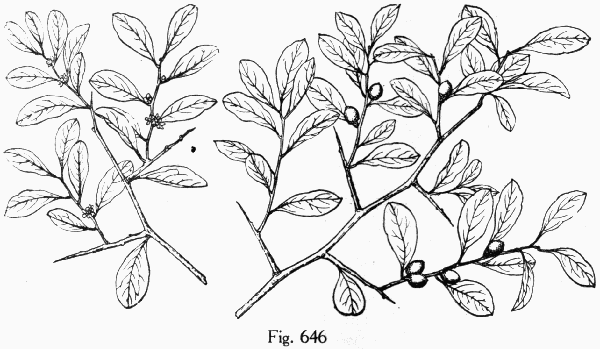
Leaves often fascicled on short spinescent lateral branchlets, spatulate to oblong-cuneate, mucronate, when they first appear pubescent, especially on the lower surface, at maturity glabrous, rather thin, pale yellow-green, 1′—1½′ long, and about ⅓′ wide, with a conspicuous midrib and usually 3 pairs of prominent primary veins; unfolding in May and [720] June and falling irregularly during the winter. Flowers in 2—4-flowered short-stemmed fascicles, on branchlets of the year. Fruit ripening irregularly during the summer, ¼′ long, dark blue or black, with a sweet pleasant flavor.
A tree, sometimes 30° high, with a trunk 6′—8′ in diameter, erect rigid zigzag branchlets terminating in a stout spine and covered at first with soft velvety pubescence, becoming glabrous before the end of their first season, pale red-brown and often covered with thin scales; more often a shrub. Bark of the trunk about ⅛′ thick, divided into flat shallow ridges, the dark brown surface tinged with red separating into thin scales. Wood very heavy, hard, close-grained, light red, with light yellow sapwood of 7—8 layers of annual growth; burning with an intense heat and valued as fuel.
Distribution. Southwestern Texas from Jackson County (Vanderbilt) and Corpus Christi, Nueces County, to the Rio Grande and to Comal and Valverde Counties; in northeastern Mexico; of tree-like habit and of its largest size on the high sandy banks of the lower Rio Grande and its tributaries; often covering large areas with dense impenetrable chaparral.
2. REYNOSIA Griseb.
Trees or shrubs, with rigid unarmed terete branches, and scaly buds. Leaves mostly opposite, entire, coriaceous, short-petiolate, reticulate-veined, persistent. Flowers minute, on stout pedicels bibracteolate near the base and two or three times longer than the flower, in small axillary sessile umbels; calyx persistent, 5-lobed, the lobes deltoid or ovate, acute or acuminate, spreading, petaloid, deciduous; disk fleshy; petals 0; stamens 5, inserted on the margin of the disk, rather shorter than the calyx-lobes; filaments incurved; anthers oval; ovary free from the disk, almost superior, conic, 2—3-celled, contracted into a short erect thick style; stigma 2—3-lobed. Fruit drupaceous; flesh thin; stone crustaceo-membranaceous. Seed ovoid or subglobose; seed-coat very thin, conspicuously rugose and tuberculate; embryo axile in copious subcorneous ruminate albumen; cotyledons oblong.
Reynosia is distributed from southern Florida and the Bahama Islands to the Antilles. Four species are recognized; of these, one, a small tree, extends into southern Florida.
The generic name is in honor of Alvaro Reynoso (1830—1888), the distinguished Cuban chemist and writer on agriculture and scientific subjects.
1. Reynosia septentrionalis Urb. Red Ironwood. Darling Plum.
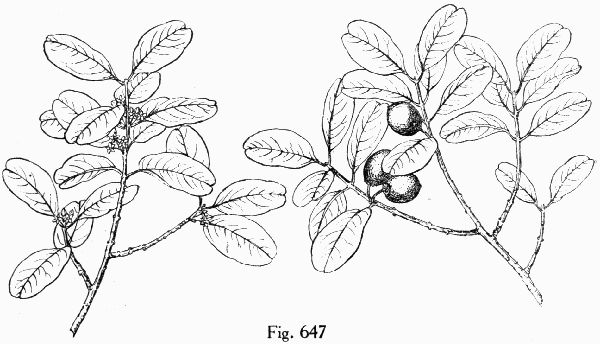
Leaves oblong to ovate or obovate, or sometimes nearly orbicular, rounded, truncate or frequently emarginate and usually minutely apiculate at apex, gradually narrowed at base into a short broad petiole, very thick and coriaceous, dark green on the upper, rather paler [721] or often rufous on the lower surface, 1′—1½′ long and ½′ broad, with thickened revolute margins, a stout broad midrib, about five pairs of primary veins spreading nearly at right angles, and numerous reticulate veinlets; unfolding in April and remaining on the branches for one and sometimes for two years. Flowers yellowish green appearing in May, 1/12′ long; sepals ovate, acute. Fruit ripening in Florida in November or frequently not until the following spring, short-obovoid, ½′ long, purple or nearly black, edible, with an agreeable flavor.
A tree, 20°—25° high, with a trunk 6′—8′ in diameter, stout terete rigid branchlets slightly puberulous when they first appear, soon becoming glabrous and gray faintly tinged with red, growing darker in their second season, then often covered by small tubercles and marked by the prominent elevated leaf-scars. Winter-buds minute, chestnut-brown. Bark of the trunk 1/16′—⅛′ thick, dark-red-brown, and divided into large plate-like scales. Wood heavy, exceedingly hard, strong, close-grained, rich dark brown, with light brown sapwood of 15—20 layers of annual growth.
Distribution. Florida, coast and islands from the Marquesas group to the shores of Bay Biscayne and the Everglade Keys, Dade County; common and generally distributed; on the Bahama Islands.
3. KRUGIODENDRON Urb.
A small tree or shrub, with slender unarmed terete branches roughened by numerous small lenticels, and minute scaly buds. Leaves opposite or obliquely opposite, or sometimes alternate on lower branches, ovate or oval, often emarginate, coriaceous, entire, short-petiolate, feather-veined, persistent; stipules acuminate, persistent. Flowers greenish yellow, on short slender pedicels, in axillary simple or dichotomously branched cymes; calyx broad-obconic, 5-lobed, the lobes triangular, acute, erect or spreading, conspicuously crested on the inner surface, deciduous; disk annular, broad, fleshy, 5-lobed, surrounding the base of the ovary; petals 0; stamens 5, inserted under the margin of the disk; anthers ovoid or ovoid-orbicular, obtuse; ovary conic, imperfectly 2-celled; styles short and thick, united nearly to the apex, the branches spreading and stigmatic on the inner face; ovule ascending from the base of the cell. Fruit 1-seeded, oval or ovoid; flesh thin and black; wall of the stone thin and bony. Seed ellipsoid, compressed, without albumen; seed-coat membranaceous; embryo filling the cavity of the seed; cotyledons thick and fleshy, obovate or elliptic.
Krugiodendron, with a single species, is confined to southern Florida and the West Indies.
The generic name is in honor of Leopold Krug (1833—1898), a student of the flora of the Antilles.
1. Krugiodendron ferreum Urb. Black Ironwood.
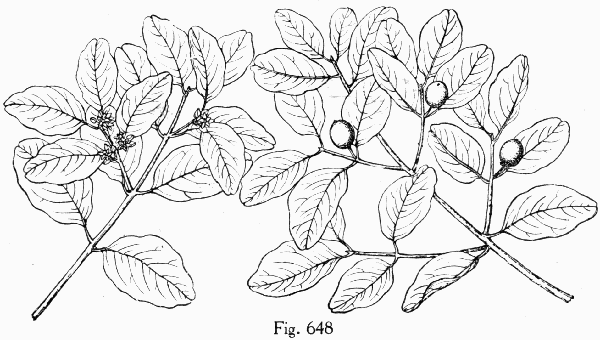
Leaves bright green and lustrous above, pale yellow-green below, glabrous with the exception of a few scattered hairs on the upper surface and on the petiole, 1′—1½′ long and ¾′—1′ wide, with entire or slightly undulate margins; persistent for two or three years; petioles stout, ¼′ in length. Flowers on bibracteolate pedicels ¼′ long, in 3—5-flowered cymes on peduncles sometimes ½′ in length, usually much shorter and often branched near the apex, on branchlets of the year; calyx about 1/16′ long. Fruit generally solitary, ⅓′ in length, on a stem ⅓′—½′ long.
A tree, sometimes 30° high, with a trunk 8′—10′ in diameter, and slender branchlets at first green and covered with dense velvety pubescence, becoming glabrous in their second year, and then gray faintly tinged with red and roughened by small crowded lenticels; generally much smaller and more often shrubby than arborescent. Bark of the trunk about ¼′ thick and divided into prominent rounded longitudinal ridges broken on the surface into short thick light gray scales. Wood exceedingly heavy, hard, strong, close-grained, brittle, rich orange-brown, with thin lighter colored sapwood.
Distribution. Florida, Cape Canaveral on the east coast to the shores of Bay Biscayne [722] and on the Everglade Keys, Dade County, near Cape Sable, and on the southern keys; one of the commonest of the small trees of the region; on the Bahama Islands and on several of the Antilles.
4. RHAMNUS L.
Trees or shrubs, with terete often spinescent branches, without a terminal bud, scaly or naked axillary buds and acrid bitter bark. Leaves alternate or rarely obliquely opposite, conduplicate in the bud, petiolate, feather-veined, entire or dentate, stipulate. Flowers perfect or polygamo-diœcious, in axillary simple or compound racemes or fascicled cymes; calyx campanulate, 4—5-lobed, the lobes triangular-ovate, erect or spreading, keeled on the inner surface, deciduous; disk thin below, more or less thickened above; petals 5, inserted on the margin of the disk, ovate, unguiculate, emarginate, infolded round the stamens, deciduous, or 0; stamens 4 or 5; filaments very short; anthers oblong-ovoid or sagittate, rudimentary and sterile in the pistillate flower; ovary free, ovoid, included in the tube of the calyx, 2—4-celled, rudimentary in the staminate flower; styles united below, with spreading stigmatic lobes or terminating in a 2—3-lobed obtuse stigma; ovule erect from the base of the cell. Fruit drupaceous, oblong or spherical; flesh thick and succulent, inclosing 2—4 separable cartilaginous 1-seeded nutlets. Seeds erect, obovoid, grooved longitudinally on the back, with a cartilaginous seed-coat, the raphe in the groove, or convex on the back, with a membranaceous seed-coat, the raphe lateral next to one margin of the cotyledons; embryo large, surrounded by thin fleshy albumen; cotyledons oval, foliaceous, with revolute margins, or flat and fleshy.
Rhamnus with about sixty species is widely distributed in nearly all the temperate and in many of the tropical parts of the world with the exception of Australasia and the islands of the Pacific Ocean. Of the five species indigenous to the United States three attain the size of small trees. The fruit and bark of Rhamnus are drastic, and yield yellow and green dyes. The European Rhamnus cathartica L., the Buckthorn, has long been used as a hedge plant in northern Europe, and in eastern North America, where it has now become sparingly naturalized.
The generic name is from ῥάμνος, the classical name of the Buckthorn.
CONSPECTUS OF THE NORTH AMERICAN ARBORESCENT SPECIES.
Flowers polygamo-diœcious, in sessile umbels; calyx 4-lobed; petals 0; anthers oblong-ovoid; lobes of the stigma elongated, spreading; fruit red; seed grooved on the back; seed-coat cartilaginous; leaves often sharply toothed, persistent; winter-buds scaly.
1. R. crocea (G).
[723]
Flowers perfect, in pedunculate umbels; calyx 5-lobed; petals 5; anthers sagittate; lobes of the stigma short and obtuse; fruit black; seed rounded on the back; seed-coat membranaceous; leaves deciduous; winter-buds naked.
Peduncles shorter than the petioles.
2. R. caroliniana (C).
Peduncles longer than the petioles.
3. R. Purshiana (B, G).
1. Rhamnus crocea Nutt.
Leaves persistent, often in fascicles, elliptic, broad-ovate to suborbicular, rounded and often apiculate at apex, glandular-denticulate with minute teeth, coriaceous, yellow-green and lustrous on the upper surface, pale and frequently bronzed or copper color on the lower surface, glabrous or often puberulous while young, with a prominent midrib and slender primary veins, ¼′—¾′ long; petioles short and stout; stipules minute, acuminate. Flowers polygamo-diœcious, on slender often puberulous pedicels, in small clusters from the axils of the leaves or of small lanceolate persistent bracts on shoots of the year; calyx 4-lobed, with acuminate lobes, about ⅛′ long; petals 0; stamens rather shorter than the calyx, with short stout incurved filaments and large ovoid anthers, minute and rudimentary in the pistillate flower; ovary ovoid, contracted into a long slender style divided above the middle into two wide-spreading acuminate stigmatic lobes, rudimentary in the staminate flower. Fruit red, obovoid, slightly grooved or lobed at maturity, ¼′ long, with thin dry flesh and 1—3 nutlets; seed broad-ovoid, pointed at apex, deeply grooved on the back and ⅛′ long, with a thin membranaceous pale chestnut-colored coat.
A shrub, 6′—3° high, with slender rigid often spinescent branchlets forming thickets.
Distribution. Coast mountains of central and southern California. Passing into
Rhamnus crocea var. ilicifolia Greene.
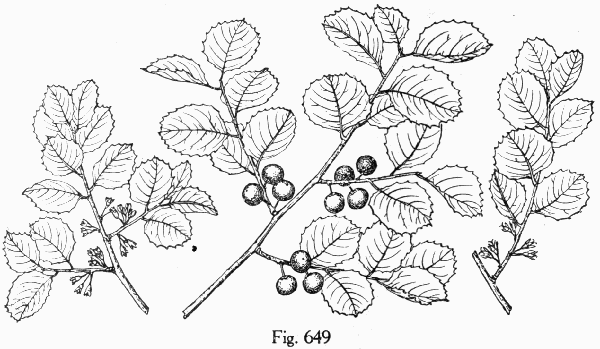
Leaves oval or orbicular, spinulose-dentate, often golden beneath and 1′—1½′ long and ¾′—1′ wide. Flowers with 4 or occasionally 5 calyx-lobes and stamens.
A tree, occasionally 25° high, with a trunk 6′—8′ in diameter, stout spreading branches, and slender branchlets yellow-green and puberulous or glabrate when they first appear, becoming dark red or reddish brown and glabrous in their second season. Winter-buds obtuse, barely more than 1/16′ long, with small puberulous apiculate imbricated scales ciliate on the margins. Bark of the trunk usually from 1/16′—⅛′ thick, the dark gray surface slightly roughened by minute tubercles.
Distribution. California, valley of the Sacramento River southward along the western slopes of the Sierra Nevada, and on the coast ranges and southern mountains to San Diego [724] County; Arizona, Oak Creek and Sycamore Cañons, near Flagstaff, Coconino County, (P. Lowell), Copper Cañon, west of Camp Verde, Yavapai County, and on the Pinal and Santa Catalina Mountains.
Passing into
Rhamnus crocea var. insularis Sarg.
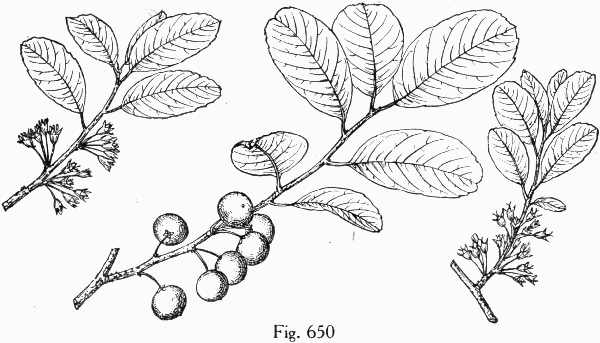
A form with larger less prominently toothed leaves sometimes 3′ long and 1½′ wide, rather larger flowers, with shorter and broader calyx-lobes a less deeply divided style, and larger fruits. A tree often growing to the height of 25°—30°, flowering later than the var. ilicifolia, and not uncommon on the islands of the Santa Barbara group and on the mountains of the adjacent mainland. A form (f. pilosa Trel.) with narrow revolute leaves densely pilose throughout, occurs in the Santa Maria valley of the mountains near San Diego.
2. Rhamnus caroliniana Walt. Indian Cherry.
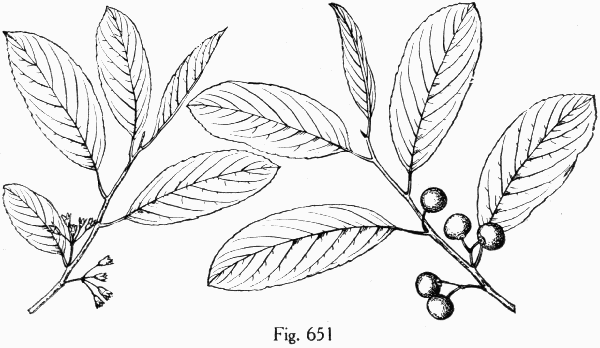
Leaves deciduous, elliptic-oblong or broad-elliptic, acute or acuminate, cuneate or somewhat rounded at base, remotely and obscurely serrate, or crenulate, densely coated when they unfold with rusty brown tomentum, and at maturity thin, dark yellow-green above, paler below, glabrous or somewhat hairy on the lower surface, 2′—6′ long and 1′ to nearly 2′ wide, with a prominent yellow midrib and about 6 pairs of conspicuous yellow primary veins; turning yellow in the autumn before falling; petioles slender, pubescent, ½′ to nearly 1′ in length; stipules nearly triangular. Flowers appearing from April to June when the leaves are almost fully grown, on slender pedicels about ¼′ long, in few-flowered pubescent umbels, on peduncles varying from ⅛′—½′ in length; calyx 5-lobed, with a narrow turbinate tube and triangular lobes; petals 5, broad-ovate, deeply notched at apex and folded round the short stamens; ovary contracted into a long columnar style terminating in a slightly 3-lobed stigma. Fruit ripening in September and sometimes remaining on the branches until the beginning of winter, globose, ⅓′ in diameter, black, with thin sweet rather dry flesh and 2—4 nutlets; seeds obtuse at apex, rounded on the back, reddish brown, about ⅕′ long.
A tree, 30°—40° high, with a trunk 6′—8′ in diameter, small spreading unarmed branches, and slender branchlets light red-brown and puberulent or covered with a glaucous bloom when they first appear, becoming slightly angled, gray, and glabrous, and marked during their second season by the small horizontal oval leaf-scars; more often a tall shrub, with numerous stems 15°—20° high. Winter-buds naked, hoary-tomentose. Bark of the trunk about ⅛′ thick, slightly furrowed, ashy gray and often marked by large black blotches. Wood rather hard, light, close-grained, not strong, light brown, with lighter colored sapwood of 5 or 6 layers of annual growth.
[725]
Distribution. Borders of streams on rich bottom-lands, and on limestone ridges; Virginia to western Florida and westward through the valley of the Ohio River to southern Iowa and southeastern Nebraska, eastern Kansas, the valley of the Washita River, Oklahoma (Ardman County), and to Kendall, Kerr and Uvalde Counties, western Texas; occasionally tree-like in western Florida and Mississippi, and of its largest size only in southern Arkansas and the adjacent portions of Texas; very abundant on the limestone barrens of central Kentucky and Tennessee.
3. Rhamnus Purshiana DC. Bearberry. Coffee-tree.
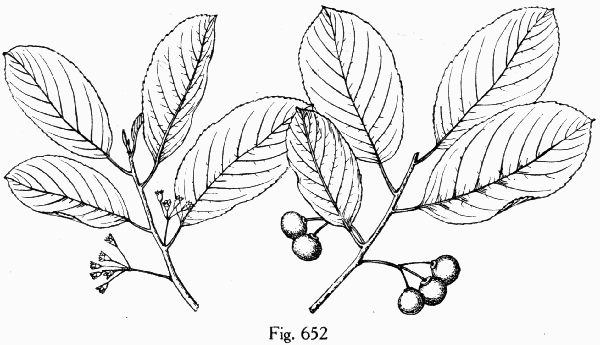
Leaves deciduous, broad-elliptic, obtuse or bluntly pointed at apex, rounded or slightly cordate at base, finely serrate, or often nearly entire, with undulate margins, thin, villose with short hairs on the lower surface and on the veins above, 1½′—7′ long, 1½′—2′ wide, conspicuously netted-veined, with a broad and prominent midrib and primary veins; turning pale yellow late in the autumn before falling; petioles stout, often pubescent, ½′—1′ in length; stipules membranaceous, acuminate. Flowers on slender pubescent pedicels ¼′—1′ long, in axillary cymes on slender pubescent peduncles ½′—1′ in length on shoots of the year; calyx nearly campanulate, with 5 spreading acuminate lobes; petals 5, minute, ovate, deeply notched at apex, and folded round the short stamens; stigma 2 or 3-lobed. Fruit globose or broad-obovoid, black, ⅓′—½′ in diameter, slightly or not at all lobed, with thin rather juicy flesh, and 2 or 3 obovoid nutlets usually ⅓′ long, rounded on the back, flattened on the inner surface, with 2 bony tooth-like enlargements at base, 1 on each side of the large scar of the hilum, and a thin gray or pale yellow-green shell; seeds obtuse at apex, rounded on the back, seed-coat thin and papery, yellow-brown on the outer surface, bright orange color on the inner surface like the cotyledons.
A tree, 35°—40° high, with a slender trunk often 18′—20′ in diameter, separating 10°—15° from the ground into numerous stout upright or sometimes nearly horizontal branches, and slender branchlets coated at first with fine soft pubescence, pale yellow-green or reddish brown, and pubescent, glabrous, or covered with scattered hairs in their second season and then marked by the elevated oval horizontal leaf-scars; often shrubby and occasionally prostrate. Winter-buds naked, hoary-tomentose. Bark of the trunk rarely more than ¼′ thick, dark brown to light brown or gray tinged with red, broken on the surface into short thin scales. Wood light, soft, not strong, brown tinged with red, with thin lighter colored sapwood. The bark possesses the drastic properties peculiar to that of other species of the genus, and is a popular domestic remedy in Oregon and California, and under the name of Cascara Sagrada has been admitted into the American materia medica.
[726]
Distribution. Rich bottom-lands and the sides of cañons, usually in coniferous forests; shores of Puget Sound eastward along the mountain ranges of northern Washington to the Bitter Root Mountains of Idaho and the shores of Flat Head Lake, Montana, and southward to central California; Arizona, southern slope of the Grand Cañon of the Colorado River, Coconino County (A. Rehder), Cave Creek Cañon, Chiricahua Mountains, Cochise County (J. W. Toumey).
Occasionally cultivated in the gardens of western Europe and of the eastern United States.
5. CEANOTHUS L.
Small trees or shrubs, with slender terete branches, without a terminal bud, and small scaly axillary buds. Leaves petiolate, 3-ribbed from the base, or pinnately veined, persistent in the arborescent species. Flowers on colored pedicels, in umbellate fascicles collected in dense or prolonged terminal or axillary thyrsoid cymes or panicles, blue or white; calyx colored, with a turbinate or hemispheric tube and 5 triangular membranaceous petaloid lobes; disk fleshy, thickened above; petals 5, inserted under the margin of the disk, unguiculate, wide-spreading, deciduous, the long claw infolded round the stamens; stamens 5, inserted with and opposite the petals, persistent, filaments spreading; ovary partly immersed in and more or less adnate to the disk, 3-celled, sometimes 3-angled, the angles often surmounted by a fleshy gland persistent on the fruit; styles short, united below; stigmas 3-lobed with spreading lobes; ovule erect from the base of the cell. Fruit 3-lobed, subglobose, with a thin outer coat, soon becoming dry, and separating into 3 crustaceous or cartilaginous longitudinally 2-valved nutlets. Seeds erect, obovoid, lenticellate, with a broad basal excrescence surrounding the hilum; seed-coat thin, crustaceous; albumen fleshy; embryo axile; cotyledons oval or obovate.
Ceanothus is confined to the temperate and warmer regions of North America, with about thirty species, mostly belonging to California. The leaves, bark, and roots are astringent and tonic. Of the species of the United States three are small trees.
The generic name is from κεάνωθος, the classical name of some spiny plant.
CONSPECTUS OF THE ARBORESCENT SPECIES OF THE UNITED STATES.
Branchlets not spinose, leaves 3-ribbed.
Leaves broad-ovate to elliptic, subcordate or rounded at base, pale and tomentose below.
1. C. arboreus (G).
Leaves elliptic, acute at base, glabrous except on the veins below.
2. C. thyrsiflorus (G).
Branchlets spinose; leaves with a single midrib, mostly elliptic, rounded or subcordate at base, glabrous.
3. C. spinosus (G).
[727]
1. Ceanothus arboreus Greene.
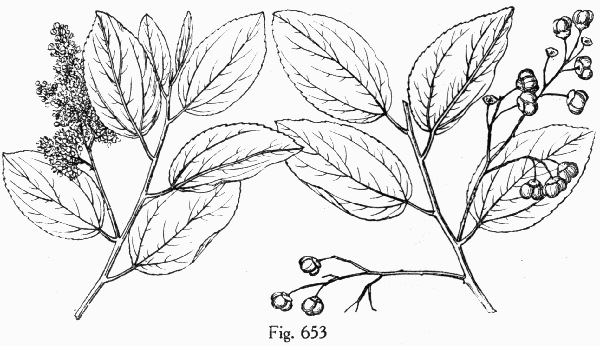
Leaves broad-ovate or elliptic, acute, conspicuously glandular-crenate, dark green and softly puberulent on the upper surface, pale and densely tomentose on the lower surface, 2½′—4′ long and 1′—2½′ wide, with prominent veins; petioles stout, pubescent, ½′—1′ in length; stipules subulate from a broad triangular base, ¼′ long. Flowers pale blue opening in July and August, on slender hairy pedicels ½′—1′ long, from the axils of large scarious caducous bracts, in ample compound densely hoary-pubescent thyrsoid clusters 3′—4′ long and 1½′—2′ wide, on a leafy or naked axillary peduncle at the end of young branches. Fruit black, ¼′ across.
A round-headed tree, 20°—25° high, with a straight trunk 6′—10′ in diameter, dividing 4°—5° from the ground into many stout spreading branches, and slender slightly angled pale brown branchlets covered with short dense tomentum, becoming in their second season terete, nearly glabrous, roughened with scattered lenticels and marked by large elevated leaf-scars; often a shrub. Bark of the trunk dark brown, about ⅛′ thick, and broken into small square plates separating into thick scales.
Distribution. Santa Catalina, Santa Cruz, and Santa Rosa Islands of the Santa Barbara group off the coast of southern California; most abundant and of its largest size on the northern slopes of Santa Cruz; on the other islands usually shrubby, with numerous slender stems.
2. Ceanothus thyrsiflorus Eschs. Blue Myrtle. California Lilac.
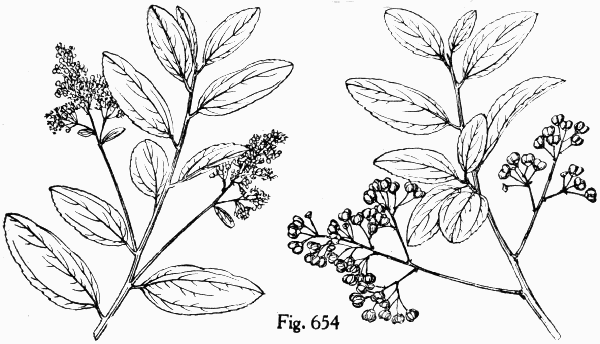
Leaves oblong or oblong-ovate, minutely glandular-serrate, smooth and lustrous on the upper surface and paler and slightly pubescent on the lower surface, especially along the 3 prominent ribs, 1′—1½′ long and ½′—1′ wide; petioles stout, ⅓′—½′ in length; stipules membranaceous, acute. Flowers blue or white, appearing in early spring in small pedunculate corymbs from the axils of minute deciduous bracts, and collected into slender rather loose thyrsoid clusters 2′—3′ long in the axils of upper leaves or of small scarious bracts, and usually surmounted by the terminal leafy shoot of the branch. Fruit ripening from July to December, black; seeds 1/12′ long, smooth, dark brown or nearly black.
A tree, occasionally 35° high, with a trunk 12′—14′ in diameter, dividing 5°—6° from the [728] ground into many small wide-spreading branches, and conspicuously angled pale yellow-green branchlets slightly pubescent when they first appear, soon becoming glabrous; more often a tall or low shrub. Bark of the trunk thin, with a bright red-brown surface separating into thin narrow appressed scales. Wood close-grained, rather soft, light brown, with thin darker colored sapwood.
Distribution. Shady hillsides on the borders of the forest and often in the neighborhood of streams; coast mountains of California from Mendocino County to the valley of the San Luis Rey River, San Diego County; of its largest size northward, and in the Redwood-forests of the Santa Cruz Mountains; southward often a low shrub, frequently flowering on the wind-swept shores of the ocean when only 1°—2° high.
3. Ceanothus spinosus Nutt. Lilac.
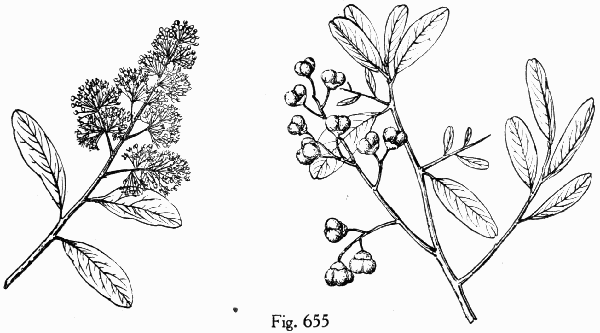
Leaves elliptic to oblong, full and rounded, apiculate or often slightly emarginate or gradually narrowed and pointed or rarely 3-lobed at apex, and rounded or cuneate at base, when they unfold villose-pubescent below along the stout midrib and obscure primary veins, soon glabrous, coriaceous, usually about 1′ long and ½′ wide; petioles stout, ⅙′—⅓′ in length, at first villose, becoming nearly glabrous; leaves on vigorous shoots sometimes ovate, conspicuously [729] 3-nerved, irregularly serrate with incurved apiculate teeth, or coarsely dentate, and often 1½′ long and ⅝′ wide; stipules minute, acute. Flowers light or dark blue, very fragrant, opening from March until May, in lax corymbs from the axils of acute pubescent red caducous bracts on upper leafy branchlets of the year, the whole inflorescence forming an open thyrsus often 5′—6′ long and 3′—4′ thick, leafless toward the apex. Fruit depressed, obscurely lobed, crestless, black, ¼′—⅓′ in diameter.
A tree, 18°—20° high, with a trunk 5′—6′ in diameter, upright branches forming a narrow open head, and slender divaricate angled branchlets pubescent or puberulous when they first appear, soon glabrous, bright green, ultimately reddish brown, frequently terminating in sharp leafless thorn-like points; more often shrubby. Bark of the trunk thin, red-brown, roughened by small closely appressed scales.
Distribution. California, common in mountain cañons near the coast of Santa Barbara, Ventura, and Los Angeles Counties; often forming a dense undergrowth in the forest, which it enlivens for many weeks in early spring by its large clusters of bright blue flowers.
6. COLUBRINA Brong.
Trees or shrubs, with terete branches and scaly buds. Leaves alternate, petiolate, pinnately veined or triple-veined from the base, often ferrugineo-tomentose on the lower surface, persistent. Flowers axillary, in contracted few-flowered cymes or fascicles, yellow or greenish yellow; calyx-tube hemispheric, persistent, 5-lobed, the lobes spreading, triangular-ovate, keeled on the inner surface, deciduous by a circumscissile line; disk fleshy, annular, 5-angled or indistinctly 5 or 10-lobed; petals 5 yellow or white, inserted under the margin of the disk, shorter than the lobes of the calyx, cucullate, unguiculate, infolding the stamens; stamens 5, opposite to and inserted with the petals; filaments incurved; anthers ovoid; ovary surrounded by and confluent with the disk, 3-celled, subglobose, contracted into a slender 3-lobed style, the obtuse lobes stigmatic on the inner face; ovule erect, from the base of the cell. Fruit subglobose, 3-lobed, the outer coat thin and septicidally dehiscent into 3 1-seeded crustaceous nutlets 2-valved at apex. Seeds erect, broad-obovoid, compressed, 3-angled; seed-coat coriaceous, smooth and shining; embryo axile in thick fleshy albumen; cotyledons orbicular, flat or incurved, thin or fleshy.
Colubrina with about a dozen species is confined to the tropics, with the largest number of species in the New World. Of the four species found within the territory of the United States three are arborescent.
The generic name is from coluber, a serpent, probably on account of the peculiar twisting of the deep furrows on the stems of some of the species.
CONSPECTUS OF THE ARBORESCENT SPECIES OF THE UNITED STATES.
Leaves thin, elliptic, ovate or lanceolate, glabrous at maturity.
1. C. reclinata (D).
Leaves thick or coriaceous.
Leaves oblong to elliptic, rounded or acute at apex, densely soft-pubescent.
2. C. cubensis (D).
Leaves elliptic to ovate-lanceolate, bluntly pointed at apex, coriaceous, rusty-pubescent beneath.
3. C. arborescens (D).
1. Colubrina reclinata Brong. Naked Wood.
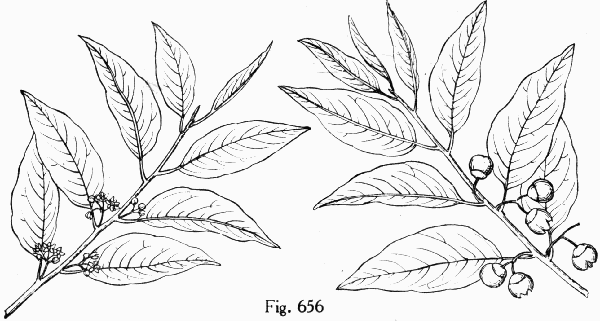
Leaves elliptic, ovate or lanceolate, usually contracted at apex into a blunt point, cuneate or somewhat rounded and furnished with 2 conspicuous marginal glands at base, and entire when they unfold in early summer thin, glabrous or finely puberulent below and along the principal veins, and at maturity thin, yellow-green, 2½′—3′ long and 1½′ to nearly 2′ wide, with a stout midrib and arcuate primary veins; persistent until their second year; petioles slender, ½′ in length. Flowers in cymes rather shorter than the petioles, on shoots of the year, pubescent, soon becoming glabrate. Fruit ¼′ in diameter and dark orange-red, ripening late in the autumn, on pedicels ½′ in length; seeds light red-brown, ⅛′ long.
[730]
A tree, 50°—60° high, with a trunk 3°—4° in diameter, divided by numerous irregular deep furrows multiplying and spreading in all directions, and branchlets slightly angled when they first appear, puberulent and reddish brown, soon becoming glabrate, and in their second season nearly terete, gray or light brown, and marked by numerous small light-colored lenticels. Bark of the trunk thin, orange-brown, exfoliating in large papery scales. Wood heavy, hard, very strong, dark brown tinged with yellow, with thin light yellow sapwood of 8—10 layers of annual growth.
Distribution. Florida, on Umbrella Key, the north end of Key Largo, and on some of the small keys south of Elliott’s Key; of its largest size and forming a forest of considerable extent on Umbrella Key; on the Bahama Islands and on many of the Antilles.
2. Colubrina cubensis Brong.
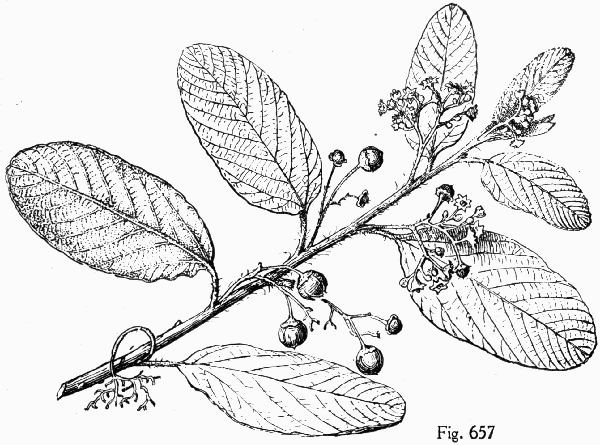
Leaves oblong to elliptic, gradually narrowed and rounded or acute and apiculate at apex, rounded or cuneate at the often unsymmetric base, slightly crenulate-serrate with [731] broad rounded teeth, thick, dull dark green and soft-pubescent on the upper surface, pale and pubescent on the lower surface, 3½′—5′ long and 1¼′—1½′ wide, with a prominent pubescent yellow midrib and slender primary veins; petioles slender, yellow, densely pubescent, ⅓′—½′ in length; stipules linear-lanceolate, long-acuminate, pubescent, ⅓′ in length. Flowers minute on pedicels ⅙′ long, from the axils of ovate acuminate villose caducous bracts, in villose cymes on peduncles longer than the petioles; calyx densely pubescent, the lobes triangular, ovate, acute, about as long as the yellow petals. Fruit globose, about ⅓′ in diameter.
A tree in Florida from 20°—30° high, with a trunk 6′—8′ in diameter (teste J. K. Small) and slender light red-brown pubescent branchlets.
Distribution. Florida, hummocks of the Everglade Keys, Dade County; on the Bahama Islands and in Cuba and Hispaniola.
3. Colubrina arborescens Sarg.
Colubrina Colubrina Mills.
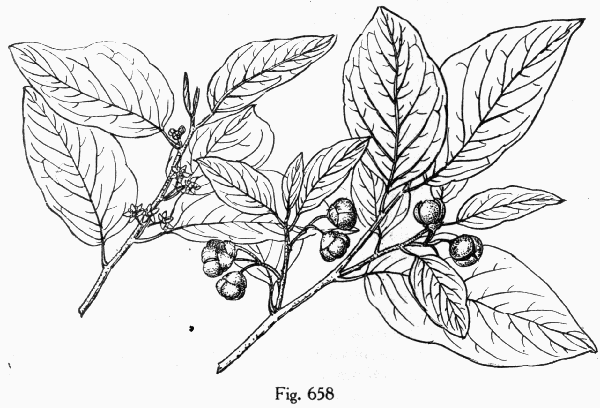
Leaves coriaceous, persistent, elliptic to ovate-lanceolate, gradually narrowed and bluntly pointed at apex, narrowed and rounded or cuneate at base, entire, dark green, glabrous and lustrous on the upper surface, pale and coated on the lower surface with thick rusty pubescence and sometimes marked by conspicuous glands mostly at the end of small veins, 2′—4½′ long and 1¼′—2½′ wide, with a thick midrib; petioles stout, rusty-pubescent, ½′—¾′ in length; stipules oblong, acuminate, rusty-pubescent, caducous. Flowers minute, in axillary cymes shorter than the petioles, covered with persistent rusty pubescence and generally produced on short axillary branches; petals white or nearly white. Fruit on a stout rusty-pubescent pedicel, about ½′ long, on a much thickened peduncle, obovoid to subglobose, dark purple or nearly black, 5/12′ in diameter; nutlets light yellow; seed about ⅙′ long.
A tree, sometimes 25° high, with a straight trunk 8′—12′ in diameter, large erect branches and stout branchlets densely rusty-pubescent when they first appear, and light gray, puberulous and marked by small dark lenticels in their second year; in Florida more often a shrub.
Distribution. Florida, on the Everglade and southern keys; on the Bahama Islands and on several of the Antilles.
[732]
XXXIX. TILIACEÆ.
Trees, shrubs, or herbs, with alternate simple leaves, and free stipules. Flowers regular, perfect; sepals valvate in the bud, deciduous; corolla hypogynous; stamens numerous, with 2-celled anthers, the cells opening longitudinally; pistil compound; styles united into 1; stigma capitate. Fruit capsular or nut-like. Seeds with albumen; embryo with broad foliaceous cotyledons.
The Linden family with forty-four genera is chiefly tropical, with more representatives in the southern than in the northern hemisphere. Of the three North American genera only Tilia is arborescent.
1. TILIA L. Bass Wood. Linden.
Trees, with terete moderately stout branchlets, without a terminal bud, large compressed acute axillary buds, with numerous imbricated scales, those of the inner rank accrescent, mucilaginous juice, and tough fibrous inner bark. Leaves conduplicate in the bud, long-petiolate, 2-ranked, cordate or truncate at the oblique base, acute or acuminate, serrate, deciduous, their petioles in falling leaving large elevated horizontal leaf-scars displaying the ends of numerous fibro-vascular bundles; stipules ligulate, membranaceous, caducous. Flowers nectariferous, fragrant, on slender clavate pedicels, in axillary or terminal cymes, with minute caducous bracts at the base of the branches, their peduncle more or less connate with the axis of a large membranaceous light green ligulate often obovate persistent conspicuously reticulate-veined bract; sepals 5, distinct; petals 5, imbricated in the bud, alternate with the sepals, sometimes thickened and glandular at the narrow base, creamy white or yellow, deciduous; stamens inserted on a short hypogynous receptacle; filaments filiform, forked near the apex, collected into 5 clusters and united at base with each other and (in the American species) with a spatulate petaloid scale (staminodium) placed opposite each petal, the branches of the filament bearing oblong extrorse half anthers; ovary sessile, tomentose, 5-celled, the cells opposite the sepals; style erect, dilated at apex into 5 spreading stigmatic lobes; ovules 2 in each cell, ascending from the middle of its inner angle, semianatropous, the micropyle centripetal-inferior. Fruit nut-like, woody, subglobose to short-oblong or ovoid, sometimes ribbed, tomentose, 1-celled by the obliteration of the partitions, 1 or 2-seeded. Seeds obovoid, amphitropous, ascending; seed-coat cartilaginous, light reddish brown; embryo large, often curved, in fleshy albumen; cotyledons reniform or cordate, palmately 5-lobed, the margins irregularly involute or crumpled; radicle inferior.
Tilia with some thirty species is widely distributed in the temperate regions of the northern hemisphere with the exception of western America, central Asia, and the Himalayas. Tilia produces soft straight-grained pale-colored light wood, largely used for the interior finish of buildings, in cabinet-making, for the sounding-boards of pianos, wood-carving and wooden ware, and in the manufacture of paper. The tough inner bark is largely manufactured into mats, cords, fish-nets, coarse cloths, and shoes. Lime-flower oil, obtained by distilling the flowers of the European species, is used in perfumery. The flowers yield large quantities of nectar, and honey made near forests of Tilia is unsurpassed in flavor and delicacy. Many of the species are planted as shade and ornamental trees, and some of the European species are now common in the gardens and parks of the eastern United States.
CONSPECTUS OF THE SPECIES OF THE UNITED STATES.
Surface of the leaves glabrous at maturity.
Leaves glabrous or almost glabrous when they unfold, coarsely serrate.
Leaves furnished with conspicuous tufts of axillary hairs, their lower surface light green and lustrous; pedicels glabrous or nearly glabrous.
1. T. glabra (A).
Leaves usually without tufts of axillary hairs, their lower surface not lustrous; pedicels densely hoary-tomentose.
2. T. nuda (C).
[733]
Leaves hoary-tomentose when they unfold.
Leaves soon glabrous.
Leaves coarsely serrate with stout teeth, their veinlets conspicuous; branchlets stout, bright red.
3. T. venulosa (A).
Leaves finely serrate with straight or incurved teeth, their veinlets less conspicuous; branchlets slender, pale reddish brown.
4. T. littoralis (C).
Leaves crenately serrate, glaucescent on the lower surface.
5. T. crenoserrata (C).
Leaves covered below early in the season with articulate hairs, becoming glabrous or nearly glabrous.
Leaves thin, coarsely serrate, green or glaucescent on the lower surface, with or without tufts of axillary hairs; summer shoots not pubescent.
6. T. floridana (C).
Leaves subcoriaceous, finely serrate, bluish green and lustrous below early in the season; tufts of axillary hairs minute, usually wanting; summer shoots pubescent.
7. T. Cocksii (C).
Surface of the leaves pubescent below during the season.
Lower surface of the leaves covered with short gray firmly attached pubescence; tufts of axillary hairs not conspicuous.
8. T. neglecta (A, C).
Lower surface of the leaves covered with articulate easily detached hairs.
Branchlets without straight hairs.
Leaves ovate, acuminate, usually obliquely truncate at base, glabrous above, their pubescence brownish or white.
9. T. caroliniana (C).
Leaves oblong-ovate, cordate or obliquely cordate at base, pubescent above early in the season.
10. T. texana (C).
Leaves semiorbicular to broad-ovate, abruptly short-pointed, deeply and usually symmetrically cordate at base.
11. T. phanera (C).
Branchlets covered with straight hairs; leaves ovate, abruptly short-pointed, oblique and truncate at base.
12. T. lasioclada (C).
Surface of the leaves tomentose below during the season with close firmly attached tomentum.
Tomentum white, gray, or brown; leaves usually glabrous on the upper surface; branchlets and winter-buds glabrous (occasionally pubescent in varieties of 13).
Branchlets slender; petioles not more than 1½′ in length; leaves oblong-ovate, acuminate or abruptly pointed, oblique and truncate or cordate at base; tomentum on the leaves of upper branches often brown; flowers ¼′—⅓′ long.
13. T. heterophylla (A, C).
Branchlets stout; petioles up to 3′ in length; leaves oblong-ovate, acuminate, obliquely truncate at base; tomentum always white; flowers 5/12′½′ long.
14. T. monticola (A).
Tomentum pale or brownish; leaves thickly covered above early in the season with fascicled hairs; branchlets tomentose; winter-buds pubescent.
15. T. georgiana (C).
1. Tilia glabra Vent. Linden. Bass Wood.
Tilia americana L.
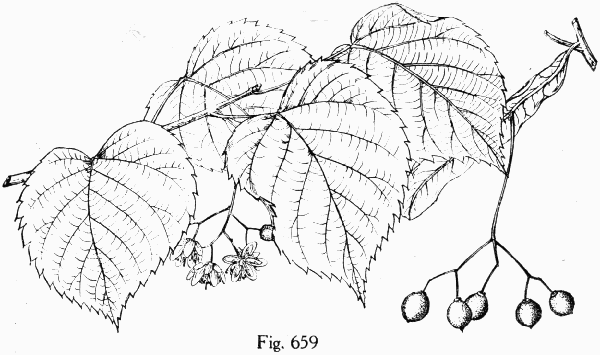
Leaves broad-ovate, contracted at apex into a slender acuminate entire point, obliquely cordate or sometimes almost truncate at base, coarsely serrate with incurved glandular teeth, often slightly pubescent when they first appear soon glabrous with the exception of tufts of rusty brown hairs in the axils of the principal veins below, thick and firm, dark dull green on the upper surface, lighter, yellow-green and lustrous on the lower surface, 5′—6′ long and 3′—4′ wide; turning pale yellow in the autumn before falling; petioles slender, 1½′—2′ in length. Flowers ½′ long, opening early in July on slender slightly angled pubescent pedicels, in few-flowered slender-branched glabrous cymes; peduncle slender, glabrous, the free portion 3½′—4′ long, its bract rounded or pointed at apex, 4′—5′ long, 1′—1½′ wide, decurrent nearly to the base or to within ½′—1′ of the base of the peduncle; sepals ovate, acuminate, densely hairy on the inner surface and slightly pubescent on the outer [734] surface, a third shorter than the lanceolate petals; staminodia oblong-obovate, bluntly pointed at apex, a third shorter than the petals; ovary villose; style covered with rufous tomentum. Fruit short-oblong to oblong-obovoid, rounded or pointed at apex, ⅓′—½′ long, and covered with short thick rufous tomentum.
A tree, usually 60°—70°, or sometimes 120°—130° high, with a tall trunk 3°—4° in diameter, small often pendulous branches forming a broad round-topped head, slender smooth glabrous light gray or light brown branchlets marked by numerous oblong dark lenticels, becoming darker in their second and dark gray or brown and conspicuously rugose in their third year. Winter-buds dark red, ovoid, about ¼′ long. Bark of the trunk about 1′ thick, deeply furrowed, the light brown surface broken into small thin scales. Wood light brown faintly tinged with red, with thick hardly distinguishable sapwood of 55—65 layers of annual growth; employed in the manufacture of paper pulp, and under the name of white wood largely used in wooden ware, cheap furniture, the panels of carriages, and for the inner soles of shoes.
Distribution. Rich often moist soil, formerly often in nearly pure forests; northern New Brunswick to the eastern shores of Lake Superior, the southern shores of Lake Winnipeg and the valley of the Assiniboine River, and southward to Pennsylvania, Ohio, eastern Kentucky, southern Michigan, Indiana and Illinois, eastern Nebraska and northern Missouri.
Often cultivated as a shade and ornamental tree in the northeastern states, and occasionally in Europe.
2. Tilia nuda Sarg.
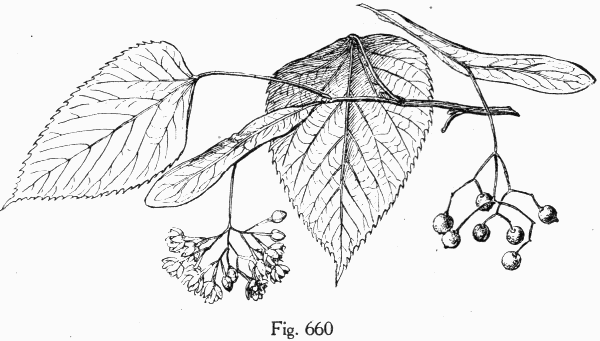
Leaves thin, ovate, abruptly pointed at apex, obliquely truncate or unsymmetrically cordate at base, and coarsely serrate with long slender straight or slightly curved conspicuously glandular teeth, as they unfold, dark red and sparingly pubescent on the midrib and veins, glabrous at the end of a few days, without or rarely with small axillary tufts, dark green on the upper surface, pale yellow-green or glaucous (var. glaucescens Sarg.) on the lower surface, 4′—4½′ long and 2½′—3½′ wide; petioles slender, glabrous, 2′—2½′ in length. Flowers opening early in June, about ⅓′ long, on hoary-tomentose pedicels, in broad usually 10 or 12, sometimes 30 or 40-flowered long-branched glabrous cymes; peduncle glabrous, the free portion ⅘′—1¼′ in length, its bract oblong, often slightly falcate, cuneate or rounded at base, rounded at apex, glabrous, 3′—4′ long, ½′—1¼′ wide, decurrent nearly to the base of the peduncle; sepals acute, rusty-tomentose on the outer surface, glabrous on the inner surface; petals oblong-ovate, narrowed at the rounded apex; staminodia [735] oblong-obovate rounded at the broad apex; style glabrous. Fruit ripening in September, subglobose to depressed-globose, covered with rusty tomentum, ¼′—⅓′ in diameter.
Usually a small tree with pale furrowed or sometimes checkered bark, small spreading branches forming a narrow round-topped head, and slender glabrous orange or red-brown branchlets. Winter-buds ovoid, obtusely pointed, dull red, glabrous, ⅙′—⅕′ long.
Distribution. Central and southwestern Mississippi (Hinds and Adams Counties); Dallas County, Alabama; West Feliciana and Calcasieu Parishes, Louisiana, to the valley of the Brazos River, eastern Texas, and to Hempstead County (Fulton and McNab), southern Arkansas; the var. glaucescens with the type, and near Page, Le Flore County, Oklahoma; in wet woods subject to overflow at San Augustine, San Augustine County, Texas, a variety (var. brevipedunculata Sarg.), differs from the type in the less coarsely serrate smaller leaves glaucescent below, in the shorter free portion of the peduncle of the inflorescence and its broader bract. A tree 25°—30° high, with slender glabrous dark red-brown branchlets.
3. Tilia venulosa Sarg.
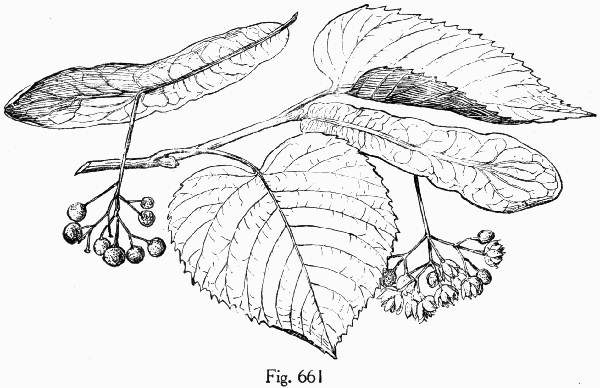
Leaves broad-ovate, abruptly acuminate at apex, cordate or unsymmetrically cordate or obliquely truncate or cordate at base, coarsely serrate with gland-tipped teeth pointing forward, covered when they unfold with pale tomentum, soon becoming pubescent, and glabrous before the flowers open, dark yellow-green on the upper surface, paler on the lower surface, 4′—4¾′ long and broad, with a prominent pale yellow midrib slightly villose on the upper side near the base, and 9 or 10 pairs of remote primary veins without axillary tufts and connected by conspicuous cross veinlets; petioles stout, glabrous, 1¾′—2′ in length. Flowers opening early in July, ⅓′ long, on slightly pubescent pedicels, in broad slender-branched nearly glabrous cymes; peduncle stout, glabrous, red, the free portion 1′—1½′ in length, its bract oblong to slightly obovate, gradually narrowed and rounded at base, rounded at apex, glabrous on the upper surface, pubescent below on the midrib and veins, 3½′—6′ long and 1¼′—1½′ wide, longer than the peduncle and decurrent nearly to its base or to within 1′—1½′ of its base; sepals ovate, acute, pale pubescent on the outer surface, villose and furnished at base on the inner surface with a tuft of long white hairs, a third shorter than the lanceolate acuminate petals; staminodia oblong-obovate, rounded at apex, about as long as the sepals; stigma slightly villose at base. Fruit ripening the end of September, subglobose, ¼′—⅓′ in diameter, covered with loose light brown pubescence.
A tree, 60°—75° high, with stout red glabrous branchlets. Winter-buds ovoid, cylindric, obtusely pointed, dark red, ¼′—⅓′ in length.
Distribution. North Carolina, rocky “coves” in rich soil, Hickory Nut Gap, in the [736] Blue Ridge, and near Saluda, Polk County, passing into var. multinervis Sarg., differing from the type in its obliquely truncate, not cordate, leaves with 12 or 13 pairs of more crowded primary veins, ellipsoid fruit, slender branchlets, and smaller winter-buds; a single tree near Saluda, Polk County.
4. Tilia littoralis Sarg.
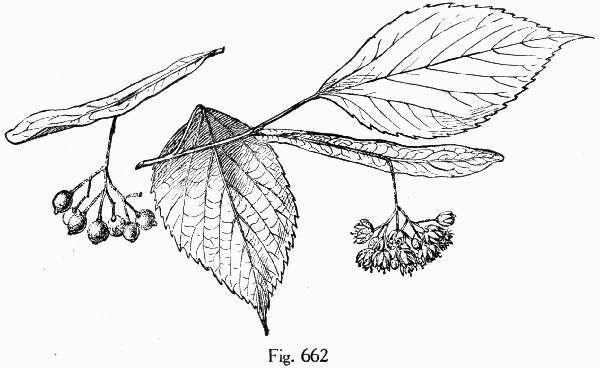
Leaves ovate, abruptly short-pointed and acute or acuminate at apex, unsymmetric and rounded on one side and cuneate on the other, or symmetric and cuneate or oblique and truncate at base, and finely serrate with straight or incurved glandular teeth, covered above when they unfold with scattered fascicled hairs and tomentose below, soon glabrous, and when the flowers open, thin, yellow-green, paler, rarely glaucous (var. discolor Sarg.) on the lower than on the upper surface, 3′—4′ long and 1¾′—2′ wide, with a slender midrib [737] and primary veins and small conspicuous tufts of rusty brown axillary hairs; petioles slender, glabrous, 1′—1½′ in length; leaves on young vigorous shoots broad-ovate, truncate or slightly cordate at base, more coarsely serrate, pubescent with fascicled hairs especially on the midrib and veins, 4′—5′ long and 3′—4′ wide; petioles densely pubescent. Flowers opening the middle of June, ⅓′ long, on pale tomentose pedicels, in small, compact, mostly 9—15-flowered, pubescent cymes; peduncle covered with scattered fascicled hairs, the free portion ⅗′—1′ long, its bract gradually narrowed and cuneate at base, rounded at apex, ciliate on the margins, pubescent on the midrib, otherwise glabrous, 2′—7′ long, ¼′—⅖′ wide, longer or shorter than and decurrent to the base or nearly to the base of the peduncle; sepals acuminate, pale pubescent on the outer surface, villose on the inner surface along the margins and at the base with long white hairs; petals acuminate; staminodia oblong-obovate, rounded at apex. Fruit ellipsoid to depressed-globose, apiculate, covered with pale brown tomentum, ¼′—⅓′ in diameter.
A tree with slender glabrous branchlets densely coated when they first appear with pale pubescence, soon glabrous, light reddish brown during their first summer, often bright red during their first winter, becoming purple the following year and ultimately light gray-brown. Winter-buds ovoid, glabrous or puberulous, bright red, about ⅕′ long and 1/12′—⅛′ in diameter.
Distribution. Georgia, shore of Colonel’s Island near the mouths of the North Newport and Medway Rivers, near Durham, Liberty County; the var. discolor with the type
5. Tilia crenoserrata Sarg.
Tilia floridana Sarg., not Small.
Leaves ovate, abruptly narrowed and acuminate at apex, usually oblique and unsymmetrically cordate or truncate or occasionally symmetrical and cordate at base, crenately serrate, the teeth tipped with minute glands, covered when they unfold with pale caducous tomentum, and at maturity dark green and lustrous above, glaucescent below, glabrous with the exception of minute axillary tufts of rusty hairs, mostly 3½′—5½′ long and 2¾′—3′ wide; petioles slender, glabrous, about 1¼′ in length. Flowers opening the middle of June, ⅓′ long, on hoary-tomentose pedicels, in compact mostly 10—18-flowered tomentose cymes; peduncle glabrous, the free portion 1′—1½′ in length, its bract oblong-obovate, cuneate at base, rounded at apex, glabrous, 3′—5′ long, usually about ⅘′ wide, decurrent nearly to the base of the peduncle; sepals acute, hoary-tomentose on the outer surface, coated with pale tomentum mixed with long white hairs on the inner surface; petals narrow-acuminate; staminodia oblong-obovate, notched at apex. Fruit ripening from the middle to the end of August, ellipsoid, conspicuously apiculate at apex, rusty-tomentose, ⅓′—⅖′ long and ¼′—⅓′ in diameter.
A tree, 25°—30°, rarely 60° high, with a trunk 10′—12′ rarely 18′—20′ in diameter, and slender glabrous red-brown branchlets. Winter-buds ovoid, acute, dark dull red, glabrous, ⅙′—⅕′ long.
Distribution. Near Albany, Dougherty County, Georgia, to central Florida (Levy, Columbia, Alachua, Putnam, Seminole and Orange Counties).
6. Tilia floridana Ashe.
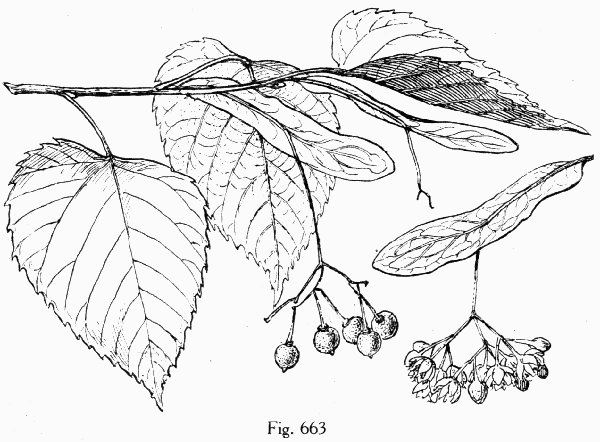
Leaves broad-ovate, acuminate or abruptly acuminate at apex, cordate or obliquely truncate at base and coarsely serrate with apiculate teeth, tinged with red and tomentose below when they unfold, fully grown and glabrous or nearly glabrous when the flowers open late in May or in early June, and at maturity thin, glabrous, dark yellow-green on the upper surface, pale or rarely covered below with a silvery white bloom (var. hypoleuca Sarg.), 3½′—5′ long and 2½′—3½′ wide, with a slender midrib and primary veins; in the east usually without axillary tufts, often present and sometimes conspicuous westward; petioles slender, glabrous, ¾′—1′ in length. Flowers opening in early summer ⅕′—¼′ long, on hoary-tomentose rarely puberulous (var. australis Sarg.) pedicels, in few-flowered rather compact [738] pubescent corymbs; peduncle pubescent, the free portion 1½′—2½′ in length, its bract oblong-obovate to oblong, rounded at apex, often falcate, glabrous, 3′—6′ long, ½′—¾′ wide, decurrent nearly to the base of the peduncle; sepals narrow, ovate, acuminate, hoary-tomentose on the outer surface, sparingly villose on the inner surface, two-thirds as long as the lanceolate petals; staminodia oblong-obovate, acute, nearly as long as the petals; style glabrous. Fruit ripening in August and September, subglobose to ellipsoid, rusty-tomentose, ½′ in diameter.
A tree, 40°—50° high, with a trunk 12′—15′ in diameter, and slender glabrous red-brown or yellow branchlets. Winter-buds obtuse, dark red-brown, glabrous, about ⅙′ long.
Distribution. North Carolina (Polk County) to western Florida and westward through northern and central Alabama, central Mississippi, northern and western Louisiana, eastern and over the Edwards Plateau to Kerr, Bandera and Uvalde Counties, Texas, and through southern and western Arkansas to eastern Oklahoma, Missouri and eastern Kentucky; in northeastern Mexico; the var. australis in Blount County, Alabama. A variety (var. oblongifolia Sarg.) with narrower more elongated leaves with more prominent tufts of axillary hairs occurs in Putnam, Leon and Gadsden Counties, Florida, on the bluffs of the Alabama River near Berlin, Dallas County, Alabama, in Hinds, Rankin and Adams Counties, Mississippi, in West Feliciana, Iberia (Avery Island) and Natchitoches Parishes, Louisiana, in Hempstead and Salina Counties, Arkansas, and in Harris, Anderson and Livingston Counties, Texas.
7. Tilia Cocksii Sarg.
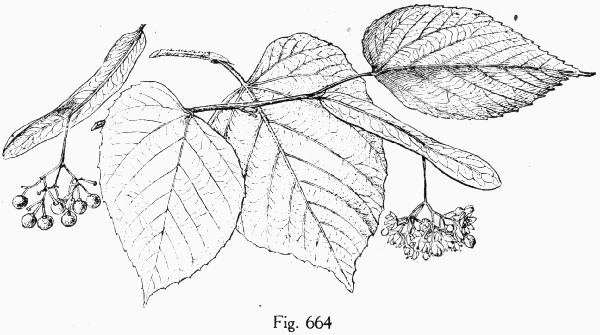
Leaves ovate, abruptly acuminate at apex, very oblique at the truncate or rounded base, dentate with small remote glandular apiculate teeth, covered when they unfold with loose floccose pubescence, nearly glabrous when fully grown early in April, when the flowers open the middle of May dark green and lustrous on the upper surface, pale blue-green and lustrous below, and at mid-summer when the fruit ripens, subcoriaceous, dark green and lustrous on the upper surface, paler on the lower surface, with slender primary veins without or occasionally with minute axillary tufts, and connected by conspicuous straight or curved veinlets, 3½′—4′ long and 2½′—3′ wide; petioles slender, glabrous, ¾′—1′ in length; [739] leaves on leading summer branchlets sometimes obliquely cordate, more coarsely serrate, covered on the upper surface with short fascicled hairs, and floccose-pubescent on the lower surface, 4′—5′ long and 4′—4¾′ wide, their petioles puberulous. Flowers opening the middle of May, ¼′ long, on tomentose pedicels, in compact pubescent many-flowered cymes; peduncle slender, glabrous, the free portion only ⅗′—⅘′ in length, its bract oblong, occasionally slightly obovate, rounded at the ends, hoary-tomentose on the under surface and pubescent on the upper surface when it first appears, and when the flowers open puberulous below and glabrous above, 3½′—6′ long, ½′—⅗′ wide and shorter than and decurrent to the base of the peduncle; sepals ovate, acuminate, pale pubescent on the outer surface, villose at the base on the inner surface, a third shorter than the lanceolate acuminate petals; staminodia oblong-obovate, rounded at apex, about half the length of the petals; style glabrous. Fruit ripening the middle of July, globose to depressed-globose, covered with loose brown tomentum, ¼′ in diameter.
A small tree with slender dull red glabrous branchlets, the leading branchlets in summer more or less pubescent. Winter-buds ovoid, acute, dull red, glabrous or pubescent on leading shoots, ⅕′—¼′ long.
Distribution. Louisiana, river banks and low woods, Lake Charles and West Lake Charles, Calcasieu Parish.
8. Tilia neglecta Spach.
Tilia Michauxii Sarg., not Nutt.
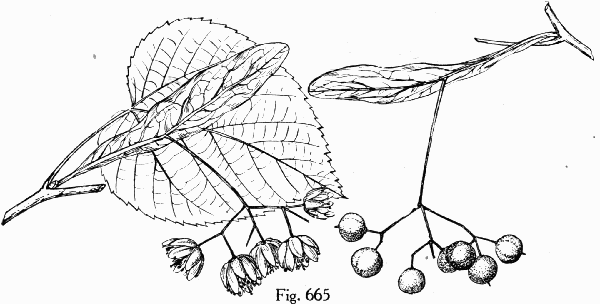
Leaves thick and firm, acute or abruptly narrowed and long-pointed at apex, obliquely concave or unsymmetrically cordate at base, coarsely serrate with straight apiculate teeth pointing forward, dark green, smooth, glabrous and lustrous above, covered below except on the midrib and veins more or less thickly with short gray pubescence often slightly tinged with brown, and furnished with conspicuous tufts of axillary hairs, usually 4′—5½′ long and 2½′—4½′ wide; petioles stout, glabrous, 1¼′—2½′ in length. Flowers opening in June and July about ⅖′ long, on pubescent or nearly glabrous pedicels, in long-branched slender glabrous mostly 5—15-flowered cymes; peduncle slender, glabrous, the free portion 1¼′—1½′ in length, its bract gradually narrowed and cuneate or unsymmetrically cuneate or rounded at base, rounded at apex, glabrous, 2¾′—4½′ long, ⅖′—⅘′ wide and longer than and decurrent nearly to the base or to within ⅗′ of the base of the peduncle; sepals broad-ovate, acute, ciliate on the margins, glabrous on the outer surface, covered on the inner surface with long white hairs, about half as long as the lanceolate petals rounded and notched at apex and rather longer than the spatulate staminodia; stamens included; style [740] villose toward the base. Fruit ripening in September, ellipsoid, ovoid, obovoid, or depressed-globose, rounded or acute or rarely gradually narrowed and acuminate at apex, rarely 5-angled, covered with rusty or pale pubescence, usually about ⅓′ in diameter.
A tree, 75°—90° high, with a trunk sometimes 3° in diameter, smooth often pendulous branches forming a broad round head, and slender glabrous branchlets. Winter-buds ovoid, rounded at the narrowed apex, about ⅕′ long, with glabrous red-brown or light brown scales. Bark of the trunk about 1′ thick, deeply furrowed, pale reddish brown and covered with small thin scales.
Distribution. Rich moist soil, Province of Quebec, near Montreal, to the coast of Massachusetts and New York, through the middle states to the valley of the Potomac River and along the Appalachian Mountains to those of North Carolina, and to Iuka, Tishomingo County, Mississippi, and from central and western New York to northern Missouri.
9. Tilia caroliniana Mill.
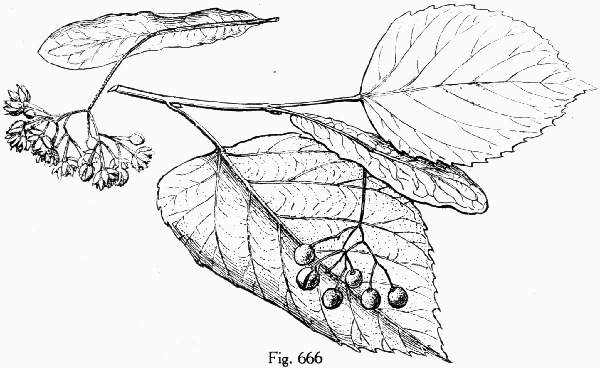
Leaves ovate, oblique and truncate or cordate at base, abruptly long-pointed at apex, coarsely dentate with broad apiculate glandular teeth pointing forward, and coated below [741] with a rusty or pale easily detached pubescence of fascicled hairs, coated when they unfold with hoary tomentum, soon glabrous on the upper surface, and at maturity dark yellow-green and lustrous above, 2¾′—4½′ long and 2½′—5′ wide; petioles stout, glabrous, 1′—1½′ in length. Flowers opening the middle of June, ¼′ long, on slender pubescent pedicels, in small stout-branched pubescent mostly 8—15-flowered cymes; peduncle slender, pubescent, the free portion ¾′—1¼′ long, its bract oblong-obovate, cuneate at base, rounded or acute at apex, nearly glabrous on the upper surface when it first appears, pubescent becoming glabrous or almost glabrous below, 4′—5′ long and ⅘′ wide, longer or shorter than and decurrent to the base or nearly to the base of the peduncle; sepals ovate, acuminate, ciliate on the margins, brown and covered with pale pubescence on the outer surface, coated on the inner surface with long white hairs; petals lanceolate, acuminate, a third longer than the sepals; staminodia oblong-obovate, rounded at apex, rather shorter than the petals; style tomentose at base or glabrous. Fruit subglobose, ellipsoid or obovoid, ⅛′ in diameter.
A large tree with slender red-brown glabrous or slightly pubescent branchlets. Winter-buds ovoid, acute, glabrous or rarely pubescent, about ¼′ long.
Distribution. Coast of North Carolina (Wrightsville Beach and the neighborhood of Wilmington, New Hanover County), southward in the immediate neighborhood of the coast to Liberty County, Georgia; western Louisiana to southern Arkansas (Hempstead and Clark Counties) common, and through eastern Texas to the Edwards Plateau (near Boerne, Kendall County); in Orizaba. Passing into
Tilia caroliniana var. rhoophila Sarg.
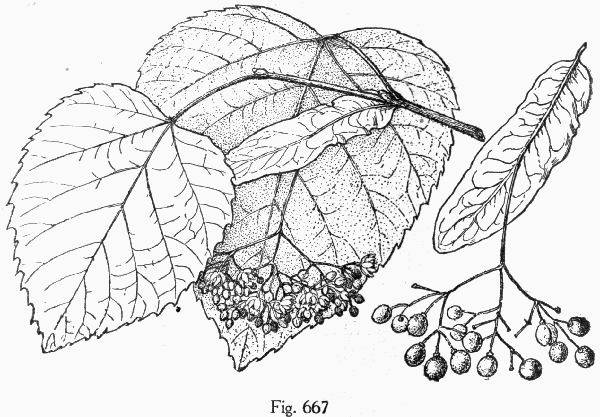
Differing from the type in its pubescent branchlets and winter-buds, its usually larger leaves, and in its tomentose corymbs of more numerous flowers. Leaves broad-ovate, abruptly short-pointed and acuminate at apex, oblique and truncate or cordate at base, coarsely serrate with broad apiculate teeth pointing forward, dark green and lustrous on the upper surface, pale and thickly covered on the lower surface with persistent white or brownish pubescence, 4′—5′ long and 2½′—5′ wide, with a slender midrib and primary veins pubescent on the lower side, and small conspicuous axillary tufts of pale hairs; petioles stout, thickly coated with pubescence, 1′—1¾′ in length; leaves on vigorous shoots often 6′ long, and 5½′ wide, and occasionally 10′ long and 9′ wide. Flowers ¼′ long, on short [742] hoary-tomentose pedicels, in wide thin-branched pubescent many-flowered (sometimes 50) cymes; peduncle thickly covered with fascicled hairs, the free portion ¼′ long, its bract oblong, unequally rounded at base, rounded at apex, glabrous on the upper surface, pubescent on the lower surface, 4′—6′ long, 1′—2′ wide, usually shorter than and decurrent nearly to the base of the peduncle; sepals acuminate, coated on the outer surface with pale or slightly rusty pubescence, villose and furnished at base on the inner surface with tufts of long hairs; petals lanceolate, acuminate and ciliate at apex, about a third longer than the sepals; staminodia spatulate, acute, about half the length of the petals; style coated at base with long white hairs. Fruit subglobose, covered with rusty tomentum, about ⅓′ in diameter.
A tree with slender branchlets thickly coated during their first year with pale pubescence, dark red-brown or gray and puberulous during their second season. Winter-buds covered with pale pubescence.
Distribution. Western Louisiana (Calcasieu and Jefferson Davis Parishes) to Hempstead County, Arkansas, and through eastern Texas to the valley of the upper Guadalupe River, Kerr County.
10. Tilia texana Sarg.
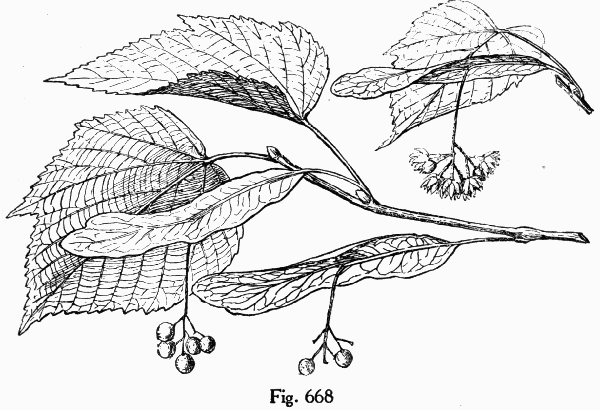
Leaves thin, oblong-ovate, abruptly contracted into a long slender acuminate point, cordate or obliquely cordate at base, finely dentate with broad apiculate teeth, early in the season pubescent above with scattered fascicled hairs and covered below with brownish slightly attached pubescence, and in the autumn light yellow-green, lustrous and nearly glabrous on the upper surface, slightly pubescent on the lower surface, 4′—5½′ long and 3¼′—5′ wide, with a slender midrib and primary veins sparingly villose on the upper side and nearly glabrous on the lower side, and small axillary tufts of brownish hairs; petioles slender, pubescent with fascicled hairs, 1′—1½′ in length; leaves on vigorous shoots often furnished with one or two large lateral acuminate serrate lobes, more coarsely dentate and more thickly covered on the lower surface with pubescence, often 5½′—6′ long and 3½′—6′ wide. Flowers opening the middle of June, ¼′ long, on slender tomentose pedicels, in small villose-pubescent mostly 7—10-flowered cymes; peduncle slender, slightly villose-pubescent, the free portion 1¼′—1½′ in length, its bract oblong-ovate to slightly obovate, unsymmetrically cuneate at base, rounded and occasionally lobed at apex, glabrous on the upper surface, [743] densely pubescent early in the season, later becoming nearly glabrous on the lower surface, 3′—6′ long and ¾′—1¼′ wide, longer or shorter than the peduncle and decurrent to its base or to within 1½′ of its base; sepals ovate, acute, pale pubescent on the outer surface, covered on the inner surface with white hairs longer and more abundant near the base; petals lanceolate, acuminate, a third longer than the sepals; staminodia linear-lanceolate, acuminate; style hoary-tomentose at base. Fruit ellipsoid, covered with rusty brown tomentum, ⅓′ long and ¼′ broad.
A small tree with slender branchlets thickly covered during their first season with close pale pubescence, and pale and puberulous or glabrous in their second year; on vigorous terminal branchlets often with thicker, light rusty brown pubescence. Winter-buds ovoid, obtusely pointed, thickly covered with pale pubescence, ¼′ long.
Distribution. Texas, Brazos and Cherokee Counties, on Spring Creek near Boerne, Kendall County, and on the rocky banks of the Guadalupe River at Kerrville, Kerr County.
11. Tilia phanera Sarg.
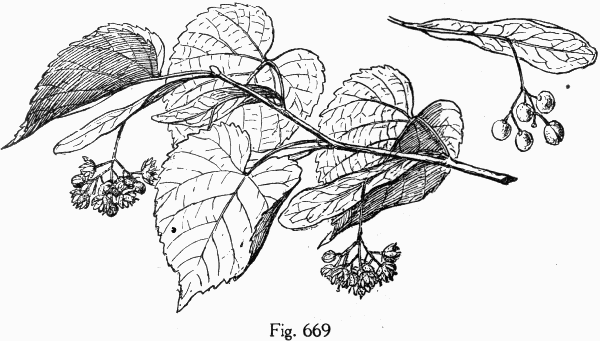
Leaves semiorbicular to broad-ovate, deeply and usually symmetrically cordate at base, abruptly short-pointed at apex, finely dentate with straight or incurved apiculate teeth, glabrous above when they unfold with the exception of a few hairs on the midrib and veins, and thickly coated below with hoary tomentum, and at maturity thin, blue-green, smooth and lustrous on the upper surface, paler and often brownish and coated with a floccose easily detached pubescence of fascicled hairs or scabrate (var. scabrida Sarg.) on the lower surface, 2′—4′ wide and usually rather broader than long, with a slender midrib and primary veins pubescent on the lower side, and small axillary clusters of rusty brown hairs; petioles slender, coated when they first appear with hoary tomentum, glabrous or slightly pubescent in the autumn, 1′—1½′ in length. Flowers opening the middle of June, ⅕′ long, on tomentose pedicels, in compact villose mostly 16—20-flowered cymes; peduncle villose, the free portion 1¼′ in length, its bract obovate, cuneate at base, broad and rounded at apex, floccose-pubescent on the lower surface, nearly glabrous on the upper surface, 3′—3½′ long and ½′—1′ wide, longer than the peduncle and decurrent to its base or to within ¼′ of its base; sepals acuminate, pale pubescent on the outer surface, villose on the margins and furnished at base on the inner surface with a tuft of long white hairs, broader and shorter than the lanceolate acuminate petals; staminodia oblong-obovate, rounded at apex, style glabrous except at the base. Fruit ripening the end of September, ellipsoid, covered with rusty tomentum, ⅓′—⅖′ long and ¼′ wide, on a stout, densely floccose-pubescent pedicel.
[744]
A tree with slender light gray-brown often zigzag branchlets covered when they first appear with fascicled hairs and deciduous during their first summer. Winter-buds ovoid, obtusely pointed, terete, reddish brown, glabrous, ⅙′—⅕′ long.
Distribution. Texas, banks of Spring Creek, near Boerne, Kendall County; the var. scabrida on a low limestone bluff of the Blanco River, near Blanco, Blanco County, near College Station, Brazos County, and at Velasco, Brazoria County.
12. Tilia lasioclada Sarg.
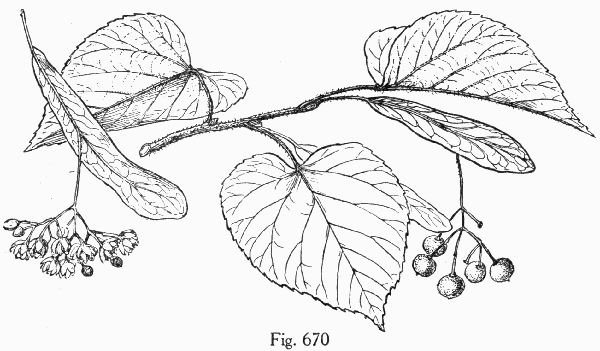
Leaves ovate, abruptly contracted at apex into a short acuminate point, oblique and truncate or on weak branchlets, often nearly symmetric and deeply cordate at base, and finely serrate with straight apiculate teeth, covered above when they unfold with soft caducous hairs and pubescent below, and at maturity thick, bright green, smooth and lustrous on the upper surface, pale and covered on the lower surface with a thick floccose easily detached pubescence of fascicled hairs, pale on those of lower leaves and often rufous on those of upper branches, 4′—6′ long and 3¼′—5′ wide, with a slender midrib and veins covered below with straight hairs mixed with fascicled hairs, and small conspicuous axillary tufts; petioles covered when they first appear with straight hairs mixed with fascicled hairs, soon glabrous, usually 1¼′—1½′ in length, those of the leaves of weak branchlets very slender and often 2′—2½′ long. Flowers in May, ⅙′—⅕′ long, on stout villose pedicels, in long-branched mostly 10—15-flowered cymes more or less thickly covered with straight white hairs; peduncle covered with long white hairs, the free portion 1′—1¼′ in length, its bract rounded and unsymmetric or acute at base, rounded or acute at apex, the midrib more or less thickly covered on the lower side with straight hairs, otherwise glabrous, 3½′—5′ long and 1′ wide, decurrent nearly to the base or to within 1′ of the base of the peduncle; sepals narrow, acute, pubescent on the outer surface, villose on the inner surface, about one-third as long as the lanceolate acuminate petals; staminodia spatulate, rounded and often lobed at apex, about as long as the sepals; style slightly villose at base. Fruit ripening in September, globose or depressed-globose, covered with rusty tomentum, about ⅖′ in diameter.
A tree, sometimes 60° high, with a trunk 12′—24′ in diameter, heavy branches forming a broad round-topped head, and stout red-brown branchlets sometimes glabrous in early summer and sometimes covered more or less thickly during their first and second seasons with long straight hairs.
Distribution. Valley of the Savannah River, near Abbeville, South Carolina, to Shell Bluff, Burke County, Georgia; River Junction, Gadsden County, Florida.
[745]
13. Tilia heterophylla Vent.
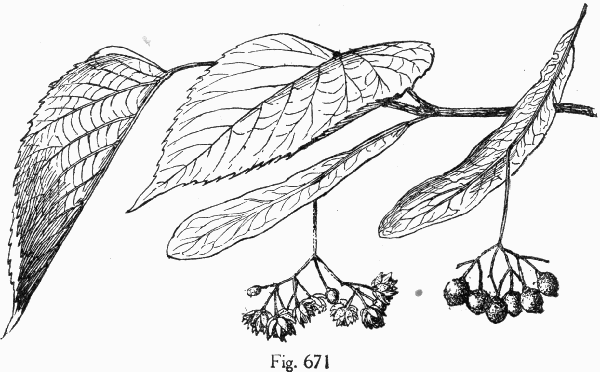
Leaves ovate, obliquely truncate or rarely slightly cordate at base, gradually narrowed and acuminate at apex, finely dentate with apiculate gland-tipped teeth, pubescent above when they unfold with caducous fascicled hairs, and at maturity dark green and glabrous on the upper surface, covered on the lower surface with thick, firmly attached, white or on upper branches often brownish tomentum, and usually furnished with small axillary tufts of rusty brown hairs, 3¼′—5¼′ long and 2½′—2¾′ wide; petioles slender, glabrous, 1½′—1¾′ in length. Flowers ¼′ long, opening in early summer, on pedicels pubescent with fascicled hairs, in wide mostly 10—20-flowered pubescent corymbs; peduncle glabrous, the free portion 1/12′—⅙′ in length, its bract narrowed and rounded at apex, unsymmetrically cuneate at base, pubescent on the upper surface, tomentose on the lower surface when it first appears, becoming glabrous, 4′—6′ long and 1′—1½′ wide, nearly sessile or decurrent to within 1½′ of the base of the peduncle; sepals acuminate, pale-pubescent on the outer surface, villose on the inner surface and furnished at base with a tuft of long white hairs; petals lanceolate, acuminate, a third longer than the sepals; staminodia oblong-ovate, acute, sometimes notched at apex; style villose at base with long white hairs. Fruit ellipsoid, apiculate at apex, covered with rusty brown tomentum, about ⅓′ long.
A large tree with slender, glabrous, reddish or yellowish brown branchlets and oblong-ovate slightly flattened glabrous winter-buds ⅕′—⅓′ in length, the outer scales slightly ciliate at apex.
Distribution. White Sulphur Springs, Greenbrier County, West Virginia; Piedmont region of North and South Carolina and Georgia; near Tallahassee, Leon County, River Junction, Gadsden County, and Rock Cave, Jackson County, Florida; near Selma and Berlin, Dallas County, Alabama; Vevay, Switzerland County, and near the Ohio River, Jefferson County, Indiana; not common. Passing into the var. amphiloba Sarg., differing from the type in the fascicled hairs on the upper surface of the young leaves and in the often pubescent branchlets; woods in sandy soil near River Junction, Gadsden County, Florida, and Valley Head, DeKalb County, Alabama; and into var. nivea Sarg., differing from the type in the white tomentum on the lower surface of the leaves, the glabrous styles, in the tomentum on the lower side of the floral bract when the flowers open, the pubescent gray or pale reddish brown branchlets and in the puberulous winter-buds; deep woods, River Junction, Gadsden County, Florida. More important is
[746]
Tilia heterophylla var. Michauxii Sarg.
Tilia Michauxii Nutt.
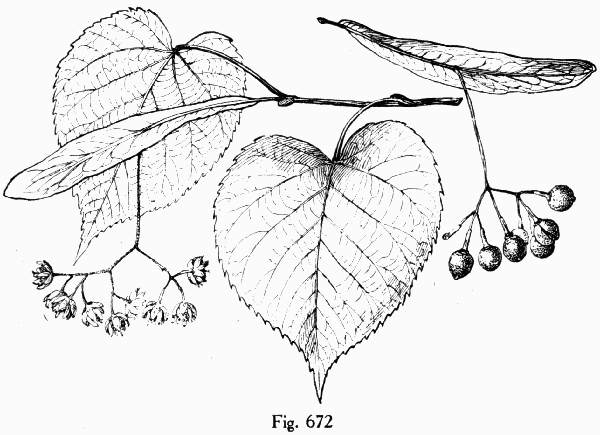
Leaves ovate to ovate-oblong, acute or abruptly short-pointed at the broad apex, cordate, obliquely cordate, or rarely obliquely truncate at base, and coarsely serrate with apiculate teeth, pubescent above when they unfold with caducous fascicled hairs, and hoary-tomentose beneath, and at maturity thin, dark green and lustrous on the upper surface and coated below with short white or grayish white tomentum, 3½′—6′ long and 3½′—5′ wide, with a slender yellow midrib and primary veins usually without axillary tufts; petioles slender, sparingly villose when they first appear, soon glabrous, 1½′—2½′ in length. Flowers ⅓′ long, opening about the 1st of July, on slender puberulous pedicels ¼′ in length, in wide long-stemmed puberulous cymes; peduncle pubescent, becoming glabrous, the free portion 1¾′—2′ in length, its bract obovoid, rounded or acute at apex, 3½′—5′ long and ½′—1′ wide, decurrent to within ⅓′—¾′ of the base of the peduncle; sepals ovate, acuminate, ciliate on the margins, puberulous on the outer surface, tomentose on the inner surface, ¼′ long, shorter than the lanceolate acuminate petals; staminodia oblong-obovoid, rounded or emarginate at apex; style glabrous. Fruit ripening in September, subglobose, rusty-tomentose, ¼′—⅓′ in diameter.
A large tree with slender glabrous light red-brown branchlets. Winter-buds ovoid, acute, slightly flattened, red, about ¼′ in length. Bark of the trunk 1′ thick, deeply furrowed, reddish or grayish brown and covered with small thin scales.
Distribution. Pennsylvania, valley of the Susquehanna River (Lancaster County) to southern and western New York and through southern Ohio, Indiana, and Illinois to northeastern Missouri (near Ilasco, Ralls County), and southward through eastern Kentucky and Tennessee to northeastern Mississippi, and along the Appalachian Mountains to northern Georgia; southern Georgia (Dougherty and Decatur Counties), Dallas County, Alabama; southwestern Missouri (Eagle Rock, Barry County), and northwestern Arkansas (Eureka Springs, Carroll County, and Cotter, Marion County).
[747]
14. Tilia monticola Sarg.
Tilia heterophylla Sarg., in part, not Vent.
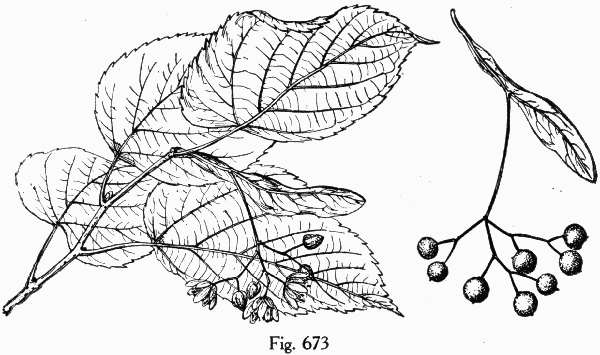
Leaves thin, gradually narrowed and acuminate at apex, ovate to oblong-ovate, very oblique and truncate or obliquely cordate at base, finely serrate with straight or incurved apiculate teeth, smooth, dark green and lustrous on the upper surface, thickly coated on the lower surface with hoary tomentum, 4′—7′ long and 3′—5′ wide; petioles slender, glabrous, 1½′—3′ in length. Flowers from the middle to the end of July, ⅖′—½′ long, on stout sparingly pubescent pedicels, in mostly 7—10-flowered thin-branched glabrous cymes; peduncle slender, glabrous, the free portion 1⅓′—1½′ in length, its bract gradually narrowed and cuneate or rounded at base, narrowed and rounded at apex, glabrous, 4′—5½′ long and ⅘′—1′ wide, decurrent to within 1/24′—⅛′ of the base of the peduncle; sepals ovate, acute, ciliate on the margins, covered on the outer surface with short pale pubescence and with silky white hairs on the inner surface; petals lanceolate, acuminate, twice longer than the sepals; staminodia oblong-lanceolate, rounded at the narrowed apex, as long or nearly as long as the petals; style clothed at the base with long white hairs. Fruit ripening in September, ovoid to ellipsoid, covered with pale rusty tomentum, ¼′—⅓′ long and about ¼′ in diameter.
A tree rarely exceeding 60° in height with a trunk 3°—4½° in diameter, slender branches forming a narrow rather pyramidal head, and stout glabrous branchlets usually bright red during their first year, becoming brown in their second season. Winter-buds compressed, ovoid, acute or rounded at apex, light red, covered with a glaucous bloom, ⅓′—½′ long. Bark of the trunk ⅗′ in thickness, deeply furrowed, the surface broken into small thin light brown scales.
Distribution. Appalachian Mountains at altitudes usually from 2500°—3000°, Farmer Mountain, on New River, Connell County, Virginia, to Johnson City, Washington County. Tennessee, and to Highlands, Macon County, North Carolina.
15. Tilia georgiana Sarg.
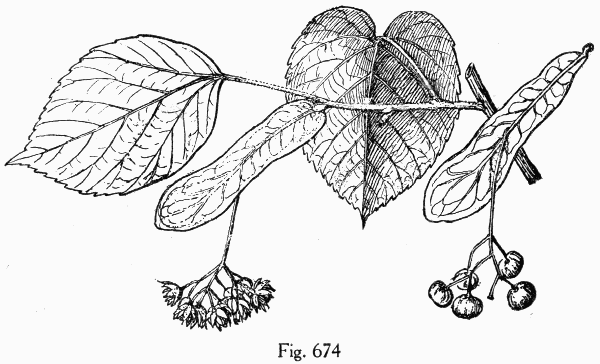
Leaves ovate, abruptly short-pointed at apex, slightly unsymmetric and usually cordate on lateral branches and often oblique or truncate on leading branches at base, and finely dentate with glandular teeth pointing forward, when they unfold deeply tinged with red, covered above by fascicled hairs and tomentose below, when the flowers open the middle of June dark yellow-green, dull and scabrate above and covered below with a thick coat of tomentum, pale on those of lower branches and tinged with brown on those from the top [748] of the tree, and conspicuously reticulate-venulose, and at maturity thick, dull yellow-green, pubescent or glabrous above, rusty or pale tomentose below, sometimes becoming nearly glabrous in the autumn, 2½′—4′ long and 2′—3′ wide; petioles slender, tomentose, 1′—1½′ in length. Flowers ¼′—⅓′ long, on slender pubescent pedicels, in compact slender-branched pubescent mostly 10—15-flowered corymbs; peduncle slender, densely pubescent, the free portion 1′—1½′ in length, its bract oblong to obovate, rounded at apex, rounded or cuneate at base, pubescent, becoming nearly glabrous, 2½′—4′ long and ¾′—1½′ wide, decurrent to the base or to within 1′ of the base of the peduncle; sepals ovate, acuminate, coated on the outer surface with pale pubescence and on the inner surface with pale hairs longest and most abundant at the base, not more than one-half the length of the lanceolate acuminate narrow petals; staminodia oblong-obovate to spatulate, acute, about two-thirds as long as the petals; style glabrous or furnished with a few hairs at the very base. Fruit ripens early in September on pubescent pedicels, depressed-globose, occasionally slightly grooved and ridged, covered with thick rusty tomentum, ⅕′—¼′ in diameter.
A small tree, with slender branchlets thickly coated during their first season with pale tomentum, and dark red-brown or brown and puberulous in their second year. Winter-buds covered with rusty brown pubescence, ¼′—⅓′ long.
Distribution. Coast of South Carolina, near Charleston; Colonel’s Island near the mouths of the North Newport and Medway Rivers, near Dunham, Liberty County, and at Brunswick, Glynn County, Georgia, to central and western Florida.
Tilia georgiana var. crinita Sarg.
Tilia pubescens Sarg., in part, not Vent.
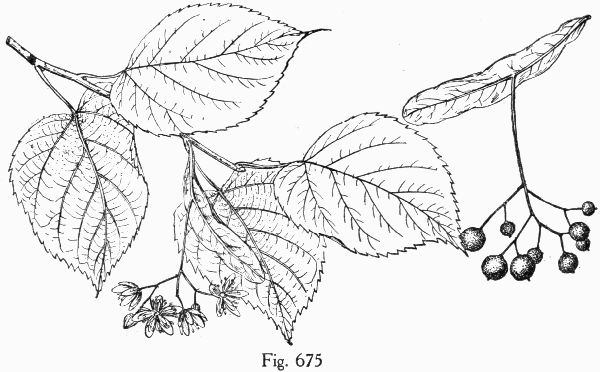
Differing in the longer and more matted usually rusty brown hairs of the pubescence, usually less closely attached to the under surface of the leaves and often conspicuous on the young branches.
A tree, 30°—40° high, with a trunk rarely exceeding 15′ in diameter, and slender branchlets densely rusty pubescent during their first season, and during their third year becoming glabrous, red-brown, rugose and marked by occasional small lenticels. Winter-buds acuminate, dark reddish brown and covered with short reddish pubescence. Bark of the trunk ½′—¾′ thick, furrowed and divided into parallel ridges, the red-brown surface broken into short thick scales.
Distribution. Sandy woods near Bluffton, Beaufort County, and in the neighborhood [749] of Charleston, South Carolina, and on Colonel’s Island near the mouth of the North Newport and Medway Rivers, near Dunham, Liberty County, Georgia.
XL. STERCULIACEÆ.
Trees or shrubs, with bitter astringent juice, mucilaginous bark, and alternate simple leaves, with stipules. Flowers perfect, regular; calyx of 5 sepals, imbricated in the bud; corolla 0 (in Fremontia); anthers extrorse; pistil of 5 united carpels; ovary 5-celled; styles united; ovules anatropous.
A family of about fifty genera mostly confined to the tropics. Its most important species, Theobroma Cacao L., of the West Indies, produces chocolate from the cotyledons. Firmiana simplex F. N. Meyer, of this family and a native of southern China, is often planted as an ornamental tree in the southern states, where it has sometimes become naturalized, and in California.
1. FREMONTIA Torr.
A tree or shrub, with stellate pubescence and naked buds. Leaves broad-ovate, lobed, thick, prominently veined, usually rufous on the lower surface, persistent; stipules minute, deciduous. Flowers solitary, terminal or opposite the leaves, pedicellate, subtended by 3 or rarely 5 minute caducous bracts; calyx subcampanulate, hypogynous, deeply 5-lobed, the lobes imbricated in the bud, petaloid, yellow, spreading, obovate, often mucronate, 1′ long, the 3 outer a little smaller than the others, pubescent on the outer surface, with a hairy cavity at the base of the inner surface; corolla 0; stamens 5; filaments alternate with the sepals, united to the middle into a column; anthers oblong-linear, incurved at the ends, 2-celled, the cells opening longitudinally; ovary 5-celled, the cells opposite the sepals; style filiform, elongated, terminated by an acute undivided stigmatic point; ovules numerous in each cell, horizontal. Fruit an ovoid acuminate 4 or 5-valved loculicidally dehiscent capsule densely coated with long matted hairs, the inner surface of the cells villose-pubescent. Seeds oval; seed-coat crustaceous, puberulous, with a small fleshy marginal deciduous ariloid appendage on the chalaza; embryo straight, in thick fleshy albumen; cotyledons oblong, foliaceous, three or four times longer than the short radicle.
Fremontia, named in honor of John C. Frémont, the distinguished explorer of western North America, is represented by a single species.
[750]
1. Fremontia californica Torr. Slippery Elm.
Fremontodendron californicum Cov.
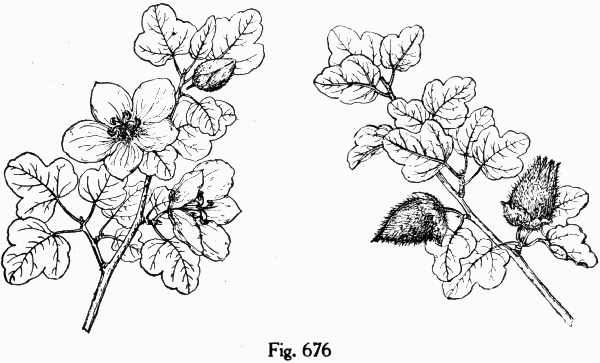
Leaves usually 3-lobed, rarely entire or sometimes 5—7-lobed, 1½′ in diameter; petioles stout, ½′—⅔′ in length. Flowers appearing in July in great profusion on short spur-like lateral branchlets. Fruit 1′ long; seeds very dark red-brown, about 3/16′ long.
A tree, 20°—30° high, with a short trunk 12′—14′ in diameter, stout rigid branches spreading almost at right angles, and stout terete branchlets thickly coated when they first appear with rufous pubescence, becoming glabrous and light red-brown; more often a low intricately branched shrub. Bark of the trunk rarely more than ¼′ thick, deeply furrowed, the dark red-brown surface broken into numerous short thick scales. Wood hard, heavy, close-grained, dark brown tinged with red, with thick lighter colored sapwood. The mucilaginous inner bark is sometimes used domestically in poultices.
Distribution. Lower slopes of the California mountains; western base of Mt. Shasta to the San Pedro Mártir Mountains, Lower California; nowhere common west of the Sierra Nevada, but of its largest size on their western foothills; most abundant east of the Sierra Nevada in the region of the Mohave Desert, growing as a low shrub and sometimes forming thickets several acres in extent.
Occasionally cultivated in western and southern Europe as an ornamental plant.
XLI. THEACEÆ.
Trees or shrubs, with simple alternate leaves, without stipules. Flowers perfect, regular, hypogynous; sepals and petals 5, imbricated in the bud; stamens numerous; anthers 2-celled, the cells opening longitudinally; pistil of 3—5 united carpels; ovary 3—5-celled; styles as many as the cells of the ovary, partly united. Fruit capsular; embryo with large cotyledons.
The Camellia family with eighteen genera is principally confined to the tropics of the New World and to southern and eastern Asia. Two genera are represented in the flora of the southern United States, and of these Gordonia is arborescent. Its most important genus, Camellia of eastern Asia, contains the Tea plant, Camellia Thea Link, and several species cultivated for the beauty of their flowers.
1. GORDONIA Ell.
Trees or shrubs, with terete branchlets, with an acuminate terminal bud, slender acuminate naked axillary buds, and watery juice. Leaves pinnately veined, entire or crenate, [751] subcoriaceous and persistent, or thin and deciduous. Flowers axillary, solitary, long-stalked or subsessile; calyx subtended by 2—5 caducous bracts; sepals unequal, rounded, concave, coriaceous, persistent; petals free or slightly united, obovate, concave, white, deciduous; stamens numerous, filaments short, united at base into a fleshy cup adnate to the base of the petals and inserted with them, or long and inserted directly on the petals; anthers introrse, yellow; ovary sessile; style elongated, erect, 5-lobed at the stigmatic apex; ovules 4—8 in each cell, pendulous in 2 series from its inner angle, collateral, anatropous. Fruit a woody oblong or subglobose 5-celled capsule loculicidally 5-valved, with a persistent axis angled by the projecting placentas. Seeds 2—8 in each cell pendulous, flat, without albumen; seed-coat woody, usually produced upward into an oblong wing; embryo mostly straight or oblique, with oblong flat or oblique cotyledons; radicle short, superior.
Gordonia with sixteen species is confined to the south Atlantic states of North America and to tropical Asia and the Malay Archipelago.
The generic name is in honor of James Gordon (1728—1791), a well-known London nurseryman.
CONSPECTUS OF THE NORTH AMERICAN SPECIES.
Flowers long-pedicellate; filaments united into a cup; capsule ovoid, the valves not splitting from the base; seeds winged; leaves persistent.
1. G. Lasianthus (C).
Flowers subsessile; filaments distinct; capsule globose, the valves septicidally splitting from the base; seeds without wings; leaves deciduous.
2. G. alatamaha (C).
1. Gordonia Lasianthus Ell. Bay. Loblolly Bay.
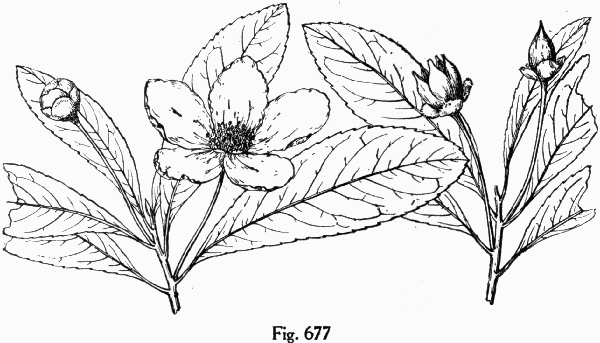
Leaves coriaceous, lanceolate to oblong, acute at apex, gradually narrowed to the cuneate base, finely or remotely crenately serrate, usually above the middle only, dark green, smooth and lustrous, 4′—5′ long and 1½′—2′ wide, persistent; finally turning scarlet and dropping irregularly through the year; petioles stout, wing-margined toward the apex, channeled, about ½′ in length. Flowers pungently fragrant, about 2½′ in diameter, expanding in July and continuing to open successively during two or three months, on stout red pedicels thickening from below upward, 2½′—3′ long, and usually furnished with 3 or 4 ovate minute subfloral bractlets; sepals ovate to oval, ½′ long, ciliate on the margins with long white hairs, and covered on the outer surface with dense velvety pale lustrous pubescence; petals rounded at apex, gradually contracted at base, silky-puberulent on the back, white, incurved, 1¼′—1½′ long and 1′ broad, stamens united into a shallow fleshy deeply 5-lobed cup pubescent on the inner surface and adnate to the base of the petals; [752] ovary ovoid, pubescent, gradually contracted into the stout style persistent on the fruit. Fruit ovoid, acute, pubescent, ¾′ long, and ½′ in diameter, splitting to below the middle; seeds winged, nearly square, slightly concave on the inner surface and rounded on the outer surface, rugose, dotted with small pale brown excrescences, nearly 1/16′ long and half the length of the thin membranaceous oblique pale brown wing pointed or rounded at apex; embryo filling the cavity of the seed, nearly straight; cotyledons subcordate, foliaceous.
A short-lived tree, 60°—75° high, with a tall straight trunk 18′—20′ in diameter, small branches growing upward at first and ultimately spreading into a narrow compact head, and dark brown rugose branchlets marked during several years by the horizontal slightly obcordate leaf-scars; or rarely a low shrub. Winter-buds ¼′—⅓′ long, and covered with pale silky lustrous pubescence. Bark of the trunk nearly 1′ thick, deeply divided into regular parallel rounded ridges, their dark red-brown scaly surface broken into many irregular shallow furrows. Wood light, soft, close-grained, not durable, light red, with lighter colored sapwood of 40—50 layers of annual growth; occasionally used in cabinet-making.
Distribution. Shallow swamps and moist depressions in Pine-barrens; southeastern Virginia southward near the coast to the shores of Indian River on the east coast and to Cape Romano on the west coast of Florida, ranging to the interior of the peninsula from Lake to De Soto Counties, and westward along the Gulf coast to southern Mississippi; most abundant in Georgia and east Florida; gradually becoming less abundant westward.
2. Gordonia alatamaha Sarg. Franklinia.
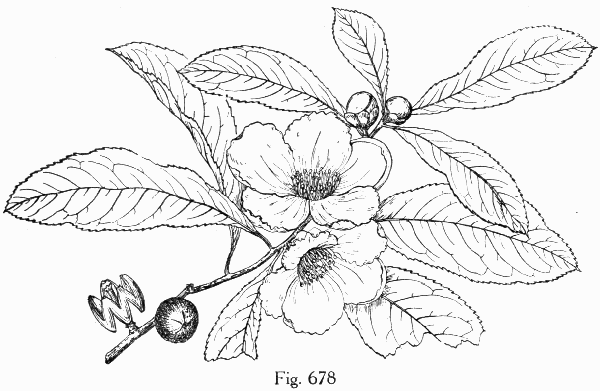
Leaves obovate-oblong, rounded or pointed at apex, gradually narrowed to the long cuneate base, remotely serrate, usually above the middle only, with small glandular teeth, bright green and lustrous on the upper surface, pale on the lower surface, 5′—6′ long and 1½′—2′ wide; turning scarlet in the autumn before falling; petioles stout, wing-margined above, ¼′—½′ in length. Flowers 3′—3½′ in diameter, appearing about the middle of September, on short stout pedicels at first pubescent, finally glabrous, from the axils of crowded upper leaves, and marked by the broad conspicuous scars of 2 minute lateral subfloral pubescent bractlets; sepals nearly circular, ½′ in diameter, ciliate on the margins, and covered on the outer surface with short lustrous silky pale hairs; petals obovate, crenulate, white, membranaceous, 1′—1½′ long and 1′ broad, and densely coated on the outer surface with fine pubescence; filaments distinct, inserted on the petals; ovary conspicuously [753] ridged, pubescent, truncate, and crowned with a slender deciduous style nearly as long as the stamens. Fruit globose, slightly pubescent, ¾′ in diameter, the valves splitting nearly to the middle and septicidally from the base to the middle; seeds 6—8, or by abortion fewer in each cell, closely packed together on the whole length of the thick axile placenta, nearly ½′ long, angled by mutual pressure, without wings.
A tree, 15°—20° high, with stout slightly angled dark red-brown branchlets covered with small pale oblong horizontal lenticels, and conspicuously marked by large prominent obcordate leaf-scars, with a marginal row of large fibro-vascular bundle-scars. Winter-buds compressed, reddish brown, puberulous, ¼′—⅓′ long. Bark of cultivated plants smooth, thin, dark brown.
Distribution. Near Fort Barrington on the Altamaha River, Georgia; not seen in a wild state since 1790, and now only known by cultivated plants.
Often cultivated in the eastern states and hardy as far north as eastern New York and occasionally in eastern Massachusetts, and rarely in western and central Europe.
XLII. CANELLACEÆ.
Trees, with pungent aromatic bark, and alternate pellucid-punctate entire penniveined persistent leaves, without stipules. Flowers perfect, regular, cymose; sepals and petals imbricated in the bud; stamens numerous, hypogynous, with filaments united into a tube inclosing the pistil, and narrow extrorse anthers adnate to the tube and longitudinally 2-celled; pistil of 2—3 united carpels; ovary free, 1-celled, with 2—5 parietal placentas; styles thick; stigmas 2—5-lobed; ovules 2 or many. Fruit a berry; seeds 2 or several; seed-coat thick, crustaceous; embryo small in fleshy oily albumen.
The Wild Cinnamon family with five genera and a few species is confined to tropical America, south Africa and Madagascar, one species reaching the shores of southern Florida.
1. CANELLA P. Br.
A tree, with scaly bark, stout ashy gray branchlets conspicuously marked by large orbicular leaf-scars, and minute buds. Leaves obovate, rounded or slightly emarginate at apex, gradually narrowed to the cuneate base, petiolate, coriaceous. Flowers small, in many-flowered subcorymbose terminal or subterminal panicles of several dichotomously branched cymes from the axils of upper leaves or from minute caducous bracts; sepals 3, suborbicular, concave, coriaceous, erect, their margins ciliate, persistent; petals 5, hypogynous, in a single row on the slightly convex receptacle, oblong, concave, rounded at apex, fleshy, twice as long as the sepals, white or rose color; stamens about 20, staminal tube crenulate at the summit and slightly extended above the anthers; ovary cylindric or oblong-conic, 1-celled, with 2 parietal placentas; style short, fleshy, terminating in a 2 or 3-lobed stigma; ovules numerous, arcuate, horizontal or descending, attached by a short funicle, imperfectly anatropous; micropyle superior. Fruit globose or slightly ovoid, fleshy, minutely pointed with the base of the persistent style, 2—4-seeded. Seeds reniform, suspended; seed-coat black and shining; embryo curved in the copious albumen; cotyledons oblong; radicle next the hilum.
The genus consists of a single West Indian species, extending into southern Florida and to Venezuela.
The generic name is from canella, the diminutive of the Latin cana or canna, a cane or reed, first applied to the bark of some Old World tree from the form of a roll or quill which it assumed in drying.
1. Canella Winterana Gærtn. Cinnamon Bark. White Wood. Wild Cinnamon.
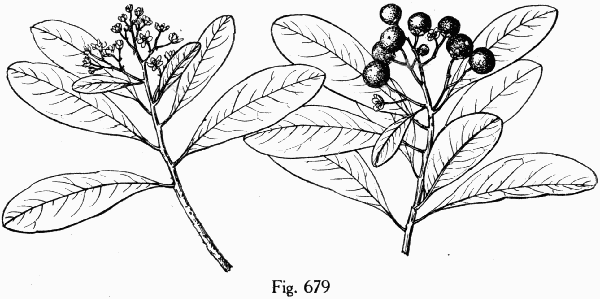
Leaves contracted into a short stout grooved petiole, 3½′—5′ long and 1½′—2′ wide, bright green and lustrous. Flowers about ⅛′ in diameter, opening in the autumn. Fruit ripening in March and April, bright crimson, soft and fleshy, ½′ in diameter; seeds about 3/16′ long.
A tree, in Florida 25°—30° high, with a straight trunk 8′—10′ in diameter, and slender [754] horizontal spreading branches forming a compact round-headed top. Bark of the trunk ⅛′ thick, light gray, broken on the surface into numerous short thick scales rarely more than 2′—3′ long and about twice as thick as the pale yellow aromatic inner bark. Wood very heavy, exceedingly hard, strong, close-grained, dark red-brown, with thick light brown or yellow sapwood of 25—30 layers of annual growth. The bitter acrid inner bark is the wild cinnamon bark of commerce. It has a pleasant cinnamon-like odor and is an aromatic stimulant and tonic.
Distribution. Florida, region of Cape Sable, Munroe County (Flamingo [A. A. Eaton], East Cape, Madeira Hammock), and widely distributed on the southern keys, usually growing in the shade of other trees; on the Bahama Islands and many of the Antilles.
XLIII. KŒBERLINIACEÆ.
An intricately branched almost leafless tree or shrub, with thin red-brown scaly bark, stout alternate glabrous branchlets covered with pale green bark and terminating in a sharp rigid straight or slightly curved spine. Leaves minute, early deciduous, alternate, narrow-obovate, rounded at apex. Flowers perfect, on slender club-shaped puberulous pedicels from the axils of minute scarious deciduous bracts, in short umbel-like racemes below the end of the branches; calyx of 3 or 5 minute sepals imbricated in the bud, deciduous; petals 4, convolute in the bud, hypogynous, obovate or oblong, subunguiculate, white, much longer than the sepals; disk 0; stamens 8, free, hypogynous, as long as the petals; filaments thickened in the middle, subulate at the ends; anthers oval, attached on the back near the base, 2-celled, the cells opening longitudinally; ovary ovoid, 2-celled, contracted at base into a short stalk and above into a simple subulate style; stigma terminal, obtuse, slightly emarginate; ovules numerous, adnate in several series to the fleshy placenta, horizontal or dependent, anatropous. Fruit a 2-celled berry, black at maturity, subglobose, tipped with the remnants of the pointed style; flesh thin and succulent, the cells 1 or 2-seeded by abortion. Seed vertical, circinate-cochleate; seed-coat crustaceous, slightly rugose, striate; albumen thin; embryo annular; cotyledons semiterete; the radicle ascending.
The family is represented by a single genus.
1. KŒBERLINIA Zucc.
Characters of the family.
Kœberlinia with one species is North American.
The generic name is in honor of L. Koeberlin, a German botanist.
1. Kœberlinia spinosa Zucc.
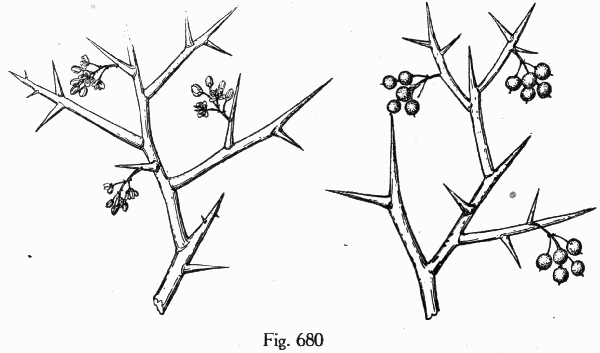
Leaves not more than ⅛′ long. Flowers appearing in May and June, about ¼′ in diameter. Fruit 3/16′—¼′ in diameter.
[755]
A bushy tree, rarely 20°—25° high, with a short stout trunk sometimes 6°—8° long and a foot in diameter; more often a low branching shrub forming impenetrable thickets often of considerable extent. Wood very hard, heavy, close-grained, dark brown somewhat streaked with orange, becoming almost black on exposure, with thin yellow or nearly white sapwood of 12—15 layers of annual growth.
Distribution. Dry gravelly mesas and foothills; valleys of the upper Colorado River (Big Springs, Howard County), and of the lower Rio Grande, Texas, westward through southern Texas and New Mexico to southern Arizona, and southward through northern Mexico, and in Lower California (San Jorge).
XLIV. CARICACEÆ.
Trees or shrubs, with bitter milky juice, and alternate long-petiolate persistent simple or digitately compound leaves, without stipules. Flowers unisexual or perfect, the perianth of the male and female flowers dissimilar; stamens in two series, inserted on the corolla; filaments free; anthers introrse. Fruit baccate.
The Pawpaw family with two genera is tropical American and Mexican, a single representative of the family reaching the shores of southern Florida.
1. CARICA L.
Short-lived trees, with erect simple or rarely branched stems composed of a thin shell of soft fibrous wood surrounding a large central cavity divided by thin soft cross partitions at the nodes, and covered with thin green or gray bark marked by the ring-like scars of fallen leaf-stalks, and stout soft fleshy roots. Leaves simple, palmately lobed or digitate, crowded toward the top of the stem and branches, large, flaccid, subpeltately palmately nerved, and usually deeply and often compoundly lobed. Flowers regular, monœcious or polygamo-diœcious, white, yellow, or greenish white, in axillary cymose panicles, the staminate elongated, pedunculate, and many-flowered, the pistillate abbreviated and few or usually 3-flowered, generally unisexual and diœcious, occasionally polygamo-diœcious, each flower in the axil of a minute ovate acute bract; calyx minute, 5-lobed, the lobes alternate with the petals; corolla of the staminate flower salverform, gamopetalous, the tube elongated, 5-lobed, the lobes oblong or linear, contorted in the bud; stamens 10; filaments free, those of the outer row alternate with the lobes of the corolla and elongated, the others alternate with them and abbreviated; anthers 2-celled, erect, opening longitudinally, often surmounted by their slightly elongated connective; ovary rudimentary, subulate; pistillate [756] flower, calyx minute, 5-lobed, persistent under the fruit; corolla polypetalous, petals 5, linear-oblong, erect, ultimately spreading above the middle, deciduous; ovary free, sessile, 1-celled or more or less spuriously 5-celled; style 0 or abbreviated; stigmas 5, linear, radiating, dilated and subpalmately lobed at apex; ovules indefinite, inserted in two rows on the placenta, anatropous, long-stalked; micropyle superior; raphe ventral; hermaphrodite flower, corolla gamopetalous, tubular-campanulate, the lobes erect and spreading or subreflexed; stamens 10, in 2 ranks, or 5; ovary obovoid-oblong, longer than the tube of the corolla, more or less spuriously 5-celled below. Fruit slightly 5-lobed, l-celled or more or less completely 5-celled, filled with soft pulp, many-seeded, that produced from the hermaphrodite flower long-stalked, pendulous, usually unsymmetric, gibbous, and smaller than that from the pistillate flower. Seeds ovoid, inclosed in membranaceous silvery white sac-like arils, occasionally germinating within the fruit; seed-coat crustaceous, closely investing the membranaceous inner coat, the outer coat becoming thick, rugose, succulent, and ultimately dry and leathery; embryo in the axis of fleshy albumen; cotyledons ovate, foliaceous, compressed, longer than the terete radicle turned toward the minute pale subbasilar hilum.
Carica with about twenty species is distributed from southern Florida through the West Indies to southern Brazil and Argentina, and from southern Mexico to Chile. One species grows probably indigenously in Florida. The milky juice of Carica contains papain, which has the power of digesting albuminous substances, and the leaves are often used in tropical countries to make meat tender.
The generic name is formed from the Carib name of one of the species.
1. Carica Papaya L. Pawpaw.
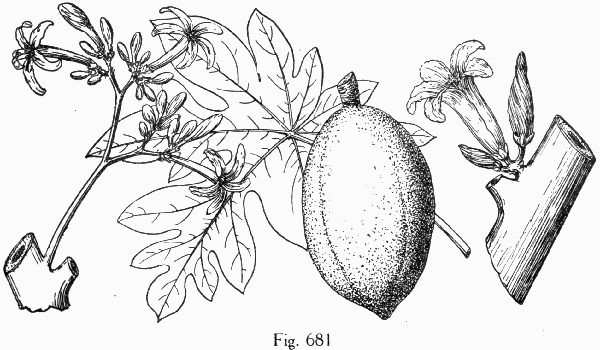
Leaves ovate or orbicular, deeply parted into 5—7 lobes divided more or less deeply into acute lateral lobes, these secondary divisions entire or rarely lobed, the lowest lobes forming a deep basal sinus, thin, flaccid, yellow-green, 15′—24′ in diameter, with broad flat yellow or orange-colored primary veins radiating from the end of the petiole through the lobes, and small secondary veins extending to the point of the lateral lobes and connected by conspicuous reticulate veinlets; petioles stout, yellow, hollow, enlarged and cordate at base, sometimes becoming 3°—4° in length before the leaves fall. Flowers often beginning to appear on plants only 3° or 4° high and a few months old, produced continuously throughout the year, the staminate in clusters on slender spreading or pendulous peduncles 4′—12′ long, the pistillate in 1—3-flowered short-stalked cymes; staminate flowers fragrant, filled with nectar, their corolla ¾′—1¼′ long, with a slender tube and acute lobes; anthers [757] oblong, orange-colored, surmounted by the rounded thickened end of the connective, those of the inner row almost sessile and one third larger than those of the outer row, shorter than their flattened filaments covered, like the connectives, with long slender white hairs; pistillate flowers about 1′ long, with erect petals, without staminodia; ovary ovoid, ivory-white, slightly and obtusely 5-angled, 1-celled, and narrowed into a short slender style crowned by a pale green stigma divided to the base into 5 radiating lobes dilated and 3-nerved at apex. Fruits hanging close together against the stem at the base of the leaf-stalk, obovoid to ellipsoid, and obtusely short-pointed, yellowish green to bright orange color; in southern Florida not more than 4′ long and 3′ thick, and usually smaller, with a thick skin closely adherent to the sweet insipid flesh forming a thin layer outside the central cavity; seeds full and rounded, about 3/16′ long; outer portion of the seed-coat rugose at first when the fruit is fully grown but still green, ivory-white, very succulent, and usually separable from the smooth paler chestnut-brown lustrous interior portion, the outer part turning black as the fruit ripens and becoming adherent to the inner portion closely investing the thin lustrous light red-brown inner coat.
A short-lived tree, in Florida attaining a height of 12°—15°, with a trunk seldom more than 6′ in diameter; in the West Indies and other tropical countries often twice as large, with a trunk occasionally dividing into a number of stout upright branches. Bark thin, light green, becoming gray toward the base of the stem.
Distribution. Florida from the southern shores of Bay Biscayne on the west coast and of Indian River on the east coast to the southern keys, growing sparingly in rich hummocks; common in all the West Indian islands, in southern Mexico, and in the tropical countries of South America; now naturalized in most of the warm regions of the world, where it is universally cultivated for its fruit, which is considered one of the most wholesome of all tropical fruits, and has been much improved by selection.
XLV. CACTACEÆ.
Succulent trees or shrubs, with copious watery juice, numerous spines springing from cushions of small bristles (areolæ), and minute caducous alternate leaves, or leafless. Flowers large and showy, perfect, usually solitary; calyx of numerous spirally imbricated sepals forming a tube, those of the inner series petal-like; corolla of numerous imbricated petals, in many series; stamens inserted on the tube of the calyx, very numerous, in several series, with slender filaments and introrse 2-celled oblong anthers, the cells opening longitudinally; pistil of several united carpels; ovary 1-celled, with several parietal placentas; styles united, terminal; stigmas as many as the placentas; ovules numerous, horizontal, anatropous. Fruit a fleshy berry. Seeds numerous, with albumen; cotyledons foliaceous; radicle turned toward the hilum.