Division II. Dicotyledons. (continued 18)
Reading edition
The Cactus family with twenty genera and a very large number of species is most abundant in the dry region adjacent to the boundary of the United States and Mexico, with a few species ranging northward to the northern United States and southward to the West Indian islands, Brazil, Peru, Chile and the Galapagos Islands. Two of the genera have arborescent representatives in the flora of the United States.
CONSPECTUS OF THE ARBORESCENT GENERA OF THE UNITED STATES.
Branches and stems columnar, ribbed, continuous; leaves 0; flower-bearing and spine-bearing areolæ distinct; flowers close above spine-bearing areolæ; tube of the flower elongated; seeds dark-colored.
1. Cereus.
Branches jointed, tuberculate; leaves scale-like; flower-bearing and spine-bearing areolæ not distinct; tube of the flower short and cup-shaped; seeds pale.
2. Opuntia.
1. CEREUS Haw.
Trees or shrubs, with columnar ribbed stems, and buds on the back of the ridges from the axils of latent leaves, geminate, superposed, the upper producing a branch or flower, the [758] lower arrested and developed into a cluster of spines surrounded by an elevated cushion or areola of chaffy tomentose scales. Flowers lateral, elongated, the calyx-lobes forming an elongated tube, those of the outer ranks adnate to the ovary, scale-like, only their tips free, those of the inner ranks free, elongated; petals cohering by their base with the top of the calyx-tube, larger than its interior lobes, spreading, recurved; stamens numerous; filaments adnate by their base to the tube of the calyx, those of the interior ranks free, the exterior united into a tube; style filiform, divided into numerous radiating linear branches stigmatic on the inner face; stalks of the ovules long and slender, becoming thick and juicy in the fruit. Seeds with very thin albumen; embryo straight; cotyledons abbreviated, hooked at apex; radicle conic.
Cereus with at least two hundred species inhabits the dry southwestern region of North America, the West Indies, tropical South America, and the Galapagos Islands. Of the numerous species found within the territory of the United States only one assumes the habit and size of a tree. The fruit of several species is edible, and the ribs of the durable woody frames of the stems of the large arborescent species are used for the rafters of houses and for fuel. Many of the species are planted in warm dry countries in hedges to protect cultivated fields, and others are popular garden plants valued for their beautiful flowers, which are sometimes nocturnal and exceedingly fragrant.
The generic name relates to the candle-like form of the stem of some of the species.
1. Cereus giganteus Engelm. Suwarro.
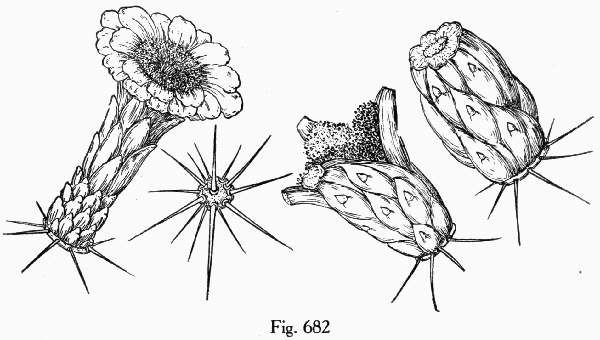
Leaves 0. Flowers 4′—4½′ long and 2½′ wide, opening from May to July in great numbers near the top of the stem, each surrounded on the lower side by the radial spines of the cluster below it; ovary ovoid, 1′ long, rather shorter than the stout tube of the flower, and covered, like the base of the tube, by the thick imbricated green outer scale-like sepals, with small free triangular acute scarious mucronate tips, furnished in their axils with short tufts of rufous hairs and occasionally with clusters of chartaceous spines, gradually passing into thin oblong-ovate or obovate larger sepals, mucronate or rounded at apex and closely imbricated in many ranks; petals 25—35, obovate-spatulate, obtuse, entire, thick and fleshy, creamy white, ⅔′ long and much reflexed after anthesis; stamens, with linear anthers emarginate at the ends, and filaments united for half their length to the walls of the calyx-tube, those of the exterior rows joined below into a long tube, surrounding the stout columnar style glandular at base and divided at apex into 12—15 green stigmas. Fruit ripening in August, ovoid or slightly obovoid, 2½′ long and 1⅓′ wide, truncate and covered at apex by the depressed pale scar left by the falling of the flower, light red at maturity, separating into 3 or 4 [759] fleshy valves bright red on their inner surface and inclosing the bright scarlet juicy mass of the enlarged funiculi and innumerable seeds; seeds obovoid, rounded, ⅙′ long, lustrous, dark chestnut-brown.
A tree, 50°—60° high, with a trunk sometimes 2° in diameter, thickest below the middle and tapering gradually toward the ends, marked by transverse superficial lines into rings 4′—8′ long, representing the amount of annual longitudinal growth, 8—12-ribbed at base with obtuse ribs 4′—5′ broad, and at summit 18—20-ribbed with obtuse deep compressed ribs, branchless or furnished above the middle with a few, usually 2 or 3, stout alternate or sometimes opposite upright branches shorter but otherwise resembling the principal stem composed of a thick tough green epidermis, a fleshy covering 3′—6′ thick saturated with bitter juice, and a circle of bundles of woody fibres making, with annual layers of exogenous growth, dense tough elastic columns placed opposite the depressions between the ribs, ½′—3′ in diameter and frequently united by branches growing at irregular intervals between them, the woody frame remaining standing after the death of the plant and the decomposition of its fleshy covering. Areolæ pale, elevated, about ½′ in diameter, bearing clusters of stout straight spines with a large dark fulvous base, sulcate or angled, tinged with red, with thick stout spines in the centre of each cluster, the 4 basal horizontal or slightly inclined downward, the lowest being the longest and stoutest and sometimes 1½′ long and 1/12′ thick, the upper shorter, more slender and slightly turned upward, with a row of shorter and thinner radial spines 12—16 in number surrounding the central group. Wood of the columns strong, very light, rather coarse-grained, with numerous conspicuous medullary rays, and light brown tinged with yellow; almost indestructible in contact with the ground, little affected by the atmosphere and largely used for the rafters of houses, for fences, and by Indians for lances, bows, etc. The fruit is consumed in large quantities by Indians.
Distribution. Low rocky hills and dry mesas of the desert; valley of Bill Williams River through central and southern Arizona to the valley of the San Pedro River and to the eastern border of the Colorado Desert between the Needles and Yuma, Yuma County, Arizona, and southward in Sonora.
2. OPUNTIA Adans.
Trees or usually shrubs, in the arborescent species of the United States with subcylindric or clavate articulate tuberculate branches, covered with small sunken stomata, and containing tubular reticulated woody skeletons, and thick fleshy or fibrous roots. Leaves scale-like, terete, subulate, caducous, bearing in their axils oblong or circular cushion-like areolæ of chaffy or woolly scales terminal on the branches and furnished above the middle with many short slender slightly attached sharp barbed bristles and toward the base with numerous stout barbed spines surrounded in some species, except at apex, by loose papery sheaths. Flowers diurnal, lateral, produced from areolæ on branches of the previous year between the bristles and spines, sessile, cup-shaped; sepals flat, erect, deciduous; corolla rotate; petals obovate, united at base, spreading; stamens shorter than the petals; filaments free or slightly united below; anthers oblong; style cylindric, longer than the stamens, obclavate below, divided at apex into 3—8 elongated or lobulate lobes stigmatic on the inner face. Fruit sometimes proliferous, covered by a thick skin, succulent and often edible, or dry, pyriform, globose or ellipsoid, concave at apex, surmounted by the marcescent tube of the flower, tuberculate, areolate, or rarely glabrous, truncate at base, with a broad umbilicus at apex. Seeds immersed in the pulpy placentas, compressed, discoid, often margined with a bony raphe; testa pale, bony, sometimes marked by a narrow darker marginal commissure; embryo coiled around the copious or scanty albumen; cotyledons large; radicle thin, obtuse.
Opuntia with many species is distributed from southern New England southward in the neighborhood of the coast to the West Indies, and through western North America to Chile, Brazil, and Argentina, the largest number of species occurring near the boundary of the United States and Mexico. Of the species of the United States at least three attain the size and habit of small trees. Cochineal is derived from a scale-insect which feeds on the [760] juices of some of the Mexican species, and the fruit of several species is refreshing and is consumed in considerable quantities in semitropical countries. The large-growing species with flat branches are employed in many countries to form hedges for the protection of gardens and fields; and the branches saturated with watery juice are sometimes stripped of their spines and bristles and fed to cattle.
Opuntia is the classical name of some plant which grew in the neighborhood of the city of Opus in Bœotia.
CONSPECTUS OF THE ARBORESCENT SPECIES OF THE UNITED STATES.
Tubercles of the branches full and rounded below the areolæ.
Joints pale olive color, easily separable, their tubercles broad, mammillate; spines yellow; flowers pink; fruit proliferous, usually spineless, often sterile.
1. O. fulgida (H).
Joints green or purple, their tubercles narrow, ovoid; spines white to reddish brown; flowers purple; fruit yellow, sparingly spinescent, rarely proliferous.
2. O. spinosior (H).
Tubercles of the branches not full and rounded below the areolæ; joints elongated, dark green or purple, their tubercles elongated; spines brown or reddish brown; flowers green, tinted with red or yellow; fruit green, spinescent, rarely proliferous.
3. O. versicolor (H).
1. Opuntia fulgida Engelm. Cholla.
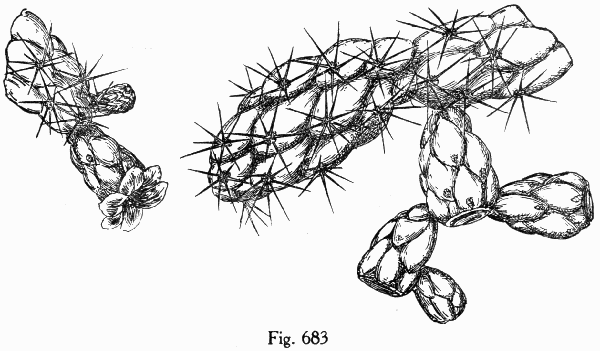
Leaves light green, gradually narrowed to the acuminate apex, ½′—1′ long. Flowers appearing from June to September, the earliest from tubercles at the end of the branches of the previous year, the others from the terminal tubercles of the immature fruit developed from the earliest flowers of the season, 1′ in diameter when fully expanded, with ovaries nearly 1′ long, 8—10 obtuse crenulate sepals, 5 erect stigmas, and 8 light pink petals, those of the outer ranks cuneate, retuse, crenulate on the margins, shorter than the lanceolate acute petals of the inner ranks, the whole strongly reflexed at maturity. Fruit proliferous, oval, rounded, 1′—1¼′ long and nearly as broad, more or less tuberculate, conspicuously marked by large pale tomentose areolæ bearing numerous small bristles, usually spineless or occasionally armed with small weak spines, hanging in pendulous clusters usually of 6 or 7 and occasionally of 40—50 fruits in a cluster, one growing from the other in continuous succession, the first the largest and containing perfect seeds, the others frequently sterile, dull green when fully ripe, with dry flesh, falling usually during the first winter or occasionally persistent on the branches during the second season, and then developing flowers from the tubercles; seeds compressed, thin, very angular, 1/12′—⅙′ in diameter.
[761]
A tree, with a more or less flexuous trunk occasionally 12° in height and sometimes a foot in diameter, a symmetric head of stout wide-spreading branches and thick pendulous joints sometimes almost hidden by the long conspicuous spines and beginning to develop their woody skeletons during their second or occasionally during their third season, the terminal or ultimate joints ovoid or ovoid-cylindric, tumid, crowded at the end of the limbs, pale olive color, 3′—8′ long, often 2′ in diameter, with broad ovoid-oblong tubercles, ½′—¾′ in length. Areolæ of pale straw-colored tomentum and short slender pale bristles, each areola bearing at first 5—15 stout stellate-spreading light yellow spines of nearly equal length, ¾′-1′ long and inclosed in loose lustrous sheaths, additional spines developing in succeeding years at the upper margin of the areolæ, the tubercles of old branches being sometimes furnished with from 40-60 spines persistent on the branches for 4-6 years. Bark of the trunk and of the large limbs about ¼′ thick, separating freely on the surface into large thin loosely attached scales varying in color from brown to nearly black on the largest stems, and unarmed, the spines mostly falling with the outer layers from branches 3′—4′ thick. Wood of old trunks light, hard, pale yellow, with broad conspicuous medullary rays, well marked layers of annual growth, and a thick pith.
Distribution. Plains of Arizona south of the Colorado plateau, and in the adjacent region of Sonora; not rare; apparently most abundant and of its largest size in the United States on the mesas near Tucson, Pima County, at altitudes between 2000° and 3000°.
2. Opuntia spinosior Toumey. Tassajo.
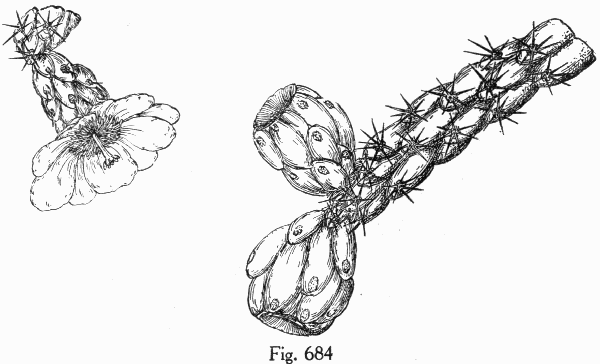
Leaves terete, tapering gradually to the setulose apex, about ¼′ long, remaining on the branches from four to six weeks. Flowers opening in April and May and remaining open for two or three days, 2′—2½′ in diameter, with ovaries about 1′ long, obovate sepals, broad-obovate dark purple petals, sensitive red stamens, and a 6—9-parted stigma. Fruits clustered at the end of the branches of the previous year, persistent during the winter and occasionally during the following summer and then sometimes proliferous, oval or rarely globose or hemispheric, frequently 2′ long and 1½′ thick, with yellow acrid flesh and 20—30 tubercles very prominent during the summer, nearly disappearing as the fruit ripens and enlarges, leaving it marked only by the small oval areolæ covered with short bristles, and bearing numerous slender spines deciduous in December as the fruit begins to turn yellow; seeds nearly orbicular, slightly or not at all beaked, ⅙′—⅕′ in diameter, and marked by linear conspicuous commissures.
A tree, with an erect trunk occasionally 10° high and 5′-10′ in diameter, numerous stout spreading limbs forming an open irregular head, and branches with joints 4′—12′ long and [762] ¾′—1′ thick, covered with a thick epidermis varying from green to purple, and usually developing woody skeletons during their second season, their tubercles prominent, compressed, ovoid, ⅓′—½′ long. Areolæ oval, clothed with pale tomentum and short light brown bristles, their spines 5—15 on the tubercles of young joints and 30—50 on those of older branches, and slender, white to light reddish brown, closely invested in white glistening sheaths, stellate-spreading, ½′—¾′ long, those in the interior sometimes considerably longer than the radial spines. Bark of the trunk and of the larger limbs about ¼′ thick, spineless, nearly black, broken into elongated ridges, and finally much roughened by numerous closely appressed scales. Wood light, soft, pale reddish brown, and conspicuously reticulate, with conspicuous medullary rays and well defined layers of annual growth; sometimes used in the manufacture of light furniture, canes, picture-frames, and other small articles.
Distribution. Widely scattered over the mesas of southern Arizona south of the Colorado plateau and of the adjacent regions of Sonora.
3. Opuntia versicolor Coult.
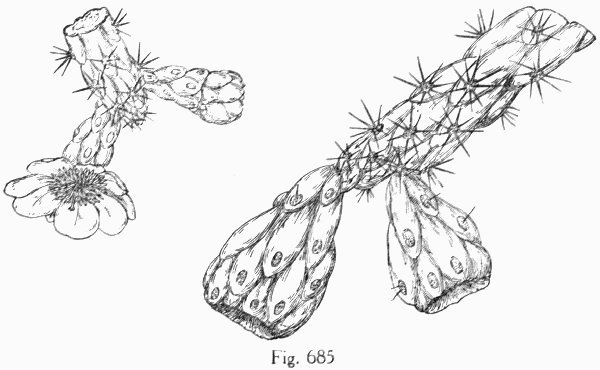
Leaves terete, abruptly narrowed to the spinescent apex, ⅓′—½′ long, persistent on the branches from four to six weeks. Flowers opening in May, about 1½′ in diameter, with ovaries ⅝′ long, broad-ovate acute sepals, and narrow obovate petals rounded above and green tinged with red or with yellow. Fruit usually clavate, 2′—2½′ long, nearly 1½′ in diameter, with areolæ generally only above the middle and usually furnished with 1—3 slender reflexed persistent spines about ½′ long, or occasionally spineless, rarely nearly spherical and only about ¾′ in diameter, ripening from December to February, and at maturity the same color as the joint on which it grows, usually withering, drying, and splitting open on the tree, or remaining fleshy and persistent on the branches until the end of the following summer, and sometimes through a second winter, or often becoming imbedded in the end of a more or less elongated joint; seeds irregularly angled, with narrow commissures.
A tree, with an erect trunk occasionally 6°—8° high and 8′ in diameter, numerous stout irregularly spreading or often upright branches, and cylindric terminal joints generally 6′—12′ but sometimes 2° in length, ¾′—1′ in diameter, and covered with a thick dark green or purple epidermis, marked by linear flattened tubercles, their woody skeletons usually formed during their second season. Areolæ large, oval, clothed with gray wool, generally bearing a cluster of small bristles, and slender stellate-spreading brown or reddish brown spines, with close early deciduous straw-colored sheaths, 4—14 and on old tubercles 20—25 in number, the inner 1—4 in number, usually deflexed and unequal in length, the longest about [763] ⅓′ long and longer than the radial spines. Bark of the trunk and of the large branches smooth, light brown or purple, usually unarmed, ½′—¾′ thick, finally separating into small closely appressed black scales. Wood reticulate, hard, compact, light reddish brown and rather lustrous, with thin conspicuous medullary rays, well-defined layers of annual growth, and thick pale or nearly white sapwood.
Distribution. Foothills and low mountain slopes of southern Arizona and northern Sonora; very abundant.
XLVI. RHIZOPHORACEÆ.
Glabrous trees or shrubs, with terete branchlets, and usually opposite coriaceous entire persistent leaves, with interpetiolar stipules. Flowers in axillary clusters; calyx-lobes valvate in the bud, persistent; petals inserted on the tube of the calyx and as many as its lobes; stamens inserted at the base of a conspicuous disk; anthers 2-celled, the cells opening longitudinally; pistil of 2—5 united carpels; ovary 2—5-celled; ovules usually 2 in each cell, suspended from its apex, collateral, anatropous; raphe ventral; micropyle superior. Fruit usually indehiscent, 1-celled and 1-seeded.
The Mangrove family is tropical, with most of its seventeen genera confined to the Old World.
1. RHIZOPHORA L. Mangrove.
Trees, with pithy branchlets, thick astringent bark, and adventitious fleshy roots. Leaves ovate or elliptic, glabrous, petiolate; stipules elongated, acuminate, infolding the bud, caducous. Flowers perfect, yellow or creamy white, sessile or pedicellate, bibracteolate, the bractlets united into an involucral cup, in pedunculate dichotomously or trichotomously branched clusters, the base of their branches surrounded by an involucre of 2 ovate 3-lobed persistent bracts, or 1-flowered; calyx 4-lobed, the lobes acute, coriaceous, ribbed on the inner surface and thickened on the margins, two or three times longer than the turbinate globose tube, reflexed at maturity, persistent; petals 4, induplicate in the bud, alternate with and longer than the calyx-lobes, inserted on a fleshy disk-like ring in the mouth of the calyx-tube, involute on the margins, coated on the inner surface with long pale hairs, or flat and naked, caducous; stamens 8—12; filaments short or 0; anthers attached at the base, introrse, elongated, connivent, areolate; ovary partly inferior, conic, 2-celled, contracted into two subulate spreading styles stigmatic at apex. Fruit a conic coriaceous berry surrounded by the reflexed calyx-lobes and perforated at the apex by the germinating embryo. Seed germinating in the fruit before falling, the apex surrounded by a thin albuminous cup-like aril; seed-coat thick and fleshy; embryo surrounded by a thin layer of albumen; cotyledons dark purple; radicle elongated, clavate, and when fully grown separating from the narrow exserted woody tube inclosing the plumule and developed from the cotyledons after the ripening of the fruit.
Rhizophora with three species is widely and generally distributed on the shores of tidal marshes in the tropical regions of the two hemispheres, one specie reaching those of southern Florida. It possesses astringent properties; the bark has been used in tanning leather, in dyeing, and as a febrifuge. The wood is hard, durable, and dark-colored. By means of the aerial germination of its seeds and in its power to develop roots from trunks and branches, Rhizophora is especially adapted to maintain itself on low tidal shores and is an important factor in protecting and extending them into the ocean. Roots springing from the stems at a considerable distance above the ground and arching outward descend into the water and fix themselves in the mud beneath, while roots growing down from the branches enter the ground and gradually thicken into stems. The fully grown radicle ready to put forth roots and leaves, and often 10′—12′ long, is thicker and heavier at the root end than at the other, and in detaching itself from the cotyledons and in falling the heavy end sticks in the mud, while the plumule at the other end, held above the shallow surface of the water, soon unfolds its leaves.
The generic name, from ῥίζα and φέρειν, was used by early authors to designate various climbing plants with thickened roots.
[764]
1. Rhizophora Mangle L.
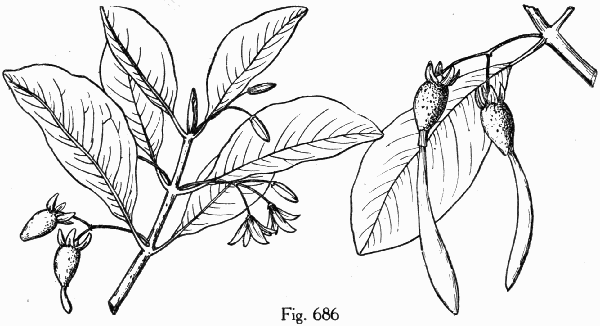
Leaves ovate or elliptic, rounded or acute at apex, gradually narrowed at base, dark green and very lustrous on the upper surface, paler on the lower surface, 3½′—5′ long and 1′—2′ wide, with slightly thickened margins, a broad midrib, and reticulate veinlets; persistent for one or two years; petioles ½′—1½′ in length; stipules lanceolate, acute, 1½′ long, deciduous as the leaf unfolds. Flowers produced through the year, 1′ in diameter, pedicellate, in 2 or 3-flowered clusters on peduncles 1½′ long from the axils of young leaves; petals pale yellow, coated on the inner surface with long pale hairs; stamens 8 with villose filaments. Fruit 1′ long, rusty brown, slightly roughened by minute bosses, the hard woody thick-walled tube developed from the cotyledons protruding ½′—⅔′ from its apex after the germination of the seed, covering the plumule, and holding the dark brown radicle marked with occasional orange-colored lenticels and when fully grown 10′—12′ long and ¼′—⅓′ thick near the apex.
A round-topped bushy tree, with spreading branches usually 15°—20° high, forming almost impenetrable thickets with its numerous aerial roots, or occasionally 70°—80° high, with a tall straight trunk clear of branches for more than half its length, a narrow head, and stout glabrous dark red-brown branchlets, becoming lighter colored in their second year and then conspicuously marked by large oval slightly elevated leaf-scars. Bark of young stems and of the branches smooth, light reddish brown, becoming on old trunks ⅓′—½′ thick, and gray faintly tinged with red, the surface irregularly fissured and broken into thin appressed scales. Wood exceedingly heavy, hard, close-grained, strong, dark reddish brown streaked with lighter brown, with pale sapwood of 40—50 layers of annual growth; used for fuel and wharf-piles.
Distribution. Shores of Florida from Mosquito Inlet on the east coast and Cedar Keys on the west coast to the southern keys; most abundant south of latitude 29°, following the coast with wide thickets and ascending the rivers for many miles; on Cape Sable and the shores of Bay Biscayne sometimes growing at a little distance from the coast on ground not submerged by the tide, and here attaining its largest size, with tall straight trunks and few aerial roots; on Bermuda, the Bahamas, the Antilles, the west coast of Mexico, lower California, the Galapagos Islands, and from Central America along the northeast coast of South America to the limits of the tropics.
XLVII. COMBRETACEÆ.
Trees or shrubs, with astringent juice, naked buds, and alternate or opposite simple entire coriaceous persistent leaves, without stipules. Flowers regular, perfect, or polygamous; [765] calyx 5-lobed, the lobes valvate in the bud; petals 5, valvate in the bud, inserted at the base of the calyx, or 0; disk epigynous; stamens 5—10, inserted on the limb of the calyx; filaments slender, filiform, distinct, exserted; anthers introrse, 2-celled, the cells opening longitudinally; ovary 1-celled; style slender, subulate; stigma minute, terminal, entire; ovules usually 2, suspended from the apex of the cell, collateral, anatropous; raphe ventral; micropyle superior. Fruit drupaceous, often crowned with the accrescent calyx. Seed solitary; albumen 0; embryo straight, with convolute cotyledons; radicle minute, turned toward the hilum.
Of the fifteen genera of this family, widely distributed through the tropics, three have arborescent representatives in southern Florida.
CONSPECTUS OF THE ARBORESCENT GENERA OF THE UNITED STATES.
Corolla 0; leaves alternate.
Calyx persistent; flowers in spikes; seeds without wings.
1. Bucida.
Calyx deciduous; flowers in capitate heads; seeds winged.
2. Conocarpus.
Corolla of 5 petals; calyx persistent; leaves opposite.
3. Laguncularia.
1. BUCIDA L.
A tree or shrub, with terete often spinescent branchlets. Leaves crowded at the end of spur-like lateral branchlets much thickened and roughened by the large elevated crowded leaf-scars, alternate, obovate to oblong-lanceolate, rounded and slightly emarginate or minutely apiculate at apex, gradually narrowed and cuneate at base, coriaceous, bluish green on the upper surface and yellow-green on the lower surface, pubescent while young, especially beneath, and glabrous at maturity with the exception of rufous hairs on the under surface of the stout midrib, and on the short stout petiole. Flowers perfect, greenish white, hairy on the outer surface, sessile in the axils of minute bracts, in lax elongated axillary clustered rufous-pubescent spikes; calyx-tube ovoid, constricted above the ovary, the limb campanulate, 5-lobed, the lobes valvate in the bud, persistent; petals 0; stamens 10, in two ranks, inflexed in the bud, unequal, 5 longer than the others and inserted opposite the calyx-lobes under the hairy 5-lobed disk, the others shorter, alternate with them and inserted higher on the calyx-tube; filaments incurved near the apex; anthers minute, sagittate; ovary included in the tube of the calyx; style thickened and villose at the base; ovules suspended on an elongated slender funiculus. Fruit ovoid, conic, oblique, and more or less falcate, irregularly 5-angled, coriaceous, light brown, puberulous on the outer surface, with thin membranaceous flesh inseparable from the crustaceous stone porous toward the interior. Seed ovoid, acute; seed-coat coriaceous, chestnut-brown; cotyledons fleshy; radicle superior.
Bucida with a single species is confined to tropical America, where it is distributed from southern Florida and the Bahama Islands through the West Indies to Guiana and Central America.
The generic name is from βοῦς, in allusion to the fancied resemblance of the fruit to the horns of an ox.
1. Bucida Buceras L. Black Olive-tree.
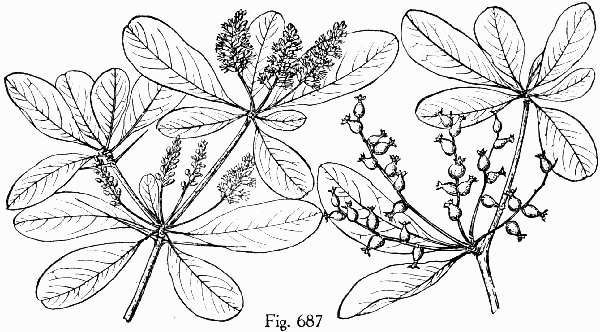
Leaves 2′—3′ long, 1′—1½′ wide, their petioles ⅓′—½′ in length. Flowers appearing in Florida in April, ⅛′ long, on spikes 1½′—3′ in length. Fruit about ⅛′ long.
A tree, with a single straight trunk, or often with a short prostrate stem 2°—3° in diameter, producing several straight upright secondary stems 40°—50° high and 12′—18′ in diameter, stout branches spreading nearly at right angles with the trunk and forming a broad head, and branchlets clothed when they first appear with short pale rufous pubescence mostly persistent for two or three years, becoming light reddish brown and covered with bark separating into thin narrow shreds. Bark of the trunk and of the large branches thick, gray tinged with orange-brown, and broken into short appressed scales. Wood exceedingly heavy, hard, close-grained, light yellow-brown sometimes slightly streaked [766] with orange, with thick clear pale yellow sapwood of 30—40 layers of annual growth. The bark has been used in tanning leather.
Distribution. Florida, only on Elliott’s Key; widely distributed in brackish marshes through the West Indies to the shores of the Caribbean Sea and the Bay of Panama.
2. CONOCARPUS L.
A tree or shrub, with angled branchlets. Leaves alternate, short-petiolate, narrow-ovate or obovate, acute, gradually contracted and biglandular at base, glabrous or sericeous. Flowers perfect, minute, in dense capitate heads in narrow leafy terminal panicles, with acute caducous bracts and bractlets coated with pale hairs, on stout hoary-tomentose peduncles bibracteolate near the middle; calyx-tube truncate, obliquely compressed at base, clothed with pale hairs, the limb campanulate, parted to the middle, the lobes ovate, acute, erect, pubescent on the outer and puberulous on the inner surface, deciduous; petals 0; disk 5-lobed, hairy; stamens usually 5, inserted in 1 rank, or rarely 7 or 8 in 2 ranks; anthers cordate, minute; style thickened and villose at base. Fruits scale-like, broad-obovoid, pointed, recurved, and covered at apex with short pale hairs, densely imbricated in ovoid reddish heads; flesh coriaceous, corky, produced into broad lateral wings; stone thin-walled, crustaceous, inseparable from the flesh. Seed irregularly ovoid; seed-coat membranaceous, pale chestnut-brown.
The genus consists of a single species of tropical America and Africa.
The generic name, from χῶνος and καρπὸς, is in allusion to the cone-like shape of the heads of fruits.
1. Conocarpus erecta L. Buttonwood.
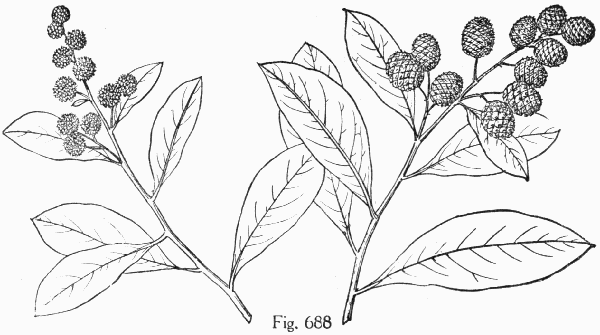
Leaves slightly puberulous on the lower surface when they first appear or coated with pale silky persistent pubescence (var. sericea, DC.), 2′—4′ long, ½′—1½′ wide, lustrous, dark green or pale on the upper surface, paler on the lower surface, with a broad orange-colored midrib, obscure primary veins, and reticulate veinlets; petioles stout, broad, ½′ in length. Flowers produced throughout the year, in heads ⅓′ in diameter on peduncles ½′—1½′ in length, in panicles 6′—12′ long. Cone of fruit about 1′ in diameter.
A tree, 40°—60° high, with a trunk 20′—30′ in diameter, small branches forming a narrow regular head, and slender branchlets conspicuously winged, light red-brown, usually glabrous, or silky pubescent (var. sericea, DC.), becoming terete and marked by large orbicular leaf-scars in their second year; or sometimes a low shrub, with semiprostrate stems. Bark of the trunk dark brown, divided by irregular reticulating fissures into broad flat ridges broken on the surface into small thin appressed scales. Wood very heavy, hard, [767] strong, close-grained, dark yellow-brown, with thin darker colored sapwood of about 10 layers of annual growth; burning slowly like charcoal and highly valued for fuel. The bark is bitter and astringent, and has been used in tanning leather, and in medicine as an astringent and tonic.
Distribution. Low muddy tide-water shores of lagoons and bays; Florida, Cape Canaveral and Cedar Keys to the southern keys; of its largest size in Florida on Lost Man’s River near Cape Sable; at its northern limits a low shrub; common on the Bahama Islands, in the Antilles, on the shores of Central America and tropical South America, on the Galapagos Islands, and on the west coast of Africa.
3. LAGUNCULARIA Gærtn.
A tree, with scaly bark, terete pithy branchlets, and naked buds. Leaves opposite, glabrous, thick and coriaceous, oblong or elliptic, obtuse or emarginate at apex, marked toward the margin with minute tubercles; their petioles conspicuously biglandular. Flowers usually perfect or polygamo-monœcious, minute, flattened, greenish white, sessile, in simple terminal axillary tomentose spikes generally collected in leafy panicles, with ovate acute hoary-tomentose bracts and bractlets; calyx-tube turbinate, with 5 prominent ridges opposite the lobes of the limb and 5 intermediate lesser ridges, furnished near the middle with 2 minute appendages, and coated with dense pale tomentum, the limb urceolate, 5-parted to the middle, the divisions triangular, obtuse or acute, erect, persistent; disk epigynous, flat, 10-lobed, the 5 lobes opposite the petals broader than those opposite the calyx-lobes, hairy; petals 5, nearly orbicular, contracted into a short claw inserted on the bottom of the calyx-limb, ciliate on the margins, caducous; stamens 10, inserted in 2 ranks; anthers cordate, apiculate; ovary 1-celled; style short, crowned with a slightly 2-lobed capitate stigma. Fruit 10-ribbed, coriaceous, hoary-pubescent, elongated, obovoid, flattened, crowned with the calyx-limb, unequally 10-ribbed, the 2 lateral ribs produced into narrow wings, 1-seeded; flesh coriaceous, corky toward the interior, inseparable from the thin-walled crustaceous stone dark red and lustrous on the inner surface. Seed suspended, obovoid or oblong; seed-coat membranaceous, dark red; radicle elongated, slightly longer and nearly inclosed by the green cotyledons.
Laguncularia consists of a single species of tropical America and Africa.
The generic name is from laguncula, in allusion to the supposed resemblance of the fruit to a flask.
1. Laguncularia racemosa Gærtn. Buttonwood. White Mangrove.
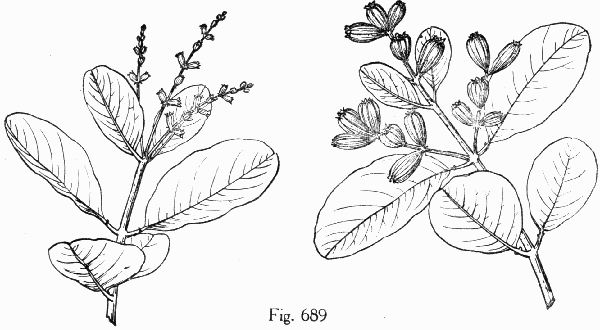
Leaves slightly tinged with red when they unfold, and at maturity dark green on the upper and lighter green or pale on the lower surface, 1½′—2½′ long and 1′—1½′ wide; petioles [768] red, ½′ in length. Flowers ¼′ long, in hoary-tomentose spikes produced throughout the year from the axils of young leaves and 1½′—2′ long. Fruit about ½′ long.
A tree, 30°—60° high, with a trunk 12′—20′ in diameter, stout spreading branches forming a narrow round-topped head, and slender glabrous branchlets somewhat angled at first, often marked with minute pale spots and dark red-brown, becoming in their second year terete, light reddish brown or orange color, thickened at the nodes, and marked by conspicuous ovate leaf-scars; or northward in Florida a low shrub. Bark of the trunk ¼′ thick, brown slightly tinged with red, the surface broken into long ridge-like scales. Wood heavy, hard, strong, close-grained, dark yellow-brown, with lighter colored sapwood of 10—12 layers of annual growth. The bark contains a large amount of tannic acid and is sometimes used in tanning leather, and is astringent and tonic.
Distribution. Muddy tidal shores of bays and lagoons; southern Florida from Cape Canaveral and Cedar Keys to the southern keys; common and of its largest size in Florida on the shores of Shark River, Monroe County; common in Bermuda, the Bahamas, the Antilles, tropical Mexico and Central America, tropical South America and western Africa.
XLVIII. MYRTACEÆ.
Trees or shrubs abounding in pungent aromatic volatile oil, with minute scaly buds. Leaves opposite, simple, mostly entire, pellucid-punctate, penniveined, persistent, the slender obscure veins arcuate and united within the thickened revolute margins; stipules 0. Flowers perfect, regular; calyx 4—5-lobed, the lobes imbricated in the bud, or lid-like and deciduous; petals 2—5, imbricated in the bud, inserted on the margin of the disk, or 0; stamens very numerous, inserted in many ranks with the petals; filaments slender, inflexed in the bud, exserted; anthers introrse, 2-celled, the cells opening longitudinally; ovary 2—4-celled; style simple, filiform, crowned with a minute stigma; ovules numerous or 2 or 3 in each cell, attached on a central placenta, anatropous or semianatropous; raphe ventral; micropyle superior. Fruit baccate, crowned with the persistent calyx-lobes, 1—4-seeded. Seeds without albumen; seed-coat membranaceous.
The Myrtle family with seventy-four genera is chiefly tropical and Australasian, with representatives in southern Europe, extratropical Africa, and extratropical South America. Two genera are represented by small trees in the flora of southern Florida. To this family, beside the Myrtle, belong the Australian Eucalypti, large and important timber-trees largely planted in California, and the Guava, cultivated in Florida for its fruit.
[769]
CONSPECTUS OF THE ARBORESCENT GENERA OF THE UNITED STATES.
Calyx closed in the bud by a lid-like deciduous limb; petals 0.
1. Calyptranthes.
Calyx 4 or 5-lobed with persistent lobes; petals 4 or 5.
2. Eugenia.
1. CALYPTRANTHES Sw.
Aromatic trees or shrubs, with terete or angled branchlets. Leaves complanate in the bud, penniveined, petiolate. Flowers minute, in subterminal and axillary pedunculate many-flowered panicles, their primary and secondary branches often racemose, the ultimate branches cymose; calyx-tube turbinate, produced above the ovary, closed in the bud by a slightly 4 or 5-lobed lid-like orbicular limb, opening in anthesis by a circumscissile line, the limb at first attached laterally, finally deciduous; disk lining the tube of the calyx; petals 2—5, minute, or 0; ovary 2 or 3-celled; ovules 2 or 3 in each cell, collateral, ascending, anatropous. Fruit 2—4-seeded. Seed subglobose or short-oblong; seed-coat shining; cotyledons foliaceous, contortuplicate; radicle elongated, incurved.
Calyptranthes with eighty species is confined to tropical America, with two species reaching southern Florida.
The generic name is from χαλύπτρα and ἄνθη, in reference to the peculiar lid-like limb which closes the calyx before the opening of the flower.
CONSPECTUS OF THE ARBORESCENT SPECIES OF THE UNITED STATES.
Leaves acuminate, pubescent below; petioles up to ½′ in length; inflorescence and young branchlets covered with silky rufous tomentum.
1. C. pallens (D).
Leaves abruptly pointed or obtuse at apex, glabrous; petioles not more than ⅙′ in length; inflorescence and young branchlets glabrous.
2. C. Zuzygium (D).
1. Calyptranthes pallens Griseb.
Chytraculia Chytraculia Sudw.
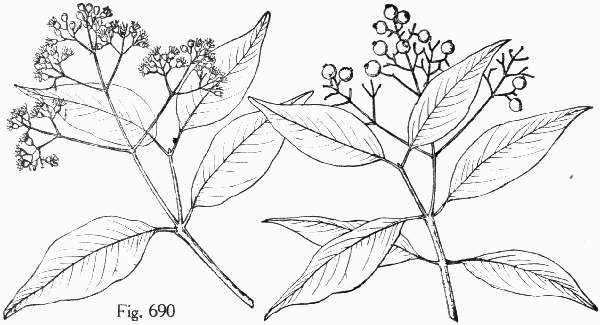
Leaves oblong or oblong-ovate, acuminate at apex, gradually narrowed and cuneate at base, pellucid-punctate above, marked with dark glands below, when they unfold pink or light red and covered with pale silky hairs, and at maturity coriaceous, dark green and lustrous on the upper surface, coated with pale pubescence on the lower surface, 2½′—3′ long and ½′—¾′ wide, with a broad midrib orange-colored beneath; petioles stout, ⅓′—½′ in length. Flowers sessile, ⅛′ long, in long-stalked many-flowered clusters 2½′—3′ long and wide, covered like their bracts and the flower-buds with silky rufous pubescence, with slender divaricate [770] branches, the ultimate divisions 3-flowered; petals 0. Fruit short-oblong or nearly globose, dark reddish brown and puberulous, with thin dry flesh; seeds short-oblong, rounded at the ends.
A tree, in Florida 20°—25° high, with a trunk 3′—4′ in diameter, small branches forming a narrow head, and slender branchlets at first wing-angled between the nodes and coated with short rufous silky tomentum, becoming in their second or third year terete, thickened at the nodes, light gray tinged with red and covered with small thin scales. Bark of the trunk about ⅛′ thick, with a generally smooth light gray or almost white surface occasionally separating into irregular plate-like scales. Wood very heavy, hard, close-grained, brown tinged with red, with lighter colored sapwood of 30—40 layers of annual growth.
Distribution. Florida, shores of Lake Worth, in the neighborhood of Bay Biscayne, Dade County, and on Big Pine Key, Elliott’s Key, Key Largo and Key West; on the Bahama Islands, on many of the Antilles and in southern Mexico.
2. Calyptranthes Zuzygium Sw.
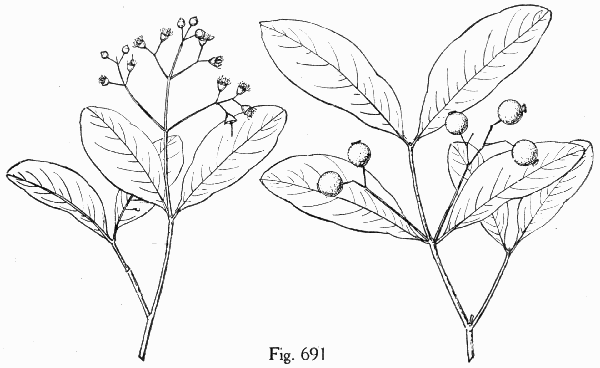
Leaves elliptic, abruptly or gradually narrowed into a blunt point or obtuse at apex, cuneate at base, entire, covered with minute pellucid dots, glabrous, dark yellow-green and lustrous on the upper surface, paler on the lower surface, 1½′—2¼′ long and ⅗′—1¼′ wide, with a broad low midrib and slender primary veins arcuate and connected within the slightly revolute somewhat undulate margins; petioles deeply grooved, ⅛′—⅙′ in length. Flowers on slender pedicels ⅙′—⅕′ long, in axillary 1—3-branched few-flowered axillary cymes ¾′ long and ½′ wide, on slender peduncles 1′—1¼′ in length, the ultimate divisions of the inflorescence 1—3-flowered; petals wanting; style rather longer than the stamens. Fruit about ⅓′ in diameter.
A tree, in Florida sometimes 40° high, with a tall trunk 4′ or 5′ in diameter, covered with smooth pale gray bark, small branches and slender terete ascending ashy gray branchlets.
Distribution. Florida, Paradise and Long Keys in the Everglades, Dade County; on the Bahama Islands and in Cuba, Jamaica and Hayti.
2. EUGENIA L.
Trees or shrubs, with hard durable wood and scaly bark. Flowers often large and conspicuous, on short bibracteolate pedicels, in axillary racemes or fascicles or dichotomously branched cymes, with minute caducous bracts and bractlets; calyx campanulate, scarcely [771] produced above the ovary, the limb 4 or rarely 5-lobed; petals usually 4, free and spreading; ovary 2 or rarely 3-celled; ovules numerous in each cell, semianatropous. Fruit 1—4-seeded. Seeds globose or flattened; seed-coat membranaceous or cartilaginous; embryo thick and fleshy; cotyledons thick, more or less conferruminate into a homogeneous mass; radicle very short, turned toward the hilum.
Eugenia with some five hundred species is common in all tropical regions, with eight species reaching the shores of southern Florida, of these 6 are small trees. Several species are valued for their stimulant and digestive properties; some produce useful timber or edible fruit, and others are cultivated for the beauty of their flowers. Cloves are the flower-buds of Eugenia aromatica Baill., a native of the Molucca Islands; and Eugenia Jambos L., the Rose Apple, of southeastern Asia, is cultivated in all tropical countries as a shade-tree and for its delicately fragrant fruit.
The generic name commemorates the interest in botany and gardening taken by Prince Eugène of Savoy, who built the Belvidere Palace near Vienna in the beginning of the eighteenth century, and made a collection of rare plants in its gardens.
CONSPECTUS OF THE ARBORESCENT SPECIES OF THE UNITED STATES.
Flowers in axillary racemes or fascicles.
Flowers in short solitary or clustered axillary racemes.
Leaves ovate or obovate, rounded at apex, short-petiolate; fruit subglobose to short-oblong.
1. E. buxifolia (C, D).
Leaves ovate, contracted at apex into a broad point, distinctly petiolate; fruit globose, black, ½′ in diameter.
2. E. axillaris (C, D).
Flowers in axillary fascicles.
Leaves usually broad-ovate, narrowed at apex into a short point, subcoriaceous; fruit subglobose, rather broader than high, ⅔′—1′ in diameter, becoming black at maturity.
3. E. rhombea (D).
Leaves oblong-ovate, narrowed at apex into a long point, coriaceous; fruit subglobose to obovoid, ¼′—⅓′ long, bright scarlet.
4. E. confusa (D).
Flowers in dichotomously branched cymes. (Anamomis.)
Leaves ovate or obovate; cymes usually 3-flowered; flowers not more than ¼′ in diameter; fruit black.
5. E. dicrana (D).
Leaves oblong or broad-elliptic; cymes 3—15-flowered; flowers up to ½′ in diameter; fruit red.
6. E. Simpsonii (D).
1. Eugenia buxifolia Willd. Gurgeon Stopper. Spanish Stopper.
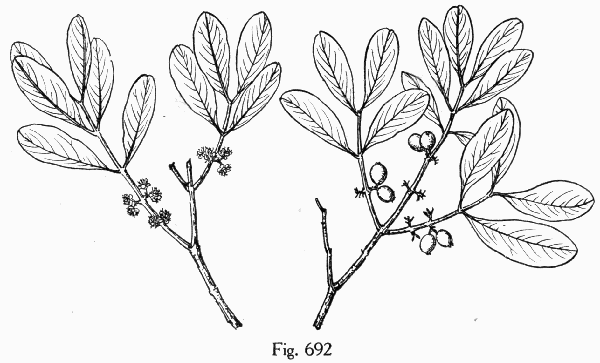
Leaves ovate or obovate, rounded at apex, sessile or narrowed into a short thick petiole, occasionally slightly and remotely crenulate-serrate above the middle, thick and coriaceous, dark green on the upper surface, yellow-green and marked with minute black dots on the lower surface, 1′—1½′ long and about 1′ wide, with a narrow conspicuous midrib; usually unfolding in November and remaining on the branches until the end of their second winter, and often turning red or partly red before falling. Flowers appearing in Florida from midsummer until early autumn, ⅛′ in diameter, on short thick pedicels, in short rufous-pubescent racemes clustered in the axils of old or fallen leaves, with minute lanceolate acute persistent bracts, and broad-ovate acute bractlets immediately below the flowers; calyx glandular-punctate, pubescent on the outer surface, with 4 ovate rounded lobes much shorter than the 4 ovate white petals rounded at apex, ciliate on the margins, and glandular-punctate. Fruit subglobose to short-oblong, black, glandular-roughened, crowned with the large calyx-lobes, usually 1-seeded, and about ⅓′ in diameter, with thin aromatic flesh; seeds ⅛′ in diameter, with a thick pale brown lustrous cartilaginous coat and a pale olive-green embryo.
A shrubby tree, in Florida rarely 20° high, with a short trunk occasionally a foot in diameter, small mostly erect branches, and terete slender branchlets coated at first with rufous pubescence, becoming at the end of a few months ashy gray or gray tinged with red, [772] and often more or less twisted or contorted. Bark of the trunk rarely more than ⅛′ thick, light brown tinged with red, and broken into small thick square scales. Wood very heavy, exceedingly hard, strong, close-grained, dark brown shaded with red, with thick lighter colored sapwood of 15—20 layers of annual growth; sometimes used for fuel.
Distribution. Florida, Cape Canaveral to the southern keys, and on the west coast from the banks of the Caloosahatchee River to Cape Sable; one of the commonest plants on the keys, forming on coral rock a large part of the shrubby second growth now occupying ground from which the original forest has been removed; on the Bahama Islands and on several of the Antilles.
2. Eugenia axillaris Willd. Stopper. White Stopper.
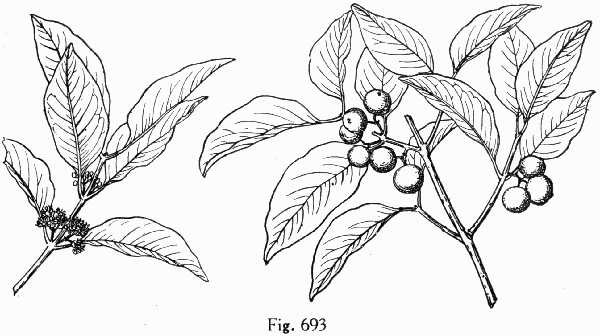
Leaves ovate, gradually or abruptly narrowed at apex into a short wide point, rounded at the narrowed base, thick and coriaceous, dark green on the upper surface, paler and covered with minute black dots on the lower surface, 1½′—2½′ long and ½′ wide, with a broad midrib deeply impressed above; petioles stout, slightly winged, about ⅓′ in length. [773] Flowers appearing at midsummer, about ⅛′ in diameter, in short axillary racemes, on stout pedicels 1/16′—½′ long, covered with pale white hairs, and furnished near the middle or toward the apex with 2 acute minute persistent bractlets; calyx glandular-punctate, covered on the outer surface with pale hairs, 4-lobed, with ovate rounded lobes shorter than the 4 ovate glandular white petals. Fruit ripening in succession from November to April, globose, black, glandular-punctate, usually 1-seeded, ½′ in diameter, edible, rather juicy, with a sweet agreeable flavor; seeds subglobose, ¼′ in diameter, with a pale brown chartaceous coat, and light olive-green cotyledons.
A tree, 20°—25° high, with a trunk occasionally a foot in diameter, small branches, and terete stout rigid ashy gray branchlets often slightly tinged with red and covered with small wart-like excrescences; or toward the northern limits of its range a low shrub. Bark of the trunk about ⅛′ thick and divided by irregular shallow fissures into broad ridges finally separating on the surface into small thin light brown scales. Wood heavy, hard, strong, very close-grained, brown often tinged with red, with thin darker colored sapwood of 5—6 layers of annual growth.
Distribution. Florida, shores of the St. John’s River to the southern keys; nowhere common; on the Bahama Islands and on several of the Antilles.
3. Eugenia rhombea Kr. & Urb. Stopper.
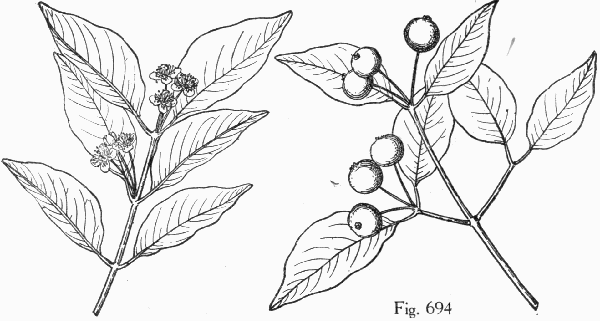
Leaves broad-ovate, narrowed into a broad point rounded at apex, and abruptly or gradually narrowed and cuneate at base, when they unfold thin and light red, and at maturity subcoriaceous, conspicuously marked with black dots, olive-green on the upper surface and paler on the lower surface, 2′—2½′ long and 1′—1½′ wide, with a narrow midrib; unfolding in Florida in May; petioles narrow-winged, ⅓′—½′ in length. Flowers ½′ in diameter, appearing in Florida in April or May on slender glandular pedicels ⅓′—⅔′ long and furnished at apex with 2 lanceolate acute persistent bractlets ciliate on the margins, in sessile axillary many-flowered clusters; calyx-tube much shorter than the limb divided into 4 glandular narrow lobes rounded at apex and one half the length of the broad-ovate rounded glandular white petals. Fruit ripening in Florida from September to November, ⅔′—1′ in diameter, slightly glandular-roughened, orange color, with a bright red cheek when fully grown, becoming black at maturity; flesh thin and dry; seeds almost globose, nearly ½′ in diameter, with a thick pale chestnut-brown lustrous coat and olive-green cotyledons.
A tree, 20°—25° high, with a trunk usually a foot in diameter, small branches, and slender terete branchlets at first light purple and covered with a glaucous bloom, becoming ashy gray or almost white. Bark of the trunk about 1/16′ thick, with a smooth light gray surface [774] slightly tinged with red. Wood heavy, hard, close-grained, light brown, with hardly distinguishable sapwood.
Distribution. Florida, Key West and Umbrella Key; on the Bahama Islands and on many of the Antilles.
4. Eugenia confusa DC. Red Stopper.
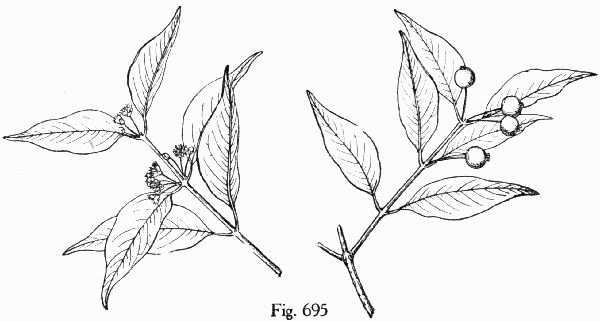
Leaves oblong-ovate, abruptly or gradually contracted into a long narrow point rounded or acute at apex, cuneate or occasionally rounded at base, thin and light red when they unfold, and at maturity dark green and very lustrous on the upper surface, paler and marked with minute black dots on the lower surface, 1½′—2′ long and ⅓′—⅔′ wide, with a thick orange-colored midrib barely impressed above and prominent reticulate veinlets; petioles stout, about ¼′ in length. Flowers barely ⅛′ in diameter, appearing in September on slender pedicels ¼′—½′ long and furnished near the apex with 2 minute acute bractlets, in many-flowered axillary clusters; calyx glandular-punctate, with 4 ovate acute lobes much shorter than the 4 broad-ovate rounded white petals. Fruit ripening in March and April, subglobose to obovoid, bright scarlet, ¼′—⅓′ long, glandular-roughened, usually solitary and 1-seeded, with thin dry flesh; seed nearly globose, about ⅛′ in diameter, with a thin crustaceous light brown lustrous coat and an olive-green embryo.
A tree, 50°—60° high, with a straight trunk 18′—20′ in diameter, stout upright branches forming a narrow compact head, and slender terete ashy gray branchlets. Bark of the trunk about ⅛′ thick, bright cinnamon-red, separating freely into small thin scales. Wood very heavy, exceedingly hard, strong, close-grained, bright red-brown, with thick dark-colored sapwood of 50—60 layers of annual growth.
Distribution. Florida, rich hummocks near the shores of Bay Biscayne, Dade County, and on Old Rhodes and Elliotts Keys; on the Bahama Islands and on several of the Antilles.
5. Eugenia dicrana Berg. Naked Wood.
Anamomis dichotoma Sarg.
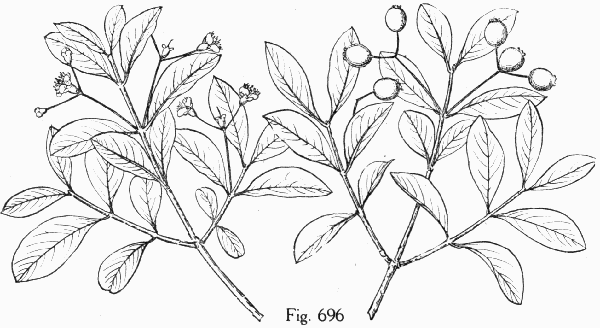
Leaves ovate or obovate, acute or rounded and occasionally emarginate at apex, cuneate at base, chartaceous when they unfold, becoming subcoriaceous, glabrous, covered with minute black dots, 1′—1¼′ long and ½′—⅔′ wide, with a stout midrib; petioles stout, enlarged at base, coated at first with silky hairs, finally glabrous. Flowers appearing in Florida in May, ¼′ in diameter, in cymes produced near the end of the branches, in the axils of leaves of the year, on slender peduncles coated with pale silky hairs, sometimes 1-flowered [775] and not longer than the leaves, more often longer than the leaves, dichotomously branched and 3-flowered, with 1 flower at the end of the principal division in the fork of its branches, or occasionally 5—7-flowered by the development of peduncles from the axils of the bracts of the secondary divisions of the inflorescence, each branch of the inflorescence furnished immediately beneath the flower with 2 lanceolate acute bractlets nearly as long as the calyx-tube; calyx hoary-tomentose, the lobes ovate, rounded at apex and much shorter than the ovate acute glandular-punctate white petals. Fruit ripening in Florida in August, reddish brown, ¼′ long, obliquely oblong, obovate or subglobose, roughened by minute glands; flesh thin, rather dry and aromatic; seeds reniform, light brown, exceedingly fragrant.
A tree, 20°—25° high, with a trunk 6′—8′ in diameter, and slender terete branchlets light red and coated with pale silky hairs when they first appear, becoming glabrous in their second year and covered with light or dark brown bark separating into small thin scales; or often a shrub, with numerous slender stems. Bark of the trunk 1/16′—⅛′ thick, with a smooth light red or red-brown surface separating into minute thin scales. Wood very heavy, hard, close-grained, light brown or red, with thick yellow sapwood of 40—50 layers of annual growth.
Distribution. Florida, rocky woods, Mosquito Inlet to Cape Canaveral on the east coast, and from the banks of the Caloosahatchee River to the shores of Cape Romano on the west coast, on Key West, and in the neighborhood of Bay Biscayne, Dade County; on the Bahama Islands and on several of the Antilles.
6. Eugenia Simpsonii Sarg.
Anamomis Simpsonii Small.
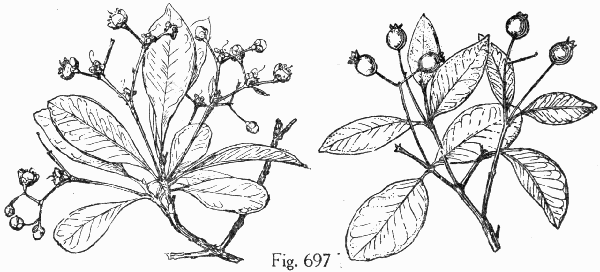
Leaves oblong, rounded and abruptly short-pointed or occasionally emarginate at apex, cuneate at base, or broad-elliptic, silky pubescent and ciliate on the margins when they unfold, soon glabrous, and at maturity coriaceous, dark yellow-green and lustrous on the upper surface, paler and dull on the lower surface, 1½′—2′ long and ½′—1′ wide, with a prominent midrib impressed on the upper side and obscure spreading primary veins united before reaching the thickened revolute entire margins of the leaf; petioles covered at first with snowy white tomentum, soon glabrous, slender, ⅛′—¼′ in length. Flowers fragrant, about ½′ in diameter, sessile in lateral 3—15-flowered cymes on slender finely appressed-pubescent peduncles longer or shorter than the subtending leaves, their bractlets acuminate and ⅓′ long; calyx-tube short-obconic, thickly covered with silky white hairs, the lobes rounded at apex, green, punctate, two of them orbicular-reniform, the others orbicular-ovate, shorter [776] than the white concave, obovate to suborbicular erose ciliate sparingly punctate petals. Fruit ellipsoid, red, mostly ⅓′—⅖′ long; seed reniform, usually solitary.
A tree, occasionally 60°—70° high, with a trunk 15′—16′ in diameter, small erect and spreading smooth gray-brown or reddish brown branches forming a narrow round-topped head, and slender branchlets covered when they first appear with snowy white tomentum, soon glabrous, and bright or dull reddish brown, and marked in their second year with the nearly orbicular elevated conspicuous scars of fallen leaves. Bark of the trunk thin, smooth, reddish, marked by pale blotches.
Distribution. Florida, Arch Creek Hummock north of Little River, and on Paradise and Long Keys in the Everglades, Dade County.
XLIX. MELASTOMACEÆ.
Trees, shrubs, or herbs with watery juice. Leaves opposite, rarely verticellate, 3—9-nerved, usually petiolate; stipules 0. Flowers regular, perfect, usually showy, rarely fragrant, in terminal clusters; calyx usually 4 or 5-lobed, the lobes imbricated in the bud; petals as many as the lobes of the calyx, inserted on its throat, imbricated or convolute in the bud; stamens as many or twice as many as the petals, inserted in 1 series with them, often inclined or decimate; anthers 2-celled, attached at the base, opening by a terminal pore; ovary 2 or many-celled; style terminal, simple, straight or declinate; stigma capitate, simple or lobed; ovules numerous, minute, anatropous. Fruit capsular or baccate, inclosed in the calyx-tube; seeds minute; testa coriaceous or crustaceous; hilum lateral or basal; embryo without albumen.
This family with 164 genera and a large number of species is chiefly confined to the tropics, and is most abundant in those of South America.
1. TETRAZYGIA A. Rich.
Trees or shrubs, with terete branchlets. Leaves opposite, petiolate, oblong-ovate to ovate-lanceolate, entire or denticulate, 3—5-nerved, persistent, scurfy, like the young branchlets, peduncles and calyx-tube. Flowers perfect in many-flowered terminal panicles or corymbs; calyx-tube urceolate or globose, adnate to the ovary, the limb constricted above the ovary and dilated below the apex, the lobes short or elongated; petals obovate, obtuse, convolute in the bud; stamens twice as many as the petals; filaments subulate; anthers linear-subulate, erect or slightly recurved, attached at base, 2-celled, opening by a minute pore at apex, their connective not extended below the cells; ovary 3—6-celled; style filiform, curved, exserted, surrounded at base by a short sheath 8—10-toothed at apex; ovules indefinite, minute, sessile on an axile placenta. Fruit a 3 or 4-celled berry, crowned by the persistent tube of the calyx; seeds numerous, minute, obpyramidal, thickened and [777] incurved at apex; testa coriaceous, slightly pitted; hilum basal; cotyledons thick; radicle short, turned toward the hilum.
Tetrazygia with 14 species is confined to the West Indies and southern Florida where one species has been discovered, the only tree of the great family of the Melastomaceæ found in the United States.
The generic name is from τέτρα and ζυγόν in allusion to the often 4-parted flowers.
1. Tetrazygia bicolor Cogn.
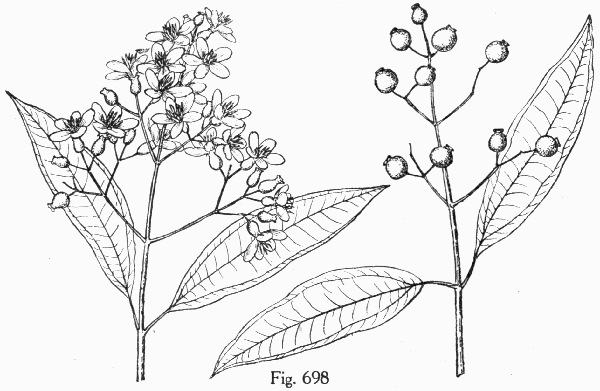
Leaves oblong-lanceolate, acuminate, gradually narrowed and rounded at base, 3-nerved, entire, undulate and slightly thickened on the revolute margins, dark green on the upper surface, paler on the lower surface, 3′—4½′ long and 1′—1¾′ wide; petioles stout, ¾—1′ in length. Flowers appearing from March to May, ⅘′ in diameter, short-stalked, in open cymose panicles; calyx urceolate, 4 or 5-lobed, the lobes nearly obsolete; petals 4 or 5, oblong-obovate, reflexed after anthesis, white; ovary 3-celled, style surrounded at base by a short sheath 10-toothed at apex. Fruit ripening in late autumn or early winter, oblong to ovoid, conspicuously constricted at apex, ¼′—⅓′ in length and ⅙′—⅕′ in diameter.
In Florida a shrub, or in the dense woods of the keys of the Everglades a slender tree, often 30° high, with an erect trunk 3′ or 4′ in diameter, covered with thin light gray-brown slightly fissured bark, small spreading branches becoming erect toward their apex and gracefully drooping leaves; or in the sandy soil of open Pine-woods often less than 3° in height.
Distribution. Florida, on the Everglade Keys, Dade County; on the Bahama Islands and in Cuba.
L. ARALIACEÆ.
Trees, shrubs, or herbs, with watery juice and scaly buds. Leaves alternate, compound or simple, petiolate, with stipules. Flowers in racemose or panicled umbels; parts of the flower in 5’s; disk epigynous; ovule solitary, suspended from the apex of the cell, anatropous; raphe ventral, the micropyle superior. Fruit baccate. Seeds, with albumen.
The Aralia family with fifty-four genera is chiefly tropical, with a few genera extending beyond the tropics into the northern hemisphere, especially into North America and eastern Asia. The widely distributed and largely extratropical genus Aralia is represented by [778] one arborescent species in the flora of the United States. Hedera, the Ivy, of this family, is commonly cultivated in the temperate parts of the United States, and some species of Panax and Acanthopanax from eastern Asia are found in gardens in the northeastern states.
1. ARALIA L.
Aromatic spiny trees and shrubs, with stout pithy branchlets, and thick fleshy roots, or bristly or glabrous perennial herbs. Leaves digitate or once or twice pinnate, the pinnæ serrulate; stipules produced on the expanded and clasping base of the petiole. Flowers perfect, polygamo-monœcious or polygamo-diœcious, on slender jointed pedicels, small, greenish white; calyx-tube coherent with the ovary, the limb truncate, repand or minutely toothed, the teeth valvate in the bud; petals imbricated in the bud, inserted by their broad base on the margin of the disk, ovate, obtuse or acute and slightly inflexed at apex; stamens inserted on the margin of the disk, alternate with the petals; filaments filiform; anthers oblong or rarely ovoid, attached on the back, introrse, 2-celled, the cells opening longitudinally; ovary 2—5-celled; styles 2—5, in the fertile flower distinct and erect or slightly united at base, spreading and incurved above the middle, or incurved from the base and sometimes inflexed at apex, crowned with large capitate stigmas, in the sterile flower short and united. Fruit fleshy, laterally compressed or 3—5-angled, crowned with the remnants of the style; nutlets 2—5, orbicular, ovoid or oblong, compressed, crustaceous, light reddish brown, 1-seeded. Seed compressed; seed-coat thin, light brown, adnate to the thin fleshy albumen; cotyledons ovate-oblong, as long as the straight radicle.
Aralia with forty species is confined to North America and Asia.
The name is of obscure meaning.
1. Aralia spinosa L. Hercules’ Club.
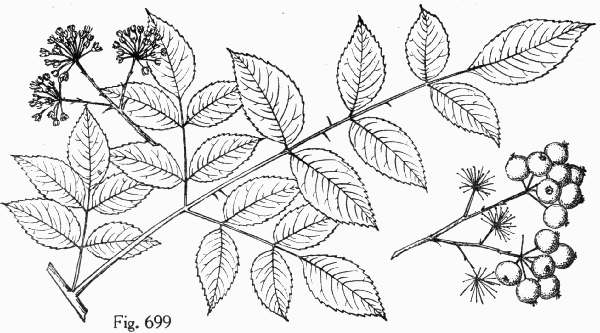
Leaves clustered at the end of the branches, twice pinnate, 3°—4° long and 2½° wide, with a stout light brown petiole 18′—20′ in length, clasping the stem with an enlarged base and armed with slender prickles, or occasionally unarmed; pinnæ unequally pinnate, usually with 5 or 6 pairs of lateral leaflets and a long-stalked terminal leaflet, and often furnished at base with a pinnate or simple leaflet; leaflets ovate, acute, dentate or crenate, cuneate or more or less rounded at base, short-petiolulate, when they unfold lustrous, bronze-green, and slightly pilose on the midrib and primary veins, and at maturity thin, dark green above, pale beneath, 2′—3′ long and 1½′ wide, with a thin midrib occasionally furnished with small prickles and slender primary veins nearly parallel with their margins; in the autumn turning light yellow before falling; stipules acute, about 1′ long, at first puberulous on the back and ciliate on the margins. Flowers 1/16′ long, appearing at midsummer on long slender pubescent straw-colored pedicels, in many-flowered umbels arranged in compound panicles, with light brown puberulous branches becoming purple in the autumn, forming a terminal racemose cluster 3°—4° long, and rising solitary or 2 or 3 together above the spreading leaves; bracts and bractlets lanceolate, acute, scarious, persistent; petals white, acute, inflexed at apex; ovary often abortive; styles connivent. Fruit ripening in autumn, black, ⅛′ in diameter, globose, 3—5-angled, crowned with the blackened styles, with thin purple very juicy flesh; seeds oblong, rounded at the ends, about 1/10′ long.
A tree, 30°—35° high, with a trunk 6′—8′ in diameter, stout wide-spreading branches, and branchlets ½′—⅔′ in diameter, armed like the branches and young trunks with stout straight or slightly incurved orange-colored scattered prickles, and nearly encircled by the conspicuous narrow leaf-scars marked by a row of prominent fibro-vascular bundle-scars, light orange-colored in their first season, lustrous and marked irregularly with oblong pale lenticels, becoming light brown in their second year, with bright green inner bark; more often a shrub, with a cluster of unbranched stems 6°—20° tall. Winter-buds: terminal conic, blunt at apex, ½′—¾′ long, with thin chestnut-brown scales; axillary triangular, flattened, about ¼′ long and broad. Bark of the trunk dark brown, about ⅛′ thick, and divided by broad shallow fissures into wide rounded ridges irregularly broken on the surface. Wood close-grained, light, soft, brittle, brown streaked with yellow, with lighter colored sapwood [779] of 2 or 3 layers of annual growth. The bark of the roots and the berries are stimulant and diaphoretic, and are sometimes used in medicine and in domestic practice.
Distribution. Deep moist soil in the neighborhood of streams; southern Pennsylvania to southern Indiana, southeastern Iowa and southeastern Missouri, and southward to northern Florida, western Louisiana, and eastern Texas; probably of its largest size on the foothills of the Big Smoky Mountains in Tennessee.
Occasionally cultivated as an ornamental plant in the eastern states and in western Europe; hardy in eastern Massachusetts.
LI. NYSSACEÆ.
Trees or shrubs, with terete branchlets, scaly buds, alternate entire dentate or serrate deciduous leaves, without stipules. Flowers diœcious, polygamo-diœcious or perfect; staminate, calyx minute, 5-toothed or lobed; petals 5 or more, imbricated in the bud, or 0; stamens as many, twice as many, or fewer than the petals, usually in 2 series; filaments sometimes of 2 lengths, elongated, filiform or subulate; disk fleshy, depressed at apex; pistillate flowers, calyx-tube adnate to the ovary; petals 5 or more, imbricated in the bud; ovary 1-celled or 6—10-celled; ovule solitary, pendulous from the apex of the cell, anatropous; micropyle superior; disk epigynous, pulvinate, the apex depressed or convex, or 0; style subulate, curved or spirally involute at apex, or 2-parted, or conic and divided into as many stigmatic lobes as the cells of the ovary. Fruit drupaceous or subsamaroid, crowned with the remnants of the calyx, 1-celled and 1-seeded, or 3—5-celled, the cells thin, 4-seeded; seed pendent, testa membranaceous or thin, albumen fleshy; cotyledons foliaceous or thin; radicle cylindric.
Nyssaceæ with 3 genera, Nyssa L., Camptotheca Decne. and Davidia Baill. and 8 species is confined to eastern North America, western China, Thibet, the Himalayas and the Malay Archipelago.
1. NYSSA L.
Trees, with leaves conduplicate in the bud, petiolate, sometimes remotely angulate or toothed, mostly crowded at the end of the branches. Flowers polygamo-diœcious, minute, greenish white; staminate on slender pedicels from the axils of minute caducous bracts, in simple or compound clusters on long axillary peduncles bibracteolate near the middle or at the apex or sometimes without bractlets; calyx disciform or cup-shaped, the limb 5-toothed; petals 5, imbricated in the bud, equal or unequal, ovate or linear-oblong, thick, inserted on the margin of the conspicuous pulvinate entire or lobed disk, erect; stamens 5—12, exserted; [780] filaments filiform; anthers oblong; ovary 0; pistillate flowers on axillary peduncles, in 2 or few-flowered clusters, sessile or nearly so, in the axils of conspicuous bracts and furnished with 1 or 2 small lateral bractlets, or solitary and surrounded by 2—4 bractlets; calyx-tube campanulate, sometimes slightly urceolate, the limb 5-toothed; petals small, thick, and spreading; stamens 5—10; filaments short; anthers fertile or sterile; disk less developed than in the staminate flower, depressed in the centre; ovary 1 or 2-celled; style terete, elongated, recurved, stigmatic toward the apex or the inner face; raphe ventral. Fruit drupaceous, short-oblong, fleshy, urceolate at apex; flesh thin, oily, acidulous; stone thick-walled, bony, terete or compressed, ribbed or winged, 1 or rarely 2-celled, usually 1-seeded. Seed filling the cavity of the stone; seed-coat pale; embryo straight.
Nyssa with six species is confined to the eastern United States and to southern and eastern Asia, where one species is distributed from the eastern Himalayas to the island of Java and another occurs in central and western China. The American species produce tough wood, with intricately contorted and twisted grain.
Nyssa, the name of a nymph, was given to this genus from the fact that one of the species grows in water.
CONSPECTUS OF THE NORTH AMERICAN SPECIES.
Pistillate flowers in 2 or few-flowered clusters, their calyx disciform; fruit blue, not more than ⅔′ long; stone with broad rounded ribs.
Stone indistinctly ribbed; leaves linear-oblong to oval or obovate.
1. N. sylvatica (A, C).
Stone prominently ribbed; leaves oblanceolate to oblong or elliptic.
2. N. biflora (C).
Pistillate flowers solitary, their calyx cup-shaped; fruit 1′ or more long.
Fruit red; stone with prominent wings; leaves oblong-oval or obovate, usually obtuse at apex.
3. N. ogeche (C).
Fruit purple; stone with acute ridges; leaves oval or oblong, acute or acuminate at apex.
4. N. aquatica (A, C).
1. Nyssa sylvatica Marsh. Tupelo. Pepperidge. Sour Gum.
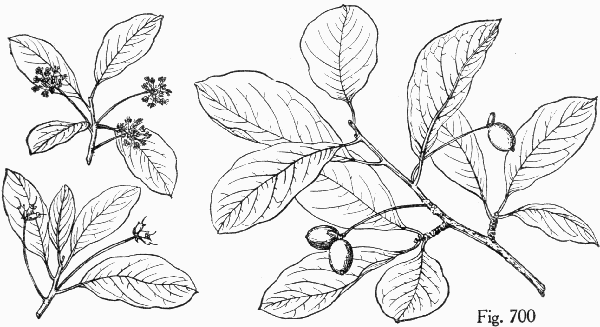
Leaves crowded at the end of lateral branchlets or remote on vigorous shoots, linear-oblong, lanceolate, oval or obovate, acute or acuminate or sometimes contracted into a short broad point at apex, cuneate or occasionally rounded at base, entire, with slightly thickened margins, or rarely coarsely dentate, coated when they unfold with rufous tomentum, especially on the lower surface, or pubescent or sometimes nearly glabrous, and at [781] maturity thick and firm, dark green and lustrous above, pale and often villose below, principally along the broad midrib and on the primary veins, 2′—5′ long and ½′—3′ wide; turning early in autumn bright scarlet on the upper surface only; petioles slender or stout, terete or wing-margined, ciliate, ¼′—1½′ in length, and often bright red. Flowers appearing in early spring when the leaves are about one third grown on slender pubescent or tomentose peduncles ½′—1½′ long, staminate in many-flowered dense or lax compound heads, pistillate in 2 to several-flowered clusters, sessile in the axils of conspicuous often foliaceous bracts, and furnished with 2 smaller acute hairy bractlets; calyx of the staminate flower disciform; petals thick, ovate-oblong, acute, rounded at apex, erect or slightly spreading, early deciduous; stamens exserted in the staminate flower, shorter than the petals in the pistillate flower; stigma stout, exserted, reflexed above the middle, 0 in the staminate flower. Fruit ripening in October, 1—3 from each flower-cluster, ovoid, ⅓′—⅔′ long, dark blue, with thin acrid flesh; stone light brown, ovoid, rounded at base, pointed at apex, terete or more or less flattened, and 10—12-ribbed, with narrow indistinct pale ribs rounded on the back.
A tree, with thick hard roots and few rootlets, often surrounded by root-sprouts, occasionally 100° or rarely 125° high, with a trunk sometimes 5° in diameter, numerous slender pendulous tough flexible branches forming a head sometimes short, cylindric and flat-topped, sometimes low and broad, or on trees crowded in the forest narrow, pyramidal or conic, and sometimes inversely conic and broad and flat at the top, and branchlets when they first appear light green to orange color, and in their first winter nearly glabrous or pale or rufous-pubescent, light red-brown marked by minute scattered pale lenticels and by small lunate leaf-scars displaying the ends of 3 conspicuous groups of fibro-vascular bundles, later becoming darker and developing short stout spur-like lateral branchlets; generally in the northern and extreme southern states much smaller, and rarely more than 50°-60° tall. Winter-buds obtuse, ¼′ long, with ovate acute apiculate dark red puberulous imbricated scales, those of the inner ranks accrescent, bright-colored at maturity, and marking the base of the branchlet with obscure ring-like scars. Bark of the trunk ¾′—1½′ thick, light brown often tinged with red, and deeply fissured, the surface of the ridges covered with small irregularly shaped scales. Wood heavy, soft, strong, very tough, not durable, light yellow or nearly white, with thick lighter colored sapwood of 80—100 layers of annual growth; used for the hubs of wheels, rollers in glass factories, ox-yokes, wharf-piles, and sometimes for the soles of shoes.
Distribution. Borders of swamps in wet imperfectly drained soil, and often especially southward on high wooded mountain slopes; valley of the Kennebec River, Maine, to southern Ontario, central Michigan, southeastern Missouri and eastern Oklahoma, and southward to northern Florida, and to the valley of the Brazos River, Texas; of its largest size on the southern Appalachian Mountains.
Occasionally cultivated as an ornamental tree in the eastern states, but difficult to transplant except when very young. The first tree in the eastern states to assume autumn colors of the leaves.
2. Nyssa biflora Walt.
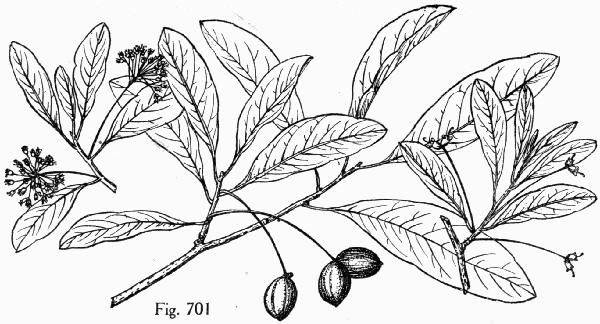
Leaves oblanceolate, oblong, elliptic or rarely ovate, acute or acuminate or occasionally rounded at the narrow apex, cuneate or rounded at the gradually narrowed base, and entire, when they unfold silky-villose above and hoary-tomentose beneath, soon becoming glabrous, dark yellow-green and lustrous on the upper surface, paler and sometimes glaucous on the lower surface, 2′—4′ long and ¾′—1′ wide, with a prominent midrib and numerous slender veins; petioles stout, ¼′—½′ in length. Flowers appearing when the leaves are nearly fully grown; staminate on slender villose pedicels, in many-flowered loose clusters on slender hairy peduncles 1′—1½′ in length; pistillate in pairs on rather stouter peduncles usually about 1′ long; calyx of the staminate flower disciform; petals oblong-ovate, rounded at apex, white, erect or slightly spreading, early deciduous. Fruit solitary or in pairs, on peduncles 1′—1½′ in length, oval or ellipsoid, dark blue, lustrous, about ⅓′ long, with acrid pulp; stone oval, compressed, narrowed at the ends, and prominently ribbed.
[782]
A tree, rarely more than 30° high, with a slender trunk gradually tapering upward from a swollen and much enlarged base, small spreading branches forming a narrow pyramidal or round-topped head, branchlets slightly villose when they first appear, soon glabrous, bright reddish brown in their first winter, becoming darker the following year, and numerous erect thick roots rising above the surface of the water. Winter-buds acute, dark red-brown, puberulous, and about ⅛′ long, the inner scales hoary-tomentose. Bark about 1′ thick, deeply furrowed, gray to very dark reddish brown.
Distribution. Small Pine-barren ponds of the coastal plain from North Carolina to central and eastern Florida, southern Alabama and Mississippi, and western Louisiana (near Lake Charles, Calcasieu Parish).
3. Nyssa ogeche Marsh. Ogeechee Lime. Sour Tupelo.
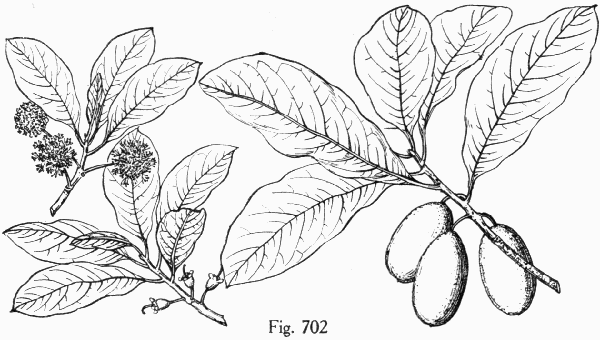
Leaves oblong, oval or obovate, acute, rounded or rarely obtuse, and apiculate at apex, gradually or abruptly cuneate or sometimes rounded at base, and entire, covered on the lower surface when they unfold with thick hoary tomentum and on the upper surface with short scattered pale hairs, and at maturity thick and firm, dark green, lustrous and slightly pilose above, pale below, 4′—6′ long and 2′—2½′ wide, with a stout midrib, 9 or 10 pairs of primary veins covered on the lower side with rufous pubescence or often nearly glabrous, and obscure reticulate veinlets; petioles stout, grooved, ½′—1′ in length. Flowers appearing in March and April; staminate in capitate clusters on slender hairy peduncles ½′ long, bibracteolate near the middle, and developed from the axils of the inner scales of the terminal bud, covered with long pale hairs on the outer surface of the short obscurely 5-toothed cup-shaped calyx and on the oblong petals rounded at apex; filaments longer than the petals; anthers oval and conspicuously tuberculate-roughened; pistillate solitary, 1/16′ long, on short stout woolly peduncles from the axils of bud-scales, and furnished at apex with 2 acute hairy bractlets; calyx coated, like the minute rounded spreading petals, with hoary tomentum; stamens included, with short filaments, and small mostly fertile anthers; style stout, exserted, reflexed from near the base. Fruit bright or dull red, on slender tomentose stems enlarged at apex and ½′—⅔′ long, ripening in July and August, and sometimes persistent on the branches until after the falling of the leaves, oblong or obovoid, 1′—1½′ in length, tipped with the thickened and pointed remnants of the style; flesh thick, juicy, very acid; stone oblong, compressed, narrowed at the ends, rounded at base, acute at apex, with walls produced into 10 or 12 broad thin papery white wings, about 1′ long, and 1 or rarely 2-seeded.
A tree, rarely 60°—70° high, with 1 or several stems occasionally 2° in diameter, spreading branches forming a narrow round-topped head, and slender branchlets coated when they [783] first appear with rufous tomentum, light reddish brown or green tinged with red and puberulous during their first summer, turning gray or reddish brown in their first winter, and marked by large lunate or nearly triangular leaf-scars displaying the ends of 3 groups of fibro-vascular bundles; often a shrub, with numerous slender clustered diverging stems. Winter-buds obtuse, ⅛′ long, with ovate apiculate imbricated scales rounded on the back and clothed with thick hoary tomentum, those of the inner ranks becoming at maturity ovate-oblong or obovate, rounded at apex, bright red, and ½′—¾′ long. Bark of the trunk about ⅛′ thick, irregularly fissured, with a dark brown surface broken into thick appressed persistent plate-like scales. Wood light, soft, tough, not strong, white, with thin hardly distinguishable sapwood of about 10 layers of annual growth. A preserve with an agreeable subacid flavor, known as Ogeechee limes, is sometimes made from the fruit in Georgia and South Carolina. The flowers abound in nectar, and are much visited by bees.
Distribution. Deep often inundated river swamps or their borders; South Carolina in the neighborhood of the coast, through the valley of the lower Ogeechee River, Georgia; in northern and in western Florida to the mouth of the Choctawhatchee River (R. H. Harper), and in the valley of the lower Apalachicola River; rare and local.
4. Nyssa aquatica Marsh. Cotton Gum. Tupelo Gum.
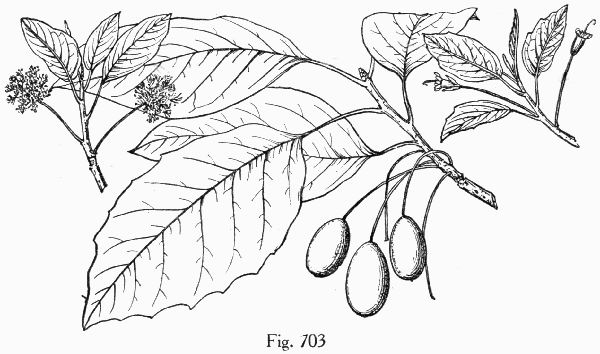
Leaves oblong-ovate, acute or acuminate and often long-pointed at apex, cuneate, rounded, or subcordate at base, entire or remotely and irregularly angulate-toothed, the teeth often tipped with a long slender mucro, when they unfold light red and coated below and on the petioles with pale tomentum and pubescent above, especially on the broad thick midrib, and at maturity thick and firm, dark green and lustrous on the upper surface, pale and more or less downy-pubescent on the lower surface, 5′—7′ long and 2′—4′ wide, with 10—12 pairs of primary veins forked near the margins and connected by conspicuous cross veins; petioles stout, grooved, hairy, enlarged at base, 1½′—2½′ in length. Flowers appearing in March and April on a long slender hairy peduncle from the axil of an inner scale of the terminal bud; staminate in dense capitate clusters, their peduncle furnished near the middle and occasionally at apex with long linear ciliate bractlets; calyx-tube cup-shaped, obscurely 5-toothed, one third as long as the oblong erect petals rounded at apex and much shorter than the stamens; pistillate solitary, surrounded by 2—4 strap-shaped scarious ciliate bractlets often ½′ long and more or less united below into an involucral cup; calyx-tube oblong and much longer than the ovate minute spreading petals; stamens included, with small mostly fertile anthers; style stout, tapering, reflexed above the middle, and revolute into a close coil. Fruit ripening early in the autumn, on slender drooping stalks 3′—4′ in [784] length, oblong or slightly obovoid, crowned with the pointed remnants of the style, dark purple, marked by conspicuous scattered pale dots, and 1′ long, with thick tough skin and thin acid flesh; stone obovoid, rounded at the narrow apex, pointed at base, flattened, light brown or nearly white, and about 10-ridged, the ridges acute and wing-like, with thin separable margins, and sometimes united by short intermediate ridges.
A tree, 80°—100° high, with a trunk 3°—4° in diameter above the greatly enlarged tapering base, comparatively small spreading branches forming a narrow oblong or pyramidal head, stout pithy branchlets dark red and coated with pale tomentum when they first appear, soon becoming glabrous or nearly so, and in their first winter light or bright red-brown and marked by small scattered pale lenticels and by the conspicuous elevated nearly orbicular leaf-scars displaying the ends of 3 large fibro-vascular bundles, and thick corky roots. Winter-buds: terminal nearly globose, with broad ovate light chestnut-brown scales keeled on the back and rounded and apiculate at apex, those of the inner ranks accrescent and at maturity oblong-ovate or oblong-obovate, rounded at apex, 1′ or more long, and bright yellow; axillary minute, obtuse, nearly imbedded in the bark. Bark of the trunk about ¼′ thick, dark brown, longitudinally furrowed, and roughened on the surface by small scales. Wood light, soft, not strong, close-grained, difficult to split, light brown or often nearly white, with thick sapwood sometimes composed of more than 100 layers of annual growth; used in the manufacture of wooden-ware, broom-handles, and wooden shoes, and largely for fruit and vegetable boxes. The wood of the roots is sometimes employed instead of cork for the floats of nets.
Distribution. Deep swamps inundated during a part of every year; coast region of the Atlantic states from southeastern Virginia to northern Florida, through the Gulf states to the valley of the Nueces River, Texas, and through Arkansas and southern and southeastern Missouri to western Kentucky and Tennessee, and to the valley of the lower Wabash River, Illinois; of its greatest size in the Cypress-swamps of western Louisiana and eastern Texas.
LII. CORNACEÆ.
Trees or shrubs, with terete branchlets, scaly buds, and alternate or opposite deciduous leaves, without stipules. Flowers perfect or polygamo-diœcious; calyx 4 or 5-toothed, petals 4 or 5; stamens inserted on the margin of the epigynous disk; anthers oblong; introrse, 2-celled, the cells opening longitudinally; ovary 1 or 2-celled; ovule solitary, suspended from the interior angle of the apex of the cell, anatropous; micropyle superior. Fruit drupaceous, 1 or 2-seeded. Seed oblong-ovoid; seed-coat membranaceous; [785] embryo in copious fleshy albumen; cotyledons foliaceous; radicle terete, turned toward the hilum.
The widely distributed Cornel family with ten genera, more numerous in temperate than in tropical regions, has arborescent representatives of the genus Cornus in North America.
1. CORNUS L. Dogwood.
Trees and shrubs, with astringent bark, opposite or rarely alternate deciduous leaves conduplicate or involute in the bud. Flowers small, perfect, white, greenish white or yellow; calyx-tube minutely 4-toothed, the teeth valvate in the bud; disk pulvinate, depressed in the centre, or obsolete; petals 4, valvate in the bud, oblong-ovate, inserted on the margin of the disk; stamens 4, alternate with the petals; filaments slender, exserted; ovary 2-celled; style exserted, simple, columnar, crowned with a single capitate or truncate stigma; raphe dorsal. Fruit ovoid or oblong; flesh thin and succulent; nut bony or crustaceous, 2-celled, 2 or sometimes 1-seeded. Seed compressed; embryo straight or slightly incurved.
Cornus with nearly fifty species is widely distributed through the three continents of the northern hemisphere, and south of the equator is represented in Peru by a single species. Of the sixteen or seventeen species of the United States four are arborescent. Cornus is rich in tannic acid, and the bark and occasionally the leaves and unripe fruit are used as tonics, astringents, and febrifuges. Of exotic species, Cornus mas, L., is often planted in the eastern states as an ornamental tree, and its edible fruit is used in Europe in preserves and cordials. The wood of Cornus is hard, close-grained, and durable, and is used in turnery and for charcoal.
The generic name, from cornu, relates to the hardness of the wood produced by plants of this genus.
CONSPECTUS OF THE ARBORESCENT SPECIES OF THE UNITED STATES.
Flowers greenish, in a dense cymose head surrounded by a conspicuous corolla-like involucre of 4—6 white or rarely red scales, from terminal buds formed the previous summer; fruit ovoid, bright red, rarely yellow.
Heads of flower-buds inclosed by the involucre during the winter; involucral scales 4, obcordate or notched at apex; leaves ovate to elliptic.
1. C. florida (A, C).
Heads of flower-buds inclosed only at base by the involucre during the winter; involucral scales 4—6, oblong to obovate, usually acute at apex; leaves ovate or rarely obovate.
2. C. Nuttallii (B, G).
Flowers cream color, in a flat cymose head, without involucral scales, terminal on shoots of the year; fruit subglobose, white or dark blue.
Leaves opposite, scabrous above; fruit white.
3. C. asperifolia (A, C).
Leaves mostly alternate and clustered at the end of the branches, smooth above; fruit dark blue or rarely yellow.
4. C. alternifolia (A, C).
1. Cornus florida L. Flowering Dogwood.
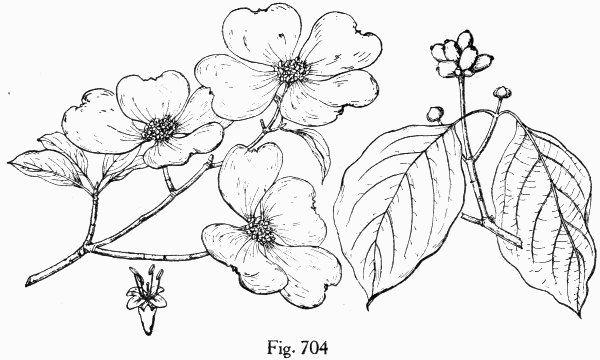
Leaves ovate to elliptic or rarely slightly obovate, acute and often contracted into a slender point at apex, gradually narrowed at base, remotely and obscurely crenulate-toothed on the somewhat thickened margins, and mostly clustered at the end of the branches, when they unfold pale and pubescent below and puberulous above, and at maturity thick and firm, bright green and covered with minute appressed hairs on the upper surface, pale or sometimes almost white and more or less pubescent on the lower surface, 3′—6′ long and 1½′—2′ wide, with a prominent light-colored midrib deeply impressed above, and 5 or 6 pairs of primary veins connected by obscure reticulate veinlets; in the autumn turning bright scarlet on the upper surface, remaining pale on the lower surface; petioles grooved, ½′—¾′ in length. Flowers: head of flower-buds appearing during the summer between the upper pair of lateral leaf-buds, inclosed by 4 involucral scales remaining light brown and more or less covered with pale hairs during the winter, and borne on a stout club-shaped puberulous peduncle ¼′ long or less during the winter and becoming 1′—1½′ in length; involucral [786] scales beginning to unfold, enlarge and grow white in early spring and when the flowers open in March at the south to May at the north, when the leaves are nearly fully grown, forming a flat corolla-like cup 3′—4′ in diameter, becoming at maturity obovoid, 1′—1½′ wide, gradually narrowed below the middle and notched at the rounded apex, reticulate-veined, pure white, pink, or rarely bright red, deciduous after the fading of the flowers; flowers in dense many-flowered cymose heads, in the axils of broad-ovate nearly triangular minutely apiculate glabrous light green deciduous bracts, ⅛′ in diameter; calyx terete, slightly urceolate, puberulous, obtusely 4-lobed, light green; corolla-lobes strap-shaped, rounded or acute at apex, slightly thickened on the margins, puberulous on the outer surface, reflexed after anthesis, green tipped with yellow; disk large and orange-colored; style crowned with a truncate stigma. Fruit ripening in October, ovoid, crowned with the remnants of the narrow persistent calyx and with the style, bright scarlet or rarely yellow (f. xanthocarpa Rehd.), lustrous, ½′ long and ¼′ broad, with thin mealy flesh, and a smooth thick-walled slightly grooved stone acute at the ends, and 1 or 2-seeded; seeds oblong, pale brown.
A bushy tree, rarely 40° high, with a short trunk 12′-18′ in diameter, slender spreading or upright branches, and divergent branchlets turning upward near the end, pale green or green tinged with red when they first appear, glabrous or slightly puberulous, bright red or yellow-green during their first winter and nearly surrounded by the narrow ring-like leaf-scars, later becoming light brown or gray tinged with red; frequently toward the northern limits of its range a much-branched shrub. Winter-buds formed in midsummer; the terminal covered by 2 opposite acute pointed scales rounded on the back and joined below for half their length, and accompanied by 2 pairs of lateral buds, each covered by a single scale, those of the lower pair shedding their scales in the autumn and remaining undeveloped. Bark of the trunk ⅛′—¼′ thick, with a dark red-brown surface divided into quadrangular or many-sided plate-like scales. Wood heavy, hard, strong, close-grained, brown sometimes changing to shades of green and red, with lighter colored sapwood of 30—40 layers of annual growth; largely used in turnery, for the bearings of machinery, the hubs of small wheels, barrel-hoops, the handles of tools, and occasionally for engravers’ blocks.
Distribution. Usually under the shade of taller trees in rich well-drained soil; southern Maine to southern Ontario, southern Michigan, southeastern Kansas and eastern Oklahoma, and southward to central Florida and the valley of the Brazos River, Texas; on the mountains of northern Mexico; comparatively rare at the north; one of the commonest and most generally distributed inhabitants of the deciduous-leaved forests of the middle and southern states, ranging from the coast nearly to the summits of the high Alleghany [787] Mountains. Trees with rose-colored or with pink involucral scales occasionally occur (var. rubra André). A variety with pendulous branches is known in gardens (var. pendula Dipp.); the var. xanthocarpa near Oyster Bay, Nassau County, Long Island, New York, and at Saluda, Polk County, North Carolina.
Often planted as an ornament of parks and gardens in the eastern states.
2. Cornus Nuttallii Aud. Dogwood.
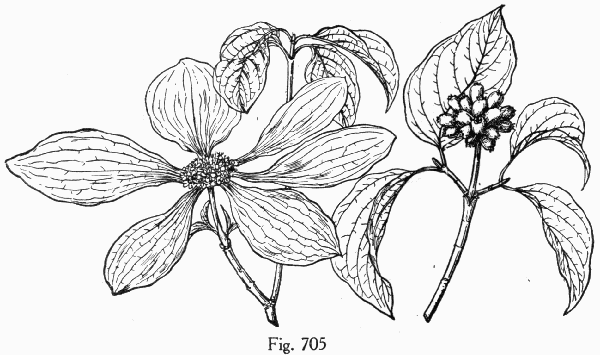
Leaves ovate or slightly obovate, acute and often contracted into a short point at the apex, cuneate at base, faintly crenulate-serrate, and generally clustered toward the end of the branches, when they unfold coated below with pale tomentum and puberulous above, and at maturity thin, bright green and slightly puberulous, with short appressed hairs on the upper surface, and woolly pubescent on the lower surface, 4′—5′ long and 1½′—3′ wide, with a prominent midrib impressed above, and about 5 pairs of slender primary veins connected by remote reticulate veinlets; in the autumn turning bright orange and scarlet before falling; petioles stout, grooved, pubescent, ½′—⅔′ in length, with a large clasping base. Flowers: head of flower-buds appearing during the summer between the upper pair of lateral leaf-buds, surrounded at base but not inclosed by the involucral scales during the winter, hemispheric, ½′ in diameter, usually nodding on a stout hairy peduncle ¾′—1′ long; involucral scales becoming when the flowers open 1½′—3′ long and 1½′—2′ wide, white or white tinged with pink, oblong to obovate or nearly orbicular, and acute, acuminate, or obtuse, entire and thickened at apex, puberulous on the outer surface, gradually narrowed below the middle and conspicuously 8-ribbed, the spreading ribs united by reticulate veinlets; flowers in dense cymose heads from the axils of minute acuminate scarious deciduous bracts; calyx terete, slightly urceolate, puberulous on the outer surface, yellow-green, or light purple, with dark red-purple lobes; petals strap-shaped, rounded at apex, spreading, somewhat puberulous on the outer surface, with thickened slightly inflexed margins, yellow-green; style crowned with a truncate stigma. Fruit ripening in October, in dense spherical heads of 30—40 drupes surrounded at base by a ring of abortive pendulous ovaries, ½′ long, ovoid, much flattened, crowned with the broad persistent calyx, bright red or orange-colored, with thin mealy flesh, and a thick-walled 1 or 2-seeded stone obtuse at the ends and scarcely grooved; seeds oblong, compressed, with a very thin pale papery coat.
A tree, 40°—60°, or exceptionally 100° high, with a trunk 1°—2° in diameter, small spreading branches forming an oblong conic or ultimately round-topped head, and slender light green branchlets coated while young with pale hairs, becoming glabrous or puberulous, dark [788] reddish purple or sometimes green during their first winter and conspicuously marked by the elevated lunate leaf-scars, ultimately becoming light brown or brown tinged with red. Winter-buds formed in July; the terminal acute, ⅓′ long, covered by 2 narrow-ovate acute long-pointed puberulous light green opposite scales, accompanied by 2 pairs of lateral buds, each covered by a single scale, those of the lower pair shedding their scales in the autumn and remaining undeveloped, those of the upper pair clothed with pale hairs, especially toward the apex, their scales thickening, turning dark purple, lengthening in the spring with the inclosed shoot, finally becoming scarious and developing into small leaves, and in falling marking the base of the branchlets with ring-like scars. Bark of the trunk about ¼′ thick, brown tinged with red, and divided on the surface into small thin appressed scales. Wood heavy, exceedingly hard, strong, close-grained, light brown tinged with red, with lighter colored sapwood of 30—40 layers of annual growth; used in cabinet-making, for mauls and the handles of tools.
Distribution. Usually in moist well-drained soil under the shade of coniferous forests; valley of the lower Fraser River and Vancouver Island, British Columbia, southward through western Washington and Oregon, on the coast ranges of California to the San Bernardino Mountains, and on the western slopes of the Sierra Nevada; southward up to altitudes of 4000°—5000°, of its largest size near the shores of Puget Sound and in the Redwood-forests of northern California.
3. Cornus asperifolia Michx. Dogwood.
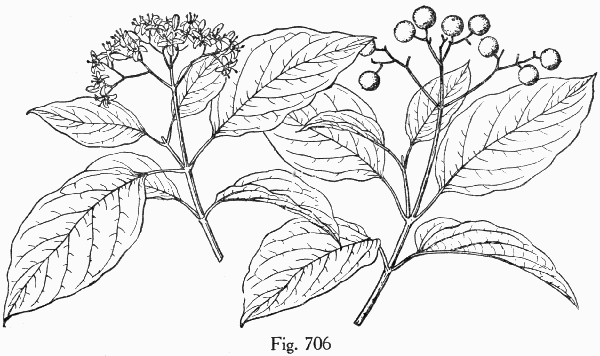
Leaves ovate or oblong, gradually or abruptly contracted at apex into a long slender point, gradually narrowed or rounded and cuneate at base, and slightly thickened on the undulate margins, coated with lustrous silvery tomentum when they unfold, and nearly fully grown when the flowers open from the middle of May in Texas to the middle of July at the north, and then dark green and roughened above by short rigid white hairs, and pale, often glaucous or rough-pubescent below, and at maturity thin, scabrous on the upper surface, pubescent or puberulous on the lower surface, 3′—4′ long and 1½′—2′ wide, with a thin midrib, and 4—6 pairs of slender primary veins parallel with their sides; petioles stout, grooved, pubescent, usually about ½′ in length. Flowers cream color, on slender pedicels, in loose broad or narrow often panicled pubescent cymes, on peduncles frequently 1′ in length; calyx oblong, cup-shaped, obscurely toothed, covered with fine silky white hairs; corolla-lobes narrow-oblong, acute, about ⅛′ long, and reflexed after the flowers open; style thickened at apex into a prominent stigma. Fruit ripening from the end of August [789] until the end of October, in loose spreading red-stemmed clusters, subglobose, white, tipped with the remnants of the style, about ¼′ in diameter, with thin dry, bitter flesh, and a full and rounded stone broader than high, somewhat oblique, slightly grooved on the edge, and 1 or 2-seeded; seeds nearly ¼′ long, with a pale brown coat.
A tree, sometimes nearly 50° high, with a short trunk 8′—10′ in diameter, thin erect wand-like branches forming a narrow irregular rather open head, and slender branchlets marked by numerous small pale lenticels, light green and puberulous when they first appear, pale red, lustrous, and puberulous during their first winter, light reddish brown in their second year, and ultimately light gray-brown or gray; usually shrubby. Winter-buds acute, compressed, pubescent, sessile, or stalked, about ⅛′ long, with 2 pairs of opposite scales, the terminal bud nearly twice as large as the compressed lateral buds. Bark of the trunk about ⅛′ thick, and divided by shallow fissures into narrow interrupted ridges broken into small closely appressed dark red-brown scales. Wood close-grained, hard, pale brown, with thick cream-colored sapwood.
Distribution. Southwestern Ontario (Point Pelee and Pelee Island), southward through Ohio, Kentucky, Tennessee and Mississippi to western Florida (Gadsden and Levy Counties) and westward to southeastern South Dakota, southeastern Nebraska, central Kansas, northwestern Oklahoma (near Alva, Woods County) and western Texas (Kerr, Menard and Brown Counties); probably only arborescent on the rich bottom-lands of southern Arkansas and eastern Texas.
4. Cornus alternifolia L. Dogwood.
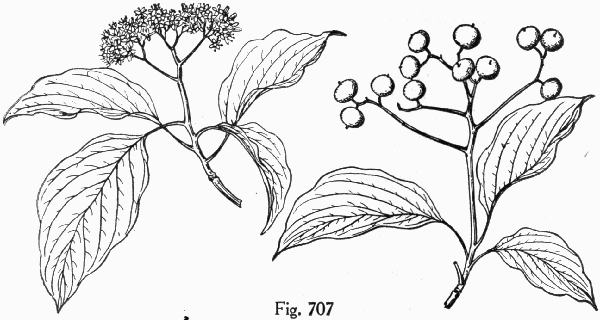
Leaves mostly alternate, clustered at the end of the branches, rarely opposite, oval or ovate, gradually contracted at apex into a long slender point, cuneate or occasionally somewhat rounded at base, obscurely crenulate-toothed on the slightly thickened and incurved margins, coated when they unfold on the lower surface with dense silvery white tomentum, and faintly tinged with red and pilose above, and at maturity thin, bright yellow-green, glabrous or sparsely pubescent on the upper surface, pale or sometimes nearly white and covered with appressed hairs on the lower surface, 3′—5′ long and 2½′—3½′ wide, with a broad orange-colored midrib slightly impressed above, and about 6 pairs of primary veins parallel with their sides; in the autumn turning yellow or yellow and scarlet; petioles slender, pubescent, grooved, 1½′—2′ in length, with an enlarged clasping base. Flowers cream color, opening from the beginning of May to the end of June on slender jointed pedicels ⅛′—¼′ long, in terminal flat puberulous many-flowered cymes 1½′—2½′ wide, mostly on lateral branchlets; calyx cup-shaped, obscurely toothed; corolla-lobes narrow, oblong, rounded at apex, ⅛′ long, reflexed after anthesis; style enlarged into a prominent stigma. Fruit in loose spreading [790] red-stemmed clusters, ripening in October, subglobose, dark blue-black, or rarely yellow (f. ochrocarpa Rehd.), ⅓′ in diameter, tipped with the remnants of the style rising from the bottom of a small depression, with thin and bitter flesh; and an obovoid nutlet, pointed at base, gradually longitudinally many-grooved, thick-walled, and 1 or 2-seeded; seeds lunate, ¼′ long, with a thin membranaceous pale coat.
A flat-topped tree, rarely 25°—30° high, with a short trunk 6′—8′ in diameter, long slender alternate diverging horizontal branches, and numerous short upright slender branchlets pale orange-green or reddish brown when they first appear, mostly light green or sometimes brown tinged with green during their first winter, later turning darker green and marked by pale lunate leaf-scars and small scattered pale lenticels; often a shrub, with numerous stems. Bark of the trunk about ⅛′ thick, dark reddish brown, and smooth or divided by shallow longitudinal fissures into narrow ridges irregularly broken transversely. Wood heavy, hard, close-grained, brown tinged with red, with thick lighter colored sapwood of 20—30 layers of annual growth.
Distribution. Rich woodlands, the margins of the forest, and the borders of streams and swamps, in moist well-drained soil, New Brunswick and Nova Scotia, westward along the valley of the St. Lawrence River to the northern shores of Lake Superior and to Minnesota, and southward through the northern states and along the Appalachian Mountains to North Carolina, up to altitudes of 3500°—4000°; in northern Alabama, southwestern Georgia, and western Florida (River Junction, Gadsden County, T. G. Harbison).
Occasionally cultivated as an ornamental plant in the eastern states.
Section 2. Gamopetalæ. Corolla of united petals (divided in Elliottia in Ericaceæ 0 in some species of Fraxinus in Oleaceæ).
A. Ovary superior (inferior in Vaccinium in Ericaceæ, partly inferior in Symplocaceæ, partly superior in Styraceæ).
LIII. ERICACEÆ.
Trees or shrubs, with scaly buds, and alternate simple leaves, without stipules. Flowers perfect, regular; calyx 4—5-lobed; corolla hypogynous, 5-lobed (of 4 petals in Elliottia), the lobes imbricated in the bud; stamens hypogynous, mostly free from the corolla, as many, or twice as many as its lobes; anthers introrse, 2-celled, opening by terminal pores, often appendaged; ovary 4—10-celled (inferior in Vaccinium); styles terminal, simple, stigma terminal; ovules numerous, anatropous or amphitropous; raphe ventral; micropyle superior. Fruit capsular, drupaceous, or baccate. Seeds with fleshy or horny albumen, embryo small; cotyledons small and short.
The Heath family with seventy-one genera is widely distributed over the temperate and tropical parts of the earth’s surface. Of the twenty-one genera found in the United States seven have arborescent representatives.
CONSPECTUS OF THE ARBORESCENT GENERA OF THE UNITED STATES.
Ovary superior.
Corolla of 4 petals; flowers in erect racemose panicles; leaves deciduous.
1. Elliottia.
Corolla gamopetalous, 5-lobed.
Fruit capsular.
Capsule septicidal, the valves in opening separating from the persistent placentiferous axis; calyx-lobes imbricated in the bud; leaves persistent (sometimes deciduous).
Flowers in terminal clusters; corolla 5-lobed; inflorescence-buds conic, covered with closely imbricated scales; leaves revolute on the margins.
2. Rhododendron.
Flowers in axillary clusters; corolla saucer-shaped, with a short narrow tube and 10 pouches below the short limb, the anthers in the pouches in the bud: inflorescence-buds elongated, covered with loosely imbricated scales; leaves flat.
3. Kalmia.
[791]
Capsule loculicidal, the valves in opening bearing the partitions and separating from the persistent placentiferous axis; calyx-lobes valvate in the bud.
Capsule ovoid-pyramidal; flowers in terminal panicles of secund racemes; anther-cells opening longitudinally from the apex to the middle; leaves deciduous.
4. Oxydendrum.
Capsule oblong; flowers in axillary fascicles; anthers opening below the apex by 2 oblong pores; leaves persistent.
5. Lyonia.
Fruit drupaceous; flowers in terminal panicles; anthers bearing a pair of reflexed awns on the back, each cell opening at apex anteriorally by a terminal pore; leaves persistent.
6. Arbutus.
Ovary inferior; fruit baccate; flowers axillary, racemose or solitary; anther-cells terminating in tubular appendages and opening by terminal pores.
7. Vaccinium.
1. ELLIOTTIA Ell.
A glabrous tree or shrub, with slender terete branchlets, scaly buds, and fibrous roots. Leaves petiolate, oblong or oblong-obovate, acute at the ends or occasionally rounded at apex, entire, thin, dark green and glabrous above, pale and villose below, particularly on the thin yellow midrib and obscure forked veins; deciduous; petioles slender and flattened, with an abruptly enlarged base nearly covering the small axillary buds. Flowers perfect, on slender elongated pedicels, in erect terminal elongated racemose panicles, with minute acute scarious caducous bracts and bractlets; calyx short, tubular, puberulous, dark red-brown, 4-toothed, the broad apiculate teeth erose on the margins and imbricated in the bud; petals 4, imbricated in the bud, spatulate-linear, sessile; stamens 8, hypogynous, shorter than the petals, filaments broad, flattened; anthers oblong-ovoid, the cells callous-mucronate, free at the apex of the spreading lobes, opening from above downward; disk much thickened, fleshy; ovary sessile, subglobose, 4-lobed, 4-celled, concave at apex; style elongated, slender, gradually enlarged and club-shaped above and incurved at apex; stigma 3—5-lobed, smaller than the thickened end of the style; ovules numerous in each cell, attached on the inner angle of a tumid placenta, ascending, anatropous. Fruit unknown.
Elliottia with a single species is confined to the southern United States.
The genus is named in honor of Stephen Elliott (1771—1830), the distinguished botanist of South Carolina.
1. Elliottia racemosa Ell.
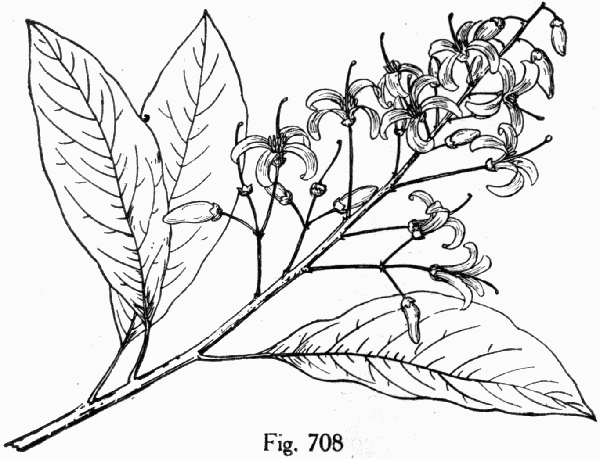
Leaves 3′—4′ long, 1′—1½′ wide; petioles ⅓′—½′ in length. Flowers about ½′ long, opening from the middle to the end of June, in clusters 7′—10′ in length.
A tree, 15°—20° high, with a trunk 4′—5′ in diameter, short ascending branches forming [792] a pyramidal head, and erect branchlets light red-brown and pilose when they first appear, bright orange-brown, lustrous, and nearly glabrous during their first winter, and roughened by slightly raised oblong-obovate leaf-scars with conspicuous central fibro-vascular bundle-scars, becoming light brown slightly tinged with red during their second season and dark gray-brown the following year; or more frequently shrubby. Winter-buds: terminal broad-ovoid, acute, about ⅛′ long, with much thickened bright chestnut-brown shining scales conspicuously white-pubescent near the margins toward the apex; lateral buds smaller, ovoid, compressed, rounded or short-pointed at apex. Bark thin, smooth, pale gray.
Distribution. Sandy woods in a few isolated stations in the valley of the Savannah River, near Augusta, Richmond County, and in Burke and Bullock Counties, Georgia.