Division 1. Monocotyledons.
Reading edition
Stems with woody fibres distributed irregularly through them, but without pith or annual layers of growth. Parts of the flower in 3’s; ovary superior; embryo with a single cotyledon. Leaves parallel-veined, alternate, long-persistent, without stipules.
III. PALMÆ.
Trees, growing by a single terminal bud, with stems covered with a thick rind, usually marked below by the ring-like scars of fallen leaf-stalks, and clothed above by their long-persistent sheaths; occasionally stemless. Leaves clustered at the top of the stem, plaited in the bud, fan-shaped or pinnate, their rachis sometimes reduced to a narrow border, long-stalked, with petioles dilated into clasping sheaths of tough fibres (vaginas); on fan-shaped leaves, furnished at the apex on the upper side with a thickened concave body (ligule). Flowers minute, perfect or unisexual, in the axils of small thin mostly deciduous bracts, in large compound clusters (spadix) surrounded by boat-shaped bracts (spathes); sepals and petals free or more or less united; stamens usually 6; anthers 2-celled, introrse, opening longitudinally; ovary 3-celled, with a single ovule in each cell; styles 1—3. Fruit a drupe or berry; embryo cylindric in a cavity of the hard albumen near the circumference of the seed. Of the 130 genera now usually recognized and chiefly inhabitants of the tropics, seven have arborescent representatives in the United States.
CONSPECTUS OF THE NORTH AMERICAN ARBORESCENT GENERA.
Leaves fan-shaped.
Leaf-stalks unarmed.
Calyx and corolla united into a short 6-lobed perianth.
Fruit white, drupaceous; albumen even.
1. Thrinax.
Fruit black, baccate; albumen channeled.
2. Coccothrinax.
Calyx and corolla distinct; fruit baccate.
3. Sabal.
Leaf-stalks armed with marginal spines.
Filaments slender, free; fruit baccate.
4. Washingtonia.
Filaments triangular, united into a cup adnate to the base of the corolla; fruit drupaceous.
5. Acœlorraphe.
Leaves pinnate.
Flower-clusters produced on the stem below the leaves; fruit violet-blue.
6. Roystonea.
Flower-clusters produced from among the leaves; fruit bright orange-scarlet.
7. Pseudophœnix.
1. THRINAX Sw.
Small unarmed trees, with stems covered with pale gray rind. Leaves orbicular, or truncate at the base, thick and firm, usually silvery white on the lower surface, divided [97] to below the middle into narrow acuminate parted segments with thickened margins and midribs; rachis a narrow border, with thin usually undulate margins; ligule thick, concave, pointed, lined while young with hoary tomentum; petioles compressed, rounded above and below, thin and smooth on the margins, with large clasping bright mahogany-red sheaths of slender matted fibres covered with thick hoary tomentum. Spadix interfoliar, stalked, its primary branches short, alternate, flattened, incurved, with numerous slender rounded flower-bearing branchlets; spathes numerous, tubular, coriaceous, cleft and more or less tomentose at the apex. Flowers opening in May and June, and occasionally irregularly in the autumn, solitary, perfect; perianth 6-lobed; stamens inserted on the base of the perianth, with subulate filaments thickened and only slightly united at the base, or nearly triangular and united into a cup adnate to the perianth, and oblong anthers; ovary 1-celled, gradually narrowed into a stout columnar style crowned by a large funnel-formed flat or oblique stigma; ovule basilar, erect. Fruit a globose drupe with juicy bitter ivory-white flesh easily separable from the thin-shelled tawny brown nut. Seed free, erect, slightly flattened at the ends, with an oblong pale conspicuous subbasilar hilum, a short-branched raphe, a thin coat, and uniform albumen more or less deeply penetrated by a broad basal cavity; embryo lateral.
Thrinax is confined to the tropics of the New World and is distributed from southern Florida through the West Indies to the shores of Central America. Seven or eight species are now generally recognized.
The wood of the Florida species is light and soft, with numerous small fibro-vascular bundles, the exterior of the stem being much harder than the spongy interior. The stems are used for the piles of small wharves and turtle-crawls, and the leaves for thatch, and in making hats, baskets, and small ropes.
Thrinax, from θρῖναξ, is in allusion to the shape of the leaves.
CONSPECTUS OF THE NORTH AMERICAN SPECIES.
Flowers on elongated pedicels; perianth obscurely lobed; stamens much exserted, their filaments subulate, barely united at base; stigma oblique; cavity of the seed extending to the apex.
Perianth obscurely lobed; style abruptly enlarged into a large oblique stigma; leaves silvery white on the lower surface.
1. T. floridana (D).
Perianth deeply lobed; style narrowed gradually into a small oblique stigma; leaves green on both surfaces.
2. T. Wendlandiana (D).
Flowers on short pedicels; lobes of the perianth ovate, acuminate; filaments nearly triangular, united below into a cup; stigma flat; cavity of the seed extending only to the middle.
Seeds pale chestnut-brown; spadix about 6° long; leaves 3°—4° in diameter.
3. T. keyensis (D).
Seeds dark chestnut-brown; spadix less than 3° long; leaves not over 2° in diameter.
4. T. microcarpa (D).
1. Thrinax floridana Sarg. Thatch.
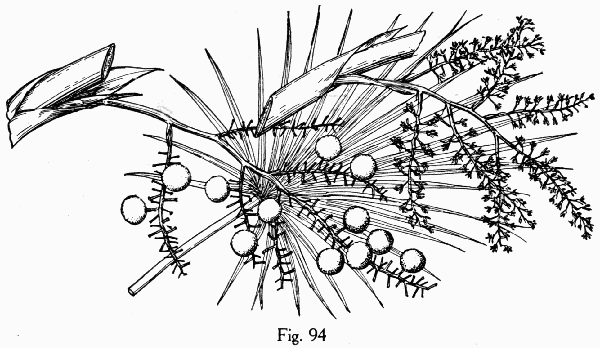
Leaves 2½°—3° in diameter, rather longer than broad, yellow-green and lustrous on the upper surface, silvery white on the lower surface, with a long-pointed, bright orange-colored ligule ¾′ long and broad; petioles 4°—4½° long, pale yellow-green or orange color toward the apex, coated at first with hoary deciduous tomentum, much thickened and tomentose toward the base. Flowers: spadix 3°—3½° long, the primary branches 6′—8′ long and ivory-white, flower-bearing branches 1½′—2′ in length; flowers on slender pedicels nearly ⅛′ long, ivory-white, very fragrant, with an obscurely-lobed perianth, much exserted stamens barely united at the base, and a large stigma. Fruit ⅜′ in diameter, somewhat depressed at the ends; seed from ⅛′ to nearly ¼′ in diameter, dark chestnut-brown.
[98]
A tree, with a slightly tapering stem 20°—30° high and 4′—6′ in diameter, clothed to the middle and occasionally almost to the ground with the sheaths of dead leaf-stalks.
Distribution. Florida, dry coral ridges and sandy shores of keys from Long Key to Torch Key, and on the mainland from Cape Romano to Cape Sable.
2. Thrinax Wendlandiana Becc. Thatch.
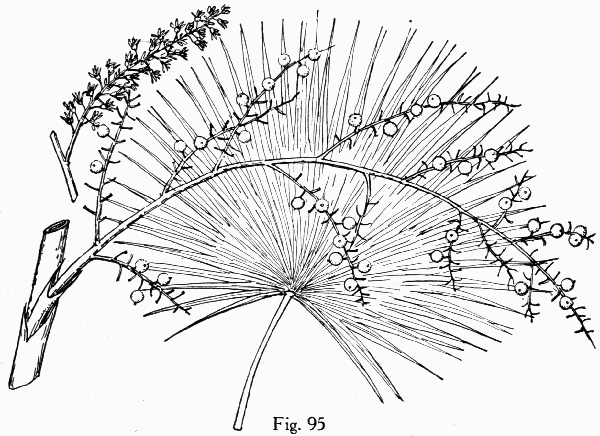
Leaves 2½°—3° in diameter, orbicular, pale yellow-green, lustrous above, with a thick concave ligule, acuminate or rarely rounded at apex; petioles 2°—4° long, much thickened and tomentose toward the base. Flowers: spadix stalked, 2°—4° long, its primary branches short, flattened, incurved, with numerous terete flower-bearing branchlets; flowers on slender pedicels 1/10′—⅛′ long, with a deeply lobed perianth, the lobes nearly [99] triangular, acuminate, and a small stigma. Fruit ¼′—⅜′ in diameter, globose; seed from ⅛′—¼′ in diameter, dark chestnut-brown.
A tree, in Florida, with a smooth pale trunk 20°—25° high and 3′—4′ in diameter.
Distribution. Florida: Dade County, Madeira Hummock, Pumpkin Key, Flamingo, and northwest of Cape Sable; also in Cuba and on Mugueres Island, Gulf of Honduras.
3. Thrinax keyensis Sarg. Thatch.
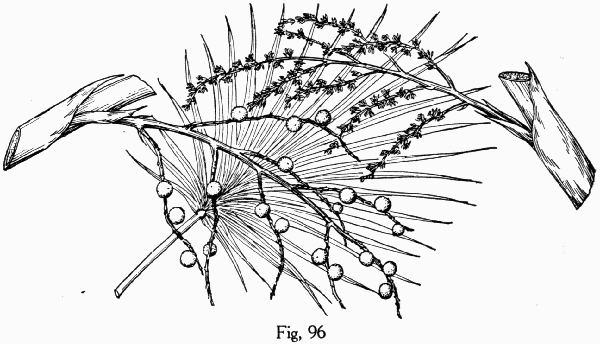
Leaves rather longer than broad, 3°—4° long, the lowest segments parallel with the petiole or spreading from it nearly at right angles, light yellow-green and lustrous on the upper surface, with bright orange-colored margins, below coated while young with deciduous hoary tomentum and pale blue-green and more or less covered with silvery white pubescence at maturity, with a thick pointed ligule 1′ long and wide, lined at first with hoary tomentum; petioles flattened above, obscurely ridged on the lower surface, tomentose while young, pale blue-green, 3°—4° long. Flowers: spadix usually about 6° long, spreading and gracefully incurved, with spathes more or less coated with hoary tomentum, large compressed primary branches, and short bright orange-colored flower-bearing branches; flowers on short thick disk-like pedicels, about ⅛′ long, white, slightly fragrant, with a tubular perianth, the lobes broadly ovate and acute, stamens with nearly triangular filaments united at the base, and a flat stigma. Fruit 1/16′ to nearly ¼′ in diameter; seed brown, 3/16′ in diameter.
A tree, with a stem often 25° high and 10′—14′ in diameter, raised on a base of thick matted roots 2°—3° high and 18′—20′ in diameter, and a broad head of leaves, the upper erect, the lower pendulous and closely pressed against the stem.
Distribution. Dry, sandy soil close to the beach on the north side of the largest of the Marquesas Keys, and on Crab Key, a small island to the westward of Torch Key, one of the Bahia Honda group, Florida; on the Bahamas.
4. Thrinax microcarpa Sarg. Silvertop Palmetto. Brittle Thatch.
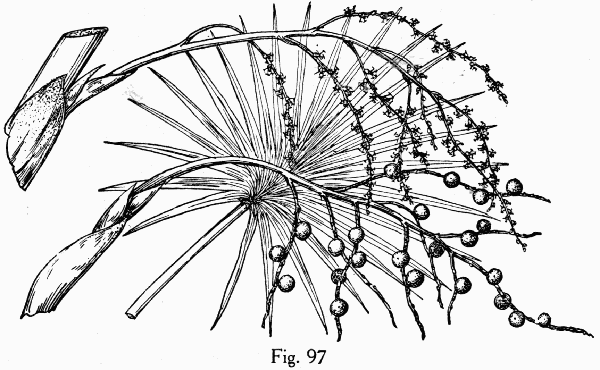
Leaves 2°—3° across, pale green above, silvery white below, more or less thickly coated while young with hoary tomentum, especially on the lower surface, divided near the base almost to the rachis, with an orbicular thick concave ligule lined with a thick coat of white tomentum; petioles thin and flexuose. Flowers: spadix elongated, with short, compressed erect branches slightly spreading below, numerous slender pendulous flower-bearing branches, and long acute spathes deeply parted at the apex, coriaceous and coated above the middle with thick hoary tomentum; flowers on short thick disk-like pedicels, with a [100] cupular perianth, the lobes broadly ovate and acute, stamens with thin nearly triangular exserted filaments slightly united at base and oblong anthers becoming reversed and extrorse at maturity, and a deep orange-colored ovary narrowed above into a short thick style dilated into a large funnel-formed stigma. Fruit globose, ⅛′ in diameter; seed subglobose, bright to dark chestnut-brown, depressed.
A tree, rarely more than 30° high, with a trunk 8′—10′ in diameter.
Distribution. Dry coral soil, on the shores of Sugar Loaf Sound, and on No Name and Bahia Honda keys, Florida; in Cuba.
2. COCCOTHRINAX Sarg.
Small unarmed trees, with simple or clustered stems or rarely stemless. Leaves orbicular, or truncate at base, pale or silvery white on the lower surface, divided into narrow obliquely folded segments acuminate and divided at apex; rachis narrow; ligules thin, free, erect, concave, pointed at the apex; petioles compressed, slightly rounded and ridged above and below, thin and smooth on the margins, gradually enlarged below into elongated sheaths of coarse fibres forming an open network covered while young by thick hoary tomentum. Spadix interfoliar, paniculate, shorter than the leaf-stalks, its primary branches furnished with numerous short slender pendulous flower-bearing secondary branches; spathes numerous, papery, cleft at the apex. Flowers solitary, perfect, jointed on elongated slender pedicels; perianth cup-shaped, obscurely lobed; stamens 9, inserted on the base of the perianth, with subulate filaments enlarged and barely united at the base, and oblong anthers; ovary 1-celled, narrowed into a slender style crowned by a funnel-formed oblique stigma; ovule basilar, erect. Fruit a subglobose berry raised on the thickened torus of the flower, with thick juicy black flesh. Seed free, erect, depressed-globose, with a thick hard vertically grooved shell deeply infolded in the bony albumen; hilum subbasilar, minute; raphe hidden in the folds of the seed-coat; embryo lateral.
Coccothrinax is confined to the tropics of the New World. Two species, of which one is stemless, inhabit southern Florida, and at least two other species are scattered over several of the West Indian islands.
Coccothrinax, from κόκκος and Thrinax, is in allusion to the berry-like fruit.
1. Coccothrinax jucunda Sarg. Brittle Thatch.
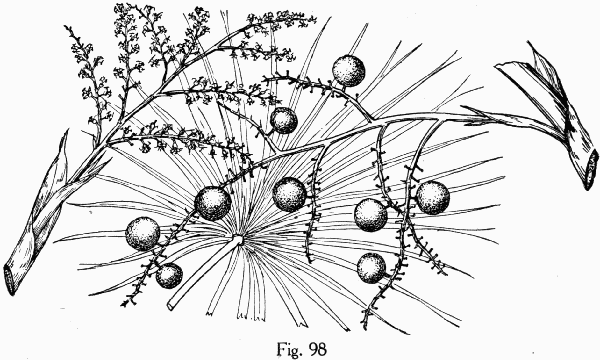
Leaves nearly orbicular, the lower segments usually parallel with the petiole, thin and brittle, 18′—24′ in diameter, divided below the middle of the leaf or toward its base nearly [101] to the ligule, with much-thickened bright orange-colored midribs and margins, pale yellow-green and lustrous on the upper surface, bright silvery white and coated at first on the lower surface with hoary deciduous pubescence, with a thin undulate obtusely short-pointed dark orange-colored rachis, and a thin concave crescent-shaped often oblique slightly undulate short-pointed and light or dark orange-colored ligule ¾′ wide, ⅓′ deep; petioles slender, pale yellow-green, 2½°—3° long. Flowers: spadix 18′—24′ long, with flattened stalks, slender much-flattened primary branches 8′—10′ long, light orange-colored slender terete flower-bearing branches 1½′—3′ long, and pale reddish brown spathes coated toward the ends with pale pubescence; flowers opening in June and irregularly also in the autumn on ridged spreading pedicels ⅛′ long, with an orange-colored ovary surmounted by an elongated style dilated into a rose-colored stigma. Fruit ripening at the end of six months, from ½′—¾′ in diameter, bright green at first when fully grown, becoming deep violet color, with succulent very juicy flesh, ultimately black and lustrous; seed light tawny brown.
A tree, with a stem slightly enlarged from the ground upward, 15°—25° high, 4′—6′ thick, covered with pale blue rind, and surmounted by a broad head of leaves at first erect, then spreading and ultimately pendulous. Wood used for the piles of small wharves and turtle-crawls. The soft tough young leaves are made into hats and baskets.
Distribution. Dry coral ridges and sandy flats from the shores of Bay Biscayne along many of the southern keys to the Marquesas group (var. marquesensis Becc.) Florida; and on the Bahamas (var. macrosperma Becc.).
3. SABAL Adans. Palmetto.
Unarmed trees, with stout columnar stems covered with red-brown rind. Leaves flabellate, tough and coriaceous, divided into many narrow long-pointed parted segments plicately folded at base, often separating on the margins into narrow threads; rachis extending nearly to the middle of the leaves, rounded and broadly winged toward the base on the lower side, thin and acute on the upper side; ligule adnate to the rachis, acute, concave, with thin incurved entire margins; petioles rounded and concave on the lower side, conspicuously ridged on the upper side, acute and entire on the margins, with elongated chestnut-brown shining sheaths of stout fibres. Spadix interfoliar, stalked, decompound, with a flattened stem, short branches, slender densely flowered ultimate branches, and numerous acuminate spathes, the outer persistent and becoming broad and [102] woody. Flowers solitary, perfect; calyx tabular, unequally lobed, the lobes slightly imbricated in the bud; corolla deeply lobed, with narrow ovate-oblong concave acute lobes valvate at the apex in the bud; stamens 6, those opposite the corolla lobes rather longer than the others, with subulate filaments united below into a shallow cup adnate to the tube of the corolla, and ovoid anthers, their cells free and spreading at the base; ovary of 3 carpels, 3-lobed, 3-celled, gradually narrowed into an elongated 3-lobed style truncate and stigmatic at the apex; ovule basilar, erect. Fruit a small black 1 or 2 or 3-lobed short-stemmed berry with thin sweet dry flesh. Seed depressed-globose, marked on the side by the prominent micropyle, with a shallow pit near the minute basal hilum, a thin seed-coat, and a ventral raphe; embryo minute, dorsal, in horny uniform albumen penetrated by a hard shallow basal cavity filled by the thickening of the seed-coat.
Sabal belongs to the New World, and is distributed from the Bermuda Islands and the South Atlantic and Gulf states of North America through the West Indies to Venezuela and Mexico.
Of the eight species now recognized four inhabit the United States; of these two are small stemless plants.
The generic name is of uncertain origin.
CONSPECTUS OF THE NORTH AMERICAN ARBORESCENT SPECIES.
Spadix short; fruit subglobose, 1-celled; seed-coat light chestnut color.
1. S. Palmetto (C).
Spadix elongated; fruit often 2 or 3-lobed, with 2 or 3 seeds; seed-coat dark chestnut-brown.
2. S. texana (E).
1. Sabal Palmetto R. & S. Cabbage Tree. Cabbage Palmetto.
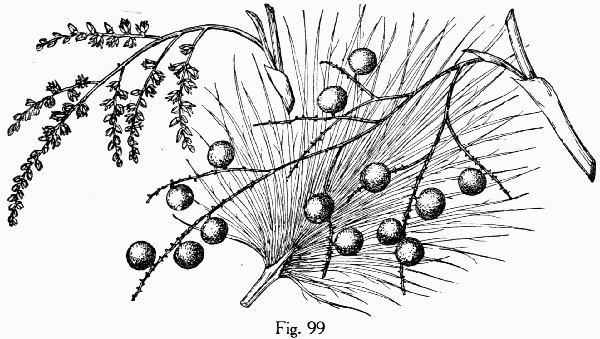
Leaves 5°—6° long and 7°—8° broad, dark green and lustrous, deeply divided into narrow parted recurved segments, with ligules 4′ long and more or less unsymmetrical at apex; petioles 6°—7° long and 1½′ wide at apex. Flowers: spadix 2°—2½° long, with slender incurved branches, slender ultimate divisions, and thin secondary spathes flushed with red at apex and conspicuously marked by pale slender longitudinal veins; flowers in the axils of minute deciduous bracts much shorter than the perianth, opening in June. Fruit ripening late in the autumn, subglobose or slightly obovoid, gradually narrowed at base, 1-seeded, about ⅓′ in diameter; seed light bright chestnut-colored, ¼′ broad.
A tree, often 40°—50° and occasionally 80°—90° high, with a tall clear trunk often 2° in diameter, sometimes branched by the destruction of the terminal bud, divided by shallow [103] irregular interrupted fissures into broad ridges, with a short pointed knob-like underground stem surrounded by a dense mass of contorted roots often 4° or 5° in diameter and 5° or 6° deep, from which tough light orange-colored roots often nearly ½′ in diameter penetrate the soil for a distance of 15° or 20°, and a broad crown of leaves at first upright, then spreading nearly at right angles with the stem, and finally pendulous. Wood light, soft, pale brown, or occasionally nearly black, with numerous hard fibro-vascular bundles, the outer rim about 2′ thick and much lighter and softer than the interior. In the southern states the trunks are used for wharf-piles, and polished cross sections of the stem sometimes serve for the tops of small tables; the wood is largely manufactured into canes. From the sheaths of young leaves the bristles of scrubbing-brushes are made. The large succulent leaf-buds are cooked and eaten as a vegetable, and coarse hats, mats, and baskets are made from the leaves. Pieces of the spongy bark of the stem are used as a substitute for scrubbing-brushes.
Distribution. Sandy soil in the immediate neighborhood of the coast from the neighborhood of Cape Hatteras and Smith Island at the mouth of Cape Fear River, North Carolina, southward near the coast to northern Florida; in Florida extending across the peninsula and south to Upper Metacomb Key, and along the west coast to Saint Andrews Bay; most abundant and of its largest size on the west coast of the Florida peninsula.
Often planted as a street tree in the cities of the southern states.
2. Sabal texana Becc. Palmetto.
Sabal mexicana S. Wats., not Mart.
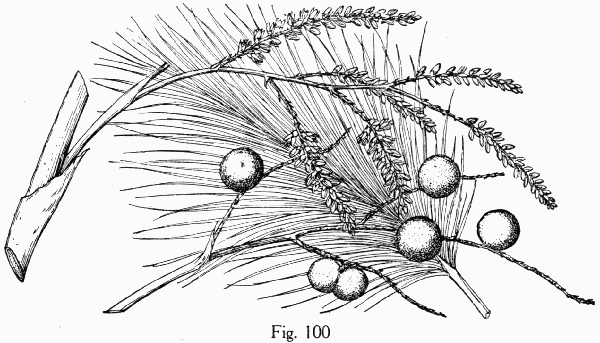
Leaves dark yellow-green and lustrous, 5°—6° long, often 7° wide, divided nearly to the middle into narrow divided segments, with thickened pale margins separating into long thin fibres, with ligules about 6′ long; petioles 7°—8° long, 1½′ wide at the apex. Flowers: spadix 7°—8° long, with stout ultimate divisions; flowers in Texas appearing in March or April in the axils of persistent bracts half as long as the perianth. Fruit ripening early in the summer, globose, often 2 or 3-lobed; seeds nearly ½′ broad and ¼′ wide, dark chestnut-brown, with a broad shallow basal cavity, and a conspicuous orange-colored hilum.
A tree, with a trunk 30°—50° high, often 2½° in diameter, and a broad head of erect ultimately pendulous leaves. Wood light, soft, pale brown tinged with red, with thick light-colored rather inconspicuous fibro-vascular bundles, the outer rim 1′ thick, soft, and light colored. On the Gulf coast the trunks are used for wharf-piles, and on the lower Rio Grande the leaves for the thatch of houses.
[104]
Distribution. Rich soil of the bottom-lands on the Bernado River, Cameron County, and near the mouth of the Rio Grande, Texas, and southward in Mexico in the neighborhood of the coast.
Frequently planted as a street tree in the towns in the lower Rio Grande valley.
4. WASHINGTONIA H. Wendl.
Trees, with stout columnar stems and broad crowns of erect and spreading finally pendulous leaves. Leaves flabellate, divided nearly to the middle into many narrow deeply parted recurved segments separating on the margins into numerous slender pale fibres; rachis short, slightly rounded on the back, gradually narrowed from a broad base, with concave margins furnished below with narrow erect wings, and slender and acute above; ligule elongated, oblong, thin and laciniate on the margins; petioles elongated, broad and thin, flattened or slightly concave on the upper side, rounded on the lower, armed irregularly with broad thin large and small straight or hooked spines confluent into a thin bright orange-colored cartilaginous margin, gradually enlarged at base into thick broad concave bright chestnut-brown sheaths composed of a network of thin strong fibres. Spadix interfoliar, stalked, elongated, paniculate, with pendulous flower-bearing ultimate divisions and numerous long spathes. Flowers perfect, jointed on thick disk-like pedicels; calyx tubular, scarious, thickened at base, gradually enlarged and slightly lobed at apex, the lobes imbricated in the bud; corolla funnel-formed, with a fleshy tube inclosed in the calyx and about half as long as the lanceolate lobes thickened and glandular on the inner surface at the base, imbricated in the bud; stamens inserted on the tube of the corolla, with free filaments thickened near the middle and linear-oblong anthers; ovary 3-lobed, 3-celled, with slender elongated flexuose styles stigmatic at apex; ovules lateral, erect. Fruit a small ellipsoidal short-stalked black berry with thin dry flesh. Seed free, erect, oblong-ovoid, concave above, with a flat base depressed in the centre, a minute sublateral hilum, a broad conspicuous rachis, a minute lateral micropyle, and a thin pale chestnut-brown inner coat closely investing the simple horny albumen; embryo minute, lateral, with the radicle turned toward the base of the fruit.
Three species of Washingtonia are known: one inhabits the interior dry region of southern California and the adjacent parts of Lower California, and the others the mountain cañons of western Sonora and southern Lower California.
The genus is named for George Washington.
1. Washingtonia filamentosa O. Kuntze. Desert Palm. Fan Palm.
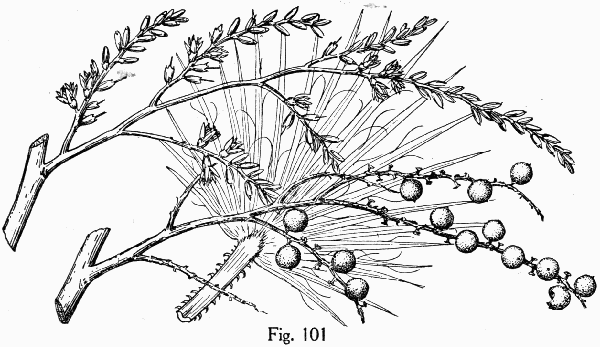
Leaves 5°—6° long and 4°—5° wide, light green, slightly tomentose on the folds; petioles [105] 4°—6° long and about 2′ broad at apex, with sheaths 16′—18′ long and 12′—14′ wide, and ligules 4′ long and cut irregularly into long narrow lobes. Flowers: spadix 10°—12° long, 3 or 4 being produced each year from the axils of upper leaves, the outer spathe inclosing the bud, narrow, elongated, and glabrous, those of the secondary branches coriaceous, yellow tinged with brown, and laciniate at apex; flowers slightly fragrant, opening late in May or early in June. Fruit produced in great profusion, ripening in September, ⅓′ long; seed ¼′ long, ⅛′ thick.
A tree, occasionally 75° high, with a trunk sometimes 50°—60° tall and 2°—3° in diameter, covered with a thick light red-brown scaly rind and clothed with a thick thatch of dead pendant leaves descending in a regular cone from the broad crown of living leaves sometimes nearly to the ground. Wood light and soft, with numerous conspicuous dark orange-colored fibro-vascular bundles. The fruit is gathered and used as food by the Indians.
Distribution. Often forming extensive groves or small isolated clumps in wet usually alkali soil in depressions along the northern and northwestern margins of the Colorado Desert in southern California, sometimes extending for several miles up the cañons of the San Bernardino and San Jacinto mountains; and in Lower California.
Now largely cultivated in southern California, New Orleans, southern Europe, and other temperate regions.
5. ACŒLORRAPHE H. Wendl.
Trees, with tall slender often clustered stems clothed for many years with the sheathing bases of the petioles of fallen leaves. Leaves suborbicular, divided into numerous two-parted segments plicately folded at the base; rachis short, acute; ligule thin, concave, furnished with a broad membranaceous dark red-brown deciduous border; petioles slender, flat or slightly concave on the upper side, rounded and ridged on the lower side, with a broad high rounded ridge, thickened and cartilaginous on the margins, more or less furnished with stout or slender flattened teeth; vagina thin and firm, bright mahogany red, lustrous, closely infolding the stem, its fibres thin and tough. Spadix paniculate, interpetiolar, its rachis slender, compressed, ultimate branches, numerous, slender, elongated, gracefully drooping, hoary-tomentose, the primary branches flattened, the secondary terete in the axils of ovate acute chestnut-brown bracts; spathes flattened, thick and firm, deeply two-cleft and furnished at apex with a red-brown membranaceous border, inclosing the rachis of the panicle, each primary branch with its spathe and the node of the rachis below it inclosed in a separate spathe, the whole surrounded by the larger spathe of the node next below. Flowers perfect, minute, sessile on the ultimate branches of the spadix, in the axils of ovate acute chestnut-brown caducous bracts, solitary toward the end of the branches and in two- or three-flowered clusters near their base; calyx truncate at base, divided into three broadly ovate sepals dentate on the margins, valvate in æstivation, enlarged and persistent under the fruit; corolla three-parted nearly to the base, its divisions valvate in æstivation, oblong-ovate, thick, concave and thickened at apex, deciduous; stamens six, included; filaments nearly triangular, united below into a cup adnate to the short tube of the corolla; anthers short-oblong, attached on the back below the middle, introrse, two-celled, the cells opening longitudinally; ovary obovoid, of three carpels, each with two deep depressions on their outer face, united into a slender style; stigma minute, terminal, persistent on the fruit; ovule solitary, erect from the bottom of the cell, anatropous. Fruit drupaceous, subglobose, one-seeded, black and lustrous; exocarp thin and fleshy; endocarp thin, crustaceous; seed erect, free, subglobose, light chestnut-brown; testa thin and hard; hilum small, suborbicular; raphe ventral, oblong, elongated, black, slightly prominent, without ramifications; embryo lateral; albumen homogeneous.
Two species of Acœlorraphe have been distinguished; they inhabit southern Florida, and one species occurs also in Cuba and on the Bahama Islands.
The generic name, from ἀ priv., Κοῖλος and ῥαφη, refers to the character of the seed.
[106]
CONSPECTUS OF THE NORTH AMERICAN SPECIES.
Petioles furnished with stout marginal teeth throughout their entire length; leaves green on both surfaces, their primary divisions extending to the middle, secondary divisions only from 3½′—9′ long; stems forming large thickets.
1. A. Wrightii (D).
Petioles furnished with thinner teeth, usually unarmed toward the apex; leaves green or glaucescent on the lower surface, their primary divisions extending nearly to the base, secondary divisions often 10′ long or more; stems often prostrate.
2. A. arborescens (D).
1. Acœlorraphe Wrightii Becc.
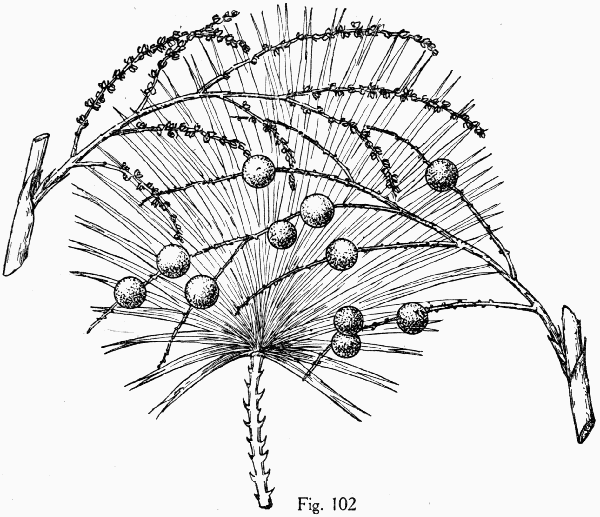
Leaves 30′—36′ in diameter, thin, light green, divided only to the middle, the divisions of the primary lobes 3½′—9′ long; petioles thin, gradually tapering from the base, 40′—60′ in length, armed throughout with stout straight or incurved teeth. Flowers: spadix 4°—6° long; flowers ⅛′—⅙′ long, with a light chestnut-brown calyx and a pale yellow-green corolla. Fruit ¼′ in diameter.
A tree with numerous stems, in Florida sometimes 10 metres high, forming great thickets.
Distribution. Dade County, Florida, from the rear of Madeira Hummock to Cape Sable, in swamps of fresh or brackish water at some distance from the coast; also in Cuba and on the Bahamas.
2. Acœlorraphe arborescens Becc.
Serenoa arborescens Sarg.
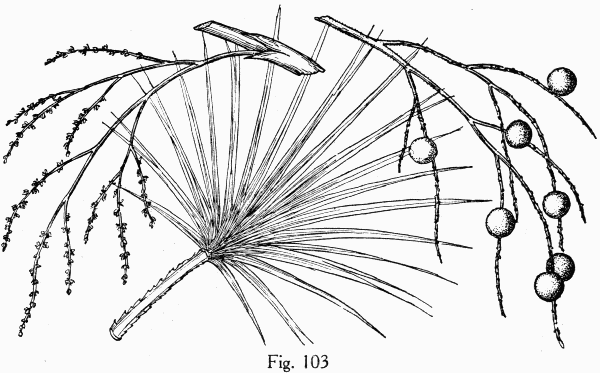
Leaves about 2° in diameter, light yellow-green on the upper surface, blue-green or glaucescent on the lower surface, divided nearly to the base into numerous lobes slightly thickened at the pale yellow midribs and margins; petioles 18′—24′ long, armed, except toward the apex, with stout flattened curved orange-colored teeth. Flowers: spadix [107] 3°—4° long, with a slender much-flattened stalk, panicled lower branches 18′—20′ in length, and 6—8 thick firm pale green conspicuously ribbed spathes dilated at apex into a narrow border; flowers with a light chestnut-brown calyx and a pale yellow-green corolla. Fruit globose, ⅓′ in diameter; seed somewhat flattened below, with a pale vertical mark on the lower side, and a hilum joined to the micropyle by a pale band.
A tree, from 30°—40° high, with 1 or several clustered erect inclining or occasionally semiprostrate stems 3′—4′ in diameter, covered almost to the ground by the closely clasping bases of the leaf-stalks and below with a thick pale rind.
Distribution. Low undrained soil covered for many months of every year in water from 1′—18′ deep, occasionally occupying almost exclusively areas of several acres in extent or more often scattered among Cypress-trees or Royal Palms, in the swamps and along the hummocks adjacent to the Chokoloskee River and its tributaries and at the head of East River, Whitewater Bay, in southwestern Florida.
6. ROYSTONEA Cook. Royal Palm.
Unarmed trees, with massive stems enlarged near the middle, and terminating in long slender bright green cylinders formed by the densely imbricated sheaths of the leaf-stalks. Leaves equally pinnate, with linear-lanceolate long-pointed unequally cleft plicately-folded pinnæ inserted obliquely on the upper side of the rachis, folded together at the base, with thin midribs and margins; rachis convex on the back, broad toward the base of the leaf and acute toward its apex; petioles semicylindric, gradually enlarged into thick elongated green sheaths. Spadix large, decompound, produced near the base of the green part of the stem, with long pendulous branches and 2 spathes, the outer semicylindric and as long as the spadix, the inner splitting ventrally and inclosing the branches of the spadix. Flowers monœcious, in a loose spiral, toward the base of the branch in 3-flowered clusters, with a central staminate and smaller lateral pistillate flowers, higher on the branch the staminate in 2-flowered clusters; calyx of the staminate flower of minute broadly ovate obtuse scarious sepals imbricated in the bud, much shorter than the corolla; petals nearly equal, valvate in the bud, ovate or obovate, acute, slightly united at the base, coriaceous; stamens 6, 9, or 12, with subulate filaments united below and adnate to the base of the corolla, and large ovate-sagittate anthers, the cells free below; ovary rudimentary, subglobose or 3-lobed; pistillate flowers much smaller, ovoid-conic; sepals obtuse; corolla erect, divided to the middle into acute erect lobes incurved at apex; staminodia 6, scale-like, united into a cup adnate to the corolla; ovary subglobose, obscurely 2 or 3-lobed, [108] 2 or 3-celled, gibbous, the cells crowned with a 3-lobed stigma becoming subbasilar on the fruit; ovule ascending. Fruit a short-stalked drupe with thin crustaceous flesh. Seed oblong-reniform, marked by the conspicuous fibrous reticulate branches of the raphe radiating from the narrow basal hilum, and covered with a thin crustaceous coat; embryo minute, cylindric, lateral, in uniform albumen.
Roystonea is confined to the tropics of the New World, where two or three species occur.
The genus as here limited was named for General Roy Stone of the United States army.
1. Roystonea regia Cook. Royal Palm.
Oreodoxa regia H. B. K.
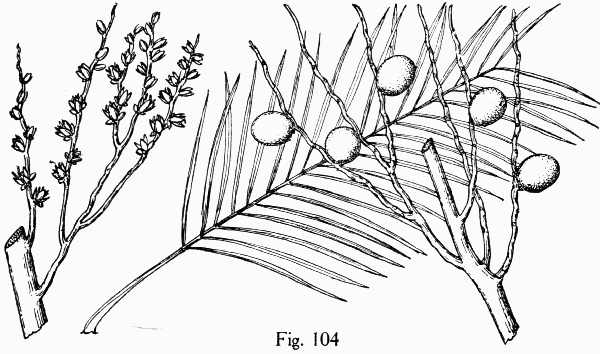
Leaves 10°—12° long, closely pinnate, the pinnæ, 2½°—3° long, 1½′ wide near the base of the leaf, and gradually decreasing in size toward its apex, deep green with slender conspicuous veins, and covered below with minute pale glandular dots; petioles almost terete, concave near the base, with thin edges separating irregularly into pale fibres, and enlarged into bright green cylindrical clasping bases 8° or 9° long and more or less covered with dark chaffy scales. Flowers: spadix about 2° long, with a nearly terete stem and slightly ridged primary and secondary branches compressed above, abruptly enlarged at the base, and simple slender flexuose long-pointed flower-bearing branchlets 3′—6′ long, pendant and closely pressed against the secondary branches; flowers opening in Florida in January and February, the staminate nearly ¼′ long and rather more than twice as long as the pistillate. Fruit oblong-obovoid, full and rounded at apex, narrowed at base, violet-blue, about ½′ long, with a thin outer coat and a light red-brown inner coat, loose and fibrous on the outer surface, and closely investing the thin light brown seed.
A tree, 80°—100° high, with a trunk rising from an abruptly enlarged base, gradually tapering from the middle to the ends and often 2° in diameter, covered with light gray rind tinged with orange color, marked with dark blotches and irregularly broken into minute plates, the green upper portion 8°—10° long, and a broad head of gracefully drooping leaves. Wood of the interior of the stem spongy, pale brown, much lighter than the hard exterior rim, containing numerous dark conspicuous fibro-vascular bundles. The outer portion of the stem is made into canes, and the trunks are sometimes used for wharf-piles and in construction.
Distribution. Florida, hummocks on Rogue River twenty miles east of Caximbas Bay, on some of the Everglades Keys, Long’s Key, and formerly on the shores of Bay Biscayne near the mouth of Little River; common in the West Indies and Central America.
Largely cultivated as an ornamental tree in tropical countries, and often planted to form avenues, for which its tall pale columnar stems and noble heads of graceful foliage make it valuable.
[109]
7. PSEUDOPHŒNIX H. Wendl.
A tree, with a slender stem abruptly enlarged at the base or tapering from the middle to the ends, covered with thin pale blue or nearly white rind, and conspicuously marked by the dark scars of fallen leaf-stalks. Leaves erect, abruptly pinnate, with crowded linear-lanceolate acuminate leaflets increasing in length and width from the ends to the middle of the leaf, thick and firm in texture, dark yellow-green above, pale and glaucous below; rachis convex on the lower side, concave on the upper side near the base of the leaf, with thin margins, becoming toward the apex of the leaf flat and narrowed below and acute above, marked on the sides at the base with dark gland-like excrescences; petioles short, concave above, with thin entire margins separating into slender fibres, gradually enlarged into broad thick sheaths of short brittle fibres. Spadix interfoliar, compound, pendulous, stalked, much shorter than the leaves, with spreading primary branches, stout and much flattened toward the base, slender and rounded above the middle, furnished at the base with a thickened ear-like body, slender secondary branches, short thin rigid densely flowered ultimate divisions, and compressed light green double spathes erose on their thin dark brown margins. Flowers on slender pedicels articulate by an expanded base, widely scattered on the ultimate branches of the spadix, staminate and bisexual in the same inflorescence; calyx reduced to the saucer-like rim of the thickened receptacle, undulate on the margin, the rounded angles alternating with the petals; petals 3, valvate in the bud, oblong, rounded at apex, thick conspicuously longitudinally veined, persistent; stamens 6, with short flattened nearly triangular filaments slightly united at the base into a narrow fleshy disk, and triangular cordate anthers attached at the base in a cavity on their outer face, 2-celled, the cells opening by lateral slits; styles of the perfect flower 3-lobed at the apex with obtuse appressed lobes, that of the sterile flower as long or longer than that of the perfect flower, more slender and tapering into a narrow 3-pointed apex. Fruit a stalked globose 2 or 3-lobed orange-scarlet thin-fleshed drupe marked by the lateral style and surrounded below by the withered remnants of the flower; pedicel abruptly enlarged at base, articulate from a persistent cushion-like body furnished in the centre with a minute point penetrating a cavity in the base of the pedicel. Seed subglobose, free, erect, with a basal hilum and a thin light red-brown coat marked by the pale conspicuous ascending 2 or 3-branched raphe; embryo minute, basal, in uniform horny albumen.
Pseudophœnix with a single species inhabits the keys of southern Florida, and the Bahamas.
The generic name is in allusion to a fancied resemblance to Phœnix, a genus of Palms.
1. Pseudophœnix vinifera Becc.
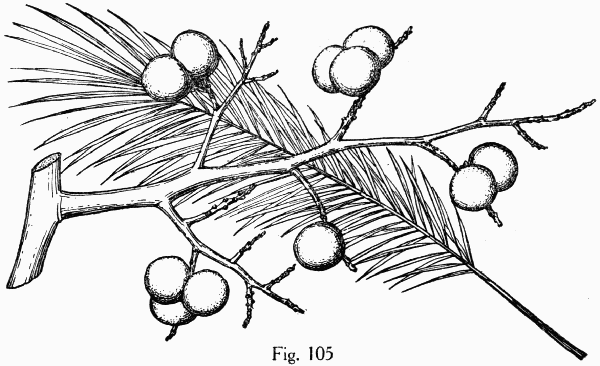
Leaves 5°—6° long, with pinnæ often 18′ long and 1′ wide near the middle of the leaf, [110] becoming at its extremities not more than half as long and wide; petioles 6′—8′ in length. Flowers: spadix 3° long and 2½° wide. Fruit ripening in May and June, ½′—¾′ in diameter on a peduncle ¼′ long; seed ¼′ in diameter.
Distribution. Florida, east end of Elliot’s Key, and east end of Key Largo near the southern shore, here forming a grove of 200 or 300 plants; more common on the Bahamas.
Occasionally cultivated in the gardens of southern Florida.
IV. LILIACEÆ.
YUCCÆ.
Leaves, alternate, linear-lanceolate. Flowers in terminal panicles; sepals and petals nearly similar, subequal, withering-persistent; ovary with more or less deeply introduced dorsal partitions; ovules numerous, 2-ranked in each cell; embryo subulate, obliquely placed across the seed; cotyledon arched in germination.
Yuccæ as here limited consists of two American genera, Hesperaloe, with two species, low plants of Texas and Mexico, and Yucca.
1. YUCCA L.
Trees with simple or branched stems prolonged by axillary naked buds, dark thick corky bark, light fibrous wood in concentric layers, and large stout horizontal roots; or often stemless. Leaves involute in the bud, at first erect, usually becoming reflexed, abruptly narrowed above the broad thickened clasping base, usually widest near the middle, concave on the upper surface, involute toward the horny usually sharp-pointed apex, convex and often slightly keeled toward the base on the lower surface, the margins serrulate or filamentose, light or dull green. Flowers fertilized by insects and opening for a single night, on slender pedicels in 2 or 3-flowered clusters or singly at the base of the large compound panicle furnished with conspicuous leathery white or slightly colored bracts, those at the base of the pedicels thin and scarious; perianth cup-shaped, with thick ovate-lanceolate creamy white segments more or less united at base, usually furnished with small tufts of white hairs at the apex, those of the outer rank narrower, shorter, and more colored than the more delicate petal-like segments of the inner rank; stamens 6, in 2 series, free, shorter than the ovary (as long in 1), white, with club-shaped fleshy filaments, obtuse and slightly 3-lobed at the apex, and cordate emarginate anthers attached on the back, the cells opening longitudinally, curling backward and expelling the large globose powdery pollen-grains; ovary oblong, 6-sided, sessile or stalked, with nectar-glands within the partitions, dull greenish white, 3-celled, gradually narrowed into a short or elongated 3-lobed ivory-white style forming a triangular stigmatic tube. Fruit oblong or oval, more or less distinctly 6-angled, 6-celled, usually beaked at the apex, baccate and indehiscent or capsular and 3-valved, the valves finally separating at the apex; pericarp of 2 coats, the outer at maturity thick, succulent and juicy, thin, dry and leathery, or thin and woody. Seeds compressed, triangular, obovoid, or obliquely ovoid or orbicular, thick, with a narrow 2-edged rim, or thin, with a wide or narrow brittle margin; seed-coat thin, black, slightly rugose or smooth; embryo in plain or rarely ruminate hard farinaceous oily albumen; cotyledon much longer than the short radicle turned toward the small oblong white hilum.
Yucca is confined to the New World and is distributed from Bermuda and the eastern Antilles, through the south Atlantic and Gulf states to Oklahoma and Arkansas, and through New Mexico and northward along the eastern base of the Rocky Mountains to South Dakota, westward to middle California, and southward through Arizona, Mexico, and Lower California to Central America. About thirty species with many varieties and probable hybrids are recognized. Of the species which inhabit the territory of the United States nine assume the habit and attain the size of small trees. The root-stalks of Yucca are used as a substitute for soap, and ropes, baskets, and mats are made from the tough fibres of the leaves. Many of the species are cultivated, especially in countries of scanty rainfall, for their great clusters of beautiful flowers, or in hedges to protect gardens from cattle.
The generic name is from the Carib name of the root of the Cassava.
[111]
CONSPECTUS OF THE ARBORESCENT SPECIES OF THE UNITED STATES.
Flower-clusters usually sessile, or short-stalked.
Fruit pendulous, with thick succulent flesh; seeds thick; albumen ruminate.
Segments of the perianth slightly united at the base.
Panicle glabrous or puberulous.
Ovary stipitate; leaves sharply toothed on their horny margins, smooth, dark green, slightly concave.
1. Y. aloifolia (C).
Ovary sessile.
Leaves concave, blue-green, rough on the lower surface.
2. Y. Treculeana (E).
Leaves concave above the middle, light yellow-green, smooth.
Style elongated.
3. Y. macrocarpa (E, H).
Style short.
4. Y. mohavensis (G, H).
Panicle coated with hoary tomentum; leaves concave, smooth, light yellow-green.
5. Y. Schottii (H).
Segments of the perianth united below into a narrow tube; leaves flat, smooth, dark green.
6. Y. Faxoniana (E).
Fruit erect or spreading, the flesh becoming thin and dry at maturity; seeds thin; albumen entire.
Leaves rigid, concave above the middle, blue-green, sharply serrate.
7. Y. brevifolia (F, G).
Leaves thin, flat or concave toward the apex, nearly entire, rough on the lower surface, dull or glaucous green.
8. Y. gloriosa (C).
Flower-clusters long-stalked; fruit capsular, erect, finally splitting between the carpels and through their backs at the apex; seeds thin; albumen entire; leaves thin, flat, filamentose on the margins, smooth, pale yellow-green.
9. Y. elata (E, H).
1. Yucca aloifolia L. Spanish Bayonet.
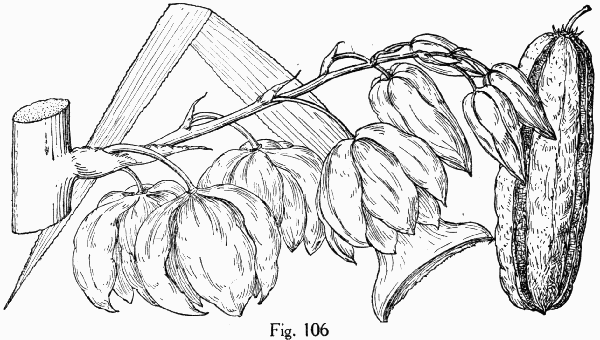
Leaves 18′—32′ long, 1¼′—2½′ wide, erect, rigid, conspicuously narrowed above the light green base, widest above the middle, slightly concave on the upper surface, smooth, dark rich green, with a stiff dark red-brown tip, and horny finely and irregularly serrate margins; long-persistent. Flowers from June until August on stout pedicels, in nearly sessile glabrous or slightly pubescent panicles 18′—24′ long; perianth 1′—1½′ in length and 3′ or 4′ across when fully expanded, the segments ovate, thick and tumid toward the base, those of the outer rank rounded and often marked with purple at apex, the inner acuminate [112] and short-pointed; stamens as long or sometimes a little longer than the light green ovary raised on a short stout stipe. Fruit ripening from August to October, elongated, ellipsoidal, hexagonal, 3′—4′ long, 1¼′—1½′ thick, light green when fully grown, and in ripening turning dark purple, the outer and inner coats forming a thick succulent mass of bitter-sweet juicy flesh, finally becoming black and drying on its stalk; seeds ¼′—⅓′ wide, about 1/16′ thick, with a thin narrow ring-like border to the rim.
A tree, occasionally 25° high, usually much smaller, with an erect or more or less inclining simple or branched trunk slightly swollen at base, and rarely more than 6′ in diameter; sometimes with numerous clustered stems. Bark near the base of the trunk thick, rough, dark brown, marked above by scars left by falling leaves.
Distribution. Sand dunes of the coast from North Carolina to eastern Louisiana; west of the Apalachicola River attaining its largest size and sometimes ranging inland through Pine-forests for thirty or forty miles; and in Yucatan (var. yucatana Trel.).
A common garden plant in all countries with a temperate climate, and long naturalized in the southern states far beyond the limits of its natural range, in some of the West Indian islands and on the Gulf coast of Mexico. Forms with leaves variously striped with white, yellow, and red or with recurving leaves are frequent in cultivation.
2. Yucca Treculeana Carr. Spanish Bayonet. Spanish Dagger.
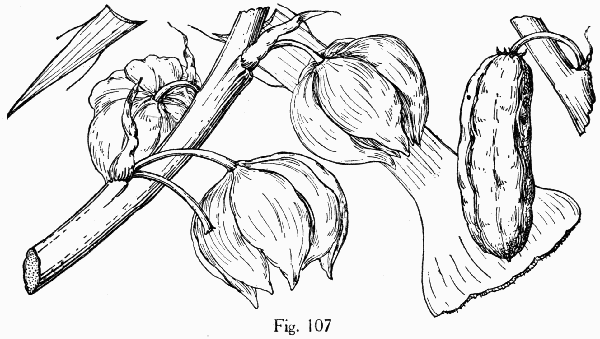
Leaves 2½°—4° long, 2′—3¼′ wide, slightly or not at all contracted above the dark red lustrous base, concave, stiff, rigid, dark blue-green, rough on the lower surface, nearly smooth on the upper, with a short stout dark red-brown tip, and dark brown margins roughened by minute deciduous teeth and ultimately separating into slender dark fibres; persistent for many years, the dead leaves hanging closely appressed against the trunk below the terminal crown of closely imbricated living leaves. Flowers in March and April on slender pedicels, in dense many-flowered glabrous or puberulous panicles 2°—4° long and raised on short stout stalks; perianth 1′—2′ long, 2′—4′ in diameter when fully expanded, with narrow elongated ovate-lanceolate to ovate segments, ¼′ wide, acute, thin and delicate, furnished at apex with a conspicuous tuft of short pale hairs; filaments slightly papillose, about as long as the prismatic ovary gradually narrowed above and crowned by the deeply divided stigmatic lobes. Fruit ripening in the summer, 3′—4′ long, about 1′ thick, dark reddish brown or ultimately black, with thin succulent sweetish flesh; seeds about ⅛′ wide, nearly 1/16′ thick, with a narrow border to the rim.
A tree, occasionally 25°—30° high, with a trunk sometimes 2° in diameter and numerous stout wide-spreading branches; usually smaller and often forming broad low thickets 4°—5° [113] tall. Bark on old trunks ¼′—½′ thick, dark red-brown and broken into thin oblong plates covered by small irregular closely appressed scales. Wood light brown, fibrous, spongy, heavy, difficult to cut and work.
Distribution. Shores of Matagorda Bay, southward through western Texas into Nuovo Leon, and through the valley of the Rio Grande to the eastern base of the mountains of western Texas; forming open stunted forests on the coast dunes at the mouth of the Rio Grande; farther from the coast often spreading into great impenetrable thickets.
Cultivated as an ornamental plant in the gardens of central and western Texas and in other southern States, and occasionally in those of southern Europe.
3. Yucca macrocarpa Coville. Spanish Dagger.
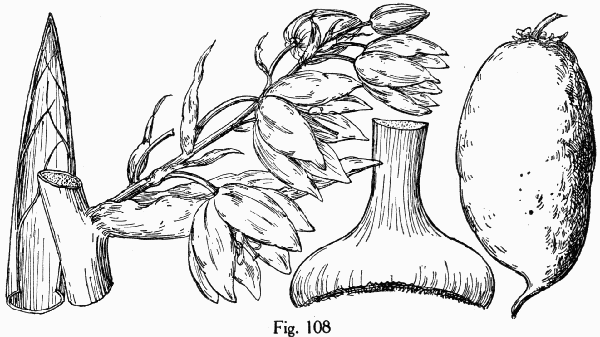
Leaves 1½°—2° long, 1′—2′ wide, gradually narrowed from the dark red lustrous base to above the middle, rigid, concave, yellow-green, rough on the lower surface and frequently also on the upper surface, with a stout elongated dark tip, and thickened margins separated into stout gray filaments. Flowers in March and April in densely flowered sessile or short-stalked glabrous or occasionally pubescent panicles; perianth usually about 2′ long, with acuminate segments, those of the outer and inner rows nearly of the same size; stamens shorter than the elongated style. Fruit 3′—4′ long, about 1½′ thick, abruptly contracted at apex into a stout point, nearly black when fully ripe, with sweet succulent flesh; seeds about ⅓′ wide, ⅛′ thick, with a narrow border to the rim.
A tree, rarely exceeding 15° in height, with a usually simple stem 6′—8′ in diameter, and often clothed to the ground with living leaves. Bark dark brown and scaly.
Distribution. Arid plains from western Texas to eastern Arizona and southward in Chihuahua.
4. Yucca mohavensis Sarg. Spanish Dagger.
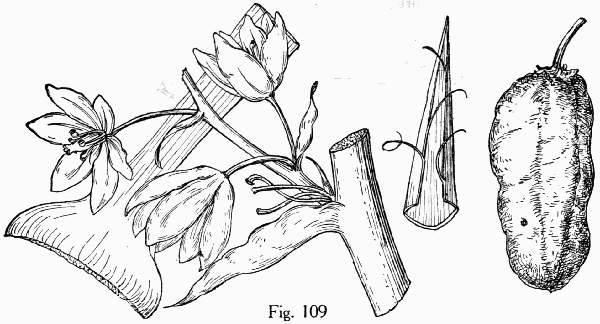
Leaves 18′—20′ long, about 1½′ wide, abruptly contracted above the dark red lustrous base, gradually narrowed upward to above the middle, thin and concave except toward the slightly thickened base of the blade, dark green, smooth on both surfaces, with a stout rigid sharp-pointed tip, and entire bright red-brown margins soon separating into numerous pale filaments. Flowers from March to May on slender erect ultimately drooping pedicels 1′—1½′ long, in densely flowered sessile or short-stemmed panicles 12′—18′ in length; perianth 1′—2′ long, the segments united at the base into a short tube, thickened and hood-shaped at the apex, those of the outer rank often deeply flushed with purple, but little longer than the less prominently ribbed usually wider and thinner segments of the inner rank; stamens [114] with more or less pilose filaments nearly as long as the short style. Fruit ripening in August and September, 3′—4′ long, about 1½′ thick, usually much constricted near the middle, abruptly contracted at apex into a short stout point, dark dull brown or nearly black, with flesh often nearly ½′ thick; seeds ⅓′ wide, rather less than ⅛′ thick, with a narrow border to the rim.
A tree, rarely exceeding 15° in height, with a trunk usually simple or occasionally furnished with short spreading branches, and 6′—8′ in diameter, usually surrounded by a cluster of shorter more or less spreading stems and often clothed to the ground with living leaves. Bark dark brown and scaly. Wood soft, spongy, light brown.
Distribution. Southern Nevada and northwestern Arizona across the Mohave Desert to the California coast, extending northward to the neighborhood of Monterey, California, and southward into northern Lower California; common and attaining its largest size on the Mohave Desert, and sometimes ascending arid mountain slopes to altitudes of 4000° above the sea.
5. Yucca Schottii Engelm. Spanish Dagger.
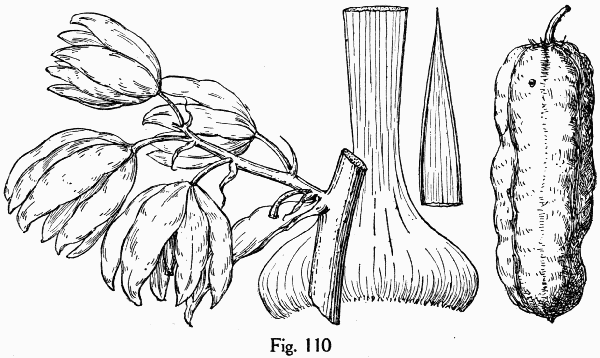
Leaves 2½°—3° long, about 1½′ wide, gradually narrowed upward from the comparatively thin lustrous red base to above the middle, flat except toward the apex, smooth, light [115] yellow-green, with a long rigid sharp light red tip, and thick entire red-brown margins finally separating into short thin brittle threads. Flowers from July to September in erect stalked tomentose panicles; perianth 1′—1¾′ long, the broad oval or oblong-obovate thin segments pubescent on the outer surface toward the base and furnished at the apex with conspicuous clusters of white tomentum; stamens about two thirds as long as the ovary, with filaments pilose at the base, and only slightly enlarged at the apex. Fruit ripening in October and November, obscurely angled, 3½′—4′ long, about 1¼′ thick, often narrowed above the middle, with a stout thick point, and thin succulent flesh; seeds ¼′ wide, about ⅛′ thick, with a thin conspicuous marginal rim.
A tree, in Arizona rarely 18°—20° high, with a trunk often crooked or slightly inclining and simple or furnished with 2 or 3 short erect branches, covered below with dark brown scaly bark, roughened for many years by persistent scars of fallen leaves, and clothed above by the pendant dead leaves of many seasons.
Distribution. Dry slopes of the mountain ranges of Arizona near the Mexican boundary usually at altitudes between 5000° and 6000°, and southward into Sonora.
6. Yucca Faxoniana Sarg. Spanish Dagger.
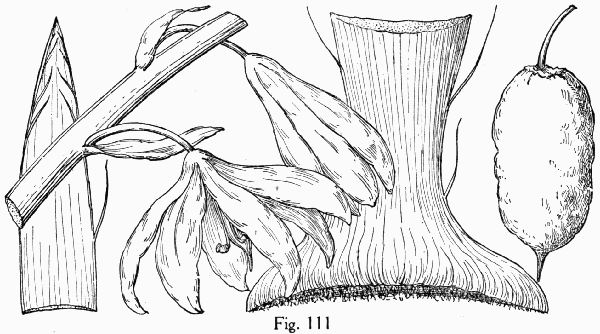
Leaves 2½°—4° long, 2½′—3′ wide, abruptly contracted above the conspicuously thickened lustrous base, widest above the middle, flat on the upper surface, thickened and rounded on the lower surface toward the base, rigid, smooth and clear dark green, with a short stout dark tip, and brown entire margins breaking into numerous stout gray or brown fibres short and spreading near the apex of the leaf, longer, more remote, and forming a thick cobweb-like mass at their base. Flowers appearing in April on thin drooping pedicels, in dense many-flowered glabrous panicles 3°—4° long, with elongated pendulous branches; perianth 2½′ long, the segments thin, concave, widest above the middle, narrowed at the ends, united at base into a short tube, those of the outer rank being about half as wide as those of the inner rank and two thirds as long; stamens much shorter than the ovary, with slender filaments pilose above the middle and abruptly dilated at apex; ovary conspicuously ridged, light yellow marked with large pale raised lenticels, and gradually narrowed into an elongated slender style. Fruit ripening in early summer, slightly or not at all angled, abruptly contracted at apex into a long or short hooked beak, 3′—4′ long, 1′—1½′ thick, light orange-colored and lustrous when first ripe, becoming nearly black, with thick succulent bitter-sweet flesh; seeds ¼′ long, about ⅛′ thick, with a narrow nearly obsolete margin to the rim.
A tree, often 40° high, with a trunk sometimes 2° in diameter above the broad abruptly [116] enlarged base, unbranched or divided into several short branches, and covered above by a thick thatch of the pendant dead leaves of many seasons; frequently smaller and until ten or twelve years old clothed from the ground with erect living leaves. Bark near the base of old trees dark reddish brown, ⅓′—½′ thick, broken on the surface into small thin loose scales.
Distribution. Common on the high desert plateau of southwestern Texas.
7. Yucca brevifolia Engelm. Joshua Tree.
Yucca arborescens Trel.
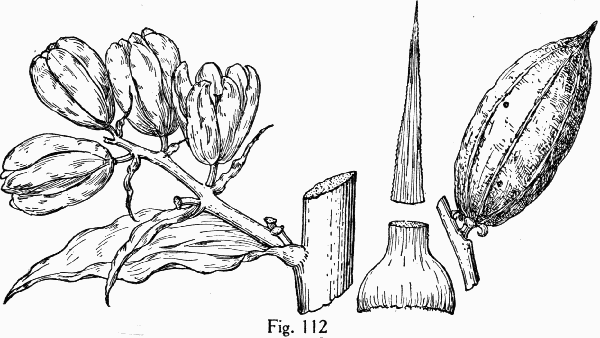
Leaves 5′—8′ or on young plants rarely 10′—12′ long, ¼′—½′ wide, rigid, crowded in dense clusters, lanceolate, gradually tapering from the bright red-brown lustrous base, bluish green and glaucous, smooth or slightly roughened, concave above the middle, with a sharp dark brown tip, and thin yellow margins armed with sharp minute teeth; persistent for many years. Flowers appearing from March until the beginning of May, the creamy white closely imbricated bracts of the nearly sessile pubescent panicle forming before its appearance a conspicuous cone-like bud 8′ or 10′ long; perianth globose to oblong, 1′—2′ long, greenish white, waxy, dull or lustrous, its segments slightly united at the base, keeled on the back, thin below the middle, gradually thickened upward into the concave incurved rounded tip, those of the outer rank rather broader, thicker, and more prominently keeled than those of the inner rank, glabrous or pubescent; stamens about half as long as the ovary, with filaments villose-papillate from the base; ovary conic, 3-lobed above the middle, bright green, with narrow slightly developed septal nectar-glands, and a sessile nearly equally 6-lobed stigma. Fruit ripening in May or June, spreading or more or less pendant at maturity, oblong-ovoid, acute, slightly 3-angled, 2′—4′ long, 1½′—2′ thick, light red or yellow-brown, the outer coat becoming dry and spongy at maturity; seeds nearly ½′ long, rather less than 1/16′ thick, with a broad well-developed margin to the rim, and a large conspicuous hilum.
A tree, 30°—40° high, with a trunk 2°—3° in diameter, rising abruptly from a broad thick basal disk, thick tough roots descending deeply into the soil, and stout branches spreading into a broad, often symmetrical head formed by the continued forking of the branches at the base of the terminal flower-clusters; the stem until 8°—10° high simple and clothed to the ground with leaves erect until after the appearance of the first flowers, then spreading at right angles and finally becoming reflexed. Bark 1′—1½′ thick, deeply divided into oblong plates frequently 2° long. Wood light, soft, spongy, difficult to work, light brown or nearly white; sometimes cut into thin layers and used as wrapping material or manufactured into boxes and other small articles. The seeds are gathered and eaten by Indians.
[117]
Distribution. Southwestern Utah to the western and northern rim of the Mohave Desert in California; most abundant and of its largest size on the foothills on the desert slope of the Tehachapi Mountains, California.
8. Yucca gloriosa L. Spanish Dagger.
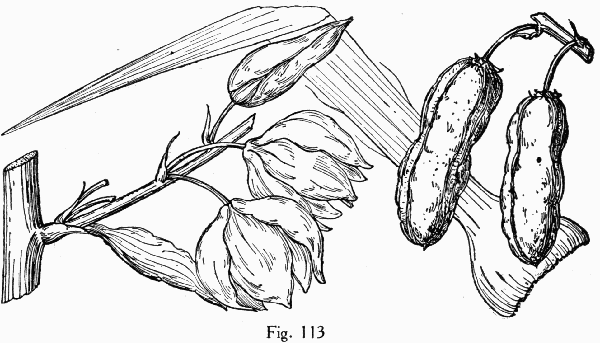
Leaves 2°—2½° long, gradually narrowed above the broad base and then gradually broadened to above the middle, thin, flat or slightly concave toward the apex, frequently longitudinally folded, dull often glaucous green, roughened on the under surface especially above the middle, with a stout dark red tip, and pale margins serrulate toward the base of the leaf, with minute early deciduous teeth, or occasionally separating into thin fibres. Flowers in October, in pubescent or glabrate panicles, 2°—4° long, on stout stalks sometimes 3°—4° in length, their large creamy white bracts forming before the panicle emerges a conspicuous egg-shaped bud 4′—6′ long; perianth when fully expanded 3½′—4′ across, its segments thin, ovate, acute, or lance-ovate, often tinged with green or purple, slightly united at the base, pubescent at apex; stamens about as long as the ovary, with hispid or slightly papillose filaments and deeply emarginate anthers; ovary slightly lobed, 6-sided, light green, gradually narrowed into the elongated spreading stigmatic lobes. Fruit very rarely produced, prominently 6-ridged, pendulous, 3′ long, 1′ in diameter, cuspidate, raised on a short stout stipe, with a thin leathery almost black outer coat; seeds ¼′ wide and about 1/36′ thick, with a smooth coat and a narrow marginal rim.
A tree, with a trunk occasionally 6°—8° high and 4′—6′ in diameter, simple or rarely furnished with a few short branches and usually clothed to the base with pendant dead leaves; in cultivation often becoming much larger, with a stout trunk covered with smooth light gray bark, and erect or in one form (var. recurvifolia Engelm.) pendulous leaves.
Distribution. Sand dunes and the borders of beaches of the seacoast from North Carolina to northern Florida.
Often cultivated with many forms in the gardens and pleasure-grounds of all temperate countries.
9. Yucca elata Engelm. Spanish Dagger.
1. Yucca radiosa Trel.
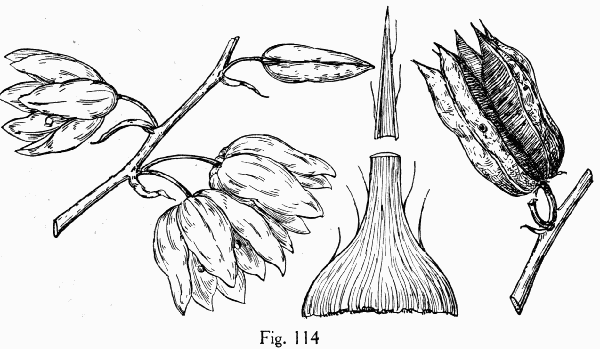
Leaves 20′—30′ long, ¼′—½′ wide, rigid, gradually narrowed from the thin base, tapering toward the apex, or sometimes somewhat broadest at the middle, thin, flat on the upper surface, slightly thickened and rounded on the lower surface toward the base, smooth, pale [118] yellow-green, with a slender stiff red-brown tip, and thickened entire pale margins soon splitting into long slender filaments. Flowers in May and June on slender spreading more or less recurved pedicels, in glabrous much-branched panicles 4°—6° long, raised on stout naked stem 3°—7° in length; perianth ovoid and acute in the bud, when fully expanded 3½′—4′ across, its segments united at the base into a short slender distinct tube, ovate or slightly obovate, those of the outer rank usually acute, not more than half as broad as those of the inner rank; stamens as long or a little longer than the ovary, with slender nearly terete filaments; ovary sessile, almost terete, pale green, abruptly contracted into the stout elongated style. Fruit an erect oblong capsule rounded and obtuse at the ends, tipped by a short stout mucro, conspicuously 3-ribbed, with rounded ridges on the back of the carpels, 1½′—2′ long, 1′—1½′ wide, with a thin firm light brown ligneous outer coat closely adherent to the lustrous light yellow inner coat, in ripening splitting from the top to the bottom between the carpels, and through their backs at the apex; seeds ⅓′ wide and about 1/32′ thick, with a smooth coat and a thin brittle wide margin to the rim.
A tree, with a rough much-branched underground stem penetrating deep into the soil and a trunk often 15°—20° high and 7′—8′ in diameter, covered above with a thick thatch of the pendant dead leaves of many years, simple, or branched at the top with a few short stout branches densely covered with leaves at first erect, then spreading nearly at right angles, and finally pendulous. Bark dark brown, irregularly fissured, broken into thin plates, about ¼′ thick. Wood light, soft, spongy, pale brown or yellow.
Distribution. High desert plateaus from southwestern Texas to southern Arizona; southward into northern Mexico; most abundant and of its largest size on the eastern slope of the continental divide in southern New Mexico and along the northern rim of the Tucson Desert in Arizona.