Division II. Dicotyledons. (continued 20)
Reading edition
Halesia is confined to the southeastern United States.
The generic name is in honor of Stephen Hales (1677—1761), an English clergyman, author of “Vegetable Staticks.”
CONSPECTUS OF THE SPECIES OF THE UNITED STATES.
Fruit 4-winged; flowers fascicled; corolla slightly lobed.
Fruit oblong to slightly obovoid.
Flowers hardly more than ½′ long; fruit 1½′ in length.
1. H. carolina (A, C).
Flowers 2′ long; fruit up to 2′ in length.
2. H. monticola (A).
Fruit clavate; flowers usually not more than ¼′ long.
3. H. parviflora (C).
Fruit 2-winged; flowers often racemose; corolla divided nearly to the base.
4. H. diptera (C).
1. Halesia carolina L.
Mohrodendron carolinum Britt.
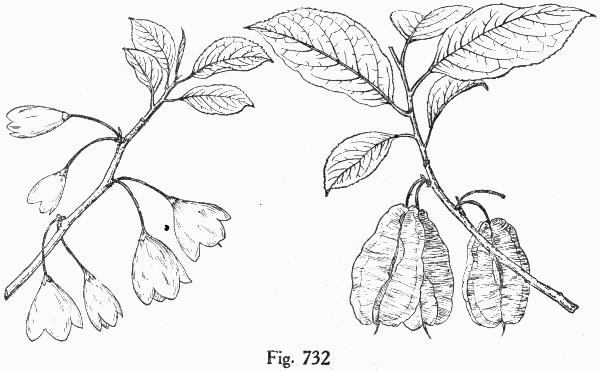
Leaves elliptic to oblong-obovate, abruptly acuminate and long-pointed at apex, gradually narrowed and rounded or cuneate at base, and dentate with small remote callous teeth, slightly pubescent or covered below when they unfold with thick hoary tomentum and densely stellate-pubescent above (var. mollis Perkins), and at maturity dark yellow-green and glabrous on the upper surface, pale and glabrous or slightly villose below on the slender yellow midrib and primary veins, 3′—4′ long and 1½′—2′ wide, and on leading shoots up to 6′—7′ in length; turning yellow in the autumn before falling; petioles slender, glabrous, pubescent or tomentose, early in the season, becoming nearly glabrous, ¼′—½′ in length. [826] Flowers about ½′ long, on glabrous or densely or slightly villose pedicels ½′—¾′ in length, from the axils of ovate caducous serrate glabrous or pubescent bracts rounded at apex, in crowded fascicles; calyx obconic, glabrous, slightly pubescent or hoary-tomentose (var. mollis Lange), the lobes ciliate; corolla narrowed below into a short tube, ¾′ across, sometimes faintly tinged with rose, rarely divided nearly to the base (var. dialypetala Schn.); stamens 10—16; filaments villose with occasional white hairs; ovary 4-celled. Fruit oblong to oblong-obovate, 4-winged, 1½′ long, ½′—¾′ in diameter; stone ellipsoid to slightly obovoid, narrowed below into a short stipe and above into the slender apex terminating in the elongated persistent style, slightly angled, ½′—⅝′ long, usually 1-seeded by abortion; seed rounded at the narrow ends, ¼′—⅓′ long.
A round-headed tree, rarely 40° high, with a short trunk often divided near the ground into several spreading stems, and 12′—18′ in diameter, small branches, and slender branchlets glabrous or densely pubescent early in the season, becoming slightly pubescent or nearly glabrous and orange-brown, and marked by large obcordate leaf-scars during their first winter and dark red-brown the following year; more often a shrub with wide-spreading stems. Winter-buds ellipsoid to ovoid, ⅛′ long, with thick broad-ovate dark red acute puberulous scales rounded on the back, those of the inner rows becoming strap-shaped, bright yellow and sometimes ½′ long. Bark of the trunk ½′ thick, slightly ridged, reddish brown, separating into thin closely appressed scales. Wood light, soft, close-grained, light brown with thick lighter-colored sapwood.
Distribution. Wooded slopes and the banks of streams, southern West Virginia (Fayette and Summers Counties); Piedmont region of North and South Carolina, ascending to altitudes of 2000°, through central Georgia to western Florida, and through Alabama south to Dallas and Mount Vernon Counties; the var. mollis with the type and the more common form in western Florida southward to Suwanee County. A seedling shrubby Halesia (var. Meehanii Perkins) with thicker smaller darker green rugose leaves, smaller cup-shaped flowers on shorter pedicels, appeared many years ago in the Meehan Nurseries at Germantown, Pennsylvania, and is possibly a hybrid but of obscure origin.
Often cultivated in the eastern United States, in California and in western and central Europe; hardy as far north as eastern Massachusetts.
2. Halesia monticola Sarg.
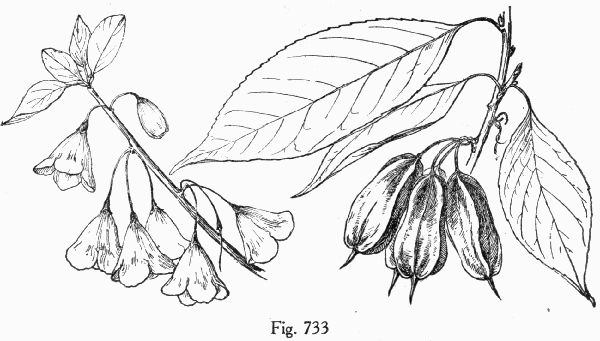
Leaves elliptic to oblong-obovate, abruptly acuminate at apex, cuneate or occasionally rounded at base, remotely dentate with minute blunt teeth, covered above when they unfold with short white hairs and below with thick hoary tomentum, half-grown and pubescent on the midrib below when the flowers open at the end of May, and at maturity thin, dark dull green on the upper surface, pale on the lower surface, glabrous with the exception of a few hairs on the lower side of the slender midrib and primary veins, 8′—11′ long and 1½′—2½′ wide; turning yellow in the autumn before falling; petioles slender, villose-pubescent when they first appear, soon glabrous, ½′—¾′ in length. Flowers 2′ long on pedicels ½′—1′ in length, from the axils of obovate or elliptic acute pubescent bracts ½′—¾′ long and ¼′ wide; calyx obconic, glabrous or slightly villose-pubescent; corolla 1′ in diameter, contracted below into a short limb; stamens 10—16; filaments slightly villose toward the base, ovary 4-celled. Fruit oblong-obovoid, cuneate at base, 4-winged, 1¾′—2′ long, 1′ in diameter; stone ovoid-ellipsoid, abruptly narrowed below into a short stipe, gradually narrowed above into the long apex, prominently angled about 1¼′—1⅓′ in length.
A tree, often 80°—90° high, with a trunk 3° in diameter and free of branches for 50°—60°, comparatively small spreading and erect branches forming a round-topped head and slender branchlets covered when they first appear with pale hairs, soon glabrous, lustrous, light red-brown or orange-brown during their first winter and dark red-brown in their second year. Winter-buds ovoid to ellipsoid, acuminate, much compressed, gibbous on the back, the outer scales thick, slightly keeled on the back, lustrous, bright red, ⅓′ long. Bark of the trunk thick, separating freely into long broad loosely attached red-brown plates ½′—¾′ thick.
[827]
Distribution. Mountain slopes at altitudes from 3000°—4000°, western North Carolina, eastern Tennessee and western Georgia; passing into the var. vestita Sarg., with leaves often rounded at base, coated below and on the petioles when they unfold with snow-white tomentum, and at maturity pubescent over the lower surface, especially on the midrib and veins, and occasionally pale rose-colored flowers (f. rosea Sarg.); banks of streams, near Marion, McDowell County, North Carolina; Heber Springs, Carroll County, Arkansas; occasionally cultivated with the var. vestita and hardy in the Arnold Arboretum and in Rochester, New York.
Halesia monticola in cultivation grows rapidly with a single trunk; and is hardy in eastern Massachusetts.
3. Halesia parviflora Michx.
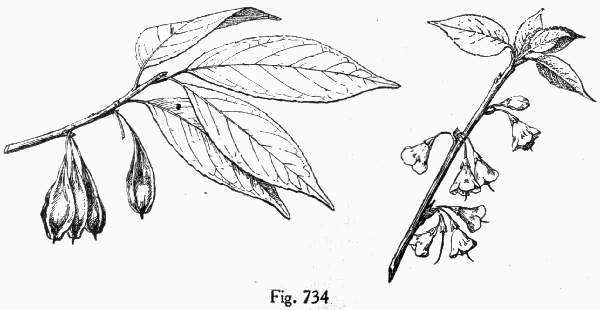
Leaves oblong-ovate to slightly obovate or elliptic, abruptly long-pointed or acuminate at apex, narrowed and cuneate or rounded at base, finely serrate with minute glandular teeth, densely covered when they unfold with hoary tomentum, becoming pubescent or glabrous, 2½′—3¼′ long and 1′—1¼′ wide, with a slender midrib and primary veins villose-pubescent [828] below; petioles hoary-tomentose when they first appear, becoming glabrous, ¼′—⅓′ in length. Flowers opening the end of March or early in April, ¼′—⅓′ long, on pedicels more or less densely villose-pubescent with white hairs, becoming nearly glabrous, ⅓′—⅖′ in length; calyx densely hoary-tomentose or rarely villose-pubescent; corolla ⅓′—½′ in diameter; stamens 10—16, filaments slightly villose. Fruit ripening in August and September, clavate, gradually narrowed into the long stipitate base, ¾′—1½′ long, 4-winged, the wings narrow, of equal width or occasionally with the alternate wings narrower than the others; stone ovoid, abruptly narrowed below into a short stipe, gradually narrowed to the apex, obscurely angled, ¾′—1¼′ long.
A slender tree, 25°—30° high, with a long trunk 8′—10′ in diameter, small light brown slightly ridged branches and slender branchlets hoary-tomentose when they first appear, becoming pubescent or nearly glabrous by the end of their first season and light gray-brown in their second year; or a shrub only a few feet tall. Winter-buds ovoid, acute, slightly compressed, villose, about ⅛′ long. Bark of the trunk thick, dark brown or nearly black, and divided by deep longitudinal furrows into narrow rounded rough ridges.
Distribution. Northern Florida, in sandy uplands (St. John, Clay, Jackson, Gadsden and Lafayette Counties); not common; Alabama (Lee County); eastern Mississippi (Laurel, Jones County), and eastern Oklahoma (near Page, Le Flore County).
4. Halesia diptera Ellis.
Mohrodendron dipterum Britt.
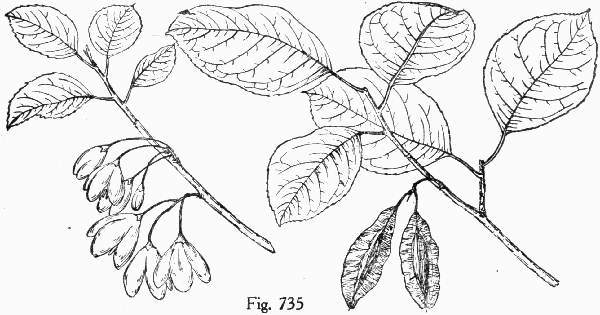
Leaves ovate to obovate, oval or elliptic, abruptly long-pointed or rarely rounded at apex, gradually narrowed and cuneate or rounded at base, undulate-serrate with remote minute callous teeth, coated below with pale tomentum and pubescent above when they unfold, and at maturity thin, light green and glabrous or pubescent on the slender midrib on the upper surface and paler and soft-pubescent on the lower surface, 3′—4′ long and 2′—2½′ wide, and at the end of vigorous branches up to 8′ long and 3′ wide, with pale conspicuous arcuate veins and reticulate veinlets; petioles slender, pubescent, ½′—¾′ in length. Flowers opening from the middle of March to the end of April, usually nearly 1′ long, on slender tomentose pedicels 1½′—2′ in length, from the axils of obovate puberulous bracts rounded or acute at apex and ½′—¾′ long, in few-flowered fascicles or in 4—6-flowered racemes; calyx thickly covered with hoary tomentum, the short lobes nearly glabrous on the inner surface; corolla puberulous on the outer surface, divided nearly to the base into slightly obovate or oval spreading lobes; stamens 8—16, usually 8, nearly as long as the corolla; filaments covered with pale hairs, and sometimes free from the corolla; ovary usually 2, rarely 4-celled and covered, like the style, with pale pubescence. Fruit oblong to [829] slightly obovoid, compressed, 1½′—2′ long, often nearly 1′ wide, with two broad wings and often with 2 or rarely 3 narrow wings between them; stone ellipsoid, 1½′—1¾′ long, conspicuously ridged, gradually narrowed below into the short slender stipe and above into the thickened pubescent style; seed acuminate at the ends, about ¾′ in length.
A tree, occasionally 30° high, with a short or rarely a tall trunk 8′—10′ in diameter, spreading branches forming a wide head and slender branchlets light green and more or less thickly covered with pale pubescence when they first appear, usually becoming glabrous, orange color, or reddish brown, lustrous and marked by the large elevated obcordate leaf-scars during their first winter, dark red-brown in their second season and dividing the following year into irregular pale longitudinal fissures; more often a shrub, with numerous stout spreading stems. Winter-buds ovoid, obtuse, 1/16′ long, with broad-ovate acute light red pubescent scales, those of the inner ranks becoming strap-shaped, scarious and ¼′ long. Bark of the trunk ⅓′—½′ thick, brown tinged with red, and divided by irregular longitudinal often broad fissures, and separating into small thin closely appressed scales. Wood light, soft, strong, close-grained, light brown with thick lighter-colored sapwood.
Distribution. Low wet woods and the borders of swamps and streams; near Savannah (Elliott) and in southwestern Georgia, western Florida (Leon and Gadsden Counties), southern Alabama, Mississippi and Louisiana to the valley of the lower Neches River, Texas, and to southwestern Arkansas (Miller County).
Occasionally cultivated in the gardens of the eastern United States and western Europe. Doubtfully hardy in Massachusetts and western New York.
2. STYRAX L.
Trees or shrubs, lepidote or stellate-tomentose except on the upper surface of the leaves, with slender terete slightly zigzag branchlets, without a terminal bud, axillary buds, with imbricated scales, and fibrous roots. Leaves involute in the bud, entire or slightly serrate. Flowers usually white on short ebracteolate drooping pedicels from the axils of small bracts, in simple or branched usually drooping axillary racemes; calyx cup-shaped, adnate to the base of the ovary or nearly free, the margin truncate, obscurely or conspicuously 5-toothed or rarely 2 or 5-parted; corolla epigynous, campanulate, 5 or rarely 6 or 7-parted, with a short tube usually longer than the lanceolate oblong or spatulate erect and spreading or revolute lobes valvate or imbricated in the bud, stamens 8—13, usually 10, longer than the corolla slightly united below into a ring or short tube; filaments flattened above; cells of the anthers linear parallel, erect; ovary broad-conic, subglobose or depressed, densely villose or rarely glabrous, at first 3-celled, becoming 1-celled or nearly 1-celled after anthesis, crowned by a subulate or thickened style terminating in a small indistinctly 3-lobed or capitate stigma; ovules few or rarely solitary, ascending; raphe dorsal, micropyle inferior. Fruit globose or slightly obovoid, drupaceous; pericarp hard and indehiscent or irregularly 3-valved or fleshy and irregularly dehiscent; endocarp glabrous, crustaceous or indurate; seed 1 by abortion or very rarely 2, filling the cavity of the stone, erect; testa membranaceous, mostly adherent to the walls of the stone; albumen fleshy or rarely horny; cotyledons usually broad, the elongated terete radicle turned toward the broad basal hilum.
Styrax is widely distributed in warm and tropical countries except in tropical and south Africa and in Australasia, extending northward into the southeastern United States and to California, southern Europe, central and western China and central Japan. Of nearly one hundred species which are now distinguished five are found within the territory of the United States; one of these occasionally becomes a small tree.
Storax and benzoin, aromatic resinous balsams, are obtained from Styrax officinale L. of southern Europe and Asia Minor, and from Styrax Benzoin Dryand. of Malaysia.
The generic name is that of the Greek name of Styrax officinale.
1. Styrax grandiflora Ait.
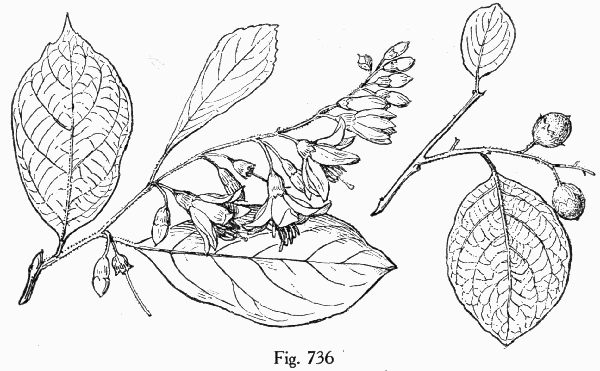
Leaves thin, deciduous, obovate, rounded and abruptly pointed or acute or acuminate or rarely rounded at apex, cuneate or rounded at the narrow base, entire or remotely serrate [830] with small apiculate teeth, when they unfold ciliate on the margins, slightly stellate-pubescent on the midrib and veins above, and coated below with hoary tomentum, and at maturity pale green and glabrous or nearly glabrous above, pale tomentose and villose on the midrib and veins below, 2½′—5′ long and 1′—3′ wide; petioles ¼′ in length, hoary-tomentose early in the season, becoming pubescent. Flowers opening in early spring after the leaves are more than half grown, ¾′—1′ long, on slender pubescent or tomentose pedicels ¼′ in length, in tomentose leafy erect or spreading axillary racemes 5′ or 6′ long, their bracts and bractlets linear, minute, tomentose, caducous; calyx more or less coarsely 5-toothed, membranaceous, tomentose on the outer surface; corolla 5-parted, the lobes longer than the tube, imbricated in the bud, membranaceous, oblong-obovate, rounded or acute at apex, stellate-pubescent on the outer surface; stamens 10, about as long as the corolla, villose-pubescent below the middle, united below into a short ring; ovary slightly inferior, obovoid, tomentose, 3-celled; style filiform, glabrous, exserted; ovules 3 or 4 in each cell. Fruit hoary-tomentose, slightly obovoid, rounded and tipped at apex with the remnants of the style, gradually narrowed and surrounded below by the calyx, ⅓′ long, and ¼′ in diameter, the outer coat crustaceous, indehiscent; seed obovoid, dark orange-brown, filling the cavity of the fruit.
A tree, rarely 40° high, with a tall straight trunk sometimes 8′ in diameter, short spreading branches forming a narrow round-topped head, and slender branchlets thickly coated when they first appear with hoary stellate pubescence more or less persistent during three seasons, ultimately glabrous and light or dark chestnut-brown; more often a broad shrub 6°—20° high. Bark of the trunk ⅓′—½′ thick, close, smooth and dark red-brown. Winter-buds: axillary, often 3, superposed, acute, covered with hoary ultimately rusty tomentum, about ⅛′ long.
Distribution. Low wet woods and the borders of swamps; southeastern Virginia, southward usually near the coast to the valley of the Apalachicola River, Florida, and through the Gulf states to western Louisiana, ranging inland to northern Georgia, northeastern Mississippi, and to the valley of the Red River at Natchitoches, Louisiana; of its largest size and perhaps only arborescent near Laurel Hill, West Feliciana Parish, Louisiana.
LIX. SYMPLOCACEÆ.
Trees or shrubs, with simple pubescence, watery juice, scaly buds, and fibrous roots. Leaves simple, alternate, coriaceous or thin, pinnately veined, usually becoming yellow [831] in drying, without stipules. Flowers regular, perfect, or polygamo-diœcious, on ebracteolate pedicels, in dense or lax axillary spikes or racemes, with small caducous bracts; calyx campanulate, 5-lobed, open in the bud, the tube adnate to the ovary, enlarged after anthesis; corolla divided nearly to the base into 3—11 usually 5 lobes imbricated in the bud; disk 0; stamens usually numerous, inserted in many series on the base of the corolla or rarely 4 in one series; filaments filiform or flattened, more or less united below into clusters; anthers ovoid-globose, introrse, 2-celled, the cells lateral, opening longitudinally; ovary inferior or partly inferior, 2—5-celled, contracted into a simple style, with an entire or slightly lobed terminal stigma; ovules 2 or rarely 4 in each cell, suspended from its inner angle, anatropous; raphe ventral; micropyle superior. Fruit a drupe (in the North American species), crowned with the persistent lobes of the calyx, with thin dry flesh and a bony 1-seeded stone. Seed oblong, suspended; seed-coat membranaceous; embryo terete, erect in copious fleshy albumen; cotyledons much shorter than the long slender radicle turned toward the broad conspicuous hilum.
The family consists of the genus Symplocos.
1. SYMPLOCOS L’Her.
Characters of the family.
Symplocos with nearly three hundred species inhabits chiefly the warmer parts of America, Asia, and Australia, one species occurring in the southern United States.
Symplocos contains a yellow coloring matter, and the bark and leaves of some species have medical properties.
The generic name, from Σύμπλοκος, relates to the union of the filaments of some of the species.
1. Symplocos tinctoria L’Her. Sweet Leaf. Horse Sugar.
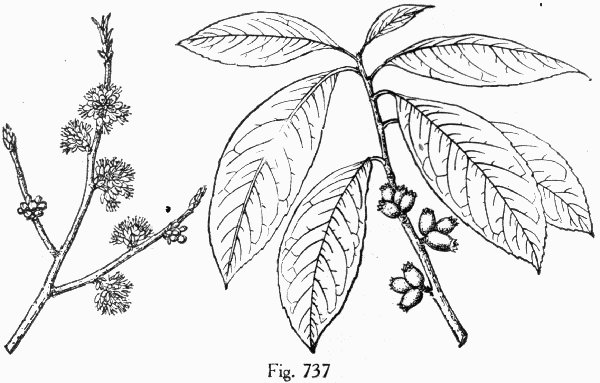
Leaves revolute in the bud, oblong, acute or acuminate at apex, gradually narrowed at base, obscurely crenulate-serrate with remote teeth, or sometimes nearly entire, coated below when they unfold with pale tomentum, glabrous or tomentose above, and furnished on the margins with minute dark caducous glands, and at maturity subcoriaceous, dark green and lustrous on the upper surface, paler and pubescent on the lower surface, 5′—6′ long and 1′—2′ wide, with a broad midrib rounded and sometimes puberulous on the upper side, inconspicuous arcuate veins and reticulate veinlets; northward and at high altitudes falling in the autumn, and southward remaining on the branches until after the opening of [832] the flowers the following spring; petioles stout, slightly winged, ⅓′—½′ in length. Flowers: flower-clusters inclosed in the bud by ovate acute orange-colored scales brown and ciliate on the margins, each of the flower-buds surrounded by 3 imbricated oblong bracts rounded or pointed at apex and ciliate on the margins, the longest as long as the calyx and one third longer than the 2 lateral bracts; flowers fragrant, opening from the 1st of March at the south to the middle of May on the southern Appalachian Mountains, on short pedicels enlarged into thick hemispheric receptacles covered with long white hairs, in nearly sessile many-flowered clusters in the axils of leaves of the previous year; calyx oblong, cup-shaped, dark green and puberulous, with minute ovate scarious lobes rounded at apex; corolla creamy white, ¼′ long, with rounded lobes; stamens exserted, with slender filaments united at base into 5 clusters, and orange-colored anthers; ovary 3-celled, furnished on the top with 5 dark nectariferous glands placed opposite the lobes of the calyx, and abruptly contracted into a slender style gradually thickened toward the apex and longer than the corolla. Fruit ripening in the summer or early autumn, ovoid, ¼′ long, dark orange-colored or brown; seed ovoid, pointed, with a thin papery chestnut-brown coat.
A tree, occasionally 30°—35° high, with a short trunk barely exceeding 6′-8′ in diameter, slender upright branches forming an open head, and stout terete pithy branchlets light green and coated with pale or rufous tomentum when they first appear, or sometimes glabrous, and covered with scattered white hairs, reddish brown to ashy gray, tinged with red and usually more or less pubescent or often covered with a glaucous bloom during their first and second years, later growing darker, roughened by occasional small elevated lenticels and marked by the low horizontal obcordate leaf-scars displaying a central cluster of large fibro-vascular bundle-scars; or more often a shrub. Winter-buds ovoid, acute, covered with broad-ovate nearly triangular acute scales, those of the inner rows accrescent on the young branchlets, and at maturity oblong-obovate, rounded and often apiculate at apex, light green, glabrous or pilose, ciliate on the margins, and often ½′ in length. Bark of the trunk ⅓′—½′ thick, ashy gray slightly tinged with red, divided by occasional narrow fissures and roughened by wart-like excrescences. Wood light, soft, close-grained, light red or brown, with thick lighter colored often nearly white sapwood of 18—20 layers of annual growth. The leaves are sweet to the taste and are devoured in the autumn by cattle and horses, and, like the bark, yield a yellow dye occasionally used domestically. The bitter aromatic roots have been used as a tonic.
Distribution. Moist rich soil, often in the shade of dense forests; peninsula of Delaware to northern Florida and from the coast to altitudes of nearly 4000° on the Blue Ridge in North and South Carolina, and to eastern Texas and southern Arkansas; in the Gulf states usually along the borders of Cypress-swamps.
LX. OLEACEÆ.
Trees or shrubs, with watery juice, scaly buds, their inner scales accrescent, opposite leaves, without stipules, and fibrous roots. Flowers perfect, diœcious or polygamous, regular; calyx 4-lobed, or 0; corolla of 2—4 petals, or 0; disk 0; stamens 2—4, rudimentary or 0 in unisexual pistillate flowers; anthers attached on the back below the middle, often apiculate by the prolongation of the connective, introrse, 2-celled, the cells opening longitudinally usually by lateral slits; ovary free, 2 or rarely 3-celled, rudimentary or 0 in the staminate flower; style simple; ovules 2 in each cell, pendulous, anatropous; micropyle superior. Fruit (in the North American arborescent genera) a samara or berry. Seed pendulous; seed-coat membranaceous; embryo straight in copious fleshy albumen; cotyledons flat, much longer than the short terete superior radicle turned toward the minute hilum.
The Olive family with twenty-five genera is widely distributed in temperate and tropical regions chiefly in the northern hemisphere. Of the five genera indigenous to the United States four are arborescent. To this family belong Olea europæa L., the Olive-tree of the Mediterranean basin, now largely cultivated in California for its fruit, and the Lilacs, Forsythias, Privets, and Jasmines, favorite garden plants in all countries with temperate climates.
[833]
CONSPECTUS OF THE ARBORESCENT GENERA OF THE UNITED STATES.
Fruit a winged samara; leaves usually compound.
1. Fraxinus.
Fruit a drupe; leaves simple.
Flowers usually without petals.
2. Forestiera.
Flowers with petals.
Corolla of 4 long linear petals united only at base; leaves deciduous.
3. Chionanthus.
Corolla tubular; leaves persistent.
4. Osmanthus.
1. FRAXINUS L. Ash.
Trees or shrubs, with thick furrowed or rarely thin and scaly bark, usually ash-colored branchlets, with thick pith, and compressed obtuse terminal buds much larger than the lateral buds. Leaves petiolate, unequally pinnate or rarely reduced to a single leaflet, deciduous; leaflets conduplicate in the bud, usually serrate, petiolulate or sessile. Flowers diœcious or polygamous, produced in early spring on slender elongated pedicels, without bractlets, in open or compact slender-branched panicles, with obovate linear or lanceolate caducous bracts, terminal on leafy shoots of the year, developed from the axils of new leaves, or from separate buds in the axils of leaves of the previous year, or at the base of young branchlets, and covered by 2 ovate scales; calyx campanulate, deciduous or persistent under the fruit, or 0; corolla 2—4-parted, the divisions conduplicate in the bud, united at base, or 0; stamens usually 2, rarely 3 or 4, inserted on the base of the corolla, or hypogynous; filaments terete, short or rarely elongated; anthers ovoid or linear-oblong, the cells opening by lateral slits; ovary 2 or rarely 3-celled, contracted into a short or elongated style terminating in a 2-lobed stigma; ovules suspended in pairs from the inner angle of the cell; raphe dorsal. Fruit a 1 or rarely 2 or 3-seeded winged samara; body terete or slightly flattened contrary to the septum, with a dry or woody pericarp produced into an elongated more or less decurrent wing, usually 1-celled by abortion or sometimes 2 or 3-celled and winged. Seed solitary in each cell, oblong, compressed, gradually narrowed and rounded at the ends, filling the cavity of the fruit; seed-coat chestnut-brown.
Fraxinus with thirty to forty species is widely distributed in the temperate regions of the northern hemisphere, and within the tropics occurs on the islands of Cuba and Java. Of the eighteen North American species here recognized all, with the exception of Fraxinus dipetala Hook., of California, are large or small trees.
Fraxinus produces tough straight-grained valuable wood, and some of the species are large and important timber-trees. The waxy exudations from the trunk and leaves of Fraxinus Ornus L., of southern Europe and Asia Minor furnish the manna of commerce used in medicine as a gentle laxative; and the Chinese white wax is obtained from the branches of Fraxinus chinensis Roxb.
Fraxinus is the classical name of the Ash-tree.
CONSPECTUS OF THE NORTH AMERICAN ARBORESCENT SPECIES.
Flowers with a corolla, in terminal panicles on lateral leafy branchlets of the year; leaflets 3—7, lanceolate to ovate-lanceolate (Ornus).
1. F. cuspidata (E, H).
Flowers without a corolla, diœcious or polygamous, in axillary panicles, from separate buds, in the axils of leaves of the previous year (Fraxinastrum).
Flowers with a calyx.
Leaflets with obscure veins, not more than ¾′ long; fruit narrow-spatulate to oblong-obovate; rachis slightly winged.
2. F. Greggii (E).
Leaflets with distinct veins, more than ¾′ long; rachis without a wing.
Body of the fruit compressed, its wing extending to the base.
Branchlets 4-sided.
Leaves usually 5-foliolate, with ovate acute leaflets; flowers unknown.
3. F. Lowellii (F).
[834]
Leaves usually reduced to a single ovate or orbicular leaflet; flowers polygamous.
4. F. anomala (F).
Branchlets terete.
Leaflets 5—7, oblong-ovate; fruit oblong-elliptic to spatulate, often 3-winged, long-stipitate.
5. F. caroliniana (A, C).
Leaflets 3—5, oblong; fruit lanceolate to oblanceolate, the body extending to the base of the fruit.
6. F. pauciflora (C).
Body of the fruit nearly terete.
Wing of the fruit terminal or slightly decurrent on the body.
Leaves and branchlets glabrous (tomentose in one form of 7).
Leaflets sessile or nearly sessile 5—7 rarely 5, ovate to oblong-ovate, rarely elliptic, acute or short-acuminate, glaucescent below.
7. F. Standleyi (H).
Leaflets stalked.
Leaflets 5—7, ovate to lanceolate, abruptly pointed or acuminate, usually pale below.
8. F. americana (A, C).
Leaflets usually 5, ovate to obovate, rounded or acute at apex.
9. F. texensis (C).
Leaves and branches pubescent; leaflets oblong-ovate to lanceolate, pale below; fruit linear-oblong.
10. F. biltmoreana (A, C).
Wing of the fruit decurrent to below the middle of the body.
Leaflets 7—9, usually 7; leaves and branches pubescent (glabrous in one form of 12).
Fruit 2′—3′ in length.
11. F. profunda (A, C).
Fruit 1′—2½′ in length.
12. F. pennsylvanica (A, E).
Leaflets 3—5.
Leaves and branchlets glabrous; fruit up to 1½′ in length.
13. F. Berlandieriana (C, E).
Leaves and branchlets pubescent or glabrous; fruit not more than ½′ in length.
14. F. velutina (F, H).
Leaflets 5—7, usually 7, the lateral generally sessile; leaves and branchlets pilose-pubescent, rarely glabrous.
15. F. oregona (B, G).
Flowers without a calyx; leaflets 5—11; wing of the fruit decurrent to the base of the body.
Branchlets quadrangular; lateral leaflets short-stalked.
16. F. quadrangulata (A, C).
Branchlets terete; lateral leaflets sessile.
17. F. nigra (A, C).
1. Fraxinus cuspidata Torr.
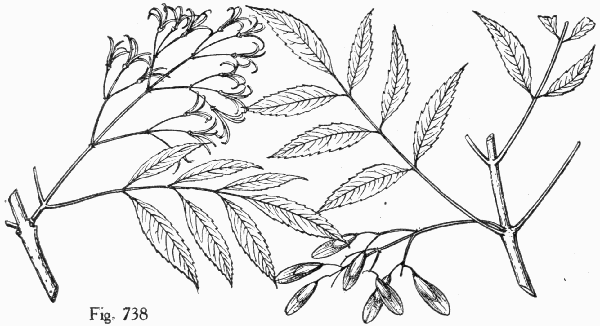
Leaves 5′—7′ long, with a slender pale petiole sometimes slightly wing-margined, and 3—7 lanceolate or ovate-lanceolate long-stalked leaflets gradually narrowed at apex into a long slender point, cuneate at base nearly entire or coarsely and remotely serrate above the middle with recurved teeth (var. serrata Rehd.), or with 3—5, rarely 7-foliolate leaves, with broader often ovate entire leaflets occasionally with simple leaves at the base of the branchlets (var. macropetala Rehd.); slightly puberulous when they unfold on the lower surface, and at maturity thin, dark green above, paler below, 1½′—2½′ long and ¼′—¾′ wide, with a pale midrib and obscure veins; petiolules slender, sometimes nearly 1′ in length. Flowers perfect, extremely fragrant, appearing in April, in open glabrous panicles 3′—4′ long and broad, terminal on lateral leafy branchlets developed from the axils of leaves of the previous year, calyx cup-shaped, 1/16′ long, with acute apiculate attenuate teeth of unequal length, deciduous, corolla ⅔′ long, thin and white, divided to below the middle into 4 linear-oblong lobes pointed at apex, and much longer than the nearly sessile oblong long-pointed anthers ovary 2-celled, with a thick 2-lobed nearly sessile stigma. Fruit elliptic to oblong-obovate, 1′ long and ¼′ wide, the wing round and slightly emarginate at apex, and decurrent nearly to the base of the flat nerveless longer body.
A tree, rarely 20° high, with a short trunk 6′—8′ in diameter, and slender terete branchlets light red-brown when they first appear, soon becoming darker and marked by scattered [835] pale lenticels and ashy gray and roughened by the dark elevated lunate leaf-scars in their second year; more often a shrub or small shrubby tree, with numerous slender spreading stems 6°—8° tall. Winter-buds: terminal acute, nearly ½′ long, with dark reddish brown glutinous scales.
Distribution. Rocky slopes and dry ridges; Western Texas, valley of the Rio Grande (mouth of Devil’s River, Valverde County) to the Chisos Mountains, and in southern New Mexico; in Coahuila, Nuevo Leon and Chihuahua; the var. macropetala in cañons of northern Arizona; the var. serrata (fig. 738) in Coahuila.
2. Fraxinus Greggii A. Gray.
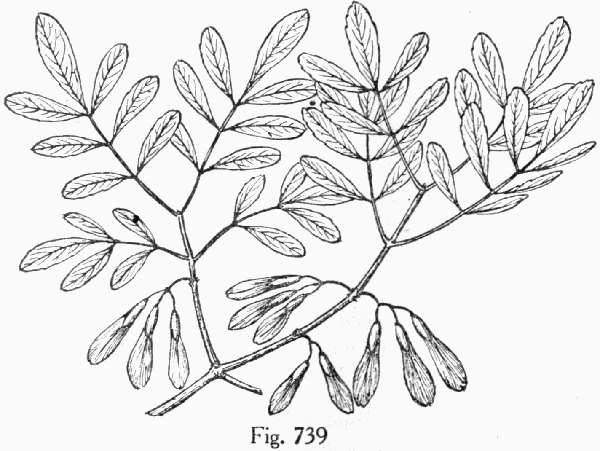
Leaves 1½′—3′ long, with a winged petiole and rachis, and 3—7 narrow spatulate to oblong-obovate leaflets entire or crenately serrate above the middle with remote teeth, a slender midrib, and obscure reticulate veins, thick and coriaceous, dark green on the upper surface rather paler and covered with small black dots on the lower surface, ½′—¾′ long, ⅛′—¼′ wide, and nearly sessile. Flowers perfect or unisexual, on slender pedicels ⅛′—¼′ long, from the [836] axils of ovate acuminate rusty-pubescent bracts, in pubescent panicles ½′—¾′ in length; calyx campanulate, scarious; stamens 1 or 2, filaments longer than the calyx, anthers declinate, nearly ⅛′ long; ovary broad-ovate, rounded at apex, longer than the calyx, the short style terminating in large reflexed stigmatic lobes. Fruit narrow-spathulate to oblong-obovate, ½′—⅔′ long and about ¼′ wide, the thin wing decurrent on the short terete body, rounded and emarginate at apex and tipped with the elongated persistent conspicuous style.
A tree, rarely 20°—25° high, with a trunk 8°—10° long and occasionally 8′ in diameter, and slender terete branchlets dark green and puberulous when they first appear, soon becoming ashy gray and roughened by numerous minute pale elevated lenticels, gradually turning dark gray, or brown in their second and third years; more often a shrub, with numerous slender erect stems 4°—12° tall. Winter-buds: terminal, about ⅛′ long, obtuse, with thick ovate light brown pubescent scales rounded on the back. Bark of the trunk thin, gray or light brown tinged with red, separating on the surface into large papery scales. Wood heavy, hard, close-grained, brown, with thick lighter-colored sapwood.
Distribution. Western Texas, along rocky beds of streams and deep ravines, Valverde County (near Devil’s River, Del Rio and Comstock); on the mountains of northeastern Mexico; apparently most common and of its largest size on the Sierra Nevada of Nuevo Leon.
3. Fraxinus Lowellii Sarg.
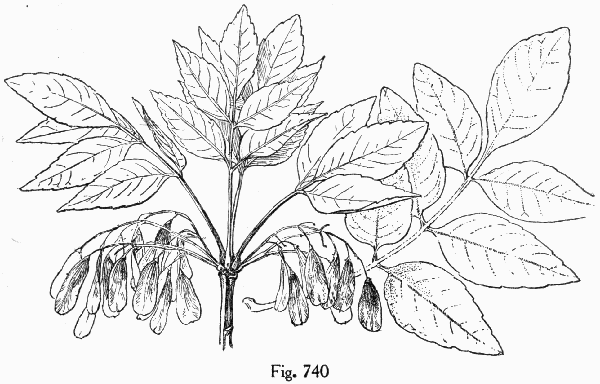
Leaves 3½′—6′ long, with a stout glabrous or slightly villose petiole, and 5 or rarely 3 ovate stalked leaflets, acuminate and long-pointed, acute or rarely rounded at apex, cuneate at base, serrate, often only above the middle, with small remote teeth, yellow-green, glabrous, or puberulous along the midrib above, glabrous or rarely sparingly villose near the base of the slender pale midrib below, 2¼′—3′ long and 1′—1½′ wide, with thin primary veins arching and united near the slightly thickened and revolute margins; on vigorous shoots occasionally 1-foliolate with a broad-ovate or semiorbicular leaflet. Flowers unknown. Fruit ripening in July, in long glabrous panicles, oblong-obovate to oblong-elliptic, surrounded at base by the minute slightly dentate calyx, 1′—1½′ long, ¼′—⅓′ wide, the wing broad or gradually narrowed and rounded, and often emarginate at apex and extending to the base of the thin compressed many-rayed body about three-quarters the length of the fruit.
A tree, 20°—25° high, with dark deeply furrowed bark, stout quadrangular often winged branchlets orange-brown in their first season and dark gray-brown the following year.
[837]
Distribution. Arizona, rocky slopes of Oak Creek Cañon about twenty miles south of Flagstaff, Coconino County, and in Copper Cañon, west of Camp Verde, Yavapai County.
4. Fraxinus anomala S. Wats.
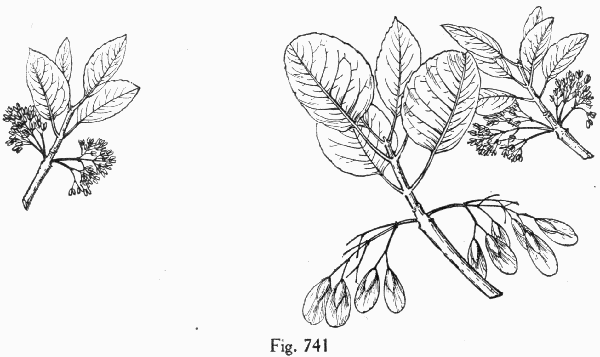
Leaves mostly reduced to a single leaflet but occasionally 2 or 3-foliolate, the leaflets broad-ovate or orbicular, rounded or acute or rarely obcordate at apex, cuneate or cordate at base, and entire, or sparingly crenately serrate above the middle, covered above when they unfold with short pale hairs and pubescent beneath, and at maturity thin but rather coriaceous, dark green above, paler below, 1½′—2′ long and 1′—2′ wide, or when more than one much smaller, with a broad rather conspicuous midrib and obscure veins, and when solitary raised on a stout grooved petiole rusty-pubescent early in the season, becoming glabrous, and often 1½′ long, or short-petiolulate in the compound leaves. Flowers appearing when the leaves are about two thirds grown, in short compact pubescent panicles, with strap-shaped or lanceolate acute bracts ½′ long and covered with thick brown villose tomentum, perfect or unisexual by the abortion of the stamens, the 2 forms occurring in the same panicle; calyx cup-shaped, minutely 4-toothed; anthers linear-oblong, orange colored, raised on slender filaments nearly as long as the stout columnar style. Fruit obovate, ½′ long, the wing rounded and often deeply emarginate at apex, surrounding the short flattened striately nerved body, and ⅓′ wide.
A tree, 18°—20° high, with a short trunk 6′—7′ in diameter, stout contorted branches forming a round-topped head, and branchlets at first quadrangular, dark green tinged with red and covered with pale pubescence, orange colored and puberulous in their first winter and marked by elevated pale lenticels and narrow lunate leaf-scars, and in their second or third year terete and ashy gray; often a low shrub, with numerous spreading stems. Winter-buds: terminal broad-ovoid, acuminate or obtuse, covered with thick orange-colored tomentum, and ⅛′—¼′ long. Bark of the trunk dark brown slightly tinged with red, ¼′ thick and divided by shallow fissures into narrow ridges separating into small thin appressed scales. Wood heavy, hard, close-grained, light brown, with thick lighter colored sapwood of 30—50 layers of annual growth.
Distribution. In the neighborhood of streams; valley of the McElmo River, southwestern Colorado; Carriso Mountains, San Juan County, northwestern New Mexico; northeastern (Apache County), and the Grand Cañon of the Colorado River, Coconino County, Arizona; southern Utah to the Charleston Mountains, southwestern Nevada and adjacent California (Inyo County).
[838]
5. Fraxinus caroliniana Mill. Water Ash. Swamp Ash.
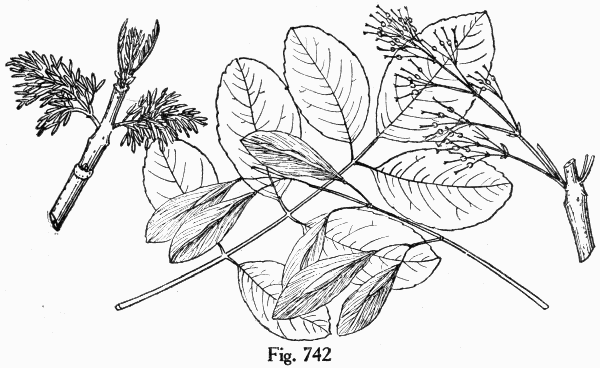
Leaves 7′—12′ long, with an elongated stout terete pale petiole, and 5—7 long-stalked ovate to oblong acute or acuminate leaflets rarely rounded at apex, cuneate or sometimes rounded or subcordate at base, and coarsely serrate with acute incurved teeth, or entire, pilose above and more or less hoary-tomentose below when they unfold, and at maturity thick and firm, 3′—6′ long and 2′—3′ wide, dark green above, paler or sometimes yellow-green and glabrous or pubescent (var. Rehderiana Sarg.) beneath, particularly along the conspicuous midrib and the numerous arcuate veins connected by obscure reticulate veinlets. Flowers diœcious, appearing in February and March in short or ultimately elongated panicles inclosed in the bud by chestnut-brown pubescent scales; staminate flower with a minute or nearly obsolete calyx, and 2 or sometimes 4 stamens, with slender filaments and linear apiculate anthers; calyx of the pistillate flower cup-shaped, deeply divided and laciniate, as long as the ovary gradually narrowed into an elongated slender style. Fruit elliptic to oblong-obovate, frequently 3-winged, surrounded at base by the persistent calyx, 2′ long, ⅓′—¾′ wide, often marked on the 2 faces by a conspicuous impressed midvein, the body short, compressed, and surrounded by the broad thin many-nerved sometimes bright violet-colored wing, acute or acuminate, or rounded and emarginate at apex and usually narrowed below into a stalk-like base.
A tree, rarely more than 40° high, with a trunk sometimes 12′ in diameter, small branches forming a narrow often round-topped head, and slender terete branchlets light green and glabrous or tomentose when they first appear, light brown tinged with red and sometimes covered with a glaucous bloom or rarely pubescent or tomentose (var. Rehderiana Sarg.) in their first winter, becoming in their second year light gray or yellow, occasionally marked by large pale lenticels, and by the elevated semiorbicular leaf-scars displaying a short row of conspicuous fibro-vascular bundle-scars. Winter-buds: terminal, ⅛′ long, with 3 pairs of ovate acute chestnut-brown puberulous scales, those of the outer rank thickened at base, rounded on the back, and shorter than the others. Bark of the trunk 1/16′—⅛′ thick, light gray, more or less marked by large irregularly shaped round patches, and separating on the surface into small thin closely appressed scales. Wood light, soft, weak, close-grained, nearly white sometimes tinged with yellow, with thick lighter colored sapwood.
Distribution. Deep river swamps inundated during several months of the year, usually under the shade of larger trees, or rarely in drier ground; coast region of the Atlantic and Gulf states, valley of the Potomac River, Virginia, near Washington, D.C., to Florida southward to Lake County and on the west coast to the valley of the lower Apalachicola [839] River, and to the valley of the Neches River (Beaumont, Jefferson County), Texas, and northward through western Louisiana to southwestern (Malvern, Hot Springs County) Arkansas; east of the Mississippi River occasionally appearing in isolated stations remote from the coast (Anson County, North Carolina, C. L. Boynton, Pike County, Georgia, R. H. Harper, Forest County, Mississippi, T. G. Harbison); in Cuba.
6. Fraxinus pauciflora Nutt. Water Ash.
Fraxinus floridana Sarg.
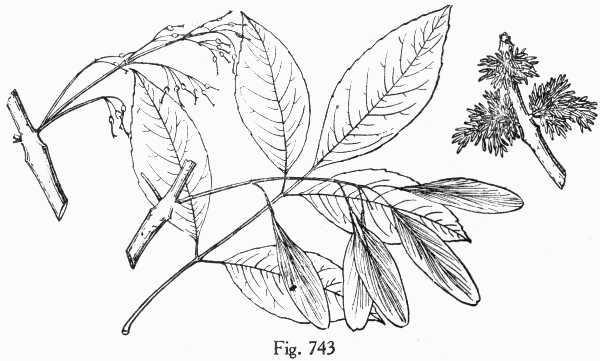
Leaves 5′—9′ long, with an elongated stout terete petiole, and 3—7, usually 5, elliptic to oblong-obovate or ovate leaflets, acuminate or rarely abruptly pointed at apex, gradually narrowed and rounded at the often unsymmetric base, finely or coarsely serrate, scurfy-pubescent above and hoary-tomentose below when they unfold, and at maturity thick and firm, dark green and glabrous or puberulous on the upper surface and more or less tomentose on the lower surface, 3′—4′ long and 1′—1¼′ wide, with a slender midrib, and thin primary veins arcuate and united within the thickened revolute margins; petiolules of the lateral leaflets ¼′—½′ long, much shorter than those of the terminal leaflet. Flowers diœcious, appearing late in February or early in March, in elongated panicles inclosed in the bud by chestnut-brown pubescent scales; staminate flower composed of an annular disk and 2 or 3 stamens, with short filaments and apiculate anthers; calyx of the pistillate flower cup-shaped, slightly lobed, as long as the ovary gradually narrowed into the slender style. Fruit oblong to lanceolate or oblanceolate, surrounded at base by the persistent calyx, 1′—2′ long, ¼′—½′ wide, marked on each of the 2 faces by a broad impressed midvein, the body near the base of the many-nerved wing narrowed, rounded, and emarginate at apex.
A tree, 30°—40° high, with a trunk sometimes 12′ in diameter, small spreading branches, and slender terete branchlets light orange-brown and occasionally marked by large pale lenticels during their first season, ashy gray and roughened the following year by the large horizontal obcordate elevated leaf-scars displaying a central ring of fibro-vascular bundle-scars. Winter-buds terminal, broad-ovoid, acute, rusty-pubescent, about ¼′ long. Bark of the trunk 1/16′—⅛′ thick, light gray, and broken on the surface into small thin closely appressed scales.
Distribution. Deep swamps; valleys of the St. Mary’s and Flint Rivers (Albany), southern Georgia; Florida, near Jacksonville, Duval County, valley of the Caloosahatchee River, and Bonita Springs, Lee County, to the shores of Lake Okeechobee, and in the valley of the lower Apalachicola River; most abundant in southern Florida.
[840]
7. Fraxinus Standleyi Rehd.
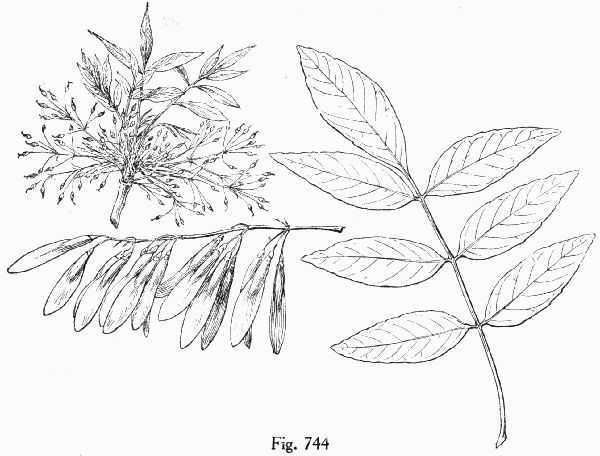
Leaves 5′—7′ long, with a slender glabrous petiole flattened, or slightly concave on the upper side, and 7—9 ovate to oblong-ovate rarely elliptic leaflets, acute or short-acuminate or rarely rounded at apex, broad-cuneate at base, slightly and irregularly serrate, yellow-green and glabrous above, glaucescent, slightly reticulate, minutely punctulate, glabrous or slightly villose on the slender midrib below, or rarely closely villose over the entire lower surface, 1½′—2½′ long and 1′—2′ wide, with usually 5—7 primary veins, the terminal leaflet raised on a petiolule up to ½′ long, the lateral short-petiolulate, or nearly sessile. Flowers not seen. Fruit ripening in September, on slender pedicels, in glabrous panicles 3′—5′ long, oblong-obovate, acute, rarely obtuse and occasionally emarginate at apex, surrounded at base by the minute calyx deeply divided into acuminate lobes, ¾′—1½′ long and ⅙′—¼′ wide, the wing decurrent nearly to the middle of the subterete or slightly compressed ellipsoid or oblong body.
A tree, sometimes 30° high, usually smaller, with a trunk only a few inches in diameter, and slender terete glabrous branches orange-brown or rarely on vigorous shoots dark red-brown and lustrous. Winter-buds: terminal ovoid, gradually narrowed and acute at apex, ⅓′ long.
Distribution. Mountain cañons at altitudes of 5500°—8000°; New Mexico (Lincoln, Grant and Luna Counties); Arizona (Cochise, Pima and Coconino Counties); on the San José Mountains, Sonora, at an altitude of 7200°; passing into var. lasia Rehd. with branchlets, lower surface of the 7 leaflets and petioles densely tomentose; in Oak Creek and Sycamore cañons south of Flagstaff, Coconino County, at Fort Apache, Navajo County, on the White Mountains, Graham County, and on the Chiricahua Mountains, Cochise County, Arizona; and near Santa Rita, Grant County, New Mexico. A single plant, possibly a shrub, of the Mexican Fraxinus papilosa Ling. differing chiefly from F. Standleyi in the glaucous papillose under surface of the leaves, has been seen at an altitude of 6750° on the west sides of the San Luis Mountains, Grant County, New Mexico.
[841]
8. Fraxinus americana L. White Ash.
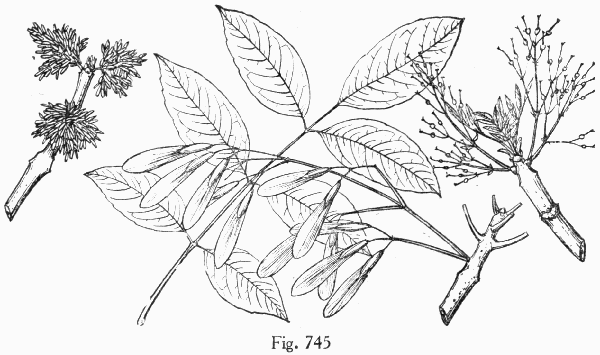
Leaves 8′—12′ long, with a stout grooved petiole, and 5—9, usually 7, ovate to oblanceolate or oval, often falcate abruptly pointed or acuminate leaflets, cuneate or rounded at base, crenulate-serrate or nearly entire, thin but firm, dark green above, pale or light green and glabrous or slightly pubescent below, or rarely thicker, lanceolate, long-acuminate, entire, glabrous and silvery white below (var. crassifolia Sarg.), 3′—5′ long and 1½′—3′ wide, with a broad midrib, and numerous conspicuous veins arcuate near the margins; falling early in the autumn after turning on some individuals deep purple and on others clear bright yellow; petiolules ¼′—½′ or that of the terminal leaflet up to 1′ in length. Flowers diœcious, opening before the leaves late in the spring, in compact ultimately elongated glabrous panicles from buds covered with dark ovate scales rounded at apex and slightly keeled on the back; calyx campanulate, slightly 4-lobed in the staminate flower, and deeply lobed or laciniately cut in the pistillate flower; stamens 2 or occasionally 3, with short stout filaments, and large oblong-ovate apiculate anthers at first nearly black, later becoming reddish purple; ovary contracted into a long slender style divided into 2 spreading dark purple stigmatic lobes. Fruit rarely deeply tinged with purple (f. iodocarpa Fern.), 1′—2½′ long and usually about ¼′ wide, or sometimes not more than ½′ long (var. microcarpa A. Gray), in crowded clusters 6′—8′ in length, lanceolate or oblanceolate, surrounded at base by the persistent calyx, the wing pointed or emarginate at apex and terminal or slightly decurrent on the terete body.
A tree, sometimes 120° high, with a tall massive trunk 5°—6° in diameter, stout upright or spreading branches forming in the forest a narrow crown, or with sufficient space a round-topped or pyramidal head, and thick terete branchlets dark green or brown tinged with red and covered with scattered pale caducous hairs when they first appear, soon becoming light orange color or ashy gray and marked by pale lenticels, becoming in their first winter gray or light brown, lustrous, often covered with a glaucous bloom and roughened by the large pale semiorbicular leaf-scars displaying near the margins a line of conspicuous fibro-vascular bundle-scars. Winter-buds: terminal broad-ovoid, obtuse, with 4 pairs of scales, those of the outer pair ovate, acute, apiculate, conspicuously keeled on the back, nearly black, slightly puberulous, about one half the length of the scales of the second pair rather shorter than those of the third pair, lengthening with the young shoots, and at maturity oblong-ovate, narrowed and rounded at apex, keeled, ½′ long, and rusty-pubescent, the scales of the inner pair becoming ⅔′ long, ovate, pointed, keeled, sometimes slightly [842] pinnatifid, green tinged with brown toward the apex, covered with pellucid dots and very lustrous. Bark of the trunk 1′—3′ thick, dark brown or gray tinged with red, and deeply divided by narrow fissures into broad flattened ridges separating on the surface into thin appressed scales. Wood heavy, hard, strong, close-grained, tough, and brown, with thick lighter colored sapwood; used in large quantities in the manufacture of agricultural implements, for the handles of tools, in carriage-building, for oars and furniture, and in the interior finish of buildings; the most valuable of the American species as a timber-tree.
Distribution. Common in rich rather moist soil on low hills, and in the neighborhood of streams; Nova Scotia, New Brunswick, southern Quebec and Ontario and the southern peninsula of Michigan, and westward and southward to eastern Minnesota, central Iowa, southeastern Nebraska, eastern Kansas, and northern Oklahoma to the valley of the Salt Fork of the Arkansas River in Woods County (near Alva, G. W. Stevens), and to Florida to Taylor County and the valley of the lower Apalachicola River, and through the Gulf states to the valley of the Trinity River, Texas; of its largest size on the bottom-lands of the basin of the lower Ohio River; southward and west of the Mississippi River less common and of smaller size; on the Appalachian Mountains up to altitudes of 3800°; the var. crassifolia at Mt. Victory, Harding County, Ohio, Campbell, Dunklin County, Missouri, and near Texarkana, Bowie County, Texas.
Often planted in the eastern states as a shade and ornamental tree, and occasionally in western and northern Europe.
A form with the wing of the fruit extending nearly to the middle of the body distinguished as Fraxinus Smallii Britt. has the appearance of a hybrid between F. americana and F. pennsylvanica var. lanceolata; individuals of this form have been found near McGuire’s Mill, on the Yellow River, Guinnett County, Georgia; near Rochester, Munroe County, New York; and near Lake Wingra, Dane County, Wisconsin.
9. Fraxinus texensis Sarg. Mountain Ash.
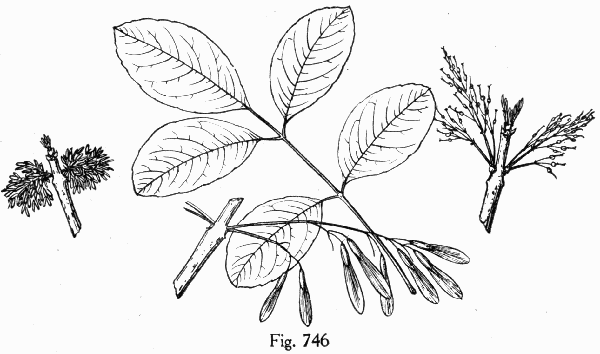
Leaves 5′—8′ long, with a long slender terete petiole, and 5 or occasionally 7 usually long-stalked ovate broad-oval or obovate leaflets, rounded or acute, or often abruptly pointed at apex, cuneate, rounded or slightly cordate at base, and coarsely crenulate-serrate, chiefly above the middle, light green slightly tinged with red and pilose with occasional pale caducous hairs when they unfold, and at maturity thick and firm, glabrous, dark green on the upper surface, pale on the lower surface, 1′—3′ long and ¾′—2′ wide, and occasionally furnished below with tufts of long white hairs at the base of the broad midrib, and [843] in the axils of the numerous conspicuous veins forked near the margins and connected by coarse reticulate veinlets; petiolules slender, ¼′—½′ and on the terminal leaflet up to 1′ in length. Flowers diœcious, appearing in March as the leaves begin to unfold, in compact glabrous panicles from the axils of leaves of the previous year, and covered in the bud by ovate rounded orange-colored scales; staminate flower composed of a minute or nearly obsolete 4-lobed calyx and 2 stamens, with short filaments and linear-oblong light purple apiculate anthers; calyx of the female flower deep cup-shaped, and divided to the base into 4 acute lobes; ovary gradually narrowed into a long slender style. Fruit in short compact clusters, spatulate to oblong, surrounded at base by the persistent calyx, ½′—1′ long and ⅛′—¼′ wide, the wing rounded or occasionally emarginate at apex, and terminal on the short terete many-rayed body; very rarely with 3 or 4 wings extending to the base of the fruit.
A tree, rarely 50° high, with a short trunk occasionally 2°—3° in diameter, thick spreading often contorted branches, and stout terete branchlets dark green tinged with red and slightly puberulous when they first appear, becoming light yellow-brown or light orange color during the summer, and in their first winter light brown marked by remote oblong pale lenticels and by large elevated lunate leaf-scars displaying a row of conspicuous fibro-vascular bundle-scars, and dark or reddish brown in their second or third season; usually much smaller. Winter-buds: terminal acute, with 3 pairs of scales, those of the first pair broad-ovate, rounded at the apex, dark orange color, pilose toward the base, and rather shorter than the ovate rounded scales of the second pair coated with rufous tomentum and becoming ½′ long or about one half the length of the linear strap-shaped scales of the inner pair truncate or emarginate at the apex and orange color. Bark of the trunk ½′—¾′ thick, dark gray and deeply divided by narrow fissures into broad scaly ridges. Wood heavy, hard, strong, light brown, with thin lighter colored sapwood; valued as fuel and occasionally used for flooring.
Distribution. Texas, high dry limestone bluffs and ridges, in the neighborhood of Dallas, Dallas County, and Fort Worth, Tarrant County, to the valley of the Colorado River near Austin, Travis County, and over the Edwards Plateau to Bandera, Kerr, Edwards and Palo Pinto Counties.
Hardy in the Arnold Arboretum.
10. Fraxinus biltmoreana Beadl.
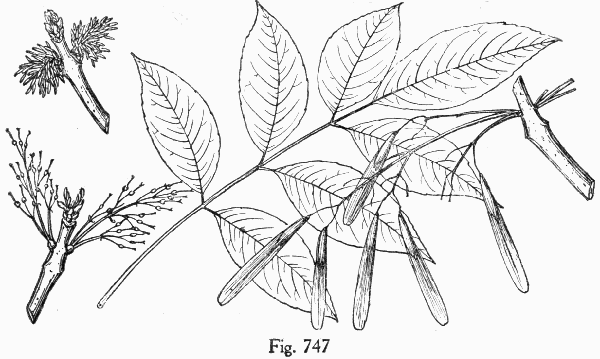
Leaves 10′—12′ long, with a stout pubescent or puberulous petiole, and 7—9 oblong-ovate to ovate-lanceolate or oval often falcate entire or obscurely toothed leaflets acuminate at apex, rounded or cuneate and often inequilateral at base, yellow-bronze color and nearly glabrous above, coated beneath, particularly on the midrib and veins, with long white hairs when they unfold, and at maturity 3′—6′ long, 1½′—2′ wide, thick and firm in texture, dark green and slightly lustrous on the upper surface, pale, or glaucous and puberulous on the lower surface and villose along the slender yellow midrib, and primary veins arcuate near the slightly thickened and incurved margins; petiolules pubescent, ¼′—½′ or that of the terminal leaflet up to 2′ in length. Flowers diœcious, appearing with the leaves about the 1st of May, in a rather compact pubescent panicle, with scarious caducous bracts and bractlets; staminate flower with a minute cup-shaped very obscurely dentate calyx and nearly sessile oblong acute anthers; calyx of the pistillate flower much larger and deeply lobed; ovary oblong, gradually narrowed into the slender style divided at apex into 2 short stigmatic lobes. Fruit linear-oblong, in elongated glabrous or puberulous clusters, 1½′—1¾′ long and about ¼′ wide, the wing terminal, only slightly narrowed at the ends, emarginate at apex, and two and a half to three times longer than the short ellipsoid terete many-nerved body.
A tree, 40°—50° high, with a trunk 12′—18′ in diameter, stout ascending or spreading branches forming an open symmetrical head, and stout light or dark gray branchlets soft-pubescent usually during two seasons, much roughened during their first winter and often for two or three years by the large elevated mostly obcordate or sometimes orbicular leaf-scars displaying a marginal line of fibro-vascular bundle-scars. Winter-buds: terminal [844] ovoid, usually broader than long, and covered with bright brown scales, those of the outer pair keeled on the back and apiculate at apex, the others rounded, accrescent, and slightly villose. Bark of the trunk rough, dark gray, and slightly furrowed.
Distribution. Banks of streams and on low river benches; western New Jersey (Bordentown, Burlington County); eastern Pennsylvania (Bucks County); near Arlington, Alexandria County, Great Falls, Fairfax County, Woodbridge, Prince William County, and Clifton Forge, Alleghany County, Virginia; near Easton, Monongalia County, West Virginia, and along the Appalachian Mountains up to altitudes of 2200° to northern Georgia; in northern Alabama (St. Bernard, Cullman County), and westward to eastern Kentucky, central Tennessee and through Ohio northward to Erie County; southern Indiana and Illinois (Richland County), to southeastern Missouri (Campbell, Dunklin County).
11. Fraxinus profunda Bush. Pumpkin Ash.
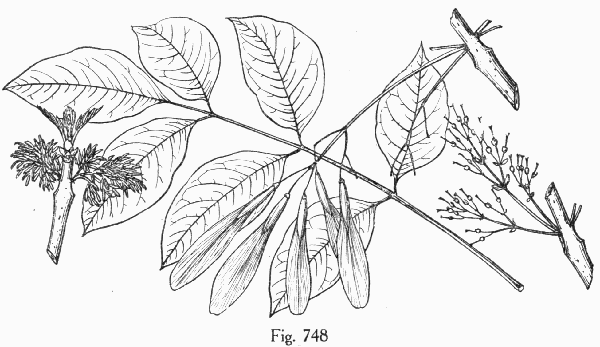
Leaves 9′—18′ long, with a stout tomentose petiole, and usually 7 but occasionally 9 lanceolate or elliptic entire or slightly serrate leaflets acuminate or abruptly long-pointed at apex, rounded, cuneate and often unsymmetric at base, coated below when they unfold with hoary tomentum, and pilose on the upper surface with short pale hairs, particularly on the midrib and veins, and at maturity thick and firm in texture, dark yellow-green and nearly glabrous on the upper surface, soft-pubescent on the lower surface, 5′—10′ long and 1½′—5′ wide, with a stout yellow midrib deeply impressed and puberulous above and numerous slender primary veins; petiolules stout, tomentose early in the season, usually becoming glabrous or nearly glabrous, ¼′—½′ or that of the terminal leaflet up to 2′ in length. Flowers diœcious, in elongated much-branched pubescent panicles, with oblong or oblong-obovate scarious bracts and bractlets; staminate flower with a minute campanulate obscurely 4-toothed calyx, and 2 or 3 stamens, with comparatively long slender filaments and oblong apiculate anthers; pistillate flower with a large deeply lobed calyx accrescent and persistent under the fruit, and an ovary gradually contracted into a slender style. Fruit in long drooping many-fruited pubescent clusters, oblong, 2′—3′ in length and often ½′ wide, the wing sometimes falcate, rounded, apiculate, or emarginate at apex, and decurrent to below the middle or nearly to the base of the thick terete many-rayed body.
A tree, occasionally 120° high, with a slender trunk 3° in diameter above the much enlarged and buttressed base, small spreading branches forming a narrow rather open head, and stout branchlets marked by large pale lenticels, coated at first with hoary tomentum, tomentose and pubescent during their first winter and light gray and pilose or glabrous the [845] following year, and marked by the oblong slightly raised obconic leaf-scars nearly surrounding the lateral buds; usually much smaller. Winter-buds terminal, broad-ovate, obtuse, light reddish brown, and covered with close pale pubescence. Bark of the trunk ½′—¾′ thick, light gray and divided by shallow fissures into broad flat or rounded ridges broken on the surface into thin closely appressed scales.
Distribution. Deep river swamps often inundated during several months of the year; western New York (H. F. Sartwell); southern Indiana and Illinois; western Kentucky (Caldwell and McCracken Counties) and Tennessee (Henderson County); southeastern Missouri, eastern Arkansas (Moark and Corning, Clay County, and Varner, Lincoln County); near New Orleans, Louisiana, eastern Mississippi (near Columbus, Lowndes County), and in the valley of the lower Apalachicola River, western Florida.
Occasionally cultivated; hardy in the Arnold Arboretum.
12. Fraxinus pennsylvanica Marsh. Red Ash.
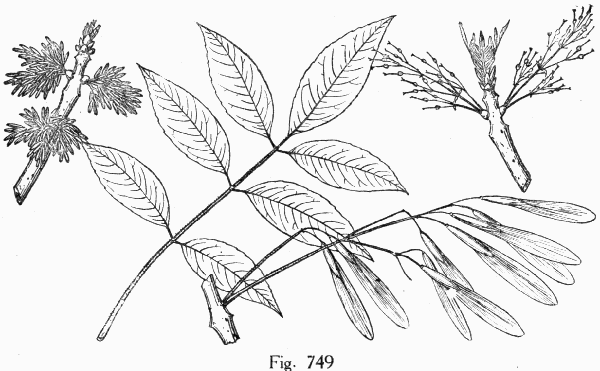
Leaves 10′—12′ long, with a stout slightly grooved pubescent petiole, and 7—9 oblong-lanceolate, ovate-elliptic or slightly obovate leaflets gradually narrowed at apex into a long slender point, unequally cuneate at base, and obscurely serrate, or often entire below the middle, when they unfold coated below and on the petiole with hoary tomentum, and lustrous and puberulous on the upper surface, and at maturity thin and firm, 4′—6′ long, 1′—1½′ wide, light yellow-green above and pale and covered below with silky pubescence, with a conspicuous midrib and branching veins; in the autumn turning yellow or rusty brown before falling; petiolules thick, grooved, pubescent, ⅛′—¼′ or that of the terminal leaflet up to 1′ in length. Flowers diœcious, appearing late in spring as the leaves begin to unfold, in a rather compact tomentose panicle, covered in the bud with ovate rusty-tomentose scales; staminate flower with a minute obscurely toothed cup-shaped calyx, and 2 stamens, with short slender filaments and linear-oblong light green anthers tinged with purple; calyx of the pistillate flower cup-shaped, deeply divided, as long as the ovary gradually narrowed into an elongated style divided at apex into 2 green stigmatic lobes. Fruit in an open glabrous or pubescent panicle, lanceolate to slightly oblanceolate or oblong-obovate or elliptic, 1′—2½′ long, ¼′—⅓′ wide, surrounded at base by the persistent calyx, the thin wing narrowed, rounded and occasionally emarginate or acute or acuminate and often apiculate at apex, decurrent to below the middle or nearly to the gradually tapering base of the slender terete many-rayed body.
A tree, 40°—60° high, with a trunk rarely exceeding 18′—20′ in diameter, stout upright [846] branches forming a compact irregularly shaped head, and slender terete branchlets more or less coated when they first appear with pale tomentum sometimes persistent until their second or third year or often disappearing during the first summer, ultimately becoming ashy gray or light brown tinged with red, frequently covered with a glaucous bloom and marked by pale lenticels, and in their first winter by the semicircular leaf-scars displaying a short row of large fibro-vascular bundle-scars. Winter-buds: terminal, about ⅛′ long, with 3 pairs of scales coated with rufous tomentum, those of the outer pair acute, rounded on the back, truncate at apex, and rather shorter than those of the other pairs 1′—1½′ long at maturity and sometimes pinnately cut toward the apex. Bark of the trunk ½′—⅔′ thick, brown tinged with red, and slightly furrowed, the surface of the ridges separating into thin appressed scales. Wood heavy, hard, rather strong, brittle, coarse-grained, light brown, with thick lighter brown sapwood streaked with yellow; sometimes confounded commercially with the more valuable wood of the White Ash. Variable in the length of the petiolules and in the shape of the fruit and the width of its wing; a form with short-stalked or nearly sessile leaflets, found chiefly in Nebraska has been described as F. campestris Britt. and a form with the wing of the spatulate fruit sometimes ¼′ wide as F. Michauxii Britt.
Distribution. Low rich moist soil near the banks of streams and lakes; Nova Scotia to Manitoba, and southward to central Georgia, northern Alabama (St. Bernard, Cullman County, and Attalla, Etowah County), northeastern Mississippi (Tishomingo County), southern Indiana and Illinois, northern Missouri, eastern Kansas and southwestern Oklahoma (Cache, Comanche County); usually confined in the Carolinas to the Piedmont region and foothills of the high mountains. Passing into
Fraxinus pennsylvanica var. lanceolata Sarg. Green Ash.
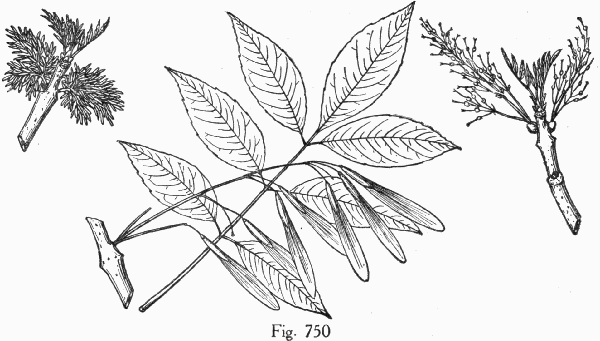
Leaves with rather narrower and shorter and usually more sharply serrate leaflets lustrous and bright green on both surfaces, and glabrous or pubescent along the midrib below.
A round-topped tree, rarely more than 60° high, or with a trunk more than 2° in diameter, slender spreading branches, ashy gray terete glabrous branchlets marked by pale lenticels, and rusty-pubescent bud-scales.
Distribution. Banks of streams; valley of the Penobscot River (Orono, Penobscot County), Maine, to northern Vermont and the valley of the St. Lawrence River, near Montreal, Province of Quebec, and to the valley of the Saskatchewan (Saskatoon, Saskatchewan), and in the United States westward to North Dakota, eastern Wyoming to the base of the Bighorn Mountains, and on the mountains of northern Montana, and southward [847] to western Florida to the valley of the lower Apalachicola River, Dallas County, Alabama, central Mississippi, Louisiana, Oklahoma to Comanche County, and Texas to the valley of the Guadalupe River; most abundant in the basin of the Mississippi River; attaining its largest size on the rich bottom-lands of eastern Texas and here often 60°—70° high, with a trunk 2°—3° in diameter; on the southern Appalachian Mountains ascending to altitudes of 2000°—2500°. As it usually grows in the east with its bright green glabrous leaves and glabrous branchlets the Green Ash appears distinct from the Red Ash, but trees occur over the area which it inhabits, but more often westward, with slightly pubescent leaves and branchlets which may be referred as well to one tree as to the other and make it impossible to distinguish satisfactorily as species the Green and Red Ash.
Often planted as a shade and ornamental tree in the middle western and occasionally in the eastern states, but less valuable than the White Ash.
13. Fraxinus Berlandieriana DC.
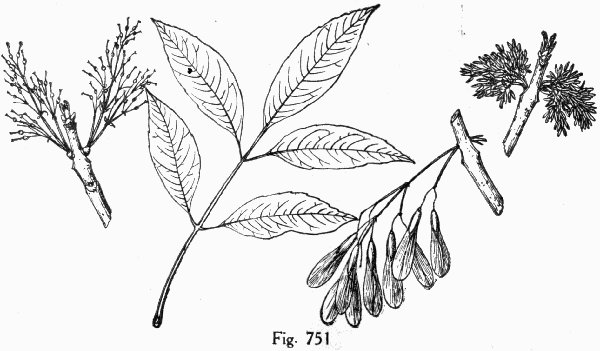
Leaves 3′—7′ long, with a slender petiole, and 3—5 lanceolate, elliptic or obovate leaflets, acuminate or abruptly acuminate or acute at apex, cuneate or rarely rounded at base, [848] mostly entire or remotely serrate, thin, dark green and glabrous on the upper surface, rather paler and glabrous or furnished with small axillary tufts of white hairs on the lower surface, 3′—4′ long and ½′—1½′ wide; petiolules slender, 1¼′—1⅓′ or that of the terminal leaflet up to 1½′ in length. Flowers diœcious, in a short glabrous panicle inclosed in the bud by broad-ovate rounded chestnut-brown pubescent scales; staminate flower with a minute obscurely lobed calyx and 2 stamens, with short filaments and linear-oblong apiculate anthers; calyx of the pistillate flower cup-shaped, deeply divided, and as long as the ovary gradually narrowed into the slender style. Fruit ripening in May, oblong-obovate to spatulate, acute or acuminate at apex, 1′—1½′ long and ¼′ wide, the wing decurrent nearly to the base of the compressed many-rayed clavate body gradually narrowed into a long slender base surrounded by the enlarged deeply lobed calyx.
A tree, rarely more than 30° high, or with a trunk more than a foot in diameter, and terete slender branchlets light green when they first appear, becoming in their first winter light brown tinged with red or ashy gray, and marked by occasional lenticels and by the small elevated nearly circular leaf-scars displaying a short row of large fibro-vascular bundle-scars. Winter-buds: terminal acute, with dark brown puberulous scales. Bark of the trunk dark gray tinged with red, 1′—1½′ thick, and divided by shallow interrupted fissures into narrow ridges. Wood light, soft, close-grained, light brown, with thick lighter colored sapwood.
Distribution. Texas, banks of streams and mountain cañons, valley of the Colorado River (Bastrop and Travis Counties), and those of the San Antonio and Nueces Rivers to the lower Rio Grande, and over the Edwards Plateau to Palo Pinto County; in northeastern Mexico.
14. Fraxinus velutina Torr.
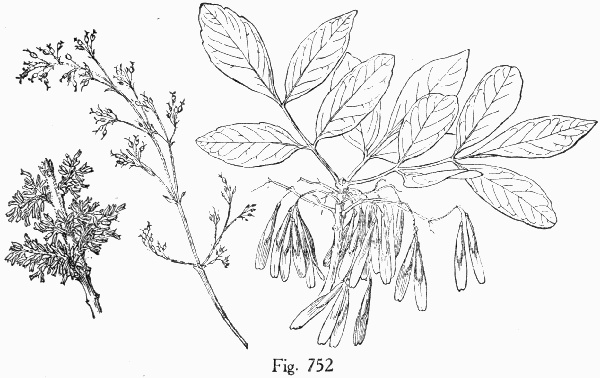
Leaves 4′—5′ long, with a broad densely villose petiole grooved like the slender rachis on the upper side, and 3—5 elliptic to ovate or slightly obovate leaflets acute at apex, narrowed and rounded or cuneate at base, finely crenulate-serrate above the middle, pubescent above and tomentose below when they unfold, and at maturity thick, pale green, glabrous on the upper surface, tomentose on the lower surface, 1′—1½′ long and ¾′—1′ wide, with a prominent midrib and primary veins, and conspicuous reticulate veinlets; petiolules of the lateral leaflets ⅙′ or less or that of the terminal leaflet up to ½′ in length. Flowers diœcious, appearing in March and April with the unfolding of the leaves, on long slender pedicels in [849] elongated pubescent panicles, covered in the bud by broad-ovate tomentose scales rounded at apex; calyx cup-shaped, densely pubescent; stamens, with short slender filaments and oblong apiculate anthers; ovary nearly inclosed in the calyx, shorter than the nearly sessile lobes of the stigma. Fruit ripening in September, on slender villose pedicels, in large many-fruited clusters, oblong-obovate to elliptic, surrounded at base by the enlarged deeply divided calyx, rarely more than ¾′ long and ⅙′ wide, the wing terminal, rounded and often emarginate or acute at apex, shorter than the terete many-rayed clavate body attenuate at base and 5/12′—½′ in length.
A slender tree, 25°—30°, rarely 40°—50° high, with a trunk 12′—18′ in diameter, stout often spreading branches forming a round-topped head, and slender terete branchlets coated during their first season with hoary tomentum, and ashy gray, glabrous and marked by large obcordate dark leaf-scars in their second year. Winter-buds: terminal acute, ⅛′ long, with 3 pairs of broad-ovate pointed tomentose scales, those of the inner pair strap-shaped and ½′ long when fully grown. Bark of the trunk ⅓′—½′ thick, gray slightly tinged with red, and deeply divided into broad flat broken ridges separating on the surface into small thin scales. Wood heavy, rather soft, not strong, close-grained, light brown, with thick lighter colored sapwood; used locally for axe-handles and in the manufacture of wagons.
Distribution. Mountain cañons up to altitudes of 6000°, central and southern Arizona and southern New Mexico. Passing into the following varieties: var. coriacea Rehd. (Fraxinus coriacea S. Wats.) differing in its thicker more coriaceous often more coarsely serrate leaflets and in the less densely pubescent or glabrescent branchlets; southern Utah (St. George, Washington County) to southeastern California; var. glabra Rehd. with glabrous 3—7-foliolate leaves and glabrous branchlets; common with the species; occasionally cultivated in the cities of Arizona; more distinct is
Fraxinus velutina var. Toumeyi Rehd.
Fraxinus Toumeyi Britt.
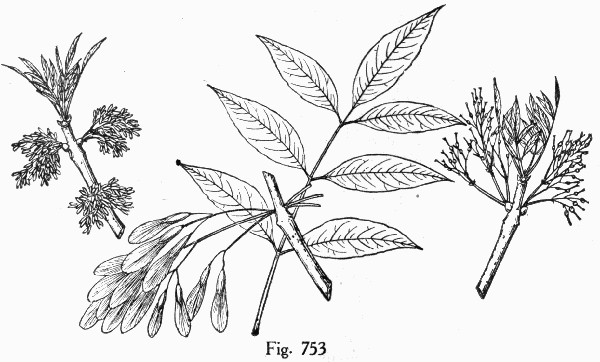
Leaves 3½′—6′ long, with a villose-pubescent petiole, and 5—7 lanceolate to elliptic or rarely obovate acuminate and long-pointed or acute leaflets, finely serrate above the middle, glabrous on the upper surface, covered on the lower surface with close fine pubescence, 1½′—3′ long and ½′—1′ wide; petiolules slender, pubescent, ⅛′—½′ or that of the terminal leaflet up to 1′ in length; occasionally on vigorous shoots reduced to a single leaflet. Flowers as in the species. Fruit narrow-oblong, 1′ long and often not more than 1/12′ wide, or spatulate [850] with the wing longer or shorter than the body, and sometimes only about ¾′ long and 1/16′ wide, with the wing longer or not more than half the length of the body.
A tree, usually 20°—30° high, with a trunk 6′—8′ in diameter, and ashy gray branchlets pale pubescent when they first appear, becoming glabrous or puberulous during their second season.
Distribution. Mountain cañons at altitudes of 5000°—6000°; in Arizona more common than F. velutina; less abundant in southern New Mexico; in Sonora.
Often used to shade the streets in the towns of southern Arizona.
15. Fraxinus oregona Nutt.
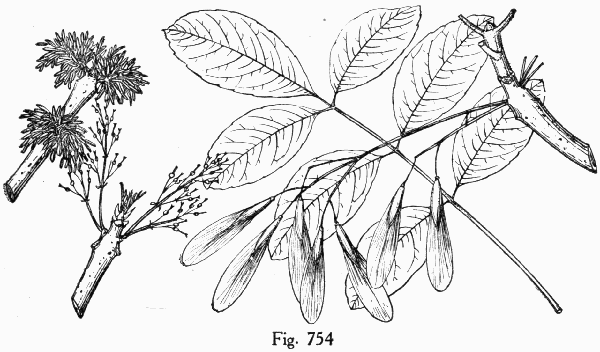
Leaves 5′—14′ long, with a stout grooved and angled pubescent, tomentose or glabrous petiole, and usually 5—7, rarely 3, or on young trees occasionally 9, ovate to elliptic or rarely oval or obovate leaflets usually contracted at apex into a short broad point, gradually narrowed at base, and entire or remotely and obscurely serrate, usually coated below and on the petioles with thick pale tomentum when they unfold and pubescent above, or nearly glabrous or pilose with a few scattered hairs, and at maturity light green on the upper surface, paler and usually tomentose, puberulous or rarely glabrous (var. glabra Rehd.), on the lower surface, 3′—7′ long and 1′—1½′ wide, with a broad pale midrib, conspicuous veins arcuate near the margins, and reticulate veinlets, the lateral usually sessile, rarely on petiolules up to ½′, or that of the terminal leaflet up to 1′ in length; turning yellow or russet brown in the autumn before falling. Flowers diœcious, appearing in April or May when the leaves begin to unfold, in compact glabrous panicles covered in the bud by broad-ovate scales coated with rufous pubescence; staminate flower composed of a minute calyx, short filaments, and short-oblong apiculate anthers; calyx of the pistillate flower laciniately cut and shorter than the ovary narrowed into a stout style divided into long conspicuous stigmatic lobes. Fruit in ample crowded clusters, oblong, obovate to oblanceolate or elliptic, rounded and often emarginate or acute at apex, 1′—2′ long and ¼′—⅓′ wide, the wing decurrent to the middle or nearly to the attenuate base of the clavate or ellipsoid slightly compressed many-rayed body.
A tree, frequently 70°—80° high, with a long trunk occasionally 4° in diameter, stout branches forming a narrow upright head or a broad shapely crown, and thick terete branchlets more or less densely coated with pale or rarely rufous silky pilose tomentum persistent during their second year or occasionally deciduous during their first summer, becoming light red-brown or orange color, glabrous or puberulous, often covered with a slight glaucous bloom, marked by small remote pale lenticels, and during their first and [851] second winters by the large elevated semiorbicular leaf-scars displaying a short row of conspicuous fibro-vascular bundle-scars, rarely always glabrous (var. glabra Rehd.). Winter-buds: terminal acute, ⅛′—¼′ long, with 4 pairs of scales covered with pale hairs or with rusty pubescence, those of the inner rows often foliaceous at maturity. Bark of the trunk 1′—1½′ thick, dark gray, or brown slightly tinged with red, and deeply divided by interrupted fissures into broad flat ridges separating on the surface into thin scales. Wood light, hard, brittle, coarse-grained, brown, with thick lighter colored sapwood; largely used in the manufacture of furniture, for the frames of carriages and wagons, in cooperage, the interior finish of houses, and for fuel.
Distribution. Usually in rich moist soil in the neighborhood of streams; coast region of southern British Columbia, southward through western Washington and Oregon and the California coast region to the Bay of San Francisco and the Santa Cruz Mountains, and along the western foothills of the Sierra Nevada to those of the mountains of San Bernardino and San Diego Counties, California; the var. glabra in Los Angeles and San Bernardino Counties, and east of the Sierra Nevada in Inyo County (Ash Creek, near Owens Lake), and occasionally northward in California; most abundant and of its largest size on the bottom-lands of the rivers of southwestern Oregon; one of the most valuable of the deciduous-leaved timber-trees of Pacific North America.
Occasionally cultivated; hardy in the Arnold Arboretum.
16. Fraxinus quadrangulata Michx. Blue Ash.
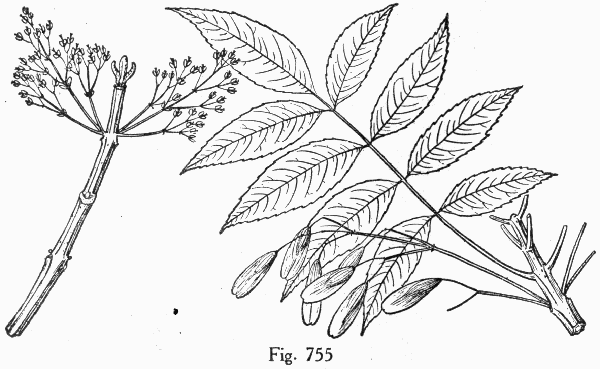
Leaves 8′—12′ long, with a slender petiole glabrous, or puberulous toward the base, and 5—11 oblong-ovate to lanceolate long-pointed coarsely serrate leaflets unequally rounded or cuneate at base, and coated when they unfold on the lower surface with thick brown tomentum, and at maturity thick and firm, yellow-green and glabrous above, pale and glabrous or sometimes furnished with tufts of pale hairs along the base of the conspicuous midrib below, 3′—5′ long and 1′—2′ wide, with short stout petiolules and 8—12 pairs of veins arcuate near the margins; turning pale yellow in the autumn before falling. Flowers perfect, appearing as the terminal buds begin to expand, in loose-branched panicles from small obtuse buds with scales keeled on the back, apiculate at apex, and covered with thick brown tomentum; calyx reduced to an obscure ring; corolla 0; stamens 2, with nearly sessile broad connectives and dark purple oblong obtuse anther-cells; ovary oblong-ovoid, gradually narrowed into a short style divided at apex into 2 light purple stigmatic lobes generally maturing and withering before the anthers open. Fruit oblong to oblong-cuneate, 1′—2′ long [852] and ⅓′—½′ wide, the wing rounded and often emarginate or acute at apex, surrounding the flat body faintly many-rayed on both surfaces.
A tree, usually 60°—70° or occasionally 120° high, with a trunk 2°—3° in diameter, small spreading branches forming a slender head, and stout 4-angled branchlets more or less 4-winged between the nodes, dark orange color and covered with short rufous pubescence when they first appear, becoming gray tinged with red in their second year and marked by scattered pale lenticels and by the large elevated obcordate leaf-scars displaying a lunate row of fibro-vascular bundle-scars, and in their third year light brown or ashy gray and then gradually becoming terete. Winter-buds: terminal about ¼′ long, with 3 pairs of scales, those of the outer row thick, rounded on the back, usually obscurely pinnate toward the apex, dark reddish brown, slightly puberulous or often hoary-tomentose, partly covering the bud, those of the inner rows strap-shaped, coated with light brown tomentum, often pinnate, becoming 1′—1½′ long. Bark of the trunk ½′—⅔′ thick, irregularly divided into large plate-like scales, the light gray surface slightly tinged with red separating into thin minute scales. Wood heavy, hard, close-grained, rather brittle, light yellow streaked with brown, with thick lighter colored sapwood of 80—90 layers of annual growth; largely used for flooring and in carriage-building, and not often distinguished commercially from that of other species of the northern and middle states. A blue dye is obtained by macerating the inner bark in water.
Distribution. Rich limestone hills, occasionally descending into the bottom-lands of fertile valleys; southwestern Ontario through southern Michigan to southwestern Iowa and southward through western Ohio and southeastern Indiana to eastern and central Kentucky (near Clarksville, Montgomery County), eastern Tennessee and northern Alabama (near Huntsville, Madison County), and through Missouri to southeastern Kansas, southwestern Arkansas and northeastern Oklahoma (near Pawhuska, Osage County); nowhere very abundant; of its largest size in the basin of the lower Wabash River, Illinois, and on the western slopes of the Big Smoky Mountains, Tennessee.
Occasionally cultivated as an ornament of parks and gardens in the eastern United States.
17. Fraxinus nigra Marsh. Black Ash. Brown Ash.
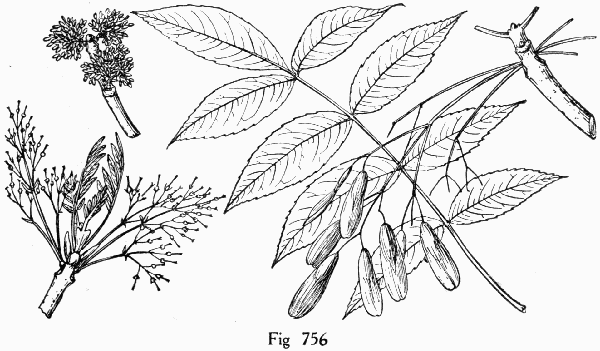
Leaves 12′—16′ long, with a stout pale petiole, and 7—11 oblong or oblong-lanceolate long-pointed leaflets, unequally cuneate or sometimes rounded at base, serrate with small incurved apiculate teeth, the lateral sessile, the terminal on a petiolule up to 1′ in length, covered especially below when they unfold with rufous hairs, and at maturity thin and firm, [853] dark green above, paler below, glabrous with the exception of occasional tufts of rufous hairs along the under side of the broad pale midrib, 4′—5′ long and 1′—2′ wide, with many conspicuous primary veins arcuate near the margins and obscurely reticulate veinlets; turning rusty brown and falling early in the autumn. Flowers polygamous, without a perianth, appearing before the leaves in a compact or ultimately elongated panicle 4′—5′ long, and covered in the bud by broad-ovate dark brown or nearly black scales rounded at apex; staminate flowers on separate trees or mixed with perfect flowers, and consisting of 2 large deeply pitted oblong dark purple apiculate anthers attached on the back to short broad filaments; pistillate flower consisting of a long slender style deeply divided into 2 broad purple stigmas and often accompanied by 1 or 2 perfect or globose rudimentary pink anthers sessile or borne on long or short filaments. Fruit in open panicles 8′—10′ in length, oblong to slightly oblong-obovate, 1′—1½′ long and ⅓′ wide, with a thin wing, surrounding the short flat faintly nerved body, rounded and emarginate at apex and narrowed and rounded or cuneate at base.
A tree, occasionally 80°—90° high, with a tall trunk rarely exceeding 20′ in diameter, slender mostly upright branches forming a narrow head, and stout terete branchlets dark green and slightly puberulous when they first appear, soon becoming ashy gray or orange color and marked by large pale lenticels, growing darker during their first winter and then roughened by the large suborbicular leaf-scars displaying a semicircular row of conspicuous fibro-vascular bundle-scars; usually much smaller. Winter-buds: terminal broad-ovate, acute, rather less than ¼′ long, with 3 pairs of scales, those of the outer pair thick and rounded on the back at base, gradually narrowed and acute at apex, dark brown, slightly puberulous, falling as the bud begins to enlarge in the spring, and shorter than the scales of the inner rows coated on the outer surface with rufous pubescence, those of the second pair becoming strap-shaped, 1′ long, ⅓′ wide, and about half as long as the pinnate usually foliaceous inner scales. Bark of the trunk gray slightly tinged with red, ⅓′—½′ thick, and divided into large irregular plates separating into thin papery scales. Wood heavy, rather soft, not strong, tough, coarse-grained, durable, easily separable into thin layers, dark brown, with thin light brown often nearly white sapwood; largely used for the interior finish of houses and in cabinet-making, and for fences, barrel hoops, and in the manufacture of baskets.
Distribution. Deep cold swamps and the low banks of streams and lakes; southern Newfoundland and the northern shores of the Gulf of St. Lawrence to Lake Winnipeg, and southward to New Castle County, Delaware, the mountains of West Virginia, southwestern Indiana (Knox County; now probably exterminated by drainage), central Iowa, central Missouri, and northwestern Arkansas.
2. FORESTIERA Poir. Swamp Privet.
Adelia Michx.
Trees or shrubs, with thin close bark, slender branchlets, and small scaly buds. Leaves simple, entire or serrulate, petiolate, deciduous or persistent. Flowers diœcious or polygamous, minute, on slender ebracteolate pedicels, in fascicles or panicles, their bracts caducous, from buds in the axils of leaves of the previous year and covered with numerous scales; calyx reduced to a narrow ring or cup-shaped, 5 or 6-lobed; corolla 0; stamens hypogynous; filaments 2—4; anthers ovoid, opening by lateral slits; ovary 2-celled, gradually narrowed into a slender style terminating in an abruptly enlarged 2-lobed stigma; ovules 2 in each cell, suspended from its apex; raphe dorsal. Fruit 1 or very rarely 2-celled, drupaceous, oblong or subglobose, with thin flesh and a thin-walled stone; seed 1 in each cell, pendulous, testa membranaceous; albumen fleshy; cotyledons plane, nearly filling the cavity of the stone.
Forestiera with 14 species is distributed from the southern United States and Mexico through Central America to Paraguay, and through the West Indies to Brazil.
The generic name is in memory of the French physician and botanist Charles Leforestière.
[854]
1. Forestiera acuminata Poir.
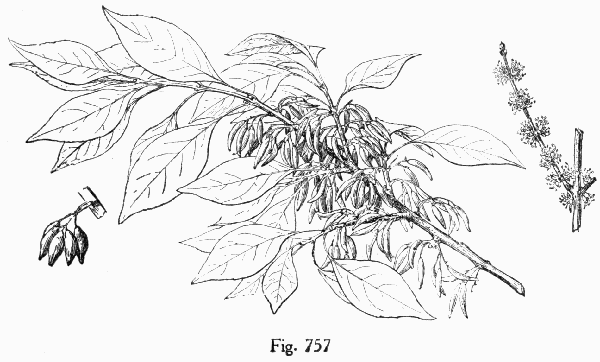
Leaves elliptic, acuminate and long-pointed at apex, gradually narrowed and cuneate at base, serrate above the middle with small remote incurved teeth, glabrous with the exception of occasional hairs on the upper side of the slender midrib, yellow-green on the upper surface, paler on the lower surface, 2½′—4½′ long and 1′—1½′ wide, with usually 5 or 6 pairs of slender primary veins and slightly thickened and incurved margins, deciduous; petioles slender, often slightly winged above the middle, ¼′—½′ in length. Flowers appearing in April and May before the leaves from ovoid pointed buds ⅛′ long, with thickened pale chestnut-brown scales; calyx reduced to a narrow slightly lobed ring; corolla 0; staminate in many-flowered fascicles, on short pedicels from the axils of broad-obovate thin yellow apiculate conspicuous bracts; stamens 4, on long slender filaments; anthers bright yellow; ovary reduced to a minute ovoid body; pistillate flowers on slender pedicels ⅛′ long, in glabrous pedunculate several-flowered panicles ¾′—1¼′ long, their bracts caducous; stamens with shorter filaments and abortive or rarely fertile anthers, or usually 0; ovary oblong-ovoid, slightly unsymmetric, gradually narrowed into the long slender style enlarged into the thickened imperfectly 2-lobed terminal stigma. Fruit falling as soon as ripe in June and July, oblong-ovoid, gradually narrowed, acute and tipped with the remnants of the style at apex, gradually narrowed and rounded at base, slightly compressed and unsymmetric, dark blue-purple, 1′—1¼′ long, about ¼′ thick, with thin dry flesh, and a striate stone rounded at base, straight on one side and rounded on the other, its wall covered with thin vertical scales spongy in appearance, and conspicuously longitudinally ridged on the inner surface the ridges terminating in long slender tips forming the acuminate apex of the stone; seeds ellipsoid, slightly compressed, striate, light brown, about ⅓′ in length.
A tree, rarely 50° high, with a short trunk 8′—10′ in diameter, small spreading branches, and slender light brown branchlets becoming darker in their second year, and marked by numerous lenticels and by the small elevated nearly orbicular leaf-scars. Winter-buds: terminal ovoid, pointed, about 1/16′ long, with numerous scales increasing in size from the outer to the inner ranks; usually much smaller, and generally a shrub 10°—15° high and broad. Bark close, slightly ridged, dark brown.
Distribution. Borders of streams and swamps in low moist soil; valley of the lower Wabash River, southwestern Indiana, southern Illinois northward along the Mississippi River to Pike County, and to central Tennessee, and from southern Missouri through Arkansas to eastern Oklahoma (near Muskogee, Muskogee County) and eastern Texas to the valley [855] of the lower Colorado River inland to Colorado County (shores of Eagle Lake), and through Louisiana, central and southern Mississippi and Alabama to western Florida (Branford, Suwanee County) and on the Savannah River, near Augusta, Richmond County, Georgia; most abundant in Missouri, Arkansas and Texas; comparatively rare east of the Mississippi River, but probably of its largest size in eastern Louisiana.
Occasionally cultivated; hardy in the Arnold Arboretum.
3. CHIONANTHUS L.
Trees or shrubs, with stout terete or slightly angled branchlets, thick pith, and buds with numerous opposite scales. Leaves simple, conduplicate in the bud, deciduous. Flowers diœcious or rarely polygamous, on elongated ebracteolate pedicels, in 3-flowered clusters terminal on the slender opposite branches, of ample loose panicles, with foliaceous persistent bracts, from separate buds in the axils of the upper leaves of the previous year; calyx minute, deeply 4-parted, the divisions imbricated in the bud, persistent under the fruit; corolla white, deeply divided into 4 or rarely 5 or 6 elongated linear lobes conduplicate-valvate in the bud, united at base into a short tube, or rarely separate; stamens 2, inserted on the base of the corolla opposite the axis of the flower, or rarely 4 in the staminate flower, included; filaments terete, short; anthers ovoid, attached on the back below the middle, apiculate by the elongation of the connective, 2-celled, the cells opening by longitudinal lateral or subextrorse slits; ovary ovoid, abruptly contracted into a short columnar style; stigma thick and fleshy, slightly 2-lobed; in the staminate flower of the Asiatic species reduced to a minute subglobose body; ovules laterally attached near the apex of the cell; raphe ventral. Fruit an ovoid or oblong, usually 1 or rarely 2 or 3-seeded thick-skinned drupe tipped with the remnants of the style; flesh thin and dry, stone thick-walled, crustaceous. Seed filling the cavity of the stone, ovoid; seed-coat chestnut-brown.
Chionanthus inhabits the middle and southern United States with one species, and northern and central China with another.
The specific name, from χιών and ἄνθος, is in allusion to the light and graceful clusters of snow-white flowers.
1. Chionanthus virginica L. Fringe-tree. Old Man’s Beard.
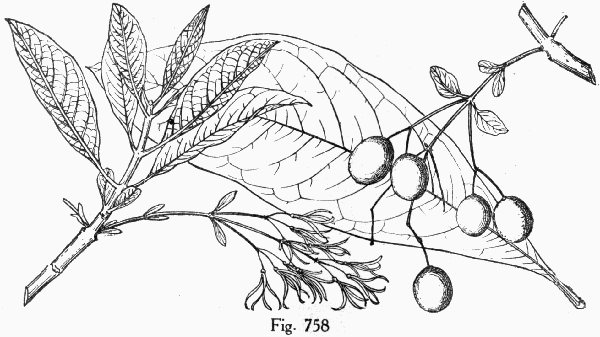
Leaves ovate or oblong, acuminate, short-pointed or sometimes rounded at apex, gradually narrowed and cuneate below, entire, with undulate margins, and coarsely reticulate-venulose, yellow-green and lustrous above, pubescent below, and ciliate on the margins when they unfold, and at maturity 4′—8′ long, ½′—4′ wide, thick and firm, dark green on [856] the upper surface, pale and glabrous on the lower surface except on the stout midrib and conspicuous arcuate primary veins more or less covered with short white hairs; turning bright clear yellow before falling early in the autumn; petioles stout, puberulous, ½′—1′ in length. Flowers slightly and agreeably fragrant, appearing when the leaves are about one third grown, in loose pubescent drooping panicles 4′—6′ in length, the bracts at the base of the lower branches of the inflorescence oblong, glabrous on the upper surface, pubescent on the lower surface, and sometimes 1′ long, those at the base of the upper branches oval, successively smaller, and gradually passing into the minute laciniate bracts subtending the lateral pedicels of the 3-flowered clusters terminating the last divisions of the panicle; some individuals bearing occasional perfect flowers among others functionally diœcious, some with sterile or rarely perfect anthers and a well-developed stigma, and others with an imperfectly developed stigma and fertile anthers; calyx light green, glabrous, with acute entire or laciniately cut lobes; corolla 1′ long, marked on the inner surface near the base by a row of bright purple spots; anthers light yellow, with a green connective. Fruit ripening in September, in loose few-fruited clusters, their bracts leaf-like and sometimes 2′ in length, oval or short-oblong, 1′ long, dark blue or nearly black, and often covered with a glaucous bloom; seeds ⅓′ long, ovoid, narrowed at apex and covered with a thin light chestnut-brown coat marked by reticulate veins radiating from the hilum.
A tree, 20°—30° high, with a short trunk 8′—10′ in diameter, stout ashy gray or light brown branches forming an oblong rather narrow head, and stout branchlets light green and covered with pale pubescence or sometimes glabrous when they first appear, terete or slightly angled in their first winter, often much thickened below the nodes, light brown or orange color, and marked by large scattered darker colored lenticels and by the elevated semiorbicular leaf-scars displaying a semicircular row of conspicuous fibro-vascular bundle-scars; often a shrub, with several stout thick spreading stems. Winter-buds broad-ovoid, acute, ⅛′ long, with about 5 pairs of scales increasing in length from the outer to the inner pair, ovate, acute, keeled on the back, light brown and slightly pilose on the outer surface, bright green and lustrous on the inner surface, and ciliate on the margins with scattered white hairs, those of the inner pair at maturity obovate, gradually narrowed below, foliaceous, and 1′—1½′ long. Bark of the trunk ¼′—½′ thick, and irregularly divided into small thin appressed brown scales tinged with red. Wood heavy, hard, close-grained, and light brown, with thick lighter colored sapwood. The bark is tonic and is sometimes used in decoctions and in the treatment of intermittent fevers, or as an aperient and diuretic, and in homœopathic practice.
Distribution. Banks of streams in rich moist soil; southeastern Pennsylvania to the Manitee River region, western Florida, and through the Gulf states to northern Arkansas (Baxter and Cleburne Counties), southwestern Oklahoma (near Page, Leflore County) and the valley of the Brazos River, Texas; ascending on the southern Appalachian Mountains to altitudes of 4000°.
Often cultivated as an ornamental plant in the eastern United States, and in western and central Europe.
4. OSMANTHUS Lour.
Trees or shrubs, with terete or slightly angled branches, and fibrous roots. Leaves simple, persistent. Flowers fragrant, polygamo-diœcious or perfect, on ebracteolate pedicels subtended by scale-like bracts, in short axillary racemes or in short axillary or rarely terminal fascicles; calyx minute, 4-toothed or divided, the divisions imbricated in the bud, persistent under the fruit; corolla tubular, 4-lobed, the lobes imbricated in the bud, ovate, obtuse, spreading after anthesis; stamens 2, inserted on the tube of the corolla opposite the lateral lobes of the calyx, or rarely 4; filaments terete, short; anthers ovoid or linear-oblong, blunt, or apiculate by the prolongation of the connective, attached on the back below the middle, 2-celled, the cells opening longitudinally by marginal slits, sometimes rudimentary or 0 in the pistillate flower; ovary subglobose; style columnar, short or elongated, crowned with an entire capitate stigma; ovules laterally attached near the apex of the cell; raphe [857] ventral. Fruit a fleshy 1-seeded ovoid or globose drupe tipped with the remnants of the style; flesh thin and succulent; stone hard and bony. Seed filling the cavity of the stone; cotyledons flat, much longer than the short superior radicle turned toward the hilum.
Osmanthus with ten species inhabits eastern North America, the Hawaiian Islands, Polynesia, Japan, China, and the Himalayas. Osmanthus fragrans Lour., a native of China and the temperate Himalayas, is cultivated in China for its fragrant minute cream-colored or yellow flowers used by the Chinese to perfume tea, and is everywhere a favorite garden plant.
The generic name, from ὀσμή and ἄνθος, relates to the fragrance of the flowers.
1. Osmanthus americanus B. & H. Devil Wood.
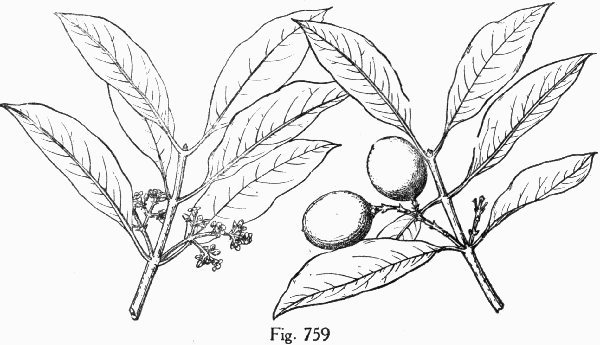
Leaves oblong-lanceolate or obovate, acute or rarely rounded and occasionally emarginate at apex, and gradually narrowed and cuneate at base, with thickened revolute margins, when they unfold coated beneath with pale tomentum, and at maturity thick and coriaceous, glabrous, bright green, lustrous above, obscurely reticulate-venulose, 4′—5′ long and ½′—2½′ wide, with a broad pale midrib and remote forked primary veins arcuate near the margins; persistent until their second year; petioles stout, ½′—¾′ in length. Flowers opening in March from pilose inflorescence-buds formed the previous autumn in the axils of the leaves of the year, the staminate, pistillate, and perfect flowers on different individuals in 3-flowered clusters, sessile or short-pedicellate, in pedunculate cymes or short racemes, with scale-like nearly triangular acute persistent bracts; calyx puberulous, with acute rigid lobes, and much shorter than the creamy white corolla ⅛′ long when expanded, with an elongated tube and short spreading ovate rounded lobes; stamens inserted on the middle of the tube of the corolla, included or slightly exserted, small and often rudimentary in the pistillate flower; ovary abruptly contracted into a stout columnar style crowned with a large exserted capitate stigma, reduced in the staminate flower to a minute point. Fruit ripening early in the autumn, oblong or obovoid, 1′ long, dark blue, with thin flesh and a thick or sometimes thin-walled brittle ovoid pointed stone; seed ovoid, covered with a chestnut-brown coat marked by broad conspicuous pale veins radiating from the short broad ventral hilum and encircling the seed.
A tree, occasionally 60°—70° high, with a trunk sometimes a foot in diameter, and slender slightly angled ultimately terete branchlets light or red-brown and marked by minute pale lenticels, becoming ashy gray in their second year and roughened by the small elevated orbicular leaf-scars displaying a ring of minute fibro-vascular bundle-scars; usually much [858] smaller and often shrubby. Winter-buds narrow-lanceolate, ½′ long, with 2 thick lanceolate reddish brown puberulous scales. Bark of the trunk thin, dark gray or gray tinged with red, and roughened by small thin appressed scales displaying in falling the dark cinnamon red inner bark. Wood heavy, very hard and strong, close-grained, difficult to work, dark brown, with thick light brown or yellow sapwood.
Distribution. Usually in moist soil near the borders of streams and Pine-barren ponds and swamps, and occasionally on dry sandy uplands; coast region of the south Atlantic and Gulf states, from the valley of the lower Cape Fear River, North Carolina, to the valley of the Kissimmee River, the interior of the peninsular (Lake and Orange Counties) and the shores of Tampa Bay, Florida, and westward to eastern Louisiana.
LXI. BORRAGINACEÆ.
Scabrous-pubescent trees or shrubs, with watery juice, and terete branchlets. Leaves simple, alternate or subverticillate, penniveined, persistent or tardily deciduous, without stipules. Flowers regular, perfect, in terminal or axillary dichotomous often scorpioid-branched cymes; calyx usually 5-lobed, persistent under the fruit; corolla hypogynous, 5-lobed, the lobes imbricated in the bud; stamens 5, inserted on the tube of the corolla opposite its lobes; filaments filiform; anthers introrse, 2-celled, the cells opening longitudinally; pistil of 2 carpels; ovary undivided (in the arborescent genera of the United States), sessile on the hypogynous inconspicuous disk, more or less completely 4-celled; style single, 2-branched or parted toward the apex; stigmas clavate or capitate; ovule solitary in each cell. Fruit drupaceous (in the arborescent genera of the United States), tipped with the remnants of the style, with 2—4 nutlets or cells. Seeds ascending; seed-coat membranaceous.
The Borage family with ninety-five genera, mostly of herbaceous plants, is widely distributed and most abundant in temperate regions, especially in the Mediterranean basin and central Asia.
CONSPECTUS OF THE ARBORESCENT GENERA OF THE UNITED STATES.
Branches of the style 2-branched; fruit partly or entirely inclosed in the enlarged calyx.
1. Cordia.
Branches of the style not branched; fruit not inclosed in the calyx.
Calyx valvately splitting into 5 minute teeth; fruit with 2—4 1-seeded nutlets.
2. Beureria.
Calyx 5-parted or cleft, the divisions imbricated in the bud; fruit with 2 2-seeded nutlets.
3. Ehretia.
1. CORDIA L.
Trees or shrubs, with petiolate entire persistent leaves and naked buds. Flowers in terminal scorpioid-branched cymes; calyx tubular or campanulate, conspicuously many-ribbed or rayed, the teeth valvate in the bud; corolla funnel form; anthers oblong-ovate; ovary 4-celled; style slender, elongated, 2-branched above the middle, the branches 2-parted, their division stigmatic to the base; ovule ascending, laterally attached below the middle to the inner angle of the cell, suborthotropous; micropyle superior. Fruit entirely or partly inclosed in the thickened calyx; flesh dry and corky or sweet and juicy; stone thick-walled, hard and bony, 1—4-celled, usually 1 or 2-seeded. Seeds without albumen; embryo filling the cavity of the seed; cotyledons thick and fleshy or membranaceous, longitudinally plicate or corrugated, much shorter than the superior radicle turned toward the hilum.
Cordia with two hundred and fifty species inhabits the tropical and warm extratropical regions of the two hemispheres, the largest number of species being American. Of the four species found within the territory of the United States two are trees. Some of the species are valuable timber-trees, and others are cultivated for their edible fruits.
The generic name is in honor of Valerius Cordus (1515—1544), the German writer on pharmacy and botany.
[859]
CONSPECTUS OF THE ARBORESCENT SPECIES OF THE UNITED STATES.
Corolla orange or flame color; fruit inclosed in the smooth glabrous thickened ivory-white calyx; leaves ovate.
1. C. Sebestena (D).
Corolla white with a yellow centre; fruit entirely or partly inclosed in the thin many-ribbed tomentose orange-brown calyx; leaves oval or oblong-ovate.
2. C. Boissieri (E, H).
1. Cordia Sebestena L. Geiger-tree.
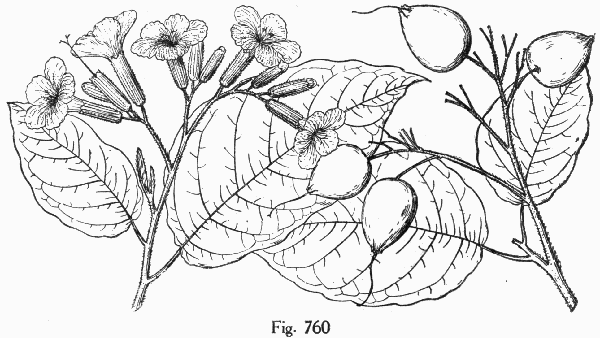
Leaves unfolding through a large part of the year, ovate, short-pointed or rounded at apex, rounded, subcordate, or cuneate at base, entire or remotely and coarsely serrate above the middle, covered when they unfold, like the branches of the inflorescence, the outside of the calyx, and the young branchlets, with thick dense rusty tomentum and with short rigid pale hairs, and at maturity thick and firm, dark green, scabrous-pubescent, or often nearly glabrous below, reticulate-venulose, 5′—6′ long and 3′—4′ wide, with a broad midrib usually covered below with pale hairs, especially in the axils of remote primary veins connected by conspicuous cross veinlets; petioles stout, pubescent, 1′—1½′ in length. Flowers appearing throughout the year on slender pedicels, in open flat cymes 6′—7′ in diameter, some individuals producing flowers with short included stamens and elongated styles, and others with exserted stamens and included styles; calyx tubular, ½′—⅔′ long, and obscurely many-rayed, with short nearly triangular rigid teeth; corolla orange or flame color, puberulous on the outer surface, with a slender tube about twice as long as the calyx and spreading rounded lobes, irregularly undulate on the margins and 1′—1½′ in diameter when fully expanded; ovary conic, glabrous, contracted into a slender style branched near the apex. Fruit broad-ovate, rather abruptly narrowed and pointed at apex, concave at base, 1¼′—1½′ long and about ¾′ broad, inclosed in the thickened fibrous calyx smooth and ivory-white on the outer surface; flesh thin, pale, and corky, separable from the irregularly sulcate thick-walled stone gradually narrowed and acuminate at apex, and deeply lobed at base; seeds linear-lanceolate, ½′ long, with a delicate white seed-coat.
A tree, in Florida 25°—30° high, with a tall trunk 5′—6′ in diameter, slender upright branches forming a narrow close round-topped head, and stout branchlets with thick pith, dark green at first, becoming ashy gray and marked by large nearly orbicular cordate leaf-scars displaying 2 central circular clusters of fibro-vascular bundle-scars. Bark of the trunk ½′—¾′ thick, dark brown, frequently nearly black, and deeply and irregularly divided [860] into narrow ridges broken on the surface into short thick appressed scales. Wood heavy, hard, close-grained, dark brown, with thick light brown or yellow sapwood.
Distribution. Florida, Flamingo near Cape Sable (A. A. Eaton) and Madeira Hammock, Munroe County, and on the southern keys; on the Bahama Islands, on most of the Antilles, and in Guiana and New Granada.
Often planted in tropical countries as an ornament of gardens.
2. Cordia Boissieri A. DC. Anacahuita.
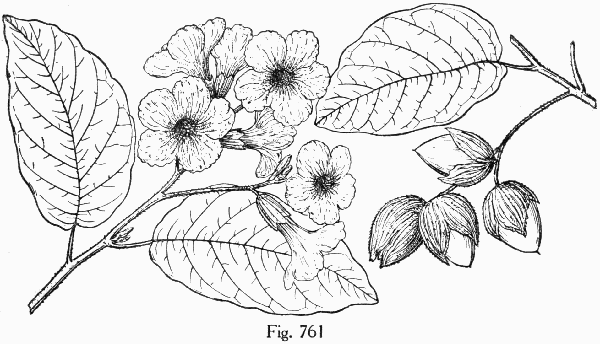
Leaves oval to oblong-ovate, acute or rounded at apex, rounded or subcordate at base, entire or obscurely crenulate-serrate, covered when they unfold like the branches of the inflorescence, both surfaces of the calyx and the young branchlets with rusty or dark brown tomentum and short white usually matted hairs, thick and firm, dark green, minutely rugose and more or less scabrous above, coated below with thick soft pale or rufous tomentum, 4′—5′ long and 3′—4′ wide, with a broad midrib, and conspicuous primary veins forked near the margins and connected by cross veinlets; deciduous at the end of their first year; petioles stout, tomentose, 1′—1½′ in length. Flowers opening from April to June, slightly fragrant, sessile or short-pedicellate, in open terminal dichotomous cymes; calyx tubular or subcampanulate, conspicuously many-ribbed, with 5 linear acute teeth, and about half as long as the tube of the white corolla puberulous on the outer surface, marked in the throat by a large light yellow spot, the lobes rounded, imbricated in the bud, and 2′ across when fully expanded; ovary glabrous, gradually narrowed into a slender 2-branched style. Fruit ovoid, 1′ long, about ¾′ broad, pointed at apex, lustrous, bright red-brown, and inclosed entirely or partly by the thin fibrous now conspicuously rayed orange-brown calyx coated on the outer surface with thick short pale tomentum, and often splitting nearly to the base; flesh thin, sweet, and pulpy, separating easily from the ovoid smooth light brown stone gradually narrowed from above the middle, faintly reticulate-veined, and marked by 4 longitudinal lines and at the acuminate apex by a deeply 4-lobed thin cap, thick-walled, hard and bony, deeply lobed at base; seeds ovoid, acute, ¼′ long, with a thin delicate pure white coat.