Division II. Dicotyledons. (continued 5)
Reading edition
A tree, usually 20°—30° or sometimes 60° high, with a tall trunk 10′—15′ in diameter, slender branches spreading into a narrow round-topped inversely conic head, and stout rigid branchlets coated at first with thick hoary tomentum disappearing during the first winter, becoming light red-brown often covered with a glaucous bloom and ultimately nearly black; frequently a shrub. Winter-buds ovoid, obtuse, about ⅛′ long, with thin [269] light chestnut-brown scales. Bark ¾′—1′ thick, nearly black, deeply divided into broad ridges broken on the surface into thick plate-like scales. Wood heavy, very strong, hard, close-grained, dark brown, with thick lighter colored sapwood.
Distribution. Scattered but nowhere abundant through Pine-forests on the slopes of cañons and on high ridges usually at altitudes between 6000°—7000° above the sea on the mountains of western Texas, and of southern New Mexico and Arizona; in northern Chihuahua and Sonora.
22. Quercus agrifolia Née. Live Oak. Encina.
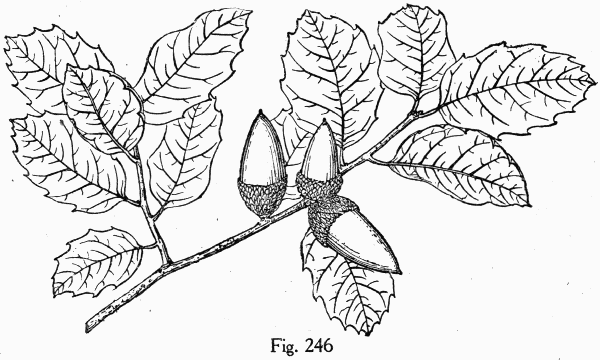
Leaves oval, orbicular or oblong, rounded or acute and apiculate at apex, rounded or cordate at base, entire or sinuate-dentate with slender rigid spinose teeth, when they unfold tinged with red and coated with caducous hoary tomentum, at maturity subcoriaceous, convex, dark or pale green, dull and obscurely reticulate above, paler, rather lustrous, glabrous or pubescent below, with tufts of rusty hairs in the axils of the principal veins, or sometimes covered above with fascicled hairs and coated below with thick hoary pubescence, ¾′—4′ long and ½′—3′ wide, with thickened strongly revolute margins; falling gradually during the winter and early spring; petioles stout or slender, pubescent or glabrous, ½′—1′ in length. Flowers: staminate in slender hairy aments 3′—4′ long; calyx bright purple-red in the bud, sometimes furnished with a tuft of long pale hairs at the apex, glabrous or glabrate, divided nearly to the base into 5—7 ovate acute segments reddish above the middle; pistillate sessile or short-stalked, their involucral scales bright red and covered with thick hoary tomentum, or glabrous or puberulous; stigmas bright red. Fruit sessile or nearly so, solitary or in few-fruited clusters; nut elongated, ovate, abruptly narrowed at base, gradually narrowed to the acute puberulous apex, light chestnut-brown, ¾′—1½′ long, ¼′—¾′ thick, the shell lined with a thick coat of pale tomentum, inclosed for one third its length or only at the base in a thin turbinate light brown cup coated on the inner surface with soft pale silky pubescence, and covered by thin papery scales rounded at the narrow apex, and slightly puberulous, especially toward the base of the cup.
A tree, occasionally 80°—90° high, with a short trunk 3°—4° or rarely 6°—7° in diameter, dividing a few feet above the base into numerous great limbs often resting on the ground and forming a low round-topped head frequently 150° across, and slender dark gray or brown branchlets tinged with red, coated at first with hoary tomentum persistent until the second or third year; or with a trunk, rising to the height of 30° or 40°, and crowned by a narrow head of small branches; often much smaller; frequently shrubby in habit, [270] with slender stems only a few feet high. Winter-buds globose and usually about 1/16′ thick, or ovoid-oblong, acute, and sometimes on vigorous shoots nearly ¼′ in length, with thin broadly ovate closely imbricated light chestnut-brown glabrous or pubescent scales. Bark of young stems and branches thin, close, light brown or pale bluish gray, becoming on old trunks 2′—3′ thick, dark brown slightly tinged with red, and divided into broad rounded ridges separating on the surface into small closely appressed scales. Wood heavy, hard, close-grained, very brittle, light brown or reddish brown, with thick darker colored sapwood; valued and largely used for fuel.
Distribution. Usually in open groves of great extent from Sonoma County, California, southward over the coast ranges and islands to the San Pedro Mártir Mountains, Lower California; less common at the north; very abundant and of its largest size in the valleys south of San Francisco Bay and their commonest and characteristic tree; frequently covering with semiprostrate and contorted stems the sand dunes on the coast in the central part of the state; in southwestern California the largest and most generally distributed Oak-tree between the mountains and the sea, often covering low hills and ascending to altitudes of 4500° in the cañons of the San Jacinto Mountains.
Occasionally cultivated as an ornamental tree in temperate western, and in southern Europe.
23. Quercus Wislizenii A. DC. Live Oak.
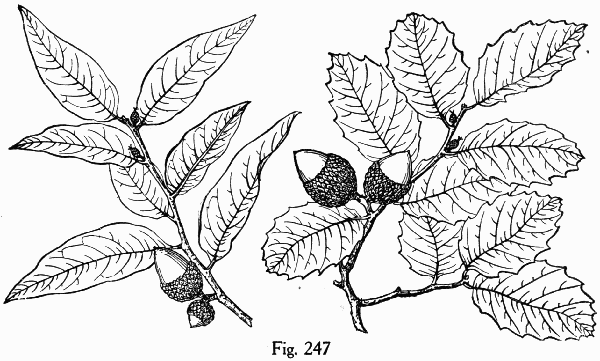
Leaves narrowly lanceolate to broadly elliptic, generally oblong-lanceolate, acute or rounded and generally apiculate at apex, rounded or truncate or gradually narrowed and cuneate at base, entire, serrulate or serrate or sinuate-dentate with spreading rigid spinescent teeth, when they unfold thin, dark red, ciliate, and covered with pale scattered fascicled hairs, at maturity thick and coriaceous, glabrous and lustrous, dark green on the upper and paler and yellow-green on the lower surface, usually 1′—1½′ long and about ⅔′ wide, with obscure primary veins and conspicuous reticulate veinlets, gradually deciduous during their second summer and autumn; petioles coated at first with hoary tomentum, usually pubescent or puberulous at maturity, ⅛′ to nearly 1′ in length. Flowers: staminate in hairy aments 3′—4′ long; calyx tinged with red in the bud, divided into broadly ovate ciliate glabrous light yellow lobes shorter than the 3—6 stamens; pistillate sessile or short-stalked, their involucral scales and peduncle hoary-tomentose. Fruit sessile, short-stalked or occasionally spicate; nut slender, oblong, abruptly narrowed at base, pointed and pilose at the apex, ¾′—1½′ long, about ⅓′ thick, light chestnut-brown, often striate, the shell lined with a scanty coat of pale tomentum, more or less inclosed in the thin turbinate sometimes [271] tubular cup ½′—1′ deep, or rarely cup-shaped and shallow, light green and puberulous within, and covered by oblong lanceolate light brown closely imbricated thin scales, sometimes toward the base of the cup thickened and rounded on the back, usually pubescent or puberulous, especially above the middle, and frequently ciliate on the margins.
A tree, usually 70°—80° high, with a short trunk 4°—6° in diameter, stout spreading branches forming a round-topped head, and slender rigid branchlets coated at first with hoary tomentum or covered with scattered fascicled hairs, puberulous or glabrous and rather light brown during their first season, gradually growing darker in their second year; usually much smaller and sometimes reduced to an intricately branched shrub, with numerous stems only a few feet tall. Winter-buds ovoid or oval, acute, ⅛′—¼′ long, with closely imbricated light chestnut-brown ciliate scales. Bark on young trees and large branches thin, generally smooth and light-colored, becoming on old trunks 2′—3′ thick, and divided into broad rounded often connected ridges separating on the surface into small thick closely appressed dark brown scales slightly tinged with red. Wood heavy, very hard, strong, close-grained, light brown tinged with red, with thick lighter colored sapwood; sometimes used for fuel.
Distribution. Lower slopes of Mt. Shasta southward through the coast region of California to the Santa Lucia Mountains, and to Santa Rosa and Santa Cruz Islands, and along the slopes of the Sierra Nevada to Kern County, up to altitudes of 2000° at the north and of 4500° at the south; as a shrub 4°—6° high with small thick leaves (var. frutescens Engelm.) on the desert slopes of the San Bernardino, San Jacinto and Cuyamaca mountains, at altitudes of 5000°—7000° above the sea, and on San Pedro Mártir in Lower California; nowhere common as a tree, but most abundant and of its largest size in the valleys of the coast region of central California at some distance from the sea, and on the foothills of the Sierra Nevada; very common as a shrub in the cañons of the desert slopes of the mountains of southern California; near the coast and on the islands small and mostly shrubby.
× Quercus morehus Kell., a supposed hybrid between Quercus Wislizenii and Q. Kelloggii occurs in Lake County, California.
24. Quercus myrtifolia Willd.
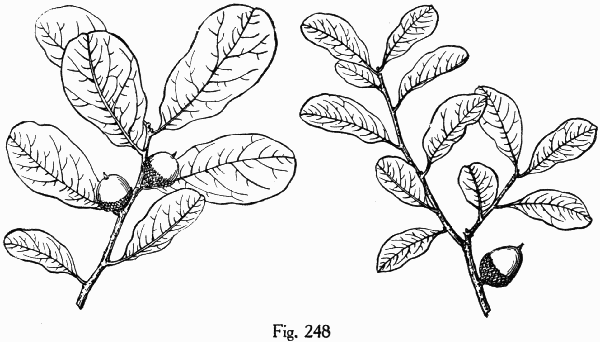
Leaves oval to oblong-obovate, acute and apiculate or broad and rounded at apex, gradually narrowed and cuneate or broad and rounded or cordate at base, entire, with much thickened revolute sometimes undulate margins, or on vigorous shoots sinuate-dentate and lobed above the middle, when they unfold, thin, dark red, coated below and on the [272] petioles with clammy rusty tomentum and densely pubescent above, at maturity thick and coriaceous, lustrous, dark green, glabrous and conspicuously reticulate-venulose above, paler, yellow-green, or light orange-brown, glabrous or pubescent below, with tufts of rusty hairs in the axils of the veins, ½′—2′ long and ¼′—1′ wide; falling gradually during their second year; petioles stout, pubescent, yellow, rarely more than ⅛′ in length. Flowers: staminate in hoary pubescent aments 1′—1½′ long; calyx coated on the outer surface with rusty hairs and divided into 5 ovate-acute, segments shorter than the 2 or 3 stamens; pistillate sessile or nearly sessile, solitary or in pairs, their involucral scales tomentose and tinged with red. Fruit solitary or in pairs, sessile or short-stalked; nut subglobose or ovoid, acute, ¼′—½′ long, dark brown, lustrous and often striate, puberulous at apex, the shell lined with a thick coat of rusty tomentum, inclosed for one fourth to one third its length in a saucer-shaped or turbinate cup light brown and puberulous within, and covered by closely imbricated broad-ovate light brown pubescent scales ciliate on the margins and rounded at their broad apex.
A round-topped tree, rarely 40° high, with a trunk 4′—5′ or rarely up to 15′ in diameter, short or rarely long spreading branches and slender branchlets coated at first with a thick pale fulvous tomentum of articulate hairs usually persistent during the summer, light brown more or less tinged with red or dark gray, and pubescent or puberulous during their first winter, becoming darker and glabrous in their second season; more often an intricately branched shrub, with slender rigid stems 3°—4° or rarely 15°—20° high and 1′—3′ in diameter. Winter-buds ovoid or oval, gradually narrowed to the acute apex, with closely imbricated dark chestnut-brown slightly puberulous scales. Bark thin and smooth, becoming near the ground dark and slightly furrowed.
Distribution. Dry sandy ridges on the coast and islands of South Carolina to Bay Biscayne, Florida, crossing the central peninsula and from the valley of the Caloosahatchee River, westward along the coast of Florida, Alabama, and Mississippi; most abundant on the islands off the coast of east Florida, and of Alabama and Mississippi; often covering large areas with low impenetrable thickets; perhaps of its largest size in Orange County, on Jupiter Island, and on the coast west of the Apalachicola River, Florida.
25. Quercus chrysolepis Liebm. Live Oak. Maul Oak.
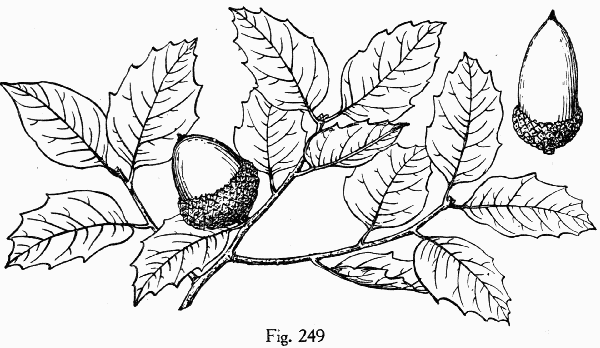
Leaves oblong-ovate to elliptic, acute or cuspidate at apex, cordate, rounded or cuneate at base, mostly entire on old trees, often dentate or sinuate-dentate on young trees with 1 or 2 or many spinescent teeth, the two forms often appearing together on vigorous shoots, clothed when they unfold with a thick tomentum of fulvous hairs soon deciduous from the [273] upper and more gradually from the lower surface, at maturity thick and coriaceous, bright yellow-green and glabrous above, more or less fulvous-tomentose below during their first year, ultimately becoming glabrate and bluish white, 1′—4′ long, ½′—2′ wide, with thickened revolute margins; deciduous during their third and fourth years; petioles slender, yellow, rarely ½′ in length. Flowers: staminate in slender tomentose aments 2′—4′ long; calyx light yellow, pubescent, divided usually into 5—7 broadly ovate acute ciliate lobes often tinged with red above the middle; pistillate sessile or subsessile or rarely in short few-flowered spikes, their broadly ovate involucral scales coated with fulvous tomentum; stigmas bright red. Fruit usually solitary, sessile or short-stalked; nut ellipsoidal or ovoid, acute or rounded at the full or narrow slightly puberulous apex, light chestnut-brown, ½′—2′ long and about as thick, the shell lined with a thin coat of loose tomentum, with abortive ovules scattered irregularly over the side of the seed, inclosed only at the base in a thin hemispheric or in a thick turbinate broad-rimmed cup pale green or dark reddish brown within, and covered by small triangular closely appressed scales with a short free tip, clothed with hoary pubescence, or often hidden in a dense coat of fulvous tomentum.
A tree, usually not more than 40°—50° high, with a short trunk 3°—5° in diameter, dividing into great horizontal limbs sometimes forming a head 150° across, and slender rigid or flexible branchlets coated at first with thick fulvous tomentum, becoming during their first winter dark brown somewhat tinged with red, tomentose, pubescent, or glabrous, and ultimately light brown or ashy gray; occasionally in sheltered cañons producing trunks 8°—9° in diameter; on exposed mountain sides forming dense thickets 15°—20° high. Winter-buds broadly ovoid or oval, acute, about ⅛′ long, with closely imbricated light chestnut-brown usually puberulous scales. Bark ¾′—1½′ thick, light or dark gray-brown tinged with red, and covered by small closely appressed scales. Wood heavy, very strong, hard, tough, close-grained, light brown, with thick darker colored sapwood; used in the manufacture of agricultural implements and wagons.
Distribution. Southern Oregon, along the California coast ranges and the western slopes of the Sierra Nevada to the San Bernardino and San Jacinto mountains; of its largest size in the cañons of the coast ranges of central California and on the foothills of the Sierra Nevada; ascending to altitudes of 8000°—9000° above the sea; near the southern boundary of California, on the mountains of northern Lower California and Sonora and in Arizona (Santa Rita and Huachuca Mountains, on Beaver Creek and in Copper Cañon near Camp Verde, and in Sycamore Cañon south of Flagstaff), usually shrubby, with rigid branches, rigid coriaceous oblong or semiorbicular spinose-dentate leaves, subsessile or pedunculate fruit, with ovoid acute nuts 1′—1½′ long, their shells lined with thick or thin pale tomentum, and purple cotyledons (var. Palmeri Engelm.—Quercus Wilcoxii Rydb.)
26. Quercus tomentella Engelm.
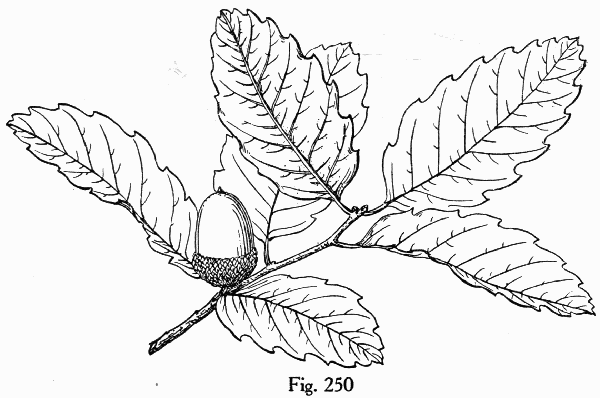
Leaves oblong-lanceolate, acute, sometimes cuspidate or occasionally rounded at apex, broad and rounded or gradually narrowed and abruptly cuneate at base, remotely crenate-dentate with small remote spreading callous tipped teeth, or entire, when they unfold light green tinged with red, covered above with scattered pale fascicled hairs and below and on the petioles with thick hoary tomentum, at maturity thick and coriaceous, dark green, glabrous and lustrous on the upper surface, pale and covered with fascicled hairs on the lower surface, 2′—4′ long, 1′—2′ wide, with thickened strongly revolute margins, and a pubescent midrib; gradually deciduous during their third season; petioles stout, pubescent, about ½′ in length. Flowers: staminate in pubescent aments 2½′—14′ long, calyx light yellow, pubescent, divided into 5—7 ovate acute lobes; pistillate subsessile or in few-flowered spikes on short or elongated pubescent peduncles, their involucral scales like the calyx coated with fascicled hairs; stigmas red. Fruit subsessile or short-stalked; nut ovoid, broad at base, full and rounded at apex, about 1½′ long and ¾′ thick, inclosed only at the base in a cup-shaped shallow cup thickened below, light brown and pubescent on the inner surface, and covered by thin ovate acute scales, their free chestnut-brown tips more or less hidden in a thick coat of hoary tomentum.
[274]
A tree, 30°—40°, or occasionally 60° high, with a trunk 1°—2° in diameter, spreading branches forming a shapely round-topped head, and slender branchlets coated at first with hoary tomentum, becoming light brown tinged with red or orange color. Winter-buds ovoid, acute or obtuse, nearly ¼′ long, with many loosely imbricated light chestnut-brown scales more or less clothed with pale pubescence. Bark thin, reddish brown, broken into large closely appressed scales. Wood heavy, hard, close-grained, compact, pale yellow-brown, with lighter colored sapwood.
Distribution. Deep narrow cañons and high wind-swept slopes of Santa Rosa, Santa Cruz, and Santa Catalina islands, California; on Guadalupe Island off the coast of Lower California.
27. Quercus Emoryi Torr. Black Oak.
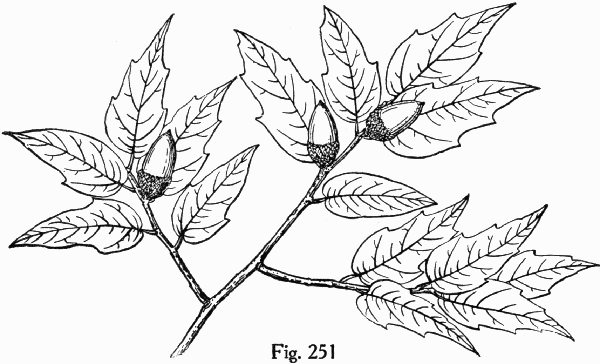
Leaves oblong-lanceolate, acute and mucronate at apex, cordate or rounded at the slightly narrowed base, entire or remotely repand-serrate with 1—5 pairs of acute rigid oblique teeth, when they unfold thin, light green more or less tinged with red and covered with silvery white tomentum, at maturity thick, rigid, coriaceous, dark green, very lustrous and glabrous or coated above with minute fascicled hairs, pale and glabrous or puberulous below, usually with 2 large tufts of white hairs at the base of the slender midrib, obscurely reticulate-venulose, 1′—2½′ long, ½′—1′ wide; falling gradually in April with the appearance of the new leaves; petioles stout, pubescent, about ¼′ in length. Flowers: staminate in hoary tomentose aments; calyx light yellow, hairy on the outer surface, divided into 5—7 ovate acute lobes; pistillate sessile or short-stalked, their involucral scales covered with hoary tomentum. Fruit ripening irregularly from June to September, sessile or short-stalked; nut oblong, oval, or ovate, narrowed at base, rounded at the narrow pilose apex, ½′—¾′ long, about ⅓′ thick, dull light green when fully grown, dark chestnut-brown or nearly black at maturity, with a thin shell lined with thick white tomentum, inclosed for from one third to one half its length in the deeply cup-shaped or nearly hemispheric cup light green and pubescent within, and covered by closely imbricated broadly ovate acute thin and scarious light brown scales clothed with short soft pale pubescence.
A tree, usually 30°—40° high, with a short trunk 2°—3° in diameter, stout rigid rather drooping branches forming a round-topped symmetrical head, and slender rigid branchlets covered at first with close hoary tomentum, bright red, pubescent or tomentose in their first winter, ultimately glabrous and dark red-brown or black; sometimes 60°—70° high, with a trunk 4°—5° in diameter, with a head occasionally 100° across; or at high altitudes [275] or on exposed mountain slopes a low shrub. Winter-buds ellipsoidal, acute, about ¼′ long, pale pubescent toward the apex, with thin closely imbricated light chestnut-brown ciliate scales. Bark 1′—2′ thick, dark brown or nearly black, deeply divided into large oblong thick plates separating into small thin closely appressed scales. Wood heavy, strong, brittle, close-grained, dark brown or almost black, with thick bright brown sapwood tinged with red. The sweet acorns are an important article of food for Mexicans and Indians, and are sold in the towns of southern Arizona and northern Mexico.
Distribution. Mountain ranges of western Texas, southern New Mexico, Arizona south of the Colorado plateau, and of northern Mexico; in Texas common in the cañons and on the southern slopes of the Limpio and Chisos mountains; the most abundant Oak of southern New Mexico and Arizona, forming a large part of the forests covering the mountain slopes and extending from the upper limits of the mesa nearly to the highest ridges; attaining its largest size and beauty in the moist soil of sheltered cañons.
28. Quercus dumosa Nutt. Scrub Oak.
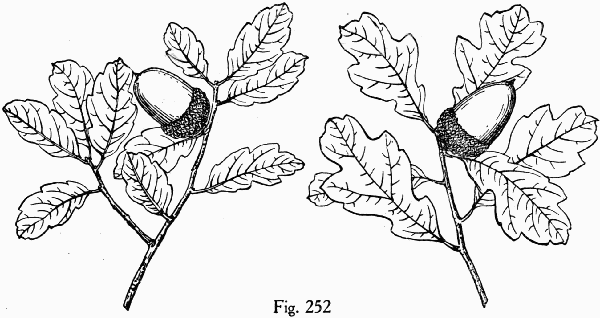
Leaves oblong, rounded and acute at apex, broad and abruptly cuneate or rounded at base, usually about ¾′ long and ½′ wide, spinescent with a few minute teeth, or undulate and entire or coarsely spinescent, with an obscure midrib and primary veins, conspicuous reticulate veinlets, and stout petioles rarely ⅛′ long; or sometimes oblong to oblong-obovate and divided by deep sinuses into 5—9 oblong acute rounded or emarginate bristle-tipped lobes, the terminal lobe 3-lobed, rounded or acute, 2′—4′ long and 1′—1½′ wide, with primary veins running to the points of the lobes, obscure reticulate veinlets, and petioles sometimes 1′ long, thin when they unfold and clothed with scattered fascicled hairs, or rarely tomentose above and coated below and on the petioles with hoary tomentum, at maturity thick and firm, dark green and glabrous on the upper surface, paler and more or less pubescent on the lower surface; mostly deciduous during the winter. Flowers: staminate in pubescent aments; calyx divided into 4—7 ovate lanceolate hairy segments; pistillate sessile or stalked, in long many-flowered tomentose spikes, their involucral scales and calyx hoary-tomentose; stigmas red. Fruit sessile or short-stalked; nut ovoid, broad at base, broad and rounded or acute at apex, ½′—1′ long, ⅓′—⅔′ thick, inclosed for one half to two thirds its length in a deep cup-shaped or hemispheric cup light brown and pubescent within, covered by ovate pointed scales coated with pale or rufous tomentum, usually much thickened, united and tuberculate, those above with free acute tips forming a fringe to the rim of the cup, or frequently with basal scales but little thickened and furnished with long free tips; in var. Alvordiana Jeps., with a nut 1½′—1⅝′ long, ¼′—½′ thick, gradually narrowed and acute at apex, inclosed only at base in a shallow cup-shaped cup.
[276]
A tree, rarely 20° high, with a trunk 12′—18′ in diameter, small branches forming a round-topped head, and slender branchlets coated at first with hoary tomentum, becoming in their first winter ashy gray or light or dark reddish brown and usually pubescent or tomentose; more often an intricately branched rigid shrub, with stout stems covered by pale gray bark and usually 6°—8° high, often forming dense thickets. Winter-buds ellipsoidal, generally acute, 1/16′—⅛′ long, with thin pale red often pilose and ciliate scales. Bark of the trunk bright brown and scaly.
Distribution. California; western slopes of the central Sierra Nevada; common on the coast ranges south of San Francisco Bay and on the islands off the coast of the southern part of the state, ranging inland to the borders of the Mohave Desert and to the cañons of the desert slopes of the San Bernardino and San Jacinto mountains, and southward into Lower California; arborescent only in sheltered cañons of the islands; the var. Alvordiana, in the San Emidio Cañon of the coast ranges of Kern County and on the San Carlos Range, Fresno County; north of San Francisco Bay replaced by the variety bullata Engelm. ranging to Mendocino County and to Napa valley.
× Quercus MacDonaldii Greene, a shrub or small tree with characters intermediate between those of Quercus dumosa and Q. Engelmannii, is usually considered a hybrid of these species. It occurs on Santa Cruz and Santa Catalina Islands, and in Santa Barbara, and Los Angeles Counties, California.
29. Quercus virginiana Mill. Live Oak.
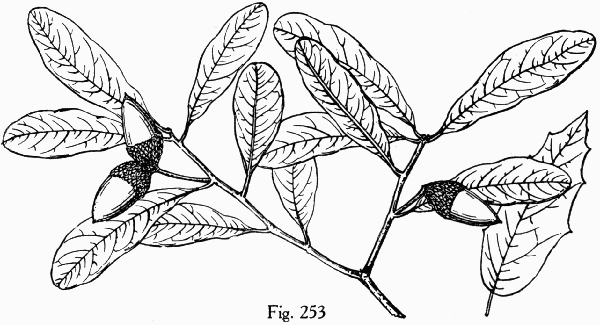
Leaves oblong, elliptic or obovate, rounded or acute at apex, gradually narrowed and cuneate or rarely rounded or cordate at base, usually entire with slightly revolute margins, or rarely spinose-dentate above the middle, thin, dark green and lustrous on the upper surface, pale and pubescent on the lower surface, 2′—5′ long, ½′—2½′ wide, and inconspicuously reticulate-venulose, with a narrow yellow midrib, and few slender obscure primary veins forked and united at some distance from the margins; gradually turning yellow or brown at the end of the winter and falling with the appearance of the new leaves in the spring; petioles stout, rarely more than ¼′ in length. Flowers: staminate in hairy aments 2′—3′ long; calyx light yellow, hairy, divided into 5—7 ovate rounded segments; anthers hirsute; pistillate in spikes on slender pubescent peduncles 1′—3′ long, their involucral scales and ovate calyx-lobes coated with hoary pubescence; stigmas bright red. Fruit usually in 3—5 fruited spikes or rarely in pairs or single on stout light brown puberulous peduncles 1′—5′ long; nut ellipsoidal or slightly obovoid, narrowed at base, rounded or acute at apex, dark chestnut-brown and lustrous, about 1′ long and ⅓′ thick, inclosed for about one fourth its length in a turbinate light reddish brown cup puberulous within, [277] its scales thin, ovate, acute, slightly keeled on the back, covered by dense lustrous hoary tomentum and ending in small closely appressed reddish tips; seed sweet, with light yellow connate cotyledons.
A tree, 40°—50° high, with a trunk 3°—4° in diameter above its swollen buttressed base, usually dividing a few feet from the ground into 3 or 4 horizontal wide-spreading limbs forming a low dense round-topped head sometimes 130° across, and slender rigid branchlets coated at first with hoary tomentum, becoming ashy gray or light brown and pubescent or puberulous during their first winter and darker and glabrous the following season; occasionally 60°—70° tall, with a trunk 6°—7° in diameter; often shrubby and occasionally not more than a foot high. Winter-buds globose or slightly obovoid, about ⅙′ long, with thin light chestnut-brown scales white and scarious on the margins. Bark of the trunk and large branches ½′—1′ thick, dark brown tinged with red, slightly furrowed, separating on the surface into small closely appressed scales. Wood very heavy, hard, strong, tough, close-grained, light brown or yellow, with thin nearly white sapwood; formerly largely and still occasionally used in shipbuilding.
Distribution. Shores of Mobjack Bay, Virginia, southward along the coast and islands to southern Florida, and along the shores of the Gulf of Mexico to northeastern Mexico, spreading inland through Texas to the valley of the Red River and to the mountains in the extreme western part of the state; on the mountains of Cuba, southern Mexico, and Central America; most abundant and of its largest size on the Atlantic and east Gulf coasts on rich hummocks and ridges a few feet above the level of the sea; abundant in Texas in the coast region, near the banks of streams, and westward toward the valley of the Rio Grande often forming the principal part of the shrubby growth on low moist soil; in sandy barren soil in the immediate vicinity of the seacoast or on the shores of salt water estuaries and bays often a shrub, sometimes bearing fruit on stems not more than a foot high (var. maritima, Sarg., and var. dentata Sarg.).
Occasionally planted as a shade and ornamental tree in the southern United States.
Variable in habit and in the size and thickness of the leaves the different forms of Quercus virginiana show little variation in their fruit. The most important of these varieties is
Quercus virginiana var. geminata Sarg.
Quercus geminata Small.
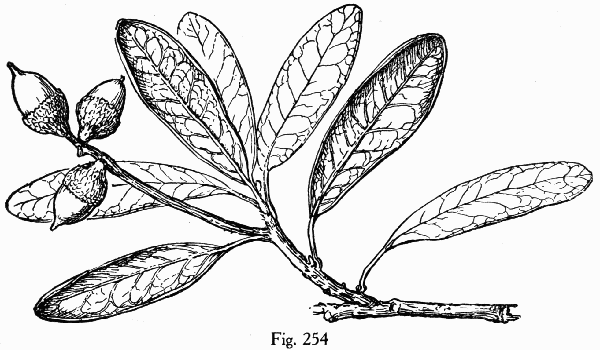
Leaves oblong-obovate to elliptic, rounded or acute at apex, cuneate or narrowed and rounded at base, occasionally slightly and irregularly dentate above the middle on vigorous shoots, conspicuously reticulate-venulose, hoary tomentose below, 1½′—3′ long, ⅓′—1′ [278] wide, with thickened strongly revolute margins; persistent until after the leaves of the typical Q. virginiana in the same locality have all fallen; occasionally in Florida with oblong-elliptic to slightly obovate leaves 4½′—5′ long and 1′—2′ wide (f. grandifolia Sarg.). Flowers and Fruit as in the species.
A tree often 75° high with a trunk 3° in diameter, with the habit, branchlets, winter-buds and bark of the typical form; often much smaller and occasionally a shrub.
Distribution. Sandy soil; coast region of North Carolina south of the Cape Fear River, South Carolina and Georgia, and southward in Florida to Jupiter Island on the east coast and the valley of the Caloosahatchee River on the west coast; abundant and often the common Live Oak in the central part of the peninsula, at least as far south as Orange County, and westward through western Florida, southeastern and southern Alabama to the Gulf coast and islands of Mississippi.
Other varieties of Quercus virginiana are var. macrophylla Sarg., differing from the type in its much larger ovate or slightly obovate leaves rounded or acute at base, entire or occasionally repand-dentate, pale tomentose below, 3½′—4′ long and 1¼′—2½′ wide. Large trees forming groves; sandy bottoms of the Atascosa River and in flat woods above them, Pleasanton, Atascosa County, Texas: var. virescens Sarg., differing from the type in the green glabrous or rarely puberulous lower surface of the leaves and in the glabrous branchlets. A large tree in sandy soil; Gainesville, Alachua County, Sanford, Seminole County, Sumner, Levey County, Simpson’s Hummock, and near Long Key in the Everglades, Dade County, Florida: var. eximea Sarg., differing from the type in its narrow elliptic to narrow oblong-obovate leaves and pale bark; a tree rarely 20° high, with a trunk 8′—12′ in diameter; rarely a shrub; dry sandy open woods, near Springfield, Livingston Parish and near Hammond, Tangipahoa Parish, eastern Louisiana. The following small shrubby small-leaved forms are recognized: var. fusiformis Sarg., with oblong-ovate leaves acute at apex, rounded or cuneate at base, entire or occasionally dentate, and pale pubescent below, and small fruit; dry limestone ridges and flat-topped hills of the Edwards Plateau (Kerr and Comal Counties), western Texas: var. dentata Chapm., distinct in the oblong-obovate repand-dentate lower leaves with large triangular teeth, acute at the broad apex, often 4′ long and 1¼′ wide at the base of the stems, and much larger than the oblong-lanceolate entire upper leaves; common in sterile pine-barrens near the coast of Florida: var. maritima Sarg., with oblong-obovate or rarely lanceolate leaves, acute and apiculate or rounded at apex, cuneate at base, and entire or slightly and irregularly toothed above the middle; fruit solitary or in pairs, or rarely in elongated spikes (Quercus succulenta [279] Small); sandy barrens near the coast, South Carolina to Miami, Dade County, Florida: var. pygmaea Sarg., with oblong-obovate leaves, cuneate at base, 3—5 lobed at apex with small acute lobes, or rarely elliptic and entire, and nearly sessile fruit, the nut inclosed nearly to the apex; a shrub rarely 3° high; Pine-woods in sandy soil; widely distributed in Florida.
30. Quercus reticulata H. B. K.
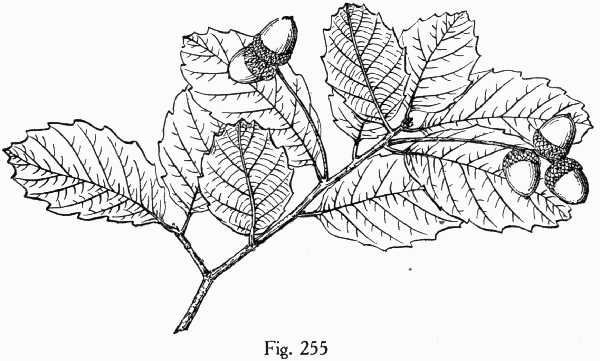
Leaves broadly obovate, obtuse and rounded or rarely acute at apex, usually cordate or occasionally rounded at the narrow base, repandly spinose-dentate above the middle or only toward the apex with slender teeth, and entire below, when they unfold coated with dense fulvous tomentum, at maturity thick, firm, and rigid, dark blue and covered with scattered fascicled hairs above, paler and coated with thick fulvous pubescence below, 1′—5′ long, ¾′—4′ broad, with a thick midrib, and primary veins running to the points of the teeth or arcuate and united within the slightly revolute margins, and very conspicuous reticulate veinlets; petioles stout about ¼′ in length. Flowers: staminate in short tomentose aments in the axils of leaves of the year; calyx light yellow, hirsute, with pale hairs, divided into 5—7 ovate acute segments; pistillate in spikes on elongated peduncles, clothed like their involucral scales with hoary tomentum; stigmas dark red. Fruit usually in many-fruited spikes or occasionally in pairs or rarely solitary, on slender hirsute or glabrous peduncles 2′—5′ long; nut oblong, rounded or acute at the pilose apex, broad at base, about ½′ long, inclosed for about one fourth its length in a shallow cup-shaped cup dark brown and pubescent within, hoary tomentose without and covered by small ovate acute scales, with thin free scarious tips, slightly thickened and rounded on the back at the bottom of the cup.
A tree, rarely more than 40° high, with a trunk 1° in diameter, and stout branchlets coated at first with thick fulvous tomentum, light orange color and more or less thickly clothed with pubescence during their first winter, becoming ashy gray or light brown; in the United States usually shrubby in habit and sometimes only a few feet tall; becoming on the Sierra Madre of Mexico a large tree. Winter-buds ovoid to oval, often surrounded by the persistent stipules of the upper leaves, about ⅛′ long, with thin loosely imbricated light red scales ciliate on the margins. Bark about ¼′ thick, dark or light brown, and covered by small thin closely appressed scales. Wood very heavy, hard, close-grained, dark brown, with thick lighter colored sapwood.
Distribution. Near the summits of the mountain ranges of southeastern New Mexico (Mogollon Mountains) and southeastern Arizona, and southward in Mexico.
[280]
31. Quercus Toumeyi Sarg.
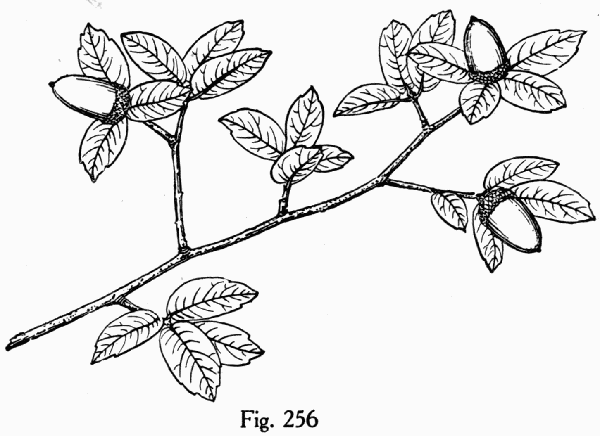
Leaves ovate or ovate-oblong or oval, acute and apiculate at apex, rounded or cordate at base, entire with thickened slightly revolute margins, or remotely spinulose-dentate, often minutely 3-toothed at apex, thin but firm in texture, light blue-green, glabrous and lustrous above, pale and puberulous below, conspicuously reticulate-venulose; ½′—¾′ long, ¼′—½′ wide; falling early in spring with the appearance of the new leaves; petioles stout, tomentose, about 1/16′ in length. Flowers unknown. Fruit sessile, solitary or in pairs, ripening in June; nut oval or ovoid, ½′—⅔′ long, ¼′ thick, light brown and lustrous, furnished at the acute apex with a narrow ring of pale pubescence, inclosed for about one half its length in a thin shallow tomentose cup light green and pubescent within, and covered by thin ovate regularly and closely imbricated light red-brown scales ending in a short rounded tip and coated on the back with pale tomentum.
A tree, 25°—30° high, with a short trunk 6′—8′ in diameter, dividing not far from the ground into numerous stout wide-spreading branches forming a broad irregular head, and slender branchlets bright red-brown more or less thickly coated with pale tomentum at midsummer, covered during their second and third years with thin dark brown nearly black bark broken into small thin closely appressed scales. Wood light brown, with thick pale sapwood.
Distribution. Forming an open forest on the Mule Mountains, Cochise County, southeastern Arizona.
32. Quercus arizonica Sarg. White Oak.
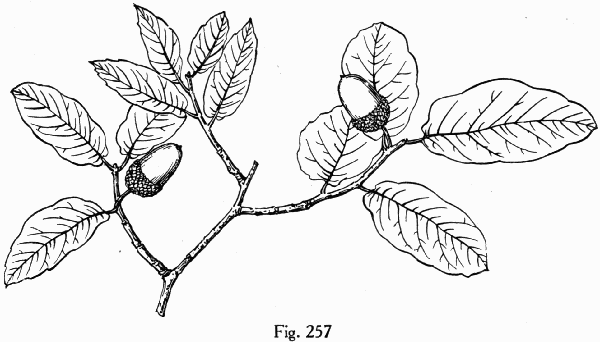
Leaves oblong-lanceolate to broadly obovate, generally acute or sometimes rounded at apex, rounded or cordate at base, repandly spinose-dentate usually, except on vigorous shoots, only above the middle or toward the apex, or entire and sometimes undulate on the margins, when they unfold light red clothed with bright fulvous tomentum and furnished with dark dental glands, at maturity thick, firm and rigid, dull dark blue-green and glabrate above, duller and covered with thick fulvous or pale pubescence below, 1′—4′ long, ½′—2′ wide, with a broad yellow midrib, slender primary veins, arcuate and united near the thickened revolute margins, and coarsely reticulate veinlets; falling in the early spring just before the appearance of the new leaves; petioles stout, tomentose, ¼′—½′ in length. Flowers: staminate in tomentose aments 2′—3′ long; calyx pale yellow, pubescent, and divided into 4—7 broad acute ciliate lobes; anthers red or yellow; pistillate on short stems tomentose like their involucral scales. Fruit sessile or on hoary-tomentose stems rarely ½′ long, usually solitary, ripening irregularly from September to November; nut oblong, oval or slightly [281] obovoid, obtuse and rounded at the puberulous apex, ¾′—1′ long, ½′ thick, dark chestnut-brown, lustrous and often striate, soon becoming light brown, inclosed for half its length in a cup-shaped or hemispheric cup light brown and pubescent within, covered by regularly and closely imbricated scales coated with pale tomentum and ending in thin light red pointed tips, those below the middle of the cup much thickened and rounded on the back; seed dark purple, very astringent.
A tree, occasionally 50°—60° tall, with a trunk 3°—4° in diameter, and thick contorted branches spreading nearly at right angles and forming a handsome round-topped symmetrical head, and stout branchlets clothed at first with thick fulvous tomentum persistent during their first winter, reddish brown or light orange color and pubescent or puberulous in their second season, ultimately glabrous and darker; usually not more than 30°—40° tall; at high elevations reduced to a low shrub. Winter-buds subglobose, about 1/16′ long, with loosely imbricated bright chestnut-brown puberulous scales ciliate on the margins. Bark of young stems and branches thin, pale, scaly with small appressed scales, becoming on old trunks about 1′ thick and deeply divided by narrow fissures into broad ridges broken into long thick plate-like scales pale or ashy gray on the surface. Wood heavy, strong, hard, close-grained, dark brown or nearly black, with thick lighter colored sapwood; used only for fuel.
Distribution. The most common and generally distributed White Oak of southern New Mexico and Arizona, covering the slopes of cañons of mountain ranges at altitudes of from 5000°—10,000° above the sea, often ascending nearly to the summits of the high peaks; and in northern Mexico.
33. Quercus oblongifolia Torr. White Oak.
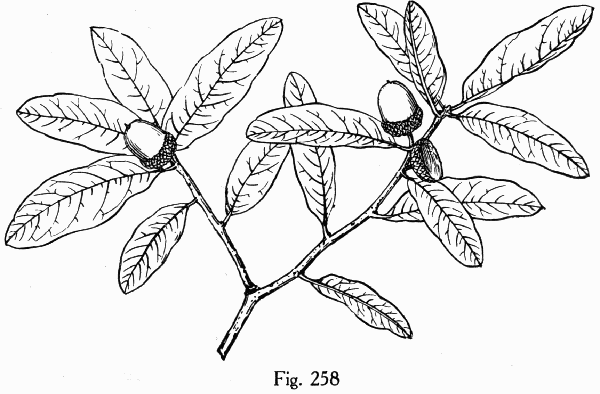
Leaves ovate, elliptic, or slightly obovate, rounded and occasionally emarginate or acute at apex, usually cordate or occasionally rounded at base, entire and sometimes undulate with thickened revolute margins, or remotely dentate with small callous teeth, on vigorous shoots and young plants oblong, rounded or cuneate at the narrow base, coarsely sinuate or undulate-toothed or 3-toothed at the broad apex and entire below, when they unfold bright red and coated with deciduous hoary tomentum, at maturity thin and firm, blue-green and lustrous above, paler below, 1′—2′ long, ½′—¾′ wide, or on vigorous shoots sometimes 3′—4′ long, with a prominent pale midrib, slender primary veins, and conspicuous reticulate veinlets; persistent during the winter without change of color, gradually turning yellow in the spring and falling at the appearance of the new leaves; petioles stout, nearly [282] terete, about ¼′ in length. Flowers: staminate in short hoary-tomentose aments; calyx bright yellow, pilose, divided into 5 or 6 laciniately cut or entire acute segments tinged with red above the middle; pistillate usually sessile, or on peduncles tomentose like the involucral scales; stigmas bright red. Fruit usually solitary and sessile, rarely long-stalked; nut ovoid, ellipsoidal, or slightly obovoid, full and rounded at apex surrounded by a narrow ring of white pubescence, dark chestnut-brown, striate, and very lustrous, soon becoming light brown in drying, ½′—¾′ long, about ⅓′ thick, inclosed for about one third its length in a cup-shaped or rarely turbinate thin cup yellow-green and pubescent on the inner surface and covered by ovate-oblong scales slightly thickened on the back, coated with hoary tomentum and ending in thin acute bright red tips ciliate on the margins and sometimes forming a minute fringe to the rim of the cup.
A tree, rarely more than 30° high, with a short trunk 18′—20′ in diameter, many stout spreading often contorted branches forming a handsome round-topped symmetrical head, and slender rigid branchlets coated at first with pale or fulvous tomentum, light red-brown, dark brown or dark orange color in their first winter, becoming ashy gray in their second or third year. Winter-buds subglobose, 1/16′—⅛′ long, with thin light chestnut-brown scales. Bark ¾′—1¼′ thick, ashy gray, and broken into small nearly square or oblong close plate-like scales. Wood very heavy, hard, strong, brittle, dark brown or nearly black, with thick brown sapwood; sometimes used as fuel.
Distribution. Chisos Mountains, western Texas, southeastern New Mexico, southern Arizona, and southward into northern Mexico; comparatively rare in Texas; abundant on the foothills of the mountain ranges of southern New Mexico and Arizona at altitudes of about 5000°, and dotting the upper slopes of the mesa where narrow cañons open to the plain.
34. Quercus Engelmannii Greene. Evergreen Oak.
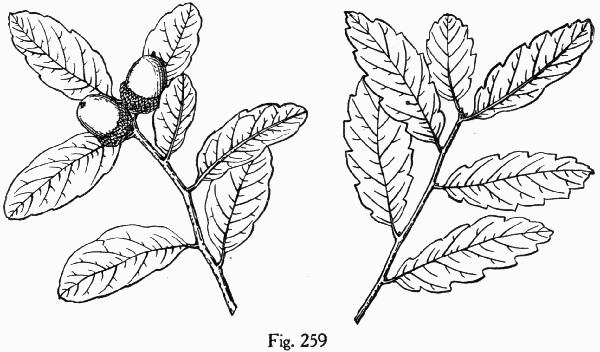
Leaves oblong to obovate, usually obtuse and rounded or sometimes acute at apex, gradually or abruptly cuneate or rounded or cordate at base, entire, often undulate, or sinuate-toothed with occasionally rigid teeth, or at the ends of sterile branches frequently coarsely crenately serrate with incurved teeth, or rarely lobed with acute oblique rounded lobes, when they unfold bright red and coated with thick pale rufous tomentum, at maturity thick, dark blue-green and glabrous or covered with fascicled hairs above, pale, usually yellow-green and clothed with light brown pubescence, or puberulous or often glabrous below, 1′—3′ long, ½′—2′ wide; deciduous in the spring with the appearance of the [283] new leaves; petioles slender, tomentose, becoming pubescent, ¼′—½′ in length. Flowers: staminate in slender hairy aments 2′—3′ long; calyx light yellow, pilose, with lanceolate acute segments; pistillate on slender peduncles, clothed like their involucral scales with dense pale tomentum. Fruit sessile or on slender pubescent peduncles sometimes ¾′ long; nut oblong, gradually narrowed and acute or broad rounded and obtuse at apex, broad or narrow at base, dark chestnut-brown more or less conspicuously marked by darker longitudinal stripes, turning light chestnut-brown in drying, ¾′—1′ long, about ½′ thick, inclosed for about half its length in a deep saucer-shaped, cup-shaped or turbinate cup light brown and puberulous within, and covered by ovate light brown scales coated with pale tomentum, usually thickened, united and tuberculate at the base of the cup, and near its rim produced into small acute ciliate tips.
A tree, 50°—60° high, with a trunk 2°—3° in diameter, thick branches spreading nearly at right angles and forming a broad rather irregular head, and stout rigid branchlets coated at first with hoary tomentum, light or dark brown tinged with red and pubescent during their first winter, becoming glabrous and light brown or gray in their second or third year. Winter-buds oval or ovoid, about ⅛′ long, with thin light red pubescent scales. Bark 1½—2′ thick, light gray tinged with brown, deeply divided by narrow fissures and separating on the surface into small thin appressed scales. Wood very heavy, hard, strong, close-grained, brittle, dark brown or nearly black, with thick lighter brown sapwood; used only for fuel.
Distribution. Low hills of southwestern California west of the coast range, occupying with Quercus agrifolia Née, a belt about fifty miles wide, and extending to within fifteen or twenty miles of the coast, from the neighborhood of Sierra Madre and San Gabriel, Los Angeles County, to the mesa east of San Diego; in northern Lower California.
35. Quercus Douglasii Hook. & Arn. Blue Oak. Mountain White Oak.
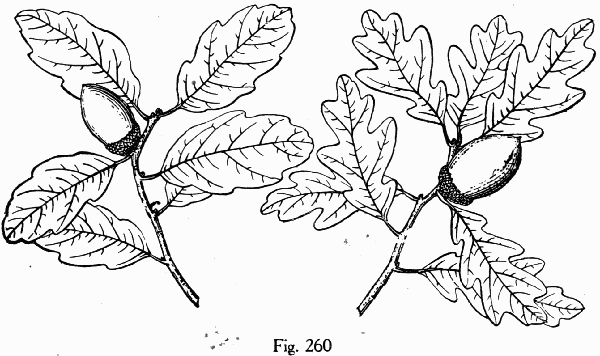
Leaves oblong, acute or rounded at apex, gradually narrowed and cuneate or broad and rounded or subcordate at base, divided by deep or shallow, wide or narrow sinuses acute or rounded in the bottom into 4 or 5 broad or narrow acute or rounded often mucronate lobes, 2′—5′ long, 1′—1¾′ wide, or oval, oblong or obovate, rounded or acute at apex, equally or unequally cuneate or rounded at base, regularly or irregularly sinuate-toothed with rounded acute rigid spinescent teeth, or denticulate toward the apex, 1′—2′ long, ¼′—1′ wide, when they unfold covered by soft pale pubescence, at maturity thin, firm and rather rigid, pale blue, with scattered fascicled hairs above, often yellow-green and covered by short [284] pubescence below, with a hirsute or puberulous prominent midrib and more or less conspicuous reticulate veinlets; petioles stout, tomentose, ¼′—½′ in length. Flowers: staminate in hairy aments 1½′—2′ long; calyx yellow-green, coated on the outer surface with pale hairs, deeply divided into broad acute laciniately cut segments; pistillate in short few-flowered spikes coated like the involucral scales with hoary tomentum. Fruit sessile or short-stalked, solitary or in pairs; nut ellipsoidal, sometimes ventricose, with a narrow base, gradually narrowed and acute at apex, ¾′—1′ long, ½′—1′ thick, or often ovoid and acute, green and lustrous, turning dark chestnut-brown in drying, with a narrow ring of hoary pubescence at apex, inclosed only at base in a thin shallow cup-shaped cup light green and pubescent on the inner surface, covered on the outer by small acute and usually thin or sometimes, especially in the south, thicker tumid scales coated with pale pubescence or tomentum and ending in thin reddish brown tips.
A tree, usually 50°—60°, rarely 80°—90° high, with a trunk 3°—4° in diameter, short stout branches spreading nearly at right angles and forming a dense round-topped symmetrical head, stout branchlets brittle at the joints, coated at first with short dense hoary tomentum, dark gray or reddish brown and tomentose, pubescent, or puberulous during their first winter, becoming ultimately ashy gray or dark brown; frequently not more than 20°—30° high, and sometimes, especially southward shrubby, in habit. Winter-buds ovoid, obtuse, ⅛′—¼′ long, with light rather bright red pubescent scales. Bark ½′—1′ thick, generally pale, and covered by small scales sometimes tinged with brown or light red. Wood hard, heavy, strong, brittle, dark brown, becoming nearly black with exposure, with thick light brown sapwood; largely used as fuel.
Distribution. Scattered over low hills, dry mountain slopes and valleys; California, Mendocino County, and the upper valley of the Sacramento River, southward along the western slopes of the Sierra Nevada up to elevations of 4000°, and through valleys of the coast ranges to the Tehachapi Pass, the borders of the Mohave Desert (Sierra de la Liebre) and the neighborhood of San Fernando, Los Angeles County; most abundant and of its largest size in the valleys between the coast mountains and the interior ridges of the coast ranges south of the Bay of San Francisco.
× Quercus jolonensis Sarg. with characters intermediate between those of Quercus Douglasii and Quercus lobata and believed to be a hybrid of those species occurs, with a number of large trees, at Jolon and between Jolon and King City, Monterey County, California.
[285]
36. Quercus Vaseyana Buckl. Shin Oak.
Quercus undulata var. Vaseyana Rydb.
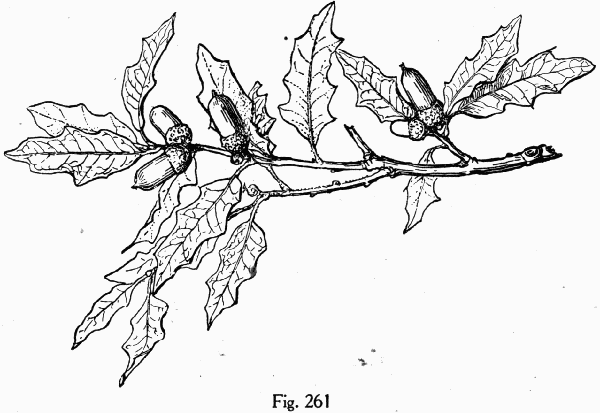
Leaves oblong, rarely oblong-obovate, acute or rounded at apex, cuneate at base, undulately lobed with small acute lobes pointing forward, rarely nearly entire, when they unfold covered above with short fascicled hairs sometimes persistent until midsummer, and tomentose below, and at maturity thin, pale gray-green, glabrous and lustrous above, pale pubescent below, 1′—1½′ long and ½′—¾′ wide; deciduous late in winter or in early spring; petioles covered with fascicled hairs when they first appear, becoming glabrous, ¼′ in length. Flowers: staminate in villose aments 1′—1¼′ long; calyx deeply divided into 4 or 5 ovate scarious lobes rounded at apex and shorter than the stamens; pistillate on short tomentose peduncles, their involucral scales ovate, acute, pubescent, shorter than the calyx-lobes; stigmas red. Fruit solitary or in pairs, sessile or short-stalked; nut ellipsoidal and only slightly narrowed at the rounded ends to oblong and slightly ovoid or obovoid, ½′—¾′ in length, ¼′—½′ in diameter, pale chestnut-brown and lustrous, the base only inclosed in the thin, saucer-shaped to cup-shaped cup, puberulous on the inner surface, covered with closely appressed ovate acute hoary tomentose scales, on some individuals abruptly contracted into short acute red-brown nearly glabrous tips.
A tree, rarely 15°—20° high, usually a shrub only 1°—3° tall, spreading into great thickets, with slender branchlets thickly covered with matted fascicled hairs during their first season, and light gray and glabrous or puberulous in their second year. Winter-buds ovoid or obovoid, about ⅛′ long, with red-brown scales ciliate on the margins. Bark rough, deeply furrowed and scaly.
Distribution. Limestone slopes and ridges or in sheltered cañons; western Texas; Kimble, Real, Kendall, Kerr, Uvalde, Edwards, Menard and Valverde Counties.
37. Quercus Mohriana Rydb. Shin Oak.
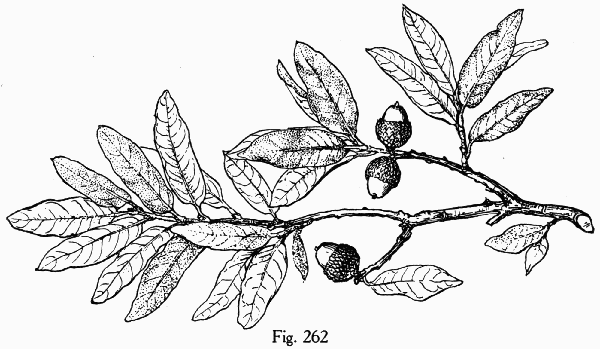
Leaves oblong-obovate to elliptic or lanceolate, acute, acuminate or rounded at apex, rounded or cuneate and often unsymmetrical at base, entire, undulate, sinuately toothed with triangular apiculate teeth, or occasionally irregularly lobed above the middle with rounded lobes, thick, gray-green, lustrous and covered above with short fascicled hairs, [286] and densely hoary tomentose below, 2°—4° long, ½′—1′ wide, with a stout midrib thickly covered with fascicled hairs, sometimes becoming glabrous, slender primary veins and reticulate veinlets; petioles stout, hoary tomentose, ⅛′—¼′ in length. Flowers: staminate in short hoary tomentose aments; calyx densely villose, deeply divided into broad ovate lobes rounded at apex; anthers red; pistillate on hoary tomentose peduncles, with hairy bracts and calyx-lobes. Fruit solitary or in pairs, nearly sessile or raised on a pubescent peduncle ½′—¾′ in length; nut ellipsoidal or ovoid, broad and rounded at the ends, light chestnut-brown, lustrous, ⅓′—½′ long, ¼′—⅓′ thick, inclosed for from half to two thirds its length in the hemispheric to cup-shaped cup, hoary tomentose on the inner surface, and covered with small closely appressed acute hoary tomentose scales much thickened below the middle of the cup, thin and much smaller toward its rim.
A tree, rarely 18°—20° high, with a trunk rarely 1° in diameter, small spreading and ascending branches forming a round-topped head, and slender branchlets thickly coated during their first season with fascicled hairs, dark gray-brown and pubescent in their second season and ultimately gray and glabrous; usually a low shrub spreading into thickets. Winter-buds broad-ovoid, obtuse, pale pubescent. Bark thin, pale, rough, deeply furrowed.
Distribution. On dry limestone hills, usually not more than 18° high with spreading branches; on deep sand, often not more than 3° high with more erect stems, often covering thousands of acres; only a tree in the protection of ledges in deep ravines and on steep hillsides; northwestern Texas (Tom Green, Coke, Nolan, Howard, Armstrong, and Wheeler Counties); central Texas (Bryan, Brazos County); southwestern Oklahoma (Beckham County).
38. Quercus Laceyi Small.
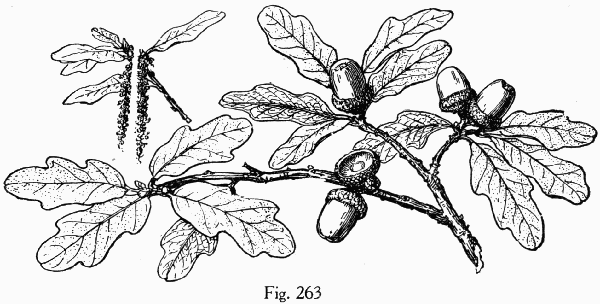
Leaves oblong to oblong-obovate, usually with two pairs of small rounded lateral lobes, occasionally 3-lobed toward the apex, rarely nearly entire, narrowed and rounded at apex, rounded, cuneate or rarely cordate at the gradually narrowed base, coated below when they unfold with loose white tomentum, soon glabrous, at maturity thin, blue-green above, yellow-green below, 2′—3′ long, ¾′—2′ wide, with a slender midrib and primary veins, and conspicuous reticulate veinlets; deciduous late in the autumn; on vigorous shoots sometimes 6′—7′ long and 3′—4′ wide; petioles glabrous or sparingly villose, ¼′—⅓′ in length. Flowers: staminate in slightly villose aments 2′—2½′ long; calyx deeply divided into 4 or 5 [287] ovate acuminate lobes shorter than the stamens; pistillate flowers not seen. Fruit solitary or in pairs, sessile or raised on a stem up to ½′ in length; nut ellipsoidal or oblong-ovoid, rounded at apex, slightly narrowed and nearly truncate at base, light chestnut-brown and lustrous, ¾′—1′ long, ⅓′—½′ in diameter, the base inclosed in the thick, cup-shaped to rarely saucer-shaped cup, tomentose on the inner surface, covered with acute much thickened pale tomentose scales.
A tree, 30°—45° high, with a trunk 20′—30′ in diameter, heavy erect and spreading branches and slender branchlets villose when they first appear, soon becoming glabrous and red-brown or gray during their second season; often a tall shrub with numerous stems. Winter-buds ovoid, acute, ⅙′ long, with chestnut-brown scales ciliate on the margins. Bark gray, thick, deeply ridged or checkered.
Distribution. Rocky banks of streams, the steep sides of cañons and on limestone bluffs; common in the southern and southwestern parts of the Edwards Plateau, western Texas (Kendall, Kerr, Bandera, Uvalde, Menard, Kemble, Real and Edwards Counties); easily distinguished in the field by the peculiar smoky or waxy appearance of the foliage.
39. Quercus annulata Buckl.
Quercus breviloba Sarg.
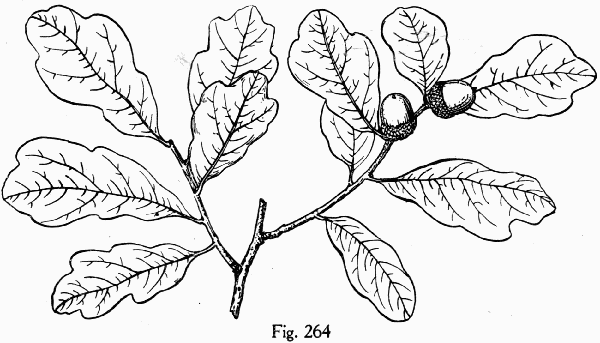
Leaves oblong to oblong-obovate or elliptic, rounded or acute at apex, cuneate or rounded at base, entire, undulate, slightly lobed with rounded or acute lobes, or 3-lobed, when they unfold covered above with fascicled hairs and tomentose below, and at maturity green, glabrous and lustrous above, green and pubescent below on lower branches, often pale or hoary tomentose on upper branches, 1¼′—2½′ long, ½′—1¼′ wide; petioles covered when they first appear with fascicled hairs, soon glabrous, ¼′—½′ in length; on vigorous branchlets sometimes thinner, glabrous, divided into broad rounded lateral lobes, gradually narrowed and cuneate at the long base, 4′ long and 2½′ wide. Flowers: staminate in pubescent aments 1′—2′ long; calyx deeply divided in villose rounded lobes, shorter than the stamens; anthers red; pistillate on tomentose peduncles, their scales rounded, tomentose; stigmas red. Fruit solitary or in 2 or 3-fruited clusters, sessile or short-stalked, oblong-ovoid to ellipsoidal, slightly narrowed and rounded at apex, light yellow-brown and lustrous, ¾′—1′ long, ⅓′—½′ in diameter; inclosed for about a quarter of its length in the cup-shaped cup, tomentose on the inner surface, covered with acute tomentose scales somewhat thickened and closely appressed below the middle of the cup, their tips chestnut-brown, free and often glabrous.
A tree, 20°—30° tall with a trunk rarely more than 1° in diameter, small spreading often [288] slightly pendulous branches forming a round-topped head, and slender branches covered when they first appear with fascicled hairs, soon becoming glabrous and gray or grayish brown; the large stems often surrounded by a ring of smaller stems produced from its roots; more often a shrub than a tree spreading into broad thickets. Winter-buds ovoid to ellipsoidal, acute, ⅛′—¼′ long, with closely imbricated chestnut-brown puberulous scales ciliate on the margins. Bark thick, rough, deeply ridged.
Distribution. Dry limestone hills and bluffs; central and western Texas, from the neighborhood of Dallas, Dallas County, and Palo Pinto County to Kendall, Kerr, Brown, Bandera, Real and Menard Counties.
40. Quercus Durandii Buckl.
Quercus breviloba Sarg. in part.
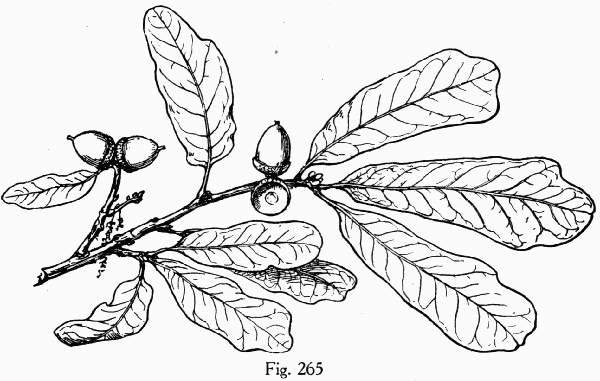
Leaves thin, obovate to elliptic, entire, 3-lobed toward the rounded or acute apex or irregularly laterally lobed, the three forms appearing on different branches of the same tree, on lower branches usually lobed, dark green and lustrous above, often green and glabrous below, sometimes 6′ or 7′ long and 3′ or 3½′ wide, on upper branches mostly entire, white and pubescent or tomentose below, 2½′—3′ long, ½′—1½′ wide; falling late in the autumn; petioles glabrous, ⅓′—¼′ in length. Flowers: staminate in slender villose aments 3′—4′ in length; calyx deeply divided into acute villose lobes shorter than the stamens; pistillate on a short tomentose peduncle, the linear acuminate bract and involucral scales hoary-tomentose; stigmas red. Fruit solitary or in pairs, short-stalked or nearly sessile; nut ovoid, or slightly obovoid, rounded or rarely acute at apex, nearly truncate at base, pale chestnut-brown, lustrous, ½′—⅔′ long, ⅓′—½′ thick, barely inclosed at base in the thin, shallow saucer-shaped cup, pale tomentose on the inner surface, and covered with small acuminate closely appressed tomentose scales slightly thickened on the back.
A tree, often 60°—90° high with a tall trunk 2°—3° in diameter, comparatively small branches, the lower horizontal, the upper ascending, forming a dense round-topped handsome head, and slender pale gray-brown branchlets covered when they first appear with fascicled hairs, soon glabrous, or puberulous during their first season, and darker in their second season. Winter-buds ovoid, acute, ¼′—⅓′ long with dark chestnut-brown rounded scales ciliate on the margins. Bark thin, light gray or nearly white and broken into thin loosely appressed scales.
Distribution. East of the Mississippi River scattered on rich limestone prairies; westward on the well drained soil of river bottoms, and often on low hummocks; near Augusta, [289] Richmond County, and De Soto, Sampson County, Georgia; West Point, Clay County, Columbus, Muscogee County, Brookville, Noxubesco County, and near Natchez, Adams County, Mississippi; McNab, Hempstead County, Arkansas; Natchitoches, Natchitoches Parish, western Louisiana; coast region of eastern Texas to the bottoms of the Guadalupe River (Victoria, Victoria County), ranging inland to San Saba County and to the neighborhood of Dallas, Dallas County; on the mountains near Monterey, Nuovo Leon; rare and local.
41. Quercus Chapmanii Sarg.
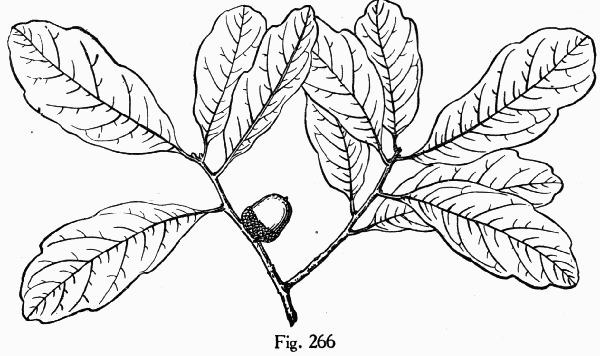
Leaves oblong to oblong-obovate, rounded at the narrow apex, narrowed and cuneate or rounded or broad and rounded at base, entire with slightly undulate margins, or obscurely sinuate-lobed above the middle, when they unfold coated below with thick bright yellow pubescence and covered above with pale fascicled deciduous hairs, at maturity [290] thick and firm or subcoriaceous, dark green, glabrous and lustrous above, light green or silvery white and glabrous below except on the slender often pubescent midrib, usually 2′—3′ long and 1′ wide, but varying from 1′—3′ in length and ¾′—1′ in width; falling gradually during the winter or sometimes persistent until the appearance of the new leaves in the spring; petioles tomentose, rarely ⅛′ in length. Flowers: staminate in short hirsute aments; calyx hirsute, divided into 5 acute laciniately cut segments; anthers hirsute; pistillate sessile or short-stalked, their involucral scales coated with dense pale tomentum. Fruit usually sessile, solitary or in pairs; nut oval, about ⅝′ long and ⅜′ thick, pubescent from the obtuse rounded apex nearly to the middle, inclosed for nearly half its length in the deep cup-shaped light brown cup slightly pubescent on the inner surface, and covered by ovate-oblong pointed scales thickened on the back, especially toward the base of the cup, and coated with pale tomentum except on their thin reddish brown margins.
Occasionally a tree, 50° high, with a trunk 1° in diameter, stout branches forming a round-topped head, and slender branchlets coated at first with dense bright yellow pubescence, becoming light or dark red-brown and puberulous during their first winter and ultimately ashy gray; more often a rigid shrub sometimes only 1°—2° tall. Winter-buds ovoid, acute, obtuse, about ⅛′ long, with glabrous or puberulous light chestnut-brown scales. Bark dark or pale, separating freely into large irregular plate-like scales.
Distribution. Sandy barrens usually in the neighborhood of the coast; Bluffton, Beaufort County, South Carolina, Colonels Islands, Liberty County, Georgia, southward along the east coast of Florida to the shores of Indian River; on the west coast from the valley of the Caloosahatchee River to the shores of Pensacola Bay, and in the interior of the peninsular from Lake County to De Soto County (neighborhood of Sebring); rare and local on the Atlantic coast; comparatively rare in the interior of the Florida peninsular; abundant in western Florida from the shores of Tampa Bay to those of Saint Andrews Bay.
42. Quercus macrocarpa Michx. Burr Oak. Mossy Cup Oak.
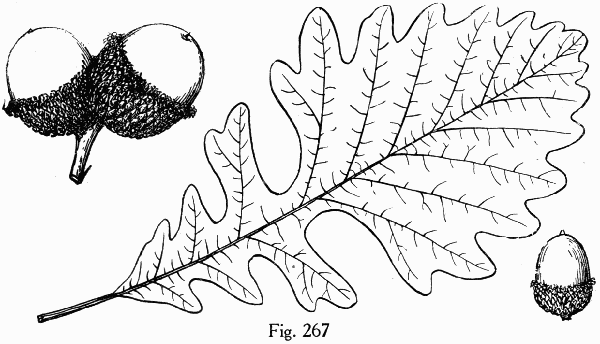
Leaves obovate or oblong, cuneate or occasionally narrow and rounded at base, divided by wide sinuses sometimes penetrating nearly to the midrib into 5—7 lobes, the terminal lobe large, oval or obovate, regularly crenately lobed, or smaller and 3-lobed at the rounded or acute apex, when they unfold yellow-green and pilose above and silvery white and coated below with long pale hairs, at maturity thick and firm, dark green, lustrous and glabrous, or occasionally pilose on the upper surface, pale green or silvery white and covered on the lower surface with soft pale or rarely rufous pubescence, 6′—12′ long, [291] 3′—6′ wide, with a stout pale midrib sometimes pilose on the upper side and pubescent on the lower, large primary veins running to the points of the lobes, and conspicuous reticulate veinlets; turning dull yellow or yellowish brown in the autumn; petioles stout, ⅓′—1′ in length. Flowers: staminate in slender aments 4′—6′ long, their yellow-green peduncles coated with loosely matted pale hairs; calyx yellow-green, pubescent, deeply divided into 4—6 acute segments ending in tufts of long pale hairs; pistillate sessile or stalked, their involucral scales broadly ovate, often somewhat tinged with red toward the margins and coated, like the peduncles, with thick pale tomentum; stigmas bright red. Fruit usually solitary, sessile or long-stalked, exceedingly variable in size and shape; nut ellipsoidal or broad-ovoid, broad at the base and rounded at the obtuse or depressed apex covered by soft pale pubescence, ⅗′ long and ⅓′ thick at the north, sometimes 2′ long and 1½′ thick in the south, its cup thick or thin, light brown and pubescent on the inner surface, hoary-tomentose and covered on the outer surface by large irregularly imbricated ovate pointed scales, at the base of the cup thin and free or sometimes much thickened and tuberculate, and near its rim generally developed into long slender pale awns forming on northern trees a short inconspicuous and at the south a long conspicuous matted fringe-like border, inclosing only the base or nearly the entire nut.
A tree, sometimes 170° high, with a trunk 6°—7° in diameter, clear of limbs for 70°—80° above the ground, a broad head of great spreading branches, and stout branchlets coated at first with thick soft pale deciduous pubescence, light orange color, usually glabrous or occasionally puberulous during their first winter, becoming ashy gray or light brown and ultimately dark brown, sometimes developing corky wings often 1′—1½′ wide; usually not more than 80° high, with a trunk 3°—4° in diameter; toward the northwestern limits of its range sometimes a low shrub. Winter-buds broadly ovoid, acute or obtuse, ⅛′—¼′ long, with light red-brown scales coated with soft pale pubescence. Bark 1′—2′ thick, deeply furrowed and broken on the surface into irregular plate-like brown scales often slightly tinged with red. Wood heavy, strong, hard, tough, close-grained, very durable, dark or rich light brown, with thin much lighter colored sapwood; used in ship and boat-building, for construction of all sorts, cabinet-making, cooperage, the manufacture of carriages, agricultural implements, baskets, railway-ties, fencing, and fuel.
Distribution. Low rich bottom-lands and intervales, or rarely in the northwest on low dry hills; Nova Scotia and New Brunswick southward to the valley of the Penobscot River, Maine, the shore of Lake Champlain, Vermont, western Massachusetts, central, southern and western Pennsylvania, northern Delaware, northern West Virginia (Hardy and Grant Counties), prairies of Caswell County, North Carolina, and middle Tennessee, and westward through the valley of the Saint Lawrence River and along the northern shores of Lake Huron to southern Manitoba, through western New York and Ohio, northern Michigan, to Minnesota (except in the northeastern counties), eastern and northwestern Nebraska, the Black Hills of South Dakota, the Turtle Mountains of North Dakota, and northeastern Wyoming, and to central Kansas, the valley of the north Fork of the Canadian River (Canton, Blaine County, and Seiling, Dewey County), Oklahoma, and the valley of the San Saba River, (Menard County and Callahan County), Texas; attaining its largest size in southern Indiana and Illinois; the common Oak of the “oak openings” of western Minnesota, and in all the basin of the Red River of the North, ranging farther to the northwest than the other Oaks of eastern America; common and generally distributed in eastern Nebraska, and of a large size in cañons or on river bottoms in the extreme northwestern part of the state; the most generally distributed Oak in southern Wisconsin, and in Kansas growing to a large size in all the eastern part of the state.
Occasionally planted as an ornamental tree in the eastern United States and in South Africa.
× Quercus Andrewsii Sarg., believed to be a hybrid of Quercus macrocarpa and Q. undulata Torr., in habit and characters intermediate between those of its supposed parents with which it grows, occurs at Seiling, Dewey County, western Oklahoma.
× Quercus guadalupensis Sarg., with characters intermediate between those of Quercus [292] macrocarpa and Q. stellata and evidently a hybrid of these species, occurs at Fredericksburg Junction in the valley of the Guadalupe River, Kendall County, Texas.
× Quercus Hillii Trel., believed to be a hybrid of Quercus macrocarpa and Q. Muehlenbergii, has been found at Roby, Lake County, Indiana, and near Independence, Jackson County, Missouri.
43. Quercus lyrata Walt. Overcup Oak. Swamp White Oak.
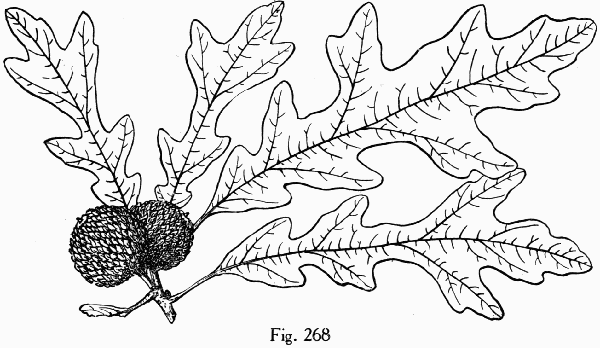
Leaves oblong-obovate, gradually narrowed and cuneate at base, divided into spreading or ascending lobes by deep or shallow sinuses rounded, straight, or oblique on the bottom, the terminal lobe oblong-ovate, usually broad, acute or acuminate at the elongated apex, and furnished with 2 small entire nearly triangular lateral lobes, the upper lateral lobes broad, more or less emarginate, or acuminate and entire or slightly lobed and much longer than the acute or rounded lower lobes, when they unfold bronze-green and pilose above with caducous hairs, and coated below with thick pale tomentum, at maturity thin and firm, dark green and glabrous above, silvery white and thickly coated with pale pubescence, or green and often nearly glabrous below, 7′—10′ long, 1′—4′ wide; turning yellow or scarlet and orange in the autumn; petioles glabrous or pubescent, ⅓′—1′ in length. Flowers: staminate in slender hairy aments 4′—6′ long; calyx light yellow, coated on the outer surface with pale hairs and divided into acute segments; pistillate sessile or stalked, their involucral scales covered, like the peduncles, with thick pale tomentum. Fruit sessile or borne on slender pubescent peduncles sometimes 1½′ in length; nut subglobose to ovoid or rarely to ovoid-oblong, ½′—1′ long, usually broader at base than long, light chestnut-brown, more or less covered above the middle with short pale pubescence, entirely or for two thirds of its length inclosed in the ovoid, nearly spherical or deep cup-shaped thin cup, bright red-brown and pubescent on the inner surface, hoary-tomentose and covered on the outer by ovate united scales produced into acute tips, much thickened and contorted at its base, gradually growing thinner and forming a ragged edge to the thin often irregularly split rim of the cup.
A tree, rarely 100° high, with a trunk 2°—3° in diameter, generally divided 15°—20° above the ground into comparatively small often pendulous branches forming a handsome symmetrical round-topped head, and slender branchlets green more or less tinged with red and pilose or pubescent when they first appear, light or dark orange-color or grayish brown and usually glabrous during their first winter, ultimately becoming ashy gray or light brown. Winter-buds ovoid, obtuse, about ⅛′ long, with light chestnut-brown scales covered, especially near their margins, with loose pale tomentum. Bark ¾′—1′ thick, light [293] gray tinged with red and broken into thick plates separating on the surface into thin irregular appressed scales. Wood heavy, hard, strong, tough, very durable in contact with the ground, rich dark brown, with thick lighter colored sapwood; confounded commercially with the wood of Quercus alba, and used for the same purpose.
Distribution. River swamps and small deep depressions on rich bottom-lands, usually wet throughout the year; southern New Jersey (Riddleton, Salem County), and valley of the Patuxent River, Maryland, southward near the coast to western Florida, through the Gulf states to the valley of the Navasota River, Brazos County, Texas, and through Arkansas to the valley of the Meramec River (Allenton, St. Louis County), Missouri, and to central Tennessee and Kentucky, southern Illinois, and southwestern Indiana to Spencer County; comparatively rare in the Atlantic and east Gulf states; most common and of its largest size in the valley of the Red River, Louisiana, and the adjacent parts of Texas and Arkansas.
Occasionally cultivated in the northeastern states and hardy in eastern Massachusetts.
× Quercus Comptonae Sarg., a hybrid of Quercus lyrata and Q. virginiana, with characters intermediate between those of its parents, discovered many years ago on the banks of Peyton’s Creek, Matagorda County, Texas (now gone), occurs with several individuals near dwellings in Natchez, Adams County, Mississippi, near Selma, Dallas County, Alabama, and in Audubon Park and streets, New Orleans, Louisiana. A tree, sometimes 100° high and one of the handsomest of North American Oaks; also produced artificially by Professor H. Ness by crossing Quercus lyrata and Q. virginiana.
44. Quercus stellata Wang. Post Oak.
Quercus minor Sarg.
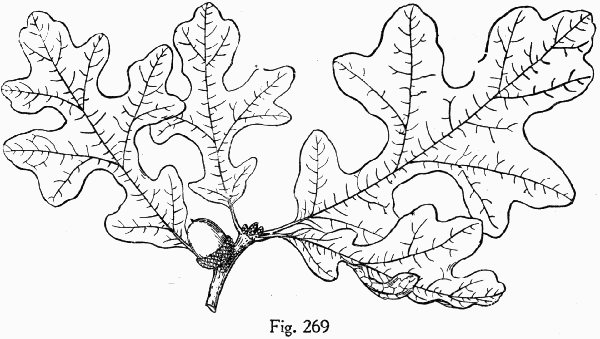
Leaves oblong-obovate, usually deeply 5-lobed, with broad sinuses oblique in the bottom, and short wide lobes, broad and truncate or obtusely pointed at apex, gradually narrowed and cuneate, or occasionally abruptly narrowed and cuneate or rounded at base, when they unfold dark red above and densely pubescent, at maturity thick and firm, deep dark green and roughened by scattered fascicled pale hairs above, covered below with gray, light yellow, or rarely silvery white pubescence, usually 4′—5′ long and 3′—4′ across the lateral lobes, with a broad light-colored midrib pubescent on the upper side and tomentose or pubescent on the lower, stout lateral veins arcuate and united near the margins and connected by conspicuous coarsely reticulated veinlets; turning dull yellow or brown in the autumn; petioles stout, pubescent, ½′ to nearly 1′ in length. Flowers: staminate in [294] aments 3′—4′ long; calyx hirsute, yellow, usually divided into 5 ovate acute laciniately cut segments; anthers covered by short scattered pale hairs; pistillate sessile or stalked, their involucral scales broadly ovate, hirsute; stigmas bright red. Fruit sessile or short-stalked; nut oval to ovoid or ovoid-oblong, broad at base, obtuse and naked or covered with pale persistent pubescence at apex, ½′—1′ long, ¼′—¾′ thick, sometimes striate with dark longitudinal stripes, inclosed for one third to one half its length in the cup-shaped, turbinate, or rarely saucer-shaped cup pale and pubescent on the inner surface, hoary-tomentose on the outer surface, and covered by thin ovate scales rounded and acute at apex, reddish brown, and sometimes toward the rim of the cup ciliate on the margins with long pale hairs.
A tree, rarely 100° high, with a trunk 2°—3° in diameter, and stout spreading branches forming a broad dense round-topped head, and stout branchlets coated at first, like the young leaves and petioles, the stalks of the aments of staminate flowers and the peduncles of the pistillate flowers, with thick orange-brown tomentum, light orange color to reddish brown, and covered by short soft pubescence during their first winter, ultimately gray, dark brown, nearly black or bright brown tinged with orange color; usually not more than 50°—60° tall, with a trunk 1°—2° in diameter, and at the northeastern limits of its range generally reduced to a shrub. Winter-buds broadly ovoid, obtuse or rarely acute, ⅛′—¼′ long, with bright chestnut-brown pubescent scales coated toward the margins with scattered pale hairs. Bark ½′—1′ thick, red more or less deeply tinged with brown, and divided by deep fissures into broad ridges covered on the surface with narrow closely appressed or rarely loose scales. Wood very heavy, hard, close-grained, durable in contact with the soil, difficult to season, light or dark brown, with thick lighter colored sapwood; largely used for fuel, fencing, railway-ties, and sometimes in the manufacture of carriages, for cooperage, and in construction.
Distribution. Dry gravelly or sandy uplands; Cape Cod and islands of southern Massachusetts, Rhode Island, Long Island, New York, to western Florida and southern Alabama and Mississippi, and from New York westward to southern Iowa, Missouri, eastern Kansas, western (Dewey County) Oklahoma, Louisiana and Texas; most abundant and of its largest size in the Mississippi basin; ascending on the southern Appalachian Mountains to altitudes of 2500°; the common Oak of central Texas on limestone hills and sandy plains forming the Texas “Cross Timbers”; usually shrubby and rare and local in southern Massachusetts; more abundant southward from the coast of the south Atlantic and the eastern Gulf states to the lower slopes of the Appalachian Mountains; in western Louisiana rarely in the moist soil of low lands.
Showing little variation in the shape of the fruit and in the character of the cup scales Quercus stellata is one of the most variable of North American Oaks in habit, in the nature of the bark, and in the presence or absence of pubescence. Some of the best marked varieties are var. araniosa Sarg., a large tree differing from the type in the usually smooth upper surface of the leaves, in the floccose persistent tomentum on their lower surface, in the less stout usually glabrous yellow or reddish branchlets, and in its scaly bark; dry sandy soil, southern Alabama, western Louisiana, southern Arkansas, eastern Oklahoma and eastern Texas. Var. paludosa Sarg., a tree up to 75° in height, differing from the type in its oblong-obovate leaves 3-lobed above the middle, slightly pubescent branchlets becoming nearly glabrous, and in its scaly bark; in rich deep soil on the often inundated bottoms of Kenison Bayou, near Washington, St. Landry Parish, Louisiana. Var. attenuata Sarg., a large tree differing from the type in the oblong to oblong-obovate narrow leaves 3-lobed at apex and gradually narrowed to the long cuneate base; near Arkansas Post on the White River, Arkansas County, Arkansas. Var. parviloba Sarg., a round-topped tree 25°—30° high, differing from the type in the smaller lobes of the leaves with more prominent reticulate veinlets; dry sandstone hills near Brownwood, Brown County, Texas. Var. anomala Sarg., a tree 15°—18° high, differing from the type in its broadly obovate subcoriaceous leaves slightly 3-lobed and rounded at apex; dry sandstone hills near Brownwood, Brown County, Texas; possibly a hybrid. Var. Palmeri Sarg., a shrub 6°—15° high, forming clumps, differing from the type in its narrow oblong or slightly obovate 5—7-lobed leaves with [295] narrow lobes, densely tomentose below, and in the thicker and more tomentose scales of the cup; sandy uplands, Elk City, Beckham County, Oklahoma. Var. rufescens Sarg., a shrub 12°—15° high, forming large clumps, differing from the type in the rusty brown pubescence on the lower surface of the polymorphous leaves, in the deeper cups of the fruit with thicker basal scales; sandy uplands, Big Spring, Howard County, Texas, and Elk City, Beckham County, Oklahoma. Var. Boyntonii Sarg., a shrub or small tree spreading into thickets, rarely more than 15° in height, differing from the type in its obovate leaves, mostly 3—5-lobed toward the apex, with small rounded lobes, and in their yellow-brown pubescence also found on the branchlets; in glades on the summit of Lookout Mountain, above Gadsden and Attala, Etowah County, Alabama.
The common and most widely distributed of the varieties of the Post Oak is
Quercus stellata var. Margaretta Sarg.
Quercus Margaretta Ashe
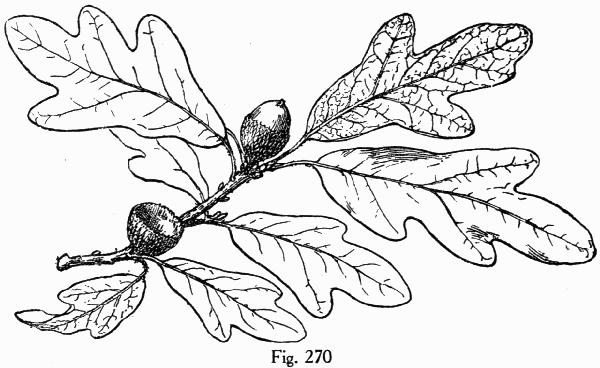
Leaves oblong-obovate, rounded at apex, cuneate or rounded at base, 3—5-lobed with usually narrow rounded, but often broad and truncate lobes, the two forms frequently occurring on the same branch, usually becoming glabrous on the upper surface early in the season, slightly pubescent, sometimes becoming nearly glabrous below, 2½′—5′ long and 2′—2½′ wide; petioles glabrous or pubescent. Flowers and Fruit as in the species.
A small tree, rarely 40° high, with slender glabrous reddish or reddish brown branchlets. Winter-buds ovoid, acute, ¼′ long with closely imbricated chestnut-brown scales glabrous, or ciliate on the margins. Bark thick, rough and furrowed, light gray.
Distribution. Usually on dry sandy slopes, hills and ridges, and southward on Pine-barren lands; coast of Virginia (Capron, Southampton County) southward in the coast and middle districts to central (Lake and Orange Counties) and western Florida, through central and southern Alabama, and eastern and southern Mississippi; in Western Louisiana (Natchitoches and Caddo Parishes); southern Arkansas (McNab, Hempstead County), and southwestern Missouri (Prosperity, Jasper County). The common Post Oak of the south Atlantic and Gulf states; occasionally a shrub (f. stonolifera Sarg.) 4°—6° high, with smaller leaves, spreading into broad thickets by stoloniferous shoots; common near Selma, Dallas County, Alabama, and on the dry sand hills of central Oklahoma.
× Quercus Harbisonii Sarg., believed to be a hybrid of Quercus stellata var. Margaretta and Q. virginiana var. geminata, has been found in the neighborhood of Jacksonville, Duval County, Florida.
[296]
45. Quercus Garryana Hook. White Oak.
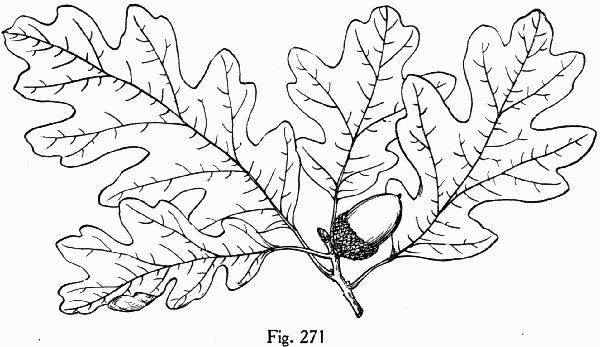
Leaves obovate to oblong, pointed at apex, cuneate or rounded at base, coarsely pinnatifid-lobed, with slightly thickened revolute margins, coated at first with soft pale lustrous pubescence, at maturity thick and firm or subcoriaceous, dark green, lustrous and glabrous above, light green or orange-brown and pubescent or glabrate below, 4′—6′ long, 2′—5′ wide, with a stout yellow midrib, and conspicuous primary veins spreading at right angles, or gradually diverging from the midrib and running to the points of the lobes; sometimes turning bright scarlet in the autumn; petioles stout, pubescent, ½′—1′ in length. Flowers: staminate in hirsute aments; calyx glabrous, laciniately cut into ovate acute slightly ciliate or linear-lanceolate much elongated segments; pistillate sessile and coated with pale tomentum. Fruit sessile or short-stalked; nut oval to slightly obovoid and obtuse, 1′—1¼′ long and ½′—1′ thick, inclosed at the base in a shallow cup-shaped or slightly turbinate cup puberulous and light brown on the inner surface, pubescent or tomentose on the outer, and covered by ovate acute scales with pointed and often elongated tips, thin, free, or sometimes thickened and more or less united toward the base of the cup, decreasing from below upward.
A tree, usually 60°—70° or sometimes nearly 100° high, with a trunk 2°—3° in diameter, stout ascending or spreading branches forming a broad compact head, and stout branchlets coated at first with thick pale rufous pubescence, pubescent or tomentose and light or dark orange color during their first winter, becoming glabrous and rather bright reddish brown in their second year and ultimately gray; frequently at high altitudes, or when exposed to the winds from the ocean, reduced to a low shrub. Winter-buds ovoid, acute, ⅓′—½′ long, densely clothed with light ferrugineous tomentum. Bark ⅛′—1′ thick, divided by shallow fissures into broad ridges separating on the surface into light brown or gray scales sometimes slightly tinged with orange color. Wood strong, hard, close-grained, frequently exceedingly tough, light brown or yellow, with thin nearly white sapwood; in Oregon and Washington used in the manufacture of carriages and wagons, in cabinet-making, shipbuilding, and cooperage, and largely as fuel.
Distribution. Valleys and the dry gravelly slopes of low hills; Vancouver Island and the valley of the lower Fraser River southward through western Washington and Oregon and the California coast-valleys to Marin County; rare and local and the only Oak-tree in British Columbia; abundant and of its largest size in the valleys of western Washington and Oregon; on the islands in the northern part of Puget Sound reduced to a low shrub [297] (Vine Oak); ascending in its shrubby forms to considerable altitudes on the western slopes of the Cascade Mountains; abundant in northwestern California; less common and of smaller size southward.
46. Quercus utahensis Rydb.
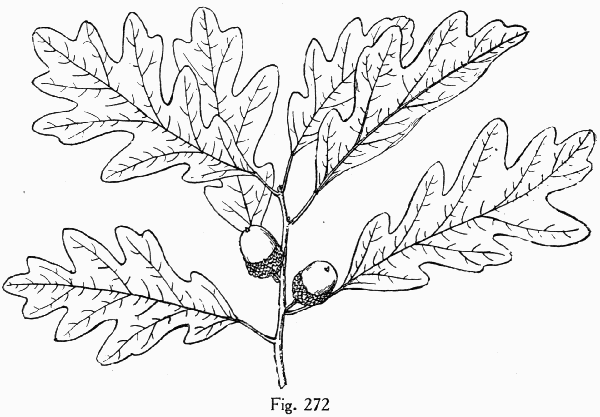
Leaves oblong-obovate, gradually narrowed and rounded or cuneate at base, divided often nearly to the midrib by broad or narrow sinuses into four or five pairs of lateral lobes rounded or acute at apex, the upper lobes usually again lobed or undulate, the terminal lobe rounded at apex, entire or three-lobed, thick, dark green, glabrous or nearly glabrous above, pale and soft pubescent below, 2½′—7′ long, 1½′—3½′ wide, with a prominent midrib and primary veins, and conspicuous veinlets; petioles stout, hoary-tomentose early in the season, pubescent or glabrous before maturity, ⅖′—1′ in length. Flowers: staminate in aments covered with fascicled hairs, 2′—2½′ long; calyx scarious, divided to the middle by wide sinuses into narrow acuminate lobes; anthers yellow; pistillate usually solitary or in pairs, the scales of the involucre thickly coated with hoary tomentum. Fruit usually solitary, sessile or raised on a stout pubescent peduncle ¼′—½′ in length; nut ovoid, broad and rounded at the ends, ⅗′—¾′ long, ½′—2½′ thick, usually inclosed for about half its length in the thick hemispheric cup covered with broad ovate pale pubescent scales much thickened on the back and closely appressed below the middle of the cup, gradually reduced in size upward, thin and less closely appressed toward its rim bordered by the free projecting tips of the upper row of scales.
A tree, occasionally 30° high, with a trunk 4′—8′ in diameter, thick erect branches forming a narrow open head, and stout branchlets red-brown and covered with fascicled hairs when they first appear, becoming light orange-brown and puberulous. Bark dark gray-brown, rough and scaly.
Distribution. Dry foothill slopes and the sides of cañons; borders of southwestern Wyoming to the eastern base of the Rocky Mountains of Colorado, and to Utah, northern New Mexico and Arizona, passing into var. mollis Sarg. with thinner scales on the lower part of the cup of the fruit; with the species over its whole range, but most abundant on the Colorado Plateau of northern Arizona; here rarely 40° high, with a trunk 18′—20′ in diameter.
[298]
47. Quercus lobata Née. White Oak. Valley Oak.
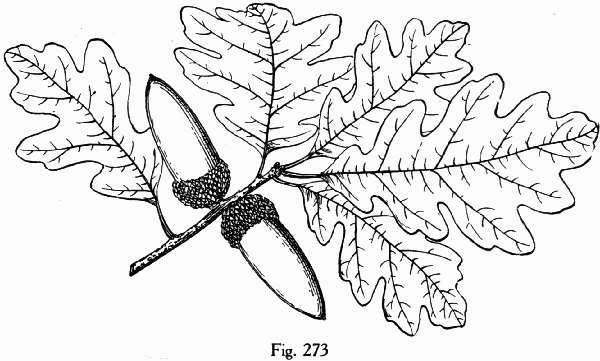
Leaves oblong to obovate, deeply 7—11 obliquely lobed, rounded at the narrow apex, narrow and cuneate or broad and rounded or cordate at base, the lateral lobes obovate, obtuse or retuse, or ovate and rounded, thin, 2½′—3′ or rarely 4′ long, 1′—2′ wide, dark green and pubescent above, pale and pubescent below, with a stout pale midrib, and conspicuous yellow veins running to the slightly thickened and revolute margins; petioles stout, hirsute, ¼′—½′ in length. Flowers: staminate in hirsute aments 2′—3′ long; calyx light yellow and divided into 6 or 8 acute pubescent ciliate lobes; pistillate solitary, sessile or rarely in elongated few-flowered spikes, their involucral scales broadly ovate, acute, coated with dense pale tomentum, about as long as the narrow calyx-lobes. Fruit solitary or in pairs, nearly sessile; nut conic, elongated, rounded or pointed at apex, 1¼′—2¼′ long, bright green and lustrous when fully grown, becoming bright chestnut-brown, usually inclosed for about one third its length in the cup-shaped cup coated with pale tomentum on the outer surface, usually irregularly tuberculate below, all but the much-thickened basal scales elongated into acute ciliate chestnut-brown free tips longest on the upper scales and forming a short fringe-like border to the rim of the cup.
A tree, often 100° feet high, with a trunk generally 3°—4°, but sometimes 10° in diameter, divided near the ground or usually 20°—30° above it into great limbs spreading at wide angles and forming a broad head of slender branches hanging gracefully in long sprays and sometimes sweeping the ground; less frequently with upper limbs growing almost at right angles with the trunk and forming a narrow rigid head of variously contorted erect or pendant branches, and slender branchlets coated at first with short silky canescent pubescence, ashy gray, light reddish brown, or pale orange-brown and slightly pubescent in their first winter, becoming glabrous and lighter colored during their second year. Winter-buds ovoid, acute, usually about ¼′ long, with orange-brown pubescent scales scarious and frequently ciliate on the margins. Bark ¾′—1½′ thick and covered by small loosely appressed light gray scales slightly tinged with orange or brown, becoming at the base of old trees frequently 5′—6′ thick and divided by longitudinal fissures into broad flat ridges broken horizontally into short plates. Wood hard, fine-grained, brittle, light brown, with thin lighter colored sapwood; used only for fuel.
Distribution. Valleys of western California between the Sierra Nevada and the ocean from the valley of the Trinity River to Kern and Los Angeles (rare) Counties; most abundant and forming open groves in the central valleys of the state.
[299]
48. Quercus leptophylla Rydb.
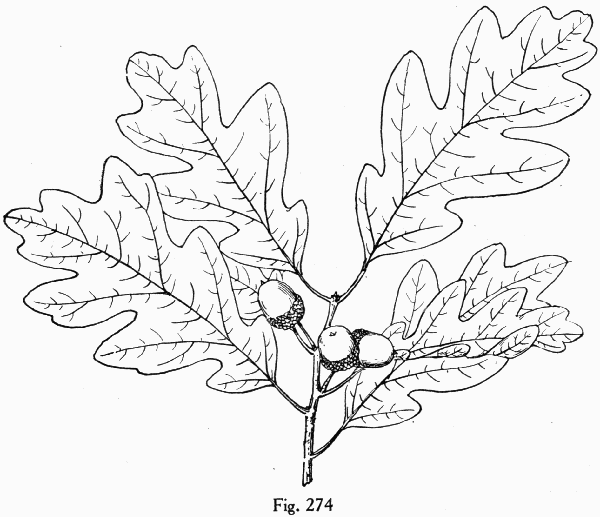
Leaves oblong to oblong-obovate, cuneate or rarely rounded at base, divided about halfway to the midrib into two to four acute or rounded lateral lobes entire or occasionally furnished on the lower side with a small nearly triangular lobe, the terminal lobe short, entire, rounded at apex or three-lobed, when they unfold thickly coated with hoary tomentum, about one-third grown when the flowers open and then covered above with fascicled hairs and tomentose below, at maturity thin, dark green, lustrous and glabrous or nearly glabrous on the upper surface, yellow-green and covered below by short white hairs most abundant on the midrib and veins, 3½′—4′ long, 1½′—2′ wide; petioles slender, pubescent ⅓′—½′ in length. Flowers: staminate in slender villose aments; calyx scarious, divided into five or six narrow acute lobes; anthers dark red-brown as the flowers open; pistillate not seen. Fruit solitary or racemose, sessile or raised on a stout tomentose peduncle ⅖′—⅗′ in length; nut oblong-ovoid, abruptly narrowed and rounded at base, gradually narrowed and rounded at apex, ½′—¾′ long; inclosed for half its length in the thin, hemispheric cup, ⅖′—½′ in diameter, and covered with acuminate only slightly thickened appressed scales densely covered with hoary tomentum.
A tree, 30°—45° high, with a trunk 16′—24′ in diameter, heavy spreading ashy gray branches forming a round-topped head, and stout branchlets, light red-brown or purple and covered with long fascicled hairs when they first appear, becoming light brown and glabrous before autumn. Bark thick, deeply furrowed, covered with small appressed pale gray scales.
Distribution. Rich bottom-lands of the Cucharas River above La Veta, Huerfano County, Colorado; on the Mogollon Mountains, Socorro County, New Mexico.
[300]
49. Quercus austrina Small.
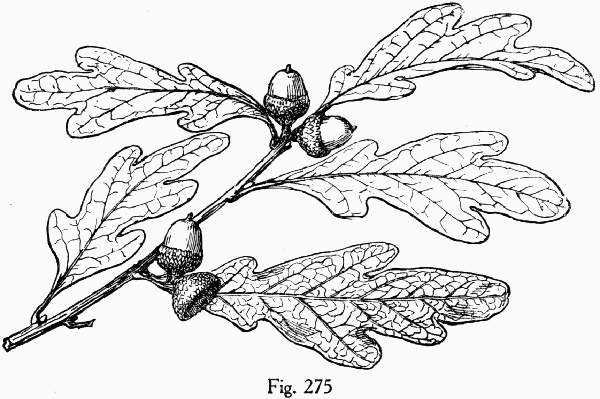
Leaves oblong-obovate, acute or rounded at apex, gradually narrowed to the long cuneate base or rarely rounded at base, usually 5-lobed with rounded lobes, the terminal lobe often 3-lobed, the upper lateral lobes pointing forward and much larger than those of the lower pair, or occasionally 3-lobed at the broad apex, or rarely nearly entire with undulate margins, when they unfold sparsely covered below with caducous fascicled hairs, at maturity glabrous, dark green and lustrous above, paler below, 3′—8′ long, 1′—4′ wide, with a prominent midrib and slender primary veins; petioles slender, at first pubescent, soon glabrous, ¼′—⅓′ in length. Flowers not seen. Fruit solitary or in pairs, sessile or raised on a stout stalk up to ½′ in length; nut ovoid, slightly narrowed toward the base, narrowed at the rounded pubescent apex, ½′—¾′ long, ½′ thick, inclosed for a third to a half its length in the thin hemispheric or deep cup-shaped cup, pale tomentose on the inner surface and covered with thin narrow loosely appressed blunt-pointed tomentose scales.
A tree, 70°—80° and rarely 100° high, with a tall trunk 2°—3° in diameter, spreading and ascending branches forming a broad rather open head, and slender glabrous red-brown or gray-brown brittle-jointed branchlets. Winter-buds ovoid to ellipsoid, acute, ⅛′—¼′ long, with closely imbricated acute puberulous chestnut-brown scales ciliate on the margins. Bark pale, scaly, and on old trunks divided into broad ridges.
Distribution. Banks of streams and river bluffs in deep rich soil; coast of South Carolina (Bluffton, Clay County, and near Charleston); Dover, Scriven County, McIntosh County, De Soto Co., Sumter County, and near Bainbridge, Decatur County, Georgia, to central and western Florida (Gainesville, Alachua County, near Santos, Marion County, Lake City, Columbia County, River Junction, Gadsden County, Marianna, Jackson County); western Alabama (Gallion, Hale County, and the neighborhood of Selma [common] and Pleasant Hill, Dallas County); and southern Mississippi (Meridian, Lauderdale County, Laurel, Jones County, Byram and near Jackson, Hinds County, near Natchez, Adams County).
50. Quercus alba L. White Oak.
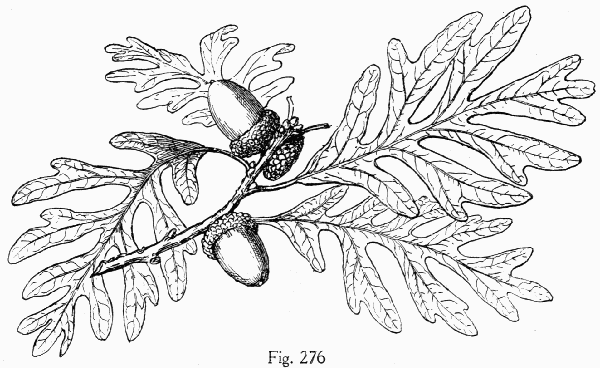
Leaves oblong-obovate, gradually narrowed and cuneate at base, divided often nearly to the midrib by narrow or broad sinuses usually oblique in the bottom into 7 or 9 lobes, the lateral, narrow, lanceolate or obovate, pointing forward, rounded or acute and often lobed at apex, the terminal usually obovate and 3-lobed, when they unfold bright red above, pale [301] below and coated with soft pubescence, soon becoming silvery white and very lustrous, at maturity thin, firm, glabrous, bright green and lustrous or dull above, pale or glaucous below, 5′—9′ long, 2′—4′ wide, with a stout bright yellow midrib and conspicuous primary veins; turning late in the autumn deep rich vinous red, gradually withering and sometimes remaining on the branches nearly through the winter; petioles stout, glabrous, ½′—1′ in length. Flowers: staminate in hirsute or nearly glabrous aments 2½′—3′ long; calyx bright yellow and pubescent, with acute lobes; pistillate bright red, their involucral scales broadly ovate, hirsute, about as long as the ovate acute calyx-lobes. Fruit sessile or raised on a slender peduncle 1′—2′ long, the two forms sometimes appearing on the same branch; nut ovoid to oblong, rounded at apex, lustrous, ¾′ long, green when fully grown, becoming light chestnut-brown, inclosed for about one fourth its length in the cup-shaped cup coated with pale or light brown tomentum, its scales at the base much thickened, united and produced into short obtuse membranaceous tips, and thinner toward the rim of the cup.
A tree, 80°—100° high, with a trunk 3°—4° in diameter, tall and naked in the forest, short in the open, and surmounted by a broad round-topped head of stout limbs spreading irregularly, small rigid branches, and slender branchlets at first bright green, often tinged with red, and coated with a loose mass of long pale or ferrugineous deciduous hairs, reddish brown during the summer, bright red and lustrous or covered with a glaucous bloom during their first winter, becoming ultimately ashy gray. Winter-buds broadly ovoid, rather obtuse, dark red-brown, about ⅛′ long. Bark light gray slightly tinged with red or brown, or occasionally nearly white, broken into thin appressed scales, becoming on old trunks sometimes 2′ thick and divided into broad flat ridges. Wood strong, very heavy, hard, tough, close-grained, durable, light brown, with thin light brown sapwood; used in shipbuilding, for construction and in cooperage, the manufacture of carriages, agricultural implements, baskets, the interior finish of houses, cabinet-making, for railway-ties and fences, and largely as fuel.
Distribution. Sandy plains and gravelly ridges, rich uplands, intervales, and moist bottom-lands, sometimes forming nearly pure forests; southern Maine to southwestern Quebec, westward through southern Ontario, the southern peninsula of Michigan, southeastern Minnesota, eastern Iowa, and southeastern Nebraska, and southward to western Florida, through the Gulf states to the valley of the Brazos River, Texas and through Arkansas to eastern Oklahoma, eastern Kansas, Missouri, Tennessee, and Kentucky; ascending the southern Appalachian Mountains as a low bush to altitudes of 4500°; [302] most abundant and of its largest size on the lower western slopes of the Alleghany Mountains and on the bottom-lands of the lower Ohio Basin. Passing into
Quercus alba var. latiloba Sarg.
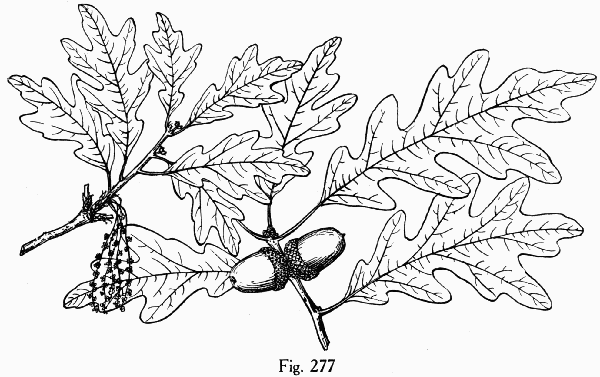
Leaves obovate-oblong, acute or rounded at apex, gradually narrowed and cuneate at base, divided usually less than half way to the midrib into broad rounded lobes; rarely obovate, with undulate margins, or slightly lobed, with broad rounded lobes (var. repanda Michx.). Flowers as in the type. Fruit rarely more than 1½′ in length, with usually thinner cup scales.
Distribution. More abundant than the species and the common northern White Oak.
× Quercus Beadlei Trel., believed to be a hybrid of Quercus alba and Q. Prinus, has been found in a swamp near Clarkton, Bladen County, North Carolina.
× Quercus Bebbiana Schn., probably a hybrid of Quercus alba and Q. macrocarpa, occurs at Charlotte, Chittenden County, Vermont, and near Kenton, Hardin County, Ohio.
× Quercus Deamii Trel., with characters intermediate between those of Quercus alba and Q. Muehlenbergii and evidently a hybrid of these species, is growing near Bluffton, Wells County, Indiana.
× Quercus Faxonii Trel., with characters intermediate between those of Quercus alba and Q. prinoides and evidently a hybrid of these species, has been found in East Walpole, Norfolk County, and Concord, Middlesex County, Massachusetts, and at Greenville, Montcalm County, Michigan.
× Quercus Fernowii Trel., evidently a hybrid of Quercus alba and Q. stellata, has been found near Allenton, St. Louis County, Missouri, and on Red Clay Creek, Virginia.
× Quercus Jackiana Schn., evidently a hybrid of Quercus alba and Q. bicolor, is growing in Franklin Park, Boston.
× Quercus Saulei Schn., with characters intermediate between those of Q. alba and Q. montana and evidently a hybrid of these species, occurs with widely distributed individuals in Vermont (Monkton, Addison County), eastern Massachusetts, near Providence, Rhode Island, New Jersey, eastern Pennsylvania, and the District of Columbia, on the Appalachian Mountains near Biltmore, Buncombe County, and Highlands, Macon County, North Carolina, at Valleyhead, Gadsden County, Alabama, and in Richland County, Illinois.
[303]
51. Quercus bicolor Willd. Swamp White Oak.
Quercus platanoides Sudw.
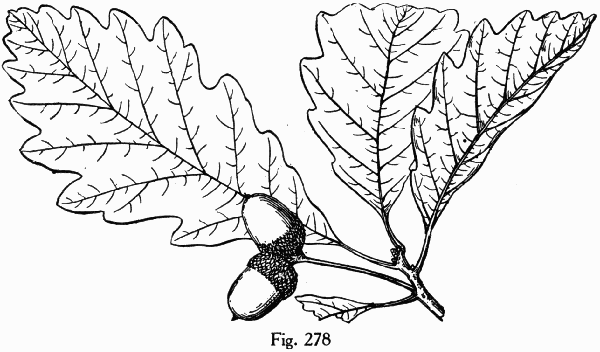
Leaves obovate to oblong-obovate, rounded at the narrowed apex, acute or rounded at the gradually narrowed and cuneate entire base, coarsely sinuate-dentate, or sometimes pinnatifid, with oblique rounded or acute entire lobes, when they unfold light bronze-green and pilose above, covered below with silvery white tomentum, with conspicuous glands on the teeth, at maturity thick and firm, dark green and lustrous on the upper surface, pale or often silvery white or tawny on the lower surface, 5′—6′ long, 2′—4′ wide, with a slender yellow midrib, primary veins running to the points of the lobes, and conspicuous reticulate veinlets; turning in the autumn dull yellow-brown or occasionally orange-color or rarely scarlet before falling; petioles stout, pilose at first, becoming glabrous, ½′—¾′ in length. Flowers: staminate in hairy aments 3′—4′ long; calyx light yellow-green, hirsute with pale hairs, and deeply divided into 5—9 lanceolate acute segments rather shorter than the stamens; pistillate in few-flowered spikes on elongated peduncles covered like the involucral scales with thick white or tawny tomentum; stigmas bright red. Fruit usually in pairs on slender dark brown glabrous puberulous or pubescent stalks 1½′—4′ in length; nut ovoid, with a broad base, rounded, acute and pubescent at apex, light chestnut-brown, ¾′—1¼′ long, ½′—¾′ thick, inclosed for about one third its length in the thick cup-shaped light brown cup pubescent on the inner surface, hoary-tomentose, and sometimes tuberculate or roughened toward the base on the outer surface by the thickened contorted tips of the ovate acute scales, thin, free, acute and chestnut-brown higher on the cup, and often forming a short fringe-like border on its margin, or sometimes entirely covered by thin scales with free acute tips.
A tree, usually 60°—70° or exceptionally 100° high, with a trunk 2°—3° or occasionally 8°—9° in diameter, rather small branches generally pendulous below and rising above into a narrow round-topped open head and often furnished with short pendulous laterals, and stout branchlets, green, lustrous, and slightly scurfy-pubescent when they first appear, light orange color or reddish brown and glabrous or puberulous during their first winter, becoming darker and often purplish and clothed with a glaucous bloom. Winter-buds broadly ovoid and obtuse, or subglobose to ovoid and acute, ⅛′ long, with light chestnut-brown scales usually pilose above the middle. Bark of young stems and small branches smooth, reddish or purplish brown, separating freely into large papery persistent scales curling back and displaying the bright green inner bark; becoming on old trunks 1′—2′ [304] thick, and deeply and irregularly divided by continuous or interrupted fissures into broad flat ridges covered by small appressed gray-brown scales often slightly tinged with red. Wood heavy, hard, strong, tough, light brown, with thin hardly distinguishable sapwood; used in construction, the interior finish of houses, cabinet-making, carriage and boat-building, cooperage, and railway-ties, and for fencing and fuel.
Distribution. Borders of streams and swamps in moist fertile soil; southern Maine to northern Vermont and southwestern Quebec, through Ontario and the southern peninsula of Michigan to southeastern Minnesota, eastern and southern Iowa, southeastern Nebraska and western Missouri, and to the District of Columbia, northern Kentucky and northeastern Oklahoma, and along the Appalachian Mountains to West Virginia; widely scattered, usually in small groves but nowhere very abundant; most common and of its largest size in western New York and northern Ohio.
× Quercus Schuettii Trel., with characters intermediate between those of Quercus bicolor and Q. macrocarpa, and probably a hybrid of these species, occurs at Fort Howard, Brown County, Wisconsin, near Rockfield and Chateaugay, Quebec, and near Rochester and Golah, Munroe County, New York.
52. Quercus Prinus L. Basket Oak. Cow Oak.
Quercus Michauxii Nutt.
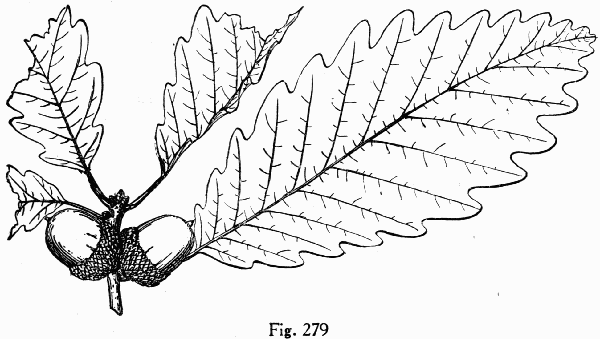
Leaves broadly obovate to oblong-obovate, acute or acuminate at apex with a short broad point, cuneate or rounded at the broad or narrow entire base, regularly crenately lobed with oblique rounded entire lobes sometimes furnished with glandular tips, or rarely entire with undulate margins, when they unfold bright yellow-green, lustrous and pubescent above, coated below with thick silvery white or ferrugineous tomentum, at maturity thick and firm or sometimes membranaceous, especially on young and vigorous branches, dark green, lustrous, glabrous or occasionally roughened by scattered fascicled hairs on the upper surface, more or less densely pubescent on the pale green or silvery white lower surface, 6′—8′ long, 3′—5′ wide; turning in the autumn dark rich crimson; petioles stout, ½′—1½′ in length. Flowers: staminate in slender hairy aments, 3′—4′ long; calyx light yellow-green, pilose with long pale hairs, and divided into 4—7 acute lobes; pistillate in few-flowered spikes on short peduncles coated like the involucral scales with dense pale rufous tomentum; stigmas dark red. Fruit solitary or in pairs, sessile or subsessile, or borne on short stout puberulous stalks rarely ½′ in length; nut ovoid to ellipsoidal, with a broad [305] base, and acute, rounded, or occasionally truncate at apex surrounded by a narrow ring of rusty pubescence, or sometimes pilose nearly to the middle, bright brown, rather lustrous, 1′—1½′ long, ¾′—1¼′ thick, inclosed for about one third its length in the thick cup-shaped cup often broad and flat on the bottom, reddish brown and pubescent within, hoary-tomentose and covered on the outer surface by regularly imbricated ovate acute scales rounded and much thickened on the back, their short tips sometimes forming a rigid fringe-like border to the rim of the cup; seed sweet and edible.
A tree, often 100° high, with a trunk sometimes free of branches for 40°—50°, and 3°—7° in diameter, stout branches ascending at narrow angles and forming a round-topped rather compact head, and stout branchlets at first dark green and covered by pale caducous hairs, becoming bright red-brown or light orange-brown during their first winter and ultimately ashy gray. Winter-buds broadly ovoid or oval, acute, ¼′ long, with thin closely and regularly imbricated dark red puberulous scales with pale margins, those of the inner ranks coated on the outer surface with loose pale tomentum. Bark ½′—1′ thick, separating into thin closely appressed silvery white or ashy gray scales more or less deeply tinged with red. Wood heavy, hard, very strong, tough, close-grained, durable, easy to split, light-brown, with thin darker colored sapwood; largely used in all kinds of construction, for agricultural implements, wheels, in cooperage, for fences and fuel, and in baskets.
Distribution. Borders of streams, swamps, and bottom-lands often covered with water; New Jersey (Morristown, Morris County and Pittsgrove, Salem County), near Wilmington, Delaware, southward through the coast and middle districts to Putnam (San Mateo) and Citrus Counties, Florida, through the Gulf states to the valley of the Trinity River, Texas, and through Arkansas and southeastern Missouri to central Tennessee and Kentucky, the valley of the lower Wabash River, Illinois, and southern Indiana eastward to Jefferson County (C. C. Deam); conspicuous from the silvery white bark, the massive trunk, and the broad crown of large bright-colored foliage.