Division II. Dicotyledons. (continued 13)
Reading edition
Distribution. Newfoundland to the shores of Hudson’s Bay, and westward in British America to the eastern slopes of the coast range of British Columbia in the valley of the Frazer River, and southward through New England, New York, northern Pennsylvania, central Michigan, northern Illinois, central Iowa, and on the Appalachian Mountains, [572] North Carolina and Tennessee; common in all the forest regions of the extreme northern states, growing in moist rather rich soil; often occupying to the exclusion of other trees large areas cleared by fire of their original forest-covering; common and attaining its largest size on the western slopes of the Big Smoky Mountains in Tennessee. Passing into var. saximontana Rehd. differing from the type in its shorter and broader, more coarsely serrate leaves, usually fewer flowered sessile umbels, larger fruit, and smaller size. The Rocky Mountain form; common from Manitoba, the Flathead Lake region, Montana, and northern Wyoming, southward through Colorado.
13. Prunus emarginata Walp. Wild Cherry.
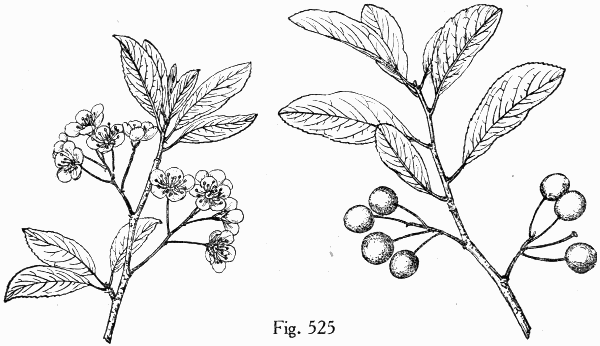
Leaves oblong-obovate to oblanceolate, rounded and usually obtuse or sometimes acute at apex, cuneate and furnished at base with 1 or 2 and sometimes 3 or 4 large dark glands, and serrate with minute subulate glandular teeth, when they unfold puberulous or pubescent on the lower surface and slightly viscid, and at maturity glabrous or pubescent below (var. mollis S. Wats.), 1′—3′ long, ⅓′—1½′ wide, dark green above and paler below; petioles usually pubescent, ⅛′—¼′ in length; stipules lanceolate, acuminate, glandular-serrate, deciduous. Flowers appearing when the leaves are about half grown, at the end of April at the level of the ocean or as late as the end of June at high altitudes, ⅓′—½′ in diameter, on slender pedicels from the axils of foliaceous glabrous glandular-serrate bracts, in 6—12-flowered glabrous or pubescent corymbs 1′—1½′ long; calyx-tube obconic, glabrous or puberulous, bright orange-colored in the throat, the lobes short, rounded, emarginate or slightly cleft at apex, sometimes slightly glandular on the margins, reflexed after the flowers open; petals obovate, rounded or emarginate at apex, contracted below into a short claw, white faintly tinged with green. Fruit ripening from June to August, on slender pedicels, in long-stalked corymbs often 2′ long, globose, ¼′—½′ in diameter, more or less translucent, with a thick skin bright red at first when fully grown, becoming darker and almost black, and thin bitter astringent flesh; stone ovoid, turgid about ⅛′ long, pointed and compressed at the ends, with thick brittle slightly pitted walls, ridged and prominently grooved on the ventral suture and rounded and slightly grooved on the dorsal suture.
A tree, occasionally 30°—40° high, with exceedingly bitter bark and leaves, a trunk 12′—14′ in diameter, slender rather upright branches forming a symmetric oblong head, and slender flexible branchlets coated at first with pale pubescence, dark red-brown during their first winter, bright red, conspicuously marked by large pale lenticels in their second season, and furnished with short lateral branchlets; frequently a shrub especially at high altitudes, with spreading stems 3°—10° tall forming dense thickets. Winter-buds acute, ⅛′ long, with chestnut-brown scales often slightly scarious on the margins, those of the inner [573] ranks becoming acuminate, glandular-serrate above the middle, with bright red tips, scarious, and ½′ long. Bark about ¼′ thick, with a generally smooth dark brown surface marked by horizontal light gray interrupted bands and by rows of oblong orange-colored lenticels. Wood close-grained, soft and brittle, brown streaked with green, with paler sapwood of 8—10 layers of annual growth.
Distribution. Usually near the banks of streams in low rich soil, or less commonly on dry hillsides; valley of the upper Jocko River, Montana, on the mountain ranges of Idaho and Washington and of southern British Columbia to Vancouver Island, and southward on the coast and interior ranges to the neighborhood of the bay of San Francisco, on the western slopes of the Sierra Nevada up to altitudes of 5000°—6000° above the sea to the head of Kern River, on the Santa Lucia, San Rafael, and San Bernardino Mountains, California, on the Washoe Mountains, Nevada, and the mountains of northern Arizona; of its largest size on Vancouver Island, in western Oregon and Washington, and on the Santa Lucia Mountains; on the coast ranges of middle California and on the Sierra Nevada commonly a shrub 5°—8° high.
14. Prunus virginiana L. Choke Cherry.
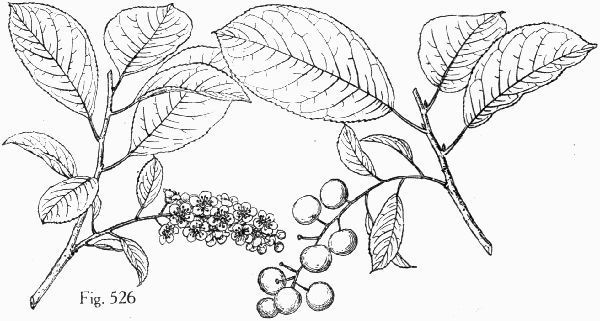
Leaves oval, oblong or obovate, abruptly short-pointed at apex, cuneate, rounded or rarely slightly cordate at base, and sharply often doubly serrate with spreading subulate teeth, glabrous when they unfold or furnished below with axillary tufts of pale hairs, and at maturity dark green and lustrous on the upper surface, light green or pale on the lower surface, 2′—4′ long and 1′—2′ wide; turning bright clear yellow in the autumn before falling; petioles slender, biglandular near apex, or on vigorous shoots sometimes many-glandular, ½′—1′ in length; stipules lanceolate, about ½′ long, early deciduous. Flowers opening from April to the end of June, ⅓′—½′ in diameter, on slender glabrous pedicels from the axils of scarious caducous bracts, in erect or nodding racemes 3′—6′ in length; calyx-tube cup-shaped, globose, the lobes short, obtuse, laciniate and more or less glandular on the margins; petals orbicular, contracted into a short claw, white; filaments and pistil glabrous, the short thick style abruptly enlarged into a broad orbicular stigma. Fruit globose or occasionally slightly elongated, ¼′—⅓′ in diameter, lustrous, bright red at first when fully grown, becoming at maturity scarlet, dark vinous red or nearly black, or rarely bright canary color (var. leucocarpa S. Wats.), with a thick lustrous skin, and dark juicy flesh, austere and astringent, becoming at maturity less astringent and sometimes edible; stone oblong-ovoid broadly ridged on one suture and acute on the other.
A tree occasionally 20°—25° high, with a straight trunk sometimes 6′—8′ in diameter, small erect or horizontal branches, and slender glabrous red-brown or orange-brown lustrous [574] branchlets marked by pale lenticels, becoming dark red-brown in their second year; more often a large or small shrub, at the north frequently not more than 2°—3° tall. Winter-buds acute or obtuse, with pale chestnut brown scales rounded at apex and more or less scarious on the margins, those of the inner rank becoming lanceolate or ligulate, sharply and often glandular-serrate, and ½′—1′ in length. Bark strongly and disagreeably scented, about ⅛′ thick, slightly and irregularly fissured, separating on the surface into small persistent dark red-brown scales, and often marked by pale irregular excrescences. Wood heavy, hard, close-grained, not strong, light brown, with thick lighter-colored sapwood of 15—20 layers of annual growth.
Distribution. Margins of the forest, generally in rich rather moist soil, and along highways and fence-rows; Newfoundland, through Labrador to the shores of Hudson’s Bay, and southward to the valley of the Potomac River and northern Kentucky; in Buncombe and Iredell Counties, North Carolina, and Talladega County, Alabama, and westward to Saskatchewan, eastern North and South Dakota and Nebraska, northeastern Missouri and Kansas; more often a tree southward and in cultivation. Passing into the var. melanocarpa Sarg. with rather thicker rarely lanceolate leaves, and usually darker often less astringent rarely yellow (f. xanthocarpa Sarg.) fruit.
Distribution. Low valleys and the slopes of mountain ranges; Manitoba, western North and South Dakota, Nebraska, Kansas and Oklahoma, westward to northern British Columbia, and southward in the Rocky Mountain region through Wyoming, Montana and Idaho, Colorado, Utah and Nevada to southern New Mexico and Arizona, and through Washington, Oregon and California to San Diego County; in the rich soil of valleys a tree sometimes 30° tall; on dry mountain slopes a shrub 2° or 3° high. More distinct is
Prunus virginiana var. demissa Sarg.
Cerasus demissa Nutt.
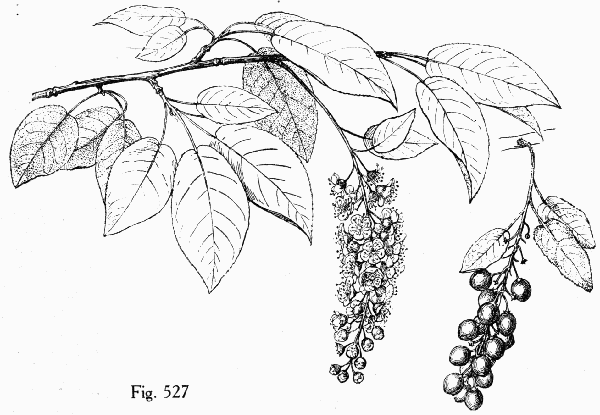
Differing in its often cordate leaves covered below with pale pubescence.
Distribution. Prairies and valleys of western Washington and Oregon, southward to Siskiyou, Napa, Santa Cruz and Kern Counties, California, in northern Nebraska, central Iowa, western Texas (Gamble’s Ranch, Armstrong County, with pubescent leaves cuneate at base), and in New Mexico.
[575]
Passing into var. demissa f. pachyrrachis Sarg. (Padus valida Woot. & Stanl.) differing in the cuneate or rounded base of the leaves, villose pubescent on the midrib and veins below, in the stouter pubescent rachis and pedicels, and in the pubescent branchlets usually becoming glabrous at the end of their second season.
Distribution. Common on the mountains of southwestern New Mexico (Sierra County) and rarely in southern California.
15. Prunus serotina Ehrh. Wild Black Cherry. Rum Cherry.
Prunus eximia Small.
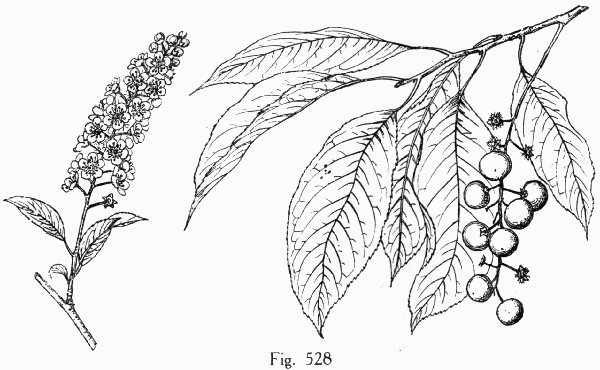
Leaves oval, oblong or oblong-lanceolate, gradually or sometimes abruptly acuminate at apex, cuneate at base, finely serrate with appressed incurved callous teeth, and furnished at the very base with 1 or more dark red conspicuous glands, when they unfold slightly hairy below on the midrib, and often bronze-green, and at maturity glabrous, thick and firm, subcoriaceous, dark green and very lustrous above, paler below, 2′—6′ long and 1′—1½′ wide, with a thin conspicuous midrib rarely furnished toward the base with a fringe of rusty tomentum and slender veins; in the autumn turning clear bright yellow before falling; petioles slender, ½′—¾′ in length; stipules lanceolate, acuminate, glandular-serrate, ½′—¾′ in length, early deciduous. Flowers appearing when the leaves are about half grown, from the end of March in Texas to the first week of June in the valley of the St. Lawrence River. ¼′ in diameter, on slender glabrous or puberulous pedicels from the axils of minute scarious caducous bracts, in erect or ultimately spreading narrow many-flowered racemes 4′—6′ long; calyx-tube saucer-shaped, glabrous or puberulous, the lobes short, ovate-oblong, acute, slightly laciniate on the margins, reflexed after the flowers open, persistent on the ripe fruit; petals broad-obovate, pure white. Fruit ripening from June to October, in drooping racemes, depressed-globose, slightly lobed, ⅓′—½′ in diameter, dark red when fully grown, almost black when ripe, with a thin skin, and dark purple juicy flesh of a pleasant vinous flavor; stone oblong-obovoid thin-walled, about ⅓′ long, acute at apex, gradually narrowed at base, broadly ridged on the ventral suture and acute on the dorsal suture.
A tree, with bitter aromatic bark and leaves, sometimes 100° high, with a trunk 4°—5° in diameter, small horizontal branches forming a narrow oblong head, and slender rather rigid glabrous branchlets at first pale green or bronze color, soon becoming bright red or dark brown tinged with red, red-brown or gray-brown and marked by minute pale lenticels during their first winter, and bright red the following year; usually much smaller and occasionally [576] toward the northern limits of its range shrub-like in habit. Winter-buds obtuse, or on sterile shoots acute, with bright chestnut-brown broad-ovate scales keeled on the back and apiculate at apex, those of the inner ranks becoming scarious at maturity, acuminate, and ½′—⅔′ long. Bark ½′—¾′ thick, broken by reticulated fissures into small irregular plates scaly on the surface, and dark red-brown, or near the Gulf-coast light gray or nearly white. Wood light, strong, rather hard, close straight-grained, with a satiny surface, light brown or red, with thin yellow sapwood of 10—12 layers of annual growth; largely used in cabinet-making and the interior finish of houses. The bark, especially that of the branches and roots, yields hydrocyanic acid used in medicine as a tonic and sedative. The ripe fruit is used to flavor alcoholic liquors.
Distribution. Nova Scotia westward through the Canadian provinces to Lake Superior, and southward through the eastern states to central (Lake County) Florida, and westward to eastern South Dakota, southeastern Nebraska, eastern Kansas, central Oklahoma and the valley of the east fork of the Frio River, Texas; usually in rich moist soil; once very abundant in all the Appalachian region, reaching its greatest size on the slopes of the high Alleghany Mountains from West Virginia to Georgia, and in Alabama; sometimes on low sandy soil, and often in New England on rocky cliffs within reach of the spray of the ocean; not common in the coast region of the southern states.
A form from the summits of Whitetop Mountain, Virginia, with larger and rather thicker leaves pale below and rather larger fruit, has been described as var. montana Britt.
16. Prunus alabamensis Mohr. Wild Cherry.
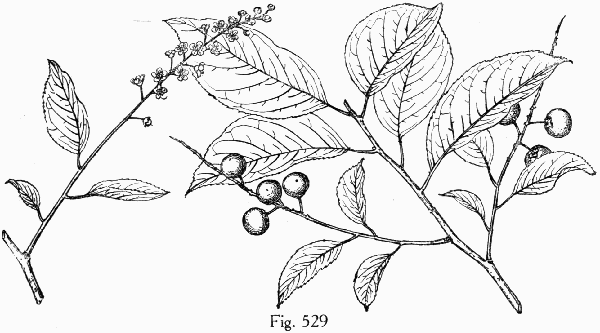
Leaves oval, broad-ovate, or occasionally obovate, acute, short-pointed or rounded at apex, cuneate, rounded or rarely slightly obcordate at base, and finely serrate with incurved teeth tipped with minute or sometimes near the base of the blade with larger dark glands, when they unfold coated below and on the upper side of the midrib with fine pubescence, and at maturity thick and firm in texture, 4′—5′ long, about 2′ wide, dark dull green and glabrous on the upper surface, dull and covered on the lower surface with short simple or forked accrescent hairs most abundant and sometimes rufescent on the slender midrib and primary veins; petioles stout, tomentose, becoming pubescent, eglandular or occasionally furnished near the apex with 1 or 2 large dark glands, ¼′—½′ in length; stipules lanceolate, acuminate, glandular-serrate, bright red, ½′ long, caducous. Flowers appearing during the first week of May, when the leaves are about half grown, ¼′ in diameter, on pubescent pedicels from the axils of ovate or obovate acuminate bright pink caducous bracts, in spreading [577] or erect slender pubescent racemes 3′—4′ long; calyx-tube broad, cup-shaped, puberulous, with short almost triangular lobes persistent on the fruit; petals white, nearly orbicular. Fruit ripening late in September, subglobose to short-oblong, ⅓′ in diameter, dark red or finally nearly black, with thin acid flesh; stone ovoid somewhat compressed, pointed at the ends, ¼′ long, ridged on the ventral suture with a broad low ridge, and slightly grooved on the dorsal suture.
A tree, 25°—30° high, with a short trunk rarely 10′ in diameter, spreading somewhat drooping branches, and slender branchlets coated at first with pale tomentum, dark red-brown during their first season, becoming nearly glabrous before winter, and much darker in their second year. Bark of the trunk dark, rough, separating freely into small thin scales.
Distribution. Summits of the low mountains of central Alabama; rare and local.
17. Prunus australis Beadl. Wild Cherry.
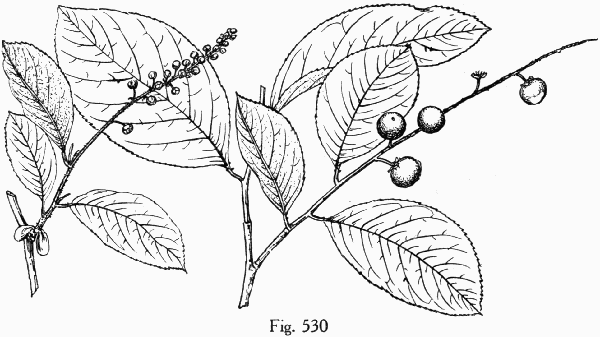
Leaves obovate, oval or elliptic, gradually narrowed and obtusely short-pointed or sometimes acute at apex, rounded or occasionally cuneate at the narrowed base, and finely serrate with slender teeth tipped with minute dark red glands, when they unfold membranaceous, pale yellow-green and glabrous above, with the exception of occasional pale hairs along the midrib, and coated below with pale or ferrugineous pubescence, and at maturity thin but firm, dark dull green above, covered below with rufous hairs most abundant on the thin broad midrib, and on the slender primary veins extending nearly to the margins of the leaf, conspicuously reticulate-venulose, 2½′—4′ long and 1½′—2½′ wide; petioles rusty-tomentose, biglandular at apex with large dark glands, about ¼′ in length; stipules linear to linear-lanceolate, glandular, bright rose color, ¼′—½′ long. Flowers probably opening toward the end of April, on short pedicels from the axils of minute rose-colored caducous bracts, in slender spreading hoary-pubescent racemes 3′—4′ long; the expanded flowers not known. Fruit ripening and falling late in July, on pedicels ¼′ long, globose, surrounded at base by the calyx-lobes and remnants of the stamens, dark purple when fully ripe, and about ¼′ in diameter, with thin flesh; stone ovoid, compressed, rounded at base, pointed at apex, about ⅙′ long and broad, ridged on the ventral suture, with a low broad ridge, slightly grooved on the dorsal suture.
A tree, sometimes 60° tall, with a trunk 12′—16′ in diameter, spreading or ascending branches forming an oblong head, and slender branchlets coated at first with pale pubescence, becoming puberulous, dull red-brown, and roughened by numerous small pale elevated lenticels at the end of their first season, and glabrous or puberulous in their second [578] year. Winter-buds ovoid, obtuse, about 1/12′ long, with acute dark red-brown glabrous scales. Bark of young stems and of the branches thin, silvery gray, and roughened by long horizontal lenticels, becoming on older trunks ⅓′ thick, ashy gray or brownish black, deeply fissured and broken into thick persistent plate-like scales.
Distribution. Clay soil at Evergreen, Conecut County, Alabama; common.
18. Prunus virens Shrive. Wild Cherry.
Padus virens Woot. & Stanl. Prunus serotina, ed. 1, in so far as relates to western Texas, New Mexico and Arizona.
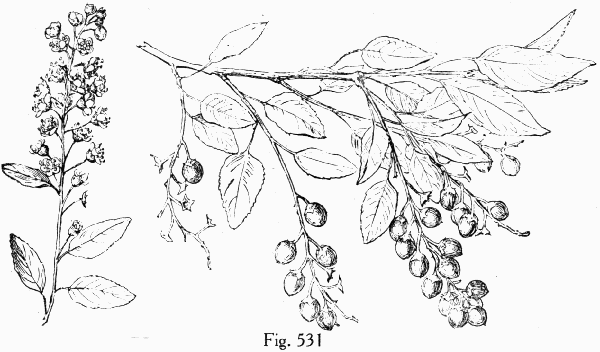
Leaves elliptic, ovate or rarely slightly obovate, acute, rounded or occasionally acuminate or abruptly narrowed into a short obtuse point at apex, rounded or broad-cuneate at base, finely crenately serrate, glabrous, light green and lustrous on the upper surface, lighter green and glabrous on the lower surface, 1½′—2′ long and ¾′—1′ wide, with a slender midrib, thin veins and reticulate veinlets; petioles slender, glabrous or rarely slightly villose, without glands, ¼′—½′ in length. Flowers appearing when the leaves are nearly fully grown from the first to the middle of May, ¼′ in diameter, on slender glabrous pedicels, in erect or spreading many-flowered glabrous or puberulous racemes 3′—6′ long; calyx-tube saucer-shaped, glabrous, 3/16′ wide, persistent under the fruit, the lobes short-pointed, acute, persistent; petals broad-obovate, pure white. Fruit ripening in August and September, in erect or spreading racemes, subglobose to short-oblong, purplish black and lustrous at maturity, ¼′—½′ in diameter, with thin juicy acrid flesh; stone compressed, slightly obovoid ¼′ in diameter, with a low broad ridge on the ventral suture, and rounded on the dorsal suture.
A tree in sheltered cañons sometimes 25°—30° high, with a trunk 18′ or 20′ in diameter, small, usually drooping or occasionally wide-spreading branches, and slender glabrous red-brown pendulous branchlets marked by small pale lenticels, becoming gray-brown in their second year; on open mountain slopes a shrub with numerous erect stems and usually smaller leaves. Winter-buds acute or acuminate, 1/16′—⅛′ long, with slightly villose red-brown scales. Bark near the base of old trunks ¼′ thick, nearly black, deeply fissured and broken on the surface into thin persistent scales, higher on the trunk and on small stems thin, smooth, reddish or gray-brown, lustrous and marked by many narrow oblong pale horizontal lenticels.
Distribution. Guadalupe Mountains, western Texas, over the mountain ranges of southern New Mexico and Arizona, extending northward in Arizona to the cañons of the [579] Colorado plateau south of the Colorado River; widely and generally distributed at altitudes between 5000° and 8000°, but nowhere abundant. Passing into var. rufula Sarg., differing in the rusty brown pubescence on the lower side of the midrib of the leaves, in the pubescent petiole and lower part of the rachis, in the puberulous ovary, and in the rusty brown pubescence of the young branchlets.
Distribution. With the species on many of the mountain ranges of southern New Mexico and Arizona at altitudes between 5400° and 6000°.
19. Prunus caroliniana Ait. Wild Orange. Mock Orange.
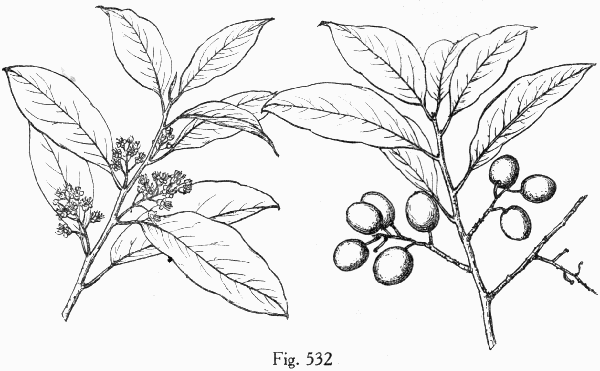
Leaves oblong-lanceolate, acuminate, mucronate, with entire thickened slightly revolute margins, or rarely remotely spinulose-serrate, glabrous, coriaceous, dark green and lustrous on the upper surface, paler on the lower surface, 2′—4½′ long and ¾′—1½′ wide, and obscurely veined, with a narrow pale midrib; persistent until their second year; petioles stout, broad, orange-colored; stipules foliaceous, lanceolate, acuminate. Flowers appearing from February to April, on slender pedicels about ½′ long, from the axils of long-acuminate scarious red-tipped bracts, in dense racemes shorter than leaves; calyx-tube narrow-obconic, the lobes small, thin, rounded, undulate on the margins, reflexed after the flowers open, deciduous; petals boat-shaped, minute, cream-colored; stamens exserted, orange-colored, with glabrous filaments and large pale anthers; ovary gradually narrowed into a slender erect style enlarged above into a club-shaped stigma. Fruit ripening in the autumn, remaining on the branches until after the flowering period of the following year, oblong, short-pointed, black and lustrous, ½′ long, with a thick skin, and thin dry flesh; stone short-ovoid, pointed, nearly cylindric, about ½′ long, full and rounded at base, with thin fragile walls, obscurely ridged on the ventral suture and deeply grooved on the dorsal suture.
A tree, 30°—40° high, with a straight or inclining trunk sometimes 10′ in diameter, slender horizontal branches forming a narrow oblong or sometimes a broad head, and glabrous branchlets marked by occasional pale lenticels, slightly angled, at first light green, becoming bright red, and in the second season light brown or gray. Winter-buds acuminate, ⅛′ long, covered with narrow pointed dark chestnut-brown scales rounded on the back. Bark about ⅛′ thick, gray, smooth or slightly roughened by longitudinal fissures, and marked by large irregular dark blotches. Wood heavy, hard, strong, close-grained, light red-brown or sometimes rich dark brown, with thick lighter colored sapwood. The partially withered leaves and young branches are often fatal to animals browsing upon them, owing to the considerable quantities of hydrocyanic acid which they contain.
[580]
Distribution. Deep rich moist bottom-lands; valley of the Cape Fear River, North Carolina, to the shores of Bay Biscayne and the valley of the Kissimee River, Florida, and through southern Alabama, Mississippi, and Louisiana to the valley of the Guadalupe River, Texas; in Bermuda; in the Atlantic and eastern Gulf states usually only in the immediate neighborhood of the sea, rarely ranging inland more than fifteen or twenty miles; common along the borders of hummocks in the center of the Florida peninsula and a characteristic tree on those in the region of Lake Apopka, Orange County; in Alabama ranging inland to Dallas County (Pleasant Hill, T. B. Harbison); most abundant and of its largest size in the valleys of eastern Texas, and here often forming great impenetrable thickets.
Often cultivated in the southern states as an ornamental plant and to form hedges; and when cultivated occasionally 50°—60° high, with a trunk 3° in diameter.
20. Prunus myrtifolia Urb.
Prunus sphærocarpa Sw.
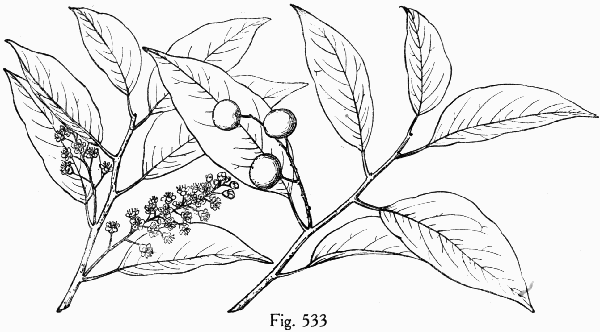
Leaves elliptic to oblong-ovate, gradually or abruptly contracted into a broad obtuse point, or less commonly rounded or rarely emarginate at apex, cuneate at base, entire, with slightly thickened undulate margins, glabrous, eglandular, subcoriaceous, yellow-green and lustrous on the upper surface, paler on the lower surface, obscurely veined, 2′—4½′ long and 1′—1½′ wide; persistent; petioles slender, orange-brown, ½′ to 1′ in length; stipules foliaceous, lanceolate, acuminate, entire, ¼′ long, early deciduous. Flowers opening in Florida in November, ⅛′ in diameter, on thin orange-colored pedicels ¼′—⅔′ long, in slender many-flowered erect racemes shorter than the leaves; calyx-tube obconic, bright orange-colored on the outer surface, marked by an orange band in the throat, the lobes thin, minute, acute, laciniate on the margins, deciduous, much shorter than the obovate rounded or acuminate white petals marked with yellow on the inner surface toward the base, contracted below into a short claw, reflexed at maturity; stamens exserted, with slender orange-colored subulate filaments and small yellow anthers; ovary sessile, contracted into a short stout style, terminating in a large club-shaped stigma. Fruit produced in Florida very sparingly, ripening either in the spring or early summer, subglobose to short-oblong, apiculate, orange-brown, ⅓′—½′ long, with thin dry flesh; stone thin-walled, cylindric, slightly narrowed at apex, and obscurely ridged on the ventral suture.
A glabrous tree, in Florida rarely 30°—40° high, with a trunk 5′—6′ in diameter, thin upright branches and slender orange-brown branchlets, becoming ashy gray or light brown tinged with red and marked by small circular pale lenticels. Bark of the trunk thin, smooth [581] or slightly reticulate-fissured, light brown tinged with red. Wood heavy, hard, close-grained, light clear red, with thick pale sapwood.
Distribution. Florida, rich hummock land, occasionally in the neighborhood of small streams and ponds near the shore of Bay Biscayne and on Long Key in the Everglades, Dade County; through the West Indies to Brazil.
21. Prunus ilicifolia Walp. Islay.
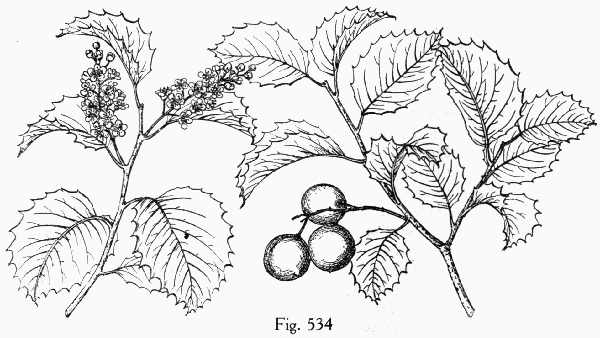
Leaves ovate to ovate-lanceolate, acute, rounded or emarginate at apex, narrowed and rounded or truncate at base, with thickened coarsely spinosely toothed margins, the stout teeth near the base of the leaf often tipped with large dark glands, thick and coriaceous, dark green and lustrous above, paler and yellow-green below, 1′—2½′ long, and 1′—1½′ wide, with a slender yellow midrib and obscure veins; deciduous during their second summer; petioles broad, ⅛′—½′ in length; stipules acuminate, obscurely denticulate, ¼′ long. Flowers opening from March to May, ⅓′ in diameter, on short slender pedicels from the axils of acuminate scarious bracts ¼′ in length and mostly deciduous before the opening of the flower-buds, in slender erect racemes 1½′—3′ long; calyx-tube cup-shaped, orange-brown, the lobes minute, acuminate, reflexed at maturity, deciduous, about one third as long as the obovate white petals rounded above and narrowed below into a short claw; stamens slightly exserted, with slender incurved filaments and minute yellow anthers; ovary sessile, abruptly contracted into a slender style usually bent near the summit at a right angle or rarely erect, and surmounted by a large orbicular stigma. Fruit ripening in November and December, subglobose, often compressed, ½′—⅔′ in diameter, dark red when fully grown, purple or sometimes nearly black at maturity, with thin slightly acid astringent flesh; stone ovoid slightly compressed, ½′—⅝′ long, short-pointed at apex, with thin brittle walls, light yellow-brown, conspicuously marked by reticulate orange-colored vein-like lines and with 3 orange bands radiating from the base to the apex along one suture, and with a single narrow band along the other suture.
A glabrous tree, 20°—30° high, with a trunk rarely 2° in diameter or more than 10°—12° long, stout spreading branches forming a dense compact head, and branchlets at first yellow-green or orange color, soon becoming gray or reddish brown and more or less conspicuously marked by minute pale lenticels, and in their second or third years by the large leaf-scars; usually much smaller and often a shrub sometimes only a foot or two high. Winter-buds acuminate, with dark red scales contracted into a long slender point, those of the inner ranks accrescent and persistent on the young branchlets until these have reached a length of several inches. Bark ⅓′—½′ thick, dark red-brown, and divided by deep fissures into [582] small square plates. Wood heavy, hard, strong, close-grained, light red-brown, with thin lighter colored sapwood of 8—10 layers of annual growth; occasionally used for fuel.
Distribution. Borders of streams and moist sandy soil in the bottoms of cañons, and as a low shrub on dry hillsides and mesas from Solano County and the shores of the Bay of San Francisco southward through the coast ranges of California to the foothills of the San Bernardino Mountains, and the valley of the San Jacinto River; in Lower California southward to the western slopes of the San Pedro Mártir Mountains.
Generally cultivated as an ornamental plant in California and occasionally in western and southern Europe.
22. Prunus Lyonii Sarg.
Prunus integrifolia Sarg.
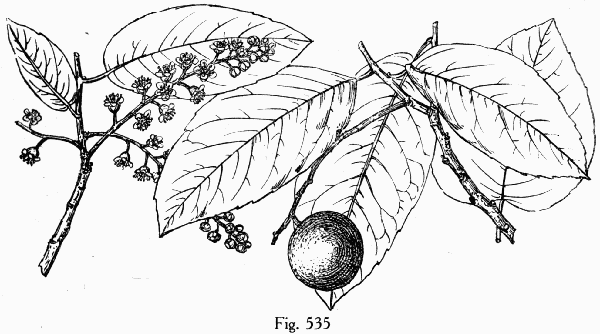
Leaves ovate to lanceolate, acuminate or abruptly narrowed into a short point at apex, cuneate, truncate or rounded at base, with thickened revolute undulate entire or occasionally, especially on vigorous shoots, remotely and minutely spinulose-dentate margins, glabrous, coriaceous, dark green and lustrous above, paler below, reticulate-venulose, 2′—3′ long and ½′—2½′ wide, with a stout midrib and obscure veins; persistent; petioles stout, yellow, ⅓′—½′ in length. Flowers appearing from March to June, about ¼′ in diameter, on slender pedicels from the axils of acuminate caducous bracts, in crowded many-flowered glabrous racemes 3′—4′ long; calyx-tube cup-shaped, orange-brown, the lobes acute, apiculate, reflexed after the flowers open, deciduous, about one third as long as the obovate petals rounded and undulate above and narrowed below into a short claw; stamens slightly exserted, with incurved filaments and small yellow anthers; ovary raised on a short stipe, the style bent near the apex and terminating in a large orbicular stigma. Fruit ripening late in the autumn, on stout pedicels, in drooping few-fruited racemes, subglobose to short-oblong, dark purple or nearly black at maturity, 1′—1¼′ in diameter, with thick luscious flesh sometimes ¼′ thick; stone ovoid to obovoid, slightly compressed, thin-walled, about ¾′ long, pointed at apex, pale yellow-brown, conspicuously marked by reticulate orange-colored lines, and by 3 dark bands radiating from base to apex along one suture, and by a single narrow line on the other suture.
A bushy tree, sometimes 25°—30° high, with one or several stout erect or spreading stems 1°—3° in diameter, spreading branches forming a broad compact head, and stout branchlets light yellow-green when they first appear, becoming light and ultimately dark reddish brown, and much roughened by the large elevated leaf-scars. Winter-buds acute or obtuse, [583] with dark red scales. Bark of the trunk ⅓′—½′ thick and dark reddish brown. Wood heavy, hard, very close-grained, pale reddish brown, with hardly distinguishable sapwood.
Distribution. Islands of southern California, in all situations from the fertile valleys and cañons at the water’s edge up to altitudes of 3000° on the dry interior ridges; in Lower California.
11. CHRYSOBALANUS L.
Trees or shrubs, with stout branchlets covered with pale lenticels, and fibrous roots. Leaves alternate, entire, coriaceous, short-petiolate, persistent; stipules minute, deciduous. Flowers perfect, short-pedicellate, small, creamy white, in axillary or terminal dichotomously branched slender canescent cymes, with conspicuous deciduous bracts; calyx turbinate-campanulate, 5-lobed, the lobes imbricated in the bud, without bracts, deciduous; disk thin, adnate to the calyx-tube; petals 5, alternate with the lobes of the calyx, spatulate, deciduous; stamens (in the arborescent species) indefinite in a single continuous series, inserted with the petals on the margin of the disk; filaments filiform, hairy, free or slightly united at base; anthers ovoid, ovary sessile in the bottom of the calyx-tube, pubescent or glabrous, 1-celled; style rising from the base of the ovary, filiform, terminated by a minute truncate stigma; ovules 2, collateral, ascending; raphe dorsal; the micropyle inferior. Fruit a fleshy 1-seeded drupe with pulpy flesh, a coriaceous or crustaceous stone 5 or 6-angled toward the base and imperfectly 5 or 6-valved, the valves reticulate-veined. Seed erect; seed-coat chartaceous, light brown; embryo filling the cavity of the seed; cotyledons thick and fleshy; radicle inferior, very short.
Chrysobalanus is represented in the south Atlantic states by a shrubby species confined to the coast region from Georgia to Alabama, and by an arborescent species, an inhabitant of the shores of southern Florida, and widely distributed through the maritime regions of tropical America, and found in various forms on the coast of western tropical Africa. The insipid fruit of the arborescent species is eaten by negroes; the seeds contain a considerable quantity of oil; and the astringent bark, leaves and roots have been used in medicine.
The generic name is from χρυσός and βάλανος, in allusion to the supposed golden fruit of one of the species.
1. Chrysobalanus icaco L. Cocoa Plum.
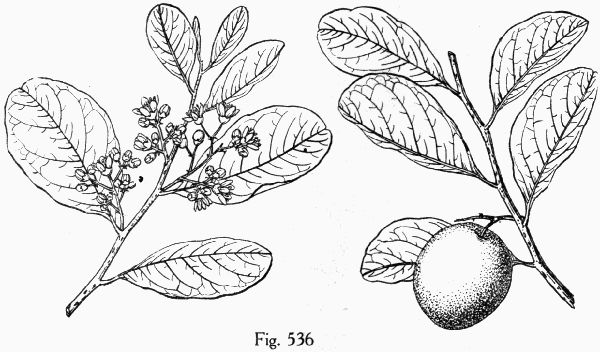
Leaves broad-elliptic or round-obovate, rounded or slightly emarginate at apex, cuneate at base, glabrous, coriaceous, obscurely reticulate-veined, dark green and lustrous on the upper surface, light yellow-green on the lower surface, 1′—3½′ long and 1′—2½′ wide, with a [584] broad conspicuous midrib rounded on the upper side and thin primary veins, standing on the branches at an acute angle and appearing to be pressed against them; petioles stout, ⅛′—¼′ in length; stipules acuminate, ⅛′ long. Flowers ⅓′ long, on short thick club-shaped hoary-tomentose pedicels, in cymes 1′—2′ in length; appearing in Florida continuously during the spring and summer months on the growing branches; calyx hoary-tomentose, the lobes nearly triangular, acute, more or less pubescent on the inner surface and about half as long as the narrow white petals; ovary hoary-pubescent; style long and slender, clothed nearly to the apex with pale hairs. Fruit nearly globose or oval-ovoid, 1½′—1¾′ in diameter, with a smooth bright pink, yellow, or creamy white skin, white sweet juicy flesh often ¼′ thick, and more or less adherent to the stone rounded at base, acute or acuminate at apex, 5 or 6-angled below the middle, about 1′ long and twice as long as broad, indehiscent or finally separating into 5 or 6 valves, the walls composed of a thin red-brown dry outer layer and a thick interior layer of hard woody fibre; seed-coat lined with a thick white reticulated fibrous coat.
Usually a broad shrub 10°—12° high, forming dense thickets, with erect branches and dark red-brown branchlets thickly covered for four or five years with lenticels, occasionally on the borders of low hummocks arborescent with reclining or rarely erect stems 20°—30° long and 1° in diameter, or on the margins of ocean beaches often not more than 1° or 2° tall. Bark dark red-brown and scaly, separating into long thin scales. Wood heavy, hard, strong, close-grained, light brown often tinged with red, with thin lighter colored sapwood of about 10 layers of annual growth.
Distribution. Florida, saline shores, river banks and low hummocks, Cape Canaveral to Bay Biscayne, and on the west coast from the mouth of the Caloosahatchie River to the southern keys; through the West Indies to southern Brazil, and on the tropical west coast of Africa. Passing into
Chrysobalanus icaco var. pellocarpa DC.
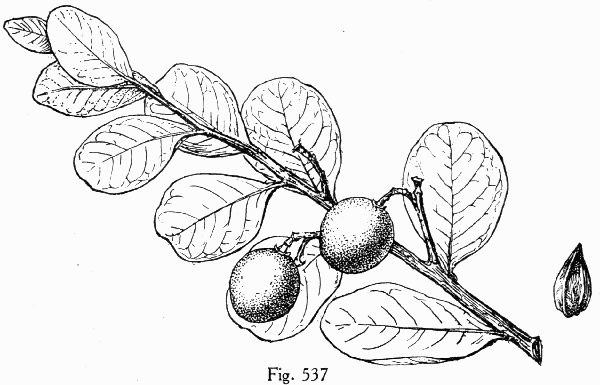
Differing from the type in its rather larger leaves spreading and less crowded on the branches, its oblong to oblong-obovoid dark purple or nearly black usually rather smaller fruit, and in its long-acuminate and more prominently angled stone.
A tree, 20°—30° or rarely 50° high, with an erect trunk 12′—16′ in diameter, erect and spreading branches forming a wide open head, and slender branchlets marked by scattered pale lenticels; often smaller and occasionally a shrub. Bark gray slightly tinged with red and covered with small closely appressed scales.
[585]
Distribution. Florida, banks of streams and borders of the Everglades, near Little River to the Everglade keys, Dade County; on the Bahama Islands and in Jamaica.
XXIII. LEGUMINOSÆ.
Trees or shrubs, with alternate usually compound leaves, regular or papilionaceous usually perfect flowers; stamens 10 or indefinite, with diadelphous or distinct filaments and 2-celled anthers, the cells opening longitudinally; ovary superior, 1 or many-celled, inserted on the bottom of the calyx. Fruit a legume. Of the four hundred and thirty genera of the Pea-family now recognized and widely distributed in all temperate and tropical regions, eighteen have arborescent representatives in the United States.
CONSPECTUS OF THE NORTH AMERICAN ARBORESCENT GENERA.
Subfamily 1. Mimosoideæ. Calyx 4—6-toothed, the teeth valvate in the bud; petals as many as the teeth of the calyx, valvate in the bud; ovules numerous, suspended in 2 ranks from the inner angle of the ovary, superposed, anatropous, the micropyle superior; stamens much exserted; leaves twice pinnate; cotyledons oval or orbicular, flat; radicle straight.
Stamens numerous (more than 10); seeds without albumen.
Filaments more or less united into a tube.
Filaments united.
Valves of the legume not separating at maturity from the margins.
1. Pithecolobium.
Valves of the legume separating at maturity from the persistent margins.
2. Lysiloma.
Filaments free or the inner ones slightly united at base.
3. Acacia.
Stamens 10; filaments free; seeds with albumen.
Legume plano-compressed, dehiscent; flowers in globose heads.
4. Leucæna.
Legume terete or compressed, indehiscent; flowers in cylindric spikes.
5. Prosopis.
Subfamily 2. Cæsalpinioidæ. Calyx 5-lobed or toothed, the divisions usually valvate in the bud; corolla imperfectly papilionaceous or nearly regular; petals 5, imbricated in the bud, the upper petal inside and inclosed by the others; stamens 10 or less; filaments free; anthers introrse; ovules numerous (sometimes 2 in one species of Gleditsia), superposed, anatropous, the micropyle superior; seeds albuminous.
Flowers imperfectly papilionaceous; calyx 5-toothed; legume flat, wing-margined; leaves simple
6. Cercis.
Flowers regular.
Flowers polygamous or diœcious.
Calyx-tube elongated, 5-lobed; petals 5; stamens 10, shorter than the petals; legume thick and woody; leaves twice pinnate.
7. Gymnocladus.
Calyx-tube short, 3—5-lobed; petals 3—5; stamens 3—5, longer than the petals; legume leathery; leaves once and twice pinnate.
8. Gleditsia.
Flowers perfect.
Legume linear, torulose, acuminate at the ends, the valves contracted between the seeds; rachis of the leaf spinescent.
9. Parkinsonia.
Legume oblong, compressed; rachis of the leaf not spinescent.
10. Cercidium.
Subfamily 3. Papilionatæ. Calyx of 5 more or less united sepals; corolla of 5 irregular petals, papilionaceous, the upper petal (standard) larger than the others and inclosing them in the bud, usually turned backward or spreading, the 2 lateral petals (wings) oblong, exterior to the 2 lower connivent more or less united petals (keel) inclosing the stamens and pistil; stamens 10, 9 of them united into a tube cleft on the upper side, the 10th and upper stamen separate, or all distinct; ovary 1 or many-celled by cross partitions; ovules amphitropous, the micropyle superior; seeds usually without albumen; leaves once pinnate.
[586]
Stamens distinct.
Flowers in racemes; legume terete, contracted between the seeds.
11. Sophora.
Flowers in panicles; legume compressed.
12. Cladrastis.
Stamens diadelphous (9 and 1).
Flowers in racemes.
Leaves glandular-dotted.
Leaves many-foliolate; petals free and distinct.
13. Eysenhardtia.
Leaves simple; wings and keel-petals adnate to the tube of the stamens.
14. Dalea.
Leaves without glandular dots.
Legume compressed; stipules becoming spinescent, persistent.
15. Robinia.
Legume turgid, the valves unequally convex by the growth of the seeds.
Leaves 10—15-foliolate, without stipules or stipels; petals purple or violet.
16. Olneya.
Leaves 3-foliolate, with minute stipules and gland-like stipels; petals usually scarlet.
17. Erythrina.
Flowers in axillary panicles; pod linear, longitudinally 4-winged.
18. Ichthyomethia.
1. PITHECOLOBIUM Mart.
Trees or shrubs, with slender branches armed with the persistent spinescent stipules. Leaves petiolate, bipinnate, the pinnæ few-foliolate, their rachis generally marked by numerous glands between the pinnæ and between the leaflets. Flowers perfect or polygamous, from the axils of minute bracts, in pedunculate globose heads or oblong cylindric spikes, their peduncles in terminal panicles or axillary fascicles; calyx campanulate, short-toothed; corolla funnel-shaped, the petals as many as the teeth of the calyx, joined for more than half their length; stamens numerous, united at base into a tube free from the corolla; anthers minute, versatile; ovary stipitate, contracted into a slender filiform style, with a minute terminal stigma. Legume compressed, 2-valved, dehiscent, the valves continuous or interrupted within. Seeds compressed, suspended transversely; funicle filiform or expanded into a fleshy aril; hilum near the base of the seed; seed-coat thin or thick, marked on each of the 2 surfaces of the seed by a faint oval ring or oblong depression; embryo filling the cavity of the seed; the radicle included or slightly exserted.
Pithecolobium with more than a hundred species is widely distributed through the tropical and subtropical regions of the two worlds, and is most abundant in tropical America. Of the four species found within the territory of the United States three are arborescent.
The generic name, from πίθηξ and ἐλλὸβίον, relates to the contorted fruit of some of the species.
CONSPECTUS OF THE NORTH AMERICAN ARBORESCENT SPECIES.
Pinnæ with 1 pair of leaflets; valves of the legume much contorted after opening; seed surrounded by the enlarged ariloid funicle.
1. P. unguis-cati (D).
Pinnæ with more than 1 pair of leaflets; valves of the legume not contorted after opening; funicle of the seed not enlarged and ariloid.
Pinnæ with 3—5 pairs of leaflets; legume short-stalked, the valves submembranaceous; seeds not in separate compartments.
2. P. brevifolium (E).
Pinnæ with 2—3 pairs of leaflets; legume sessile, the valves thick and woody, tardily dehiscent; seeds in separate compartments.
3. P. flexicaule (E).
1. Pithecolobium unguis-cati Mart. Cat’s Claw.
Zygia Unguis-Cati Sudw.
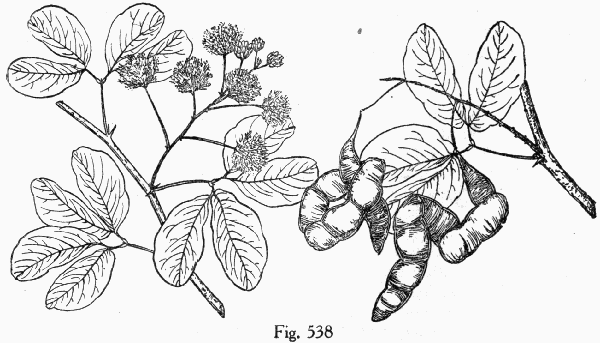
Leaves persistent, long-petiolate, with a single pair of bifoliolate pinnæ and a slender petiole ½′—1′ long and slightly and abruptly enlarged at base; rachis glandular between [587] the short stout petiolules and between the orbicular or broad-oblong leaflets, rounded and rarely emarginate at apex, rounded on one side and cuneate on the other of the oblique base, entire, thin or somewhat coriaceous, reticulate-veined, bright green and lustrous on the upper surface and paler on the lower surface, ½′—2′ long, and ½′—1½′ wide. Flowers polygamous, pale yellow, glabrous or slightly puberulous, opening in Florida in March and continuing to appear until midsummer, in globular heads on slender peduncles 1′—1½′ long fascicled in the axils of upper leaves or collected in ample terminal panicles, their bracts lanceolate, acuminate, chartaceous, ¼′ long, caducous; calyx rather less than 1/12′ long, broadly toothed, one quarter as long as the acuminate petals barely exceeding the tube formed by the union of the filaments; stamens purple, ½′ long; ovary glabrous, long-stalked, minute or rudimentary in the sterile flower. Fruit slightly torulose, stipitate, rounded or acute at apex, 2′—4′ long, ¼′—½′ wide, the valves reticulate-veined, thickened on the margins, bright reddish brown and after opening greatly and variously contorted; seeds irregularly obovoid or sometimes nearly triangular, compressed or thickened, dark chestnut-brown, lustrous, marked by faint oval rings, ⅓′ long, surrounded at base by the enlarged bright red ariloid funicle; seed-coat thin, cartilaginous.
A tree, sometimes 20°—25° high, with a slender trunk 7′—8′ in diameter, ascending and spreading branches forming a low flat irregular head, and slender somewhat zigzag branchlets slightly striately angled when they first appear, becoming terete, light gray-brown or dark reddish brown, covered with minute pale lenticels, and armed with the straight persistent rigid stipular spines broad at base and ¼′ long, or rarely minute; more often a shrub, with many vine-like almost prostrate stems. Bark of the trunk ¼′ thick, reddish brown and divided by shallow fissures into small square plates. Wood very heavy, hard, close-grained, rich red varying to purple, with thin clear yellow sapwood. The bark is astringent and diuretic, and was once used in Jamaica as a cure for many diseases.
Distribution. Florida, Captive and Sanibel Islands and Caloosa, Lee County to the southern keys; most abundant in its arborescent form on the larger of the eastern keys, and probably of its largest size in Florida on Elliott’s Key; often forming shrubby thickets; on the Bahamas, and common and widely distributed through the Antilles to Venezuela and New Granada.
2. Pithecolobium brevifolium Benth. Huajillo.
Zygia brevifolia Sudw.
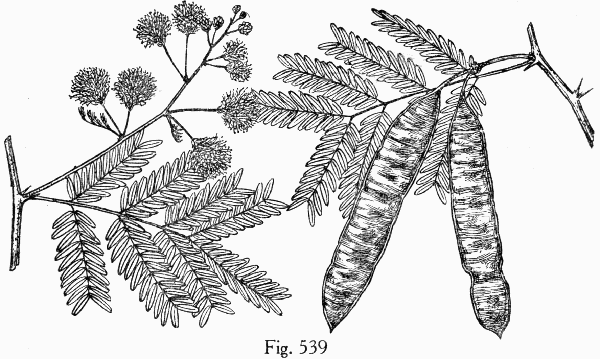
Leaves 2′—3′ long, 2′ wide, with eight to ten 10—20-foliolate pinnæ and slender terete petioles 1′ in length and furnished near the middle with a dark oblong gland, when they [588] unfold coated with pale tomentum and at maturity glabrous with the exception of the puberulous petiole and rachis; persistent or tardily deciduous; leaflets oblong-linear, obtuse or acute at apex, oblique at base, very short-petiolulate, light green on the upper surface, paler on the lower surface, ⅙′—¼′ long. Flowers white to violet-yellow, in globose or oblong heads ½′ in diameter, on thin pubescent peduncles bracteolate at apex, coated at first, like the flower-buds, with thick white tomentum, developed usually in pairs from the axils of lanceolate acute scarious deciduous bracts, and arranged in short terminal racemes; calyx shortly 5-lobed, puberulous on the outer surface, about 1/24′ long and one fourth the length of the puberulous petals persistent with the stamens at the base of the mature legume; stamens nearly ½′ long. Fruit ripening at midsummer and often persistent on the branches after opening until the trees flower the following year, straight, slightly torulose, short-stalked, contracted at apex into a short slender point, 4′—6′ long and ⅔′ wide, its valves thin, thick-margined, reddish brown on the outer surface, yellow tinged with red on the inner surface, reticulate-veined; seeds suspended by a slender coiled and somewhat dilated funicle, compressed, ovoid to nearly orbicular, dark chestnut-brown, very lustrous, ¼′ long, and faintly marked by large oval depressions; seed-coat thin, cartilaginous.
A tree, 25°—30° high, with a trunk rarely 5′—6′ in diameter, slender upright branches forming a narrow irregular head, and branchlets slightly striately angled, covered with minute white lenticels, light gray and puberulous when they first appear, becoming dark brown in their second year, and armed with stout rigid stipular spines sometimes ½′ long and persistent for many years; more often a shrub, sometimes only 2°—3° tall. Bark of the trunk smooth, light gray somewhat tinged with red, and often marked by large pale blotches. Wood dark-colored, hard, and heavy.
Distribution. Bluffs and bottom-lands of the lower Rio Grande, and on the upper Nueces River in Uvalde County, Texas; usually a low shrub spreading into broad clumps, but occasionally in the rich and comparatively moist soil of the banks of river-lagoons a slender tree; in Mexico more abundant, and of its largest size from the mouth of the Rio Grande to the Sierra Madre of Nuevo Leon.
3. Pithecolobium flexicaule Coult. Ebony.
Zygia flexicaulis Sudw.
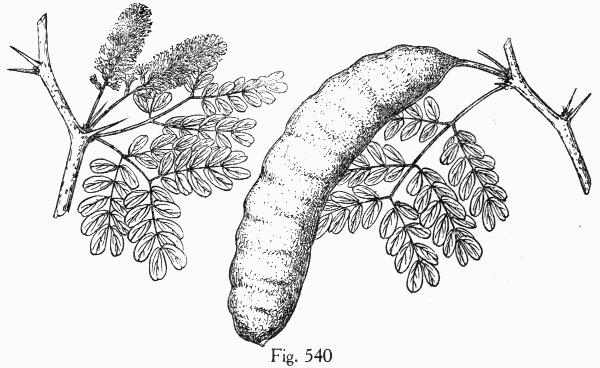
Leaves persistent, 1½′—2′ long, 2½′—3′ wide, long-petiolate with slender puberulous petioles glandular near the middle and furnished at apex with small orbicular solitary glands, and 4—6 usually 6-foliolate pinnæ, the lowest pair often the shortest; leaflets [589] oblong-ovate, rounded at apex, reticulate-veined, thin or subcoriaceous, glabrous, dark green and lustrous on the upper surface, paler on the lower surface, ¼′—⅓′ long; petiolules short and broad. Flowers light yellow or cream color, very fragrant, sessile in the axils of minute caducous bracts, appearing from June until August, in cylindric dense or interrupted spikes 1½′ long, on stout pubescent peduncles fascicled in the axils of the upper leaves of the previous year; corolla four or five times as long as the calyx and like it puberulous on the outer surface, and about as long as the tube formed by the union of the filaments; stamens ⅛′ long; ovary glabrous, sessile. Fruit ripening in the autumn and remaining on the branches until after the flowering season of the following year, sessile, tardily dehiscent, thick, straight or slightly falcate, oblique at base, rounded and contracted into a short broad point at apex, pubescent, 4′—6′ long and 1′—1¼′ wide, with thick woody valves lined with a thick pithy substance inclosing and separating the seeds; seeds suspended on a very short straight funicle, bright red-brown, ½′ long and ¼′ wide, irregularly obovoid, faintly marked by short oblong depressions; seed-coat thick, crustaceous.
A tree, 20°—30° high, with a straight trunk 2°—3° in diameter, separating 8°—10° from the ground into short spreading branches forming a wide round head, and stout zigzag branchlets, puberulous, light green or dark reddish brown when they first appear, becoming in their second year glabrous or rarely puberulous, dark reddish brown or light gray, and armed with the persistent stipular pale chestnut-brown spines ¼′—½′ long. Wood exceedingly heavy, hard, compact, close-grained, dark rich red-brown slightly tinged with purple, with thin clear bright yellow sapwood; almost indestructible in contact with the ground and largely used for fence-posts; valued by cabinet-makers and for fuel, and considered more valuable than that of any other tree of the lower Rio Grande valley. The seeds are palatable and nutritious, and are boiled when green or roasted when ripe by the Mexicans, who use their thick shells as a substitute for coffee.
Distribution. Shores of Matagorda Bay, Texas, to the Sierra Nevada of Nuevo Leon, and in Lower California; common on the bluffs of the Gulf-coast and on both banks of the lower Rio Grande; south of the Rio Grande one of the commonest and most beautiful trees of the region.
2. LYSILOMA Benth.
Trees or shrubs, with slender unarmed branchlets, abruptly bipinnate long-petiolate persistent leaves, their petioles marked by large conspicuous glands, and small leaflets in many pairs; stipules large, membranaceous, persistent or deciduous. Flowers perfect [590] or rarely polygamous, minute, usually white or greenish white, from the axils of minute bractlets more or less dilated at apex, in globose many-flowered heads, on axillary solitary or fascicled peduncles; calyx campanulate, 5-toothed; corolla funnel-shaped, of 5 petals united for more than half their length; stamens generally 12—30, exserted; filaments filiform, united at base into a tube free from the corolla; anthers minute, ovoid, versatile; ovary sessile, contracted into a slender subulate style, with a minute terminal stigma. Legume broad, straight, compressed, submembranaceous, the valves at maturity separating from the undivided margins, continuous within, their outer layer thin and papery, dark-colored, the inner rather thicker, pale yellow. Seeds compressed, transverse, suspended by a long slender funicle, the hilum near the base; seed-coat thin, crustaceous; radicle slightly exserted.
Lysiloma with about ten species inhabits tropical America from southern Florida and the Bahama Islands, the West Indies, Mexico and Lower California, to Central America and Bolivia. Several of the species produce valuable timber.
The generic name, from λύσις and λῶμα, refers to the separation of the valves from the margins of the legume.
1. Lysiloma bahamensis Benth. Wild Tamarind.
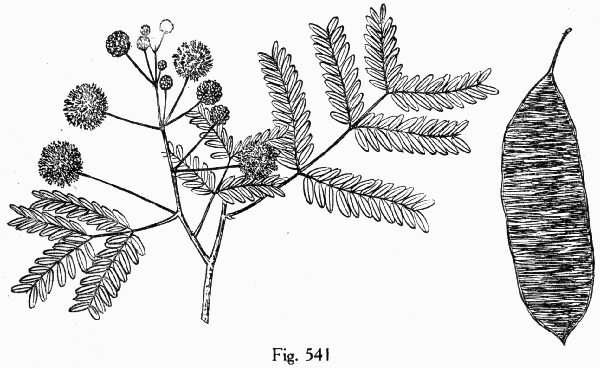
Leaves 4′—5′ long, glabrous or sometimes slightly puberulous, with slender petioles 1′ long, marked near the middle with an elevated gland, enlarged and slightly glandular at base, and 2—6 pairs of short-stalked 40—80-foliolate pinnæ; stipules foliaceous, ovate or ovate-oblong, acuminate, auriculate and semicordate at base, ½′ long, usually caducous; leaflets obliquely ovate or oblong, obtuse or acute, more or less united at base by the greater development of one of the sides, sessile or short-petiolulate, entire, reticulate-veined, light green, paler on the lower than on the upper surface, ¼′—½′ long, and ⅛′—¼′ wide. Flowers about ⅓′ long, in heads appearing in Florida early in April, coated before the flowers open with thick pale tomentum, and after the exsertion of the stamens ⅔′ in diameter, on peduncles ¾′—1½′ long, solitary or fascicled in the axils of upper leaves, their bracts and bractlets acute, membranaceous, caducous; calyx 5-toothed, pilose on the outer surface, especially above the middle, 1/12′ long, and half as long as the 5-lobed corolla with reflexed lobes; stamens about 20, twice as long as the corolla, united for one fourth of their length into a slender tube. Fruit ripening in the autumn and persistent on the branches until after the flowering period of the following year, stipitate, gradually narrowed and acute at the ends, 4′—5′ long, 1′ broad, with a slender stem 1′—2′ [591] long, in clusters of 2 or 3 on short peduncles abruptly and conspicuously enlarged at the apex; valves thin and papery, bronze-green when fully grown, becoming dark red-brown, separating slowly from the margins; seeds oval or obovoid, dark brown, lustrous, ½′ long.
A tree, 50°—60° high, with a trunk 2°—3° in diameter, stout spreading branches forming a wide flat head, and glabrous or somewhat pilose conspicuously verrucose branchlets, bright red-brown when they first appear, becoming pale or light reddish brown in their second year. Bark of the trunk of young trees and of the branches smooth, light gray tinged with pink, becoming on old trunks ¼′—½′ thick, dark brown and separating into large plate-like scales. Wood heavy, hard, not strong, tough, close-grained, rich dark brown tinged with red, with nearly white sapwood 1′—1½′ thick, of 4 or 5 layers of annual growth; in Florida occasionally used and valued for boat and shipbuilding.
Distribution. Florida; shores of Bay Biscayne near Miami, and the Everglade Keys, Dade County, common, and on Key Largo, Elliott’s, Plantation, and Boca Chica Keys, not common; on the Bahama Islands and in Cuba.
3. ACACIA Adans.
Trees or shrubs, with slender branches armed with spinescent stipules or infrastipular spines. Leaves alternate on young branchlets and fascicled in earlier axils, bipinnate, with usually small leaflets, persistent. Flowers perfect or polygamous, small, in the axils of minute linear bractlets more or less dilated and often peltate at apex, in globose heads or cylindric spikes on axillary solitary or fascicled peduncles; calyx campanulate, 5 or 6-toothed; petals as many as the divisions of the calyx, more or less united; stamens numerous, usually more than 50, exserted, free or slightly and irregularly united at base, inserted under or just above the base of the ovary; filaments filiform; anthers small, attached on the back, versatile; ovary contracted into a long slender style terminating in a minute stigma. Legume nearly cylindric or flat, indehiscent, continuous or divided within. Seeds transverse, compressed; seed-coat thick, crustaceous, marked on each face of the seed by an oval depression or ring; radicle straight, included, or slightly exserted.
Acacia with more than four hundred species is widely distributed through Australia, where it is most largely represented, tropical and southern Africa, northern Africa, southwestern China, the warmer regions of southern Asia, the islands of the south Pacific, tropical and temperate South America, the West Indies, Central America and Mexico to the southwestern boundaries of the United States where ten or twelve species occur; of these five are arborescent. Acacia is astringent, and many species yield valuable tan bark. Gum arabic is produced by different Old World species; many of the species yield hard heavy durable wood, and some of the Australian Acacias are large and valuable timber-trees. Many species are cultivated for their graceful foliage and handsome fragrant flowers.
The generic name, from ἀκακία, relates to the spines with which the branches are usually armed.
CONSPECTUS OF THE ARBORESCENT SPECIES OF THE UNITED STATES.
Flowers in globose heads; corolla 5-lobed; ovary sessile; stipules persistent, becoming spines.
Legume cylindric, glabrous, its sutures conspicuously thickened and grooved; seeds in 2 ranks.
1. A. Farnesiana (E).
Legume flattened, pubescent, its sutures not thickened, slightly grooved; seeds in 1 rank.
2. A. tortuosa (E).
Flowers in short, often interrupted, spikes; legume flattened, pubescent, its sutures thickened; seeds in one rank.
3. A. Emoriana (E).
Flowers in elongated slender spikes; corolla of 5 petals only slightly united at base; ovary stalked; stipules caducous; branchlets armed with infrastipular spines.
[592]
Legume 1′—1¼′ wide, straight or slightly contracted between the seeds, not becoming twisted and contorted at maturity; seeds narrow-obovoid or ovoid; leaflets green, glabrous, with prominent veinlets.
4. A. Wrightii (E).
Legume ½′—¾′ wide, often conspicuously contracted between the seeds, becoming twisted and contorted at maturity; seeds nearly orbicular; leaflets blue-green, pubescent, with obscure veinlets.
5. A. Greggii (E, G, H).
1. Acacia Farnesiana Willd. Huisache. Cassie.
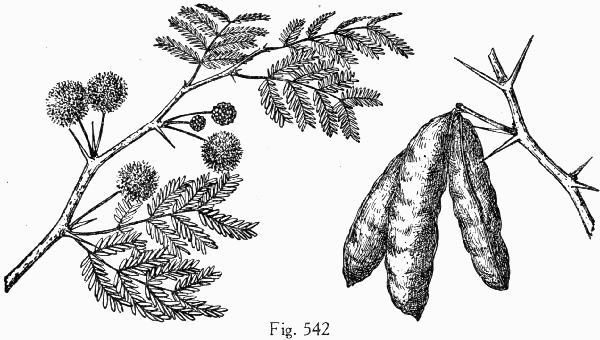
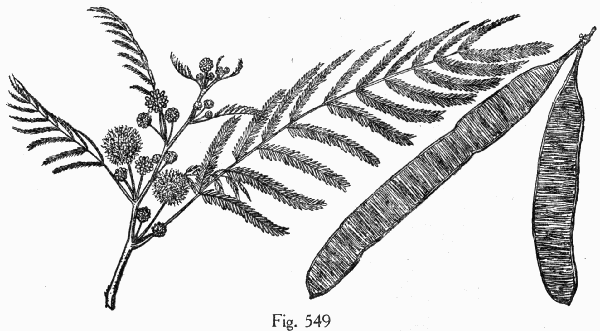
Leaves 2′—4′ long, with 2—8, usually 4 or 5, pairs of pinnæ, generally somewhat puberulous on the short petiole and rachis; in Texas mostly falling at the beginning of winter; pinnæ sessile or short-stalked, remote or close together, with 10—25 pairs of linear acute leaflets tipped with a minute point, unequal at base, sessile or short-petiolulate, glabrous or puberulous, bright green, ⅛′—¼′ long. Flowers bright yellow, very fragrant, 1/16′ long, opening during the summer and autumn from the axils of minute clavate pilose bractlets, in heads ⅔′ in diameter, on axillary thin puberulous peduncles, solitary or most often 2 or 3 together and 1′—1½′ in length, with two minute dentate connate bracts forming an involucral cup immediately under the flower-head; calyx about half as long as the petals and like them somewhat pilose on the outer surface; stamens two or three times as long as the corolla; ovary short-stipitate, covered with long pale hairs. Fruit oblong, cylindric or spindle-shaped, thick, turgid, straight or curved, slightly contracted between the seeds, short-stalked, narrowed at apex into a short thick point, 2′—3′ long, ½′—⅔′ broad, dark red-purple, lustrous, and marked by broad light-colored bands along the thickened grooved sutures, the outer coat of the walls thin and papery, inclosing a thick pithy pulp-like substance surrounding the seeds, each in a separate thin-walled compartment; seeds ovoid, thick, flattened on the inner surface by mutual pressure, ¼′ long, suspended transversely in 2 ranks on a short straight funicle, light brown, lustrous, and faintly marked by large oval rings.
A tree, 20°—30° high, with a straight trunk 12′—18′ in diameter, separating 6°—8° from the ground into numerous long pendulous branches forming a wide round spreading head, and slender terete or slightly striate angled branchlets, glabrous or at first puberulous, and armed with straight rigid terete spines developed from the persistent stipules and sometimes 1½′ long. Bark of the trunk thin, reddish brown, irregularly broken by long reticulated ridges, exfoliating in large thin scales. Wood heavy, hard, close-grained, rich reddish brown, with thin pale sapwood; in India used for the knees of small vessels and in agricultural implements.
[593]
Distribution. Now widely spread by cultivation through the tropical and subtropical regions of the two worlds and probably a native of America from western Texas to northern Chile; growing in Texas apparently naturally in the arid and almost uninhabited region between the Nueces and Rio Grande; naturalized and now covering great areas in the valley of the Guadalupe River near Victoria, Victoria County, Texas.
Largely cultivated in southern Europe for its fragrant flowers used in the manufacture of perfumery, as an ornament of gardens in all warm countries, and in India as a hedge plant.
2. Acacia tortuosa Willd.
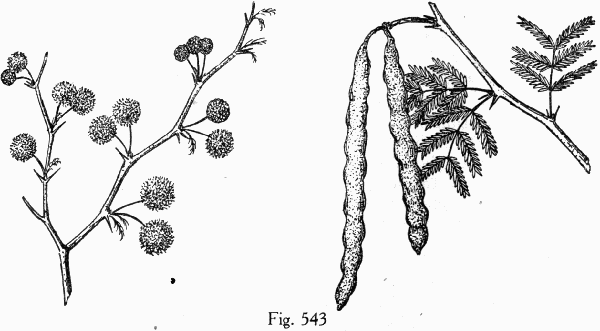
Leaves generally less than 1′ long, short-petiolate, with a slender puberulous rachis and usually 3 or 4 pairs of pinnæ; early deciduous; pinnæ sessile or short-stalked, remote, with 10—15 pairs of linear somewhat falcate leaflets, acute, tipped with a minute point, subsessile, light green, glabrous, 1/20′—1/16′ long. Flowers minute, bright yellow, very fragrant, in the axils of clavate pilose bracts, in heads ¼′—⅜′ in diameter, appearing in March with or just before the unfolding leaves, on clustered or solitary slender puberulous peduncles ½′—¾′ long, and furnished at apex with 2 minute connate bracts; calyx only about one third as long as the corolla, with short puberulous lobes; corolla puberulous at apex, less than half as long as the filaments; ovary covered with short close pubescence. Fruit elongated, linear, slightly compressed, somewhat constricted between the seeds, dark red-brown and cinereo-puberulous, 3′—5′ long and about ¼′ wide; seeds in 1 series, obovoid, compressed, dark red-brown, lustrous, about ¼′ long, faintly marked by large oval rings.
A tree, occasionally 15°—20° high, with a straight trunk 5′—6′ in diameter, stout wide-spreading branches forming an open irregular head, and slender somewhat zigzag slightly angled reddish brown branchlets roughened by numerous minute round lenticels, villose with short pale hairs, and armed with thin terete puberulous spines occasionally ¾′ long; in Texas usually shrubby, with numerous stems forming a symmetric round-topped bush only a few feet high. Bark dark brown or nearly black, and deeply furrowed.
Distribution. Valley of the Rio Cibolo to Eagle Pass on the Rio Grande, Maverick County, Texas; and in northern and southern Mexico, the West Indies, Venezuela, and on the Galapagos Islands; in Texas probably arborescent only on the plains of the Rio Grande near Spofford, Kinney County.
3. Acacia Emoriana Benth.
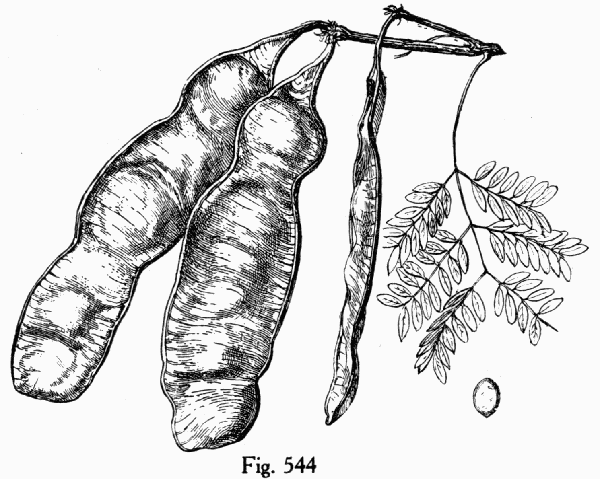
Leaves 3½′—4′ long, with a slender petiole and rachis, villose-pubescent early in the season, becoming nearly glabrous; and 4 or 5 pairs of pinnæ; falling late in the autumn; [594] pinnæ on slender stalks ¼′ in length, with 5—7 pairs of oblong leaflets rounded and apiculate at apex, obliquely rounded at base, short-petiolulate, pointing forward, when they unfold densely villose above and on the margins, and hoary-tomentose below, becoming glabrous, gray-green rather darker above than below, ⅓′ long. Flowers subsessile, puberulous, in interrupted spikes, ¾′—1′ in length, densely hoary-tomentose when they first appear late in March, on villose peduncles ½′—1′ in length, and furnished near the apex with lanceolate caducous bracts; calyx about half the length of the ovate acute petals ciliate on the margins, about 1/12′ long and much shorter than the stamens; ovary stipitate, glabrous. Fruit fully grown in July, stipitate much compressed, rounded and sometimes slightly emarginate at apex, gradually narrowed and obliquely cuneate at base, with much thickened revolute undulate margins, densely pubescent early in the season, becoming puberulous, 5′ or 6′ long, 1¼′—1½′ wide and many-seeded, or nearly orbicular and 1 or 2-seeded; seeds in one series, oval, the two sides unsymmetric, obliquely pointed at base, rounded at apex, compressed, dark chestnut-brown and lustrous, ½′ long and ¼′ wide.
A tree, sometimes 25° high, usually smaller, with slender red-brown branchlets pubescent or puberulous when they first appear, becoming glabrous in their second year, and armed with small curved stipular spines; often a shrub.
Distribution. Texas; creek banks and cañons, near Montell and Uvalde, Uvalde County, and rocky banks of Devil’s River, Valverde County (E. J. Palmer).
4. Acacia Wrightii Benth. Cat’s Claw.
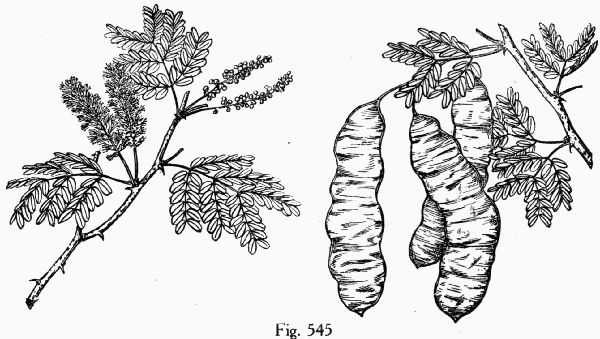
Leaves 1′—2′ long, slightly pubescent, especially on the petiole and rachis, with 1—3 pairs of pinnæ, slender petioles 1⅓′ in length, and eglandular or glandular with small convex glands, and linear acute caducous stipules 1/16′ long; pinnæ short-stalked, with 2—5 pairs of obovate-oblong leaflets, obliquely rounded and often apiculate at apex, sessile or short-petiolulate, 2 or sometimes 3-nerved, glabrous, or rarely pubescent, reticulate-veined, rigid, bright green and rather paler on the lower surface than on the upper surface, ¼′—⅚′ long. Flowers light yellow, fragrant, appearing from the end of March to the end of May, on slender pubescent pedicels from the axils of minute caducous bracts, in narrow spikes 1½′ long, often interrupted below the middle, on slender fascicled pubescent or sometimes glabrous peduncles; calyx obscurely 5-lobed, pubescent on the outer surface, half as long as the spatulate petals slightly united at base, and ciliate on the margins; stamens ¼′ long; ovary long-stalked, covered with long pale hairs. Fruit fully grown [595] early in the summer, deciduous in the autumn, slightly falcate, compressed, stipitate, oblique at base, rounded and short-pointed at apex, 2′—4′ long, 1′—1¼′ wide, with thick straight or irregularly contracted margins and thin papery walls conspicuously marked by narrow horizontal reticulate veins; seeds narrow-obovoid, compressed, ¼′ long, suspended transversely on a long slender funicle, light brown, marked by large oval depressions.
A tree, occasionally 25°—30° high, with a short trunk 10′—12′ in diameter, spreading branches forming a low wide or irregular head, and branchlets when they first appear somewhat striately angled, glabrous, pale yellow-brown or dark red-brown, turning pale gray in their second year, and armed with occasional stout recurved infrastipular chestnut-brown spines ¼′ long, compressed toward the broad base and sharp-pointed, or rarely unarmed. Bark of the trunk about ⅛′ thick, divided by shallow furrows into broad ridges separating on the surface into thin narrow scales. Wood very heavy, hard, close-grained, bright clear brown streaked with red and yellow, with thin clear yellow sapwood of 6 or 7 layers of annual growth; valued and largely used as fuel.
Distribution. Valley of the Guadalupe River in the neighborhood of New Braunfels, Comal County, Texas, to the Sierra Madre of Nuevo Leon; most abundant and of its largest size south of the Rio Grande on dry gravelly mesas and foothills.
5. Acacia Greggii A. Gray. Cat’s Claw. Una de Gato.
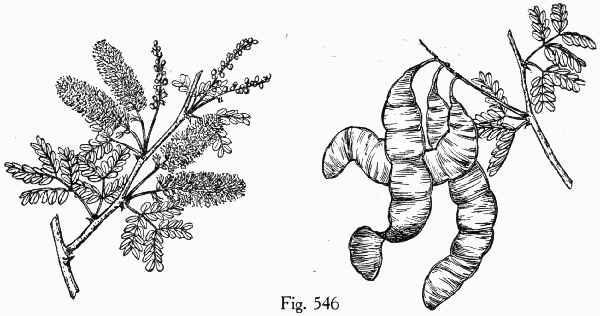
Leaves 1′—3′ long, pubescent or puberulous, with 1—3 pairs of pinnæ, a short slender petiole furnished near the middle with a minute oblong chestnut-brown gland, and linear caducous stipules 1/16′ long; pinnæ short-stalked, with 4—5 pairs of obovate oblique leaflets rounded or truncate at apex and unequally contracted at base into a short petiolule, thick and rigid, 2—3-nerved, inconspicuously reticulate-veined, hoary-pubescent, 1/16′—¼′ long. Flowers fragrant, bright creamy yellow, in dense oblong pubescent spikes, on a peduncle ½′—⅔′ long, and fascicled usually 2 or 3 together toward the end of the branches; calyx obscurely 5-lobed, puberulous on the outer surface, half as long as the petals slightly united at base and pale-tomentose on the margins; stamens ¼′ long; ovary long-stalked, covered with long pale hairs. Fruit fully grown at midsummer and hanging unopened on the branches until winter or the following spring, compressed, straight or slightly falcate, obliquely narrowed at base into a short stalk, acute or rounded at apex, more or less contracted between the seeds, 2′—4′ long, ½′—¾′ wide, curling and often contorted when fully ripe, the valves thin and membranaceous, thick-margined, light brown, conspicuously transversely reticulate-veined; seeds nearly orbicular, compressed, dark brown and lustrous, ¼′ in diameter, marked by small oval depressions.
[596]
A tree, rarely 30° high, with a trunk 10′—12′ in diameter, numerous spreading branches, and striately angled puberulous or in Texas glabrous pale brown branchlets faintly tinged with red and armed with stout recurved infrastipular spines flat at base, and ¼′ long and broad. Bark of the trunk about ⅛′ thick, furrowed, the surface separating into thin narrow scales. Wood heavy, very hard, strong, close-grained, durable, rich brown or red, with thin light yellow sapwood of 5 or 6 layers of annual growth.
Distribution. Dry gravelly mesas, the sides of low cañons and the banks of mountain streams; valley of the Rio Grande, western Texas, through southern New Mexico and Arizona to southern California, ranging northward in Arizona to the rim of the Grand Cañon of the Colorado River, and to Clark County, Nevada; in northern Mexico, and in Lower California to the eastern base of the San Pedro Mártir Mountains.
4. LEUCÆNA Benth.
Trees or shrubs, with slender unarmed branches. Leaves persistent, abruptly bipinnate, with numerous pinnæ and small leaflets in many pairs, petiolate, the petioles often furnished with a conspicuous gland below the lower pair of pinnæ; stipules minute and caducous, or becoming spinescent and persistent. Flowers minute, white, mostly perfect, sessile or short-pedicellate, in the axils of small peltate bracts villose at apex, in globose many-flowered pedunculate heads, the peduncles in axillary fascicles or in leafless terminal racemes; calyx tubular-campanulate, minutely 5-toothed; petals 5, free, acute or rounded at apex, narrowed at base; stamens 10, free, inserted under the ovary, exserted; filaments filiform; anthers oblong, versatile; ovary stipitate, contracted into a long slender style, with a minute terminal slightly dilated stigma. Legume many-seeded, stipitate, linear, compressed, dehiscent, the valves thickened on the margins, rigid, thin, continuous within, their outer coat thin and papery, dark-colored, the inner rather thicker, woody, pale brown. Seeds obovoid, compressed, transverse, the hilum near the base, suspended on a long slender funicle; seed-coat thin, crustaceous, brown and lustrous; embryo inclosed on its two sides by a thin layer of horny albumen; radicle slightly exserted.
Leucæna with nine or ten species is confined to the warmer parts of America from western Texas to Venezuela and Peru, and to the islands of the Pacific Ocean from New Caledonia to Tahiti, where one species has been recognized. Of the indigenous species found in the territory of the United States, three are arborescent. Leucæna glauca L., a small tree or shrub, cultivated in all warm countries, and a native probably of tropical America, is now naturalized on Key West, Florida.
The generic name, from λευχαίνω, refers to the color of the flowers.
[597]
CONSPECTUS OF THE NORTH AMERICAN SPECIES.
Peduncles bibracteolate at apex; stipules becoming spinescent.
Leaves 10—14-pinnate; pinnæ with 15—30 pairs of leaflets; blade of the bract of the flower produced into a short point.
1. L. Greggii (E).
Leaves 2—4-pinnate; pinnæ with 4—8 pairs of leaflets; blade of the bract of the flower produced into a long slender villose tip.
2. L. retusa (E).
Peduncles without bracts; stipules minute, caducous; leaves 30—36-pinnate; pinnæ with 30—60 pairs of leaflets.
3. L. pulverulenta (E).
1. Leucæna Greggii S. Wats.
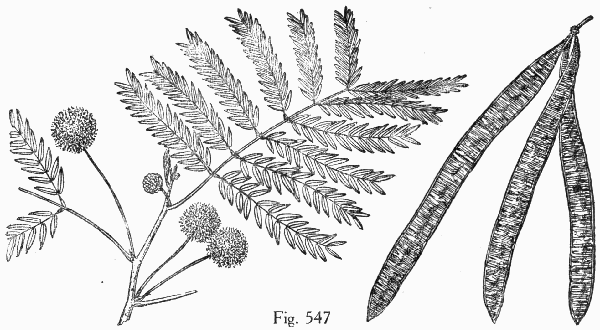
Leaves 6′—7′ long and broad, with a slender rachis furnished on the upper side with a single elongated bottle-shaped gland between the stalks of each pair of pinnæ; pinnæ 10—14, remote, short-stalked, with 15—30 pairs of leaflets; stipules gradually narrowed into a long slender point, becoming rigid and spinescent, ⅓′ to nearly ½′ long and persistent for two or three years; leaflets lanceolate, acute or acuminate, often somewhat falcate, nearly sessile or short-petiolulate, full and rounded toward the base on the lower margin, nearly straight on the upper margin, gray-green, ultimately nearly glabrous, ¼′—⅓′ long, about ⅛′ wide, with a narrow midvein and obscure lateral nerves. Flowers on slender pedicels, in heads ¾′—1′ in diameter, on stout peduncles 2′—3′ long furnished at apex with 2 irregularly 3-lobed bracts, and solitary or in pairs; calyx coated with hairs only near the apex, much shorter than the spatulate glabrous more or less boat-shaped petals; ovary villose with a few short scattered hairs. Fruit 6′-8′ long, ⅓′—½′ wide, narrowed below into a short stout stipe, acuminate and crowned at apex with the thickened style, ⅓′—¾′ long, cinereo-pubescent until nearly fully grown, becoming nearly glabrous at maturity, much compressed, with narrow wing-like margins; seeds conspicuously notched by the hilum, ½′ long and ⅓′ wide.
A tree, 15°-20° high, with a stem 4′—5′ in diameter, and stout zigzag red-brown branchlets marked by numerous pale lenticels, coated at first with short spreading lustrous yellow deciduous hairs found also on the young petioles and lower surface of the unfolding leaflets, the peduncles of the flower-heads and their bracts. Bark about ⅜′ thick, dark brown, divided into low ridges and broken on the surface into small closely appressed persistent scales. Wood heavy, hard, close-grained, rich brown streaked with red, with thin clear sapwood.
Distribution. Mountain ravines and the steep banks of streams; western Texas from the valley of the upper San Saba River to that of Devil’s River; and southward into Mexico.
[598]
2. Leucæna retusa Benth.
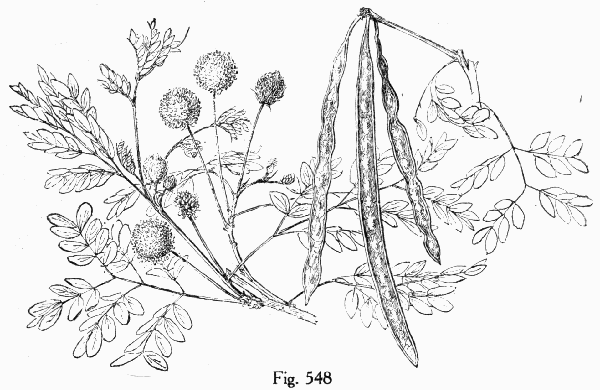
Leaves 3′ or 4′ long and 4′ or 5′ wide, with a slender petiole and rachis and 2-4 pairs of pinnæ 6′-10′ long, remote, long-stalked, with 4-8 pairs of short-stalked leaflets furnished between their stems with a single globose white gland found also occasionally on the upper side of the rachis between the stems of the pinnæ; stipules ovate, gradually narrowed into a long slender tip, ½′ in length, often persistent through the season; leaflets obliquely obovate or elliptic, rounded and apiculate at apex, obliquely rounded or cuneate at the unsymmetric base, entire, short-petiolulate, villose-pubescent like the rachis and petiole when they first appear, soon, glabrous, and at maturity thin, blue-green, ¾′—1′ long and ⅓′—½′ wide, with a slender midrib, and prominent veins extending obliquely toward the apex of the leaflet, those of the lowest pair more prominent and starting from near its base. Flowers short-stalked in the axil of a peltate bract, its blade produced into a long slender villose tip, appearing continuously from April until October in dense globose heads ¾′ in diameter, on villose bibracteolate axillary, single or fascicled peduncles 1½′—3′ in length; calyx thin, tubular, 5-toothed at apex; petals narrow-oblong, hardly longer than the calyx; stamens 10, shorter than the bract of the flower; anthers glabrous. Fruit solitary or clustered, on a puberulous peduncle 3′-5′ in length, 6′-10′ long, ⅓′—½′ wide, gradually narrowed below into a stout stipe, the acuminate apex terminating in the thickened persistent style, glabrous and dark reddish brown; seeds ⅓′ long and ¼′ wide.
A tree, occasionally 25° high, with a trunk 6′-8′ in diameter, and slender branchlets pubescent when they first appear, becoming puberulous and orange-brown or reddish brown at the end of their first season; more often a shrub.
Distribution. Texas; steep rocky hillsides, and on the summits of limestone bluffs; (Uvalde, Valverde, Kemble, Real and Jeff Davis Counties).
3. Leucæna pulverulenta Benth. Mimosa.
Leaves 4′-7′ long and 3′-4′ wide, with a slender petiole usually marked by a large dark oblong gland between the somewhat enlarged base and the lowest pair of the 30-36 nearly sessile crowded pinnæ, each with 30-60 pairs of leaflets, and minute caducous stipules, when they unfold covered like the peduncles and flower-buds with dense hoary tomentum, and at maturity puberulous on the petiole and rachis; leaflets linear, acute, rather oblique at base by the greater development of the upper side, sessile or very [599] short-petiolulate, pale bright green, ⅙′—¼′ long. Flowers sessile, fragrant, in heads ½′ in diameter, appearing in succession as the branches grow from early spring to midsummer, on slender peduncles 1′—1½′ long and fascicled in the axils of upper leaves; calyx one fourth as long as the acute petals and like them pilose on the outer surface; stamens twice as long as the petals; ovary coated with long pale hairs. Fruit conspicuously thick-margined, 4′-14′ long, long-stalked, tipped with a short straight or recurved point, usually in pairs on a peduncle thickened at apex; seeds 5/16′ long.
A tree, 50°-60° high, with a straight trunk 18′-20′ in diameter, separating 20°-30° from the ground into slender spreading branches forming a loose round head, and branchlets at first more or less striately grooved and thickly coated with pulverulent caducous tomentum, becoming at the end of a few weeks terete, pale cinnamon-brown and puberulous. Bark about ¼′ thick, bright cinnamon-brown, and roughened by thick persistent scales. Wood heavy, hard, very close-grained, rich dark brown, with thin clear yellow sapwood of 2 or 3 layers of annual growth; considered valuable, and sometimes manufactured into lumber.
Distribution. Rich moist soil of river banks and the borders of lagoons and small streams; valley of the lower Rio Grande; in Texas only for a few miles near its mouth; more abundant from Matamoras to Monterey in Nuevo Leon; and southward to the neighborhood of the City of Mexico.
Occasionally planted as a shade and ornamental tree in the towns of the lower Rio Grande valley and in New Orleans, Louisiana.
5. PROSOPIS L. Mesquite.
Trees or shrubs, with branches without a terminal bud and armed with geminate supra-axillary persistent spines, and small obtuse axillary buds covered with acute apiculate dark brown scales. Leaves alternate on branches of the year and fascicled in earlier axils, deciduous, usually 2 rarely 3-4-pinnate, with many-foliolate pinnæ; petioles glandular at apex with a minute gland, and tipped with the small spinescent rachis; stipules linear, membranaceous or spinescent, deciduous. Flowers greenish white, nearly sessile, in axillary pedunculate spikes; calyx campanulate, 5-toothed, or slightly 5-lobed, deciduous; petals 5, connate below the middle or ultimately free, glabrous or tomentose on the inner surface toward the apex, sometimes puberulous on the outer surface; stamens 10, free, inserted with the petals on the margin of a minute disk adnate to the calyx-tube, those opposite the lobes of the calyx rather longer than the others; filaments filiform; anthers oblong, versatile, their connective tipped with a minute deciduous gland, the cells [600] opening by marginal sutures; ovary stipitate, villose; style filiform, with a minute terminal stigma. Legume linear, compressed, or subterete, straight or falcate, or contorted or twisted into a more or less regular spiral, indehiscent; the outer coat thin, woody, pale yellow, inclosing a thick spongy inner coat of sweet pulp containing the seeds placed obliquely and separately inclosed, their envelopes forming nut-like joints. Seeds oblong, compressed, the hilum near the base; seed-coat crustaceous, light brown, lustrous; embryo surrounded by a layer of horny albumen; radicle short, slightly exserted.
Prosopis is distributed in the New World from southern Kansas to Patagonia, and in the Old World is confined to tropical Africa, and to southwestern and tropical Asia. Sixteen or seventeen species have been distinguished. Of the three species found in the territory of the United States two are small trees.
Prosopis produces hard durable wood, particularly valuable as fuel, and the pods are used as fodder.
The generic name is from προσωπίς, employed by Dioscorides as a name of the Burdock.
CONSPECTUS OF THE NORTH AMERICAN ARBORESCENT SPECIES.
Legume compressed or ultimately convex; pinnæ 12—22-foliolate.
1. P. juliflora (C, E, G, H).
Legume thick, spirally twisted; pinnæ 10—16-foliolate.
2. P. pubescens (E, F, G, H).
1. Prosopis juliflora DC. Mesquite. Honey Locust.
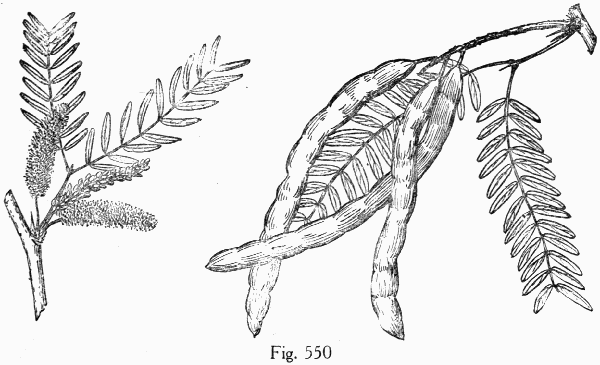
Leaves with 2 or rarely 4 pinnæ, and slender terete petioles abruptly enlarged and glandular at base; stipules linear, acute, membranaceous, deciduous. Flowers appearing in successive crops from May to the middle of July, fragrant, about 1/12′ long, on short pedicels, in slender cylindric spikes 1½′—4′ long, on stout peduncles ½′—¾′ in length; calyx glabrous or puberulous, about one fourth as long as the narrowly oblong acute petals, glabrous or puberulous on the outer surface and covered on the inner surface toward the apex with hoary tomentum; stamens twice as long as the corolla, the dark-colored connective of the anther-cells furnished at apex with a stalked gland; ovary short-stalked, clothed with silky hairs. Fruit in drooping clusters, linear, at first flat, becoming subterete at maturity, constricted between the 10-20 seeds, straight or falcate, contracted at the ends, 4′—9′ long, ¼′—½′ wide; seeds about ¼′ long.
A low tree, with a large thick taproot descending frequently to the depth of 40°-50°, [601] and furnished with radiating horizontal roots spreading in all directions and forming a dense mat, a trunk 6′—8′ in diameter, divided a short distance above the ground into many irregularly arranged crooked branches forming a loose straggling head, and slender branchlets at first pale yellow-green, turning darker in their second year, furnished in the axils of the leaves of their first season with short spur-like excrescences covered with chaffy scales, and armed with stout straight terete supra-axillary persistent spines ½′—2′ long, or rarely unarmed; more often a shrub, with numerous stems only a few feet high. Bark of the trunk thick, dark reddish brown, divided by shallow fissures, the surface separating into short thick scales. Wood heavy, close-grained, rich dark brown or sometimes red, with thin clear yellow sapwood; almost indestructible in contact with the soil, and largely used for fence-posts, railway-ties, the underpinnings of buildings, and occasionally in the manufacture of furniture, the fellies of wheels, and the pavements of city streets; the best fuel of the region, and largely made into charcoal. The ripe pods supply Mexicans and Indians with a nutritious food, and are devoured by most herbivorous animals. A gum, resembling gum-arabic, exudes from the stems.
Distribution. Western Texas and eastern New Mexico, and on the island of Jamaica; eastward and westward diverging into two extreme forms. These are
Prosopis juliflora var. glandulosa Cock.
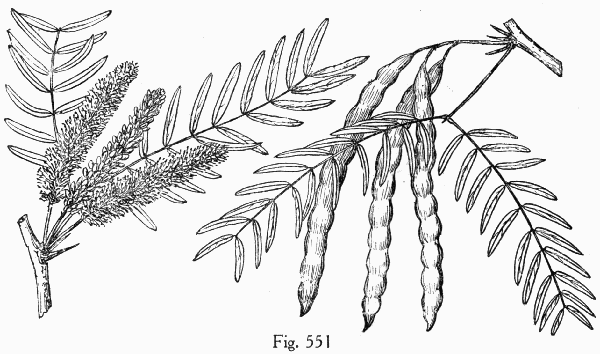
Leaves 8′—10′ long, 2-pinnate, with long slender petioles, the pinnæ 12—20-foliolate; leaflets distant, linear, mostly acute, glabrous, dark green, often 2′ long and ⅛′—¼′ wide. Flowers with a usually glabrous calyx. Fruit occasionally conspicuously constricted between the seeds (f. constricta Sarg.).
A round-topped tree, often 20° high, with a trunk a foot in diameter, and long gracefully drooping branches forming a symmetrical round-topped head.
Distribution. Eastern Texas to western Louisiana (near Shreveport, Caddo Parish), western Oklahoma and southern Kansas, and southward into northern Mexico. The common Mesquite of eastern Texas; reappearing with rather shorter and more crowded leaflets in Arizona, southern California, and Lower California.
Prosopis juliflora var. velutina Sarg.
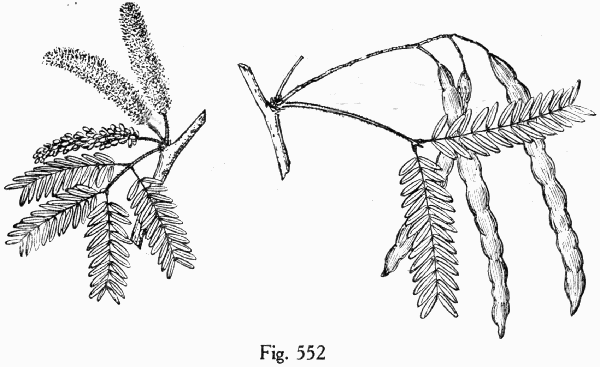
Leaves 5′—6′ long, often fascicled, 2—4-pinnate, cinereo-pubescent, with short petioles, the pinnæ 12-22-foliolate; leaflets oblong or linear-oblong, obtuse or acute, crowded, pale green, ¼′—½′ long. Flowers in densely-flowered spikes 2′—3′ long; calyx villose.
[602]
A tree, often 50° high, with a trunk 2° in diameter, covered with rough dark brown bark, and heavy irregularly arranged usually crooked branches.
Distribution. Dry valleys of southern Arizona and of Sonora.
2. Prosopis pubescens Benth. Screw Bean. Screw Pod Mesquite.
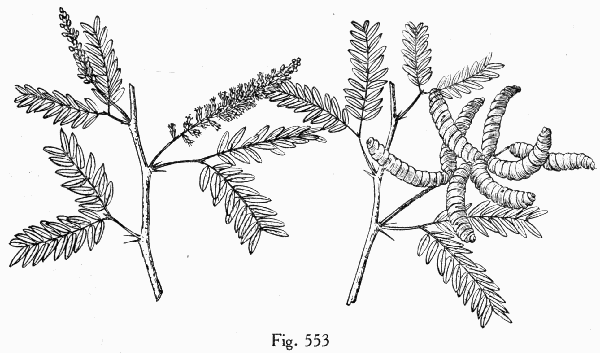
Leaves canescently pubescent, 2′—3′ long, with a slender petiole ⅓′—⅔′ in length, and pinnæ 1½′—2′ long and 10—16-foliolate; stipules spinescent, deciduous; leaflets oblong or somewhat falcate, acute, sessile or short-petiolulate, often apiculate, conspicuously reticulate-veined, ⅓′—⅔′ long, ⅛′ wide. Flowers beginning to open in early spring, and produced in successive crops from the axils of minute scarious bracts, in dense or interrupted cylindric spikes 2′—3′ long; calyx obscurely 5-lobed, pubescent on the outer surface, one third to one fourth as long as the narrow acute petals coated on the inner surface near the apex with thick white tomentum, and slightly puberulous on the outer surface; ovary and young fruit hoary-tomentose. Fruit ripening throughout the summer and falling in the autumn, in dense racemes, sessile, twisted with from 12—20 turns into a narrow straight spiral 1′—2′ long; seeds 1/16′ long.
[603]
A tree, 25°-30° high, with a slender trunk sometimes a foot in diameter, and terete branches canescently pubescent or glabrate when they first appear, becoming glabrous and light red-brown in their third year, and armed with stout spines ⅓′—½′ long. Bark of the trunk thick, light brown tinged with red, separating in long thin persistent ribbon-like scales. Wood heavy, exceedingly hard, close-grained, not strong, light brown, with thin lighter colored sapwood of 6 or 7 layers of annual growth; used as fuel and occasionally for fencing. The sweet, nutritious legumes are valued as fodder.
Distribution. Sandy or gravelly bottom-lands; valley of the Rio Grande in western Texas, and through New Mexico and Arizona to southern Utah and Nevada, and to San Diego County, California, and northern Mexico; attaining its largest size in the United States in the valleys of the lower Colorado and Gila Rivers, Arizona.
6. CERCIS L.
Trees or shrubs, with scaly bark, slender unarmed branchlets prolonged by an upper axillary bud, marked by numerous minute pale lenticels, and in their first winter by small elevated horizontal leaf-scars showing the ends of two large fibro-vascular bundles, and small scaly obtuse axillary buds covered by imbricated ovate chestnut-brown scales. Leaves simple, entire, 5—7-nerved with prominent nerves, long-petiolate, deciduous; petioles slender, terete, abruptly enlarged at apex; stipules ovate, acute, small, membranaceous, caducous. Flowers appearing in early spring before or with the leaves on thin jointed pedicels, in simple fascicles or racemose clusters produced on branches of the previous or earlier years, or on the trunk, with small scale-like bracts often imbricated at the base of the inflorescence, and minute bractlets; calyx disciferous, short-turbinate, purplish, persistent, the tube oblique at base, campanulate, enlarged on the lower side, 5-toothed, the short broad teeth imbricated in the bud; corolla subpapilionaceous; petals nearly equal, rose color, oblong-ovate, rounded at apex, unguiculate, slightly auricled on one side of the base of the blade, the upper petal slightly smaller and inclosed in the bud by the wing-petals encircled by the broader slightly imbricated keel-petals; stamens 10, inserted in 2 rows on the margin of the thin disk, free, declinate, those of the inner row opposite the petals and rather shorter than the others; filaments enlarged and pilose below the middle, persistent until the fruit is grown; anthers uniform, oblong, attached on the back near the base; ovary short-stalked, inserted obliquely in the bottom of the calyx-tube; style filiform, fleshy, incurved, with a stout obtuse terminal stigma; ovules 2-ranked, attached to the inner angle of the ovary. Legume stalked, oblong or broad-linear, straight on the upper edge, curved on the lower edge, acute at the ends, compressed, tipped with the thickened remnants of the style, many-seeded, 2-valved, the valves coriaceo-membranaceous, many-veined, tardily dehiscent by the dorsal and often by the wing-margined ventral suture, dark red-purple and lustrous at maturity. Seeds suspended transversely on a slender funicle, ovoid or oblong, compressed, the small depressed hilum near the apex; seed-coat crustaceous, bright reddish brown; embryo surrounded by a thin layer of horny albumen, compressed; cotyledons oval, flat, the radicle short, straight or obliquely incurved, slightly exserted.
Cercis is confined to eastern and western North America, southern Europe, and to southwestern, central and eastern Asia. Of the eight species now distinguished, three occur in North America. Two of these are arborescent.
The generic name is from κερκίς, the Greek name of the European species, from a fancied resemblance of the fruit to the weaver’s implement of that name.
CONSPECTUS OF THE NORTH AMERICAN ARBORESCENT SPECIES.
Flowers in sessile clusters; leaves ovate, acute, cordate or truncate at base.
1. C. canadensis (A, C).
Flowers fascicled or slightly racemose; leaves reniform.
2. C. reniformis (C).
[604]
1. Cercis canadensis L. Redbud. Judas-tree.
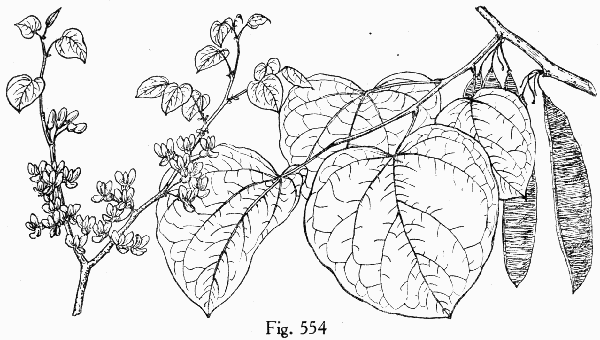
Leaves broad-ovate, acute or acuminate and often abruptly contracted at apex into a short broad point, truncate or more or less cordate at base, entire, glabrous with the exception of axillary tufts of white hairs, or sometimes more or less pubescent below, 3′—5′ long and broad; turning in the autumn before falling bright clear yellow; petioles 2′—5′ in length. Flowers ½′ long, on pedicels ⅓′—½′ in length and fascicled 4-8 together; rarely white (var. alba Rehdr.). Fruit fully grown in the south by the end of May and at the north at midsummer, and then pink or rose color, 2½′—3½′ long, falling late in the autumn or in early winter; seeds about ¼′ long.
A tree, sometimes 40°-50° high, with a straight trunk usually separating 10°-12° from the ground into stout branches covered with smooth light brown or gray bark, and forming an upright or often a wide flat head, and slender glabrous somewhat angled branchlets, brown and lustrous during their first season, becoming dull and darker the following year and ultimately dark or grayish brown. Bark of the trunk about ½′ thick and divided by deep longitudinal fissures into long narrow plates, the bright red-brown surface separating into thin scales. Wood heavy, hard, not strong, close-grained, rich dark brown tinged with red, with thin lighter colored sapwood of 8-10 layers of annual growth.
Distribution. Borders of streams and rich bottom-lands, forming, especially west of the Alleghany Mountains, an abundant undergrowth to the forest; valley of the Delaware River, New Jersey, central and southern Pennsylvania southward to northern Florida, northern Alabama and southern Mississippi (Crystal Springs, Copiah County), and westward to southwestern Ontario (Point Pelee, Essex County), and through southern Michigan to southern Iowa, southeastern Nebraska, eastern Kansas, western Oklahoma (Major and Dewey Counties), Louisiana, and the valley of the Brazos River, Texas; and on the Sierra Madre of Nuevo Leon; common and of its largest size in southwestern Arkansas, Oklahoma and eastern Texas, and in early spring a conspicuous feature of the landscape.
Often cultivated as an ornamental tree in the northeastern states, and occasionally in western Europe.
2. Cercis reniformis Engl. Redbud.
Cercis texensis Sarg.
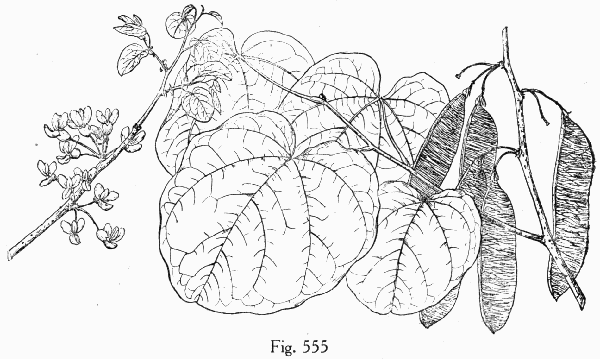
Leaves reniform, when they unfold light green and slightly pilose, and at maturity subcoriaceous, dark green and lustrous on the upper surface, paler, glabrous or pubescent on the lower surface, and 2′—3′ in diameter; petioles 1½′—2′ in length. Flowers about ½′ [605] long, on slender pedicels ½′—¾′ in length and fascicled in sessile clusters, or occasionally racemose. Fruit 2′—4′ long, ½′—1′ wide; seeds ¼′ long.
A slender tree, occasionally 20° or rarely 40° high, with a trunk 6′-12′ in diameter, and glabrous branchlets marked by numerous minute white lenticels, light reddish brown during their first and second years, becoming dark brown in their third season; more often a shrub, sending up numerous stems and forming dense thickets only a few feet high. Bark of the trunk and branches thin, smooth, light gray. Wood heavy, hard, close-grained brown streaked with yellow, with thin lighter colored sapwood of 5 or 6 layers of annual growth.
Distribution. Limestone hills and ridges; neighborhood of Dallas, Dallas County, Texas to the Sierra Madre of Nuevo Leon; common in the valley of the upper Colorado River, Texas; of its largest size on the mountains of northeastern Mexico.
7. GYMNOCLADUS Lam.
Trees, with stout unarmed blunt branchlets with a thick pith, prolonged by axillary buds, rough deeply fissured bark, thick fleshy roots, and minute buds depressed in pubescent cavities of the bark, 2 in the axil of each leaf, superposed, remote, the lower and smaller sterile and nearly surrounded by the enlarged base of the petiole, their scales 2, ovate, rounded at apex, coated with thick dark brown tomentum, infolded one over the other, accrescent with the young shoots. Leaves deciduous, unequally bipinnate; pinnæ many-foliolulate, with 1 or 2 pairs of the lowest pinnæ reduced to single leaflets; pinnæ and leaflets usually alternate; leaflets thin, ovate, entire, petiolulate; stipules foliaceous, early deciduous. Flowers regular, diœcious, greenish white, long-pedicellate, the slender pedicels from the axils of long lanceolate scarious caducous bracts, bibracteolate near the middle; staminate flowers in a short terminal racemose corymb; pistillate flowers in elongated terminal racemes, on pedicels much longer than those of the staminate flowers; calyx tubular, elongated, 10-ribbed, lined with a thin glandular disk, 5-lobed, the lobes, lanceolate, acute, nearly equal, erect; petals 4 or 5, oblong, rounded or acute at apex, pubescent, as long as the calyx-lobes or rather longer and twice as broad, inserted on the margin of the disk, spreading or reflexed; stamens 10, free, inserted with the petals, erect, included; filaments filiform, pilose, those opposite the petals shorter than the others; anthers oblong, uniform, small and sterile in the pistillate flower; ovary sessile or slightly stipitate, acute; styles short, erect, obliquely dilated into 2 broad lobes stigmatic on their [606] inner surface, rudimentary or 0 in the sterile flower; ovules numerous, suspended from the angle opposite the posterior petals. Legume oblong, subfalcate, turgid or slightly compressed, several-seeded, 2-valved, tardily dehiscent, the thin tough woody valves thickened on the margins into narrow wings, pulpy between the seeds. Seeds ovoid or slightly obovoid, suspended by a long slender funicle; seed-coat thick, bony, brown and opaque, of 3 layers; embryo surrounded by a thin layer of horny albumen; cotyledons ovate, orange-colored, thick and fleshy, the radicle short, erect.
Gymnocladus, with two species, is confined to eastern North America and to central China.
Gymnocladus is slightly astringent and purgative, and the detersive pulp surrounding the seeds of the Asiatic species is used in China as a substitute for soap.
The generic name, from γυμνός and κλάδος, relates to the stout branchlets destitute of spray.
1. Gymnocladus dioicus K. Koch. Kentucky Coffee-tree. Mahogany.
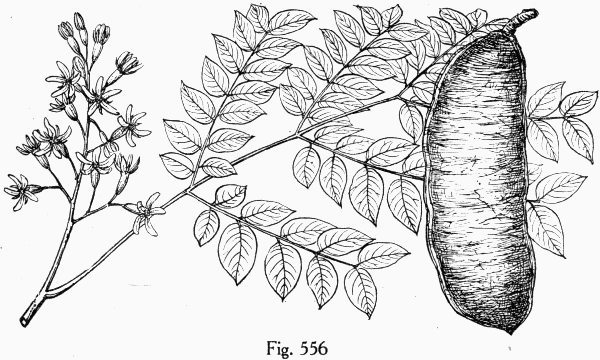
Leaves 1°—3° long, 18′—24′ wide, obovate, 5—9 pinnate, the pinnæ 6—14-foliolate, covered when they unfold with hoary tomentum except on the upper surface of the ovate acute leaflets, often mucronate, especially while young, cuneate or irregularly rounded at base, pink at first, soon becoming bronze-green and lustrous, glabrous on the upper surface with the exception of a few scattered hairs along the midrib, and at maturity thin, obscurely veined, dark green above, pale yellow-green and glabrous below, with the exception of a few short hairs scattered along the narrow midrib, 2′—2½′ long and 1′ wide, or those replacing the lowest or occasionally the 2 lower pairs of pinnæ sometimes twice as large; turning bright clear yellow in the autumn before falling; petioles abruptly and conspicuously enlarged at base, at first hoary-tomentose, becoming glabrous at maturity; stipules lanceolate or slightly obovate, glandular-serrate toward the apex, ⅓′ long. Flowers: inflorescence of the staminate tree 3′—4′ long, the lower branches usually 3 or 4-flowered; inflorescence of the pistillate tree 10′—12′ long, the flowers on stout pedicels 1′—2½′ long or twice to five times as long as those of the staminate flowers; flowers hoary-tomentose in the bud; calyx ⅔′ long, covered on the outer surface when the flowers open with pale hairs and on the inner surface with hoary tomentum; petals keeled, pilose on the back, slightly grooved, tomentose on the inner surface; anthers bright orange color; ovary hairy. Fruit 6′—10′ long, 1½′—2′ wide, dark red-brown, covered with a glaucous bloom, on stout stalks 1′—2′ in length, remaining unopened on the branches through the winter; seeds separated by a thick layer of dark-colored sweet pulp, ¾′ long.
[607]
A tree, 75°—110° high, with a trunk 2°—3° in diameter, usually dividing 10°—15° from the ground into 3 or 4 principal stems spreading slightly and forming a narrow round-topped head, or occasionally sending up a tall straight shaft destitute of branches for 70°—80°, and branchlets coated when they first appear with short dense pubescence faintly tinged with red, bearing at their base the conspicuous orange-green obovate pubescent bud-scales, ¼′—⅓′ thick at the end of their first season, very blunt, dark brown, often slightly pilose, marked by orange-colored lenticels, and roughened by the large pale broadly heart-shaped leaf-scars displaying the ends of 3 or 4 conspicuous fibro-vascular bundles. Bark of the trunk ¾′—1′ thick, deeply fissured, dark gray tinged with red, and roughened by small persistent scales. Wood heavy although not hard, strong, coarse-grained, very durable in contact with the soil, rich light brown tinged with red, with thin lighter colored sapwood of 5 or 6 layers of annual growth; occasionally used in cabinet-making and for fence-posts, rails, and in construction. The seeds were formerly used as a substitute for coffee; a decoction of the fresh green pulp of the unripe fruit is used in homœopathic practice.
Distribution. Bottom-lands in rich soil; central and western New York and Franklin County, Pennsylvania, through southern Ontario and southern Michigan to southeastern Minnesota, northeastern and southern Iowa, southeastern South Dakota, eastern and northeastern Nebraska, eastern Kansas, southwestern Arkansas and northeastern Oklahoma (with isolated stations in Woods and Custer Counties and in the western parts of Cimarron County); in Eastern Kentucky, and western and middle Tennessee; nowhere common.
Occasionally cultivated in the gardens and parks of the eastern United States, and of northern and central Europe.
8. GLEDITSIA L.
Trees, with furrowed bark, slender terete slightly zigzag branchlets thickened at the apex and prolonged by axillary buds, thick fibrous roots, the trunk and branches often armed with stout simple or branched spines or abortive branchlets developed from supra-axillary or adventitious buds imbedded in the bark. Winter-buds minute, 3 or 4 together, superposed, the 2 or 3 lower without scales and covered by the scar left by the falling of the petiole, the upper larger, nearly surrounded by the base of the petiole and covered by small scurfy scales. Leaves long-petiolate, often fascicled in earlier axils, abruptly pinnate or bipinnate, the pinnæ increasing in length from the base to the apex of the leaf, the lowest sometimes reduced to single leaflets; deciduous; leaflets thin, their margins irregularly crenate, without stipels; stipules minute, caducous. Flowers regular, polygamous, minute, green or white on short pedicels, in axillary or lateral simple or fascicled racemes, with minute scale-like caducous bracts; calyx campanulate, lined with the disk, 3—5-lobed, the narrow lobes nearly equal; petals as many as the lobes of the calyx, nearly equal; stamens 6—10, inserted with the petals on the margin of the disk, exserted; filaments free, filiform, erect; anthers uniform, much smaller and abortive in the pistillate flower; ovary subsessile, rarely bicarpellary, rudimentary or 0 in the staminate flower; styles short; stigma terminal, more or less dilated, often oblique; ovules 2 or many, suspended from the angle opposite the posterior petal. Legume compressed, many-seeded, elongated, straight and indehiscent, or 1—3-seeded, ovoid and tardily dehiscent. Seeds transverse, ovoid to suborbicular, flattened, attached by a long slender funicle; seed-coat thin, crustaceous, light brown; embryo surrounded by a layer of horny orange-colored albumen; cotyledons subfoliaceous, compressed; radicle short, erect, slightly exserted.
Gleditsia is confined to eastern North America, where three species occur, southwestern Asia, China, Formosa, Japan, and west tropical Africa. It produces strong, durable, coarse-grained wood. In Japan the pods are used as a substitute for soap.
The generic name is in honor of Johann Gottlieb Gleditsch (1714—1786), professor of botany at Berlin.
[608]
CONSPECTUS OF THE NORTH AMERICAN ARBORESCENT SPECIES.
Legume linear-oblong, elongated, many-seeded, indehiscent.
Legume 12′—18′ long, with pulp between the seeds; ovary hoary-tomentose.
1. G. triacanthos (A, C).
Legume 4′—5′ long, without pulp between the seeds.
2. G. texana (C).
Legume oval, oblique, 1—3-seeded, without pulp, tardily dehiscent; ovary glabrous.
3. G. aquatica (A, C).
1. Gleditsia triacanthos L. Honey Locust.
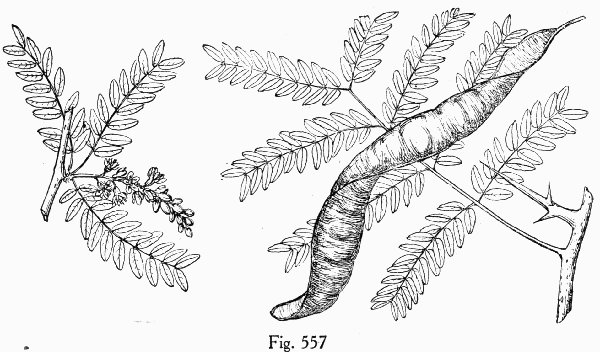
Leaves 7′—8′ long, 18—28-foliolulate or sometimes bipinnate, with 4—7 pairs of pinnæ, those of the upper pair 4′—5′ long, when they unfold hoary-tomentose, and at maturity pubescent on the petiole and rachis, the short stout petiolules, and the under surface of the midrib of the oblong-lanceolate leaflets, unequal at base, acute or slightly rounded at apex, remotely crenulate-serrate, dark green and lustrous above, dull yellow-green below, 1′—1½′ long and ½′ wide; turning in the autumn pale clear yellow. Flowers appearing in June when the leaves are nearly fully grown from the axils of leaves of previous years; the staminate in short many-flowered pubescent racemes 2′—2½′ long and often clustered; the pistillate in slender graceful few-flowered usually solitary racemes 2½′—3½′ long; calyx campanulate, narrowed at base, the acute lobes thickened, revolute and ciliate on the margins, villose with pale hairs, rather shorter than and half as wide as the erect acute petals; filaments pilose toward the base; anthers green; pistil rarely of 2 carpels, hoary-tomentose. Fruit 12′—18′ long, dark brown, pilose and slightly falcate, with straight thickened margins, 2 or 3 together in short racemes on stalks 1′—1½′ long, their walls thin and tough, contracting in drying by a number of corkscrew twists, and falling late in the autumn or early in winter; seeds oval, ⅓′ long, separated by thick succulent pulp.
A tree, 75°—140° high, with a trunk 2°—3° or occasionally 5°—6° in diameter, slender spreading somewhat pendulous branches forming a broad open rather flat-topped head, and branchlets marked by minute lenticels, at first light reddish brown and slightly puberulous, soon becoming lustrous and red tinged with green, and in their second year greenish brown and armed with stout rigid long-pointed simple or 3-forked spines at first red, and bright chestnut-brown when fully grown, or rarely unarmed (var. inermis Pursh.). Bark of the trunk ½′—¾′ thick, divided by deep fissures into long narrow longitudinal ridges and [609] roughened on the surface by small persistent scales. Wood hard, strong, coarse-grained, very durable in contact with the ground, red or bright red-brown, with thin pale sapwood of 10—12 layers of annual growth; largely used for fence-posts and rails, for the hubs of wheels, and in construction.