Division II. Dicotyledons. (continued 4)
Reading edition
A low shrub spreading into broad thickets by underground stems, with leaves pale pubescent on the lower surface; and distributed in the neighborhood of the coast from the valley of the Cape Fear River, North Carolina, to southern Georgia. Passing into
Castanea alnifolia var. floridana Sarg. Chinquapin.
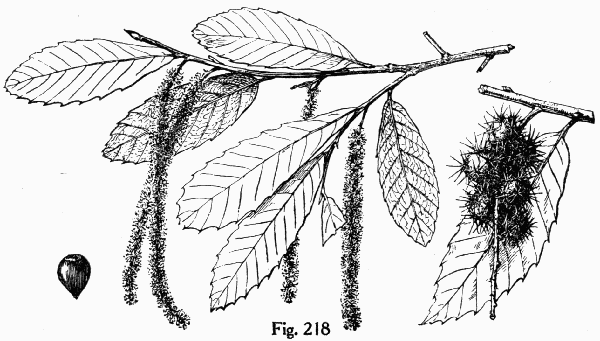
Leaves oblong-obovate to elliptic, acute, acuminate or rounded at apex, gradually narrowed and cuneate or rounded at base, irregularly sinuate-toothed with apiculate teeth, [234] hoary tomentose below when they unfold, soon glabrous with the exception of the last leaves of vigorous summer shoots, and at maturity thin, glabrous, dark green above, light green and lustrous below, 3′—4′ long and 1′—1¾′ wide; petioles stout, glabrous, about 1/12′ in length. Flowers: staminate aments pale pubescent, 4′—5′ long; androgynous aments pubescent, as long or rather longer with ten or twelve involucres of pistillate flowers below the middle, often only the lowest being fertilized. Fruit: involucre 1-seeded, subglobose to short-oblong, pale tomentose, ¾′ to 1¼′ in diameter, covered with stout pubescent scattered spines divided at base into numerous branches; nut ovoid, terete, acute, dark chestnut-brown, lustrous, ½′ to nearly ¾′ in length.
A tree occasionally 40°—45° high, with a tall trunk sometimes a foot in diameter, small irregularly spreading branches forming a narrow head, and slender glabrous or rarely pilose red-brown branchlets; more often a shrub sometimes with broader obovoid leaves sometimes puberulous on the lower surface.
Dry sandy soil; coast of North Carolina, near Wrightsville, New Hanover County; Dover, near the Ogechee River, Screven County, Georgia; Jacksonville, Duval County, and Panama City on Saint Andrew’s Bay, Bay County, Florida; near Selma, Dallas County, Alabama; and Covington, St. Tammany Parish, Louisiana.
A tree only on the shores of Saint Andrew’s Bay.
3. CASTANOPSIS Spach.
Trees, with scaly bark, astringent wood, and winter-buds covered by numerous imbricated scales. Leaves convolute in the bud, 5-ranked, coriaceous, entire or dentate, penniveined, persistent; stipules obovate or lanceolate, scarious, mostly caducous. Flowers in 3-flowered cymes, or the pistillate rarely solitary or in pairs, in the axils of minute bracts, on slender erect aments from the axils of leaves of the year; the staminate on usually elongated and panicled aments, and composed of a campanulate 5 or 6-lobed or parted calyx, the lobes imbricated in the bud, usually 10 or 12 stamens inserted on the slightly thickened torus, with elongated exserted filiform filaments and oblong anthers, and a minute hirsute rudimentary ovary; the pistillate on shorter simple or panicled aments or scattered at the base of the staminate inflorescence, the cymes surrounded by an involucre of imbricated scales; calyx urn-shaped, the short limb divided into 6 obtuse lobes; abortive stamens inserted on the limb of the calyx and opposite its lobes; ovary sessile on the thin disk, 3-celled after fecundation, with 3 spreading styles terminating in minute stigmas, and 2 ovules in each cell attached to its interior angle. Fruit maturing at the end of the second or rarely of the first season, its involucre inclosing 1—3 nuts, ovoid or globose, sometimes more or less depressed, rarely obscurely angled, dehiscent or indehiscent, covered by stout spines, tuberculate or marked by interrupted vertical ridges; nut more or less angled by mutual pressure when more than 1, often pilose, crowned with the remnants of the style, marked at the base by a large conspicuous circular depressed scar, the thick shell tomentose on the inner surface. Seed usually solitary by abortion, bearing at apex the abortive ovules; cotyledons plano-convex, fleshy, farinaceous.
Castanopsis inhabits California with two species, and southeastern Asia where it is distributed with about twenty-five species from southern China to the Malay Archipelago and the eastern Himalayas. Of the California species one is usually arborescent and the other Castanopsis sempervirens Dudley is a low alpine shrub of the coast ranges and the Sierra Nevada.
Castanopsis from κὰστανα and ὄψις, in allusion to its resemblance to the Chestnut-tree.
1. Castanopsis chrysophylla A. DC. Chinquapin. Golden-leaved Chestnut.
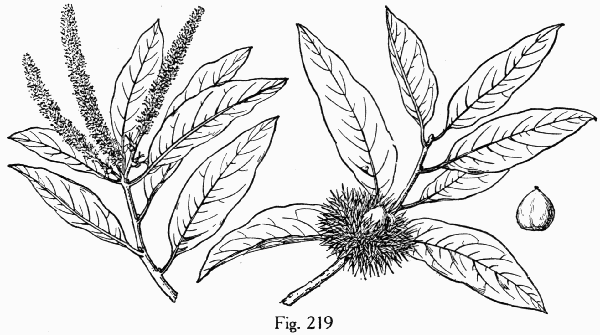
Leaves lanceolate or oblong-ovate, gradually narrowed at the ends or sometimes abruptly contracted at apex into a short broad point, entire with slightly thickened revolute margins, when they unfold thin, coated below with golden yellow persistent scales and above with scattered white scales, at maturity thick and coriaceous, dark green and [235] lustrous above, 2′—6′ long, ½′ to nearly 2′ wide, with a stout midrib raised and rounded on the upper side; turning yellow at maturity and falling gradually at the end of their second or in their third year; petioles ¼′—⅓′ in length; stipules ovate, rounded or acute at apex, brown and scarious, puberulous, ¼′—⅓′ long. Flowers appearing irregularly from June until February in the axils of broadly ovate apiculate pubescent bracts on staminate and androgynous scurfy stout-stemmed aments 2′—2½′ long and crowded at the ends of the branches; calyx of the staminate flower coated on the outer surface with hoary tomentum, divided into broadly ovate rounded lobes much shorter than the slender stamens; calyx of the pistillate flower oblong-campanulate, free from the ovary, clothed with hoary tomentum, divided at apex into short rounded lobes, rather shorter than the minute abortive stamens; anthers red; ovary conic, hirsute, with elongated slightly spreading thick pale stigmas. Fruit ripening at the end of the second season, involucre globose, dehiscent, irregularly 4-valved, often slightly shorter than the nuts, sessile, solitary, or clustered, tomentose and covered on the outer surface by long stout or slender rigid spines, 1′—1½′ in diameter, containing 1 or occasionally 2 nuts; nuts broadly ovoid, acute, obtusely 3-angled, light yellow-brown and lustrous; seeds dark purple-red, sweet and edible.
A tree, 50°—100° high, with a massive trunk 3°—6° in diameter, frequently free of branches for 50°, stout spreading branches forming a broad compact round-topped or conic head, and rigid branchlets coated when they first appear with bright golden-yellow scurfy scales, dark reddish brown and slightly scurfy during their first winter, and gradually growing darker in their second season; often much smaller and sometimes reduced to a shrub, 2°—12° high (var. minor A. De Candolle). Winter-buds fully grown at mid-summer, usually crowded near the end of the branch, ovoid or subglobose, with broadly ovate apiculate thin and papery light brown scales slightly puberulous on the back, ciliate on the scarious often reflexed margins, the terminal about ¼′ long and broad and rather larger than the often stipitate axillary buds. Bark 1′—2′ thick and deeply divided into rounded ridges 2′—3′ wide, broken into thick plate-like scales, dark red-brown on the surface and bright red internally. Wood light, soft, close-grained, not strong, light brown tinged with red, with thin lighter colored sapwood of 50—60 layers of annual growth; occasionally used in the manufacture of ploughs and other agricultural implements.
Distribution. Skamania County, Washington, valley of the lower Columbia River, Oregon, southward along the western slopes of the Cascade Mountains, and in California along the western slopes of the Sierra Nevada and through the coast ranges to the elevated valleys of the San Jacinto Mountains, sometimes ascending to altitudes of 4000° above the sea; of its largest size in the humid coast valleys of northern California.
Occasionally cultivated in the gardens of temperate Europe.
[236]
4. LITHOCARPUS Bl.
Pasania Örst.
Trees, with astringent properties, pubescence of fascicled hairs, deeply furrowed scaly bark, hard close-grained brittle wood, stout branchlets, and winter-buds covered by few erect or spreading foliaceous scales. Leaves convolute in the bud, petiolate, persistent, entire or dentate, with a stout midrib, primary veins running obliquely to the points of the teeth, or on entire leaves forked and united near the margins, and reticulate veinlets; stipules oblong-obovate to linear-lanceolate, those of the upper leaves persistent and surrounding the buds during the winter. Flowers in erect unisexual and in bisexual tomentose aments from the axils of leaves of the year, from the inner scales of the terminal bud or from separate buds in the axils of leaves of the previous year; staminate in 3-flowered clusters in the axils of ovate rounded bracts, the lateral flowers subtended by similar but smaller bracts, each flower composed of a 5-lobed tomentose calyx, with nearly triangular acute lobes, 10 stamens, with slender elongated filaments and small oblong or emarginate anthers, and an acute abortive hairy ovary; pistillate scattered at the base of the upper aments below the staminate flowers, solitary in the axils of acute bracts, furnished with minute lateral bractlets, and composed of a 6-lobed ovoid calyx, with rounded lobes, inclosed in the tomentose involucral scales, 6 stamens, with abortive anthers, an ovoid-oblong 3-celled ovary, 3 elongated spreading light green styles thickened and stigmatic at apex, and 2 anatropous ovules in each cell. Fruit an oval or ovoid nut maturing at the end of the second season, 1-seeded by abortion, surrounded at base by the accrescent woody cupular involucre of the flower, marked by a large pale circular basal scar, the thick shell tomentose on the inner surface. Seed red-brown, filling the cavity of the nut, bearing at apex the abortive ovules; cotyledons thick and fleshy, yellow and bitter.
Lithocarpus is intermediate between the Oaks and the Chestnuts, and, with the exception of one California species, is confined to southeastern Asia, where it is distributed with many species from southern Japan and southern China through the Malay Peninsula to the Indian Archipelago.
Lithocarpus from λίθος and καρπός, in allusion to the character of the fruit.
1. Lithocarpus densiflora Rehd. Tan Bark Oak. Chestnut Oak.
Quercus densiflora Hook. & Arn. Pasania densiflora Örst.
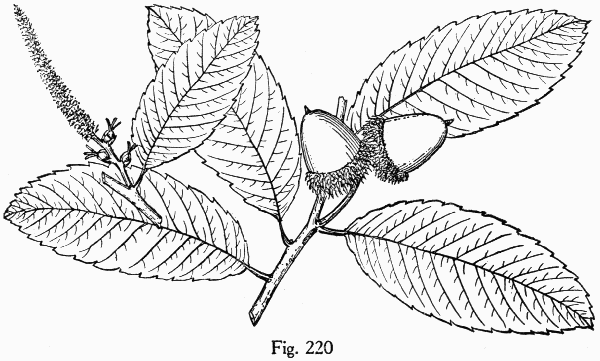
Leaves oblong or oblong-obovate, rounded or acute or rarely cordate at base, acute or occasionally rounded at apex, or rarely lanceolate and acuminate (f. lanceolata Rehdr.) repand-dentate, with acute callous teeth, or entire with thickened revolute margins, coated when they unfold with fulvous tomentum and glandular on the margins with dark caducous glands, at maturity pale green, lustrous and glabrous or covered with scattered pubescence on the upper surface, rusty-tomentose on the lower, ultimately becoming glabrous above and glabrate and bluish white below, 3′—5′ long, ¾′—3′ wide, with a midrib raised and rounded on the upper side, thin or thick primary veins and fine conspicuous reticulate veinlets; persistent until the end of their third or fourth year; petioles stout, rigid, tomentose, ½′—¾′ in length; stipules brown and scarious, hirsute on the outer surface. Flowers in early spring and frequently also irregularly during the autumn; aments stout-stemmed, 3′—4′ long; staminate flowers crowded, hoary-tomentose in the bud, their bracts tomentose. Fruit solitary or often in pairs, on a stout tomentose peduncle ½′—1′ in length; nut full and rounded at base, gradually narrowed and acute or rounded at apex, scurfy-pubescent when fully grown, becoming light yellow-brown, glabrous and lustrous at maturity, ¾′—1′ long, ½′—1′ thick, its cup shallow, tomentose with lustrous red-brown hairs on the inner surface, and covered by long linear rigid spreading or recurved light brown scales coated with fascicled hairs, frequently tipped, especially while young, with dark red glands and often tomentose near the base of the cup.
[237]
A tree, usually 70°—80° but sometimes 150° high, with a trunk 1°—4° in diameter, stout branches ascending in the forest and forming a narrow spire-like head, or in open positions spreading horizontally and forming a broad dense symmetrical round-topped crown, and branchlets coated at first with a thick fulvous tomentum of fascicled hairs often persistent until the second or third year, becoming dark reddish brown and frequently covered with a glaucous bloom; or sometimes reduced to a shrub, with slender stems only a few feet high (var. montana Rehdr.). Winter-buds ovoid, obtuse, ¼′—⅓′ long, often surrounded by the persistent stipules of the upper leaves, with tomentose loosely imbricated scales, those of the outer ranks linear-lanceolate, increasing in width toward the interior of the bud, those of the inner ranks ovate or obovate and rounded at apex. Bark ¾′—1½′ thick, deeply divided by narrow fissures into broad rounded ridges broken into nearly square plates covered by closely appressed light red-brown scales. Wood hard, strong, close-grained, brittle, reddish brown, with thick darker brown sapwood; largely used as fuel. The bark is exceedingly rich in tannin and is largely used for tanning leather.
Distribution. Valley of the Umpqua River, Oregon, southward through the coast ranges to the Santa Inez Mountains, California, and along the western slope of the Sierra Nevada up to elevations of 4000° above the sea to Mariposa County; very abundant in the humid coast region north of San Francisco Bay and on the Santa Cruz and Santa Lucia Mountains, and of its largest size in the Redwood forest of Napa and Mendocino Counties; southward and on the Sierras less abundant and of smaller size; the form lanceolata in southern Oregon and in Del Norte and Mendocino Counties, California; the var. montana at high altitudes on the Siskiyou Mountains, in the region of Mount Shasta and on the northern Sierra Nevada.
5. QUERCUS L. Oak.
Trees or shrubs, with astringent properties, pubescence of fascicled hairs, scaly or dark and furrowed bark, hard and close-grained or porous brittle wood, slender branchlets marked by pale lenticels and more or less prominently 5-angled. Winter-buds clustered at the ends of the branchlets, with numerous membranaceous chestnut-brown slightly accrescent caducous scales closely imbricated in 5 ranks, in falling marking the base of the branchlet with ring-like scars. Leaves 5-ranked, lobed, dentate or entire, often variable on the same branch, membranaceous or coriaceous, the primary veins prominent and extending to the margins or united within them and connected by more or less reticulate veinlets, deciduous in the autumn or persistent until spring or until their third or fourth year; [238] petioles in falling leaving slightly elevated semiorbicular more or less obcordate leaf-scars broader than high, marked by the ends of numerous scattered fibro-vascular bundles; stipules obovate to lanceolate, scarious, caducous, or those of upper leaves occasionally persistent through the season. Flowers vernal with or after the unfolding of the leaves; staminate solitary in the axils of lanceolate acute caducous bracts, or without bracts, in graceful pendulous clustered aments, from separate or leaf-buds in the axils of leaves of the previous year, or from the axils of the inner scales of the terminal bud or from those of the leaves of the year; calyx campanulate, lobed or divided to the base into 4—7, usually 6, membranaceous lobes; stamens 4—6, rarely 2, or 10—12, inserted on the slightly thickened torus, with free filiform exserted filaments and ovate-oblong or subglobose glabrous or rarely hairy 2-celled usually yellow anthers; pistillate solitary, subtended by a caducous bract and 2 bractlets, in short or elongated few-flowered spikes from the axils of leaves of the year; calyx urn-shaped, with a short campanulate 6-lobed limb, the tube adnate to the incompletely 3 or rarely 4 or 5-celled ovary inclosed more or less completely by an accrescent involucre of imbricated scales, becoming the cup of the fruit; styles as many as the cells of the ovary, short or elongated, erect or incurved, dilated above, stigmatic on the inner face or at apex only, generally persistent on the fruit; ovules anatropous or semianatropous, 2 in each cell. Fruit a nut (acorn) maturing in one or in two years, ovoid, subglobose, or turbinate, short-pointed at apex, 1-seeded by abortion, marked at base by a large conspicuous circular scar, with a thick shell, glabrous or coated on the inner surface with pale tomentum, more or less surrounded or inclosed in the accrescent cupular involucre of the flower (cup), its scales thin or thickened, loosely or closely imbricated. Seed marked at base or at apex or rarely on the side by the abortive ovules; cotyledons thick and fleshy, usually plano-convex and entire.
Quercus inhabits the temperate regions of the northern hemisphere and high altitudes within the tropics, ranging in the New World southward to the mountains of Colombia and in the Old World to the Indian Archipelago. Two hundred and seventy-five species have been described; of the North American species fifty-four are large or small trees. Of exotic species, the European Quercus Robur L., and Quercus sessiliflora Salisb., have been frequently cultivated as ornamental trees in the eastern United States, where, however, they are usually short-lived and unsatisfactory. Many of the species are important timber-trees; their bark is often rich in tannin and is used for tanning leather, and all produce wood valuable for fuel and in the manufacture of charcoal.
Quercus is the classical name of the Oak-tree.
CONSPECTUS OF THE NORTH AMERICAN ARBORESCENT SPECIES.
Fruit maturing at the end of the second season (except 22); shell of the nut silky tomentose on the inner surface; leaves or their lobes bristle-tipped. Black Oaks.
Stamens usually 4—6; styles elongated, finally recurved; abortive ovules apical.
Leaves deciduous in their first autumn or winter.
Leaves pinnately lobed, convolute in the bud.
Leaves green on both surfaces.
Scales of the cup of the fruit closely appressed.
Leaves usually dull on the upper surface, 7—11-lobed; cup of the fruit cup-shaped or in one variety broad and saucer-shaped, its scales thin.
1. Q. borealis (A).
Leaves lustrous.
Leaves dimorphous, 5—7-lobed, axillary clusters of hairs large and prominent; cup of the fruit saucer-shaped or in one form deep cup-shaped.
2. Q. Shumardii (A, C).
Leaves similar on upper and lower branches.
Cup of the fruit turbinate or deep cup-shaped.
Leaves 5-lobed, the lobes usually entire, rarely furnished with tufts of axillary hairs below.
3. Q. texana (C).
[239]
Leaves 5—7-lobed, the lobes dentate, furnished with tufts of axillary hairs below.
4. Q. ellipsoidalis (A).
Cup of the fruit deep cup-shaped to turbinate; leaves 5—9-lobed, the lobes toothed.
5. Q. coccinea (A, C).
Cup of the fruit saucer-shaped.
Leaves 5—9-lobed.
6. Q. palustris (A, C).
Leaves 3—5-lobed.
7. Q. georgiana (C).
Scales of the cup of the fruit more or less loosely imbricated, forming a free margin on its rim.
Leaves usually 7-lobed.
Winter-buds tomentose.
8. Q. velutina (A, C).
Winter-buds pubescent only at apex.
9. Q. Kelloggii (G).
Leaves usually 3—5-lobed; winter-buds rusty pubescent.
10. Q. Catesbæi (C).
Leaves whitish or grayish tomentulose below.
Leaves mostly acutely 5-lobed, pale or silvery white below.
11. Q. ilicifolia (A).
Leaves often dimorphous, 3—11-lobed, the lobes often falcate.
12. Q. rubra (A, C).
Leaves broad-obovate, often abruptly dilated at the wide obscurely lobed apex.
Leaves rounded or cordate at base.
Lower surface of the leaves orange color or brownish, the upper scales of the cup forming with several rows a thick rim on its inner surface, often reflexed.
13. Q. marilandica (A, C).
Lower surface of the leaves pale, the erect scales on the rim of the cup in a single row.
14. Q. arkansana (C).
Leaves cuneate at base.
Leaves oblong-obovate.
15. Q. nigra (C).
Leaves rhombic.
16. Q. rhombica (C).
Leaves lanceolate-oblong or lanceolate-obovate, usually entire, involute in the bud. Willow Oaks.
Leaves glabrous.
Leaves lanceolate to oblanceolate, deciduous in autumn.
17. Q. Phellos (A, C).
Leaves elliptic or rarely oblong-obovate, deciduous in the late winter.
18. Q. laurifolia (C).
Leaves tomentose or pubescent below, oblong-lanceolate to oblong-obovate.
Leaves pale blue-green, hoary tomentose below.
19. Q. cinerea (C).
Leaves dark green, pubescent below.
20. Q. imbricaria (A).
Leaves not deciduous in the autumn, revolute in the bud (convolute in 23).
Leaves mostly persistent until after the appearance of those of the following year.
Leaves lanceolate, oblong-lanceolate or elliptic, pale and tomentose below.
21. Q. hypoleuca (E, H).
Leaves oval, orbicular to oblong, green and pubescent below; fruit maturing at the end of the first season.
22. Q. agrifolia (G).
Leaves persistent until their second summer or autumn.
Leaves lanceolate to oval or oblong-lanceolate, entire or serrate; cup of the fruit turbinate or tubular.
23. Q. Wislizenii (G).
Leaves oval to oblong-obovate; cup of the fruit saucer-shaped or turbinate.
24. Q. myrtifolia (C).
Stamens usually 6—8; styles dilated; abortive ovules basal or lateral; leaves persistent until their third or fourth season, involute in the bud.
Leaves oblong, entire, dentate, or sinuate-toothed, fulvous-tomentose and ultimately pale on the lower surface; cup of the fruit usually thick.
25. Q. chrysolepis (G, H).
Leaves oblong-lanceolate, crenate-dentate or entire, pubescent or tomentose below; cup of the fruit usually thin.
26. Q. tomentella (G).
[240]
Fruit maturing at the end of the first season; shell of the nut glabrous on the inner surface (hoary-tomentose in 27); abortive ovules basal; stamens 6—8; styles dilated; lobes of the leaves not bristle-tipped. White Oaks.
Leaves mostly persistent until the appearance of those of the following year, revolute in the bud (convolute in 28).
Leaves yellow-green.
Fruit sessile or short-stalked.
Leaves oblong-lanceolate, entire or repand-dentate; inner surface of the nut hoary tomentose.
27. Q. Emoryi (F, H).
Leaves oblong or obovate, entire, sinuate-toothed or lobed.
28. Q. dumosa (G).
Fruit long-stalked; leaves oblong, elliptic or obovate, pale, glabrous or in one form densely tomentose below.
29. Q. virginiana (C).
Leaves blue-green.
Fruit usually in many-fruited long-stalked clusters; leaves broad-obovate, coarsely reticulate-venulose.
30. Q. reticulata (H).
Fruit solitary or in pairs.
Cup of the fruit saucer-shaped; leaves ovate to ovate-oblong, entire.
31. Q. Toumeyi (H).
Cup of the fruit cup-shaped or hemispherical, oblong-lanceolate to broad-obovate, pubescent below.
32. Q. arizonica (H).
Cup of the fruit usually cup-shaped or turbinate.
Leaves ovate, oval or obovate, usually cordate at base; fruit rather long-stalked.
33. Q. oblongifolia (E, H).
Leaves oblong to obovate, usually cuneate or rounded or cordate at base.
34. Q. Engelmannii (G).
Leaves deciduous in their first season.
Leaves blue-green.
Arboreous; leaves oblong, lobed, spinescent-dentate or entire, pubescent below; cup of the fruit shallow cup-shaped.
35. Q. Douglasii (G).
Arborescent or shrubby.
Leaves oblong to oblong-obovate, undulate-lobed; cup of the fruit saucer-shaped to cup-shaped.
36. Q. Vaseyana (C).
Leaves oblong-obovate to elliptic or lanceolate, undulate, serrate-toothed or irregularly lobed; cup of the fruit hemispheric to cup-shaped.
37. Q. Mohriana (C).
Leaves oblong to oblong-ovate, slightly lobed or entire; cup of the fruit cup-shaped or rarely saucer-shaped.
38. Q. Laceyi (C).
Leaves yellow-green.
Leaves entire or slightly lobed.
Leaves different on upper and lower branches, oblong to oblong-obovate, slightly lobed or entire.
Cup of the fruit cup-shaped.
39. Q. annulata (C).
Cup of the fruit shallow saucer-shaped.
40. Q. Durandii (C).
Leaves similar on upper and lower branches, entire or slightly sinuate-lobed toward the apex, oblong or oblong-obovate.
41. Q. Chapmanii (C).
Leaves more or less deeply sinuate-lobed.
Leaves white-tomentulose below (sometimes green and pubescent in 43).
Leaves obovate or oblong, lyrately pinnatifid or deeply sinuate-lobed; cup of the fruit fringed by the awned scales.
42. Q. macrocarpa (A, C, F).
Leaves obovate-oblong, deeply 5—9-lobed or pinnatifid; nut often inclosed in the cup.
43. Q. lyrata (A, C).
Leaves pubescent below.
Leaves usually covered above with fascicled hairs, obovate, 3—5-lobed, their lobes truncate or rounded.
44. Q. stellata (A, C).
Leaves glabrous above at maturity.
Leaves obovate to oblong; cup of the fruit shallow cup-shaped or slightly turbinate, its scales usually thin.
45. Q. Garryana (B, G).
[241]
Leaves oblong-obovate; cup of the fruit hemispheric, the scales often much thickened.
46. Q. utahensis (F).
Leaves oblong-obovate, deeply lobed; nut conic, elongated, inclosed for one-third its length in the cup-shaped cup.
47. Q. lobata (G).
Leaves glabrate or puberulous below, oblong to oblong-obovate.
48. Q. leptophylla (F).
Leaves glabrous below.
Leaves oblong-obovate, usually 5-lobed.
49. Q. austrina (C).
Leaves oblong-obovate, obliquely pinnatifid or 3—9-lobed.
50. Q. alba (A, C).
Leaves coarsely sinuate-toothed. Chestnut Oaks.
Fruit on peduncles much longer than the petioles; leaves obovate or oblong-obovate, generally sinuate-dentate or lobed, pubescent, and usually hoary on the lower surface.
51. Q. bicolor (C).
Fruit on peduncles about as long or shorter than the petioles.
Leaves obovate or oblong-obovate, cuneate or rounded at the broad or narrow base, tomentose or pubescent and often silvery white below.
52. Q. Prinus (A, C).
Leaves obovate or oblong to lanceolate, acuminate, with rounded or acute teeth.
53. Q. montana (A, C).
Fruit sessile or nearly so; leaves oblong to lanceolate, acute or acuminate or broadly obovate, puberulous and pale, often silvery white on the lower surface.
54. Q. Muehlenbergii (A, C).
1. Quercus borealis Michx. Red Oak.
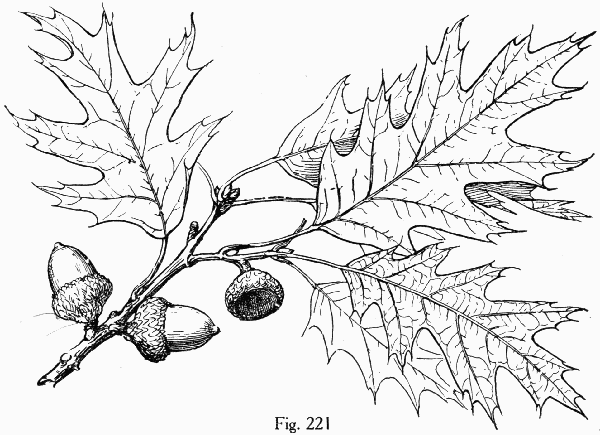
Leaves obovate or oblong, acute or acuminate, abruptly or gradually cuneate or rounded at the broad or narrow base, usually divided about half way to the midrib by wide oblique sinuses rounded at the bottom into 11 or sometimes into 7 or 9 acute oblique ovate lobes tapering from broad bases and mostly sinuately 3-toothed at apex with elongated bristle-pointed teeth, or sometimes oblong-obovate, gradually narrowed and cuneate at base, and sinuately lobed with broad acute usually entire or slightly dentate lobes, when they unfold pink, covered with soft silky pale pubescence on the upper surface and [242] below with thick white tomentum, soon glabrous, at maturity thin and firm, dark green, dull and glabrous above, pale yellow-green, glabrous or rarely puberulous and sometimes furnished with small tufts of rusty hairs in the axils of the veins below, 5′—9′ long, 4′—6′ wide; falling early in the autumn after turning dull or sometimes bright orange color or brown; petioles stout, yellow or red, 1′—2′ in length. Flowers: staminate in pubescent aments 4′—5′ long; calyx divided into 4 or 5 narrow ovate rounded lobes shorter than the stamens; pistillate on short glabrous peduncles, their involucral scales broadly ovate, dark reddish brown, shorter than the conspicuous linear acute bract of the flower and as long as the lanceolate acute calyx-lobes; stigmas bright green. Fruit solitary or in pairs, sessile or short-stalked, ovoid, gradually narrowed and acute at apex or cylindric and rounded at apex, pale brown, lustrous, more or less tomentose toward the ends, ½′—1′ long; ½′—¾′ in diameter; cup cup-shaped, puberulous on the inner surface, covered with small closely appressed ovate acute red-brown pubescent scales slightly thickened on the back toward the base of the cup, with a thin dark-colored tip and margins.
A tree usually not more than 60°—70° high, with a trunk 2°—3° in diameter, often much smaller, stout branches forming a narrow head, and slender lustrous branchlets light green and covered with pale scurfy pubescence when they first appear, dark red during their first winter and ultimately dark brown. Winter-buds ovoid, gradually narrowed to the acute apex, about ¼′ long, with thin ovate acute light chestnut-brown scales. Bark on young stems and on the upper part of the limbs of old trees 1′—1½′ thick, dark brown tinged with red and divided into small thick appressed plates scaly on the surface. Wood heavy, hard, strong, close-grained, light reddish brown, with thin lighter-colored sapwood; used in construction, for the interior finish of houses, and in furniture.
Distribution. Nova Scotia and New Brunswick, through Quebec to southern Ontario, and southward to northern New England, western New York, northern Pennsylvania (Presque Isle, Erie County), northern Michigan, southeastern Wisconsin, central Minnesota, central Iowa (Winneshick County), and on the Appalachian Mountains of North Carolina at altitudes of about 4000°. Passing with many intermediate forms differing in the size of the nut and in the depth of the cup into
Quercus borealis var. maxima Ashe. Red Oak.
Quercus rubra Du Roi, not L.
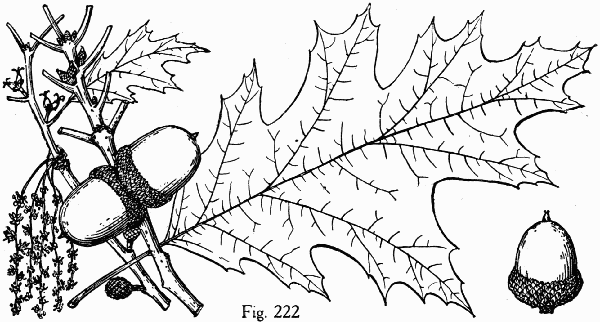
Fruit solitary or in pairs, sessile or short-stalked; nut ovoid to slightly obovoid, gradually narrowed and rounded at apex, slightly narrowed at base, usually 1′—1¼′ long and ½′—⅔′ thick, occasionally not more than ⅔′ long and thick, inclosed only at the base in a thick saucer-shaped cup.
[243]
A tree, usually 70°—80°, or occasionally 150° high, with a trunk 3°—4° in diameter, and stout spreading and ascending branches forming a broad head.
Distribution. Province of Quebec in the neighborhood of Montreal, and southern Ontario, westward through southern Michigan to southeastern Nebraska, and southward to northern Georgia, on the southern Appalachian Mountains up to altitudes of 3000°, southern Kentucky, eastern and central Tennessee, northeastern (Tishomingo County), northwestern (Yazoo County), and central and southern (Hinds and Union Counties) Mississippi, northern and southwestern Alabama (Dekalb, Cullman, Jefferson, and Dallas Counties), northwestern Arkansas, and eastern Kansas and Oklahoma; one of the largest and most generally distributed trees of the northern states; rare and local in the south; of its largest size in the region north of the Potomac and Ohio Rivers.
Often planted as a park and shade tree in the northeastern states and in the counties of western and northern Europe; generally more successful in Europe than other American Oaks.
× Quercus Lowellii Sarg., a possible hybrid of Quercus borealis and Q. ilicifolia, has been found in the neighborhood of Seabury, York County, Maine.
× Quercus Porterii Trel., probably a hybrid of Quercus borealis var. maxima and Q. velutina, has been found on Bowditch Hill, Jamaica Plain, Suffolk County, Massachusetts, on College Hill, Easton, Northampton County, Pennsylvania, and near Columbus, Franklin County, Ohio.
× Quercus runcinata Engelm., believed to be a hybrid of Quercus borealis var. maxima and Q. imbricaria first found near St. Louis, occurs also in the neighborhood of Independence, Jackson County, and at Williamsville, Wayne County, Missouri, and in Richland and Wayne Counties, Illinois.
2. Quercus Shumardii Buckl.
Quercus texana Sarg. in part, not Buckl.
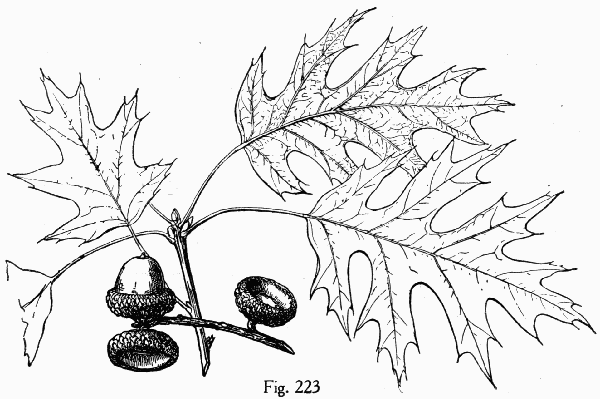
Leaves obovate, seven rarely five-lobed, the lobes two or three-lobed and sometimes dentate at apex, on leaves of lower branches short and broad, and separated by narrow sinuses pointed or rounded in the bottom, on upper branches deeply divided by broad rounded sinuses into narrow acuminate lobes, when they unfold often tinged with red and covered with pale loose tomentum deciduous before they are half grown, at maturity glabrous, dark green and lustrous above, paler and furnished below with large axillary tufts [244] of pale hairs, 6′—8′ long, 4′—5′ wide, with a thin midrib and slender primary veins running to the points of the lobes; petioles slender, glabrous, 2′—2½′ in length. Flowers: staminate in slender glabrous aments 6′—7′ long; calyx divided into 4 or 5 rounded slightly villose lobes shorter than the stamens; pistillate on pubescent peduncles, their involucral scales ovate, light brown, pubescent; stigmas red. Fruit: nut oblong-ovoid, narrowed and rounded at apex, ¾′—1¼′ long, ½′—1′ in diameter, inclosed at the base only in the thick saucer-shaped cup with a slightly incurved rim and covered with closely appressed ovate pale pubescent or nearly glabrous scales narrowed above the middle, abruptly long-pointed, thin or often conspicuously tuberculate.
A tree up to 120° high, with a tall trunk occasionally 5° in diameter, stout wide-spreading branches forming a broad rather open head, and gray or grayish brown glabrous branchlets. Winter-buds ovoid, acute or acuminate, about ¼′ long, with closely imbricated gray glabrous or rarely pubescent scales. Bark 1′—1½′ thick, ridged, broken into small appressed plates scaly on the surface. Wood heavy, hard, close-grained, light reddish brown, often manufactured into lumber in the Mississippi valley and considered more valuable than that of the northern Red Oak.
Distribution. Borders of streams and swamps in moist rich soil; coast region of Texas eastward from the Colorado River and ranging inland up the valley of that river to Burnet County, southeastern Oklahoma, through Arkansas, southeastern Kansas and Missouri to Fayette County, Iowa, southern Illinois and Indiana, the neighborhood of Columbus, Franklin County, Ohio, and southeastern Michigan (near Portage Lake, Jackson County); through the eastern Gulf States to western and central Florida and northward in the neighborhood of the coast to the valley of the Neuse River, North Carolina; Chesapeake Beach, Calvert County, Maryland (W. W. Ashe); ranging inland in the south Atlantic States to Rome, Floyd County, Georgia, Calhoun Falls, Abbeville County, and Columbia, Richland County, South Carolina, and Chapel Hill, Orange County, North Carolina. Passing into
Quercus Shumardii var. Schneckii Sarg.
Quercus texana Sarg. in part, not Buckl. Quercus Schneckii Britt.
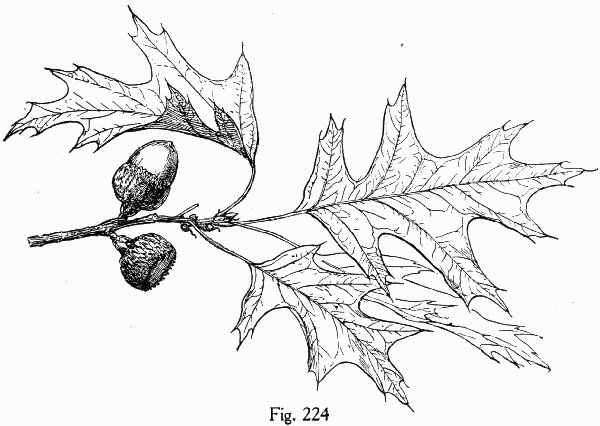
Differing from the type in the deep cup-shaped cup of the fruit covered with thin scales, rarely much thickened and tuberculate at base (only on river banks near Vicksburg, [245] Warren County, Mississippi), and connected with it by forms with the cups of the fruit differing from saucer to deep cup-shaped.
Distribution. Growing with Quercus Shumardii; more common in Texas and in the Mississippi valley than the type, and ranging eastward through Louisiana and Mississippi to central and southern Alabama, central and southeastern Tennessee (neighborhood of Chattanooga), and central Kentucky; apparently not reaching the Atlantic States.
3. Quercus texana Buckl.
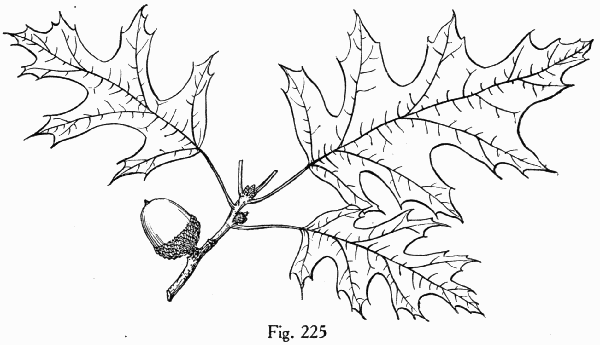
Leaves widest above the middle, broad-cuneate, concave-cuneate or nearly truncate at base, deeply or rarely only slightly divided by broad sinuses rounded in the bottom into 5 or 7 lobes, the terminal lobe 3-lobed and acute at apex, the upper lateral lobes broad and more or less divided at apex and much larger and more deeply lobed than those of the lowest pair, when they unfold densely covered with fascicled hairs and often bright red, soon glabrous, thin, dark green and lustrous above, pale and lustrous and rarely furnished below with small inconspicuous axillary tufts of pale hairs, 3′—3½′ long, 2½′—3′ wide, with a thin midrib and slender primary veins running to the points of the lobes; petioles slender, soon glabrous, ¾′—1½′ in length. Flowers: staminate in slender villose aments 3′—4′ long; calyx thin, villose on the outer surface, divided into 4 or 5 acute lobes shorter than the stamens; pistillate on short hoary tomentose peduncles, their involucral scales brown tinged with red; stigmas bright red. Fruit short-stalked, usually solitary; nut ovoid, narrowed and rounded at apex, light red-brown, often striate, ¼′—¾′ long and broad, sometimes acute, nearly 1′ in length and not more than ⅓′ in diameter; cup turbinate, covered with thin ovate acuminate slightly appressed glabrous scales, in the small fruit of trees on dry hills inclosing a third or more of the nut, in the larger fruit of trees on better soil comparatively less deep.
A tree on dry hills rarely more than 30° tall, with a trunk 8′—10′ in diameter, small spreading or erect branches and slender red or reddish brown glabrous or rarely pubescent branchlets; often a shrub; on better soil at the foot of hills occasionally 50° high with a trunk 12′—18′ in diameter. Winter-buds ovoid, acute, ⅙′—¼′ long and covered with closely imbricated acute slightly or densely pubescent red scales. Bark light brown tinged with red, ¾′—1′ thick, deeply ridged and broken into plate-like scales.
Distribution. Dry limestone hills and ridges, and in the more fertile soil at their base; central and western Texas (Dallas, Tarrant County to Travis and Bexar Counties), and to the Edwards Plateau (San Saba, Kerr, Brown, Coke and Uvalde Counties); westward [246] replaced by the var. chesosensis Sarg. differing in the acuminate lobes of the leaves and smaller cups of the fruit; known only on the dry rocky slopes of the Chesos Mountains, Brewster County, Texas; and by the var. stellapila Sarg., differing in the presence of fascicled hairs on both surfaces of the mature leaves and on the branchlets of the year; above Fort Davis, Jeff Davis County, Texas.
4. Quercus ellipsoidalis E. J. Hill. Black Oak.
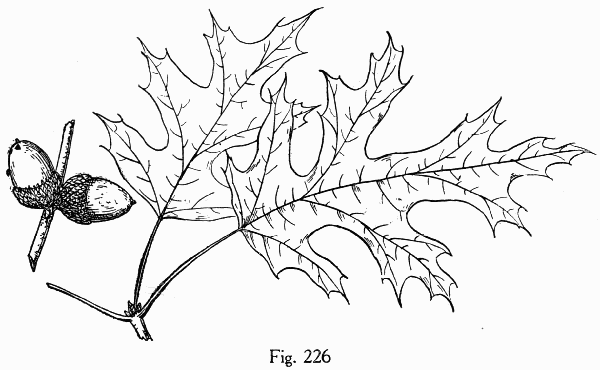
Leaves elliptic to obovate-orbicular, acute or acuminate, truncate or broadly cuneate at base, deeply divided by wide sinuses rounded in the bottom into 5—7 oblong lobes repandly dentate at apex, or often, especially those of the upper pair, repandly lobulate, when they unfold slightly tinged with red and hoary-tomentose, soon becoming glabrous with the exception of small tufts of pale hairs in the axils of the principal veins, at maturity thin and firm, bright green and lustrous above, paler and sometimes entirely glabrous below, 3′—5′ long, 2½′—4′ wide, with a stout midrib and primary veins and prominent reticulate veinlets; late in the autumn turning yellow or pale brown more or less blotched with purple; petioles slender, glabrous or rarely puberulous, 1½′—2′ in length. Flowers: staminate in puberulous aments 1½′—2′ long; calyx campanulate, usually tinged with red, 2—5-lobed or parted into oblong-ovate or rounded segments, glabrous or slightly villose, fringed at apex with long twisted hairs, about as long as the 2—5 stamens, with short filaments and oblong anthers; pistillate on stout tomentose 1—3-flowered peduncles, red, their involucral scales broad, oblong, acute, hairy; calyx campanulate, 4—7-lobed, ciliate on the margins. Fruit short-stalked or nearly sessile, solitary or in pairs; nut ellipsoidal to subglobose, chestnut-brown, often striate and puberulous, inclosed for one third to one half its length in a turbinate or cup-shaped cup gradually narrowed at base, thin, light red-brown, and covered by narrow ovate obtuse or truncate brown pubescent closely appressed scales.
A tree, 60°—70° high, with a short trunk rarely 3° in diameter, much forked branches ascending above and often pendulous low on the stem, forming a narrow oblong head, and slender branchlets covered at first with matted pale hairs, bright reddish brown during their first winter, becoming dark gray-brown or reddish brown in their second season. Winter-buds ovoid, obtuse or acute, sometimes slightly angled, about ⅛′ long, with ovate or oval red-brown lustrous slightly puberulous outer scales ciliate on the margins. Bark thin, light yellow internally, close, rather smooth, divided by shallow connected fissures into thin plates, dark brown near the base of the tree, dull above, gray-brown and only slightly furrowed on the large branches.
[247]
Distribution. In the neighborhood of Chicago, Illinois, to southeastern Minnesota common; often covering large areas of sandy soil with a stunted growth and on the prairies sometimes a low shrub; eastern Iowa (Muscatine County), and the Lower Peninsular of Michigan (Montmorency, Arenac, and St. Clair Counties).
5. Quercus coccinea Muench. Scarlet Oak. Spanish Oak.
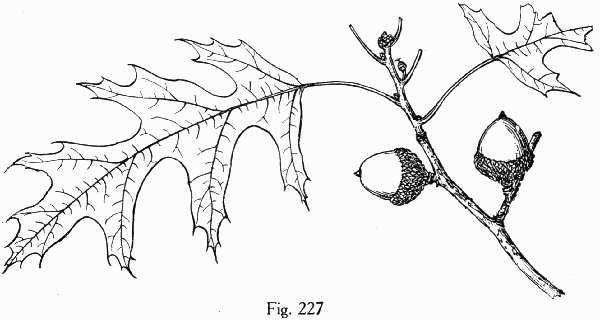
Leaves oblong-obovate or elliptic, truncate or cuneate at base, deeply divided by wide sinuses rounded in the bottom into 7 or rarely 9 lobes repand-dentate at apex, the terminal lobe, ovate, acute, and 3-toothed, the middle division the largest and furnished with 2 small lateral teeth, the lateral lobes obovate, oblique or spreading, sometimes falcate, usually broad and oblique at the coarsely toothed apex, when they unfold bright red covered with loose pale pubescence above and below with silvery white tomentum, green at the end of a few days, at maturity thin and firm, bright green, glabrous and very lustrous above, paler and less lustrous and sometimes furnished with small tufts of rusty pubescence in the axils of the veins below, 3′—6′ long, 2½′—4′ broad, with a yellow midrib and primary veins, late in the autumn turning brilliant scarlet; petioles slender, terete, 1½′—2½′ in length. Flowers: staminate in slender glabrous aments 3′—4′ long; calyx pubescent, bright red before opening, divided into 4 or 5 ovate acute segments shorter than the stamens; pistillate on pubescent peduncles sometimes ½′ long, bright red, their involucral scales ovate, pubescent, shorter than the acute calyx-lobes. Fruit sessile or stalked, solitary or in pairs; nut oval, oblong-ovate or hemispheric, truncate or rounded at base, rounded at apex, ½′—1′ long, ⅓′—⅔′ thick, light reddish brown and occasionally striate, inclosed for one third to one half its length in a deep cup-shaped or turbinate thin cup light reddish brown on the inner surface, covered by closely imbricated oblong-ovate acute thin, or rarely much thickened (var. tuberculata Sarg.) light reddish brown slightly puberulous scales.
A tree, 70°—80° high, with a trunk 2°—3° in diameter, comparatively small branches spreading gradually and forming a rather narrow open head, and slender branchlets coated at first with loose scurfy pubescence, soon pale green and lustrous, light red or orange-red in their first winter and light or dark brown the following year; usually much smaller. Winter-buds ellipsoidal or ovoid, gradually narrowed at apex, ⅛′—¼′ long, dark reddish brown, and pale-pubescent above the middle. Bark of young stems and branches smooth, light brown, becoming on old trunks ½′—1′ thick and divided by shallow fissures into irregular ridges covered by small light brown scales slightly tinged with red. Wood heavy, hard, strong, coarse-grained, light or reddish brown, with thicker darker colored sapwood.
Distribution. Light dry usually sandy soil; valley of the Androscoggin River, Maine, [248] southern New Hampshire and Vermont to southern Ontario, southward to the District of Columbia and along the Appalachian Mountains to eastern Kentucky and Tennessee, and northern Georgia; in central Georgia and northeastern Mississippi (near Corinth, Alcorn County), and westward through New York, Ohio, Indiana, Illinois and southern Wisconsin to central Missouri (Jerome, Phelps County); in eastern Oklahoma (Arkansas River valley near Fisher, Creek County, G. W. Stevens); ascending to altitudes of nearly 5000° on the southern mountains; the prevailing Oak above 2500° to the summits of the Blue Ridge of the Carolinas; very abundant in the coast region from Massachusetts Bay to southern New Jersey; less common in the interior, growing on dry gravelly uplands, and on the prairies skirting the western margins of the eastern forest.
Occasionally planted in the northeastern states and in Europe as an ornamental tree valued chiefly for the brilliant autumn color of the foliage.
× Quercus Robbinsii Trel., believed to be a hybrid of Quercus coccinea and Q. ilicifolia, occurs at North Easton, Bristol County, Massachusetts.
× Quercus Benderi Baenitz, a supposed hybrid of Quercus coccinea and Q. borealis var. maxima, appeared several years ago in Silesia, and a similar tree has been found in the Blue Hills Reservation near Boston.
6. Quercus palustris Muench. Pin Oak. Swamp Spanish Oak.
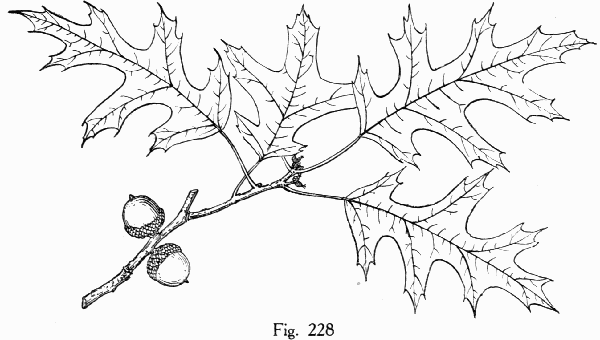
Leaves obovate, narrowed and cuneate or broad and truncate at base, divided by wide deep sinuses rounded in the bottom into 5—7 lobes, the terminal lobe ovate, acute, 3-toothed toward the apex, or entire, the lateral lobes spreading or oblique, sometimes falcate, especially those of the lowest pair, gradually tapering and acute at the dentate apex, or obovate and broad at apex, when they unfold light bronze-green stained with red on the margins, lustrous and puberulous above, coated below and on the petioles with pale scurfy pubescence, at maturity thin and firm, dark green and very lustrous above, pale below, with large tufts of pale hairs in the axils of the conspicuous primary veins; 4′—6′ long, 2′—4′ wide, with a stout midrib; late in the autumn gradually turning deep scarlet; petioles slender, yellow, ½′—2′ in length. Flowers: staminate in hairy aments 2′—3′ long; calyx puberulous and divided into 4 or 5 oblong rounded segments more or less laciniately cut on the margins, shorter than the stamens; pistillate on short tomentose peduncles, their involucral scales broadly ovate, tomentose, shorter than the acuminate calyx-lobes; stigmas bright red. Fruit sessile or short-stalked, solitary or clustered; nut nearly hemispheric, about ½′ in diameter, light brown, often striate, inclosed only at the base in a thin saucer-shaped [249] cup dark red-brown and lustrous within, and covered by closely appressed ovate light red-brown thin puberulous scales.
A tree, usually 70°—80° high, with a trunk 2°—3° in diameter, often clothed with small tough drooping branches, or when crowded in the forest sometimes 120° high, with a trunk 60°—70° tall and 4°—5° in diameter, slender branches beset with short-ridged spur-like laterals a few inches in length, forming on young trees a broad pyramidal head, becoming on older trees open and irregular, with rigid and more pendulous branches often furnished at first with small drooping branchlets, and slender tough branchlets dark red and covered by short pale silvery tomentum, soon becoming green and glabrous, lustrous dark red-brown or orange color in their first winter, growing darker in their second year and ultimately dark gray-brown. Winter-buds ovoid, gradually narrowed and acute at apex, about ⅛′ long, with imbricated light chestnut-brown scales puberulous toward the thin sometimes ciliate margins. Bark of young trunks and branches smooth, lustrous, light brown frequently tinged with red, becoming on older trunks ¾′—1¼′ thick, light gray-brown, generally smooth and covered by small closely appressed scales. Wood heavy, hard, strong, coarse-grained, light brown, with thin rather darker colored sapwood; sometimes used in construction, and for shingles and clapboards.
Distribution. Borders of swamps and river-bottoms in deep rich moist soil; valley of the Connecticut River in western Massachusetts and Connecticut; on Grand Isle in the Niagara River, New York to southern Ontario and southwestern Michigan, and westward to eastern Iowa (Muscatine County), and southward to southern West Virginia (Hardy and Mercer Counties), southwestern Virginia (Wythe County), central North Carolina (on Bowling’s Creek, near Chapel Hill, Orange County, and on Dutchman’s Creek, Forsyth County); and to southern Kentucky, central Tennessee, southern Arkansas (Fulton, Hempstead County), and northeastern Oklahoma; rare and of small size in New England; exceedingly common on the coast plain south of the Hudson River; very abundant on the bottom-lands of the streams of the lower Ohio River.
Often cultivated as an ornamental tree in the northeastern states and occasionally in the countries of western and central Europe.
7. Quercus georgiana M. A. Curtis.
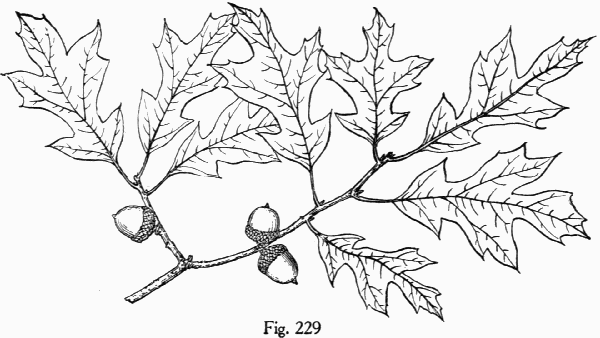
Leaves convolute in the bud, elliptic or obovate, gradually narrowed and cuneate at base, divided generally about half way to the midrib by wide or narrow oblique sinuses rounded in the bottom into 3—7 lobes, the terminal lobe ovate, acute, or rounded and entire or frequently furnished with 1 or 2 small lateral teeth, the lateral lobes oblique or [250] spreading, mostly triangular, acute and entire, or those of the upper and of the middle pair often broad and repand-lobulate at the oblique ends, sometimes gradually 3-lobed at the broad apex and narrowed and entire below, or equally 3-lobed, with broad or narrow spreading lateral lobes, or occasionally pinnatifid, when they unfold bright green tinged with red, ciliate on the margins and coated on the midrib, veins, and petioles with loose pale pubescence, at maturity thin, bright green and lustrous above, paler below, and glabrous or furnished with tufts of hairs in the axils of the primary veins, usually about 2½′ long and 1½′ wide; turning dull orange and scarlet in the autumn; petioles slender, ½′—¾′ in length. Flowers: staminate in slender glabrous or pubescent aments 2′—3′ long; calyx divided into 4 or 5 broadly ovate rounded segments rather shorter than the stamens; pistillate on short glabrous slender peduncles; their involucral scales rather shorter than the acute calyx-lobes, pubescent or puberulous; stigmas bright red. Fruit short-stalked; nut ellipsoidal or subglobose, ⅓′—½′ long, light red-brown and lustrous, inclosed for one third to nearly one half its length in a thick cup-shaped cup light red-brown and lustrous on the inner surface, and covered by thin ovate bright light red-brown truncate erose scales.
Distribution. Georgia; on Stone Mountain, and Little Stone Mountain, Dekalb County; on a few other granite hills between the Yellow and Oconee rivers in the region south and east of Stone Mountain (Winder, Jackson County, Rockmart, Polk County and at Warm Springs, Meriwether County).
Occasionally cultivated, and hardy in eastern Massachusetts.
× Quercus Smallii Trel., a possible hybrid of Quercus georgiana and Q. marilandica, occurs on the slopes and summit of Little Stone Mountain, Dekalb County, Georgia.
8. Quercus velutina Lam. Black Oak. Yellow-bark Oak.
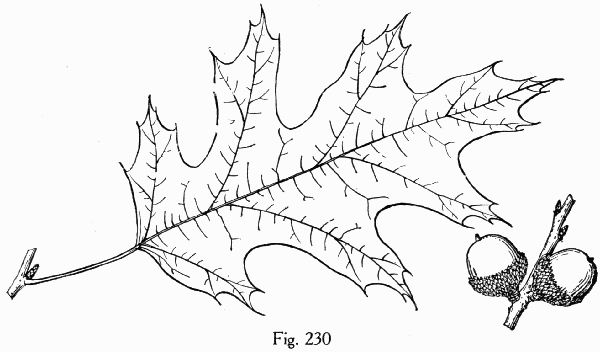
Leaves ovate or oblong, rounded, cuneate or truncate at base, mostly 7-lobed and sometimes divided nearly to the middle by wide rounded sinuses into narrow obovate more or less repand-dentate lobes, or into elongated nearly entire mucronate lobes tapering gradually from a broad base, the terminal lobe oblong, elongated, acute, furnished with small lateral teeth, or broad, rounded, and coarsely repand-dentate, or slightly divided into broad dentate lobes or sinuate-dentate, bright crimson when they unfold, and covered above by long loose scattered white hairs and below with thick pale or silvery white tomentum, hoary-pubescent when half grown, and at maturity thick and firm or subcoriaceous, dark green and lustrous above, below yellow-green, brown or dull copper color and more or less pubescent or glabrous with the exception of tufts of rusty hairs in the axils of the principal veins, 3′—12′ long and 2′—10′ wide, but usually 5′—6′ long and 3′—4′ wide, with a stout midrib and primary veins; late in the autumn turning dull red, dark orange color, or brown, and falling gradually during the winter; petioles stout, yellow, glabrous or puberulous, 3′—6′ in length. Flowers: staminate in tomentose or pubescent aments 4′—6′ long; calyx coated with pale hairs, with ovate acute lobes; pistillate on short tomentose peduncles, their involucral scales ovate, shorter than the acute calyx-lobes; stigmas bright red. Fruit sessile or short-stalked, solitary or in pairs; nut ovoid-oblong, obovoid, oval or hemispheric, broad and rounded at base, full and rounded at apex, light red-brown, often striate, frequently coated with soft rufous pubescence, ½′—¾′ long and broad, or rarely 1′ long and broad, inclosed for about half its length or rarely nearly to the apex in the thin deeply cup-shaped or turbinate cup dark red-brown on the inner surface, covered by thin light chestnut-brown acute hoary scales closely appressed at the base of the cup, loosely imbricated above the middle, with free scarious tips forming a fringe-like border to its rim.
A tree, often 70°—80° and occasionally 150° high, with a trunk 3°—4° in diameter, slender branches spreading gradually into a narrow open head, stout branchlets coated at first with pale or fulvous scurfy tomentum, becoming in their first winter glabrous, dull red or reddish brown, growing dark brown in their second year or brown slightly tinged with red. Winter-buds ovoid, strongly angled, gradually narrowed and obtuse at apex, hoary-tomentose, ¼′—½′ long. Bark of young stems and branches smooth, dark brown, deep [251] orange color internally, becoming ¾′—1½′ thick on old trunks, and deeply divided into broad rounded ridges broken on the surface into thick dark brown or nearly black closely appressed plate-like scales. Wood heavy, hard, strong, coarse-grained, bright brown tinged with red, with thin lighter colored sapwood; of little value except as fuel. The bark abounds in tannic acid and is largely used in tanning, as a yellow dye, and in medicine.
Distribution. Dry gravelly uplands and ridges; coast of southern Maine to northern Vermont, southern and western Ontario, the southern peninsula of Michigan, northwestern, eastern and southern Iowa, and southeastern Nebraska, and southward to western Florida, southern Alabama, Mississippi, Louisiana, eastern Kansas, northeastern Oklahoma and eastern Texas to the valley of the Brazos River; one of the commonest Oaks on the gravelly drift of southern New England and the middle states; ascending on the southern Appalachian Mountains to altitudes of about 4000°, and often forming a large part of the forest growth on their foothills; abundant in all parts of the Mississippi basin, and of its largest size in the valley of the lower Ohio River; the common species of the Black Oak group reaching the south-Atlantic and Gulf Coast, and here generally scattered on dry ridges through the maritime Pine belt.
Quercus velutina, which is more variable in the form of its leaves than the other North American Black Oaks, is easily recognized by the bright yellow color of the inner bark, in early spring by the deep red color of the unfolding leaves, becoming pale and silvery in a few days, and by the large tomentose winter-buds. From western Missouri to northwestern Arkansas a form occurs (var. missouriensis Sarg.) with the mature leaves covered above with fascicled hairs, and coated below and on the petioles and summer branchlets with rusty pubescence, and with broader more loosely imbricated hoary-tomentose cup-scales.
9. Quercus Kelloggii Newb. Black Oak.
Quercus californica Coop.
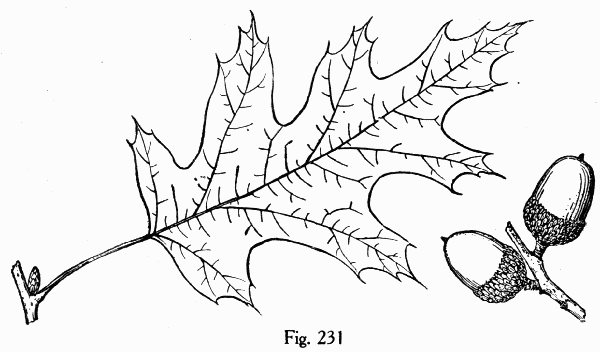
Leaves oblong or obovate, truncate, cuneate or rounded at the narrow base, 7 or rarely 5-lobed by wide and deep or shallow and oblique sinuses rounded in the bottom, the terminal lobe ovate, 3-toothed at the acute apex, the lateral lobes tapering gradually from the base or broad and obovate, coarsely repand-dentate with acute pointed teeth, or rarely entire, when they unfold dark red or purple and pilose above and coated below and on the petioles with thick silvery white tomentum, at maturity thick and firm, [252] lustrous, dark yellow-green and glabrous or rarely pubescent above, light yellow-green or brownish and glabrous or pubescent, or occasionally hoary-tomentose below, 3′—6′ long, 2′—4′ wide; turning yellow or brown in the autumn before falling; petioles slender, yellow, 1′—2′ in length. Flowers: staminate in hairy aments 4′—5′ long; calyx pubescent, divided into 4 or 5 ovate acute segments shorter than the stamens; anthers bright red; pistillate on short tomentose peduncles, their involucral scales ovate, coated like the acute calyx-lobes with pale tomentum; stigmas dark red. Fruit short-stalked, solitary or clustered; nut oblong, ellipsoidal or obovoid, broad and rounded at base, full and rounded or gradually narrowed and acute at the puberulous apex, 1′—1½′ long, about ¾′ broad, light chestnut-brown, often striate, inclosed for one fourth to two thirds of its length in the deep cup-shaped cup light brown on the inner surface, and covered by thin ovate-lanceolate lustrous light chestnut brown scales, sometimes rounded and thickened on the back toward the base of the cup, their tips elongated, thin and erose on the margins, often forming a narrow fringe-like border to the rim of the cup.
A tree, occasionally 100° high, with a trunk 3°—4° in diameter, stout spreading branches forming an open round-topped head, and branchlets coated at first with thick hoary caducous tomentum, bright red or brown tinged with red, and usually glabrous or pubescent or puberulous during their first winter, becoming dark red-brown in their second year; frequently much smaller and at high elevations a small shrub (f. cibata Jeps.). Winter-buds ovoid, gradually narrowed and acute at apex, about ¼′ long, with closely imbricated pale chestnut-brown scales ciliate on the thin scarious margins and pubescent toward the point of the bud. Bark of young stems and branches smooth, light brown, becoming on old trunks 1′—1½′ thick, dark brown slightly tinged with red or nearly black, divided into broad ridges at the base of old trees and broken above into thick irregular oblong plates covered by minute closely appressed scales. Wood heavy, hard, strong, very brittle, bright red, with thin lighter colored sapwood; occasionally used as fuel.
Distribution. Valleys and mountain slopes; basin of the Mackenzie River in western Oregon, southward over the California coast ranges, and along the western slopes of the Sierra Nevada up to altitudes of 6500° to the Cuyamaca Mountains near the southern boundary of California; extending across the Sierra Nevada to the foothills of Owens valley (Jepson) in eastern California; rare in the immediate neighborhood of the coast; the largest and most abundant Oak-tree of the valleys of southwestern Oregon and of the Sierra Nevada, sometimes forming groves of considerable extent in coniferous forests; of its largest size at altitudes of about 6000° above the sea.
[253]
10. Quercus Catesbæi Michx. Turkey Oak.
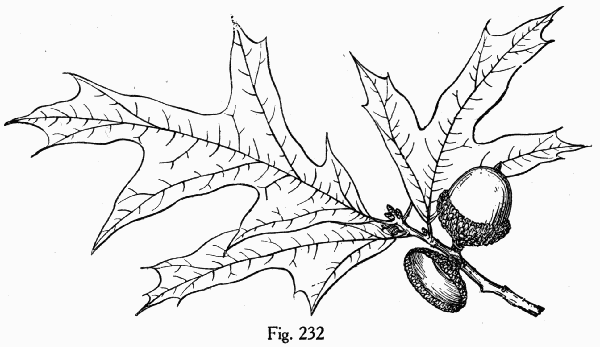
Leaves oblong or obovate or nearly triangular, gradually narrowed and cuneate at base, deeply divided by wide rounded sinuses into 3 or 5 or rarely 7 lobes, the terminal lobe ovate, elongated, acute and entire or repand-dentate, or obovate and coarsely equally or irregularly 3-toothed at apex, the lateral lobes spreading, usually falcate, entire and acute, tapering from the broad base, and broad, oblique, and repand-lobulate at apex, or 3-toothed at the broad apex and gradually narrowed to the base, coated when they unfold with rufous fascicled hairs, and when fully grown thick and rigid, bright yellow-green and lustrous above, paler, lustrous, and glabrous below, with large tufts of rusty hairs in the axils of the veins, 3′—12′ long, 1′—10′ wide, but usually about 5′ long and wide, with a broad yellow or red-brown midrib; turning bright scarlet before falling in the late autumn or early winter; petioles stout, grooved, ¼′—¾′ in length. Flowers: staminate in slender hairy red-stemmed aments 4′—5′ long; calyx puberulous and divided into 4 or 5 ovate acute lobes; pistillate on short stout tomentose peduncles, their involucral scales bright red, pubescent, hairy at the margins; stigmas dark red. Fruit short-stalked, usually solitary; nut oval, full and rounded at the ends, about 1′ long and ¾′ broad, dull light brown, covered at the apex by a thin coat of snow-white tomentum, inclosed for about one third its length in a thin turbinate cup often gradually narrowed into a stout stalk-like base, light red-brown and lustrous on the inner surface, covered by ovate-oblong rounded scales extending above the rim of the cup and down over the upper third of the inner surface, and hoary-pubescent except their thin bright red margins.
A tree, usually 20°—30°, or occasionally 50°—60° high, with a trunk rarely exceeding 2° in diameter, stout spreading more or less contorted branches forming a broad or narrow open irregular generally round-topped head, and stout branchlets coated at first with fascicled hairs, nearly glabrous and deep red when the leaves are half grown, dark red in their first winter, gradually growing dark brown; generally much smaller and sometimes shrubby. Winter-buds elongated, acute, ½′ long, with light chestnut-brown scales erose on the thin margins, and coated, especially toward the point of the bud, with rusty pubescence. Bark ½′—1′ thick, red internally, dark gray tinged with red on the surface, and at the base of old trunks becoming nearly black, deeply and irregularly furrowed and broken into small appressed scales. Wood heavy, hard, strong, rather close-grained, light brown tinged with red, with thick lighter colored sapwood; largely used for fuel.
Distribution. Dry barren sandy ridges and sandy bluffs and hummocks in the neighborhood of the coast; southeastern Virginia (near Zuni, Isle of Wight County) to the shores [254] of Indian River and Peace Creek, Florida, and westward to eastern Louisiana; comparatively rare toward the western limits of its range, and most abundant and of its largest size on the high bluff-like shores of bays and estuaries in South Carolina and Georgia; the prevailing tree with Quercus cinerea in the flat woods of the interior of the Florida peninsula as far south as the sandy ridges in the neighborhood of Lake Istokpoga, De Soto County.
× Quercus Mellichampii Trel. believed to be a hybrid of Quercus Catesbæi and Q. laurifolia occurs at Bluffton on the coast of South Carolina, in the neighborhood of Orlando, Orange County and near San Mateo, Putnam County, Florida.
× Quercus Ashei Trel. believed to be a hybrid of Quercus Catesbæi with Q. cinerea occurs at Folkston and near Trader’s Hill, Charlton County and St. Mary’s, Camden County, Georgia.
× Quercus blufftonensis Trel., a probable hybrid of Quercus Catesbæi and Q. rubra L., has been found at Bluffton, South Carolina.
× Quercus Walteriana Ashe, believed to be a hybrid of Quercus Catesbæi and Q. nigra, is not rare in the immediate neighborhood of the coast of South Carolina and Georgia, and occurs on sand hills in Sampson County, North Carolina, near Jacksonville, Duval County, Florida, at Mount Vernon, Mobile County and in the neighborhood of Selma, Dallas County, Alabama.
11. Quercus ilicifolia Wang. Bear Oak. Scrub Oak.
Quercus nana Sarg.
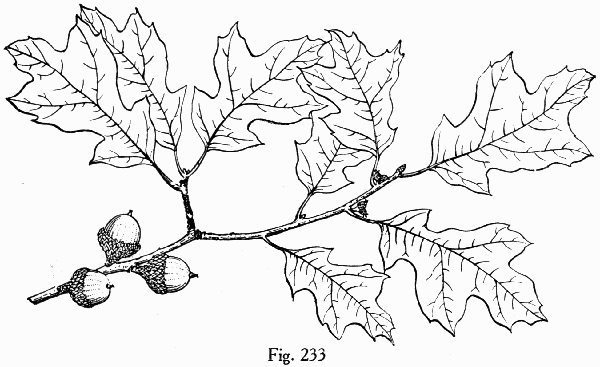
Leaves obovate or rarely oblong, gradually or abruptly cuneate at base, divided by wide shallow sinuses into 3—7, usually 5, acute lobes, the terminal lobe ovate, elongated, rounded and 3-toothed or acute and dentate or entire at apex, the lateral lobes spreading, mostly triangular and acute, or those of the upper pair broad, oblique and repand-lobulate or broad at apex, slightly 3-lobed and entire below, or deeply 3-lobed above and sinuate below, or occasionally oblong to oblong-obovate and entire, with undulate margins, when they unfold dull red and puberulous or pubescent on the upper surface and coated on the lower and on the petioles with thick pale tomentum, with conspicuous tufts of silvery white hairs in the axils of the veins, at maturity thick and firm, dark green and lustrous above, covered below with pale or silvery white pubescence, 2′—5′ long, 1½′—3′ wide, [255] with a stout yellow midrib and slender primary veins; turning dull scarlet or yellow in the autumn; petioles slender, glabrous, or pubescent, 1′—1½′ in length. Flowers: staminate in hairy aments 4′—5′ long, and often persistent until midsummer; calyx red or green tinged with red and irregularly divided into 3—5 ovate rounded lobes shorter than the stamens; anthers bright red ultimately yellow; pistillate on stout tomentose peduncles, their involucral scales ovate, about as long as the acute calyx-lobes, red and tomentose; stigmas dark red. Fruit produced in great profusion, sessile or stalked, in pairs or rarely solitary; nut ovoid, broad, flat or rounded at base, gradually narrowed and acute or rounded at apex, about ½′ long and broad, light brown, lustrous, usually faintly striate, inclosed for about one half its length in the cup-shaped or saucer-shaped cup often abruptly enlarged above the stalk-like base, thick, light reddish brown within, and covered by thin ovate closely imbricated red-brown puberulous scales acute or truncate at apex, the minute free tips of the upper scales forming a fringe-like border to the cup.
A tree, occasionally 18°—20° high, with a trunk 5′—6′ in diameter, with slender spreading branches usually forming a round-topped head, and slender branchlets dark green more or less tinged with red and hoary-pubescent at first, during their first winter red-brown or ashy gray and pubescent or puberulous, becoming glabrous and darker in their second year and ultimately dark brown or nearly black; more frequently an intricately branched shrub, with numerous contorted stems 3°—10° tall. Winter-buds ovoid, obtuse, about ⅛′ long, with dark chestnut-brown rather loosely imbricated glabrous or pilose scales. Bark thin, smooth, dark brown, covered by small closely appressed scales.
Distribution. Dry sandy barrens and rocky hillsides; coast of eastern Maine southward through eastern and southern New England to southern and southwestern Pennsylvania and along the Appalachian Mountains, principally on their eastern slopes, to southern Virginia; on Crowder and King Mountains, Gaston County, North Carolina; and westward to the shores of Lake George and the valley of the Hudson River; common in eastern and southern New England, in the Pine barrens of New Jersey, and in eastern Pennsylvania.
× Quercus Brittonii Davis, believed to be a hybrid of Quercus ilicifolia and Q. marilandica, has been found on Staten Island, New York, and at Ocean Grove, Monmouth County, New Jersey.
× Quercus Giffordii Trel., believed to be a hybrid of Quercus ilicifolia and Q. Phellos, has been found at May’s Landing, Atlantic County, New Jersey.
× Quercus Rehderi Trel., believed to be a hybrid of Quercus ilicifolia and Q. velutina, is not rare in eastern Massachusetts and occurs on Martha’s Vineyard (Chilmark).
12. Quercus rubra L. Red Oak. Spanish Oak.
Quercus digitata Sudw.
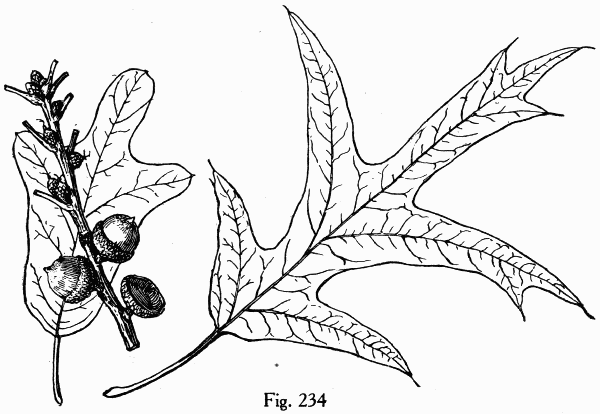
Leaves ovate to obovate, narrowed and rounded or cuneate at base, the terminal lobe long-acuminate, entire or slightly lobed, often falcate, usually longer than the 2 or 4 acuminate entire lateral lobes narrowed from a broad base and often falcate, or oblong-obovate and divided at the broad apex by wide or narrow sinuses broad and rounded in the bottom into 3 rounded or acute entire or dentate lobes, and entire and gradually narrowed below into an acute or rounded base (var. triloba Ashe), the two forms usually occurring on different but sometimes on the same tree, at maturity thin and firm, dark green and lustrous above, coated below with soft close pale or rusty pubescence, 6′—7′ long and 4′—5′ wide, obscurely reticulate-venulose, with a stout tomentose midrib and primary veins; turning brown or dull orange color in the autumn; petioles slender, flattened, 1′—2′ in length. Flowers: staminate in tomentose aments, 3′—5′ long; calyx thin and scarious, pubescent on the outer surface, divided into 4 or 5 ovate rounded segments; pistillate on stout tomentose peduncles, their involucral scales coated with rusty tomentum, as long or rather shorter than the acute calyx-lobes; stigmas dark red. Fruit sessile or short-stalked; nut subglobose to ellipsoidal, full and rounded at apex, truncate and rounded at base, about [256] ½′ long, bright orange-brown, inclosed only at base or sometimes for one third its length in a thin saucer-shaped cup flat on the bottom or gradually narrowed from a stalk-like base, or deep and turbinate, bright red-brown on the inner surface, covered by thin ovate-oblong reddish scales acute or rounded at apex and pale-pubescent except on the margins.
A tree, usually 70°—80° high, with a trunk 2°—3° in diameter, large spreading branches forming a broad round-topped open head, and stout branchlets coated at first, like the young leaves, with thick rusty or orange-colored clammy tomentum, dark red or reddish brown and pubescent or rarely glabrous during their first winter, becoming in their second year dark red-brown or ashy gray. The var. triloba usually 20°—30° rarely 40°—50° high. Winter-buds ovoid or oval, acute, ⅛′—¼′ long, with bright chestnut-brown puberulous or pilose scales ciliate with short pale hairs. Bark ¾′—1′ thick, dark brown or pale, and divided by shallow fissures into broad ridges covered by thin closely appressed scales. Wood hard, strong, not durable, coarse-grained, light red, with thick lighter colored sapwood; sometimes used in construction, and largely as fuel. The bark is rich in tannin, and is used in tanning leather and occasionally in medicine.
Distribution. Southeastern and southern Pennsylvania and southern New Jersey southward to central Florida, through the Gulf states to the valley of the Brazos River, Texas, and through eastern Oklahoma and southwestern Missouri to central Tennessee and Kentucky, southern Indiana and Illinois, southern Ohio (Black Fork Creek, Lawrence County), and Kanawha County, West Virginia; in the north Atlantic states only in the neighborhood of the coast and comparatively rare; very common in the south Atlantic and Gulf states on dry hills between the coast plain and the Appalachian Mountains; less abundant in the southern maritime Pine belt. The var. triloba: rare and local. Pleasant Grove, Lancaster County, Pennsylvania and Jefferson County, Indiana, southward to central and western Florida, southern Alabama and Mississippi, western Arkansas and eastern Texas; on dry uplands near Milledgeville, Baldwin County, Georgia, the prevailing form.
Quercus rubra var. pagodæfolia Ashe. Swamp Spanish Oak. Red Oak.
Quercus pagoda Rafn. Quercus pagodæfolia Ashe.
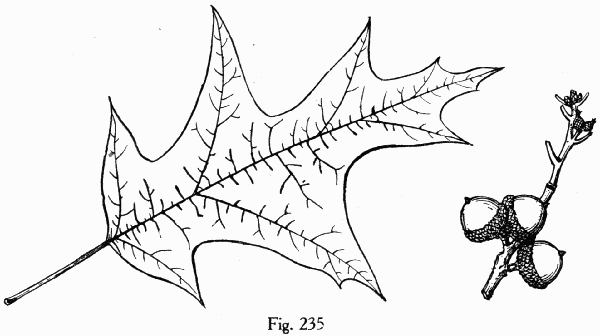
Leaves elliptic to oblong, acuminate, gradually narrowed and cuneate or full and rounded or rarely truncate at base, deeply divided by wide sinuses rounded in the bottom into 5—11 acuminate usually entire repand-dentate lobes often falcate and spreading at right angles [257] to the midrib or pointed toward the apex of the leaf, when they unfold coated with pale tomentum, thickest on the lower surface, and dark red on the upper surface, at maturity dark green and very lustrous above, pale and tomentose below, 6′—8′ long and 5′—6′ wide, with a stout midrib usually puberulous on the upper side, slender primary veins arched to the points of the lobes, and conspicuous reticulate veinlets; turning bright clear yellow before falling; petioles stout, pubescent or tomentose, 1½′—2′ in length. Flowers and Fruit as in the species.
A tree, sometimes 120° high, with a trunk 4°—5° in diameter, heavy branches forming in the forest a short narrow crown, or in more open situations wide-spreading or ascending and forming a great open head, and slender branchlets hoary tomentose at first, tomentose or pubescent during their first winter, and dark reddish brown and puberulous during their second year. Winter-buds ovoid, acute, often prominently 4-angled, about ¼′ long, with light red-brown puberulous scales sometimes ciliate at the apex. Bark about 1′ thick and roughened by small rather closely appressed plate-like light gray, gray-brown or dark brown scales. Wood light reddish brown, with thin nearly white sapwood; largely manufactured into lumber in the Mississippi valley, and valued almost as highly as white oak.
Distribution. Rich bottom-lands and the alluvial banks of streams; Maryland (Queen Anne County) and coast of Virginia to northern Florida, and through the Gulf states and Arkansas to southern Missouri, western Tennessee and Kentucky, and southern Illinois and Indiana; most abundant and one of the largest and most valuable timber-trees in the river swamps of the Yazoo basin, Mississippi, and of eastern Arkansas. Differing chiefly from the type in the more numerous and more acuminate lobes of the usually more elongated leaves usually paler on the lower surface, and in the generally paler bark of the trunk; passing into Quercus rubra var. leucophylla Ashe with leaves on upper branches nearly as broad as long thickly covered below with brownish pubescence and deeply divided into 5—7 lobes, and on lower branches slightly obovate, less deeply divided, thin, dark green, sometimes pubescent becoming glabrous above and often covered below with pale or brown pubescence.
A tree sometimes 120° high; in low rich soil; coast region of southeastern Virginia, southward to western Florida and through the Gulf states to the valley of the Neches River, Texas, and northward to northern Arkansas; in southern Illinois (near Mt. Carmel, Wabash County) and southwestern Indiana (near Hovey Lake, Posey County); abundant in low woods about River Junction, Gadsden County, Florida, and in central Mississippi.
× Quercus Willdenoviana Zabel is believed in Europe to be a hybrid of Quercus rubra and Quercus velutina.
[258]
13. Quercus marilandica Muench. Black Jack. Jack Oak.
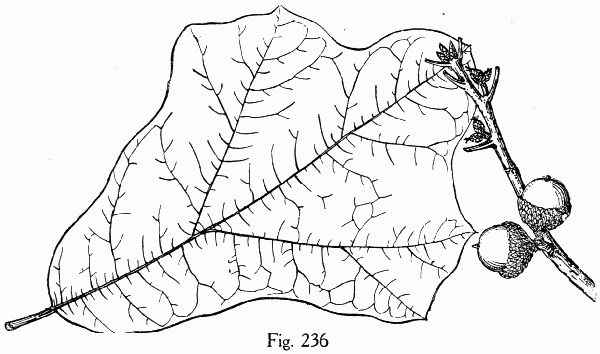
Leaves broadly obovate, rounded or cordate at the narrow base, usually 3 or rarely 5-lobed at the broad and often abruptly dilated apex, with short or long, broad or narrow, rounded or acute, entire or dentate lobes, or entire or dentate at apex, sometimes oblong-obovate, undulate-lobed at the broad apex and entire below, or equally 3-lobed with elongated spreading lateral lobes broad and lobulate at apex, when they unfold coated with a clammy tomentum of fascicled hairs and bright pink on the upper surface, at maturity thick and firm or subcoriaceous, dark yellow-green and very lustrous above, yellow, orange color, or brown and scurfy-pubescent below, usually 6′—7′ long and broad, with a thick broad orange-colored midrib; turning brown or yellow in the autumn; petioles stout, yellow, glabrous or pubescent, ½′—¾′ in length. Flowers: staminate in hoary aments 2′—4′ long; calyx thin and scarious, tinged with red above the middle, pale-pubescent on the outer surface, divided into 4 or 5 broad ovate rounded lobes; anthers apiculate, dark red; pistillate on short rusty-tomentose peduncles coated like their involucral scales with thick rusty tomentum; stigmas dark red. Fruit, solitary or in pairs, usually pedunculate; nut oblong, full and rounded at the ends, rather broader below than above the middle, about ¾′ long, light yellow-brown and often striate, the shell lined with dense fulvous tomentum, inclosed for one third to nearly two thirds of its length in a thick turbinate light brown cup puberulous on the inner surface, and covered by large reddish brown loosely imbricated scales often ciliate and coated with loose pale or rusty tomentum, the upper scales smaller, erect, inserted on the top of the cup in several rows, and forming a thick rim round its inner surface, or occasionally reflexed and covering the upper half of the inner surface of the cup.
A tree, 20°—30°, or occasionally 40°—50° high, with a trunk rarely more than 1′ in diameter, short stout spreading often contorted branches forming a narrow compact round-topped or sometimes an open irregular head, and stout branchlets coated at first with thick pale tomentum, light brown and scurfy-pubescent during their first summer, becoming reddish brown and glabrous or puberulous in the winter, and ultimately brown or ashy gray. Winter-buds ovoid or oval, prominently angled, light red-brown, coated with rusty brown hairs, about ¼′ long. Bark 1′—1½′ thick, and deeply divided into nearly square plates 1′—3′ long and covered by small closely appressed dark brown or nearly black scales. Wood heavy, hard, strong, dark rich brown, with thick lighter colored sapwood; largely used as fuel and in the manufacture of charcoal.
Distribution. Dry sandy or clay barrens; Long Island and Staten Island, New York, eastern and southern Pennsylvania, and southern New Jersey to the shores of Matanzas Inlet and Tampa Bay, Florida, and westward through the Gulf states to western Texas [259] (Callahan County) and to western Oklahoma (Dewey and Kiowa Counties), Arkansas, eastern Kansas, southeastern Nebraska and through Missouri to northeastern Illinois, southwestern and southern Indiana, and northeastern Kentucky (South Portsmouth, Greenup County, R. E. Horsey); rare in the north, very abundant southward; west of the Mississippi River often forming on sterile soils a great part of the forest growth; of its largest size in southern Arkansas and eastern Texas.
× Quercus Rudkinii Britt., with characters intermediate between those of Quercus marilandica and Q. Phellos, and probably a hybrid of these species, has been found near Tottenville, Staten Island, New York, at Keyport, Monmouth County, New Jersey, and at the Falls of the Yadkin River, Stanley County, North Carolina.
× Quercus sterilis Trel., believed to be a hybrid of Quercus marilandica and Q. nigra has been found in Bladen County, North Carolina.
× Quercus Hastingsii Sarg., believed to be a hybrid of Quercus marilandica and Q. texana, occurs near Boerne, Kendall County, and at Brownwood, Brown County, Texas.
× Quercus Bushii Sarg., believed to be a hybrid of Quercus marilandica and Q. velutina, although not common, occurs in eastern Oklahoma (Sapulpa, Creek County), Mississippi (Oxford, Lafayette County), Alabama (Dothan, Houston County, near Berlin, Dallas County, and Daphne, Baldwin County), Florida (Sumner, Levey County), and in Georgia (Climax, Decatur County).
14. Quercus arkansana Sarg.
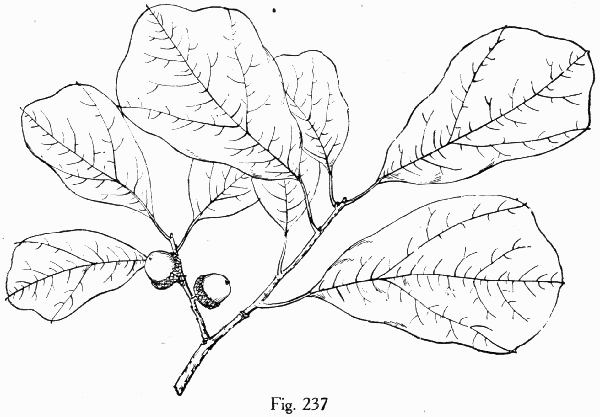
Leaves broadly obovate, slightly 3-lobed or dentate at the wide apex, cuneate at base, on sterile branches often oblong-ovate, acute or rounded at apex, rounded at base, the lobes ending in long slender mucros, when they unfold tinged with red, thickly covered with pale fascicled hairs persistent until summer, the midrib and veins more thickly clothed with long straight hairs, and at maturity glabrous, with the exception of small axillary tufts of pubescence on the lower surface, light yellow-green above, paler below, 2′—2¾′ long and broad, with a slender light yellow midrib, thin primary veins and prominent veinlets; on sterile branches often 4½′—5½′ long and 2½′—2¾′ wide; petioles slender, coated at first with clusters of pale hairs, becoming glabrous or puberulous, ⅗′—⅘′ in length. Flowers: staminate in aments covered with clusters of long pale hairs, 2′—2½′ long; calyx [260] usually 4 rarely 3-lobed, thinly covered with long white hairs; stamens usually 4; anthers ovoid-oblong, apiculate, dark red; pistillate on stout peduncles, hoary-tomentose like the scales of the involucre; stigmas dark red. Fruit solitary or in pairs, on short glabrous peduncles; nut broad-ovoid, rounded at apex, sparingly pubescent especially below the middle with fascicled hairs, light brown, obscurely striate, ¼′—⅓′ long, ½′—⅝′ thick, inclosed only at base in the flat saucer-shaped cup, pubescent on the inner surface, covered with closely appressed scales obtuse at their narrow apex, red on the margins, pale pubescent, those of the upper rank smaller, erect, inserted on the top of the cup and forming a thin rim round its inner surface.
A tree when crowded in the forest often 60°—70° high, with a tall trunk, stout ascending branches forming a long narrow head, and slender branchlets thickly coated early in the season with pale fascicled hairs, pubescent or nearly glabrous in their first autumn and darker and glabrous in their second year, when not crowded by other trees rarely 40° high with a short trunk occasionally 1° in diameter. Winter-buds ovoid, acute, with thin light chestnut-brown slightly pubescent or nearly glabrous scales. Bark thick, nearly black, divided by deep fissures into long narrow ridges covered with thick closely appressed scales.
Distribution. Low woods and on rolling sand hills four miles north of Fulton, Hempstead County, Arkansas; rare and local.
15. Quercus nigra L. Water Oak.
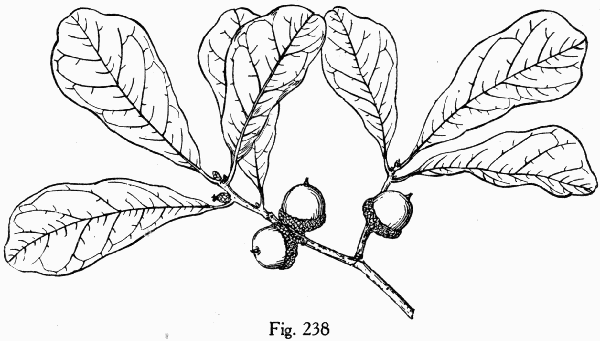
Leaves oblong-obovate, gradually narrowed and cuneate at base and enlarged often abruptly at the broad rounded entire or occasionally 3-lobed apex, on vigorous young branchlets sometimes pinnatifid with acute, acuminate or rounded lobes or broadly oblong-obovate and rounded at apex with entire or undulate margins, on upper branches occasionally linear-lanceolate, on occasional trees narrowed below to an elongated cuneate base and gradually widened above into a more or less deeply 3-lobed apex, the lobes rounded or acute (var. tridentifera Sarg.), or often acute at the ends, and on upper branchlets sometimes linear-lanceolate to linear-obovate, acute or rounded at apex, divided above the middle by deep wide rounded sinuses into elongated lanceolate acute entire lobes, or pinnatifid above the middle, when they unfold thin, light green more or less tinged with red and covered by fine caducous pubescence, with conspicuous tufts of pale hairs in the axils of the veins below, at maturity thin, dull bluish green, paler below than above, glabrous or with axillary tufts of rusty hairs, usually about 2½′ long and 1½′ wide, or on fertile branches sometimes 6′ long and 2½′ wide; turning yellow and falling gradually during the winter; petioles stout, flattened, ⅛′—½′ in length; leaves of seedling plants linear-lanceolate with entire or undulate margins, or occasionally lobed with 1 or 2 pointed lobes, often deeply 3-lobed at a wide apex, and occasionally furnished below the middle with a single acuminate lobe, all the forms often occurring on a plant less than three feet high. Flowers: staminate in red hairy-stemmed aments 2′—3′ long; calyx thin and scarious, covered on the outer surface with short hairs, divided into 4 or 5 ovate rounded segments; pistillate on short tomentose peduncles, their involucral scales a little shorter than the acute calyx-lobes and coated with rusty hairs; stigmas deep red. Fruit usually solitary, sessile or short-stalked; nut ovoid, broad and flat at base, full and rounded at the pubescent apex, light yellow-brown, often striate, ⅓′—⅔′ long and nearly as thick, usually inclosed only at the base in a thin saucer-shaped cup, or occasionally for one third its length in a cup-shaped cup, coated on the inner surface with pale silky tomentum and covered by ovate acute closely appressed light red-brown scales clothed with pale pubescence except on their darker colored margins.
A tree, occasionally 80° high, with a trunk 2°—3½° in diameter, numerous slender branches spreading gradually from the stem and forming a symmetrical round-topped head, and slender glabrous branchlets light or dull red during their first winter, becoming grayish brown in their second season. Winter-buds ovoid, acute, strongly angled, covered by loosely imbricated dark red-brown puberulous scales slightly ciliate on the thin margins. [261] Bark ½′—¾′ thick, with a smooth light brown surface slightly tinged with red and covered by smooth closely appressed scales. Wood heavy, hard, strong, close-grained, light brown, with thick lighter colored sapwood; little valued except as fuel.
Distribution. High sandy borders of swamps and streams and the rich bottom-lands of rivers, or northward sometimes in dry woods; southern Delaware, southward to the shores of the Indian River and Tampa Bay, Florida, ranging inland in the south Atlantic states through the Piedmont region, and westward through the Gulf states to the valley of the Colorado River, Texas, and through eastern Oklahoma and Arkansas to southeastern Missouri and to central Tennessee and Kentucky. The var. tridentifera Sarg. rare and local; southwest Virginia to Alabama (near Selma, Dallas County), central and western Mississippi, eastern Louisiana; valley of Navidad River, Lavaca County, Texas. A form (f. microcarya Sarg.—Quercus microcarya Small) occurs in the dry soil on slopes of Little Stone Mountain, Dekalb County, Georgia.
The Water Oak is commonly planted as a shade-tree in the streets and squares of the cities and towns of the southern states.
16. Quercus rhombica Sarg.
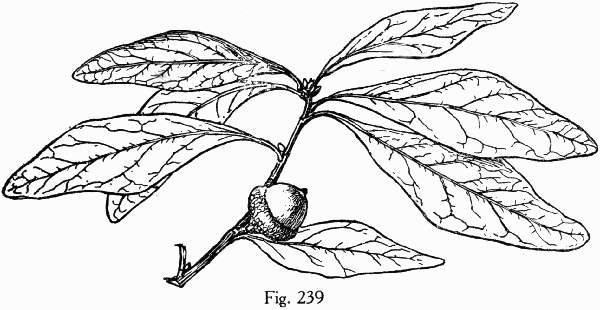
Leaves rhombic, rarely oblong-obovate to lanceolate, acute or rounded and apiculate at apex, cuneate at base, the margins entire or slightly undulate, those on vigorous shoots occasionally furnished on each side near the middle with a short lobe, when they unfold deeply tinged with red, covered with short pale caducous pubescence and furnished below with usually persistent tufts of axillary hairs, at maturity thin, dark green and lustrous above, pale below, 3½′—4′ long, 1½′—2′ wide, with a stout conspicuous yellow midrib and slender forked primary veins; turning yellow and falling gradually in early winter, rarely at the ends of branches, obovate and rounded, slightly 3-lobed or undulate at the broad apex (var. obovatifolia Sarg.); petioles yellow, ⅕′—½′ in length. Flowers not seen. Fruit sessile or short-stalked; nut ovoid, rounded at apex, thickly covered with pale pubescence, ⅖′—½′ long, ⅗′ thick; inclosed only at the base in a saucer-shaped cup, rounded on the bottom, silky pubescent on the inner surface, and covered with slightly pubescent reddish brown loosely appressed scales rounded at apex, with free tips, those of the upper rank thin and ciliate on the margins.
A tree often 120°—150° high, with a tall trunk 3°—4½° in diameter, stout, wide-spreading smooth branches forming a broad open head, and slender glabrous branchlets red-brown during their first season and dark gray the following year. Bark pale gray, slightly furrowed and covered with closely appressed scales, ½′—¾′ thick.
[262]
Distribution. Borders of swamps and low wet woods of the coast region; southeastern Virginia (Dismal Swamp) to northern Florida, and through the Gulf states to the valley of the Neches River (Beaumont, Jefferson County), eastern Texas; in Louisiana northward to the valley of the Red River; most abundant in south central Alabama and in Louisiana.
× Quercus beaumontiana Sarg., believed to be a hybrid of Quercus rhombica and Q. rubra has been found growing by a street in Beaumont, Jefferson County, Texas.
× Quercus Cocksii Sarg., probably a hybrid of Quercus rhombica and Q. velutina, has been found at Pineville, Rapides Parish, Louisiana.
17. Quercus Phellos L. Willow Oak.
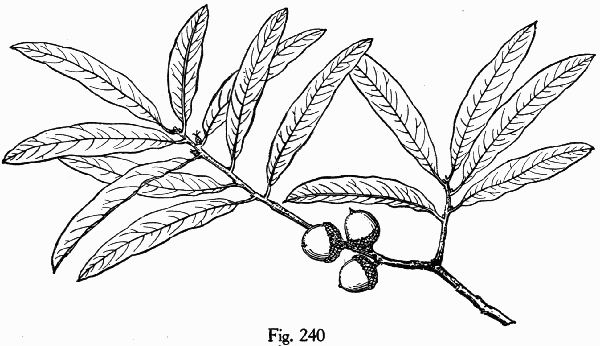
Leaves ovate-lanceolate or rarely obovate-lanceolate, often somewhat falcate, gradually narrowed and acute at the ends, and entire with slightly undulate margins, when they fold light yellow-green and lustrous on the upper surface, coated on the lower with pale caducous pubescence, at maturity glabrous, light green and rather lustrous above, dull and paler or rarely hoary-pubescent below, conspicuously reticulate-venulose, 2½′—5′ long, ¼′—1′ wide, with a slender yellow midrib and obscure primary veins forked and united [263] about halfway between the midrib and margins; turning pale yellow in the autumn; petioles stout, about ⅛′ in length. Flowers: staminate in slender-stemmed aments 2′—3′ long; calyx yellow, hirsute, with 4 or 5 acute segments; pistillate on slender glabrous peduncles, their involucral scales brown covered by pale hairs, about as long as the acute calyx-lobes; stigmas bright red. Fruit short-stalked or nearly sessile, solitary or in pairs; nut hemispheric, light, yellow-brown, coated with pale pubescence, inclosed only at the very base in the thin pale reddish brown saucer-shaped cup silky-pubescent on the inner surface, and covered by thin ovate hoary-pubescent closely appressed scales rounded at apex.
A tree, often 70°—90° high, with a trunk 2° or rarely 4° in diameter, small branches spreading into a comparatively narrow open or conical round-topped head, and slender glabrous reddish brown branchlets roughened by dark lenticels, becoming in their second year dark brown tinged with red or grayish brown; usually much smaller. Winter-buds ovoid, acute, about ⅛′ long, with dark chestnut-brown scales pale and scarious on the margins. Bark ½′—¾′ thick, light red-brown slightly tinged with red, generally smooth but on old trees broken by shallow narrow fissures into irregular plates covered by small closely appressed scales. Wood heavy, strong, not hard, rather coarse-grained, light brown tinged with red, with thin lighter colored sapwood; occasionally used in construction, for clapboards and the fellies of wheels.
Distribution. Low wet borders of swamps and streams and rich sandy uplands; Staten Island, New York, southern New Jersey and southeastern Pennsylvania and southward to northeastern Florida, through the Gulf states to the valley of the Navasota River, Brazos County, Texas, and through Arkansas, eastern Oklahoma and southeastern Missouri to central Tennessee and northwestern Kentucky (Ballard County), and in southwestern Illinois (Massac and Pope Counties); in the Atlantic states usually confined to the maritime plain; less common in the middle districts, rarely extending to the Appalachian foothills.
Occasionally planted as a shade-tree in the streets of southern towns, and rarely in western Europe; hardy in eastern Massachusetts.
Quercus heterophylla Michx. f.
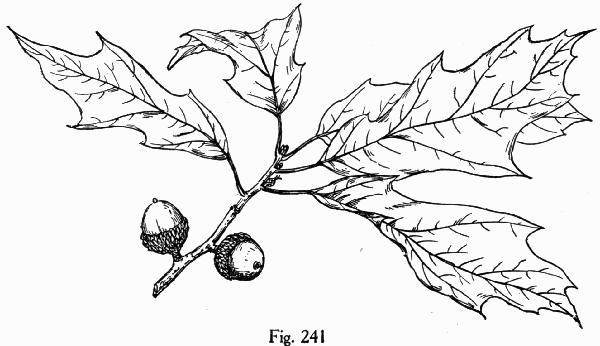
This has usually been considered a hybrid between Quercus Phellos and Quercus velutina or Quercus borealis var. maxima; first known in the eighteenth century from an individual growing in a field belonging to John Bartram on the Schuylkill River, Philadelphia. What appears to be the same form has since been discovered in a number of stations [264] from New Jersey to Texas, and it is possible that Quercus heterophylla may, as many botanists have believed, best be considered a species.
× Quercus subfalcata Trel., believed to be a hybrid of Quercus Phellos and Q. rubra has been found at Wickliffe, Ballard County, Illinois, at Campbell, Lawrence County, Mississippi, Fulton, Hempstead County, Arkansas, and Houston, Harris County, Texas; its var. microcarpa Sarg., probably of the same parentage, originated in a Dutch nursery.
× Quercus ludoviciana Sarg., believed to be a hybrid of Quercus Phellos and Q. rubra var. pagodæfolia grows in low wet woods ten miles west of Opelousas, St. Landry Parish, Louisiana.
18. Quercus laurifolia Michx. Laurel Oak. Water Oak.
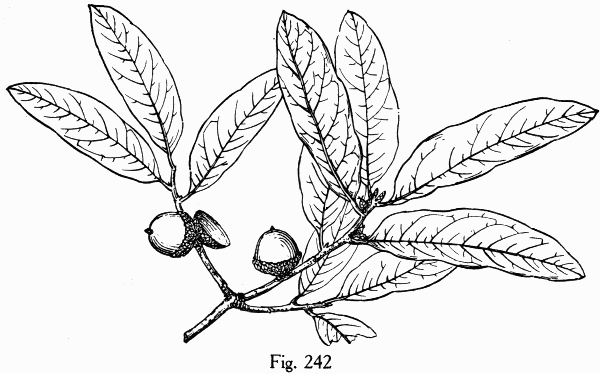
Leaves elliptic or rarely slightly broadest above the middle, acuminate at the ends, apiculate at apex, occasionally lanceolate or oblong-obovate and rounded at apex (var. hybrida Michx.) sometimes 3-lobed at apex, the terminal lobe acuminate, much larger than the others (var. tridentata Sarg.), frequently unequally lobed on vigorous branches of young trees, with small nearly triangular lobes, when they unfold in spring yellow-green, or later in the season often pink or bright red, and slightly puberulous, at maturity thin, green, and very lustrous above, light green and less lustrous below, usually 3′—4′ long and ¾′ wide, with a conspicuous yellow midrib; falling abruptly in early spring leaving the branches bare during only a few weeks; petioles stout, yellow, rarely more than ¼′ in length. Flowers: staminate in red-stemmed hairy aments 2′—3′ long; calyx pubescent on the outer surface, divided into 4 ovate rounded lobes; pistillate on stout glabrous peduncles, their involucral scales brown and hairy, about as long as the acute calyx-lobes; stigmas dark red. Fruit sessile or subsessile, generally solitary; nut ovoid to hemispheric, broad and slightly rounded at base, full and rounded at the puberulous apex, dark brown, about ½′ long, inclosed for about one fourth its length in a thin saucer-shaped cup red-brown and silky-pubescent on the inner surface, and covered by thin ovate light red-brown scales rounded at apex and pale-pubescent except on their darker colored margins.
A tree, occasionally 100° high, with a tall trunk 3°—4° in diameter, and comparatively slender branches spreading gradually into a broad dense round-topped shapely head, and slender glabrous branchlets dark red when they first appear, dark red-brown during their first winter, becoming reddish brown or dark gray in their second season. Winter-buds broadly ovoid or oval, abruptly narrowed and acute at apex, 1/16′—⅛′ long with numerous [265] thin closely imbricated bright red-brown scales ciliate on the margins. Bark of young trees ½′—1′ thick, dark brown more or less tinged with red, roughened by small closely appressed scales, becoming at the base of old trees 1′—2′ thick, nearly black, and divided by deep fissures into broad flat ridges. Wood heavy, very strong and hard, coarse-grained, liable to check badly in drying, dark brown tinged with red, with thick lighter colored sapwood; probably used only as fuel.
Distribution. Sandy banks of streams and swamps and rich hummocks in the neighborhood of the coast; North Carolina (near Newbern) southward to the shores of Bay Biscayne and the valley of the Caloosahatchie River, Florida, and in the interior of the peninsula to the neighborhood of Lake Istokpaga, De Soto County, and westward to eastern Louisiana, ranging inland to Darlington, Darlington County, South Carolina, to the neighborhood of Augusta, Richmond County, Mayfield, Hancock County, Albany, Dougherty County, Cuthbert, Randolph County, and Bainbridge, Decatur County, Georgia, Georgiana, Butler County, and Berlin, Dallas County, Alabama, Rockport, Copiah County, Mississippi, and to the neighborhood of Bogalusa, Washington Parish, Louisiana (R. S. Cocks); nowhere abundant, but most common and of its largest size in eastern Florida.
19. Quercus cinerea Michx. Blue Jack. Upland Willow Oak.
Quercus brevifolia Sarg.
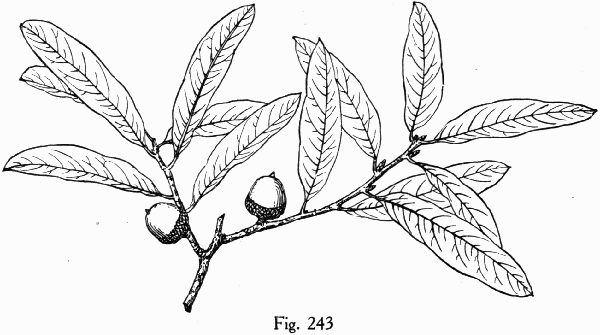
Leaves oblong-lanceolate to oblong-obovate, gradually narrowed and cuneate or sometimes rounded at base, acute or rounded and apiculate at apex, entire with slightly thickened undulate margins, or at the ends of vigorous sterile branches occasionally 3-lobed at the apex and variously lobed on the margins (β dentato-lobata A. De Candolle), when they unfold bright pink and pubescent on the upper surface, coated on the lower with thick silvery white tomentum, at maturity firm in texture, blue-green, lustrous, conspicuously reticulate venulose above, pale-tomentose below, 2′—5′ long, ½′—1½′ wide, with a stout yellow midrib and remote obscure primary veins forked and united within the margins; turning red and falling gradually late in the autumn or in early winter; petioles stout, ¼′—½′ in length. Flowers: staminate in hoary-tomentose aments 2′—3′ long; calyx pubescent, bright red and furnished at apex with a thick tuft of silvery white hairs before opening, divided into 4 or 5 ovate acute lobes, becoming yellow as it opens; stamens 4 or 5; anthers apiculate, dark red in the bud, becoming yellow; pistillate on short stout tomentose peduncles, their involucral scales about as long as the acute calyx-lobes and coated with [266] pale tomentum; stigmas dark red. Fruit produced in great profusion, sessile or raised on a short stalk rarely ¼′ long; nut ovoid, full and rounded at the ends or subglobose, about ½′ long, often striate, hoary-pubescent at apex, inclosed only at the base or for one half its length in a thin saucer-shaped or cup-shaped cup bright red-brown and coated with lustrous pale pubescence on the inner surface, and covered by thin closely imbricated ovate-oblong scales hoary-tomentose except on the dark red-brown margins.
A tree on dry hills, usually 15°—20° high, with a trunk 5′—6′ in diameter, stout branches forming a narrow irregular-head, and thick rigid branchlets coated at first with a dense fulvous or hoary tomentum of fascicled hairs, soon becoming glabrous or puberulous, dark brown sometimes tinged with red during their first winter and darker in their second year; or in low moist soil often 60°—75° high, with a trunk 18′—20′ in diameter, and a broad round-topped shapely head of drooping branches. Winter-buds ovoid, acute, with numerous rather loosely imbricated bright chestnut-brown scales ciliate on the margins, often ¼′ long on vigorous branches, frequently obtuse and occasionally much smaller. Bark ¾′—1½′ thick, and divided into thick nearly square plates 1′—2′ long, and covered by small dark brown or nearly black scales slightly tinged with red. Wood hard, strong, close-grained, light brown tinged with red, with thick darker colored sapwood; probably only used as fuel.
Distribution. Sandy barrens and dry upland ridges, and in the rich moist soil of the pine-covered flats of the Florida peninsula; North Carolina southward to the shores of the Indian River and Peace Creek, Florida, and along the Gulf coast to the valley of the Brazos River, Texas; in the Atlantic and middle Gulf states mostly confined to a maritime belt 40°—60° wide, extending across the Florida peninsula as far south as the sand hills in the neighborhood of Lake Istokpoga, De Soto County, and west of the Mississippi River, ranging inland to the neighborhood of Dallas, Dallas County, Texas and to southeastern Oklahoma (near Antlers, Pushmataha County).
× Quercus dubia Ashe, believed to be a hybrid of Quercus cinerea and Q. laurifolia occurs at Abbottsburg, Bladen County, North Carolina, on the coast of South Carolina, in southern Georgia and northern and central Florida, and at Mississippi City, Lincoln County, Mississippi.
× Quercus subintegra Trel., a supposed hybrid of Quercus cinerea and Q. rubra occurs at Lumber City, Telfair County, Georgia, Lake City, Columbia County, Florida, and at Berlin, Dallas County, Alabama.
× Quercus sublaurifolia Trel., a supposed hybrid of Quercus cinerea and Q. laurifolia occurs at Folkston, Charlton County, Georgia, and at Biloxi, Harrison County, Mississippi.
× Quercus carolinensis Trel., believed to be a hybrid of Quercus cinerea and Q. marilandica occurs at Newbern, Craven County, North Carolina, Lumber City, Telfair County and Climax, Decatur County, Georgia, and near Fletcher, Hardin County, Texas.
× Quercus caduca Trel., believed to be a hybrid of Quercus cinerea and Q. nigra, occurs at Folkston, Charlton County and Lumber City, Telfair County, Georgia, Jacksonville, Duval County, and Gainsville, Alachua County, Florida, Mississippi City, Harrison County, Mississippi, and at Milano, Milano County and Bryan, Brazos County, Texas.
× Quercus oviedoensis Sarg., believed to be a hybrid of Quercus cinerea and Q. myrtifolia, has been found near Oviedo, Orange County, Florida.
20. Quercus imbricaria Michx. Shingle Oak. Laurel Oak.
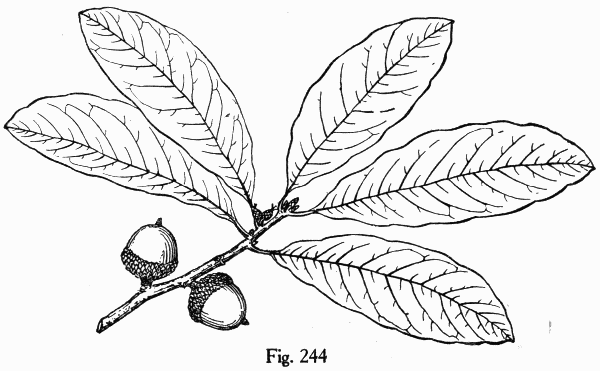
Leaves oblong-lanceolate to oblong-obovate, apiculate and acute or rounded at apex, gradually narrowed and cuneate or rounded at base, entire with slightly thickened, revolute often undulate margins, or sometimes more or less 3-lobed, or on sterile branches occasionally repand-lobulate, when they unfold bright red, soon becoming yellow-green, covered with scurfy rusty pubescence on the upper surface and hoary-tomentose on the lower, at maturity thin, glabrous, dark green, and very lustrous above, pale green or light brown and pubescent below, 4′—6′ long, ¾′—2′ wide, with a stout yellow midrib, numerous slender yellow veins arcuate and united at some distance from the margins, and reticulate [267] veinlets; late in the autumn turning dark red on the upper surface; petioles stout, pubescent, rarely more than ½′ in length. Flowers: staminate in hoary-tomentose aments, 2′—3′ long; calyx light yellow, pubescent, and divided into 4 acute segments; pistillate on slender tomentose peduncles, their involucral scales covered with pale pubescence and about as long as the acute calyx-lobes; stigmas greenish yellow. Fruit solitary or in pairs, on stout peduncles often nearly ½′ in length; nut nearly as broad as long, full and rounded at the ends, dark chestnut-brown, often obscurely striate, ½′—⅔′ long, inclosed for one third to one half its length in a thin cup-shaped or turbinate cup bright red-brown and lustrous on the inner surface, and covered by thin ovate light red-brown scales rounded or acute at the apex and pubescent except on their darker colored margins.
A tree, usually 50°—60° high, with a trunk rarely exceeding 3° in diameter, or rarely 100° high, with a long naked stem 3°—4° in diameter, slender tough horizontal or somewhat pendulous branches forming a narrow round-topped picturesque head, and slender branchlets dark green, lustrous, and often suffused with red when they first appear, soon glabrous, light reddish brown or light brown during their first winter and dark brown in their second year. Winter-buds ovoid, acute, about ⅛′ long, obscurely angled, and covered by closely imbricated light chestnut-brown lustrous scales erose and often ciliate on the margins. Bark on young stems and branches thin, light brown, smooth, and lustrous, becoming on old trunks ¾′—1½′ thick, and slightly divided by irregular shallow fissures into broad ridges covered by close slightly appressed light brown scales somewhat tinged with red. Wood heavy, hard, rather coarse-grained, light brown tinged with red, with thin lighter colored sapwood; occasionally used in construction, and for clapboards and shingles.
Distribution. Rich hillsides and the fertile bottom-lands of streams; Lehigh County (Allentown to Dorney’s Park), Bedford, Huntington, Franklin and Union Counties, Pennsylvania, westward through Ohio to southern Michigan, southern Wisconsin and southeastern and southern Iowa (Muscatine to Taylor County), and southward to the District of Columbia, along the Appalachian Mountains and their foothills, up to altitudes of 2200°, to the valley of the Little Tennessee River, North Carolina, and to northern Georgia (Wilkes County), and middle Tennessee; through Missouri to northeastern Kansas and southeastern Nebraska, and in northern and southern Arkansas (Fulton, Hempstead County); comparatively rare in the east; one of the most abundant Oaks of the lower Ohio basin; probably growing to its largest size in southern Indiana and Illinois.
Occasionally planted as an ornamental tree in the northern states, and hardy as far north as Massachusetts.
[268]
× Quercus Leana Nutt., scattered usually in solitary individuals from the District of Columbia and western North Carolina to southern Michigan, central and northern Illinois and southeastern Missouri, is believed to be a hybrid between this species and Quercus velutina.
× Quercus tridentata Engelm., described as a hybrid of Quercus imbricaria and Q. marilandica first found at Allenton, Saint Louis County, Missouri, occurs also near Olney, Richland County, Illinois.
× Quercus exacta Trel., believed to be a hybrid of Quercus imbricaria and Q. palustris, occurs near Olney, Richland County, Illinois, and at Crown Point, Lake County, Indiana.
21. Quercus hypoleuca Engelm.
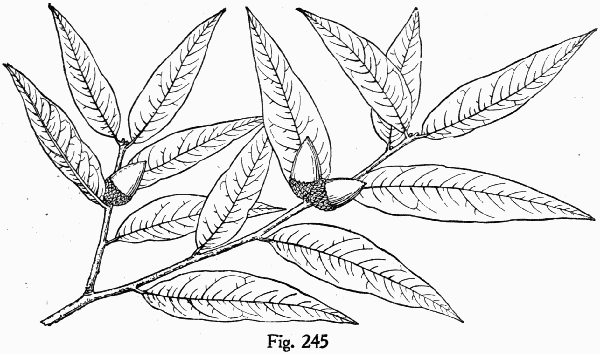
Leaves lanceolate or oblong-lanceolate to elliptic, occasionally somewhat falcate, acute and often apiculate at apex, cuneate or rounded or cordate at the narrow base, entire or repandly serrate above the middle with occasionally small minute rigid spinose teeth, or on vigorous shoots serrate-lobed with oblique acute lobes, when they unfold light red, covered with close pale pubescence above and coated below with thick hoary tomentum, at maturity thick and firm, dark yellow-green and lustrous on the upper surface, covered on the lower with thick silvery white or fulvous tomentum, 2′—4′ long, ½′—1′ wide, with thickened revolute margins; turning yellow or brown and falling gradually during the spring after the appearance of the new leaves; petioles stout, flattened, pubescent or tomentose, ⅛′—¼′ in length. Flowers: staminate in slender aments 4′—5′ long; calyx slightly tinged with red, covered with pale hairs and divided into 4 or 5 broadly ovate rounded lobes; anthers acute, apiculate, bright red becoming yellow; pistillate mostly solitary, sessile or short-stalked, their involucral scales thin, scarious, and soft-pubescent; stigmas dark red. Fruit sessile or borne on a stout peduncle up to ½′ in length, usually solitary; nut ovoid, acute or rounded at the narrow hoary-pubescent apex, dark green and often striate when ripe, becoming light chestnut-brown in drying, ½′—⅔′ long, the shell lined with white tomentum, inclosed for about one third its length in a turbinate thick cup pubescent on the inner surface, and covered by thin broadly ovate light chestnut-brown scales rounded at apex and clothed, especially toward the base of the cup, with soft silvery pubescence.