Division II. Dicotyledons. (continued 15)
Reading edition
Of the sixteen genera of this family, which is widely distributed through the tropics of the two hemispheres, one only, Bursera, occurs in the United States, reaching the shores of southern Florida with an arborescent species, and southern California and Arizona with another species.
1. BURSERA Jacq.
Trees, with balsamic resinous juices. Leaves unequally pinnate; leaflets opposite, petiolulate, entire or subserrate, thin, or coriaceous. Flowers polygamous, small, on fascicled or rarely solitary pedicels, in short or elongated lateral simple or branched panicles; calyx minute, membranaceous; petals inserted on the base of an annular crenate disk, reflexed at maturity above the middle; stamens inserted on the base of the disk; anthers oblong, attached on the back above the base, usually effete in the pistillate flower; ovary sessile, ovoid, 3-celled, rudimentary in the staminate flower; style short; stigma capitate, obtuse, 3-lobed; ovules suspended below the apex from the central angle. Fruit with a valvate epicarp, globose or oblong-oblique, indistinctly 3-angled; flesh coriaceo-carnose, 2—3-valved; nutlets 1—3, usually solitary, adnate to a persistent fleshy axis, 1-celled, [646] 1-seeded, covered with a thin membranaceous coat. Seed ovoid, without albumen; seed-coat membranaceous; hilum ventral, below the apex; embryo straight; cotyledons contortuplicate.
Bursera with about forty species is confined to southern Florida, the Antilles, the southwestern United States and to Mexico, and Central and South America.
The generic name is in honor of Joachim Burser (1593—1649), a German botanist and physician.
CONSPECTUS OF THE ARBORESCENT SPECIES OF THE UNITED STATES.
Leaves 5—7 rarely 3-foliolate, their rachis and petiole without wings; staminate flowers in elongated many-flowered racemes.
1. B. Simaruba (D).
Leaves usually 10—22-foliolate, their rachis and petiole wing-margined; staminate flowers in short, usually 3-flowered clusters.
2. B. microphylla (G, H).
1. Bursera Simaruba Sarg. Gumbo Limbo. West Indian Birch.
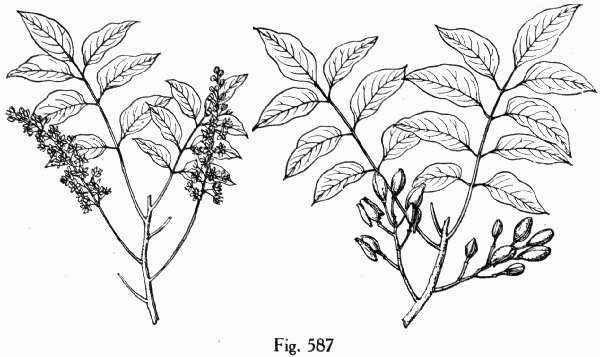
Leaves confined to the end of the branchlets, 6′—8′ long, 4′—8′ wide, with a long slender petiole, and usually 5, rarely 3 or 7 leaflets coriaceous at maturity, oblong-ovate, oblique at base, contracted at apex into a long or short point, 2½′—3′ long, 1½′—2′ broad, with stout petiolules often ½′ long; deciduous in early winter or occasionally persistent until the following spring. Flowers about 3/16′ in diameter, appearing before the leaves or as they unfold, on slender pedicels ⅓′—½′ long, in slender raceme-like panicles, those of the staminate plant 4′—5′ long or nearly twice as long as those of the pistillate plant; calyx-lobes and petals 5; petals ovate-lanceolate, acute, revolute on the margins, and nearly four times as long as the slender acute calyx-lobes; stamens of the staminate flower as long as the petals and in the pistillate flower not more than half as long, with smaller often effete anthers. Fruit in short raceme-like clusters, ¼′—⅓′ long, 3-angled, with a thick dark red outer coat, separating readily into 3 broad-ovate valves, and containing 1 or rarely 2 bony triangular nutlets rounded at base, pointed at apex, and covered with a thin membranaceous light pink coat; seeds 1 or 2, triangular, rose color.
A glabrous tree, 50°—60° high, with a trunk 2½°—3° in diameter, massive primary branches spreading nearly at right angles, and stout terete branchlets light gray during their first season, becoming during their second year reddish brown, covered with lenticular spots and conspicuously marked by large elevated obcordate yellow leaf-scars. Winter-buds [647] short, rounded, obtuse, with broad-ovate dark red scales slightly scarious on the margins. Bark of the trunk and large branches 1′ thick, glandular dotted, separating freely into thin papery bright red-brown scales exposing in falling the dark red-brown or gray inner bark. Wood spongy, very light, exceedingly soft and weak, light brown, with thick sapwood, soon becoming discolored by decay. Pieces of the trunk and large branches set in the ground soon produce roots and grow rapidly into large trees. The aromatic resin obtained by incisions cut in the trunk was formerly used in the treatment of gout, and in the West Indies is manufactured into varnish. An infusion of the leaves is sometimes used in Florida as a substitute for tea.
Distribution. Florida, from Cape Canaveral to the southern keys, and on the west coast from Terra Ceia Island, Manatee County, Plagida, De Sota County, and Gasparilla Island southward; one of the largest and most common of the south Florida trees, and the only one which sheds its foliage during the autumn and winter; on most of the West Indian islands, in tropical Mexico, Guatemala, New Granada, and Venezuela.
2. Bursera microphylla A. Gray.
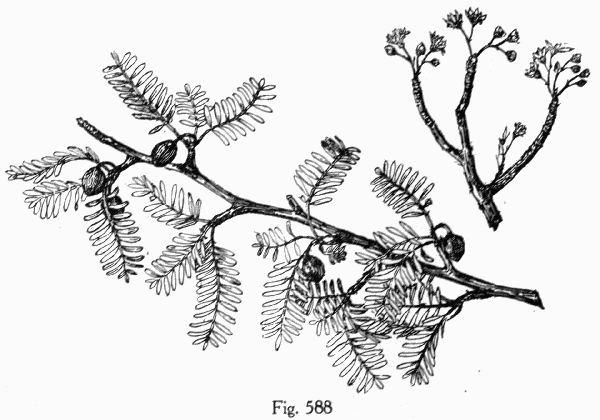
Leaves glabrous, deciduous, 1′—1¼′ long, with a slender narrowly winged rachis and petiole and usually 10—20 oblong or oblong-obovate leaflets rounded at apex, obliquely cuneate at base, sessile, about ¼′ long and 1/12′ wide. Flowers appearing in June before the leaves, ⅙′ long on slender pedicels from the axils of minute acuminate caducous bracts, in mostly 3-flowered clusters ¼′ in length; staminate, calyx-lobes ovate, acute; petals 5, lanceolate, acuminate, revolute on the margins, 3 or 4 times longer than the calyx-lobes, white; stamens shorter than the petals; pistillate flower not seen. Fruit ripening in October, ellipsoid or slightly obovoid, solitary, drooping on the thickened pedicel ⅕′ in length, 3-angled, ¼′ long, red, glabrous, splitting into three valves; nutlets usually ovoid, acute, narrow at base, thin walled, 3-angled, gray with a deep depression at base.
A tree, rarely 10°—12° high, with a short trunk 2½′—3′ in diameter, stout erect and spreading branches, forming a wide round-topped head, and slender glabrous red branchlets, roughened during their first year by the crowded scars of fallen leaves; more often a low shrub. Bark of the trunk pale yellow, separating into membranaceous scales, the outer layer thin and firm, the inner layer corky, reddish brown, ½′ thick. Wood hard, close-grained, pale yellow.
[648]
Distribution. Colorado Desert, between Fish Creek and Carriso Creek about twenty-five miles from the Mexican Boundary, on “banks of dry washes, in hard sterile soil covered with boulders” (E. H. Davis), Imperial County, California; near Maricopa, Pinal County, Arizona, and in Lower California and Sonora; reported as a tree only from California.
XXIX. MELIACEÆ.
Trees or shrubs, with hard wood and alternate pinnate leaves, without stipules. Flowers in panicles, perfect, regular; calyx 5-lobed, the lobes contorted (in Swietenia) in the bud, persistent; petals 5, convolute in the bud; stamens inserted at the base of the disk; filaments united into a tube; anthers introrse, 2-celled, the cells opening longitudinally; ovary 3—5-celled, free, surrounded at base by an annular or cup-shaped disk; styles united, dilated into a 5-lobed stigma; ovules numerous in each cell, suspended, semianatropous; raphe ventral; micropyle superior. Fruit a capsule (in Swietenia) or drupe. Seeds often winged; embryo with leafy cotyledons.
A family with about forty genera chiefly confined to the tropics, with a single representative, Swietenia, in southern Florida. Melia Azedarach L., of this family, the China-tree or Pride of India, with drupaceous fruits, has long been cultivated in the southern states, where it now often grows spontaneously.
1. SWIETENIA Jacq.
Trees, with heavy dark red wood. Leaves abruptly pinnate, glabrous, long-petiolate, persistent; leaflets opposite, petiolulate, usually oblique at base. Flowers small, in axillary or subterminal panicles produced near the end of the branches; calyx minute; petals spreading; staminal tube urn-shaped, connate with the petals, 10-lobed, the lobes convolute in the bud; anthers 10, fixed by the back below the sinuses of the staminal tube, included; ovary ovoid, 5-celled, the cells opposite the petals; style erect, longer than the tube of the stamens; stigma discoid, 5-rayed. Fruit a 5-celled 5-valved capsule septicidally dehiscent from the base, the valves separating from a persistent 5-angled axis thickened toward the apex and 5-winged toward the base. Seeds suspended from near the summit of the axis, imbricated in 2 ranks, compressed, emarginate, produced above into a long membranaceous wing with the hilum at its apex and transversed by the raphe; embryo transverse; cotyledons conferruminate with each other and with the thin fleshy albumen; radicle short, papillæform.
Swietenia with five species is confined to tropical America from southern Florida where one species occurs, to Venezuela, western and southwestern Mexico, and the east coast of Central America.
The generic name is in honor of Baron von Swieten (1700—1772), the distinguished Dutch physician, founder of the Botanic Garden and of the Medical School at Vienna.
1. Swietenia mahagoni Jacq. Mahogany.
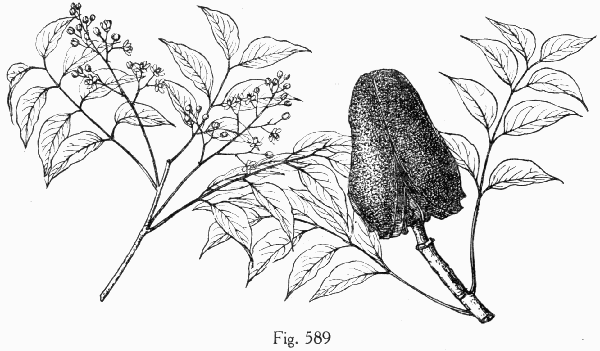
Leaves 4′—6′ long, with a slender glabrous petiole thickened at base and 3 or 4 pairs of ovate-lanceolate leaflets rounded at base on the upper side, narrow-cuneate or nearly straight on the lower side, entire, coriaceous, pale yellow-green or slightly rufous on the under surface, 3′—4′ long, 1′—1½′ wide, with a prominent reddish brown midrib, conspicuous reticulate veins, and a stout grooved petiolule ¼′ long. Flowers appearing in July and August on slender puberulous pedicels, bibracteolate near the middle, 1 or 2 together at the end of the branches of slender panicles in the axils of leaves of the year; calyx glabrous, cup-shaped, much shorter than the ovate elliptic petals ⅛′ long and slightly emarginate at apex. Fruit ripening in the autumn or early winter, long-stalked, ovoid, rounded at apex narrowed at base, 4′—5′ long and 2½′ broad, with thick dark brown valves rugose and pitted on the surface, its axis obovoid 3′ or 4′ long, 1′—1½′ thick, dark red-brown, [649] marked near the apex by the dark scars left by the falling seeds; seeds ¾′ long, almost square, thickened at base and nearly one fourth as long as their ovate rugose red-brown wings rounded or truncate at apex and gradually contracted below.
A tree, in Florida rarely more than 40°—50° high or with a trunk exceeding 2° in diameter, and slender glabrous angled branchlets covered during their first season with pale red-brown bark, becoming lighter or gray faintly tinged with red and thickly covered with lenticels during their second year; much larger in the West Indies. Winter-buds about ⅛′ long, with broad-ovate minutely apiculate loosely imbricated light red scales. Bark of the trunk in Florida ½′—⅔′ thick, with a dark red-brown surface broken into short broad rather thick scales. Wood heavy, exceedingly hard and strong, close-grained, very durable, rich red-brown, becoming darker with age and exposure, with thin yellow sapwood of about 20 layers of annual growth; the most esteemed of all woods for cabinet-making, and also largely used in the interior finish of houses and railroad cars, and formerly in ship and boat-building. The bark is bitter and astringent and has been used as a substitute for quinine in the treatment of intermittent fevers.
Distribution. Florida, hummocks, shores of Bay Biscayne on the Everglade Keys and near Flamingo on White Water Bay, Dade County, on Elliotts Key, Key Largo and Upper Matacombe Key; rare and now nearly exterminated except in the region of Cape Sable; on the Bahama and many of the West Indian islands.
XXX. EUPHORBIACEÆ.
Trees, shrubs, or herbs, with acrid juice, and alternate stipular leaves. Flowers monœcious or diœcious; calyx 3—6-lobed or parted, the divisions imbricated in the bud, or wanting; corolla 0; stamens 2 or 3, or as many or twice as many as the calyx-lobes; anthers 2-celled, opening longitudinally; ovules 1 or 2 in each cell, suspended, anatropous; raphe ventral; micropyle superior. Fruit a drupe or capsule. Seeds albuminous; cotyledons flat, much longer than the superior radicle.
The Euphorbia family, widely distributed over tropical and temperate regions, with some one hundred and thirty genera and over three thousand species, is represented in the United States by three arborescent genera, with only five species, and by many shrubby herbaceous and annual plants.
[650]
CONSPECTUS OF THE ARBORESCENT GENERA OF THE UNITED STATES.
Fruit drupaceous.
Nutlets usually 1-celled and 1-seeded; stamens as many or twice as many as the calyx-lobes, free.
1. Drypetes.
Nutlets 6—8-celled and 6—8-seeded; stamens 2 or 3, united into a column.
2. Hippomane.
Fruit a 3-lobed capsule splitting into three 2-valved 1-seeded carpels.
1. DRYPETES Vahl.
Trees or shrubs, with thick juice, and terete branchlets. Leaves involute in the bud, petiolate, penniveined, coriaceous, persistent; stipules minute, caducous. Flowers axillary, sessile or pedicellate, their pedicels from the axils of minute deciduous bracts, ebracteolate, the males in many-flowered clusters, the females solitary or in few-flowered clusters; calyx divided nearly to the base into 4 or 5 lobes rounded or acute at apex, deciduous or persistent under the fruit; stamens inserted under the margin of a flat or concave slightly lobed disk, 0 in the pistillate flower; filaments filiform; anthers ovoid, emarginate, attached on the back near the base, extrorse or introrse, 2-celled, the cells affixed to a broad oblong connective; ovary sessile, ovoid, 1 or rarely 2-celled, with 1 or 2 sessile or subsessile peltate or reniform stigmas, rudimentary or wanting in the staminate flower; ovules collateral, descending, attached to the central angle of the cell, operculate, with a hood-like body developed from the placenta. Fruit drupaceous, ovoid or subglobose, tipped with the withered remnants of the stigmas; flesh thick and corky or thin and crustaceous; stone thick or thin, bony or crustaceous, 1-celled and 1-seeded, or rarely 2-celled and 2-seeded. Seed filling the cavity of the nut; seed-coat crustaceous or membranaceous; embryo erect in thin fleshy albumen.
Drypetes is confined to the tropical regions of the New World, and is distributed from southern Florida through the West Indies to eastern Brazil. Of the eleven species now distinguished, two inhabit the coast-region of southern Florida.
The generic name, from δρύππα, relates to the character of the fruit.
CONSPECTUS OF THE NORTH AMERICAN SPECIES.
Calyx 5-lobed; stamens 8; ovary 1-celled; fruit oblong, ivory-white; outer coat thick and mealy; stone thick-walled.
1. D. diversifolia (D).
Calyx 4-lobed; stamens 4; ovary 2-celled; fruit subglobose, bright red; outer coat thin, crustaceous; stone thin-walled.
2. D. lateriflora (D).
1. Drypetes diversifolia Krug & Urb. White Wood.
Drypetes keyensis Krug & Urb.
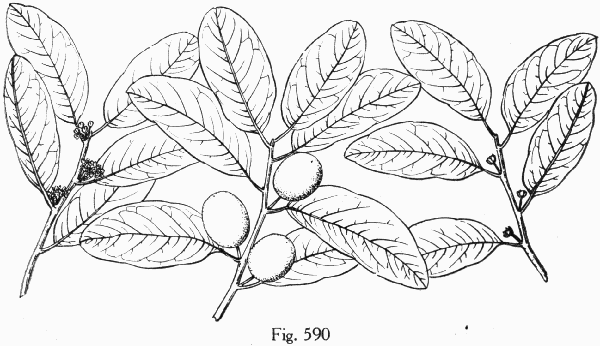
Leaves appearing in early spring and falling during their second year, entire, oval or oblong, often more or less falcate, acute, acuminate, rounded or rarely emarginate at apex, rounded or cuneate at base, on young plants often spinose-dentate, when they unfold thin and membranaceous, light green or green tinged with red and pilose with scattered pale hairs, and at maturity coriaceous, dark green and lustrous, rather paler on the lower surface than on the upper surface, 3′—5′ long and 1′—2′ wide, with a broad thick pale midrib raised and rounded on the upper side and obscure primary veins arcuate and united near the thick revolute cartilaginous margins and connected by conspicuous coarsely reticulated veinlets; petioles stout, yellow, grooved above, ½′ long; stipules nearly triangular, rather less than 1/16′ long, caducous. Flowers on pedicels rather shorter than the petioles, opening in early spring from the axils of leaves of the previous year, the staminate in many-flowered clusters, the pistillate usually solitary or occasionally in 2—3-flowered clusters; calyx [651] yellow-green, hirsute on the outer surface, 1/16′ long, and divided nearly to the base into 5 ovate acute boat-shaped lobes deciduous from the fruit; stamens about 8, inserted on the borders of the slightly lobed pulvinate concave disk; filaments unequal in length, rather longer than the calyx-lobes and a little longer than the broad-ovoid emarginate pilose extrorse anthers, with broad ovate acute connectives; ovary sessile, hirsute, 1-celled, crowned with a broad sessile slightly stalked oblique pulvinate stigma, wanting in the staminate flower. Fruit ripening in the autumn, deciduous at maturity from its stout erect stalk much enlarged at apex and ⅓′ long, ovoid, 1′ long, ivory-white, with thick dry mealy flesh closely investing the light brown stone narrowed at base into a long point, with bony walls ⅛′ thick and penetrated longitudinally by large fibro-vascular bundle-channels; seed oblong, rounded at the ends, nearly ½′ long, covered with a thin membranaceous light brown coat marked by conspicuous veins radiating from the small hilum.
A tree, occasionally 30°—40° high, with a trunk sometimes a foot in diameter, stout usually erect branches forming an oblong round-topped head, and stout branchlets light green tinged with red and covered with pale scattered caducous hairs when they first appear, becoming ashy gray and roughened by numerous elevated circular pale lenticels and later by the large prominent orbicular leaf-scars displaying the ends of 3 conspicuous fibro-vascular bundles. Winter-buds minute, obtuse, partly immersed in the bark and coated with brown resin. Bark of the trunk about ½′ thick, smooth, milky white and often marked by large irregular gray or pale brown patches. Wood heavy, hard, not strong, brittle, close-grained, and brown streaked with bright yellow, with thick yellow-brown sapwood.
Distribution. Florida, Flamingo near Cape Sable (C. T. Simpson), Cocoanut Grove (Miss O. Rodham), Dade County, on Key West, Key Largo, Elliotts, Lower Metacombe and Umbrella Keys. One of the rarest of the tropical trees of Florida; on the Bahamas.
2. Drypetes lateriflora Urb. Guiana Plum.
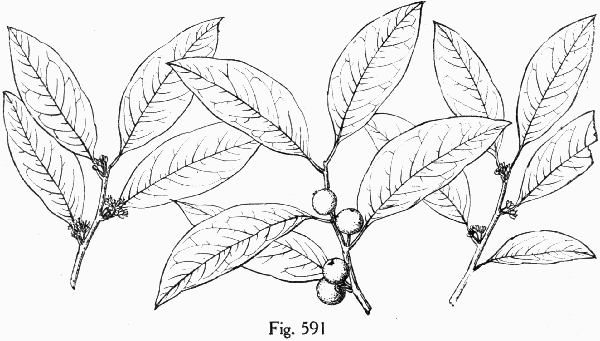
Leaves appearing in Florida in early spring and falling during their second year, oblong, acute or acuminate at apex, gradually narrowed at base, and entire, when they unfold thin and covered with scattered pale hairs, and at maturity subcoriaceous, dark green and lustrous, 3′—4′ long and ½′—1½′ wide, with a conspicuous light-colored midrib, rounded above, and pale obscure primary veins arcuate and united near the slightly thickened revolute margins and connected by slender reticulate veinlets; petioles slender, grooved, ¼′ in length. Flowers on pedicels shorter than the petioles, opening late in the autumn or in early winter on branches one or two years old, in the axils of leaves or from leafless nodes, in [652] many or few-flowered clusters; calyx greenish white, hirsute on the outer surface, divided to the base into 4 ovate rounded lobes, persistent under the fruit; stamens 4, inserted under the margin and between the lobes of the flat tomentose disk; filaments slender, exserted; anthers introrse, emarginate, pilose, wanting in the pistillate flower; ovary ovoid, tomentose, 2-celled, with 2 nearly sessile oblique spreading cushion-like stigmas. Fruit ripening during the spring and early summer, subglobose, ⅓′ in diameter, tipped with the conspicuous blackened remnants of the stigmas, bright red, covered with soft pubescence, solitary or in clusters of 2 or 3, deciduous at maturity from its stout stalk enlarged at apex and ¼′ long; flesh thin and crustaceous, closely investing the thin-walled crustaceous stone; seed usually solitary by abortion, obovoid, gibbous, ⅛′ long, narrowed below, narrowed and marked at apex by the elevated pale hilum and on the inner surface of the seed-coat by the broad conspicuous raphe.
A tree, 20°—30° high, with a short trunk 5′—6′ in diameter, small erect branches, and slender branchlets, light green tinged with red when they first appear, becoming in their first winter ashy gray and marked by scattered pale lenticels, and at the end of their second year by the small elevated oval leaf-scars displaying the ends of 3 fibro-vascular bundles. Winter-buds minute, acute or obtuse, chestnut-brown, and covered with pale hairs. Bark of the trunk about 1/16′ thick, light brown tinged with red, the generally smooth surface separating into small irregular scales. Wood heavy, hard, brittle, close-grained, rich dark brown, with thick yellow sapwood.
Distribution. Florida, Palm Beach, Palm Beach County, shores of Bay Biscayne, Dade County, and on many of the southern keys; common on the Bahama Islands and on several of the Antilles.
2. HIPPOMANE L.
A glabrous tree, with thick acrid juice, scaly bark, and stout pithy branchlets marked by circular raised lenticels, and oblong or semiorbicular horizontal elevated leaf-scars displaying a row of obscure fibro-vascular bundle-scars, and nearly encircled at the nodes by ring-like scars left by the falling of the stipules. Winter-buds ovoid, acute, covered by many loosely imbricated long-pointed chestnut-brown scales. Leaves alternate, involute in the bud, tardily deciduous, broad-ovate, rounded and abruptly narrowed at apex into a broad point terminating in a slender mucro, rounded or subcordate at base, remotely crenulate-serrate with minute gland-tipped teeth, penniveined, long-petiolate, at first pilose with occasional long pale hairs, soon becoming glabrous, and at maturity thick and coriaceous, dark yellow-green and lustrous above, paler and dull below, with a stout light yellow midrib [653] raised and rounded on the upper side, and slender primary veins remote, arcuate, and united at some distance from the margins and connected by conspicuous coarsely reticulate veinlets more prominent on the upper than on the lower side; their petioles elongated, slender, rigid, light yellow, rounded below, obscurely grooved above, marked at the apex by large orbicular dark red glands; stipules ovate-lanceolate, abruptly narrowed from a broad base, slightly laciniate near the apex, membranaceous, light chestnut-brown, caducous. Inflorescence terminal, spicate, appearing in early spring usually before the unfolding leaves, the stout fleshy rachis often bearing at the base acute sterile deciduous bracts, or 1 or 2 small leaves, the minute pistillate flowers solitary in their axils or in the axils of ovate acute lanceolate bracts furnished with 2 lateral glandular bractlets; staminate flowers minute, articulate on slender pedicels clustered in 8—15-flowered fascicles in the axils of simple bracts higher on the rachis and extending to its apex; calyx usually 3-lobed, the lobes imbricated in the bud, that of the staminate flower yellow-green, membranaceous, divided below into 3 or sometimes into 2 acute lobes; calyx of the pistillate flower, ovoid, yellow-green, divided nearly to the base into 3 ovate acute concave divisions rounded on the back; stamens 2 or often 3, exserted, more or less connate by their filaments into a stout column, free and spreading at apex; anthers ovoid, light yellow, surmounted by the short prolonged connective, attached on the back below the middle, erect, extrorse; ovary 6—8-celled, narrowed at base, gradually contracted above into a short simple cylindric style separating into 6—8 long radiating flattened abruptly reflexed lobes stigmatic on the inner face; ovule solitary in each cell. Fruit drupaceous, pome-shaped, obscurely 6—8-lobed, raised on a thickened woody stem; skin thin, light yellow-green or yellow and red; flesh thick, lactescent, adherent to the thick-walled rugose deeply winged 6—8-celled, 6—8-seeded subglobose stone flattened at the ends, the cells divided throughout by thin dark radial plates, ultimately separable, penetrated near the summit by oblique canals filled by the funicles of the seeds. Seeds oblong-ovoid, marked by a minute slightly elevated hilum and on the ventral face by an obscure raphe; seed-coat membranaceous, separable into 2 layers, the outer dark, the inner thinner, light brown; embryo surrounded by thick fleshy albumen.
The genus is represented by a single species abounding in exceedingly poisonous caustic sap which produces cutaneous eruptions and when taken internally destroys the mucous membrane; formerly employed by the Caribs to poison arrows.
The generic name is from ἵππος and μανία, and was first used by the Greeks to distinguish some plant with properties excitant to horses.
1. Hippomane Mancinella L. Manchineel.
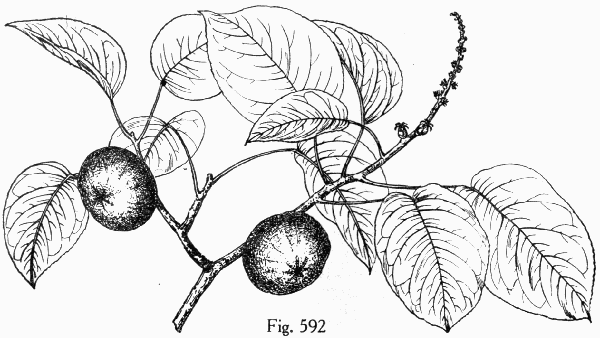
Leaves 3′—4′ long, 1½′—2′ wide, unfolding in early spring and persistent in Florida until the spring of the following year; petioles 2½′—4′ in length. Flowers opening in March [654] before the leaves of the year; rachis of the inflorescence 4′—6′ long, dark purple, more or less covered with a glaucous bloom. Fruit ripening in the autumn or early winter and often persistent on the branches until after the appearance of the flowers of the following year, 1′—1½′ in diameter, light yellow-green, with a bright red cheek; seeds about ¼′ long.
A tree, in Florida rarely more than 12°—15° high, with a short trunk 5′—6′ in diameter, long spreading pendulous branches forming a handsome round-topped head; in the West Indies often 50°—60° tall, with a trunk occasionally 3° in diameter. Bark of the trunk ¼′—½′ thick, dark brown and broken on the surface into small thick appressed irregularly shaped scales; in the West Indies sometimes smooth, light gray or nearly white. Wood light and soft, close-grained, dark brown, with thick light brown or yellow sapwood.
Distribution. Florida, sandy beaches and dry knolls in the immediate neighborhood of the ocean, shores of White Water Bay and on many of the southern keys; on the Bahama Islands, through the Antilles to the northern countries of South America, and to southern Mexico and the eastern and western coasts of Central America.
3. GYMNANTHES Sw.
Glabrous trees or shrubs, with milky juice and slender terete branchlets. Leaves conduplicate in the bud, petiolate, entire or crenulate-serrate, coriaceous, penniveined, persistent; stipules membranaceous, minute, caducous. Flowers monœcious or rarely diœcious; inflorescence buds covered with closely imbricated chestnut-brown scales, lengthening in anthesis, bearing in the upper axils numerous 3-branched clusters of staminate flowers, their branches furnished with minute ovate bracts, and in the lower axils 2 or 3 long-stalked pistillate flowers; calyx of the staminate flower minute or 0; stamens 2 or rarely 3; filaments filiform, inserted on the slightly enlarged torus, free or slightly connate at base; anthers attached on the back below the middle, erect, ovoid, 2-celled, the cells parallel; calyx of the pistillate flower reduced to 3 bract-like scales; ovary ovoid, 3-celled, narrowed into 3 recurved styles free or slightly united at base, stigmatic on their inner face; ovule solitary in each cell. Fruit a 3-lobed capsule separating from the persistent axis into three 2-valved 1-seeded carpels dehiscent on the dorsal suture and partly dehiscent on the ventral suture. Seed ovoid or subglobose, strophiolate; seed-coat crustaceous; embryo erect in fleshy albumen.
Gymnanthes with about ten species is confined to the tropics of the New World and is distributed from southern Florida, where one species occurs, through the West Indies to Mexico and Brazil.
The generic name, from γυμνός and ἄνθος, relates to the structure of the naked flowers.
1. Gymnanthes lucida Sw. Crab Wood.
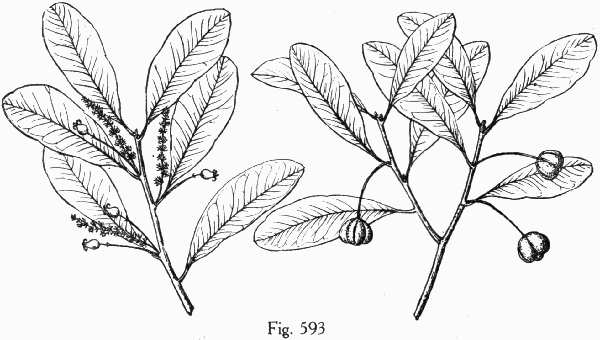
Leaves oblong-ovate or ovate-lanceolate, obscurely and remotely crenulate-serrate or often entire, when they unfold thin and membranaceous, deeply tinged with red, and glandular on the teeth with minute caducous dark glands, and at maturity coriaceous, dark green and lustrous on the upper surface and pale and dull on the lower surface, 2′—3′ long, ⅔′—1½′ wide, with a broad pale midrib raised and rounded on the upper side, obscure primary veins arcuate and united near the margins and connected by prominent coarsely reticulate veinlets; appearing in Florida in early spring and remaining on the branches through their second summer; petioles broad, slightly grooved, about ¼′ in length; stipules ovate, acute, light brown, clothed on the margins with long pale hairs, about 1/16′ long. Flowers: inflorescence buds appearing in Florida late in the autumn in the axils of leaves of the year and beginning to lengthen in spring, the inflorescence becoming 1½′—2′ long, with a slender glabrous angled rachis, the scales broad-ovate, pointed, concave, rounded and thickened at apex, puberulous and ciliate on the margins, those inclosing the male flowers connate with the flowers and persistent under the calyx, those subtending the female flowers at the base of the inflorescence and not raised on their peduncle. Fruit produced in Florida sparingly, ripening in the autumn, slightly obovoid, dark reddish brown [655] or nearly black, ⅓′ in diameter, covered with thin dry flesh, and pendent on a slender stem 1′ or more in length; seeds ovoid.
A tree, occasionally 20°—30° high, with a trunk 6′—8′ in diameter and often irregularly ridged, the rounded ridges spreading near the surface of the ground into broad buttresses, slender erect branches forming a narrow open oblong head, and slender upright branchlets light green more or less deeply shaded with red when they first appear, becoming in their first winter light gray-brown faintly tinged with red and roughened by numerous oblong pale lenticels, ultimately ashy gray and marked at the end of their second year by the semiorbicular elevated leaf-scars displaying the ends of 4 fibro-vascular bundle-scars superposed in pairs. Winter-buds ovoid, obtuse, covered with chestnut-brown scales, about 1/16′ long. Bark of the trunk dark red-brown, about 1/16′ thick, separating into large thin scales, in falling displaying the light brown inner bark. Wood very heavy, hard, close-grained, rich dark brown streaked with yellow, with thick bright yellow sapwood; in Florida occasionally manufactured into canes, and used as fuel.
Distribution. Florida, common in low woods from the shores of Bay Biscayne to the Everglade Keys, Dade County, and on many of the southern keys to those of the Marquesas group; on the Bahama Islands, and on many of the Antilles.
XXXI. ANACARDIACEÆ.
Trees or shrubs, with terete pithy branchlets, resinous juice, and alternate simple or pinnate leaves, without stipules, and scaly or naked buds. Flowers regular, minute, diœcious, polygamo-diœcious, or polygamo-monœcious; calyx-lobes and petals 5, imbricated in the bud or 0; stamens as many as the petals and alternate and inserted with them on the margin or under an hypogynous annular fleshy slightly 5-lobed disk; filaments filiform; anthers oblong, introrse, 2-celled, the cells opening longitudinally; ovary 1-celled; styles 1—3; ovule solitary, suspended from the apex of a slender funicle rising from the base of the cell, anatropous; micropyle superior; styles 3, united or spreading; stigmas terminal. Fruit drupaceous. Seed without albumen; seed-coat thin and membranaceous; embryo filling the cavity of the seed; cotyledons flat, accumbent on the short radicle.
The Sumach family with some sixty genera is mostly confined to the warmer parts of the earth’s surface and contains the Mango, Pistacia, and other important trees. In the flora of the United States four genera have arborescent representatives.
[656]
CONSPECTUS OF THE ARBORESCENT GENERA OF THE UNITED STATES.
Flowers without petals, and in the species of the United States, without a calyx.
1. Pistacia.
Flowers with a calyx and petals.
Flowers usually diœcious by abortion; styles lateral, spreading; pedicels of the abortive flowers becoming long and plumose at maturity; fruit compressed, very oblique; leaves simple, deciduous.
2. Cotinus.
Flowers mostly diœcious; styles terminal, short, united; stigma 3-lobed; fruit ovoid, glabrous; leaves unequally pinnate, persistent.
3. Metopium.
Flowers polygamo-diœcious or polygamo-monœcious; styles terminal, spreading; fruit usually globose, naked or clothed with acrid hairs; leaves unequally pinnate, trifoliolate or rarely simple, deciduous or rarely persistent.
4. Rhus.
1. PISTACIA L.
Balsamic trees or shrubs. Leaves 3-foliolate or equally or unequally pinnate, petiolate, deciduous or persistent. Flowers small, diœcious, subtended by a bract and 2 branchlets, short pedicellate in panicles or racemes; calyx 1 or 2-lobed or in the pistillate flower 3—5-lobed, or 0; petals 0, stamens 3—5, 0 in the pistillate flower; filaments short, their base connate with the disk; anthers large; ovary subglobose or short-ovoid, rudimentary or 0 in the staminate flower; style 3-lobed, shorter than the 3 obovate-oblong or oblong stigmas. Drupe ovoid, oblique, compressed; exocarpa thin; the stone bony, 1-seeded; seed compressed; cotyledons thick plano-convex.
Pistacia with eight or nine species is confined to the valley of the lower Rio Grande, southern Mexico; the Canary Islands, the countries adjacent to the Mediterranean, and northern and central China, with one species growing on the northern banks of the Rio Grande in Texas.
The Pistacio-nuts of commerce, the green or yellow seeds of P. vera L. are largely used in confectionery, and some of the species are valued for the decoration of parks and gardens.
Pistacia from πιστ and ἄκεομαι, in reference to the healing properties of its resinous exudations.
1. Pistacia texana Swing.
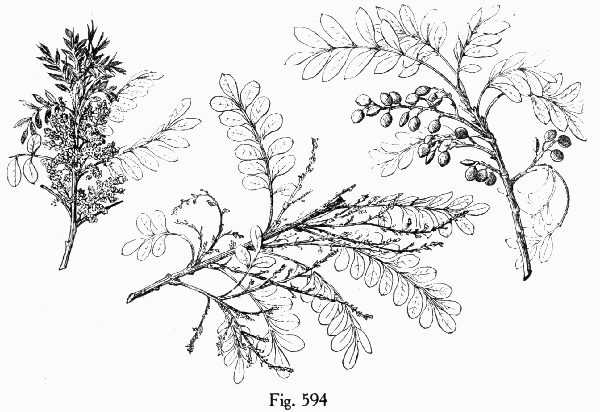
Leaves persistent or tardily deciduous, 9—19-foliolate, with a slightly winged rachis pubescent above and a flattened narrow-winged petiole ½′—¾′ in length; leaflets spatulate, [657] rounded and often mucronate at apex, gradually narrowed below into a deltoid or subcuneiform base, entire, more or less curved and unequilateral, wine-red when they unfold, and at maturity thin, dark green and sparingly pubescent along the midrib above, pale and glabrous below, nearly sessile or the terminal leaflet raised on a short petiolule, 5/12′—¾′ long and about ¼′ wide, with a slender midrib often near one side of the leaflet and reticulate veinlets. Flowers small, without a calyx, appearing just before or with the new leaves, in simple nearly glabrous panicles, their bracts and bractlets ciliate on the margins and wine-red at apex; staminate flowers more crowded than the pistillate, in compact panicles ¾′—1½′ long; anthers reddish yellow or wine color; pistillate flowers in loose panicles 1½′—2½′ in length; ovary ovoid or subglobose, two of the three styles with 2-lobed stigmas, the third with a 3-lobed stigma. Fruit oval, dark reddish brown and slightly glaucescent, about ¼′ long and ⅙′ broad, usually striate.
A small tree, occasionally 30° high with a short trunk 15′—18′ in diameter, with stout erect and spreading branches forming a head sometimes 30°—35° across, and slender slightly pubescent reddish branchlets becoming grayish brown by the end of their first year; more often a large shrub with numerous stout stems.
Distribution. Texas, limestone cliffs and the rocky bottoms of cañons periodically swept by floods, and in deep narrow ravines, along the lower Pecos River and in the neighborhood of its mouth, Valverde County; and in northeastern Mexico.
2. COTINUS L.
Small trees or shrubs, with scaly bark, small acute winter-buds, with numerous imbricated scales, fleshy roots, and strong-smelling juice. Leaves simple, petiolate, oval, obovate-oblong or nearly orbicular, glabrous or more or less pilose-pubescent, deciduous. Flowers regular, diœcious by abortion or rarely polygamo-diœcious, greenish yellow, on slender pedicels accrescent after the flowering period, mostly abortive and then becoming conspicuously tomentose-villose at maturity, in ample loose terminal or lateral pyramidal or thyrsoidal panicles, the branches from the axils of linear acute or spatulate deciduous bracts; calyx-lobes ovate-lanceolate, obtuse, persistent; disk coherent with the base of the calyx and surrounding the base of the ovary; petals oblong, acute, twice as long as the calyx, inserted under the free margin of the disk opposite its lobes, deciduous; stamens shorter than the petals, usually rudimentary or wanting in the pistillate flower; ovary sessile, obovoid, compressed, rudimentary in the staminate flower; styles 3, short and spreading from the lateral apex of the ovary; stigmas large, obtuse. Fruit oblong-oblique, compressed, glabrous, conspicuously reticulate-veined, light red-brown, bearing on the side near the middle the remnants of the persistent styles, the outer coat thin and dry; stone thick and bony.
Cotinus is widely distributed through southern Europe and the Himalayas to central China with a single species, and is represented in the southern United States by one species.
The Old World Cotinus coggygria Scop., the Smoke-tree of gardens, is often cultivated in the United States.
The generic name is from Κότινος, the classical name of a tree with red wood.
1. Cotinus americanus Nutt. Chittam Wood.
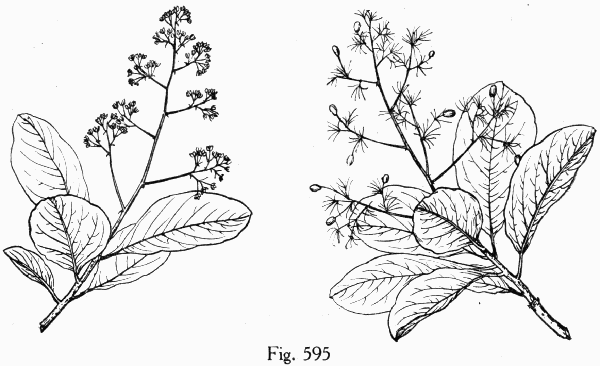
Leaves oval or obovate, rounded or sometimes slightly emarginate at apex, gradually contracted at base, and entire, with slightly wavy revolute margins, when they unfold light purple and covered below with fine silky white hairs, and at maturity dark green on the upper surface, pale on the lower surface, and puberulous along the under side of the broad midrib and primary veins, 4′—6′ long and 2′—3′ wide; turning in the autumn brilliant shades of orange and scarlet; petioles stout, ½′—¾′ in length. Flowers appearing late in April or early in May on pedicels ½′—¾′ long, and usually collected 3 or 4 together in loose umbels near the end of the principal branches of puberulous terminal slender long-branched [658] few-flowered panicles 5′—6′ long and 2½′—3′ broad, the staminate and pistillate flowers on different individuals. Fruit produced very sparingly, about ⅛′ long, on stems 2′—3′ in length; the sterile pedicels becoming 1½′—2′ long at maturity and covered with short not very abundant rather inconspicuous pale purple or brown hairs; seed kidney-shaped, pale brown, about 1/16′ long.
A tree, 25°—35° high, with a straight trunk occasionally 12′—14′ in diameter, usually dividing 12°—14° from the ground into several erect stems separating into wide-spreading often slightly pendulous branches, and slender branchlets purple when they first appear, soon becoming green, bright red-brown and covered with small white lenticels and marked by large prominent leaf-scars during their first winter, and dark orange-colored in their second year. Winter-buds ⅛′ long, and covered with thin dark red-brown scales. Bark of the trunk ⅛′ thick, light gray, furrowed, and broken on the surface into thin oblong scales. Wood light, soft, rather coarse-grained, bright clear rich orange color, with thin nearly white sapwood; largely used locally for fence-posts and very durable in contact with the soil; yielding a clear orange-colored dye.
Distribution. Banks of the Ohio River, Owensboro, Daviess County, Kentucky (E. J. Palmer); on the Cheat Mountains, eastern Tennessee; near Huntsville, Madison County, Alabama; valley of White River in Stone and Taney Counties, southern Missouri; near Cotter, Baxter County, and Van Buren, Crawford County, Arkansas, and eastern Oklahoma; valleys of the upper Guadalupe and Medina Rivers, western Texas; usually only in small isolated groves or thickets scattered along the sides of rocky ravines or dry slopes; very abundant as a small shrub and spreading over many thousand acres of the mountain cañons, and high hillsides in the neighborhood of Spanish Pass, Kendall County, Texas.
Occasionally cultivated in the eastern United States and rarely in Europe; hardy as far north as eastern Massachusetts.
3. METOPIUM P. Br.
Trees or shrubs, with naked buds, fleshy roots, and milky exceedingly caustic juice. Leaves unequally pinnate, persistent; leaflets coriaceous, lustrous, long-petiolulate. Flowers diœcious, yellow-green, on short stout pedicels, in narrow erect axillary clusters at the ends of the branches, with minute acute deciduous bracts and bractlets, the males and females on different trees; calyx-lobes semiorbicular, about half as long as the ovate obtuse petals; stamens 5, inserted under the margin of the disk; filaments shorter than the anthers, minute and rudimentary in the pistillate flower; ovary ovoid, sessile, minute in the staminate [659] flower; style terminal, short, undivided; stigma 3-lobed. Fruit ovoid, compressed, smooth and glabrous, crowned with the remnants of the style; outer coat thick and resinous; stone crustaceous. Seed nearly quadrangular, compressed; seed-coat smooth, dark brown and opaque, the broad funicle covering its margin.
Metopium with two species is confined to southern Florida and the West Indies.
The generic name, from ὄπος, was the classical name of an African tree now unknown.
1. Metopium toxiferum Kr. & Urb. Poison Wood. Hog Gum.
Metopium Metopium Small.
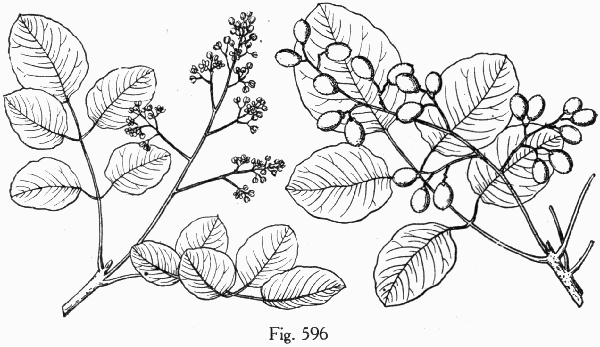
Leaves clustered near the end of the branches, 9′—10′ long, with stout petioles swollen and enlarged at base, and 5—7 leaflets, or often 3-foliolate; unfolding in March and persistent until the following spring; leaflets ovate, rounded or usually contracted toward the acute or sometimes slightly emarginate apex, rounded or sometimes cordate or cuneate at base, 3′—4′ long, 2′—3′ broad, with thickened slightly revolute margins, a prominent midrib, primary veins spreading at right angles, and numerous reticulate veinlets; petiolules stout, ½′—1′ long, that of the terminal leaflet often twice as long as the others. Flowers about ⅛′ in diameter, in clusters as long or rather longer than the leaves; petals yellow-green, marked on the inner surface by dark longitudinal lines; stamens rather shorter than the petals. Fruit ripening in November and December, pendent in long graceful clusters, orange-colored, rather lustrous, ¾′ in length; seed about ¼′ long.
A tree, frequently 35°—40° high, with a short trunk sometimes 2° in diameter, stout spreading often pendulous branches forming a low broad head, and reddish brown branchlets marked by prominent leaf-scars and numerous orange-colored lenticels. Winter-buds ⅓′—½′ in length, with acuminate scales ciliate on the margin with rufous hairs. Bark of the trunk about ⅛′ thick, light reddish brown tinged with orange, often marked by dark spots caused by the exuding of the resinous gum, and separating into large thin plate-like scales displaying the bright orange color of the inner bark. Wood heavy, hard, not strong, rich dark brown streaked with red, with thick light brown or yellow sapwood of 25—30 layers of annual growth. The resinous gum obtained from incisions made in the bark is emetic, purgative, and diuretic.
Distribution. Florida, shores of Bay Biscayne, on the Everglade Keys, and on Coot Bay in the rear of Cape Sable, Dade County, and on the southern keys; very abundant; in the Bahamas, Cuba, Jamaica, and Honduras.
[660]
4. RHUS L.
Trees or shrubs, with pithy branchlets, fleshy roots, and milky sometimes caustic or watery juice. Leaves unequally pinnate, or rarely simple. Flowers mostly diœcious, rarely polygamous, white or greenish white, in more or less compound axillary or terminal panicles, the staminate and pistillate usually produced on separate plants; calyx-lobes united at base only, generally persistent; disk surrounding the base of the free ovary, coherent with the base of the calyx; petals longer than the calyx-lobes, inserted under the margin of the disk, opposite its lobes, deciduous; stamens 5, inserted on the margin of the disk alternate with the petals; filaments longer than the anthers; ovary ovoid or subglobose, sessile; styles 3, terminal, free or slightly connate at base, rising from the centre of the ovary. Fruit usually globose, smooth or covered with hairs; outer coat thin and dry, more or less resinous; stone crustaceous or bony. Seed ovoid or reniform, commonly transverse; cotyledons foliaceous, generally transverse; radicle long, uncinate, laterally accumbent.
Rhus is widely distributed, with more than one hundred species, in the extra-tropical regions of the northern and southern hemispheres. In North America the genus is widely and generally distributed from Canada to southern Mexico and from the shores of the Atlantic to those of the Pacific Ocean, with sixteen or seventeen species within the territory of the United States. Of these, four obtain the habit of small trees. The acrid poisonous juice of Rhus vernicifera DC., of China, furnishes the black varnish used in China and Japan in the manufacture of lacquer, and other species are valued for the tannin contained in their leaves or for the wax obtained from their fruit.
The name of the genus is from Ῥοῦς, the classical name of the European Sumach.
CONSPECTUS OF NORTH AMERICAN ARBORESCENT SPECIES.
Flowers in terminal thyrsoid panicles; fruit globular, clothed with acrid hairs; leaves unequally pinnate, deciduous; Sumachs.
Branches and leaf-stalks densely velvety hairy; leaflets 11—31, pale on the lower surface; fruit covered with long hairs; buds inclosed in the enlarged base of the petioles; juice milky.
1. R. typhina (A, C).
Branches and leaf-stalks pubescent; rachis winged; leaflets 9—21, green on the lower surface; fruit pilose; buds not inclosed by the petioles; juice watery.
2. R. copallina (A, C).
Flowers in axillary slender panicles; fruit glabrous, white; leaves unequally pinnate, deciduous; leaflets 7—13.
3. R. vernix (A, C).
Flowers in short compact terminal panicled racemes; fruit pubescent; leaves ovate, entire or serrate, simple or rarely trifoliolate, persistent.
4. R. integrifolia (G).
1. Rhus typhina L. Staghorn Sumach.
Rhus hirta Sudw.
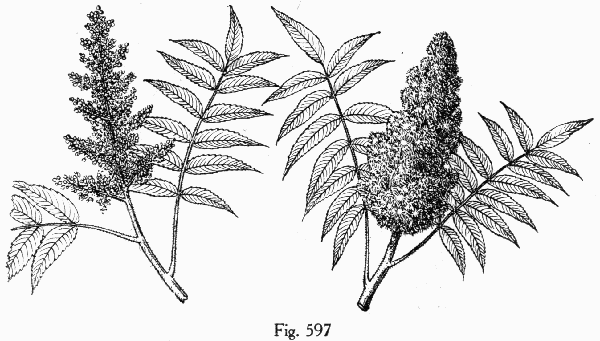
Leaves 16′—24′ long, with a stout petiole usually red on the upper side and covered with soft pale hairs, enlarged at base and surrounding and inclosing the bud developed in its axil, and 11—31 oblong often falcate rather remotely and sharply serrate or rarely laciniate long-pointed nearly sessile or short-stalked leaflets rounded or slightly heart-shaped at base, covered above like the petiole and young shoots when they first appear with red caducous hairs, bright yellow-green until half grown, and at maturity dark green and rather opaque on the upper surface, pale or often nearly white on the lower surface, glabrous with the exception of the short fine hairs on the under side of the stout midrib, and primary veins forked near the margins, opposite, or the lower leaflets slightly alternate, those of the 3 or 4 middle pairs considerably longer than those at the ends of the leaf, 2′—5′ long, and 1′—1½′ wide; turning in the autumn before falling bright scarlet with shades of crimson, [661] purple, and orange. Flowers opening gradually and in succession in early summer, the pistillate a week or ten days later than the staminate, on slender pedicels from the axils of small acute pubescent bracts, in dense panicles, with a pubescent stem and branchlets, and acuminate bracts ½′ to nearly 2′ long and deciduous with the opening of the flowers; panicle of the staminate flowers 8′—12′ long and 5′—6′ broad, with wide-spreading branches and nearly one third larger than the more compact panicle of the pistillate plant; calyx-lobes acute, covered on the outer surface with long slender hairs, much shorter than the petals in the staminate flower, and almost as long in the pistillate flower; petals of the staminate flower yellow-green sometimes tinged with red, strap-shaped, rounded at apex, becoming reflexed above the middle at maturity; petals of the pistillate flower green, narrow and acuminate, with a thickened and slightly hooded apex, remaining erect; disk bright red and conspicuous; stamens slightly exserted, with slender filaments and large bright orange-colored anthers; ovary ovoid, pubescent, the 3 short styles slightly connate at base, with large capitate stigmas, in the staminate flower glabrous, much smaller, unusually rudimentary. Fruit fully grown and colored in August and ripening late in the autumn in dense panicles 6′—8′ long and 2′—3′ wide, depressed-globose, with a thin outer covering clothed with long acrid crimson hairs and a small pale brown bony stone; seed slightly reniform, orange-brown.
A tree, occasionally 35°—40° high, with copious white viscid juice turning black on exposure, a slender often slightly inclining trunk occasionally 12′—14′ in diameter, stout upright often contorted branches forming a low flat open head, and thick branchlets covered with long soft brown hairs gathered also in tufts in the axils of the leaflets, becoming glabrous after their third or fourth year, and in their second season marked by large narrow leaf-scars and by small orange-colored lenticels enlarging vertically and persistent for several years; more frequently a tall shrub, spreading by underground shoots into broad thickets. Winter-buds conic, thickly coated with long silky pale brown hairs, about ¼′ long. Bark of the trunk thin, dark brown, generally smooth, and occasionally separating into small square scales. Wood light, brittle, soft, coarse-grained, orange-colored, streaked with green, with thick nearly white sapwood. From the young shoots pipes are made for drawing the sap of the Sugar Maple. The bark, especially that of the roots, and the leaves are rich in tannin. A form with narrow deeply divided leaflets (f. dissecta Rehdr.) occasionally occurs.
Distribution. Usually on uplands in good soil, or less commonly on sterile gravelly banks and on the borders of streams and swamps, New Brunswick and through the valley [662] of the St. Lawrence River to southern Ontario and westward to eastern North Dakota and eastern and northeastern Iowa, and southward through the northern states and along the Appalachian Mountains to northern Georgia and Mississippi; more abundant on the Atlantic seaboard than in the region west of the Appalachian Mountains.
Occasionally cultivated as an ornamental plant in the United States, and very commonly in central and northern Europe.
× Rhus hybrida Rehdr. a hybrid of R. typhina and R. glabra L. has been found in Massachusetts.
2. Rhus copallina L. Sumach.
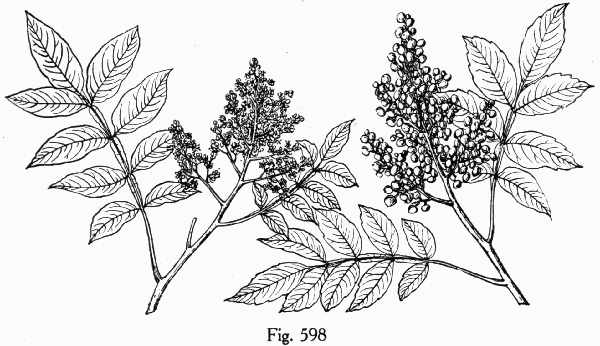
Leaves 6′—8′ long, with a slender pubescent petiole and rachis more or less broadly wing-margined between the leaflets, the wings increasing in width toward the apex of the leaf, and 9—21 oblong or ovate-lanceolate leaflets entire or remotely serrate above the middle, sharp-pointed or rarely emarginate at apex, acute or obtuse and often unequal at base, those of the lower pairs short-petiolulate and smaller than those above the middle of the leaf, the others sessile with the exception of the terminal leaflet sometimes contracted into a long winged stalk, when they unfold dark green and slightly puberulous above, especially along the midrib, and covered below with fine silvery white pubescence, at maturity subcoriaceous, dark green and lustrous above, pale and pubescent below, 1½′—2½′ long and about ¾′ wide, with slightly thickened revolute margins, a prominent midrib and primary veins; turning in the autumn before falling dark rich maroon color on the upper surface. Flowers appearing from June in the south to August in the north, those of the staminate plant opening in succession during nearly a month and continuing to unfold long after the petals of the pistillate plant have fallen, on stout pubescent pedicels ⅛′—¼′ long, in short compact pubescent panicles, the lower branches from the axils of the upper leaves, 4′—6′ long, 3′—4′ broad, and usually smaller on the female than on the male plant, their bracts and bractlets ovate or oblong, densely cinereo-pilose, deciduous before the expansion of the flowers; calyx puberulous on the outer surface, with ovate acute lobes one third as long as the ovate greenish yellow petals rounded at apex, becoming reflexed above the middle; disk red and conspicuous; stamens somewhat longer than the petals, with slender filaments and large orange-colored anthers, in the pistillate flower much shorter than the petals, with minute rudimentary anthers; ovary ovoid, pubescent, glabrous, much smaller in the staminate flower. Fruit ripening in five or six weeks and borne in stout compact often nodding pubescent clusters sometimes persistent on the branches [663] until the beginning of the following summer, ⅛′ across, slightly obovoid, more or less flattened, with a thin bright red coat covered with short fine glandular hairs, and a smooth bony orange-brown stone; seed reniform, smooth, orange-colored, with a broad funicle.
A tree, 25°—30° high, with colorless watery juice, a short stout trunk 8′—10′ in diameter, erect spreading branches, and branchlets at first dark green tinged with red and more or less densely clothed with short fine or sometimes ferrugineous pubescence, appearing slightly zigzag at the end of their first season from the swellings formed by the prominent leaf-scars, and then pale reddish brown, slightly puberulous and marked by conspicuous dark-colored lenticels; or at the north usually a low shrub rarely more than 4°—5° tall. Winter-buds minute, nearly globose, and covered with dark rusty brown tomentum. Bark of the trunk ⅓′—½′ thick, light brown tinged with red, and marked by large elevated dark red-brown circular excrescences, and separating into large thin papery scales. Wood light, soft, coarse-grained, light brown streaked with green and often tinged with red, with thin lighter colored sapwood of 4 or 5 layers of annual growth. The leaves are rich in tannin and are gathered in large quantities and ground for curing leather and for dyeing.
Distribution. Dry hillsides and ridges; widely and generally distributed from northern New England to southern Florida, and to southeastern Iowa, southeastern Nebraska, eastern Kansas and the valley of the San Antonio River, Texas; in Cuba; in the United States arborescent only southward; at the north rarely more than a few feet high and spreading by underground stems on gravelly sterile soil into broad thickets; varying considerably in the size and form of the leaflets. The most distinct and probably the most constant of these varieties is var. lanceolata A. Gray, a small tree growing on the prairies of eastern Texas to the valley of the Rio Grande and to southeastern New Mexico, often forming thickets on river bluffs or on the banks of small streams, and distinguished by its narrow acute often falcate leaflets and by its larger inflorescence and fruit. A tree sometimes 25°—30° high, with a trunk occasionally 8′ in diameter, covered by dark gray bark marked by lenticular excrescences. The flowers appear in July and August and the dull red or sometimes green fruit ripens in early autumn and falls before the beginning of winter.
Occasionally cultivated as an ornamental plant in the eastern United States, and in western and northern Europe.
3. Rhus vernix L. Poison Dogwood. Poison Sumach.
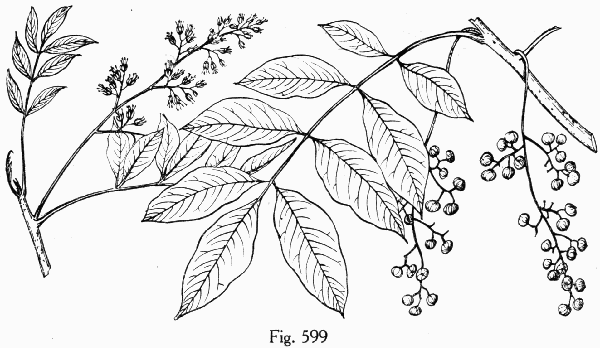
Leaves 7′—14′ long, with a slender usually light red or red and green petiole, and 7—13 obovate-oblong entire leaflets slightly unequal at base and narrowed at the acute or rounded apex, bright orange color and coated, especially on the margins and under surface, with fine pubescence when they unfold, soon becoming glabrous, and at maturity 3′—4′ long, 1½′—2′ wide, dark green and lustrous above, pale below, with a prominent midrib scarlet above, primary veins forked near the margins, conspicuous reticulate veinlets, and revolute margins; turning early in the autumn before falling to brilliant shades of scarlet or orange and scarlet. Flowers about ⅛′ long, appearing in early summer on slender pubescent pedicels bibracteolate near the middle, in long narrow axillary pubescent panicles crowded near the end of the branches, with acute pubescent early deciduous bracts and bractlets; calyx-lobes acute, one third the length of the yellow-green acute petals erect and slightly reflexed toward the apex; stamens nearly twice as long as the petals, with slender filaments and large orange-colored anthers, in the fertile flower not more than half the length of the petals, with small rudimentary anthers; ovary ovoid-globose, with short thick spreading styles terminating in large capitate stigmas. Fruit ripening in September and often persistent on the branches until the following spring, in long graceful racemes, ovoid, acute, often flattened and slightly gibbous, tipped with the dark remnants of the styles, glabrous, striate, ivory-white or white tinged with yellow, very lustrous, and about ½′ long; stone conspicuously grooved, the wall thin, membranaceous; seed pale yellow.
A tree, with acrid poisonous juice turning black on exposure, occasionally 25° high, with [664] a trunk 5′—6′ in diameter, slender rather pendulous branches forming a narrow round-topped head, and slender glabrous branchlets reddish brown and covered with minute orange-colored lenticels when they first appear, orange-brown at the end of their first season, becoming light gray and marked by large elevated conspicuous leaf-scars; more often a shrub, with several slender clustered stems. Winter-buds acute and covered with dark purple scales puberulous on the back, and ciliate on the margins with short pale hairs, the terminal ⅛′—¾′ long and two or three times larger than the axillary buds. Bark of the trunk thin, light gray, smooth or sometimes slightly striate. Wood light, soft, coarse-grained, light yellow streaked with brown, with lighter colored sapwood.
Distribution. Wet swamps often inundated during a portion of the year; northern New England to northern Florida and southern Alabama, and westward to Ontario and southeastern Minnesota, western Louisiana and the valley of the Neches River (San Augustine County) eastern Texas; common and one of the most dangerous plants of the North American flora. An infusion of the young branches and leaves is employed in homœopathic practice, and the juice can be used as a black lustrous durable varnish.
4. Rhus integrifolia B. & H. Mahogany.
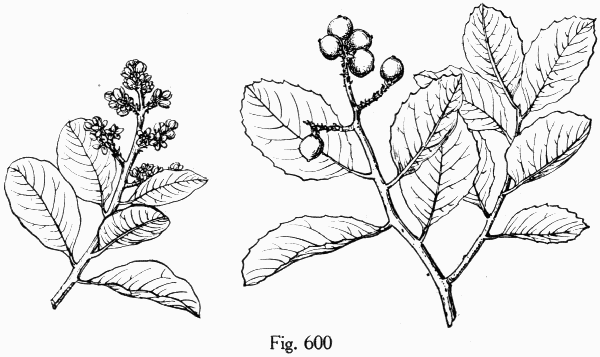
Leaves simple or very rarely 3-foliolate, persistent, acute or rounded at apex, with thickened revolute, or spinosely toothed margins (var. serrata Engler), puberulous when young, and at maturity 1½′—3′ long, 1′—1½′ wide, thick and coriaceous, dark yellow-green above, paler below, and glabrous with the exception of the stout petiole, broad thick midrib, and prominent reticulate veins. Flowers appearing from February to April, ¼′ in diameter when expanded, on short stout pedicels, with 2—4 broad-ovate pointed persistent scarious ciliate pubescent bractlets, in short dense racemes forming hoary-pubescent terminal panicles 1′—3′ in length; sepals rose-colored, orbicular, concave, ciliate on the margins, rather less than half the length of the rounded ciliate reflexed rose-colored petals; stamens as long as the petals, with slender filaments and pale anthers, minute and rudimentary in the pistillate flower; ovary broad-ovoid, pubescent, with 3 short thick connate styles and very large 3-lobed capitate stigmas, rudimentary in the staminate flower. Fruit ½′ long, ovoid, flattened, more or less gibbous, thick, dark red, densely pubescent; stone kidney-shaped, smooth, light chestnut-brown, with thick walls; seed flattened, pale, with a broad dark-colored funicle covering its side.
A tree, rarely 30° high, with a short stout trunk 2°—3° in diameter, numerous spreading branches, and stout branchlets covered when they first appear with thick pale pubescence [665] disappearing in their second and third years, and bright reddish brown and marked by numerous small elevated lenticels; or usually a small often almost prostrate shrub. Winter-buds small, obtuse, covered with a thick coat of pale tomentum. Bark of the trunk ¼′—½′ thick, bright reddish brown, exfoliating in large plate-like scales. Wood hard, heavy, bright clear red, with thin pale sapwood of 8—10 layers of annual growth; valued and largely used as fuel. The fruit is occasionally employed in the preparation of a cooling beverage.
Distribution. Sandy sterile soil along sea beaches, and bluffs in the immediate vicinity of the ocean; neighborhood of Santa Barbara, Santa Barbara County, California, to the shores of Magdalena Bay, Lower California, and on the Santa Barbara and Cedros islands; on the mainland usually shrubby, forming close impenetrable thickets; in more sheltered situations and on the islands becoming arborescent; probably of its largest size on the shores of Todos Santos Bay, Lower California.
XXXII. CYRILLACEÆ.
Trees or shrubs, with small scaly buds and watery juice. Leaves alternate, entire, subcoriaceous, without stipules, persistent or tardily deciduous. Flowers small, regular, perfect, on slender bibracteolate pedicels, in terminal or axillary racemes; calyx 5—8-lobed, persistent, the lobes imbricated in the bud; petals 5—8, hypogynous; stamens 5—10, hypogynous, those opposite the petals shorter than the others; anthers oblong, introrse, 2-celled, the cells laterally dehiscent, opening longitudinally; ovary 2—4-celled; ovules suspended, anatropous; raphe dorsal; micropyle superior. Fruit an indehiscent capsule. Seed suspended; seed-coat membranaceous; albumen fleshy, radicle superior.
A family confined to the warmer parts of America, with three genera, of which two are represented by small trees in the southern states.
CONSPECTUS OF THE GENERA OF THE UNITED STATES.
Flowers in axillary racemes; calyx 5-lobed; petals 5 contorted in the bud; fruit without wings, 2-celled, with 2 seeds in each cell.
1. Cyrilla.
Flowers in terminal racemes; calyx 5—8-lobed; petals 5—8 imbricated in the bud; fruit with 2—4 wings, 3 or rarely 4-celled, with 1 seed in each cell.
2. Cliftonia.
[666]
1. CYRILLA L.
A glabrous tree or shrub, with spongy bark, slender terete branchlets conspicuously marked by large leaf-scars, and narrow acute winter-buds covered with chestnut-brown scales. Leaves usually clustered near the end of the branches, oblong or oblong-obovate, pointed, rounded, or slightly emarginate at apex, conspicuously reticulate-veined, short-petiolate. Flowers on pedicels from the axils of narrow alternate persistent bracts, in slender racemes from the axils of fallen leaves or of small deciduous bracts near the end of the branches of the previous year; calyx minute, divided nearly to the base into 5 ovate-lanceolate acute coriaceous lobes; petals 5, contorted in the bud, white or rose color, inserted on an annular disk, three or four times longer than the calyx-lobes, oblong-lanceolate, acute, concave, subcoriaceous, furnished below the middle on the inner surface with a broad glandular nectary; stamens 5, opposite the divisions of the calyx, inserted with and shorter than the petals; filaments subulate, fleshy; anther-cells united above the point of attachment, free below; ovary ovoid, free, sessile, pointed, 2-celled; styles short, thick; stigma 2-lobed, with spreading lobes; ovules 3 in each cell, suspended from an elongated placental process developed from the apex of the cell. Fruit 2-celled, broad-ovoid, crowned with the remnants of the persistent style; pericarp spongy. Seeds 2 in each cell, elongated, acuminate; embryo minute, cylindric, 2-lobed.
Cyrilla is represented by a single species of the coast region of the south Atlantic and Gulf states and of the Antilles and eastern tropical South America.
The name commemorates the scientific labors of Dominico Cirillo (1734—1799), the distinguished Italian naturalist and patriot.
1. Cyrilla racemiflora L. Ironwood. Leather Wood.
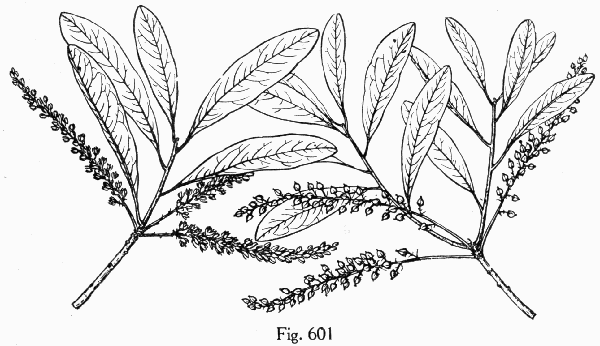
Leaves 2′—3′ long and ¼′—1′ wide, with a stout petiole ⅛′—1′ in length; turning late in the autumn and early winter to brilliant shades of orange and scarlet and then deciduous, or southward persistent with little change of color until the beginning of the following summer. Flowers appearing late in June or early in July, in racemes usually 6—10 together and 4′—6′ long, at first erect, becoming pendulous before the fruit ripens. Fruit ripening in August and September, rarely more than 1/16′ long; seeds light brown.
A slender tree, occasionally 30°—35° high, with a stout often eccentric trunk 10′—14′ in diameter, dividing several feet above the ground into numerous wide-spreading branches, and slender branchlets bright brown during their first season and ultimately ashy gray; [667] often a broad bush sending up many slender stems 15°—20° high. Winter-buds about ⅛′ long. Bark of the trunk rarely more than ½′ thick except near the base of old trees, and covered by large thin bright red-brown scales. Wood heavy, hard, close-grained, not strong, brown tinged with red, with rather lighter colored sapwood. The spongy bark at the base of the trunk is pliable, absorbent, and astringent, and has been recommended as a styptic.
Distribution. Rich shaded river-bottoms, the borders of sandy swamps and shallow ponds of the coast Pine-belt, or on high sandy exposed ridges rising above streams near the Gulf coast; southeastern Virginia southward near the coast to northern Florida and westward along the Gulf coast to the valley of the Neches River, Texas; in Lake County, Florida, and ranging northward in Mississippi to Forrest County (near Hattiesburg, T. G. Harbison), and in Alabama to Dallas County; in swamps near the coast of western Florida often a low shrub with smaller leaves and shorter racemes (var. parviflora Sarg.); in Cuba, Jamaica, Porto Rico, Demarara, and Brazil (var. racemifera Sarg.).
2. CLIFTONIA Gærtn. f.
A glabrous tree or shrub, with thick dark brown scaly bark, slender terete branchlets marked by conspicuous leaf-scars, and small acuminate buds covered by chestnut-brown scales. Leaves oblong-lanceolate, rounded or slightly emarginate at apex, glandular-punctate, short-petiolate, persistent. Flowers on pedicels from the axils of large acuminate membranaceous alternate bracts deciduous before the opening of the flowers, in short terminal erect racemes; calyx 5—8-lobed, equal or unequal, broad-ovoid, rounded or acuminate at apex, much shorter than the 5—8 obovate unguiculate concave white or rose-colored sepals; stamens 10, opposite and alternate with the sepals, inserted with and shorter than the petals, 2-ranked, those of the outer rank longer than the others; filaments laterally enlarged near the middle, flattened below, subulate above; disk cup-shaped, surrounding the base of the oblong 2—4-winged 2—4-celled ovary; stigma subsessile, obscurely 2—4-lobed; ovules 2 in each cell, suspended from its apex. Fruit oblong, 2—4-winged, crowned with the remnants of the persistent style, 3 or rarely 4-celled; pericarp spongy, the wings thin and membranaceous. Seed 1 in each cell, terete, tapering to the ends, suspended; cotyledons very short.
Cliftonia is represented by a single species of the south Atlantic and Gulf states.
The generic name is in honor of Dr. Francis Clifton (d. 1736), an English physician.
1. Cliftonia monophylla Britt. Titi. Ironwood.
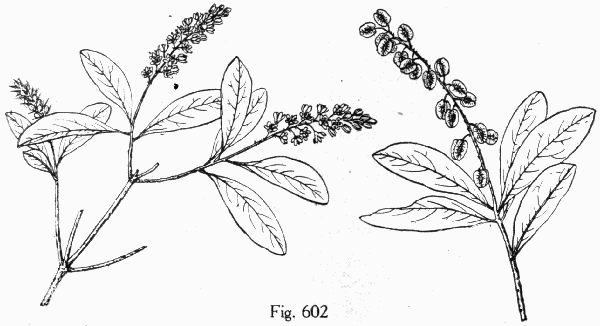
Leaves 1½′—2′ long, ½′—1′ wide, bright green and lustrous on the upper surface, paler on the lower surface; persistent until the autumn of their second year. Flowers fragrant, [668] appearing in February and March, in racemes at first nodding, and conspicuous from the long exserted dark red-brown caducous bracts, becoming erect as the flowers open. Fruit about ¼′ long, ripening in August and September; seeds 1/16′—⅛′ long, light brown.
A tree, occasionally 40°—50° high, with a stout often crooked or inclining trunk, occasionally 15′—18′ in diameter, and usually divided 12°—15° from the ground into a number of stout ascending branches, and slender rigid bright red-brown branchlets, becoming paler during their second and third seasons; or sometimes a shrub, with numerous straggling stout or slender stems frequently only a few feet high or occasionally 30°—40° high. Winter-buds about ¼′ long. Bark of young stems and of large branches thin, the surface separating into small persistent scales 1′—2′ long, becoming near the base of old trees deeply furrowed, dark red-brown, ¼′ thick, and broken on the surface into short broad scales. Wood heavy, close-grained, moderately hard, brittle, not strong, brown tinged with red, with thick lighter colored sapwood of 40—50 layers of annual growth; burning with a clear bright flame, and valued as fuel.
Distribution. Damp sandy peat soil in swamps almost submerged for several months of the year, or often in shallow rarely overflowed swamps; coast region of the south Atlantic states from the valley of the Savannah River to the coast of western Florida, and through the maritime Pine-belt of the Gulf coast to eastern Louisiana.
XXXIII. AQUIFOLIACEÆ.
Trees or shrubs, with terete branchlets, scaly buds, and alternate simple entire crenate or pungently toothed petiolate persistent or deciduous leaves, with minute stipules. Flowers axillary, solitary or cymose, small, greenish white, diœcious; calyx 4—6-lobed, the lobes imbricated in the bud, hypogynous; petals 4—6, oval or oblong, obtuse, free or united at base, imbricated in the bud; disk 0; stamens as many as and alternate with the petals and adnate to the base of the corolla; anthers introrse, 2-celled, the cells opening longitudinally, small and sterile in the pistillate flower; pistil compound; ovary 4—8-celled, minute and rudimentary in the staminate flower; style short or 0; stigmas as many as the cells of the ovary, nearly confluent; ovule generally solitary in each cell, suspended, anatropous; raphe usually dorsal, the micropyle superior. Fruit a drupe, with as many indehiscent bony or crustaceous 1-seeded nutlets as carpels; sarcocarp thin and fleshy. Seed narrowed at the ends, suspended; seed-coat membranaceous, pale brown; embryo minute in the apex of the copious fleshy albumen; cotyledons plain; the radicle superior.
The Holly family with five genera is distributed in temperate and tropical regions of the two hemispheres. Of the five genera now recognized, only Ilex is important in the number of species or is widely distributed.
1. ILEX L.
Characters of the family.
Ilex with about one hundred and seventy-five species is found in all tropical and temperate regions of the world with the exception of western North America, Australia, New Zealand, Tasmania, and New Guinea, the largest number of species occurring in Brazil and Guiana. Of the thirteen species which inhabit eastern North America, six are trees. Ilex contains a bitter principle, ilicin, and possesses tonic properties. Ilex paraguariensis St. Hilaire, of South America, furnishes the maté or Paraguay tea, and is the most useful of the species. The European Ilex Aquifolium L. is a favorite garden plant, and is sometimes planted in the middle, southern, and Pacific United States.
Ilex is the classical name of the Evergreen Oak of southern Europe.
CONSPECTUS OF THE NORTH AMERICAN ARBORESCENT SPECIES.
Parts of the flower in 4’s; pedicels with bractlets at the base; nutlets prominently ribbed on the back and sides; leaves persistent.
Leaves armed with spiny teeth; young branchlets glabrous or sparingly pubescent.
1. I. opaca (A, C).
[669]
Leaves serrate or entire; fruit bright red.
Leaves oblanceolate or oblong-obovate, mostly entire; young branchlets pubescent; calyx-lobes acuminate.
2. I. Cassine (C).
Leaves elliptic or oblong-elliptic, coarsely crenulate-serrate; young branchlets puberulous; calyx-lobes obtuse.
3. I. vomitoria (C).
Leaves entire, ovate, ovate-elliptic or ovate-lanceolate; fruit brownish purple.
4. I. Krugiana (D).
Parts of the flower in 4’s or 5’s, rarely in 6’s; pedicels without bractlets; nutlets striate, many-ribbed on the back; leaves deciduous.
Leaves oblong-spatulate or obovate-lanceolate, remotely crenulate-serrate; calyx-lobes broad-triangular.
5. I. decidua (A, C).
Leaves ovate or oblong-lanceolate, sharply serrate; calyx-lobes acute.
6. I. monticola (A).
1. Ilex opaca Ait. Holly.
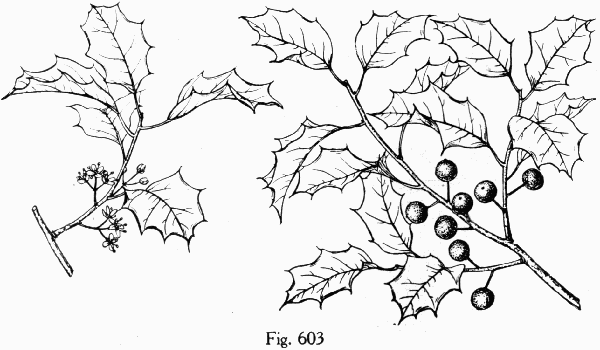
Leaves elliptic to obovate-oblong, pungently acute, with thickened undulate margins and few stout spinose teeth, or occasionally entire, especially on upper branches, thick, coriaceous, dull yellow-green, paler and often yellow on the lower surface, 2′—4′ long, with a prominent midrib and conspicuous veins; persistent on the branches for three years, finally deciduous in the spring; petioles short, stout, thickened at base, grooved above, slightly puberulent; stipules minute, broad-acute or nearly deltoid, persistent. Flowers appearing in spring on slender puberulous pedicels, with minute acute bractlets, in short pedunculate cymes from the axils of young leaves or scattered along the base of the young shoots, 3—9-flowered on the staminate and 1 or rarely 2 or 3-flowered on the pistillate plant; calyx-lobes acute, ciliate on the margins; stigmas broad and sessile. Fruit ripening late in the autumn, persistent on the branches during the winter, spherical or ovoid, dull red or rarely yellow, ¼′ in diameter; nutlets prominently few-ribbed on the back and sides, rather narrower at apex than at base.
A tree, often 40°—50° and occasionally 80°—100° high, with a trunk 2°, 3°, or exceptionally 4° in diameter, short slender branches forming a narrow pyramidal head, and stout branchlets covered when they first appear with fine rufous pubescence disappearing during their first season, and becoming glabrous and pale brown. Winter-buds obtuse or acuminate, ⅛′—¼′ long, with narrow acuminate ciliate scales. Bark about ½′ thick, light gray and roughened by wart-like excrescences. Wood light, tough, not strong, close-grained, [670] nearly white when first cut, turning brown with age and exposure, with thick rather lighter colored sapwood; valued and much used in cabinet-making, in the interior finish of houses, and in turnery. The branches are used in large quantities for Christmas decoration.
Distribution. Coast of Massachusetts, in the city of Quincy, Norfolk County, southward generally near the coast to the shores of Mosquito Inlet and Charlotte Harbor, Florida; valley of the Mississippi River from southern Indiana and Illinois, to the shores of the Gulf of Mexico, and through Missouri, Arkansas, eastern Oklahoma, and Louisiana to the valley of Cibolo Creek (Southerland Springs, Wilson County), Texas; rare and of small size east of the Hudson River and rare in the Appalachian Mountain region and the country immediately west of it; most abundant and of its largest size on the bottom-lands of the streams of northern Louisiana, southern Arkansas and eastern Texas; at the north in dry rather gravelly soil often on the margins of Oak-woods, southward on the borders of swampy river-bottoms, in rich humid soil.
Occasionally cultivated in the eastern states as an ornamental plant.
2. Ilex Cassine L. Dahoon.
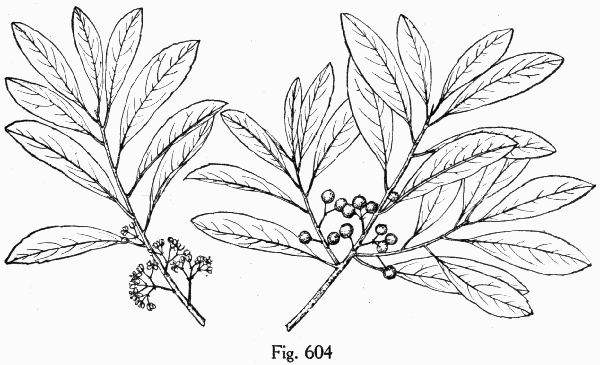
Leaves oblanceolate to oblong-obovate, acute, mucronate or rarely rounded and occasionally emarginate at apex, gradually narrowed and cuneate at base, revolute and entire, or sometimes serrate above the middle with sharp mucronate teeth, puberulous above and densely pubescent below when they first unfold, becoming glabrous at maturity with the exception of scattered hairs on the lower surface of the broad midrib, dark green and lustrous above, pale below, 1½′—3′ long and ½′—1′ wide; petioles short, stout, thickened at the base, sparingly villose. Flowers on hairy pedicels, with acute scarious bractlets, in pedunculate clusters, 3—9-flowered on the staminate plant, usually 3-flowered on the pistillate plant sometimes nearly 1′ long, from the axils of leaves of the year or occasionally of the previous year; calyx-lobes acute, ciliate. Fruit ripening late in the autumn, persistent until the following spring, globose, sometimes ¼′ in diameter, bright or occasionally dull red or nearly yellow, solitary or often in clusters of 3’s; nutlets prominently few-ribbed on the back and sides; rounded at base, acute at apex.
A tree, 25°—30° high, with a trunk 12′—18′ in diameter, and branches coated at first with dense silky pubescence persistent until the end of the second or third year, ultimately dark brown and marked by occasional lenticels; or often a low shrub. Winter-buds minute, acute, with lanceolate scales thickly coated with pale silky pubescence. Bark of the trunk [671] about 1/16′ thick, dark gray, thickly covered and roughened by lenticels. Wood light, soft, close-grained, not strong, pale brown, with thick nearly white sapwood.
Distribution. Cold swamps and on their borders, in rich moist soil, or occasionally on the high sandy banks of Pine-barren streams; southeastern Virginia southward in the immediate neighborhood of the coast to the shores of Bay Biscayne and the Everglade Keys, Dade County, and in the interior of the peninsular in Polk and De Soto Counties, Florida, and along the Gulf coast to western Louisiana; on the Bahama Islands and in Cuba (var. latifolia Ait.); nowhere abundant on the Atlantic coast; most common in western Florida and southern Alabama; passing through forms with elongated narrow leaves (var. angustifolia Ait., the common form of southern Alabama) into the variety myrtifolia Sarg. This is a low shrub or occasionally a slender wide-branched tree, with pale nearly white bark, puberulous branchlets, and crowded generally entire mucronate leaves ½′—1′ long, ⅛′ wide, with strongly reflexed margins, a very short petiole, and a broad prominent midrib; an inhabitant of Cypress-swamps and Pine-barren ponds or their margins, in the neighborhood of the coast, North Carolina to Louisiana.
Ilex Cassine is occasionally cultivated in Europe.
3. Ilex vomitoria Ait. Cassena. Yaupon.
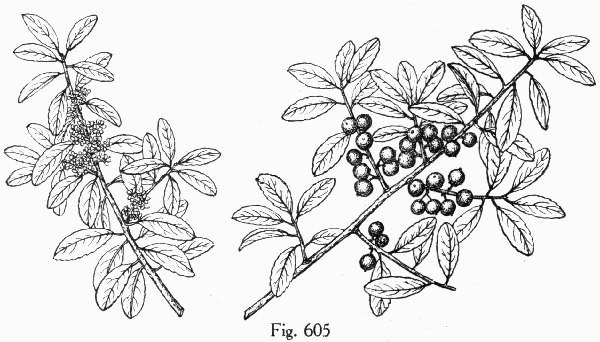
Leaves elliptic to elliptic-oblong, obtuse, coarsely and remotely crenulate-serrate, coriaceous, dark green and lustrous above, pale and opaque below, 1′—2′ long and ¼′—1′ wide, persistent for two or three years, generally falling just before the appearance of the new growth of their third season; petioles short, broad, and grooved. Flowers on slender club-shaped glabrous pedicels, with minute bractlets at the base, in short glabrous cymes on branchlets of the previous year, those of the staminate plant short-stemmed and many-flowered, those of the pistillate plant sessile and 1 or 2-flowered; calyx-lobes rounded, obtuse, often slightly ciliate; ovary contracted below the broad flat stigma. Fruit produced in great abundance, on stems not more than ¼′ long, ripening late in the autumn or in early winter, soon deciduous, or persistent until spring, scarlet, nearly globose, about ¼′ in diameter; nutlets obtuse at the ends, and prominently few-ribbed on the back and sides.
A small much-branched tree, 20°—25° high, with a slender often inclining trunk rarely more than 6′ in diameter, and stout branchlets standing at right angles with the stem, slightly angled and puberulous during their first season, becoming glabrous or nearly glabrous, terete and pale gray in their second year; generally a tall shrub, with numerous stems forming dense thickets. Winter-buds minute, obtuse, with narrow dark brown or often nearly black scales. Bark of the trunk 1/16′—⅛′ thick, the light red-brown surface broken [672] into thin minute scales. Wood heavy, hard, close-grained, nearly white, turning yellow with exposure, with thick lighter colored sapwood.
Distribution. Southeastern Virginia to the St. John’s River and Cedar Keys, Florida, and westward to the shores of Matagorda Bay and the valleys of the upper Rio Blanco and the Guadalupe River, Texas, and to southern Arkansas; in the Atlantic and east Gulf states rarely far from salt water and usually not more than 10°—15° high; of its largest size and of tree-like habit only on the rich bottom-lands of eastern Texas. The branches covered with the fruit are sold during the winter months for decorative purposes. An infusion of the leaves, which are emetic and purgative, was used by the Indians, who formerly visited the coast in large numbers every spring to drink it.
Occasionally used in the southern states for hedges.
4. Ilex Krugiana Loesen.
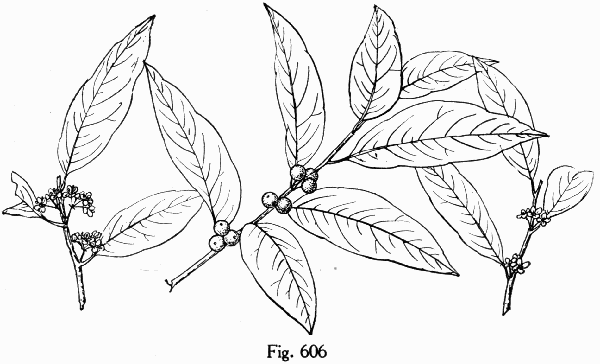
Leaves ovate, ovate-elliptic or ovate-lanceolate, acuminate and abruptly long-pointed or acute at apex, rounded or obtusely cuneate at base, entire, with slightly thickened margins subcoriaceous or coriaceous, glabrous, dark yellow-green and lustrous above, dull beneath, persistent, 2½′—4′ long and 1′—1½′ wide, with a prominent midrib deeply impressed on the upper side and pale on the lower side, and 6—9 pairs of slender primary veins connected by thin reticulate veinlets; petioles slender, ⅓′—¾′ in length; stipules minute, whitish, persistent. Flowers on slender pedicels, 1/12′—⅙′ long, in the axils of minute acute scarious deciduous bractlets, in crowded clusters, the staminate 1—3-flowered on short peduncles, the pistillate 1-flowered; calyx about 1/12′ in diameter, 4-lobed, the lobes triangular, suberect, about as long as the tube, imbricated in the bud; corolla rotate, greenish white, petals 4, ovate or slightly obovate in the pistillate flower, imbricated in the bud; stamens 4 in the staminate flower, nearly as long as the petals; filaments slender, about as long as the oval anthers; in the pistillate flower much smaller and abortive; ovary 4-celled, ellipsoid; stigma small, discoid, obscurely 4-lobed; ovary of the staminate flower subconic, minute and abortive. Fruit on a stout pedicel up to ⅕′ in length, globose, brownish purple, lustrous, ⅙′ in diameter; sarcocarp thin; nutlets 4, irregularly 3-seeded, obtusely angled, dark brown.
In Florida a tree, sometimes 30°—40° high, with a tall often crooked trunk occasionally 4′ in diameter and covered with thin smooth nearly white bark, becoming on old individuals darker-colored and broken into narrow scales, and small ascending branchlets green when they first appear, becoming light gray and finally white, and marked by numerous round elliptic lenticels; often a shrub.
[673]
Distribution. Florida, Homestead and Paradise Keys in the Everglades, Dade County; in the Bahama Islands, Hayti and San Domingo.
5. Ilex decidua Walt.
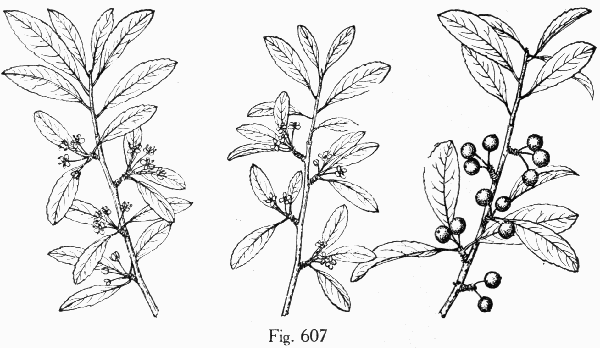
Leaves deciduous, except on vigorous shoots, fascicled at the end of short spur-like lateral branchlets, oblong-spatulate or spatulate-lanceolate, acuminate, obtuse or emarginate at apex, gradually narrowed below, remotely crenulate-serrate, 2′—3′ long, ⅓′—1′ wide, thin early in the season, becoming thick and firm at maturity, light green above and pale and sparingly hairy along the narrow midrib below; petioles slender, grooved, pubescent, about ¼′ in length; stipules filiform, membranaceous. Flowers on slender pedicels, those of the staminate plant often ½′ long and longer than those of the pistillate plant, in 1 or 2-flowered glabrous cymes crowded at the end of the lateral branches of the previous season, or rarely solitary on branchlets of the year; calyx-lobes triangular, with smooth or sometimes ciliate margins. Fruit on short stout stems, ripening in the early autumn, often remaining on the branches until the appearance of the leaves the following spring, globose or depressed-globose, orange or orange-scarlet, ¼′ in diameter; nutlets narrowed and rounded at base, acute or acuminate at apex, many-ribbed on the back.
A tree, 20°—30° high, with a slender trunk 6′—10′ in diameter, stout spreading branches, and slender glabrous pale silver gray branchlets; more often a tall straggling shrub. Winter-buds minute, obtuse, with ovate light gray scales. Bark of the trunk rarely more than 1/16′ thick, light brown, and roughened by wart-like excrescences. Wood heavy, hard, close-grained, creamy white, with rather lighter colored sapwood.
Distribution. Borders of streams and swamps in low moist soil; Gloucester County, Virginia, to western Florida in the region between the eastern and southern base of the Appalachian Mountains and the neighborhood of the coast, and through the Gulf states to the valley of the Colorado River, Texas, and through Arkansas, eastern Oklahoma, and southern Missouri to southern Illinois; usually shrubby east of the Mississippi River and only arborescent in Missouri, southern Arkansas, and eastern Texas. In Florida a form (var. Curtissii Fern.) occurs with leaves only ⅓′—⅔′ long and fruit about ¼′ in diameter.
6. Ilex monticola Gray.
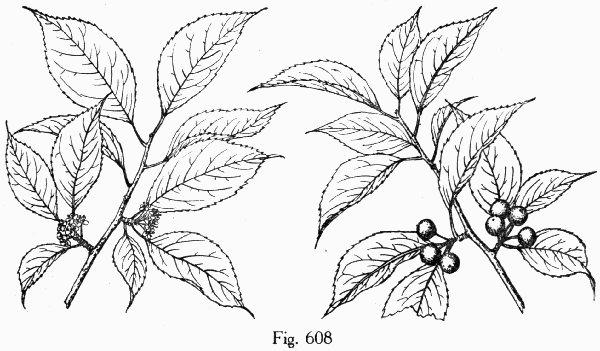
Leaves deciduous, ovate to oblong-lanceolate, abruptly narrowed and acuminate or rarely acute at apex, cuneate or rarely rounded at base, sharply and rather remotely serrate with minute glandular incurved teeth, thin, glabrous, or sparingly hairy along the prominent [674] midrib and veins, 2′—5′ long, ½′—2½′ wide, light green above and pale below; petioles slender, ⅓′—½′ in length. Flowers appearing in June when the leaves are more than half grown, on slender pedicels ½′ long on the staminate plant and much longer on the pistillate plant, in 1—2-flowered cymes crowded at the end of lateral spur-like branchlets of the previous year, or solitary on branchlets of the year; calyx-lobes acute, ciliate; ovary contracted below the broad flat stigma. Fruit globose, bright scarlet, nearly ½′ in diameter; nutlets narrowed at the ends, prominently ribbed on the back and sides.
A tree, 30°—40° high, with a short trunk sometimes 10′—12′ in diameter, slender branches forming a narrow pyramidal head, and more or less zigzag glabrous branchlets pale red-brown at first, becoming dark gray at the end of their first season; more often a low shrub, with spreading stems. Winter-buds broad-ovoid to subglobose, about ⅛′ long, with ovate keeled apiculate light brown scales. Bark of the trunk usually less than 1/16′ thick, with a light brown surface roughened by numerous lenticels. Wood hard, heavy, close-grained, and creamy white.
Distribution. Central and western New York, southward along the Appalachian Mountains to eastern Tennessee; northern and central Georgia; coast of South Carolina near Charleston; western Florida (Mariana, Jackson County, and Wakulla Springs, Wakulla County); Dallas County, Alabama; northeastern Mississippi (Tishomingo County), and in West Feliciana and Wynn Parishes, Louisiana; a shrubby form with leaves soft pubescent beneath (var. mollis Britt.) occurs in western Massachusetts and Connecticut, and southward to North Carolina.
XXXIV. CELASTRACEÆ.
Trees or shrubs, with watery juice, and opposite or alternate simple persistent or deciduous leaves, with or without stipules. Flowers regular, perfect, polygamous or diœcious, pedicellate in axillary clusters; calyx 4—5-lobed, the lobes imbricated in the bud; petals 4 or 5, imbricated in the bud; stamens 4 or 5; anthers introrse, 2-celled, the cells opening longitudinally; ovary 2—5-celled; ovules 2 or solitary in each cell (6 in Canotia), anatropous, or subhorizontal (in Canotia). Fruit a capsule or drupe. Seed with copious albumen; embryo axile.
A family of about thirty-eight genera widely distributed over the tropical and warm temperate parts of the world, with five arborescent representatives in the United States.
[675]
CONSPECTUS OF THE ARBORESCENT GENERA OF THE UNITED STATES.
Leaves opposite, deciduous; parts of the flower in 4’s; fruit a fleshy capsule enclosed in a colored aril.
1. Evonymus.
Leaves alternate, persistent (0 in 3).
Fruit capsular; parts of the flower in 5’s.
Capsule 3—4-valved, loculicidal, its outer coat woody, the valves apiculate at apex; base of the seed enclosed in a colored aril.
2. Maytenus.
Capsule 5-valved, septicidal, its outer coat thin and fleshy, the valves 2-lobed at apex; seed without an aril.
3. Canotia.
Fruit drupaceous; parts of the flower in 4’s; seed without an aril.
Leaves often crenately serrate above the middle; stipules minute, caducous; fruit usually 1-seeded; branchlets quadrangular.
4. Gyminda.
Leaves entire; stipules 0; fruit 2-seeded; branchlets terete.
5. Schæfferia.
1. EVONYMUS L.
Small generally glabrous trees or shrubs, with usually square sometimes wing-margined branchlets, bitter drastic bark, slender obtuse or acuminate winter-buds, and fibrous roots. Leaves opposite, petiolate, entire, crenate or dentate, deciduous or rarely persistent; stipules minute, caducous. Flowers perfect or polygamo-diœcious, in dichotomous axillary usually few-flowered cymes; calyx 4-lobed (in the North American arborescent species); disk thick and fleshy, cohering with and filling the short tube of the calyx, flat, 4-angled or lobed, closely surrounding and adhering to the ovary; petals inserted in the sinuses of the calyx under the free border of the disk, as many as and much longer than the calyx-lobes, spreading, deciduous; stamens as many as the petals and alternate with them, inserted on the summit of the disk; filaments very short, subulate, erect or recurved; anthers 2-celled, the cells nearly parallel or spreading below; ovary 4-celled; styles short, terminating in a depressed stigma; ovules usually 2 in each cell, ascending from the central angle; raphe ventral, micropyle inferior, or pendulous, the raphe then dorsal and the micropyle superior. Fruit capsular, 4-lobed and celled, fleshy, angled or winged, smooth (in the North American arborescent species), loculicidally 4-valved, the valves septicidal. Seeds 2 in each cell, or commonly solitary by abortion, ascending, surrounded by a colored aril; seed-coat chartaceous; albumen fleshy; embryo axile; cotyledons broad, coriaceous, parallel with the raphe; the radicle short, inferior.
Evonymus is widely distributed through the northern hemisphere, extending south of the equator to the islands of the Indian Archipelago and to Australia. About forty species are distinguished, the largest number occurring in the tropical regions of southern Asia, and in China and Japan. Of the four species found within the territory of the United States one only is a small tree. Many of the species are rich in bitter and astringent principles, and are drastic and slightly stimulant. Many are valued as ornaments of gardens and parks.
The generic name is from the classical name of one of the European species.
1. Evonymus atropurpureus Jacq. Bunting Bush. Wahoo.
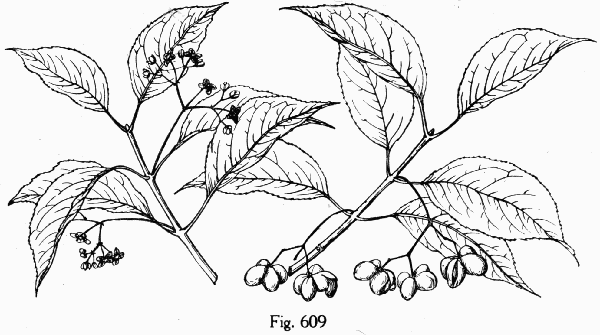
Leaves ovate-elliptic, acuminate, minutely serrate or biserrate, thin, puberulous below, 2′—5′ long and 1′—2′ wide, with a stout midrib and primary veins; turning pale yellow in the autumn and falling in October; petioles stout, ½′—1′ in length. Flowers appearing from May to the middle of June, nearly ½′ across, in twice or thrice dichotomous usually 7—15-flowered cymes borne on slender peduncles 1′—2′ long and conspicuously marked by the scars of minute bracts; calyx-lobes 4, rounded or rarely acute at apex, mostly entire; petals broad-obovate, undulate, often erose on the margins; anthers spreading. Fruit ripening in October, usually persistent on the branches until midwinter, deeply lobed, ½′ across, with light purple valves; seeds sometimes gibbous on the dorsal side, broad and [676] rounded above, narrowed below, ¼′ long, with a thin light chestnut-brown wrinkled coat and a thin scarlet aril.
A tree, rarely 20°—25° high, with a trunk 4′—6′ in diameter, spreading branches, and slender terete branchlets dark purple-brown at first, becoming lighter colored in their second season, often covered with small crowded lenticels, and marked by prominent leaf-scars, occasionally slightly or on vigorous shoots rarely broadly wing-margined; more often a shrub, 6°—10° tall. Winter-buds ⅛′ long, acute, with narrow purple apiculate scales scarious on the margins and covered by a glaucous bloom. Bark thin, ashy gray, and covered by thin minute scales. Wood heavy, hard, very close-grained, white tinged with orange.
Distribution. Borders of woods in rich soil; western New York to southern Minnesota, central Iowa, southeastern South Dakota, northwestern Nebraska, central Kansas, Oklahoma to the valley of the Canadian River (near Minton, Caddo County), southern Arkansas and eastern Texas (Dallas County), and southward to eastern Tennessee, Jackson County, Alabama, and western Florida; in the valley of the upper Missouri River, Montana; arborescent only in southern Arkansas and Texas.
Occasionally cultivated as an ornament of gardens in the eastern United States and in Europe.
2. MAYTENUS Molina.
Small unarmed trees or shrubs with slender branchlets and minute buds. Leaves alternate often in two ranks, coriaceous, petiolate, persistent; stipules minute, deciduous. Flowers polygamous, small, white, yellow or red, axillary, solitary or in cymose or fascicled clusters; calyx 5-lobed; petals 5, spreading; stamens 5, inserted under the orbicular disk, with undulate margins; filaments filiform; anthers ovoid-cordate; ovary immersed and confluent with the disk, 2—4-celled; style 0 or columnar; stigma 2—4-lobed, usually sessile; ovules erect, solitary or in pairs in each cell. Fruit capsular, coriaceous, 2—4-valved; seed erect, surrounded at base or entirely in a pulpy aril; testa crustaceous; albumen fleshy or wanting; cotyledons foliaceous.
Maytenus with some seventy species is widely distributed in the tropical and subtropical regions of America from southern Florida, where one species occurs, to Brazil and Chile.
The Chilean Maytenus boaria Molina, a handsome tree of graceful habit, is occasionally cultivated in California.
The generic name is from Mayten, the Chilean name of one of the species.
[677]
1. Maytenus phyllanthoides Benth.
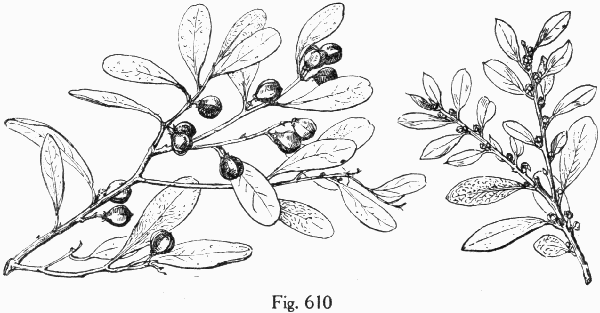
Leaves oblong-obovate to elliptic, rounded and rarely emarginate or acute at apex, gradually narrowed and cuneate at base and entire, deeply tinged with red when they unfold and at maturity, 1′—1½′ long and ½′—¾′ wide, with thickened often slightly undulate margins, a slender midrib, obscure primary veins, and conspicuous reticulate veinlets; petioles stout, ⅙′—¼′ in length. Flowers usually solitary or in compact fascicles, short-stalked, about 1/12′ in diameter; calyx-lobes rounded at apex, often persistent under the fruit, reddish, shorter than the white petals; ovary 3—4-celled. Fruit solitary, short-stalked, broad-obovoid, 4-angled, rounded and minutely mucronate at apex, abruptly narrowed below, bright red, ¼′—⅓′ long and broad, 1-celled, 3—4-valved, the valves opening to the base, ridged down the inner surface with a low ridge developed from the dissepiment, 2—4-seeded; seed ellipsoid, acute at the ends, 1/12′ long, surrounded at base by an open bright red aril.
A round-topped tree, rarely 20° high, with a trunk 1°—2° in diameter (teste J. K. Small), and slender alternate glabrous pale gray branchlets; usually a low shrub.
Distribution. Florida, west coast, Captiva Island, Lee County, to the neighborhood of Cape Sable; Cocoanut Grove, Dade County, and on many of the southern keys; on bluffs of Matagorda Bay near Corpus Christi, Nueces County, Texas; in northern Mexico and Lower California; probably of its largest size in Florida on Sands Key and on Captiva Island.
3. CANOTIA Torr.
A glabrous leafless tree, with light brown deeply furrowed bark, stout terete alternate branches terminating in rigid, pale green and striate spines, their base and those of the peduncles surrounded by black triangular persistent cushion-like processes minutely papillose on the surface. Flowers perfect, on slender spreading pedicels jointed below the middle, 3—7 together, in short-stemmed fascicles or corymbs near the end of the branches, from the axils of minute ovate subulate bracts; calyx 5-lobed, minute, persistent, much shorter than the oblong obtuse white hypogynous petals imbricated in the bud, reflexed at maturity above the middle, deciduous; stamens 5, hypogynous, opposite the lobes of the calyx; filaments awl-shaped, rather shorter than the petals, persistent on the fruit; anthers oblong, cordate, minutely apiculate, attached below the middle, grooved on the back; ovary raised upon and confluent with a fleshy slightly 10-angled gynophore, papillose-glandular on the surface, 5-celled, the cells opposite the petals, terminating in a fleshy elongated style; stigma slightly 5-lobed; ovules 6 in each cell, inserted in 2 ranks on its [678] inner angle, subhorizontal; micropyle inferior. Fruit a woody ovoid, acuminate capsule rounded at base, crowned with the subulate persistent style, septicidally 5-valved, the valves 2-lobed at apex; outer coat thin, fleshy; inner coat woody. Seed solitary or in pairs, ascending, subovoid, flattened; seed-coat subcoriaceous, papillate, produced below into a subfalcate membranaceous wing; embryo surrounded by thin fleshy albumen, erect; cotyledons oval, compressed; radicle very short, inferior.
The genus is represented by a single species.
The generic name is that by which this plant was known to the Mexicans of Arizona at the time of its discovery.
1. Canotia holacantha Torr.
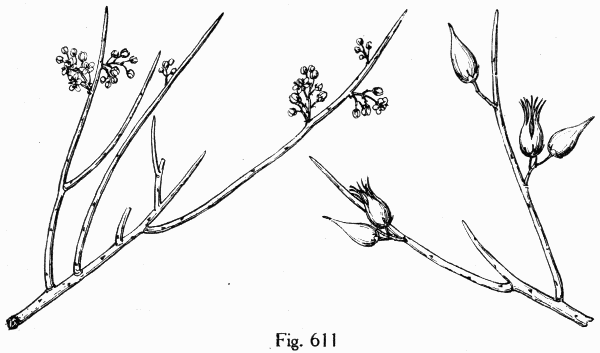
Leaves 0. Flowers ⅛′—¼′ in diameter, appearing from June until October. Capsule 1′ long; seed about ¾′ in length.
A small shrub-like tree, sometimes 20°—30° high, with a short stout trunk rarely a foot in diameter; or often a low spreading shrub.
Distribution. Dry gravelly mesas on the Arizona foothills, from the White Mountain region to the valley of Bill Williams’s Fork in the northwestern part of the state, and on Providence Mountain in southern California.
4. GYMINDA Sarg.
Trees or shrubs, with pale quadrangular branchlets and minute acuminate buds. Leaves opposite, short-petiolate, oblong-obovate, rounded and sometimes emarginate at apex, entire or remotely crenulate-serrate above the middle with revolute thickened margins, feather-veined, coriaceous, persistent; stipules minute, acuminate, membranaceous, caducous. Flowers unisexual, pedicellate, in axillary pedunculate few-flowered dichotomously branched cymes bibracteolate at apex; calyx minute, 4-lobed, persistent, with a short urceolate tube and rounded lobes; disk fleshy, filling the tube of the calyx, cup-shaped, slightly 4-lobed; petals entire, obovate, white, rounded at apex, reflexed, much longer than the lobes of the calyx; stamens 4, opposite the sepals, inserted in the lobes of the disk, exserted, 0 in the pistillate flower; filaments slender, subulate, incurved; anthers oblong; ovary 2-celled, oblong, sessile, confluent with the disk, crowned with a large 2-lobed sessile stigma, rudimentary and deeply cleft in the staminate flower; ovule solitary, suspended from the apex of the cell; raphe dorsal; micropyle superior. Fruit drupaceous, 2-celled, 1 or 2-seeded, black or dark blue, oval or obovoid, crowned with the remnants of [679] the persistent stigma, often 1-celled by abortion; flesh thin; stone thick, crustaceous. Seed oblong, suspended; seed-coat membranaceous; albumen thin, fleshy; embryo axile; cotyledons ovate, foliaceous; radicle superior, next the hilum.
Gyminda with a single species is distributed from southern Florida to Trinidad and southern Mexico, and is represented in Central America by what is perhaps a second species.
The generic name is formed by transposing the first three letters of Myginda, to which this plant had been referred.
1. Gyminda latifolia Urb.
Gyminda Grisebachii Sarg.
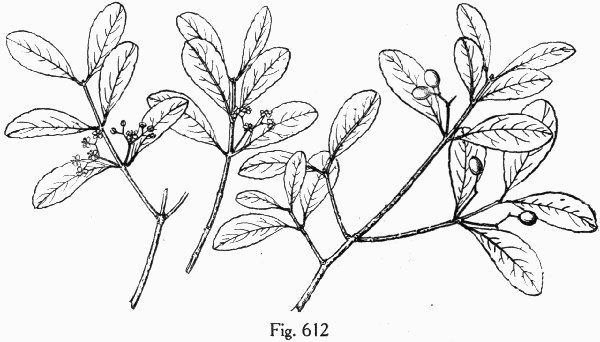
Leaves 1½′—2′ long, ¾′—1′ broad, pale yellow-green. Flowers produced on shoots of the year from April to June. Fruit ripening in November, ¼′ long.
A tree, sometimes 20°—25° high, with a trunk rarely more than 6′ in diameter, and branchlets becoming terete during their third season and covered with thin slightly grooved roughened bright red-brown bark. Bark of the trunk thin, brown tinged with red, separating into thin minute scales. Wood very heavy, hard, close-grained, dark brown or nearly black, with thick light brown sapwood of 75—80 layers of annual growth.
Distribution. Florida, common and generally distributed over the southern keys from the Marquesas group to Upper Matecombe Key; in Cuba, Porto Rico, Trinidad, and southern Mexico. A form (var. glaucescens, Small.) with smaller less coriaceous very glaucous leaves occurs in Cuba.
5. SCHÆFFERIA Jacq.
Glabrous trees or shrubs, with slender rigid terete branches and small obtuse buds. Leaves alternate, or fascicled on short spur-like branchlets, entire, obovate or spatulate, acute and minutely apiculate or gradually narrowed to the rounded or emarginate apex, cuneate below, persistent, without stipules. Flowers diœcious, pedicellate in axillary clusters from buds covered by scale-like persistent bracts; calyx 4-lobed, the lobes orbicular, persistent, much shorter than the 4 hypogynous, oblong, obtuse, white or greenish white petals; stamens 4, hypogynous, inserted under the margin of the small inconspicuous disk opposite the lobes of the calyx, wanting in the pistillate flower; filaments subulate, incurved; anthers oblong-ovoid; ovary 2-celled, ovoid, sessile, free, rudimentary in the [680] staminate flower; style very short, gradually enlarged into the large 2-lobed stigma, with spreading lobes; ovule solitary, ascending; raphe thin, ventral; micropyle inferior. Fruit a small 2-seeded fleshy drupe, ovoid or obovoid, crowned with the remnants of the persistent style, indistinctly 2-lobed by longitudinal grooves, slightly flattened; flesh thin and tuberculate; nutlets 2, obovoid, rounded at the ends, with a thick bony shell. Seed solitary, ascending; seed-coat membranaceous; albumen fleshy; cotyledons broad, foliaceous; radicle very short, inferior, next the hilum.
Schæfferia with four or five species is confined to the New World, with one species in southern Florida, and another, a small shrub, Schæfferia cuneifolia A. Gray in the arid region of western Texas and northern Mexico.
The generic name is in honor of Jakob Christian Schaeffer (1718—1790), the distinguished German naturalist.
1. Schæfferia frutescens Jacq. Yellow Wood. Box Wood.
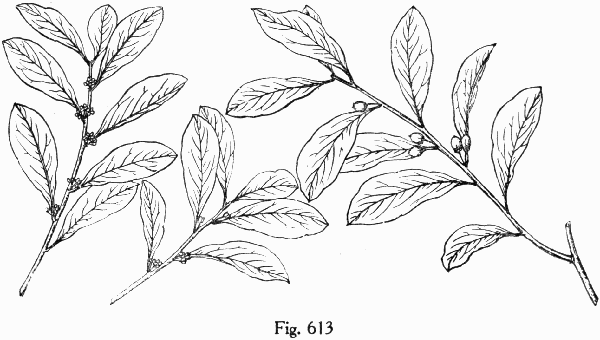
Leaves bright yellow-green, 2′—2½′ long, ½′-1′ wide, with thick revolute margins, appearing in Florida in April and persistent on the branches until the spring of the following year; petioles short and broad. Flowers opening in spring on branchlets of the year, ⅛′ across, the staminate generally 3 or 5 together on pedicels rarely more than ⅙′ long, the pistillato solitary or 2 or 3 together on pedicels rather longer than the petioles. Fruit ripening in Florida in November, slightly grooved, compressed, bright scarlet, with an acrid disagreeable flavor.
A glabrous tree, 35°—40° high, with a trunk sometimes 8′—10′ in diameter, erect branches, and slender many-angled branchlets pale greenish yellow during their first season, becoming light gray during their second year and then conspicuously marked by the remains of the persistent wart-like clusters of bud-scales; or often a tall or low shrub. Bark of the trunk rarely more than 1/12′ thick, pale brown faintly tinged with red, the surface divided by long shallow fissures, and ultimately separating into long narrow scales. Wood heavy, close-grained, bright clear yellow, with thick rather lighter colored sapwood; sometimes used as a substitute for boxwood in wood engraving.
Distribution. Florida, upper Matecombe and Old Rhodes Keys, and eastward on the southern keys, and on the Everglade Keys, Dade County; on the Bahama Islands, and widely distributed through the West Indies to Venezuela.
[681]
XXXV. ACERACEÆ.
Trees or rarely shrubs, with limpid juice, terete branches, scaly buds, their inner scales accrescent and marking the base of the branchlets with ring-like scars, and fibrous roots. Leaves opposite, or on vigorous shoots rarely in whorls of 3, long-petiolate, simple, palmately 3—7-lobed and nerved or pinnately 3—7-foliolulate, usually without stipules, deciduous, in falling leaving small U-shaped narrow scars showing the ends of 3 equidistant fibro-vascular bundles. Flowers regular, diœciously or monœciously polygamous, rarely perfect or diœcious, in fascicles produced from separate lateral buds appearing in early spring before the leaves or in terminal and lateral racemes or panicles appearing with or later than the leaves; bracts minute, caducous; calyx colored, generally 5-parted, the lobes imbricated in the bud; petals usually 5, imbricated in the bud, or 0; disk annular, fleshy, more or less lobed, with a free margin; stamens 4—10, usually 7 or 8, inserted on the summit or inside of the disk, hypogynous; filaments distinct, filiform, commonly exserted in the staminate, shorter and generally abortive in the pistillate flower; anthers oblong or linear, attached at the base, introrse, 2-celled, the cells opening longitudinally; ovary 2-lobed, 2-celled, compressed contrary to the dissepiment, wing-margined on the back; styles 2, inserted between the lobes of the ovary, connate below and divided into 2 linear branches stigmatose on their inner surface; ovules 2 in each cell, collateral, rarely superposed, ascending, attached by their broad base to the inner angle of the cell, anatropous or amphitropous; micropyle inferior. Fruit composed of 2 samaras separable from a small persistent axis, the nut-like carpels compressed laterally, produced on the back into a large chartaceous or coriaceous reticulated obovate wing thickened on the lower margin. Seed solitary by abortion, or rarely 2 in each cell, ovoid, compressed, irregularly 3-angled, ascending obliquely, without albumen; seed-coat membranaceous, the inner coat often fleshy; embryo conduplicate; cotyledons thin, foliaceous or coriaceous, irregularly plicate, incumbent or accumbent on the elongated descending radicle turned toward the hilum.